Cambridge A Level Mathematics 9709 — 2009 May/June Paper 5 · Variant 1
9709/51/M/J/09 · 6 questions · 50 marks · ≈56 min
The question paper and its mark scheme, free to read here and free to download. This is Cambridge’s own paper, exactly as it was sat.
Question paper4 pages
Mark scheme5 pages
Answers below. Sit the paper first if you are practising.
Questions as text
Q1 · A uniform lamina is in the form of a sector of a circle with centre O, radius 0.2 m and…
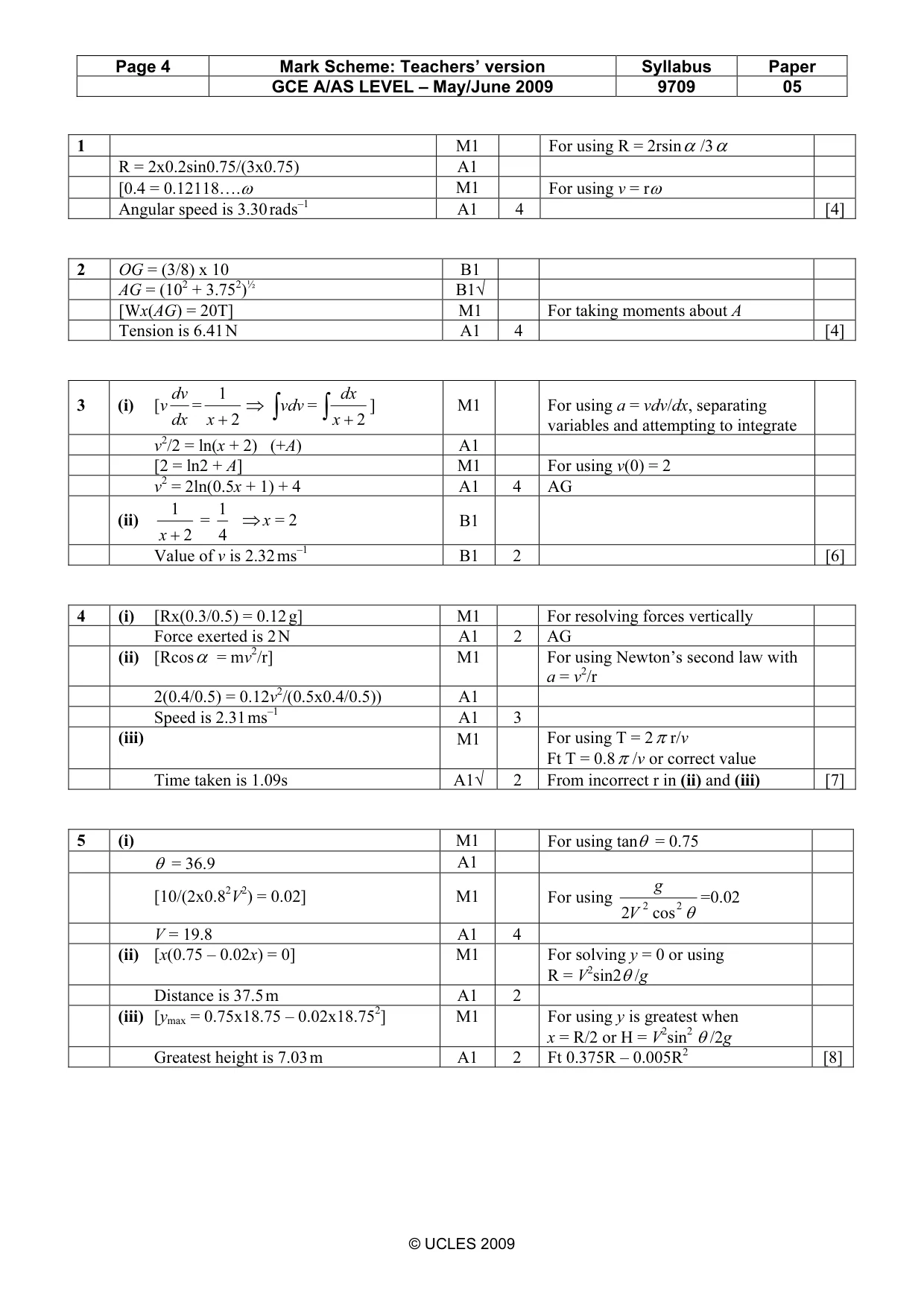
1 A uniform lamina is in the form of a sector of a circle with centre O, radius 0.2 m and angle 1.5 radians. The lamina rotates in a horizontal plane about a fixed vertical axis through O. The centre of mass of the lamina moves with speed 0.4 m s−1. Show that the angular speed of the lamina is 3.30 rad s−1, correct to 3 significant figures. [4]
Mark scheme: 1 M1 For using R = 2rsinα /3α R = 2x0.2sin0.75/(3x0.75) A1 [0.4 = 0.12118….ω M1 For using v = rω Angular speed is 3.30 rads–1 A1 4 [4]
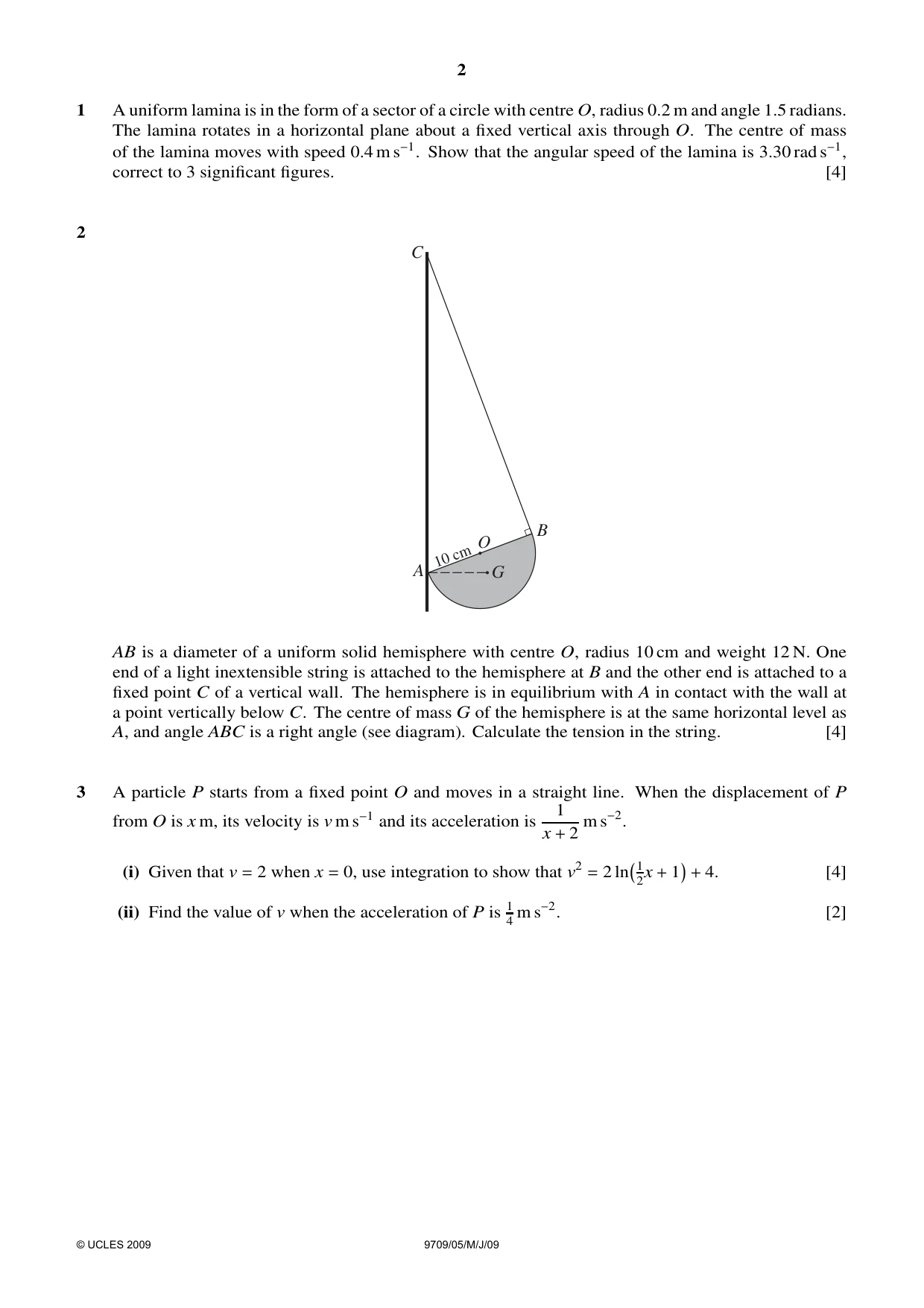
Q2 · C B O cm 10 A G AB is a diameter of a uniform solid hemisphere with centre O, radius 10…
2 C B O cm 10 A G AB is a diameter of a uniform solid hemisphere with centre O, radius 10 cm and weight 12 N. One end of a light inextensible string is attached to the hemisphere at B and the other end is attached to a fixed point C of a vertical wall. The hemisphere is in equilibrium with A in contact with the wall at a point vertically below C. The centre of mass G of the hemisphere is at the same horizontal level as A, and angle ABC is a right angle (see diagram). Calculate the tension in the string. [4]
Mark scheme: 2 OG = (3/8) x 10 B1 AG = (102 + 3.752)½ B1√ [Wx(AG) = 20T] M1 For taking moments about A Tension is 6.41 N A1 4 [4] dv 1 dx ∫ ∫
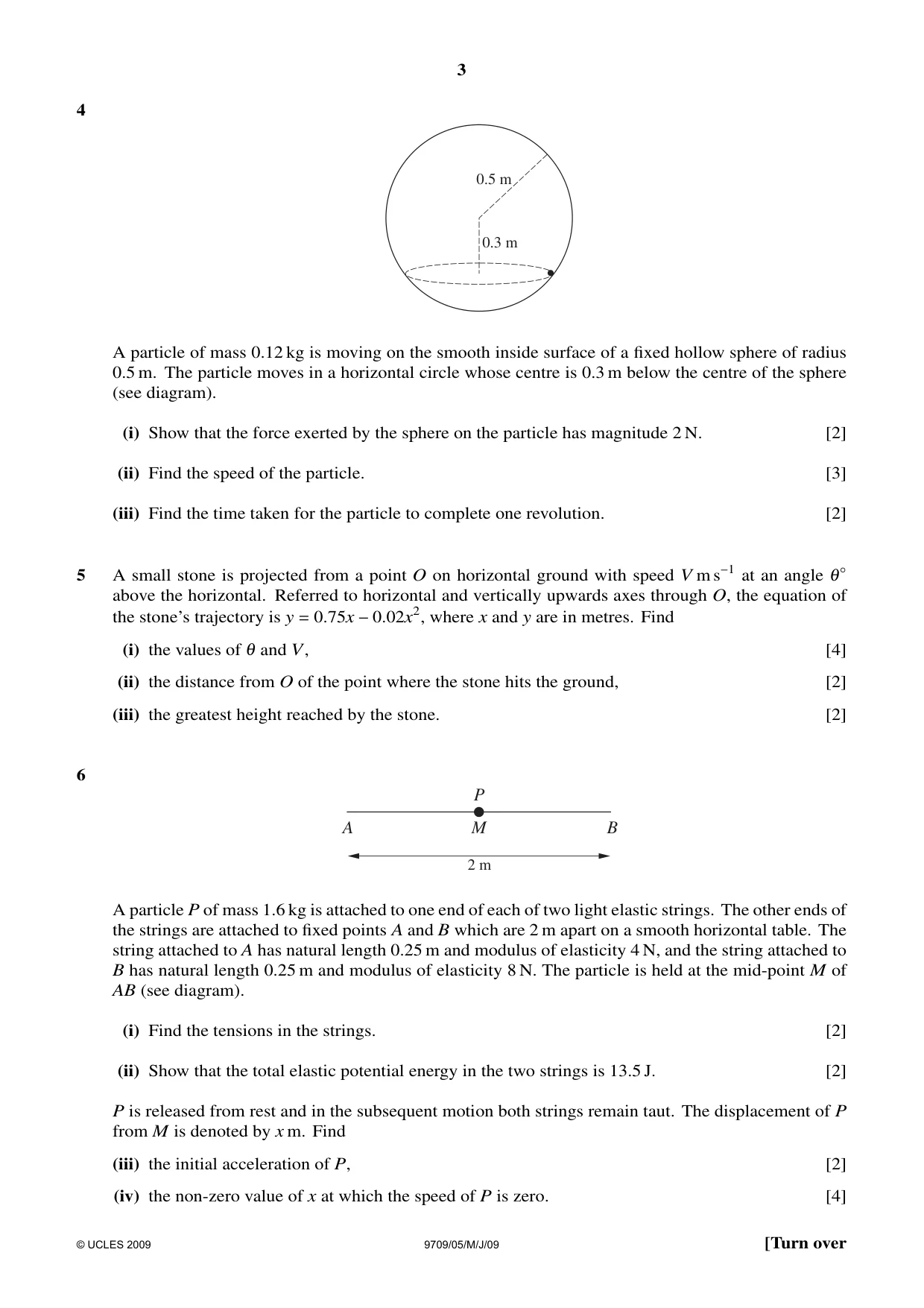
Q4 · 0.5 m 0.3 m A particle of mass 0.12 kg is moving on the smooth inside surface of a fixed…
4 0.5 m 0.3 m A particle of mass 0.12 kg is moving on the smooth inside surface of a fixed hollow sphere of radius 0.5 m. The particle moves in a horizontal circle whose centre is 0.3 m below the centre of the sphere (see diagram). (i) Show that the force exerted by the sphere on the particle has magnitude 2 N. [2] (ii) Find the speed of the particle. [3] (iii) Find the time taken for the particle to complete one revolution. [2]
Mark scheme: 4 (i) [Rx(0.3/0.5) = 0.12 g] M1 For resolving forces vertically Force exerted is 2 N A1 2 AG (ii) [Rcosα = mv2/r] M1 For using Newton’s second law with a = v2/r 2(0.4/0.5) = 0.12v2/(0.5x0.4/0.5)) A1 Speed is 2.31 ms–1 A1 3 (iii) M1 For using T = 2π r/v Ft T = 0.8π /v or correct value Time taken is 1.09s A1√ 2 From incorrect r in (ii) and (iii) [7]
Q5 · A small stone is projected from a point O on horizontal ground with speed V m s−1 at an…
5 A small stone is projected from a point O on horizontal ground with speed V m s−1 at an angle θ◦ above the horizontal. Referred to horizontal and vertically upwards axes through O, the equation of the stone’s trajectory is y = 0.75x −0.02x2, where x and y are in metres. Find (i) the values of θ and V, [4] (ii) the distance from O of the point where the stone hits the ground, [2] (iii) the greatest height reached by the stone. [2]
Mark scheme: 5 (i) M1 For using tanθ = 0.75 θ = 36.9 A1 g [10/(2x0.82V2) = 0.02] M1 For using 2 2 =0.02 2V cos θ V = 19.8 A1 4 (ii) [x(0.75 – 0.02x) = 0] M1 For solving y = 0 or using R = V2sin2θ /g Distance is 37.5 m A1 2 (iii) [ymax = 0.75x18.75 – 0.02x18.752] M1 For using y is greatest when x = R/2 or H = V2sin2 θ /2g Greatest height is 7.03 m A1 2 Ft 0.375R – 0.005R2 [8] GCE A/AS LEVEL – May/June 2009 9709 05
Q6 · P A M B 2 m A particle P of mass 1.6 kg is attached to one end of each of two light…
6 P A M B 2 m A particle P of mass 1.6 kg is attached to one end of each of two light elastic strings. The other ends of the strings are attached to fixed points A and B which are 2 m apart on a smooth horizontal table. The string attached to A has natural length 0.25 m and modulus of elasticity 4 N, and the string attached to B has natural length 0.25 m and modulus of elasticity 8 N. The particle is held at the mid-point M of AB (see diagram). (i) Find the tensions in the strings. [2] (ii) Show that the total elastic potential energy in the two strings is 13.5 J. [2] P is released from rest and in the subsequent motion both strings remain taut. The displacement of P from M is denoted by x m. Find (iii) the initial acceleration of P, [2] (iv) the non-zero value of x at which the speed of P is zero. [4]
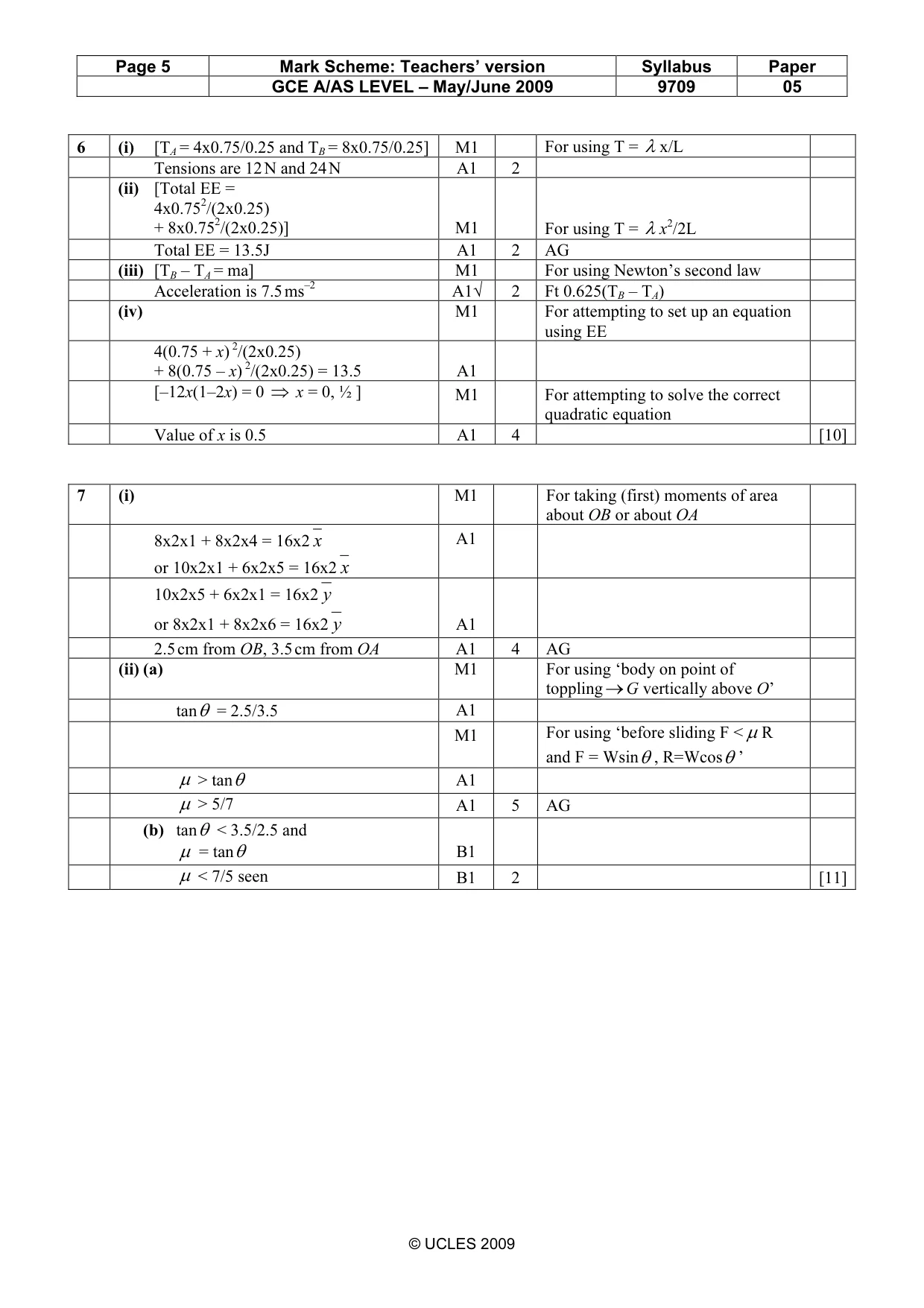
Mark scheme: 6 (i) [TA = 4x0.75/0.25 and TB = 8x0.75/0.25] M1 For using T = λ x/L Tensions are 12 N and 24 N A1 2 (ii) [Total EE = 4x0.752/(2x0.25) + 8x0.752/(2x0.25)] M1 For using T = λ x2/2L Total EE = 13.5J A1 2 AG (iii) [TB – TA = ma] M1 For using Newton’s second law Acceleration is 7.5 ms–2 A1√ 2 Ft 0.625(TB – TA) (iv) M1 For attempting to set up an equation using EE 4(0.75 + x) 2/(2x0.25) + 8(0.75 – x) 2/(2x0.25) = 13.5 A1 [–12x(1–2x) = 0 ⇒ x = 0, ½ ] M1 For attempting to solve the correct quadratic equation Value of x is 0.5 A1 4 [10]
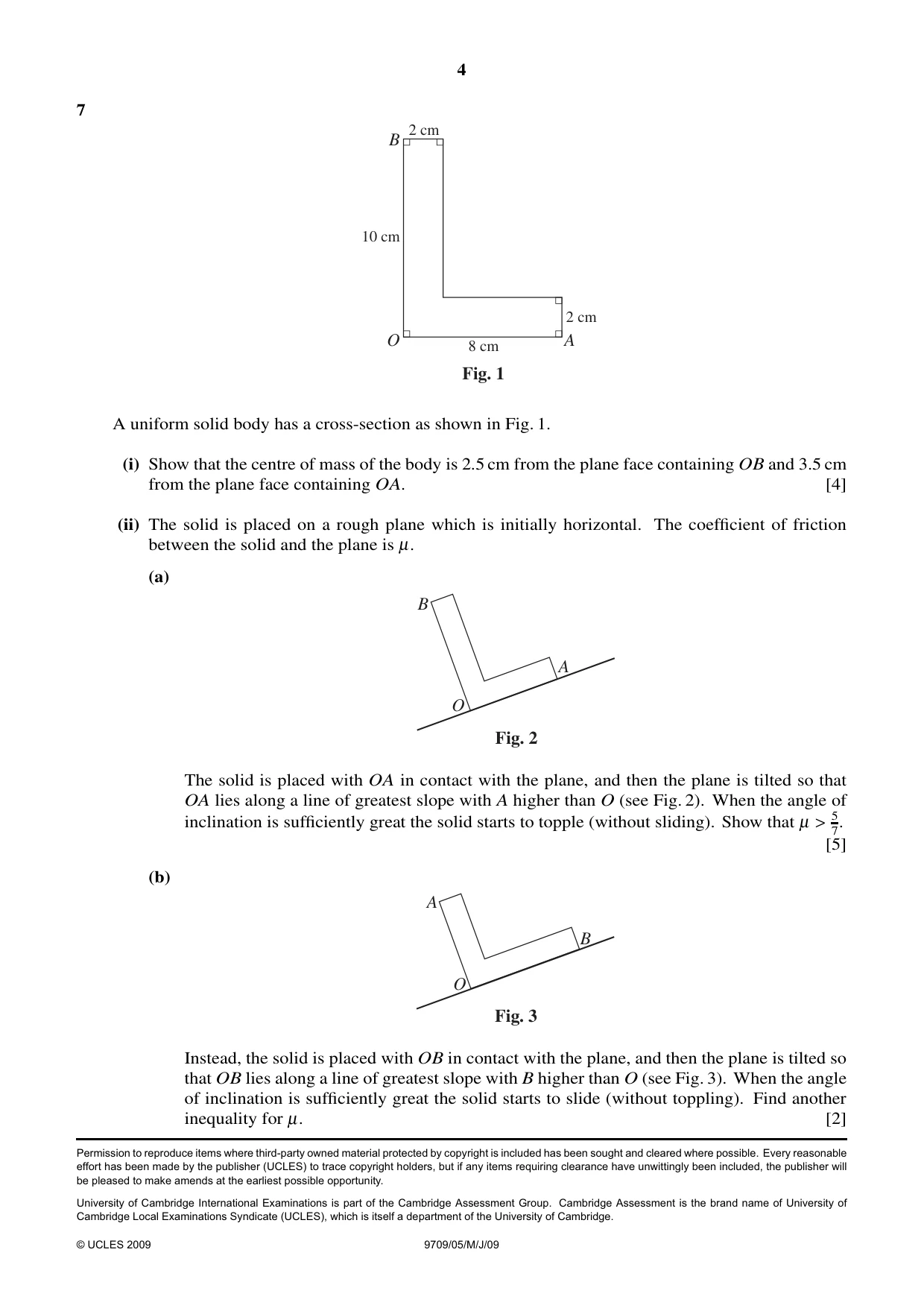
Q7 · 2 cm B 10 cm 2 cm O A 8 cm Fig
7 2 cm B 10 cm 2 cm O A 8 cm Fig. 1 A uniform solid body has a cross-section as shown in Fig. 1. (i) Show that the centre of mass of the body is 2.5 cm from the plane face containing OB and 3.5 cm from the plane face containing OA. [4] (ii) The solid is placed on a rough plane which is initially horizontal. The coefficient of friction between the solid and the plane is µ. (a) B A O Fig. 2 The solid is placed with OA in contact with the plane, and then the plane is tilted so that OA lies along a line of greatest slope with A higher than O (see Fig. 2). When the angle of inclination is sufficiently great the solid starts to topple (without sliding). Show that µ > 57. [5] (b) A B O Fig. 3 Instead, the solid is placed with OB in contact with the plane, and then the plane is tilted so that OB lies along a line of greatest slope with B higher than O (see Fig. 3). When the angle of inclination is sufficiently great the solid starts to slide (without toppling). Find another inequality for µ. [2]
Mark scheme: 7 (i) M1 For taking (first) moments of area about OB or about OA 8x2x1 + 8x2x4 = 16x2 x A1 or 10x2x1 + 6x2x5 = 16x2 x 10x2x5 + 6x2x1 = 16x2 y or 8x2x1 + 8x2x6 = 16x2 y A1 2.5 cm from OB, 3.5 cm from OA A1 4 AG (ii) (a) M1 For using ‘body on point of toppling→G vertically above O’ tanθ = 2.5/3.5 A1 M1 For using ‘before sliding F < µ R and F = Wsinθ , R=Wcosθ ’ µ > tanθ A1 µ > 5/7 A1 5 AG (b) tanθ < 3.5/2.5 and µ = tanθ B1 µ < 7/5 seen B1 2 [11]
What was in this paper
The subtopics covered by these 6 questions, and how many questions each got. Open one in a new tab to see every Cambridge question on it.
What you needed in this session
Cambridge’s own grade thresholds for 2009 May/June, Paper 5 · Variant 1. A higher threshold means an easier paper — the bar moves with how the cohort did.