Cambridge A Level Mathematics 9709 — 2010 May/June Paper 5 · Variant 3
9709/53/M/J/10 · 7 questions · 50 marks · ≈56 min
The question paper and its mark scheme, free to read here and free to download. This is Cambridge’s own paper, exactly as it was sat.
Question paper4 pages
Mark scheme5 pages
Answers below. Sit the paper first if you are practising.
Questions as text
Q1 · A particle is projected horizontally with speed 12 m s−1 from the top of a high cliff
1 A particle is projected horizontally with speed 12 m s−1 from the top of a high cliff. Find the direction of motion of the particle after 2 s. [3]
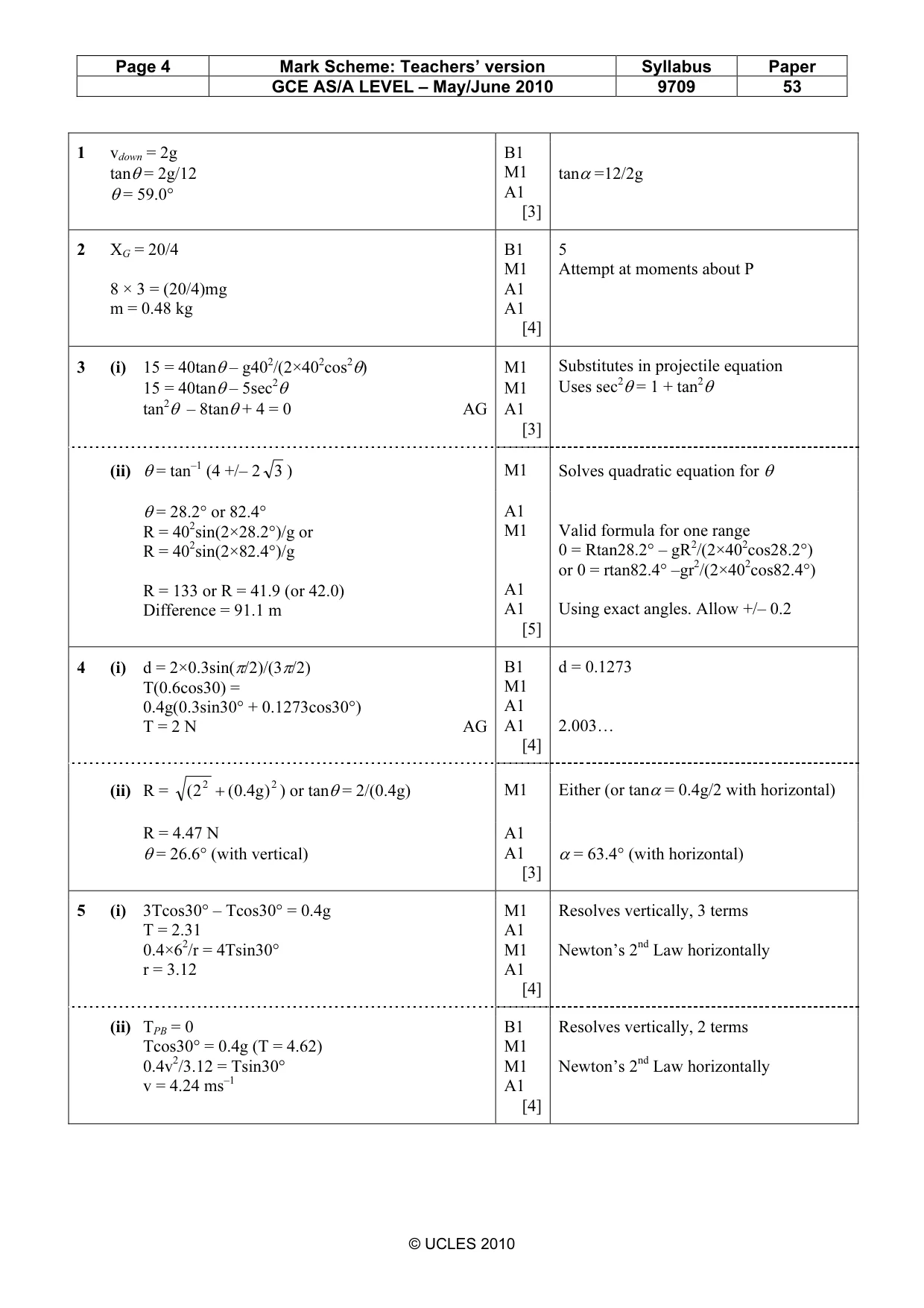
Mark scheme: 1 vdown = 2g B1 tanθ = 2g/12 M1 tanα =12/2g θ = 59.0° A1 [3]
Q2 · 3 N Q 20 cm 4 cm P A uniform solid cone has height 20 cm and base radius 4 cm
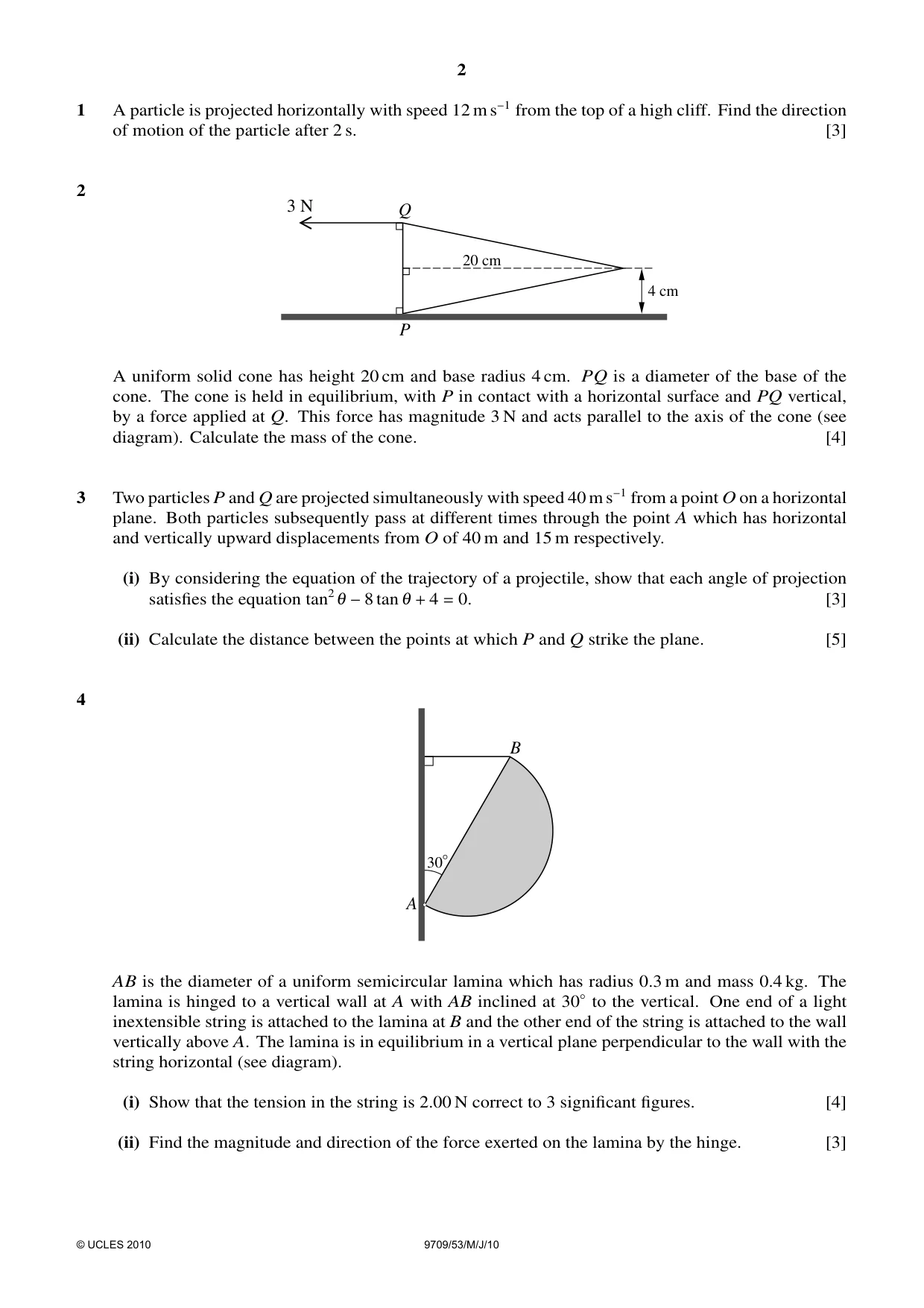
2 3 N Q 20 cm 4 cm P A uniform solid cone has height 20 cm and base radius 4 cm. PQ is a diameter of the base of the cone. The cone is held in equilibrium, with P in contact with a horizontal surface and PQ vertical, by a force applied at Q. This force has magnitude 3 N and acts parallel to the axis of the cone (see diagram). Calculate the mass of the cone. [4]
Mark scheme: 2 XG = 20/4 B1 5 M1 Attempt at moments about P 8 × 3 = (20/4)mg A1 m = 0.48 kg A1 [4] 2 2 2
Q3 · Two particles P and Q are projected simultaneously with speed 40 m s−1 from a point O on…
3 Two particles P and Q are projected simultaneously with speed 40 m s−1 from a point O on a horizontal plane. Both particles subsequently pass at different times through the point A which has horizontal and vertically upward displacements from O of 40 m and 15 m respectively. (i) By considering the equation of the trajectory of a projectile, show that each angle of projection satisfies the equation tan2θ −8 tan θ + 4 = 0. [3] (ii) Calculate the distance between the points at which P and Q strike the plane. [5]
Mark scheme: 3 (i) 15 = 40tanθ – g402/(2×402cos2θ) M1θ Substitutes in projectile equation 15 = 40tanθ – 5sec2θ M1θ Uses sec2θ = 1 + tan2θ tan2θ – 8tanθ + 4 = 0 AG A1θ [3] (ii) θ = tan–1 (4 +/– 2 3 ) M1 Solves quadratic equation for θ θ = 28.2° or 82.4° A1 R = 402sin(2×28.2°)/g or M1 Valid formula for one range R = 402sin(2×82.4°)/g 0 = Rtan28.2° – gR2/(2×402cos28.2°) or 0 = rtan82.4° –gr2/(2×402cos82.4°) R = 133 or R = 41.9 (or 42.0) A1 Difference = 91.1 m A1 Using exact angles. Allow +/– 0.2 [5]
Q4 · B 30° A AB is the diameter of a uniform semicircular lamina which has radius 0.3 m and…
4 B 30° A AB is the diameter of a uniform semicircular lamina which has radius 0.3 m and mass 0.4 kg. The lamina is hinged to a vertical wall at A with AB inclined at 30◦to the vertical. One end of a light inextensible string is attached to the lamina at B and the other end of the string is attached to the wall vertically above A. The lamina is in equilibrium in a vertical plane perpendicular to the wall with the string horizontal (see diagram). (i) Show that the tension in the string is 2.00 N correct to 3 significant figures. [4] (ii) Find the magnitude and direction of the force exerted on the lamina by the hinge. [3]
Mark scheme: 4 (i) d = 2×0.3sin(π/2)/(3π/2) B1 d = 0.1273 T(0.6cos30) = M1 0.4g(0.3sin30° + 0.1273cos30°) A1 T = 2 N AG A1 2.003… [4] (ii) R = ( 2 2 + ( 4.0g ) 2 ) or tanθ = 2/(0.4g) M1 Either (or tanα = 0.4g/2 with horizontal) R = 4.47 N A1 θ = 26.6° (with vertical) A1 α = 63.4° (with horizontal) [3]
Q5 · Q 30° B 30° P A small ball B of mass 0.4 kg is attached to fixed points P and Q on a…
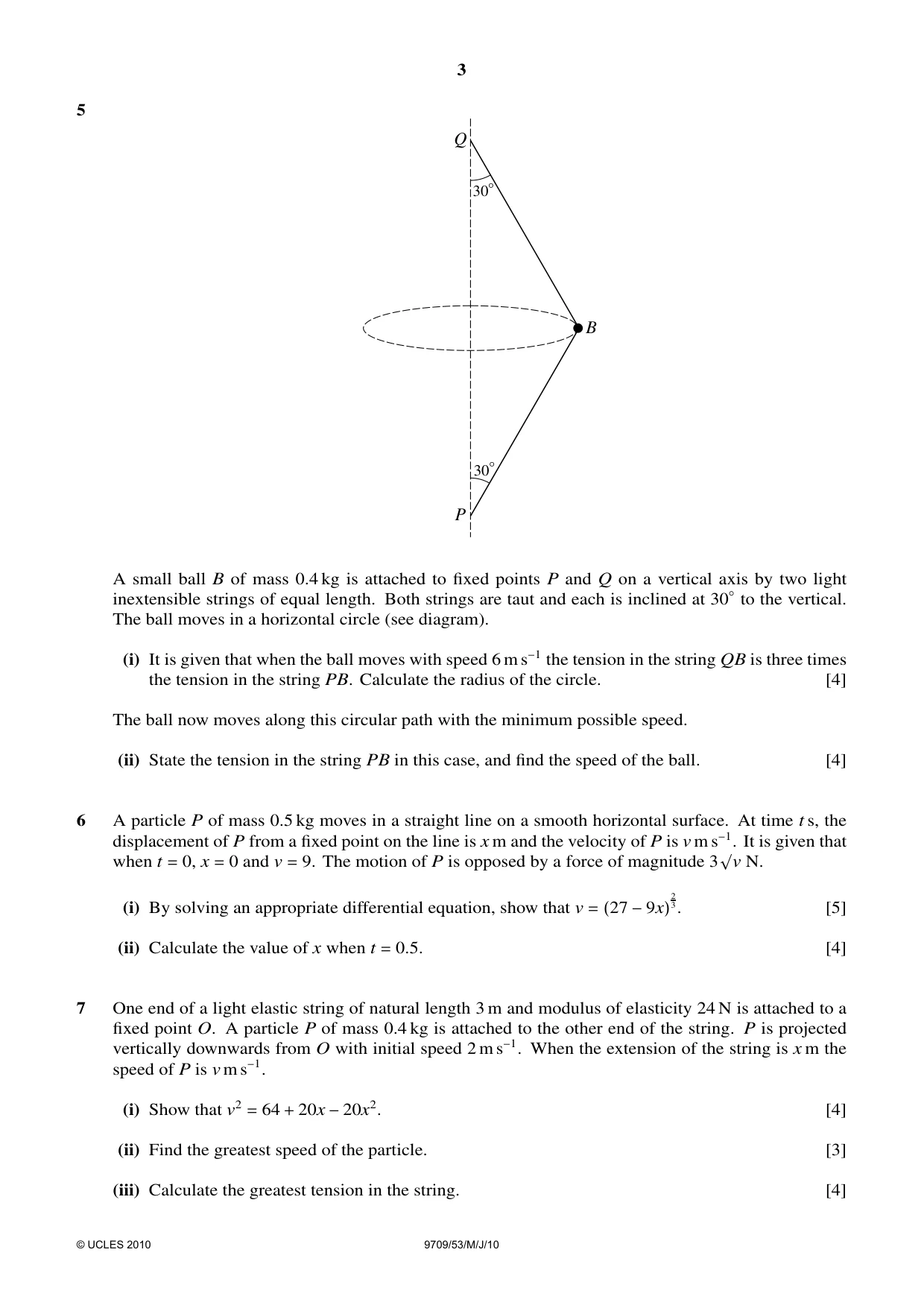
5 Q 30° B 30° P A small ball B of mass 0.4 kg is attached to fixed points P and Q on a vertical axis by two light inextensible strings of equal length. Both strings are taut and each is inclined at 30◦to the vertical. The ball moves in a horizontal circle (see diagram). (i) It is given that when the ball moves with speed 6 m s−1 the tension in the string QB is three times the tension in the string PB. Calculate the radius of the circle. [4] The ball now moves along this circular path with the minimum possible speed. (ii) State the tension in the string PB in this case, and find the speed of the ball. [4]
Mark scheme: 5 (i) 3Tcos30° – Tcos30° = 0.4g M1 Resolves vertically, 3 terms T = 2.31 A1 0.4×62/r = 4Tsin30° M1 Newton’s 2nd Law horizontally r = 3.12 A1 [4] (ii) TPB = 0 B1 Resolves vertically, 2 terms Tcos30° = 0.4g (T = 4.62) M1 0.4v2/3.12 = Tsin30° M1 Newton’s 2nd Law horizontally v = 4.24 ms–1 A1 [4] GCE AS/A LEVEL – May/June 2010 9709 53 1/2 d
Q6 · A particle P of mass 0.5 kg moves in a straight line on a smooth horizontal surface
6 A particle P of mass 0.5 kg moves in a straight line on a smooth horizontal surface. At time t s, the displacement of P from a fixed point on the line is x m and the velocity of P is vm s−1. It is given that when t 0, x 0 and v 9. The motion of P is opposed by a force of magnitude 3√v N. = = = 2 (i) By solving an appropriate differential equation, show that v = (27 −9x) 3. [5] (ii) Calculate the value of x when t = 0.5. [4]
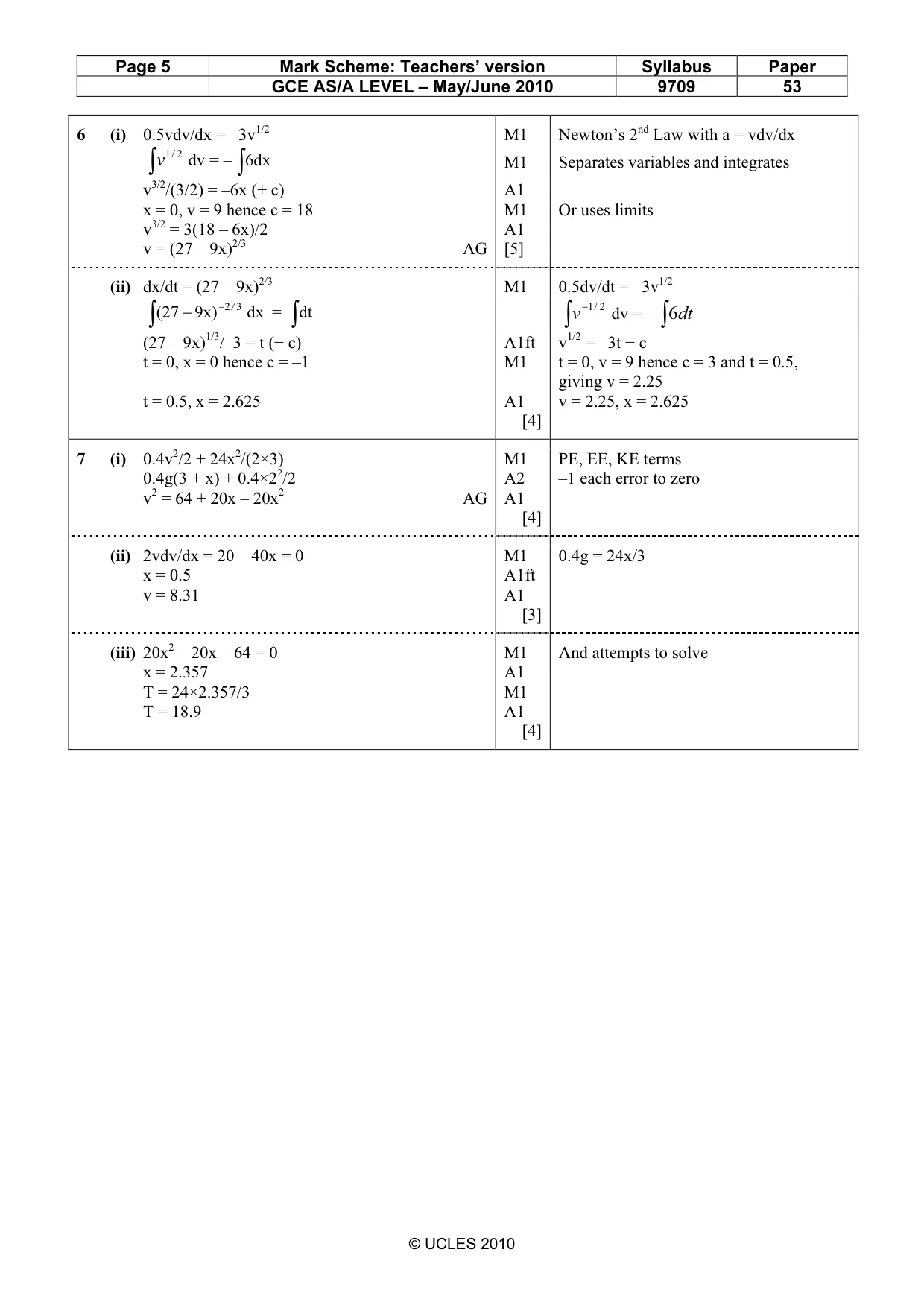
Mark scheme: 6 (i) 0.5vdv/dx = –3v1/2 M1 Newton’s 2nd Law with a = vdv/dx M1 Separates variables and integrates ∫ 1v / 2 dv = –∫6dx v3/2/(3/2) = –6x (+ c) A1 x = 0, v = 9 hence c = 18 M1 Or uses limits v3/2 = 3(18 – 6x)/2 A1 v = (27 – 9x)2/3 AG [5] (ii) dx/dt = (27 – 9x)2/3 M1 0.5dv/dt = –3v1/2 dv = ∫ (27 − 9x) −2/ 3 dx = ∫dt ∫ v −1 / 2 –∫dt6 (27 – 9x)1/3/–3 = t (+ c) A1ft v1/2 = –3t + c t = 0, x = 0 hence c = –1 M1 t = 0, v = 9 hence c = 3 and t = 0.5, giving v = 2.25 t = 0.5, x = 2.625 A1 v = 2.25, x = 2.625 [4] 2 2
Q7 · One end of a light elastic string of natural length 3 m and modulus of elasticity 24 N is…
7 One end of a light elastic string of natural length 3 m and modulus of elasticity 24 N is attached to a fixed point O. A particle P of mass 0.4 kg is attached to the other end of the string. P is projected vertically downwards from O with initial speed 2 m s−1. When the extension of the string is x m the speed of P is v m s−1. (i) Show that v2 = 64 + 20x −20x2. [4] (ii) Find the greatest speed of the particle. [3] (iii) Calculate the greatest tension in the string. [4]
Mark scheme: 7 (i) 0.4v2/2 + 24x2/(2×3) M1 PE, EE, KE terms 0.4g(3 + x) + 0.4×22/2 A2 –1 each error to zero v2 = 64 + 20x – 20x2 AG A1 [4] (ii) 2vdv/dx = 20 – 40x = 0 M1 0.4g = 24x/3 x = 0.5 A1ft v = 8.31 A1 [3] (iii) 20x2 – 20x – 64 = 0 M1 And attempts to solve x = 2.357 A1 T = 24×2.357/3 M1 T = 18.9 A1 [4]
What was in this paper
The subtopics covered by these 7 questions, and how many questions each got. Open one in a new tab to see every Cambridge question on it.
What you needed in this session
Cambridge’s own grade thresholds for 2010 May/June, Paper 5 · Variant 3. A higher threshold means an easier paper — the bar moves with how the cohort did.