Cambridge A Level Mathematics 9709 — 2009 Oct/Nov Paper 5 · Variant 2
9709/52/O/N/09 · 7 questions · 50 marks · ≈56 min
The question paper and its mark scheme, free to read here and free to download. This is Cambridge’s own paper, exactly as it was sat.
Question paper4 pages
Mark scheme6 pages
Answers below. Sit the paper first if you are practising.
Questions as text
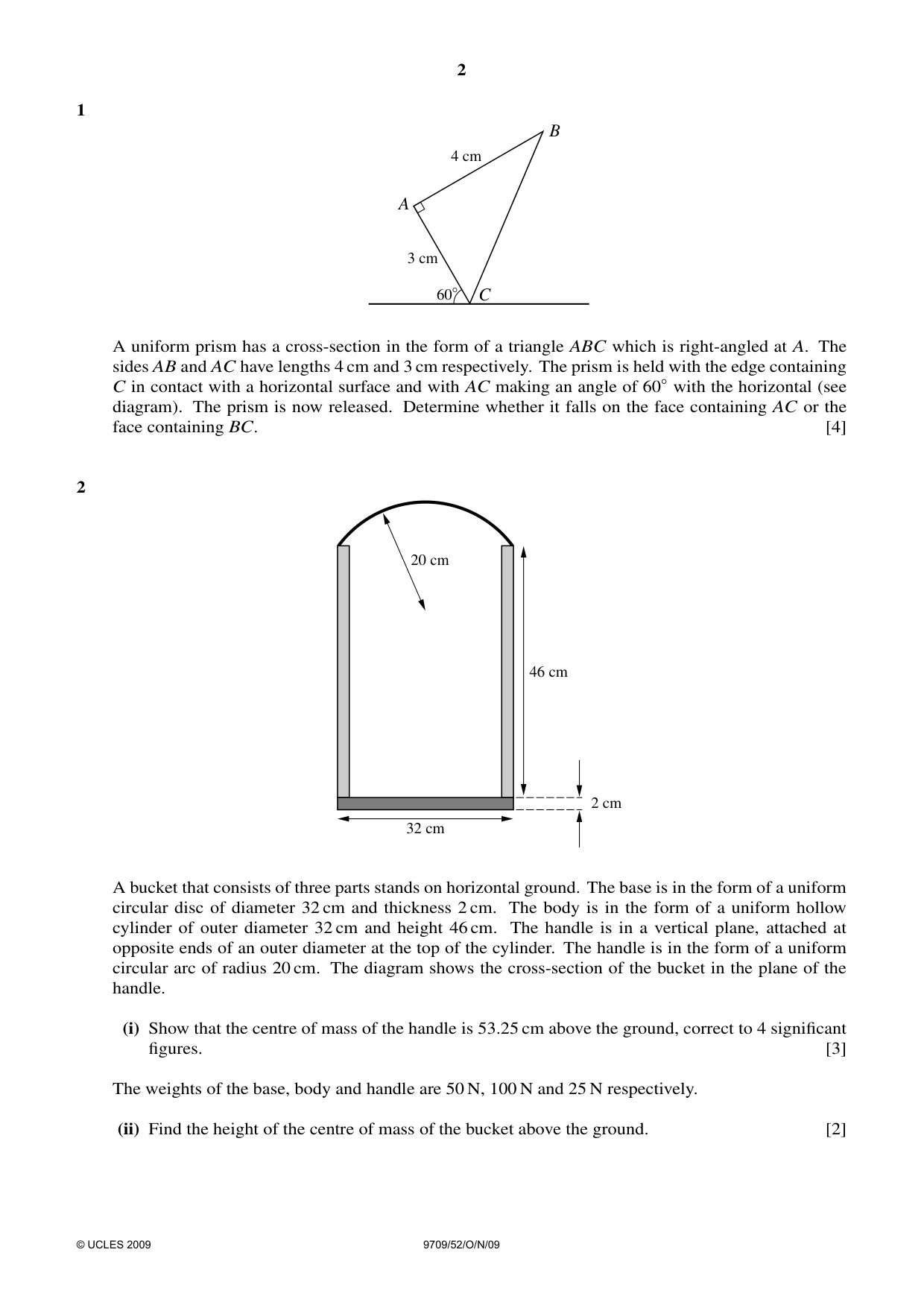
Q1 · B 4 cm A 3 cm 60° C A uniform prism has a cross-section in the form of a triangle ABC…
1 B 4 cm A 3 cm 60° C A uniform prism has a cross-section in the form of a triangle ABC which is right-angled at A. The sides AB and AC have lengths 4 cm and 3 cm respectively. The prism is held with the edge containing C in contact with a horizontal surface and with AC making an angle of 60◦with the horizontal (see diagram). The prism is now released. Determine whether it falls on the face containing AC or the face containing BC. [4]
Mark scheme: 1 [tan α = 2/3 or tan α = { 1 × 4 ÷ 2 × 3}] M1 For finding the angle between CA and the 3 3 median (or the angle between CA and CG where G is the centre of mass) α = 33. 7° A1 [60° + α > 90°] M1 For comparing 60° + α with 90° → prism falls on face containing BC A1 4 4
Q2 · 20 cm 46 cm 2 cm 32 cm A bucket that consists of three parts stands on horizontal ground
2 20 cm 46 cm 2 cm 32 cm A bucket that consists of three parts stands on horizontal ground. The base is in the form of a uniform circular disc of diameter 32 cm and thickness 2 cm. The body is in the form of a uniform hollow cylinder of outer diameter 32 cm and height 46 cm. The handle is in a vertical plane, attached at opposite ends of an outer diameter at the top of the cylinder. The handle is in the form of a uniform circular arc of radius 20 cm. The diagram shows the cross-section of the bucket in the plane of the handle. (i) Show that the centre of mass of the handle is 53.25 cm above the ground, correct to 4 significant figures. [3] The weights of the base, body and handle are 50 N, 100 N and 25 N respectively. (ii) Find the height of the centre of mass of the bucket above the ground. [2]
Mark scheme: 2 (i) [ y handle is 20 × 0.8/0.927.. from centre M1 For using y = rsin α ÷ α (17.25)] Centre of arc is 12 cm below top of B1 cylinder Height = 2 + 46 – 12 + 17.25 = 53.25 cm A1 3 AG (ii) [(50 + 100 + 25) y = M1 For taking moments about the base 50 × 1 + 100 × 25 + 25 × 53.25] Height is 22.2 cm A1 2 5
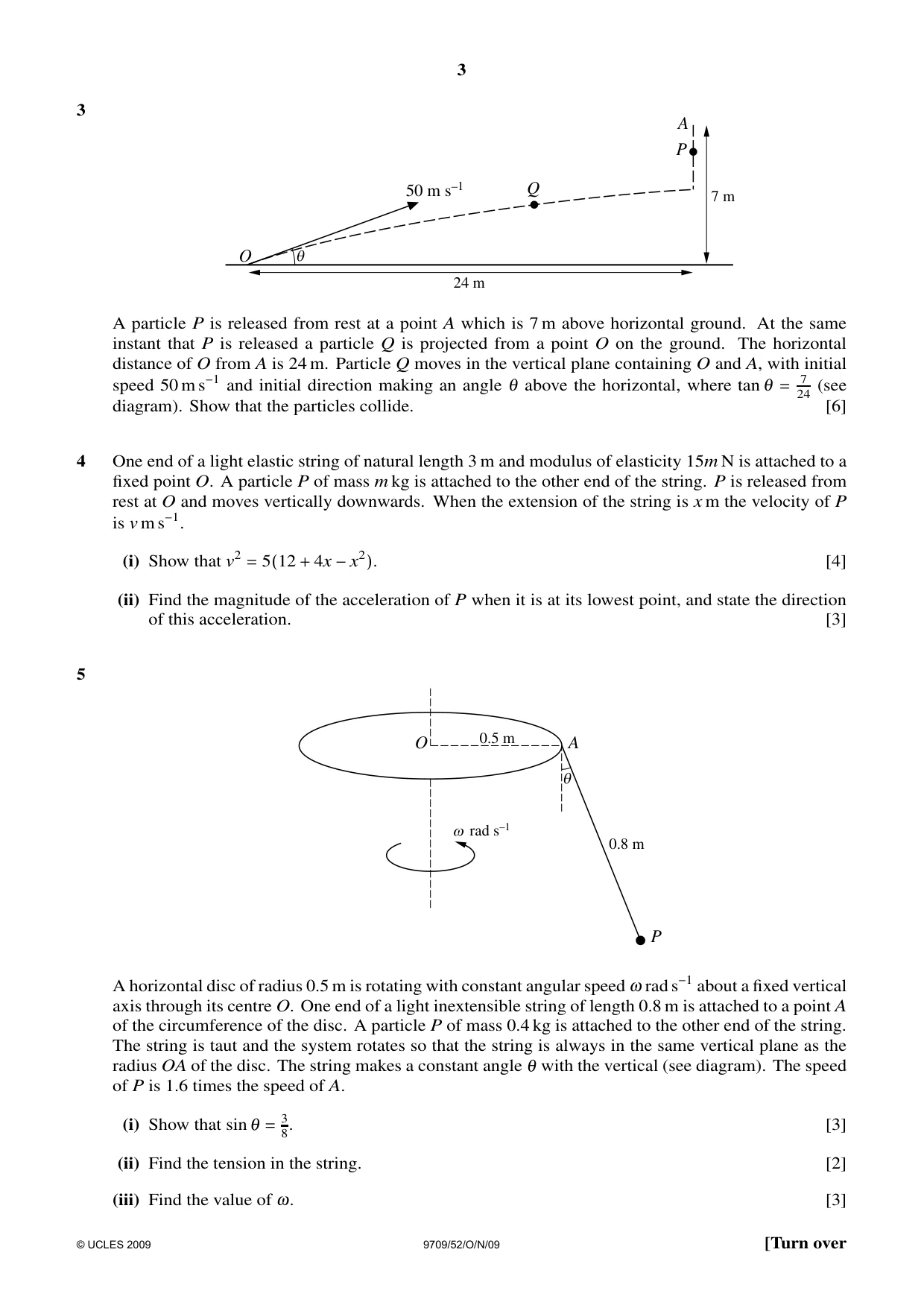
Q3 · A P 50 m s–1 Q 7 m O q 24 m A particle P is released from rest at a point A which is 7 m…
3 A P 50 m s–1 Q 7 m O q 24 m A particle P is released from rest at a point A which is 7 m above horizontal ground. At the same instant that P is released a particle Q is projected from a point O on the ground. The horizontal distance of O from A is 24 m. Particle Q moves in the vertical plane containing O and A, with initial speed 50 m s−1 and initial direction making an angle θ above the horizontal, where tan θ = 7 (see 24 diagram). Show that the particles collide. [6]
Mark scheme: 3 24 = 50 × 0.96t M1 For using x = (Vcosθ)t to find t t = 0.5 A1 [y = 50 × 0.5 × (7/25) – 1 10 × 0.52 or M1 For substituting t = 0.5 into 2 Y = Vtsinθ – 1 gt2 or x = 24 into the y = (7/24)24 – 10 × 242/(2×502×0.962)] 2 equation of the trajectory. yQ = 5.75 A1 yP = 7 – 1 g × 0.52 M1 For evaluating yP when t = 0.5 2 yP = yQ at time t = 0.5 → particles collide A1 6 6 GCE A/AS LEVEL – October/November 2009 9709 52
Q4 · One end of a light elastic string of natural length 3 m and modulus of elasticity 15m N…
4 One end of a light elastic string of natural length 3 m and modulus of elasticity 15m N is attached to a fixed point O. A particle P of mass m kg is attached to the other end of the string. P is released from rest at O and moves vertically downwards. When the extension of the string is x m the velocity of P is v m s−1. (i) Show that v2 = 5(12 + 4x −x2). [4] (ii) Find the magnitude of the acceleration of P when it is at its lowest point, and state the direction of this acceleration. [3]
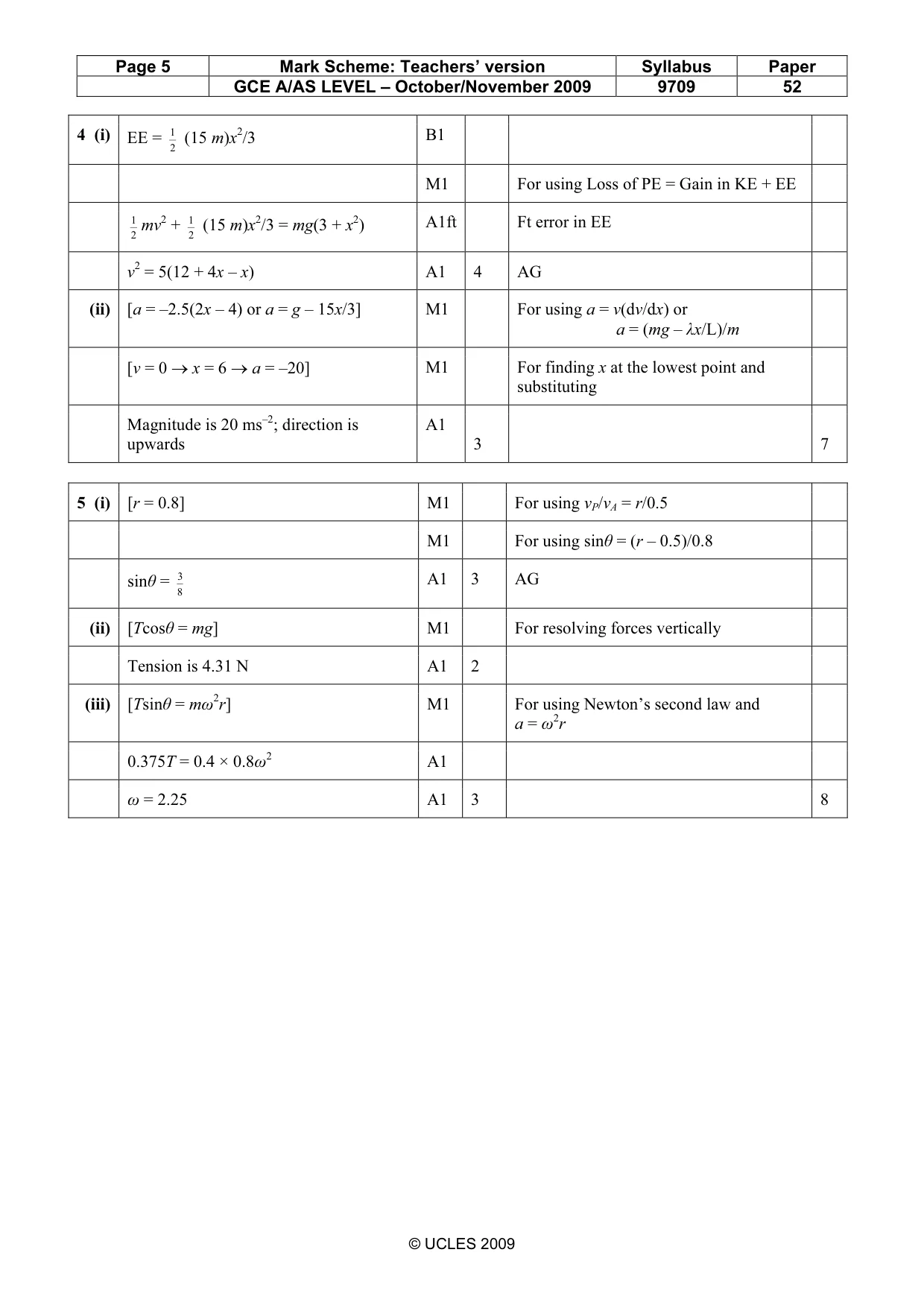
Mark scheme: 4 (i) EE = 1 (15 m)x2/3 B1 2 M1 For using Loss of PE = Gain in KE + EE 1 mv2 + 1 (15 m)x2/3 = mg(3 + x2) A1ft Ft error in EE 2 2 v2 = 5(12 + 4x – x) A1 4 AG (ii) [a = –2.5(2x – 4) or a = g – 15x/3] M1 For using a = v(dv/dx) or a = (mg – λx/L)/m [v = 0 → x = 6 → a = –20] M1 For finding x at the lowest point and substituting Magnitude is 20 ms–2; direction is A1 upwards 3 7
Q5 · 0.5 m O A q w rad s–1 0.8 m P A horizontal disc of radius 0.5 m is rotating with constant…
5 0.5 m O A q w rad s–1 0.8 m P A horizontal disc of radius 0.5 m is rotating with constant angular speed ω rad s−1 about a fixed vertical axis through its centre O. One end of a light inextensible string of length 0.8 m is attached to a point A of the circumference of the disc. A particle P of mass 0.4 kg is attached to the other end of the string. The string is taut and the system rotates so that the string is always in the same vertical plane as the radius OA of the disc. The string makes a constant angle θ with the vertical (see diagram). The speed of P is 1.6 times the speed of A. (i) Show that sin θ = 38. [3] (ii) Find the tension in the string. [2] (iii) Find the value of ω. [3]
Mark scheme: 5 (i) [r = 0.8] M1 For using vP/vA = r/0.5 M1 For using sinθ = (r – 0.5)/0.8 sinθ = 3 A1 3 AG 8 (ii) [Tcosθ = mg] M1 For resolving forces vertically Tension is 4.31 N A1 2 (iii) [Tsinθ = mω2r] M1 For using Newton’s second law and a = ω2r 0.375T = 0.4 × 0.8ω2 A1 ω = 2.25 A1 3 8 GCE A/AS LEVEL – October/November 2009 9709 52
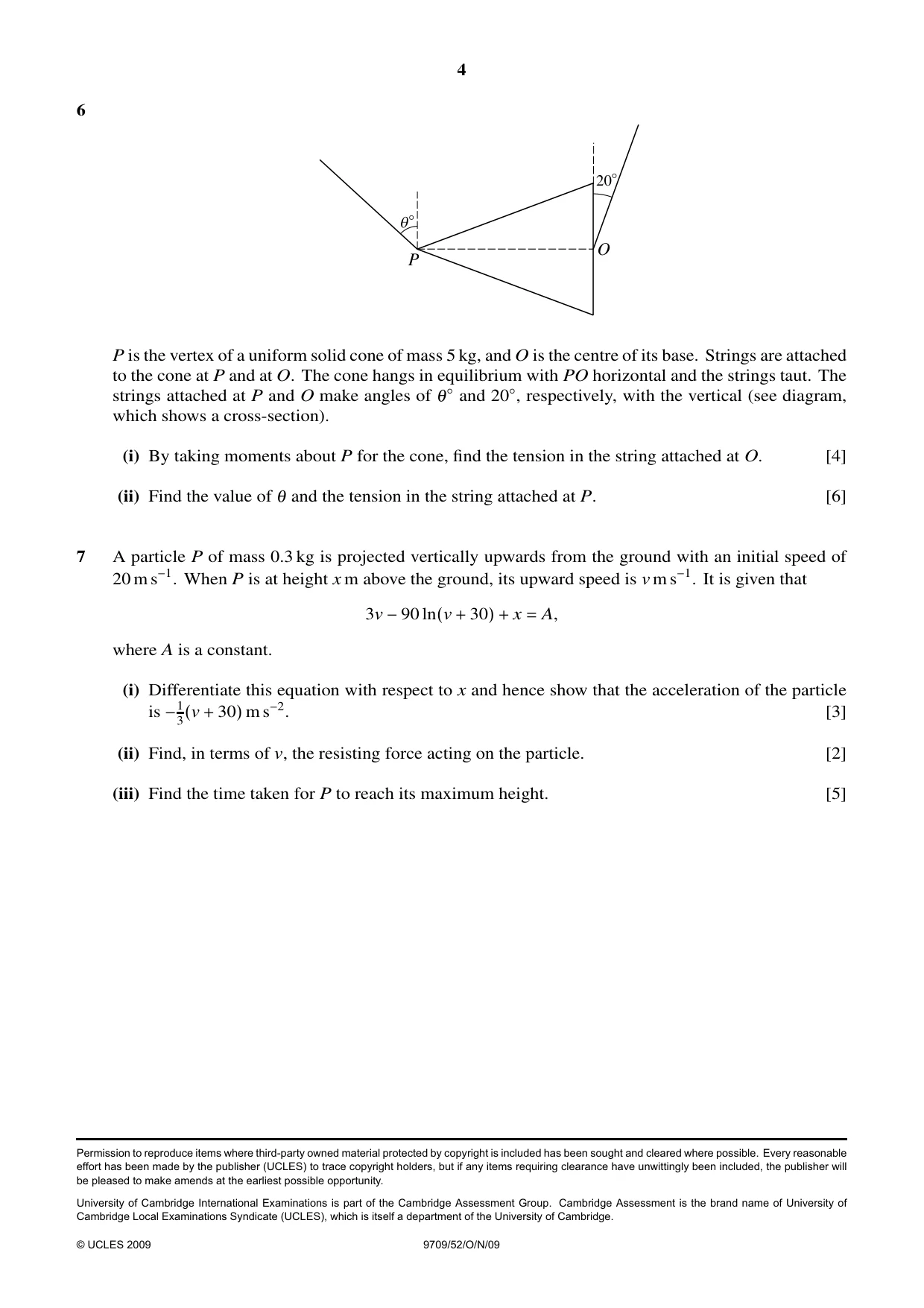
Q6 · 20° q° O P P is the vertex of a uniform solid cone of mass 5 kg, and O is the centre of…
6 20° q° O P P is the vertex of a uniform solid cone of mass 5 kg, and O is the centre of its base. Strings are attached to the cone at P and at O. The cone hangs in equilibrium with PO horizontal and the strings taut. The strings attached at P and O make angles of θ◦and 20◦, respectively, with the vertical (see diagram, which shows a cross-section). (i) By taking moments about P for the cone, find the tension in the string attached at O. [4] (ii) Find the value of θ and the tension in the string attached at P. [6]
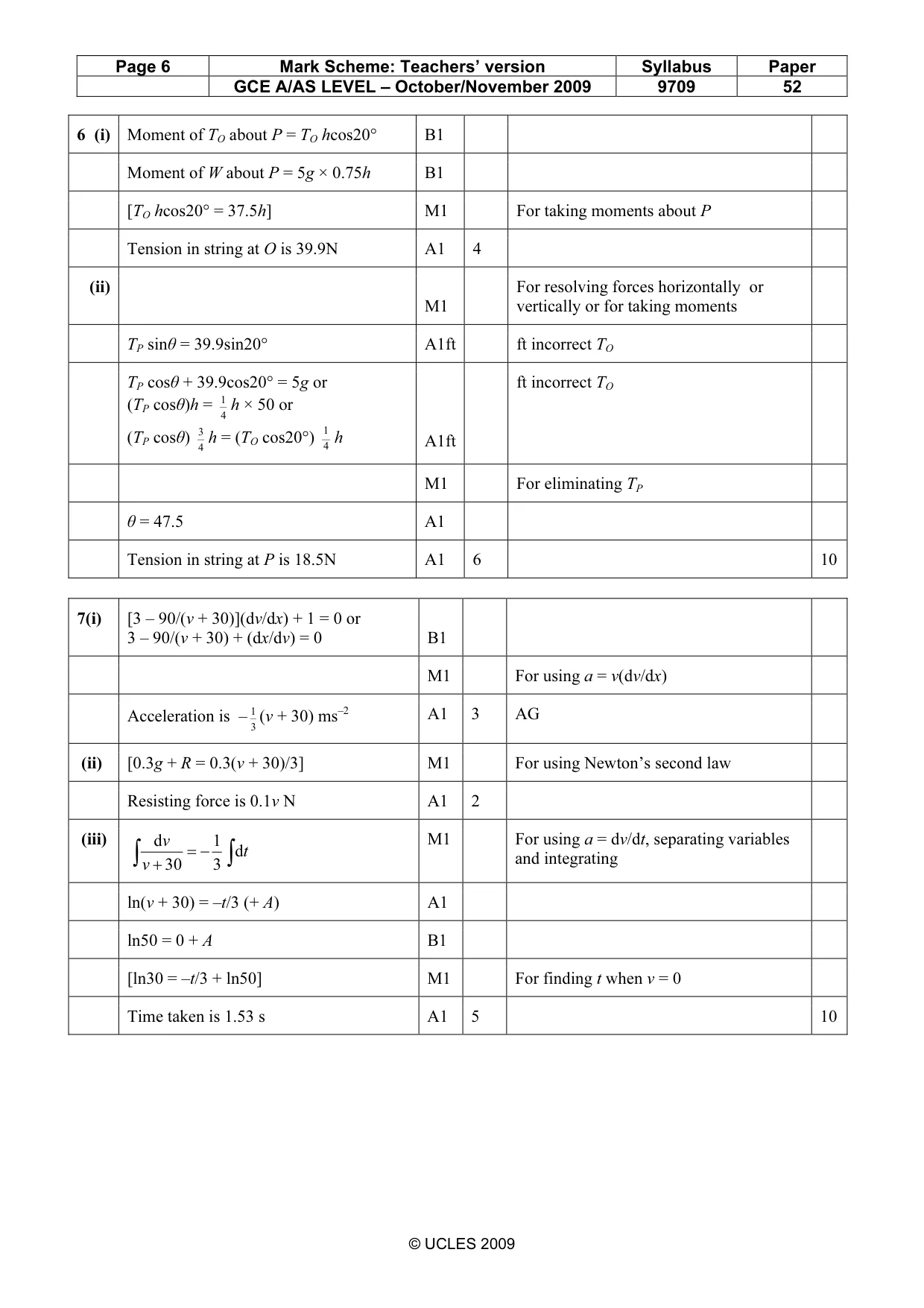
Mark scheme: 6 (i) Moment of TO about P = TO hcos20° B1 Moment of W about P = 5g × 0.75h B1 [TO hcos20° = 37.5h] M1 For taking moments about P Tension in string at O is 39.9N A1 4 (ii) For resolving forces horizontally or M1 vertically or for taking moments TP sinθ = 39.9sin20° A1ft ft incorrect TO TP cosθ + 39.9cos20° = 5g or ft incorrect TO (TP cosθ)h = 1 h × 50 or 4 (TP cosθ) 3 h = (TO cos20°) 1 h A1ft 4 4 M1 For eliminating TP θ = 47.5 A1 Tension in string at P is 18.5N A1 6 10
Q7 · A particle P of mass 0.3 kg is projected vertically upwards from the ground with an…
7 A particle P of mass 0.3 kg is projected vertically upwards from the ground with an initial speed of 20 m s−1. When P is at height x m above the ground, its upward speed is v m s−1. It is given that 3v −90 ln(v + 30) + x = A, where A is a constant. (i) Differentiate this equation with respect to x and hence show that the acceleration of the particle is −13(v + 30) m s−2. [3] (ii) Find, in terms of v, the resisting force acting on the particle. [2] (iii) Find the time taken for P to reach its maximum height. [5]
Mark scheme: 7(i) [3 – 90/(v + 30)](dv/dx) + 1 = 0 or 3 – 90/(v + 30) + (dx/dv) = 0 B1 M1 For using a = v(dv/dx) Acceleration is – 1 (v + 30) ms–2 A1 3 AG 3 (ii) [0.3g + R = 0.3(v + 30)/3] M1 For using Newton’s second law Resisting force is 0.1v N A1 2 (iii) d v 1 M1 For using a = dv/dt, separating variables and integrating ∫ v + 30 = − 3 ∫ dt ln(v + 30) = –t/3 (+ A) A1 ln50 = 0 + A B1 [ln30 = –t/3 + ln50] M1 For finding t when v = 0 Time taken is 1.53 s A1 5 10
What was in this paper
The subtopics covered by these 7 questions, and how many questions each got. Open one in a new tab to see every Cambridge question on it.
What you needed in this session
Cambridge’s own grade thresholds for 2009 Oct/Nov, Paper 5 · Variant 2. A higher threshold means an easier paper — the bar moves with how the cohort did.