Questions as text
Q1 · Ali has been charged with manslaughter 9084/22 May/June 2017
1 (a) Ali has been charged with manslaughter. He appears before a magistrate so he can be committed for trial at the Crown Court. Ali shouts that he wants his case heard by at least two magistrates and in private. The magistrate tells Ali to be quiet but he starts to sing loudly and will not stop. The magistrate sends Ali out of court, looks at all the material relating to the case and commits him for trial at the Crown Court. Explain whether Ali’s committal proceedings are lawful under the Magistrates’ Courts Act 1980. [10] (b) Jasmine has been charged with burglary and Brian is the prosecuting barrister. At the committal proceedings he wants to submit a written statement from Connor, aged 16, who saw Jasmine breaking into a shop. Connor has signed the statement but it does not say how old he is. Brian is in a rush to meet with a client so he gives the statement to the magistrate and asks them to pass it on to the defence barrister. Explain whether Jasmine’s committal proceedings are lawful under the Magistrates’ Courts Act 1980. [10] (c) Jerome has been charged with the murder of a famous pop star. His barrister argues that media attention makes it hard for Jerome to get a fair trial. The magistrate agrees to hold the committal proceedings in private. The prosecution barrister, Helena, submits a written signed statement made by William, who cannot read, which says he saw Jerome at the murder scene. Explain whether Jerome’s committal proceedings are lawful under the Magistrates’ Courts Act 1980. [10] (d) Explain the selection and role of magistrates in criminal cases. Discuss their importance in the English legal system. [20] Source material for Question 1 Magistrates’ Courts Act 1980 Section 4 General nature of committal proceedings (1) The functions of examining justices* may be discharged by a single justice. (2) Examining justices shall sit in open court except where any enactment contains an express provision to the contrary and except where it appears to them as respects the whole or any part of committal proceedings that the ends of justice would not be served by their sitting in open court. (3) Subject to subsection (4) below, evidence tendered before examining justices shall be tendered in the presence of the accused. (4) Examining justices may allow evidence to be tendered before them in the absence of the accused if─ (a) they consider that by reason of his disorderly conduct before them it is not practicable for the evidence to be tendered in his presence, or (b) he cannot be present for reasons of health but is represented by a legal representative and has consented to the evidence being tendered in his absence. *An examining justice is another term for a magistrate. Section 5A Evidence which is admissible … (2) Evidence falls within this subsection if it─ (a) is tendered by or on behalf of the prosecutor, and (b) falls within subsection (3) below. (3) The following evidence falls within this subsection─ (a) written statements complying with section 5B below. Section 5B Written statements … (2) The conditions falling within this subsection are that─ (a) the statement purports to be signed by the person who made it; … (c) before the statement is tendered in evidence a copy of the statement is given, by or on behalf of the prosecutor, to each of the other parties to the proceedings. (3) The conditions falling within this subsection are that─ (a) if the statement is made by a person under 18 years old, it gives his age; (b) if it is made by a person who cannot read it, it is read to him before he signs it and is accompanied by a declaration by the person who so read the statement to the effect that it was so read.
50 marks
This question in 9084/22 May/June 2017
Q2 · A vacancy arises for a judge in the Supreme Court 9084/21 Oct/Nov 2018
2 (a) A vacancy arises for a judge in the Supreme Court. The Lord Chancellor and his deputy meet to decide who to appoint. Patrick, an old friend of the Lord Chancellor, was a barrister for 15 years before sitting in the Court of Appeal for 5 years. He is currently ending a two year contract teaching law at an American university. The Lord Chancellor writes to the Prime Minister with Patrick’s name and the Prime Minister recommends Patrick is appointed. Explain how the Constitutional Reform Act 2005 will apply to Patrick. [10] (b) A new Deputy President of the Supreme Court is needed so the Lord Chancellor sets up a selection commission to choose one. Jane has been a successful advocate in Scotland and England for 20 years. Jane has the support of judges in every part of the United Kingdom (England, Scotland, Wales and Northern Ireland) who are not on the commission. As there is no Scottish judge in the Supreme Court, the Lord Chancellor sends Jane’s name to the Prime Minister and he recommends her appointment. Explain how the Constitutional Reform Act 2005 will apply to Jane. [10] (c) A new President of the Supreme Court is needed. Lord Kent is a member of the Lord Chancellor’s selection commission and he has been a member of the Supreme Court for six years. Lots of senior judges support Lord Kent’s nomination but the Lord Chancellor prefers Lady Jones, who has also been a Supreme Court judge for six years. The Lord Chancellor sends both names to the Prime Minister, who recommends that Lord Kent is appointed. Explain how the Constitutional Reform Act 2005 will apply to Lord Kent. [10] (d) Describe the training of judges. Assess the effectiveness of their training. [20] Source material for Question 2 Constitutional Reform Act 2005 Section 25 Qualification for appointment to the Supreme Court (1) A person is not qualified to be appointed a judge of the Supreme Court unless he has (at any time) — (a) held high judicial office for a period of at least 2 years, (b) satisfied the judicial-appointment eligibility condition on a 15-year basis, or (c) been a qualifying practitioner for a period of at least 15 years. Section 26 Selection of members of the Court (1) This section applies to a recommendation for an appointment to one of the following offices— (a) judge of the Supreme Court; (b) President of the Court; (c) Deputy President of the Court. (2) A recommendation may be made only by the Prime Minister. (3) The Prime Minister— (a) must recommend any person whose name is notified to him by the Lord Chancellor; (b) may not recommend any other person. (4) A person who is not a judge of the Court must be recommended for appointment as a judge if his name is notified to the Prime Minister for an appointment as President or Deputy President. (5) If there is a vacancy in one of the offices mentioned in subsection (1), or it appears to him that there will soon be such a vacancy, the Lord Chancellor must convene a selection commission for the selection of a person to be recommended. Section 27 Selection process … (2) As part of the selection process the commission must consult each of the following— (a) such of the senior judges as are not members of the commission and are not willing to be considered for selection; (b) the Lord Chancellor; … (5) Selection must be on merit. (6) A person may be selected only if he meets the requirements of section 25. (7) A person may not be selected if he is a member of the commission. (8) In making selections for the appointment of judges of the Court the commission must ensure that between them the judges will have knowledge of, and experience of practice in, the law of each part of the United Kingdom. … (10) Any selection must be of one person only.
50 marks
Mark scheme: 2(a) Explain how the Constitutional Reform Act 2005 will apply to Patrick 10 Band 1 [0 marks] Irrelevant answer. Band 2–3 [1–5 marks] A candidate needs to be selective in choosing the correct part of the source material. • Principle without section – understanding that Patrick will not be appointed. and/or • Reference to s25 and/or s26 Constitutional Reform Act 2005 with little or no development. Band 4 [6–7 marks] Some development of s25 and/or s26 and some application. Band 5 [8–10 marks] Full development of the relevant sections. Conclusion: Patrick will not be appointed as a judge of the Supreme Court although he meets s25(1)(a) as he has held high judicial office for five years and (c) as he has been a barrister for 15 years. Patrick’s appointment is also covered by s26(1)(a). The fact that he is currently in America does not disqualify him and the Prime Minister has followed the correct process in s26(3). However the Lord Chancellor has breached s26(5) as he has not called together a selection committee. 2(b) Explain how the Constitutional Reform Act 2005 will apply to Jane. 10 Band 1 [0 marks] Irrelevant answer. Band 2–3 [1–5 marks] A candidate needs to be selective in choosing the correct part of the source material. • Principle without section – understanding that Jane will be appointed as Deputy President. and/or • Reference to s25 and/or s26 and/or s27 Constitutional Reform Act 2005 with little or no development. Band 4 [6–7 marks] Some development of s25 and/or s26 and/or s27 and some application. Band 5 [8–10 marks] Full development of the relevant sections. Conclusion: Jane will be appointed as Deputy President of the Supreme Court as she meets the qualification requirement under s25(1)(c) and the Prime Minister has followed the correct process under s26(4) for a vacancy which comes within s26(1)(c). The Lord Chancellor has followed the correct procedure under s26(5) as he has set up a selection commission. S27(2) has been followed as judges from every part of the UK have been consulted, as has s27(8) as Jane can give expertise on Scottish law. 2(c) Explain how the Constitutional Reform Act 2005 will apply to Lord 10 Kent. Band 1 [0 marks] Irrelevant answer. Band 2–3 [1–5 marks] A candidate needs to be selective in choosing the correct part of the source material. • Principle without section – understanding that Lord Kent cannot be appointed. and/or • Reference to s25 and/or s26 and/or s27 Constitutional Reform Act 2005 with little or no development. Band 4 [6–7 marks] Some development of s25 and/or s26 and/or s27 and some application. Band 5 [8–10 marks] Full development of the relevant sections. Conclusion: Lord Kent cannot be appointed as President although he does meet s25(1)(a) as he has been a Supreme court judge for six years. The vacancy falls within s26(1)(b) and the Lord Chancellor has followed s26(5) in setting up a selection commission. Lord Kent meets s26(6) but he cannot be appointed under s27(7) as he is a member of the selection commission. As two names were submitted to the Prime Minister under s27(10) only one can be selected and Lord Kent cannot be the person chosen under s26(3). 2(d) Describe the training of judges. Assess the effectiveness of their 20 training. Band 1 [0 marks] Irrelevant answer. Band 2 [1–6 marks] Discusses the training of judges and its effectiveness in general terms. Band 3 [7–13 marks] Some more detailed references to the training of judges and its effectiveness but lacking in detail or range. Band 4–5 [14–20 marks] Very good discussion of the training of judges and critical evaluation of their training. To reach higher marks all aspects of the question need to be dealt with in some detail with good critical awareness.
This question in 9084/21 Oct/Nov 2018
Q3 · A vacancy arises for a judge in the Supreme Court 9084/23 Oct/Nov 2018
2 (a) A vacancy arises for a judge in the Supreme Court. The Lord Chancellor and his deputy meet to decide who to appoint. Patrick, an old friend of the Lord Chancellor, was a barrister for 15 years before sitting in the Court of Appeal for 5 years. He is currently ending a two year contract teaching law at an American university. The Lord Chancellor writes to the Prime Minister with Patrick’s name and the Prime Minister recommends Patrick is appointed. Explain how the Constitutional Reform Act 2005 will apply to Patrick. [10] (b) A new Deputy President of the Supreme Court is needed so the Lord Chancellor sets up a selection commission to choose one. Jane has been a successful advocate in Scotland and England for 20 years. Jane has the support of judges in every part of the United Kingdom (England, Scotland, Wales and Northern Ireland) who are not on the commission. As there is no Scottish judge in the Supreme Court, the Lord Chancellor sends Jane’s name to the Prime Minister and he recommends her appointment. Explain how the Constitutional Reform Act 2005 will apply to Jane. [10] (c) A new President of the Supreme Court is needed. Lord Kent is a member of the Lord Chancellor’s selection commission and he has been a member of the Supreme Court for six years. Lots of senior judges support Lord Kent’s nomination but the Lord Chancellor prefers Lady Jones, who has also been a Supreme Court judge for six years. The Lord Chancellor sends both names to the Prime Minister, who recommends that Lord Kent is appointed. Explain how the Constitutional Reform Act 2005 will apply to Lord Kent. [10] (d) Describe the training of judges. Assess the effectiveness of their training. [20] Source material for Question 2 Constitutional Reform Act 2005 Section 25 Qualification for appointment to the Supreme Court (1) A person is not qualified to be appointed a judge of the Supreme Court unless he has (at any time) — (a) held high judicial office for a period of at least 2 years, (b) satisfied the judicial-appointment eligibility condition on a 15-year basis, or (c) been a qualifying practitioner for a period of at least 15 years. Section 26 Selection of members of the Court (1) This section applies to a recommendation for an appointment to one of the following offices— (a) judge of the Supreme Court; (b) President of the Court; (c) Deputy President of the Court. (2) A recommendation may be made only by the Prime Minister. (3) The Prime Minister— (a) must recommend any person whose name is notified to him by the Lord Chancellor; (b) may not recommend any other person. (4) A person who is not a judge of the Court must be recommended for appointment as a judge if his name is notified to the Prime Minister for an appointment as President or Deputy President. (5) If there is a vacancy in one of the offices mentioned in subsection (1), or it appears to him that there will soon be such a vacancy, the Lord Chancellor must convene a selection commission for the selection of a person to be recommended. Section 27 Selection process … (2) As part of the selection process the commission must consult each of the following— (a) such of the senior judges as are not members of the commission and are not willing to be considered for selection; (b) the Lord Chancellor; … (5) Selection must be on merit. (6) A person may be selected only if he meets the requirements of section 25. (7) A person may not be selected if he is a member of the commission. (8) In making selections for the appointment of judges of the Court the commission must ensure that between them the judges will have knowledge of, and experience of practice in, the law of each part of the United Kingdom. … (10) Any selection must be of one person only.
50 marks
Mark scheme: 2(a) Explain how the Constitutional Reform Act 2005 will apply to Patrick 10 Band 1 [0 marks] Irrelevant answer. Band 2–3 [1–5 marks] A candidate needs to be selective in choosing the correct part of the source material. • Principle without section – understanding that Patrick will not be appointed. and/or • Reference to s25 and/or s26 Constitutional Reform Act 2005 with little or no development. Band 4 [6–7 marks] Some development of s25 and/or s26 and some application. Band 5 [8–10 marks] Full development of the relevant sections. Conclusion: Patrick will not be appointed as a judge of the Supreme Court although he meets s25(1)(a) as he has held high judicial office for five years and (c) as he has been a barrister for 15 years. Patrick’s appointment is also covered by s26(1)(a). The fact that he is currently in America does not disqualify him and the Prime Minister has followed the correct process in s26(3). However the Lord Chancellor has breached s26(5) as he has not called together a selection committee. 2(b) Explain how the Constitutional Reform Act 2005 will apply to Jane. 10 Band 1 [0 marks] Irrelevant answer. Band 2–3 [1–5 marks] A candidate needs to be selective in choosing the correct part of the source material. • Principle without section – understanding that Jane will be appointed as Deputy President. and/or • Reference to s25 and/or s26 and/or s27 Constitutional Reform Act 2005 with little or no development. Band 4 [6–7 marks] Some development of s25 and/or s26 and/or s27 and some application. Band 5 [8–10 marks] Full development of the relevant sections. Conclusion: Jane will be appointed as Deputy President of the Supreme Court as she meets the qualification requirement under s25(1)(c) and the Prime Minister has followed the correct process under s26(4) for a vacancy which comes within s26(1)(c). The Lord Chancellor has followed the correct procedure under s26(5) as he has set up a selection commission. S27(2) has been followed as judges from every part of the UK have been consulted, as has s27(8) as Jane can give expertise on Scottish law. 2(c) Explain how the Constitutional Reform Act 2005 will apply to Lord 10 Kent. Band 1 [0 marks] Irrelevant answer. Band 2–3 [1–5 marks] A candidate needs to be selective in choosing the correct part of the source material. • Principle without section – understanding that Lord Kent cannot be appointed. and/or • Reference to s25 and/or s26 and/or s27 Constitutional Reform Act 2005 with little or no development. Band 4 [6–7 marks] Some development of s25 and/or s26 and/or s27 and some application. Band 5 [8–10 marks] Full development of the relevant sections. Conclusion: Lord Kent cannot be appointed as President although he does meet s25(1)(a) as he has been a Supreme court judge for six years. The vacancy falls within s26(1)(b) and the Lord Chancellor has followed s26(5) in setting up a selection commission. Lord Kent meets s26(6) but he cannot be appointed under s27(7) as he is a member of the selection commission. As two names were submitted to the Prime Minister under s27(10) only one can be selected and Lord Kent cannot be the person chosen under s26(3). 2(d) Describe the training of judges. Assess the effectiveness of their 20 training. Band 1 [0 marks] Irrelevant answer. Band 2 [1–6 marks] Discusses the training of judges and its effectiveness in general terms. Band 3 [7–13 marks] Some more detailed references to the training of judges and its effectiveness but lacking in detail or range. Band 4–5 [14–20 marks] Very good discussion of the training of judges and critical evaluation of their training. To reach higher marks all aspects of the question need to be dealt with in some detail with good critical awareness.
This question in 9084/23 Oct/Nov 2018
Q4 · Mrs Justice Teal is hearing a case in which a high profile celebrity is being tried for… 9084/21 May/June 2019
1 (a) Mrs Justice Teal is hearing a case in which a high profile celebrity is being tried for murder. When the jury is being taken to see the site of the murder, Mrs Justice Teal is worried that a juror may try to take photographs and sell them to the media. She orders all jurors to surrender any electronic devices for the day. Sue, a juror, asks if she can keep her mobile phone as her husband is very ill in hospital and the judge agrees. Explain how the Juries Act 1974 will apply in this situation. [10] (b) Pete is a court security officer in a trial where the judge has made an order for all the jurors to surrender any electronic devices whilst they are sitting in the court room. The judge orders Pete to find an electronic device that he believes Ben, a juror, is hiding. Pete tells Ben to remove his trousers and he finds a mobile phone in Ben’s trouser pocket. Pete asks Ben to hand over the phone. Ben refuses so Pete seizes the phone. Explain how the Courts Act 2003 will apply in this situation. [10] (c) Harriet is a juror in a trial involving a violent gang. Whilst the jury is deliberating the judge orders that they should stay in a hotel and surrender any electronic devices so that gang members cannot try and threaten them. Harriet has two mobile phones but she only surrenders one. The next day, Jane, a court security officer, is suspicious so she makes Harriet take off her coat and she finds the second mobile phone. Explain how the Juries Act 1974 and the Courts Act 2003 will apply in this situation. [10] (d) Describe the qualifications for jury service and the process by which a jury is selected. Assess the advantages of trial by jury. [20] Source material for Question 1 Juries Act 1974 (as amended by s69 Criminal Justice and Courts Act 2015) Section 15A Surrender of electronic communications devices (1) A judge dealing with an issue may order the members of a jury trying the issue to surrender any electronic communications devices for a period. (2) An order may be made only if the judge considers that— (a) the order is necessary or expedient in the interests of justice, and (b) the terms of the order are a proportionate means of safeguarding those interests. (3) An order may only specify a period during which the members of the jury are— (a) in the building in which the trial is being heard, (b) in other accommodation provided at the judge’s request, (c) visiting a place in accordance with arrangements made by the court, or (d) travelling to or from a place mentioned in paragraph (b) or (c). (4) An order may be made subject to exceptions. (5) It is a contempt of court for a member of a jury to fail to surrender an electronic communications device* in accordance with an order under this section. *An electronic communications device would include a mobile phone (cell phone) Courts Act 2003 (as amended by s70 Criminal Justice and Courts Act 2015) Section 54A Powers in relation to jurors’ electronic communications devices (1) This section applies where an order has been made under section 15A of the Juries Act 1974 (surrender of electronic communications devices by jurors) in respect of the members of a jury. (2) A court security officer acting in the execution of the officer’s duty must, if ordered to do so by a judge, search a member of the jury in order to determine whether the juror has failed to surrender an electronic communications device in accordance with the order. (3) Subsection (2) does not authorise the officer to require a person to remove clothing other than a coat, jacket, headgear, gloves or footwear. (4) If the search reveals a device which is required by the order to be surrendered— (a) the officer must ask the juror to surrender the device, and (b) if the juror refuses to do so, the officer may seize it. (5) In this section, “electronic communications device” means a device that is designed or adapted for a use which consists of or includes the sending or receiving of signals that are transmitted by means of an electronic communications network.
50 marks
Mark scheme: Question Answer Marks 1(a) Explain how the Juries Act 1974 will apply in this situation. 10 Band 1 [0 marks] Irrelevant answer. Band 2–3 [1–5 marks] A candidate needs to be selective in choosing the correct part of the source material. • Principle without section – understanding that the order made by Mrs Justice Teal is valid and that Sue can keep her phone and/or • Reference to s15A Juries Act 1974 with little or no development. Band 4 [6–7 marks] Some development of any of s15A(1) and/or (2) and/or (3) and/or (4) and some application. Band 5 [8–10 marks] Full development of the relevant sections. Conclusion: Mrs Justice Teal can make a valid order under s15A(1) which meets both (2)(a) and (b) as she fears the trial may be affected and photographs sent to the media. Her order is valid under (3)(c) and (d) as it covers the visit to the murder site and she can make an exception for Sue under (4). 1(b) Explain how the Courts Act 2003 will apply in this situation. 10 Band 1 [0 marks] Irrelevant answer. Band 2–3 [1–5 marks] A candidate needs to be selective in choosing the correct part of the source material. • Principle without section – understanding that the seizure of Ben’s phone is, overall, invalid due to the unauthorised search and/or • Reference to s54A Courts Act 2003 with little or no development. Band 4 [6–7 marks] Some development of any of s54A(1) and/or (2) and/or (3) and/or (4) and some application. Band 5 [8–10 marks] Full development of the relevant sections. Conclusion: Ben’s phone cannot be seized by Pete. There has been a valid order under s54A(1) and Pete is doing his duty under (2) as he is acting on the judge’s orders. Although Pete follows the correct procedure in (4)(a) and (b) in relation to Ben’s phone, the search is unauthorised under (3) as Pete tells Ben to remove his trousers. 1(c) Explain how the Juries Act 1974 and the Courts Act 2003 will apply in 10 this situation. Band 1 [0 marks] Irrelevant answer. Band 2–3 [1–5 marks] A candidate needs to be selective in choosing the correct part of the source material. • Principle without section – understanding that Harriet has committed contempt of court and the search by Jane at court has not been authorised by the judge and/or • Reference to s15A Juries Act 1974 and/or s54A Courts Act 2003 with little or no development. Band 4 [6–7 marks] Some development of any of s15A(1) and/or s54A(2) Courts Act 2003 and some application. Band 5 [8–10 marks] Full development of the relevant sections. Conclusion: Harriet has committed contempt of court but Jane’s search at court has not been authorised by the judge. The judge has made a valid order under s15A(1); under (2)(a) it is in the interests of justice and is also proportionate under (b). As it only covers their time in the hotel this is covered by (3)(b) and Harriet commits contempt of court under (5) when she keeps one phone. Jane’s search comes within s54A(3) as Harriet is only asked to remove her coat but it breaches s54A(2) as there has been no order to cover proceedings at court by the judge. 1(d) Describe the qualifications for jury service and the process by which a 20 jury is selected. Assess the advantages of trial by jury. Band 1 [0 marks] Irrelevant answer. Band 2 [1–6 marks] Describes the qualifications for jury service and the selection process and/or assesses the advantages of jury trial in very general terms. Band 3 [7–13 marks] Some more detailed references on the qualifications for jury service and the selection process, perhaps with a factual approach, and/or some assessment of the advantages of jury trial. Band 4–5 [14–20 marks] Very good discussion of both the qualifications for jury service and the selection process and good assessment of the advantages of jury trial. To reach higher marks candidates need to deal with both parts of the question, showing a good level of detail and good critical awareness linked to the question.
This question in 9084/21 May/June 2019
Q5 · Khalid, aged 21, applies to join the police force after university 9084/22 Oct/Nov 2019
2 (a) Khalid, aged 21, applies to join the police force after university. He came to the UK 10 years ago with his family and is allowed to remain indefinitely. He passes the physical and written tests with high marks, although he only just passes the numeracy test, and has two good references from his university tutors. Khalid does not put a caution for theft three years ago on his application form. Several months later Khalid receives a short letter telling him his application was successful. Explain how the Police Regulations 2003 will apply to Khalid. [10] (b) Stephanie Walker, aged 30 and a British citizen, is appointed as a police officer in London. She has just completed two years in the armed forces, where she was awarded a certificate of good conduct. She meets all the other qualifications for employment. The chief officer for London has set a probationary period of one year for anyone who joins the force and Police Constable (PC) Walker is a popular and committed officer. On the last day of her probationary period, PC Walker is arresting a suspect who produces a knife and she has a severe anxiety attack. Explain how the Police Regulations 2003 will apply to PC Walker. [10] (c) Troy, aged 19, applies to be a police officer. He buys extra strong contact lenses so he can pass the eyesight test and when asked he says he does not wear contact lenses. Troy has one good reference but his other referee notes that Troy has been involved in several fights. Within a month of starting the six month probationary period set by the Secretary of State Troy fails to identify a suspect’s car because he is not wearing his contact lenses and cannot read the number plate. No other officer will work with him as he is very aggressive when under pressure. Explain how the Police Regulations 2003 will apply to Troy. [10] (d) Describe the parliamentary and judicial controls of delegated legislation. Assess the effectiveness of delegated legislation as a method of law making. [20] Source material for Question 2 The Police Regulations 2003 Regulation 10: Qualifications for appointment to a police force (1) A candidate for appointment to a police force— (a) must, if not a national of a State which is a Contracting Party to the Agreement on the European Economic Area, have leave to enter or remain in the United Kingdom for an indefinite period; (b) must produce satisfactory references as to character, and, if he has served in any police force, in the armed forces, in the civil service or as a seaman, produce satisfactory proof of his good conduct while so serving; (c) must have attained the age of 18 years 6 months; (d) must be certified by a registered medical practitioner approved by the police authority to be in good health, of sound constitution and fitted both physically and mentally to perform the duties on which he will be employed after appointment; (e) must meet the standard of eyesight determined by the Secretary of State; (f) must, if a candidate for appointment in the rank of constable, satisfy the chief officer that he is sufficiently competent in written and spoken English, and sufficiently numerate, by passing such assessments in written and spoken English, and numeracy, as may be approved by the Secretary of State; (g) … (h) must give such information as may be required as to his previous history or employment or any other matter relating to his appointment to the police force. (2) A candidate for appointment to a police force shall be given a notice in terms approved by the Secretary of State drawing attention to the terms and conditions of service which shall be contained therein. (3) … Regulation 12: Probationary service in the rank of constable (1) A member of a police force appointed in the rank of constable, other than such a member who transferred to the force from another police force having completed the required period of probation therein, shall be on probation for such period as the Secretary of State shall determine in respect of such appointments. (2) The Secretary of State may confer on the chief officer discretion to determine the required period of probation in a particular case. (3) … Regulation 13: Discharge of probationer (1) Subject to the provisions of this regulation, during his period of probation in the force the services of a constable may be dispensed with at any time if the chief officer considers that he is not fitted, physically or mentally, to perform the duties of his office, or that he is not likely to become an efficient or well conducted constable. (2) A constable whose services are dispensed with under this regulation shall be entitled to receive a month’s notice or a month’s pay in lieu thereof. (3) …
50 marks
Mark scheme: 2(a) Explain how the Police Regulations 2003 will apply to Khalid. 10 Band 1 [0 marks] Irrelevant answer. Band 2–3 [1–5 marks] A candidate needs to be selective in choosing the correct part of the source material. • Principle without section – understanding that Khalid is unlikely to go on to become a police officer. and/or • Reference to Regulation 10 of the Police Regulations 2003 with little or no development. Band 4 [6–7 marks] Some development of Regulation 10 and some application. Band 5 [8–10 marks] Full development of the relevant sections. Conclusion: Khalid is unlikely to go on to be a police officer. He meets the residence condition under 1(a), he has two good references which meets (b), he is 21 and so meets the age criteria in (c), he has passed the physical tests to meet (d) and he has passed the literacy and numeracy tests to meet (f). However, his failure to declare his caution for theft means he does not meet (h). 2(b) Explain how the Police Regulations 2003 will apply to PC Walker. 10 Band 1 [0 marks] Irrelevant answer. Band 2–3 [1–5 marks] A candidate needs to be selective in choosing the correct part of the source material. • Principle without section – understanding that PC Walker may be allowed to work as a police officer. and/or • Reference to Regulations 10 and/or 12 and/or 13 of the Police Regulations 2003 with little or no development. Band 4 [6–7 marks] Some development of Regulations 10 and/or 12 and/or 13 and some application. Band 5 [8–10 marks] Full development of the relevant sections. Conclusion: PC Walker may be allowed to serve as a police officer. Under Regulation 12(1) there is a valid probationary period and this can be set by the chief officer under (2). Her timed in the armed services brings her within Regulation 10(1)(b), she meets (c) as she is 30 years old and she meets all the other requirements. PC Walker’s anxiety attack on the last day of her probationary period means she may fail her probation under 13(1) but this may not prevent her working as an officer given her previous record. Credit an argument based on the fact that under s13(1) an anxiety attack may make PC Walker unfit to be a police officer as long as it is supported by sufficient reasoning 2(c) Explain how the Police Regulations 2003 will apply to Troy. 10 Band 1 [0 marks] Irrelevant answer. Band 2–3 [1–5 marks] A candidate needs to be selective in choosing the correct part of the source material. • Principle without section – understanding that Troy will not be able to continue as a police officer. and/or • Reference to Regulation 10 and/or 12 and/or 13 of the Police Regulations 2003 with little or no development. Band 4 [6–7 marks] Some development of Regulation 10 and/or 12 and/or 13 and some application. Band 5 [8–10 marks] Full development of the relevant sections. Conclusion: Troy will not be able to continue as a police officer. Under Regulation 10(1) Troy, who is 19 years old, meets the age requirement in (c) but he does not meet (b) as one reference refers to his fighting and (e) as he does not tell the truth about his eyesight. There is an appropriate probationary period under 12(1) as the six months has been set by the Secretary of State. Under 13(1) the chief officer may dispense with Troy’s services due to his physical competence with regard to his eyesight or his efficiency due to his aggression. Under (2) he will receive a month’s pay or notice. 2(d) Describe the parliamentary and judicial controls of delegated 20 legislation. Assess the effectiveness of delegated legislation as a method of law making. Band 1 [0 marks] Irrelevant answer. Band 2 [1–6 marks] Describes the controls over delegated legislation and/or assesses the effectiveness of this type of law making in very general terms. Band 3 [7–13 marks] More detailed references to the parliamentary and/or judicial controls on delegated legislation, such as resolution procedures and the use of committees in Parliament and/or judicial review in the courts and some assessment of the effectiveness of delegated legislation as a form of law making but with a largely factual basis. Band 4–5 [14–20 marks] Very good detail on the way in which delegated legislation is controlled by both parliamentary and judicial methods and good assessment of the effectiveness of delegated legislation as a form of law making. To reach higher marks candidates need to engage with both aspects of the question showing good critical awareness.
This question in 9084/22 Oct/Nov 2019
Q6 · The Board of the Office for Legal Complaints (OLC) appoints, with the Lord Chancellor’s… 9084/22 May/June 2020
2 (a) The Board of the Office for Legal Complaints (OLC) appoints, with the Lord Chancellor’s approval, a chairman who has had a career in banking. Six other members are appointed after the chairman has been consulted. Most are appointed for a four-year term but one, who has been a member of the OLC twice before, is appointed for only two years. Priya wants the OLC to deal with a complaint she has about her solicitor. Explain how the Legal Services Act 2007 will apply to Priya in this situation. [10] (b) Fred has been a member of the OLC for three years. He still has two years left to serve when he writes a letter of resignation to the Board. Colin is half-way through a five-year term on the OLC when he is found to be an undischarged bankrupt. Jack, the chairman, is convicted of theft and the Lord Chancellor approves his removal. In his place, the Board appoints Alan, who is a part-time Circuit Judge. The OLC is asked to decide on a case involving a complaint about a barrister. Explain how the Legal Services Act 2007 will apply in this situation. [10] (c) The OLC appoints Juan to be a member of their staff. A year later, Juan is doing such a good job he is appointed as a member of the OLC. Ann is a member of the OLC who has missed every meeting for the last nine months without giving any reasons. A month later, after consulting the chairman, the Board writes to Ann to say she has been removed. In her place, the Board appoints Maria, an accountant, for a term of three years. The OLC is asked to consider a complaint by Trevor about the judge who handled his trial. Explain how the Legal Services Act 2007 will apply in this situation. [10] (d) Describe the education and training needed to become a barrister. Assess the extent to which it is fit for purpose in the twenty-first century. [20] Source material for Question 2 Legal Services Act 2007 SCHEDULE 15 – The Office for Legal Complaints 1 (1) The Office for Legal Complaints (OLC) is to consist of the following members— (a) a chairman appointed by the Board with the approval of the Lord Chancellor, and (b) at least 6, but not more than 8, other persons appointed by the Board after consultation with the chairman. 2 (1) In appointing members of the OLC, the Board must ensure that a majority of the members of the OLC are lay persons. (2) The chairman must be a lay person. (3) In this Schedule a reference to a ‘lay person’ is a reference to a person who has never been an authorised person in relation to an activity which is a reserved legal activity. (4) For the purposes of sub-paragraph (3), a person is deemed to have been an authorised person in relation to an activity which is a reserved legal activity if that person has before the appointed day been— (a) a barrister, or (b) a solicitor. 3 (1) An ombudsman may be a member (but not chairman) of the OLC. 4... 5... 6 (1) A member of the OLC must be appointed for a fixed period. (2) The period for which a member is appointed must not exceed 5 years. (3) A person who has held office as a member may be re-appointed once only, for a further period (whether consecutive or not) not exceeding 5 years. 7… 8 (1) A member may at any time— (a) resign from office by giving notice to the Board; (b) be removed from office by the Board. (2) The Board may not under sub-paragraph (1)(b) remove a member (including the chairman) from office unless the Board is satisfied that the member— (a) has failed without reasonable excuse to discharge the functions of the office for a continuous period of at least 6 months, (b) has been convicted of an offence, (c) is an undischarged bankrupt, or (d) is otherwise unfit to hold the office or unable to discharge its functions. (3) The chairman may be removed from office under sub-paragraph (1)(b) only with the consent of the Lord Chancellor. (4) The Board must consult the chairman before removing a member (other than the chairman) under sub-paragraph (1)(b). (5) The Board may not remove an ordinary member on the ground mentioned in paragraph (a) of sub-paragraph (2) more than 3 months after the end of the period mentioned in that paragraph. 9... 10... 11... 12... 13 The OLC may appoint such staff as it considers appropriate to assist in the performance of its functions. 14...
50 marks
Mark scheme: 2(a) Explain how the Legal Services Act 2007 will apply to Priya in this 10 situation. Band 1 [0 marks] Irrelevant answer. Band 2/3 [1–5 marks] A candidate needs to be selective in choosing the correct part of the source material. • Principle without section – understanding that the OLC will not be able to help Priya as it has not been put together lawfully. and/or • Reference to Schedule 15 Legal Services Act 2007 with little or no development. Band 4 [6–7 marks] Some development of Schedule 15 and some application. Band 5 [8–10 marks] Full development of the relevant sections. Conclusion: the OLC will be unable to deal with Priya’s complaint as it has not been put together correctly as a body. Under Schedule 15 1(1)(a) the Chairman is properly appointed, as are the six other members under (b). Under 2(1) most members are lay people, as is the Chairman which satisfies (2). However, although 6(1) and (2) are met (3) is breached by the member who has been on the OLC twice before. 2(b) Explain how the Legal Services Act 2007 will apply in this situation. 10 Band 1 [0 marks] Irrelevant answer. Band 2/3 [1–5 marks] A candidate needs to be selective in choosing the correct part of the source material. • Principle without section – understanding that the OLC cannot deal with the complaint as it has not been put together correctly. and/or • Reference to Schedule 15 Legal Services Act 2007 with little or no development. Band 4 [6–7 marks] Some development of Schedule 15 and some application. Band 5 [8–10 marks] Full development of the relevant sections. Conclusion: the OLC is not properly constituted and so will not be able to hear the complaint about the barrister. Fred’s resignation is acceptable under 8(1) as he has given notice to the Board. It would be legal for the Board to remove Colin under 8(2)(c) as he is an undischarged bankrupt. It is also legal to remove Jack under 2(b) as he has committed theft and under (3) as the Lord Chancellor has approved his removal. However, the appointment of Alan is not legal under 1(2) as he is not a lay person. 2(c) Explain how the Legal Services Act 2007 will apply in this situation. 10 Band 1 [0 marks] Irrelevant answer. Band 2/3 [1–5 marks] A candidate needs to be selective in choosing the correct part of the source material. • Principle without section – understanding that the OLC will be able to hear Trevor’s complaint about the judge. and/or • Reference to Schedule 15 Legal Services Act 2007 with little or no development. Band 4 [6–7 marks] Some development of Schedule 15 and some application. Band 5 [8–10 marks] Full development of the relevant sections. Conclusion: the OLC is properly constituted and so they will be able to handle Trevor’s complaint. Juan can be appointed under 13 and his elevation to the OLC as a member is lawful under 15. Ann can be removed under 8(1)(b) as she falls under 8(2)(a) by missing meetings without explanation. The removal is valid under 8(4) as the Chairman has been consulted and it meets 8(5) as the letter is written one month later. The appointment of Maria is legal under 2 as she is a lay person. 2(d) Describe the education and training needed to become a barrister. 20 Assess the extent to which the it is fit for purpose in the twenty-first century. Band 1 [0 marks] Irrelevant answer. Band 2 [1–6 marks] Describes the education and training for barristers and/or assesses the fitness for purpose of the Bar in very general terms. Band 3 [7–13 marks] Some more detailed references to the education and training of barristers, perhaps focused on factual aspects such as university education, the professional academic training and pupillage and/or some general assessment of the fitness for purpose of the Bar, perhaps considering areas such as accessibility, diversity, earning potential and the types of work undertaken. Band 4/5 [14–20 marks] Very good detail on the education and training of barristers and good assessment of the Bar’s fitness for purpose. To reach higher marks, all parts of the question need to be dealt with in detail showing good critical awareness.
This question in 9084/22 May/June 2020
Q7 · Pablo owns a van which he must by law drive at no more than 50 miles per hour (mph) 9084/21 Oct/Nov 2020
1 (a) Pablo owns a van which he must by law drive at no more than 50 miles per hour (mph). On 1 November, a police speed camera records Pablo driving his van at 65 mph. A week later, a notice of intended prosecution sent by second class post arrives at his last known address. It states that Pablo was speeding on 1 November. The offence is one of discretionary disqualification and Pablo decides to plead guilty by post. He notifies the court by sending a letter, which he signs by putting Mister in brackets after his name, but he does not include any other personal information. Explain how the Road Traffic Offenders Act 1988 will apply in this situation. [10] (b) Jana is recorded by a police speed camera on 1 September when she is driving her car at 70 mph on a road where the speed limit is 60 mph. Three months later the prosecutor receives evidence of Jana’s speeding and signs a certificate that she should be prosecuted. A notice of intended prosecution is addressed to her and left at her last known address. Jana’s court date is set for 10 January. Her offence involves discretionary disqualification and on 10 January, Jana appears in court with her licence and its counterpart. Explain how the Road Traffic Offenders Act 1988 will apply in this situation. [10] (c) Simon is the registered keeper of a car owned by his brother, Andreas, who lives abroad. On 1 March 2017, Simon is recorded by a police speed camera when he is driving at 40 mph in the town centre, where the speed limit is 30 mph. On 10 March a notice of intended prosecution is delivered to Simon at his home specifying the time and place of the offence. Simon intends to plead not guilty to this summary offence involving obligatory disqualification but he does not receive a letter about the hearing until 1 October 2019 and the court hearing is set for 5 December 2019. On 4 December 2019, Simon takes his licence to the proper officer of the court but he cannot find the accompanying counterpart. Explain how the Road Traffic Offenders Act 1988 will apply in this situation. [10] (d) Describe the role of lay magistrates in the criminal justice system. Assess the advantages and disadvantages of using lay people in this role. [20] Source material for Question 1 Road Traffic Offenders Act 1988 (as amended) Section 1 Requirement of warning etc. of prosecutions for certain offences. (1) A person shall not be convicted of an offence to which this section applies unless— (a) … (b) within fourteen days of the commission of the offence a summons for the offence was served on him, or (c) within fourteen days of the commission of the offence a notice of the intended prosecution specifying the nature of the alleged offence and the time and place where it is alleged to have been committed, was— (i) in the case of cycling offences, served on him, (ii) in the case of any other offence, served on him or on the person, if any, registered as the keeper of the vehicle at the time of the commission of the offence. (1A) A notice required by this section to be served on any person may be served on that person— (a) by delivering it to him; (b) by addressing it to him and leaving it at his last known address; or (c) by sending it by registered post, recorded delivery service or first class post addressed to him at his last known address. (2) (3) … (4) Schedule 1 to this Act shows the offences to which this section applies. Section 6 Time within which summary proceedings for certain offences must be commenced. (1) Subject to subsection (2) below, summary proceedings for an offence to which this section applies may be brought within a period of six months from the date on which evidence sufficient in the opinion of the prosecutor to warrant the proceedings came to his knowledge. (2) No such proceedings shall be brought by virtue of this section more than three years after the commission of the offence. Section 7 Duty of accused to provide licence. (1) A person who is prosecuted for an offence involving obligatory or discretionary disqualification and who is the holder of a licence must— (a) cause it to be delivered to the proper officer of the court not later than the day before the date appointed for the hearing, or (b) post it, at such a time that in the ordinary course of post it would be delivered not later than that day, in a letter duly addressed to the clerk and either registered or sent by the recorded delivery service, or (c) have it with him at the hearing and the foregoing obligations imposed on him as respects the licence also apply as respects the counterpart to the licence. Section 8 Duty to include date of birth and sex in written plea of guilty. A person who gives a notification to the designated officer for a magistrates’ court of a written plea of guilty in respect of an offence involving obligatory or discretionary disqualification must include in the notification a statement of the date of birth and sex of the accused. Schedule 1 Sections 1 and 6 apply to— (a) an offence consisting in the contravention of a restriction on the speed of vehicles, and (b) a speeding offence.
50 marks
Mark scheme: Question Answer Marks 1(a) Explain how the Road Traffic Offenders Act 1988 will apply in this 10 situation. Band 1 [0 marks] Irrelevant answer. Band 2–3 [1–5 marks] A candidate needs to be selective in choosing the correct part of the source material. • Principle without section – understanding that the correct procedures have not been followed in relation to Pablo and/or • Reference to s1 and/or s8 and/or Schedule 1 Road Traffic Offenders Act 1988 with little or no development. Band 4 [6–7 marks] Some development of any of s1 and/or s8 and/or Schedule 1 and some application. Band 5 [8–10 marks] Full development of the relevant sections. Conclusion: the correct procedures have not been followed in relation to Pablo. The offence is appropriate under the Act according to s1(4) and Schedule 1(a). There is a notice of intention to prosecute, but it is not valid under s1(1)(c) as it fails to give all the details required. The notice is also invalid under (1A)(c) as it is sent by second class post. Although Pablo makes use of the s8 opportunity to plead guilty by post this is invalid as he includes his gender, but not his date of birth in the letter. 1(b) Explain how the Road Traffic Offenders Act 1988 will apply in this 10 situation. Band 1 [0 marks] Irrelevant answer. Band 2–3 [1–5 marks] A candidate needs to be selective in choosing the correct part of the source material. • Principle without section – understanding that all the correct procedures have been followed in relation to Jana and/or • Reference to s1 and/or s6 and/or s7 and/or Schedule 1 Road Traffic Offenders Act 1988 with little or no development. Band 4 [6–7 marks] Some development of any of s1 and/or s6 and/or s7 and/or Schedule 1 Road Traffic Offenders Act 1988 and some application. Band 5 [8–10 marks] Full development of the relevant sections. Conclusion: all the correct procedures have been followed in relation to Jana. Under s1(4) and Schedule 1(b) she has committed a valid offence. The notice for intended prosecution is correctly served under s1(1A)(b). The prosecution is within the time limit set down by s6(1) and her appearance in court meets s7(1)(c). 1(c) Explain how the Road Traffic Offenders Act 1988 will apply in this 10 situation. Band 1 [0 marks] Irrelevant answer. Band 2–3 [1–5 marks] A candidate needs to be selective in choosing the correct part of the source material. • Principle without section – understanding that all the correct procedures have not been followed in relation to Simon and/or • Reference to s1 and/or s6 and/or s7 and/or Schedule 1 Road Traffic Offenders Act 1988 with little or no development. Band 4 [6–7 marks] Some development of any of s1 and/or s6 and/or s7 and/or Schedule 1 Road Traffic Offenders Act 1988 and some application. Band 5 [8–10 marks] Full development of the relevant sections. Conclusion: the correct procedures have not all been followed in relation to Simon. There is a valid offence under s1(4) and Schedule 1(b). There is also a valid notice under s1(1)(c)(ii) as he is the registered keeper of the car. This is correctly served under s1(1A)(a). Despite the delay, the proceedings are valid under s6(2). Simon fails under s7(1)(a) as he does not deliver the counterpart to his licence. 1(d) Describe the role of lay magistrates in the criminal justice system. 20 Assess the advantages and disadvantages of using lay people in this role. Band 1 [0 marks] Irrelevant answer. Band 2 [1–6 marks] Describes the role of lay magistrates in the criminal justice system and/or assesses their advantages and disadvantages in very general terms. Band 3 [7–13 marks] Some more detailed references on the role of lay magistrates in the criminal justice system in both pre-trial and trial matters, such as bail and warrants, allocation of cases and trial processes as well as sentencing and appeals, but perhaps with a factual approach, and/or some assessment of their advantages and disadvantages in terms of keeping the courts running, having the expertise to deal with the cases before them, and not being case hardened as opposed to a perceived lack of legal knowledge and being more likely to convict. Band 4/5 [14–20 marks] Very good discussion of both the role of lay magistrates in the criminal justice system and good assessment of their advantages and disadvantages. To reach higher marks, candidates need to deal with both parts of the question, showing a good level of detail and good critical awareness linked to the question.
This question in 9084/21 Oct/Nov 2020
Q8 · Pablo owns a van which he must by law drive at no more than 50 miles per hour (mph) 9084/23 Oct/Nov 2020
1 (a) Pablo owns a van which he must by law drive at no more than 50 miles per hour (mph). On 1 November, a police speed camera records Pablo driving his van at 65 mph. A week later, a notice of intended prosecution sent by second class post arrives at his last known address. It states that Pablo was speeding on 1 November. The offence is one of discretionary disqualification and Pablo decides to plead guilty by post. He notifies the court by sending a letter, which he signs by putting Mister in brackets after his name, but he does not include any other personal information. Explain how the Road Traffic Offenders Act 1988 will apply in this situation. [10] (b) Jana is recorded by a police speed camera on 1 September when she is driving her car at 70 mph on a road where the speed limit is 60 mph. Three months later the prosecutor receives evidence of Jana’s speeding and signs a certificate that she should be prosecuted. A notice of intended prosecution is addressed to her and left at her last known address. Jana’s court date is set for 10 January. Her offence involves discretionary disqualification and on 10 January, Jana appears in court with her licence and its counterpart. Explain how the Road Traffic Offenders Act 1988 will apply in this situation. [10] (c) Simon is the registered keeper of a car owned by his brother, Andreas, who lives abroad. On 1 March 2017, Simon is recorded by a police speed camera when he is driving at 40 mph in the town centre, where the speed limit is 30 mph. On 10 March a notice of intended prosecution is delivered to Simon at his home specifying the time and place of the offence. Simon intends to plead not guilty to this summary offence involving obligatory disqualification but he does not receive a letter about the hearing until 1 October 2019 and the court hearing is set for 5 December 2019. On 4 December 2019, Simon takes his licence to the proper officer of the court but he cannot find the accompanying counterpart. Explain how the Road Traffic Offenders Act 1988 will apply in this situation. [10] (d) Describe the role of lay magistrates in the criminal justice system. Assess the advantages and disadvantages of using lay people in this role. [20] Source material for Question 1 Road Traffic Offenders Act 1988 (as amended) Section 1 Requirement of warning etc. of prosecutions for certain offences. (1) A person shall not be convicted of an offence to which this section applies unless— (a) … (b) within fourteen days of the commission of the offence a summons for the offence was served on him, or (c) within fourteen days of the commission of the offence a notice of the intended prosecution specifying the nature of the alleged offence and the time and place where it is alleged to have been committed, was— (i) in the case of cycling offences, served on him, (ii) in the case of any other offence, served on him or on the person, if any, registered as the keeper of the vehicle at the time of the commission of the offence. (1A) A notice required by this section to be served on any person may be served on that person— (a) by delivering it to him; (b) by addressing it to him and leaving it at his last known address; or (c) by sending it by registered post, recorded delivery service or first class post addressed to him at his last known address. (2) (3) … (4) Schedule 1 to this Act shows the offences to which this section applies. Section 6 Time within which summary proceedings for certain offences must be commenced. (1) Subject to subsection (2) below, summary proceedings for an offence to which this section applies may be brought within a period of six months from the date on which evidence sufficient in the opinion of the prosecutor to warrant the proceedings came to his knowledge. (2) No such proceedings shall be brought by virtue of this section more than three years after the commission of the offence. Section 7 Duty of accused to provide licence. (1) A person who is prosecuted for an offence involving obligatory or discretionary disqualification and who is the holder of a licence must— (a) cause it to be delivered to the proper officer of the court not later than the day before the date appointed for the hearing, or (b) post it, at such a time that in the ordinary course of post it would be delivered not later than that day, in a letter duly addressed to the clerk and either registered or sent by the recorded delivery service, or (c) have it with him at the hearing and the foregoing obligations imposed on him as respects the licence also apply as respects the counterpart to the licence. Section 8 Duty to include date of birth and sex in written plea of guilty. A person who gives a notification to the designated officer for a magistrates’ court of a written plea of guilty in respect of an offence involving obligatory or discretionary disqualification must include in the notification a statement of the date of birth and sex of the accused. Schedule 1 Sections 1 and 6 apply to— (a) an offence consisting in the contravention of a restriction on the speed of vehicles, and (b) a speeding offence.
50 marks
Mark scheme: Question Answer Marks 1(a) Explain how the Road Traffic Offenders Act 1988 will apply in this 10 situation. Band 1 [0 marks] Irrelevant answer. Band 2–3 [1–5 marks] A candidate needs to be selective in choosing the correct part of the source material. • Principle without section – understanding that the correct procedures have not been followed in relation to Pablo and/or • Reference to s1 and/or s8 and/or Schedule 1 Road Traffic Offenders Act 1988 with little or no development. Band 4 [6–7 marks] Some development of any of s1 and/or s8 and/or Schedule 1 and some application. Band 5 [8–10 marks] Full development of the relevant sections. Conclusion: the correct procedures have not been followed in relation to Pablo. The offence is appropriate under the Act according to s1(4) and Schedule 1(a). There is a notice of intention to prosecute, but it is not valid under s1(1)(c) as it fails to give all the details required. The notice is also invalid under (1A)(c) as it is sent by second class post. Although Pablo makes use of the s8 opportunity to plead guilty by post this is invalid as he includes his gender, but not his date of birth in the letter. 1(b) Explain how the Road Traffic Offenders Act 1988 will apply in this 10 situation. Band 1 [0 marks] Irrelevant answer. Band 2–3 [1–5 marks] A candidate needs to be selective in choosing the correct part of the source material. • Principle without section – understanding that all the correct procedures have been followed in relation to Jana and/or • Reference to s1 and/or s6 and/or s7 and/or Schedule 1 Road Traffic Offenders Act 1988 with little or no development. Band 4 [6–7 marks] Some development of any of s1 and/or s6 and/or s7 and/or Schedule 1 Road Traffic Offenders Act 1988 and some application. Band 5 [8–10 marks] Full development of the relevant sections. Conclusion: all the correct procedures have been followed in relation to Jana. Under s1(4) and Schedule 1(b) she has committed a valid offence. The notice for intended prosecution is correctly served under s1(1A)(b). The prosecution is within the time limit set down by s6(1) and her appearance in court meets s7(1)(c). 1(c) Explain how the Road Traffic Offenders Act 1988 will apply in this 10 situation. Band 1 [0 marks] Irrelevant answer. Band 2–3 [1–5 marks] A candidate needs to be selective in choosing the correct part of the source material. • Principle without section – understanding that all the correct procedures have not been followed in relation to Simon and/or • Reference to s1 and/or s6 and/or s7 and/or Schedule 1 Road Traffic Offenders Act 1988 with little or no development. Band 4 [6–7 marks] Some development of any of s1 and/or s6 and/or s7 and/or Schedule 1 Road Traffic Offenders Act 1988 and some application. Band 5 [8–10 marks] Full development of the relevant sections. Conclusion: the correct procedures have not all been followed in relation to Simon. There is a valid offence under s1(4) and Schedule 1(b). There is also a valid notice under s1(1)(c)(ii) as he is the registered keeper of the car. This is correctly served under s1(1A)(a). Despite the delay, the proceedings are valid under s6(2). Simon fails under s7(1)(a) as he does not deliver the counterpart to his licence. 1(d) Describe the role of lay magistrates in the criminal justice system. 20 Assess the advantages and disadvantages of using lay people in this role. Band 1 [0 marks] Irrelevant answer. Band 2 [1–6 marks] Describes the role of lay magistrates in the criminal justice system and/or assesses their advantages and disadvantages in very general terms. Band 3 [7–13 marks] Some more detailed references on the role of lay magistrates in the criminal justice system in both pre-trial and trial matters, such as bail and warrants, allocation of cases and trial processes as well as sentencing and appeals, but perhaps with a factual approach, and/or some assessment of their advantages and disadvantages in terms of keeping the courts running, having the expertise to deal with the cases before them, and not being case hardened as opposed to a perceived lack of legal knowledge and being more likely to convict. Band 4/5 [14–20 marks] Very good discussion of both the role of lay magistrates in the criminal justice system and good assessment of their advantages and disadvantages. To reach higher marks, candidates need to deal with both parts of the question, showing a good level of detail and good critical awareness linked to the question.
This question in 9084/23 Oct/Nov 2020
Q9 · Archie plans to kidnap a famous celebrity who lives in a house near London 9084/22 May/June 2021
1 (a) Archie plans to kidnap a famous celebrity who lives in a house near London. On 1 August 2018 Archie hides in bushes opposite the house. He shines a laser beam at a car as it leaves the house. The car driver is dazzled and crashes into a wall. The celebrity is not in the car. Archie is arrested at the scene and the laser is found in his possession. At his trial for a summary offence, Archie says that he is a photographer and was preparing to take pictures of the celebrity. Explain how the Laser Misuse (Vehicles) Act 2018 will apply in this situation. [10] (b) Gina, an animal rights campaigner, is arrested by police on 11 July 2018 for shining a laser beam at the air traffic control tower of an airfield close to her home in Wales. She wants to stop an aircraft transporting zoo animals from taking off. Unknown to Gina, the control tower is fitted with special glass to stop people who work there being dazzled and the aircraft does take off. Gina is charged with a summary offence. Explain how the Laser Misuse (Vehicles) Act 2018 will apply in this situation. [10] (c) Imran is an architect redesigning a road and on 20 September 2019 he uses a laser to take measurements. Imran puts up a warning sign for drivers using the road and then points his laser at a measuring stick 50 m down the road. As Imran turns the laser on, he sneezes and the beam shines into the eyes of Belinda, who is driving a bus along the road. Belinda is dazzled and crashes her bus into a wall. Imran is charged with a summary offence. Explain how the Laser Misuse (Vehicles) Act 2018 will apply in this situation. [10] (d) Describe how lay magistrates are selected and trained. Assess the extent to which the selection and training of lay magistrates has improved their ability to do their job. [20] Source material for Question 1 Laser Misuse (Vehicles) Act 2018 (adapted) Section 1 Offence of shining or directing a laser beam towards a vehicle (1) A person commits an offence if— (a) the person shines or directs a laser beam towards a vehicle which is moving or ready to move, and (b) the laser beam dazzles or distracts, or is likely to dazzle or distract, a person with control of the vehicle. (2) It is a defence to show— (a) that the person had a reasonable excuse for shining or directing the laser beam towards the vehicle, or (b) that the person— (i) did not intend to shine or direct the laser beam towards the vehicle, and (ii) exercised all due diligence and took all reasonable precautions to avoid doing so. (3) A person is taken to have shown a fact mentioned in subsection (2) if— (a) sufficient evidence is adduced to raise an issue with respect to it, and (b) the contrary is not proved beyond reasonable doubt. (4) A person who commits an offence under this section is liable— (a) on summary conviction in England and Wales, to imprisonment for a term not exceeding 12 months, to a fine or to both; … Section 2 Offences relating to air traffic services (1) A person commits an offence if— (a) the person shines or directs a laser beam— (i) towards an air traffic facility, or (ii) towards a person providing air traffic services, and (b) the laser beam dazzles or distracts, or is likely to dazzle or distract, a person providing air traffic services. (2) It is a defence to show— (a) that the person had a reasonable excuse for shining or directing the laser beam towards the facility or person, or (b) that the person— (i) did not intend to shine or direct the laser beam towards the facility or person, and (ii) exercised all due diligence and took all reasonable precautions to avoid doing so. (3) A person is taken to have shown a fact mentioned in subsection (2) if— (a) sufficient evidence is adduced to raise an issue with respect to it, and (b) the contrary is not proved beyond reasonable doubt. (4) A person who commits an offence under this section is liable— (a) on summary conviction in England and Wales, to imprisonment for a term not exceeding 12 months, to a fine or to both; … (6) In this section “air traffic facility” means any building, structure, vehicle or other place from which air traffic services are provided. Section 3 Interpretation In this Act “vehicle” means any vehicle used for travel by land, water or air. Section 4 Commencement … (3) Section 1 and 2 come into force at the end of the period of two months beginning with the day on which this Act is passed, May 10 2018.
50 marks
Mark scheme: Question Answer Marks 1(a) Explain how the Laser Misuse (Vehicles) Act 2018 will apply in this 10 situation. Band 1 [0 marks] Irrelevant answer. Band 2–3 [1–5 marks] A candidate needs to be selective in choosing the correct part of the source material. • Principle without section – understanding that Archie has committed an offence and/or • Reference to s1 and/or s3 Laser Misuse (Vehicles) Act 2018 with little or no development Band 4 [6–7 marks] Some development of s1 and/or s3 and some application. Band 5 [8–10 marks] Full development of the relevant sections. Conclusion: Archie will be guilty of an offence. He breaches s1(1)(a) as he directs the laser at a moving vehicle and he meets s1(1)(b) as the driver crashes because they cannot see. His defence of a reasonable excuse under s1(2) is unlikely to be successful as under (3) there is no mention of him having a camera when he is arrested so his story is unlikely to be believed. Under s3 a car will be classed as a vehicle as it travels on land. If convicted he will be covered by s1(4). The offence occurs once the Act has come into force under s4(3). 1(b) Explain how the Laser Misuse (Vehicles) Act 2018 will apply in this 10 situation. Band 1 [0 marks] Irrelevant answer. Band 2–3 [1–5 marks] A candidate needs to be selective in choosing the correct part of the source material. • Principle without section – understanding that an offence has been committed and/or • Reference to s2 and/or s4 Laser Misuse (Vehicles) Act 2018 with little or no development. Band 4 [6–7 marks] Some development of s2 and/or s4 and some application. Band 5 [8–10 marks] Full development of the relevant sections. Conclusion: Gina will be guilty of an offence. She meets s2(1)(a)(i) as she points a beam at the control tower, a building which would be covered by s2(6) as it is a facility at the airfield. She is covered by s2(1)(b) as the beam would be likely to distract and this was Gina’s intention. It seems unlikely that she would have a valid defence under s2(2). Under s4(3) Gina can be charged as the Act has been live for two months and it applies in Wales so her sentence will be covered by s2(4)(a). Gina may raise a defence under s2(2) based on being an animal rights campaigner; this is unlikely to succeed but an alternative argument can be rewarded if logically and reasonably made. 1(c) Explain how the Laser Misuse (Vehicles) Act 2018 will apply in this 10 situation. Band 1 [0 marks] Irrelevant answer. Band 2 – 3 [1–5 marks] A candidate needs to be selective in choosing the correct part of the source material. • Principle without section – understanding that Imran has not committed an offence and/or • Reference to s1 and/or s3 and/or s4 Laser Misuse (Vehicles) Act 2018 with little or no development Band 4 [6–7 marks] Some development of s1 and/or s3 and/or s4 and some application. Band 5 [8–10 marks] Full development of the relevant sections. Conclusion: Imran will not be guilty of an offence. He can be charged under s4(3) as the potential offence occurs more than two months after the Act is passed. He is covered by s1(1)(a) as he did shine a laser beam at a moving bus and by s1(1)(b) as it dazzled Belinda, causing her to crash. However, he has a defence under s1(2)(b)(i) as he did not intend to dazzle Belinda. In addition under s1(1)(b)(ii) he had put up a warning sign for drivers. His defence will be valid under s1(2)(a) as there is evidence of the warning sign being on the road and under (b) it would be very hard to prove his sneeze was anything other than involuntary. Under s3 a bus is a vehicle used for travel by land. 1(d) Describe how lay magistrates are selected and trained. Assess the 20 extent to which the selection and training of lay magistrates has improved their ability to do their job. Band 1 [0 marks] Irrelevant answer. Band 2 [1–6 marks] Describes the selection and training process and/or evaluates its effectiveness in very general terms. Band 3 [7–13 marks] Some more detailed description of the selection and/or training processes for lay magistrates, perhaps with a factual approach such as the selection criteria and the interview process or the training programme required, and/or some assessment of the effectiveness or one or both of these processes, perhaps in terms of creating a more diverse and balanced lay magistracy which is well trained and so more able to deal with the cases before them. Band 4/5 [14–20 marks] Very good description of both the selection and training process, with a good level of detail on both aspects, and good assessment of the effectiveness of these processes, which may include wider policy issues. To reach higher marks, candidates need to deal with both parts of the question, showing a good level of detail and good critical awareness linked to the question.
This question in 9084/22 May/June 2021
Q10 · Helen was the Minister for Justice 9084/21 Oct/Nov 2021
2 (a) Helen was the Minister for Justice. She was recommended to the Prime Minister for appointment as Lord Chancellor. Following her appointment, Helen sits in a Supreme Court case which has the potential to reduce the amount of tax people pay. The Prime Minister has a meeting with Helen and says it is vital people pay as much tax as possible. Helen tells the judges sitting with her what the Prime Minister has said. The court unanimously decides that people should pay more tax rather than less. Explain how the Constitutional Reform Act 2005 will apply in this situation. [10] (b) James, a member of the House of Lords and a law professor at a university in England, is recommended to the Prime Minister to be Lord Chancellor. He takes the Lord Chancellor’s oath saying: “I, James, do swear that in the office of Lord Chancellor of England I will respect the rule of law. So help me God”. A month later James is due to name two new judges but he is very ill and the Queen makes the appointments. Explain how the Constitutional Reform Act 2005 will apply in this situation. [10] (c) Flora is Lord Chancellor when the Lord Chief Justice resigns. She recommends three candidates and asks the Judicial Appointments Commission (JAC) to set up a selection panel. The JAC appoints a panel of seven people. Two are bankers and four are judges. Two of the judges are also members of the JAC. The final panel member is the Lord Chief Justice who is resigning. One of the bankers chairs the selection panel. They choose David to be the next Lord Chief Justice. Explain how the Constitutional Reform Act 2005 will apply in this situation. [10] (d) Describe judicial independence. Assess the importance of the independence of the judiciary. [20] Source material for Question 2 Constitutional Reform Act 2005 Section 2 Lord Chancellor to be qualified by experience (1) A person may not be recommended for appointment as Lord Chancellor unless he appears to the Prime Minister to be qualified by experience. (2) The Prime Minister may take into account any of these— (a) experience as a Minister of the Crown; (b) experience as a member of either House of Parliament; (c) experience as a qualifying practitioner; (d) experience as a teacher of law in a university. Section 3 Guarantee of continued judicial independence (1) The Lord Chancellor, other Ministers of the Crown and all with responsibility for matters relating to the judiciary or otherwise to the administration of justice must uphold the continued independence of the judiciary. … (5) The Lord Chancellor and other Ministers of the Crown must not seek to influence particular judicial decisions through any special access to the judiciary. … (7) In this section “the judiciary” includes the judiciary of any of the following— (a) the Supreme Court; (b) any other court established under the law of any part of the United Kingdom. Section 14 Transfer of appointment functions to Her Majesty Schedule 3 provides for— (a) Her Majesty instead of the Lord Chancellor to make appointments to certain offices, and (b) the modification of enactments relating to those offices. Section 17 Lord Chancellor’s oath (1) The oath set out in subsection (2) shall be tendered to and taken by the Lord Chancellor, after and in the same manner as the official oath, as soon as may be after his acceptance of office. (2) The oath is— “I, , do swear that in the office of Lord High Chancellor of Great Britain I will respect the rule of law, defend the independence of the judiciary and discharge my duty to ensure the provision of resources for the efficient and effective support of the courts for which I am responsible. So help me God.” Section 68 Duty to fill vacancies (1) The Lord Chancellor must make a recommendation to fill any vacancy in the office of Lord Chief Justice. Section 70 Selection process (1) On receiving a request the Judicial Appointments Commission must appoint a selection panel. (1A) The panel must have an odd number of members not less than five. (1B) The members of the panel must include— (a) at least two who are non-legally-qualified, (b) at least two judicial members, and (c) at least two members of the Commission, and contributions to meeting more than one of the requirements may be made by the same person’s membership of the panel. (1C) The members of the panel may not include the current holder of the office for which a selection is to be made. (1D) If the panel is convened for the selection of a person to be recommended for appointment as Lord
50 marks
Mark scheme: 2(a) Explain how the Constitutional Reform Act 2005 will apply in this 10 situation. Band 1 [0 marks] Irrelevant answer. Band 2–3 [1–5 marks] A candidate needs to be selective in choosing the correct part of the source material. • Principle without section – understanding that Helen is properly appointed but she has breached the independence of the judiciary and/or • Reference to s2 and/or s3 Constitutional Reform Act 2005 with little or no development. Band 4 [6–7 marks] Some development of any of s2 and/or s3 and some application. Band 5 [8–10 marks] Full development of the relevant sections. Conclusion: Helen has been properly appointed but she has breached the independence of the judiciary. Her appointment is valid under s2(1) as she is recommended by the Prime Minister and she meets s2(2)(a) as she is a current Minister of the Crown. However she has breached s3(1) as after her meeting with the Prime Minister she influences her fellow judges which comes under s3(5). This is also the case because she influences the Supreme Court which is covered by s3(7)(a). 2(b) Explain how the Constitutional Reform Act 2005 will apply in this 10 situation. Band 1 [0 marks] Irrelevant answer. Band 2–3 [1–5 marks] A candidate needs to be selective in choosing the correct part of the source material. • Principle without section – understanding that James’ appointment is valid although his oath is not. The Queen can substitute for James and he does have to recommend an appointment as Lord Chief Justice. and/or • Reference to s2 and/or s14 and/or s17 Constitutional Reform Act 2005 with little or no development. Band 4 [6–7 marks] Some development of any of s2 and/or s14 and/or s17 and some application. Band 5 [8–10 marks] Full development of the relevant sections. Conclusion: James’ appointment is valid although his oath is not and the Queen can act as substitute when he is ill. James has been properly appointed as he has been recommended by the Prime Minister under s2(1) and he meets the criteria under s2(2)(b) as he is a member of the House of Lords and (d) as a law professor. He does not say the words of the oath correctly which is covered by s17(2). When James is ill it is possible for the Queen to take over his role as under s14(a). 2(c) Explain how the Constitutional Reform Act 2005 will apply in this 10 situation. Band 1 [0 marks] Irrelevant answer. Band 2–3 [1–5 marks] A candidate needs to be selective in choosing the correct part of the source material. • Principle without section – understanding that much of the procedure is valid but David’s appointment is invalid. and/or • Reference to s68 and/or s70 Constitutional Reform Act 2005 with little or no development. Band 4 [6–7 marks] Some development of any of s68 and/or s70 and some application. Band 5 [8–10 marks] Full development of the relevant sections. Conclusion: David cannot be appointed at LCJ. Flora as Lord Chancellor has correctly followed s68 by making a recommendation for the role of LCJ and she has met s70(1) by asking the JAC to set up a selection panel. The panel meets (1A) as it is made up of seven people. It also meets (1B)(a) as two are not legally qualified, (b) as four are judges and (c) as two sit on the JAC. Although the panel is valid under (1D) as one of the bankers acts as chair, David’s appointment is invalid because under (1C) the current LCJ cannot sit on the panel. 2(d) Describe judicial independence. Assess the importance of the 20 independence of the judiciary. Band 1 [0 marks] Irrelevant answer. Band 2 [1–6 marks] Describes what is meant by judicial independence and/or assesses the importance of the independence of the judiciary in very general terms. Band 3 [7–13 marks] Some more detailed references to judicial independence, perhaps with a more factual focus on the concept of the three arms of the state along with limited use of cases and/or examples and/or some general assessment of the importance of the independence of the judiciary in making sure that decisions are balanced and that government power is subject to scrutiny. Band 4/5 [14–20 marks] Very good detail on judicial independence, the theory behind it and good use of relevant cases and examples and good assessment of the importance of judicial independence, with relevant examples, and discussion of wider policy issues. To reach higher marks, all parts of the question need to be dealt with in detail showing good critical awareness.
This question in 9084/21 Oct/Nov 2021
Q11 · On 14 November 2018 Jim, a prisoner, has an argument with another prisoner 9084/22 Oct/Nov 2021
1 (a) On 14 November 2018 Jim, a prisoner, has an argument with another prisoner. Mark, the prison officer on duty, tries to calm the situation. Jim swears at Mark and threatens to punch him before he is restrained by other prison officers. At his trial for common assault, Jim is convicted of a summary offence and is sentenced to five months in prison. Explain how the Assaults on Emergency Workers (Offences) Act 2018 will apply in this situation. [10] (b) Diana works as an unpaid community officer with the same powers as a police constable. She is shopping with her family on 1 February 2019 when she sees Jason steal a bag from an elderly shopper. Diana chases Jason and grabs hold of him. Jason hits Diana before being arrested by police officers who arrive on the scene. Jason is convicted of the summary offence of battery. Explain how the Assaults on Emergency Workers (Offences) Act 2018 will apply in this situation. [10] (c) Douglas’s brother died in a fire. Douglas is angry and holds firefighters responsible. On 9 April 2020 he starts a fire in a building and telephones the emergency services. The fire service arrives. Douglas stabs Liam, a firefighter, in the arm as revenge for his brother’s death. The jury convicts Douglas of malicious wounding. The judge does not mention any aggravating factors when sentencing Douglas. Explain how the Assaults on Emergency Workers (Offences) Act 2018 will apply in this situation. [10] (d) Describe the qualifications required to be a juror. Assess the disadvantages of using juries in Crown Court trials. [20] Source material for Question 1 Assaults on Emergency Workers (Offences) Act 2018 Section 1 Common assault and battery (1) The section applies to an offence of common assault or battery that is committed against an emergency worker acting in the exercise of functions as such a worker. (2) A person guilty of an offence to which this section applies is liable— (a) on summary conviction, to imprisonment for a term not exceeding 12 months, or to a fine, or to both; (b) on conviction on indictment, to imprisonment for a term not exceeding 12 months, or to a fine, or to both. (3) For the purposes of subsection (1), the circumstances in which an offence is to be taken as committed against a person acting in the exercise of functions as an emergency worker include circumstances where the offence takes place at a time when the person is not at work but is carrying out functions which, if done in work time, would have been in the exercise of functions as an emergency worker. … (6) This section applies only in relation to offences committed on or after the day it comes into force. Section 2 Aggravating factor (1) This section applies where— (a) the court is considering for the purposes of sentencing the seriousness of an offence listed in subsection (3), and (b) the offence was committed against an emergency worker acting in the exercise of functions as such a worker. (2) The court— (a) must treat the fact mentioned in subsection (1)(b) as an aggravating factor (that is to say, a factor that increases the seriousness of the offence), and (b) must state in open court that the offence is so aggravated. (3) The offences referred to in subsection (1)(a) are— (a) an offence under any of the following provisions of the Offences against the Person Act 1861— (i) section 16 (threats to kill); (ii) section 18 (wounding with intent to cause grievous bodily harm); (iii) section 20 (malicious wounding); … (7) This section applies only in relation to offences committed on or after the day it comes into force. Section 3 Meaning of “emergency worker” (1) In sections 1 and 2, “emergency worker” means— (a) a constable; (b) a person (other than a constable) who has the powers of a constable or is otherwise employed for police purposes or is engaged to provide services for police purposes; (c) a National Crime Agency officer; (d) a prison officer; … (h) a person employed for the purposes of providing, or engaged to provide, fire services or fire and rescue services. (2) It is immaterial for the purposes of subsection (1) whether the employment or engagement is paid or unpaid. Section 4 Extent, commencement and short title … (2) This Act comes into force at the end of the period of two months beginning with the day on which it is passed, 13 September 2018.
50 marks
Mark scheme: Question Answer Marks 1(a) Explain how the Assaults on Emergency Workers (Offences) Act 2018 10 will apply in this situation. Band 1 [0 marks] Irrelevant answer. Band 2–3 [1–5 marks] A candidate needs to be selective in choosing the correct part of the source material. • Principle without section – understanding that Jim’s conviction and sentencing are lawful and/or • Reference to s1 and/or s3 and/or s4 Assaults on Emergency Workers (Offences) Act 2018 with little or no development. Band 4 [6–7 marks] Some development of any of s1 and/or s3 and/or s4 and some application . Band 5 [8–10 marks] Full development of the relevant sections. Conclusion: Jim’s conviction and sentencing are both lawful. Jim has committed assault under s1(1), he is found guilty under s1(2) and his sentence is valid under (a). Under s1(6) the Act has been in force for two months and one day. Jim’s offence comes under s3(1)(d) as a prison officer is classed as an emergency worker. The Act has come into effect at the time of the offence under s4(2). 1(b) Explain how the Assaults on Emergency Workers (Offences) Act 2018 10 will apply in this situation. Band 1 [0 marks] Irrelevant answer. Band 2–3 [1–5 marks] A candidate needs to be selective in choosing the correct part of the source material. • Principle without section – understanding that Jason has committed an offence and/or • Reference to s1 and/or s3 and/or s4 Assaults on Emergency Workers (Offences) Act 2018 with little or no development. Band 4 [6–7 marks] Some development of any of s1 and/or s3 and/or s4 and some application. Band 5 [8–10 marks] Full development of the relevant sections. Conclusion: Jason has committed an offence. He has committed battery which is covered by s1(1), the sentence is appropriate under s1(2)(a) and under s1(6) this is more than two months after the Act is passed. Jason also comes within s1(3) as Diana would have acted in the same way had she been on duty. Under s3(1)(b) Diana is classed as an emergency worker and under s3(2) it does not matter that her post is unpaid. The Act has come into effect at the time of the offence under s4(2). 1(c) Explain how the Assaults on Emergency Workers (Offences) Act 2018 10 will apply in this situation. Band 1 [0 marks] Irrelevant answer. Band 2–3 [1–5 marks] A candidate needs to be selective in choosing the correct part of the source material. • Principle without section – understanding that Douglas has committed an offence but that the sentence may not be lawful and/or • Reference to s2 and/or s3 and/or s4 Assaults on Emergency Workers (Offences) Act 2018 with little or no development Band 4 [6–7 marks] Some development of any of s2 and/or s3 and/or s4 and some application. Band 5 [8–10 marks] Full development of the relevant sections. Conclusion: Douglas has committed an offence but the sentence may not be lawful. Stabbing Liam several times in the arm would come within s2(1)(a) and (b) as it is an offence of malicious wounding under s2(3)(a)(iii). Liam is also an emergency worker under s3(1)(h). However there is a problem in sentencing as the judge does not mention in open court the aggravating factor as required by s2(2)(b). The Act has come into effect at the time of the offence under s4(2). 1(d) Describe the qualifications required to be a juror. Assess the 20 disadvantages of using juries in Crown Court trials. Band 1 [0 marks] Irrelevant answer. Band 2 [1–6 marks] Describes the qualifications needed to be a juror and/or assesses their disadvantages in criminal trials in very general terms. Band 3 [7–13 marks] Some more detailed references to the qualifications needed to be a juror, perhaps with a factual approach and some reference to the Juries Act 1974, and/or some assessment of some of the disadvantages of using them in Crown Court trials. Band 4/5 [14–20 marks] Very good description of both the qualifications needed to be a juror, with a good range of examples and detail and good assessment of the disadvantages of using them in the Crown Court, which could include addressing wider issues such as bias and the influence of the media. To reach higher marks, candidates need to deal with both parts of the question, showing a good level of detail and good critical awareness linked to the question.
This question in 9084/22 Oct/Nov 2021
Q12 · Helen was the Minister for Justice 9084/23 Oct/Nov 2021
2 (a) Helen was the Minister for Justice. She was recommended to the Prime Minister for appointment as Lord Chancellor. Following her appointment, Helen sits in a Supreme Court case which has the potential to reduce the amount of tax people pay. The Prime Minister has a meeting with Helen and says it is vital people pay as much tax as possible. Helen tells the judges sitting with her what the Prime Minister has said. The court unanimously decides that people should pay more tax rather than less. Explain how the Constitutional Reform Act 2005 will apply in this situation. [10] (b) James, a member of the House of Lords and a law professor at a university in England, is recommended to the Prime Minister to be Lord Chancellor. He takes the Lord Chancellor’s oath saying: “I, James, do swear that in the office of Lord Chancellor of England I will respect the rule of law. So help me God”. A month later James is due to name two new judges but he is very ill and the Queen makes the appointments. Explain how the Constitutional Reform Act 2005 will apply in this situation. [10] (c) Flora is Lord Chancellor when the Lord Chief Justice resigns. She recommends three candidates and asks the Judicial Appointments Commission (JAC) to set up a selection panel. The JAC appoints a panel of seven people. Two are bankers and four are judges. Two of the judges are also members of the JAC. The final panel member is the Lord Chief Justice who is resigning. One of the bankers chairs the selection panel. They choose David to be the next Lord Chief Justice. Explain how the Constitutional Reform Act 2005 will apply in this situation. [10] (d) Describe judicial independence. Assess the importance of the independence of the judiciary. [20] Source material for Question 2 Constitutional Reform Act 2005 Section 2 Lord Chancellor to be qualified by experience (1) A person may not be recommended for appointment as Lord Chancellor unless he appears to the Prime Minister to be qualified by experience. (2) The Prime Minister may take into account any of these— (a) experience as a Minister of the Crown; (b) experience as a member of either House of Parliament; (c) experience as a qualifying practitioner; (d) experience as a teacher of law in a university. Section 3 Guarantee of continued judicial independence (1) The Lord Chancellor, other Ministers of the Crown and all with responsibility for matters relating to the judiciary or otherwise to the administration of justice must uphold the continued independence of the judiciary. … (5) The Lord Chancellor and other Ministers of the Crown must not seek to influence particular judicial decisions through any special access to the judiciary. … (7) In this section “the judiciary” includes the judiciary of any of the following— (a) the Supreme Court; (b) any other court established under the law of any part of the United Kingdom. Section 14 Transfer of appointment functions to Her Majesty Schedule 3 provides for— (a) Her Majesty instead of the Lord Chancellor to make appointments to certain offices, and (b) the modification of enactments relating to those offices. Section 17 Lord Chancellor’s oath (1) The oath set out in subsection (2) shall be tendered to and taken by the Lord Chancellor, after and in the same manner as the official oath, as soon as may be after his acceptance of office. (2) The oath is— “I, , do swear that in the office of Lord High Chancellor of Great Britain I will respect the rule of law, defend the independence of the judiciary and discharge my duty to ensure the provision of resources for the efficient and effective support of the courts for which I am responsible. So help me God.” Section 68 Duty to fill vacancies (1) The Lord Chancellor must make a recommendation to fill any vacancy in the office of Lord Chief Justice. Section 70 Selection process (1) On receiving a request the Judicial Appointments Commission must appoint a selection panel. (1A) The panel must have an odd number of members not less than five. (1B) The members of the panel must include— (a) at least two who are non-legally-qualified, (b) at least two judicial members, and (c) at least two members of the Commission, and contributions to meeting more than one of the requirements may be made by the same person’s membership of the panel. (1C) The members of the panel may not include the current holder of the office for which a selection is to be made. (1D) If the panel is convened for the selection of a person to be recommended for appointment as Lord
50 marks
Mark scheme: 2(a) Explain how the Constitutional Reform Act 2005 will apply in this 10 situation. Band 1 [0 marks] Irrelevant answer. Band 2–3 [1–5 marks] A candidate needs to be selective in choosing the correct part of the source material. • Principle without section – understanding that Helen is properly appointed but she has breached the independence of the judiciary and/or • Reference to s2 and/or s3 Constitutional Reform Act 2005 with little or no development. Band 4 [6–7 marks] Some development of any of s2 and/or s3 and some application. Band 5 [8–10 marks] Full development of the relevant sections. Conclusion: Helen has been properly appointed but she has breached the independence of the judiciary. Her appointment is valid under s2(1) as she is recommended by the Prime Minister and she meets s2(2)(a) as she is a current Minister of the Crown. However she has breached s3(1) as after her meeting with the Prime Minister she influences her fellow judges which comes under s3(5). This is also the case because she influences the Supreme Court which is covered by s3(7)(a). 2(b) Explain how the Constitutional Reform Act 2005 will apply in this 10 situation. Band 1 [0 marks] Irrelevant answer. Band 2–3 [1–5 marks] A candidate needs to be selective in choosing the correct part of the source material. • Principle without section – understanding that James’ appointment is valid although his oath is not. The Queen can substitute for James and he does have to recommend an appointment as Lord Chief Justice. and/or • Reference to s2 and/or s14 and/or s17 Constitutional Reform Act 2005 with little or no development. Band 4 [6–7 marks] Some development of any of s2 and/or s14 and/or s17 and some application. Band 5 [8–10 marks] Full development of the relevant sections. Conclusion: James’ appointment is valid although his oath is not and the Queen can act as substitute when he is ill. James has been properly appointed as he has been recommended by the Prime Minister under s2(1) and he meets the criteria under s2(2)(b) as he is a member of the House of Lords and (d) as a law professor. He does not say the words of the oath correctly which is covered by s17(2). When James is ill it is possible for the Queen to take over his role as under s14(a). 2(c) Explain how the Constitutional Reform Act 2005 will apply in this 10 situation. Band 1 [0 marks] Irrelevant answer. Band 2–3 [1–5 marks] A candidate needs to be selective in choosing the correct part of the source material. • Principle without section – understanding that much of the procedure is valid but David’s appointment is invalid. and/or • Reference to s68 and/or s70 Constitutional Reform Act 2005 with little or no development. Band 4 [6–7 marks] Some development of any of s68 and/or s70 and some application. Band 5 [8–10 marks] Full development of the relevant sections. Conclusion: David cannot be appointed at LCJ. Flora as Lord Chancellor has correctly followed s68 by making a recommendation for the role of LCJ and she has met s70(1) by asking the JAC to set up a selection panel. The panel meets (1A) as it is made up of seven people. It also meets (1B)(a) as two are not legally qualified, (b) as four are judges and (c) as two sit on the JAC. Although the panel is valid under (1D) as one of the bankers acts as chair, David’s appointment is invalid because under (1C) the current LCJ cannot sit on the panel. 2(d) Describe judicial independence. Assess the importance of the 20 independence of the judiciary. Band 1 [0 marks] Irrelevant answer. Band 2 [1–6 marks] Describes what is meant by judicial independence and/or assesses the importance of the independence of the judiciary in very general terms. Band 3 [7–13 marks] Some more detailed references to judicial independence, perhaps with a more factual focus on the concept of the three arms of the state along with limited use of cases and/or examples and/or some general assessment of the importance of the independence of the judiciary in making sure that decisions are balanced and that government power is subject to scrutiny. Band 4/5 [14–20 marks] Very good detail on judicial independence, the theory behind it and good use of relevant cases and examples and good assessment of the importance of judicial independence, with relevant examples, and discussion of wider policy issues. To reach higher marks, all parts of the question need to be dealt with in detail showing good critical awareness.
This question in 9084/23 Oct/Nov 2021
Q13 · Having successfully completed all her courses, Angela has recently qualified as a… 9084/21 May/June 2022
1 (a) Having successfully completed all her courses, Angela has recently qualified as a solicitor and her name has been added to the roll. She wants to get a practising certificate in order to start a job she has been offered with a law firm. She checks the Law Society website and sees that she has to pay a fee of £100 but that the fee for someone applying for the first time is £75. Angela submits her application with a fee of £75. Explain how the Legal Services Act 1974 will apply to Angela in this situation. [10] (b) Khalid, a solicitor whose name is on the roll, was suspended a year ago for a period of six months for having an inappropriate relationship with a client. As his suspension is about to end Khalid applies for a new practising certificate. Although his application is completed correctly the Law Society refuses to grant him a new certificate, saying its decision is in the public interest. Khalid appeals to the High Court against this decision. The High Court supports the decision of the Law Society and directs it not to issue a practising certificate. Explain how the Legal Services Act 1974 will apply to Khalid in this situation. [10] (c) Melody has been on the roll of solicitors for five years. Having lost her job in a law firm she applies for sole solicitor endorsement. When the Law Society checks her application it discovers that the law firm Melody worked for placed a restriction on her handling clients’ fees as she had not followed the law firm’s rules about banking. The Law Society grants Melody a practising certificate with a condition that she employs someone to take care of the financial aspect of her practice as a sole solicitor. Explain how the Legal Services Act 1974 will apply to Melody in this situation. [10] (d) Describe the education and training needed to become a solicitor. Assess the extent to which the role of a solicitor overlaps with that of a barrister. [20] Source material for Question 1 Legal Services Act 1974 Schedule 16 (adapted) Section 9 Applications for practising certificates (1) A person whose name is on the roll may apply to the Law Society to be issued with a practising certificate. (2) An application under this section may include an application for a sole solicitor endorsement. (3) An application under this section must be— (a) made in accordance with the regulations, and (b) accompanied by the appropriate fee. (4) “The appropriate fee”, in relation to an application, means— (a) any fee payable under subsection (1) of section 11 in respect of the practising certificate applied for, and (b) any additional fee payable under subsection (4) of that section in respect of the application. Section 10 The issue of practising certificates (1) Subject to the following provisions of this section, where an application is made in accordance with section 9, the Society must issue a practising certificate to the applicant if it is satisfied that the applicant— (a) is not suspended from practice, and (b) is complying with any prescribed requirements imposed on the applicant. (2) A practising certificate issued to an applicant of a prescribed description must be issued subject to any conditions prescribed in relation to applicants of that description. (3) In such circumstances as may be prescribed, the Society must, if it considers it is in the public interest to do so— (a) refuse to issue a practising certificate under this section, or (b) where it decides to issue a practising certificate, issue it subject to one or more conditions. (4) The conditions which may be imposed include— (a) conditions requiring the person to whom the certificate is issued to take specified steps that will, in the opinion of the Society, be conducive to the carrying on by that person of an efficient practice as a solicitor (including, if the certificate has a sole solicitor endorsement, an efficient practice as a sole solicitor); (b) … Section 11 Fee payable on issue of practising certificates (1) Before a practising certificate is issued, there must be paid to the Society in respect of the certificate a fee of such amount as the Society may from time to time determine. (2) Different fees may be specified for different categories of applicant and in respect of different circumstances. Section 13 Appeals etc in connection with the issue of practising certificates (1) A person who makes an application under section 9 may appeal to the High Court against— (a) a decision to refuse the application for a practising certificate, (b) if the application included an application for a sole solicitor endorsement, a decision to refuse the application for the endorsement, or (c) a decision to impose a condition on a practising certificate issued in consequence of the application. (2), (3) … (4) On an appeal under subsection (1), the High Court may— (a) affirm the decision of the Society, (b), (c) … (d) direct the Society not to issue a certificate, (e), (f) … (g) make such other order as the High Court thinks fit.
50 marks
Mark scheme: Question Answer Marks 1(a) Explain how the Legal Services Act 1974 will apply to Angela in this 10 situation. Band 1 [0 marks] Irrelevant answer. Band 23 [15 marks] A candidate needs to be selective in choosing the correct part of the source material. Principle without section – understanding that Angela will be entitled to a practicing certificate and she will be able to take up her job and/or Reference to s9 and/or s11 Legal Services Act 1974 with little or no development Band 4 [67 marks] Some development of any of s9 and/or s11 and some application Band 5 [810 marks] Full development of the relevant sections. Conclusion: Angela will be granted a practicing certificate and will be able to take up her job. She is entitled to apply under s9(1) and she has met s9(3)(a) as she has complied with the regulations and under (b) she has included the appropriate fee. Under s9(4) the fee of £75 is appropriate as Angela has checked the Law Society website to meet s11(1) and under (2) it is permissible for the Society to vary their fees by the category of applicant. Candidates can be credited for a reference to s10(1) but this is not required for full marks. 1(b) Explain how the Legal Services Act 1974 will apply to Khalid in this 10 situation. Band 1 [0 marks] Irrelevant answer. Band 23 [15 marks] A candidate needs to be selective in choosing the correct part of the source material. Principle without section – understanding that the ruling by the Law Society and the High Court is valid and Khalid will fail in his application to be granted a practising certificate and/or Reference to s10 and/or s13 Legal Services Act 1974 with little or no development. Band 4 [67 marks] Some development of any of s10 and/or s13 and some application. Band 5 [810 marks] Full development of the relevant sections. Conclusion: Khalid will fail in his appeal against the Law Society’s decision to grant him a practising certificate. He does not meet s10(1)(a) as he is currently suspended when he makes his application and the Law Society can rely on s10(3)(a) when they refuse to grant a certificate. Khalid has appealed to the correct court against the refusal to grant a practising certificate under s13(1)(a) but under s13(4)(1)(a) the court can uphold the decision of the Law Society and/or under (d) direct them not to issue a certificate to Khalid. 1(c) Explain how the Legal Services Act 1974 will apply to Melody in this 10 situation. Band 1 [0 marks] Irrelevant answer. Band 23 [1-5 marks] A candidate needs to be selective in choosing the correct part of the source material. Principle without section – understanding that the granting by the Law Society of a practising certificate with conditions is lawful and/or Reference to s9 and/or s10 Legal Services Act 1974 with little or no development Band 4 [67 marks] Some development of any of s9 and/or s10 and some application. Band 5 [810 marks] Full development of the relevant sections. Conclusion: Melody can be granted a practising certificate as she meets the Law Society’s requirements but the conditions they impose are valid. Melody can make an application under s9(1) as she has been on the roll for five years and she meets (2) as she applies for sole solicitor endorsement. When the Law Society checks Melody’s application they find she is not suspended under s10(1)(a) but that she has prescribed requirements imposed on her under (b). When the Law Society issue the certificate they meet s10(2) as they place conditions on her, which is permitted under (3)(b), and under (4) these will help her work efficiently as a sole practitioner. 1(d) Describe the education and training needed to become a solicitor. 20 Assess the extent to which the role of a solicitor overlaps with that of a barrister. Band 1 [0 marks] Irrelevant answer. Band 2 [16 marks] Describes the education and training for solicitors and/or assessing the overlap between their role and that of barristers in very general terms. Band 3 [713 marks] Some more detailed references to the education and training for solicitors, perhaps with a factual approach such as a focus on the degree route, the GDL and professional training requirements, both theoretical and practical and/or some assessment of the overlap between the roles of barristers and solicitors such as rights of audience and direct access. Band 4/5 [1420 marks] Very good description of the education and training for solicitors with detail on all stages and very good discussion of the overlap between the two professions and the implications this has for the provision of legal services for clients. To reach higher marks candidates need to deal with both parts of the question, showing a good level of detail and good critical awareness linked to the question.
This question in 9084/21 May/June 2022
Q14 · The Lord Chancellor wants to create a new Law Commission 9084/23 May/June 2022
2 (a) The Lord Chancellor wants to create a new Law Commission. He appoints Lord Smith, a judge in the Court of Appeal, as Chairman. A teacher of Law in a university, a solicitor with 20 years’ experience and a barrister with 10 years’ experience are appointed as Commissioners for four years. The last appointment is Lady Jones, a judge in the Supreme Court. Lady Jones struggles to do her work for the Commission as she is very busy sitting in the Supreme Court. A month after he is appointed, the university teacher, David, resigns saying he has too much work to do. Two months later someone takes over his teaching and he is reappointed by the Lord Chancellor. Explain how the Law Commissions Act 1996 will apply in this situation. [10] (b) Before the Law Commission starts work the Lord Chancellor wants to appoint five people to work full time to help it do its job. The Treasury tells the Lord Chancellor that to save money only three people can be appointed. The Treasury also agrees to pay the salaries of all the Commissioners except the Supreme Court judge Lady Jones. The Lord Chancellor and the Law Commission create a protocol to make it clear how Ministers are to provide support when asked to do so and to take seriously reform proposals. The Lord Chancellor lays the protocol before Parliament and it is approved. Explain how the Law Commissions Act 1996 will apply in this situation. [10] (c) The Law Commission Act 2009 is passed on 1 June 2009 and comes into effect on 1 August of that year. On 5 September 2010 the Lord Chancellor lays a report before Parliament on the work of the Law Commission. The report sets out the proposals which have been achieved in the first year of the Law Commission’s work, noting that some have been only partly completed. The report gives a long list of proposals that have not been implemented with a detailed explanation of why this is the case and a plan for how some of the proposals might still be implemented in a future year. Explain how the Law Commissions Act 1996 and the Law Commission Act 2009 will apply in this situation. [10] (d) Describe the role of the Law Commission. Assess its effectiveness in reforming the law. [20] Source material for Question 2 Law Commissions Act 1996 (adapted) 1 The Law Commission. (1) For the purpose of promoting the reform of the law of England and Wales there shall be constituted in accordance with this section a body of Commissioners, to be known as the Law Commission, consisting (except during any temporary vacancy) of a Chairman and four other Commissioners appointed by the Lord Chancellor. (1A) The person appointed to be the Chairman shall be a person who holds office as a judge of the High Court or Court of Appeal in England and Wales. (2) The persons appointed to be the other Commissioners shall be persons appearing to the Lord Chancellor to be suitably qualified by the holding of judicial office or by experience as a person having a general qualification within the meaning of section 71 of the Courts and Legal Services Act 1990 or as a teacher of law in a university. (3) A person appointed to be a Commissioner shall be appointed for such term (not exceeding five years) and subject to such conditions as may be determined by the Lord Chancellor at the time of his appointment; but a Commissioner may at any time resign his office and a person who ceases to be a Commissioner shall be eligible for reappointment. (4) A person who holds judicial office may be appointed as a Commissioner without relinquishing that office, but shall not (unless otherwise provided by the terms of his appointment) be required to perform his duties as the holder of that office while he remains a member of the Commission 3A Reports on implementation of Law Commission proposals (1) As soon as practicable after the end of each reporting year, the Lord Chancellor must prepare a report on— (a) the Law Commission proposals implemented (in whole or in part) during the year; (b) the Law Commission proposals that have not been implemented (in whole or in part) as at the end of the year. (2) The Lord Chancellor must lay the report before Parliament. (3) The first reporting year is the year starting with the day on which section 1 of the Law Commission Act 2009 comes into force; and the second reporting year is the year after that and so on. 3B Protocol about the Law Commission’s work (1) The Lord Chancellor and the Law Commission may agree for the purposes of this section a statement (a “protocol”) about the Law Commission’s work. (2) The protocol may include (among other things) provision about— (a) … (b) the assistance and information that Ministers of the Crown and the Law Commission are to give each other; (c) the way in which Ministers of the Crown are to deal with the Law Commission’s proposals for reform, consolidation or statute law revision. (3) … (4) The Lord Chancellor must lay the protocol (and any revision of it) before Parliament. 4 Remuneration and pensions of Commissioners. (1) There shall be paid to the Commissioners of the Law Commission, other than a Commissioner who holds high judicial office, such salaries or remuneration as may be determined, with the approval of the Treasury, by the Lord Chancellor 5 Staff and expenses and the Law Commission Act 2009 appear on page 6. 5 Staff and expenses. (1) The Lord Chancellor may appoint such officers and servants of the Law Commission as he may, with the approval of the Treasury as to number and conditions of service, determine. Law Commission Act 2009 Section 3 Commencement and short title (1) This Act comes into force at the end of the period of 2 months beginning with the day on which it is passed.
50 marks
Mark scheme: 2(a) Explain how the Law Commissions Act 1996 will apply in this situation. 10 Band 1 [0 marks] Irrelevant answer. Band 2 3 [15 marks] A candidate needs to be selective in choosing the correct part of the source material. Principle without section – understanding that the Law Commission is properly created and/or Reference to s1 Law Commissions Act 1996 with little or no development. Band 4 [67 marks] Some development of any of s1 Law Commissions Act 1996 and some application. Band 5 [810 marks] Full development of the relevant sections. Conclusion: the Law Commission has been correctly constituted. The Lord Chancellor makes all the appointments so this meets s1(1), and choosing Lord Smith to be chairman meets (1A). The other appointments meet (2) as there is a judge, legal professionals and an academic. They all meet (3) as the appointment is for less than five years and although David resigns he can be reappointed. Under (4) Lady Jones should not need to sit in the Supreme Court whilst she is a Commissioner. 2(b) Explain how the Law Commissions Act 1996 will apply in this situation. 10 Band 1 [0 marks] Irrelevant answer. Band 2 3 [15 marks] A candidate needs to be selective in choosing the correct part of the source material. Principle without section – understanding that all the correct provisions have been followed and/or Reference to s3B and/or s4 and/or s5 Law Commissions Act 1996 with little or no development. Band 4 [67 marks] Some development of any of s3B and/or s4 and/or s5 Law Commissions Act 1996 and some application. Band 5 [810 marks] Full development of the relevant sections. Conclusion: all the correct provisions have been followed. The Lord Chancellor follows s5(1) in requesting staff to help the Law Commission but the Treasury is entitled to reduce the numbers. Under s4(1) it is appropriate for all the Commissioners except Lady Jones to be paid, as she will be paid by the Supreme Court. The creation of a protocol is valid under s3B(1) and asking Ministers to provide support is valid under (2)(b) and to take reform proposals seriously under (c). The Lord Chancellor has followed the correct procedure by laying the protocol before Parliament under (4) and it is valid as it has been approved. 2(c) Explain how the Law Commissions Act 1996 and the Law Commission 10 Act 2009 will apply in this situation. Band 1 [0 marks] Irrelevant answer. Band 2 3 [15 marks] A candidate needs to be selective in choosing the correct part of the source material. Principle without section – understanding that all the correct procedures have been followed. and/or Reference to s3 Law Commissions Act 1996 and/or s3 Law Commission Act 2009 with little or no development. Band 4 [67 marks] Some development of any of s3 Law Commissions Act 1996 and/or s3 Law Commission Act 2009 and some application. Band 5 [810 marks] Full development of the relevant sections. Conclusion: all the correct procedures have been followed. Under s3(1) Law Commission Act 2009 it is a requirement for the Lord Chancellor to make a report on the work of the Law Commission and it has come into effect when the report is made. This takes place under Law Commissions Act 1996 s3A(1), the report meets (2) as it is laid before Parliament and the date requirement as provided for by (3) is met. The report meets s3A(1)(a) as it also details what has been implemented and (b) by listing what has not been achieved. 2(d) Describe the role of the Law Commission. Assess its effectiveness in 20 reforming the law. Band 1 [0 marks] Irrelevant answer. Band 2 [16 marks] Describes the role of the Law Commission and/or evaluates its effectiveness in very general terms. Band 3 [713 marks] Some more detailed description of the role of the Law Commission, perhaps by looking at the referral process and repeal, consolidation or codification with some examples and/or some assessment of its effectiveness, perhaps by considering at least of these aspects. Band 4/5 [1420 marks] Very good discussion of the full range of the role of the Law Commission with good examples and good assessment of its effectiveness, which may include successes and problems such as lack of parliamentary access and lack of political will to achieve reform. To reach higher marks candidates need to deal with both parts of the question, showing a good level of detail and good critical awareness linked to the question.
This question in 9084/23 May/June 2022
Q15 · Mumtaz, an office worker, is on the electoral register in the town where she lives 9084/21 Oct/Nov 2022
1 (a) Mumtaz, an office worker, is on the electoral register in the town where she lives. She is summoned by post by the Lord Chancellor to be a juror in a Crown Court trial in a town which is 20 minutes’ travelling time from her home. Mumtaz attends for the first three days of the trial, but on the third day one of the 12 jurors is taken to hospital with a heart attack. The judge instructs the jury to continue hearing the case. Mumtaz does not attend the next day as she thinks the judge will discharge the jury. Explain how the Juries Act 1974 will apply to Mumtaz in this situation. [10] (b) Franco, a self-employed mechanic, receives a written summons from the Lord Chancellor for 14 days’ jury service at his local county court. The summons is delivered by hand to his address on the electoral register. A week before the first date on which he is required, Franco receives an email from the appropriate officer which says he is only required to serve for seven days. Franco attends the trial for seven days but on the eighth day he does not attend. When he is prosecuted for not attending Franco argues that he thought he was not needed because of the email he had received. Explain how the Juries Act 1974 will apply to Franco in this situation. [10] (c) Desiree, a teacher, receives a summons for jury service by post at her home address to sit in a trial at her nearest High Court, which is 50 miles from her home. Her school makes it clear they will pay Desiree whilst she is serving as a juror. On the first day Desiree attends, her name is drawn in a ballot in open court. After nine days the trial ends and Desiree claims for her travelling expenses. She has had to cancel some extra tutoring sessions and so she claims for these and for the days when she could not teach her lessons at school. Explain how the Juries Act 1974 will apply to Desiree in this situation. [10] (d) Explain the qualifications required to sit as a juror. Assess the disadvantages of using juries in both criminal and civil trials. [20] Source material for Question 1 Juries Act 1974 (as amended) Section 2 Summoning. (1) Subject to the provisions of this Act, the Lord Chancellor shall be responsible for the summoning of jurors to attend for service in the Crown Court, the High Court and the county court and for determining the occasions on which they are to attend when so summoned, and the number to be summoned. (2) In making arrangements to discharge his duty under subsection (1) above the Lord Chancellor shall have regard to the convenience of the persons summoned and to their respective places of residence, and in particular to the desirability of selecting jurors within reasonable daily travelling distance of the place where they are to attend. (3) Subject to subsection (2) above, there shall be no restriction on the places in England and Wales at which a person may be required to attend or serve on a jury under this Act. (4) Subject to the provisions of this Act, jurors shall be so summoned by notice in writing sent by post, or delivered by hand. The notice shall be regarded as properly addressed if the address is that shown in the electoral register, and a notice so addressed, and delivered by hand to that address, shall be deemed to have been delivered personally to the person to whom it is addressed unless the contrary is proved. Section 4 Withdrawal or alteration of summonses. If it appears to the appropriate officer, at any time before the day on which any person summoned under section 2 of this Act is first to attend, that his attendance is unnecessary, or can be dispensed with on any particular day or days, the appropriate officer may withdraw or alter the summons by notice served in the same way as a notice of summons. Section 11 The ballot and swearing of jurors. (1) The jury to try an issue before a court shall be selected by ballot in open court from the panel, or part of the panel, of jurors summoned to attend at the time and place in question. Section 16 Continuation of criminal trial on death or discharge of juror. (1) Where in the course of a trial of any person for an offence on indictment any member of the jury dies or is discharged by the court whether as being through illness incapable of continuing to act or for any other reason, but the number of its members is not reduced below nine, the jury shall nevertheless be considered as remaining for all the purposes of that trial properly constituted, and the trial shall proceed and a verdict may be given accordingly. Section 19 Payment for jury service. (1) Subject to the following provisions of this section, a person who serves as a juror shall be entitled, in respect of his attendance at court for the purpose of performing jury service, to receive payments, at rates determined by the Lord Chancellor with the consent of the Minister for the Civil Service and subject to any prescribed conditions, by way of allowance— (a) for travelling and subsistence; and (b) for financial loss, where in consequence of his attendance for that purpose he has incurred any expenditure (otherwise than on travelling and subsistence) to which he would not otherwise be subject or he has suffered any loss of earnings. Section 20 appears on page 4. Section 20 Offences: failure to attend, serving while disqualified etc. (1) Subject to the provisions of subsections (2) to (4) below— (a) if a person duly summoned under this Act fails to attend (on the first or on any subsequent day on which he is required to attend by the summons or by the appropriate officer) in compliance with the summons, or (b) if a person, after attending in pursuance of a summons, is not available when called on to serve as a juror, or is unfit for service by reason of drink or drugs, he shall be liable to a fine not exceeding £100. (2) An offence under subsection (1) above shall be punishable either on summary conviction or as if it were criminal contempt of court committed in the face of the court. (3) … (4) A person shall not be liable to be punished under the preceding provisions of this section if he can show some reasonable cause for his failure to comply with the summons, or for not being available when called on to serve, and those provisions have effect subject to the provisions of this Act about the withdrawal or alteration of a summons and about the granting of any excusal or deferral.
50 marks
Mark scheme: Question Answer Marks 1(a) Explain how the Juries Act 1974 will apply to Mumtaz in this situation. 10 Band 1 [0 marks] Irrelevant answer. Band 2 – 3 [1–5 marks] A candidate needs to be selective in choosing the correct part of the source material. • Principle without section – understanding that Mumtaz has committed an offence and/or • Reference to s2 and/or s16 and/or s20 Juries Act 1974 with little or no development. Band 4 [6–7 marks] Some development of any of s2 and/or s16 and/or s20 Juries Act 1974 and some application. Band 5 [8–10 marks] Full development of the relevant sections. Conclusion: Mumtaz has committed an offence. Her summons is lawful under s2(1) as it is made by the Lord Chancellor and it meets (2) as it is only 20 minutes from where she lives. The judge’s direction for the jury to continue sitting is valid under s16(1) as 11 jurors remain. As Mumtaz does not attend on the fourth day of the trial she commits an offence under s20(1)(a) and she will receive a summary conviction under (2). Candidates can be credited for the use of s2(4) in relation to summons by post being valid but this is not requited for full marks. Candidates can be credited for the use of s20(4) in relation to Mumtaz deciding not to attend court but this is not required for full marks. 1(b) Explain how the Juries Act 1974 will apply to Franco in this situation. 10 Band 1 [0 marks] Irrelevant answer. Band 2 – 3 [1–5 marks] A candidate needs to be selective in choosing the correct part of the source material. • Principle without section – understanding that Franco has committed an offence but he is likely to have a defence and/or • Reference to s2 and/or s4 and/or s20 Juries Act 1974 with little or no development. Band 4 [6–7 marks] Some development of any of s2 and/or s4 and/or s20 Juries Act 1974 and some application. Band 5 [8–10 marks] Full development of the relevant sections. Conclusion: Franco has committed an offence but he is likely to have a defence. Franco’s initial summons is valid under s2(1) as the county court is covered and under (2) as it is his local court. The summons is also lawful under s2(4) as it is delivered by hand to his address on the electoral register. The alteration of the amount of time Franco must serve is lawful under s4 but has not been delivered in the same way as the initial summons and so is invalid. When Franco is prosecuted under s20(1)(a) for non–attendance it would seem likely that he has a defence under (4) as he would not have known how the communication should have been made. Credit an argument that Franco still commits an offence and he will then receive a summary conviction. 1(c) Explain how the Juries Act 1974 will apply to Desiree in this situation. 10 Band 1 [0 marks] Irrelevant answer. Band 2–3 [1–5 marks] A candidate needs to be selective in choosing the correct part of the source material. • Principle without section – understanding that Desiree’s summoning is lawful but not all of her expenses claim is lawful and/or • Reference to s2 and/or s11 and/or s19 Juries Act 1974 with little or no development. Band 4 [6–7 marks] Some development of any of s2 and/or s11 and/or s19 Juries Act 1974 and some application. Band 5 [8–10 marks] Full development of the relevant sections. Conclusion: The summoning of Desiree is lawful but part of her expenses claim is unlawful. Desiree is lawfully summoned under s2(3) as that is the nearest High Court to her home and under (4) as it is sent to her home. As the ballot which selects Desiree to the jury is held in open court this is valid under s11. When Desiree makes her claim for expenses she is allowed to be repaid for her travelling expenses under s19(1)(a) and for the extra tutoring sessions she had to cancel under (1)(b) as this is loss of earnings but not for when she misses her lessons at school as she is already being paid. 1(d) Describe the qualifications required to sit as a juror. Assess the 20 disadvantages of using juries in both criminal and civil trials. Band 1 [0 marks] Irrelevant answer. Band 2 [1–6 marks] Describes the qualifications for sitting as a juror and/or assesses the disadvantages of using juries in either or both criminal and civil trials in very general terms. Band 3 [7–13 marks] Some more detailed references to the qualifications to sit as a juror, perhaps with a factual approach such as age and residence alongside disqualification criteria, and/or some assessment of the disadvantages of using juries in criminal trials such as inclination to believe the police without testing the evidence and in civil cases to show sympathy for claimants in the awarding of damages. Band 4/5 [14–20 marks] Very good description of the qualifications, including disqualifications, required to be a juror, using relevant cases as illustration. Very good discussion of the disadvantages of using jurors in criminal cases, which could include issues such as the problem of bias and the role of the media, alongside the policy in civil cases to reduce the use of juries. To reach higher marks, candidates need to deal with both parts of the question, showing a good level of detail and good critical awareness linked to the question.
This question in 9084/21 Oct/Nov 2022
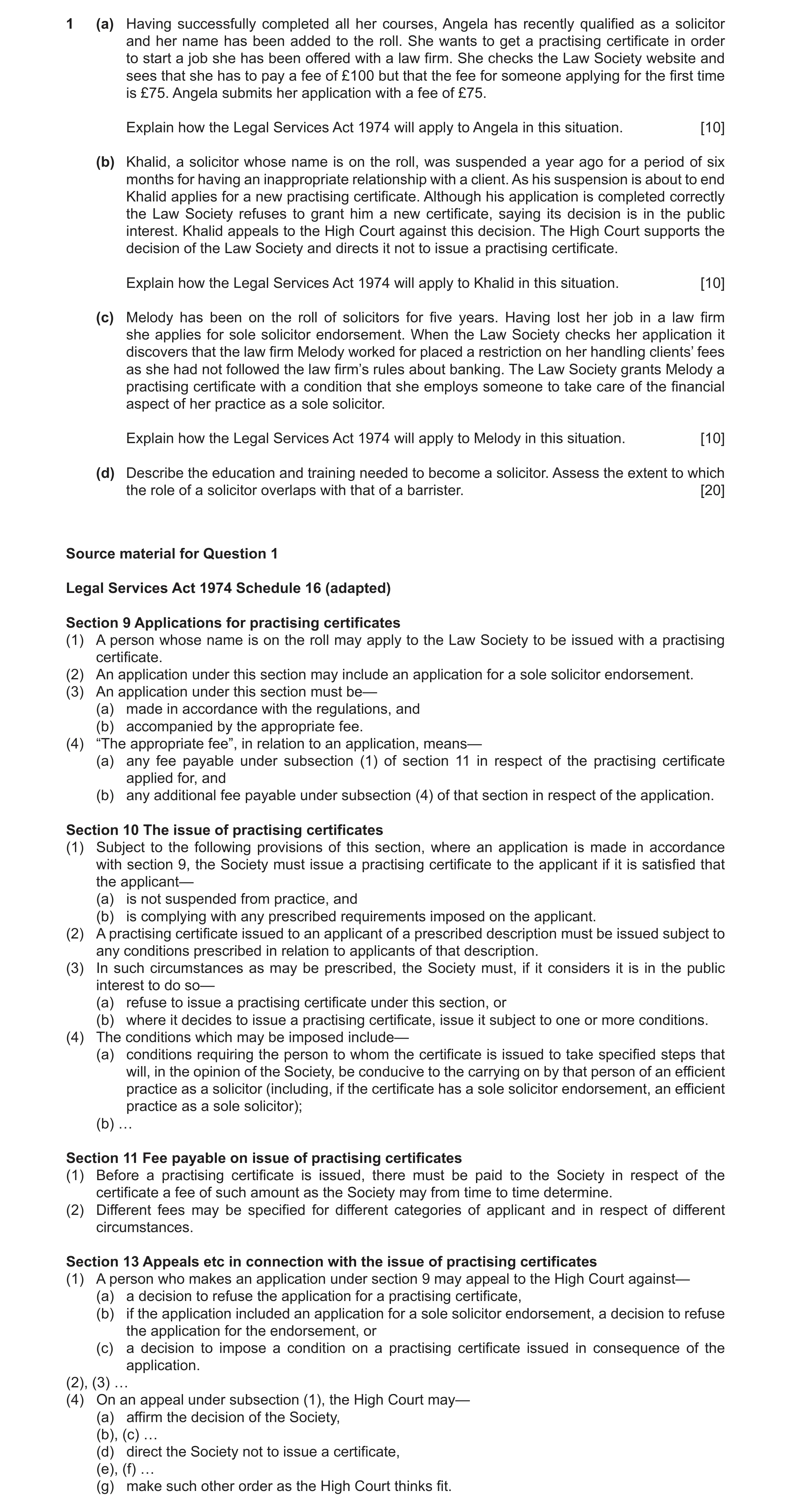
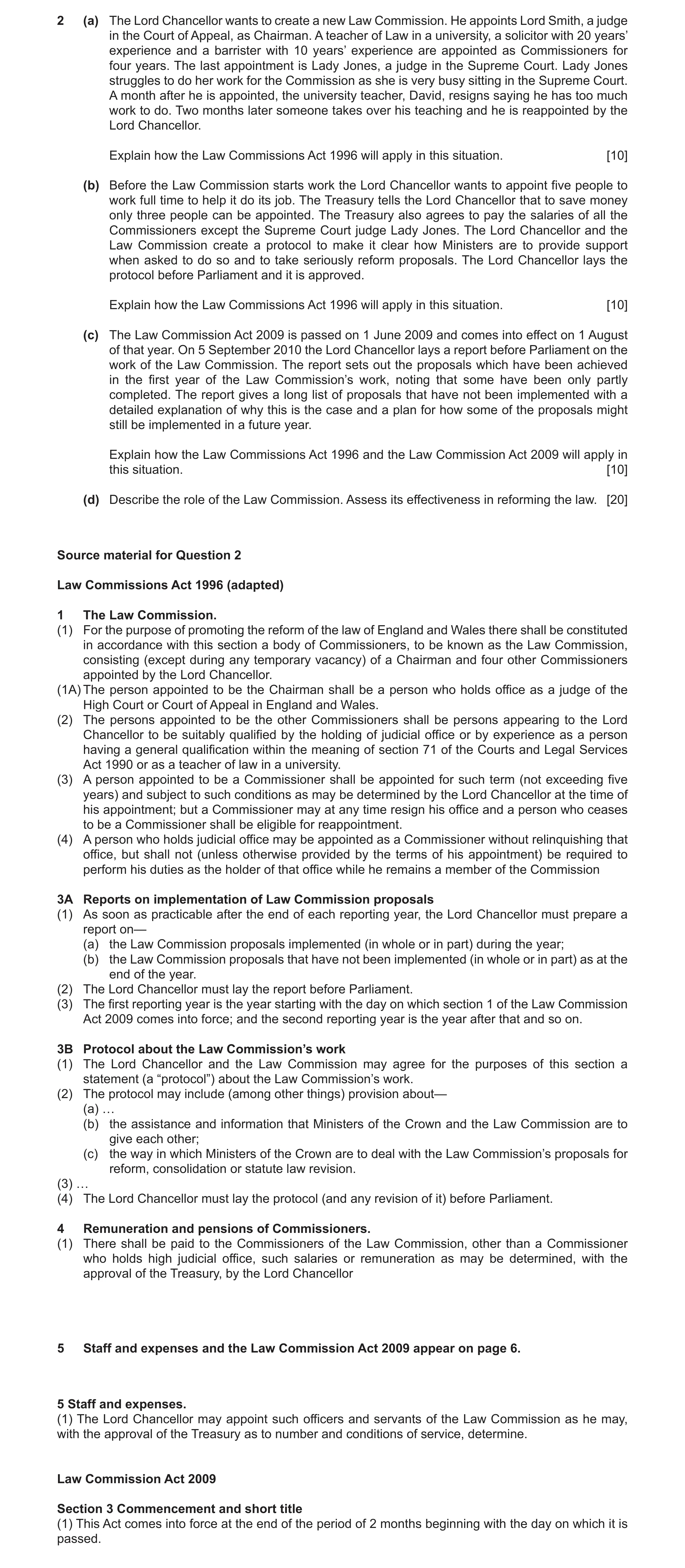
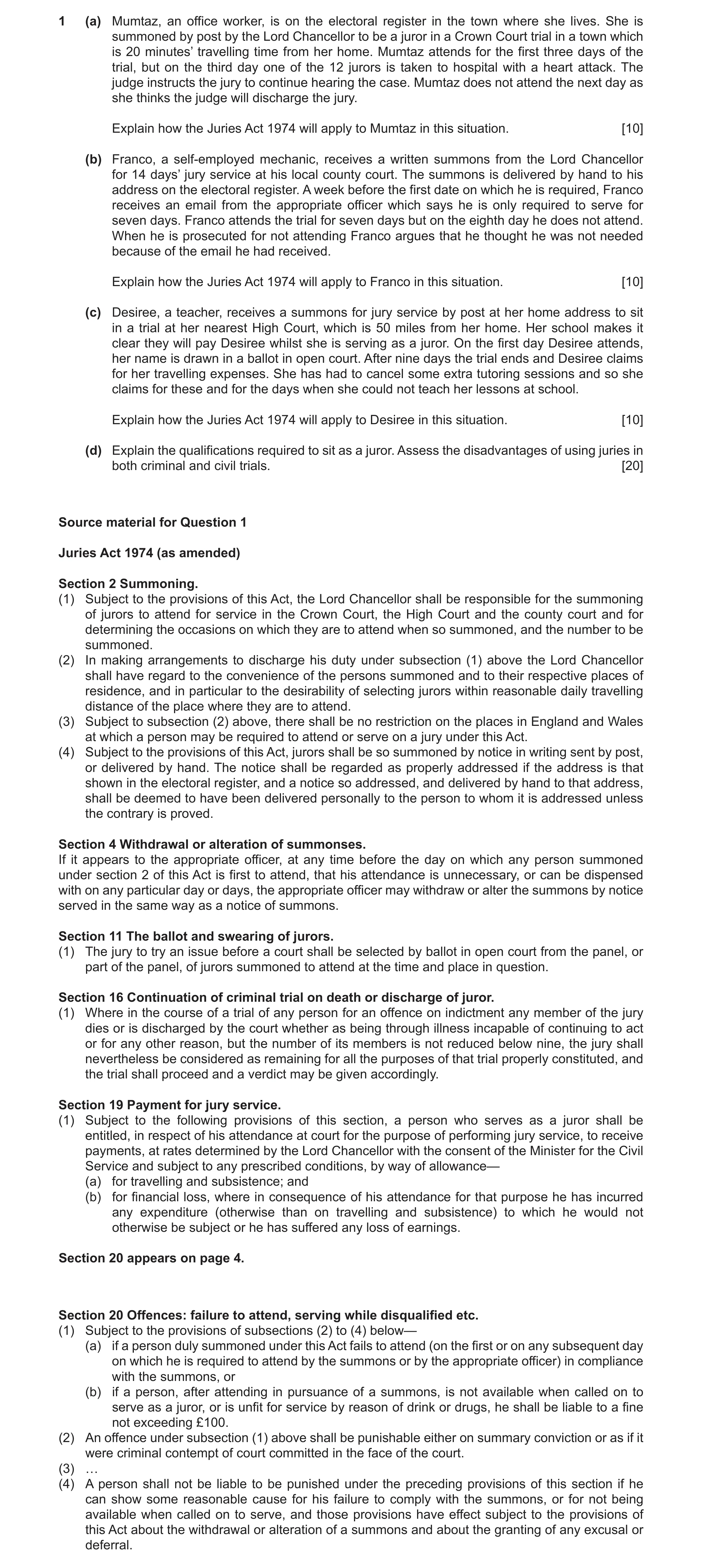
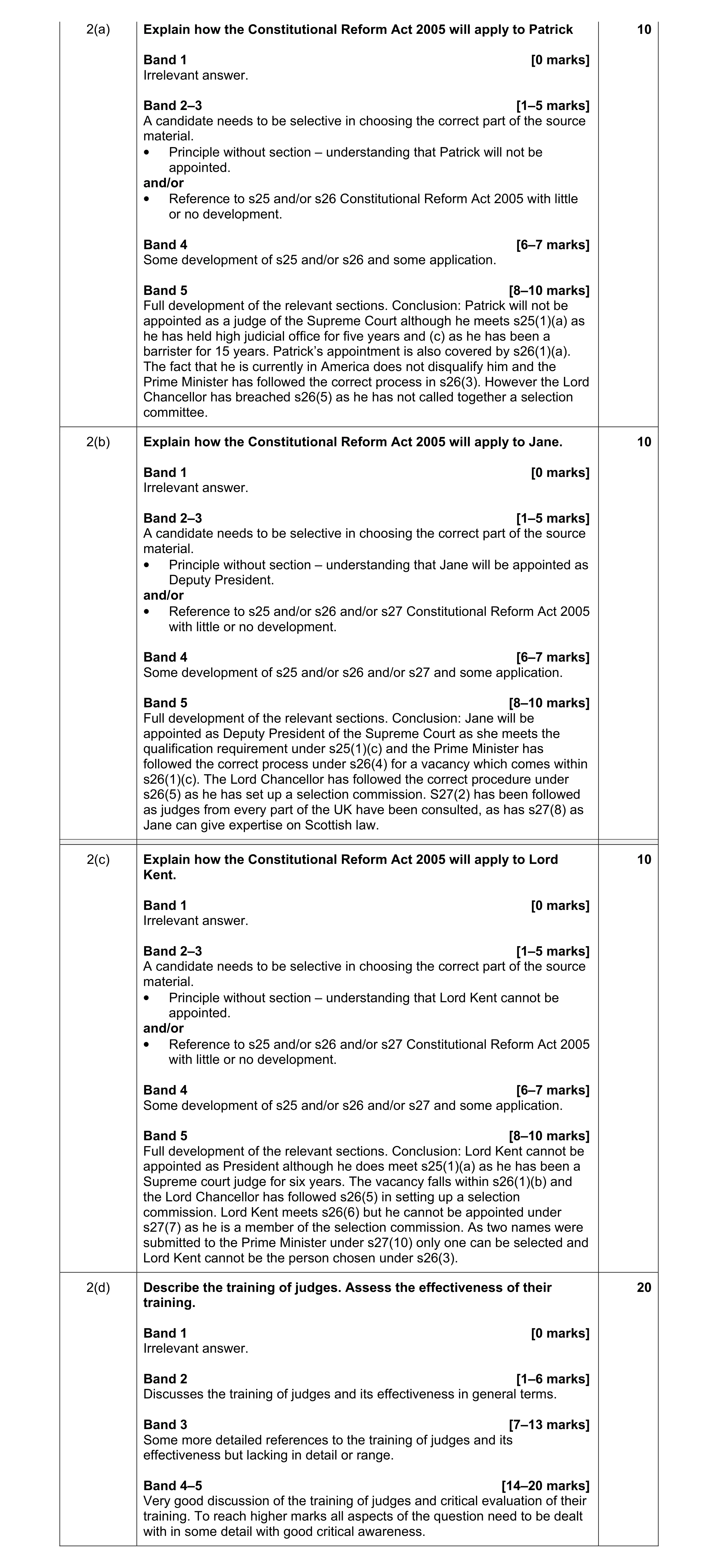 50
50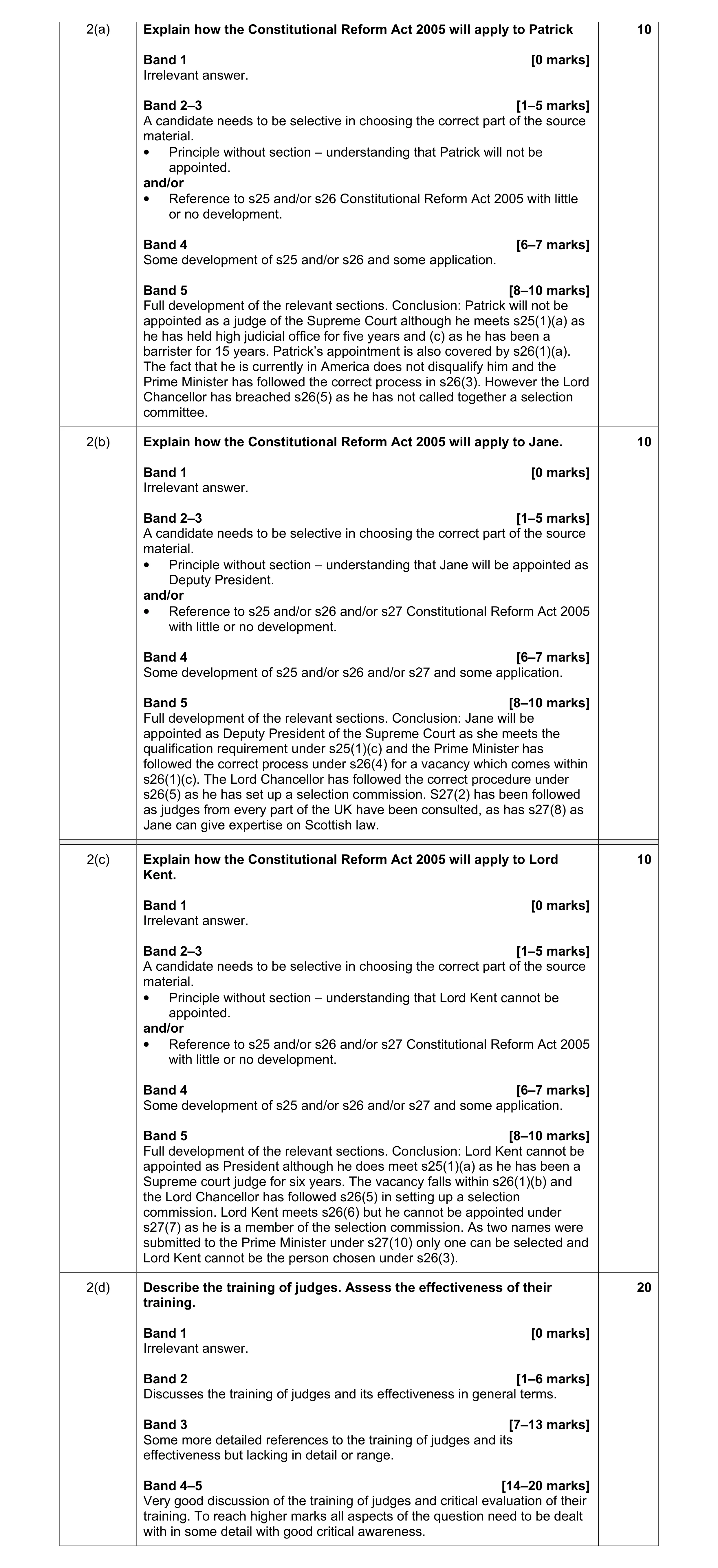 50
50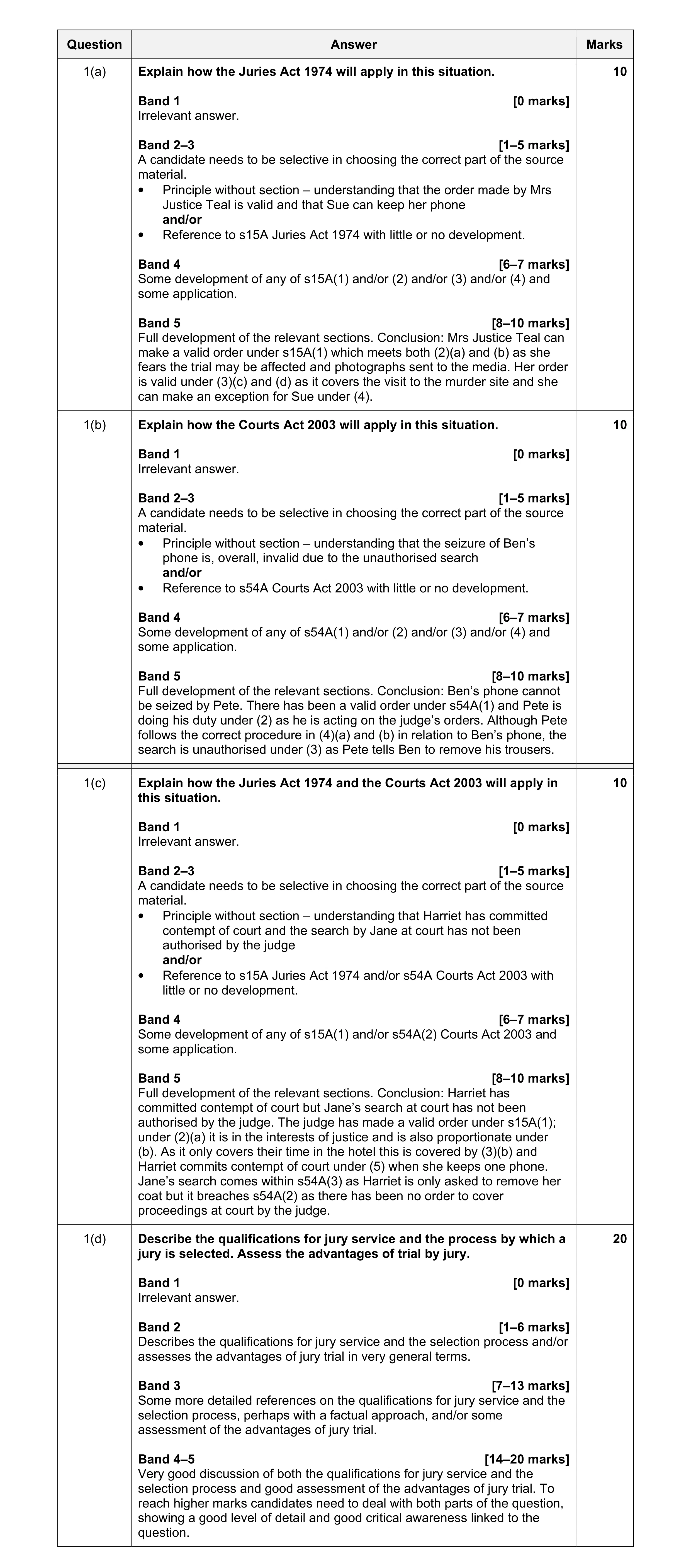 50
50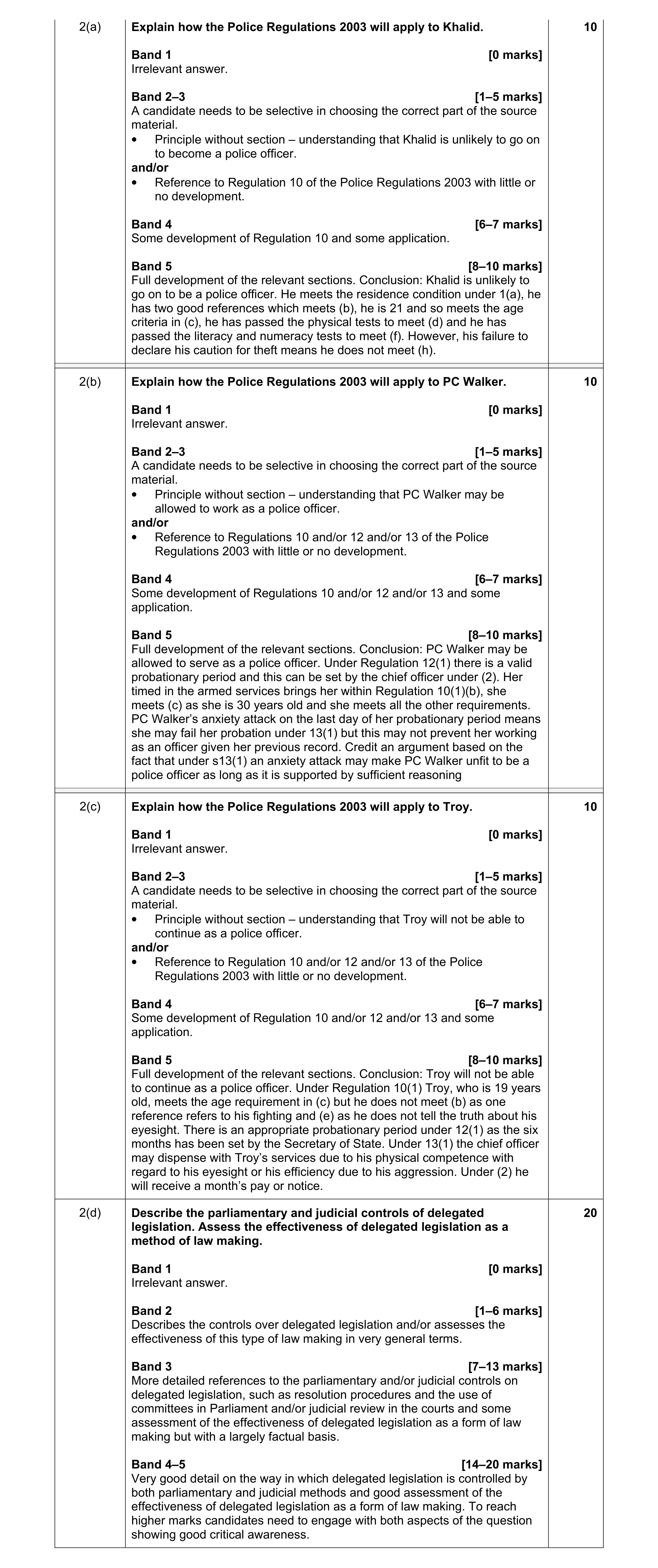 50
50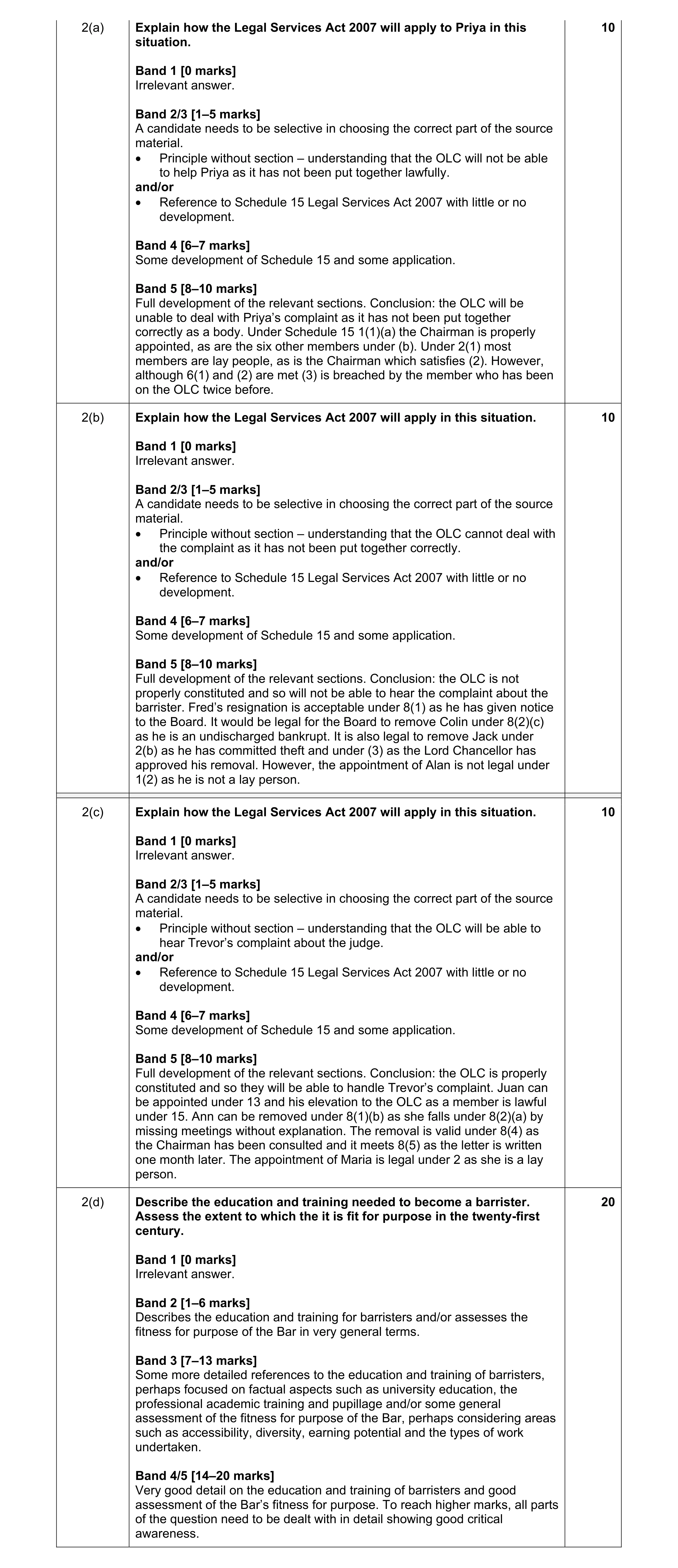 50
50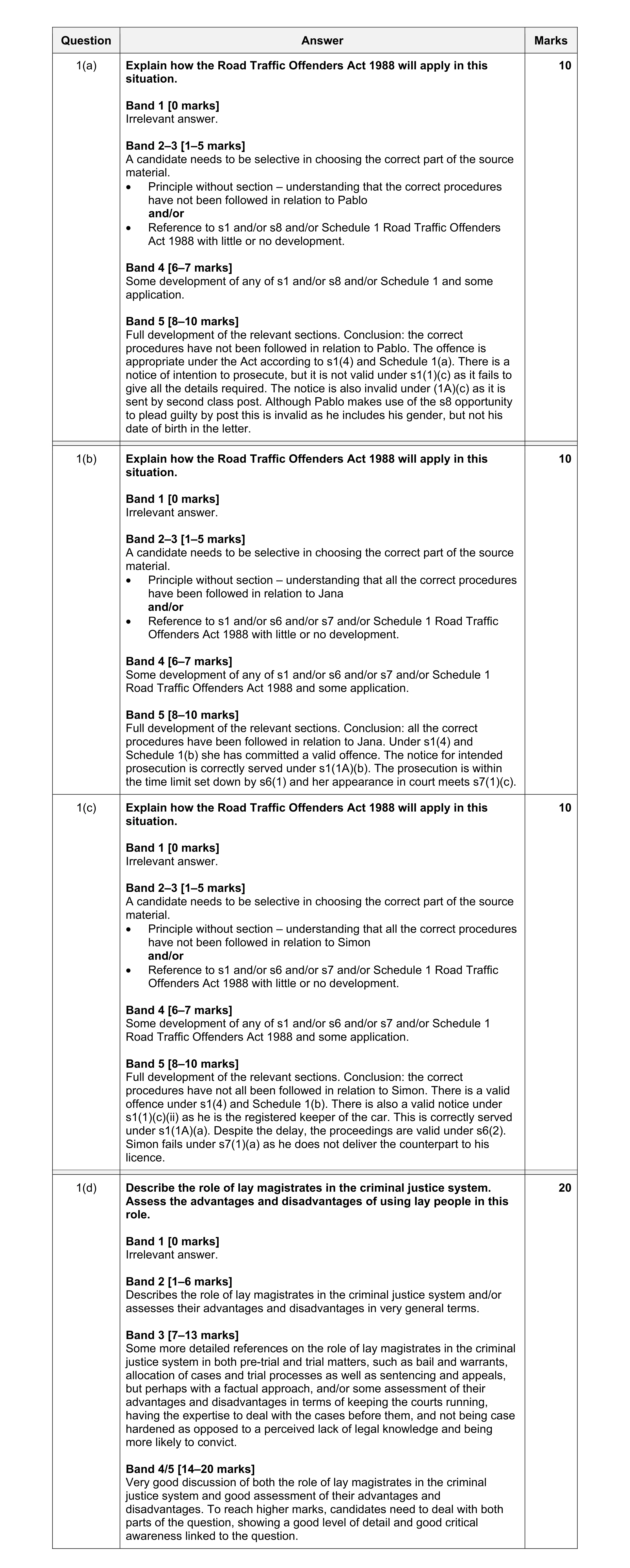 50
50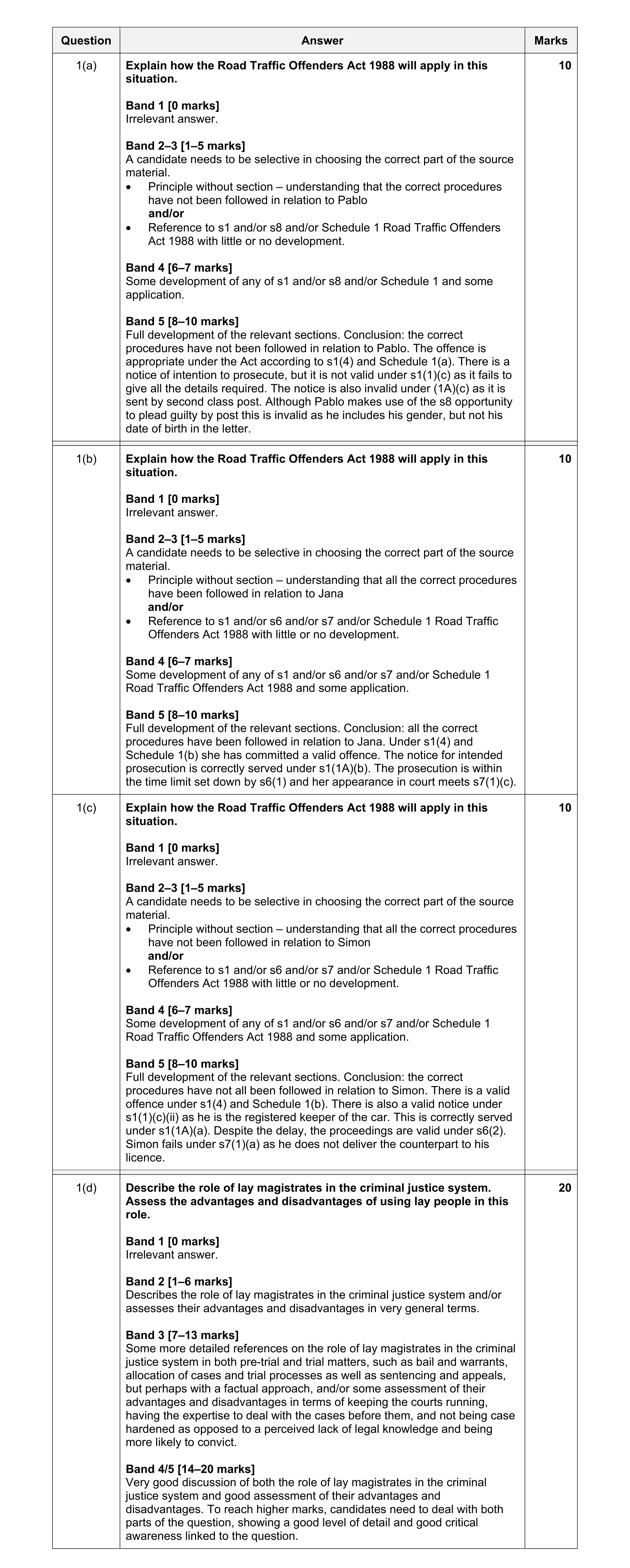 50
50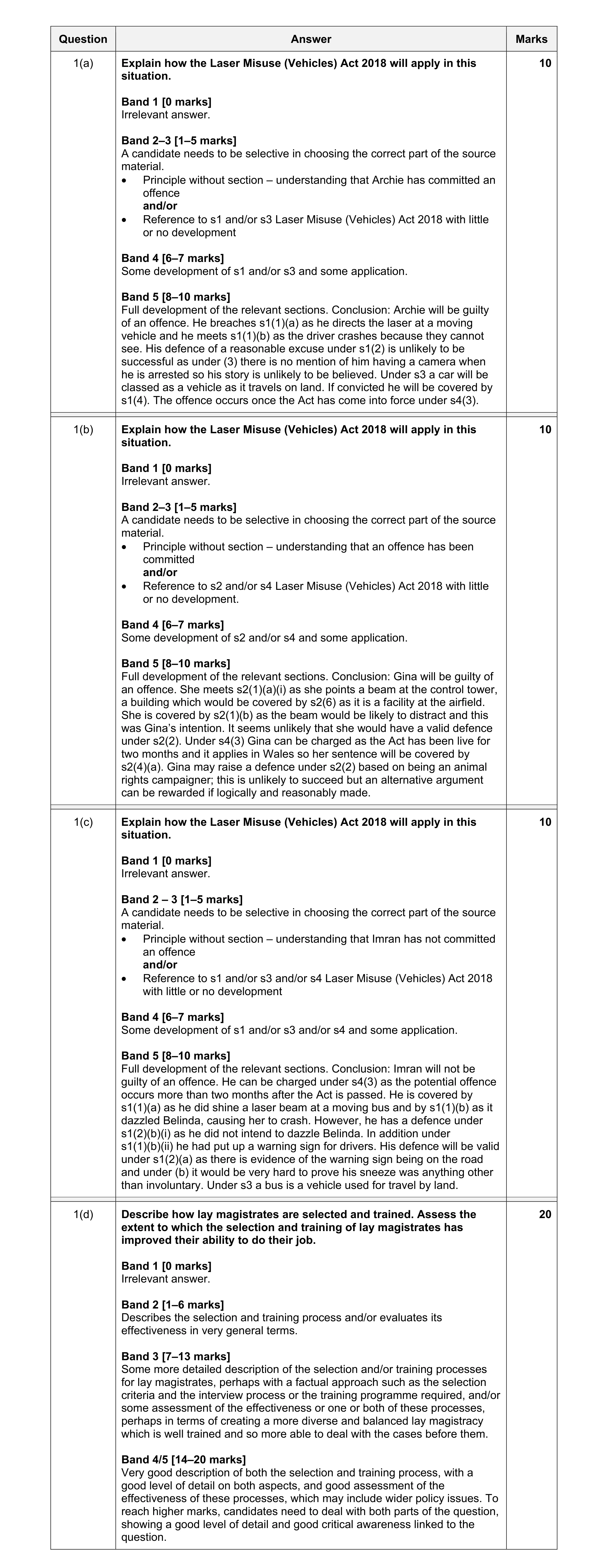 50
50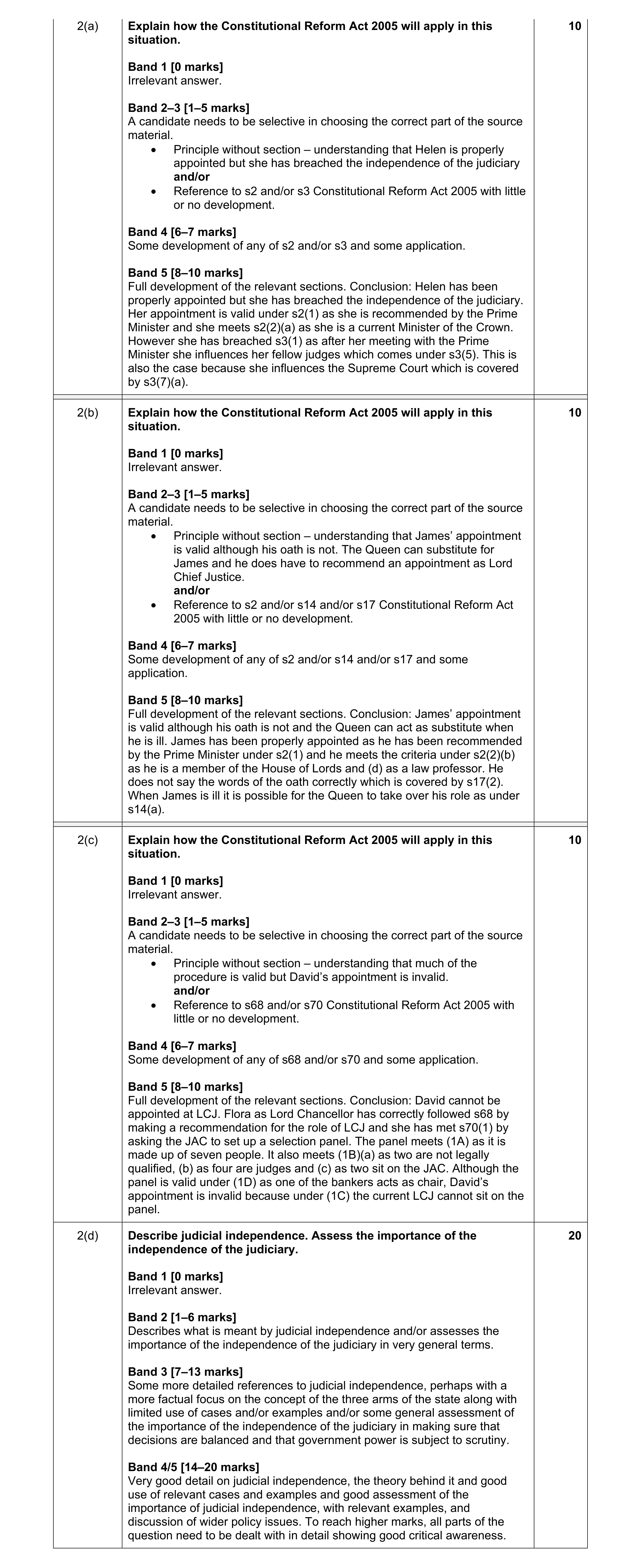 50
50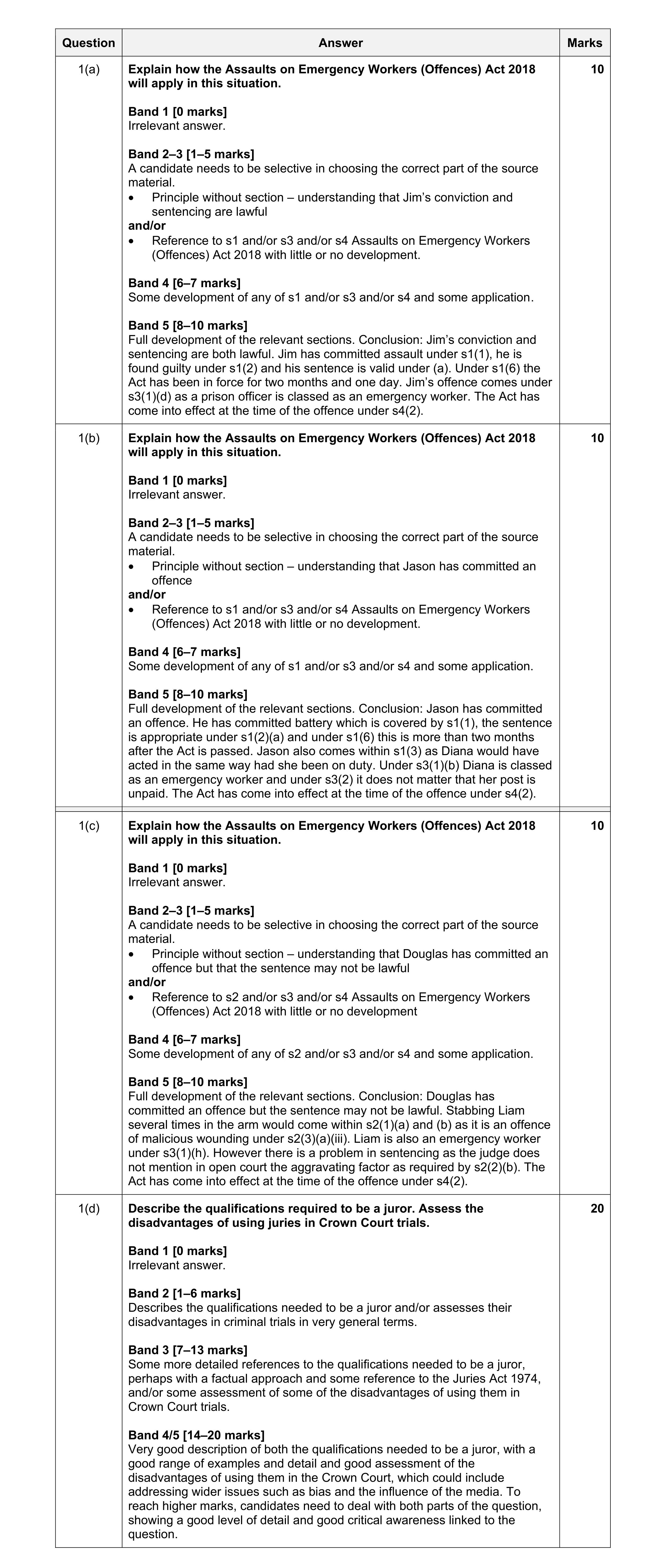 50
50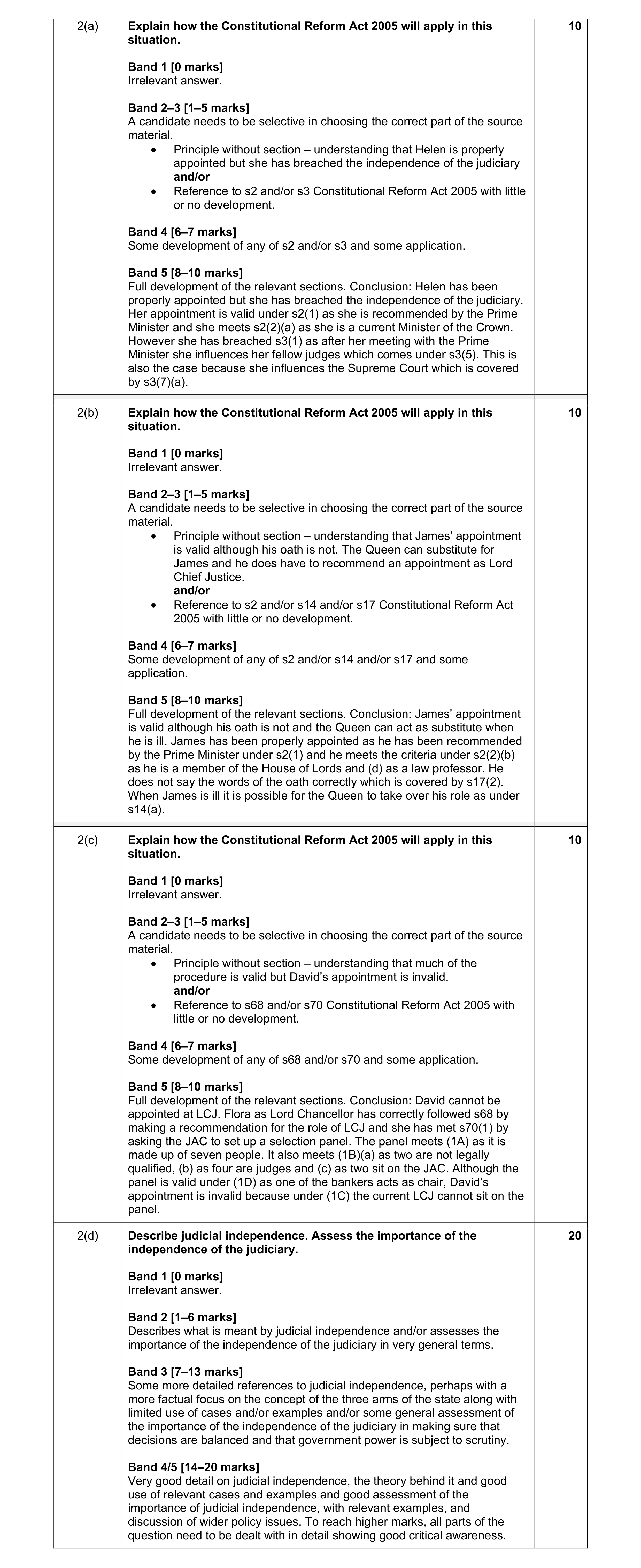 50
50 50
50 50
50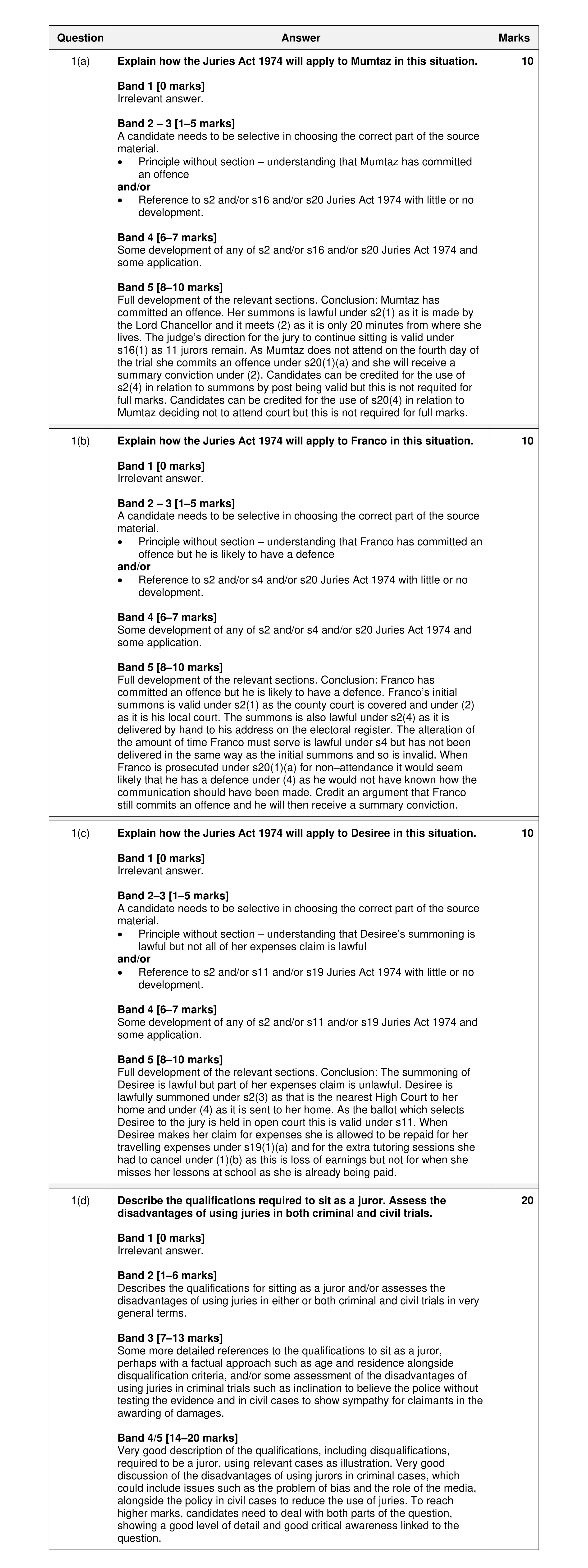 50
50