Questions as text
Q1 · France, 1774–1814 (a) Explain why the monarchy was abolished in 1792 9489/22 Feb/March 2021
1 France, 1774–1814 (a) Explain why the monarchy was abolished in 1792. [10] (b) How far did Napoleon’s domestic policies benefit the French people? [20]
30 marks
Mark scheme: Question Answer Marks 1(a) Explain why the monarchy was abolished in 1792. 10 • Louis XVI showed little enthusiasm for the ideas of the Revolution because his acceptance of reform appeared to be grudging (e.g. The Civil Constitution of the Clergy), which suggested that he was at heart an autocratic king. • He was perceived by many as an incompetent ruler. He was indecisive and this inspired little trust in him, and by extension in the idea of a constitutional monarchy. • There were huge social and political divisions within France, compounded by economic and political problems. The new system of a constitutional monarchy appeared unlikely to resolve the situation. • The Flight to Varennes in 1791 led many in France to see Louis as a traitor and a threat to what had been gained since 1789. • All this led, allied to military setbacks, to a growing movement in favour of removing the monarchy altogether, especially in Paris amongst the sans culottes and Republican Clubs, such as the Jacobin. Accept any other valid responses. 1(b) How far did Napoleon’s domestic policies benefit the French people? 20 Arguments in favour of Napoleon’s policies benefiting the French people could be as follows. The founding of the Bank of France in 1800 and then its direct control by the state in 1806 helped establish France’s creditworthiness and, thereby, contributed to financial stability. In addition, the introduction of a new metal coinage in 1803 provided for a strong and stable currency and helped make the country solvent. Therefore, these actions of Napoleon benefited all and were in marked contrast to what had gone before in France. The Civil Code enshrined equality for all before the law and the establishment of uniform laws brought rationality to the French legal system. This clearly benefited all. This policy of rationalisation was also extended to the fiscal system. This was something previous governments had sought to do but had not succeeded in doing. Therefore, Napoleon’s action here was a benefit. Education was widened and the careers open to the talents offered opportunities for some social mobility. The use of plebiscites promoted a sense of democracy. The view can, however, be challenged. The guaranteeing of property rights under the Consulate was more of a benefit to the middle-class than the rural and urban poor. Plebiscites were under the control of the government and the franchise was limited. In 1801, and for the rest of his rule, Napoleon used a select group to act as intermediaries between the government and the people. This group was drawn from the richest men in the department. Thus, popular choice was reduced whilst the wealthy gained further influence. The Imperial University, in function a kind of Ministry of Education, was founded in 1808. It controlled the curriculum and appointed all state secondary school teachers. It offered no room for freedom of thought or expression for either staff or pupils. The Civil Code emphasised male authority and the father’s rights, thereby reversing several gains made by women as a result of the Revolution. The personal freedom of all was restricted through the policy of spies and censorship. By 1811 only four newspapers remained in Paris and all were subject to police supervision. Napoleon did rationalise the fiscal system. However, the shift was now from direct to indirect taxation, i.e. consumption was taxed. Thus, the burden now fell on the consumer, and most consumers were poor. Accept any other valid responses.
This question in 9489/22 Feb/March 2021
Q2 · France, 1774–1814 (a) Explain why the Estates General was not able to deal with the… 9489/21 May/June 2021
1 France, 1774–1814 (a) Explain why the Estates General was not able to deal with the issues France faced. [10] (b) How far did Napoleon as First Consul, 1799–1804, maintain the principles of the Revolution? [20]
30 marks
Mark scheme: Question Answer Marks 1(a) Explain why the Estates General was not able to deal with the issues 10 France faced. • Procedure: There was uncertainty because the previous meeting of the institution had been in 1614. Therefore, no one was sure how it should proceed. It was agreed that the Estates General represented three groups: clergy, nobility, and others. However, there were serious differences about voting, including how decisions should be made. • Over optimistic: The cahiers raised expectations in the country and amongst the deputies that the Estates General would bring about a fundamental overhaul of France. However, as an institution of the Ancien Regime it could never meet these expectations. • Lack of guidance: Finance was a major issue facing France, but the cahiers (lists of grievances sent to the Estates General) were contradictory in the solutions they proposed, as there had been no royal direction in their production, and this fed through to the early debates. • Frustration with the king created new issues: Louis XVI sought to keep the Estates General’s voting bias which discriminated against the Third Estate. In response it challenged the king’s power when it voted to call itself the National Assembly and claimed it had the right to decide on matters of taxation. This had never been a reason for the calling of the Estates General. • The king’s bad faith: Whilst the new National Assembly was becoming more strident, the fear grew, which was not unfounded, that Louis XVI was seeking to deploy additional troops in Paris to restore his authority. This led to disorder, e.g., the storming of the Bastille. The end of the Estates General had come a little earlier (9th. July) when the National Constituent Assembly was formed. Using the Estates General, an old institution of the Ancien Regime, had shown that the issues France faced could only be dealt with by new institutions based on new ideas. Accept any other valid responses. 1(b) How far did Napoleon as First Consul, 1799‒1804, maintain the 20 principles of the Revolution? Arguments to support the view that he did maintain the principles of the Revolution could be as follows. Napoleon was the figurehead of the coup in 1799 because his military successes had made him popular, and he had shown that he was a defender of the Revolution against its enemies (e.g., Toulon, 1793 and the royalist Vendémiaire uprising, 1795). His policies as First Consul can be said to have not openly contradicted his claim that he was continuing the best features of the Revolution. For example, plebiscites were used as a form of popular consent, albeit carefully managed. They did, nonetheless, pay some lip-service to the revolutionary idea of consent. There were three consuls to share power: a difference from the monarchy and Robespierre’s dictatorship. The Civil Code did enshrine the principle of equality for all before the law, a key revolutionary belief. The Concordat of 1801 with the Pope did uphold the principle of religious freedom, a clear revolutionary ideal. His actions regarding local administration and the fiscal system can be seen as completing work begun in 1789–1793 and 1795– 1799. However, the view can be challenged. The democratic element of elections was minimal, as they were more the presentation of candidates, restricted to the notables, seen as suitable for selection as deputies. The Civil Code emphasised male authority and the rights of the father, and so undermined many gains made by women during the Revolution. The Concordat with the Pope was seen by many revolutionaries as a betrayal of all that had been achieved since 1789 in limiting the power and influence of the Catholic Church in France. The Civil Code allowed for greater centralisation and, thereby, greater personal control for Napoleon. Accept any other valid responses.
This question in 9489/21 May/June 2021
Q3 · France, 1774–1814 (a) Explain why Napoleon introduced the Civil Code 9489/23 May/June 2021
1 France, 1774–1814 (a) Explain why Napoleon introduced the Civil Code. [10] (b) ‘Louis XVI brought about his own downfall.’ How far do you agree with this view? [20]
30 marks
Mark scheme: Question Answer Marks 1(a) Explain why Napoleon introduced the Civil Code. 10 • There was a need because the old feudal system with its outdated laws and customs had been dealt a death-blow by the Revolution. There was a need to establish a uniform legal system which reflected the new situation in France. • Successive governments had tried to organise a national legal system. Napoleon aimed to succeed where they had failed. • He wanted to show that he was the heir of the Revolution by establishing the principle of the equality of all before the law. • Introducing the Code would allow Napoleon’s views to become dominant. The Code was influenced greatly by the authoritarian ideas of Roman Law, emphasising male authority and the father’s rights. This fitted well with Napoleon’s views on society and his belief in the inferior position of women. • The Civil Code would foster uniformity and centralisation in France, thereby consolidating his personal control. Accept any other valid responses. 1(b) ‘Louis XVI brought about his own downfall’. How far do you agree with 20 this view? Arguments to support the view could be as follows. Louis XVI’s lack of a royal policy for the drawing up of the cahiers allowed expectations to be raised that the Estates General was going to bring about an overhaul of the political system, which was not what was planned when it was called by the government. This would mean the deputies would need careful management. However, Louis XVI showed little political nous. For example, in June in 1789 he tried to prevent the Third Estate from meeting as the National Assembly which led to the Tennis Court Oath’s declaration that deputies would not leave until a constitution was created. Louis XVI displayed an inconsistent attitude towards developments after 1789. For example, opposition to and then acceptance of the Civil Constitution of the Clergy (1790). This sense of a lack of commitment to the political developments taking place in France seemed to be confirmed by his flight to Varennes in 1791. He began to be seen as a traitor to France, not as the king of France. The discovery in the Tuileries Palace of secret correspondence (1792) appeared to show Louis XVI was fostering counter- revolution. Thus, Robespierre was able to argue, during the debates on what should be done with the king, that the Revolution would never be stable whilst Louis was alive. On 21 January 1793 Louis XVI was executed. The view can be challenged. The series of poor harvests, beyond the king’s control, and rising prices created a febrile political atmosphere, and engendered a desire for change with the determination to use extreme methods, if needed, to achieve this. Enlightenment ideas and the success of the American Revolution had created the belief amongst many in France that their political system was outdated and had to change. The impact of war, such as social and economic disruption, from 1792 led this desire to take on an increasingly radical form. The Jacobins, who were the first party to call for the execution of the king, began to grow in political influence. Amidst the increasing loss of life due to war and civil disorder, plus seeming economic collapse, the removal of the king no longer appeared unthinkable. Accept any other valid responses.
This question in 9489/23 May/June 2021
Q4 · France, 1774–1814 (a) Explain why Necker resigned in 1781 9489/22 Feb/March 2022
1 France, 1774–1814 (a) Explain why Necker resigned in 1781. [10] (b) How firmly did Napoleon establish his control over France as First Consul, 1799–1804? [20]
30 marks
Mark scheme: Question Answer Marks 1(a) Explain why Necker resigned in 1781. 10 Indicative content • Necker’s publication of the first ever public balance sheet of the French monarchy’s finances (Le Compte Rendu au Roi) provoked controversy at court and undermined his position in government. • Conservatives at the court, such as the Comte de Vergennes (Foreign Minister), were appalled at the publication. They believed that the king’s subjects had neither the need nor the right to know the state of the kingdom’s finances. Such public airing of government issues was fine for a country such as Britain, but it was not the French way. • Critics of Necker claimed that revenue (annual surplus of 12m livres, based on 264m livres revenue set against 252m livres expenses) was over-estimated and expenses such as the cost of war in America were omitted. Necker was deliberately misleading the king and the country. • It was claimed that the aim was not to provide a true account of the kingdom’s accounts but to bolster Necker’s own position against his rivals at court, who questioned how long loans alone could sustain finances. His request, following publication, to be admitted to the king’s innermost council, despite being Swiss and a Protestant, seemed to show he was interested only in his advancement. On the advice of Maurepas and de Vergennes, who both threatened to resign if their advice was ignored, Louis XVI refused Necker’s request. Necker resigned Accept any other valid responses. 1(b) How firmly did Napoleon establish his control over France as First 20 Consul, 1799–1804? Indicative content Arguments to show he had established firm control could take the following form. Napoleon’s authority was established from the outset by the constitution of 1799, and as First Consul he overshadowed the other two Consuls. They were granted the right, only, to express an opinion (voix consultative), whilst Napoleon’s decision, in all matters, was final. In December 1800 he narrowly escaped assassination. This showed the potential fragility of the regime. Therefore, in 1802 Napoleon was offered the Consulship for life with the right to nominate his successor. His power was established further by his ability to appoint ministers and lesser officials. The Tribunate and Legislature were representative bodies, but they were controlled by Napoleon. In 1802, for example, the Tribunate was reduced from 100 to 50 members after criticising the Civil Code. The Legislature never rejected government bills after 1802. With regard to the Civil Code, Napoleon drew up its agenda and regularly attended sessions that approved it, making his views clear throughout. However, the extent of this control can be questioned. That an attempt was made on his life in and the year 1804 saw a series of royalist plots and counter-plots (The Duc d’ Enghieu, a member of the Bourbon family, allegedly sought to supplant Napoleon by murdering him and his family, and taking over the government) suggests that not all were willing to accept Napoleon’s authority. Moreover, his appeal to the Corsican law of the vendetta to justify the abduction and execution of d’Enghieu seems to suggest desperation rather than authoritative control. The sense of insecurity can be seen, also, in the use of censorship. In January 1800, the number of political journals in Paris were reduced from 73 to 13. The production of new ones was forbidden and by the end of 1800 only nine remained. Their editors had to rely on military bulletins or articled published in ‘Le Moniteur’, the official government journal. Candidates might offer a definition of ‘firmly’ and use this to organise their response. This is perfectly acceptable. Accept any other valid responses.
This question in 9489/22 Feb/March 2022
Q5 · France, 1774–1814 (a) Explain why the Assembly of Notables met in 1787 9489/23 May/June 2022
1 France, 1774–1814 (a) Explain why the Assembly of Notables met in 1787. [10] (b) To what extent did Napoleon’s domestic policies change France in the period 1799–1814? [20]
30 marks
Mark scheme: Question Answer Marks 1(a) Explain why the Assembly of Notables met in 1787. 10 Indicative content There was an urgent need to deal with the precarious state of France’s finances. The deficit stood at 112m livres, a quarter of expected income and nearly half of annual revenue was absorbed by debt service. Government credit was exhausted, and the country faced bankruptcy. Economies in government and court expenditure were popular, but would save only about 30%, at the most, of total expenses. The problem for the government was to increase revenue without attacking the fiscal privileges of the clergy and nobility. This, however, was impossible as indirect taxes on consumer goods were insufficient. This meant that the fiscal exemptions of the First and Second Estates would have to be addressed. Calonne, Controller-General of Finances since 1783, believed the solution lay with the calling of an Assembly of Notables. It was assumed that, as all the members were royal nominees, they would agree to rubber-stamp Calonne’s plan for a new graduated land tax. This public show of backing from the leading men of the country for Calonne’s plan would result in further loans being available. Accept any other valid responses. 1(b) To what extent did Napoleon’s domestic policies change France in the 20 period 1799–1814? Indicative content In terms of government and administration, reforms such as the inauguration of the Empire and the Civil Code replaced the loosely controlled and devolved popular sovereignty of the Revolution with an authority which was more centralised and autocratic. The Civil Code did away with the confused legal and judicial system which had existed prior to, and persisted after, 1789. The establishing of the principle of equality before the law was something never sought by the Ancien Régime nor achieved by revolutionary groups after 1789. The Concordat with the Church did establish the principle of religious toleration and established a more exacting control over the Church than that by the Ancien Régime and the following revolutionary governments. Education was widened and there was some attempt at social mobility with the ‘careers open to the talents’. For most of this period France did not experience any serious unrest, unlike that seen between 1789 and the fall of the Directory in 1799. It was not until the bad harvest of 1811, plus the increased burden of conscription (1812–14), that serious threats to order arose. 1(b) However, the extent of change can be challenged. The use of censorship and the secret police seemed a continuation of the Ancien Régime. The Civil Code was based on the authoritarianism of Roman Law rather than personal freedom espoused after 1789. In addition, it curtailed the changes made to women’s right, gained after 1789, by emphasising male authority and the father’s rights. France experienced no agricultural revolution, with farming continuing to use the same subsistence methods. This was no doubt the result of the plentiful harvests up to 1811. In industry, Napoleon did provide subsidies to manufacturers, but it did not appear to be a priority for him. The establishment of the Empire seemed a return to the absolutism of the Bourbons. Accept any other valid responses.
This question in 9489/23 May/June 2022
Q6 · France, 1774–1814 (a) Explain why Napoleon’s domestic policies were popular 9489/21 Oct/Nov 2022
1 France, 1774–1814 (a) Explain why Napoleon’s domestic policies were popular. [10] (b) ‘War caused the French monarchy to fall in 1792.’ How far do you agree? [20]
30 marks
Mark scheme: Question Answer Marks 1(a) Explain why Napoleon’s domestic policies were popular. 10 Indicative content • A sense of order – The Concordat with the Catholic church was popular as most of the population was Catholic and had been distressed by revolutionary developments such as the Cult of the Supreme Being. Napoleon was seen as restoring an acceptable order to State-Church relations. • A feeling of stability – The country’s finances were put on a sounder footing following the economic chaos that had beset the country since 1789. • Aspirations met – Whilst the Concordat did re-establish the Church’s influence in France, it was not as pre-1789. The Revolution was recognised and the Church agreed not to seek to recover Church lands. The clergy were to be paid civil servants appointed by the government and bound by oath. Other faiths were to be tolerated. This appealed to supporters of the Revolution who could see that the Church was state- controlled, a long-held revolutionary aim. • Government for all – The Civil Code rationalised France’s chaotic legal system, with uniform laws established through the country and alongside the principle of equality before the law. The law now seemed be for all, not a favoured few. References to developments in education, public works and ‘career open to the talents’ should be rewarded. Accept any other valid responses 1(b) ‘War caused the French monarchy to fall in 1792.’ How far do you 20 agree? Indicative content France had been at war since April 1792 and had suffered several reverses. French soldiers deserted en masse, and in one case murdered their General, Dillon. Since 1789, more than 50% of France’s army officers had fled the country and it took time to train new officers. There was animosity between the old regulars (Whites) and new volunteers (Blues) who had joined 1791-92. These volunteers were often poorly armed and untrained. Added to this was the social and economic disruption caused by war. This led to a growing sense of fear and paranoia, especially in Paris, about traitors and counterrevolutionaries, and a desire to apportion blame. This fell on the monarchy. If this institution was removed then, it followed, the war would go in France’s favour. This argument can be questioned. Louis XVI did not inspire trust. His failed attempt to flee France in June 1791 and his vetoing of legislation led many to see him as less than enthusiastic about the Revolution. Indeed, he seemed a positive threat. For example, the issuing of the Brunswick Manifesto (July 1792), which stated Paris would face severe consequences if the king were to be harmed, seemed to highlight this threat and gave credence to the view that the monarchy should go. Economic issues played a part as the harvest of 1792 was mediocre, leading to a rise in grain prices. This all added to the febrile atmosphere created by war and the king’s actions. The result was that talk of getting rid of the monarchy, unthought of in 1789, was commonplace now by the summer of 1792. Accept any other valid responses.
This question in 9489/21 Oct/Nov 2022
Q7 · France, 1774–1814 (a) Explain why the insurrection of 10 August 1792 happened 9489/22 Oct/Nov 2022
1 France, 1774–1814 (a) Explain why the insurrection of 10 August 1792 happened. [10] (b) ‘The Concordat of 1801 was Napoleon’s greatest domestic achievement.’ How far do you agree? [20]
30 marks
Mark scheme: Question Answer Marks 1(a) Explain why the insurrection of 10 August 1792 happened. 10 Indicative content • After Louis XVI’s failed attempt to flee France in June 1791 support for the monarchy began to fall markedly. The attempted escape was a threat to what the revolution had so far achieved. • The outbreak of war in April 1792 increased the fear of traitors and counter-revolutionaries. The French army was weakened by unreliable officers and undisciplined recruits. Therefore, the army had to rely, more and more, on volunteers from the urban working populations. This meant the sans culottes demanded an increased voice in decision making. • Economic considerations further influenced their actions. The 1791 harvest had been mediocre and grain prices rose. In 1792, there was a demand to halt the free trade in grain and for prices to be fixed by law. The sans culottes saw rising grain prices as a counter-revolutionary design to starve them into surrender. • The Brunswick Manifesto, July 1792, added to the mix of fear and tension in Paris. It threatened the people of Paris with retribution if any harm befell the king. • This led to a growing demand for the dethronement of the king, and the Legislative Assembly (LA) agreed to debate the question on the 9 August. However, the LA’s decision not to indict Lafayette, now seen as an enemy of the revolution, convinced many that there would be no decision made about dethronement. In the early hours of 10 August the sounding of the tocsin, the call to insurrection since the journées of 1789, marked the start of the seizure of power. Accept any other valid responses. 1(b) ‘The Concordat of 1801 was Napoleon’s greatest domestic 20 achievement.’ How far do you agree? Indicative content The Concordat provided stability. Most of the French people were Catholic, and they had been appalled at the disorder in Church–State relations brought about by events since 1789. It restored the Church to a position of influence within France, albeit not at the same level as before 1789. Nonetheless, it was established that Catholicism was the religion of most French citizens and that it would be freely exercised. Those who had purchased Church lands were able to keep them, and so were supportive of Napoleon’s actions. Those of a more revolutionary inclination were pleased that the Church’s wealth was not restored and welcomed the toleration of other religions as a further limit to the Church’s influence. Extreme ultramontanists and unreformed Jacobins might take issue, but they were a small minority. Therefore, the Concordat had a far-reaching appeal which provided extensive support for Napoleon’s regime from an early stage and which could be built upon. The statement, however, can be challenged. Napoleon was able to achieve a large amount of economic stability, something that had been noticeably lacking since 1789. This was done through the founding of the Bank of France in 1800 and its direct control by the state in in 1806. This helped to establish France’s creditworthiness. The introduction of a new coinage in 1803 established economic order by helping the country become solvent. The Civil Code brought rationality to the legal system by making the law accessible to all and establishing the principle of equality before the law. The system was widely accepted and still lasts. The lessening of women’s rights by the Civil Code, whilst questionable by the standards of today, was seen, from an early nineteenth century standpoint, as a necessary correction of revolutionary excess. These policies gave the impression that Napoleon was ruling in the interests of all, and it was this perception, perhaps, that was his greatest domestic achievement. Candidates might seek to define ‘greatest’ and use its definition to organise their response. This is perfectly acceptable. Accept any other valid responses.
This question in 9489/22 Oct/Nov 2022
Q8 · France, 1774–1814 (a) Explain why Napoleon became emperor in 1804 9489/21 May/June 2024
1 France, 1774–1814 (a) Explain why Napoleon became emperor in 1804. [10] (b) ‘Taxes caused the outbreak of the French Revolution in 1789.’ How far do you agree? [20]
30 marks
Mark scheme: Question Answer Marks 1(a) Explain why Napoleon became emperor in 1804. 10 Indicative content As a very successful general, glory and prestige for France were associated with his name. The imperial title appeared fitting and avoided the title of ‘king.’ It appeared the natural step. In 1802, he was confirmed, by plebiscite (i.e. popular demand) as Consul for Life. This included, also, the right to nominate his successor. It was the first step towards the introduction of hereditary rule. By1803 he was holding court in royal style – state ceremonies were multiplied, etiquette was formalised, official dress became more elaborate. The several failed plots, such as Cadoudal/Pichegru, 180304, against his life, led many to consider what would happen if Napoleon was assassinated. The Bourbon Pretender’s recent threat to restore all ‘stolen properties’ to their ‘rightful owners’ once he regained the throne caused many to become convinced that only Napoleon stood between them and the loss of all they had gained by the Revolution. In May 1804 a formal motion was approved by the Senate that Napoleon Bonaparte be declared Emperor of the French, and this was to be hereditary in his family. A plebiscite of November 1804 confirmed the request. Accept any other valid responses. 1(b) ‘Taxes caused the outbreak of the French Revolution in 1789.’ How far 20 do you agree? Indicative content Arguments to support the importance of taxes in causing the Revolution of 1789 could be as follows. Taxation was, clearly. a major issue when considering the causes. The inability to collect enough and the resulting bankruptcy of France was a prime cause of the summoning of the Estates General which, of course, led to the revolution itself. The corruption of the Ancien Régime system with its inefficiency and the gross unfairness of the various exemptions were vital to the condemnation of the old system. The reluctance of Louis and the monarchists to support significant change to the tax system further drove the events of 1789. This view, however, can be challenged. Louis XVI was inadequate to the task facing France in 1789. For example, on June 20 members of the National Assembly were barred from entering their meeting hall. This led to the swearing of the Tennis Court Oath whose demand for a constitution had not been part of the agenda when the Estates General was called. Events were moving away from royal control. Whilst he reversed course on June 27 and recognised the new Assembly, at the same time he ordered reliable army units to Paris. It was fear of a royal coup which led to the storming of the Bastille. This was all set against the background of widespread hunger. There had been a series of bad harvests in the 1780s which led to the rise in bread prices which drove many of the poor in France to the point of starvation. The Women’s March on Versailles, October 1789, was driven by the rise in prices. The ideas of the Enlightenment provided a theoretical framework for reorganising the Ancien Régime. Allied to this was the experience of fighting in the American Revolutionary War which showed that theory could be turned, successfully, into reality. Accept any other valid responses.
This question in 9489/21 May/June 2024
Q9 · France, 1774–1814 (a) Explain why the storming of the Bastille happened 9489/23 May/June 2024
1 France, 1774–1814 (a) Explain why the storming of the Bastille happened. [10] (b) ‘Napoleon was able to maintain his power by using propaganda.’ How far do you agree? [20]
30 marks
Mark scheme: Question Answer Marks 1(a) Explain why the storming of the Bastille happened. 10 Indicative content Failings by Louis XVI – these created an atmosphere of mistrust and apprehension amongst Parisians. For example, on June 23 he invalidated the decisions of the National Assembly and instructed all three estates to sit separately, but on 27 June he reversed these decisions. There was real concern about his commitment to change. Fear – the king moved additional troops to the vicinity of Paris. By early July over half the 25 000 troops were Swiss and German mercenaries, loyal to the king and not friendly to ordinary Parisians. Change in government – Necker, the Minister of Finance, popular amongst the people of Paris for his support of change, was dismissed by the king on 11 July. It suggested the start of a coup by conservative elements in the royal government. Defence – Parisians sought food, guns, and supplies to protect themselves against the seemingly inevitable royal assault. Whilst 29 000- 30 000 muskets were acquired from the Hôtel de Ville on the morning of 14 July there was neither powder nor shot. However, 250 barrels of gunpowder were stored at the Bastille. Negotiations were undertaken, initially, but gunfire began, and fighting became intense and violent. By 5:30 pm the Bastille had fallen. Symbolic– the Bastille was a monument to royal absolutism. Its storming signified a revolutionary assault on this system of government. Accept any other valid responses. 1(b) ‘Napoleon was able to maintain his power by using propaganda.’ How 20 far do you agree? Indicative content Arguments to support the central role played by propaganda in Napoleon’s maintenance of power, 17991814, could be as follows. Napoleon sold himself, successfully, as the real heir to the revolution. For example, making the Church an adjunct of the state and promoting the notion of ‘a career open to the talents’. This made his appeal widespread and helped to secure his power and authority. He took great care to present himself and his regime in an impressive light: his portraits of the coronation ceremony are good examples of this. Allied to propaganda was Napoleon’s great care over censoring and controlling the press. Furthermore, there was an endless emphasis on his military victories and the glory and gains that accrued to France as a result. Monuments such as the Arc de Triomphe could be cited. He, also, managed to present his failures, such as Trafalgar, in a good light, or blamed someone else. However, this view can be challenged. Napoleon’s power was established from the outset by the constitution of 1799, and as First Consul he overshadowed the other two Consuls. They were granted the right, only, to express an opinion (voix consultative), whilst Napoleon’s decision, in all matters, was final. In December 1800, Napoleon was offered the Consulship for life with the right to nominate his successor. His power was established further by his ability to appoint ministers and lesser officials. The Tribunate and Legislature were representative bodies, but they were controlled by Napoleon. In 1802, for example, the Tribunate was reduced from 100 to 50 members after criticising the Civil Code. In 1804 he became Emperor of the French, with the title being hereditary in his family. He provided good, stable, government and ensured that the most important gains of the revolution (at least to the middle class) were maintained. There were also sensible, popular, and lasting reforms such as the Concordat and the Civil Code which helped his longevity. Additionally, there was a lack of any alternative to Napoleon’s rule. The Bourbon Pretender Louis XVIII was hardly a threat. Napoleon’s military victories were also popular as were the territorial gains. Bonaparte, also, was not averse to manipulating plebiscites to ensure he obtained the result he wanted. Napoleon also used repressive measures like the secret police and censorship of the press to maintain his control. Accept any other valid responses.
This question in 9489/23 May/June 2024
Q10 · France, 1774–1814 (a) Explain why Napoleon agreed to the Concordat of 1801 9489/21 Oct/Nov 2024
1 France, 1774–1814 (a) Explain why Napoleon agreed to the Concordat of 1801. [10] (b) ‘The failings of Louis XVI led to the storming of the Bastille.’ How far do you agree? [20]
30 marks
Mark scheme: Question Answer Marks 1(a) Explain why Napoleon agreed to the Concordat of 1801. 10 Indicative content • It would provide stability after the disorder of church-state relations since 1789. • It was a matter of expediency – under the Directory many parish churches had been reopened and priests persuaded to officiate. Therefore, it was probable that the revival of Catholic public worship had gone so far that no government could safely have ignored or opposed it. • Most French people were Catholic, so a modus vivendi with the Catholic Church would be popular. This would make Bonaparte’s regime popular. • Catholicism had become identified with the royalist cause. Napoleon wanted it identified with the people, reunited with the State, loyal in its support to the head of state. Under his control it would be a force for peace and stability and draw Catholic support away from the Bourbons. • Whilst accepting the need to reach an accommodation with the Catholic Church, Napoleon was aware that there could be no restoration of the Catholic Church’s influence pre-1789, otherwise there would be a backlash against his rule. Therefore, those who purchased church lands kept them and other religious affiliations were to be tolerated. Accept any other valid responses. 1(b) ‘The failings of Louis XVI led to the storming of the Bastille.’ How far do 20 you agree? Indicative content Arguments to support this viewpoint might be as follows. It had been the failure of Louis XVI to manage earlier attempts to provide reform to the absolutist system which had led to the calling of the Estates General. The Estates General provided the backdrop to the storming of the Bastille The failings of Louis XVI helped to foster an atmosphere of mistrust and apprehension amongst Parisians. For example, on 23 June he invalidated the decisions of the National Assembly and instructed all three estates to sit separately, but on 27 June he reversed these decisions. There was real concern about his commitment to change. In addition, this failure to provide clear leadership over the question of voting by head or by estate led to a vacuum appearing around the running of the country. The lack of direction offered by Louis XVI over the cahiers led to an expansion of expectations over reform of the Ancien Regimé which could not be controlled by the royal government. This meant that events would be decided outside the orbit of the royal court as Louis XVI’s failings added to an already febrile atmosphere, where rumour dominated, and radicalism began to develop. The storming of the Bastille exemplified this – the Bastille was a monument to royal absolutism. Its storming signified a revolutionary assault on this system of government. However, this view can be challenged. There was real fear that Louis meant to restore his authority through violence. The king moved additional troops to the vicinity of Paris. By early July over half the 25 000 troops were Swiss and German mercenaries, loyal to the king and not friendly to ordinary Parisians. Changes to his government furthered this fear. Necker, Minister of Finance, popular amongst the people of Paris for his support of change, was dismissed by the king on 11 July. It suggested the start of a coup by conservative elements in the royal government. This was set against a background of rising food prices and growing lawlessness in the city. To provide a defence against any royal attack Parisians sought food, guns, and supplies to protect themselves against, what seemed, the inevitable royal assault. Whilst 29 000– 30 000 muskets were acquired from the Hôtel de Ville on the morning of 14 July there was neither powder nor shot. However, 250 barrels of gunpowder were stored at the Bastille. Negotiations were undertaken, initially, but gunfire began, and fighting became intense and violent. By 5:30 pm the Bastille had fallen. Accept any other valid responses.
This question in 9489/21 Oct/Nov 2024
Q11 · France, 1774–1814 (a) Explain why Louis XVI and his family fled Paris in June 1791 9489/22 Oct/Nov 2024
1 France, 1774–1814 (a) Explain why Louis XVI and his family fled Paris in June 1791. [10] (b) ‘Napoleon was a dictator.’ How far do you agree? [20]
30 marks
Mark scheme: Question Answer Marks 1(a) Explain why Louis XVI and his family fled Paris in June 1791. 10 Indicative content • One view is that Louis XVI intended to leave France, put himself at the head of foreign troops and French émigrés and forcibly restore the Ancien Regime. • J. Hardman, a biographer of Louis XVI, disagrees. He claims Louis intended to set up his headquarters in Lorraine. The mobilisation of 8000 Austrian troops in Luxemburg was a pretext for his general, Marquis de Bouille, to assemble an army in Lorraine and afford the royal family personal protection. • Louis XVI feared for his and his family’s safety – in April when the royal family tried to celebrate Easter mass at the Queen’s palace of Saint- Cloud a crowd turned back the royal carriage which was sitting in the courtyard of the Tuileries. • He was seeking to forestall an émigré uprising. They had often embarrassed him by speaking in his name yet would have put him under the control of an aristocratic form of government he had rejected. • Louis XVI expected the constitution to be finalised in July. Therefore, he wanted to leave Paris to avoid being forced to accept it as it stood. Accept any other valid responses. 1(b) ‘Napoleon was a dictator.’ How far do you agree? 20 Indicative content Arguments to support the view that Napoleon was a dictator could be as follows. He dominated the whole policy-making process and took the key decisions on war and peace. His methods of attaining power showed strong autocratic tendencies (a military coup). There was censorship and Fouché ran an effective police force. He took considerable steps to deal with opposition (Duc d’ Enghien) and there was an effective propaganda campaign. It was an authoritarian regime, and he made himself Emperor and looked set to create a hereditary monarchy with his family’s control of other countries spreading, as in Spain. He manipulated plebiscites to provide seeming popular support for his policies. Under Napoleon, the Senate became an instrument of his personal power. Its membership increased from 80 to 140 by 1814, most of the additional members being his direct nominees. Therefore, its members were anxious to please its benefactor and president, Napoleon. In 1808 the Tribunate was abolished, and the Legislature survived only by being subservient to Napoleon’s will. However, the view can be challenged. The army took no part in implementing government policies nor was it used to interfere directly in politics, as had been the case under the Directory. He had substantial support from the majority of the French people. The fact that so many of the changes that he brought about remained after his defeat indicates popular support for much of what he did. He took care not to offend Catholic sensibilities and was aware that there were limits to his authority. He was aware of the background of coups and took great care also to stress that many of the revolutionary ‘gains’ became part of French law. Accept any other valid responses.
This question in 9489/22 Oct/Nov 2024
Q12 · France, 1774–1814 (a) Explain why Napoleon was able to establish order in France after… 9489/21 May/June 2025
1 France, 1774–1814 (a) Explain why Napoleon was able to establish order in France after 1799. [10] (b) To what extent were Robespierre and the Jacobins responsible for political instability in France in the period 1790–94? [20]
30 marks
Mark scheme: Question Answer Marks 1(a) Explain why Napoleon was able to establish order in France after 1799. 10 Indicative content • The Concordat prevented any Catholic issue from arising and there was religious toleration for Protestants. • The Civil Code’s blend of the old and the new meant it solved many problems, and it lasted. • Censorship and the work of Fouché repressed dissent. • His successes abroad were popular and raised not only his prestige but that of France. • This mix of glory and good government was popular; it was a welcome change from the instability common in the 1790s. Accept any other valid responses. 1(b) To what extent were Robespierre and the Jacobins responsible for 20 political instability in France, 1790–1794? Indicative content Arguments to support the view might include how Robespierre and the Jacobins’ radicalism in so many areas alienated moderate opinion and gave ammunition to the counterrevolutionaries. Their actions, also, led to the foreign coalition against France strengthening, with Britain entering the war against France in 1793. In addition, the self-denying ordinance of May 1791 proposed by Robespierre, as an act of political self-sacrifice, forbade all sitting members of the National Constituent Assembly from standing as candidates for the Legislative Assembly. In replacing the entire legislature the stability of the government was undermined. The Terror brought chaos to both the centre and the regions, and the scope for any common ground from those in favour of reform was seriously diminished by their actions. Therefore, a violent coup against Robespierre and the Jacobins was seen as the only way to halt this extremism. The view can be challenged. The attitude and role of the King until his death were major factors and made the likelihood of any constitutional settlement almost impossible. There were active opponents of any change to the Ancient Régime and there was, of course, the attitude of Austria and Prussia. There was widespread hunger and social unrest, in large part caused by the war. It should be remembered that Robespierre had been opposed to the declaration of war in April 1792. Once Robespierre and the Jacobins were removed from power in 1794 stability did not follow. Accept any other valid responses.
This question in 9489/21 May/June 2025
Q13 · France, 1774–1814 (a) Explain why the Jacobins fell from power in 1794 9489/23 May/June 2025
1 France, 1774–1814 (a) Explain why the Jacobins fell from power in 1794. [10] (b) ‘Repressive rather than reformist.’ How far do you agree with this view of Napoleon’s regime? [20]
30 marks
Mark scheme: Question Answer Marks 1(a) Explain why the Jacobins fell from power in 1794. 10 Indicative content • The Terror – it appeared to be anarchy in power. • Impact of war – added to the dissatisfaction of many with the Jacobins. • Dechristianisation – a step too far for many in France, a country which was overwhelmingly Christian in outlook, despite events since 1789. • Rising bread prices, increasing extremism of the sans culottes and splits in the government led to a growing wish for stability. The Jacobins were seen as preventing the achievement of stability, so only their removal could bring it about. Accept any other valid responses. 1(b) ‘Repressive rather than reformist.’ How far do you agree with this view 20 of Napoleon’s regime? Indicative content Arguments to support this view might be as follows. His was an authoritarian regime and while there were the plebiscites, they were tampered with to reflect what Napoleon wanted. In addition, there was Fouché and his works and a growing autocracy and censorship. Conscription was not popular and damaged the rural economy. The imperial title and accompanying etiquette could be argued to be a throwback to the Ancien Régime of the Bourbons and not, in any way, reform minded. The Concordat made the Church in France a part of the state. This was something that had been sought after since medieval times. What could be challenged is how ‘great’ a reformer he was. Arguably he did enough to ensure sufficient support to stay in power and his motivation for many of the changes might well have been to consolidate his own power and further his imperial ambitions. This can be challenged. The Civil Code was a remarkable step forward from the Ancien Régime, although women might not always agree. The Ancien Régime had ended and major elements of the Revolution, such as the ending of feudalism, were firmly incorporated into France. An emphatically fairer legal system was brought in. The Concordat, while not seen as a reform necessarily by ecclesiastics, was a rational solution to a complex problem. His insistence on tolerance for all was an important step forward. The system of Prefects and Sub Prefects led to much greater efficiency in the localities and local administration in France uniformly improved. There was much fairer taxation than had been the case in the past and new concepts like equality before the law slowly emerged. It became a much more tolerant society. There were significant attempts to develop the economy of France which would benefit all and not just a few. There were real attempts to improve infrastructure such as roads and navigable waterways. Accept any other valid responses.
This question in 9489/23 May/June 2025
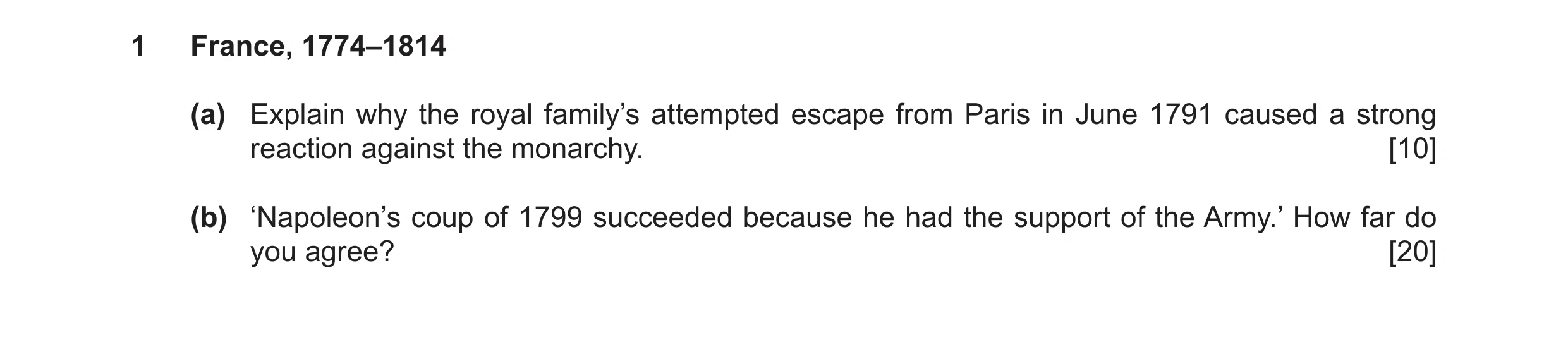
Q14 · France, 1774–1814 (a) Explain why the royal family’s attempted escape from Paris in June… 9489/21 Oct/Nov 2025
1 France, 1774–1814 (a) Explain why the royal family’s attempted escape from Paris in June 1791 caused a strong reaction against the monarchy. [10] (b) ‘Napoleon’s coup of 1799 succeeded because he had the support of the Army.’ How far do you agree? [20]
30 marks
Mark scheme: Question Answer Marks 1(a) Explain why the royal family’s attempted escape from Paris in June 1791 10 caused a strong reaction against the monarchy. Indicative content • The constitutional experiment was at an end. The attempted escape showed that the king was opposed to what had happened in France since the summer of 1789. • In seeming to seek foreign aid Louis XVI showed himself to be a traitor. • It showed there was a growing royalist faction prepared to use foreign intervention to destroy the gains of the revolution. If the monarchy were removed this faction would have no purpose. • Louis XVI was seen to be out of touch with his people in wanting to restore the Ancien Régime. The question of the governance of France now required more extreme methods (e.g. the petition on the Champs de Mars, July 1791, demanding the removal of the king). Accept any other valid responses. 1(b) ‘Napoleon’s coup of 1799 succeeded because he had the support of the 20 Army.’ How far do you agree? Indicative content Arguments to support this view could be as follows. The status that Napoleon had with the support of the army made him a national figure, especially since it had brought considerable glory to France (Italy/Egypt). His army was also critical in ensuring the coup worked and that there was no armed opposition. Moreover, it had been the army which had ensured the survival of the Directory against the numerous coups it faced. Once this support was lost the Directory had no means to survive. There was no countercoup against Napoleon in 1799. As an authoritarian figure due to his army support, he could find a middle way between the excesses of the Revolution and the failings of the Ancien Régime, and he could gain legitimacy at the same time This appeared to be the only possible solution to the problem of French government in 1799. Challenges to this view might consider how the Directory had clearly failed to establish a degree of permanency and lacked legitimacy in the eyes of many. There was, also, no credible figure capable of leading France on either the right or the left. Additionally, there was a complete lack of consensus about how France could and should be governed. Most people wanted stability and the gains of 1789–91. The war that France was also fighting was deeply unpopular because of the increased taxation and conscription. Napoleon’s ambition and his timing, together with his successful career and record, also made him a strong alternative. He also enjoyed the support of his brother and men like Fouché and Sieyès. His propaganda skills and political astuteness, also, marked him out. Accept any other valid responses.
This question in 9489/21 Oct/Nov 2025
Q15 · France, 1774–1814 (a) Explain why Napoleon’s regime can be seen as a dictatorship 9489/22 Oct/Nov 2025
1 France, 1774–1814 (a) Explain why Napoleon’s regime can be seen as a dictatorship. [10] (b) To what extent had the Revolution changed France by the end of 1791? [20]
30 marks
Mark scheme: Question Answer Marks 1(a) Explain why Napoleon’s regime can be seen as a dictatorship. 10 Indicative content • His method of gaining power, a military coup, showed strong autocratic tendencies. • He manipulated plebiscites to get the desired outcome. Commitment to revolutionary democracy was a sham. • There was extensive censorship and a network of government spies to ensure there was no questioning of Napoleon’s rule. • He made himself emperor and the imperial title hereditary. Accept any other valid responses. 1(b) To what extent had the Revolution changed France by the end of 1791? 20 Indicative content Arguments to show that the Revolution had changed France to a great degree might be as follows. It was clear to many that by 1789, after the fall of the Bastille, a wider national uprising and the ‘Great Fear’, that fundamental change had to happen. The ‘Bonfire of Privilege’ when feudalism effectively went, happened as early as August 1789. So many of the institutions of the Ancien régime which had perpetrated inequality such as the Parlements, the Provincial Estates and taxes like the gabelle, had gone. June 1790 saw the abolition of all hereditary titles and the nobility. The previous feudal geography of France was gone, replaced by 83 departments. The Civil Constitution of the Clergy, July 1790, was also a major step forward in linking the Church more closely to the State and dealing with abuses common under the Ancien Régime such as absenteeism and pluralism. For example, the number of bishoprics declined from 135 to 83 and all clerical posts except for parish priests and bishops ceased to exist. March 1791 saw the dissolution of the guilds and in September Louis XVI accepted the new constitution. It was the new phenomenon of public opinion that had forced change not the wishes of the king and his ministers. However, this view can be challenged. While on the one hand the Ancien Régime appeared to have gone, there was little sign of coherent rebuilding. There was little fiscal stability and no real answers to the issues of taxation which had played such a key part in bringing about the crisis of 1789. The new tax rolls were based, still, on those of the Ancien Régime so that great regional variations remained. A survey of land values was not begun until 1807 and not completed until the 1830s. The voting system with its concept of ‘active citizens’ still favoured the wealthy. Arguably, change could be seen as superficial and not likely to last while there was still a Bourbon on the throne, and there was still a throne. The royal family’s attempted escape from Paris in June 1791 seemed to confirm this for many. The petition to abolish the monarchy and the consequences of the Massacre on the Champs de Mars in July 1791 showed that revolutionary change was not over but moving to a more radical phase. Accept any other valid responses.
This question in 9489/22 Oct/Nov 2025
![Question 1: France, 1774–1814 (a) Explain why the monarchy was abolished in 1792. [10] (b) How far did Napoleon’s domestic policies benefit the French …](https://img.pastlit.com/crops/1ed363be-b9e0-442c-ac52-96baff607b3a/q1.webp)
![Question 2: France, 1774–1814 (a) Explain why the Estates General was not able to deal with the issues France faced. [10] (b) How far did Napoleon as F…](https://img.pastlit.com/crops/13d46c47-39fa-4683-9180-45eba3203b62/q1.webp)
![Question 3: France, 1774–1814 (a) Explain why Napoleon introduced the Civil Code. [10] (b) ‘Louis XVI brought about his own downfall.’ How far do you a…](https://img.pastlit.com/crops/a2dd7a46-f840-4e99-a1a1-4c55cac6aff6/q1.webp)
![Question 4: France, 1774–1814 (a) Explain why Necker resigned in 1781. [10] (b) How firmly did Napoleon establish his control over France as First Cons…](https://img.pastlit.com/crops/3a108354-9e63-4dda-aa25-3f4e84d6528d/q1.webp)
![Question 5: France, 1774–1814 (a) Explain why the Assembly of Notables met in 1787. [10] (b) To what extent did Napoleon’s domestic policies change Fra…](https://img.pastlit.com/crops/cdfe1459-4531-4ac2-8be6-4c93b03d18cd/q1.webp)
![Question 6: France, 1774–1814 (a) Explain why Napoleon’s domestic policies were popular. [10] (b) ‘War caused the French monarchy to fall in 1792.’ How…](https://img.pastlit.com/crops/282c593b-07bc-48aa-b218-f66ce3507669/q1.webp) 1 / 3
1 / 3![Question 7: France, 1774–1814 (a) Explain why the insurrection of 10 August 1792 happened. [10] (b) ‘The Concordat of 1801 was Napoleon’s greatest dome…](https://img.pastlit.com/crops/124b0c92-4203-4199-9793-a06889ebec9c/q1.webp)
![Question 8: France, 1774–1814 (a) Explain why Napoleon became emperor in 1804. [10] (b) ‘Taxes caused the outbreak of the French Revolution in 1789.’ H…](https://img.pastlit.com/crops/1e9768d7-c225-4abe-a9c2-55fadd798beb/q1.webp)
![Question 9: France, 1774–1814 (a) Explain why the storming of the Bastille happened. [10] (b) ‘Napoleon was able to maintain his power by using propaga…](https://img.pastlit.com/crops/1ba80a66-7d3b-4183-b897-f2a4e68305f3/q1.webp)
![Question 10: France, 1774–1814 (a) Explain why Napoleon agreed to the Concordat of 1801. [10] (b) ‘The failings of Louis XVI led to the storming of the …](https://img.pastlit.com/crops/5a216cca-6ede-4d0a-8b84-12a4d3c58783/q1.webp)
![Question 11: France, 1774–1814 (a) Explain why Louis XVI and his family fled Paris in June 1791. [10] (b) ‘Napoleon was a dictator.’ How far do you agre…](https://img.pastlit.com/crops/3cd171d1-0ecf-44fa-ae60-c8f47acabfd0/q1.webp)
![Question 12: France, 1774–1814 (a) Explain why Napoleon was able to establish order in France after 1799. [10] (b) To what extent were Robespierre and t…](https://img.pastlit.com/crops/437c8215-73eb-4aff-b91b-9fe5da52cbf3/q1.webp) 2 / 3
2 / 3![Question 13: France, 1774–1814 (a) Explain why the Jacobins fell from power in 1794. [10] (b) ‘Repressive rather than reformist.’ How far do you agree w…](https://img.pastlit.com/crops/90cfefd7-83ab-449c-94e6-73ab8c94737d/q1.webp)
![Question 15: France, 1774–1814 (a) Explain why Napoleon’s regime can be seen as a dictatorship. [10] (b) To what extent had the Revolution changed Franc…](https://img.pastlit.com/crops/f34ff3ad-4811-4297-b0bb-1f9e0c2c9aee/q1.webp) 3 / 3
3 / 3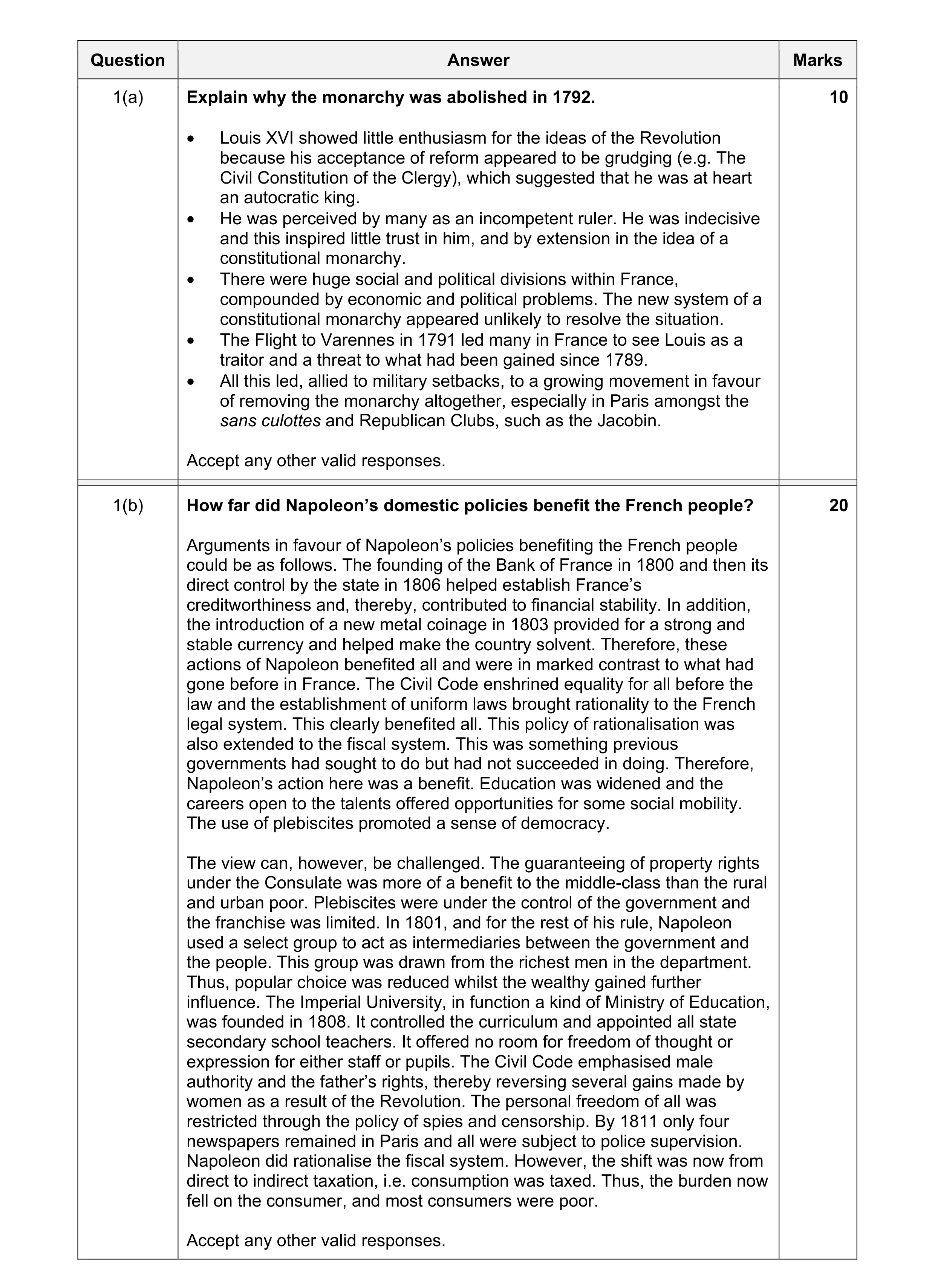 30
30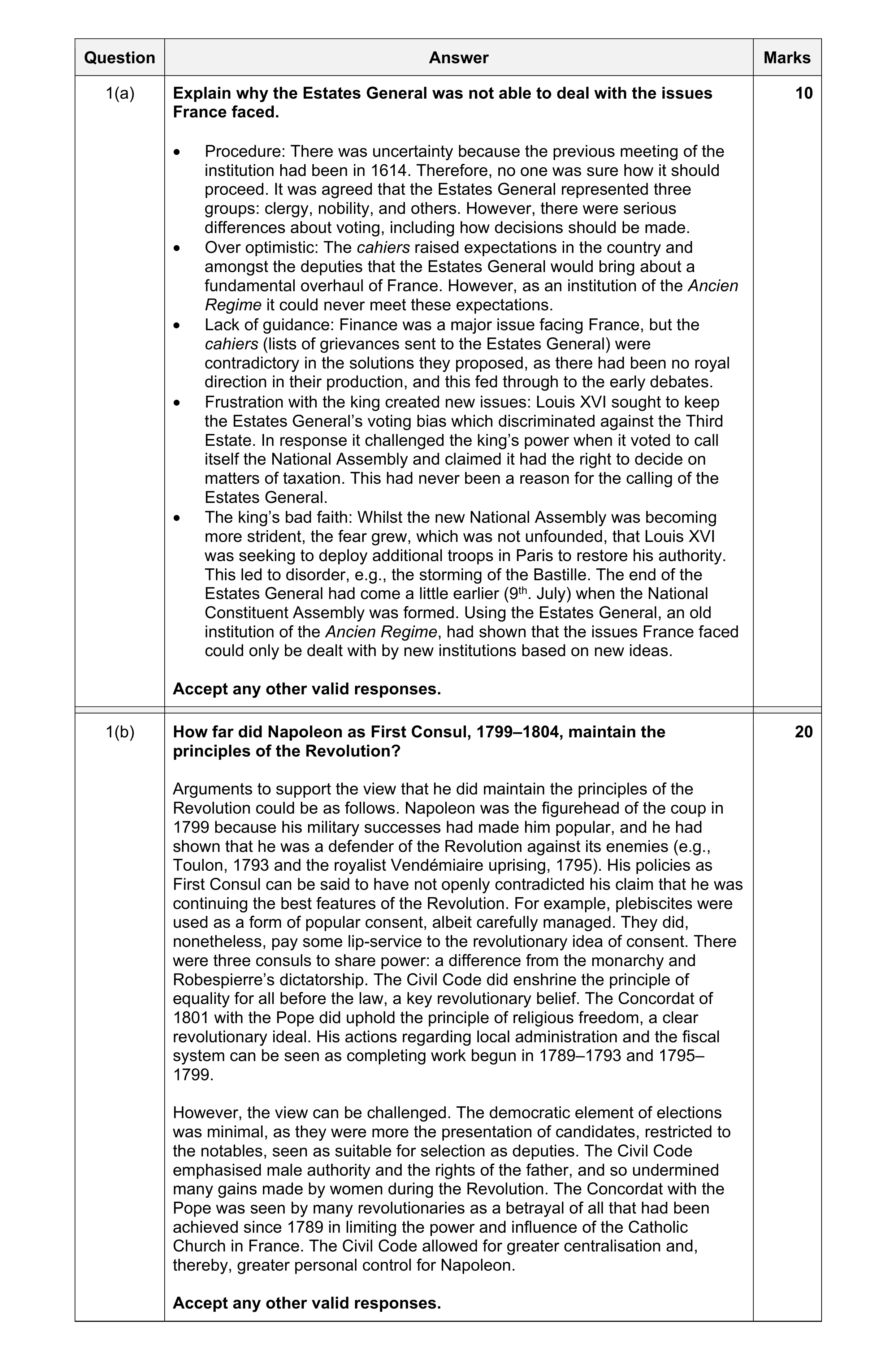 30
30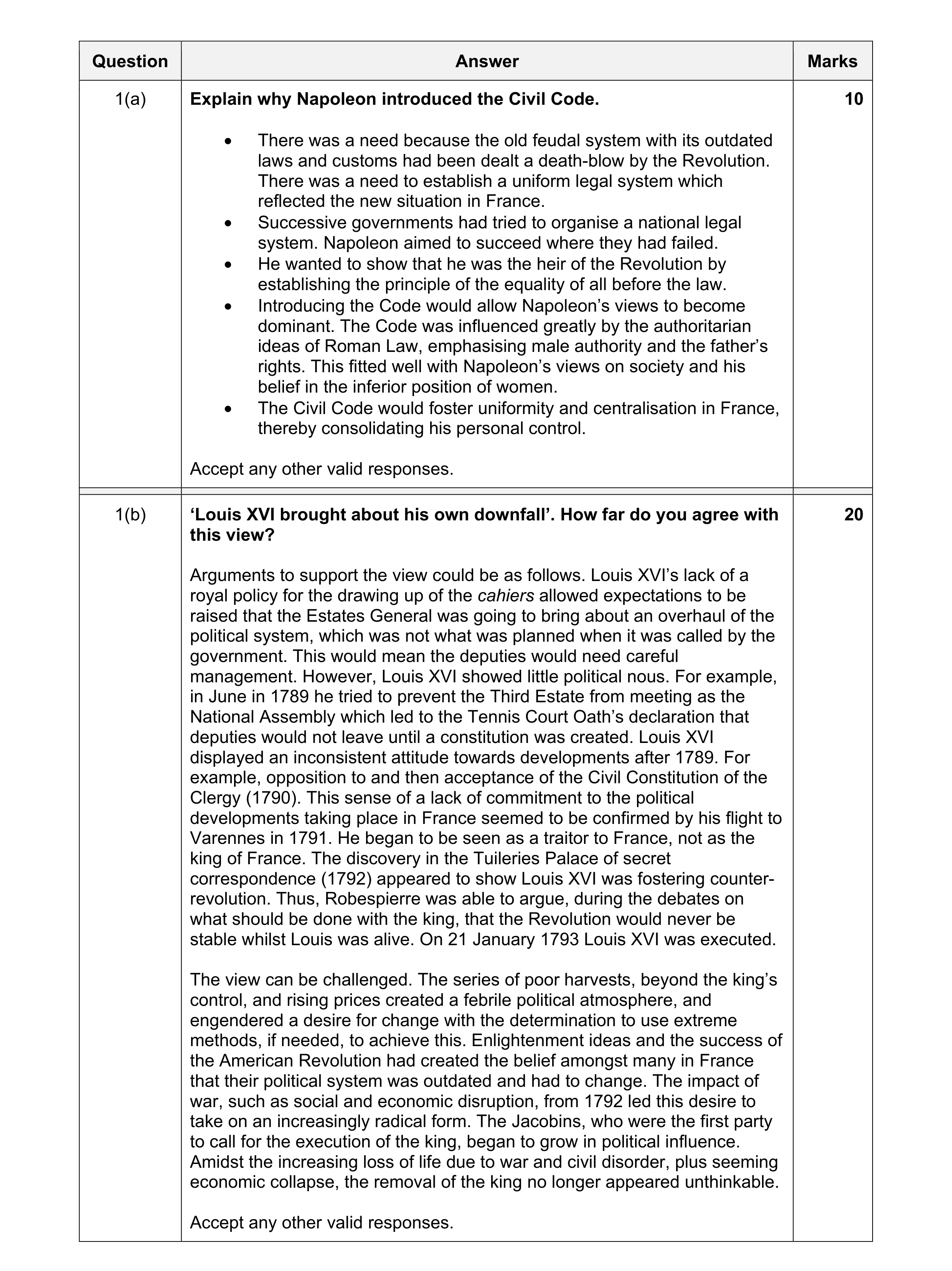 30
30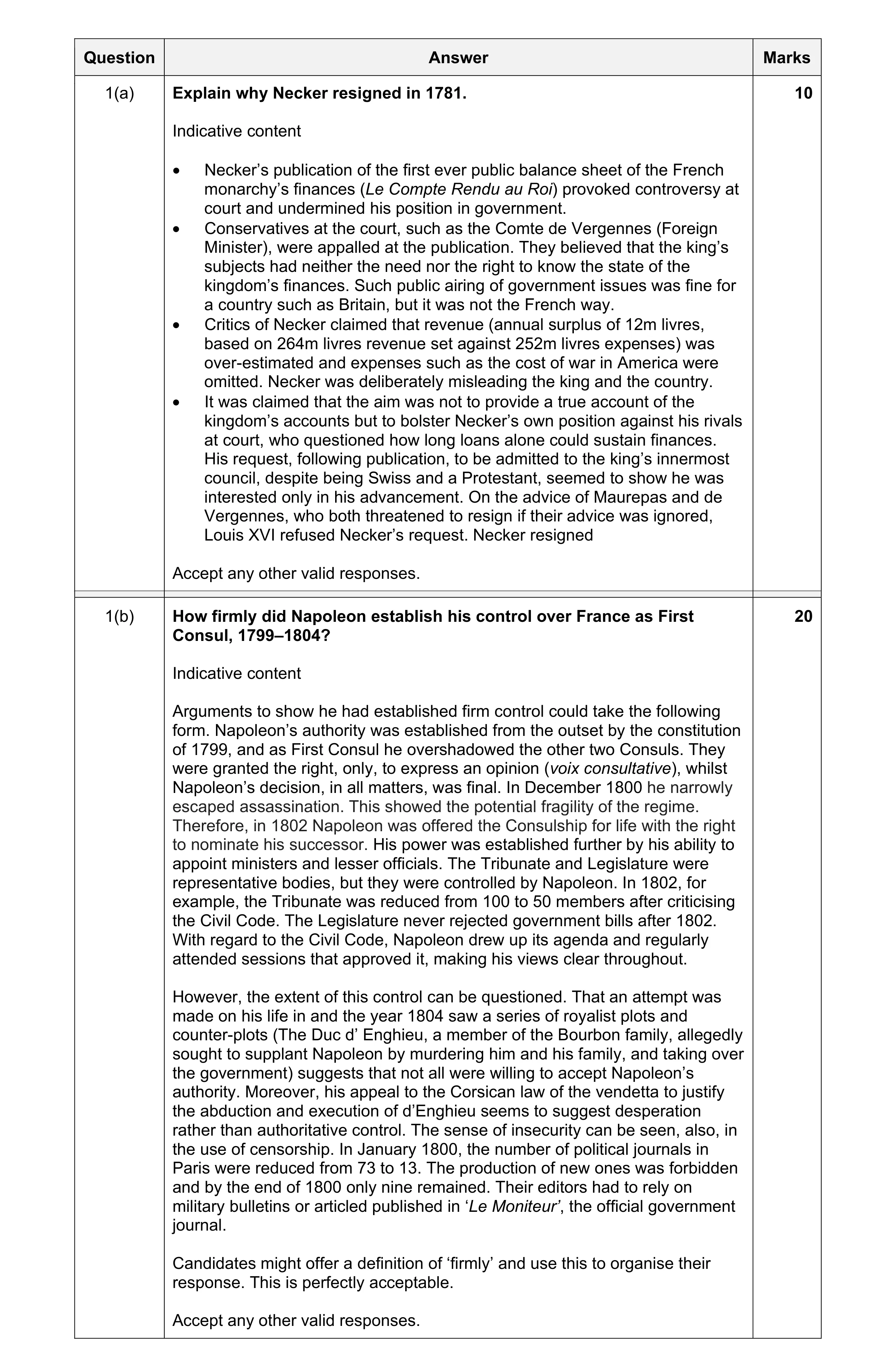 30
30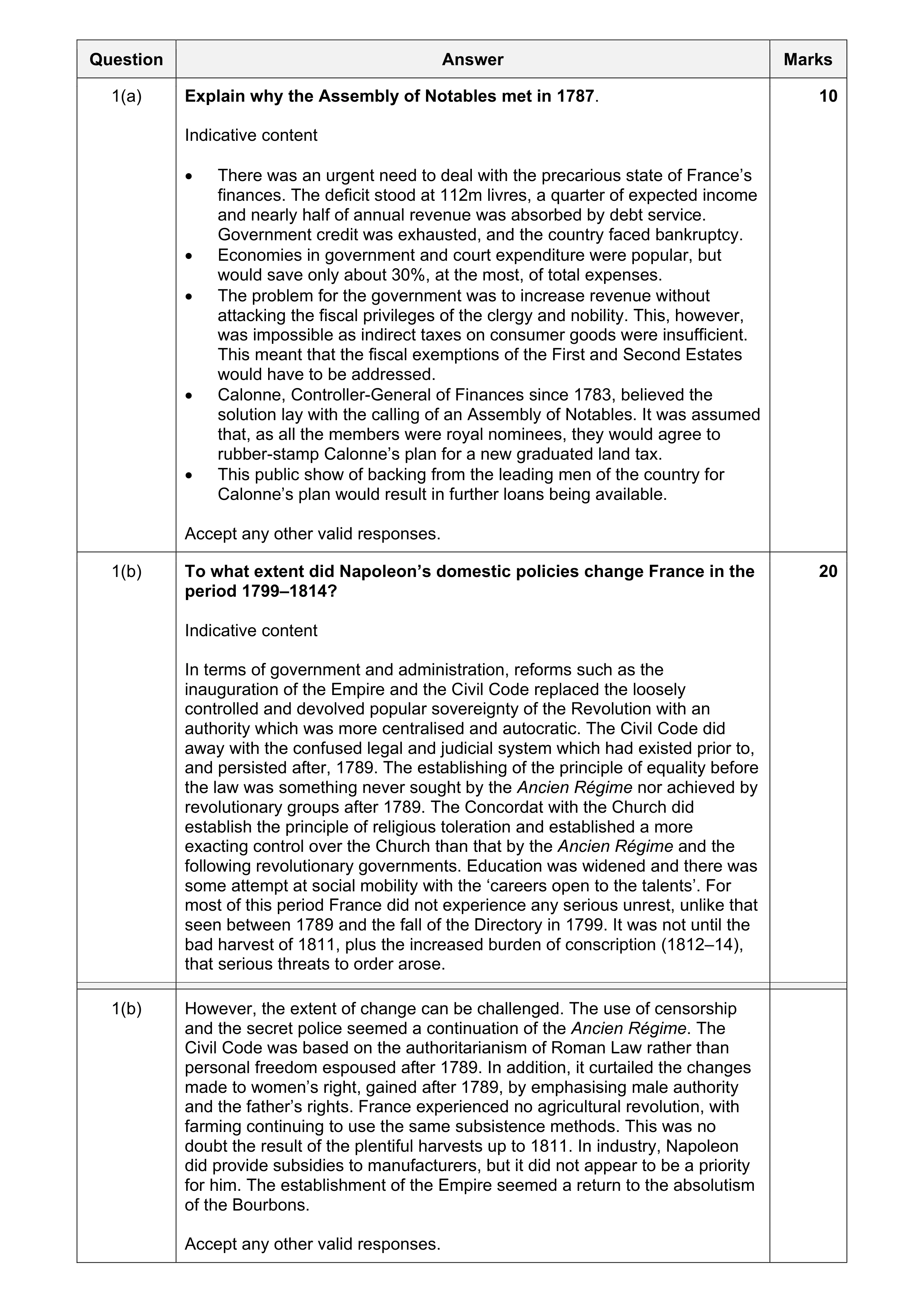 30
30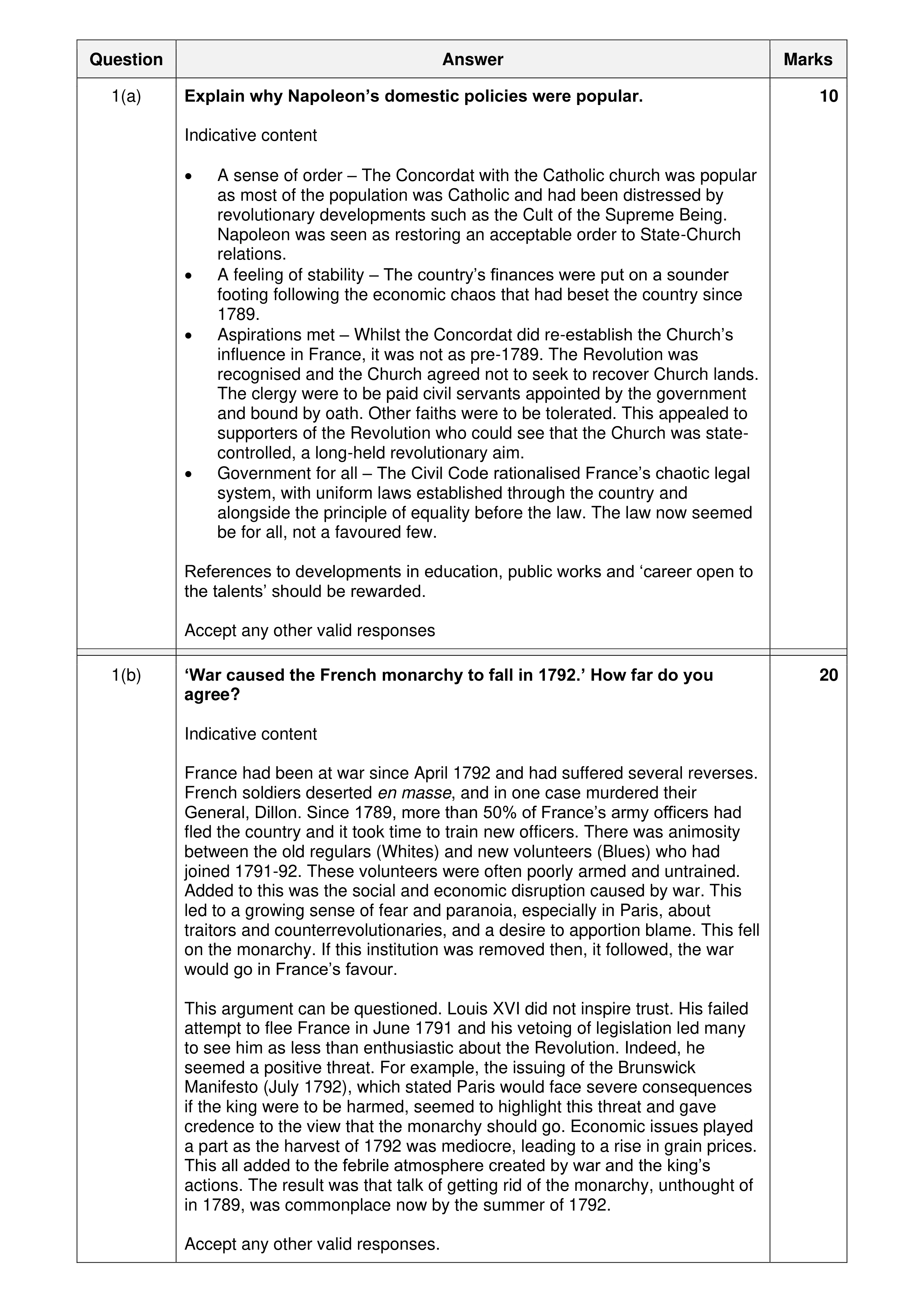 30
30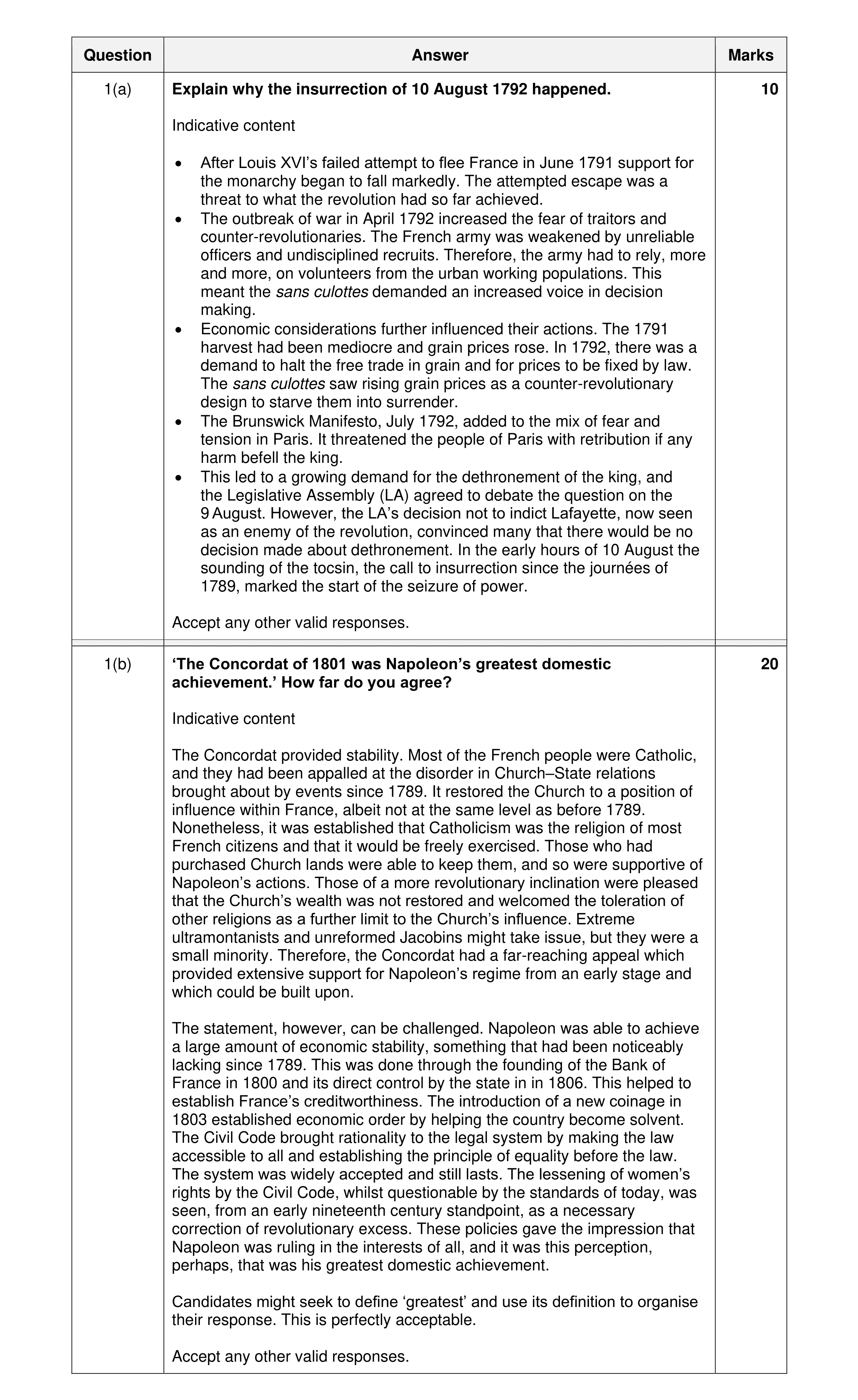 30
30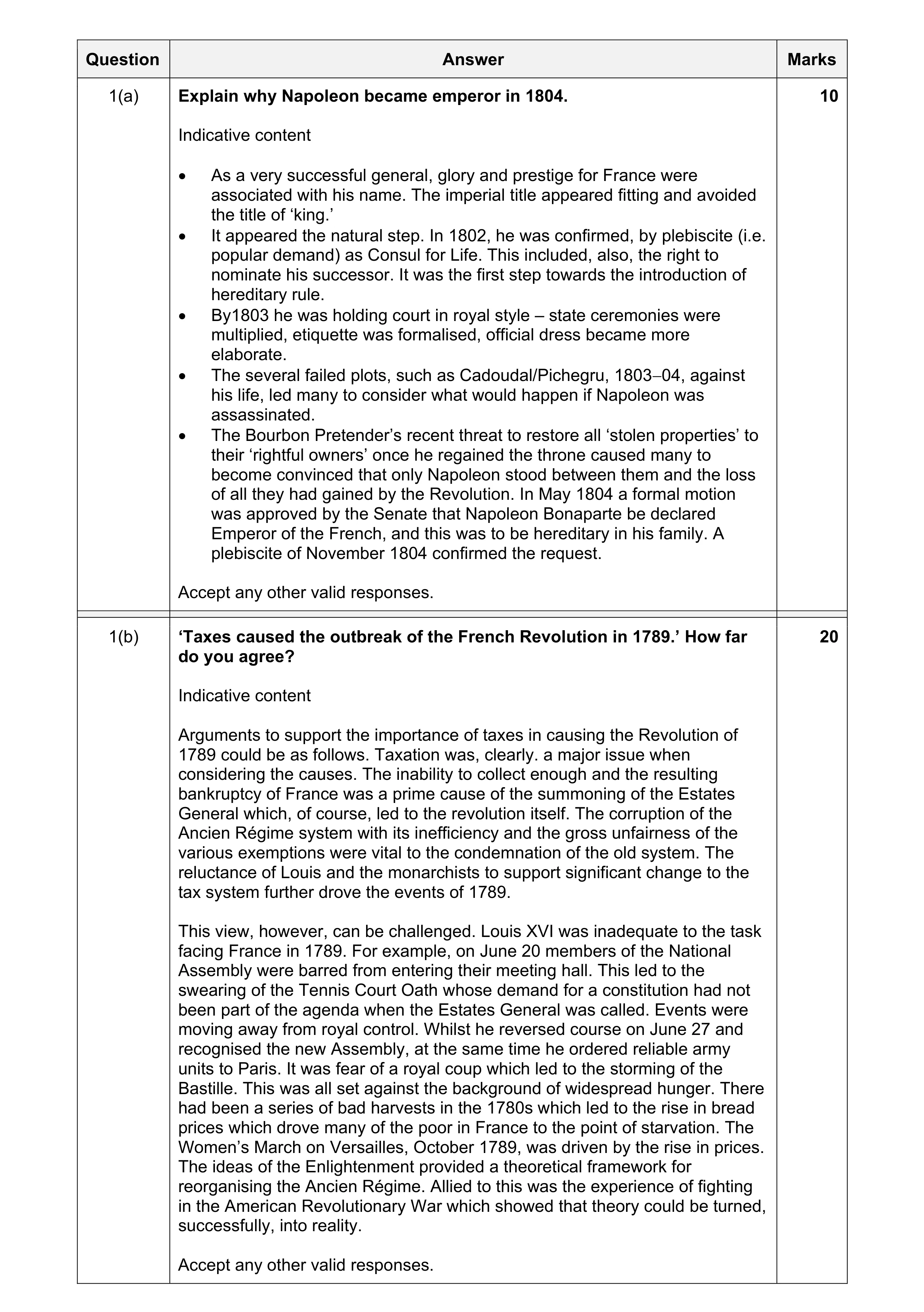 30
30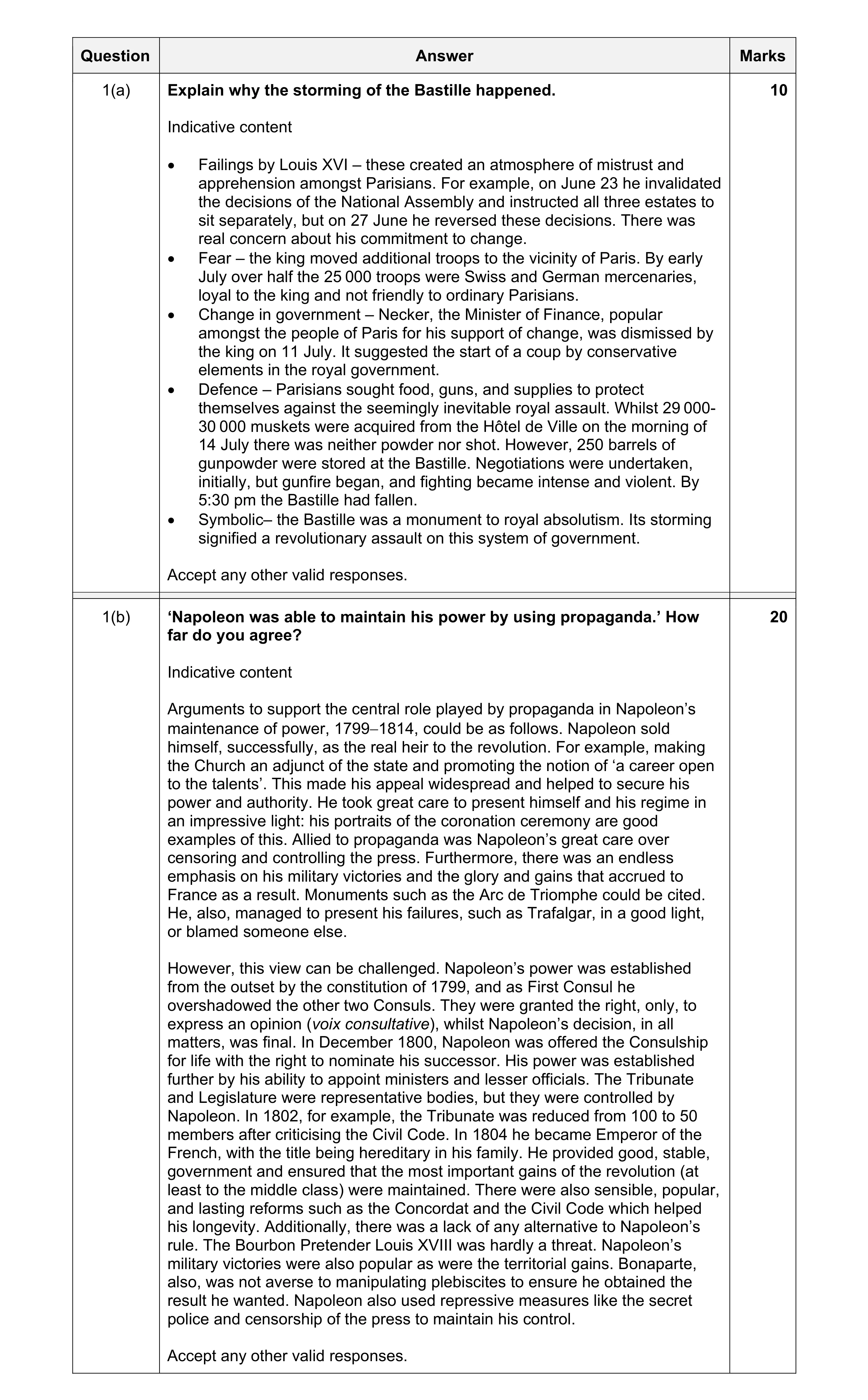 30
30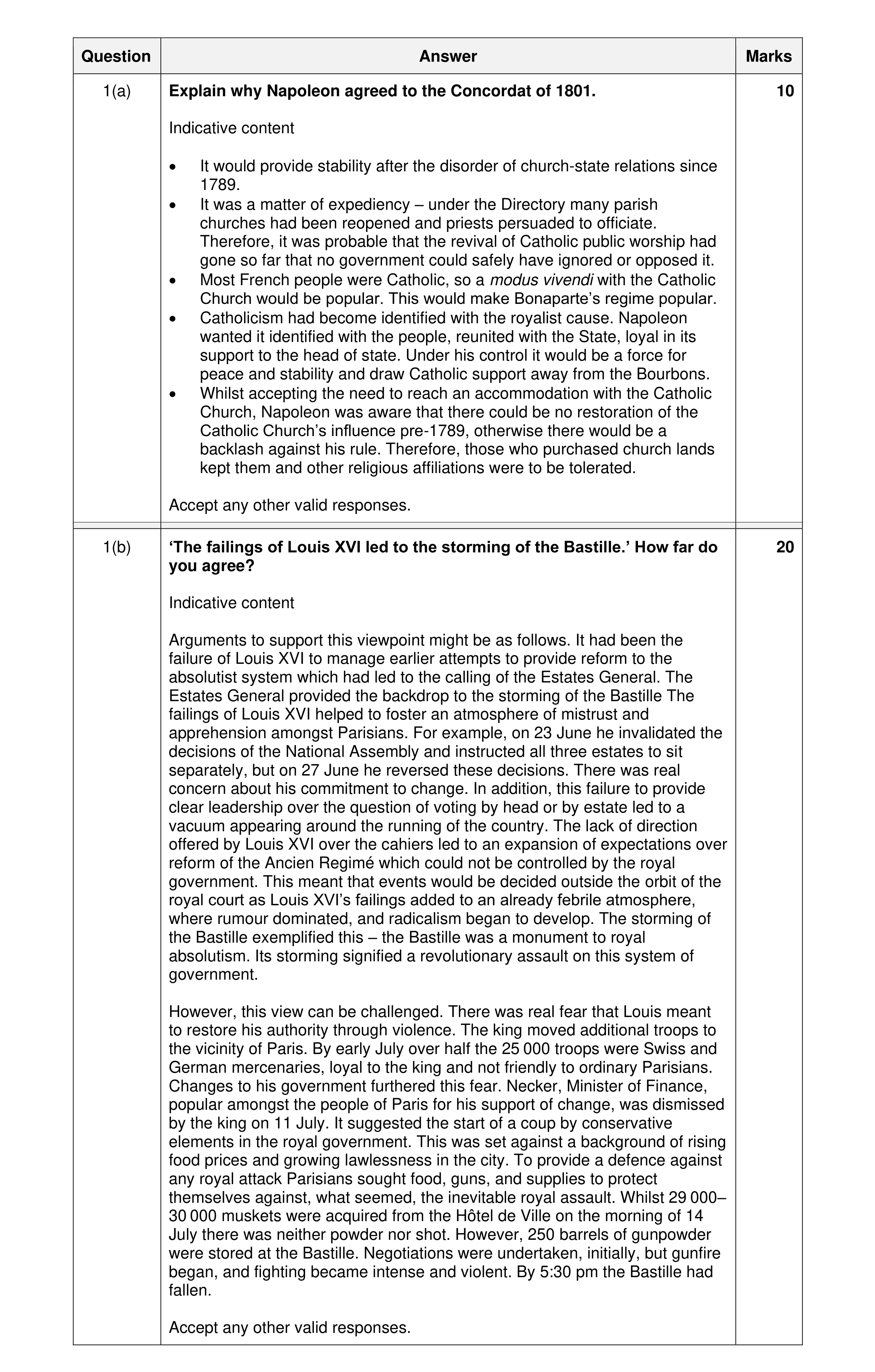 30
30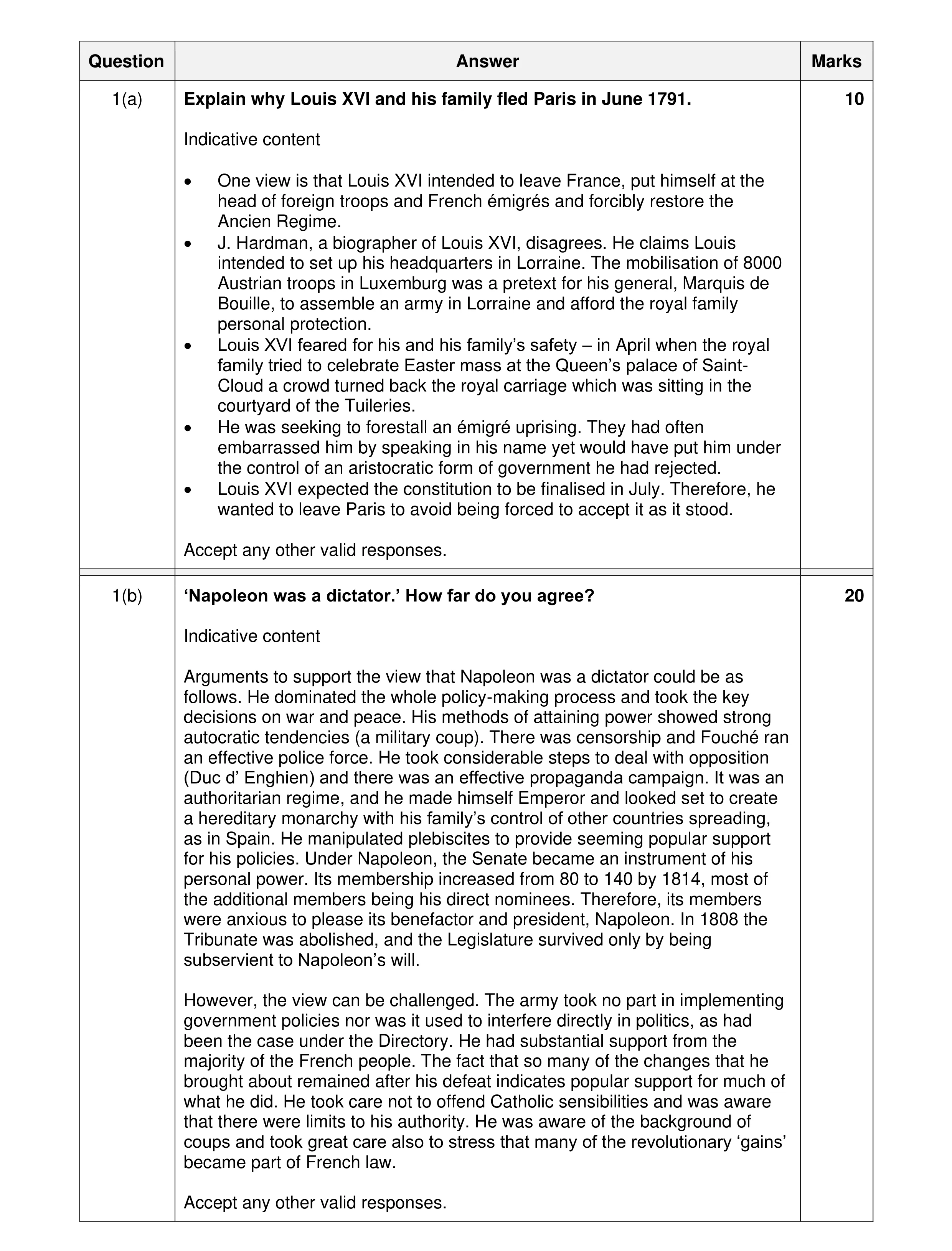 30
30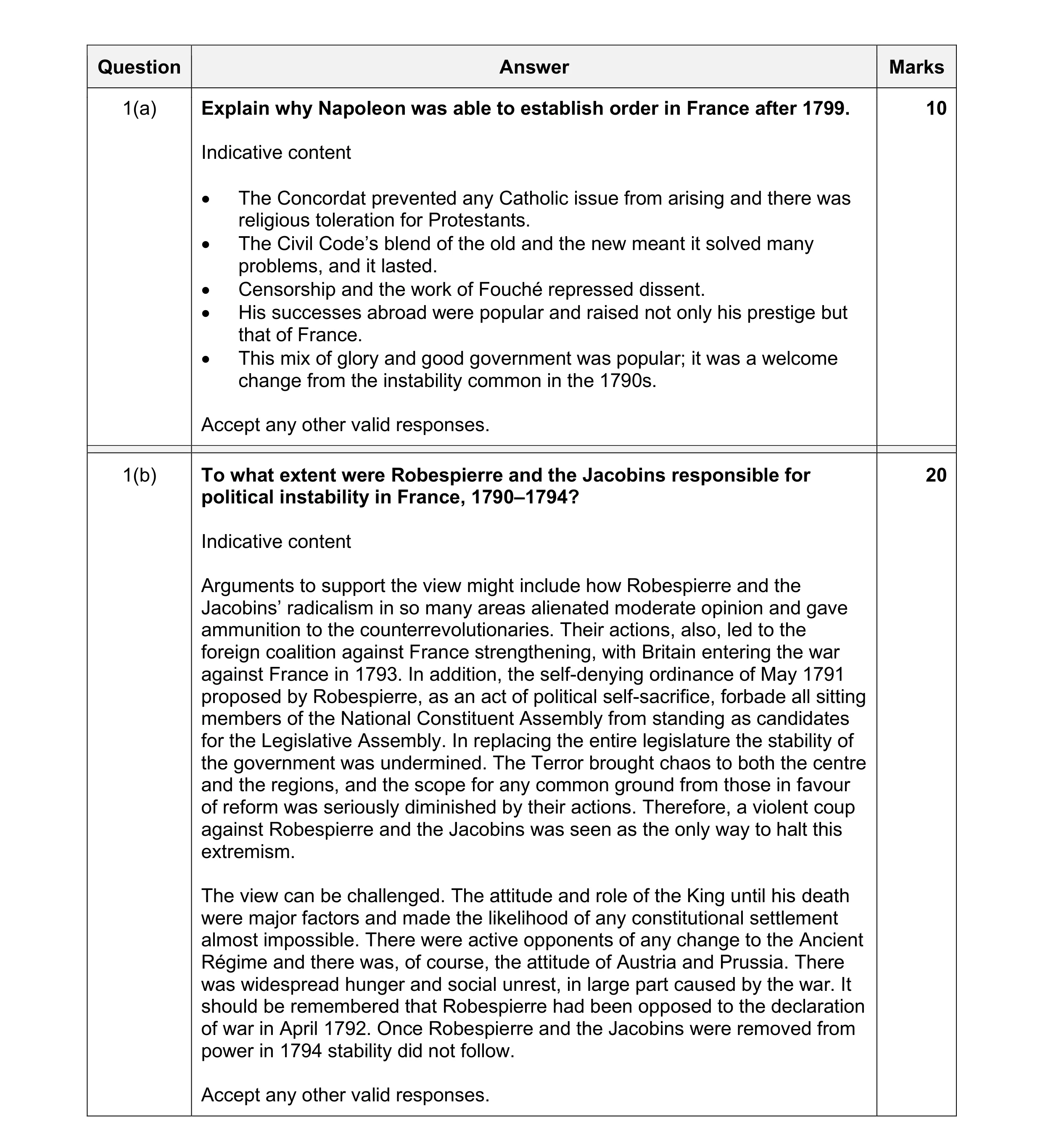 30
30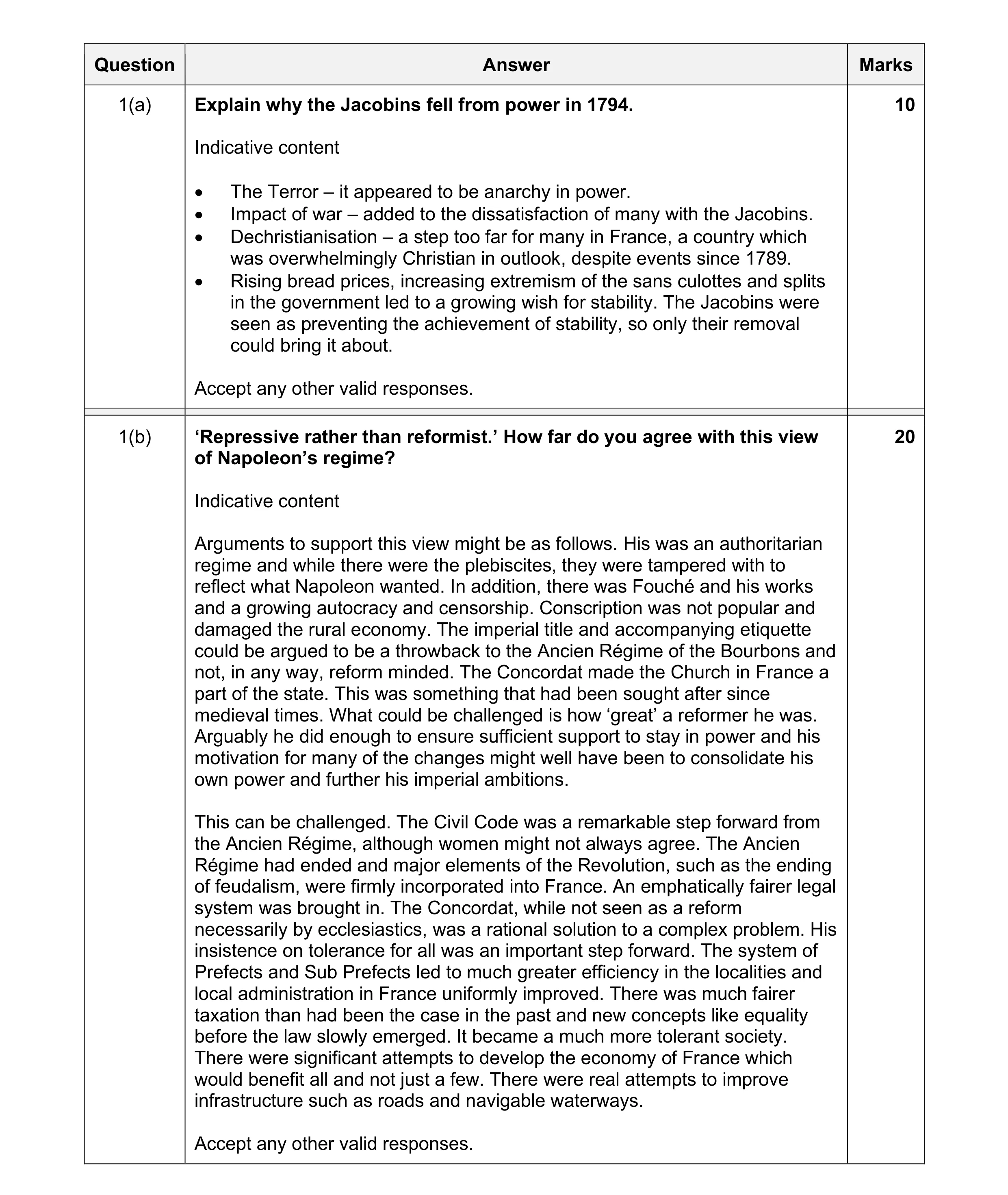 30
30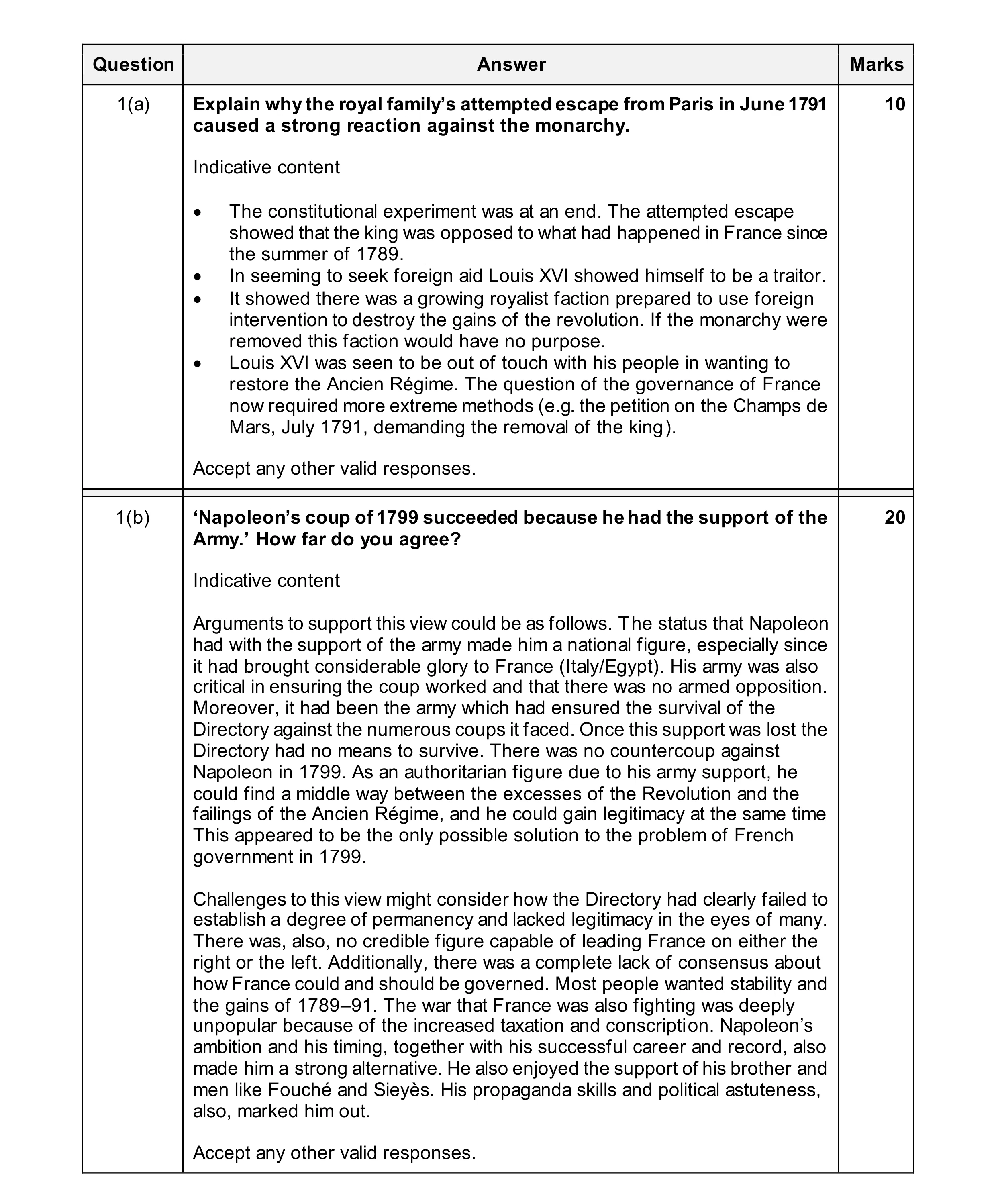 30
30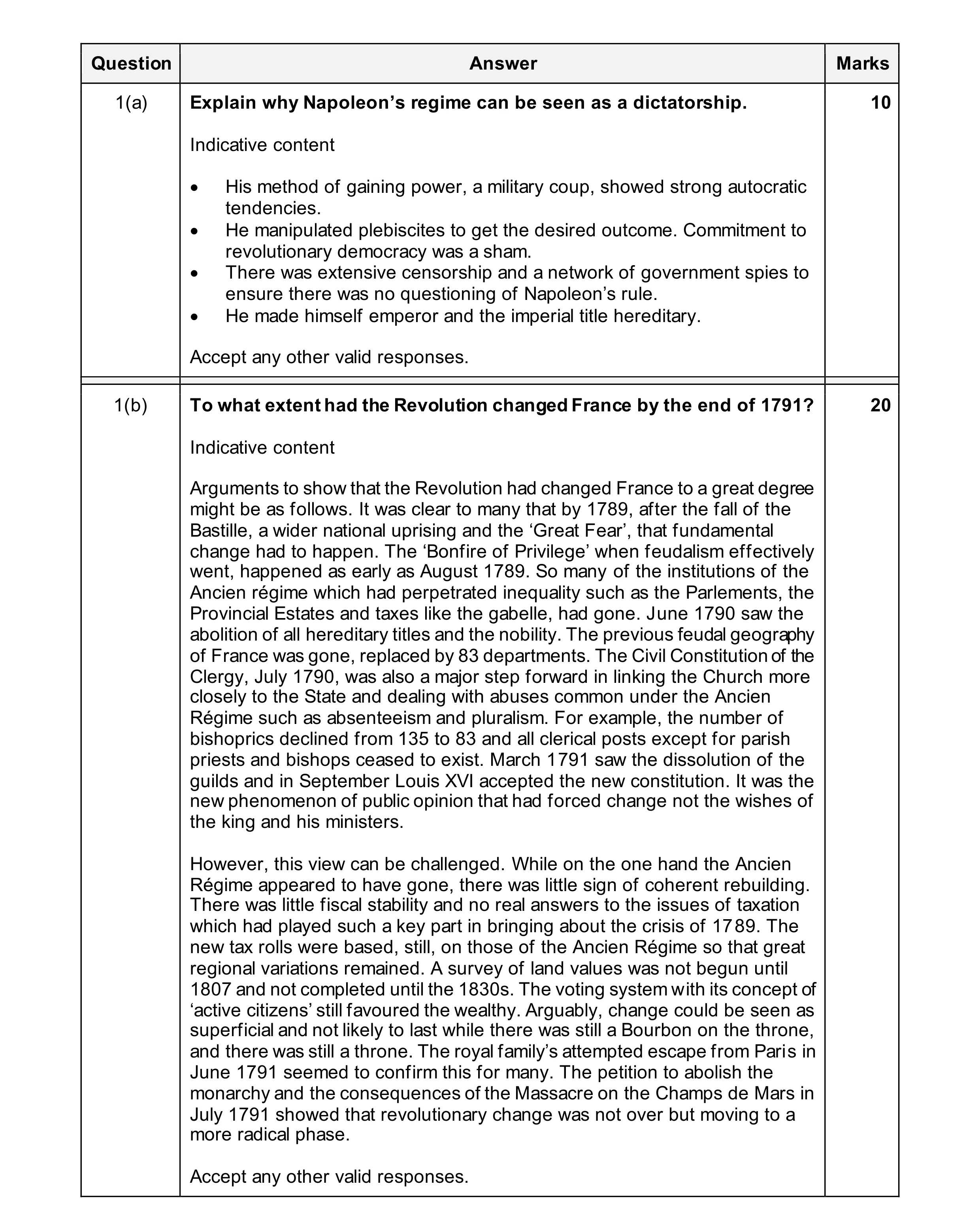 30
30