Questions as text
Q1 · China and Japan, 1912–45 (a) Explain why Japan was unhappy with the outcome of the Paris… 9489/22 Feb/March 2021
9 China and Japan, 1912–45 (a) Explain why Japan was unhappy with the outcome of the Paris Peace Conference. [10] (b) How successful were Chiang Kai-shek’s attempts to re-unite China? [20]
30 marks
Mark scheme: 9(a) Explain why the Japan was unhappy with the outcome of the Paris 10 Peace Conference. Though the Japanese had not fought in Europe the Japanese Fleet had been utilised in the Mediterranean and the Japanese played a major role in the Asia sphere but: • They were not included in the discussions of the ‘Big Three’. • Though they were given German island territories and some of Germany’s concessions in China they did not get all they wanted in China. • The Japanese felt they were not treated as a modernised industrial and military power. • The Treaty of Versailles did not endorse the equality of all races and the Japanese felt they had been treated as an inferior race. Accept other valid responses. 9(b) How successful were Chiang Kai-shek’s attempts to re-unite China? 20 Responses will need to consider the developments of KMT control following the death of Sun and the rise to power of Chiang. It may include something about the internal struggle for control of the KMT but is more likely to focus on the ending of the warlord era and the Nationalist/communist conflict. Chiang used his control of the military forces to establish his leadership of KMT and remove left wing leaders. The Northern Expedition in1927 saw him gain control of much of Southern China. The Shanghai massacres broke with CCP. He completed the capture of Beijing, which gave Chiang control of most of China. Encirclement campaigns; after fifth, destroyed Jiangxi Soviet and drove out communists. Failure to deliver Sun Yat-sen’s 3 principles led to loss of support from wider population. He failed to destroy CCP – Long March. He failed to respond to Japanese invasion of Manchuria. His failure to act against Japan led to Xian Bridge incident. Constant attempt to counteract CCP growth led to failure to act effectively against Japan in 2nd Sino–Japanese War. Accept other valid responses.
This question in 9489/22 Feb/March 2021
Q2 · France, 1774–1814 (a) Explain why the Directory was overthrown in 1799 9489/22 May/June 2021
1 France, 1774–1814 (a) Explain why the Directory was overthrown in 1799. [10] (b) ‘Economic weakness was the main cause of political instability in France between 1790 and 1795.’ How far do you agree with this view? [20]
30 marks
Mark scheme: Question Answer Marks 1(a) Explain why the Directory was overthrown in 1799. 10 • The Directory failed to offer a solution to the political, social, and economic problems facing France at the time, which were a legacy of the Revolution. • The background of war, coup attempts, and possible counter- revolutionary activities created instability which eroded the Directory’s authority. • Many property owners, created by the Revolution, feared a Jacobin revival or monarchical restoration would result in the loss of their recent acquisitions. The continuation of weak government by the Directory seemed to bring either of these two unwanted outcomes ever closer. • Napoleon was a successful general which created popular appeal and made him appear a viable alternative. • Napoleon’s timing was impeccable as he left for France and arrived before news of his setbacks in Egypt became common knowledge. This, combined with his brother Lucien’s earlier tireless efforts to rally support for the coup of 1799, resulted in the Directory’s overthrow in 1799. Accept any other valid responses. 1(b) ‘Economic weakness was the main cause of political instability in 20 France between 1790 and 1795’. How far do you agree with this view? The following are some possible arguments in support of the viewpoint. Industrial and agricultural output fell, foreign trade declined, and prices rose during this time, all of which had a negative impact on government finances. They issued assignats, a type of bond based on the value of seized clerical property that evolved into a paper currency, to deal with the issue of national debt and reduce taxation. However, due to the government’s lack of control over the amount to be printed, their value grew beyond the confiscated property’s limits, causing inflation. Inflation increased between 1791 and 1793, with food prices increasing by 90% but wages only increasing by 80%. Poor harvests caused food shortages, which exacerbated inflation, and the assignats became a cause of food riots and public disorder as a result. In September 1793, for example, the sans culottes invaded the National Convention, demanding food. The Committee of Public Safety (CPS) enacted the Law of the Maximum, which established price and wage controls, because they saw hunger and poverty as threats to their position. The law, however, increased instability by causing producers to either limit food production or hoard their food stocks in response to the new prices set by law. This created shortages and famines, leading the CPS to send troops to arrest farmers and seize crops. As a result, resentment grew as the seizures only alleviated food shortages in Paris while exacerbating shortages in other parts of the country. All of this undermined the government’s authority and contributed to Robespierre’s and his allies’ downfall. In December 1794, the Thermidorean government increased inflation even more by abolishing the Maximum and issuing assignats. It was replaced by the Directory in November 1795. The view can be challenged. The notion of constitutional monarchy was eroded by Louis XVI’s often hostile attitude toward political change, leading to his execution in January 1793, which further polarised politics. From 1792, the impact of war and the threat of foreign invasion, combined with counter-revolutionary uprisings, had created a tense political climate. As a result, events like the September Massacres of 1792 and the reign of Terror under the Jacobins occurred. The latter further radicalised French politics and created instability. The Thermidorian Reaction, which took place in 1794, put an end to Jacobin rule but not to political instability. The Jacobins still had support, and disorder broke out in April and May 1795. This led to the ‘White Terror’ against these supporters. Thus, violence rather than any notion of legitimate popular sovereignty was the determinant in politics. Accept any other valid responses.
This question in 9489/22 May/June 2021
Q3 · France, 1774–1814 (a) Explain why Louis XVI was executed in 1793 9489/21 Oct/Nov 2021
1 France, 1774–1814 (a) Explain why Louis XVI was executed in 1793. [10] (b) To what extent was Napoleon’s military ability the reason for the ending of the Directory in 1799? [20]
30 marks
Mark scheme: Question Answer Marks 1(a) Explain why Louis XVI was executed in 1793. 10 • Louis XVI was reluctant to make concessions (e.g. Civil Constitution of the Clergy) which made him appear as a barrier to reform. • The flight to Varennes seemed to show that the king supported foreign invasion to undo the Revolution and this made many citizens in France see him as a traitor. • After the Flight to Varennes, radicals, such as the Jacobins, gained more influence. The Jacobins were the first political group to demand the death of the king. • Events such as the Massacre on the Champs de Mars (1791) and the attack on the Tuileries Palace (1792) caused many Parisians to see Louis XVI as the cause of the death of many of their fellow citizens. This further increased the calls for his execution. • The discovery in the Tuileries Palace of the king’s secret correspondence seemed to show that he was encouraging counter-revolution and was a further sign of his bad faith regarding the Revolution. It was made public in November 1792 and it undoubtedly influenced the debates over the king’s fate. On 21 January 1793 he was executed. Accept any other valid responses. 1(b) To what extent was Napoleon’s military ability the reason for the ending 20 of the Directory in 1799? Arguments to support the view could be as follows. Napoleon had a superb military reputation due to his successes in Italy (1796–1797) and Egypt (1798–99). These victories attested to his military ability and created a popular appeal which was one reason why the conspirators of 1799 looked to Napoleon for support and to organise the necessary military support. This seemed to be vindicated by the fact that Napoleon was greeted as a hero by the civilian population on his return from Egypt. The army saw him as a leader to overthrow a weak government which appeared to have abandoned its revolutionary roots. Thus, on 10 November, it was Napoleon who ordered troops to move against the Council of 500 in the Palace of St. Cloud. This led the Council of Ancients to end the Directory and the creation of a three-man executive, the Consuls. However, this view can be challenged. The Directory came to an end because it was assailed by coups and regional instability throughout its period of rule, and so it could not establish firm foundations. For example, there were royalist risings in the west and the threat of invasion by the Second Coalition. It was further isolated because it appeared to many Republicans that the Directory was abandoning the ideas of the Revolution. There was a lack of support which bordered on apathy. For example, by the late 1790s, it had become difficult to persuade men to come forward as candidates for election as local officials. The initial reaction to the coup of 1799 was muted as it was seen as a cosmetic manoeuvre by the Directory – Consuls instead of Directors. Lucien Bonaparte’s work prior to the coup in arranging and organising support was central to its success and the ending of the Directory. Napoleon showed political nous by leaving Egypt and reaching France before knowledge of his failing became common knowledge. Accept any other valid responses.
This question in 9489/21 Oct/Nov 2021
Q4 · France, 1774–1814 (a) Explain why the National Constituent Assembly introduced the August… 9489/22 Oct/Nov 2021
1 France, 1774–1814 (a) Explain why the National Constituent Assembly introduced the August Decrees. [10] (b) ‘The ideas of the Revolution were ignored by the Directory.’ To what extent do you agree with this view? [20]
30 marks
Mark scheme: Question Answer Marks 1(a) Explain why the National Constituent Assembly introduced the August 10 Decrees. • To restore calm in the French provinces because, following the storming of the Bastille (14 July 1789), there was mass uproar which spread from Paris to the countryside. • This ‘Great Fear’ saw nobles families attacked and properties destroyed. The latter often occurred irrespective of whether they were noble owned. This frightened the property-owning members of the Assembly. However, they had no means available to restore order by force. • Liberal deputies from the Breton Club (forerunners of the Jacobin movement) believed only a grand gesture by the Assembly, such as reforming the social pattern of the nation, would calm the peasants. • The pressure of the moment led many deputies to go further than they had intended. • Aristocrats’ proponents, such as the Duc d’Aigullion, had a history of support for the cause of patriotic liberty, which includes supporting the military in America in the 1770s. Therefore, there was a perception that they were not posturing, but were driven by idealism. • Answers may focus specifically on the key terms of the August Decrees – abolition of feudalism and privilege of the Church. Accept any other valid responses. 1(b) ‘The ideas of the Revolution were ignored by the Directory.’ To what 20 extent do you agree with this statement? Arguments to support the view could be as follows. The Constitution of 1795 gave the Directory emergency powers to curb press freedom and the freedom of association, more in line with the ‘Ancien Regime’ than the Revolution of 1789. The coups faced by the Directory undermined its authority and made it appear to be solely concerned with political survival as an end, rather than continuing the ideas of the Revolution. Thus, the lack of an initial response to the coup of 1799 may have been because many saw it as a cosmetic move by the Directory – Consuls instead of Directors. In 1797, the Directory nullified elections in 49 departments and excluded 177 deputies. This anti-democratic sentiment, which ran counter to the Revolution’s ideas, resurfaced in 1799 when the Directory attempted to impose its own hand-picked candidates. The suppression of party activity was an attack on the ideas of the Revolution. This meant that those who had previously been politically active were replaced by inexperienced and previously politically inactive people. They followed a more loosely defined set of principles which suggested that the Directory did ignore the ideas of the Revolution. The view can, however, be challenged. The Directory managed to build on the huge achievements of 1791–92, and the 1795 Constitution established a franchise based on the payment of taxes, similar to the 1791 Constitution. For a time, the Directory made democratic institutions work, such as yearly elections and the secret ballot, as required by the 1795 Constitution and in accordance with the Revolution’s democratic ideas (the secret ballot was not adopted by Britain until 1872). There franchise was far broader than that of their British or Dutch neighbours, and the press was remarkably free. All of this is in line with revolutionary ideas. Despite a general economic depression, the Directory was able to maintain, and in some areas, increase French prosperity by 1799. Economic prosperity and security were goals of the Revolution and, indeed, the desire to establish them could be said to have played a large part in bringing about the Revolution of 1789. It is acceptable for responses to seek a definition of the ideas of the Revolution and use this as a template to organise their argument. Accept any other valid responses.
This question in 9489/22 Oct/Nov 2021
Q5 · France, 1774–1814 (a) Explain why France experienced the ‘Reign of Terror’ between 1792… 9489/23 Oct/Nov 2021
1 France, 1774–1814 (a) Explain why France experienced the ‘Reign of Terror’ between 1792 and 1794. [10] (b) To what extent did the ideas of the Enlightenment cause the outbreak of the Revolution in 1789? [20]
30 marks
Mark scheme: Question Answer Marks 1(a) Explain why France experienced the ‘Reign of Terror’ between 1792 and 10 1794. • After the declaration of war against Austria in 1792 there was the fear of invasion. This meant that the Revolution could be overturned. All methods had to be used to make sure this did not occur. • There was anti-Jacobin violence outside of Paris and counter-revolution gained ground. Cities like Lyon and Toulon were breaking away. Therefore, radical measures had to be taken to prevent the country from falling apart. • Given the circumstances the sans culottes, whose support was essential to the Jacobins, demanded that the Committee of Public Safety act firmly. • The Jacobins saw it as a way of consolidating their power by casting opponents as threats to the Revolution. • Robespierre believed in the notion of the ‘General Will’. This represented the interests of everyone, not just the few. The Revolution would bring about a Republic built for this ideal. Therefore, anyone who sought to oppose this ideal had to be dealt with in order to preserve the Republic of Virtue. Accept any other valid responses. 1(b) To what extent did the ideas of the Enlightenment cause the outbreak of 20 the Revolution in 1789? Arguments to support the view that the Enlightenment had the primary role in bringing about the Revolution could be as follows. The Enlightenment stressed the prominence of reason rather than that of tradition and dogma. Therefore, it was a challenge to absolute monarchy as it existed in France and to its principal supporter, the Catholic Church. This clearly influenced the demand brought by the Third Estate for voting by head and not by Estate. The August Decrees can be seen as a means to rationalise the political system of the Ancien Regime by ending feudalism, with its accretions of privileges for select groups, such as the nobility and the clergy. The Enlightenment emphasised individual liberty and the consent of the governed (Locke/Rousseau). This undoubtedly acted as an influence on the setting up of the National Assembly and the Tennis Court Oath, swearing to remain in session until a constitution had been established. The success of the American Revolution (1775–83) with its espousal of Enlightenment ideals inspired many Frenchmen who had served in America to play prominent roles in the French Revolution (e.g. Marquis de Lafayette and Duc d’Aigullion). However, this argument can be challenged. The inefficient tax system of the Ancien Regime, where the burden was not shared by either the Clergy or the Nobility, meant that it could not meet its debts, exacerbated by participation in the American Revolutionary War and profligate spending by the royal family. The resultant calling of the Estates General and drawing up of the cahiers de doleances to seek a solution to this problem only raised expectations to a level that would need careful handling by the royal government. A series of poor harvests led to rising prices and the resulting economic and social distress all helped create a febrile political atmosphere. Louis XVI, however, showed that he lacked any effective political skill to deal with this situation. He antagonised the Third Estate which led to the swearing of the Tennis Court Oath with its aim to create a constitution which would undoubtedly limit royal power. He brought about real fear in the summer of 1789 that he was going to use force to establish royal control. This led to the attack on the Bastille and wide-spread disorder in the countryside (‘The Great Fear’). The August Decrees were an attempt to placate the peasants by ending feudalism, the bedrock of the Ancien Regime. Accept any other valid responses.
This question in 9489/23 Oct/Nov 2021
Q6 · France, 1774–1814 (a) Explain why Louis XVI issued the edict of 24 January 1789… 9489/21 May/June 2022
1 France, 1774–1814 (a) Explain why Louis XVI issued the edict of 24 January 1789, summoning the Estates General. [10] (b) To what extent was the Directory a failure? [20]
30 marks
Mark scheme: Question Answer Marks 1(a) Explain why Louis XVI issued the edict of 24 January 1789, 10 summoning the Estates General. Indicative content The king and his ministers had failed to find solutions to the range of problems that the Ancien Régime faced, in particular financial issues. The efforts of other institutions had proved to be no better. The Paris Parlement and Assembly of Notables failed to provide answers. There was severe economic distress in the country which was leading to social disorder (e.g., the Day of Tiles in Grenoble, 1788). The inability to provide solutions created a crisis of confidence amongst the money markets in the French government’s financial stability and credit was becoming more and more problematic to obtain. It was felt that the Estates General would provide the means to create new taxes and other changes to fix what was wrong with the system Accept any other valid responses. 1(b) To what extent was the Directory a failure? 20 Indicative content The fact that Napoleon’s coup of 1799 was successful shows that the Directory had lost support and indicates that its government had been a failure. There had been other coups (18 Fructidor V, 22 Floreal VI, 30 Prairial VII) which showed not only a lack of support for its policies but proved detrimental to its reputation. This was compromised further by manipulation of elections, such as in 1797 and 1799. In terms of the economy there was a partial bankruptcy and debt repudiation in 1797. It could be argued that the Directory was a temporary measure after the years of turmoil, and, as such, it could satisfy neither the radical nor conservative elements in France. Thus, there were significant neo-Jacobin and royalist gains in several elections. The view, however, can be challenged. The Directory did end the Terror and provided stability despite significant internal divisions. It made democratic institutions work for a time. For example, annual elections and the secret ballot. The constitution of 1795 created a broad electorate, with, by 18th century standards, an extensive franchise. There was a degree of peace and stability within France, which was greater than it had been since 1789. The decision to dispatch Napoleon to Italy had provided it with some military glory through his victories in the Italian campaign. Accept any other valid responses.
This question in 9489/21 May/June 2022
Q7 · France, 1774–1814 (a) Explain why Napoleon’s coup of 1799 against the Directory was… 9489/23 Oct/Nov 2022
1 France, 1774–1814 (a) Explain why Napoleon’s coup of 1799 against the Directory was successful. [10] (b) How far do you agree that the failure of the Estates General was caused by Louis XVI? [20]
30 marks
Mark scheme: Question Answer Marks 1(a) Explain why Napoleon’s coup of 1799 against the Directory was 10 successful. Indicative content • Napoleon was a successful general who had considerable appeal amongst the army and the people of France. Therefore, the coup seemed to offer a viable alternative • Napoleon displayed excellent political skill. The timing of his return to France meant that the news of the less than glorious outcome of his Egyptian expedition did not precede his arrival. Thus, his reputation was not tarnished and his appeal to the French people remained • There was a lot of disillusionment with the Directory. For example, its manipulation of the voting system in 1797 and 1799 seemed to show its concern was maintaining power rather than governing France • His brother, Lucien, just prior to the coup was elected President of the Five Hundred and was able to persuade them to accept the coup • The coup was well prepared. In the weeks before the coup the conspirators bought the allegiance of the deputies. A large number of the Ancients seemed to have had advance warning of the coup and agreed to support it. No difficulties were raised about moving the Councils to St. Cloud, which enabled the coup to take place Accept any other valid responses. 1(b) How far do you agree that the failure of the Estates General was 20 caused by Louis XVI? Indicative content Louis XVI failed to give a clear lead to the Estates General. For example, the cahiers, a list of grievances sent to the Estates General to inform its discussions, had had no input from the royal government. This meant that, at times, the solutions they suggested were contradictory. Louis XVI’s approach created disillusionment with the king, and, thereby, the whole procedure of the Estates General. The voting bias of the Estates General, which discriminated against the Third Estate, was not dealt with by Louis XVI. This created an impasse, as the Third Estate began to discuss separately the organisation of the legislature. The failure to reconcile the three Estates by the king led to the creation of the National Assembly. Louis XVI sought to restore the order of the Estates General by ordering the hall where the National Assembly met to be closed and guarded by royal troops. This reinforced the changes to the Estates General as the new National Assembly swore not to disband until they had settled the constitution of France (the Tennis Court Oath). This argument can be challenged. The last calling of the Estates General had been in 1614. This meant that there was no clear notion of how the newly convened Estates General should proceed. This lack of clarity was seen in the issue of voting – by Estate or by head? The cahiers seemed to promise a way to deal with the issues facing the kingdom. Undoubtedly, this raised expectations which the Estates General could never meet. The problem faced by France in 1789 required a complete overhaul of the Ancien Régime. Therefore, it is questionable just how effective such a seemingly disregarded institution of the Ancien Régime could be in restoring the system. Accept any other valid responses.
This question in 9489/23 Oct/Nov 2022
Q8 · China and Japan, 1912–45 (a) Explain why the Japanese army occupied Manchuria in 1931 9489/23 Oct/Nov 2023
9 China and Japan, 1912–45 (a) Explain why the Japanese army occupied Manchuria in 1931. [10] (b) To what extent was the increasing support for the Chinese Communist Party in the 1930s a result of the policies of Chiang Kai-shek? [20]
30 marks
Mark scheme: 9(a) Explain why the Japanese army occupied Manchuria in 1931. 10 Indicative content • Their actions were designed to place the civilian government in an untenable position and to force its hand. • Need for more resources in the wake of the Wall Street Crash/Great Depression. • Chance to expand at the expense of a weak and divided China. • Part of their anti-western strategy in the face of perceived maltreatment at the hands of the western powers. Accept any other valid responses. 9(b) To what extent was the increasing support for the Chinese Communist 20 Party in the 1930s a result of the policies of Chiang Kai-shek? Indicative content Discussion of Chiang’s policies might how Chiang, as head of the new Nationalist government, stood committed to a program of social reform, but most of it remained on paper, partly because his control of the country remained precarious. provincial warlords, whom he had neutralized rather than crushed, still disputed his authority. Corruption and lack of direction within the government prevented any significant reforms from taking place. A series of wars took place in western China, including the Kumul Rebellion, the Sino-Tibetan War, and the Soviet Invasion of Xinjiang. Although the central government was nominally in control of the entire country during this period, large areas of China remained under the semi-autonomous rule of local warlord. There continued to be foot-dragging and even outright defiance, as in the Fujian Rebellion of 1933–34. All of these provided opportunities for the CCP to build support as the major alternative to the KMT Discussion of other factors might consider the communists posed a major threat, having withdrawn to rural strongholds and formed their own army and government. This put them in a strong position to take advantage of the failures of Chiang’s government especially amongst the rural peasantry. The war against Japan saw a further erosion of support and the communist use or guerrilla tactics won support as it was seen as a postie response to the Japanese that kept their influence confined to the cities and coastal regions. the KMT was seen as having retreated from confrontation having been defeated in the early campaigns of 1937/8. After 1940, conflicts between the Kuomintang and Communists became more frequent in the areas not under Japanese control. The Communists expanded their influence wherever opportunities presented themselves through mass organizations, administrative reforms and the land–and tax-reform measures favouring the peasants and through the spread of their organizational network. Accept any other valid responses.
This question in 9489/23 Oct/Nov 2023
Q9 · France, 1774–1814 (a) Explain why Louis XVI recalled the Parlements at the start of his… 9489/22 Feb/March 2024
1 France, 1774–1814 (a) Explain why Louis XVI recalled the Parlements at the start of his reign in 1774. [10] (b) To what extent did internal divisions cause the counter-revolutionaries to fail in the period from 1790 to 1795? [20]
30 marks
Mark scheme: Question Answer Marks 1(a) Explain why Louis XVI recalled the Parlements at the start of his reign in 10 1774. Indicative content In 1771, Maupeou, Louis XV’s Chancellor, acted against Parlementaire resistance to royal policies. Judges were shorn of their administrative and political powers and resisting Parlements were exiled. • The death of Louis XV meant the bad relations that had existed between the Crown and the Parlements was no longer a factor. • As a young king of 20, Louis XVI wanted to put his mark on the reign. The recall of the Parlements was a way of signalling a new beginning. • The recalling would be a popular move as many saw the uprooting of these centuries-old institutions, almost coeval with the monarchy, as an example of ‘ministerial despotism’, which was not the French way. • To not recall the Parlements might cause the popular acclaim which had greeted Louis XVI on becoming king to wane. Accept any other valid responses. 1(b) To what extent did internal divisions cause the counter-revolutionaries 20 to fail in the period from 1790 to 1795? Indicative content Arguments to support the importance of internal division in causing the failure of the counterrevolutionaries, 1790–95, could be as follows. Division was engendered, in part, by poor leadership. None of the three Louis, XVI, XVII and XVIII proved to be able leaders and there was no other possible leader of any quality, appeal, or vision. The counterrevolutionaries became bitterly divided over a whole range of vital issues, the role of the Church, constitutionalism, foreign support as well as regional clashes. In addition, they were out of touch with French public opinion, particularly over whether to accept the ‘gains’ of 1789–1791.There was simply no sign of any concerted action. A factor behind the flight to Varennes was the desire by Louis XVI to forestall an émigré uprising, as they had often embarrassed him by speaking in his name but would have put him under the control of an aristocratic form of government he rejected. However, this view can be challenged. For example, the overwhelmingly popular demand for the ‘gains’ of 1789–91 to become permanent made any chance of attaining a restoration of anything resembling the Ancien Regime highly unlikely. The counterrevolutionaries support for the war against their own country made them look like traitors while the military successes of the Republic weakened their cause and limited their support. The Terror and repression generally damaged them, and the work of republican generals like Hoche was very effective. The unwillingness of supporters from one region, Brittany for example, to leave their region in support of others, also, led to the failure of the counterrevolutionaries. The lack of quality foreign support from, for example, Austria and the self-interest of Britain can be cited, also, as significant in bringing about the failure of the counterrevolutionaries. Accept any other valid responses.
This question in 9489/22 Feb/March 2024
Q10 · France, 1774–1814 (a) Explain why Turgot’s policies faced opposition 9489/22 May/June 2024
1 France, 1774–1814 (a) Explain why Turgot’s policies faced opposition. [10] (b) ‘By avoiding radical policies, the Directory was able to survive for four years.’ How far do you agree? [20]
30 marks
Mark scheme: Question Answer Marks 1(a) Due to some issues with this question Cambridge has applied a mitigation. 10 When marking responses to this question examiners should do the following: 1 Mark all parts of the paper according to the mark scheme. 2 Compare the mark achieved on 1(a) and the mark achieved on part (a) of the candidate’s other question. 3 If the candidate has achieved the same mark or higher on 1(a), take no further action. 4 If the candidate has achieved a lower mark on 1(a), then change the mark for 1(a) to match the mark on part (a) of the other question. Indicate on the script that this change has been made by writing your original mark and ‘OMBA’ (i.e. original mark before adjustment) as an annotation at the end of the candidate’s response. Explain why Turgot’s policies faced opposition. Indicative content He was First Minister of State and Controller-General of Finances to Louis XVI, August 1774 to May 1776. One of his most significant plans involved redistribution of the tax burden to impose taxes on the wealthiest citizens who were paying nothing. This was strongly opposed by the first and second estates who used their influence at court to block these changes. As an advocate of the Enlightenment idea of Physiocracy (Law of Nature) he favoured a liberalisation of the French economy to generate the prosperity that would solve the government’s financial problems. This meant dismantling all obstacles to the flow of free trade, free labour, and free market pricing. Therefore, those of a more conservative economic outlook saw such actions as threatening. For example, those who held an interest in grain speculation, such as several Princes of the Blood. He sought to undo local tolls on grain, which were part of a well- established system of regulated supply, to establish a freer economy. However, the introduction of this policy occurred at the worst possible time as 1774 saw a bad harvest, the resumption of dearth and rising prices. This led to rioting and public disorder, known as ‘The Flour War.’ In 1776 he introduced his ‘Six Edicts’. Two proved particularly contentious. Abolition of the corvée. A forced labour service owed by commoners to the State which produced most of its road building programme. It would be replaced by a property tax payable by all sections of society. Nobles used their collective voice in the Parlements to declare that not only was this a dilution of noble privilege but, also, threatened the nobles’ right to demand comparable service from their own peasants on their estates. Abolishing the trade guilds. For the guild masters Turgot’s economic liberty would destroy their livelihood. They had sunk capital and years of apprenticeship in a system that guaranteed them both skilled labour and remunerative prices. Turgot’s response to this opposition to his policies was to use lits de justice and lettres de cachet to carry out the policies. These were seen as high-handed and only furthered opposition to his policies. Accept any other valid responses. 1(b) ‘By avoiding radical policies, the Directory was able to survive for four 20 years.’ How far do you agree? Indicative content Arguments to support this view could be as follows. The actions of the Committee of Public Safety, the représentants en mission, such as Fouché at Lyons, and the events of the Terror had produced a strong reaction against further radicalisation. Added to this was a deep dislike of the De- Christianisation campaign with its iconoclasm and violence. Therefore, the seemingly more conservative outlook of the Directory gave it a wide appeal. By 1799 many parish churches had already reopened, and priests persuaded to officiate. To many in France the Directory occupied an appealing middle ground between the excesses of the Ancien Regimé and the Jacobin terror. The view, however, that the lack of a radical agenda was the key to the Directory’s survival over four years can be questioned. The Directory was fortunate that the opposition it faced in the form of Jacobins and Royalists was weak and divided. They were never going to unite to form a united opposition, nor could they overcome their own internal divisions. Napoleon’s victories in Italy provided the Directory with some military glory which increased its appeal, allowing it to survive. The Directory had the support of the army. It was the loss of this support which contributed to its fall in 1799. It did adhere to some revolutionary beliefs. For example, annual elections and the secret ballot. By eighteenth-century standards the constitution of 1795 a broad electorate and an extensive franchise. Accept any other valid responses.
This question in 9489/22 May/June 2024
Q11 · China and Japan, 1912–45 (a) Explain why Japanese military leaders thought war with the… 9489/22 Oct/Nov 2024
9 China and Japan, 1912–45 (a) Explain why Japanese military leaders thought war with the USA was inevitable by 1941. [10] (b) How important was Chinese Communist Party support to the success of the Northern Expedition? [20]
30 marks
Mark scheme: 9(a) Explain why Japanese military leaders thought war with the USA was 10 inevitable by 1941. Indicative content Japan, in the 1930s, was dominated by an expansionist military regime. One of its objects was the reshaping of the economic landscape of Southeast Asia, something that would inevitably bring them into conflict with other powers. The US was seen as particularly critical because: • Developing an area of Japanese control across the western Pacific zone depended on effective naval communications and the US was the other major sea power of the Pacific. The Washington Naval Treaty had given it an advantage, but the Japanese had repudiated this treaty and believed it would be necessary to challenge the US for naval superiority. • Japan was initially worried about response of western colonial powers, but by the summer of 1940 they had either fallen to Nazi control (Netherlands and France) or were fully engaged in defending themselves in Europe (Britain) and so were no longer a threat. • Even after the start of the war in Europe Japan still remained worried about the possibility of the Soviet Union attacking as they had avoided involvement in Europe but in July 1940 Hitler launched operation Barbarossa which removed any immediate Soviet threat to Japan. • This left the only serious threat to Japanese ambitions as the US Pacific Fleet based at Pearl Harbor. The only way to neutralise this threat was to launch a surprise attack when the bulk of the fleet was in port and thus cripple US capacity to prevent Japan taking over the western colonies it had its eyes on. Accept any other valid responses. 9(b) How important was Chinese Communist Party support to the success of 20 the Northern Expedition? Indicative content The Northern Expedition began in July 1926, having been four years in the planning. It was led by Chiang Kai-shek who, as effective head of the National Revolutionary army had taken over as de facto leader of the KMT following the death of Sun. Under Sun’s leadership, leading communists had been integrated into leading roles in the KMT and one of Chiang’s first acts was to remove these (the Canton Purge 1926), but communist forces remained a substantial part of the NRA (National Revolutionary Army) when it launched the Northern expedition. Communists had been actively recruiting and much of the success of the Northern Expedition was due to the large numbers of peasant and workers who joined the KMT forces as their success became increasingly apparent. Many of these recruits were attracted by the Communist promises of land redistribution and creation of industrial co- operatives. This expansion of the army with Communist supporters gave the KMT the advantage thy needed to push forward with the expedition as planned. Wang, the leader of the KMT left-wing faction, who headed a government in Wuhan, was happy to cooperate with the communists and valued their contribution. However, Chiang, leading the right wing, was not happy to be dependent on the communists and ended their cooperation with the Shanghai massacres in 1927. Despite this the KMT went on to capture major cities of the North including Beijing in 1928. From an early stage the KMT success also owed a considerable debt to the USSR. They perceived an advantage in supporting the KMT in order to create a friendlier ally on their eastern frontier and so provide military training to officers like Chiang before the establishment of the Whampoa Military Academy in 1924. They also supplied advisors and modern weapons to support the KMT in their campaign against the warlords. Weaknesses of the warlords was also an influence. Compared to the NRA the warlord armies were badly organised and poorly equipped. They were sufficient to control each warlord area but not for operations on a larger scale. Many of the soldiers were mercenaries who utilised their position to terrorise local populations to extract further rewards in addition to the pay they received Additionally, the warlords themselves tended to jealously guard their own positions so there was limited cooperation between them meaning they did not have the strength to resist a well-equipped and organised army like the NRA. Accept any other valid responses.
This question in 9489/22 Oct/Nov 2024
Q12 · France, 1774–1814 (a) Explain why the Directory faced problems from its beginning in 1795 9489/22 Feb/March 2025
1 France, 1774–1814 (a) Explain why the Directory faced problems from its beginning in 1795. [10] (b) ‘The French Revolution of 1789 was caused by hunger.’ How far do you agree? [20]
30 marks
Mark scheme: Question Answer Marks 1(a) Explain why the Directory faced problems from its beginning in 1795. 10 Indicative content • Political – it faced opposition from both Jacobins and Royalists. • Foreign – it was at war with two major powers, Britain and Austria, and the latter hoped that Russia might join its side. • Financial – the Director overseeing financial matters stated that the Treasury was empty. The assignats were almost worthless (it printed 100 million in one day, only meeting one-third of the government’s needs) and public revenues were non-existent. • Famine – the harvest of 1795 did little to relieve famine conditions of the spring and the British blockade disrupted imports from overseas. The best of domestic produce was requisitioned for the army. Accept any other valid responses. 1(b) ‘The French Revolution of 1789 was caused by hunger.’ How far do you 20 agree? Indicative content Arguments to support this view might be as follows. It was clearly a factor as events had been caused, or fuelled, by it since the start of Louis XVI’s reign – The Flour War. There had been a series of bad harvests in the 1780s which led to the rise in bread prices which drove many of the poor in France to the point of starvation. This was the backdrop to the calling of the Estates General and the Great Fear. The former led to the creation of a National Assembly and the calling for a constitution. The latter led to the August Decrees and the abolition of feudalism. The rising price of bread and unstable supply of foodstuffs to Paris sparked the Women’s March to Versailles, October 1789. The view can be challenged. Lack of leadership by Louis XVI and his government was a factor. For example, on 20 June members of the National Assembly were barred from entering their meeting hall. This led to the swearing of the Tennis Court Oath whose demand for a constitution had not been part of the agenda when the Estates General was called. Events were moving away from royal control. Whilst he reversed course on 27 June and recognised the new Assembly, at the same time he ordered reliable army units to Paris. It was fear of a royal coup which led to the storming of the Bastille. The ideas of the Enlightenment provided a theoretical framework for reorganising the Ancien Régime. Allied to this was the experience of fighting in the American Revolutionary War which showed that theory could be turned, successfully, into reality. Accept any other valid responses.
This question in 9489/22 Feb/March 2025
Q13 · France, 1774–1814 (a) Explain why Napoleon was able to establish order in France after… 9489/21 May/June 2025
1 France, 1774–1814 (a) Explain why Napoleon was able to establish order in France after 1799. [10] (b) To what extent were Robespierre and the Jacobins responsible for political instability in France in the period 1790–94? [20]
30 marks
Mark scheme: Question Answer Marks 1(a) Explain why Napoleon was able to establish order in France after 1799. 10 Indicative content • The Concordat prevented any Catholic issue from arising and there was religious toleration for Protestants. • The Civil Code’s blend of the old and the new meant it solved many problems, and it lasted. • Censorship and the work of Fouché repressed dissent. • His successes abroad were popular and raised not only his prestige but that of France. • This mix of glory and good government was popular; it was a welcome change from the instability common in the 1790s. Accept any other valid responses. 1(b) To what extent were Robespierre and the Jacobins responsible for 20 political instability in France, 1790–1794? Indicative content Arguments to support the view might include how Robespierre and the Jacobins’ radicalism in so many areas alienated moderate opinion and gave ammunition to the counterrevolutionaries. Their actions, also, led to the foreign coalition against France strengthening, with Britain entering the war against France in 1793. In addition, the self-denying ordinance of May 1791 proposed by Robespierre, as an act of political self-sacrifice, forbade all sitting members of the National Constituent Assembly from standing as candidates for the Legislative Assembly. In replacing the entire legislature the stability of the government was undermined. The Terror brought chaos to both the centre and the regions, and the scope for any common ground from those in favour of reform was seriously diminished by their actions. Therefore, a violent coup against Robespierre and the Jacobins was seen as the only way to halt this extremism. The view can be challenged. The attitude and role of the King until his death were major factors and made the likelihood of any constitutional settlement almost impossible. There were active opponents of any change to the Ancient Régime and there was, of course, the attitude of Austria and Prussia. There was widespread hunger and social unrest, in large part caused by the war. It should be remembered that Robespierre had been opposed to the declaration of war in April 1792. Once Robespierre and the Jacobins were removed from power in 1794 stability did not follow. Accept any other valid responses.
This question in 9489/21 May/June 2025
Q14 · France, 1774–1814 (a) Explain why the March of the Women, 6 October 1789, happened 9489/22 May/June 2025
1 France, 1774–1814 (a) Explain why the March of the Women, 6 October 1789, happened. [10] (b) To what extent did the Directory, 1795–1799, restore order? [20]
30 marks
Mark scheme: Question Answer Marks 1(a) Explain why the March of the Women, 6 October 1789, happened. 10 Indicative content • On 5 October there were disturbances among women in the marketplaces of Paris due to the high price of bread. Most workers spent nearly half their income on bread. • On 1 October a lavish royal banquet had been held at Versailles for the officers of newly arrived troops. At a time of growing austerity, it seemed an affront to those suffering and was a source of great public outrage. • Lack of support from the King for reform. The outrage and unrest became mixed with the activities of revolutionaries seeking liberal political reforms and a constitutional monarchy. On October 4 Louis XVI had said he had reservations about the Declaration of the Rights of Man. • Revolutionary agitators encouraged the women to march on Versailles. The women believed once the king, his court and the Assembly returned to Paris the supply of food to the city would become reliable and affordable. • The storming of the Bastille in July 1789 had shown that the common people of Paris had the power to influence political events. There had been calls for a mass demonstration at Versailles since August. Accept any other valid responses. 1(b) To what extent did the Directory, 1795–1799, restore order? 20 Indicative content Arguments to show that the Directory was successful in restoring order might consider how the legislature was bicameral (Council of 500 and Council of Elders), as events since 1789 had shown how a single chamber did not support ordered government. It could be argued that the Directory was a period of comparative calm after the Terror and that the Revolution had been largely a destructive force before 1795 and as such the Directory genuinely tried to be constructive and restore order. It also managed a largely successful war against major enemies, including Britain and Austria, and tried to tackle issues left behind by previous regimes, such as the currency and the Church, with a degree of success. By the end of 1795, there was more peace and stability within France than there had been since 1789. Radicals like Babeuf were dealt with and a working constitution developed. The Constitution of 1795 was a remarkable document in the circumstances and may have been as close to a consensus as was possible in the times. Competent local government was established, and signs of a workable police system were emerging. This view can be challenged. Many saw the Directory as merely a temporary measure lacking in legitimacy. There were significant royalist and neo-Jacobin gains in many elections, and these were ominous for future stability and order. There was an evident lack of consensus about how France should be governed. Partial bankruptcy and debt repudiation occurred in 1797. Coups continued, such as 18 Fructidor V, 22 Floreal VI, 30 Prairial VII and the final one of Brumaire. The Jourdan Law on conscription, passed in September 1798, seemed to presage the undermining of order as the last time that military service had been imposed there had been an uprising in the Vendée and civil war, and this had been met with terror. It might be said that by the end of its life the Directory was bringing the Revolution full circle. Accept any other valid responses.
This question in 9489/22 May/June 2025
Q15 · France, 1774–1814 (a) Explain why the Jacobins fell from power in 1794 9489/23 May/June 2025
1 France, 1774–1814 (a) Explain why the Jacobins fell from power in 1794. [10] (b) ‘Repressive rather than reformist.’ How far do you agree with this view of Napoleon’s regime? [20]
30 marks
Mark scheme: Question Answer Marks 1(a) Explain why the Jacobins fell from power in 1794. 10 Indicative content • The Terror – it appeared to be anarchy in power. • Impact of war – added to the dissatisfaction of many with the Jacobins. • Dechristianisation – a step too far for many in France, a country which was overwhelmingly Christian in outlook, despite events since 1789. • Rising bread prices, increasing extremism of the sans culottes and splits in the government led to a growing wish for stability. The Jacobins were seen as preventing the achievement of stability, so only their removal could bring it about. Accept any other valid responses. 1(b) ‘Repressive rather than reformist.’ How far do you agree with this view 20 of Napoleon’s regime? Indicative content Arguments to support this view might be as follows. His was an authoritarian regime and while there were the plebiscites, they were tampered with to reflect what Napoleon wanted. In addition, there was Fouché and his works and a growing autocracy and censorship. Conscription was not popular and damaged the rural economy. The imperial title and accompanying etiquette could be argued to be a throwback to the Ancien Régime of the Bourbons and not, in any way, reform minded. The Concordat made the Church in France a part of the state. This was something that had been sought after since medieval times. What could be challenged is how ‘great’ a reformer he was. Arguably he did enough to ensure sufficient support to stay in power and his motivation for many of the changes might well have been to consolidate his own power and further his imperial ambitions. This can be challenged. The Civil Code was a remarkable step forward from the Ancien Régime, although women might not always agree. The Ancien Régime had ended and major elements of the Revolution, such as the ending of feudalism, were firmly incorporated into France. An emphatically fairer legal system was brought in. The Concordat, while not seen as a reform necessarily by ecclesiastics, was a rational solution to a complex problem. His insistence on tolerance for all was an important step forward. The system of Prefects and Sub Prefects led to much greater efficiency in the localities and local administration in France uniformly improved. There was much fairer taxation than had been the case in the past and new concepts like equality before the law slowly emerged. It became a much more tolerant society. There were significant attempts to develop the economy of France which would benefit all and not just a few. There were real attempts to improve infrastructure such as roads and navigable waterways. Accept any other valid responses.
This question in 9489/23 May/June 2025
Q16 · China and Japan, 1912–45 (a) Explain why Japan’s international policies during the 1930s… 9489/23 May/June 2025
9 China and Japan, 1912–45 (a) Explain why Japan’s international policies during the 1930s became increasingly aggressive. [10] (b) To what extent was Yuan Shih-kai responsible for the failure to establish a strong central government in China after the 1911 Revolution? [20]
30 marks
Mark scheme: 9(a) Explain why Japan’s international policies during the 1930s became 10 increasingly aggressive. Indicative content The invasion of Manchuria by the Kwantung Army in September 1931, in defiance of the orders of the democratic Government demonstrated the failure of democracy and The Emperor dismissed the Prime minister an appointed a National Unity government under the leadership of Admiral Saito. • The military government proceeded to reject the objections of the League of Nations and consolidate its position in Manchuria, appointing a puppet Chinese government in Manchukuo. • The Japanese withdrew from the League of Nations • The military pressed on with further incursions into Chinese territory culminating in the Second Sino Japanese War in 1937. • One major concern in some military circles was the threat of the Soviet Union seeking to expand in East Asia at the expense of China and Japan. As a result, they signed the anti-Comintern Pact with Germany in November 1936 (subsequently joined by Italy in 1937). • With the outbreak of WW2 there was strong pressure from some in the military to take advantage of this by seizing European colonies in the Far East. Others were reluctant to do this until the German invasion of Russia in June 1941 removed that threat from Japan and left them free to pursue a more aggressive expansionist policy. Accept any other valid responses. 9(b) To what extent was Yuan Shih-kai responsible for the failure to establish 20 a strong central government in China after the 1911 revolution? Indicative content In 1911 the Xinhai Revolution, caused by army discontent over continued payment of compensation to foreign powers for the effects of the Boxer Rebellion, brought the Chinese imperial government to an end and the child emperor Pu Yi abdicated in January 1912. Discussion about establishing a strong government might consider how Sun Yat-sen, who had been in exile in Europe returned to China and gathered various political parties together to form the KMT. They elected Sun as Provisional President of United Provinces of China and in January 1912 Sun formally announce the formation of the Republic of China with a base in Nanking. However, he had little real control with no constitution, no money and no army. Meanwhile the Manchu government, now headed by Yuan was still in control in Beijing. In order to avoid civil war negotiations between the two led to an agreement whereby Yuan arranged the abdication of Pu Yi and was named the first President of the Republic of China. Elections followed which were won by the KMT who planned to appoint their chairman Sung Chiao-yen as prime minister. However, the assassination of Sung (probably on Yuan’s orders) ended the possibility of developing democratic government and Sun fled to Japan, Yuan quickly crushed resistance and used the army to take over complete control of government banning the KMT, dismissing parliament and issuing a new constitution giving the president complete power. Thus, it seemed that, whilst clearly a dictatorship, Yuan had set up a stable government in China. However, despite having the strongest army in China, the size of the country and remoteness of some provinces meant the resistance in the provinces continued and local war lords had more control of their regions than the central government. Yuan’s control was further undermined when he was forced accept Japan’s Twenty-One Demands in 1915, which gave Japan considerable control over Chinese affairs and made Yuan appear as weak and inadequate as the last Manchu rulers. His final mistake, in December 1915 was to cancel the Republican constitution and declare himself Emperor. He had badly miscalculated his popularity, especially in the army. Several provinces refused to recognise him as Emperor and declared their independence and after just 83 days he resigned as Emperor and died shortly afterwards. As a result of these events in 1915, the country disintegrated. The national army split into regional groups and went off to support local warlords and China slipped into the chaos of the Warlord Era. Accept any other valid responses.
This question in 9489/23 May/June 2025
![Question 1: China and Japan, 1912–45 (a) Explain why Japan was unhappy with the outcome of the Paris Peace Conference. [10] (b) How successful were Chi…](https://img.pastlit.com/crops/1ed363be-b9e0-442c-ac52-96baff607b3a/q9.webp)
![Question 2: France, 1774–1814 (a) Explain why the Directory was overthrown in 1799. [10] (b) ‘Economic weakness was the main cause of political instabi…](https://img.pastlit.com/crops/6c7ef1dc-7c08-460e-b4bd-4c71c646eae8/q1.webp)
![Question 3: France, 1774–1814 (a) Explain why Louis XVI was executed in 1793. [10] (b) To what extent was Napoleon’s military ability the reason for th…](https://img.pastlit.com/crops/63a88974-9d8b-4fde-90de-0e3bfda623dc/q1.webp)
![Question 4: France, 1774–1814 (a) Explain why the National Constituent Assembly introduced the August Decrees. [10] (b) ‘The ideas of the Revolution we…](https://img.pastlit.com/crops/7b934edf-2381-45da-a7bc-e9de705ac1d2/q1.webp)
![Question 5: France, 1774–1814 (a) Explain why France experienced the ‘Reign of Terror’ between 1792 and 1794. [10] (b) To what extent did the ideas of …](https://img.pastlit.com/crops/3be512a5-fff3-4f44-ae8e-2b50e93415e8/q1.webp)
![Question 6: France, 1774–1814 (a) Explain why Louis XVI issued the edict of 24 January 1789, summoning the Estates General. [10] (b) To what extent was…](https://img.pastlit.com/crops/0632145a-fdbe-4ced-ad0e-98806fbd3a40/q1.webp) 1 / 3
1 / 3![Question 7: France, 1774–1814 (a) Explain why Napoleon’s coup of 1799 against the Directory was successful. [10] (b) How far do you agree that the fail…](https://img.pastlit.com/crops/32f76f59-0113-4885-afac-439c1ef17df6/q1.webp)
![Question 8: China and Japan, 1912–45 (a) Explain why the Japanese army occupied Manchuria in 1931. [10] (b) To what extent was the increasing support f…](https://img.pastlit.com/crops/4e9a4013-918d-4de7-8097-ec79c6b04326/q9.webp)
![Question 9: France, 1774–1814 (a) Explain why Louis XVI recalled the Parlements at the start of his reign in 1774. [10] (b) To what extent did internal…](https://img.pastlit.com/crops/fe40b30a-a626-4555-9a8e-9c296cf5d55d/q1.webp)
![Question 10: France, 1774–1814 (a) Explain why Turgot’s policies faced opposition. [10] (b) ‘By avoiding radical policies, the Directory was able to sur…](https://img.pastlit.com/crops/d307473b-eb3d-42cb-b640-1158fb25930c/q1.webp)
![Question 11: China and Japan, 1912–45 (a) Explain why Japanese military leaders thought war with the USA was inevitable by 1941. [10] (b) How important …](https://img.pastlit.com/crops/3cd171d1-0ecf-44fa-ae60-c8f47acabfd0/q9.webp)
![Question 12: France, 1774–1814 (a) Explain why the Directory faced problems from its beginning in 1795. [10] (b) ‘The French Revolution of 1789 was caus…](https://img.pastlit.com/crops/e770a01d-6907-4b7f-a733-2f53128fb283/q1.webp) 2 / 3
2 / 3![Question 13: France, 1774–1814 (a) Explain why Napoleon was able to establish order in France after 1799. [10] (b) To what extent were Robespierre and t…](https://img.pastlit.com/crops/437c8215-73eb-4aff-b91b-9fe5da52cbf3/q1.webp)
![Question 14: France, 1774–1814 (a) Explain why the March of the Women, 6 October 1789, happened. [10] (b) To what extent did the Directory, 1795–1799, r…](https://img.pastlit.com/crops/f0ed21d0-0f48-4734-a6b3-a4cb32722fc7/q1.webp)
![Question 15: France, 1774–1814 (a) Explain why the Jacobins fell from power in 1794. [10] (b) ‘Repressive rather than reformist.’ How far do you agree w…](https://img.pastlit.com/crops/90cfefd7-83ab-449c-94e6-73ab8c94737d/q1.webp)
![Question 16: China and Japan, 1912–45 (a) Explain why Japan’s international policies during the 1930s became increasingly aggressive. [10] (b) To what e…](https://img.pastlit.com/crops/90cfefd7-83ab-449c-94e6-73ab8c94737d/q9.webp) 3 / 3
3 / 3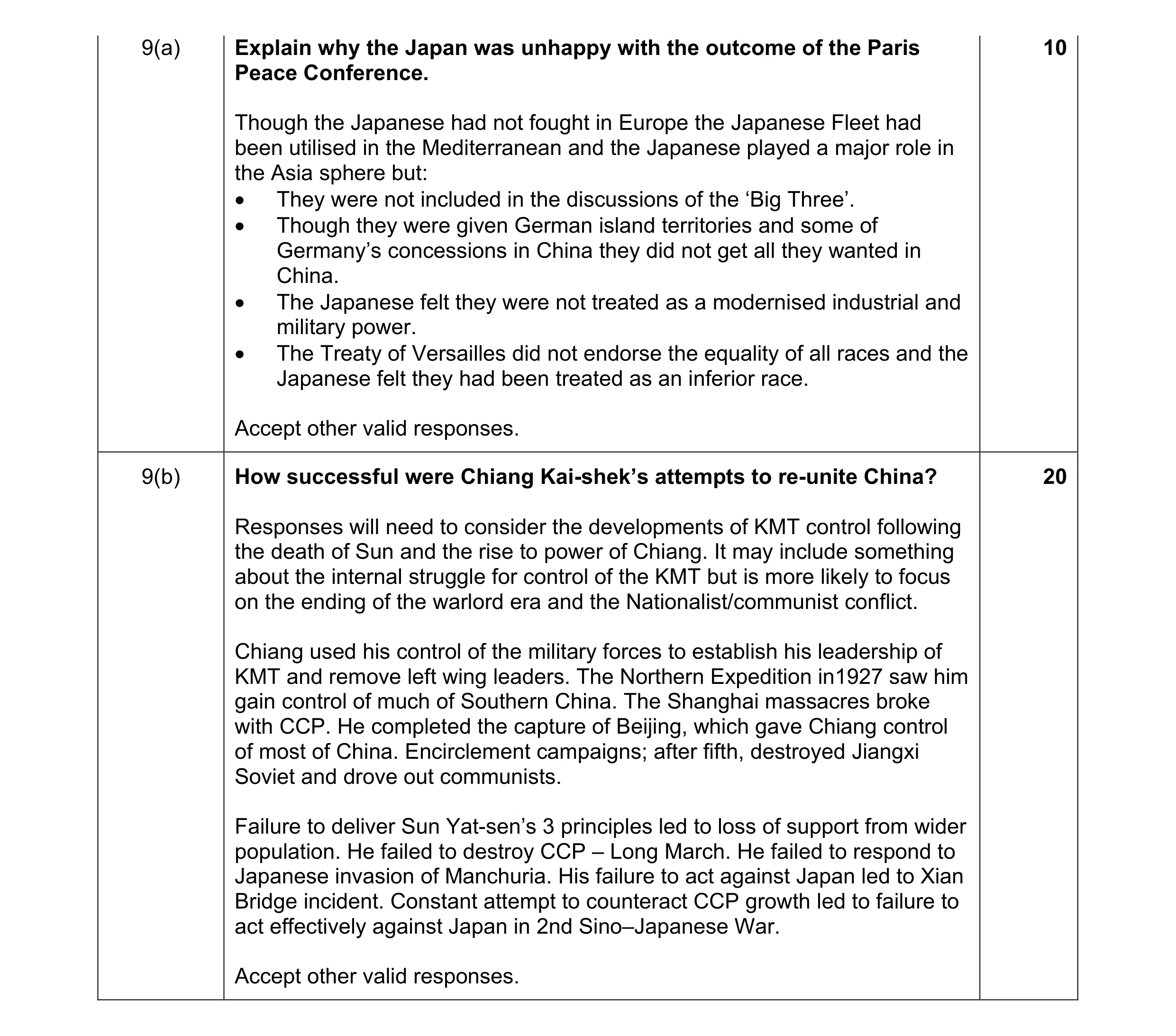 30
30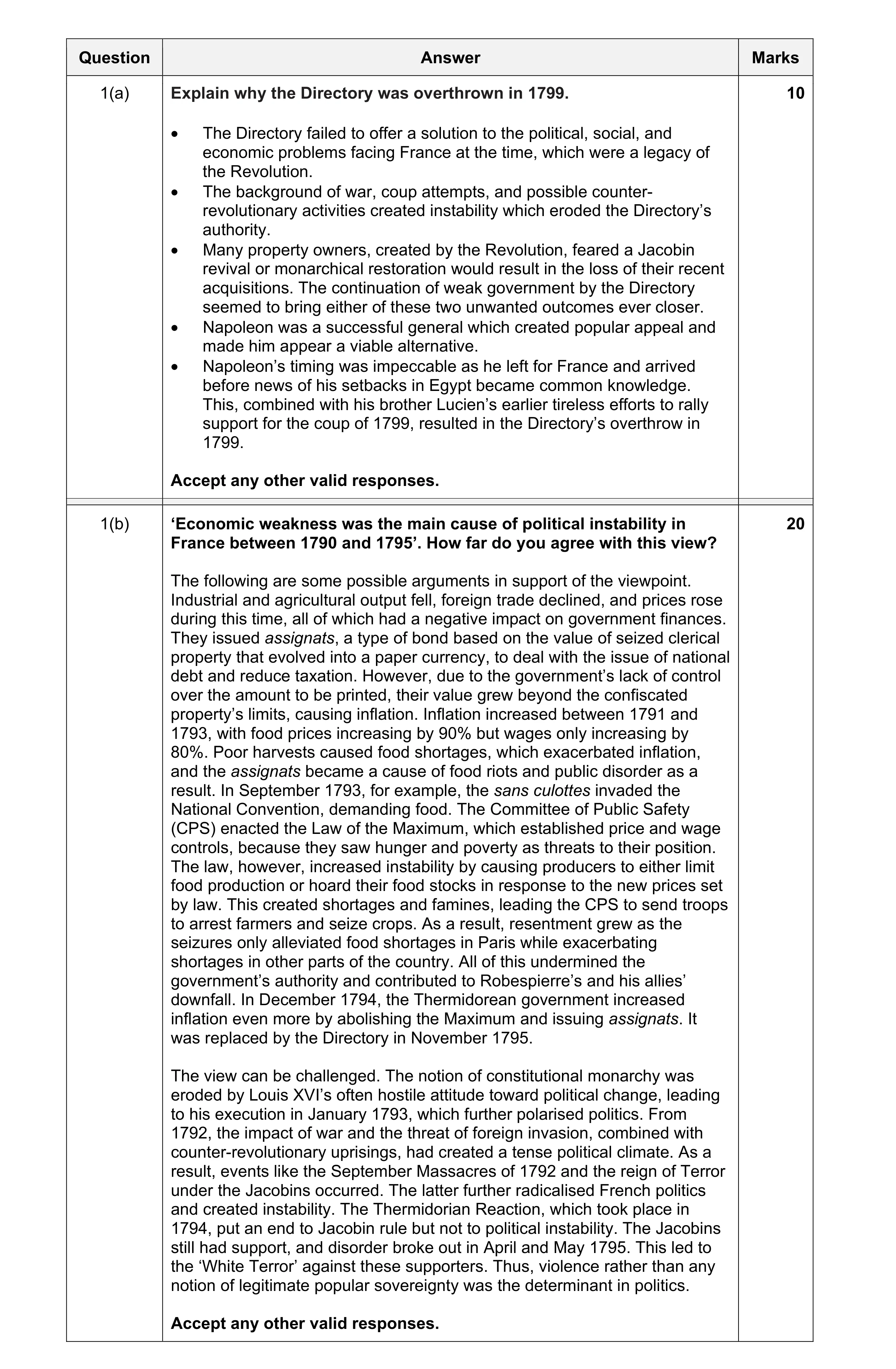 30
30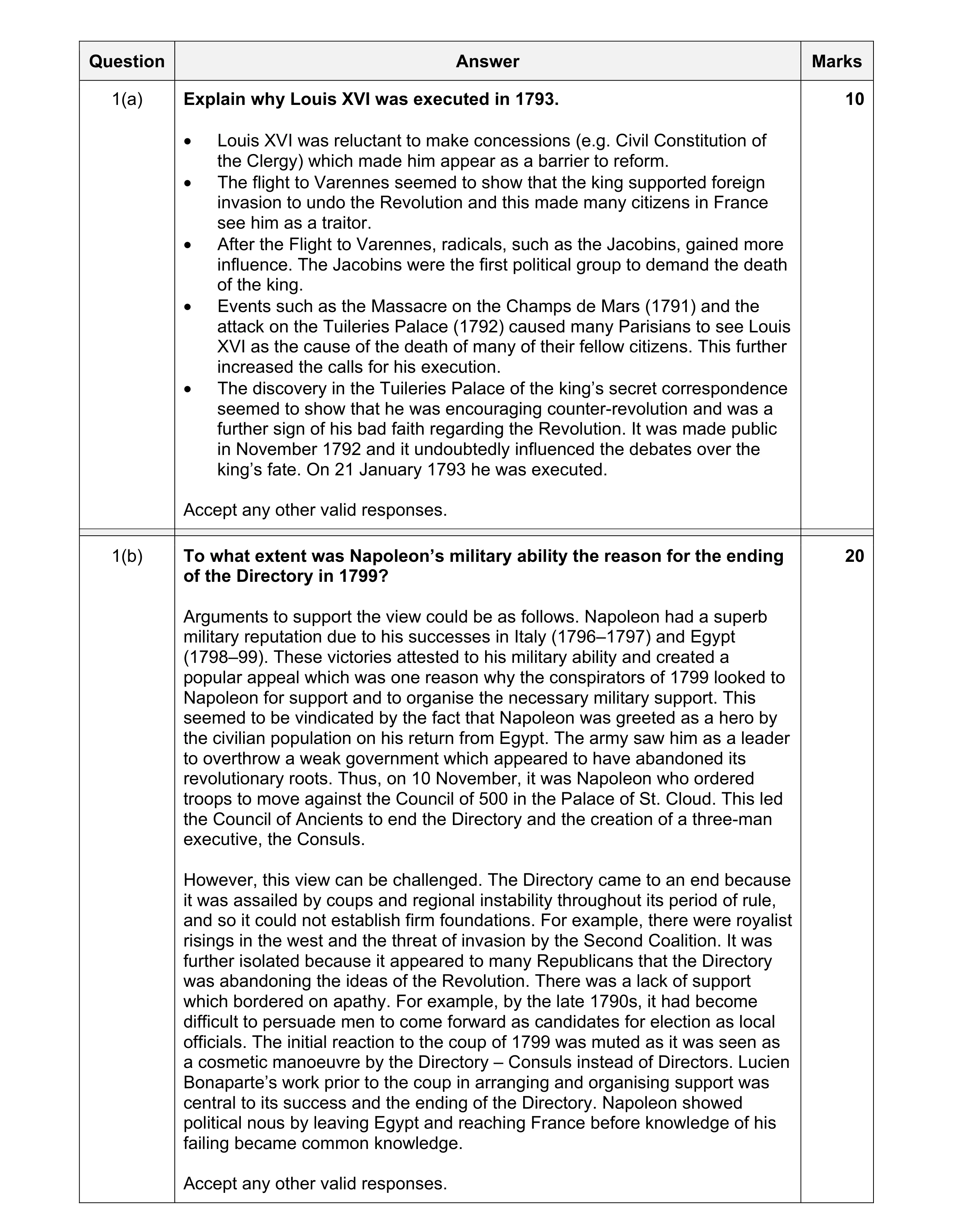 30
30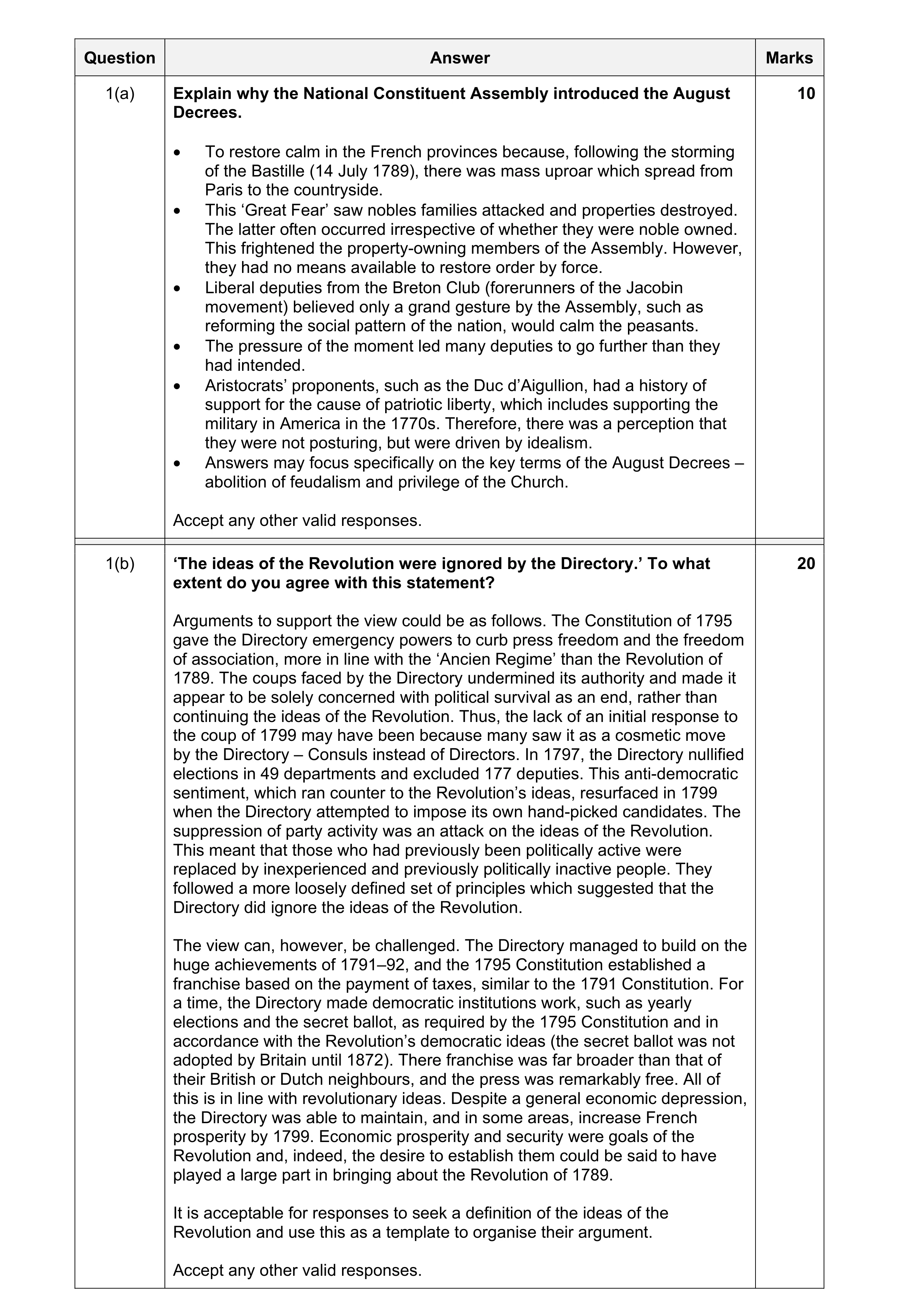 30
30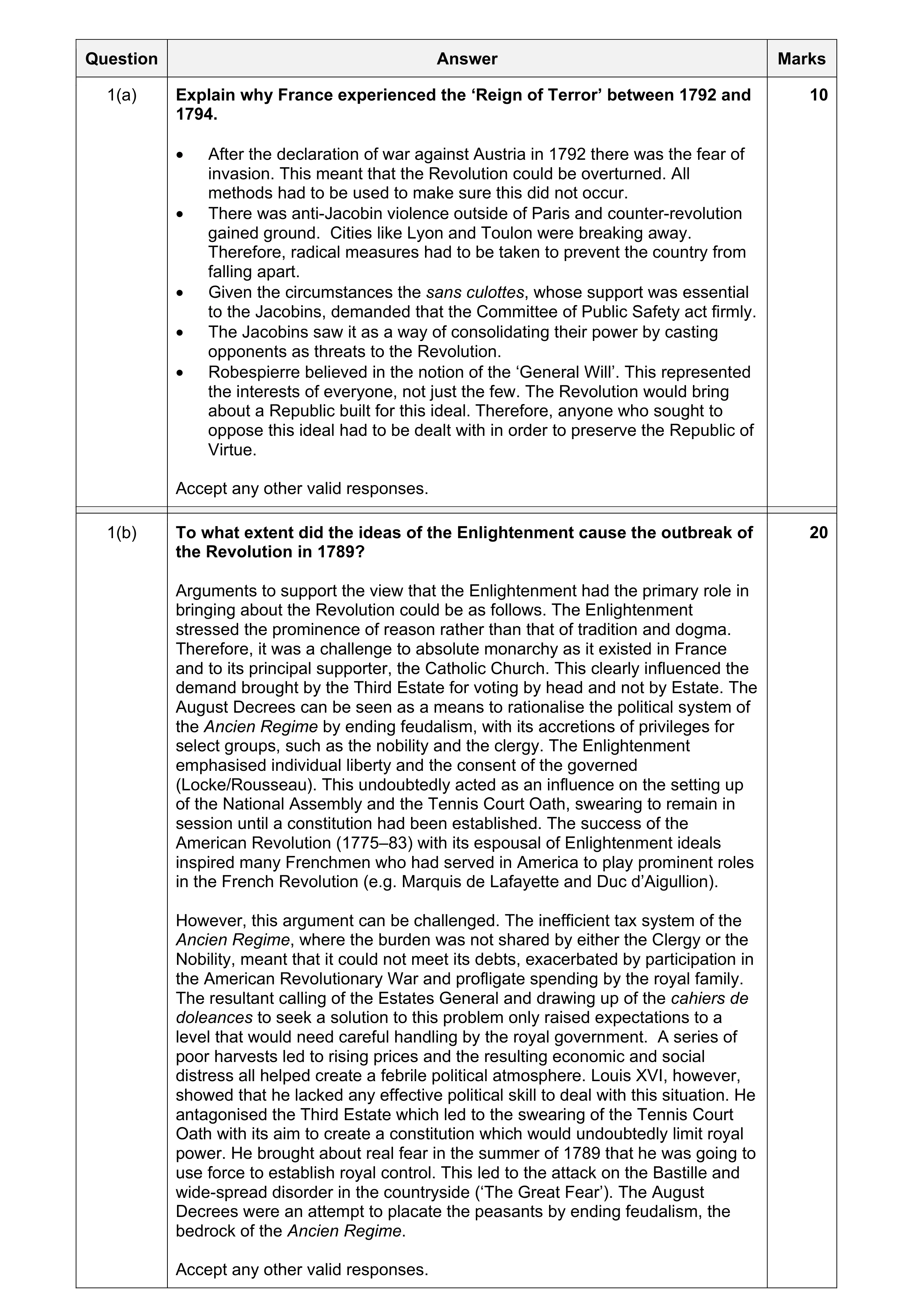 30
30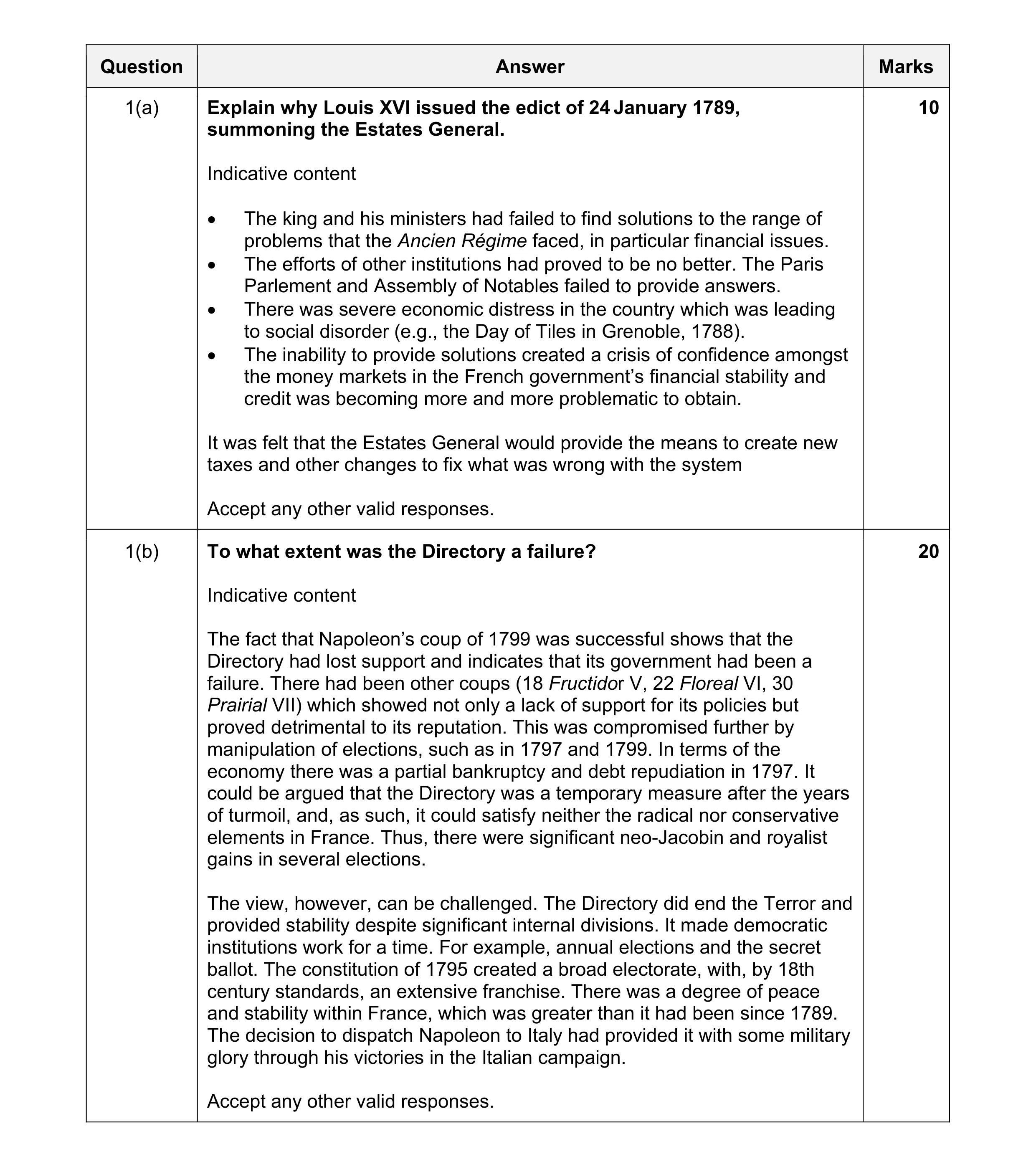 30
30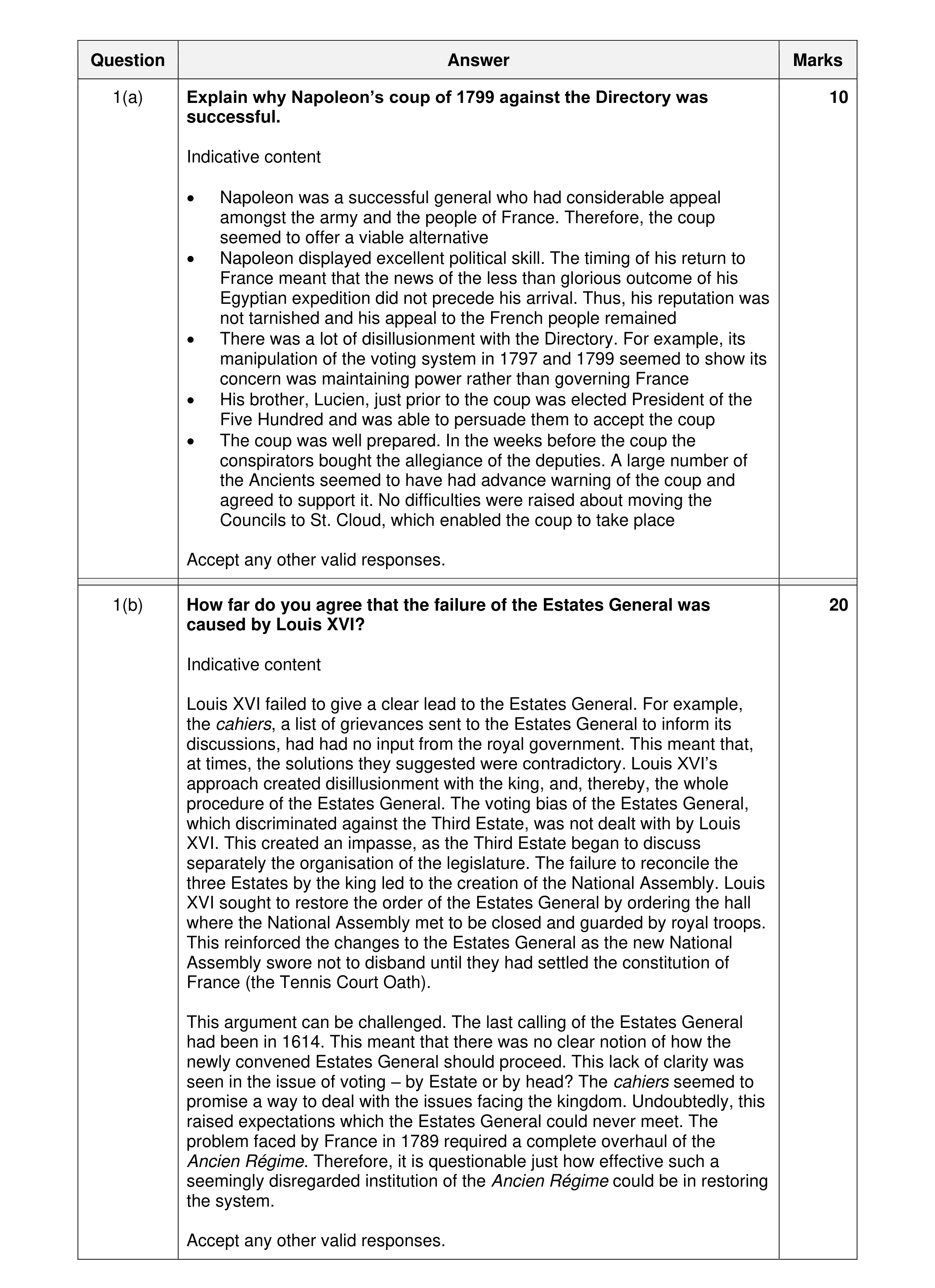 30
30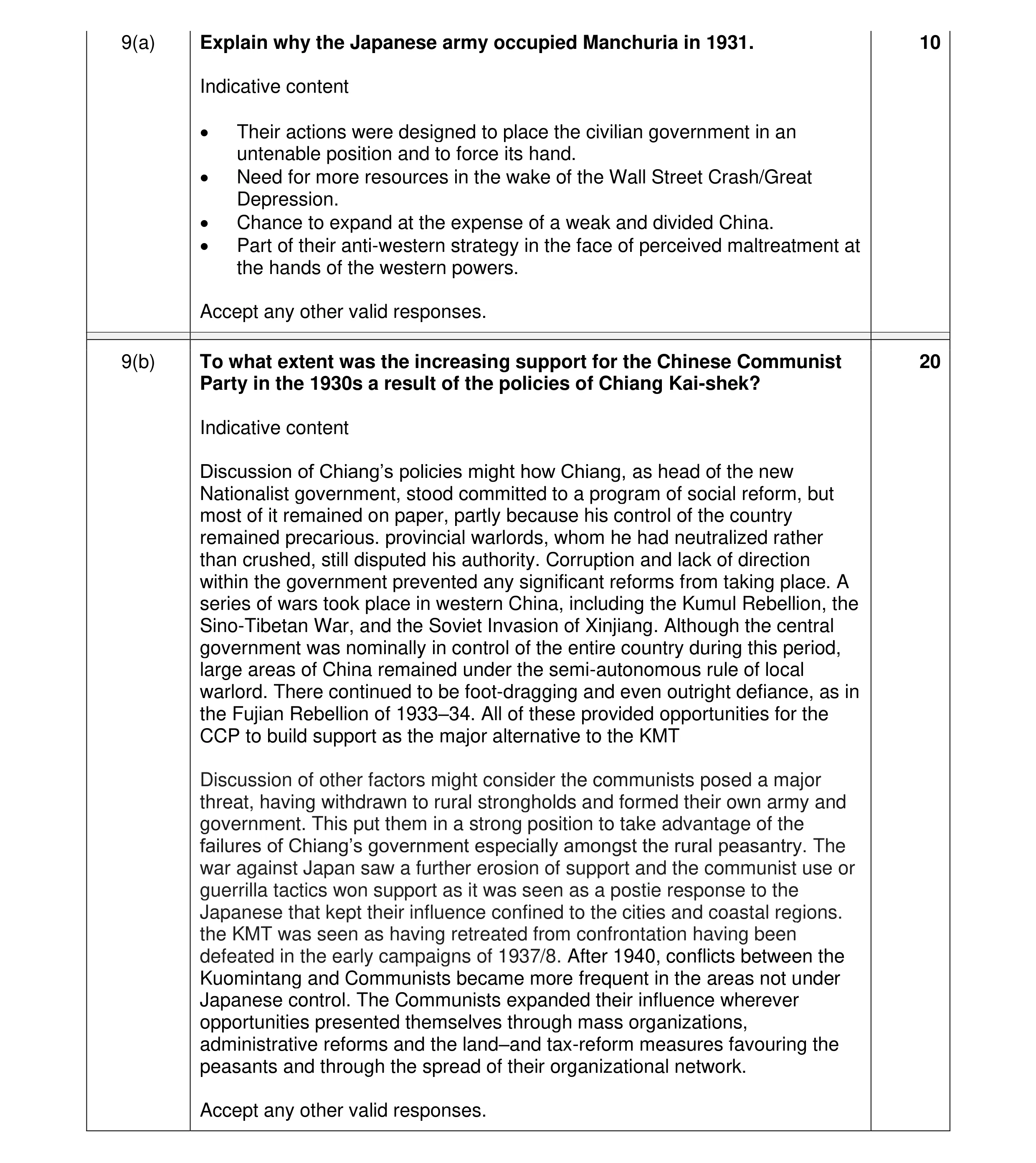 30
30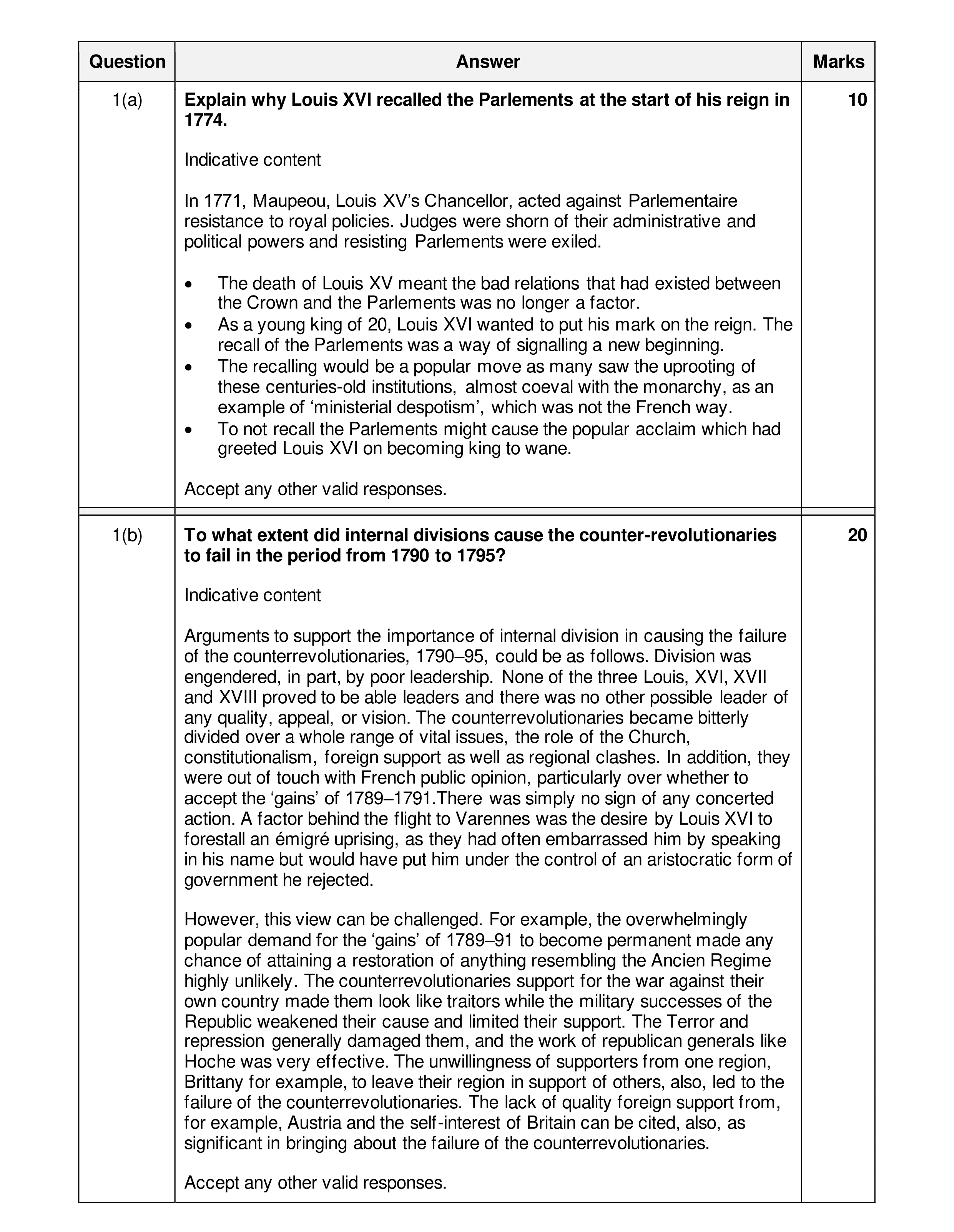 30
30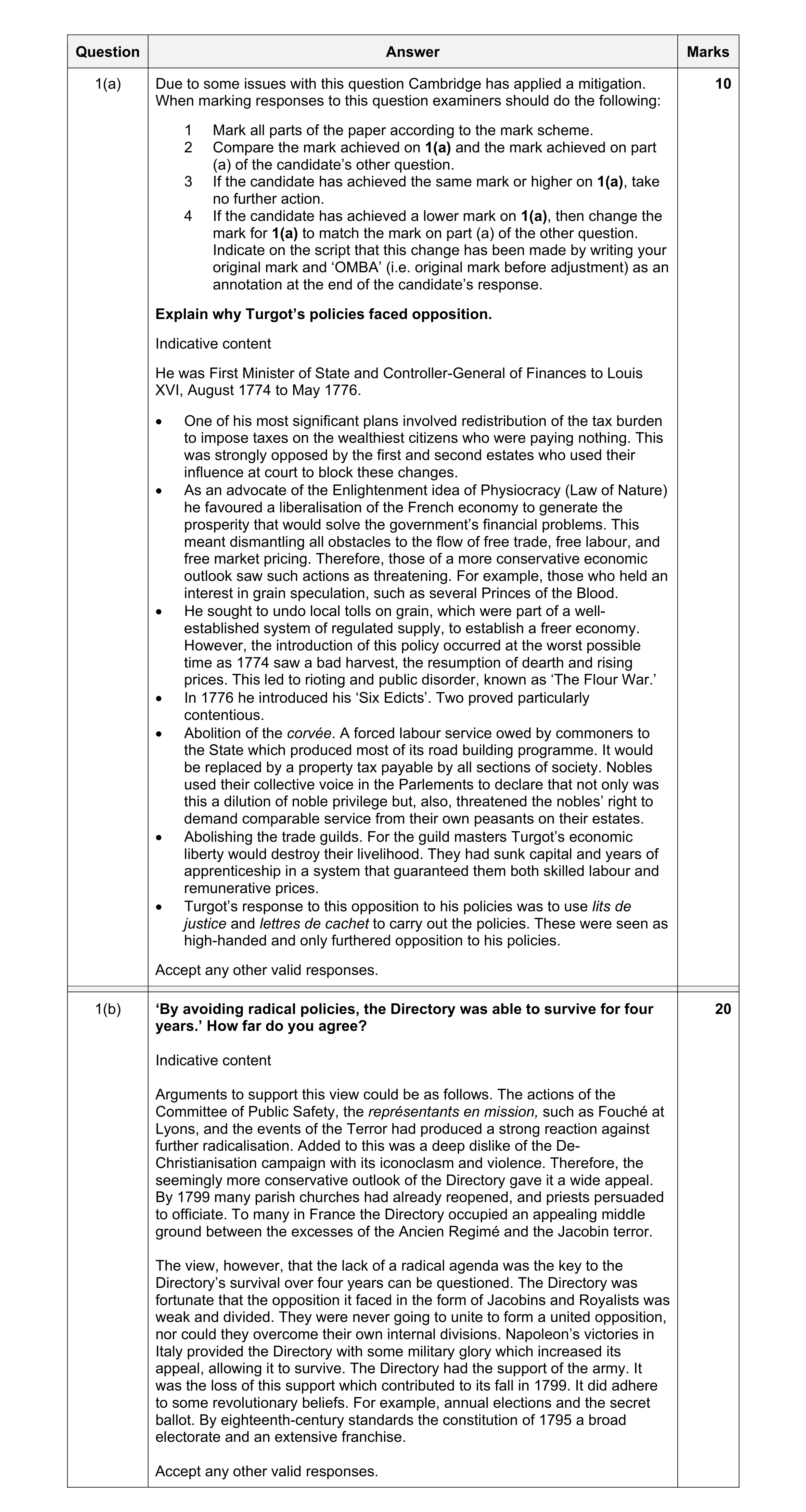 30
30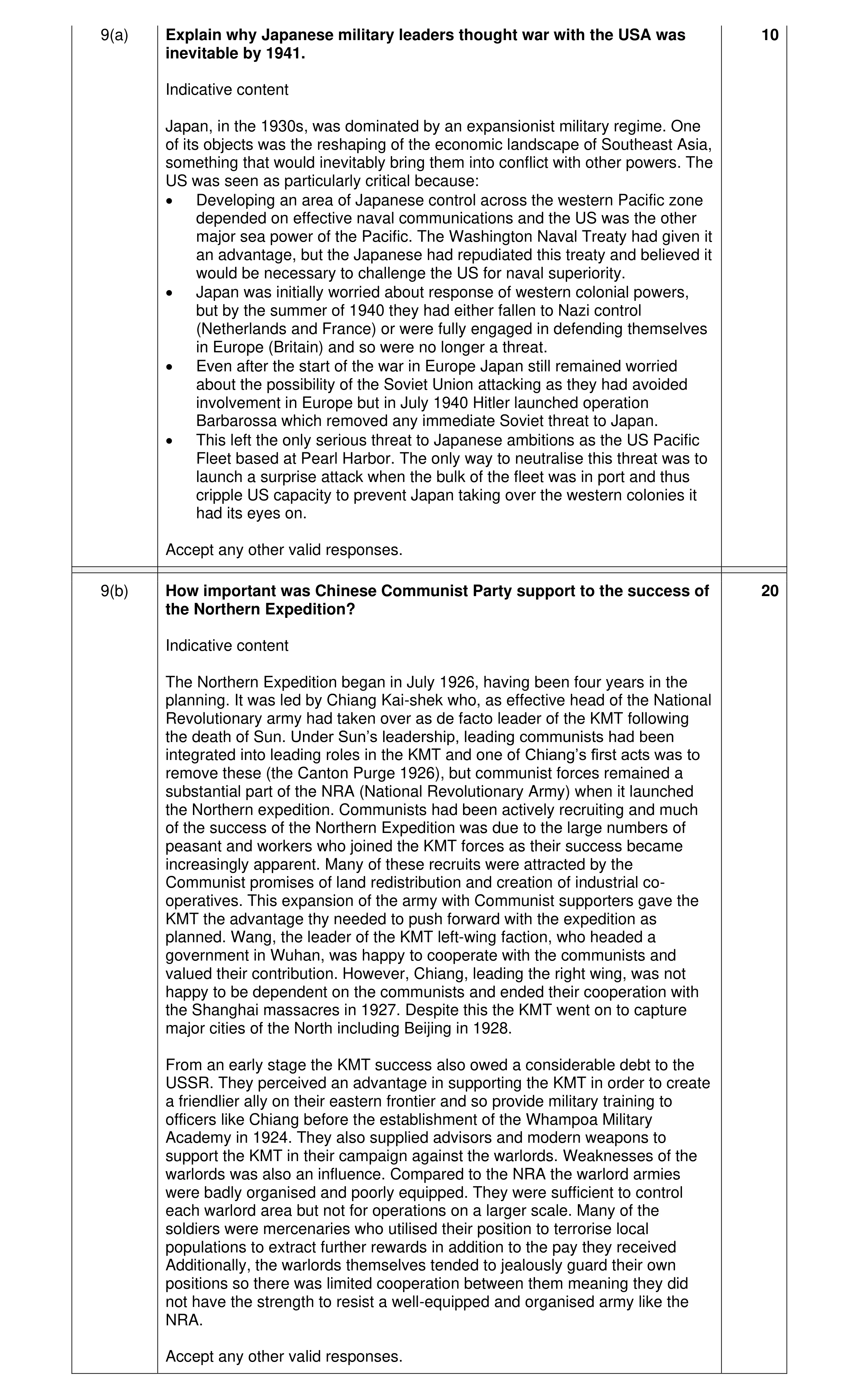 30
30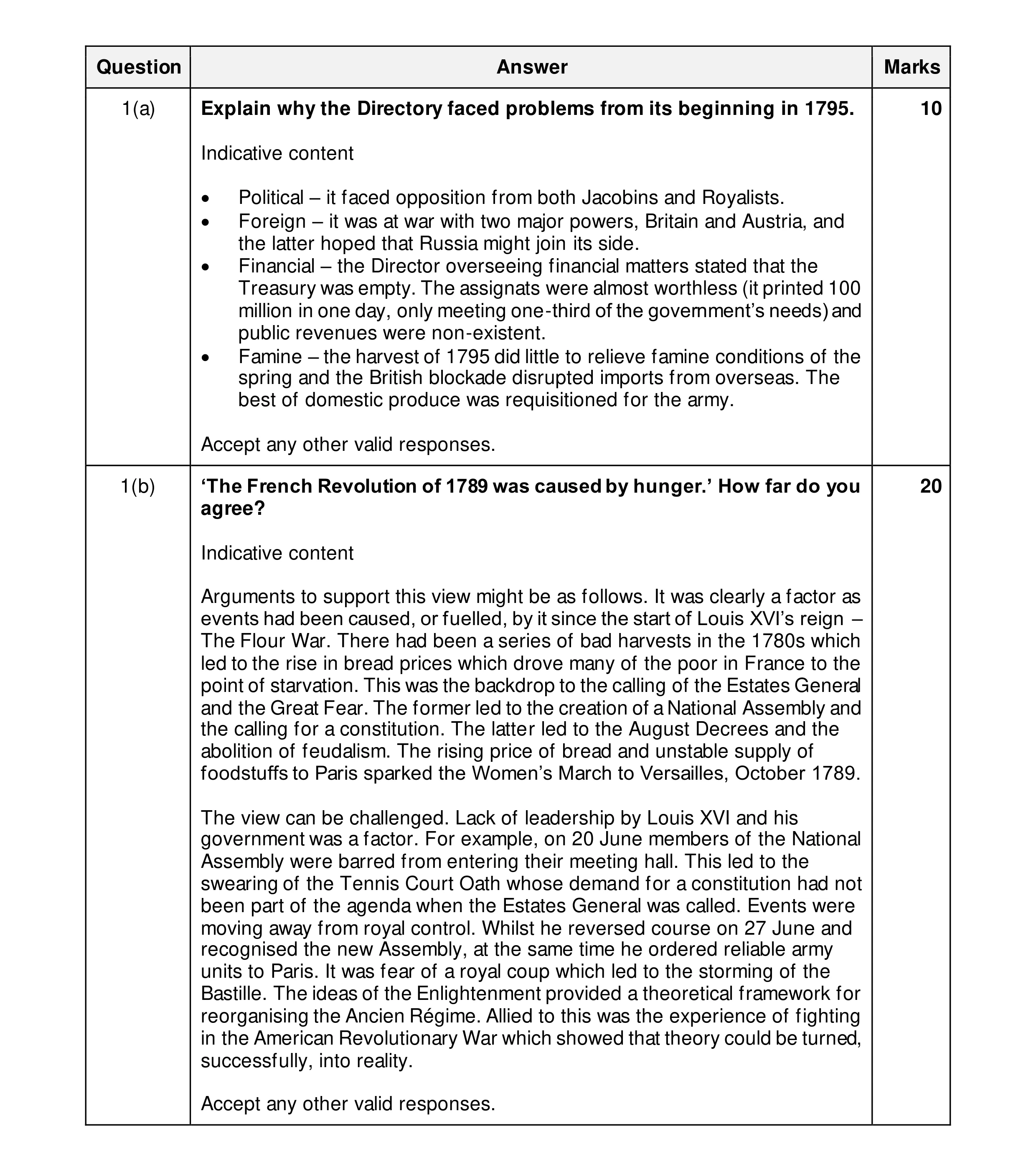 30
30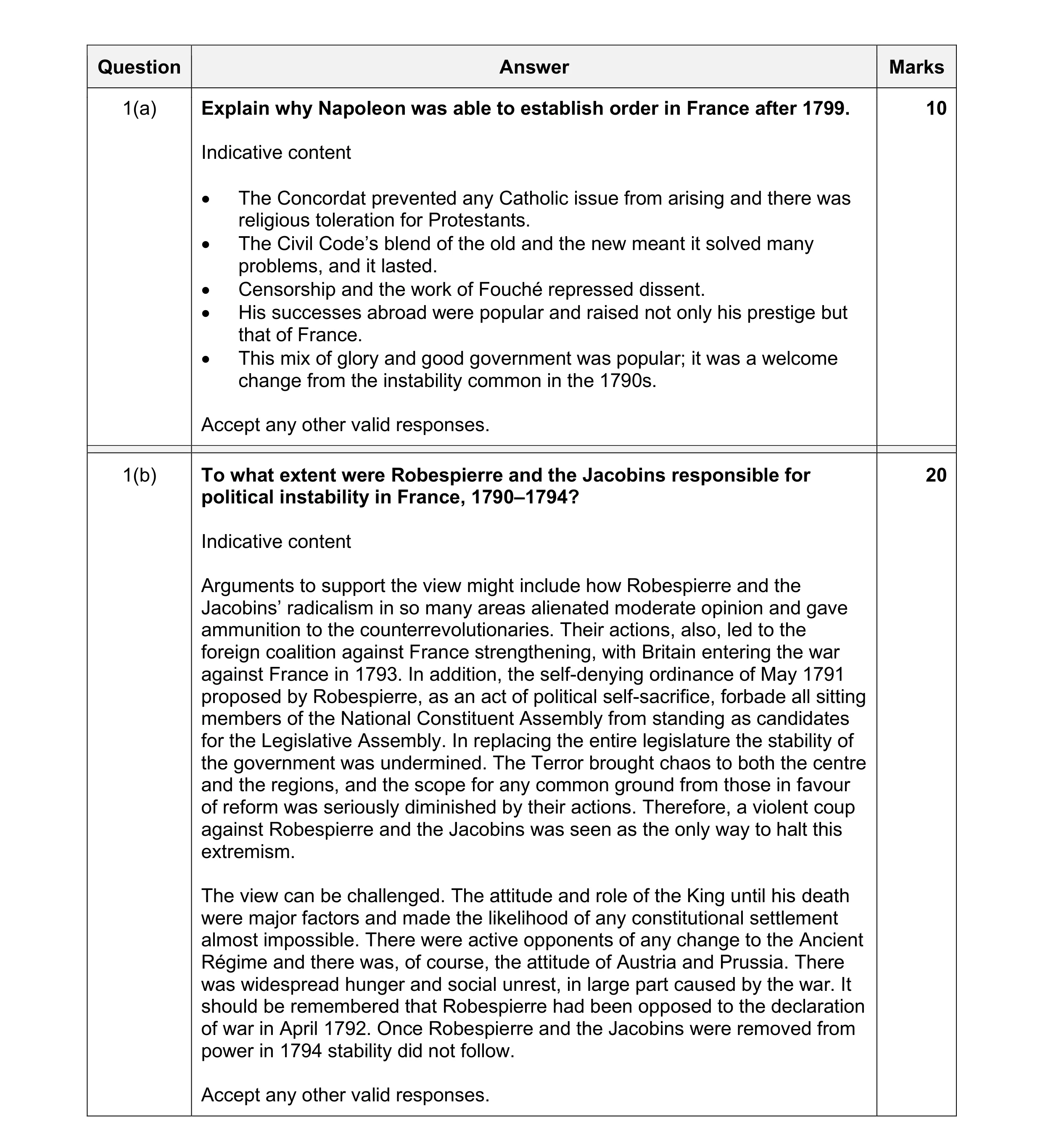 30
30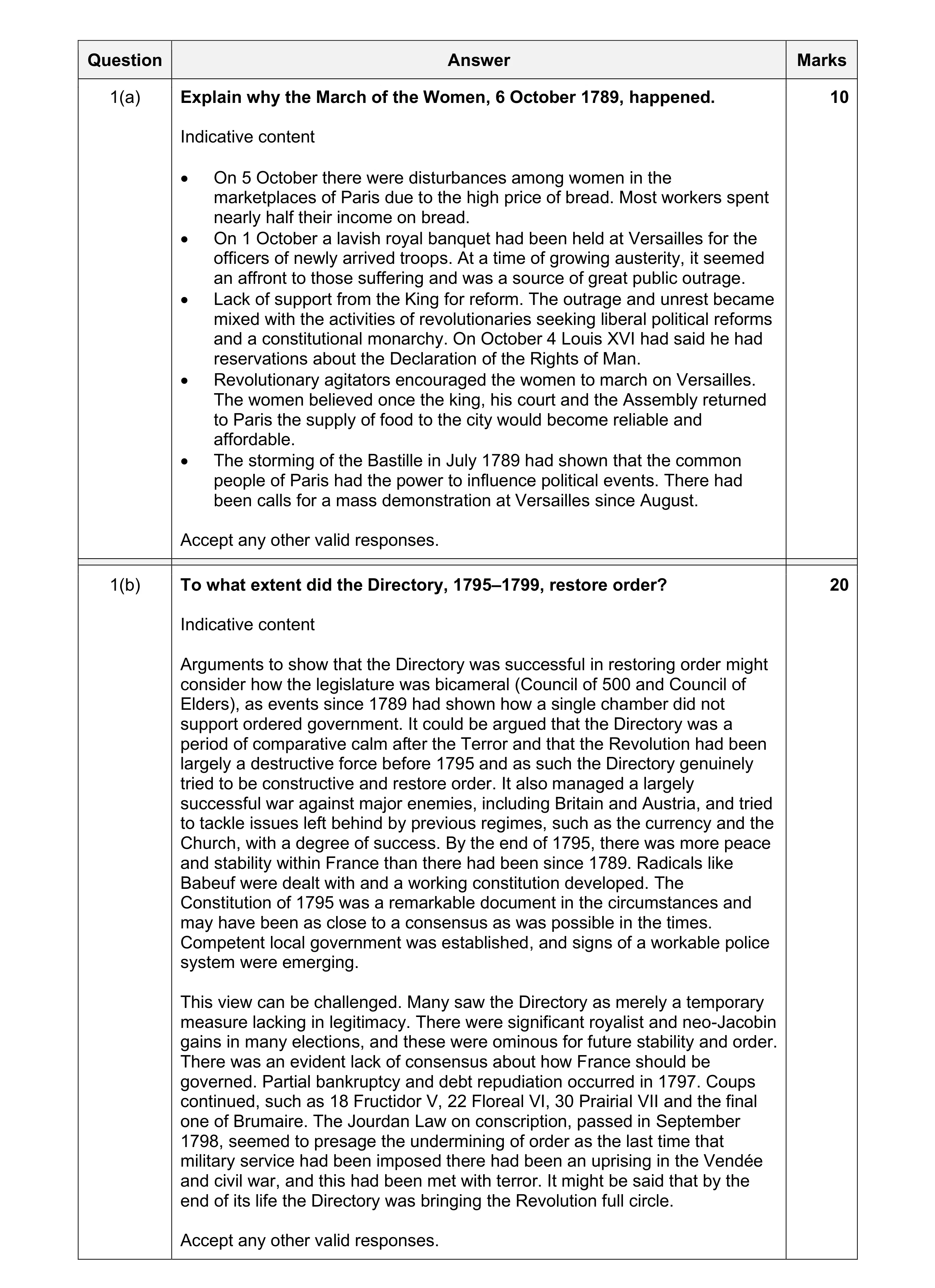 30
30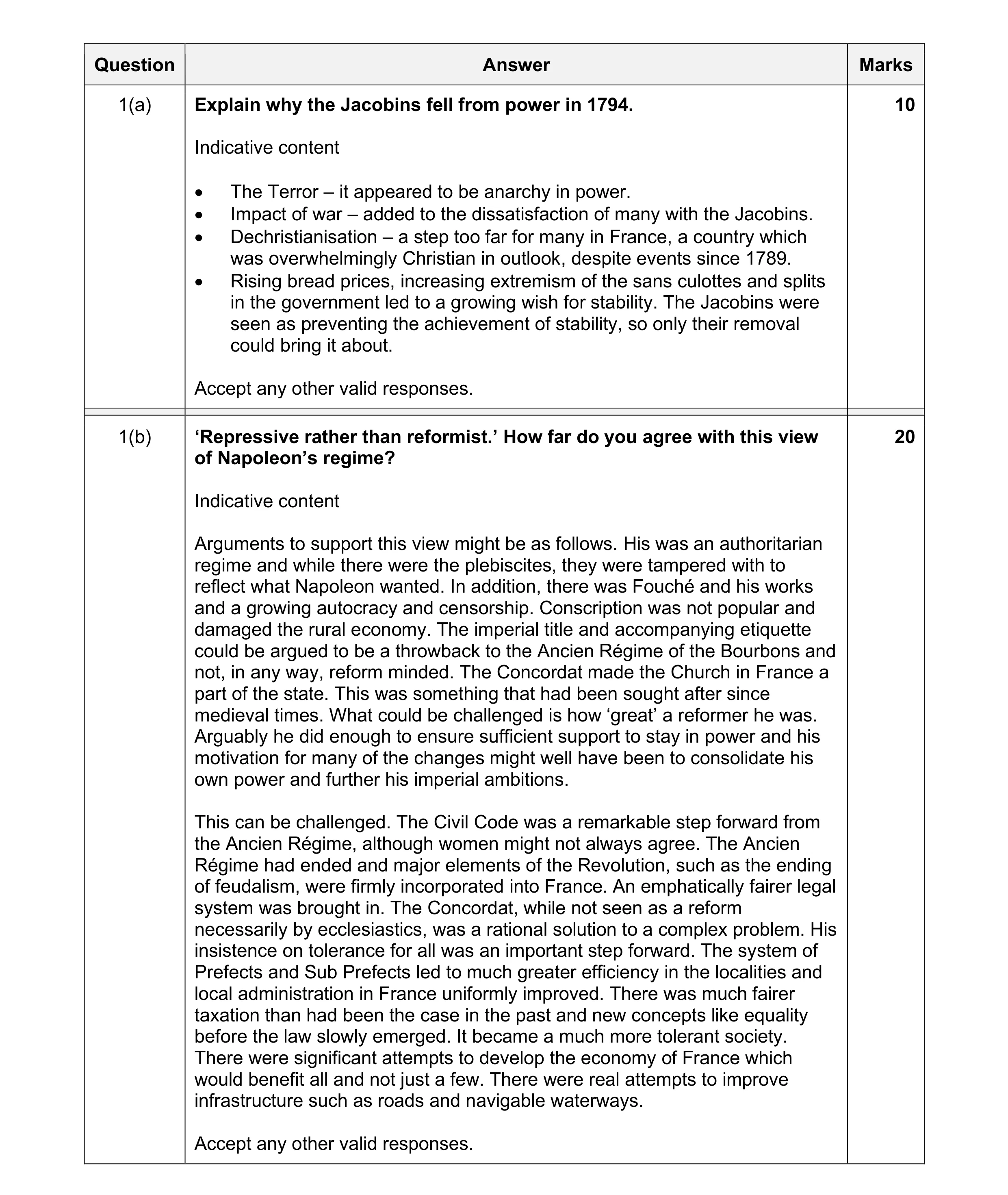 30
30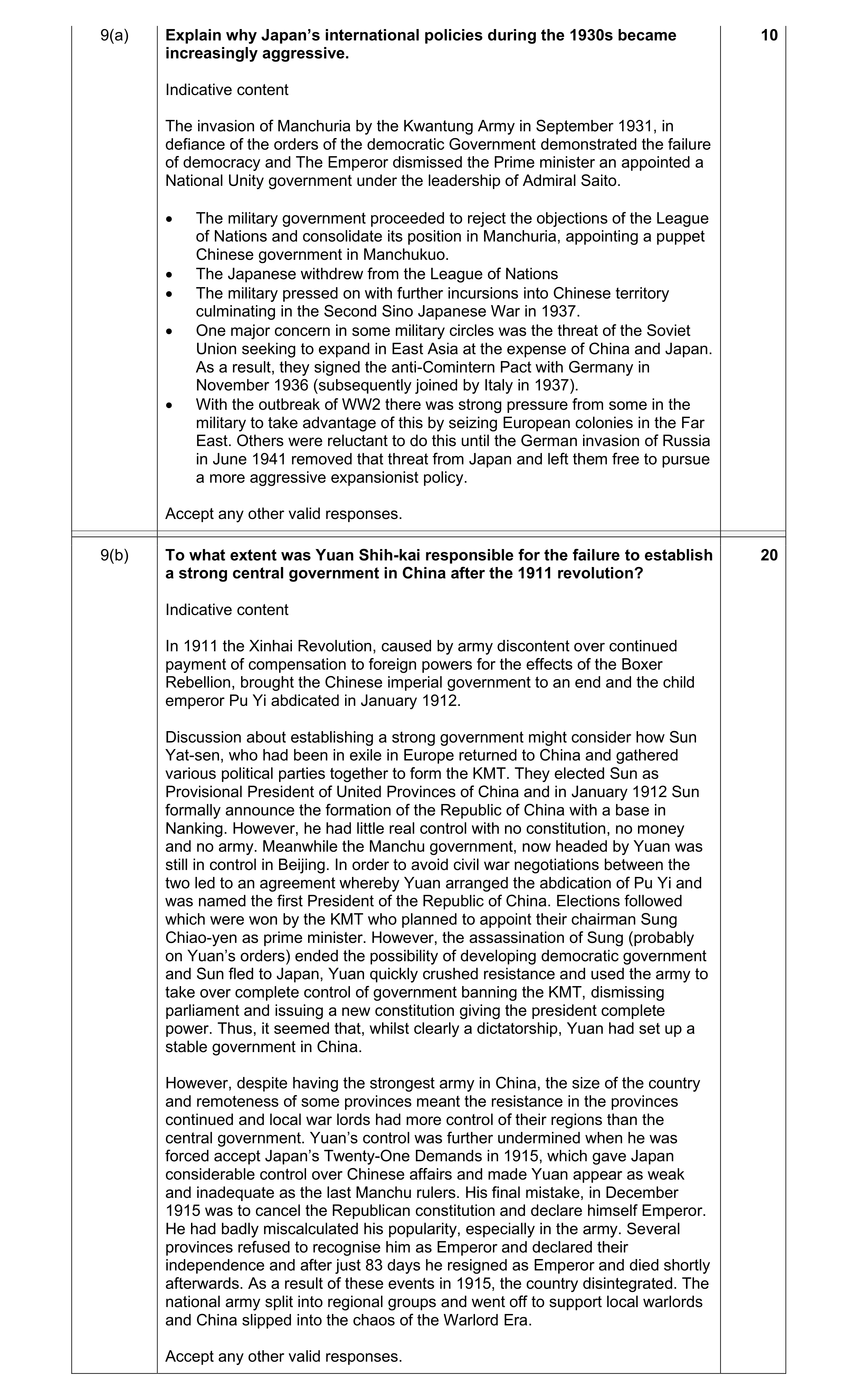 30
30