Questions as text
Q1 · A drawing of a green plant 0654/31 May/June 2017
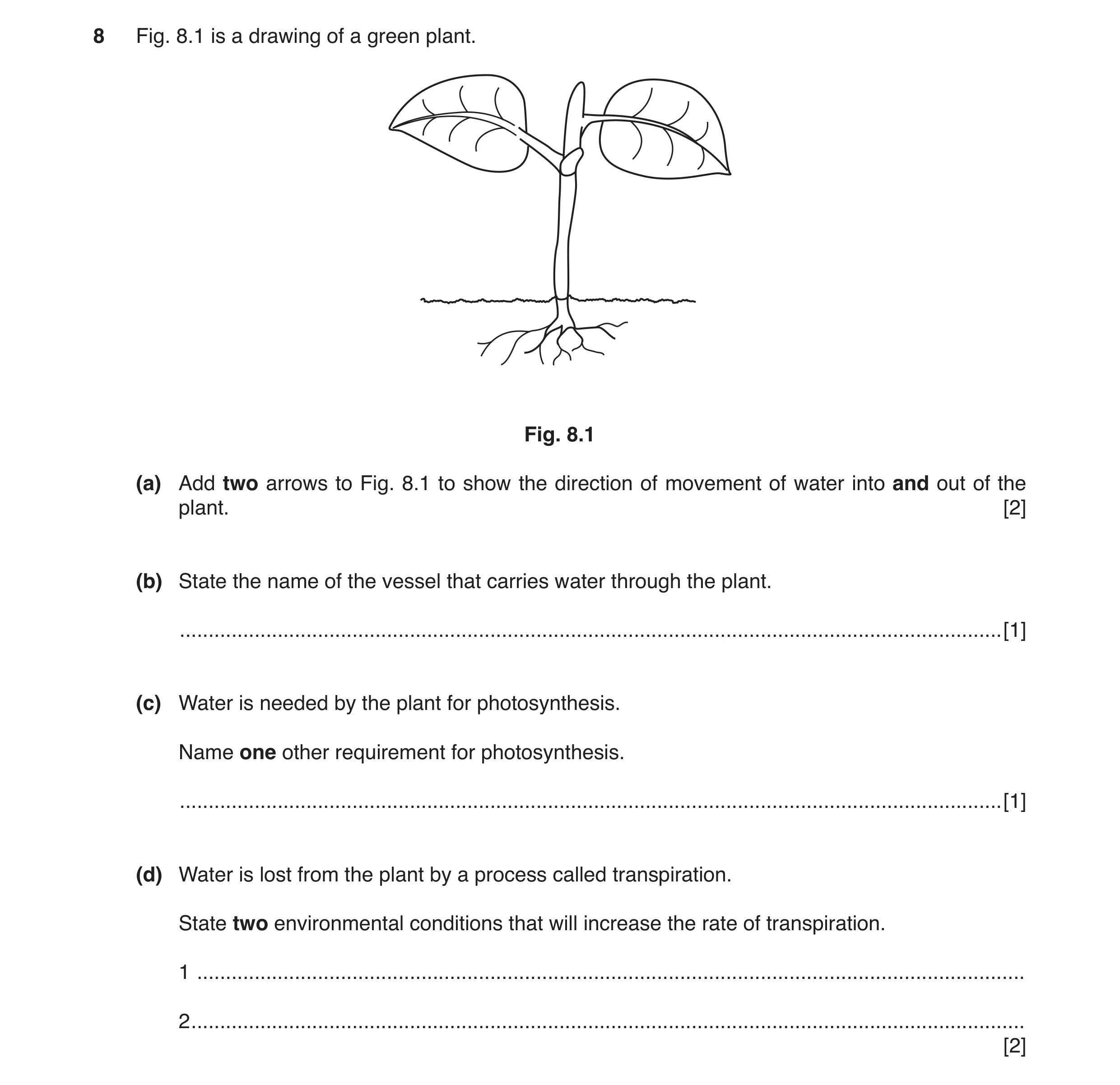
8 Fig. 8.1 is a drawing of a green plant. Fig. 8.1 (a) Add two arrows to Fig. 8.1 to show the direction of movement of water into and out of the plant. [2] (b) State the name of the vessel that carries water through the plant. … [1] (c) Water is needed by the plant for photosynthesis. Name one other requirement for photosynthesis. … [1] (d) Water is lost from the plant by a process called transpiration. State two environmental conditions that will increase the rate of transpiration. 1 … 2 … [2]
6 marks
Mark scheme: 8(a) one arrow pointing into the roots ; one arrow pointing out from the leaf ; 2 8(b) xylem ; 1 8(c) light / carbon dioxide / chlorophyll ; 1 8(d) higher temperature / hot ; increased wind speed / windy ; arid / dry (conditions) ; max 2
This question in 0654/31 May/June 2017
Q2 · State the term used to describe the loss of water from a leaf by evaporation 0654/33 Oct/Nov 2018
4 (a) State the term used to describe the loss of water from a leaf by evaporation. … [1] (b) Two similar leaves are removed from the same plant. • Leaf A is kept in an environment of high humidity. • Leaf B is kept in an environment of low humidity. • All other variables are kept the same. The mass of each leaf is measured each hour for six hours. Table 4.1 shows the results. Table 4.1 time / hours mass of leaf A / g mass of leaf B / g 0 0.90 0.90 1 0.90 0.86 2 0.90 0.83 3 0.87 0.80 4 0.87 0.78 5 0.85 0.78 6 0.85 0.75 (i) Calculate the difference in mass between leaf A and leaf B at six hours. … [1] (ii) Explain the difference in mass between leaf A and leaf B at six hours. … … … … [2] (c) Describe how plants obtain water. … … … [2] (d) (i) Draw a circle around two substances transported by xylem in plants. blood carbon dioxide glucose methane mineral ions oxygen urea water [2] (ii) State one other function of xylem apart from transport. … [1]
9 marks
Mark scheme: 4(a) transpiration ; 1 4(b)(i) 0.10 g ; 1 4(b)(ii) leaf A loses less mass – no mark increased humidity ; less transpiration / evaporation ; less water lost ; max 2 4(c) absorbed / uptake through root hair (cells) ; by diffusion ; 2 4(d)(i) water ; mineral ions ; 2 4(d)(ii) support ; 1
This question in 0654/33 Oct/Nov 2018
Q3 · Complete the definition of the term transpiration using words or phrases from the list 0654/32 May/June 2019
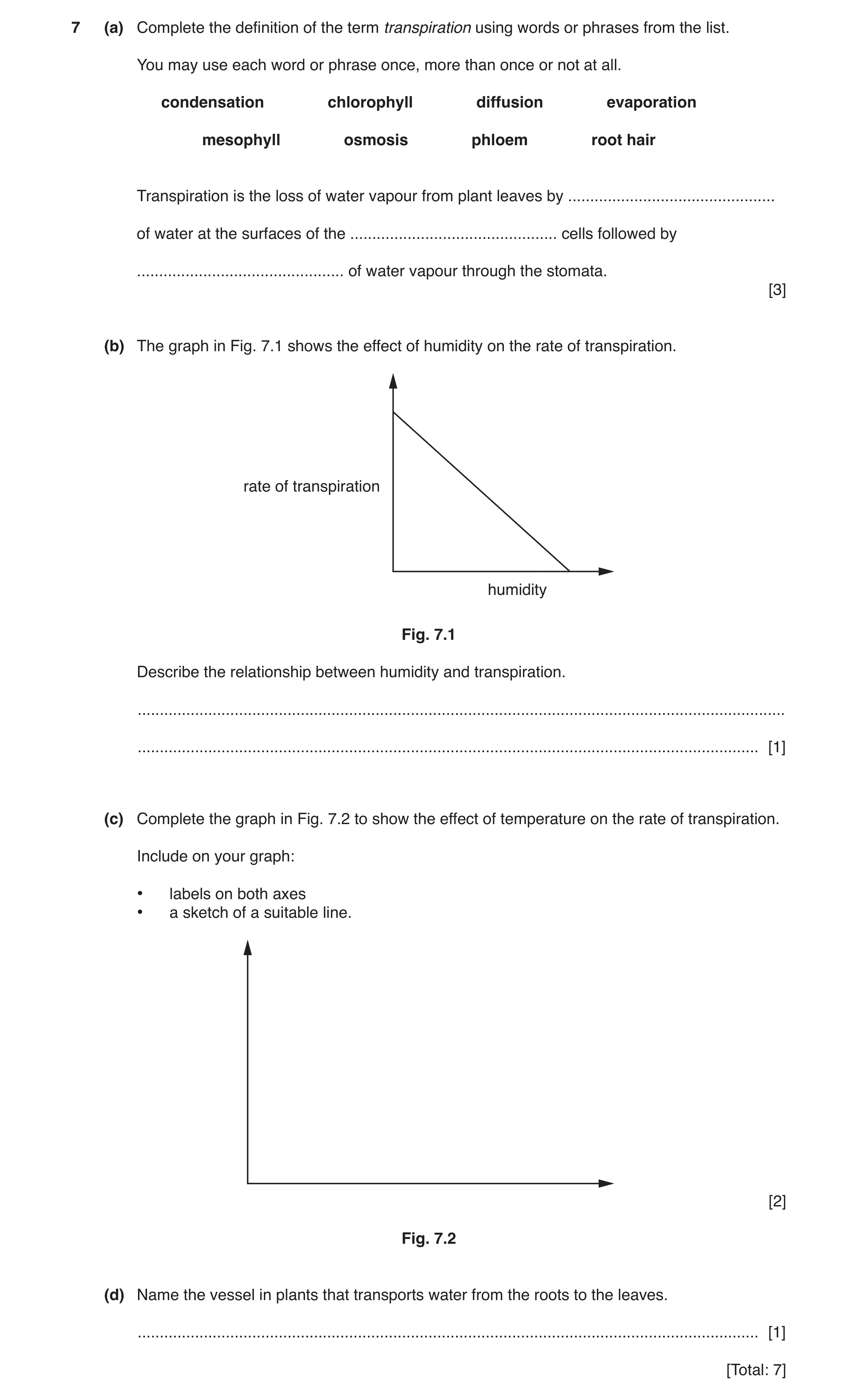
7 (a) Complete the definition of the term transpiration using words or phrases from the list. You may use each word or phrase once, more than once or not at all. condensation chlorophyll diffusion evaporation mesophyll osmosis phloem root hair Transpiration is the loss of water vapour from plant leaves by … of water at the surfaces of the … cells followed by … of water vapour through the stomata. [3] (b) The graph in Fig. 7.1 shows the effect of humidity on the rate of transpiration. rate of transpiration humidity Fig. 7.1 Describe the relationship between humidity and transpiration. … … [1] (c) Complete the graph in Fig. 7.2 to show the effect of temperature on the rate of transpiration. Include on your graph: • labels on both axes • a sketch of a suitable line. [2] Fig. 7.2 (d) Name the vessel in plants that transports water from the roots to the leaves. … [1] [Total: 7]
7 marks
Mark scheme: 7(a) evaporation ; mesophyll ; diffusion ; 3 7(b) as humidity increases the rate of transpiration decreases ; 1 7(c) y axis labelled rate of transpiration, x axis labelled temperature ; initial positive correlation ; 2 7(d) xylem ; 1
This question in 0654/32 May/June 2019
Q4 · Complete the definition of the term transpiration using words or phrases from the list 0654/33 May/June 2019
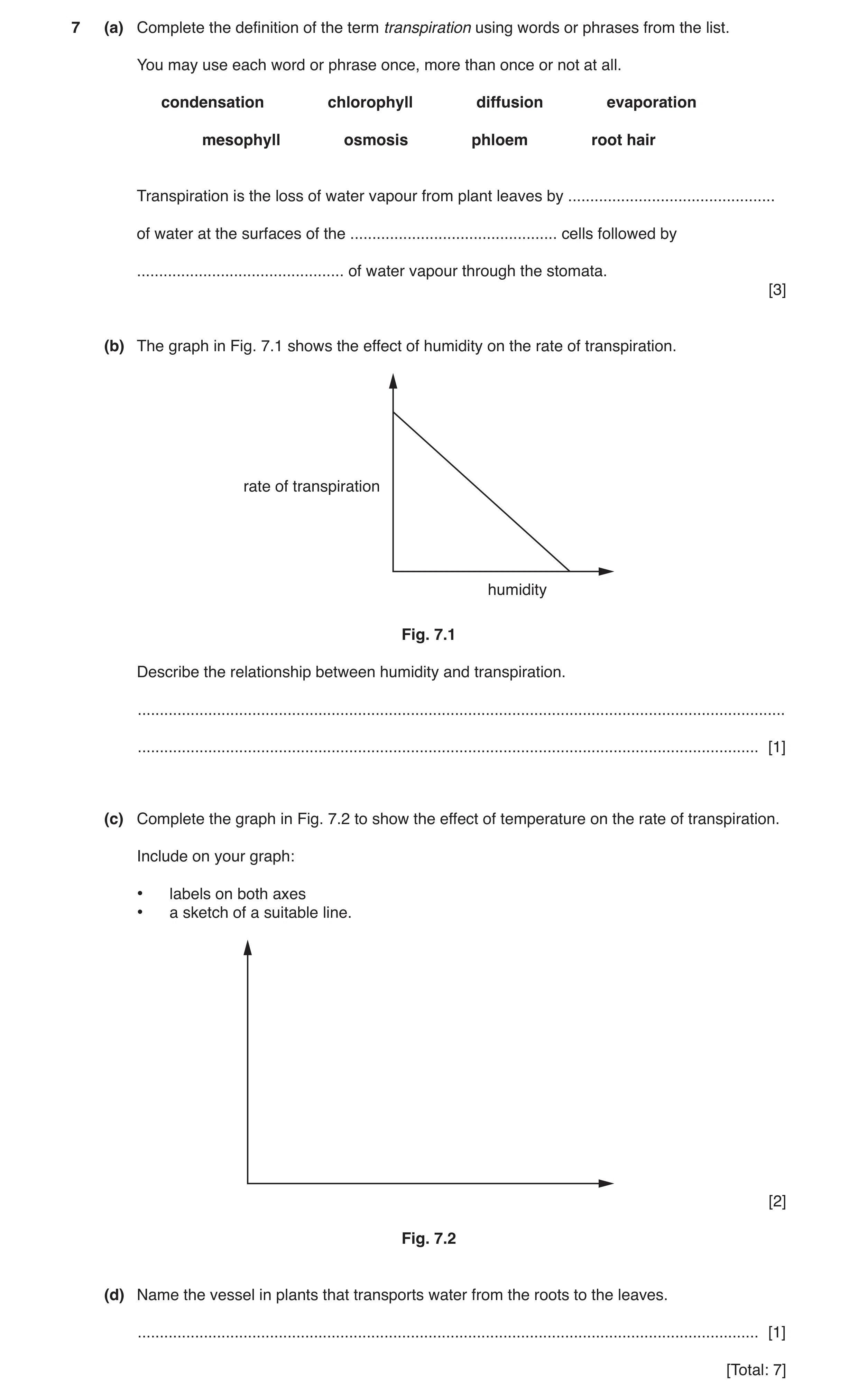
7 (a) Complete the definition of the term transpiration using words or phrases from the list. You may use each word or phrase once, more than once or not at all. condensation chlorophyll diffusion evaporation mesophyll osmosis phloem root hair Transpiration is the loss of water vapour from plant leaves by … of water at the surfaces of the … cells followed by … of water vapour through the stomata. [3] (b) The graph in Fig. 7.1 shows the effect of humidity on the rate of transpiration. rate of transpiration humidity Fig. 7.1 Describe the relationship between humidity and transpiration. … … [1] (c) Complete the graph in Fig. 7.2 to show the effect of temperature on the rate of transpiration. Include on your graph: • labels on both axes • a sketch of a suitable line. [2] Fig. 7.2 (d) Name the vessel in plants that transports water from the roots to the leaves. … [1] [Total: 7]
7 marks
Mark scheme: 7(a) evaporation ; mesophyll ; diffusion ; 3 7(b) as humidity increases the rate of transpiration decreases ; 1 7(c) y axis labelled rate of transpiration, x axis labelled temperature ; initial positive correlation ; 2 7(d) xylem ; 1
This question in 0654/33 May/June 2019
Q5 · A diagram of a section through the heart and associated blood vessels 0654/33 Oct/Nov 2019
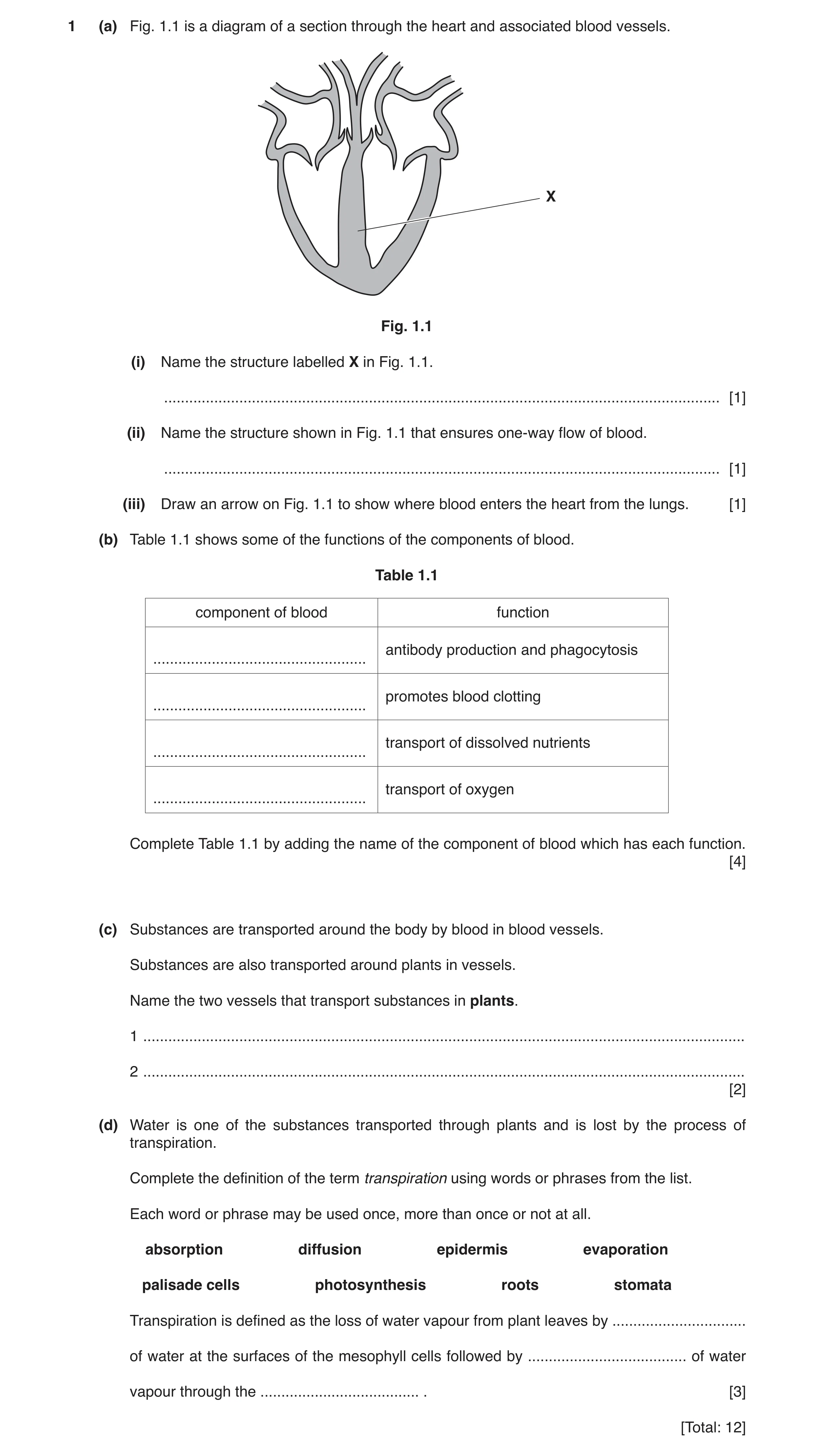
1 (a) Fig. 1.1 is a diagram of a section through the heart and associated blood vessels. X Fig. 1.1 (i) Name the structure labelled X in Fig. 1.1. … [1] (ii) Name the structure shown in Fig. 1.1 that ensures one-way flow of blood. … [1] (iii) Draw an arrow on Fig. 1.1 to show where blood enters the heart from the lungs. [1] (b) Table 1.1 shows some of the functions of the components of blood. Table 1.1 component of blood function antibody production and phagocytosis … promotes blood clotting … transport of dissolved nutrients … transport of oxygen … Complete Table 1.1 by adding the name of the component of blood which has each function. [4] (c) Substances are transported around the body by blood in blood vessels. Substances are also transported around plants in vessels. Name the two vessels that transport substances in plants. 1 … 2 … [2] (d) Water is one of the substances transported through plants and is lost by the process of transpiration. Complete the definition of the term transpiration using words or phrases from the list. Each word or phrase may be used once, more than once or not at all. absorption diffusion epidermis evaporation palisade cells photosynthesis roots stomata Transpiration is defined as the loss of water vapour from plant leaves by … of water at the surfaces of the mesophyll cells followed by … of water vapour through the … . [3] [Total: 12]
12 marks
Mark scheme: 1(a)(i) septum ; 1 1(a)(ii) valve; 1 1(a)(iii) arrow pointing into the heart from the pulmonary vein ; (furthest right blood vessel) 1 1(b) component of blood function white blood cell ; antibody production and phagocytosis platelets ; promotes blood clotting plasma ; transport of dissolved nutrients red blood cell ; transport of oxygen 4 1(c) xylem ; phloem ; 2 1(d) evaporation ; diffusion ; stomata ; 3
This question in 0654/33 Oct/Nov 2019
Q6 · Simplified cross-sections of three different types of blood vessel 0654/32 May/June 2020
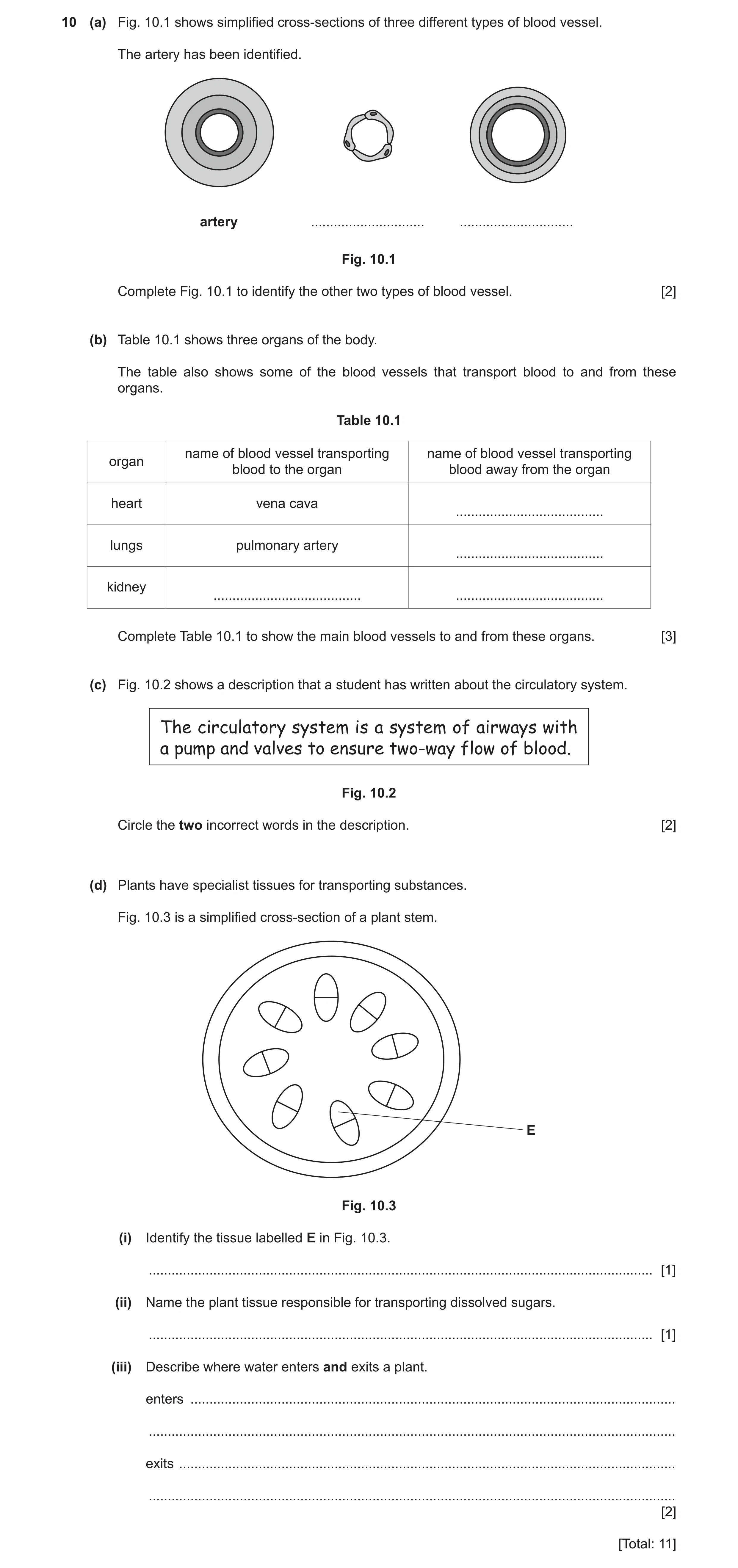
10 (a) Fig. 10.1 shows simplified cross-sections of three different types of blood vessel. The artery has been identified. artery … … Fig. 10.1 Complete Fig. 10.1 to identify the other two types of blood vessel. [2] (b) Table 10.1 shows three organs of the body. The table also shows some of the blood vessels that transport blood to and from these organs. Table 10.1 name of blood vessel transporting name of blood vessel transporting organ blood to the organ blood away from the organ heart vena cava … lungs pulmonary artery … kidney … … Complete Table 10.1 to show the main blood vessels to and from these organs. [3] (c) Fig. 10.2 shows a description that a student has written about the circulatory system. The circulatory system is a system of airways with a pump and valves to ensure two-way flow of blood. Fig. 10.2 Circle the two incorrect words in the description. [2] (d) Plants have specialist tissues for transporting substances. Fig. 10.3 is a simplified cross-section of a plant stem. E Fig. 10.3 (i) Identify the tissue labelled E in Fig. 10.3. … [1] (ii) Name the plant tissue responsible for transporting dissolved sugars. … [1] (iii) Describe where water enters and exits a plant. enters … … exits … … [2] [Total: 11]
11 marks
Mark scheme: 10(a) capillaries ; veins ; 2 10(b) heart vena cava aorta / pulmonary artery lungs pulmonary artery pulmonary vein kidney renal artery renal vein ;;; each correct row for 1 mark 3 10(c) airways circled ; two / two-way circled ; 2 10(d)(i) xylem ; 1 10(d)(ii) phloem ; 1 10(d)(iii) enter root hair (cell) ; leave through stomata / leaf ; 2
This question in 0654/32 May/June 2020
Q7 · Simplified cross-sections of three different types of blood vessel 0654/33 May/June 2020
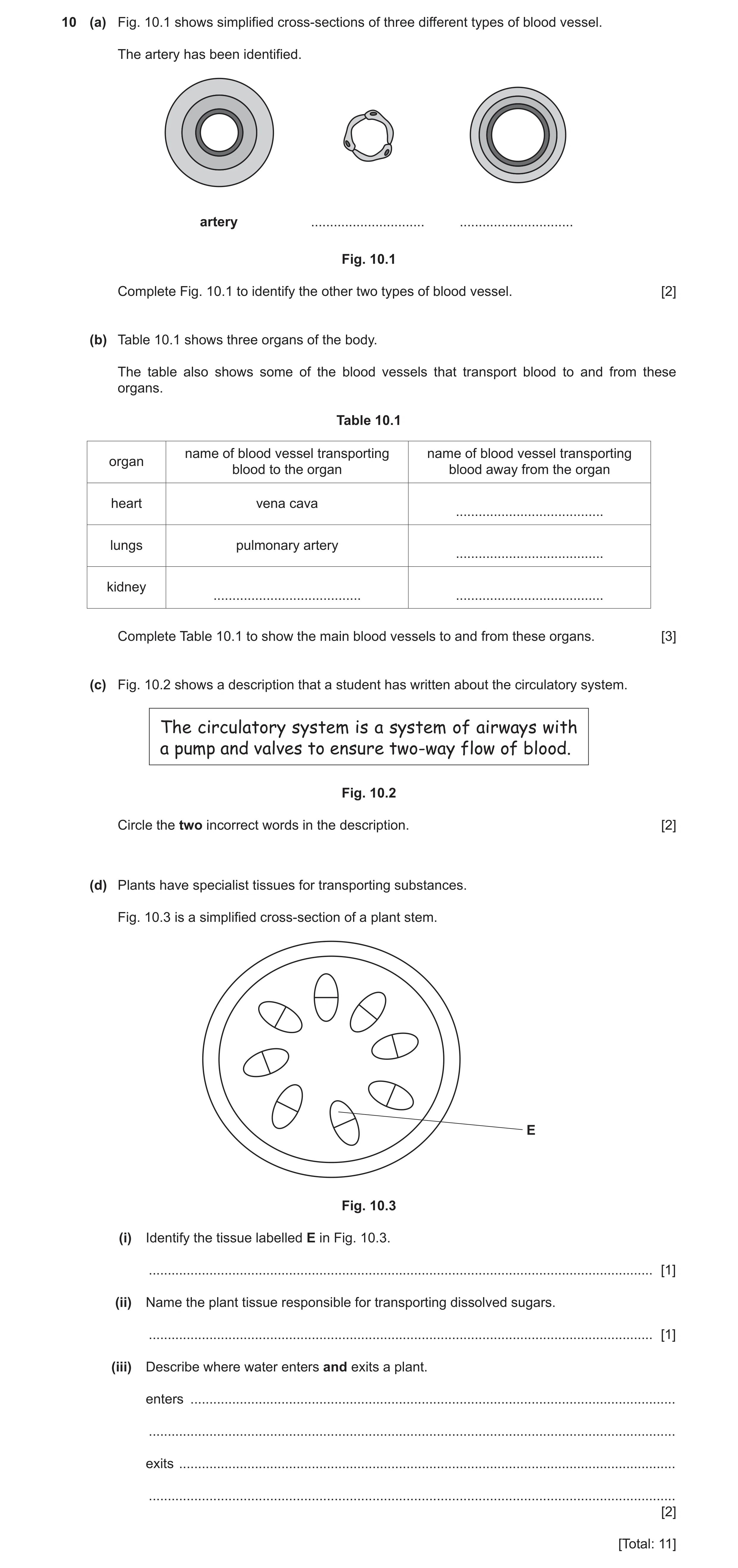
10 (a) Fig. 10.1 shows simplified cross-sections of three different types of blood vessel. The artery has been identified. artery … … Fig. 10.1 Complete Fig. 10.1 to identify the other two types of blood vessel. [2] (b) Table 10.1 shows three organs of the body. The table also shows some of the blood vessels that transport blood to and from these organs. Table 10.1 name of blood vessel transporting name of blood vessel transporting organ blood to the organ blood away from the organ heart vena cava … lungs pulmonary artery … kidney … … Complete Table 10.1 to show the main blood vessels to and from these organs. [3] (c) Fig. 10.2 shows a description that a student has written about the circulatory system. The circulatory system is a system of airways with a pump and valves to ensure two-way flow of blood. Fig. 10.2 Circle the two incorrect words in the description. [2] (d) Plants have specialist tissues for transporting substances. Fig. 10.3 is a simplified cross-section of a plant stem. E Fig. 10.3 (i) Identify the tissue labelled E in Fig. 10.3. … [1] (ii) Name the plant tissue responsible for transporting dissolved sugars. … [1] (iii) Describe where water enters and exits a plant. enters … … exits … … [2] [Total: 11]
11 marks
Mark scheme: 10(a) capillaries ; veins ; 2 10(b) heart vena cava aorta / pulmonary artery lungs pulmonary artery pulmonary vein kidney renal artery renal vein ;;; each correct row for 1 mark 3 10(c) airways circled ; two / two-way circled ; 2 10(d)(i) xylem ; 1 10(d)(ii) phloem ; 1 10(d)(iii) enter root hair (cell) ; leave through stomata / leaf ; 2
This question in 0654/33 May/June 2020
Q8 · A photomicrograph of a cross-section of a root 0654/32 Feb/March 2021
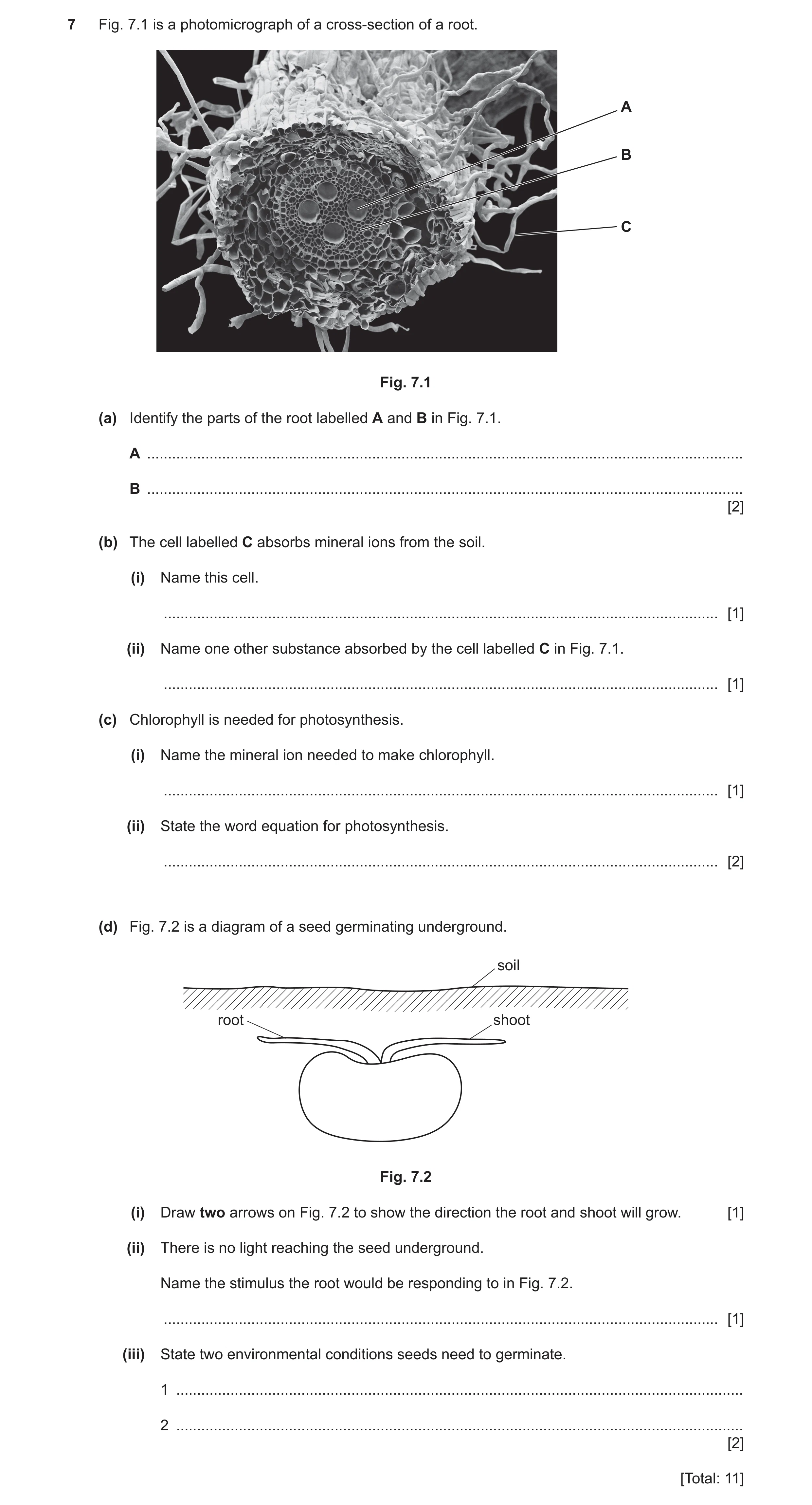
7 Fig. 7.1 is a photomicrograph of a cross-section of a root. A B C Fig. 7.1 (a) Identify the parts of the root labelled A and B in Fig. 7.1. A … B … [2] (b) The cell labelled C absorbs mineral ions from the soil. (i) Name this cell. … [1] (ii) Name one other substance absorbed by the cell labelled C in Fig. 7.1. … [1] (c) Chlorophyll is needed for photosynthesis. (i) Name the mineral ion needed to make chlorophyll. … [1] (ii) State the word equation for photosynthesis. … [2] (d) Fig. 7.2 is a diagram of a seed germinating underground. soil root shoot Fig. 7.2 (i) Draw two arrows on Fig. 7.2 to show the direction the root and shoot will grow. [1] (ii) There is no light reaching the seed underground. Name the stimulus the root would be responding to in Fig. 7.2. … [1] (iii) State two environmental conditions seeds need to germinate. 1 … 2 … [2] [Total: 11]
11 marks
Mark scheme: 7(a) A xylem ; B phloem ; 2 7(b)(i) root hair (cell) ; 1 7(b)(ii) water ; 1 7(c)(i) magnesium ; 1 7(c)(ii) carbon dioxide + water → glucose + oxygen ;; 2 7(d)(i) shoot arrow pointing upwards and root arrow pointing downwards ; 1 7(d)(ii) gravity ; 1 7(d)(iii) any two from warm / suitable temperature ; oxygen ; moisture / water ; 2
This question in 0654/32 Feb/March 2021
Q9 · Plants use different tissues to transport substances around the plant 0654/31 May/June 2021
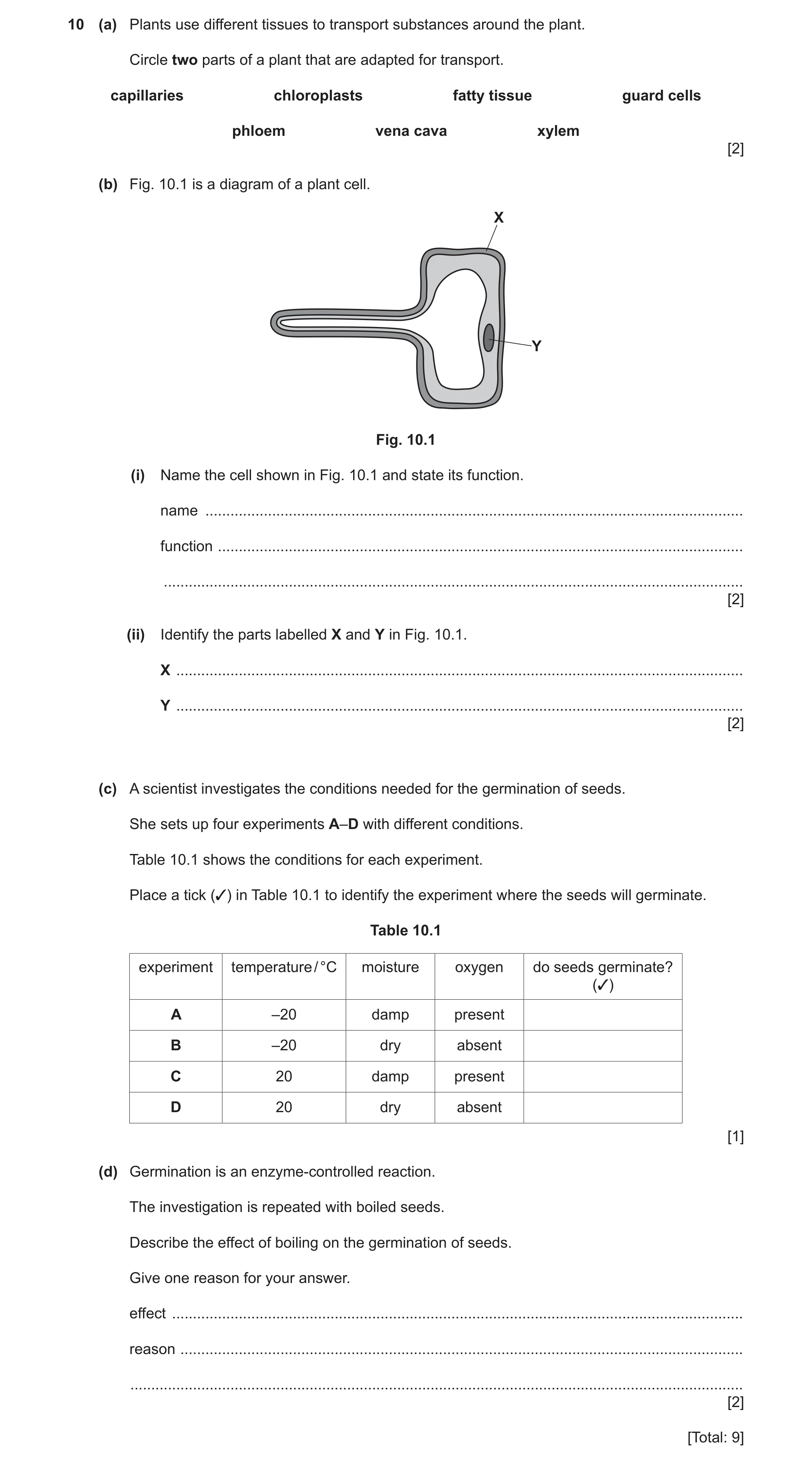
10 (a) Plants use different tissues to transport substances around the plant. Circle two parts of a plant that are adapted for transport. capillaries chloroplasts fatty tissue guard cells phloem vena cava xylem [2] (b) Fig. 10.1 is a diagram of a plant cell. X Y Fig. 10.1 (i) Name the cell shown in Fig. 10.1 and state its function. name … function … … [2] (ii) Identify the parts labelled X and Y in Fig. 10.1. X … Y … [2] (c) A scientist investigates the conditions needed for the germination of seeds. She sets up four experiments A–D with different conditions. Table 10.1 shows the conditions for each experiment. Place a tick (3) in Table 10.1 to identify the experiment where the seeds will germinate. Table 10.1 experiment temperature / °C moisture oxygen do seeds germinate? (3) A –20 damp present B –20 dry absent C 20 damp present D 20 dry absent [1] (d) Germination is an enzyme‑controlled reaction. The investigation is repeated with boiled seeds. Describe the effect of boiling on the germination of seeds. Give one reason for your answer. effect … reason … … [2] [Total: 9]
9 marks
Mark scheme: 10(a) phloem circled ; xylem circled ; 2 10(b)(i) name root hair (cell) ; function absorption of, water / mineral ions ; 2 10(b)(ii) X cell wall ; Y nucleus ; 2 Question Answer Marks 10(c) prediction of germination (/ X) X X X ; 1 10(d) effect no germination ; reason (high temperature) decreases enzyme / stops activity ; 2
This question in 0654/31 May/June 2021
Q10 · A diagram of a cross-section through a leaf 0654/33 Oct/Nov 2023
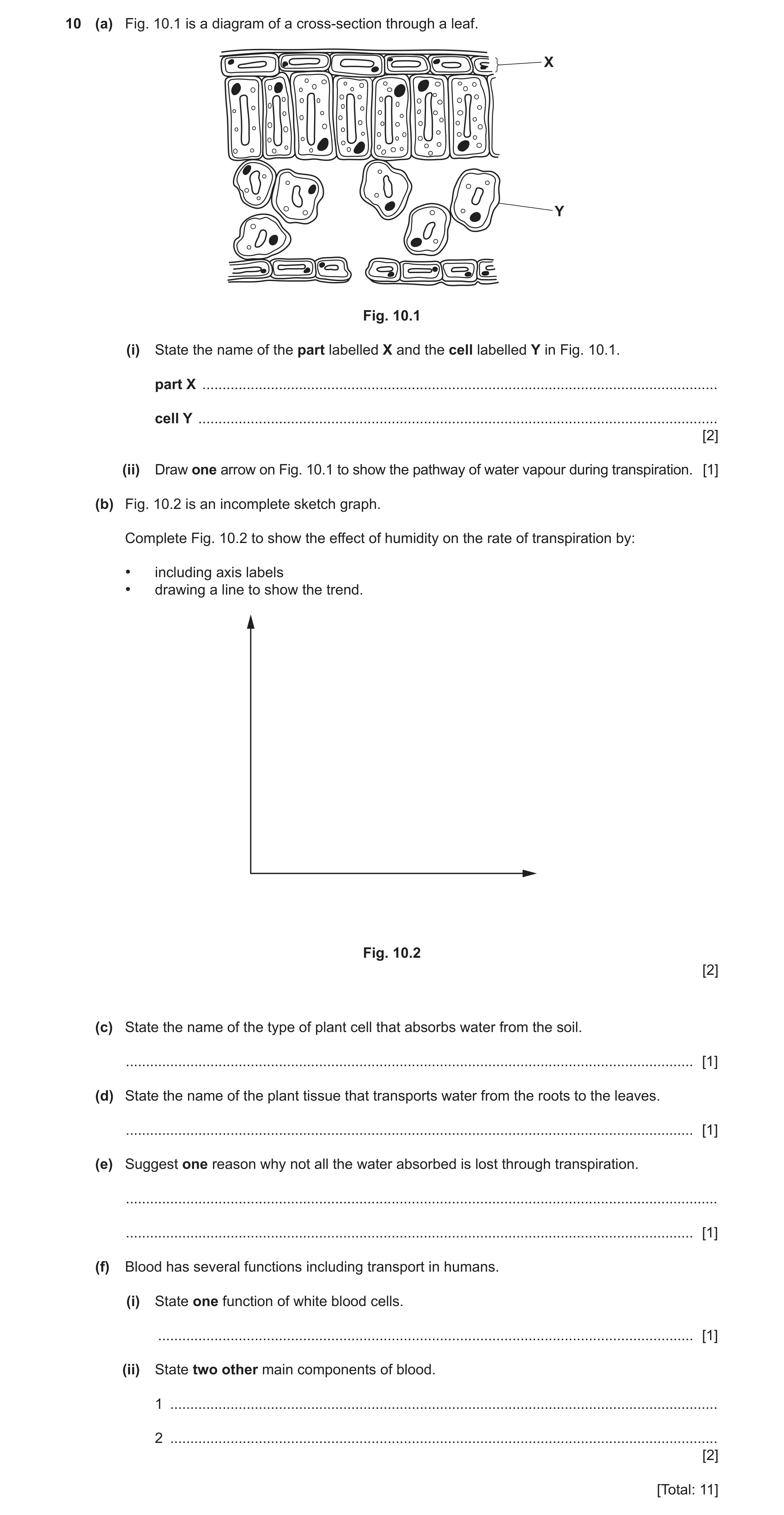
10 (a) Fig. 10.1 is a diagram of a cross-section through a leaf. X Y Fig. 10.1 (i) State the name of the part labelled X and the cell labelled Y in Fig. 10.1. part X … cell Y … [2] (ii) Draw one arrow on Fig. 10.1 to show the pathway of water vapour during transpiration. [1] (b) Fig. 10.2 is an incomplete sketch graph. Complete Fig. 10.2 to show the effect of humidity on the rate of transpiration by: • including axis labels • drawing a line to show the trend. Fig. 10.2 [2] (c) State the name of the type of plant cell that absorbs water from the soil. … [1] (d) State the name of the plant tissue that transports water from the roots to the leaves. … [1] (e) Suggest one reason why not all the water absorbed is lost through transpiration. … … [1] (f) Blood has several functions including transport in humans. (i) State one function of white blood cells. … [1] (ii) State two other main components of blood. 1 … 2 … [2] [Total: 11]
11 marks
Mark scheme: 10(a)(i) X – (upper) epidermis ; 2 Y – spongy mesophyll ; 10(a)(ii) arrow drawn from leaf going out of stoma ; 1 10(b) axis labels ; 2 negative correlation ; 10(c) root hair (cell) ; 1 10(d) xylem ; 1 10(e) some used in, photosynthesis / support ; 1 10(f)(i) phagocytosis / production of antibodies ; 1 10(f)(ii) any two from: 2 red blood cells ; plasma ; platelets ;
This question in 0654/33 Oct/Nov 2023
Q11 · A student investigates the effect of light on an aquatic plant 0654/32 May/June 2024
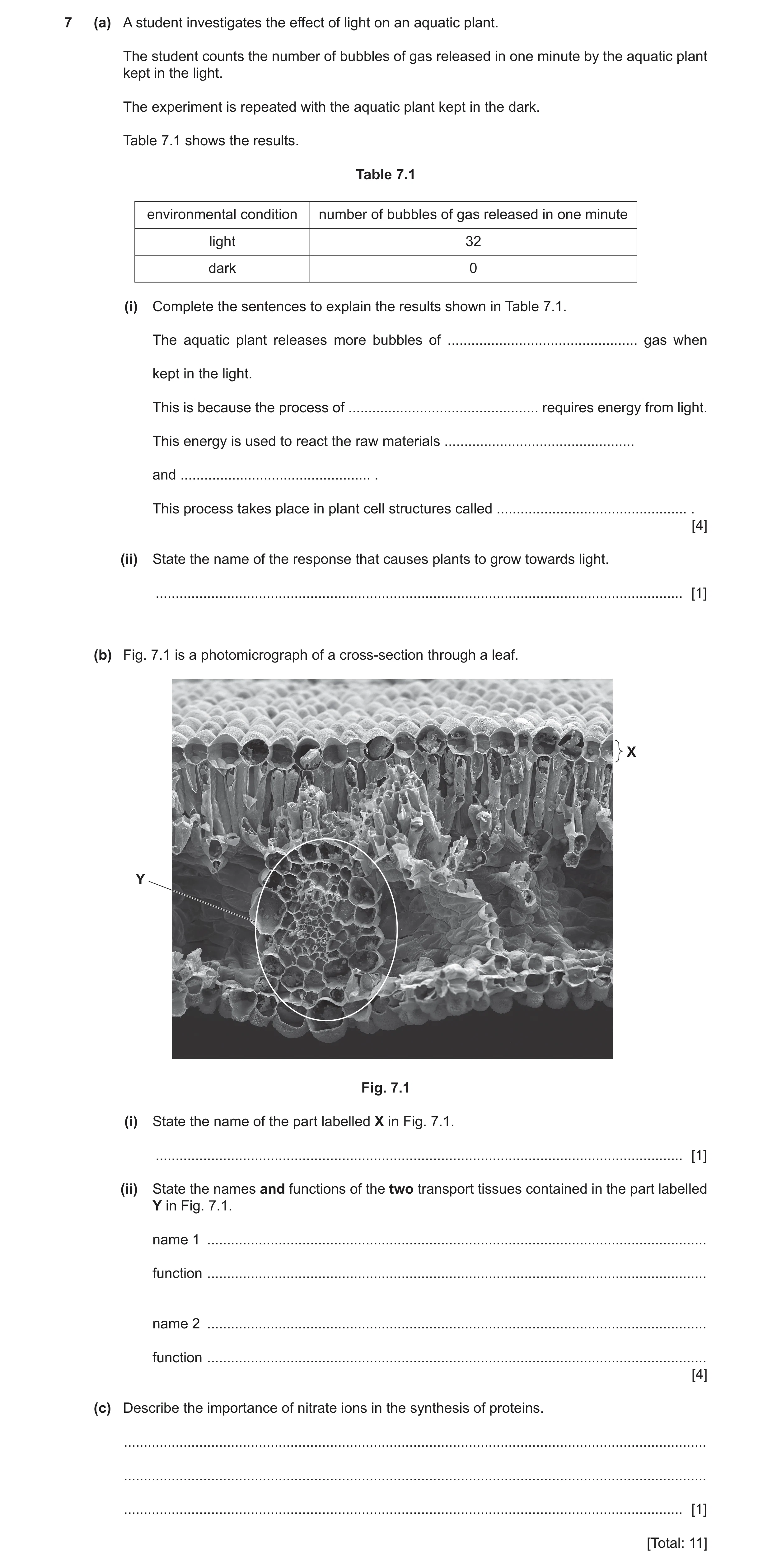
7 (a) A student investigates the effect of light on an aquatic plant. The student counts the number of bubbles of gas released in one minute by the aquatic plant kept in the light. The experiment is repeated with the aquatic plant kept in the dark. Table 7.1 shows the results. Table 7.1 environmental condition number of bubbles of gas released in one minute light 32 dark 0 (i) Complete the sentences to explain the results shown in Table 7.1. The aquatic plant releases more bubbles of … gas when kept in the light. This is because the process of … requires energy from light. This energy is used to react the raw materials … and … . This process takes place in plant cell structures called … . [4] (ii) State the name of the response that causes plants to grow towards light. … [1] (b) Fig. 7.1 is a photomicrograph of a cross‑section through a leaf. X Y Fig. 7.1 (i) State the name of the part labelled X in Fig. 7.1. … [1] (ii) State the names and functions of the two transport tissues contained in the part labelled Y in Fig. 7.1. name 1 … function … name 2 … function … [4] (c) Describe the importance of nitrate ions in the synthesis of proteins. … … … [1] [Total: 11]
11 marks
Mark scheme: 7(a)(i) oxygen ; photosynthesis ; carbon dioxide and water ; chloroplasts ; 4 7(a)(ii) phototropism ; 1 7(b)(i) (upper) epidermis ; 1 Question Answer Marks 7(b)(ii) xylem ; transports mineral ions / water or xylem is for support (of leaf) ; phloem ; transports dissolved sugars ; 4 7(c) nitrates are required to synthesise, amino acids (which make proteins) ; 1
This question in 0654/32 May/June 2024
Q12 · A photomicrograph of a cross-section through a root 0654/32 Oct/Nov 2024
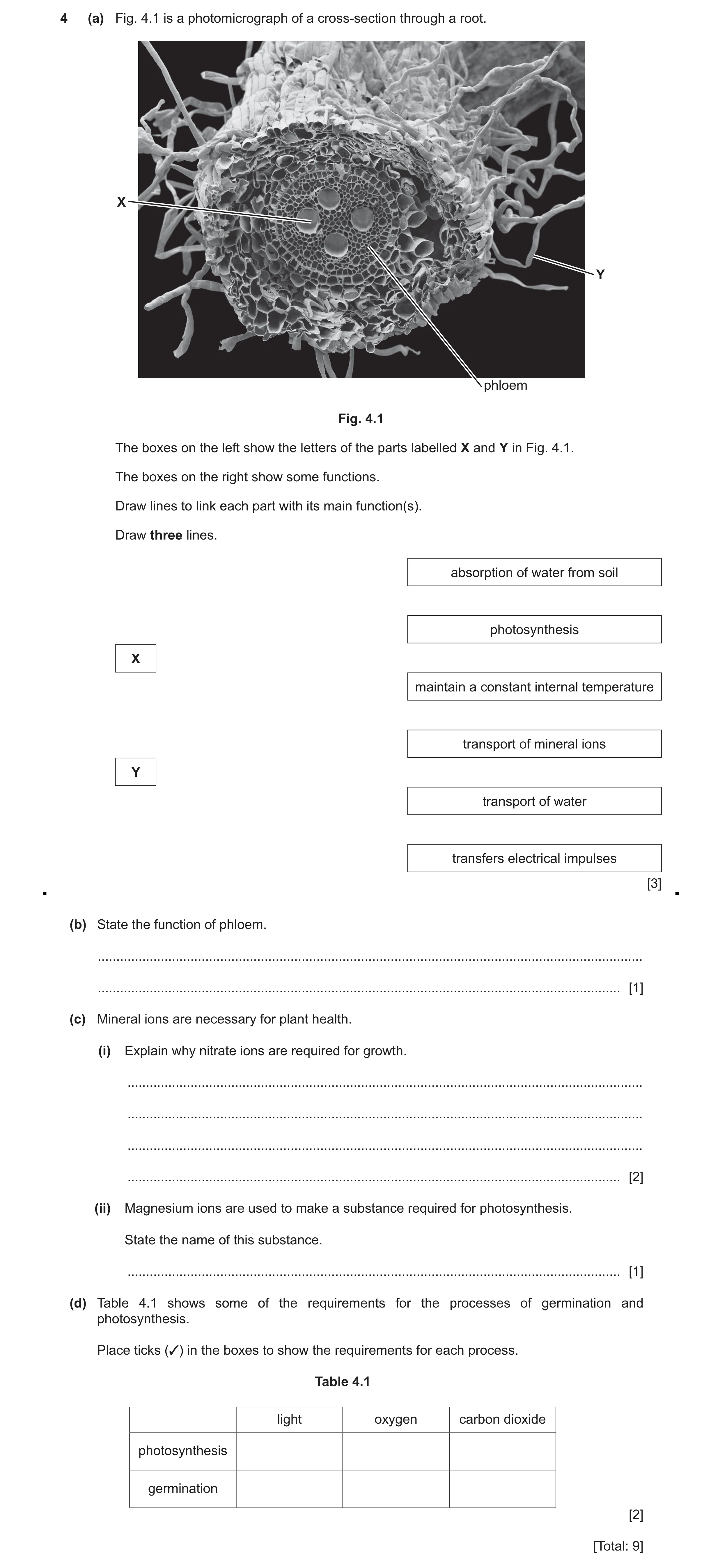
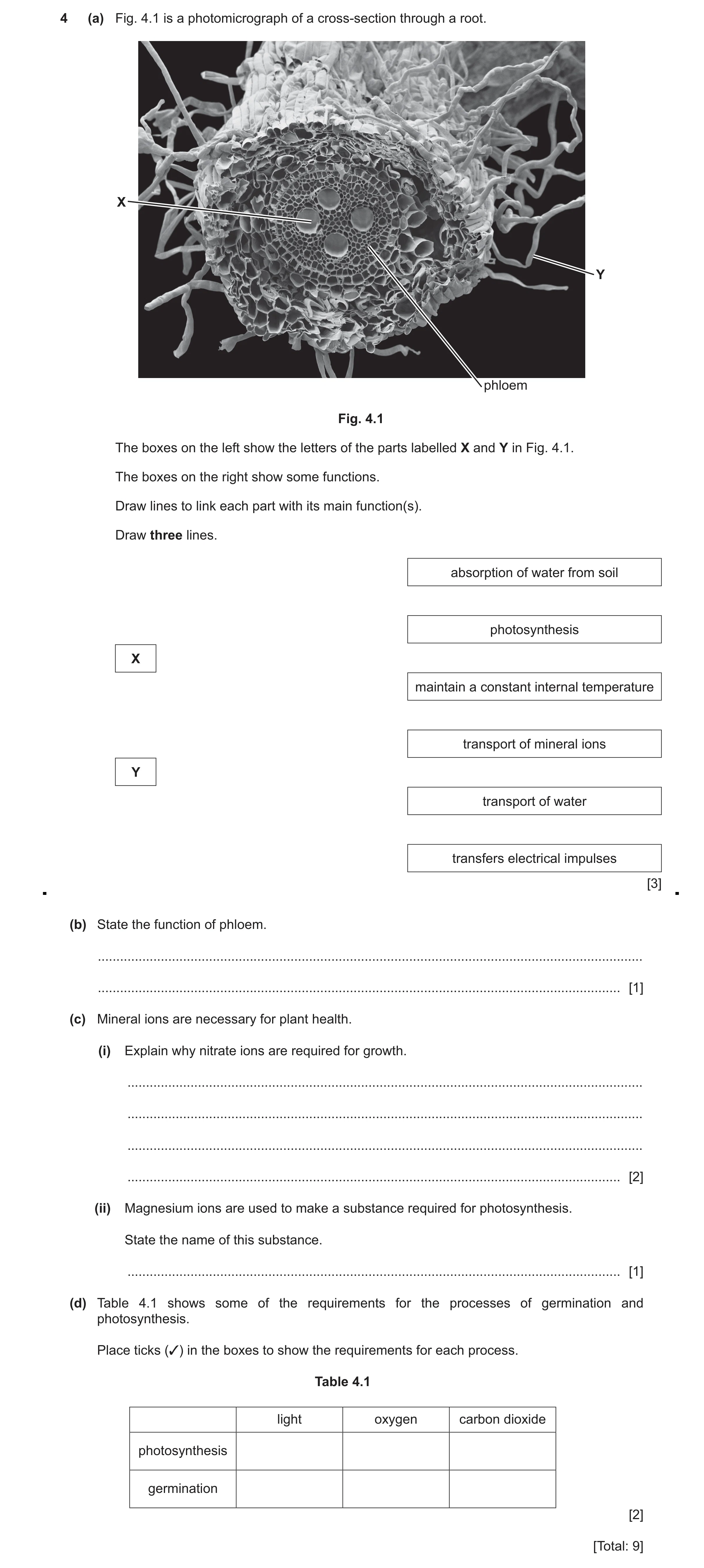
4 (a) Fig. 4.1 is a photomicrograph of a cross-section through a root. X Y phloem Fig. 4.1 The boxes on the left show the letters of the parts labelled X and Y in Fig. 4.1. The boxes on the right show some functions. Draw lines to link each part with its main function(s). Draw three lines. absorption of water from soil photosynthesis X maintain a constant internal temperature transport of mineral ions Y transport of water transfers electrical impulses [3] (b) State the function of phloem. … … [1] (c) Mineral ions are necessary for plant health. (i) Explain why nitrate ions are required for growth. … … … … [2] (ii) Magnesium ions are used to make a substance required for photosynthesis. State the name of this substance. … [1] (d) Table 4.1 shows some of the requirements for the processes of germination and photosynthesis. Place ticks (✓) in the boxes to show the requirements for each process. Table 4.1 light oxygen carbon dioxide photosynthesis germination [2] [Total: 9]
9 marks
Mark scheme: 4(a) absorption of water 3 photosynthesis X maintain a constant internal temperature transport of mineral ions Y transport of water transfers electrical impulses one mark for each correct line ;;; 4(b) transport of, dissolved sugars / sucrose / amino acids ; 1 4(c)(i) (nitrate ions) are needed to, synthesise / make, amino acids ; 2 amino acids make up proteins (which are required for growth) ; 4(c)(ii) chlorophyll ; 1 4(d) 2 light oxygen carbon dioxide photosynthesis germination 1 mark for each correct row ;;
This question in 0654/32 Oct/Nov 2024
Q13 · A photomicrograph of a cross-section through a root 0654/33 Oct/Nov 2024
4 (a) Fig. 4.1 is a photomicrograph of a cross-section through a root. X Y phloem Fig. 4.1 The boxes on the left show the letters of the parts labelled X and Y in Fig. 4.1. The boxes on the right show some functions. Draw lines to link each part with its main function(s). Draw three lines. absorption of water from soil photosynthesis X maintain a constant internal temperature transport of mineral ions Y transport of water transfers electrical impulses [3] (b) State the function of phloem. … … [1] (c) Mineral ions are necessary for plant health. (i) Explain why nitrate ions are required for growth. … … … … [2] (ii) Magnesium ions are used to make a substance required for photosynthesis. State the name of this substance. … [1] (d) Table 4.1 shows some of the requirements for the processes of germination and photosynthesis. Place ticks (✓) in the boxes to show the requirements for each process. Table 4.1 light oxygen carbon dioxide photosynthesis germination [2] [Total: 9]
9 marks
Mark scheme: 4(a) absorption of water 3 photosynthesis X maintain a constant internal temperature transport of mineral ions Y transport of water transfers electrical impulses one mark for each correct line ;;; 4(b) transport of, dissolved sugars / sucrose / amino acids ; 1 4(c)(i) (nitrate ions) are needed to, synthesise / make, amino acids ; 2 amino acids make up proteins (which are required for growth) ; 4(c)(ii) chlorophyll ; 1 4(d) 2 light oxygen carbon dioxide photosynthesis germination 1 mark for each correct row ;;
This question in 0654/33 Oct/Nov 2024
Q14 · State the word that describes a disease-causing organism 0654/32 Feb/March 2025
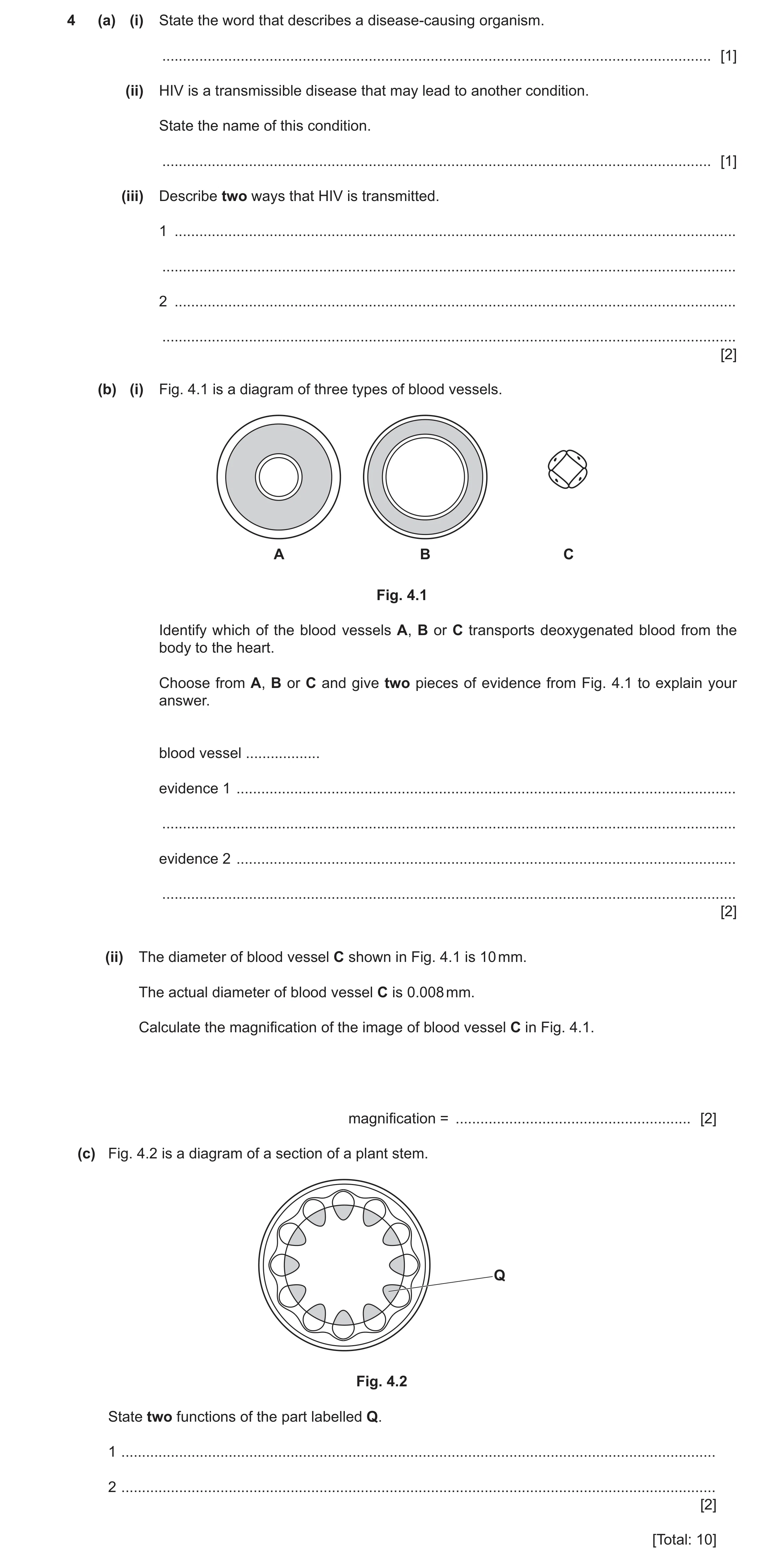
4 (a) (i) State the word that describes a disease-causing organism. … [1] (ii) HIV is a transmissible disease that may lead to another condition. State the name of this condition. … [1] (iii) Describe two ways that HIV is transmitted. 1 … … 2 … … [2] (b) (i) Fig. 4.1 is a diagram of three types of blood vessels. A B C Fig. 4.1 Identify which of the blood vessels A, B or C transports deoxygenated blood from the body to the heart. Choose from A, B or C and give two pieces of evidence from Fig. 4.1 to explain your answer. blood vessel … evidence 1 … … evidence 2 … … [2] (ii) The diameter of blood vessel C shown in Fig. 4.1 is 10 mm. The actual diameter of blood vessel C is 0.008 mm. Calculate the magnification of the image of blood vessel C in Fig. 4.1. magnification = … [2] (c) Fig. 4.2 is a diagram of a section of a plant stem. Q Fig. 4.2 State two functions of the part labelled Q. 1 … 2 … [2] [Total: 10]
10 marks
Mark scheme: 4(a)(i) pathogen ; 1 4(a)(ii) AIDS ; 1 4(a)(iii) any two from: 2 unprotected sexual intercourse sharing needles blood transfusions AVP ; ; 4(b)(i) B (no mark) 2 thin wall ; large lumen ; 4(b)(ii) 10 image size 2 Magnification = or ; 0.008 actual size 1250 ; 4(c) any two from: 2 support transport of water transport of mineral ions ; ;
This question in 0654/32 Feb/March 2025
Q15 · A diagram of a heart 0654/31 Oct/Nov 2025
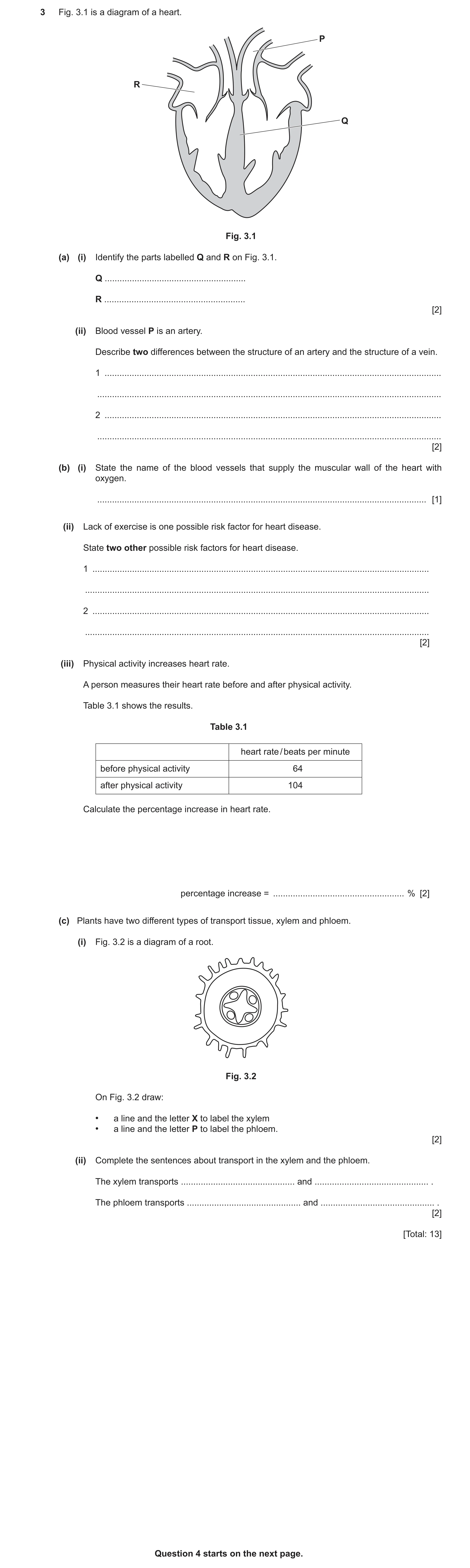
3 Fig. 3.1 is a diagram of a heart. P R Q Fig. 3.1 (a) (i) Identify the parts labelled Q and R on Fig. 3.1. Q … R … [2] (ii) Blood vessel P is an artery. Describe two differences between the structure of an artery and the structure of a vein. 1 … … 2 … … [2] (b) (i) State the name of the blood vessels that supply the muscular wall of the heart with oxygen. … [1] (ii) Lack of exercise is one possible risk factor for heart disease. State two other possible risk factors for heart disease. 1 … … 2 … … [2] (iii) Physical activity increases heart rate. A person measures their heart rate before and after physical activity. Table 3.1 shows the results. Table 3.1 heart rate / beats per minute before physical activity 64 after physical activity 104 Calculate the percentage increase in heart rate. percentage increase = … % [2] (c) Plants have two different types of transport tissue, xylem and phloem. (i) Fig. 3.2 is a diagram of a root. Fig. 3.2 On Fig. 3.2 draw: • a line and the letter X to label the xylem • a line and the letter P to label the phloem. [2] (ii) Complete the sentences about transport in the xylem and the phloem. The xylem transports … and … . The phloem transports … and … . [2] [Total: 13] Question 4 starts on the next page.
13 marks
Mark scheme: 3(a)(i) Q = septum ; 2 R = right atrium ; 3(a)(ii) any two from: 2 • artery has, smaller lumen / ORA ; • artery has, thicker wall / muscle / ORA ; • veins have valves / ORA ; 3(b)(i) coronary arteries ; 1 3(b)(ii) any two from: 2 • alcohol ; • smoking ; • obesity ; • diabetes ; • high blood pressure ; • diet ; • stress ; • genetic predisposition ; • age ; • sex ; 3(b)(iii) 104 − 64 2 100 = ; 64 63 (%) ; 3(c)(i) 2 X P 1 mark for each correct label 3(c)(ii) xylem – water and mineral ions ; 2 phloem – sucrose and amino acids ;
This question in 0654/31 Oct/Nov 2025
 1 / 23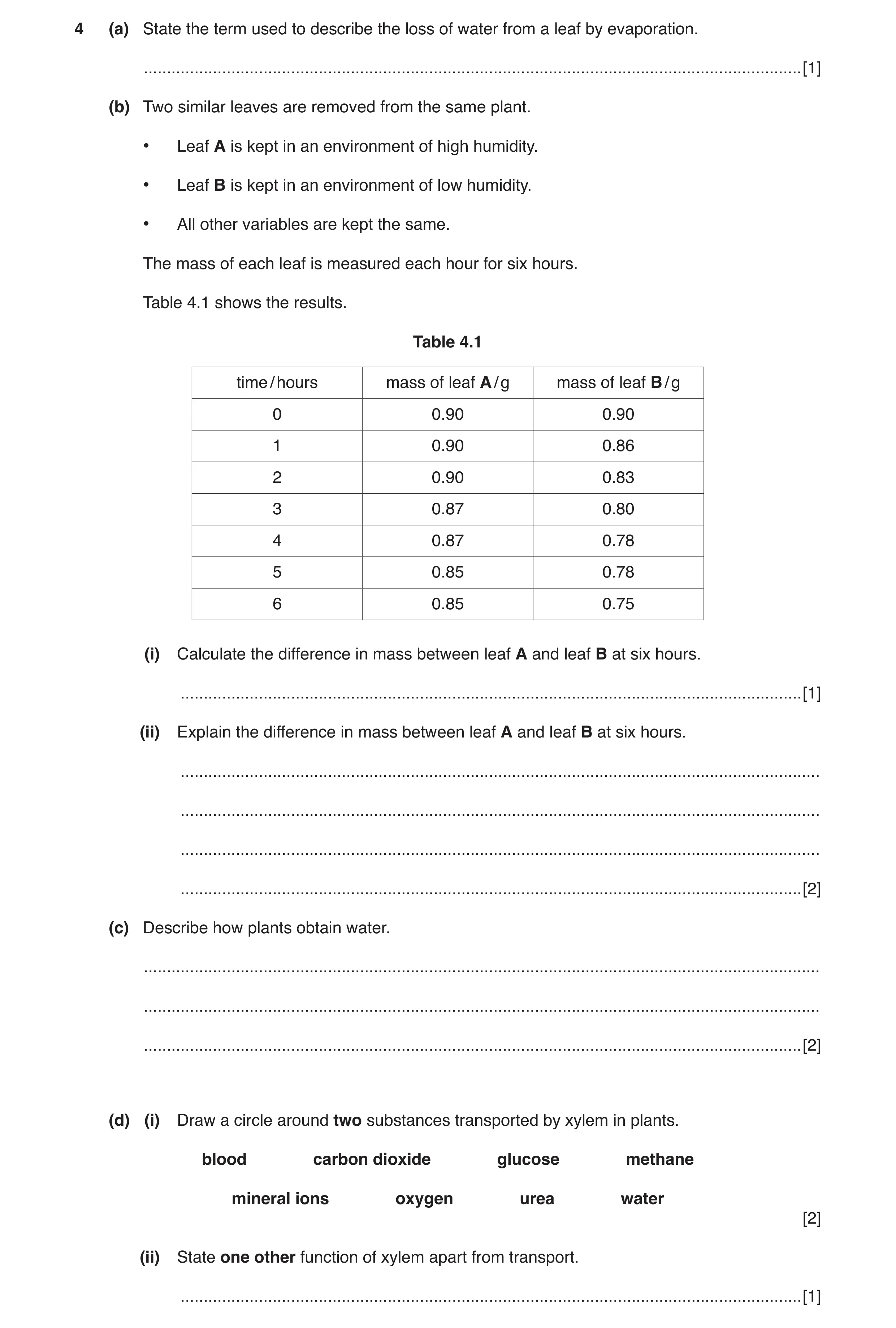
 6
6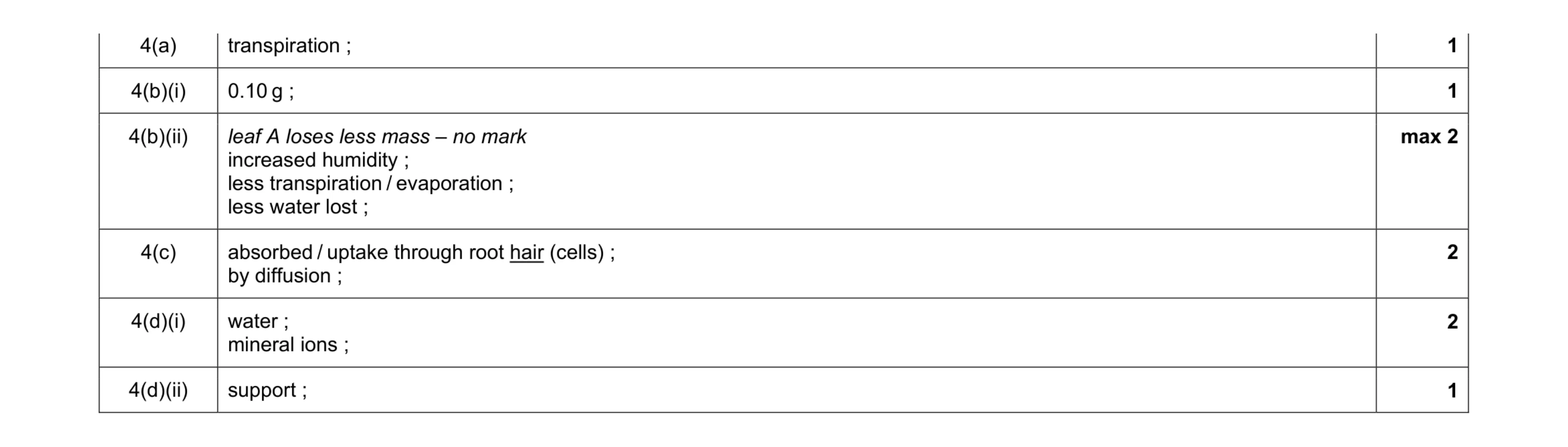 9
9 7
7 7
7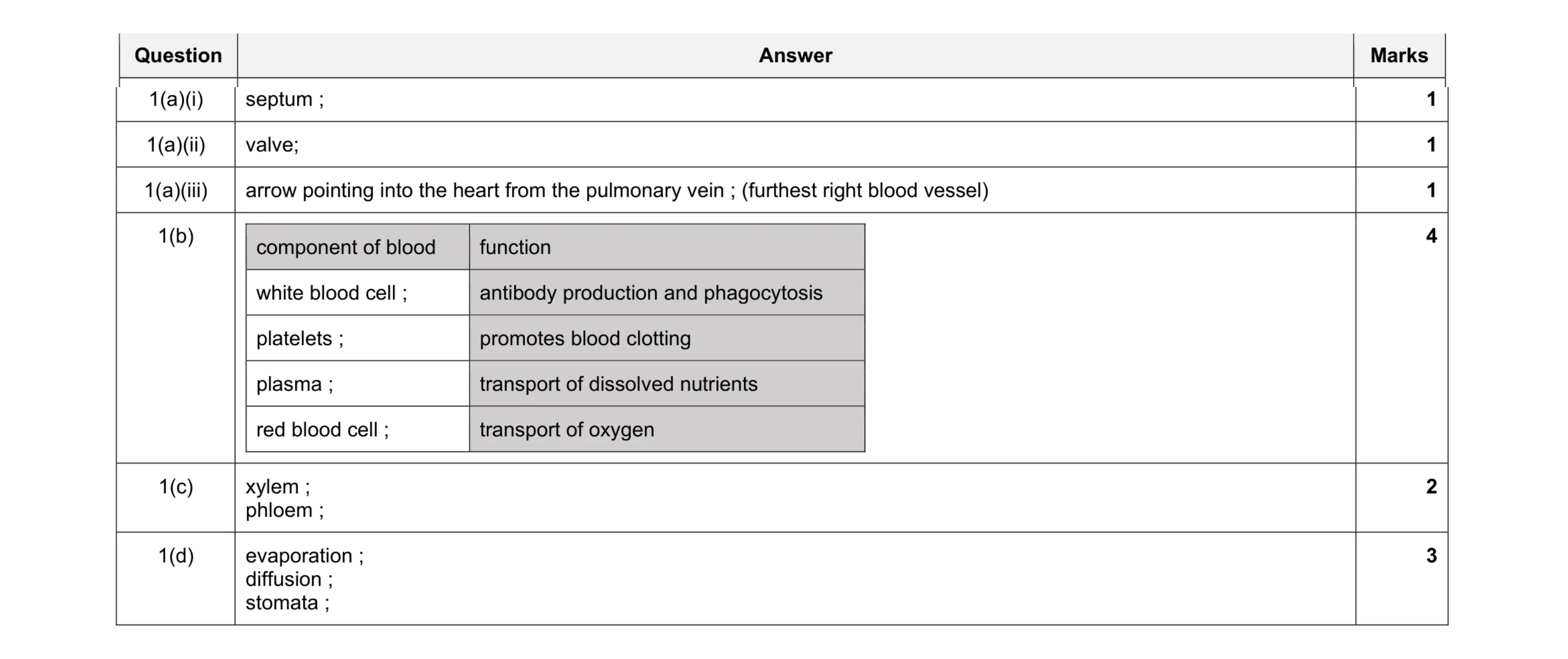 12
12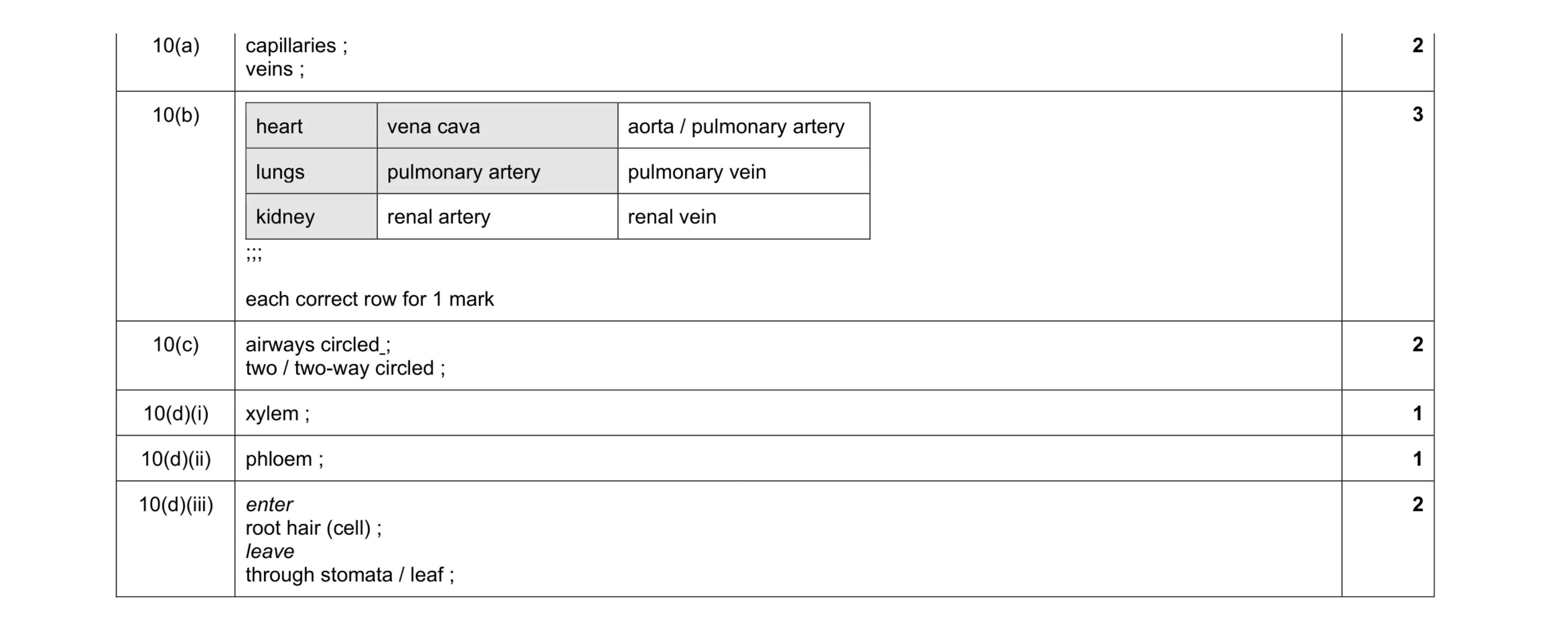 11
11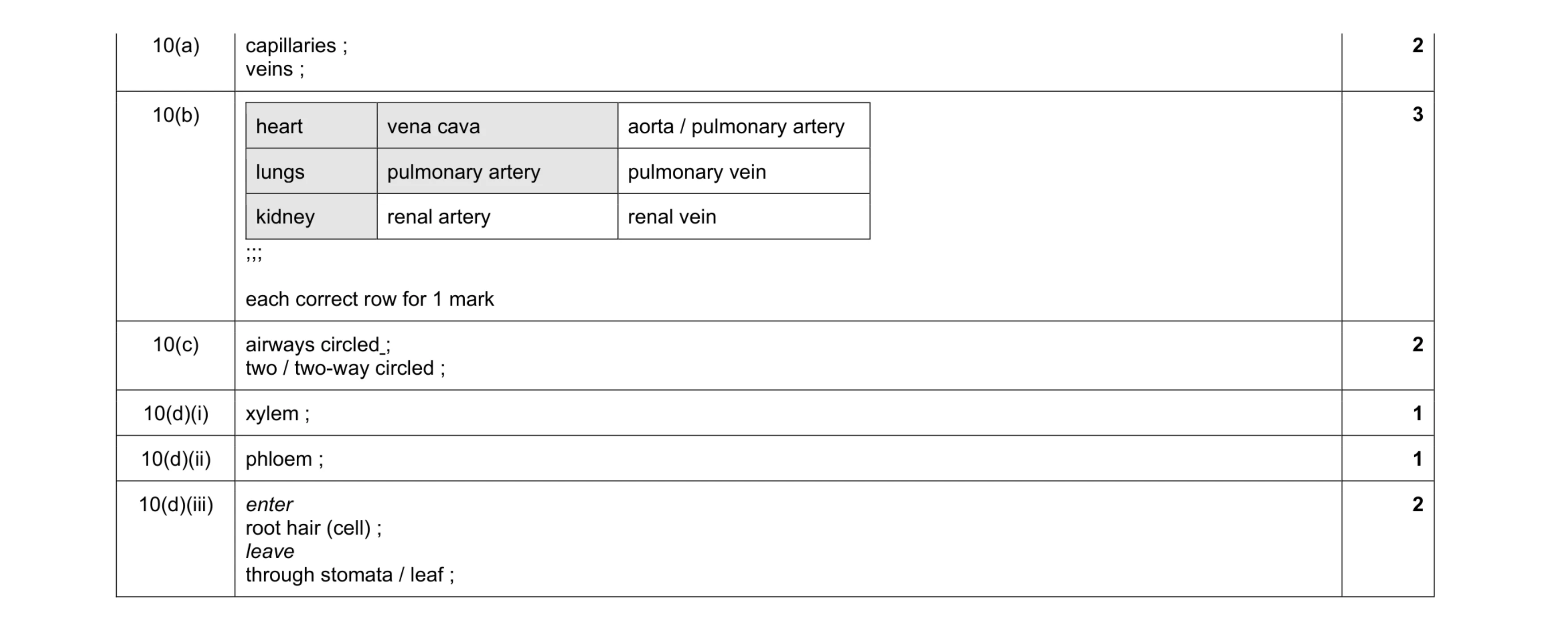 11
11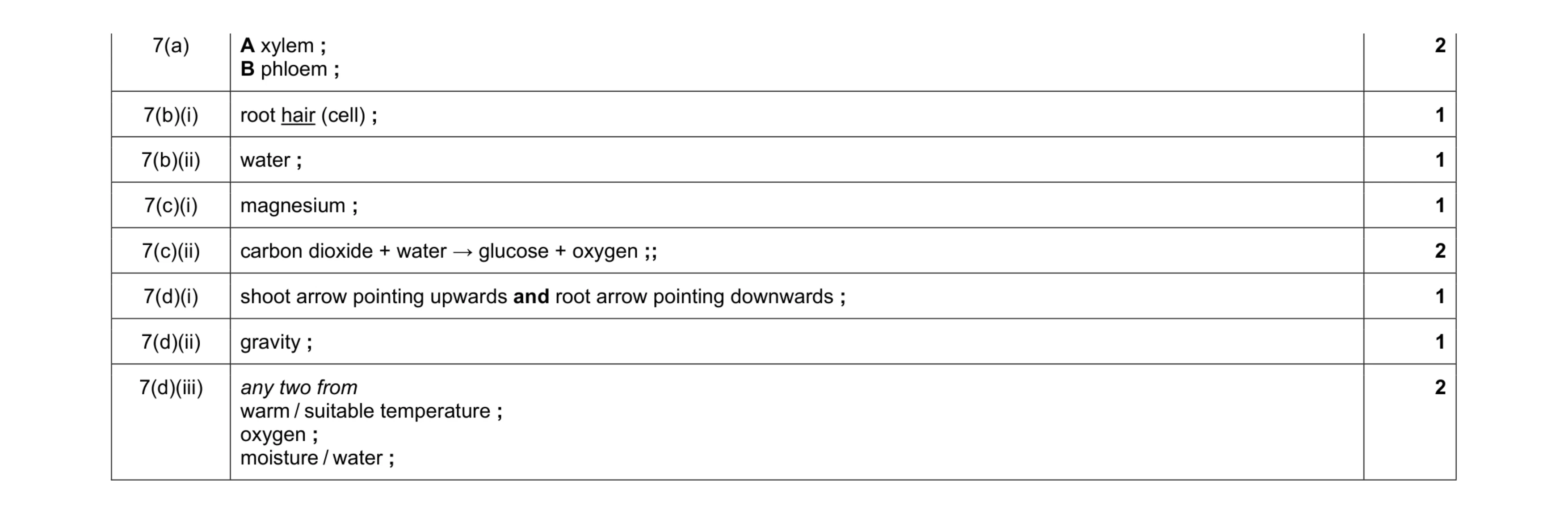 11
11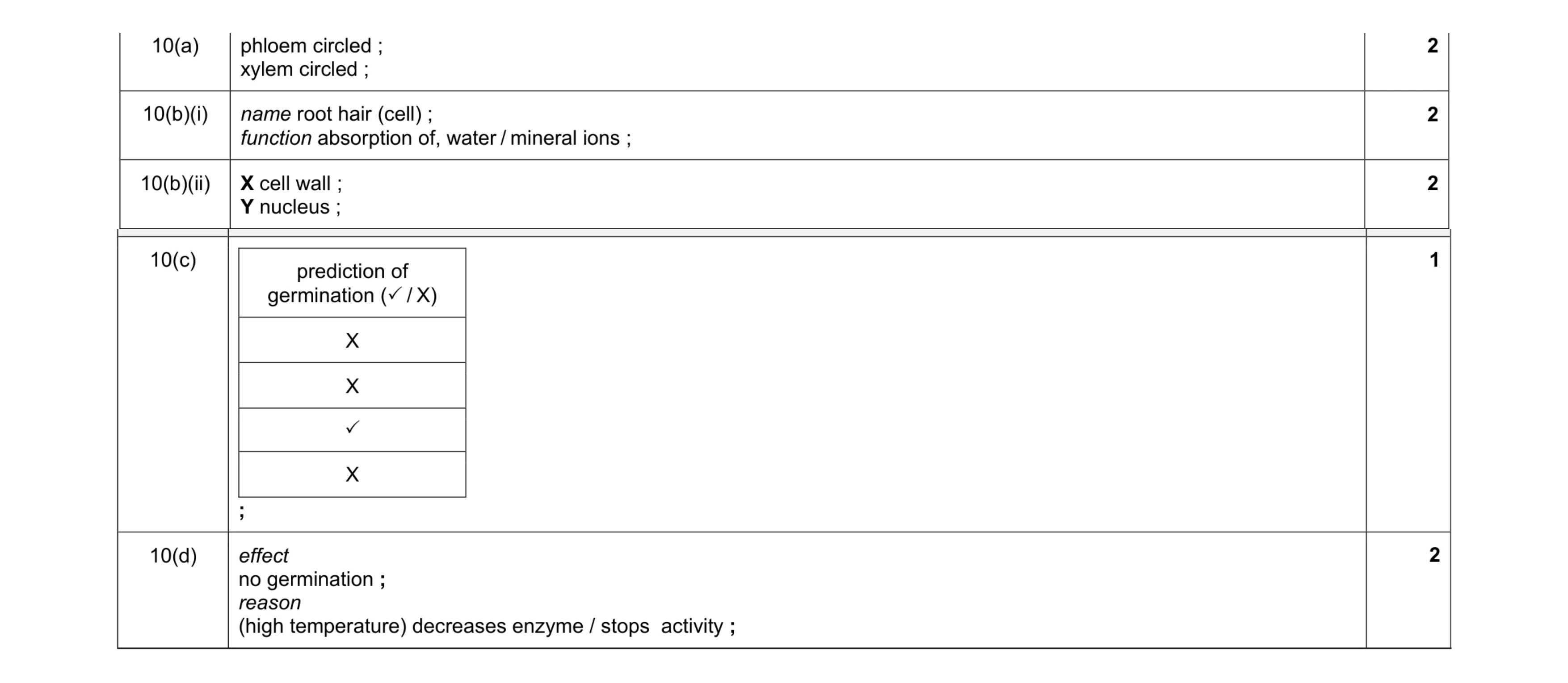 9
9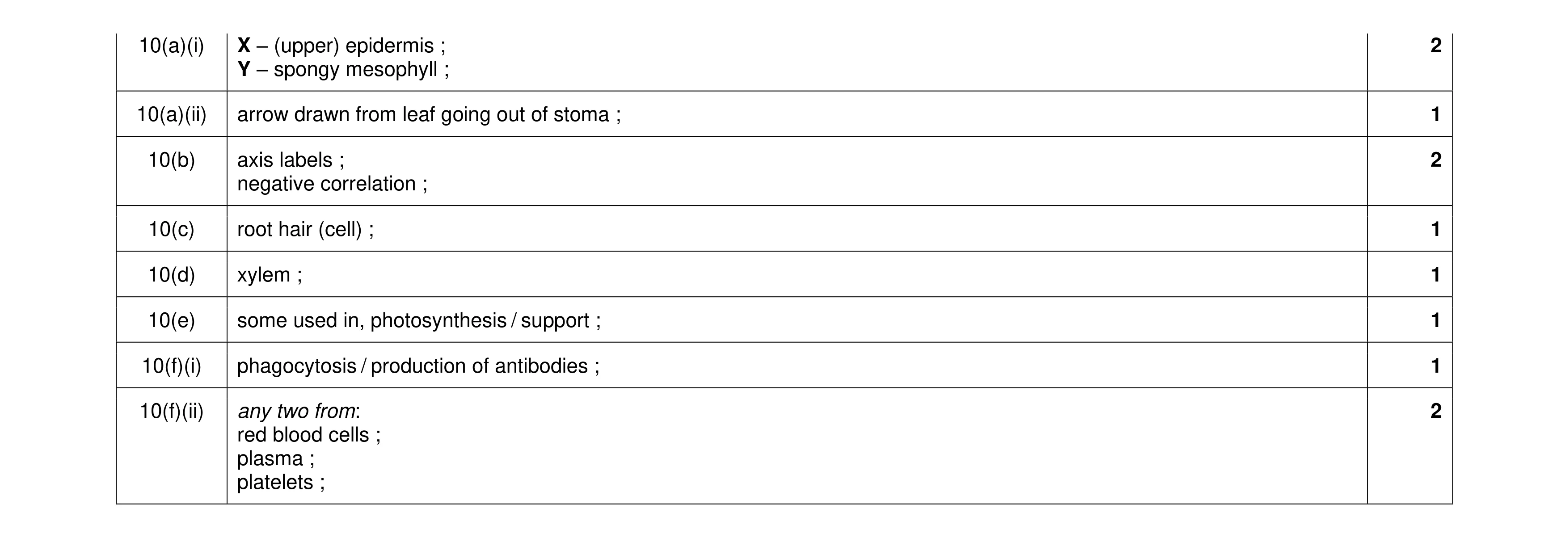 11
11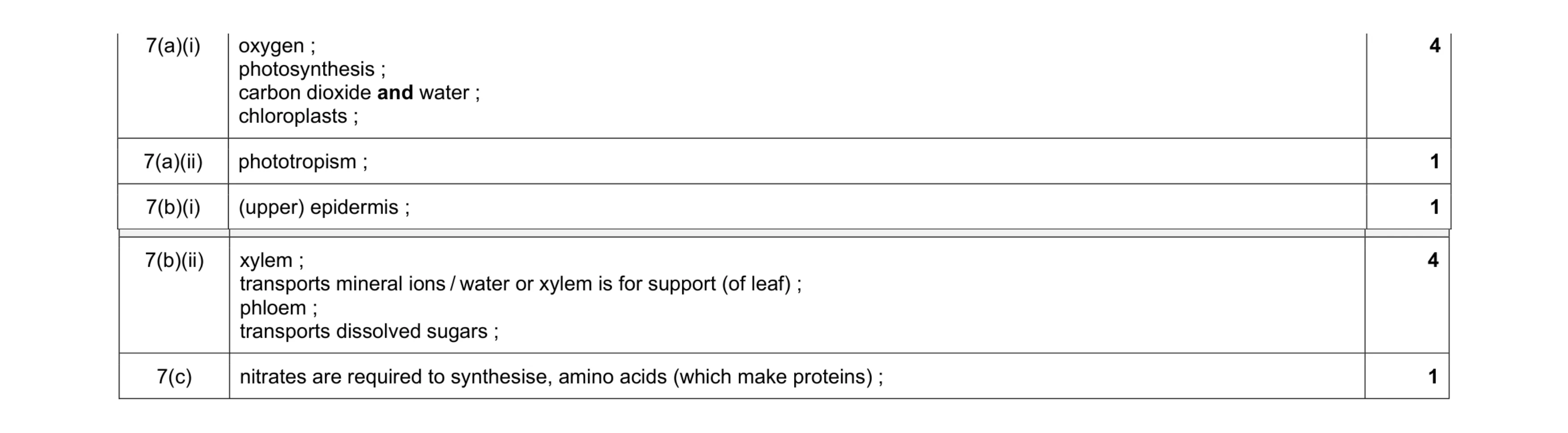 11
11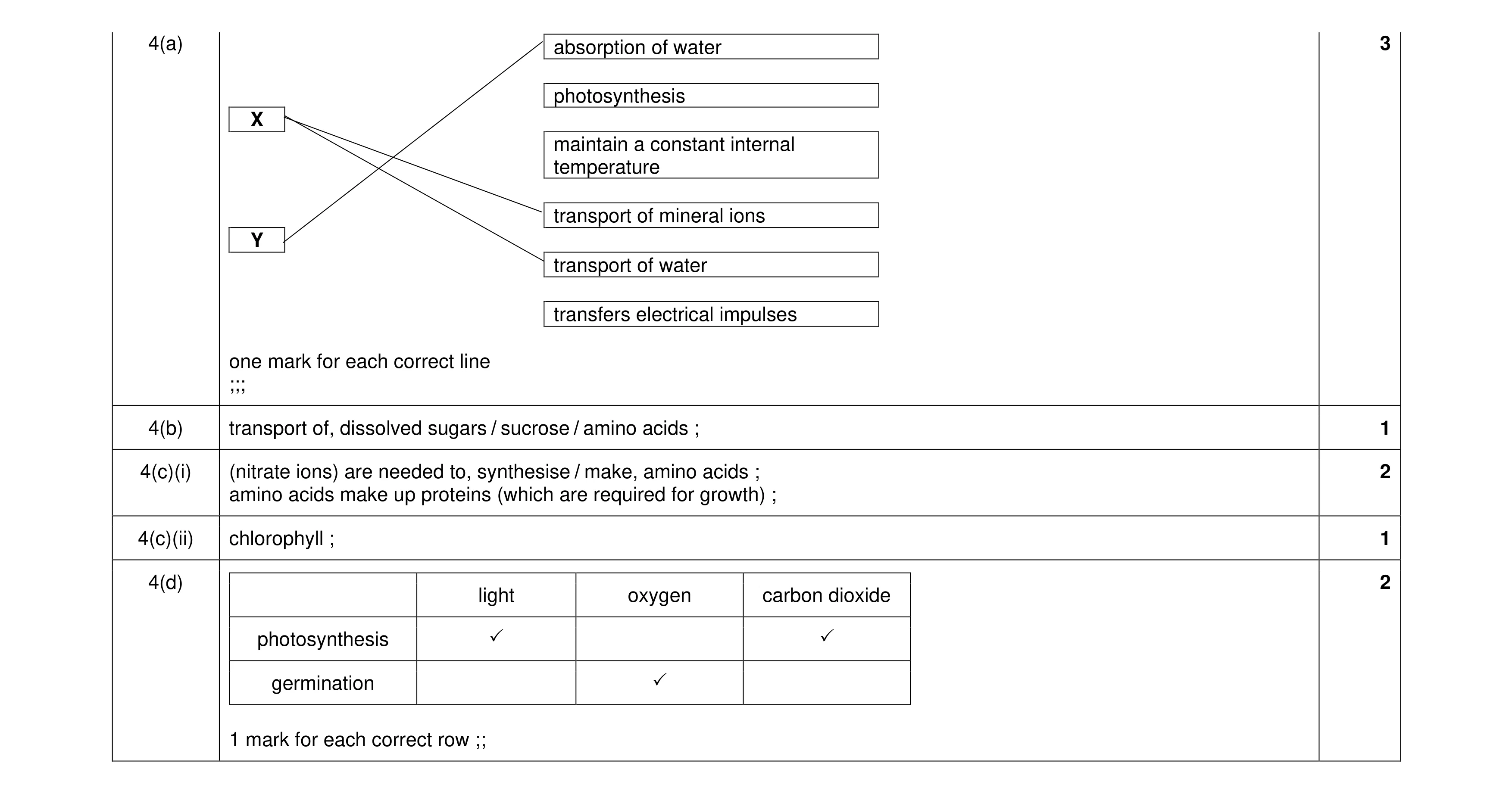 9
9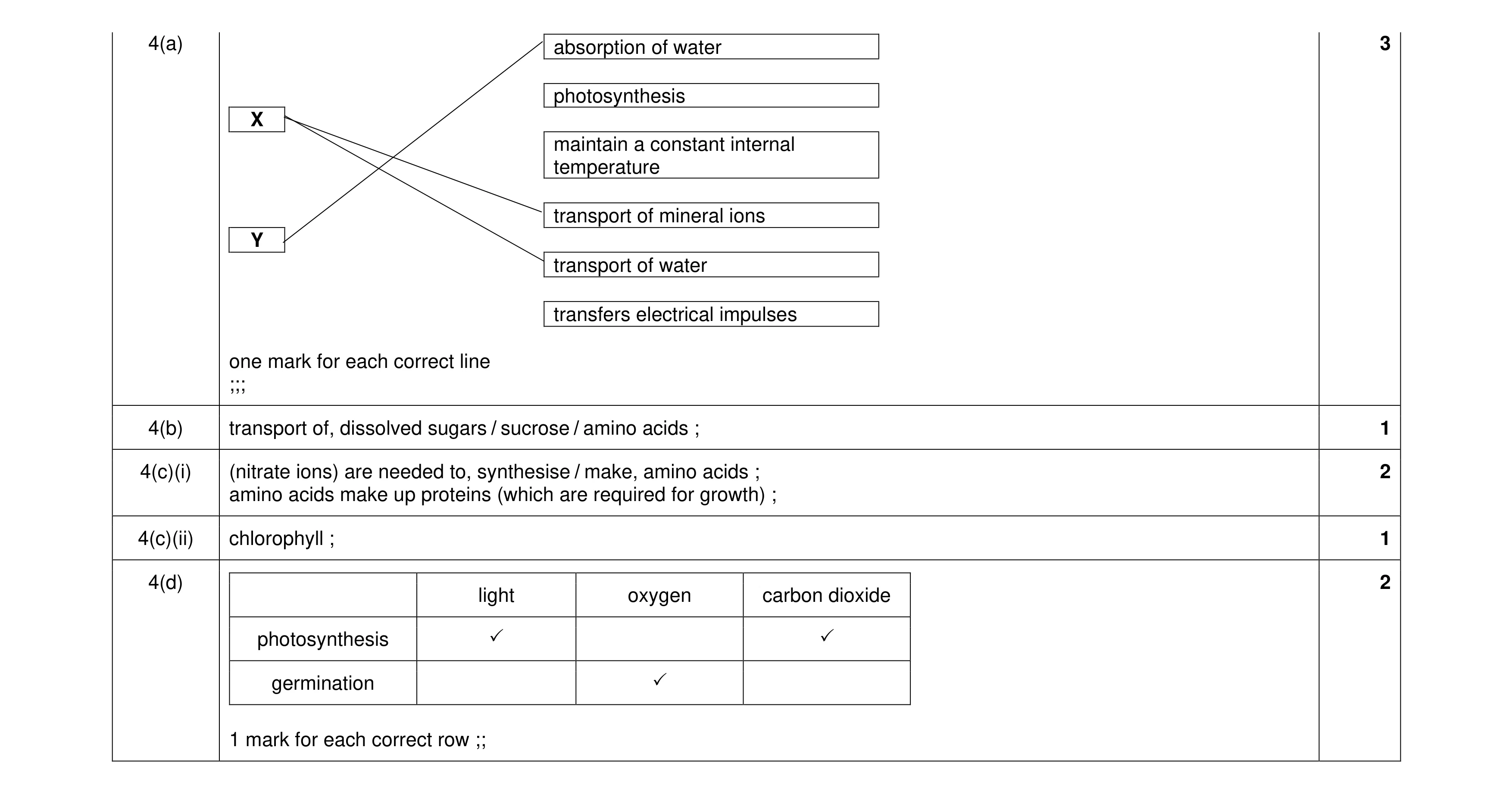 9
9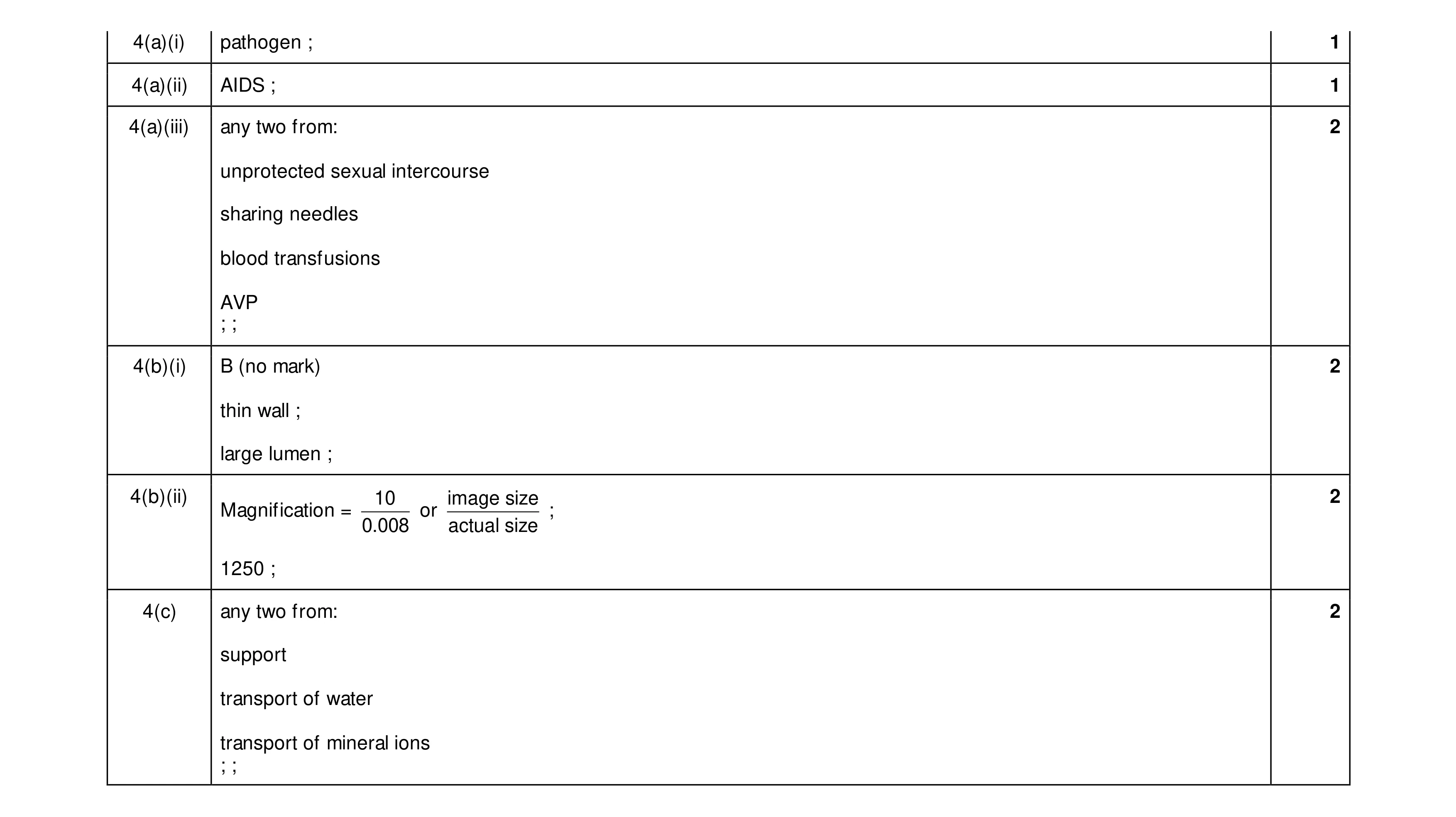 10
10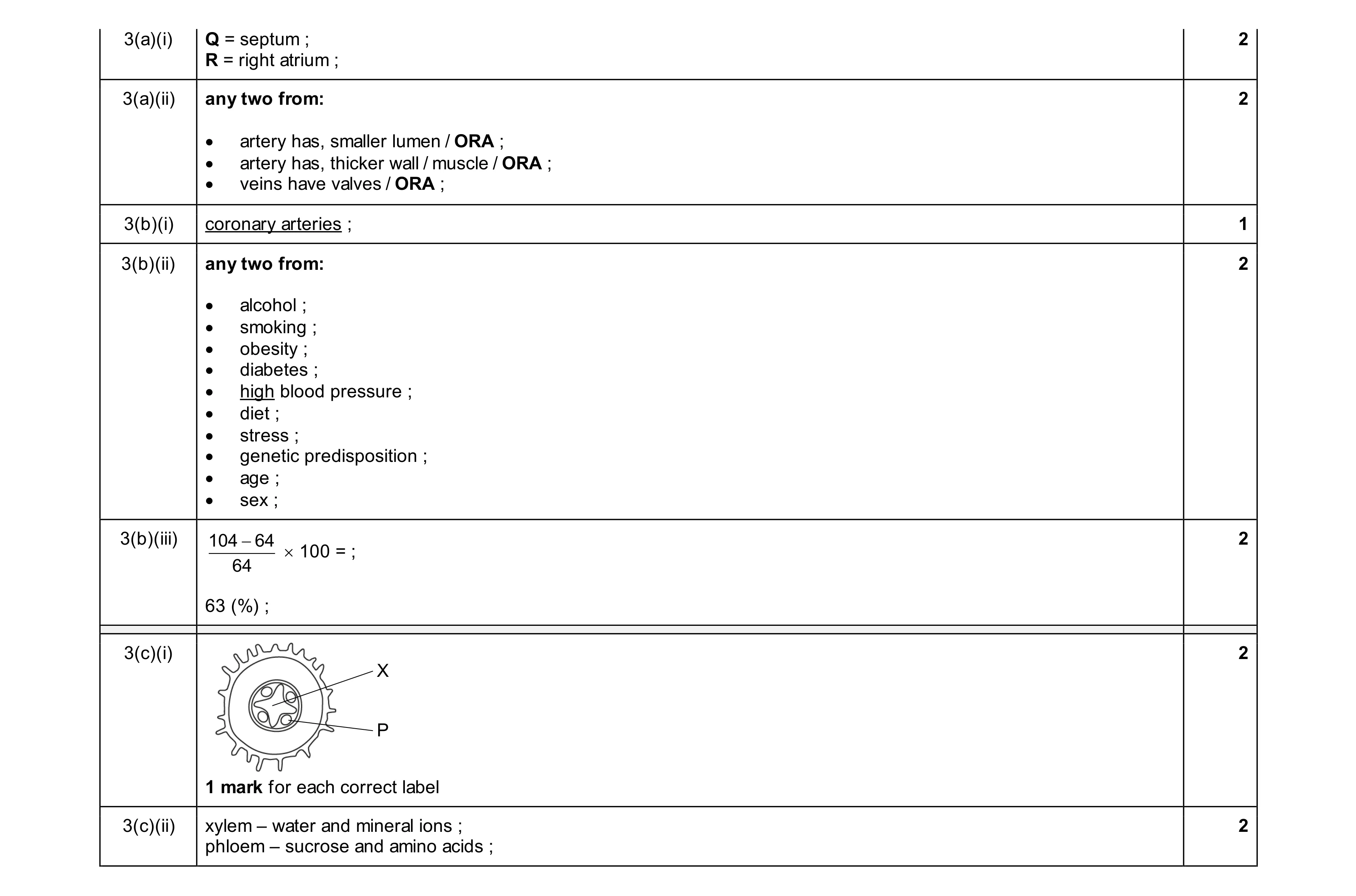 13
13