Questions as text
Q1 · In a plant, what leads to offspring that are identical to the parent? 0654/21 May/June 2017
4 In a plant, what leads to offspring that are identical to the parent? A asexual reproduction B insect pollination C seed germination D sexual reproduction
1 marks
Answer: A
This question in 0654/21 May/June 2017
Q2 · What is the function of microorganisms in yoghurt making? 0654/21 May/June 2017
6 What is the function of microorganisms in yoghurt making? A They make the sugar in milk become solid. B They produce lactic acid. C They raise the pH of the mixture. D They reduce the fat content of the milk.
1 marks
Answer: B
This question in 0654/21 May/June 2017
Q3 · In a plant, what leads to offspring that are identical to the parent? 0654/22 May/June 2017
4 In a plant, what leads to offspring that are identical to the parent? A asexual reproduction B insect pollination C seed germination D sexual reproduction
1 marks
Answer: A
This question in 0654/22 May/June 2017
Q4 · In a plant, what leads to offspring that are identical to the parent? 0654/23 May/June 2017
4 In a plant, what leads to offspring that are identical to the parent? A asexual reproduction B insect pollination C seed germination D sexual reproduction
1 marks
Answer: A
This question in 0654/23 May/June 2017
Q5 · What is an advantage of asexual reproduction compared with sexual reproduction? 0654/21 Oct/Nov 2018
9 What is an advantage of asexual reproduction compared with sexual reproduction? A A specific disease is less likely to spread throughout the whole population. B It increases variation in the offspring. C It produces offspring more rapidly. D It requires two parents.
1 marks
Answer: C
This question in 0654/21 Oct/Nov 2018
Q6 · What is an advantage of asexual reproduction compared with sexual reproduction? 0654/22 Oct/Nov 2018
9 What is an advantage of asexual reproduction compared with sexual reproduction? A A specific disease is less likely to spread throughout the whole population. B It increases variation in the offspring. C It produces offspring more rapidly. D It requires two parents.
1 marks
Answer: C
This question in 0654/22 Oct/Nov 2018
Q7 · What is an advantage of asexual reproduction compared with sexual reproduction? 0654/23 Oct/Nov 2018
9 What is an advantage of asexual reproduction compared with sexual reproduction? A A specific disease is less likely to spread throughout the whole population. B It increases variation in the offspring. C It produces offspring more rapidly. D It requires two parents.
1 marks
Answer: C
This question in 0654/23 Oct/Nov 2018
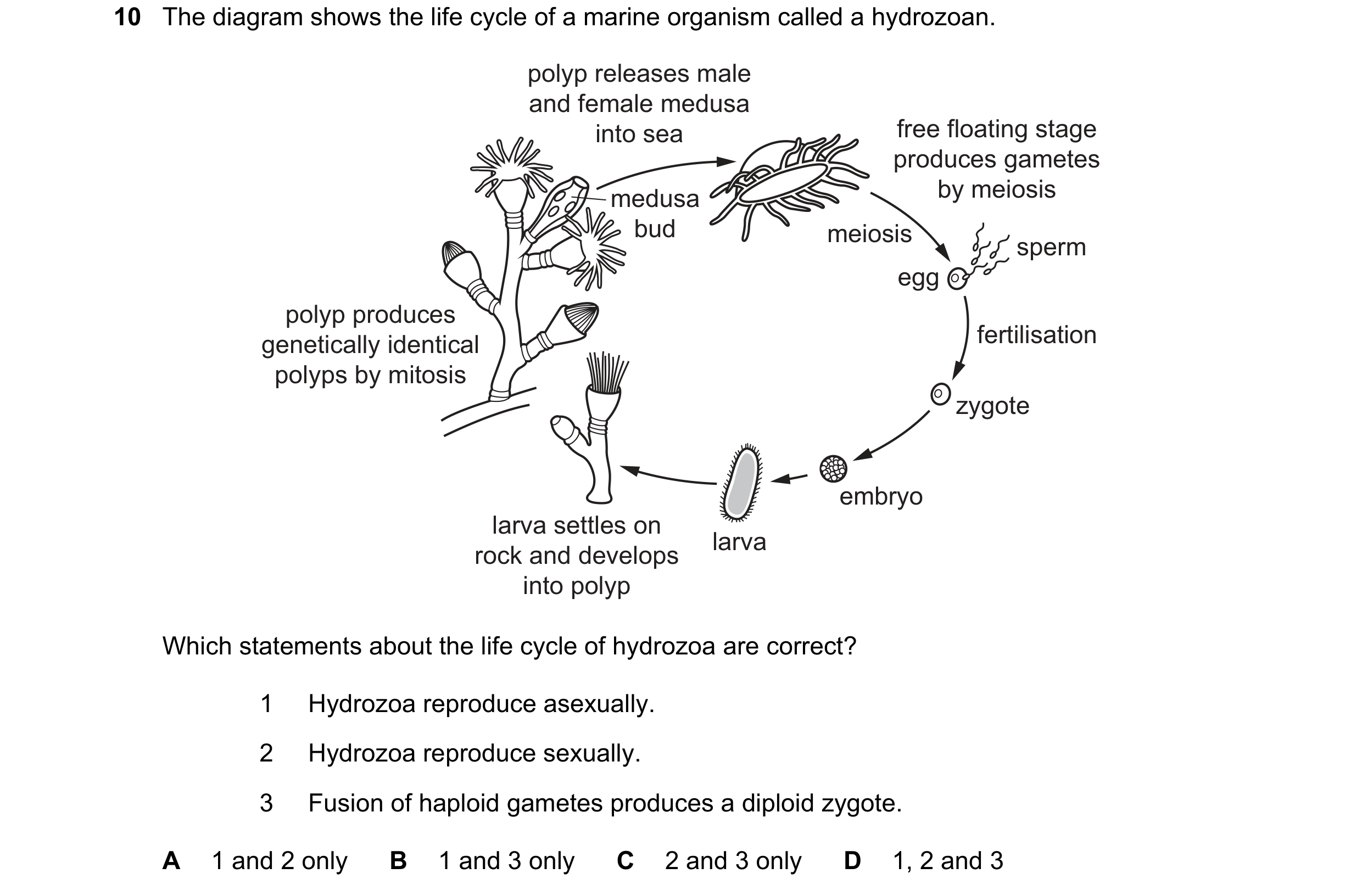
Q8 · The diagram shows the life cycle of a marine organism called a hydrozoan 0654/23 May/June 2022
10 The diagram shows the life cycle of a marine organism called a hydrozoan. polyp releases male and female medusa into sea free floating stage produces gametes medusa by meiosis bud meiosis sperm egg polyp produces genetically identical fertilisation polyps by mitosis zygote embryo larva settles on larva rock and develops into polyp Which statements about the life cycle of hydrozoa are correct? 1 Hydrozoa reproduce asexually. 2 Hydrozoa reproduce sexually. 3 Fusion of haploid gametes produces a diploid zygote. A 1 and 2 only B 1 and 3 only C 2 and 3 only D 1, 2 and 3
1 marks
Answer: D
This question in 0654/23 May/June 2022
Q9 · What are the advantages of a plant reproducing asexually? 0654/23 Oct/Nov 2022
10 What are the advantages of a plant reproducing asexually? 1 increased variety of genetic material 2 only small flowers need to be produced 3 rapid increase in population size A 1 only B 2 only C 3 only D 1, 2 and 3
1 marks
Answer: C
This question in 0654/23 Oct/Nov 2022
Q10 · In a plant, what leads to offspring that are genetically identical to the parent? 0654/21 May/June 2023
10 In a plant, what leads to offspring that are genetically identical to the parent? A asexual reproduction B insect pollination C seed germination D sexual reproduction
1 marks
Answer: A
This question in 0654/21 May/June 2023
Q11 · Which row describes asexual reproduction? 0654/21 May/June 2024
10 Which row describes asexual reproduction?
only one fusion of genetealy
parent nuclei :
offspring
A v v v
B v v x
Cc v x v
D x v v
key
/=yes
X=n0o
1 marks
Answer: C
This question in 0654/21 May/June 2024
Q12 · Which statement describes one similarity between asexual and sexual reproduction? 0654/21 Oct/Nov 2024
10 Which statement describes one similarity between asexual and sexual reproduction? A They both involve gametes. B They both involve parent and offspring. C They both produce genetically identical individuals. D They both require fertilisation to take place.
1 marks
Answer: B
This question in 0654/21 Oct/Nov 2024
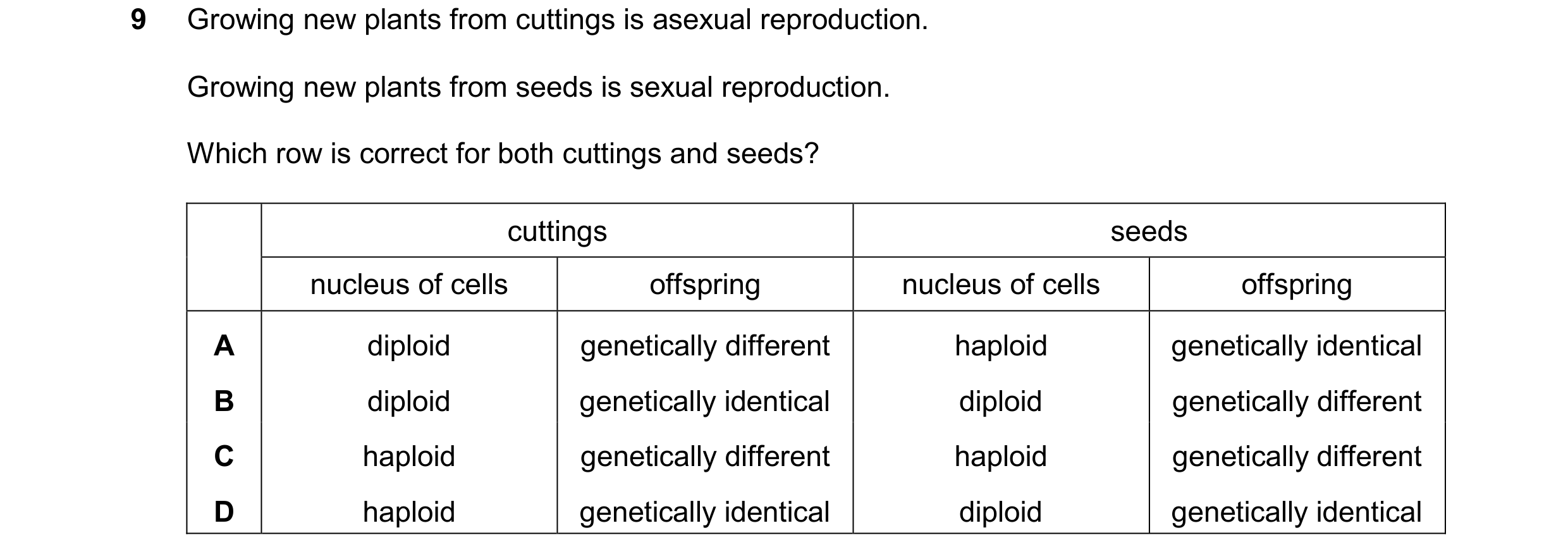
Q13 · Growing new plants from cuttings is asexual reproduction 0654/22 Feb/March 2025
9 Growing new plants from cuttings is asexual reproduction. Growing new plants from seeds is sexual reproduction. Which row is correct for both cuttings and seeds? cuttings seeds nucleus of cells offspring nucleus of cells offspring A diploid genetically different haploid genetically identical B diploid genetically identical diploid genetically different C haploid genetically different haploid genetically different D haploid genetically identical diploid genetically identical
1 marks
Answer: B
This question in 0654/22 Feb/March 2025
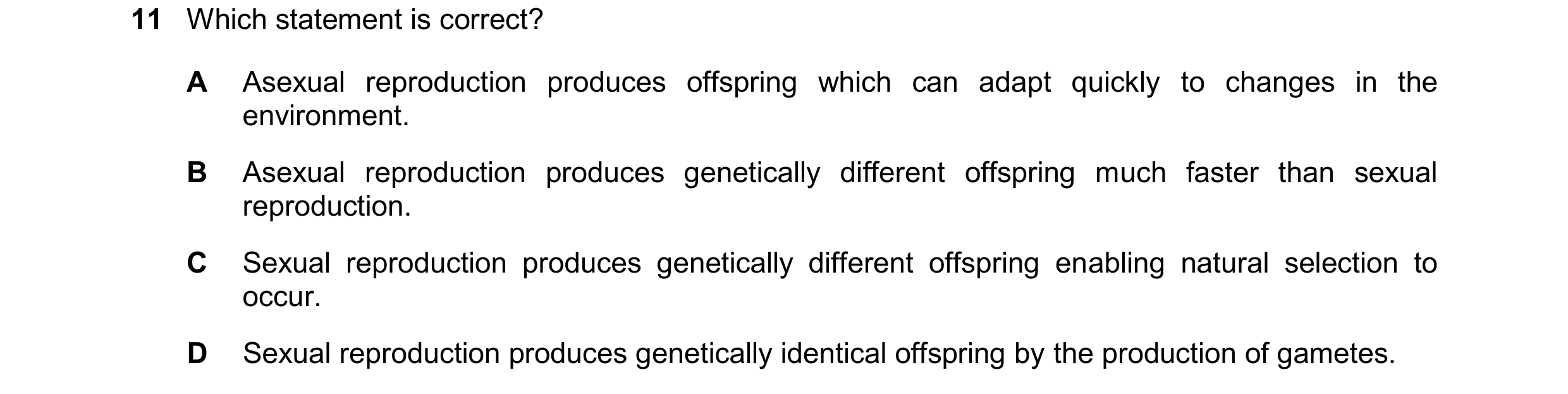
Q14 · Which statement is correct? 0654/22 Oct/Nov 2025
11 Which statement is correct? A Asexual reproduction produces offspring which can adapt quickly to changes in the environment. B Asexual reproduction produces genetically different offspring much faster than sexual reproduction. C Sexual reproduction produces genetically different offspring enabling natural selection to occur. D Sexual reproduction produces genetically identical offspring by the production of gametes.
1 marks
Answer: C
This question in 0654/22 Oct/Nov 2025





 1 / 3
1 / 3

 2 / 3
2 / 3

 3 / 3
3 / 3