Questions as text
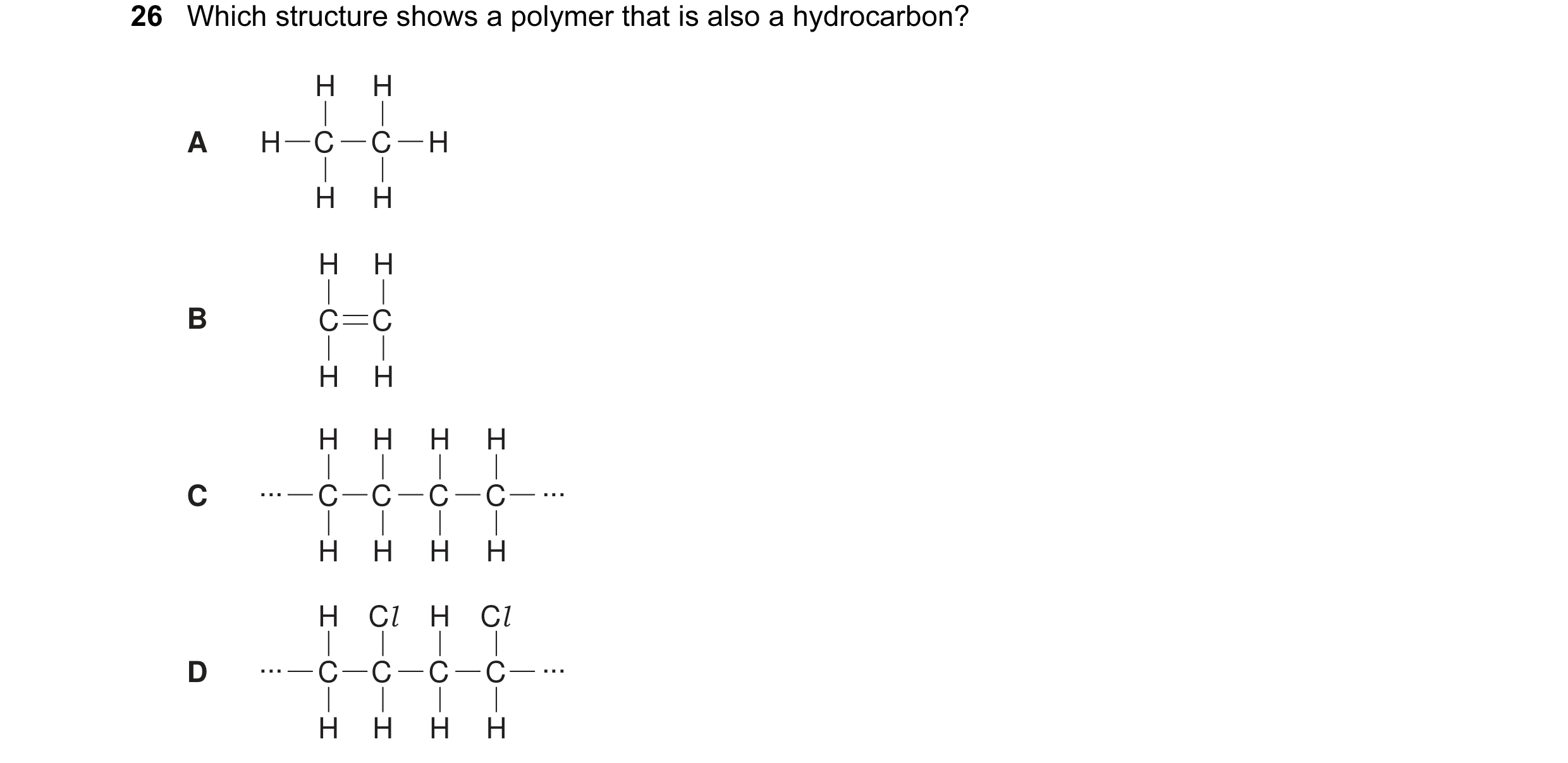
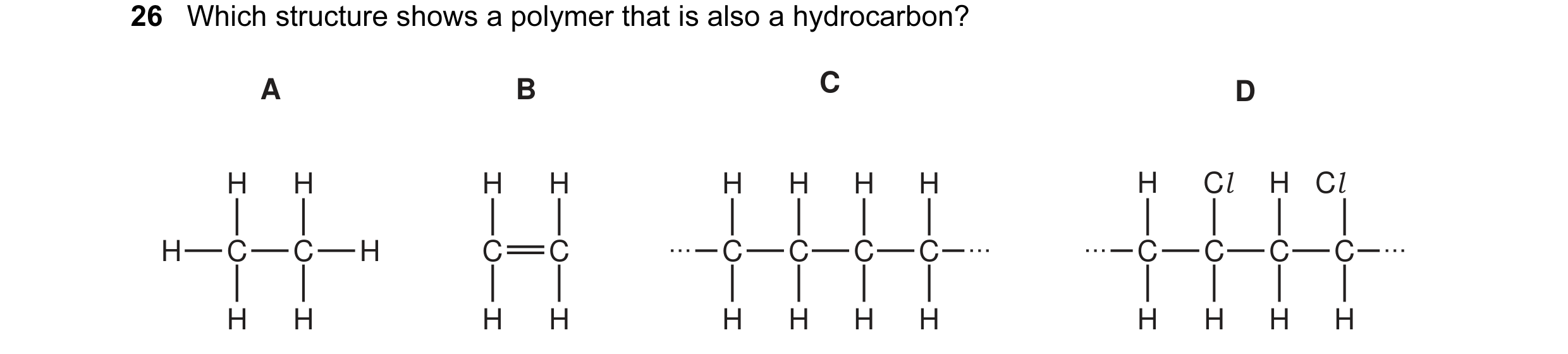
Q1 · Which structure shows a polymer that is also a hydrocarbon? 0653/11 Oct/Nov 2005
26 Which structure shows a polymer that is also a hydrocarbon? H H A H C C H H H H H B C C H H H H H H C ... C C C C ... H H H H H Cl H Cl D ... C C C C ... H H H H
1 marks
Answer: C
This question in 0653/11 Oct/Nov 2005
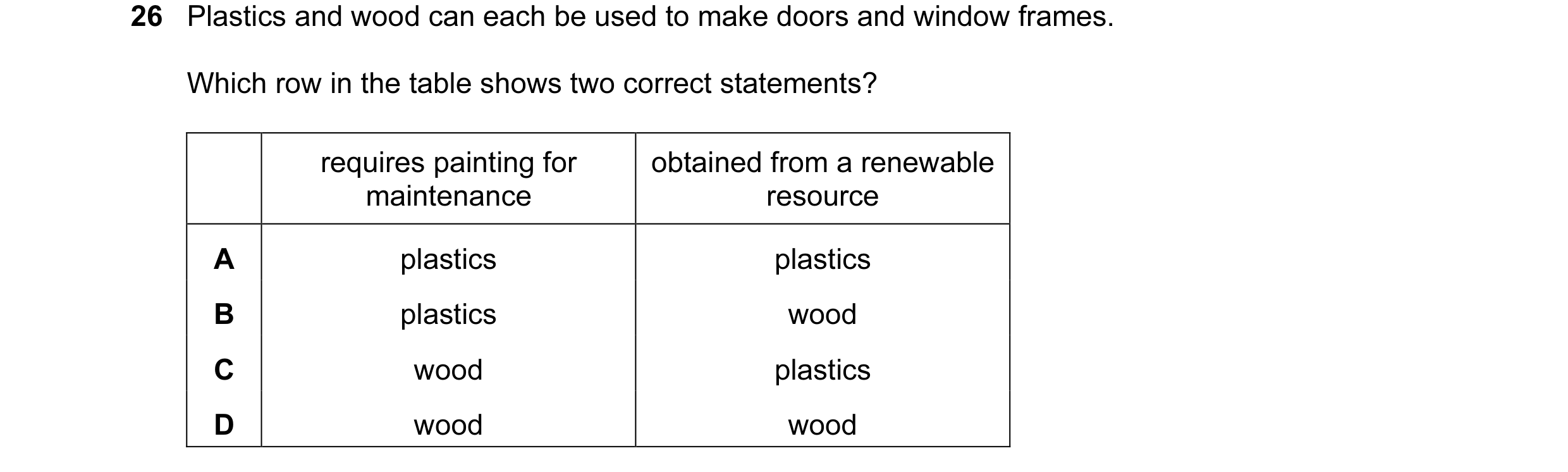
Q2 · Plastics and wood can each be used to make doors and window frames 0653/11 May/June 2006
26 Plastics and wood can each be used to make doors and window frames. Which row in the table shows two correct statements? requires painting for obtained from a renewable maintenance resource A plastics plastics B plastics wood C wood plastics D wood wood
1 marks
Answer: D
This question in 0653/11 May/June 2006
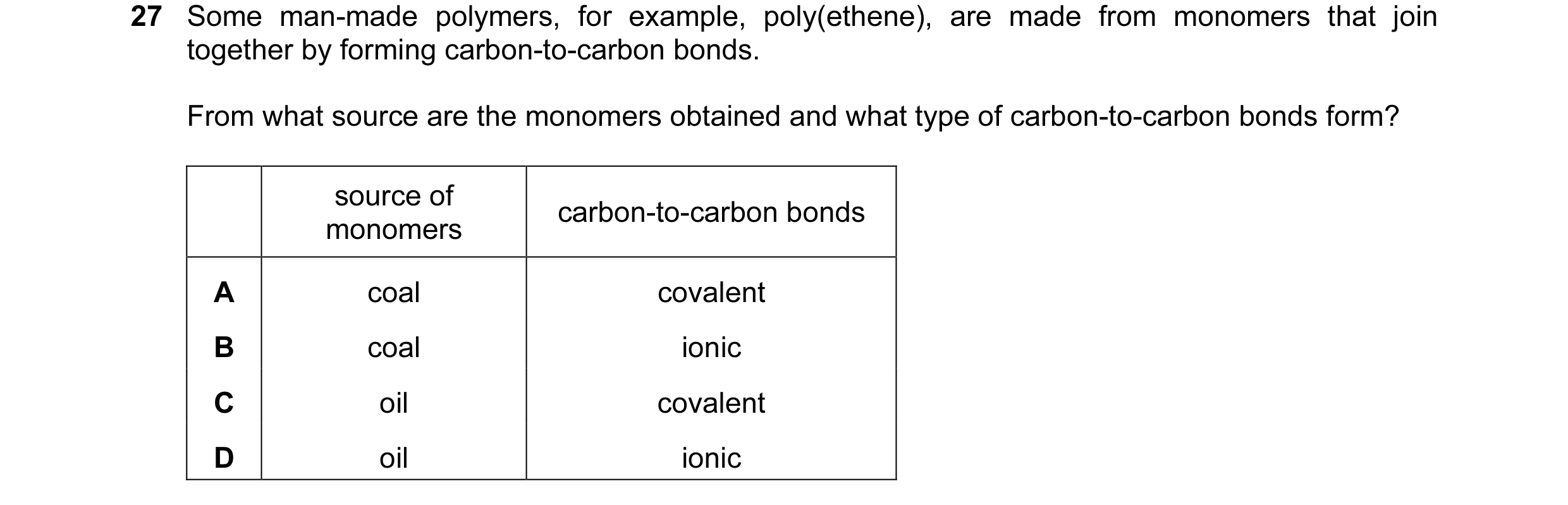
Q3 · Some man-made polymers, for example, poly(ethene), are made from monomers that join… 0653/11 May/June 2006
27 Some man-made polymers, for example, poly(ethene), are made from monomers that join together by forming carbon-to-carbon bonds. From what source are the monomers obtained and what type of carbon-to-carbon bonds form? source of carbon-to-carbon bonds monomers A coal covalent B coal ionic C oil covalent D oil ionic
1 marks
Answer: C
This question in 0653/11 May/June 2006
Q4 · Some man-made plastics are made from small molecules which join together by covalent bonds 0653/11 Oct/Nov 2006
27 Some man-made plastics are made from small molecules which join together by covalent bonds. What is the main source of these small molecules and what is the structure of the plastics? source of small molecules structure H A coal H C H H H H H H B coal … C C C C … H H H H H C oil H C H H H H H H D oil … C C C C … H H H H
1 marks
Answer: D
This question in 0653/11 Oct/Nov 2006
Q5 · The description below of a plastic is incomplete 0653/11 Oct/Nov 2007
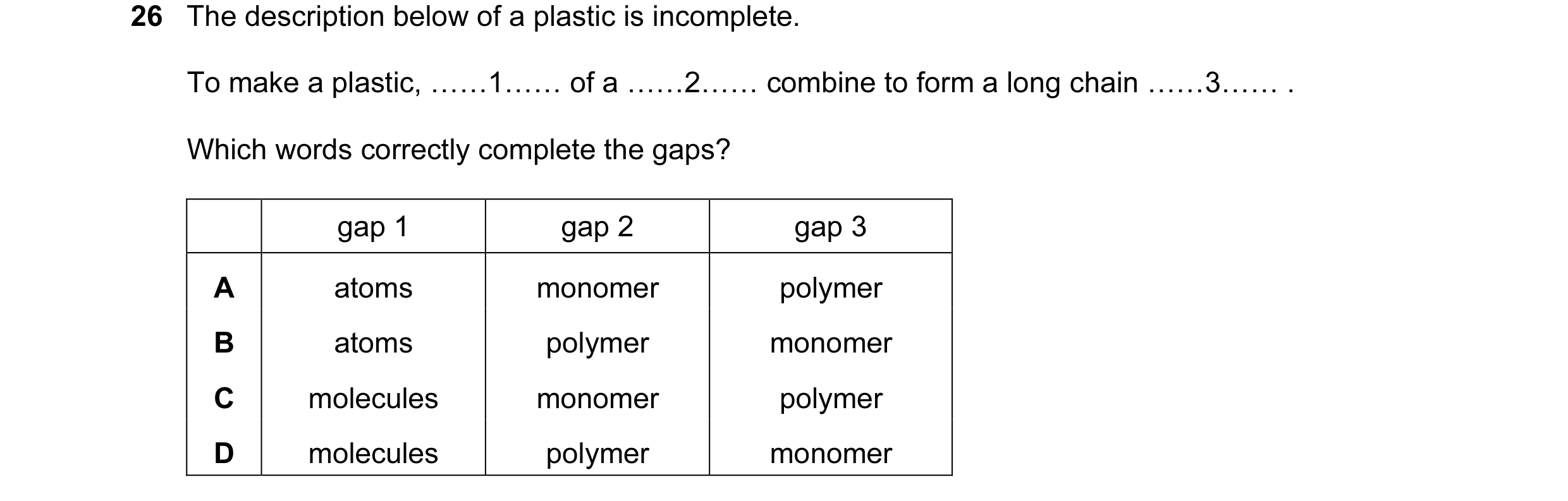
26 The description below of a plastic is incomplete. To make a plastic, ……1…… of a ……2…… combine to form a long chain ……3…… . Which words correctly complete the gaps? gap 1 gap 2 gap 3 A atoms monomer polymer B atoms polymer monomer C molecules monomer polymer D molecules polymer monomer
1 marks
Answer: C
This question in 0653/11 Oct/Nov 2007
Q6 · The sentence about making long chain molecules is incomplete 0653/11 May/June 2008
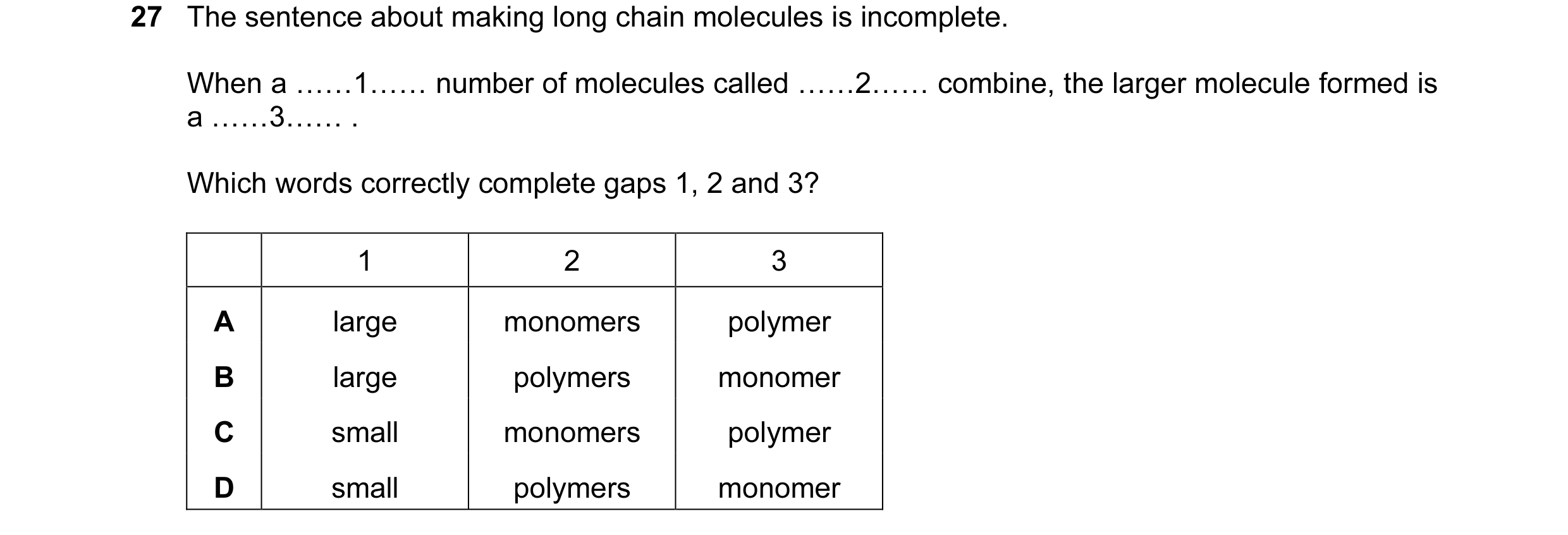
27 The sentence about making long chain molecules is incomplete. When a ……1…… number of molecules called ……2…… combine, the larger molecule formed is a ……3…… . Which words correctly complete gaps 1, 2 and 3? 1 2 3 A large monomers polymer B large polymers monomer C small monomers polymer D small polymers monomer
1 marks
Answer: A
This question in 0653/11 May/June 2008
Q7 · Some plastics have long chain molecules that are made from molecules called X 0653/11 Oct/Nov 2008
27 Some plastics have long chain molecules that are made from molecules called X. The molecules of X are most commonly obtained from Y. What are X and Y? X Y A monomers coal B monomers oil C polymers coal D polymers oil
1 marks
Answer: B
This question in 0653/11 Oct/Nov 2008
Q8 · How can the structure of a plastic be described? 0653/11 May/June 2009
26 How can the structure of a plastic be described? A a mixture of ions B a mixture of long chain molecules C a mixture of atoms of metals D a mixture of small hydrocarbon molecules
1 marks
Answer: B
This question in 0653/11 May/June 2009
Q9 · This description of a plastic is incomplete 0653/11 May/June 2010
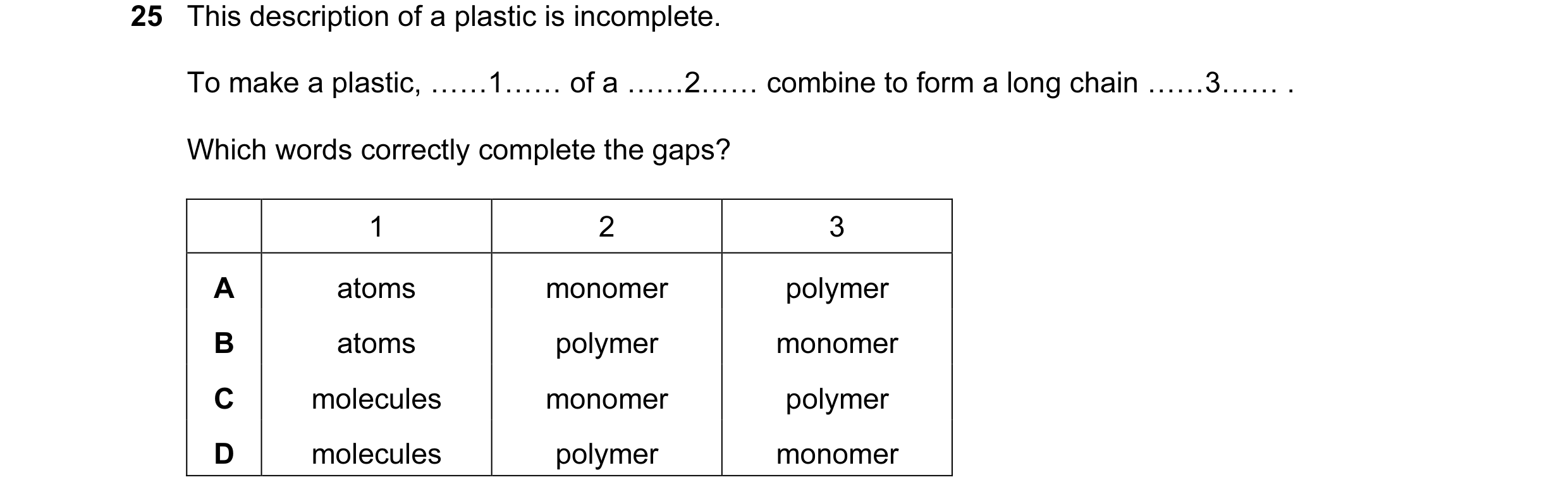
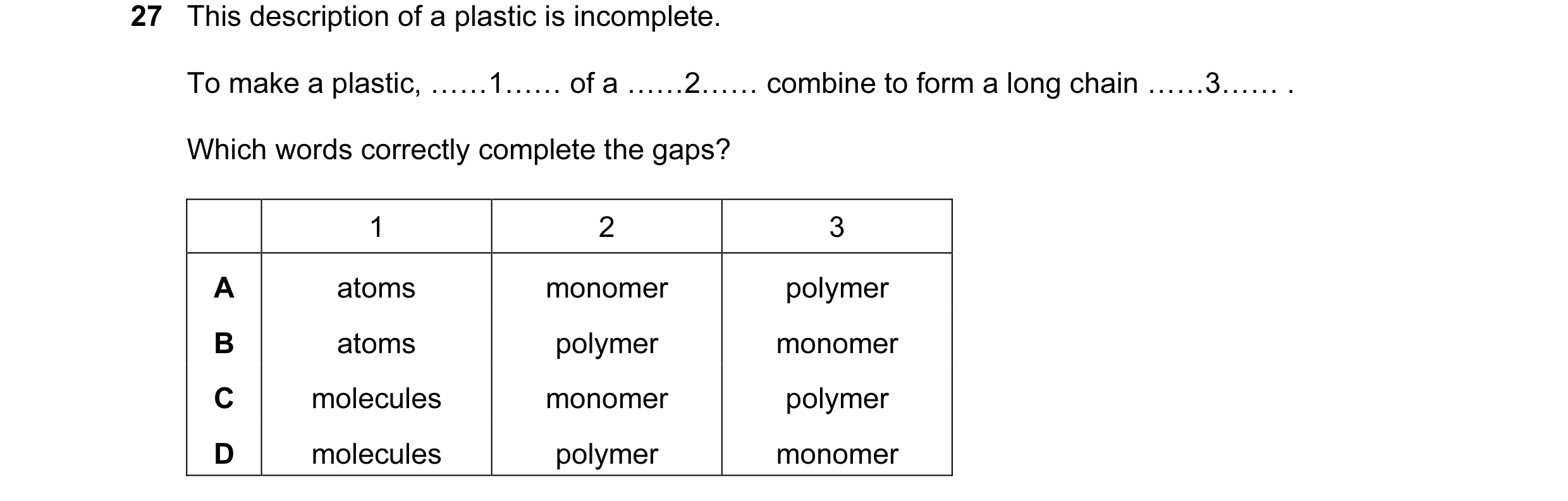
25 This description of a plastic is incomplete. To make a plastic, ……1…… of a ……2…… combine to form a long chain ……3…… . Which words correctly complete the gaps? 1 2 3 A atoms monomer polymer B atoms polymer monomer C molecules monomer polymer D molecules polymer monomer
1 marks
Answer: C
This question in 0653/11 May/June 2010
Q10 · This description of a plastic is incomplete 0653/12 May/June 2010
27 This description of a plastic is incomplete. To make a plastic, ……1…… of a ……2…… combine to form a long chain ……3…… . Which words correctly complete the gaps? 1 2 3 A atoms monomer polymer B atoms polymer monomer C molecules monomer polymer D molecules polymer monomer
1 marks
Answer: C
This question in 0653/12 May/June 2010
Q11 · This description of a plastic is incomplete 0653/13 May/June 2010
27 This description of a plastic is incomplete. To make a plastic, ……1…… of a ……2…… combine to form a long chain ……3…… . Which words correctly complete the gaps? 1 2 3 A atoms monomer polymer B atoms polymer monomer C molecules monomer polymer D molecules polymer monomer
1 marks
Answer: C
This question in 0653/13 May/June 2010
Q12 · Which structure shows a polymer that is also a hydrocarbon? 0653/11 Oct/Nov 2010
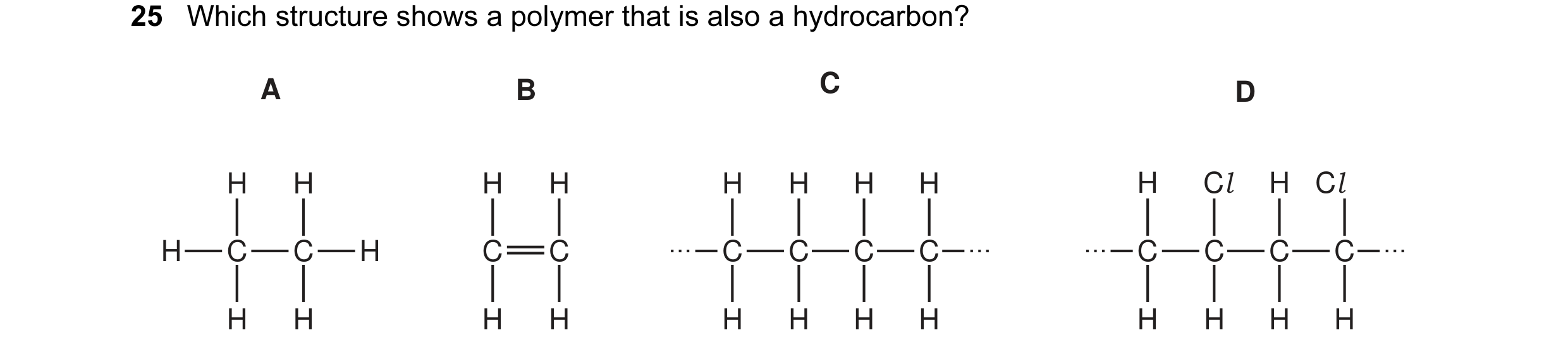
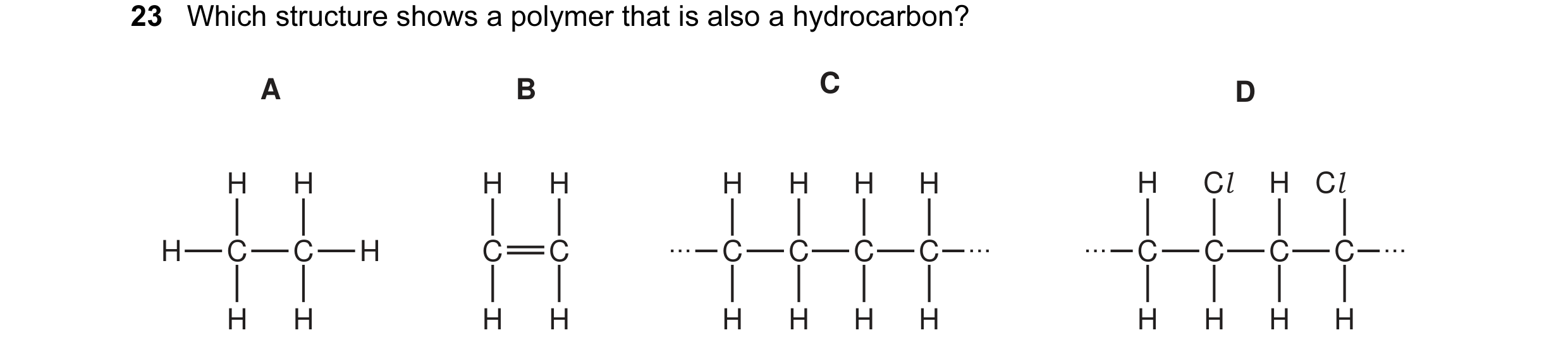
25 Which structure shows a polymer that is also a hydrocarbon? A B C D H H H H H H H H H Cl H Cl H C C H C C C C C C C C C C H H H H H H H H H H H H
1 marks
Answer: C
This question in 0653/11 Oct/Nov 2010
Q13 · Which structure shows a polymer that is also a hydrocarbon? 0653/12 Oct/Nov 2010
23 Which structure shows a polymer that is also a hydrocarbon? A B C D H H H H H H H H H Cl H Cl H C C H C C C C C C C C C C H H H H H H H H H H H H
1 marks
Answer: C
This question in 0653/12 Oct/Nov 2010
Q14 · Which structure shows a polymer that is also a hydrocarbon? 0653/13 Oct/Nov 2010
26 Which structure shows a polymer that is also a hydrocarbon? A B C D H H H H H H H H H Cl H Cl H C C H C C C C C C C C C C H H H H H H H H H H H H
1 marks
Answer: C
This question in 0653/13 Oct/Nov 2010
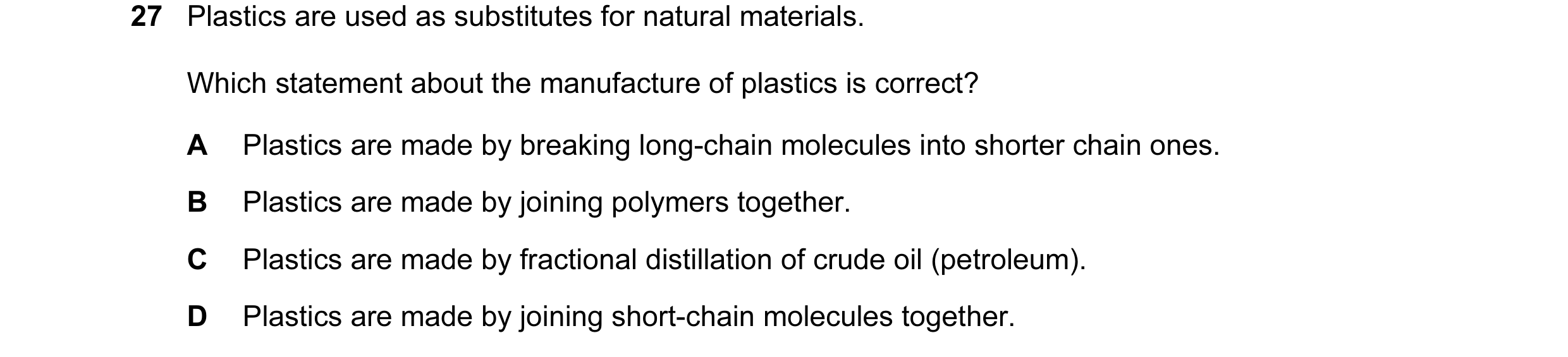
Q15 · Plastics are used as substitutes for natural materials 0653/11 May/June 2011
27 Plastics are used as substitutes for natural materials. Which statement about the manufacture of plastics is correct? A Plastics are made by breaking long-chain molecules into shorter chain ones. B Plastics are made by joining polymers together. C Plastics are made by fractional distillation of crude oil (petroleum). D Plastics are made by joining short-chain molecules together.
1 marks
Answer: D
This question in 0653/11 May/June 2011
Q16 · Plastics are used as substitutes for natural materials 0653/12 May/June 2011
26 Plastics are used as substitutes for natural materials. Which statement about the manufacture of plastics is correct? A Plastics are made by breaking long-chain molecules into shorter chain ones. B Plastics are made by joining polymers together. C Plastics are made by fractional distillation of crude oil (petroleum). D Plastics are made by joining short-chain molecules together.
1 marks
Answer: D
This question in 0653/12 May/June 2011
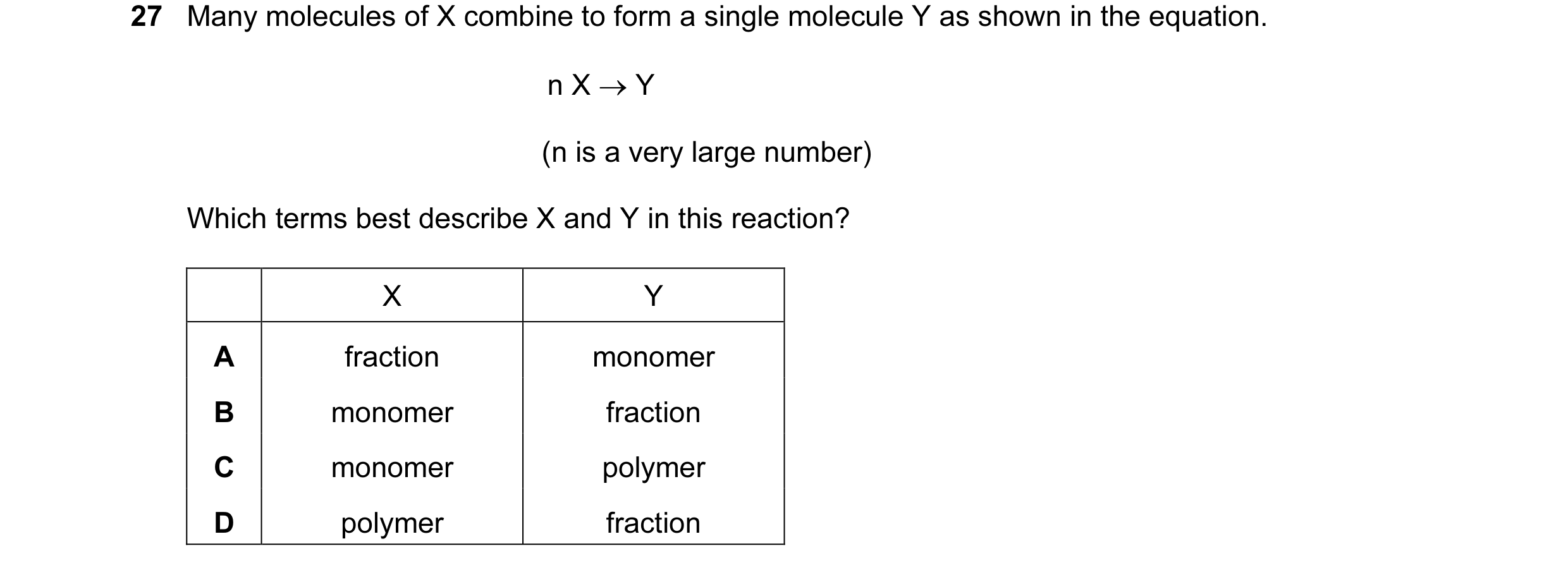
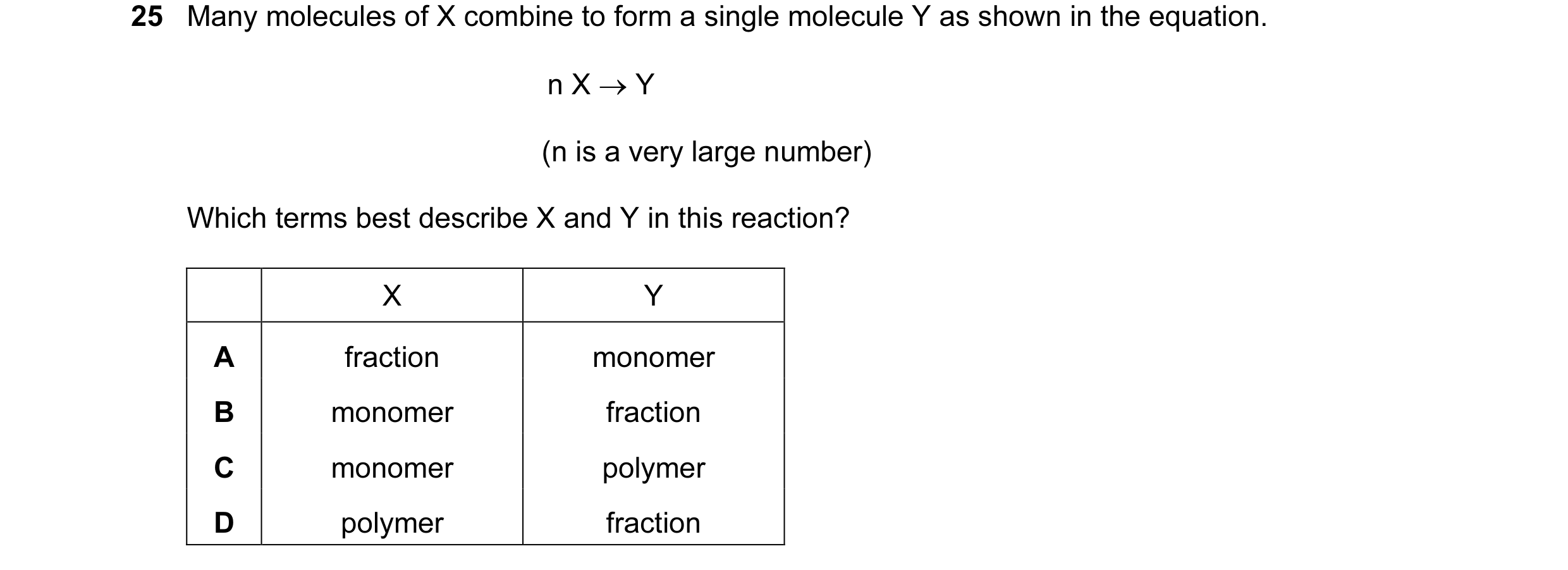
Q17 · Many molecules of X combine to form a single molecule Y as shown in the equation 0653/11 Oct/Nov 2011
27 Many molecules of X combine to form a single molecule Y as shown in the equation. n X → Y (n is a very large number) Which terms best describe X and Y in this reaction? X Y A fraction monomer B monomer fraction C monomer polymer D polymer fraction
1 marks
Answer: C
This question in 0653/11 Oct/Nov 2011
Q18 · Many molecules of X combine to form a single molecule Y as shown in the equation 0653/12 Oct/Nov 2011
25 Many molecules of X combine to form a single molecule Y as shown in the equation. n X → Y (n is a very large number) Which terms best describe X and Y in this reaction? X Y A fraction monomer B monomer fraction C monomer polymer D polymer fraction
1 marks
Answer: C
This question in 0653/12 Oct/Nov 2011
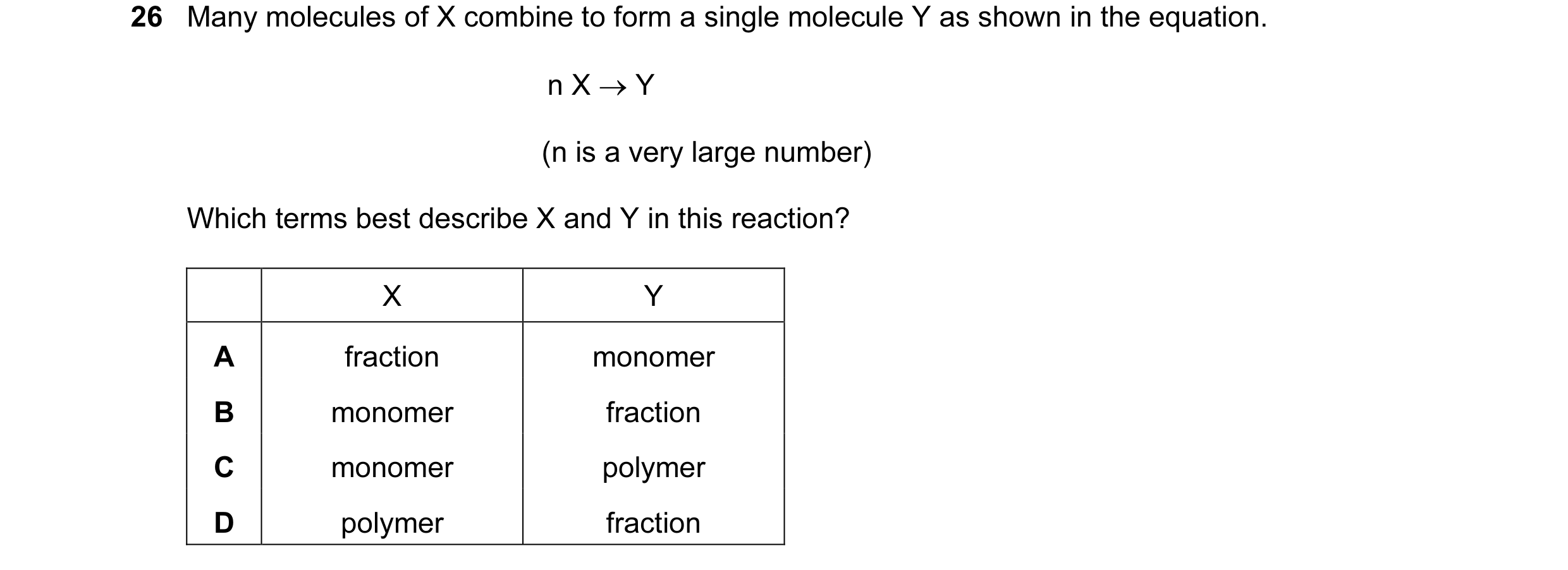
Q19 · Many molecules of X combine to form a single molecule Y as shown in the equation 0653/13 Oct/Nov 2011
26 Many molecules of X combine to form a single molecule Y as shown in the equation. n X → Y (n is a very large number) Which terms best describe X and Y in this reaction? X Y A fraction monomer B monomer fraction C monomer polymer D polymer fraction
1 marks
Answer: C
This question in 0653/13 Oct/Nov 2011
Q20 · P, Q, R and S are four hydrocarbons 0653/12 Feb/March 2019
27 P, Q, R and S are four hydrocarbons. P is unsaturated. Q contains only single covalent bonds. R undergoes addition polymerisation. S decolourises bromine water. Which row identifies these hydrocarbons? P Q R S A alkane alkene alkane alkane B alkene alkane alkane alkene C alkene alkane alkene alkane D alkene alkane alkene alkene
1 marks
Answer: D
This question in 0653/12 Feb/March 2019
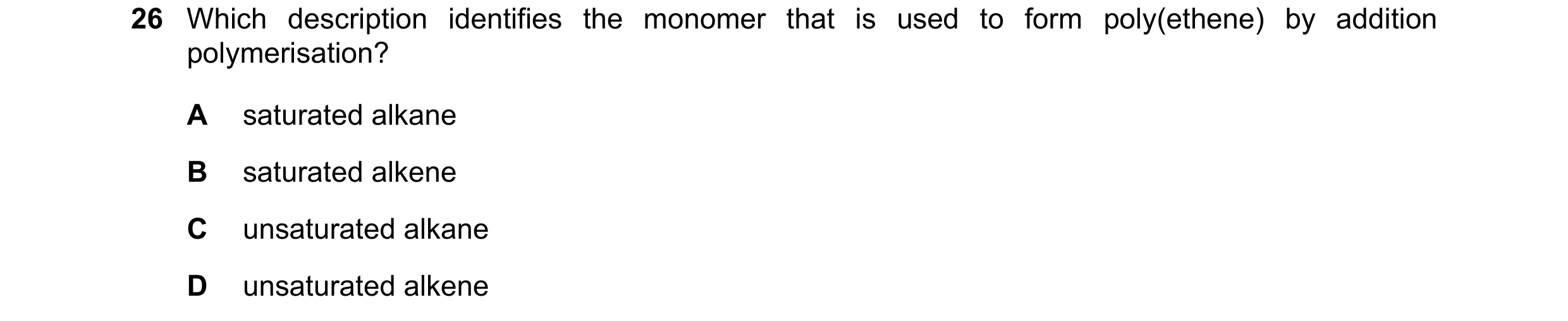
Q21 · Which description identifies the monomer that is used to form poly(ethene) by addition… 0653/12 Feb/March 2022
26 Which description identifies the monomer that is used to form poly(ethene) by addition polymerisation? A saturated alkane B saturated alkene C unsaturated alkane D unsaturated alkene
1 marks
Answer: D
This question in 0653/12 Feb/March 2022
Q22 · Which process is used to make poly(ethene)? 0653/11 Oct/Nov 2023
27 Which process is used to make poly(ethene)? A addition polymerisation B cracking C fractional distillation D reacting ethane molecules together
1 marks
Answer: A
This question in 0653/11 Oct/Nov 2023
 1 / 6
1 / 6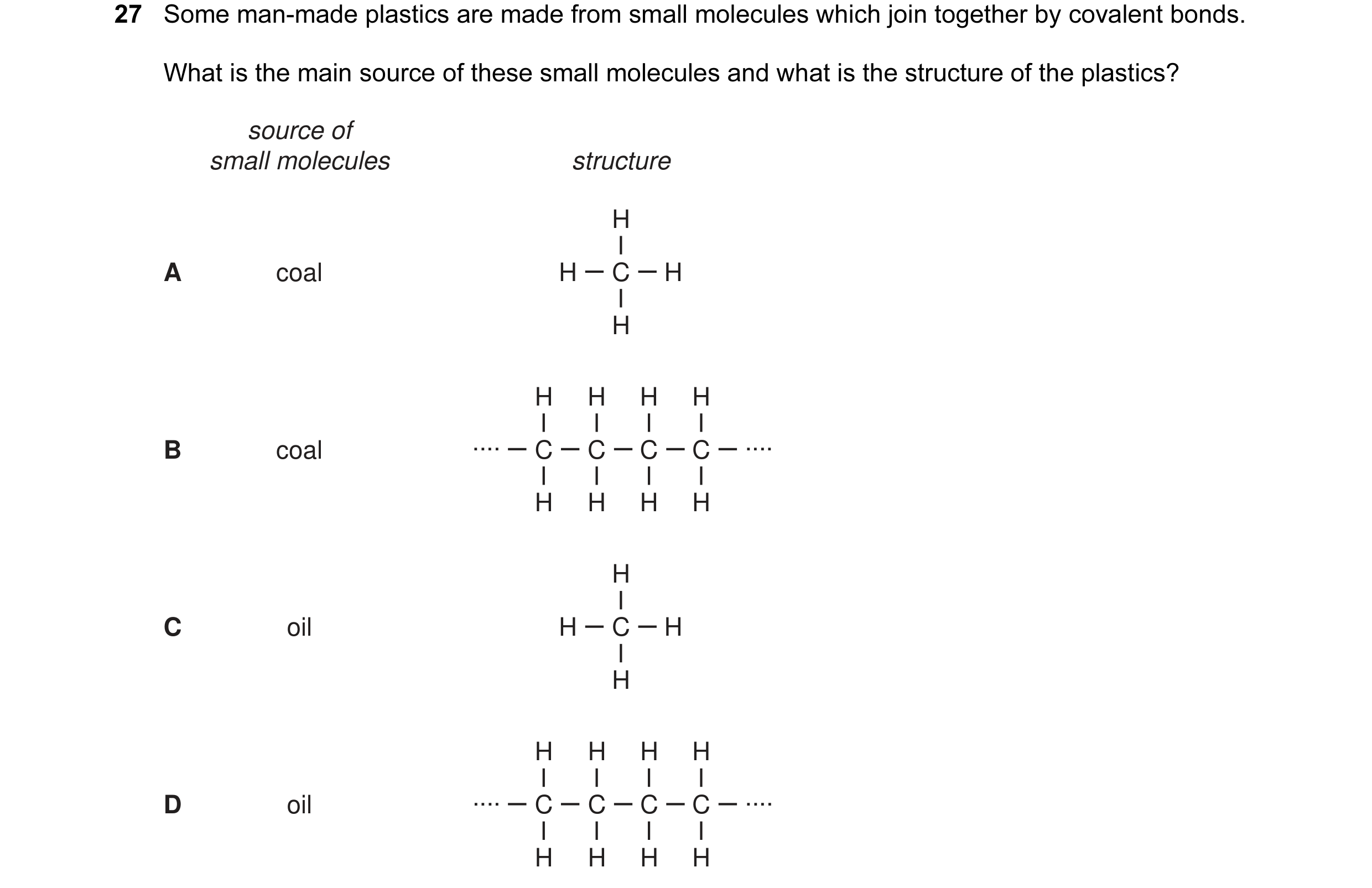
 2 / 6
2 / 6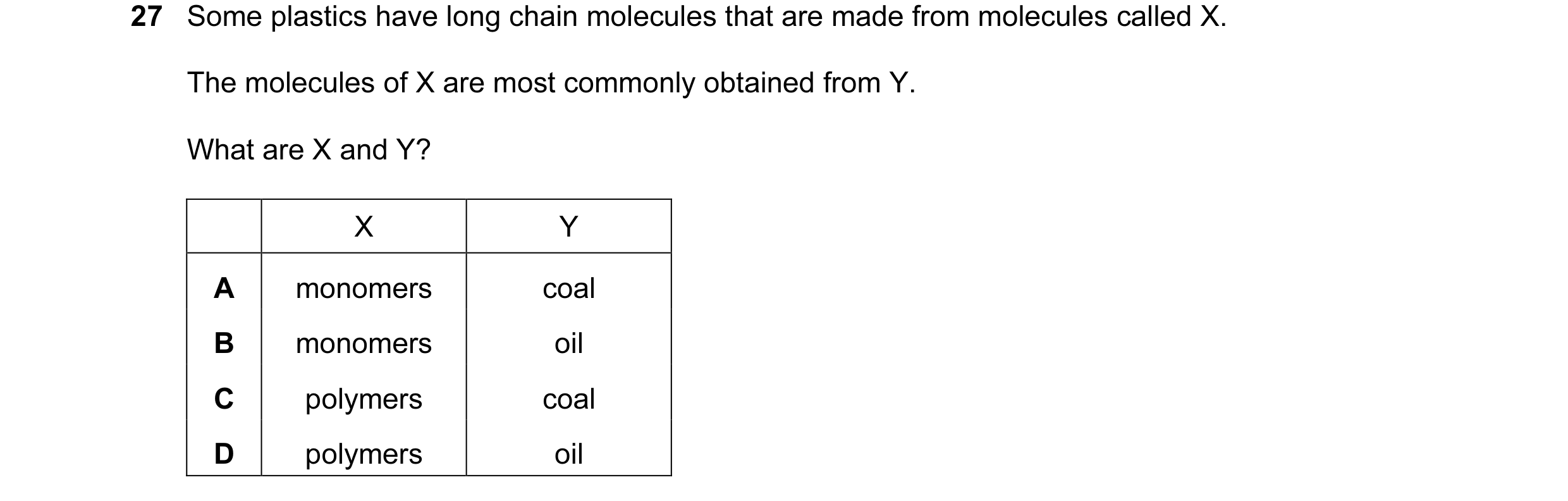

 3 / 6
3 / 6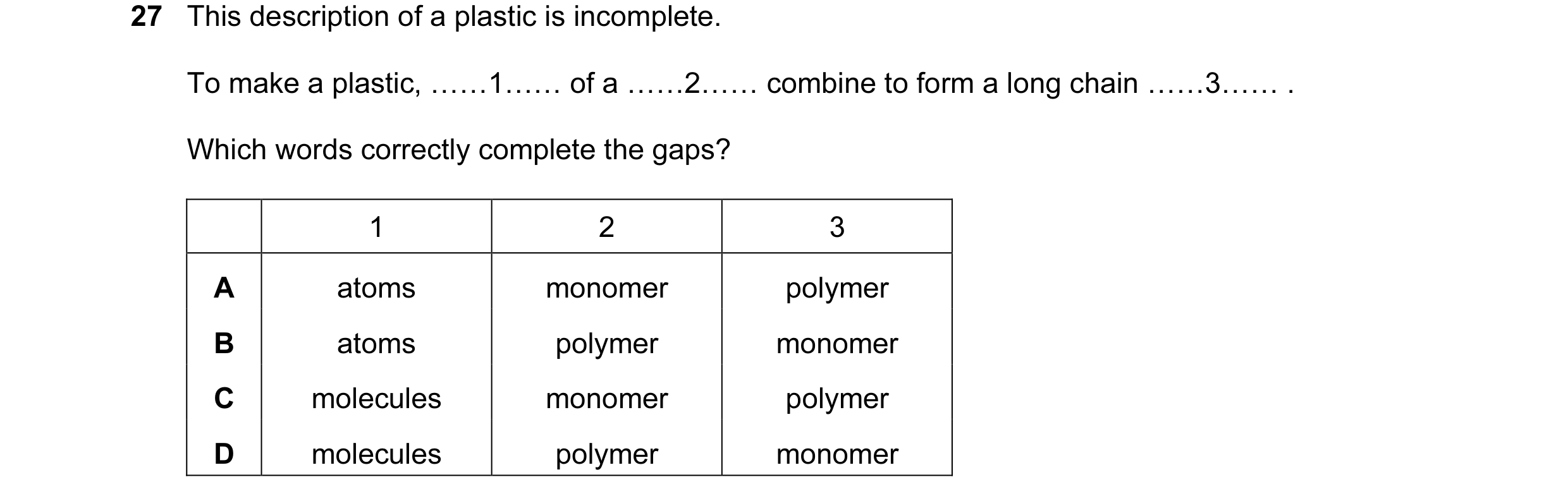
 4 / 6
4 / 6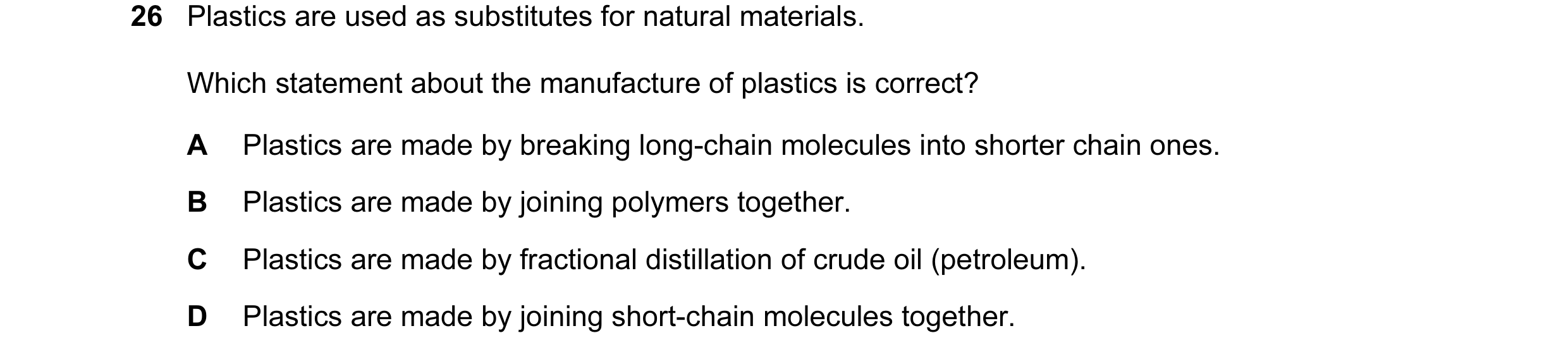
 5 / 6
5 / 6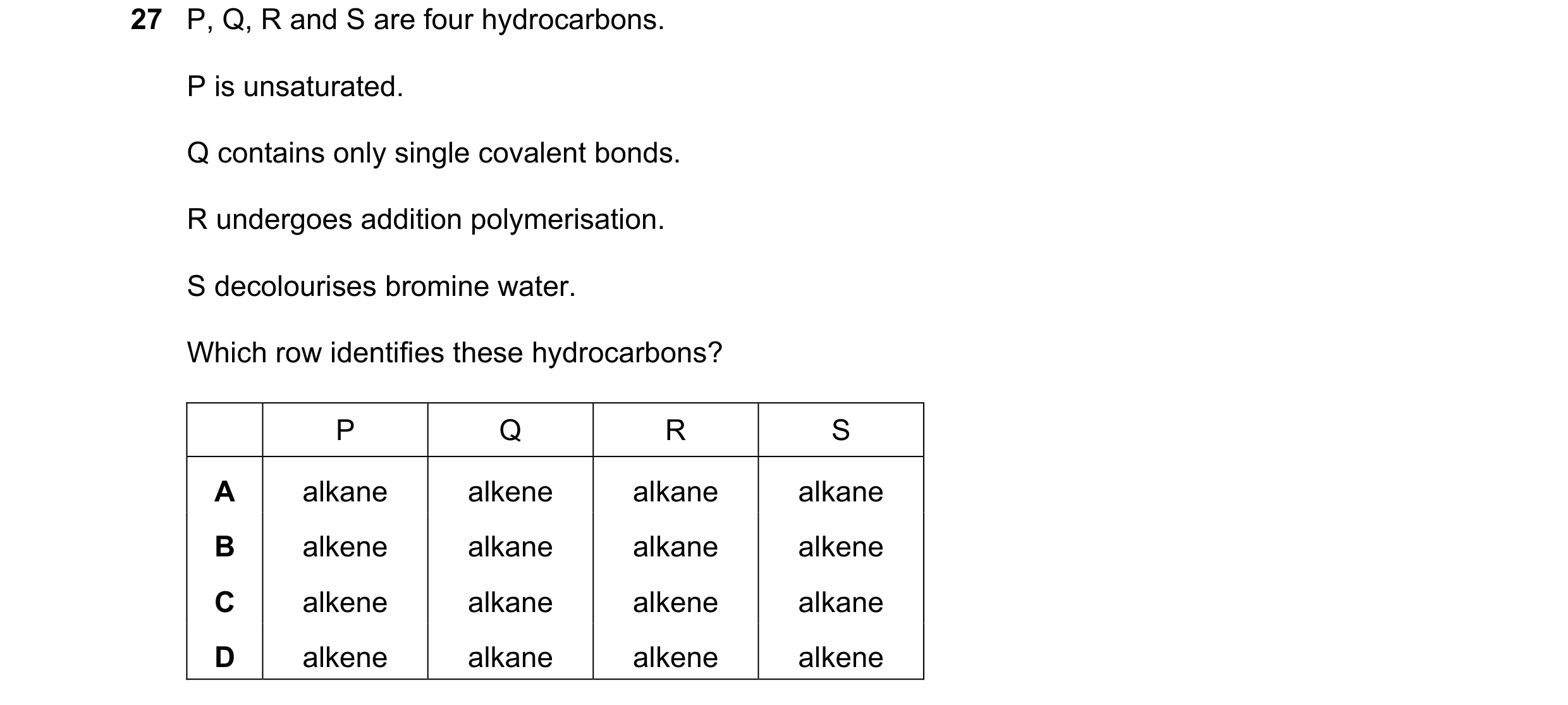
 6 / 6
6 / 6