Questions as text
Q1 · A diagram of part of the carbon cycle 0653/42 Feb/March 2017
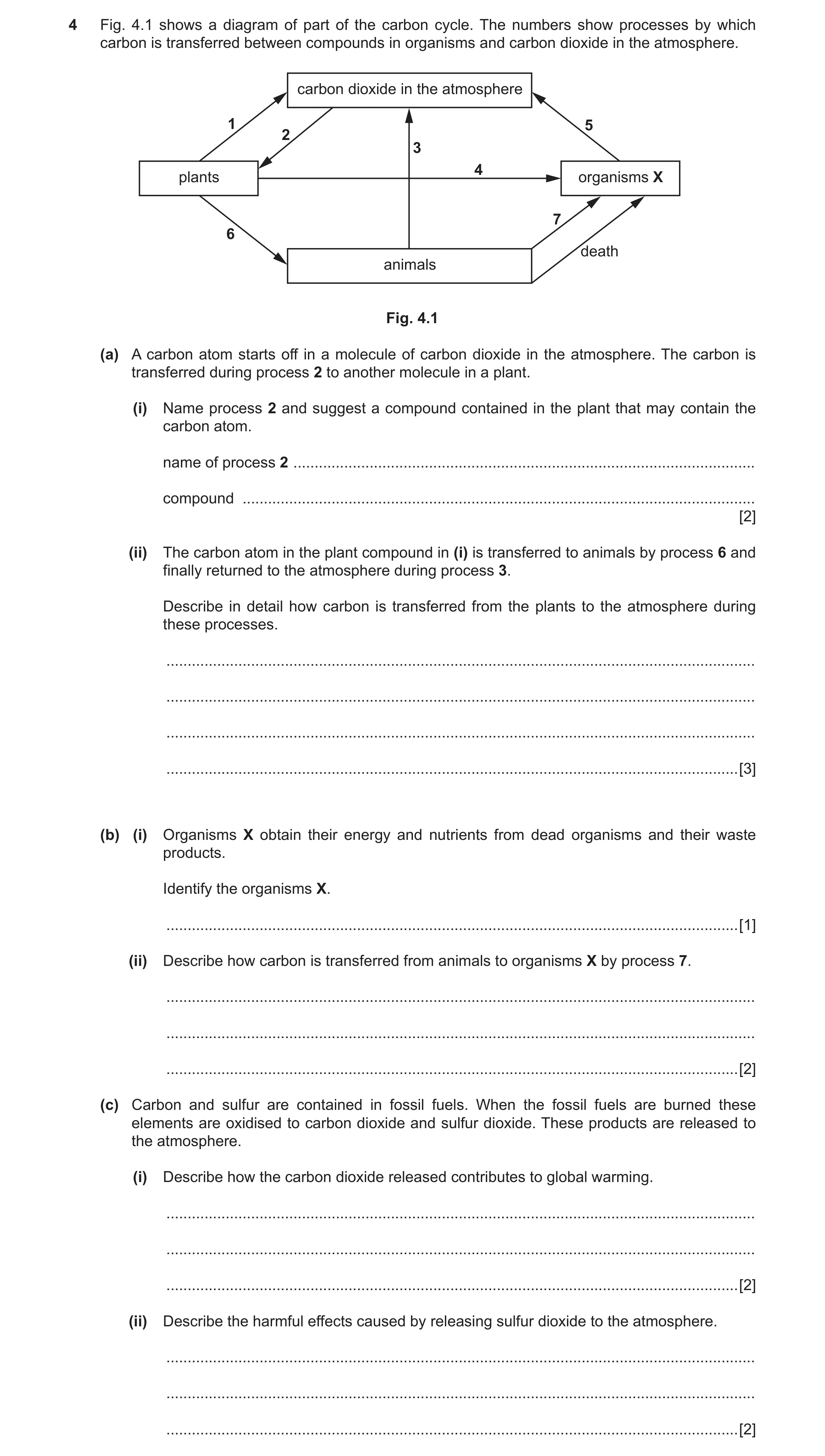
4 Fig. 4.1 shows a diagram of part of the carbon cycle. The numbers show processes by which carbon is transferred between compounds in organisms and carbon dioxide in the atmosphere. carbon dioxide in the atmosphere 1 5 2 3 4 plants organisms X 7 6 death animals Fig. 4.1 (a) A carbon atom starts off in a molecule of carbon dioxide in the atmosphere. The carbon is transferred during process 2 to another molecule in a plant. (i) Name process 2 and suggest a compound contained in the plant that may contain the carbon atom. name of process 2 … compound … [2] (ii) The carbon atom in the plant compound in (i) is transferred to animals by process 6 and finally returned to the atmosphere during process 3. Describe in detail how carbon is transferred from the plants to the atmosphere during these processes. … … … … [3] (b) (i) Organisms X obtain their energy and nutrients from dead organisms and their waste products. Identify the organisms X. … [1] (ii) Describe how carbon is transferred from animals to organisms X by process 7. … … … [2] (c) Carbon and sulfur are contained in fossil fuels. When the fossil fuels are burned these elements are oxidised to carbon dioxide and sulfur dioxide. These products are released to the atmosphere. (i) Describe how the carbon dioxide released contributes to global warming. … … … [2] (ii) Describe the harmful effects caused by releasing sulfur dioxide to the atmosphere. … … … [2]
12 marks
Mark scheme: 4(a)(i) photosynthesis ; glucose / starch / sugar ; 2 4(a)(ii) reference to plants eaten by animals (process 6) ; reference to respiration (process 3) ; carbon dioxide produced ; 3 4(b)(i) decomposers ; 1 4(b)(ii) excretion / egestion ; of urine / faeces ; 2 4(c)(i) carbon dioxide is a greenhouse gas ; radiation / heat from earth prevented from escaping / trapped in atmosphere ; the idea that increased carbon dioxide levels increase the ability of the atmosphere to trap heat / act as a greenhouse ; max 2 4(c)(ii) (sulfur dioxide) may cause acid rain ; any valid consequence of acid rain; sulfur dioxide may cause respiratory problems in humans ; max 2
This question in 0653/42 Feb/March 2017
Q2 · Some bacterial cells as seen using an electron microscope 0653/41 Oct/Nov 2017
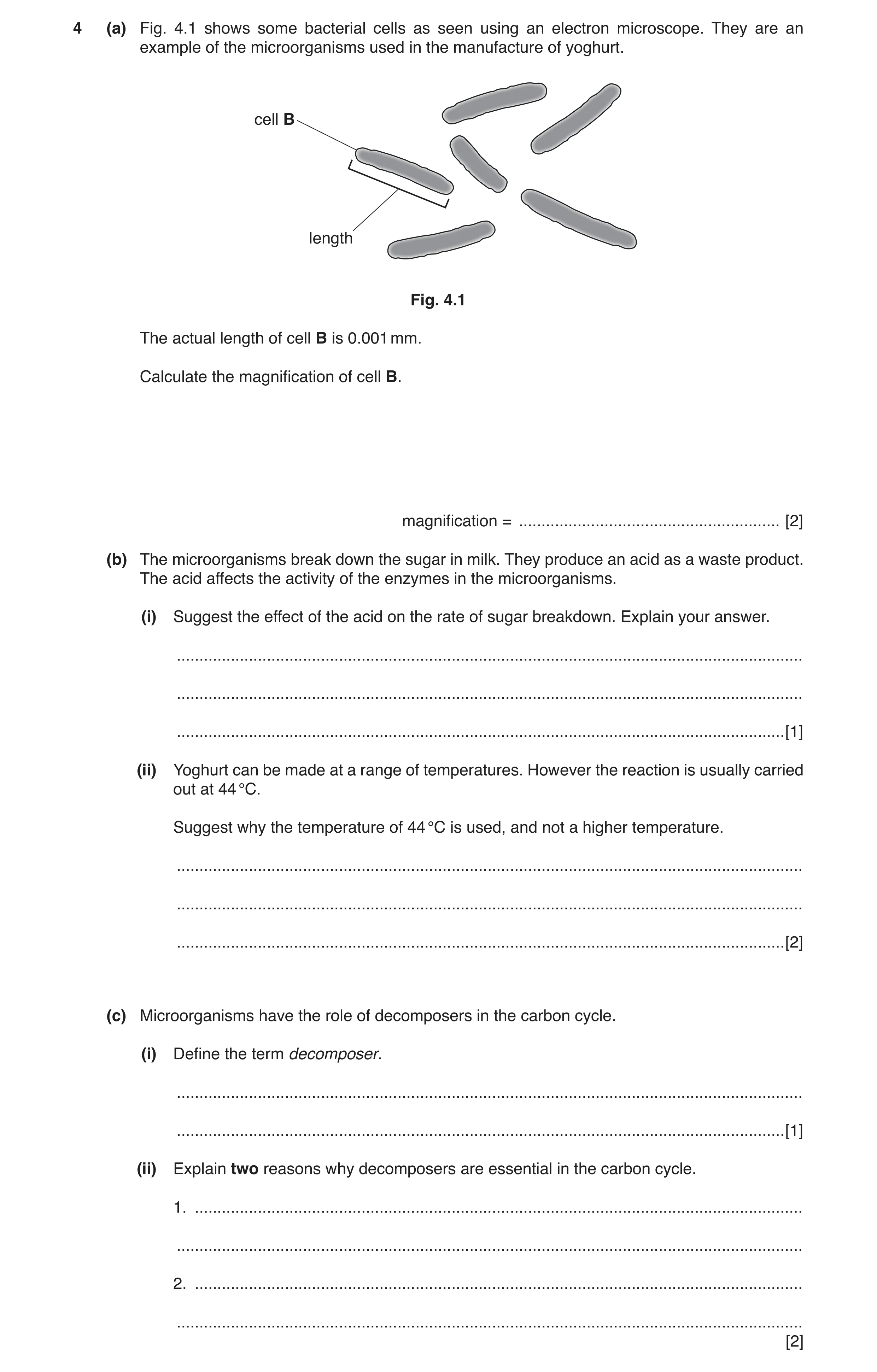
4 (a) Fig. 4.1 shows some bacterial cells as seen using an electron microscope. They are an example of the microorganisms used in the manufacture of yoghurt. cell B length Fig. 4.1 The actual length of cell B is 0.001 mm. Calculate the magnification of cell B. magnification = … [2] (b) The microorganisms break down the sugar in milk. They produce an acid as a waste product. The acid affects the activity of the enzymes in the microorganisms. (i) Suggest the effect of the acid on the rate of sugar breakdown. Explain your answer. … … … [1] (ii) Yoghurt can be made at a range of temperatures. However the reaction is usually carried out at 44 °C. Suggest why the temperature of 44 °C is used, and not a higher temperature. … … … [2] (c) Microorganisms have the role of decomposers in the carbon cycle. (i) Define the term decomposer. … … [1] (ii) Explain two reasons why decomposers are essential in the carbon cycle. 1. … … 2. … … [2]
8 marks
Mark scheme: 4(a) length of cell on diagram is 25 mm ; divided by 0.001 = 25 000 ; 2 4(b)(i) reduces rate – no mark enzymes made inactive / denatured by acid / no longer at optimum pH ; 1 4(b)(ii) 44°C is optimum temperature ; above 44°C enzymes denatured by heat ; additional detail describing denaturation ; max 2 4(c)(i) (an organism) that gets energy from / feeds on dead / waste organic matter ; 1 4(c)(ii) they decompose / break down / get rid of dead bodies / waste ; allow carbon to be recycled / release carbon dioxide (into the air) ; the idea that plants make use of carbon dioxide / carbon (during photosynthesis) ; max 2
This question in 0653/41 Oct/Nov 2017
Q3 · A sealed glass jar containing soil and plants 0653/41 Oct/Nov 2017
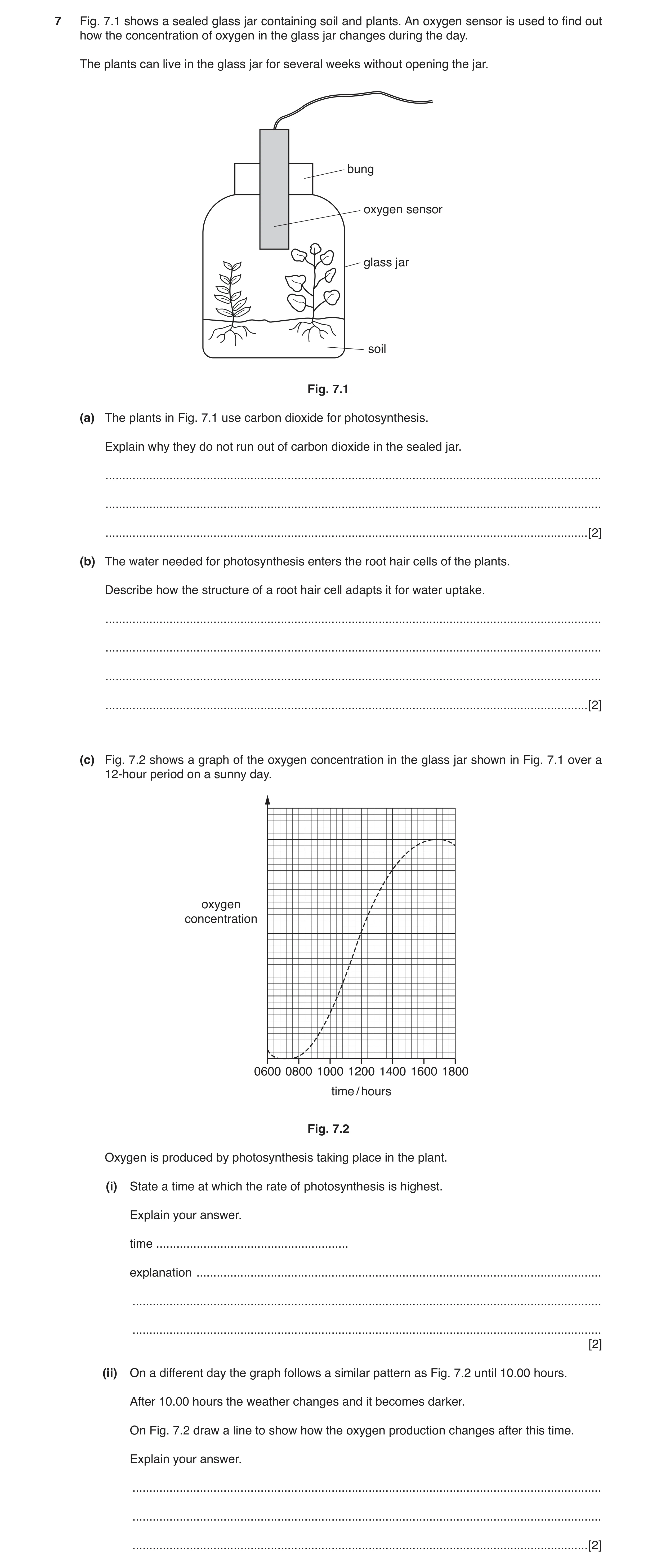
7 Fig. 7.1 shows a sealed glass jar containing soil and plants. An oxygen sensor is used to find out how the concentration of oxygen in the glass jar changes during the day. The plants can live in the glass jar for several weeks without opening the jar. bung oxygen sensor glass jar soil Fig. 7.1 (a) The plants in Fig. 7.1 use carbon dioxide for photosynthesis. Explain why they do not run out of carbon dioxide in the sealed jar. … … … [2] (b) The water needed for photosynthesis enters the root hair cells of the plants. Describe how the structure of a root hair cell adapts it for water uptake. … … … … [2] (c) Fig. 7.2 shows a graph of the oxygen concentration in the glass jar shown in Fig. 7.1 over a 12-hour period on a sunny day. oxygen concentration 0600 0800 1000 1200 1400 1600 1800 time / hours Fig. 7.2 Oxygen is produced by photosynthesis taking place in the plant. (i) State a time at which the rate of photosynthesis is highest. Explain your answer. time … explanation … … … [2] (ii) On a different day the graph follows a similar pattern as Fig. 7.2 until 10.00 hours. After 10.00 hours the weather changes and it becomes darker. On Fig. 7.2 draw a line to show how the oxygen production changes after this time. Explain your answer. … … … [2]
8 marks
Mark scheme: 7(a) plants during 7(b) large increa by dif 7(c)(i) any ti maxim 7(c)(ii) line d (rate s produce carbo g respiration ; surface area / e ases rate / efficie ffusion ; me between 10 mum rate of oxy rawn with reduc of) photosynthes on dioxide ; longated shape ency of uptake ; .00 and 13.00 ; gen production / ced gradient afte sis (oxygen prod ; / steepest gradie er 10.00 ; duction) depend ent ; dent on (amount of) light ; max 2 x 2 2 2
This question in 0653/41 Oct/Nov 2017
Q4 · Some processes occurring in a forest 0653/43 Oct/Nov 2017
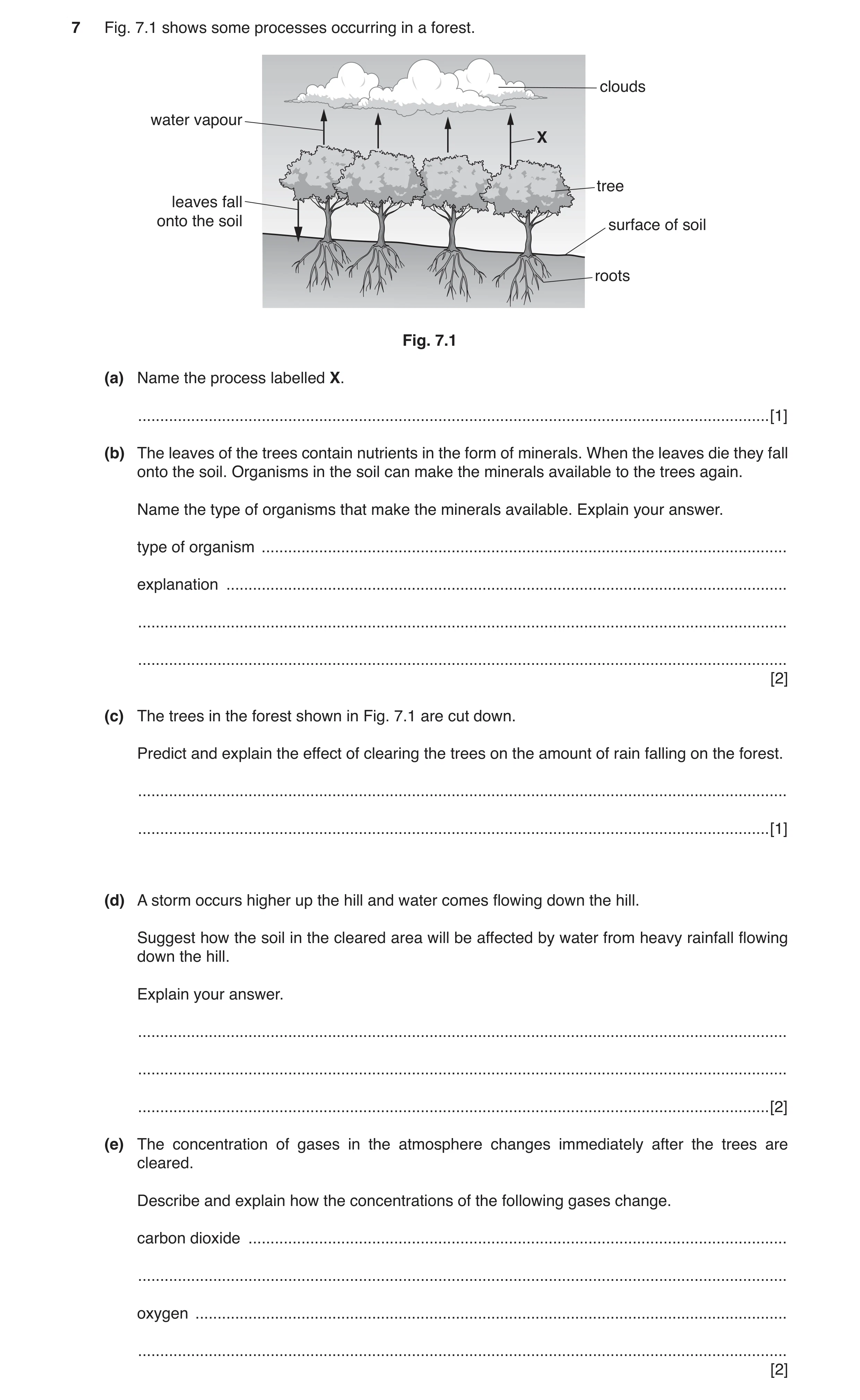
7 Fig. 7.1 shows some processes occurring in a forest. clouds water vapour X tree leaves fall onto the soil surface of soil roots Fig. 7.1 (a) Name the process labelled X. … [1] (b) The leaves of the trees contain nutrients in the form of minerals. When the leaves die they fall onto the soil. Organisms in the soil can make the minerals available to the trees again. Name the type of organisms that make the minerals available. Explain your answer. type of organism … explanation … … … [2] (c) The trees in the forest shown in Fig. 7.1 are cut down. Predict and explain the effect of clearing the trees on the amount of rain falling on the forest. … … [1] (d) A storm occurs higher up the hill and water comes flowing down the hill. Suggest how the soil in the cleared area will be affected by water from heavy rainfall flowing down the hill. Explain your answer. … … … [2] (e) The concentration of gases in the atmosphere changes immediately after the trees are cleared. Describe and explain how the concentrations of the following gases change. carbon dioxide … … oxygen … … [2]
8 marks
Mark scheme: 7(a) transpiration ; 1 7(b) decomposers ; break down dead organisms (or their leaves) ; 2 7(c) rainfall reduced because less water is being transpired / evaporated from trees ; 1 7(d) soil will be eroded ; no trees / tree roots to stabilise the soil ; 2 7(e) carbon dioxide increases (no mark) less taken in during photosynthesis ; oxygen decreases (no mark) less given out by photosynthesis ; 2
This question in 0653/43 Oct/Nov 2017
Q5 · A simplified version of the carbon cycle 0653/42 May/June 2018
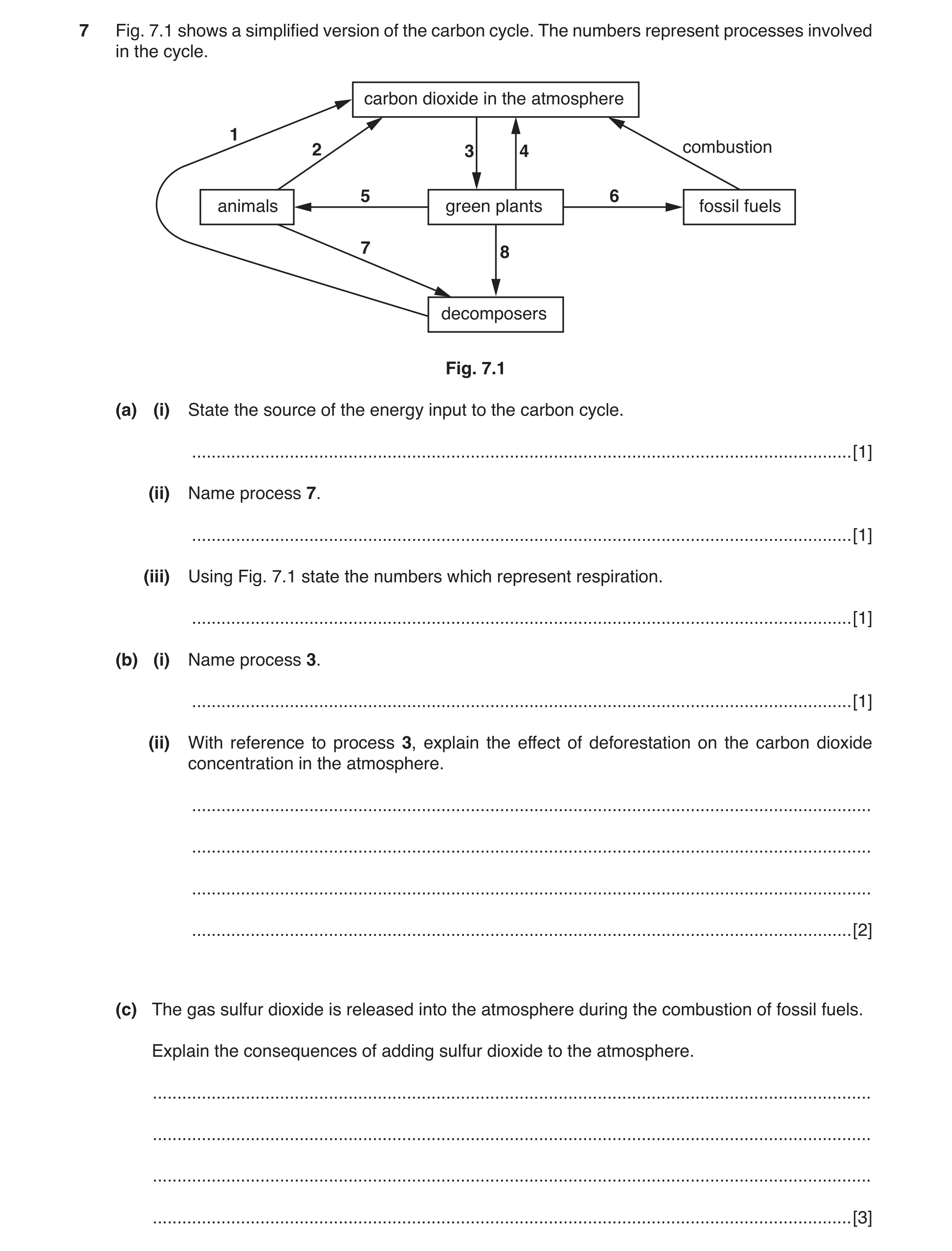
7 Fig. 7.1 shows a simplified version of the carbon cycle. The numbers represent processes involved in the cycle. carbon dioxide in the atmosphere 1 2 3 4 combustion 5 6 animals green plants fossil fuels 7 8 decomposers Fig. 7.1 (a) (i) State the source of the energy input to the carbon cycle. … [1] (ii) Name process 7. … [1] (iii) Using Fig. 7.1 state the numbers which represent respiration. … [1] (b) (i) Name process 3. … [1] (ii) With reference to process 3, explain the effect of deforestation on the carbon dioxide concentration in the atmosphere. … … … … [2] (c) The gas sulfur dioxide is released into the atmosphere during the combustion of fossil fuels. Explain the consequences of adding sulfur dioxide to the atmosphere. … … … … [3]
9 marks
Mark scheme: 7(a)(i) the Sun ; 1 7(a)(ii) death / egestion / excretion ; 1 7(a)(iii) 1, 2, 4 1 7(b)(i) photosynthesis ; 1 7(b)(ii) (concentration increases) less CO2 removed ; because photosynthesis reduced ; (CO2 continues to be) added to atmosphere by respiration / combustion ; max 2 7(c) dissolves in rainwater / owtte ; forms acid rain ; consequence of pollution by acid rain ; (e.g. harm to plants / animals / water courses damage to building materials) 3
This question in 0653/42 May/June 2018
Q6 · A simplified diagram of the carbon cycle 0653/42 May/June 2019
4 (a) Fig. 4.1 shows a simplified diagram of the carbon cycle. carbon dioxide in the atmosphere X photosynthesis respiration respiration fossilisation feeding fossil fuels green plants animals respiration Y Y decomposers Fig. 4.1 (i) Name process X. … [1] (ii) Name process Y. … [1] (iii) Explain the effect of clearing forests on the concentration of carbon dioxide in the atmosphere. … … … [2] (b) Nitrate ions can be added to water in a lake accidentally. The effects of this can lead to the death of organisms living in the water. Use the words in the list to complete the sentences which explain how this happens. Each word can be used once, more than once, or not at all. addition death decomposers decreased feeding growth increased respiration • There is an increased availability of nitrate ions. • This results in an increased … of producers on the surface of the lake. • This leads to … decomposition after the … of producers. • Increased aerobic respiration by … occurs which results in a reduction of dissolved oxygen. • This causes the death of organisms in the water. [4] [Total: 8]
8 marks
Mark scheme: 4(a)(i) combustion / burning ; 1 4(a)(ii) death / excretion / egestion ; 1 4(a)(iii) (increases) less photosynthesis / fewer trees to photosynthesise ; so CO2 not taken in / fewer trees to take in carbon dioxide ; 2 4(b) growth ; increased ; death ; decomposers ; 4
This question in 0653/42 May/June 2019
Q7 · A diagram of the carbon cycle 0653/43 Oct/Nov 2019
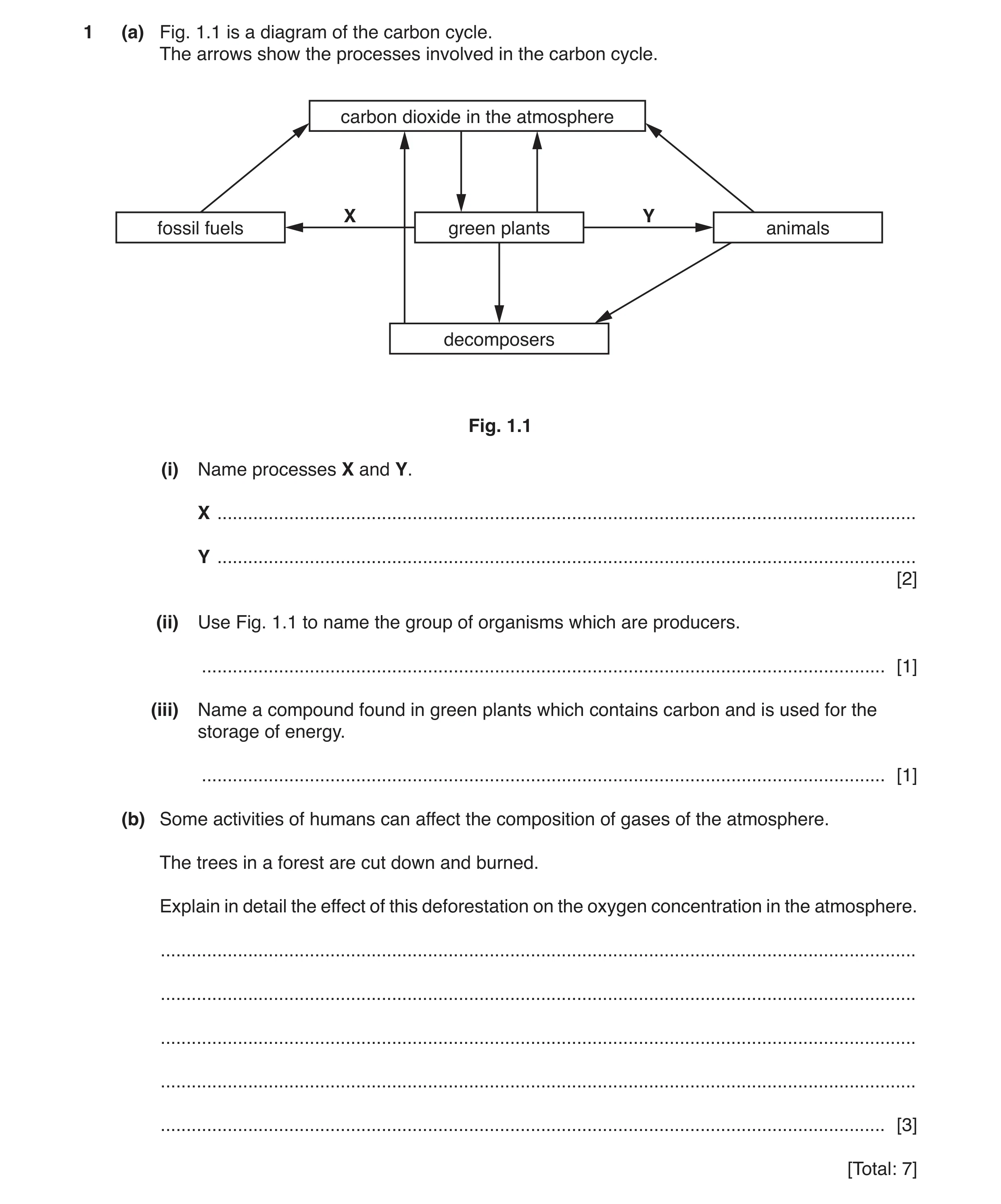
1 (a) Fig. 1.1 is a diagram of the carbon cycle. The arrows show the processes involved in the carbon cycle. carbon dioxide in the atmosphere X Y fossil fuels green plants animals decomposers Fig. 1.1 (i) Name processes X and Y. X … Y … [2] (ii) Use Fig. 1.1 to name the group of organisms which are producers. … [1] (iii) Name a compound found in green plants which contains carbon and is used for the storage of energy. … [1] (b) Some activities of humans can affect the composition of gases of the atmosphere. The trees in a forest are cut down and burned. Explain in detail the effect of this deforestation on the oxygen concentration in the atmosphere. … … … … … [3] [Total: 7]
7 marks
Mark scheme: 1(a)(i) X fossilisation ; Y feeding / eating / ingestion ; 2 1(a)(ii) green plants ; 1 1(b)(iii) starch ; 1 1(b) (oxygen concentration decreases because) O2 used up during combustion ; fewer trees so less photosynthesis ; so less oxygen produced ; 3
This question in 0653/43 Oct/Nov 2019
Q8 · Part of a forest food web 0653/42 Feb/March 2021
4 (a) Fig. 4.1 shows part of a forest food web. fox blackbird ladybird hedgehog aphid slug green plant Fig. 4.1 (i) Use Fig. 4.1 to identify: one producer … one herbivore … one tertiary consumer. … [3] (ii) Define the term trophic level. … … [1] (iii) Use Fig. 4.1 to describe how energy from the green plant reaches the fox. … … … … [2] (b) Fig. 4.2 shows the percentage of gases in the atmosphere inside the forest. carbon dioxide 0.04% other gases oxygen nitrogen 21% 78% Fig. 4.2 Explain how cutting down and burning the forest would affect the concentration of carbon dioxide in Fig. 4.2. … … … … … … [3] [Total: 9]
9 marks
Mark scheme: 4(a)(i) (green) plant ; slug / aphid ; fox / blackbird ; 3 4(a)(ii) the position of an organism in a food chain or food web ; 1 4(a)(iii) passes to slug when slug eats (green) plant passes to hedgehog when hedgehog eats slug passes to fox when fox eats hedgehog ;; all three = 2 marks one or two = 1 mark 2 4(b) concentration of carbon dioxide increases ; because, carbon dioxide is produced by burning (the forest) ; less carbon dioxide removed (from the air) by photosynthesis ; 3
This question in 0653/42 Feb/March 2021
Q9 · There has been a large increase in the concentration of carbon dioxide in the atmosphere… 0653/42 Oct/Nov 2021
8 There has been a large increase in the concentration of carbon dioxide in the atmosphere over the last 50 years. (a) (i) State the name of one natural process which produces carbon dioxide. … [1] (ii) Suggest one reason for the large increase in carbon dioxide concentration over the last 50 years. … [1] (b) Carbon dioxide is a greenhouse gas. Suggest why many scientists are concerned about increased concentrations of greenhouse gases in the atmosphere. … … … [2] (c) Some information about carbon dioxide and sea water is shown. Sea water is made of water, dissolved salts and dissolved gases. Carbon dioxide from the atmosphere dissolves in sea water. The carbon dioxide then reacts with water to form carbonic acid. (i) Use the information to identify a solvent, a solute and a solution. solvent … solute … solution … [3] (ii) Suggest why many scientists are concerned about increasing amounts of carbon dioxide dissolving in sea water. … … [1] [Total: 8]
8 marks
Mark scheme: 8(a)(i) respiration / AVP ; 1 8(a)(ii) combustion of fossil fuels / AVP ; 1 8(b) causes enhanced greenhouse effect / global warming ; leads to, climate change / named harmful effect of climate change e.g. sea level rise ; 2 8(c)(i) solvent: water ; solute: salts / gases ; solution: carbonic acid / sea (water) ; 3 8(c)(ii) seas are becoming more acidic / acidification / named harmful effect ; 1
This question in 0653/42 Oct/Nov 2021
Q10 · Starch is broken down by amylase into smaller molecules 0653/41 Oct/Nov 2022
4 (a) Starch is broken down by amylase into smaller molecules. (i) State the type of carbohydrate molecules produced when amylase breaks down starch. … [1] (ii) Fig. 4.1 shows the effect of temperature on amylase activity. 600 500 time taken 400 for amylase to break down starch 300 / s 200 100 0 20 25 30 35 40 45 temperature / °C Fig. 4.1 Explain the effect of temperature on amylase activity between 25 °C and 35 °C. … … … … … [3] (iii) Explain why amylase does not break down protein molecules. … … … [2] (b) Starch is used for storage in plants. Carbon in starch is returned to the atmosphere as part of the carbon cycle. (i) State two processes in the carbon cycle that return carbon to the atmosphere. 1 … 2 … [2] (ii) State the process in the carbon cycle that traps carbon for millions of years. … [1] (c) Plants are the producers in a food web. Fig. 4.2 shows a food web. owl bird snake spider toad insect grass Fig. 4.2 Use Fig. 4.2 to explain why the snake is both a secondary and a tertiary consumer. … … … [2] [Total: 11]
11 marks
Mark scheme: 4(a)(i) (simple) sugar ; 1 4(a)(ii) starch is broken down more quickly as temperature increases / activity of amylase increases as temperature increases ; 3 increase in kinetic energy (of particles) / (particles) move faster ; increased frequency of collisions / increased number of successful collisions ; 4(a)(iii) idea that, amylase is specific (to starch) ; 2 protein molecules will not fit into active site / (shape of) active site not complementary to protein (shape) / (shape of) active site is complementary to starch (shape) ; 4(b)(i) any two from: 2 combustion ; respiration ; decomposition ; AVP ; 4(b)(ii) fossilisation ; 1 4(c) (snake is a) 2 secondary consumer when it eats the insect ; tertiary consumer when it eats the toad ;
This question in 0653/41 Oct/Nov 2022
Q11 · Part of the breathing system in humans 0653/43 May/June 2025
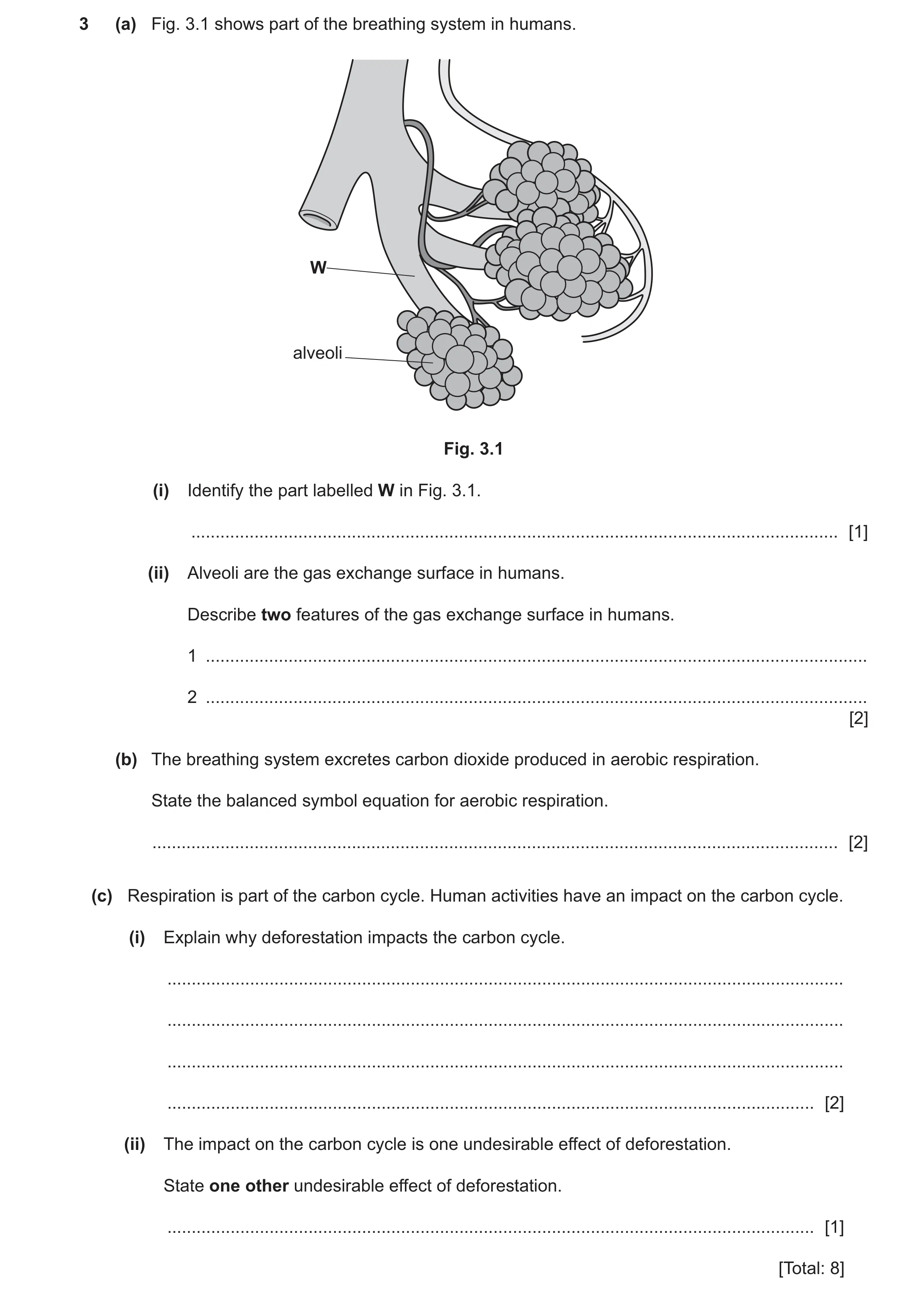
3 (a) Fig. 3.1 shows part of the breathing system in humans. W alveoli Fig. 3.1 (i) Identify the part labelled W in Fig. 3.1. … [1] (ii) Alveoli are the gas exchange surface in humans. Describe two features of the gas exchange surface in humans. 1 … 2 … [2] (b) The breathing system excretes carbon dioxide produced in aerobic respiration. State the balanced symbol equation for aerobic respiration. … [2] (c) Respiration is part of the carbon cycle. Human activities have an impact on the carbon cycle. (i) Explain why deforestation impacts the carbon cycle. … … … … [2] (ii) The impact on the carbon cycle is one undesirable effect of deforestation. State one other undesirable effect of deforestation. … [1] [Total: 8]
8 marks
Mark scheme: 3(a)(i) bronchiole ; 1 3(a)(ii) any two from: 2 large surface area ; thin surface ; good blood supply ; good ventilation (with air) ; AVP ; 3(b) C6H12O6 + 6O2 → 6H2O + 6CO2 ;; 2 correct reactants (in either order) and balanced = 1 mark correct products (in either order) and balanced = 1mark 3(c)(i) any two from: 2 decrease in photosynthesis ; so less carbon dioxide removed from atmosphere / carbon dioxide (in atmosphere) increases ; AVP ; 3(c)(ii) any one from: 1 habitat destruction ; reduced biodiversity ; extinction ; loss of soil ; flooding ;
This question in 0653/43 May/June 2025
 7 / 16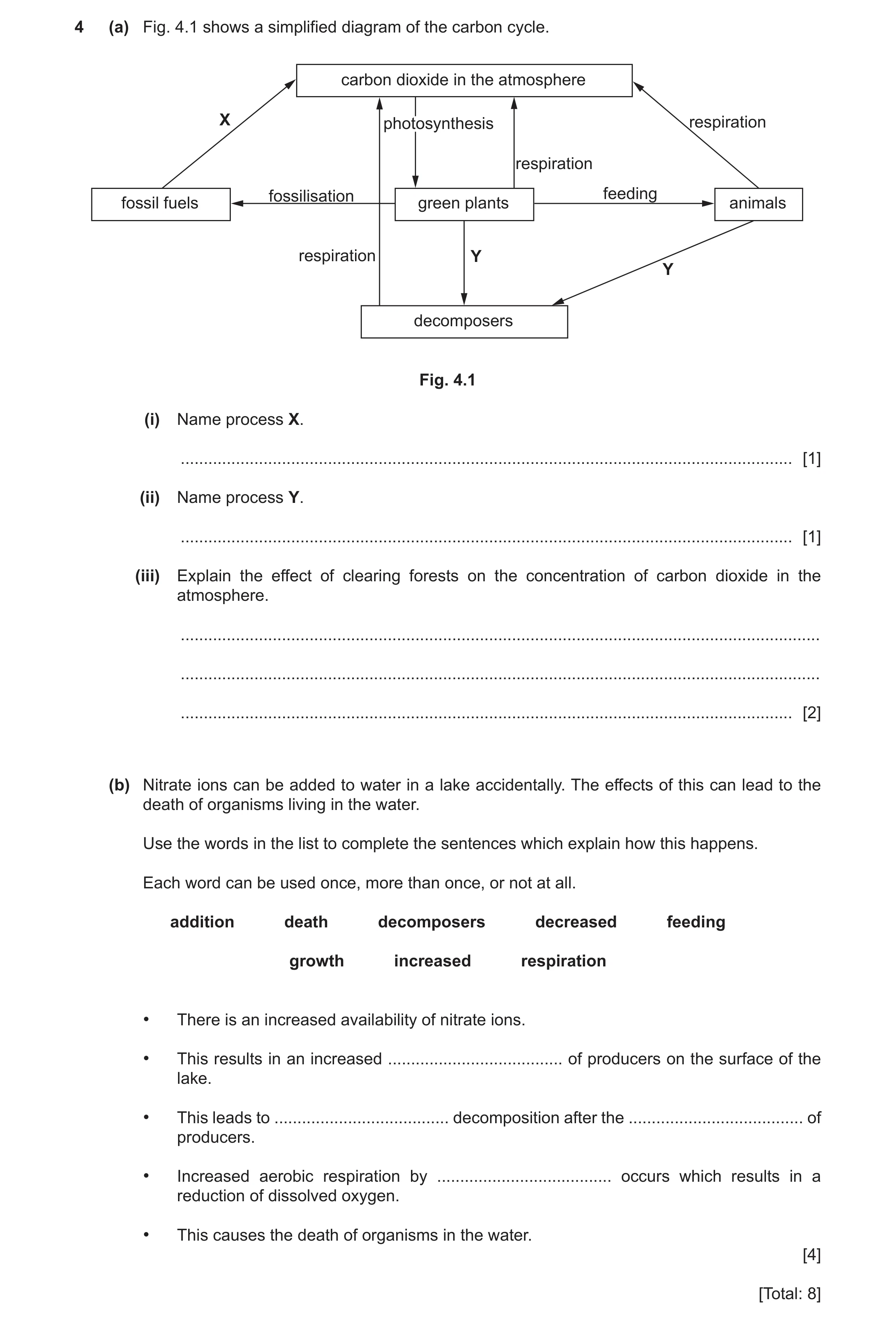
 10 / 16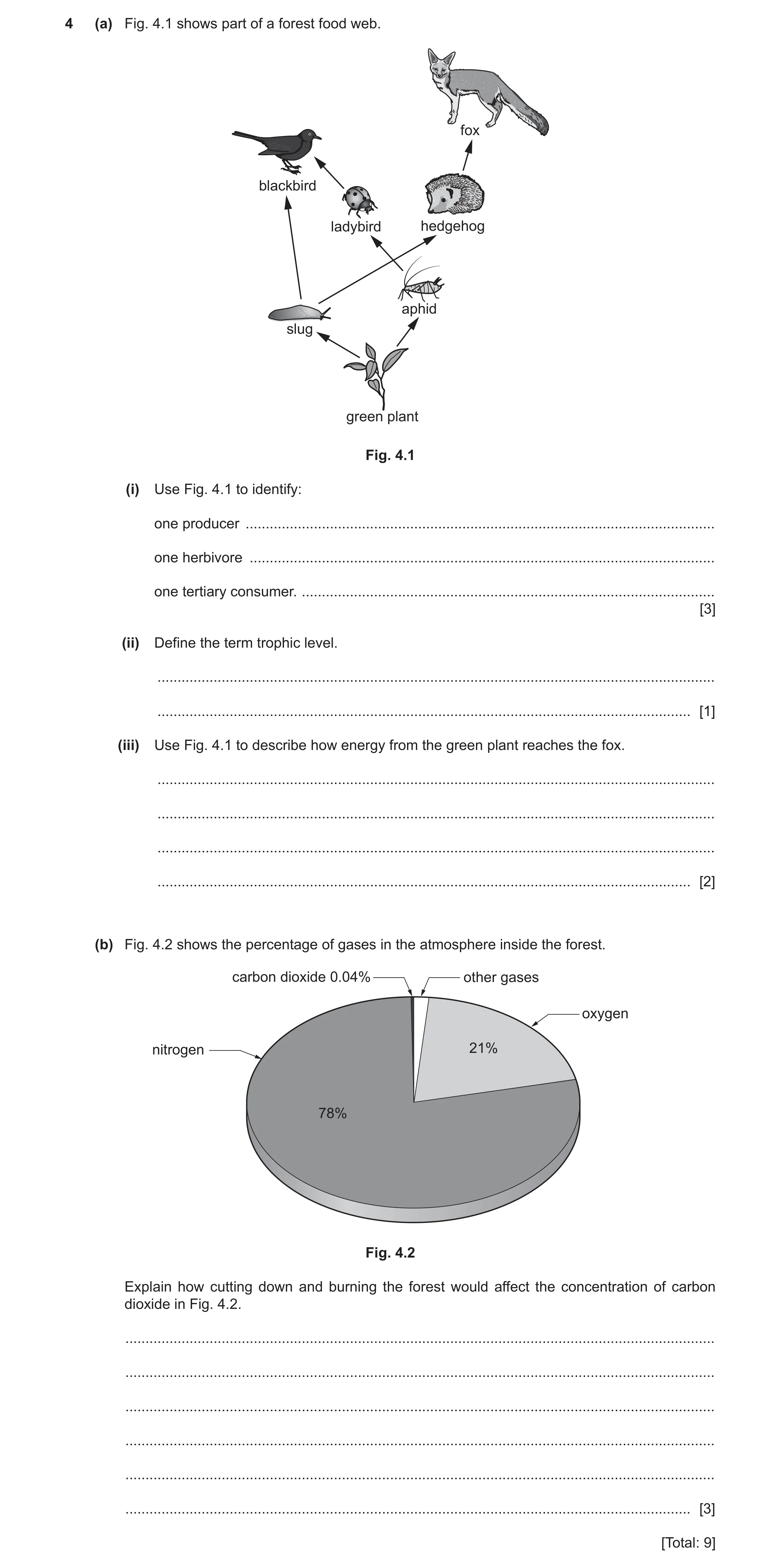
 13 / 16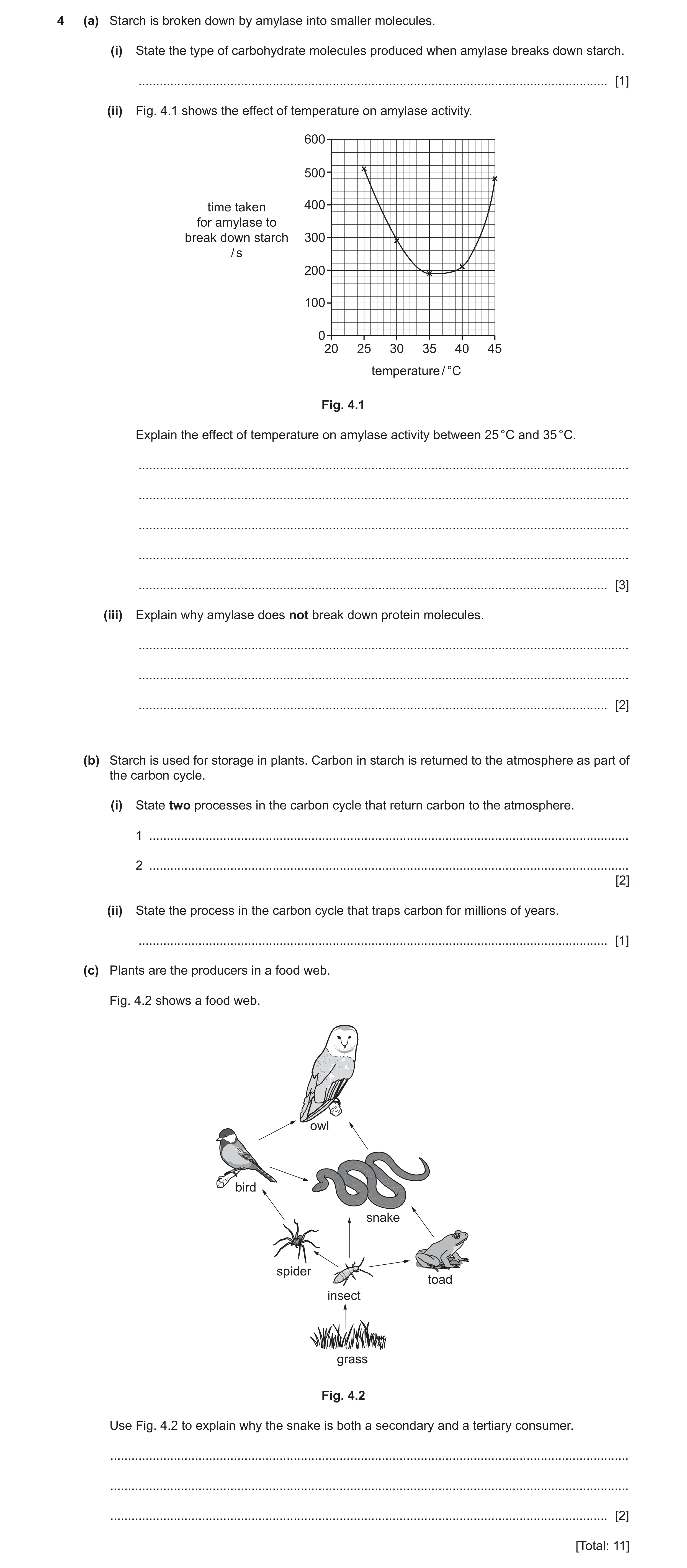
 16 / 16
 12
12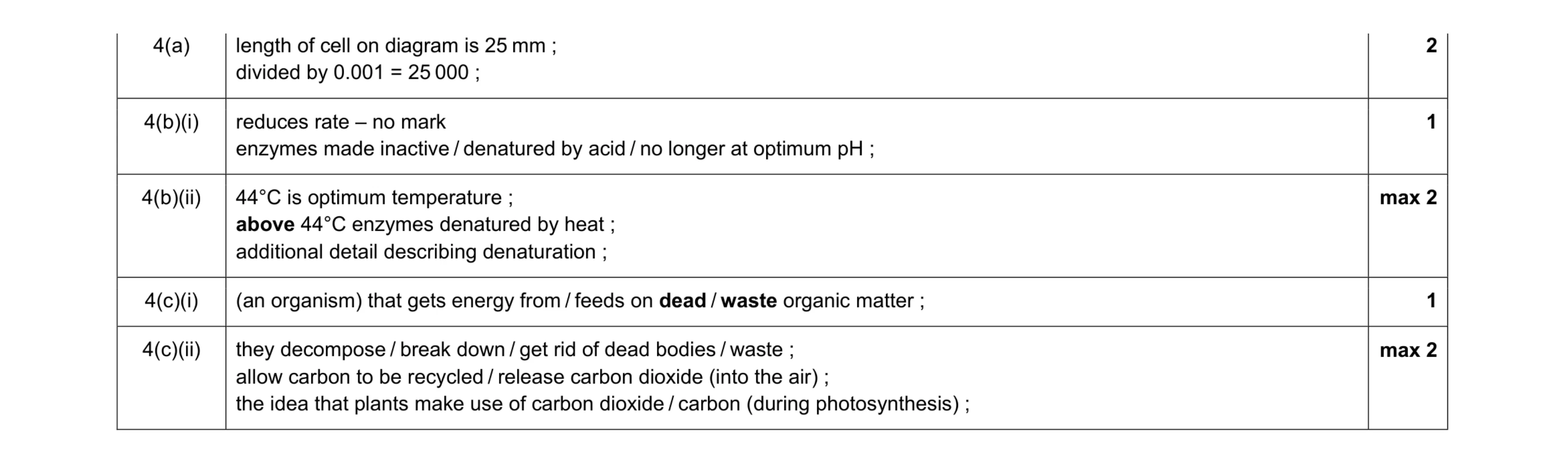 8
8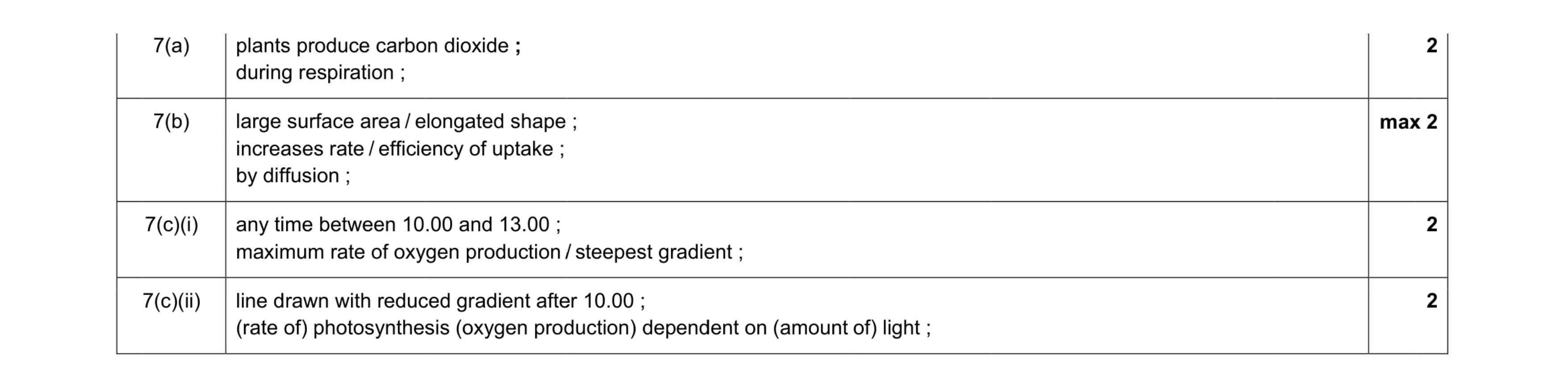 8
8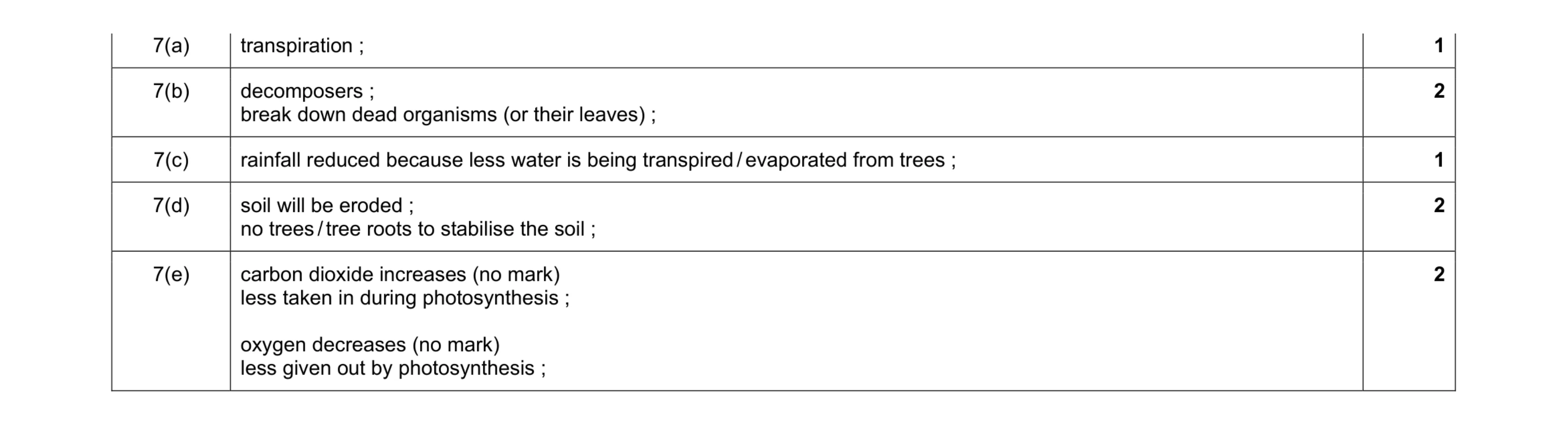 8
8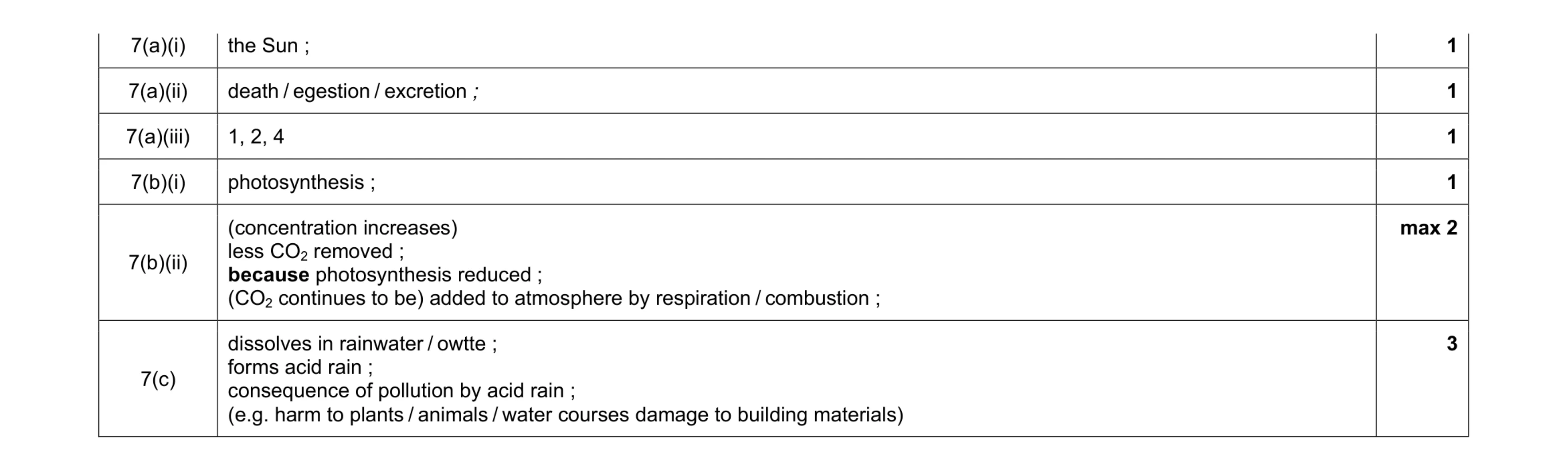 9
9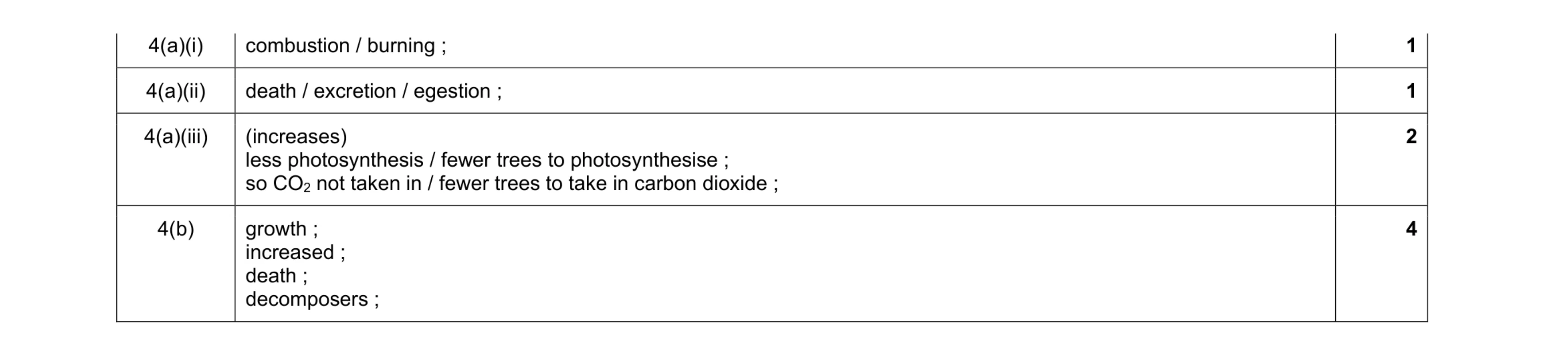 8
8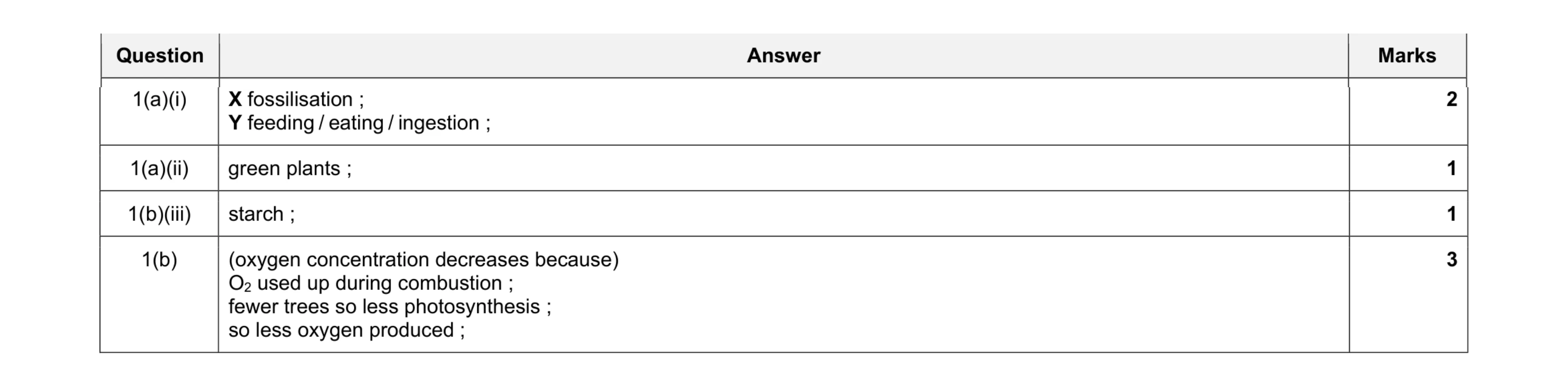 7
7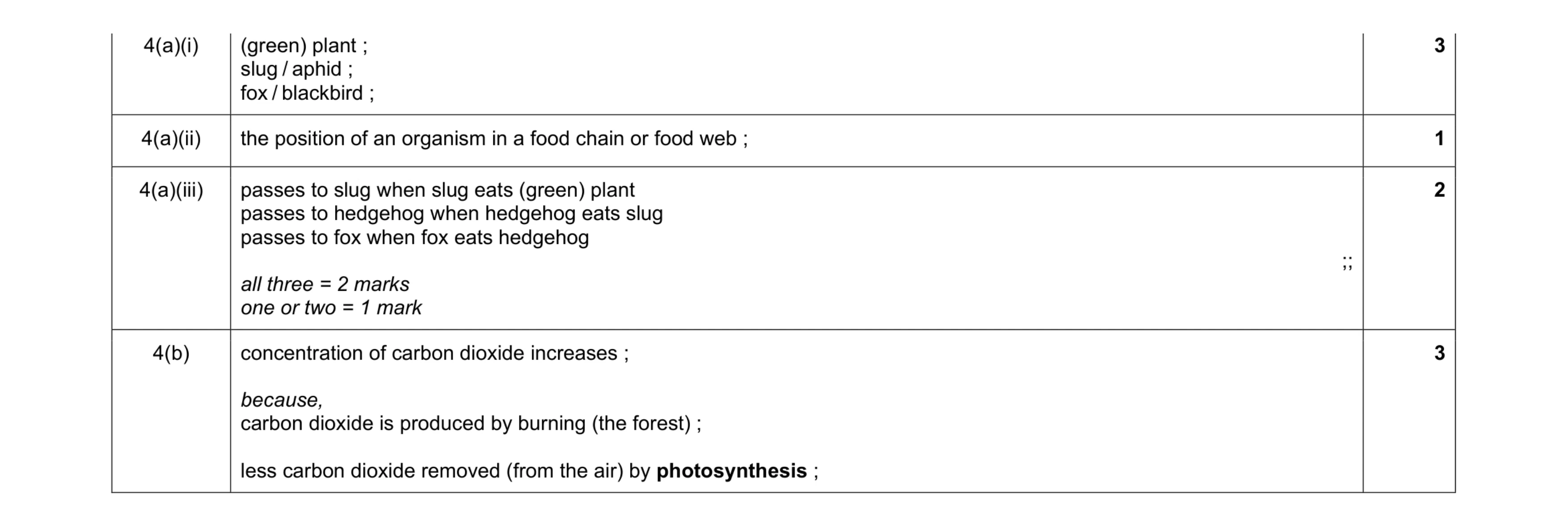 9
9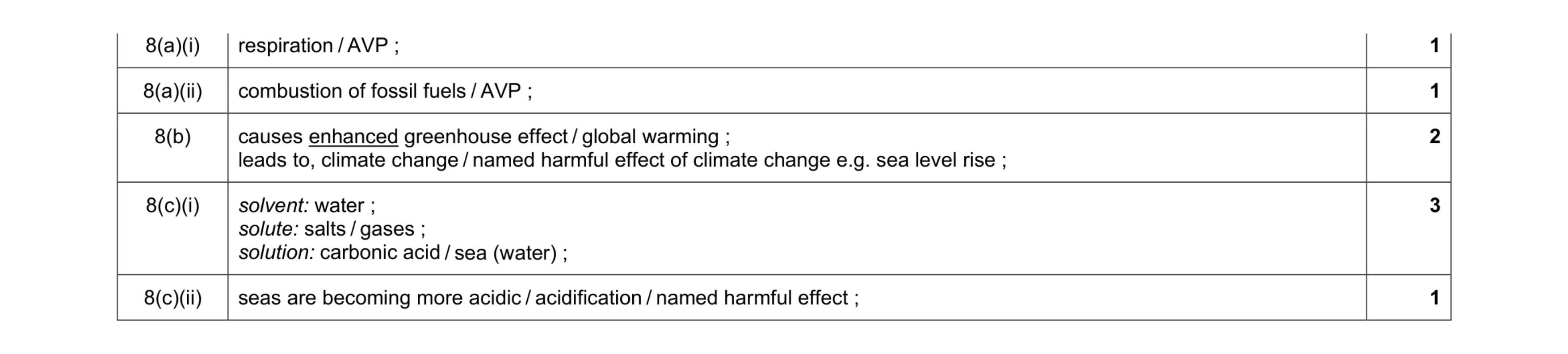 8
8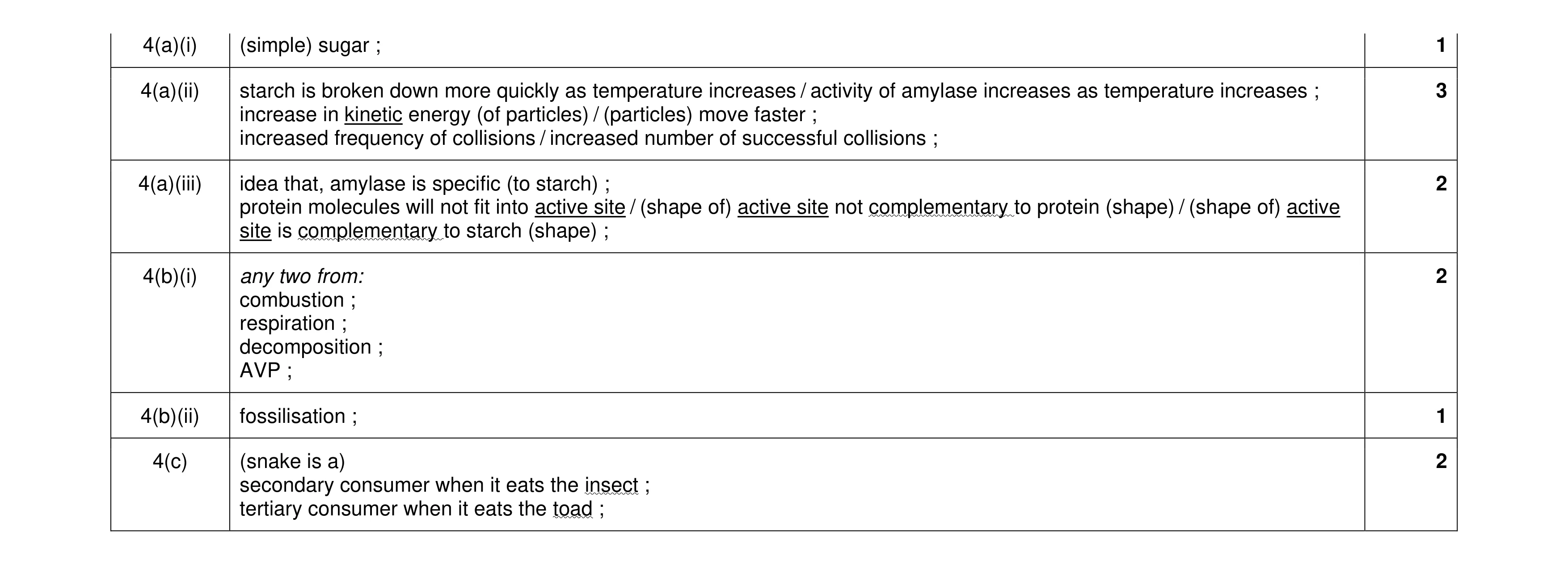 11
11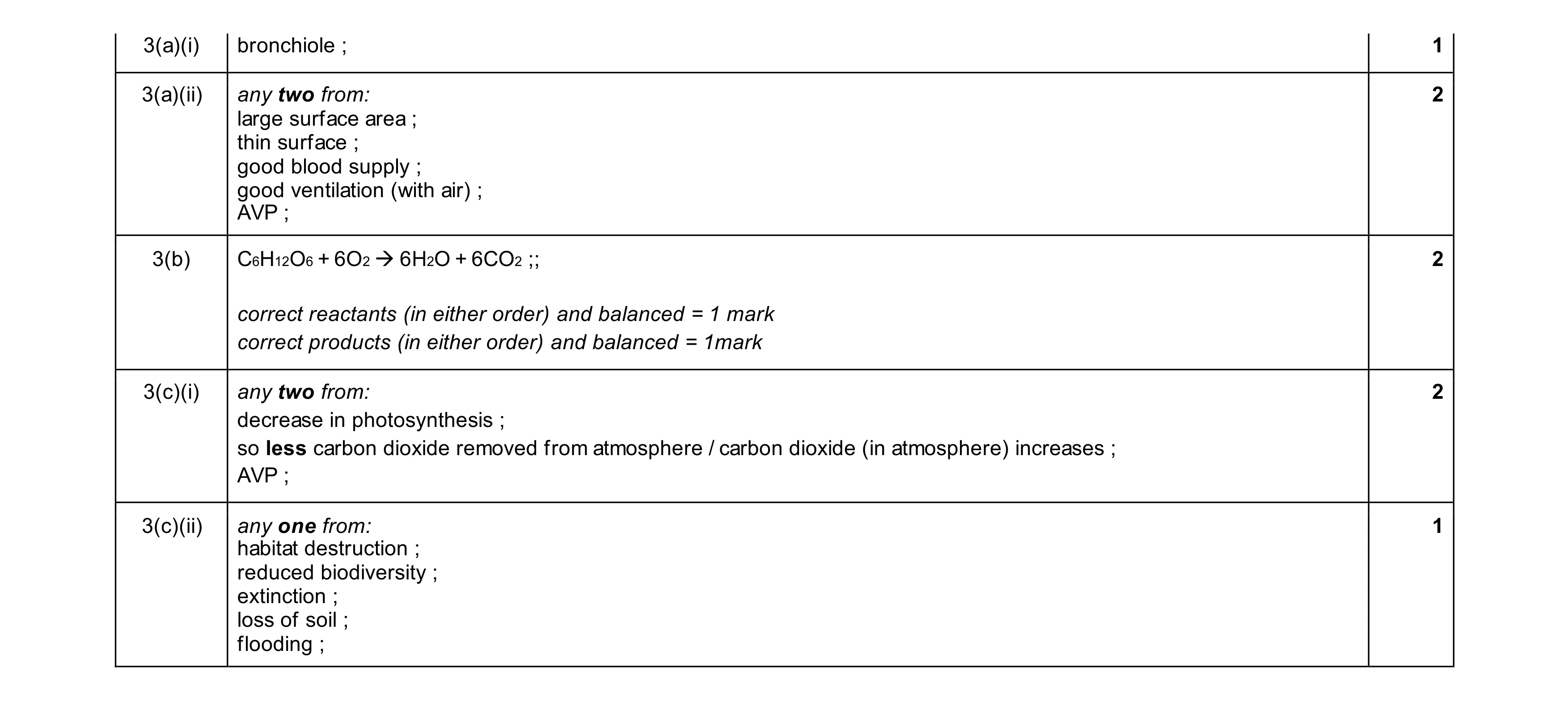 8
8