Questions as text
Q1 · A diagram of part of the carbon cycle 0653/32 Feb/March 2017
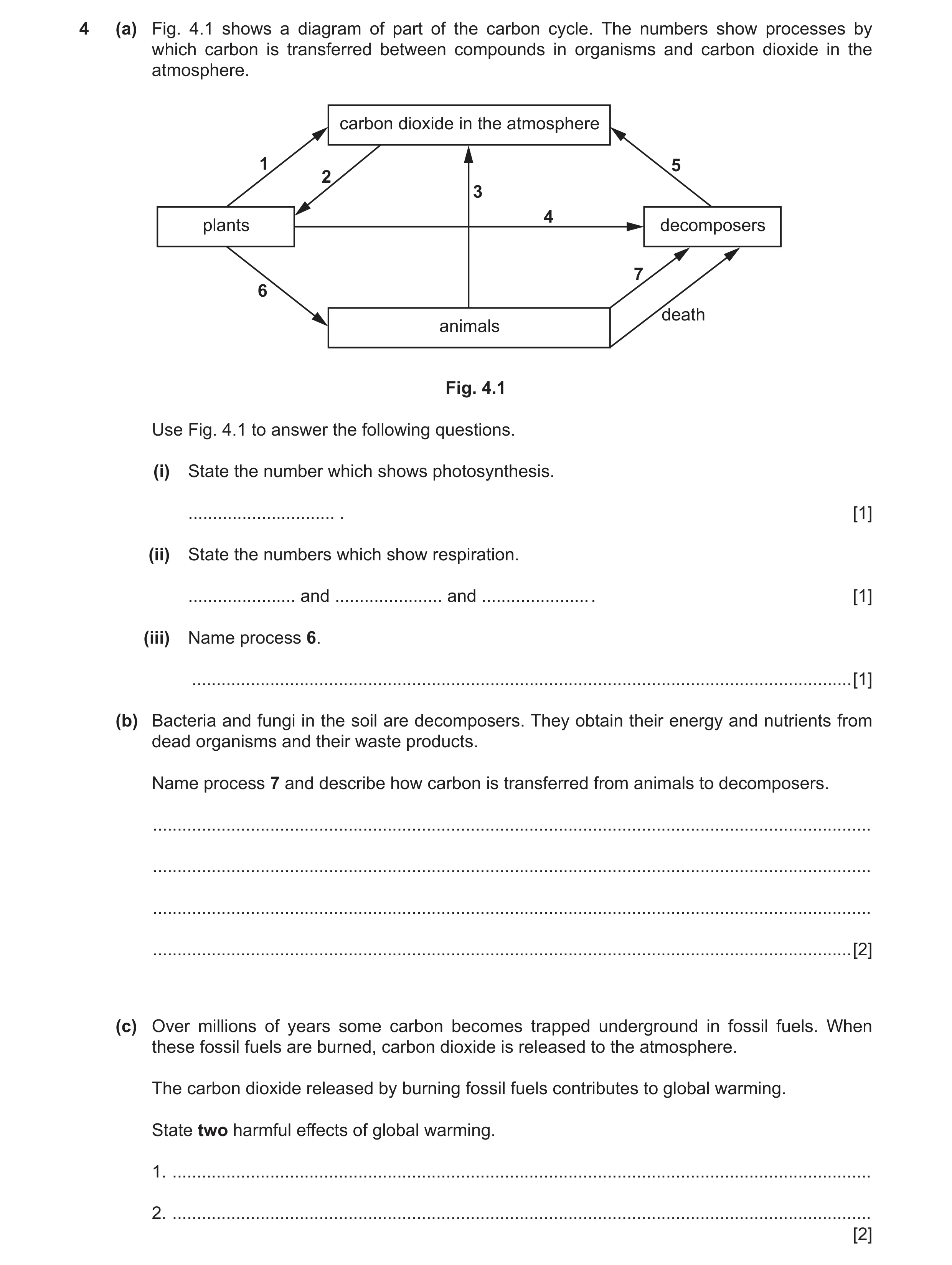
4 (a) Fig. 4.1 shows a diagram of part of the carbon cycle. The numbers show processes by which carbon is transferred between compounds in organisms and carbon dioxide in the atmosphere. carbon dioxide in the atmosphere 1 5 2 3 4 plants decomposers 7 6 death animals Fig. 4.1 Use Fig. 4.1 to answer the following questions. (i) State the number which shows photosynthesis. … . [1] (ii) State the numbers which show respiration. … and … and … . [1] (iii) Name process 6. … [1] (b) Bacteria and fungi in the soil are decomposers. They obtain their energy and nutrients from dead organisms and their waste products. Name process 7 and describe how carbon is transferred from animals to decomposers. … … … … [2] (c) Over millions of years some carbon becomes trapped underground in fossil fuels. When these fossil fuels are burned, carbon dioxide is released to the atmosphere. The carbon dioxide released by burning fossil fuels contributes to global warming. State two harmful effects of global warming. 1. … 2. … [2]
7 marks
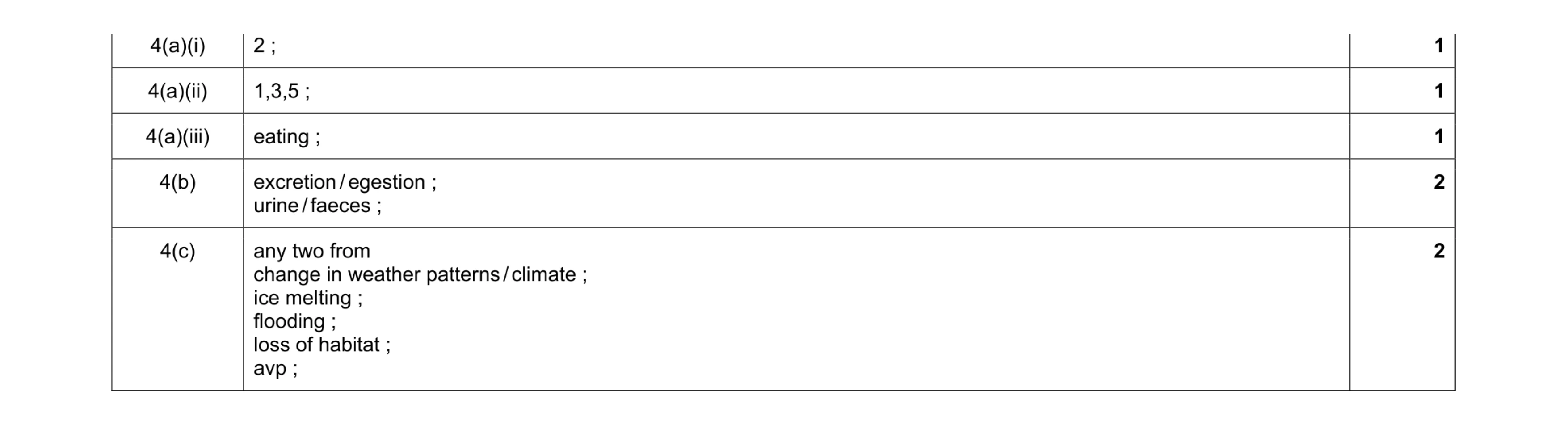
Mark scheme: 4(a)(i) 2 ; 1 4(a)(ii) 1,3,5 ; 1 4(a)(iii) eating ; 1 4(b) excretion / egestion ; urine / faeces ; 2 4(c) any two from change in weather patterns / climate ; ice melting ; flooding ; loss of habitat ; avp ; 2
This question in 0653/32 Feb/March 2017
Q2 · Some processes occurring in a forest growing on a hill 0653/33 Oct/Nov 2017
7 Fig. 7.1 shows some processes occurring in a forest growing on a hill. clouds water vapour X tree leaves fall onto the soil surface of soil roots Fig. 7.1 (a) Name the process labelled X. … [1] (b) (i) The leaves of the trees contain carbohydrates, for example sugar. Describe how leaves use a carbon compound in the air to make sugar. … … … [2] (ii) When leaves die they fall onto the soil. Decomposers (bacteria and fungi) feed on the dead leaves and use the sugar present in the leaves. Suggest and explain how the carbon in the sugar is returned to the atmosphere by the decomposers. … … … [2] (c) The trees in the forest shown in Fig. 7.1 are cut down. Predict and explain the effect of clearing the trees on the amount of rain falling on the area. … … … [1] (d) A storm occurs higher up the hill and water comes flowing down the hill. Suggest how the soil in the cleared area will be affected by water from heavy rainfall flowing down the hill. Explain your answer. … … … [2]
8 marks
Mark scheme: 7(a) transpiration ; 1 7(b)(i) carbon dioxide from the air ; is used in photosynthesis / reacts with water ; 2 7(b)(ii) by respiration ; carbon dioxide released ; 2 7(c) rainfall reduced (no mark) less water being transpired / evaporated from trees ; 1 7(d) soil easily eroded ; due to lack of tree roots ; 2
This question in 0653/33 Oct/Nov 2017
Q3 · A food web for a pond habitat 0653/32 Oct/Nov 2020
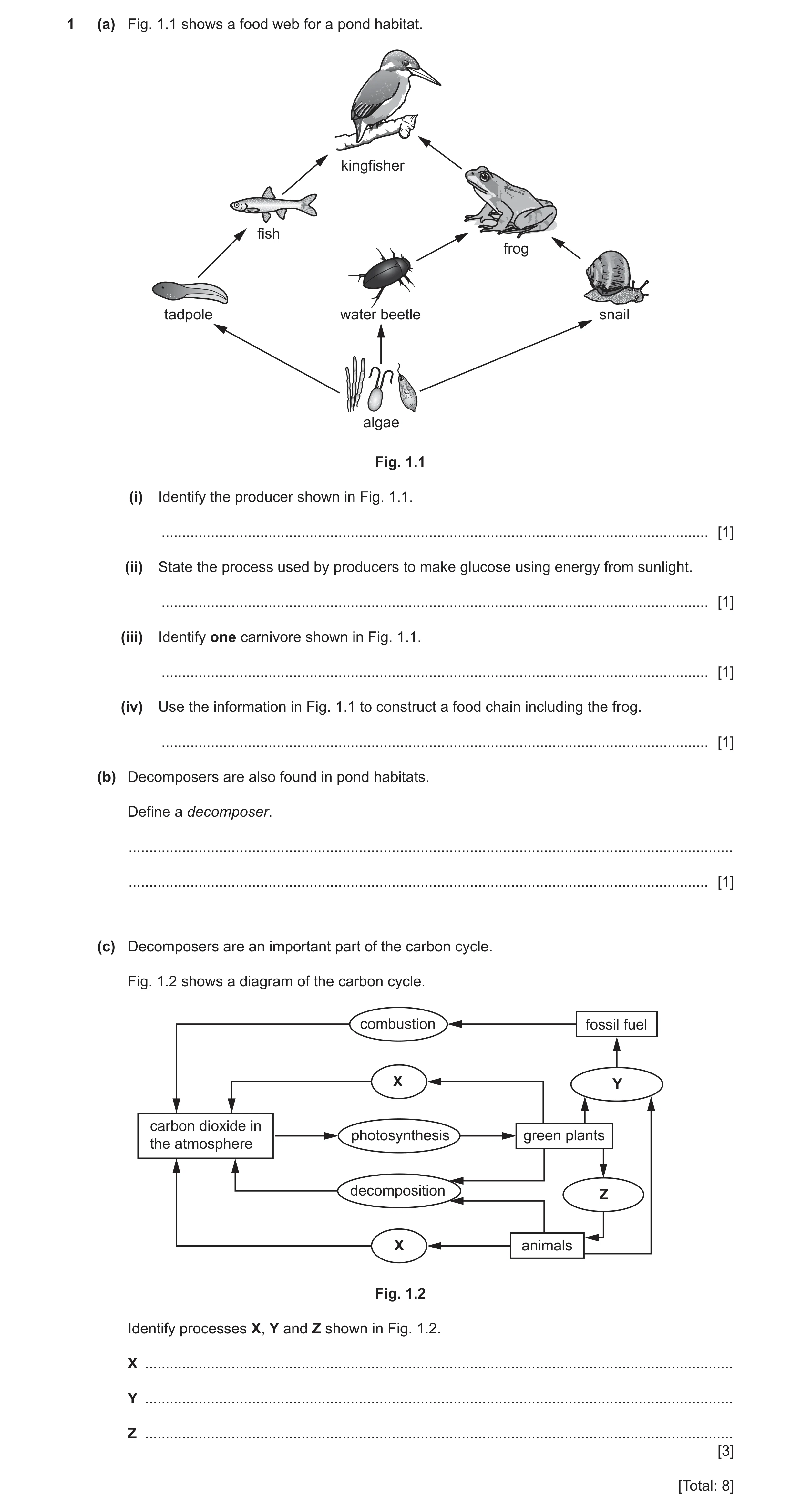
1 (a) Fig. 1.1 shows a food web for a pond habitat. kingfisher fish frog tadpole water beetle snail algae Fig. 1.1 (i) Identify the producer shown in Fig. 1.1. … [1] (ii) State the process used by producers to make glucose using energy from sunlight. … [1] (iii) Identify one carnivore shown in Fig. 1.1. … [1] (iv) Use the information in Fig. 1.1 to construct a food chain including the frog. … [1] (b) Decomposers are also found in pond habitats. Define a decomposer. … … [1] (c) Decomposers are an important part of the carbon cycle. Fig. 1.2 shows a diagram of the carbon cycle. combustion fossil fuel X Y carbon dioxide in photosynthesis green plants the atmosphere decomposition Z X animals Fig. 1.2 Identify processes X, Y and Z shown in Fig. 1.2. X … Y … Z … [3] [Total: 8]
8 marks
Mark scheme: 1(a)(i) algae ; 1 1(a)(ii) photosynthesis ; 1 1(a)(iii) frog / fish / kingfisher ; 1 1(a)(iv) algae → snail / water beetle → frog → kingfisher ; 1 1(b) (an organism that) gets its energy from dead or waste organic matter ; 1 1(c) X respiration ; Y fossilisation ; Z feeding ; 3 Question Answer Marks
This question in 0653/32 Oct/Nov 2020
Q4 · Part of a food web from the ocean 0653/31 May/June 2022
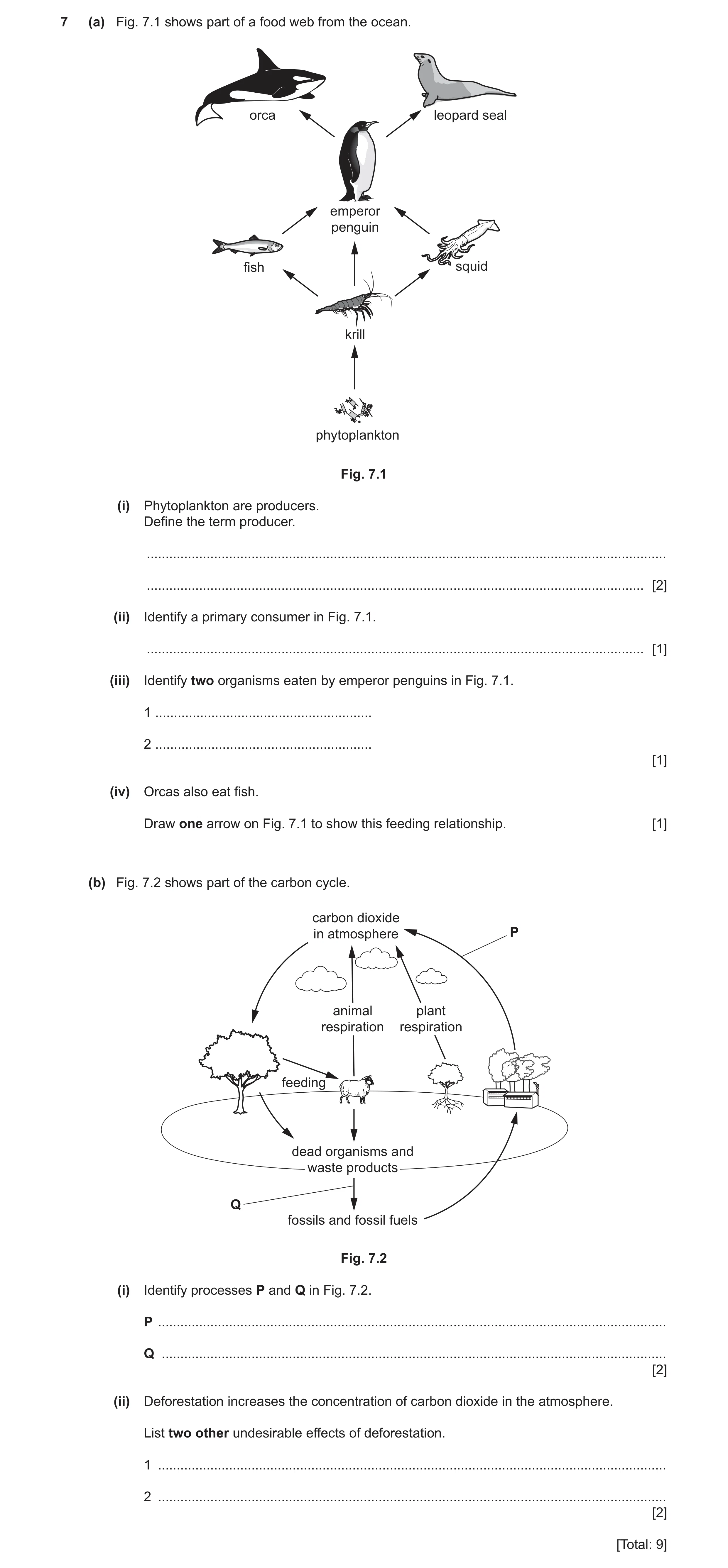
7 (a) Fig. 7.1 shows part of a food web from the ocean. orca leopard seal emperor penguin fish squid krill phytoplankton Fig. 7.1 (i) Phytoplankton are producers. Define the term producer. … … [2] (ii) Identify a primary consumer in Fig. 7.1. … [1] (iii) Identify two organisms eaten by emperor penguins in Fig. 7.1. 1 … 2 … [1] (iv) Orcas also eat fish. Draw one arrow on Fig. 7.1 to show this feeding relationship. [1] (b) Fig. 7.2 shows part of the carbon cycle. carbon dioxide in atmosphere P animal plant respiration respiration feeding dead organisms and waste products Q fossils and fossil fuels Fig. 7.2 (i) Identify processes P and Q in Fig. 7.2. P … Q … [2] (ii) Deforestation increases the concentration of carbon dioxide in the atmosphere. List two other undesirable effects of deforestation. 1 … 2 … [2] [Total: 9]
9 marks
Mark scheme: 7(a)(i) organism that makes its own (organic) nutrients ; using energy from, (sun)light / photosynthesis ; 2 7(a)(ii) krill ; 1 7(a)(iii) any two from: fish krill squid ; 1 7(a)(iv) arrow drawn from fish to orca ; 1 7(b)(i) P – combustion Q – fossilisation 2 7(b)(ii) any two from: soil erosion ; habitat loss ; extinction / endangers species ; flooding ; 2
This question in 0653/31 May/June 2022
Q5 · A cell from the spongy mesophyll of a plant 0653/31 Oct/Nov 2022
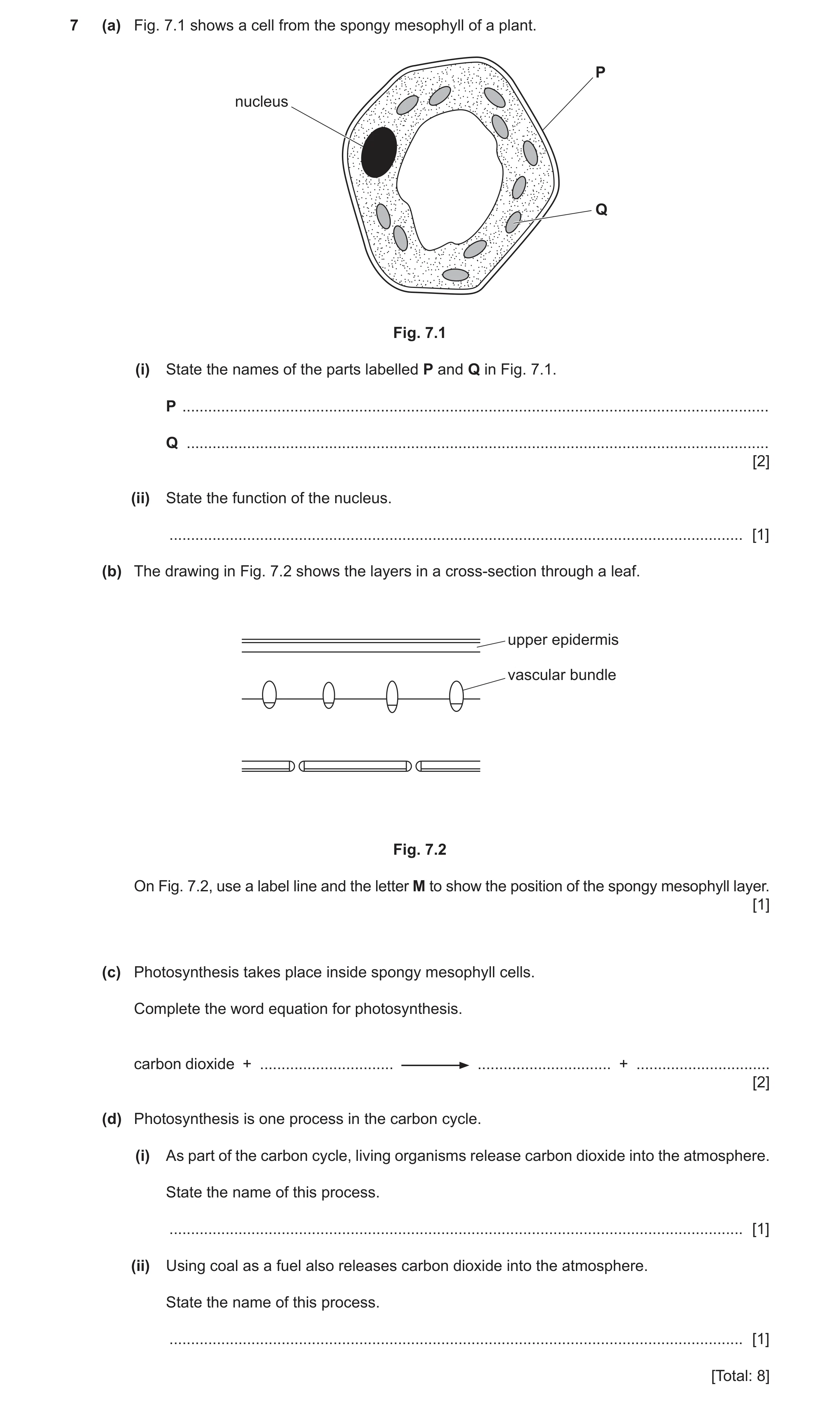
7 (a) Fig. 7.1 shows a cell from the spongy mesophyll of a plant. P nucleus Q Fig. 7.1 (i) State the names of the parts labelled P and Q in Fig. 7.1. P … Q … [2] (ii) State the function of the nucleus. … [1] (b) The drawing in Fig. 7.2 shows the layers in a cross-section through a leaf. upper epidermis vascular bundle Fig. 7.2 On Fig. 7.2, use a label line and the letter M to show the position of the spongy mesophyll layer. [1] (c) Photosynthesis takes place inside spongy mesophyll cells. Complete the word equation for photosynthesis. carbon dioxide + … … + … [2] (d) Photosynthesis is one process in the carbon cycle. (i) As part of the carbon cycle, living organisms release carbon dioxide into the atmosphere. State the name of this process. … [1] (ii) Using coal as a fuel also releases carbon dioxide into the atmosphere. State the name of this process. … [1] [Total: 8]
8 marks
Mark scheme: 7(a)(i) P (cell) wall ; 2 Q chloroplast ; 7(a)(ii) controls the cell (activities) ; 1 7(b) M below line of vascular bundles above lower epidermis ; 1 7(c) water ; 2 glucose + oxygen ; 7(d)(i) respiration ; 1 7(d)(ii) combustion ; 1
This question in 0653/31 Oct/Nov 2022
Q6 · Part of the carbon cycle 0653/32 Feb/March 2024
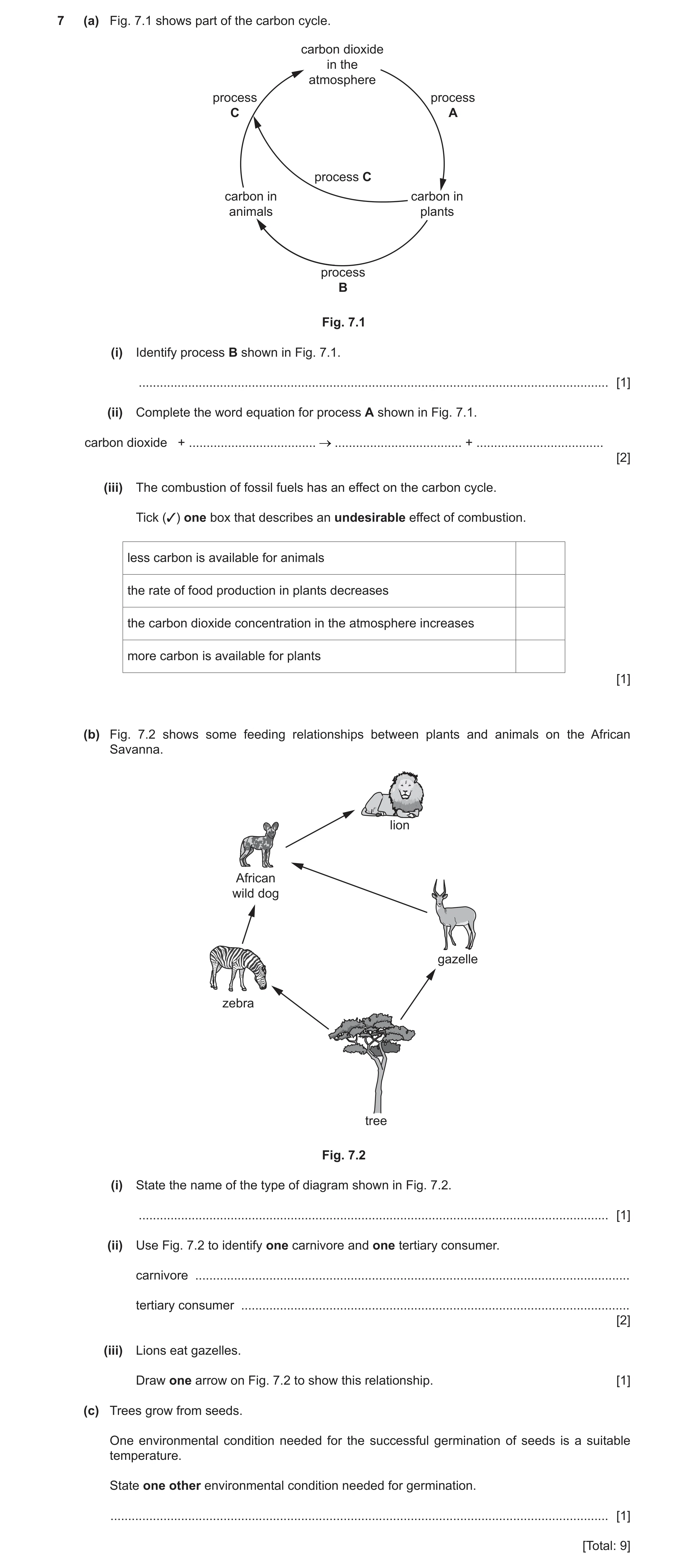
7 (a) Fig. 7.1 shows part of the carbon cycle. carbon dioxide in the atmosphere process process C A process C carbon in carbon in animals plants process B Fig. 7.1 (i) Identify process B shown in Fig. 7.1. … [1] (ii) Complete the word equation for process A shown in Fig. 7.1. carbon dioxide + … … + … [2] (iii) The combustion of fossil fuels has an effect on the carbon cycle. Tick (3) one box that describes an undesirable effect of combustion. less carbon is available for animals the rate of food production in plants decreases the carbon dioxide concentration in the atmosphere increases more carbon is available for plants [1] (b) Fig. 7.2 shows some feeding relationships between plants and animals on the African Savanna. lion African wild dog gazelle zebra tree Fig. 7.2 (i) State the name of the type of diagram shown in Fig. 7.2. … [1] (ii) Use Fig. 7.2 to identify one carnivore and one tertiary consumer. carnivore … tertiary consumer … [2] (iii) Lions eat gazelles. Draw one arrow on Fig. 7.2 to show this relationship. [1] (c) Trees grow from seeds. One environmental condition needed for the successful germination of seeds is a suitable temperature. State one other environmental condition needed for germination. … [1] [Total: 9]
9 marks
Mark scheme: 7(a)(i) feeding ; 1 7(a)(ii) water ; 2 glucose + oxygen ; 7(a)(iii) 1 less carbon is available for animals the rate of food production in plants decreases the carbon dioxide concentration in the atmosphere increases ✓ ; more carbon is available for plants 7(b)(i) food web ; 1 7(b)(ii) carnivore: (African wild) dog / lion ; 2 tertiary consumer: lion ; 7(b)(iii) arrow drawn from gazelle pointing towards lion ; 1 7(c) oxygen / water / moisture ; 1
This question in 0653/32 Feb/March 2024
Question 7 0653/32 May/June 2024
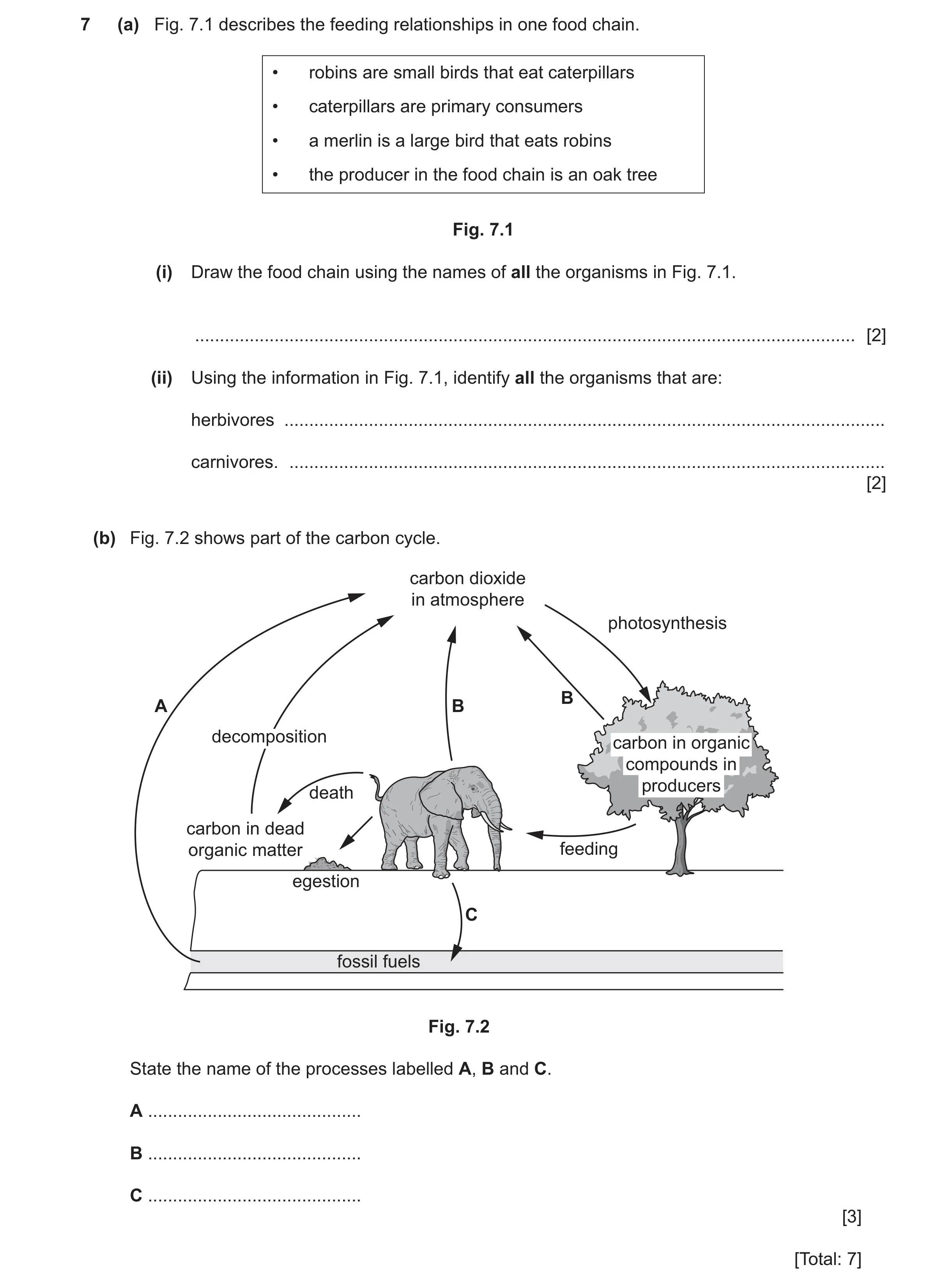
7 (a) Fig. 7.1 describes the feeding relationships in one food chain. • robins are small birds that eat caterpillars • caterpillars are primary consumers • a merlin is a large bird that eats robins • the producer in the food chain is an oak tree Fig. 7.1 (i) Draw the food chain using the names of all the organisms in Fig. 7.1. … [2] (ii) Using the information in Fig. 7.1, identify all the organisms that are: herbivores … carnivores. … [2] (b) Fig. 7.2 shows part of the carbon cycle. carbon dioxide in atmosphere photosynthesis B A B decomposition carbon in organic compounds in producers death carbon in dead organic matter feeding egestion C fossil fuels Fig. 7.2 State the name of the processes labelled A, B and C. A … B … C … [3] [Total: 7]
7 marks
Mark scheme: 7(a)(i) oak / tree → caterpillar → robin → merlin ;; named organisms in correct order (1) arrows correct (1) 2 7(a)(ii) caterpillar ; robin and merlin ; 2 Question Answer Marks 7(b) A combustion ; B respiration ; C fossilisation ; 3
This question in 0653/32 May/June 2024
Q8 · A student’s drawing of a cross-section of a leaf 0653/31 Oct/Nov 2024
7 (a) Fig. 7.1 shows a student’s drawing of a cross-section of a leaf. A B E D C Fig. 7.1 (i) State the letter in Fig. 7.1 that identifies: a guard cell … a vascular bundle … where water vapour diffuses out from the leaf. … [3] (ii) Use a label line and the letter X to identify a cuticle in Fig. 7.1. [1] (b) Fig. 7.2 shows the pathway taken by water from the soil to the leaves. Complete Fig. 7.2. soil root hair cells root … cells xylem vessels … cells in the leaf Fig. 7.2 [2] (c) Plants are an important part of the carbon cycle. Circle the process that decreases the amount of carbon dioxide in the atmosphere. combustion decomposition photosynthesis respiration transpiration [1] [Total: 7]
7 marks
Mark scheme: 7(a)(i) D ; 3 B ; C ; 7(a)(ii) cuticle labelled ; 1 7(b) cortex ; 2 mesophyll ; 7(c) photosynthesis ; 1
This question in 0653/31 Oct/Nov 2024
Q9 · A diagram of a plant root hair cell 0653/31 May/June 2025
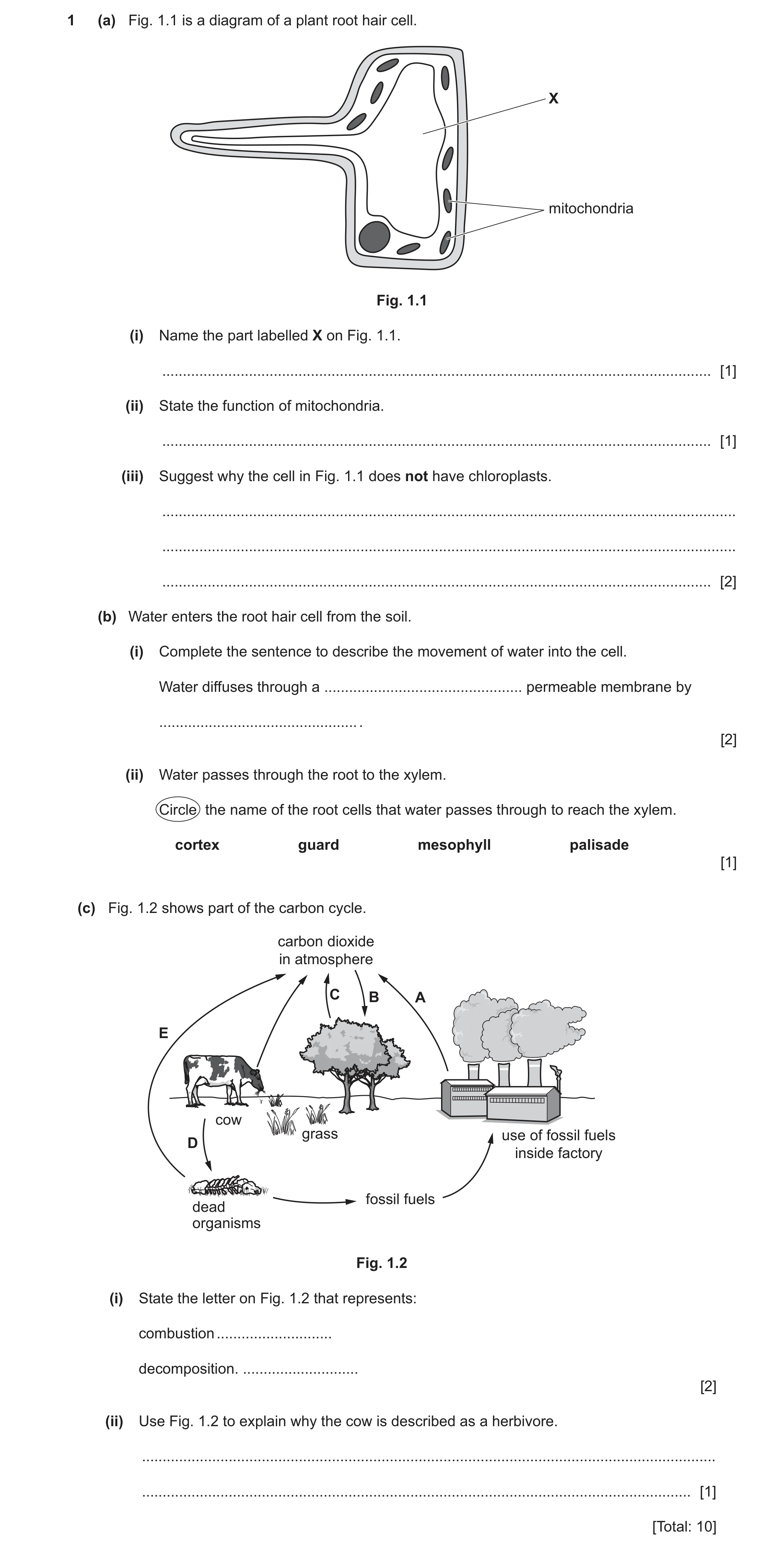
1 (a) Fig. 1.1 is a diagram of a plant root hair cell. X mitochondria Fig. 1.1 (i) Name the part labelled X on Fig. 1.1. … [1] (ii) State the function of mitochondria. … [1] (iii) Suggest why the cell in Fig. 1.1 does not have chloroplasts. … … … [2] (b) Water enters the root hair cell from the soil. (i) Complete the sentence to describe the movement of water into the cell. Water diffuses through a … permeable membrane by … . [2] (ii) Water passes through the root to the xylem. Circle the name of the root cells that water passes through to reach the xylem. cortex guard mesophyll palisade [1] (c) Fig. 1.2 shows part of the carbon cycle. carbon dioxide in atmosphere C B A E cow grass use of fossil fuels D inside factory fossil fuels dead organisms Fig. 1.2 (i) State the letter on Fig. 1.2 that represents: combustion … decomposition. … [2] (ii) Use Fig. 1.2 to explain why the cow is described as a herbivore. … … [1] [Total: 10]
10 marks
Mark scheme: Question Answer Marks 1(a)(i) vacuole ; 1 1(a)(ii) (aerobic) respiration ; 1 1(a)(iii) (root hair cells) do not / cannot, photosynthesise / no photosynthesis ; 2 no light available ; 1(b)(i) partially ; 2 osmosis ; 1(b)(ii) cortex ; 1 1(c)(i) A ; 2 D ; 1(c)(ii) idea that they only feed on plants / only gain energy from plants ; 1
This question in 0653/31 May/June 2025
Q10 · Part of a food web from a coral reef habitat 0653/33 May/June 2025
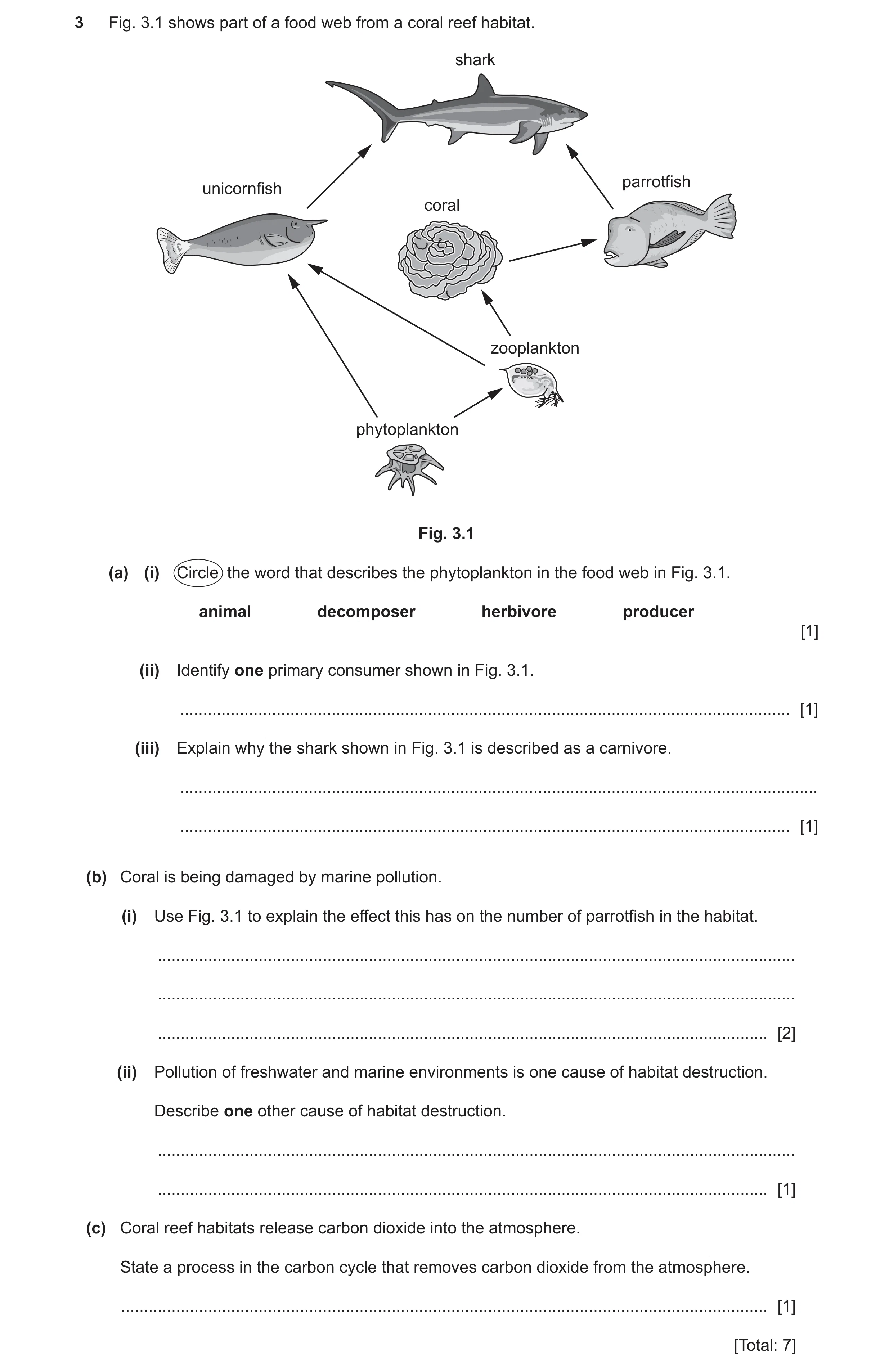
3 Fig. 3.1 shows part of a food web from a coral reef habitat. shark parrotfish unicornfish coral zooplankton phytoplankton Fig. 3.1 (a) (i) Circle the word that describes the phytoplankton in the food web in Fig. 3.1. animal decomposer herbivore producer [1] (ii) Identify one primary consumer shown in Fig. 3.1. … [1] (iii) Explain why the shark shown in Fig. 3.1 is described as a carnivore. … … [1] (b) Coral is being damaged by marine pollution. (i) Use Fig. 3.1 to explain the effect this has on the number of parrotfish in the habitat. … … … [2] (ii) Pollution of freshwater and marine environments is one cause of habitat destruction. Describe one other cause of habitat destruction. … … [1] (c) Coral reef habitats release carbon dioxide into the atmosphere. State a process in the carbon cycle that removes carbon dioxide from the atmosphere. … [1] [Total: 7]
7 marks
Mark scheme: 3(a)(i) producer ; 1 3(a)(ii) zooplankton / unicornfish ; 1 3(a)(iii) feeds on / eats, animals / fish (only) ; 1 3(b)(i) (parrotfish) numbers would decrease ; 2 as less food available (for parrotfish) ; 3(b)(ii) any one from: 1 increased area for housing / crop production / livestock production ; extraction of natural material ; construction, e.g. building roads / building railways ; 3(c) photosynthesis ; 1
This question in 0653/33 May/June 2025
 1 / 15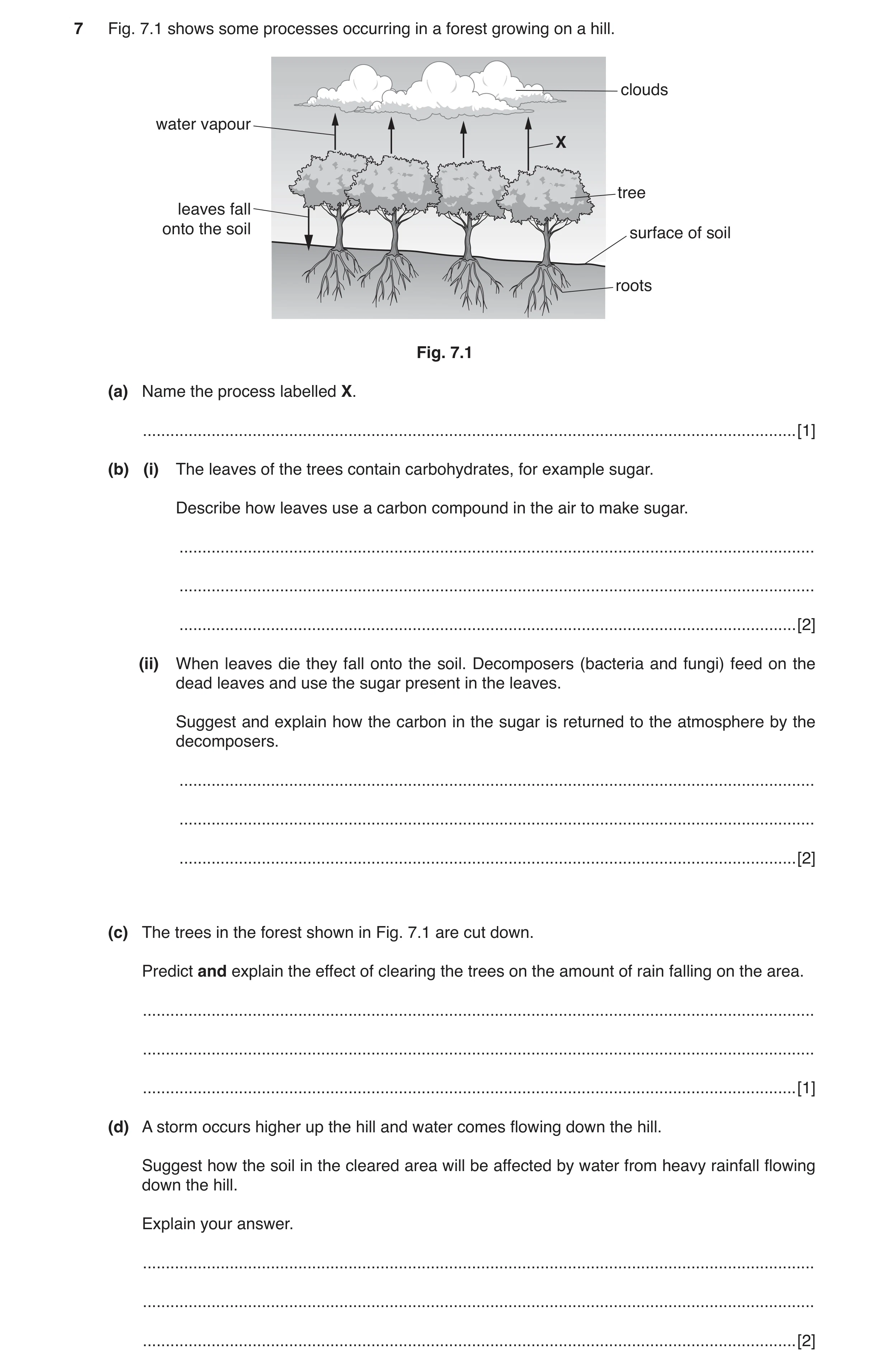
 10 / 15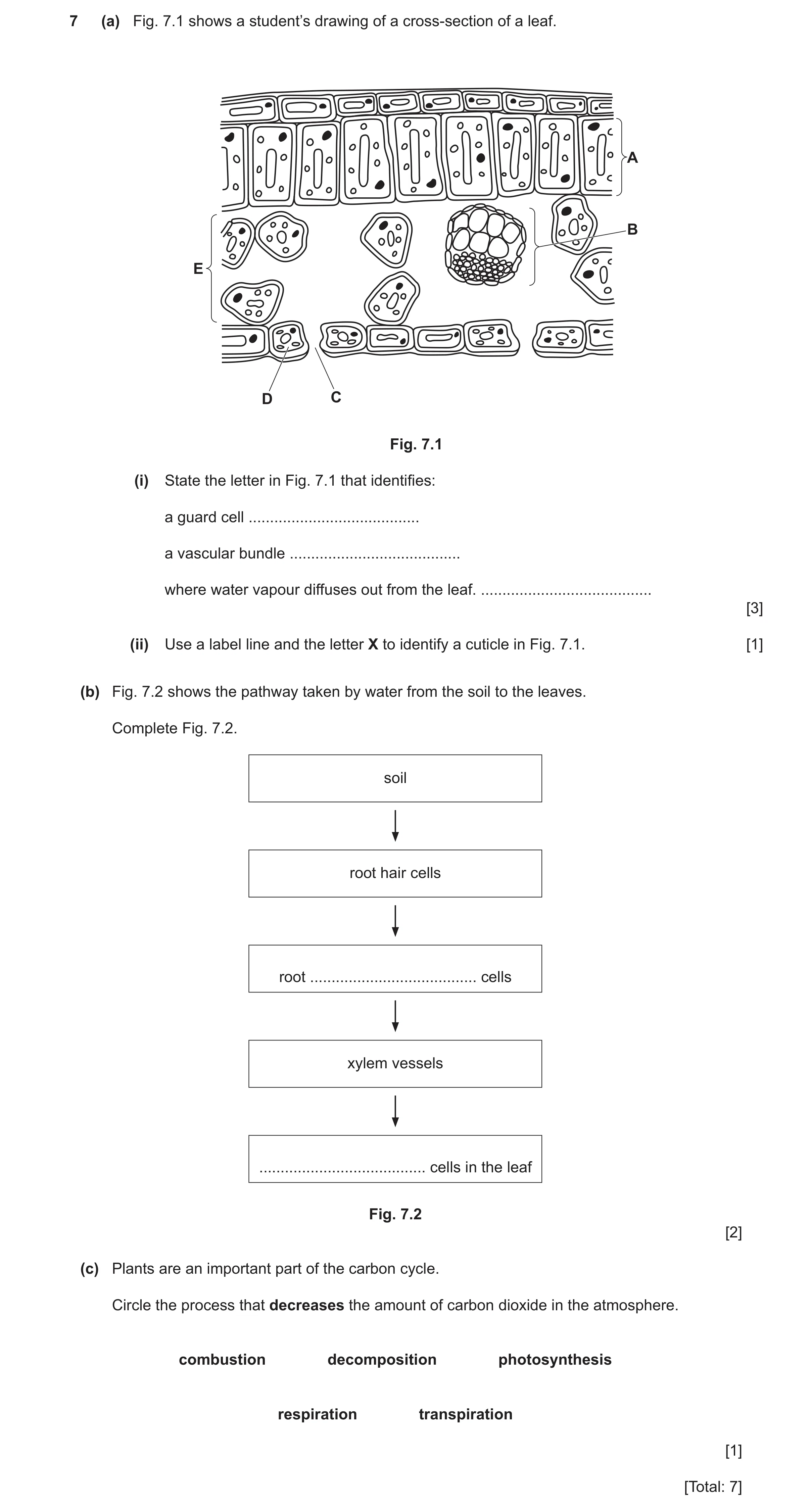
 7
7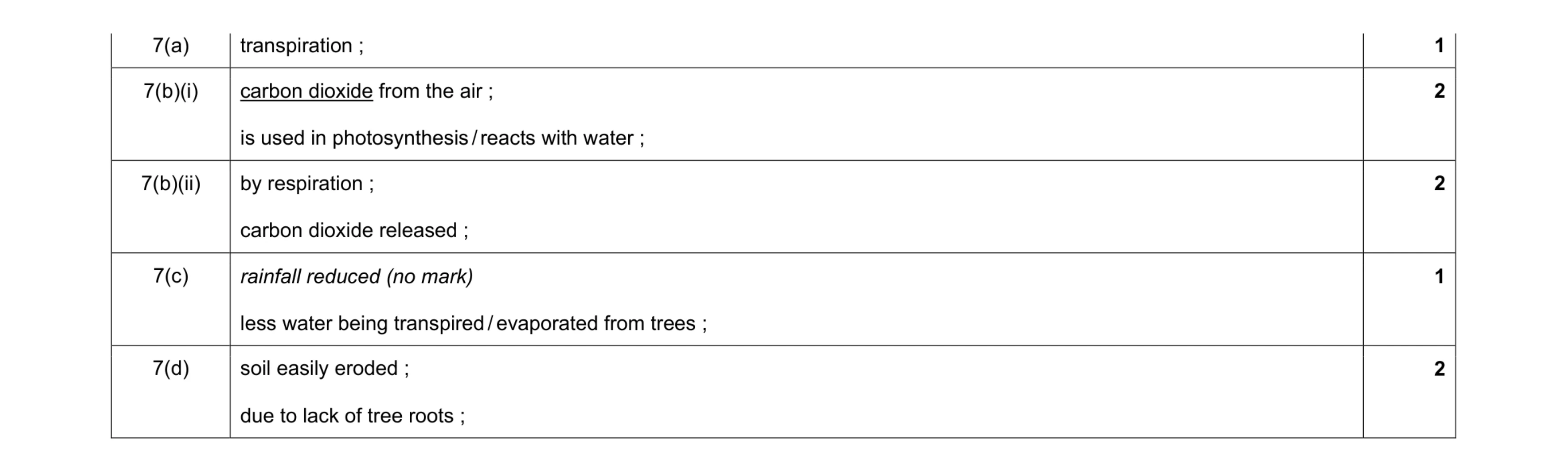 8
8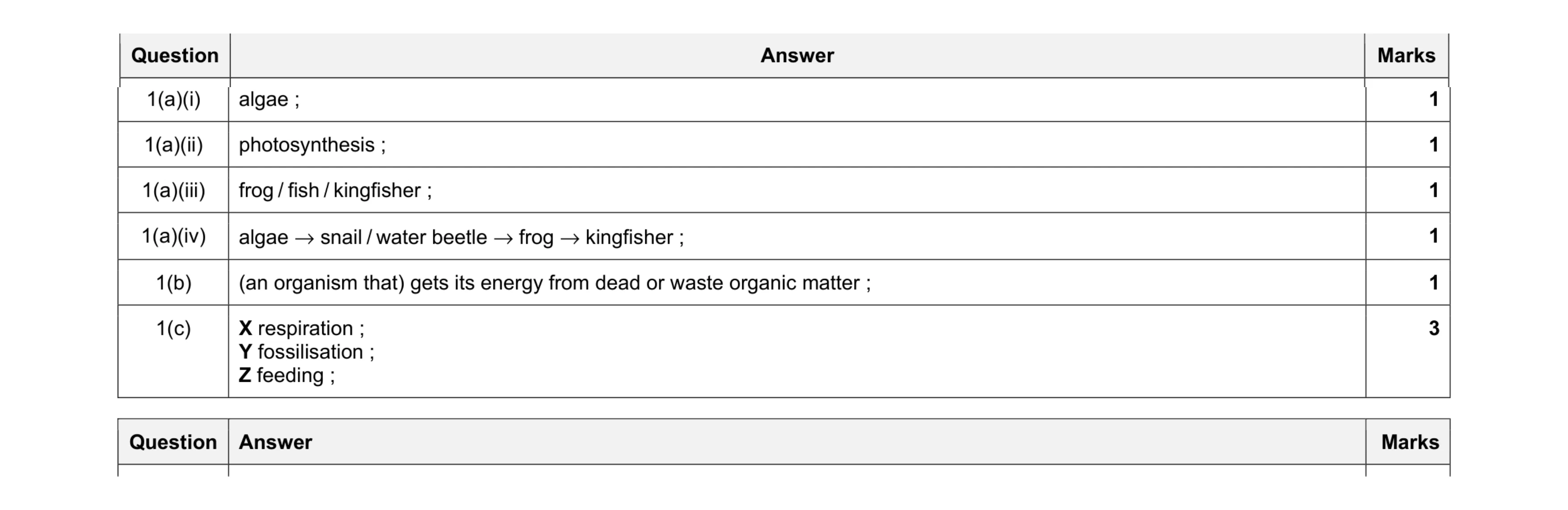 8
8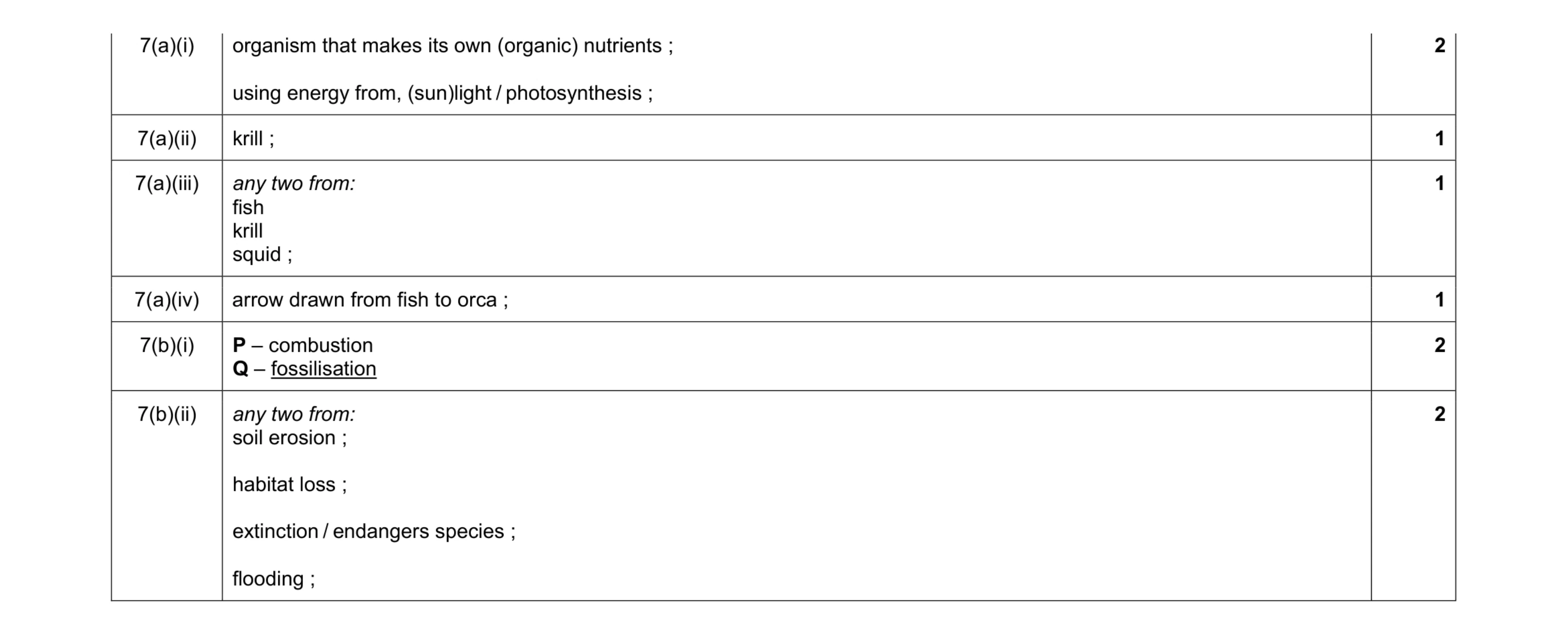 9
9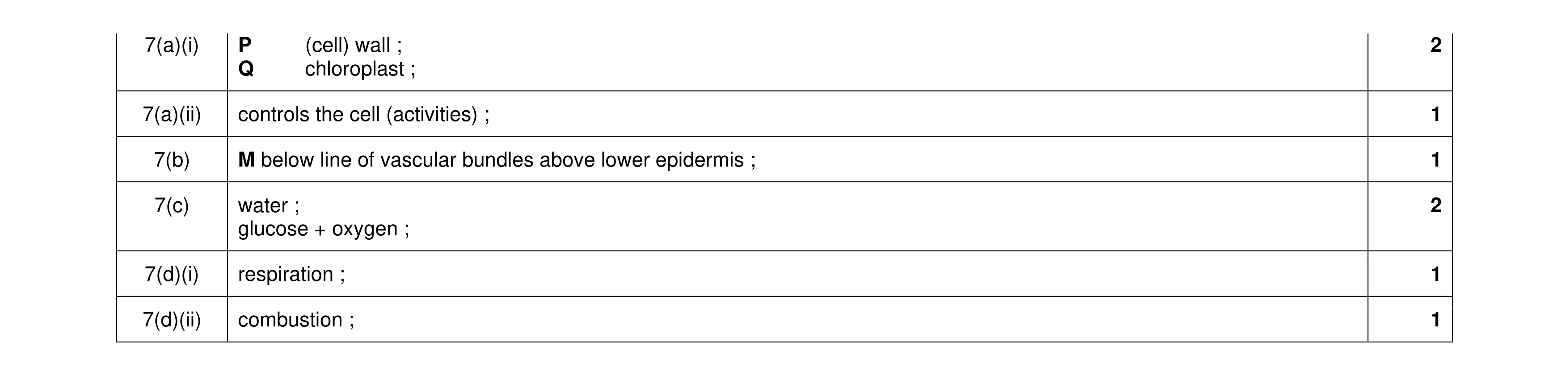 8
8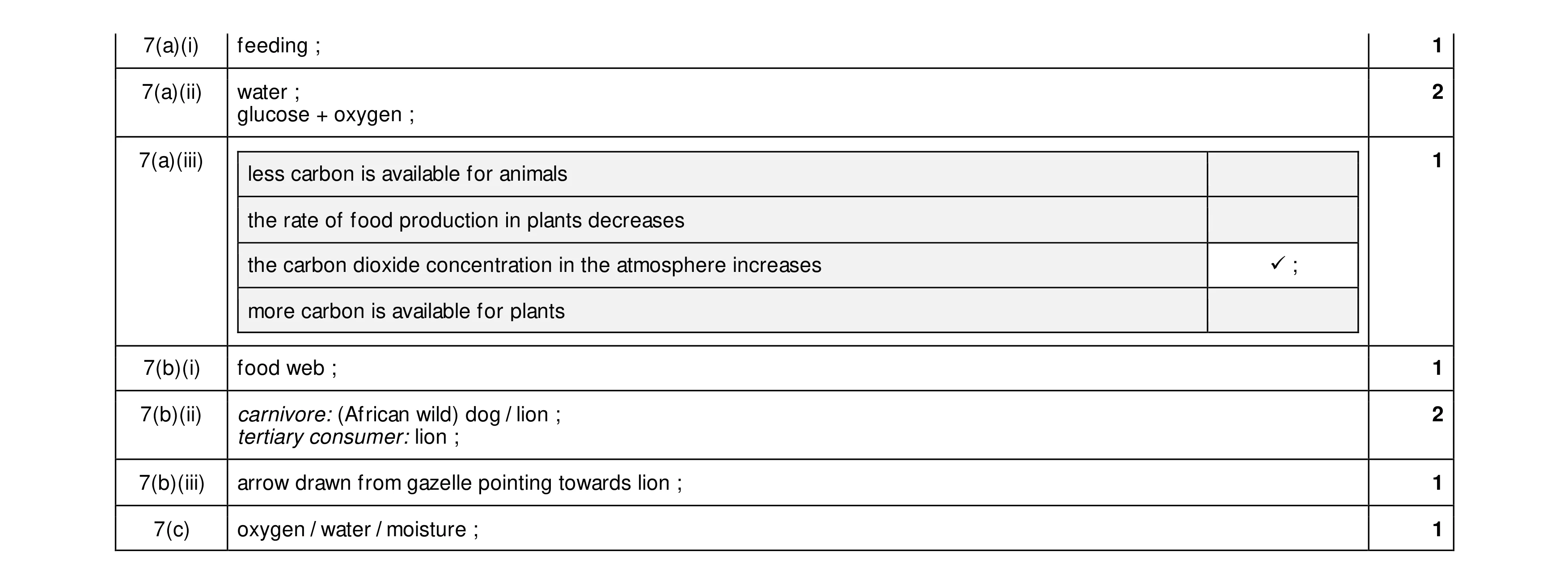 9
9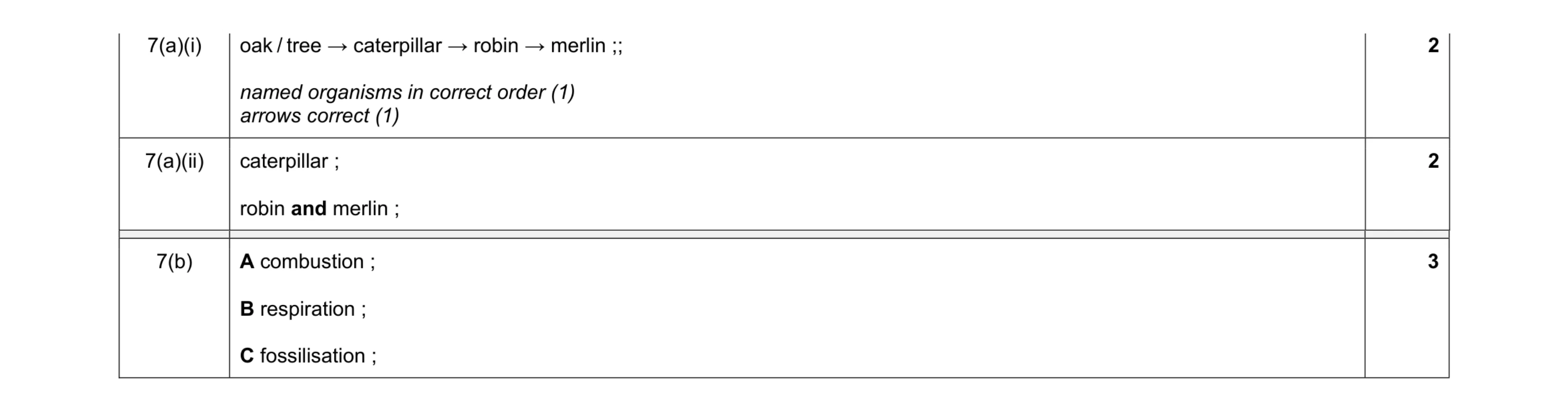 7
7 7
7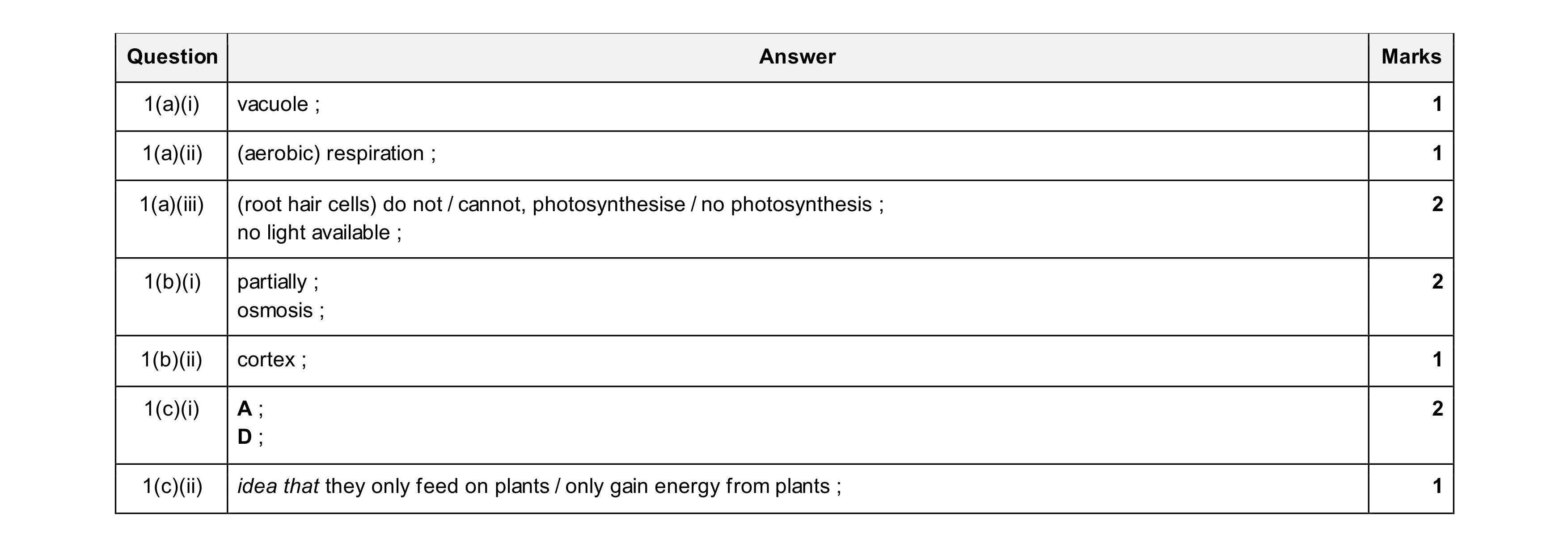 10
10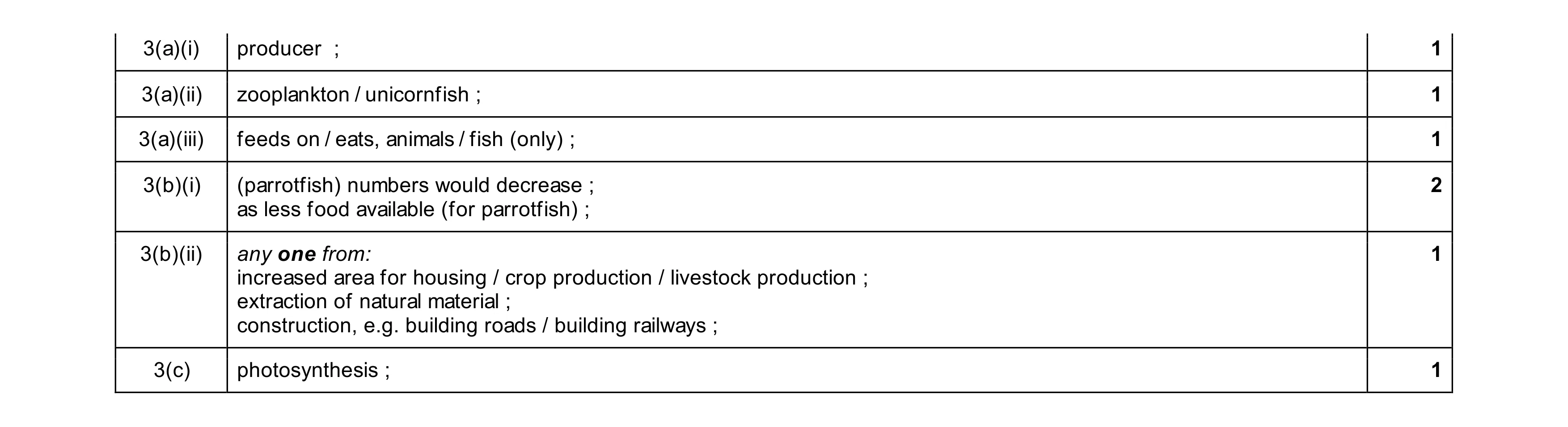 7
7