Questions as text
Q1 · A mains electrical circuit uses insulated copper cable and the cable overheats 0652/11 Oct/Nov 2007
36 A mains electrical circuit uses insulated copper cable and the cable overheats. To prevent the cable overheating, how should the cable be changed, and why? A Use thicker copper cable which has less resistance. B Use thicker insulation which stops the heat escaping. C Use thinner copper cable which has more resistance. D Use thinner insulation which allows less heat to escape.
1 marks
Answer: A
This question in 0652/11 Oct/Nov 2007
Q2 · On a building site, the metal scaffolding is firmly embedded in the damp ground 0652/11 Oct/Nov 2009
36 On a building site, the metal scaffolding is firmly embedded in the damp ground. A builder holds a mains-operated electric drill in one hand, and with his other hand holds on to the scaffolding. The power cable of the drill is damaged where it enters the metal casing of the drill. What danger does this present to the builder? A A current could flow through the builder and electrocute him. B A current in the scaffolding could heat it up and burn him. C The large current could blow the fuse and damage the drill. D The large current could make the motor spin too quickly.
1 marks
Answer: A
This question in 0652/11 Oct/Nov 2009
Q3 · The current in an electric heater is 10 A 0652/11 Oct/Nov 2011
36 The current in an electric heater is 10 A. The heater is connected to the power supply using wire which is designed to carry a current of 5 A. Why is this a hazard? A The heater could explode. B The wire could explode. C The heater could become too hot and cause a fire. D The wire could become too hot and cause a fire.
1 marks
Answer: D
This question in 0652/11 Oct/Nov 2011
Q4 · The current in an electric heater is 10 A 0652/12 Oct/Nov 2011
35 The current in an electric heater is 10 A. The heater is connected to the power supply using wire which is designed to carry a current of 5 A. Why is this a hazard? A The heater could explode. B The wire could explode. C The heater could become too hot and cause a fire. D The wire could become too hot and cause a fire.
1 marks
Answer: D
This question in 0652/12 Oct/Nov 2011
Q5 · It is dangerous for electric sockets and wall switches to be fitted in a room with a hot… 0652/11 Oct/Nov 2013
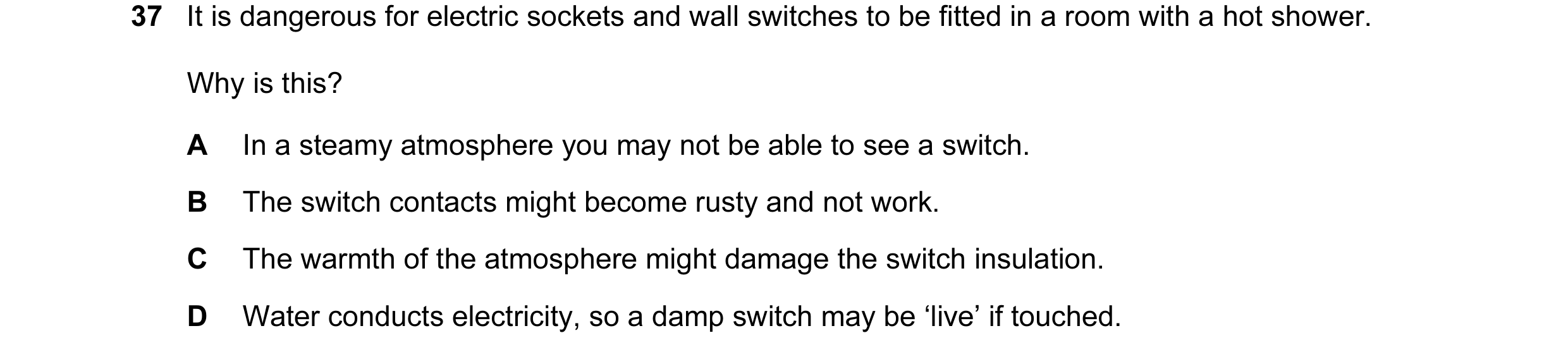
37 It is dangerous for electric sockets and wall switches to be fitted in a room with a hot shower. Why is this? A In a steamy atmosphere you may not be able to see a switch. B The switch contacts might become rusty and not work. C The warmth of the atmosphere might damage the switch insulation. D Water conducts electricity, so a damp switch may be ‘live’ if touched.
1 marks
Answer: D
This question in 0652/11 Oct/Nov 2013
Q6 · It is dangerous for electric sockets and wall switches to be fitted in a room with a hot… 0652/12 Oct/Nov 2013
37 It is dangerous for electric sockets and wall switches to be fitted in a room with a hot shower. Why is this? A In a steamy atmosphere you may not be able to see a switch. B The switch contacts might become rusty and not work. C The warmth of the atmosphere might damage the switch insulation. D Water conducts electricity, so a damp switch may be ‘live’ if touched.
1 marks
Answer: D
This question in 0652/12 Oct/Nov 2013
Q7 · Overheating of a cable in an electric circuit is a safety hazard 0652/11 Oct/Nov 2016
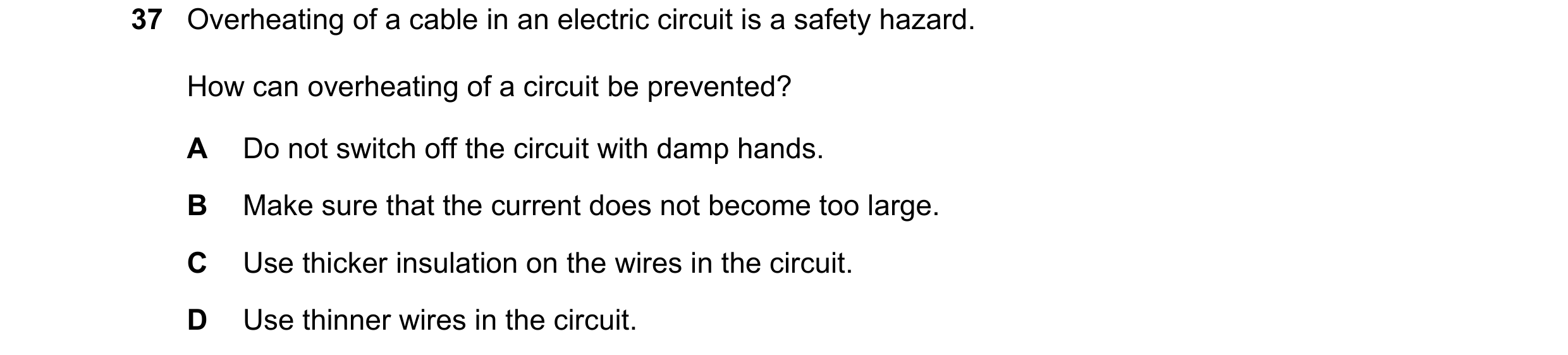
37 Overheating of a cable in an electric circuit is a safety hazard. How can overheating of a circuit be prevented? A Do not switch off the circuit with damp hands. B Make sure that the current does not become too large. C Use thicker insulation on the wires in the circuit. D Use thinner wires in the circuit.
1 marks
Answer: B
This question in 0652/11 Oct/Nov 2016
Q8 · Overheating of a cable in an electric circuit is a safety hazard 0652/12 Oct/Nov 2016
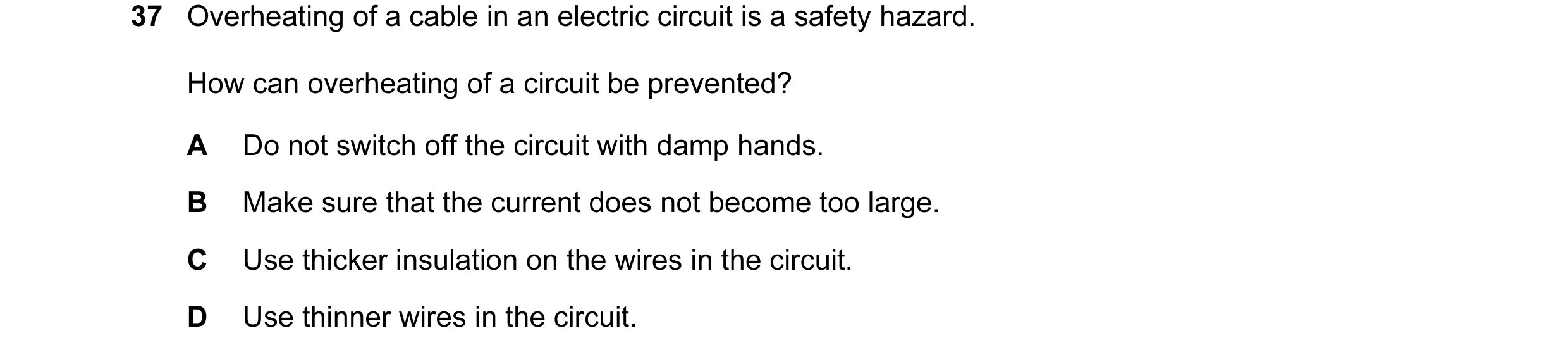
37 Overheating of a cable in an electric circuit is a safety hazard. How can overheating of a circuit be prevented? A Do not switch off the circuit with damp hands. B Make sure that the current does not become too large. C Use thicker insulation on the wires in the circuit. D Use thinner wires in the circuit.
1 marks
Answer: B
This question in 0652/12 Oct/Nov 2016
Q9 · A student connects a number of electrical appliances to the same electric socket through… 0652/11 Oct/Nov 2018
36 A student connects a number of electrical appliances to the same electric socket through two adaptors. to washing machine to iron to computer to heater to hairdryer to toaster to microwave What is the main hazard produced by this arrangement? A a fire caused by overheating wires B a person receiving an electric shock C an appliance overheating D the appliances sharing the voltage available
1 marks
Answer: A
This question in 0652/11 Oct/Nov 2018
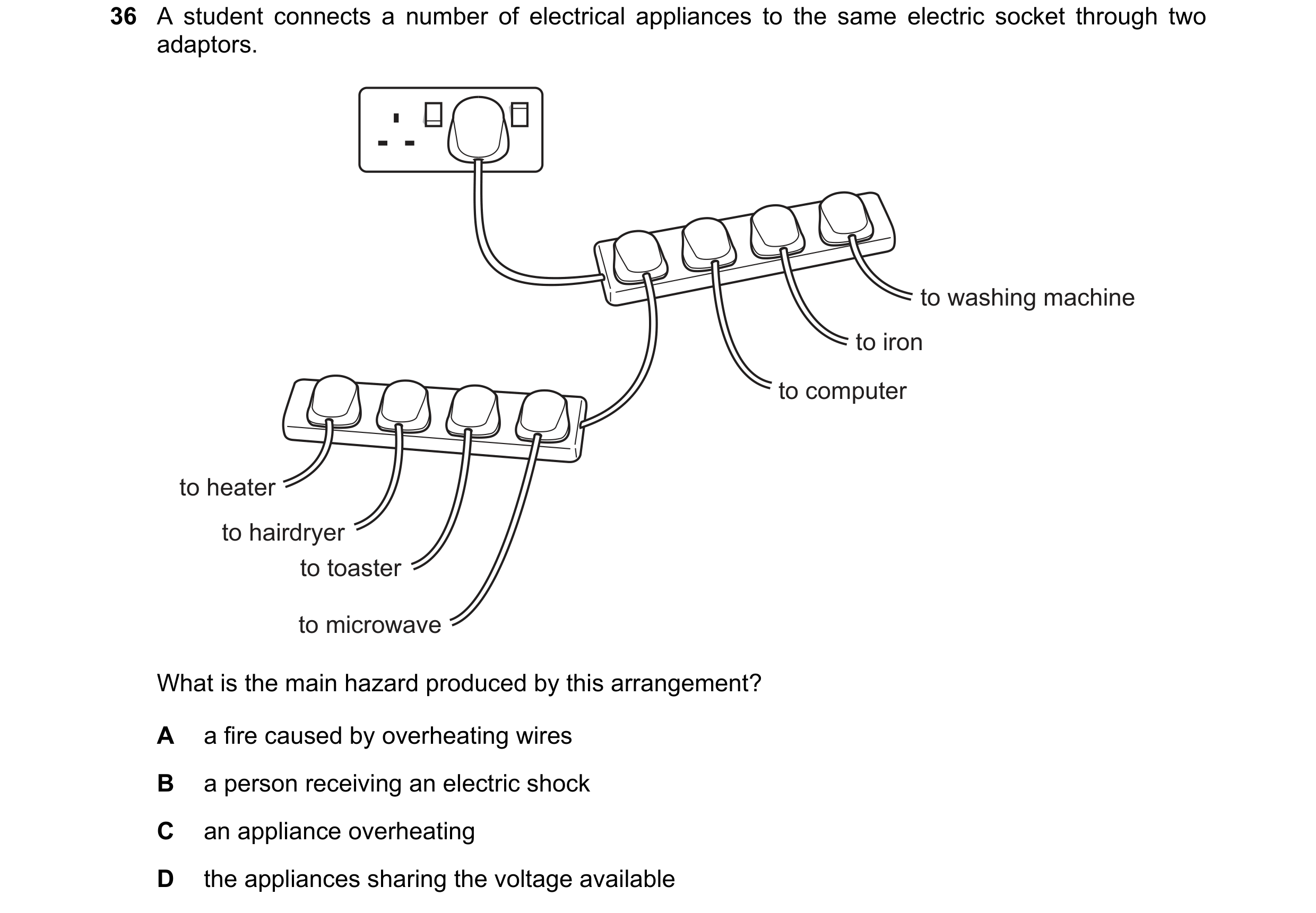
Q10 · A student connects a number of electrical appliances to the same electric socket through… 0652/12 Oct/Nov 2018
36 A student connects a number of electrical appliances to the same electric socket through two adaptors. to washing machine to iron to computer to heater to hairdryer to toaster to microwave What is the main hazard produced by this arrangement? A a fire caused by overheating wires B a person receiving an electric shock C an appliance overheating D the appliances sharing the voltage available
1 marks
Answer: A
This question in 0652/12 Oct/Nov 2018
Q11 · A four-way adaptor is connected by a cable to the mains supply 0652/11 Oct/Nov 2019
37 A four-way adaptor is connected by a cable to the mains supply. The cable is protected by a 13 A fuse. mains socket four-way adaptor plug cable to adaptor Which use of the adaptor causes the fuse protecting the cable to ‘blow’? number of current in plugs used plugs A 1 12 A B 2 10 A and 10 A C 3 3 A, 4 A and 5 A D 4 2 A, 2 A, 3 A and 3 A
1 marks
Answer: B
This question in 0652/11 Oct/Nov 2019
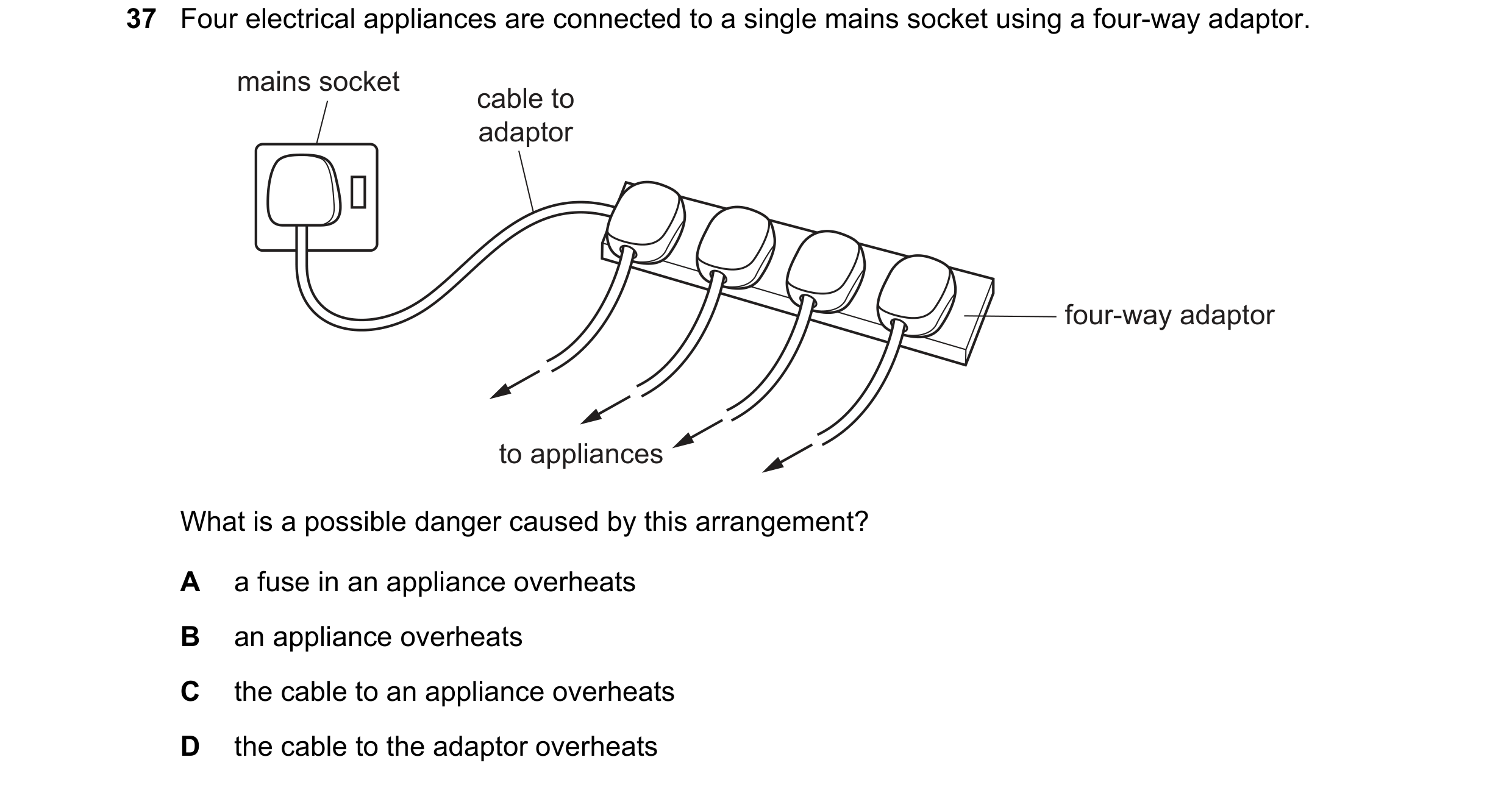
Q12 · Four electrical appliances are connected to a single mains socket using a four-way adaptor 0652/12 Oct/Nov 2019
37 Four electrical appliances are connected to a single mains socket using a four-way adaptor. mains socket cable to adaptor four-way adaptor to appliances What is a possible danger caused by this arrangement? A a fuse in an appliance overheats B an appliance overheats C the cable to an appliance overheats D the cable to the adaptor overheats
1 marks
Answer: D
This question in 0652/12 Oct/Nov 2019
Q13 · Overheating of a cable in an electric circuit is a safety hazard 0652/11 Oct/Nov 2020
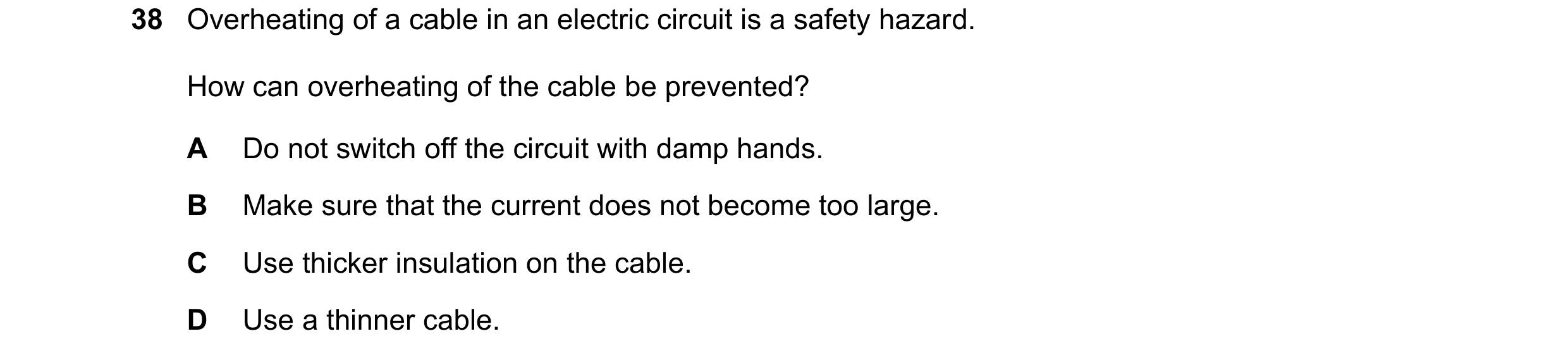
38 Overheating of a cable in an electric circuit is a safety hazard. How can overheating of the cable be prevented? A Do not switch off the circuit with damp hands. B Make sure that the current does not become too large. C Use thicker insulation on the cable. D Use a thinner cable.
1 marks
Answer: B
This question in 0652/11 Oct/Nov 2020
Q14 · What is the benefit of earthing the metal case of an electric kettle? 0652/11 Oct/Nov 2022
37 What is the benefit of earthing the metal case of an electric kettle? A It prevents an electric shock if the live wire touches the metal case. B It prevents the insulation of the cable from becoming damaged. C It prevents overheating of the cable. D It prevents overheating of the kettle.
1 marks
Answer: A
This question in 0652/11 Oct/Nov 2022
Q15 · A lamp is in a circuit that is protected by a 1 A fuse 0652/11 Oct/Nov 2023
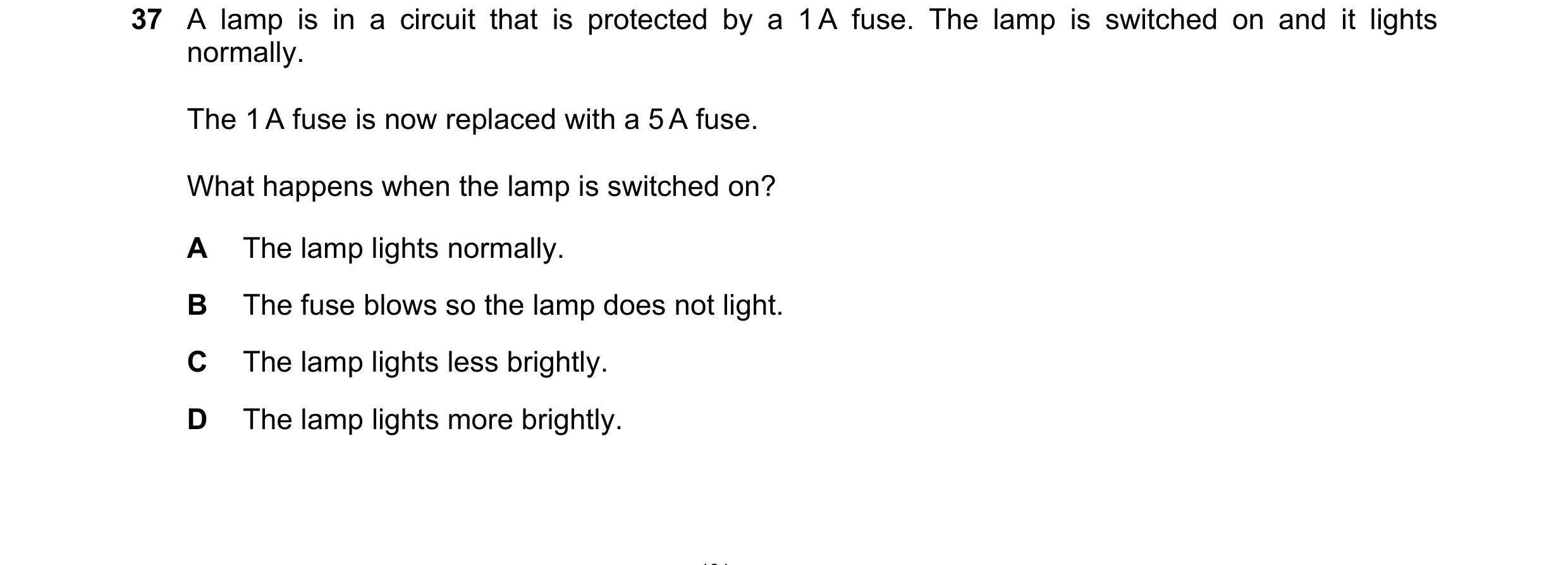
37 A lamp is in a circuit that is protected by a 1 A fuse. The lamp is switched on and it lights normally. The 1 A fuse is now replaced with a 5 A fuse. What happens when the lamp is switched on? A The lamp lights normally. B The fuse blows so the lamp does not light. C The lamp lights less brightly. D The lamp lights more brightly.
1 marks
Answer: A
This question in 0652/11 Oct/Nov 2023
Q16 · A lamp is in a circuit that is protected by a 1 A fuse 0652/12 Oct/Nov 2023
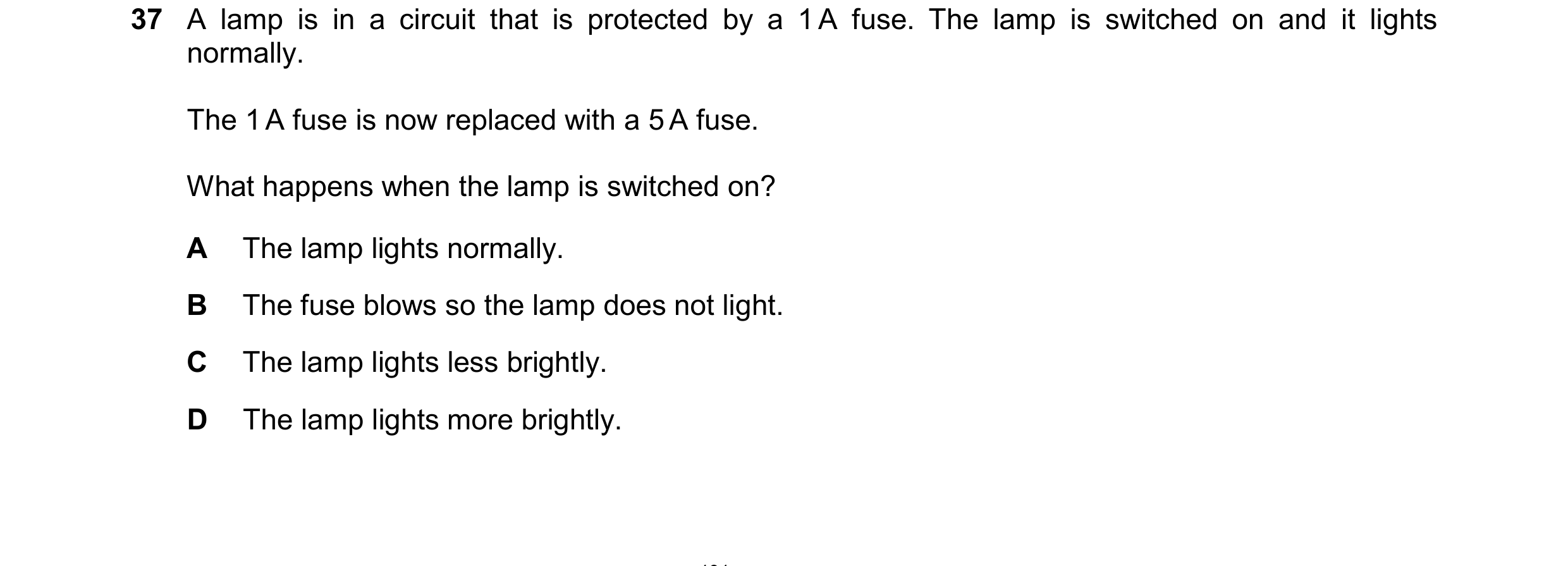
37 A lamp is in a circuit that is protected by a 1 A fuse. The lamp is switched on and it lights normally. The 1 A fuse is now replaced with a 5 A fuse. What happens when the lamp is switched on? A The lamp lights normally. B The fuse blows so the lamp does not light. C The lamp lights less brightly. D The lamp lights more brightly.
1 marks
Answer: A
This question in 0652/12 Oct/Nov 2023
Q17 · An electrical appliance has a metal case 0652/11 Oct/Nov 2024
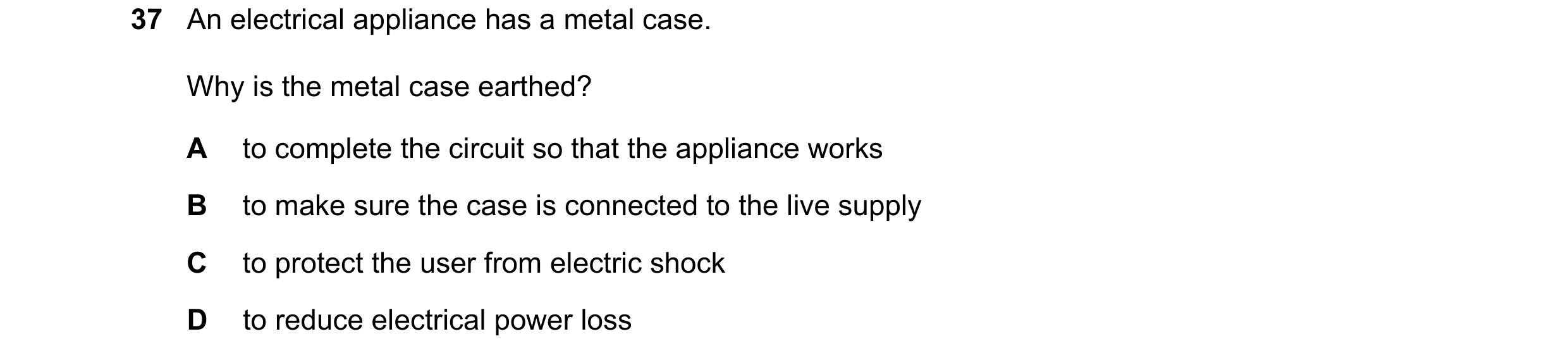
37 An electrical appliance has a metal case. Why is the metal case earthed? A to complete the circuit so that the appliance works B to make sure the case is connected to the live supply C to protect the user from electric shock D to reduce electrical power loss
1 marks
Answer: C
This question in 0652/11 Oct/Nov 2024
 1 / 5
1 / 5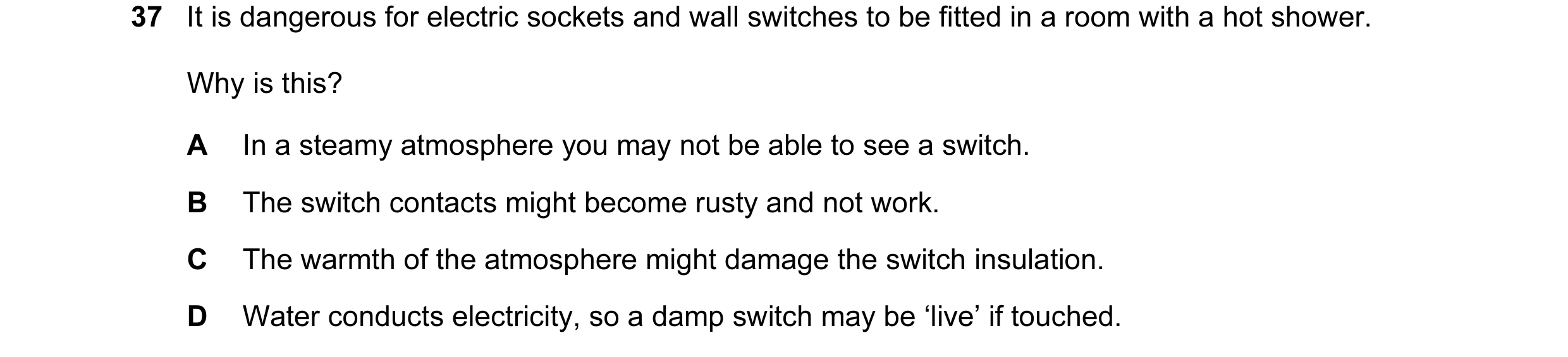
 2 / 5
2 / 5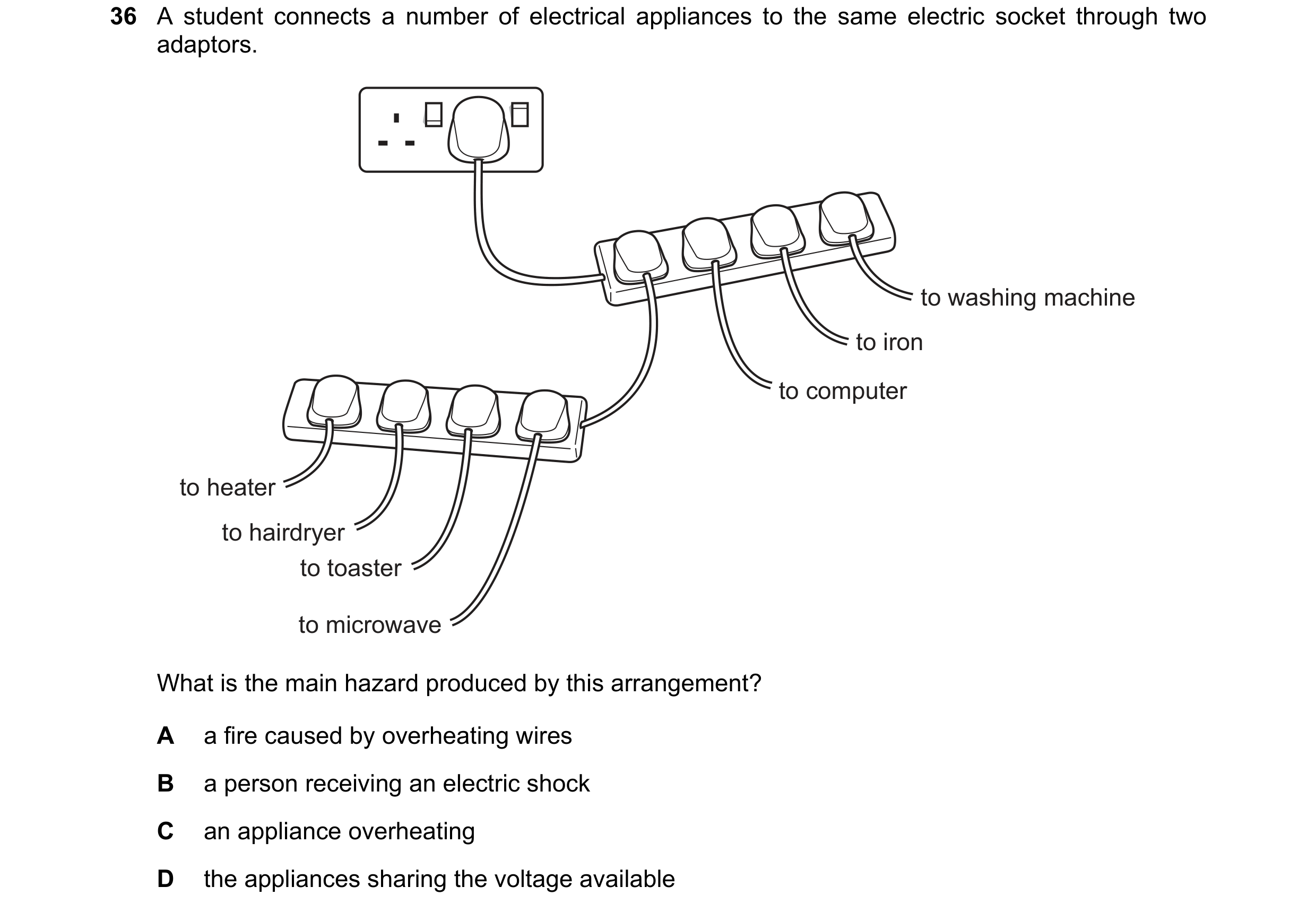
 3 / 5
3 / 5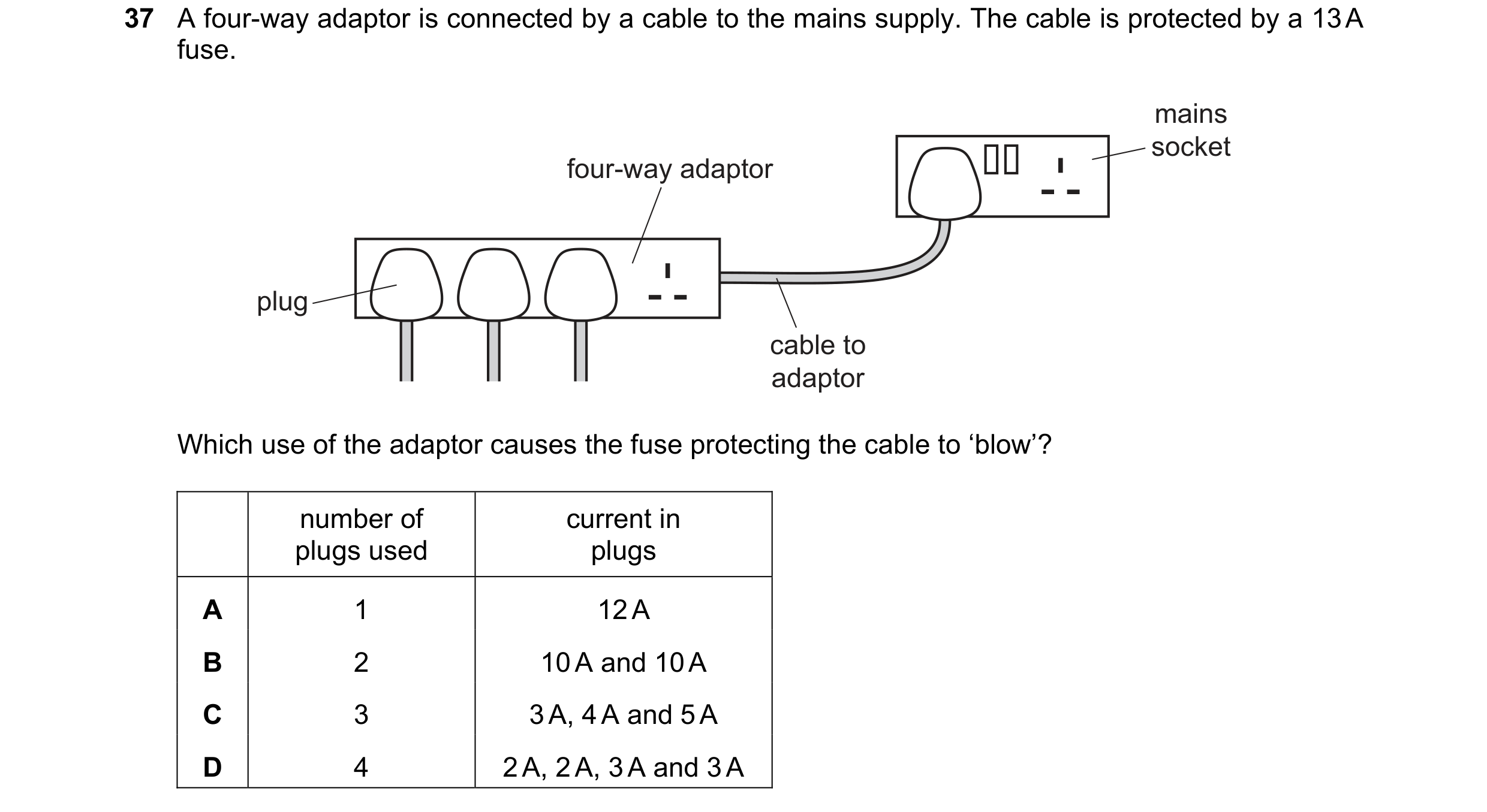
 4 / 5
4 / 5
 5 / 5
5 / 5