Questions as text
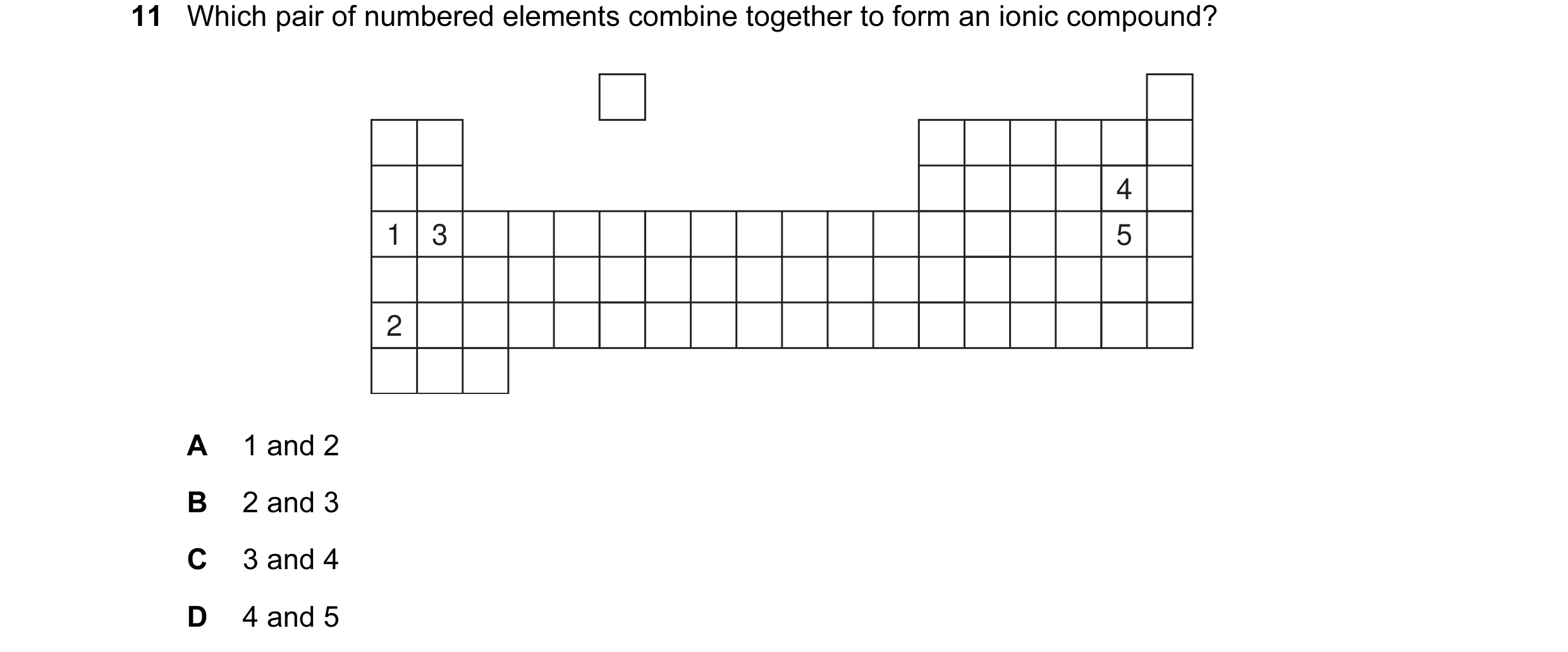
Q1 · Which pair of numbered elements combine together to form an ionic compound? 0652/11 Oct/Nov 2005
11 Which pair of numbered elements combine together to form an ionic compound? 4 1 3 5 2 A 1 and 2 B 2 and 3 C 3 and 4 D 4 and 5
1 marks
Answer: C
This question in 0652/11 Oct/Nov 2005
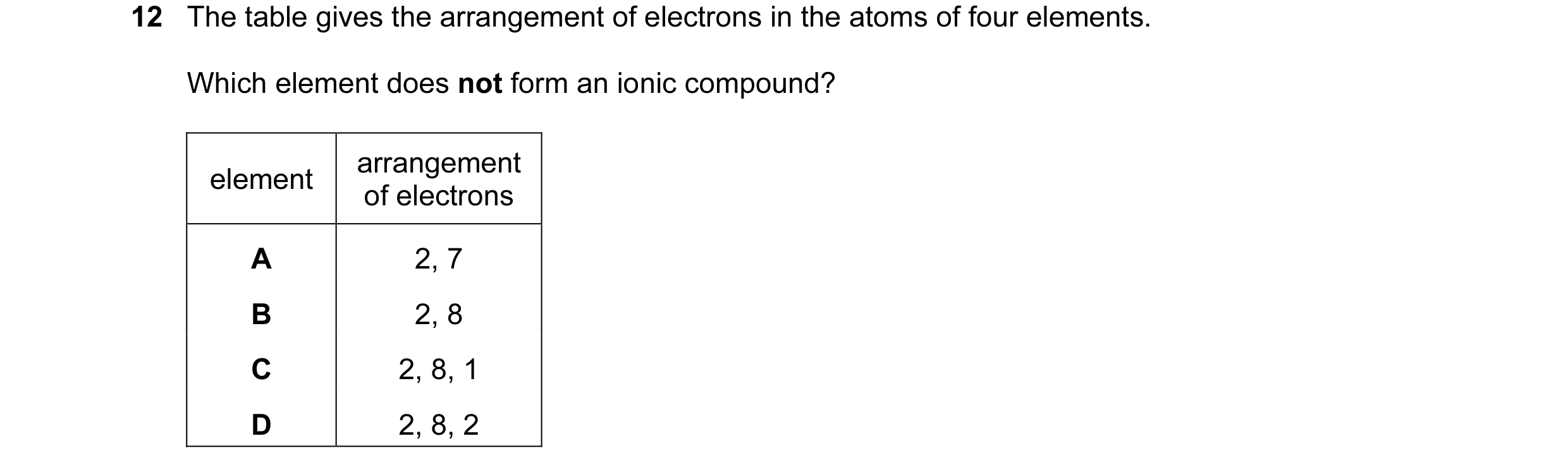
Q2 · The table gives the arrangement of electrons in the atoms of four elements 0652/11 Oct/Nov 2009
12 The table gives the arrangement of electrons in the atoms of four elements. Which element does not form an ionic compound? arrangement element of electrons A 2, 7 B 2, 8 C 2, 8, 1 D 2, 8, 2
1 marks
Answer: B
This question in 0652/11 Oct/Nov 2009
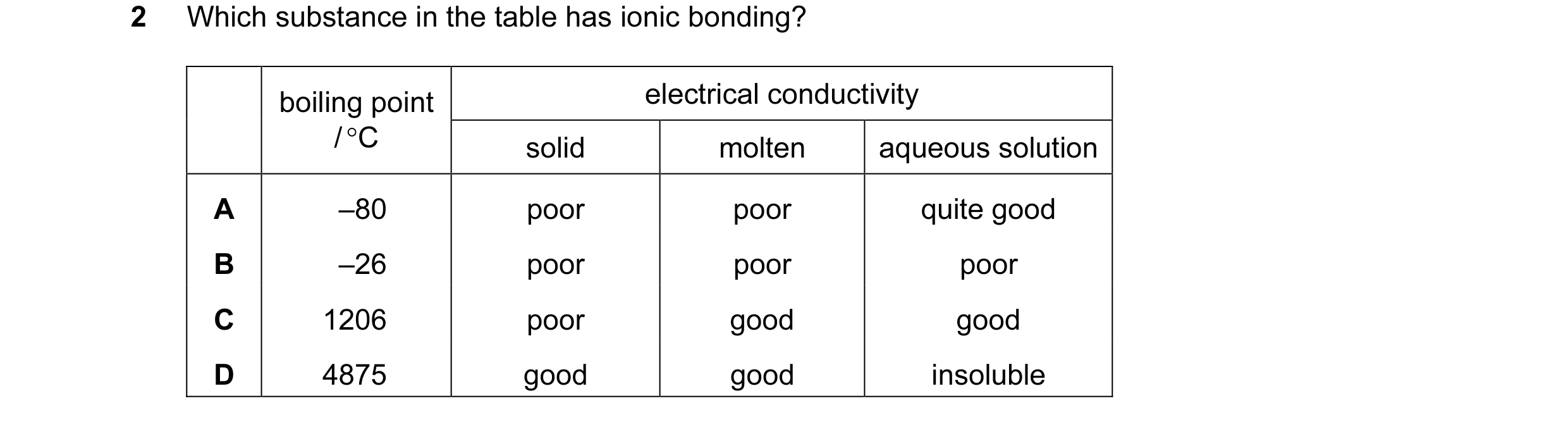
Q3 · Which substance in the table has ionic bonding? 0652/11 Oct/Nov 2010
2 Which substance in the table has ionic bonding? boiling point electrical conductivity / °C solid molten aqueous solution A –80 poor poor quite good B –26 poor poor poor C 1206 poor good good D 4875 good good insoluble
1 marks
Answer: C
This question in 0652/11 Oct/Nov 2010
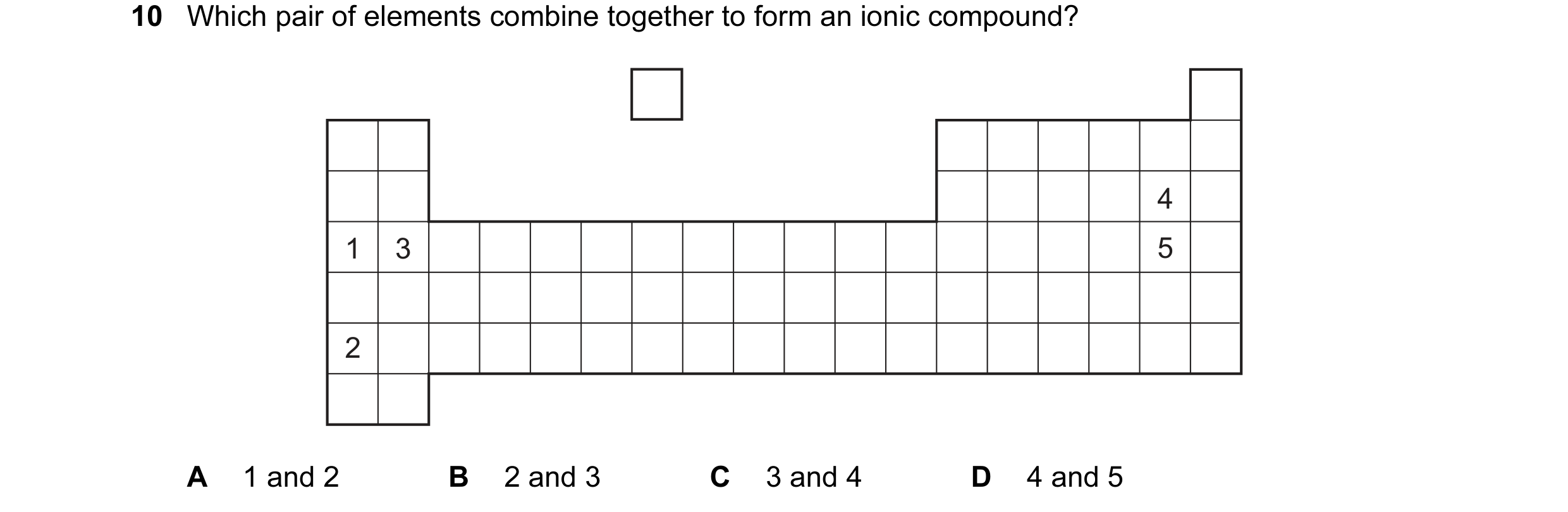
Q4 · Which pair of elements combine together to form an ionic compound? 0652/11 Oct/Nov 2013
10 Which pair of elements combine together to form an ionic compound? 4 1 3 5 2 A 1 and 2 B 2 and 3 C 3 and 4 D 4 and 5
1 marks
Answer: C
This question in 0652/11 Oct/Nov 2013
Q5 · Which pair of elements combine together to form an ionic compound? 0652/12 Oct/Nov 2013
10 Which pair of elements combine together to form an ionic compound? 4 1 3 5 2 A 1 and 2 B 2 and 3 C 3 and 4 D 4 and 5
1 marks
Answer: C
This question in 0652/12 Oct/Nov 2013
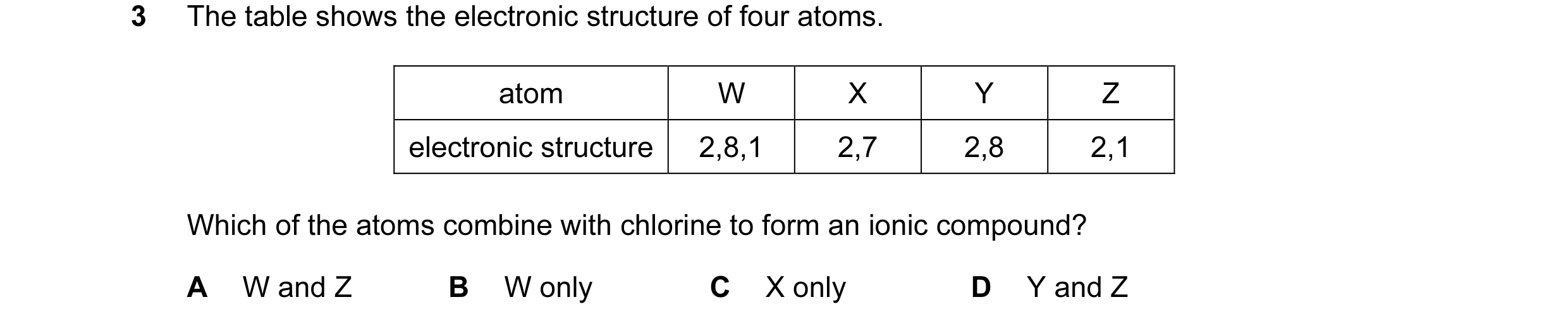
Q6 · The table shows the electronic structure of four atoms 0652/11 Oct/Nov 2014
3 The table shows the electronic structure of four atoms. atom W X Y Z electronic structure 2,8,1 2,7 2,8 2,1 Which of the atoms combine with chlorine to form an ionic compound? A W and Z B W only C X only D Y and Z
1 marks
Answer: A
This question in 0652/11 Oct/Nov 2014
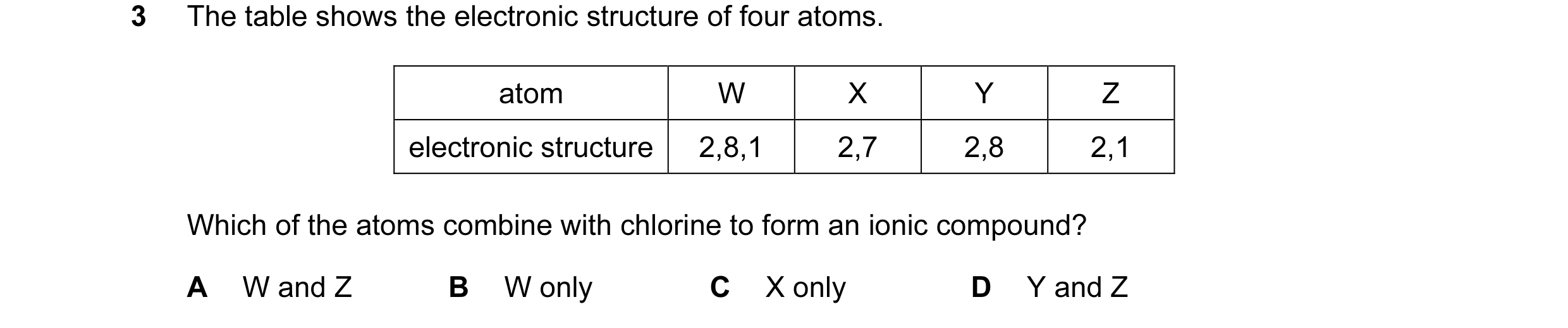
Q7 · The table shows the electronic structure of four atoms 0652/12 Oct/Nov 2014
3 The table shows the electronic structure of four atoms. atom W X Y Z electronic structure 2,8,1 2,7 2,8 2,1 Which of the atoms combine with chlorine to form an ionic compound? A W and Z B W only C X only D Y and Z
1 marks
Answer: A
This question in 0652/12 Oct/Nov 2014
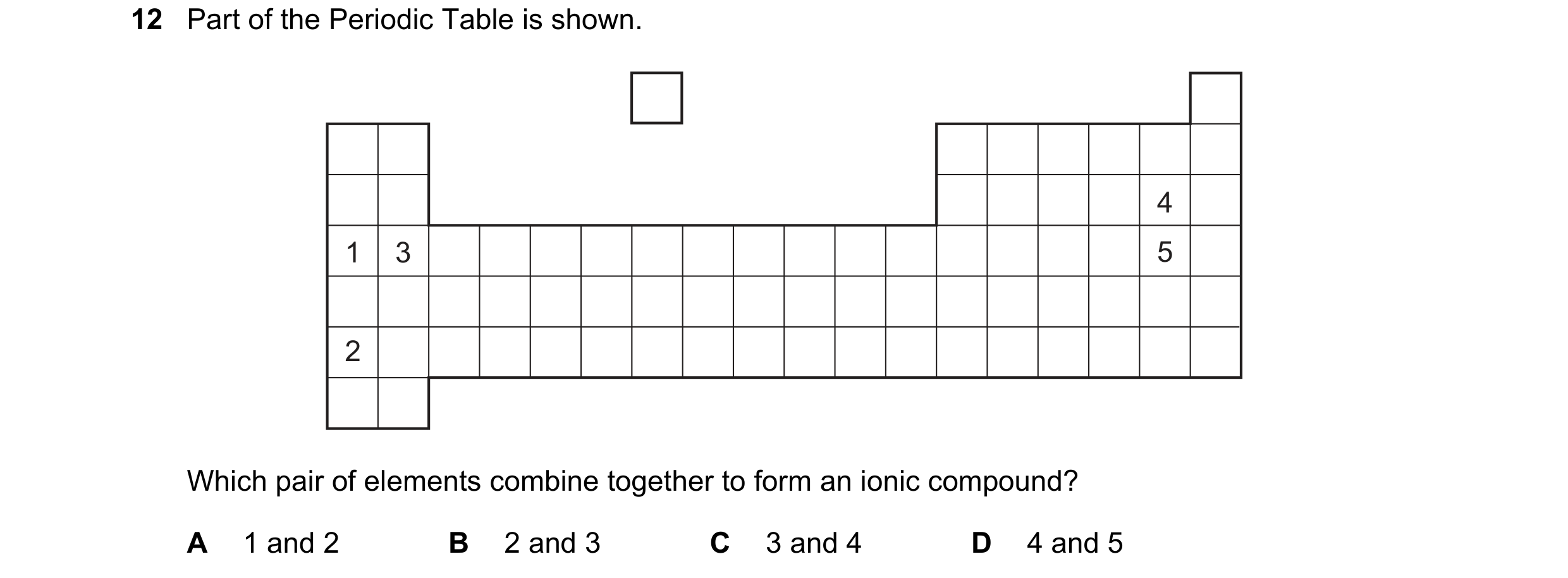
Q8 · Part of the Periodic Table is shown 0652/11 Oct/Nov 2016
12 Part of the Periodic Table is shown. 4 1 3 5 2 Which pair of elements combine together to form an ionic compound? A 1 and 2 B 2 and 3 C 3 and 4 D 4 and 5
1 marks
Answer: C
This question in 0652/11 Oct/Nov 2016
Q9 · Part of the Periodic Table is shown 0652/12 Oct/Nov 2016
12 Part of the Periodic Table is shown. 4 1 3 5 2 Which pair of elements combine together to form an ionic compound? A 1 and 2 B 2 and 3 C 3 and 4 D 4 and 5
1 marks
Answer: C
This question in 0652/12 Oct/Nov 2016
Q10 · When atoms of sodium combine with atoms of chlorine, sodium chloride is formed 0652/11 Oct/Nov 2017
3 When atoms of sodium combine with atoms of chlorine, sodium chloride is formed. How are the bonds between sodium and chlorine formed? A Chlorine gives electrons to sodium. B Sodium and chlorine lose electrons. C Sodium gives electrons to chlorine. D Sodium shares electrons with chlorine.
1 marks
Answer: C
This question in 0652/11 Oct/Nov 2017
Q11 · When atoms of sodium combine with atoms of chlorine, sodium chloride is formed 0652/12 Oct/Nov 2017
3 When atoms of sodium combine with atoms of chlorine, sodium chloride is formed. How are the bonds between sodium and chlorine formed? A Chlorine gives electrons to sodium. B Sodium and chlorine lose electrons. C Sodium gives electrons to chlorine. D Sodium shares electrons with chlorine.
1 marks
Answer: C
This question in 0652/12 Oct/Nov 2017
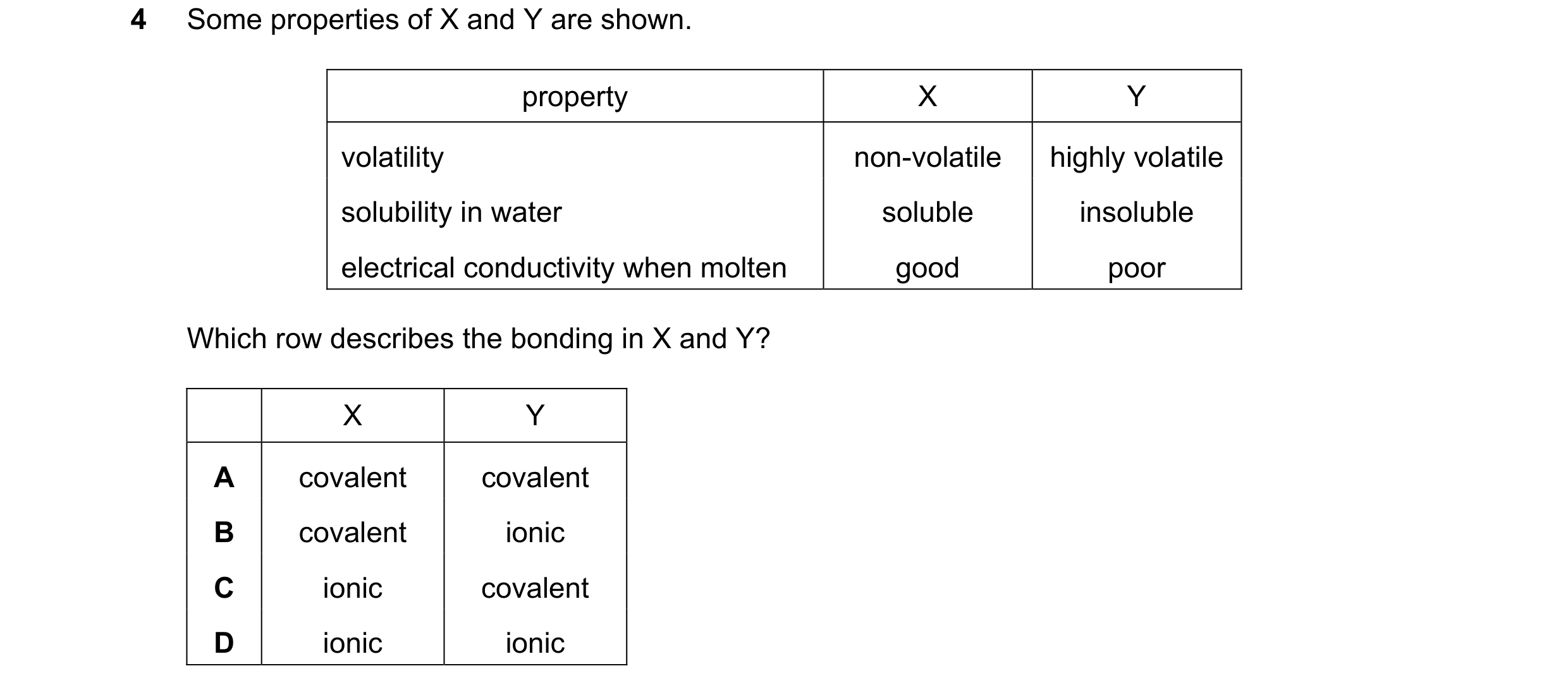
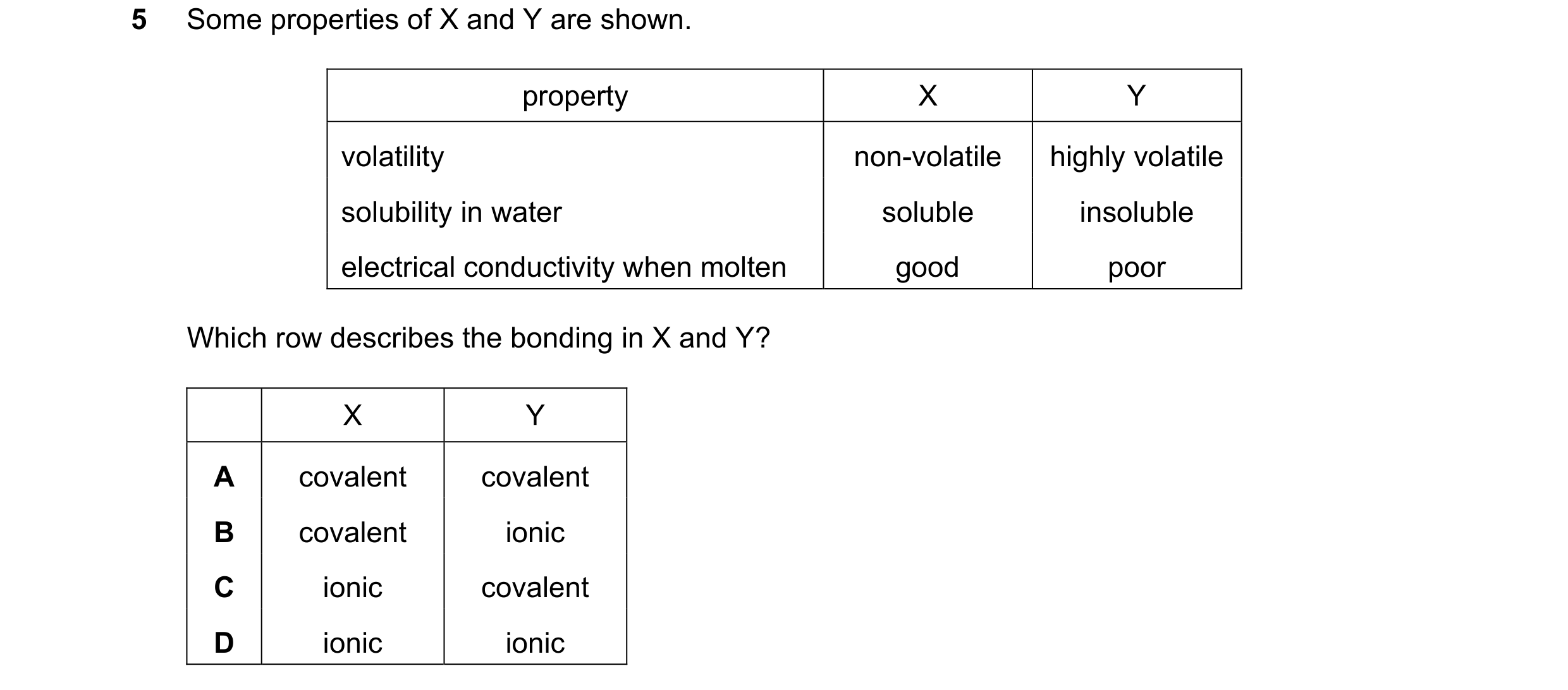
Q12 · Some properties of X and Y are shown 0652/12 Oct/Nov 2019
4 Some properties of X and Y are shown. property X Y volatility non-volatile highly volatile solubility in water soluble insoluble electrical conductivity when molten good poor Which row describes the bonding in X and Y? X Y A covalent covalent B covalent ionic C ionic covalent D ionic ionic
1 marks
Answer: C
This question in 0652/12 Oct/Nov 2019
Q13 · Rubidium iodide is an ionic compound 0652/11 Oct/Nov 2020
5 Rubidium iodide is an ionic compound. Which row describes what happens to the rubidium and iodine atoms when they form ions? rubidium atoms iodine atoms A gain one electron gain one electron B gain one electron lose one electron C lose one electron gain one electron D lose one electron lose one electron
1 marks
Answer: C
This question in 0652/11 Oct/Nov 2020
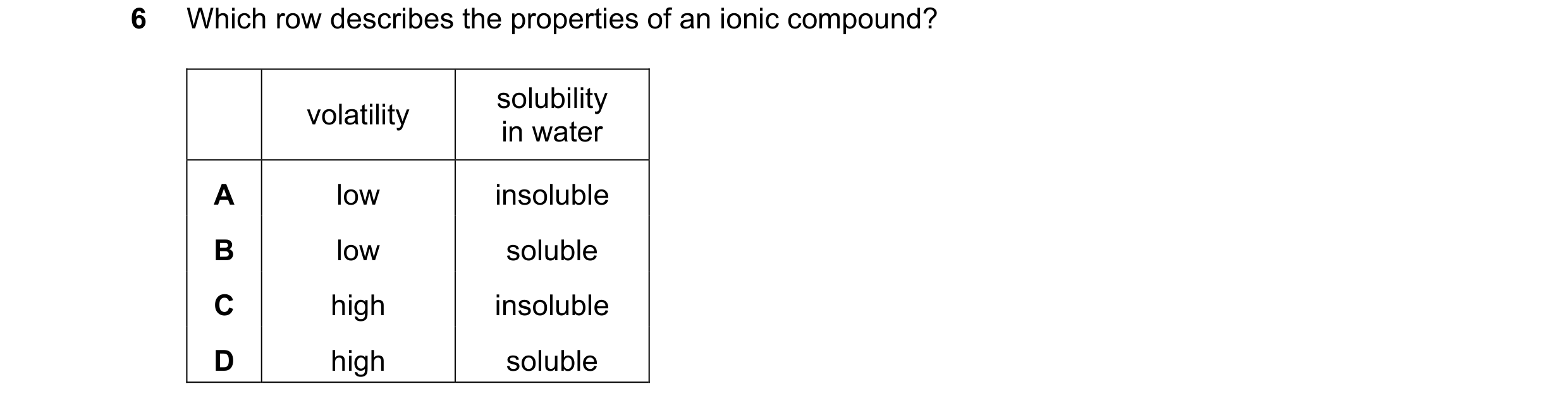
Q14 · Which row describes the properties of an ionic compound? 0652/11 Oct/Nov 2020
6 Which row describes the properties of an ionic compound? solubility volatility in water A low insoluble B low soluble C high insoluble D high soluble
1 marks
Answer: B
This question in 0652/11 Oct/Nov 2020
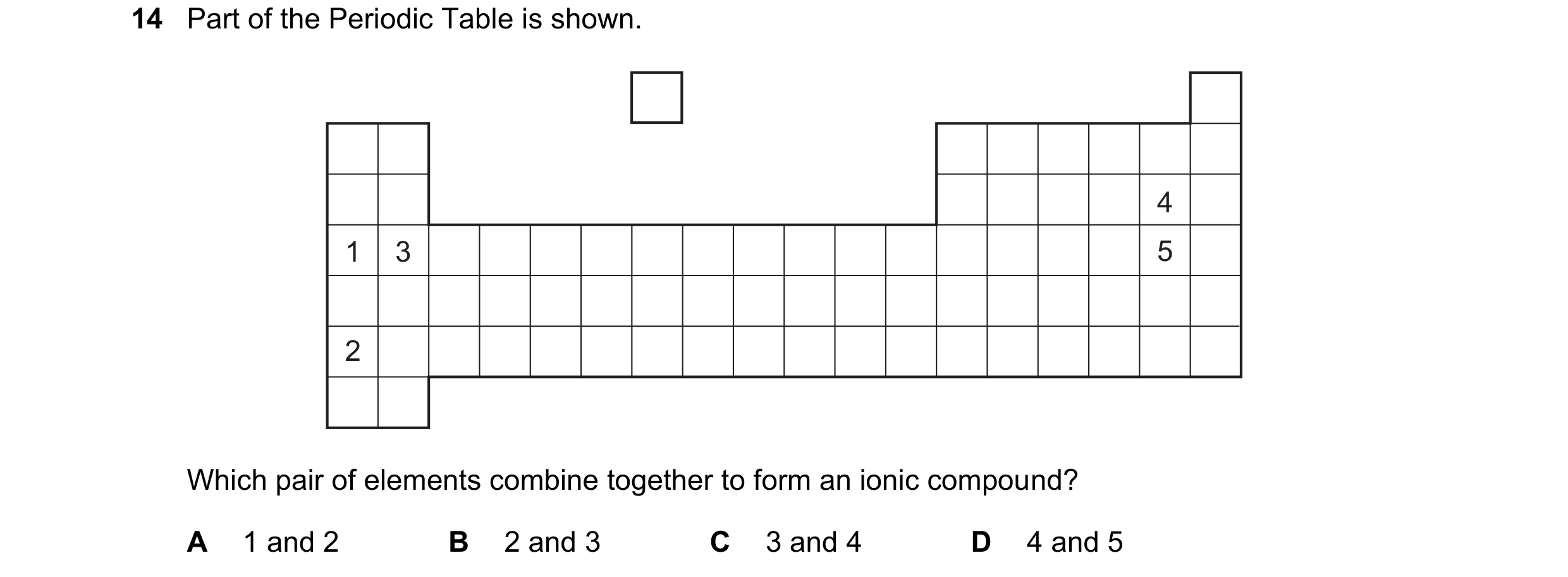
Q15 · Part of the Periodic Table is shown 0652/11 Oct/Nov 2020
14 Part of the Periodic Table is shown. 4 1 3 5 2 Which pair of elements combine together to form an ionic compound? A 1 and 2 B 2 and 3 C 3 and 4 D 4 and 5
1 marks
Answer: C
This question in 0652/11 Oct/Nov 2020
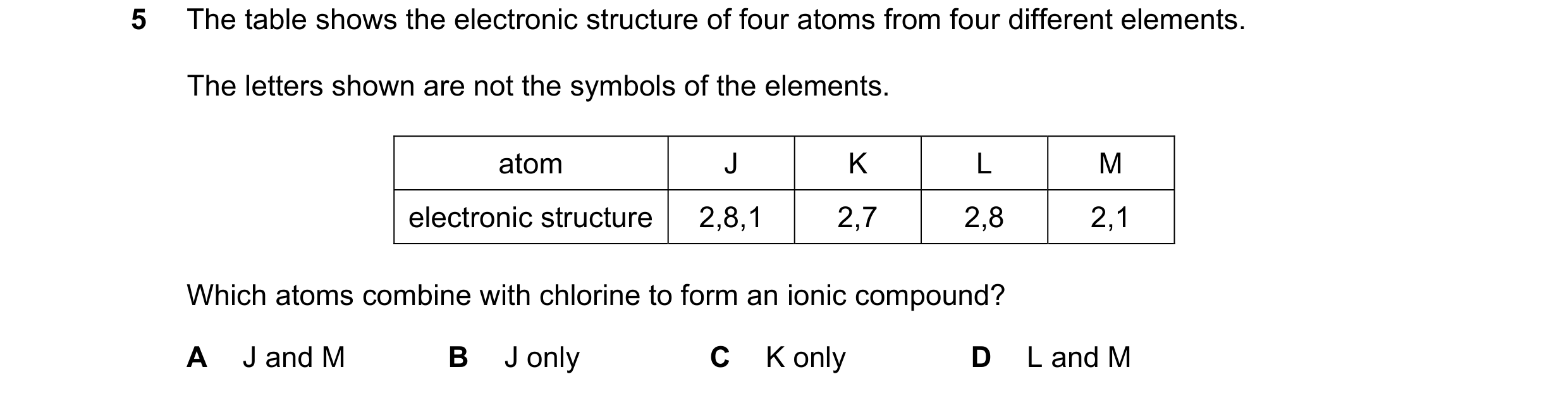
Q16 · The table shows the electronic structure of four atoms from four different elements 0652/11 Oct/Nov 2021
5 The table shows the electronic structure of four atoms from four different elements. The letters shown are not the symbols of the elements. atom J K L M electronic structure 2,8,1 2,7 2,8 2,1 Which atoms combine with chlorine to form an ionic compound? A J and M B J only C K only D L and M
1 marks
Answer: A
This question in 0652/11 Oct/Nov 2021
Q17 · When atoms of sodium combine with atoms of chlorine, sodium chloride is formed 0652/11 Oct/Nov 2022
4 When atoms of sodium combine with atoms of chlorine, sodium chloride is formed. How are the bonds between sodium and chlorine formed? A Chlorine gives electrons to sodium. B Sodium and chlorine lose electrons. C Sodium gives electrons to chlorine. D Sodium shares electrons with chlorine.
1 marks
Answer: C
This question in 0652/11 Oct/Nov 2022
Q18 · Some properties of X and Y are shown 0652/11 Oct/Nov 2024
5 Some properties of X and Y are shown. property X Y volatility non-volatile highly volatile solubility in water soluble insoluble electrical conductivity when molten good poor Which row describes the bonding in X and Y? X Y A covalent covalent B covalent ionic C ionic covalent D ionic ionic
1 marks
Answer: C
This question in 0652/11 Oct/Nov 2024
 1 / 5
1 / 5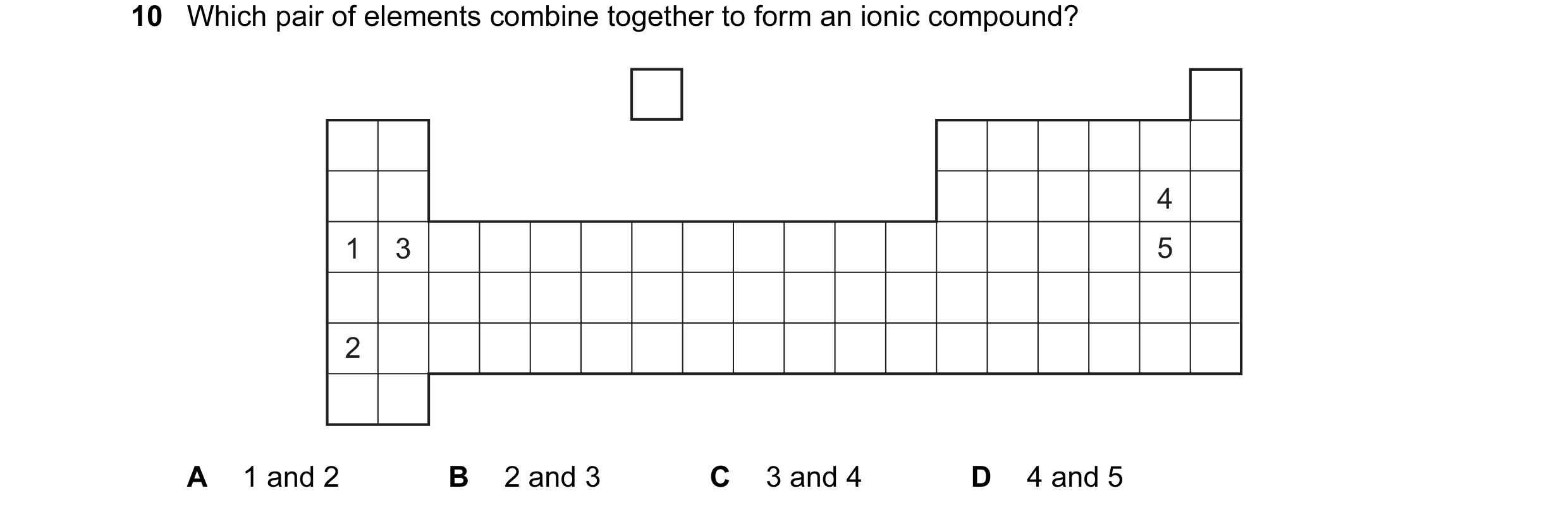
 2 / 5
2 / 5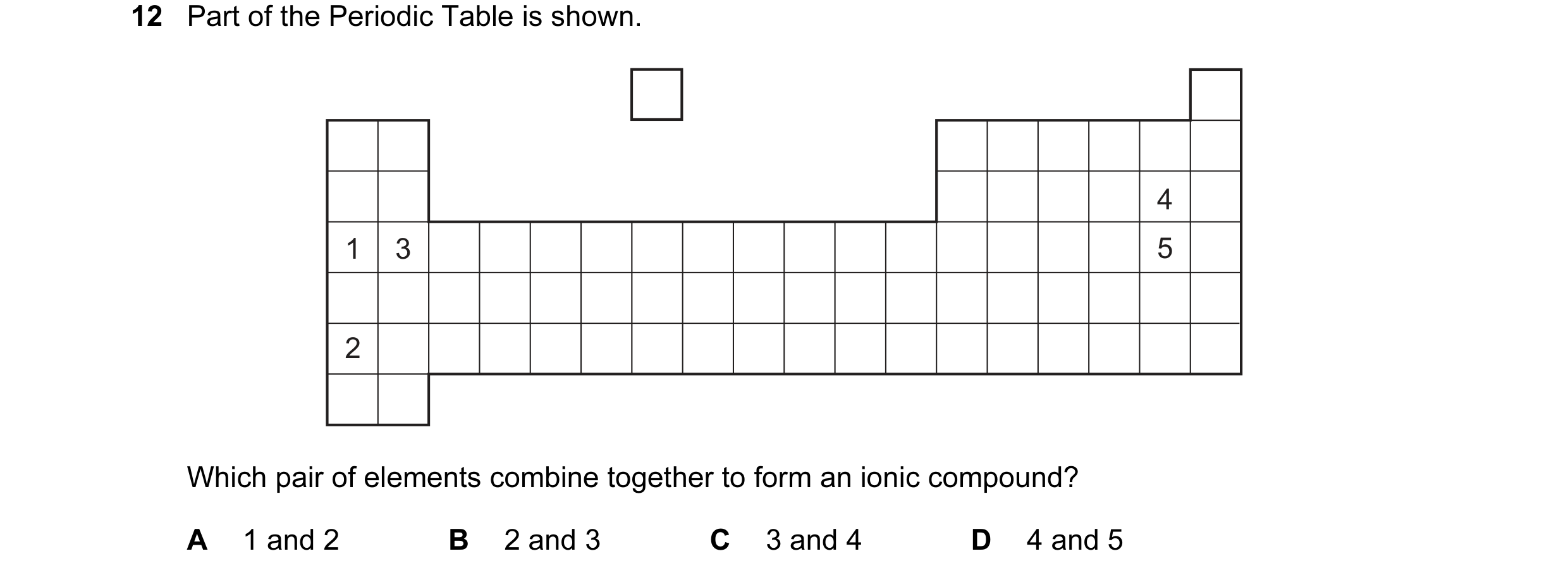
 3 / 5
3 / 5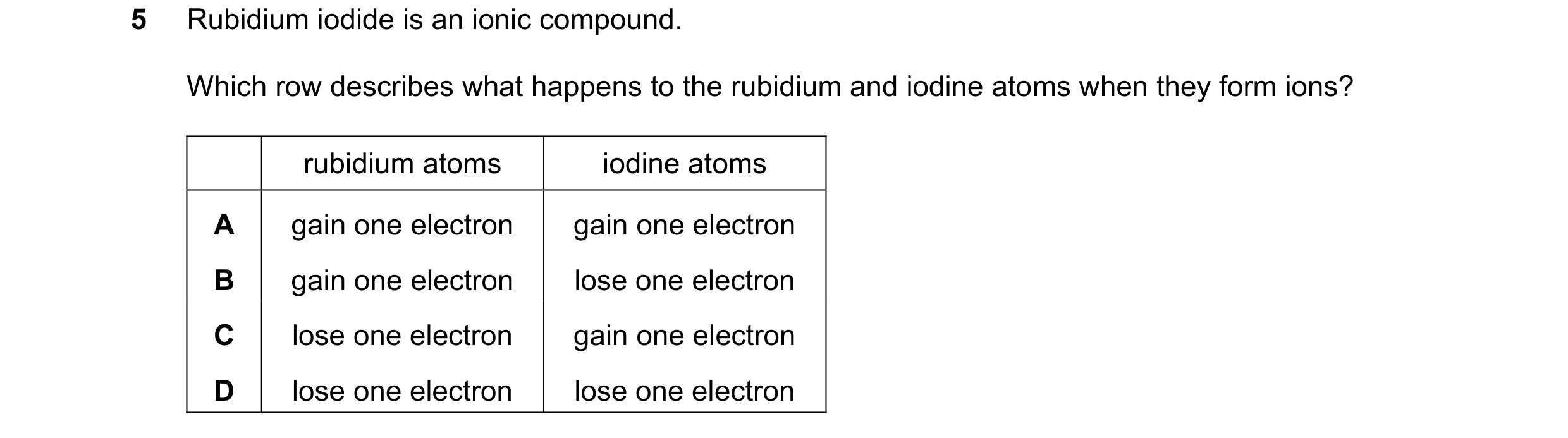
 4 / 5
4 / 5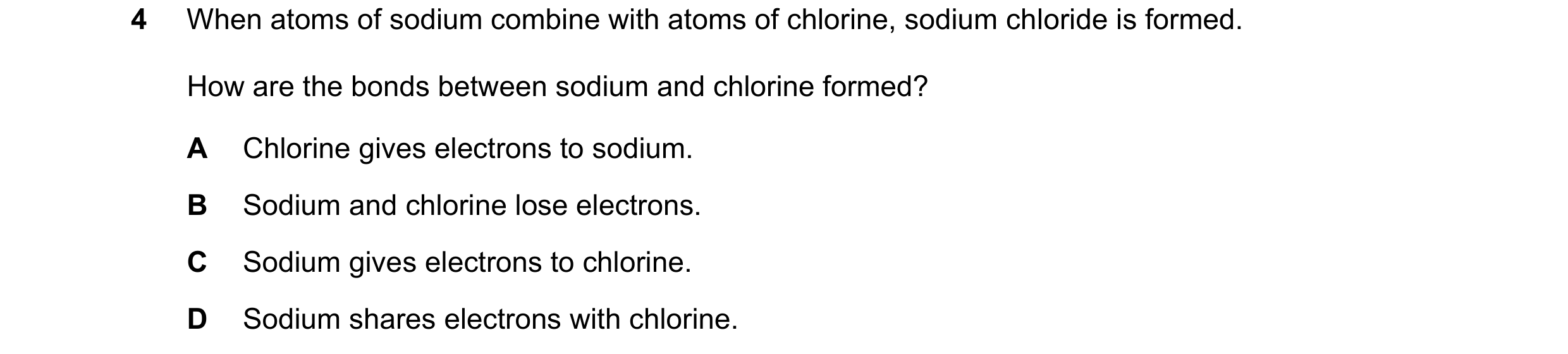
 5 / 5
5 / 5