Questions as text
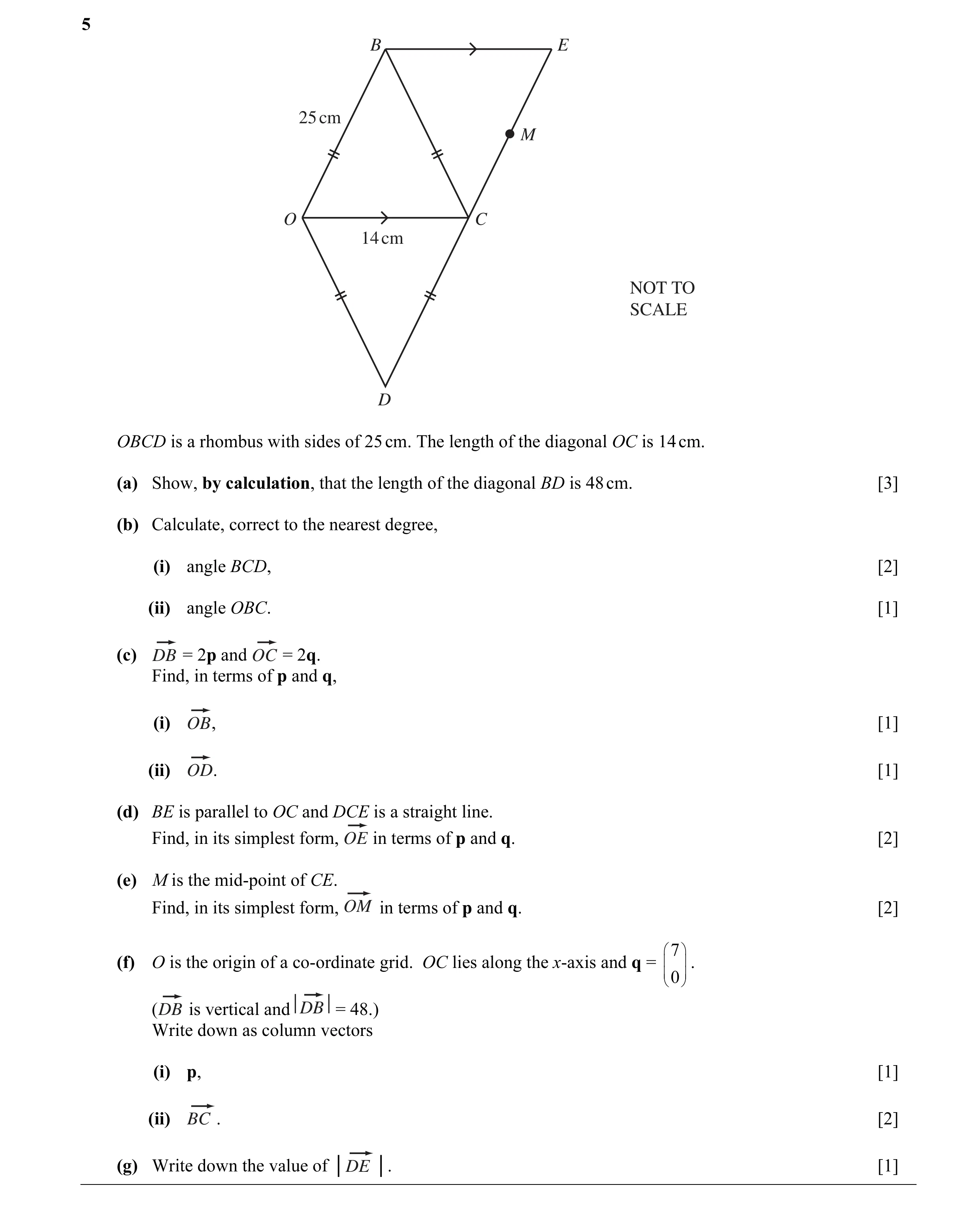
Q1 · B E 25 cm M O C 14 cm NOT TO SCALE D OBCD is a rhombus with sides of 25 cm 0580/41 May/June 2007
5 B E 25 cm M O C 14 cm NOT TO SCALE D OBCD is a rhombus with sides of 25 cm. The length of the diagonal OC is 14 cm. (a) Show, by calculation, that the length of the diagonal BD is 48 cm. [3] (b) Calculate, correct to the nearest degree, (i) angle BCD, [2] (ii) angle OBC. [1] (c) DB = 2p and OC = 2q. Find, in terms of p and q, (i) OB, [1] (ii) OD. [1] (d) BE is parallel to OC and DCE is a straight line. Find, in its simplest form, OE in terms of p and q. [2] (e) M is the mid-point of CE. Find, in its simplest form, OM in terms of p and q. [2] 7 (f) O is the origin of a co-ordinate grid. OC lies along the x-axis and q = . 0 (DB is vertical and DB = 48.) Write down as column vectors (i) p, [1] (ii) BC . [2] (g) Write down the value of │DE │. [1]
16 marks
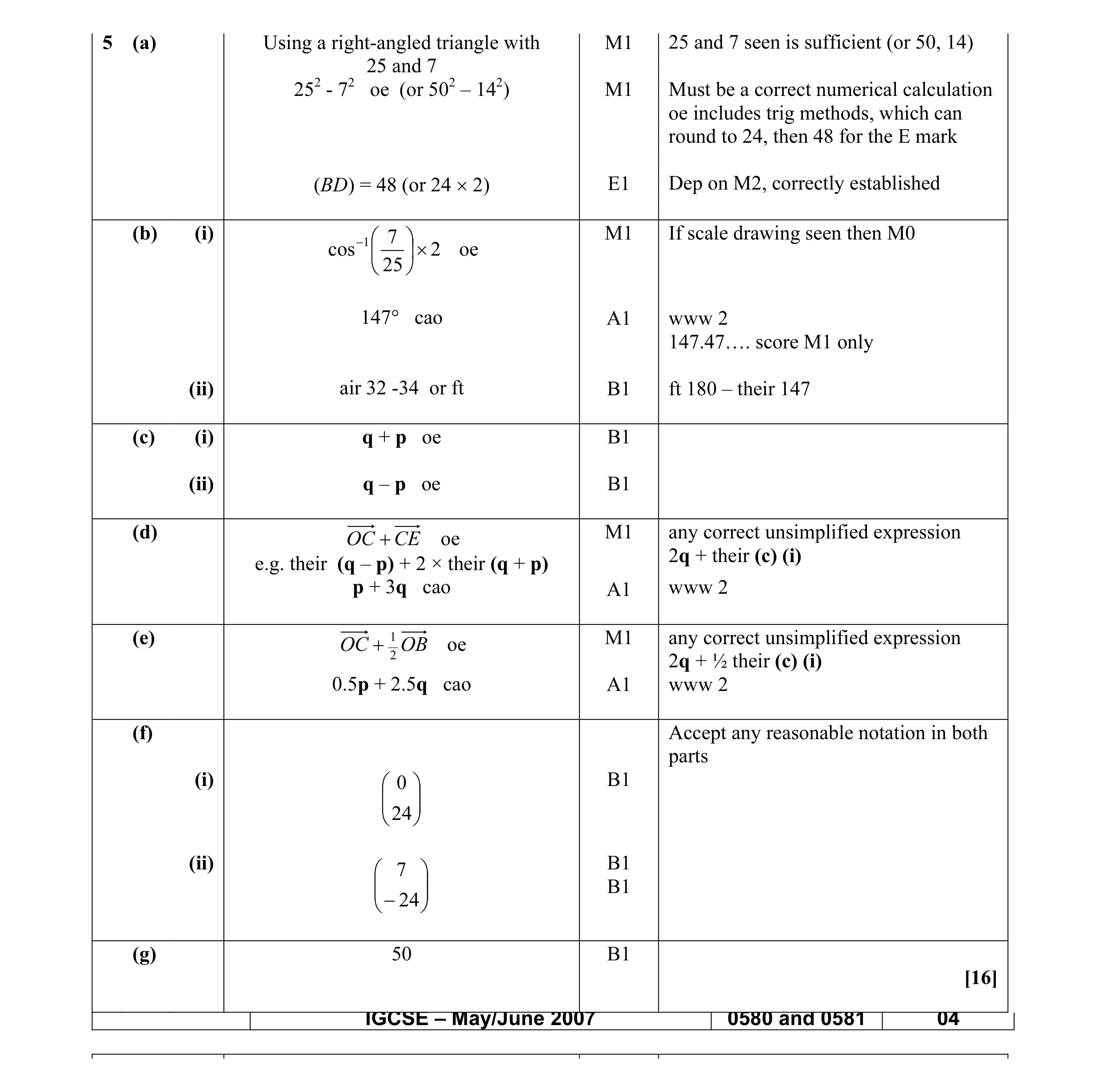
Mark scheme: 5 (a) Using a right-angled triangle with M1 25 and 7 seen is sufficient (or 50, 14) 25 and 7 252 - 72 oe (or 502 – 142) M1 Must be a correct numerical calculation oe includes trig methods, which can round to 24, then 48 for the E mark (BD) = 48 (or 24 × 2) E1 Dep on M2, correctly established (b) (i) −1 7 M1 If scale drawing seen then M0 cos × 2 oe 25 147° cao A1 www 2 147.47…. score M1 only (ii) air 32 -34 or ft B1 ft 180 – their 147 (c) (i) q + p oe B1 (ii) q – p oe B1 (d) M1 any correct unsimplified expression OC + CE oe 2q + their (c) (i) e.g. their (q – p) + 2 × their (q + p) p + 3q cao A1 www 2 (e) 1 M1 any correct unsimplified expression OC + OB oe 2 2q + ½ their (c) (i) 0.5p + 2.5q cao A1 www 2 (f) Accept any reasonable notation in both parts (i) 0 B1 24 (ii) B1 7 B1 −24 (g) 50 B1 [16] IGCSE – May/June 2007 0580 and 0581 04
This question in 0580/41 May/June 2007
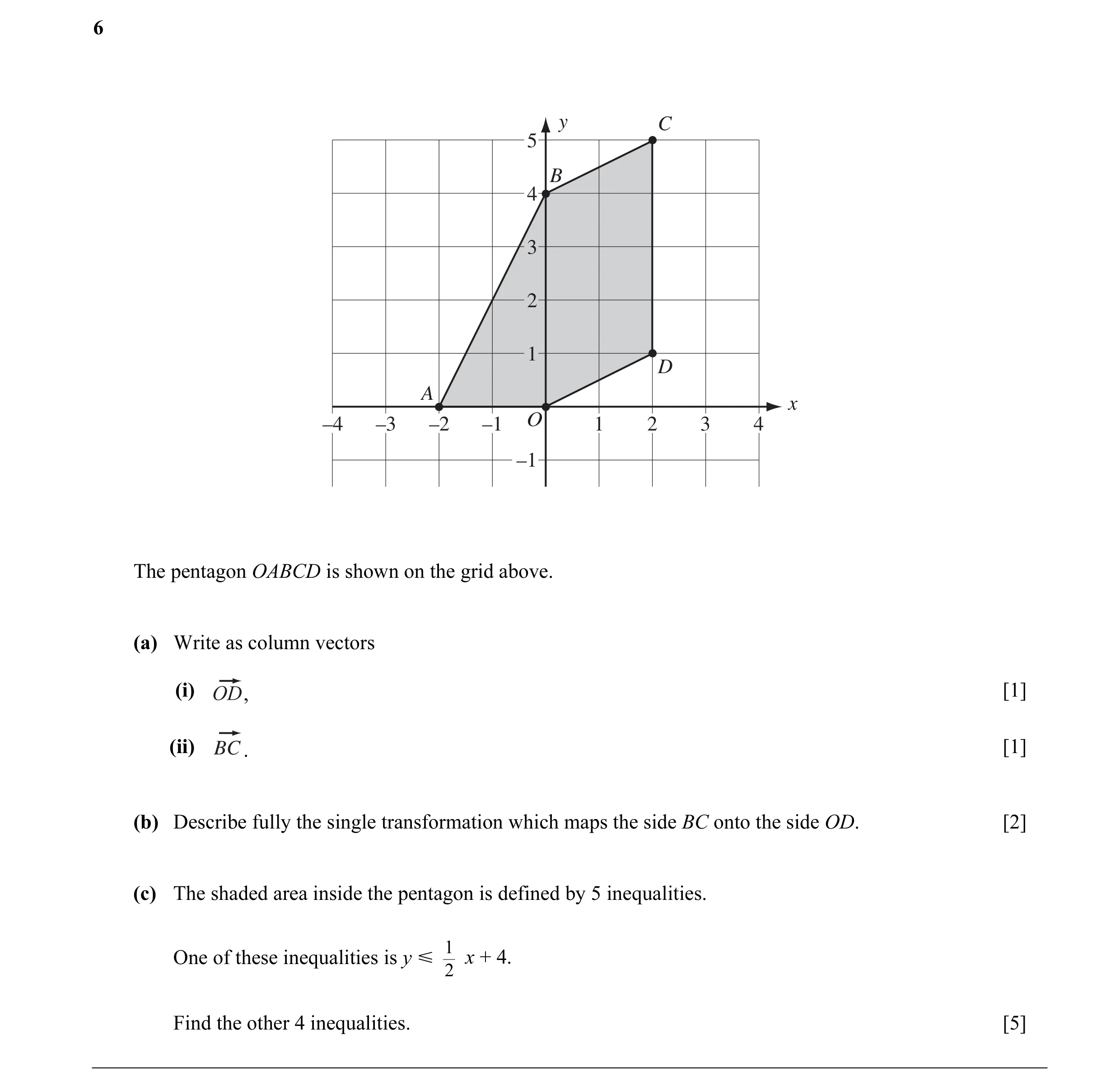
Q2 · Y C 5 B 4 3 2 1 D A x –4 –3 –2 –1 O 1 2 3 4 –1 The pentagon OABCD is shown on the grid… 0580/41 May/June 2008
6 y C 5 B 4 3 2 1 D A x –4 –3 –2 –1 O 1 2 3 4 –1 The pentagon OABCD is shown on the grid above. (a) Write as column vectors (i) , [1] (ii) BC . [1] (b) Describe fully the single transformation which maps the side BC onto the side OD. [2] (c) The shaded area inside the pentagon is defined by 5 inequalities. 1 One of these inequalities is y Y x + 4. 2 Find the other 4 inequalities. [5]
9 marks
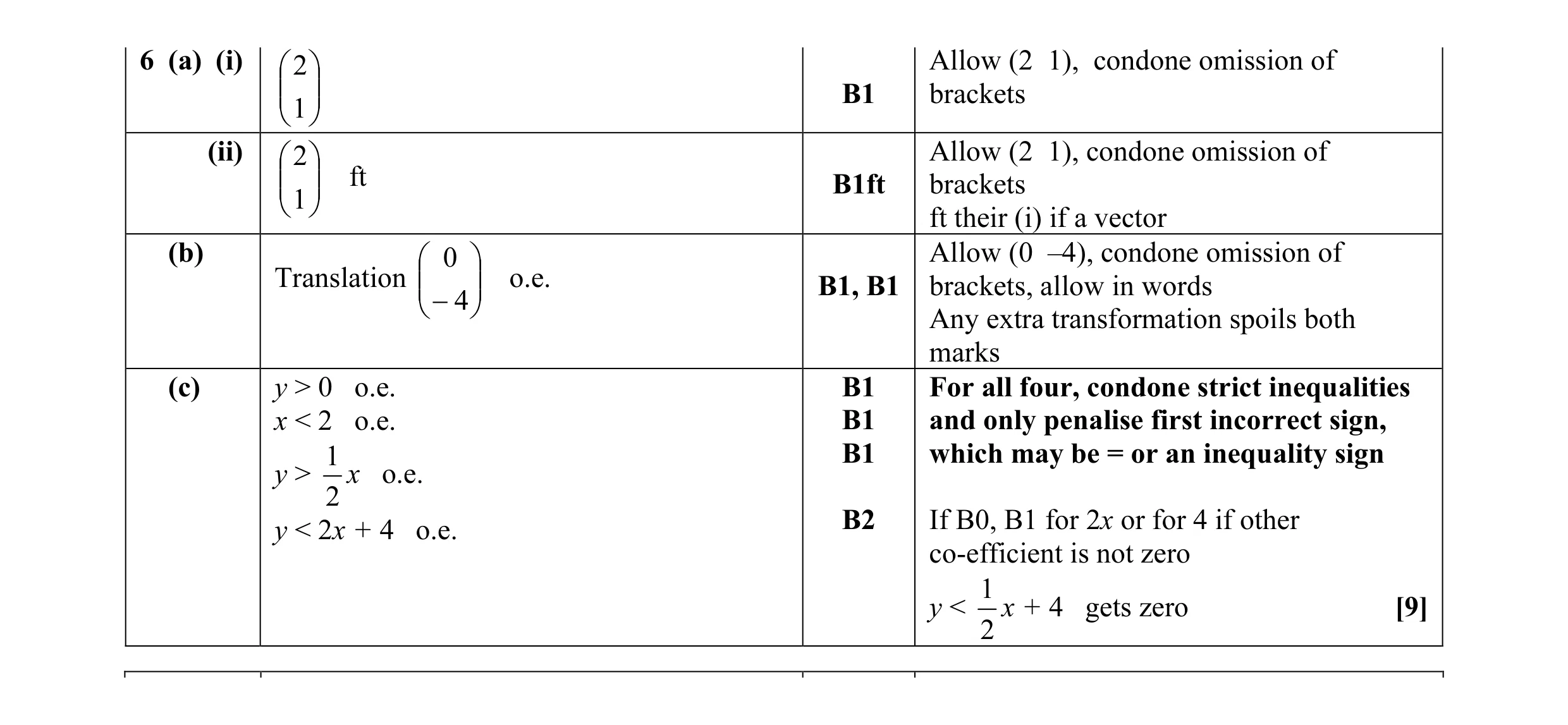
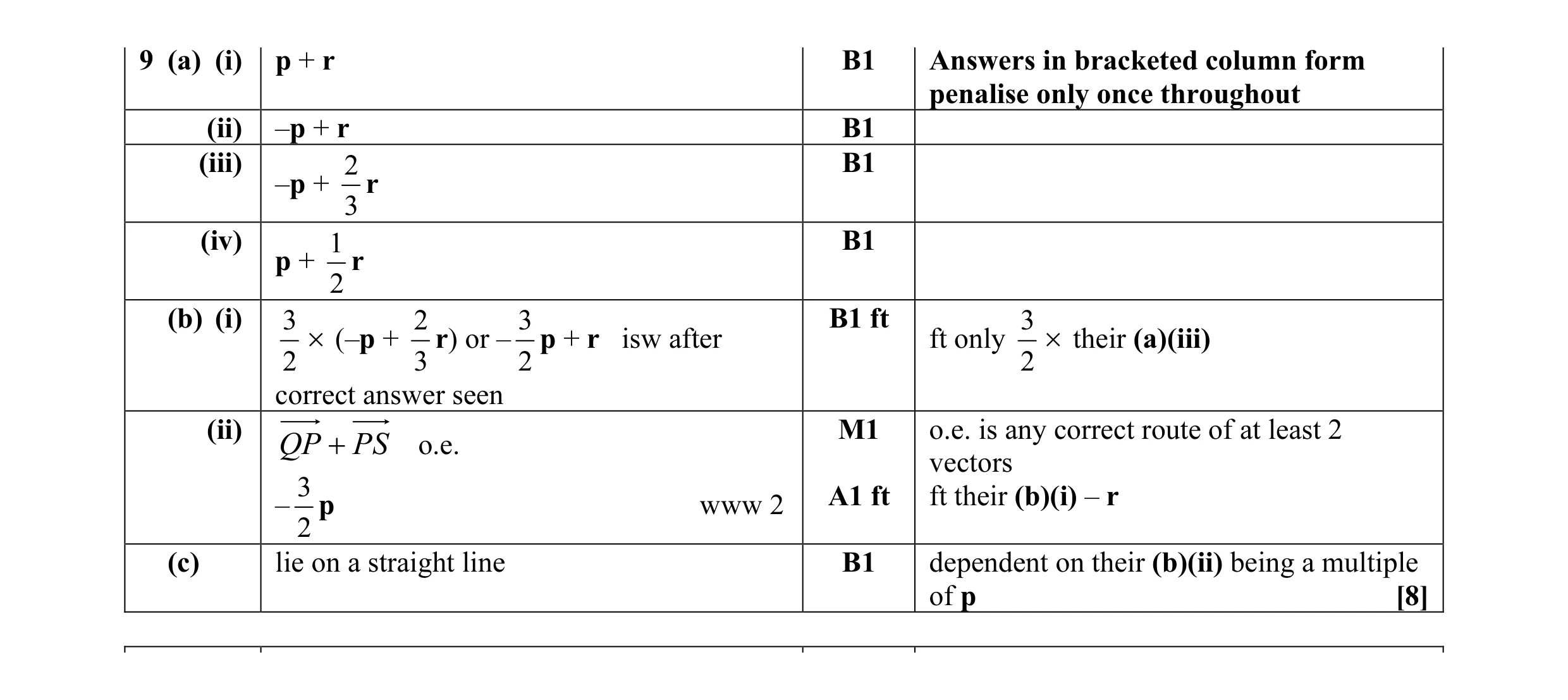
Mark scheme: 6 (a) (i) 2 Allow (2 1), condone omission of B1 brackets 1 (ii) 2 Allow (2 1), condone omission of ft B1ft brackets 1 ft their (i) if a vector (b) 0 Allow (0 –4), condone omission of Translation o.e. B1, B1 brackets, allow in words −4 Any extra transformation spoils both marks (c) y > 0 o.e. B1 For all four, condone strict inequalities x < 2 o.e. B1 and only penalise first incorrect sign, 1 B1 which may be = or an inequality sign y > x o.e. 2 B2 If B0, B1 for 2x or for 4 if other y < 2x + 4 o.e. co-efficient is not zero 1 y < x + 4 gets zero [9] 2
This question in 0580/41 May/June 2008
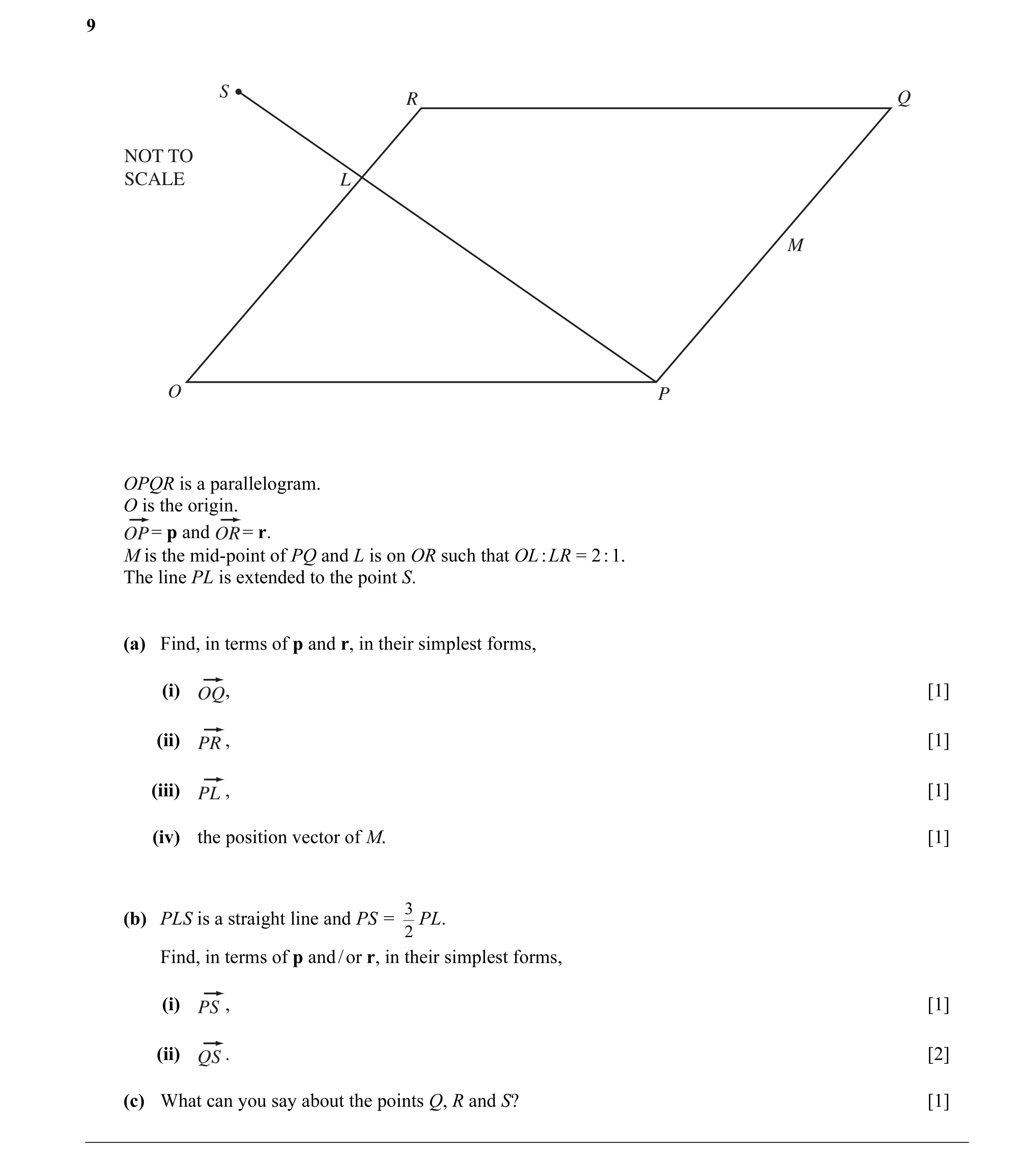
Q3 · S R Q NOT TO SCALE L M O P OPQR is a parallelogram 0580/41 May/June 2008
9 S R Q NOT TO SCALE L M O P OPQR is a parallelogram. O is the origin. OP= p and OR= r. M is the mid-point of PQ and L is on OR such that OL : LR = 2 : 1. The line PL is extended to the point S. (a) Find, in terms of p and r, in their simplest forms, (i) OQ, [1] (ii) PR , [1] (iii) PL , [1] (iv) the position vector of M. [1] 3 (b) PLS is a straight line and PS = PL. 2 Find, in terms of p and / or r, in their simplest forms, (i) PS , [1] (ii) QS . [2] (c) What can you say about the points Q, R and S? [1]
8 marks
Mark scheme: 9 (a) (i) p + r B1 Answers in bracketed column form penalise only once throughout (ii) –p + r B1 (iii) 2 B1 –p + r 3 (iv) 1 B1 p + r 2 (b) (i) 3 2 3 B1 ft 3 × (–p + r) or – p + r isw after ft only × their (a)(iii) 2 3 2 2 correct answer seen (ii) M1 o.e. is any correct route of at least 2 QP + PS o.e. vectors 3 A1 ft ft their (b)(i) – r – p www 2 2 (c) lie on a straight line B1 dependent on their (b)(ii) being a multiple of p [8]
This question in 0580/41 May/June 2008
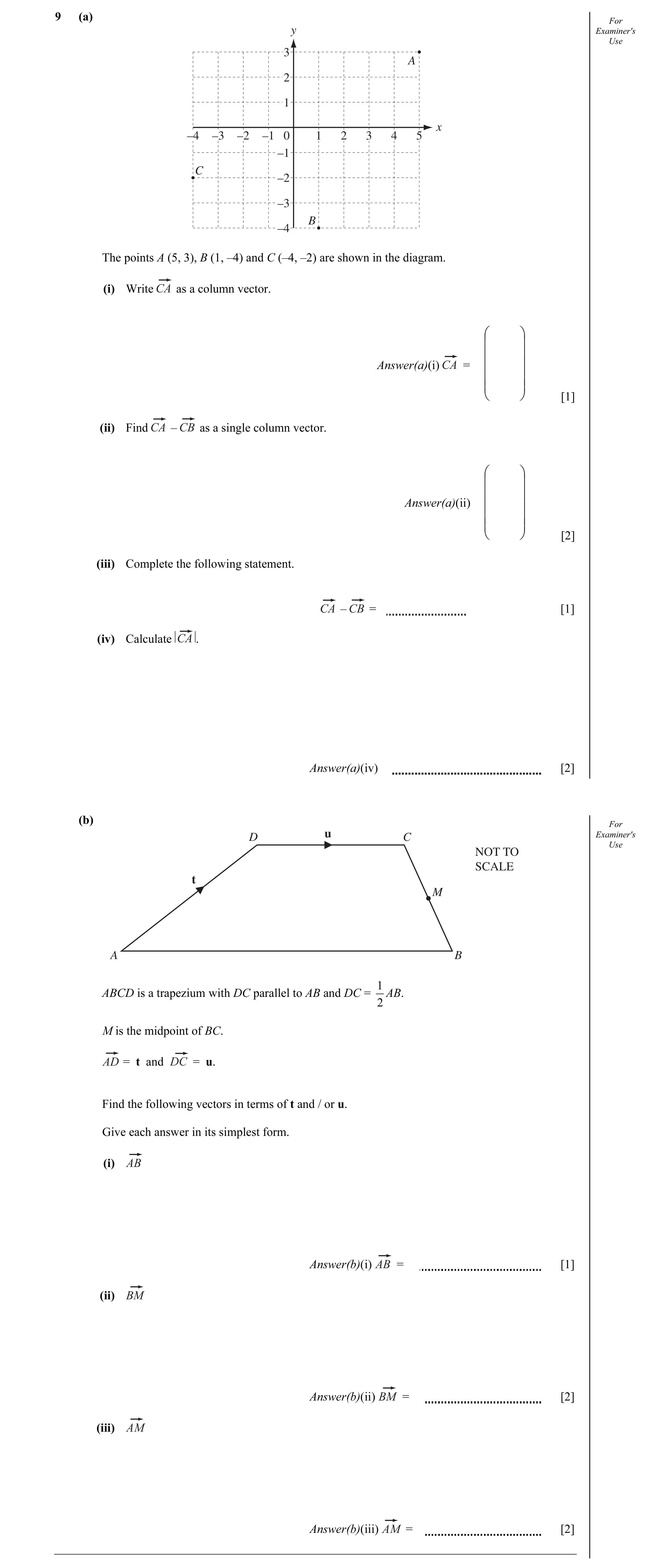
Q4 · For y Examiner's Use 3 A 2 1 x –4 –3 –2 –1 0 1 2 3 4 5 –1 C –2 –3 B –4 The points A (5… 0580/43 Oct/Nov 2010
9 (a) For y Examiner's Use 3 A 2 1 x –4 –3 –2 –1 0 1 2 3 4 5 –1 C –2 –3 B –4 The points A (5, 3), B (1, –4) and C (–4, –2) are shown in the diagram. (i) Write as a column vector. Answer(a)(i) = [1] (ii) Find – as a single column vector. Answer(a)(ii) [2] (iii) Complete the following statement. – = [1] (iv) Calculate . Answer(a)(iv) [2] (b) For u Examiner's D C Use NOT TO SCALE t M A B 1 ABCD is a trapezium with DC parallel to AB and DC = AB. 2 M is the midpoint of BC. = t and = u. Find the following vectors in terms of t and / or u. Give each answer in its simplest form. (i) Answer(b)(i) = [1] (ii) Answer(b)(ii) = [2] (iii) Answer(b)(iii) = [2]
11 marks
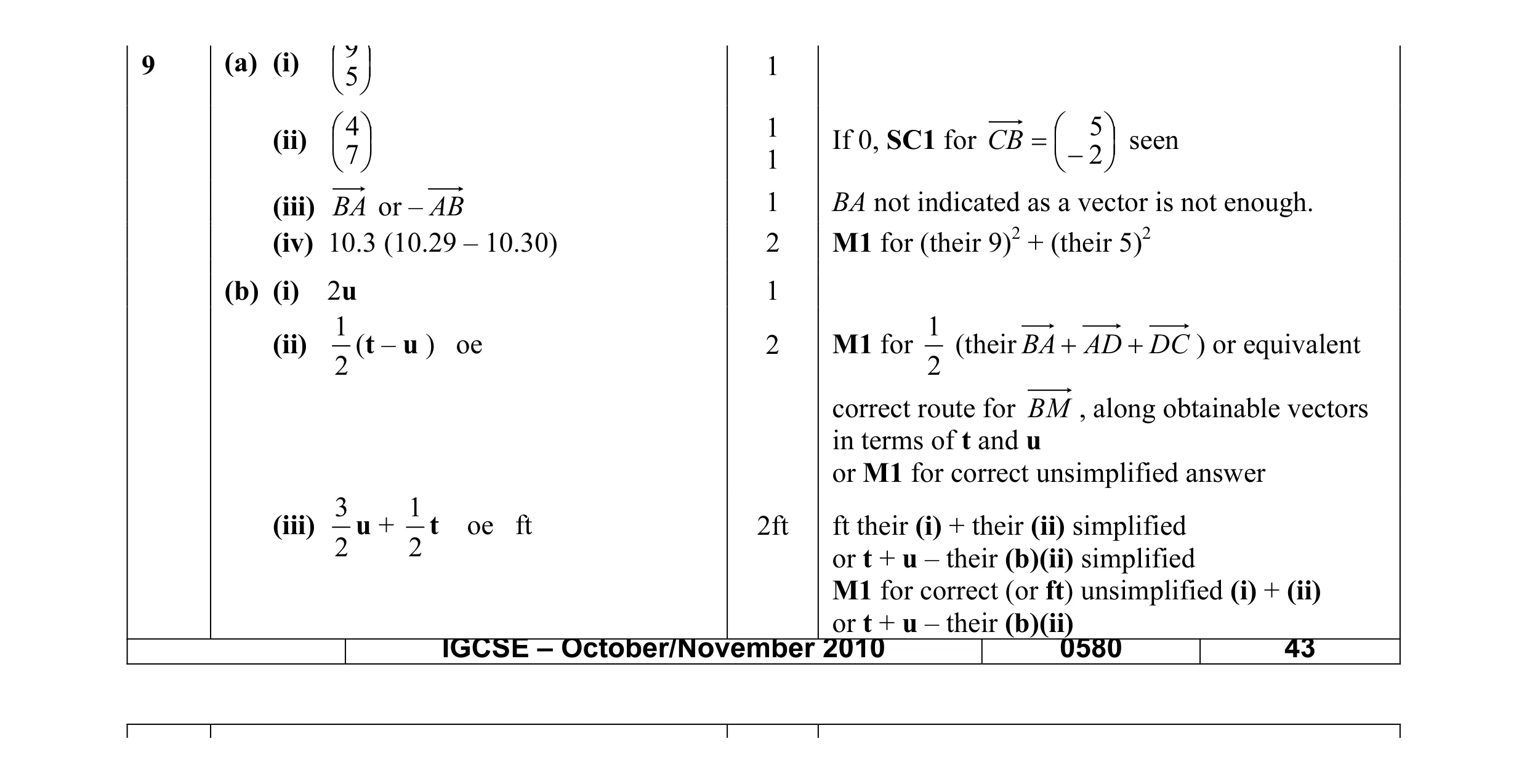
Mark scheme: 9 (a) (i) 9 1 5 (ii) 4 1 If 0, SC1 for CB = 5 seen 7 1 − 2 (iii) BA or – AB 1 BA not indicated as a vector is not enough. (iv) 10.3 (10.29 – 10.30) 2 M1 for (their 9)2 + (their 5)2 (b) (i) 2u 1 1 1 (ii) (t – u ) oe 2 M1 for (their BA + AD + DC ) or equivalent 2 2 correct route for BM , along obtainable vectors in terms of t and u or M1 for correct unsimplified answer 3 1 (iii) u + t oe ft 2ft ft their (i) + their (ii) simplified 2 2 or t + u – their (b)(ii) simplified M1 for correct (or ft) unsimplified (i) + (ii) or t + u – their (b)(ii) IGCSE – October/November 2010 0580 43
This question in 0580/43 Oct/Nov 2010
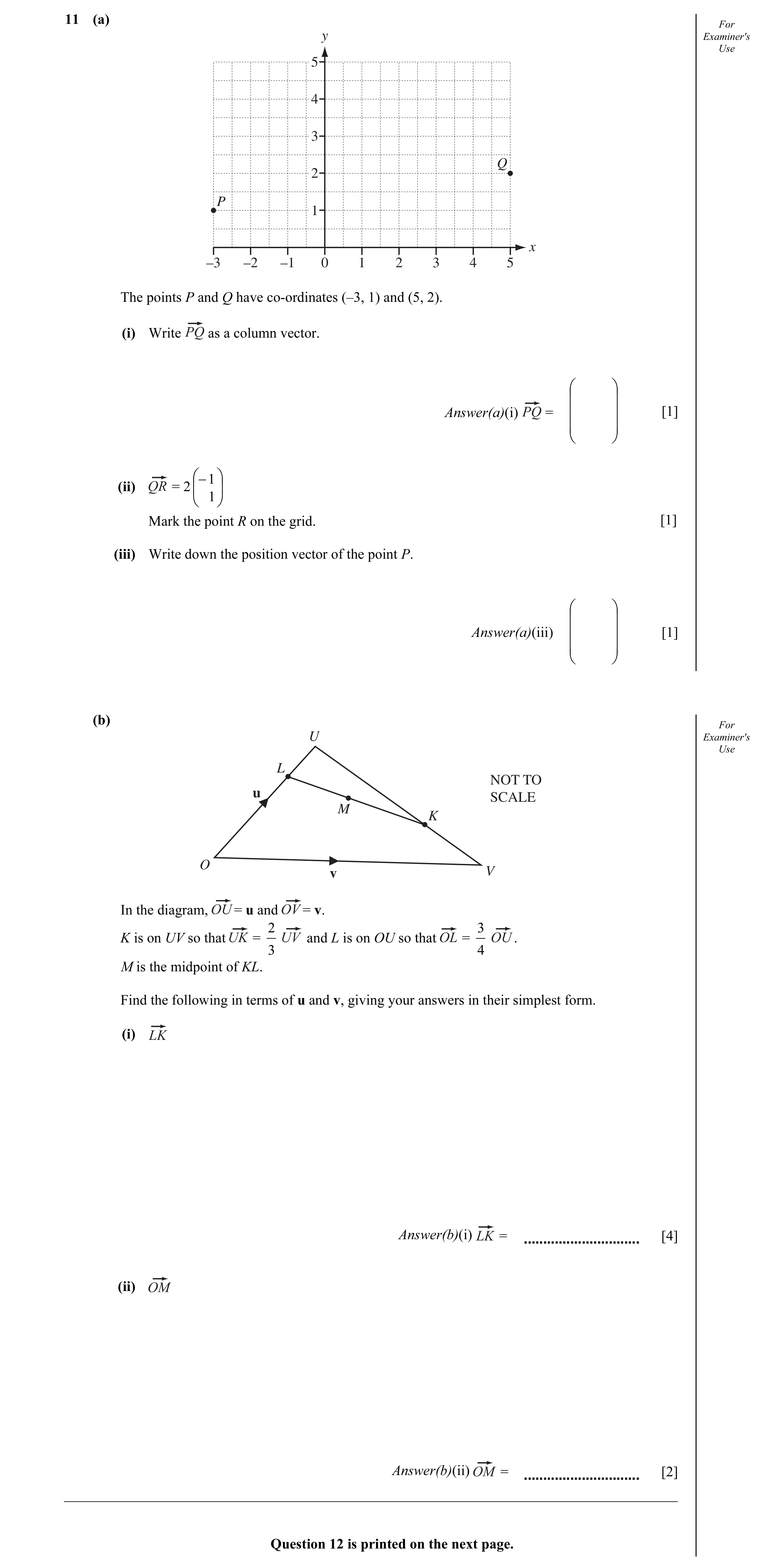
Q5 · For y Examiner's Use 5 4 3 Q 2 P 1 x –3 –2 –1 0 1 2 3 4 5 The points P and Q have… 0580/43 Oct/Nov 2011
11 (a) For y Examiner's Use 5 4 3 Q 2 P 1 x –3 –2 –1 0 1 2 3 4 5 The points P and Q have co-ordinates (–3, 1) and (5, 2). (i) Write as a column vector. Answer(a)(i) = [1] − 1 (ii) = 2 1 Mark the point R on the grid. [1] (iii) Write down the position vector of the point P. Answer(a)(iii) [1] (b) For U Examiner's Use L NOT TO u SCALE M K O V v In the diagram, = u and = v. 2 3 K is on UV so that = and L is on OU so that = . 3 4 M is the midpoint of KL. Find the following in terms of u and v, giving your answers in their simplest form. (i) Answer(b)(i) = [4] (ii) Answer(b)(ii) = [2] Question 12 is printed on the next page.
9 marks
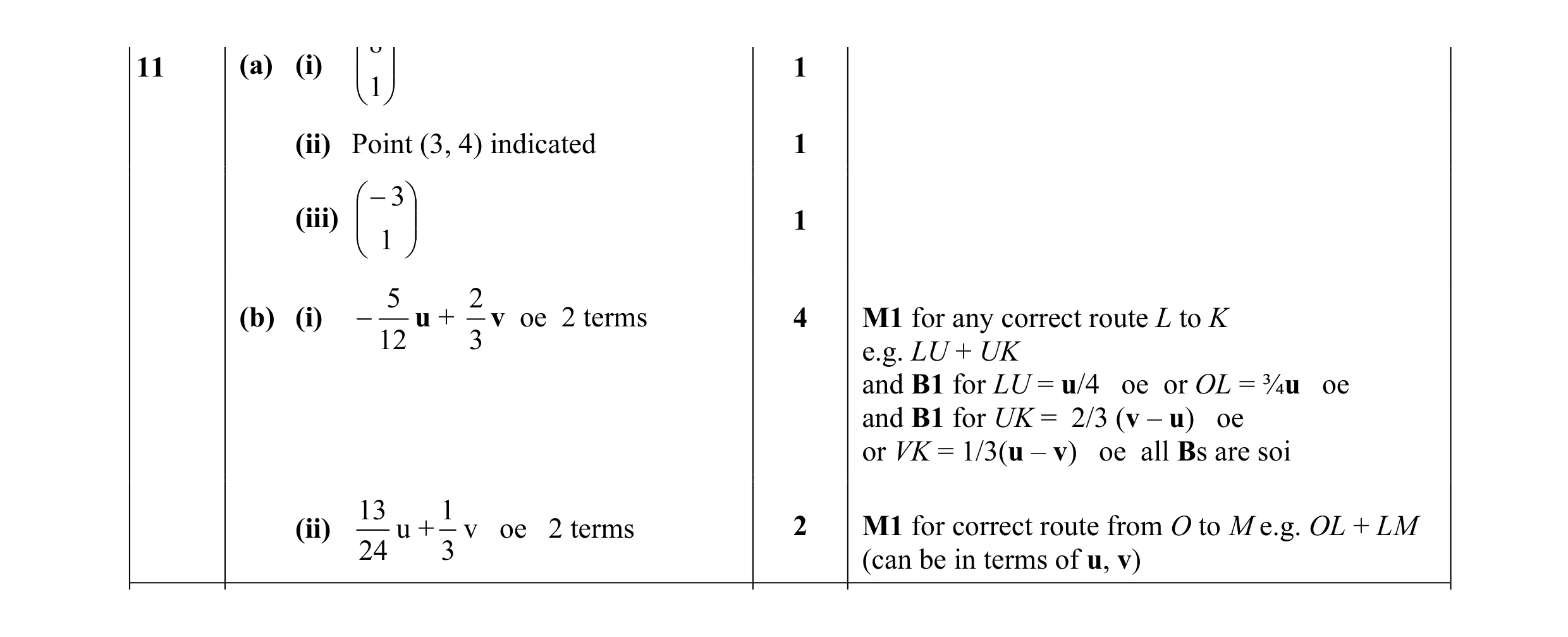
Mark scheme: 8 11 (a) (i) 1 1 (ii) Point (3, 4) indicated 1 − 3 (iii) 1 1 5 2 (b) (i) − u + v oe 2 terms 4 M1 for any correct route L to K 12 3 e.g. LU + UK and B1 for LU = u/4 oe or OL = ¾u oe and B1 for UK = 2/3 (v – u) oe or VK = 1/3(u – v) oe all Bs are soi 13 1 (ii) u + v oe 2 terms 2 M1 for correct route from O to M e.g. OL + LM 24 3 (can be in terms of u, v)
This question in 0580/43 Oct/Nov 2011
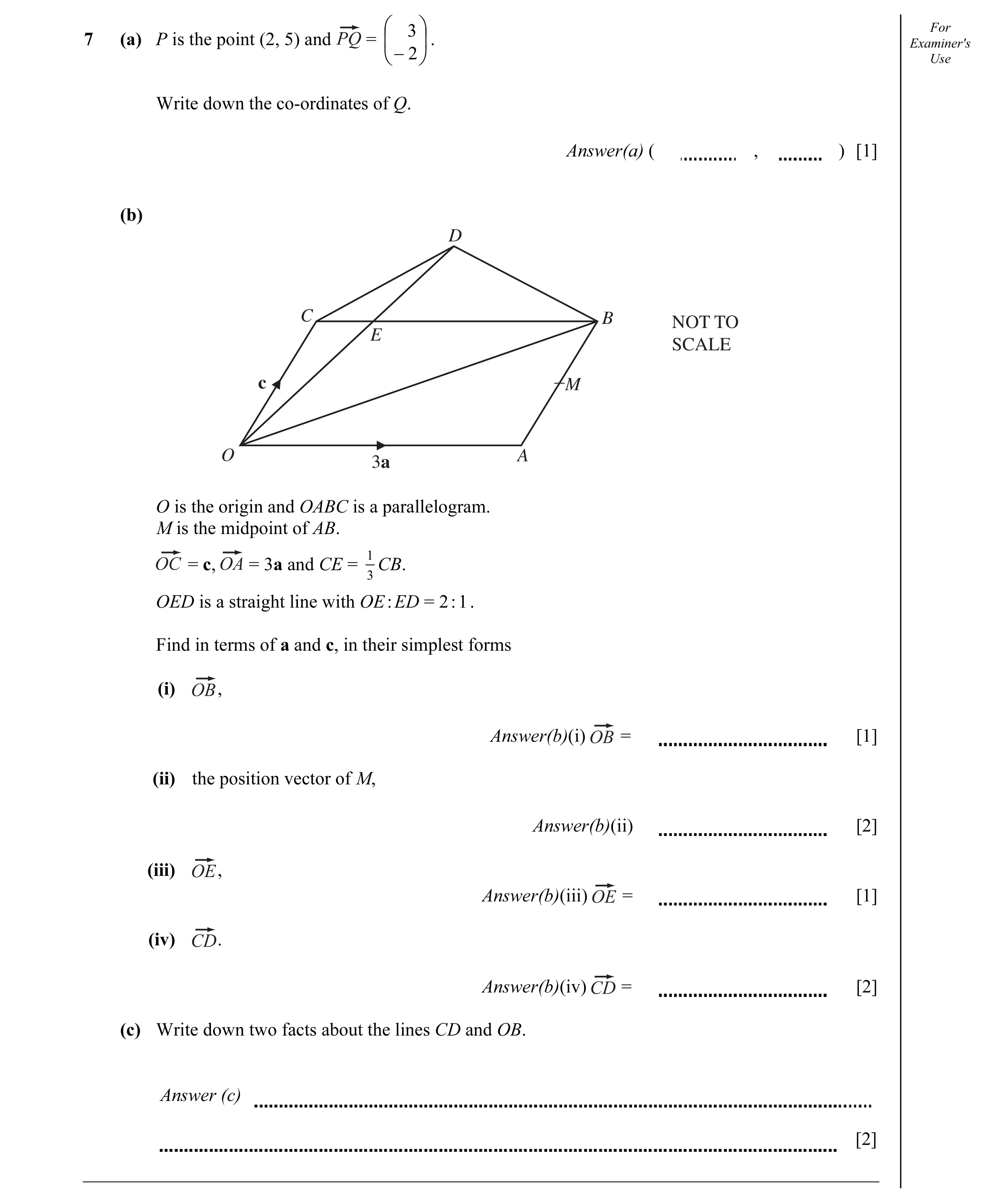
Q6 · For 3 7 (a) P is the point (2, 5) and = 0580/42 May/June 2012
For 3 7 (a) P is the point (2, 5) and = . Examiner's −2 Use Write down the co-ordinates of Q. Answer(a) ( , ) [1] (b) D C B NOT TO E SCALE c M O A 3a O is the origin and OABC is a parallelogram. M is the midpoint of AB. = c, = 3a and CE = 1 CB. 3 OED is a straight line with OE : ED = 2 : 1 . Find in terms of a and c, in their simplest forms (i) , Answer(b)(i) = [1] (ii) the position vector of M, Answer(b)(ii) [2] (iii) , Answer(b)(iii) = [1] (iv) . Answer(b)(iv) = [2] (c) Write down two facts about the lines CD and OB. Answer (c) [2]
9 marks
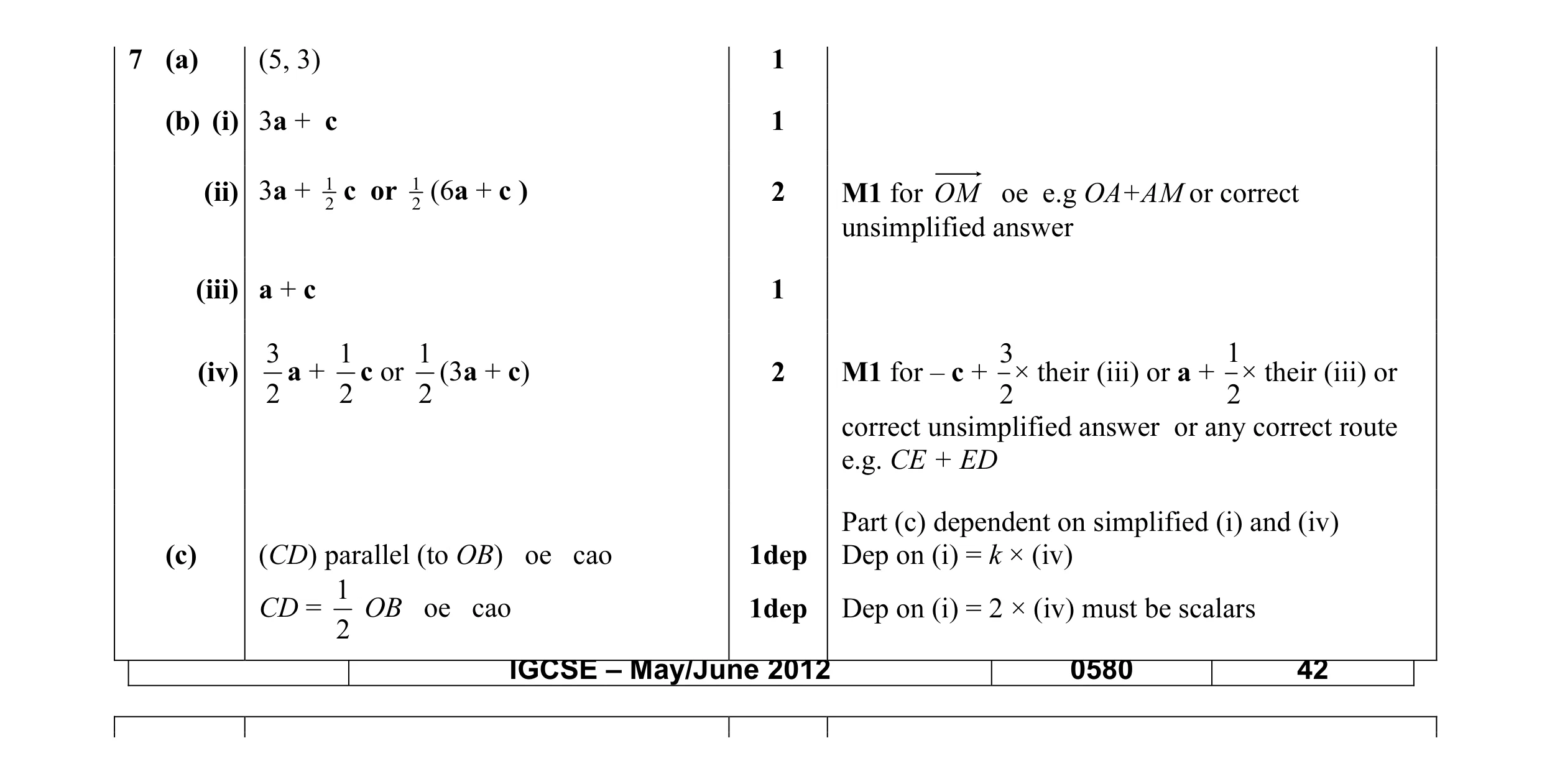
Mark scheme: 7 (a) (5, 3) 1 (b) (i) 3a + c 1 (ii) 3a + 12 c or 12 (6a + c ) 2 M1 for OM oe e.g OA+AM or correct unsimplified answer (iii) a + c 1 3 1 1 (iv) a + c or (3a + c) 2 M1 for – c + 3× their (iii) or a + 1× their (iii) or 2 2 2 2 2 correct unsimplified answer or any correct route e.g. CE + ED Part (c) dependent on simplified (i) and (iv) (c) (CD) parallel (to OB) oe cao 1dep Dep on (i) = k × (iv) 1 CD = OB oe cao 1dep Dep on (i) = 2 × (iv) must be scalars 2 IGCSE – May/June 2012 0580 42
This question in 0580/42 May/June 2012
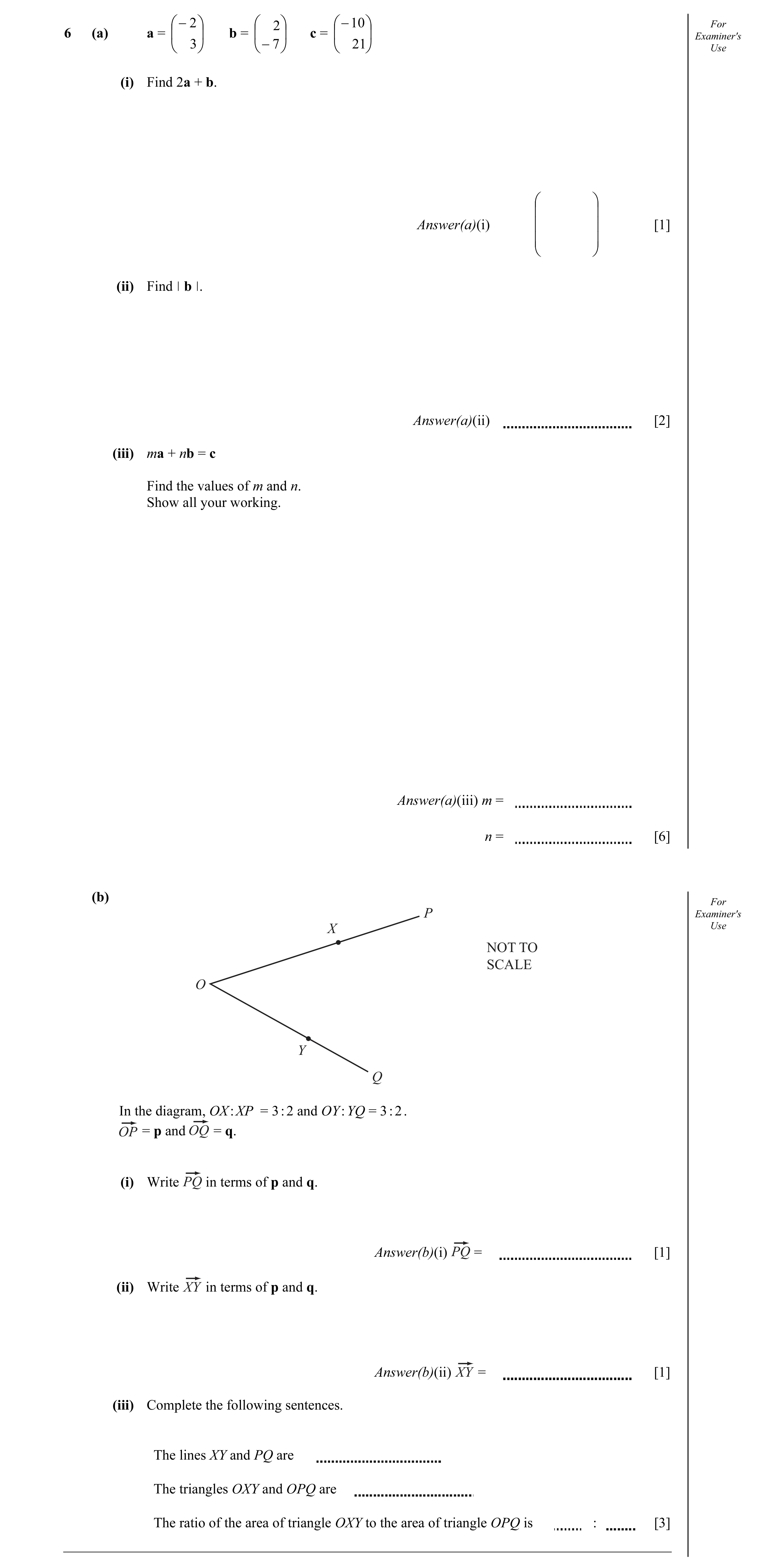
Q7 · − 2 2 − 10 For 6 (a) a = b = c = Examiner's 3 −7 21 Use… 0580/41 Oct/Nov 2012
− 2 2 − 10 For 6 (a) a = b = c = Examiner's 3 −7 21 Use (i) Find 2a + b. Answer(a)(i) [1] (ii) Find ö=b ö. Answer(a)(ii) [2] (iii) ma + nb = c Find the values of m and n. Show all your working. Answer(a)(iii) m = n = [6] (b) For P Examiner's X Use NOT TO SCALE O Y Q In the diagram, OX : XP = 3 : 2 and OY : YQ = 3 : 2 . = p and = q. (i) Write in terms of p and q. Answer(b)(i) = [1] (ii) Write in terms of p and q. Answer(b)(ii) = [1] (iii) Complete the following sentences. The lines XY and PQ are The triangles OXY and OPQ are The ratio of the area of triangle OXY to the area of triangle OPQ is : [3]
14 marks
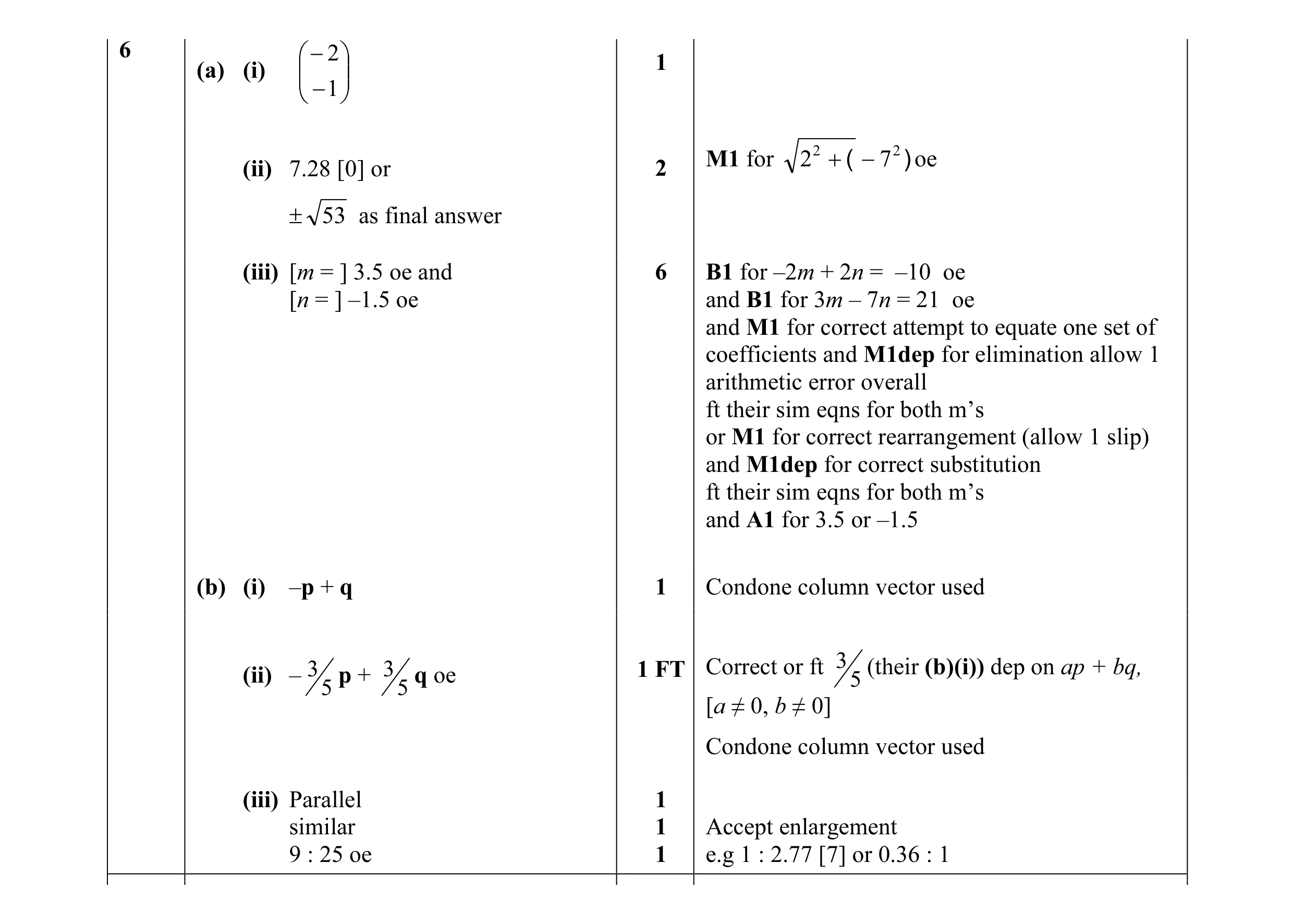
Mark scheme: 6 − 2 1 (a) (i) − 1 M1 for 2 2 + ( − 7 2 ) oe (ii) 7.28 [0] or 2 ± 53 as final answer (iii) [m = ] 3.5 oe and 6 B1 for –2m + 2n = –10 oe [n = ] –1.5 oe and B1 for 3m – 7n = 21 oe and M1 for correct attempt to equate one set of coefficients and M1dep for elimination allow 1 arithmetic error overall ft their sim eqns for both m’s or M1 for correct rearrangement (allow 1 slip) and M1dep for correct substitution ft their sim eqns for both m’s and A1 for 3.5 or –1.5 (b) (i) –p + q 1 Condone column vector used 3 3 3 (ii) – p + q oe 1 FT Correct or ft 5 (their (b)(i)) dep on ap + bq, 5 5 [a ≠ 0, b ≠ 0] Condone column vector used (iii) Parallel 1 similar 1 Accept enlargement 9 : 25 oe 1 e.g 1 : 2.77 [7] or 0.36 : 1
This question in 0580/41 Oct/Nov 2012
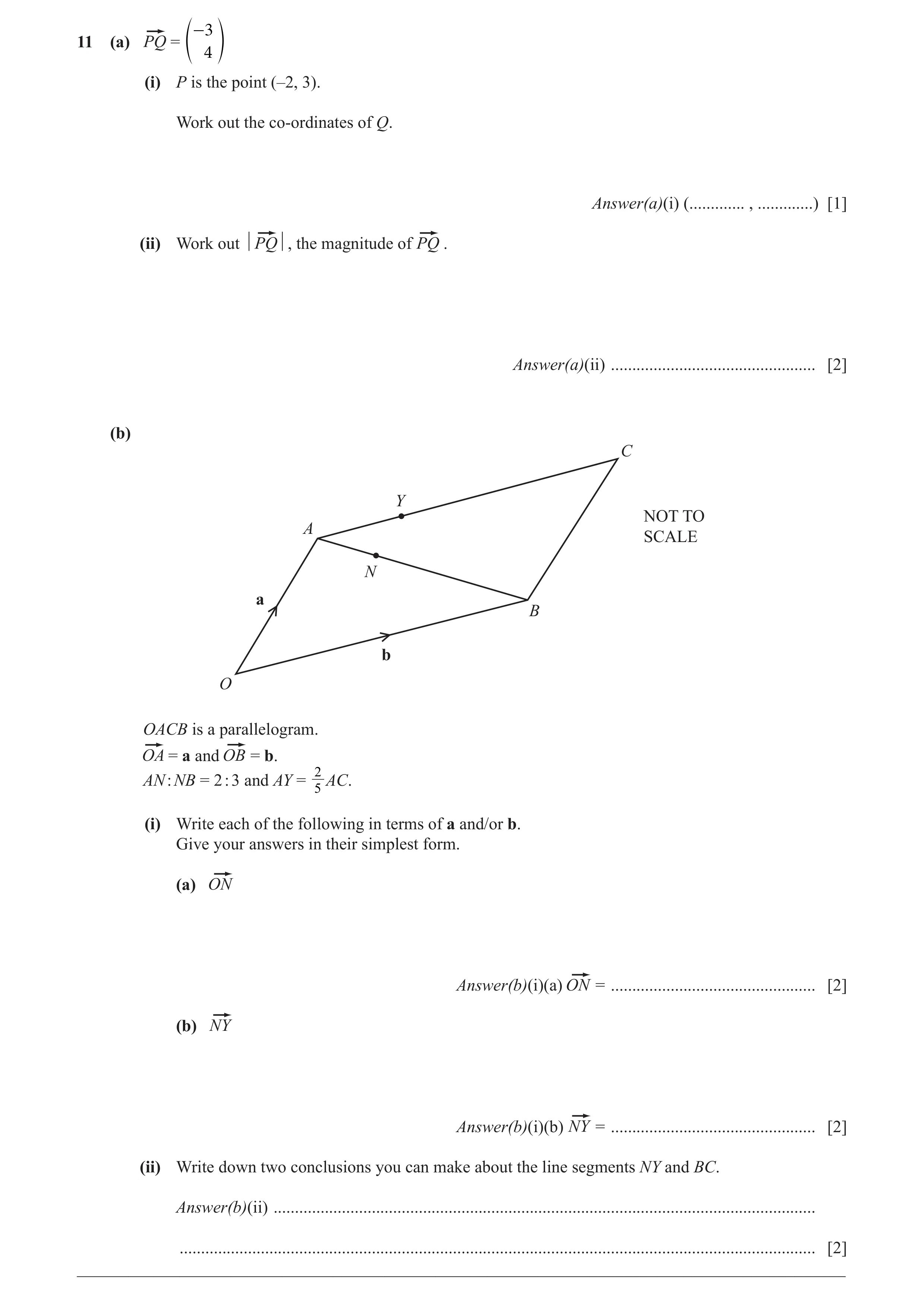
Q8 · -3 11 (a) = e 4 o (i) P is the point (–2, 3) 0580/41 May/June 2014
-3 11 (a) = e 4 o (i) P is the point (–2, 3). Work out the co-ordinates of Q. Answer(a)(i) ( … , … ) [1] (ii) Work out , the magnitude of . Answer(a)(ii) … [2] (b) C Y NOT TO A SCALE N a B b O OACB is a parallelogram. = a and = b. 2 AN : NB = 2 : 3 and AY = AC. 5 (i) Write each of the following in terms of a and/or b. Give your answers in their simplest form. (a) Answer(b)(i)(a) = … [2] (b) Answer(b)(i)(b) = … [2] (ii) Write down two conclusions you can make about the line segments NY and BC. Answer(b)(ii) … … [2] __________________________________________________________________________________________
9 marks
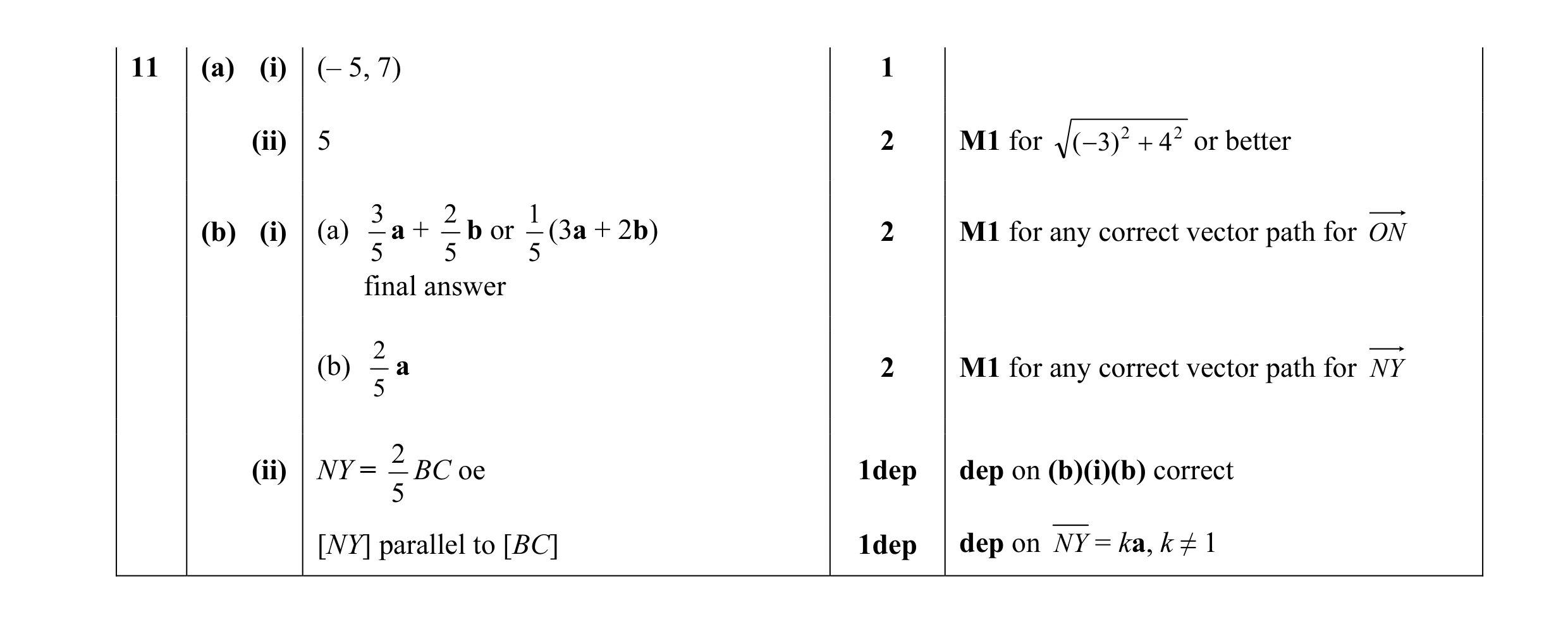
Mark scheme: 11 (a) (i) (– 5, 7) 1 (ii) 5 2 M1 for ( − 3) 2 + 4 2 or better 3 2 1 (b) (i) (a) a + b or (3a + 2b) 2 M1 for any correct vector path for ON 5 5 5 (a) final answer 2 (b) a 2 M1 for any correct vector path for NY 5 2 (ii) NY = BC oe 1dep dep on (b)(i)(b) correct 5 [NY] parallel to [BC] 1dep dep on NY = ka, k ≠ 1
This question in 0580/41 May/June 2014
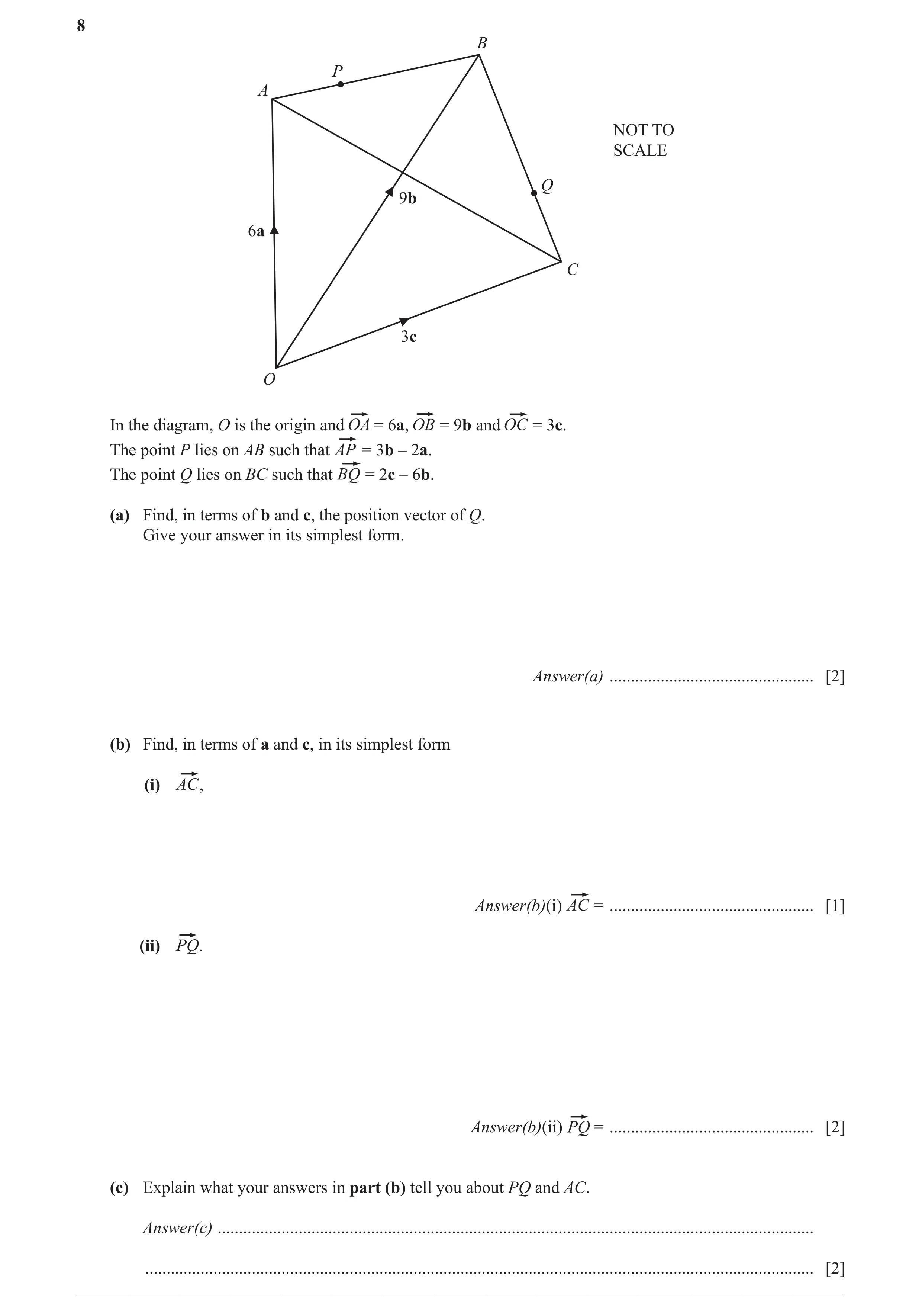
Q9 · B P A NOT TO SCALE Q 9b 6a C 3c O In the diagram, O is the origin and = 6a, = 9b and = 3c 0580/41 Oct/Nov 2014
8 B P A NOT TO SCALE Q 9b 6a C 3c O In the diagram, O is the origin and = 6a, = 9b and = 3c. The point P lies on AB such that = 3b – 2a. The point Q lies on BC such that = 2c – 6b. (a) Find, in terms of b and c, the position vector of Q. Give your answer in its simplest form. Answer(a) … [2] (b) Find, in terms of a and c, in its simplest form (i) , Answer(b)(i) = … [1] (ii) . Answer(b)(ii) = … [2] (c) Explain what your answers in part (b) tell you about PQ and AC. Answer(c) … … [2] __________________________________________________________________________________________
7 marks
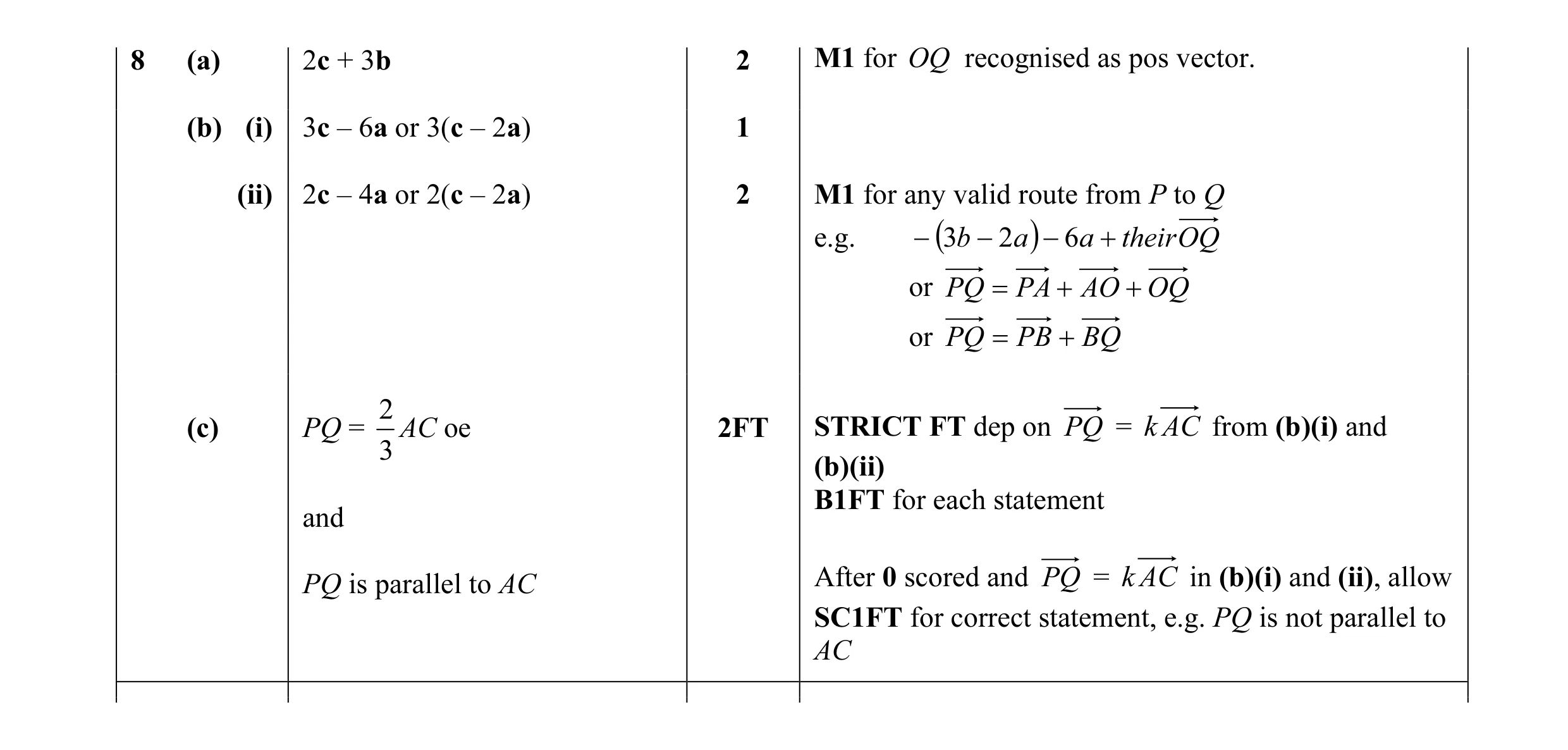
Mark scheme: 8 (a) 2c + 3b 2 M1 for OQ recognised as pos vector. (b) (i) 3c – 6a or 3(c – 2a) 1 (ii) 2c – 4a or 2(c – 2a) 2 M1 for any valid route from P to Q e.g. − (3b − 2 a ) − 6 a + their OQ or PQ = PA + AO + OQ or PQ = PB + BQ 2 (c) PQ = AC oe 2FT STRICT FT dep on PQ = k AC from (b)(i) and 3 (b)(ii) B1FT for each statement and PQ is parallel to AC After 0 scored and PQ = k AC in (b)(i) and (ii), allow SC1FT for correct statement, e.g. PQ is not parallel to AC
This question in 0580/41 Oct/Nov 2014
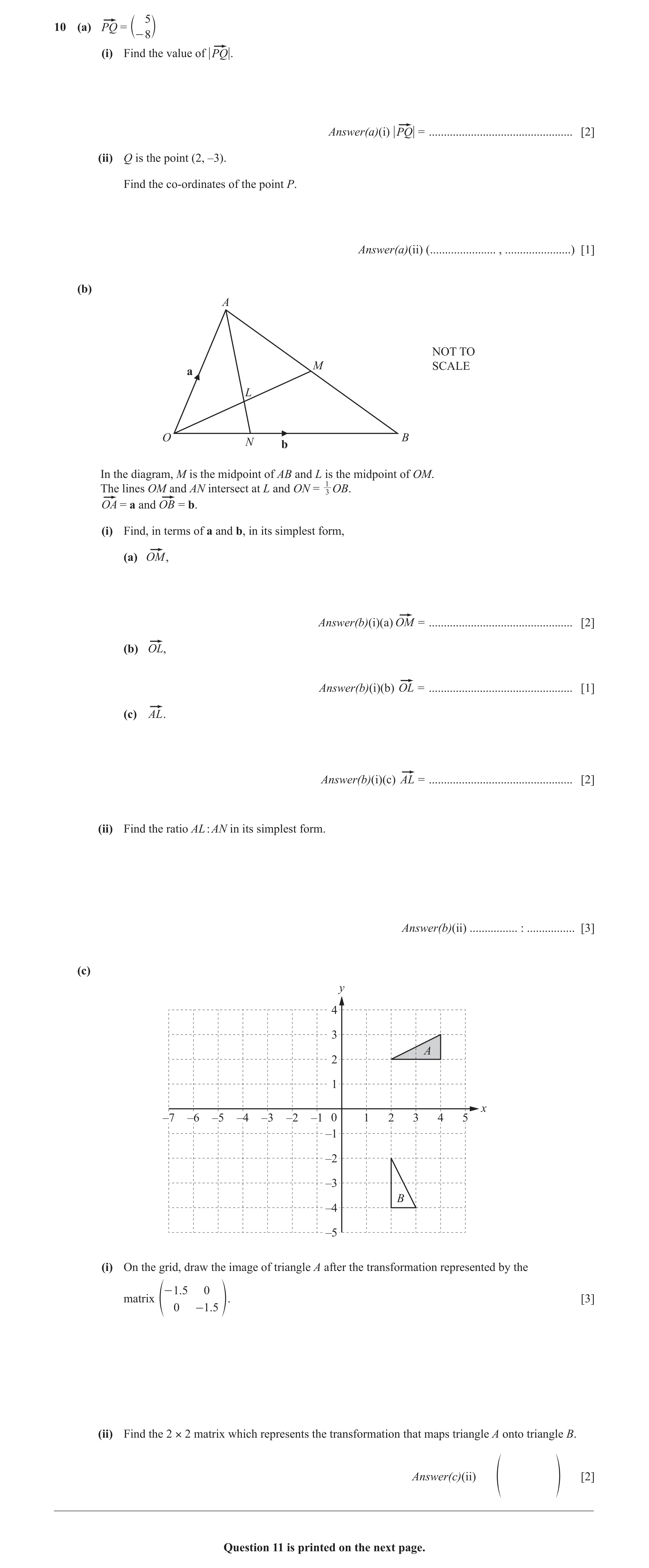
Q10 · 10 (a) = c - 8 m (i) Find the value of 0580/42 May/June 2015
5 10 (a) = c - 8 m (i) Find the value of . Answer(a)(i) = … [2] (ii) Q is the point (2, –3). Find the co-ordinates of the point P. Answer(a)(ii) ( … , … ) [1] (b) A NOT TO M SCALE a L O B N b In the diagram, M is the midpoint of AB and L is the midpoint of OM. The lines OM and AN intersect at L and ON = 13 OB. = a and = b. (i) Find, in terms of a and b, in its simplest form, (a) , Answer(b)(i)(a) = … [2] (b) , Answer(b)(i)(b) = … [1] (c) . Answer(b)(i)(c) = … [2] (ii) Find the ratio AL : AN in its simplest form. Answer(b)(ii) … : … [3] (c) y 4 3 A 2 1 x –7 –6 –5 –4 –3 –2 –1 0 1 2 3 4 5 –1 –2 –3 B –4 –5 (i) On the grid, draw the image of triangle A after the transformation represented by the - 1.5 0 matrix [3] f 0 - 1.5 p. (ii) Find the 2 × 2 matrix which represents the transformation that maps triangle A onto triangle B. Answer(c)(ii) [2] f p __________________________________________________________________________________________ Question 11 is printed on the next page.
16 marks
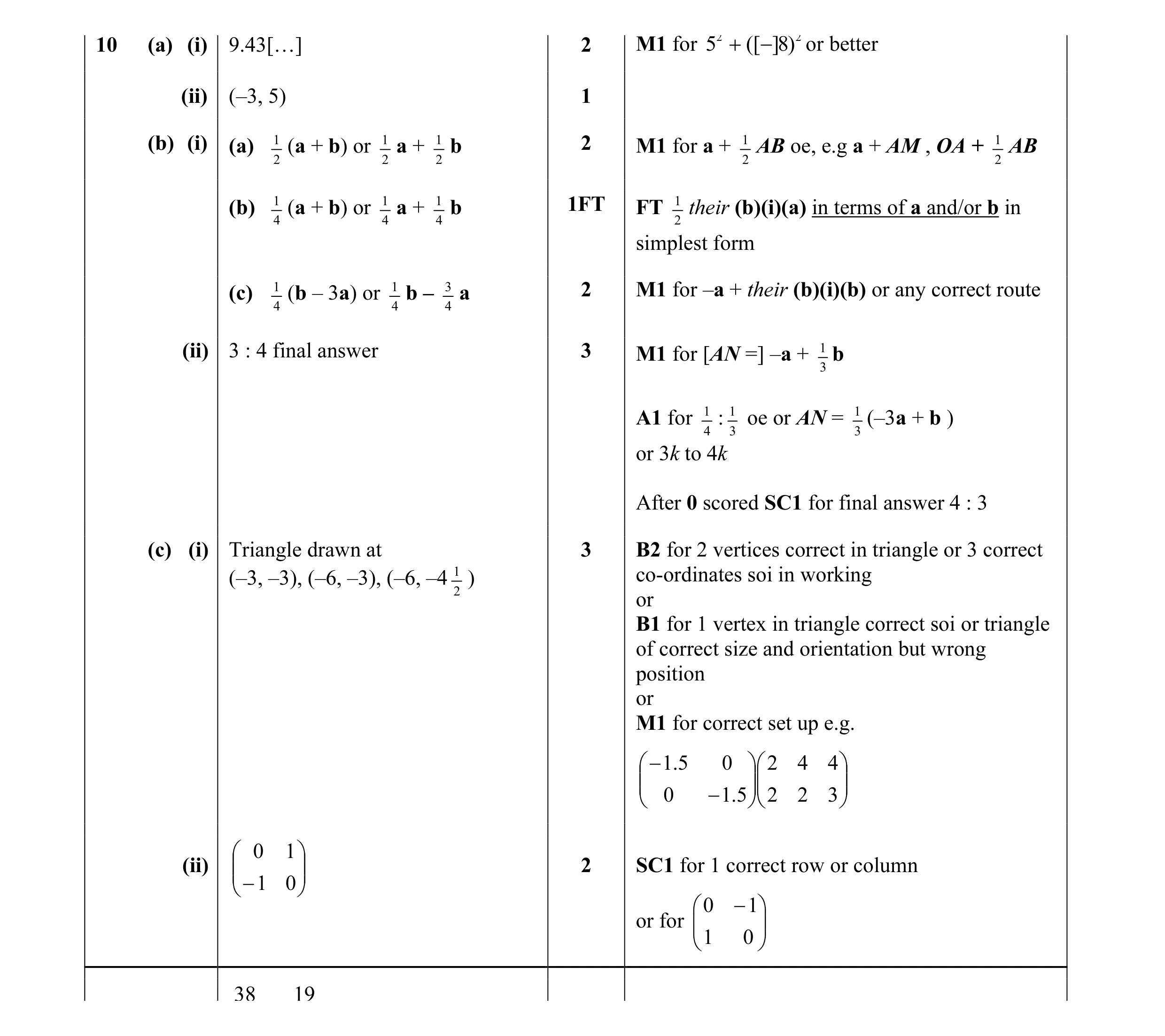
Mark scheme: 10 (a) (i) 9.43[…] 2 M1 for 52 + ([−)8] 2 or better (ii) (–3, 5) 1 (b) (i) (a) 1 (a + b) or 1 a + 1 b 2 M1 for a + 1 AB oe, e.g a + AM , OA + 1 AB 2 2 2 2 2 (b) 1 (a + b) or 1 a + 1 b 1FT FT 1 their (b)(i)(a) in terms of a and/or b in 4 4 4 2 simplest form (c) 1 (b – 3a) or 1 b – 3 a 2 M1 for –a + their (b)(i)(b) or any correct route 4 4 4 (ii) 3 : 4 final answer 3 M1 for [AN =] –a + 1 b 3 A1 for 1 : 1 oe or AN = 1 (–3a + b ) 4 3 3 or 3k to 4k After 0 scored SC1 for final answer 4 : 3 (c) (i) Triangle drawn at 3 B2 for 2 vertices correct in triangle or 3 correct (–3, –3), (–6, –3), (–6, –4 1 ) co-ordinates soi in working 2 or B1 for 1 vertex in triangle correct soi or triangle of correct size and orientation but wrong position or M1 for correct set up e.g. − 5.1 0 2 4 4 0 − 5.1 2 2 3 0 1 (ii) 2 SC1 for 1 correct row or column − 1 0 0 − 1 or for 1 0 38 19
This question in 0580/42 May/June 2015
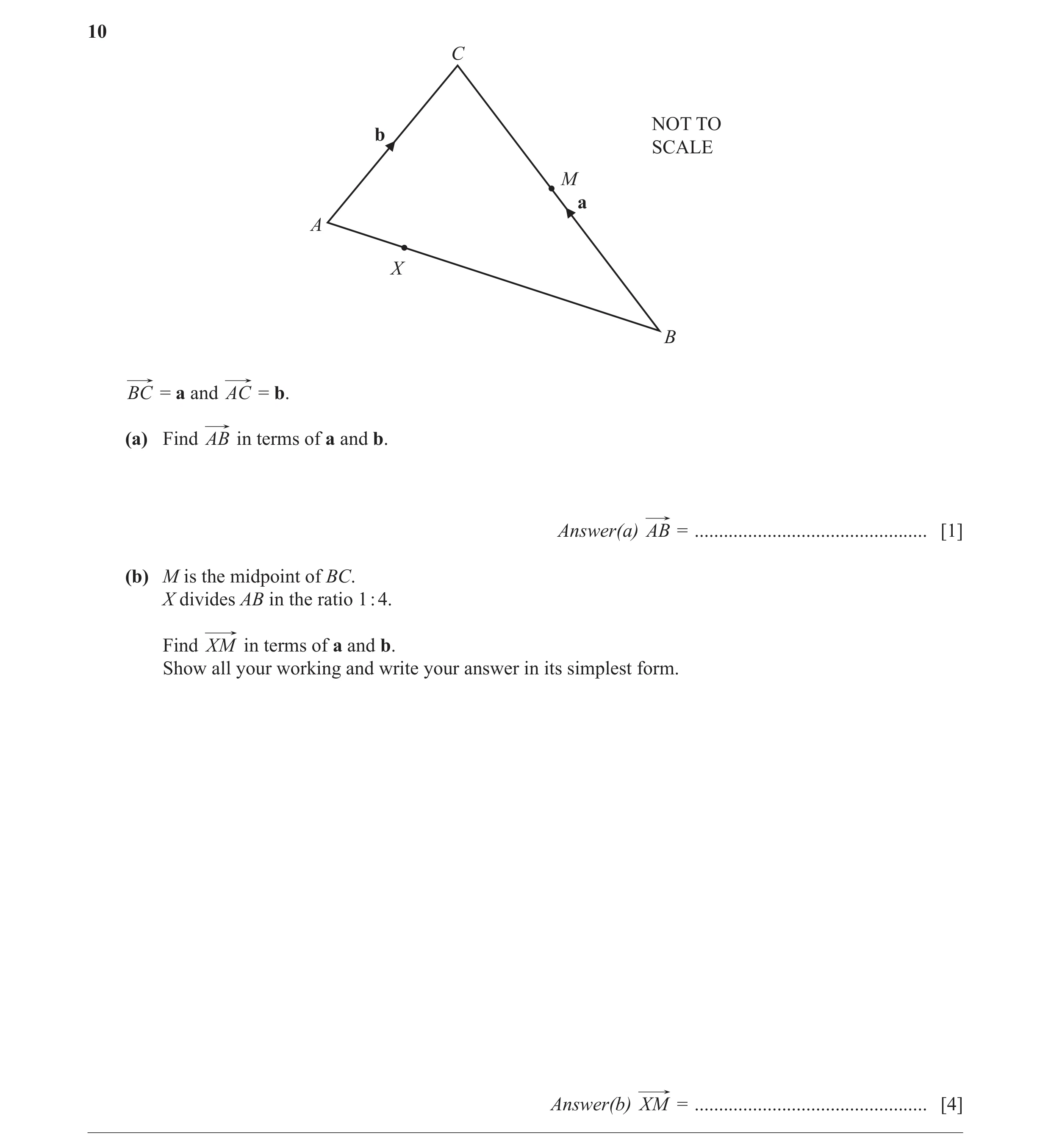
Q11 · C NOT TO b SCALE M a A X B BC = a and AC = b 0580/41 Oct/Nov 2015
10 C NOT TO b SCALE M a A X B BC = a and AC = b. (a) Find AB in terms of a and b. Answer(a) AB = … [1] (b) M is the midpoint of BC. X divides AB in the ratio 1 : 4. Find XM in terms of a and b. Show all your working and write your answer in its simplest form. Answer(b) XM = … [4]
5 marks
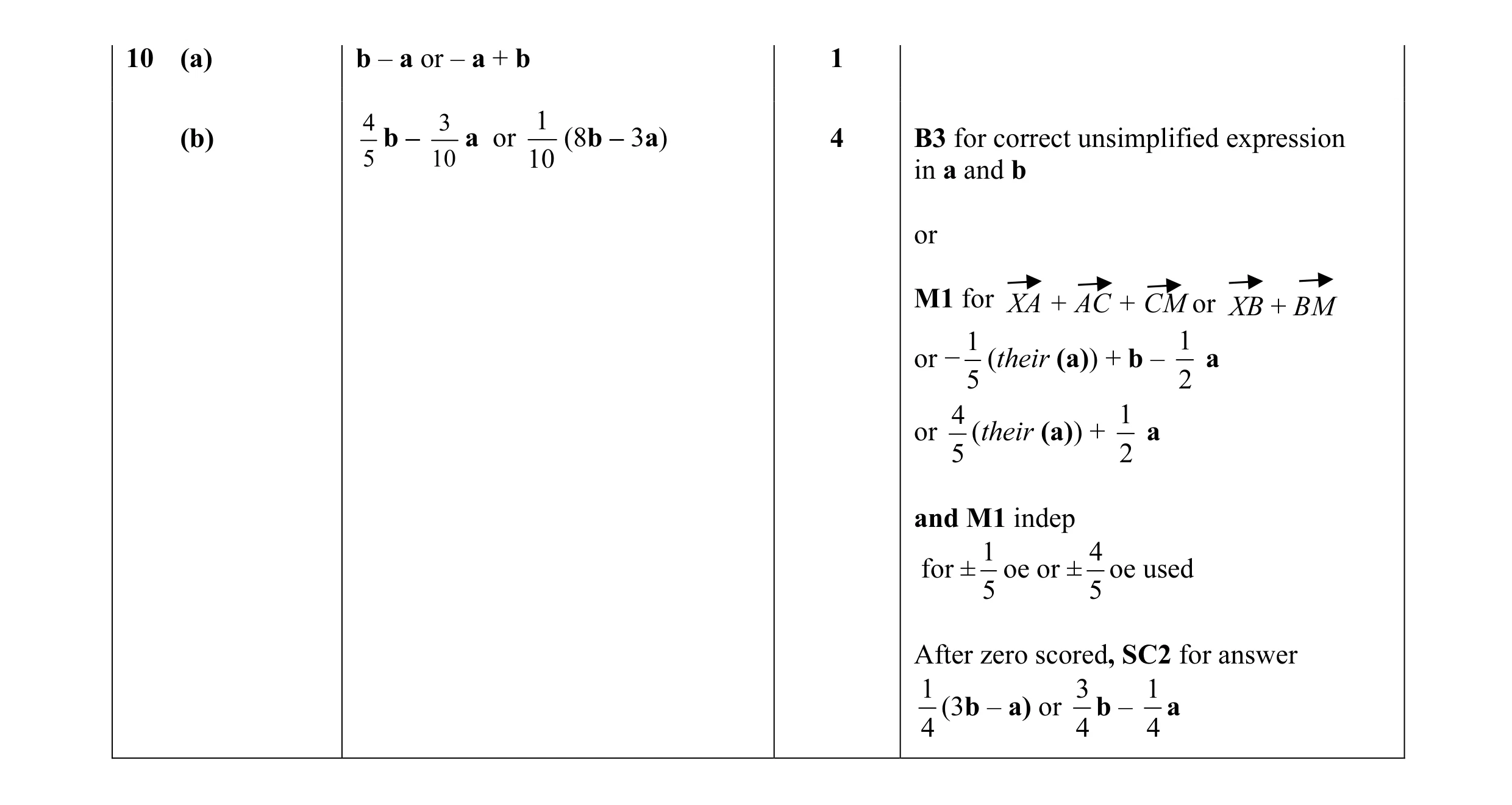
Mark scheme: 10 (a) b – a or – a + b 1 4 3 1 (b) b – a or (8b – 3a) 4 B3 for correct unsimplified expression 5 10 10 in a and b or M1 for XA + AC + CM or XB + BM 1 1 or −5 (their (a)) + b – 2 a 4 1 or (their (a)) + a 5 2 and M1 indep 1 4 for ± oe or ± oe used 5 5 After zero scored, SC2 for answer 1 3 1 (3b – a) or b – a 4 4 4
This question in 0580/41 Oct/Nov 2015
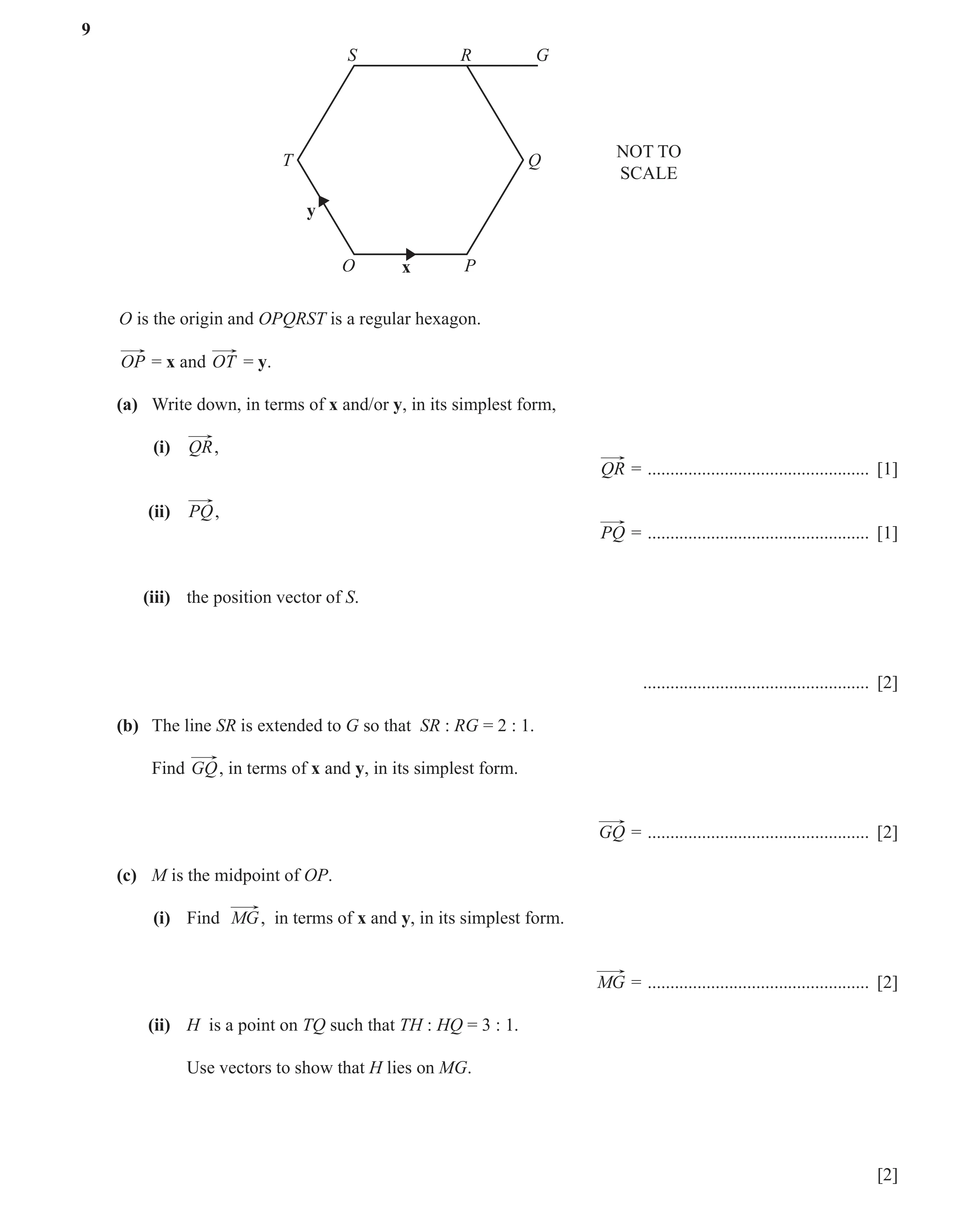
Q12 · S R G NOT TO T Q SCALE y O x P O is the origin and OPQRST is a regular hexagon 0580/42 Feb/March 2016
9 S R G NOT TO T Q SCALE y O x P O is the origin and OPQRST is a regular hexagon. OP = x and OT = y. (a) Write down, in terms of x and/or y, in its simplest form, (i) QR , Q R = … [1] (ii) PQ, PQ = … [1] (iii) the position vector of S. … [2] (b) The line SR is extended to G so that SR : RG = 2 : 1. Find GQ, in terms of x and y, in its simplest form. GQ = … [2] (c) M is the midpoint of OP. (i) Find MG, in terms of x and y, in its simplest form. MG = … [2] (ii) H is a point on TQ such that TH : HQ = 3 : 1. Use vectors to show that H lies on MG. [2]
10 marks
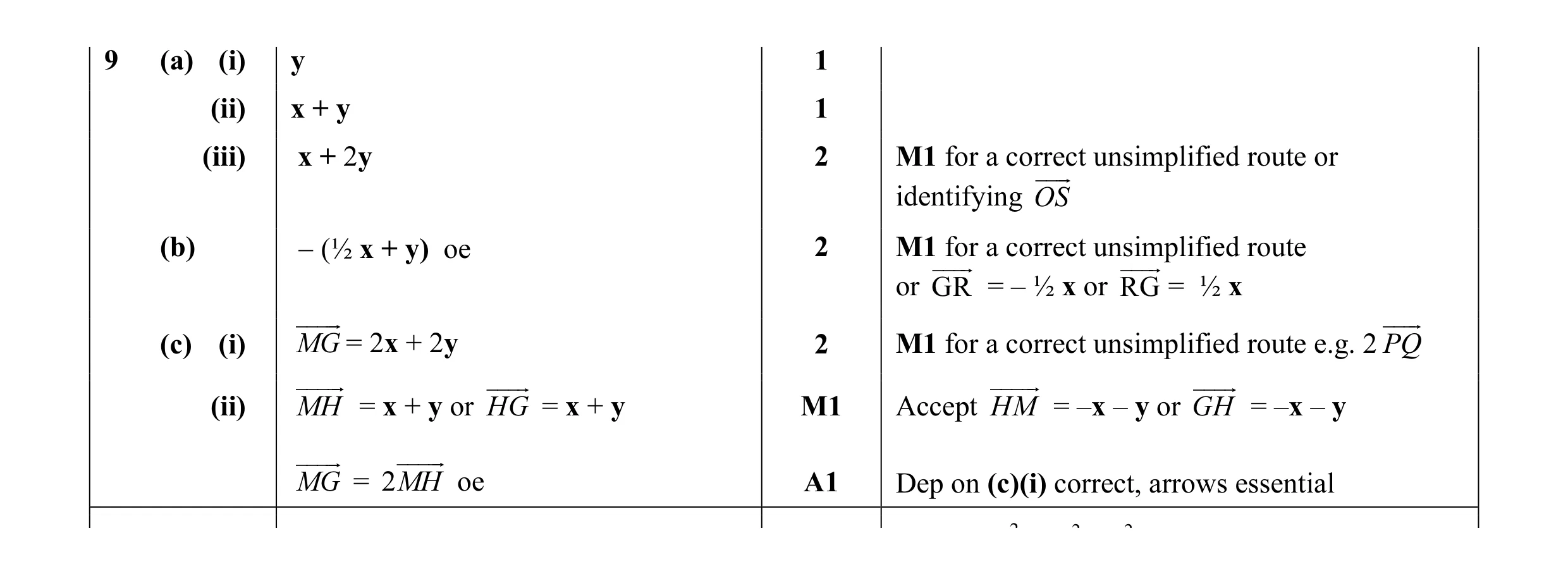
Mark scheme: 9 (a) (i) y 1 (ii) x + y 1 (iii) x + 2y 2 M1 for a correct unsimplified route or identifying OS (b) − (½ x + y) oe 2 M1 for a correct unsimplified route or GR = – ½ x or RG = ½ x (c) (i) MG = 2x + 2y 2 M1 for a correct unsimplified route e.g. 2 PQ (ii) MH = x + y or HG = x + y M1 Accept HM = –x – y or GH = –x – y MG = 2 MH oe A1 Dep on (c)(i) correct, arrows essential 2 2 2
This question in 0580/42 Feb/March 2016
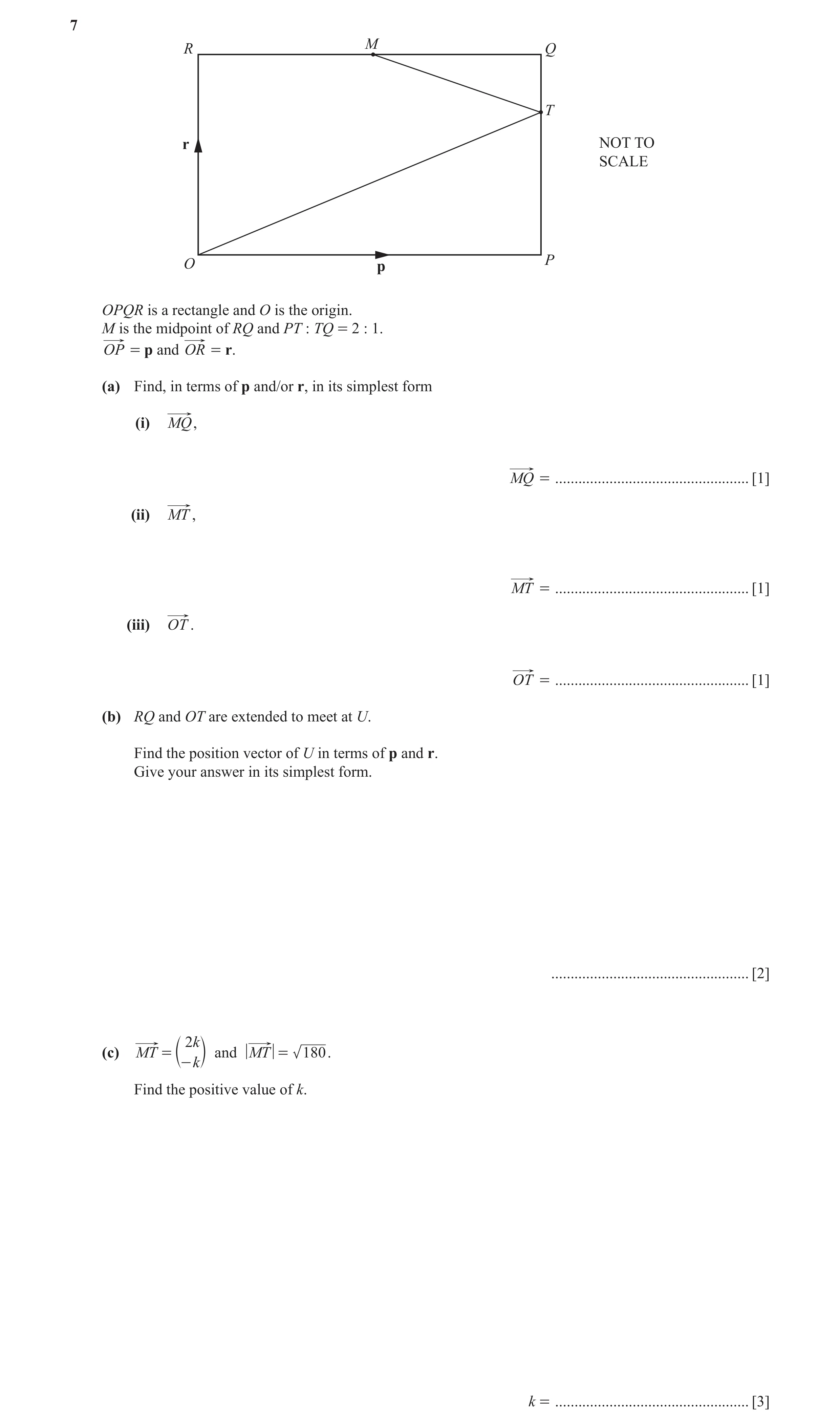
Q13 · M R Q T r NOT TO SCALE O p P OPQR is a rectangle and O is the origin 0580/41 May/June 2016
7 M R Q T r NOT TO SCALE O p P OPQR is a rectangle and O is the origin. M is the midpoint of RQ and PT : TQ = 2 : 1. OP = p and OR = r. (a) Find, in terms of p and/or r, in its simplest form (i) MQ, MQ = … [1] (ii) MT , MT = … [1] (iii) OT . OT = … [1] (b) RQ and OT are extended to meet at U. Find the position vector of U in terms of p and r. Give your answer in its simplest form. … [2] 2k (c) MT = and MT = 180 . c- k m Find the positive value of k. k = … [3]
8 marks
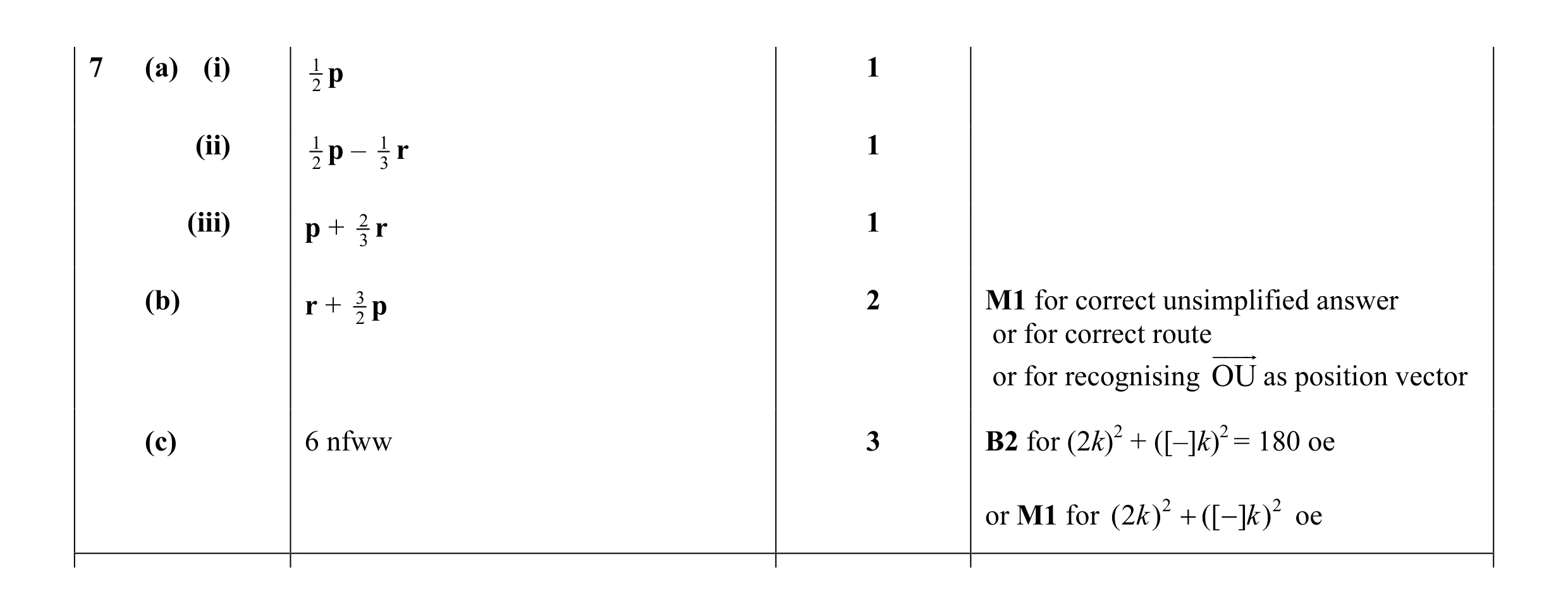
Mark scheme: 7 (a) (i) 1 p 1 2 (ii) 1 2 p – 13 r 1 2 r 1 (iii) p + 3 3 p 2 M1 for correct unsimplified answer (b) r + 2 or for correct route or for recognising OU as position vector (c) 6 nfww 3 B2 for (2k)2 + ([–]k)2 = 180 oe or M1 for (2 k ) 2 + ([ − ]k ) 2 oe
This question in 0580/41 May/June 2016
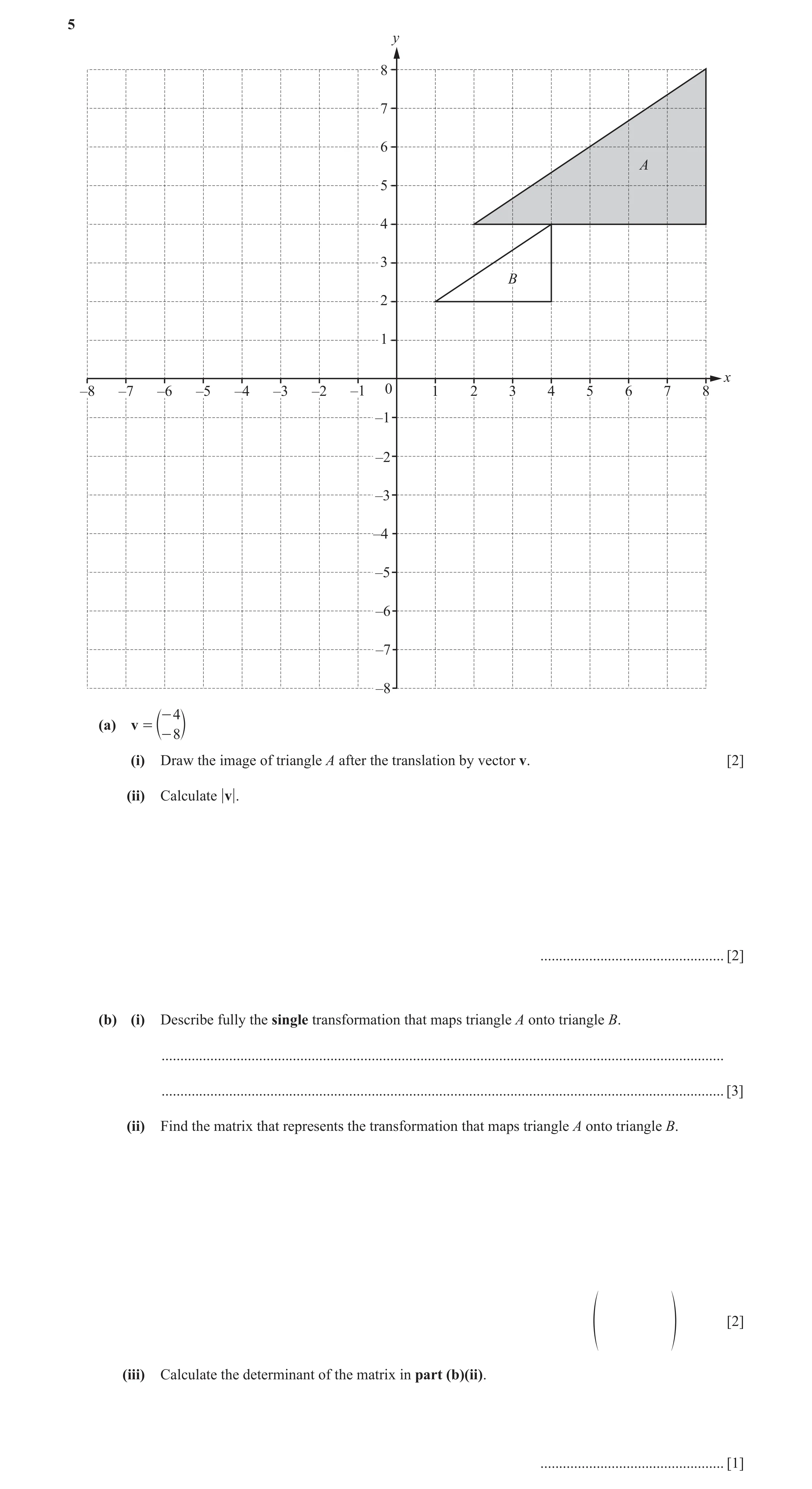
Q14 · Y 8 7 6 A 5 4 3 B 2 1 x –8 –7 –6 –5 –4 –3 –2 –1 0 1 2 3 4 5 6 7 8 –1 –2 –3 –4 –5 –6 –7 –8… 0580/41 Oct/Nov 2016
5 y 8 7 6 A 5 4 3 B 2 1 x –8 –7 –6 –5 –4 –3 –2 –1 0 1 2 3 4 5 6 7 8 –1 –2 –3 –4 –5 –6 –7 –8 - 4 (a) v = c- 8m (i) Draw the image of triangle A after the translation by vector v. [2] (ii) Calculate v . … [2] (b) (i) Describe fully the single transformation that maps triangle A onto triangle B. … … [3] (ii) Find the matrix that represents the transformation that maps triangle A onto triangle B. [2] f p (iii) Calculate the determinant of the matrix in part (b)(ii). … [1]
10 marks
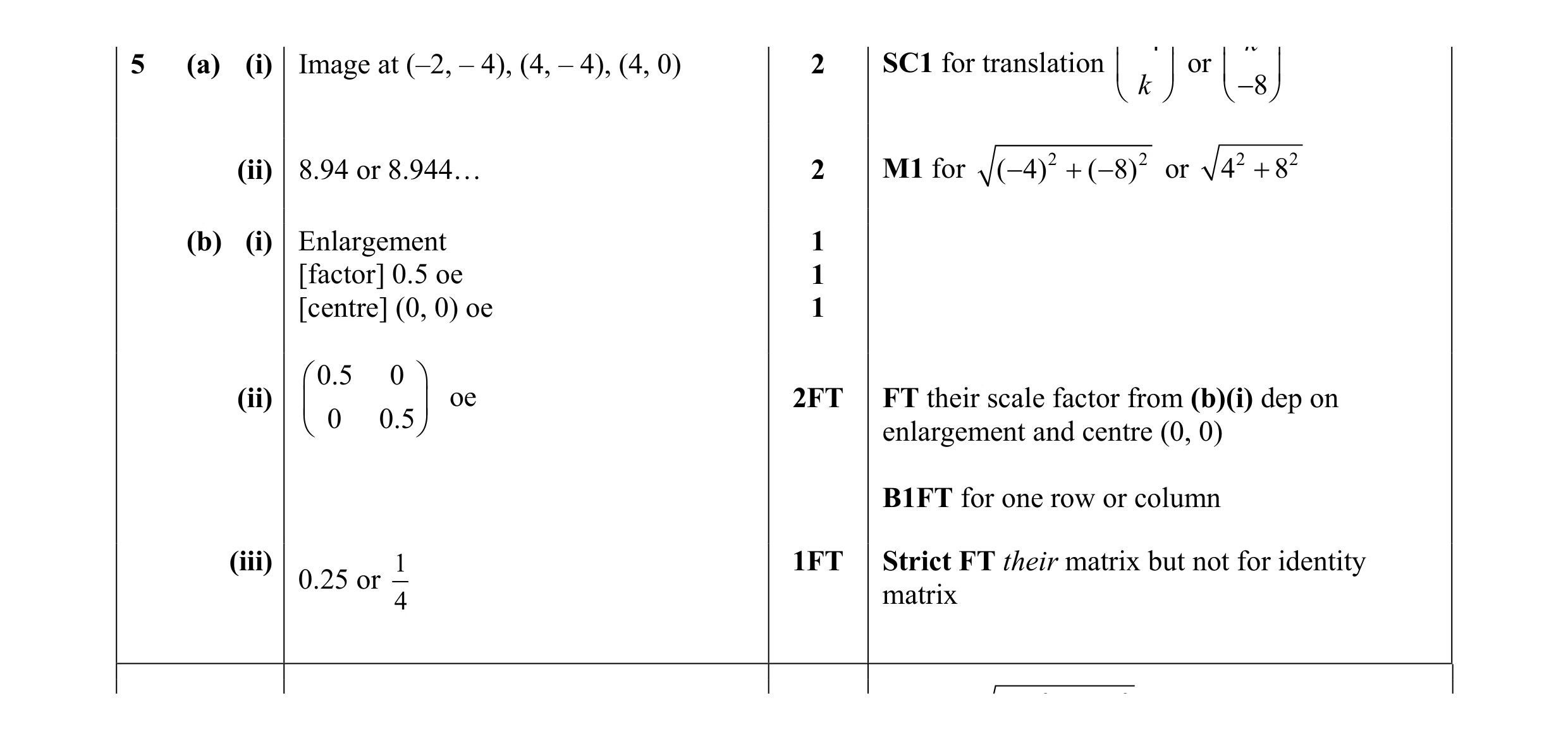
Mark scheme: 4 k 5 (a) (i) Image at (–2, – 4), (4, – 4), (4, 0) 2 SC1 for translation or k −8 (ii) 8.94 or 8.944… 2 M1 for ( − 4) 2 + ( − 8) 2 or 4 2 + 8 2 (b) (i) Enlargement 1 [factor] 0.5 oe 1 [centre] (0, 0) oe 1 0.5 0 (ii) oe 2FT FT their scale factor from (b)(i) dep on 0 0.5 enlargement and centre (0, 0) B1FT for one row or column (iii) 1 1FT Strict FT their matrix but not for identity 0.25 or 4 matrix 2 2
This question in 0580/41 Oct/Nov 2016
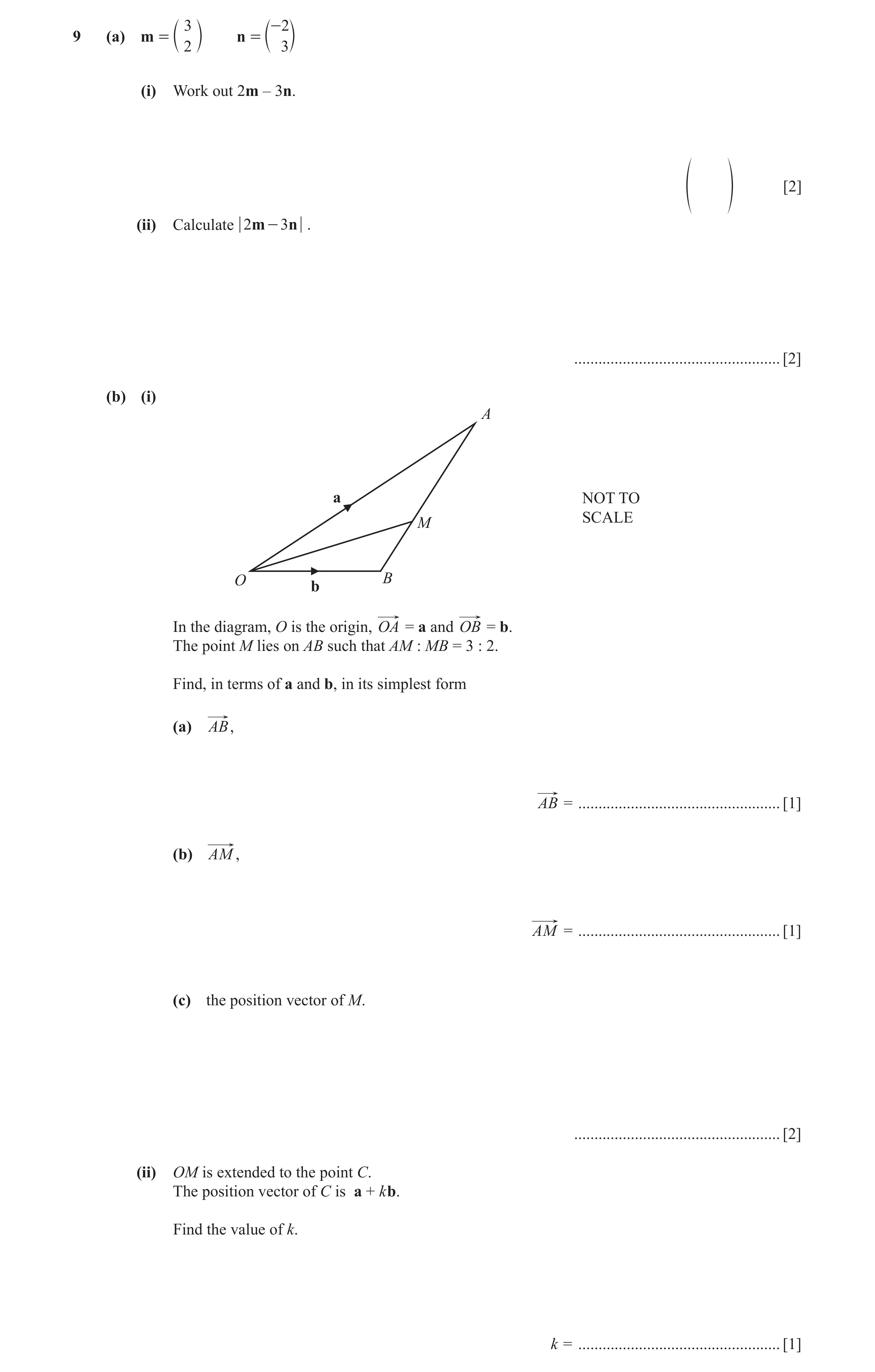
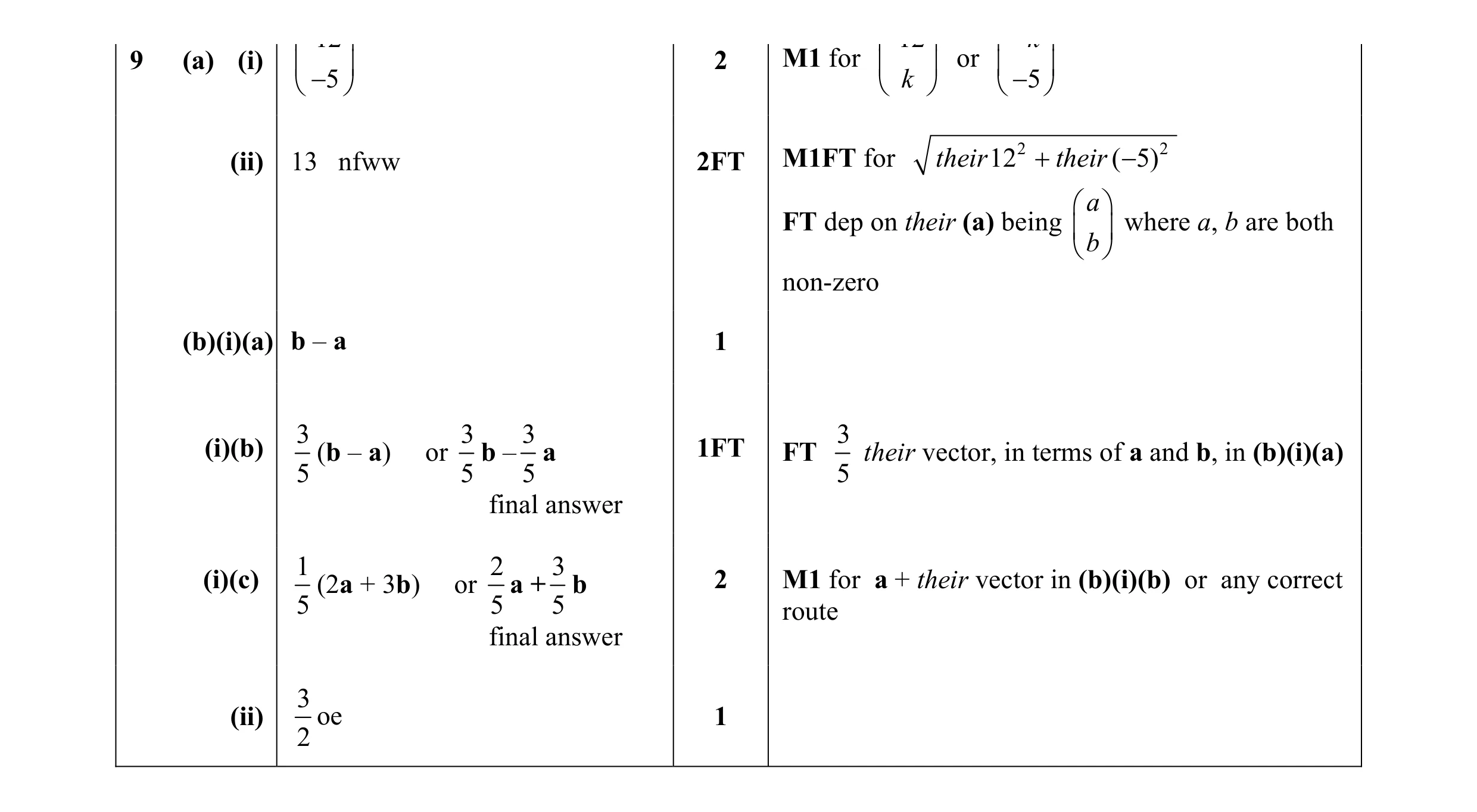
Q15 · -2 9 (a) m = n = c 2 m c 3 m (i) Work out 2m – 3n 0580/43 Oct/Nov 2016
3 -2 9 (a) m = n = c 2 m c 3 m (i) Work out 2m – 3n. [2] f p (ii) Calculate 2m - 3n . … [2] (b) (i) A a NOT TO SCALE M O B b In the diagram, O is the origin, OA = a and OB = b. The point M lies on AB such that AM : MB = 3 : 2. Find, in terms of a and b, in its simplest form (a) AB, AB = … [1] (b) AM , AM = … [1] (c) the position vector of M. … [2] (ii) OM is extended to the point C. The position vector of C is a + kb. Find the value of k. k = … [1]
9 marks
Mark scheme: 12 12 k 9 (a) (i) 2 M1 for or −5 k − 5 (ii) 13 nfww 2FT M1FT for their 12 2 + their ( −5) 2 a FT dep on their (a) being where a, b are both b non-zero (b)(i)(a) b – a 1 3 3 3 3 (i)(b) (b – a) or b – a 1FT FT their vector, in terms of a and b, in (b)(i)(a) 5 5 5 5 final answer 1 2 3 (i)(c) (2a + 3b) or a + b 2 M1 for a + their vector in (b)(i)(b) or any correct 5 5 5 route final answer 3 (ii) oe 1 2
This question in 0580/43 Oct/Nov 2016
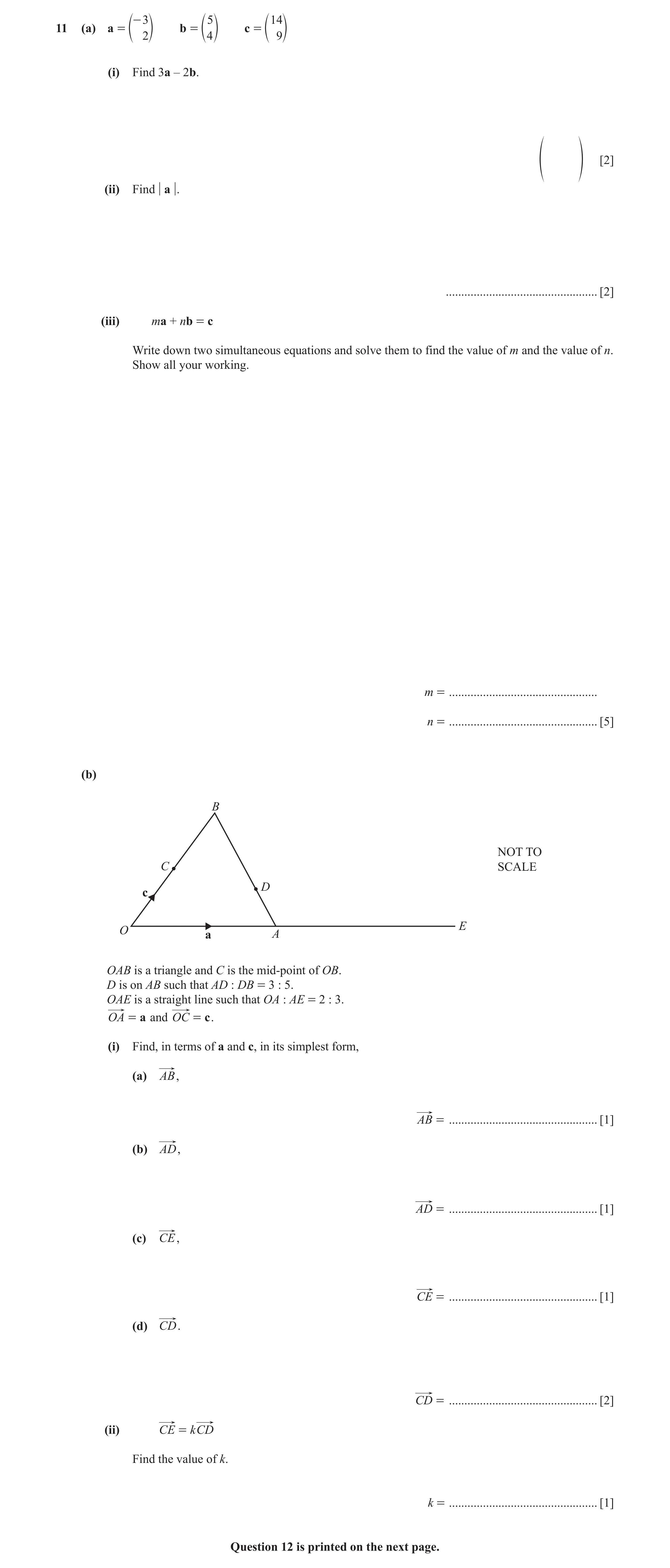
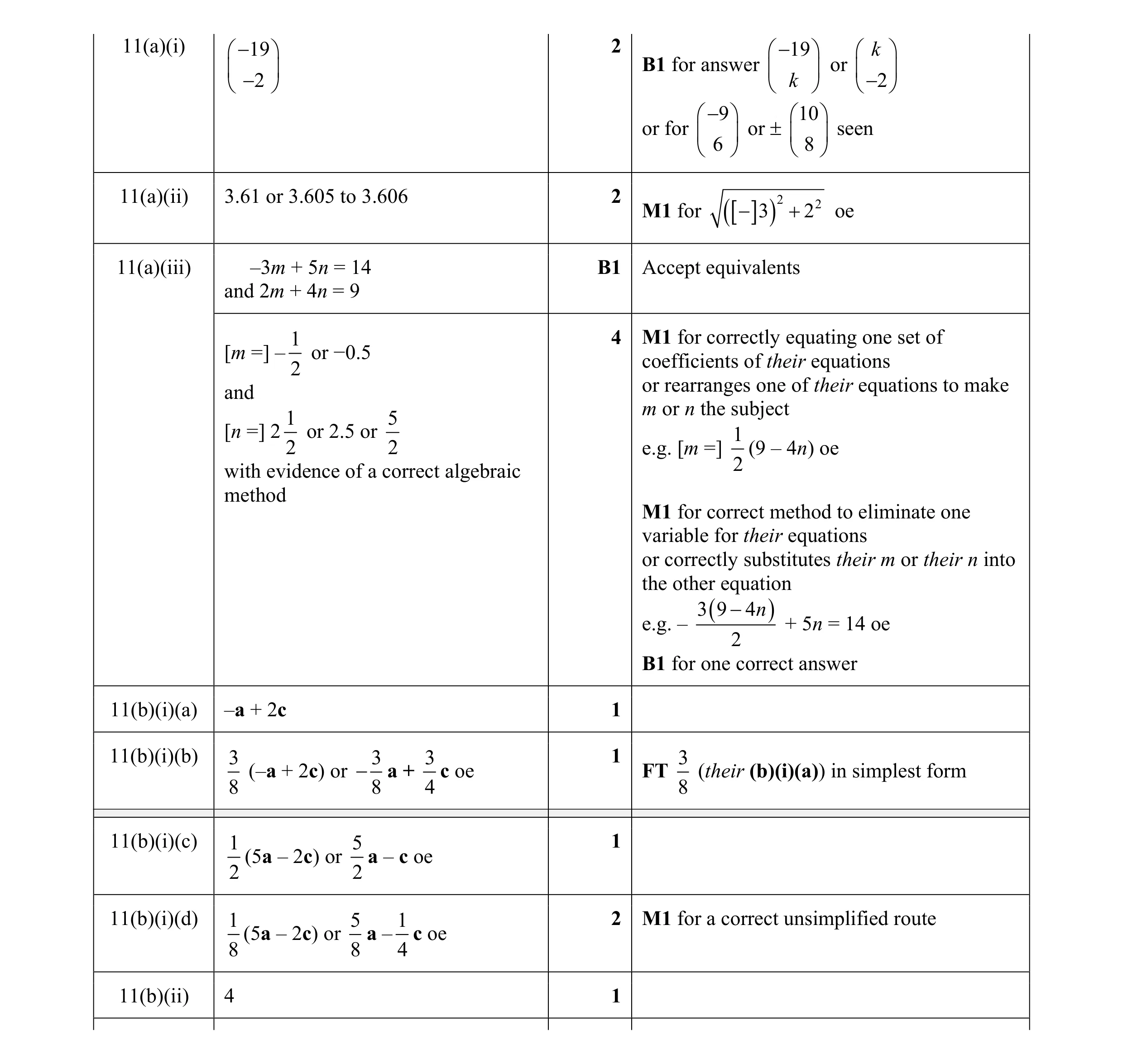
Q16 · - 3 5 14 11 (a) a = b = c = e 2o e 4 o e 9 o (i) Find 3a – 2b 0580/42 Oct/Nov 2018
- 3 5 14 11 (a) a = b = c = e 2o e 4 o e 9 o (i) Find 3a – 2b. [2] f p (ii) Find a . … [2] (iii) ma + nb = c Write down two simultaneous equations and solve them to find the value of m and the value of n. Show all your working. m = … n = … [5] (b) B NOT TO C SCALE D c E O a A OAB is a triangle and C is the mid-point of OB. D is on AB such that AD : DB = 3 : 5. OAE is a straight line such that OA : AE = 2 : 3. OA = a and OC = c . (i) Find, in terms of a and c, in its simplest form, (a) AB, AB = … [1] (b) AD, AD = … [1] (c) CE, CE = … [1] (d) CD. CD = … [2] (ii) CE = kCD Find the value of k. k = … [1] Question 12 is printed on the next page.
15 marks
Mark scheme: 11(a)(i) −19 2 −19 k B1 for answer or −2 k −2 −9 10 or for or ± seen 6 8 11(a)(ii) 3.61 or 3.605 to 3.606 2 2 2 M1 for ( [ − ] 3 ) + 2 oe 11(a)(iii) –3m + 5n = 14 B1 Accept equivalents and 2m + 4n = 9 1 4 M1 for correctly equating one set of [m =] – or −0.5 coefficients of their equations 2 or rearranges one of their equations to make and m or n the subject 1 5 [n =] 2 or 2.5 or 1 2 2 e.g. [m =] (9 – 4n) oe 2 with evidence of a correct algebraic method M1 for correct method to eliminate one variable for their equations or correctly substitutes their m or their n into the other equation 3 ( 9 −n4 ) e.g. – + 5n = 14 oe 2 B1 for one correct answer 11(b)(i)(a) –a + 2c 1 11(b)(i)(b) 3 3 3 1 3 (–a + 2c) or − a + c oe FT (their (b)(i)(a)) in simplest form 8 8 4 8 11(b)(i)(c) 1 5 1 (5a – 2c) or a – c oe 2 2 11(b)(i)(d) 1 5 1 2 M1 for a correct unsimplified route (5a – 2c) or a – c oe 8 8 4 11(b)(ii) 4 1
This question in 0580/42 Oct/Nov 2018
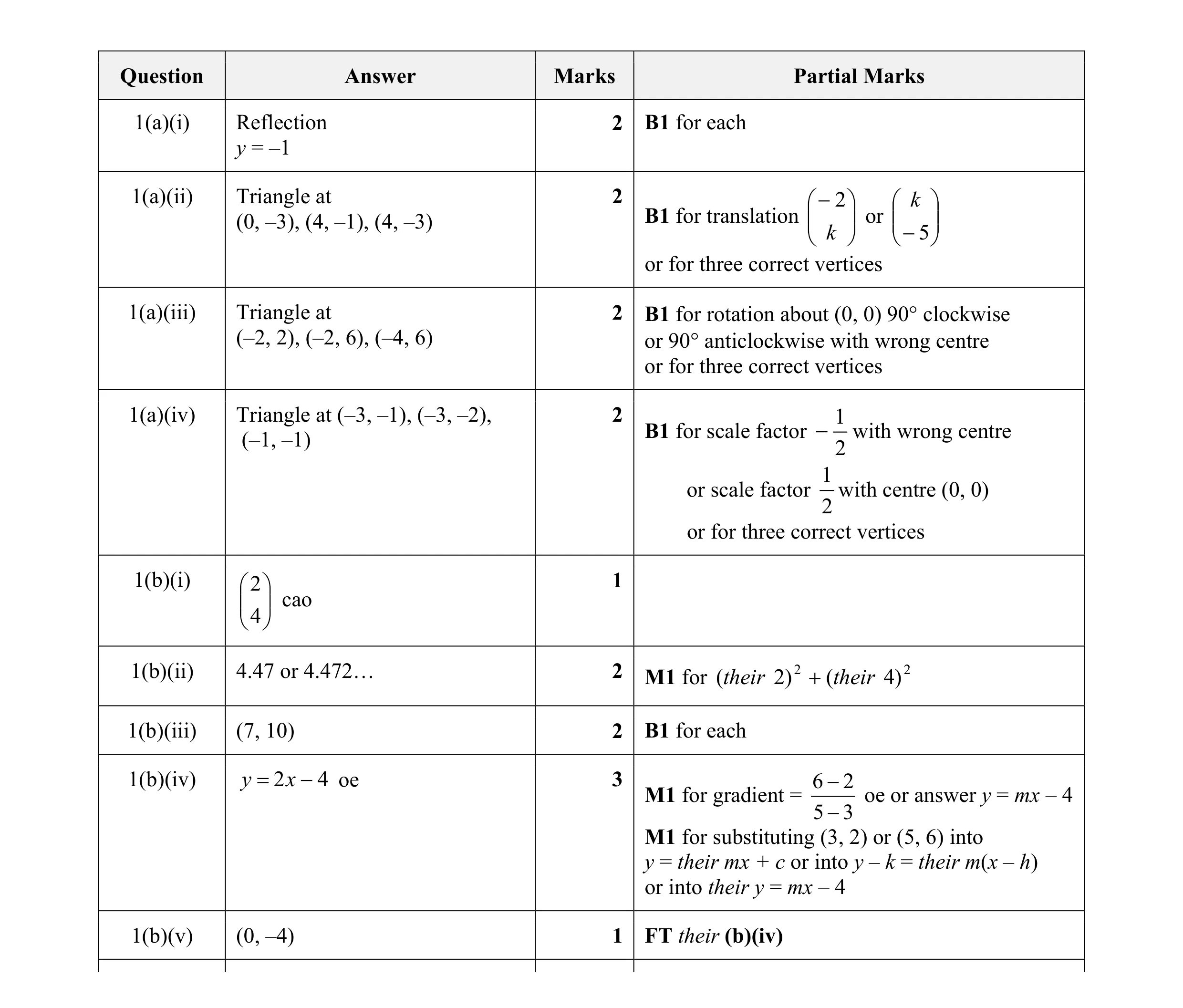
Q17 · Y 7 6 5 4 3 T 2 1 –7 –6 –5 –4 –3 –2 –1 0 1 2 3 4 5 6 7 x –1 –2 –3 –4 P –5 –6 –7 (i)… 0580/43 Oct/Nov 2018
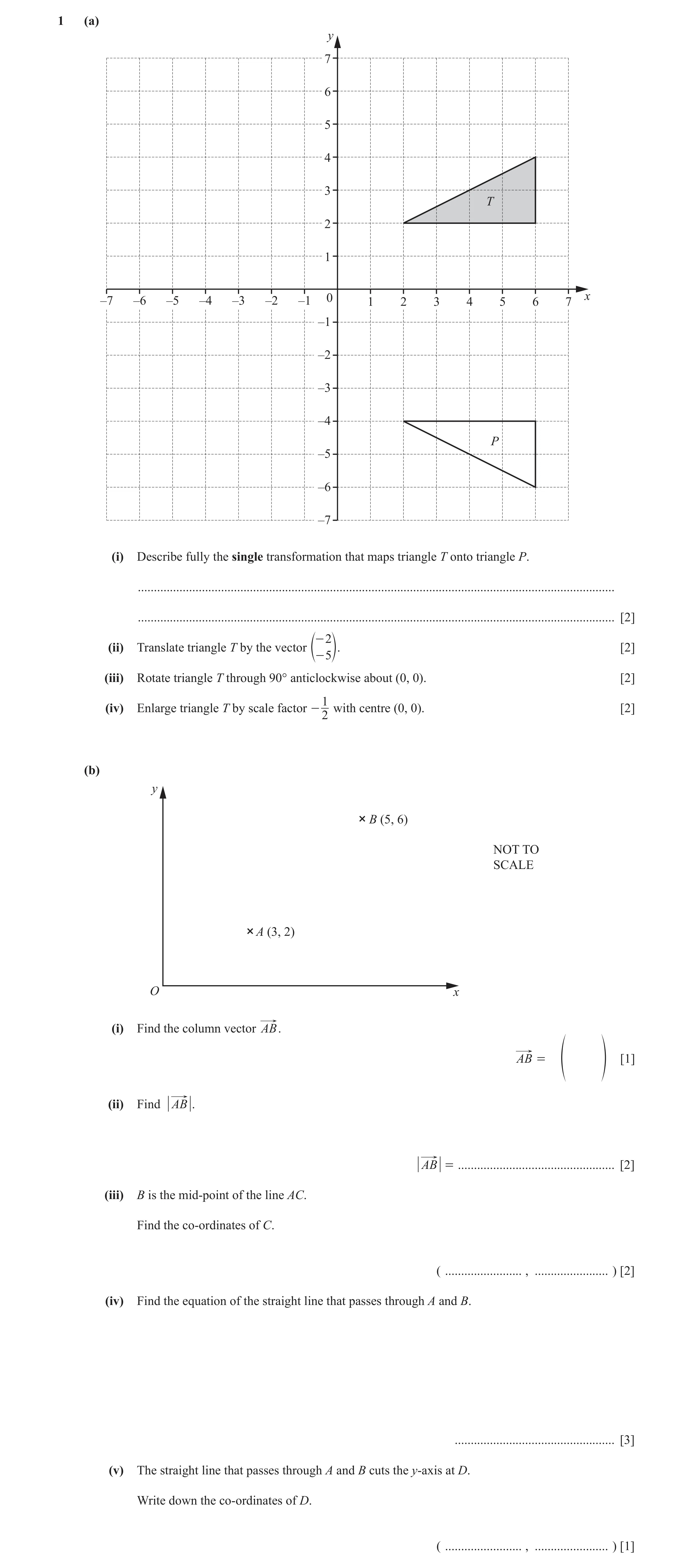
1 (a) y 7 6 5 4 3 T 2 1 –7 –6 –5 –4 –3 –2 –1 0 1 2 3 4 5 6 7 x –1 –2 –3 –4 P –5 –6 –7 (i) Describe fully the single transformation that maps triangle T onto triangle P. … … [2] - 2 (ii) Translate triangle T by the vector [2] e - 5o. (iii) Rotate triangle T through 90° anticlockwise about (0, 0). [2] 1 (iv) Enlarge triangle T by scale factor - with centre (0, 0). [2] 2 (b) y B (5, 6) NOT TO SCALE A (3, 2) O x (i) Find the column vector AB. AB = [1] f p (ii) Find AB . AB = … [2] (iii) B is the mid-point of the line AC. Find the co-ordinates of C. ( … , … ) [2] (iv) Find the equation of the straight line that passes through A and B. … [3] (v) The straight line that passes through A and B cuts the y-axis at D. Write down the co-ordinates of D. ( … , … ) [1]
17 marks
Mark scheme: Question Answer Marks Partial Marks 1(a)(i) Reflection 2 B1 for each y = –1 1(a)(ii) Triangle at 2 − 2 k (0, –3), (4, –1), (4, –3) B1 for translation or k −5 or for three correct vertices 1(a)(iii) Triangle at 2 B1 for rotation about (0, 0) 90° clockwise (–2, 2), (–2, 6), (–4, 6) or 90° anticlockwise with wrong centre or for three correct vertices 1(a)(iv) Triangle at (–3, –1), (–3, –2), 2 1 B1 for scale factor − with wrong centre (–1, –1) 2 1 or scale factor with centre (0, 0) 2 or for three correct vertices 1(b)(i) 2 1 cao 4 1(b)(ii) 4.47 or 4.472… 2 M1 for (their 2) 2 + (their 4) 2 1(b)(iii) (7, 10) 2 B1 for each 1(b)(iv) y = 2 x − 4 oe 3 6 − 2 M1 for gradient = oe or answer y = mx – 4 5 − 3 M1 for substituting (3, 2) or (5, 6) into y = their mx + c or into y – k = their m(x – h) or into their y = mx – 4 1(b)(v) (0, –4) 1 FT their (b)(iv)
This question in 0580/43 Oct/Nov 2018
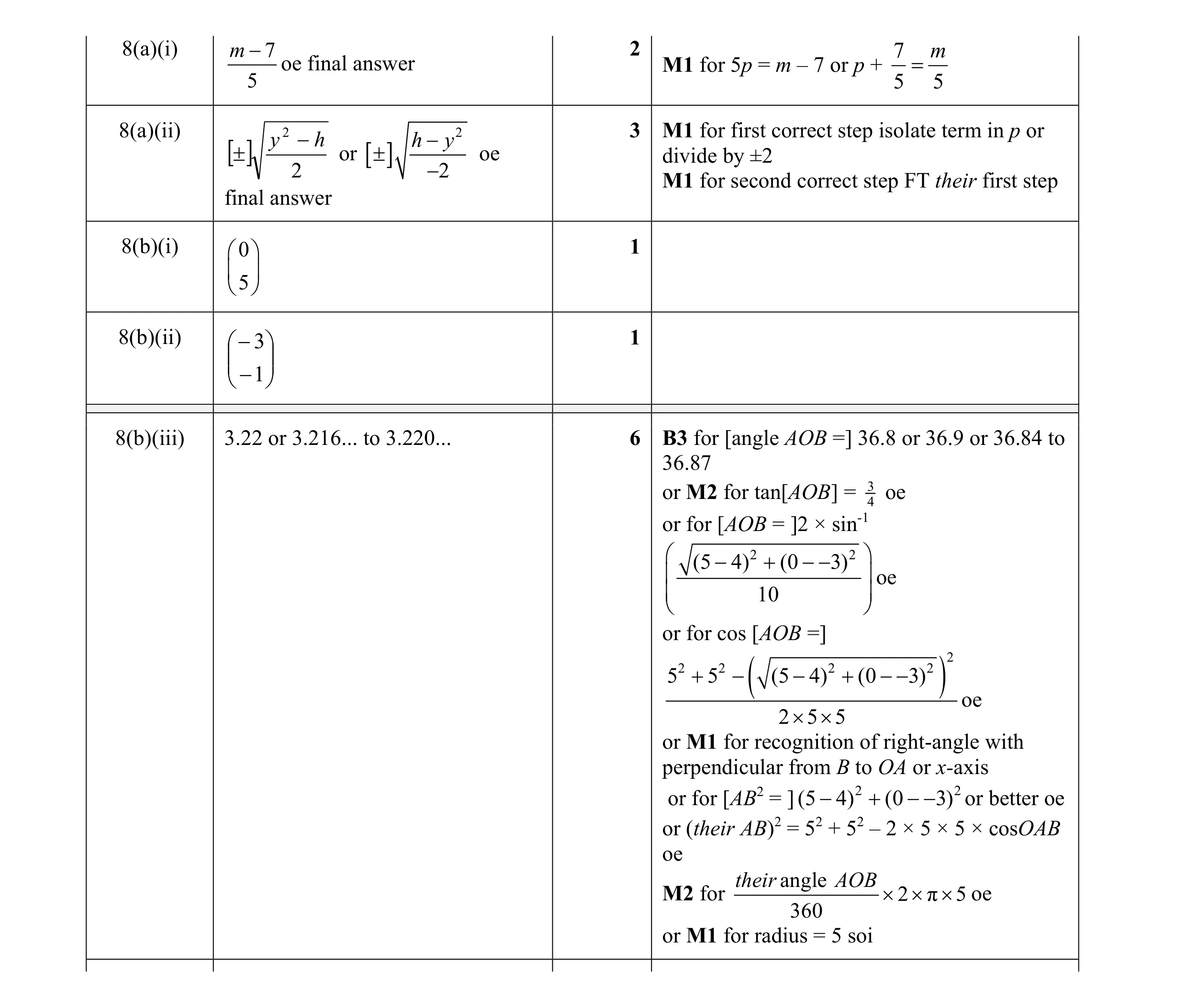
Q18 · Make p the subject of (i) 5p + 7 = m , p = … [2] (ii) y 2 - 2p 2 = h 0580/42 Oct/Nov 2019
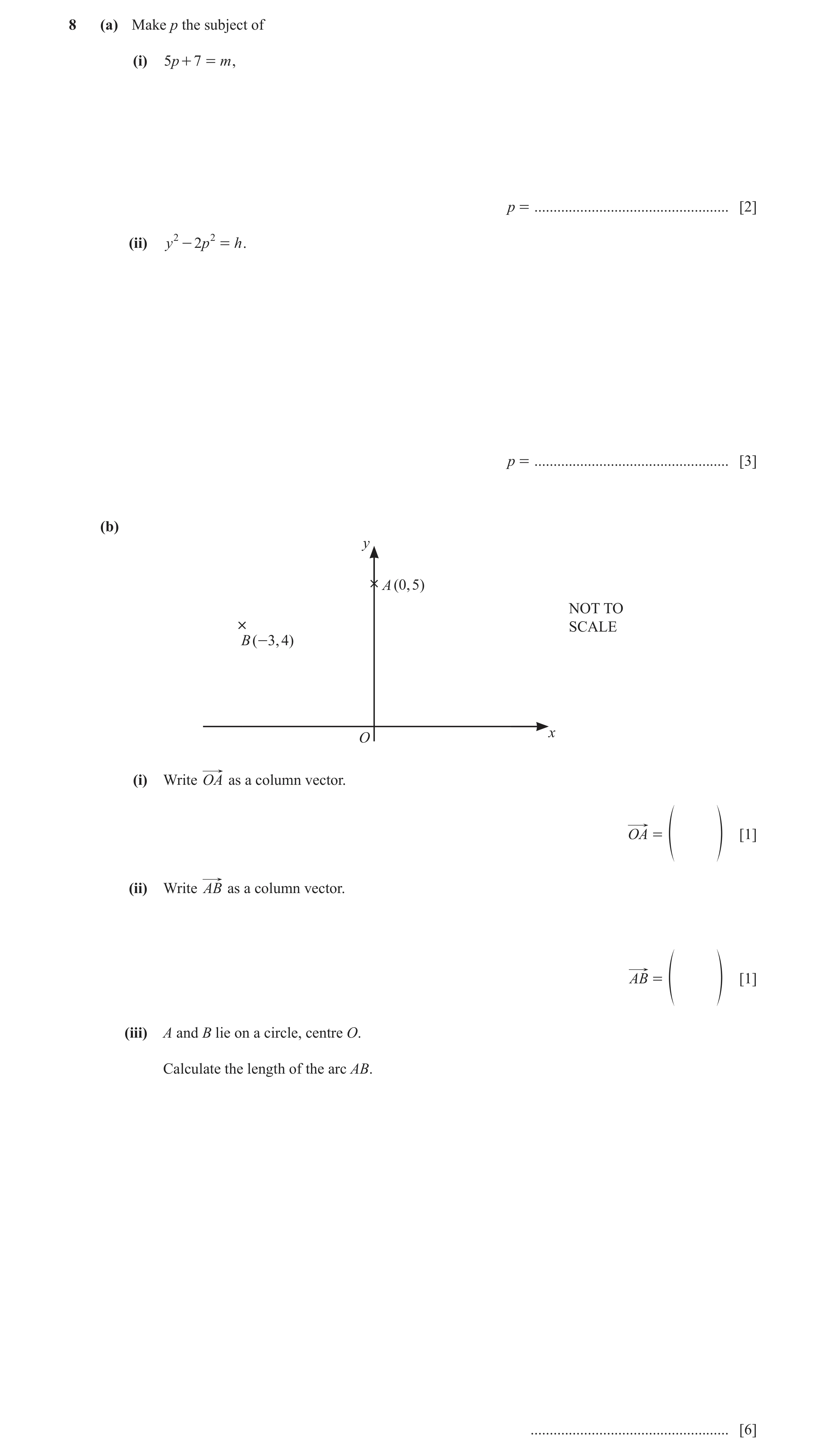
8 (a) Make p the subject of (i) 5p + 7 = m , p = … [2] (ii) y 2 - 2p 2 = h . p = … [3] (b) y A (0, 5) NOT TO SCALE B (-3, 4) x O (i) Write OA as a column vector. OA = [1] f p (ii) Write AB as a column vector. AB = [1] f p (iii) A and B lie on a circle, centre O. Calculate the length of the arc AB. … [6]
13 marks
Mark scheme: 8(a)(i) m − 7 2 7 m oe final answer M1 for 5p = m – 7 or p + = 5 5 5 8(a)(ii) 2 2 3 M1 for first correct step isolate term in p or [± ] y − h or [ ± ] h − y oe divide by ±2 2 −2 M1 for second correct step FT their first step final answer 8(b)(i) 0 1 5 8(b)(ii) − 3 1 − 1 8(b)(iii) 3.22 or 3.216... to 3.220... 6 B3 for [angle AOB =] 36.8 or 36.9 or 36.84 to 36.87 or M2 for tan[AOB] = 34 oe or for [AOB = ]2 × sin-1 2 2 (5 − 4) + (0 −−3) oe 10 or for cos [AOB =] 2 5 2 + 5 2 − (5 − 4) 2 + (0 −−3) 2 ( ) oe 2 × 5 × 5 or M1 for recognition of right-angle with perpendicular from B to OA or x-axis or for [AB2 = ] (5 − 4) 2 + (0 −− 3) 2 or better oe or (their AB)2 = 52 + 52 – 2 × 5 × 5 × cosOAB oe their angle AOB M2 for × 2 × π × 5 oe 360 or M1 for radius = 5 soi
This question in 0580/42 Oct/Nov 2019
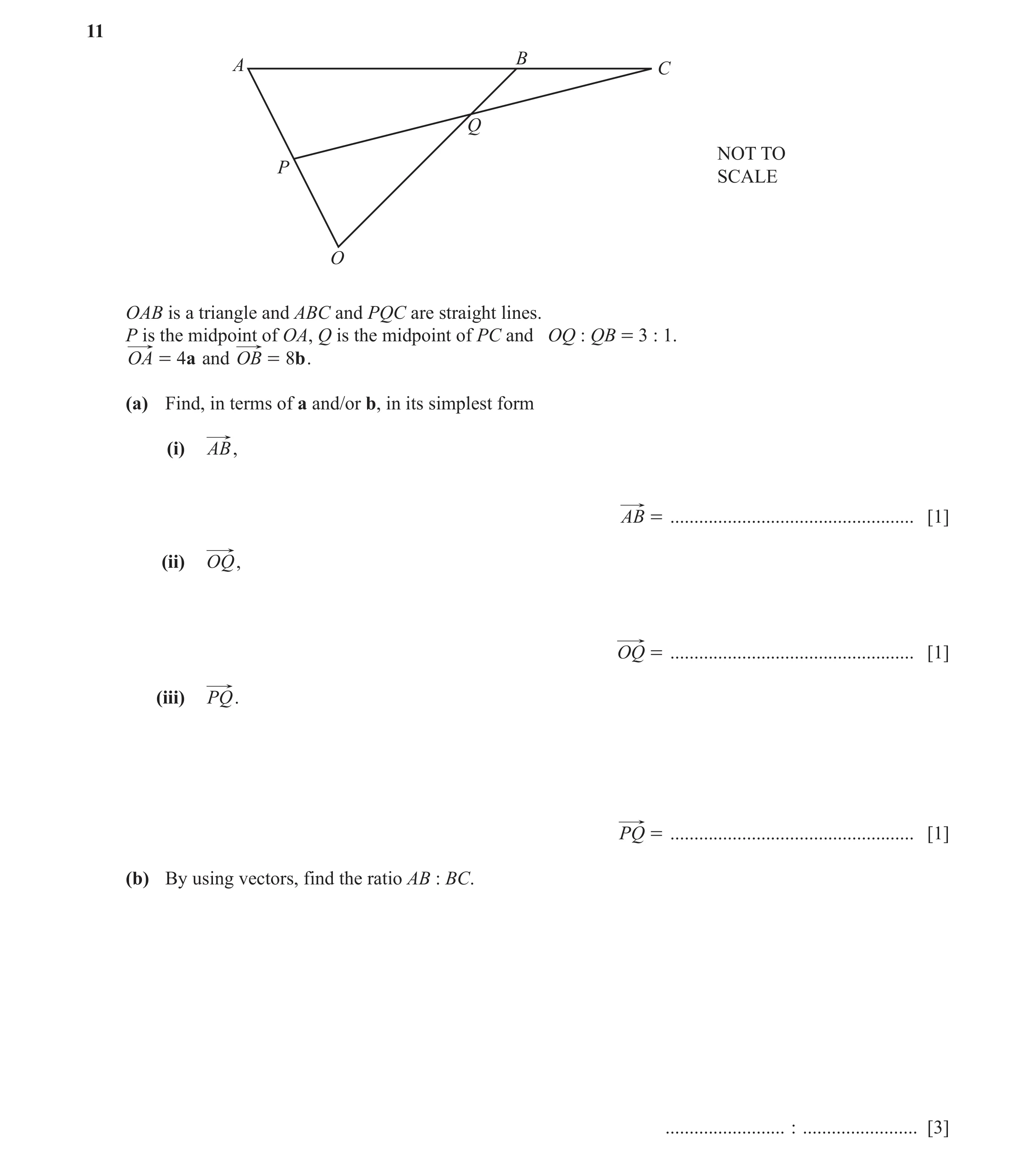
Q19 · B A C Q NOT TO P SCALE O OAB is a triangle and ABC and PQC are straight lines 0580/43 Oct/Nov 2019
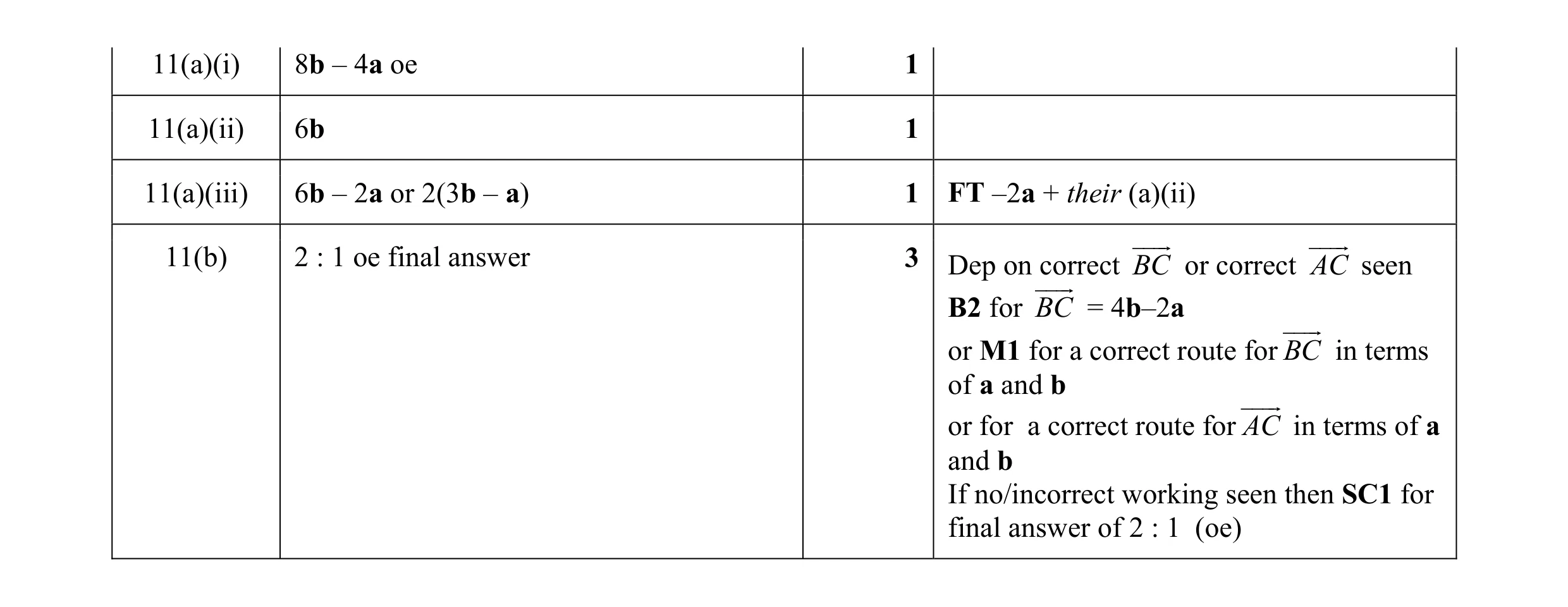
11 B A C Q NOT TO P SCALE O OAB is a triangle and ABC and PQC are straight lines. P is the midpoint of OA, Q is the midpoint of PC and OQ : QB = 3 : 1. OA = 4a and OB = 8b . (a) Find, in terms of a and/or b, in its simplest form (i) AB, AB = … [1] (ii) OQ, OQ = … [1] (iii) PQ. PQ = … [1] (b) By using vectors, find the ratio AB : BC. … : … [3]
6 marks
Mark scheme: 11(a)(i) 8b – 4a oe 1 11(a)(ii) 6b 1 11(a)(iii) 6b – 2a or 2(3b – a) 1 FT –2a + their (a)(ii) JJJG JJJG 11(b) 2 : 1 oe final answer 3 Dep on correct BC or correct AC seen JJJG B2 for BC = 4b–2a JJJG or M1 for a correct route for BC in terms of a and b JJJG or for a correct route for AC in terms of a and b If no/incorrect working seen then SC1 for final answer of 2 : 1 (oe)
This question in 0580/43 Oct/Nov 2019
Q20 · - 2 2 (a) p = q = e 5 o e 7o (i) Find 2 p + q 0580/42 May/June 2020
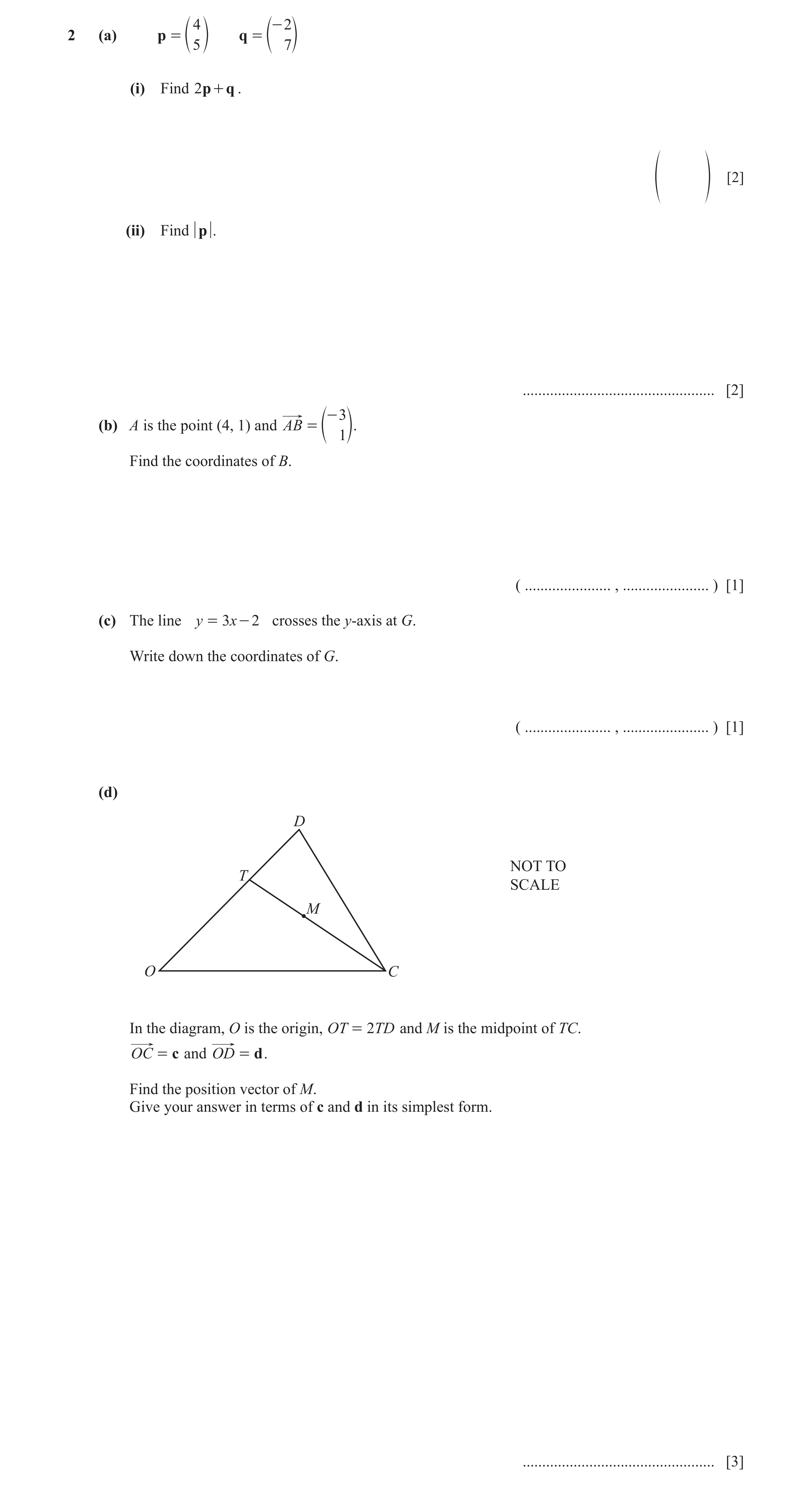
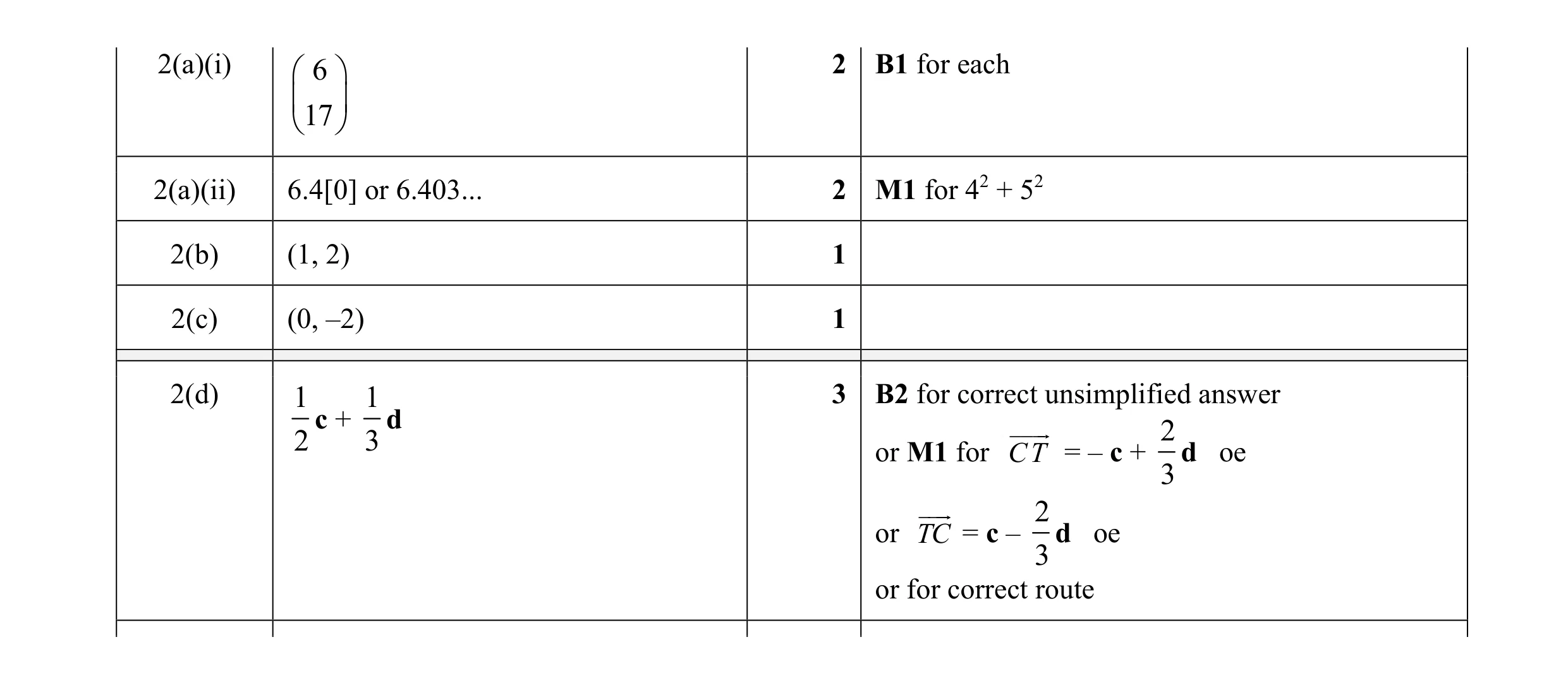
4 - 2 2 (a) p = q = e 5 o e 7o (i) Find 2 p + q . [2] f p (ii) Find p . … [2] - 3 (b) A is the point (4, 1) and AB = e 1o. Find the coordinates of B. ( … , … ) [1] (c) The line y = 3 x - 2 crosses the y-axis at G. Write down the coordinates of G. ( … , … ) [1] (d) D NOT TO T SCALE M O C In the diagram, O is the origin, OT = 2TD and M is the midpoint of TC. OC = c and OD = d . Find the position vector of M. Give your answer in terms of c and d in its simplest form. … [3]
9 marks
Mark scheme: 2(a)(i) 6 2 B1 for each 17 2(a)(ii) 6.4[0] or 6.403... 2 M1 for 42 + 52 2(b) (1, 2) 1 2(c) (0, –2) 1 2(d) 1 1 3 B2 for correct unsimplified answer c + d 2 2 3 or M1 for CT = – c + d oe 3 2 or TC = c – d oe 3 or for correct route
This question in 0580/42 May/June 2020
Q21 · - 2 2 8 (a) AB = BC = DC = e- 1o e 5o e- 3o Find (i) AC, AC = [2] f p (ii) BD, BD = [2] f… 0580/43 Oct/Nov 2020
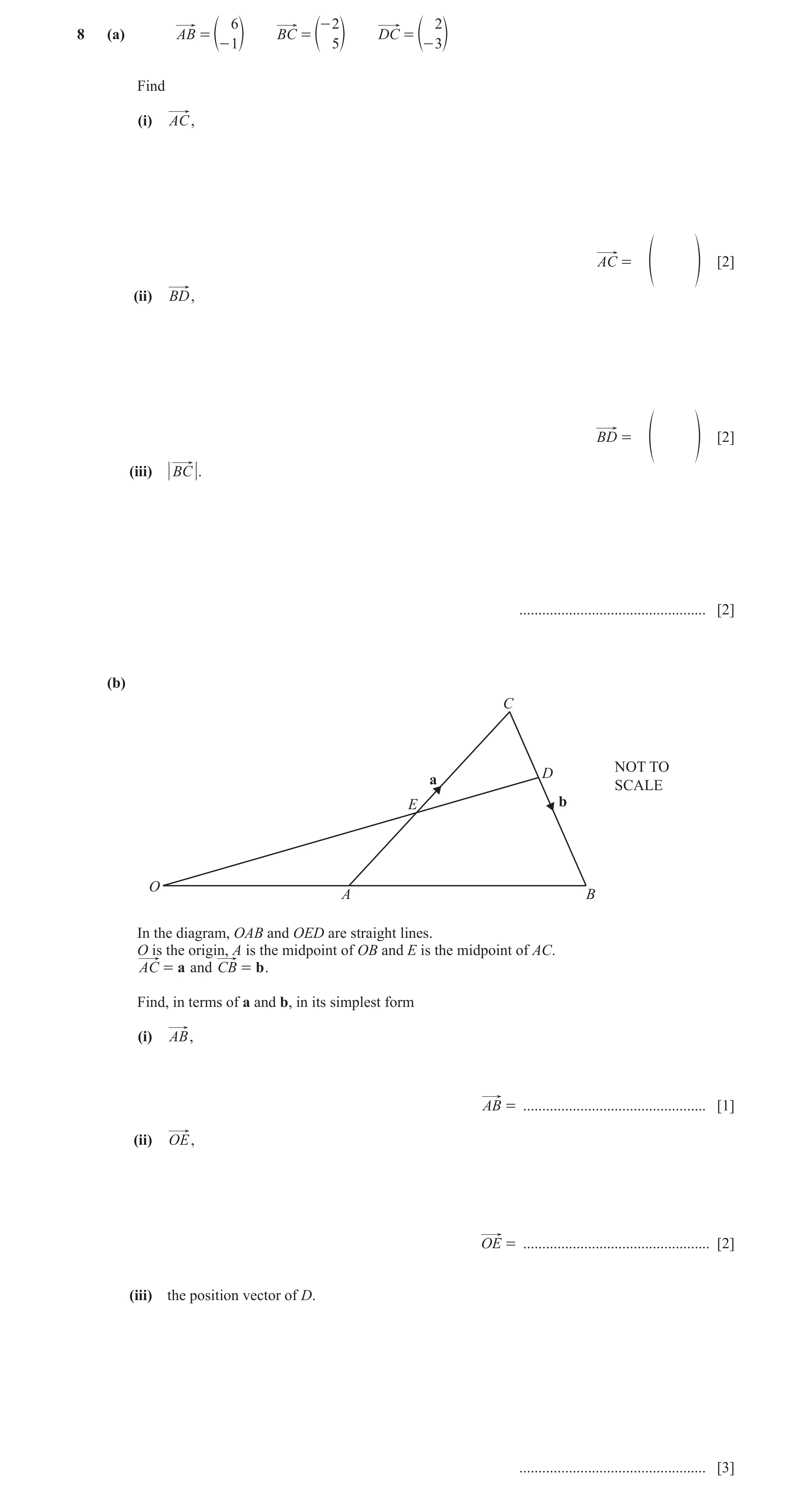
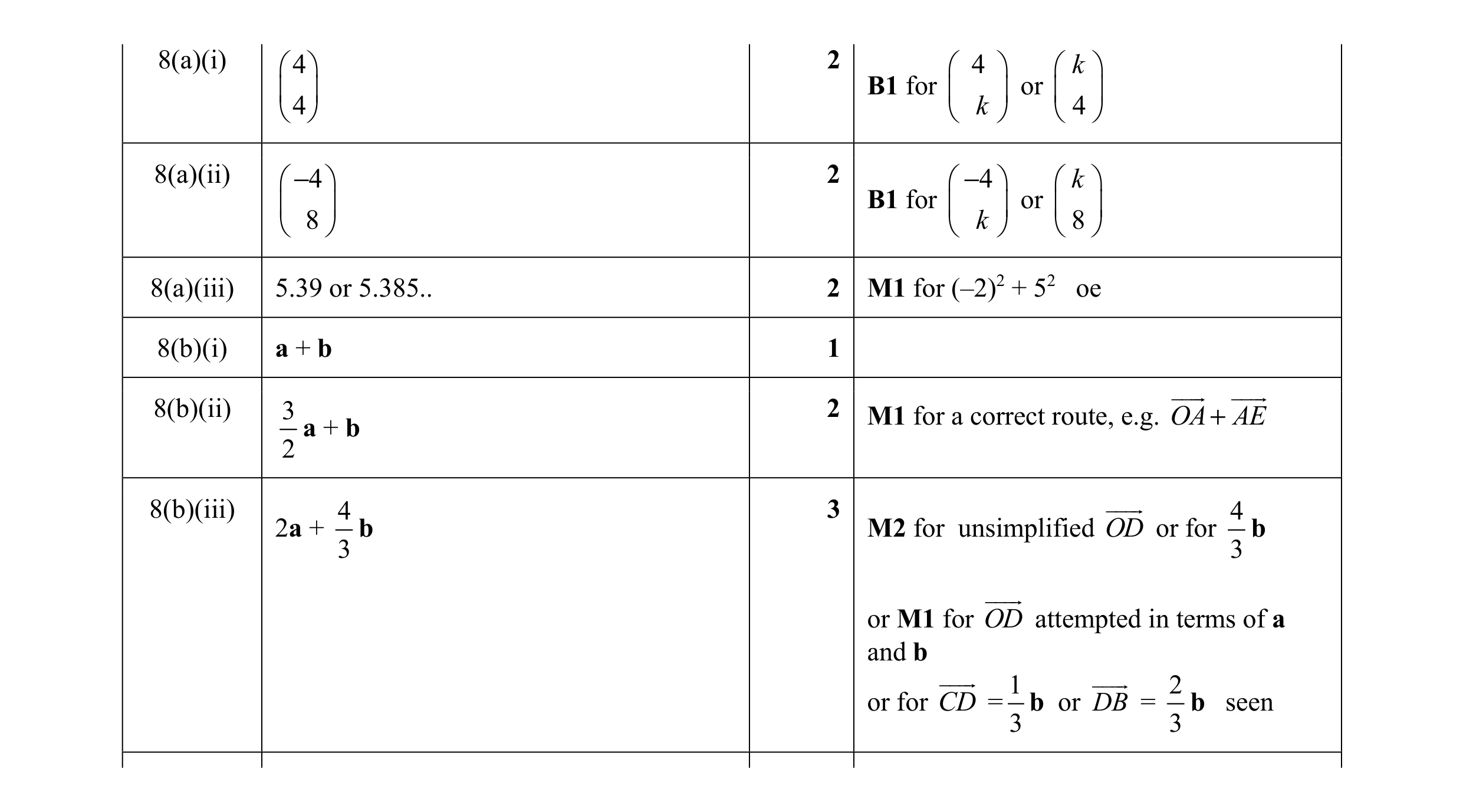
6 - 2 2 8 (a) AB = BC = DC = e- 1o e 5o e- 3o Find (i) AC, AC = [2] f p (ii) BD, BD = [2] f p (iii) BC . … [2] (b) C NOT TO D a SCALE E b O A B In the diagram, OAB and OED are straight lines. O is the origin, A is the midpoint of OB and E is the midpoint of AC. AC = a and CB = b . Find, in terms of a and b, in its simplest form (i) AB, AB = … [1] (ii) OE, OE = … [2] (iii) the position vector of D. … [3]
12 marks
Mark scheme: 8(a)(i) 4 2 4 k B1 for or 4 k 4 8(a)(ii) −4 2 −4 k B1 for or 8 k 8 8(a)(iii) 5.39 or 5.385.. 2 M1 for (–2)2 + 52 oe 8(b)(i) a + b 1 8(b)(ii) 3 2 M1 for a correct route, e.g. OA + AE a + b 2 8(b)(iii) 4 3 4 2a + b M2 for unsimplified OD or for b 3 3 or M1 for OD attempted in terms of a and b 1 2 or for CD = b or DB = b seen 3 3
This question in 0580/43 Oct/Nov 2020
Q22 · - 3 2 5 (a) a = b = e 8o e- 5o (i) Find (a) b - a , [1] f p (b) 2a + b , [2] f p (c) b 0580/42 May/June 2021
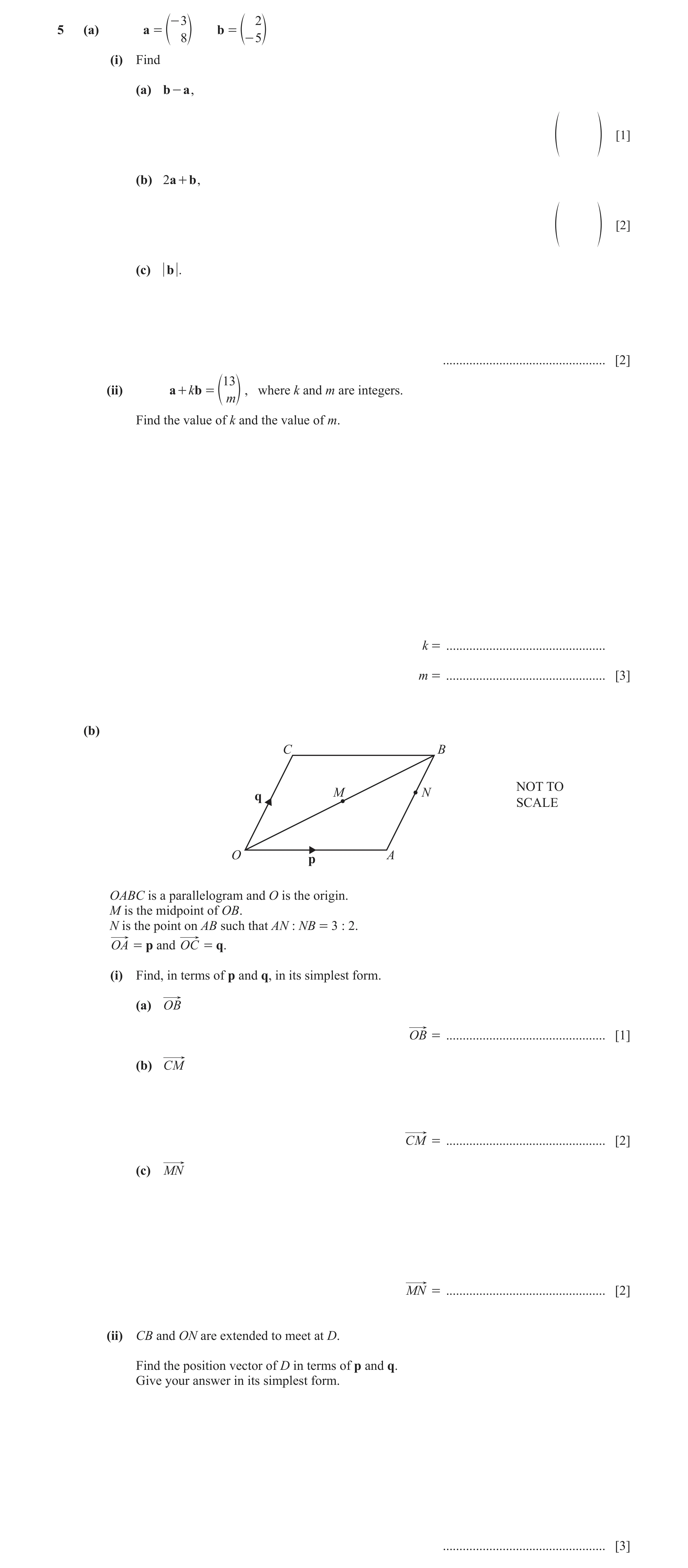
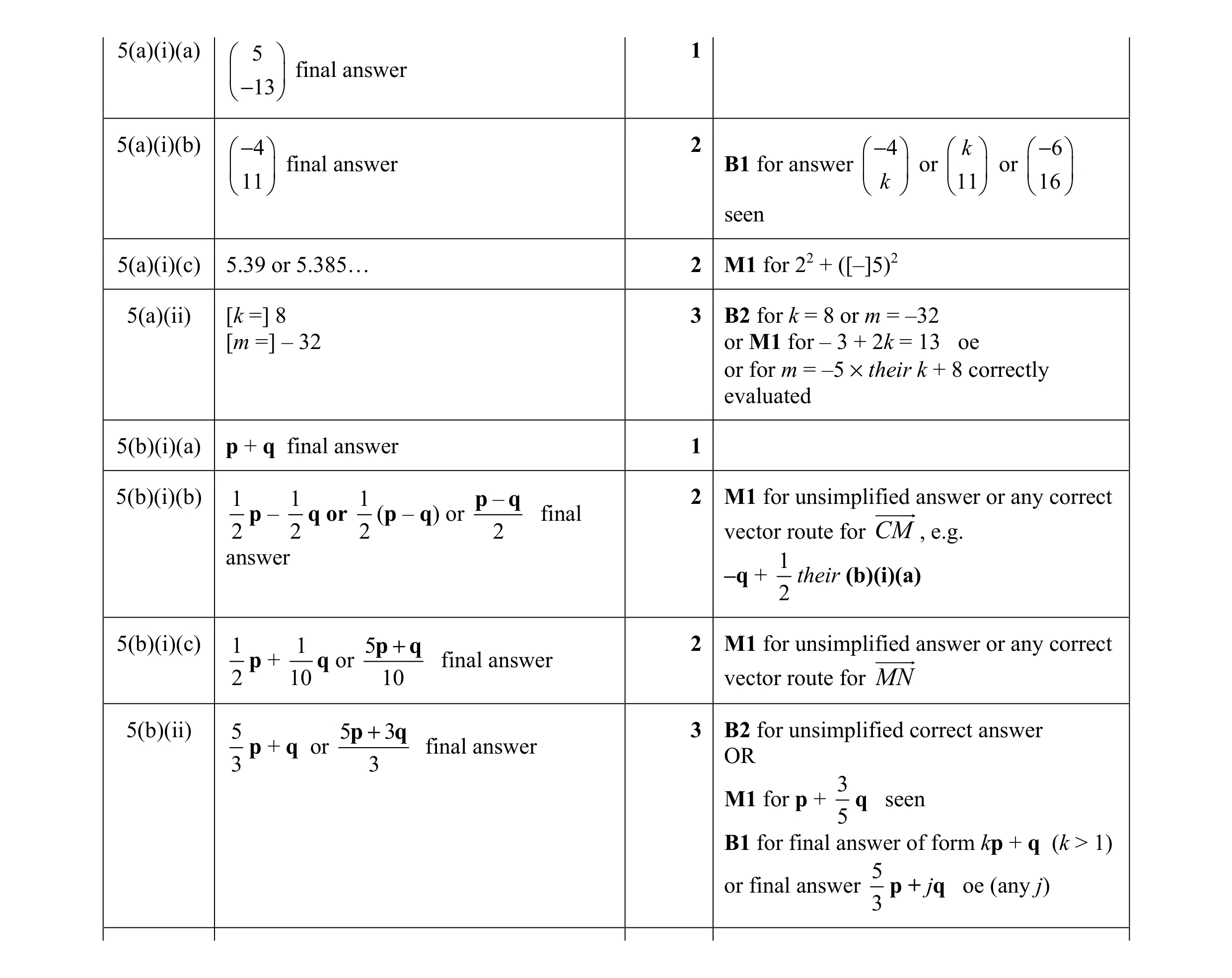
- 3 2 5 (a) a = b = e 8o e- 5o (i) Find (a) b - a , [1] f p (b) 2a + b , [2] f p (c) b . … [2] 13 (ii) a + kb = , where k and m are integers. e mo Find the value of k and the value of m. k = … m = … [3] (b) C B NOT TO q M N SCALE O A p OABC is a parallelogram and O is the origin. M is the midpoint of OB. N is the point on AB such that AN : NB = 3 : 2. OA = p and OC = q. (i) Find, in terms of p and q, in its simplest form. (a) OB OB = … [1] (b) CM CM = … [2] (c) MN MN = … [2] (ii) CB and ON are extended to meet at D. Find the position vector of D in terms of p and q. Give your answer in its simplest form. … [3]
16 marks
Mark scheme: 5(a)(i)(a) 5 1 final answer −13 5(a)(i)(b) − 4 2 − 4 k − 6 final answer B1 for answer or or 11 k 11 16 seen 5(a)(i)(c) 5.39 or 5.385… 2 M1 for 22 + ([–]5)2 5(a)(ii) [k =] 8 3 B2 for k = 8 or m = –32 [m =] – 32 or M1 for – 3 + 2k = 13 oe or for m = –5 × their k + 8 correctly evaluated 5(b)(i)(a) p + q final answer 1 5(b)(i)(b) 1 1 1 p – q 2 M1 for unsimplified answer or any correct p – q or (p – q) or final 2 2 2 2 vector route for CM , e.g. answer 1 – q + their (b)(i)(a) 2 5(b)(i)(c) 1 1 5p + q 2 M1 for unsimplified answer or any correct p + q or final answer 2 10 10 vector route for MN 5(b)(ii) 5 5p + 3q 3 B2 for unsimplified correct answer p + q or final answer OR 3 3 3 M1 for p + q seen 5 B1 for final answer of form kp + q (k > 1) 5 or final answer p + jq oe (any j) 3
This question in 0580/42 May/June 2021
Q23 · A is the point (1, 5) and B is the point (3, 9) 0580/43 May/June 2021
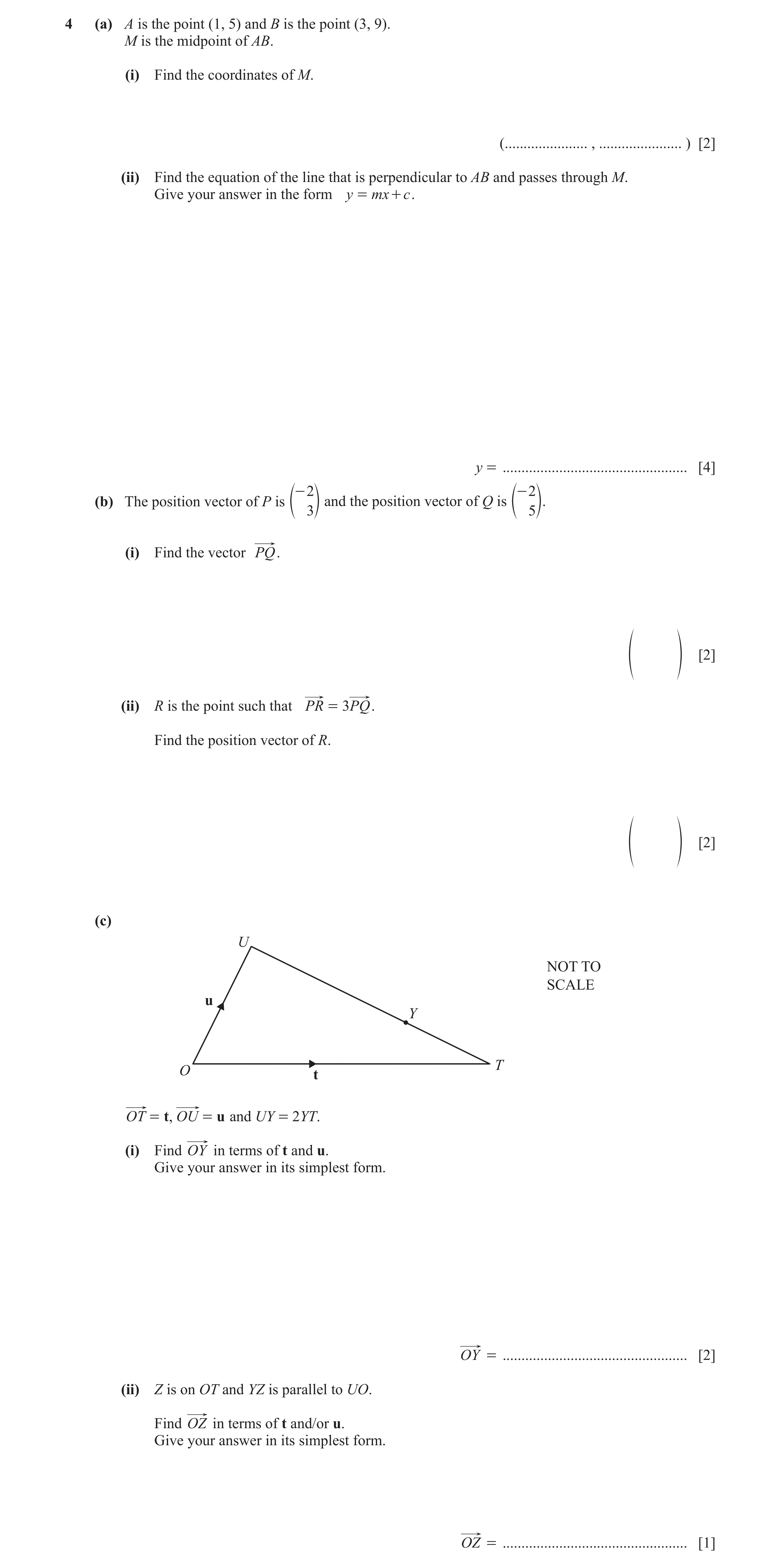
4 (a) A is the point (1, 5) and B is the point (3, 9). M is the midpoint of AB. (i) Find the coordinates of M. ( … , … ) [2] (ii) Find the equation of the line that is perpendicular to AB and passes through M. Give your answer in the form y = mx + c . y = … [4] - 2 - 2 (b) The position vector of P is and the position vector of Q is e 3o e 5o. (i) Find the vector PQ. [2] f p (ii) R is the point such that PR = 3PQ . Find the position vector of R. [2] f p (c) U NOT TO SCALE u Y T O t OT = t , OU = u and UY = 2YT. (i) Find OY in terms of t and u. Give your answer in its simplest form. OY = … [2] (ii) Z is on OT and YZ is parallel to UO. Find OZ in terms of t and/or u. Give your answer in its simplest form. OZ = … [1]
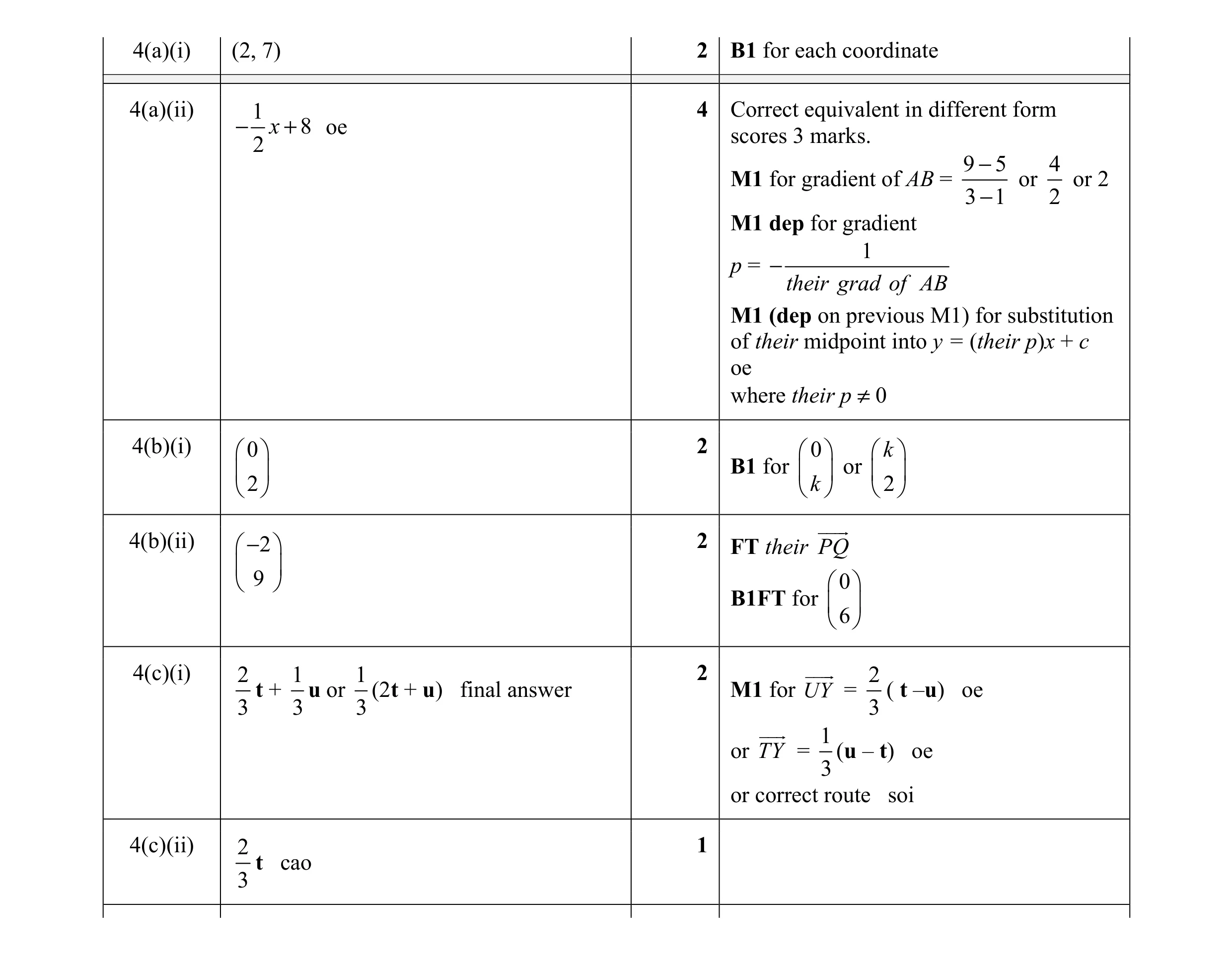
13 marks
Mark scheme: 4(a)(i) (2, 7) 2 B1 for each coordinate 4(a)(ii) 1 4 Correct equivalent in different form − x + 8 oe scores 3 marks. 2 9 − 5 4 M1 for gradient of AB = or or 2 3 − 1 2 M1 dep for gradient 1 p = −their grad of AB M1 (dep on previous M1) for substitution of their midpoint into y = (their p)x + c oe where their p ≠ 0 4(b)(i) 0 2 0 k B1 for or 2 k 2 4(b)(ii) − 2 2 FT their PQ 9 0 B1FT for 6 4(c)(i) 2 1 1 2 2 t + u or (2t + u) final answer M1 for UY = ( t –u) oe 3 3 3 3 1 or TY = (u – t) oe 3 or correct route soi 4(c)(ii) 2 1 t cao 3
This question in 0580/43 May/June 2021
Q24 · - 2 9 (a) F is the point (5, - 2 ) and FG = e 3o 0580/42 Oct/Nov 2021
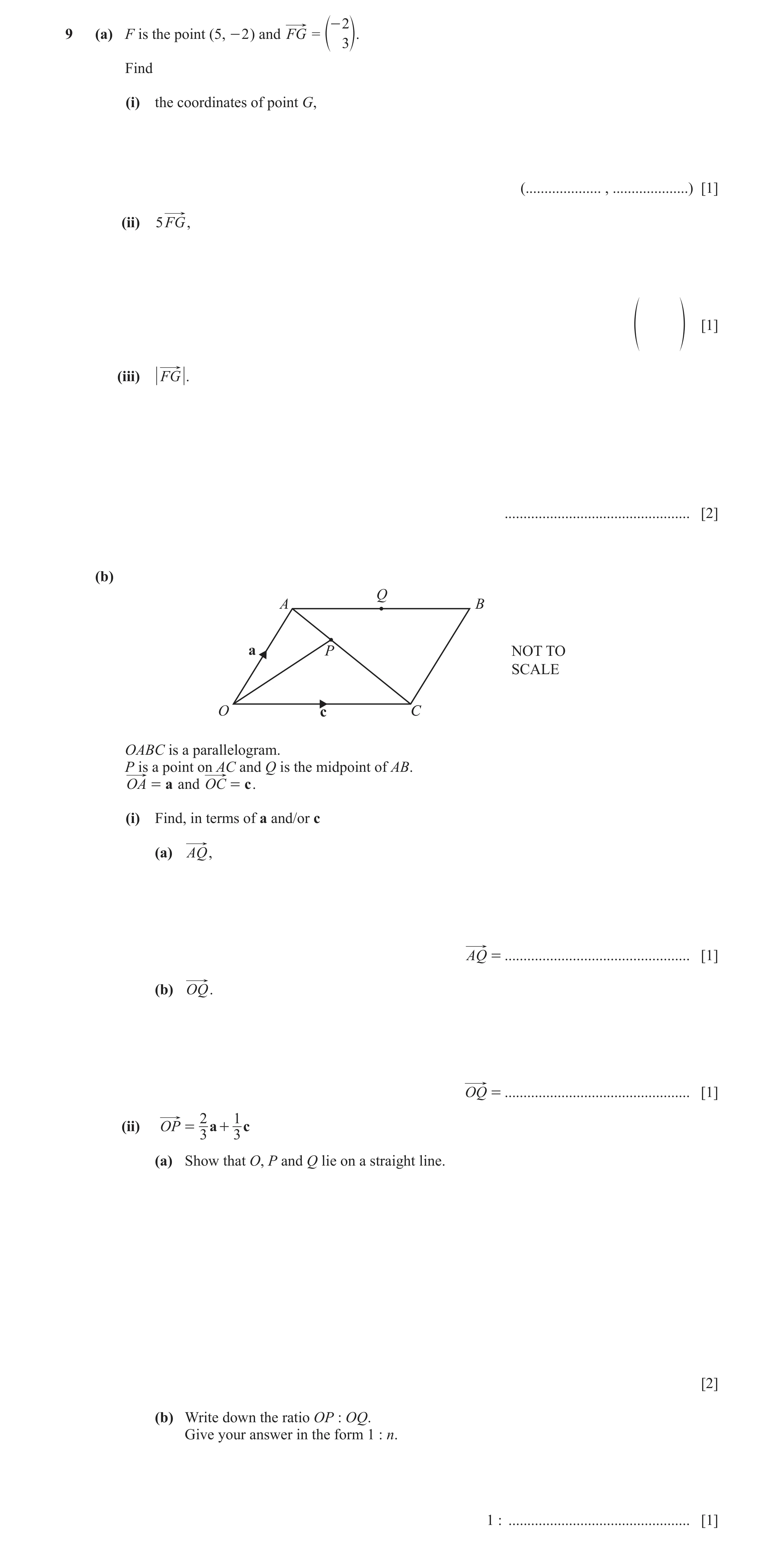
- 2 9 (a) F is the point (5, - 2 ) and FG = e 3o. Find (i) the coordinates of point G, ( … , … ) [1] (ii) 5 FG , [1] f p (iii) FG . … [2] (b) Q A B a P NOT TO SCALE O c C OABC is a parallelogram. P is a point on AC and Q is the midpoint of AB. OA = a and O C = c . (i) Find, in terms of a and/or c (a) AQ, AQ = … [1] (b) O Q . O Q = … [1] 2 1 (ii) OP = a + c 3 3 (a) Show that O, P and Q lie on a straight line. [2] (b) Write down the ratio OP : OQ. Give your answer in the form 1 : n. 1 : … [1]
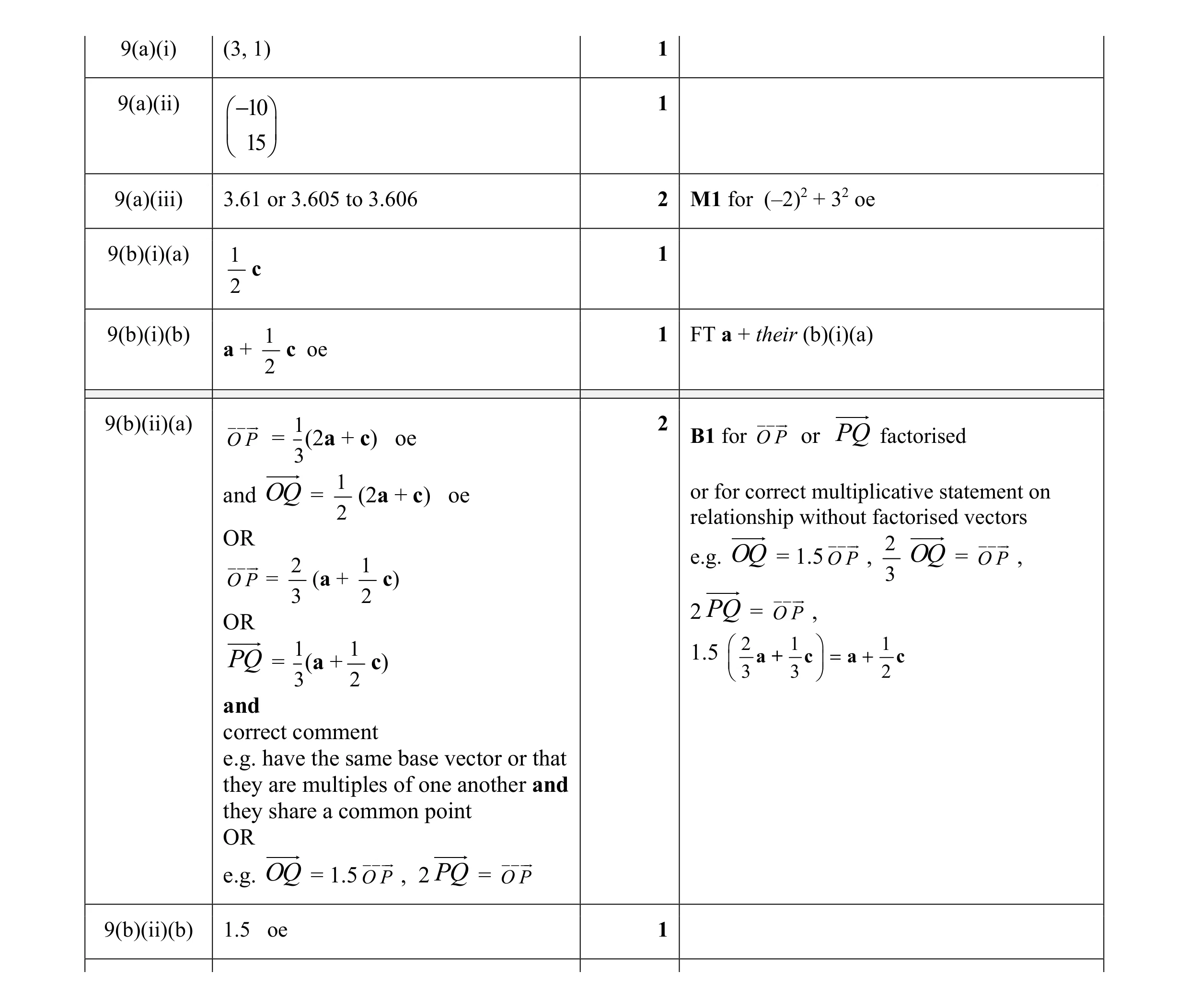
9 marks
Mark scheme: 9(a)(i) (3, 1) 1 9(a)(ii) −10 1 15 9(a)(iii) 3.61 or 3.605 to 3.606 2 M1 for (–2)2 + 32 oe 9(b)(i)(a) 1 1 c 2 9(b)(i)(b) 1 1 FT a + their (b)(i)(a) a + c oe 2 9(b)(ii)(a) 1 2 O P = + c) oe B1 for O P or PQ factorised 3(2a 1 and OQ = (2a + c) oe or for correct multiplicative statement on 2 relationship without factorised vectors OR 2 e.g. OQ = 1.5 O,P OQ = O,P 2 1 O=P (a + c) 3 3 2 2 PQ = O,P OR 2 1 1 1 1.5 a + c = a + 1 c PQ = + c) 3 3 2 3(a 2 and correct comment e.g. have the same base vector or that they are multiples of one another and they share a common point OR e.g. OQ = 1.5 O,P 2 PQ = O P 9(b)(ii)(b) 1.5 oe 1
This question in 0580/42 Oct/Nov 2021
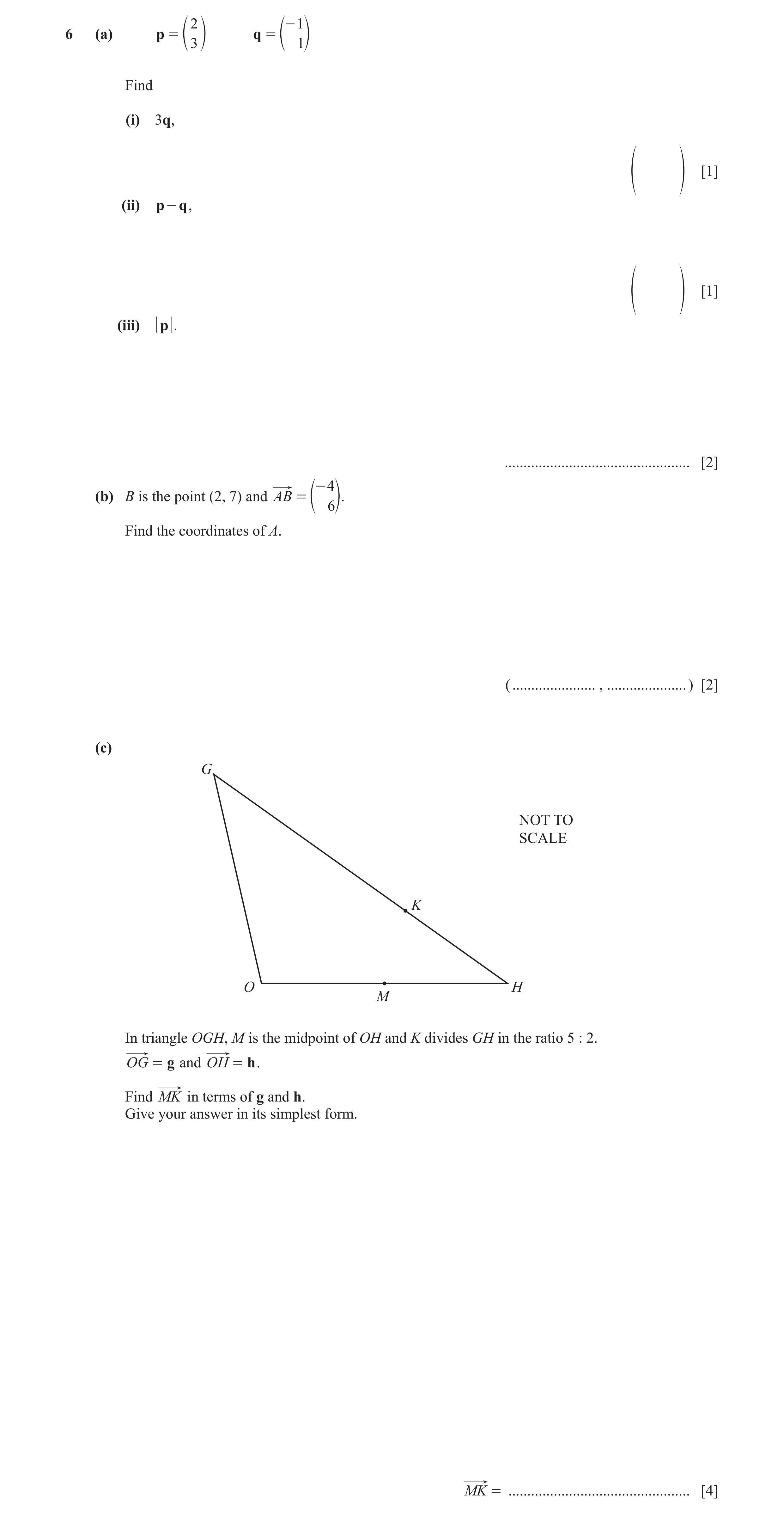
Q25 · - 1 6 (a) p = q = e 3 o e 1o Find (i) 3q, [1] f p (ii) p - q , [1] f p (iii) p 0580/41 Oct/Nov 2022
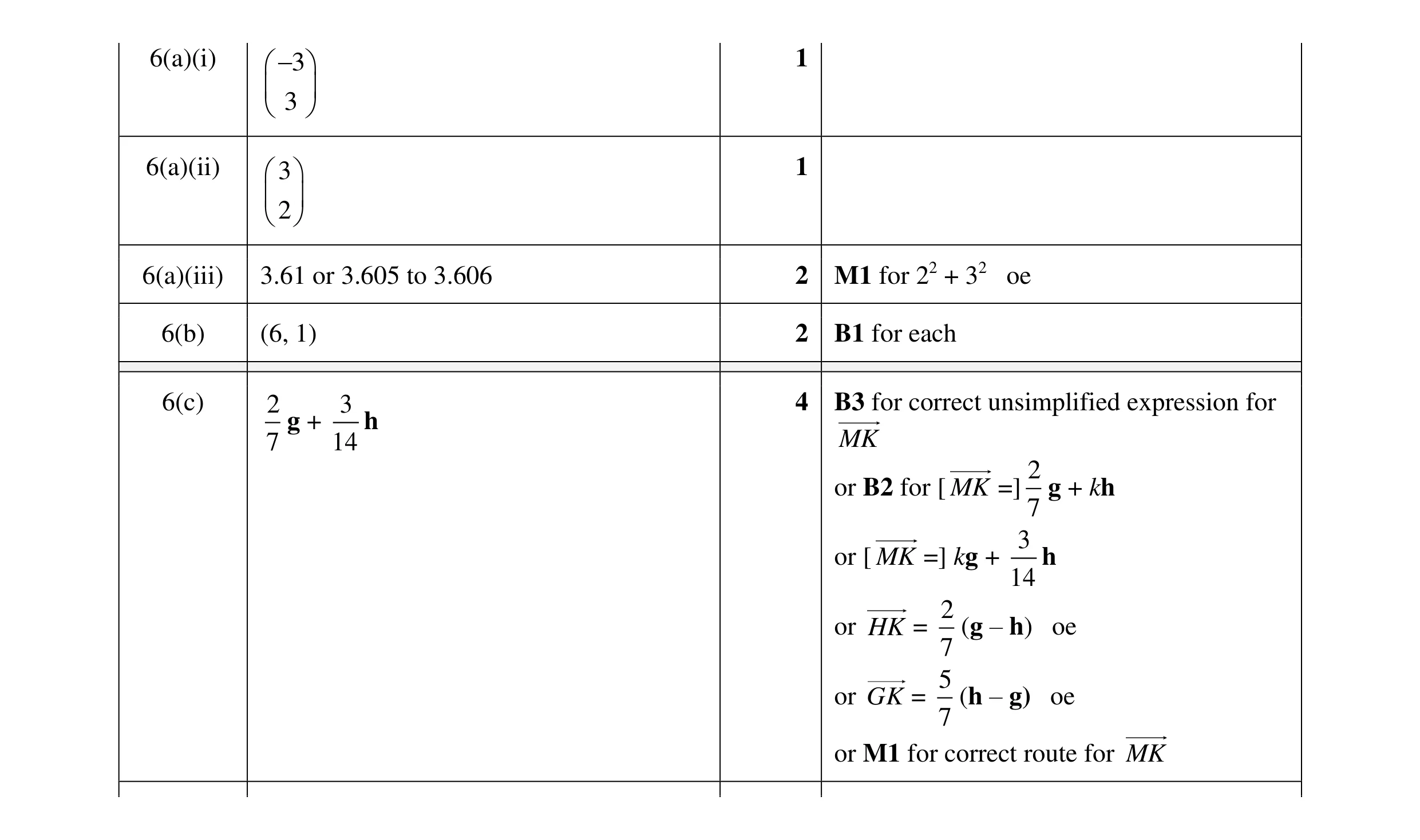
2 - 1 6 (a) p = q = e 3 o e 1o Find (i) 3q, [1] f p (ii) p - q , [1] f p (iii) p . … [2] - 4 (b) B is the point (2, 7) and AB = e 6o. Find the coordinates of A. ( … , … ) [2] (c) G NOT TO SCALE K O H M In triangle OGH, M is the midpoint of OH and K divides GH in the ratio 5 : 2. OG = g and OH = h . Find MK in terms of g and h. Give your answer in its simplest form. MK = … [4]
10 marks
Mark scheme: 6(a)(i) −3 1 3 6(a)(ii) 3 1 2 6(a)(iii) 3.61 or 3.605 to 3.606 2 M1 for 22 + 32 oe 6(b) (6, 1) 2 B1 for each 6(c) 2 3 4 B3 for correct unsimplified expression for g + h 7 14 MK 2 or B2 for [ MK =] g + kh 7 3 or [ MK =] kg + h 14 2 or HK = (g – h) oe 7 5 or GK = (h – g) oe 7 or M1 for correct route for MK
This question in 0580/41 Oct/Nov 2022
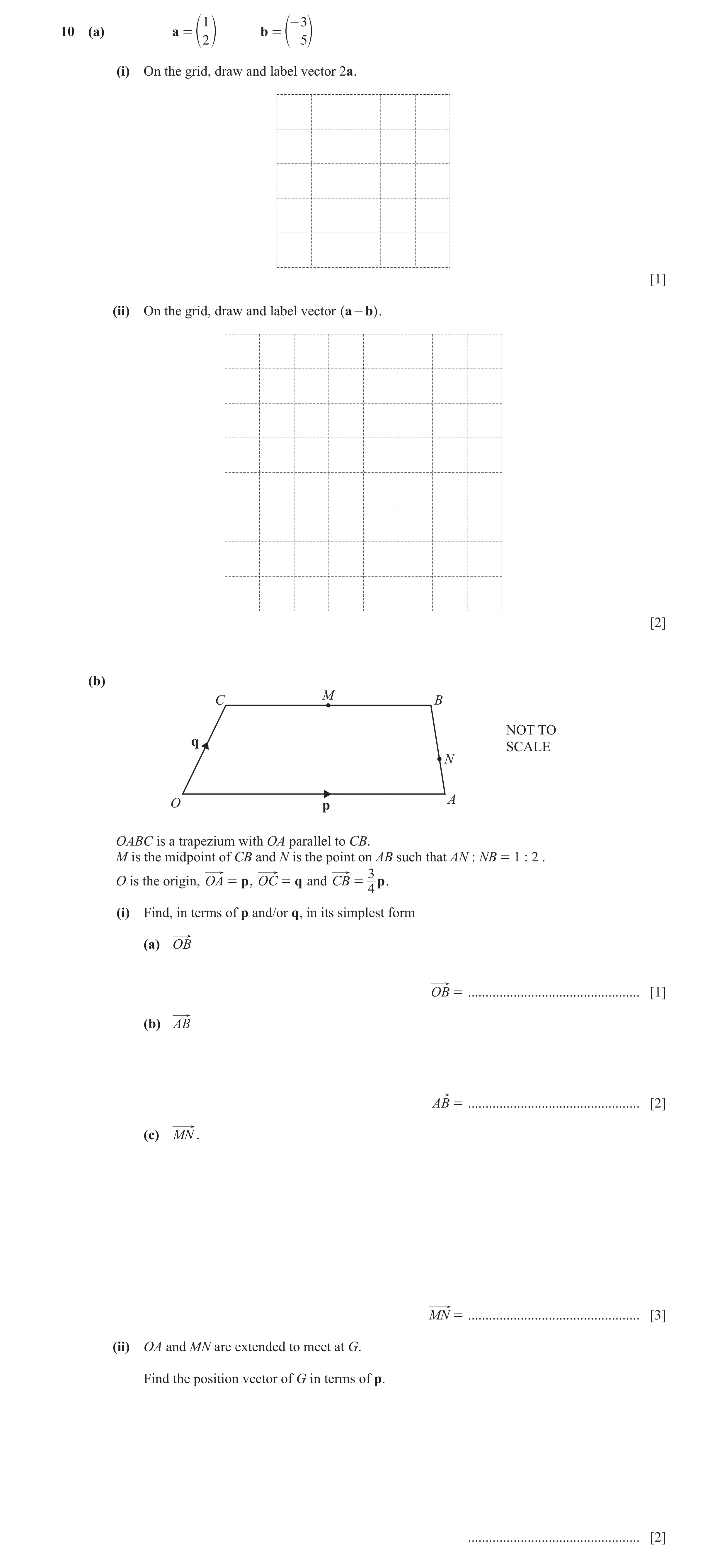
Q26 · - 3 10 (a) a = b = e 2 o e 5o (i) On the grid, draw and label vector 2a 0580/43 Oct/Nov 2022
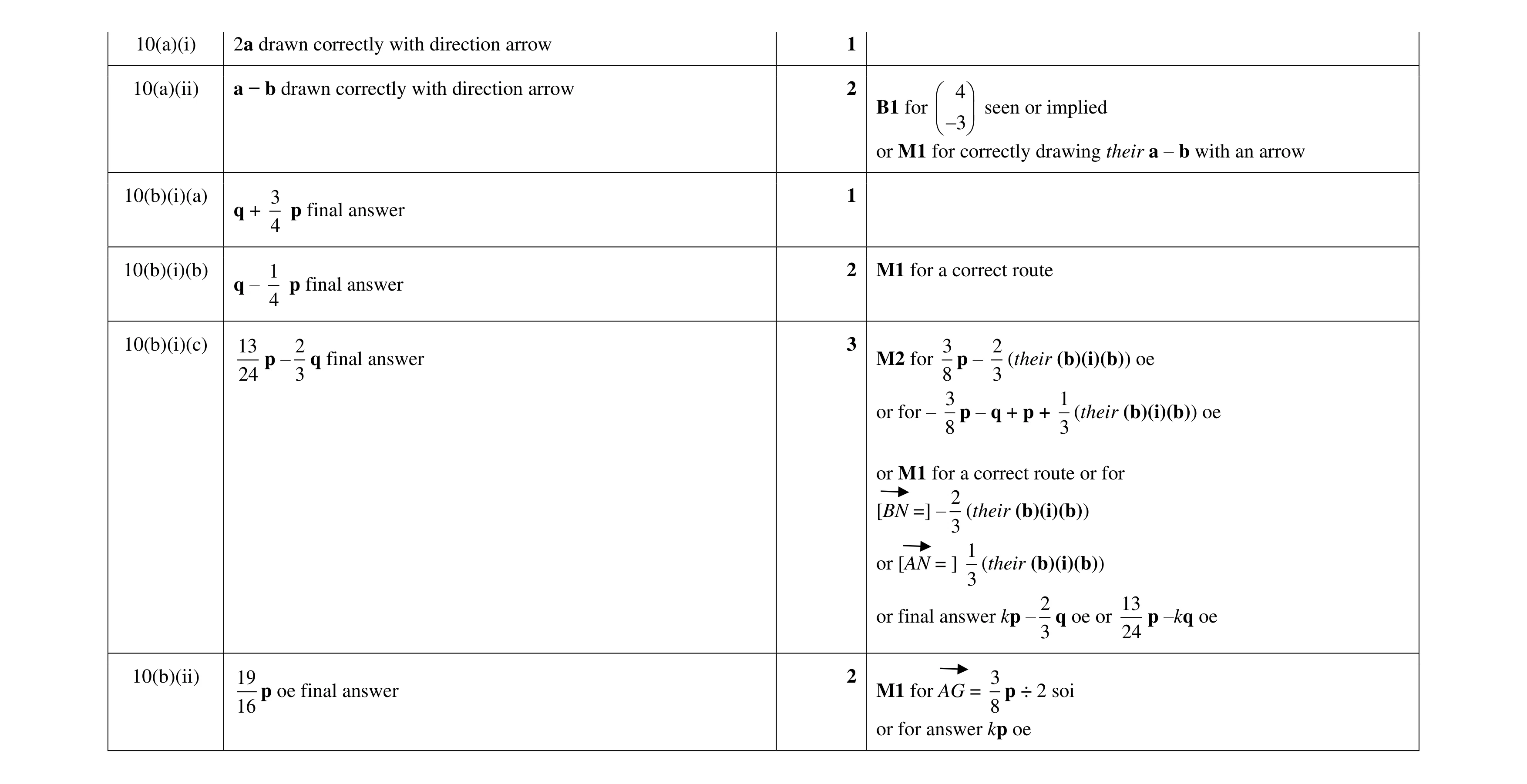
1 - 3 10 (a) a = b = e 2 o e 5o (i) On the grid, draw and label vector 2a. [1] (ii) On the grid, draw and label vector ( a - b ) . [2] (b) M C B NOT TO q SCALE N A O p OABC is a trapezium with OA parallel to CB. M is the midpoint of CB and N is the point on AB such that AN : NB = 1 : 2 . 3 O is the origin, OA = p , OC = q and CB = p . 4 (i) Find, in terms of p and/or q, in its simplest form (a) OB OB = … [1] (b) AB AB = … [2] (c) MN . MN = … [3] (ii) OA and MN are extended to meet at G. Find the position vector of G in terms of p. … [2]
11 marks
Mark scheme: 10(a)(i) 2a drawn correctly with direction arrow 1 10(a)(ii) a − b drawn correctly with direction arrow 2 4 B1 for seen or implied −3 or M1 for correctly drawing their a – b with an arrow 10(b)(i)(a) 3 1 q + p final answer 4 10(b)(i)(b) 1 2 M1 for a correct route q – p final answer 4 10(b)(i)(c) 13 2 3 3 2 p – q final answer M2 for p – (their (b)(i)(b)) oe 24 3 8 3 3 1 or for – p – q + p + (their (b)(i)(b)) oe 8 3 or M1 for a correct route or for 2 [BN =] – (their (b)(i)(b)) 3 1 or [AN = ] (their (b)(i)(b)) 3 2 13 or final answer kp – q oe or p –kq oe 3 24 10(b)(ii) 19 2 3 p oe final answer M1 for AG = p ÷ 2 soi 16 8 or for answer kp oe
This question in 0580/43 Oct/Nov 2022
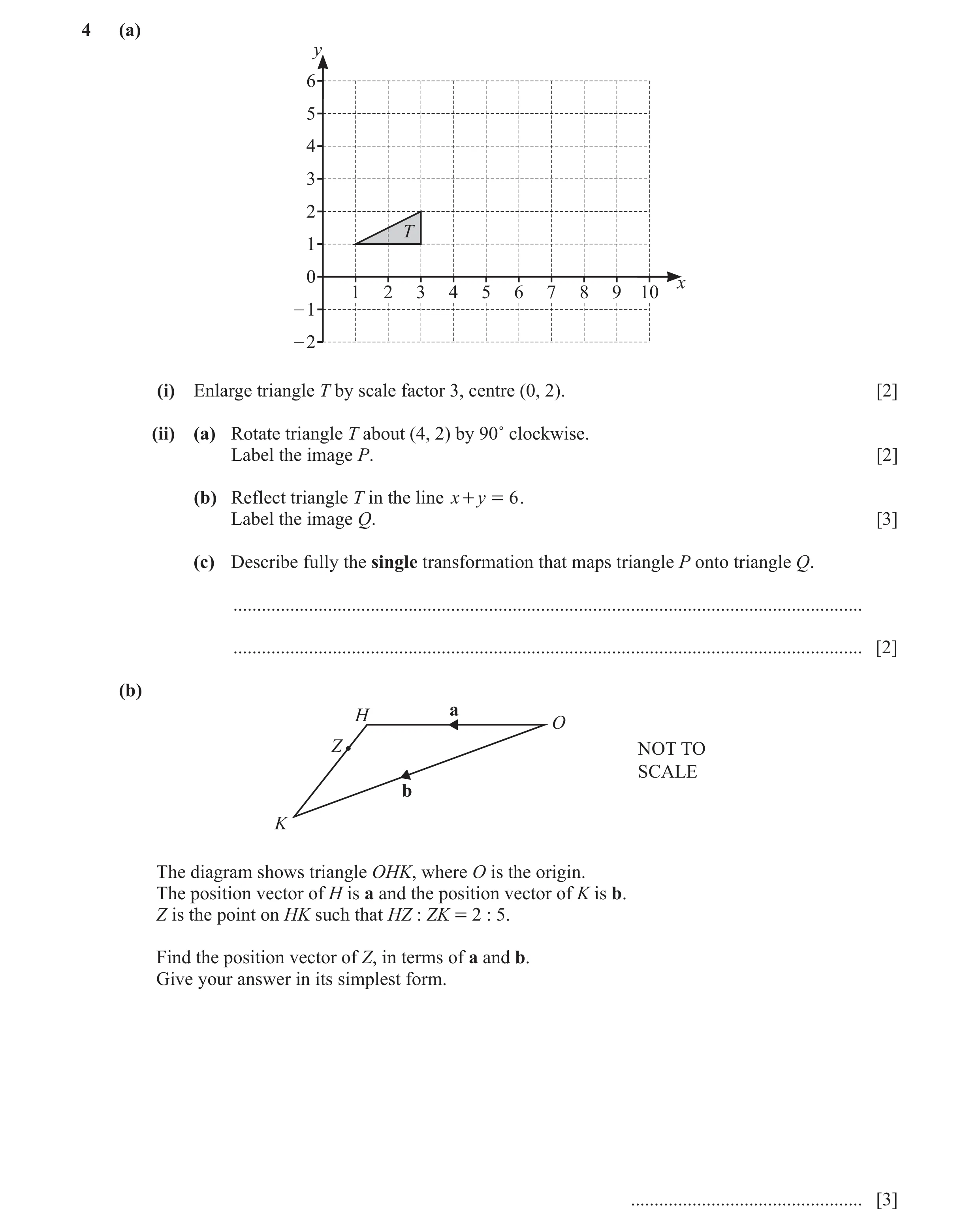
Q27 · Y 6 5 4 3 2 T 1 0 x 1 2 3 4 5 6 7 8 9 10 – 1 – 2 (i) Enlarge triangle T by scale factor… 0580/42 Feb/March 2023
4 (a) y 6 5 4 3 2 T 1 0 x 1 2 3 4 5 6 7 8 9 10 – 1 – 2 (i) Enlarge triangle T by scale factor 3, centre (0, 2). [2] (ii) (a) Rotate triangle T about (4, 2) by 90˚ clockwise. Label the image P. [2] (b) Reflect triangle T in the line x + y = 6 . Label the image Q. [3] (c) Describe fully the single transformation that maps triangle P onto triangle Q. … … [2] (b) a H O Z NOT TO SCALE b K The diagram shows triangle OHK, where O is the origin. The position vector of H is a and the position vector of K is b. Z is the point on HK such that HZ : ZK = 2 : 5. Find the position vector of Z, in terms of a and b. Give your answer in its simplest form. … [3]
12 marks
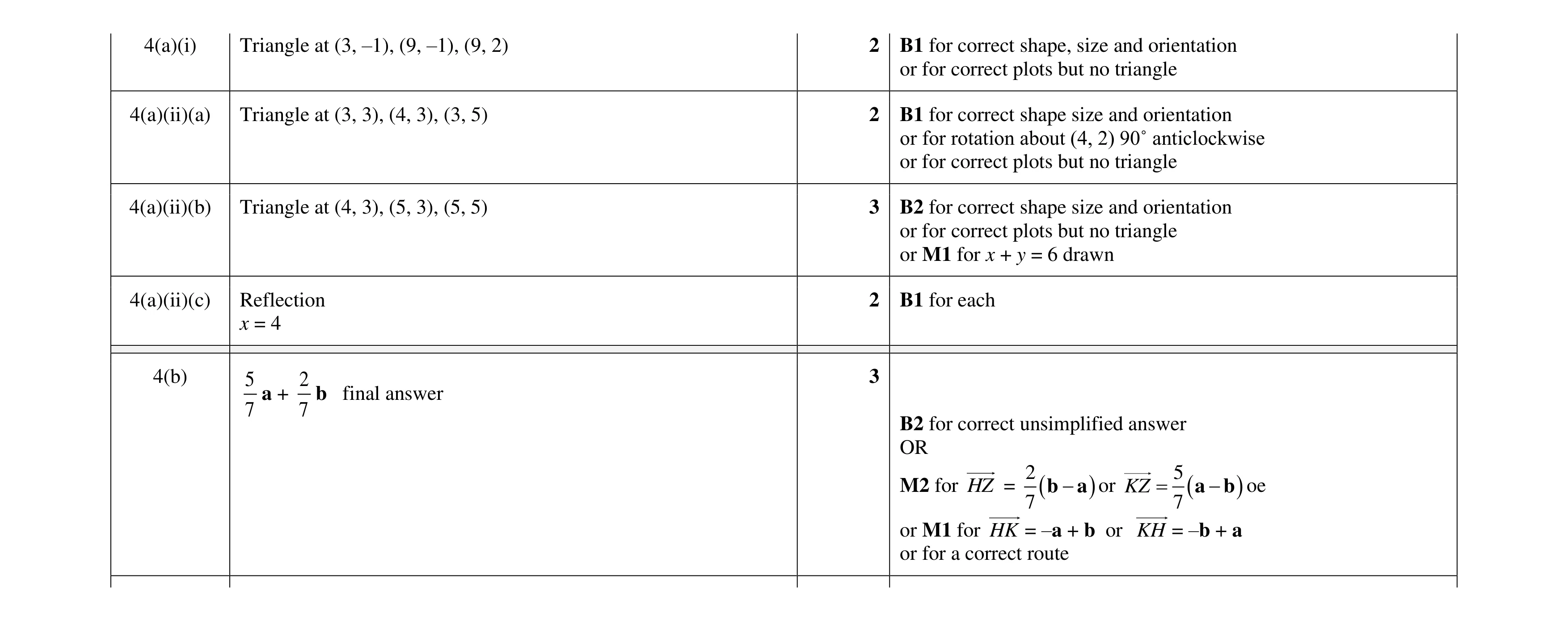
Mark scheme: 4(a)(i) Triangle at (3, –1), (9, –1), (9, 2) 2 B1 for correct shape, size and orientation or for correct plots but no triangle 4(a)(ii)(a) Triangle at (3, 3), (4, 3), (3, 5) 2 B1 for correct shape size and orientation or for rotation about (4, 2) 90˚ anticlockwise or for correct plots but no triangle 4(a)(ii)(b) Triangle at (4, 3), (5, 3), (5, 5) 3 B2 for correct shape size and orientation or for correct plots but no triangle or M1 for x + y = 6 drawn 4(a)(ii)(c) Reflection 2 B1 for each x = 4 4(b) 5 2 3 a + b final answer 7 7 B2 for correct unsimplified answer OR 2 5 M2 for HZ = ( b − a ) or KZ = ( a − b ) oe 7 7 or M1 for HK = –a + b or KH = –b + a or for a correct route
This question in 0580/42 Feb/March 2023
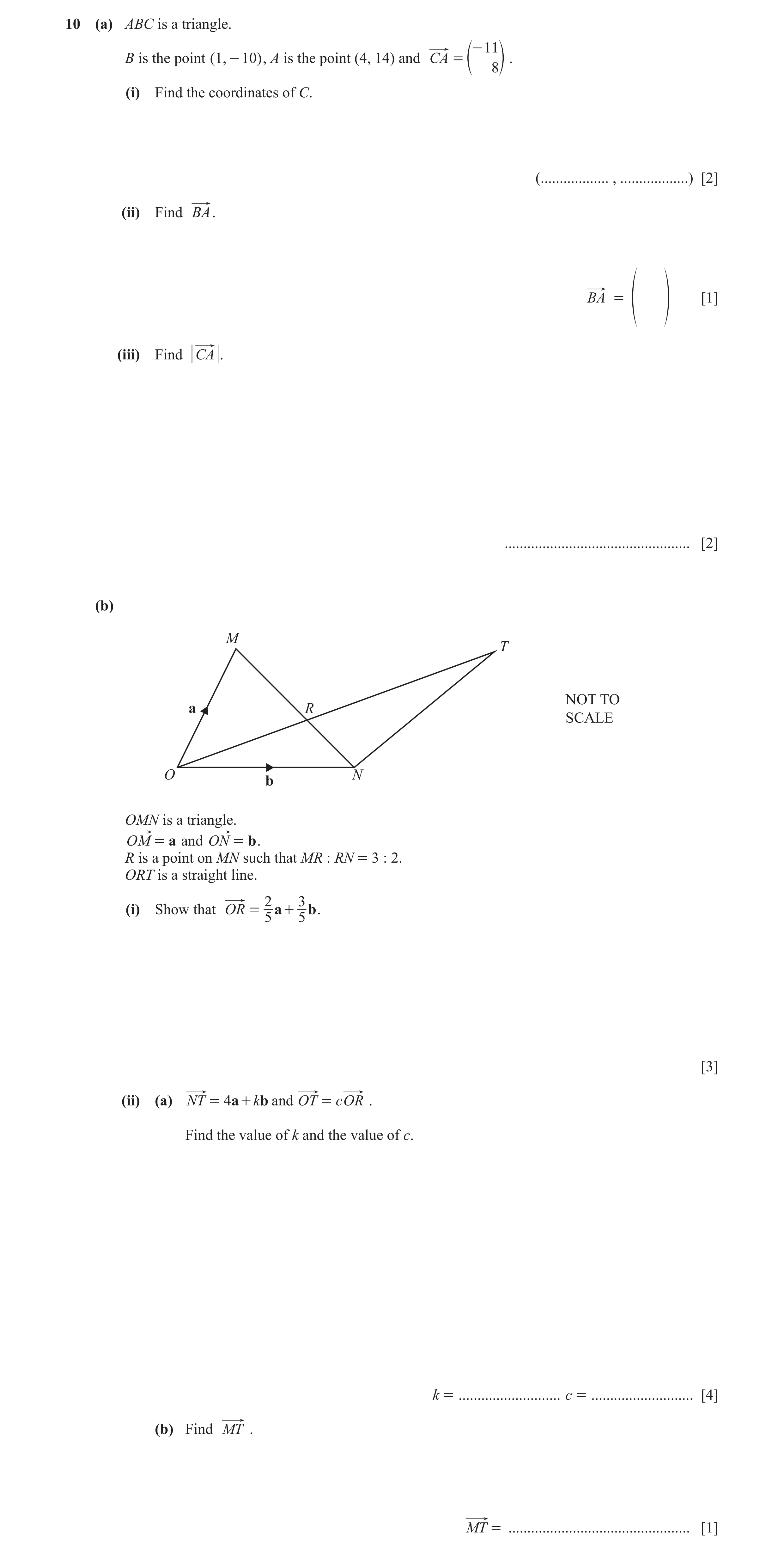
Q28 · ABC is a triangle 0580/41 Oct/Nov 2023
10 (a) ABC is a triangle. - 11 B is the point ( 1, - 10) , A is the point (4, 14) and CA = . e 8o (i) Find the coordinates of C. ( … , … ) [2] (ii) Find BA. BA = [1] f p (iii) Find CA . … [2] (b) M T NOT TO a R SCALE O N b OMN is a triangle. OM = a and ON = b . R is a point on MN such that MR : RN = 3 : 2. ORT is a straight line. 2 3 (i) Show that OR = a + b . 5 5 [3] (ii) (a) NT = 4a + kb and OT = c OR . Find the value of k and the value of c. k = … c = … [4] (b) Find MT . MT = … [1]
13 marks
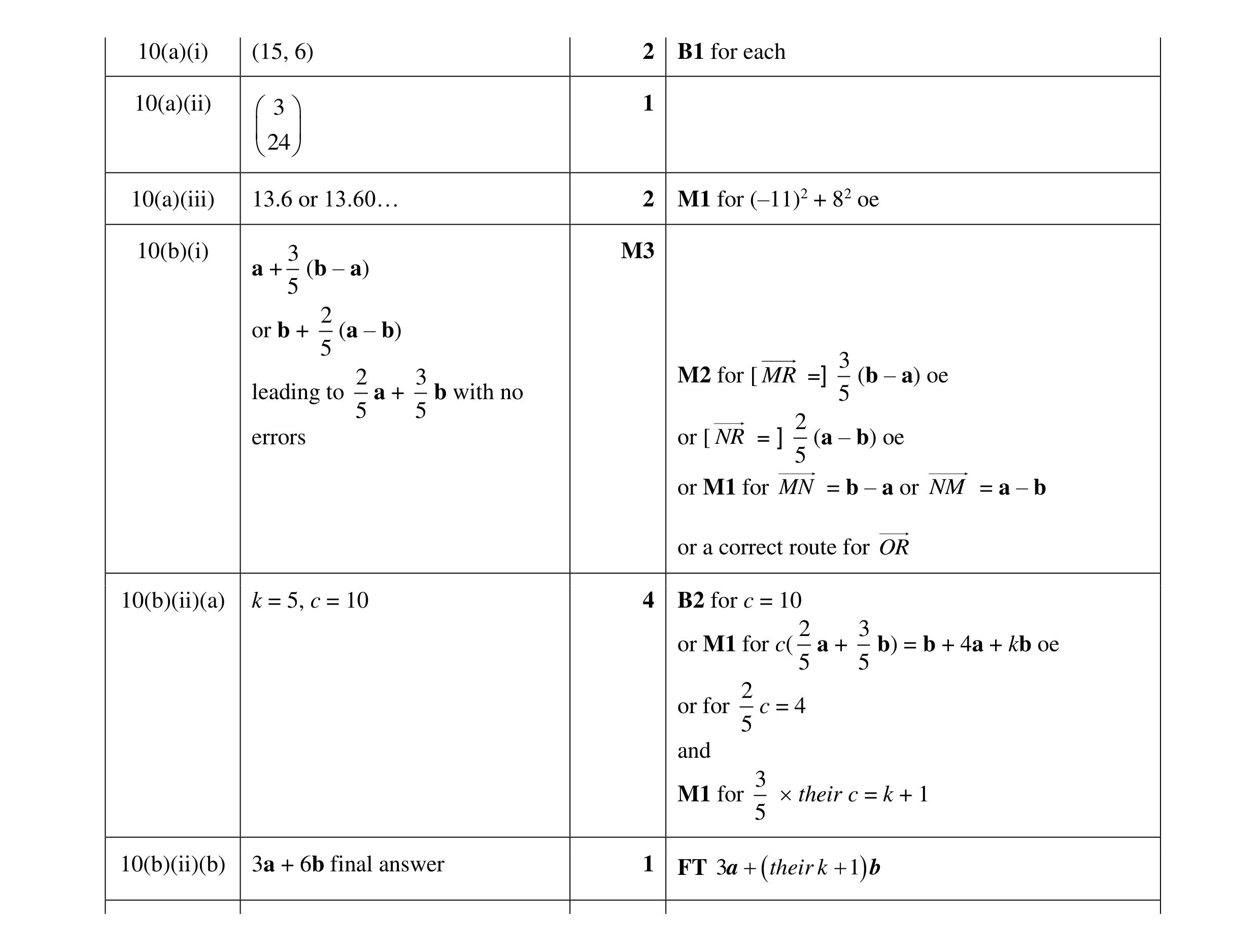
Mark scheme: 10(a)(i) (15, 6) 2 B1 for each 10(a)(ii) 3 1 24 10(a)(iii) 13.6 or 13.60… 2 M1 for (–11)2 + 82 oe 10(b)(i) 3 M3 a + (b – a) 5 2 or b + (a – b) 5 3 2 3 M2 for [ MR =] (b – a) oe leading to a + b with no 5 5 5 2 errors or [ NR = ] (a – b) oe 5 or M1 for MN = b – a or NM = a – b or a correct route for OR 10(b)(ii)(a) k = 5, c = 10 4 B2 for c = 10 2 3 or M1 for c( a + b) = b + 4a + kb oe 5 5 2 or for c = 4 5 and 3 M1 for their c = k + 1 5 10(b)(ii)(b) 3a + 6b final answer 1 FT 3a + ( their k + 1) b
This question in 0580/41 Oct/Nov 2023
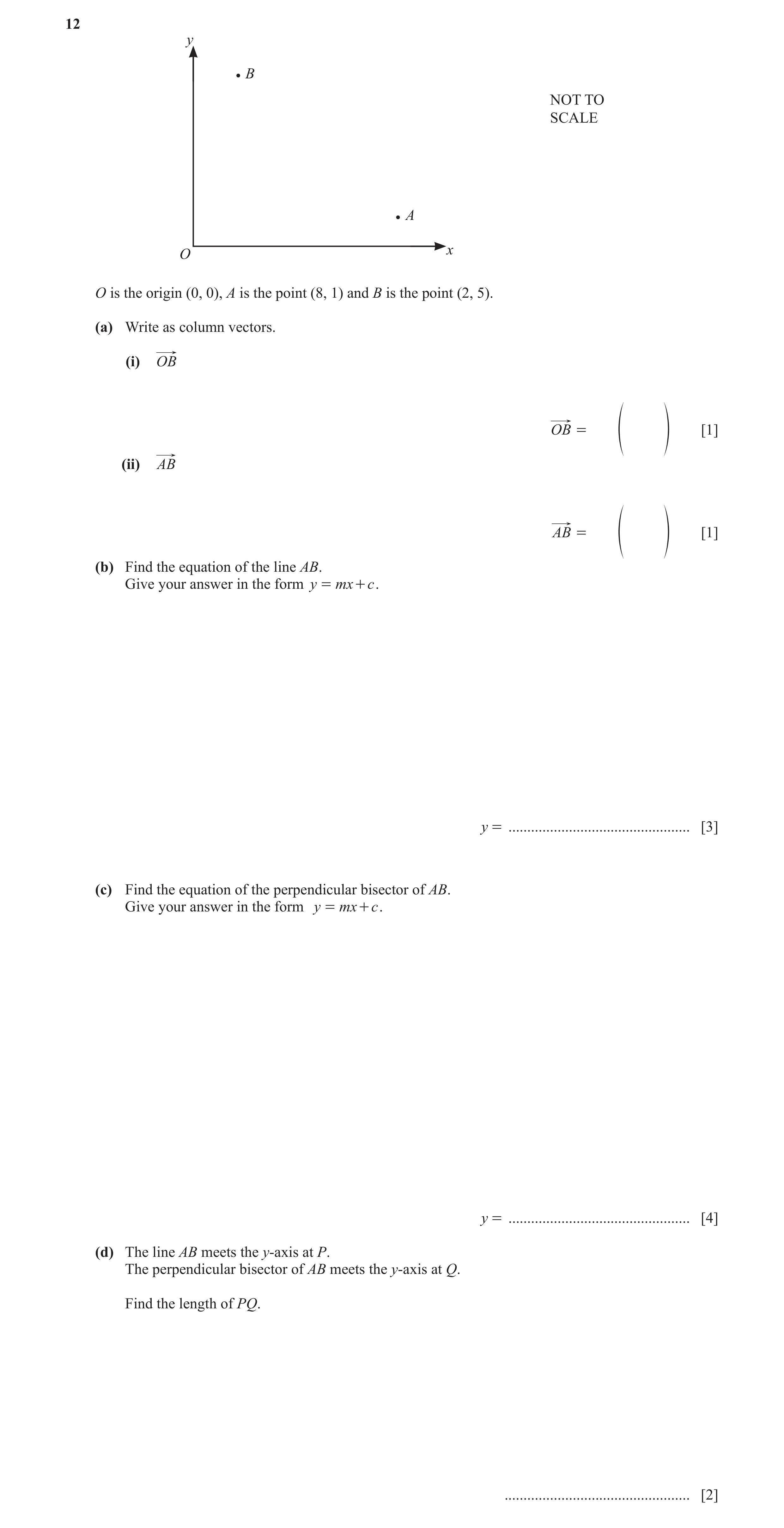
Q29 · Y B NOT TO SCALE A x O O is the origin (0, 0), A is the point (8, 1) and B is the point… 0580/42 Oct/Nov 2023
12 y B NOT TO SCALE A x O O is the origin (0, 0), A is the point (8, 1) and B is the point (2, 5). (a) Write as column vectors. (i) OB OB = [1] f p (ii) AB AB = [1] f p (b) Find the equation of the line AB. Give your answer in the form y = mx + c . y = … [3] (c) Find the equation of the perpendicular bisector of AB. Give your answer in the form y = mx + c . y = … [4] (d) The line AB meets the y-axis at P. The perpendicular bisector of AB meets the y-axis at Q. Find the length of PQ. … [2]
11 marks
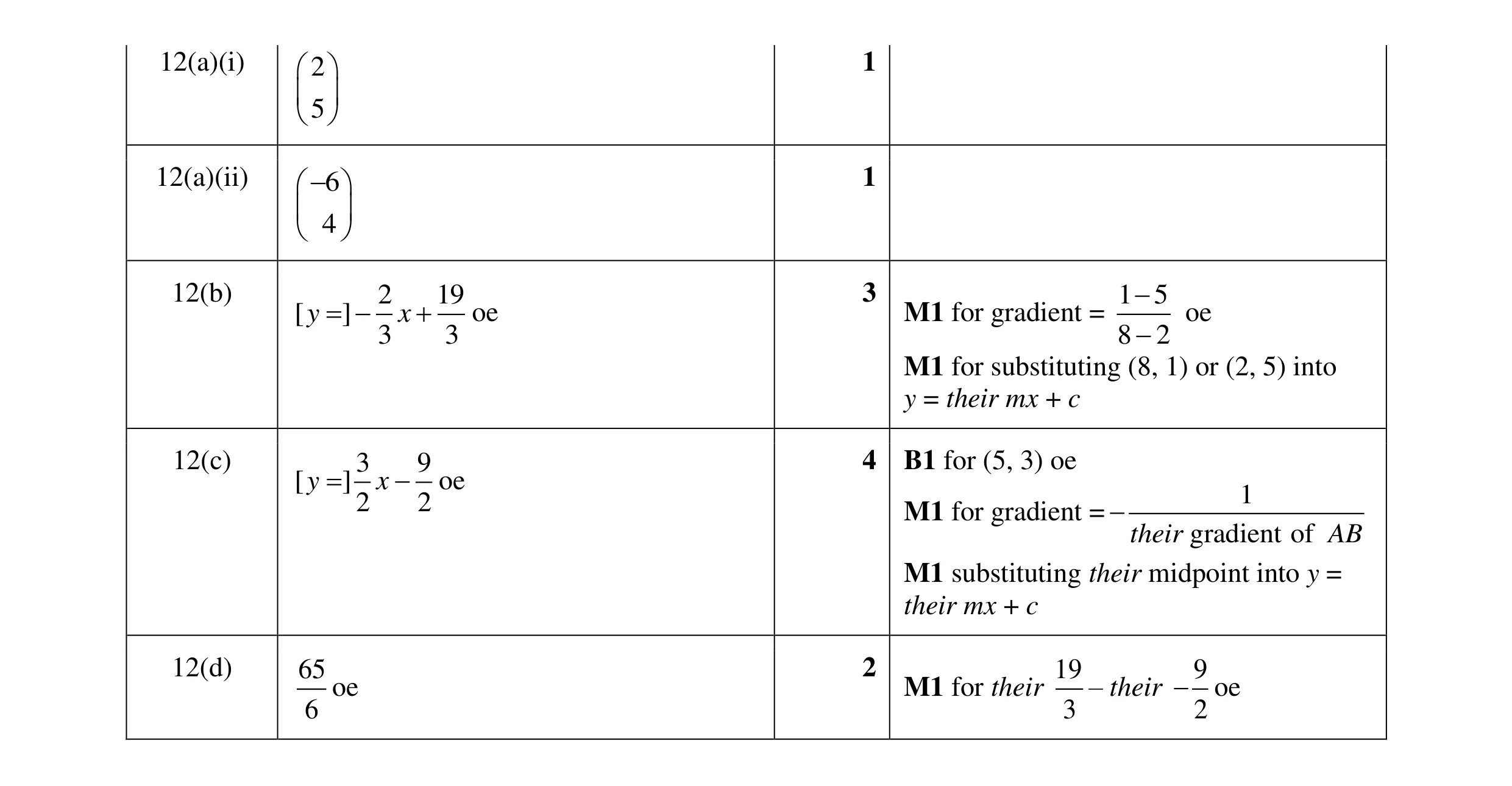
Mark scheme: 12(a)(i) 2 1 5 12(a)(ii) −6 1 4 12(b) 2 19 3 1 − 5 [ y =] − x + oe M1 for gradient = oe 3 3 8 − 2 M1 for substituting (8, 1) or (2, 5) into y = their mx + c 12(c) 3 9 4 B1 for (5, 3) oe [ y = x − oe 1 ]2 2 M1 for gradient = −their gradient of AB M1 substituting their midpoint into y = their mx + c 12(d) 65 2 19 9 oe M1 for their – their − oe 6 3 2
This question in 0580/42 Oct/Nov 2023
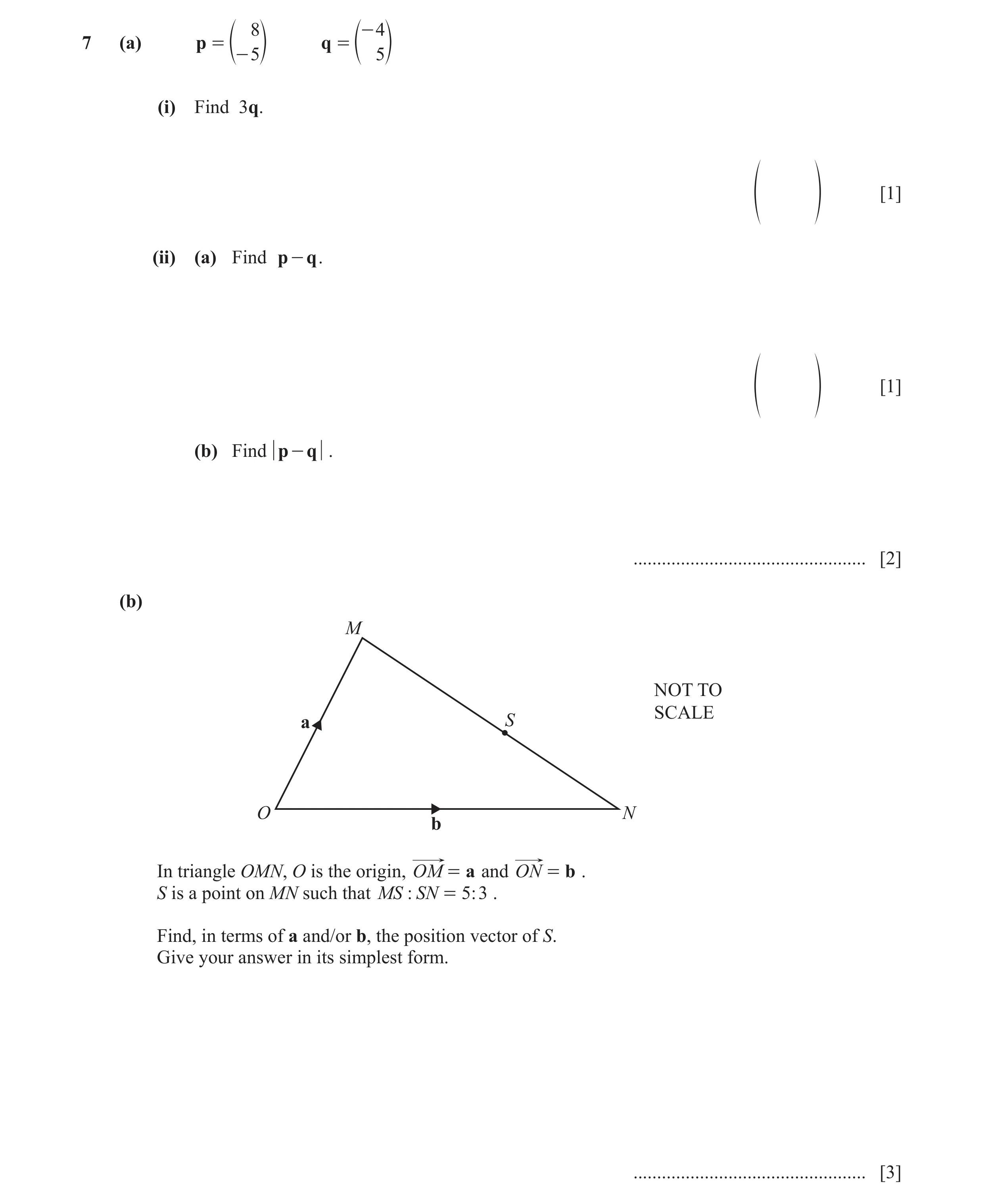
Q30 · - 4 7 (a) p = q = e- 5o e 5o (i) Find 3q 0580/42 Feb/March 2024
8 - 4 7 (a) p = q = e- 5o e 5o (i) Find 3q. [1] f p (ii) (a) Find p - q . [1] f p (b) Find p - q . … [2] (b) M NOT TO SCALE a S O N b In triangle OMN, O is the origin, OM = a and ON = b . S is a point on MN such that MS : SN = 5 : 3 . Find, in terms of a and/or b, the position vector of S. Give your answer in its simplest form. … [3]
7 marks
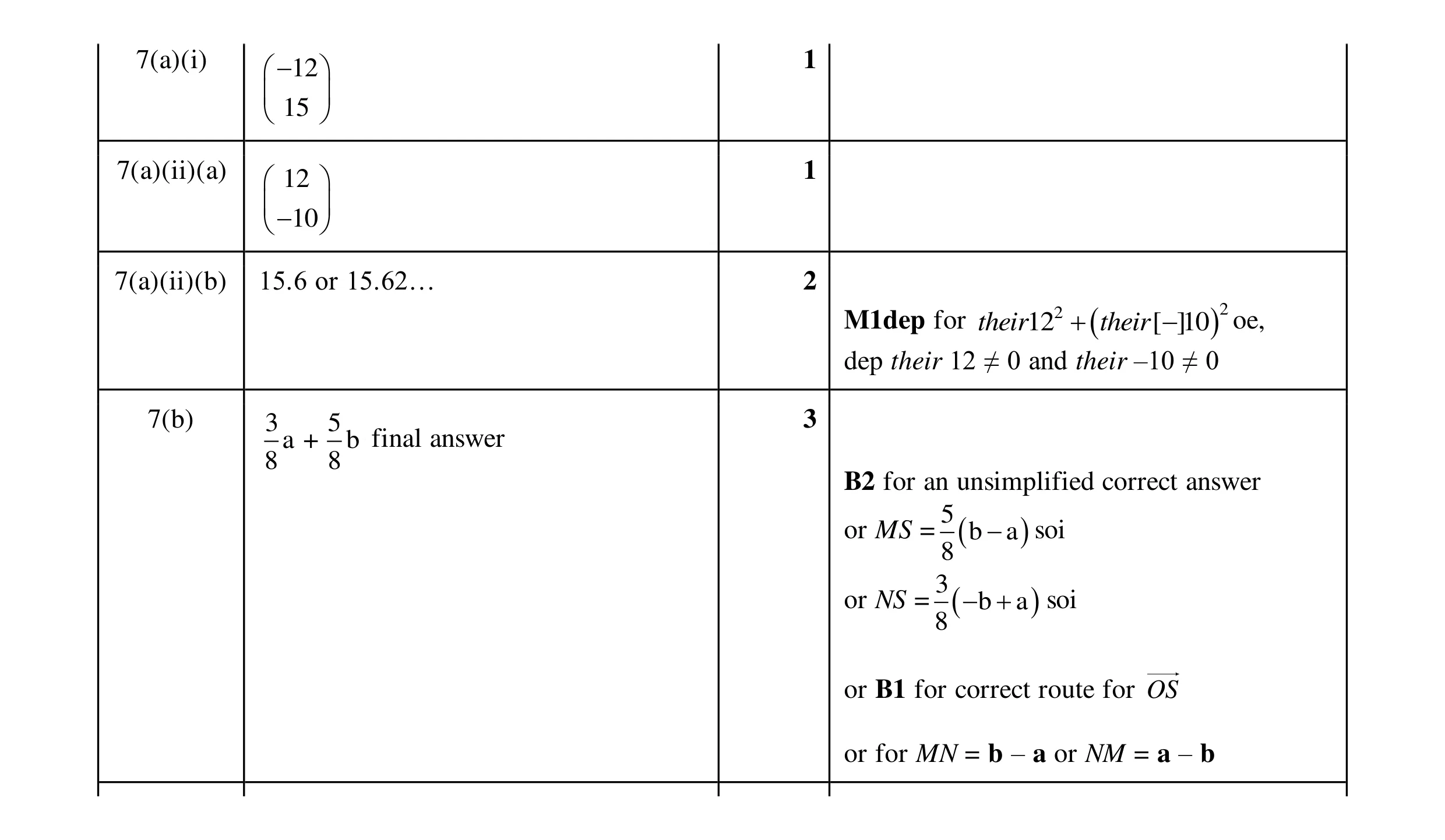
Mark scheme: 7(a)(i) −12 1 15 7(a)(ii)(a) 1 12 −10 7(a)(ii)(b) 15.6 or 15.62… 2 M1dep for their122 + ( their [ −]10 ) 2 oe, dep their 12 ≠ 0 and their –10 ≠ 0 7(b) 3 5 3 a + b final answer 8 8 B2 for an unsimplified correct answer 5 or MS = ( b − a ) soi 8 3 or NS = ( −+b a ) soi 8 or B1 for correct route for OS or for MN = b – a or NM = a – b
This question in 0580/42 Feb/March 2024
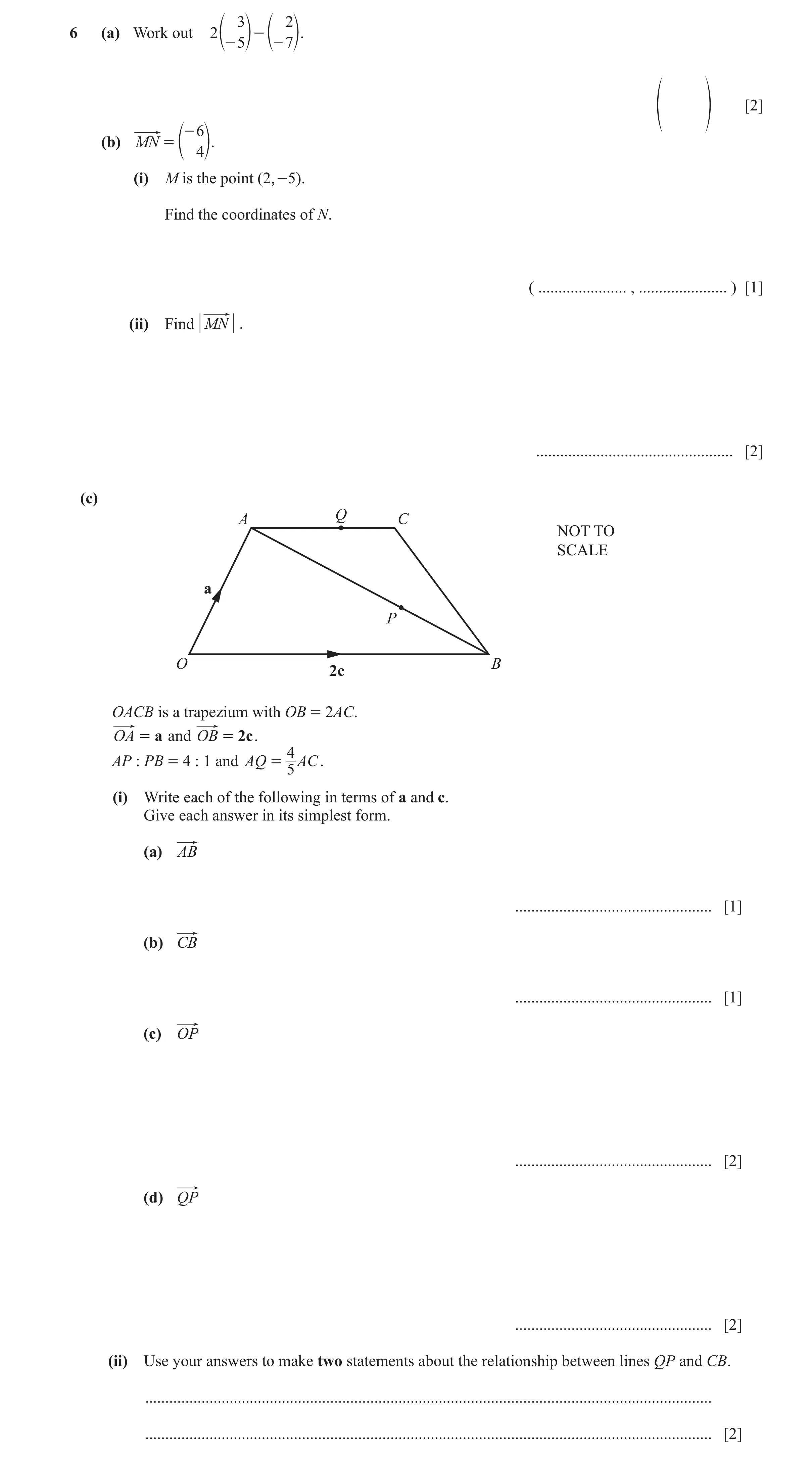
Q31 · 2 6 (a) Work out 2 e o - e o 0580/42 Oct/Nov 2024
3 2 6 (a) Work out 2 e o - e o. - 5 - 7 f p [2] - 6 (b) MN = e o. 4 (i) M is the point (2, -5). Find the coordinates of N. ( … , … ) [1] (ii) Find MN . … [2] (c) A Q C NOT TO SCALE a P O B 2c OACB is a trapezium with OB = 2AC. OA = a and OB = 2c . 4 AP : PB = 4 : 1 and AQ = AC . 5 (i) Write each of the following in terms of a and c. Give each answer in its simplest form. (a) AB … [1] (b) CB … [1] (c) OP … [2] (d) QP … [2] (ii) Use your answers to make two statements about the relationship between lines QP and CB. … … [2]
13 marks
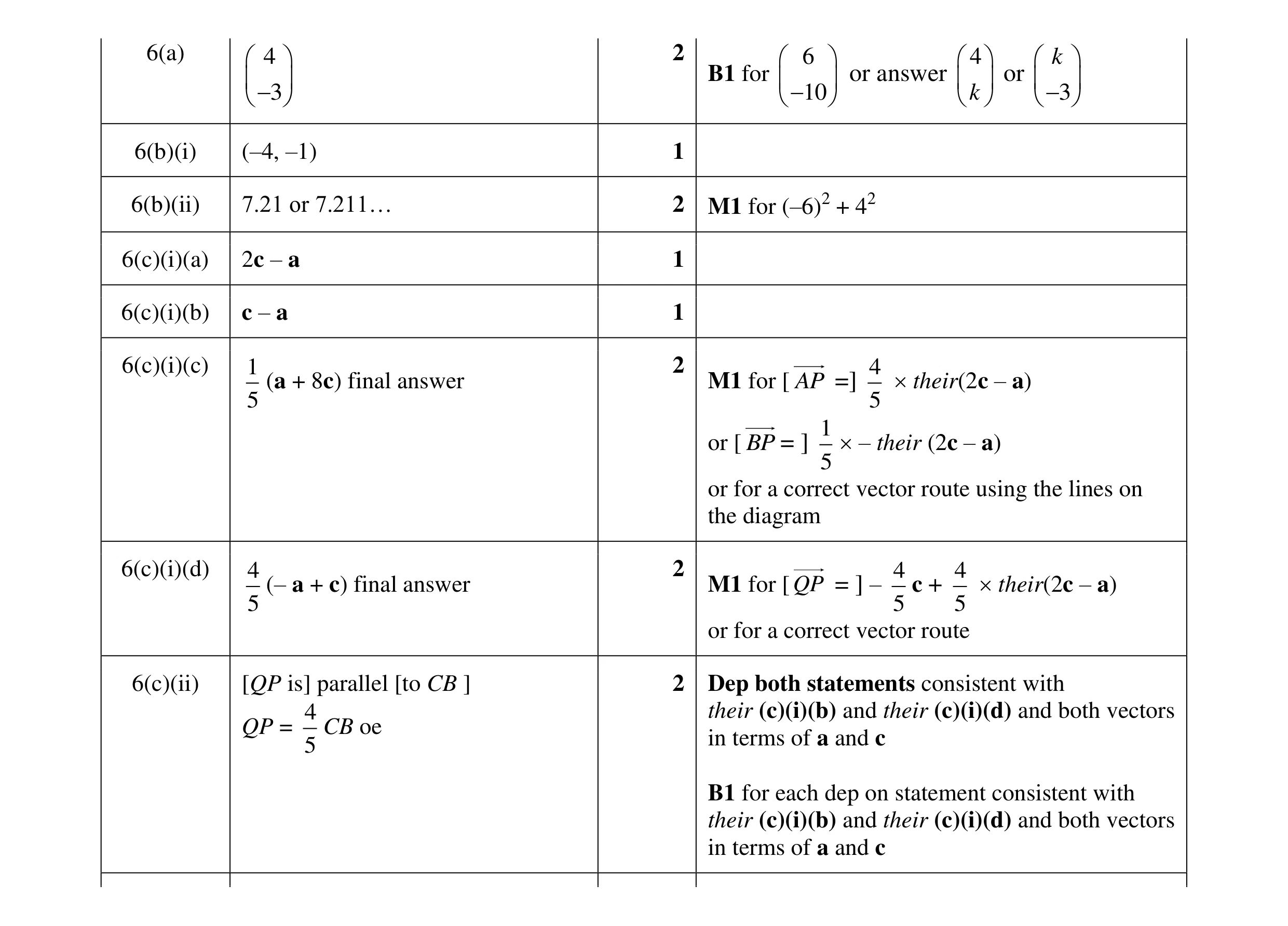
Mark scheme: 6(a) 4 2 6 4 k B1 for or answer or −3 −10 k −3 6(b)(i) (–4, –1) 1 6(b)(ii) 7.21 or 7.211… 2 M1 for (–6)2 + 42 6(c)(i)(a) 2c – a 1 6(c)(i)(b) c – a 1 6(c)(i)(c) 1 2 4 (a + 8c) final answer M1 for [ AP =] their(2c – a) 5 5 1 or [ BP = ] – their (2c – a) 5 or for a correct vector route using the lines on the diagram 6(c)(i)(d) 4 2 4 4 (– a + c) final answer M1 for [QP = ] – c + their(2c – a) 5 5 5 or for a correct vector route 6(c)(ii) [QP is] parallel [to CB ] 2 Dep both statements consistent with 4 their (c)(i)(b) and their (c)(i)(d) and both vectors QP = CB oe in terms of a and c 5 B1 for each dep on statement consistent with their (c)(i)(b) and their (c)(i)(d) and both vectors in terms of a and c
This question in 0580/42 Oct/Nov 2024
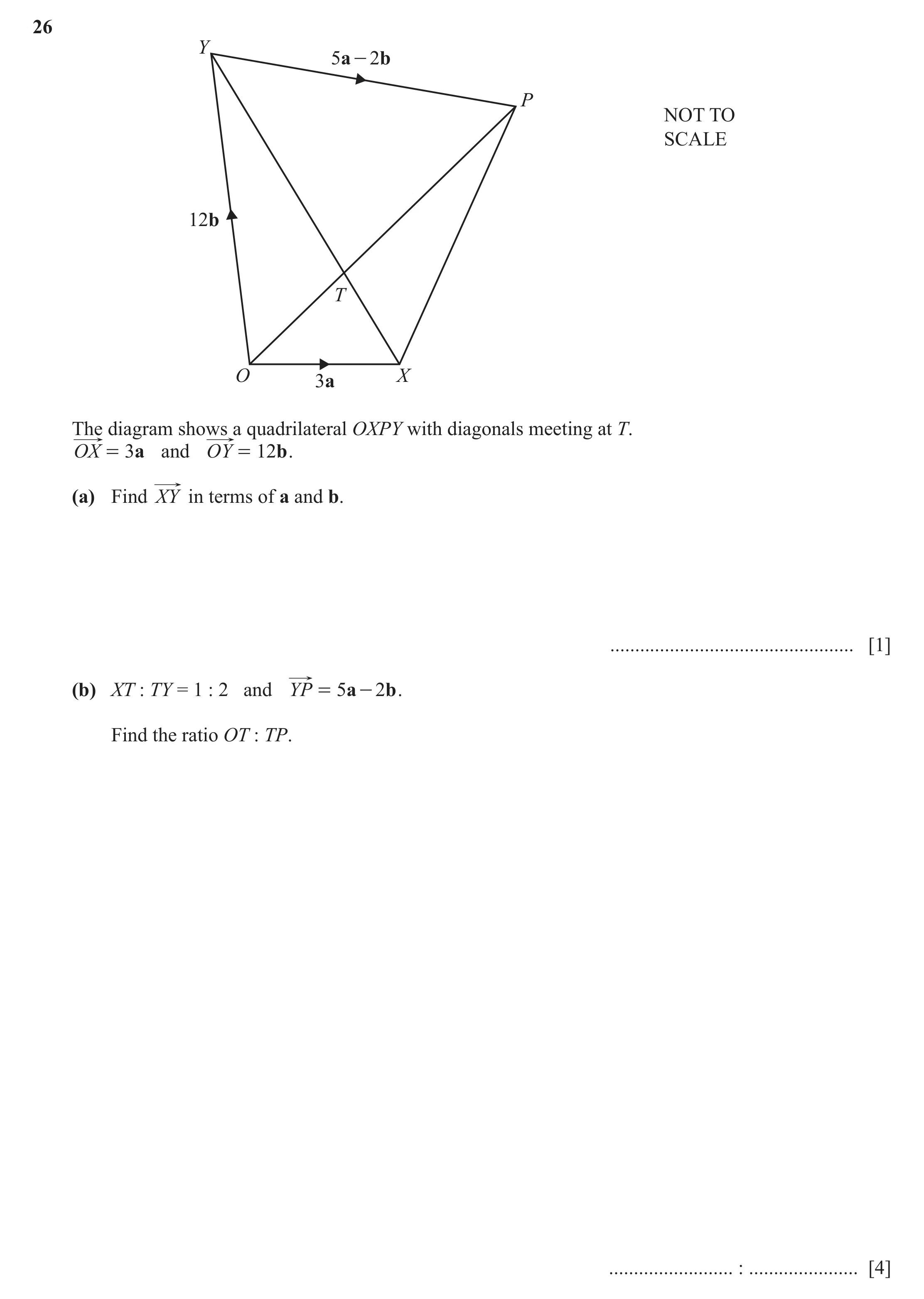
Q32 · Y 5a - 2b P NOT TO SCALE 12b T O X 3a The diagram shows a quadrilateral OXPY with… 0580/43 May/June 2025
26 Y 5a - 2b P NOT TO SCALE 12b T O X 3a The diagram shows a quadrilateral OXPY with diagonals meeting at T. OX = 3a and OY = 12b . (a) Find XY in terms of a and b. … [1] (b) XT : TY = 1 : 2 and YP = 5a - 2b . Find the ratio OT : TP. … : … [4]
5 marks
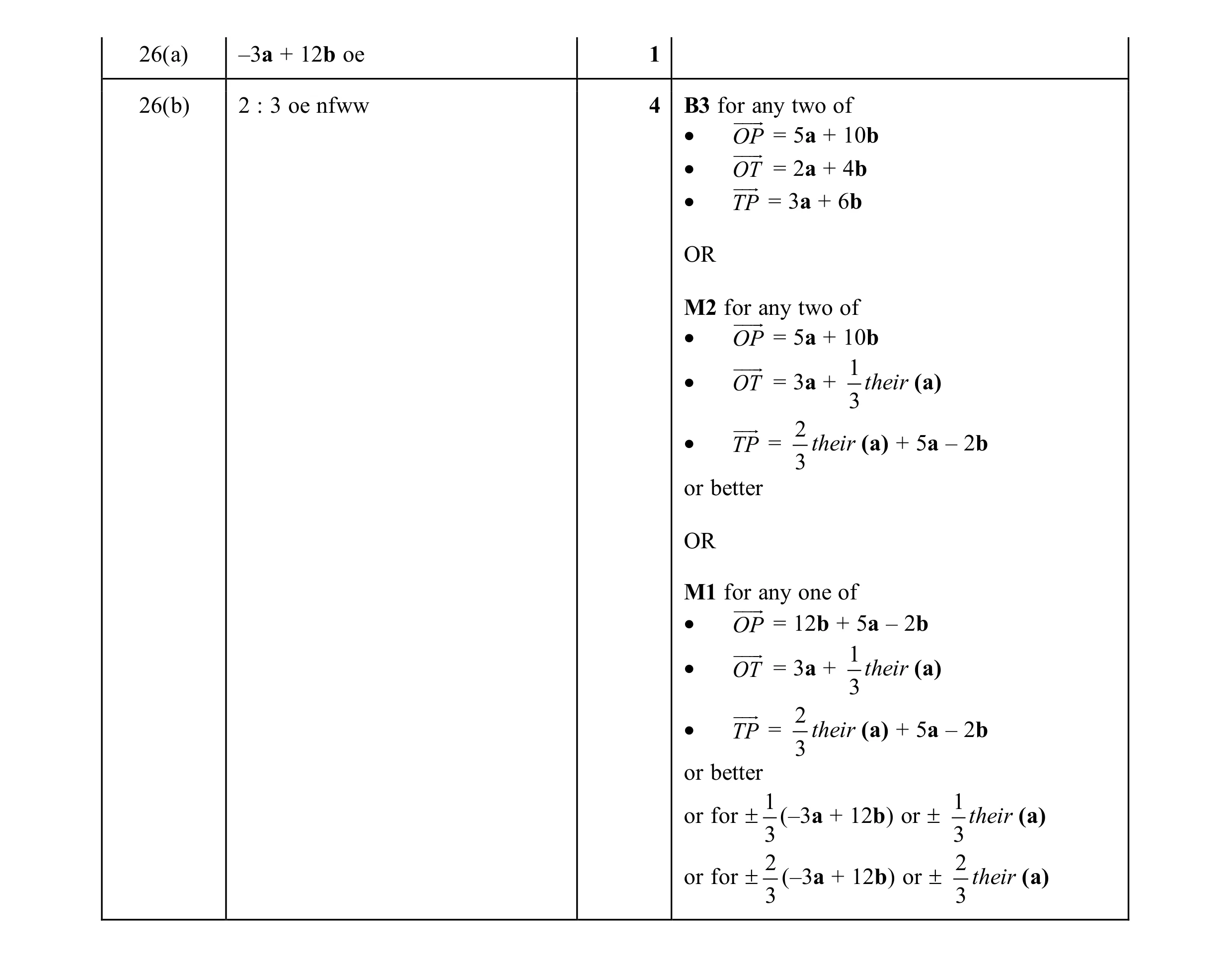
Mark scheme: 26(a) –3a + 12b oe 1 26(b) 2 : 3 oe nfww 4 B3 for any two of • OP = 5a + 10b • OT = 2a + 4b • TP = 3a + 6b OR M2 for any two of • OP = 5a + 10b 1 • OT = 3a + their (a) 3 2 • TP = their (a) + 5a – 2b 3 or better OR M1 for any one of • OP = 12b + 5a – 2b 1 • OT = 3a + their (a) 3 2 • TP = their (a) + 5a – 2b 3 or better 1 1 or for ± (–3a + 12b) or ± their (a) 3 3 2 2 or for ± (–3a + 12b) or ± their (a) 3 3
This question in 0580/43 May/June 2025
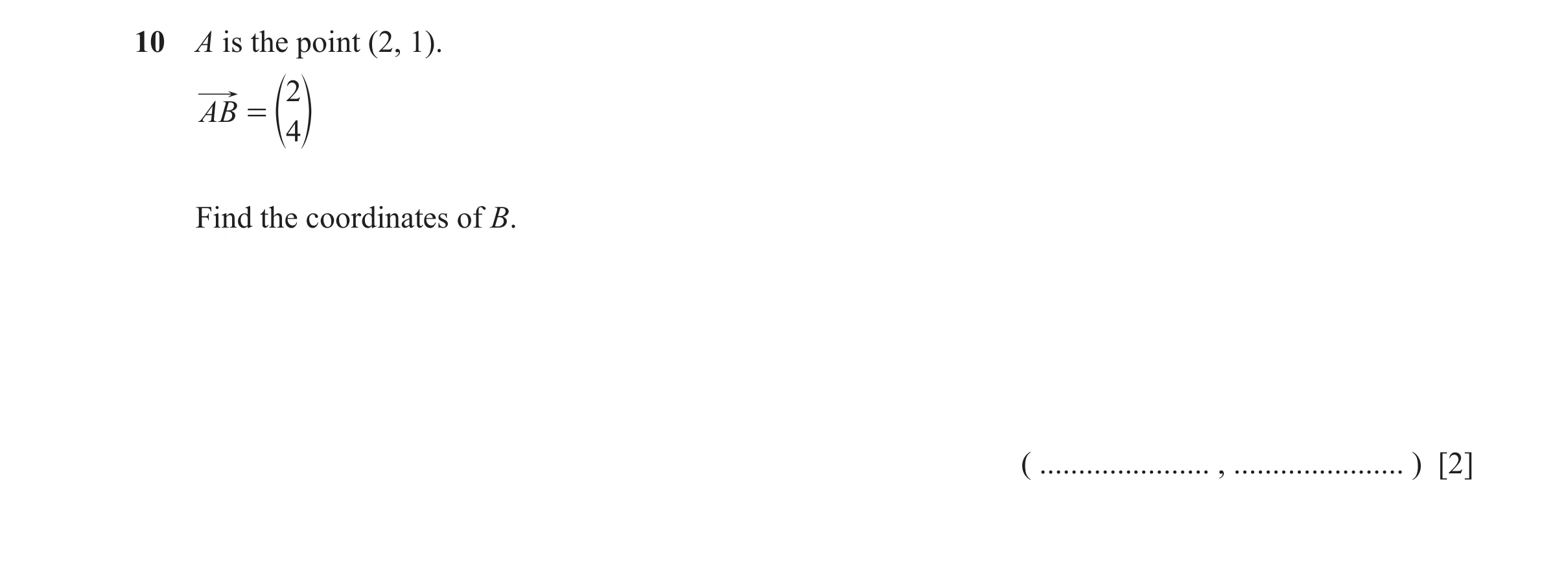
Q33 · A is the point (2, 1) 0580/41 Oct/Nov 2025
10 A is the point (2, 1). 2 AB = e o 4 Find the coordinates of B. ( … , … ) [2]
2 marks
Mark scheme: 10 (4, 5) 2 B1 for each
This question in 0580/41 Oct/Nov 2025
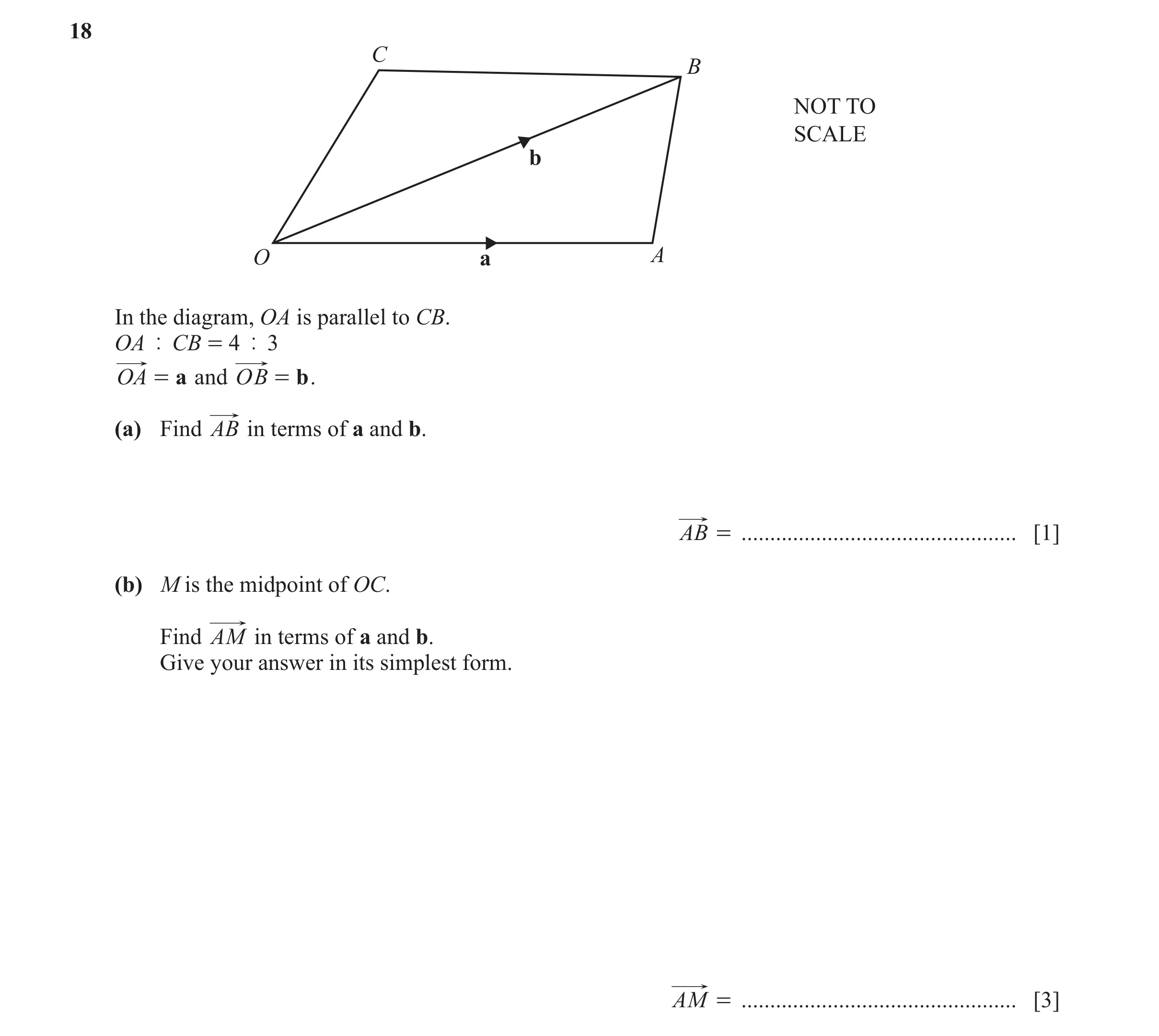
Q34 · C B NOT TO SCALE b O a A In the diagram, OA is parallel to CB 0580/42 Oct/Nov 2025
18 C B NOT TO SCALE b O a A In the diagram, OA is parallel to CB. OA | CB = 4 | 3 OA = a and OB = b . (a) Find AB in terms of a and b. AB = … [1] (b) M is the midpoint of OC. Find AM in terms of a and b. Give your answer in its simplest form. AM = … [3]
4 marks
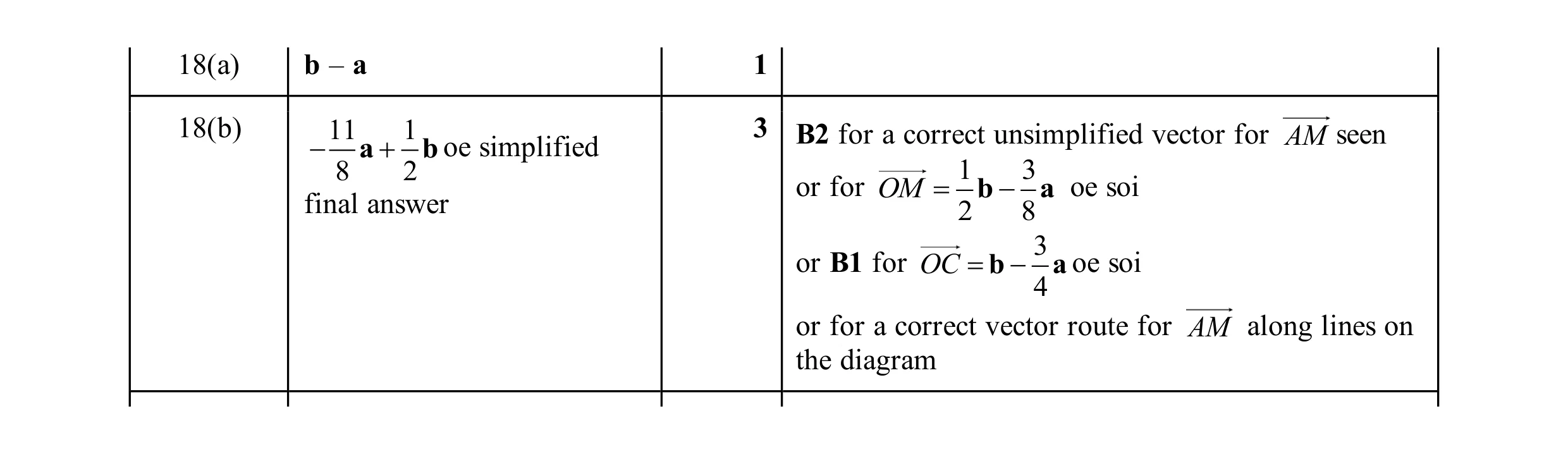
Mark scheme: 18(a) b – a 1 18(b) 11 1 3 B2 for a correct unsimplified vector for AM seen − a + b oe simplified 8 2 1 3 or for OM = b − a oe soi final answer 2 8 3 or B1 for OC = b − a oe soi 4 or for a correct vector route for AM along lines on the diagram
This question in 0580/42 Oct/Nov 2025
 1 / 47
 2 / 47
 3 / 47
 8 / 47
 11 / 47
 12 / 47
 15 / 47
 16 / 47
 27 / 47
 39 / 47
 43 / 47
 46 / 47
 47 / 47
 16
 9
 8
 11
 9
 9
 14
 9
 7
 16
 5
 10
 8
 10
 9
 15
 17
 13
 6
 9
 12
 16
 13
 9
 10
 11
 12
 13
 11
 7
 13
 5
 2
 4