Questions as text
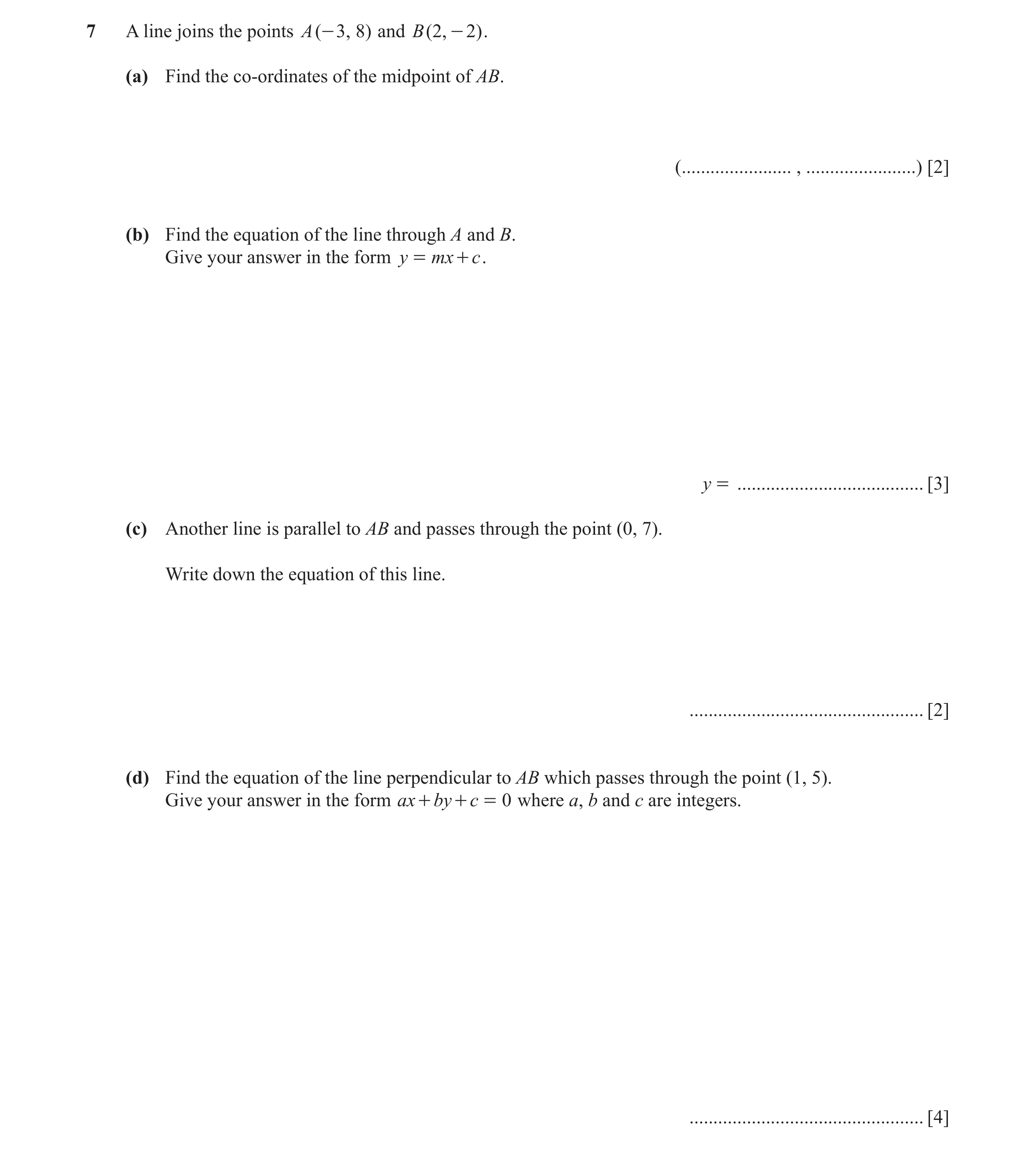
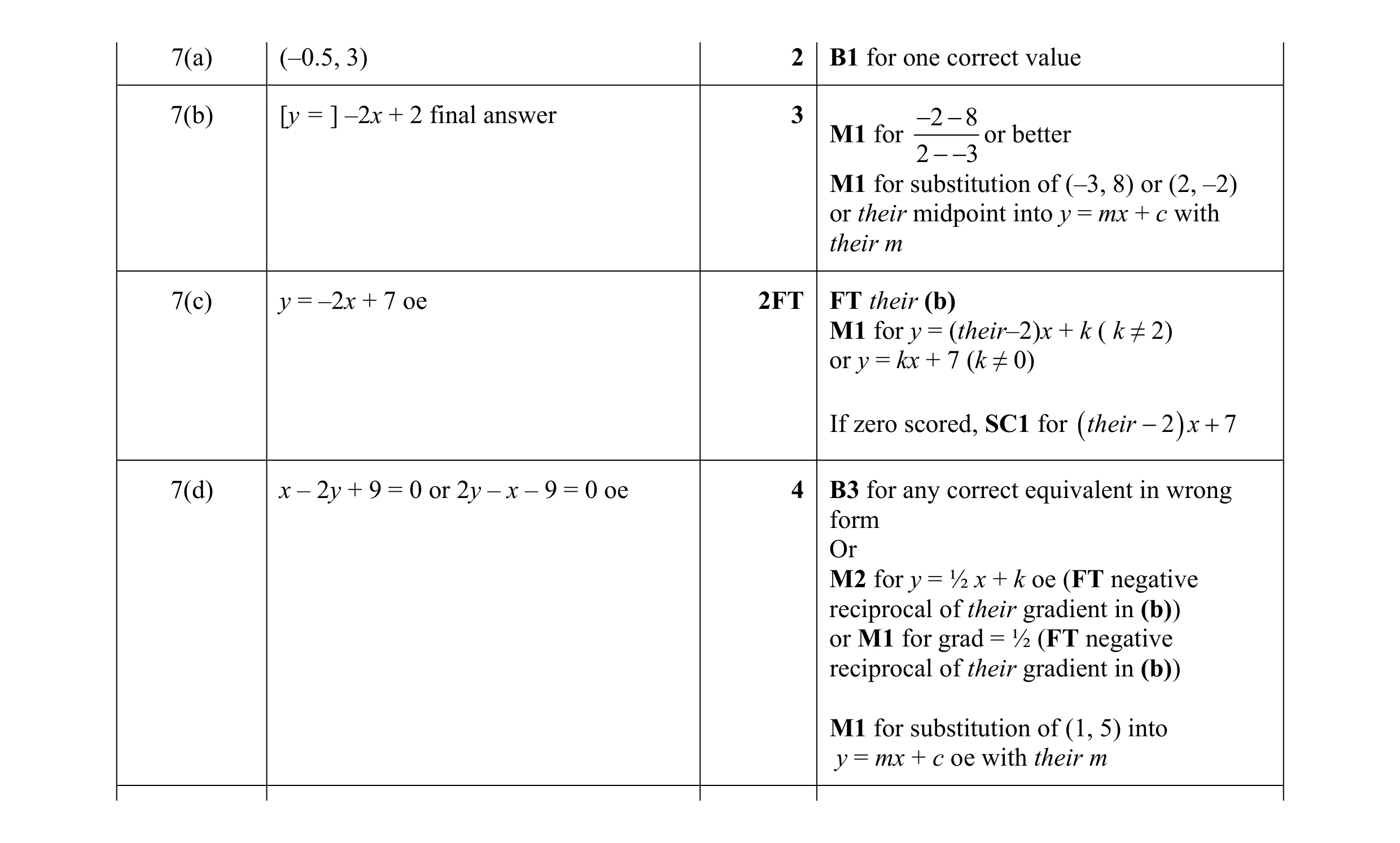
Q1 · A line joins the points A (- 3, 8) and B (2, - 2) 0580/41 May/June 2017
7 A line joins the points A (- 3, 8) and B (2, - 2) . (a) Find the co-ordinates of the midpoint of AB. ( … , … ) [2] (b) Find the equation of the line through A and B. Give your answer in the form y = mx + c . y = … [3] (c) Another line is parallel to AB and passes through the point (0, 7). Write down the equation of this line. … [2] (d) Find the equation of the line perpendicular to AB which passes through the point (1, 5). Give your answer in the form ax + by + c = 0 where a, b and c are integers. … [4]
11 marks
Mark scheme: 7(a) (–0.5, 3) 2 B1 for one correct value 7(b) [y = ] –2x + 2 final answer 3 −−2 8 M1 for better 2 −−or3 M1 for substitution of (–3, 8) or (2, –2) or their midpoint into y = mx + c with their m 7(c) y = –2x + 7 oe 2FT FT their (b) M1 for y = (their–2)x + k ( k ≠ 2) or y = kx + 7 (k ≠ 0) If zero scored, SC1 for ( their − 2 ) x + 7 7(d) x – 2y + 9 = 0 or 2y – x – 9 = 0 oe 4 B3 for any correct equivalent in wrong form Or M2 for y = ½ x + k oe (FT negative reciprocal of their gradient in (b)) or M1 for grad = ½ (FT negative reciprocal of their gradient in (b)) M1 for substitution of (1, 5) into y = mx + c oe with their m
This question in 0580/41 May/June 2017
Q2 · A line joins A (1, 3) to B (5, 8) 0580/42 Oct/Nov 2019
3 A line joins A (1, 3) to B (5, 8). (a) (i) Find the midpoint of AB. ( … , … ) [2] (ii) Find the equation of the line AB. Give your answer in the form y = mx + c . y = … [3] (b) The line AB is transformed to the line PQ. Find the co-ordinates of P and the co-ordinates of Q after AB is transformed by 5 (i) a translation by the vector e- 2o, P ( … , … ) Q ( … , … ) [2] (ii) a rotation through 90° anticlockwise about the origin, P ( … , … ) Q ( … , … ) [2] (iii) a reflection in the line x = 2 , P ( … , … ) Q ( … , … ) [2] - 1 2 (iv) a transformation by the matrix e 0 - 1o. P ( … , … ) Q ( … , … ) [2] (c) Describe fully the single transformation that maps the line AB onto the line PQ where P is the point (-2, -6) and Q is the point (-10, -16). … … [3]
16 marks
Mark scheme: 3(a)(i) (3, 5.5) 2 B1 for either value correct 3(a)(ii) 5 7 3 5 x + final answer B2 for answer x + c oe or for correct 4 4 4 equation in different form 8 − 3 or M1 for oe 5 − 1 and M1 for correct substitution shown of (1, 3) or (5, 8) or their (a)(i) into y = (their m)x + c oe 3(b)(i) (6, 1) 2 B1 for 2 or 3 values correct (10, 6) 3(b)(ii) (–3, 1) 2 B1 for 2 or 3 values correct (–8, 5) If 0 scored, SC1 for (3, –1) and (8, –5) 3(b)(iii) (3, 3) 2 B1 for 2 or 3 values correct but not for (–1, 8) (1, 3) and (5, 8) 3(b)(iv) (5, –3) 2 B1 for either (11, –8) − 1 2 1 − 1 2 5 or M1 for or 0 − 1 3 0 − 1 8 3(c) Enlargement 3 B1 for each –2 Origin oe
This question in 0580/42 Oct/Nov 2019
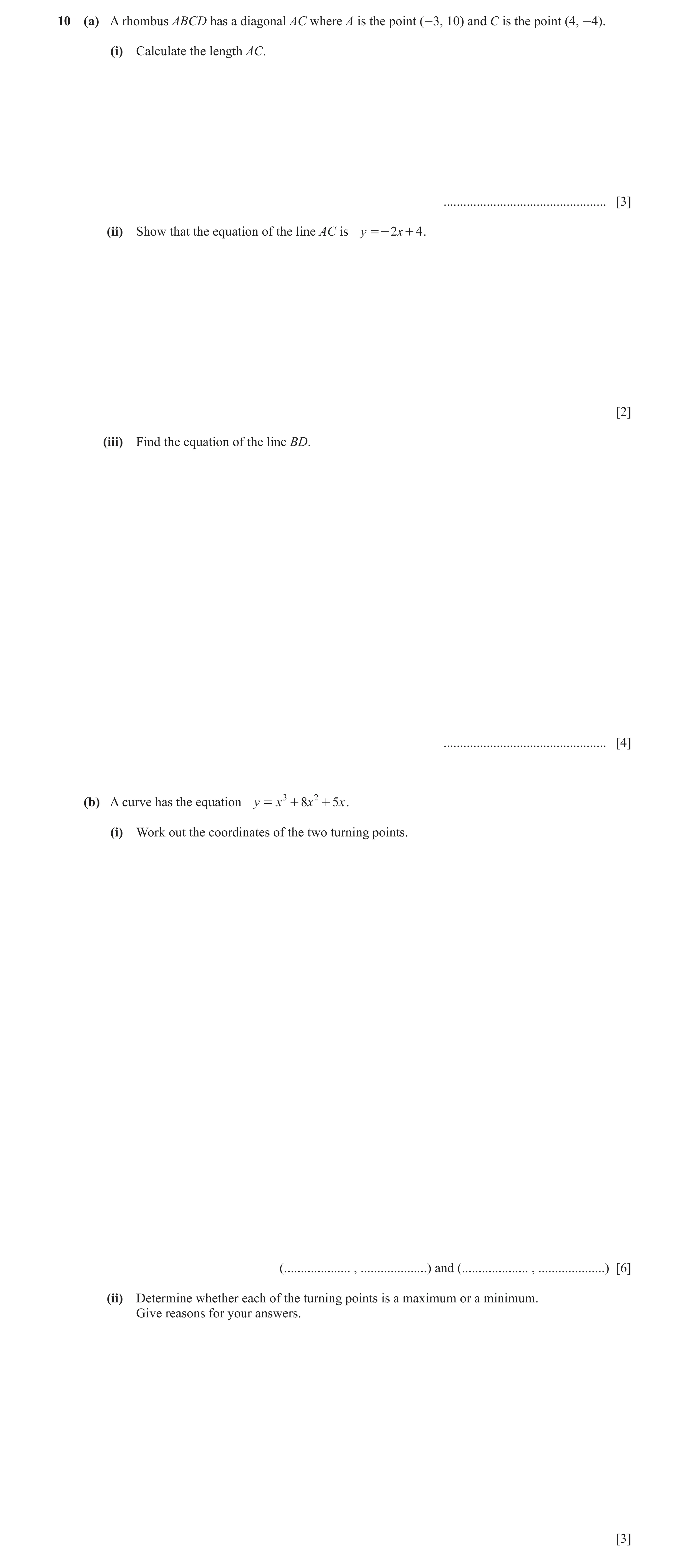
Q3 · A rhombus ABCD has a diagonal AC where A is the point (-3, 10) and C is the point (4, -4) 0580/41 May/June 2020
10 (a) A rhombus ABCD has a diagonal AC where A is the point (-3, 10) and C is the point (4, -4). (i) Calculate the length AC. … [3] (ii) Show that the equation of the line AC is y =- 2x + 4 . [2] (iii) Find the equation of the line BD. … [4] (b) A curve has the equation y = x 3 + 8x 2 + 5x . (i) Work out the coordinates of the two turning points. ( … , … ) and ( … , … ) [6] (ii) Determine whether each of the turning points is a maximum or a minimum. Give reasons for your answers. [3]
18 marks
Mark scheme: 10(a)(i) 15.7 or 15.65... 3 2 2 M2 for ( 4 – 10) + (4 – –3) oe or M1 for (–4 –10)2 + (4 – – 3)2 oe 10(a)(ii) –10 – 4 M1 [= –2] oe 4 – –3 10 = –2(–3) + c A1 Or –4 = –2(4) + c and correct completion to y = –2x + 4 10(a)(iii) 1 11 4 M1 for grad = ½ soi y = x + oe M1 for [midpoint =] (½, 3) 2 4 M1 for substitution of (1/2, 3) into their y = mx + c oe 10(b)(i) 1 22 6 B2 for 3x2 + 16x + 5 − , − oe and (–5, 50) Or B1 for one correct 3 27 M1 for derivative = 0 or their derivative = 0 1 M1 for [x =] – and [ x =] –5 3 22 B1 for – and 50 27 10(b)(ii) 1 22 3 B2 for one correct with reason − , − minimum or M1 for correct attempt e.g. 2nd derivatives, 3 27 gradients or sketching (–5, 50) maximum with correct reasons
This question in 0580/41 May/June 2020
Q4 · The equation of line L is 3x - 8y + 20 = 0 0580/43 May/June 2020
9 (a) The equation of line L is 3x - 8y + 20 = 0 . (i) Find the gradient of line L. … [2] (ii) Find the coordinates of the point where line L cuts the y-axis. ( … , … ) [1] (b) The coordinates of P are (-3, 8) and the coordinates of Q are (9, -2). (i) Calculate the length PQ. … [3] (ii) Find the equation of the line parallel to PQ that passes through the point (6, -1). … [3] (iii) Find the equation of the perpendicular bisector of PQ. … [4]
13 marks
Mark scheme: 9(a)(i) 3 2 M1 for 8 y = 3 x + 20 or better 8 9(a)(ii) (0, 2.5) oe 1 (b)(i) 15.6 or 15.62… 3 2 2 M2 for ( 9 −−3 ) + ( −−2 8 ) oe seen 2 2 or M1 for ( 9 −−3) or ( −−2 8 ) oe seen 9(b)(ii) 5 3 −−2 8 y = − x + 4 oe M1 for gradient oe 6 9 −−3 M1 for substituting (6, −1) into a linear equation oe 9(b)(iii) 6 3 4 5 y = x − oe M1 for gradient −1 / their − 5 5 6 B1 for midpoint at (3, 3) M1 for their midpoint substituted into y = their m × x + c oe
This question in 0580/43 May/June 2020
Q5 · Find the gradient of the curve y = 2x 3 - 7x + 4 when x =- 2 0580/42 Feb/March 2021
12 (a) Find the gradient of the curve y = 2x 3 - 7x + 4 when x =- 2 . … [3] (b) A is the point (7, 2) and B is the point (−5, 8). (i) Calculate the length of AB. … [3] (ii) Find the equation of the line that is perpendicular to AB and that passes through the point (−1, 3). Give your answer in the form y = mx + c . y = … [4] (iii) AB is one side of the parallelogram ABCD and - a • BC = where a 2 0 and b 2 0 e- bo • the gradient of BC is 1 • BC = 8 . Find the coordinates of D. ( … , … ) [4]
14 marks
Mark scheme: 12(a) 17 3 M2 for 3 × 2 x 2 − 7 or better isw or M1 for 3 × 2 x 2 oe or kx2 – 7 seen 12(b)(i) 13.4 or 13.41 to 13.42 3 2 2 M2 for ( −−5 7 ) + ( 8 − 2 ) oe 2 2 or M1 for ( −−5 7 ) + ( 8 − 2 ) oe 12(b)(ii) [ y = ] 2 x + 5 final answer 4 8 − 2 M1 for [gradient of AB =] oe −−5 7 1 M1dep for gradient p = −÷1 their − oe 2 M1dep on previous M1 for substituting (−1, 3) into y = their px + c oe where their p ≠ 0 12(b)(iii) ( 5, 0) 4 − 2 2 B3 for AD = or DA = − 2 2 12 or coordinates of C (−7, 6) and CD = oe − 6 seen or B2 for a = b = 2 soi or coordinates of C (−7, 6) 2 8 oe or M1 for a = b oe soi or for a 2 + b 2 = ( ) a or cos 45 = oe 8 −12 12 = DC = or for or CD seen 6 − 6 y − 8 y − 2 or = 1 oe or = 1 x −−5 x − 7
This question in 0580/42 Feb/March 2021
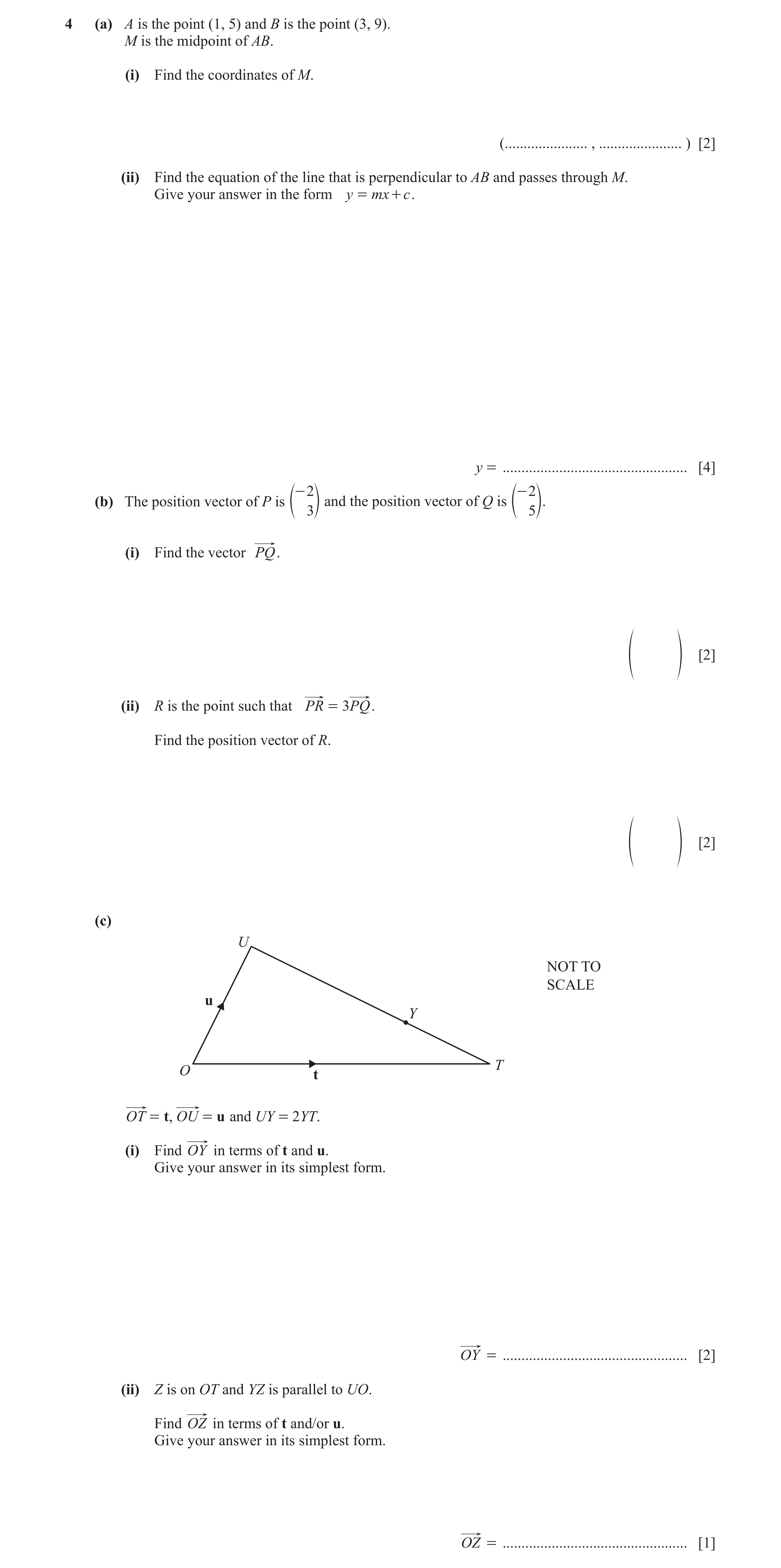
Q6 · A is the point (1, 5) and B is the point (3, 9) 0580/43 May/June 2021
4 (a) A is the point (1, 5) and B is the point (3, 9). M is the midpoint of AB. (i) Find the coordinates of M. ( … , … ) [2] (ii) Find the equation of the line that is perpendicular to AB and passes through M. Give your answer in the form y = mx + c . y = … [4] - 2 - 2 (b) The position vector of P is and the position vector of Q is e 3o e 5o. (i) Find the vector PQ. [2] f p (ii) R is the point such that PR = 3PQ . Find the position vector of R. [2] f p (c) U NOT TO SCALE u Y T O t OT = t , OU = u and UY = 2YT. (i) Find OY in terms of t and u. Give your answer in its simplest form. OY = … [2] (ii) Z is on OT and YZ is parallel to UO. Find OZ in terms of t and/or u. Give your answer in its simplest form. OZ = … [1]
13 marks
Mark scheme: 4(a)(i) (2, 7) 2 B1 for each coordinate 4(a)(ii) 1 4 Correct equivalent in different form − x + 8 oe scores 3 marks. 2 9 − 5 4 M1 for gradient of AB = or or 2 3 − 1 2 M1 dep for gradient 1 p = −their grad of AB M1 (dep on previous M1) for substitution of their midpoint into y = (their p)x + c oe where their p ≠ 0 4(b)(i) 0 2 0 k B1 for or 2 k 2 4(b)(ii) − 2 2 FT their PQ 9 0 B1FT for 6 4(c)(i) 2 1 1 2 2 t + u or (2t + u) final answer M1 for UY = ( t –u) oe 3 3 3 3 1 or TY = (u – t) oe 3 or correct route soi 4(c)(ii) 2 1 t cao 3
This question in 0580/43 May/June 2021
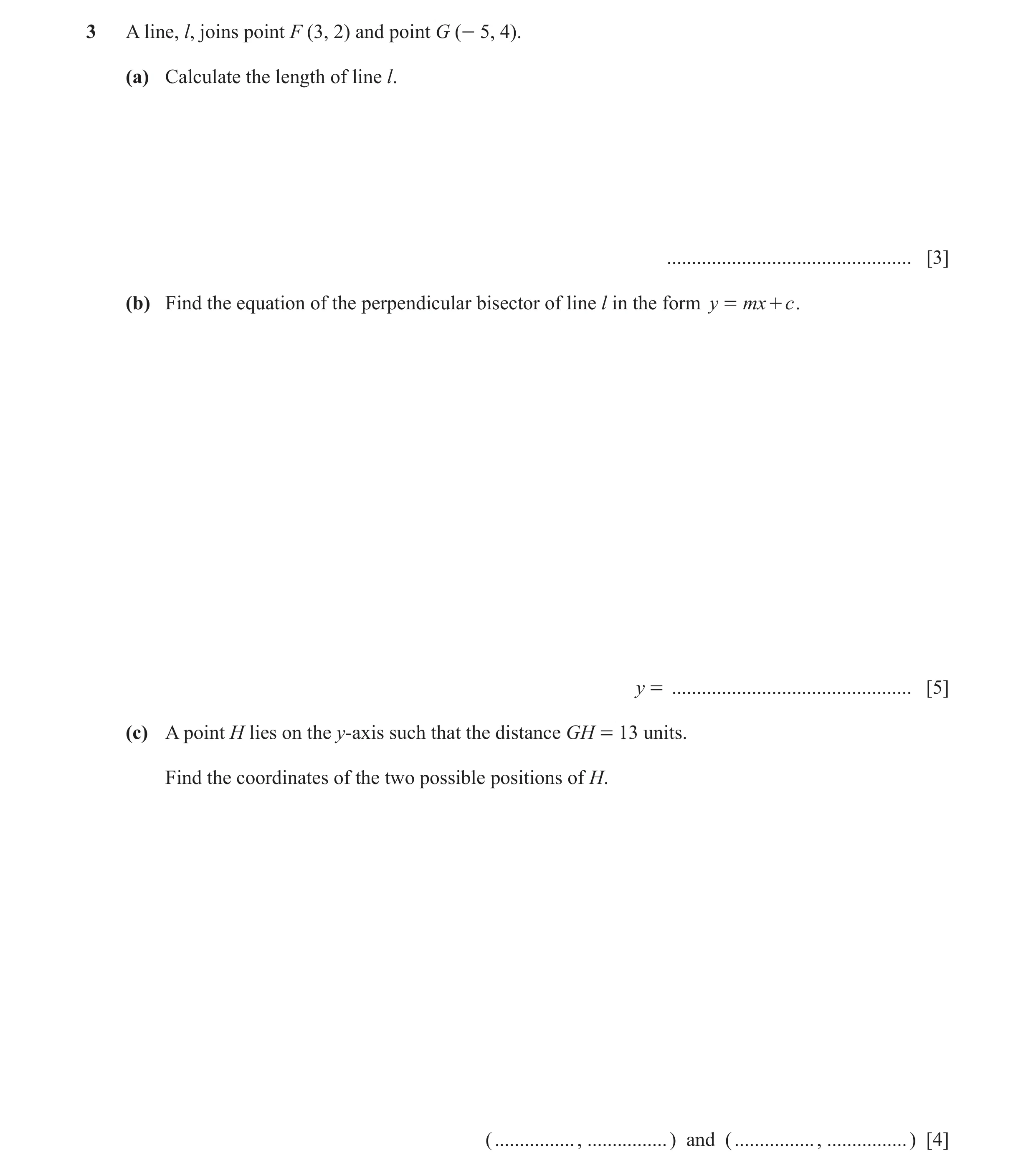
Q7 · A line, l, joins point F (3, 2) and point G (- 5, 4) 0580/42 May/June 2022
3 A line, l, joins point F (3, 2) and point G (- 5, 4). (a) Calculate the length of line l. … [3] (b) Find the equation of the perpendicular bisector of line l in the form y = mx + c . y = … [5] (c) A point H lies on the y-axis such that the distance GH = 13 units. Find the coordinates of the two possible positions of H. ( … , … ) and ( … , … ) [4]
12 marks
Mark scheme: 3(a) 8.25 or 8.246… 3 2 2 M2 for 3 5 2 4 oe or better or M1 for 3 5 and 2 4 oe seen 3(b) [ y ] 4 x 7 5 B1 for [midpoint] (− 1, 3) soi 4 2 M1 for [gradient of l =] oe 5 3 1 M1 for gradient 1 / their 4 M1dep on at least M1 for their (− 1, 3) substituted into y = their m x + c oe 3(c) (0, − 8) and (0, 16) 4 B3 for (0, −8) or (0, 16) or for –8 and 16 OR B2 for distance = [±]12 soi or M1 for 132 – (5[–0])2 oe B1 for both answers (0, k), k ≠ 0 or 4 ALT METHOD B3 for (0, −8) or (0 , 16) or for – 8 and 16 OR M2 for y2 – 8y – 128 [= 0] or for (y – 4)2 = 144 or better or M1 for 132 = (–5 – 0)2 + (4 – y)2 oe B1 for both answers (0, k), k ≠ 0 or 4
This question in 0580/42 May/June 2022
Q8 · A has coordinates ( - 2 , 7) , B has coordinates ( 1 , - 5 ) and C has coordinates ( 5, 4) 0580/43 May/June 2022
8 (a) A has coordinates ( - 2 , 7) , B has coordinates ( 1 , - 5 ) and C has coordinates ( 5, 4) . (i) Find the coordinates of the midpoint of the line AB. ( … , … ) [2] (ii) Find AC. AC = [2] f p (iii) Find AC . … [2] (iv) Find the equation of the line AB. Give your answer in the form y = mx + c . y = … [3] (v) Find the equation of the line perpendicular to AB that passes through C. Give your answer in the form y = mx + c . y = … [3] (b) The graphs of y + 5 x = 8 and y = 2x 2 + 6x - 13 intersect at the points P and Q. Find the coordinates of P and the coordinates of Q. Show all your working. P ( … , … ) Q ( … , … ) [6]
18 marks
Mark scheme: 8(a)(i) (–0.5, 1) 2 B1 for each 8(a)(ii) 7 2 B1 for each 3 8(a)(iii) 7.62 or 7.615 to 7.616 2 FT their (a)(ii) M1 for (their 7)2 + (their –3)2 oe 8(a)(iv) [y =] –4x –1 final answer 3 B2 for answer –4x + c [oe] or for correct equation in different form or for –4x +–1 or for –4m – 1 OR 5 7 M1 for oe 1 2 M1 for correct substitution shown of (–2, 7) or (1, –5) or their (–0.5, 1) into y = (their m)x + c oe OR M1 for 7 = –2m + c and –5 = m + c A1 for m = –4 and c = –1 8(a)(v) 1 11 3 1 [y =] x + final answer M1 for grad = oe nfww soi, 4 4 4 FT negative reciprocal of their gradient from (iv) M1 for correct substitution shown of (5, 4) into y = (their m)x + c oe or, if no substitution shown, (5, 4) satisfies their final linear equation. 8(b) 2x2 + 11x – 21 [= 0] M2 or M1 for 8 – 5x = 2x2 + 6x – 13 oe or better (2x – 3)(x + 7) [= 0] oe M2 Allow correct method to solve their or quadratic equation e.g. formula, complete 2 the square but not for 2x2 + 6x – 13 11 11 4 2 21 2 2 M1 FT their equation or for 2x(x+ 7) – 3(x + 7) [= 0] –11 21 11 2 oe or x(2x – 3) + 7(2x – 3) [= 0] 4 2 4 or (2x + a)(x + b) [= 0] where ab = – 21 or 2b + a = 11 OR M1 for 112 4 2 21 11 k 11 k or for or 2 2 2 2 OR 11 2 M1 for x 4 3 1 B2 B1 for one correct pair or for 2 correct , and (–7, 43) x-values or 2 correct y-values 2 2
This question in 0580/43 May/June 2022
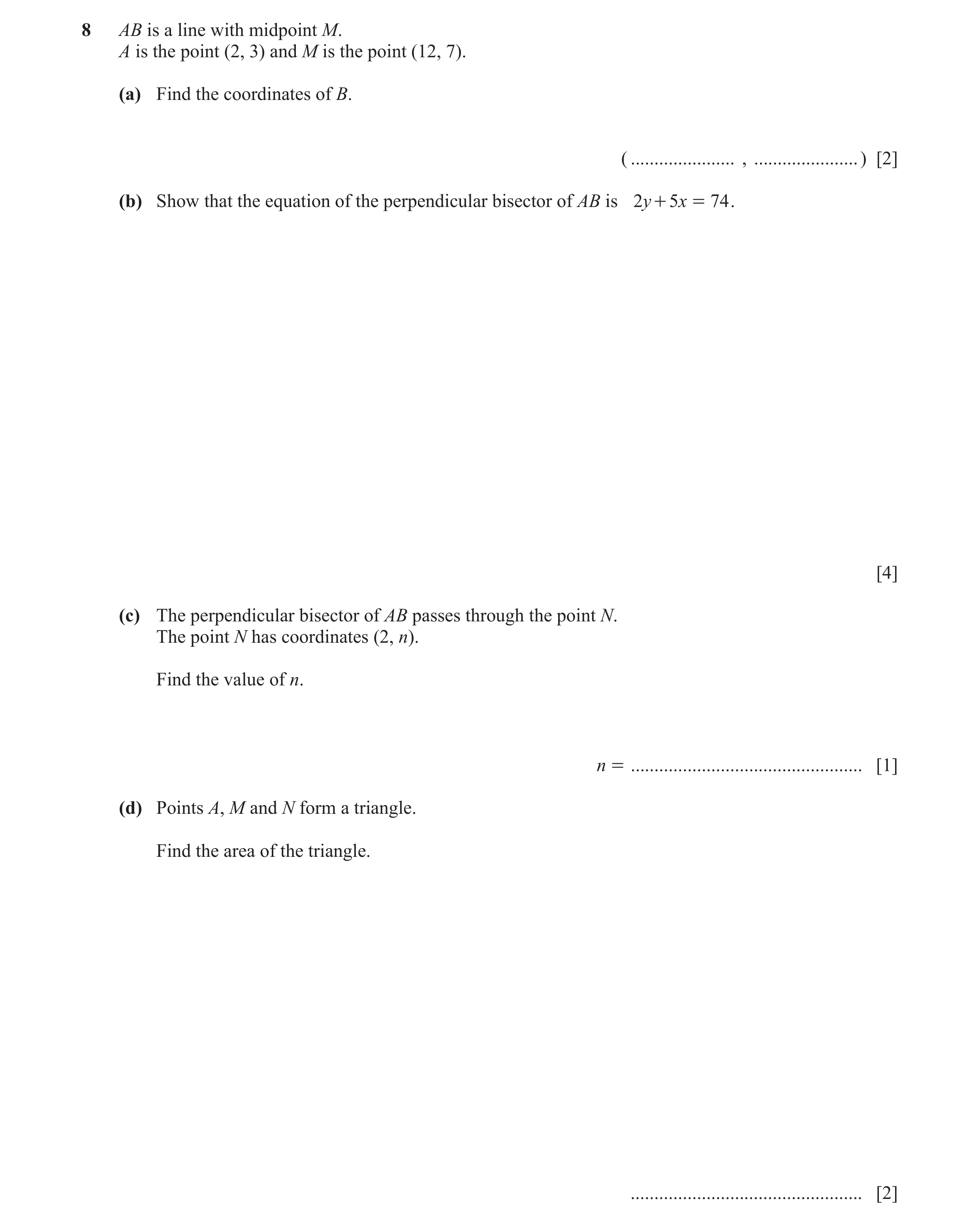
Q9 · AB is a line with midpoint M 0580/42 Oct/Nov 2022
8 AB is a line with midpoint M. A is the point (2, 3) and M is the point (12, 7). (a) Find the coordinates of B. ( … , … ) [2] (b) Show that the equation of the perpendicular bisector of AB is 2y + 5x = 74 . [4] (c) The perpendicular bisector of AB passes through the point N. The point N has coordinates (2, n). Find the value of n. n = … [1] (d) Points A, M and N form a triangle. Find the area of the triangle. … [2]
9 marks
Mark scheme: 8(a) (22, 11) 2 B1 for each value 8(b) their11 − 3 M1 oe or better their 22 − 2 1 M1 −their m Substitution of (12, 7) into M1 Accept y – 7 = their m(x – 12) oe y = (their m)x + c leading to 2y + 5x = 74 final answer A1 Without error or omission 8(c) 32 1 8(d) 145 2 1 M1 for × (their 32 – 3) × 10 oe 2 or 1 2 2 2 2 (7 − 3) + (12 − 2) (their 32 − 7) + (2 − 12) oe 2
This question in 0580/42 Oct/Nov 2022
Q10 · In the square ABCD, A has coordinates ( - 2 , 1) and B has coordinates (1, 5) 0580/41 May/June 2023
6 (a) In the square ABCD, A has coordinates ( - 2 , 1) and B has coordinates (1, 5). C has coordinates (a, b), where a and b are both positive integers. Find the coordinates of C and the coordinates of D. You may use the grid to help you. y 6 5 4 3 2 1 – 3 – 2 – 1 0 1 2 3 4 5 6 x – 1 – 2 – 3 C ( … , … ) D ( … , … ) [4] (b) P has coordinates ( - 1, 3) and Q has coordinates (6, 4). (i) Find the coordinates of the midpoint of PQ. ( … , … ) [2] (ii) Find the length PQ. … [3] (iii) Find the gradient of PQ. … [2] (iv) Find the equation of the line parallel to PQ that crosses the x-axis at x = 2 . … [3]
14 marks
Mark scheme: 6(a) (5, 2) 4 B3 for 3 correct values or answers for C and D (2, − 2) reversed or correct coordinates given on diagram wrongly labelled or B2 for one correct coordinate pair correctly labelled or M2 for A,B,C and D correctly plotted or M1 for A and B correctly plotted If 0 or 1 scored instead award SC2 for answers (–3, 8) and (–6, 4) or answers (1.5,1.5) and (–2.5, 4.5) 6(b)(i) (2.5, 3.5) oe 2 B1 for each 6(b)(ii) 7.07 or 7.071... 3 2 2 M2 for 6 1 4 3 oe or M1 for 6 1 or 4 3 oe 6(b)(iii) 1 2 4 3 M1 for 7 6 oe1 6(b)(iv) 1 2 3 M1 for gradient = their (iii) y x or 7 y x 2 oe 7 7 M1dep for substituting (2, 0) in a linear final answer equation with their m allow if (2,0) satisfies y=(their(b)(iii) gradient)x+c
This question in 0580/41 May/June 2023
Q11 · M has coordinates (4, 1) and N has coordinates ( -2, -7) 0580/43 May/June 2023
11 M has coordinates (4, 1) and N has coordinates ( -2, -7). (a) Find the length of MN. … [3] (b) Find the gradient of MN. … [2] (c) Find the equation of the perpendicular bisector of MN. … [4] Question 12 is printed on the next page.
9 marks
Mark scheme: 11(a) 10 3 M2 for (1 – –7)2 + (4 – –2)2 oe or M1 for (1 – –7) or (4 – –2) oe 11(b) 4 8 2 1 7 or M1 for oe 3 6 4 2 11(c) 3 9 4 3 9 y x B3 for x 4 4 4 4 or 4 y 3 x 9 0 oe OR final answers B1 for midpoint (1, − 3) 3 1 M1 for gradient or 4 their (b) M1 for substituting their (1, −3) into y = (their m)x + c or for y 3 their m = oe x 1
This question in 0580/43 May/June 2023
Q12 · Y B NOT TO SCALE A x O O is the origin (0, 0), A is the point (8, 1) and B is the point… 0580/42 Oct/Nov 2023
12 y B NOT TO SCALE A x O O is the origin (0, 0), A is the point (8, 1) and B is the point (2, 5). (a) Write as column vectors. (i) OB OB = [1] f p (ii) AB AB = [1] f p (b) Find the equation of the line AB. Give your answer in the form y = mx + c . y = … [3] (c) Find the equation of the perpendicular bisector of AB. Give your answer in the form y = mx + c . y = … [4] (d) The line AB meets the y-axis at P. The perpendicular bisector of AB meets the y-axis at Q. Find the length of PQ. … [2]
11 marks
Mark scheme: 12(a)(i) 2 1 5 12(a)(ii) −6 1 4 12(b) 2 19 3 1 − 5 [ y =] − x + oe M1 for gradient = oe 3 3 8 − 2 M1 for substituting (8, 1) or (2, 5) into y = their mx + c 12(c) 3 9 4 B1 for (5, 3) oe [ y = x − oe 1 ]2 2 M1 for gradient = −their gradient of AB M1 substituting their midpoint into y = their mx + c 12(d) 65 2 19 9 oe M1 for their – their − oe 6 3 2
This question in 0580/42 Oct/Nov 2023
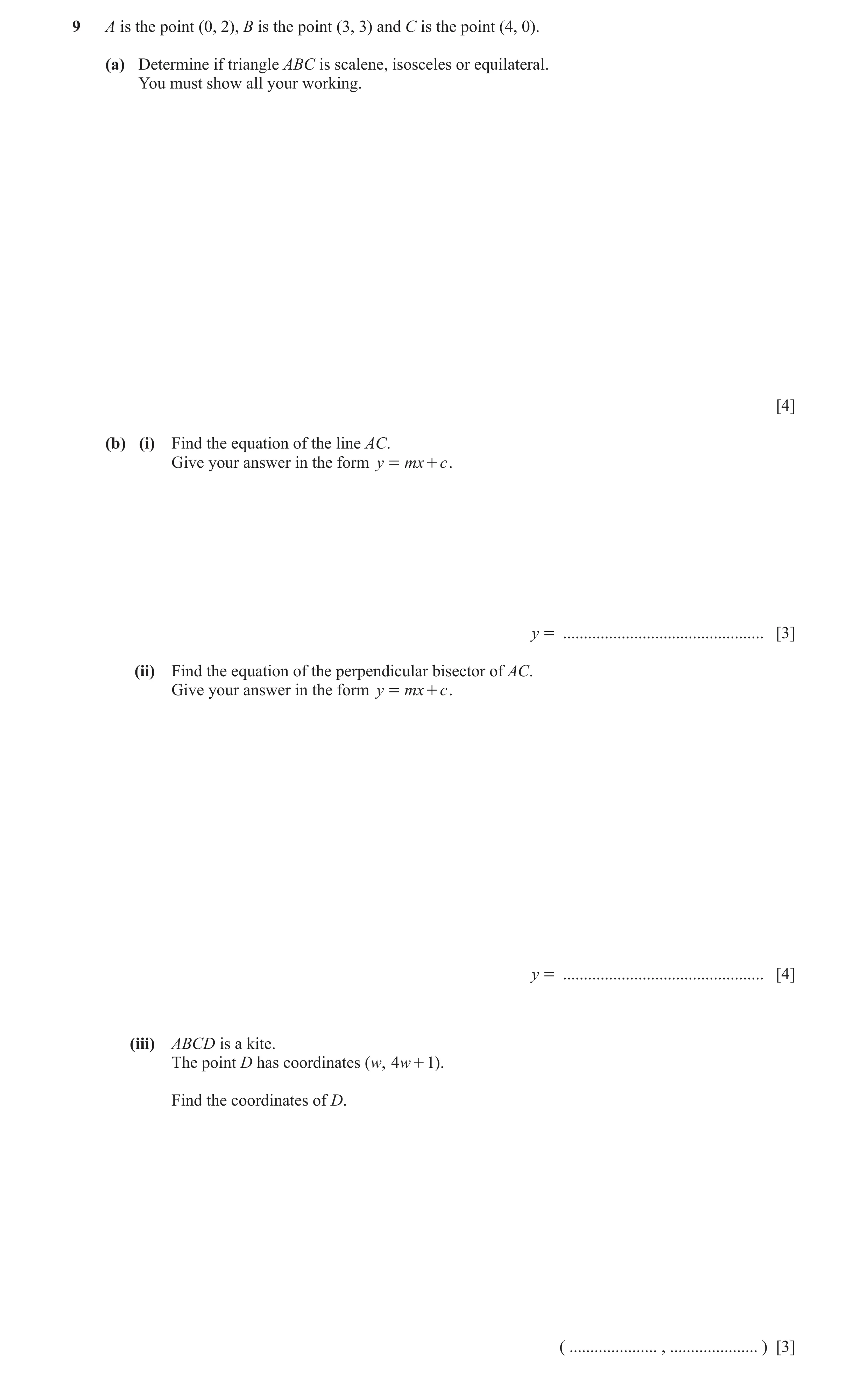
Q13 · A is the point (0, 2), B is the point (3, 3) and C is the point (4, 0) 0580/43 Oct/Nov 2023
9 A is the point (0, 2), B is the point (3, 3) and C is the point (4, 0). (a) Determine if triangle ABC is scalene, isosceles or equilateral. You must show all your working. [4] (b) (i) Find the equation of the line AC. Give your answer in the form y = mx + c . y = … [3] (ii) Find the equation of the perpendicular bisector of AC. Give your answer in the form y = mx + c . y = … [4] (iii) ABCD is a kite. The point D has coordinates (w, 4w + 1). Find the coordinates of D. ( … , … ) [3]
14 marks
Mark scheme: 9(a) [AB2 =] (3 – 0)2 + (3 – 2)2 oe or M1 3 or oe better 1 [AC2 =] (0 – 2)2 + (4 – 0)2 oe or M1 4 or oe better −2 [BC2 =] (0 – 3)2 + (4 – 3)2 oe or M1 1 or oe better −3 Triangle is isosceles [with 10, 20 A1 or Triangle is isosceles and only vector AB and BC and 10 or better shown] have the same magnitude [because they have the same components] 9(b)(i) 1 3 0 − 2 [y =] − x + 2 oe M1 for oe 2 4 − 0 M1 for substituting (0, 2) or (4, 0) into y = their mx + c oe or B1 for answer y = kx + 2 9(b)(ii) [y =] 2x – 3 4 −1 M1 for their grad (b)(i) B1 for (2, 1) M1 for substituting their (2, 1) into y = their px + d oe 9(b)(iii) (–2, –7) 3 B2 for w = – 2 or M1 for 4w + 1 = 2w – 3 FT their (b)(ii) 4 w + 1 − 3 or for 2 = w − 3
This question in 0580/43 Oct/Nov 2023
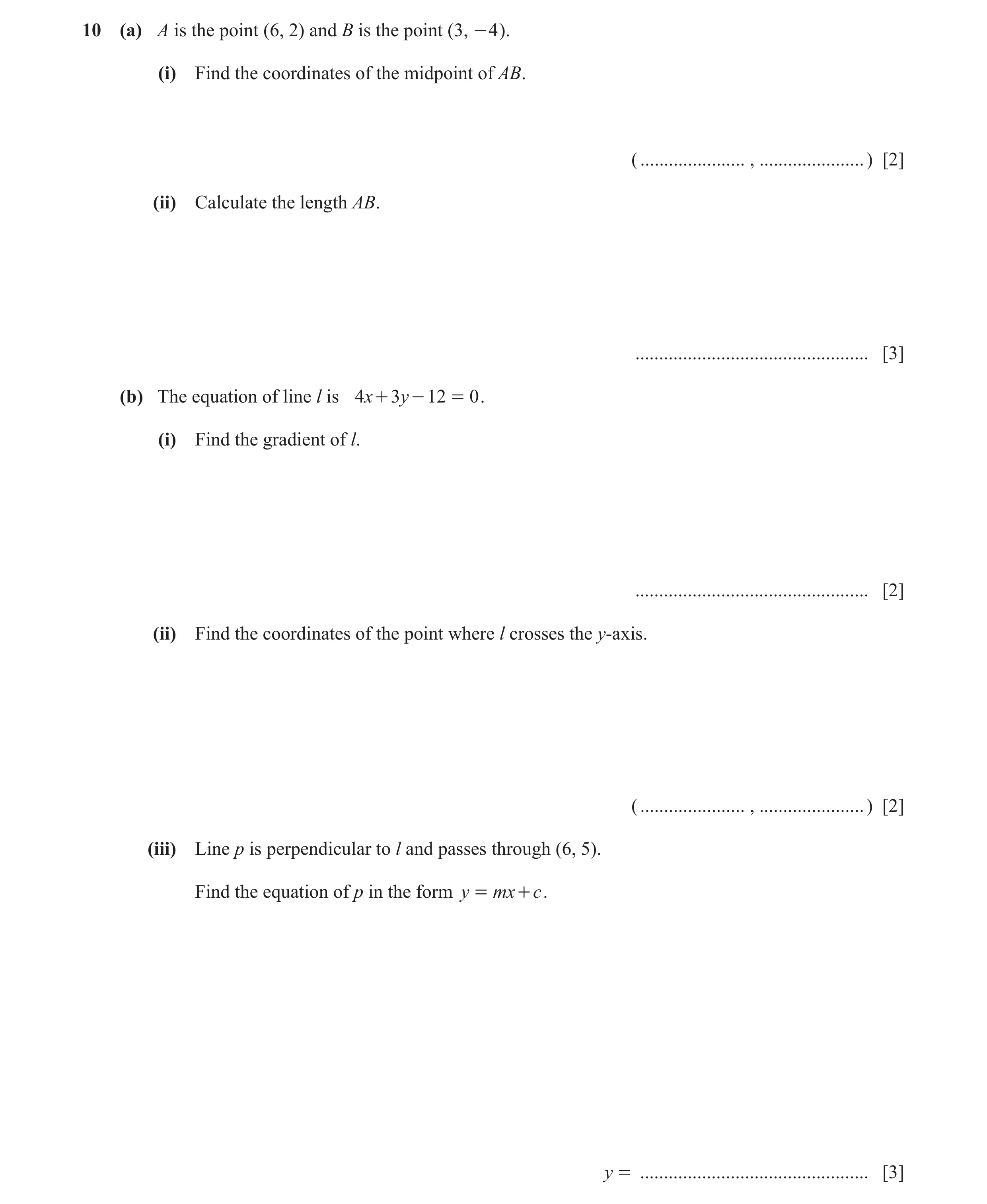
Q14 · A is the point (6, 2) and B is the point (3, - 4 ) 0580/42 May/June 2024
10 (a) A is the point (6, 2) and B is the point (3, - 4 ). (i) Find the coordinates of the midpoint of AB. ( … , … ) [2] (ii) Calculate the length AB. … [3] (b) The equation of line l is 4x + 3y - 12 = 0 . (i) Find the gradient of l. … [2] (ii) Find the coordinates of the point where l crosses the y-axis. ( … , … ) [2] (iii) Line p is perpendicular to l and passes through (6, 5). Find the equation of p in the form y = mx + c . y = … [3]
12 marks
Mark scheme: 10(a)(i) (4.5, −1) 2 B1 for each 10(a)(ii) 6.71 or 6.708... 3 M2 for (6 – 3)2 + (2 – – 4)2 oe or better or M1 for [–] 6 3 and [–] 2 4 oe or for ([–]3)2 and ([–]6)2 oe 10(b)(i) 4 2 M1 for 3 y 4 x 12 3 4 12 or x y [= 0] or better seen 3 3 10(b)(ii) (0, 4) 2 B1 for each or for y = 4 not in coordinate form 10(b)(iii) 3 1 3 3 1 [ y ] x final answer M1 for gradient or oe or 4 2 4 their(b)(i) better 3 M1 for (6, 5) substituted into y = x + c 4 or y = their mx + c oe
This question in 0580/42 May/June 2024
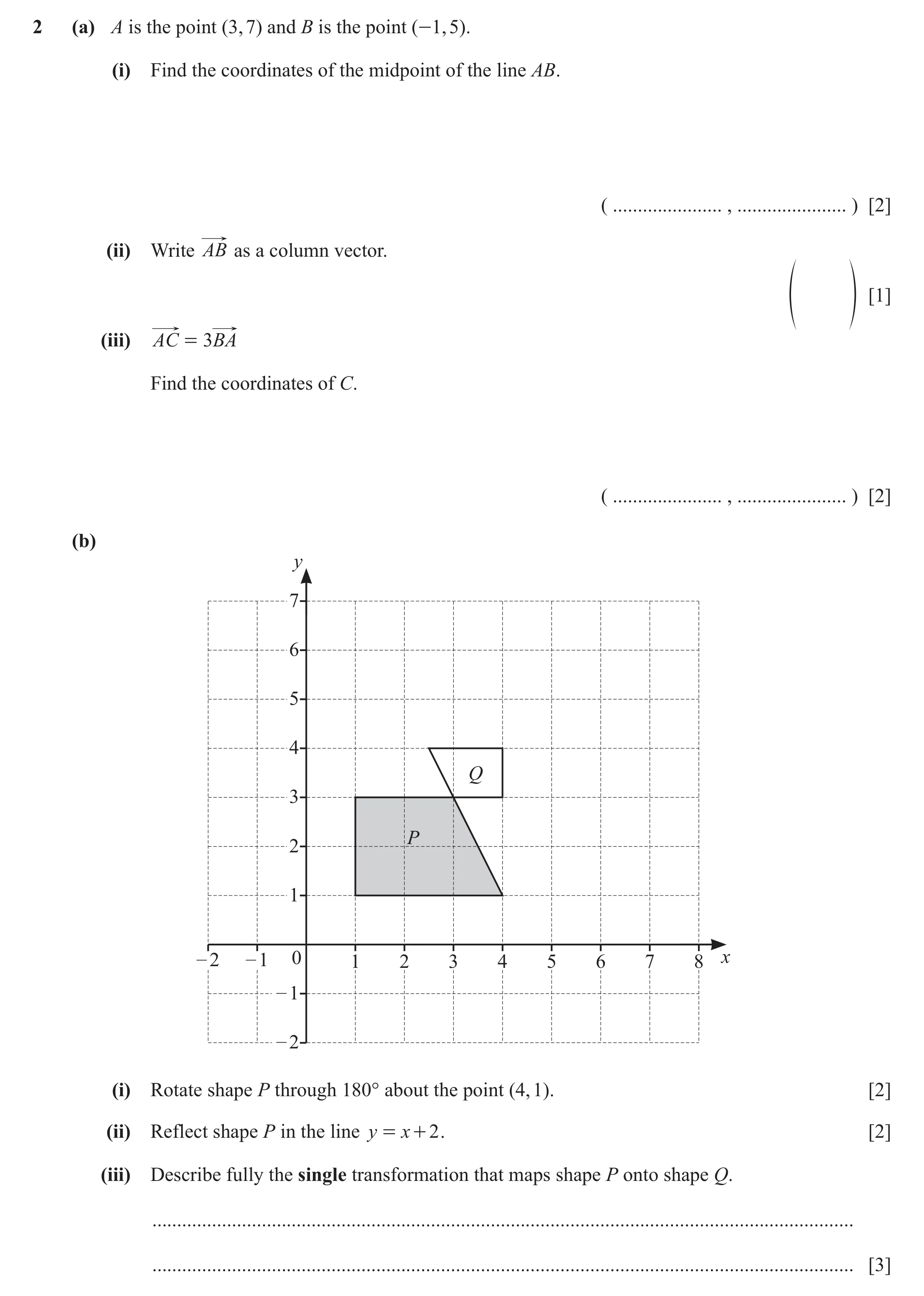
Q15 · A is the point (3, 7) and B is the point (-1, 5) 0580/43 Oct/Nov 2024
2 (a) A is the point (3, 7) and B is the point (-1, 5). (i) Find the coordinates of the midpoint of the line AB. ( … , … ) [2] (ii) Write AB as a column vector. f p [1] (iii) AC = 3BA Find the coordinates of C. ( … , … ) [2] (b) y 7 6 5 4 Q 3 P 2 1 – 2 – 1 0 1 2 3 4 5 6 7 8 x – 1 – 2 (i) Rotate shape P through 180° about the point (4, 1). [2] (ii) Reflect shape P in the line y = x + 2 . [2] (iii) Describe fully the single transformation that maps shape P onto shape Q. … … [3]
12 marks
Mark scheme: 2(a)(i) (1, 6) 2 B1 for each 2(a)(ii) −4 1 −2 2(a)(iii) (15, 13) 2 FT their (a)(ii) 12 −12 M1 for or seen 6 −6 or for –1 + 16 and 5 + 8 seen 2(b)(i) Image at (4, 1), (5, –1), (7, –1), (7, 1) 2 B1 for rotation 180° but incorrect position 2(b)(ii) Image at (1, 3), (–1, 3), (–1, 6), (1, 5) 2 B1 for correct orientation but incorrect position or for drawing line y = x + 2 2(b)(iii) Enlargement 3 B1 for each [centre] (3, 3) 1 [factor] − 2
This question in 0580/43 Oct/Nov 2024
 1 / 20
![Question 2: A line joins A (1, 3) to B (5, 8). (a) (i) Find the midpoint of AB. ( ........................ , ........................) [2] (ii) Find th…](https://img.pastlit.com/crops/81aa6d77-6dc1-4c2d-8c9f-d820bd22f28e/q3.webp)
![Question 4: (a) The equation of line L is 3x - 8y + 20 = 0 . (i) Find the gradient of line L. ................................................. [2] (ii…](https://img.pastlit.com/crops/0004f1f3-f7b0-49c9-b90c-1ca681fa889e/q9.webp)
![Question 5: (a) Find the gradient of the curve y = 2x 3 - 7x + 4 when x =- 2 . ................................................. [3] (b) A is the point…](https://img.pastlit.com/crops/470482a8-9315-41a2-b1f1-ab7236402332/q12.webp)
 9 / 20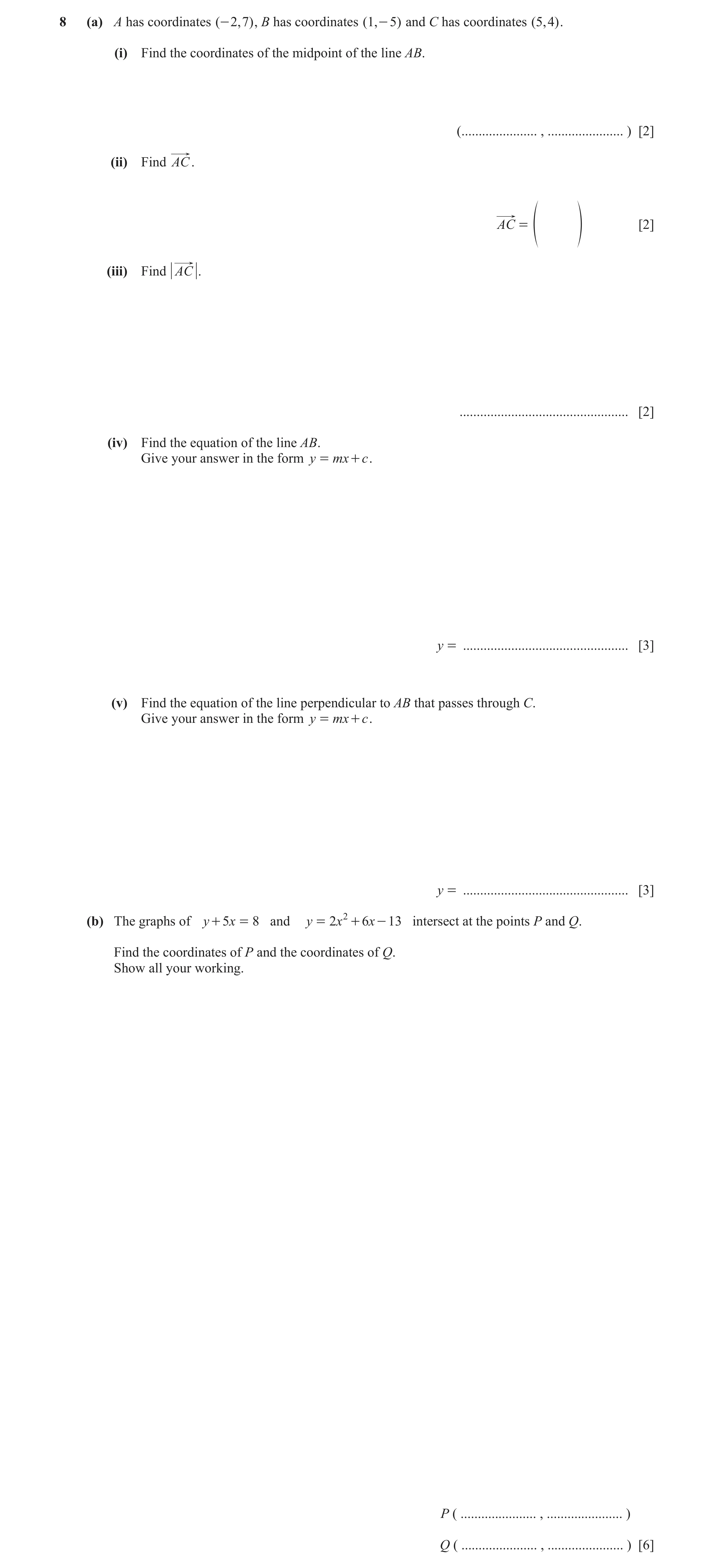
 12 / 20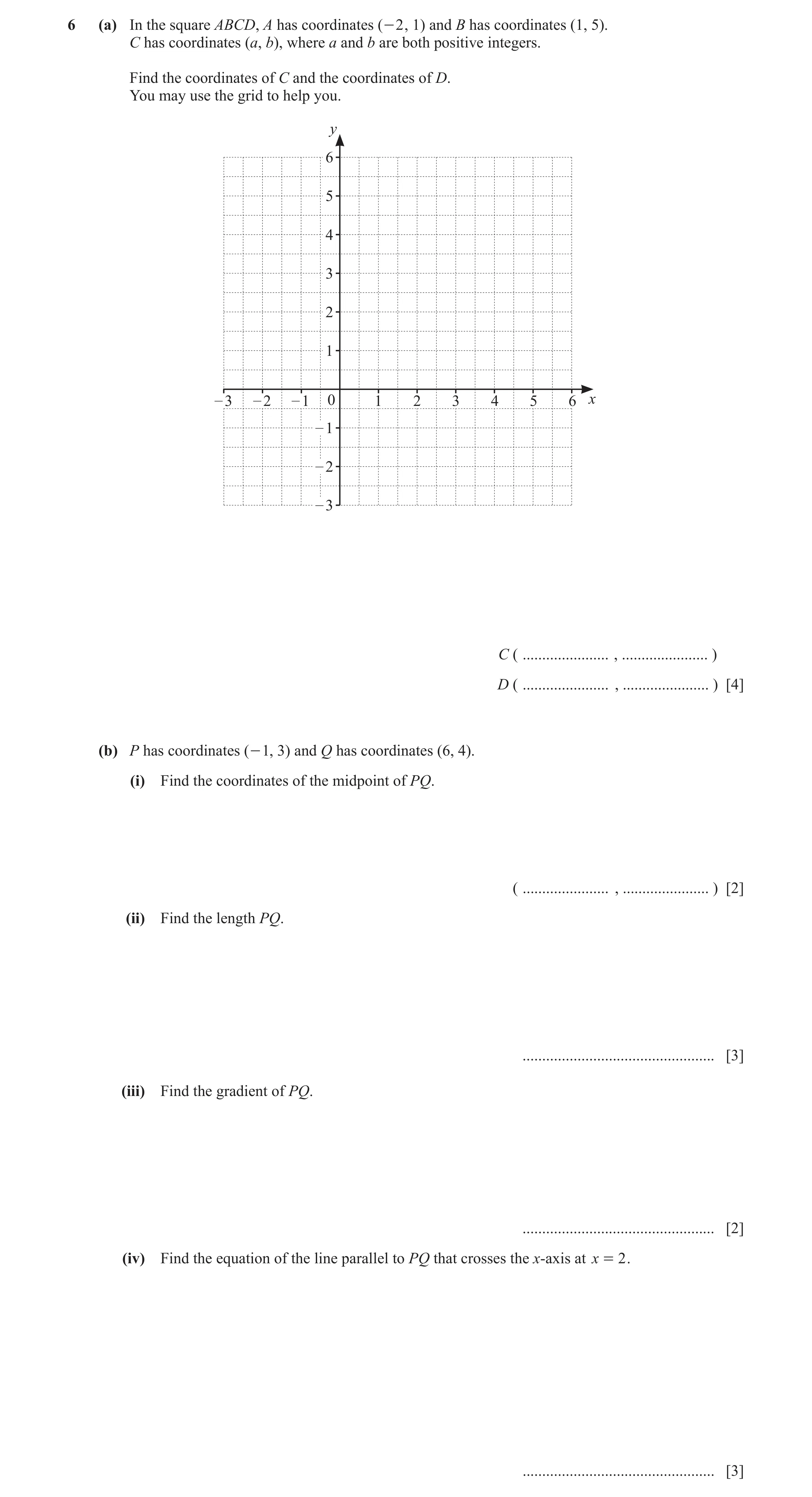
![Question 11: M has coordinates (4, 1) and N has coordinates ( -2, -7). (a) Find the length of MN. ................................................. [3] …](https://img.pastlit.com/crops/8f43649c-25cd-4a6e-9498-26bd158be84e/q11.webp) 15 / 20
15 / 20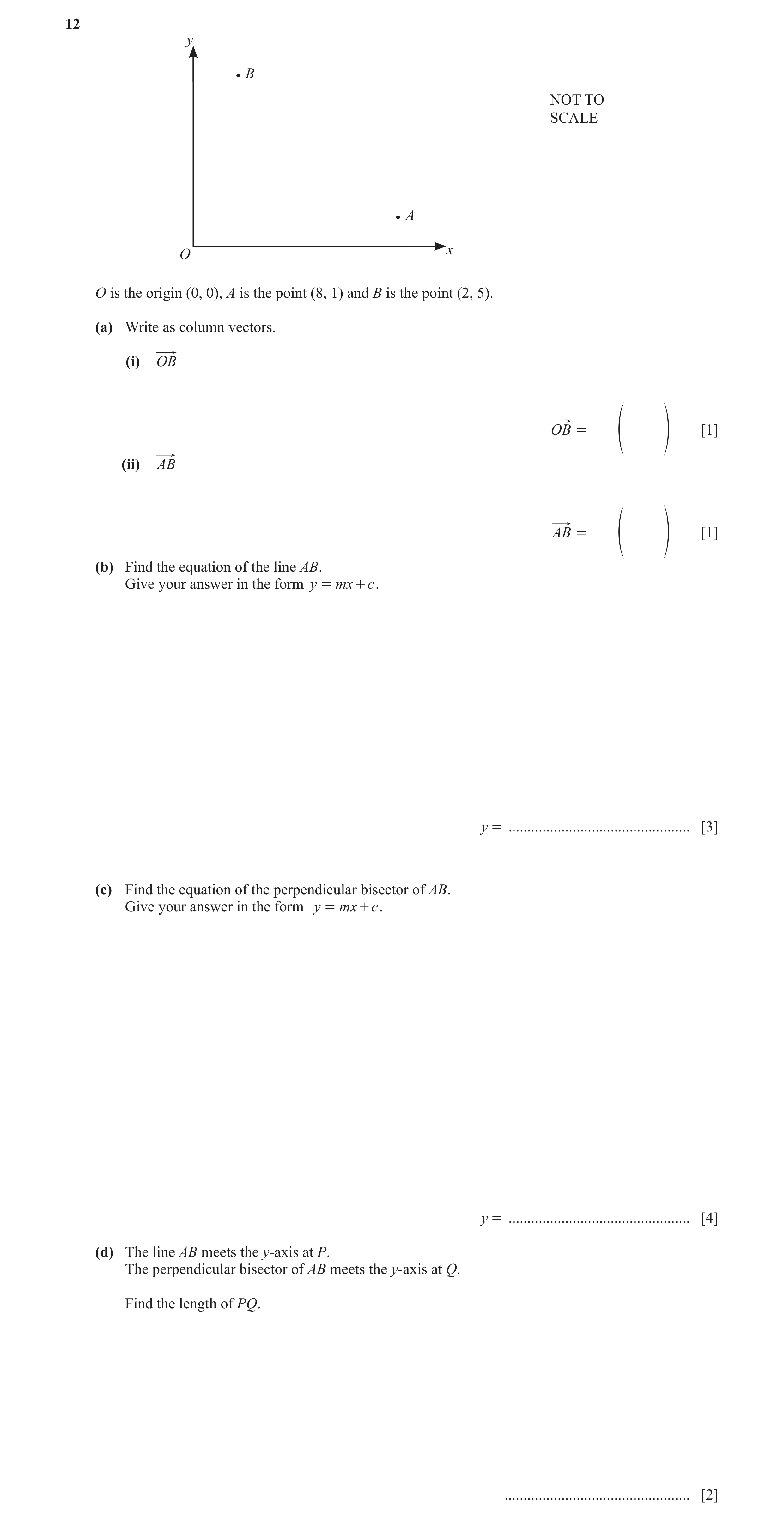
 19 / 20
 20 / 20
 11
11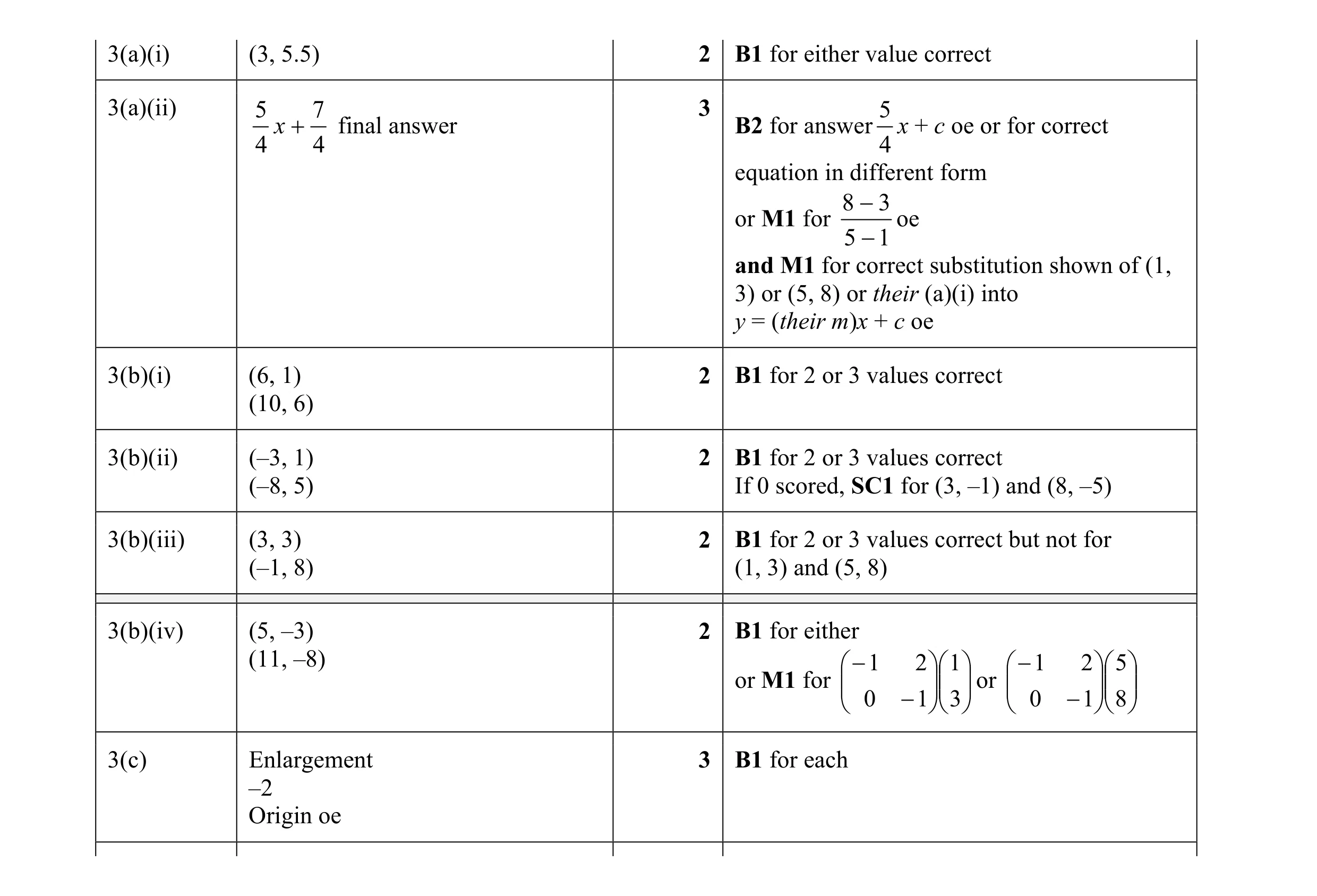 16
16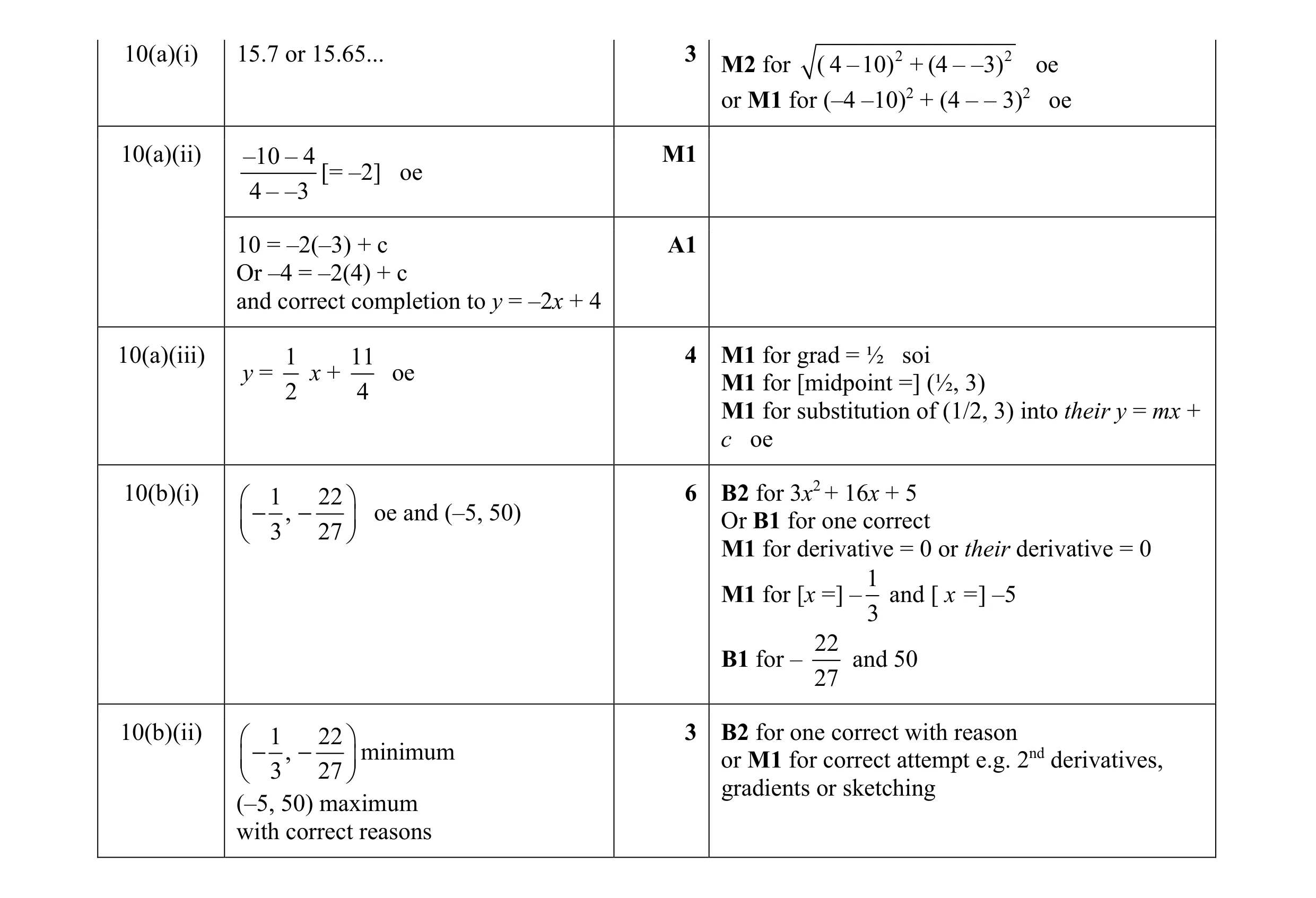 18
18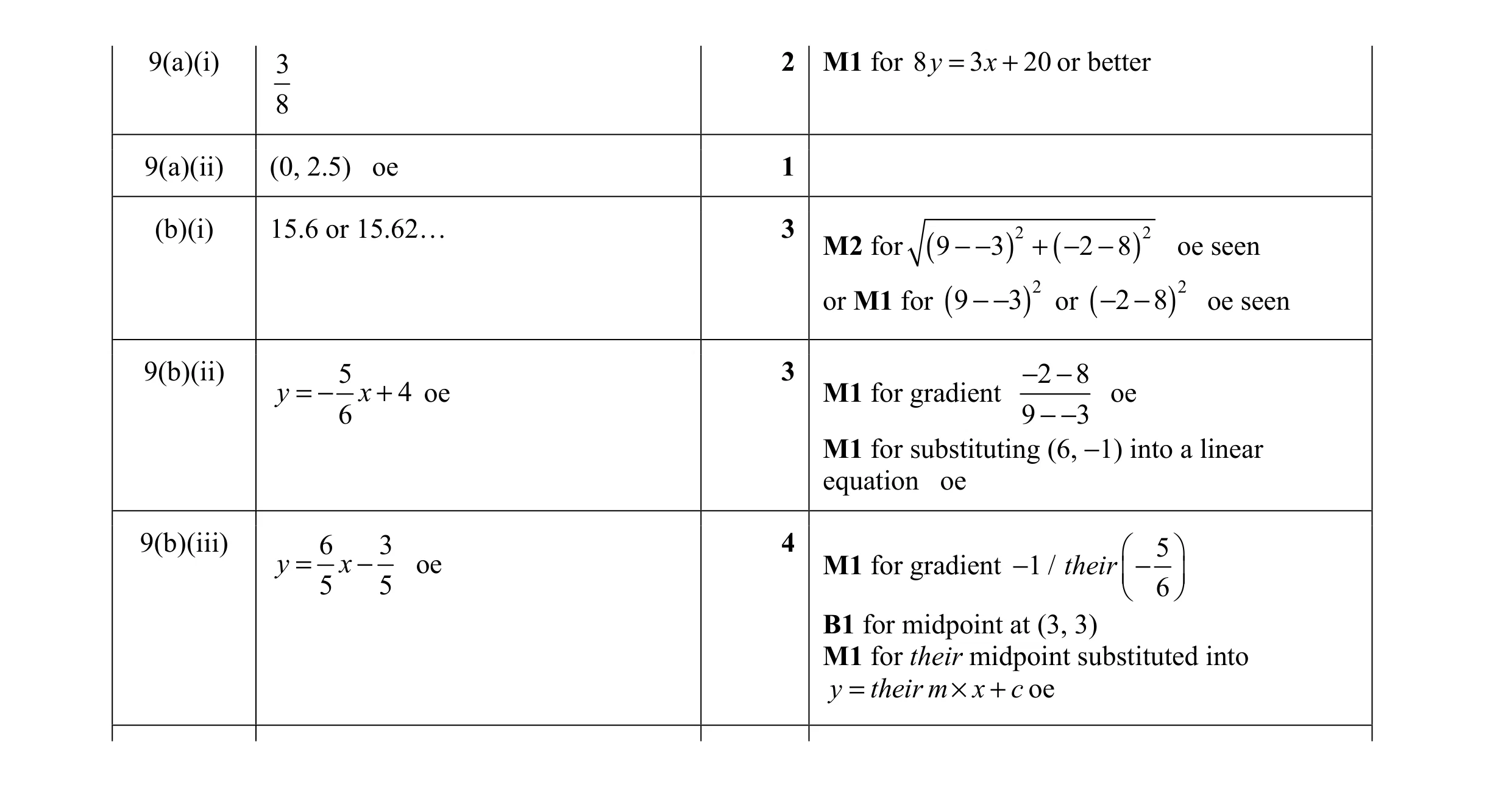 13
13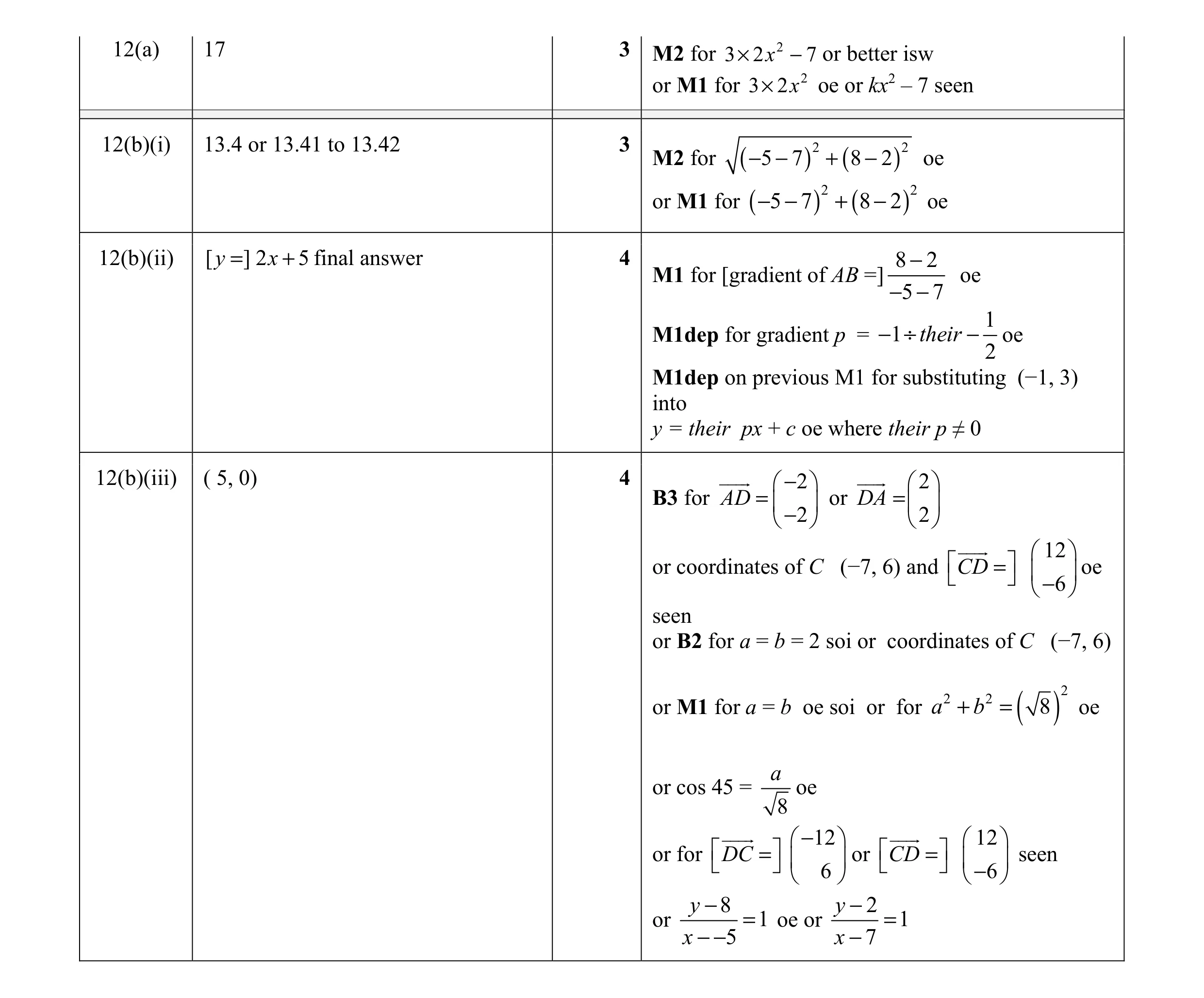 14
14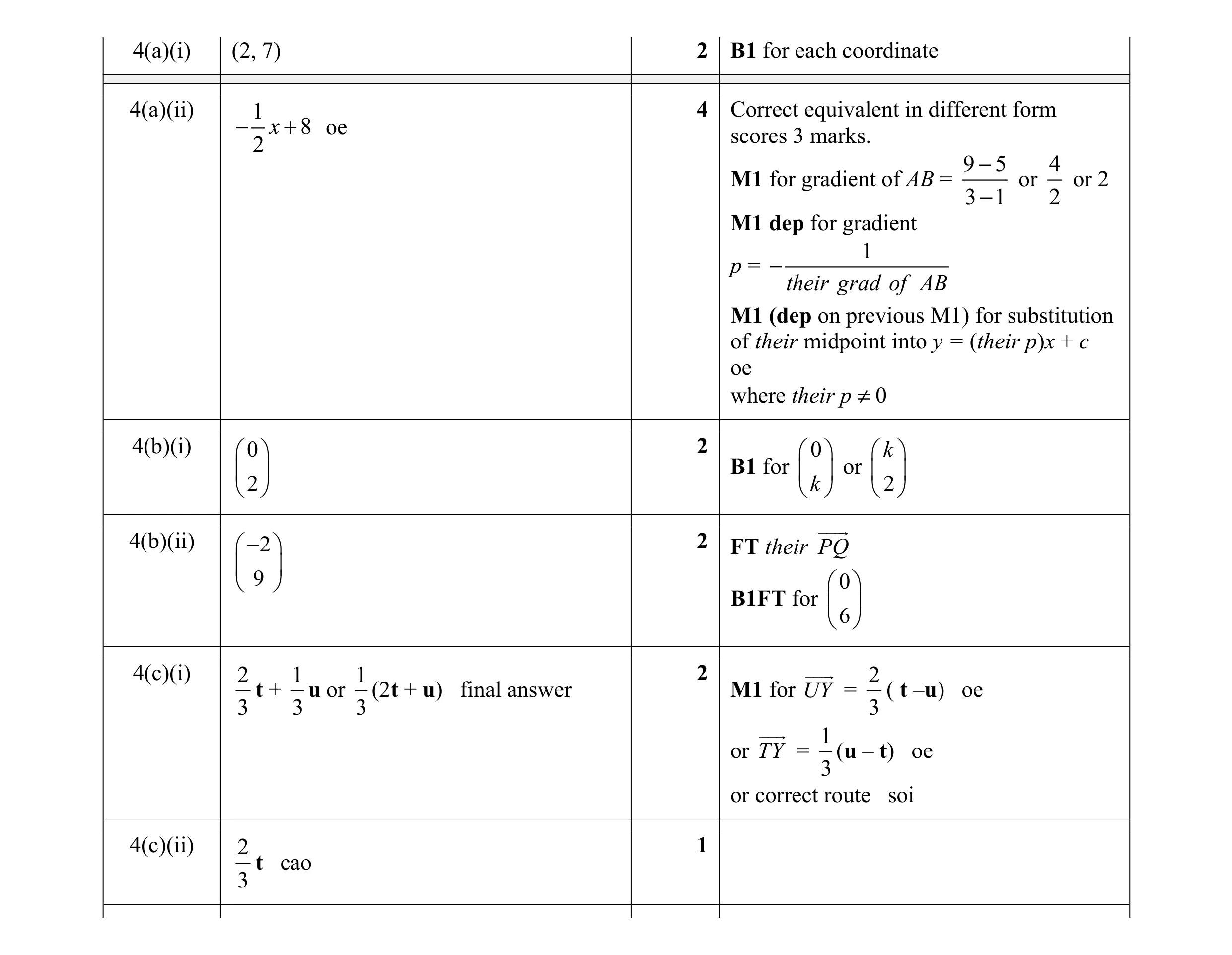 13
13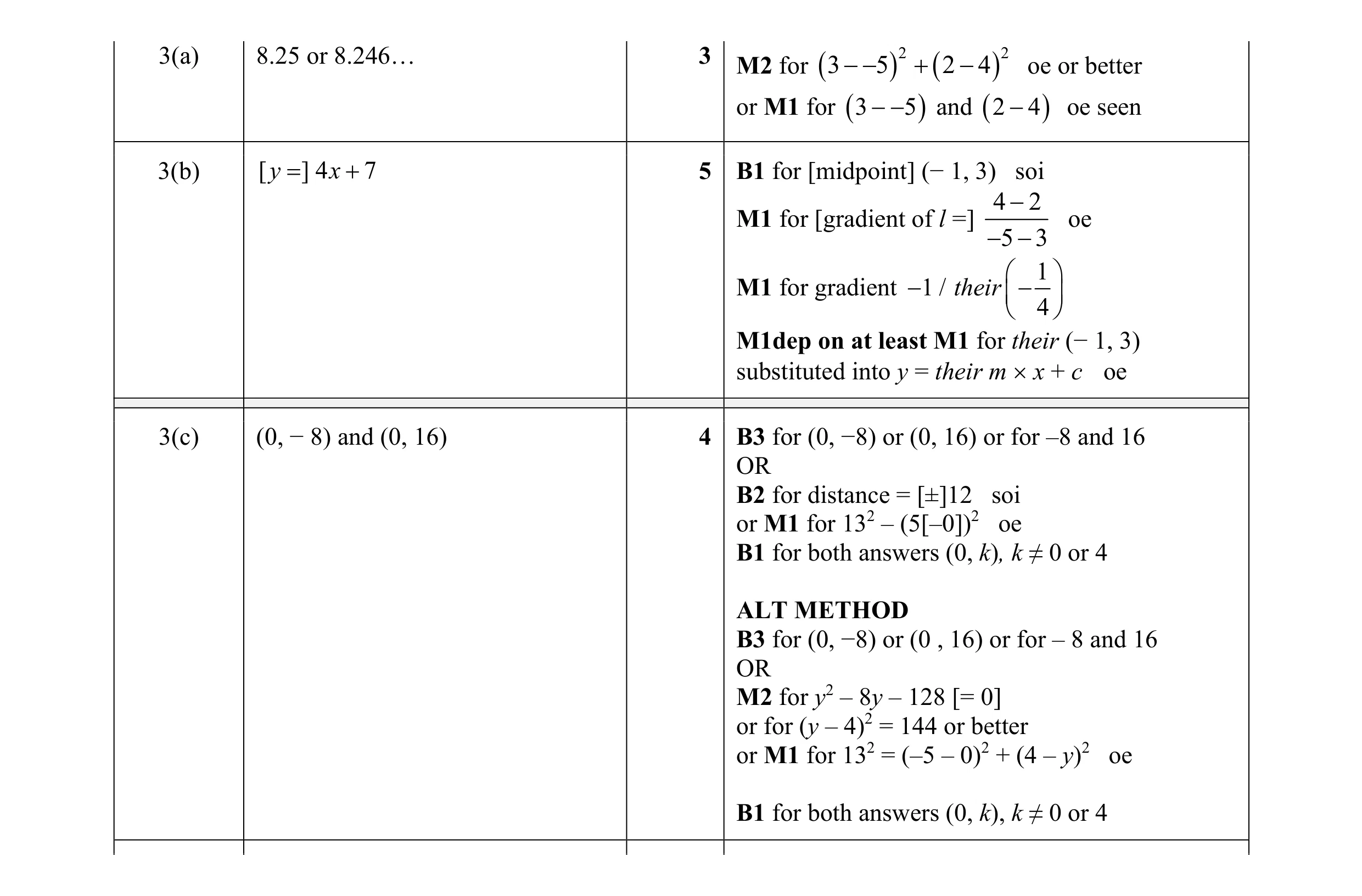 12
12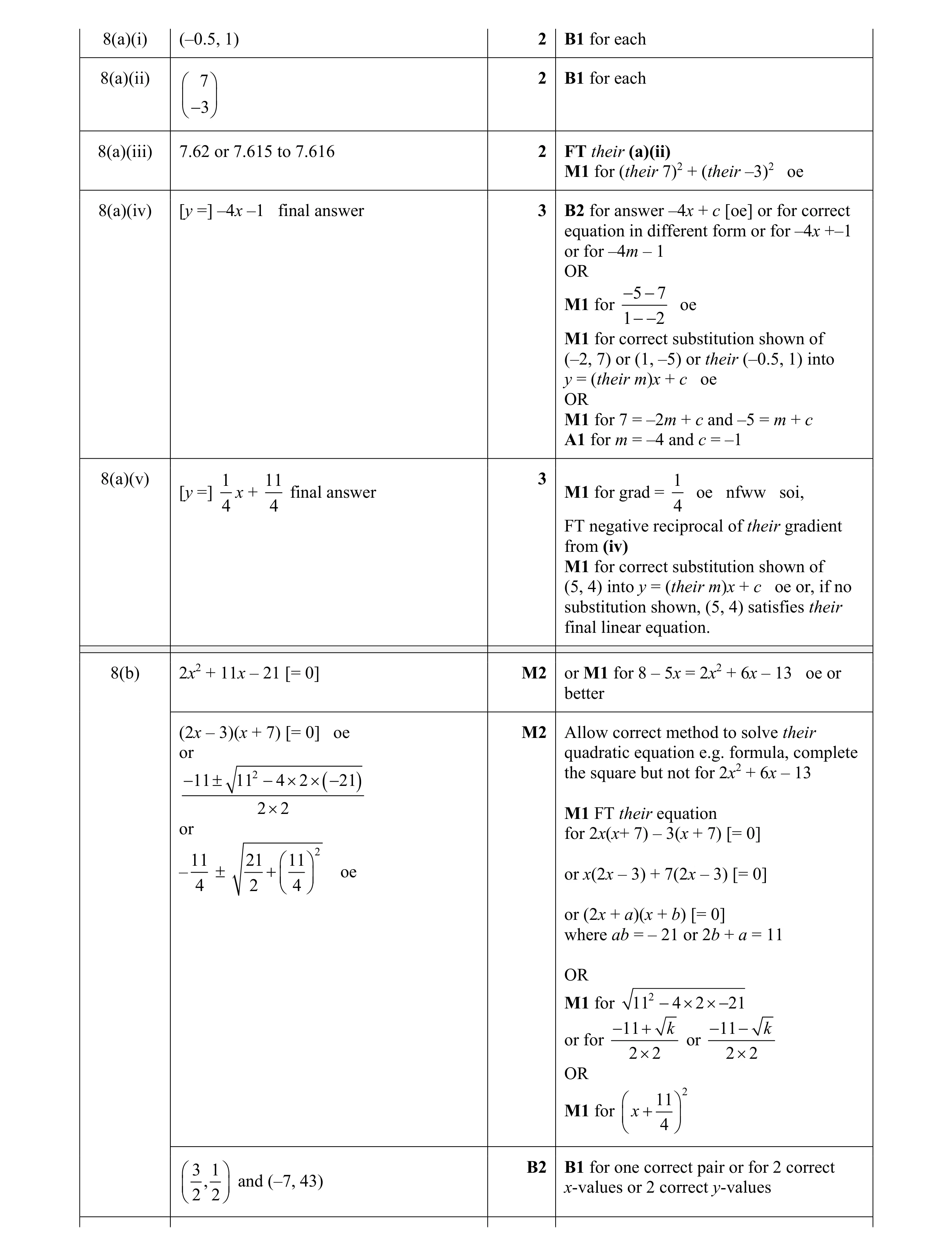 18
18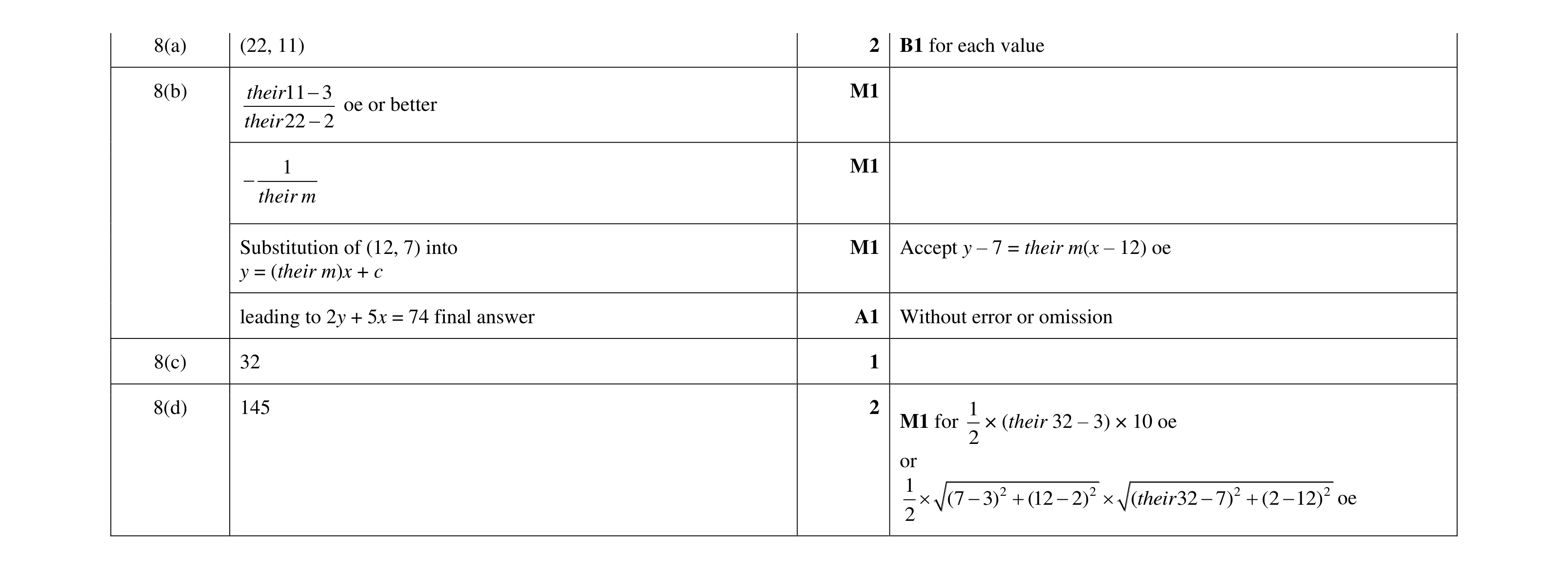 9
9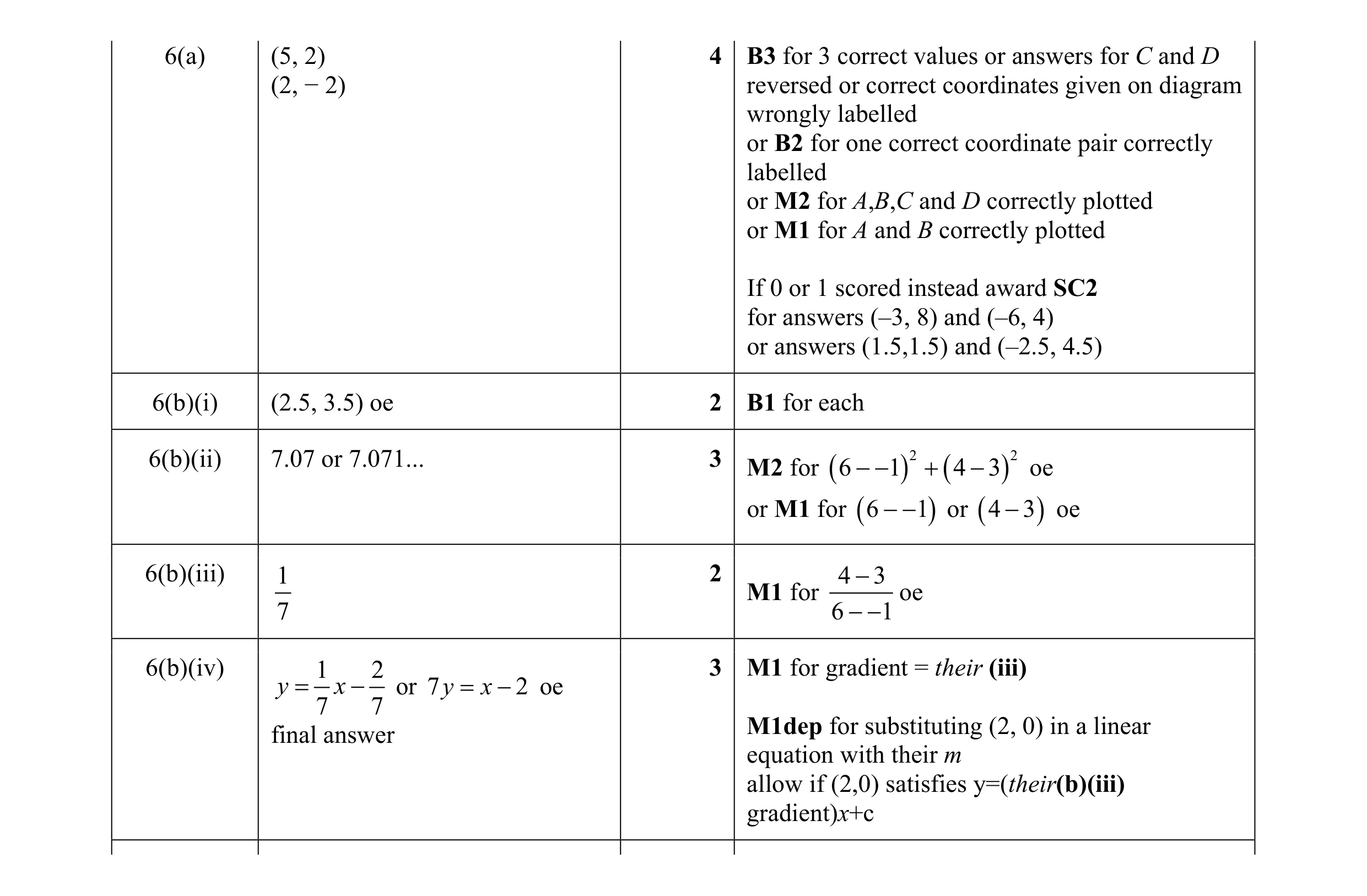 14
14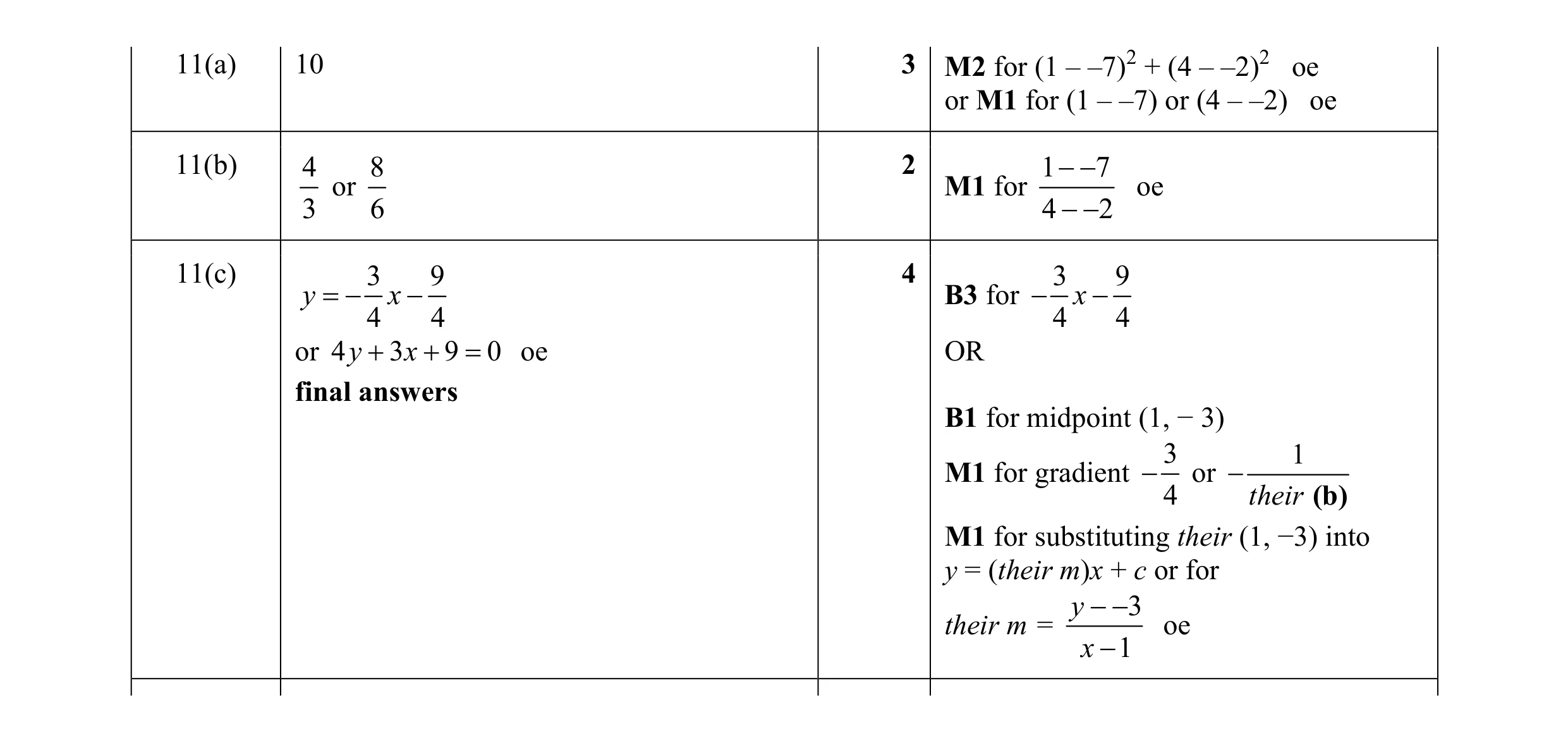 9
9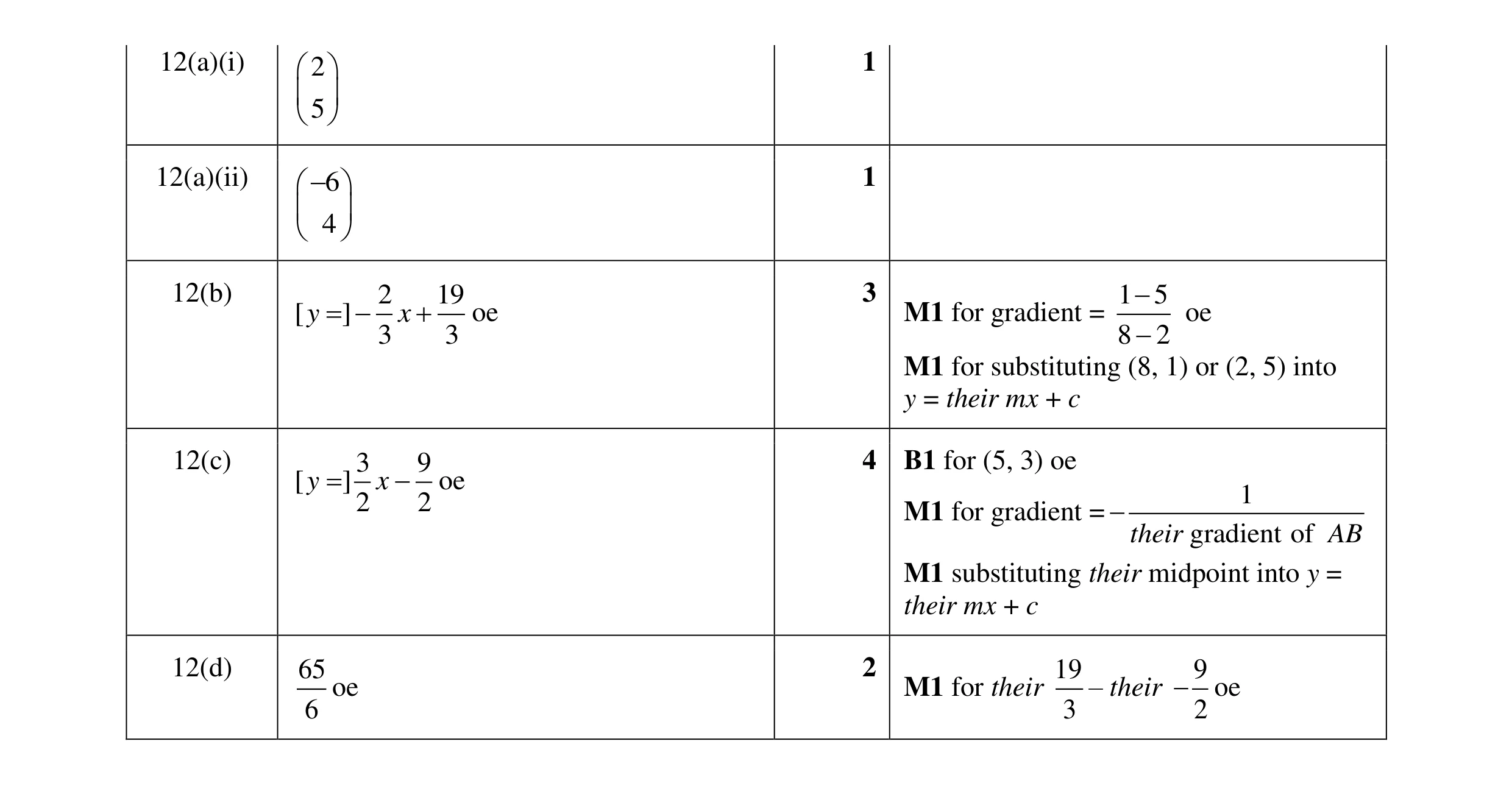 11
11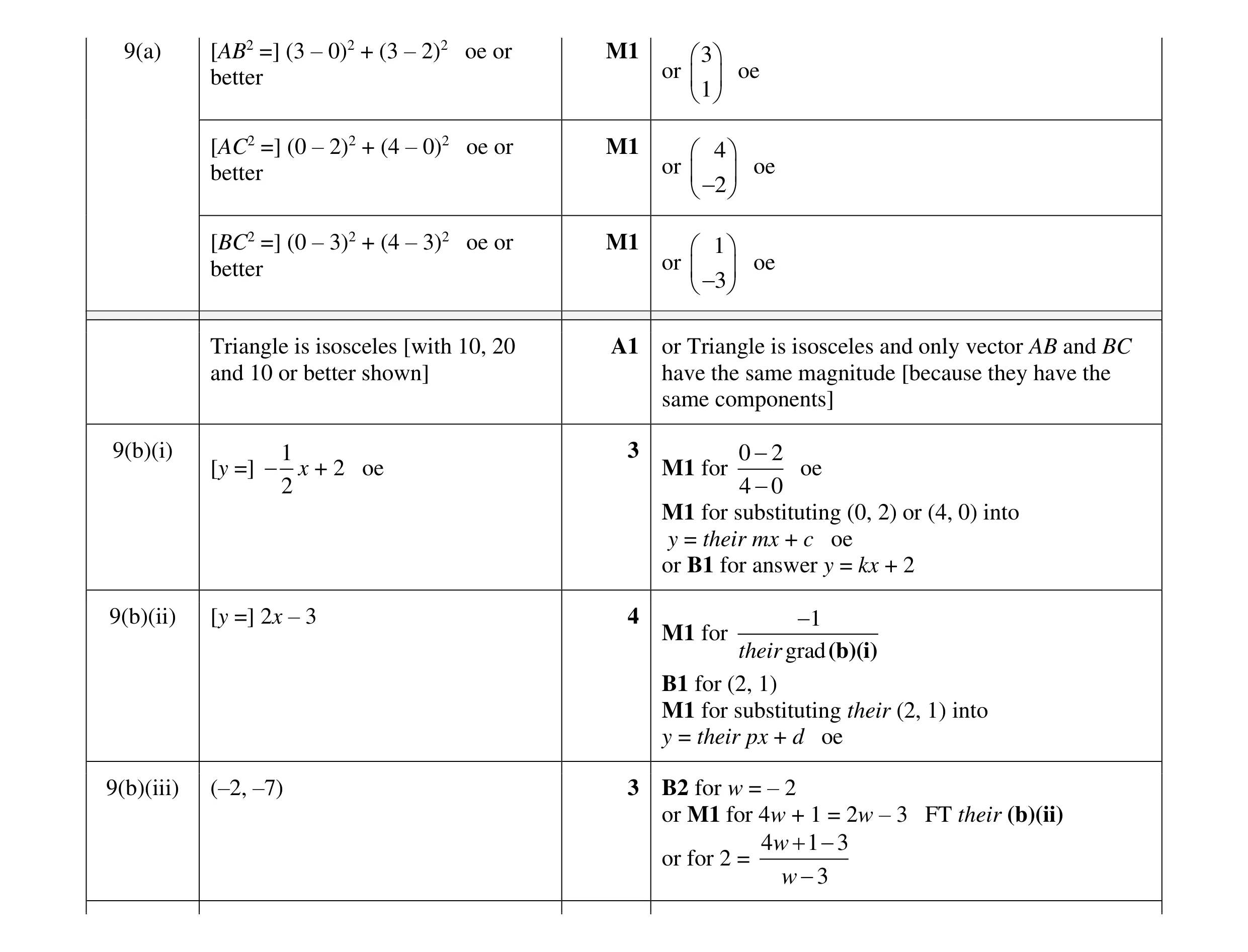 14
14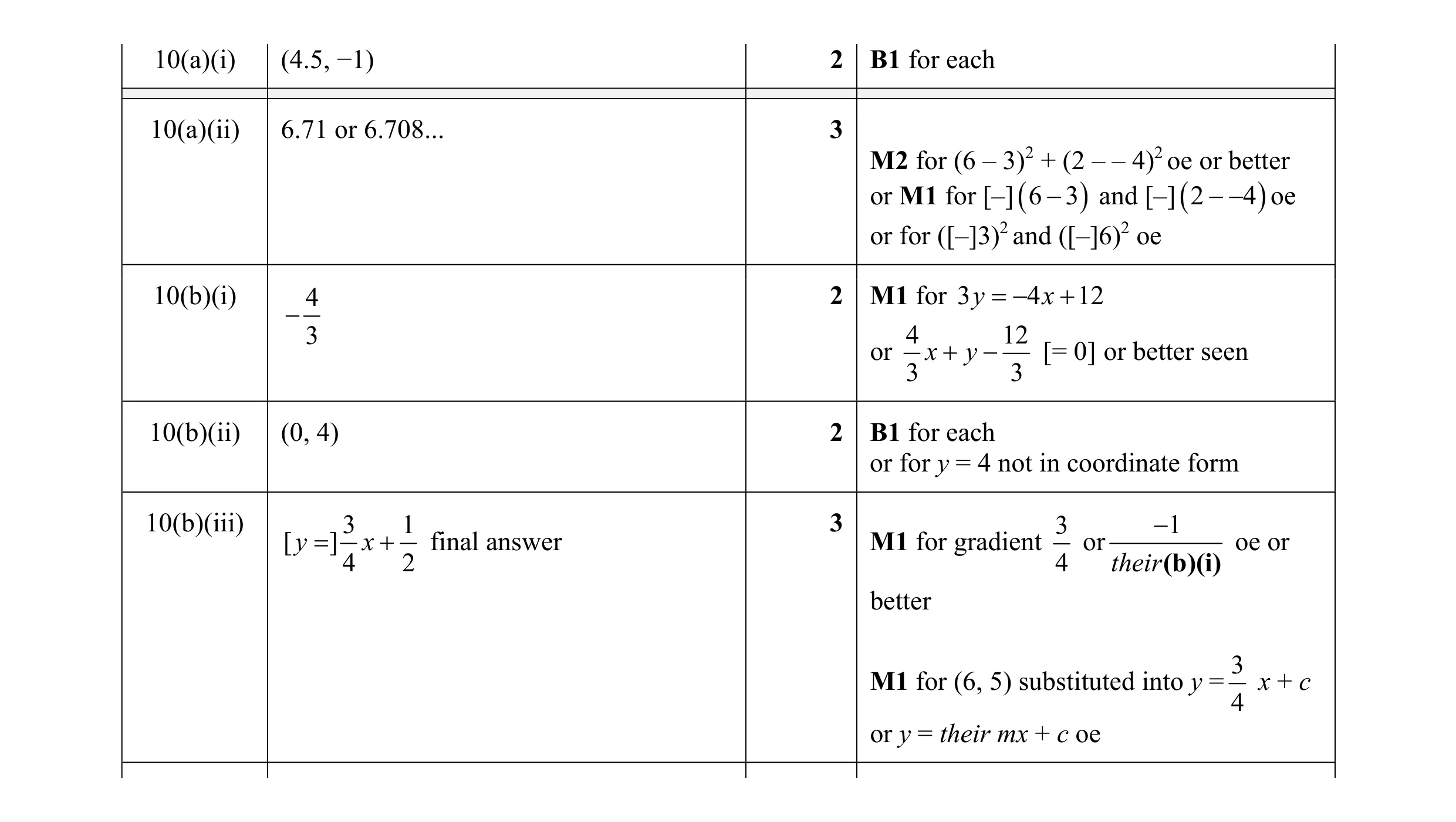 12
12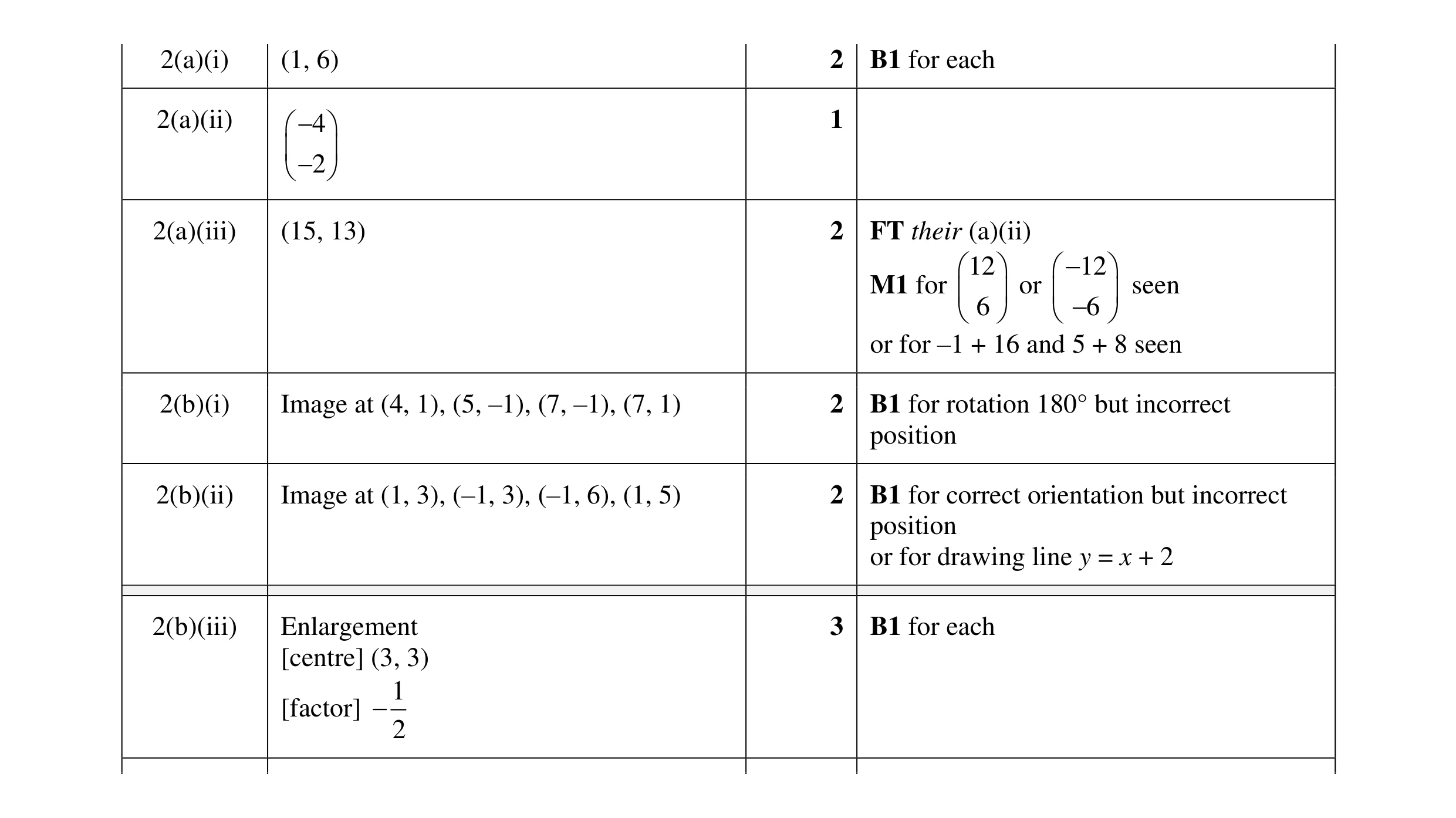 12
12