Cambridge IGCSE Mathematics 0580 — 2022 Oct/Nov Paper 4 · Variant 2
0580/42/O/N/22 · 11 questions · 130 marks · ≈146 min
The question paper and its mark scheme, free to read here and free to download. This is Cambridge’s own paper, exactly as it was sat.
Question paper20 pages
Mark scheme14 pages
Answers below. Sit the paper first if you are practising.
Questions as text
Q1 · At a football club, season tickets are sold for seated areas and for standing areas
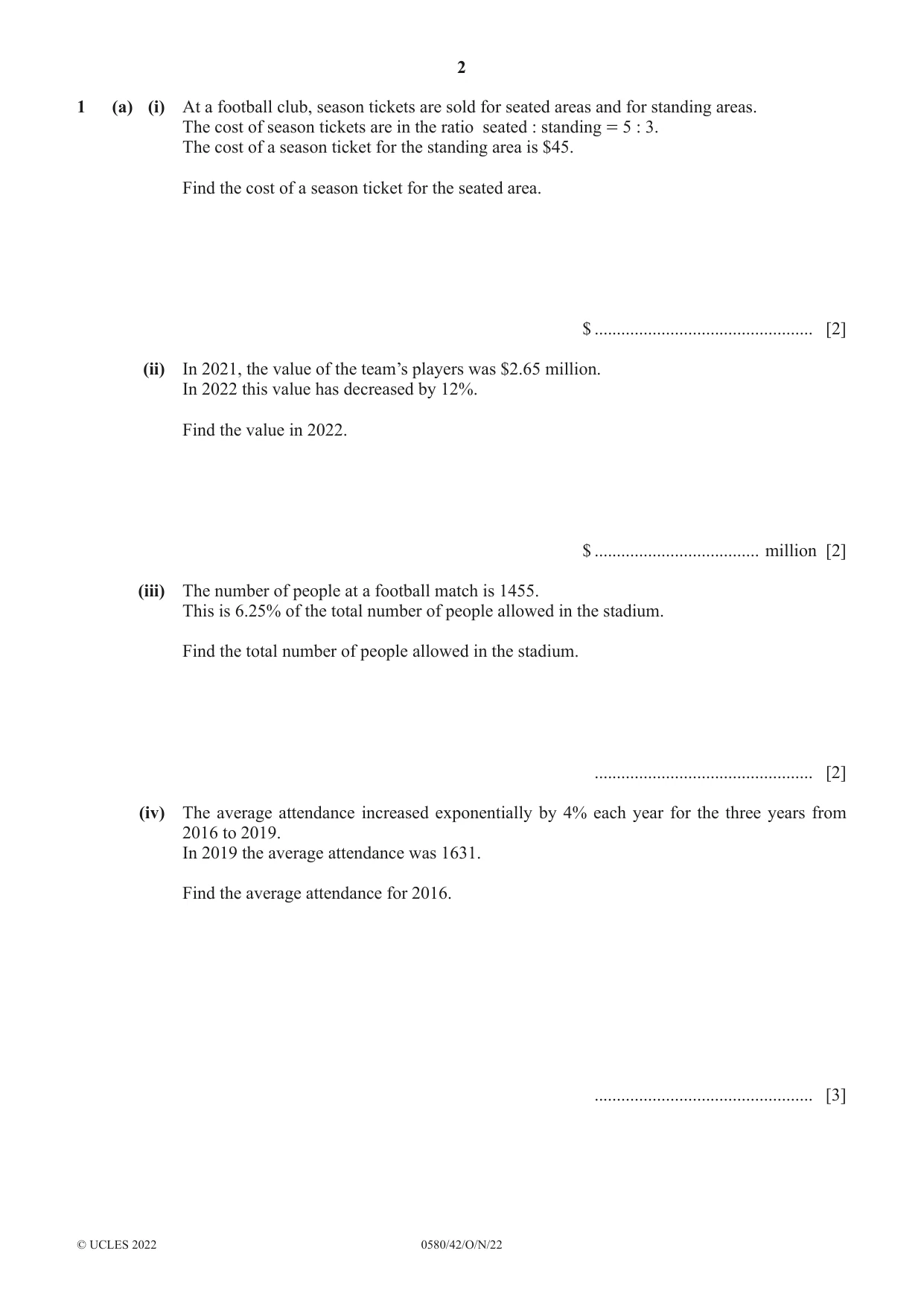
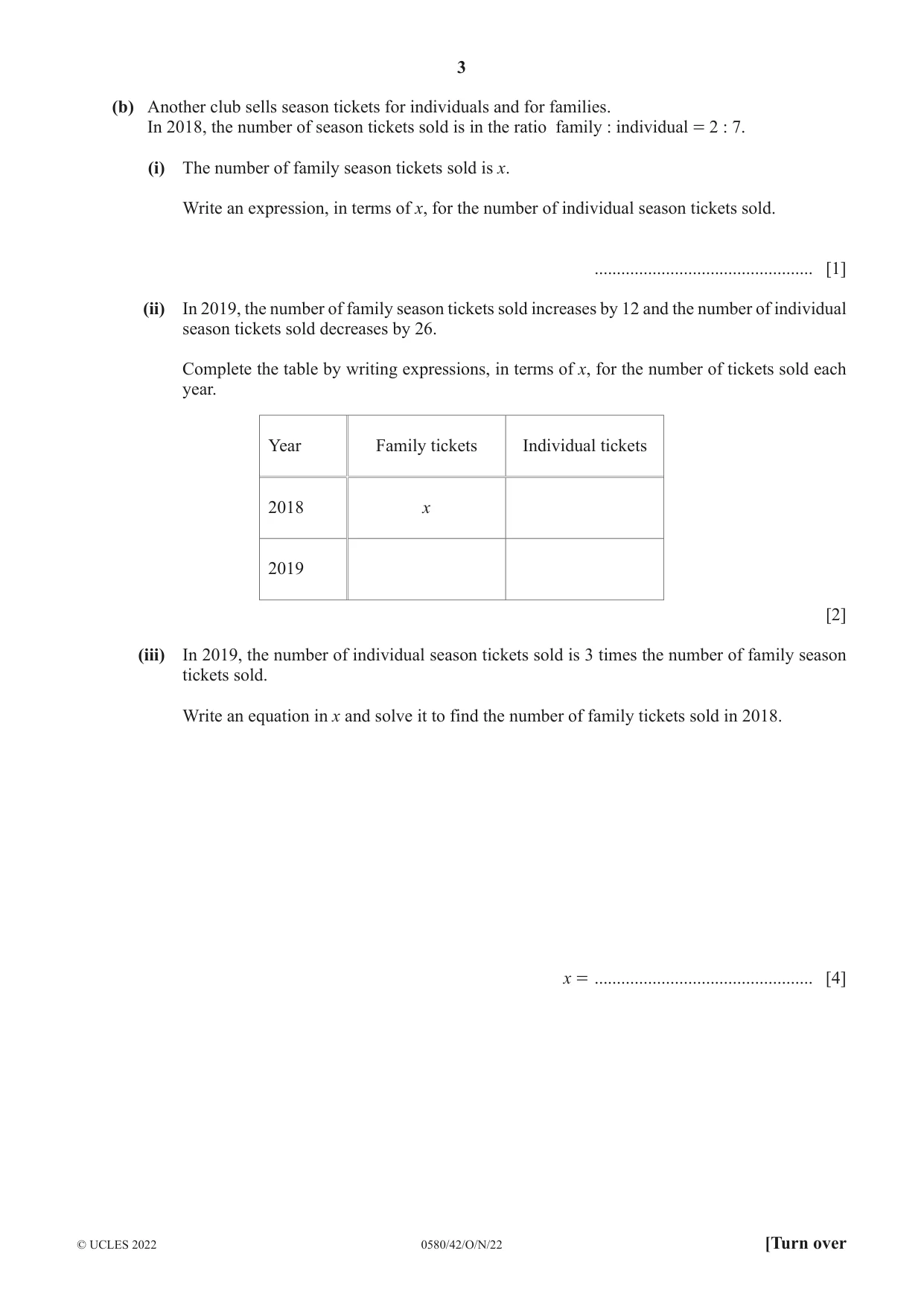
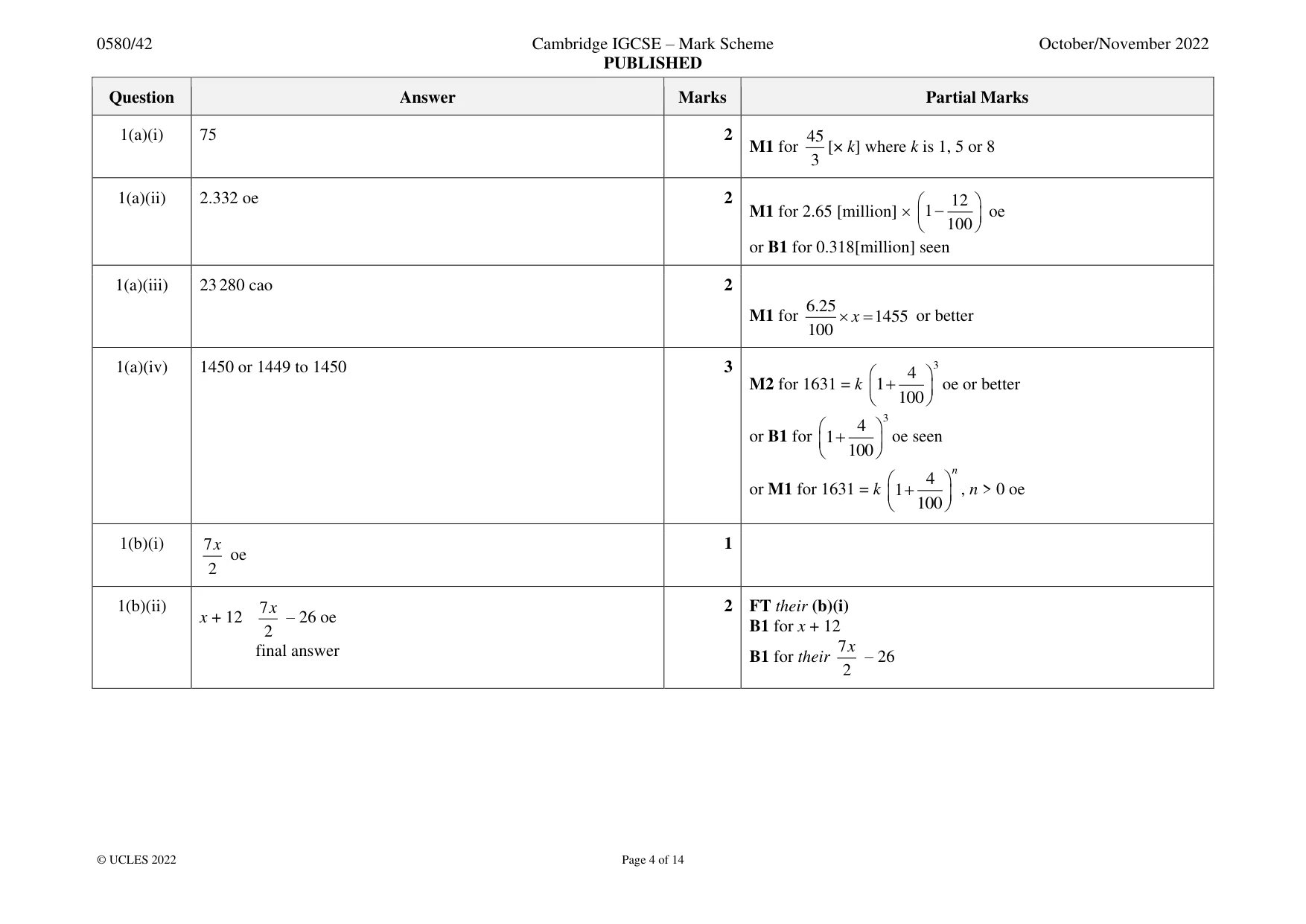
1 (a) (i) At a football club, season tickets are sold for seated areas and for standing areas. The cost of season tickets are in the ratio seated : standing = 5 : 3. The cost of a season ticket for the standing area is $45. Find the cost of a season ticket for the seated area. $ ................................................. [2] (ii) In 2021, the value of the team’s players was $2.65 million. In 2022 this value has decreased by 12%. Find the value in 2022. $ ..................................... million [2] (iii) The number of people at a football match is 1455. This is 6.25% of the total number of people allowed in the stadium. Find the total number of people allowed in the stadium. ................................................. [2] (iv) The average attendance increased exponentially by 4% each year for the three years from 2016 to 2019. In 2019 the average attendance was 1631. Find the average attendance for 2016. ................................................. [3] (b) Another club sells season tickets for individuals and for families. In 2018, the number of season tickets sold is in the ratio family : individual = 2 : 7. (i) The number of family season tickets sold is x. Write an expression, in terms of x, for the number of individual season tickets sold. ................................................. [1] (ii) In 2019, the number of family season tickets sold increases by 12 and the number of individual season tickets sold decreases by 26. Complete the table by writing expressions, in terms of x, for the number of tickets sold each year. Year Family tickets Individual tickets 2018 x 2019 [2] (iii) In 2019, the number of individual season tickets sold is 3 times the number of family season tickets sold. Write an equation in x and solve it to find the number of family tickets sold in 2018. x = ................................................. [4]
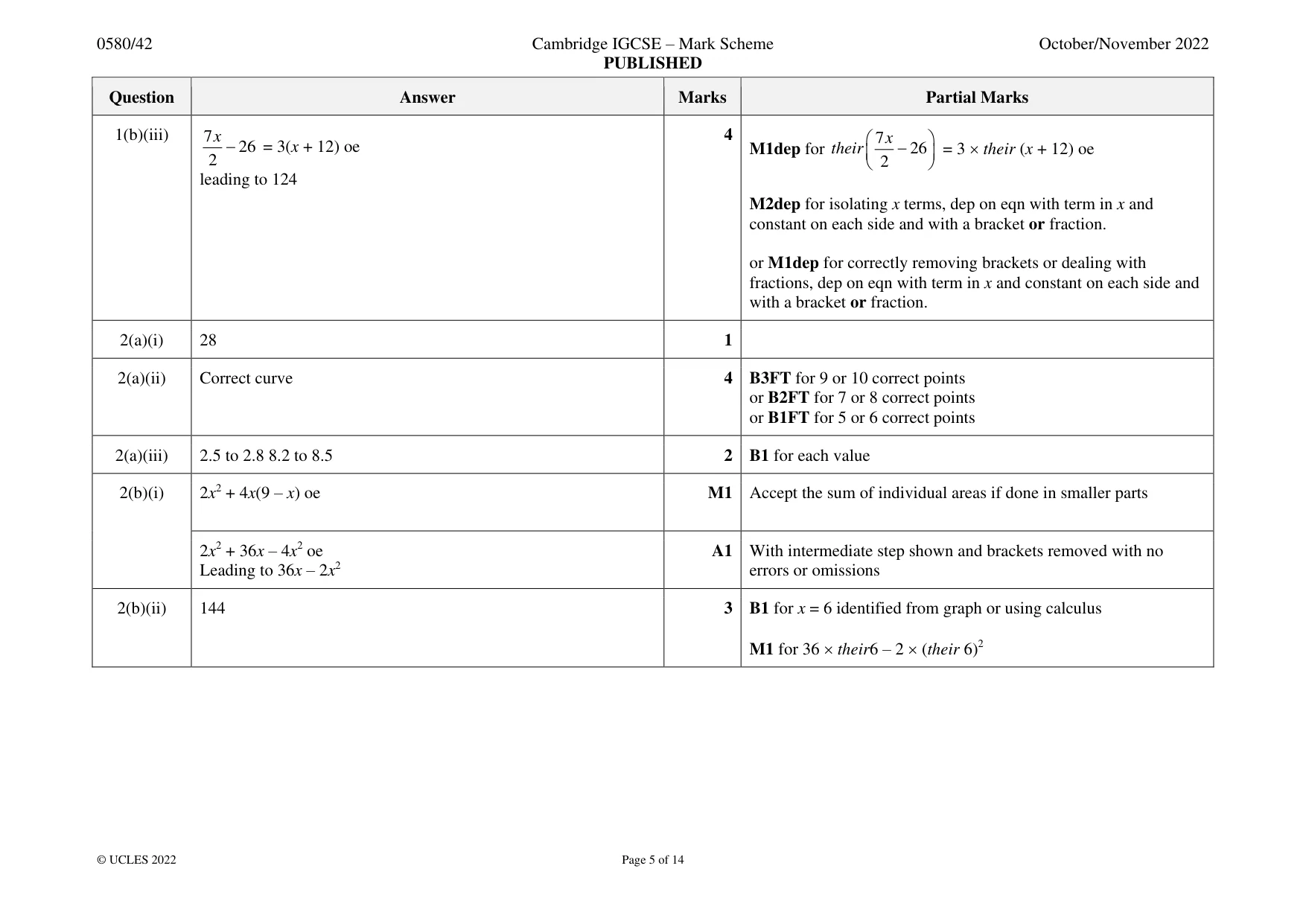
Mark scheme: Question Answer Marks Partial Marks 1(a)(i) 75 2 45 M1 for [× k] where k is 1, 5 or 8 3 1(a)(ii) 2.332 oe 2 12 M1 for 2.65 [million] 1 − oe 100 or B1 for 0.318[million] seen 1(a)(iii) 23 280 cao 2 6.25 M1 for x = 1455 or better 100 1(a)(iv) 1450 or 1449 to 1450 3 3 4 M2 for 1631 = k 1 + oe or better 100 4 3 or B1 for 1 + oe seen 100 4 n or M1 for 1631 = k 1 + , n > 0 oe 100 1(b)(i) 7 x 1 oe 2 1(b)(ii) 7 x 2 FT their (b)(i) x + 12 – 26 oe B1 for x + 12 2 final answer 7 x B1 for their – 26 2 1(b)(iii) 7 x 4 7 x − 26 = 3(x + 12) oe M1dep for their − 26 = 3 their (x + 12) oe 2 2 leading to 124 M2dep for isolating x terms, dep on eqn with term in x and constant on each side and with a bracket or fraction. or M1dep for correctly removing brackets or dealing with fractions, dep on eqn with term in x and constant on each side and with a bracket or fraction.
Q2 · All the lengths in this question are measured in centimetres
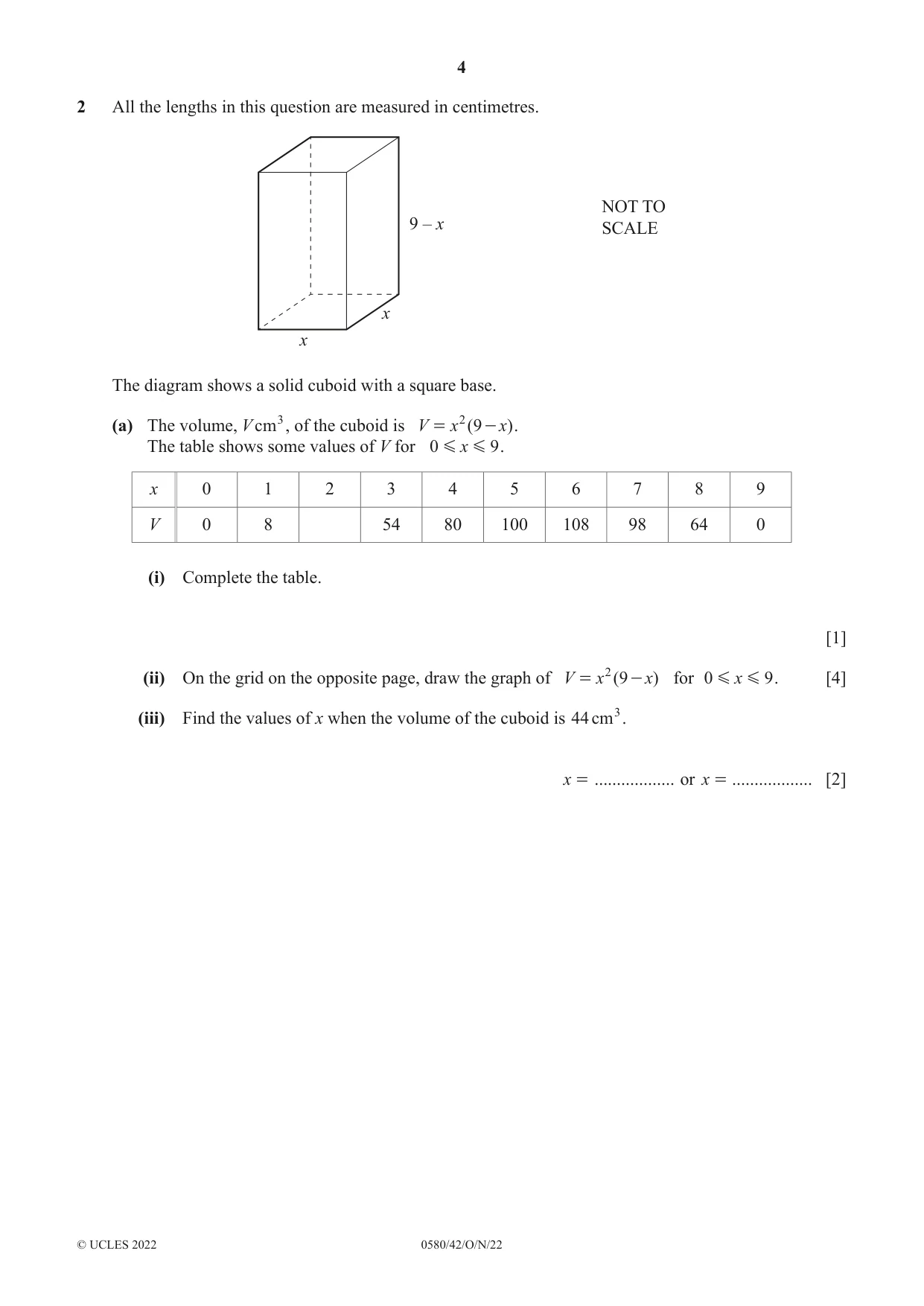
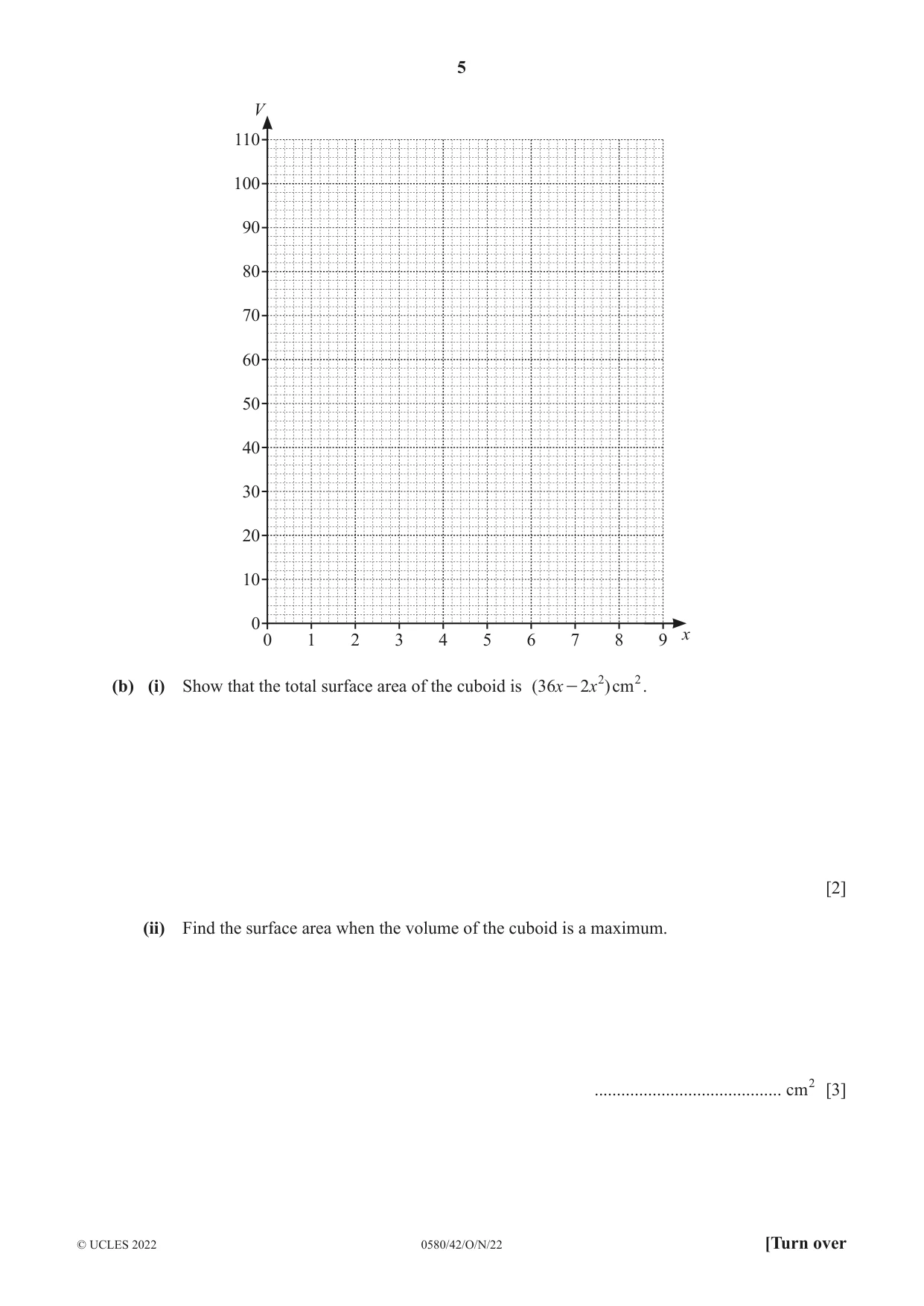
2 All the lengths in this question are measured in centimetres. NOT TO 9 – x SCALE x x The diagram shows a solid cuboid with a square base. (a) The volume, V cm 3, of the cuboid is V = x 2 ( 9 - x) . The table shows some values of V for 0 G x G 9 . x 0 1 2 3 4 5 6 7 8 9 V 0 8 54 80 100 108 98 64 0 (i) Complete the table. [1] (ii) On the grid on the opposite page, draw the graph of V = x 2 ( 9 - x) for 0 G x G 9 . [4] (iii) Find the values of x when the volume of the cuboid is 44 cm 3. x = .................. or x = .................. [2] V 110 100 90 80 70 60 50 40 30 20 10 0 x 0 1 2 3 4 5 6 7 8 9 (b) (i) Show that the total surface area of the cuboid is ( 36x - 2x 2 )cm 2 . [2] (ii) Find the surface area when the volume of the cuboid is a maximum. .......................................... cm2 [3]
Mark scheme: 2(a)(i) 28 1 2(a)(ii) Correct curve 4 B3FT for 9 or 10 correct points or B2FT for 7 or 8 correct points or B1FT for 5 or 6 correct points 2(a)(iii) 2.5 to 2.8 8.2 to 8.5 2 B1 for each value 2(b)(i) 2x2 + 4x(9 – x) oe M1 Accept the sum of individual areas if done in smaller parts 2x2 + 36x – 4x2 oe A1 With intermediate step shown and brackets removed with no Leading to 36x – 2x2 errors or omissions 2(b)(ii) 144 3 B1 for x = 6 identified from graph or using calculus M1 for 36 their6 – 2 (their 6)2
Q3 · Kai and Ann carry out a survey on the distances travelled, in kilometres, by 200 cars
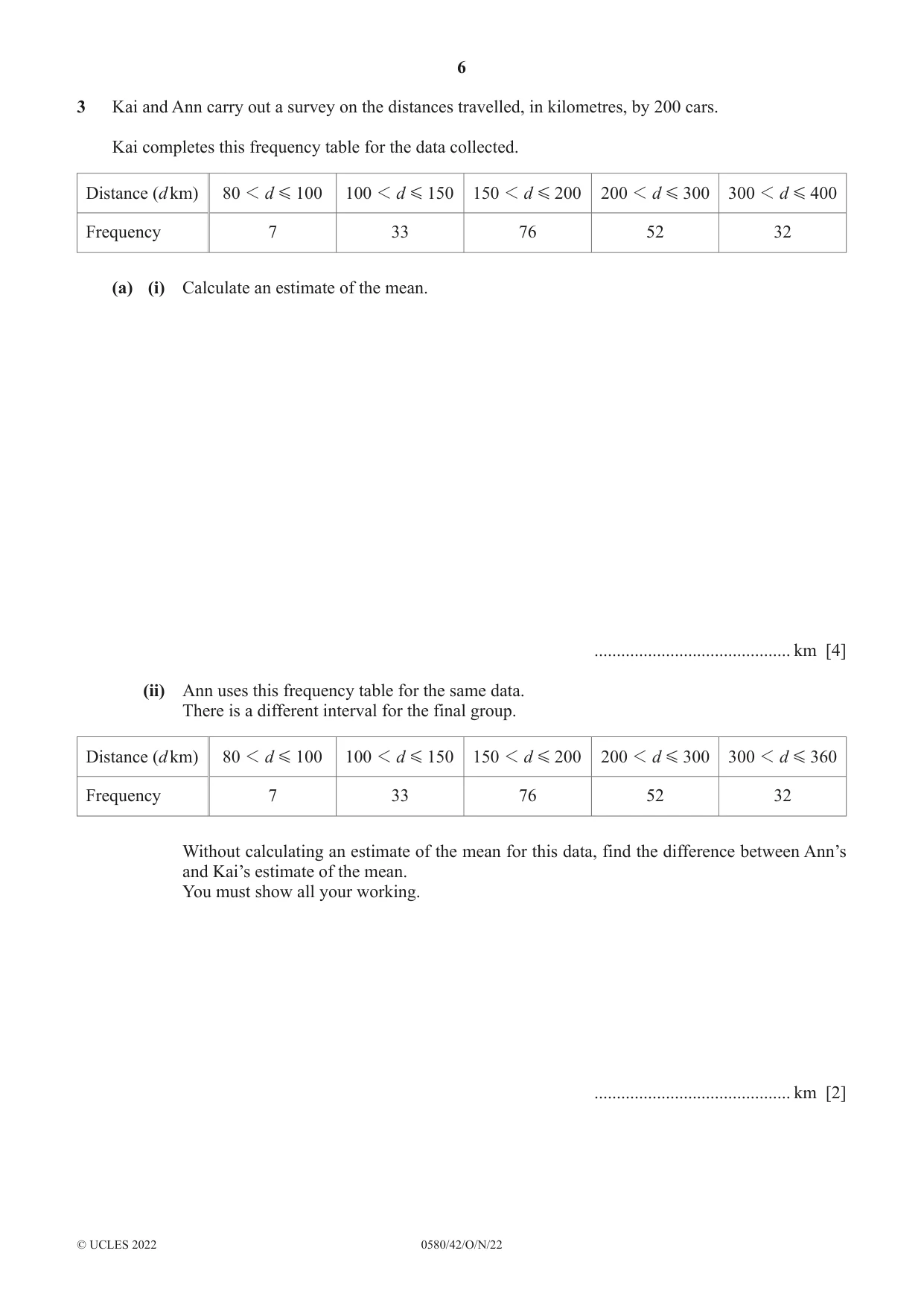
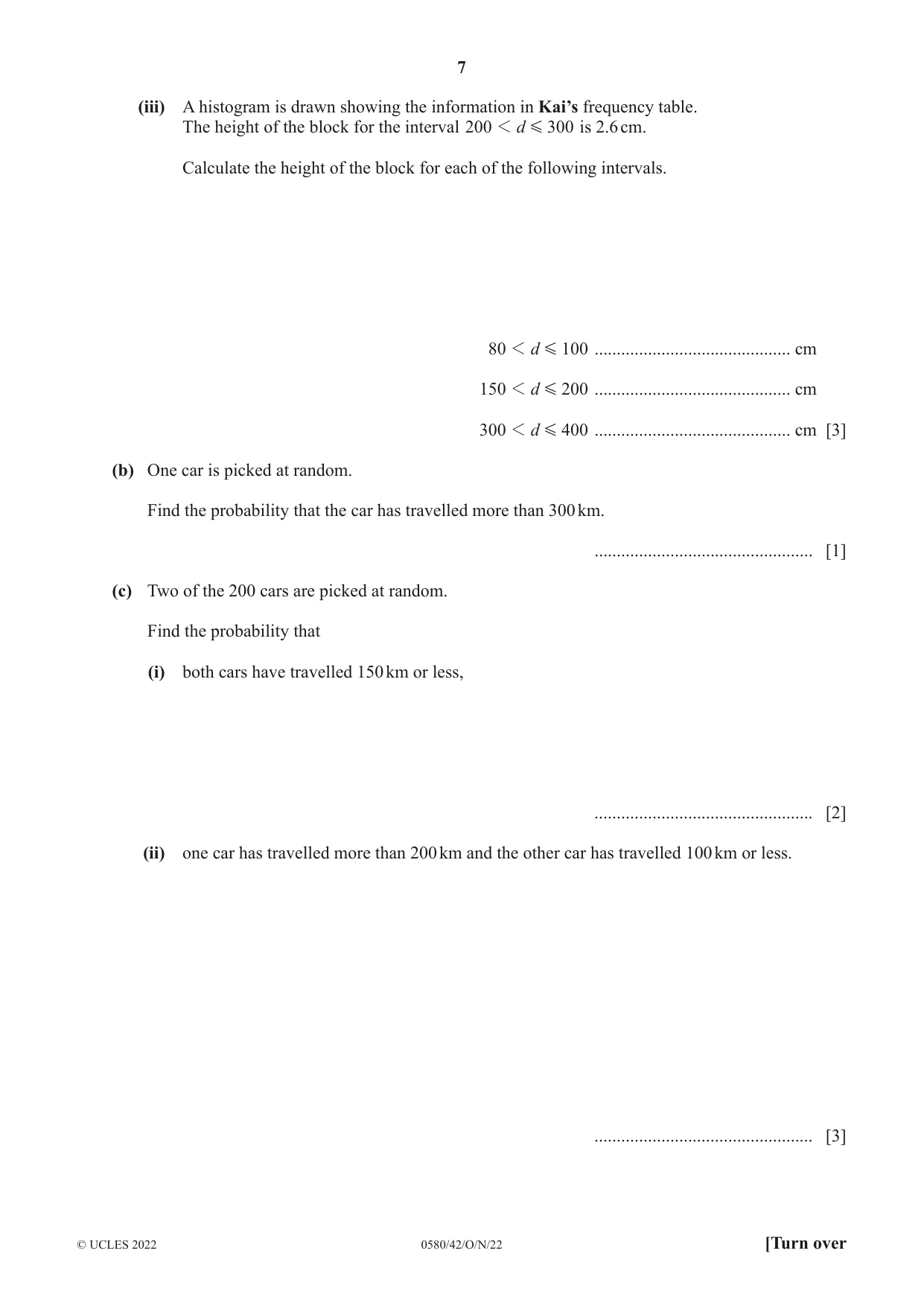
3 Kai and Ann carry out a survey on the distances travelled, in kilometres, by 200 cars. Kai completes this frequency table for the data collected. Distance (d km) 80 1 d G 100 100 1 d G 150 150 1 d G 200 200 1 d G 300 300 1 d G 400 Frequency 7 33 76 52 32 (a) (i) Calculate an estimate of the mean. ............................................ km [4] (ii) Ann uses this frequency table for the same data. There is a different interval for the final group. Distance (d km) 80 1 d G 100 100 1 d G 150 150 1 d G 200 200 1 d G 300 300 1 d G 360 Frequency 7 33 76 52 32 Without calculating an estimate of the mean for this data, find the difference between Ann’s and Kai’s estimate of the mean. You must show all your working. ............................................ km [2] (iii) A histogram is drawn showing the information in Kai’s frequency table. The height of the block for the interval 200 1 d G 300 is 2.6 cm. Calculate the height of the block for each of the following intervals. 80 1 d G 100 ............................................ cm 150 1 d G 200 ............................................ cm 300 1 d G 400 ............................................ cm [3] (b) One car is picked at random. Find the probability that the car has travelled more than 300 km. ................................................. [1] (c) Two of the 200 cars are picked at random. Find the probability that (i) both cars have travelled 150 km or less, ................................................. [2] (ii) one car has travelled more than 200 km and the other car has travelled 100 km or less. ................................................. [3]
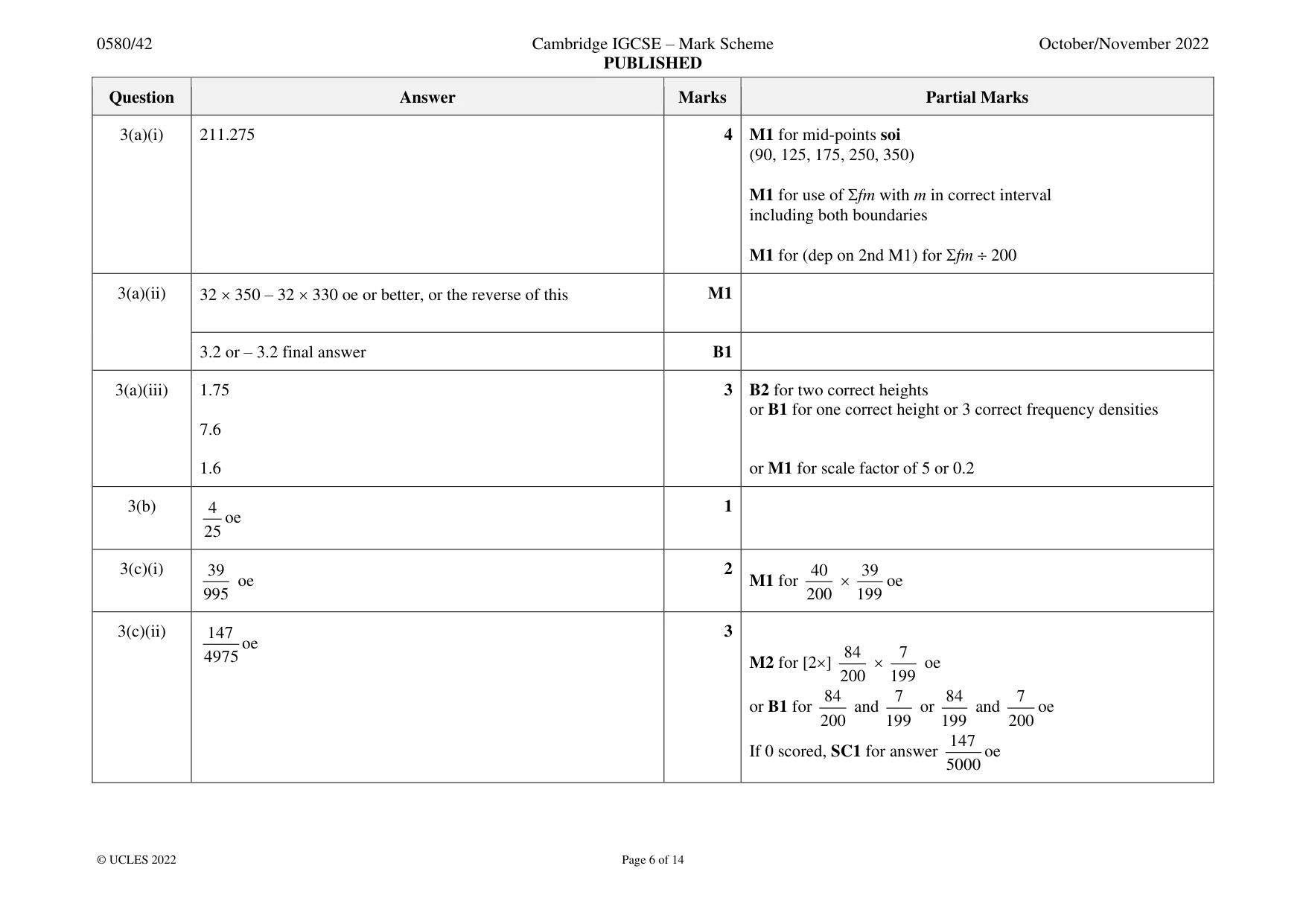
Mark scheme: 3(a)(i) 211.275 4 M1 for mid-points soi (90, 125, 175, 250, 350) M1 for use of fm with m in correct interval including both boundaries M1 for (dep on 2nd M1) for fm 200 3(a)(ii) 32 350 – 32 330 oe or better, or the reverse of this M1 3.2 or – 3.2 final answer B1 3(a)(iii) 1.75 3 B2 for two correct heights or B1 for one correct height or 3 correct frequency densities 7.6 1.6 or M1 for scale factor of 5 or 0.2 3(b) 4 1 oe 25 3(c)(i) 39 2 40 39 oe M1 for oe 995 200 199 3(c)(ii) 147 3 oe 4975 84 7 M2 for [2] oe 200 199 84 7 84 7 or B1 for and or and oe 200 199 199 200 147 If 0 scored, SC1 for answer oe 5000
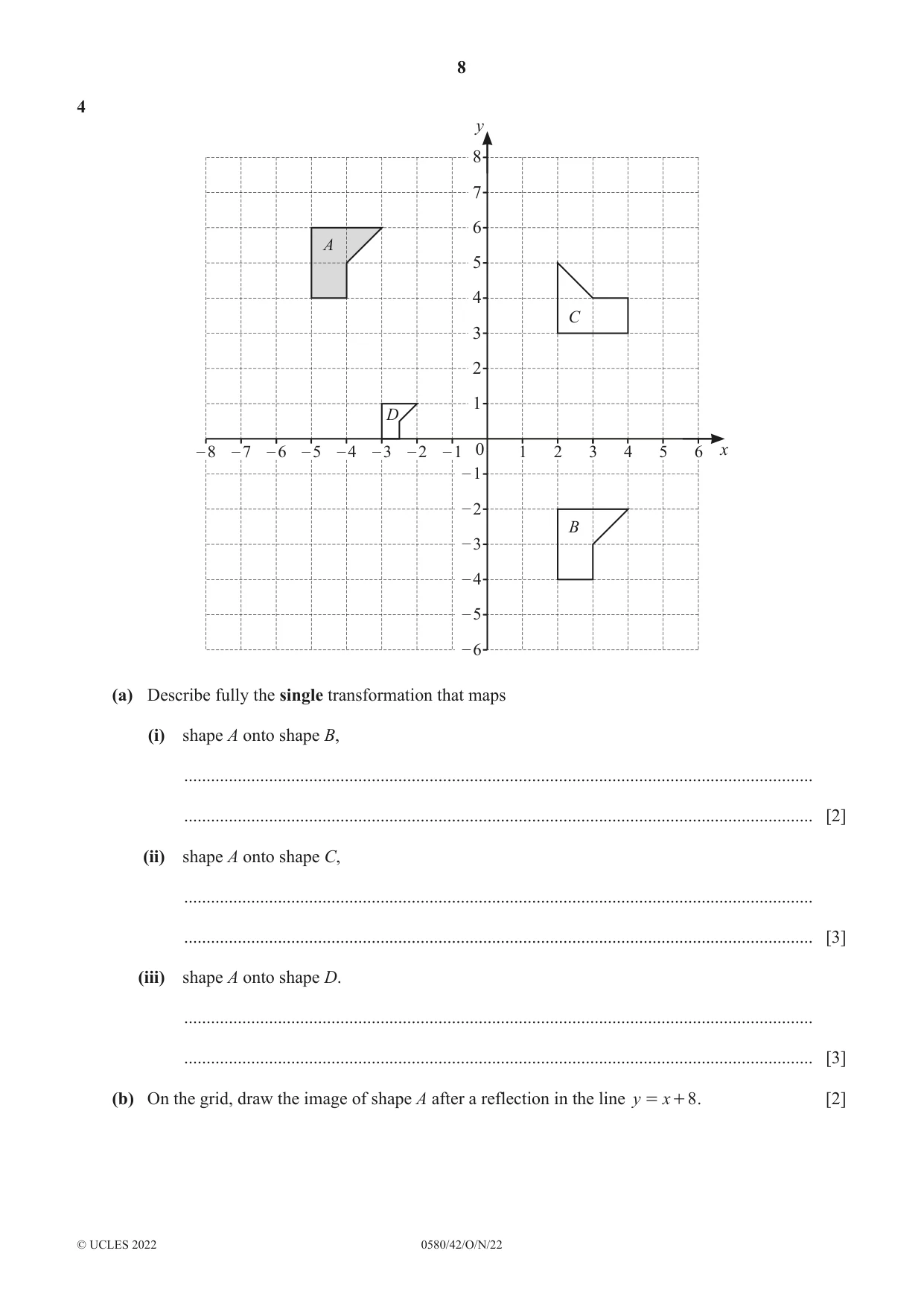
Q4 · Y 8 7 6 A 5 4 C 3 2 1 D – 8 – 7 – 6 – 5 – 4 – 3 – 2 – 1 0 1 2 3 4 5 6 x – 1 – 2 B – 3 – 4…
4 y 8 7 6 A 5 4 C 3 2 1 D – 8 – 7 – 6 – 5 – 4 – 3 – 2 – 1 0 1 2 3 4 5 6 x – 1 – 2 B – 3 – 4 – 5 – 6 (a) Describe fully the single transformation that maps (i) shape A onto shape B, ............................................................................................................................................. ............................................................................................................................................. [2] (ii) shape A onto shape C, ............................................................................................................................................. ............................................................................................................................................. [3] (iii) shape A onto shape D. ............................................................................................................................................. ............................................................................................................................................. [3] (b) On the grid, draw the image of shape A after a reflection in the line y = x + 8 . [2]
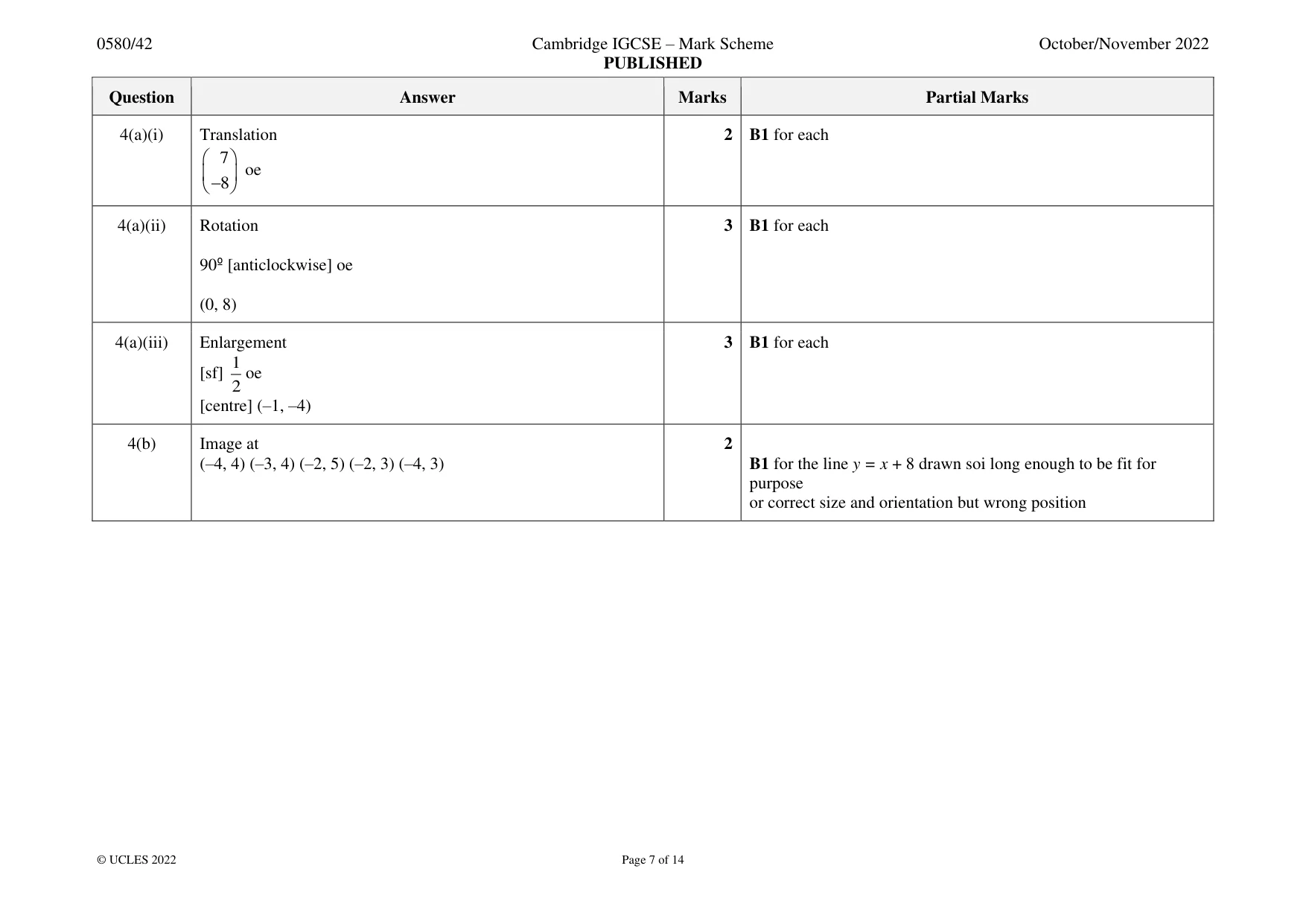
Mark scheme: 4(a)(i) Translation 2 B1 for each 7 oe −8 4(a)(ii) Rotation 3 B1 for each 90º [anticlockwise] oe (0, 8) 4(a)(iii) Enlargement 3 B1 for each 1 [sf] oe 2 [centre] (–1, –4) 4(b) Image at 2 (–4, 4) (–3, 4) (–2, 5) (–2, 3) (–4, 3) B1 for the line y = x + 8 drawn soi long enough to be fit for purpose or correct size and orientation but wrong position
Q5 · The diagram shows the speed–time graph for part of a journey for two vehicles, a car and…
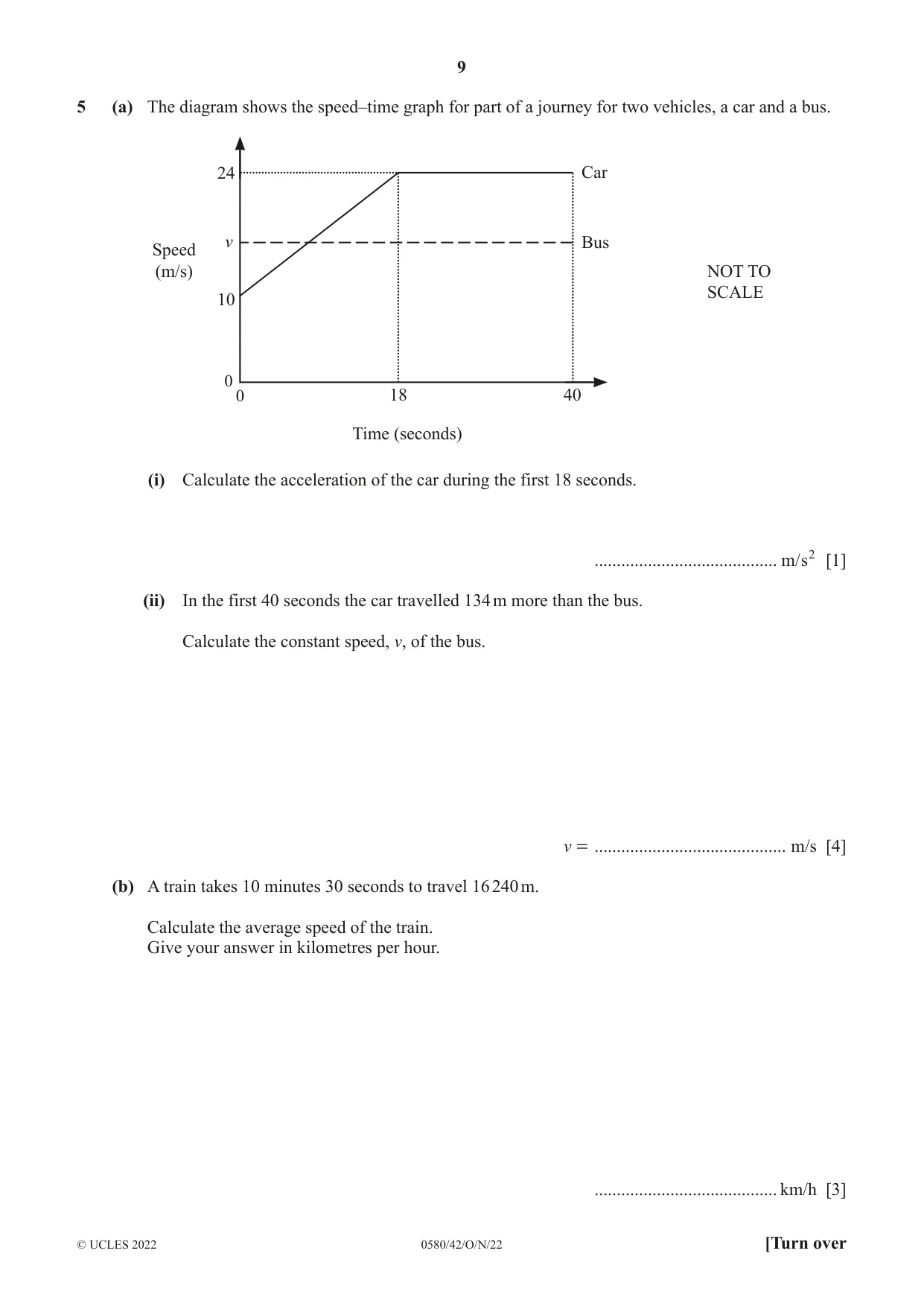
5 (a) The diagram shows the speed–time graph for part of a journey for two vehicles, a car and a bus. 24 Car v Bus Speed (m/s) NOT TO SCALE 10 0 0 18 40 Time (seconds) (i) Calculate the acceleration of the car during the first 18 seconds. ......................................... m/s2 [1] (ii) In the first 40 seconds the car travelled 134 m more than the bus. Calculate the constant speed, v, of the bus. v = ........................................... m/s [4] (b) A train takes 10 minutes 30 seconds to travel 16 240 m. Calculate the average speed of the train. Give your answer in kilometres per hour. ......................................... km/h [3]
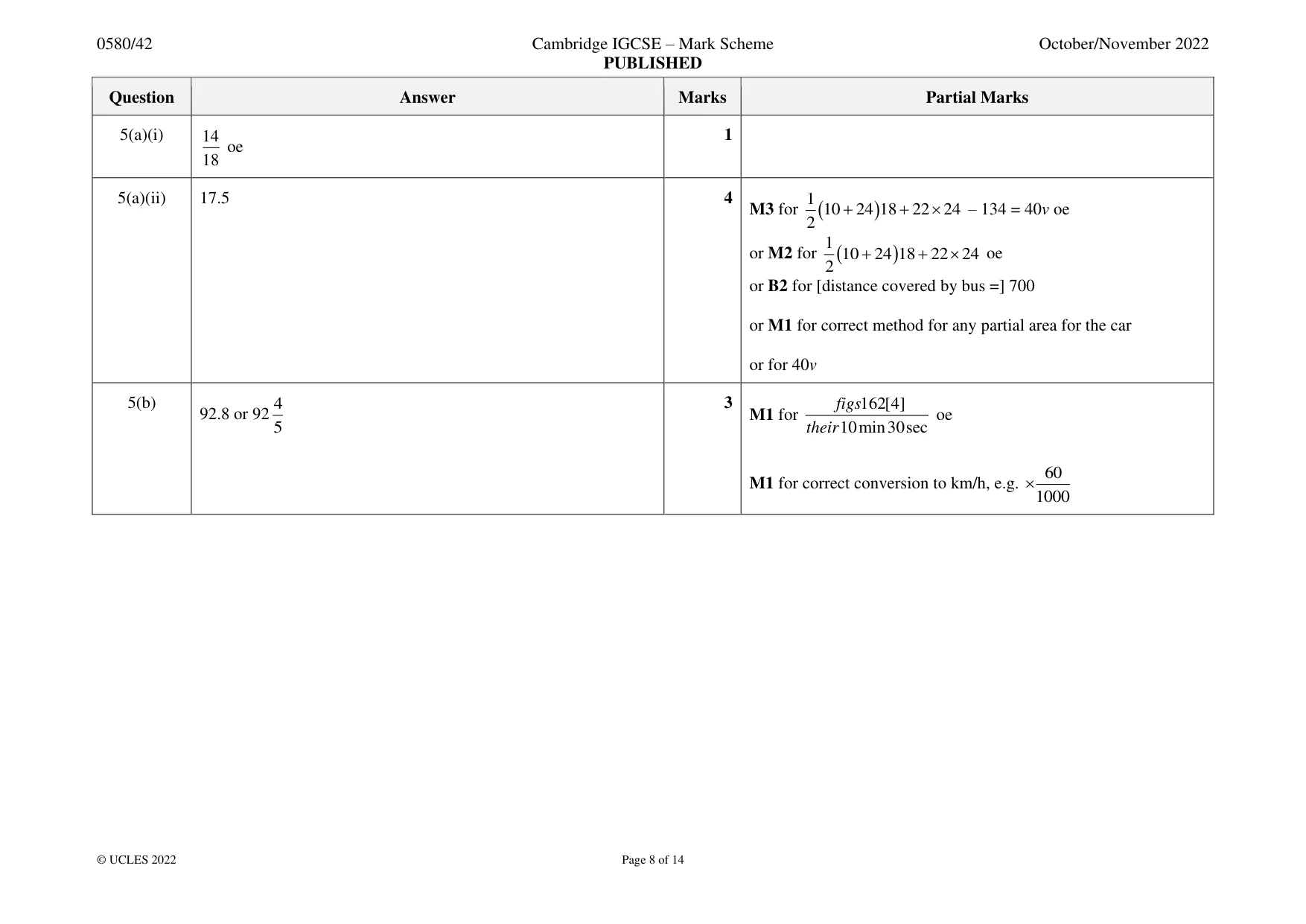
Mark scheme: 5(a)(i) 14 1 oe 18 5(a)(ii) 17.5 4 1 M3 for (10 + 24 )18 + 22 24 – 134 = 40v oe 2 1 or M2 for (10 + 24 )18 + 22 24 oe 2 or B2 for [distance covered by bus =] 700 or M1 for correct method for any partial area for the car or for 40v 5(b) 4 3 figs162[4] 92.8 or 92 M1 for oe 5 their 10min30sec 60 M1 for correct conversion to km/h, e.g. 1000
Question 6
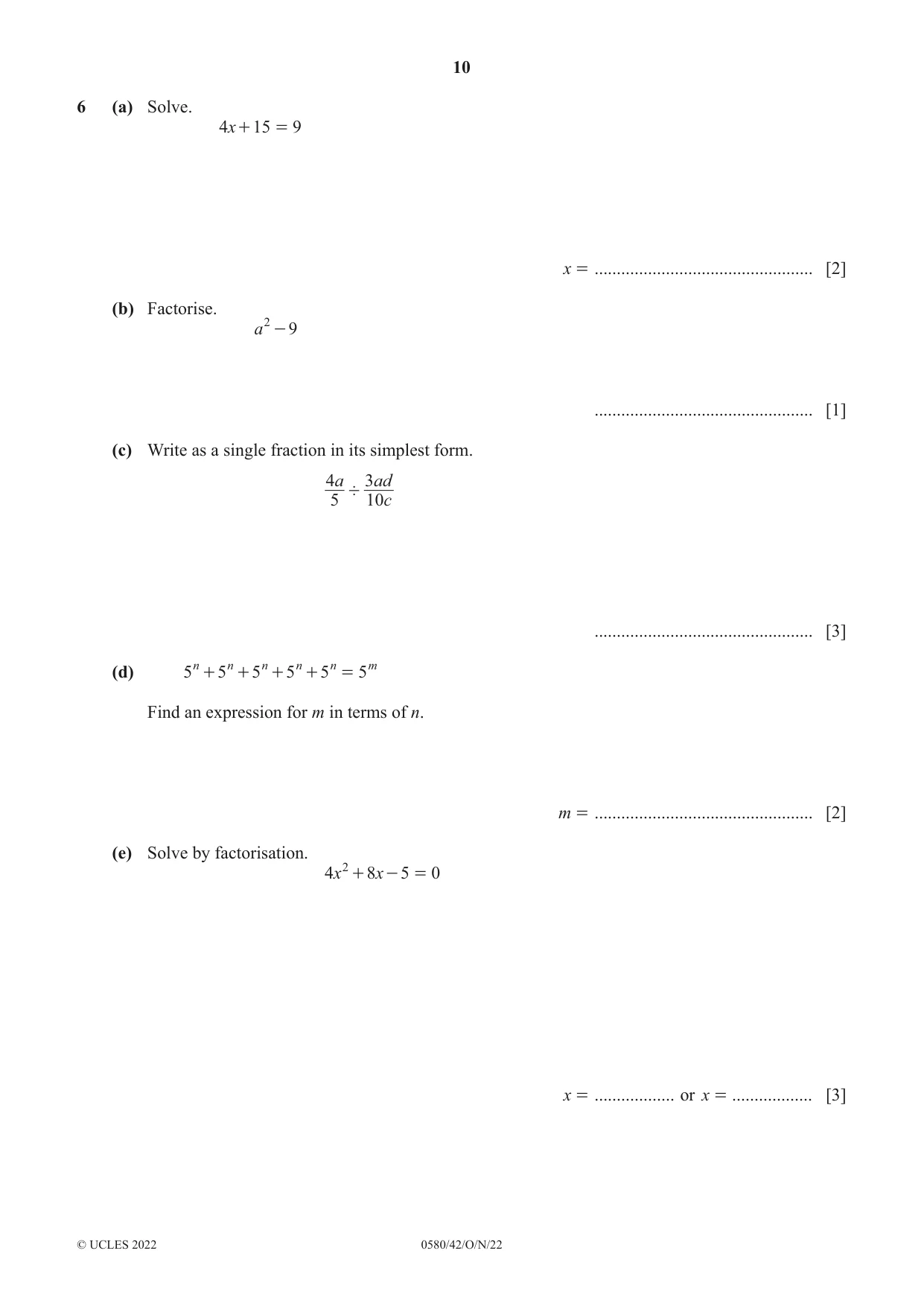
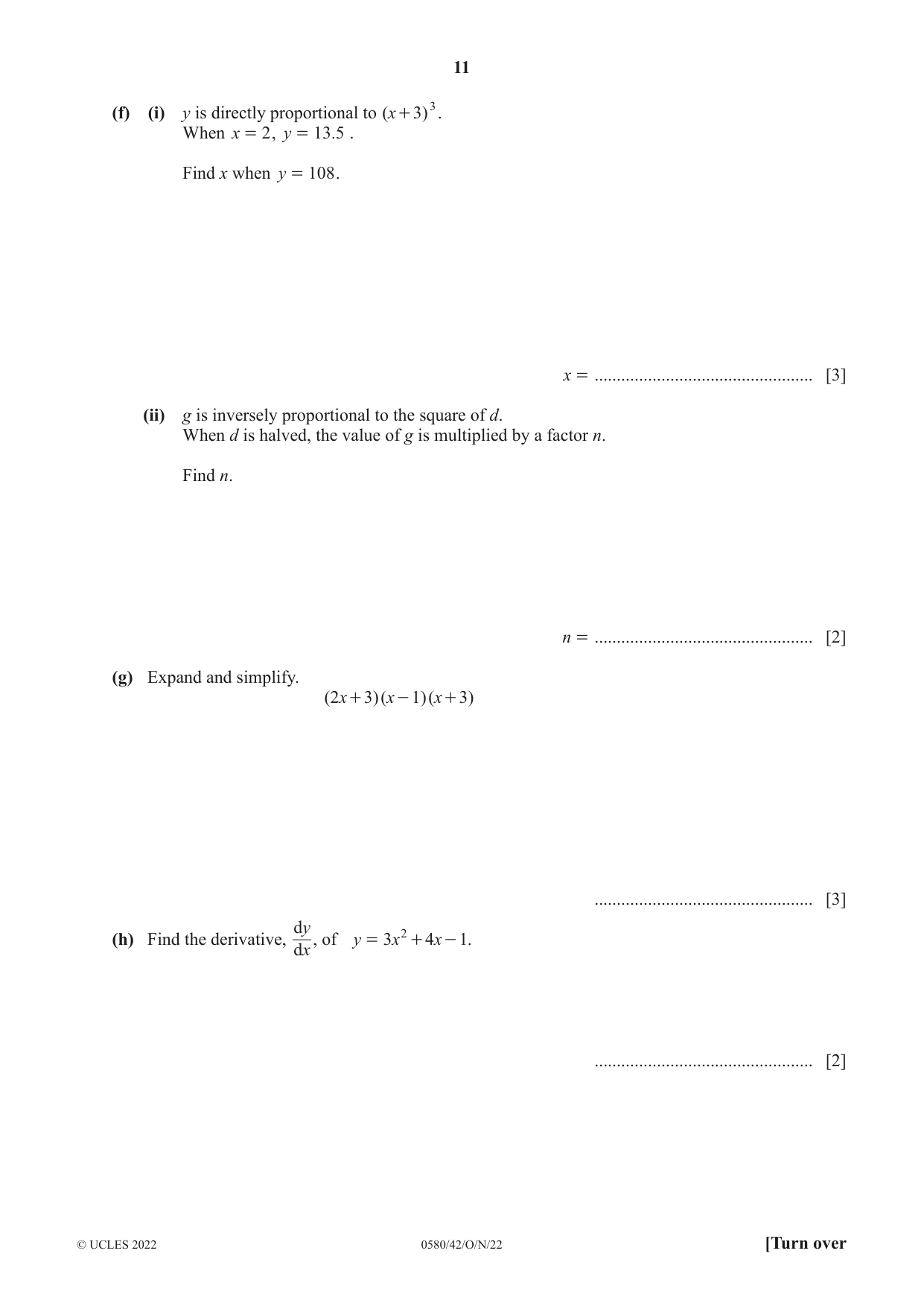
6 (a) Solve. 4x + 15 = 9 x = ................................................. [2] (b) Factorise. a 2 - 9 ................................................. [1] (c) Write as a single fraction in its simplest form. 4a 3ad ' 5 10c ................................................. [3] (d) 5 n + 5 n + 5 n + 5 n + 5 n = 5 m Find an expression for m in terms of n. m = ................................................. [2] (e) Solve by factorisation. 4x 2 + 8x - 5 = 0 x = .................. or x = .................. [3] (f) (i) y is directly proportional to ( x + 3) 3 . When x = 2 , y = 13.5 . Find x when y = 108 . x = ................................................. [3] (ii) g is inversely proportional to the square of d. When d is halved, the value of g is multiplied by a factor n. Find n. n = ................................................. [2] (g) Expand and simplify. ( 2x + 3)( x - 1)( x + 3) ................................................. [3] dy 2(h) Find the derivative, , of y = 3x + 4x - 1. dx ................................................. [2]
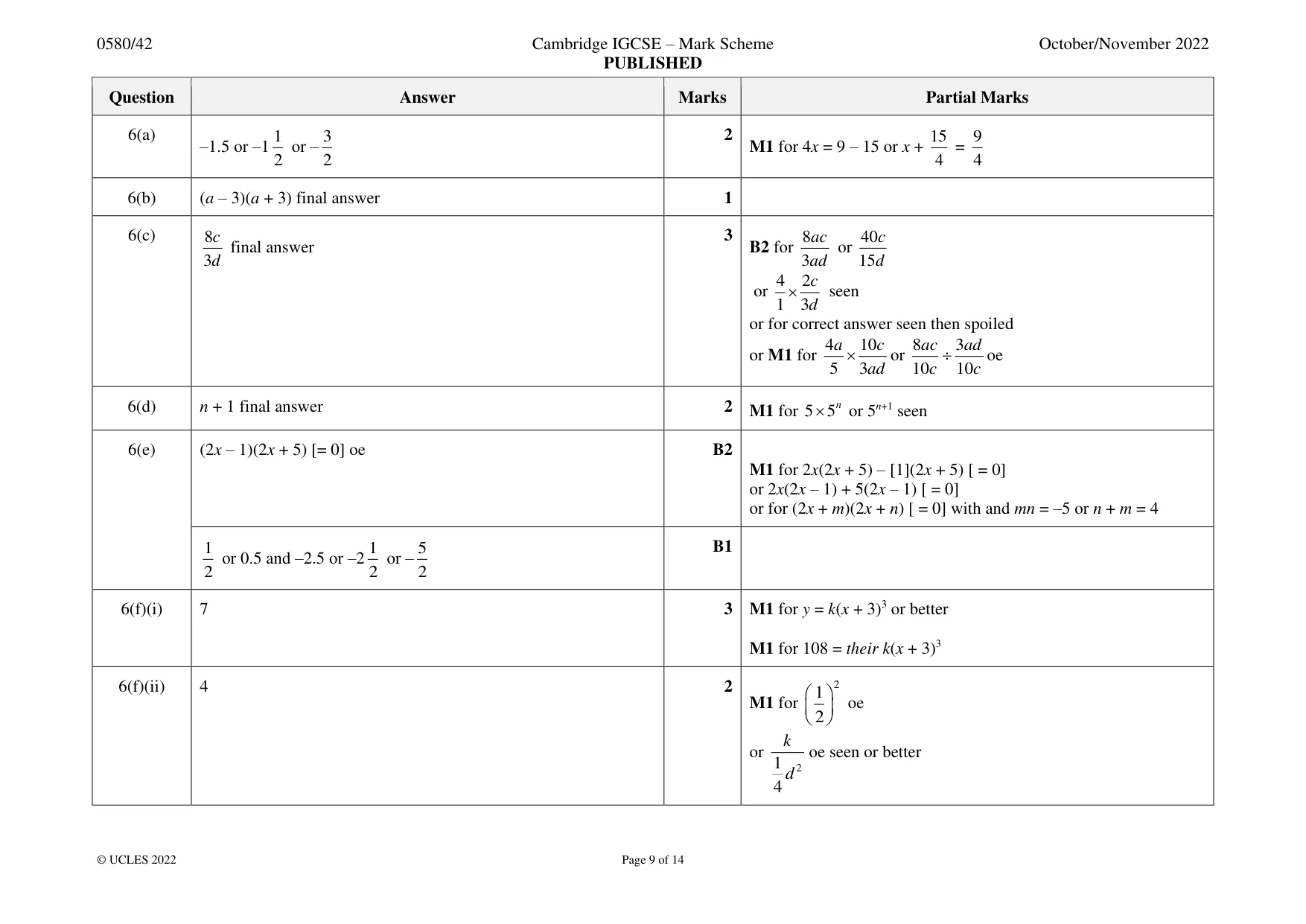
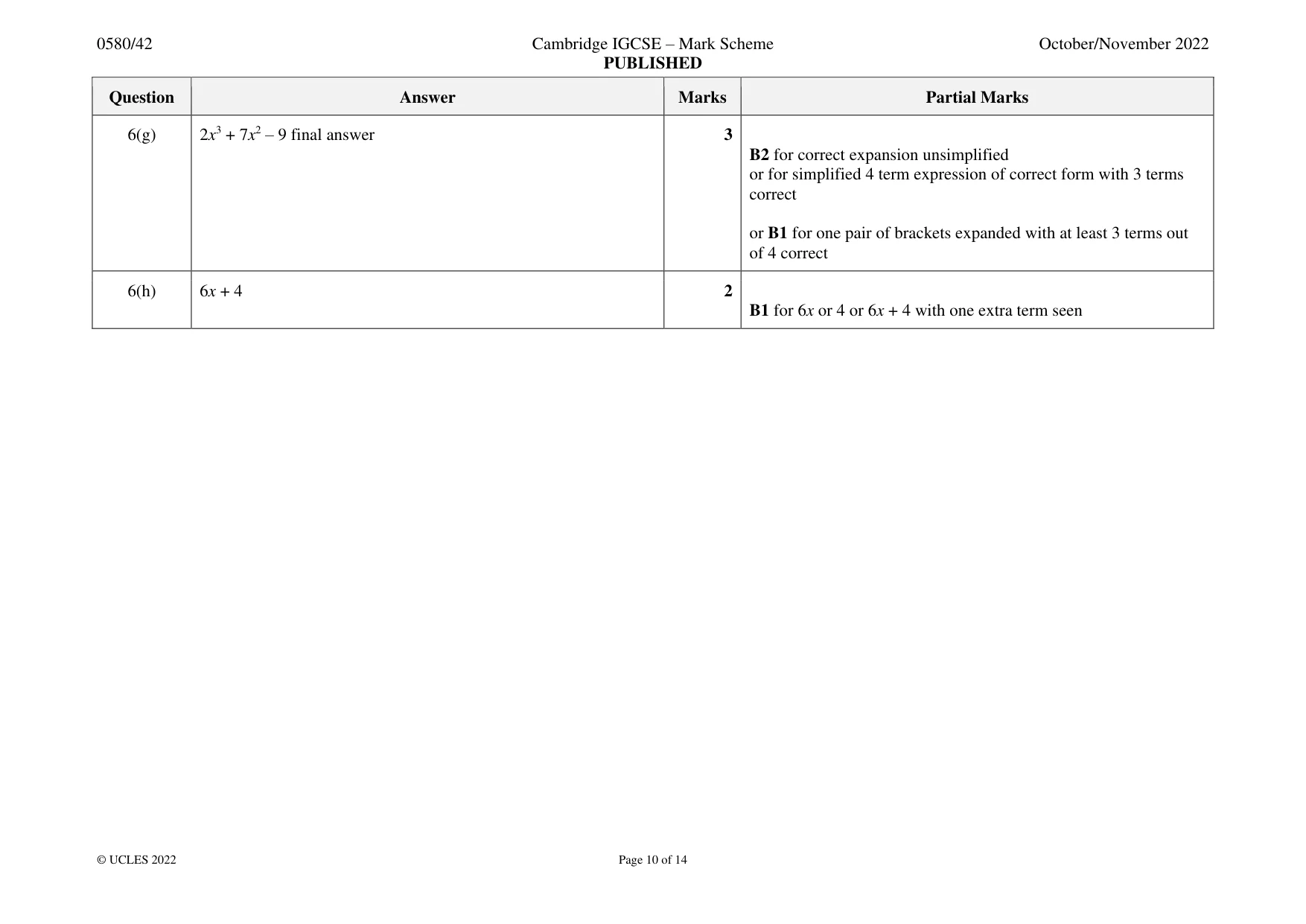
Mark scheme: 6(a) 1 3 2 15 9 –1.5 or –1 or – M1 for 4x = 9 – 15 or x + = 2 2 4 4 6(b) (a – 3)(a + 3) final answer 1 6(c) 8c 3 8 ac 40 c final answer B2 for or 3d 3ad 15 d 4 2 or c seen 1 3d or for correct answer seen then spoiled 4 a 10c 8 ac 3ad or M1 for or oe 5 3ad 10c 10c 6(d) n + 1 final answer 2 M1 for 5 5 n or 5n+1 seen 6(e) (2x – 1)(2x + 5) [= 0] oe B2 M1 for 2x(2x + 5) – [1](2x + 5) [ = 0] or 2x(2x – 1) + 5(2x – 1) [ = 0] or for (2x + m)(2x + n) [ = 0] with and mn = –5 or n + m = 4 1 1 5 B1 or 0.5 and –2.5 or –2 or – 2 2 2 6(f)(i) 7 3 M1 for y = k(x + 3)3 or better M1 for 108 = their k(x + 3)3 6(f)(ii) 4 2 2 1 M1 for oe 2 k or oe seen or better 1 2 d 4 6(g) 2x3 + 7x2 – 9 final answer 3 B2 for correct expansion unsimplified or for simplified 4 term expression of correct form with 3 terms correct or B1 for one pair of brackets expanded with at least 3 terms out of 4 correct 6(h) 6x + 4 2 B1 for 6x or 4 or 6x + 4 with one extra term seen
Q7 · R 39.4 cm 38.2 cm NOT TO SCALE P Q 46.5 cm (i) Calculate angle QPR
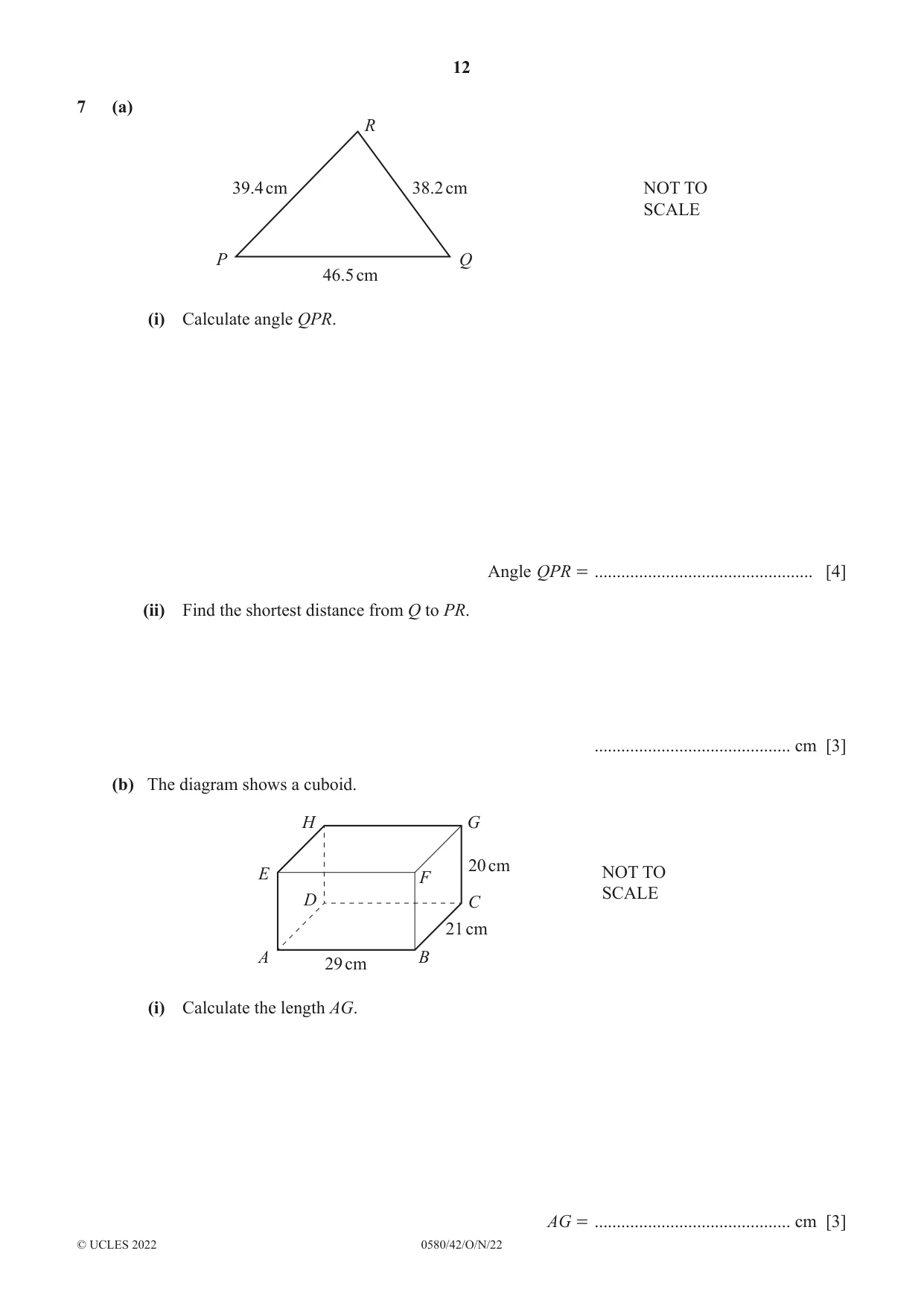
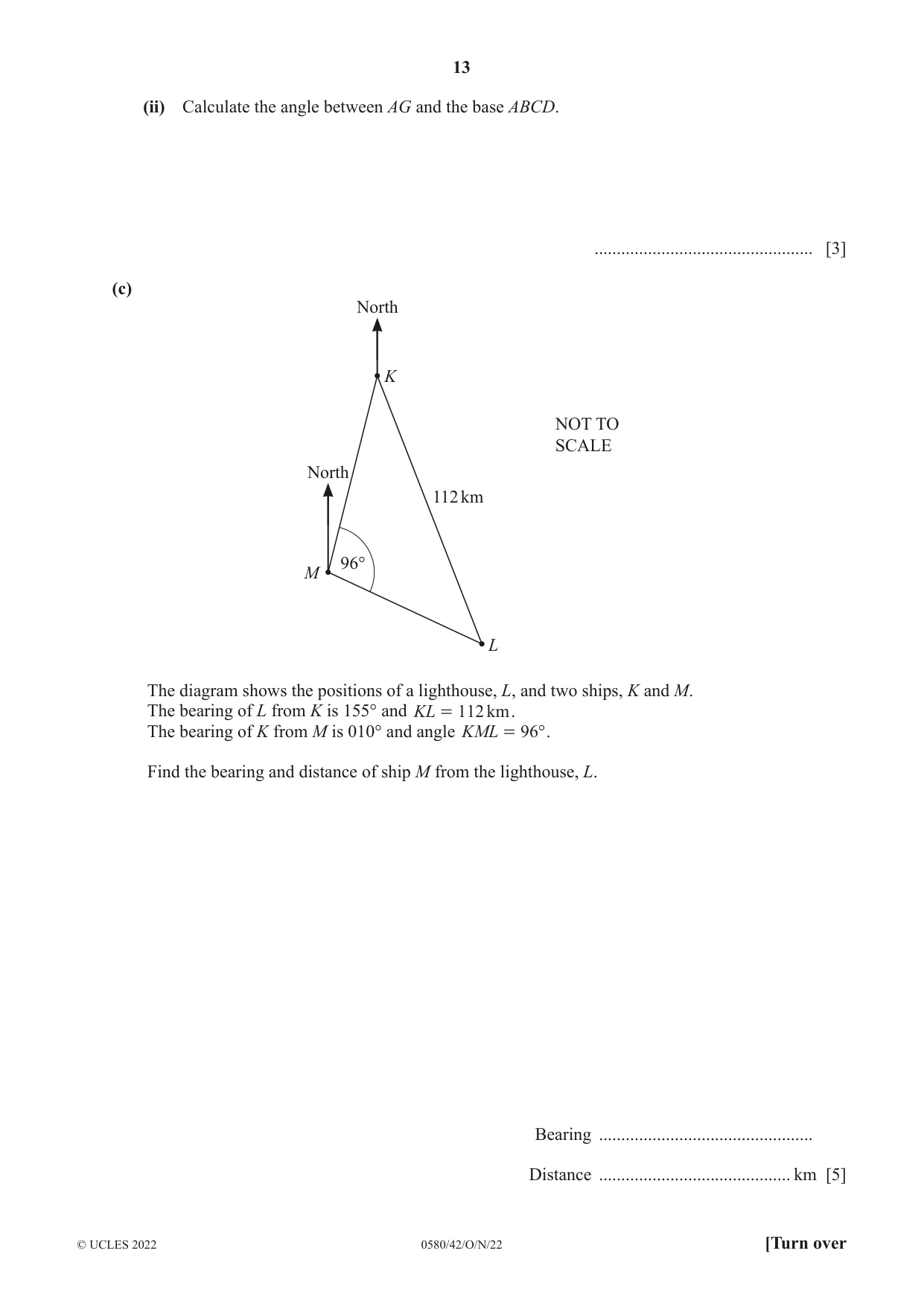
7 (a) R 39.4 cm 38.2 cm NOT TO SCALE P Q 46.5 cm (i) Calculate angle QPR. Angle QPR = ................................................. [4] (ii) Find the shortest distance from Q to PR. ............................................ cm [3] (b) The diagram shows a cuboid. H G 20 cm E F NOT TO SCALE D C 21 cm A B 29 cm (i) Calculate the length AG. AG = ............................................ cm [3] (ii) Calculate the angle between AG and the base ABCD. ................................................. [3] (c) North K NOT TO SCALE North 112 km 96° M L The diagram shows the positions of a lighthouse, L, and two ships, K and M. The bearing of L from K is 155° and KL = 112 km . The bearing of K from M is 010° and angle KML = 96° . Find the bearing and distance of ship M from the lighthouse, L. Bearing ................................................ Distance ........................................... km [5]
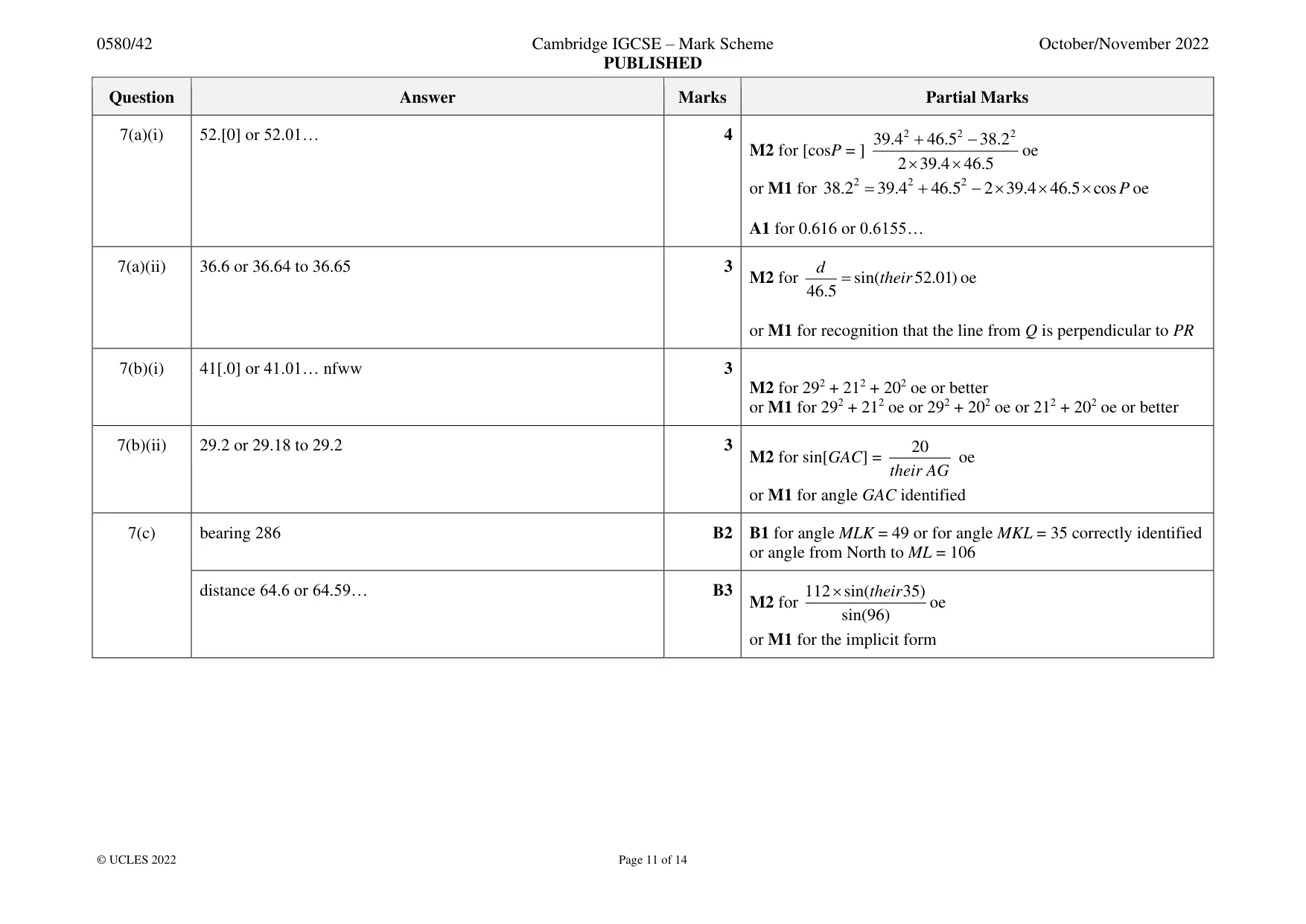
Mark scheme: 7(a)(i) 52.[0] or 52.01… 4 39.4 2 + 46.5 2 − 38.2 2 M2 for [cosP = ] oe 2 39.4 46.5 or M1 for 38.2 2 = 39.4 2 + 46.52 −2 39.4 46.5 cos P oe A1 for 0.616 or 0.6155… 7(a)(ii) 36.6 or 36.64 to 36.65 3 d M2 for = sin(their 52.01) oe 46.5 or M1 for recognition that the line from Q is perpendicular to PR 7(b)(i) 41[.0] or 41.01… nfww 3 M2 for 292 + 212 + 202 oe or better or M1 for 292 + 212 oe or 292 + 202 oe or 212 + 202 oe or better 7(b)(ii) 29.2 or 29.18 to 29.2 3 20 M2 for sin[GAC] = oe their AG or M1 for angle GAC identified 7(c) bearing 286 B2 B1 for angle MLK = 49 or for angle MKL = 35 correctly identified or angle from North to ML = 106 distance 64.6 or 64.59… B3 112 sin(their 35) M2 for oe sin(96) or M1 for the implicit form
Q8 · AB is a line with midpoint M
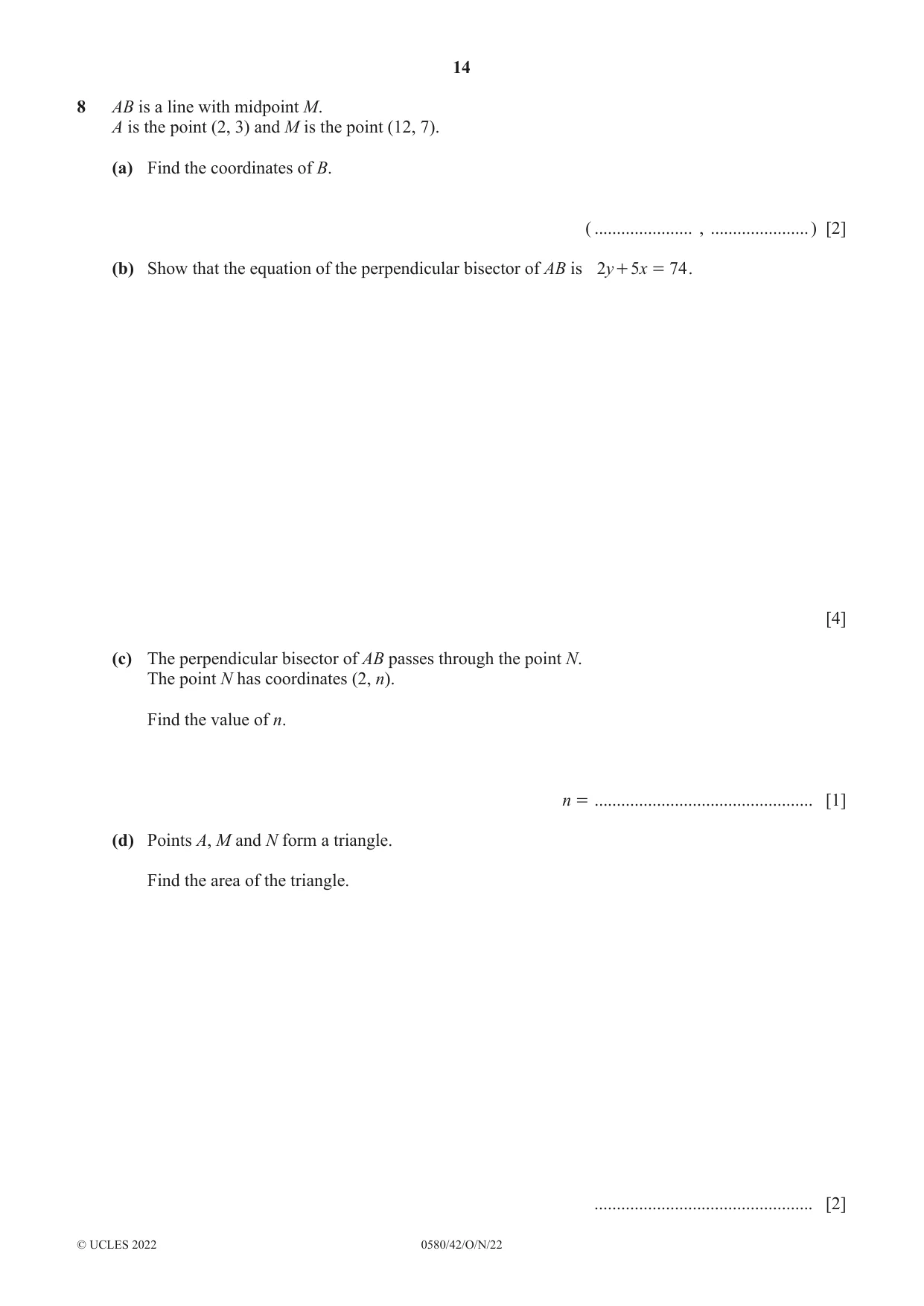
8 AB is a line with midpoint M. A is the point (2, 3) and M is the point (12, 7). (a) Find the coordinates of B. ( ...................... , ...................... ) [2] (b) Show that the equation of the perpendicular bisector of AB is 2y + 5x = 74 . [4] (c) The perpendicular bisector of AB passes through the point N. The point N has coordinates (2, n). Find the value of n. n = ................................................. [1] (d) Points A, M and N form a triangle. Find the area of the triangle. ................................................. [2]
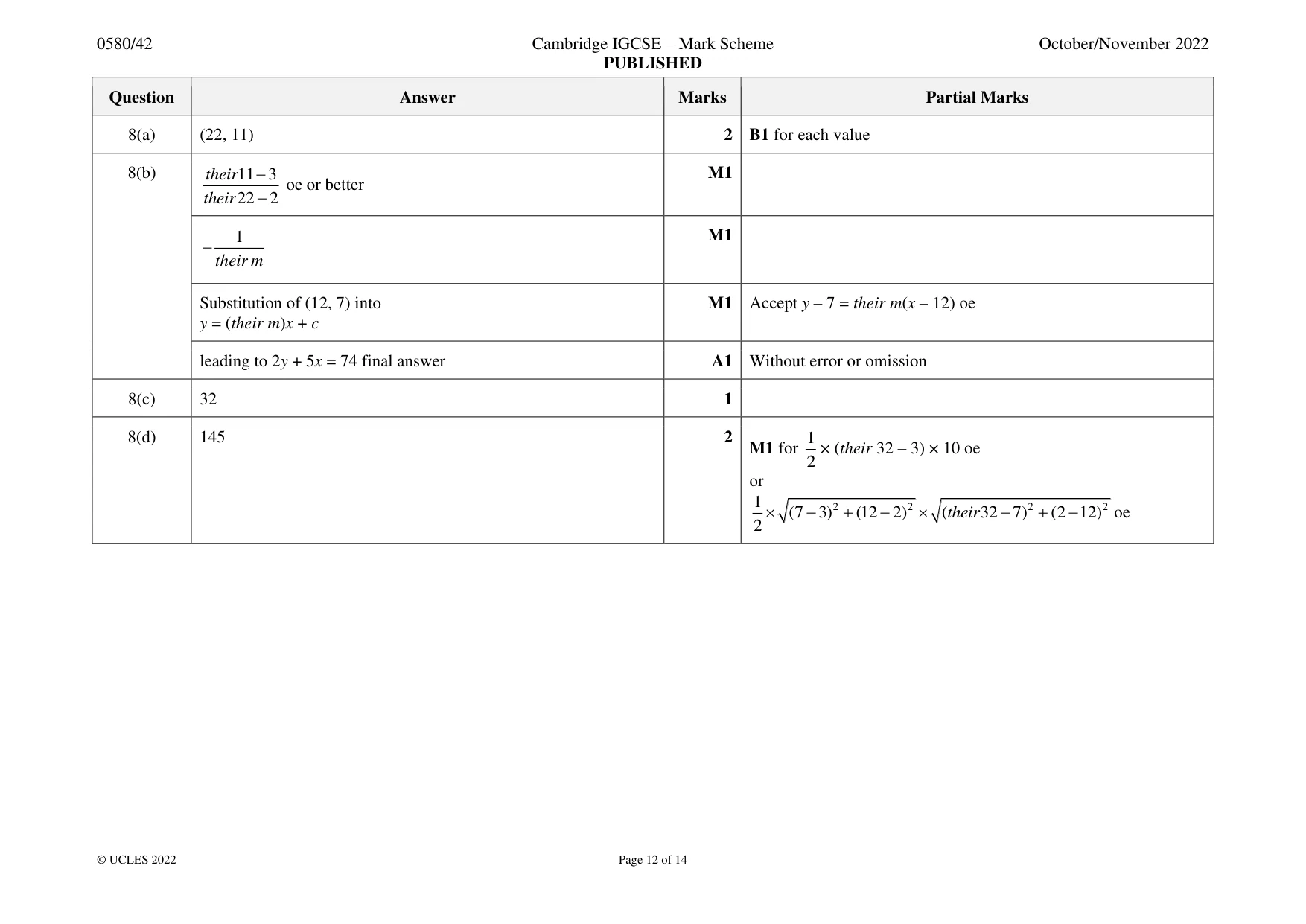
Mark scheme: 8(a) (22, 11) 2 B1 for each value 8(b) their11 − 3 M1 oe or better their 22 − 2 1 M1 −their m Substitution of (12, 7) into M1 Accept y – 7 = their m(x – 12) oe y = (their m)x + c leading to 2y + 5x = 74 final answer A1 Without error or omission 8(c) 32 1 8(d) 145 2 1 M1 for × (their 32 – 3) × 10 oe 2 or 1 2 2 2 2 (7 − 3) + (12 − 2) (their 32 − 7) + (2 − 12) oe 2
Q9 · Y 1 0 x 360° – 1 (a) On the diagram, sketch the graph of y = sin x for 0° G x G 360°
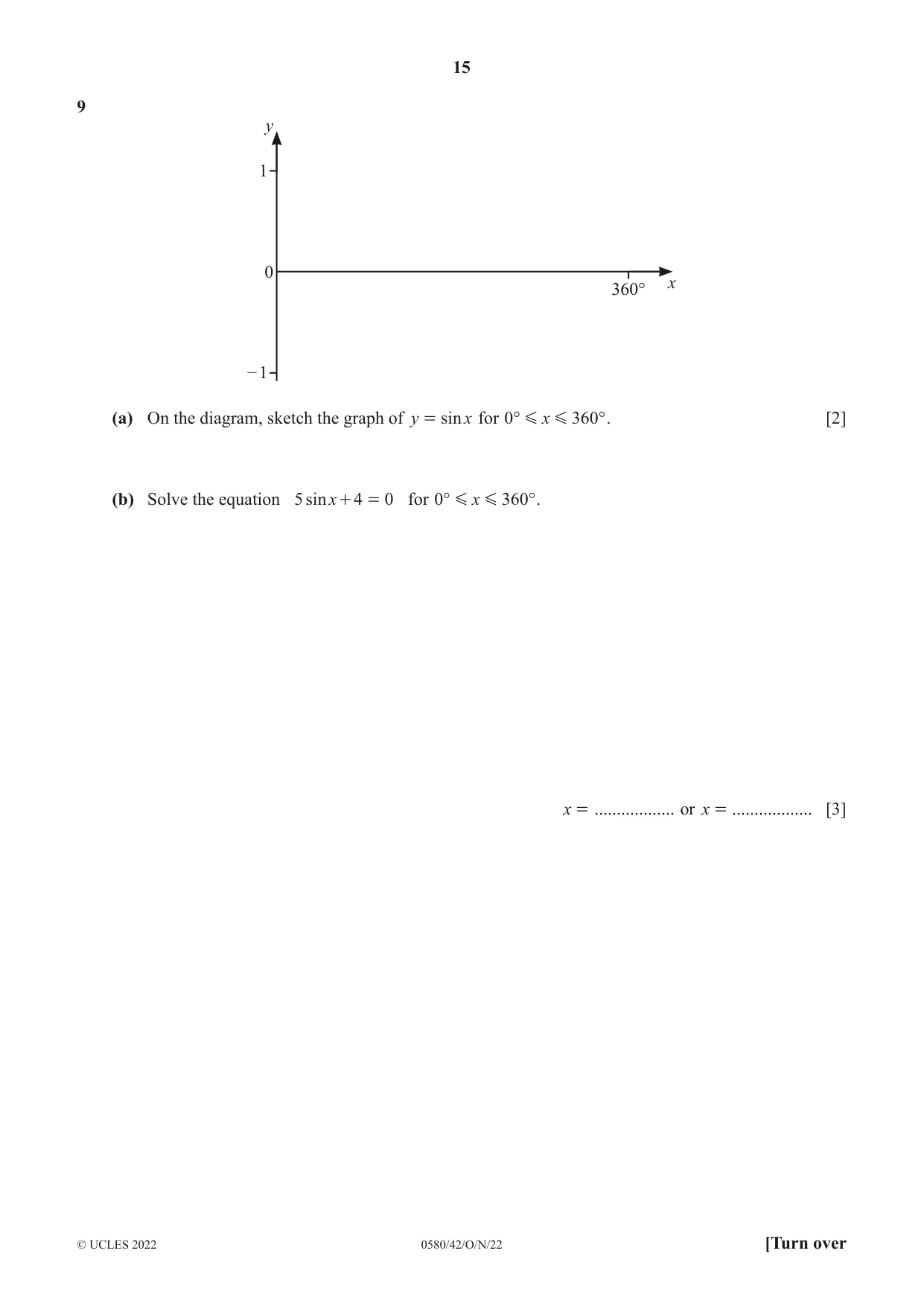
9 y 1 0 x 360° – 1 (a) On the diagram, sketch the graph of y = sin x for 0° G x G 360° . [2] (b) Solve the equation 5 sinx + 4 = 0 for 0° G x G 360 ° . x = .................. or x = .................. [3]
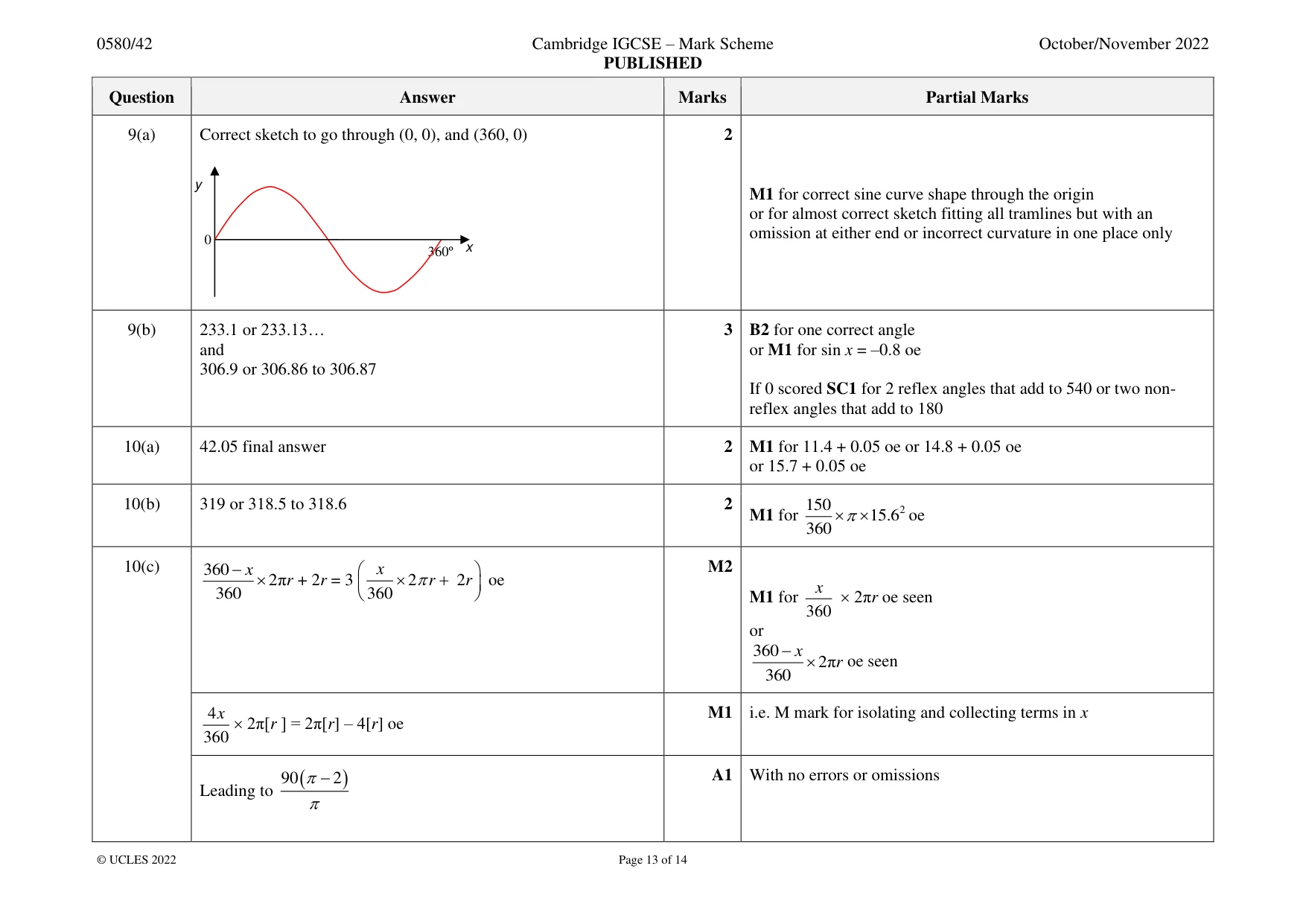
Mark scheme: 9(a) Correct sketch to go through (0, 0), and (360, 0) 2 y M1 for correct sine curve shape through the origin or for almost correct sketch fitting all tramlines but with an omission at either end or incorrect curvature in one place only 0 360º x 9(b) 233.1 or 233.13… 3 B2 for one correct angle and or M1 for sin x = –0.8 oe 306.9 or 306.86 to 306.87 If 0 scored SC1 for 2 reflex angles that add to 540 or two non- reflex angles that add to 180
Q10 · The lengths of the sides of a triangle are 11.4 cm, 14.8 cm and 15.7 cm, all correct to 1…
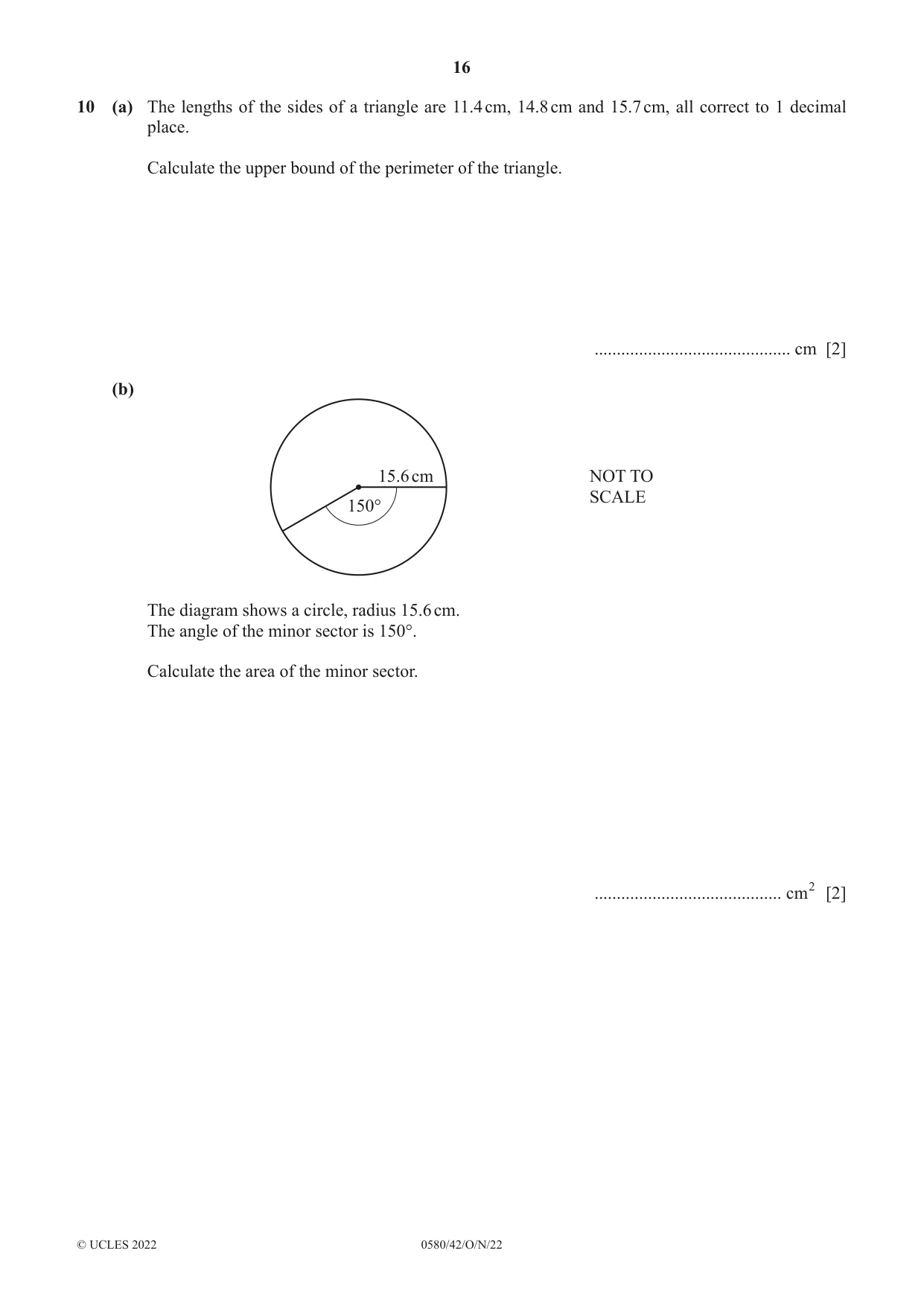
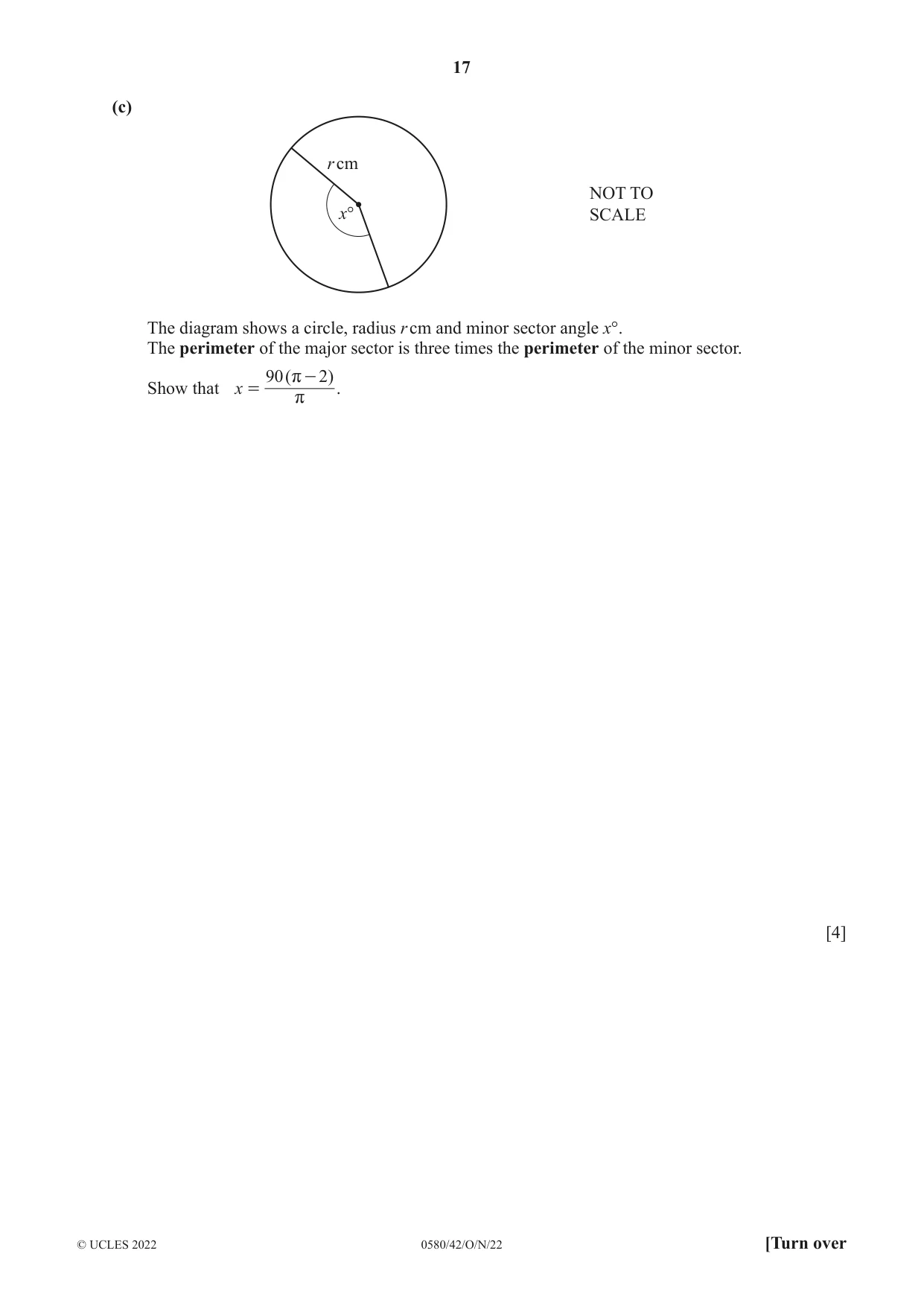
10 (a) The lengths of the sides of a triangle are 11.4 cm, 14.8 cm and 15.7 cm, all correct to 1 decimal place. Calculate the upper bound of the perimeter of the triangle. ............................................ cm [2] (b) 15.6 cm NOT TO SCALE 150° The diagram shows a circle, radius 15.6 cm. The angle of the minor sector is 150°. Calculate the area of the minor sector. .......................................... cm2 [2] (c) r cm NOT TO x° SCALE The diagram shows a circle, radius r cm and minor sector angle x°. The perimeter of the major sector is three times the perimeter of the minor sector. 90 ( r - 2 ) Show that x = . r [4]
Mark scheme: 10(a) 42.05 final answer 2 M1 for 11.4 + 0.05 oe or 14.8 + 0.05 oe or 15.7 + 0.05 oe 10(b) 319 or 318.5 to 318.6 2 150 2 M1 for 15.6 oe 360 10(c) 360 − x x M2 2πr + 2r = 3 2r + 2r oe x 360 360 M1 for 2πr oe seen 360 or 360 − x 2πr oe seen 360 4 x M1 i.e. M mark for isolating and collecting terms in x 2π[r ] = 2π[r] – 4[r] oe 360 90 (− 2 ) A1 With no errors or omissions Leading to
Q11 · M 20511 (a) = e40mo 2 Find the two possible values of m
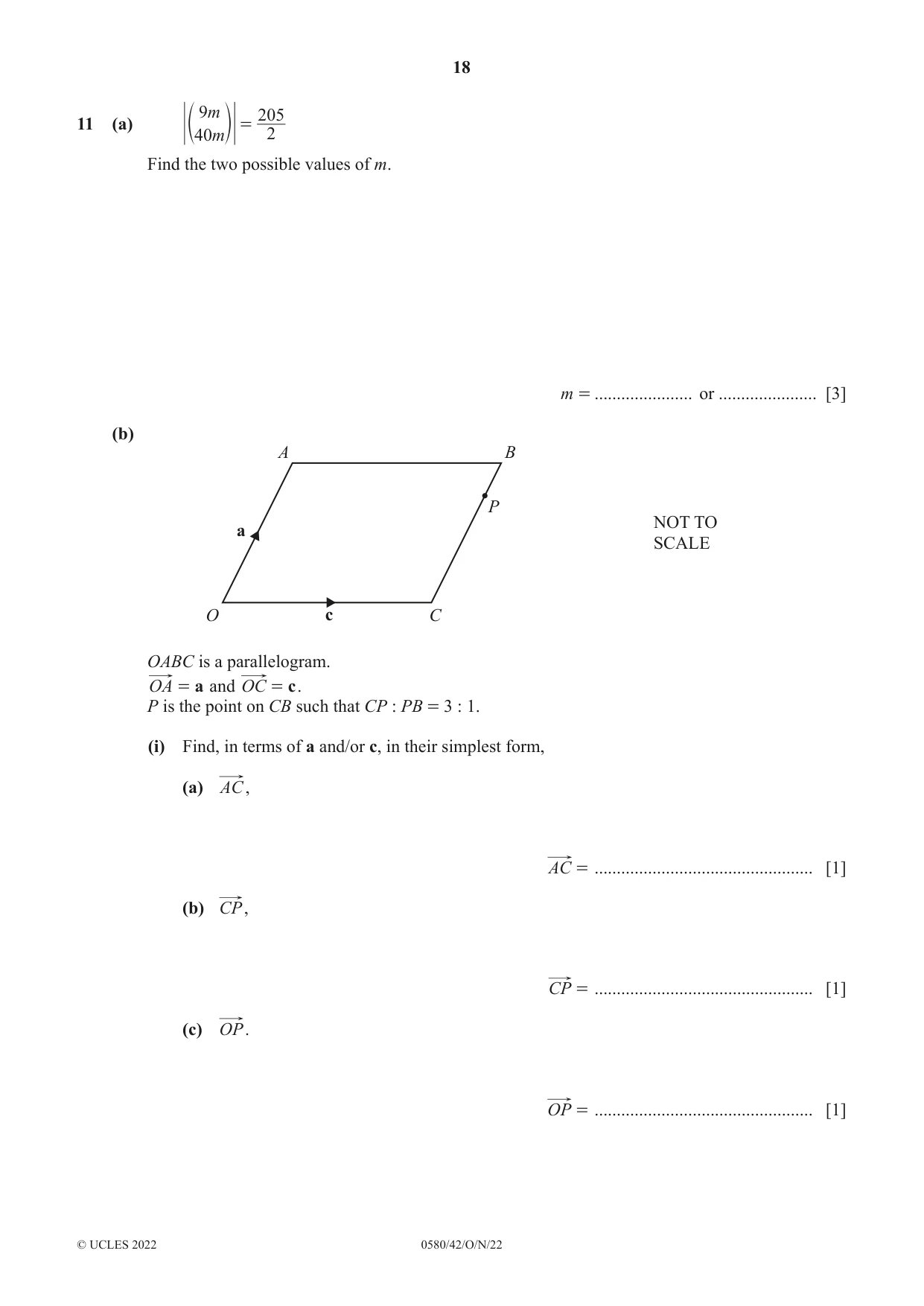
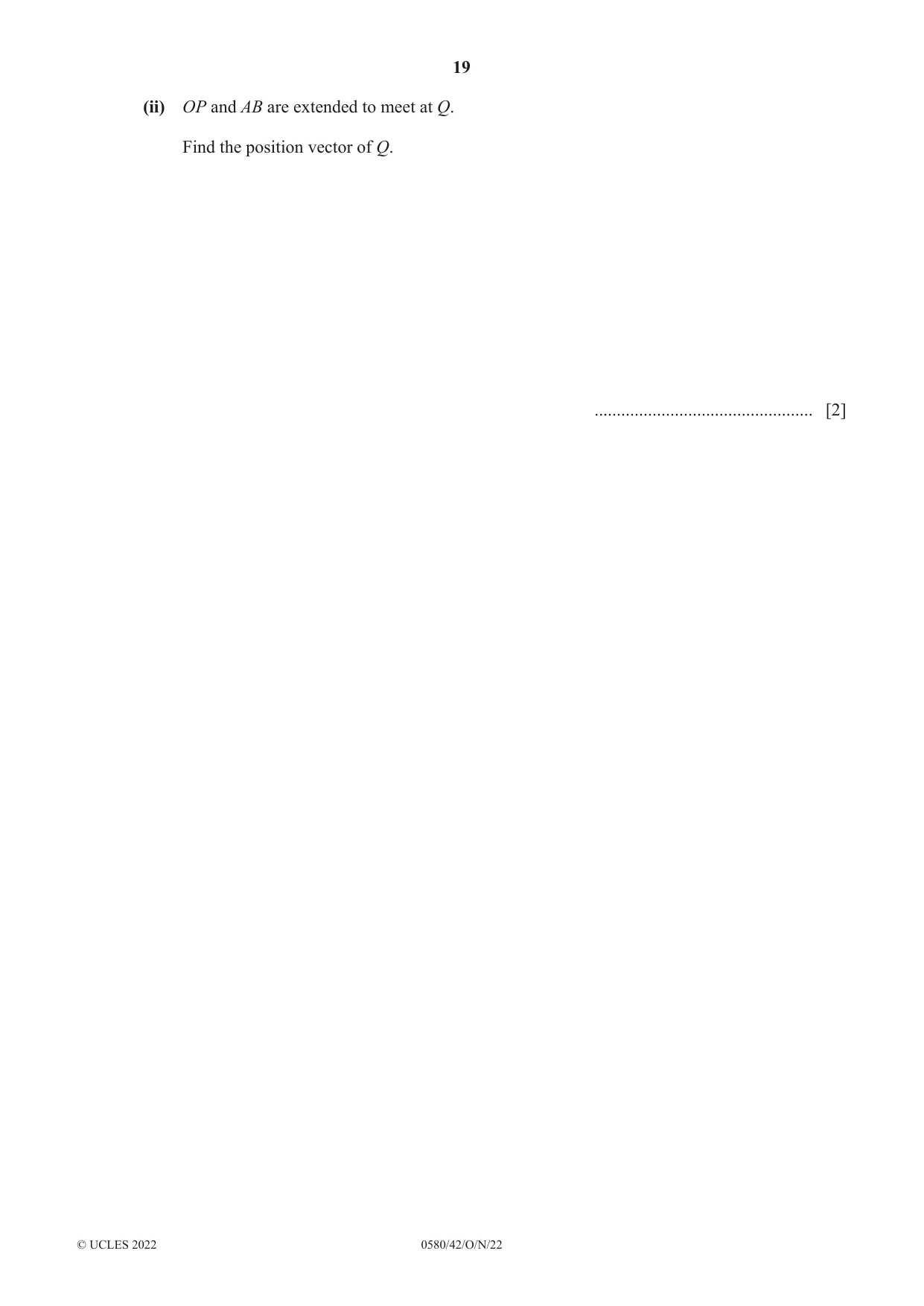
9m 20511 (a) = e40mo 2 Find the two possible values of m. m = ...................... or ...................... [3] (b) A B P NOT TO a SCALE O c C OABC is a parallelogram. OA = a and OC = c . P is the point on CB such that CP : PB = 3 : 1. (i) Find, in terms of a and/or c, in their simplest form, (a) AC, AC = ................................................. [1] (b) CP, CP = ................................................. [1] (c) OP. OP = ................................................. [1] (ii) OP and AB are extended to meet at Q. Find the position vector of Q. ................................................. [2]
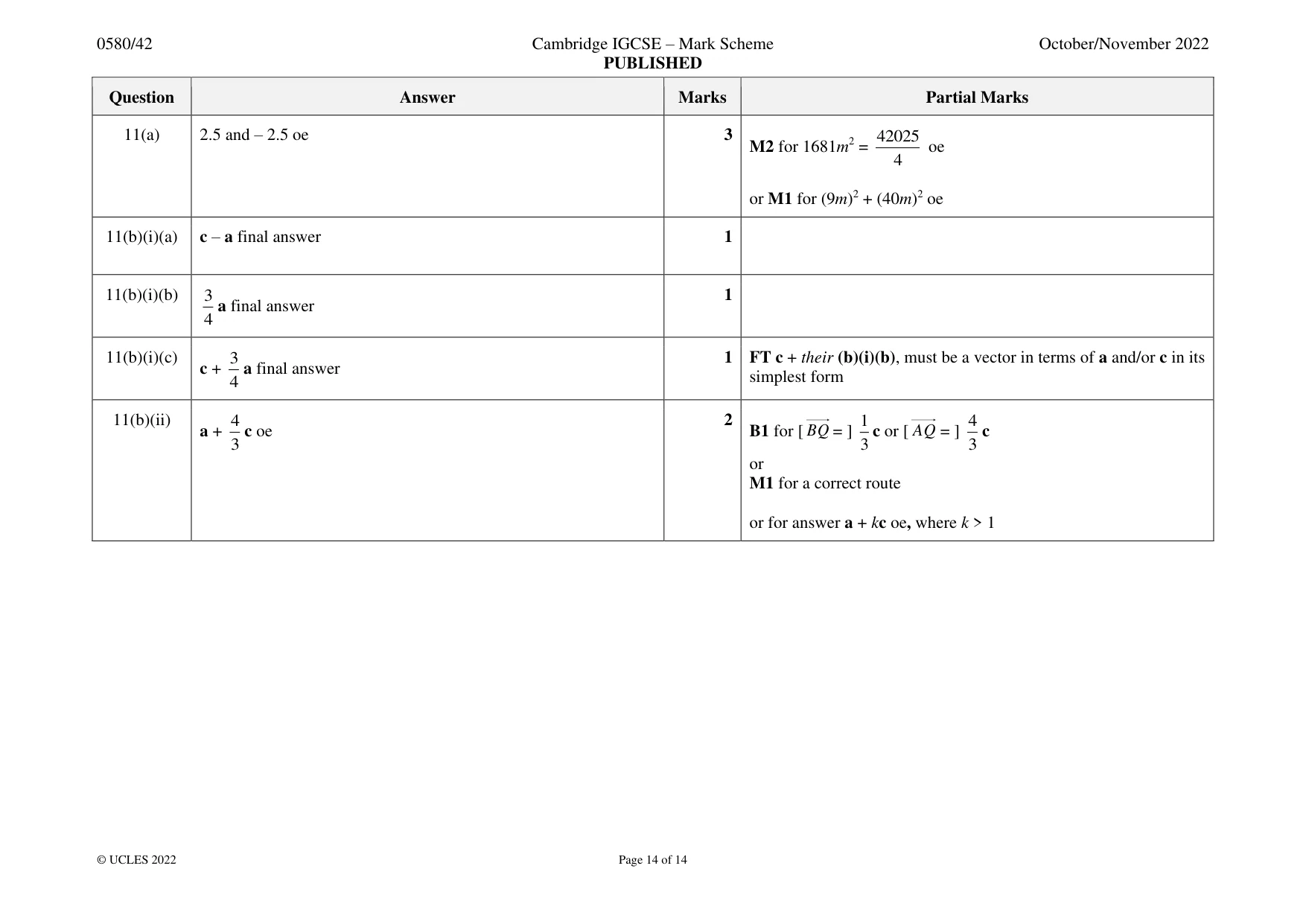
Mark scheme: 11(a) 2.5 and – 2.5 oe 3 42025 M2 for 1681m2 = oe 4 or M1 for (9m)2 + (40m)2 oe 11(b)(i)(a) c – a final answer 1 11(b)(i)(b) 3 1 a final answer 4 11(b)(i)(c) 3 1 FT c + their (b)(i)(b), must be a vector in terms of a and/or c in its c + a final answer simplest form 4 11(b)(ii) 4 2 1 4 a + c oe B1 for [ BQ = ] c or [ AQ = ] c 3 3 3 or M1 for a correct route or for answer a + kc oe, where k > 1
What was in this paper
The subtopics covered by these 11 questions, and how many questions each got. Open one in a new tab to see every Cambridge question on it.
What you needed in this session
Cambridge’s own grade thresholds for 2022 Oct/Nov, Paper 4 · Variant 2. A higher threshold means an easier paper — the bar moves with how the cohort did.