Questions as text
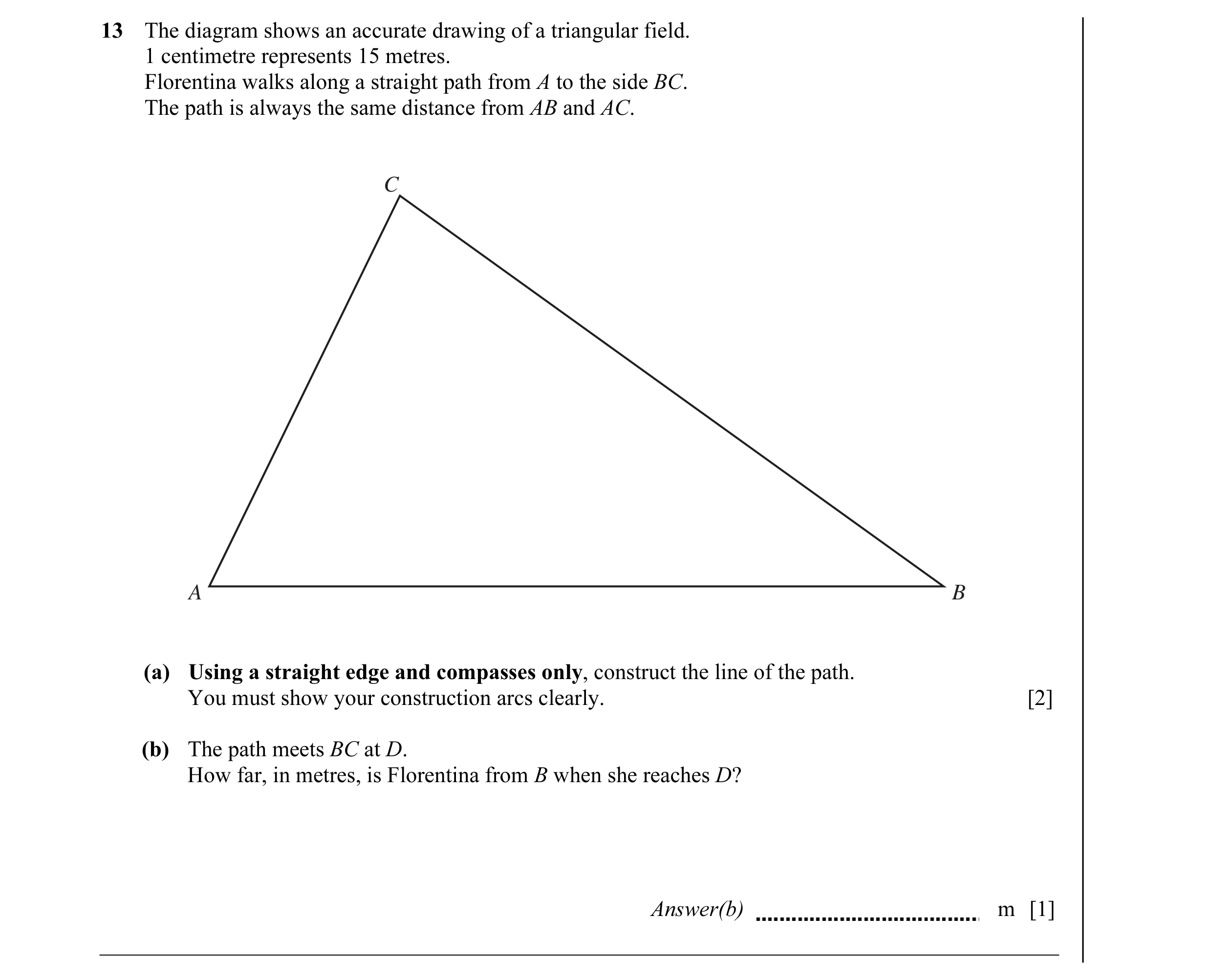
Q1 · The diagram shows an accurate drawing of a triangular field 0580/11 May/June 2009
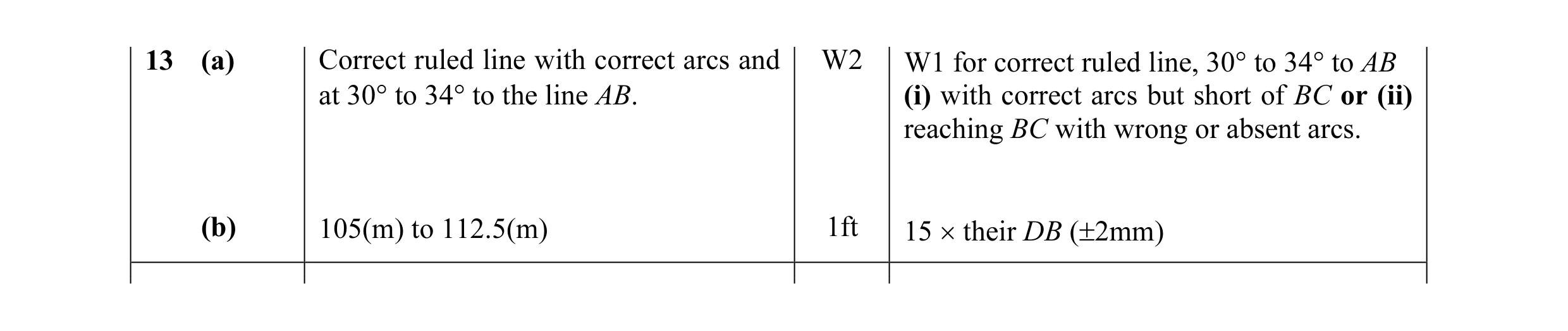
13 The diagram shows an accurate drawing of a triangular field. 1 centimetre represents 15 metres. Florentina walks along a straight path from A to the side BC. The path is always the same distance from AB and AC. C A B (a) Using a straight edge and compasses only, construct the line of the path. You must show your construction arcs clearly. [2] (b) The path meets BC at D. How far, in metres, is Florentina from B when she reaches D? Answer(b) m [1]
3 marks
Mark scheme: 13 (a) Correct ruled line with correct arcs and W2 W1 for correct ruled line, 30° to 34° to AB at 30° to 34° to the line AB. (i) with correct arcs but short of BC or (ii) reaching BC with wrong or absent arcs. (b) 105(m) to 112.5(m) 1ft 15 × their DB (±2mm)
This question in 0580/11 May/June 2009
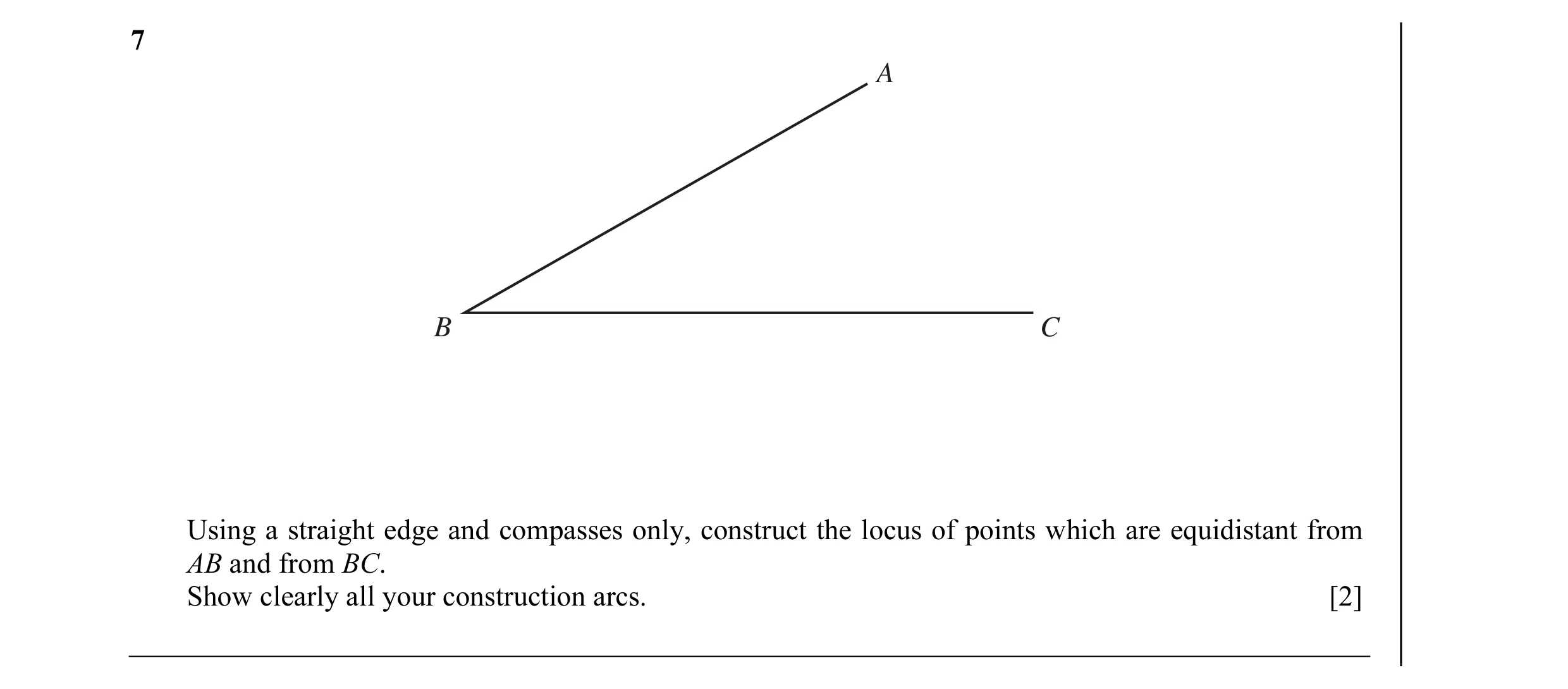
Q2 · A B C Using a straight edge and compasses only, construct the locus of points which are… 0580/11 Oct/Nov 2009
7 A B C Using a straight edge and compasses only, construct the locus of points which are equidistant from AB and from BC. Show clearly all your construction arcs. [2]
2 marks
Mark scheme: 7 Correct angle bisector (±2°) with two 2 W1 correct bisector without arcs or incorrect arcs pairs of correct arcs. or absent arcs. Line (±2 mm) from B. Line (±2 mm) from B.
This question in 0580/11 Oct/Nov 2009
Q3 · A B C Using a straight edge and compasses only, construct the locus of points which are… 0580/12 Oct/Nov 2009
7 A B C Using a straight edge and compasses only, construct the locus of points which are equidistant from AB and from BC. Show clearly all your construction arcs. [2]
2 marks
Mark scheme: 7 Correct angle bisector (±2°) with two 2 W1 correct bisector without arcs or incorrect arcs pairs of correct arcs. or absent arcs. Line (±2 mm) from B. Line (±2 mm) from B.
This question in 0580/12 Oct/Nov 2009
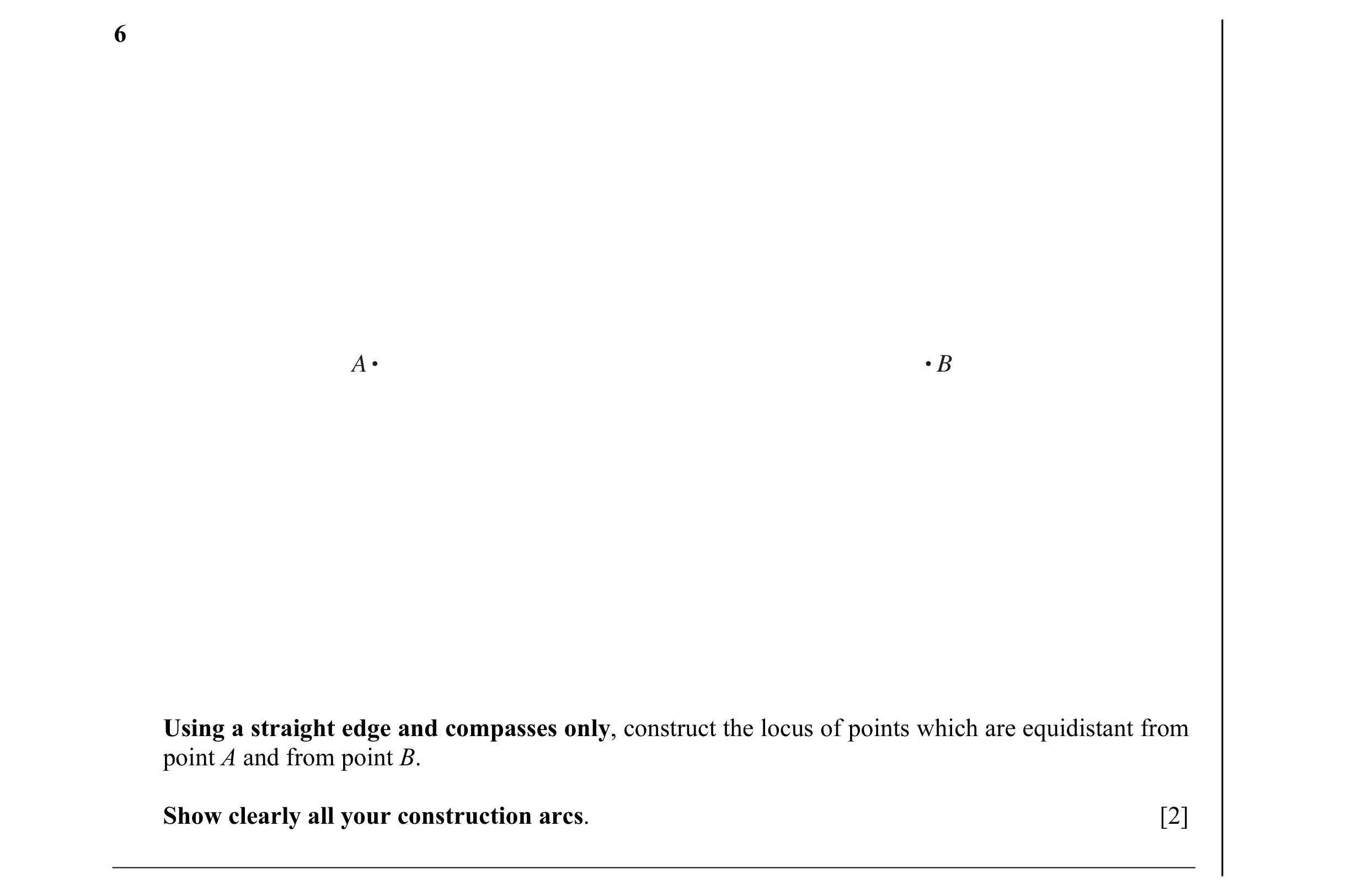
Q4 · A B Using a straight edge and compasses only, construct the locus of points which are… 0580/11 Oct/Nov 2010
6 A B Using a straight edge and compasses only, construct the locus of points which are equidistant from point A and from point B. Show clearly all your construction arcs. [2]
2 marks
Mark scheme: 6 Perpendicular bisector of AB 2 SC1 accurate, but without arcs with 2 pairs of arcs
This question in 0580/11 Oct/Nov 2010
Q5 · For Examiner's Use C B A (a) On the diagram above, using a straight edge and compasses… 0580/12 May/June 2011
18 For Examiner's Use C B A (a) On the diagram above, using a straight edge and compasses only, construct (i) the bisector of angle ABC, [2] (ii) the locus of points which are equidistant from A and from B. [2] (b) Shade the region inside the triangle which is nearer to A than to B and nearer to AB than to BC. [1]
5 marks
Mark scheme: 18 (a) (i) 2 B1 correct line B1 2 sets of correct arcs (ii) 2 B1 correct line B1 two sets of correct arcs R (b) 1 correct region, shaded or shown by the letter R IGCSE – May/June 2011 0580 12
This question in 0580/12 May/June 2011
Q6 · Triangle ABC has sides AB = 40 m, BC = 25 m and AC = 35 m 0580/11 May/June 2012
12 Triangle ABC has sides AB = 40 m, BC = 25 m and AC = 35 m. Using a scale of 1 cm to represent 5 m, construct triangle ABC. The construction must be completed using a ruler and compasses only. All construction arcs must be clearly shown. Answer A B [3]
3 marks
Mark scheme: 12 Triangle drawn correctly 3 M1 for one side drawn to correct length with ruler and arcs and M1 for clear method of crossing arcs even if wrong scale or inaccurate 750 × 5 × 2 5
This question in 0580/11 May/June 2012
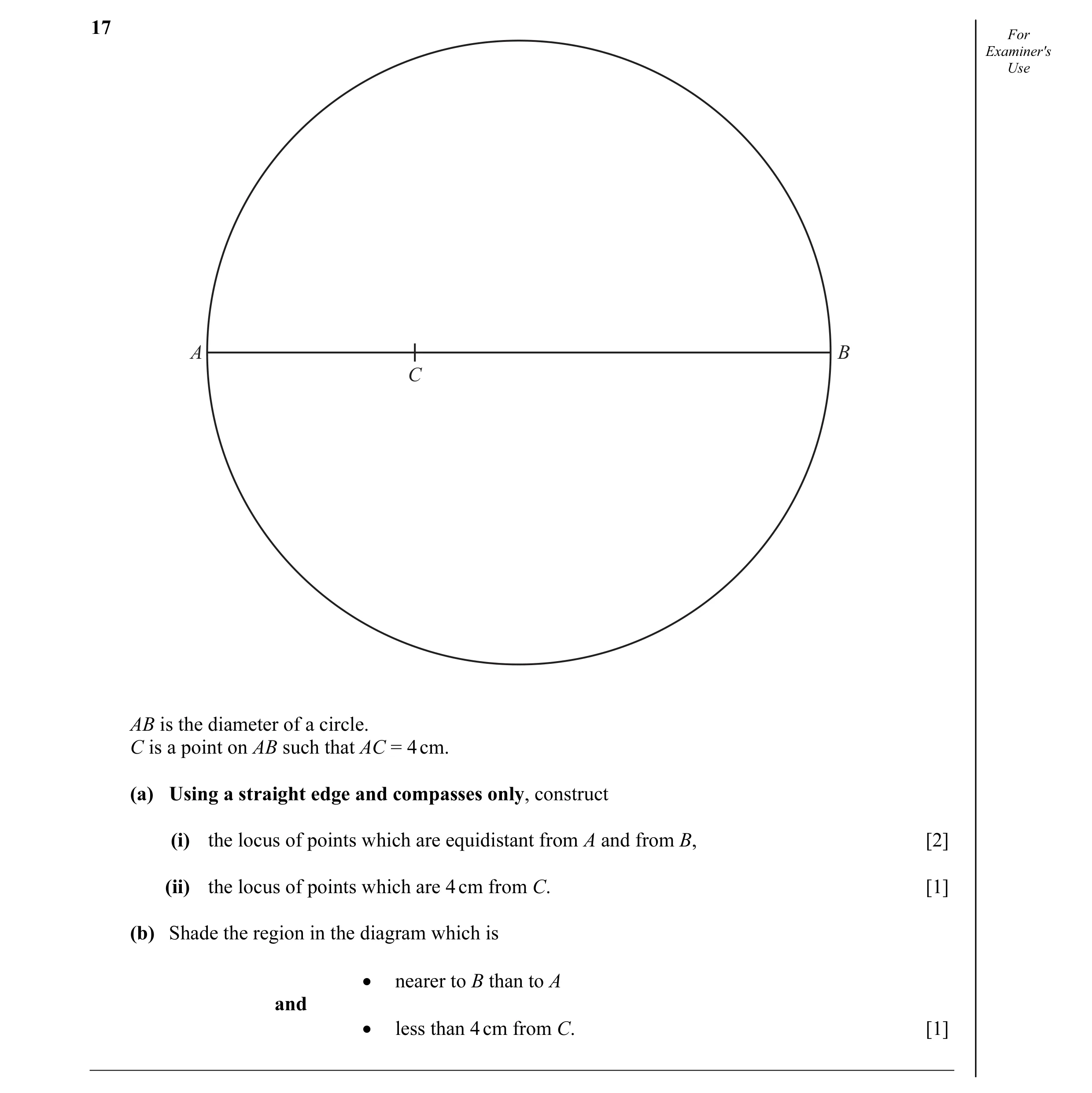
Q7 · For Examiner's Use A B C AB is the diameter of a circle 0580/11 Oct/Nov 2012
17 For Examiner's Use A B C AB is the diameter of a circle. C is a point on AB such that AC = 4 cm. (a) Using a straight edge and compasses only, construct (i) the locus of points which are equidistant from A and from B, [2] (ii) the locus of points which are 4 cm from C. [1] (b) Shade the region in the diagram which is • nearer to B than to A and • less than 4 cm from C. [1]
4 marks
Mark scheme: 17 (a) 2 B1 for correct line, on each side of AB (longer than dash at C) B1 for 2 pairs of intersecting arcs R 1 Intention to draw a full correct circle (b) 1 R shaded must be a closed region
This question in 0580/11 Oct/Nov 2012
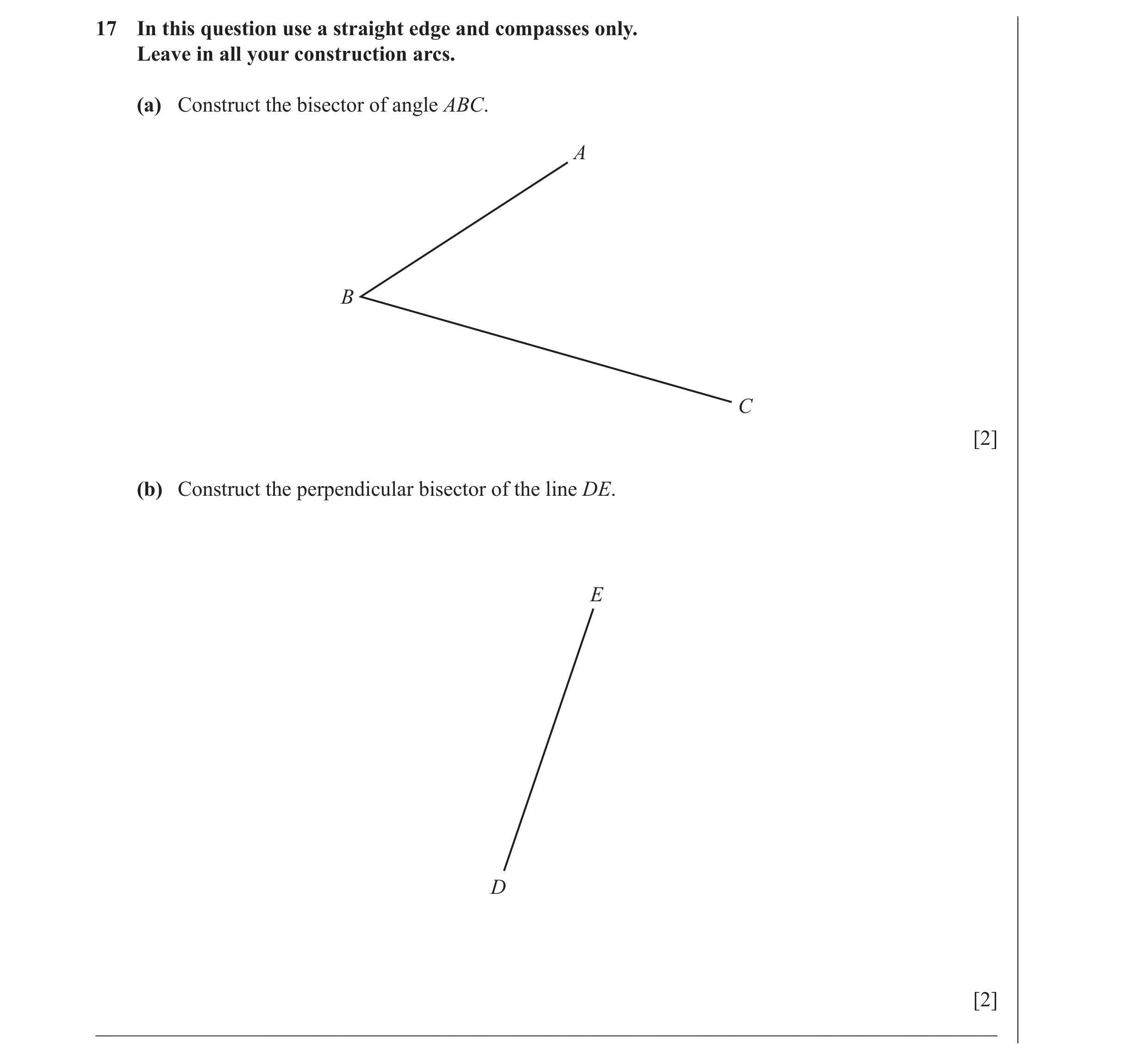
Q8 · In this question use a straight edge and compasses only 0580/11 May/June 2013
17 In this question use a straight edge and compasses only. Leave in all your construction arcs. (a) Construct the bisector of angle ABC. A B C [2] (b) Construct the perpendicular bisector of the line DE. E D [2] _____________________________________________________________________________________
4 marks
Mark scheme: 17 (a) correct ruled line 1 two pairs of correct arcs 1 (b) correct ruled line 1 two pairs of correct arcs 1 2 2
This question in 0580/11 May/June 2013
Q9 · For Examiner′s Use A P B C (a) On the diagram above, draw a line perpendicular to the… 0580/11 Oct/Nov 2013
18 For Examiner′s Use A P B C (a) On the diagram above, draw a line perpendicular to the line AB, through the point P. [1] (b) Using a straight edge and compasses only, construct the locus of points that are equidistant from A and from C. [2] _____________________________________________________________________________________
3 marks
Mark scheme: 18 (a) Ruled perpendicular line 1 ± 2° through P (b) Correct ruled line drawn 2 B1 for correct line without correct arcs with 2 correct sets of arcs or for 2 sets of correct arcs with no line h M1 f i 56 b tt
This question in 0580/11 Oct/Nov 2013
Q10 · Use a straight edge and compasses only for the constructions in parts (a) and (b) 0580/12 Oct/Nov 2013
21 Use a straight edge and compasses only for the constructions in parts (a) and (b). For Examiner′s Leave in all your construction arcs. Use B A C (a) Construct the bisector of angle ABC. [2] (b) Construct the perpendicular bisector of AB. [2] (c) Shade the region inside triangle ABC containing points that are ● less than 7 cm from C and ● closer to A than to B. [2] _____________________________________________________________________________________
6 marks
Mark scheme: 21 (a) Angle bisector with correct arcs 2 B1 for correct line, with incorrect or no arcs or correct arcs with incorrect or no line (b) Perpendicular bisector with two 2 B1 for correct line, with incorrect or no arcs or correct pairs of arcs correct arcs with incorrect or no line (c) Arc centre C, radius 7cm 1 Correct region shaded 1FT FT their arc centre C
This question in 0580/12 Oct/Nov 2013
Q11 · For Examiner′s Use A (a) Construct the locus of all the points which are 3 cm from vertex… 0580/13 Oct/Nov 2013
20 For Examiner′s Use A (a) Construct the locus of all the points which are 3 cm from vertex A and outside the rectangle. [2] (b) Construct, using a straight edge and compasses only, one of the lines of symmetry of the rectangle. [2] _____________________________________________________________________________________
4 marks
Mark scheme: 20 (a) Circle, radius 3 cm, centre A, not inside the 2 M1 for arc or full circle centre rectangle A radius 3 cm or for an incorrect size circle at A outside rectangle (b) One line of symmetry with correct arcs E.g. 2 B1 for correct ruled line (must reach or cross two sides) B1 for 2 pairs of correct intersecting arcs IGCSE – October/November 2013 0580 13
This question in 0580/13 Oct/Nov 2013
Q12 · Using a straight edge and compasses only, construct the perpendicular bisector of AB 0580/13 May/June 2014
17 Using a straight edge and compasses only, construct the perpendicular bisector of AB. All construction arcs must be clearly shown. A B [2] __________________________________________________________________________________________
2 marks
Mark scheme: 17 Perpendicular bisector with 2 pairs of correct arcs. 2 B1 for correct line or B1 for 2 pairs of correct arcs 7
This question in 0580/13 May/June 2014
Q13 · The diagram shows the plan, ABCD, of a park 0580/12 Oct/Nov 2014
20 The diagram shows the plan, ABCD, of a park. The scale is 1 centimetre represents 20 metres. D C A B Scale: 1 cm to 20 m (a) Find the actual distance BC. Answer(a) … m [2] (b) A fountain, F, is to be placed ● 160 m from C and ● equidistant from AB and AD. On the diagram, using a ruler and compasses only, construct and mark the position of F. Leave in all your construction lines. [5] __________________________________________________________________________________________
7 marks
Mark scheme: 20 (a) 102 to 106 2 B1 for 5.1 to 5.3 seen (b) Correct position of F with 5 B2 for Correct ruled angle bisector of A with correct correct arcs for angle bisector arcs or B1 for correct bisector with no/wrong arcs and B2 for Arc centre C, radius 8 cm or B1 for arc centre C with incorrect radius or correct conversion to 8 cm and B1 for marking position of F on their bisector and 8 cm from C or their arc centre C
This question in 0580/12 Oct/Nov 2014
Q14 · Using a ruler and compasses only, construct a triangle with sides 5 cm, 6 cm and 7 cm 0580/11 May/June 2015
6 Using a ruler and compasses only, construct a triangle with sides 5 cm, 6 cm and 7 cm. The 5 cm side has been drawn for you. [2] __________________________________________________________________________________________
2 marks
Mark scheme: 6 Correct triangle 2 M1 for a triangle with one other side correct with correct pair of arcs or for correct pair of arcs
This question in 0580/11 May/June 2015
Q15 · In this question use a ruler and compasses 0580/11 May/June 2015
19 In this question use a ruler and compasses. A B D C Shade the region inside rectangle ABCD that is • more than 2 cm from AD and • more than 4 cm from B. [3] __________________________________________________________________________________________
3 marks
Mark scheme: 19 correct shaded region 3 B1 for ruled line 2cm from and parallel to AD and B1 for arc centre B, radius 4cm and B1 for correct shaded region between their vertical line and their arc centre B
This question in 0580/11 May/June 2015
Q16 · Construct a triangle with sides of length 55 mm, 68 mm and 85 mm 0580/12 Oct/Nov 2015
15 Construct a triangle with sides of length 55 mm, 68 mm and 85 mm. The 85 mm side has been drawn for you. [2]
2 marks
Mark scheme: 15 correct triangle with correct arcs 2 B1 for correct triangle without arcs or 1 correct side with arcs
This question in 0580/12 Oct/Nov 2015
Q17 · In this question use a ruler and compasses only and show all your construction arcs 0580/13 Oct/Nov 2015
14 In this question use a ruler and compasses only and show all your construction arcs. Using a scale of 1 centimetre to represent 50 metres, construct a triangle with sides 550 m, 450 m and 300 m. The 300 m side has been drawn for you. [2] __________________________________________________________________________________________
2 marks
Mark scheme: 14 Correct triangle with correct 2 B1 for correct triangle without arcs or 1 correct side arcs with arcs
This question in 0580/13 Oct/Nov 2015
Q18 · Using a straight edge and compasses only, construct the bisector of angle ABC 0580/11 May/June 2016
19 (a) Using a straight edge and compasses only, construct the bisector of angle ABC. A B C [2] (b) Using a straight edge and compasses only, construct the perpendicular bisector of the line DE. D E [2]
4 marks
Mark scheme: 19 (a) Correct ruled angle bisector with all 2 M1 for accurate angle bisector with no / wrong correct arcs arcs or for all correct arcs with no / wrong line (b) Correct ruled perpendicular bisector 2 M1 for accurate bisector with no / wrong arcs with two pairs of correct arcs or for two pairs of correct intersecting arcs with no / wrong line
This question in 0580/11 May/June 2016
Q19 · The diagram shows triangle ABC 0580/12 May/June 2016
20 The diagram shows triangle ABC. A C B (a) Using a straight edge and compasses only, construct the bisector of angle ABC. [2] (b) Draw the locus of points inside the triangle that are 3 cm from AC. [1]
3 marks
Mark scheme: 20 (a) Bisector of angle B accurate with 2 B1 for accurate line with no/wrong arcs two pairs of correct arcs or for correct arcs with no/wrong line (b) Ruled line parallel to AC at a 1 distance of 3 cm to AC only inside the triangle
This question in 0580/12 May/June 2016
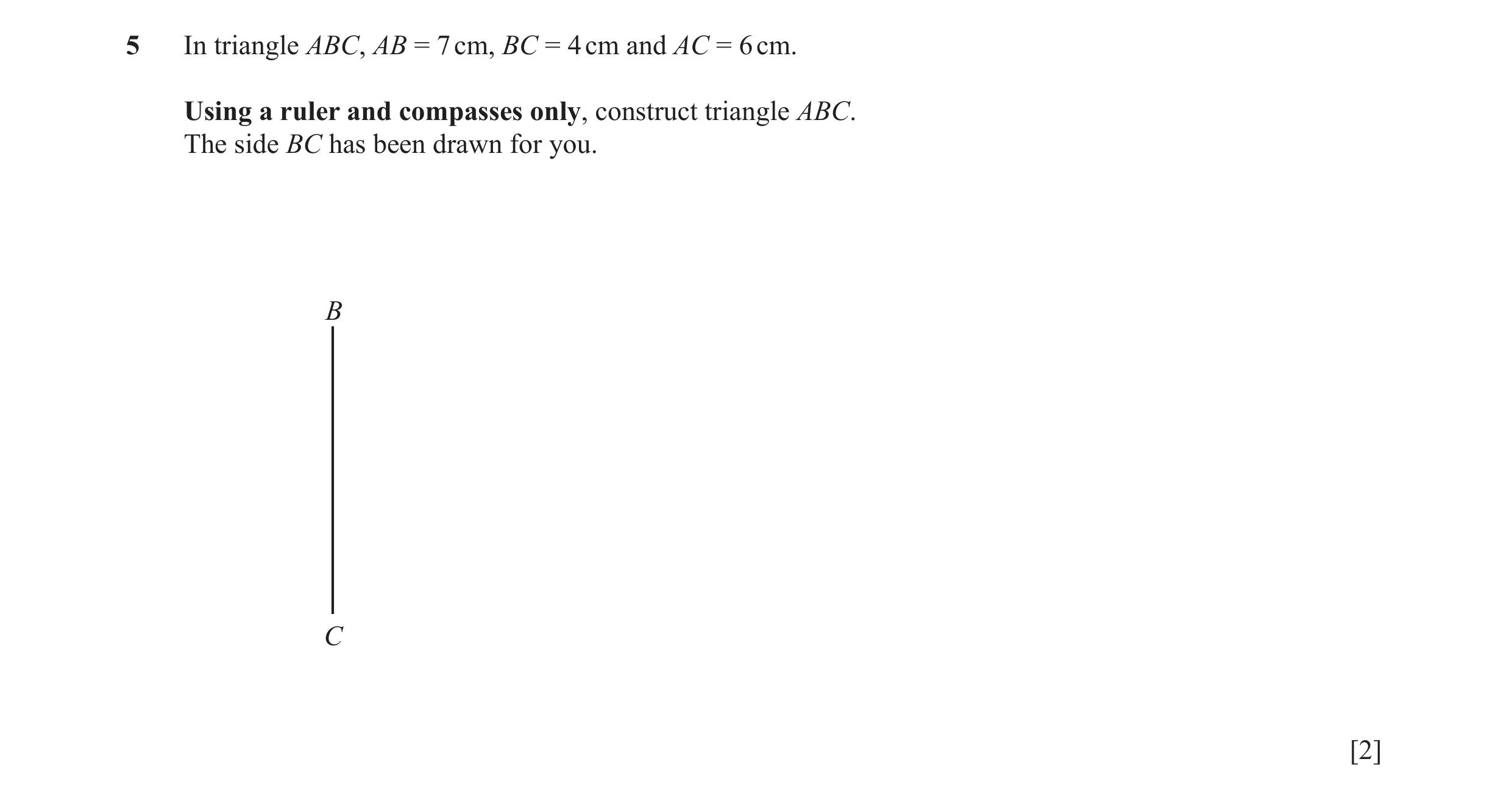
Q20 · In triangle ABC, AB = 7 cm, BC = 4 cm and AC = 6 cm 0580/11 Oct/Nov 2016
5 In triangle ABC, AB = 7 cm, BC = 4 cm and AC = 6 cm. Using a ruler and compasses only, construct triangle ABC. The side BC has been drawn for you. B C [2]
2 marks
Mark scheme: 5 Fully correct triangle 2 B1 for correct triangle without arcs with correct arcs or for correct position of arcs If zero scored, SC1 for fully correct reversed triangle with arcs ie AB = 6 cm and AC = 7 cm or for triangle with only one of AB or AC correct length with suitable arcs 18 7
This question in 0580/11 Oct/Nov 2016
Q21 · The angle in a semi-circle is 90° 0580/12 Feb/March 2017
16 (a) The angle in a semi-circle is 90°. Use the circle drawn below, with its centre marked, to show this. [1] (b) The line AB is one side of an equilateral triangle ABC. Using a straight edge and compasses only, construct triangle ABC. A B [2]
3 marks
Mark scheme: 16 (a) Angle in semi-circle drawn with 1 diameter through centre (b) Equilateral triangle with correct 2 M1 for clear evidence of constructed 60° angles arcs. or arcs crossing equal in length to AB or an accurate diagram with no/incorrect arcs 10 5
This question in 0580/12 Feb/March 2017
Q22 · B C A The diagram shows the positions of three points, A, B and C 0580/11 May/June 2017
23 B C A The diagram shows the positions of three points, A, B and C. (a) Using a ruler and compasses only, construct (i) the perpendicular bisector of the line AB, [2] (ii) the locus of all points that are 3 cm from C. [2] (b) Shade the region that is • closer to A than to B and • less than 3 cm from C. [1]
5 marks
Mark scheme: 23(a)(i) Correct ruled bisector of AB with 2 pairs of arcs 2 B1 for correct bisector with no or incorrect arcs or 2 pairs of correct arcs 23(a)(ii) Complete circle, 2 B1 for an arc of correct radius or a circle radius 3 cm, centre C of incorrect radius 23(b) Correct region shaded 1 dep on at least B1 in both parts
This question in 0580/11 May/June 2017
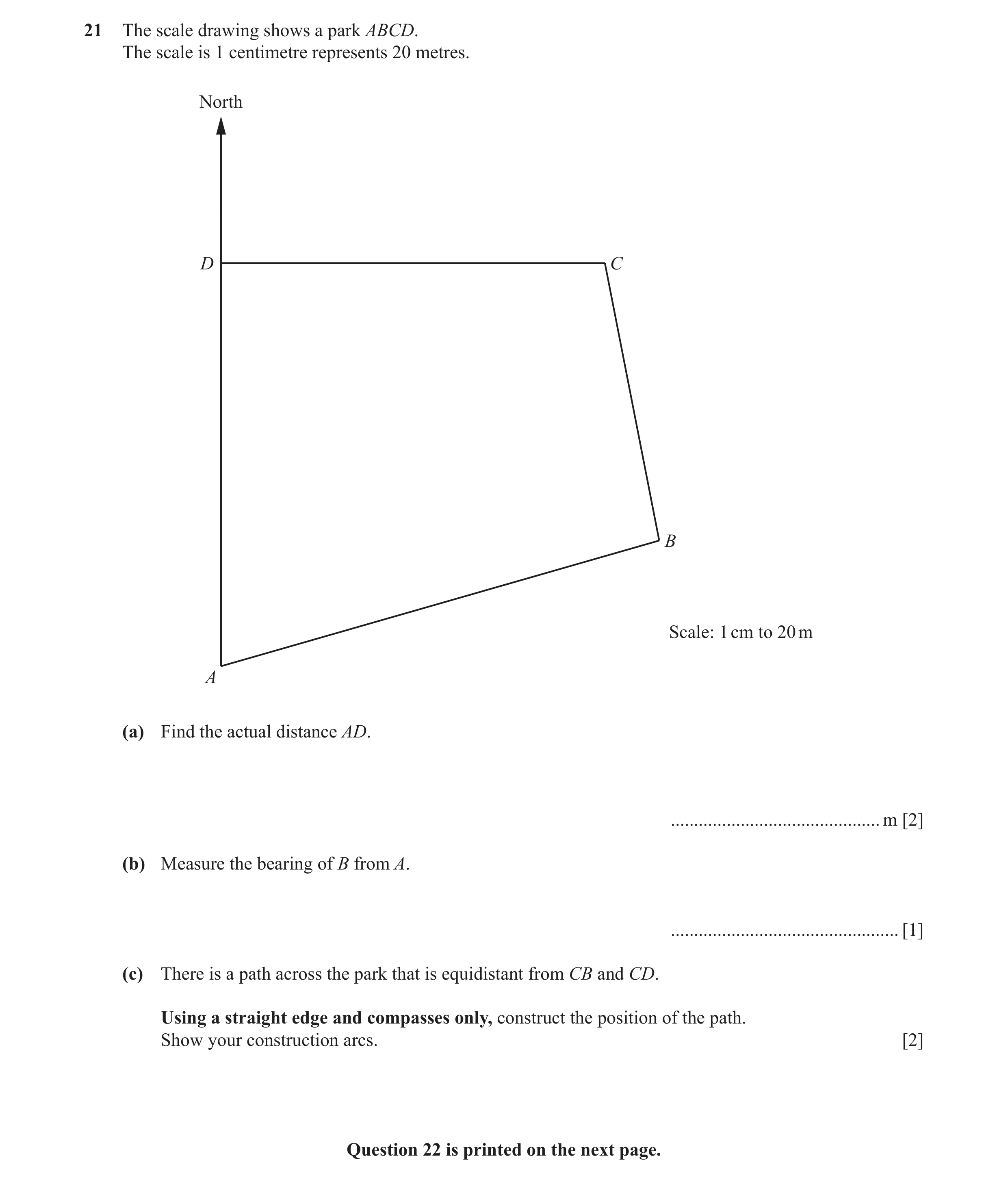
Q23 · The scale drawing shows a park ABCD 0580/13 Oct/Nov 2017
21 The scale drawing shows a park ABCD. The scale is 1 centimetre represents 20 metres. North D C B Scale: 1 cm to 20 m A (a) Find the actual distance AD. … m [2] (b) Measure the bearing of B from A. … [1] (c) There is a path across the park that is equidistant from CB and CD. Using a straight edge and compasses only, construct the position of the path. Show your construction arcs. [2] Question 22 is printed on the next page.
5 marks
Mark scheme: 21(a) 168 2 B1 for 8.4 seen 21(b) [0]74 1 21(c) Correct angle bisector with correct arcs 2 B1 for correct bisector with wrong / no arcs meeting AB
This question in 0580/13 Oct/Nov 2017
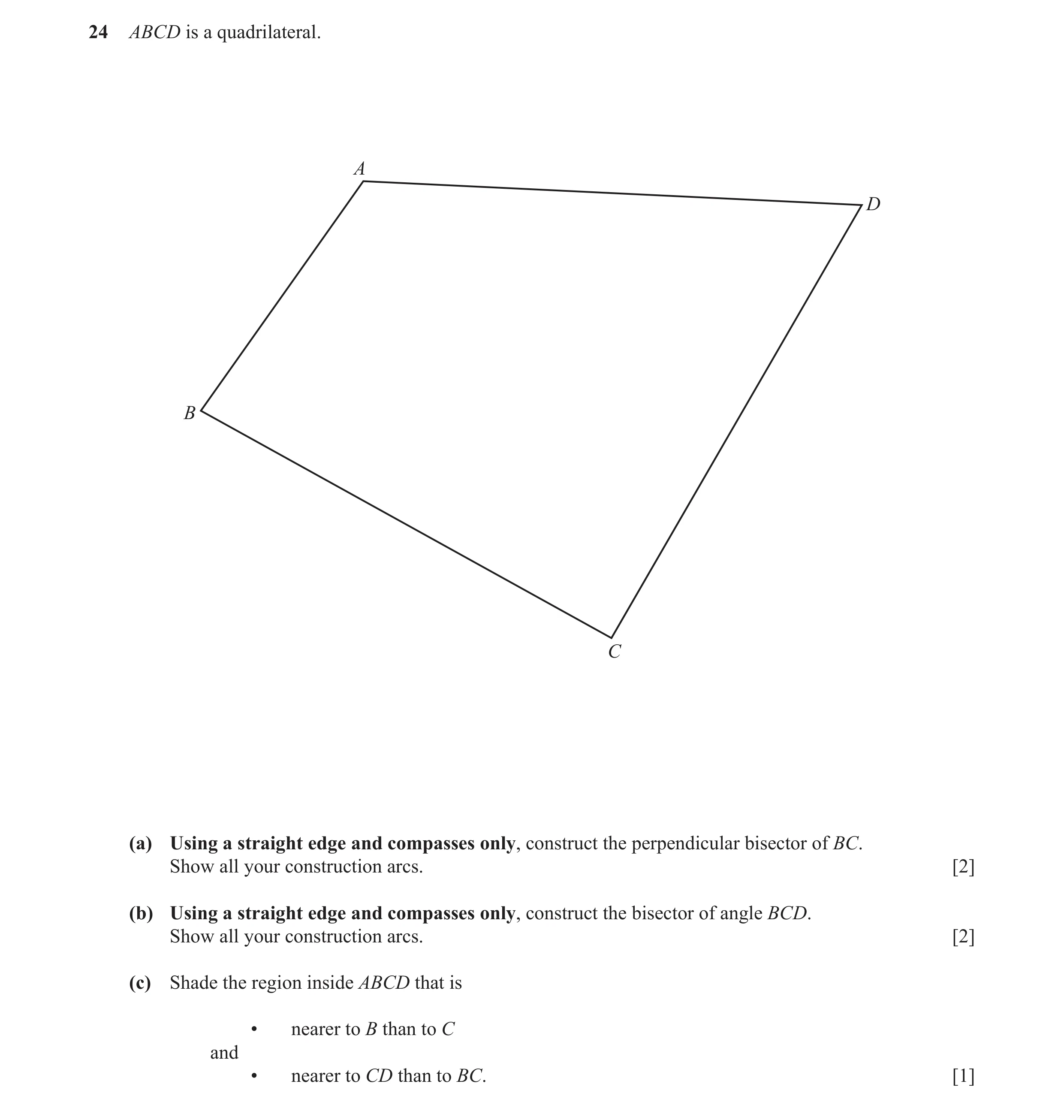
Q24 · ABCD is a quadrilateral 0580/13 May/June 2018
24 ABCD is a quadrilateral. A D B C (a) Using a straight edge and compasses only, construct the perpendicular bisector of BC. Show all your construction arcs. [2] (b) Using a straight edge and compasses only, construct the bisector of angle BCD. Show all your construction arcs. [2] (c) Shade the region inside ABCD that is • nearer to B than to C and • nearer to CD than to BC. [1]
5 marks
Mark scheme: 24(a) correct perpendicular bisector with 2 B1 for correct perpendicular bisector correct arcs without any arcs or with incorrect arcs 24(b) correct angle bisector with correct arcs 2 B1 for correct angle bisector without any arcs or with incorrect arcs 24(c) correct region shaded 1 Dep on B1, B1
This question in 0580/13 May/June 2018
Q25 · The diagram shows a pentagon ABCDE 0580/12 Oct/Nov 2018
18 The diagram shows a pentagon ABCDE. A E B D C (a) Using a straight edge and compasses only, construct the bisector of angle BCD. [2] (b) Draw the locus of the points inside the pentagon that are 3 cm from E. [1] (c) Shade the region inside the pentagon that is • less than 3 cm from E and • nearer to DC than to BC. [1]
4 marks
Mark scheme: 18(a) Correct ruled bisector with two pairs of 2 B1 for correct ruled bisector with arcs no/wrong arcs 18(b) Correct arc centre E radius 3 cm inside 1 pentagon 18(c) Correct region shaded 1 Dependent on at least B1 in part (a) and 1 mark in part (b) and a closed region
This question in 0580/12 Oct/Nov 2018
Q26 · B A C (a) (i) Using a straight edge and compasses only, construct the perpendicular… 0580/12 May/June 2019
24 B A C (a) (i) Using a straight edge and compasses only, construct the perpendicular bisector of AB. Show all your construction arcs. [2] (ii) Using a ruler and compasses only, construct the locus of points inside the triangle that are 4 cm from C. [1] (b) Shade the region inside the triangle that is • more than 4 cm from C and • closer to B than to A. [1]
4 marks
Mark scheme: 24(a)(i) Ruled bisector of AB with 2 pairs of 2 M1 for 2 pairs of correct arcs correct arcs or B1 for correct ruled bisector with incomplete or no arcs 24(a)(ii) Arc centre C radius 4 cm 1 24(b) Closed region shaded 1
This question in 0580/12 May/June 2019
Q27 · The diagram shows the base of a triangle 0580/11 Oct/Nov 2019
8 The diagram shows the base of a triangle. The lengths of the other two sides are 6 cm and 4 cm. Using a ruler and compasses only, construct the other two sides of the triangle. Show all your construction arcs. [2]
2 marks
Mark scheme: 8 Correct triangle with sides 6 cm and 4 cm 2 B1 for correct triangle with no or and correct arcs incorrect arcs or correct arcs with no or inaccurate sides drawn
This question in 0580/11 Oct/Nov 2019
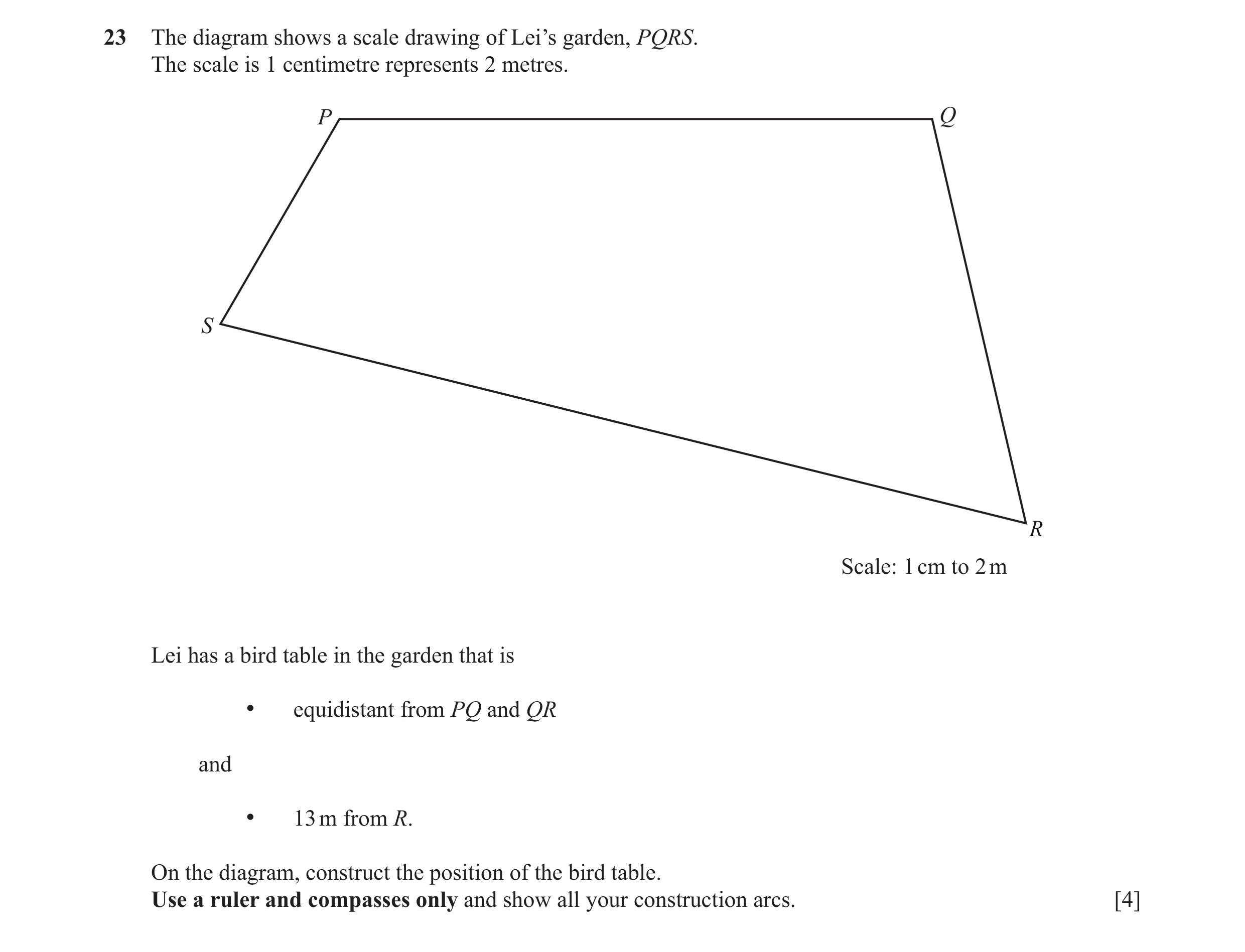
Q28 · The diagram shows a scale drawing of Lei’s garden, PQRS 0580/12 Oct/Nov 2019
23 The diagram shows a scale drawing of Lei’s garden, PQRS. The scale is 1 centimetre represents 2 metres. P Q S R Scale: 1 cm to 2 m Lei has a bird table in the garden that is • equidistant from PQ and QR and • 13 m from R. On the diagram, construct the position of the bird table. Use a ruler and compasses only and show all your construction arcs. [4]
4 marks
Mark scheme: 23 Bisector of angle Q accurate with two 4 M2 for bisector of angle Q accurate with pairs of correct arcs two pairs of correct arcs or M1 for accurate bisector with no/wrong and arcs Arc centre R, radius 6.5 cm M2 for arc centre R, radius 6.5 cm or M1 for arc centre R With bird table correctly indicated or implied by correct intersecting Maximum 3 marks if constructions incorrect position/region is labelled, or there is no label and a region is shaded, or their constructions do not intersect
This question in 0580/12 Oct/Nov 2019
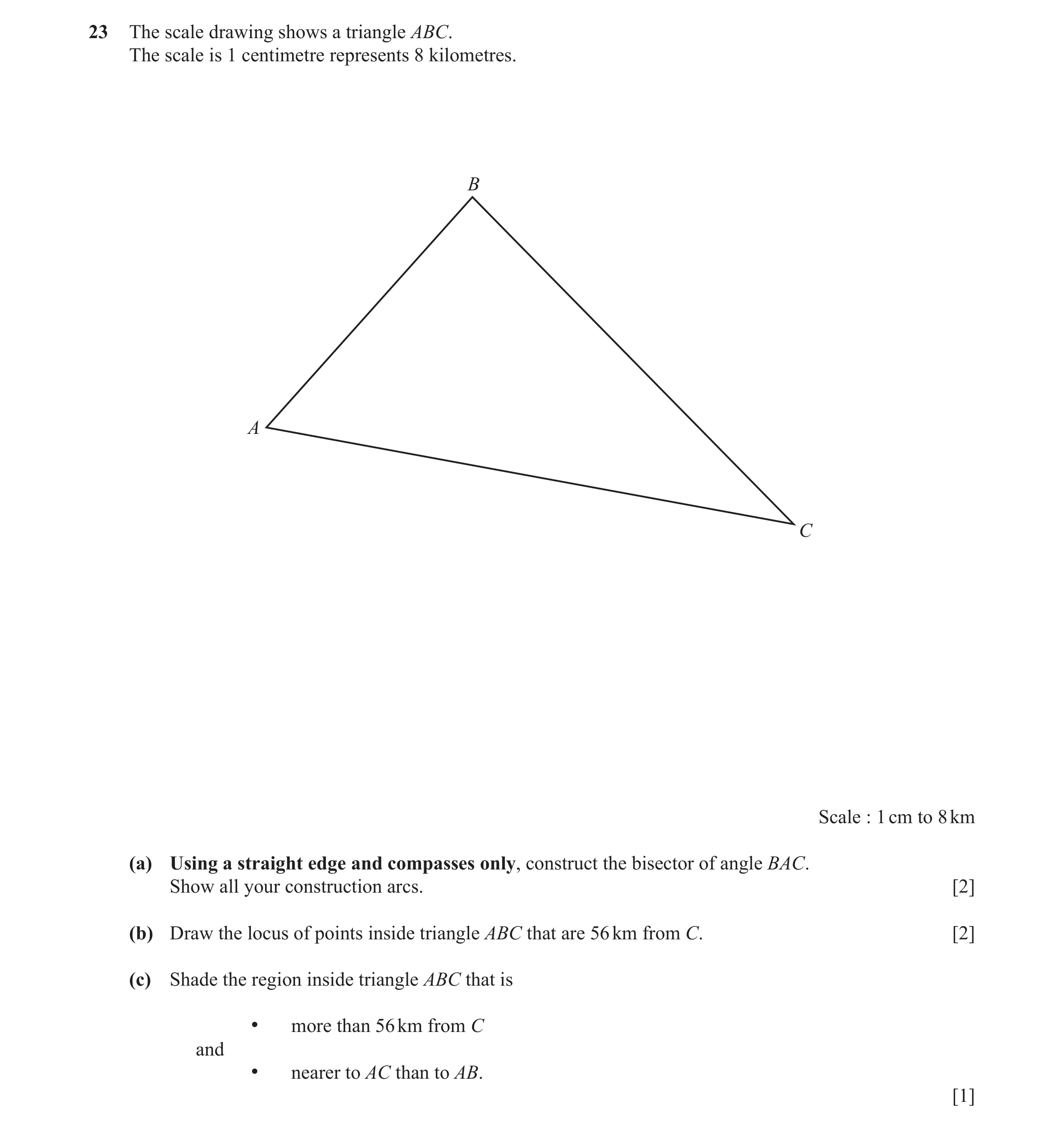
Q29 · The scale drawing shows a triangle ABC 0580/13 Oct/Nov 2019
23 The scale drawing shows a triangle ABC. The scale is 1 centimetre represents 8 kilometres. B A C Scale : 1 cm to 8 km (a) Using a straight edge and compasses only, construct the bisector of angle BAC. Show all your construction arcs. [2] (b) Draw the locus of points inside triangle ABC that are 56 km from C. [2] (c) Shade the region inside triangle ABC that is • more than 56 km from C and • nearer to AC than to AB. [1]
5 marks
Mark scheme: 23(a) correct line with two correct pairs 2 B1 for correct line with no or incorrect arcs of correct arcs 23(b) arc centre C radius 7 cm and from 2 B1 for any arc centre C from AC to BC or arc AC to BC radius 7 cm from C not reaching AC and/or BC 23(c) correct region shaded 1 Dep on at least B1 B1
This question in 0580/13 Oct/Nov 2019
Q30 · In triangle ABC, BC = 7.6 cm and AC = 6.2 cm 0580/13 Oct/Nov 2020
6 In triangle ABC, BC = 7.6 cm and AC = 6.2 cm. Using a ruler and compasses only, construct triangle ABC. Leave in your construction arcs. The side AB has been drawn for you. A B [2]
2 marks
Mark scheme: 6 Accurate triangle with correct 2 B1 for accurate triangle with no/incorrect construction arcs arcs or SC1 for accurate triangle with arcs with sides interchanged
This question in 0580/13 Oct/Nov 2020
Q31 · P is a point on a line 0580/12 May/June 2021
3 P is a point on a line. P Draw a line through point P that is perpendicular to this line. [1]
1 marks
Mark scheme: 3 Ruled line at 90° to the given line 1 through or touching point P
This question in 0580/12 May/June 2021
Q32 · A rhombus has side length 6.5 cm 0580/12 May/June 2021
17 A rhombus has side length 6.5 cm. The rhombus can be constructed by drawing two triangles. Using a ruler and compasses only, construct the rhombus. Leave in your construction arcs. One diagonal of the rhombus has been drawn for you. [2]
2 marks
Mark scheme: 17 Accurate construction of rhombus with 2 B1 for accurate diagram with no/wrong sides 6.5 cm and correct construction arcs arcs or for one triangle (6.5 cm, 6.5 cm, 8 cm) correctly constructed with correct arcs or for four correct arcs
This question in 0580/12 May/June 2021
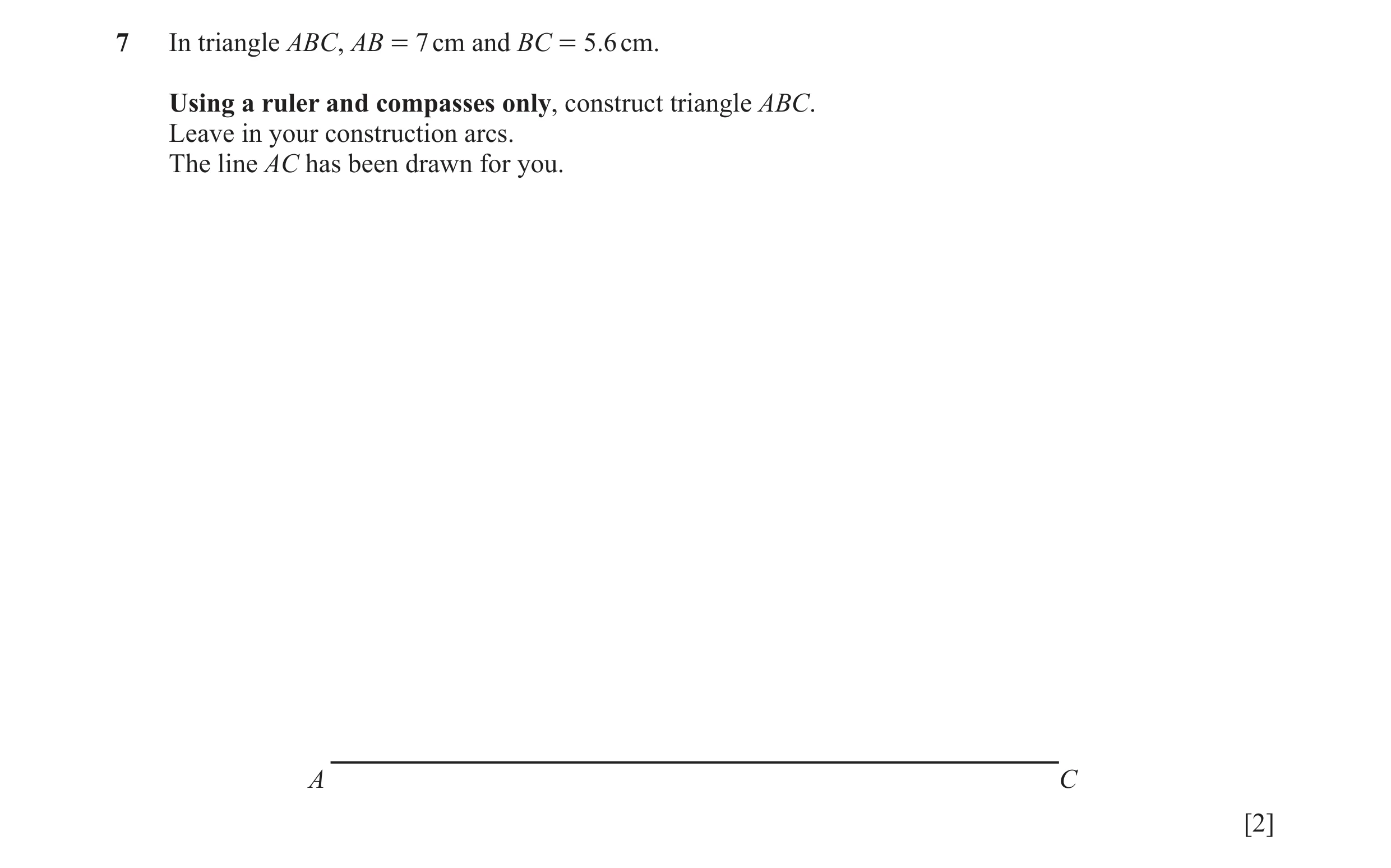
Q33 · In triangle ABC, AB = 7 cm and BC = 5.6 cm 0580/12 Oct/Nov 2021
7 In triangle ABC, AB = 7 cm and BC = 5.6 cm. Using a ruler and compasses only, construct triangle ABC. Leave in your construction arcs. The line AC has been drawn for you. A C [2]
2 marks
Mark scheme: 7 Accurate triangle with a correct pair of 2 B1 for correct triangle with no arcs or two arcs correct arcs If 0 scored, SC1 for triangle with correct arcs but lines interchanged
This question in 0580/12 Oct/Nov 2021
Q34 · Measure the marked angle 0580/12 Feb/March 2022
8 (a) Measure the marked angle. … [1] (b) NOT TO 9.5 cm 8 cm SCALE 12 cm Using a ruler and compasses only, construct this triangle. Leave in your construction arcs. The side of length 12 cm has been drawn for you. [2]
3 marks
Mark scheme: 8(a) 40° 1 8(b) Correct triangle with arcs 2 B1 for correct triangle with incorrect or no arcs or for two correct arcs or for a triangle with arcs but one side not in range
This question in 0580/12 Feb/March 2022
Q35 · Measure the length of this line in millimetres 0580/11 Oct/Nov 2022
3 (a) Measure the length of this line in millimetres. … mm [1] (b) Draw a line perpendicular to this line. [1]
2 marks
Mark scheme: 3(a) 77 1 3(b) Ruled perpendicular line 1 meeting the given line
This question in 0580/11 Oct/Nov 2022
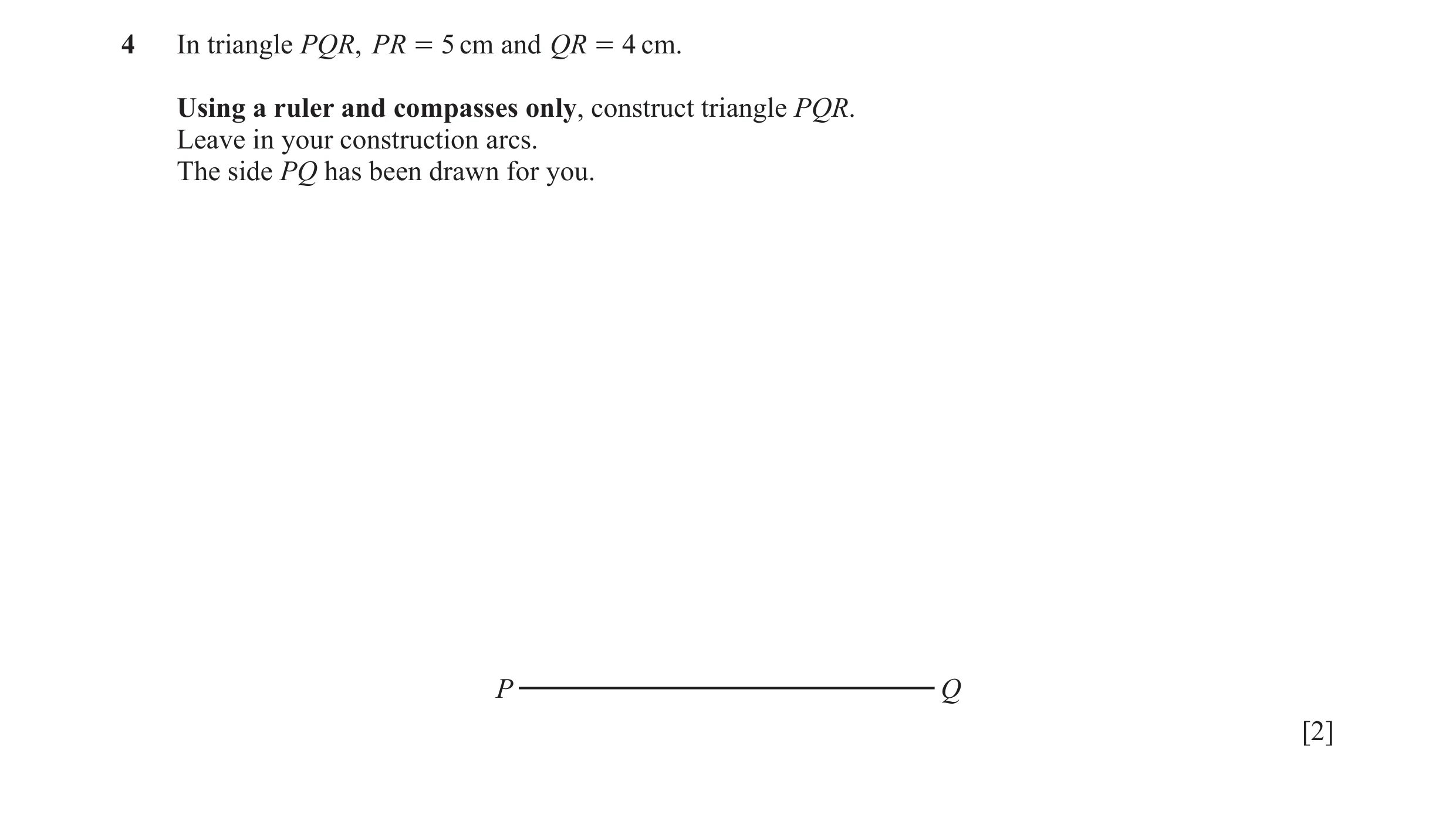
Q36 · In triangle PQR, PR = 5 cm and QR = 4 cm 0580/11 Oct/Nov 2022
4 In triangle PQR, PR = 5 cm and QR = 4 cm. Using a ruler and compasses only, construct triangle PQR. Leave in your construction arcs. The side PQ has been drawn for you. P Q [2]
2 marks
Mark scheme: 4 Correct triangle with correct arcs 2 B1 for correct triangle with no arcs or incorrect arcs or two correct arcs If 0 scored, SC1 for correct triangle and correct arcs but lines interchanged
This question in 0580/11 Oct/Nov 2022
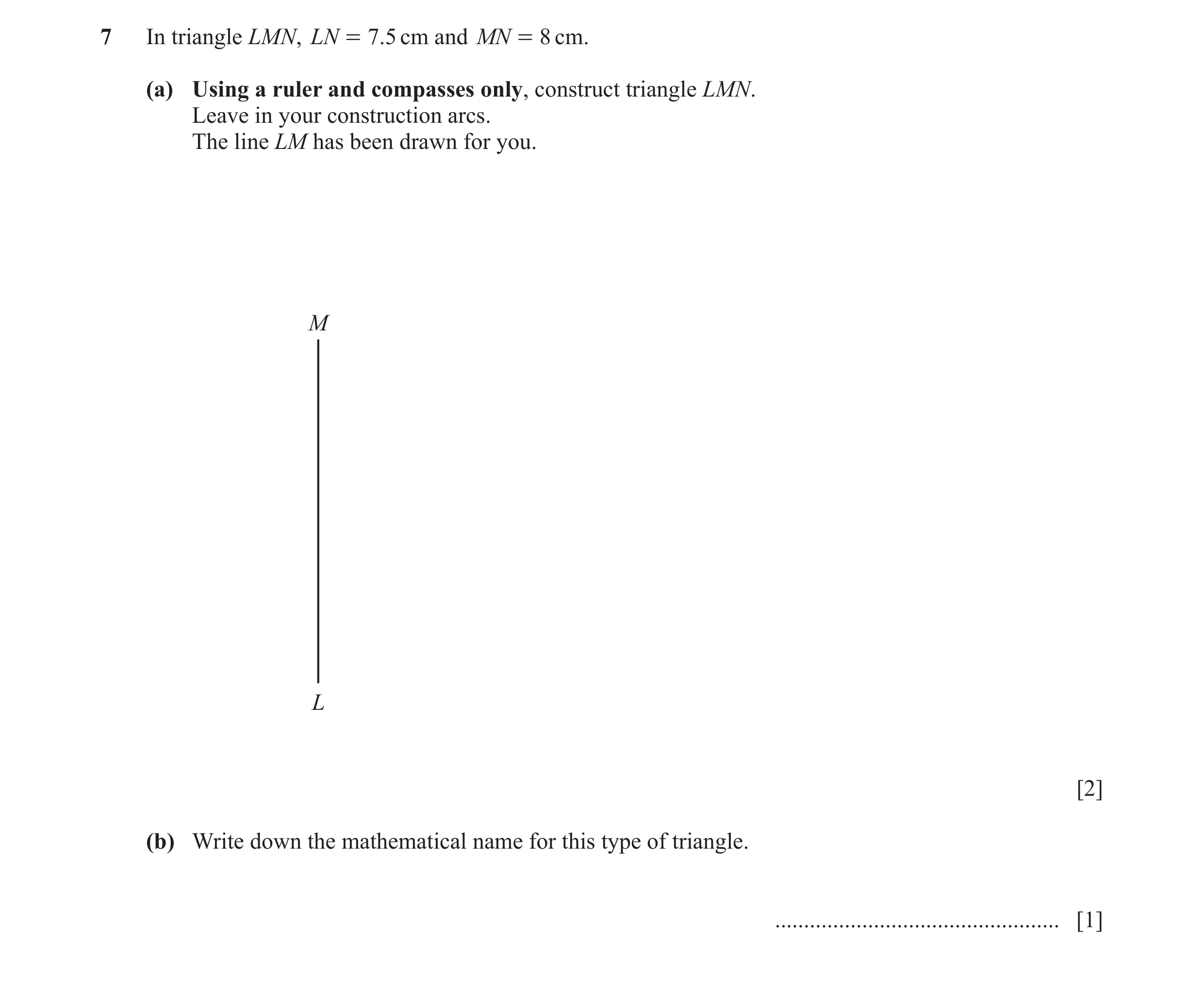
Q37 · In triangle LMN, LN = 7.5 cm and MN = 8 cm 0580/13 Oct/Nov 2023
7 In triangle LMN, LN = 7.5 cm and MN = 8 cm. (a) Using a ruler and compasses only, construct triangle LMN. Leave in your construction arcs. The line LM has been drawn for you. M L [2] (b) Write down the mathematical name for this type of triangle. … [1]
3 marks
Mark scheme: 7(a) Correct construction 2 B1 for accurate triangle with incorrect or no arcs or for 2 correct arcs If 0 scored, SC1 for accurate triangle with arcs but lines interchanged 7(b) Scalene 1
This question in 0580/13 Oct/Nov 2023
Q38 · Triangle ABC has sides AC = 4 .2 cm and BC = 5.6 cm 0580/12 Oct/Nov 2024
6 Triangle ABC has sides AC = 4 .2 cm and BC = 5.6 cm . Using a ruler and compasses only, construct triangle ABC. Leave in your construction arcs. The side AB has been drawn for you. A B [2]
2 marks
Mark scheme: 6 Correct triangle with construction arcs 2 B1 for correct triangle with incorrect or no arcs or for two correct arcs If 0 scored SC1 for triangle with arcs but lines interchanged
This question in 0580/12 Oct/Nov 2024
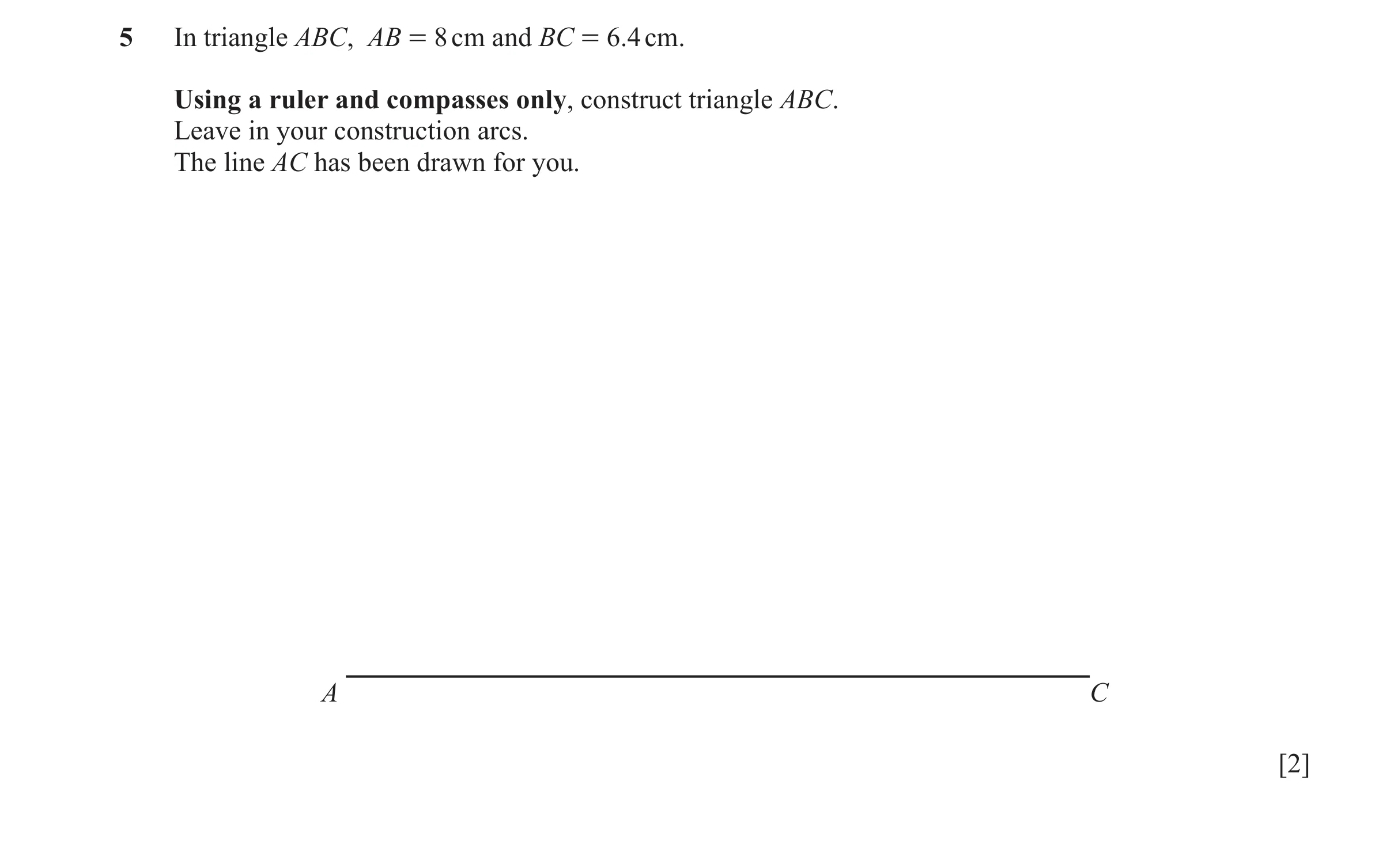
Q39 · In triangle ABC, AB = 8 cm and BC = 6.4 cm 0580/11 Oct/Nov 2025
5 In triangle ABC, AB = 8 cm and BC = 6.4 cm. Using a ruler and compasses only, construct triangle ABC. Leave in your construction arcs. The line AC has been drawn for you. A C [2]
2 marks
Mark scheme: 5 Accurate triangle with correct 2 B1 for correct triangle with incorrect or construction arcs no arcs or for two correct intersecting arcs with incorrect or no lines If 0 scored, SC1 for triangle with arcs but lines interchanged
This question in 0580/11 Oct/Nov 2025
 1 / 28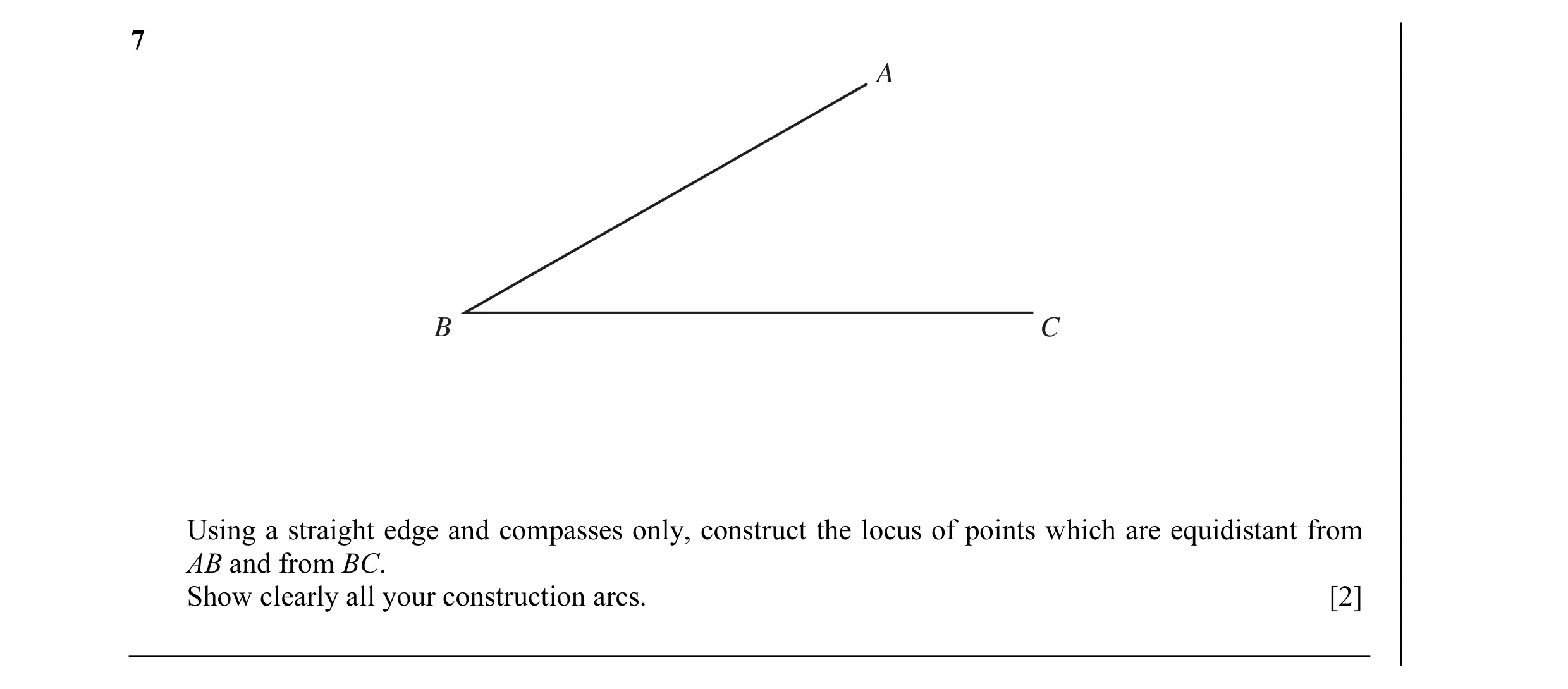
 2 / 28
![Question 5: For Examiner's Use C B A (a) On the diagram above, using a straight edge and compasses only, construct (i) the bisector of angle ABC, [2] (…](https://img.pastlit.com/crops/af4d2622-57aa-4d05-a618-217ad2746dd0/q18.webp) 3 / 28
3 / 28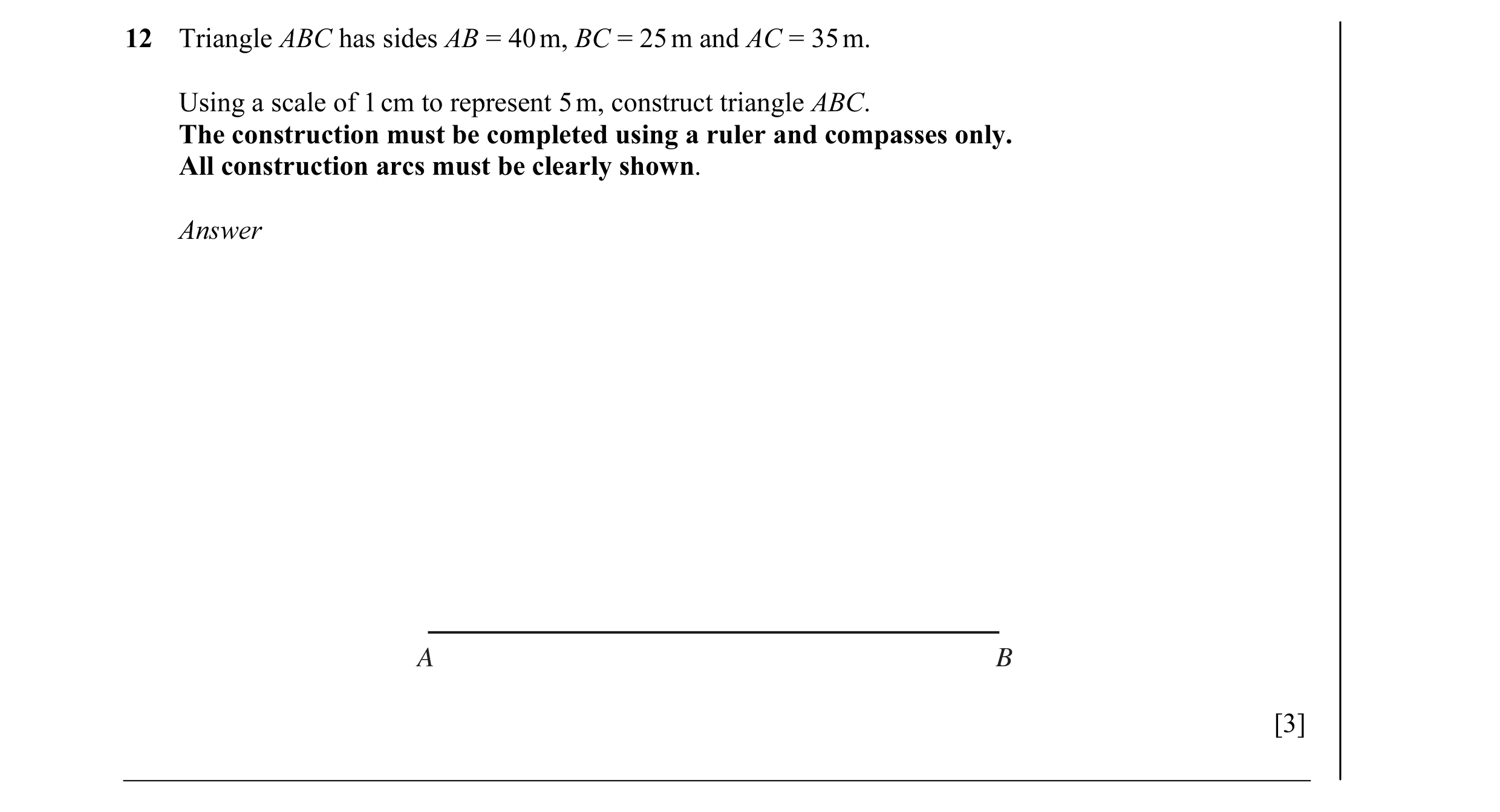 4 / 28
 5 / 28
 6 / 28
![Question 9: For Examiner′s Use A P B C (a) On the diagram above, draw a line perpendicular to the line AB, through the point P. [1] (b) Using a straigh…](https://img.pastlit.com/crops/8f8321ec-4bb3-4681-9369-66242019f1f6/q18.webp) 7 / 28
7 / 28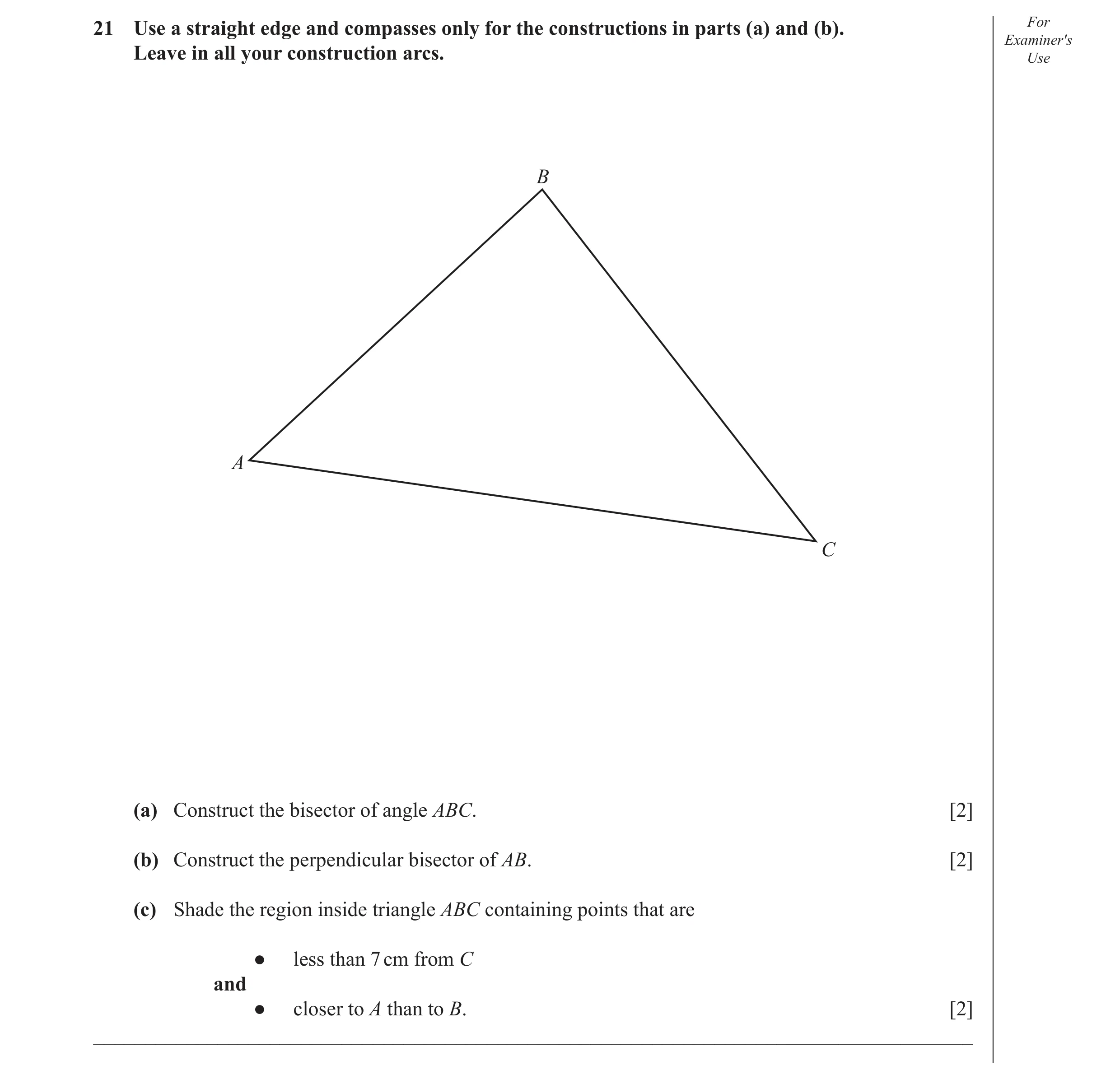 8 / 28
![Question 11: For Examiner′s Use A (a) Construct the locus of all the points which are 3 cm from vertex A and outside the rectangle. [2] (b) Construct, u…](https://img.pastlit.com/crops/f26b022c-1a77-4ee3-8ea0-88c17d81d06b/q20.webp)
![Question 12: Using a straight edge and compasses only, construct the perpendicular bisector of AB. All construction arcs must be clearly shown. A B [2] …](https://img.pastlit.com/crops/44750ab3-2c1d-411c-bdc0-74320fe5deae/q17.webp) 9 / 28
9 / 28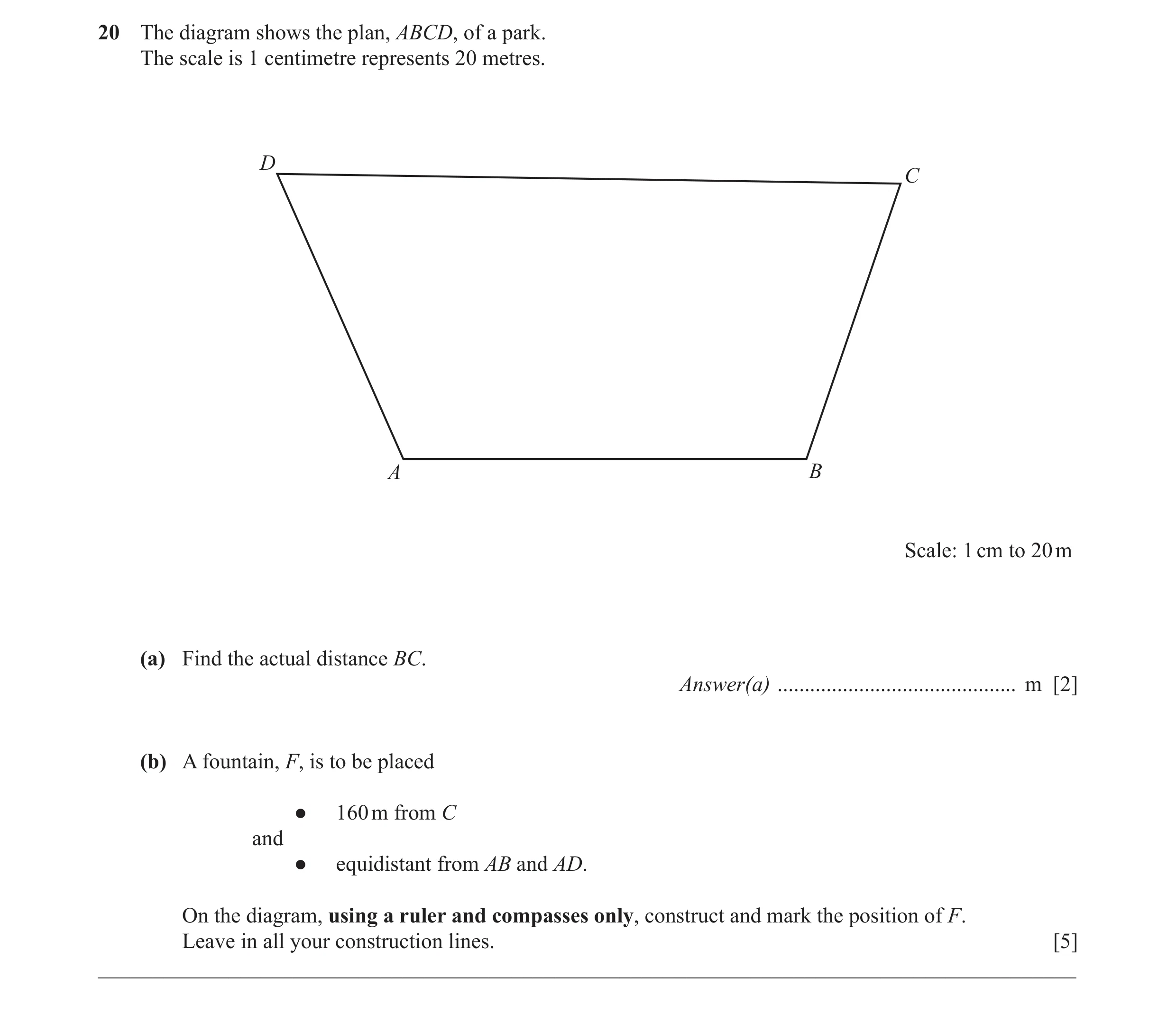
![Question 14: Using a ruler and compasses only, construct a triangle with sides 5 cm, 6 cm and 7 cm. The 5 cm side has been drawn for you. [2] __________…](https://img.pastlit.com/crops/edbcf8c1-0ee3-4027-bbbb-352bfb3554ce/q6.webp) 10 / 28
10 / 28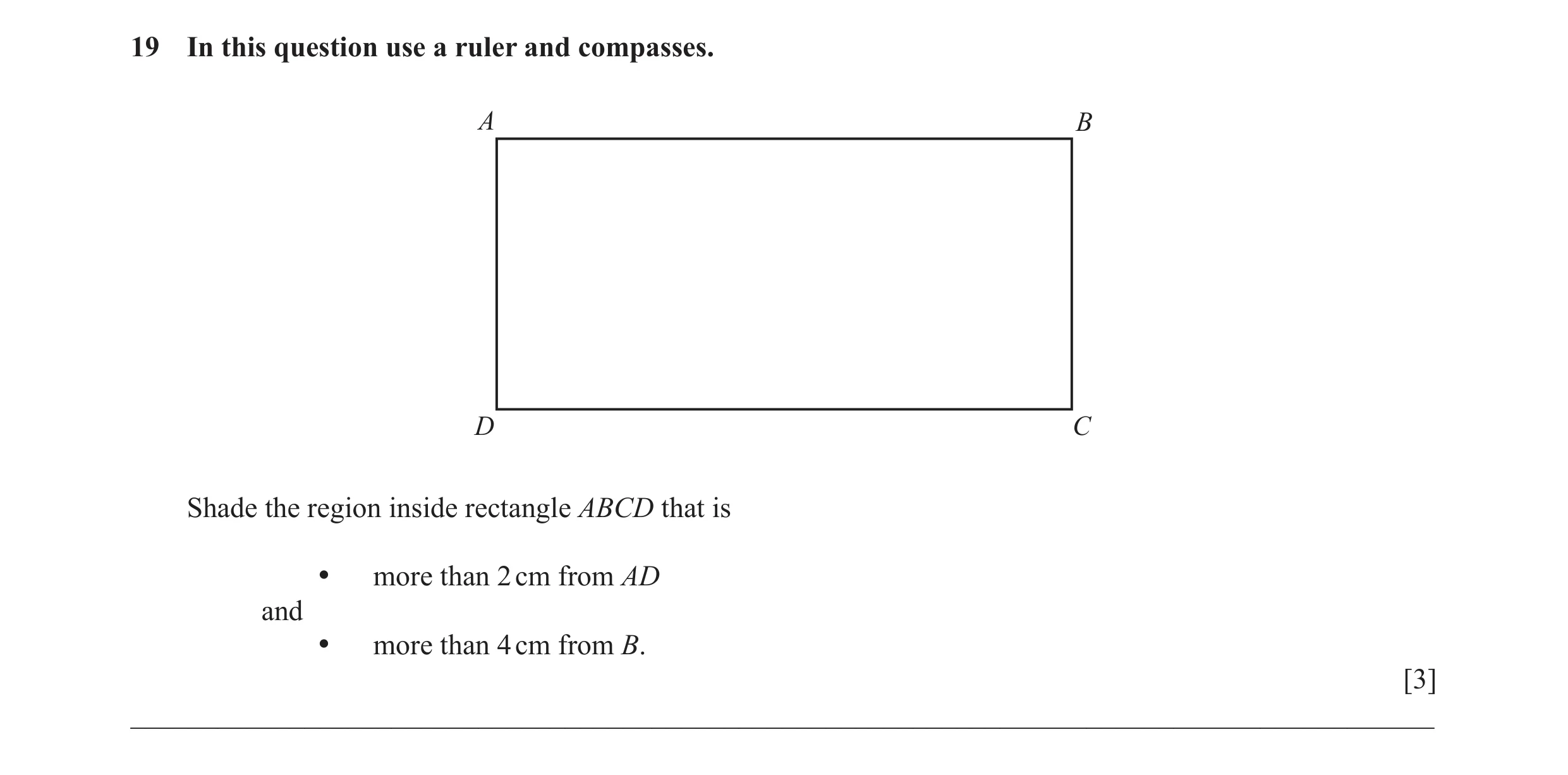
![Question 16: Construct a triangle with sides of length 55 mm, 68 mm and 85 mm. The 85 mm side has been drawn for you. [2]](https://img.pastlit.com/crops/94a0ff97-3161-41c1-a182-638f9d5b7fb2/q15.webp) 11 / 28
11 / 28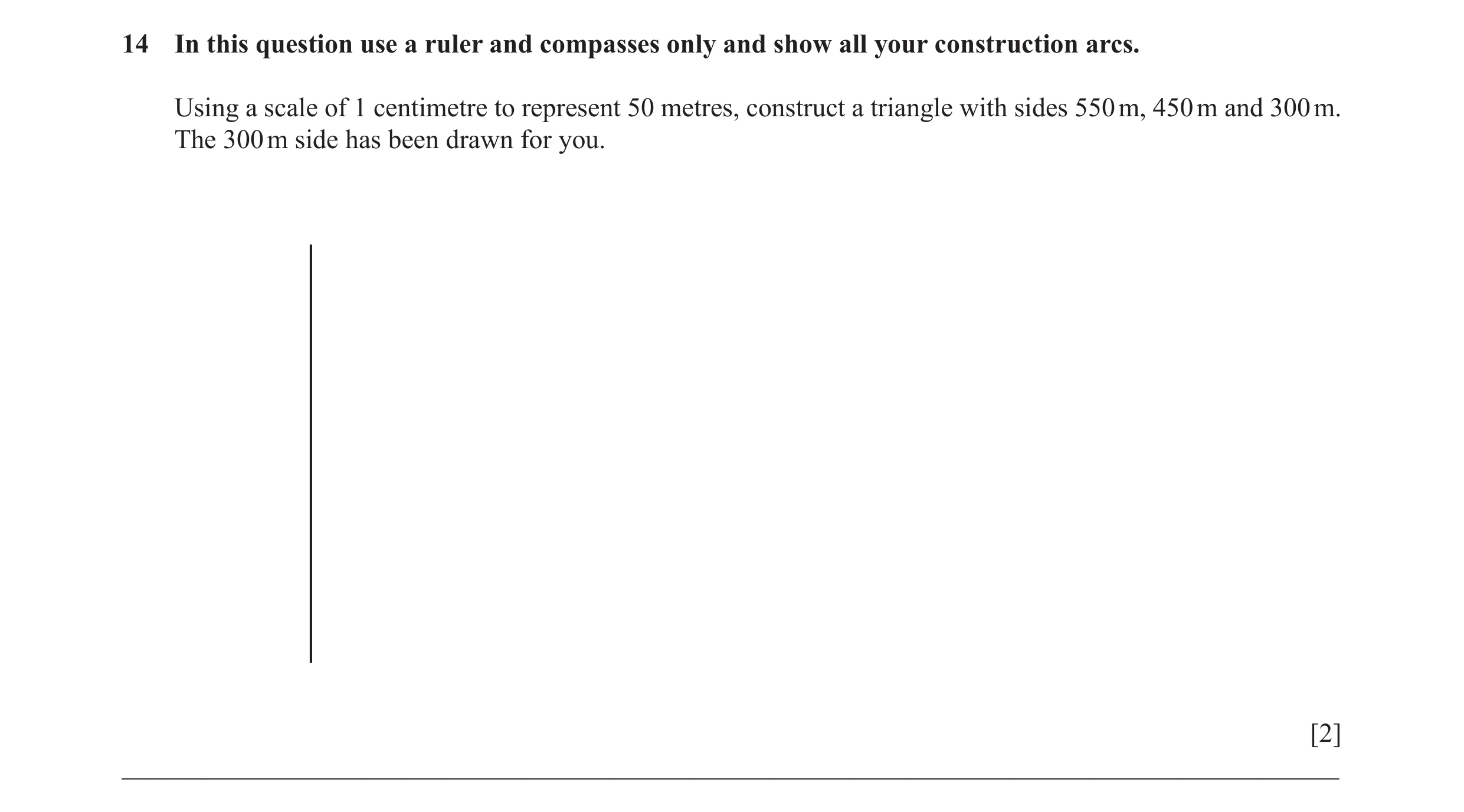 12 / 28
![Question 18: (a) Using a straight edge and compasses only, construct the bisector of angle ABC. A B C [2] (b) Using a straight edge and compasses only, …](https://img.pastlit.com/crops/91dfc33c-35e0-41c0-8710-5a2bb50d0586/q19.webp) 13 / 28
13 / 28![Question 19: The diagram shows triangle ABC. A C B (a) Using a straight edge and compasses only, construct the bisector of angle ABC. [2] (b) Draw the l…](https://img.pastlit.com/crops/71cfcee7-59bb-414b-897f-1d93588e3077/q20.webp)
 14 / 28
![Question 21: (a) The angle in a semi-circle is 90°. Use the circle drawn below, with its centre marked, to show this. [1] (b) The line AB is one side of…](https://img.pastlit.com/crops/deb31e6c-dab7-4969-a198-e44f283d7f17/q16.webp) 15 / 28
15 / 28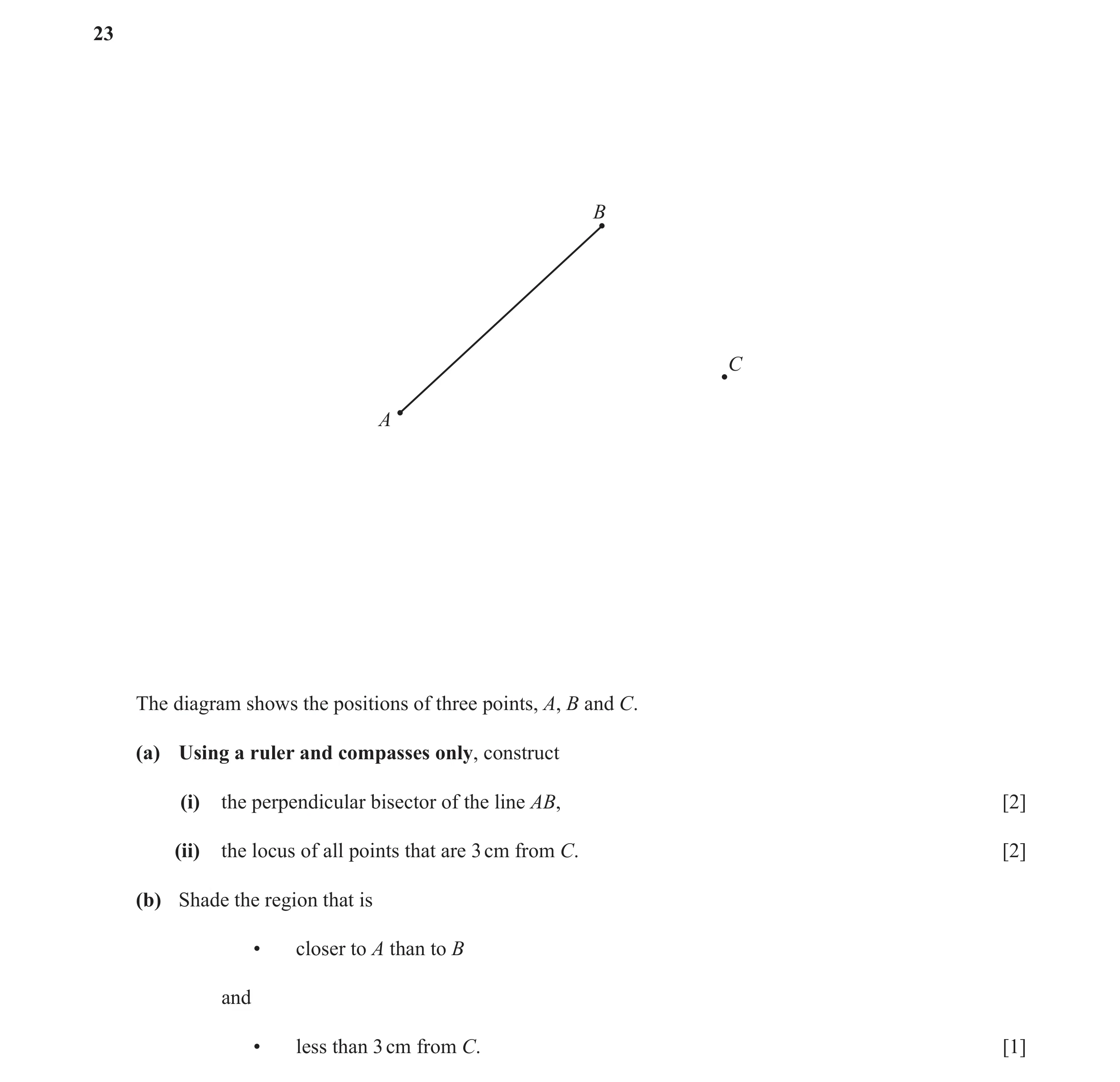 16 / 28
 17 / 28
 18 / 28
![Question 25: The diagram shows a pentagon ABCDE. A E B D C (a) Using a straight edge and compasses only, construct the bisector of angle BCD. [2] (b) Dr…](https://img.pastlit.com/crops/0fee0350-e4f1-477c-8455-a6924583aded/q18.webp) 19 / 28
19 / 28![Question 26: B A C (a) (i) Using a straight edge and compasses only, construct the perpendicular bisector of AB. Show all your construction arcs. [2] (i…](https://img.pastlit.com/crops/670b7646-e077-42f1-ba30-06015b0187a6/q24.webp) 20 / 28
20 / 28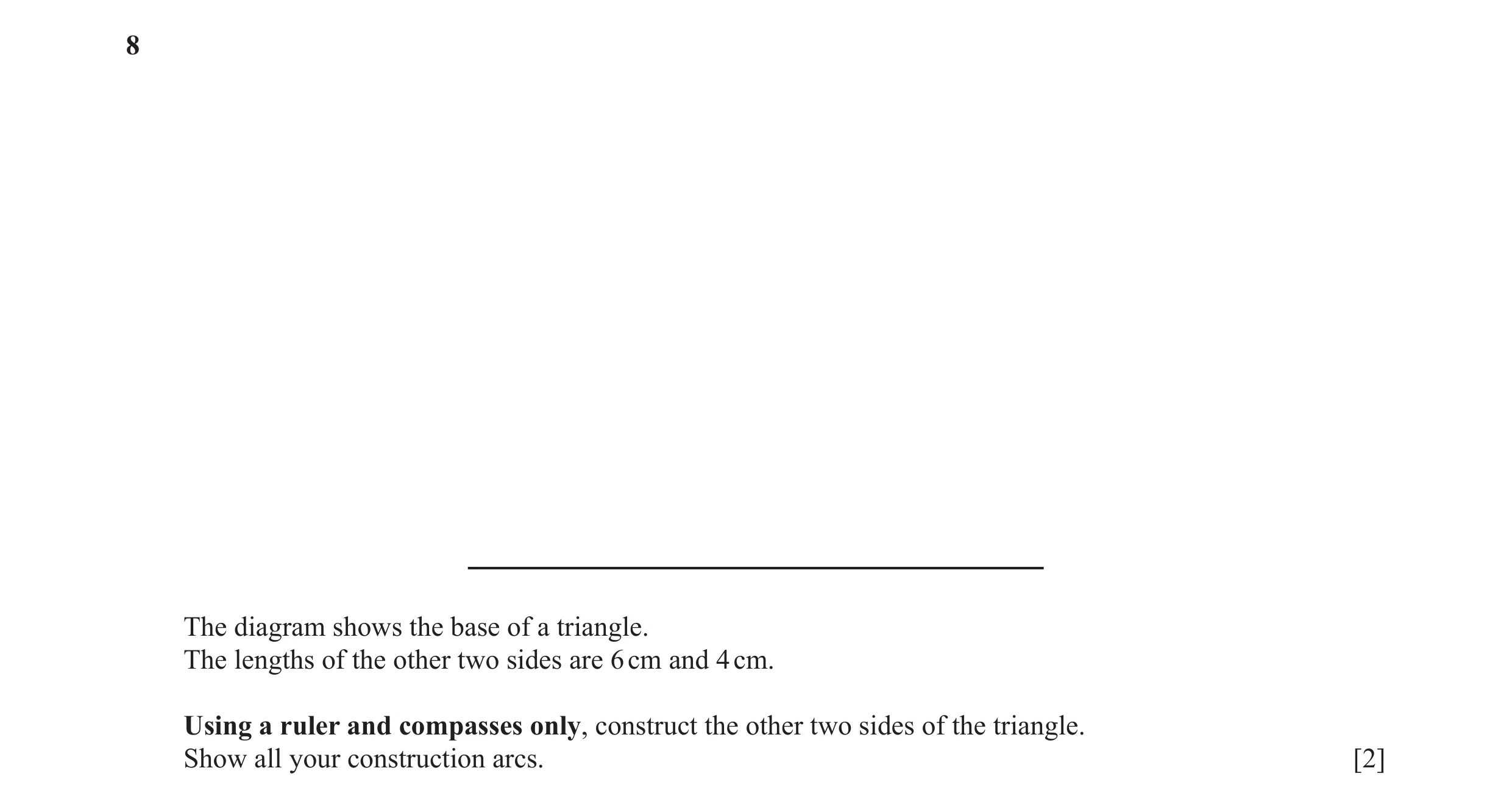
 21 / 28
 22 / 28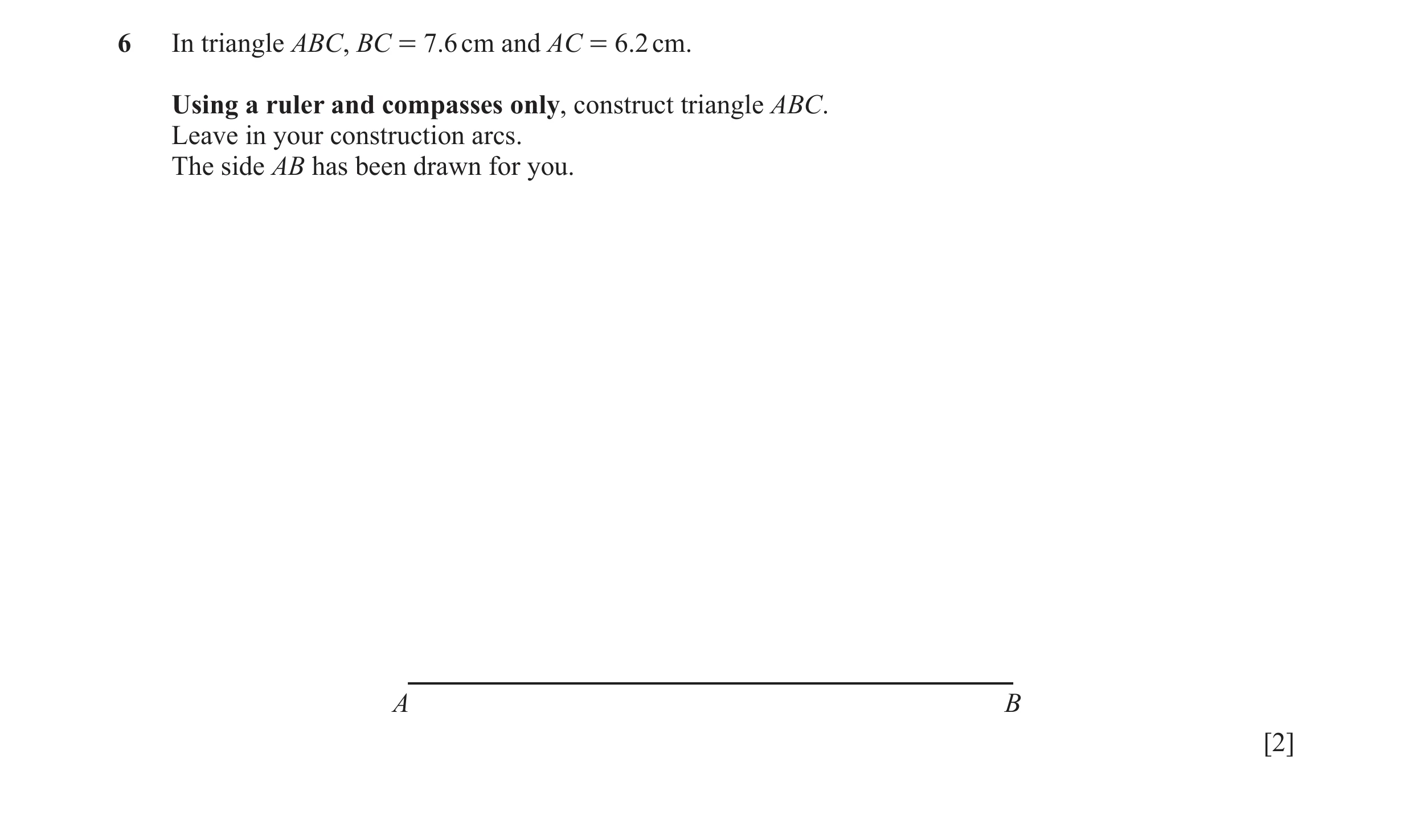
![Question 31: P is a point on a line. P Draw a line through point P that is perpendicular to this line. [1]](https://img.pastlit.com/crops/da0eb517-c9b6-487e-a526-903eeaa0bdb8/q3.webp) 23 / 28
23 / 28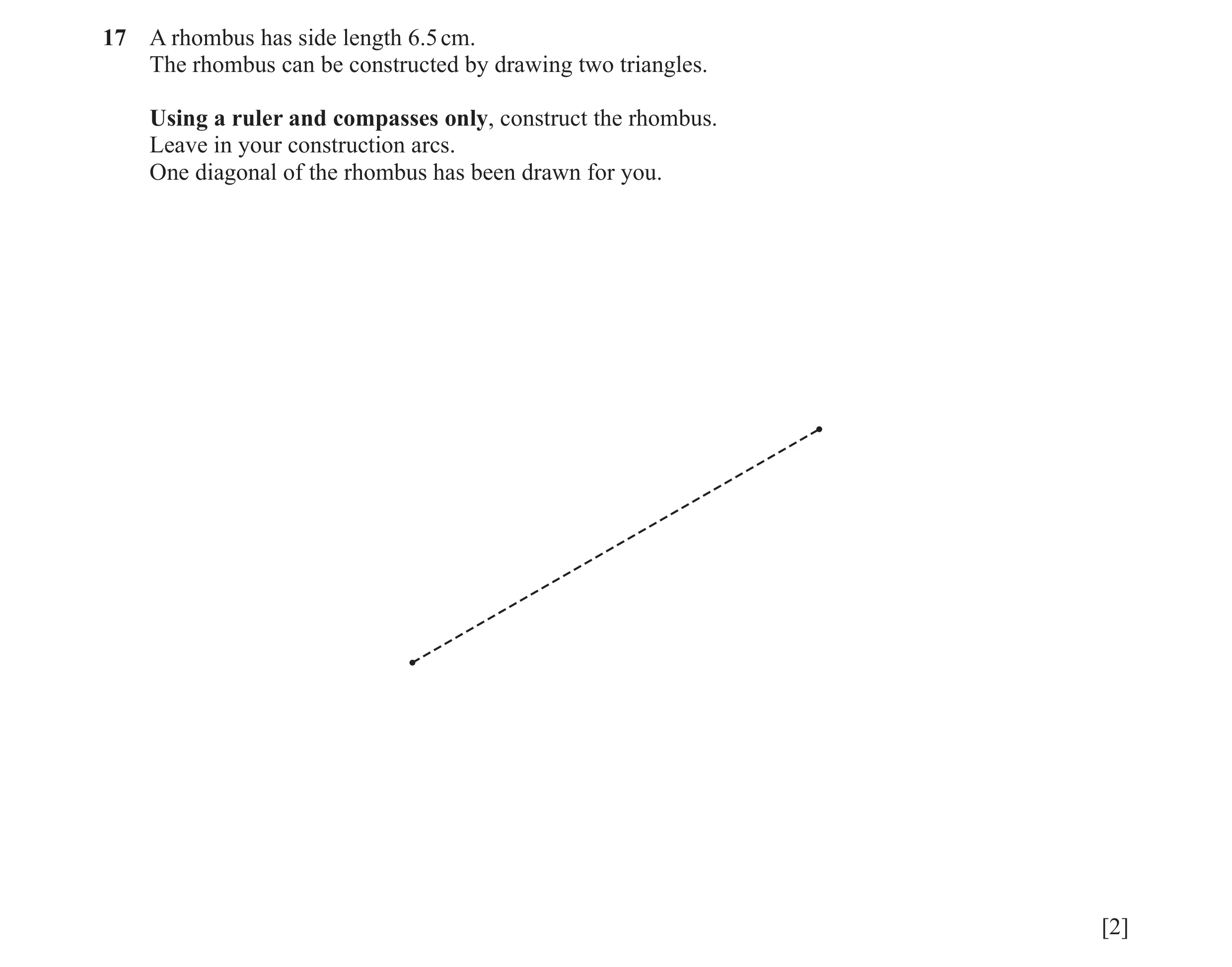
 24 / 28
![Question 34: (a) Measure the marked angle. ................................................. [1] (b) NOT TO 9.5 cm 8 cm SCALE 12 cm Using a ruler and co…](https://img.pastlit.com/crops/e4f35e16-bd14-402b-9780-a20b03e66f6a/q8.webp) 25 / 28
25 / 28![Question 35: (a) Measure the length of this line in millimetres. .......................................... mm [1] (b) Draw a line perpendicular to this…](https://img.pastlit.com/crops/a7fecb8e-98f1-4398-9fa2-c2dbbb970389/q3.webp)
 26 / 28
 27 / 28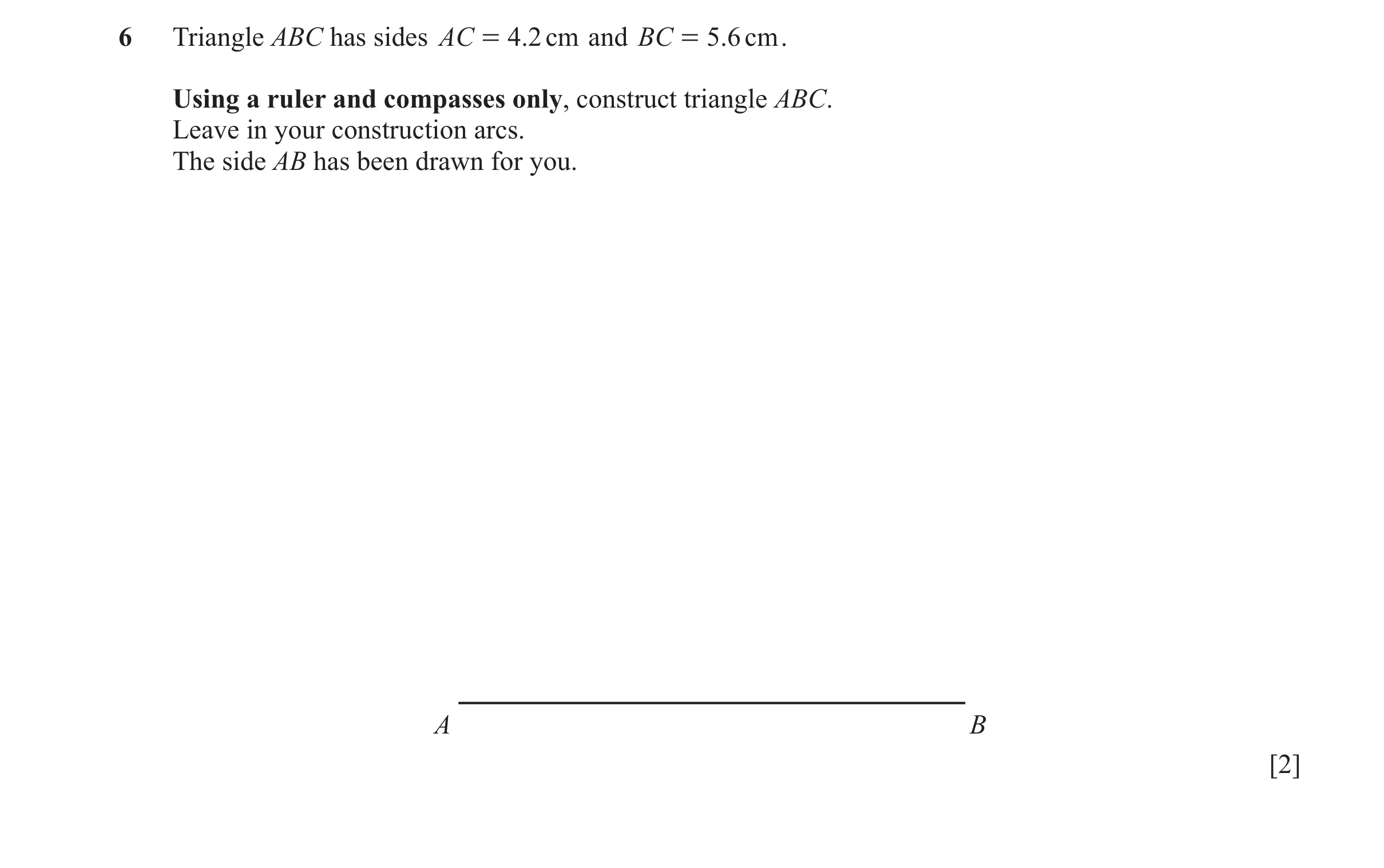
 28 / 28
 3
3 2
2 2
2 2
2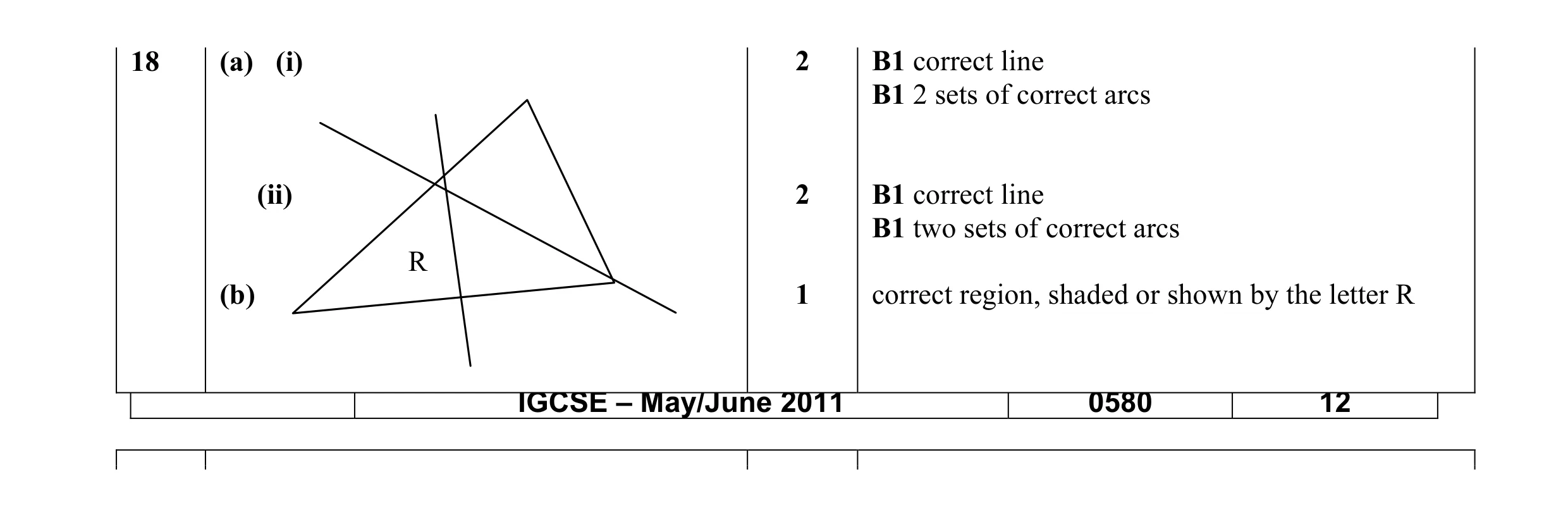 5
5 3
3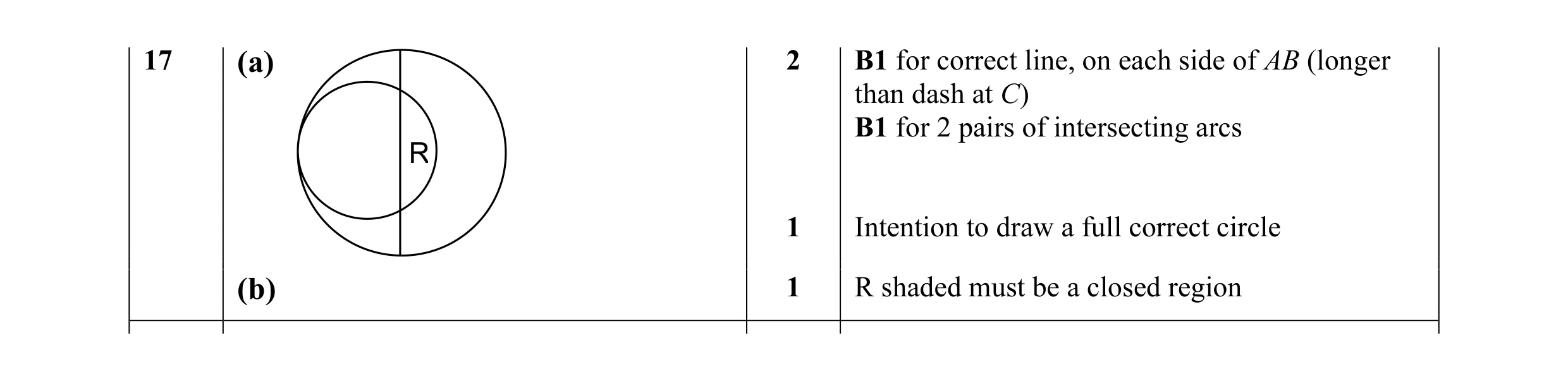 4
4 4
4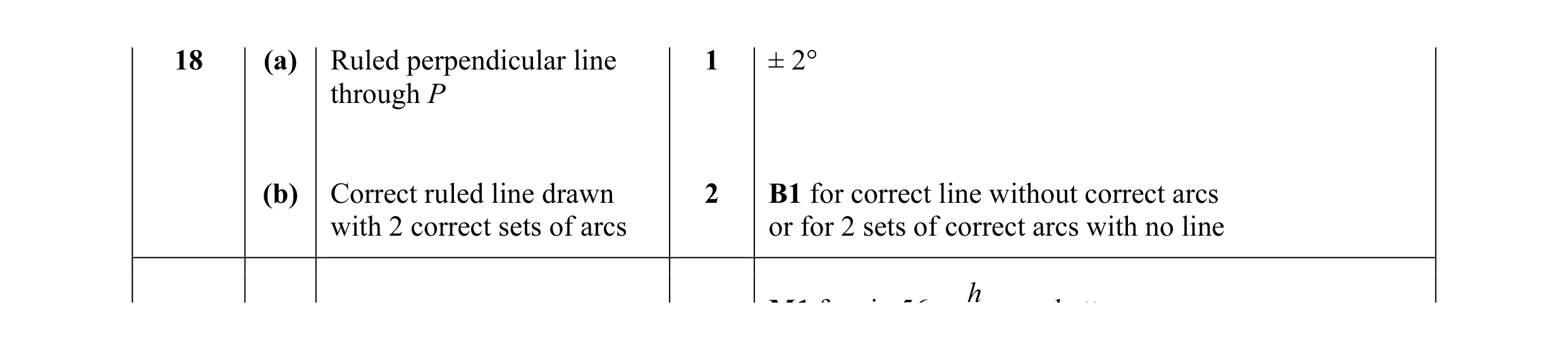 3
3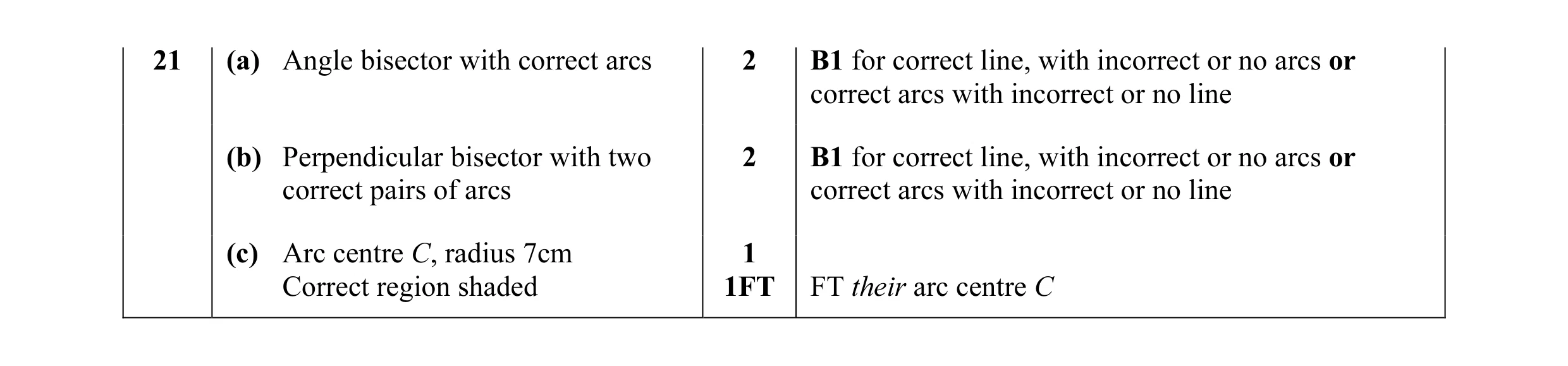 6
6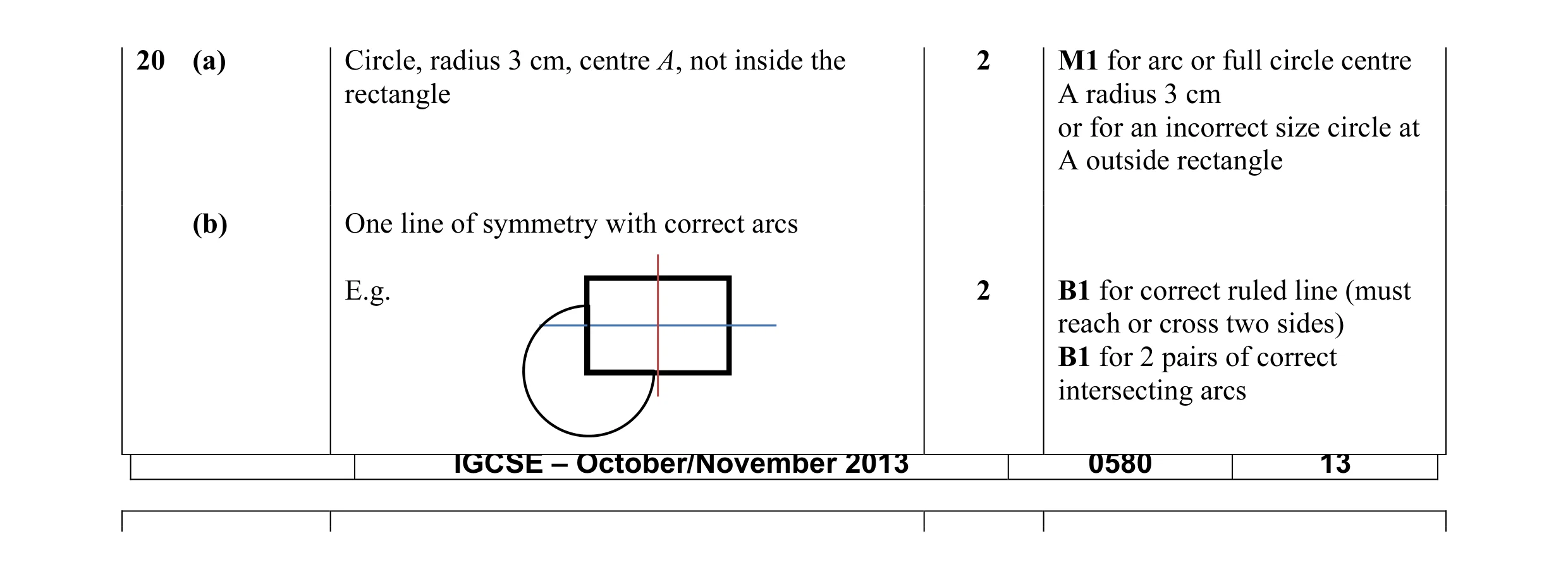 4
4 2
2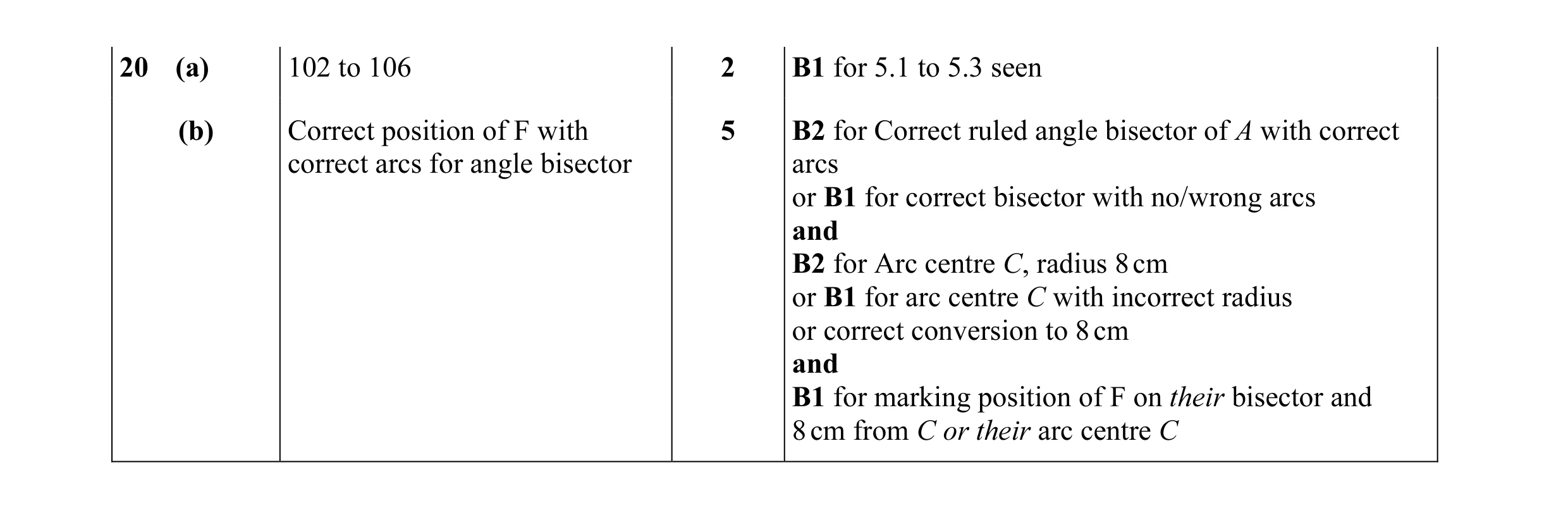 7
7 2
2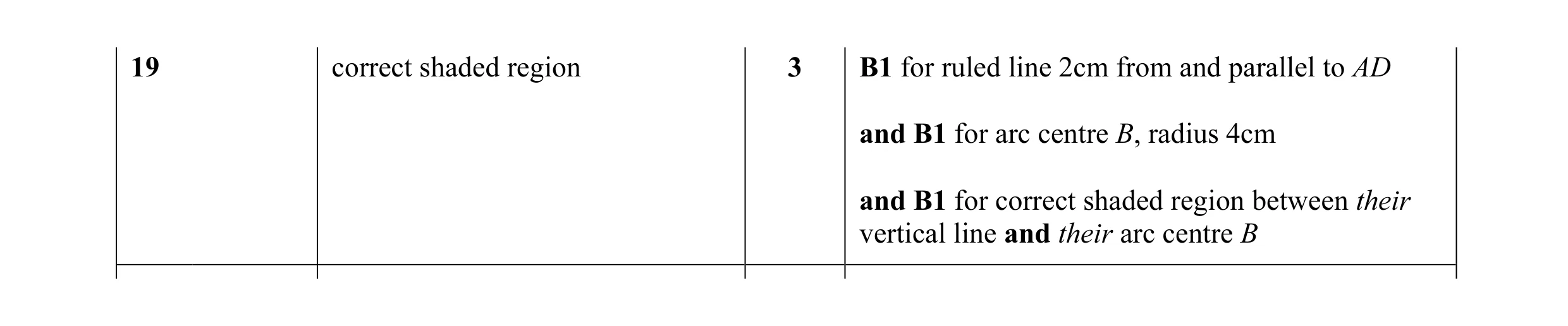 3
3 2
2 2
2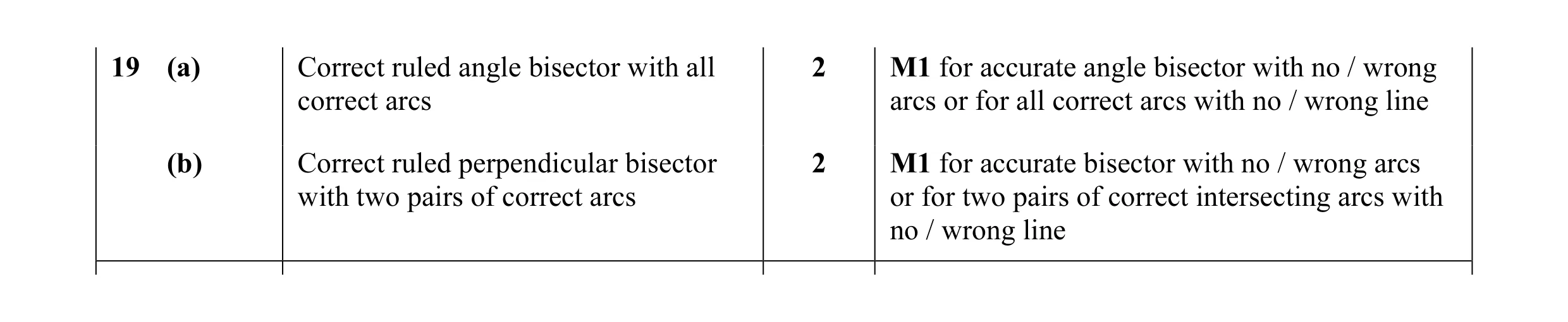 4
4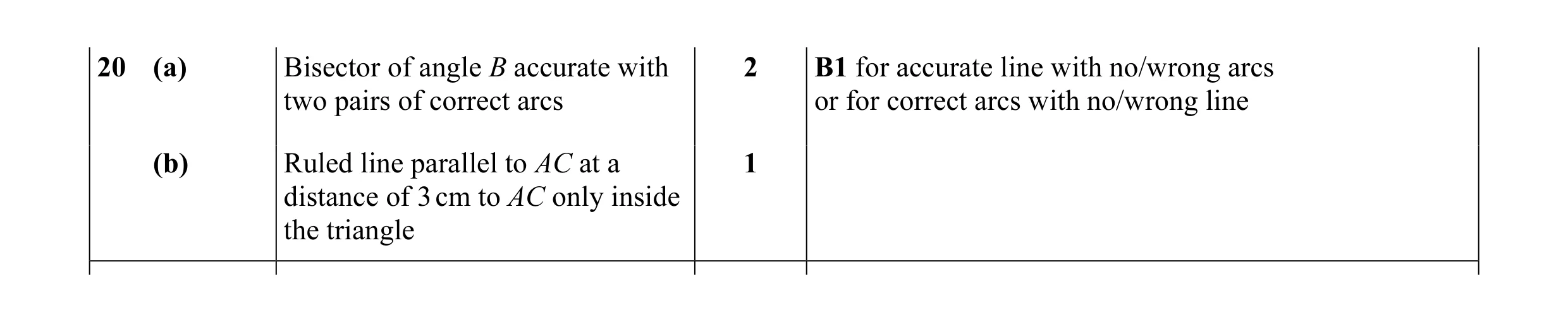 3
3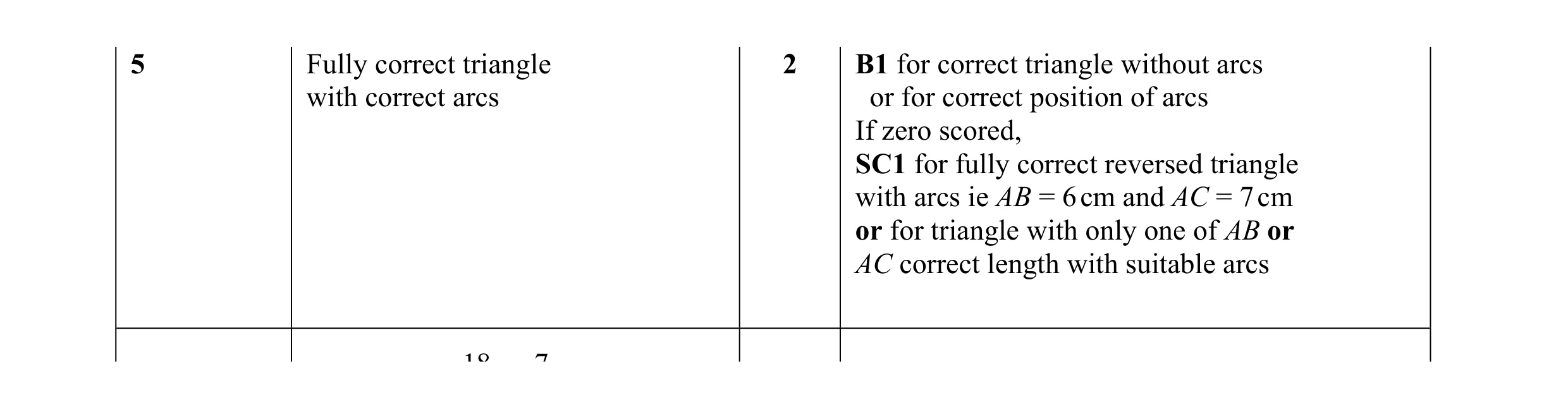 2
2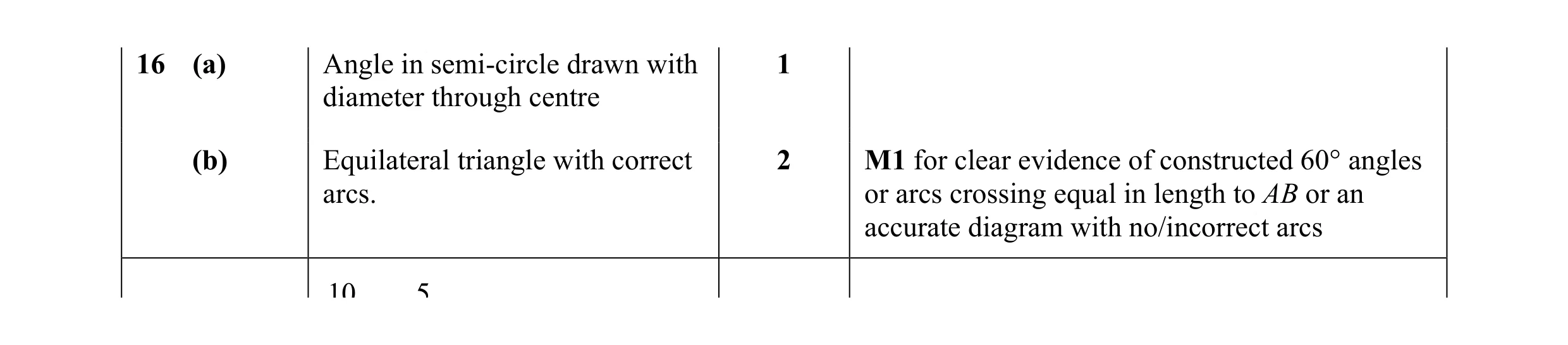 3
3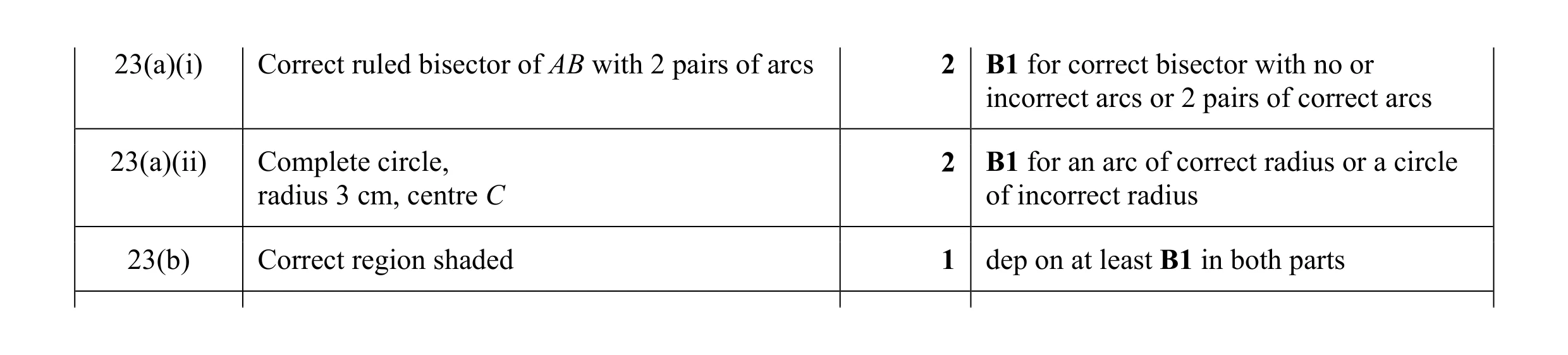 5
5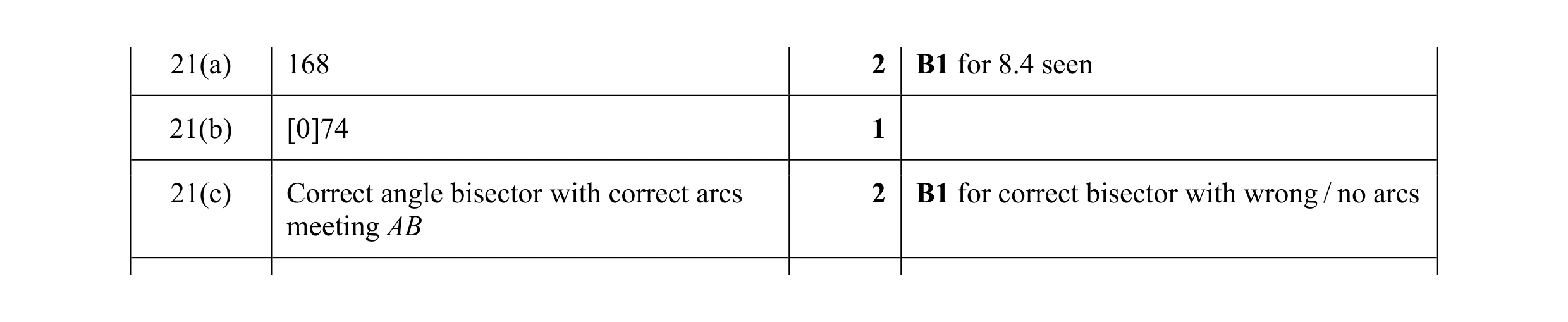 5
5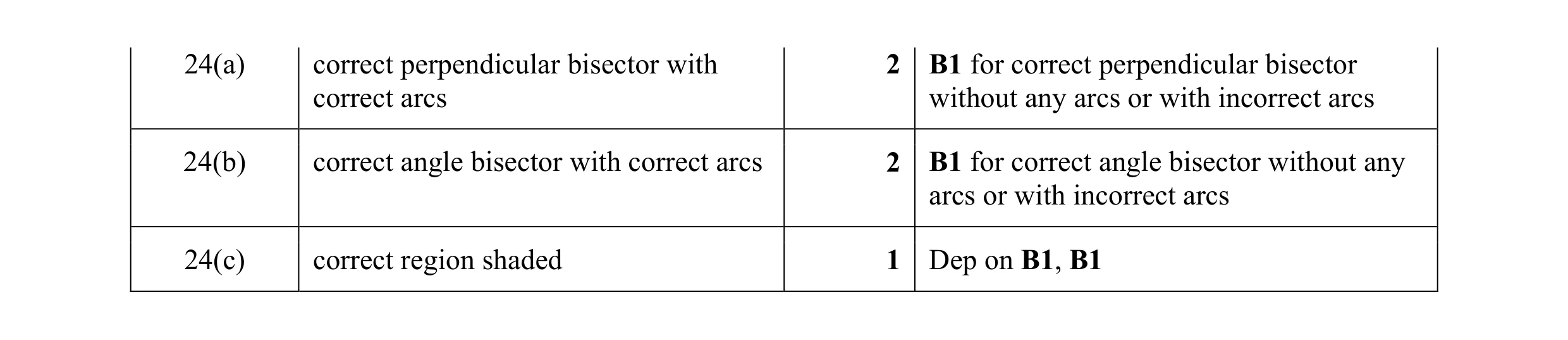 5
5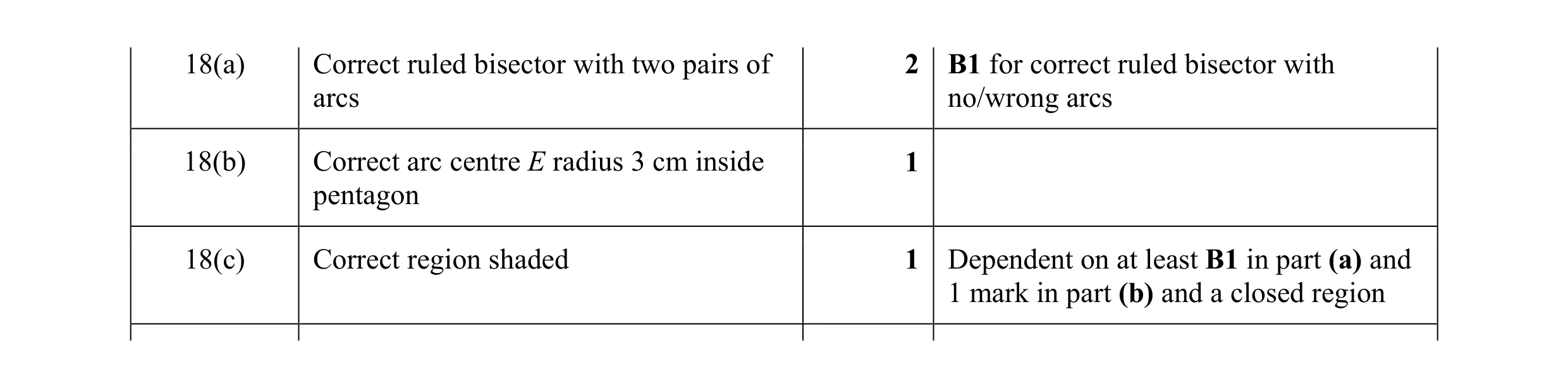 4
4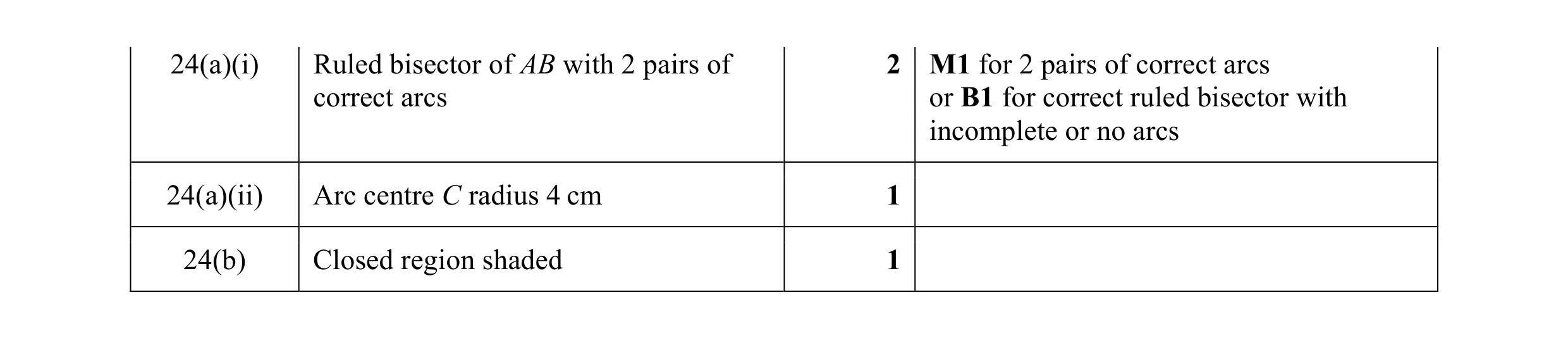 4
4 2
2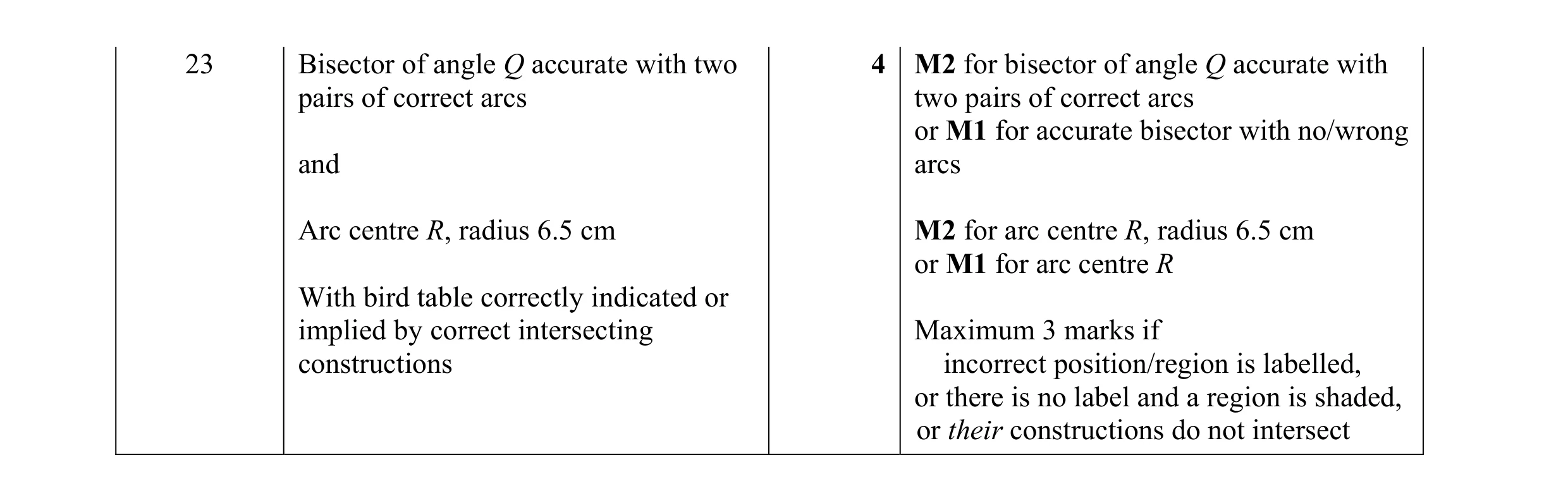 4
4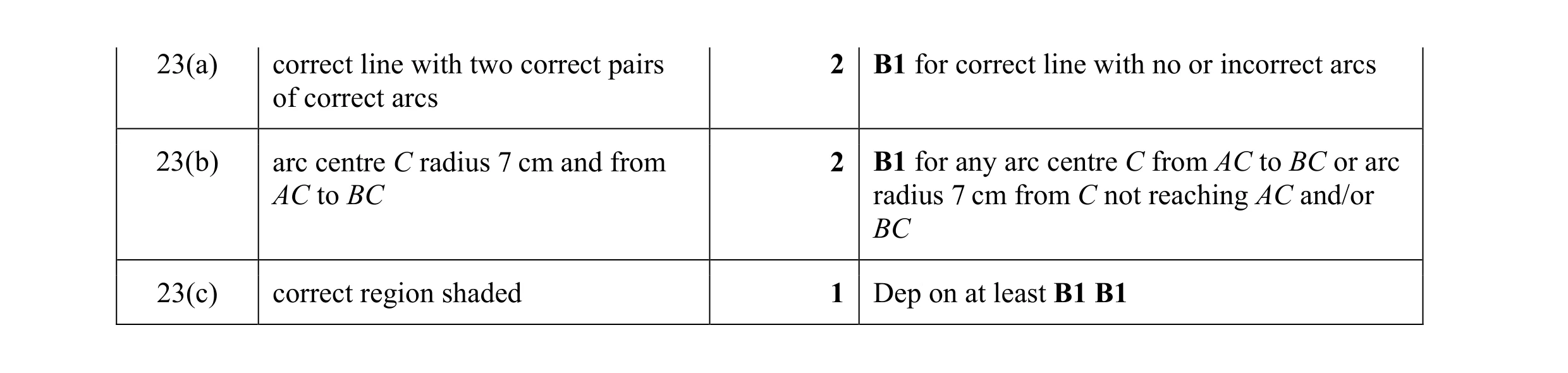 5
5 2
2 1
1 2
2 2
2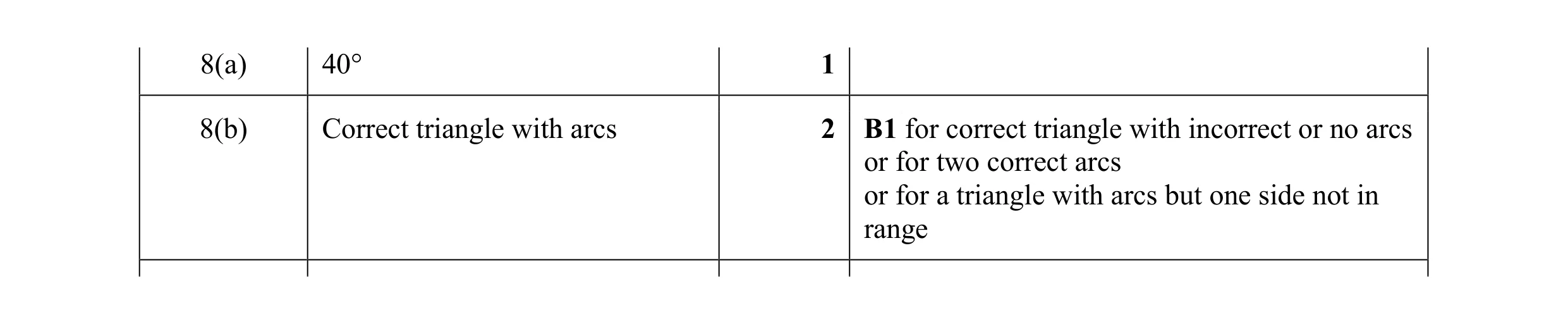 3
3 2
2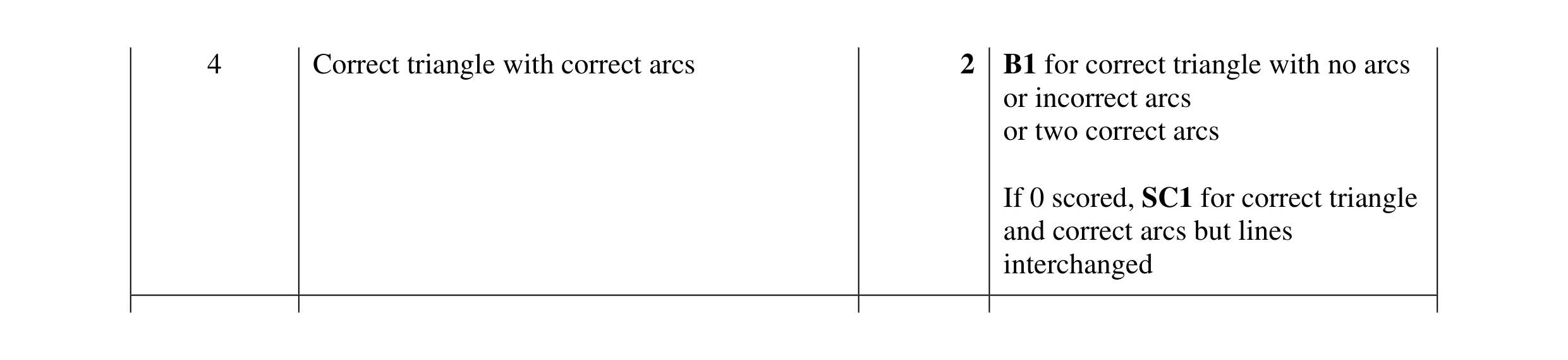 2
2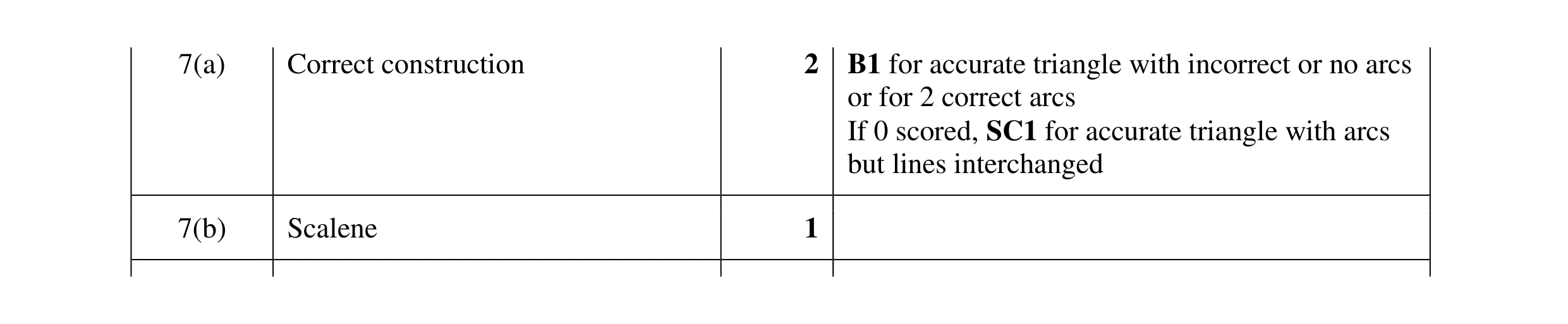 3
3 2
2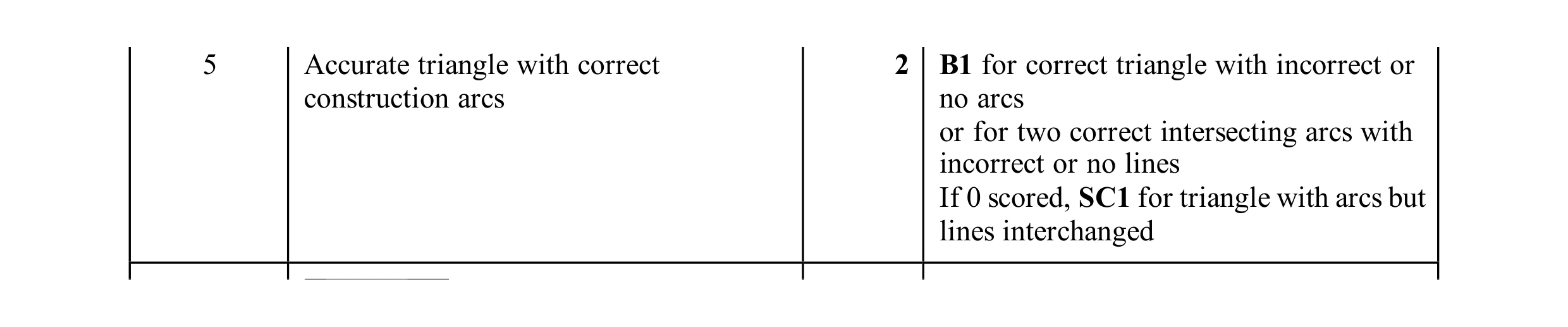 2
2