Cambridge IGCSE Mathematics 0580 — 2017 Oct/Nov Paper 1 · Variant 3
0580/13/O/N/17 · 22 questions · 56 marks · ≈63 min
The question paper and its mark scheme, free to read here and free to download. This is Cambridge’s own paper, exactly as it was sat.
Question paper12 pages
Mark scheme4 pages
Answers below. Sit the paper first if you are practising.
Questions as text
Q1 · Ahmed drives his car from London to Cambridge
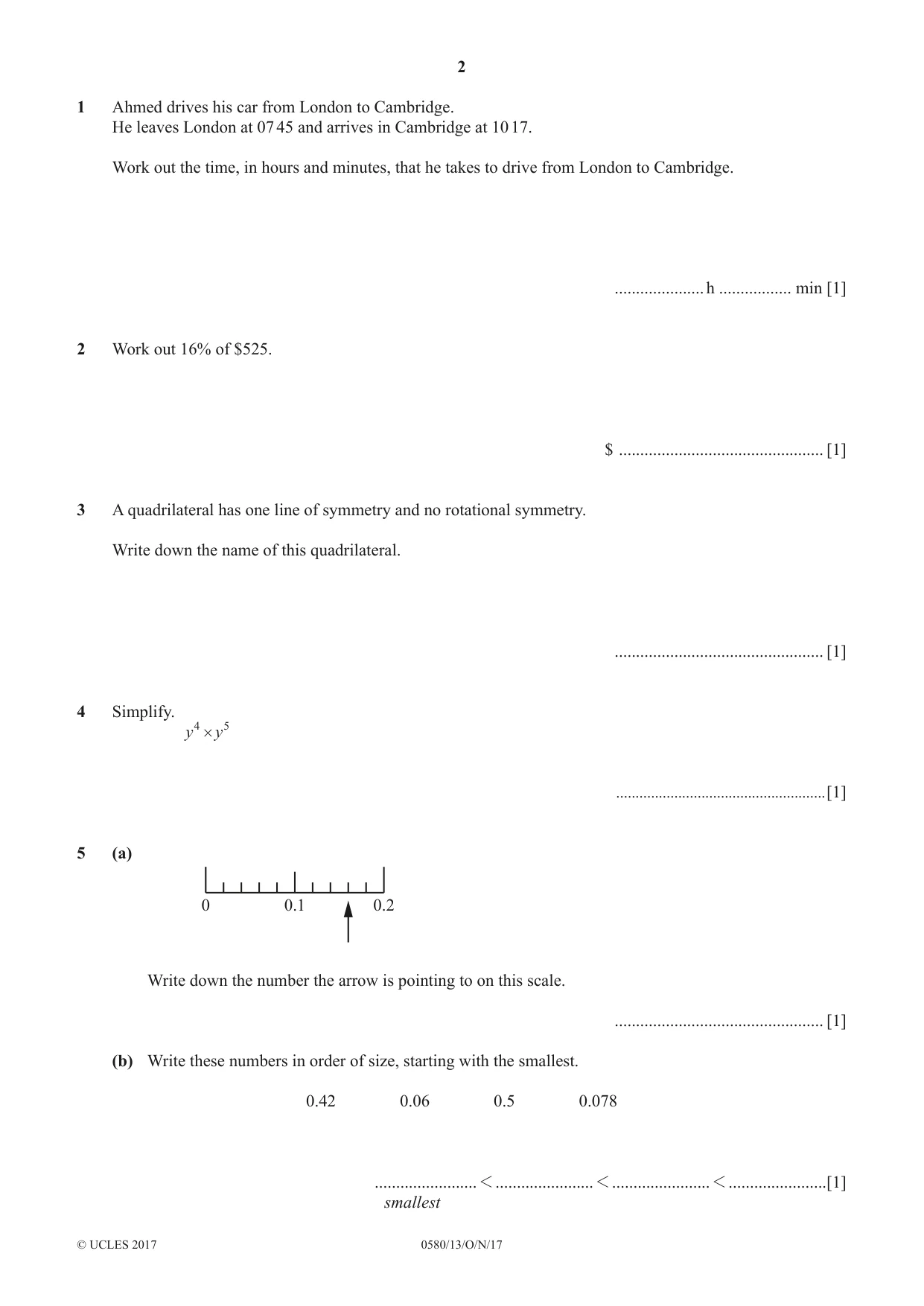
1 Ahmed drives his car from London to Cambridge. He leaves London at 07 45 and arrives in Cambridge at 10 17. Work out the time, in hours and minutes, that he takes to drive from London to Cambridge. .....................h ................. min [1]
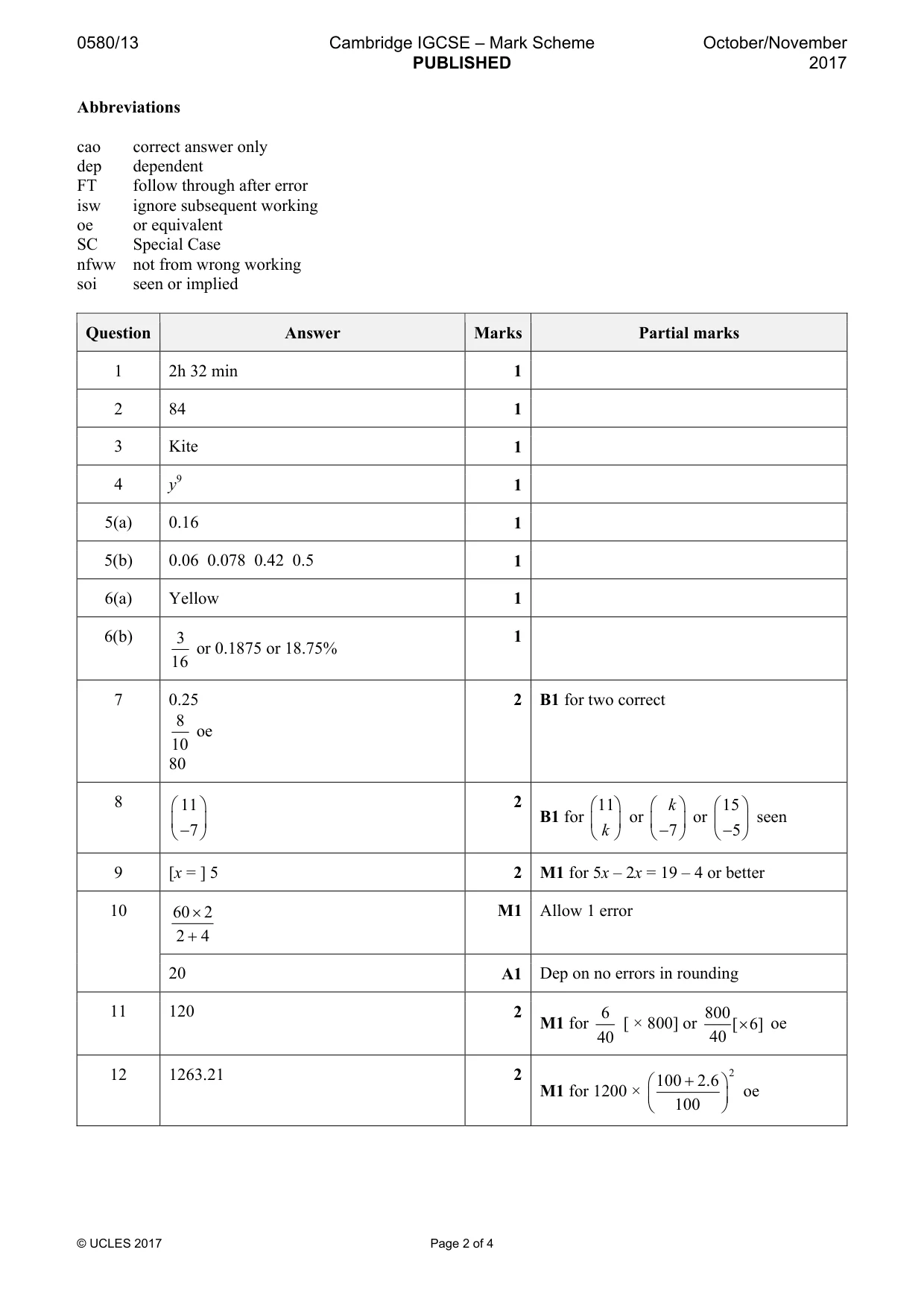
Mark scheme: Question Answer Marks Partial marks 1 2h 32 min 1
Q2 · Work out 16% of $525
2 Work out 16% of $525. $ ................................................ [1]
Mark scheme: 2 84 1
Q3 · A quadrilateral has one line of symmetry and no rotational symmetry
3 A quadrilateral has one line of symmetry and no rotational symmetry. Write down the name of this quadrilateral. ................................................. [1]
Mark scheme: 3 Kite 1
Question 4
4 Simplify. y 4 # y 5 ......................................................[1]
Mark scheme: 4 y9 1
Q5 · 0 0.1 0.2 Write down the number the arrow is pointing to on this scale
5 (a) 0 0.1 0.2 Write down the number the arrow is pointing to on this scale. ................................................. [1] (b) Write these numbers in order of size, starting with the smallest. 0.42 0.06 0.5 0.078 ........................ 1 ....................... 1 ....................... 1 .......................[1] smallest
Mark scheme: 5(a) 0.16 1 5(b) 0.06 0.078 0.42 0.5 1
Q6 · A bag contains 16 counters
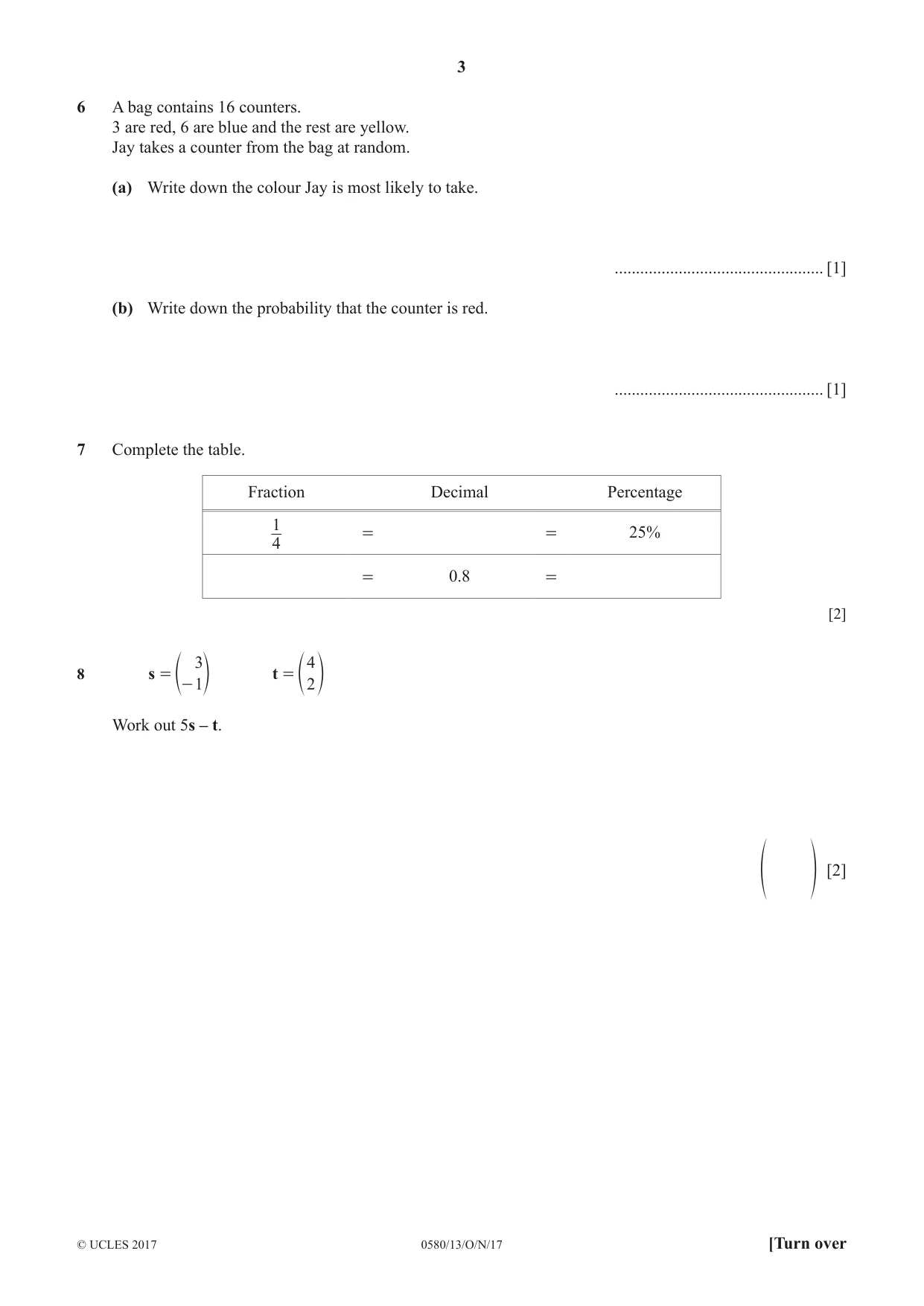
6 A bag contains 16 counters. 3 are red, 6 are blue and the rest are yellow. Jay takes a counter from the bag at random. (a) Write down the colour Jay is most likely to take. ................................................. [1] (b) Write down the probability that the counter is red. ................................................. [1]
Mark scheme: 6(a) Yellow 1 6(b) 3 1 or 0.1875 or 18.75% 16
Question 7
7 Complete the table. Fraction Decimal Percentage 1 = = 25% 4 = 0.8 = [2]
Mark scheme: 7 0.25 2 B1 for two correct 8 oe 10 80
Q8 · 4 8 s = t = f- 1p f 2 p Work out 5s – t
3 4 8 s = t = f- 1p f 2 p Work out 5s – t. [2] f p
Mark scheme: 8 11 2 11 k 15 B1 for or or seen − 7 k − 7 − 5
Question 9
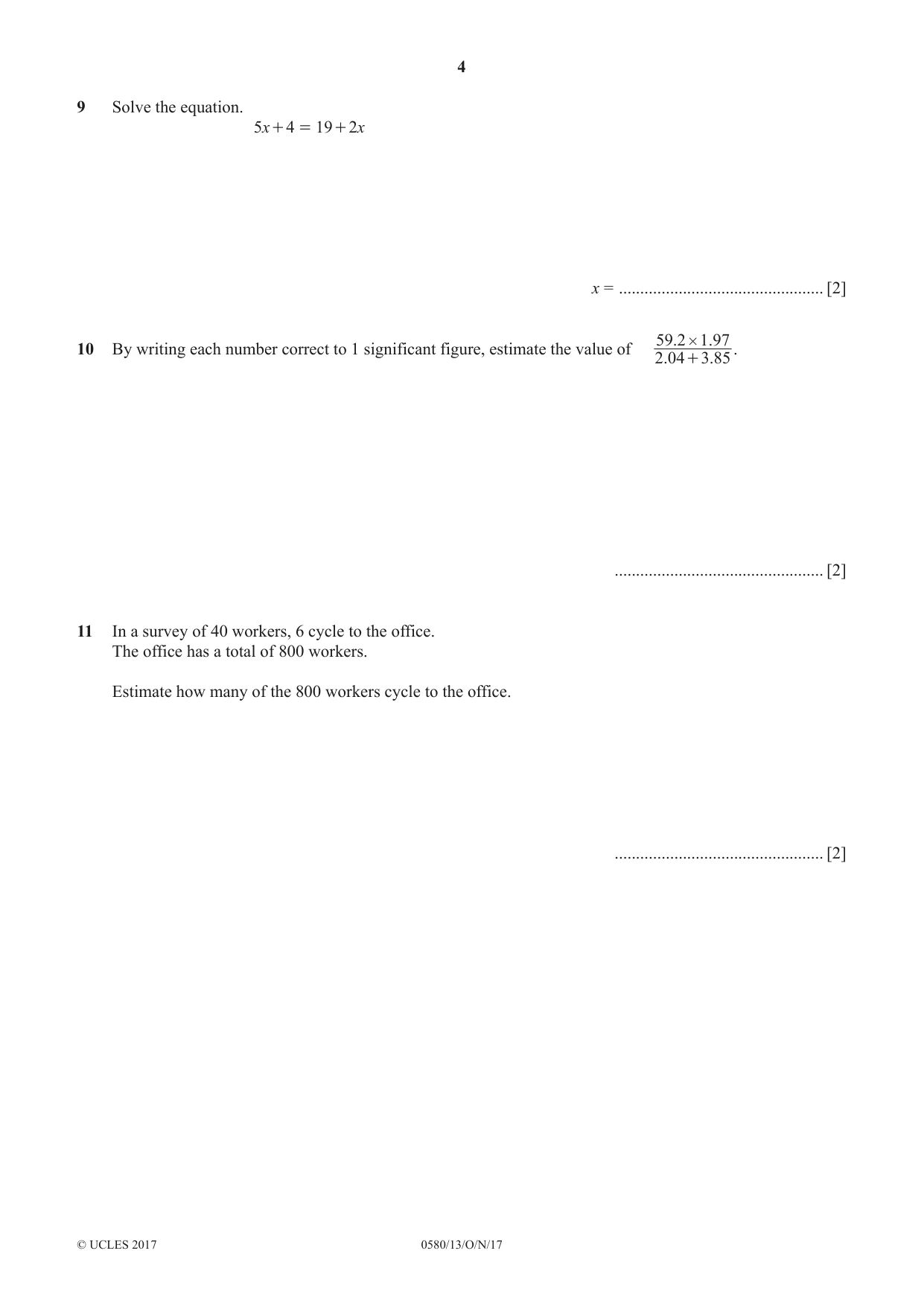
9 Solve the equation. 5x + 4 = 19 + 2x x = ................................................ [2]
Mark scheme: 9 [x = ] 5 2 M1 for 5x – 2x = 19 – 4 or better
Q10 · 2 # 1.9710 By writing each number correct to 1 significant figure, estimate the value of
59.2 # 1.9710 By writing each number correct to 1 significant figure, estimate the value of . 2. 04 + 3. 85 ................................................. [2]
Mark scheme: 10 60 × 2 M1 Allow 1 error 2 + 4 20 A1 Dep on no errors in rounding
Q11 · In a survey of 40 workers, 6 cycle to the office
11 In a survey of 40 workers, 6 cycle to the office. The office has a total of 800 workers. Estimate how many of the 800 workers cycle to the office. ................................................. [2]
Mark scheme: 11 120 2 6 M1 for [ × 800] or 800[ × 6] oe 40 40
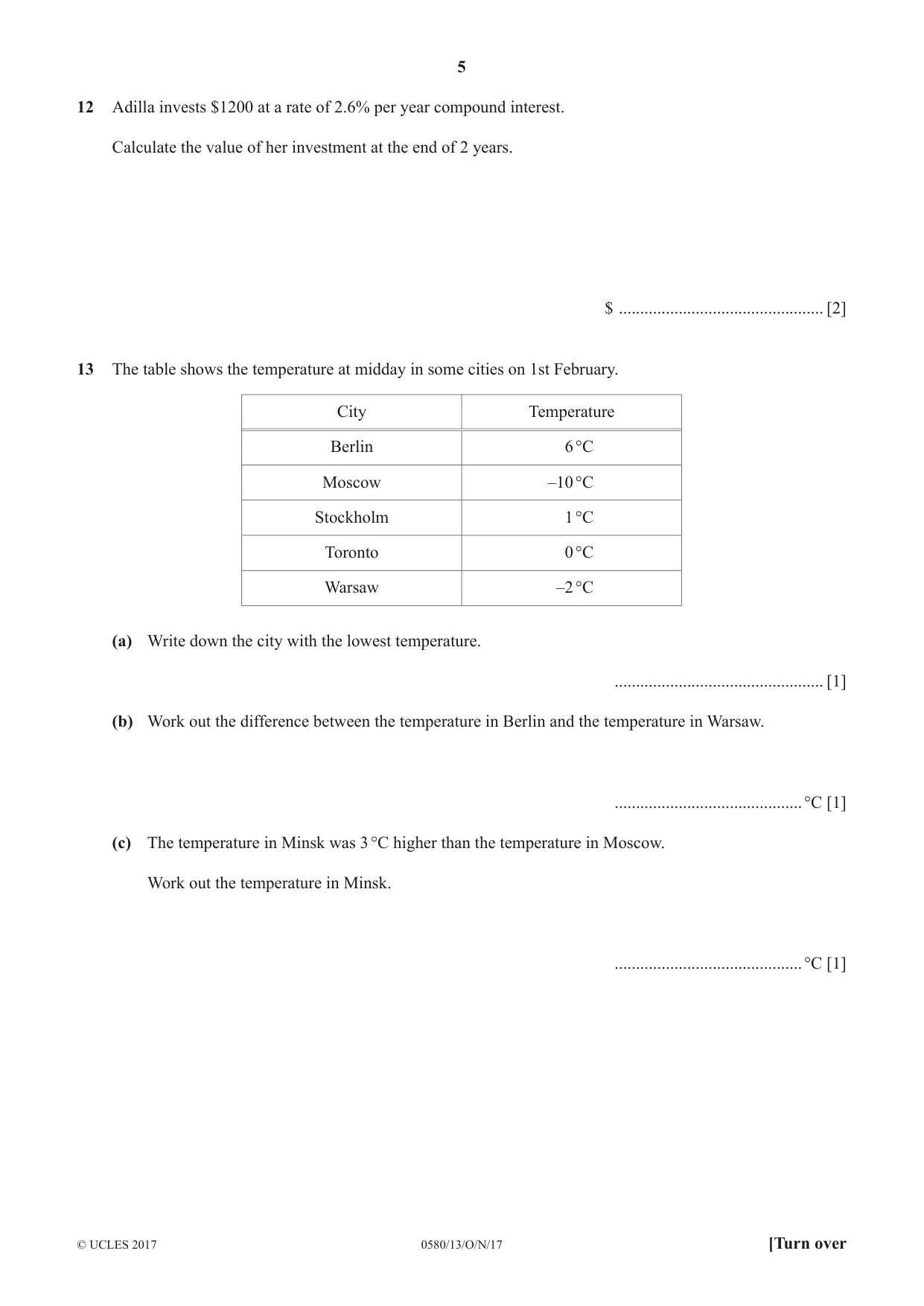
Q12 · Adilla invests $1200 at a rate of 2.6% per year compound interest
12 Adilla invests $1200 at a rate of 2.6% per year compound interest. Calculate the value of her investment at the end of 2 years. $ ................................................ [2]
Mark scheme: 12 1263.21 2 2 100 + 2.6 M1 for 1200 × oe 100
Q13 · The table shows the temperature at midday in some cities on 1st February
13 The table shows the temperature at midday in some cities on 1st February. City Temperature Berlin 6 °C Moscow –10 °C Stockholm 1 °C Toronto 0 °C Warsaw –2 °C (a) Write down the city with the lowest temperature. ................................................. [1] (b) Work out the difference between the temperature in Berlin and the temperature in Warsaw. ............................................°C [1] (c) The temperature in Minsk was 3 °C higher than the temperature in Moscow. Work out the temperature in Minsk. ............................................°C [1]
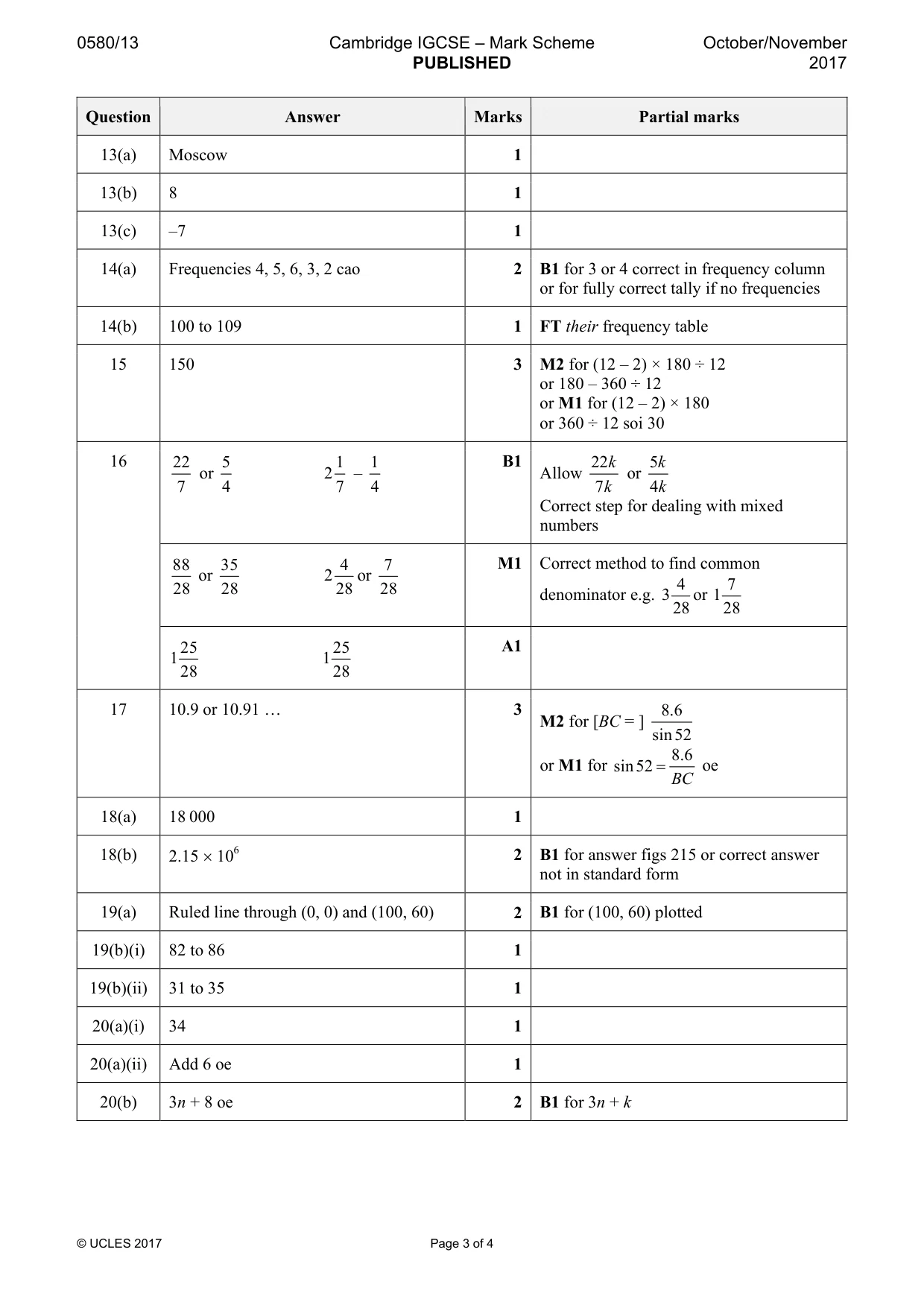
Mark scheme: 13(a) Moscow 1 13(b) 8 1 13(c) –7 1
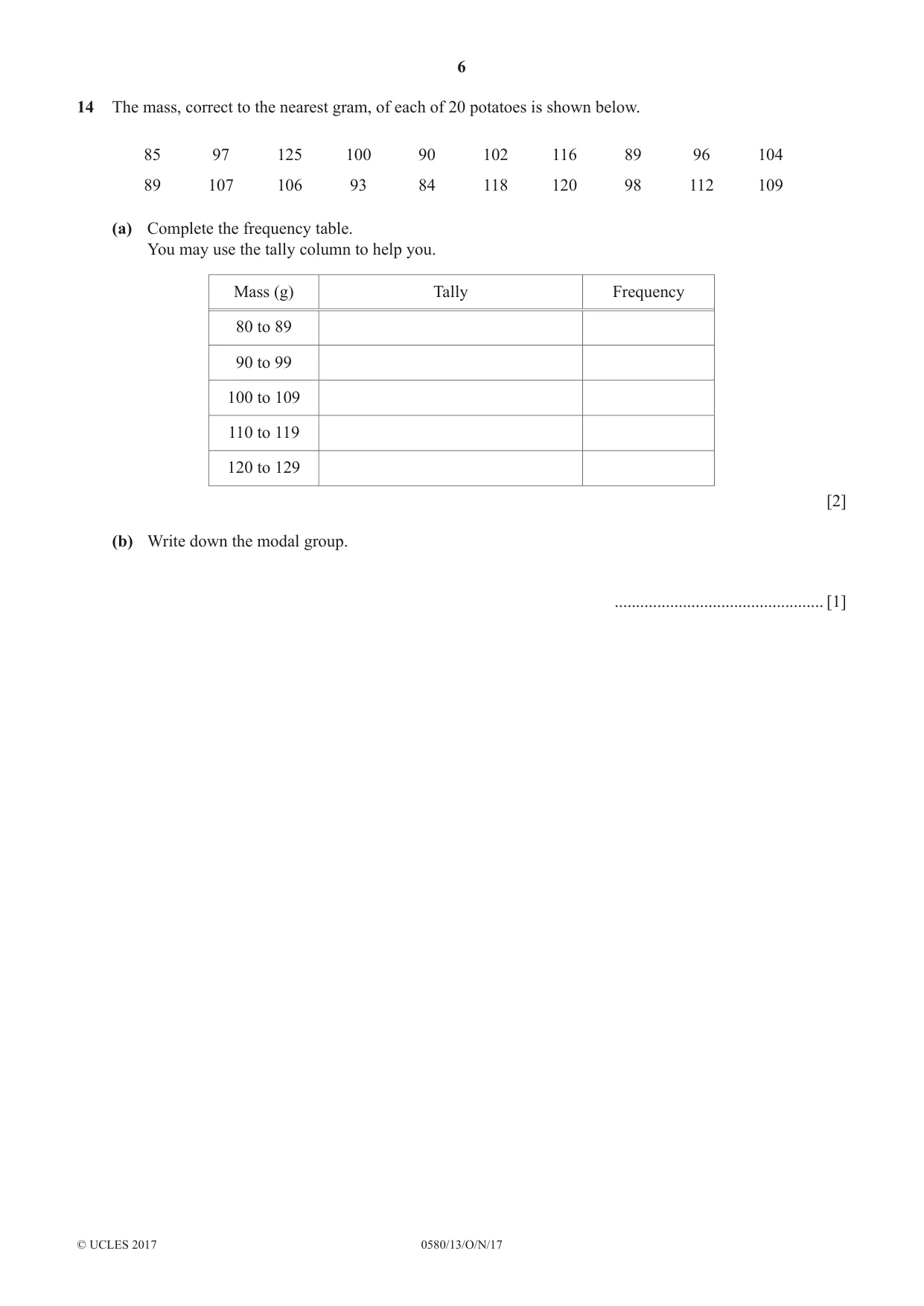
Q14 · The mass, correct to the nearest gram, of each of 20 potatoes is shown below
14 The mass, correct to the nearest gram, of each of 20 potatoes is shown below. 85 97 125 100 90 102 116 89 96 104 89 107 106 93 84 118 120 98 112 109 (a) Complete the frequency table. You may use the tally column to help you. Mass (g) Tally Frequency 80 to 89 90 to 99 100 to 109 110 to 119 120 to 129 [2] (b) Write down the modal group. ................................................. [1]
Mark scheme: 14(a) Frequencies 4, 5, 6, 3, 2 cao 2 B1 for 3 or 4 correct in frequency column or for fully correct tally if no frequencies 14(b) 100 to 109 1 FT their frequency table
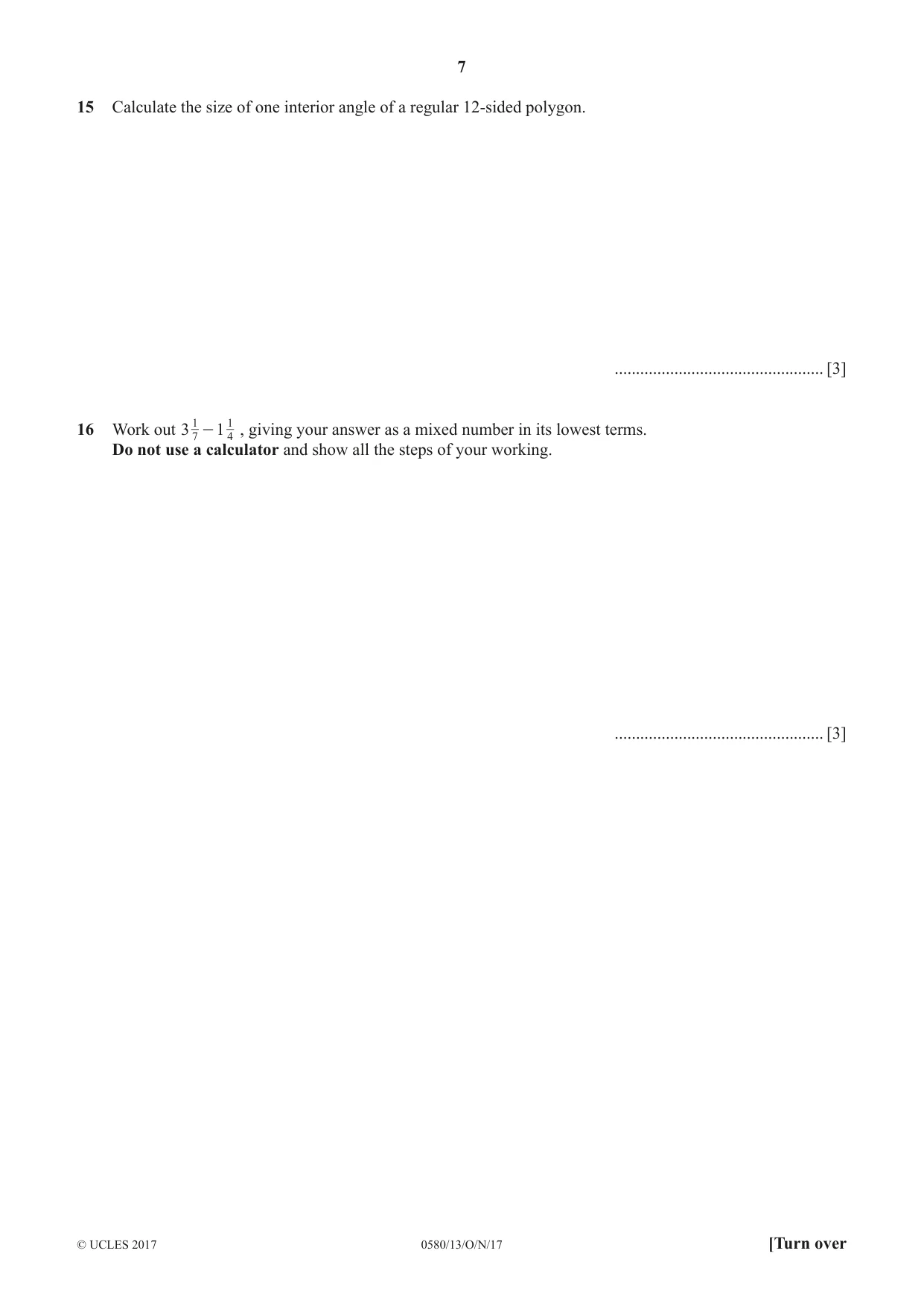
Q15 · Calculate the size of one interior angle of a regular 12-sided polygon
15 Calculate the size of one interior angle of a regular 12-sided polygon. ................................................. [3]
Mark scheme: 15 150 3 M2 for (12 – 2) × 180 ÷ 12 or 180 – 360 ÷ 12 or M1 for (12 – 2) × 180 or 360 ÷ 12 soi 30
Q16 · Work out 3 17 1 - 1 4 , giving your answer as a mixed number in its lowest terms
16 Work out 3 17 1 - 1 4 , giving your answer as a mixed number in its lowest terms. Do not use a calculator and show all the steps of your working. ................................................. [3]
Mark scheme: 16 22 5 1 1 B1 22 k 5k or 2 – Allow or 7 4 7 4 7 k 4 k Correct step for dealing with mixed numbers 88 35 4 7 M1 Correct method to find common or 2 or 28 28 28 28 4 7 denominator e.g. 3 or 28 128 25 25 A1 128 128
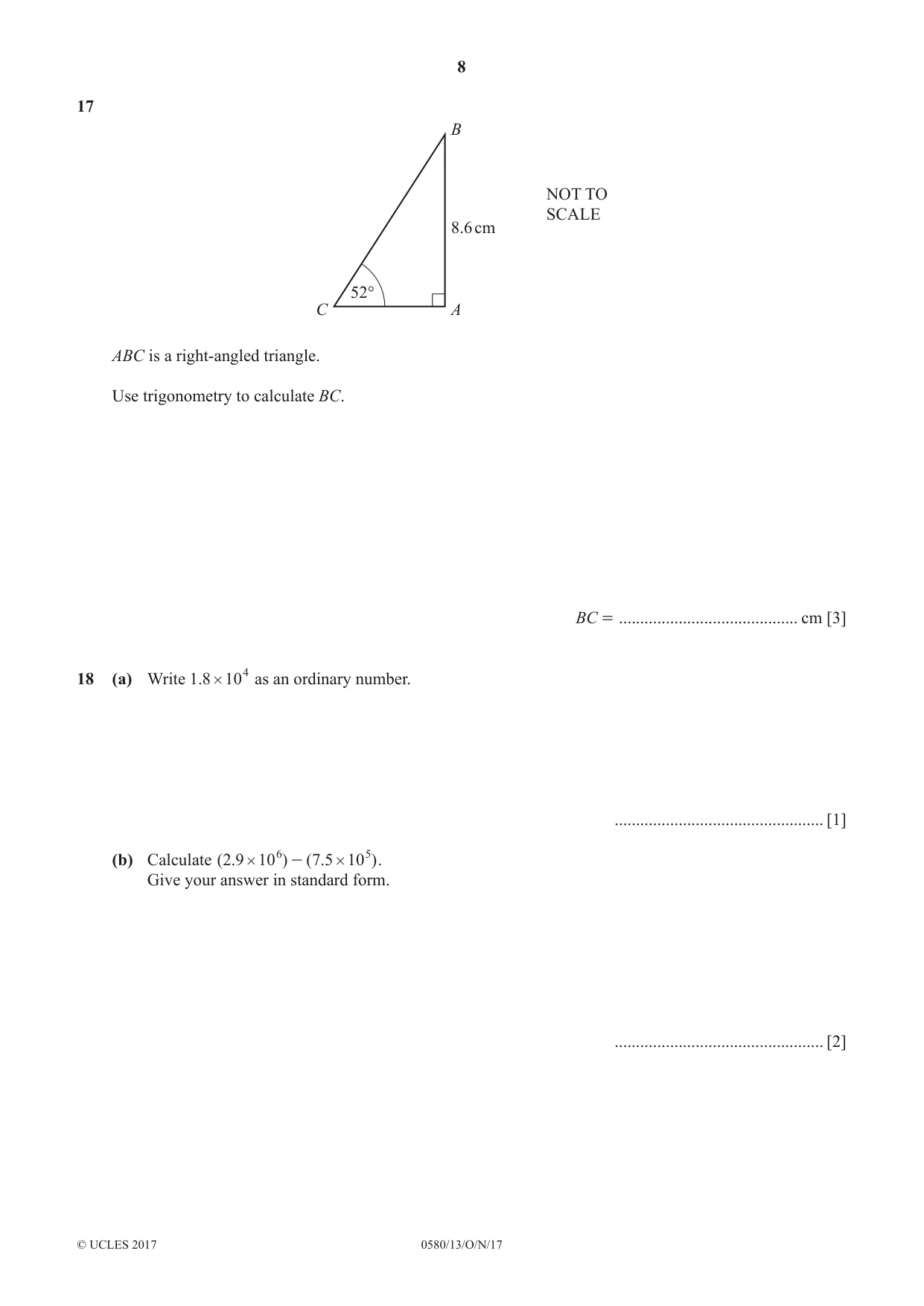
Q17 · B NOT TO SCALE 8.6 cm 52° C A ABC is a right-angled triangle
17 B NOT TO SCALE 8.6 cm 52° C A ABC is a right-angled triangle. Use trigonometry to calculate BC. BC = .......................................... cm [3]
Mark scheme: 17 10.9 or 10.91 … 3 8.6 M2 for [BC = ] sin52 8.6 or M1 for sin52 = oe BC
Q18 · Write .18 # 104 as an ordinary number
18 (a) Write .18 # 104 as an ordinary number. ................................................. [1] (b) Calculate (2. 9 # 10 6 ) - ( 7. 5 # 10 5 ) . Give your answer in standard form. ................................................. [2]
Mark scheme: 18(a) 18 000 1 18(b) 2.15 × 10⁶ 2 B1 for answer figs 215 or correct answer not in standard form
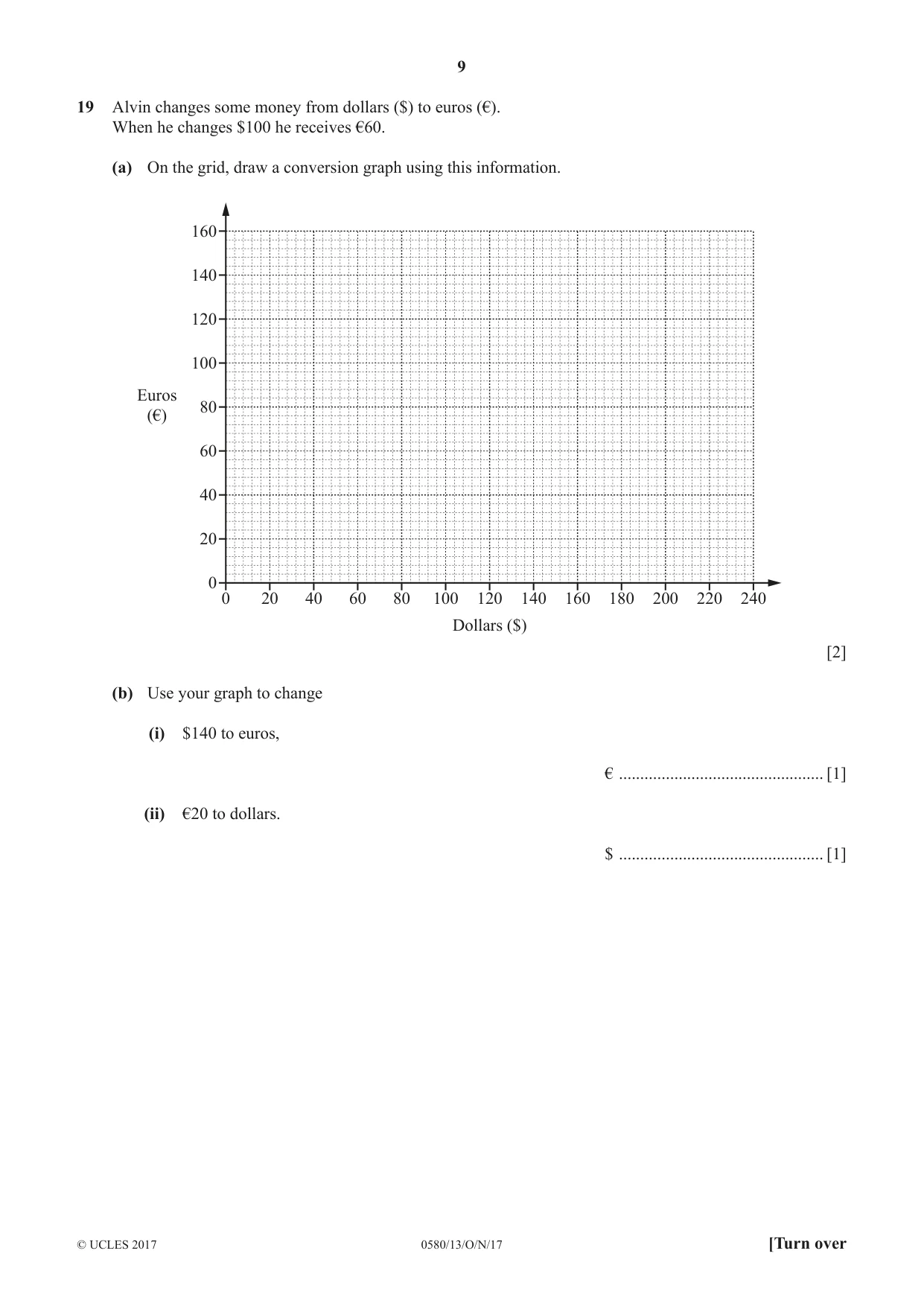
Q19 · Alvin changes some money from dollars ($) to euros (€)
19 Alvin changes some money from dollars ($) to euros (€). When he changes $100 he receives €60. (a) On the grid, draw a conversion graph using this information. 160 140 120 100 Euros 80 (€) 60 40 20 0 0 20 40 60 80 100 120 140 160 180 200 220 240 Dollars ($) [2] (b) Use your graph to change (i) $140 to euros, € ................................................ [1] (ii) €20 to dollars. $ ................................................ [1]
Mark scheme: 19(a) Ruled line through (0, 0) and (100, 60) 2 B1 for (100, 60) plotted 19(b)(i) 82 to 86 1 19(b)(ii) 31 to 35 1
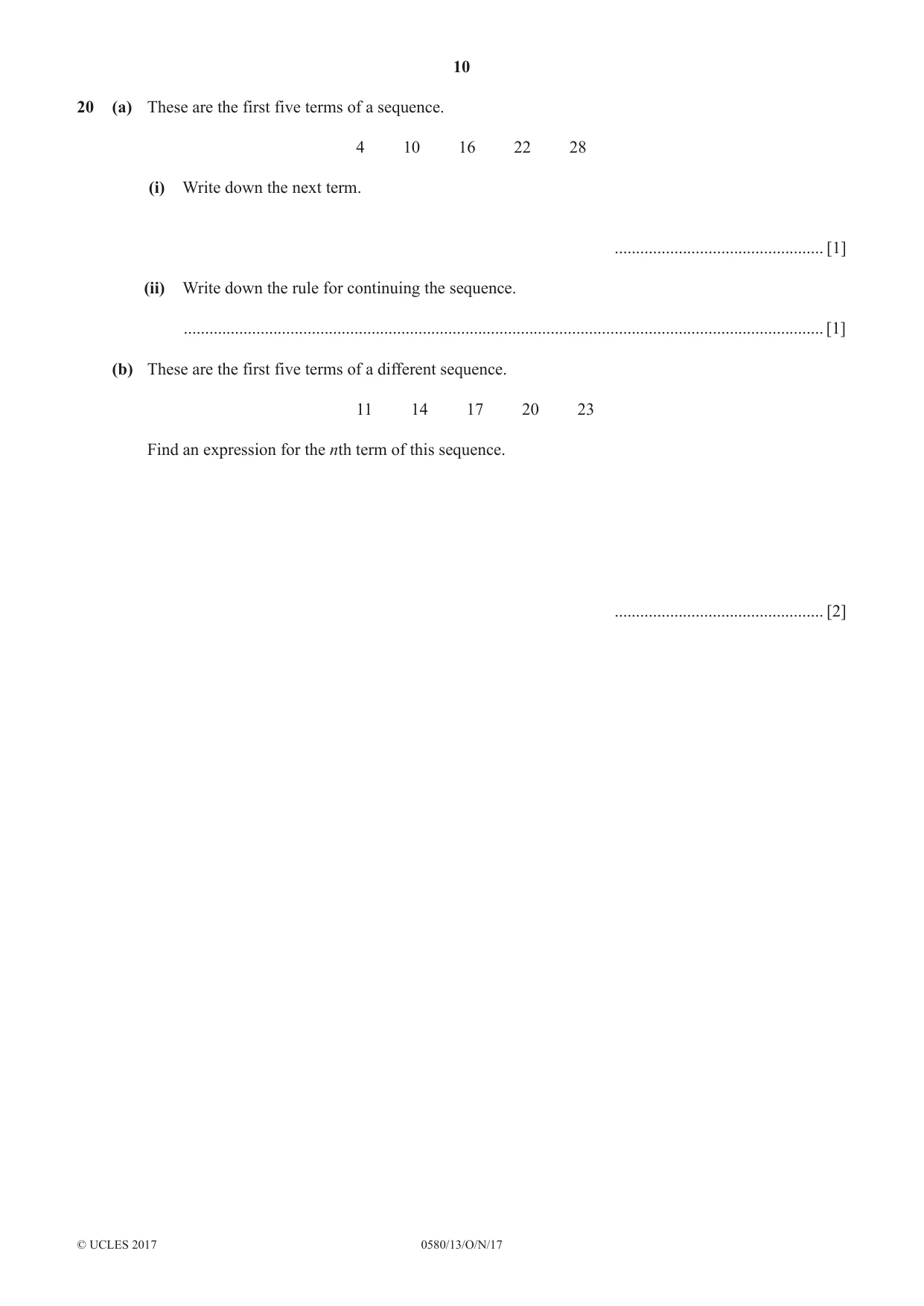
Q20 · These are the first five terms of a sequence
20 (a) These are the first five terms of a sequence. 4 10 16 22 28 (i) Write down the next term. ................................................. [1] (ii) Write down the rule for continuing the sequence. ...................................................................................................................................................... [1] (b) These are the first five terms of a different sequence. 11 14 17 20 23 Find an expression for the nth term of this sequence. ................................................. [2]
Mark scheme: 20(a)(i) 34 1 20(a)(ii) Add 6 oe 1 20(b) 3n + 8 oe 2 B1 for 3n + k
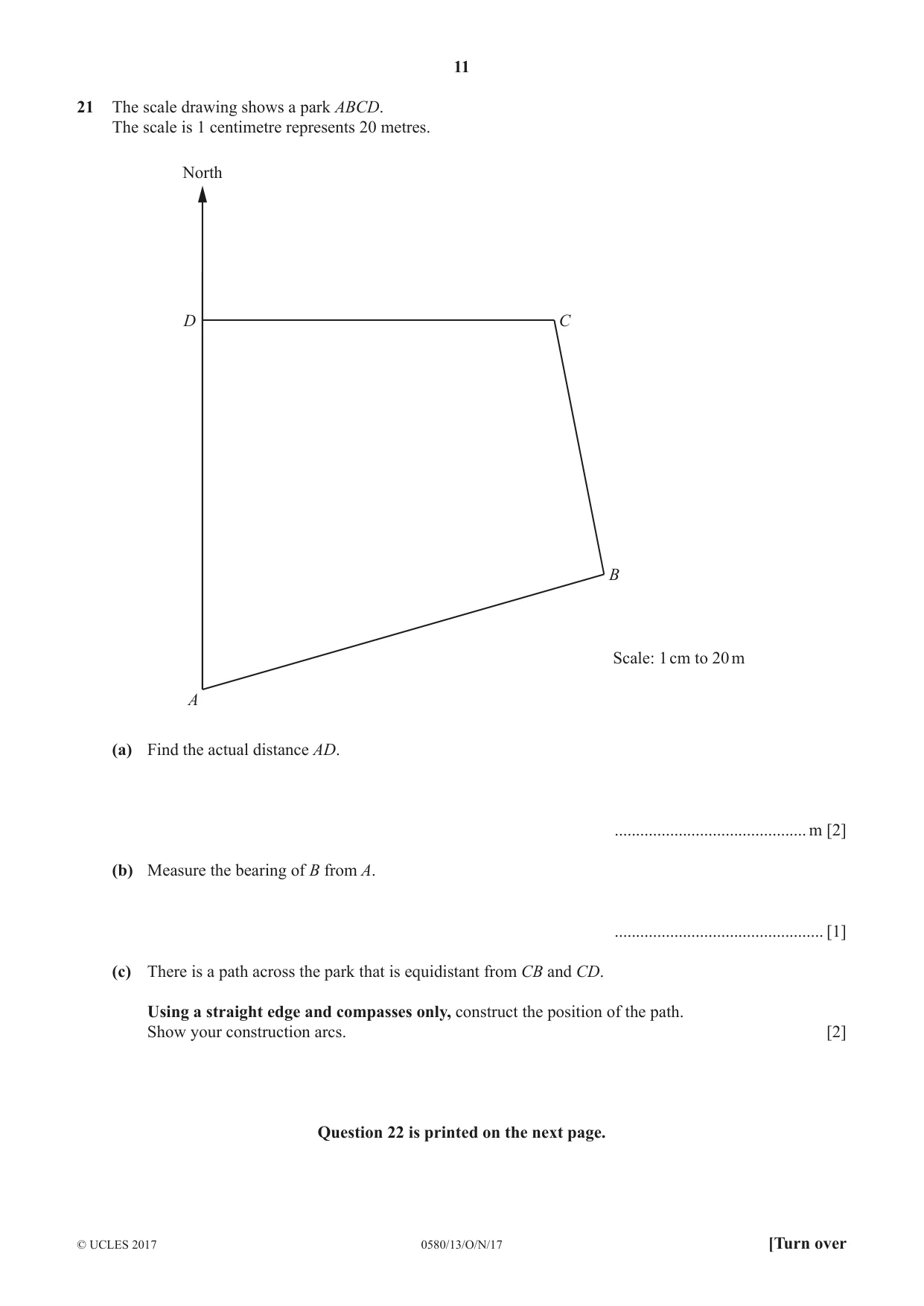
Q21 · The scale drawing shows a park ABCD
21 The scale drawing shows a park ABCD. The scale is 1 centimetre represents 20 metres. North D C B Scale: 1 cm to 20 m A (a) Find the actual distance AD. ............................................. m [2] (b) Measure the bearing of B from A. ................................................. [1] (c) There is a path across the park that is equidistant from CB and CD. Using a straight edge and compasses only, construct the position of the path. Show your construction arcs. [2] Question 22 is printed on the next page.
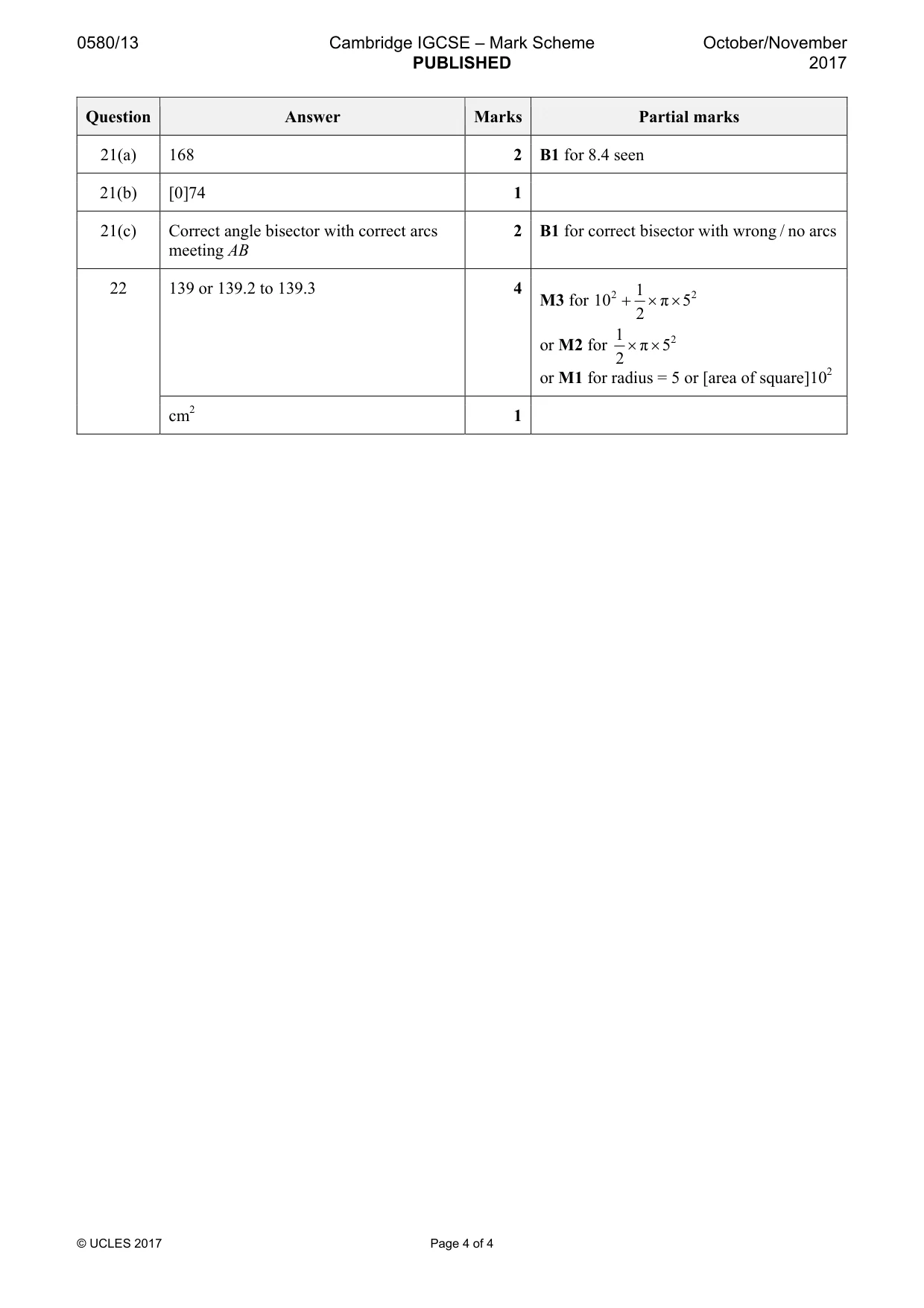
Mark scheme: 21(a) 168 2 B1 for 8.4 seen 21(b) [0]74 1 21(c) Correct angle bisector with correct arcs 2 B1 for correct bisector with wrong / no arcs meeting AB
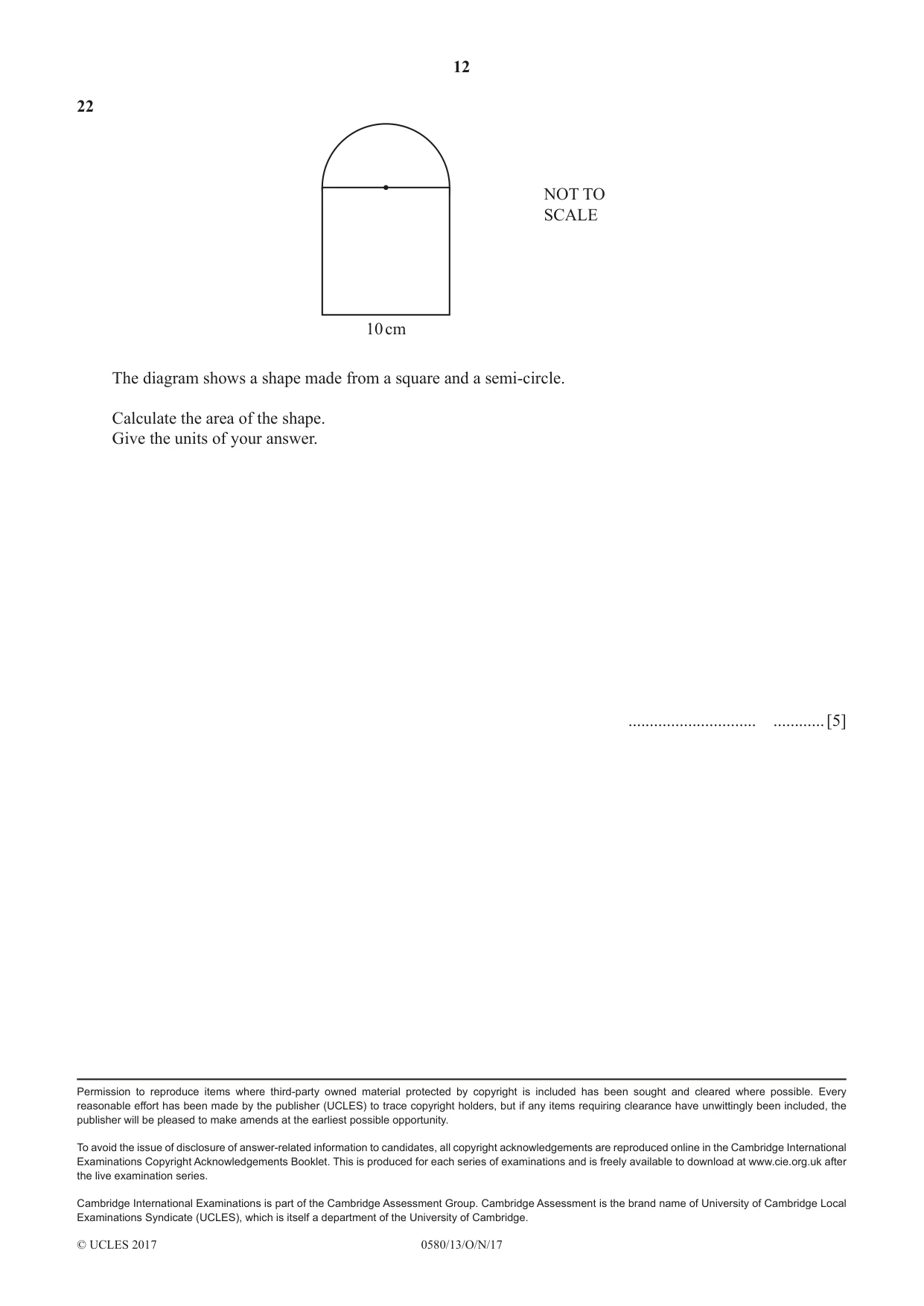
Q22 · NOT TO SCALE 10 cm The diagram shows a shape made from a square and a semi-circle
22 NOT TO SCALE 10 cm The diagram shows a shape made from a square and a semi-circle. Calculate the area of the shape. Give the units of your answer. .............................. ............ [5]
Mark scheme: 22 139 or 139.2 to 139.3 4 2 1 2 M3 for 10 + × π × 5 2 1 2 or M2 for × π × 5 2 or M1 for radius = 5 or [area of square]102 cm2 1
What was in this paper
The subtopics covered by these 22 questions, and how many questions each got. Open one in a new tab to see every Cambridge question on it.
2Fractions, decimals and percentages2Percentages2Classifying statistical data1Equations1Estimation1Graphs in practical situations1Indices I1Introduction to probability1Ratio and proportion1Right-angled triangles1Scale drawings1Sequences1Standard form1Symmetry1The four operations1Time1Types of number1Vectors in two dimensions1What you needed in this session
Cambridge’s own grade thresholds for 2017 Oct/Nov, Paper 1 · Variant 3. A higher threshold means an easier paper — the bar moves with how the cohort did.