Cambridge IGCSE Mathematics 0580 — 2012 Oct/Nov Paper 1 · Variant 1
0580/11/O/N/12 · 20 questions · 56 marks · ≈63 min
The question paper and its mark scheme, free to read here and free to download. This is Cambridge’s own paper, exactly as it was sat.
Question paper12 pages
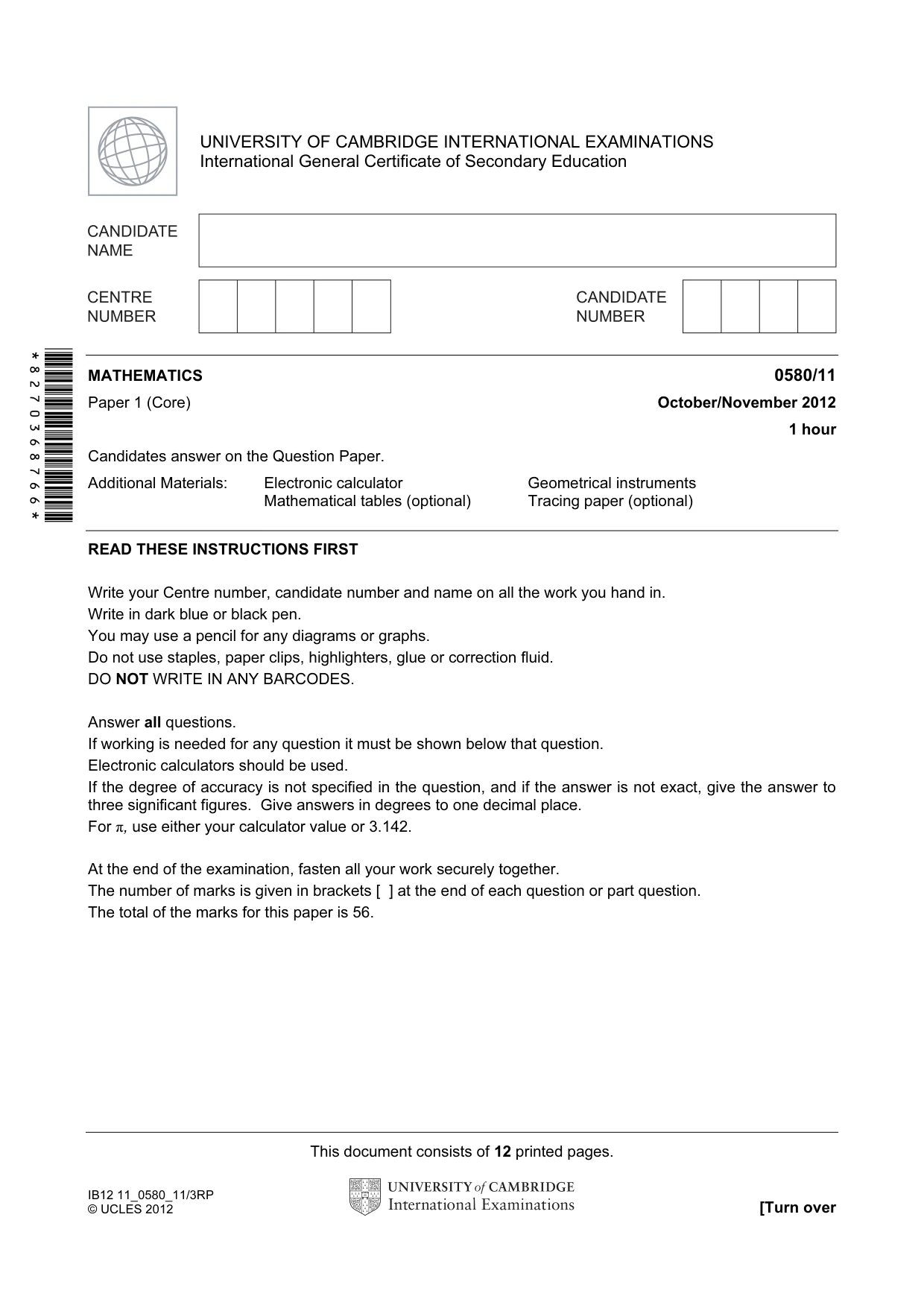
Mark scheme3 pages
Answers below. Sit the paper first if you are practising.
Questions as text
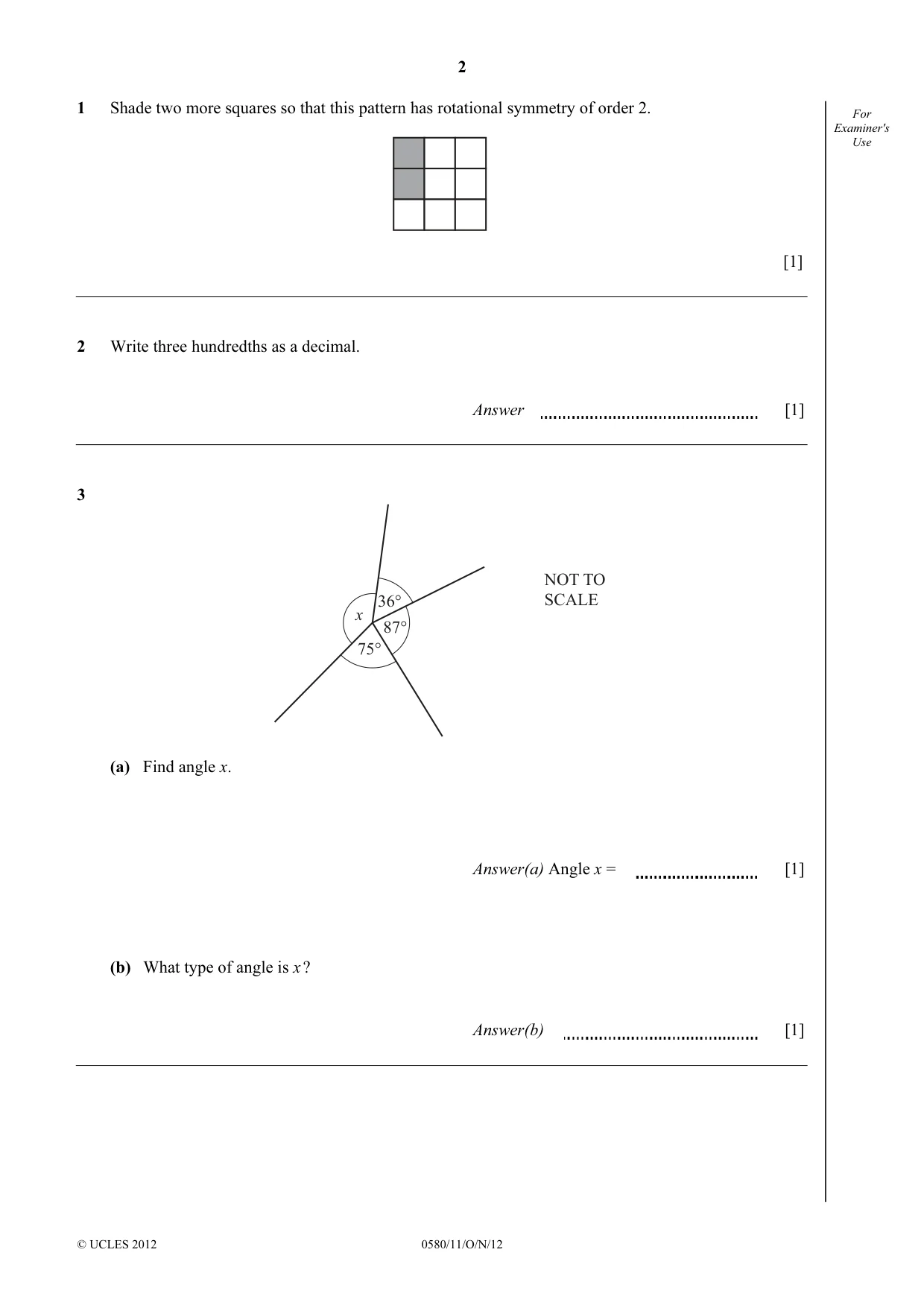
Q1 · Shade two more squares so that this pattern has rotational symmetry of order 2
1 Shade two more squares so that this pattern has rotational symmetry of order 2. For Examiner's Use [1]
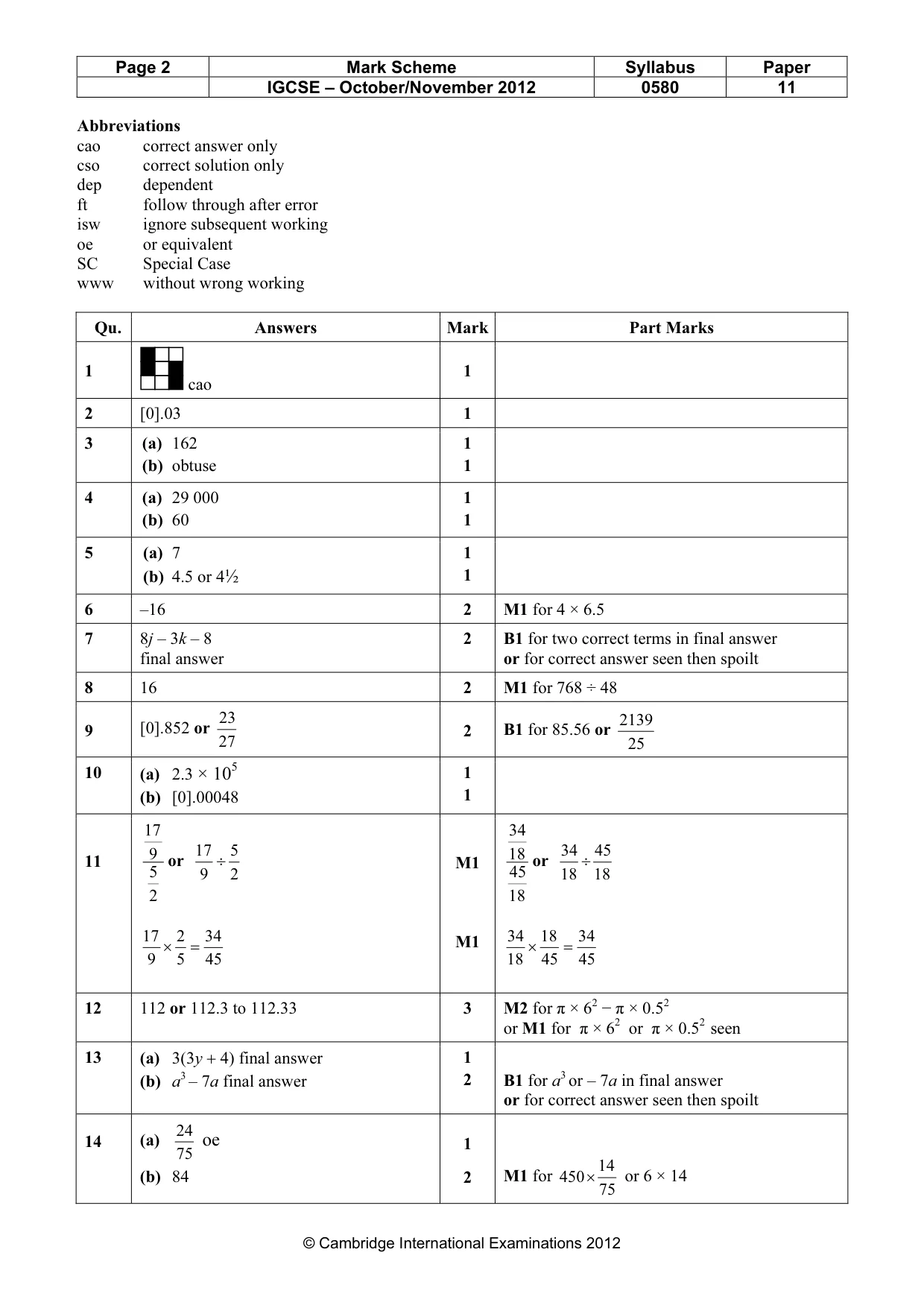
Mark scheme: Qu. Answers Mark Part Marks 1 1 cao
Q2 · Write three hundredths as a decimal
2 Write three hundredths as a decimal. Answer [1]
Mark scheme: 2 [0].03 1
Q3 · NOT TO 36° SCALE x 87° 75° (a) Find angle x
3 NOT TO 36° SCALE x 87° 75° (a) Find angle x. Answer(a) Angle x = [1] (b) What type of angle is x ? Answer(b) [1]
Mark scheme: 3 (a) 162 1 (b) obtuse 1
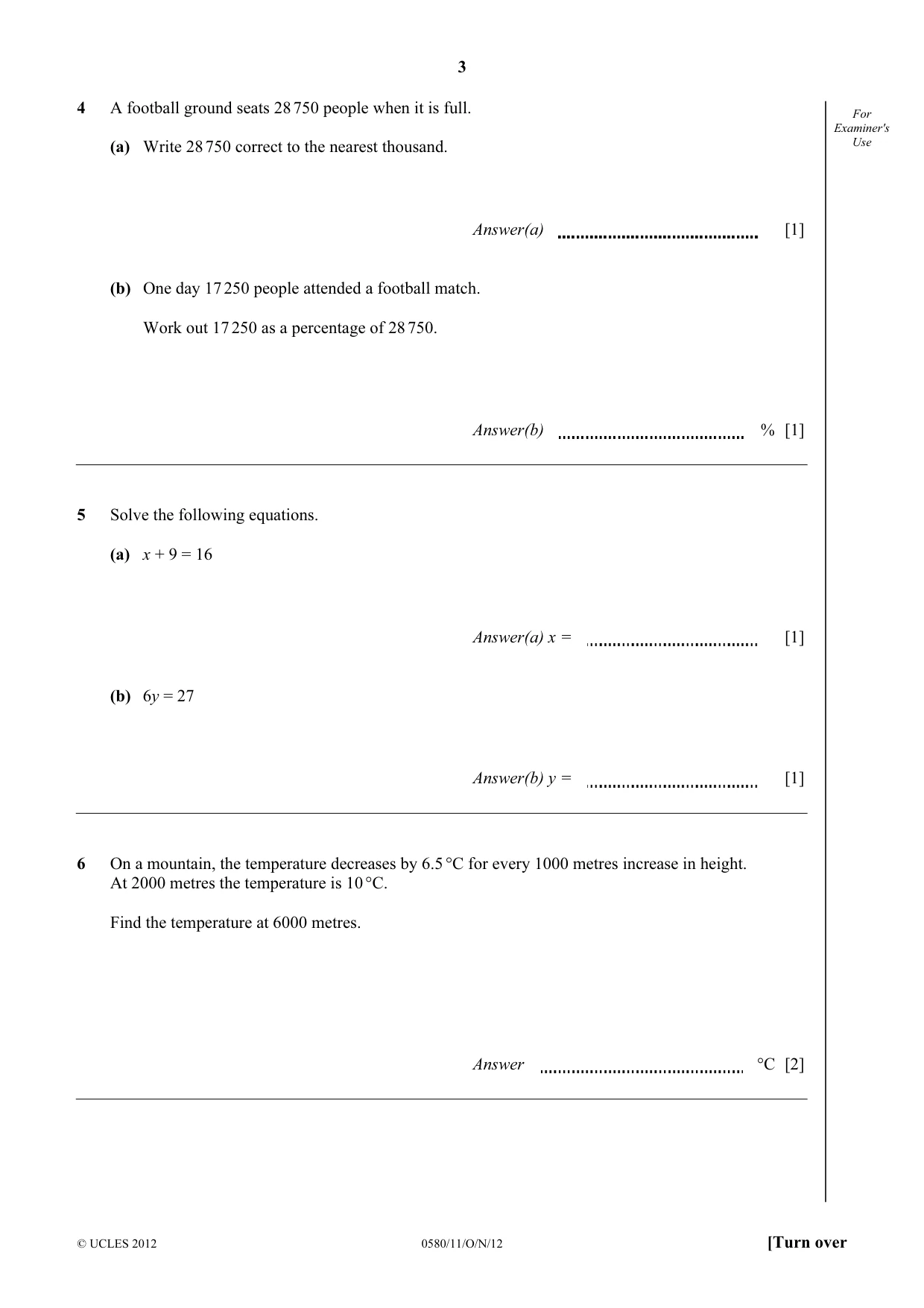
Q4 · A football ground seats 28 750 people when it is full
4 A football ground seats 28 750 people when it is full. For Examiner's Use (a) Write 28 750 correct to the nearest thousand. Answer(a) [1] (b) One day 17 250 people attended a football match. Work out 17 250 as a percentage of 28 750. Answer(b) % [1]
Mark scheme: 4 (a) 29 000 1 (b) 60 1
Q5 · Solve the following equations
5 Solve the following equations. (a) x + 9 = 16 Answer(a) x = [1] (b) 6y = 27 Answer(b) y = [1]
Mark scheme: 5 (a) 7 1 (b) 4.5 or 4½ 1
Q6 · On a mountain, the temperature decreases by 6.5 °C for every 1000 metres increase in…
6 On a mountain, the temperature decreases by 6.5 °C for every 1000 metres increase in height. At 2000 metres the temperature is 10 °C. Find the temperature at 6000 metres. Answer °C [2]
Mark scheme: 6 –16 2 M1 for 4 × 6.5
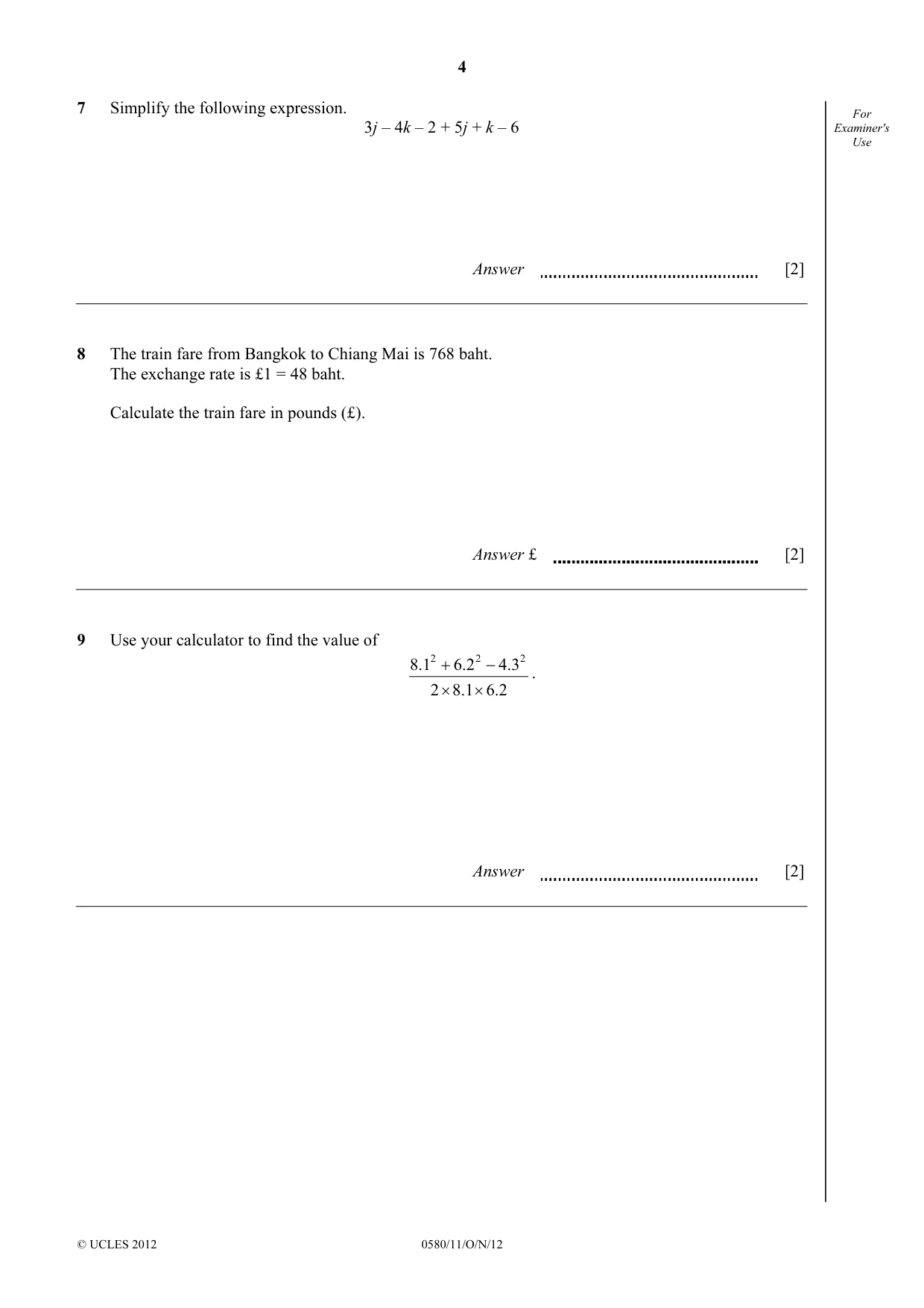
Q7 · Simplify the following expression
7 Simplify the following expression. For 3j – 4k – 2 + 5j + k – 6 Examiner's Use Answer [2]
Mark scheme: 7 8j – 3k – 8 2 B1 for two correct terms in final answer final answer or for correct answer seen then spoilt
Q8 · The train fare from Bangkok to Chiang Mai is 768 baht
8 The train fare from Bangkok to Chiang Mai is 768 baht. The exchange rate is £1 = 48 baht. Calculate the train fare in pounds (£). Answer £ [2]
Mark scheme: 8 16 2 M1 for 768 ÷ 48 23 2139 [0] 852 f
Q9 · Use your calculator to find the value of 8.12 + 6.2 2 − 4.3 2
9 Use your calculator to find the value of 8.12 + 6.2 2 − 4.3 2 . 2 × 8.1 × 6.2 Answer [2]
Mark scheme: 2139 9 [0].852 or 2 B1 for 85.56 or 27 25 5
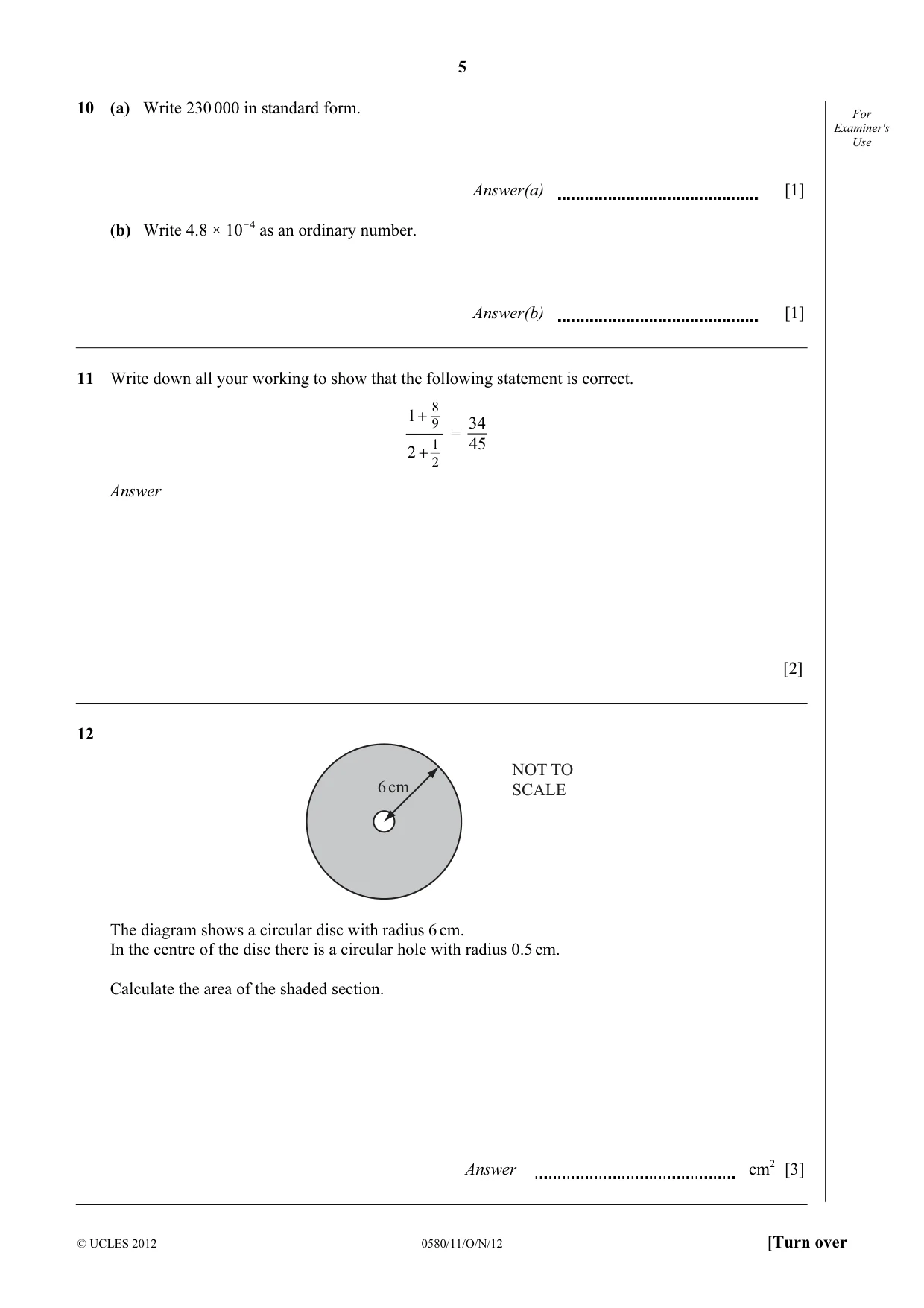
Q10 · Write 230 000 in standard form
10 (a) Write 230 000 in standard form. For Examiner's Use Answer(a) [1] O4 (b) Write 4.8 × 10 as an ordinary number. Answer(b) [1]
Mark scheme: 10 (a) 2.3 × 10⁵ 1 (b) [0].00048 1 17 34 9 17 5 18 34 45
Q11 · Write down all your working to show that the following statement is correct
11 Write down all your working to show that the following statement is correct. 8 1 + 9 34 = 1 45 2 + 2 Answer [2]
Mark scheme: 9 17 5 18 34 45 11 or ÷ M1 or ÷ 5 9 2 45 18 18 2 18 17 2 34 34 18 34 × = M1 × = 9 5 45 18 45 45 2 2
Q12 · NOT TO 6 cm SCALE The diagram shows a circular disc with radius 6 cm
12 NOT TO 6 cm SCALE The diagram shows a circular disc with radius 6 cm. In the centre of the disc there is a circular hole with radius 0.5 cm. Calculate the area of the shaded section. Answer cm2 [3]
Mark scheme: 12 112 or 112.3 to 112.33 3 M2 for π × 62 − π × 0.52 or M1 for π × 62 or π × 0.52 seen
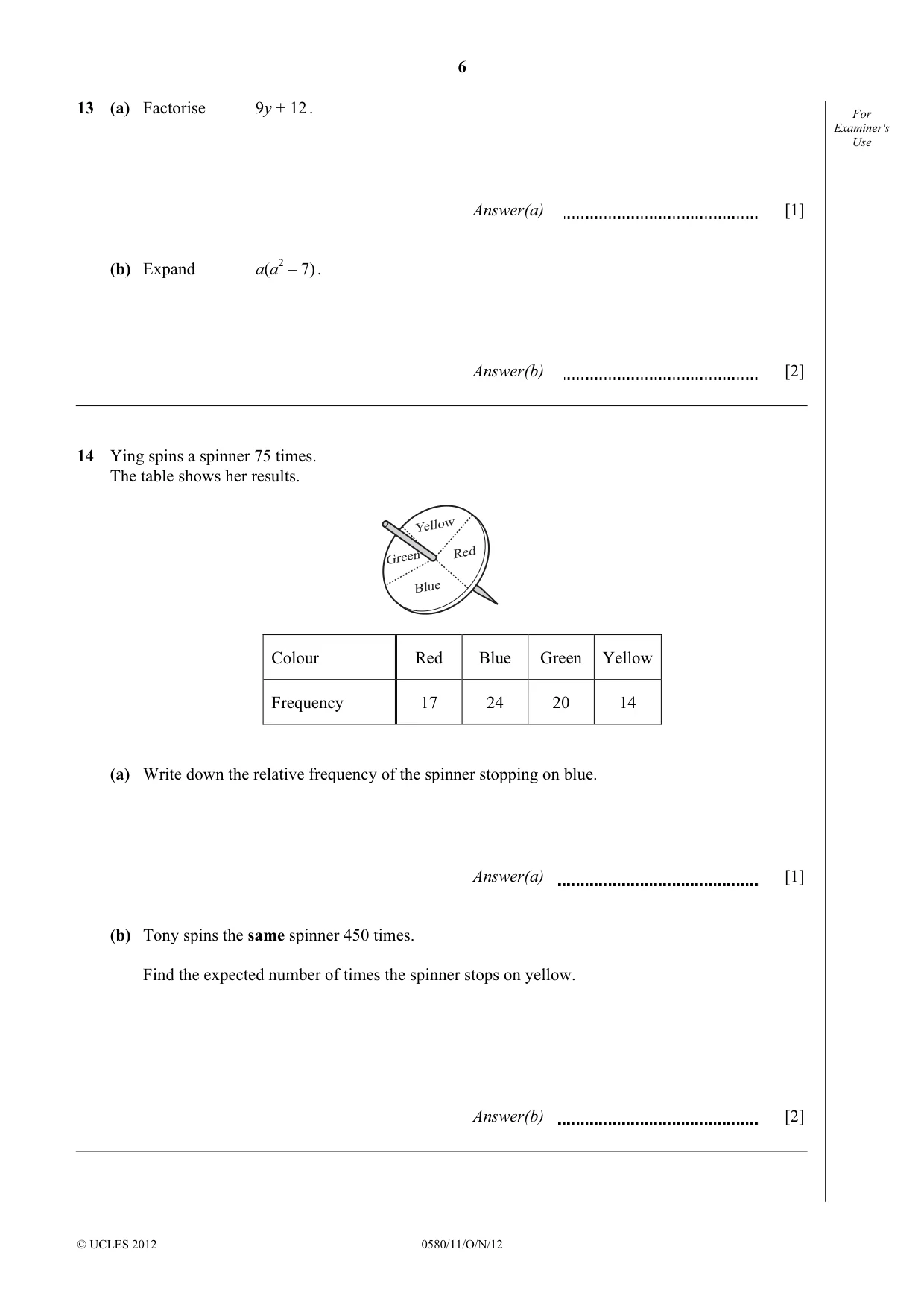
Q13 · Factorise 9y + 12
13 (a) Factorise 9y + 12 . For Examiner's Use Answer(a) [1] (b) Expand a(a2 – 7) . Answer(b) [2]
Mark scheme: 13 (a) 3(3y + 4) final answer 1 (b) a3 – 7a final answer 2 B1 for a3 or – 7a in final answer or for correct answer seen then spoilt 24
Q14 · Ying spins a spinner 75 times
14 Ying spins a spinner 75 times. The table shows her results. Yellow Green Red Blue Colour Red Blue Green Yellow Frequency 17 24 20 14 (a) Write down the relative frequency of the spinner stopping on blue. Answer(a) [1] (b) Tony spins the same spinner 450 times. Find the expected number of times the spinner stops on yellow. Answer(b) [2]
Mark scheme: 24 14 (a) oe 1 75 14 (b) 84 2 M1 for 450× or 6 × 14 75 IGCSE – October/November 2012 0580 11 20 ( ) 360 [ 160] 1
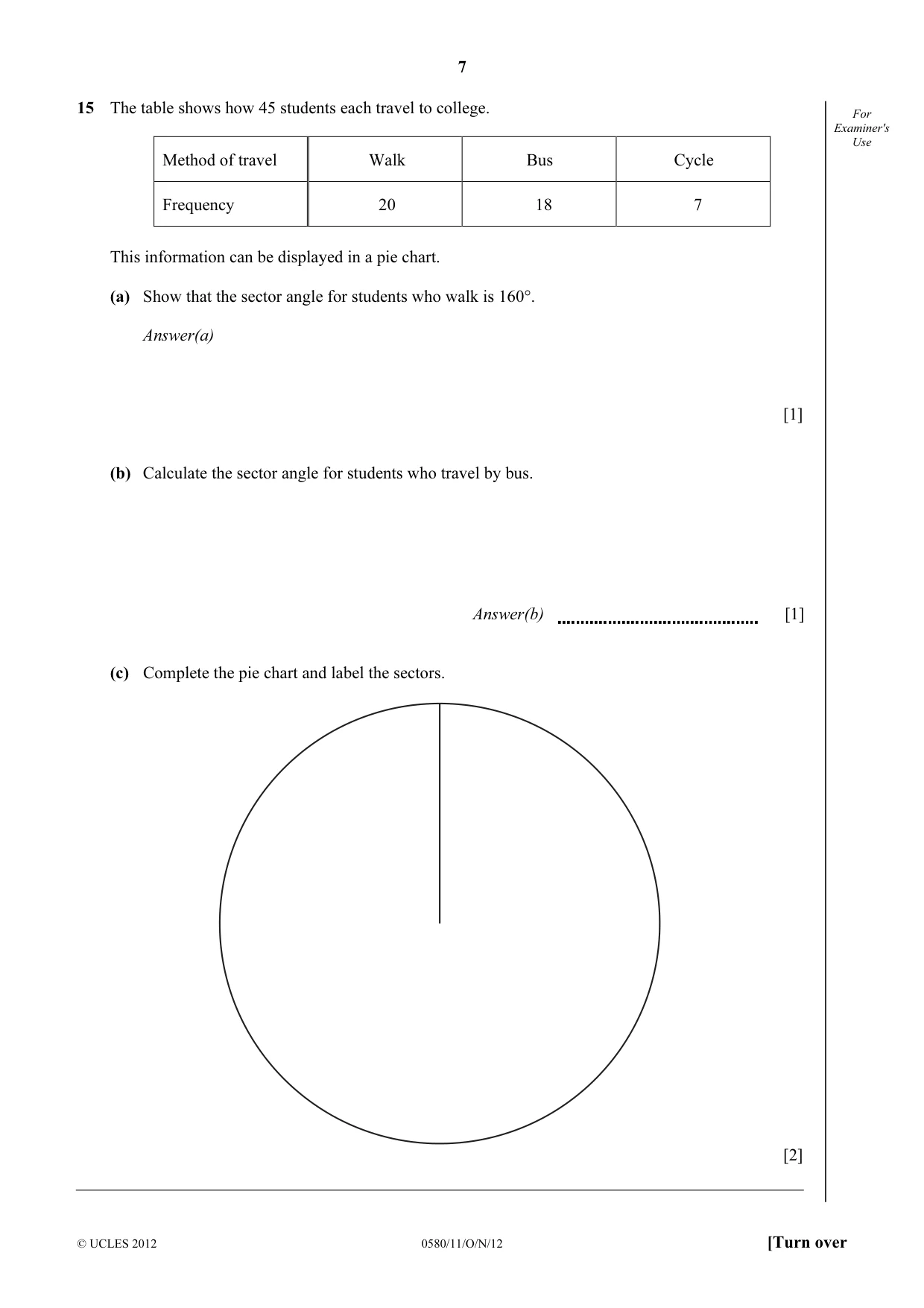
Q15 · The table shows how 45 students each travel to college
15 The table shows how 45 students each travel to college. For Examiner's Use Method of travel Walk Bus Cycle Frequency 20 18 7 This information can be displayed in a pie chart. (a) Show that the sector angle for students who walk is 160°. Answer(a) [1] (b) Calculate the sector angle for students who travel by bus. Answer(b) [1] (c) Complete the pie chart and label the sectors. [2]
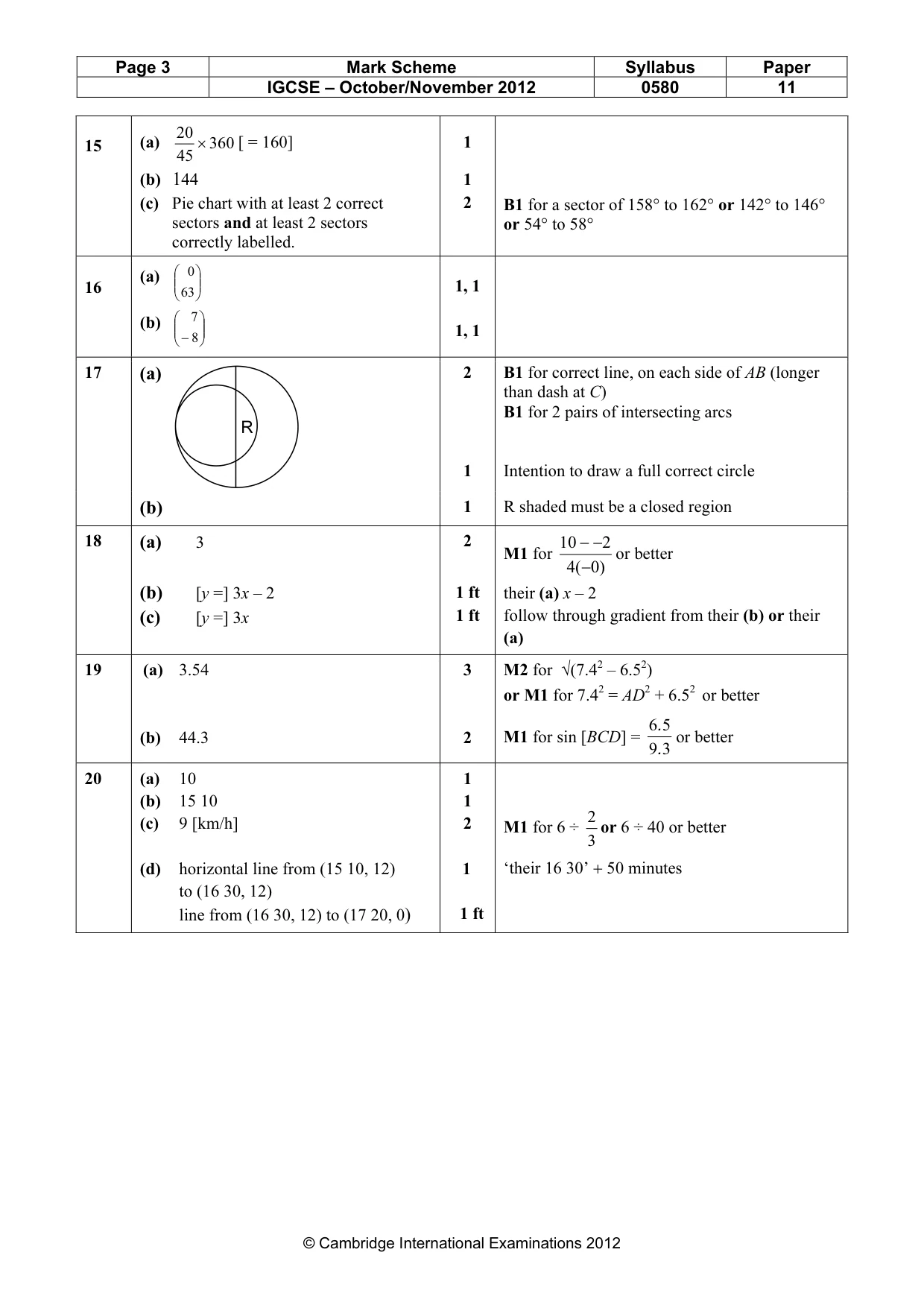
Mark scheme: 0 15 (a) × 360 [ = 160] 1 45 (b) 144 1 (c) Pie chart with at least 2 correct 2 B1 for a sector of 158° to 162° or 142° to 146° sectors and at least 2 sectors or 54° to 58° correctly labelled. (a) 0 1 1
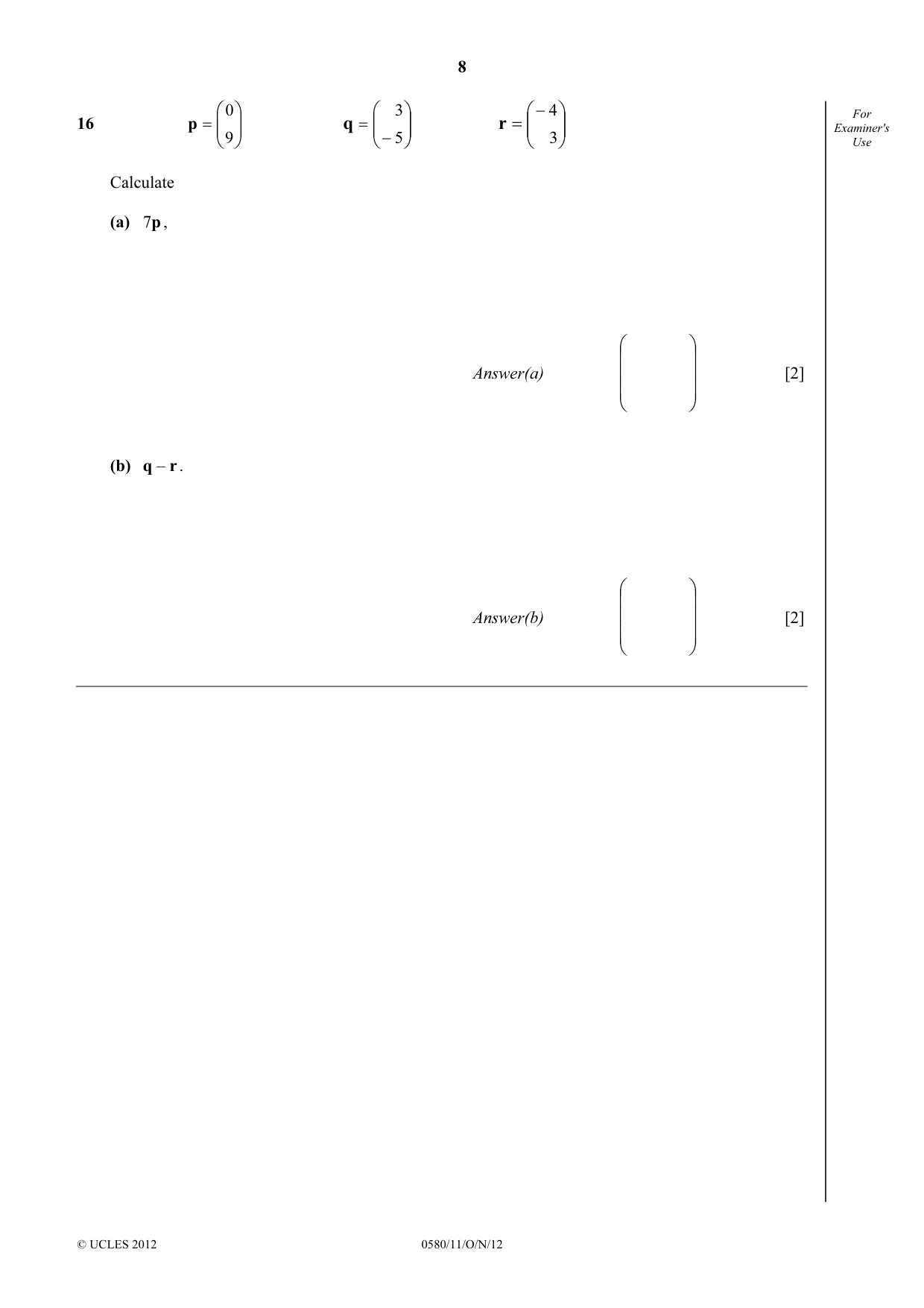
Q16 · − For Examiner's16 p = q = r = 9 − 5 3 Use Calculate (a) 7p…
− For Examiner's16 p = q = r = 9 − 5 3 Use Calculate (a) 7p , Answer(a) [2] (b) q – r . Answer(b) [2]
Mark scheme: (a) 1, 116 63 7 (b) 1, 1 −8
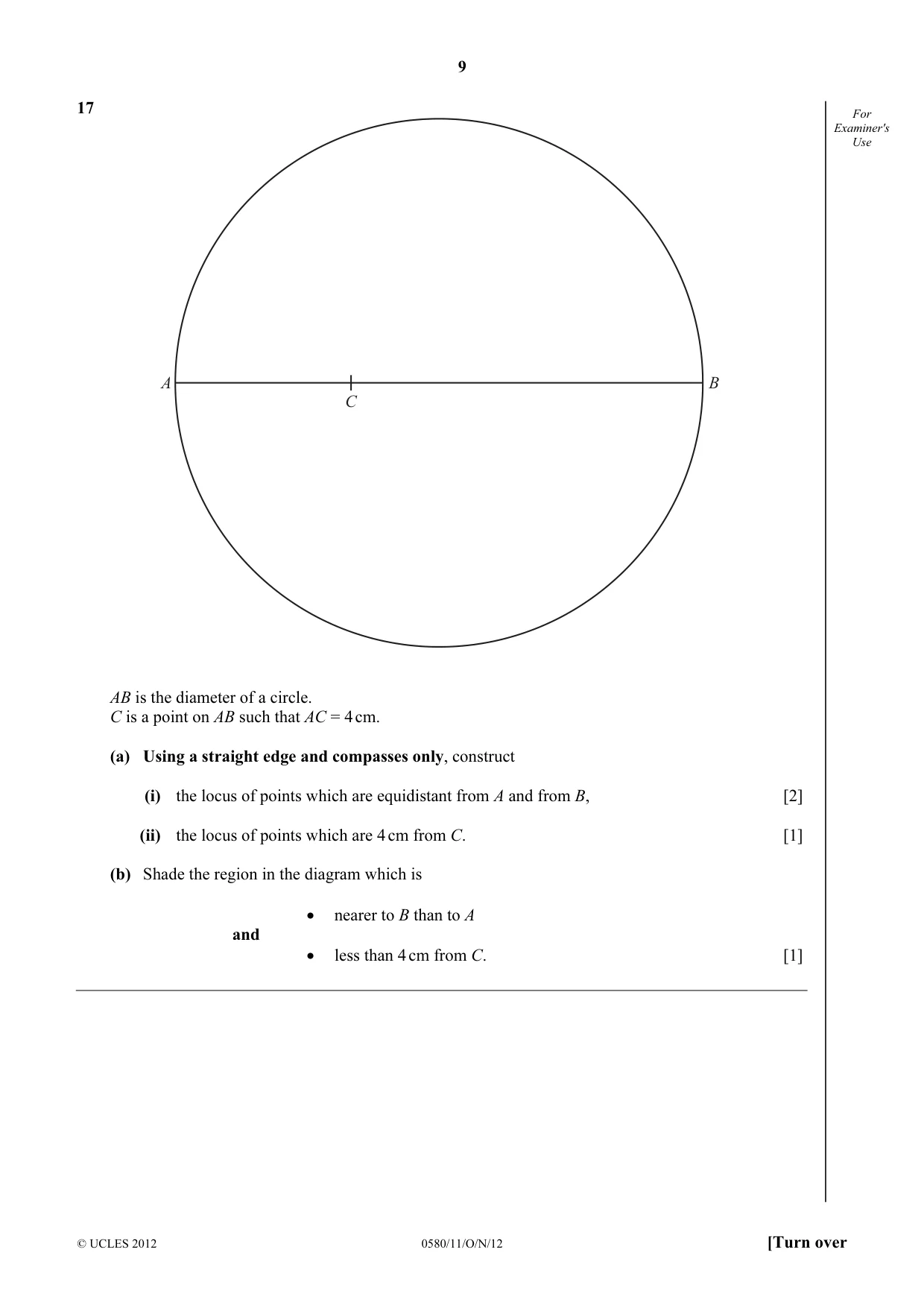
Q17 · For Examiner's Use A B C AB is the diameter of a circle
17 For Examiner's Use A B C AB is the diameter of a circle. C is a point on AB such that AC = 4 cm. (a) Using a straight edge and compasses only, construct (i) the locus of points which are equidistant from A and from B, [2] (ii) the locus of points which are 4 cm from C. [1] (b) Shade the region in the diagram which is • nearer to B than to A and • less than 4 cm from C. [1]
Mark scheme: 17 (a) 2 B1 for correct line, on each side of AB (longer than dash at C) B1 for 2 pairs of intersecting arcs R 1 Intention to draw a full correct circle (b) 1 R shaded must be a closed region
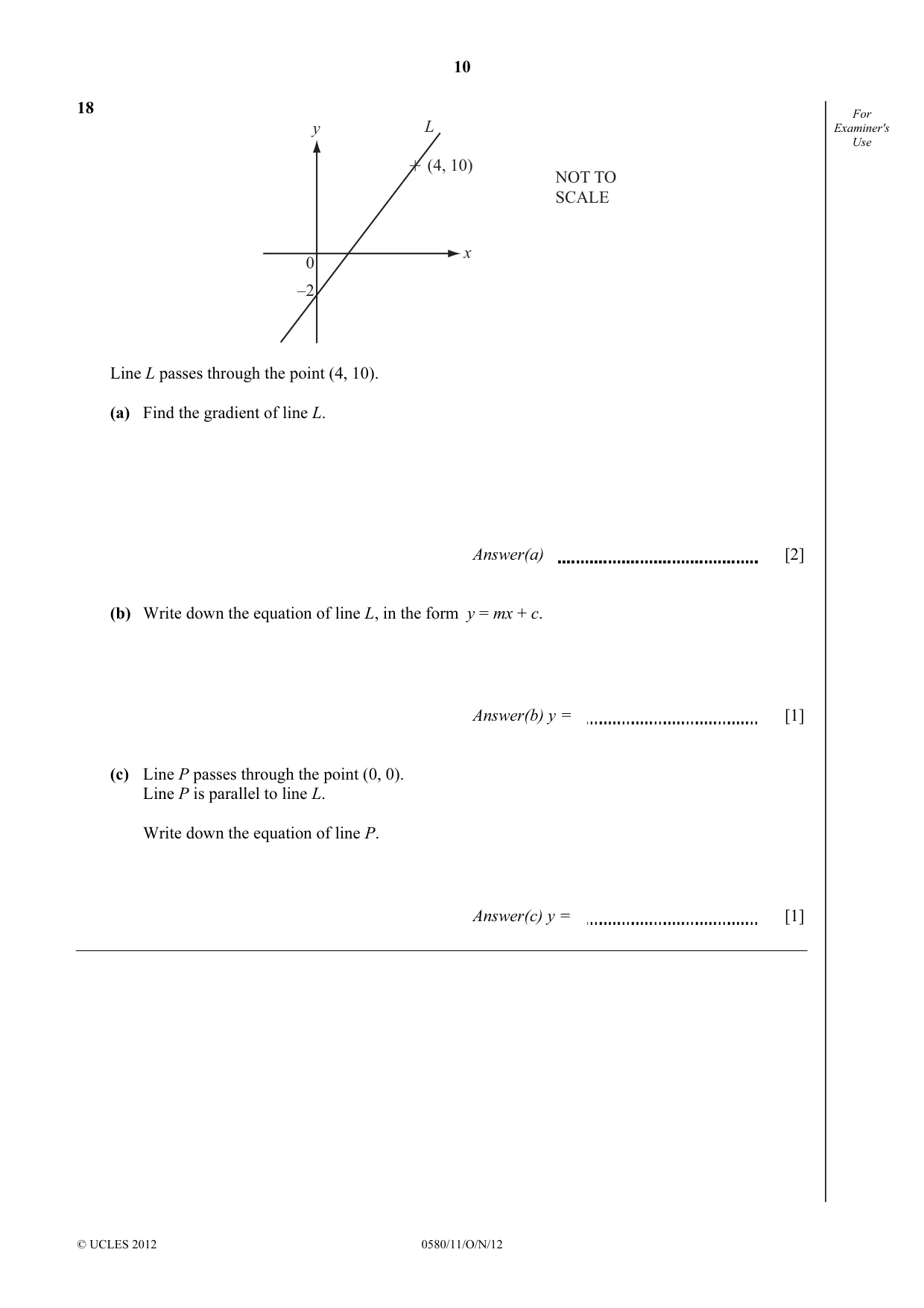
Q18 · For y L Examiner's Use (4, 10) NOT TO SCALE x 0 –2 Line L passes through the point (4, 10)
18 For y L Examiner's Use (4, 10) NOT TO SCALE x 0 –2 Line L passes through the point (4, 10). (a) Find the gradient of line L. Answer(a) [2] (b) Write down the equation of line L, in the form y = mx + c. Answer(b) y = [1] (c) Line P passes through the point (0, 0). Line P is parallel to line L. Write down the equation of line P. Answer(c) y = [1]
Mark scheme: 18 (a) 3 2 10 − −2 M1 for or better 4( −0) (b) [y =] 3x – 2 1 ft their (a) x – 2 (c) [y =] 3x 1 ft follow through gradient from their (b) or their (a) √ 2 2
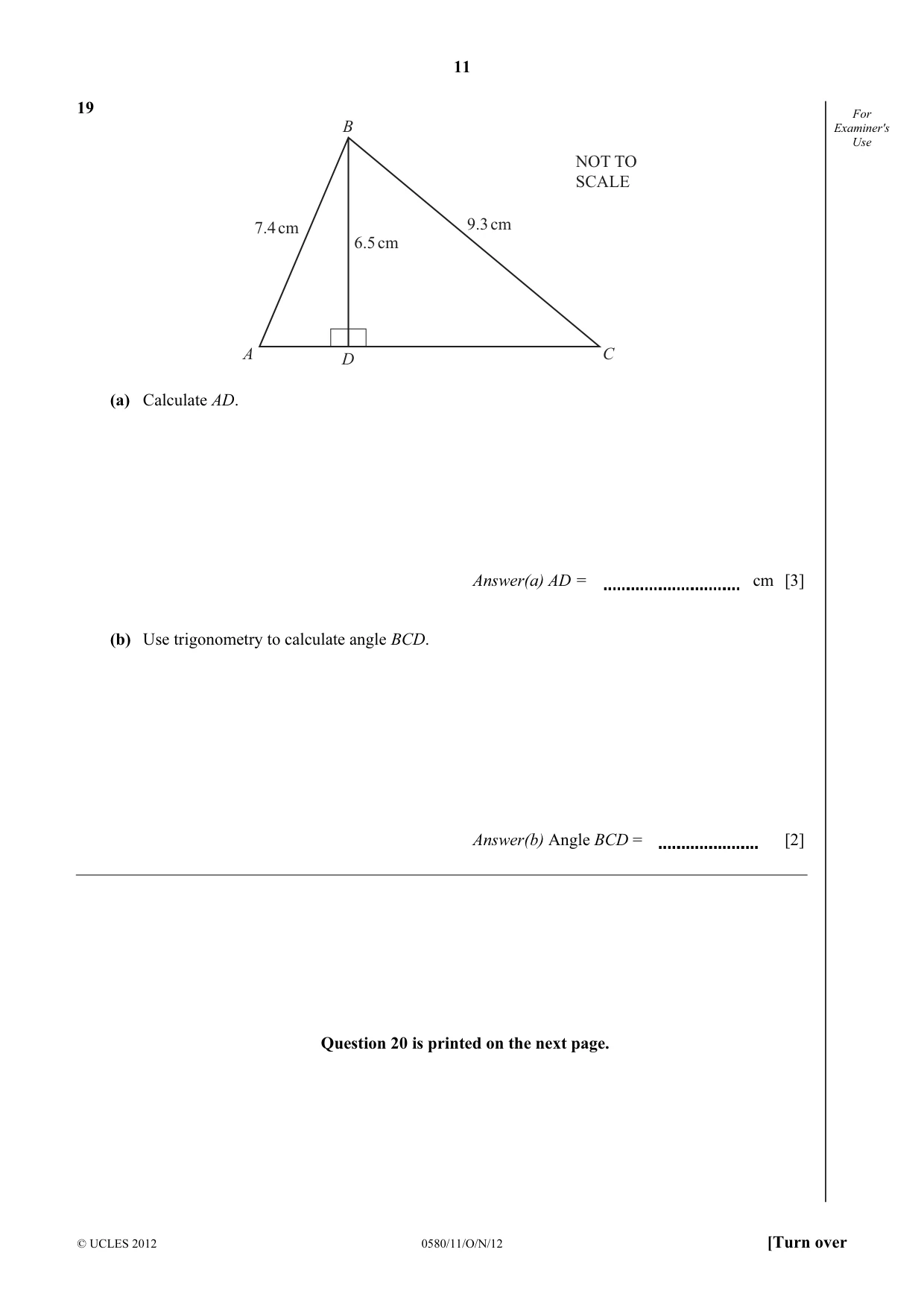
Q19 · For B Examiner's Use NOT TO SCALE 7.4 cm 9.3 cm 6.5 cm A C D (a) Calculate AD
19 For B Examiner's Use NOT TO SCALE 7.4 cm 9.3 cm 6.5 cm A C D (a) Calculate AD. Answer(a) AD = cm [3] (b) Use trigonometry to calculate angle BCD. Answer(b) Angle BCD = [2] Question 20 is printed on the next page.
Mark scheme: 19 (a) 3.54 3 M2 for √(7.42 – 6.52) or M1 for 7.42 = AD2 + 6.52 or better 6 . 5 (b) 44.3 2 M1 for sin [BCD] = or better 9 . 3
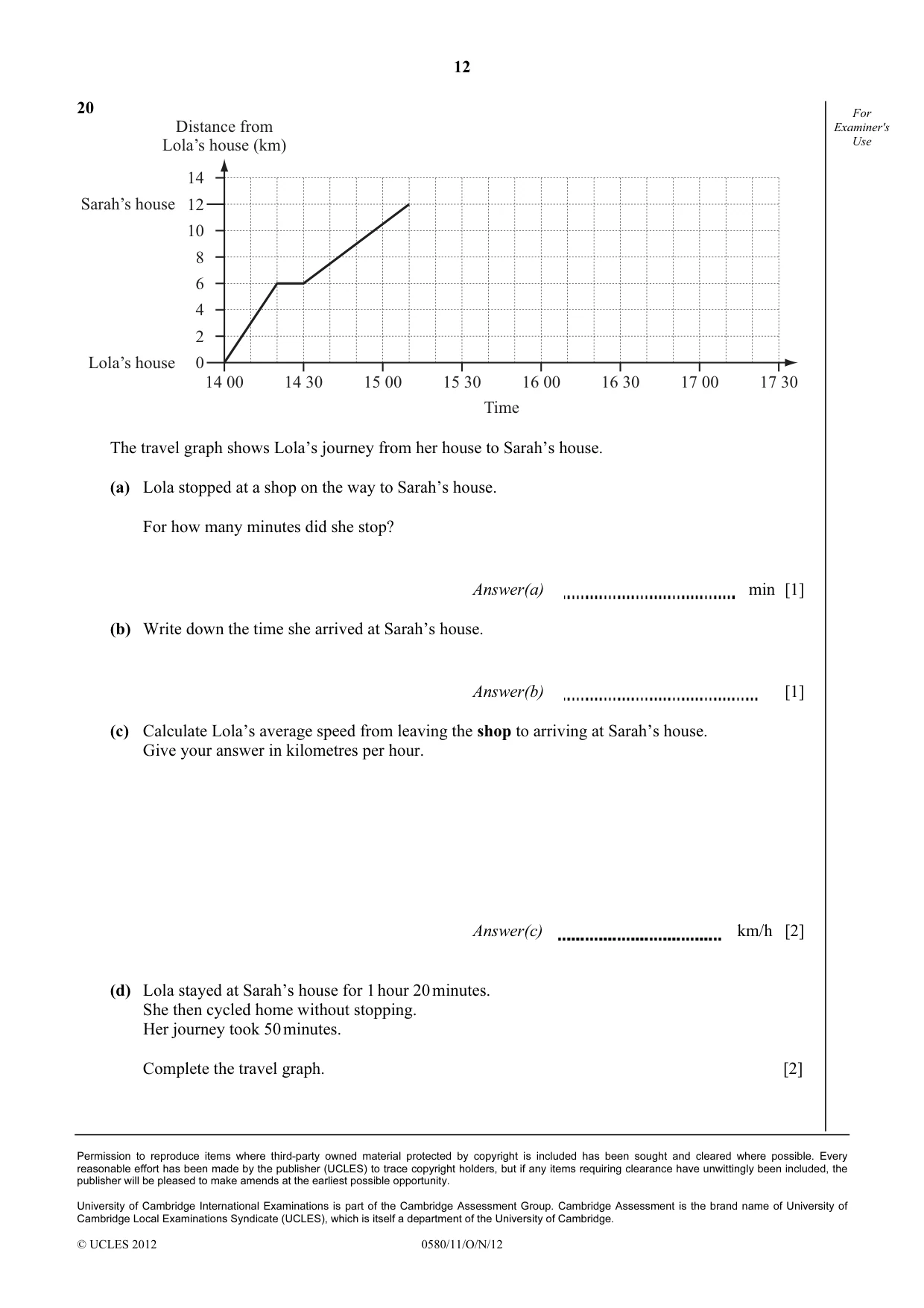
Q20 · For Distance from Examiner's Lola’s house (km) Use 14 Sarah’s house 12 10 8 6 4 2 Lola’s…
20 For Distance from Examiner's Lola’s house (km) Use 14 Sarah’s house 12 10 8 6 4 2 Lola’s house 0 14 00 14 30 15 00 15 30 16 00 16 30 17 00 17 30 Time The travel graph shows Lola’s journey from her house to Sarah’s house. (a) Lola stopped at a shop on the way to Sarah’s house. For how many minutes did she stop? Answer(a) min [1] (b) Write down the time she arrived at Sarah’s house. Answer(b) [1] (c) Calculate Lola’s average speed from leaving the shop to arriving at Sarah’s house. Give your answer in kilometres per hour. Answer(c) km/h [2] (d) Lola stayed at Sarah’s house for 1 hour 20 minutes. She then cycled home without stopping. Her journey took 50 minutes. Complete the travel graph. [2]
Mark scheme: 20 (a) 10 1 (b) 15 10 1 2 (c) 9 [km/h] 2 M1 for 6 ÷ or 6 ÷ 40 or better 3 (d) horizontal line from (15 10, 12) 1 ‘their 16 30’ + 50 minutes to (16 30, 12) line from (16 30, 12) to (17 20, 0) 1 ft
What was in this paper
The subtopics covered by these 20 questions, and how many questions each got. Open one in a new tab to see every Cambridge question on it.
2Circles, arcs and sectors2Fractions, decimals and percentages2Angles1Equations1Geometrical constructions1Gradient of linear graphs1Limits of accuracy1Pythagoras’ theorem1Rates1Ratio and proportion1Relative and expected frequencies1Standard form1Symmetry1Time1Using a calculator1Vectors in two dimensions1What you needed in this session
Cambridge’s own grade thresholds for 2012 Oct/Nov, Paper 1 · Variant 1. A higher threshold means an easier paper — the bar moves with how the cohort did.