Cambridge IGCSE Mathematics 0580 — 2013 May/June Paper 1 · Variant 1
0580/11/M/J/13 · 20 questions · 56 marks · ≈63 min
The question paper and its mark scheme, free to read here and free to download. This is Cambridge’s own paper, exactly as it was sat.
Question paper8 pages
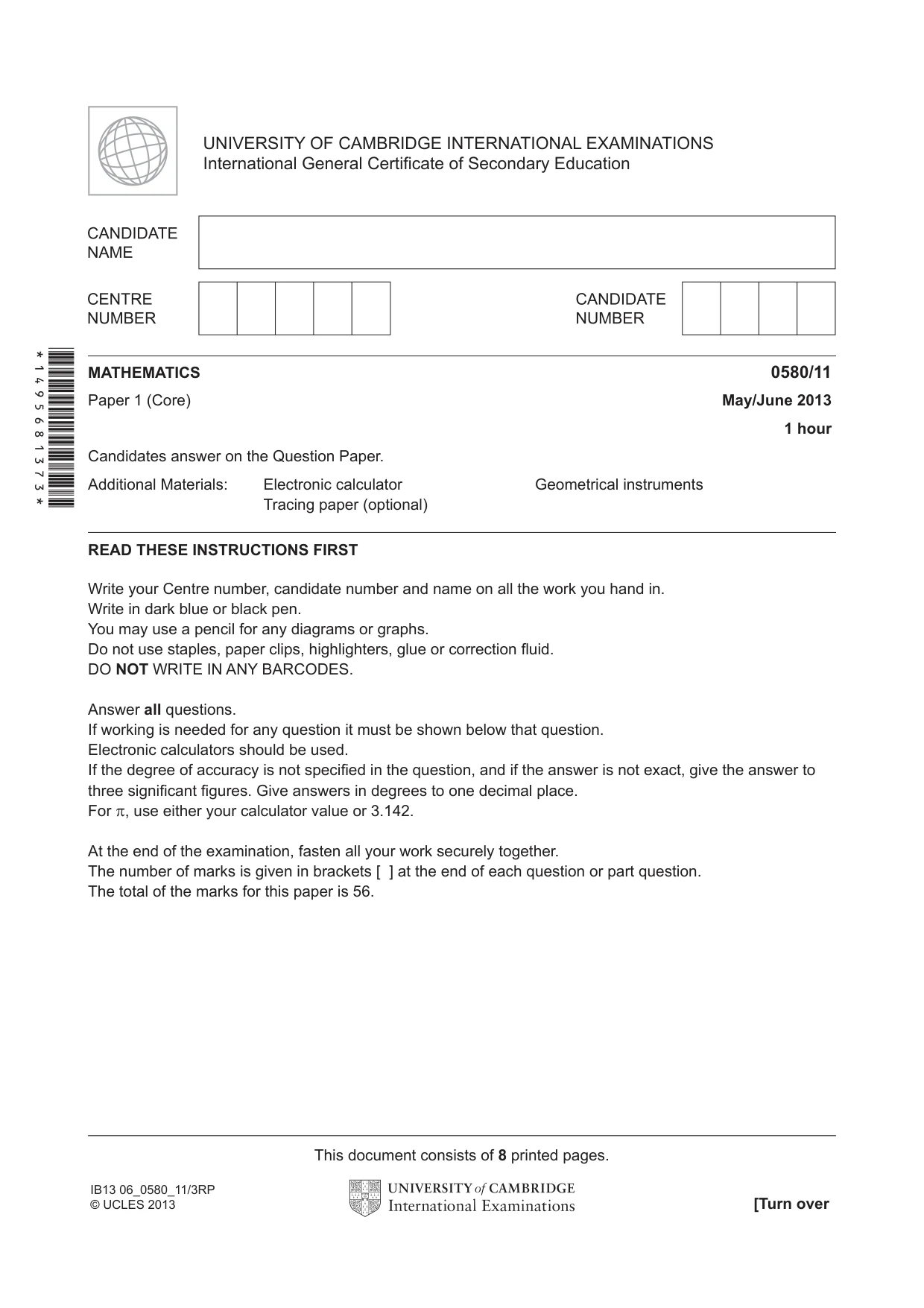
Mark scheme3 pages
Answers below. Sit the paper first if you are practising.
Questions as text
Q1 · Write 45% as a fraction in its simplest form
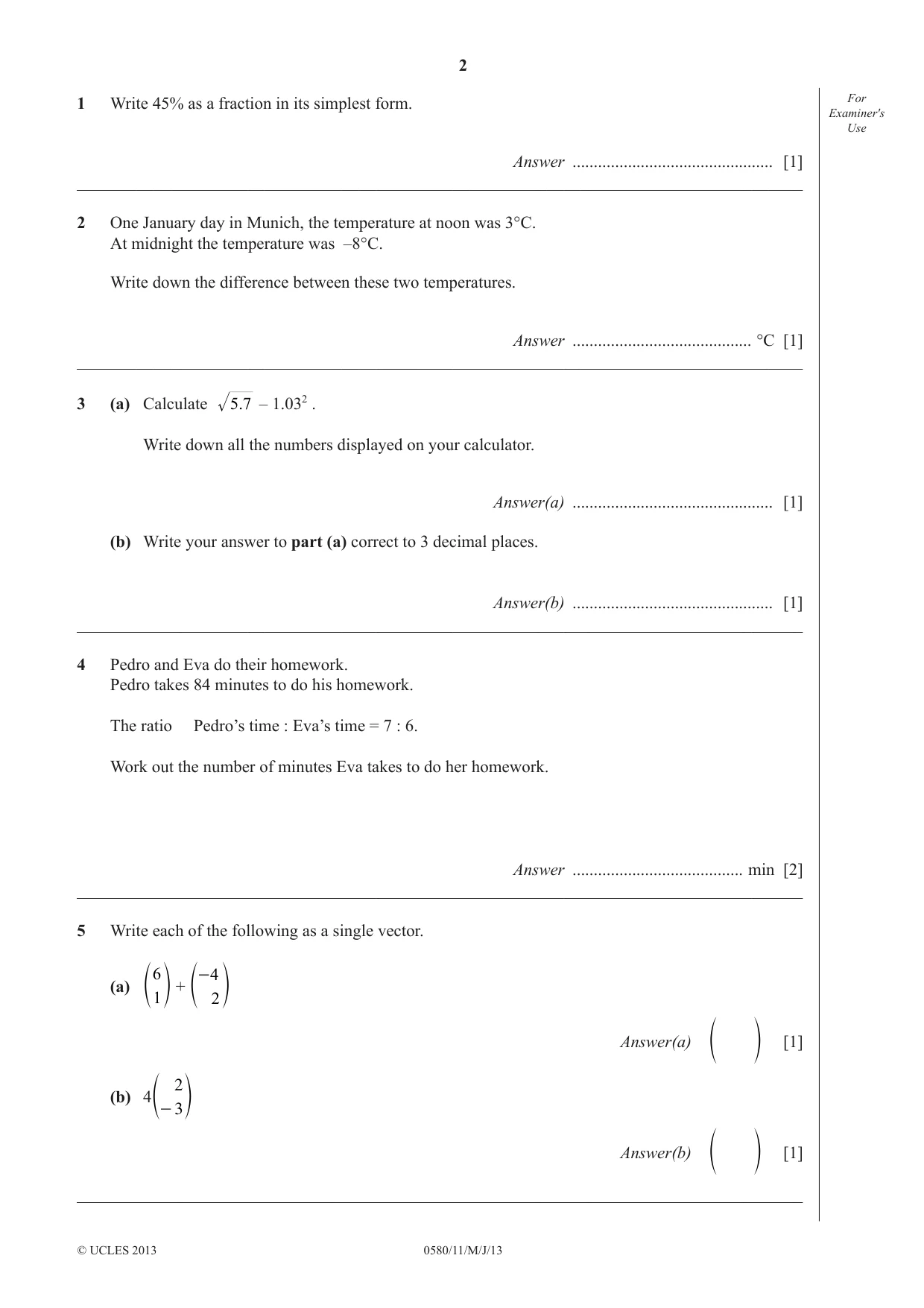
1 Write 45% as a fraction in its simplest form. For Examiner's Use Answer ............................................... [1] _____________________________________________________________________________________
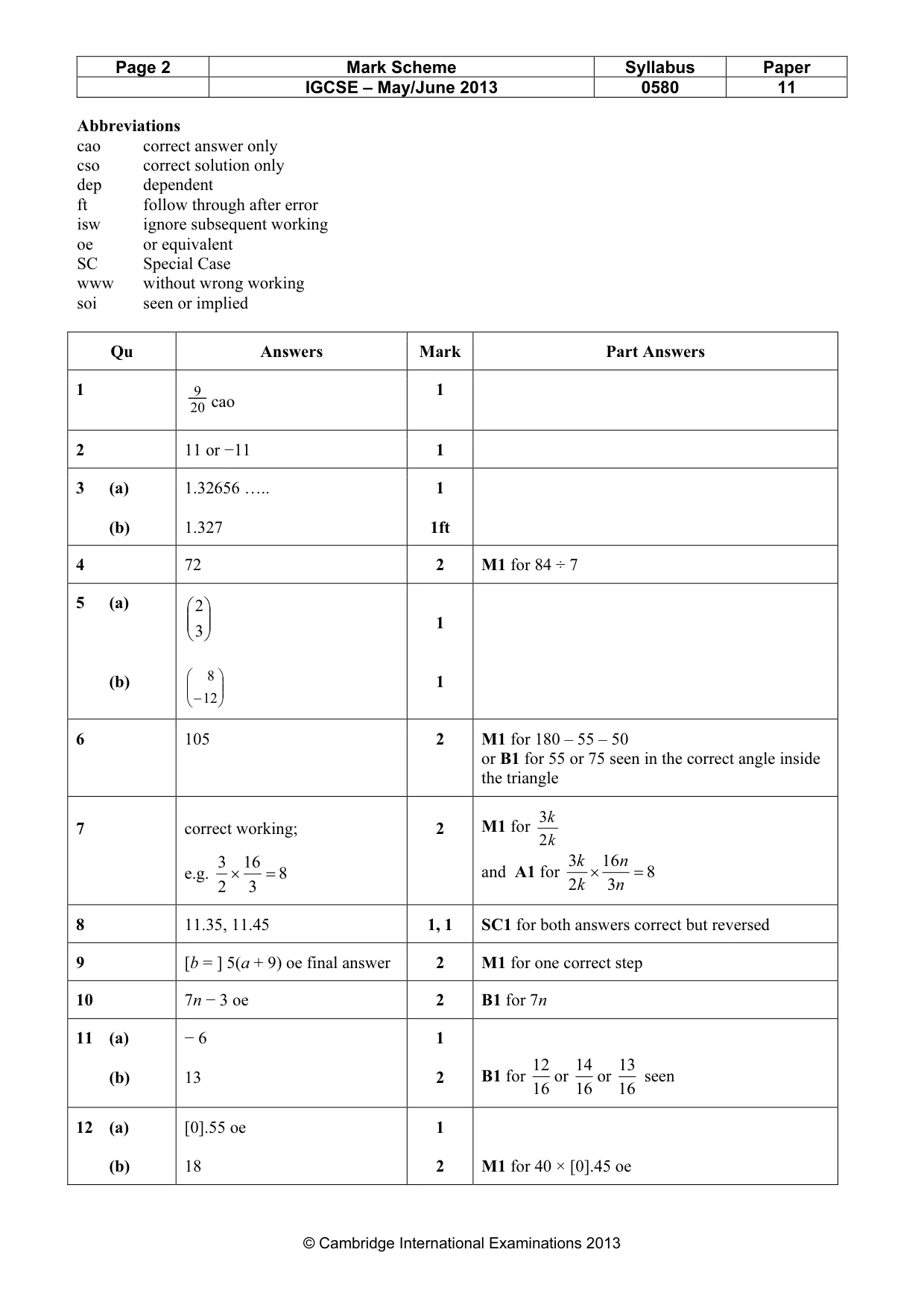
Mark scheme: Qu Answers Mark Part Answers 1 9 1 20 cao
Q2 · One January day in Munich, the temperature at noon was 3°C
2 One January day in Munich, the temperature at noon was 3°C. At midnight the temperature was –8°C. Write down the difference between these two temperatures. Answer .......................................... °C [1] _____________________________________________________________________________________
Mark scheme: 2 11 or −11 1
Q3 · Calculate 5.7 – 1.032
3 (a) Calculate 5.7 – 1.032 . Write down all the numbers displayed on your calculator. Answer(a) ............................................... [1] (b) Write your answer to part (a) correct to 3 decimal places. Answer(b) ............................................... [1] _____________________________________________________________________________________
Mark scheme: 3 (a) 1.32656 ….. 1 (b) 1.327 1ft
Q4 · Pedro and Eva do their homework
4 Pedro and Eva do their homework. Pedro takes 84 minutes to do his homework. The ratio Pedro’s time : Eva’s time = 7 : 6. Work out the number of minutes Eva takes to do her homework. Answer ........................................ min [2] _____________________________________________________________________________________
Mark scheme: 4 72 2 M1 for 84 ÷ 7
Q5 · Write each of the following as a single vector
5 Write each of the following as a single vector. 6 -4 (a) + e 1 o e 2 o Answer(a) [1] e o 2 (b) 4 3 e- o Answer(b) [1] e o _____________________________________________________________________________________
Mark scheme: 5 (a) 2 1 3 8 (b) 1 −12
Q6 · For Examiner's Use 50° NOT TO 55° SCALE a° Use the information in the diagram to fi nd the…
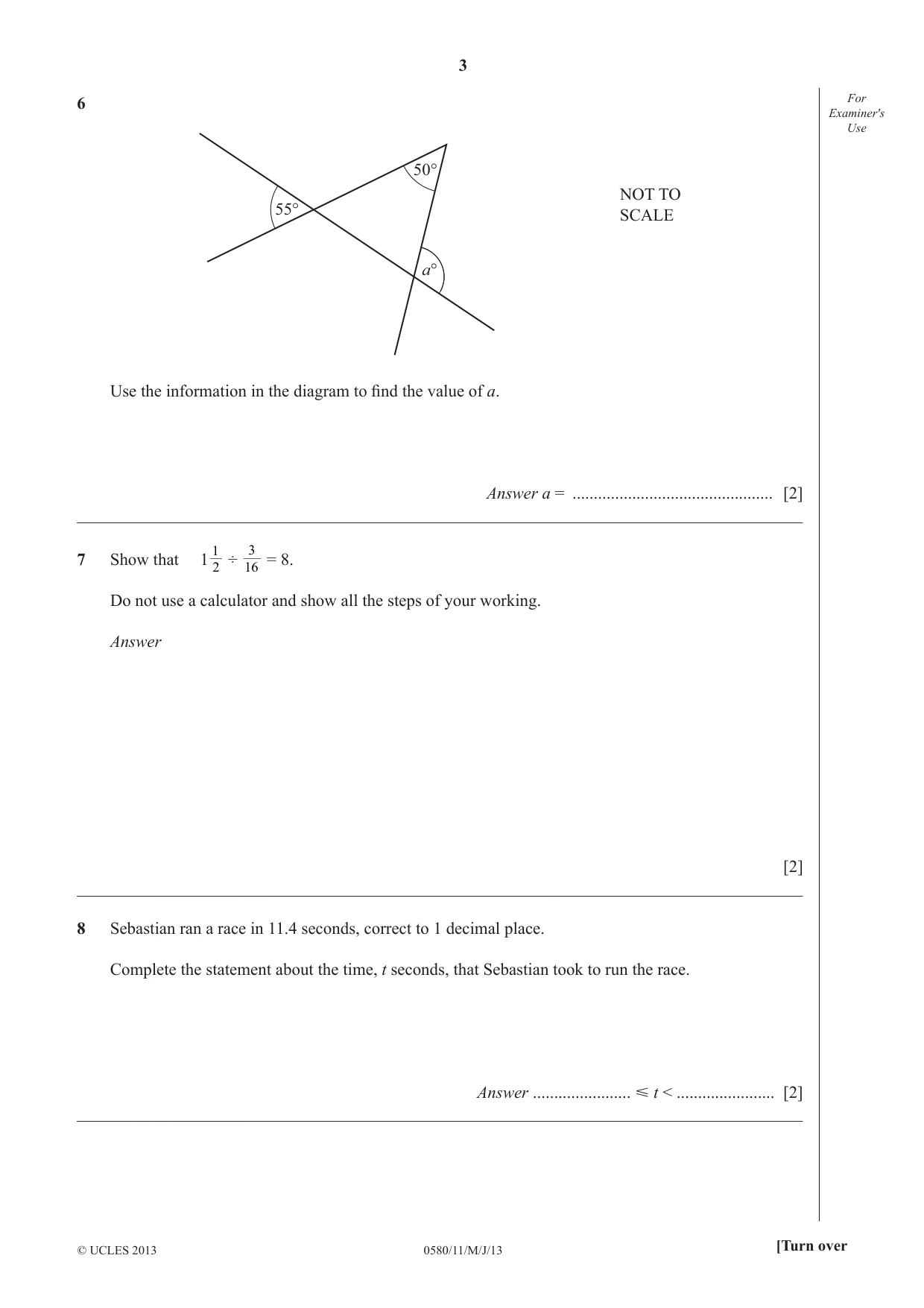
6 For Examiner's Use 50° NOT TO 55° SCALE a° Use the information in the diagram to fi nd the value of a. Answer a = ............................................... [2] _____________________________________________________________________________________
Mark scheme: 6 105 2 M1 for 180 – 55 – 50 or B1 for 55 or 75 seen in the correct angle inside the triangle 3 k M1 f
Q7 · 3 7 Show that 1 ÷ = 8
1 3 7 Show that 1 ÷ = 8. 2 16 Do not use a calculator and show all the steps of your working. Answer [2] _____________________________________________________________________________________
Mark scheme: 3 k 7 correct working; 2 M1 for 2 k 3 16 3k 16 n e.g. × = 8 and A1 for × = 8 2 3 2 k 3n
Q8 · Sebastian ran a race in 11.4 seconds, correct to 1 decimal place
8 Sebastian ran a race in 11.4 seconds, correct to 1 decimal place. Complete the statement about the time, t seconds, that Sebastian took to run the race. Answer ....................... Ğ t < ....................... [2] _____________________________________________________________________________________
Mark scheme: 8 11.35, 11.45 1, 1 SC1 for both answers correct but reversed
Q9 · Rearrange this equation to make b the subject
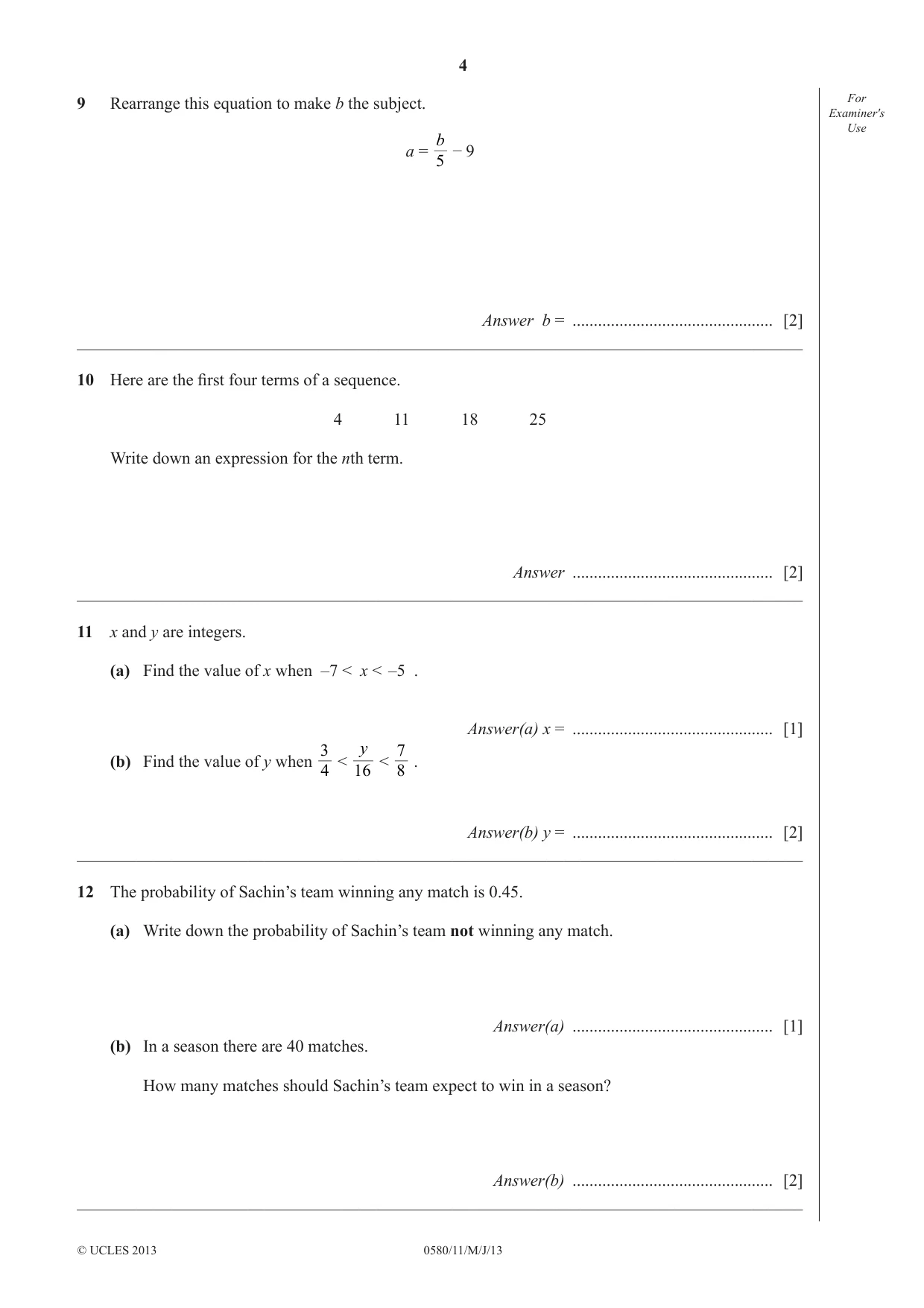
9 Rearrange this equation to make b the subject. For Examiner's Use b a = – 9 5 Answer b = ............................................... [2] _____________________________________________________________________________________
Mark scheme: 9 [b = ] 5(a + 9) oe final answer 2 M1 for one correct step
Q10 · Here are the fi rst four terms of a sequence
10 Here are the fi rst four terms of a sequence. 4 11 18 25 Write down an expression for the nth term. Answer ............................................... [2] _____________________________________________________________________________________
Mark scheme: 10 7n − 3 oe 2 B1 for 7n
Q11 · X and y are integers
11 x and y are integers. (a) Find the value of x when –7 < x < –5 . Answer(a) x = ............................................... [1] 3 y 7 (b) Find the value of y when < < . 4 16 8 Answer(b) y = ............................................... [2] _____________________________________________________________________________________
Mark scheme: 11 (a) − 6 1 12 14 13 (b) 13 2 B1 for or or seen 16 16 16
Q12 · The probability of Sachin’s team winning any match is 0.45
12 The probability of Sachin’s team winning any match is 0.45. (a) Write down the probability of Sachin’s team not winning any match. Answer(a) ............................................... [1] (b) In a season there are 40 matches. How many matches should Sachin’s team expect to win in a season? Answer(b) ............................................... [2] _____________________________________________________________________________________
Mark scheme: 12 (a) [0].55 oe 1 (b) 18 2 M1 for 40 × [0].45 oe IGCSE – May/June 2013 0580 11
Q13 · Complete each statement with the correct mathematical term
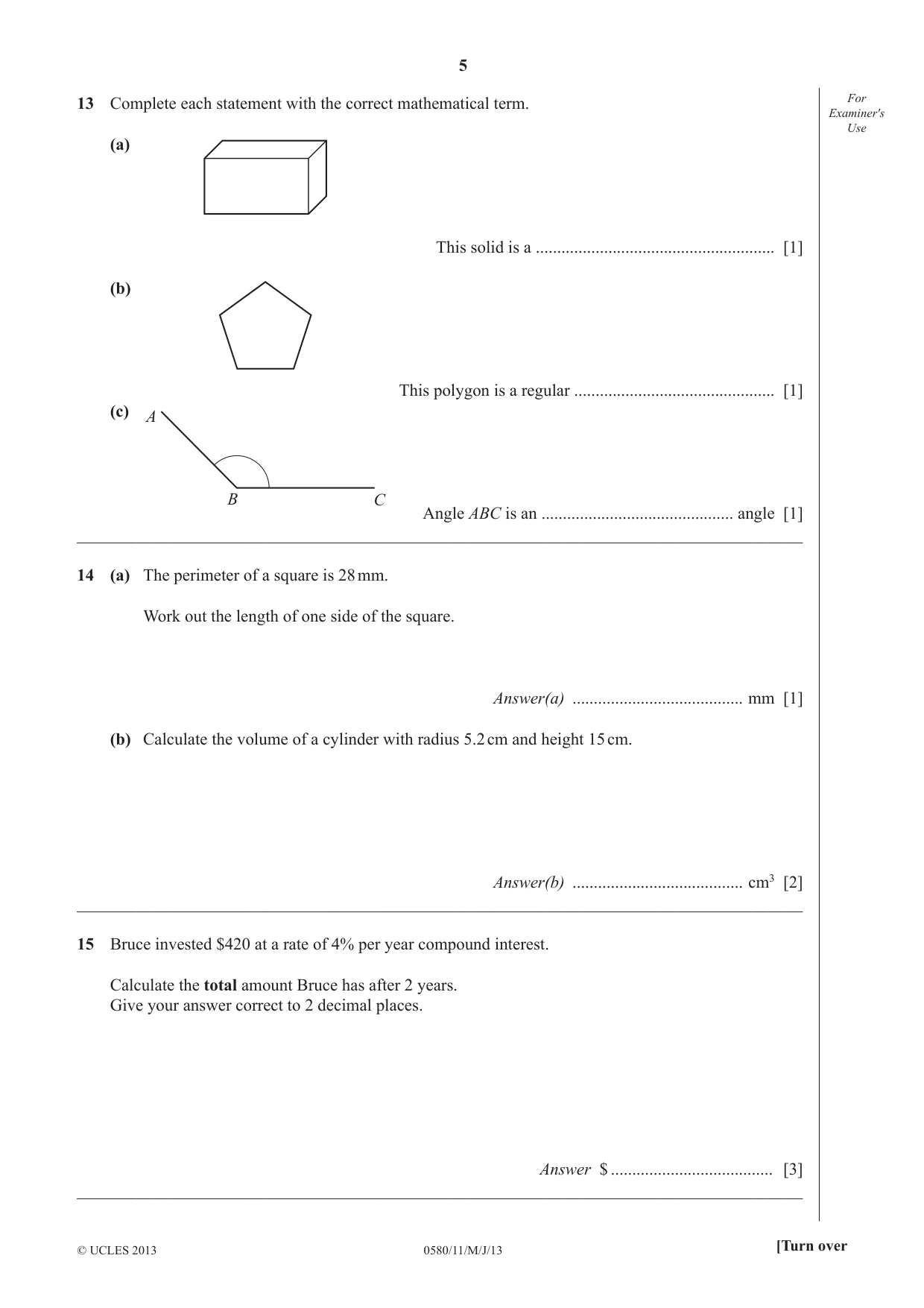
13 Complete each statement with the correct mathematical term. For Examiner's Use (a) This solid is a ........................................................ [1] (b) This polygon is a regular ............................................... [1] (c) A B C Angle ABC is an ............................................. angle [1] _____________________________________________________________________________________
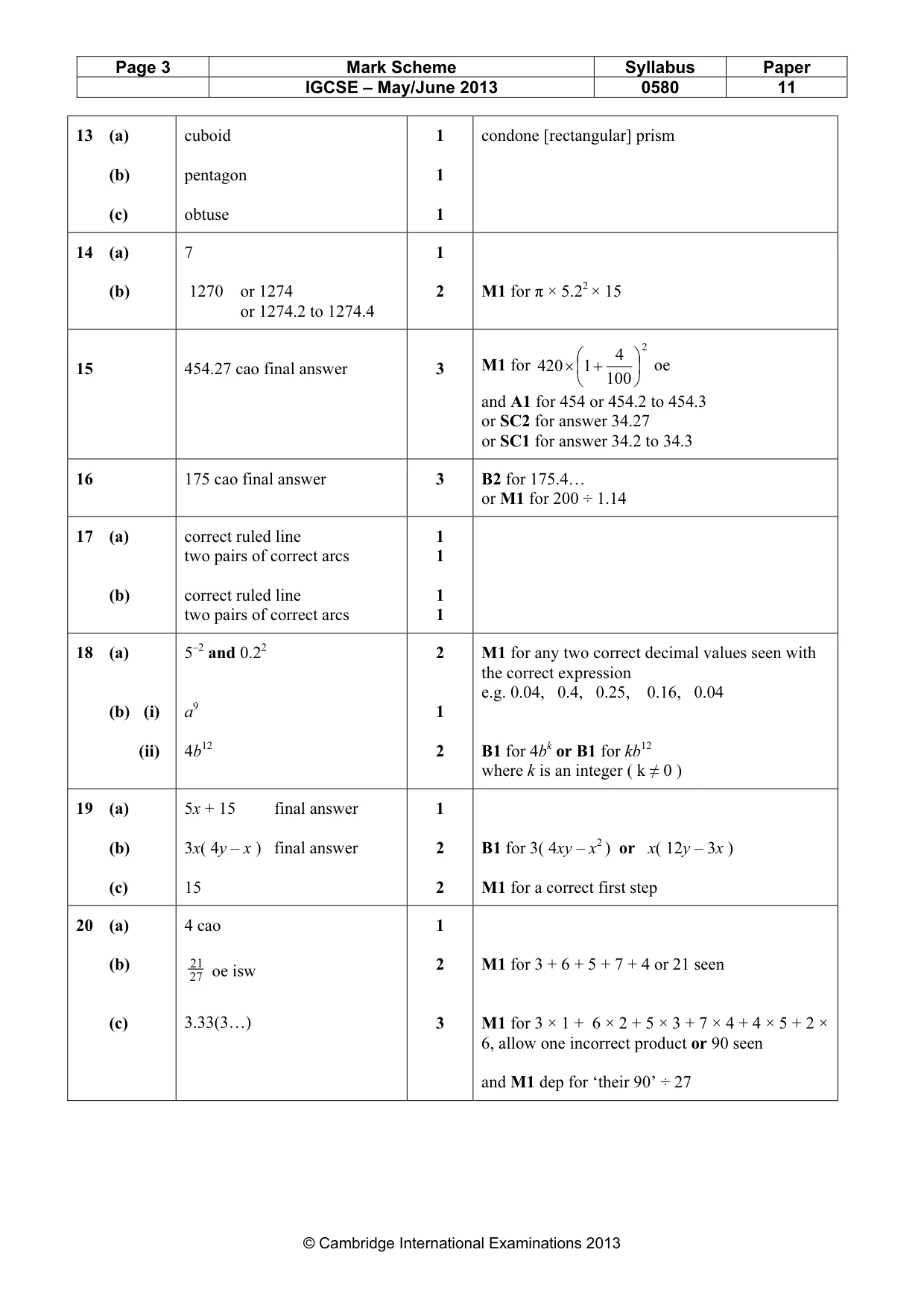
Mark scheme: 13 (a) cuboid 1 condone [rectangular] prism (b) pentagon 1 (c) obtuse 1
Q14 · The perimeter of a square is 28 mm
14 (a) The perimeter of a square is 28 mm. Work out the length of one side of the square. Answer(a) ........................................ mm [1] (b) Calculate the volume of a cylinder with radius 5.2 cm and height 15 cm. Answer(b) ........................................ cm3 [2] _____________________________________________________________________________________
Mark scheme: 14 (a) 7 1 (b) 1270 or 1274 2 M1 for π × 5.22 × 15 or 1274.2 to 1274.4 4 2 M1 f 420 1
Q15 · Bruce invested $420 at a rate of 4% per year compound interest
15 Bruce invested $420 at a rate of 4% per year compound interest. Calculate the total amount Bruce has after 2 years. Give your answer correct to 2 decimal places. Answer $ ...................................... [3] _____________________________________________________________________________________
Mark scheme: + 1 oe15 454.27 cao final answer 3 M1 for 420 × 100 and A1 for 454 or 454.2 to 454.3 or SC2 for answer 34.27 or SC1 for answer 34.2 to 34.3
Q16 · Martina changed 200 Swiss francs (CHF) into euros (€)
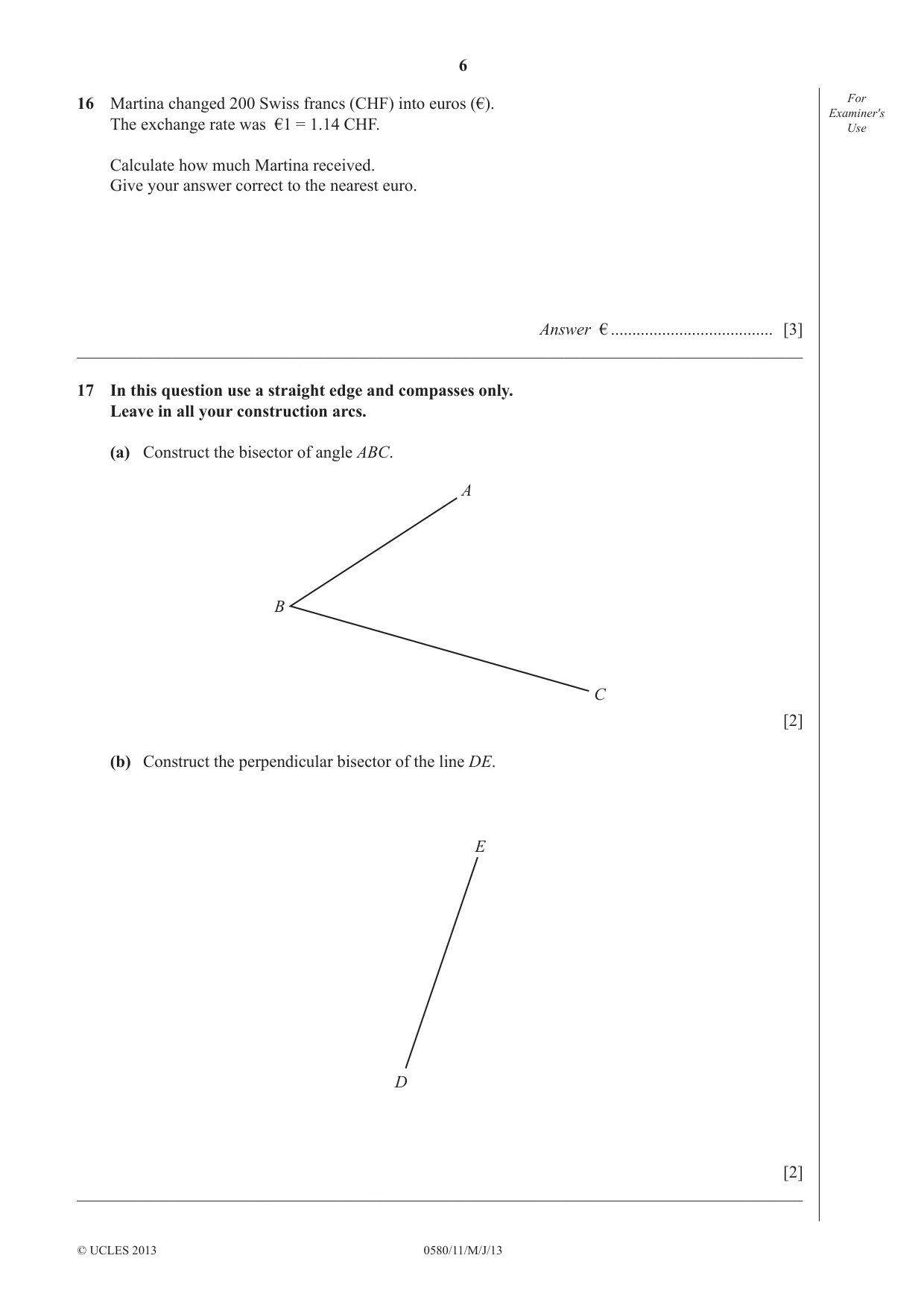
16 Martina changed 200 Swiss francs (CHF) into euros (€). For Examiner's The exchange rate was €1 = 1.14 CHF. Use Calculate how much Martina received. Give your answer correct to the nearest euro. Answer € ...................................... [3] _____________________________________________________________________________________
Mark scheme: 16 175 cao final answer 3 B2 for 175.4… or M1 for 200 ÷ 1.14
Q17 · In this question use a straight edge and compasses only
17 In this question use a straight edge and compasses only. Leave in all your construction arcs. (a) Construct the bisector of angle ABC. A B C [2] (b) Construct the perpendicular bisector of the line DE. E D [2] _____________________________________________________________________________________
Mark scheme: 17 (a) correct ruled line 1 two pairs of correct arcs 1 (b) correct ruled line 1 two pairs of correct arcs 1 2 2
Q18 · Which two of these have the same value?
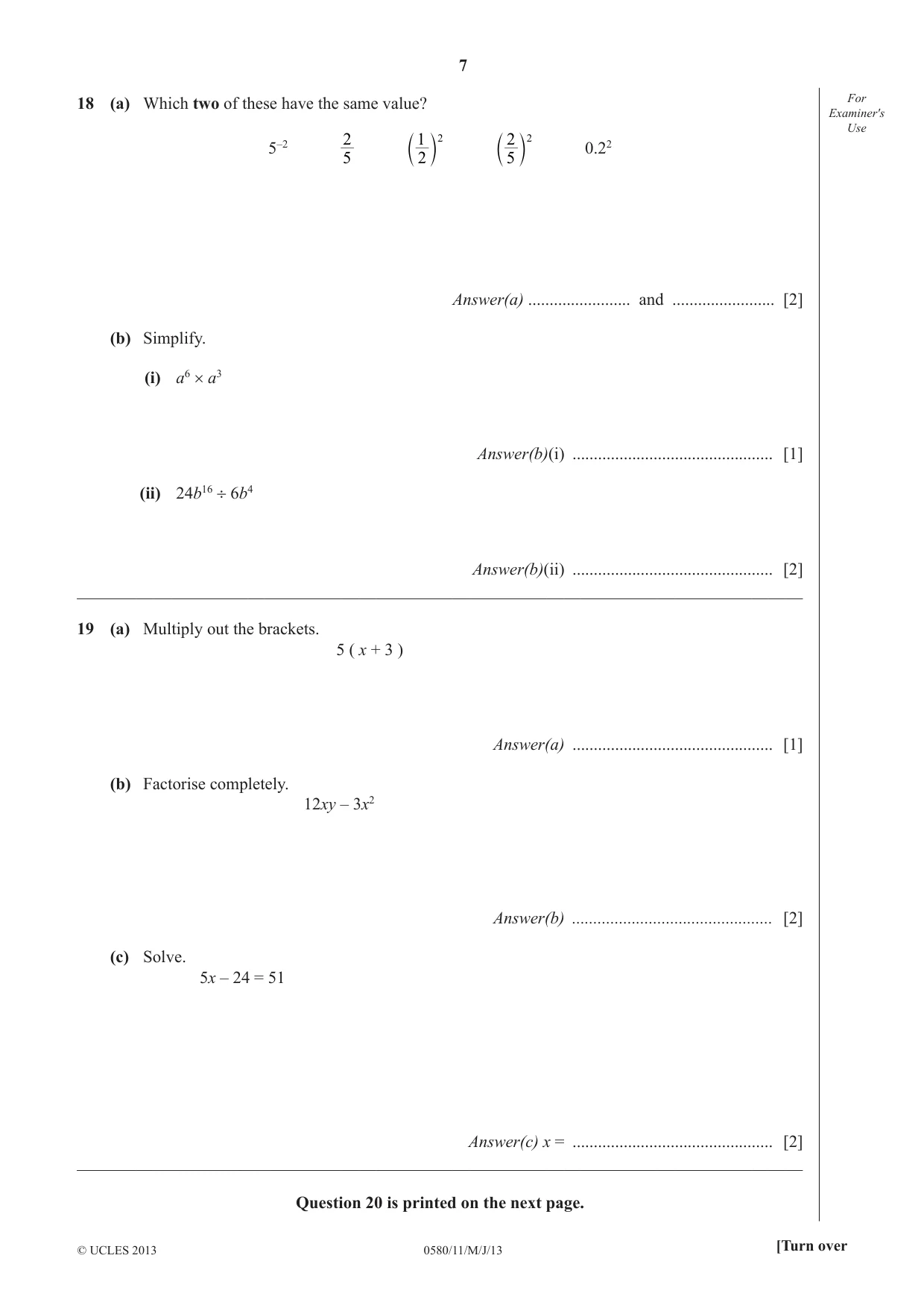
18 (a) Which two of these have the same value? For Examiner's Use 2 1 2 2 2 5–2 0.22 5 c 2 m c 5 m Answer(a) ........................ and ........................ [2] (b) Simplify. (i) a6 × a3 Answer(b)(i) ............................................... [1] (ii) 24b16 ÷ 6b4 Answer(b)(ii) ............................................... [2] _____________________________________________________________________________________
Mark scheme: 18 (a) 5–2 and 0.22 2 M1 for any two correct decimal values seen with the correct expression e.g. 0.04, 0.4, 0.25, 0.16, 0.04 (b) (i) a9 1 (ii) 4b12 2 B1 for 4bk or B1 for kb12 where k is an integer ( k ≠ 0 )
Q19 · Multiply out the brackets
19 (a) Multiply out the brackets. 5 ( x + 3 ) Answer(a) ............................................... [1] (b) Factorise completely. 12xy – 3x2 Answer(b) ............................................... [2] (c) Solve. 5x – 24 = 51 Answer(c) x = ............................................... [2] _____________________________________________________________________________________ Question 20 is printed on the next page.
Mark scheme: 19 (a) 5x + 15 final answer 1 (b) 3x( 4y – x ) final answer 2 B1 for 3( 4xy – x2 ) or x( 12y – 3x ) (c) 15 2 M1 for a correct first step
Q20 · Marco throws a six-sided dice 27 times
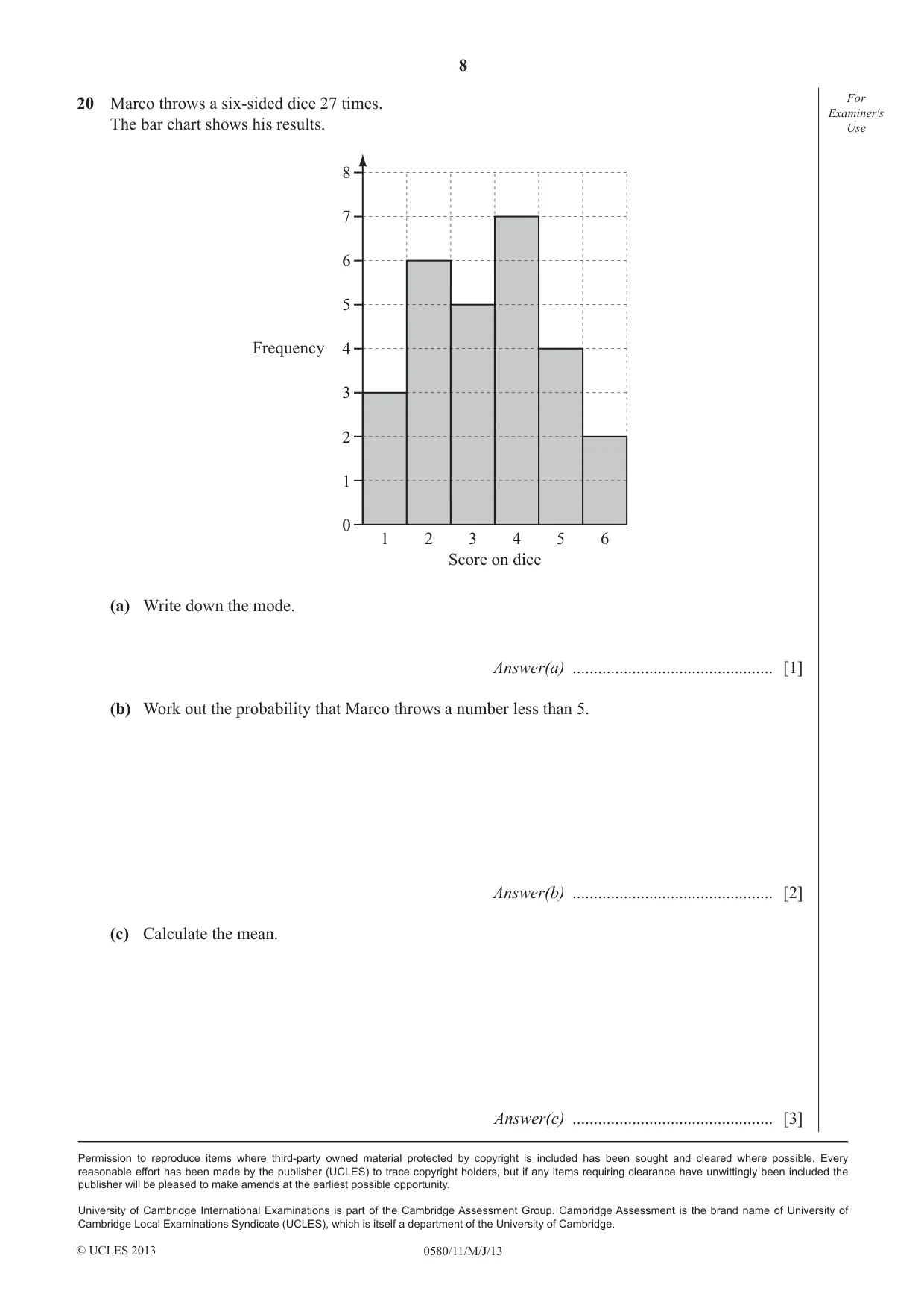
20 Marco throws a six-sided dice 27 times. For Examiner's The bar chart shows his results. Use 8 7 6 5 Frequency 4 3 2 1 0 1 2 3 4 5 6 Score on dice (a) Write down the mode. Answer(a) ............................................... [1] (b) Work out the probability that Marco throws a number less than 5. Answer(b) ............................................... [2] (c) Calculate the mean. Answer(c) ............................................... [3]
Mark scheme: 20 (a) 4 cao 1 (b) 21 2 M1 for 3 + 6 + 5 + 7 + 4 or 21 seen 27 oe isw (c) 3.33(3…) 3 M1 for 3 × 1 + 6 × 2 + 5 × 3 + 7 × 4 + 4 × 5 + 2 × 6, allow one incorrect product or 90 seen and M1 dep for ‘their 90’ ÷ 27
What was in this paper
The subtopics covered by these 20 questions, and how many questions each got. Open one in a new tab to see every Cambridge question on it.
3Fractions, decimals and percentages2Surface area and volume2Algebraic manipulation1Angles1Averages and range1Equations1Geometrical constructions1Indices II1Limits of accuracy1Percentages1Relative and expected frequencies1Sequences1The four operations1Using a calculator1Vectors in two dimensions1What you needed in this session
Cambridge’s own grade thresholds for 2013 May/June, Paper 1 · Variant 1. A higher threshold means an easier paper — the bar moves with how the cohort did.