Cambridge IGCSE Mathematics 0580 — 2009 May/June Paper 1 · Variant 1
0580/11/M/J/09 · 18 questions · 50 marks · ≈56 min
The question paper and its mark scheme, free to read here and free to download. This is Cambridge’s own paper, exactly as it was sat.
Question paper25 pages
Mark scheme9 pages
Answers below. Sit the paper first if you are practising.
Questions as text
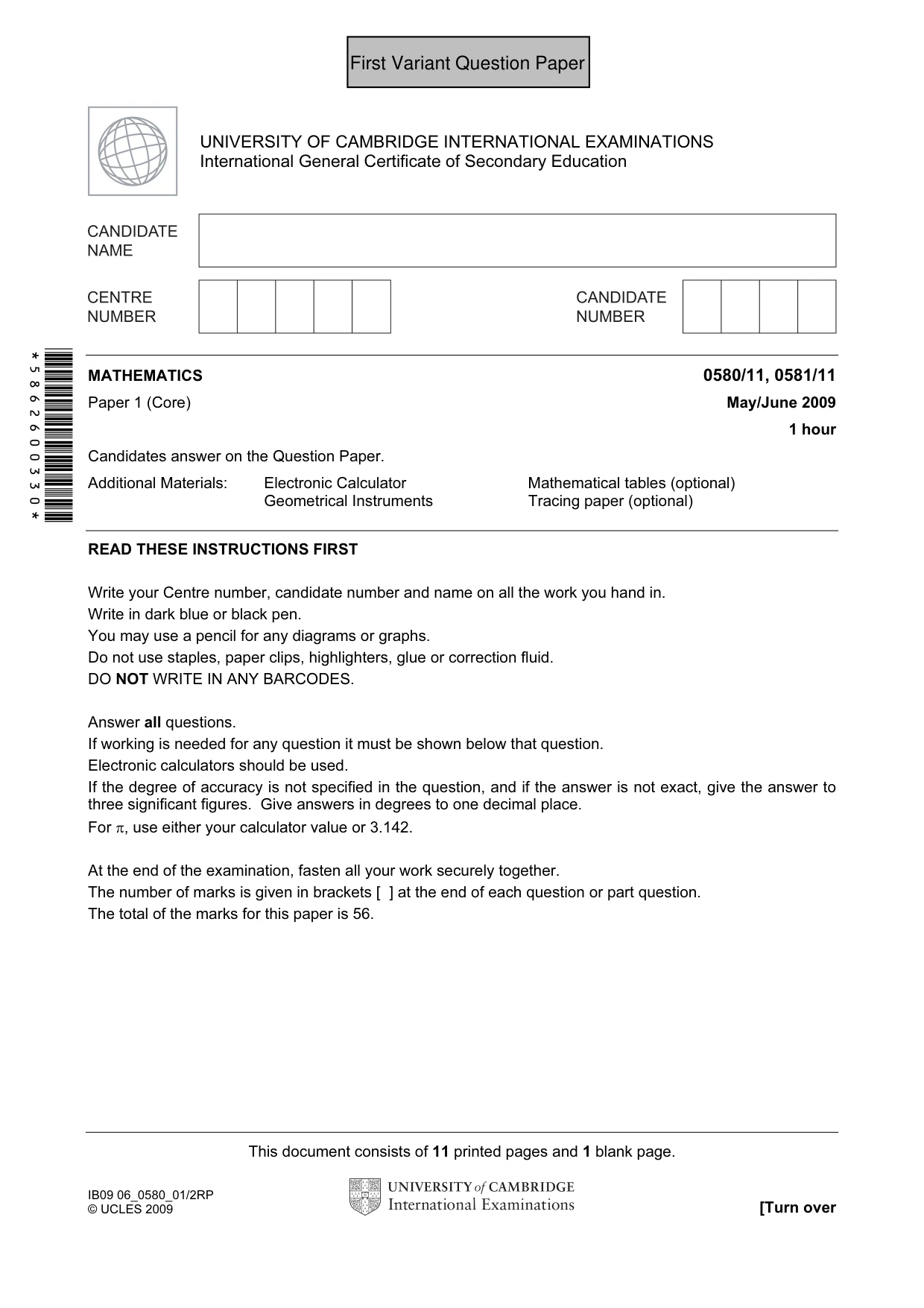
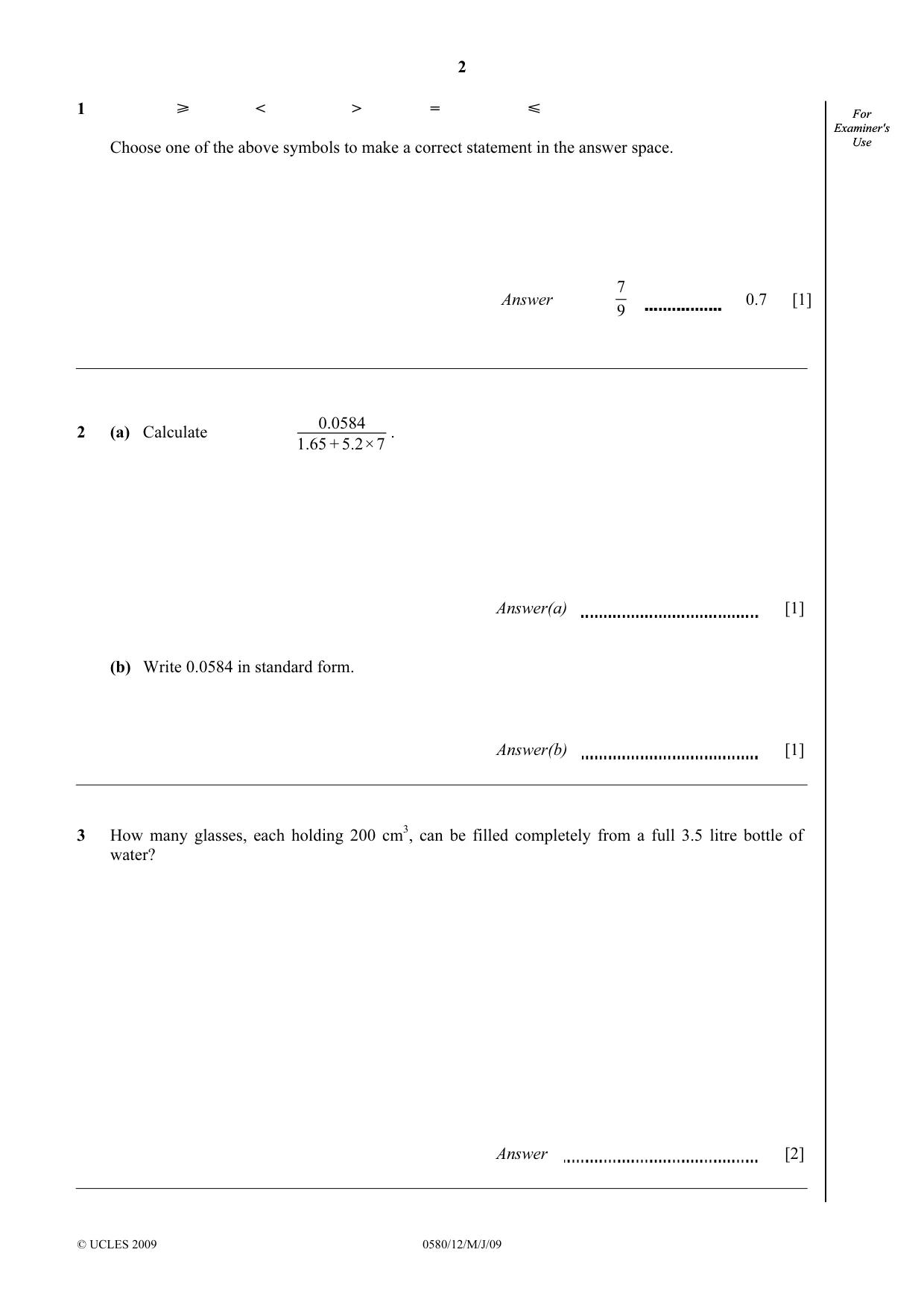
Q1 · [ < > = Y For Examiner's Choose one of the above symbols to make a correct statement in…
1 [ < > = Y For Examiner's Choose one of the above symbols to make a correct statement in the answer space. Use 4 Answer 0.4 [1] 9
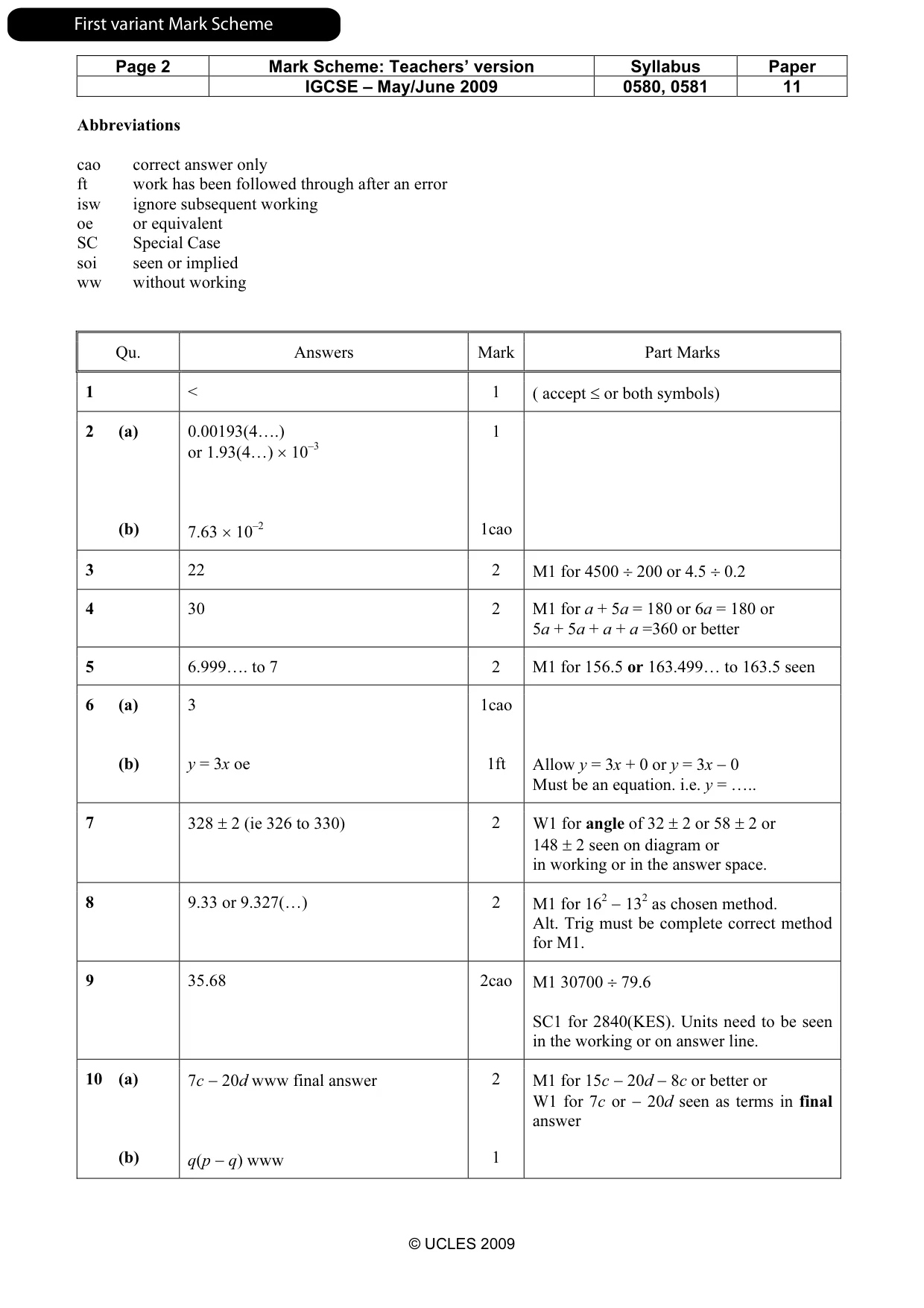
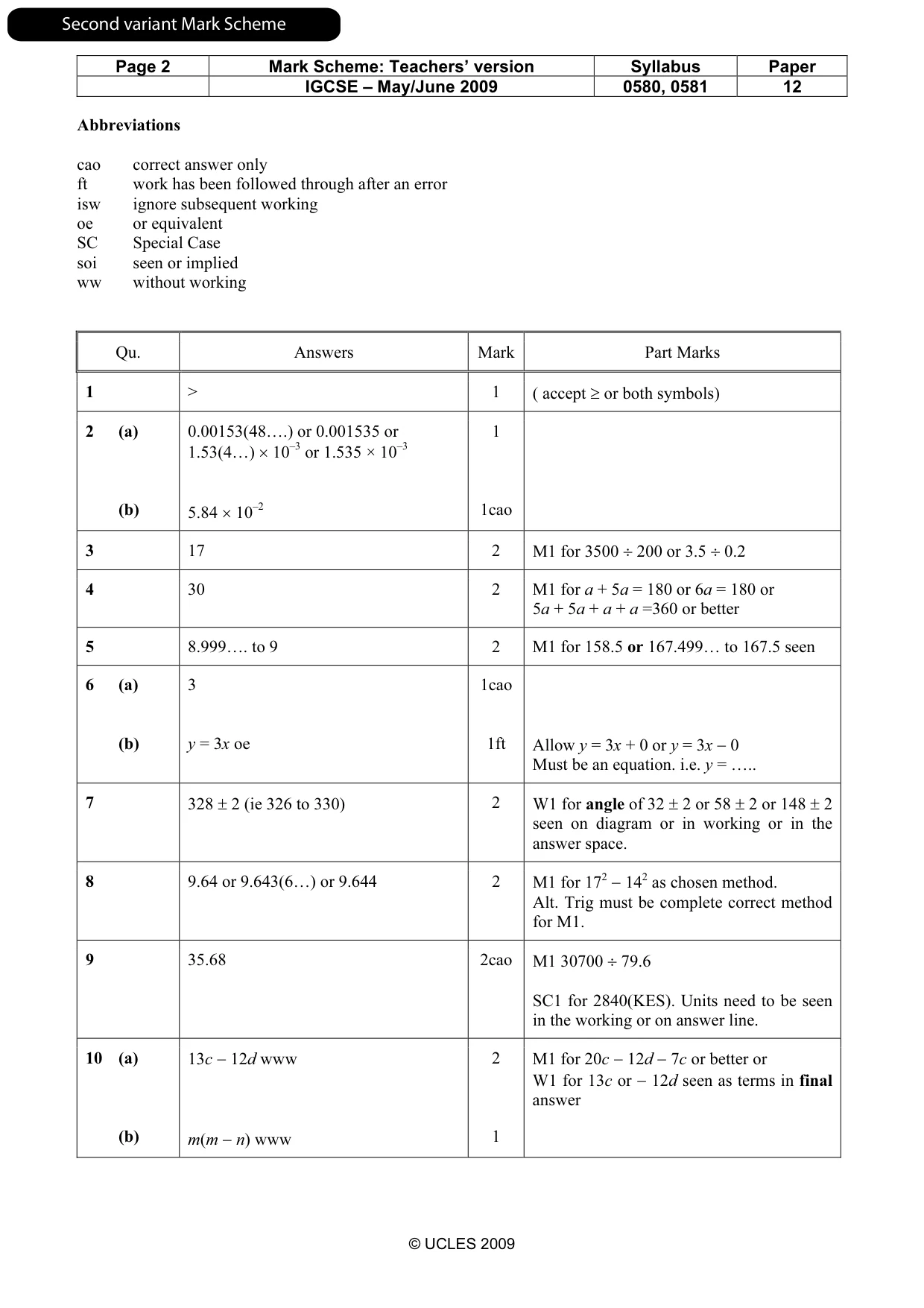
Mark scheme: Qu. Answers Mark Part Marks 1 < 1 ( accept ≤ or both symbols)
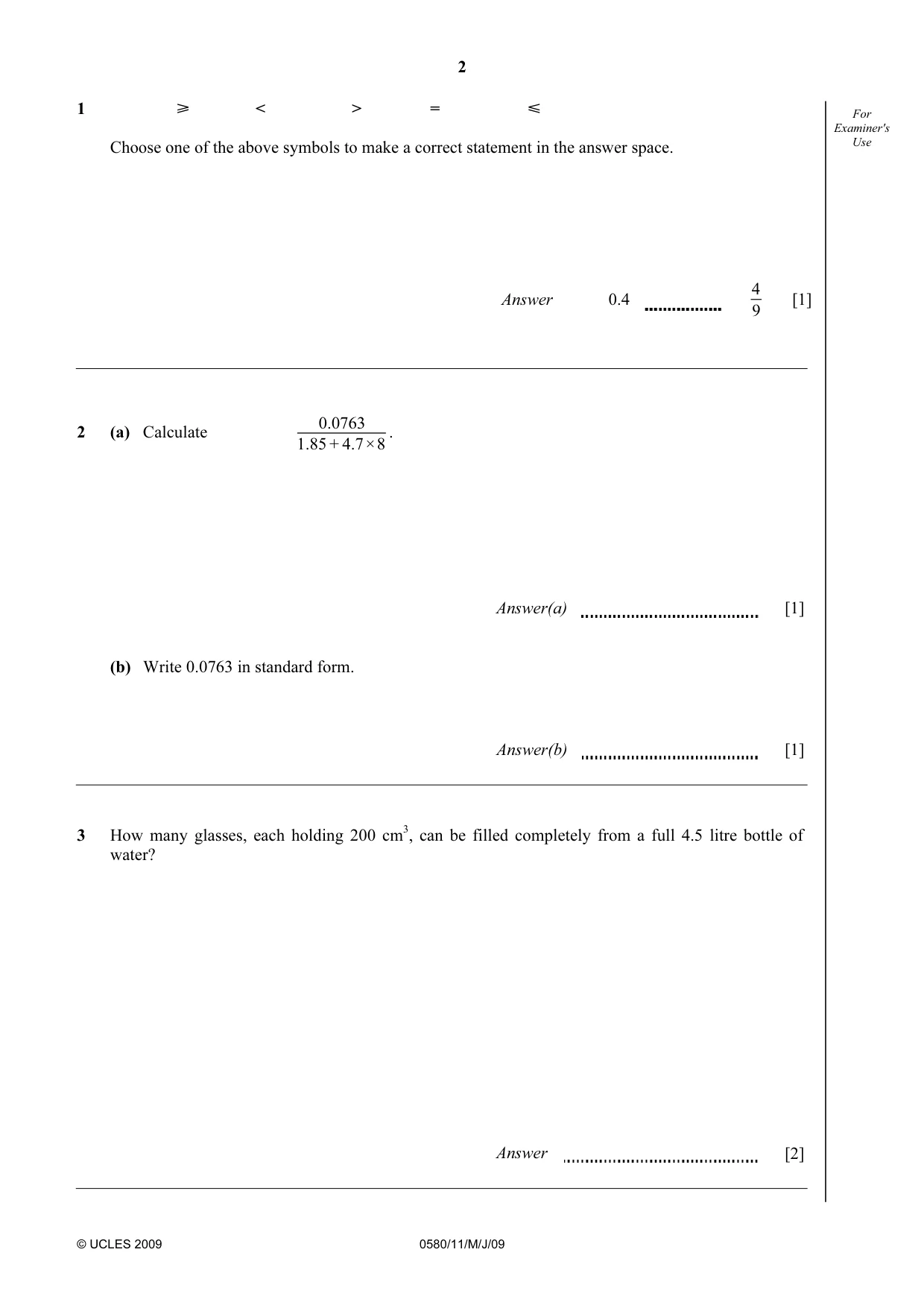
Q2 · 0763 2 (a) Calculate
0.0763 2 (a) Calculate . 1.85 + 4.7×8 Answer(a) [1] (b) Write 0.0763 in standard form. Answer(b) [1]
Mark scheme: 2 (a) 0.00193(4….) 1 or 1.93(4…) × 10–3 (b) 7.63 × 10⁻² 1cao
Q3 · How many glasses, each holding 200 cm3, can be filled completely from a full 4.5 litre…
3 How many glasses, each holding 200 cm3, can be filled completely from a full 4.5 litre bottle of water? Answer [2]
Mark scheme: 3 22 2 M1 for 4500 ÷ 200 or 4.5 ÷ 0.2
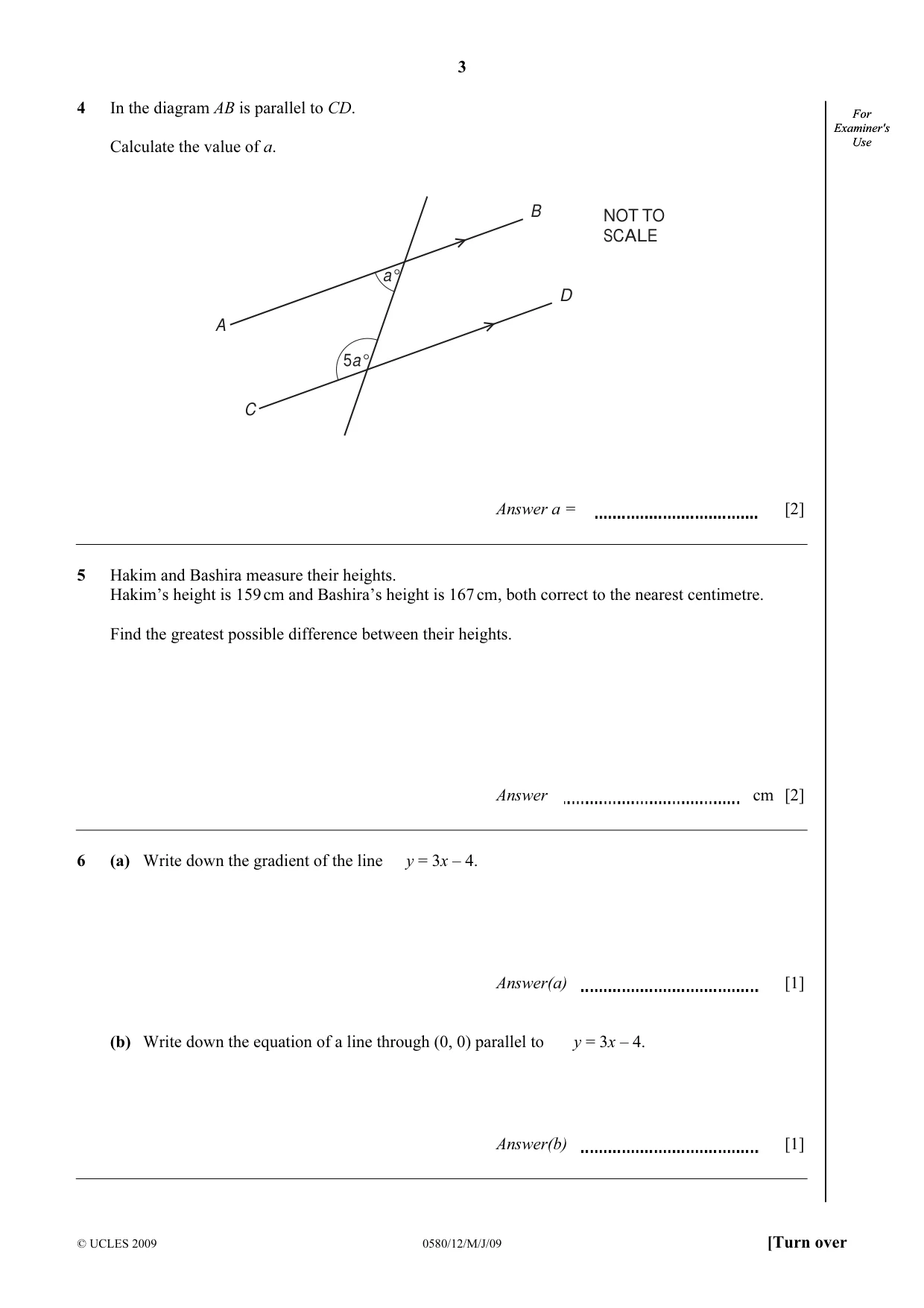
Q4 · In the diagram AB is parallel to CD
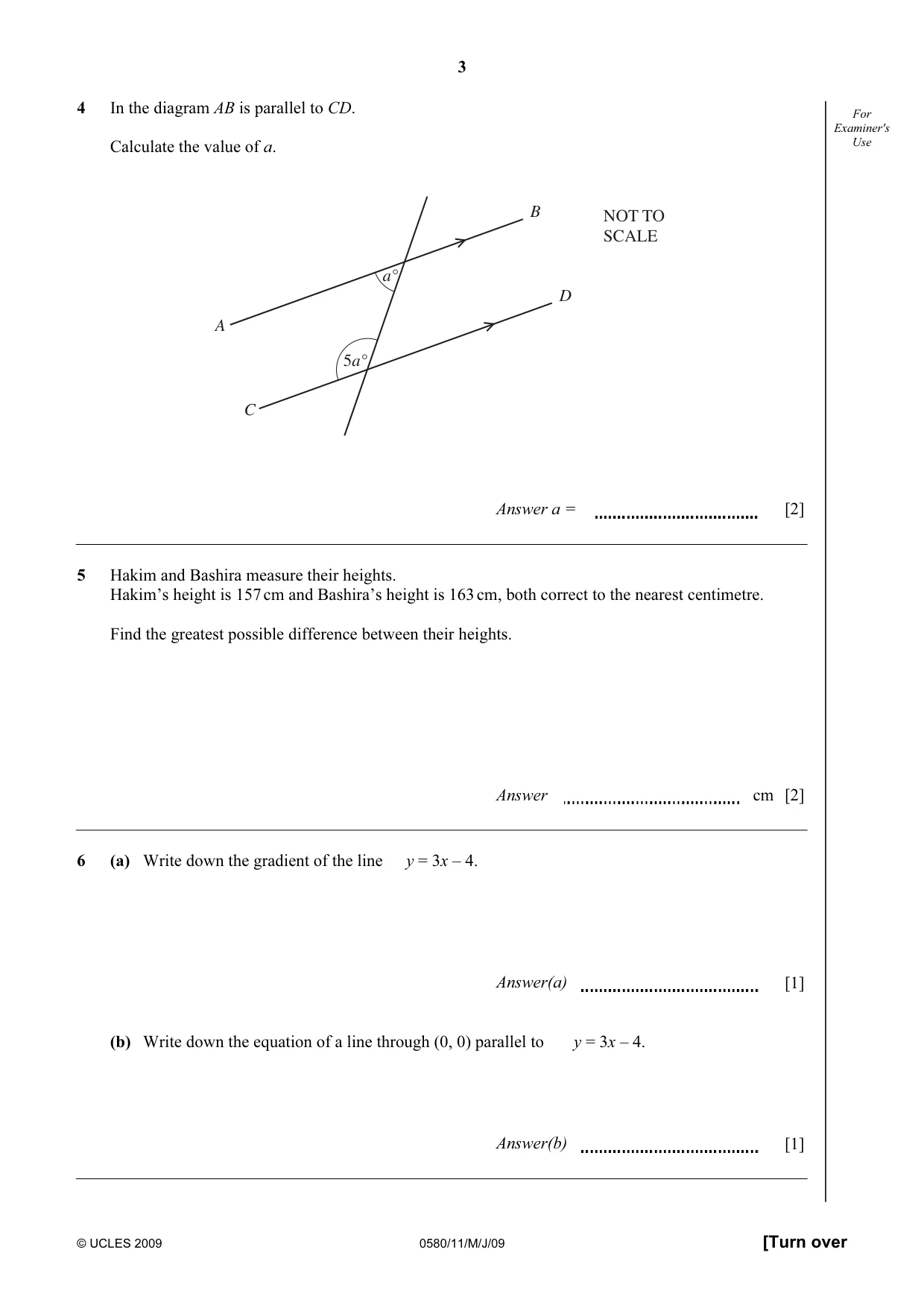
4 In the diagram AB is parallel to CD. For Examiner's Calculate the value of a. Use B NOT TO SCALE a° D A 5a° C Answer a = [2]
Mark scheme: 4 30 2 M1 for a + 5a = 180 or 6a = 180 or 5a + 5a + a + a =360 or better
Q5 · Hakim and Bashira measure their heights
5 Hakim and Bashira measure their heights. Hakim’s height is 157 cm and Bashira’s height is 163 cm, both correct to the nearest centimetre. Find the greatest possible difference between their heights. Answer cm [2]
Mark scheme: 5 6.999…. to 7 2 M1 for 156.5 or 163.499… to 163.5 seen
Q6 · Write down the gradient of the line y = 3x – 4
6 (a) Write down the gradient of the line y = 3x – 4. Answer(a) [1] (b) Write down the equation of a line through (0, 0) parallel to y = 3x – 4. Answer(b) [1]
Mark scheme: 6 (a) 3 1cao (b) y = 3x oe 1ft Allow y = 3x + 0 or y = 3x − 0 Must be an equation. i.e. y = …..
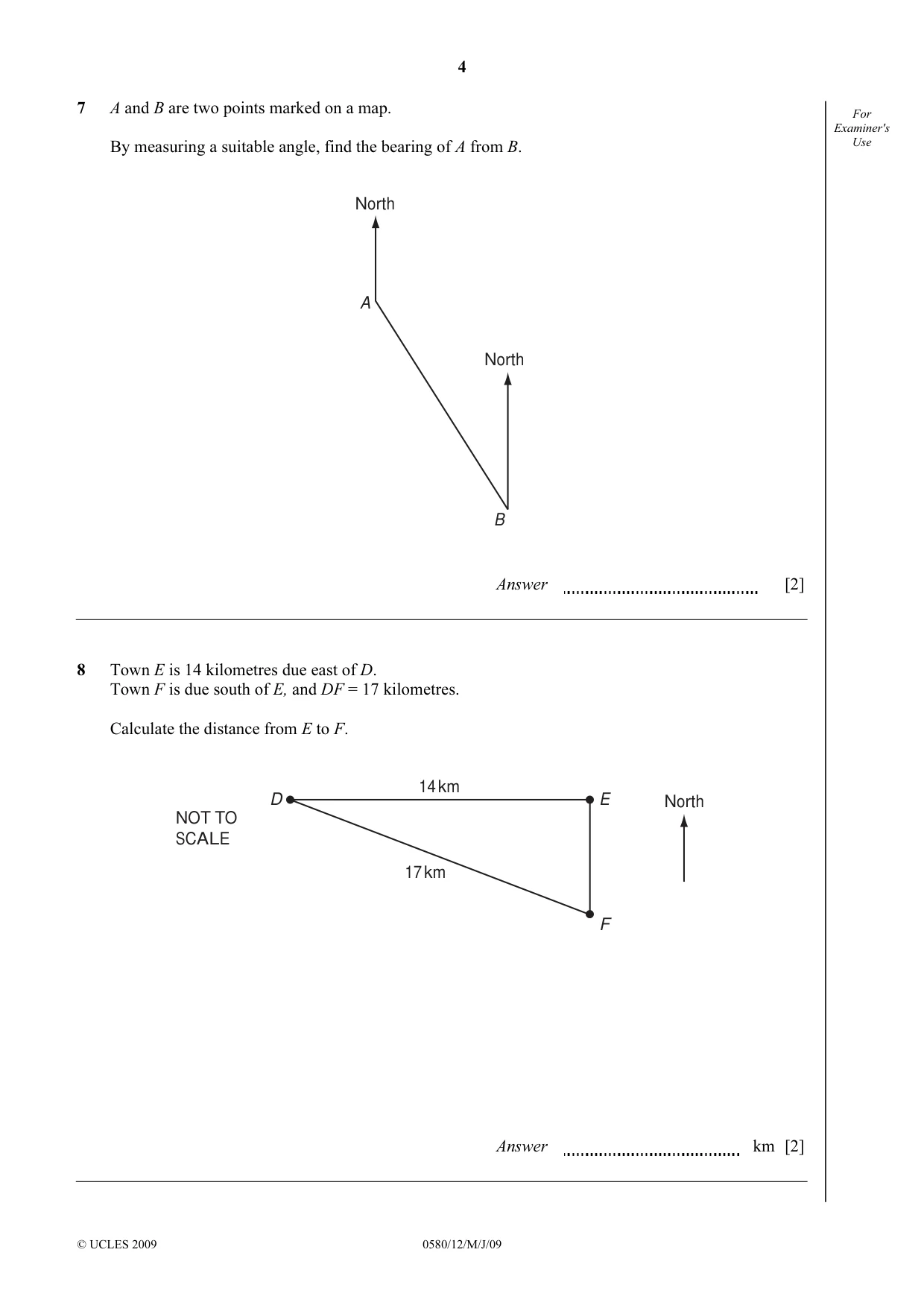
Q7 · A and B are two points marked on a map
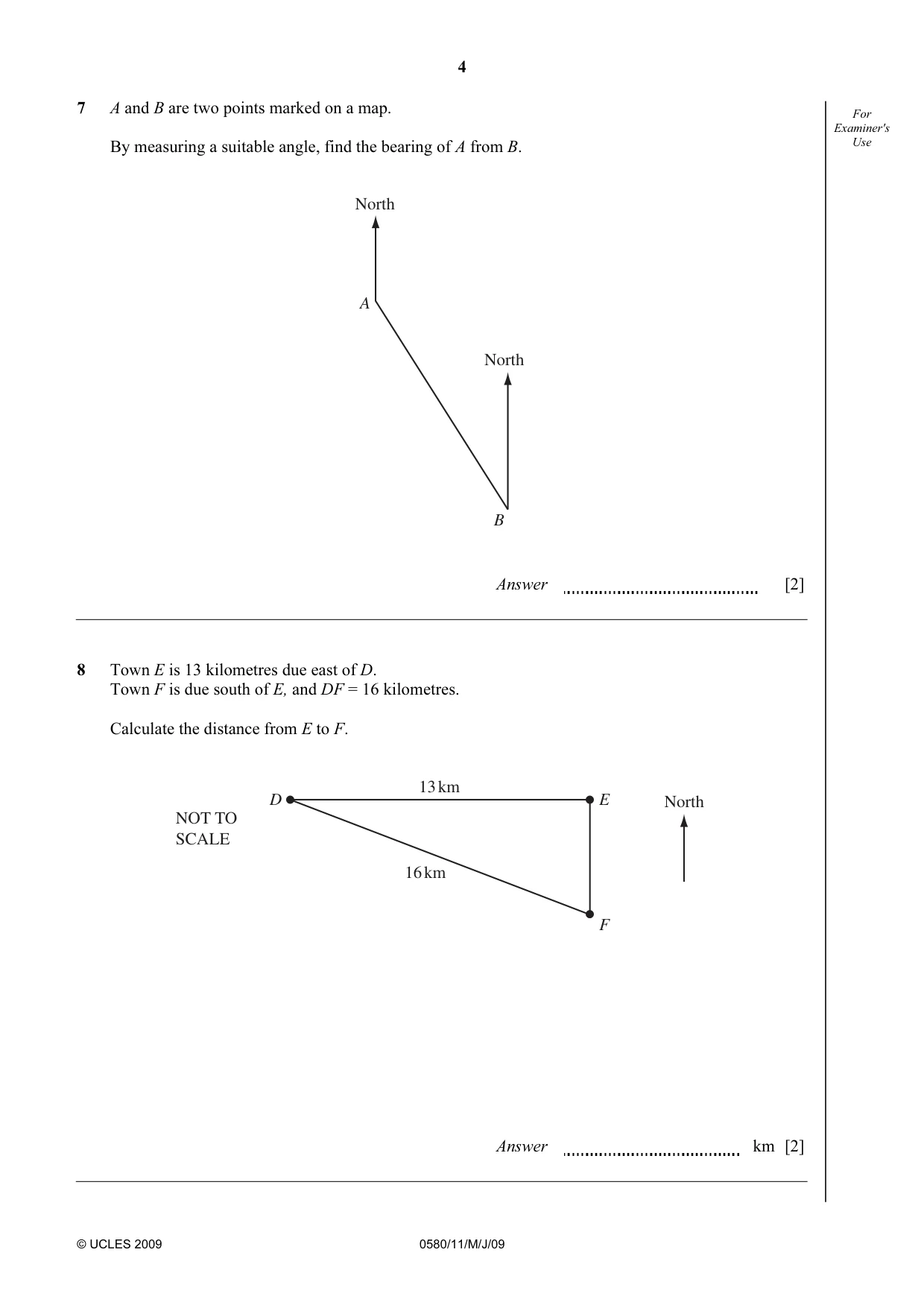
7 A and B are two points marked on a map. For Examiner's By measuring a suitable angle, find the bearing of A from B. Use North A North B Answer [2]
Mark scheme: 7 328 ± 2 (ie 326 to 330) 2 W1 for angle of 32 ± 2 or 58 ± 2 or 148 ± 2 seen on diagram or in working or in the answer space. 2 2
Q8 · Town E is 13 kilometres due east of D
8 Town E is 13 kilometres due east of D. Town F is due south of E, and DF = 16 kilometres. Calculate the distance from E to F. 13 km D E North NOT TO SCALE 16 km F Answer km [2]
Mark scheme: 8 9.33 or 9.327(…) 2 M1 for 162 − 132 as chosen method. Alt. Trig must be complete correct method for M1.
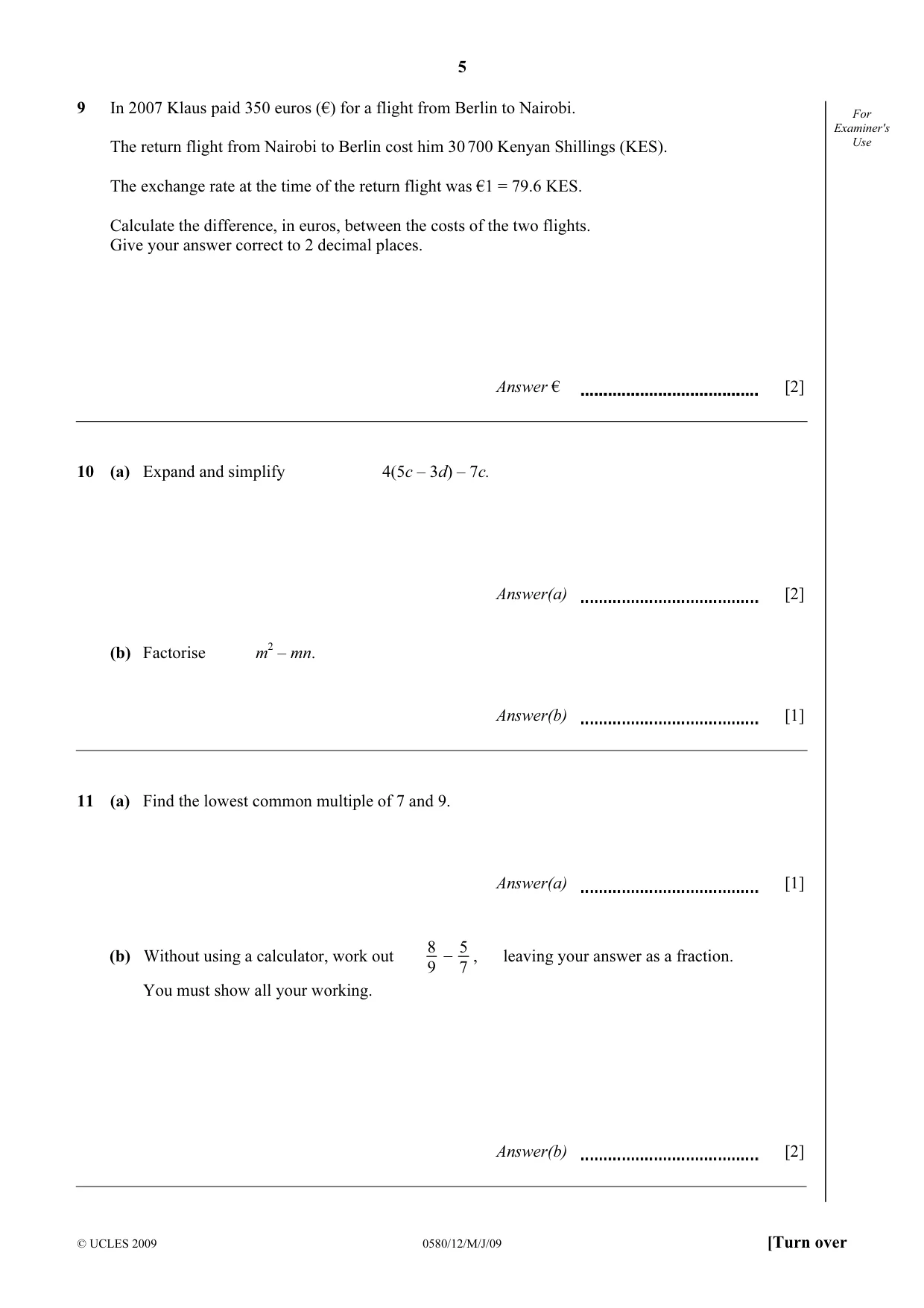
Q9 · In 2007 Klaus paid 350 euros (€) for a flight from Berlin to Nairobi
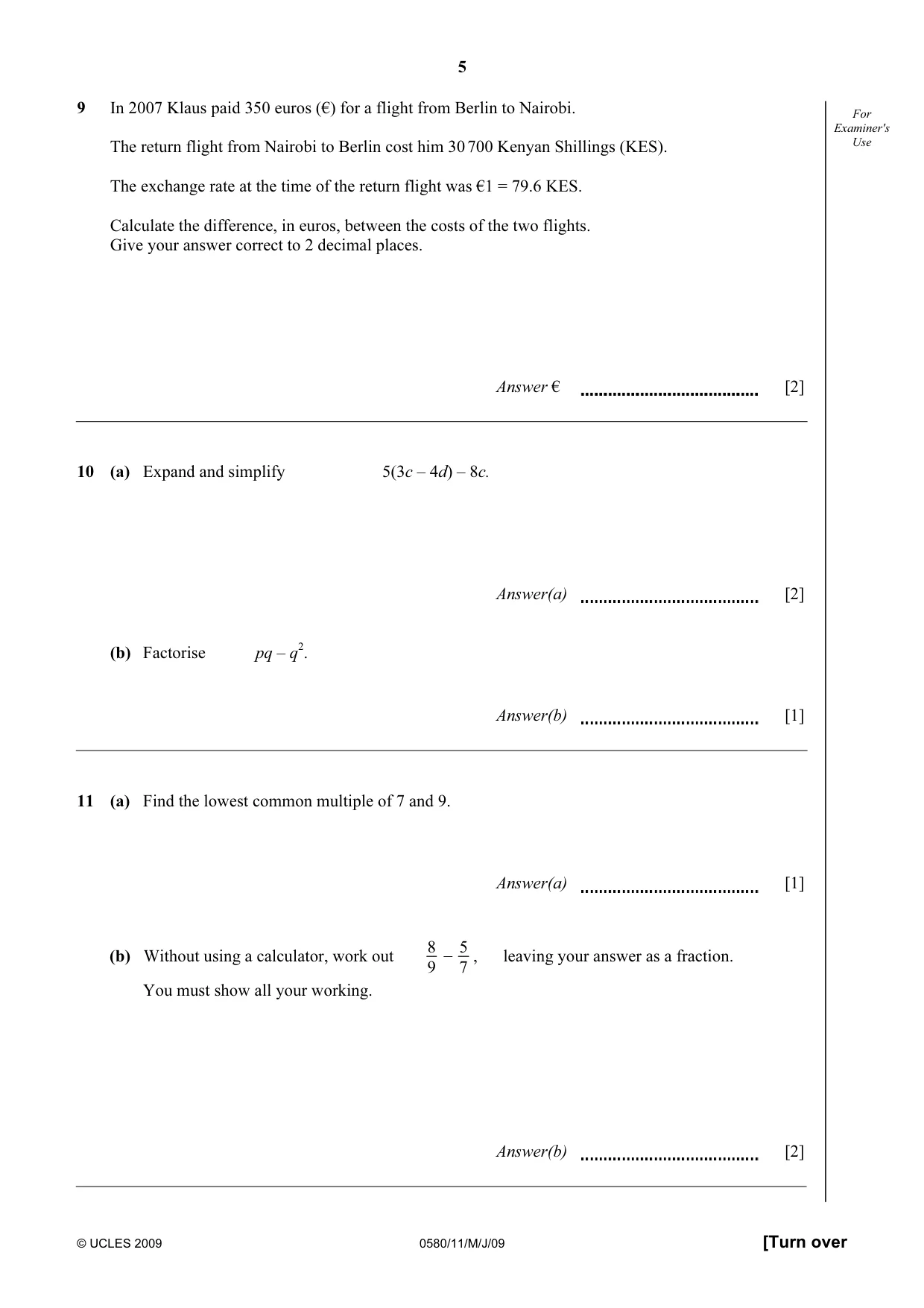
9 In 2007 Klaus paid 350 euros (€) for a flight from Berlin to Nairobi. For Examiner's The return flight from Nairobi to Berlin cost him 30 700 Kenyan Shillings (KES). Use The exchange rate at the time of the return flight was €1 = 79.6 KES. Calculate the difference, in euros, between the costs of the two flights. Give your answer correct to 2 decimal places. Answer € [2]
Mark scheme: 9 35.68 2cao M1 30700 ÷ 79.6 SC1 for 2840(KES). Units need to be seen in the working or on answer line.
Q10 · Expand and simplify 5(3c – 4d) – 8c
10 (a) Expand and simplify 5(3c – 4d) – 8c. Answer(a) [2] (b) Factorise pq – q2. Answer(b) [1]
Mark scheme: 10 (a) 7c − 20d www final answer 2 M1 for 15c − 20d − 8c or better or W1 for 7c or − 20d seen as terms in final answer (b) q(p − q) www 1 IGCSE – May/June 2009 0580, 0581 11
Q11 · Find the lowest common multiple of 7 and 9
11 (a) Find the lowest common multiple of 7 and 9. Answer(a) [1] 8 _ 5 (b) Without using a calculator, work out , leaving your answer as a fraction. 9 7 You must show all your working. Answer(b) [2]
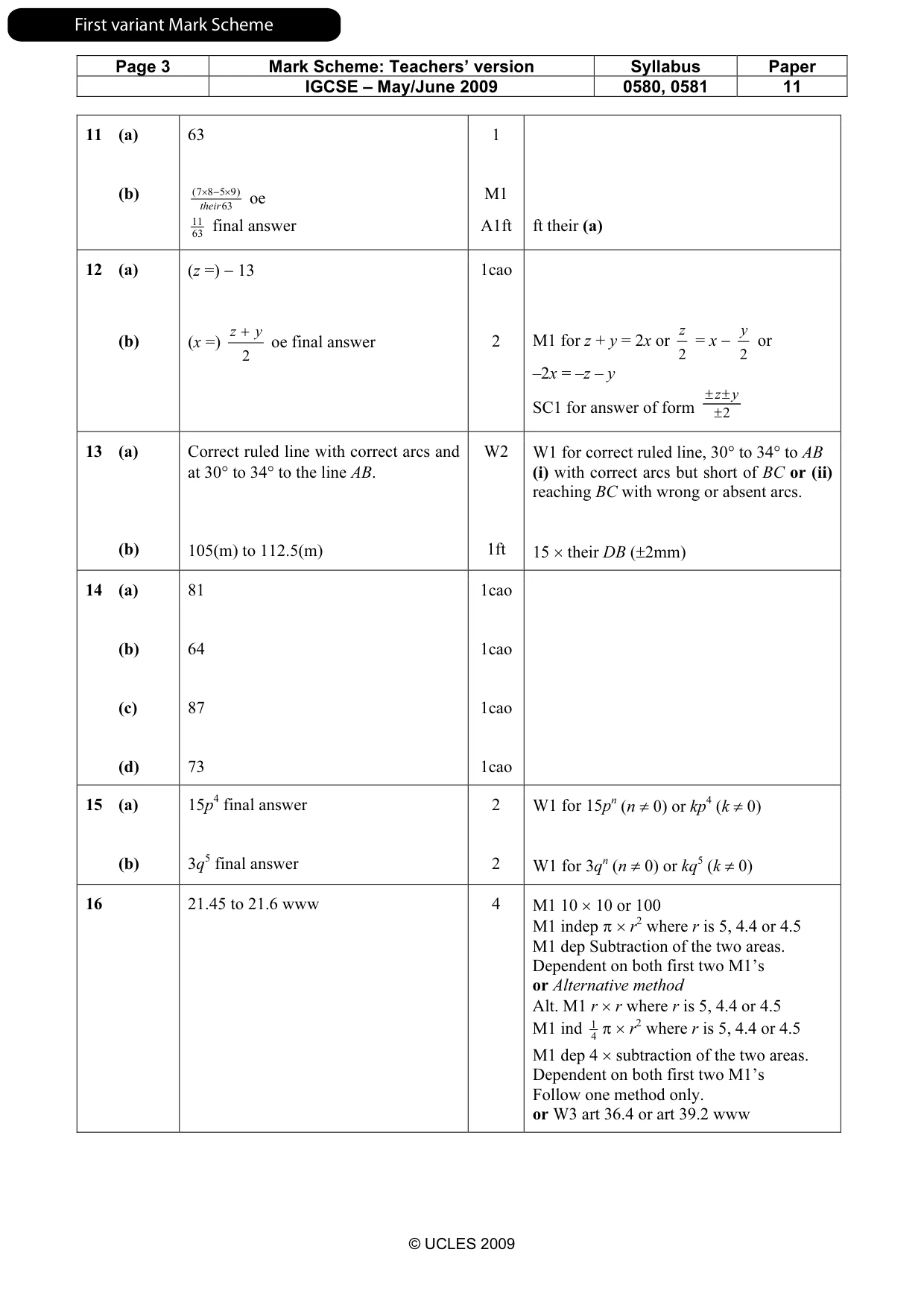
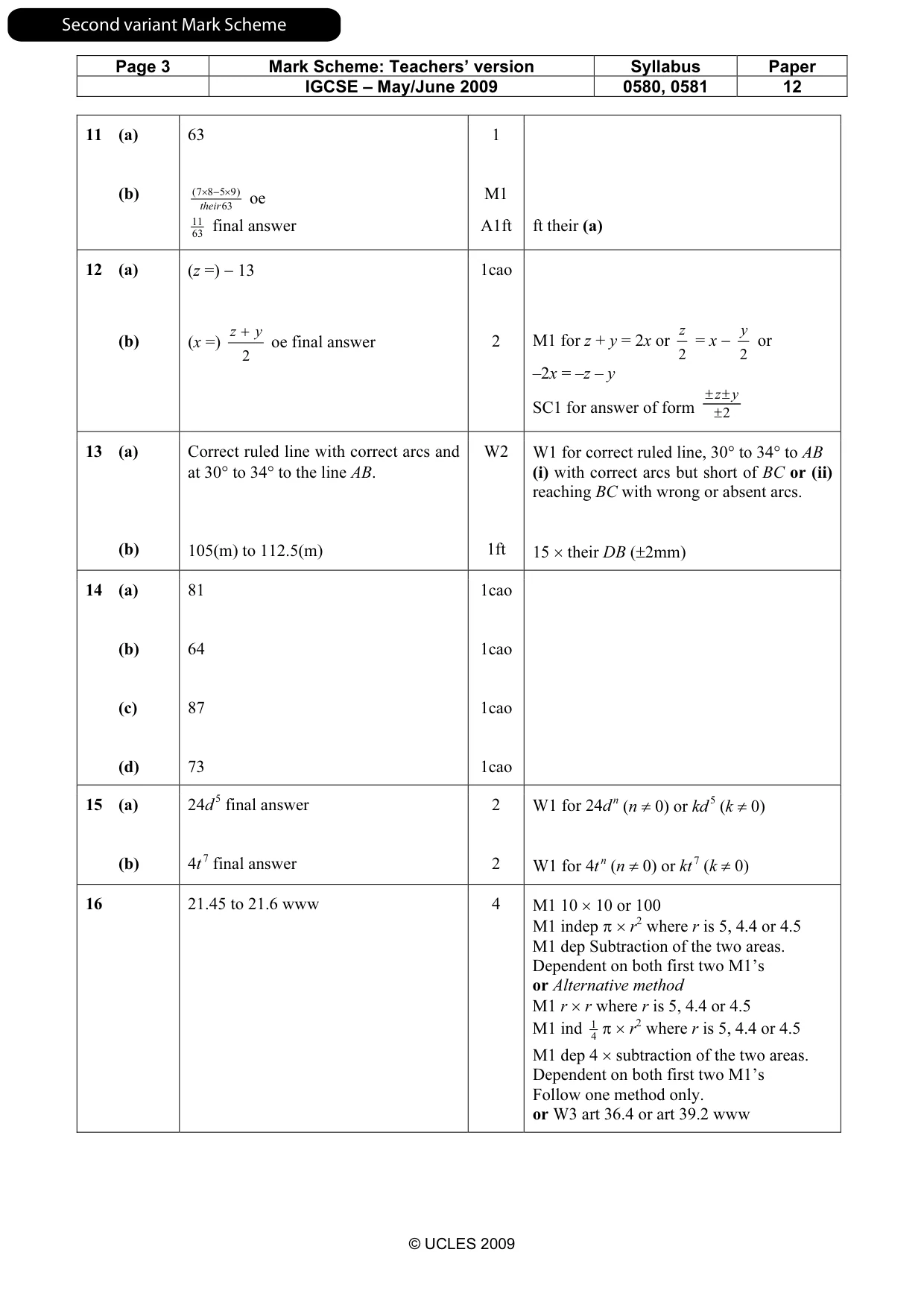
Mark scheme: 11 (a) 63 1 ×8 − 5 (b) ( 7 ×9 ) oe M1 their 63 11 63 final answer A1ft ft their (a)
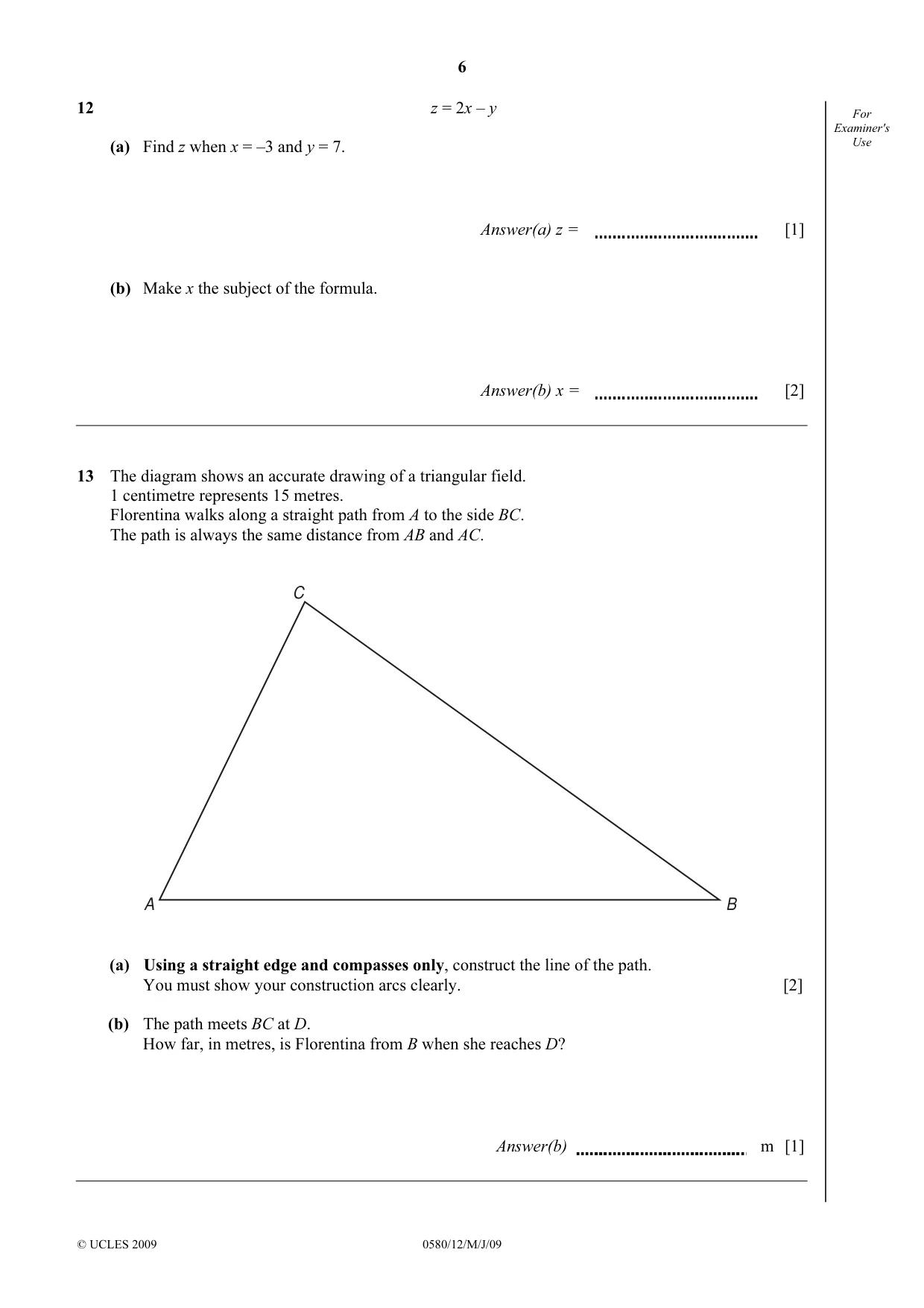
Q12 · Z = 2x – y For Examiner's (a) Find z when x = –3 and y = 7
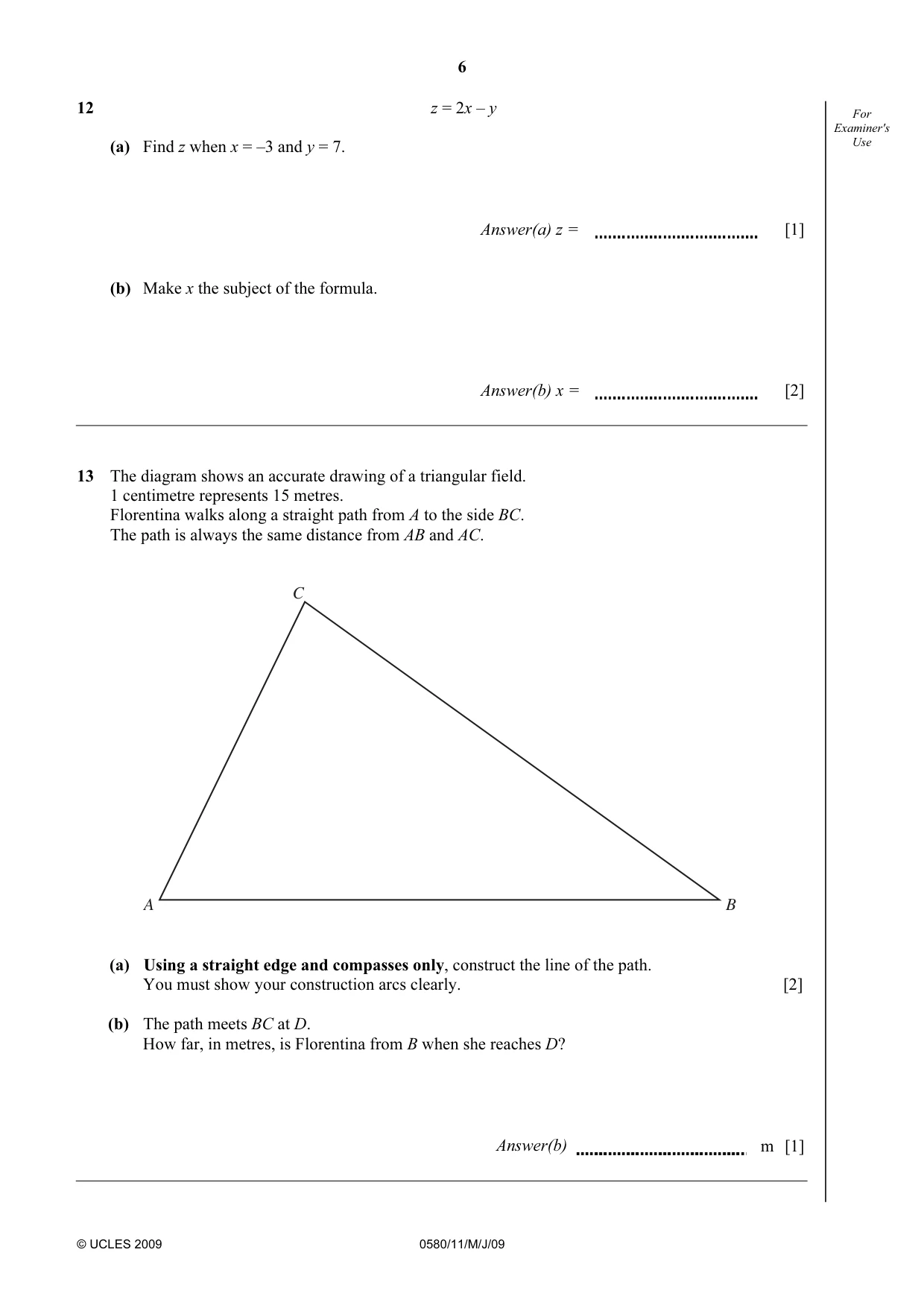
12 z = 2x – y For Examiner's (a) Find z when x = –3 and y = 7. Use Answer(a) z = [1] (b) Make x the subject of the formula. Answer(b) x = [2]
Mark scheme: 12 (a) (z =) − 13 1cao z + y z y (b) (x =) oe final answer 2 M1 for z + y = 2x or = x − or 2 2 2 –2x = –z – y ± z ± y SC1 for answer of form ± 2
Q13 · The diagram shows an accurate drawing of a triangular field
13 The diagram shows an accurate drawing of a triangular field. 1 centimetre represents 15 metres. Florentina walks along a straight path from A to the side BC. The path is always the same distance from AB and AC. C A B (a) Using a straight edge and compasses only, construct the line of the path. You must show your construction arcs clearly. [2] (b) The path meets BC at D. How far, in metres, is Florentina from B when she reaches D? Answer(b) m [1]
Mark scheme: 13 (a) Correct ruled line with correct arcs and W2 W1 for correct ruled line, 30° to 34° to AB at 30° to 34° to the line AB. (i) with correct arcs but short of BC or (ii) reaching BC with wrong or absent arcs. (b) 105(m) to 112.5(m) 1ft 15 × their DB (±2mm)
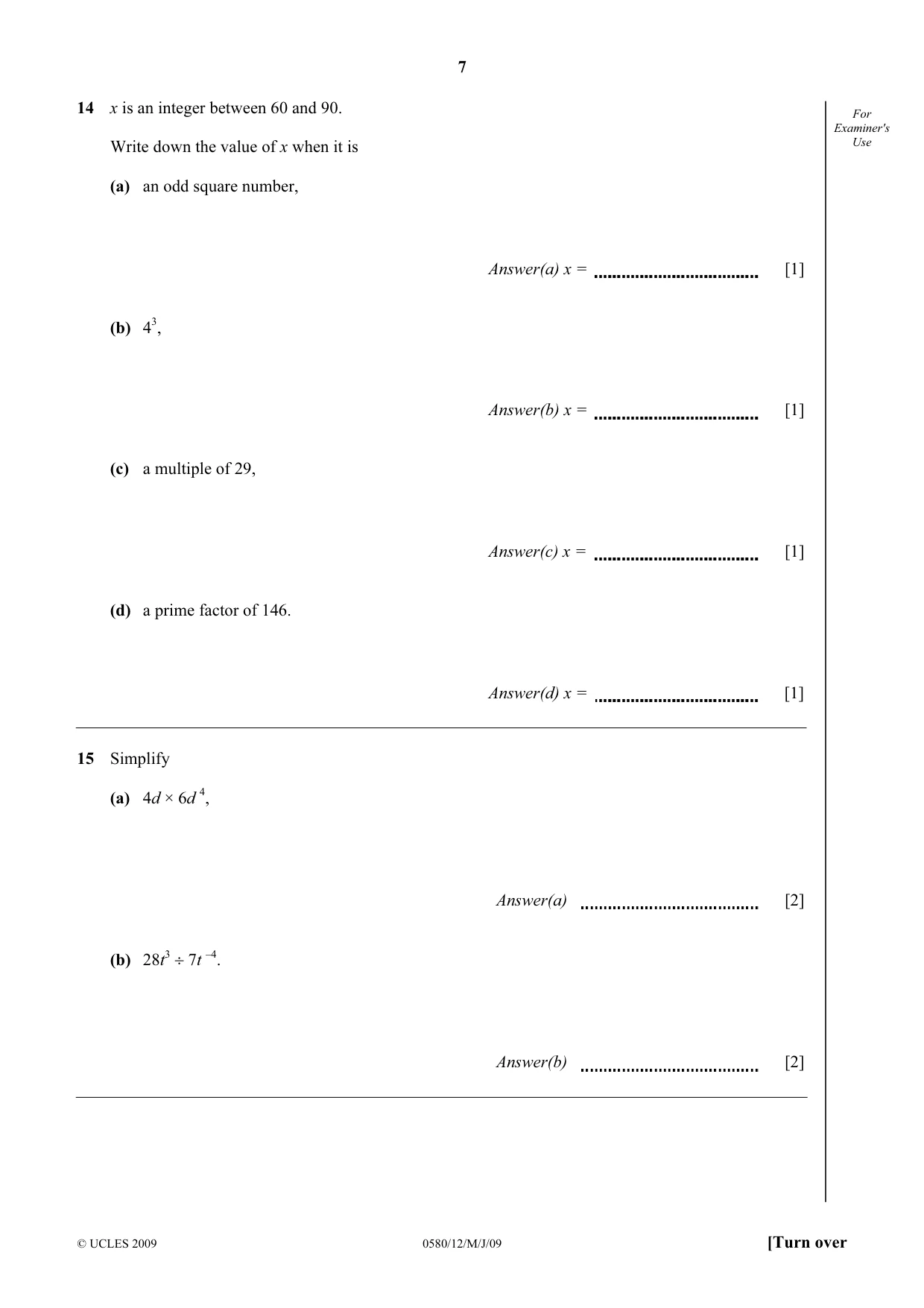
Q14 · X is an integer between 60 and 90
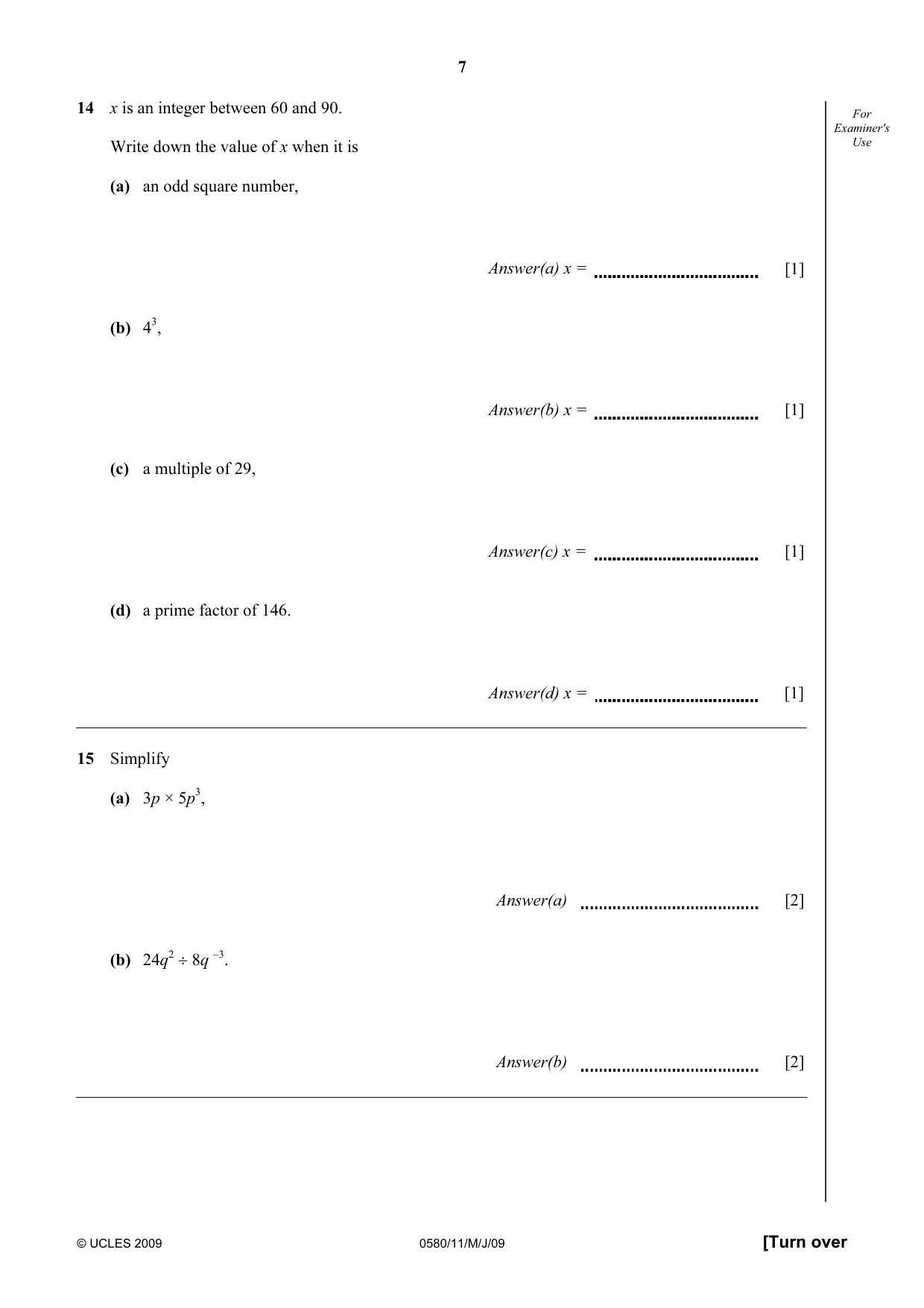
14 x is an integer between 60 and 90. For Examiner's Write down the value of x when it is Use (a) an odd square number, Answer(a) x = [1] (b) 43, Answer(b) x = [1] (c) a multiple of 29, Answer(c) x = [1] (d) a prime factor of 146. Answer(d) x = [1]
Mark scheme: 14 (a) 81 1cao (b) 64 1cao (c) 87 1cao (d) 73 1cao 4 4
Q15 · Simplify (a) 3p × 5p3, Answer(a) [2] (b) 24q2 ÷ 8q –3
15 Simplify (a) 3p × 5p3, Answer(a) [2] (b) 24q2 ÷ 8q –3. Answer(b) [2]
Mark scheme: 15 (a) 15p4 final answer 2 W1 for 15pn (n ≠ 0) or kp4 (k ≠ 0) (b) 3q5 final answer 2 W1 for 3qn (n ≠ 0) or kq5 (k ≠ 0)
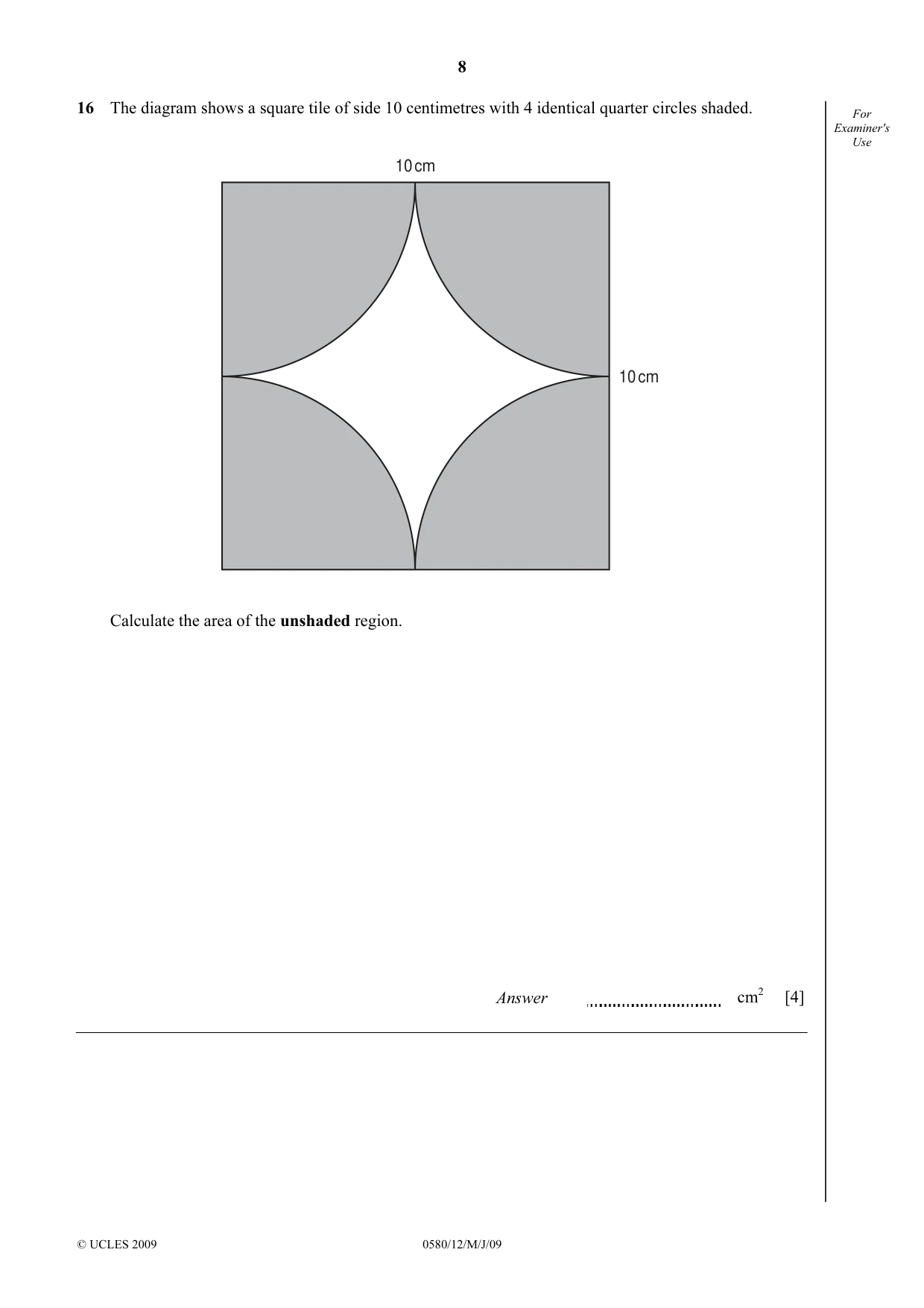
Q16 · The diagram shows a square tile of side 10 centimetres with 4 identical quarter circles…
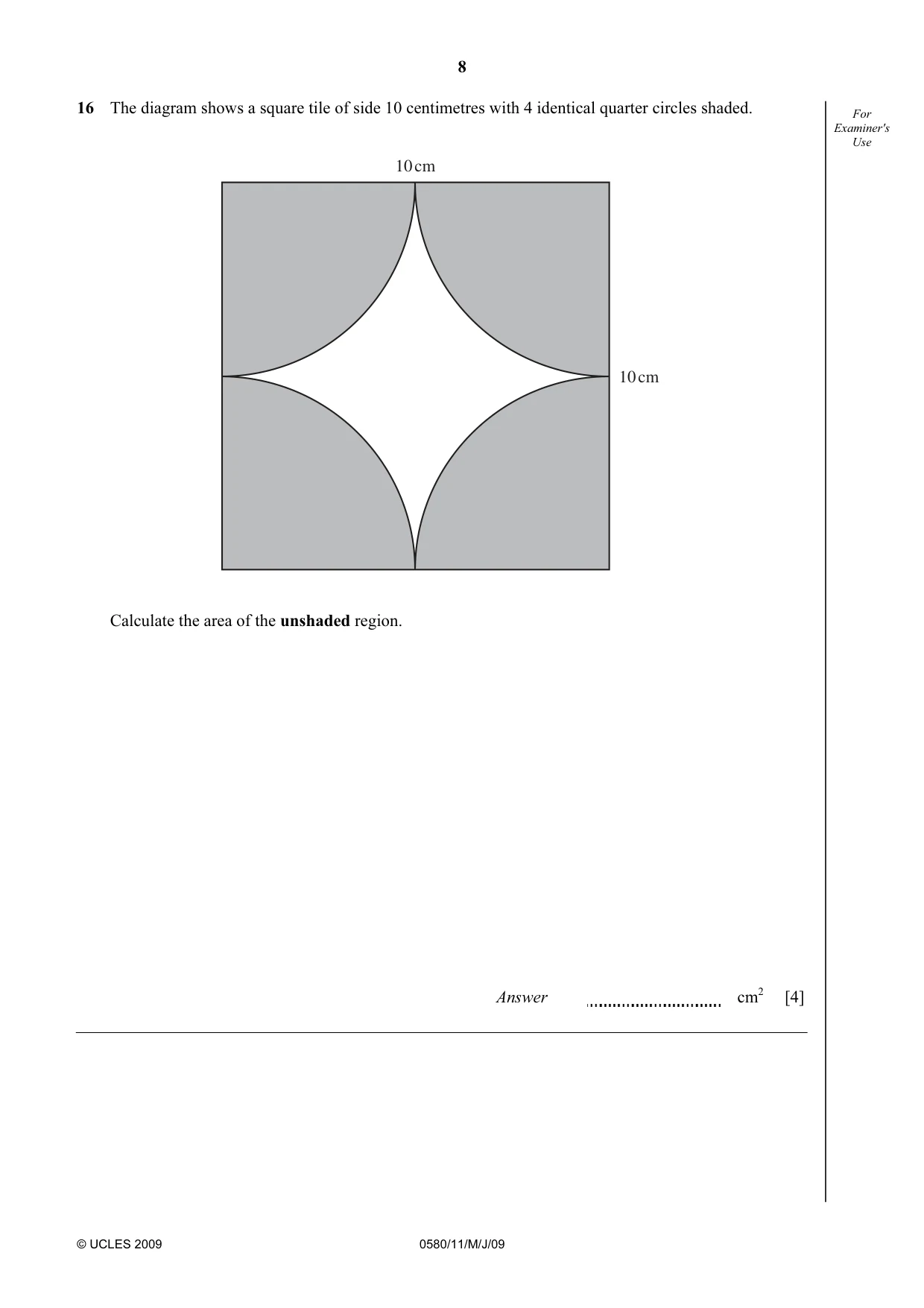
16 The diagram shows a square tile of side 10 centimetres with 4 identical quarter circles shaded. For Examiner's Use 10 cm 10 cm Calculate the area of the unshaded region. Answer cm2 [4]
Mark scheme: 16 21.45 to 21.6 www 4 M1 10 × 10 or 100 M1 indep π × r2 where r is 5, 4.4 or 4.5 M1 dep Subtraction of the two areas. Dependent on both first two M1’s or Alternative method Alt. M1 r × r where r is 5, 4.4 or 4.5 M1 ind 14 π × r2 where r is 5, 4.4 or 4.5 M1 dep 4 × subtraction of the two areas. Dependent on both first two M1’s Follow one method only. or W3 art 36.4 or art 39.2 www IGCSE – May/June 2009 0580, 0581 11
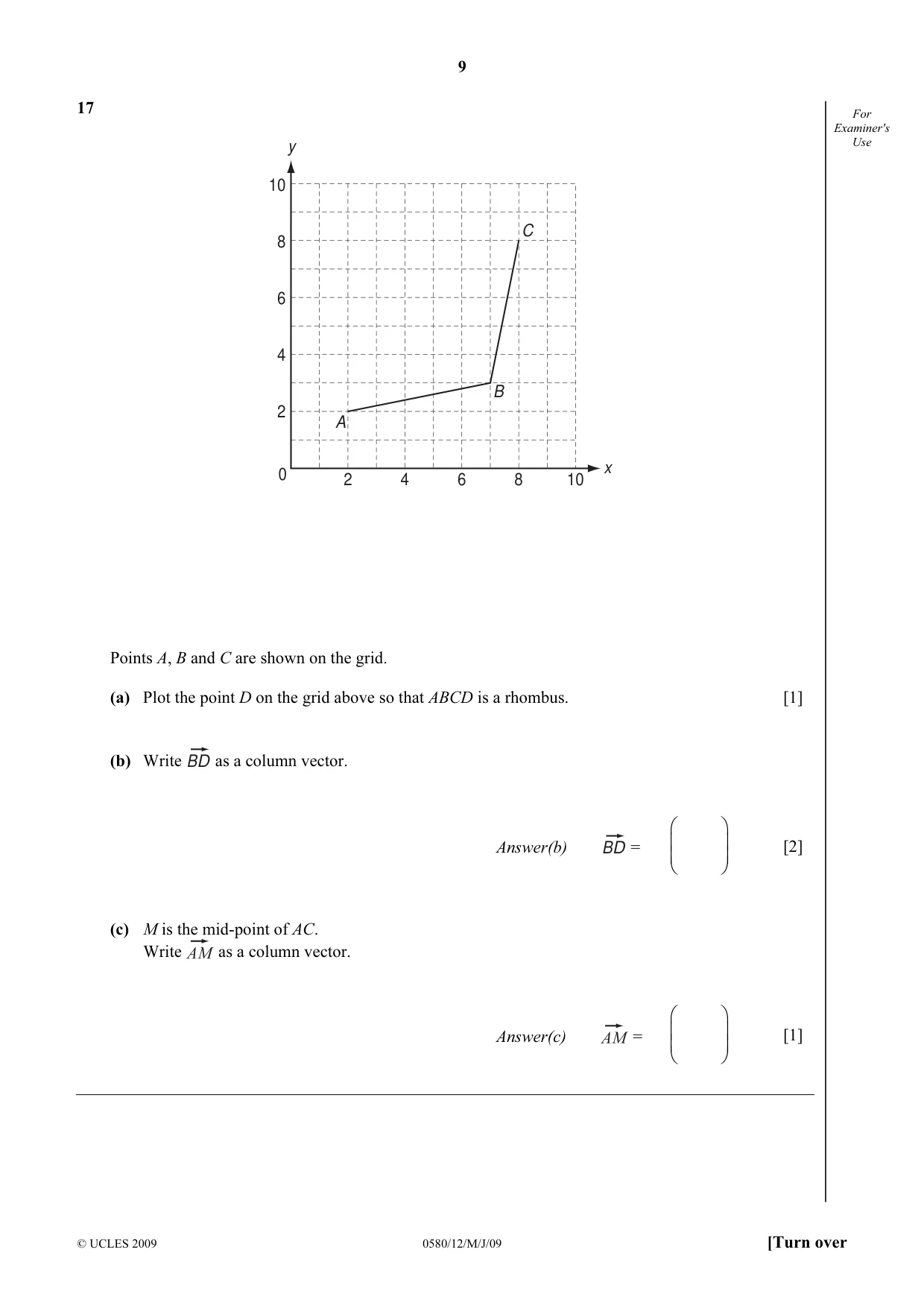
Q17 · For Examiner's y Use 10 C 8 6 4 B 2 A x 0 2 4 6 8 10 Points A, B and C are shown on the…
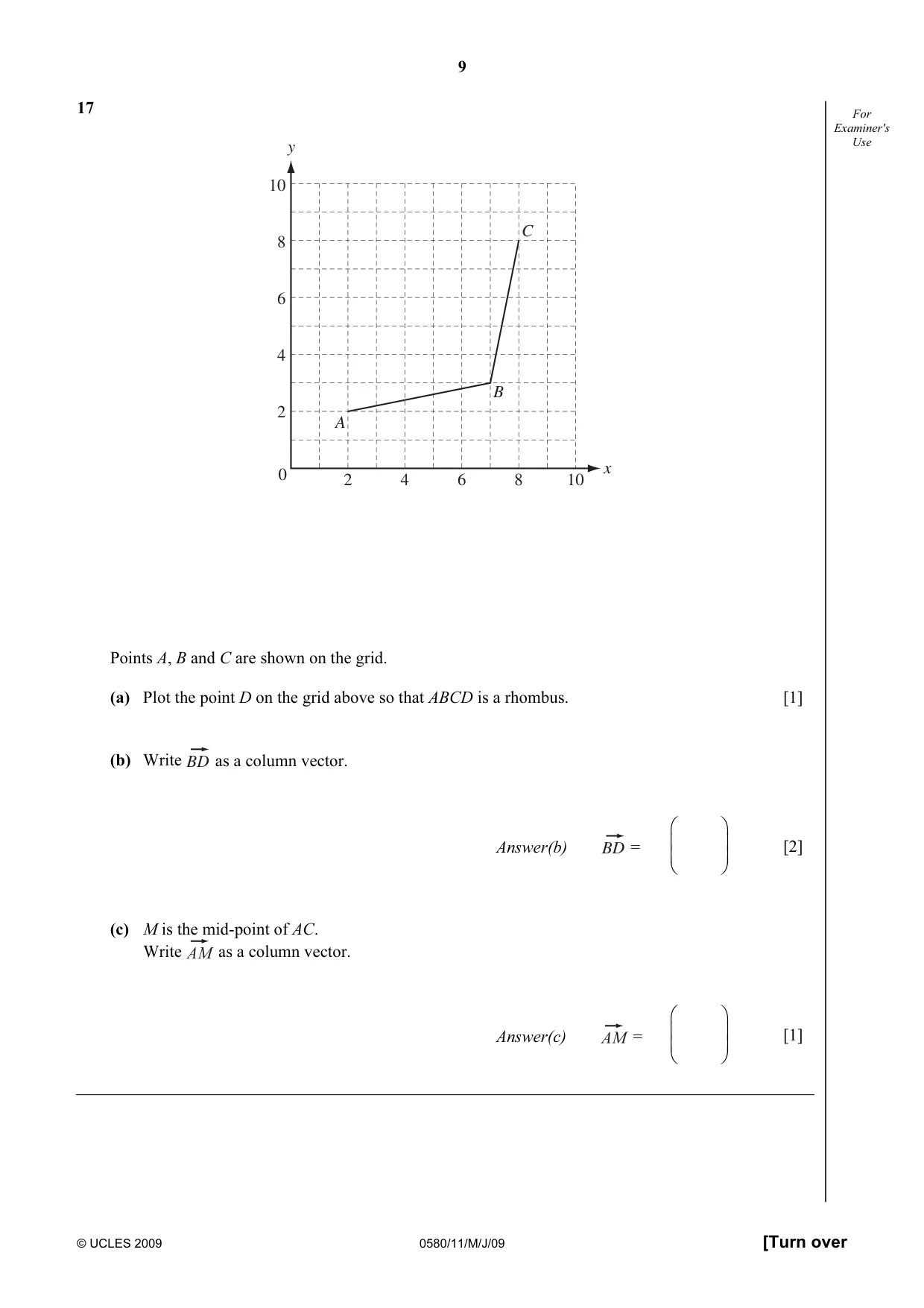
17 For Examiner's y Use 10 C 8 6 4 B 2 A x 0 2 4 6 8 10 Points A, B and C are shown on the grid. (a) Plot the point D on the grid above so that ABCD is a rhombus. [1] (b) Write BD as a column vector. Answer(b) BD = [2] (c) M is the mid-point of AC. Write as a column vector. Answer(c) = [1]
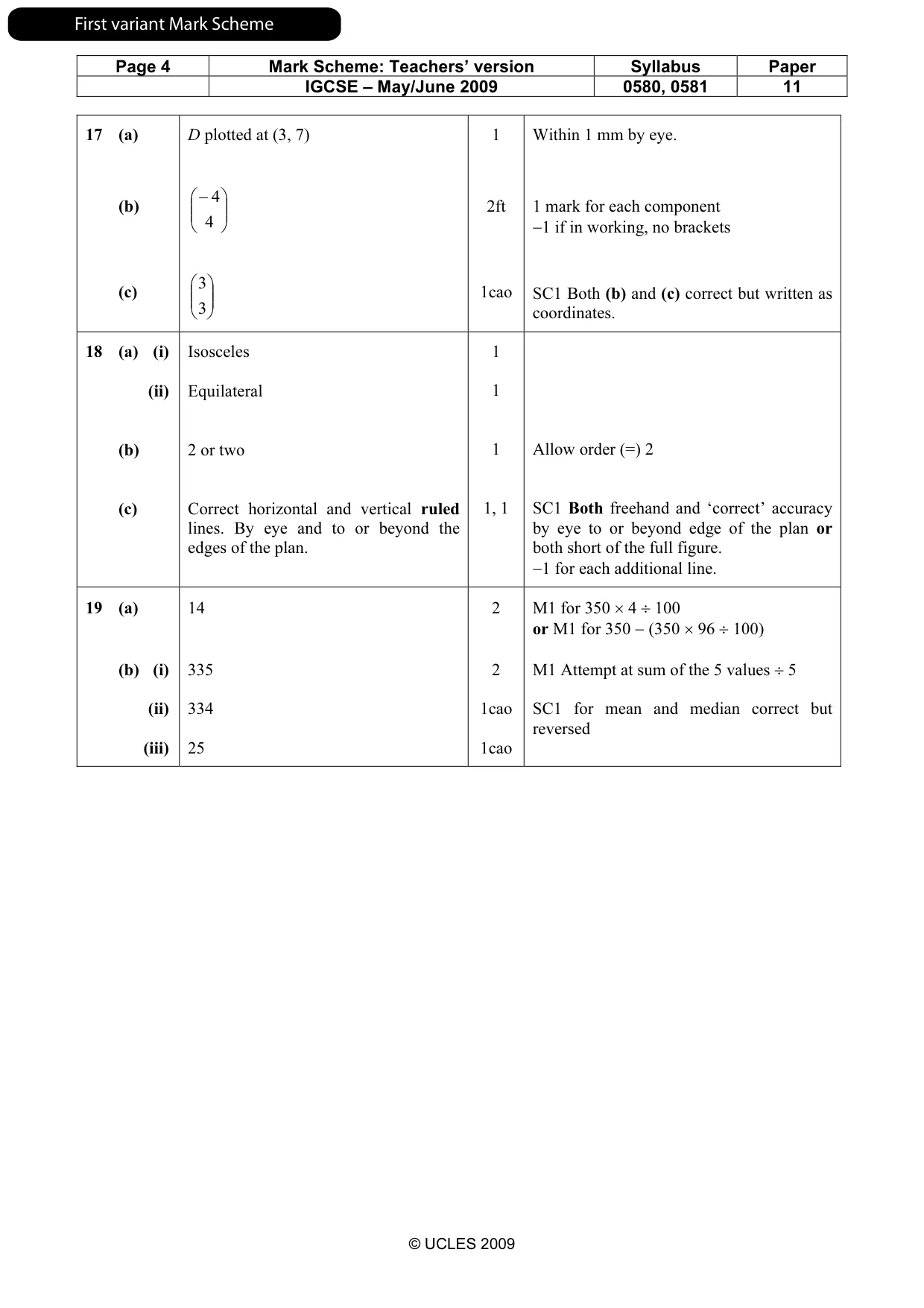
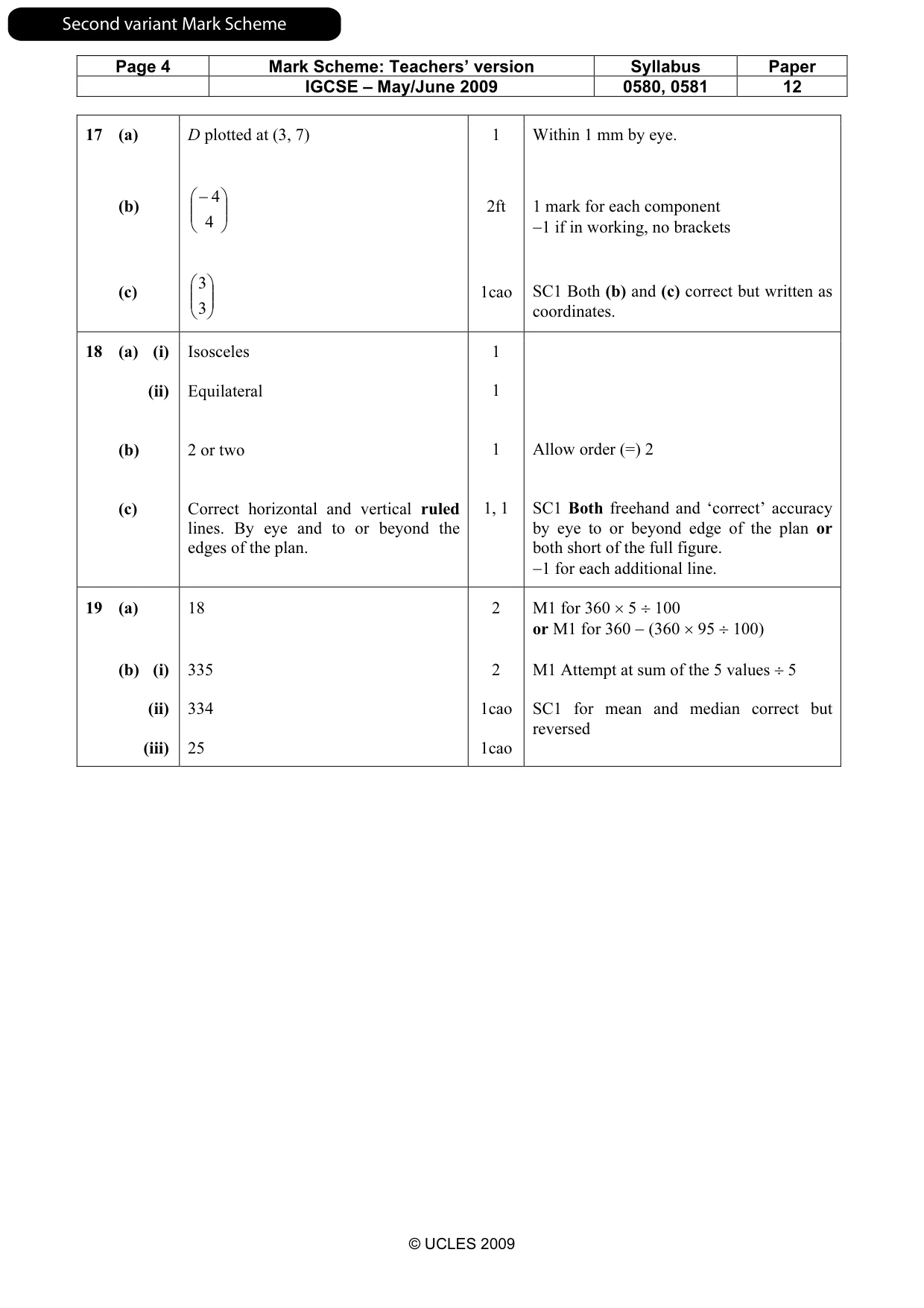
Mark scheme: 17 (a) D plotted at (3, 7) 1 Within 1 mm by eye. − 4 (b) 2ft 1 mark for each component 4 −1 if in working, no brackets 3 (c) 1cao SC1 Both (b) and (c) correct but written as 3 coordinates.
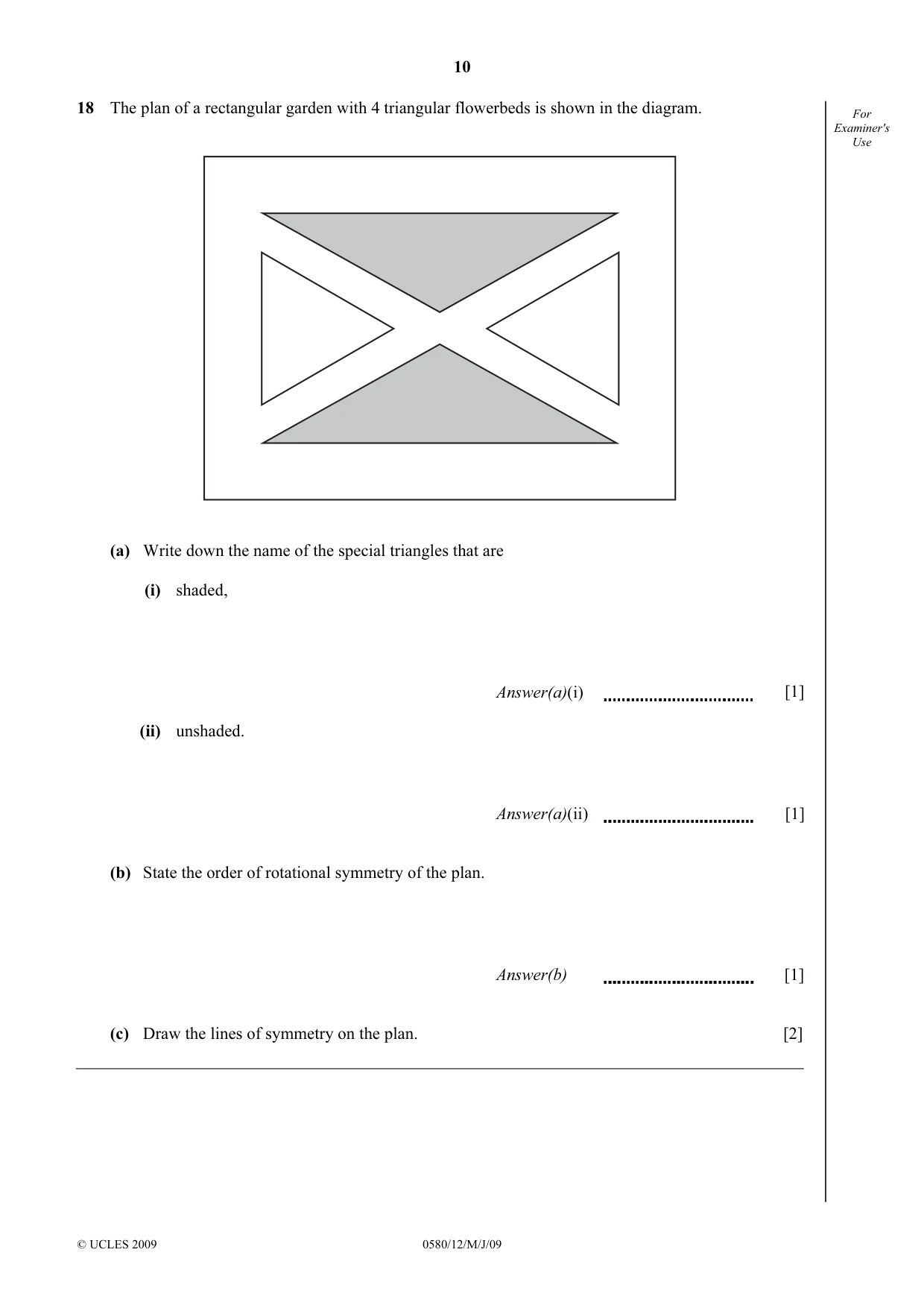
Q18 · The plan of a rectangular garden with 4 triangular flowerbeds is shown in the diagram
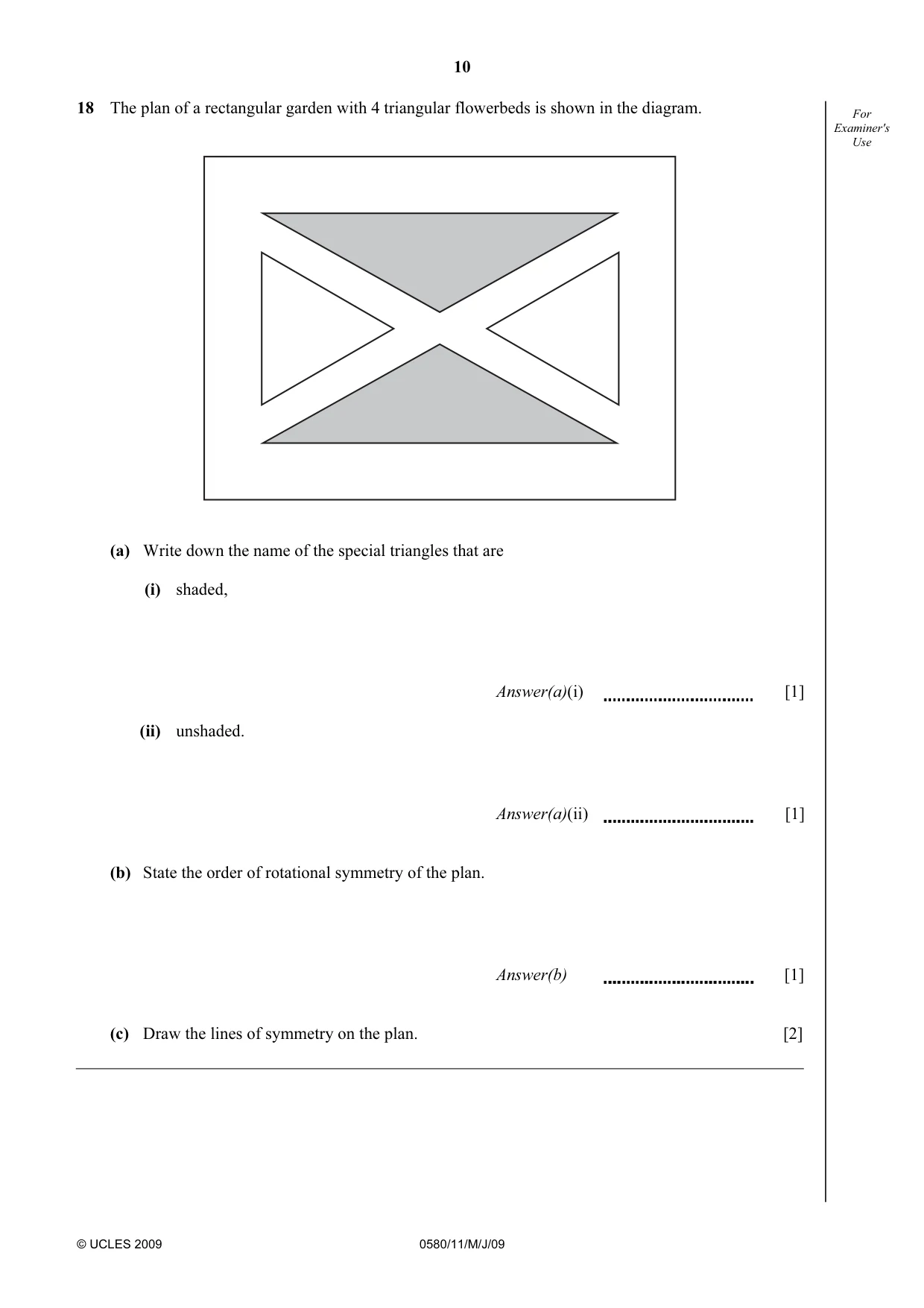
18 The plan of a rectangular garden with 4 triangular flowerbeds is shown in the diagram. For Examiner's Use (a) Write down the name of the special triangles that are (i) shaded, Answer(a)(i) [1] (ii) unshaded. Answer(a)(ii) [1] (b) State the order of rotational symmetry of the plan. Answer(b) [1] (c) Draw the lines of symmetry on the plan. [2]
Mark scheme: 18 (a) (i) Isosceles 1 (ii) Equilateral 1 (b) 2 or two 1 Allow order (=) 2 (c) Correct horizontal and vertical ruled 1, 1 SC1 Both freehand and ‘correct’ accuracy lines. By eye and to or beyond the by eye to or beyond edge of the plan or edges of the plan. both short of the full figure. −1 for each additional line.
What was in this paper
The subtopics covered by these 18 questions, and how many questions each got. Open one in a new tab to see every Cambridge question on it.