Cambridge IGCSE Mathematics 0580 — 2021 May/June Paper 1 · Variant 2
0580/12/M/J/21 · 25 questions · 56 marks · ≈63 min
The question paper and its mark scheme, free to read here and free to download. This is Cambridge’s own paper, exactly as it was sat.
Question paper12 pages
Mark scheme6 pages
Answers below. Sit the paper first if you are practising.
Questions as text
Q1 · Draw the line of symmetry on this shape
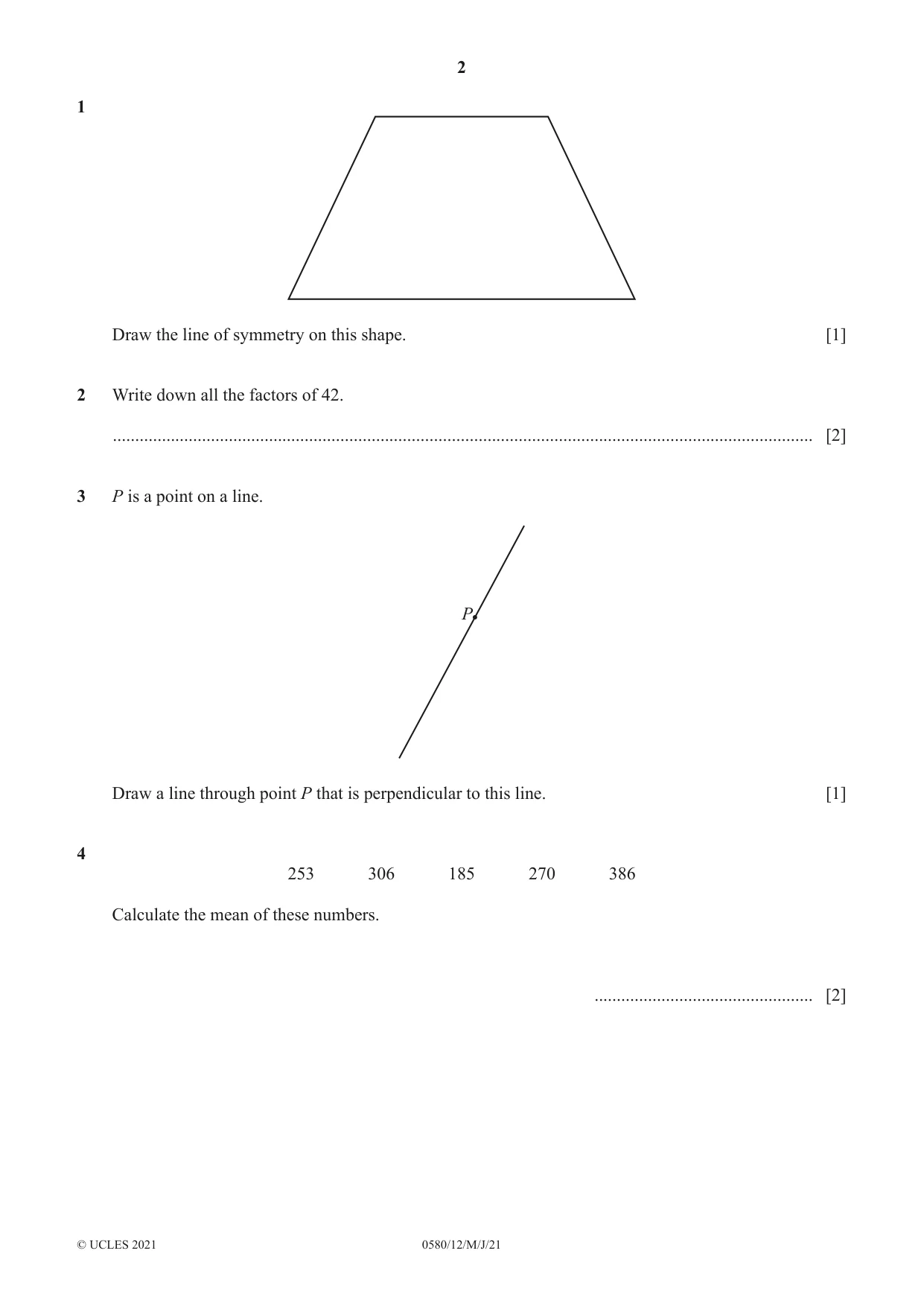
1 Draw the line of symmetry on this shape. [1]
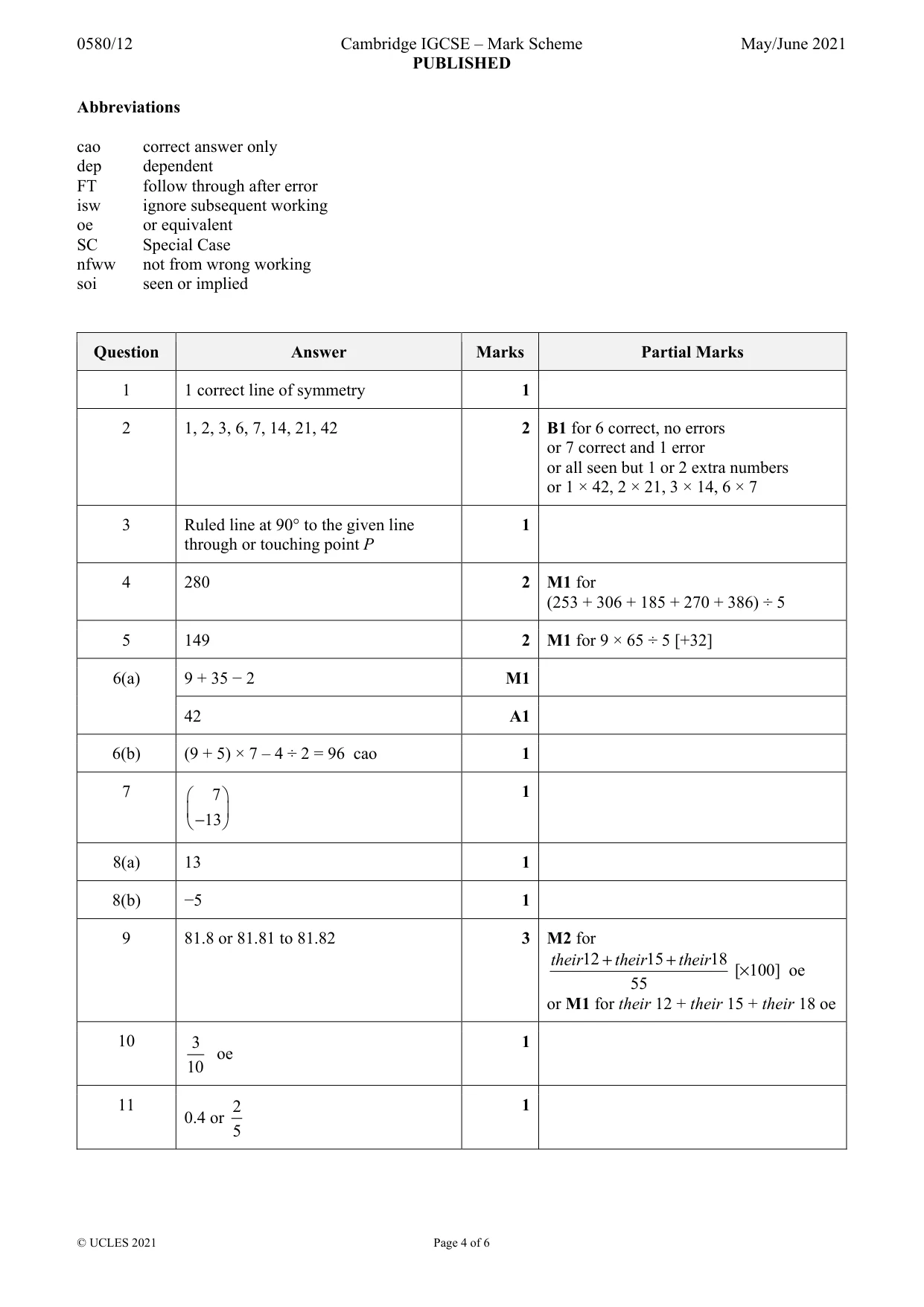
Mark scheme: Question Answer Marks Partial Marks 1 1 correct line of symmetry 1
Q2 · Write down all the factors of 42
2 Write down all the factors of 42. ............................................................................................................................................................. [2]
Mark scheme: 2 1, 2, 3, 6, 7, 14, 21, 42 2 B1 for 6 correct, no errors or 7 correct and 1 error or all seen but 1 or 2 extra numbers or 1 × 42, 2 × 21, 3 × 14, 6 × 7
Q3 · P is a point on a line
3 P is a point on a line. P Draw a line through point P that is perpendicular to this line. [1]
Mark scheme: 3 Ruled line at 90° to the given line 1 through or touching point P
Q4 · 253 306 185 270 386 Calculate the mean of these numbers
4 253 306 185 270 386 Calculate the mean of these numbers. ................................................. [2]
Mark scheme: 4 280 2 M1 for (253 + 306 + 185 + 270 + 386) ÷ 5
Q5 · The formula for changing a temperature measured in Celsius (°C) to Fahrenheit (°F) is 9C…
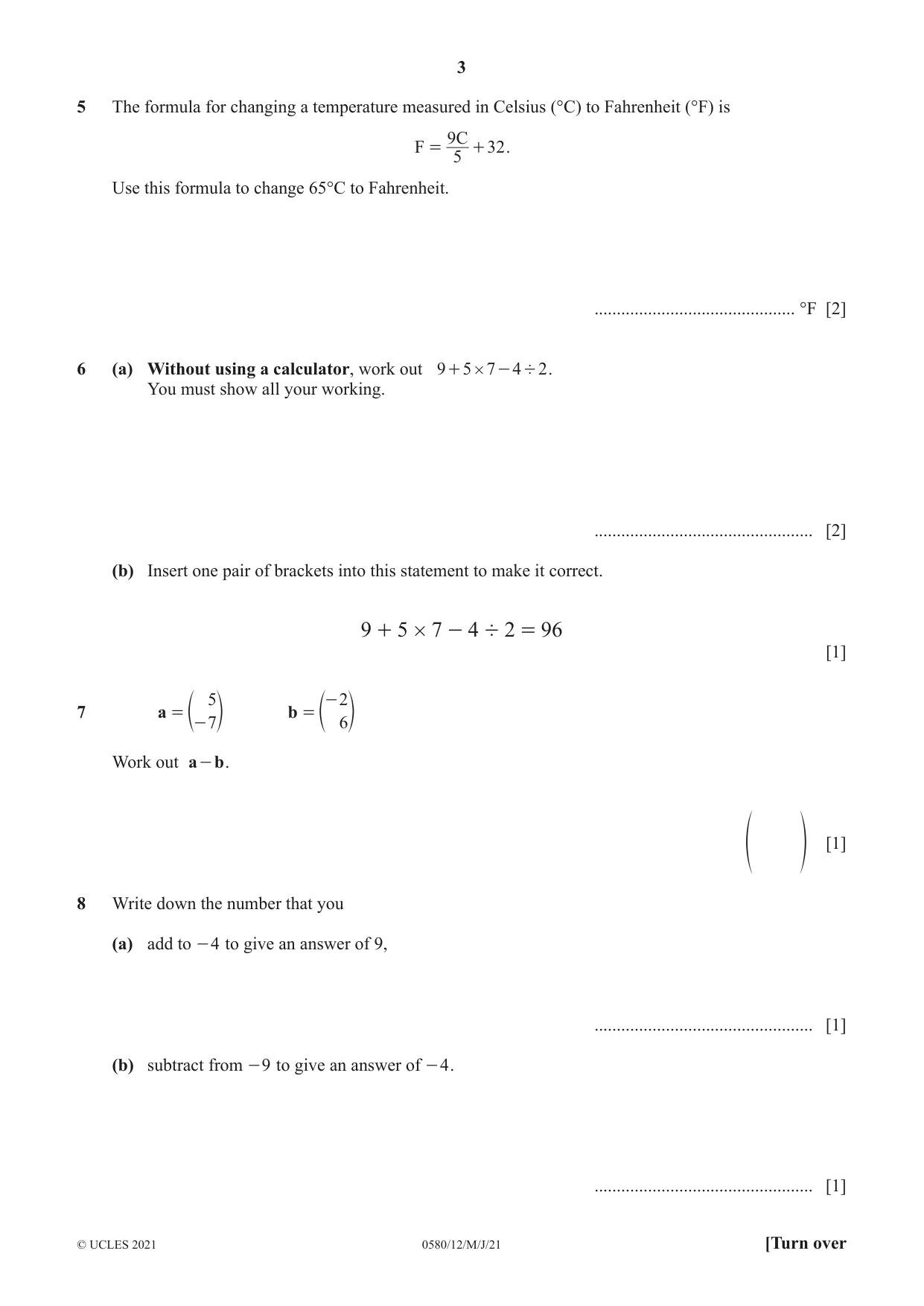
5 The formula for changing a temperature measured in Celsius (°C) to Fahrenheit (°F) is 9C F = + 32 . 5 Use this formula to change 65°C to Fahrenheit. ............................................. °F [2]
Mark scheme: 5 149 2 M1 for 9 × 65 ÷ 5 [+32]
Q6 · Without using a calculator, work out 9 + 5 # 7 - 4 ' 2
6 (a) Without using a calculator, work out 9 + 5 # 7 - 4 ' 2 . You must show all your working. ................................................. [2] (b) Insert one pair of brackets into this statement to make it correct. 9 + 5 # 7 - 4 ' 2 = 96 [1]
Mark scheme: 6(a) 9 + 35 − 2 M1 42 A1 6(b) (9 + 5) × 7 – 4 ÷ 2 = 96 cao 1
Q7 · - 2 7 a = b = e- 7o e 6o Work out a - b
5 - 2 7 a = b = e- 7o e 6o Work out a - b . [1] f p
Mark scheme: 7 7 1 −13
Q8 · Write down the number that you (a) add to - 4 to give an answer of 9…
8 Write down the number that you (a) add to - 4 to give an answer of 9, ................................................. [1] (b) subtract from - 9 to give an answer of - 4 . ................................................. [1]
Mark scheme: 8(a) 13 1 8(b) −5 1
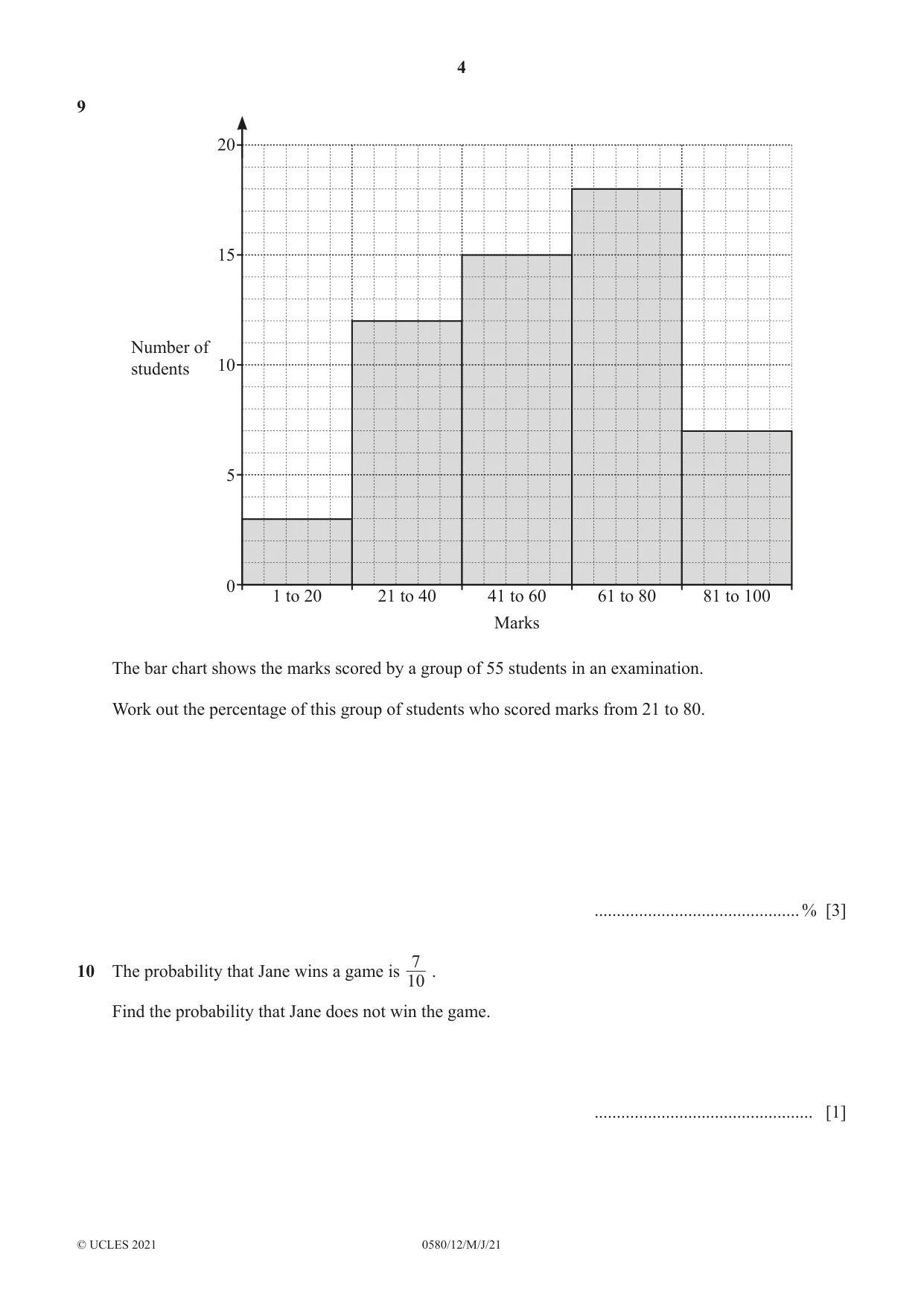
Q9 · 20 15 Number of students 10 5 0 1 to 20 21 to 40 41 to 60 61 to 80 81 to 100 Marks The…
9 20 15 Number of students 10 5 0 1 to 20 21 to 40 41 to 60 61 to 80 81 to 100 Marks The bar chart shows the marks scored by a group of 55 students in an examination. Work out the percentage of this group of students who scored marks from 21 to 80. ..............................................% [3]
Mark scheme: 9 81.8 or 81.81 to 81.82 3 M2 for their12 + their15 + their18 [× 100] oe 55 or M1 for their 12 + their 15 + their 18 oe
Q10 · 0 The probability that Jane wins a game is
710 The probability that Jane wins a game is . 10 Find the probability that Jane does not win the game. ................................................. [1]
Mark scheme: 10 3 1 oe 10
Question 11
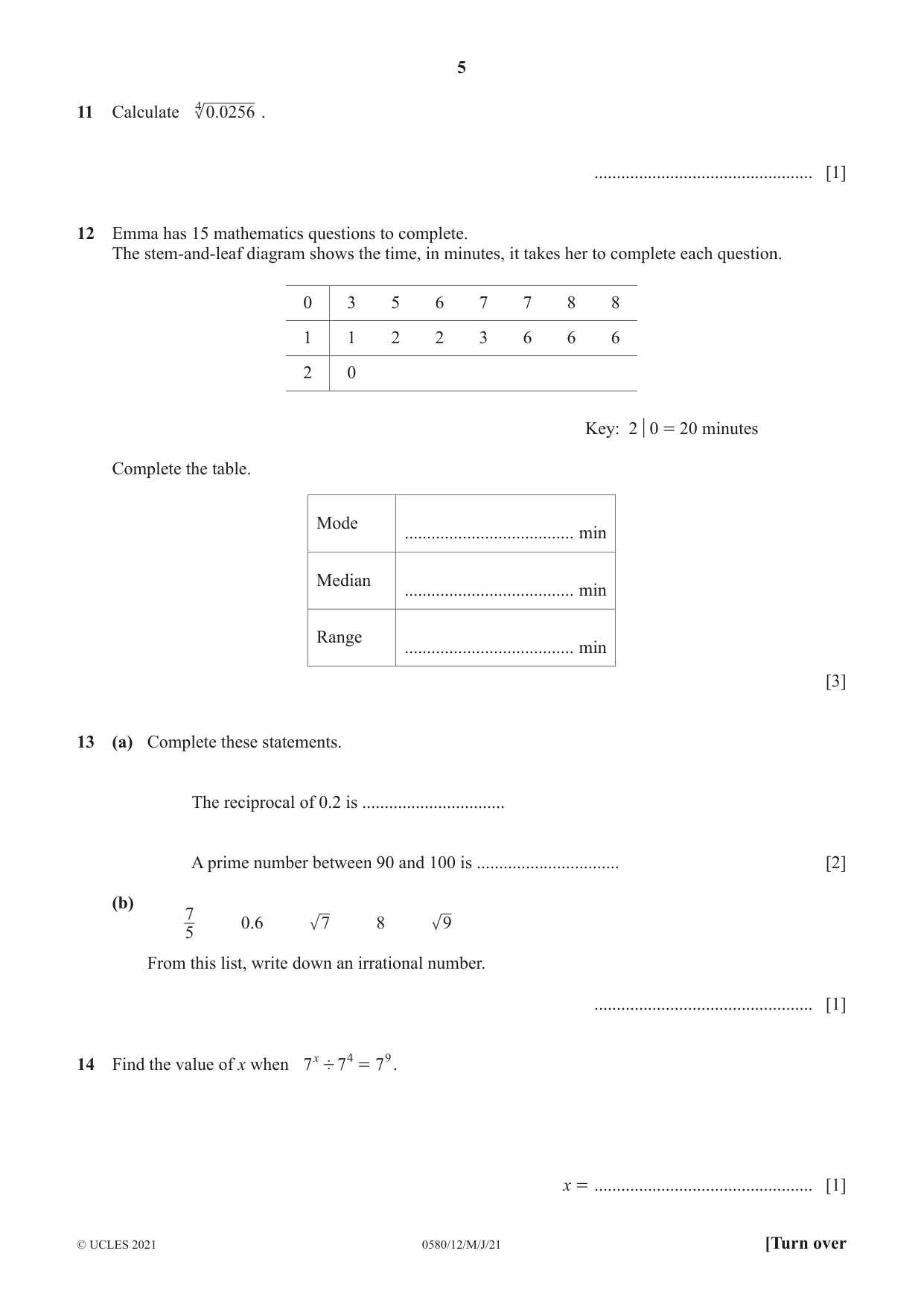
11 Calculate 4 .00256 . ................................................. [1]
Mark scheme: 11 2 1 0.4 or 5
Q12 · Emma has 15 mathematics questions to complete
12 Emma has 15 mathematics questions to complete. The stem‑and‑leaf diagram shows the time, in minutes, it takes her to complete each question. 0 3 5 6 7 7 8 8 1 1 2 2 3 6 6 6 2 0 Key: 2 q0 = 20 minutes Complete the table. Mode ...................................... min Median ...................................... min Range ...................................... min [3]
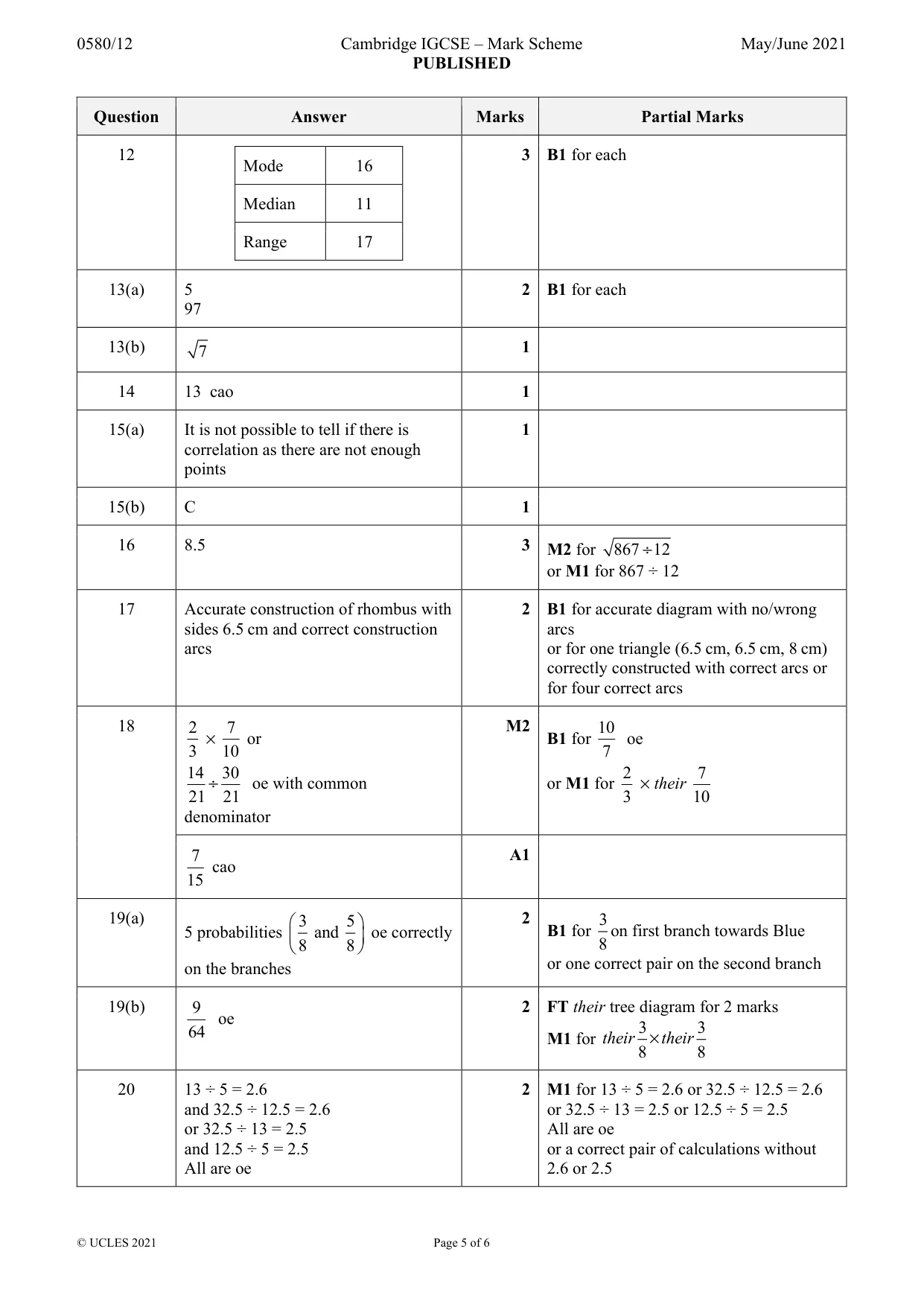
Mark scheme: 12 3 B1 for each Mode 16 Median 11 Range 17
Question 13
13 (a) Complete these statements. The reciprocal of 0.2 is ................................ A prime number between 90 and 100 is ................................ [2] (b) 7 0.6 7 8 9 5 From this list, write down an irrational number. ................................................. [1]
Mark scheme: 13(a) 5 2 B1 for each 97 13(b) 7 1
Q14 · Find the value of x when 7 x ' 7 4 = 7 9
14 Find the value of x when 7 x ' 7 4 = 7 9 . x = ................................................. [1]
Mark scheme: 14 13 cao 1
Q15 · Henrik draws this scatter diagram
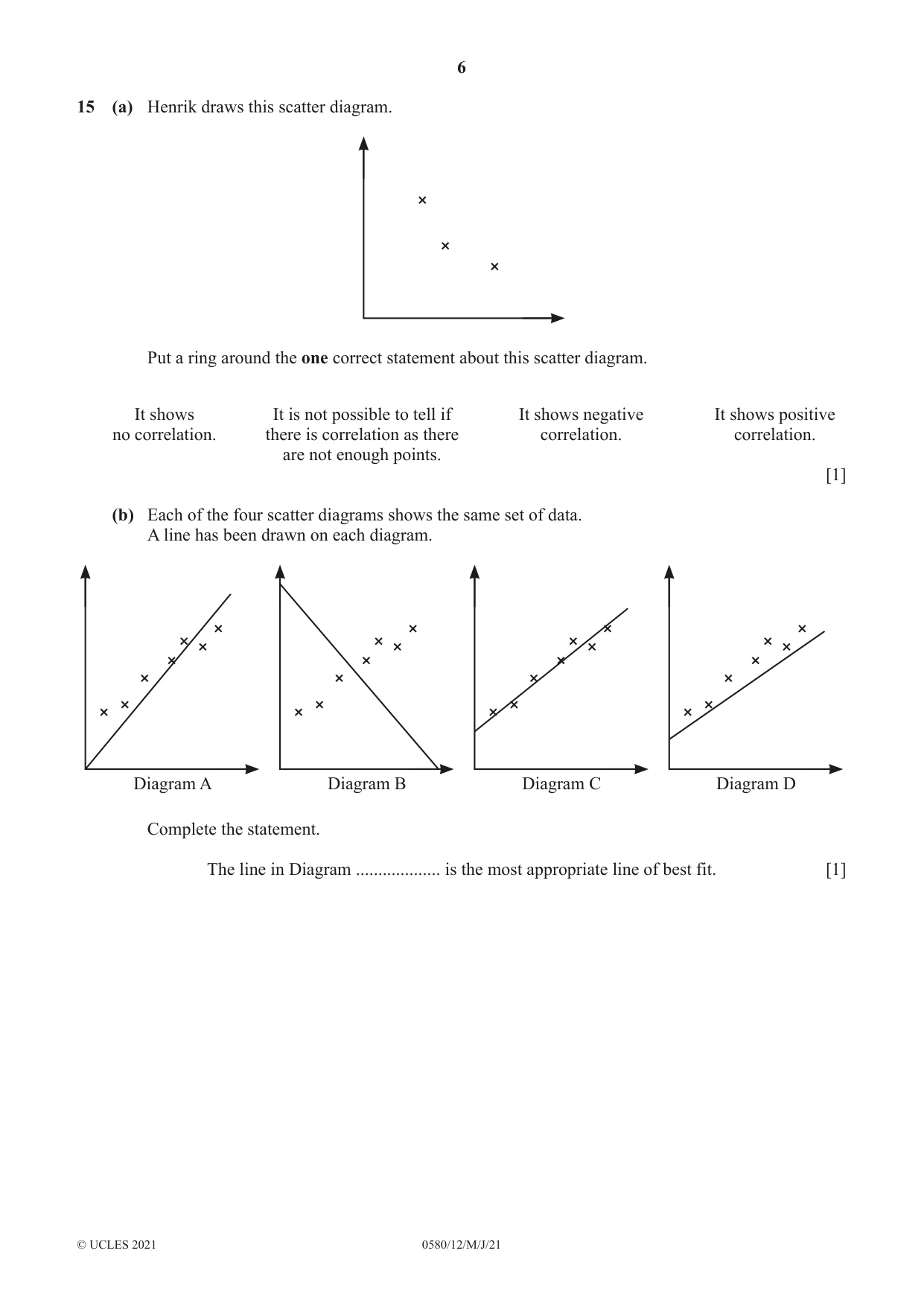
15 (a) Henrik draws this scatter diagram. Put a ring around the one correct statement about this scatter diagram. It shows It is not possible to tell if It shows negative It shows positive no correlation. there is correlation as there correlation. correlation. are not enough points. [1] (b) Each of the four scatter diagrams shows the same set of data. A line has been drawn on each diagram. Diagram A Diagram B Diagram C Diagram D Complete the statement. The line in Diagram ................... is the most appropriate line of best fit. [1]
Mark scheme: 15(a) It is not possible to tell if there is 1 correlation as there are not enough points 15(b) C 1
Q16 · A cuboid has a square base
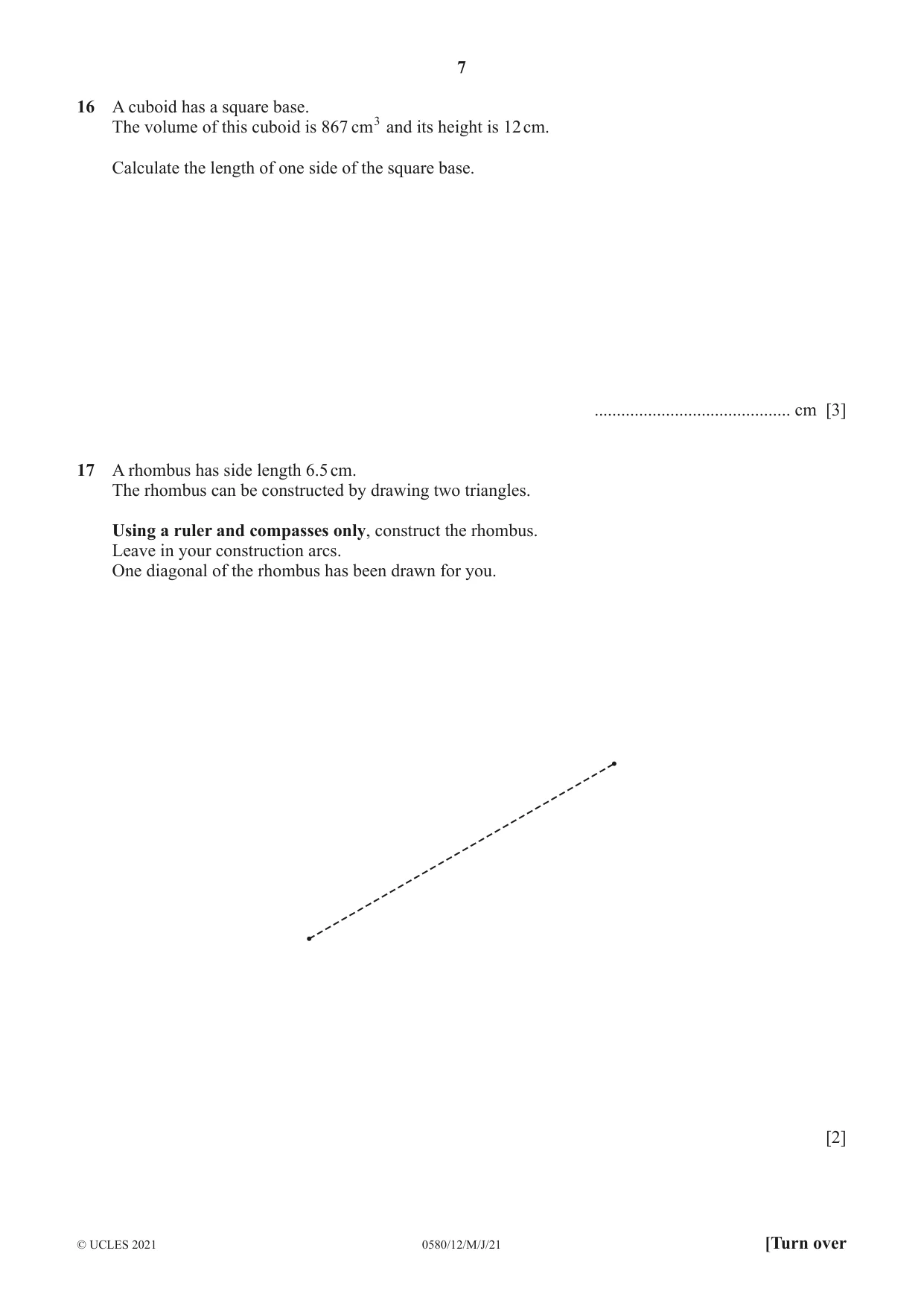
16 A cuboid has a square base. The volume of this cuboid is 867 cm3 and its height is 12 cm. Calculate the length of one side of the square base. ............................................ cm [3]
Mark scheme: 16 8.5 3 M2 for 867 ÷ 12 or M1 for 867 ÷ 12
Q17 · A rhombus has side length 6.5 cm
17 A rhombus has side length 6.5 cm. The rhombus can be constructed by drawing two triangles. Using a ruler and compasses only, construct the rhombus. Leave in your construction arcs. One diagonal of the rhombus has been drawn for you. [2]
Mark scheme: 17 Accurate construction of rhombus with 2 B1 for accurate diagram with no/wrong sides 6.5 cm and correct construction arcs arcs or for one triangle (6.5 cm, 6.5 cm, 8 cm) correctly constructed with correct arcs or for four correct arcs
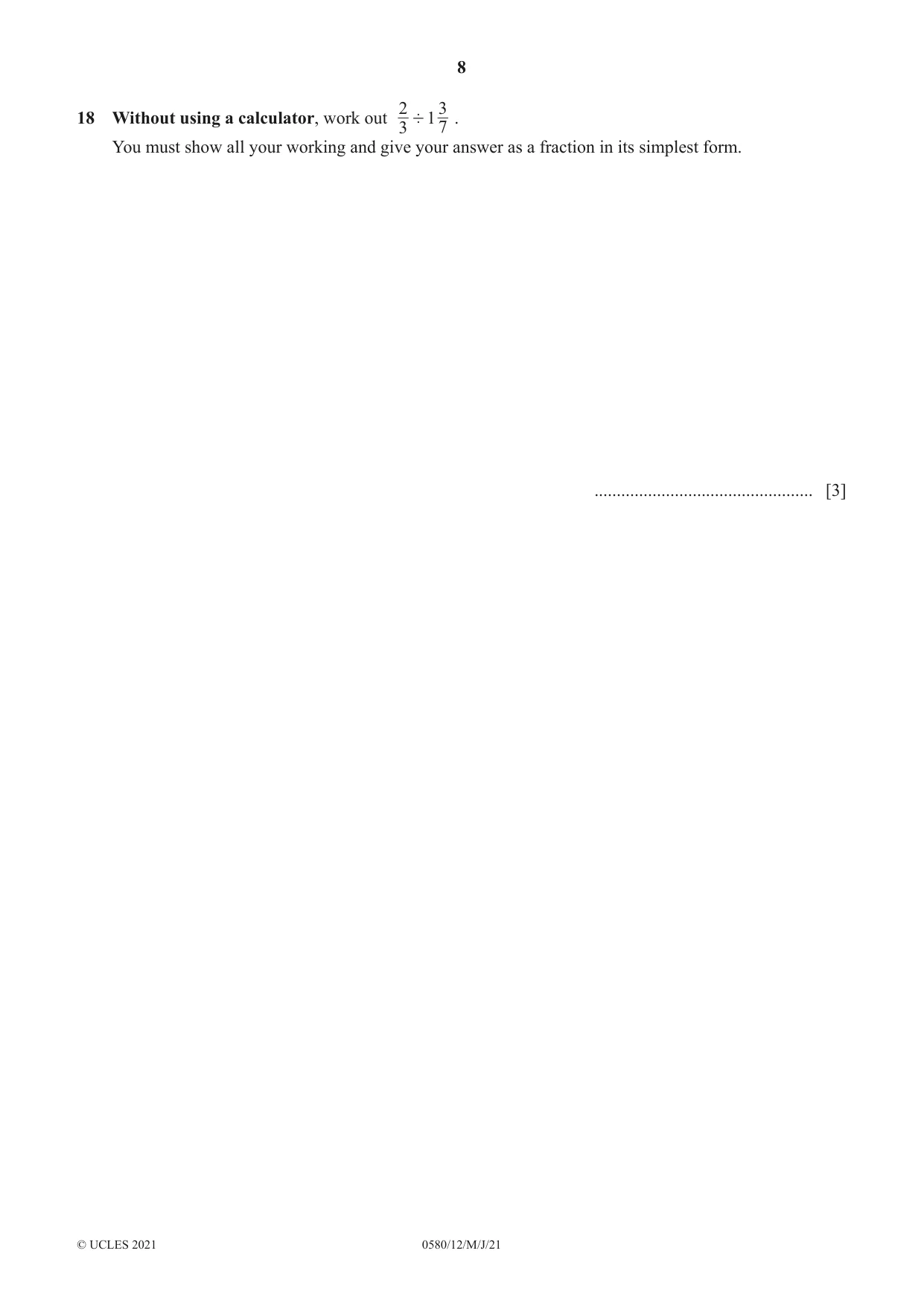
Q18 · 318 Without using a calculator, work out ' 1
2 318 Without using a calculator, work out ' 1 . 3 7 You must show all your working and give your answer as a fraction in its simplest form. ................................................. [3]
Mark scheme: 18 2 7 M2 10 × or B1 for oe 3 10 7 14 30 2 7 ÷ oe with common or M1 for × their 21 21 3 10 denominator 7 A1 cao 15
Q19 · A bag contains 5 red balls and 3 blue balls
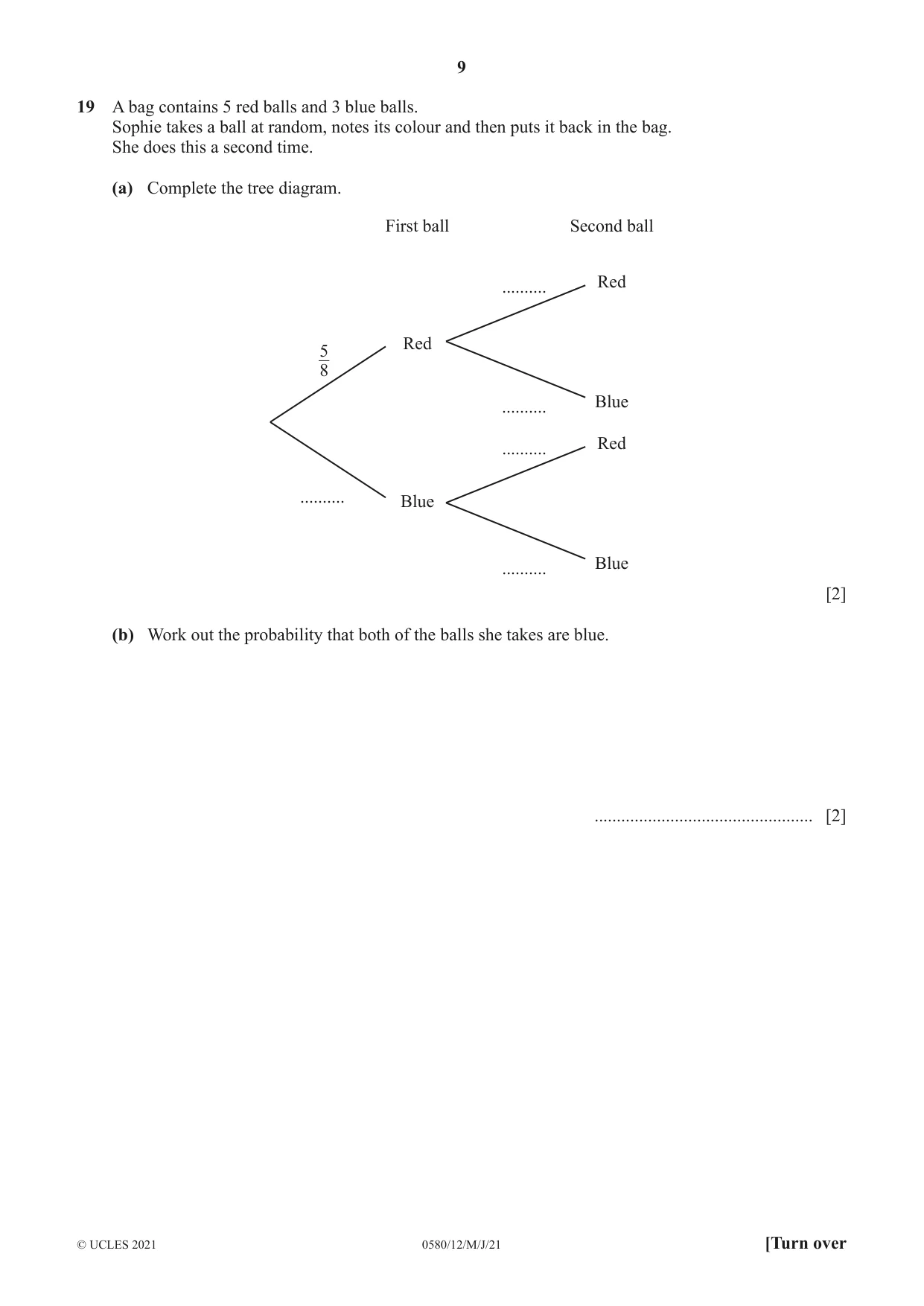
19 A bag contains 5 red balls and 3 blue balls. Sophie takes a ball at random, notes its colour and then puts it back in the bag. She does this a second time. (a) Complete the tree diagram. First ball Second ball Red .......... Red 5 8 Blue .......... Red .......... .......... Blue Blue .......... [2] (b) Work out the probability that both of the balls she takes are blue. ................................................. [2]
Mark scheme: 19(a) 3 5 2 3 5 probabilities and oe correctly B1 for on first branch towards Blue 8 8 8 or one correct pair on the second branch on the branches 19(b) 9 2 FT their tree diagram for 2 marks oe 3 3 64 M1 for their × their 8 8
Q20 · NOT TO SCALE 12.5 cm 5 cm 32.5 cm 13 cm The diagram shows two cylinders
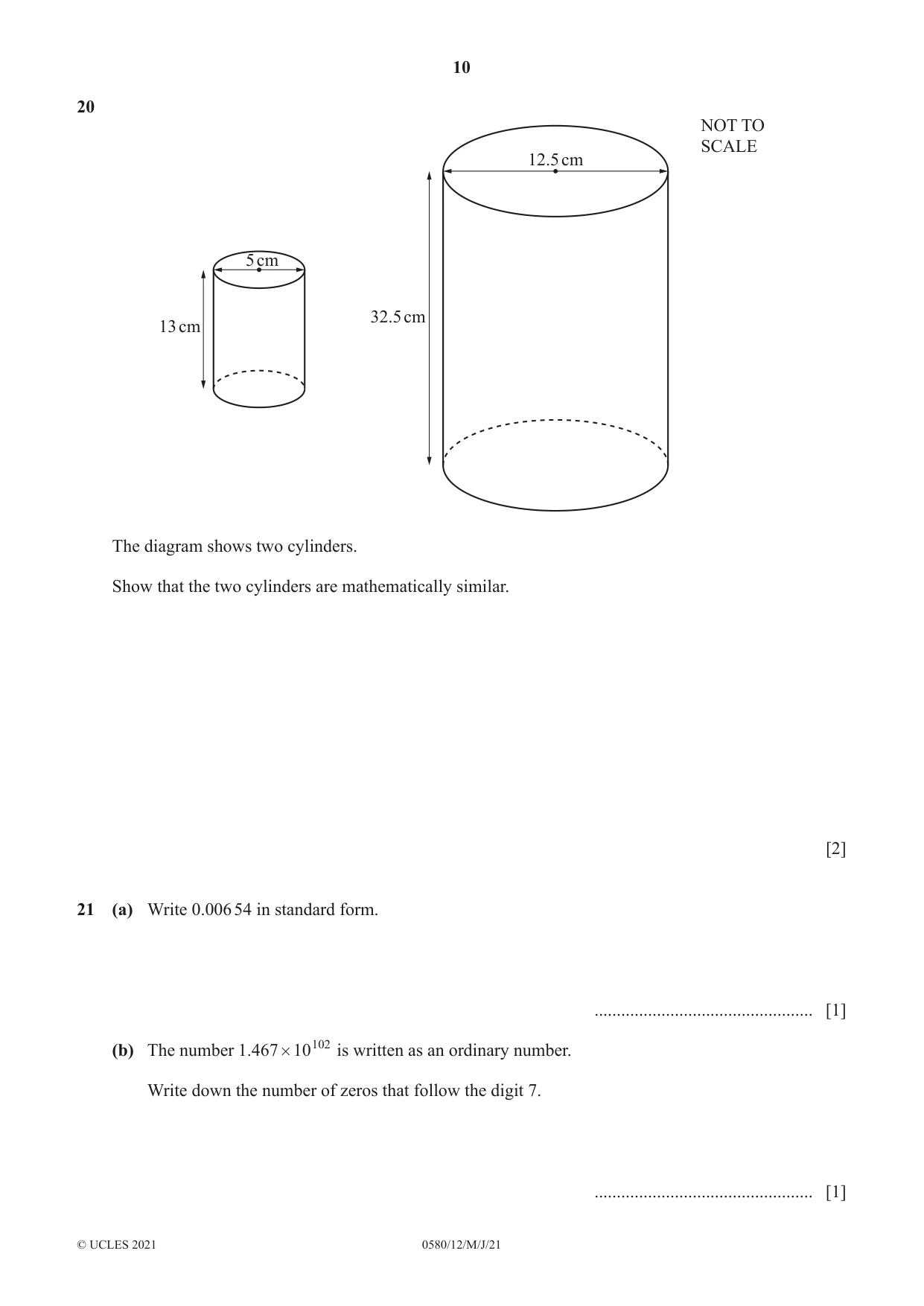
20 NOT TO SCALE 12.5 cm 5 cm 32.5 cm 13 cm The diagram shows two cylinders. Show that the two cylinders are mathematically similar. [2]
Mark scheme: 20 13 ÷ 5 = 2.6 2 M1 for 13 ÷ 5 = 2.6 or 32.5 ÷ 12.5 = 2.6 and 32.5 ÷ 12.5 = 2.6 or 32.5 ÷ 13 = 2.5 or 12.5 ÷ 5 = 2.5 or 32.5 ÷ 13 = 2.5 All are oe and 12.5 ÷ 5 = 2.5 or a correct pair of calculations without All are oe 2.6 or 2.5
Q21 · Write 0.006 54 in standard form
21 (a) Write 0.006 54 in standard form. ................................................. [1] (b) The number .1467 # 10102 is written as an ordinary number. Write down the number of zeros that follow the digit 7. ................................................. [1]
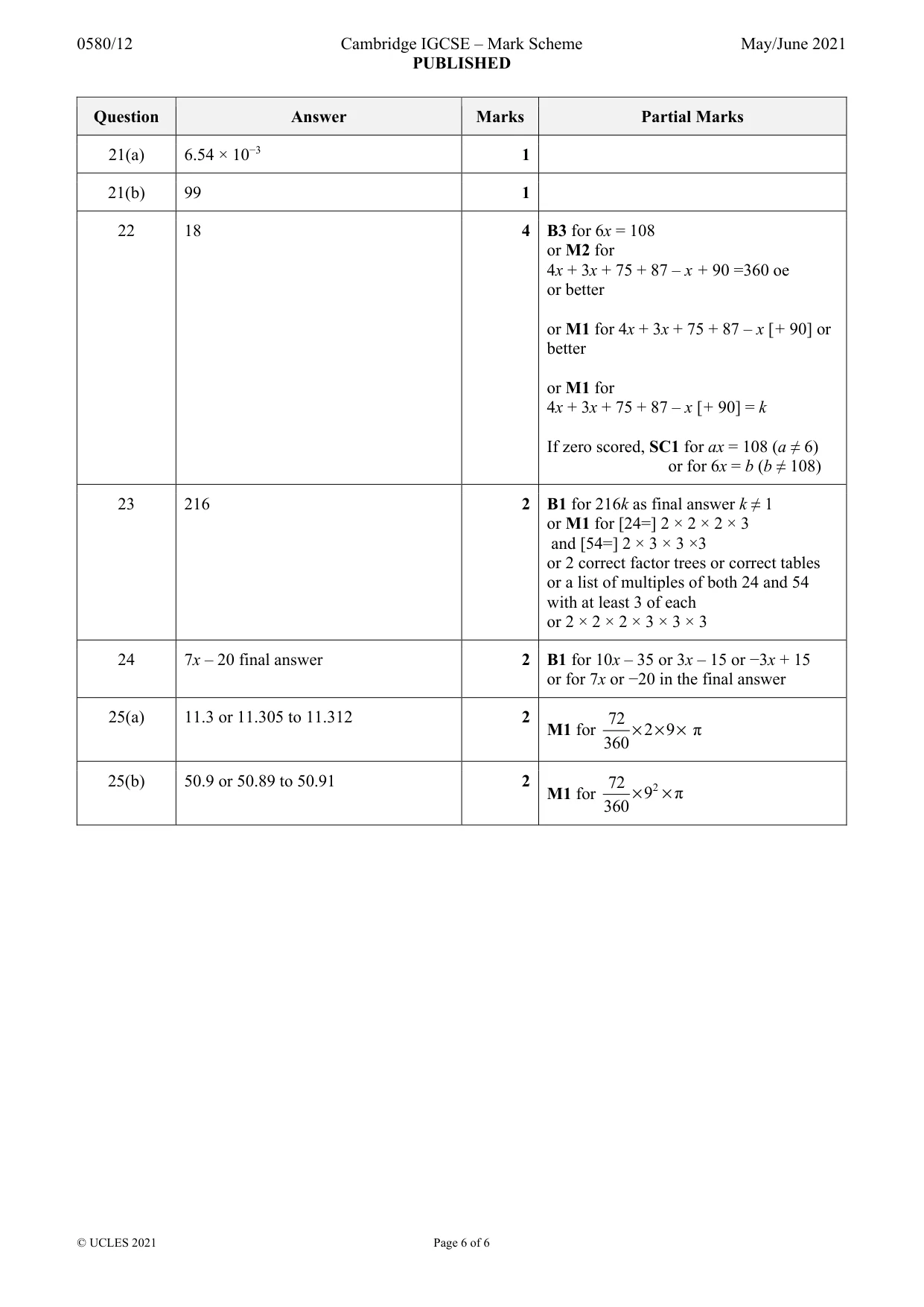
Mark scheme: 21(a) 6.54 × 10⁻³ 1 21(b) 99 1
Q22 · 4x° NOT TO SCALE ( 3x + 75 )° ( 87- )x° The diagram shows a quadrilateral
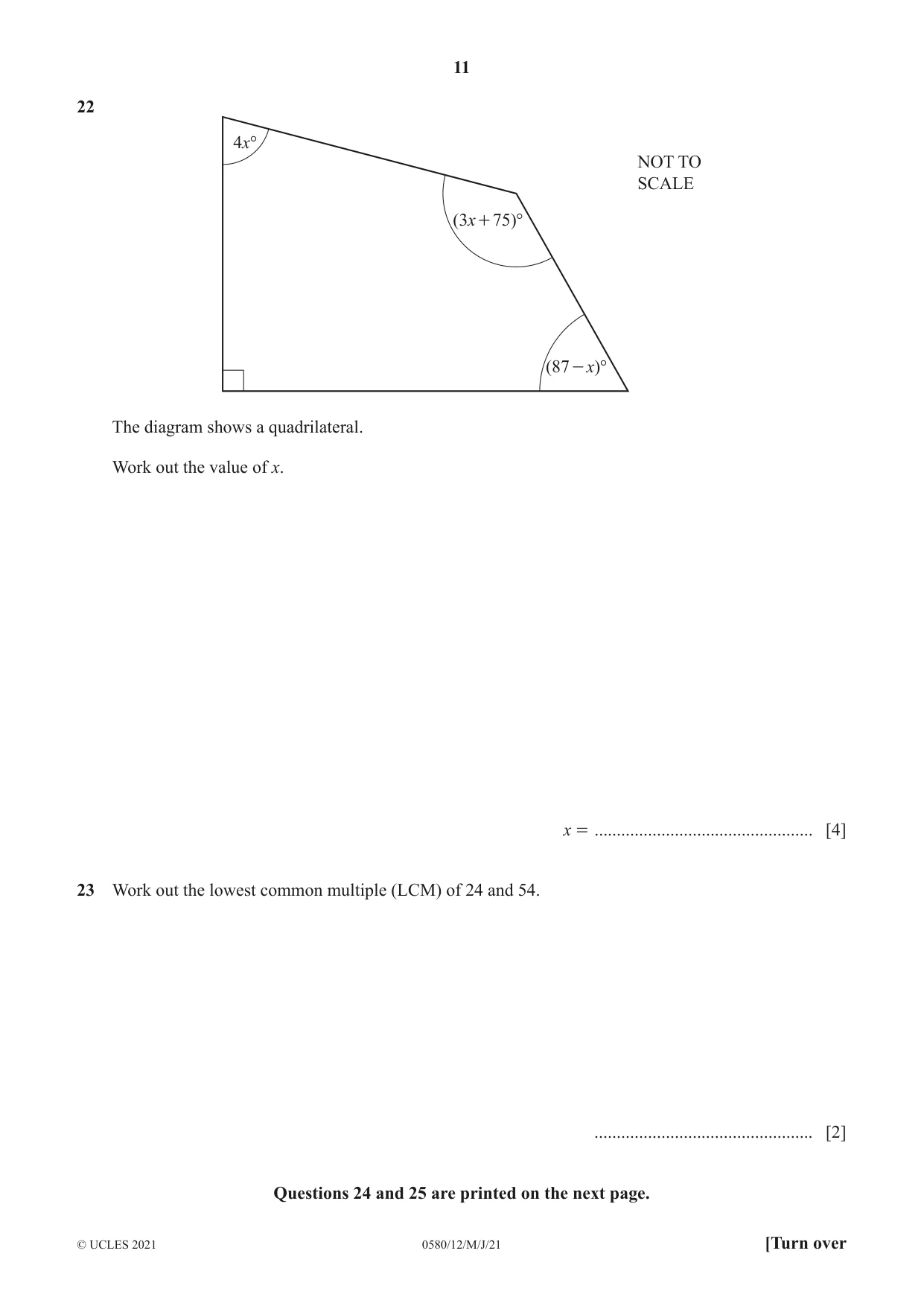
22 4x° NOT TO SCALE ( 3x + 75 )° ( 87- )x° The diagram shows a quadrilateral. Work out the value of x. x = ................................................. [4]
Mark scheme: 22 18 4 B3 for 6x = 108 or M2 for 4x + 3x + 75 + 87 – x + 90 =360 oe or better or M1 for 4x + 3x + 75 + 87 – x [+ 90] or better or M1 for 4x + 3x + 75 + 87 – x [+ 90] = k If zero scored, SC1 for ax = 108 (a ≠ 6) or for 6x = b (b ≠ 108)
Q23 · Work out the lowest common multiple (LCM) of 24 and 54
23 Work out the lowest common multiple (LCM) of 24 and 54. ................................................. [2] Questions 24 and 25 are printed on the next page.
Mark scheme: 23 216 2 B1 for 216k as final answer k ≠ 1 or M1 for [24=] 2 × 2 × 2 × 3 and [54=] 2 × 3 × 3 ×3 or 2 correct factor trees or correct tables or a list of multiples of both 24 and 54 with at least 3 of each or 2 × 2 × 2 × 3 × 3 × 3
Question 24
24 Expand and simplify. 5 ( 2x - 7) - 3 ( x - 5) ................................................. [2]
Mark scheme: 24 7x – 20 final answer 2 B1 for 10x – 35 or 3x – 15 or −3x + 15 or for 7x or −20 in the final answer
Q25 · B NOT TO SCALE 72° O 9 cm A The diagram shows a sector of a circle, centre O, radius 9 cm
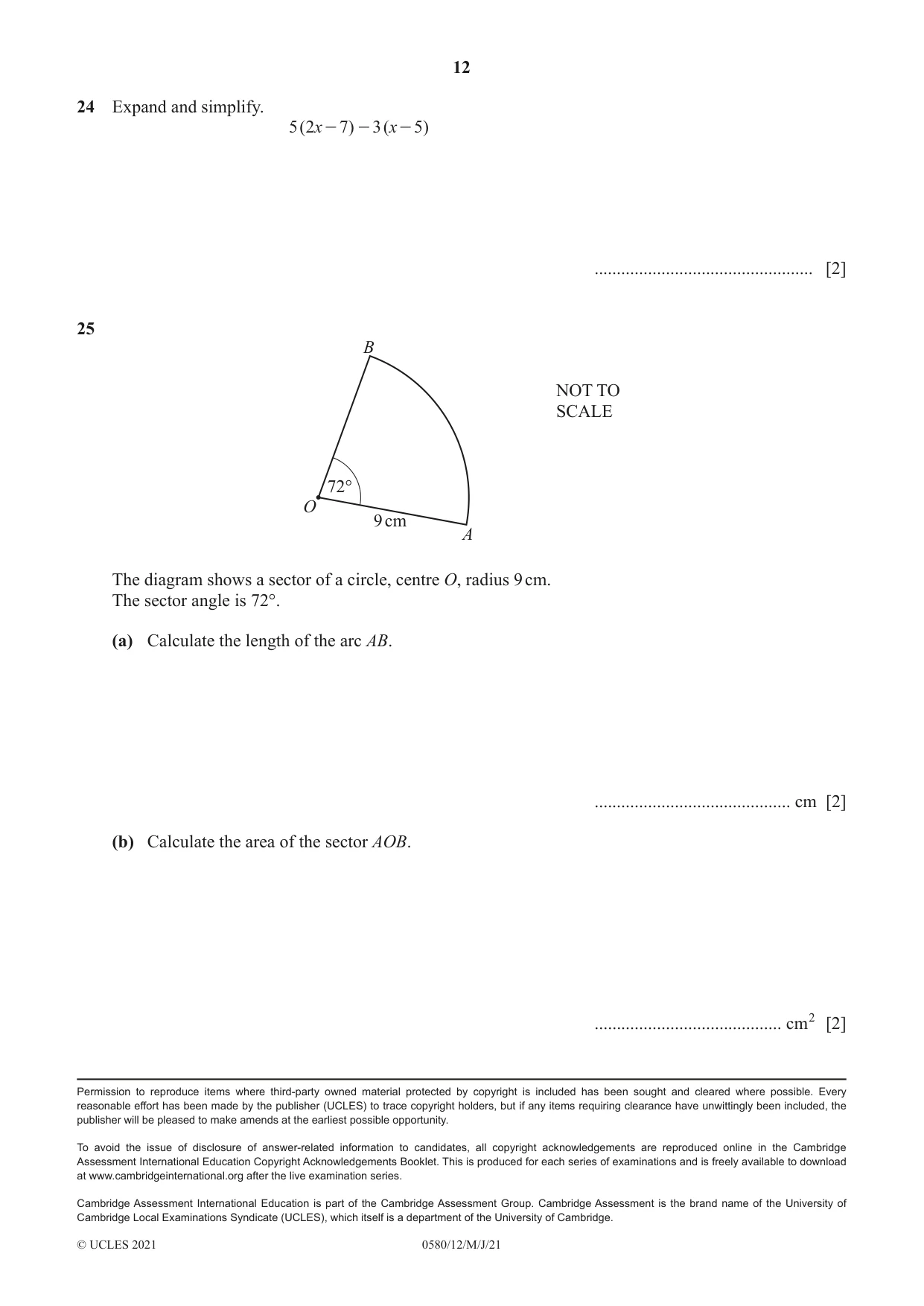
25 B NOT TO SCALE 72° O 9 cm A The diagram shows a sector of a circle, centre O, radius 9 cm. The sector angle is 72°. (a) Calculate the length of the arc AB. ............................................ cm [2] (b) Calculate the area of the sector AOB. .......................................... cm2 [2]
Mark scheme: 25(a) 11.3 or 11.305 to 11.312 2 72 M1 for × 2 × 9 × π 360 25(b) 50.9 or 50.89 to 50.91 2 72 2 M1 for × 9 × π 360
What was in this paper
The subtopics covered by these 25 questions, and how many questions each got. Open one in a new tab to see every Cambridge question on it.
3Averages and range2Geometrical constructions2The four operations2Algebraic manipulation1Angles1Circles, arcs and sectors1Fractions, decimals and percentages1Indices I1Interpreting statistical data1Introduction to algebra1Introduction to probability1Powers and roots1Probability of combined events1Scatter diagrams1Similarity1Standard form1Surface area and volume1Symmetry1Vectors in two dimensions1What you needed in this session
Cambridge’s own grade thresholds for 2021 May/June, Paper 1 · Variant 2. A higher threshold means an easier paper — the bar moves with how the cohort did.