Cambridge IGCSE Economics 0455 — 2023 Oct/Nov Paper 2 · Variant 1
0455/21/O/N/23 · 5 questions · 90 marks · ≈101 min
The question paper and its mark scheme, free to read here and free to download. This is Cambridge’s own paper, exactly as it was sat.
Question paper8 pages






Mark scheme24 pages
Answers below. Sit the paper first if you are practising.








Questions as text
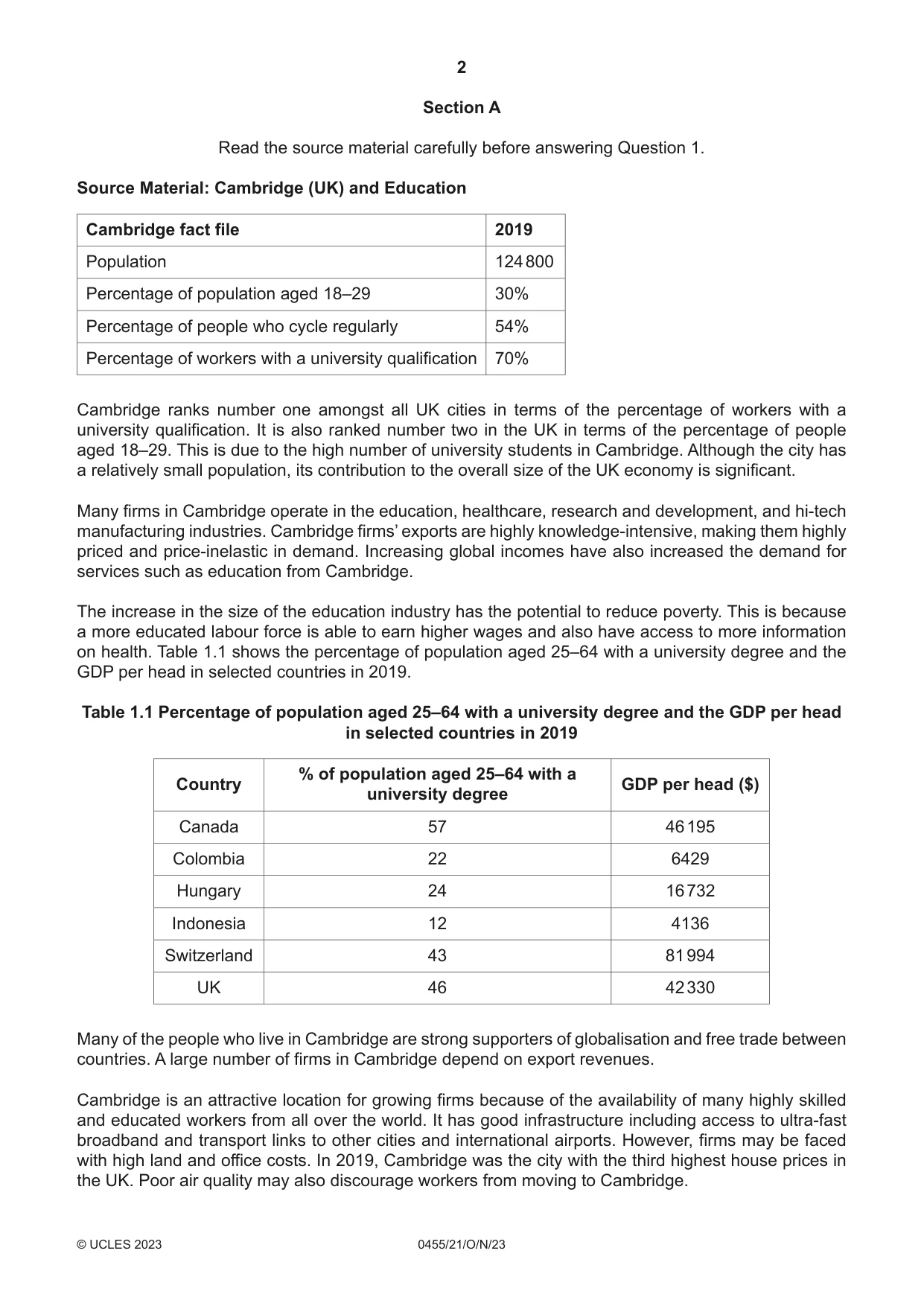
Q1 · Calculate the total number of people in Cambridge aged 18–29 in 2019
1 (a) Calculate the total number of people in Cambridge aged 18–29 in 2019. [1] (b) Identify two types of industries in Cambridge that operate in the tertiary sector. [2] (c) Identify two benefits of having highly knowledge‑intensive exports. [2] (d) Explain how having a more educated labour force can reduce poverty. [4] (e) Draw a demand and supply diagram to show the effects of increased global income on the market for education in Cambridge. [4] (f) Analyse the relationship between the percentage of population aged 25–64 with a university degree and GDP per head. [5] (g) Discuss whether or not free trade is beneficial for a city such as Cambridge. [6] (h) Discuss whether or not firms in Cambridge will continue to grow. [6]
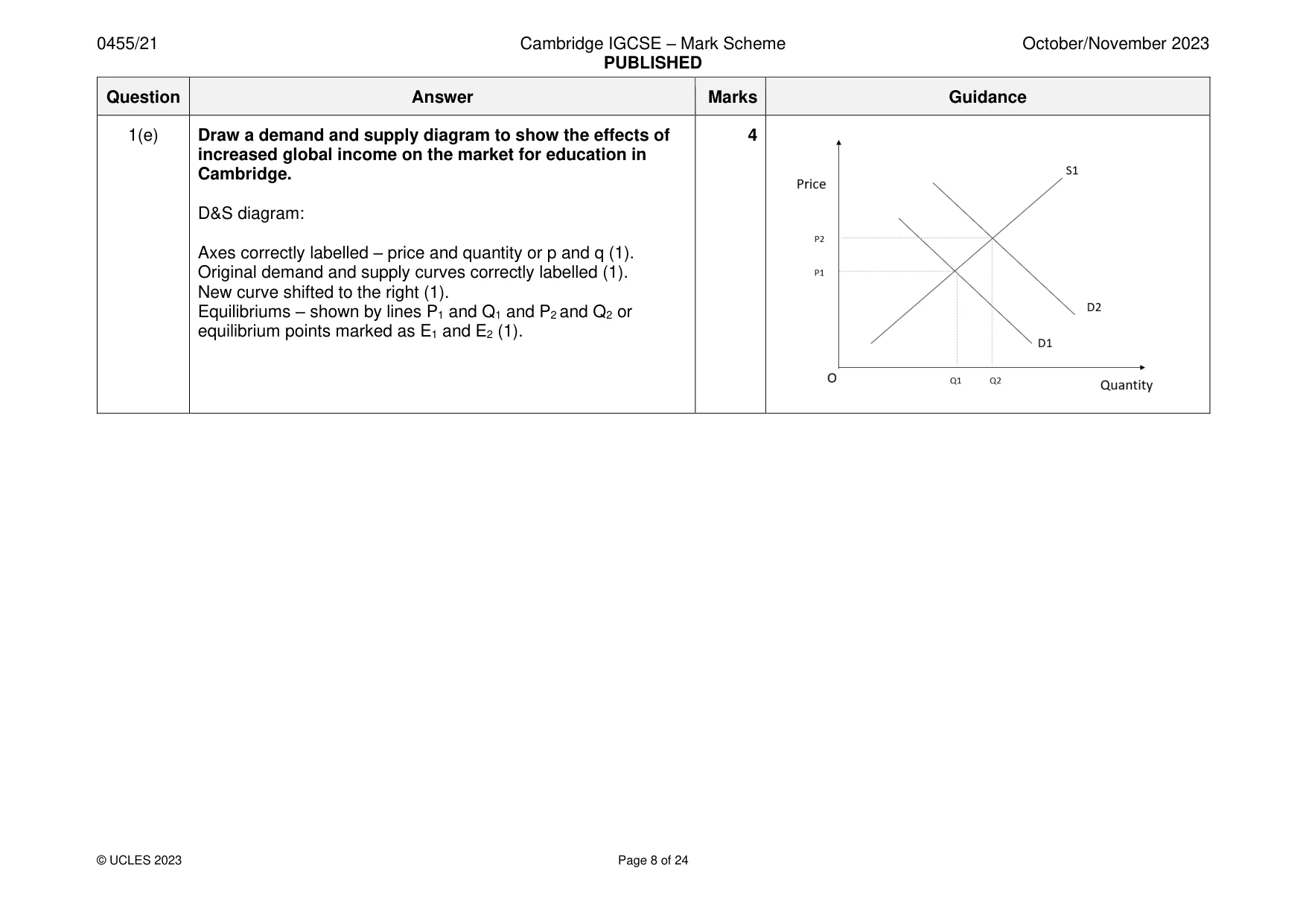
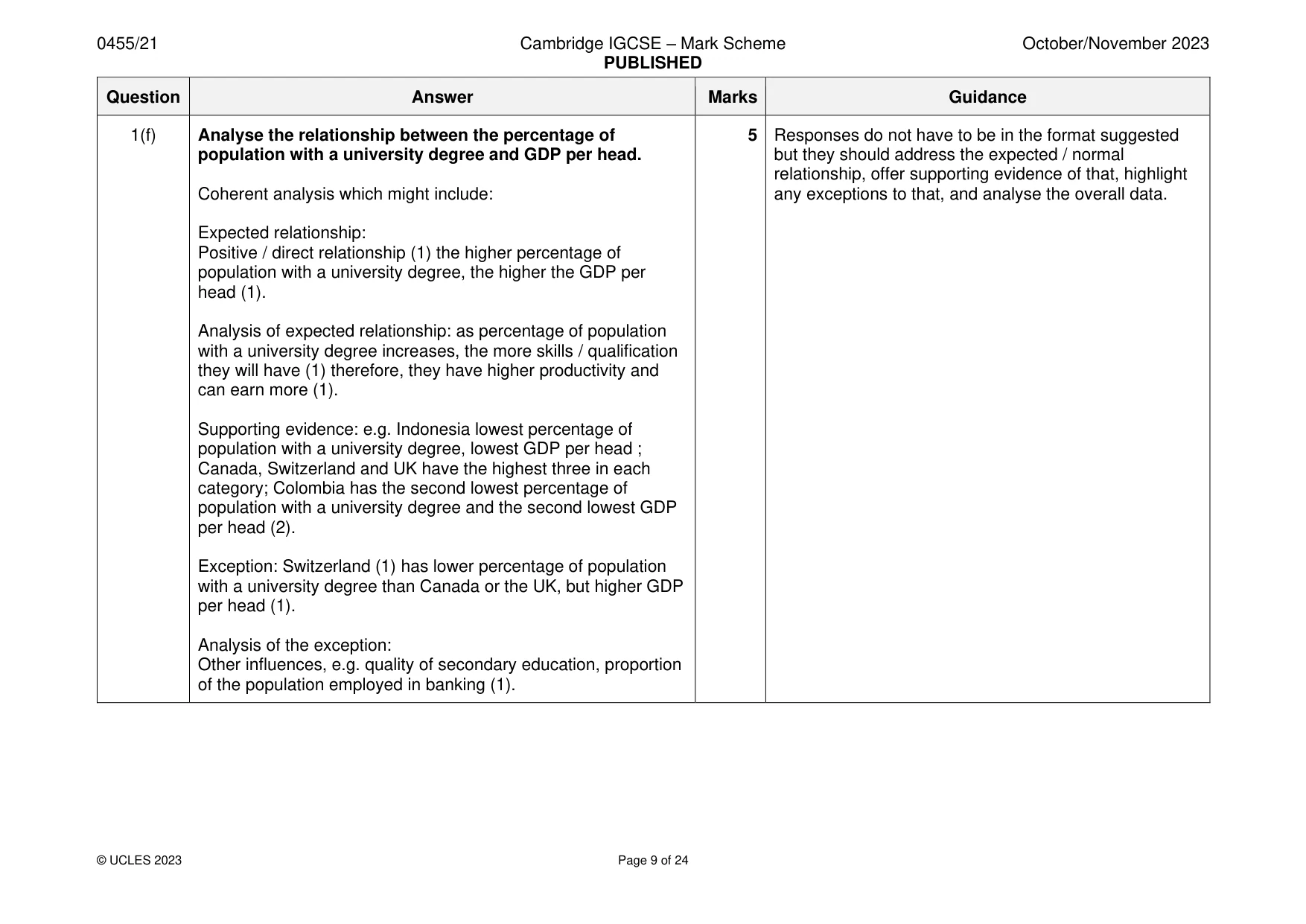
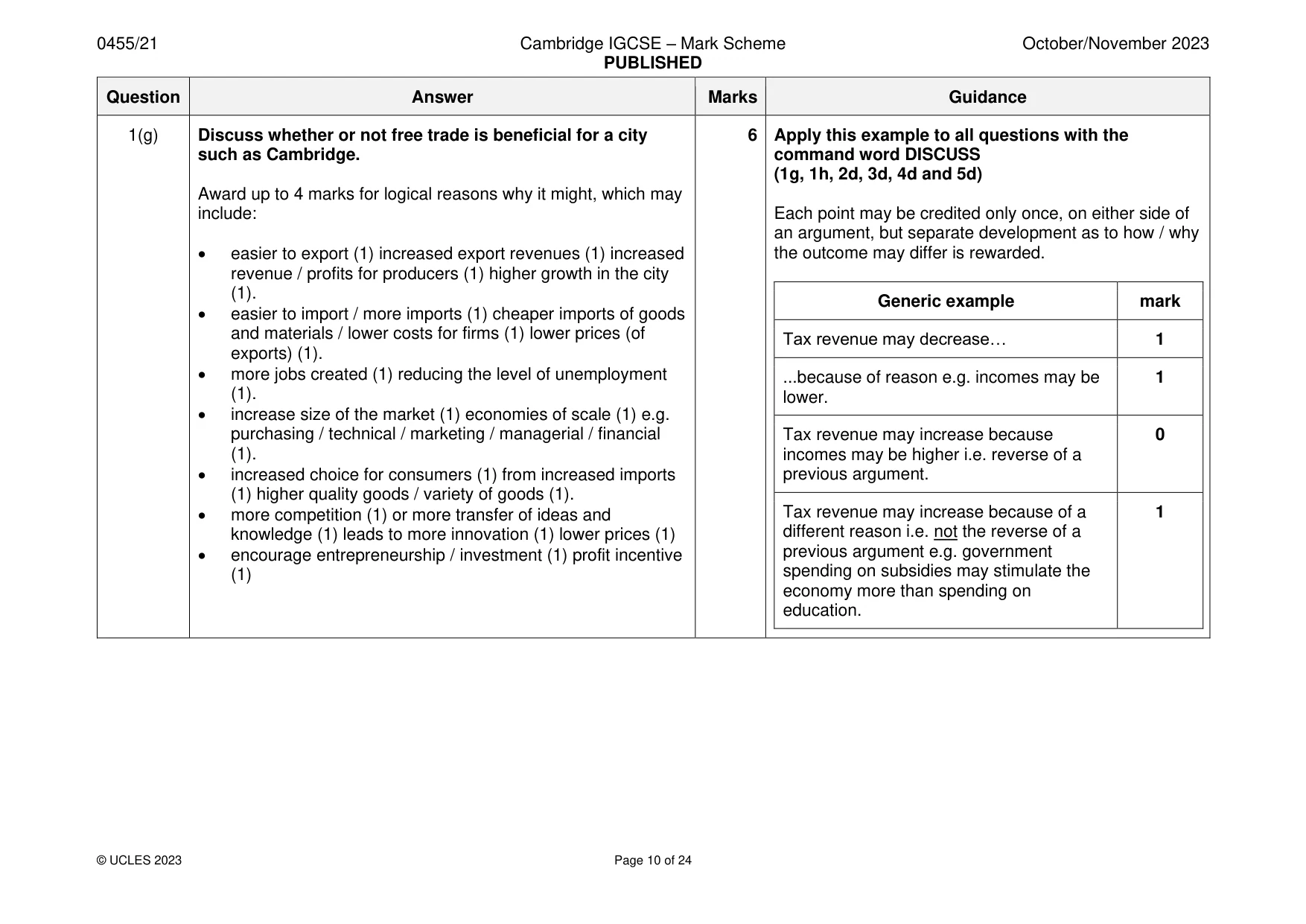
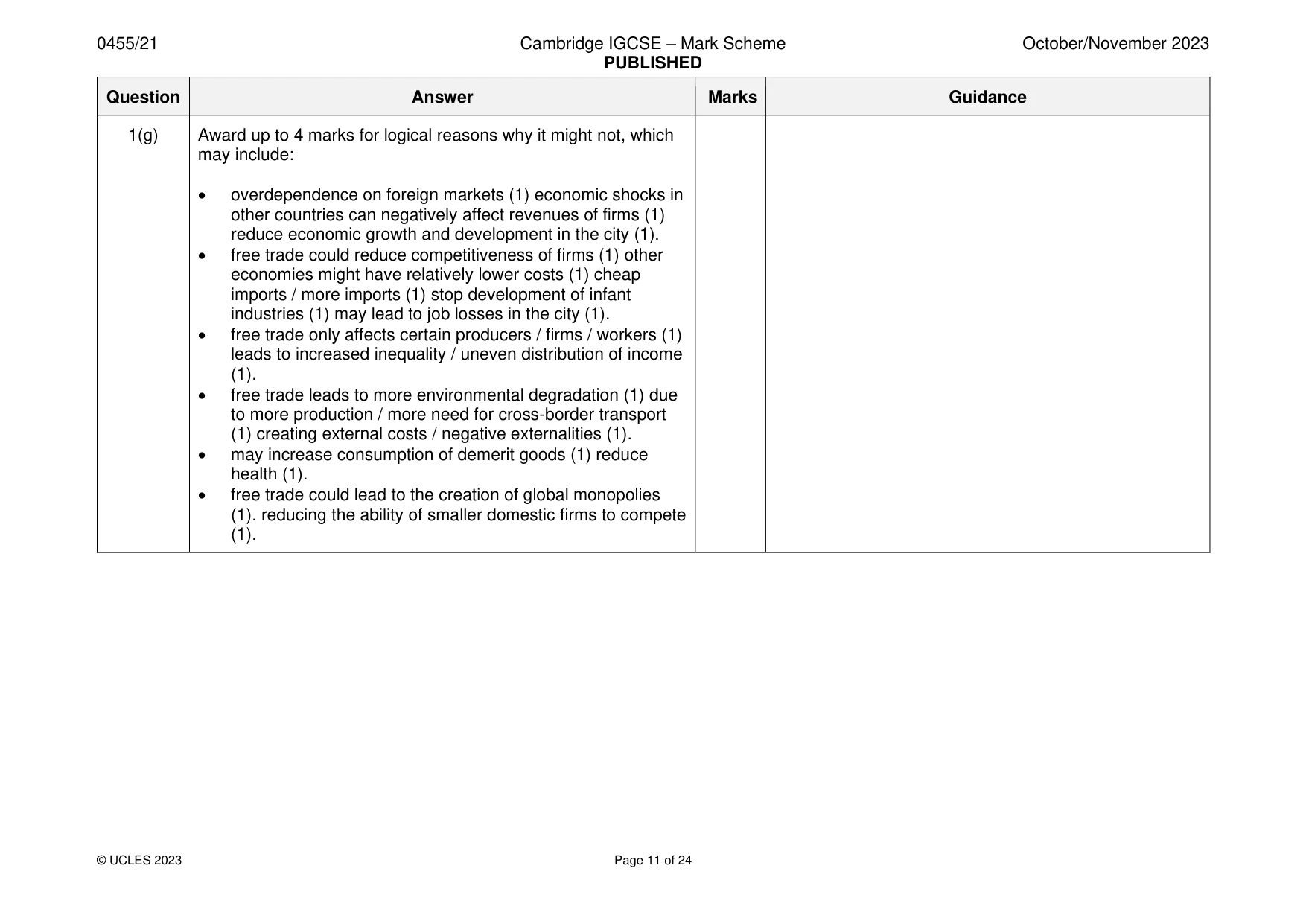
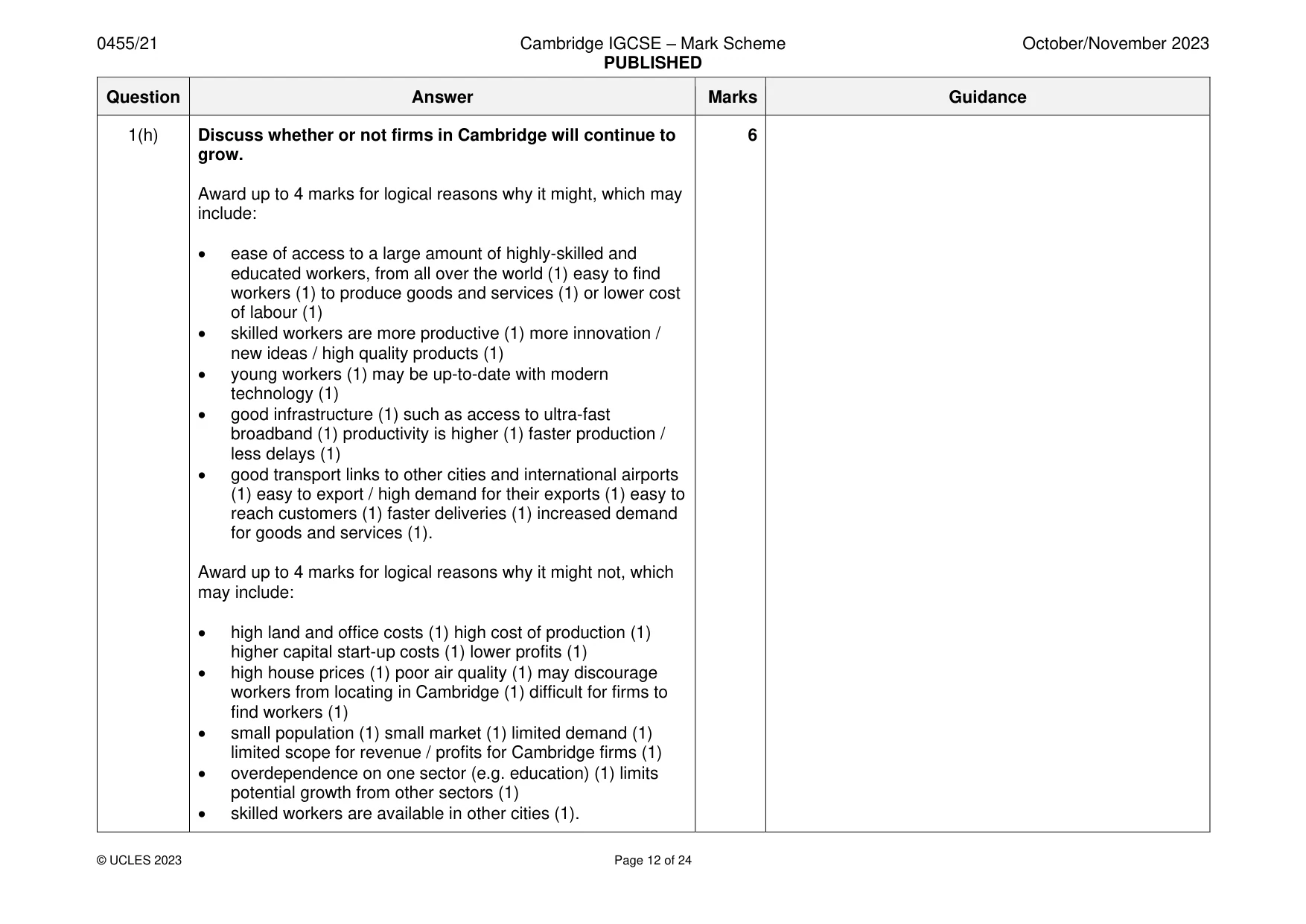
Mark scheme: Question Answer Marks Guidance 1(a) Calculate the total number of people in Cambridge aged 18– 1 29 in 2019. 37 440 (1) 1(b) Identify two types of industries in Cambridge that operate in 2 If more than two types are given, consider the first three. the tertiary sector. Education (1). Healthcare (1). Research and development (1). 1(c) Identify two benefits of having highly knowledge-intensive 2 If more than two benefits are given, consider the first exports. three. Exports highly priced (1). Accept high value for highly priced. Price inelastic in demand (1). Increased demand for exports (due to increased global incomes) (1). 1(d) Explain how having a more educated labour force can 4 reduce poverty. Logical explanation which might include: a more educated labour force will be more skilled / more productive (1) enabling them to earn higher wages (1) able to afford basic necessities (1). a more educated labour force may have more job opportunities / less unemployment (1) wages may be higher than unemployment benefits (1). a more educated labour force has access to more information on health (1) increasing the ability to work (1) have access to better healthcare (1). 1(e) Draw a demand and supply diagram to show the effects of 4 increased global income on the market for education in Cambridge. D&S diagram: Axes correctly labelled – price and quantity or p and q (1). Original demand and supply curves correctly labelled (1). New curve shifted to the right (1). Equilibriums – shown by lines P1 and Q1 and P2 and Q2 or equilibrium points marked as E1 and E2 (1). 1(f) Analyse the relationship between the percentage of 5 Responses do not have to be in the format suggested population with a university degree and GDP per head. but they should address the expected / normal relationship, offer supporting evidence of that, highlight Coherent analysis which might include: any exceptions to that, and analyse the overall data. Expected relationship: Positive / direct relationship (1) the higher percentage of population with a university degree, the higher the GDP per head (1). Analysis of expected relationship: as percentage of population with a university degree increases, the more skills / qualification they will have (1) therefore, they have higher productivity and can earn more (1). Supporting evidence: e.g. Indonesia lowest percentage of population with a university degree, lowest GDP per head ; Canada, Switzerland and UK have the highest three in each category; Colombia has the second lowest percentage of population with a university degree and the second lowest GDP per head (2). Exception: Switzerland (1) has lower percentage of population with a university degree than Canada or the UK, but higher GDP per head (1). Analysis of the exception: Other influences, e.g. quality of secondary education, proportion of the population employed in banking (1). 1(g) Discuss whether or not free trade is beneficial for a city 6 Apply this example to all questions with the such as Cambridge. command word DISCUSS (1g, 1h, 2d, 3d, 4d and 5d) Award up to 4 marks for logical reasons why it might, which may include: Each point may be credited only once, on either side of an argument, but separate development as to how / why • easier to export (1) increased export revenues (1) increased the outcome may differ is rewarded. revenue / profits for producers (1) higher growth in the city (1). Generic example mark • easier to import / more imports (1) cheaper imports of goods and materials / lower costs for firms (1) lower prices (of Tax revenue may decrease… 1 exports) (1). • more jobs created (1) reducing the level of unemployment ...because of reason e.g. incomes may be 1 (1). lower. • increase size of the market (1) economies of scale (1) e.g. purchasing / technical / marketing / managerial / financial Tax revenue may increase because 0 (1). incomes may be higher i.e. reverse of a • increased choice for consumers (1) from increased imports previous argument. (1) higher quality goods / variety of goods (1). • more competition (1) or more transfer of ideas and Tax revenue may increase because of a 1 knowledge (1) leads to more innovation (1) lower prices (1) different reason i.e. not the reverse of a • encourage entrepreneurship / investment (1) profit incentive previous argument e.g. government (1) spending on subsidies may stimulate the economy more than spending on education. 1(g) Award up to 4 marks for logical reasons why it might not, which may include: • overdependence on foreign markets (1) economic shocks in other countries can negatively affect revenues of firms (1) reduce economic growth and development in the city (1). • free trade could reduce competitiveness of firms (1) other economies might have relatively lower costs (1) cheap imports / more imports (1) stop development of infant industries (1) may lead to job losses in the city (1). • free trade only affects certain producers / firms / workers (1) leads to increased inequality / uneven distribution of income (1). • free trade leads to more environmental degradation (1) due to more production / more need for cross-border transport (1) creating external costs / negative externalities (1). • may increase consumption of demerit goods (1) reduce health (1). • free trade could lead to the creation of global monopolies (1). reducing the ability of smaller domestic firms to compete (1). 1(h) Discuss whether or not firms in Cambridge will continue to 6 grow. Award up to 4 marks for logical reasons why it might, which may include: • ease of access to a large amount of highly-skilled and educated workers, from all over the world (1) easy to find workers (1) to produce goods and services (1) or lower cost of labour (1) • skilled workers are more productive (1) more innovation / new ideas / high quality products (1) • young workers (1) may be up-to-date with modern technology (1) • good infrastructure (1) such as access to ultra-fast broadband (1) productivity is higher (1) faster production / less delays (1) • good transport links to other cities and international airports (1) easy to export / high demand for their exports (1) easy to reach customers (1) faster deliveries (1) increased demand for goods and services (1). Award up to 4 marks for logical reasons why it might not, which may include: • high land and office costs (1) high cost of production (1) higher capital start-up costs (1) lower profits (1) • high house prices (1) poor air quality (1) may discourage workers from locating in Cambridge (1) difficult for firms to find workers (1) • small population (1) small market (1) limited demand (1) limited scope for revenue / profits for Cambridge firms (1) • overdependence on one sector (e.g. education) (1) limits potential growth from other sectors (1) • skilled workers are available in other cities (1).
Q2 · A third of the world’s ski resorts are located in the Alps
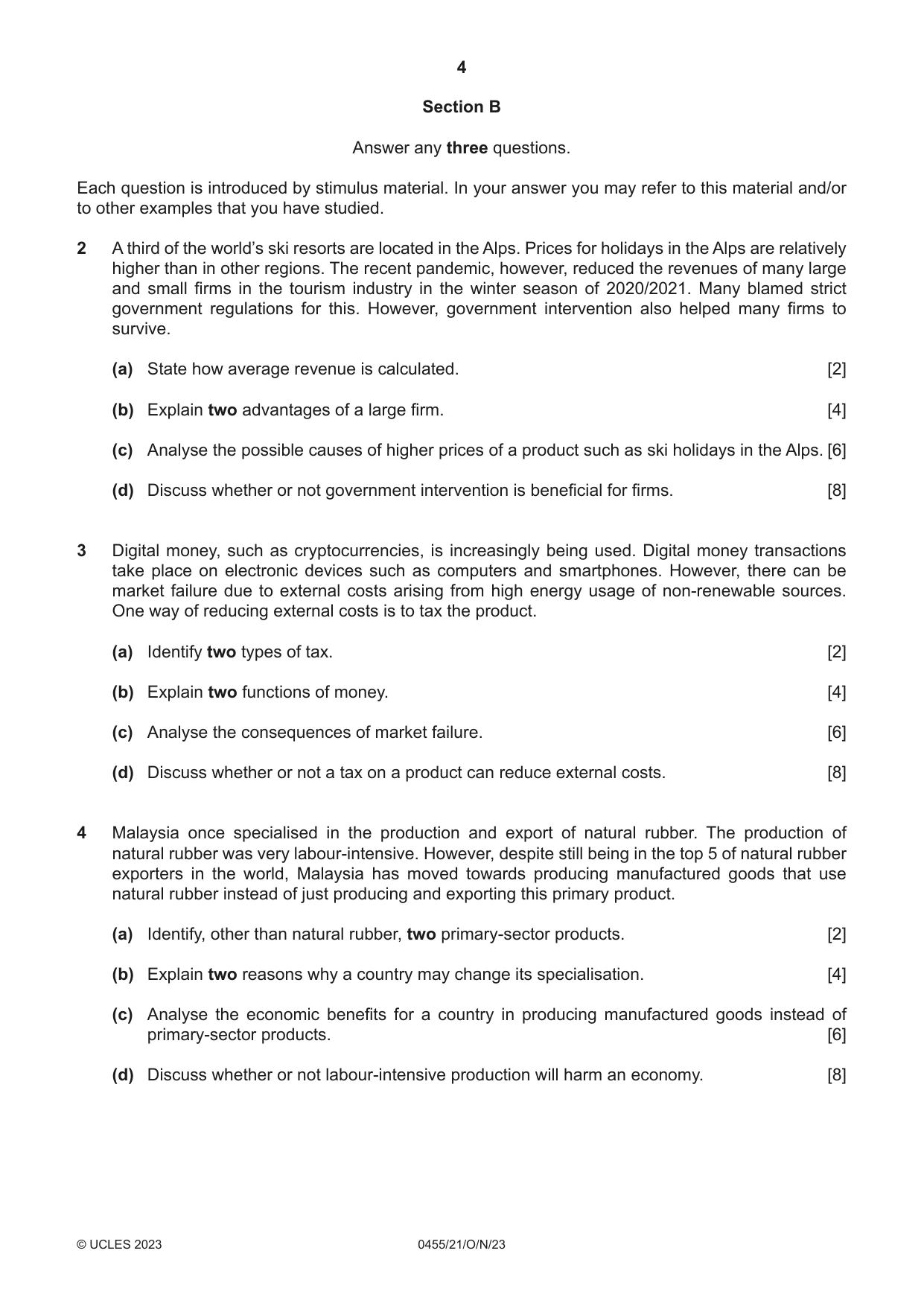
2 A third of the world’s ski resorts are located in the Alps. Prices for holidays in the Alps are relatively higher than in other regions. The recent pandemic, however, reduced the revenues of many large and small firms in the tourism industry in the winter season of 2020/2021. Many blamed strict government regulations for this. However, government intervention also helped many firms to survive. (a) State how average revenue is calculated. [2] (b) Explain two advantages of a large firm. [4] (c) Analyse the possible causes of higher prices of a product such as ski holidays in the Alps. [6] (d) Discuss whether or not government intervention is beneficial for firms. [8]
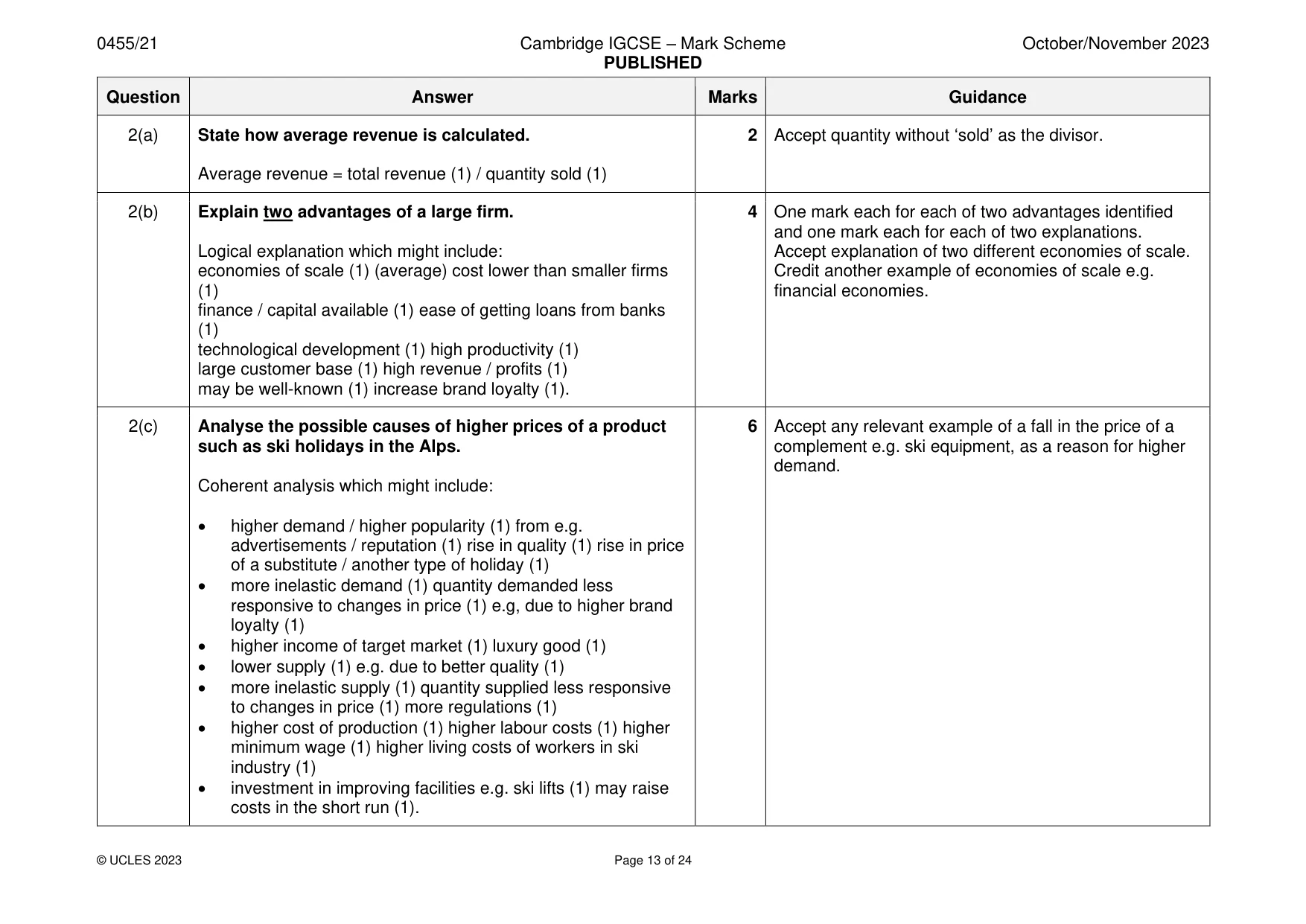
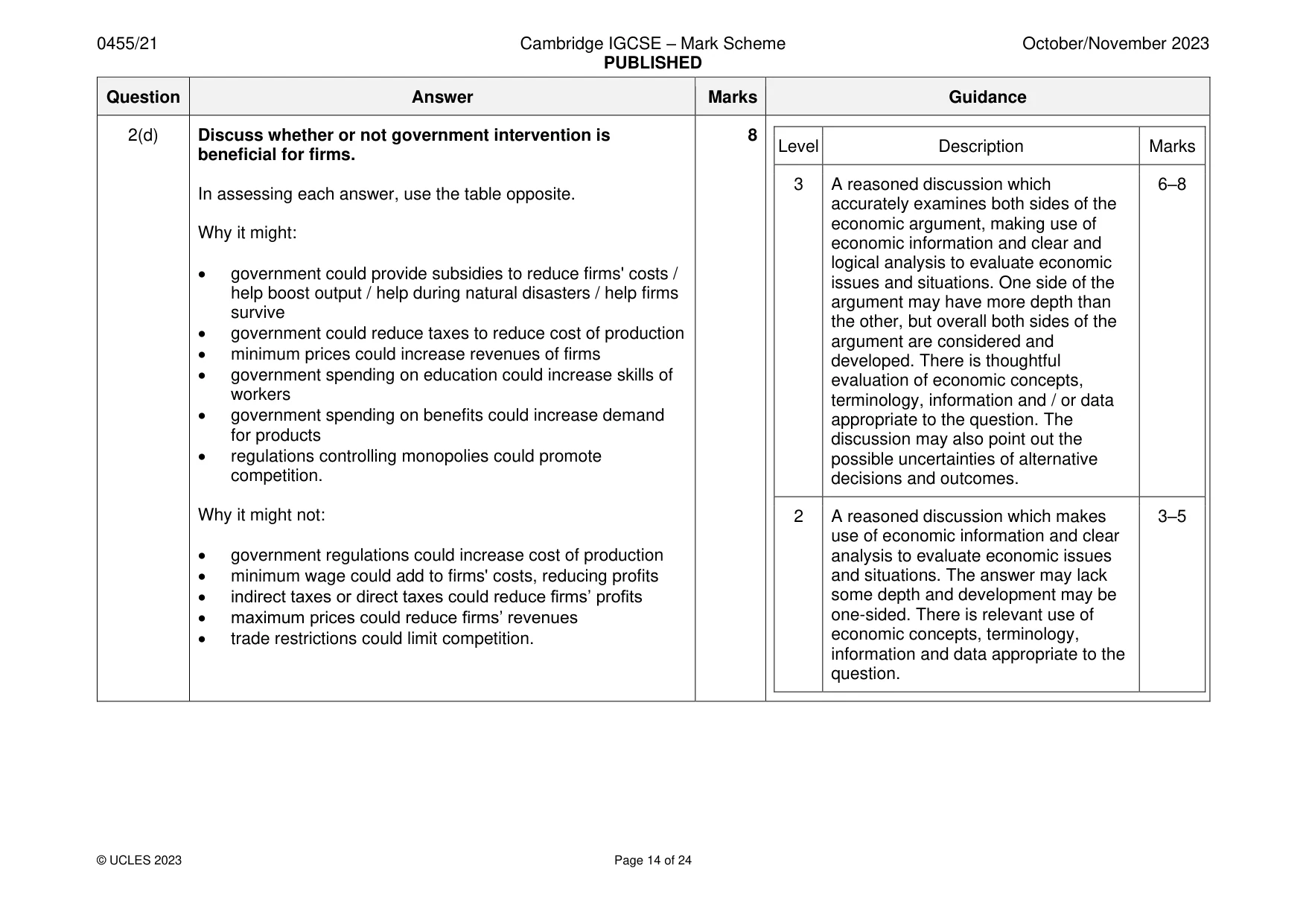
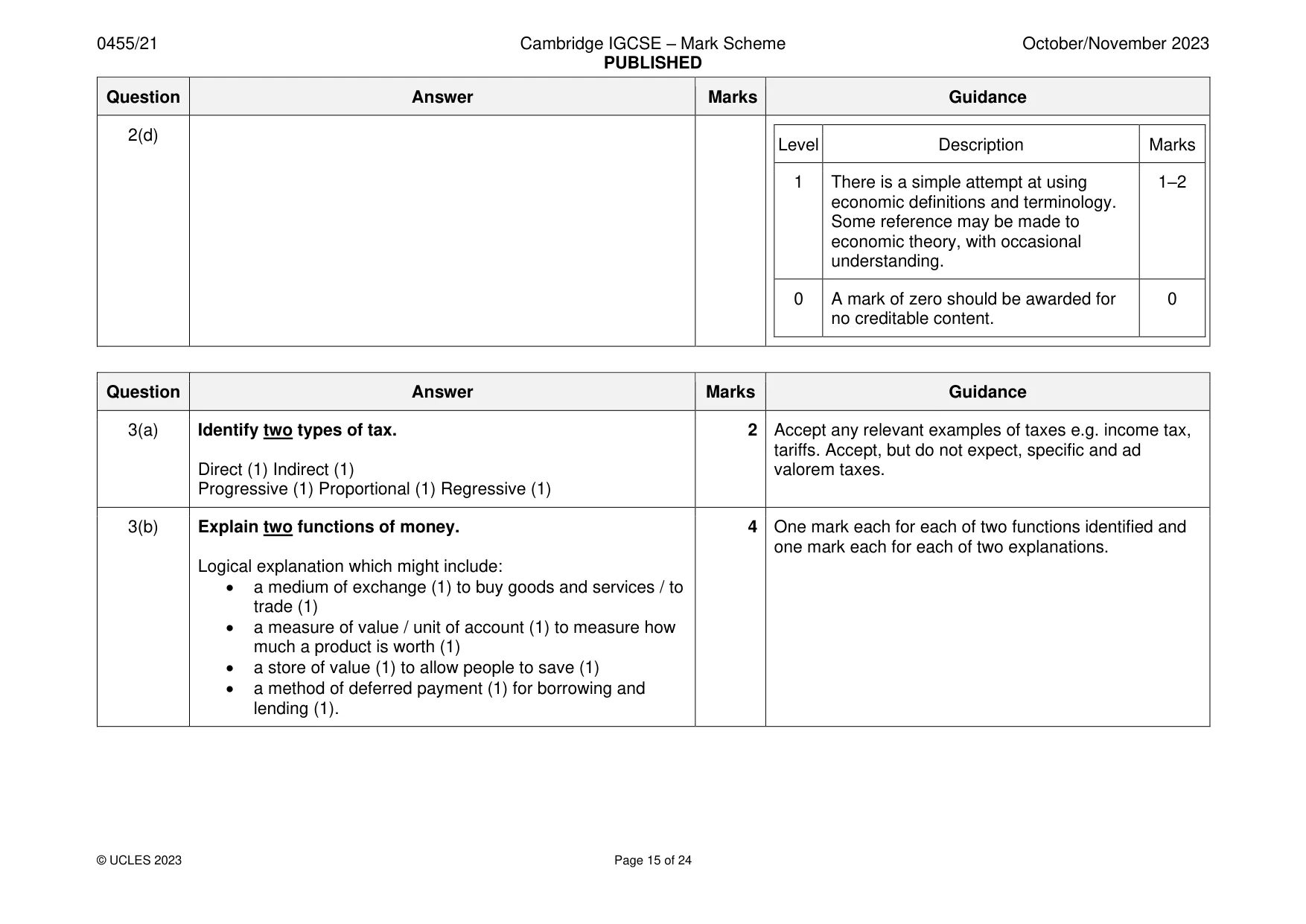
Mark scheme: 2(a) State how average revenue is calculated. 2 Accept quantity without ‘sold’ as the divisor. Average revenue = total revenue (1) / quantity sold (1) 2(b) Explain two advantages of a large firm. 4 One mark each for each of two advantages identified and one mark each for each of two explanations. Logical explanation which might include: Accept explanation of two different economies of scale. economies of scale (1) (average) cost lower than smaller firms Credit another example of economies of scale e.g. (1) financial economies. finance / capital available (1) ease of getting loans from banks (1) technological development (1) high productivity (1) large customer base (1) high revenue / profits (1) may be well-known (1) increase brand loyalty (1). 2(c) Analyse the possible causes of higher prices of a product 6 Accept any relevant example of a fall in the price of a such as ski holidays in the Alps. complement e.g. ski equipment, as a reason for higher demand. Coherent analysis which might include: • higher demand / higher popularity (1) from e.g. advertisements / reputation (1) rise in quality (1) rise in price of a substitute / another type of holiday (1) • more inelastic demand (1) quantity demanded less responsive to changes in price (1) e.g, due to higher brand loyalty (1) • higher income of target market (1) luxury good (1) • lower supply (1) e.g. due to better quality (1) • more inelastic supply (1) quantity supplied less responsive to changes in price (1) more regulations (1) • higher cost of production (1) higher labour costs (1) higher minimum wage (1) higher living costs of workers in ski industry (1) • investment in improving facilities e.g. ski lifts (1) may raise costs in the short run (1). 2(d) Discuss whether or not government intervention is 8 Level Description Marks beneficial for firms. 3 A reasoned discussion which 6–8 In assessing each answer, use the table opposite. accurately examines both sides of the economic argument, making use of Why it might: economic information and clear and logical analysis to evaluate economic • government could provide subsidies to reduce firms' costs / issues and situations. One side of the help boost output / help during natural disasters / help firms argument may have more depth than survive the other, but overall both sides of the • government could reduce taxes to reduce cost of production argument are considered and • minimum prices could increase revenues of firms developed. There is thoughtful • government spending on education could increase skills of evaluation of economic concepts, workers terminology, information and / or data • government spending on benefits could increase demand appropriate to the question. The for products discussion may also point out the • regulations controlling monopolies could promote possible uncertainties of alternative competition. decisions and outcomes. Why it might not: 2 A reasoned discussion which makes 3–5 use of economic information and clear • government regulations could increase cost of production analysis to evaluate economic issues • minimum wage could add to firms' costs, reducing profits and situations. The answer may lack • indirect taxes or direct taxes could reduce firms’ profits some depth and development may be • maximum prices could reduce firms’ revenues one-sided. There is relevant use of • trade restrictions could limit competition. economic concepts, terminology, information and data appropriate to the question. 2(d) Level Description Marks 1 There is a simple attempt at using 1–2 economic definitions and terminology. Some reference may be made to economic theory, with occasional understanding. 0 A mark of zero should be awarded for 0 no creditable content.
Q3 · Digital money, such as cryptocurrencies, is increasingly being used
3 Digital money, such as cryptocurrencies, is increasingly being used. Digital money transactions take place on electronic devices such as computers and smartphones. However, there can be market failure due to external costs arising from high energy usage of non‑renewable sources. One way of reducing external costs is to tax the product. (a) Identify two types of tax. [2] (b) Explain two functions of money. [4] (c) Analyse the consequences of market failure. [6] (d) Discuss whether or not a tax on a product can reduce external costs. [8]
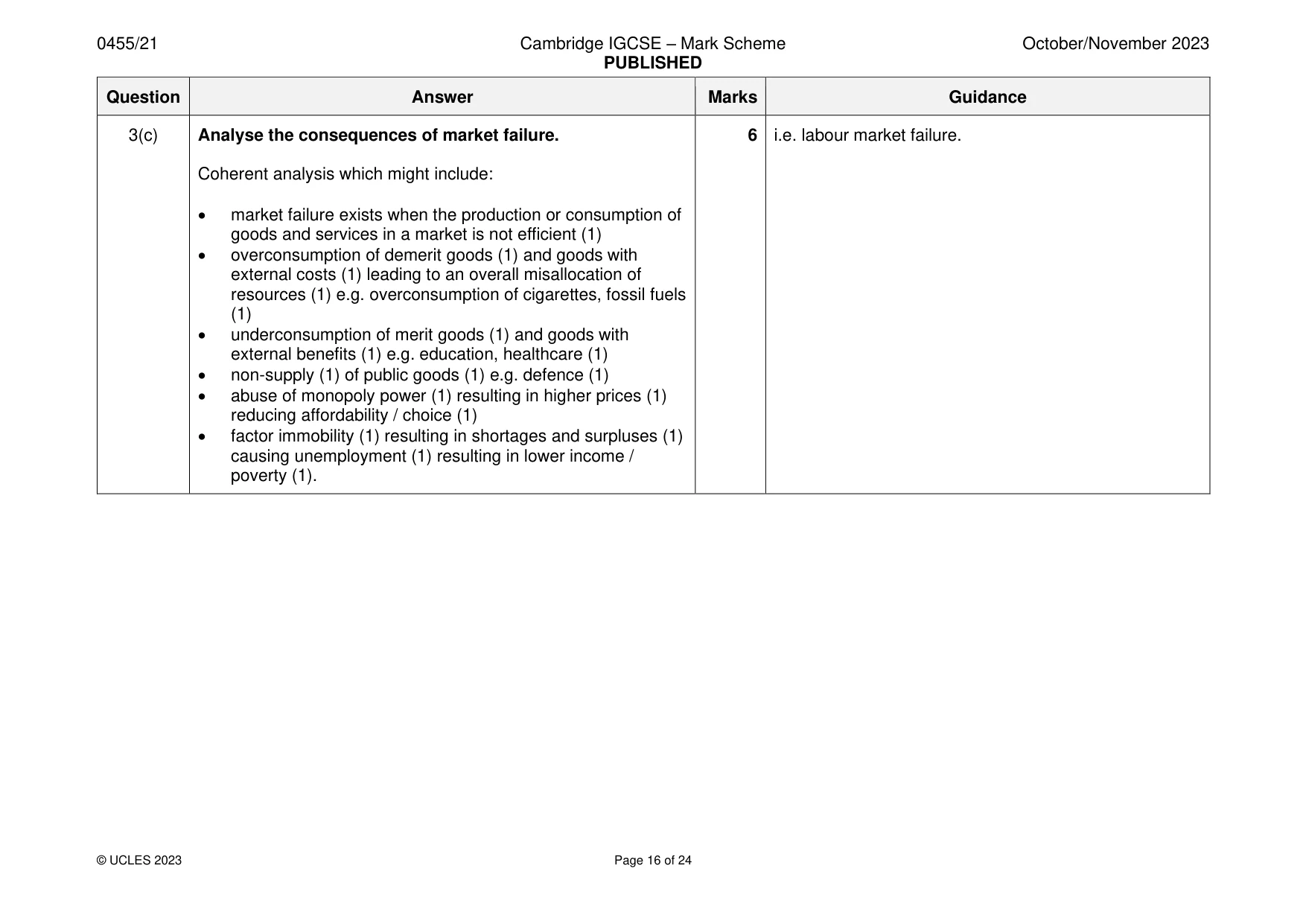
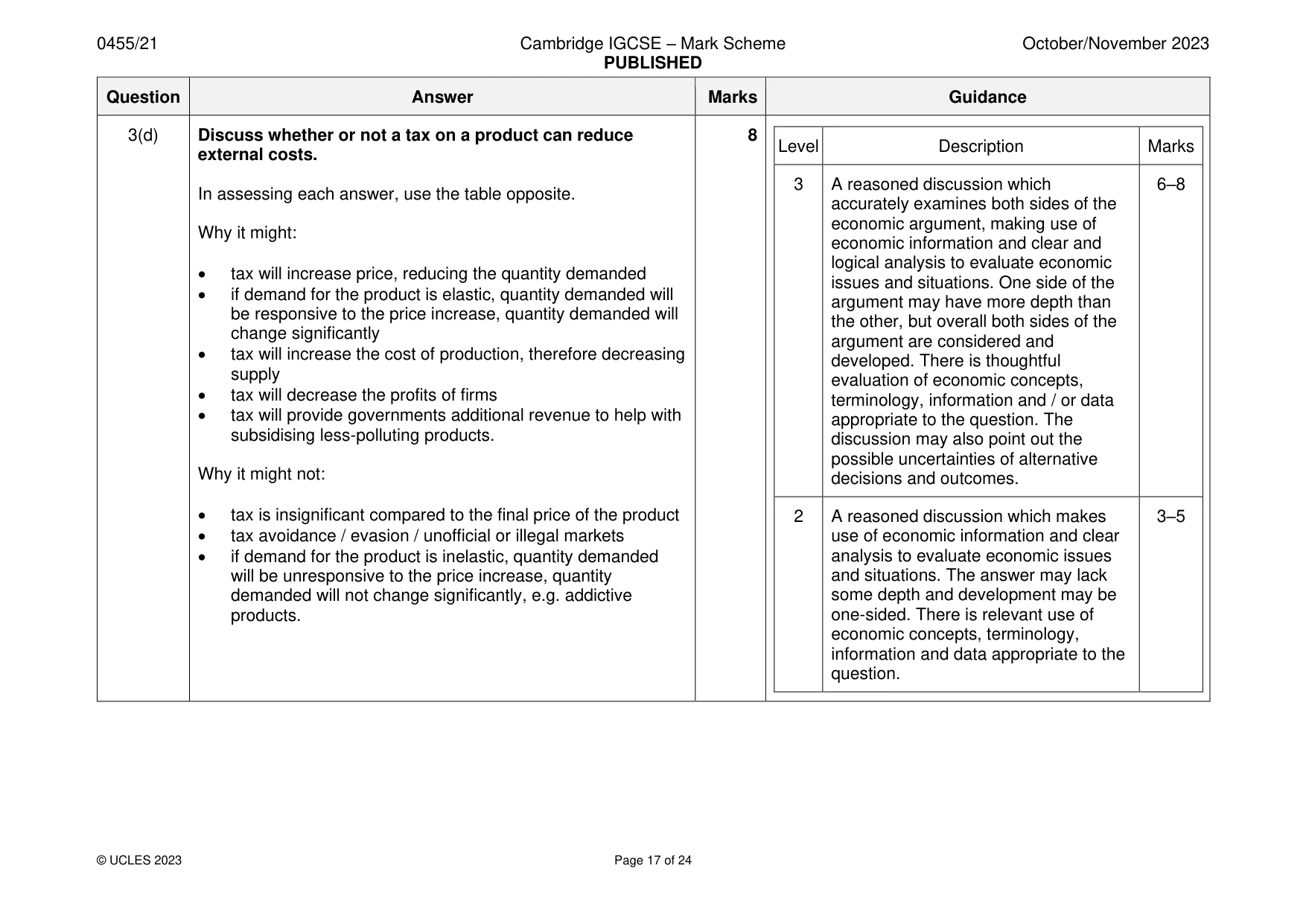
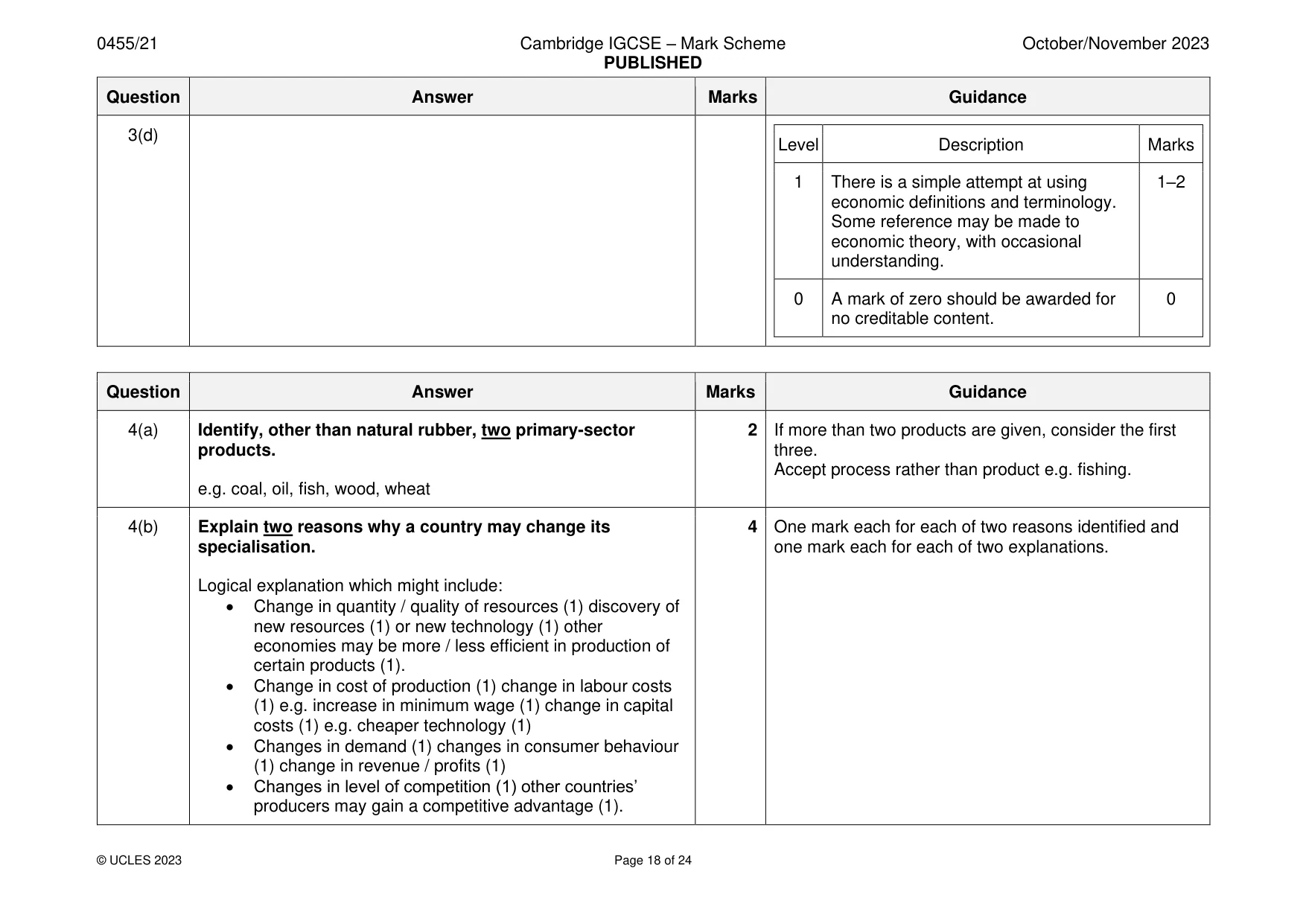
Mark scheme: 3(a) Identify two types of tax. 2 Accept any relevant examples of taxes e.g. income tax, tariffs. Accept, but do not expect, specific and ad Direct (1) Indirect (1) valorem taxes. Progressive (1) Proportional (1) Regressive (1) 3(b) Explain two functions of money. 4 One mark each for each of two functions identified and one mark each for each of two explanations. Logical explanation which might include: • a medium of exchange (1) to buy goods and services / to trade (1) • a measure of value / unit of account (1) to measure how much a product is worth (1) • a store of value (1) to allow people to save (1) • a method of deferred payment (1) for borrowing and lending (1). 3(c) Analyse the consequences of market failure. 6 i.e. labour market failure. Coherent analysis which might include: • market failure exists when the production or consumption of goods and services in a market is not efficient (1) • overconsumption of demerit goods (1) and goods with external costs (1) leading to an overall misallocation of resources (1) e.g. overconsumption of cigarettes, fossil fuels (1) • underconsumption of merit goods (1) and goods with external benefits (1) e.g. education, healthcare (1) • non-supply (1) of public goods (1) e.g. defence (1) • abuse of monopoly power (1) resulting in higher prices (1) reducing affordability / choice (1) • factor immobility (1) resulting in shortages and surpluses (1) causing unemployment (1) resulting in lower income / poverty (1). 3(d) Discuss whether or not a tax on a product can reduce 8 Level Description Marks external costs. 3 A reasoned discussion which 6–8 In assessing each answer, use the table opposite. accurately examines both sides of the economic argument, making use of Why it might: economic information and clear and logical analysis to evaluate economic • tax will increase price, reducing the quantity demanded issues and situations. One side of the • if demand for the product is elastic, quantity demanded will argument may have more depth than be responsive to the price increase, quantity demanded will the other, but overall both sides of the change significantly argument are considered and • tax will increase the cost of production, therefore decreasing developed. There is thoughtful supply evaluation of economic concepts, • tax will decrease the profits of firms terminology, information and / or data • tax will provide governments additional revenue to help with appropriate to the question. The subsidising less-polluting products. discussion may also point out the possible uncertainties of alternative Why it might not: decisions and outcomes. • tax is insignificant compared to the final price of the product 2 A reasoned discussion which makes 3–5 • tax avoidance / evasion / unofficial or illegal markets use of economic information and clear • if demand for the product is inelastic, quantity demanded analysis to evaluate economic issues will be unresponsive to the price increase, quantity and situations. The answer may lack demanded will not change significantly, e.g. addictive some depth and development may be products. one-sided. There is relevant use of economic concepts, terminology, information and data appropriate to the question. 3(d) Level Description Marks 1 There is a simple attempt at using 1–2 economic definitions and terminology. Some reference may be made to economic theory, with occasional understanding. 0 A mark of zero should be awarded for 0 no creditable content.
Q4 · Malaysia once specialised in the production and export of natural rubber
4 Malaysia once specialised in the production and export of natural rubber. The production of natural rubber was very labour‑intensive. However, despite still being in the top 5 of natural rubber exporters in the world, Malaysia has moved towards producing manufactured goods that use natural rubber instead of just producing and exporting this primary product. (a) Identify, other than natural rubber, two primary‑sector products. [2] (b) Explain two reasons why a country may change its specialisation. [4] (c) Analyse the economic benefits for a country in producing manufactured goods instead of primary‑sector products. [6] (d) Discuss whether or not labour‑intensive production will harm an economy. [8]
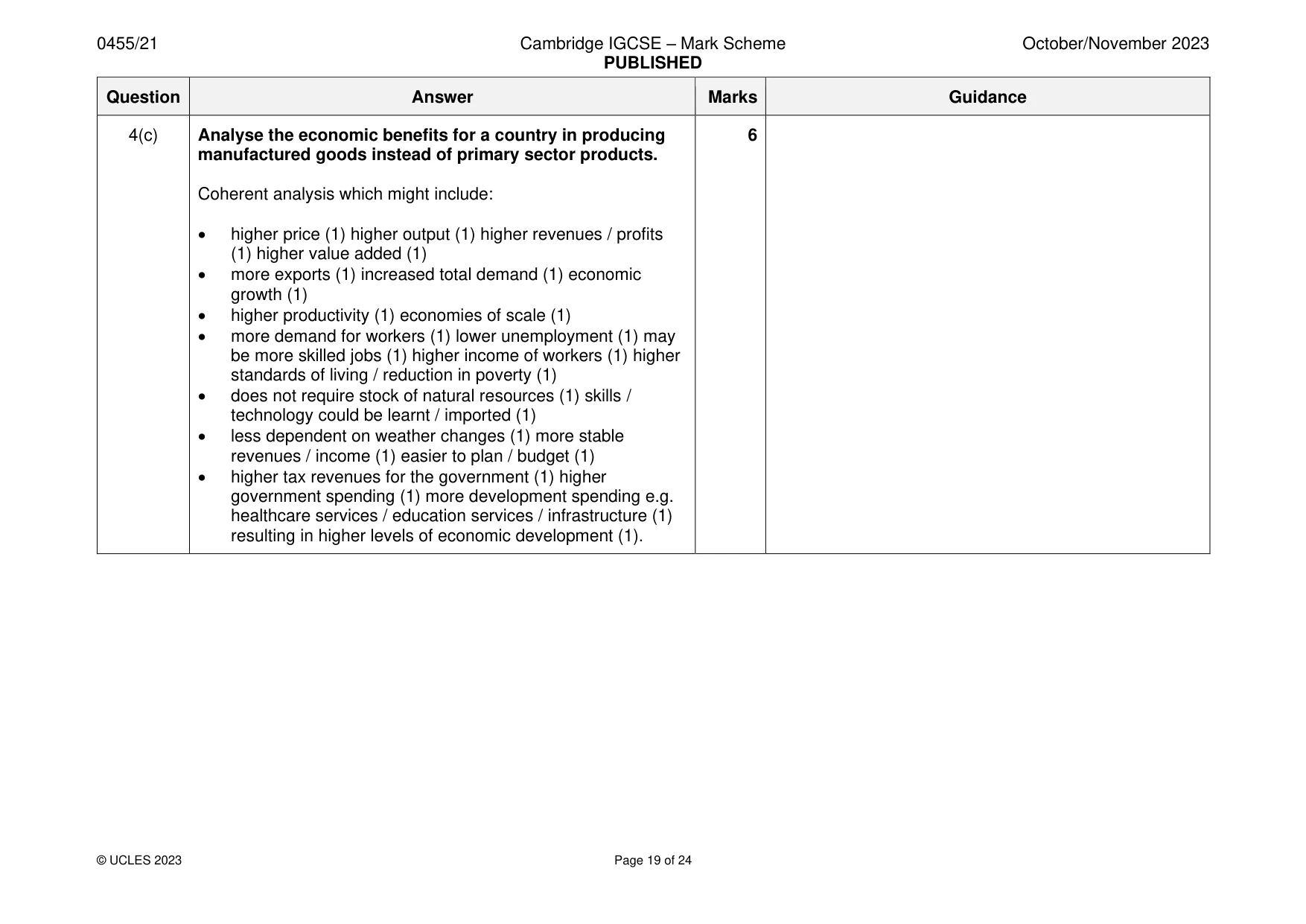
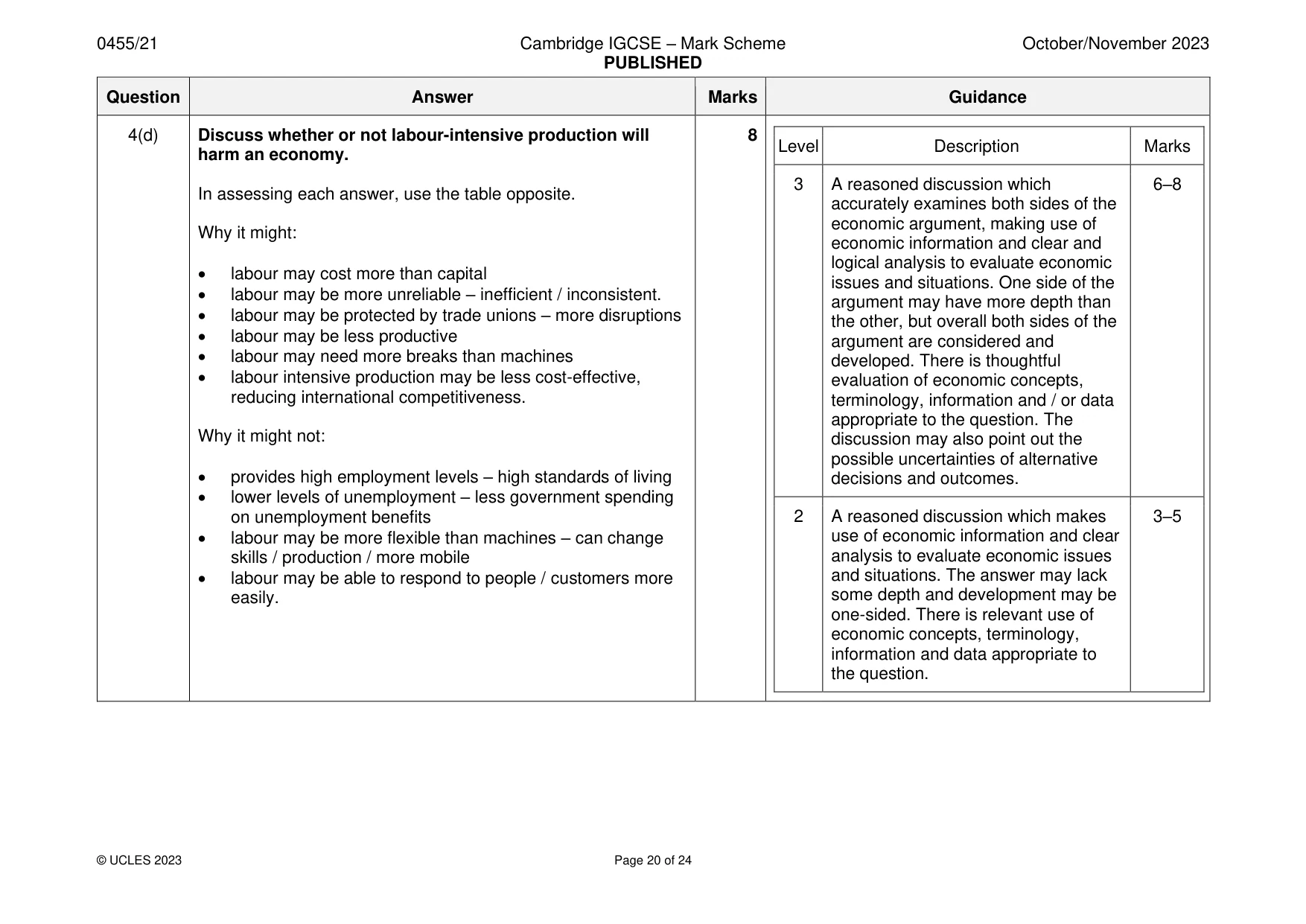
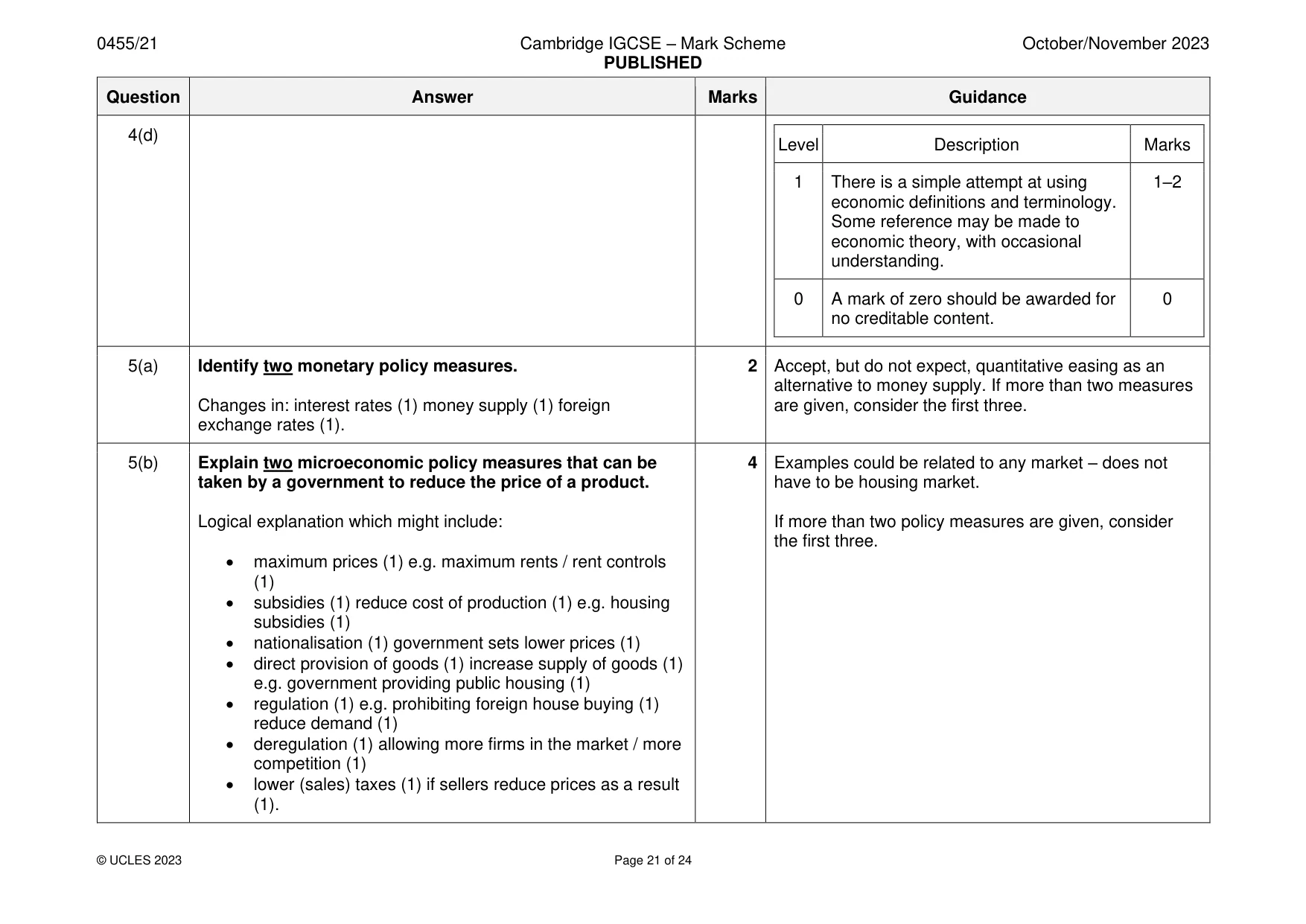
Mark scheme: 4(a) Identify, other than natural rubber, two primary-sector 2 If more than two products are given, consider the first products. three. Accept process rather than product e.g. fishing. e.g. coal, oil, fish, wood, wheat 4(b) Explain two reasons why a country may change its 4 One mark each for each of two reasons identified and specialisation. one mark each for each of two explanations. Logical explanation which might include: • Change in quantity / quality of resources (1) discovery of new resources (1) or new technology (1) other economies may be more / less efficient in production of certain products (1). • Change in cost of production (1) change in labour costs (1) e.g. increase in minimum wage (1) change in capital costs (1) e.g. cheaper technology (1) • Changes in demand (1) changes in consumer behaviour (1) change in revenue / profits (1) • Changes in level of competition (1) other countries’ producers may gain a competitive advantage (1). 4(c) Analyse the economic benefits for a country in producing 6 manufactured goods instead of primary sector products. Coherent analysis which might include: • higher price (1) higher output (1) higher revenues / profits (1) higher value added (1) • more exports (1) increased total demand (1) economic growth (1) • higher productivity (1) economies of scale (1) • more demand for workers (1) lower unemployment (1) may be more skilled jobs (1) higher income of workers (1) higher standards of living / reduction in poverty (1) • does not require stock of natural resources (1) skills / technology could be learnt / imported (1) • less dependent on weather changes (1) more stable revenues / income (1) easier to plan / budget (1) • higher tax revenues for the government (1) higher government spending (1) more development spending e.g. healthcare services / education services / infrastructure (1) resulting in higher levels of economic development (1). 4(d) Discuss whether or not labour-intensive production will 8 Level Description Marks harm an economy. 3 A reasoned discussion which 6–8 In assessing each answer, use the table opposite. accurately examines both sides of the economic argument, making use of Why it might: economic information and clear and logical analysis to evaluate economic • labour may cost more than capital issues and situations. One side of the • labour may be more unreliable – inefficient / inconsistent. argument may have more depth than • labour may be protected by trade unions – more disruptions the other, but overall both sides of the • labour may be less productive argument are considered and • labour may need more breaks than machines developed. There is thoughtful • labour intensive production may be less cost-effective, evaluation of economic concepts, reducing international competitiveness. terminology, information and / or data appropriate to the question. The Why it might not: discussion may also point out the possible uncertainties of alternative • provides high employment levels – high standards of living decisions and outcomes. • lower levels of unemployment – less government spending on unemployment benefits 2 A reasoned discussion which makes 3–5 • labour may be more flexible than machines – can change use of economic information and clear skills / production / more mobile analysis to evaluate economic issues • labour may be able to respond to people / customers more and situations. The answer may lack easily. some depth and development may be one-sided. There is relevant use of economic concepts, terminology, information and data appropriate to the question. 4(d) Level Description Marks 1 There is a simple attempt at using 1–2 economic definitions and terminology. Some reference may be made to economic theory, with occasional understanding. 0 A mark of zero should be awarded for 0 no creditable content.
Q5 · One reason why the price of houses in cities such as Hong Kong, London, and New York is…
5 One reason why the price of houses in cities such as Hong Kong, London, and New York is very high, is the low price elasticity of supply of houses. Trade unions in some of these cities are calling for more affordable housing for workers. Governments are also trying to implement various microeconomic policy measures to reduce the price of houses. In addition, the stability of the housing market can impact upon the effectiveness of monetary policy. (a) Identify two monetary policy measures. [2] (b) Explain two microeconomic policy measures that can be taken by a government to reduce the price of a product. [4] (c) Analyse the key determinants of price elasticity of supply of a product. [6] (d) Discuss whether or not trade unions benefit workers. [8]
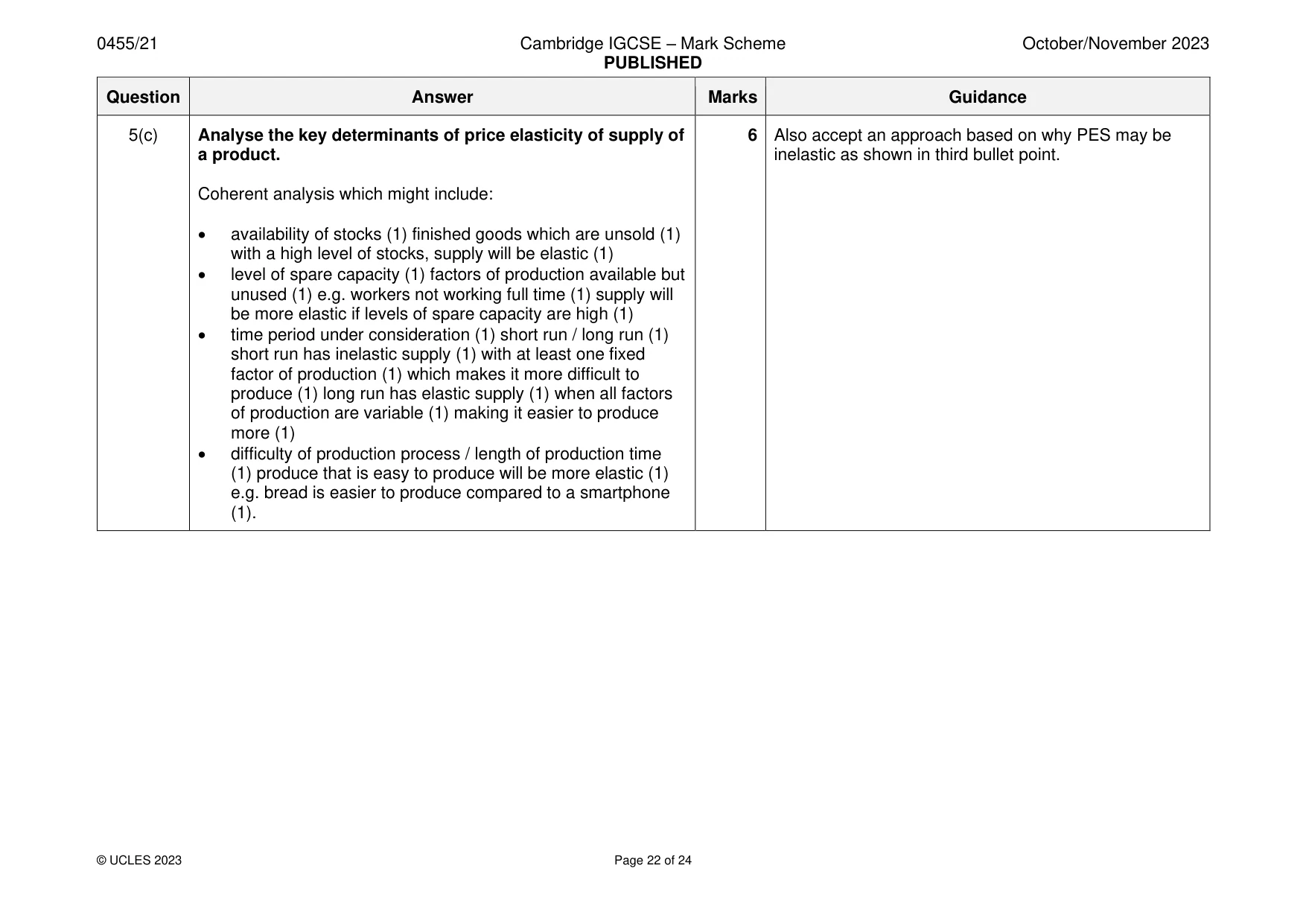
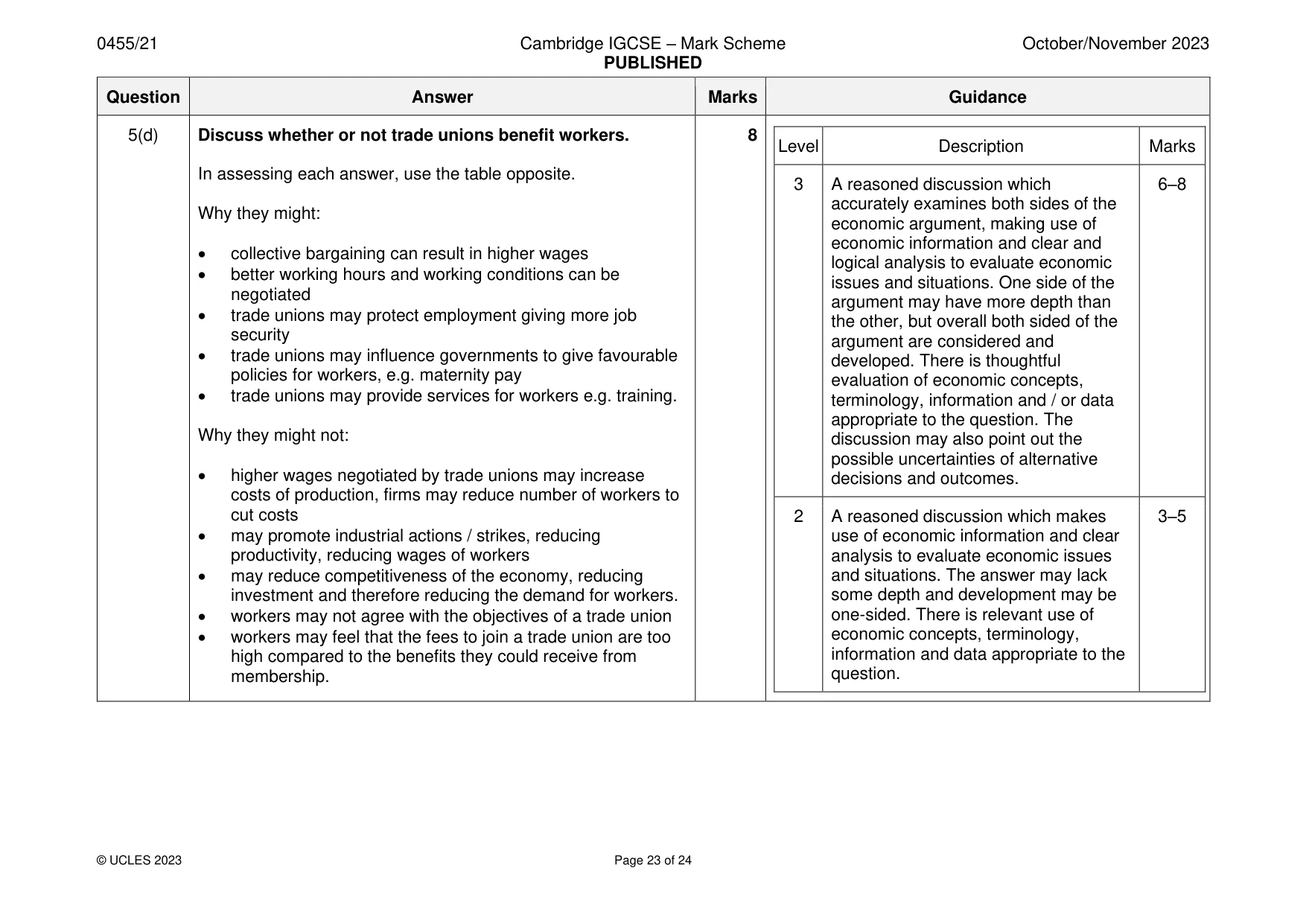
Mark scheme: 5(a) Identify two monetary policy measures. 2 Accept, but do not expect, quantitative easing as an alternative to money supply. If more than two measures Changes in: interest rates (1) money supply (1) foreign are given, consider the first three. exchange rates (1). 5(b) Explain two microeconomic policy measures that can be 4 Examples could be related to any market – does not taken by a government to reduce the price of a product. have to be housing market. Logical explanation which might include: If more than two policy measures are given, consider the first three. • maximum prices (1) e.g. maximum rents / rent controls (1) • subsidies (1) reduce cost of production (1) e.g. housing subsidies (1) • nationalisation (1) government sets lower prices (1) • direct provision of goods (1) increase supply of goods (1) e.g. government providing public housing (1) • regulation (1) e.g. prohibiting foreign house buying (1) reduce demand (1) • deregulation (1) allowing more firms in the market / more competition (1) • lower (sales) taxes (1) if sellers reduce prices as a result (1). 5(c) Analyse the key determinants of price elasticity of supply of 6 Also accept an approach based on why PES may be a product. inelastic as shown in third bullet point. Coherent analysis which might include: • availability of stocks (1) finished goods which are unsold (1) with a high level of stocks, supply will be elastic (1) • level of spare capacity (1) factors of production available but unused (1) e.g. workers not working full time (1) supply will be more elastic if levels of spare capacity are high (1) • time period under consideration (1) short run / long run (1) short run has inelastic supply (1) with at least one fixed factor of production (1) which makes it more difficult to produce (1) long run has elastic supply (1) when all factors of production are variable (1) making it easier to produce more (1) • difficulty of production process / length of production time (1) produce that is easy to produce will be more elastic (1) e.g. bread is easier to produce compared to a smartphone (1). 5(d) Discuss whether or not trade unions benefit workers. 8 Level Description Marks In assessing each answer, use the table opposite. 3 A reasoned discussion which 6–8 accurately examines both sides of the Why they might: economic argument, making use of economic information and clear and • collective bargaining can result in higher wages logical analysis to evaluate economic • better working hours and working conditions can be issues and situations. One side of the negotiated argument may have more depth than • trade unions may protect employment giving more job the other, but overall both sided of the security argument are considered and • trade unions may influence governments to give favourable developed. There is thoughtful policies for workers, e.g. maternity pay evaluation of economic concepts, • trade unions may provide services for workers e.g. training. terminology, information and / or data appropriate to the question. The Why they might not: discussion may also point out the possible uncertainties of alternative • higher wages negotiated by trade unions may increase decisions and outcomes. costs of production, firms may reduce number of workers to cut costs 2 A reasoned discussion which makes 3–5 • may promote industrial actions / strikes, reducing use of economic information and clear productivity, reducing wages of workers analysis to evaluate economic issues • may reduce competitiveness of the economy, reducing and situations. The answer may lack investment and therefore reducing the demand for workers. some depth and development may be • workers may not agree with the objectives of a trade union one-sided. There is relevant use of • workers may feel that the fees to join a trade union are too economic concepts, terminology, high compared to the benefits they could receive from information and data appropriate to the membership. question. 5(d) Level Description Marks 1 There is a simple attempt at using 1–2 economic definitions and terminology. Some reference may be made to economic theory, with occasional understanding. 0 A mark of zero should be awarded for 0 no creditable content.
What was in this paper
The subtopics covered by these 5 questions, and how many questions each got. Open one in a new tab to see every Cambridge question on it.
What you needed in this session
Cambridge’s own grade thresholds for 2023 Oct/Nov, Paper 2 · Variant 1. A higher threshold means an easier paper — the bar moves with how the cohort did.