Cambridge IGCSE Economics 0455 — 2022 May/June Paper 2 · Variant 1
0455/21/M/J/22 · 5 questions · 90 marks · ≈101 min
The question paper and its mark scheme, free to read here and free to download. This is Cambridge’s own paper, exactly as it was sat.
Question paper8 pages
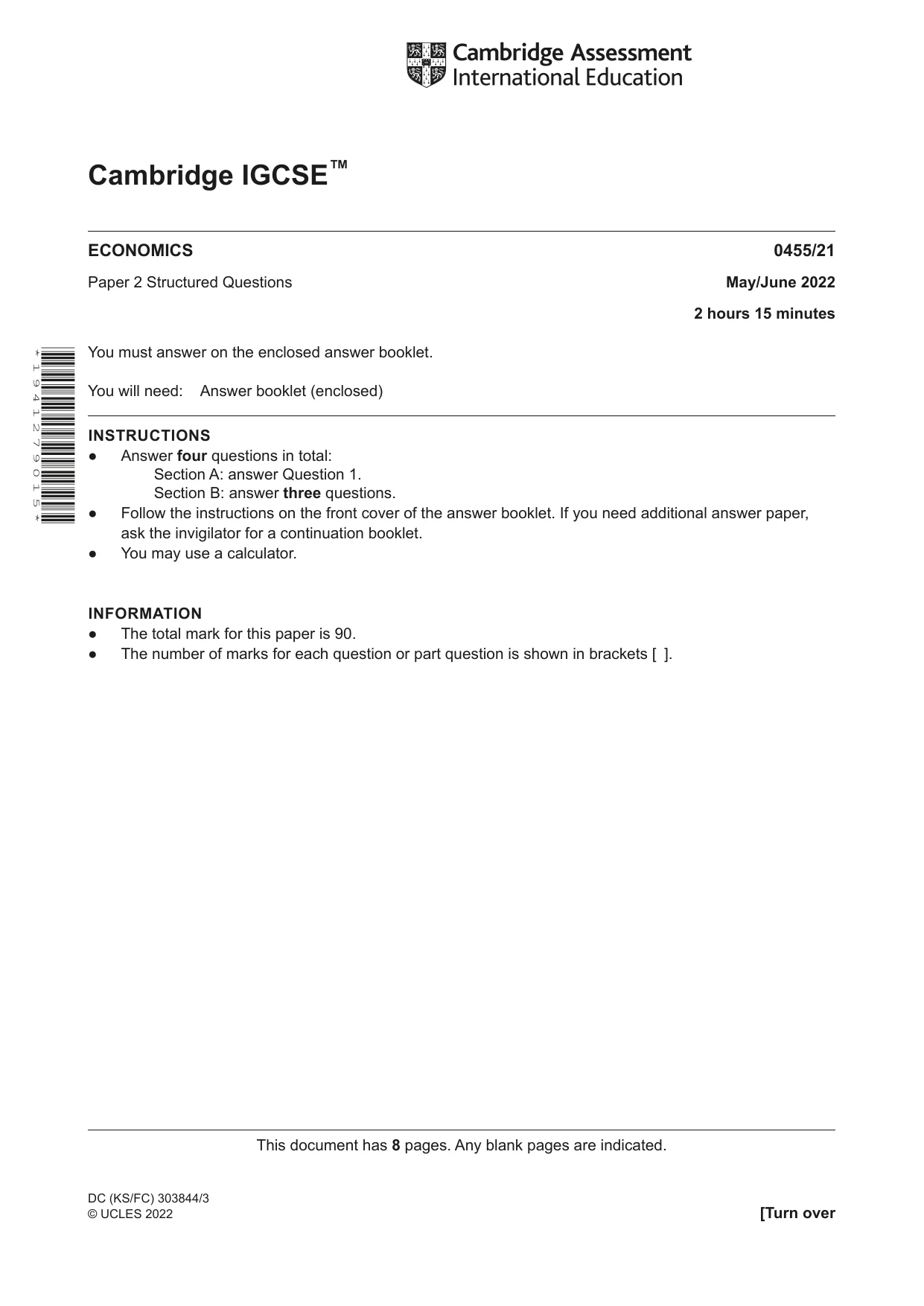
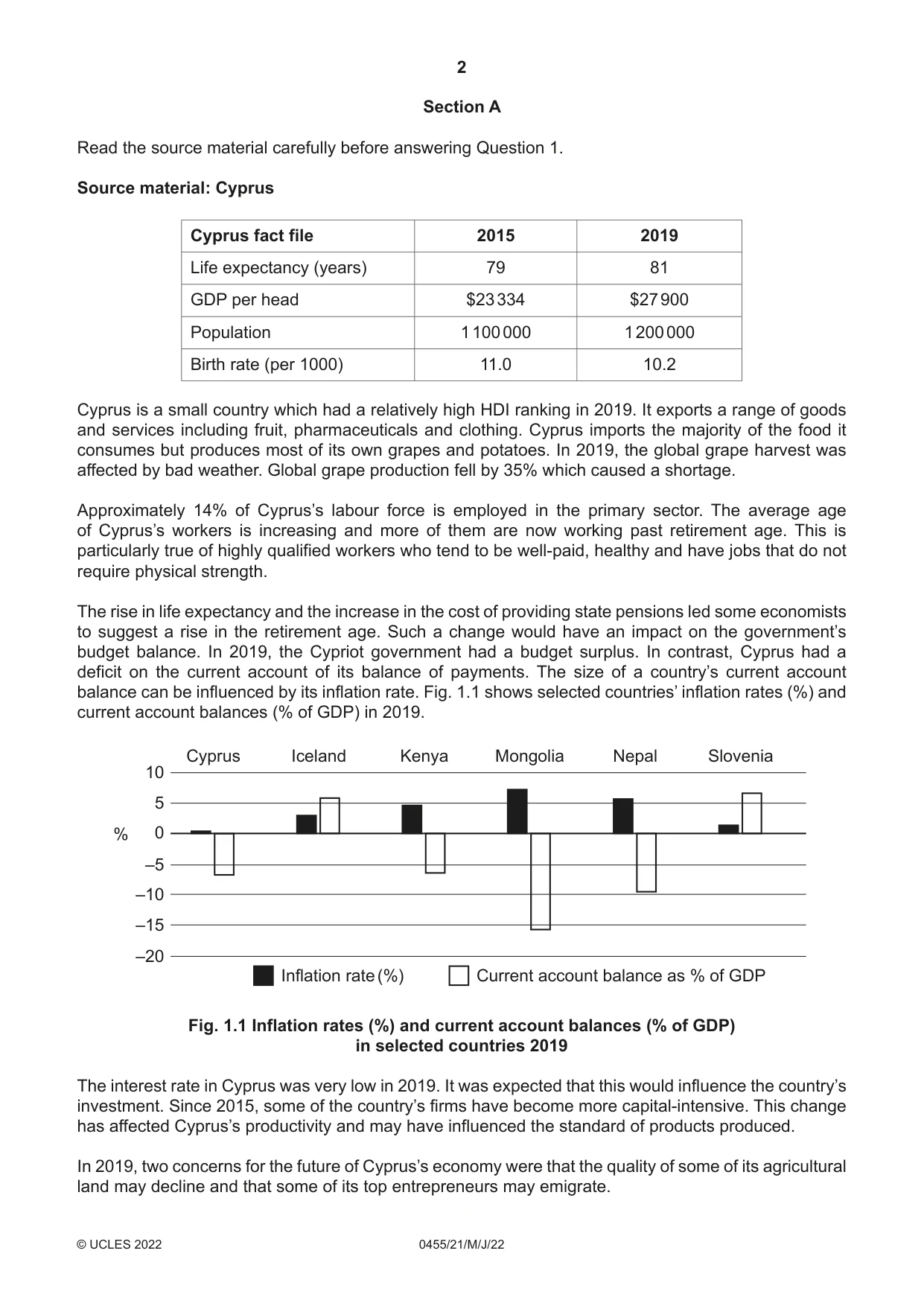
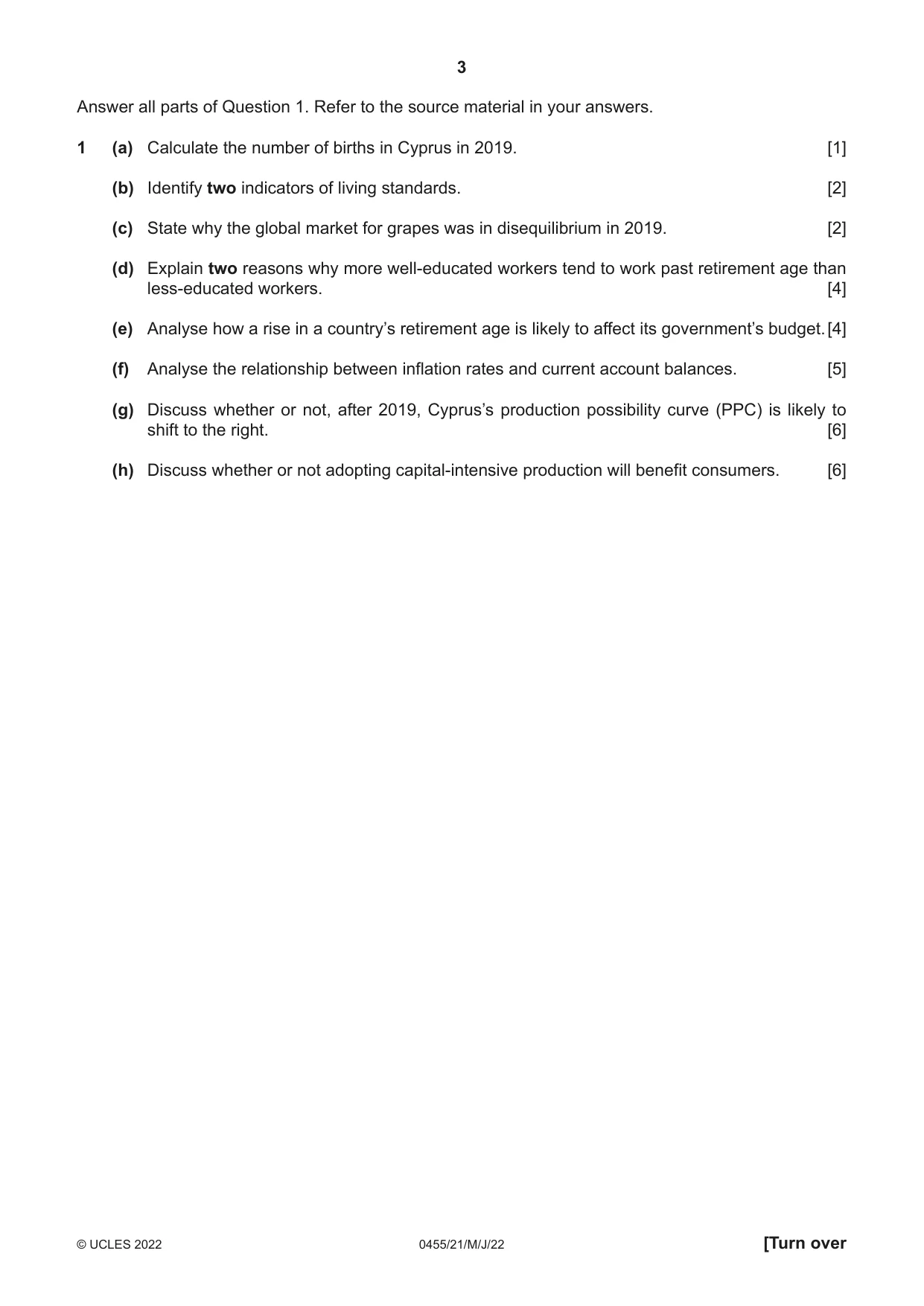
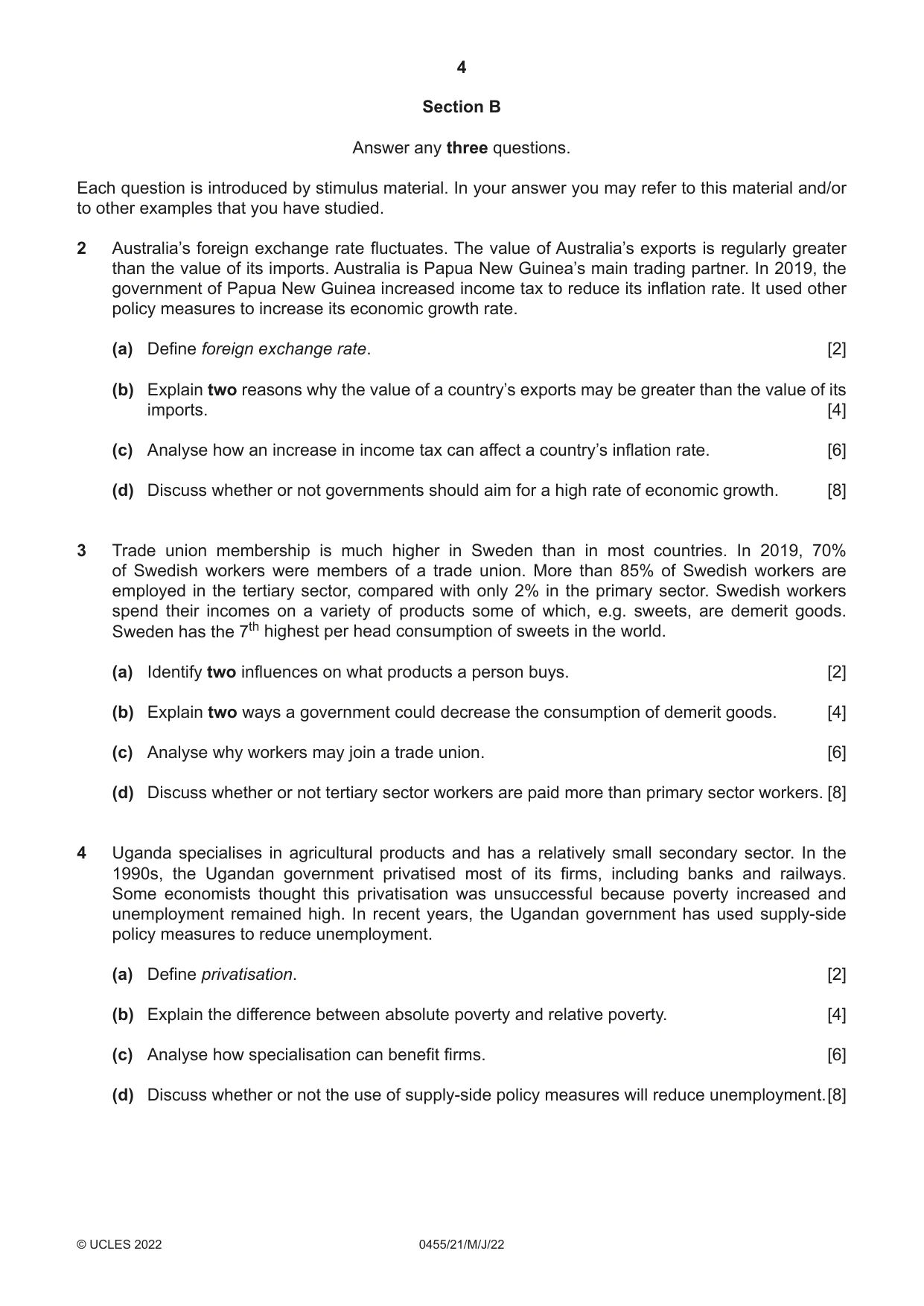




Mark scheme23 pages
Answers below. Sit the paper first if you are practising.
Questions as text
Q1 · Calculate the number of births in Cyprus in 2019
1 (a) Calculate the number of births in Cyprus in 2019. [1] (b) Identify two indicators of living standards. [2] (c) State why the global market for grapes was in disequilibrium in 2019. [2] (d) Explain two reasons why more well-educated workers tend to work past retirement age than less-educated workers. [4] (e) Analyse how a rise in a country’s retirement age is likely to affect its government’s budget. [4] (f) Analyse the relationship between inflation rates and current account balances. [5] (g) Discuss whether or not, after 2019, Cyprus’s production possibility curve (PPC) is likely to shift to the right. [6] (h) Discuss whether or not adopting capital-intensive production will benefit consumers. [6]
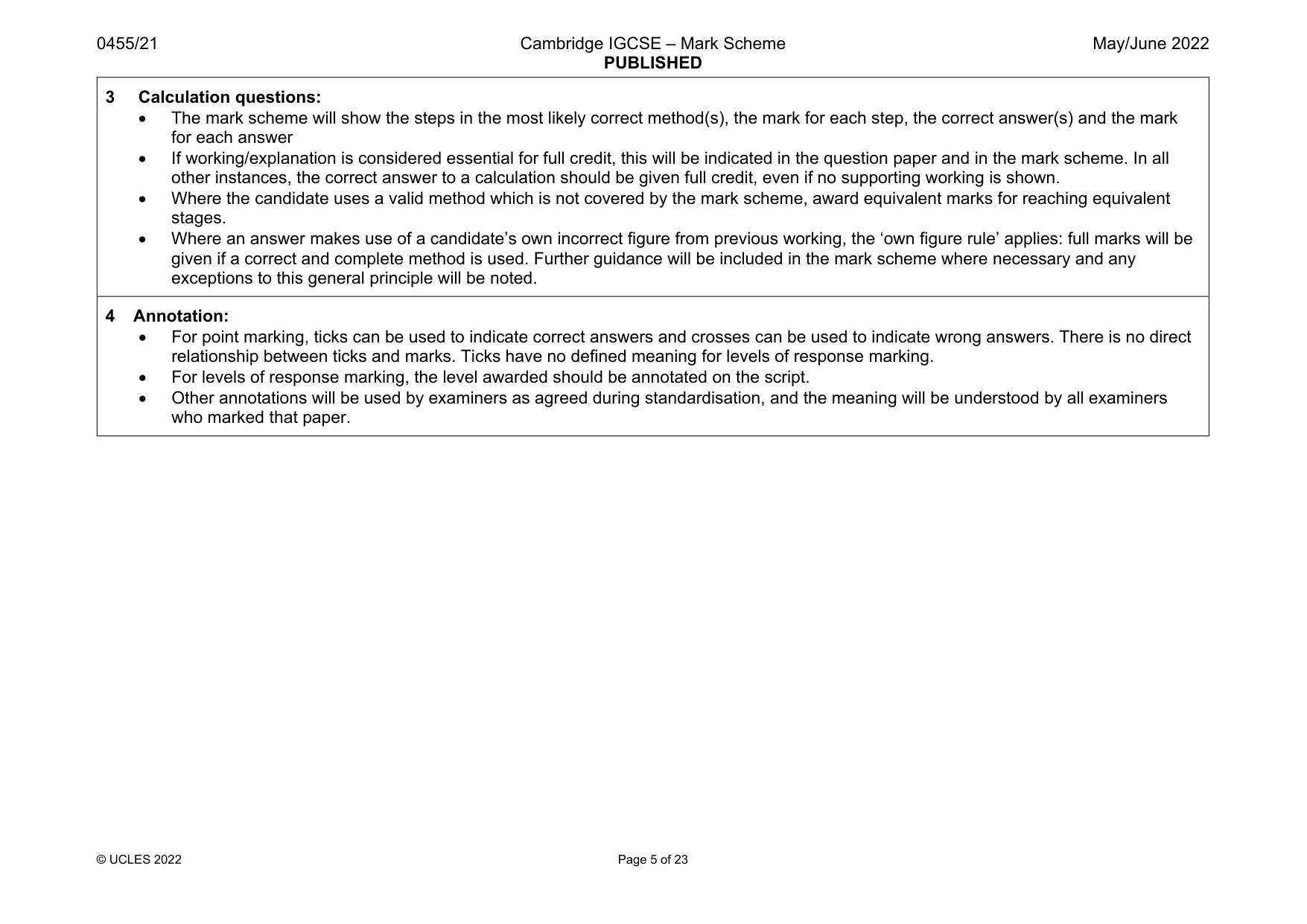
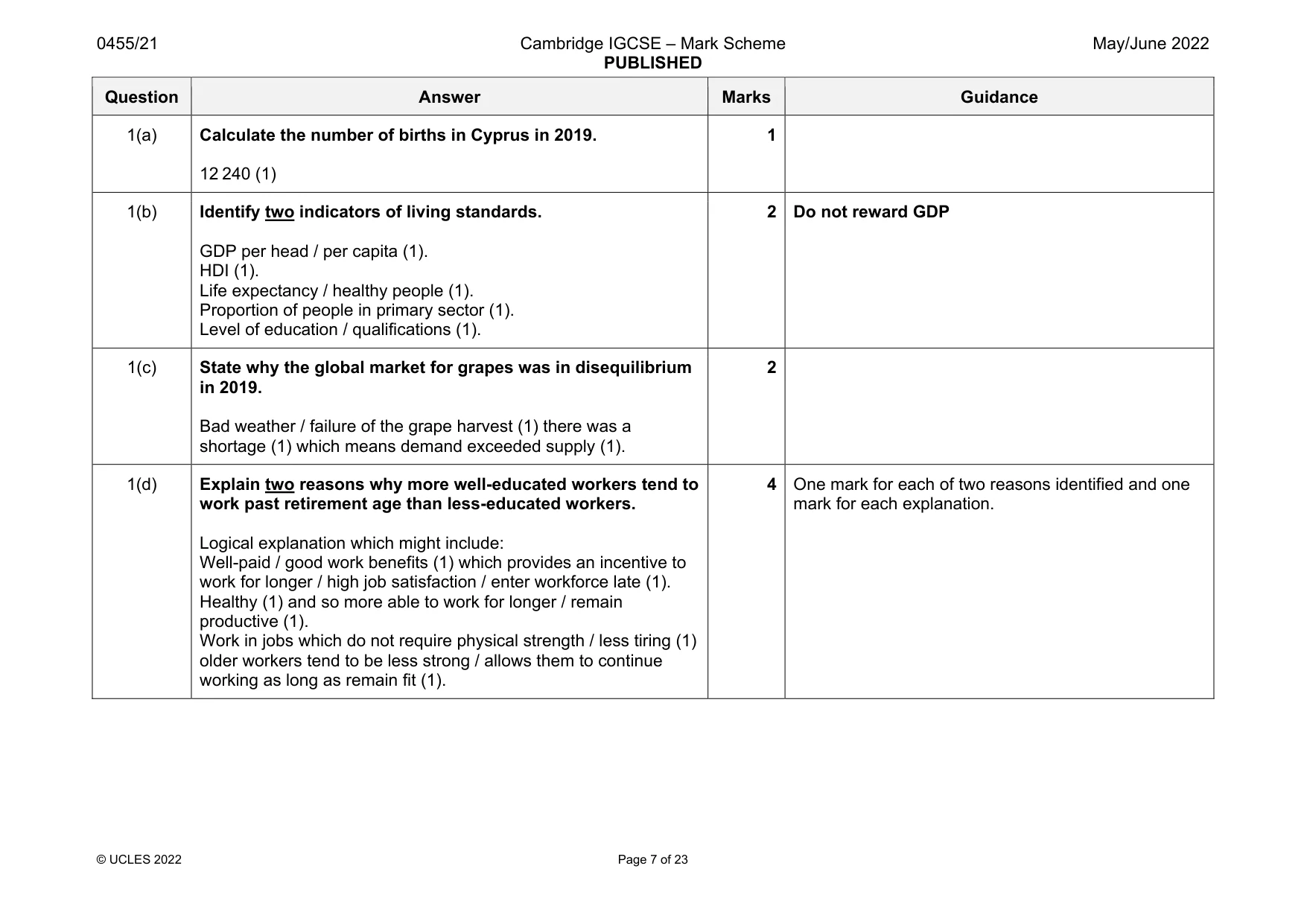
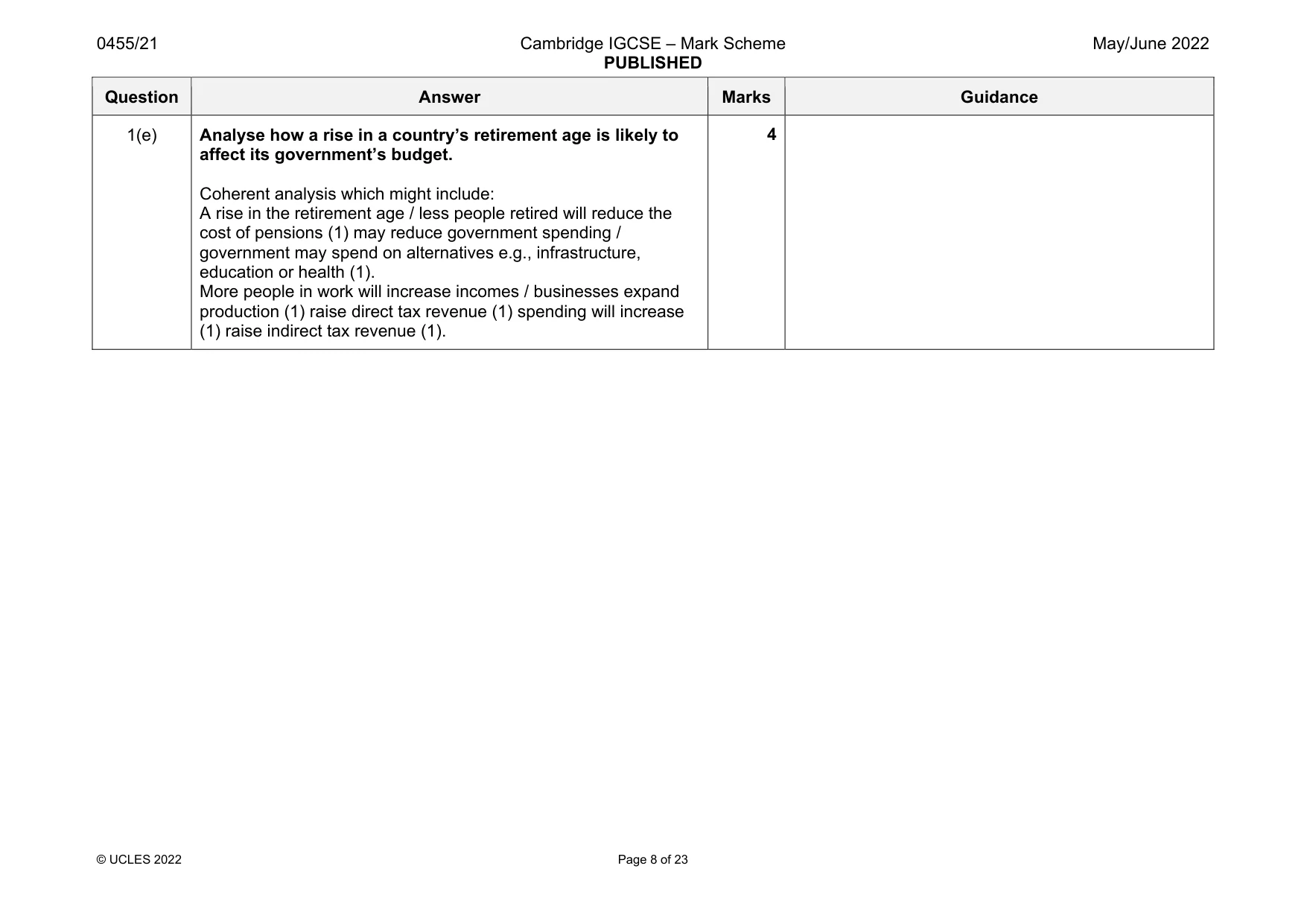
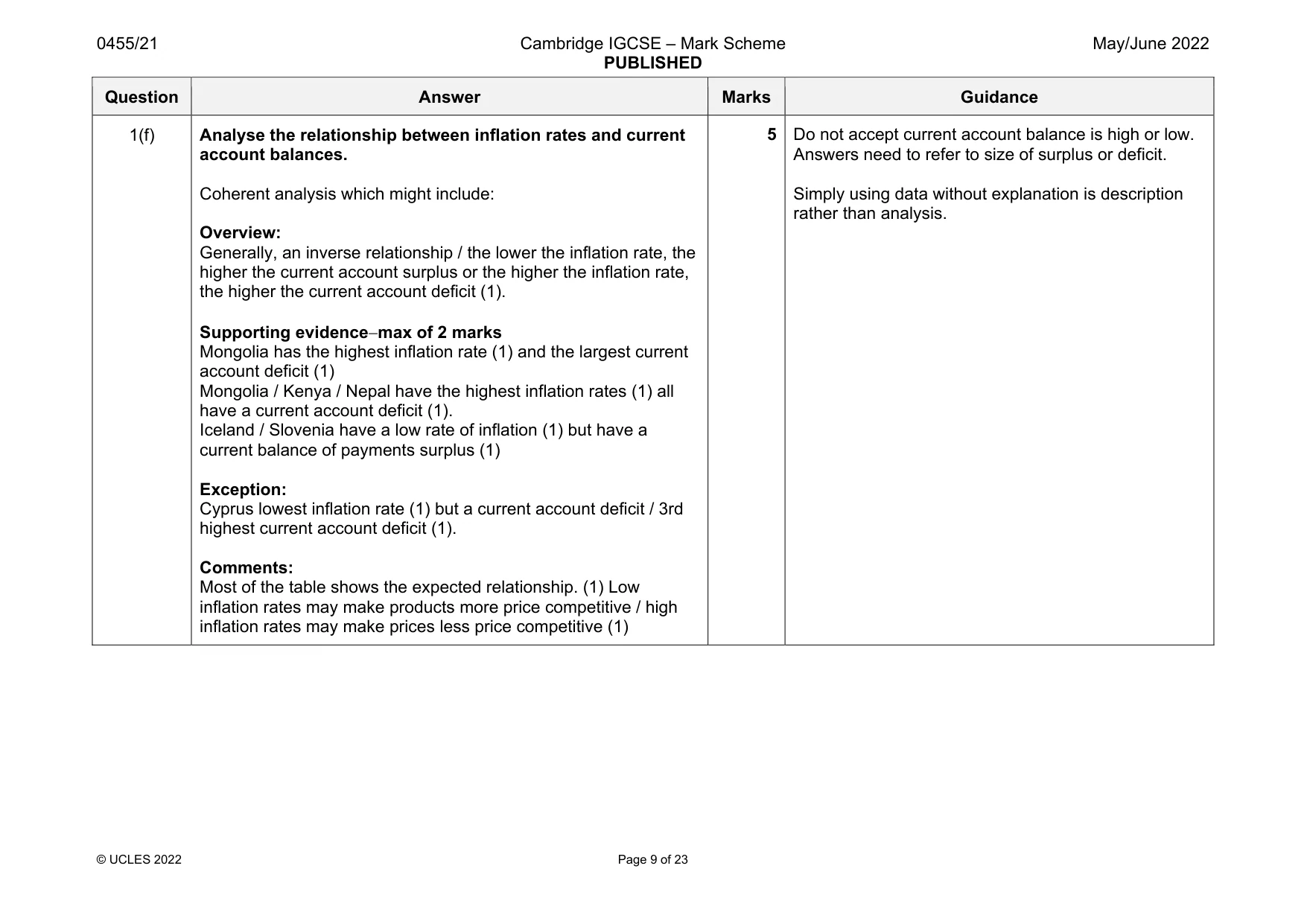
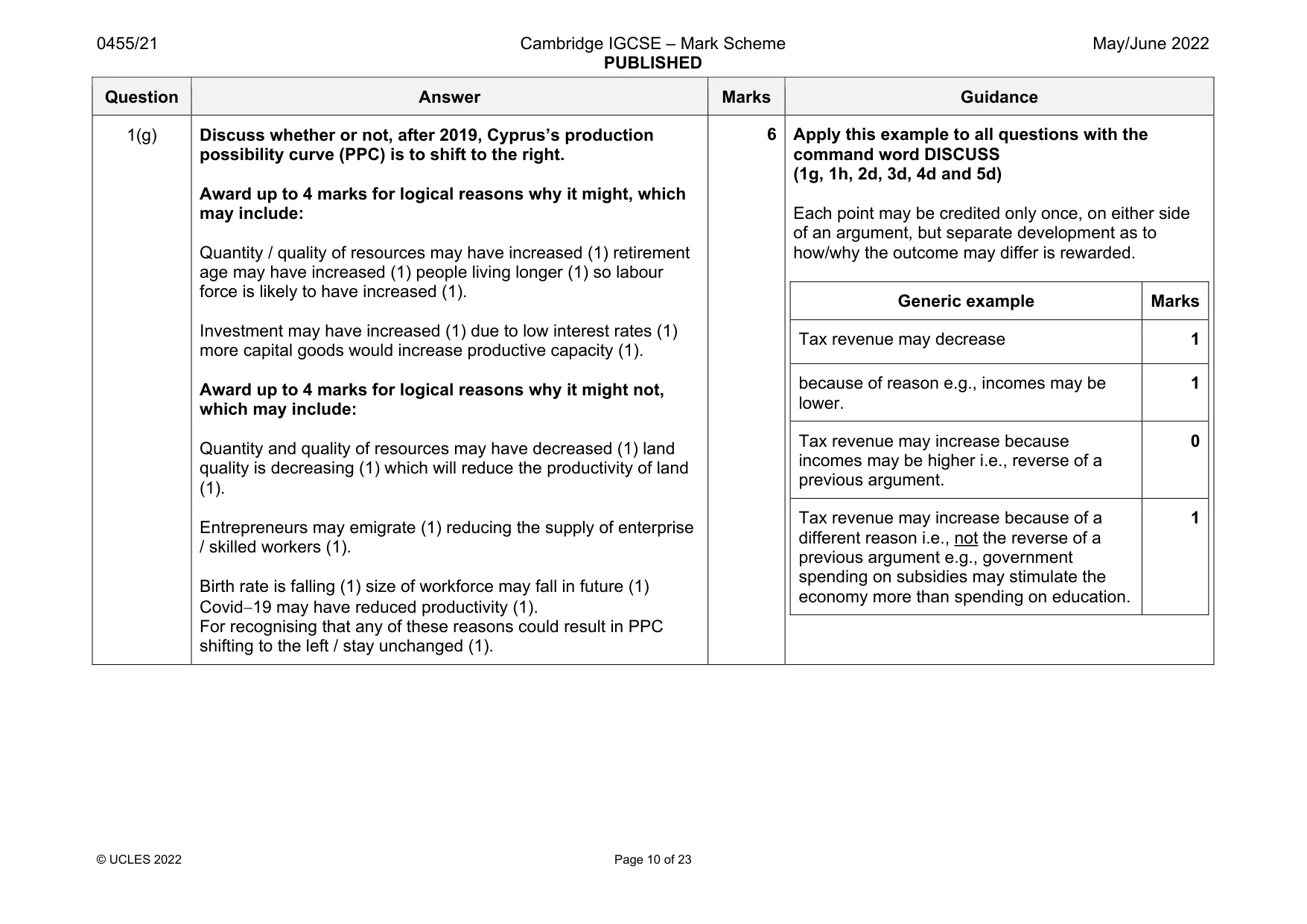
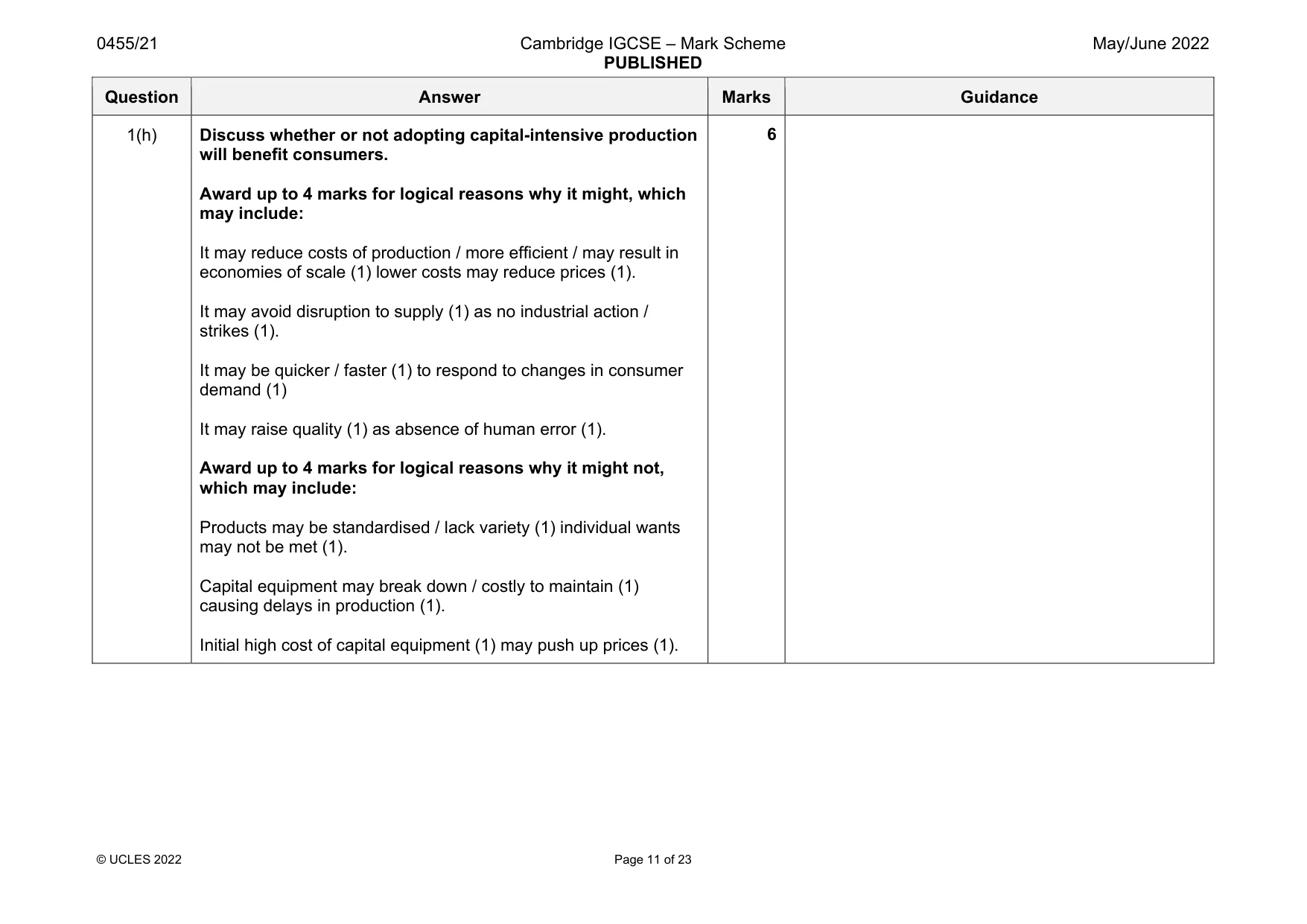
Mark scheme: 1(a) Calculate the number of births in Cyprus in 2019. 12 240 (1) 1 1(b) Identify two indicators of living standards. GDP per head / per capita (1). HDI (1). Life expectancy / healthy people (1). Proportion of people in primary sector (1). Level of education / qualifications (1). 2 Do not reward GDP 1(c) State why the global market for grapes was in disequilibrium in 2019. Bad weather / failure of the grape harvest (1) there was a shortage (1) which means demand exceeded supply (1). 2 1(d) Explain two reasons why more well-educated workers tend to work past retirement age than less-educated workers. Logical explanation which might include: Well-paid / good work benefits (1) which provides an incentive to work for longer / high job satisfaction / enter workforce late (1). Healthy (1) and so more able to work for longer / remain productive (1). Work in jobs which do not require physical strength / less tiring (1) older workers tend to be less strong / allows them to continue working as long as remain fit (1). 4 One mark for each of two reasons identified and one mark for each explanation. Question Answer Marks Guidance 1(e) Analyse how a rise in a country’s retirement age is likely to affect its government’s budget. Coherent analysis which might include: A rise in the retirement age / less people retired will reduce the cost of pensions (1) may reduce government spending / government may spend on alternatives e.g., infrastructure, education or health (1). More people in work will increase incomes / businesses expand production (1) raise direct tax revenue (1) spending will increase (1) raise indirect tax revenue (1). 4 Question Answer Marks Guidance 1(f) Analyse the relationship between inflation rates and current account balances. Coherent analysis which might include: Overview: Generally, an inverse relationship / the lower the inflation rate, the higher the current account surplus or the higher the inflation rate, the higher the current account deficit (1). Supporting evidencemax of 2 marks Mongolia has the highest inflation rate (1) and the largest current account deficit (1) Mongolia / Kenya / Nepal have the highest inflation rates (1) all have a current account deficit (1). Iceland / Slovenia have a low rate of inflation (1) but have a current balance of payments surplus (1) Exception: Cyprus lowest inflation rate (1) but a current account deficit / 3rd highest current account deficit (1). Comments: Most of the table shows the expected relationship. (1) Low inflation rates may make products more price competitive / high inflation rates may make prices less price competitive (1) 5 Do not accept current account balance is high or low. Answers need to refer to size of surplus or deficit. Simply using data without explanation is description rather than analysis. Question Answer Marks Guidance 1(g) Discuss whether or not, after 2019, Cyprus’s production possibility curve (PPC) is to shift to the right. Award up to 4 marks for logical reasons why it might, which may include: Quantity / quality of resources may have increased (1) retirement age may have increased (1) people living longer (1) so labour force is likely to have increased (1). Investment may have increased (1) due to low interest rates (1) more capital goods would increase productive capacity (1). Award up to 4 marks for logical reasons why it might not, which may include: Quantity and quality of resources may have decreased (1) land quality is decreasing (1) which will reduce the productivity of land (1). Entrepreneurs may emigrate (1) reducing the supply of enterprise / skilled workers (1). Birth rate is falling (1) size of workforce may fall in future (1) Covid19 may have reduced productivity (1). For recognising that any of these reasons could result in PPC shifting to the left / stay unchanged (1). 6 Apply this example to all questions with the command word DISCUSS (1g, 1h, 2d, 3d, 4d and 5d) Each point may be credited only once, on either side of an argument, but separate development as to how/why the outcome may differ is rewarded. Generic example Marks Tax revenue may decrease 1 because of reason e.g., incomes may be lower. 1 Tax revenue may increase because incomes may be higher i.e., reverse of a previous argument. 0 Tax revenue may increase because of a different reason i.e., not the reverse of a previous argument e.g., government spending on subsidies may stimulate the economy more than spending on education. 1 Question Answer Marks Guidance 1(h) Discuss whether or not adopting capital-intensive production will benefit consumers. Award up to 4 marks for logical reasons why it might, which may include: It may reduce costs of production / more efficient / may result in economies of scale (1) lower costs may reduce prices (1). It may avoid disruption to supply (1) as no industrial action / strikes (1). It may be quicker / faster (1) to respond to changes in consumer demand (1) It may raise quality (1) as absence of human error (1). Award up to 4 marks for logical reasons why it might not, which may include: Products may be standardised / lack variety (1) individual wants may not be met (1). Capital equipment may break down / costly to maintain (1) causing delays in production (1). Initial high cost of capital equipment (1) may push up prices (1). 6
More questions on Production possibility curve (PPC) diagrams
Q2 · Australia’s foreign exchange rate fluctuates
2 Australia’s foreign exchange rate fluctuates. The value of Australia’s exports is regularly greater than the value of its imports. Australia is Papua New Guinea’s main trading partner. In 2019, the government of Papua New Guinea increased income tax to reduce its inflation rate. It used other policy measures to increase its economic growth rate. (a) Define foreign exchange rate. [2] (b) Explain two reasons why the value of a country’s exports may be greater than the value of its imports. [4] (c) Analyse how an increase in income tax can affect a country’s inflation rate. [6] (d) Discuss whether or not governments should aim for a high rate of economic growth. [8]
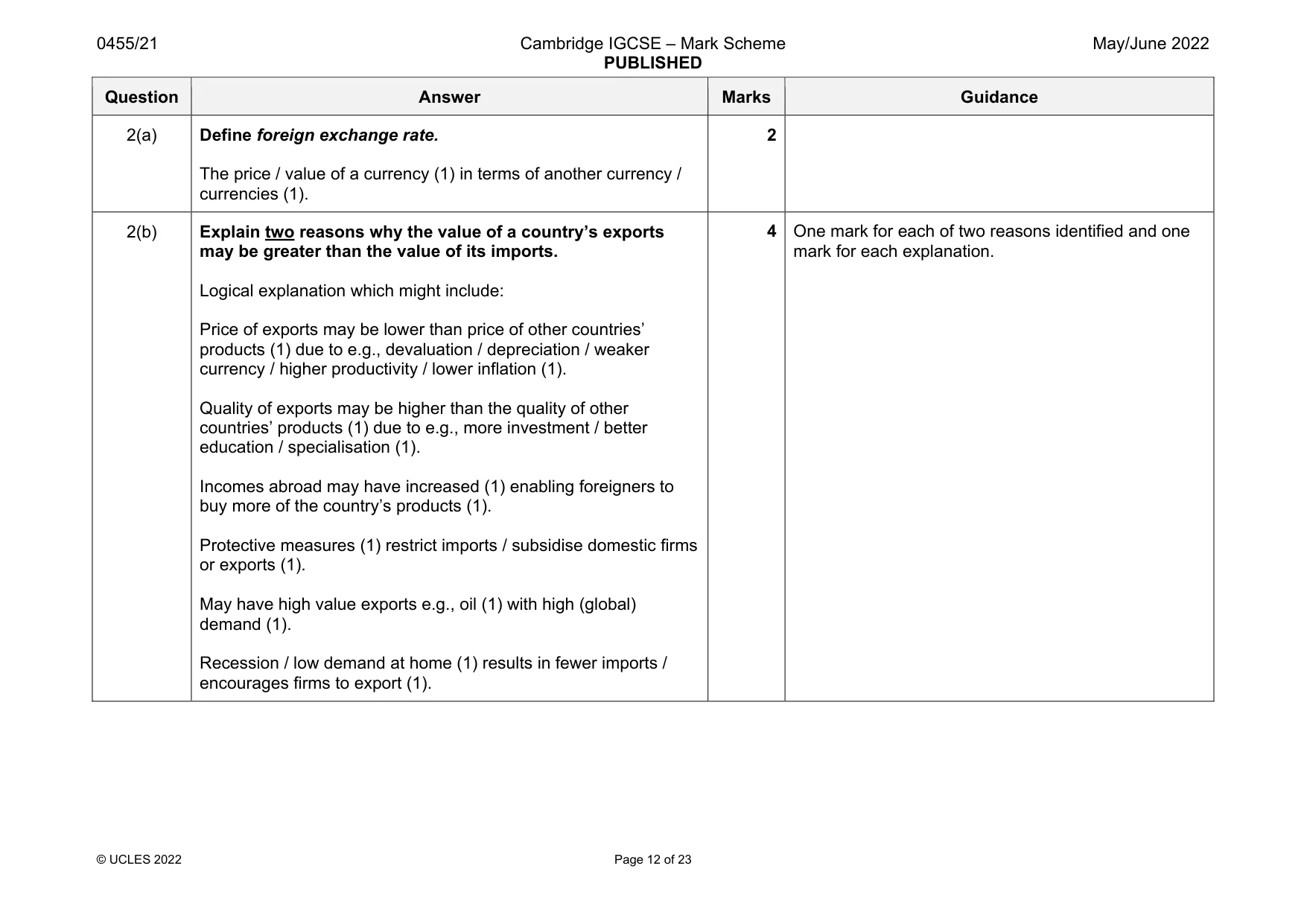
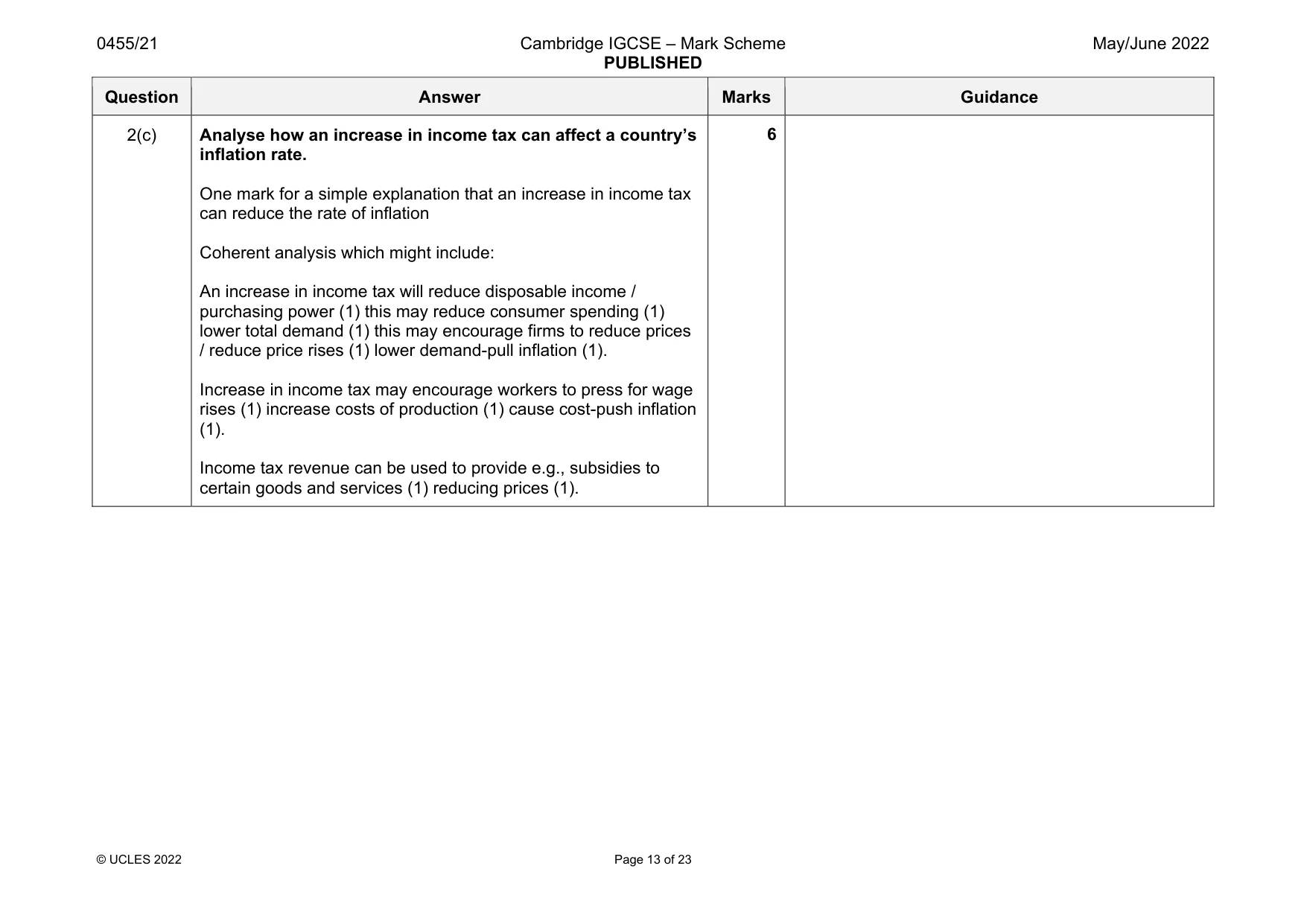
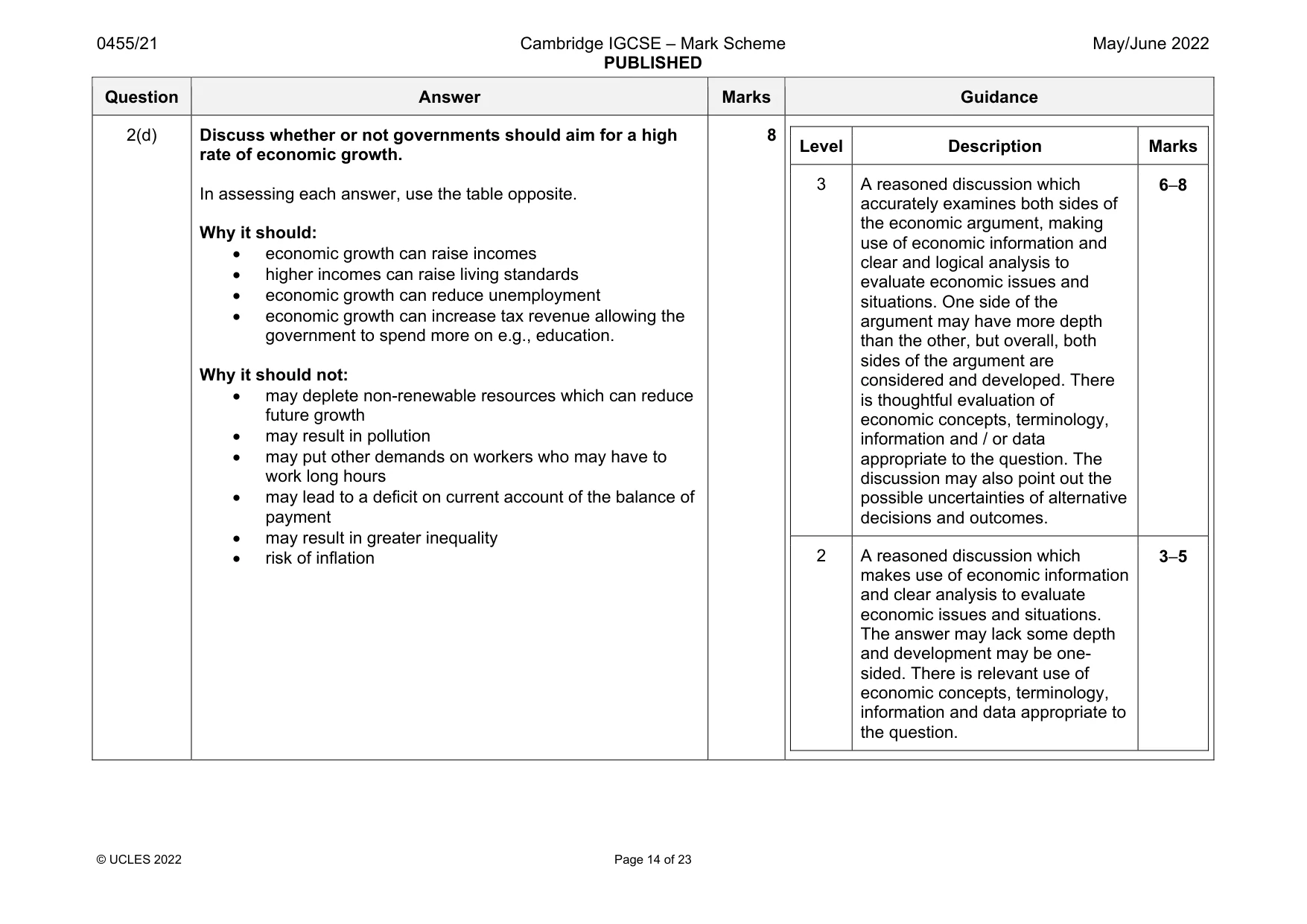
Mark scheme: 2(a) Define foreign exchange rate. The price / value of a currency (1) in terms of another currency / currencies (1). 2 2(b) Explain two reasons why the value of a country’s exports may be greater than the value of its imports. Logical explanation which might include: Price of exports may be lower than price of other countries’ products (1) due to e.g., devaluation / depreciation / weaker currency / higher productivity / lower inflation (1). Quality of exports may be higher than the quality of other countries’ products (1) due to e.g., more investment / better education / specialisation (1). Incomes abroad may have increased (1) enabling foreigners to buy more of the country’s products (1). Protective measures (1) restrict imports / subsidise domestic firms or exports (1). May have high value exports e.g., oil (1) with high (global) demand (1). Recession / low demand at home (1) results in fewer imports / encourages firms to export (1). 4 One mark for each of two reasons identified and one mark for each explanation. Question Answer Marks Guidance 2(c) Analyse how an increase in income tax can affect a country’s inflation rate. One mark for a simple explanation that an increase in income tax can reduce the rate of inflation Coherent analysis which might include: An increase in income tax will reduce disposable income / purchasing power (1) this may reduce consumer spending (1) lower total demand (1) this may encourage firms to reduce prices / reduce price rises (1) lower demand-pull inflation (1). Increase in income tax may encourage workers to press for wage rises (1) increase costs of production (1) cause cost-push inflation (1). Income tax revenue can be used to provide e.g., subsidies to certain goods and services (1) reducing prices (1). 6 Question Answer Marks Guidance 2(d) Discuss whether or not governments should aim for a high rate of economic growth. In assessing each answer, use the table opposite. Why it should: economic growth can raise incomes higher incomes can raise living standards economic growth can reduce unemployment economic growth can increase tax revenue allowing the government to spend more on e.g., education. Why it should not: may deplete non-renewable resources which can reduce future growth may result in pollution may put other demands on workers who may have to work long hours may lead to a deficit on current account of the balance of payment may result in greater inequality risk of inflation 8 Level Description Marks 3 A reasoned discussion which accurately examines both sides of the economic argument, making use of economic information and clear and logical analysis to evaluate economic issues and situations. One side of the argument may have more depth than the other, but overall, both sides of the argument are considered and developed. There is thoughtful evaluation of economic concepts, terminology, information and / or data appropriate to the question. The discussion may also point out the possible uncertainties of alternative decisions and outcomes. 68 2 A reasoned discussion which makes use of economic information and clear analysis to evaluate economic issues and situations. The answer may lack some depth and development may be one- sided. There is relevant use of economic concepts, terminology, information and data appropriate to the question. 35 Question Answer Marks Guidance 2(d) Level Description Marks 1 There is a simple attempt at using economic definitions and terminology. Some reference may be made to economic theory, with occasional understanding. 12 0 A mark of zero should be awarded for no creditable content. 0
Q3 · Trade union membership is much higher in Sweden than in most countries
3 Trade union membership is much higher in Sweden than in most countries. In 2019, 70% of Swedish workers were members of a trade union. More than 85% of Swedish workers are employed in the tertiary sector, compared with only 2% in the primary sector. Swedish workers spend their incomes on a variety of products some of which, e.g. sweets, are demerit goods. Sweden has the 7th highest per head consumption of sweets in the world. (a) Identify two influences on what products a person buys. [2] (b) Explain two ways a government could decrease the consumption of demerit goods. [4] (c) Analyse why workers may join a trade union. [6] (d) Discuss whether or not tertiary sector workers are paid more than primary sector workers. [8]
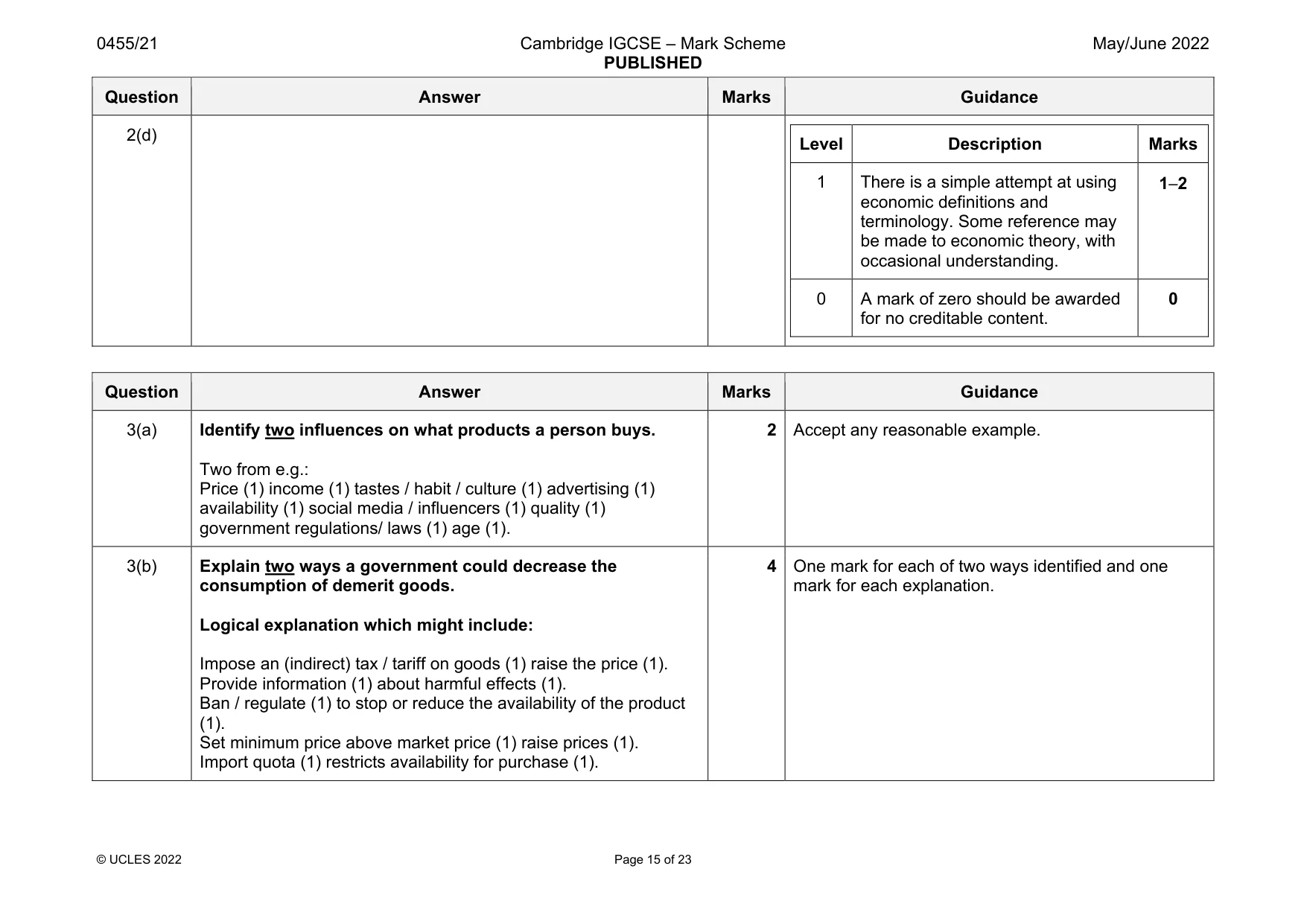
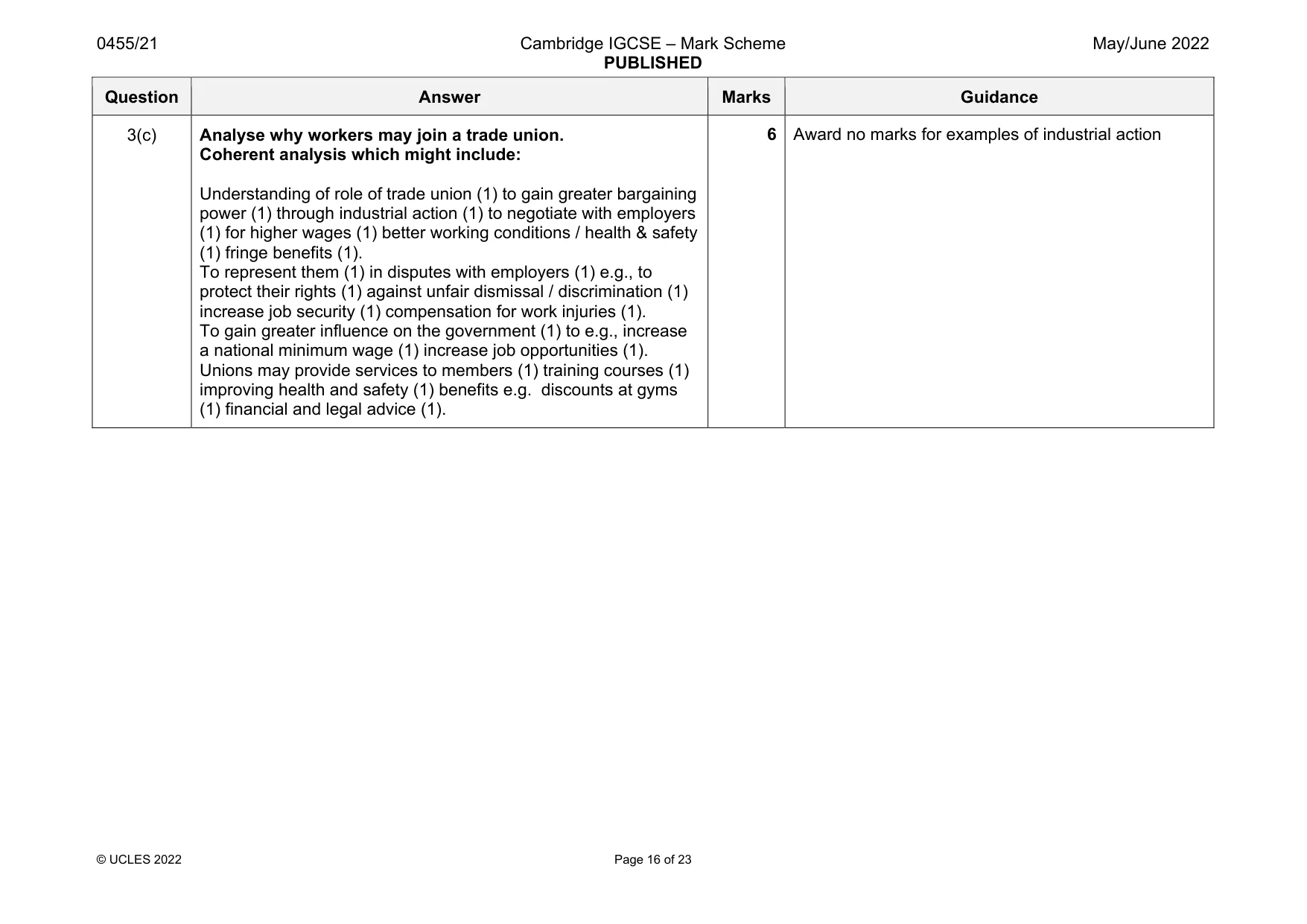
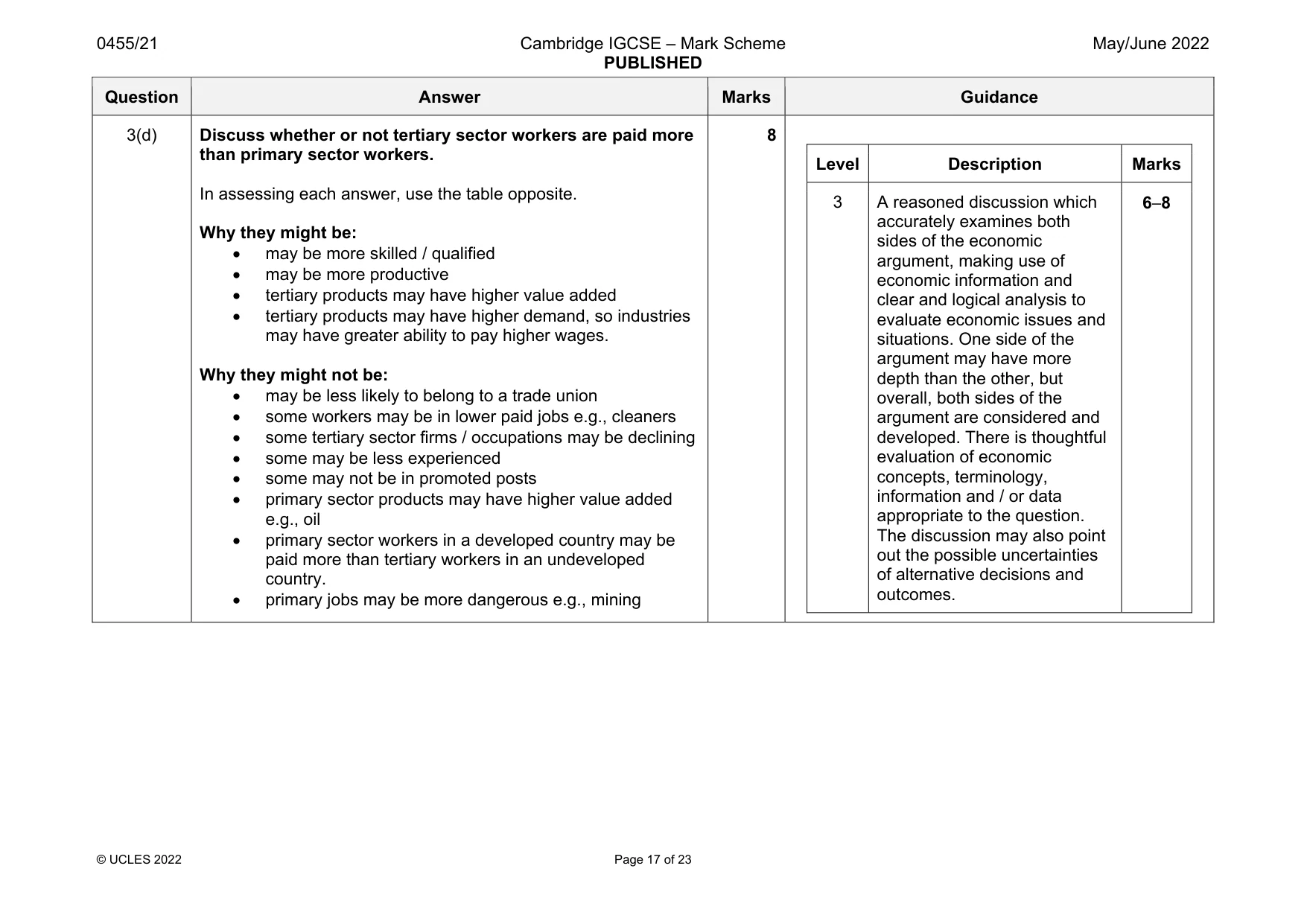
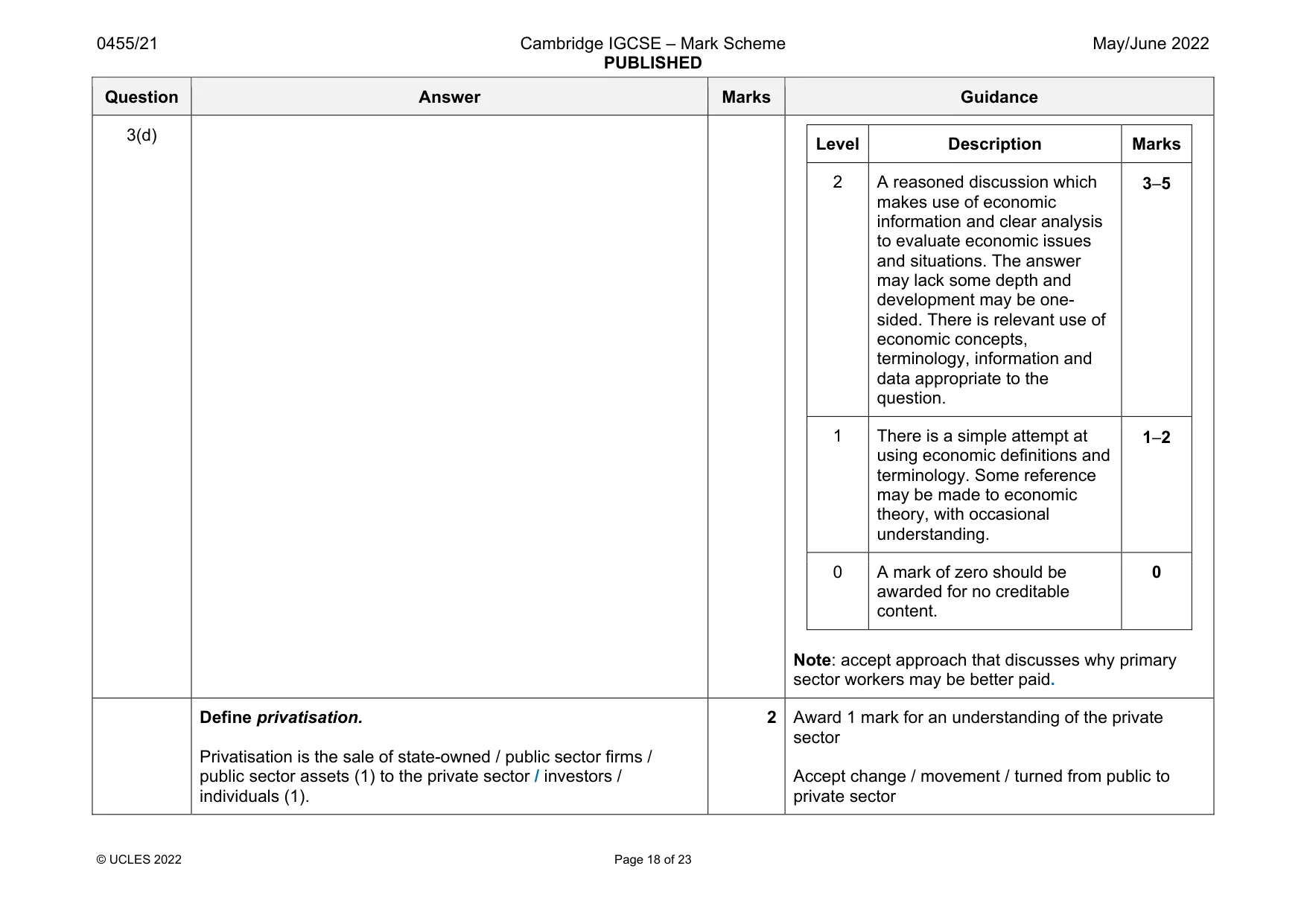
Mark scheme: 3(a) Identify two influences on what products a person buys. Two from e.g.: Price (1) income (1) tastes / habit / culture (1) advertising (1) availability (1) social media / influencers (1) quality (1) government regulations/ laws (1) age (1). 3(b) Explain two ways a government could decrease the consumption of demerit goods. Logical explanation which might include: Impose an (indirect) tax / tariff on goods (1) raise the price (1). Provide information (1) about harmful effects (1). Ban / regulate (1) to stop or reduce the availability of the product (1). Set minimum price above market price (1) raise prices (1). Import quota (1) restricts availability for purchase (1). 4 One mark for each of two ways identified and one mark for each explanation. Question Answer Marks Guidance 3(c) Analyse why workers may join a trade union. Coherent analysis which might include: Understanding of role of trade union (1) to gain greater bargaining power (1) through industrial action (1) to negotiate with employers (1) for higher wages (1) better working conditions / health & safety (1) fringe benefits (1). To represent them (1) in disputes with employers (1) e.g., to protect their rights (1) against unfair dismissal / discrimination (1) increase job security (1) compensation for work injuries (1). To gain greater influence on the government (1) to e.g., increase a national minimum wage (1) increase job opportunities (1). Unions may provide services to members (1) training courses (1) improving health and safety (1) benefits e.g. discounts at gyms (1) financial and legal advice (1). 6 Award no marks for examples of industrial action Question Answer Marks Guidance 3(d) Discuss whether or not tertiary sector workers are paid more than primary sector workers. In assessing each answer, use the table opposite. Why they might be: may be more skilled / qualified may be more productive tertiary products may have higher value added tertiary products may have higher demand, so industries may have greater ability to pay higher wages. Why they might not be: may be less likely to belong to a trade union some workers may be in lower paid jobs e.g., cleaners some tertiary sector firms / occupations may be declining some may be less experienced some may not be in promoted posts primary sector products may have higher value added e.g., oil primary sector workers in a developed country may be paid more than tertiary workers in an undeveloped country. primary jobs may be more dangerous e.g., mining 8 Level Description Marks 3 A reasoned discussion which accurately examines both sides of the economic argument, making use of economic information and clear and logical analysis to evaluate economic issues and situations. One side of the argument may have more depth than the other, but overall, both sides of the argument are considered and developed. There is thoughtful evaluation of economic concepts, terminology, information and / or data appropriate to the question. The discussion may also point out the possible uncertainties of alternative decisions and outcomes. 68 Question Answer Marks Guidance 3(d) Level Description Marks 2 A reasoned discussion which makes use of economic information and clear analysis to evaluate economic issues and situations. The answer may lack some depth and development may be one- sided. There is relevant use of economic concepts, terminology, information and data appropriate to the question. 35 1 There is a simple attempt at using economic definitions and terminology. Some reference may be made to economic theory, with occasional understanding. 12 0 A mark of zero should be awarded for no creditable content. 0 Note: accept approach that discusses why primary sector workers may be better paid. Define privatisation. Privatisation is the sale of state-owned / public sector firms / public sector assets (1) to the private sector / investors / individuals (1). 2 Award 1 mark for an understanding of the private sector Accept change / movement / turned from public to private sector
Q4 · Uganda specialises in agricultural products and has a relatively small secondary sector
4 Uganda specialises in agricultural products and has a relatively small secondary sector. In the 1990s, the Ugandan government privatised most of its firms, including banks and railways. Some economists thought this privatisation was unsuccessful because poverty increased and unemployment remained high. In recent years, the Ugandan government has used supply-side policy measures to reduce unemployment. (a) Define privatisation. [2] (b) Explain the difference between absolute poverty and relative poverty. [4] (c) Analyse how specialisation can benefit firms. [6] (d) Discuss whether or not the use of supply-side policy measures will reduce unemployment. [8]
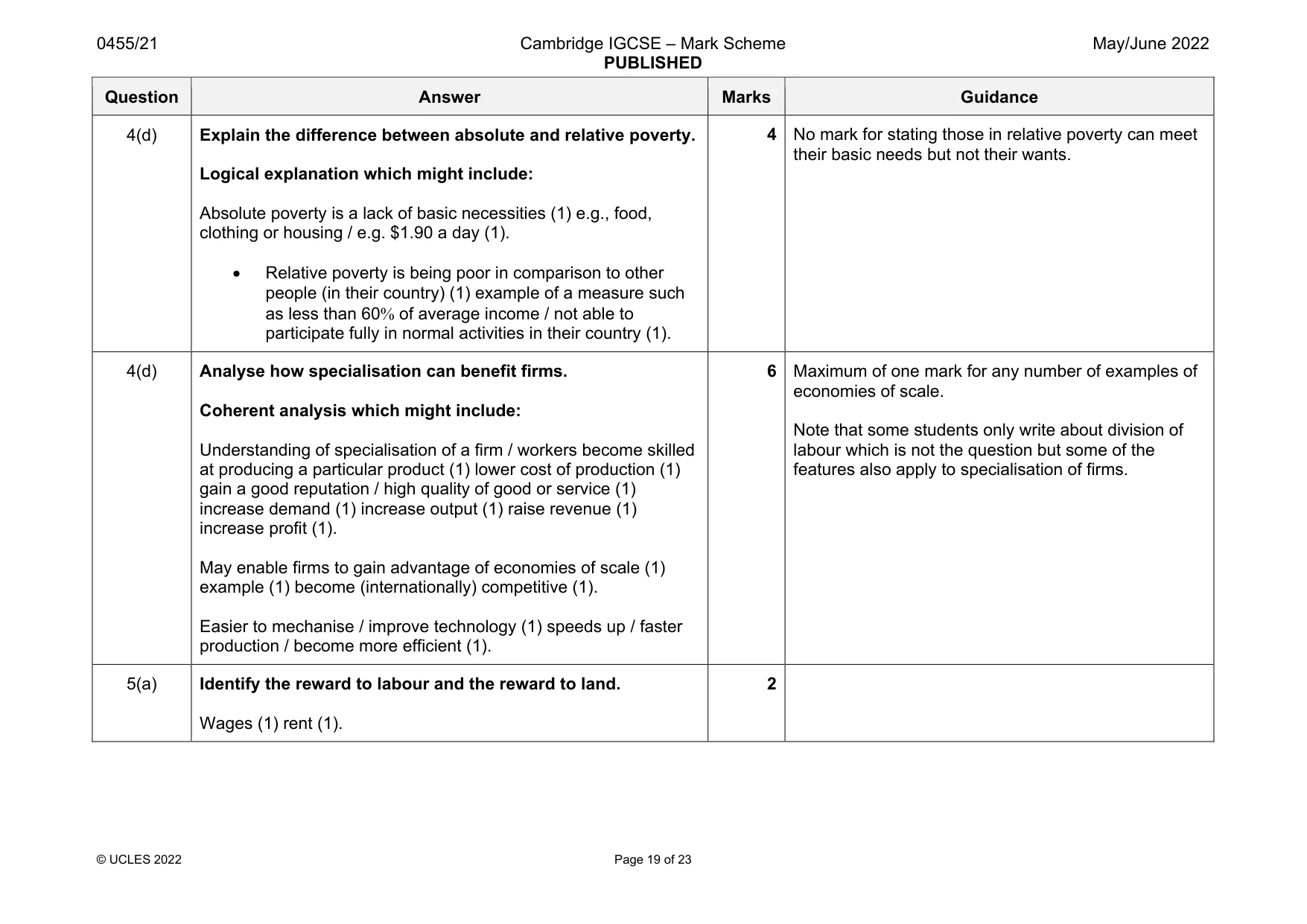
Mark scheme: 4(d) Explain the difference between absolute and relative poverty. Logical explanation which might include: Absolute poverty is a lack of basic necessities (1) e.g., food, clothing or housing / e.g. $1.90 a day (1). Relative poverty is being poor in comparison to other people (in their country) (1) example of a measure such as less than 60 of average income / not able to participate fully in normal activities in their country (1). their basic needs but not their wants. 4(d) Analyse how specialisation can benefit firms. Coherent analysis which might include: Understanding of specialisation of a firm / workers become skilled at producing a particular product (1) lower cost of production (1) gain a good reputation / high quality of good or service (1) increase demand (1) increase output (1) raise revenue (1) increase profit (1). May enable firms to gain advantage of economies of scale (1) example (1) become (internationally) competitive (1). Easier to mechanise / improve technology (1) speeds up / faster production / become more efficient (1). 6 Maximum of one mark for any number of examples of economies of scale. Note that some students only write about division of labour which is not the question but some of the features also apply to specialisation of firms.
Q5 · Singapore is a high-income country with a shortage of land and labour
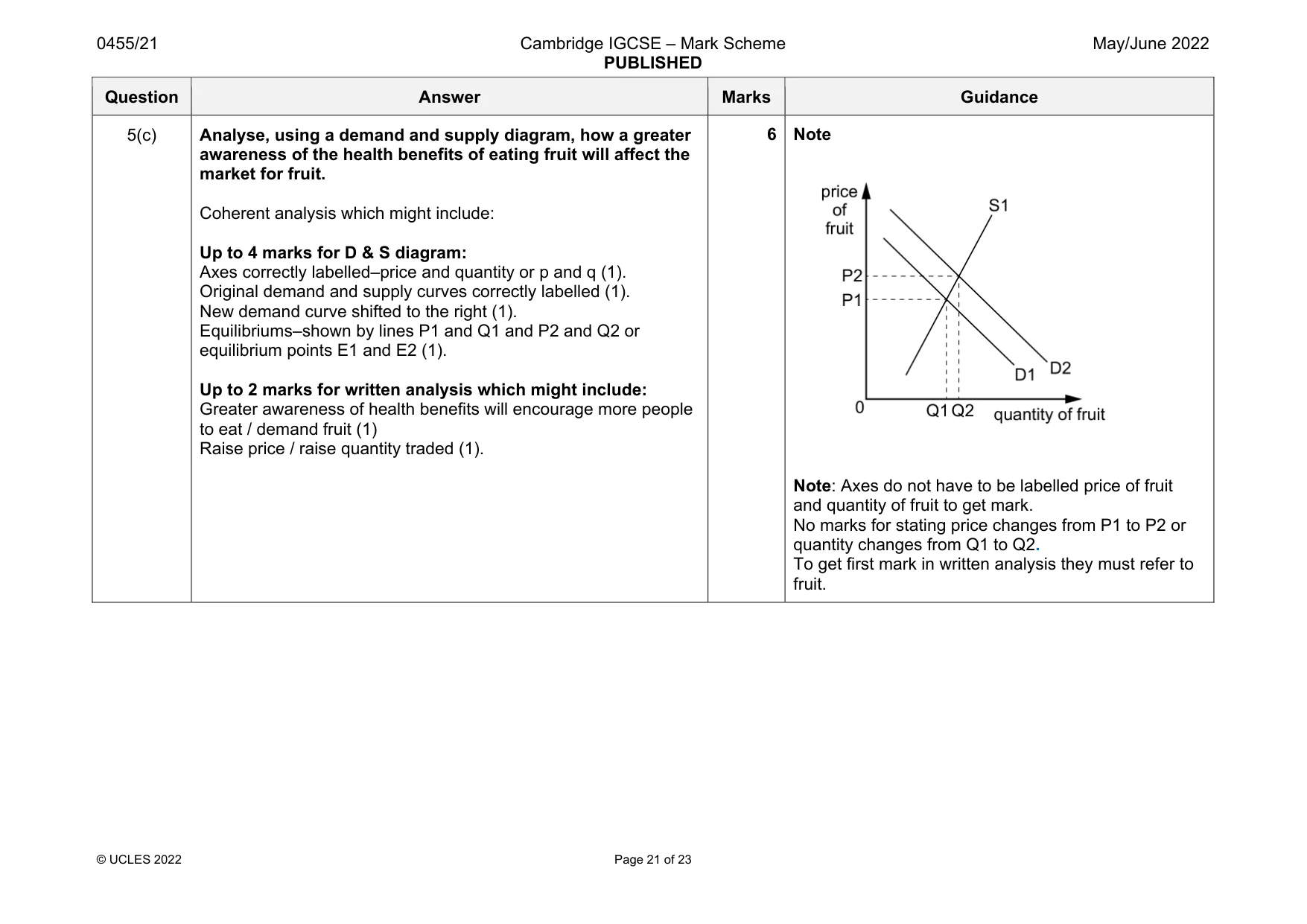
5 Singapore is a high-income country with a shortage of land and labour. Singapore is often given as an example of a market economy. The Singaporean government does, however, intervene in the economy. For example, it encourages its population to eat two servings of fruit and two servings of vegetables per day. (a) Identify the reward to labour and the reward to land. [2] (b) Explain how an increase in a worker’s income can affect their mobility of labour. [4] (c) Analyse, using a demand and supply diagram, how a greater awareness of the health benefits of eating fruit will affect the market for fruit. [6] (d) Discuss whether or not a market economic system benefits an economy. [8]
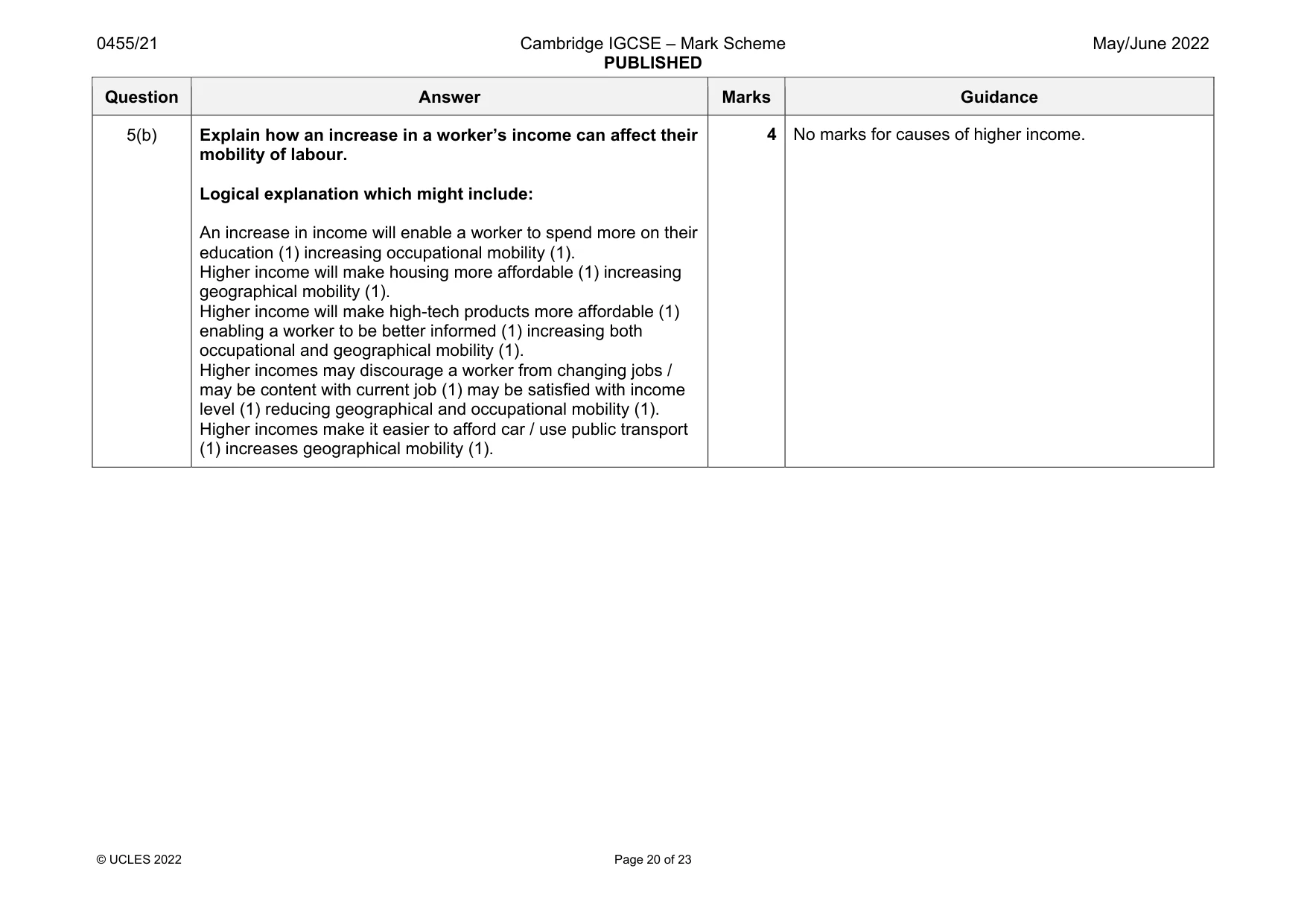
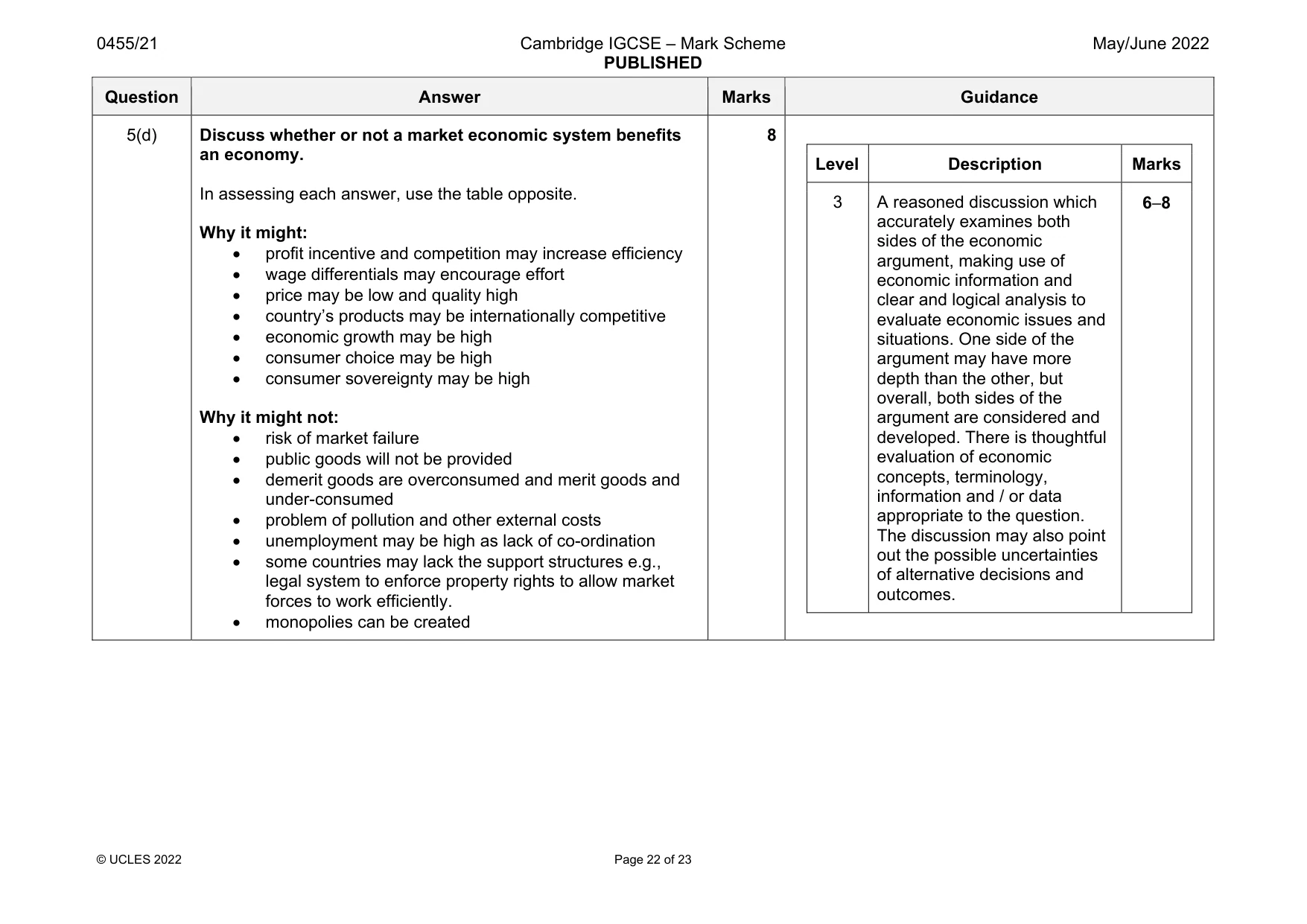
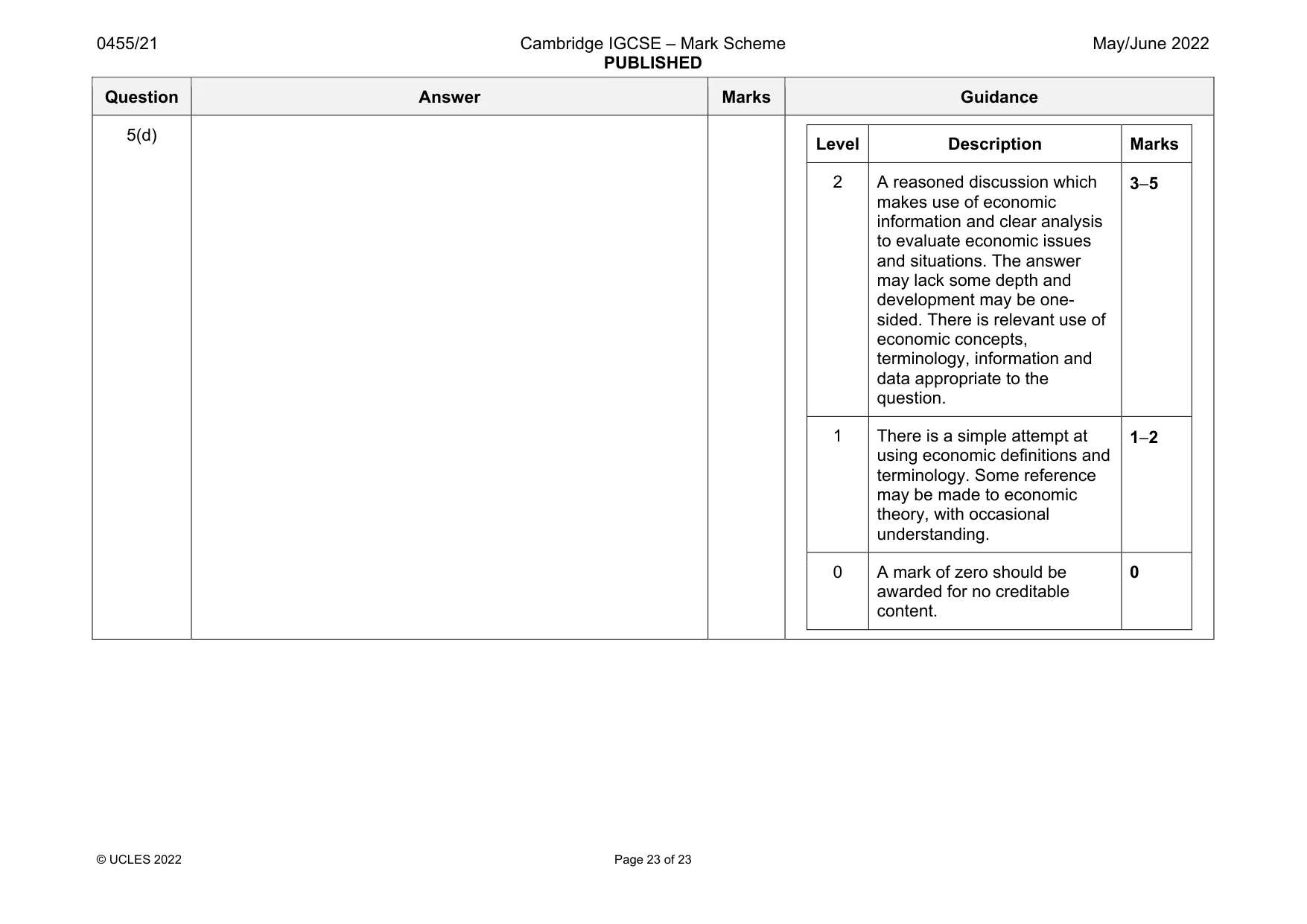
Mark scheme: 5(a) Identify the reward to labour and the reward to land. Wages (1) rent (1). 2 Question Answer Marks Guidance 5(b) Explain how an increase in a worker’s income can affect their mobility of labour. Logical explanation which might include: An increase in income will enable a worker to spend more on their education (1) increasing occupational mobility (1). Higher income will make housing more affordable (1) increasing geographical mobility (1). Higher income will make high-tech products more affordable (1) enabling a worker to be better informed (1) increasing both occupational and geographical mobility (1). Higher incomes may discourage a worker from changing jobs / may be content with current job (1) may be satisfied with income level (1) reducing geographical and occupational mobility (1). Higher incomes make it easier to afford car / use public transport (1) increases geographical mobility (1). 4 No marks for causes of higher income. Question Answer Marks Guidance 5(c) Analyse, using a demand and supply diagram, how a greater awareness of the health benefits of eating fruit will affect the market for fruit. Coherent analysis which might include: Up to 4 marks for D & S diagram: Axes correctly labelled–price and quantity or p and q (1). Original demand and supply curves correctly labelled (1). New demand curve shifted to the right (1). Equilibriums–shown by lines P1 and Q1 and P2 and Q2 or equilibrium points E1 and E2 (1). Up to 2 marks for written analysis which might include: Greater awareness of health benefits will encourage more people to eat / demand fruit (1) Raise price / raise quantity traded (1). 6 Note Note: Axes do not have to be labelled price of fruit and quantity of fruit to get mark. No marks for stating price changes from P1 to P2 or quantity changes from Q1 to Q2. To get first mark in written analysis they must refer to fruit. Question Answer Marks Guidance 5(d) Discuss whether or not a market economic system benefits an economy. In assessing each answer, use the table opposite. Why it might: profit incentive and competition may increase efficiency wage differentials may encourage effort price may be low and quality high country’s products may be internationally competitive economic growth may be high consumer choice may be high consumer sovereignty may be high Why it might not: risk of market failure public goods will not be provided demerit goods are overconsumed and merit goods and under-consumed problem of pollution and other external costs unemployment may be high as lack of co-ordination some countries may lack the support structures e.g., legal system to enforce property rights to allow market forces to work efficiently. monopolies can be created 8 Level Description Marks 3 A reasoned discussion which accurately examines both sides of the economic argument, making use of economic information and clear and logical analysis to evaluate economic issues and situations. One side of the argument may have more depth than the other, but overall, both sides of the argument are considered and developed. There is thoughtful evaluation of economic concepts, terminology, information and / or data appropriate to the question. The discussion may also point out the possible uncertainties of alternative decisions and outcomes. 68 Question Answer Marks Guidance 5(d) Level Description Marks 2 A reasoned discussion which makes use of economic information and clear analysis to evaluate economic issues and situations. The answer may lack some depth and development may be one- sided. There is relevant use of economic concepts, terminology, information and data appropriate to the question. 35 1 There is a simple attempt at using economic definitions and terminology. Some reference may be made to economic theory, with occasional understanding. 12 0 A mark of zero should be awarded for no creditable content. 0
What was in this paper
The subtopics covered by these 5 questions, and how many questions each got. Open one in a new tab to see every Cambridge question on it.
What you needed in this session
Cambridge’s own grade thresholds for 2022 May/June, Paper 2 · Variant 1. A higher threshold means an easier paper — the bar moves with how the cohort did.