Cambridge IGCSE Economics 0455 — 2022 May/June Paper 2 · Variant 3
0455/23/M/J/22 · 5 questions · 90 marks · ≈101 min
The question paper and its mark scheme, free to read here and free to download. This is Cambridge’s own paper, exactly as it was sat.
Question paper8 pages
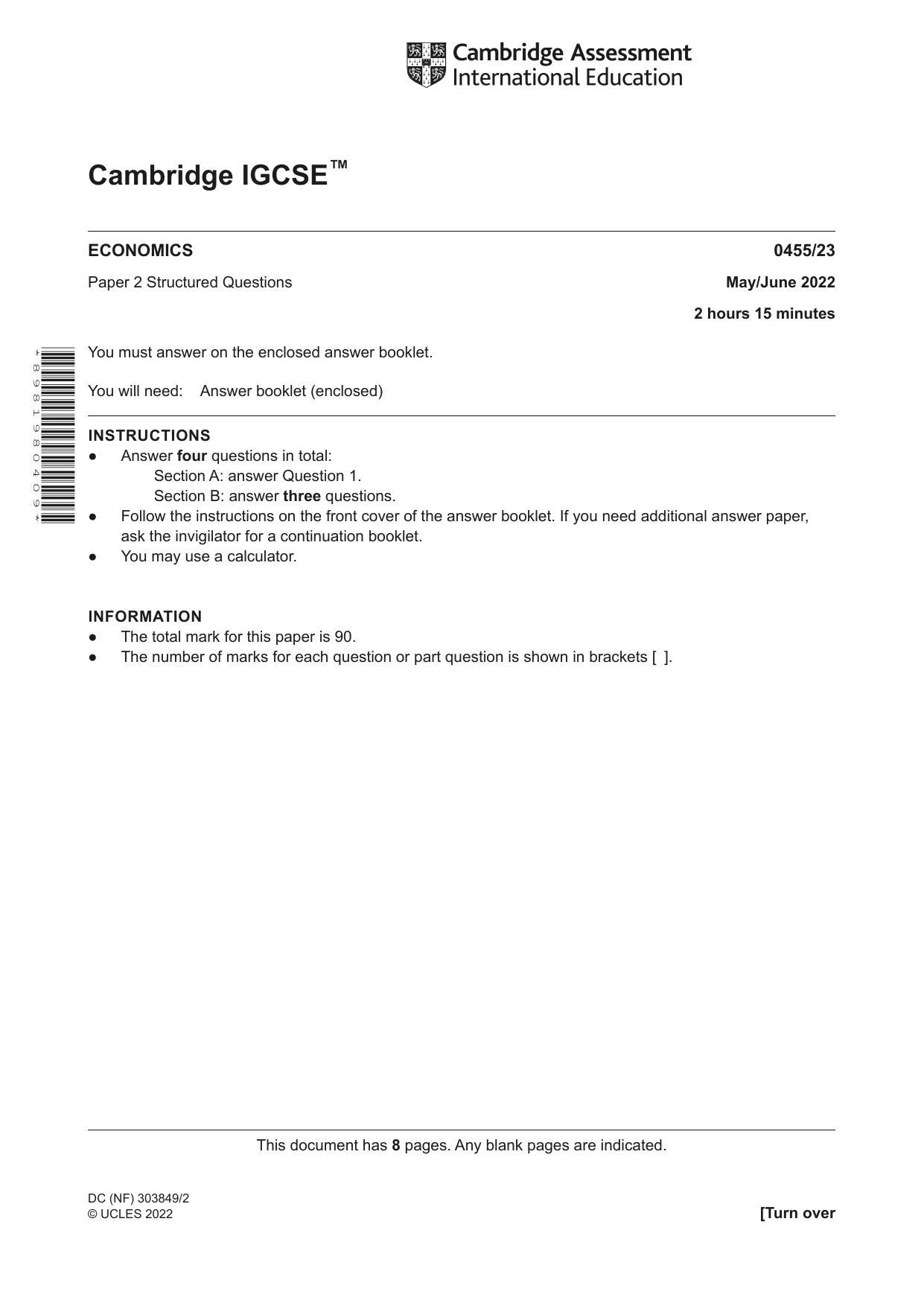




Mark scheme31 pages
Answers below. Sit the paper first if you are practising.
Questions as text
Q1 · Calculate Europe’s percentage contribution to the global total eSports revenue in 2019
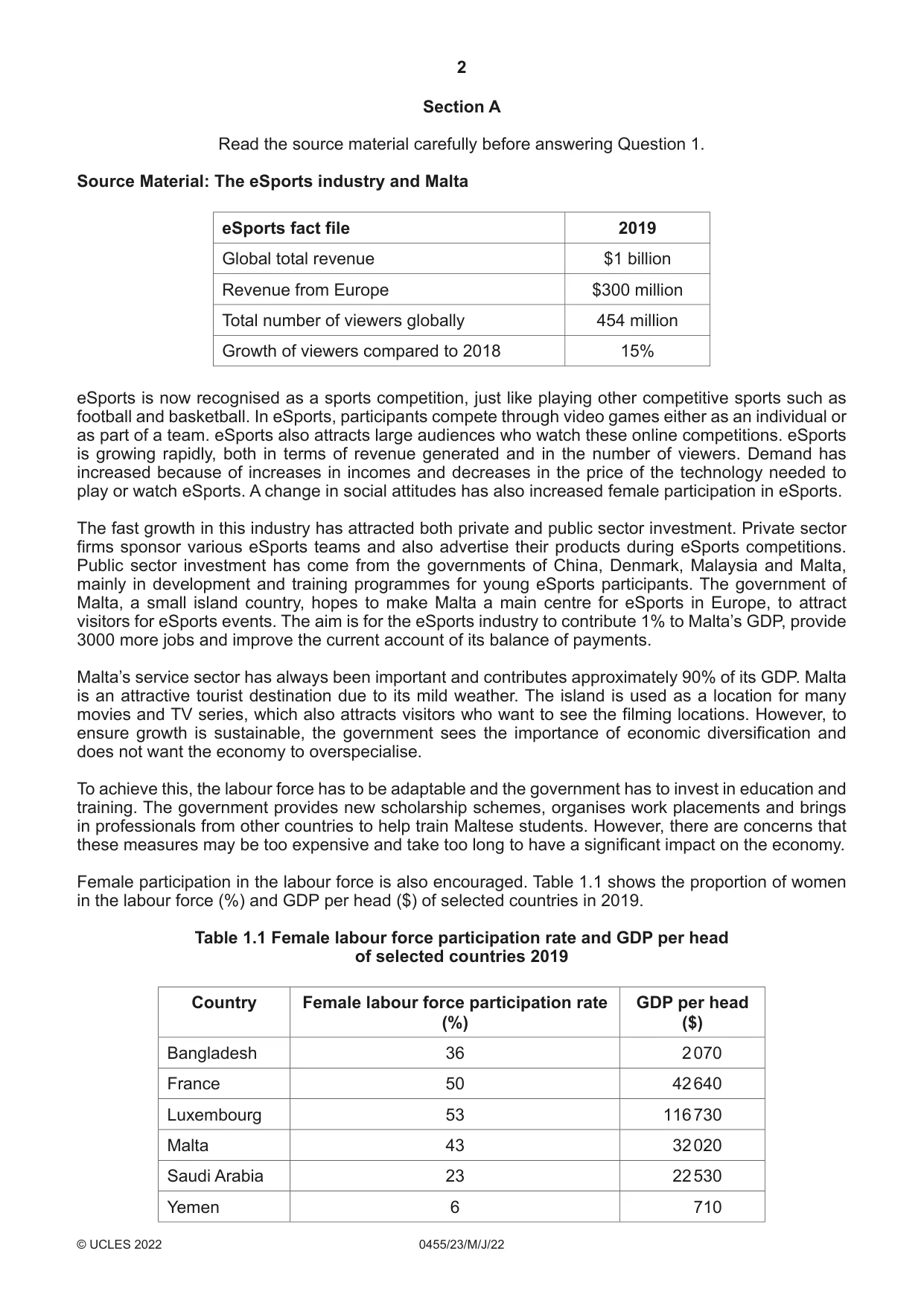
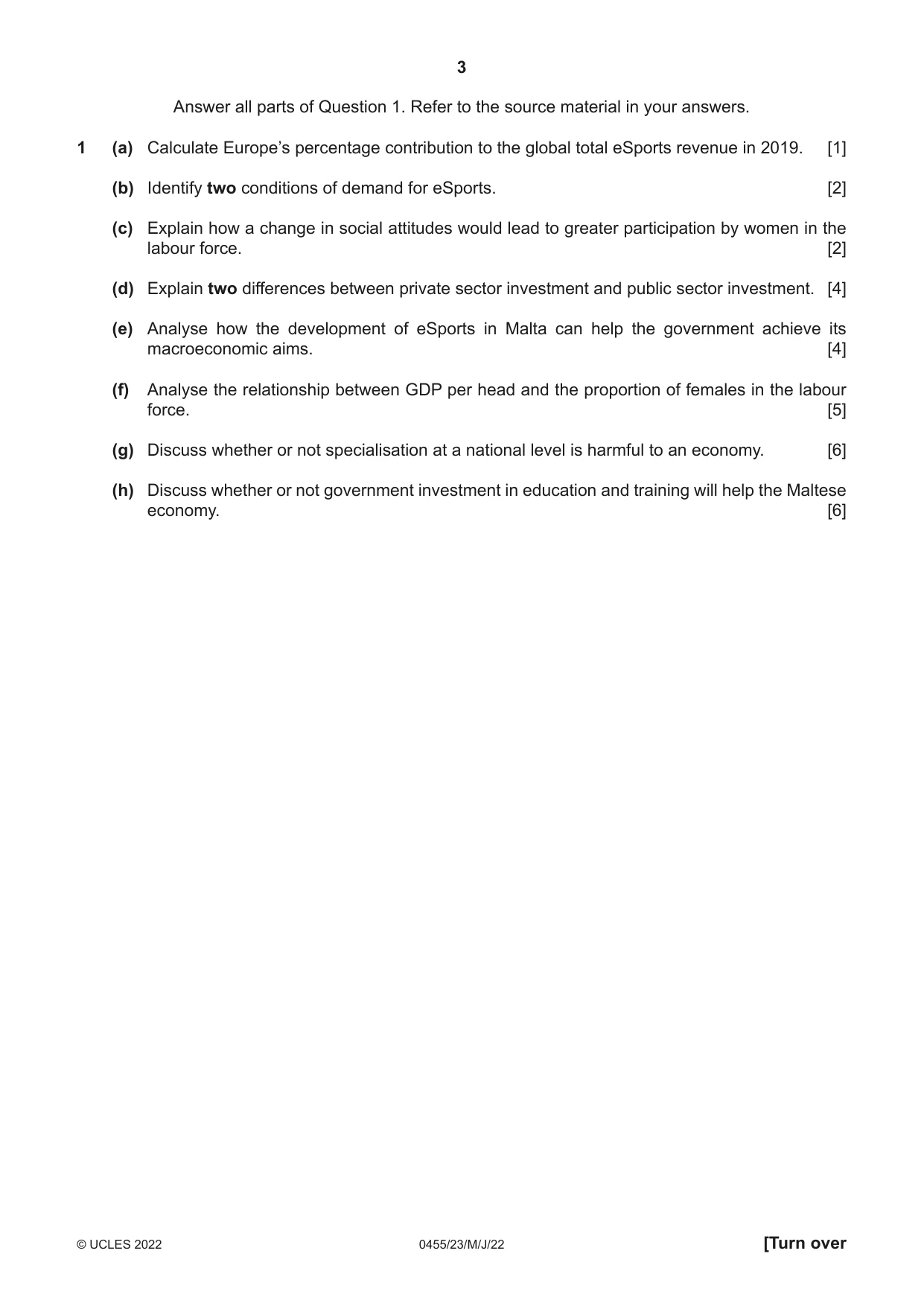
1 (a) Calculate Europe’s percentage contribution to the global total eSports revenue in 2019. [1] (b) Identify two conditions of demand for eSports. [2] (c) Explain how a change in social attitudes would lead to greater participation by women in the labour force. [2] (d) Explain two differences between private sector investment and public sector investment. [4] (e) Analyse how the development of eSports in Malta can help the government achieve its macroeconomic aims. [4] (f) Analyse the relationship between GDP per head and the proportion of females in the labour force. [5] (g) Discuss whether or not specialisation at a national level is harmful to an economy. [6] (h) Discuss whether or not government investment in education and training will help the Maltese economy. [6]
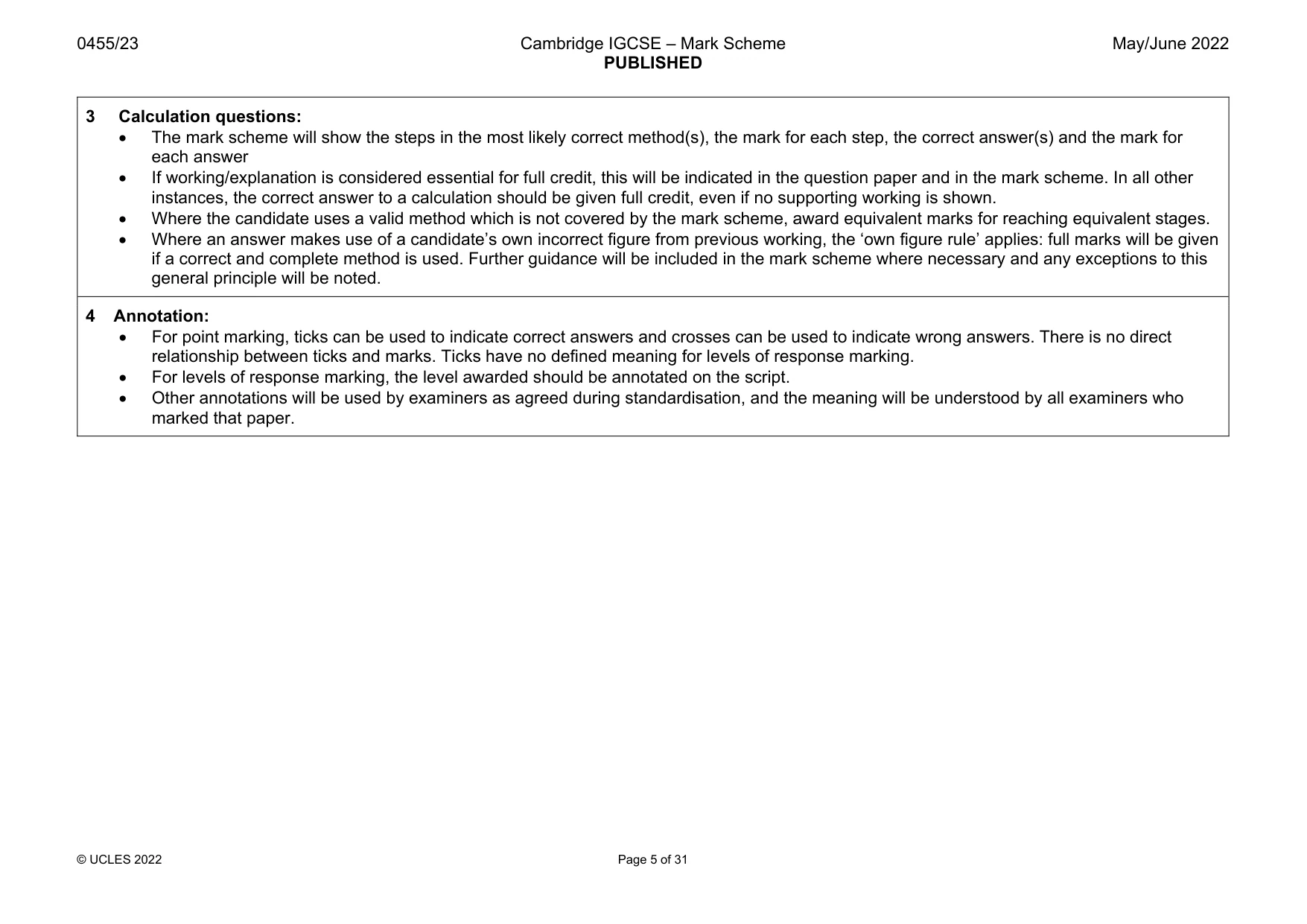
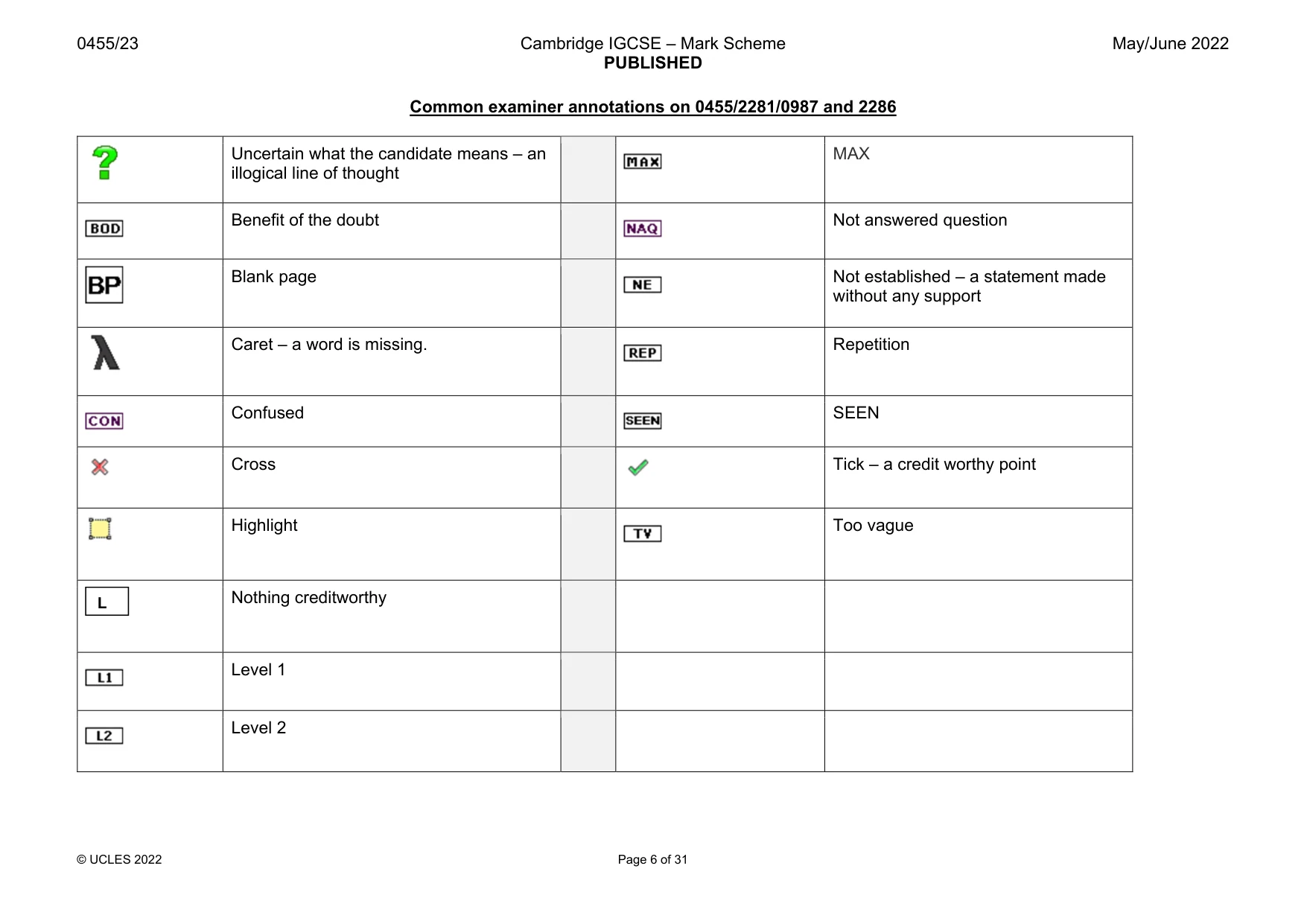
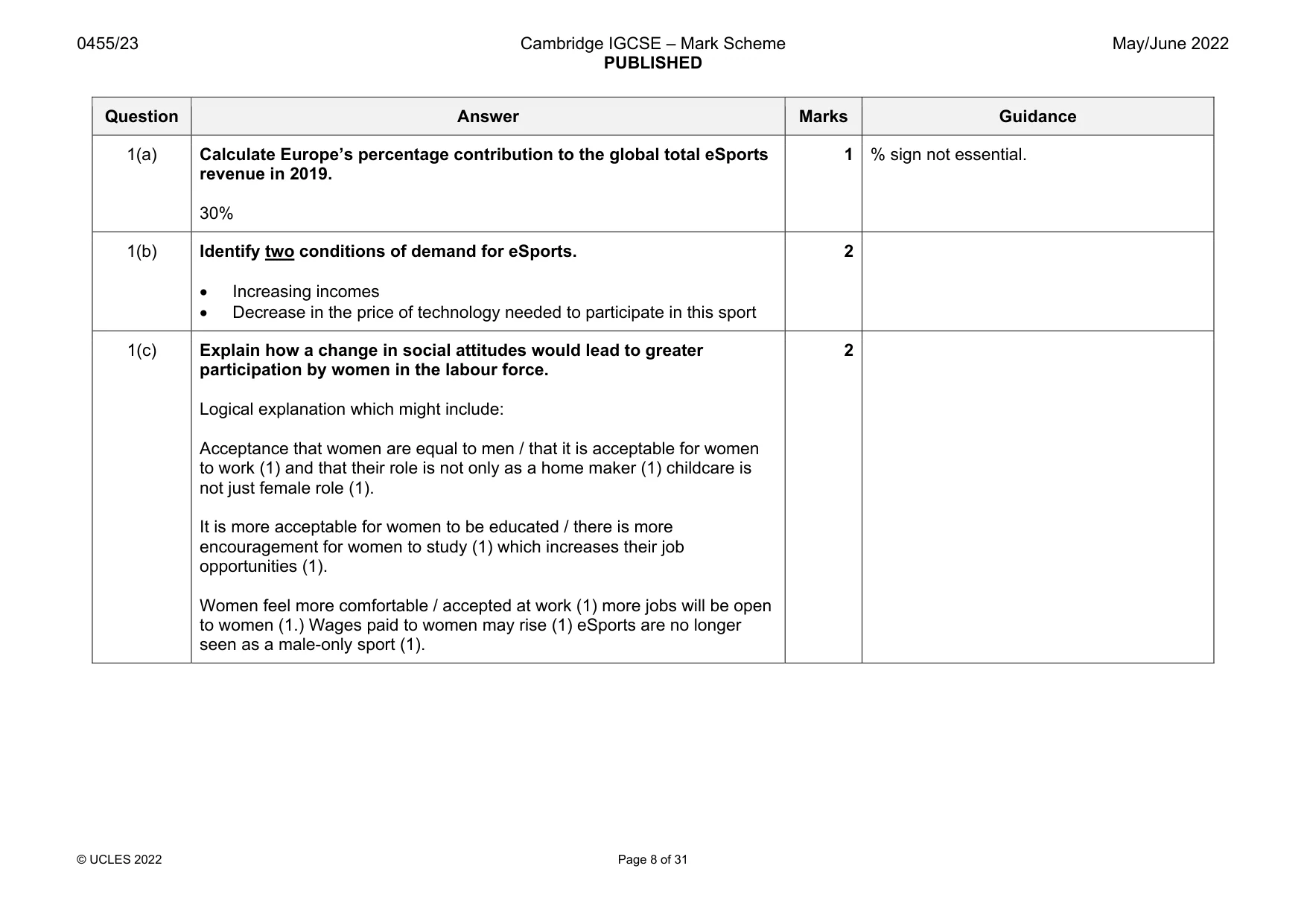
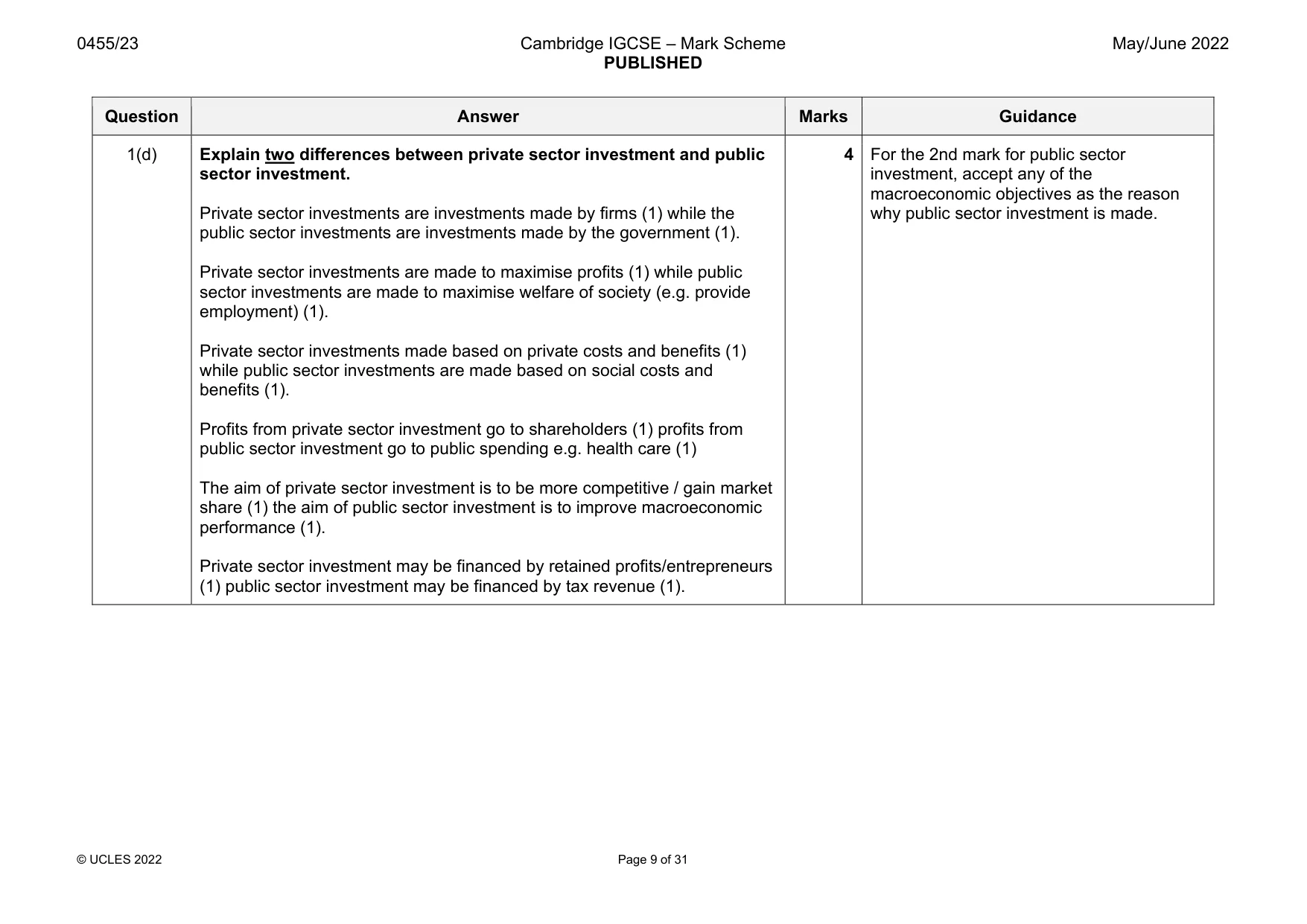
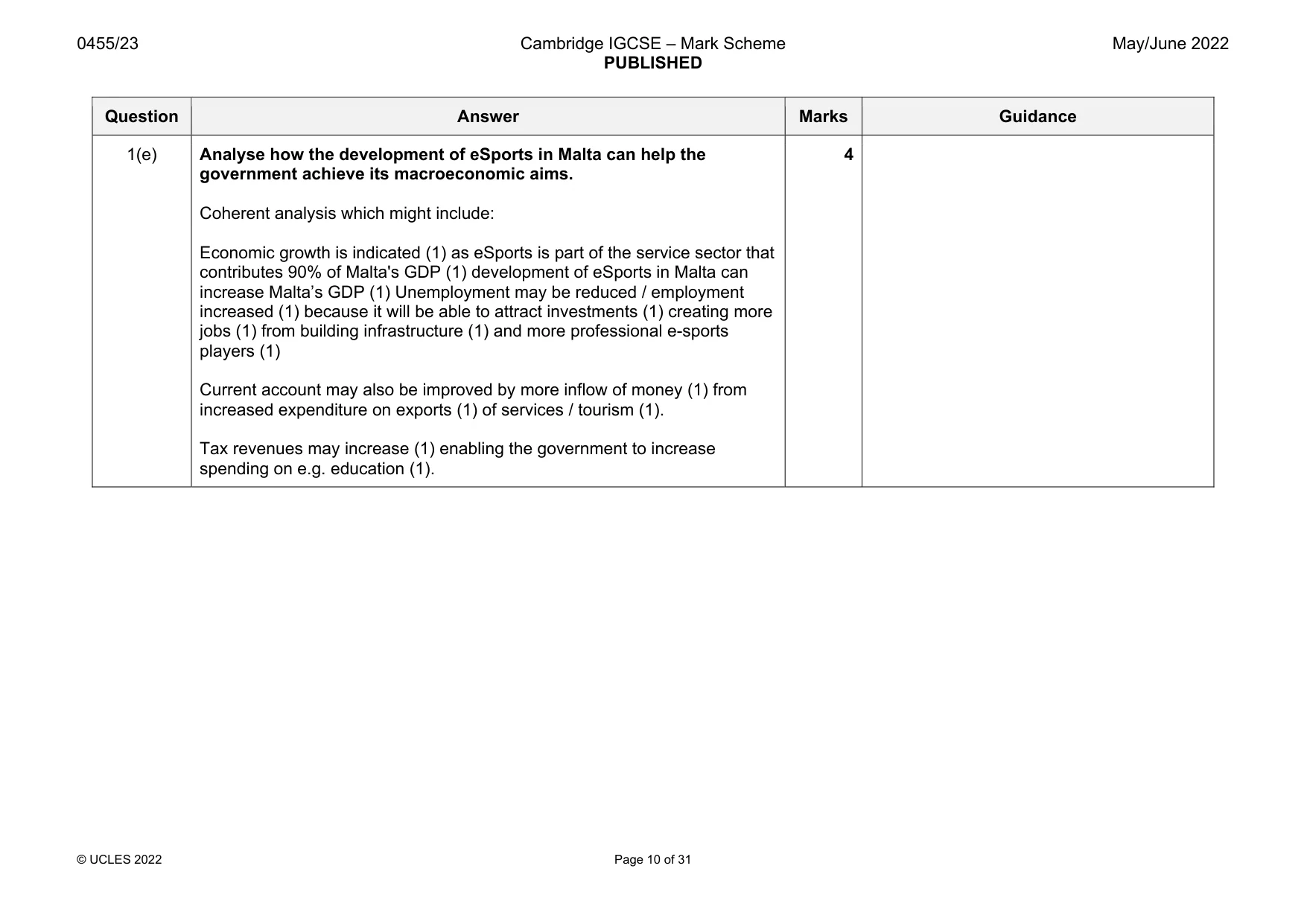
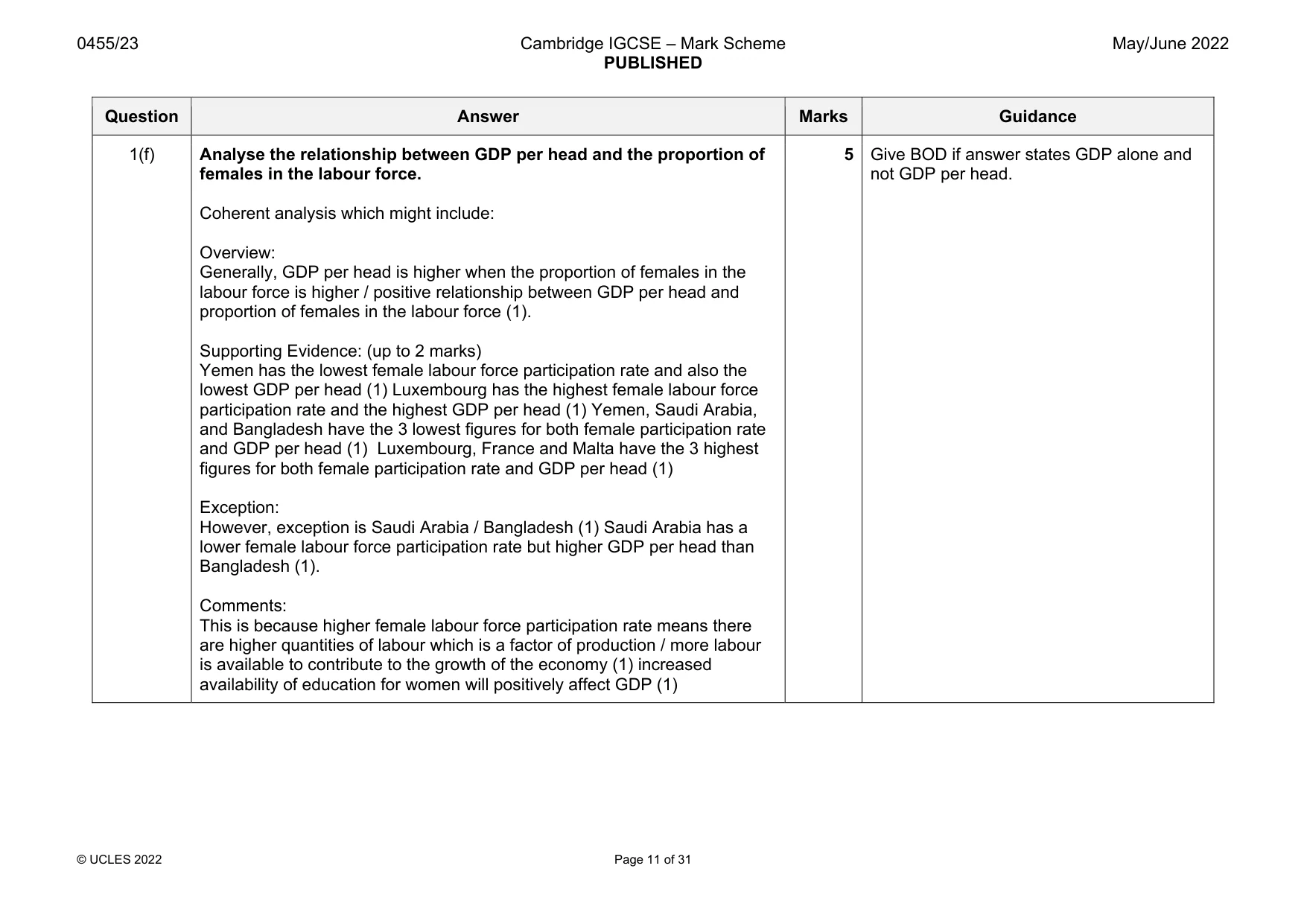
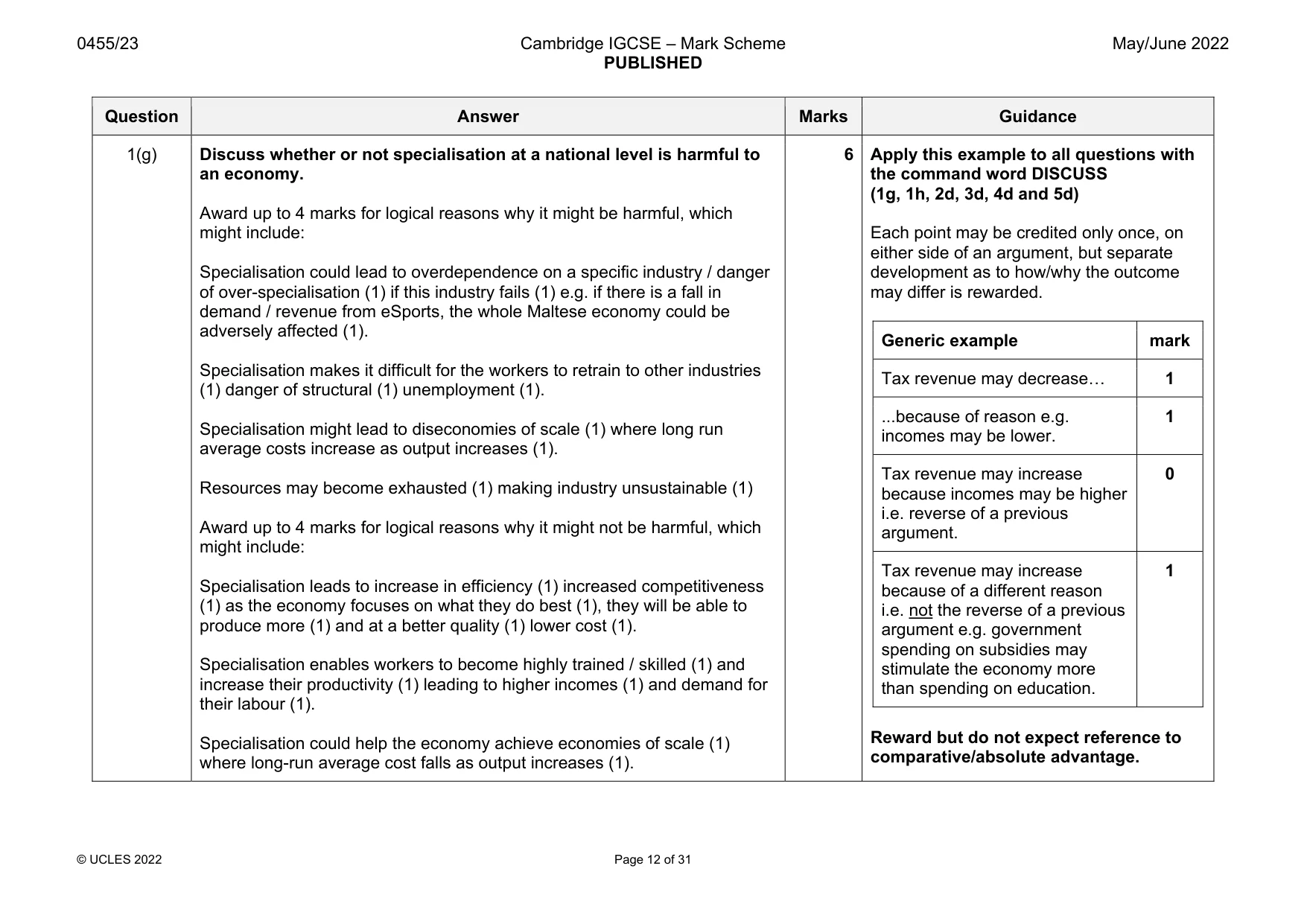
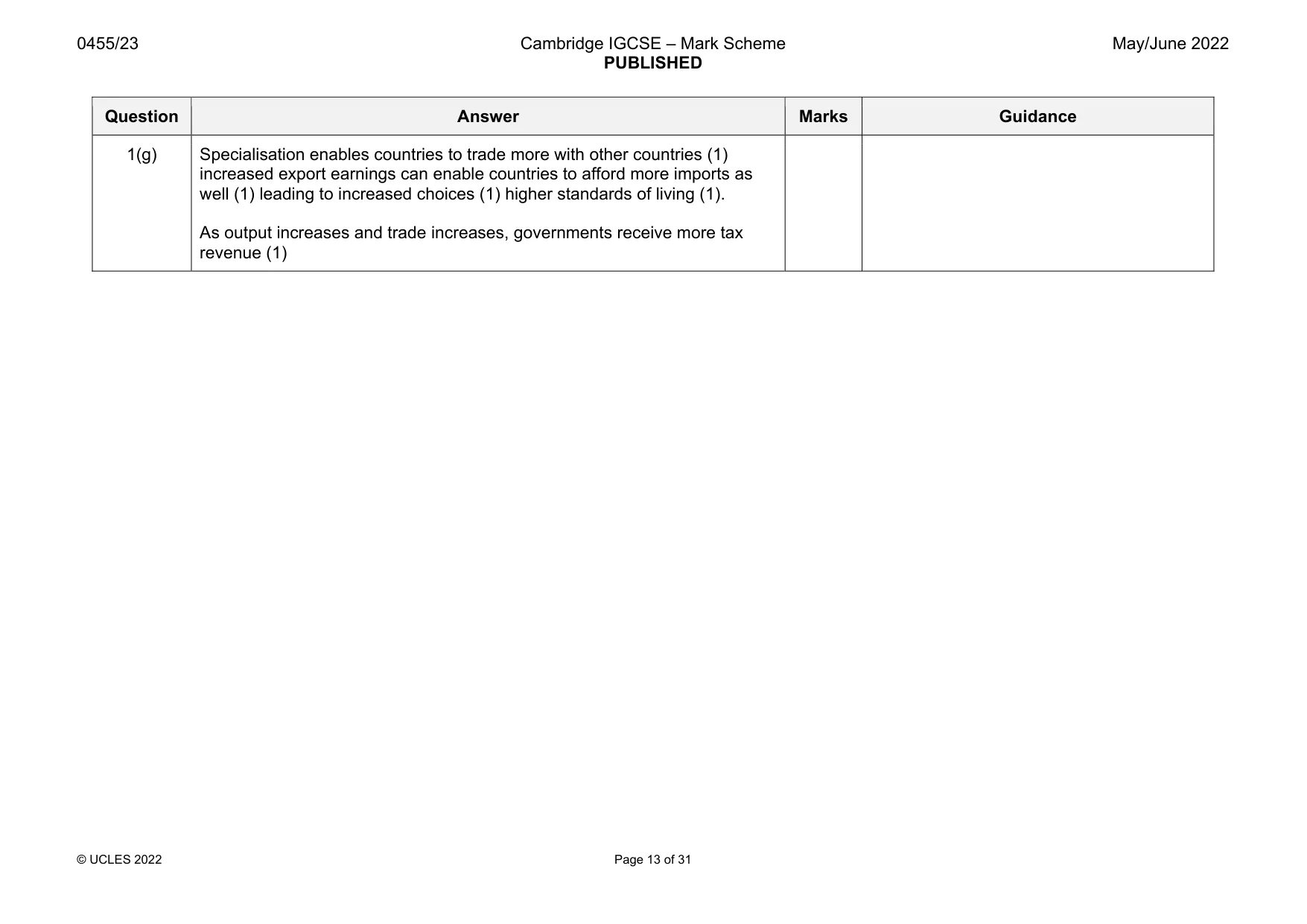
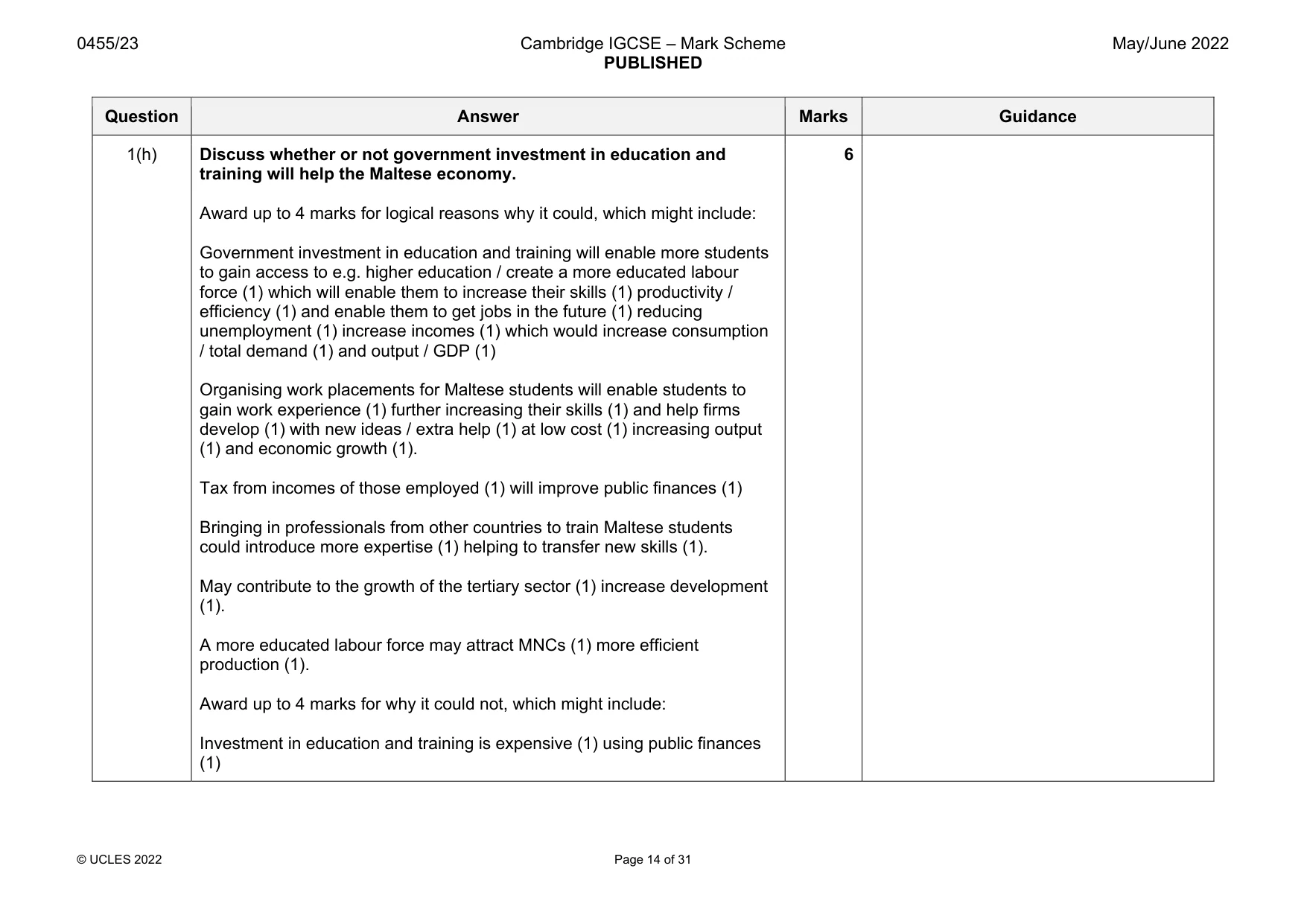
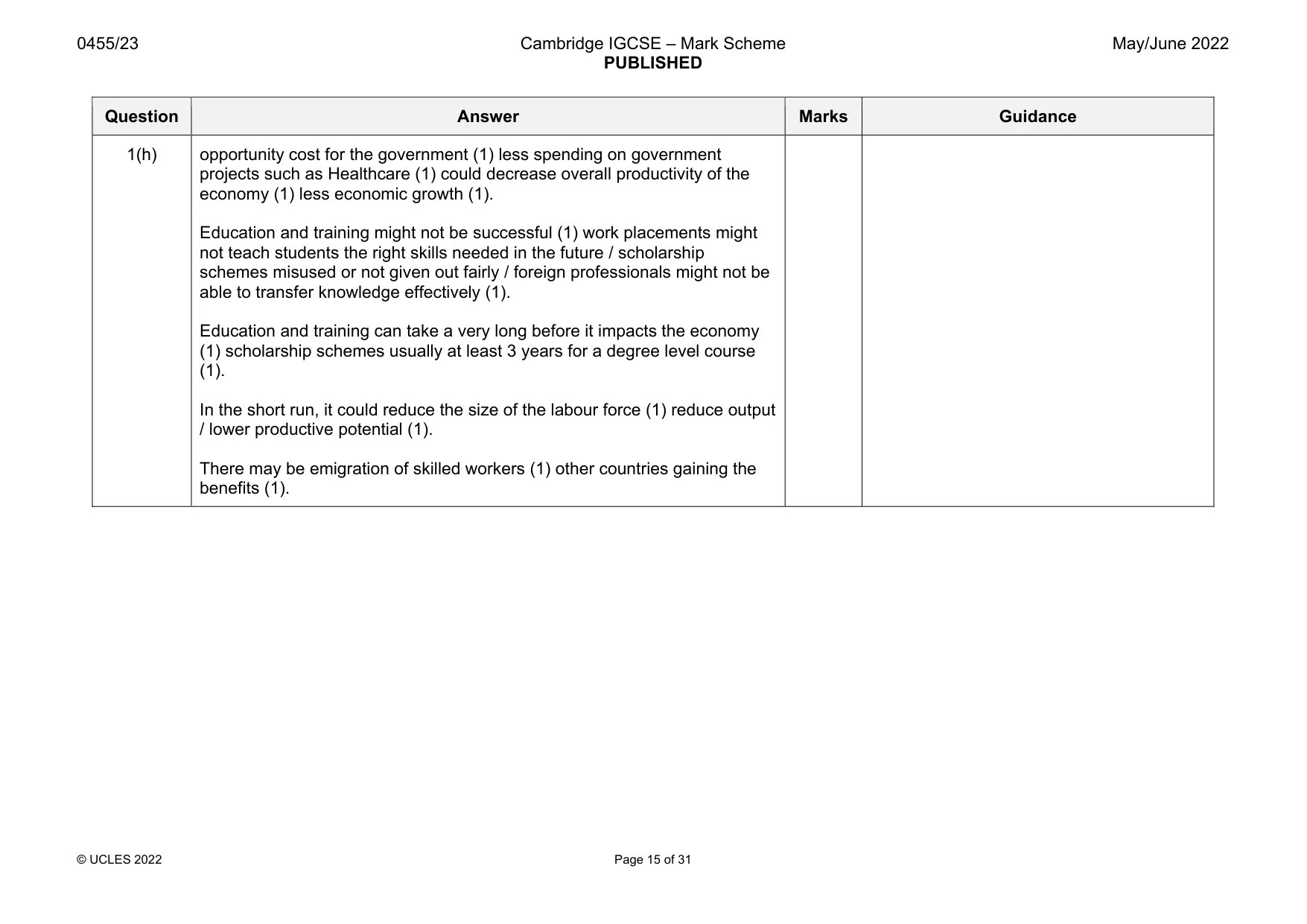
Mark scheme: 1(a) Calculate Europe’s percentage contribution to the global total eSports revenue in 2019. 30% 1(b) Identify two conditions of demand for eSports. Increasing incomes Decrease in the price of technology needed to participate in this sport 2 1(c) Explain how a change in social attitudes would lead to greater participation by women in the labour force. Logical explanation which might include: Acceptance that women are equal to men / that it is acceptable for women to work (1) and that their role is not only as a home maker (1) childcare is not just female role (1). It is more acceptable for women to be educated / there is more encouragement for women to study (1) which increases their job opportunities (1). Women feel more comfortable / accepted at work (1) more jobs will be open to women (1.) Wages paid to women may rise (1) eSports are no longer seen as a male-only sport (1). 2 Question Answer Marks Guidance 1(d) Explain two differences between private sector investment and public sector investment. Private sector investments are investments made by firms (1) while the public sector investments are investments made by the government (1). Private sector investments are made to maximise profits (1) while public sector investments are made to maximise welfare of society (e.g. provide employment) (1). Private sector investments made based on private costs and benefits (1) while public sector investments are made based on social costs and benefits (1). Profits from private sector investment go to shareholders (1) profits from public sector investment go to public spending e.g. health care (1) The aim of private sector investment is to be more competitive / gain market share (1) the aim of public sector investment is to improve macroeconomic performance (1). Private sector investment may be financed by retained profits/entrepreneurs (1) public sector investment may be financed by tax revenue (1). 4 For the 2nd mark for public sector investment, accept any of the macroeconomic objectives as the reason why public sector investment is made. Question Answer Marks Guidance 1(e) Analyse how the development of eSports in Malta can help the government achieve its macroeconomic aims. Coherent analysis which might include: Economic growth is indicated (1) as eSports is part of the service sector that contributes 90% of Malta's GDP (1) development of eSports in Malta can increase Malta’s GDP (1) Unemployment may be reduced / employment increased (1) because it will be able to attract investments (1) creating more jobs (1) from building infrastructure (1) and more professional e-sports players (1) Current account may also be improved by more inflow of money (1) from increased expenditure on exports (1) of services / tourism (1). Tax revenues may increase (1) enabling the government to increase spending on e.g. education (1). 4 Question Answer Marks Guidance 1(f) Analyse the relationship between GDP per head and the proportion of females in the labour force. Coherent analysis which might include: Overview: Generally, GDP per head is higher when the proportion of females in the labour force is higher / positive relationship between GDP per head and proportion of females in the labour force (1). Supporting Evidence: (up to 2 marks) Yemen has the lowest female labour force participation rate and also the lowest GDP per head (1) Luxembourg has the highest female labour force participation rate and the highest GDP per head (1) Yemen, Saudi Arabia, and Bangladesh have the 3 lowest figures for both female participation rate and GDP per head (1) Luxembourg, France and Malta have the 3 highest figures for both female participation rate and GDP per head (1) Exception: However, exception is Saudi Arabia / Bangladesh (1) Saudi Arabia has a lower female labour force participation rate but higher GDP per head than Bangladesh (1). Comments: This is because higher female labour force participation rate means there are higher quantities of labour which is a factor of production / more labour is available to contribute to the growth of the economy (1) increased availability of education for women will positively affect GDP (1) 5 Give BOD if answer states GDP alone and not GDP per head. Question Answer Marks Guidance 1(g) Discuss whether or not specialisation at a national level is harmful to an economy. Award up to 4 marks for logical reasons why it might be harmful, which might include: Specialisation could lead to overdependence on a specific industry / danger of over-specialisation (1) if this industry fails (1) e.g. if there is a fall in demand / revenue from eSports, the whole Maltese economy could be adversely affected (1). Specialisation makes it difficult for the workers to retrain to other industries (1) danger of structural (1) unemployment (1). Specialisation might lead to diseconomies of scale (1) where long run average costs increase as output increases (1). Resources may become exhausted (1) making industry unsustainable (1) Award up to 4 marks for logical reasons why it might not be harmful, which might include: Specialisation leads to increase in efficiency (1) increased competitiveness (1) as the economy focuses on what they do best (1), they will be able to produce more (1) and at a better quality (1) lower cost (1). Specialisation enables workers to become highly trained / skilled (1) and increase their productivity (1) leading to higher incomes (1) and demand for their labour (1). Specialisation could help the economy achieve economies of scale (1) where long-run average cost falls as output increases (1). 6 Apply this example to all questions with the command word DISCUSS (1g, 1h, 2d, 3d, 4d and 5d) Each point may be credited only once, on either side of an argument, but separate development as to how/why the outcome may differ is rewarded. Generic example mark Tax revenue may decrease… 1 ...because of reason e.g. incomes may be lower. 1 Tax revenue may increase because incomes may be higher i.e. reverse of a previous argument. 0 Tax revenue may increase because of a different reason i.e. not the reverse of a previous argument e.g. government spending on subsidies may stimulate the economy more than spending on education. 1 Reward but do not expect reference to comparative/absolute advantage. Question Answer Marks Guidance 1(g) Specialisation enables countries to trade more with other countries (1) increased export earnings can enable countries to afford more imports as well (1) leading to increased choices (1) higher standards of living (1). As output increases and trade increases, governments receive more tax revenue (1) Question Answer Marks Guidance 1(h) Discuss whether or not government investment in education and training will help the Maltese economy. Award up to 4 marks for logical reasons why it could, which might include: Government investment in education and training will enable more students to gain access to e.g. higher education / create a more educated labour force (1) which will enable them to increase their skills (1) productivity / efficiency (1) and enable them to get jobs in the future (1) reducing unemployment (1) increase incomes (1) which would increase consumption / total demand (1) and output / GDP (1) Organising work placements for Maltese students will enable students to gain work experience (1) further increasing their skills (1) and help firms develop (1) with new ideas / extra help (1) at low cost (1) increasing output (1) and economic growth (1). Tax from incomes of those employed (1) will improve public finances (1) Bringing in professionals from other countries to train Maltese students could introduce more expertise (1) helping to transfer new skills (1). May contribute to the growth of the tertiary sector (1) increase development (1). A more educated labour force may attract MNCs (1) more efficient production (1). Award up to 4 marks for why it could not, which might include: Investment in education and training is expensive (1) using public finances (1) 6 Question Answer Marks Guidance 1(h) opportunity cost for the government (1) less spending on government projects such as Healthcare (1) could decrease overall productivity of the economy (1) less economic growth (1). Education and training might not be successful (1) work placements might not teach students the right skills needed in the future / scholarship schemes misused or not given out fairly / foreign professionals might not be able to transfer knowledge effectively (1). Education and training can take a very long before it impacts the economy (1) scholarship schemes usually at least 3 years for a degree level course (1). In the short run, it could reduce the size of the labour force (1) reduce output / lower productive potential (1). There may be emigration of skilled workers (1) other countries gaining the benefits (1).
Q2 · Voralberg, a region in Austria, has the highest income and best healthcare of any region…
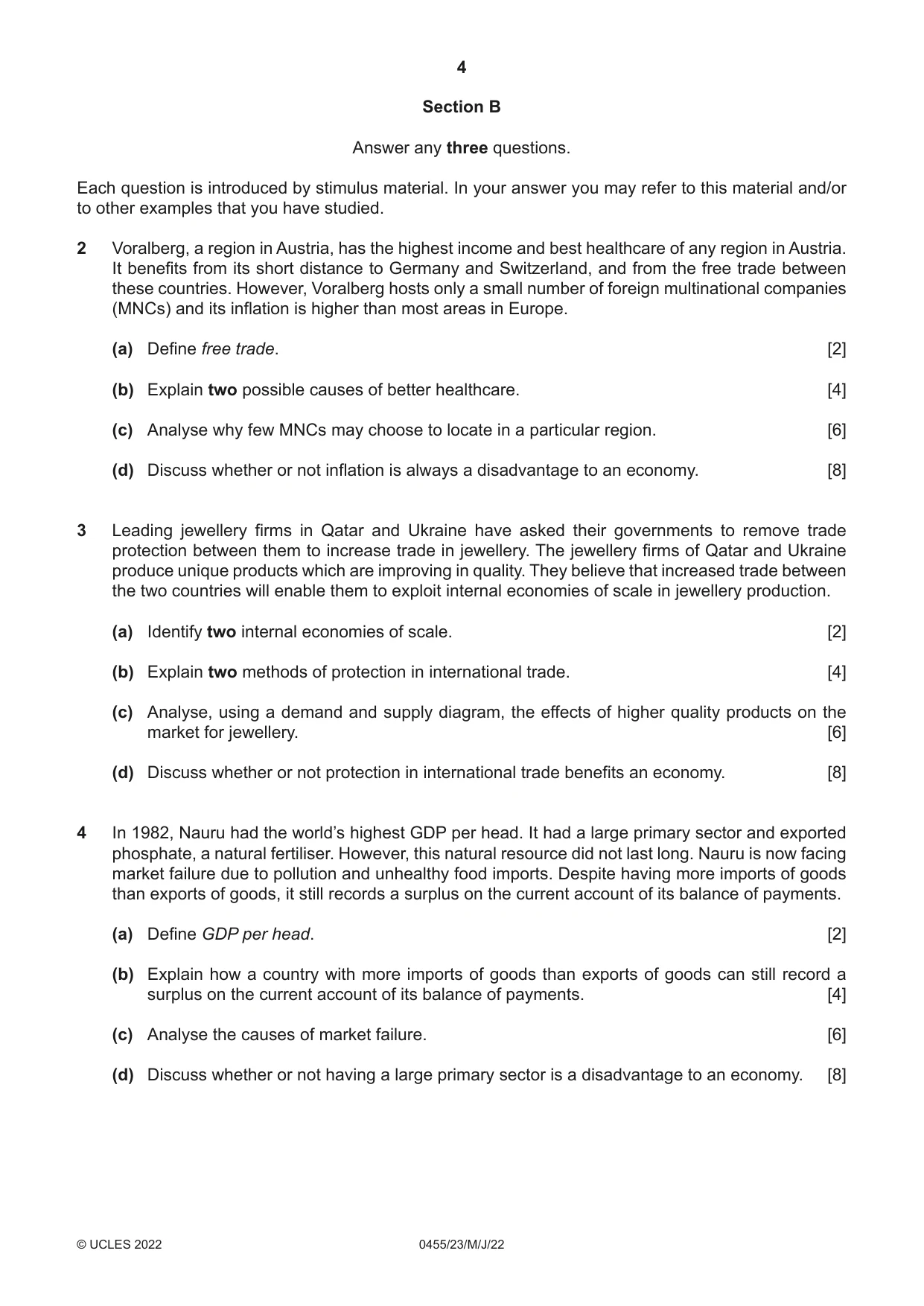
2 Voralberg, a region in Austria, has the highest income and best healthcare of any region in Austria. It benefits from its short distance to Germany and Switzerland, and from the free trade between these countries. However, Voralberg hosts only a small number of foreign multinational companies (MNCs) and its inflation is higher than most areas in Europe. (a) Define free trade. [2] (b) Explain two possible causes of better healthcare. [4] (c) Analyse why few MNCs may choose to locate in a particular region. [6] (d) Discuss whether or not inflation is always a disadvantage to an economy. [8]
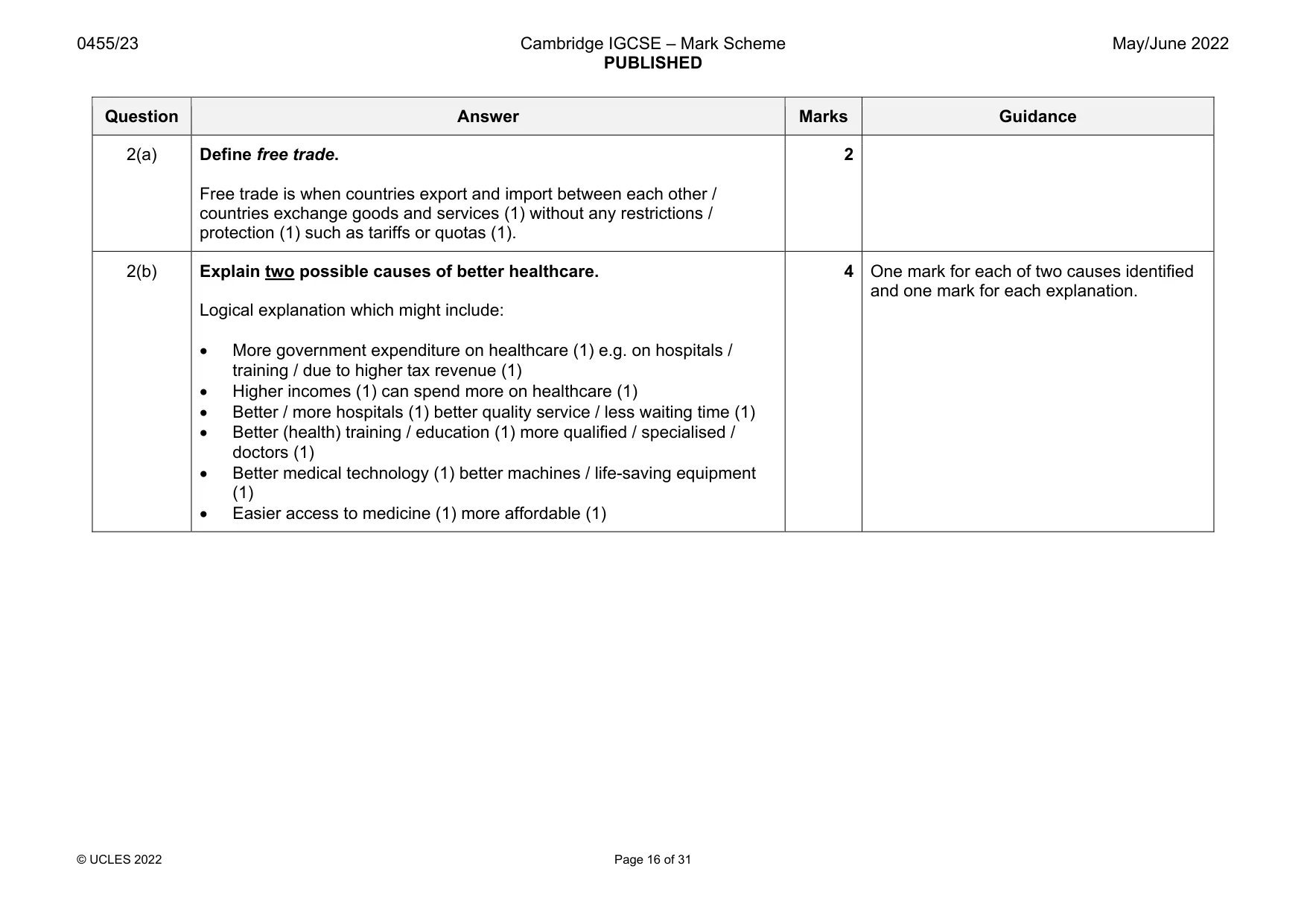
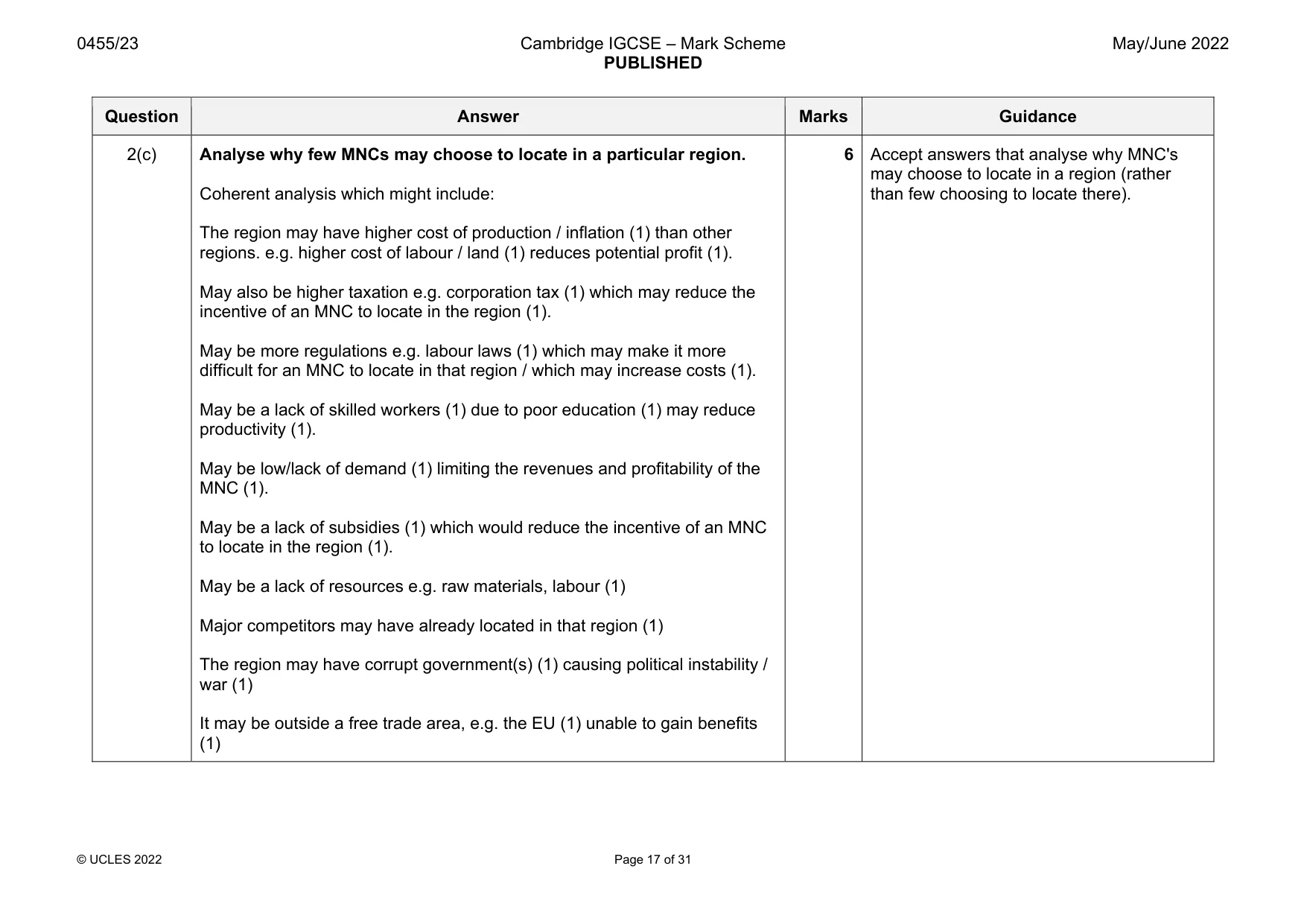
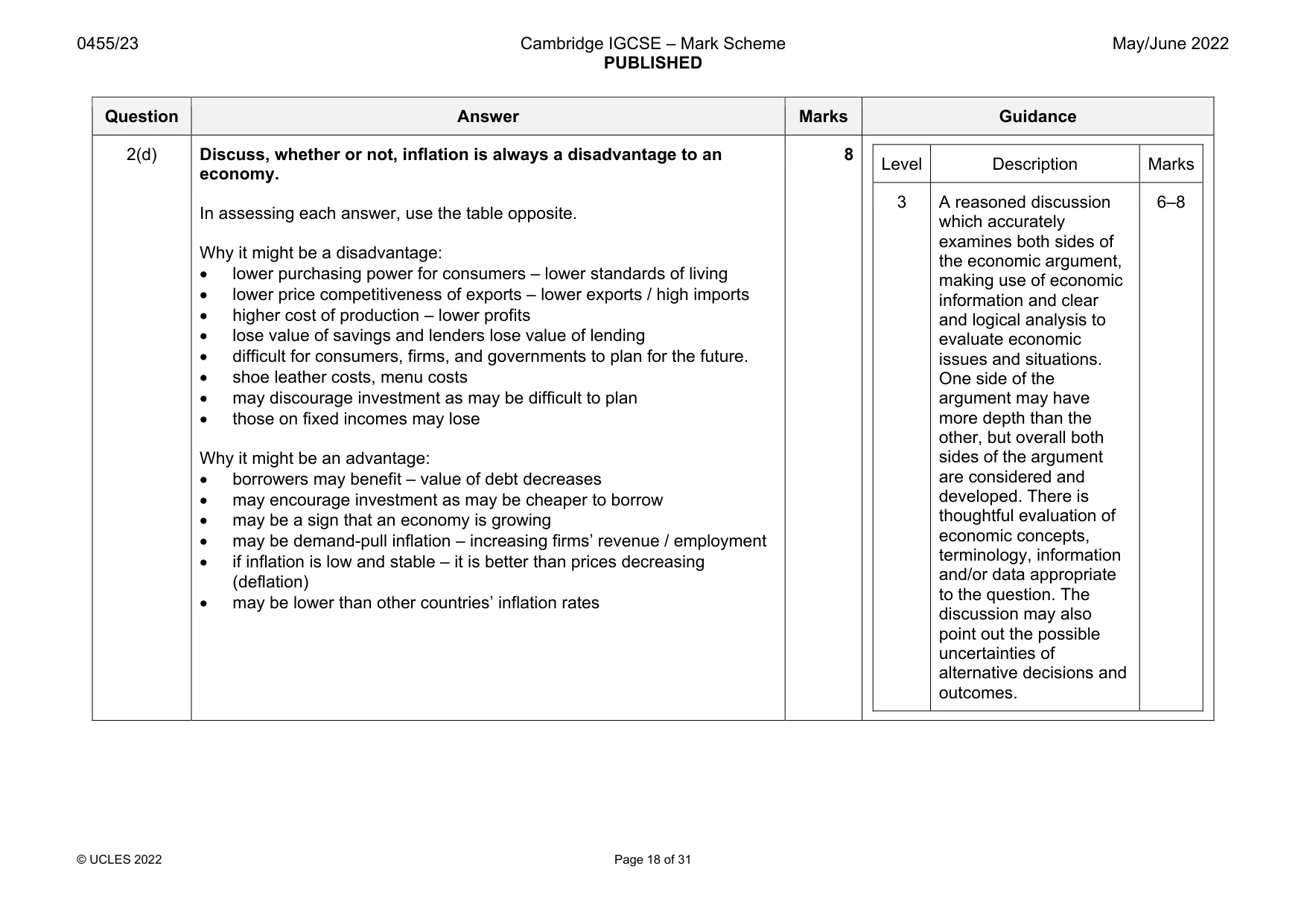
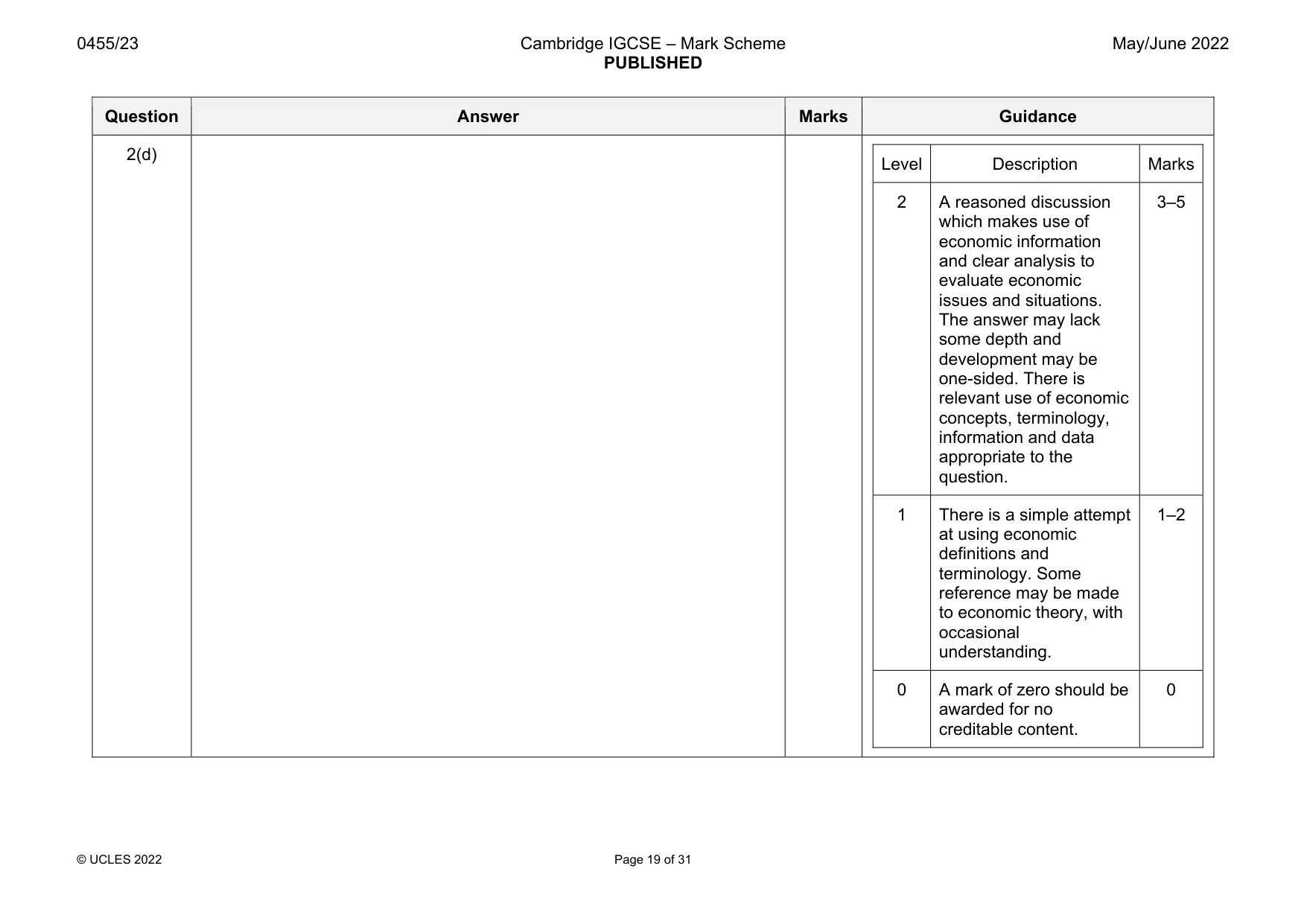
Mark scheme: 2(a) Define free trade. Free trade is when countries export and import between each other / countries exchange goods and services (1) without any restrictions / protection (1) such as tariffs or quotas (1). 2(b) Explain two possible causes of better healthcare. Logical explanation which might include: More government expenditure on healthcare (1) e.g. on hospitals / training / due to higher tax revenue (1) Higher incomes (1) can spend more on healthcare (1) Better / more hospitals (1) better quality service / less waiting time (1) Better (health) training / education (1) more qualified / specialised / doctors (1) Better medical technology (1) better machines / life-saving equipment (1) Easier access to medicine (1) more affordable (1) 4 One mark for each of two causes identified and one mark for each explanation. Question Answer Marks Guidance 2(c) Analyse why few MNCs may choose to locate in a particular region. Coherent analysis which might include: The region may have higher cost of production / inflation (1) than other regions. e.g. higher cost of labour / land (1) reduces potential profit (1). May also be higher taxation e.g. corporation tax (1) which may reduce the incentive of an MNC to locate in the region (1). May be more regulations e.g. labour laws (1) which may make it more difficult for an MNC to locate in that region / which may increase costs (1). May be a lack of skilled workers (1) due to poor education (1) may reduce productivity (1). May be low/lack of demand (1) limiting the revenues and profitability of the MNC (1). May be a lack of subsidies (1) which would reduce the incentive of an MNC to locate in the region (1). May be a lack of resources e.g. raw materials, labour (1) Major competitors may have already located in that region (1) The region may have corrupt government(s) (1) causing political instability / war (1) It may be outside a free trade area, e.g. the EU (1) unable to gain benefits (1) 6 Accept answers that analyse why MNC's may choose to locate in a region (rather than few choosing to locate there). Question Answer Marks Guidance 2(d) Discuss, whether or not, inflation is always a disadvantage to an economy. In assessing each answer, use the table opposite. Why it might be a disadvantage: lower purchasing power for consumers – lower standards of living lower price competitiveness of exports – lower exports / high imports higher cost of production – lower profits lose value of savings and lenders lose value of lending difficult for consumers, firms, and governments to plan for the future. shoe leather costs, menu costs may discourage investment as may be difficult to plan those on fixed incomes may lose Why it might be an advantage: borrowers may benefit – value of debt decreases may encourage investment as may be cheaper to borrow may be a sign that an economy is growing may be demand-pull inflation – increasing firms’ revenue / employment if inflation is low and stable – it is better than prices decreasing (deflation) may be lower than other countries’ inflation rates 8 Level Description Marks 3 A reasoned discussion which accurately examines both sides of the economic argument, making use of economic information and clear and logical analysis to evaluate economic issues and situations. One side of the argument may have more depth than the other, but overall both sides of the argument are considered and developed. There is thoughtful evaluation of economic concepts, terminology, information and/or data appropriate to the question. The discussion may also point out the possible uncertainties of alternative decisions and outcomes. 6–8 Question Answer Marks Guidance 2(d) Level Description Marks 2 A reasoned discussion which makes use of economic information and clear analysis to evaluate economic issues and situations. The answer may lack some depth and development may be one-sided. There is relevant use of economic concepts, terminology, information and data appropriate to the question. 3–5 1 There is a simple attempt at using economic definitions and terminology. Some reference may be made to economic theory, with occasional understanding. 1–2 0 A mark of zero should be awarded for no creditable content. 0
Q3 · Leading jewellery firms in Qatar and Ukraine have asked their governments to remove trade…
3 Leading jewellery firms in Qatar and Ukraine have asked their governments to remove trade protection between them to increase trade in jewellery. The jewellery firms of Qatar and Ukraine produce unique products which are improving in quality. They believe that increased trade between the two countries will enable them to exploit internal economies of scale in jewellery production. (a) Identify two internal economies of scale. [2] (b) Explain two methods of protection in international trade. [4] (c) Analyse, using a demand and supply diagram, the effects of higher quality products on the market for jewellery. [6] (d) Discuss whether or not protection in international trade benefits an economy. [8]
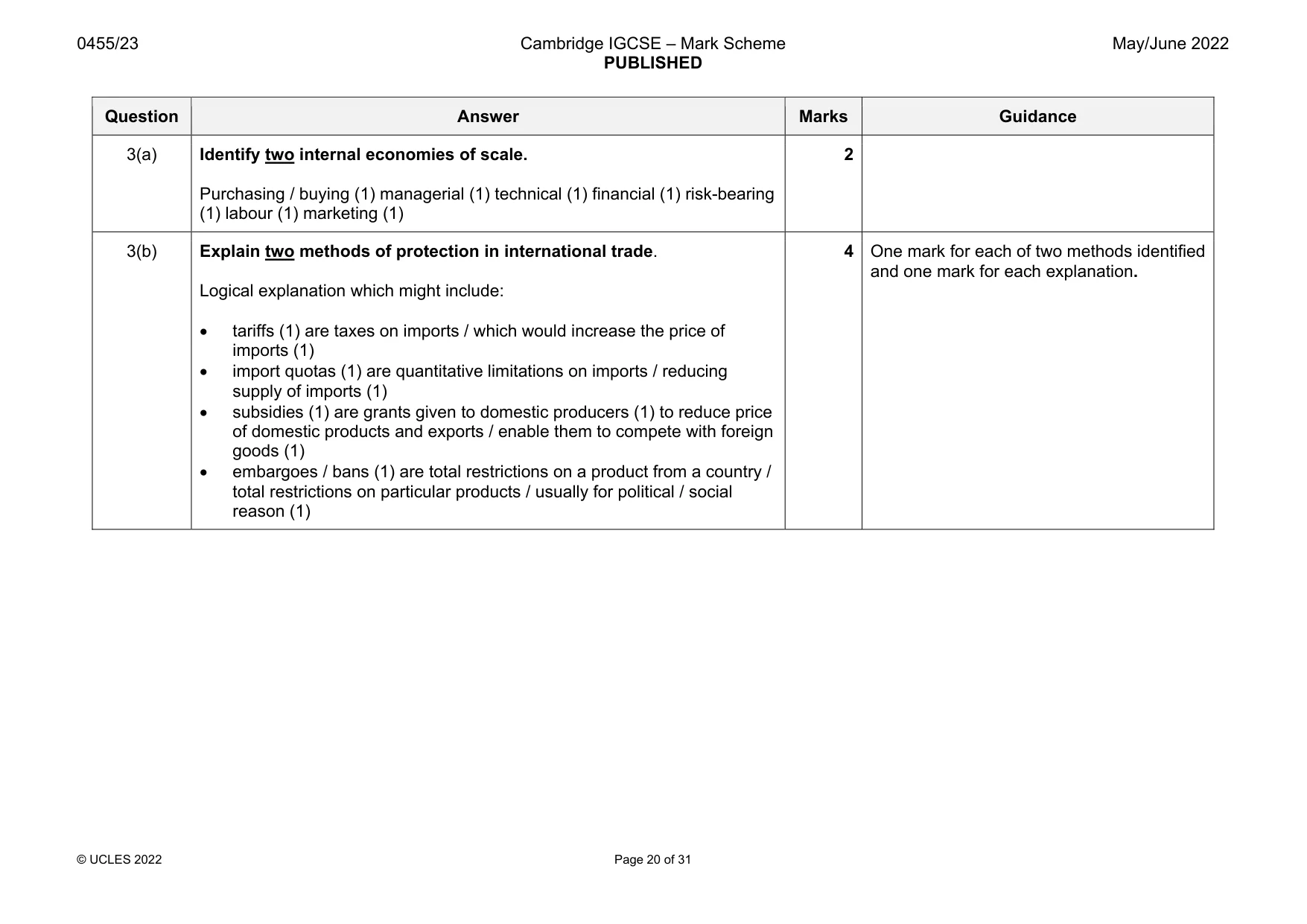
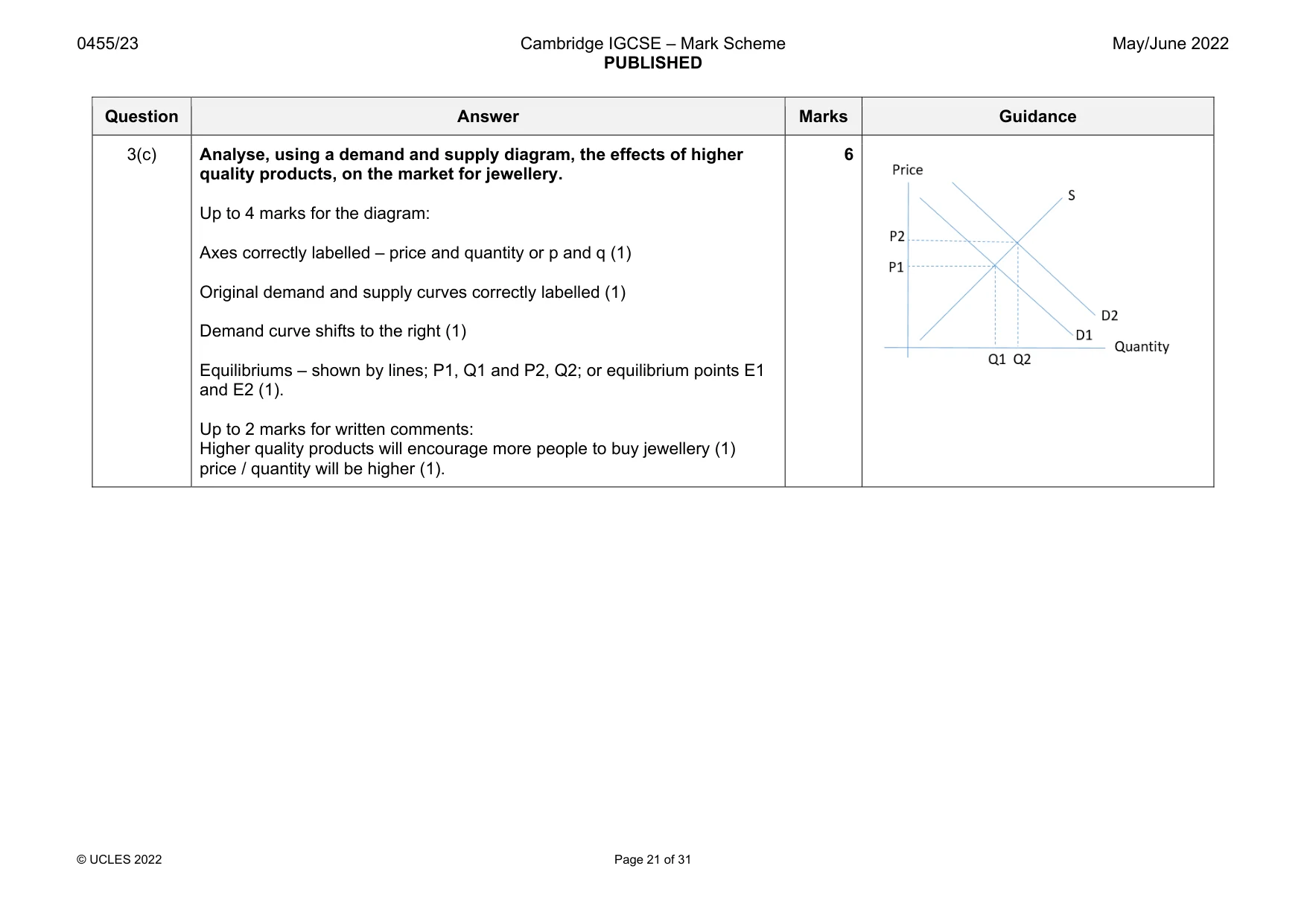
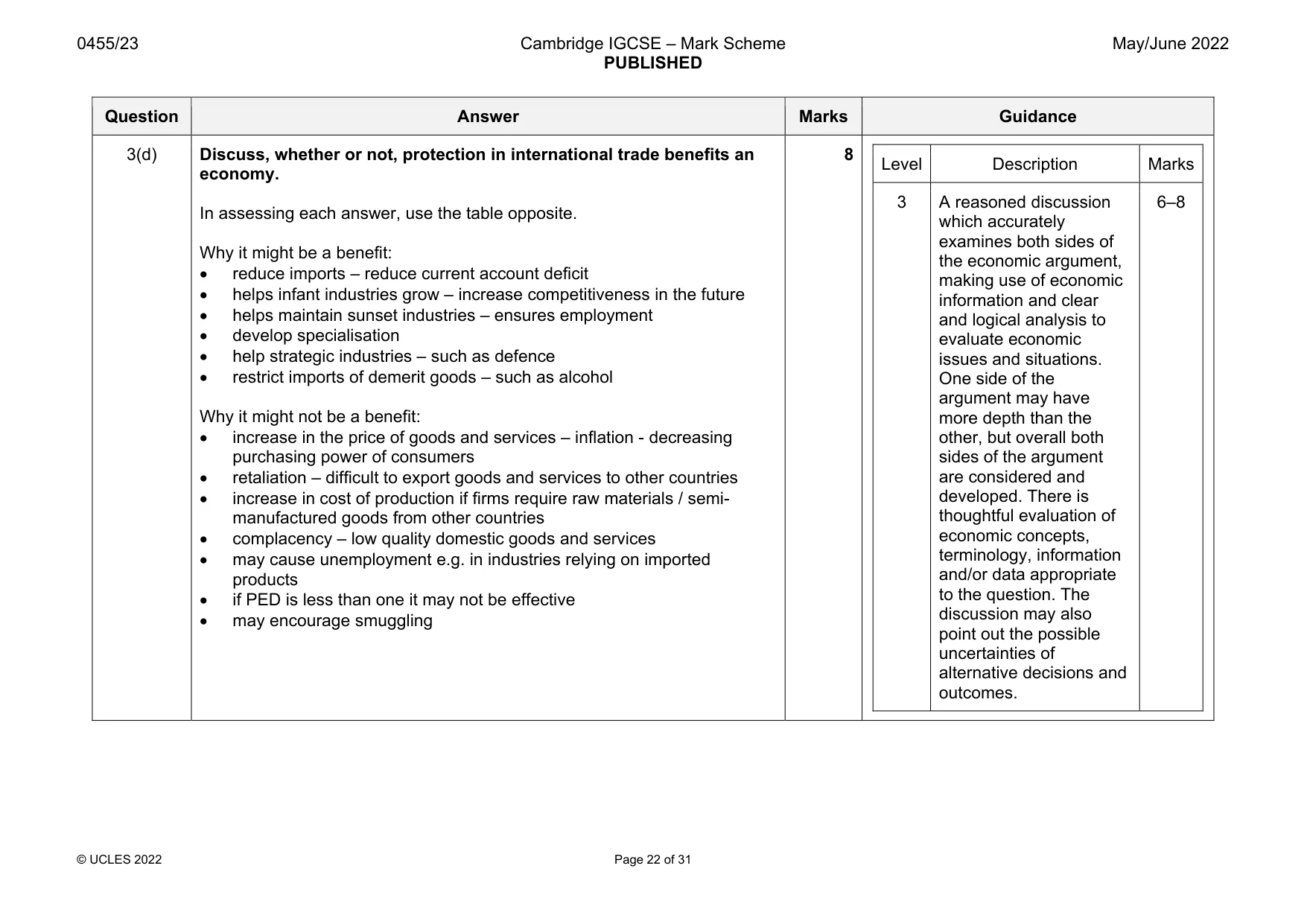
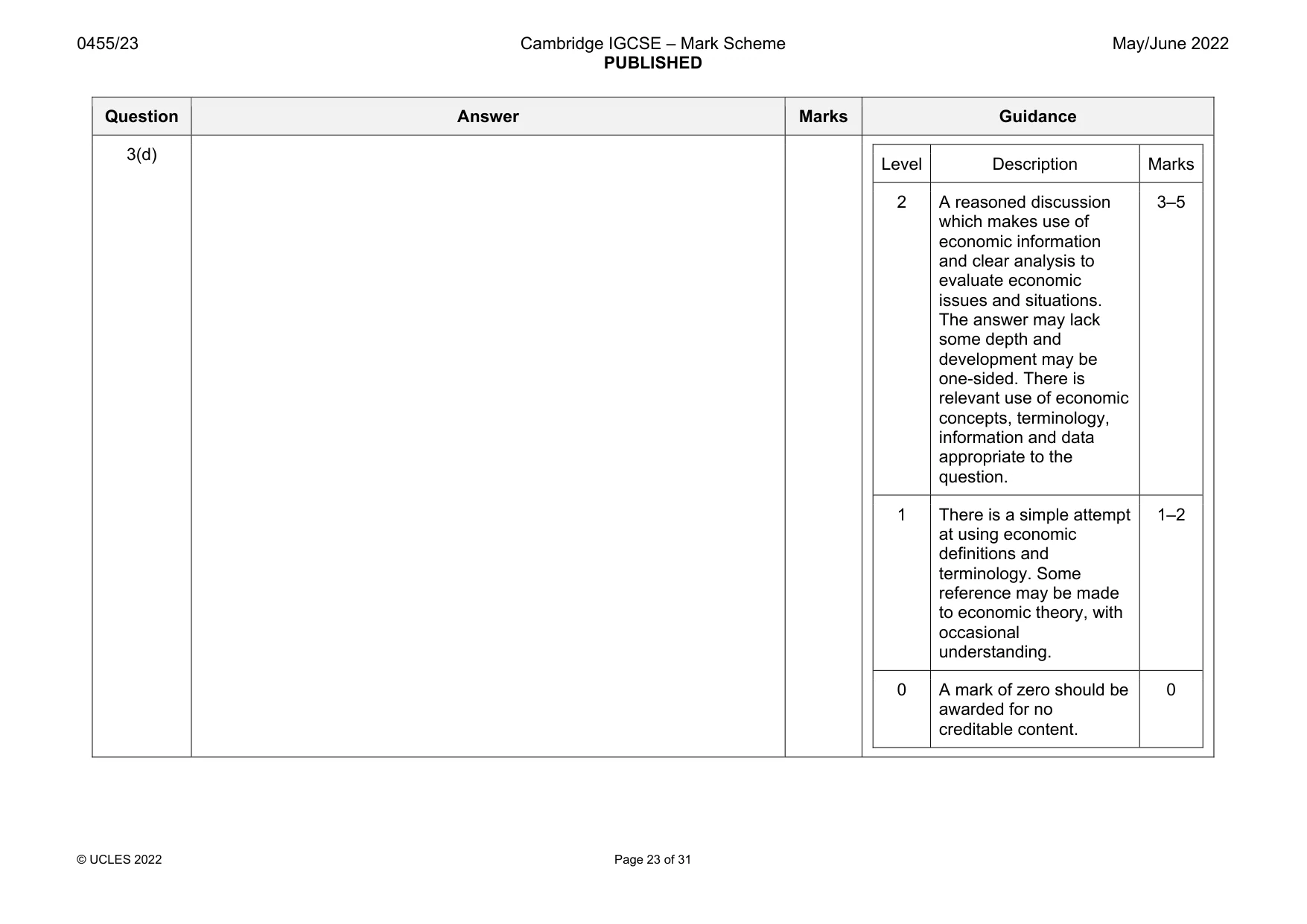
Mark scheme: 3(a) Identify two internal economies of scale. Purchasing / buying (1) managerial (1) technical (1) financial (1) risk-bearing (1) labour (1) marketing (1) 3(b) Explain two methods of protection in international trade. Logical explanation which might include: tariffs (1) are taxes on imports / which would increase the price of imports (1) import quotas (1) are quantitative limitations on imports / reducing supply of imports (1) subsidies (1) are grants given to domestic producers (1) to reduce price of domestic products and exports / enable them to compete with foreign goods (1) embargoes / bans (1) are total restrictions on a product from a country / total restrictions on particular products / usually for political / social reason (1) 4 One mark for each of two methods identified and one mark for each explanation. Question Answer Marks Guidance 3(c) Analyse, using a demand and supply diagram, the effects of higher quality products, on the market for jewellery. Up to 4 marks for the diagram: Axes correctly labelled – price and quantity or p and q (1) Original demand and supply curves correctly labelled (1) Demand curve shifts to the right (1) Equilibriums – shown by lines; P1, Q1 and P2, Q2; or equilibrium points E1 and E2 (1). Up to 2 marks for written comments: Higher quality products will encourage more people to buy jewellery (1) price / quantity will be higher (1). 6 Question Answer Marks Guidance 3(d) Discuss, whether or not, protection in international trade benefits an economy. In assessing each answer, use the table opposite. Why it might be a benefit: reduce imports – reduce current account deficit helps infant industries grow – increase competitiveness in the future helps maintain sunset industries – ensures employment develop specialisation help strategic industries – such as defence restrict imports of demerit goods – such as alcohol Why it might not be a benefit: increase in the price of goods and services – inflation - decreasing purchasing power of consumers retaliation – difficult to export goods and services to other countries increase in cost of production if firms require raw materials / semi- manufactured goods from other countries complacency – low quality domestic goods and services may cause unemployment e.g. in industries relying on imported products if PED is less than one it may not be effective may encourage smuggling 8 Level Description Marks 3 A reasoned discussion which accurately examines both sides of the economic argument, making use of economic information and clear and logical analysis to evaluate economic issues and situations. One side of the argument may have more depth than the other, but overall both sides of the argument are considered and developed. There is thoughtful evaluation of economic concepts, terminology, information and/or data appropriate to the question. The discussion may also point out the possible uncertainties of alternative decisions and outcomes. 6–8 Question Answer Marks Guidance 3(d) Level Description Marks 2 A reasoned discussion which makes use of economic information and clear analysis to evaluate economic issues and situations. The answer may lack some depth and development may be one-sided. There is relevant use of economic concepts, terminology, information and data appropriate to the question. 3–5 1 There is a simple attempt at using economic definitions and terminology. Some reference may be made to economic theory, with occasional understanding. 1–2 0 A mark of zero should be awarded for no creditable content. 0
Q4 · In 1982, Nauru had the world’s highest GDP per head
4 In 1982, Nauru had the world’s highest GDP per head. It had a large primary sector and exported phosphate, a natural fertiliser. However, this natural resource did not last long. Nauru is now facing market failure due to pollution and unhealthy food imports. Despite having more imports of goods than exports of goods, it still records a surplus on the current account of its balance of payments. (a) Define GDP per head. [2] (b) Explain how a country with more imports of goods than exports of goods can still record a surplus on the current account of its balance of payments. [4] (c) Analyse the causes of market failure. [6] (d) Discuss whether or not having a large primary sector is a disadvantage to an economy. [8]
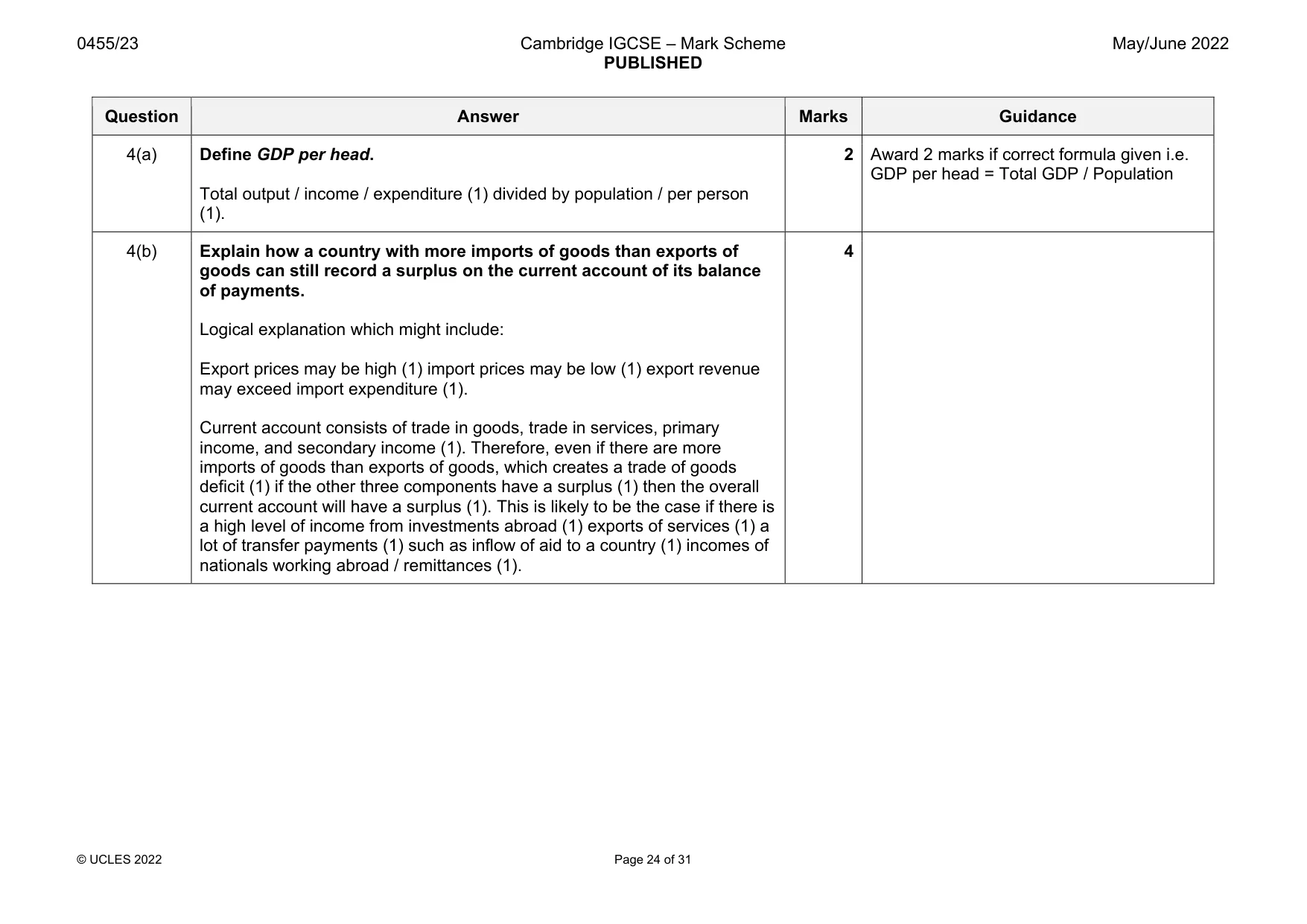
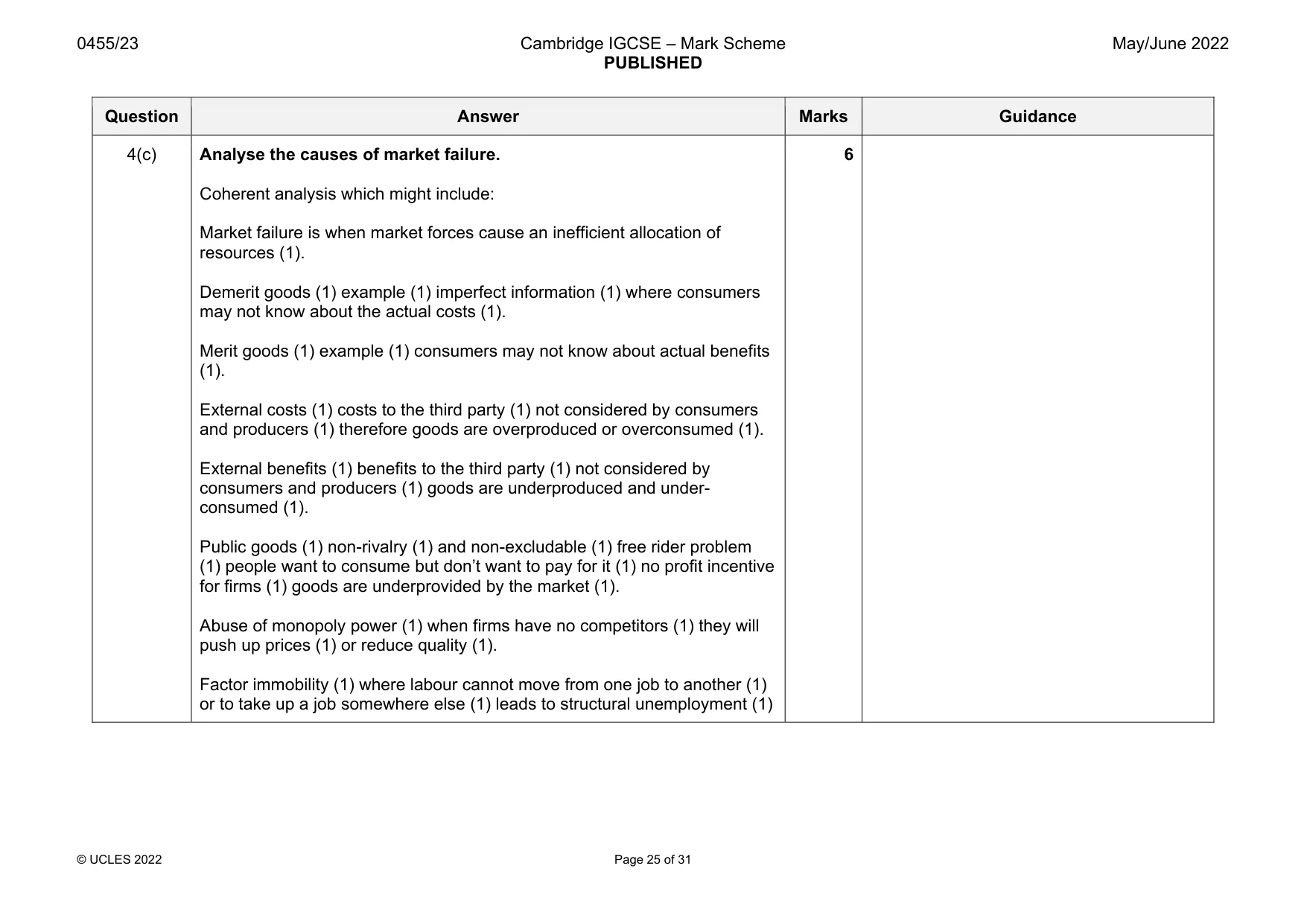
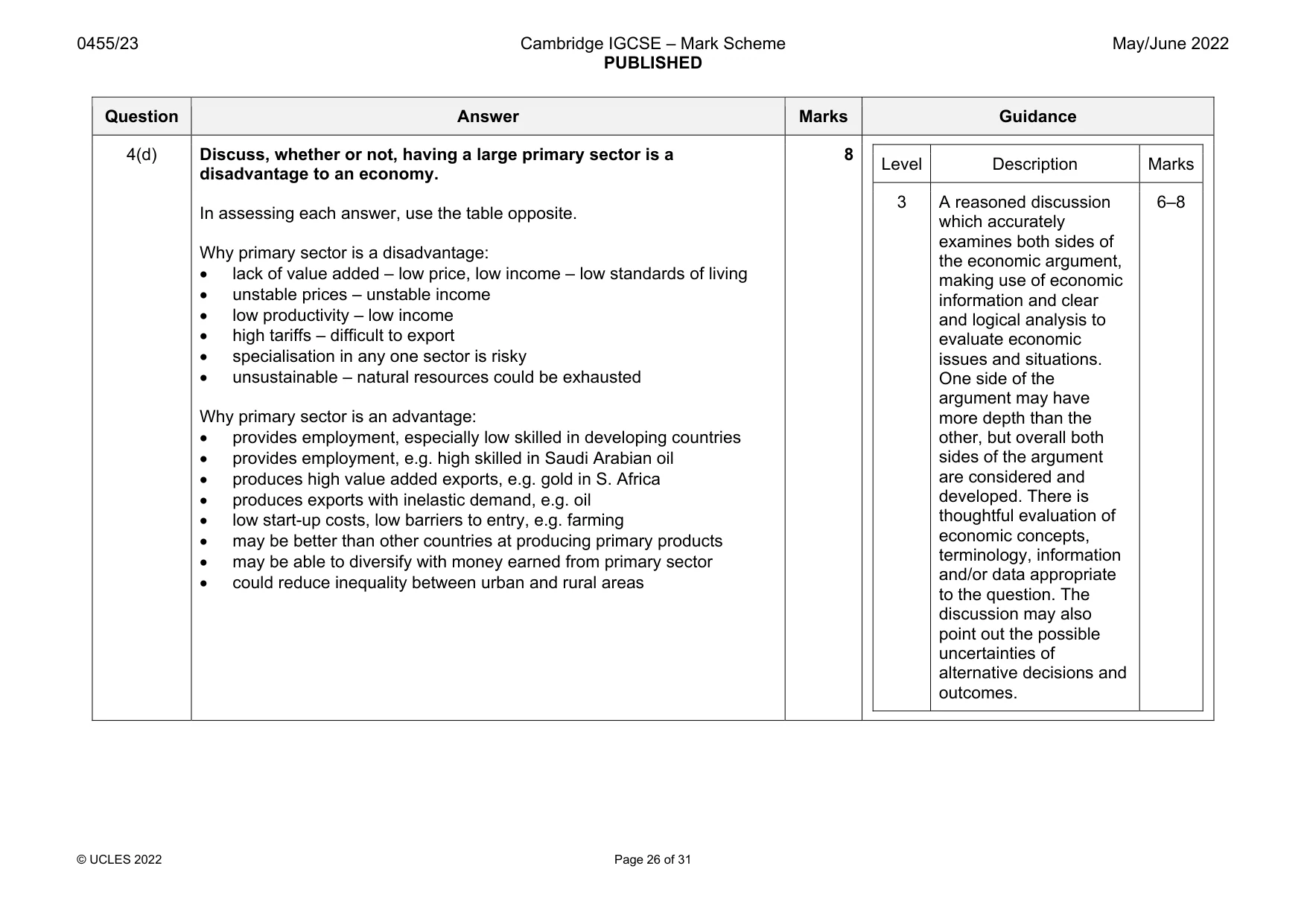
Mark scheme: 4(a) Define GDP per head. Total output / income / expenditure (1) divided by population / per person (1). GDP per head = Total GDP / Population 4(b) Explain how a country with more imports of goods than exports of goods can still record a surplus on the current account of its balance of payments. Logical explanation which might include: Export prices may be high (1) import prices may be low (1) export revenue may exceed import expenditure (1). Current account consists of trade in goods, trade in services, primary income, and secondary income (1). Therefore, even if there are more imports of goods than exports of goods, which creates a trade of goods deficit (1) if the other three components have a surplus (1) then the overall current account will have a surplus (1). This is likely to be the case if there is a high level of income from investments abroad (1) exports of services (1) a lot of transfer payments (1) such as inflow of aid to a country (1) incomes of nationals working abroad / remittances (1). 4 Question Answer Marks Guidance 4(c) Analyse the causes of market failure. Coherent analysis which might include: Market failure is when market forces cause an inefficient allocation of resources (1). Demerit goods (1) example (1) imperfect information (1) where consumers may not know about the actual costs (1). Merit goods (1) example (1) consumers may not know about actual benefits (1). External costs (1) costs to the third party (1) not considered by consumers and producers (1) therefore goods are overproduced or overconsumed (1). External benefits (1) benefits to the third party (1) not considered by consumers and producers (1) goods are underproduced and under- consumed (1). Public goods (1) non-rivalry (1) and non-excludable (1) free rider problem (1) people want to consume but don’t want to pay for it (1) no profit incentive for firms (1) goods are underprovided by the market (1). Abuse of monopoly power (1) when firms have no competitors (1) they will push up prices (1) or reduce quality (1). Factor immobility (1) where labour cannot move from one job to another (1) or to take up a job somewhere else (1) leads to structural unemployment (1) 6 Question Answer Marks Guidance 4(d) Discuss, whether or not, having a large primary sector is a disadvantage to an economy. In assessing each answer, use the table opposite. Why primary sector is a disadvantage: lack of value added – low price, low income – low standards of living unstable prices – unstable income low productivity – low income high tariffs – difficult to export specialisation in any one sector is risky unsustainable – natural resources could be exhausted Why primary sector is an advantage: provides employment, especially low skilled in developing countries provides employment, e.g. high skilled in Saudi Arabian oil produces high value added exports, e.g. gold in S. Africa produces exports with inelastic demand, e.g. oil low start-up costs, low barriers to entry, e.g. farming may be better than other countries at producing primary products may be able to diversify with money earned from primary sector could reduce inequality between urban and rural areas 8 Level Description Marks 3 A reasoned discussion which accurately examines both sides of the economic argument, making use of economic information and clear and logical analysis to evaluate economic issues and situations. One side of the argument may have more depth than the other, but overall both sides of the argument are considered and developed. There is thoughtful evaluation of economic concepts, terminology, information and/or data appropriate to the question. The discussion may also point out the possible uncertainties of alternative decisions and outcomes. 6–8 Question Answer Marks Guidance 4(d) Level Description Marks 2 A reasoned discussion which makes use of economic information and clear analysis to evaluate economic issues and situations. The answer may lack some depth and development may be one-sided. There is relevant use of economic concepts, terminology, information and data appropriate to the question. 3–5 1 There is a simple attempt at using economic definitions and terminology. Some reference may be made to economic theory, with occasional understanding. 1–2 0 A mark of zero should be awarded for no creditable content. 0
Q5 · More government spending creates opportunity costs
5 More government spending creates opportunity costs. This was one of the problems that the president of France faced in 2017. Since he came to power, he has focused on using supply-side policy measures, rather than monetary policy. Trade union membership has reduced in France in recent years. (a) Define monetary policy. [2] (b) Explain, using an example, the influence of opportunity cost on government decision-making. [4] (c) Analyse the reasons why trade union membership has reduced in some countries. [6] (d) Discuss whether or not supply-side policy measures always promote economic growth. [8]
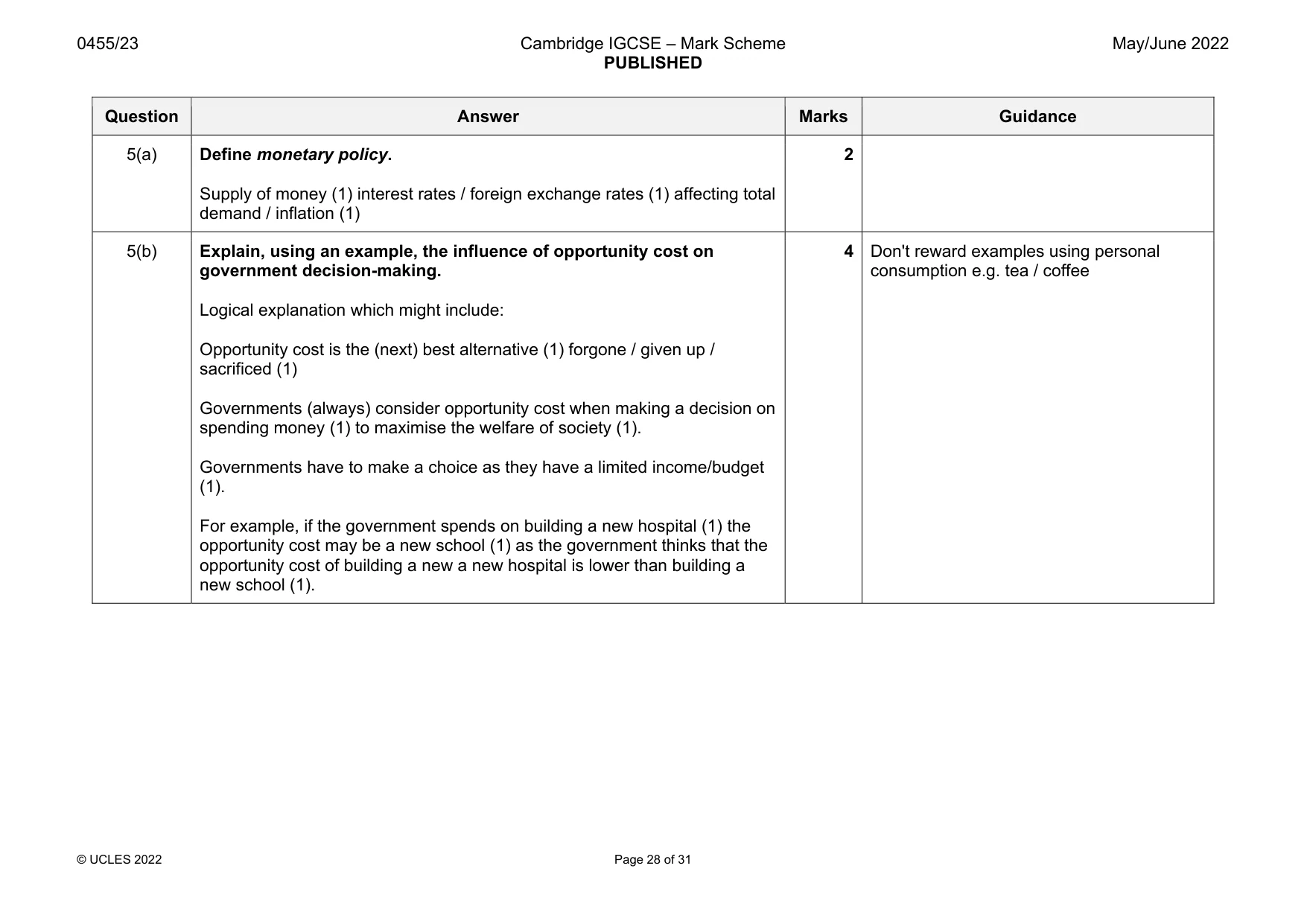
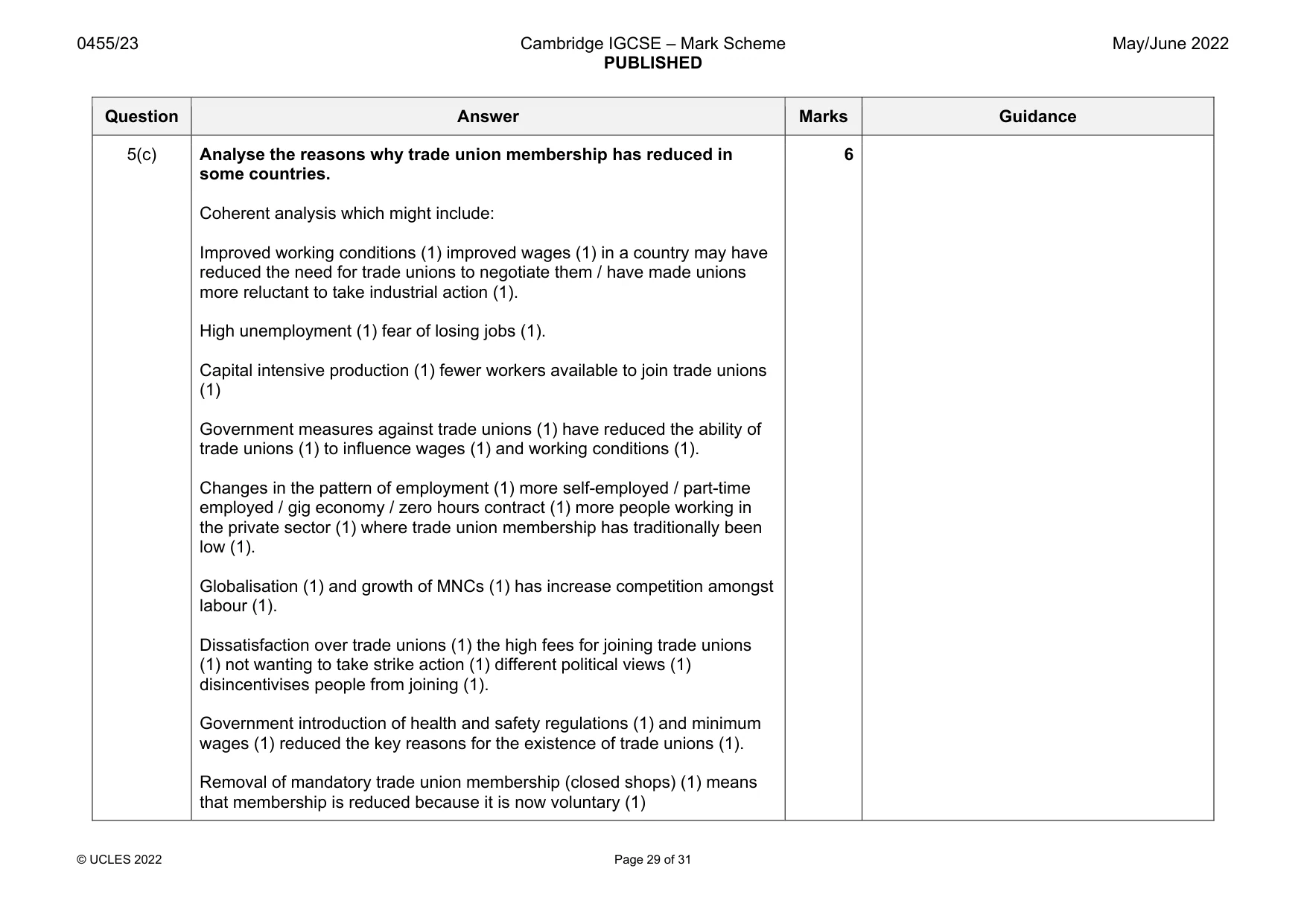
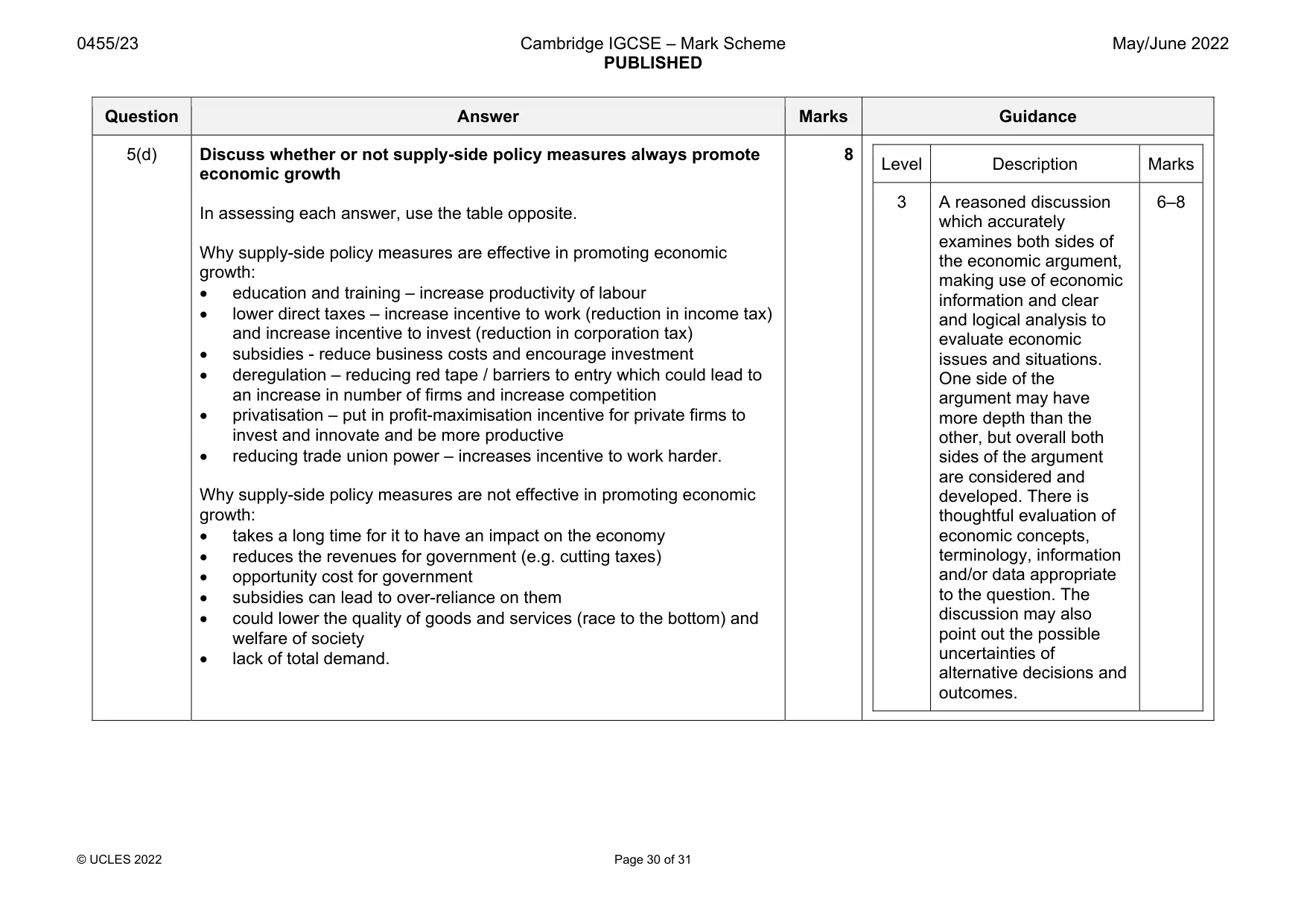
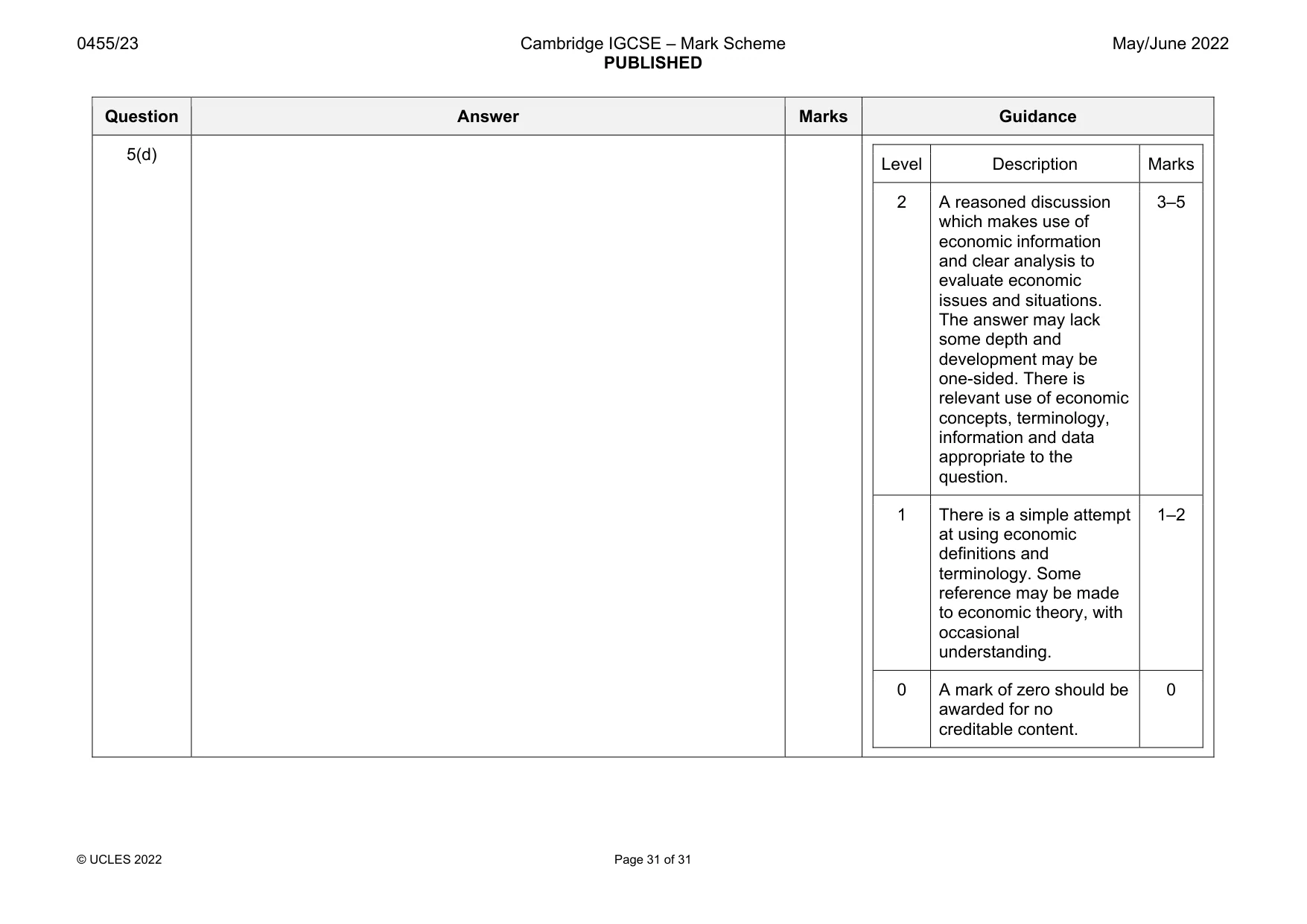
Mark scheme: 5(a) Define monetary policy. Supply of money (1) interest rates / foreign exchange rates (1) affecting total demand / inflation (1) 5(b) Explain, using an example, the influence of opportunity cost on government decision-making. Logical explanation which might include: Opportunity cost is the (next) best alternative (1) forgone / given up / sacrificed (1) Governments (always) consider opportunity cost when making a decision on spending money (1) to maximise the welfare of society (1). Governments have to make a choice as they have a limited income/budget (1). For example, if the government spends on building a new hospital (1) the opportunity cost may be a new school (1) as the government thinks that the opportunity cost of building a new a new hospital is lower than building a new school (1). 4 Don't reward examples using personal consumption e.g. tea / coffee Question Answer Marks Guidance 5(c) Analyse the reasons why trade union membership has reduced in some countries. Coherent analysis which might include: Improved working conditions (1) improved wages (1) in a country may have reduced the need for trade unions to negotiate them / have made unions more reluctant to take industrial action (1). High unemployment (1) fear of losing jobs (1). Capital intensive production (1) fewer workers available to join trade unions (1) Government measures against trade unions (1) have reduced the ability of trade unions (1) to influence wages (1) and working conditions (1). Changes in the pattern of employment (1) more self-employed / part-time employed / gig economy / zero hours contract (1) more people working in the private sector (1) where trade union membership has traditionally been low (1). Globalisation (1) and growth of MNCs (1) has increase competition amongst labour (1). Dissatisfaction over trade unions (1) the high fees for joining trade unions (1) not wanting to take strike action (1) different political views (1) disincentivises people from joining (1). Government introduction of health and safety regulations (1) and minimum wages (1) reduced the key reasons for the existence of trade unions (1). Removal of mandatory trade union membership (closed shops) (1) means that membership is reduced because it is now voluntary (1) 6 Question Answer Marks Guidance 5(d) Discuss whether or not supply-side policy measures always promote economic growth In assessing each answer, use the table opposite. Why supply-side policy measures are effective in promoting economic growth: education and training – increase productivity of labour lower direct taxes – increase incentive to work (reduction in income tax) and increase incentive to invest (reduction in corporation tax) subsidies - reduce business costs and encourage investment deregulation – reducing red tape / barriers to entry which could lead to an increase in number of firms and increase competition privatisation – put in profit-maximisation incentive for private firms to invest and innovate and be more productive reducing trade union power – increases incentive to work harder. Why supply-side policy measures are not effective in promoting economic growth: takes a long time for it to have an impact on the economy reduces the revenues for government (e.g. cutting taxes) opportunity cost for government subsidies can lead to over-reliance on them could lower the quality of goods and services (race to the bottom) and welfare of society lack of total demand. 8 Level Description Marks 3 A reasoned discussion which accurately examines both sides of the economic argument, making use of economic information and clear and logical analysis to evaluate economic issues and situations. One side of the argument may have more depth than the other, but overall both sides of the argument are considered and developed. There is thoughtful evaluation of economic concepts, terminology, information and/or data appropriate to the question. The discussion may also point out the possible uncertainties of alternative decisions and outcomes. 6–8 Question Answer Marks Guidance 5(d) Level Description Marks 2 A reasoned discussion which makes use of economic information and clear analysis to evaluate economic issues and situations. The answer may lack some depth and development may be one-sided. There is relevant use of economic concepts, terminology, information and data appropriate to the question. 3–5 1 There is a simple attempt at using economic definitions and terminology. Some reference may be made to economic theory, with occasional understanding. 1–2 0 A mark of zero should be awarded for no creditable content. 0
What was in this paper
The subtopics covered by these 5 questions, and how many questions each got. Open one in a new tab to see every Cambridge question on it.
What you needed in this session
Cambridge’s own grade thresholds for 2022 May/June, Paper 2 · Variant 3. A higher threshold means an easier paper — the bar moves with how the cohort did.