Cambridge IGCSE Economics 0455 — 2019 Oct/Nov Paper 2 · Variant 2
0455/22/O/N/19 · 7 questions · 90 marks · ≈101 min
The question paper and its mark scheme, free to read here and free to download. This is Cambridge’s own paper, exactly as it was sat.
Question paper8 pages
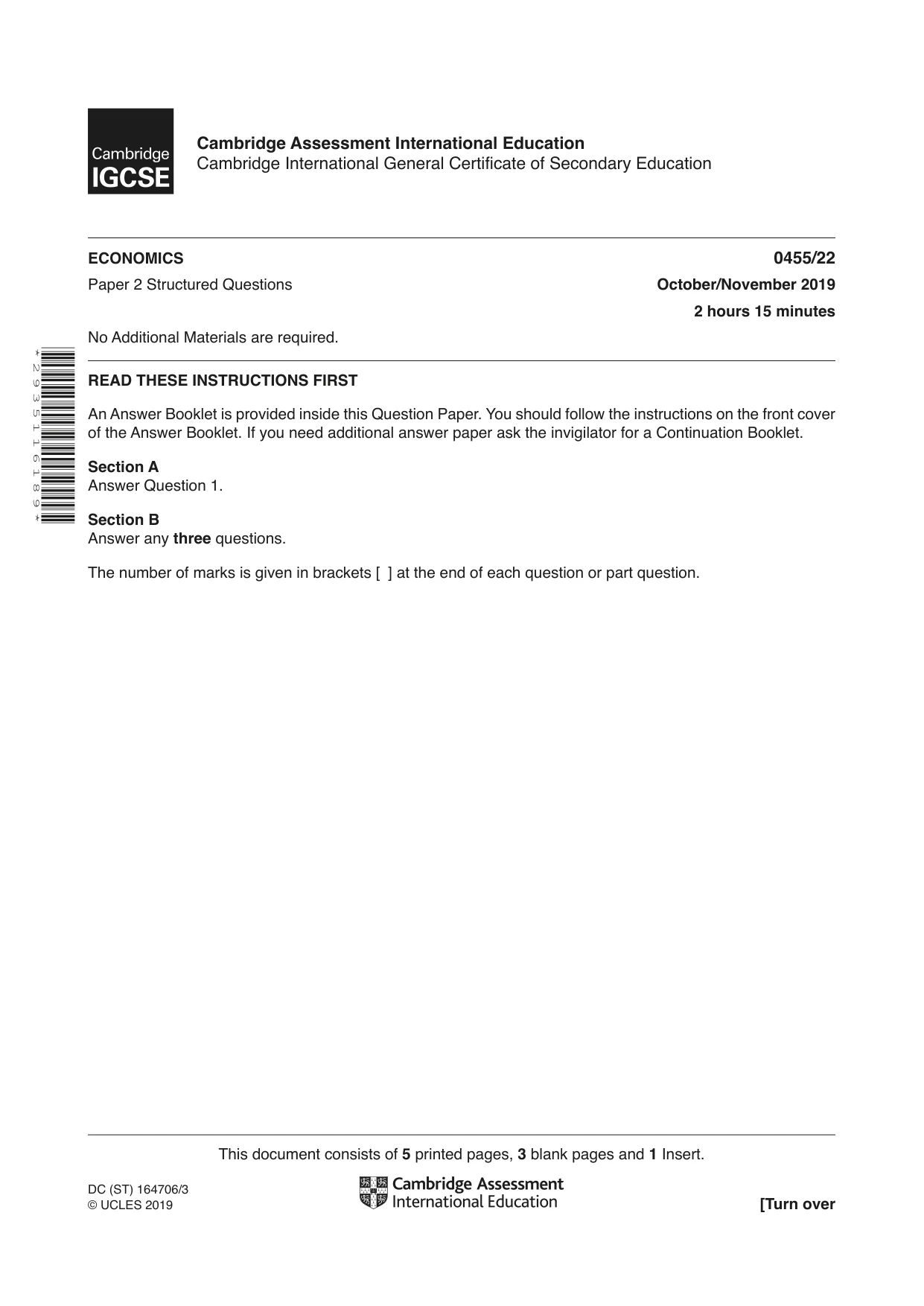
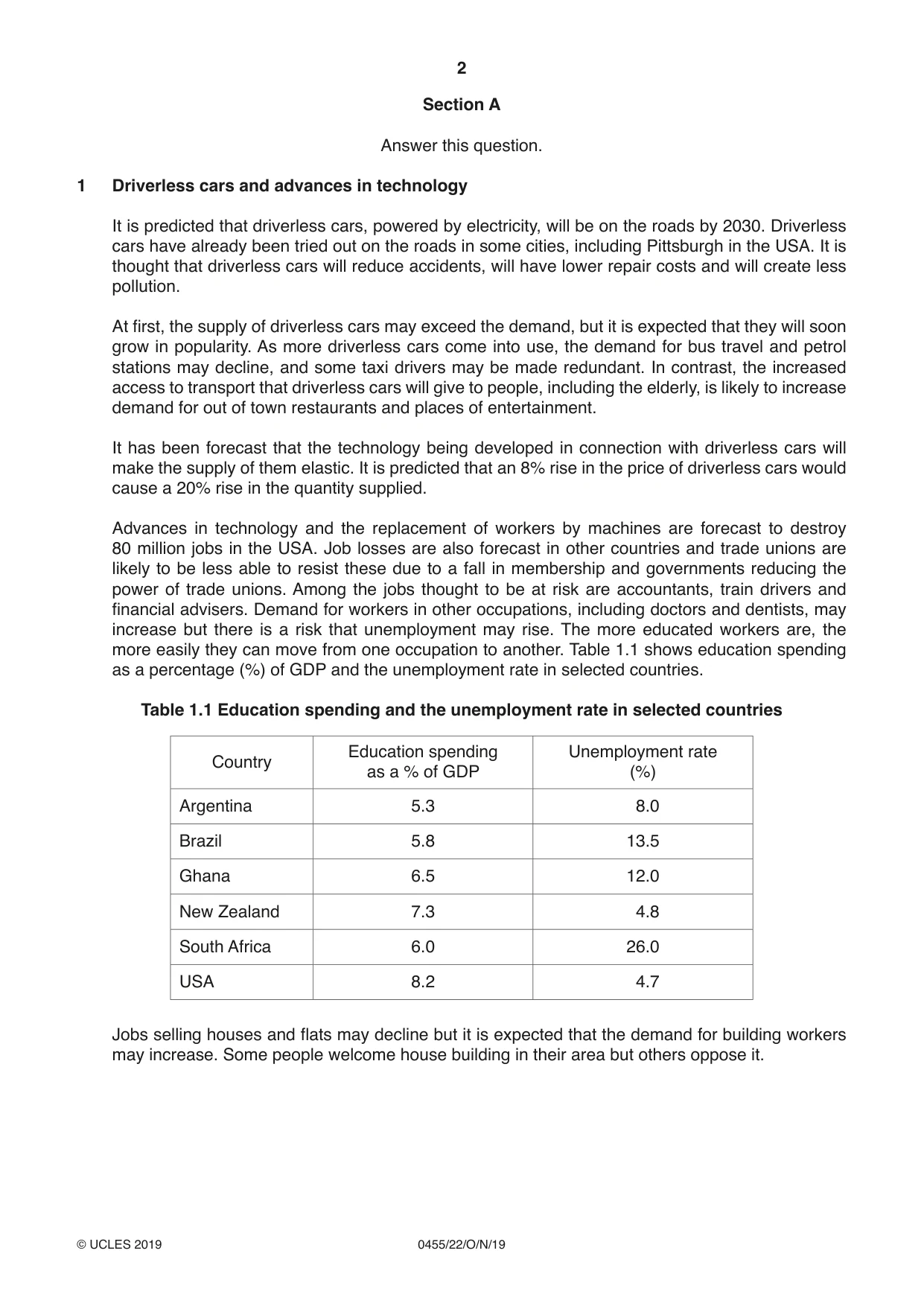
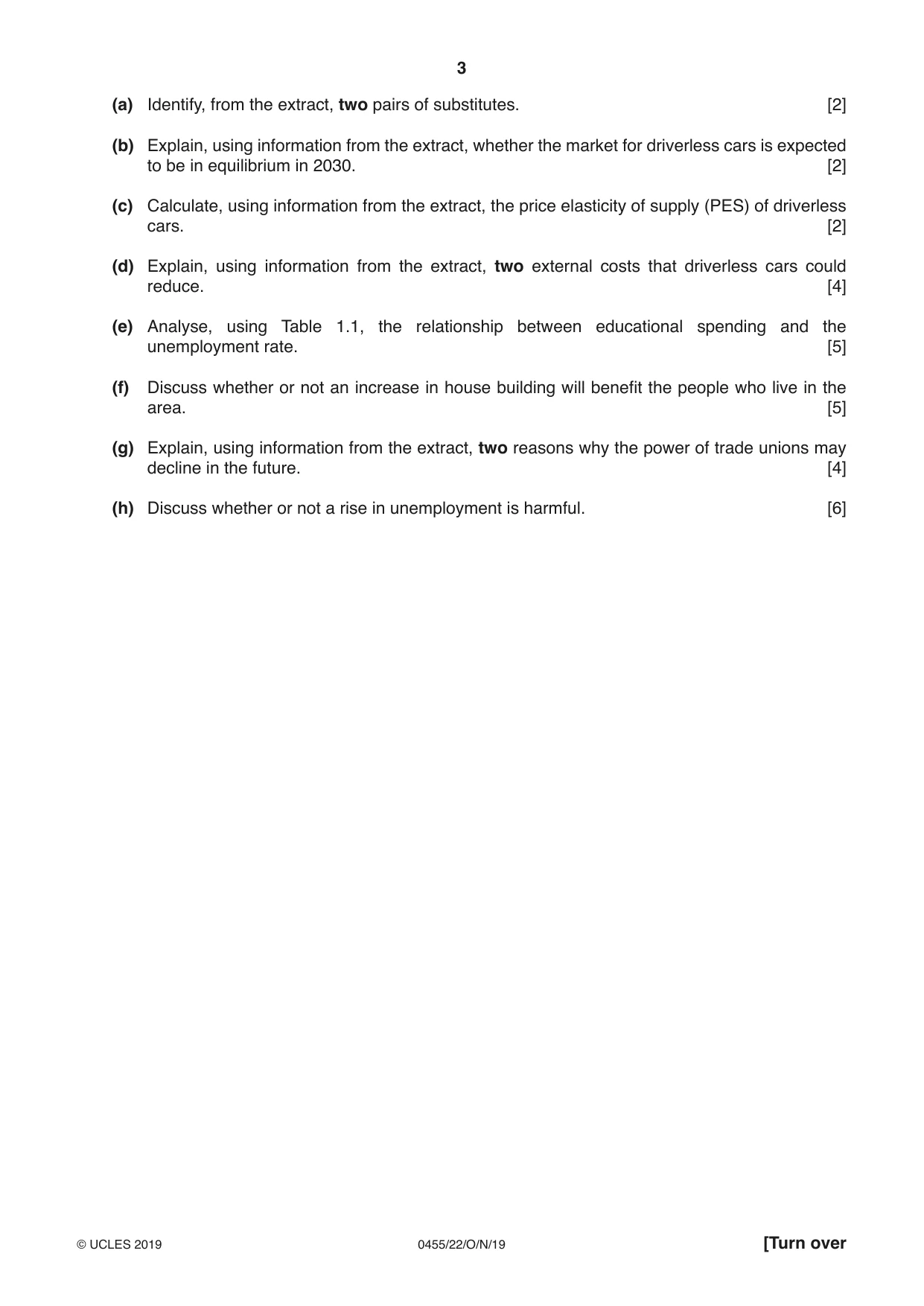
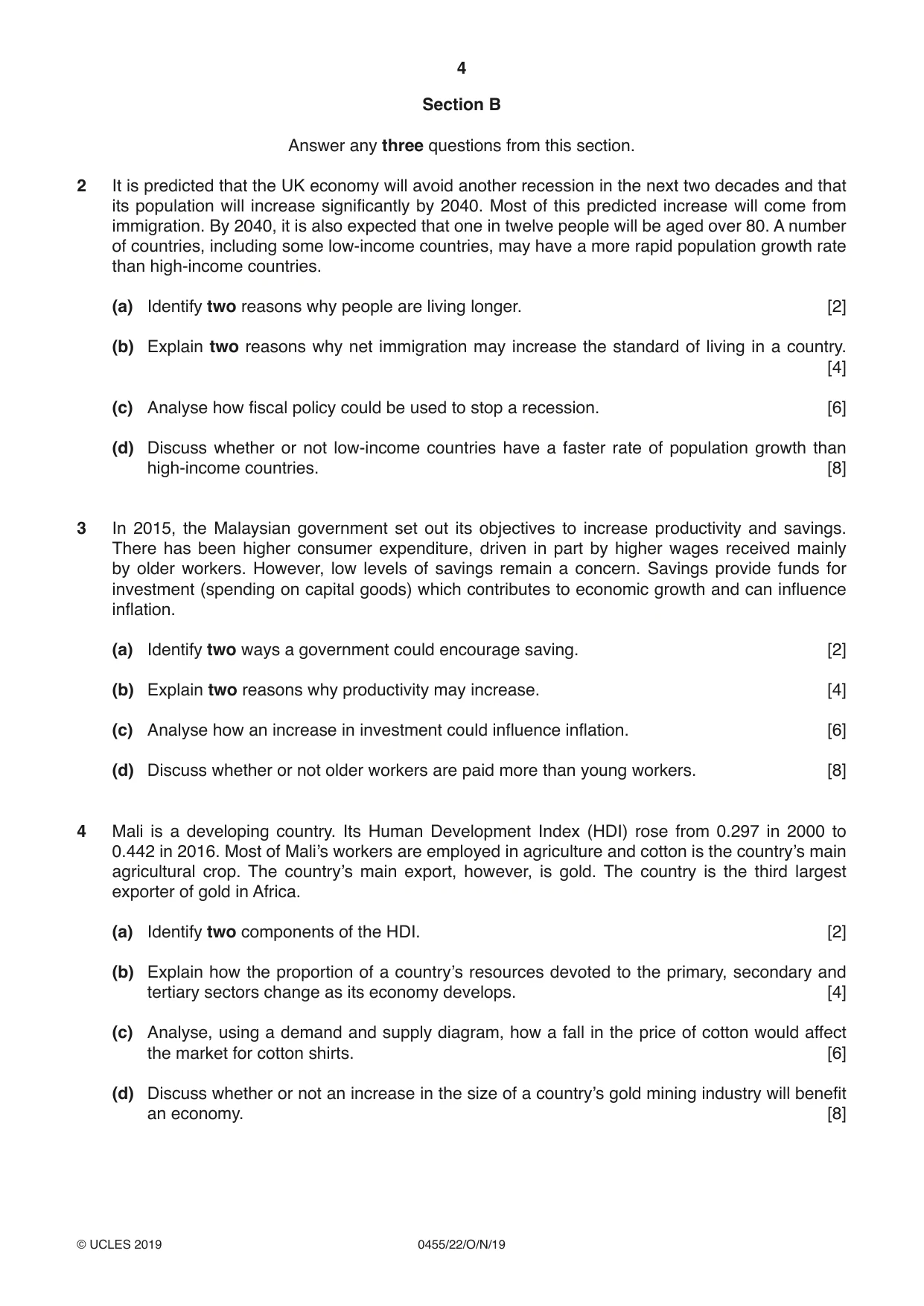



Mark scheme23 pages
Answers below. Sit the paper first if you are practising.
Questions as text
Q1 · Driverless cars and advances in technology It is predicted that driverless cars, powered…
1 Driverless cars and advances in technology It is predicted that driverless cars, powered by electricity, will be on the roads by 2030. Driverless cars have already been tried out on the roads in some cities, including Pittsburgh in the USA. It is thought that driverless cars will reduce accidents, will have lower repair costs and will create less pollution. At first, the supply of driverless cars may exceed the demand, but it is expected that they will soon grow in popularity. As more driverless cars come into use, the demand for bus travel and petrol stations may decline, and some taxi drivers may be made redundant. In contrast, the increased access to transport that driverless cars will give to people, including the elderly, is likely to increase demand for out of town restaurants and places of entertainment. It has been forecast that the technology being developed in connection with driverless cars will make the supply of them elastic. It is predicted that an 8% rise in the price of driverless cars would cause a 20% rise in the quantity supplied. Advances in technology and the replacement of workers by machines are forecast to destroy 80 million jobs in the USA. Job losses are also forecast in other countries and trade unions are likely to be less able to resist these due to a fall in membership and governments reducing the power of trade unions. Among the jobs thought to be at risk are accountants, train drivers and financial advisers. Demand for workers in other occupations, including doctors and dentists, may increase but there is a risk that unemployment may rise. The more educated workers are, the more easily they can move from one occupation to another. Table 1.1 shows education spending as a percentage (%) of GDP and the unemployment rate in selected countries. Table 1.1 Education spending and the unemployment rate in selected countries Education spending Unemployment rate Country as a % of GDP (%) Argentina 5.3 8.0 Brazil 5.8 13.5 Ghana 6.5 12.0 New Zealand 7.3 4.8 South Africa 6.0 26.0 USA 8.2 4.7 Jobs selling houses and flats may decline but it is expected that the demand for building workers may increase. Some people welcome house building in their area but others oppose it. (a) Identify, from the extract, two pairs of substitutes. [2] (b) Explain, using information from the extract, whether the market for driverless cars is expected to be in equilibrium in 2030. [2] (c) Calculate, using information from the extract, the price elasticity of supply (PES) of driverless cars. [2] (d) Explain, using information from the extract, two external costs that driverless cars could reduce. [4] (e) Analyse, using Table 1.1, the relationship between educational spending and the unemployment rate. [5] (f) Discuss whether or not an increase in house building will benefit the people who live in the area. [5] (g) Explain, using information from the extract, two reasons why the power of trade unions may decline in the future. [4] (h) Discuss whether or not a rise in unemployment is harmful. [6]
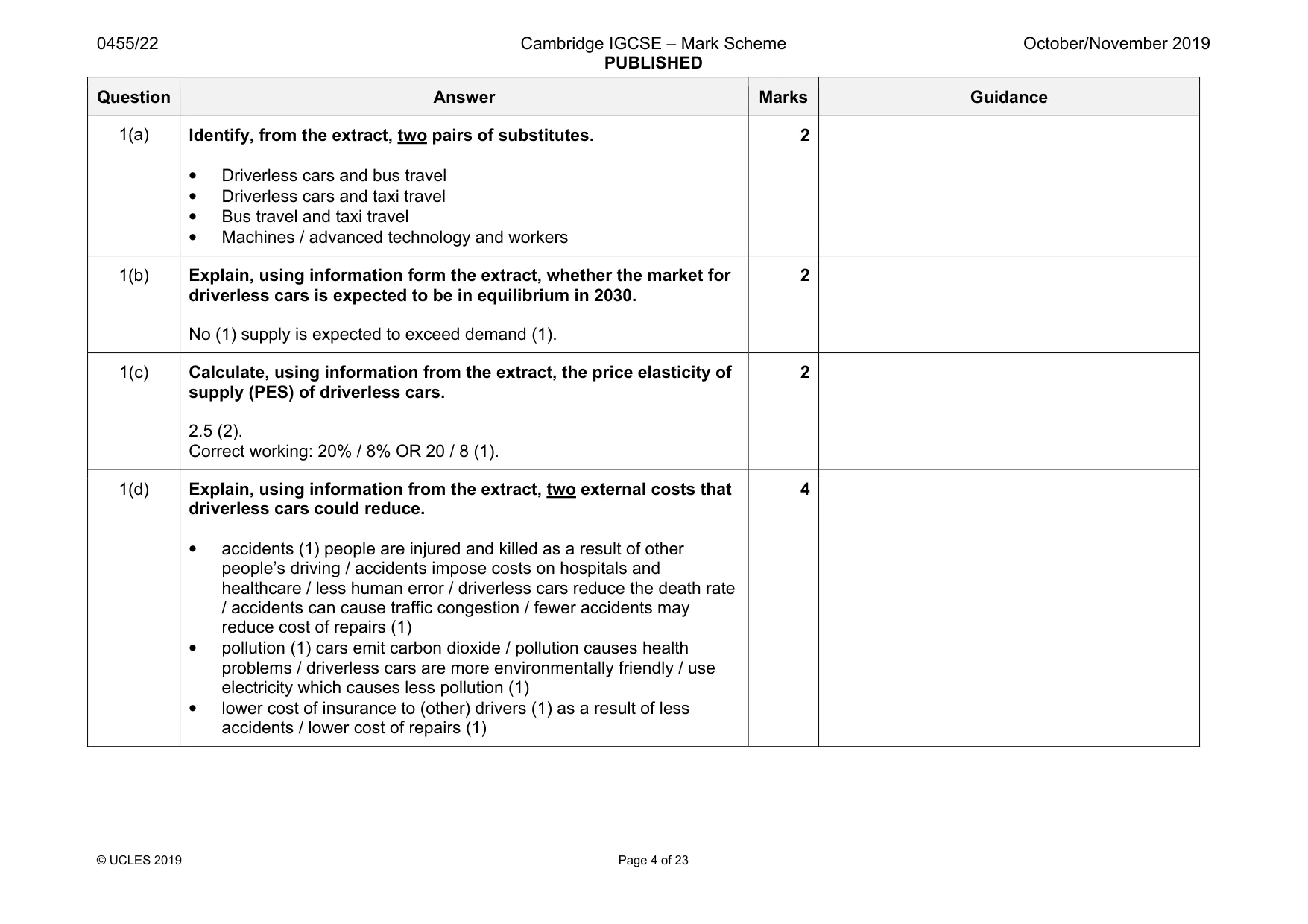
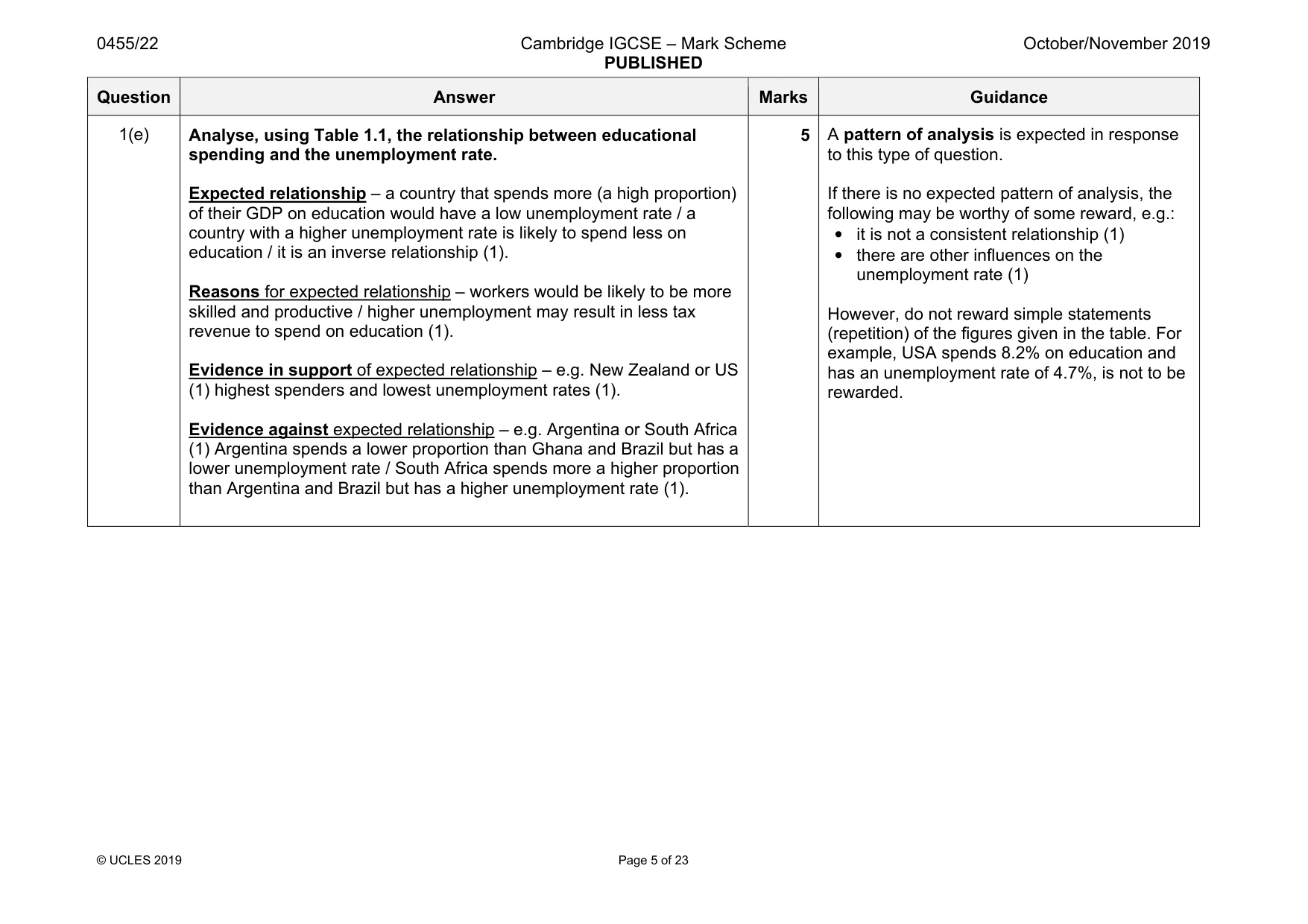
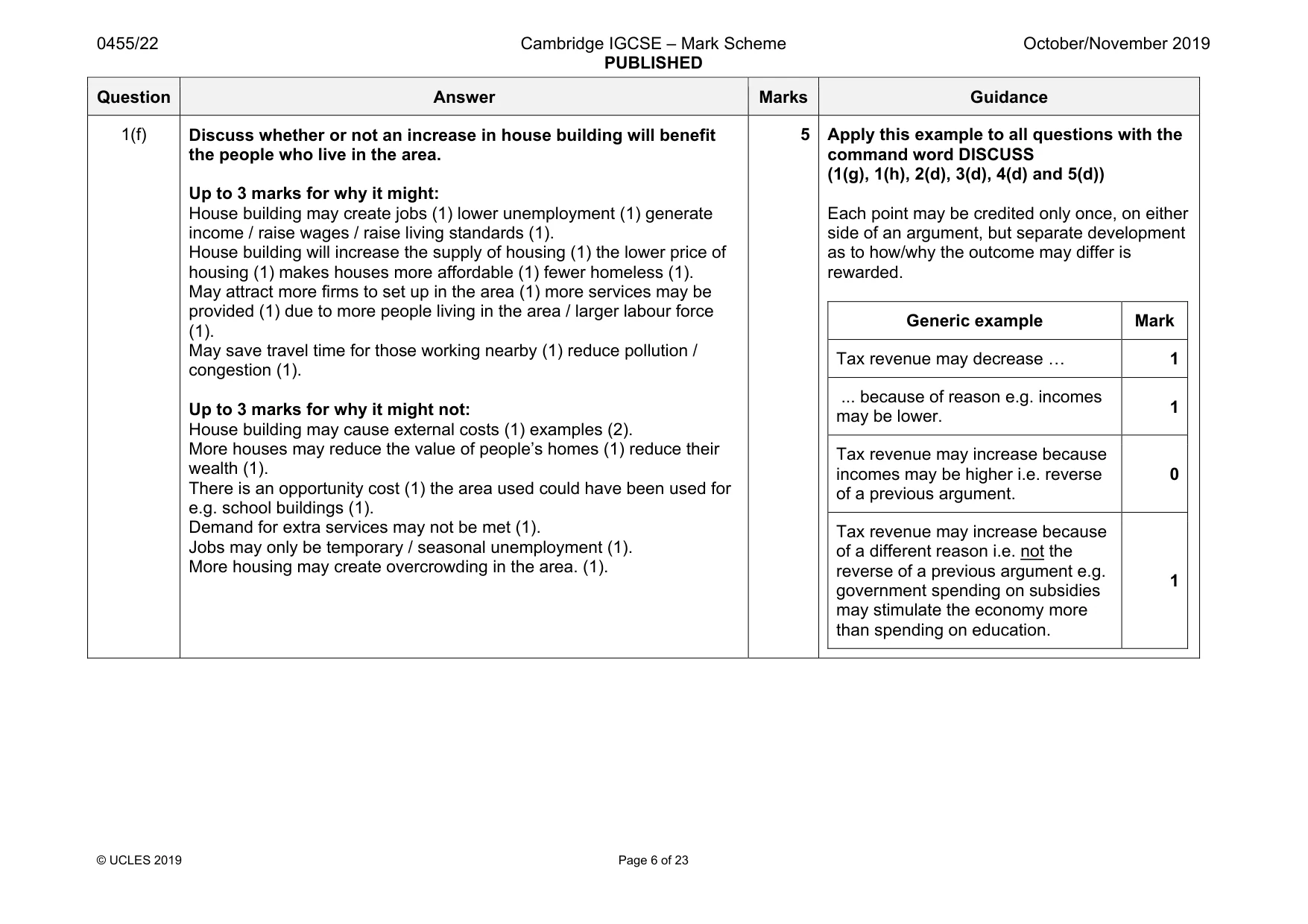
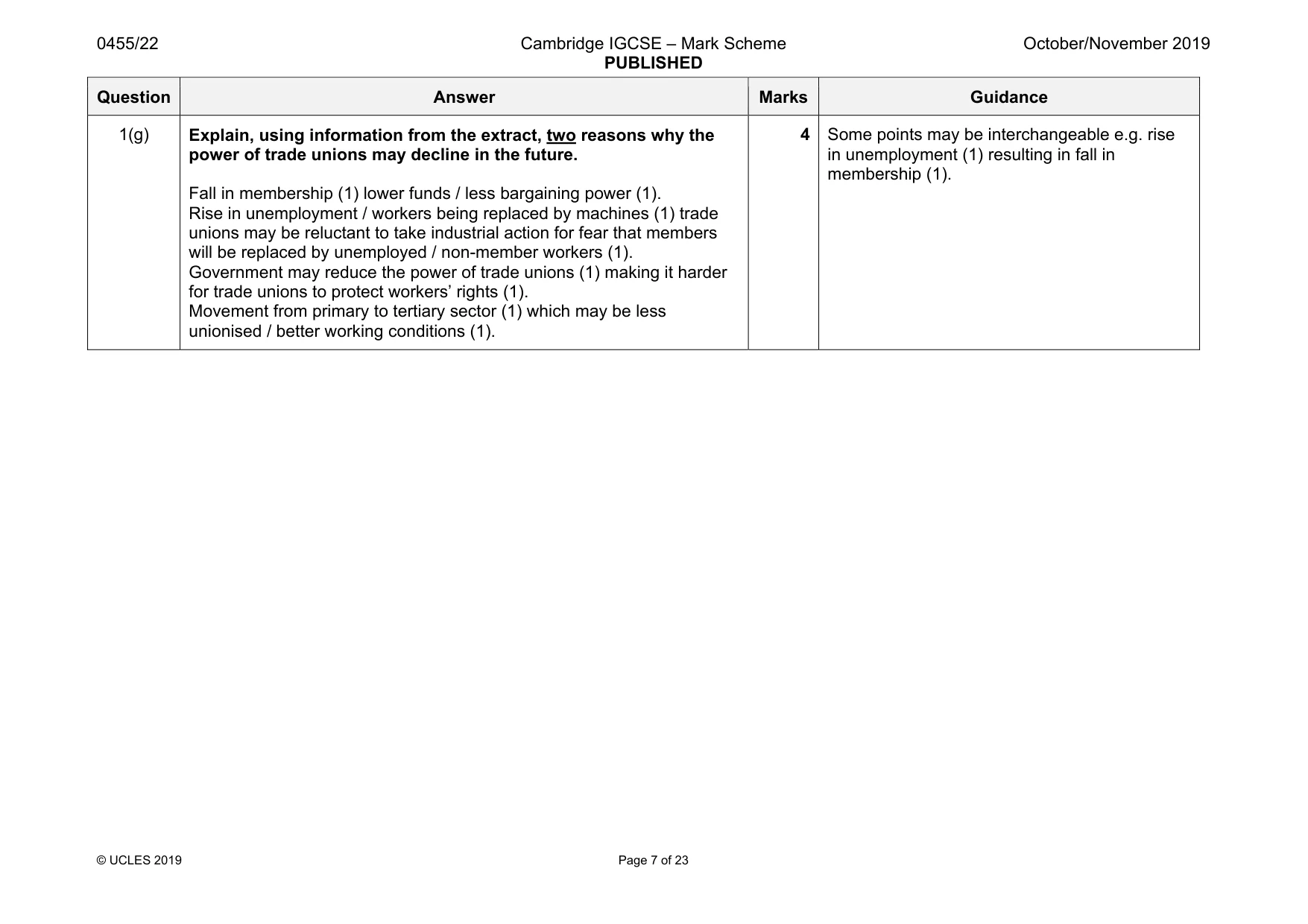
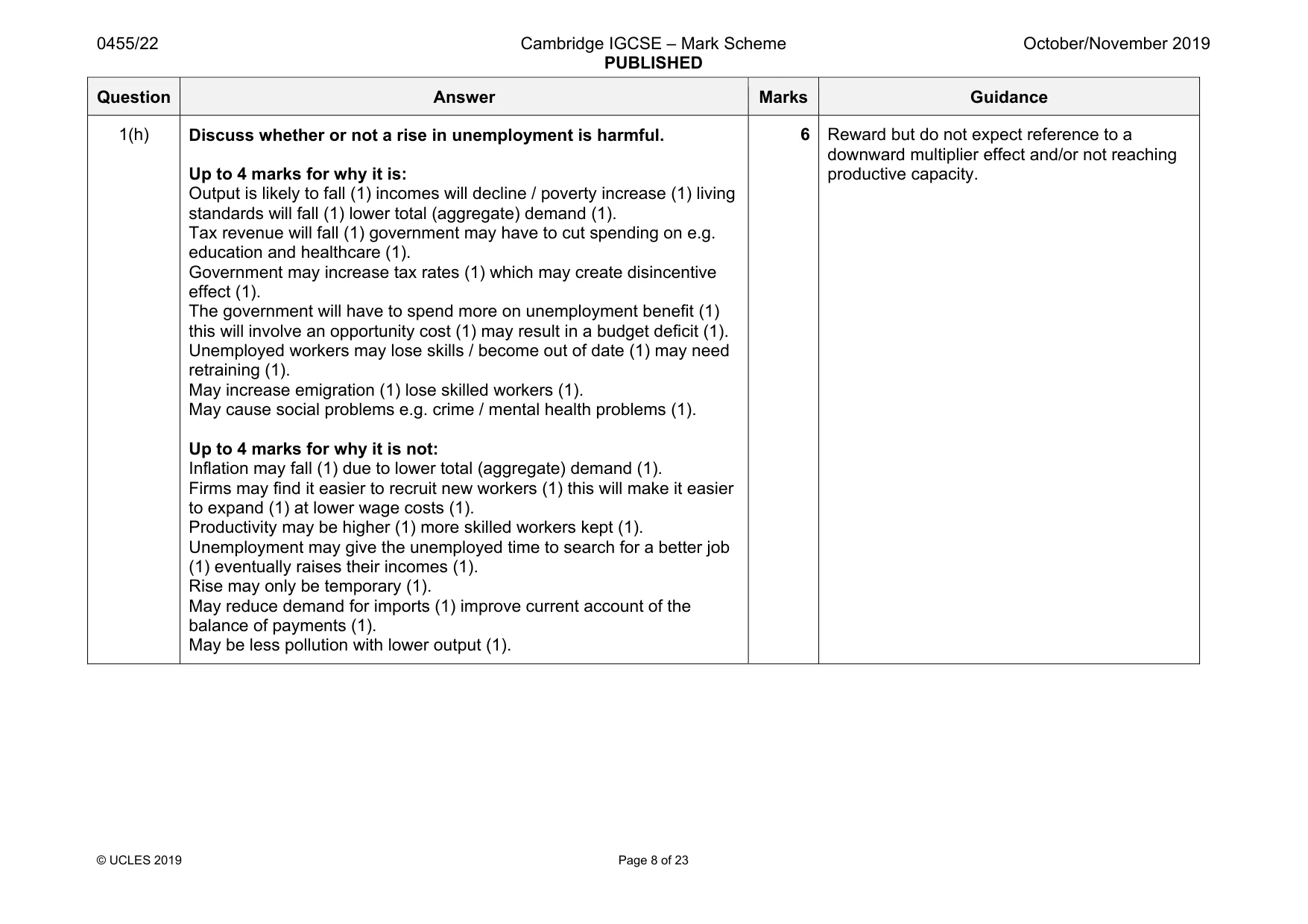
Mark scheme: 1(a) Identify, from the extract, two pairs of substitutes. • Driverless cars and bus travel • Driverless cars and taxi travel • Bus travel and taxi travel • Machines / advanced technology and workers 2 1(b) Explain, using information form the extract, whether the market for driverless cars is expected to be in equilibrium in 2030. No (1) supply is expected to exceed demand (1). 2 1(c) Calculate, using information from the extract, the price elasticity of supply (PES) of driverless cars. 2.5 (2). Correct working: 20% / 8% OR 20 / 8 (1). 2 1(d) Explain, using information from the extract, two external costs that driverless cars could reduce. • accidents (1) people are injured and killed as a result of other people’s driving / accidents impose costs on hospitals and healthcare / less human error / driverless cars reduce the death rate / accidents can cause traffic congestion / fewer accidents may reduce cost of repairs (1) • pollution (1) cars emit carbon dioxide / pollution causes health problems / driverless cars are more environmentally friendly / use electricity which causes less pollution (1) • lower cost of insurance to (other) drivers (1) as a result of less accidents / lower cost of repairs (1) 4 Question Answer Marks Guidance 1(e) Analyse, using Table 1.1, the relationship between educational spending and the unemployment rate. Expected relationship – a country that spends more (a high proportion) of their GDP on education would have a low unemployment rate / a country with a higher unemployment rate is likely to spend less on education / it is an inverse relationship (1). Reasons for expected relationship – workers would be likely to be more skilled and productive / higher unemployment may result in less tax revenue to spend on education (1). Evidence in support of expected relationship – e.g. New Zealand or US (1) highest spenders and lowest unemployment rates (1). Evidence against expected relationship – e.g. Argentina or South Africa (1) Argentina spends a lower proportion than Ghana and Brazil but has a lower unemployment rate / South Africa spends more a higher proportion than Argentina and Brazil but has a higher unemployment rate (1). 5 A pattern of analysis is expected in response to this type of question. If there is no expected pattern of analysis, the following may be worthy of some reward, e.g.: • it is not a consistent relationship (1) • there are other influences on the unemployment rate (1) However, do not reward simple statements (repetition) of the figures given in the table. For example, USA spends 8.2% on education and has an unemployment rate of 4.7%, is not to be rewarded. Question Answer Marks Guidance 1(f) Discuss whether or not an increase in house building will benefit the people who live in the area. Up to 3 marks for why it might: House building may create jobs (1) lower unemployment (1) generate income / raise wages / raise living standards (1). House building will increase the supply of housing (1) the lower price of housing (1) makes houses more affordable (1) fewer homeless (1). May attract more firms to set up in the area (1) more services may be provided (1) due to more people living in the area / larger labour force (1). May save travel time for those working nearby (1) reduce pollution / congestion (1). Up to 3 marks for why it might not: House building may cause external costs (1) examples (2). More houses may reduce the value of people’s homes (1) reduce their wealth (1). There is an opportunity cost (1) the area used could have been used for e.g. school buildings (1). Demand for extra services may not be met (1). Jobs may only be temporary / seasonal unemployment (1). More housing may create overcrowding in the area. (1). 5 Apply this example to all questions with the command word DISCUSS (1(g), 1(h), 2(d), 3(d), 4(d) and 5(d)) Each point may be credited only once, on either side of an argument, but separate development as to how/why the outcome may differ is rewarded. Generic example Mark Tax revenue may decrease « 1 ... because of reason e.g. incomes may be lower. 1 Tax revenue may increase because incomes may be higher i.e. reverse of a previous argument. 0 Tax revenue may increase because of a different reason i.e. not the reverse of a previous argument e.g. government spending on subsidies may stimulate the economy more than spending on education. 1 Question Answer Marks Guidance 1(g) Explain, using information from the extract, two reasons why the power of trade unions may decline in the future. Fall in membership (1) lower funds / less bargaining power (1). Rise in unemployment / workers being replaced by machines (1) trade unions may be reluctant to take industrial action for fear that members will be replaced by unemployed / non-member workers (1). Government may reduce the power of trade unions (1) making it harder for trade unions to protect workers’ rights (1). Movement from primary to tertiary sector (1) which may be less unionised / better working conditions (1). 4 Some points may be interchangeable e.g. rise in unemployment (1) resulting in fall in membership (1). Question Answer Marks Guidance 1(h) Discuss whether or not a rise in unemployment is harmful. Up to 4 marks for why it is: Output is likely to fall (1) incomes will decline / poverty increase (1) living standards will fall (1) lower total (aggregate) demand (1). Tax revenue will fall (1) government may have to cut spending on e.g. education and healthcare (1). Government may increase tax rates (1) which may create disincentive effect (1). The government will have to spend more on unemployment benefit (1) this will involve an opportunity cost (1) may result in a budget deficit (1). Unemployed workers may lose skills / become out of date (1) may need retraining (1). May increase emigration (1) lose skilled workers (1). May cause social problems e.g. crime / mental health problems (1). Up to 4 marks for why it is not: Inflation may fall (1) due to lower total (aggregate) demand (1). Firms may find it easier to recruit new workers (1) this will make it easier to expand (1) at lower wage costs (1). Productivity may be higher (1) more skilled workers kept (1). Unemployment may give the unemployed time to search for a better job (1) eventually raises their incomes (1). Rise may only be temporary (1). May reduce demand for imports (1) improve current account of the balance of payments (1). May be less pollution with lower output (1). 6 Reward but do not expect reference to a downward multiplier effect and/or not reaching productive capacity.
Q2 · It is predicted that the UK economy will avoid another recession in the next two decades…
2 It is predicted that the UK economy will avoid another recession in the next two decades and that its population will increase significantly by 2040. Most of this predicted increase will come from immigration. By 2040, it is also expected that one in twelve people will be aged over 80. A number of countries, including some low-income countries, may have a more rapid population growth rate than high-income countries. (a) Identify two reasons why people are living longer. [2] (b) Explain two reasons why net immigration may increase the standard of living in a country. [4] (c) Analyse how fiscal policy could be used to stop a recession. [6] (d) Discuss whether or not low-income countries have a faster rate of population growth than high-income countries. [8]
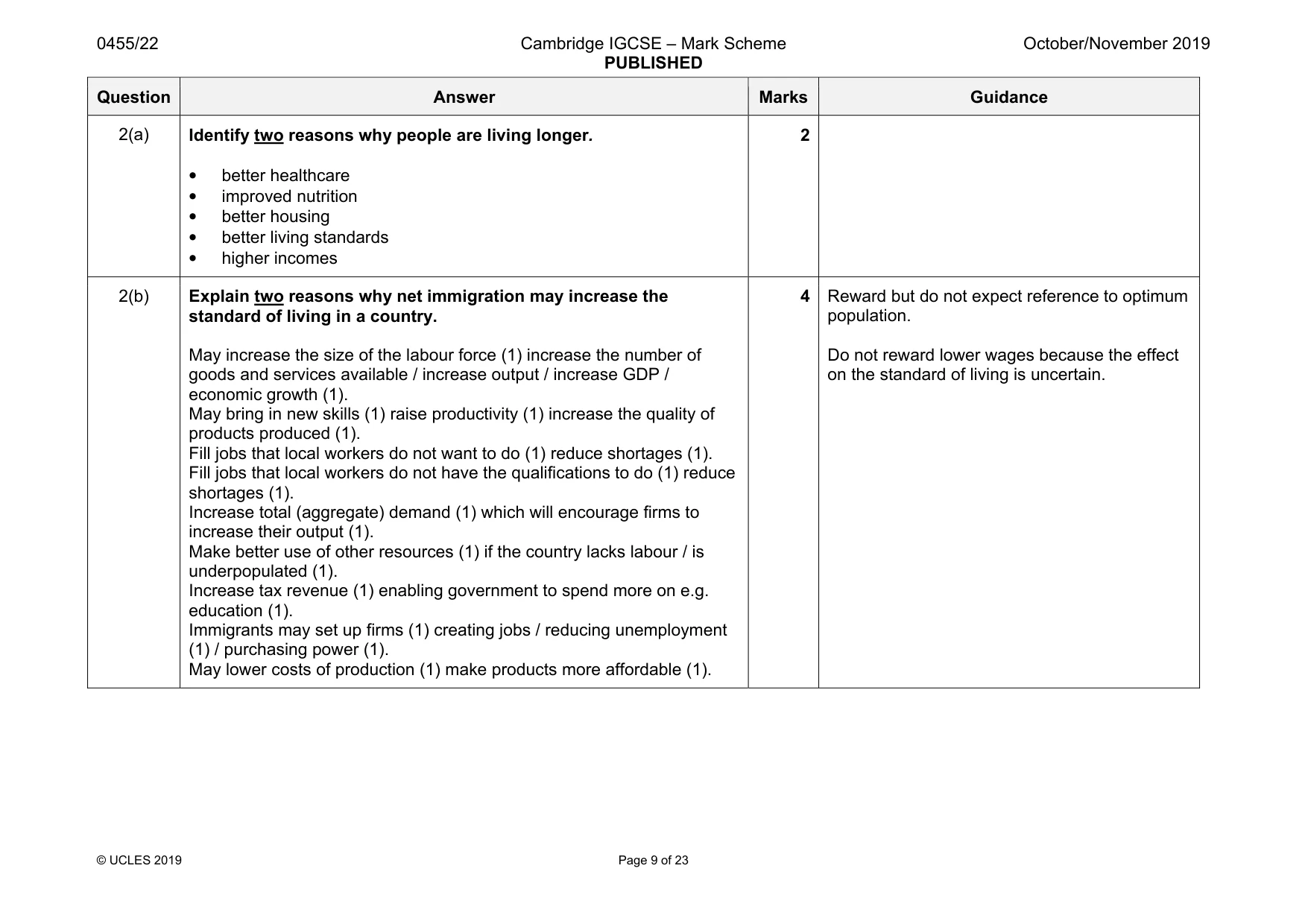
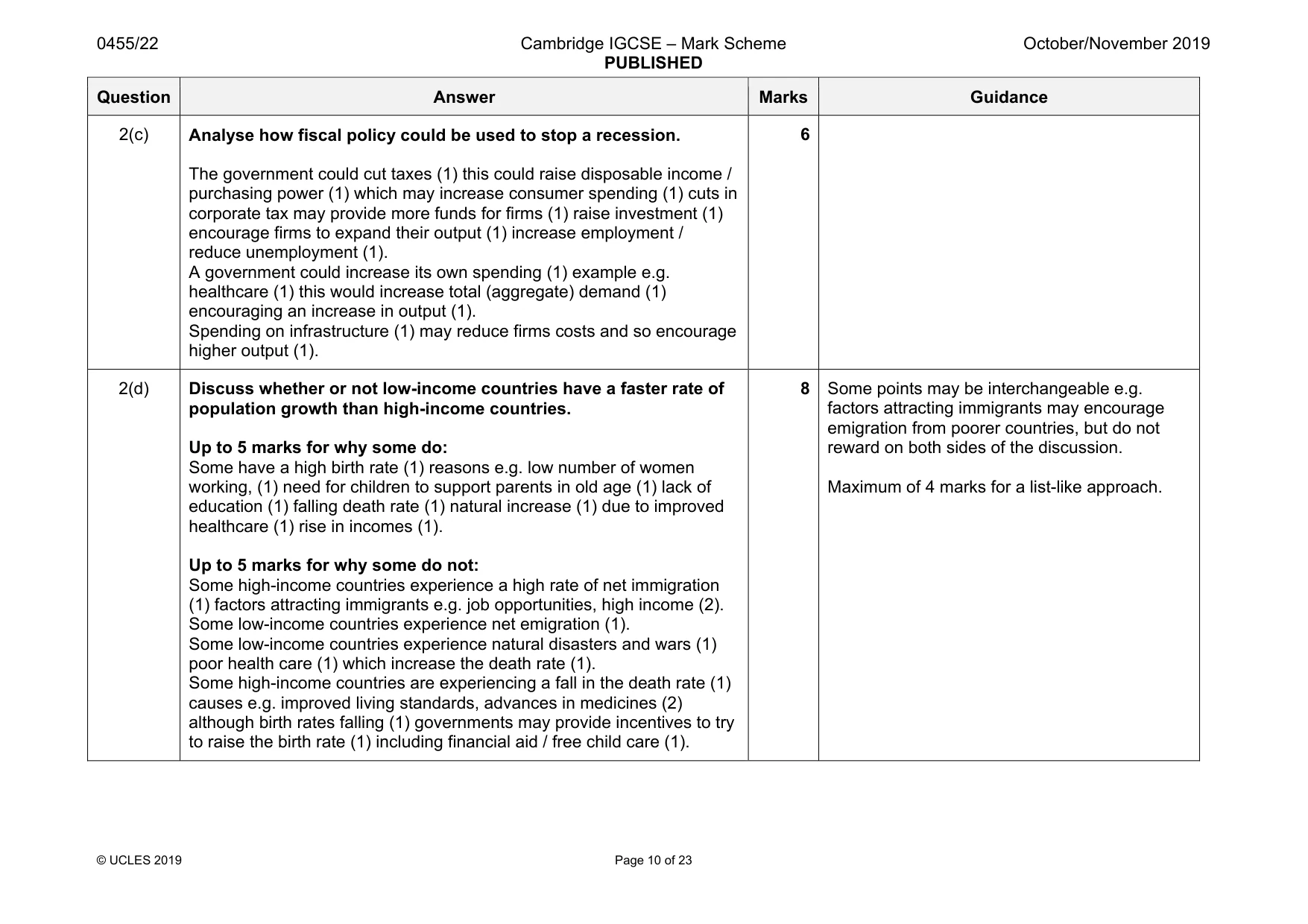
Mark scheme: 2(a) Identify two reasons why people are living longer. • better healthcare • improved nutrition • better housing • better living standards • higher incomes 2 2(b) Explain two reasons why net immigration may increase the standard of living in a country. May increase the size of the labour force (1) increase the number of goods and services available / increase output / increase GDP / economic growth (1). May bring in new skills (1) raise productivity (1) increase the quality of products produced (1). Fill jobs that local workers do not want to do (1) reduce shortages (1). Fill jobs that local workers do not have the qualifications to do (1) reduce shortages (1). Increase total (aggregate) demand (1) which will encourage firms to increase their output (1). Make better use of other resources (1) if the country lacks labour / is underpopulated (1). Increase tax revenue (1) enabling government to spend more on e.g. education (1). Immigrants may set up firms (1) creating jobs / reducing unemployment (1) / purchasing power (1). May lower costs of production (1) make products more affordable (1). 4 Reward but do not expect reference to optimum population. Do not reward lower wages because the effect on the standard of living is uncertain. Question Answer Marks Guidance 2(c) Analyse how fiscal policy could be used to stop a recession. The government could cut taxes (1) this could raise disposable income / purchasing power (1) which may increase consumer spending (1) cuts in corporate tax may provide more funds for firms (1) raise investment (1) encourage firms to expand their output (1) increase employment / reduce unemployment (1). A government could increase its own spending (1) example e.g. healthcare (1) this would increase total (aggregate) demand (1) encouraging an increase in output (1). Spending on infrastructure (1) may reduce firms costs and so encourage higher output (1). 6 2(d) Discuss whether or not low-income countries have a faster rate of population growth than high-income countries. Up to 5 marks for why some do: Some have a high birth rate (1) reasons e.g. low number of women working, (1) need for children to support parents in old age (1) lack of education (1) falling death rate (1) natural increase (1) due to improved healthcare (1) rise in incomes (1). Up to 5 marks for why some do not: Some high-income countries experience a high rate of net immigration (1) factors attracting immigrants e.g. job opportunities, high income (2). Some low-income countries experience net emigration (1). Some low-income countries experience natural disasters and wars (1) poor health care (1) which increase the death rate (1). Some high-income countries are experiencing a fall in the death rate (1) causes e.g. improved living standards, advances in medicines (2) although birth rates falling (1) governments may provide incentives to try to raise the birth rate (1) including financial aid / free child care (1). 8 Some points may be interchangeable e.g. factors attracting immigrants may encourage emigration from poorer countries, but do not reward on both sides of the discussion. Maximum of 4 marks for a list-like approach.
Q3 · In 2015, the Malaysian government set out its objectives to increase productivity and…
3 In 2015, the Malaysian government set out its objectives to increase productivity and savings. There has been higher consumer expenditure, driven in part by higher wages received mainly by older workers. However, low levels of savings remain a concern. Savings provide funds for investment (spending on capital goods) which contributes to economic growth and can influence inflation. (a) Identify two ways a government could encourage saving. [2] (b) Explain two reasons why productivity may increase. [4] (c) Analyse how an increase in investment could influence inflation. [6] (d) Discuss whether or not older workers are paid more than young workers. [8]
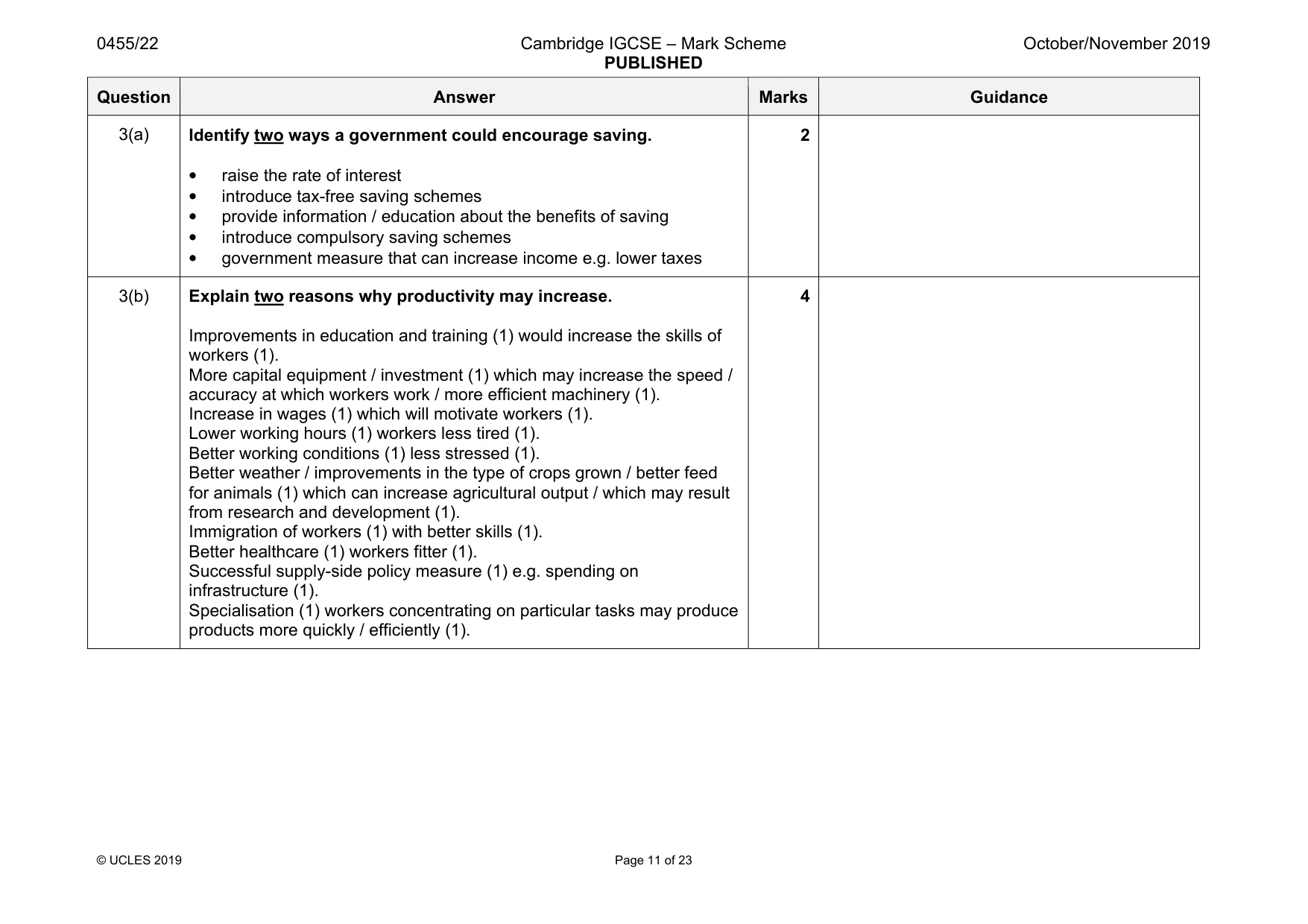
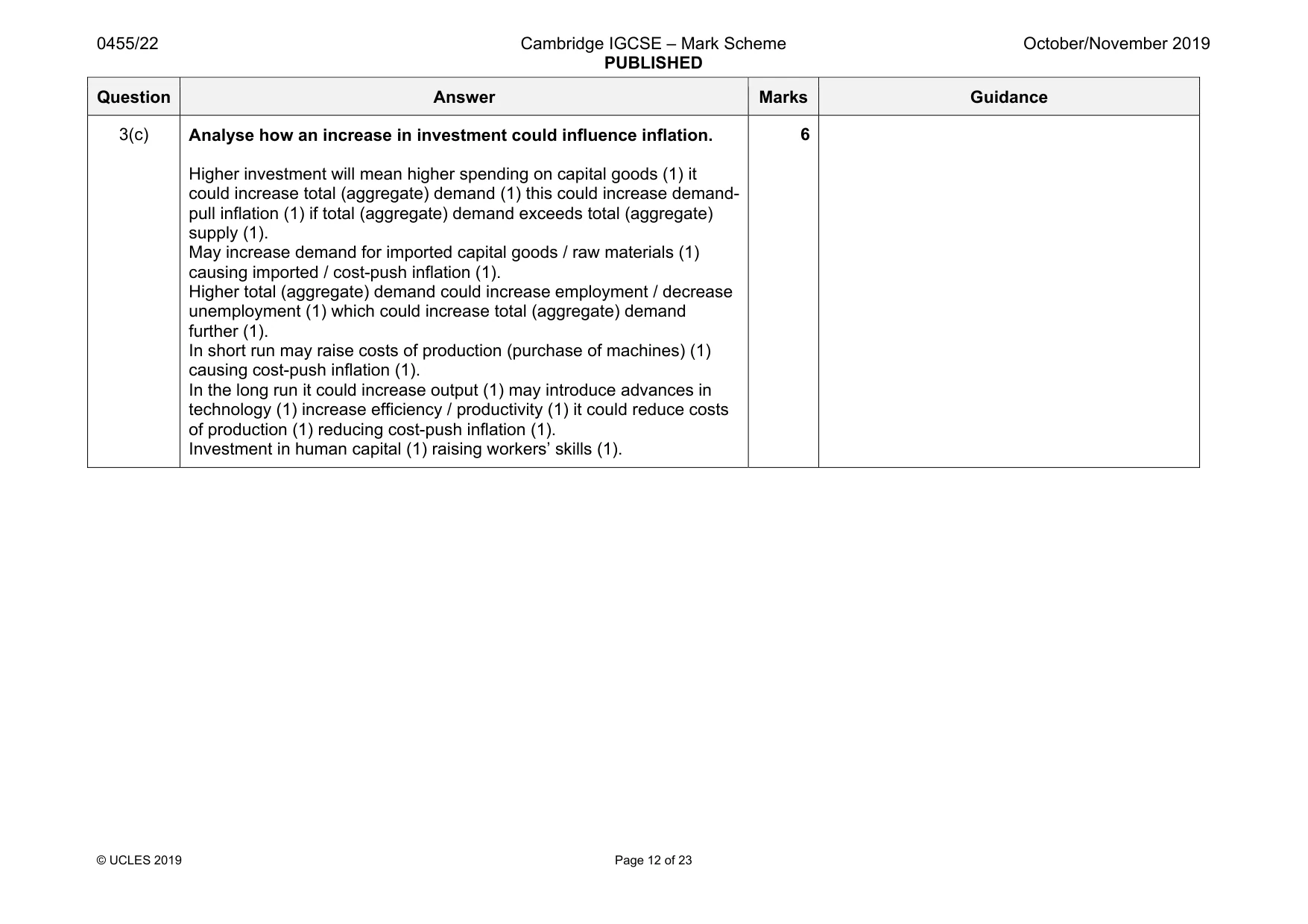
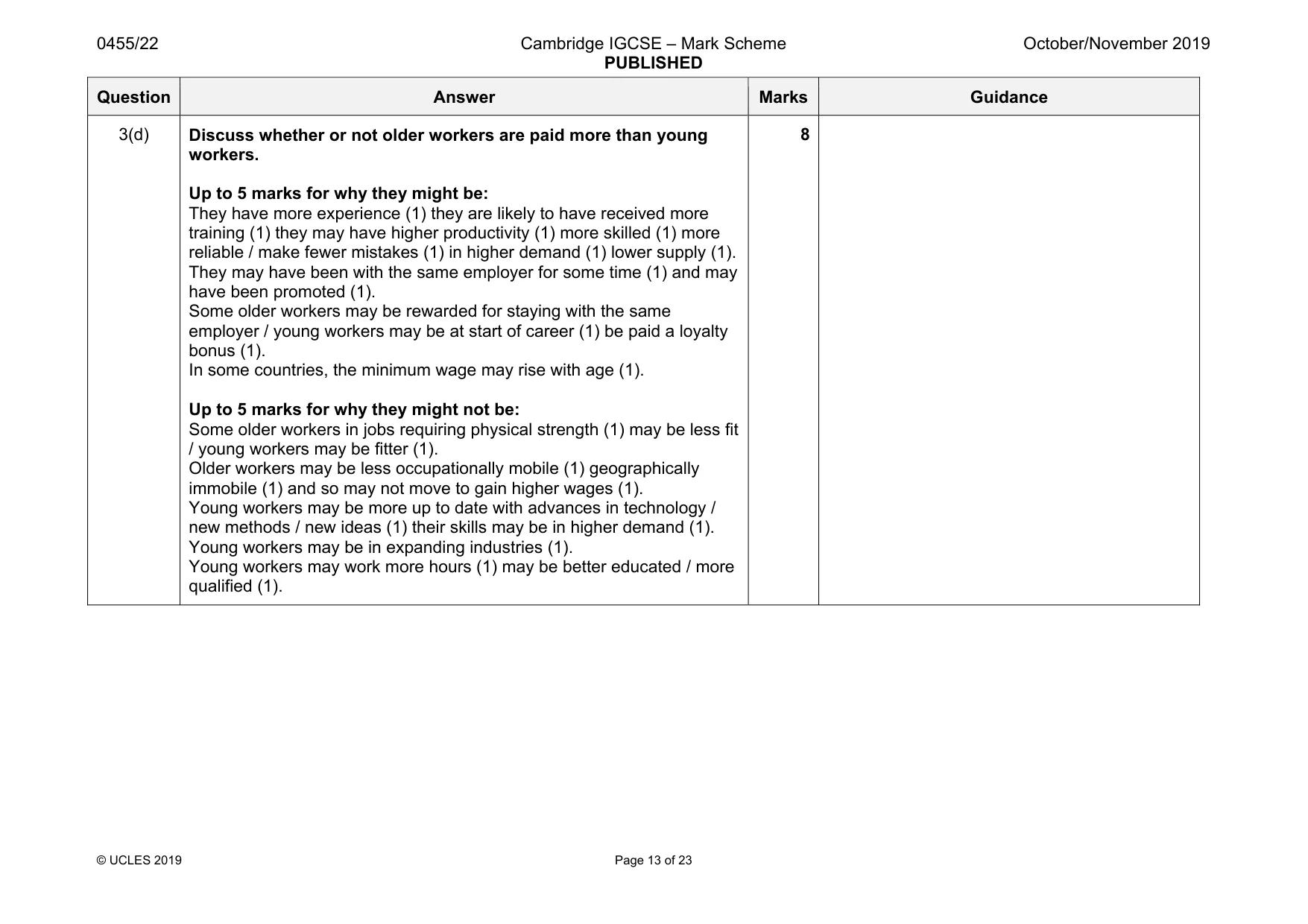
Mark scheme: 3(a) Identify two ways a government could encourage saving. • raise the rate of interest • introduce tax-free saving schemes • provide information / education about the benefits of saving • introduce compulsory saving schemes • government measure that can increase income e.g. lower taxes 2 3(b) Explain two reasons why productivity may increase. Improvements in education and training (1) would increase the skills of workers (1). More capital equipment / investment (1) which may increase the speed / accuracy at which workers work / more efficient machinery (1). Increase in wages (1) which will motivate workers (1). Lower working hours (1) workers less tired (1). Better working conditions (1) less stressed (1). Better weather / improvements in the type of crops grown / better feed for animals (1) which can increase agricultural output / which may result from research and development (1). Immigration of workers (1) with better skills (1). Better healthcare (1) workers fitter (1). Successful supply-side policy measure (1) e.g. spending on infrastructure (1). Specialisation (1) workers concentrating on particular tasks may produce products more quickly / efficiently (1). 4 Question Answer Marks Guidance 3(c) Analyse how an increase in investment could influence inflation. Higher investment will mean higher spending on capital goods (1) it could increase total (aggregate) demand (1) this could increase demand- pull inflation (1) if total (aggregate) demand exceeds total (aggregate) supply (1). May increase demand for imported capital goods / raw materials (1) causing imported / cost-push inflation (1). Higher total (aggregate) demand could increase employment / decrease unemployment (1) which could increase total (aggregate) demand further (1). In short run may raise costs of production (purchase of machines) (1) causing cost-push inflation (1). In the long run it could increase output (1) may introduce advances in technology (1) increase efficiency / productivity (1) it could reduce costs of production (1) reducing cost-push inflation (1). Investment in human capital (1) raising workers’ skills (1). 6 Question Answer Marks Guidance 3(d) Discuss whether or not older workers are paid more than young workers. Up to 5 marks for why they might be: They have more experience (1) they are likely to have received more training (1) they may have higher productivity (1) more skilled (1) more reliable / make fewer mistakes (1) in higher demand (1) lower supply (1). They may have been with the same employer for some time (1) and may have been promoted (1). Some older workers may be rewarded for staying with the same employer / young workers may be at start of career (1) be paid a loyalty bonus (1). In some countries, the minimum wage may rise with age (1). Up to 5 marks for why they might not be: Some older workers in jobs requiring physical strength (1) may be less fit / young workers may be fitter (1). Older workers may be less occupationally mobile (1) geographically immobile (1) and so may not move to gain higher wages (1). Young workers may be more up to date with advances in technology / new methods / new ideas (1) their skills may be in higher demand (1). Young workers may be in expanding industries (1). Young workers may work more hours (1) may be better educated / more qualified (1). 8
Q4 · Mali is a developing country
4 Mali is a developing country. Its Human Development Index (HDI) rose from 0.297 in 2000 to 0.442 in 2016. Most of Mali’s workers are employed in agriculture and cotton is the country’s main agricultural crop. The country’s main export, however, is gold. The country is the third largest exporter of gold in Africa. (a) Identify two components of the HDI. [2] (b) Explain how the proportion of a country’s resources devoted to the primary, secondary and tertiary sectors change as its economy develops. [4] (c) Analyse, using a demand and supply diagram, how a fall in the price of cotton would affect the market for cotton shirts. [6] (d) Discuss whether or not an increase in the size of a country’s gold mining industry will benefit an economy. [8]
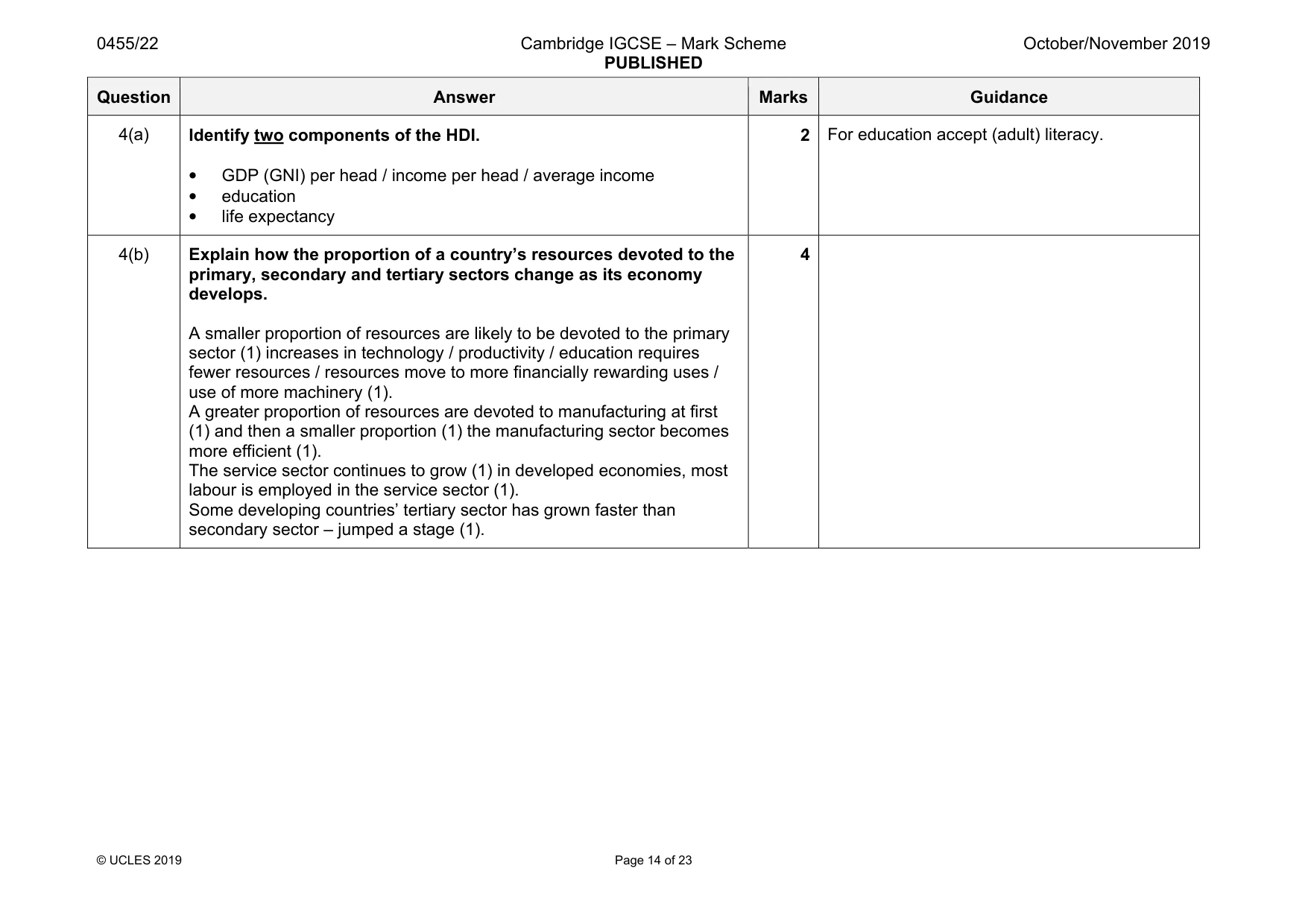
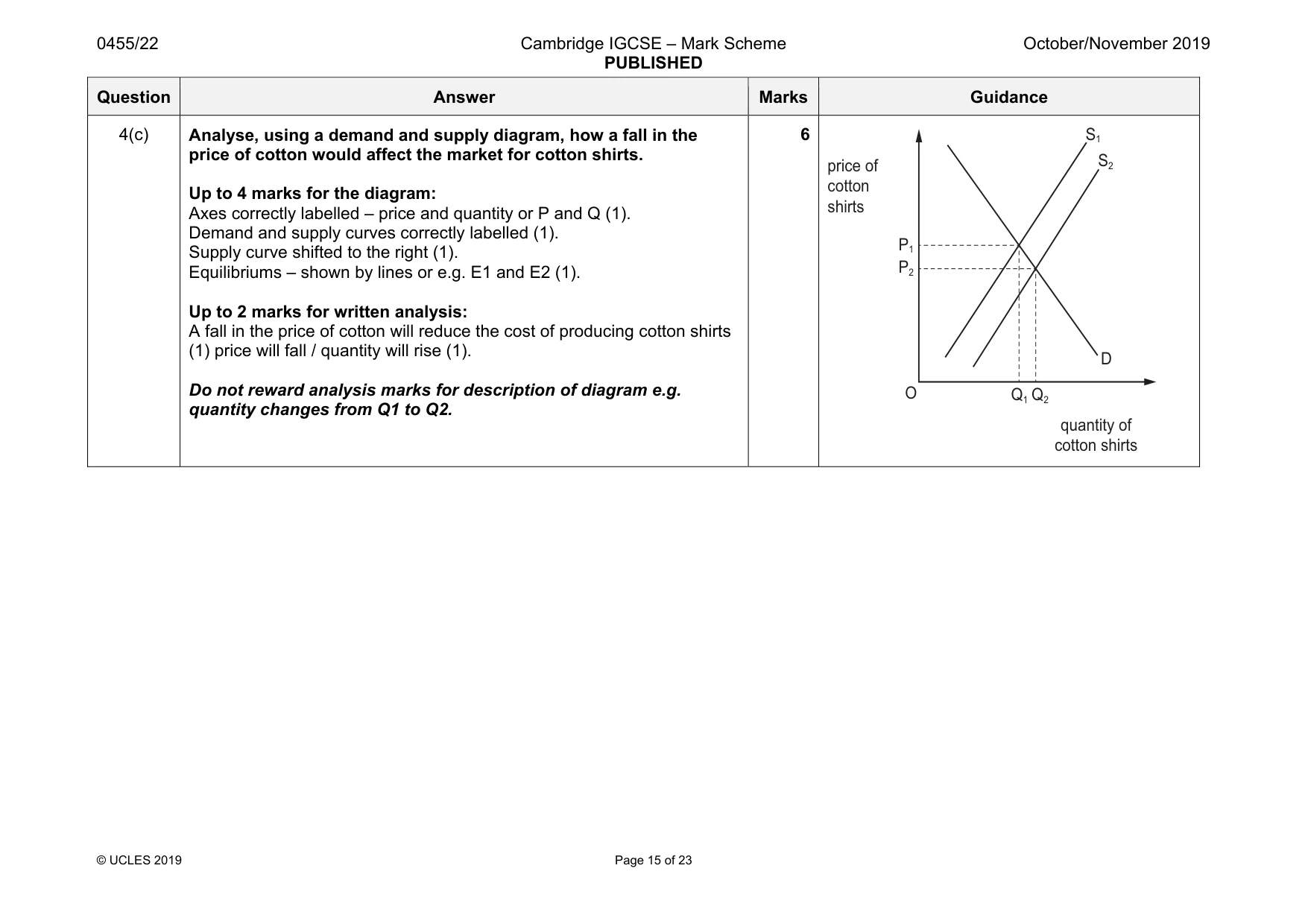
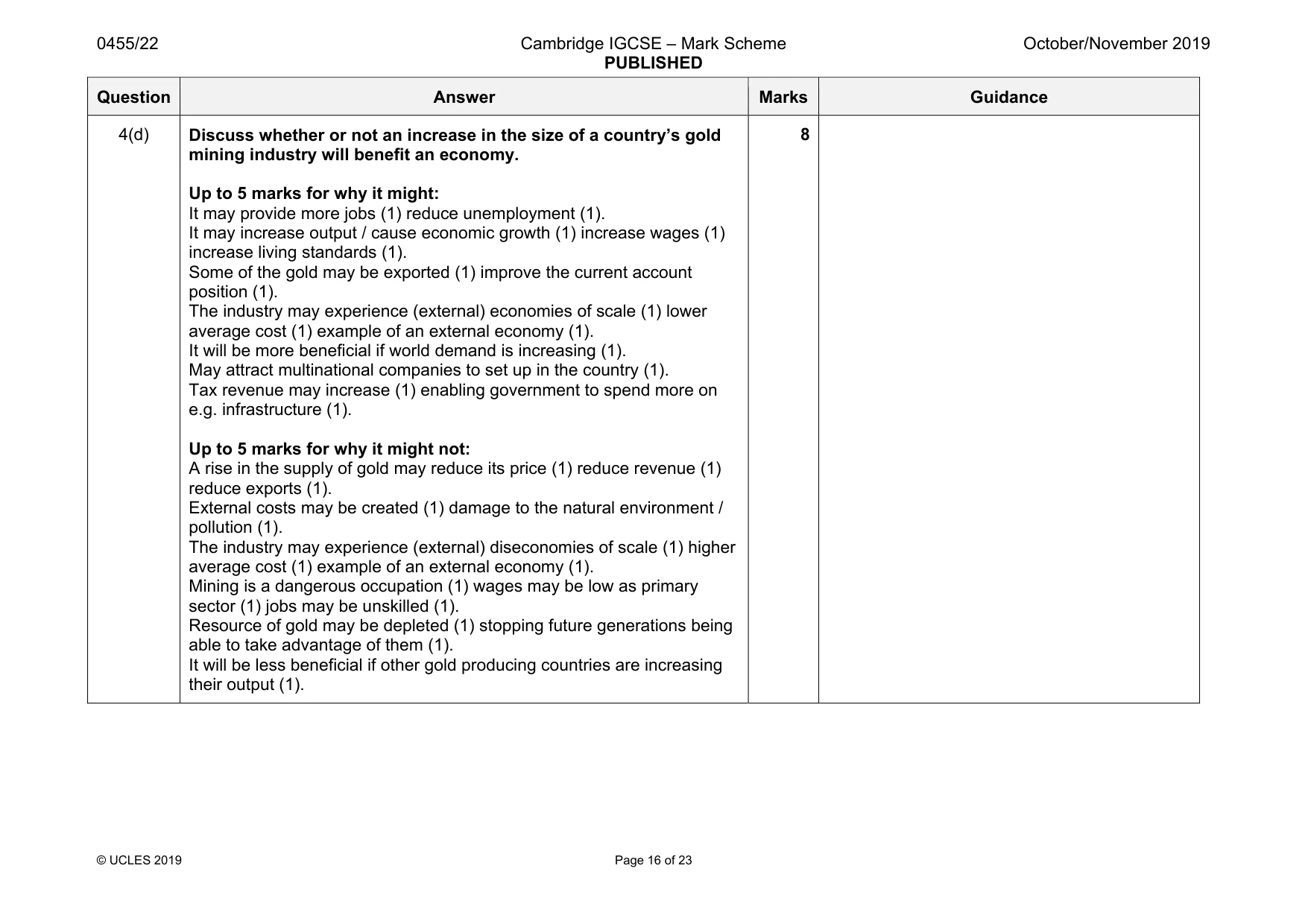
Mark scheme: 4(a) Identify two components of the HDI. • GDP (GNI) per head / income per head / average income • education • life expectancy 2 For education accept (adult) literacy. 4(b) Explain how the proportion of a country’s resources devoted to the primary, secondary and tertiary sectors change as its economy develops. A smaller proportion of resources are likely to be devoted to the primary sector (1) increases in technology / productivity / education requires fewer resources / resources move to more financially rewarding uses / use of more machinery (1). A greater proportion of resources are devoted to manufacturing at first (1) and then a smaller proportion (1) the manufacturing sector becomes more efficient (1). The service sector continues to grow (1) in developed economies, most labour is employed in the service sector (1). Some developing countries’ tertiary sector has grown faster than secondary sector – jumped a stage (1). 4 Question Answer Marks Guidance 4(c) Analyse, using a demand and supply diagram, how a fall in the price of cotton would affect the market for cotton shirts. Up to 4 marks for the diagram: Axes correctly labelled – price and quantity or P and Q (1). Demand and supply curves correctly labelled (1). Supply curve shifted to the right (1). Equilibriums – shown by lines or e.g. E1 and E2 (1). Up to 2 marks for written analysis: A fall in the price of cotton will reduce the cost of producing cotton shirts (1) price will fall / quantity will rise (1). Do not reward analysis marks for description of diagram e.g. quantity changes from Q1 to Q2. 6 S2 S1 Q1 Q2 P2 P1 D O quantity of cotton shirts price of cotton shirts Question Answer Marks Guidance 4(d) Discuss whether or not an increase in the size of a country’s gold mining industry will benefit an economy. Up to 5 marks for why it might: It may provide more jobs (1) reduce unemployment (1). It may increase output / cause economic growth (1) increase wages (1) increase living standards (1). Some of the gold may be exported (1) improve the current account position (1). The industry may experience (external) economies of scale (1) lower average cost (1) example of an external economy (1). It will be more beneficial if world demand is increasing (1). May attract multinational companies to set up in the country (1). Tax revenue may increase (1) enabling government to spend more on e.g. infrastructure (1). Up to 5 marks for why it might not: A rise in the supply of gold may reduce its price (1) reduce revenue (1) reduce exports (1). External costs may be created (1) damage to the natural environment / pollution (1). The industry may experience (external) diseconomies of scale (1) higher average cost (1) example of an external economy (1). Mining is a dangerous occupation (1) wages may be low as primary sector (1) jobs may be unskilled (1). Resource of gold may be depleted (1) stopping future generations being able to take advantage of them (1). It will be less beneficial if other gold producing countries are increasing their output (1). 8
Q5 · In May 2017, the price of olive oil rose by more than 10%
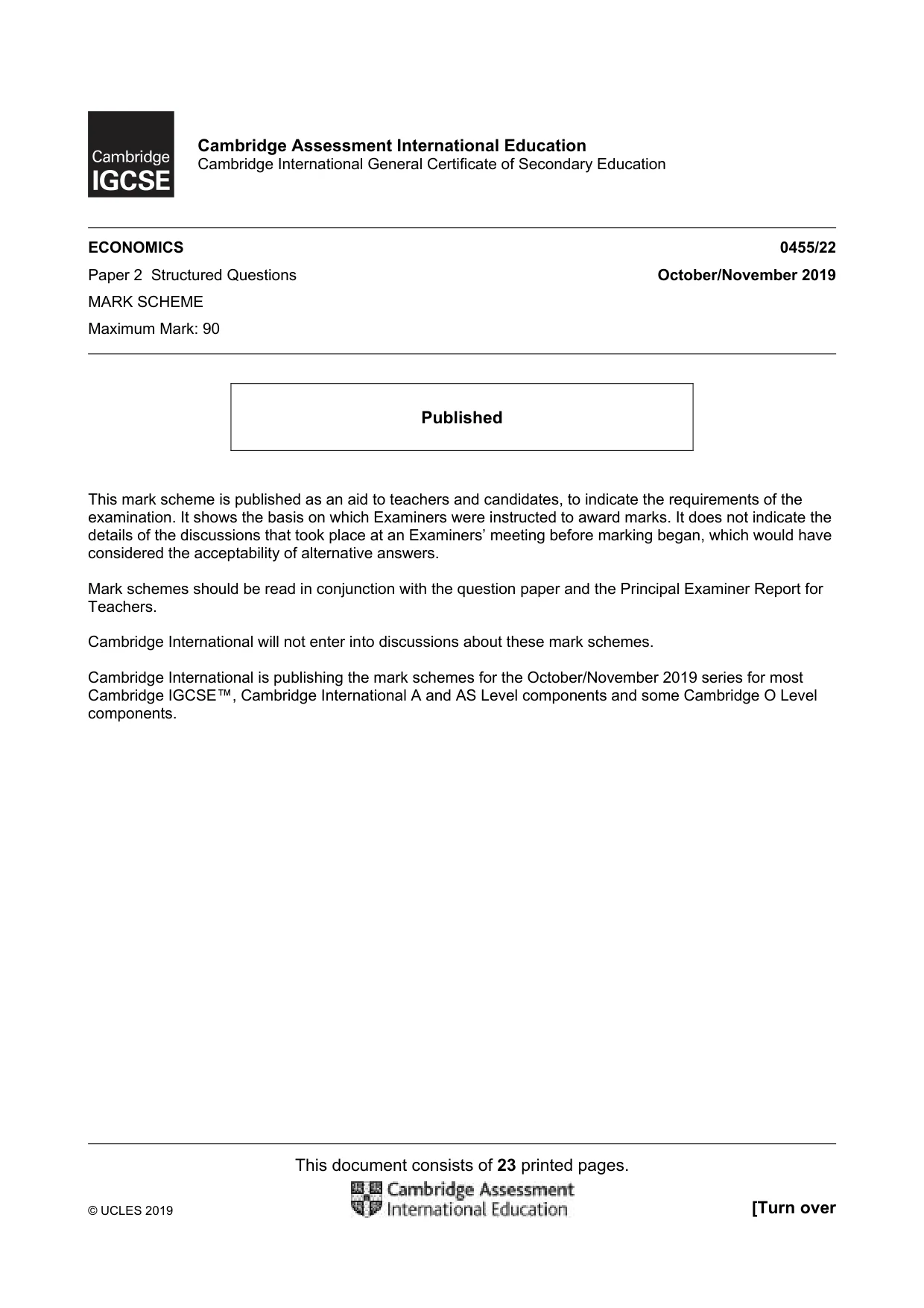
5 In May 2017, the price of olive oil rose by more than 10%. This was caused by a drought in Greece, Italy, Spain and Tunisia, the major producing countries. Global supply was forecast to fall by 14% in 2017. Demand for olive oil fell in Europe, but rose in a number of other countries including Australia, Brazil and China. Some basic food items, including bread and rice, are taxed in some countries but are subsidised in other countries. (a) Identify two examples of land used in growing agricultural crops. [2] (b) Explain why the concept of price elasticity of supply (PES) may be useful to a government in deciding whether to subsidise the production of a product. [4] (c) Analyse why the demand for a product may be higher in one country than in another country. [6] (d) Discuss whether or not the government should influence the production of basic food items, such as bread or rice. [8]
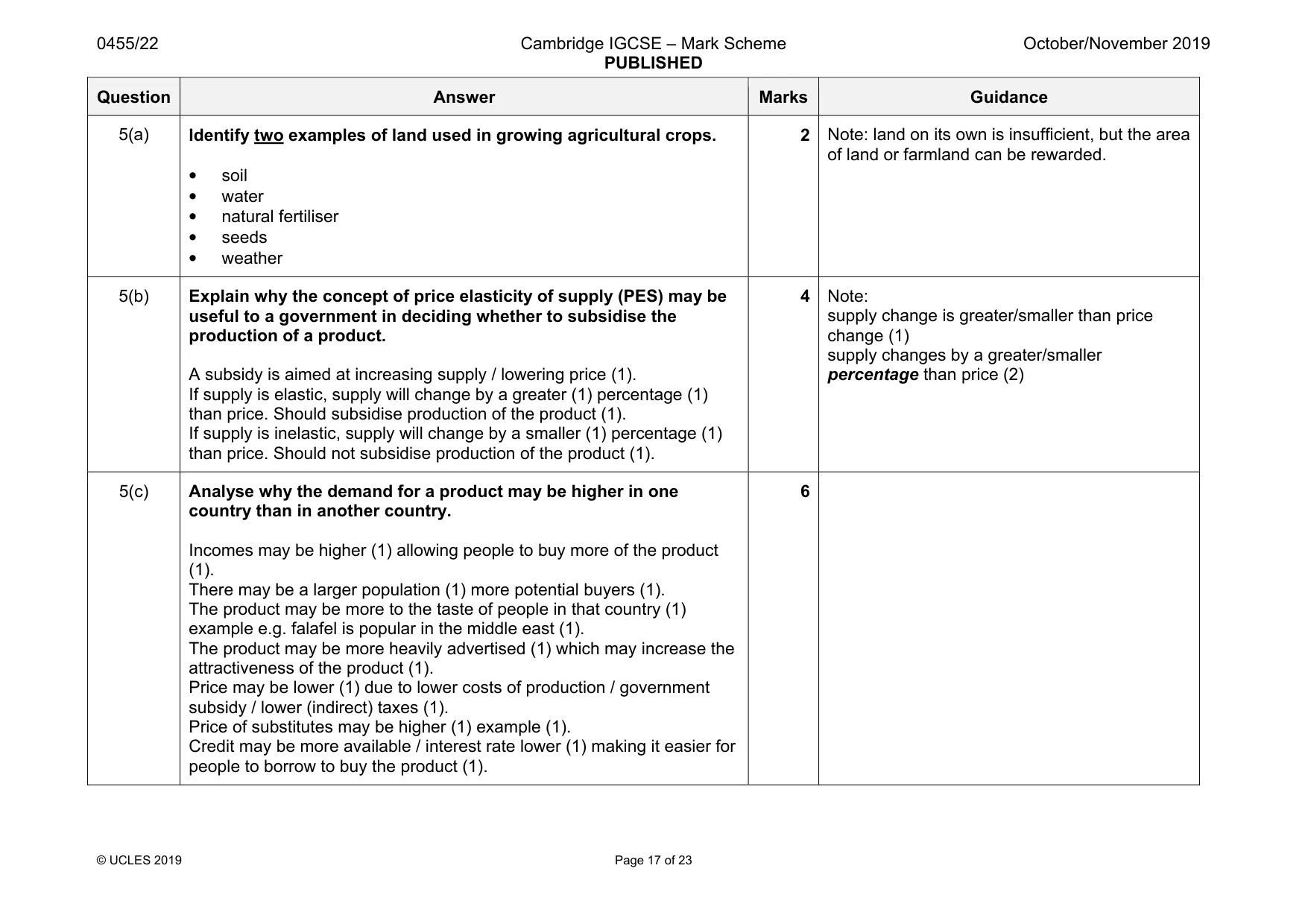
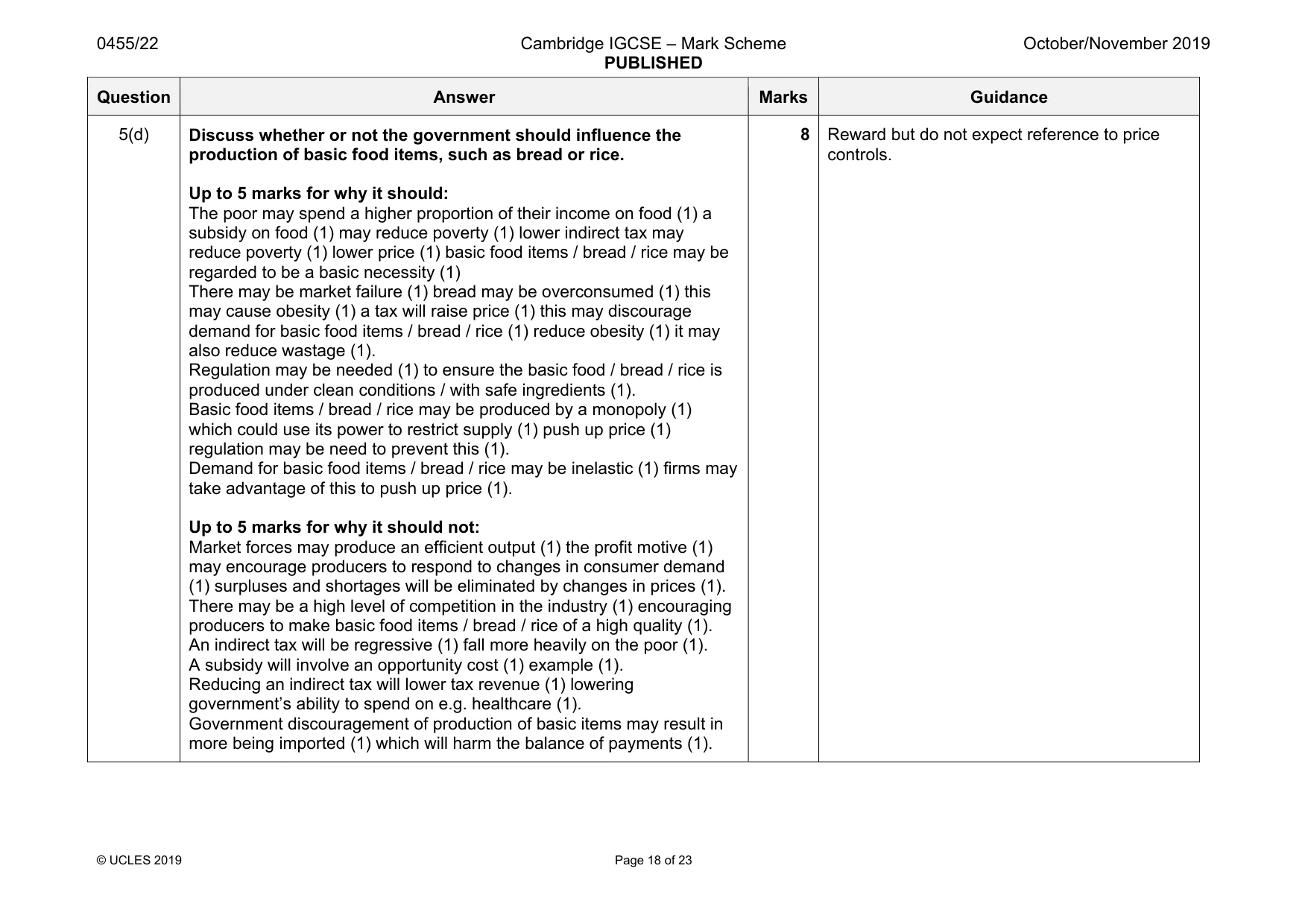
Mark scheme: 5(a) Identify two examples of land used in growing agricultural crops. • soil • water • natural fertiliser • seeds • weather 2 Note: land on its own is insufficient, but the area of land or farmland can be rewarded. 5(b) Explain why the concept of price elasticity of supply (PES) may be useful to a government in deciding whether to subsidise the production of a product. A subsidy is aimed at increasing supply / lowering price (1). If supply is elastic, supply will change by a greater (1) percentage (1) than price. Should subsidise production of the product (1). If supply is inelastic, supply will change by a smaller (1) percentage (1) than price. Should not subsidise production of the product (1). 4 Note: supply change is greater/smaller than price change (1) supply changes by a greater/smaller percentage than price (2) 5(c) Analyse why the demand for a product may be higher in one country than in another country. Incomes may be higher (1) allowing people to buy more of the product (1). There may be a larger population (1) more potential buyers (1). The product may be more to the taste of people in that country (1) example e.g. falafel is popular in the middle east (1). The product may be more heavily advertised (1) which may increase the attractiveness of the product (1). Price may be lower (1) due to lower costs of production / government subsidy / lower (indirect) taxes (1). Price of substitutes may be higher (1) example (1). Credit may be more available / interest rate lower (1) making it easier for people to borrow to buy the product (1). 6 Question Answer Marks Guidance 5(d) Discuss whether or not the government should influence the production of basic food items, such as bread or rice. Up to 5 marks for why it should: The poor may spend a higher proportion of their income on food (1) a subsidy on food (1) may reduce poverty (1) lower indirect tax may reduce poverty (1) lower price (1) basic food items / bread / rice may be regarded to be a basic necessity (1) There may be market failure (1) bread may be overconsumed (1) this may cause obesity (1) a tax will raise price (1) this may discourage demand for basic food items / bread / rice (1) reduce obesity (1) it may also reduce wastage (1). Regulation may be needed (1) to ensure the basic food / bread / rice is produced under clean conditions / with safe ingredients (1). Basic food items / bread / rice may be produced by a monopoly (1) which could use its power to restrict supply (1) push up price (1) regulation may be need to prevent this (1). Demand for basic food items / bread / rice may be inelastic (1) firms may take advantage of this to push up price (1). Up to 5 marks for why it should not: Market forces may produce an efficient output (1) the profit motive (1) may encourage producers to respond to changes in consumer demand (1) surpluses and shortages will be eliminated by changes in prices (1). There may be a high level of competition in the industry (1) encouraging producers to make basic food items / bread / rice of a high quality (1). An indirect tax will be regressive (1) fall more heavily on the poor (1). A subsidy will involve an opportunity cost (1) example (1). Reducing an indirect tax will lower tax revenue (1) lowering government’s ability to spend on e.g. healthcare (1). Government discouragement of production of basic items may result in more being imported (1) which will harm the balance of payments (1). 8 Reward but do not expect reference to price controls.
Q6 · The Indian government subsidises the country’s exports of cotton textiles
6 The Indian government subsidises the country’s exports of cotton textiles. The USA, the largest buyer of Indian cotton textiles, benefited from this. India planned to stop the subsidy by 2019. This was welcomed by other cotton textile exporters. The USA may not be much affected, in part, because income usually rises in the country. The value of the Indian rupee against the US dollar was relatively stable in this period but rose slightly in mid-2017. (a) Identify the difference between an export and an import. [2] (b) Explain how a rise in the income of its main trading partners may affect a country’s trade in goods balance. [4] (c) Analyse how a rise in a country’s foreign exchange rate may affect its unemployment rate. [6] (d) Discuss whether or not a government should subsidise its exports. [8]
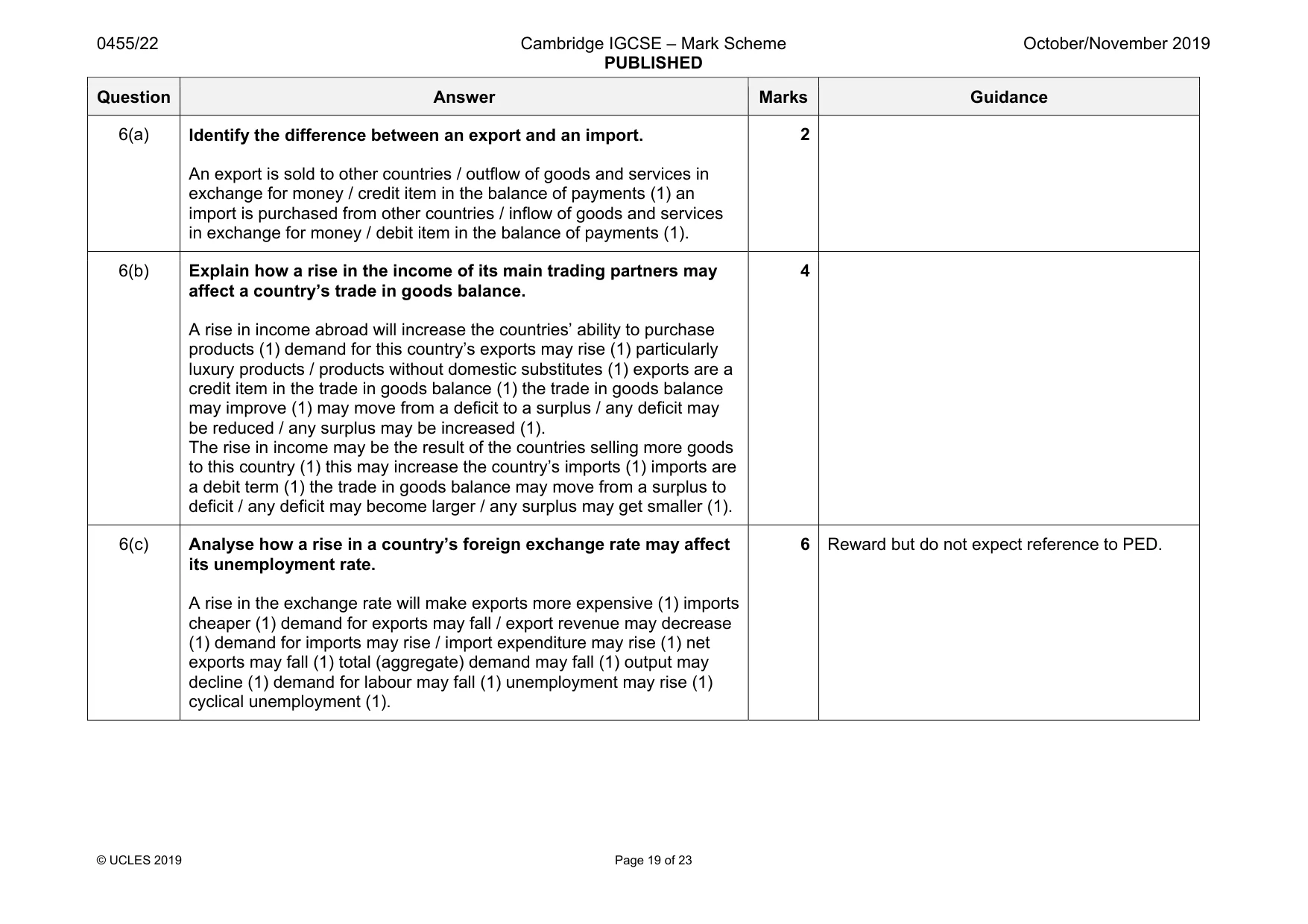
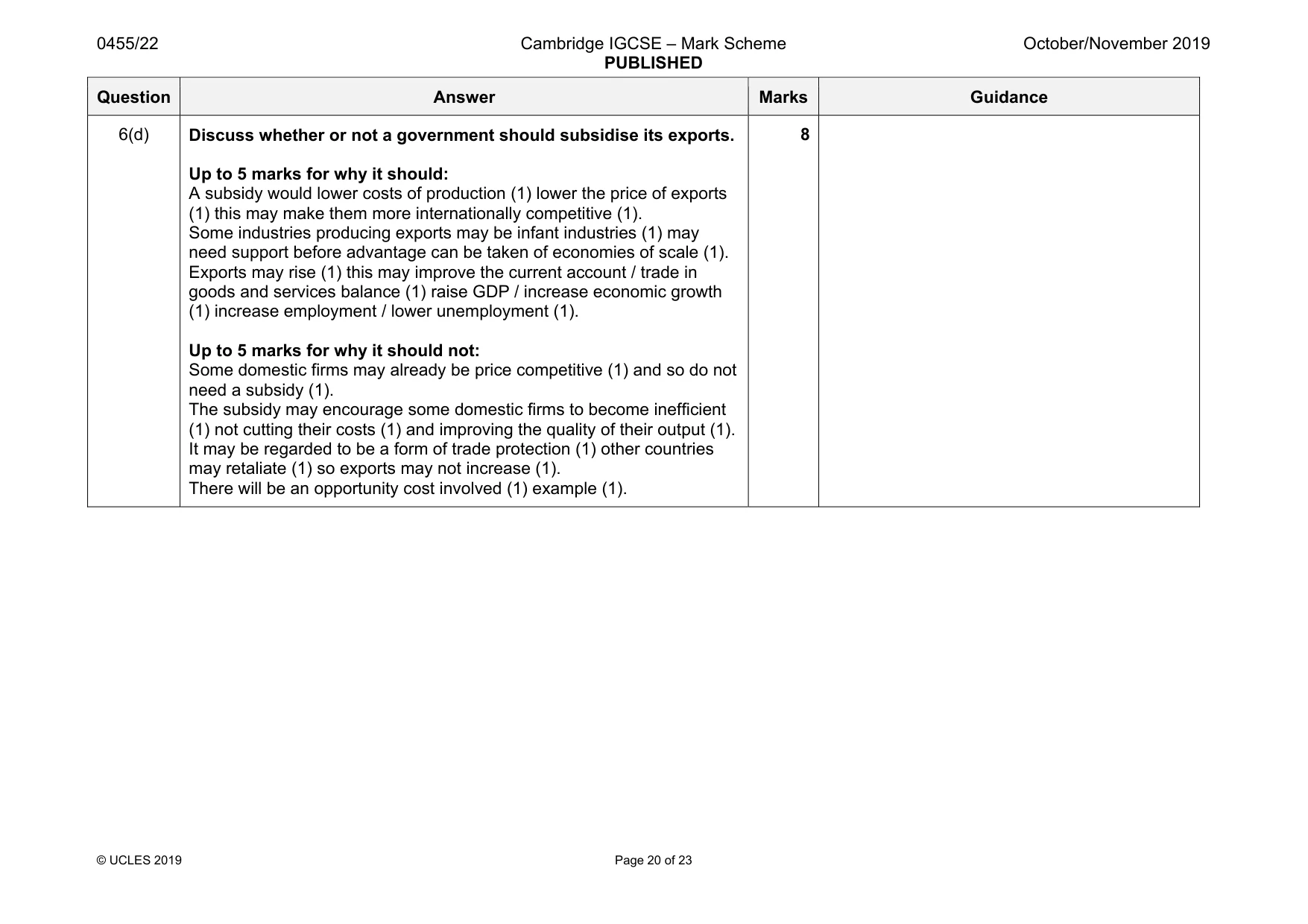
Mark scheme: 6(a) Identify the difference between an export and an import. An export is sold to other countries / outflow of goods and services in exchange for money / credit item in the balance of payments (1) an import is purchased from other countries / inflow of goods and services in exchange for money / debit item in the balance of payments (1). 2 6(b) Explain how a rise in the income of its main trading partners may affect a country’s trade in goods balance. A rise in income abroad will increase the countries’ ability to purchase products (1) demand for this country’s exports may rise (1) particularly luxury products / products without domestic substitutes (1) exports are a credit item in the trade in goods balance (1) the trade in goods balance may improve (1) may move from a deficit to a surplus / any deficit may be reduced / any surplus may be increased (1). The rise in income may be the result of the countries selling more goods to this country (1) this may increase the country’s imports (1) imports are a debit term (1) the trade in goods balance may move from a surplus to deficit / any deficit may become larger / any surplus may get smaller (1). 4 6(c) Analyse how a rise in a country’s foreign exchange rate may affect its unemployment rate. A rise in the exchange rate will make exports more expensive (1) imports cheaper (1) demand for exports may fall / export revenue may decrease (1) demand for imports may rise / import expenditure may rise (1) net exports may fall (1) total (aggregate) demand may fall (1) output may decline (1) demand for labour may fall (1) unemployment may rise (1) cyclical unemployment (1). 6 Reward but do not expect reference to PED. Question Answer Marks Guidance 6(d) Discuss whether or not a government should subsidise its exports. Up to 5 marks for why it should: A subsidy would lower costs of production (1) lower the price of exports (1) this may make them more internationally competitive (1). Some industries producing exports may be infant industries (1) may need support before advantage can be taken of economies of scale (1). Exports may rise (1) this may improve the current account / trade in goods and services balance (1) raise GDP / increase economic growth (1) increase employment / lower unemployment (1). Up to 5 marks for why it should not: Some domestic firms may already be price competitive (1) and so do not need a subsidy (1). The subsidy may encourage some domestic firms to become inefficient (1) not cutting their costs (1) and improving the quality of their output (1). It may be regarded to be a form of trade protection (1) other countries may retaliate (1) so exports may not increase (1). There will be an opportunity cost involved (1) example (1). 8
Q7 · More agricultural markets come close to perfect competition than markets for manufactured…
7 More agricultural markets come close to perfect competition than markets for manufactured goods and for services. The goals of business organisations can vary between markets, and within markets. In 2017, the Nigerian government used supply-side policy measures to influence the goals and performance of firms in a range of markets and to lower firms’ average costs of production. (a) Identify two characteristics of perfect competition. [2] (b) Explain two goals a business organisation may have. [4] (c) Analyse the main reasons for the differences in the size of firms. [6] (d) Discuss whether or not the use of supply-side policy measures by a government will reduce firms’ average costs of production. [8]
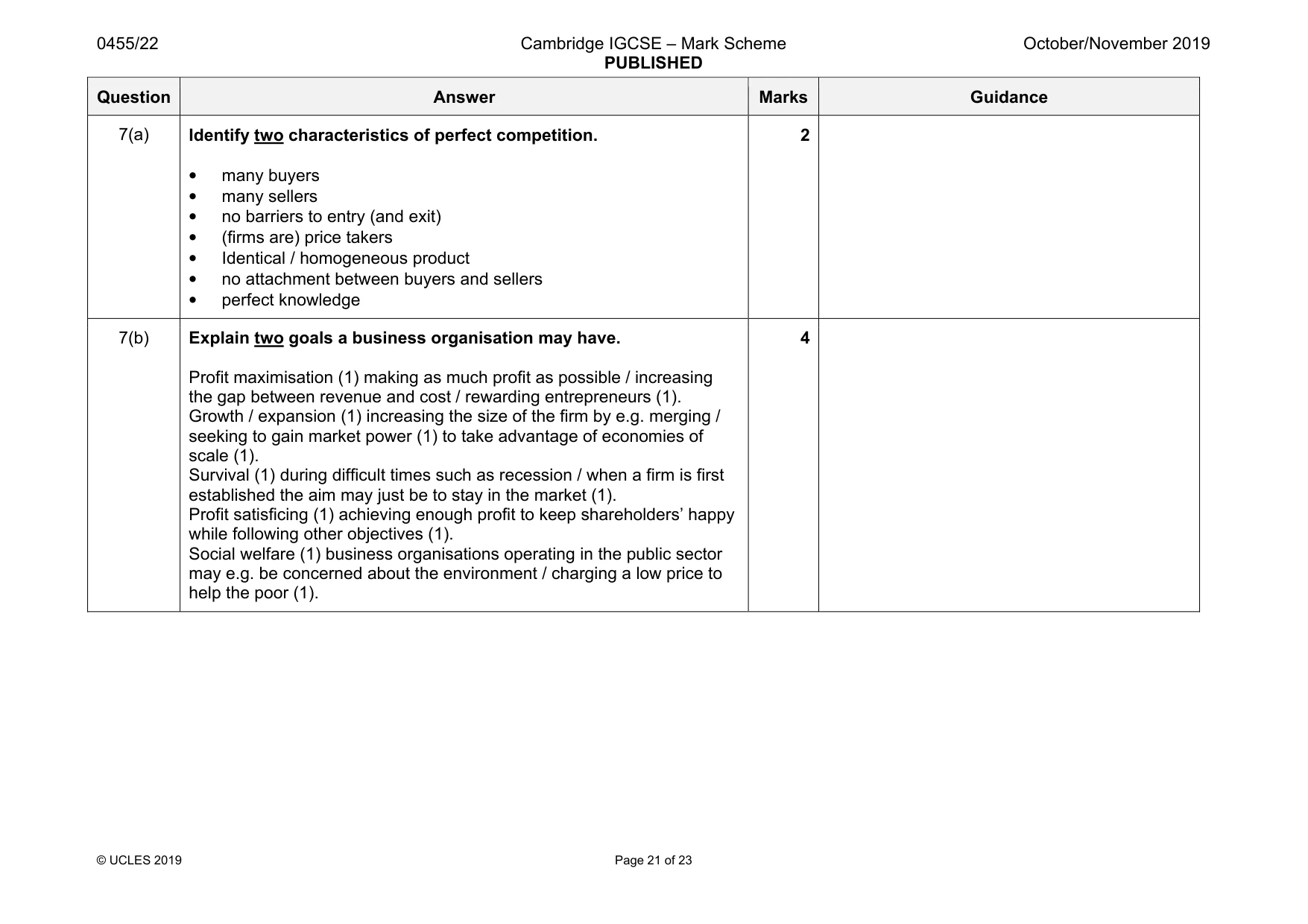
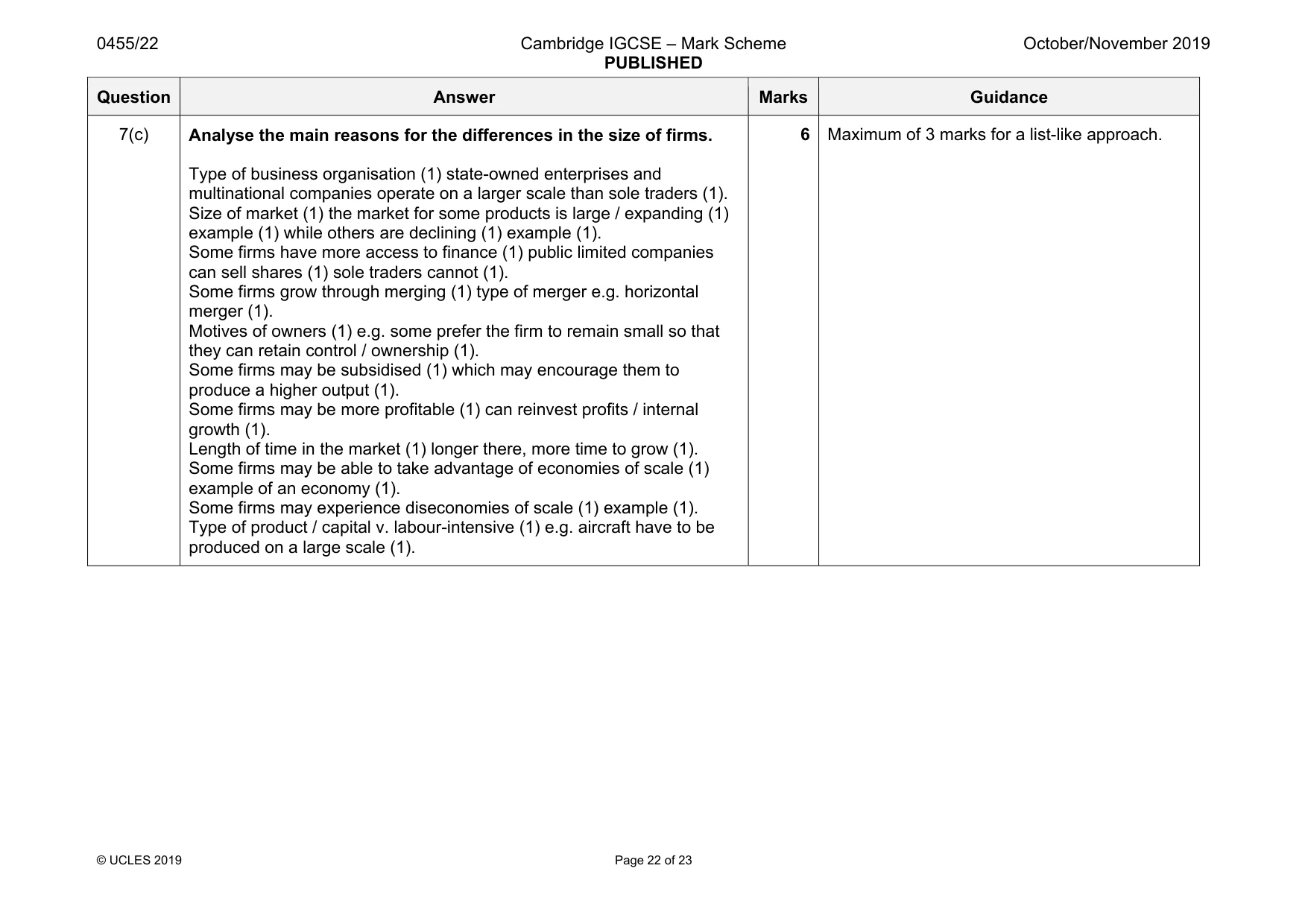
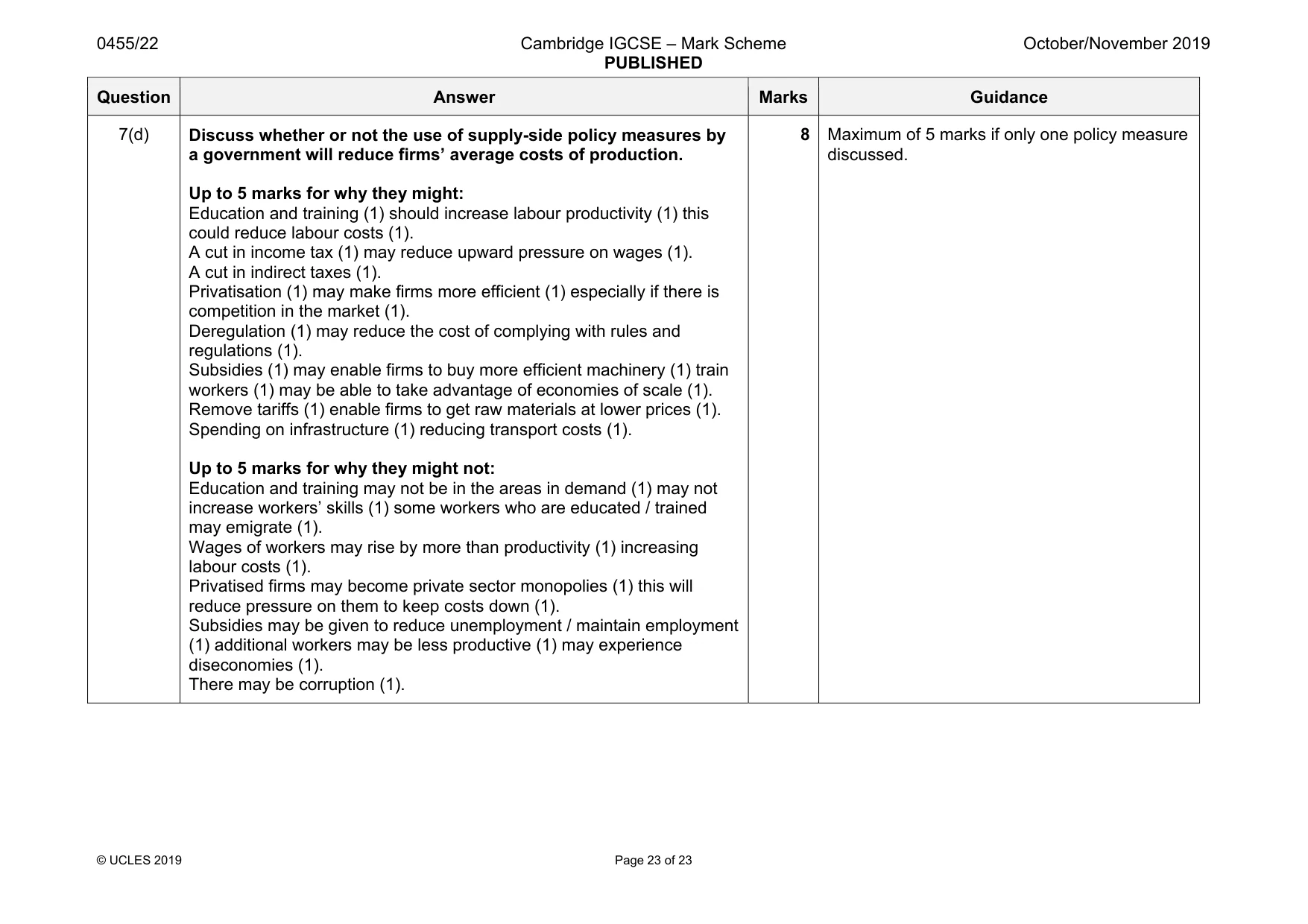
Mark scheme: 7(a) Identify two characteristics of perfect competition. • many buyers • many sellers • no barriers to entry (and exit) • (firms are) price takers • Identical / homogeneous product • no attachment between buyers and sellers • perfect knowledge 2 7(b) Explain two goals a business organisation may have. Profit maximisation (1) making as much profit as possible / increasing the gap between revenue and cost / rewarding entrepreneurs (1). Growth / expansion (1) increasing the size of the firm by e.g. merging / seeking to gain market power (1) to take advantage of economies of scale (1). Survival (1) during difficult times such as recession / when a firm is first established the aim may just be to stay in the market (1). Profit satisficing (1) achieving enough profit to keep shareholders’ happy while following other objectives (1). Social welfare (1) business organisations operating in the public sector may e.g. be concerned about the environment / charging a low price to help the poor (1). 4 Question Answer Marks Guidance 7(c) Analyse the main reasons for the differences in the size of firms. Type of business organisation (1) state-owned enterprises and multinational companies operate on a larger scale than sole traders (1). Size of market (1) the market for some products is large / expanding (1) example (1) while others are declining (1) example (1). Some firms have more access to finance (1) public limited companies can sell shares (1) sole traders cannot (1). Some firms grow through merging (1) type of merger e.g. horizontal merger (1). Motives of owners (1) e.g. some prefer the firm to remain small so that they can retain control / ownership (1). Some firms may be subsidised (1) which may encourage them to produce a higher output (1). Some firms may be more profitable (1) can reinvest profits / internal growth (1). Length of time in the market (1) longer there, more time to grow (1). Some firms may be able to take advantage of economies of scale (1) example of an economy (1). Some firms may experience diseconomies of scale (1) example (1). Type of product / capital v. labour-intensive (1) e.g. aircraft have to be produced on a large scale (1). 6 Maximum of 3 marks for a list-like approach. Question Answer Marks Guidance 7(d) Discuss whether or not the use of supply-side policy measures by a government will reduce firms’ average costs of production. Up to 5 marks for why they might: Education and training (1) should increase labour productivity (1) this could reduce labour costs (1). A cut in income tax (1) may reduce upward pressure on wages (1). A cut in indirect taxes (1). Privatisation (1) may make firms more efficient (1) especially if there is competition in the market (1). Deregulation (1) may reduce the cost of complying with rules and regulations (1). Subsidies (1) may enable firms to buy more efficient machinery (1) train workers (1) may be able to take advantage of economies of scale (1). Remove tariffs (1) enable firms to get raw materials at lower prices (1). Spending on infrastructure (1) reducing transport costs (1). Up to 5 marks for why they might not: Education and training may not be in the areas in demand (1) may not increase workers’ skills (1) some workers who are educated / trained may emigrate (1). Wages of workers may rise by more than productivity (1) increasing labour costs (1). Privatised firms may become private sector monopolies (1) this will reduce pressure on them to keep costs down (1). Subsidies may be given to reduce unemployment / maintain employment (1) additional workers may be less productive (1) may experience diseconomies (1). There may be corruption (1). 8 Maximum of 5 marks if only one policy measure discussed.
What was in this paper
The subtopics covered by these 7 questions, and how many questions each got. Open one in a new tab to see every Cambridge question on it.
What you needed in this session
Cambridge’s own grade thresholds for 2019 Oct/Nov, Paper 2 · Variant 2. A higher threshold means an easier paper — the bar moves with how the cohort did.