Cambridge IGCSE Economics 0455 — 2018 May/June Paper 2 · Variant 1
0455/21/M/J/18 · 7 questions · 90 marks · ≈101 min
The question paper and its mark scheme, free to read here and free to download. This is Cambridge’s own paper, exactly as it was sat.
Question paper8 pages



Mark scheme17 pages
Answers below. Sit the paper first if you are practising.
Questions as text
Q1 · Banking and unemployment in Morocco Morocco’s banking industry has been described as one…
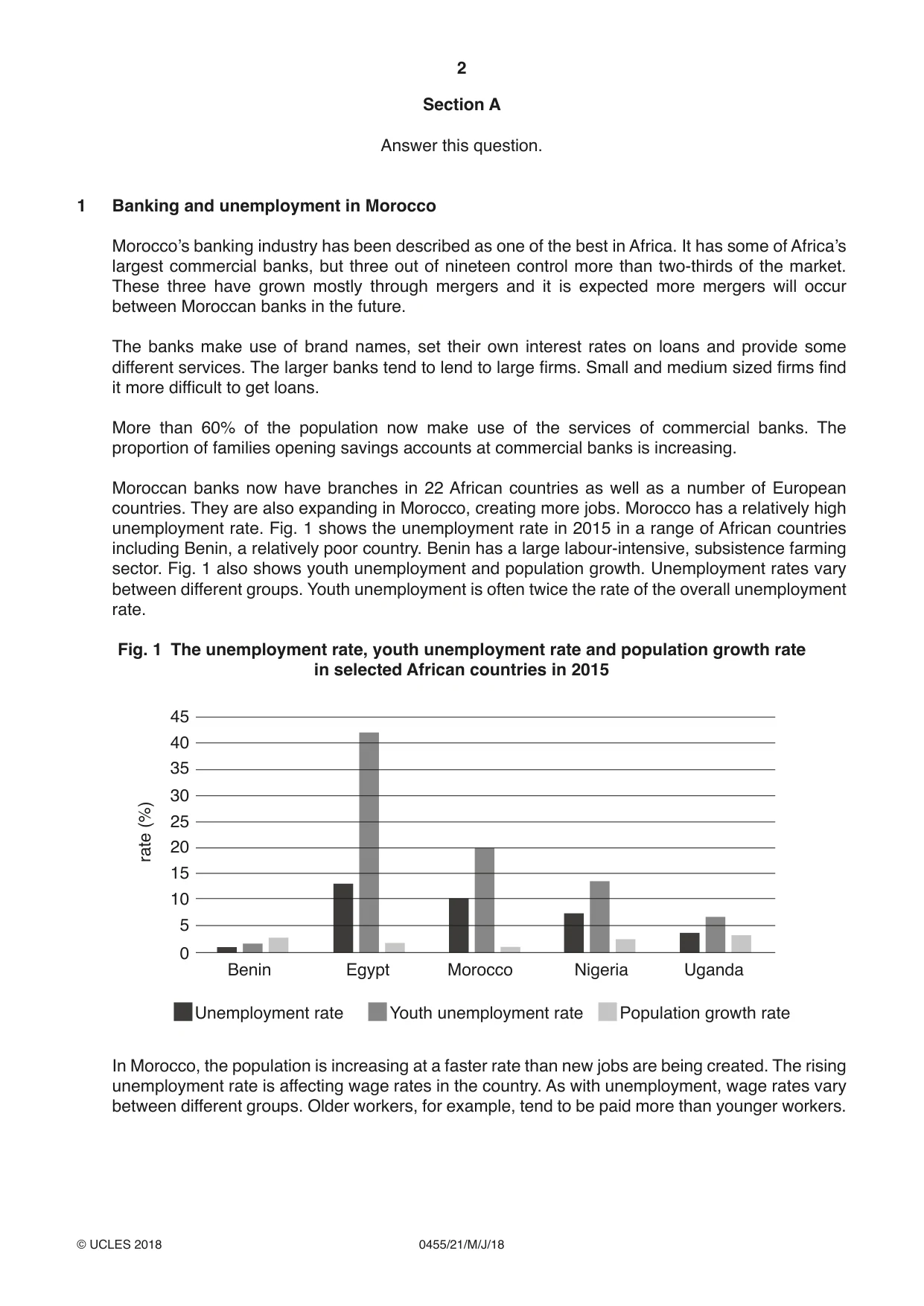
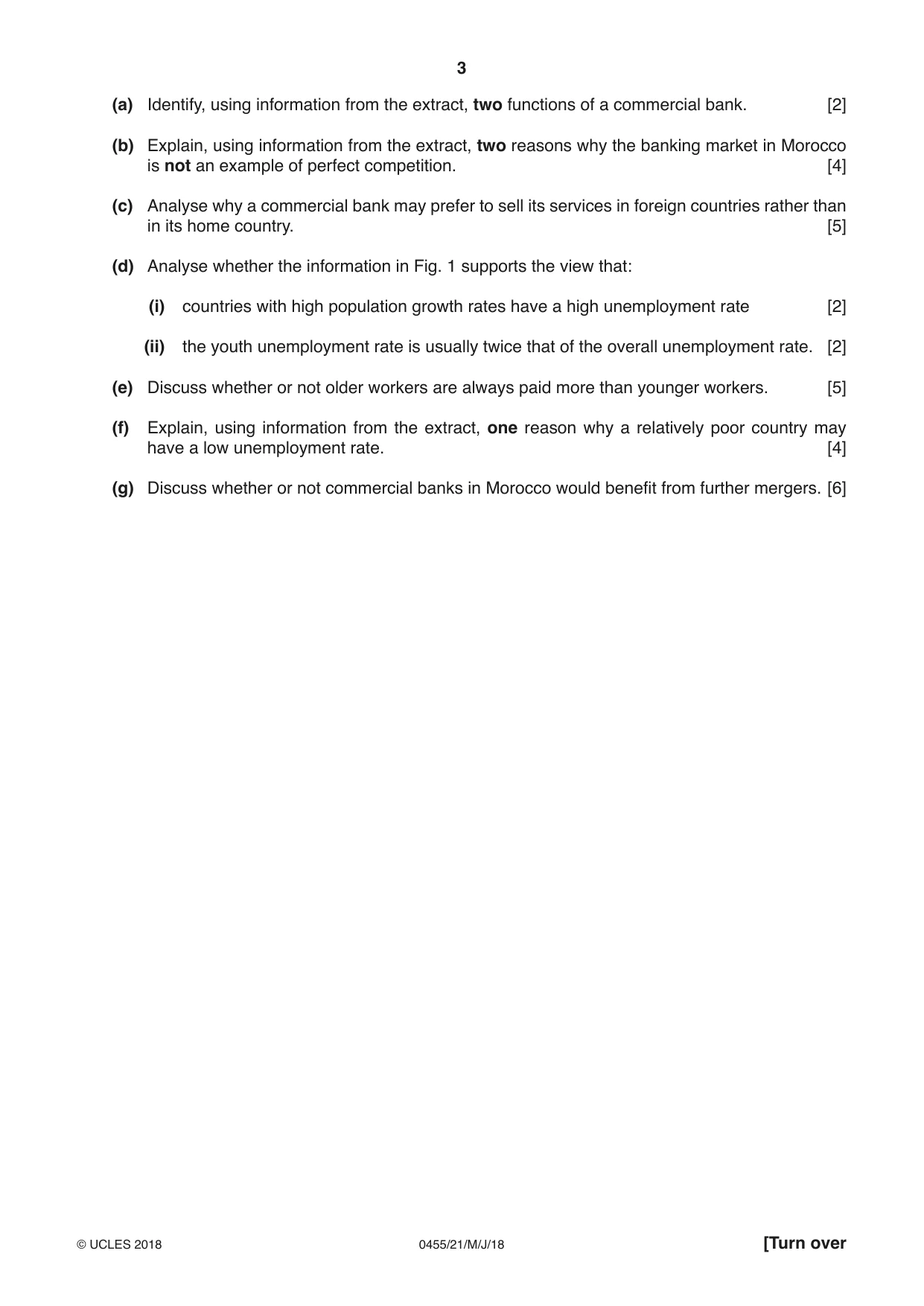
1 Banking and unemployment in Morocco Morocco’s banking industry has been described as one of the best in Africa. It has some of Africa’s largest commercial banks, but three out of nineteen control more than two-thirds of the market. These three have grown mostly through mergers and it is expected more mergers will occur between Moroccan banks in the future. The banks make use of brand names, set their own interest rates on loans and provide some different services. The larger banks tend to lend to large firms. Small and medium sized firms find it more difficult to get loans. More than 60% of the population now make use of the services of commercial banks. The proportion of families opening savings accounts at commercial banks is increasing. Moroccan banks now have branches in 22 African countries as well as a number of European countries. They are also expanding in Morocco, creating more jobs. Morocco has a relatively high unemployment rate. Fig. 1 shows the unemployment rate in 2015 in a range of African countries including Benin, a relatively poor country. Benin has a large labour-intensive, subsistence farming sector. Fig. 1 also shows youth unemployment and population growth. Unemployment rates vary between different groups. Youth unemployment is often twice the rate of the overall unemployment rate. Fig. 1 The unemployment rate, youth unemployment rate and population growth rate in selected African countries in 2015 45 40 35 30 (%) 25 rate 20 15 10 5 0 Benin Egypt Morocco Nigeria Uganda Unemployment rate Youth unemployment rate Population growth rate In Morocco, the population is increasing at a faster rate than new jobs are being created. The rising unemployment rate is affecting wage rates in the country. As with unemployment, wage rates vary between different groups. Older workers, for example, tend to be paid more than younger workers. (a) Identify, using information from the extract, two functions of a commercial bank. [2] (b) Explain, using information from the extract, two reasons why the banking market in Morocco is not an example of perfect competition. [4] (c) Analyse why a commercial bank may prefer to sell its services in foreign countries rather than in its home country. [5] (d) Analyse whether the information in Fig. 1 supports the view that: (i) countries with high population growth rates have a high unemployment rate [2] (ii) the youth unemployment rate is usually twice that of the overall unemployment rate. [2] (e) Discuss whether or not older workers are always paid more than younger workers. [5] (f) Explain, using information from the extract, one reason why a relatively poor country may have a low unemployment rate. [4] (g) Discuss whether or not commercial banks in Morocco would benefit from further mergers. [6]
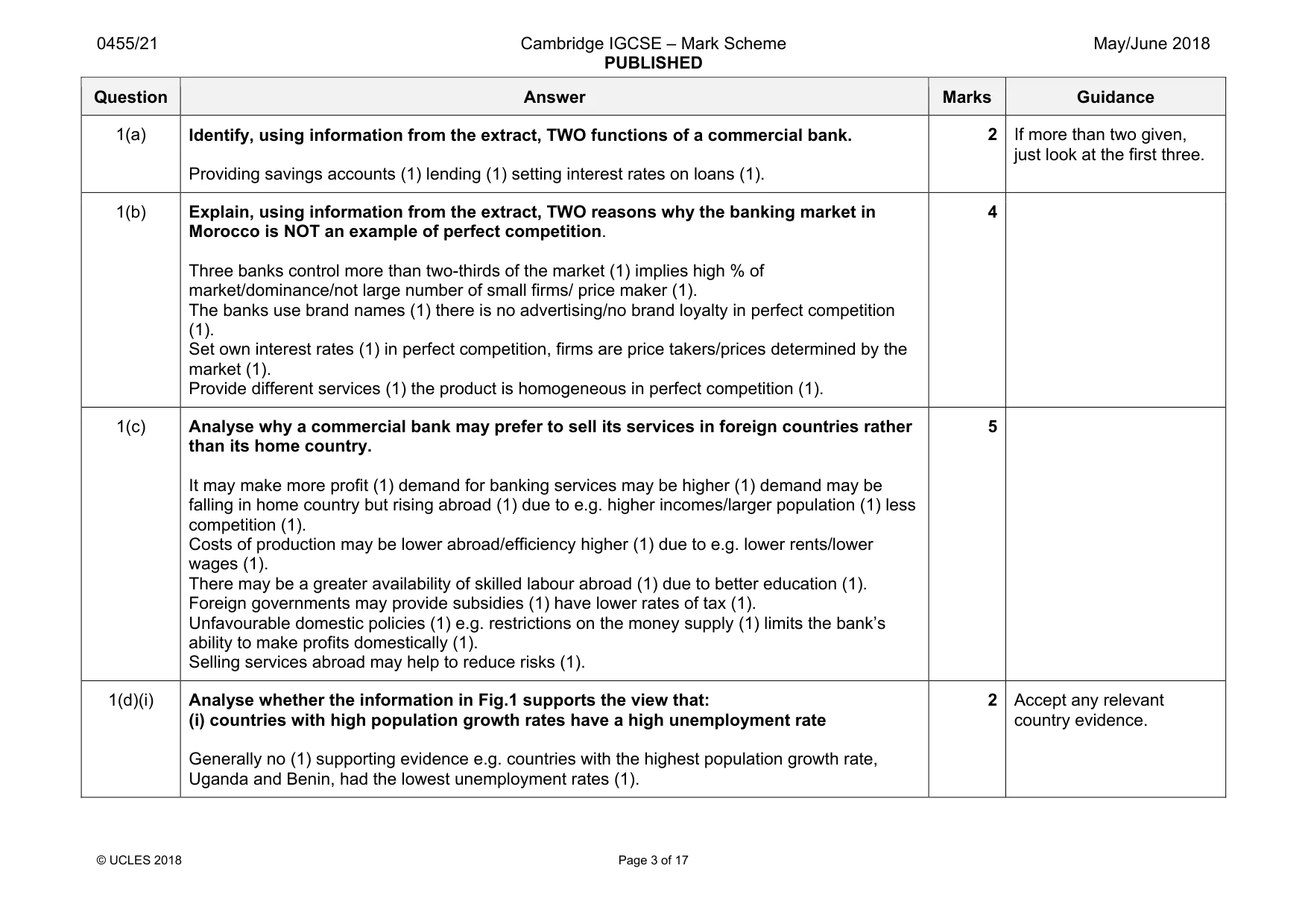
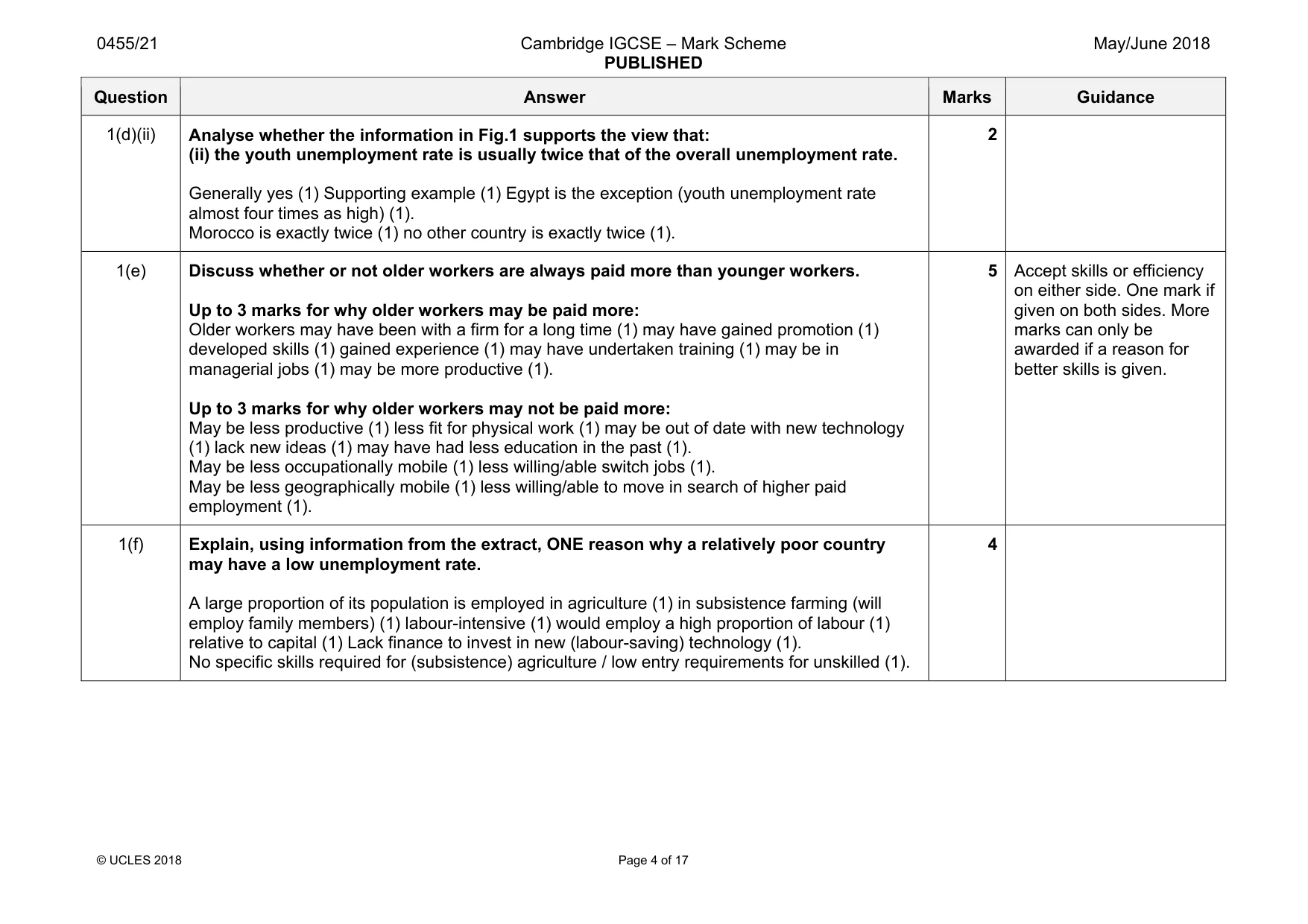
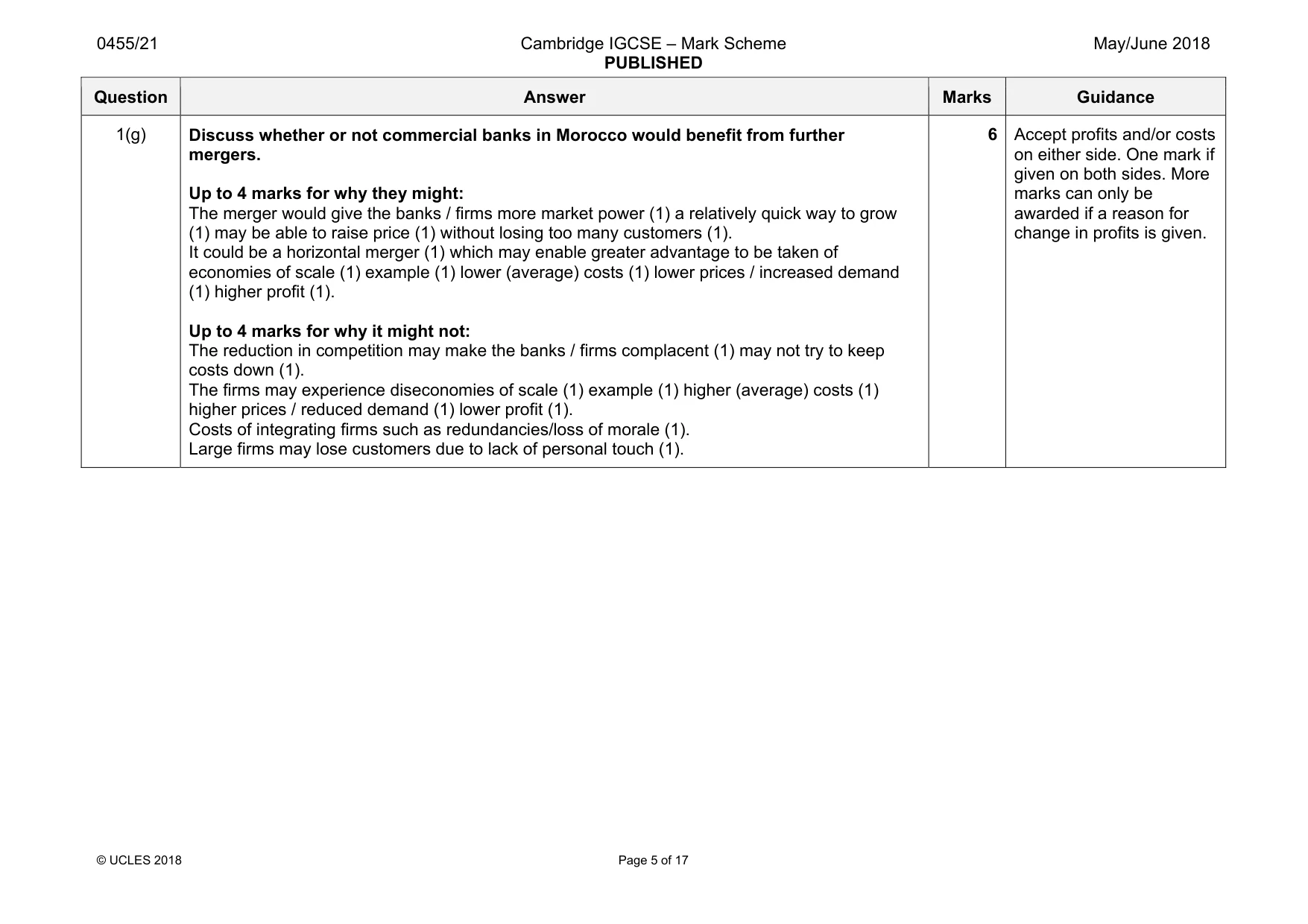
Mark scheme: 1(a) Identify, using information from the extract, TWO functions of a commercial bank. Providing savings accounts (1) lending (1) setting interest rates on loans (1). 2 just look at the first three. 1(b) Explain, using information from the extract, TWO reasons why the banking market in Morocco is NOT an example of perfect competition. Three banks control more than two-thirds of the market (1) implies high % of market/dominance/not large number of small firms/ price maker (1). The banks use brand names (1) there is no advertising/no brand loyalty in perfect competition (1). Set own interest rates (1) in perfect competition, firms are price takers/prices determined by the market (1). Provide different services (1) the product is homogeneous in perfect competition (1). 4 1(c) Analyse why a commercial bank may prefer to sell its services in foreign countries rather than its home country. It may make more profit (1) demand for banking services may be higher (1) demand may be falling in home country but rising abroad (1) due to e.g. higher incomes/larger population (1) less competition (1). Costs of production may be lower abroad/efficiency higher (1) due to e.g. lower rents/lower wages (1). There may be a greater availability of skilled labour abroad (1) due to better education (1). Foreign governments may provide subsidies (1) have lower rates of tax (1). Unfavourable domestic policies (1) e.g. restrictions on the money supply (1) limits the bank’s ability to make profits domestically (1). Selling services abroad may help to reduce risks (1). 5 1(d)(i) Analyse whether the information in Fig.1 supports the view that: (i) countries with high population growth rates have a high unemployment rate Generally no (1) supporting evidence e.g. countries with the highest population growth rate, Uganda and Benin, had the lowest unemployment rates (1). 2 Accept any relevant country evidence. Question Answer Marks Guidance 1(d)(ii) Analyse whether the information in Fig.1 supports the view that: (ii) the youth unemployment rate is usually twice that of the overall unemployment rate. Generally yes (1) Supporting example (1) Egypt is the exception (youth unemployment rate almost four times as high) (1). Morocco is exactly twice (1) no other country is exactly twice (1). 2 1(e) Discuss whether or not older workers are always paid more than younger workers. Up to 3 marks for why older workers may be paid more: Older workers may have been with a firm for a long time (1) may have gained promotion (1) developed skills (1) gained experience (1) may have undertaken training (1) may be in managerial jobs (1) may be more productive (1). Up to 3 marks for why older workers may not be paid more: May be less productive (1) less fit for physical work (1) may be out of date with new technology (1) lack new ideas (1) may have had less education in the past (1). May be less occupationally mobile (1) less willing/able switch jobs (1). May be less geographically mobile (1) less willing/able to move in search of higher paid employment (1). 5 Accept skills or efficiency on either side. One mark if given on both sides. More marks can only be awarded if a reason for better skills is given. 1(f) Explain, using information from the extract, ONE reason why a relatively poor country may have a low unemployment rate. A large proportion of its population is employed in agriculture (1) in subsistence farming (will employ family members) (1) labour-intensive (1) would employ a high proportion of labour (1) relative to capital (1) Lack finance to invest in new (labour-saving) technology (1). No specific skills required for (subsistence) agriculture / low entry requirements for unskilled (1). 4 Question Answer Marks Guidance 1(g) Discuss whether or not commercial banks in Morocco would benefit from further mergers. Up to 4 marks for why they might: The merger would give the banks / firms more market power (1) a relatively quick way to grow (1) may be able to raise price (1) without losing too many customers (1). It could be a horizontal merger (1) which may enable greater advantage to be taken of economies of scale (1) example (1) lower (average) costs (1) lower prices / increased demand (1) higher profit (1). Up to 4 marks for why it might not: The reduction in competition may make the banks / firms complacent (1) may not try to keep costs down (1). The firms may experience diseconomies of scale (1) example (1) higher (average) costs (1) higher prices / reduced demand (1) lower profit (1). Costs of integrating firms such as redundancies/loss of morale (1). Large firms may lose customers due to lack of personal touch (1). 6 Accept profits and/or costs on either side. One mark if given on both sides. More marks can only be awarded if a reason for change in profits is given.
Q2 · In England football stadiums are usually built and financed by the private sector, but in…
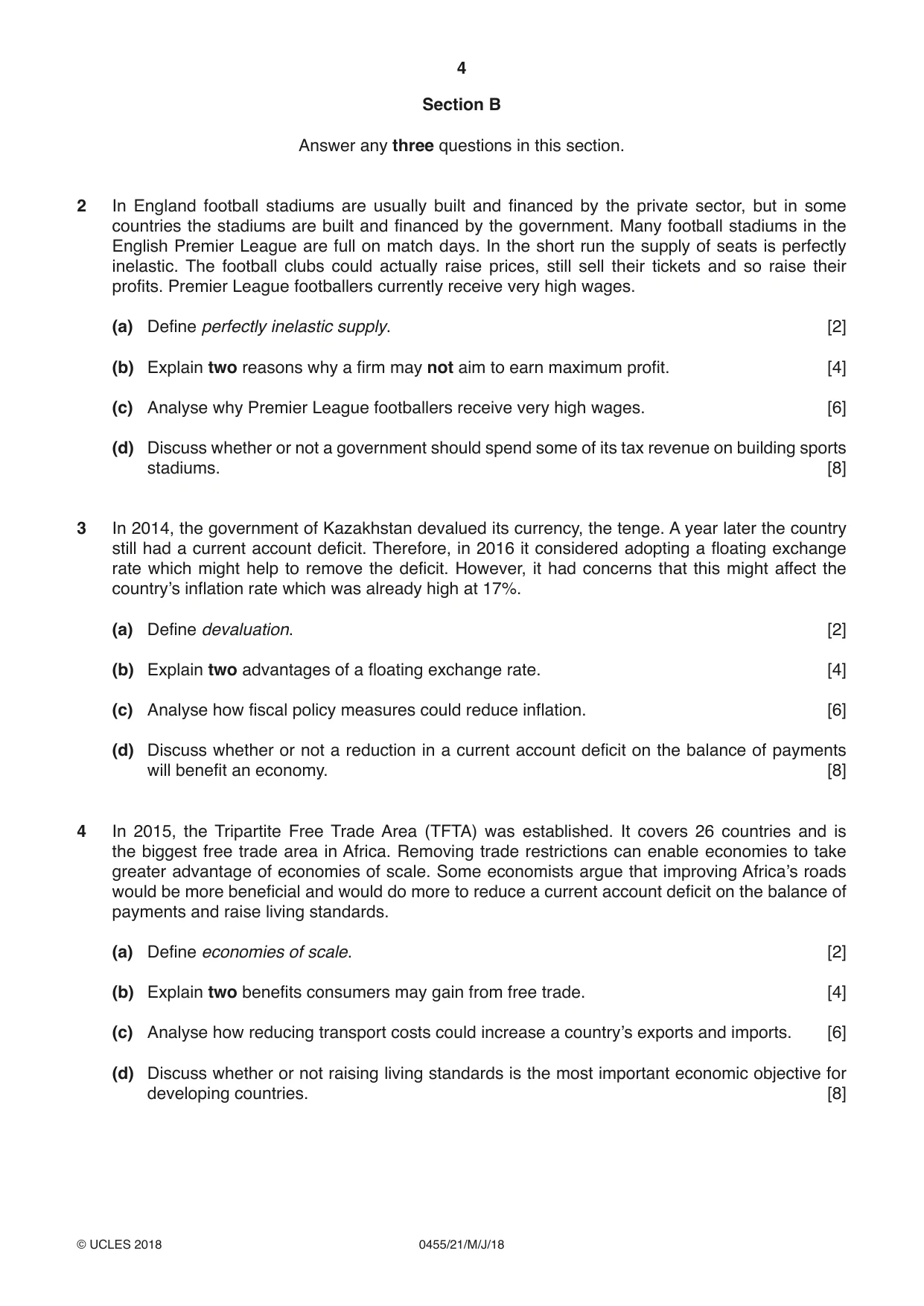
2 In England football stadiums are usually built and financed by the private sector, but in some countries the stadiums are built and financed by the government. Many football stadiums in the English Premier League are full on match days. In the short run the supply of seats is perfectly inelastic. The football clubs could actually raise prices, still sell their tickets and so raise their profits. Premier League footballers currently receive very high wages. (a) Define perfectly inelastic supply. [2] (b) Explain two reasons why a firm may not aim to earn maximum profit. [4] (c) Analyse why Premier League footballers receive very high wages. [6] (d) Discuss whether or not a government should spend some of its tax revenue on building sports stadiums. [8]
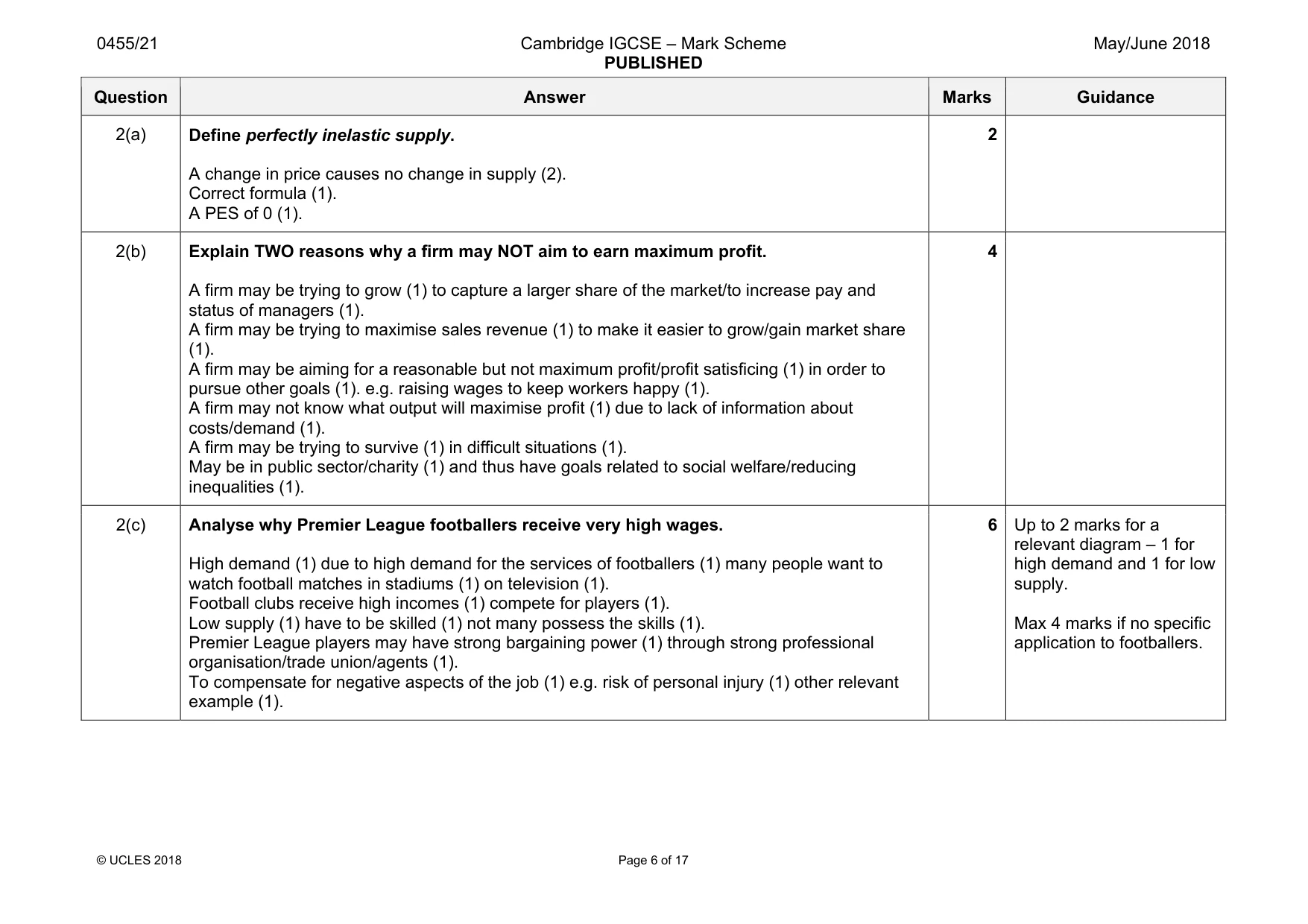
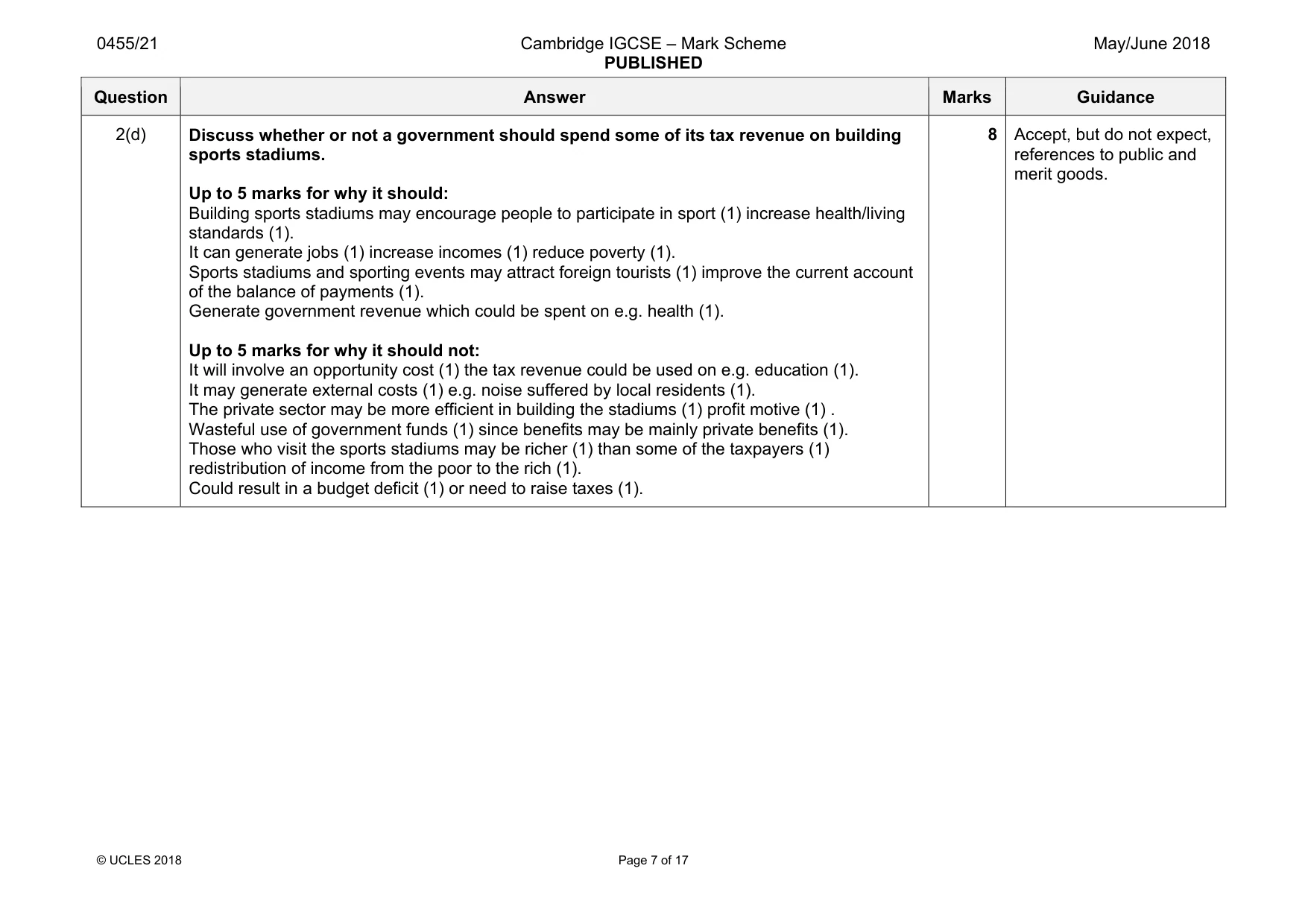
Mark scheme: 2(a) Define perfectly inelastic supply. A change in price causes no change in supply (2). Correct formula (1). A PES of 0 (1). 2 2(b) Explain TWO reasons why a firm may NOT aim to earn maximum profit. A firm may be trying to grow (1) to capture a larger share of the market/to increase pay and status of managers (1). A firm may be trying to maximise sales revenue (1) to make it easier to grow/gain market share (1). A firm may be aiming for a reasonable but not maximum profit/profit satisficing (1) in order to pursue other goals (1). e.g. raising wages to keep workers happy (1). A firm may not know what output will maximise profit (1) due to lack of information about costs/demand (1). A firm may be trying to survive (1) in difficult situations (1). May be in public sector/charity (1) and thus have goals related to social welfare/reducing inequalities (1). 4 2(c) Analyse why Premier League footballers receive very high wages. High demand (1) due to high demand for the services of footballers (1) many people want to watch football matches in stadiums (1) on television (1). Football clubs receive high incomes (1) compete for players (1). Low supply (1) have to be skilled (1) not many possess the skills (1). Premier League players may have strong bargaining power (1) through strong professional organisation/trade union/agents (1). To compensate for negative aspects of the job (1) e.g. risk of personal injury (1) other relevant example (1). 6 Up to 2 marks for a relevant diagram – 1 for high demand and 1 for low supply. Max 4 marks if no specific application to footballers. Question Answer Marks Guidance 2(d) Discuss whether or not a government should spend some of its tax revenue on building sports stadiums. Up to 5 marks for why it should: Building sports stadiums may encourage people to participate in sport (1) increase health/living standards (1). It can generate jobs (1) increase incomes (1) reduce poverty (1). Sports stadiums and sporting events may attract foreign tourists (1) improve the current account of the balance of payments (1). Generate government revenue which could be spent on e.g. health (1). Up to 5 marks for why it should not: It will involve an opportunity cost (1) the tax revenue could be used on e.g. education (1). It may generate external costs (1) e.g. noise suffered by local residents (1). The private sector may be more efficient in building the stadiums (1) profit motive (1) . Wasteful use of government funds (1) since benefits may be mainly private benefits (1). Those who visit the sports stadiums may be richer (1) than some of the taxpayers (1) redistribution of income from the poor to the rich (1). Could result in a budget deficit (1) or need to raise taxes (1). 8 Accept, but do not expect, references to public and merit goods.
Q3 · In 2014, the government of Kazakhstan devalued its currency, the tenge
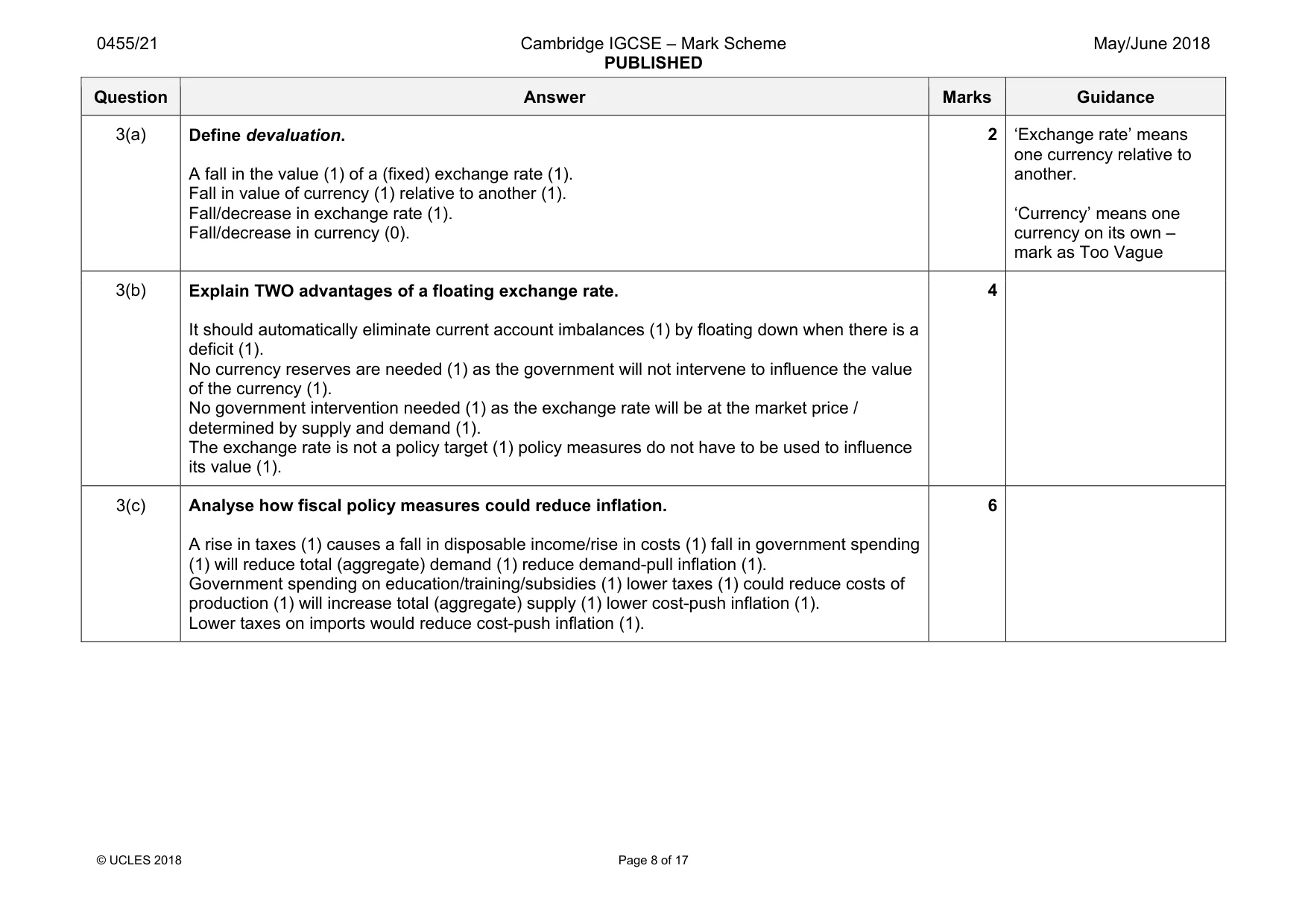
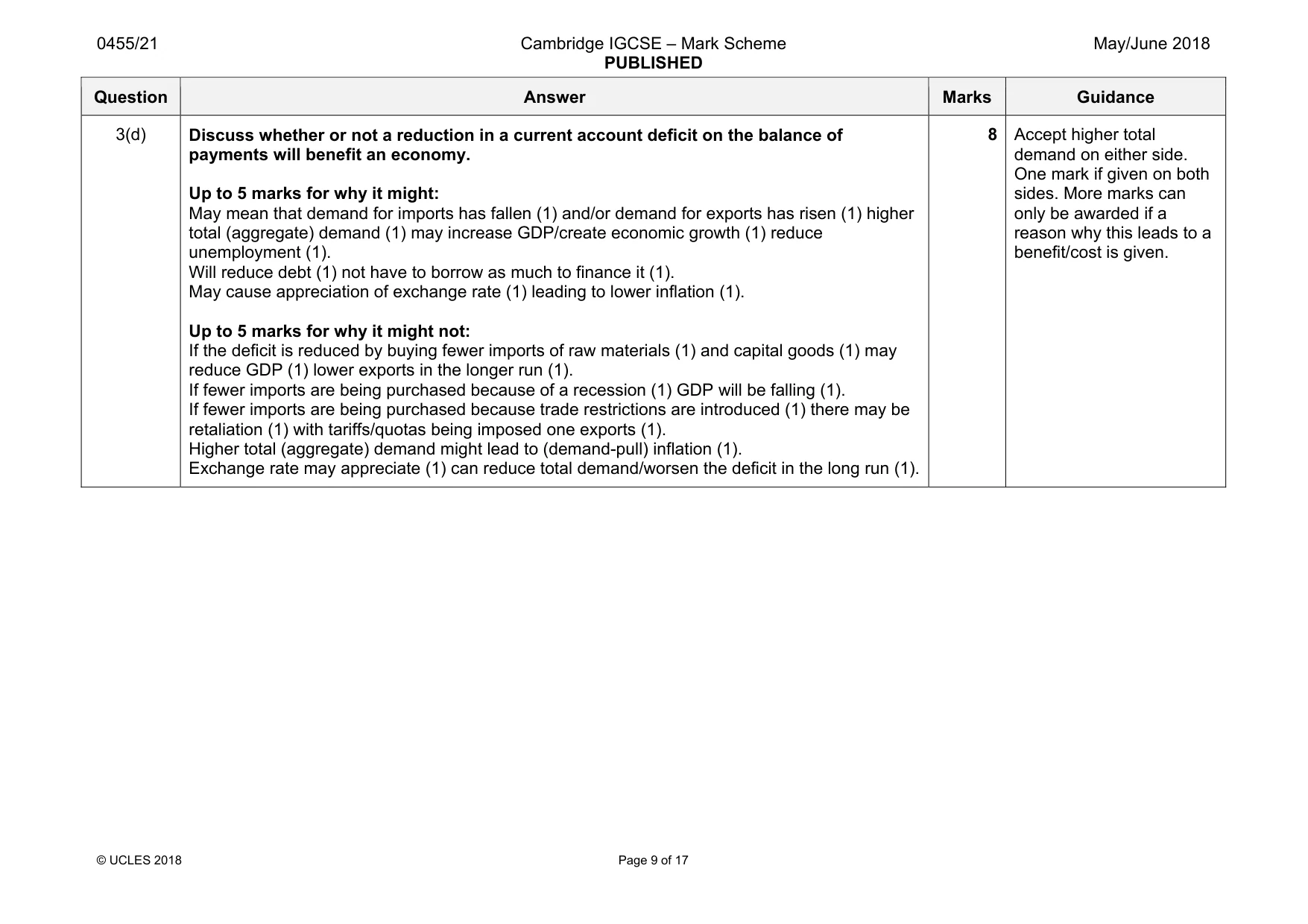
3 In 2014, the government of Kazakhstan devalued its currency, the tenge. A year later the country still had a current account deficit. Therefore, in 2016 it considered adopting a floating exchange rate which might help to remove the deficit. However, it had concerns that this might affect the country’s inflation rate which was already high at 17%. (a) Define devaluation. [2] (b) Explain two advantages of a floating exchange rate. [4] (c) Analyse how fiscal policy measures could reduce inflation. [6] (d) Discuss whether or not a reduction in a current account deficit on the balance of payments will benefit an economy. [8]
Mark scheme: 3(a) Define devaluation. A fall in the value (1) of a (fixed) exchange rate (1). Fall in value of currency (1) relative to another (1). Fall/decrease in exchange rate (1). Fall/decrease in currency (0). 2 one currency relative to another. ‘Currency’ means one currency on its own – mark as Too Vague 3(b) Explain TWO advantages of a floating exchange rate. It should automatically eliminate current account imbalances (1) by floating down when there is a deficit (1). No currency reserves are needed (1) as the government will not intervene to influence the value of the currency (1). No government intervention needed (1) as the exchange rate will be at the market price / determined by supply and demand (1). The exchange rate is not a policy target (1) policy measures do not have to be used to influence its value (1). 4 3(c) Analyse how fiscal policy measures could reduce inflation. A rise in taxes (1) causes a fall in disposable income/rise in costs (1) fall in government spending (1) will reduce total (aggregate) demand (1) reduce demand-pull inflation (1). Government spending on education/training/subsidies (1) lower taxes (1) could reduce costs of production (1) will increase total (aggregate) supply (1) lower cost-push inflation (1). Lower taxes on imports would reduce cost-push inflation (1). 6 Question Answer Marks Guidance 3(d) Discuss whether or not a reduction in a current account deficit on the balance of payments will benefit an economy. Up to 5 marks for why it might: May mean that demand for imports has fallen (1) and/or demand for exports has risen (1) higher total (aggregate) demand (1) may increase GDP/create economic growth (1) reduce unemployment (1). Will reduce debt (1) not have to borrow as much to finance it (1). May cause appreciation of exchange rate (1) leading to lower inflation (1). Up to 5 marks for why it might not: If the deficit is reduced by buying fewer imports of raw materials (1) and capital goods (1) may reduce GDP (1) lower exports in the longer run (1). If fewer imports are being purchased because of a recession (1) GDP will be falling (1). If fewer imports are being purchased because trade restrictions are introduced (1) there may be retaliation (1) with tariffs/quotas being imposed one exports (1). Higher total (aggregate) demand might lead to (demand-pull) inflation (1). Exchange rate may appreciate (1) can reduce total demand/worsen the deficit in the long run (1). 8 Accept higher total demand on either side. One mark if given on both sides. More marks can only be awarded if a reason why this leads to a benefit/cost is given.
Q4 · In 2015, the Tripartite Free Trade Area (TFTA) was established
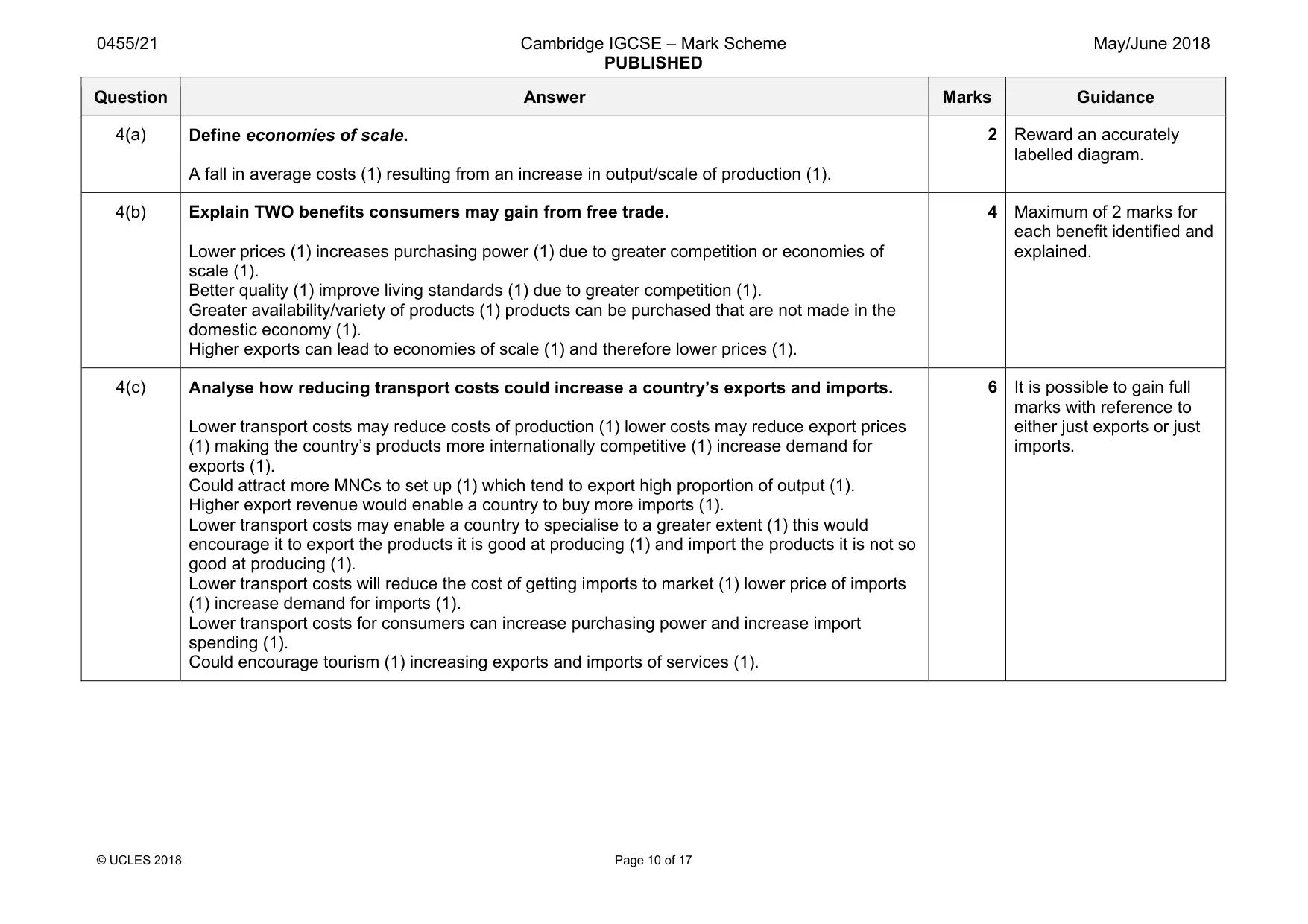
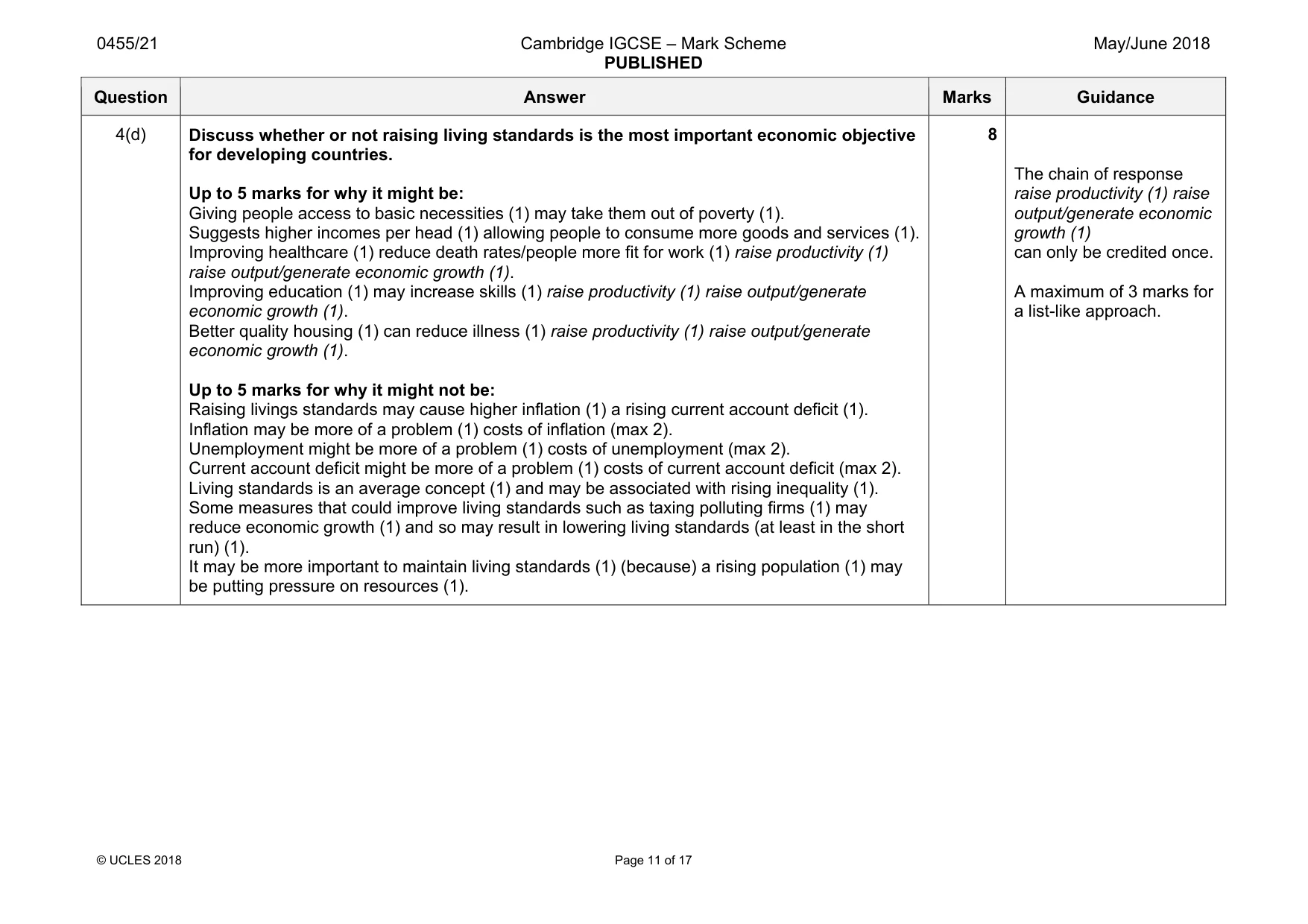
4 In 2015, the Tripartite Free Trade Area (TFTA) was established. It covers 26 countries and is the biggest free trade area in Africa. Removing trade restrictions can enable economies to take greater advantage of economies of scale. Some economists argue that improving Africa’s roads would be more beneficial and would do more to reduce a current account deficit on the balance of payments and raise living standards. (a) Define economies of scale. [2] (b) Explain two benefits consumers may gain from free trade. [4] (c) Analyse how reducing transport costs could increase a country’s exports and imports. [6] (d) Discuss whether or not raising living standards is the most important economic objective for developing countries. [8]
Mark scheme: 4(a) Define economies of scale. A fall in average costs (1) resulting from an increase in output/scale of production (1). 2 labelled diagram. 4(b) Explain TWO benefits consumers may gain from free trade. Lower prices (1) increases purchasing power (1) due to greater competition or economies of scale (1). Better quality (1) improve living standards (1) due to greater competition (1). Greater availability/variety of products (1) products can be purchased that are not made in the domestic economy (1). Higher exports can lead to economies of scale (1) and therefore lower prices (1). 4 Maximum of 2 marks for each benefit identified and explained. 4(c) Analyse how reducing transport costs could increase a country’s exports and imports. Lower transport costs may reduce costs of production (1) lower costs may reduce export prices (1) making the country’s products more internationally competitive (1) increase demand for exports (1). Could attract more MNCs to set up (1) which tend to export high proportion of output (1). Higher export revenue would enable a country to buy more imports (1). Lower transport costs may enable a country to specialise to a greater extent (1) this would encourage it to export the products it is good at producing (1) and import the products it is not so good at producing (1). Lower transport costs will reduce the cost of getting imports to market (1) lower price of imports (1) increase demand for imports (1). Lower transport costs for consumers can increase purchasing power and increase import spending (1). Could encourage tourism (1) increasing exports and imports of services (1). 6 It is possible to gain full marks with reference to either just exports or just imports. Question Answer Marks Guidance 4(d) Discuss whether or not raising living standards is the most important economic objective for developing countries. Up to 5 marks for why it might be: Giving people access to basic necessities (1) may take them out of poverty (1). Suggests higher incomes per head (1) allowing people to consume more goods and services (1). Improving healthcare (1) reduce death rates/people more fit for work (1) raise productivity (1) raise output/generate economic growth (1). Improving education (1) may increase skills (1) raise productivity (1) raise output/generate economic growth (1). Better quality housing (1) can reduce illness (1) raise productivity (1) raise output/generate economic growth (1). Up to 5 marks for why it might not be: Raising livings standards may cause higher inflation (1) a rising current account deficit (1). Inflation may be more of a problem (1) costs of inflation (max 2). Unemployment might be more of a problem (1) costs of unemployment (max 2). Current account deficit might be more of a problem (1) costs of current account deficit (max 2). Living standards is an average concept (1) and may be associated with rising inequality (1). Some measures that could improve living standards such as taxing polluting firms (1) may reduce economic growth (1) and so may result in lowering living standards (at least in the short run) (1). It may be more important to maintain living standards (1) (because) a rising population (1) may be putting pressure on resources (1). 8 The chain of response raise productivity (1) raise output/generate economic growth (1) can only be credited once. A maximum of 3 marks for a list-like approach.
Q5 · The government of Slovenia has introduced a range of supply-side policy measures to…
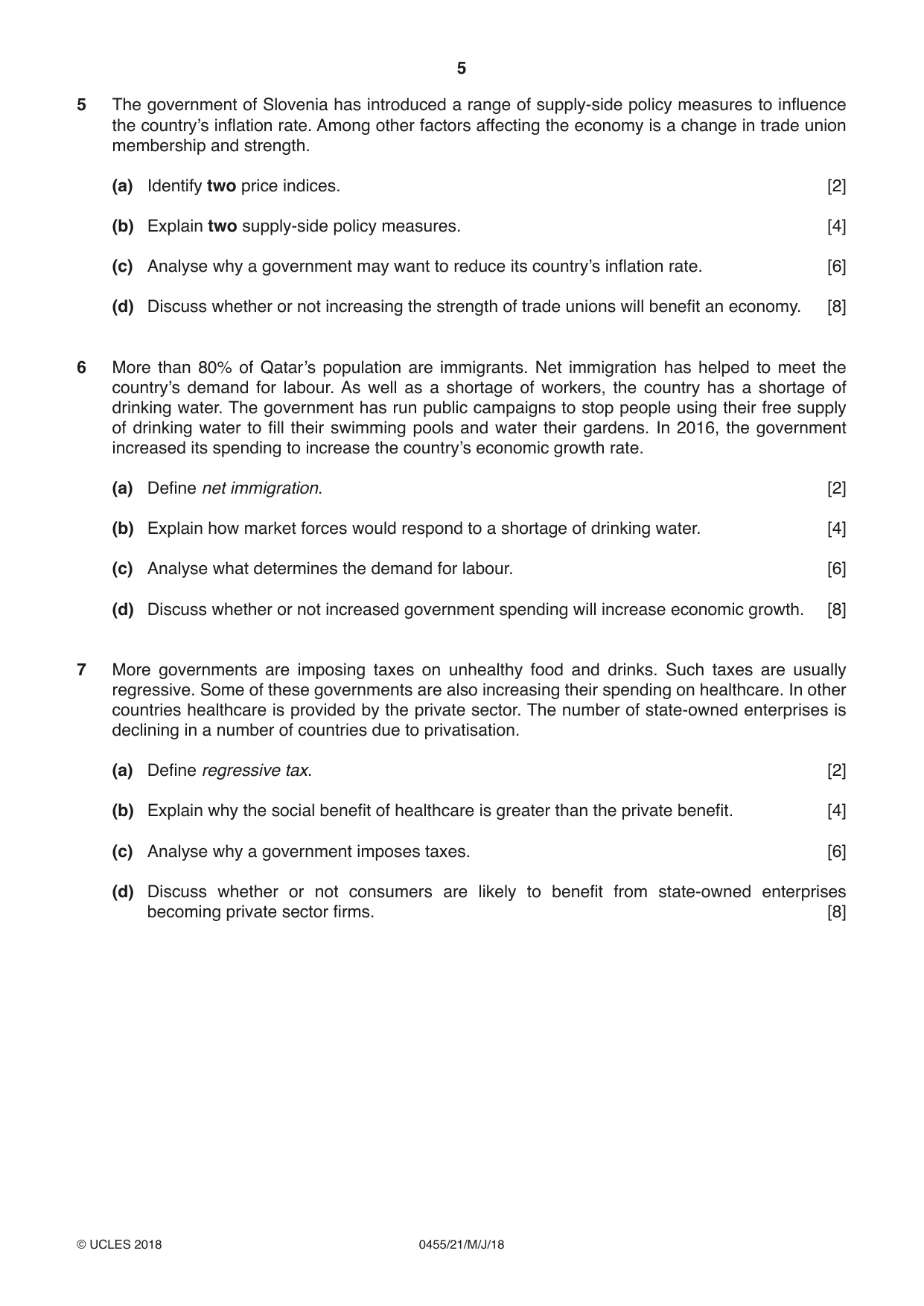
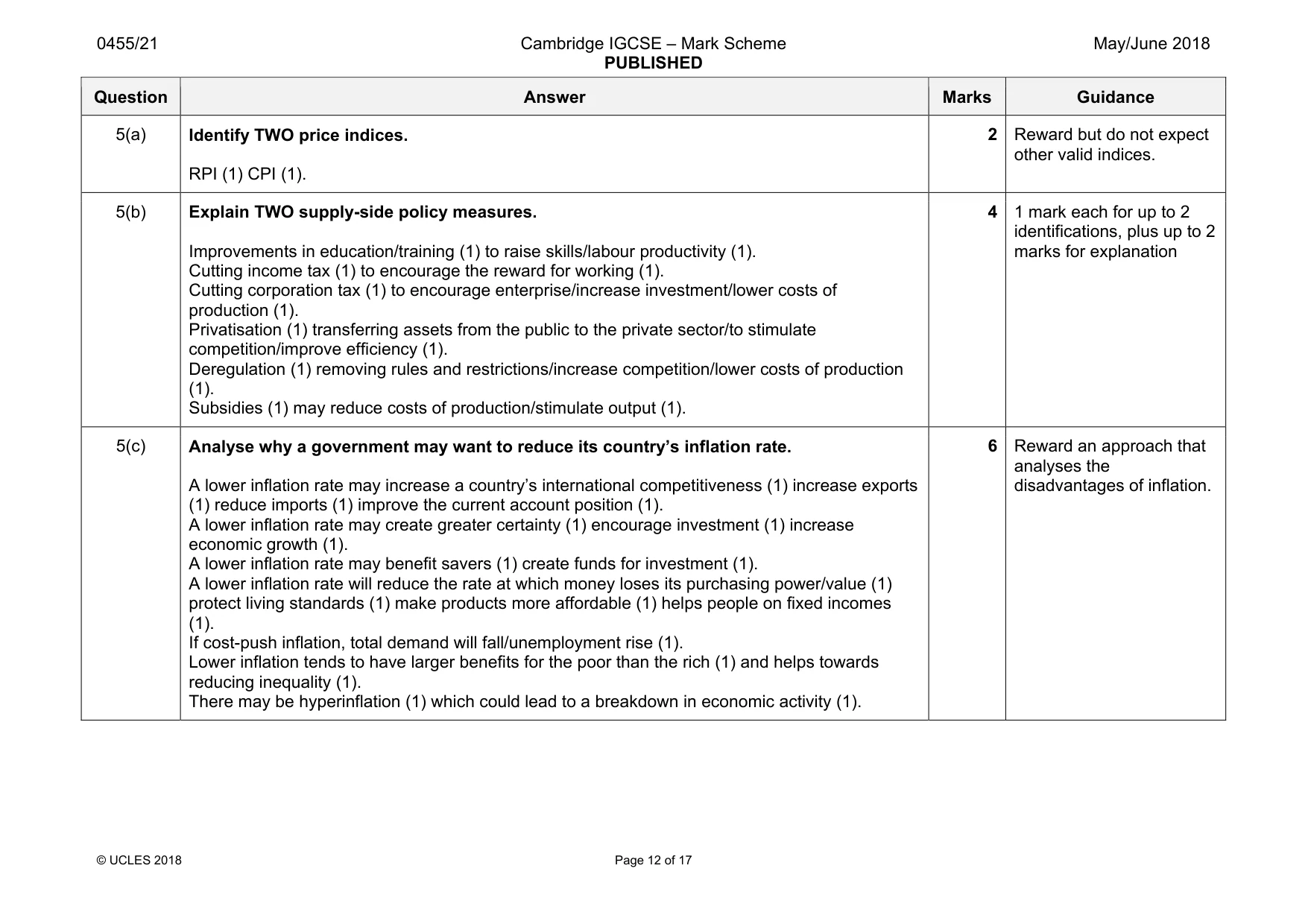
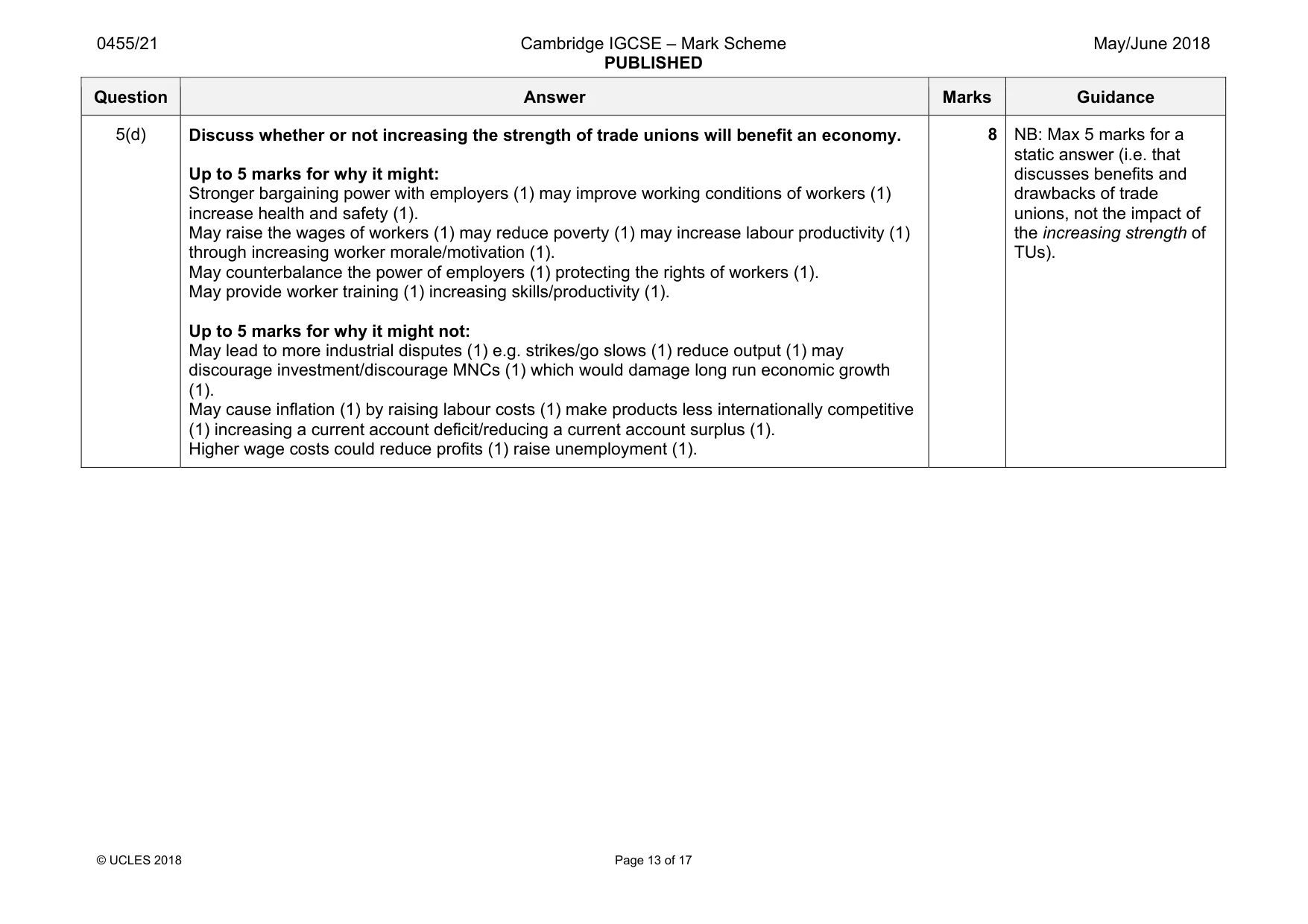
5 The government of Slovenia has introduced a range of supply-side policy measures to influence the country’s inflation rate. Among other factors affecting the economy is a change in trade union membership and strength. (a) Identify two price indices. [2] (b) Explain two supply-side policy measures. [4] (c) Analyse why a government may want to reduce its country’s inflation rate. [6] (d) Discuss whether or not increasing the strength of trade unions will benefit an economy. [8]
Mark scheme: 5(a) Identify TWO price indices. RPI (1) CPI (1). other valid indices. 5(b) Explain TWO supply-side policy measures. Improvements in education/training (1) to raise skills/labour productivity (1). Cutting income tax (1) to encourage the reward for working (1). Cutting corporation tax (1) to encourage enterprise/increase investment/lower costs of production (1). Privatisation (1) transferring assets from the public to the private sector/to stimulate competition/improve efficiency (1). Deregulation (1) removing rules and restrictions/increase competition/lower costs of production (1). Subsidies (1) may reduce costs of production/stimulate output (1). 4 1 mark each for up to 2 identifications, plus up to 2 marks for explanation 5(c) Analyse why a government may want to reduce its country’s inflation rate. A lower inflation rate may increase a country’s international competitiveness (1) increase exports (1) reduce imports (1) improve the current account position (1). A lower inflation rate may create greater certainty (1) encourage investment (1) increase economic growth (1). A lower inflation rate may benefit savers (1) create funds for investment (1). A lower inflation rate will reduce the rate at which money loses its purchasing power/value (1) protect living standards (1) make products more affordable (1) helps people on fixed incomes (1). If cost-push inflation, total demand will fall/unemployment rise (1). Lower inflation tends to have larger benefits for the poor than the rich (1) and helps towards reducing inequality (1). There may be hyperinflation (1) which could lead to a breakdown in economic activity (1). 6 Reward an approach that analyses the disadvantages of inflation. Question Answer Marks Guidance 5(d) Discuss whether or not increasing the strength of trade unions will benefit an economy. Up to 5 marks for why it might: Stronger bargaining power with employers (1) may improve working conditions of workers (1) increase health and safety (1). May raise the wages of workers (1) may reduce poverty (1) may increase labour productivity (1) through increasing worker morale/motivation (1). May counterbalance the power of employers (1) protecting the rights of workers (1). May provide worker training (1) increasing skills/productivity (1). Up to 5 marks for why it might not: May lead to more industrial disputes (1) e.g. strikes/go slows (1) reduce output (1) may discourage investment/discourage MNCs (1) which would damage long run economic growth (1). May cause inflation (1) by raising labour costs (1) make products less internationally competitive (1) increasing a current account deficit/reducing a current account surplus (1). Higher wage costs could reduce profits (1) raise unemployment (1). 8 NB: Max 5 marks for a static answer (i.e. that discusses benefits and drawbacks of trade unions, not the impact of the increasing strength of TUs).
Q6 · More than 80% of Qatar’s population are immigrants
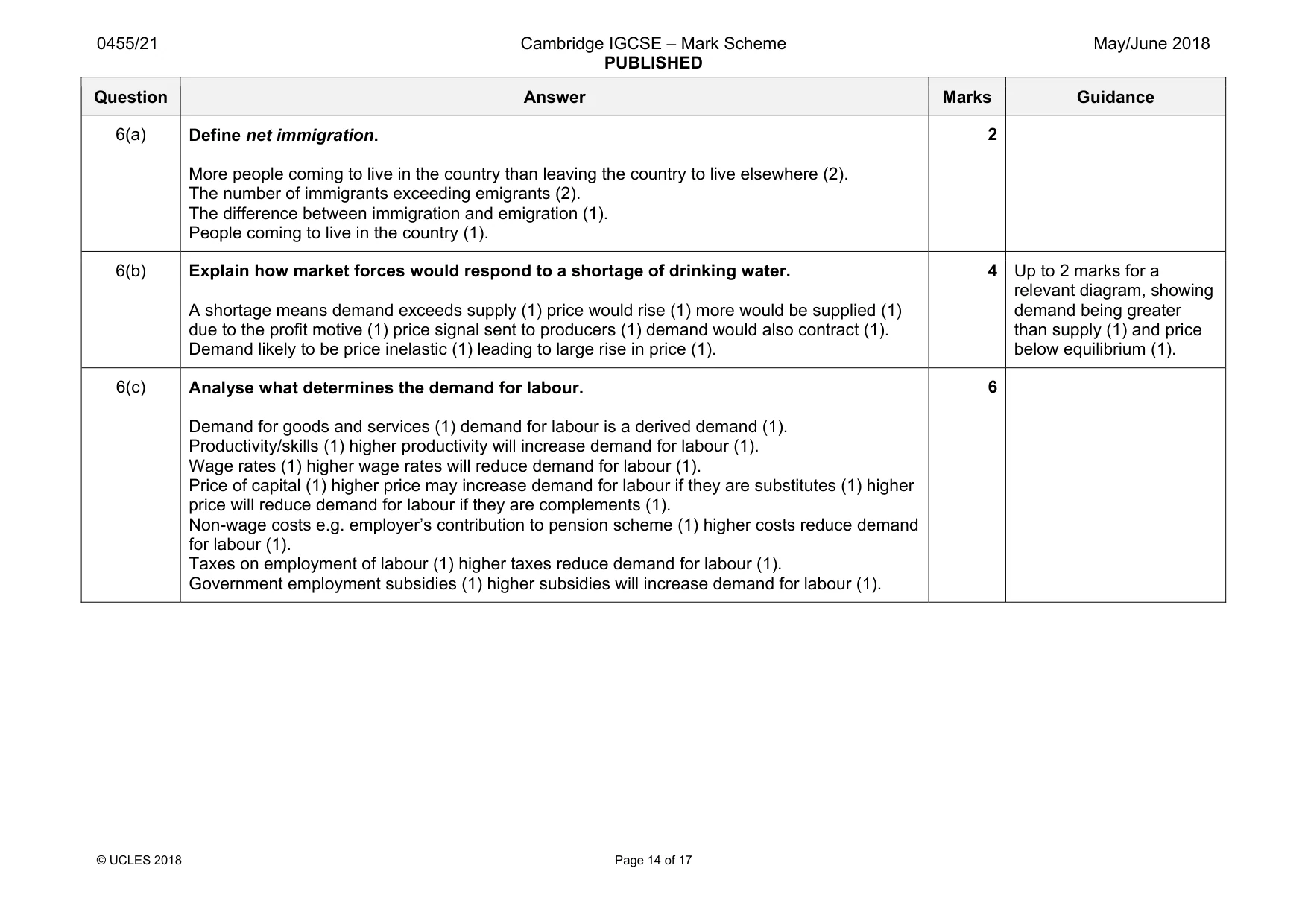
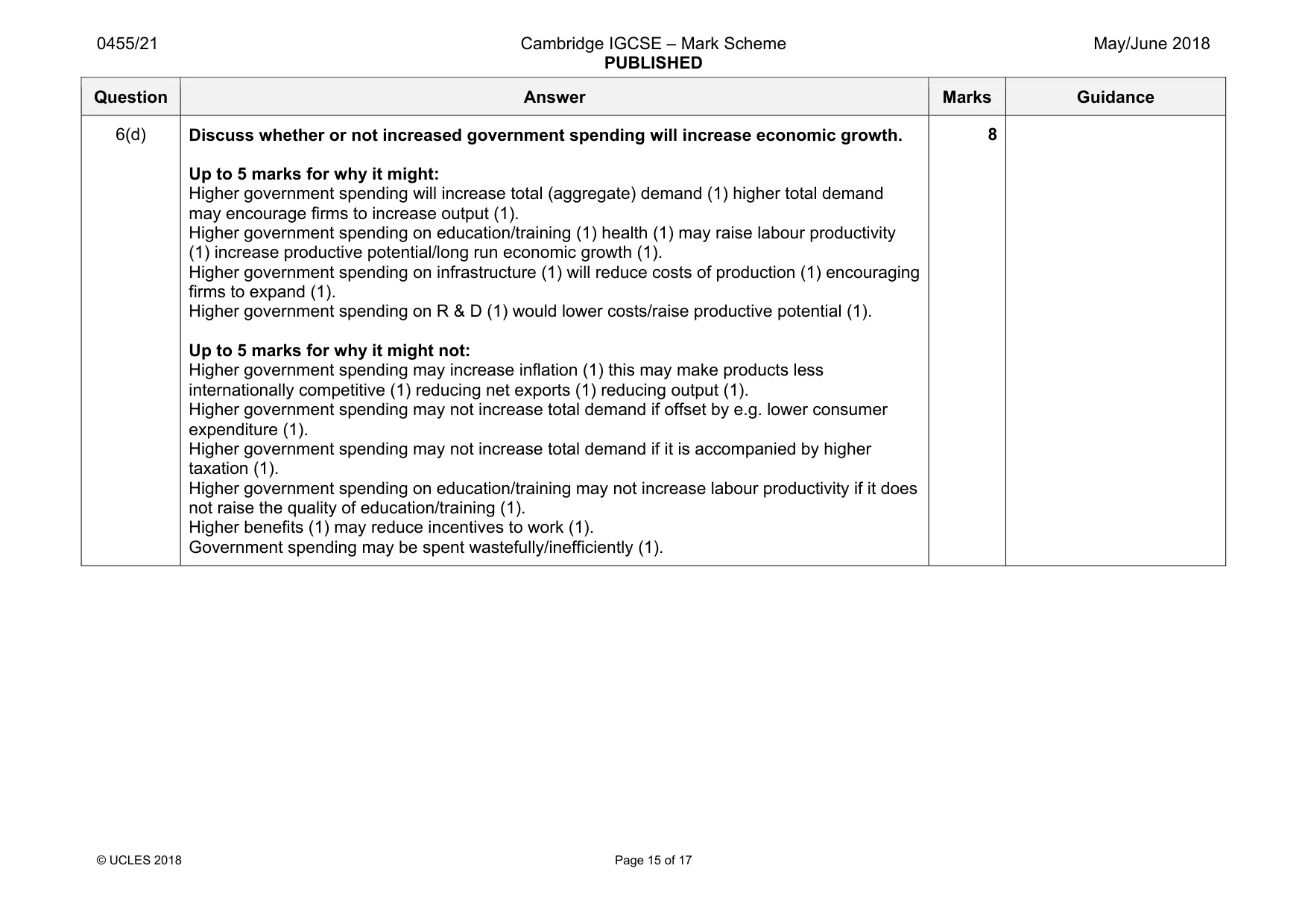
6 More than 80% of Qatar’s population are immigrants. Net immigration has helped to meet the country’s demand for labour. As well as a shortage of workers, the country has a shortage of drinking water. The government has run public campaigns to stop people using their free supply of drinking water to fill their swimming pools and water their gardens. In 2016, the government increased its spending to increase the country’s economic growth rate. (a) Define net immigration. [2] (b) Explain how market forces would respond to a shortage of drinking water. [4] (c) Analyse what determines the demand for labour. [6] (d) Discuss whether or not increased government spending will increase economic growth. [8]
Mark scheme: 6(a) Define net immigration. More people coming to live in the country than leaving the country to live elsewhere (2). The number of immigrants exceeding emigrants (2). The difference between immigration and emigration (1). People coming to live in the country (1). 2 6(b) Explain how market forces would respond to a shortage of drinking water. A shortage means demand exceeds supply (1) price would rise (1) more would be supplied (1) due to the profit motive (1) price signal sent to producers (1) demand would also contract (1). Demand likely to be price inelastic (1) leading to large rise in price (1). 4 Up to 2 marks for a relevant diagram, showing demand being greater than supply (1) and price below equilibrium (1). 6(c) Analyse what determines the demand for labour. Demand for goods and services (1) demand for labour is a derived demand (1). Productivity/skills (1) higher productivity will increase demand for labour (1). Wage rates (1) higher wage rates will reduce demand for labour (1). Price of capital (1) higher price may increase demand for labour if they are substitutes (1) higher price will reduce demand for labour if they are complements (1). Non-wage costs e.g. employer’s contribution to pension scheme (1) higher costs reduce demand for labour (1). Taxes on employment of labour (1) higher taxes reduce demand for labour (1). Government employment subsidies (1) higher subsidies will increase demand for labour (1). 6 Question Answer Marks Guidance 6(d) Discuss whether or not increased government spending will increase economic growth. Up to 5 marks for why it might: Higher government spending will increase total (aggregate) demand (1) higher total demand may encourage firms to increase output (1). Higher government spending on education/training (1) health (1) may raise labour productivity (1) increase productive potential/long run economic growth (1). Higher government spending on infrastructure (1) will reduce costs of production (1) encouraging firms to expand (1). Higher government spending on R & D (1) would lower costs/raise productive potential (1). Up to 5 marks for why it might not: Higher government spending may increase inflation (1) this may make products less internationally competitive (1) reducing net exports (1) reducing output (1). Higher government spending may not increase total demand if offset by e.g. lower consumer expenditure (1). Higher government spending may not increase total demand if it is accompanied by higher taxation (1). Higher government spending on education/training may not increase labour productivity if it does not raise the quality of education/training (1). Higher benefits (1) may reduce incentives to work (1). Government spending may be spent wastefully/inefficiently (1). 8
Q7 · More governments are imposing taxes on unhealthy food and drinks
7 More governments are imposing taxes on unhealthy food and drinks. Such taxes are usually regressive. Some of these governments are also increasing their spending on healthcare. In other countries healthcare is provided by the private sector. The number of state-owned enterprises is declining in a number of countries due to privatisation. (a) Define regressive tax. [2] (b) Explain why the social benefit of healthcare is greater than the private benefit. [4] (c) Analyse why a government imposes taxes. [6] (d) Discuss whether or not consumers are likely to benefit from state-owned enterprises becoming private sector firms. [8]
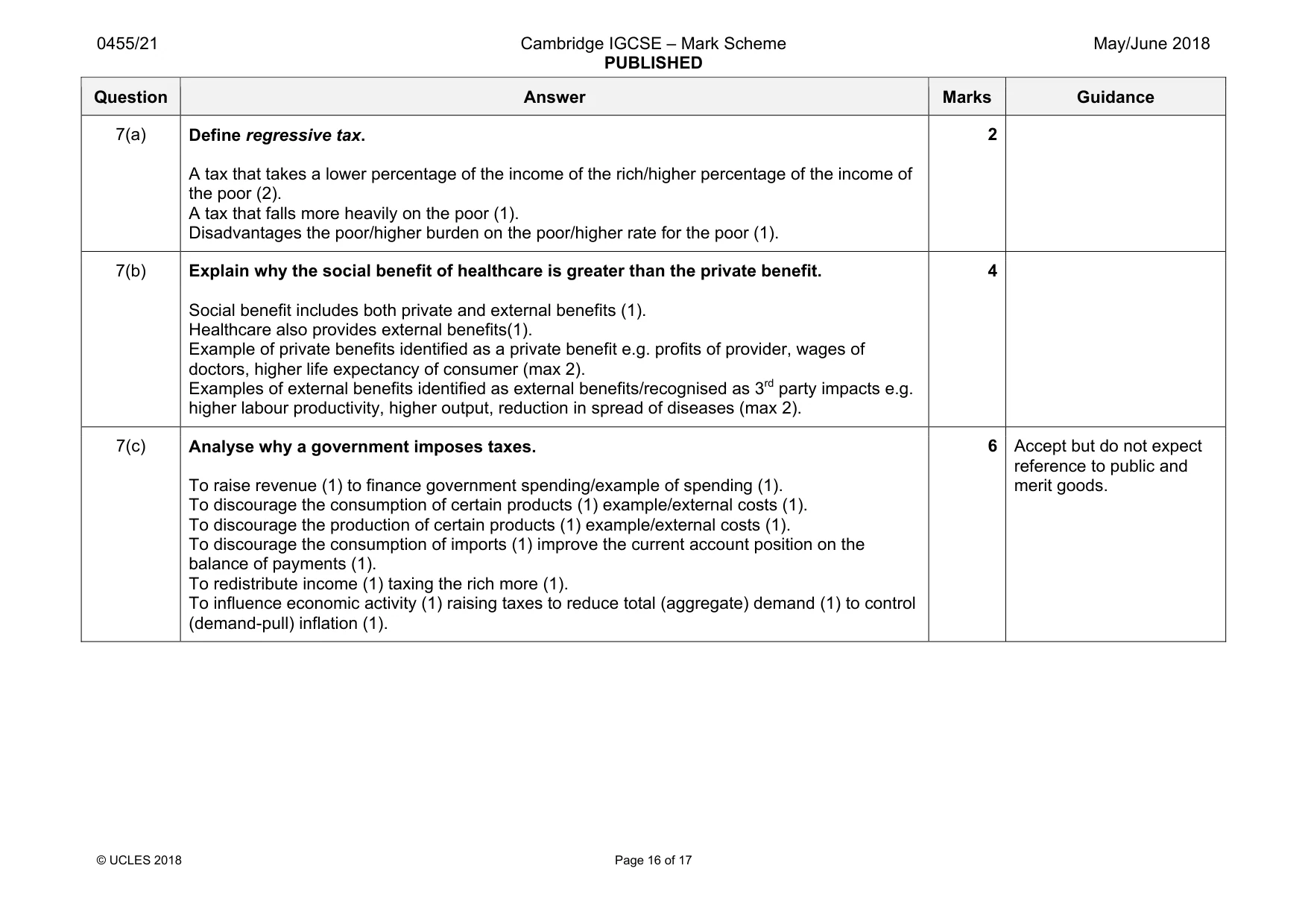
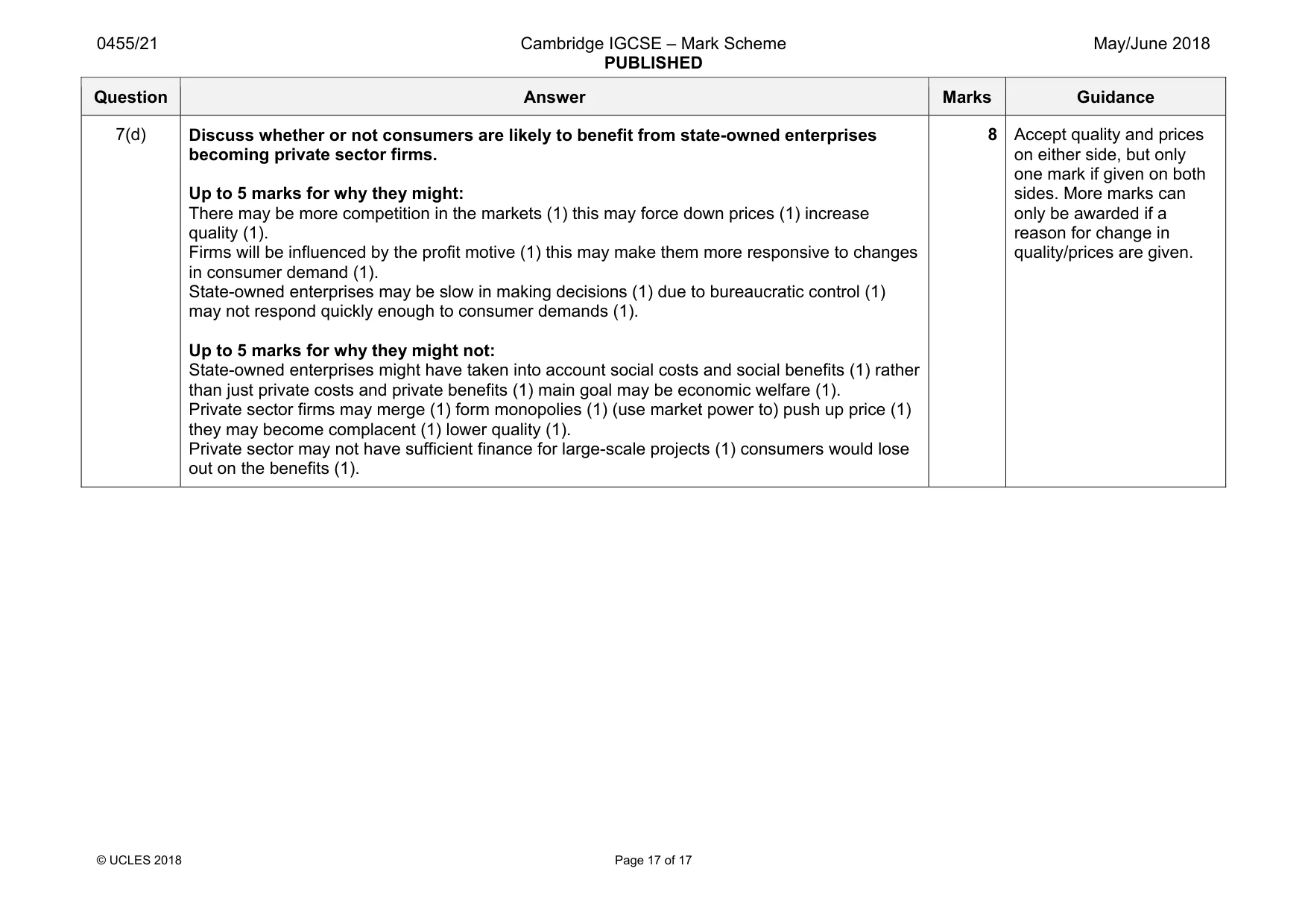
Mark scheme: 7(a) Define regressive tax. A tax that takes a lower percentage of the income of the rich/higher percentage of the income of the poor (2). A tax that falls more heavily on the poor (1). Disadvantages the poor/higher burden on the poor/higher rate for the poor (1). 2 7(b) Explain why the social benefit of healthcare is greater than the private benefit. Social benefit includes both private and external benefits (1). Healthcare also provides external benefits(1). Example of private benefits identified as a private benefit e.g. profits of provider, wages of doctors, higher life expectancy of consumer (max 2). Examples of external benefits identified as external benefits/recognised as 3rd party impacts e.g. higher labour productivity, higher output, reduction in spread of diseases (max 2). 4 7(c) Analyse why a government imposes taxes. To raise revenue (1) to finance government spending/example of spending (1). To discourage the consumption of certain products (1) example/external costs (1). To discourage the production of certain products (1) example/external costs (1). To discourage the consumption of imports (1) improve the current account position on the balance of payments (1). To redistribute income (1) taxing the rich more (1). To influence economic activity (1) raising taxes to reduce total (aggregate) demand (1) to control (demand-pull) inflation (1). 6 Accept but do not expect reference to public and merit goods. Question Answer Marks Guidance 7(d) Discuss whether or not consumers are likely to benefit from state-owned enterprises becoming private sector firms. Up to 5 marks for why they might: There may be more competition in the markets (1) this may force down prices (1) increase quality (1). Firms will be influenced by the profit motive (1) this may make them more responsive to changes in consumer demand (1). State-owned enterprises may be slow in making decisions (1) due to bureaucratic control (1) may not respond quickly enough to consumer demands (1). Up to 5 marks for why they might not: State-owned enterprises might have taken into account social costs and social benefits (1) rather than just private costs and private benefits (1) main goal may be economic welfare (1). Private sector firms may merge (1) form monopolies (1) (use market power to) push up price (1) they may become complacent (1) lower quality (1). Private sector may not have sufficient finance for large-scale projects (1) consumers would lose out on the benefits (1). 8 Accept quality and prices on either side, but only one mark if given on both sides. More marks can only be awarded if a reason for change in quality/prices are given.
What was in this paper
The subtopics covered by these 7 questions, and how many questions each got. Open one in a new tab to see every Cambridge question on it.
What you needed in this session
Cambridge’s own grade thresholds for 2018 May/June, Paper 2 · Variant 1. A higher threshold means an easier paper — the bar moves with how the cohort did.