Cambridge IGCSE Economics 0455 — 2019 Oct/Nov Paper 2 · Variant 1
0455/21/O/N/19 · 7 questions · 90 marks · ≈101 min
The question paper and its mark scheme, free to read here and free to download. This is Cambridge’s own paper, exactly as it was sat.
Question paper8 pages




Mark scheme21 pages
Answers below. Sit the paper first if you are practising.


Questions as text
Q1 · New York: A Global Financial Centre New York is the best city in the world in terms of…
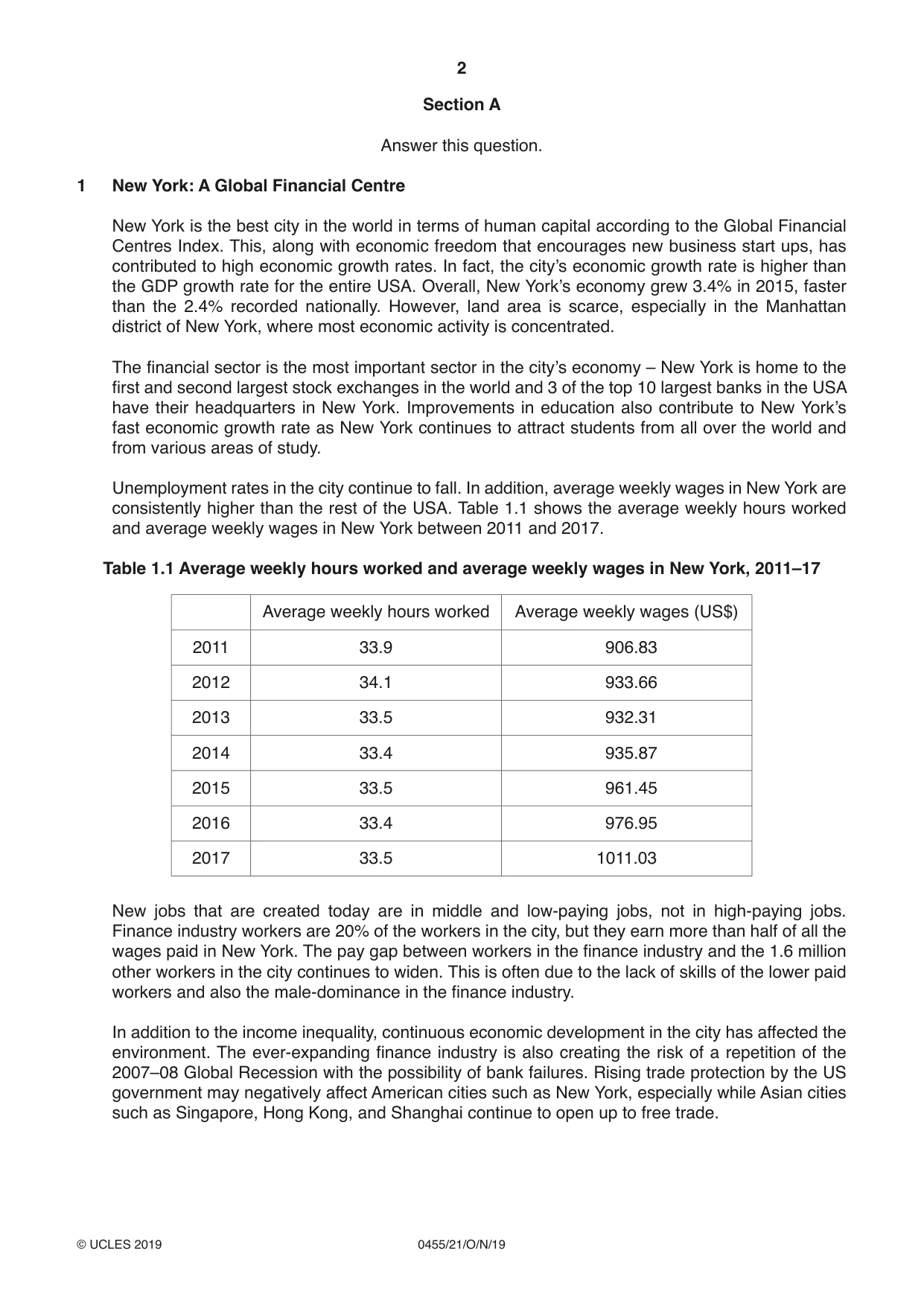
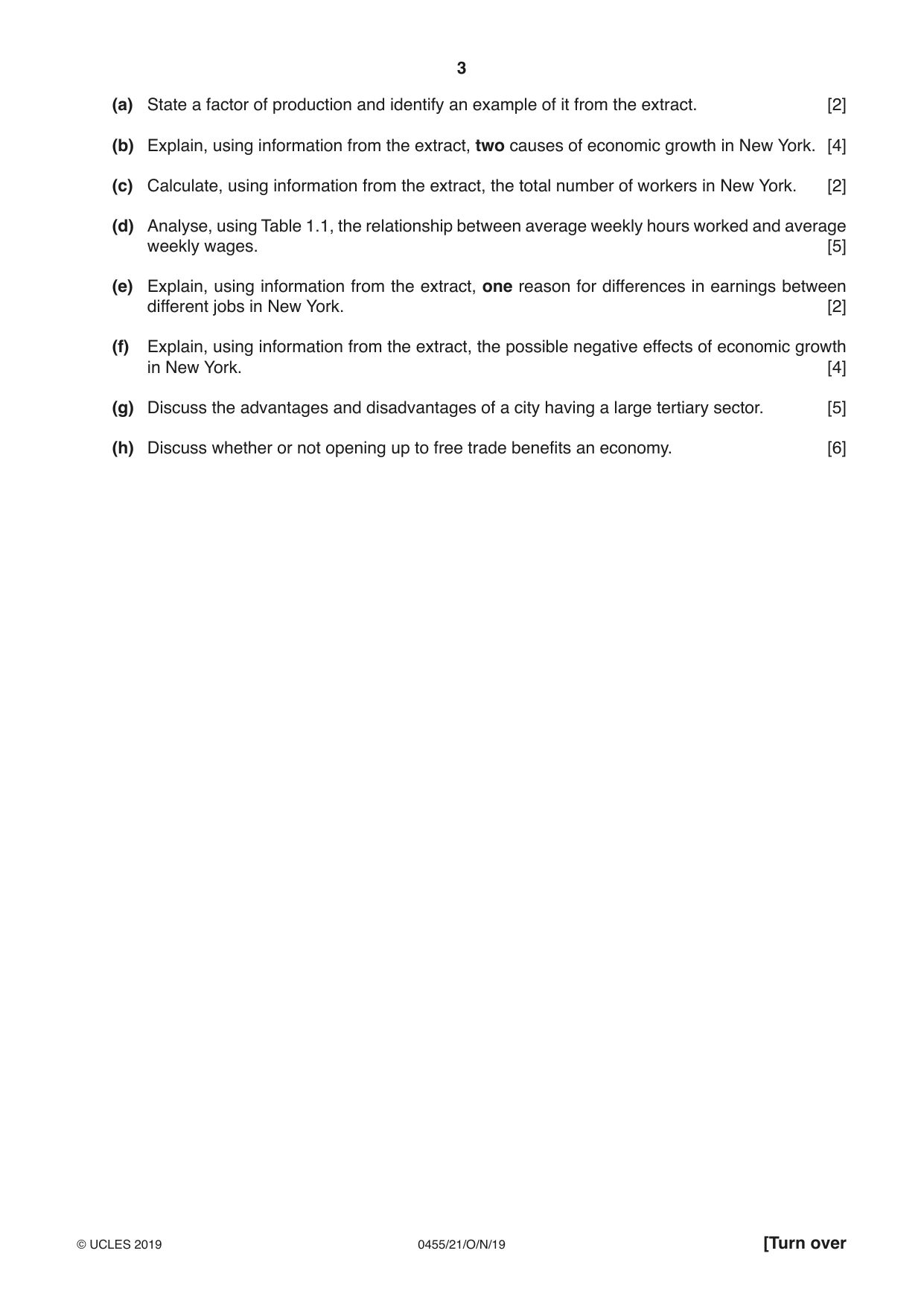
1 New York: A Global Financial Centre New York is the best city in the world in terms of human capital according to the Global Financial Centres Index. This, along with economic freedom that encourages new business start ups, has contributed to high economic growth rates. In fact, the city’s economic growth rate is higher than the GDP growth rate for the entire USA. Overall, New York’s economy grew 3.4% in 2015, faster than the 2.4% recorded nationally. However, land area is scarce, especially in the Manhattan district of New York, where most economic activity is concentrated. The financial sector is the most important sector in the city’s economy – New York is home to the first and second largest stock exchanges in the world and 3 of the top 10 largest banks in the USA have their headquarters in New York. Improvements in education also contribute to New York’s fast economic growth rate as New York continues to attract students from all over the world and from various areas of study. Unemployment rates in the city continue to fall. In addition, average weekly wages in New York are consistently higher than the rest of the USA. Table 1.1 shows the average weekly hours worked and average weekly wages in New York between 2011 and 2017. Table 1.1 Average weekly hours worked and average weekly wages in New York, 2011–17 Average weekly hours worked Average weekly wages (US$) 2011 33.9 906.83 2012 34.1 933.66 2013 33.5 932.31 2014 33.4 935.87 2015 33.5 961.45 2016 33.4 976.95 2017 33.5 1011.03 New jobs that are created today are in middle and low-paying jobs, not in high-paying jobs. Finance industry workers are 20% of the workers in the city, but they earn more than half of all the wages paid in New York. The pay gap between workers in the finance industry and the 1.6 million other workers in the city continues to widen. This is often due to the lack of skills of the lower paid workers and also the male-dominance in the finance industry. In addition to the income inequality, continuous economic development in the city has affected the environment. The ever-expanding finance industry is also creating the risk of a repetition of the 2007–08 Global Recession with the possibility of bank failures. Rising trade protection by the US government may negatively affect American cities such as New York, especially while Asian cities such as Singapore, Hong Kong, and Shanghai continue to open up to free trade. (a) State a factor of production and identify an example of it from the extract. [2] (b) Explain, using information from the extract, two causes of economic growth in New York. [4] (c) Calculate, using information from the extract, the total number of workers in New York. [2] (d) Analyse, using Table 1.1, the relationship between average weekly hours worked and average weekly wages. [5] (e) Explain, using information from the extract, one reason for differences in earnings between different jobs in New York. [2] (f) Explain, using information from the extract, the possible negative effects of economic growth in New York. [4] (g) Discuss the advantages and disadvantages of a city having a large tertiary sector. [5] (h) Discuss whether or not opening up to free trade benefits an economy. [6]
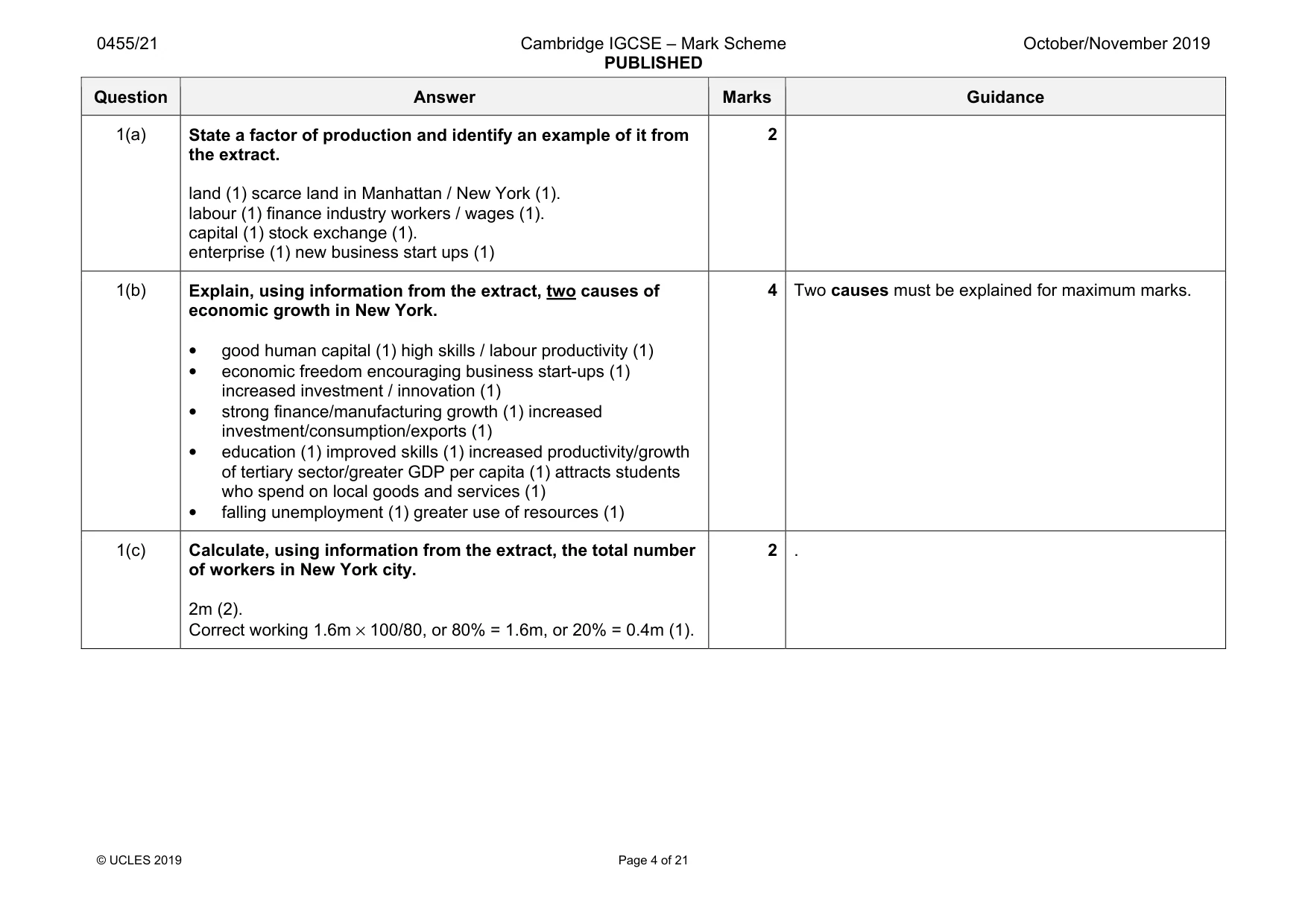
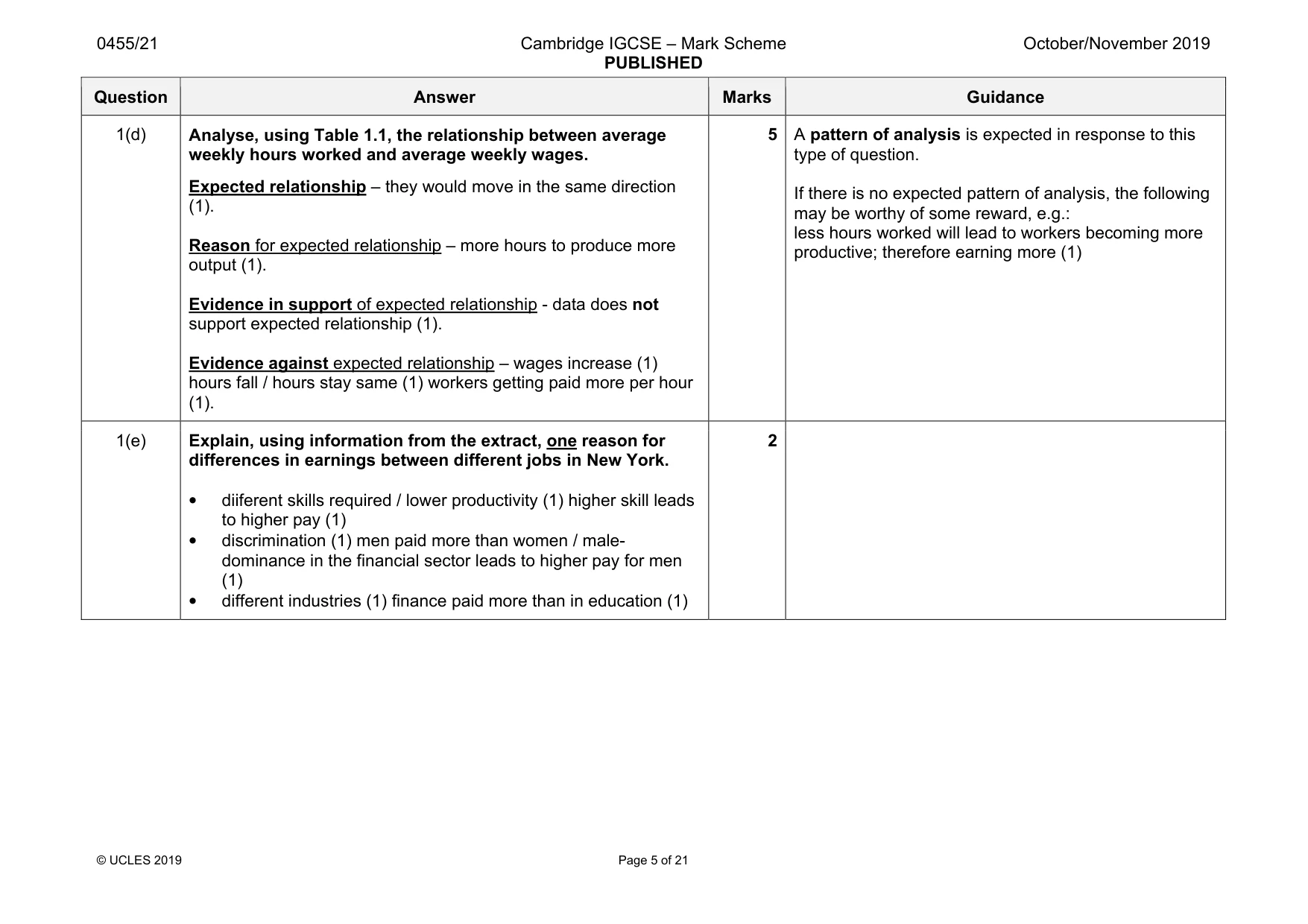
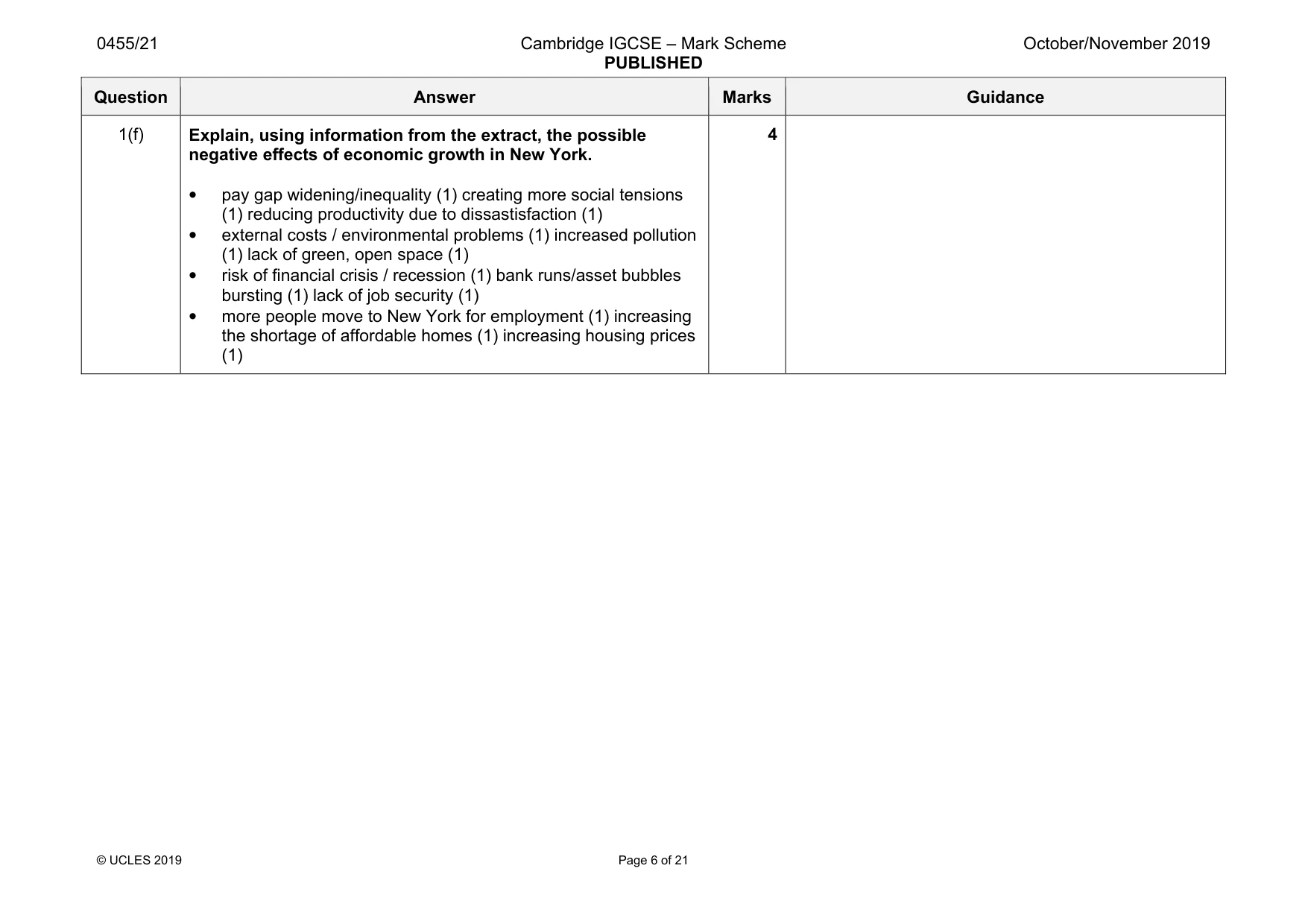
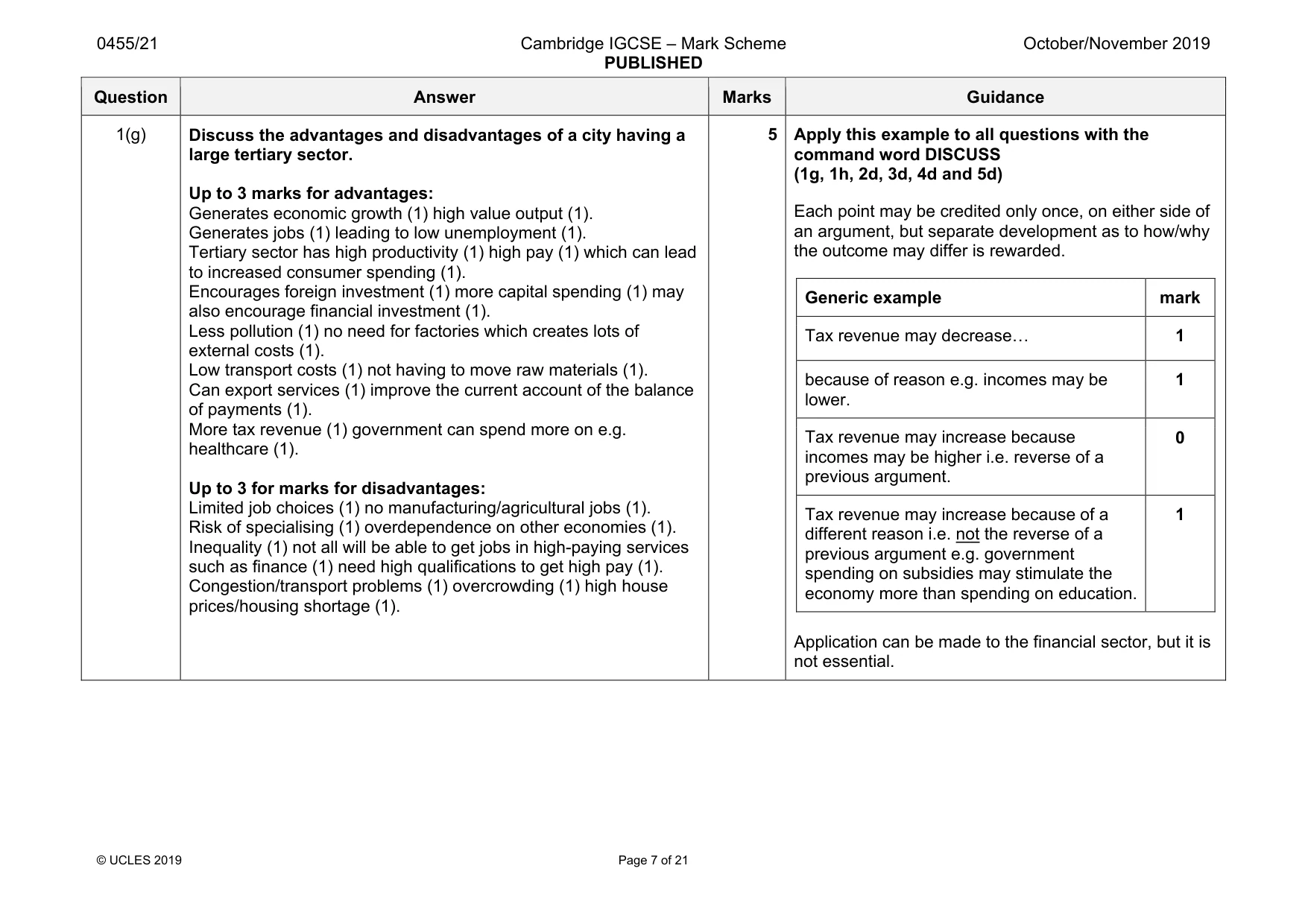
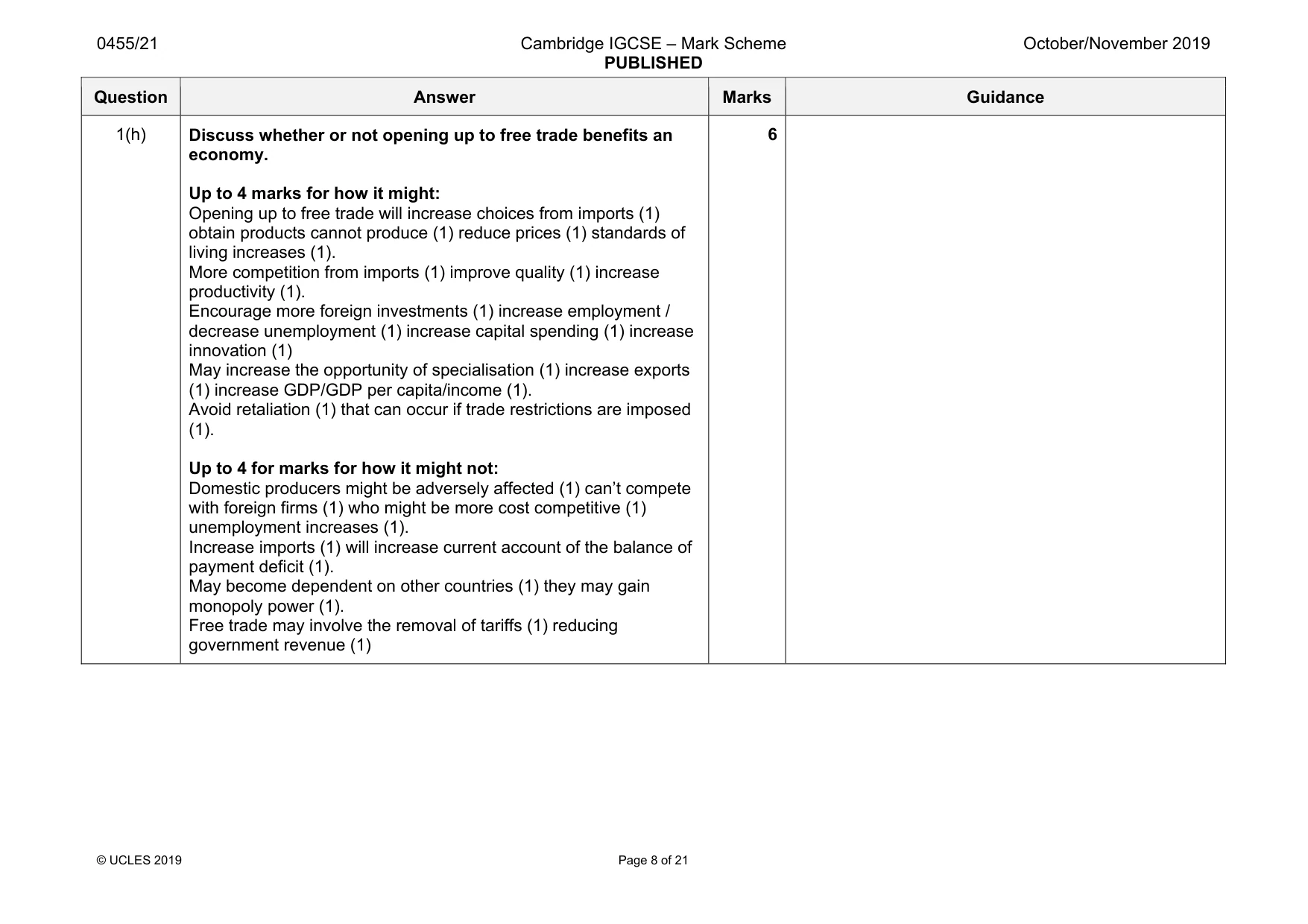
Mark scheme: 1(a) State a factor of production and identify an example of it from the extract. land (1) scarce land in Manhattan / New York (1). labour (1) finance industry workers / wages (1). capital (1) stock exchange (1). enterprise (1) new business start ups (1) 2 1(b) Explain, using information from the extract, two causes of economic growth in New York. • good human capital (1) high skills / labour productivity (1) • economic freedom encouraging business start-ups (1) increased investment / innovation (1) • strong finance/manufacturing growth (1) increased investment/consumption/exports (1) • education (1) improved skills (1) increased productivity/growth of tertiary sector/greater GDP per capita (1) attracts students who spend on local goods and services (1) • falling unemployment (1) greater use of resources (1) 4 Two causes must be explained for maximum marks. 1(c) Calculate, using information from the extract, the total number of workers in New York city. 2m (2). Correct working 1.6m × 100/80, or 80% = 1.6m, or 20% = 0.4m (1). 2 . Question Answer Marks Guidance 1(d) Analyse, using Table 1.1, the relationship between average weekly hours worked and average weekly wages. Expected relationship – they would move in the same direction (1). Reason for expected relationship – more hours to produce more output (1). Evidence in support of expected relationship - data does not support expected relationship (1). Evidence against expected relationship – wages increase (1) hours fall / hours stay same (1) workers getting paid more per hour (1). 5 A pattern of analysis is expected in response to this type of question. If there is no expected pattern of analysis, the following may be worthy of some reward, e.g.: less hours worked will lead to workers becoming more productive; therefore earning more (1) 1(e) Explain, using information from the extract, one reason for differences in earnings between different jobs in New York. • diiferent skills required / lower productivity (1) higher skill leads to higher pay (1) • discrimination (1) men paid more than women / male- dominance in the financial sector leads to higher pay for men (1) • different industries (1) finance paid more than in education (1) 2 Question Answer Marks Guidance 1(f) Explain, using information from the extract, the possible negative effects of economic growth in New York. • pay gap widening/inequality (1) creating more social tensions (1) reducing productivity due to dissastisfaction (1) • external costs / environmental problems (1) increased pollution (1) lack of green, open space (1) • risk of financial crisis / recession (1) bank runs/asset bubbles bursting (1) lack of job security (1) • more people move to New York for employment (1) increasing the shortage of affordable homes (1) increasing housing prices (1) 4 Question Answer Marks Guidance 1(g) Discuss the advantages and disadvantages of a city having a large tertiary sector. Up to 3 marks for advantages: Generates economic growth (1) high value output (1). Generates jobs (1) leading to low unemployment (1). Tertiary sector has high productivity (1) high pay (1) which can lead to increased consumer spending (1). Encourages foreign investment (1) more capital spending (1) may also encourage financial investment (1). Less pollution (1) no need for factories which creates lots of external costs (1). Low transport costs (1) not having to move raw materials (1). Can export services (1) improve the current account of the balance of payments (1). More tax revenue (1) government can spend more on e.g. healthcare (1). Up to 3 for marks for disadvantages: Limited job choices (1) no manufacturing/agricultural jobs (1). Risk of specialising (1) overdependence on other economies (1). Inequality (1) not all will be able to get jobs in high-paying services such as finance (1) need high qualifications to get high pay (1). Congestion/transport problems (1) overcrowding (1) high house prices/housing shortage (1). 5 Apply this example to all questions with the command word DISCUSS (1g, 1h, 2d, 3d, 4d and 5d) Each point may be credited only once, on either side of an argument, but separate development as to how/why the outcome may differ is rewarded. Generic example mark Tax revenue may decrease« 1 because of reason e.g. incomes may be lower. 1 Tax revenue may increase because incomes may be higher i.e. reverse of a previous argument. 0 Tax revenue may increase because of a different reason i.e. not the reverse of a previous argument e.g. government spending on subsidies may stimulate the economy more than spending on education. 1 Application can be made to the financial sector, but it is not essential. Question Answer Marks Guidance 1(h) Discuss whether or not opening up to free trade benefits an economy. Up to 4 marks for how it might: Opening up to free trade will increase choices from imports (1) obtain products cannot produce (1) reduce prices (1) standards of living increases (1). More competition from imports (1) improve quality (1) increase productivity (1). Encourage more foreign investments (1) increase employment / decrease unemployment (1) increase capital spending (1) increase innovation (1) May increase the opportunity of specialisation (1) increase exports (1) increase GDP/GDP per capita/income (1). Avoid retaliation (1) that can occur if trade restrictions are imposed (1). Up to 4 for marks for how it might not: Domestic producers might be adversely affected (1) can’t compete with foreign firms (1) who might be more cost competitive (1) unemployment increases (1). Increase imports (1) will increase current account of the balance of payment deficit (1). May become dependent on other countries (1) they may gain monopoly power (1). Free trade may involve the removal of tariffs (1) reducing government revenue (1) 6
Q2 · In 2017, two firms in the chemical industry in China merged
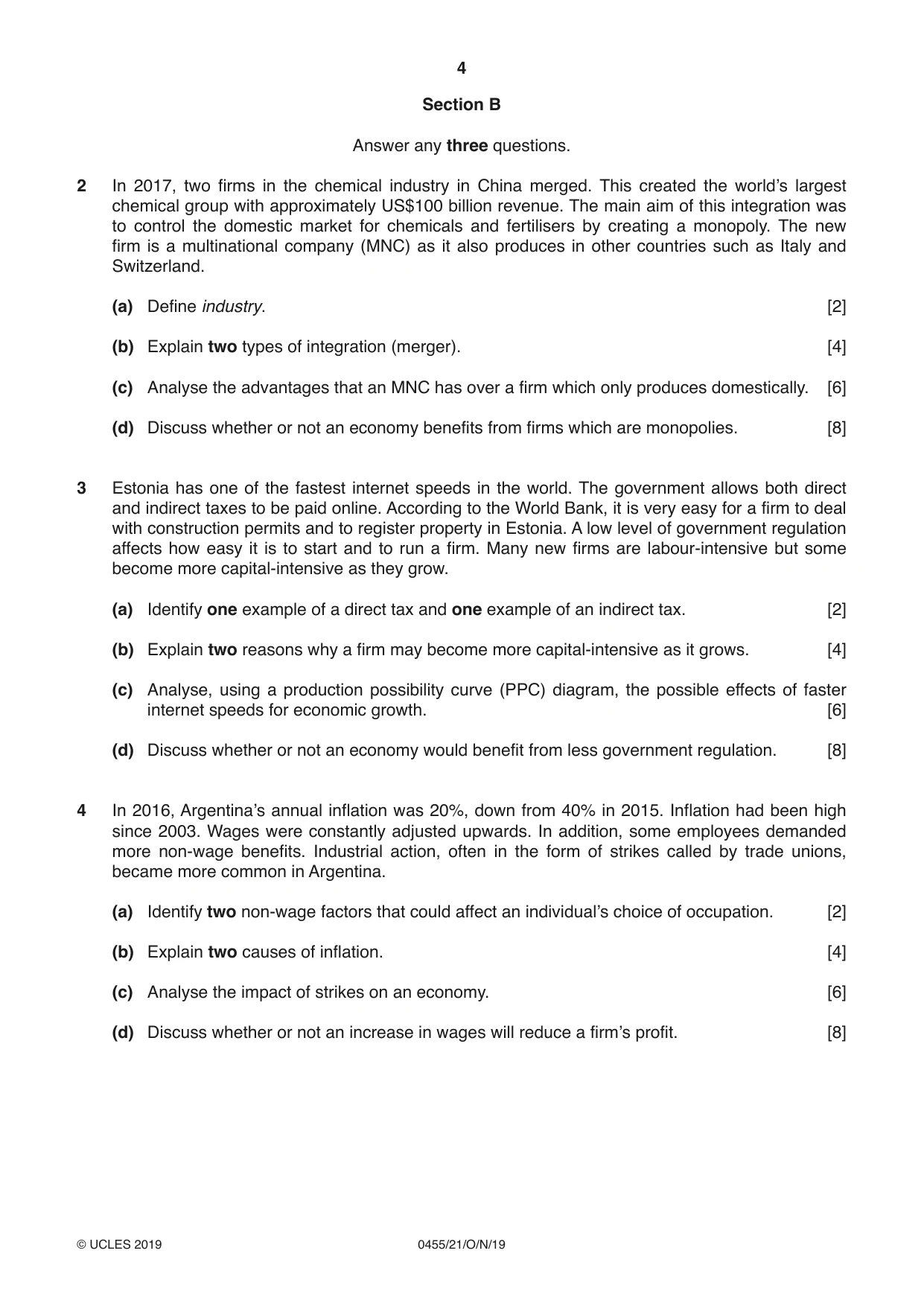
2 In 2017, two firms in the chemical industry in China merged. This created the world’s largest chemical group with approximately US$100 billion revenue. The main aim of this integration was to control the domestic market for chemicals and fertilisers by creating a monopoly. The new firm is a multinational company (MNC) as it also produces in other countries such as Italy and Switzerland. (a) Define industry. [2] (b) Explain two types of integration (merger). [4] (c) Analyse the advantages that an MNC has over a firm which only produces domestically. [6] (d) Discuss whether or not an economy benefits from firms which are monopolies. [8]
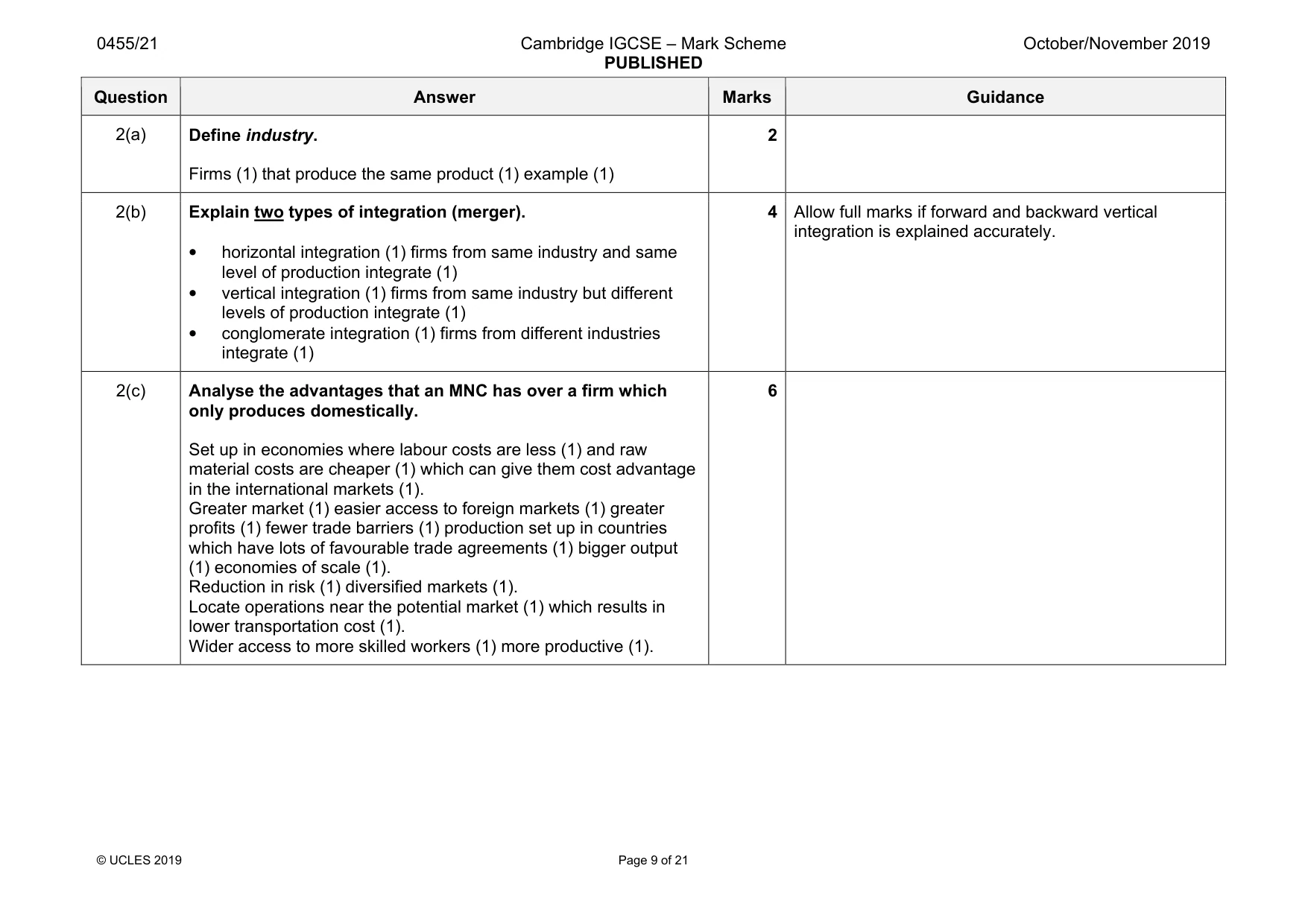
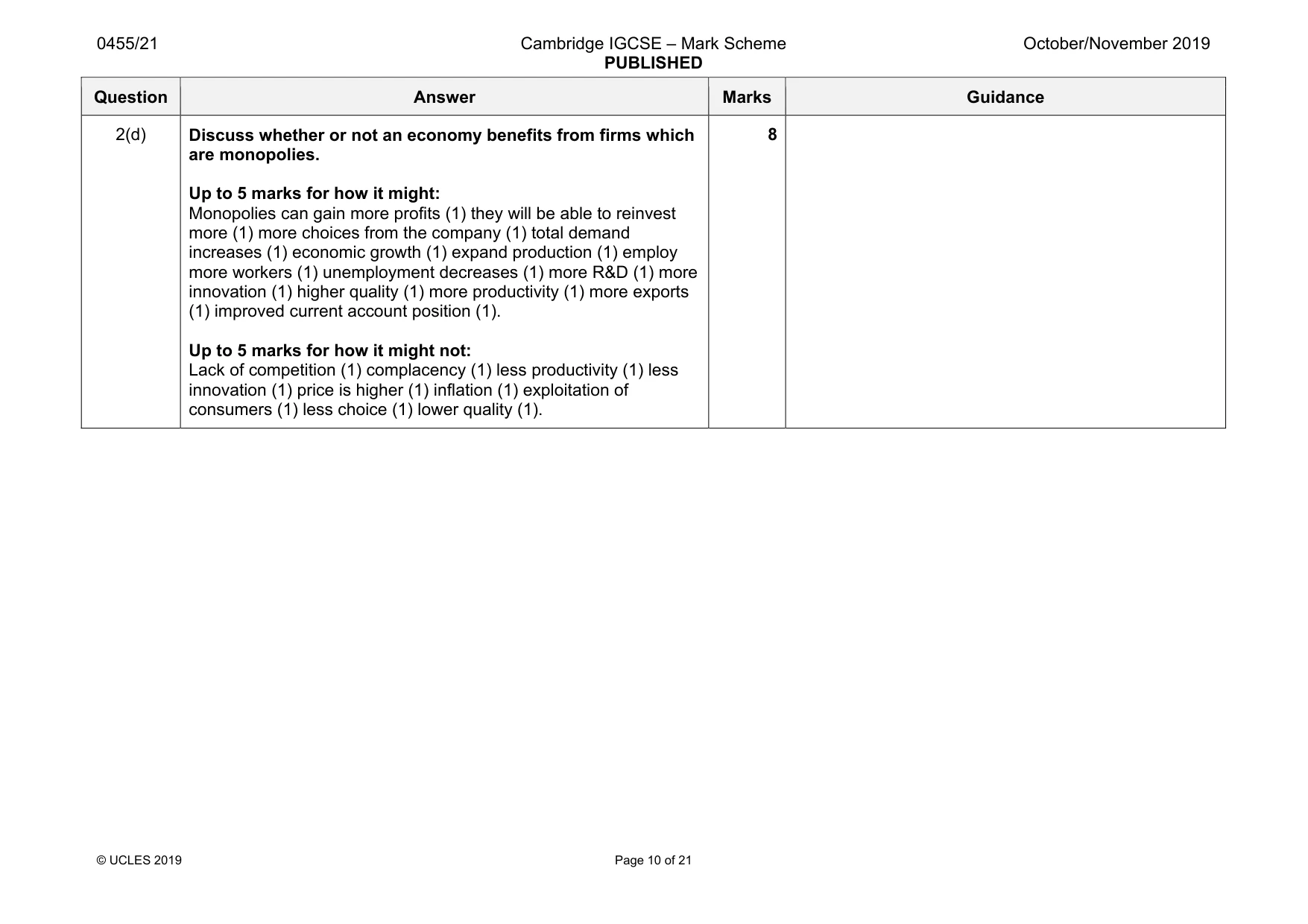
Mark scheme: 2(a) Define industry. Firms (1) that produce the same product (1) example (1) 2 2(b) Explain two types of integration (merger). • horizontal integration (1) firms from same industry and same level of production integrate (1) • vertical integration (1) firms from same industry but different levels of production integrate (1) • conglomerate integration (1) firms from different industries integrate (1) 4 Allow full marks if forward and backward vertical integration is explained accurately. 2(c) Analyse the advantages that an MNC has over a firm which only produces domestically. Set up in economies where labour costs are less (1) and raw material costs are cheaper (1) which can give them cost advantage in the international markets (1). Greater market (1) easier access to foreign markets (1) greater profits (1) fewer trade barriers (1) production set up in countries which have lots of favourable trade agreements (1) bigger output (1) economies of scale (1). Reduction in risk (1) diversified markets (1). Locate operations near the potential market (1) which results in lower transportation cost (1). Wider access to more skilled workers (1) more productive (1). 6 Question Answer Marks Guidance 2(d) Discuss whether or not an economy benefits from firms which are monopolies. Up to 5 marks for how it might: Monopolies can gain more profits (1) they will be able to reinvest more (1) more choices from the company (1) total demand increases (1) economic growth (1) expand production (1) employ more workers (1) unemployment decreases (1) more R&D (1) more innovation (1) higher quality (1) more productivity (1) more exports (1) improved current account position (1). Up to 5 marks for how it might not: Lack of competition (1) complacency (1) less productivity (1) less innovation (1) price is higher (1) inflation (1) exploitation of consumers (1) less choice (1) lower quality (1). 8
Q3 · Estonia has one of the fastest internet speeds in the world
3 Estonia has one of the fastest internet speeds in the world. The government allows both direct and indirect taxes to be paid online. According to the World Bank, it is very easy for a firm to deal with construction permits and to register property in Estonia. A low level of government regulation affects how easy it is to start and to run a firm. Many new firms are labour-intensive but some become more capital-intensive as they grow. (a) Identify one example of a direct tax and one example of an indirect tax. [2] (b) Explain two reasons why a firm may become more capital-intensive as it grows. [4] (c) Analyse, using a production possibility curve (PPC) diagram, the possible effects of faster internet speeds for economic growth. [6] (d) Discuss whether or not an economy would benefit from less government regulation. [8]
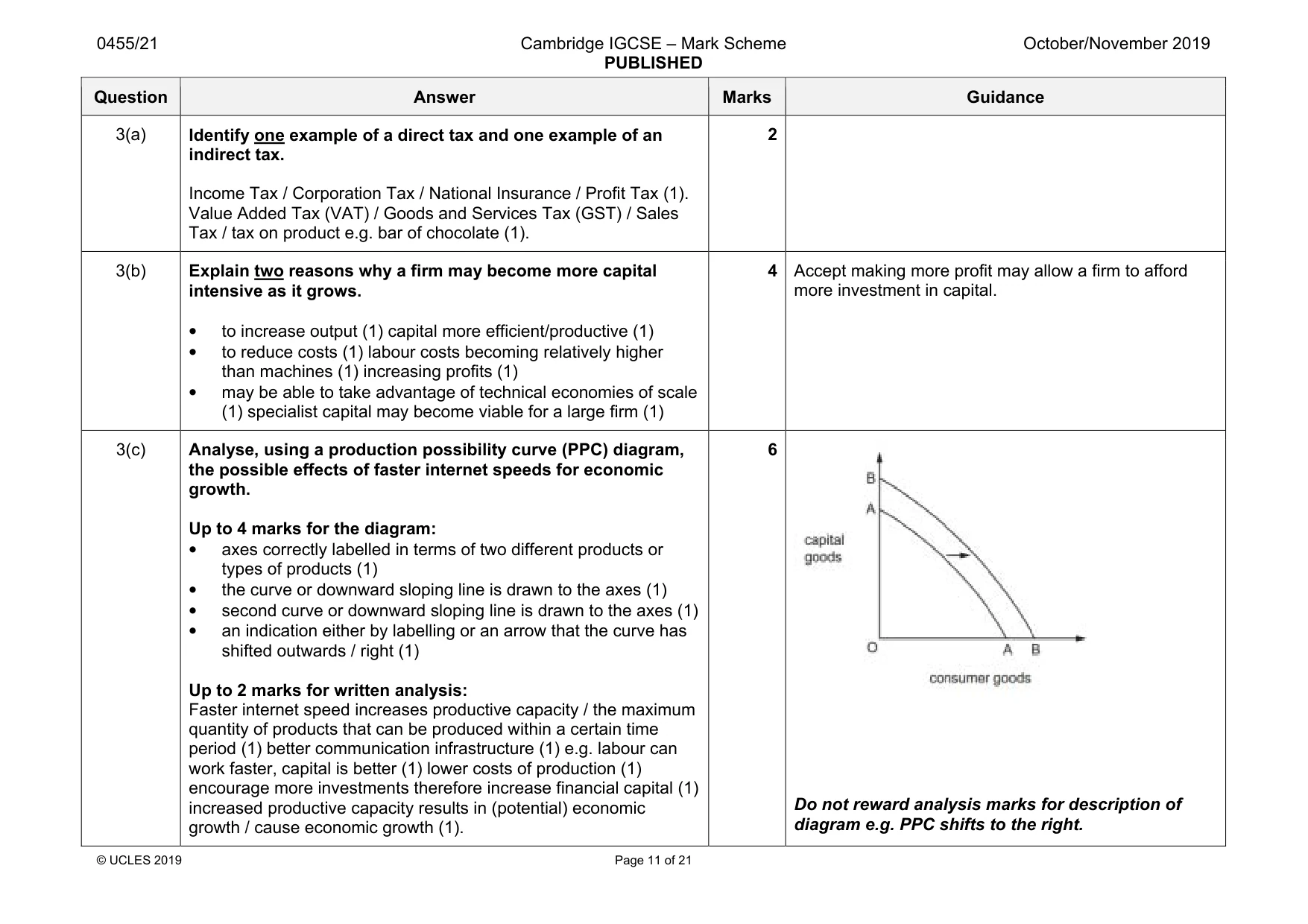
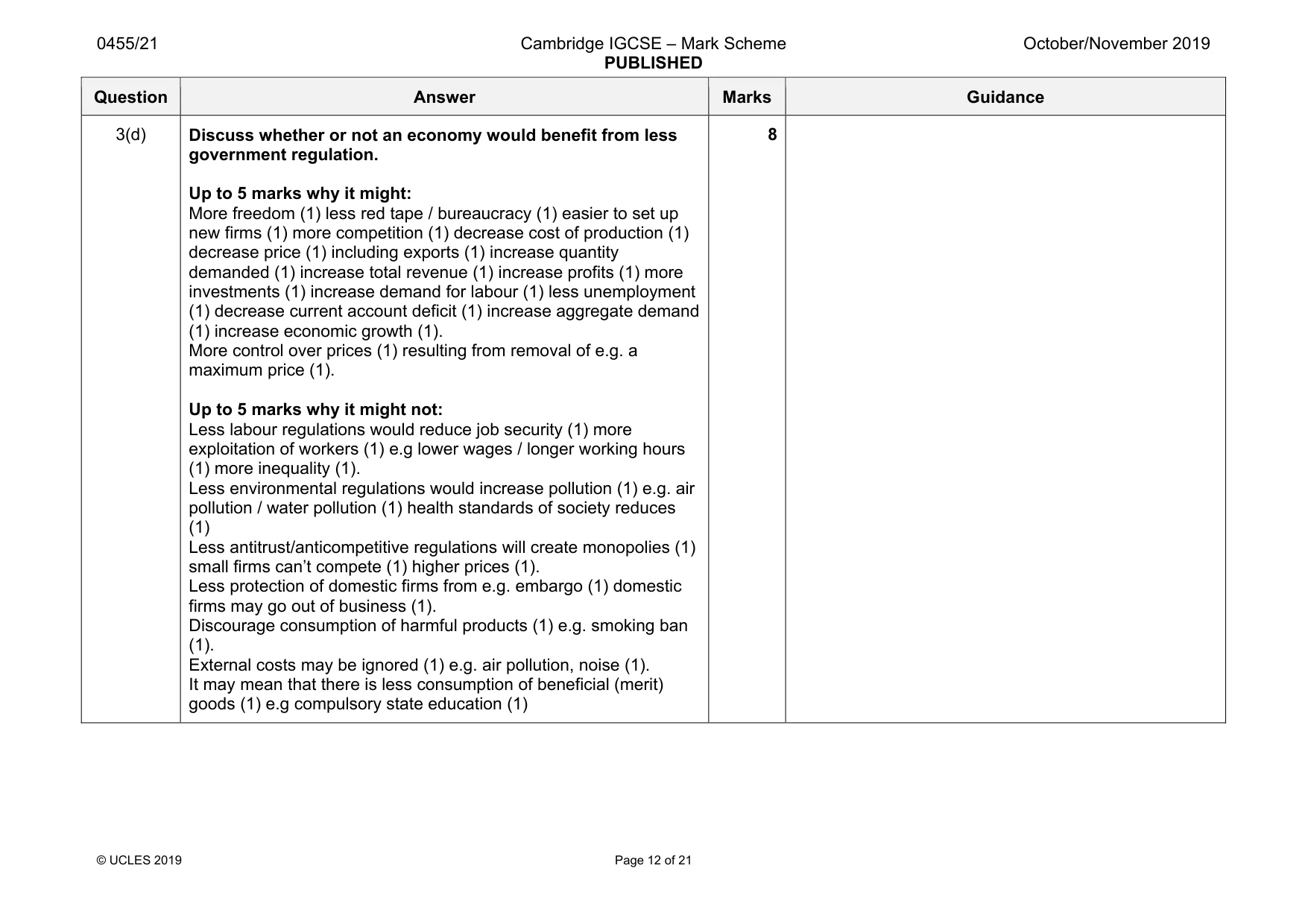
Mark scheme: 3(a) Identify one example of a direct tax and one example of an indirect tax. Income Tax / Corporation Tax / National Insurance / Profit Tax (1). Value Added Tax (VAT) / Goods and Services Tax (GST) / Sales Tax / tax on product e.g. bar of chocolate (1). 2 3(b) Explain two reasons why a firm may become more capital intensive as it grows. • to increase output (1) capital more efficient/productive (1) • to reduce costs (1) labour costs becoming relatively higher than machines (1) increasing profits (1) • may be able to take advantage of technical economies of scale (1) specialist capital may become viable for a large firm (1) 4 Accept making more profit may allow a firm to afford more investment in capital. 3(c) Analyse, using a production possibility curve (PPC) diagram, the possible effects of faster internet speeds for economic growth. Up to 4 marks for the diagram: • axes correctly labelled in terms of two different products or types of products (1) • the curve or downward sloping line is drawn to the axes (1) • second curve or downward sloping line is drawn to the axes (1) • an indication either by labelling or an arrow that the curve has shifted outwards / right (1) Up to 2 marks for written analysis: Faster internet speed increases productive capacity / the maximum quantity of products that can be produced within a certain time period (1) better communication infrastructure (1) e.g. labour can work faster, capital is better (1) lower costs of production (1) encourage more investments therefore increase financial capital (1) increased productive capacity results in (potential) economic growth / cause economic growth (1). 6 Do not reward analysis marks for description of diagram e.g. PPC shifts to the right. Question Answer Marks Guidance 3(d) Discuss whether or not an economy would benefit from less government regulation. Up to 5 marks why it might: More freedom (1) less red tape / bureaucracy (1) easier to set up new firms (1) more competition (1) decrease cost of production (1) decrease price (1) including exports (1) increase quantity demanded (1) increase total revenue (1) increase profits (1) more investments (1) increase demand for labour (1) less unemployment (1) decrease current account deficit (1) increase aggregate demand (1) increase economic growth (1). More control over prices (1) resulting from removal of e.g. a maximum price (1). Up to 5 marks why it might not: Less labour regulations would reduce job security (1) more exploitation of workers (1) e.g lower wages / longer working hours (1) more inequality (1). Less environmental regulations would increase pollution (1) e.g. air pollution / water pollution (1) health standards of society reduces (1) Less antitrust/anticompetitive regulations will create monopolies (1) small firms can’t compete (1) higher prices (1). Less protection of domestic firms from e.g. embargo (1) domestic firms may go out of business (1). Discourage consumption of harmful products (1) e.g. smoking ban (1). External costs may be ignored (1) e.g. air pollution, noise (1). It may mean that there is less consumption of beneficial (merit) goods (1) e.g compulsory state education (1) 8
Q4 · In 2016, Argentina’s annual inflation was 20%, down from 40% in 2015
4 In 2016, Argentina’s annual inflation was 20%, down from 40% in 2015. Inflation had been high since 2003. Wages were constantly adjusted upwards. In addition, some employees demanded more non-wage benefits. Industrial action, often in the form of strikes called by trade unions, became more common in Argentina. (a) Identify two non-wage factors that could affect an individual’s choice of occupation. [2] (b) Explain two causes of inflation. [4] (c) Analyse the impact of strikes on an economy. [6] (d) Discuss whether or not an increase in wages will reduce a firm’s profit. [8]
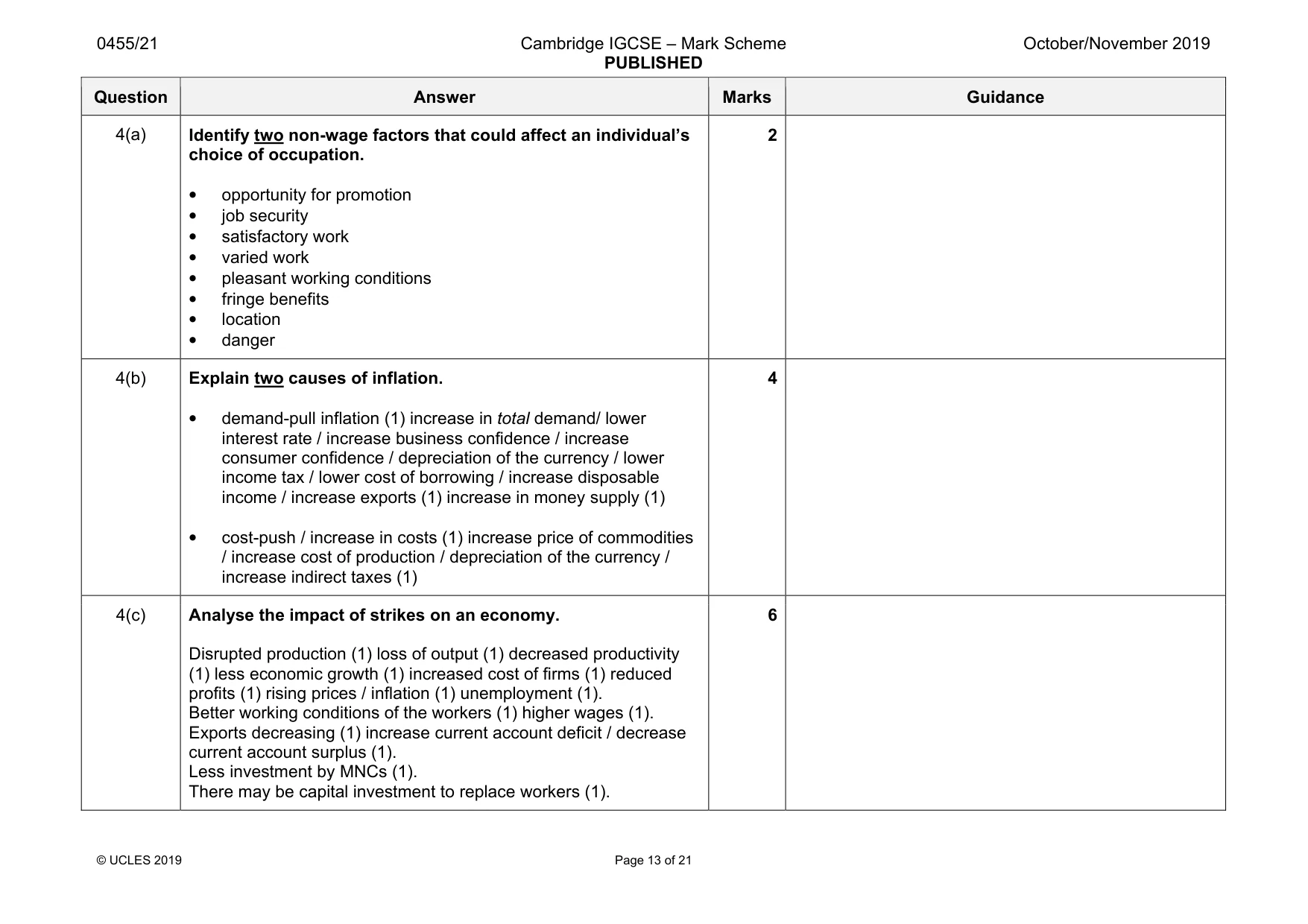
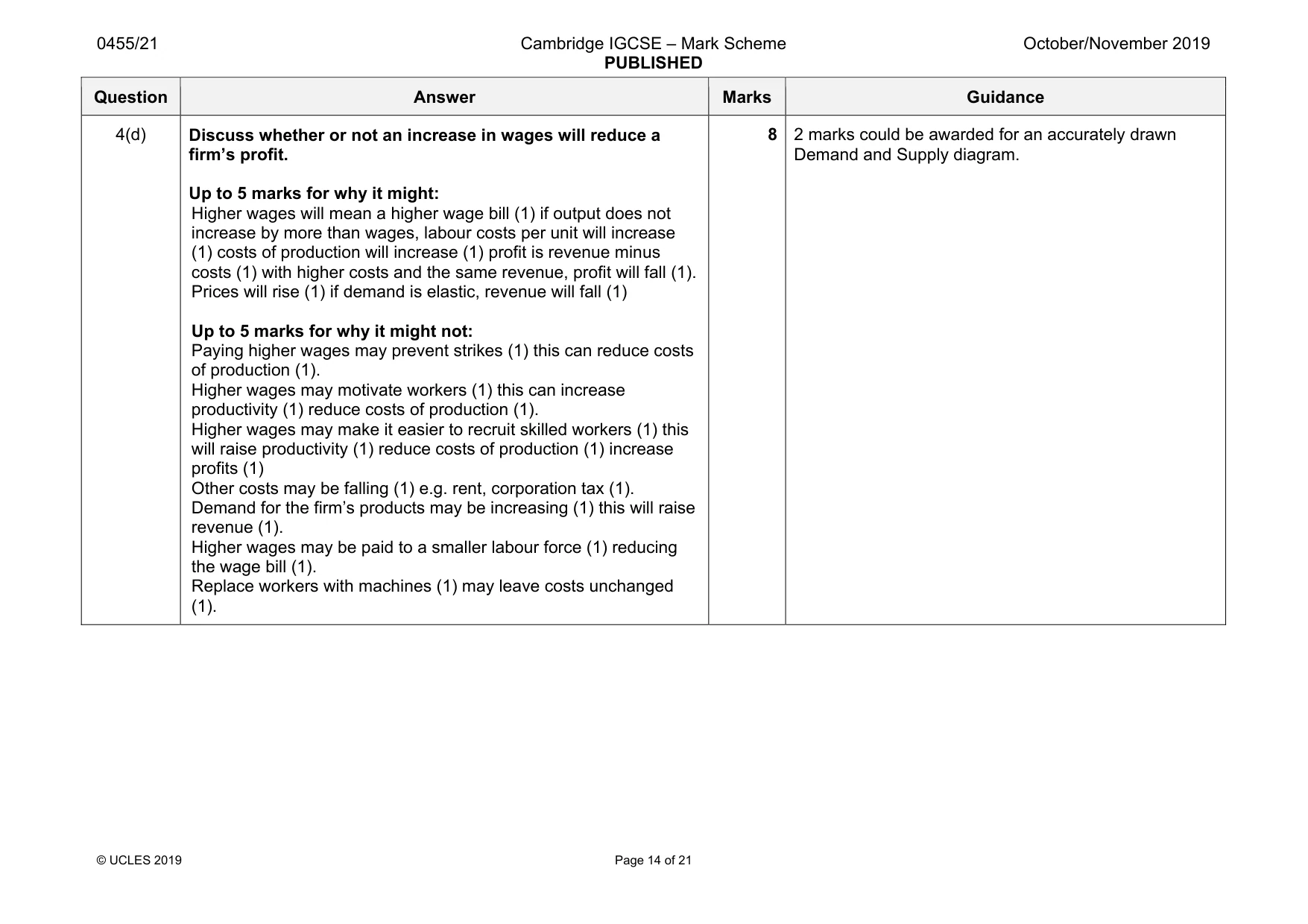
Mark scheme: 4(a) Identify two non-wage factors that could affect an individual’s choice of occupation. • opportunity for promotion • job security • satisfactory work • varied work • pleasant working conditions • fringe benefits • location • danger 2 4(b) Explain two causes of inflation. • demand-pull inflation (1) increase in total demand/ lower interest rate / increase business confidence / increase consumer confidence / depreciation of the currency / lower income tax / lower cost of borrowing / increase disposable income / increase exports (1) increase in money supply (1) • cost-push / increase in costs (1) increase price of commodities / increase cost of production / depreciation of the currency / increase indirect taxes (1) 4 4(c) Analyse the impact of strikes on an economy. Disrupted production (1) loss of output (1) decreased productivity (1) less economic growth (1) increased cost of firms (1) reduced profits (1) rising prices / inflation (1) unemployment (1). Better working conditions of the workers (1) higher wages (1). Exports decreasing (1) increase current account deficit / decrease current account surplus (1). Less investment by MNCs (1). There may be capital investment to replace workers (1). 6 Question Answer Marks Guidance 4(d) Discuss whether or not an increase in wages will reduce a firm’s profit. Up to 5 marks for why it might: Higher wages will mean a higher wage bill (1) if output does not increase by more than wages, labour costs per unit will increase (1) costs of production will increase (1) profit is revenue minus costs (1) with higher costs and the same revenue, profit will fall (1). Prices will rise (1) if demand is elastic, revenue will fall (1) Up to 5 marks for why it might not: Paying higher wages may prevent strikes (1) this can reduce costs of production (1). Higher wages may motivate workers (1) this can increase productivity (1) reduce costs of production (1). Higher wages may make it easier to recruit skilled workers (1) this will raise productivity (1) reduce costs of production (1) increase profits (1) Other costs may be falling (1) e.g. rent, corporation tax (1). Demand for the firm’s products may be increasing (1) this will raise revenue (1). Higher wages may be paid to a smaller labour force (1) reducing the wage bill (1). Replace workers with machines (1) may leave costs unchanged (1). 8 2 marks could be awarded for an accurately drawn Demand and Supply diagram.
Q5 · The Monetary Authority of Singapore (MAS), the government body which controls the…
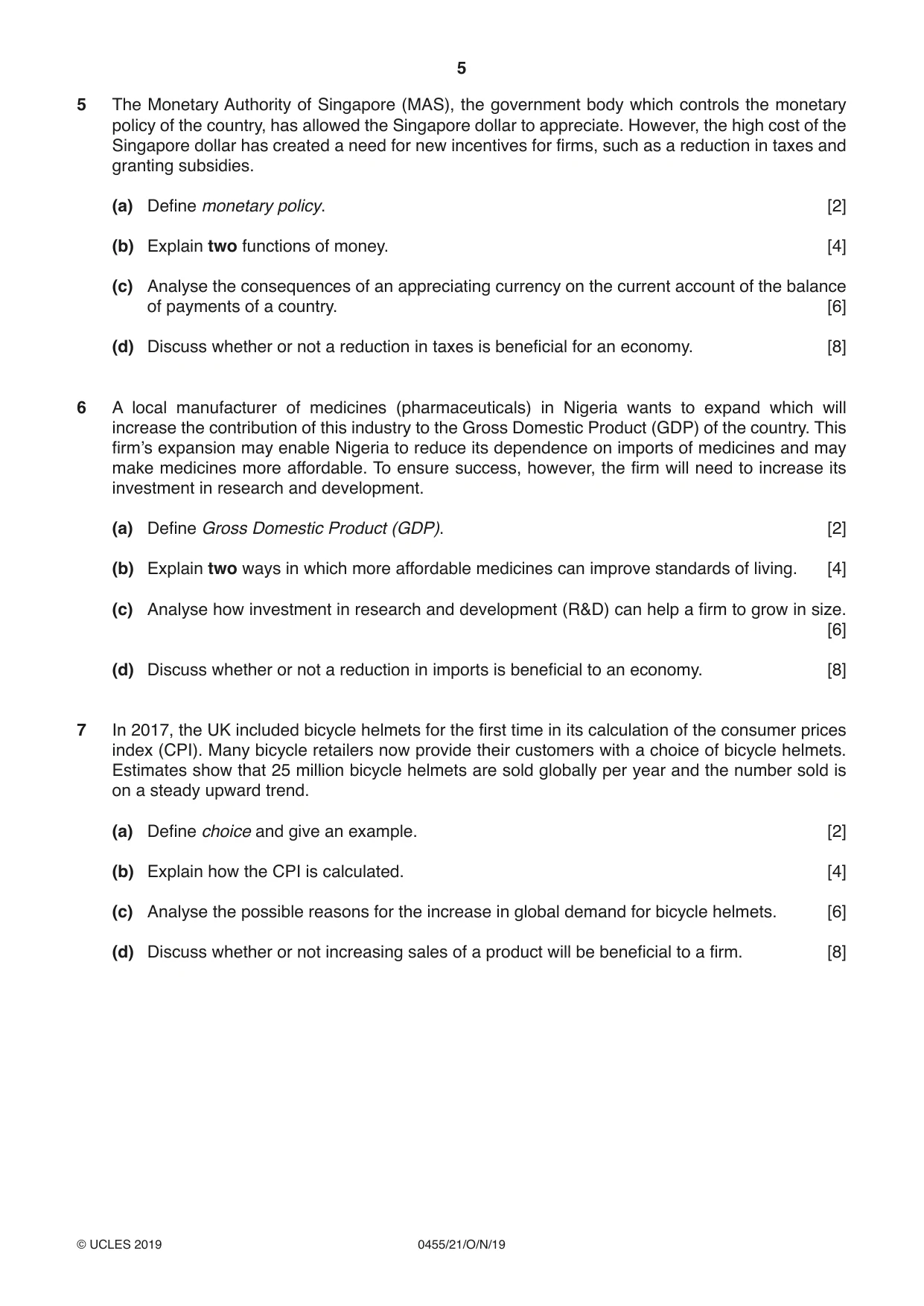
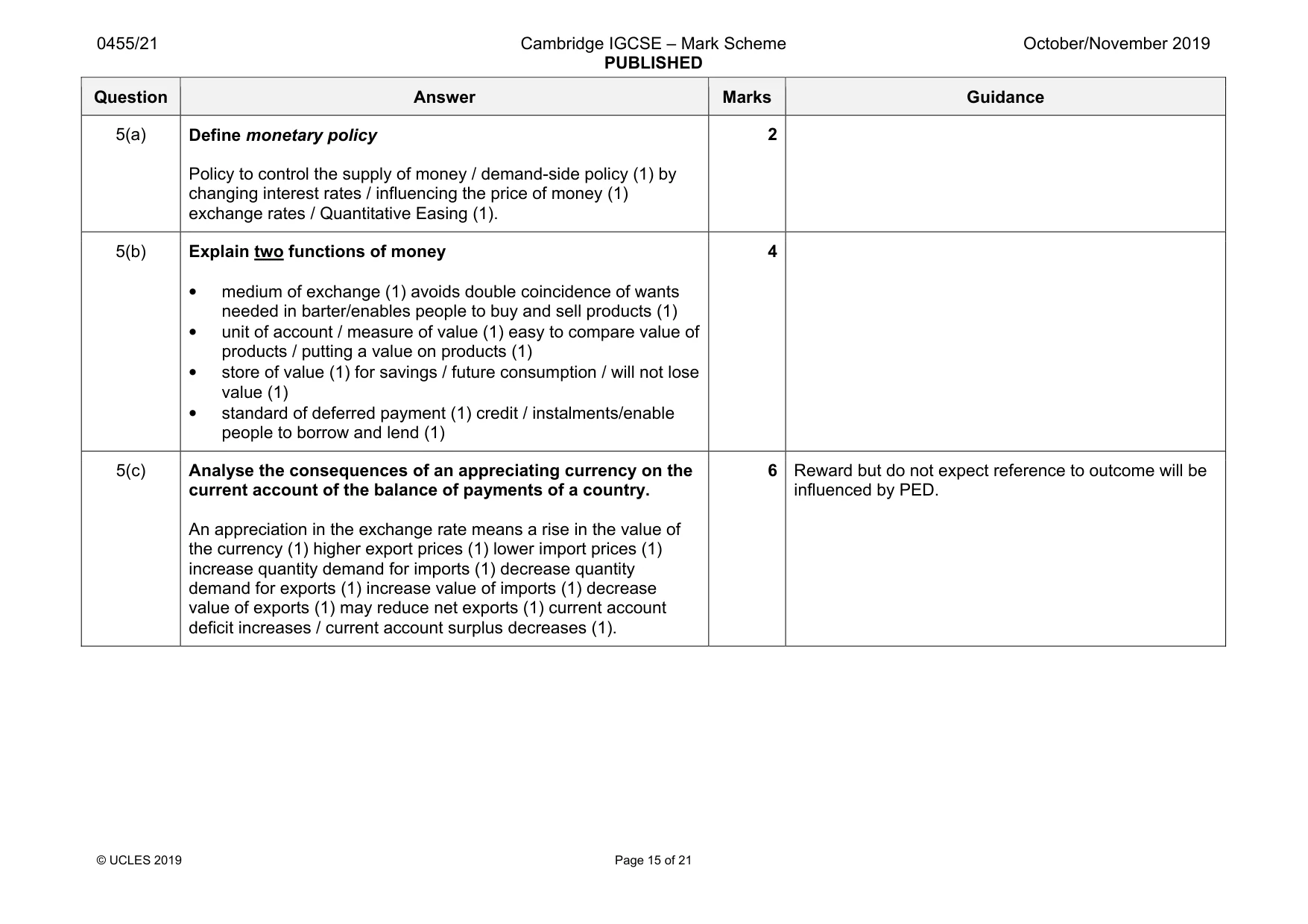
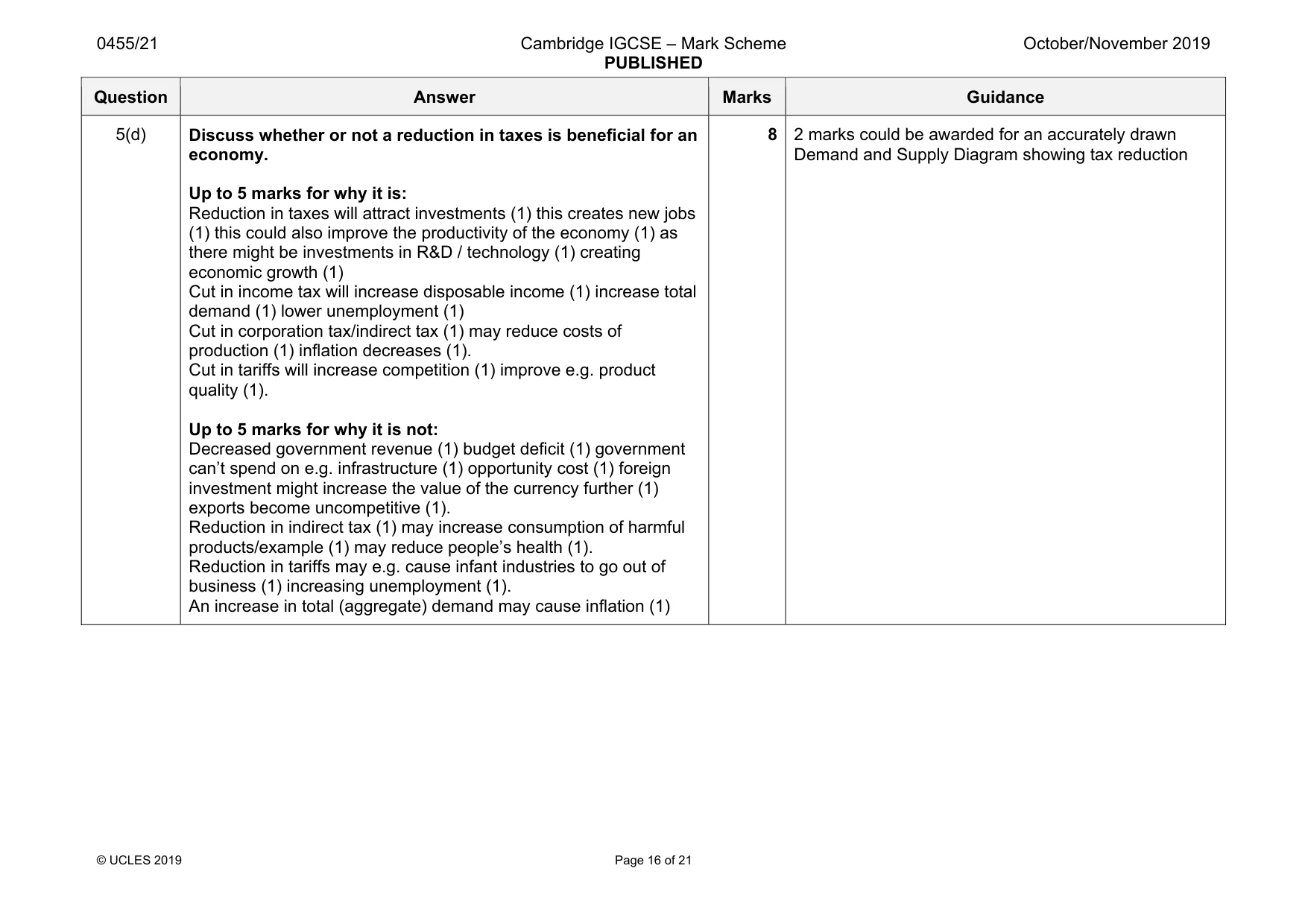
5 The Monetary Authority of Singapore (MAS), the government body which controls the monetary policy of the country, has allowed the Singapore dollar to appreciate. However, the high cost of the Singapore dollar has created a need for new incentives for firms, such as a reduction in taxes and granting subsidies. (a) Define monetary policy. [2] (b) Explain two functions of money. [4] (c) Analyse the consequences of an appreciating currency on the current account of the balance of payments of a country. [6] (d) Discuss whether or not a reduction in taxes is beneficial for an economy. [8]
Mark scheme: 5(a) Define monetary policy Policy to control the supply of money / demand-side policy (1) by changing interest rates / influencing the price of money (1) exchange rates / Quantitative Easing (1). 2 5(b) Explain two functions of money • medium of exchange (1) avoids double coincidence of wants needed in barter/enables people to buy and sell products (1) • unit of account / measure of value (1) easy to compare value of products / putting a value on products (1) • store of value (1) for savings / future consumption / will not lose value (1) • standard of deferred payment (1) credit / instalments/enable people to borrow and lend (1) 4 5(c) Analyse the consequences of an appreciating currency on the current account of the balance of payments of a country. An appreciation in the exchange rate means a rise in the value of the currency (1) higher export prices (1) lower import prices (1) increase quantity demand for imports (1) decrease quantity demand for exports (1) increase value of imports (1) decrease value of exports (1) may reduce net exports (1) current account deficit increases / current account surplus decreases (1). 6 Reward but do not expect reference to outcome will be influenced by PED. Question Answer Marks Guidance 5(d) Discuss whether or not a reduction in taxes is beneficial for an economy. Up to 5 marks for why it is: Reduction in taxes will attract investments (1) this creates new jobs (1) this could also improve the productivity of the economy (1) as there might be investments in R&D / technology (1) creating economic growth (1) Cut in income tax will increase disposable income (1) increase total demand (1) lower unemployment (1) Cut in corporation tax/indirect tax (1) may reduce costs of production (1) inflation decreases (1). Cut in tariffs will increase competition (1) improve e.g. product quality (1). Up to 5 marks for why it is not: Decreased government revenue (1) budget deficit (1) government can’t spend on e.g. infrastructure (1) opportunity cost (1) foreign investment might increase the value of the currency further (1) exports become uncompetitive (1). Reduction in indirect tax (1) may increase consumption of harmful products/example (1) may reduce people’s health (1). Reduction in tariffs may e.g. cause infant industries to go out of business (1) increasing unemployment (1). An increase in total (aggregate) demand may cause inflation (1) 8 2 marks could be awarded for an accurately drawn Demand and Supply Diagram showing tax reduction
Q6 · A local manufacturer of medicines (pharmaceuticals) in Nigeria wants to expand which will…
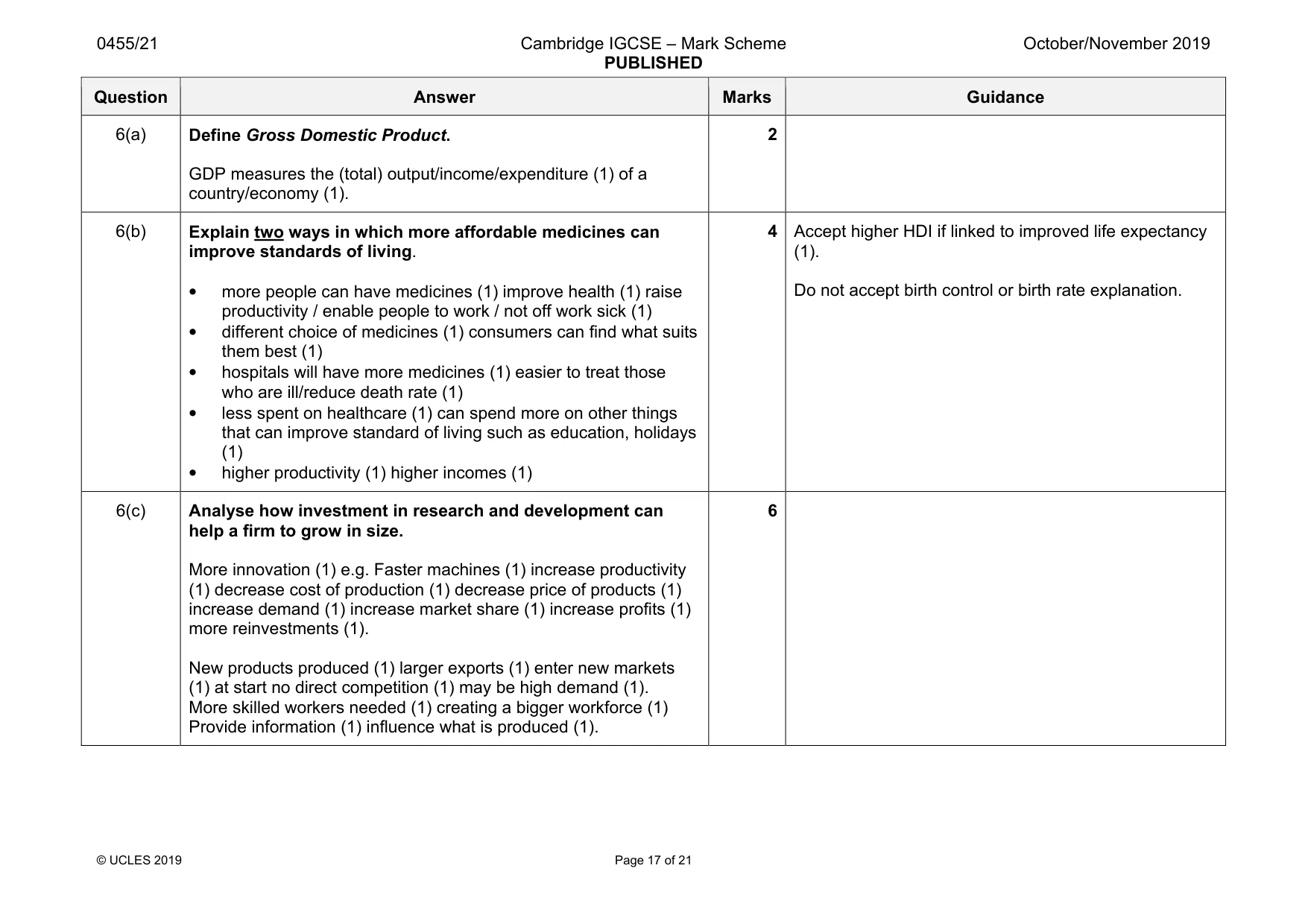
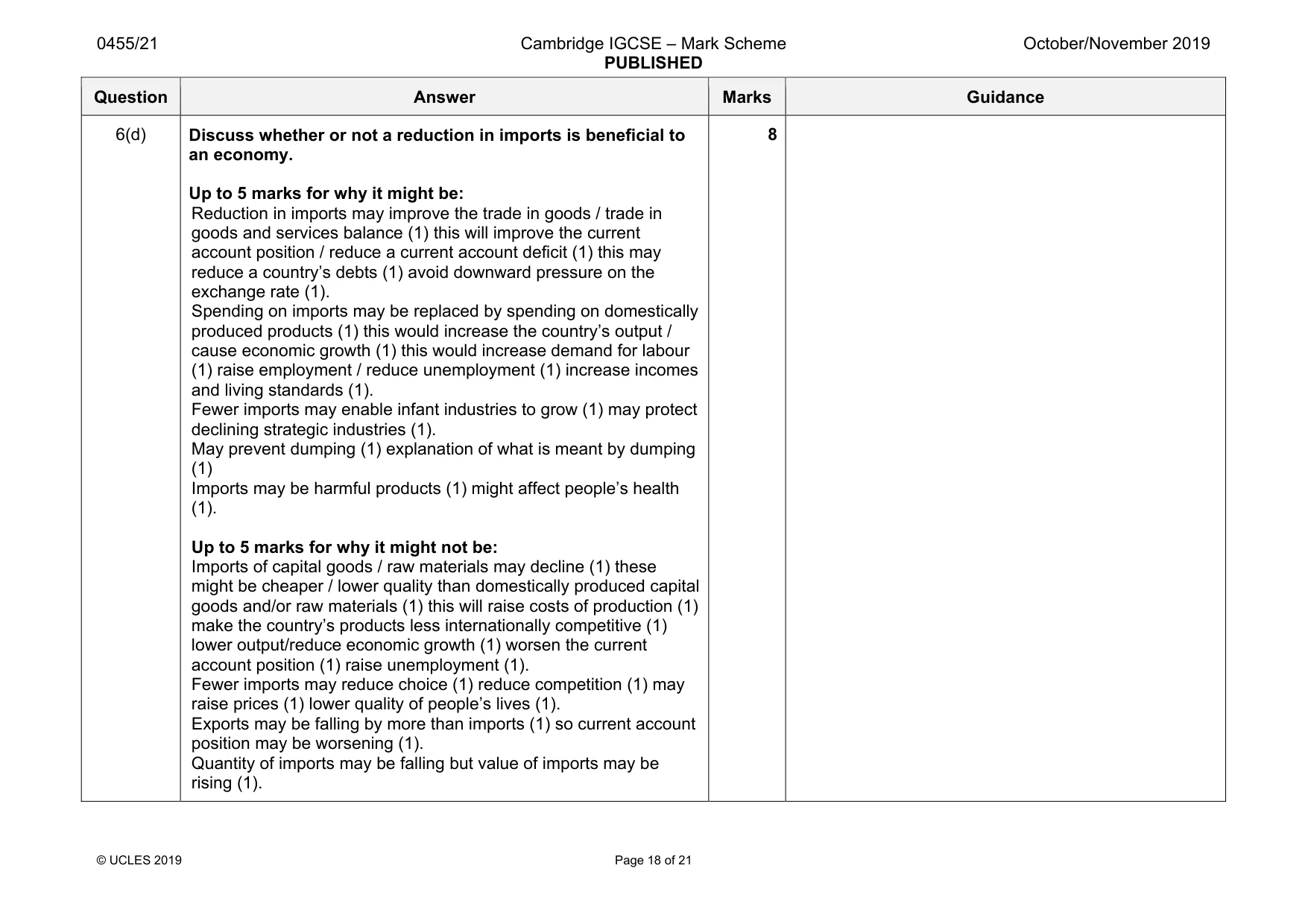
6 A local manufacturer of medicines (pharmaceuticals) in Nigeria wants to expand which will increase the contribution of this industry to the Gross Domestic Product (GDP) of the country. This firm’s expansion may enable Nigeria to reduce its dependence on imports of medicines and may make medicines more affordable. To ensure success, however, the firm will need to increase its investment in research and development. (a) Define Gross Domestic Product (GDP). [2] (b) Explain two ways in which more affordable medicines can improve standards of living. [4] (c) Analyse how investment in research and development (R&D) can help a firm to grow in size. [6] (d) Discuss whether or not a reduction in imports is beneficial to an economy. [8]
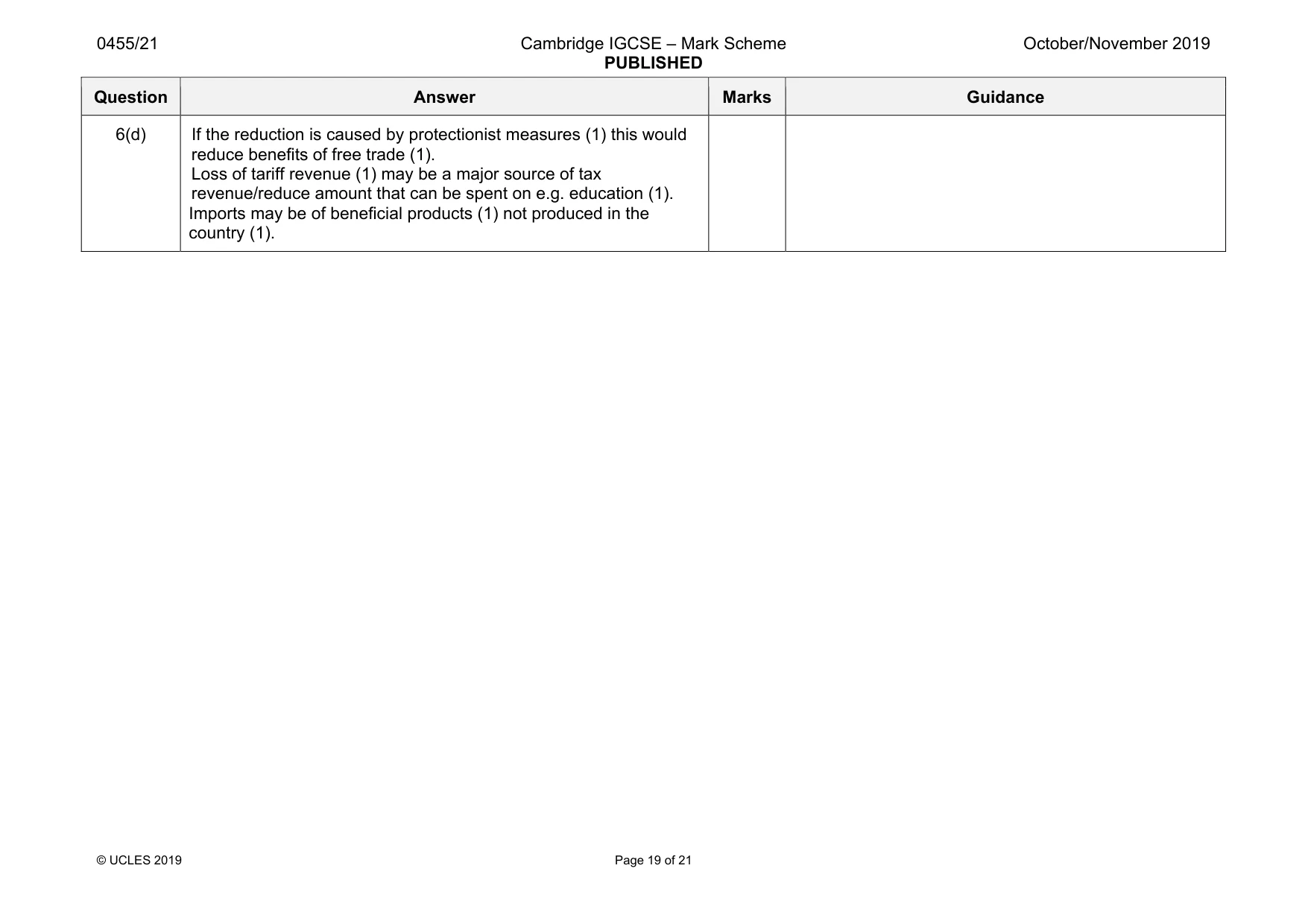
Mark scheme: 6(a) Define Gross Domestic Product. GDP measures the (total) output/income/expenditure (1) of a country/economy (1). 2 6(b) Explain two ways in which more affordable medicines can improve standards of living. • more people can have medicines (1) improve health (1) raise productivity / enable people to work / not off work sick (1) • different choice of medicines (1) consumers can find what suits them best (1) • hospitals will have more medicines (1) easier to treat those who are ill/reduce death rate (1) • less spent on healthcare (1) can spend more on other things that can improve standard of living such as education, holidays (1) • higher productivity (1) higher incomes (1) 4 Accept higher HDI if linked to improved life expectancy (1). Do not accept birth control or birth rate explanation. 6(c) Analyse how investment in research and development can help a firm to grow in size. More innovation (1) e.g. Faster machines (1) increase productivity (1) decrease cost of production (1) decrease price of products (1) increase demand (1) increase market share (1) increase profits (1) more reinvestments (1). New products produced (1) larger exports (1) enter new markets (1) at start no direct competition (1) may be high demand (1). More skilled workers needed (1) creating a bigger workforce (1) Provide information (1) influence what is produced (1). 6 Question Answer Marks Guidance 6(d) Discuss whether or not a reduction in imports is beneficial to an economy. Up to 5 marks for why it might be: Reduction in imports may improve the trade in goods / trade in goods and services balance (1) this will improve the current account position / reduce a current account deficit (1) this may reduce a country’s debts (1) avoid downward pressure on the exchange rate (1). Spending on imports may be replaced by spending on domestically produced products (1) this would increase the country’s output / cause economic growth (1) this would increase demand for labour (1) raise employment / reduce unemployment (1) increase incomes and living standards (1). Fewer imports may enable infant industries to grow (1) may protect declining strategic industries (1). May prevent dumping (1) explanation of what is meant by dumping (1) Imports may be harmful products (1) might affect people’s health (1). Up to 5 marks for why it might not be: Imports of capital goods / raw materials may decline (1) these might be cheaper / lower quality than domestically produced capital goods and/or raw materials (1) this will raise costs of production (1) make the country’s products less internationally competitive (1) lower output/reduce economic growth (1) worsen the current account position (1) raise unemployment (1). Fewer imports may reduce choice (1) reduce competition (1) may raise prices (1) lower quality of people’s lives (1). Exports may be falling by more than imports (1) so current account position may be worsening (1). Quantity of imports may be falling but value of imports may be rising (1). 8 Question Answer Marks Guidance 6(d) If the reduction is caused by protectionist measures (1) this would reduce benefits of free trade (1). Loss of tariff revenue (1) may be a major source of tax revenue/reduce amount that can be spent on e.g. education (1). Imports may be of beneficial products (1) not produced in the country (1).
Q7 · In 2017, the UK included bicycle helmets for the first time in its calculation of the…
7 In 2017, the UK included bicycle helmets for the first time in its calculation of the consumer prices index (CPI). Many bicycle retailers now provide their customers with a choice of bicycle helmets. Estimates show that 25 million bicycle helmets are sold globally per year and the number sold is on a steady upward trend. (a) Define choice and give an example. [2] (b) Explain how the CPI is calculated. [4] (c) Analyse the possible reasons for the increase in global demand for bicycle helmets. [6] (d) Discuss whether or not increasing sales of a product will be beneficial to a firm. [8]
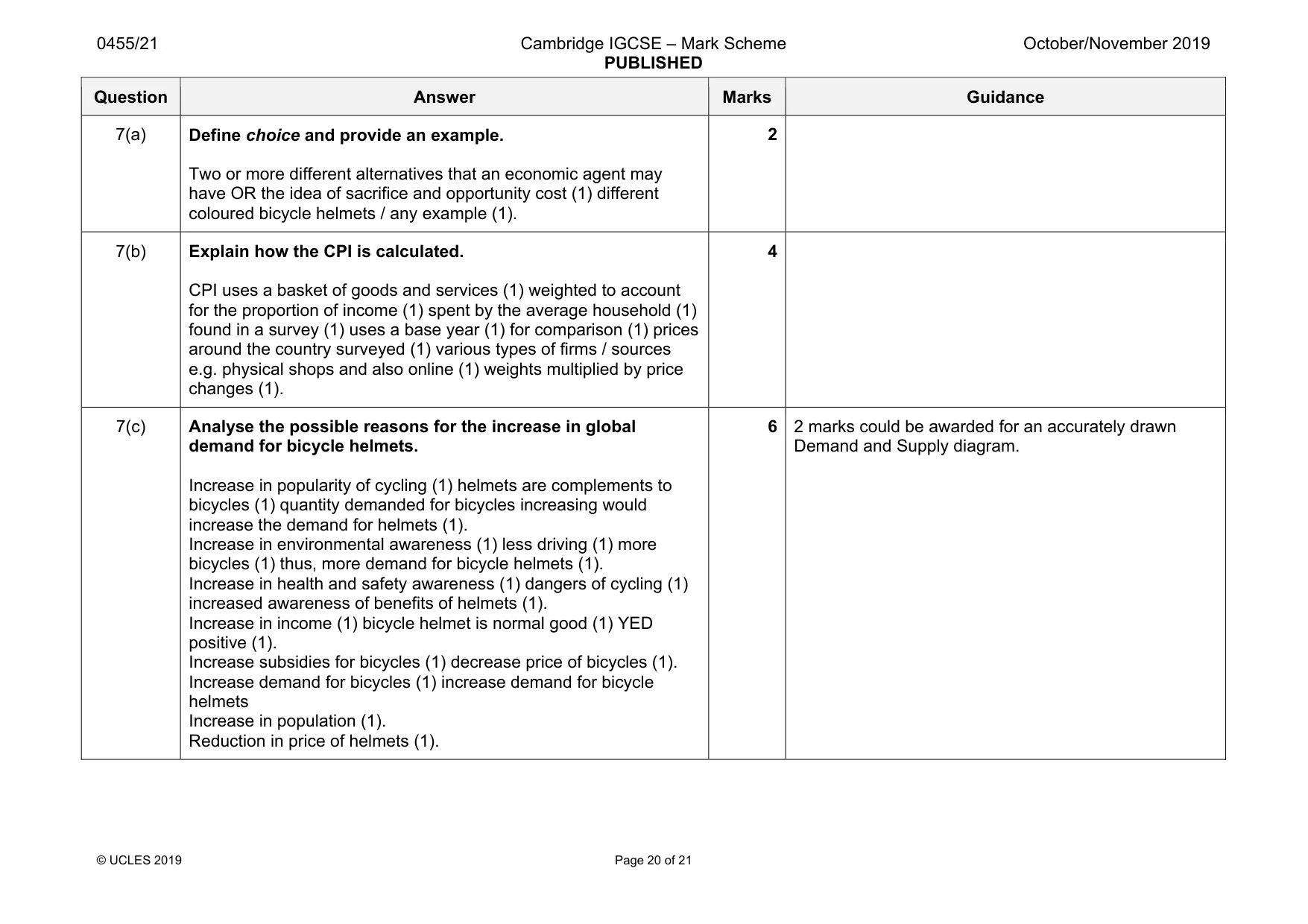
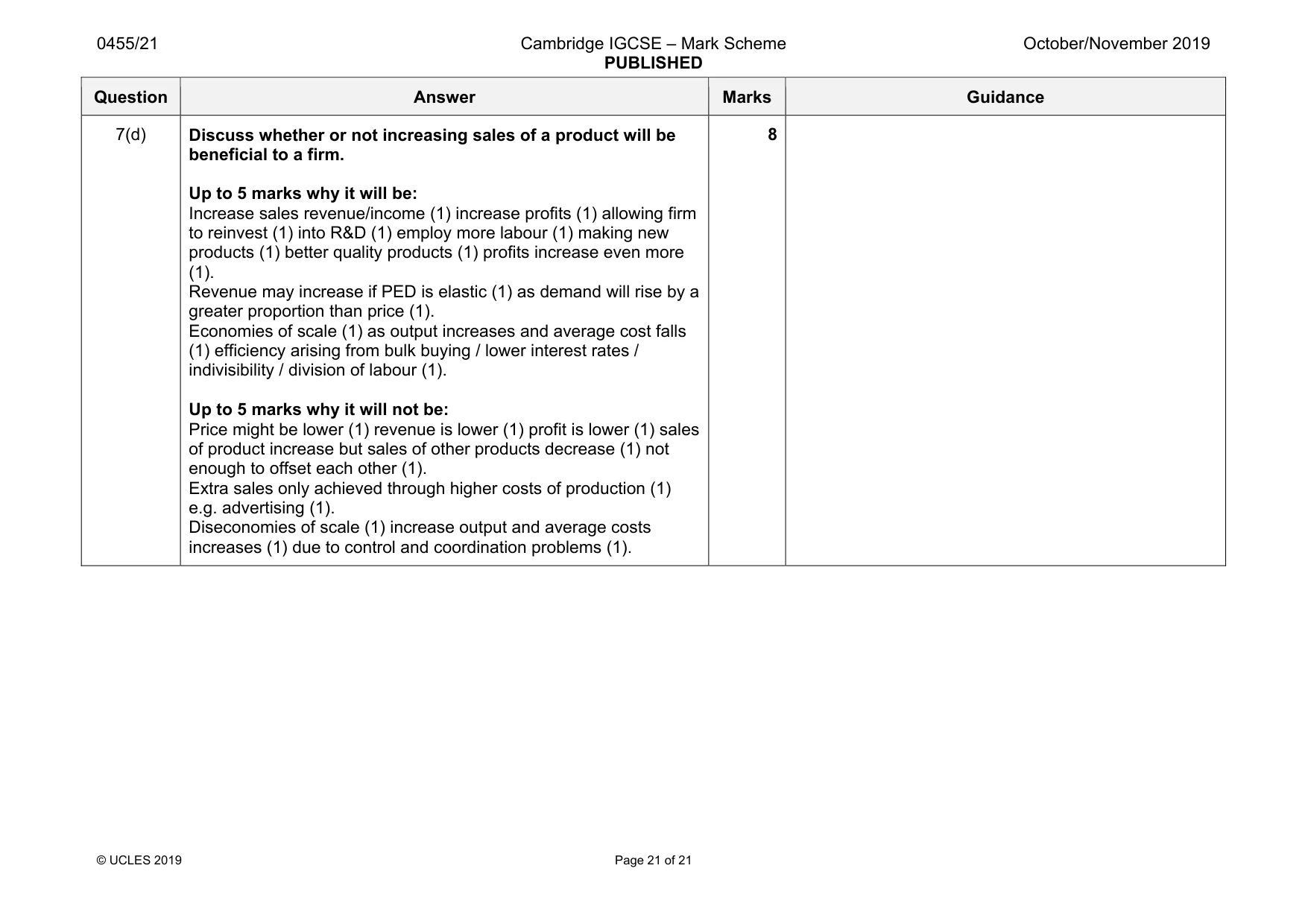
Mark scheme: 7(a) Define choice and provide an example. Two or more different alternatives that an economic agent may have OR the idea of sacrifice and opportunity cost (1) different coloured bicycle helmets / any example (1). 2 7(b) Explain how the CPI is calculated. CPI uses a basket of goods and services (1) weighted to account for the proportion of income (1) spent by the average household (1) found in a survey (1) uses a base year (1) for comparison (1) prices around the country surveyed (1) various types of firms / sources e.g. physical shops and also online (1) weights multiplied by price changes (1). 4 7(c) Analyse the possible reasons for the increase in global demand for bicycle helmets. Increase in popularity of cycling (1) helmets are complements to bicycles (1) quantity demanded for bicycles increasing would increase the demand for helmets (1). Increase in environmental awareness (1) less driving (1) more bicycles (1) thus, more demand for bicycle helmets (1). Increase in health and safety awareness (1) dangers of cycling (1) increased awareness of benefits of helmets (1). Increase in income (1) bicycle helmet is normal good (1) YED positive (1). Increase subsidies for bicycles (1) decrease price of bicycles (1). Increase demand for bicycles (1) increase demand for bicycle helmets Increase in population (1). Reduction in price of helmets (1). 6 2 marks could be awarded for an accurately drawn Demand and Supply diagram. Question Answer Marks Guidance 7(d) Discuss whether or not increasing sales of a product will be beneficial to a firm. Up to 5 marks why it will be: Increase sales revenue/income (1) increase profits (1) allowing firm to reinvest (1) into R&D (1) employ more labour (1) making new products (1) better quality products (1) profits increase even more (1). Revenue may increase if PED is elastic (1) as demand will rise by a greater proportion than price (1). Economies of scale (1) as output increases and average cost falls (1) efficiency arising from bulk buying / lower interest rates / indivisibility / division of labour (1). Up to 5 marks why it will not be: Price might be lower (1) revenue is lower (1) profit is lower (1) sales of product increase but sales of other products decrease (1) not enough to offset each other (1). Extra sales only achieved through higher costs of production (1) e.g. advertising (1). Diseconomies of scale (1) increase output and average costs increases (1) due to control and coordination problems (1). 8
What was in this paper
The subtopics covered by these 7 questions, and how many questions each got. Open one in a new tab to see every Cambridge question on it.
What you needed in this session
Cambridge’s own grade thresholds for 2019 Oct/Nov, Paper 2 · Variant 1. A higher threshold means an easier paper — the bar moves with how the cohort did.