Cambridge IGCSE Economics 0455 — 2021 Oct/Nov Paper 2 · Variant 1
0455/21/O/N/21 · 5 questions · 90 marks · ≈101 min
The question paper and its mark scheme, free to read here and free to download. This is Cambridge’s own paper, exactly as it was sat.
Question paper8 pages
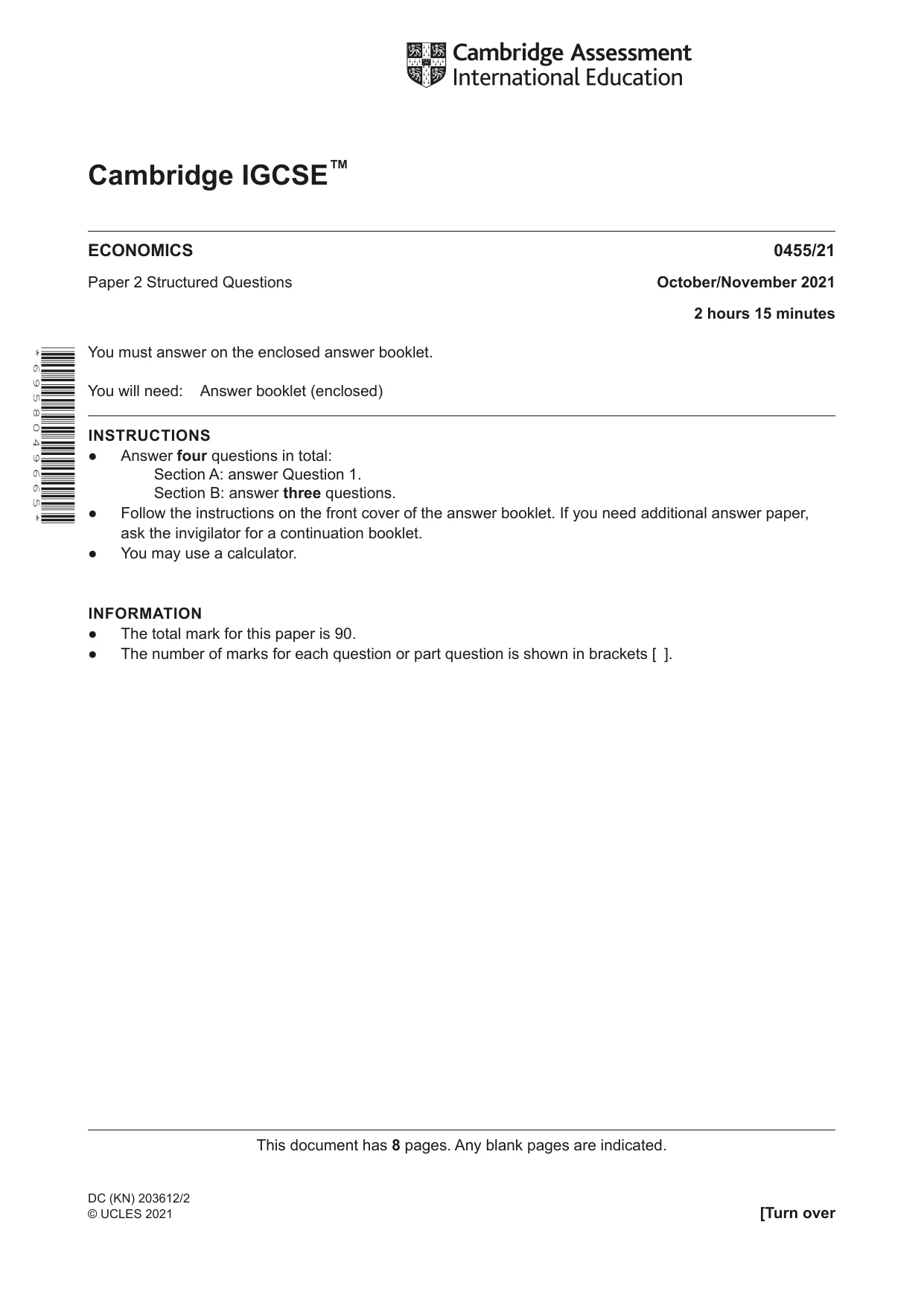



Mark scheme22 pages
Answers below. Sit the paper first if you are practising.
Questions as text
Q1 · Calculate, in $, the total exports of Laos to China in 2017
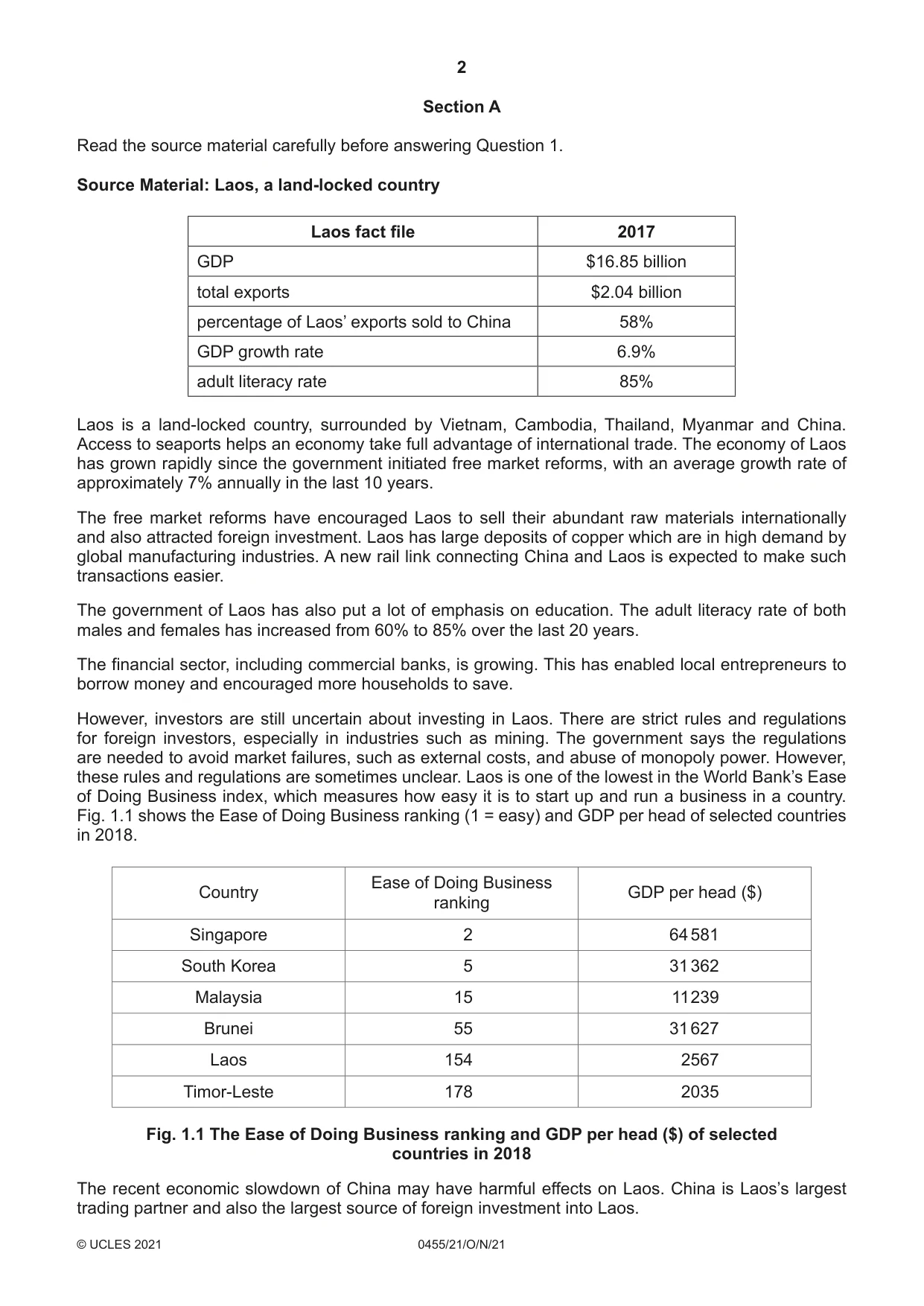
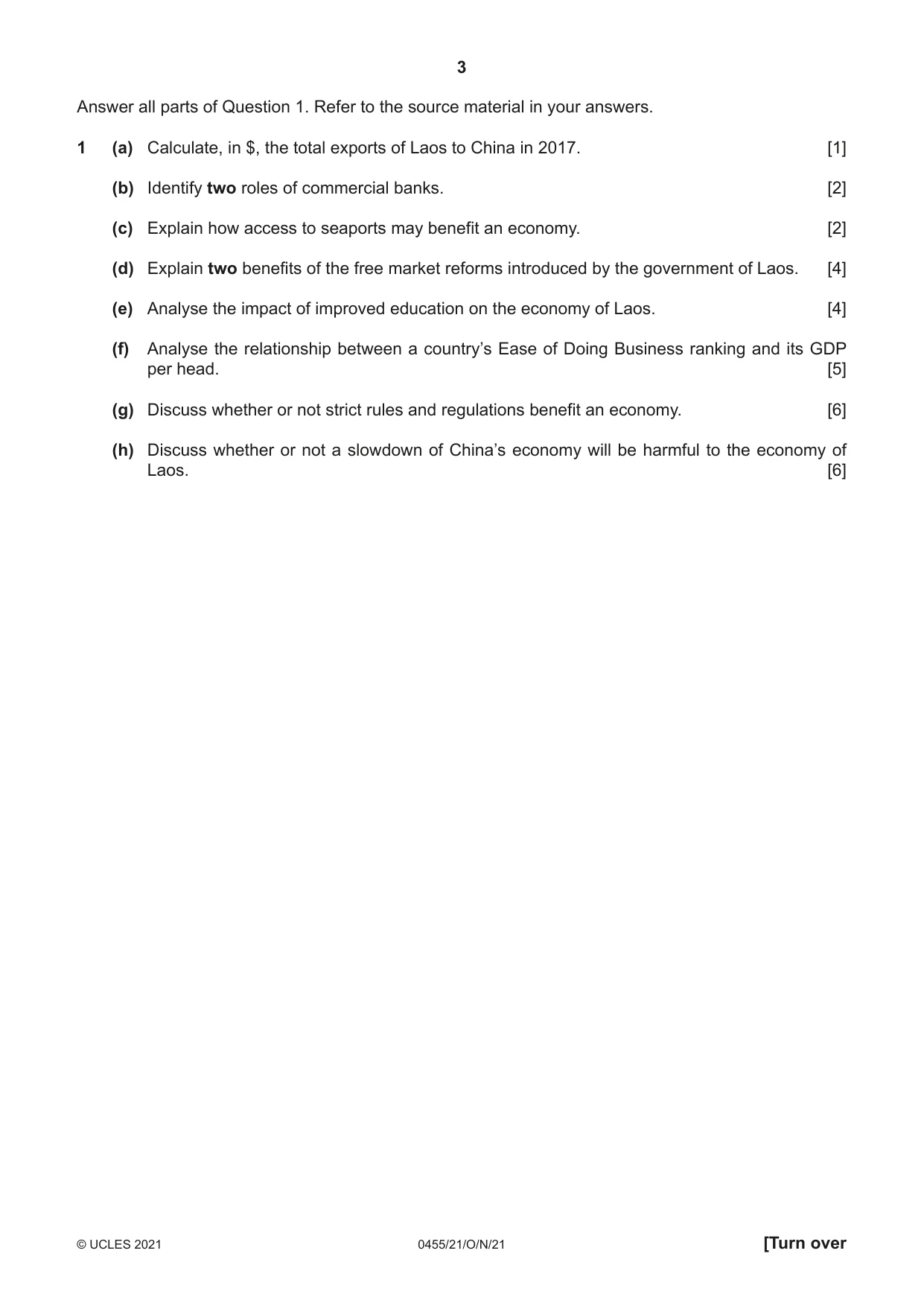
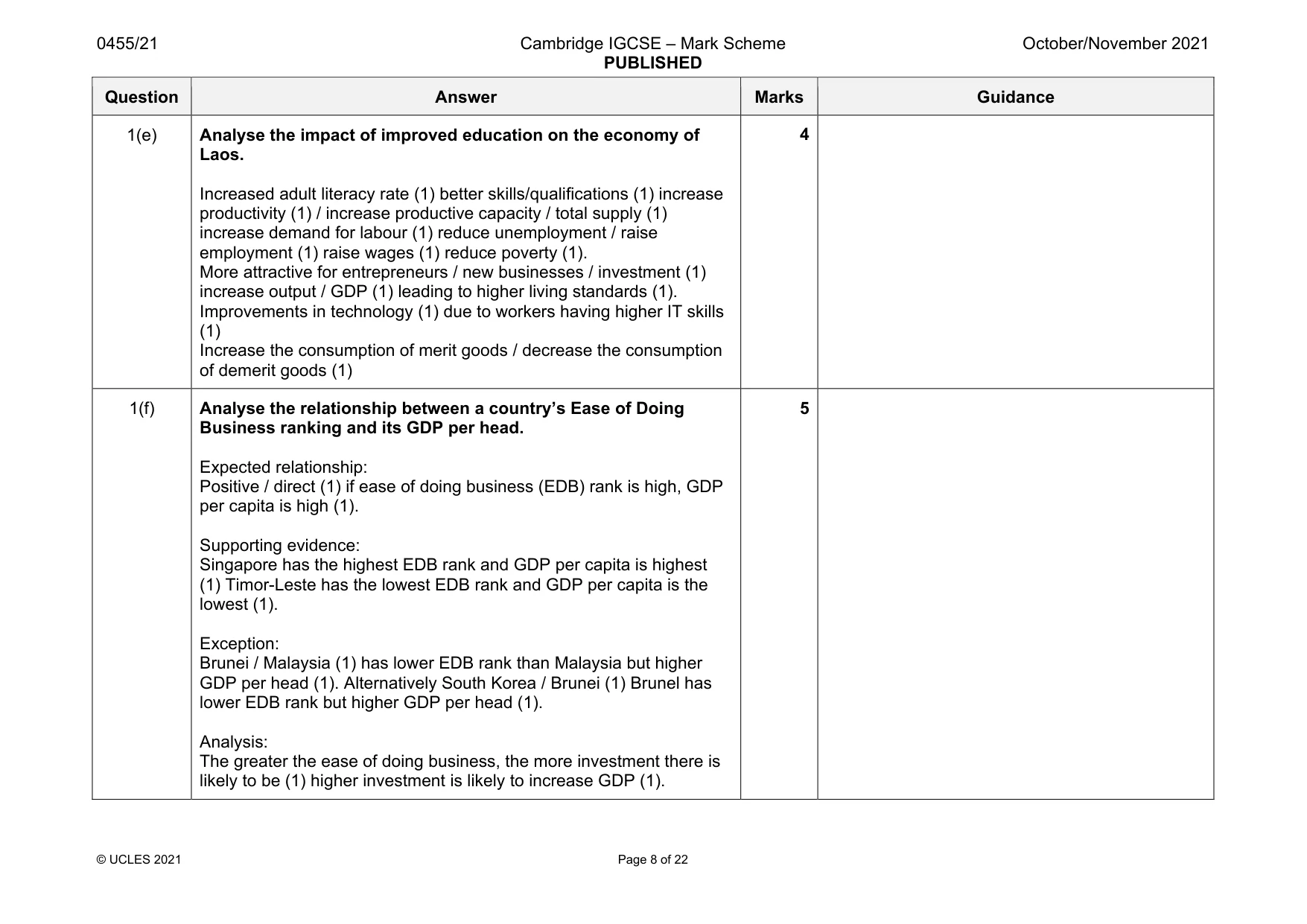
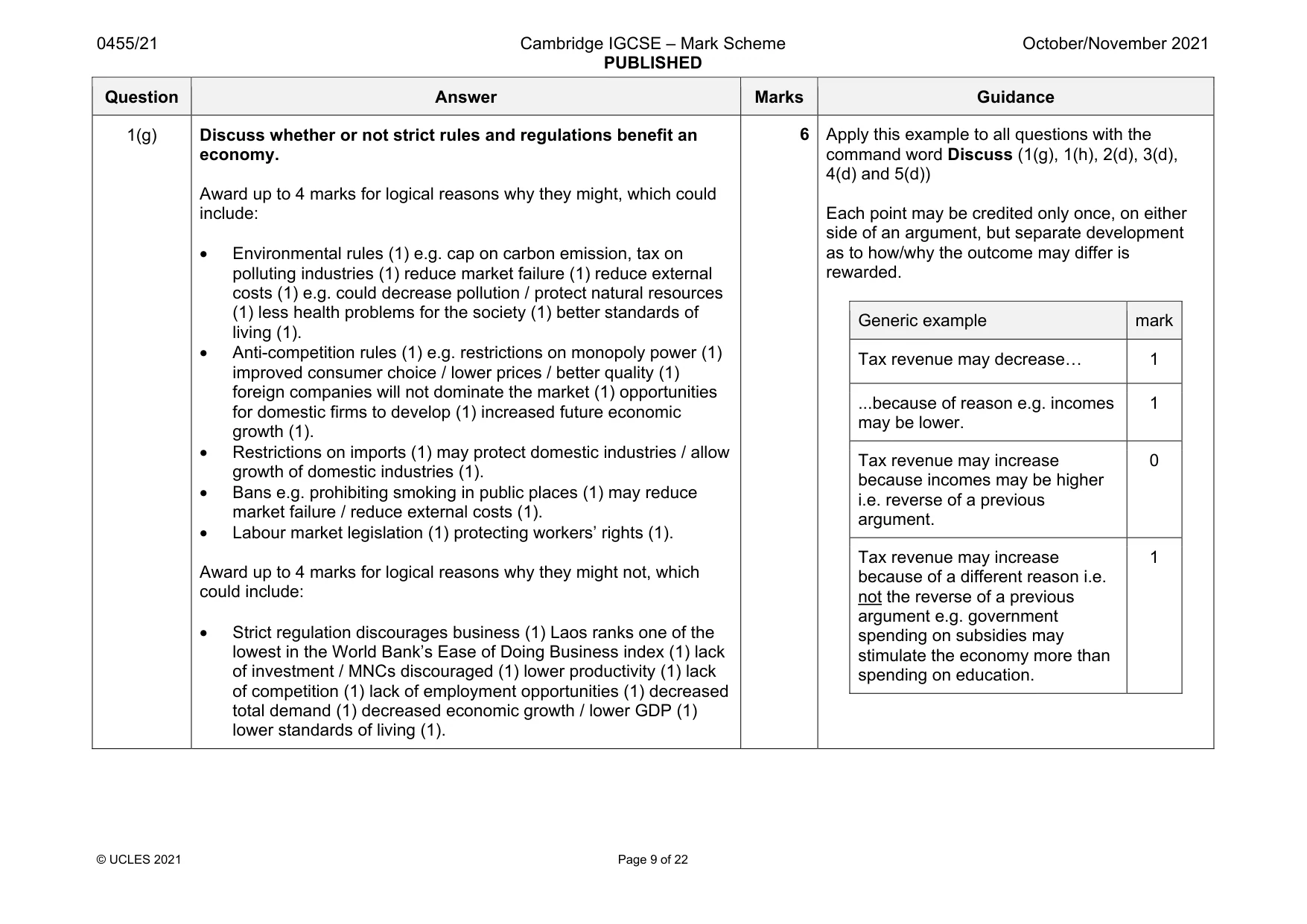
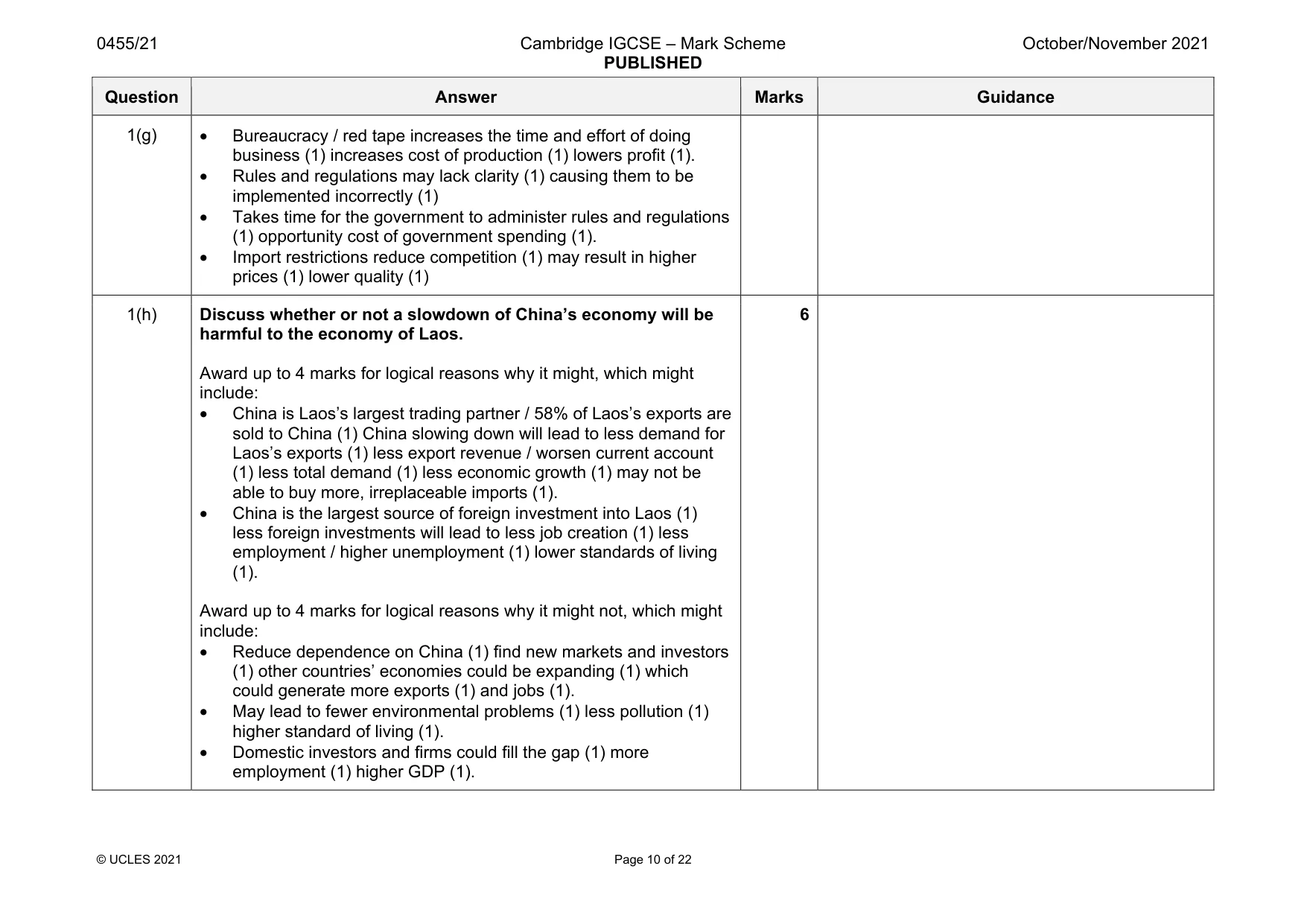
1 (a) Calculate, in $, the total exports of Laos to China in 2017. [1] (b) Identify two roles of commercial banks. [2] (c) Explain how access to seaports may benefit an economy. [2] (d) Explain two benefits of the free market reforms introduced by the government of Laos. [4] (e) Analyse the impact of improved education on the economy of Laos. [4] (f) Analyse the relationship between a country’s Ease of Doing Business ranking and its GDP per head. [5] (g) Discuss whether or not strict rules and regulations benefit an economy. [6] (h) Discuss whether or not a slowdown of China’s economy will be harmful to the economy of Laos. [6]
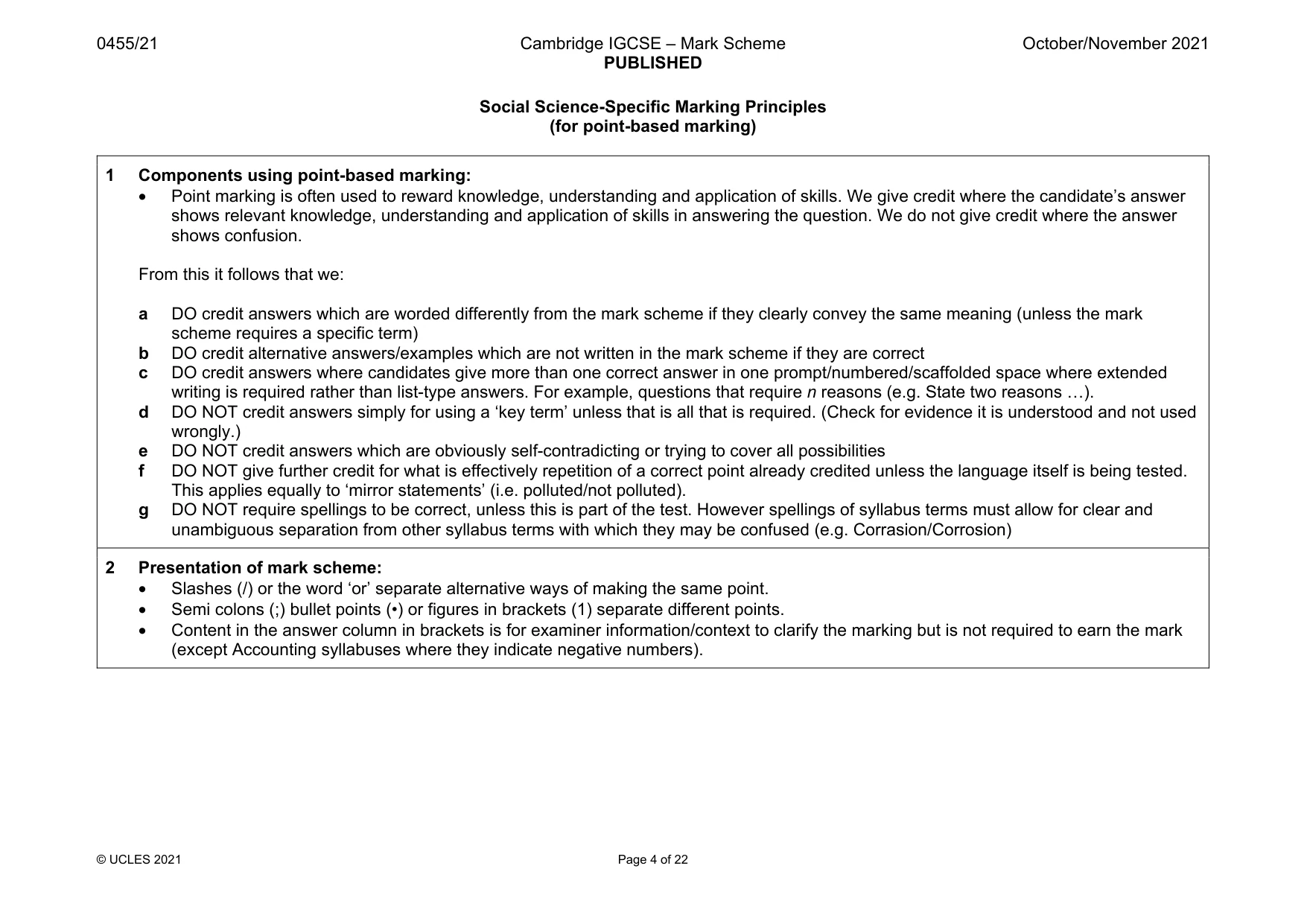
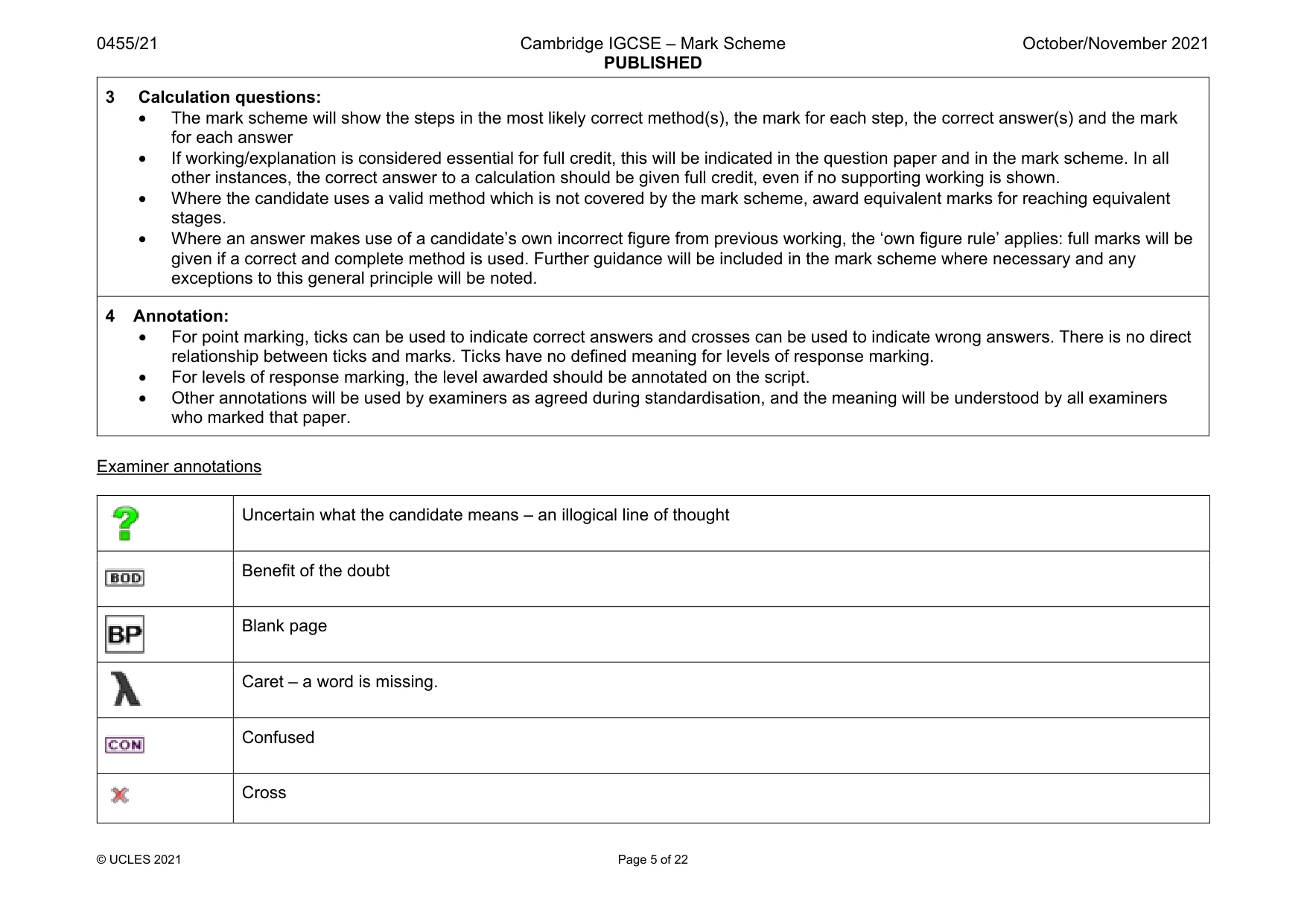
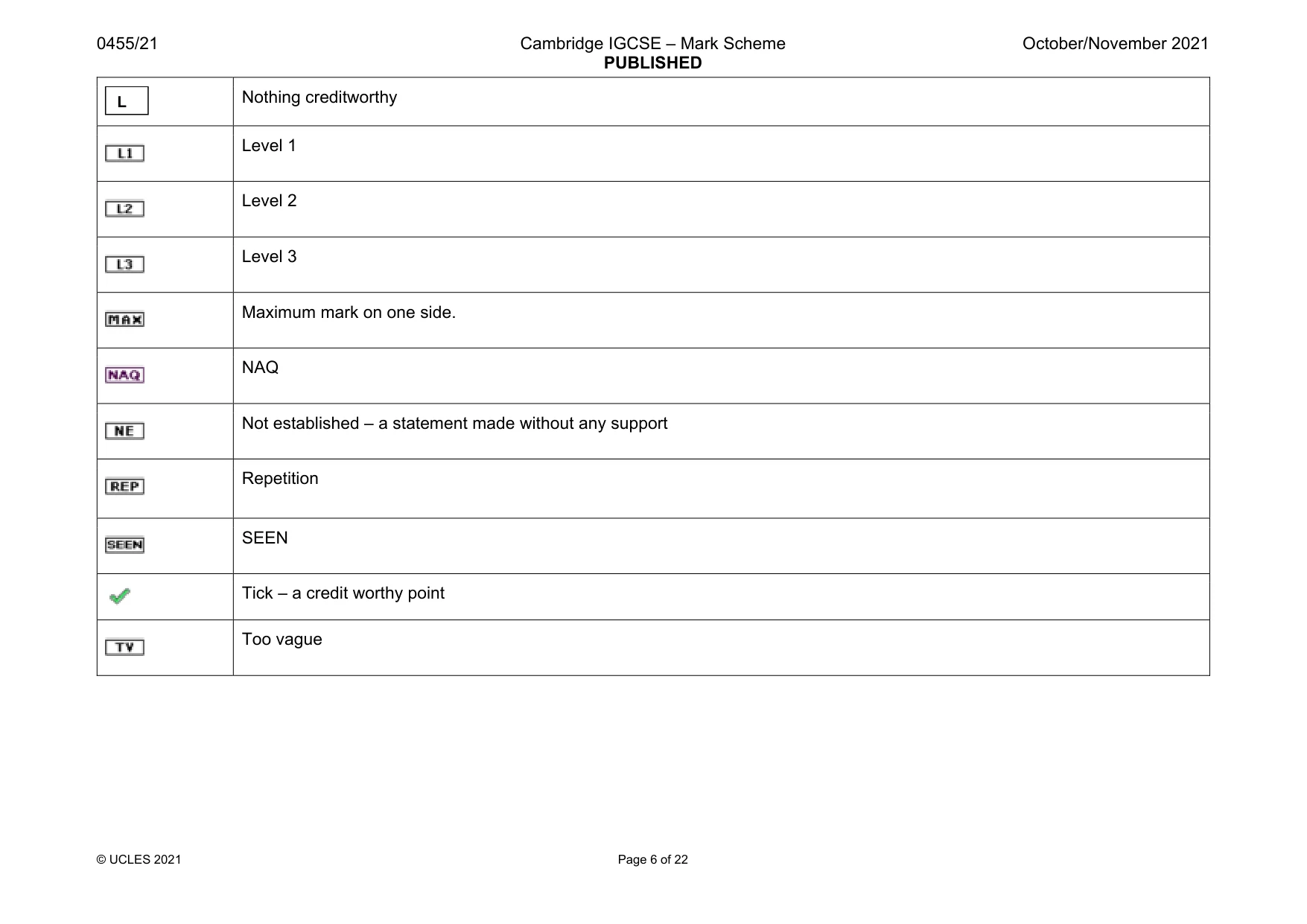
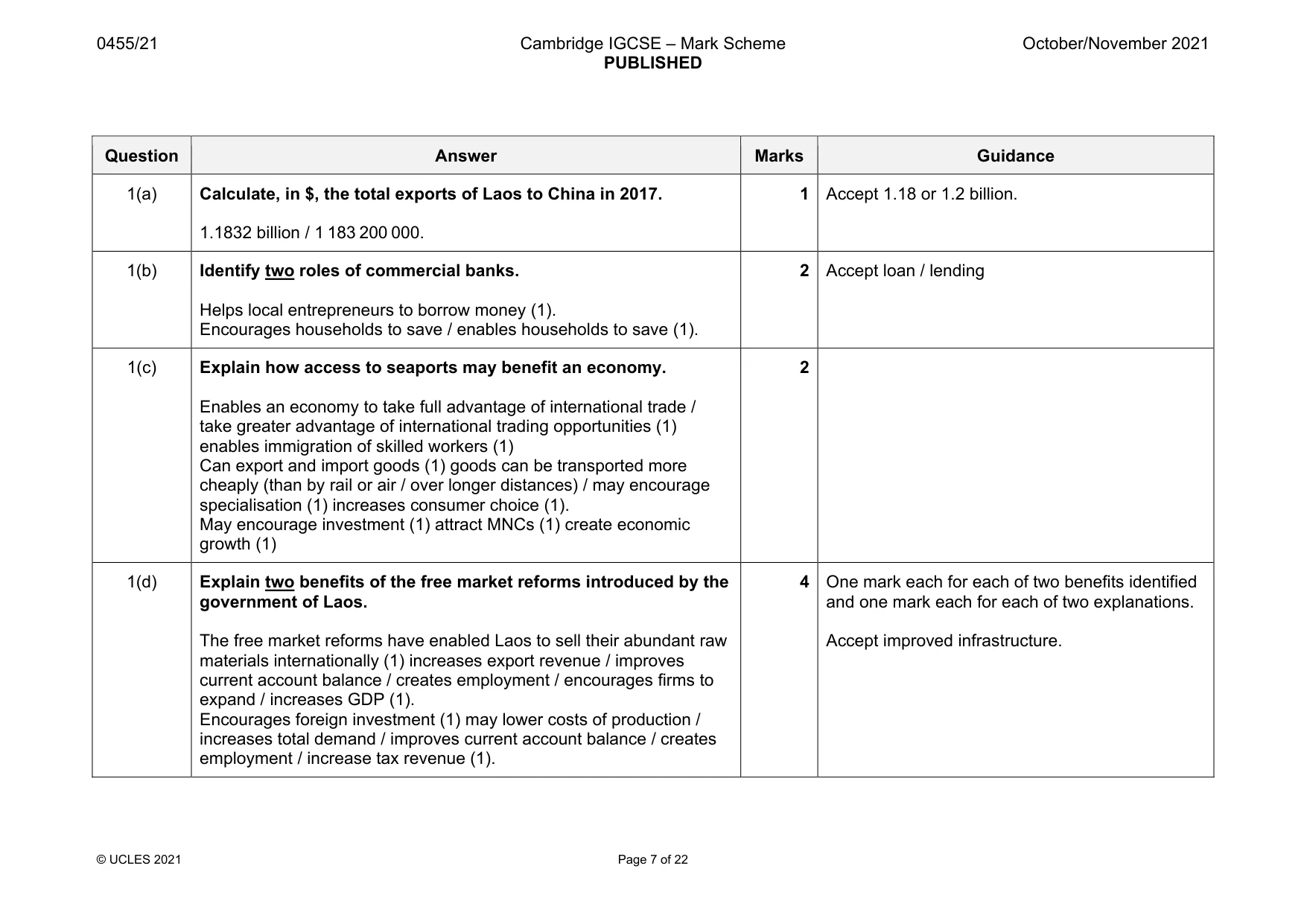
Mark scheme: 1(a) Calculate, in $, the total exports of Laos to China in 2017. 1.1832 billion / 1 183 200 000. 1 Accept 1.18 or 1.2 billion. 1(b) Identify two roles of commercial banks. Helps local entrepreneurs to borrow money (1). Encourages households to save / enables households to save (1). 2 Accept loan / lending 1(c) Explain how access to seaports may benefit an economy. Enables an economy to take full advantage of international trade / take greater advantage of international trading opportunities (1) enables immigration of skilled workers (1) Can export and import goods (1) goods can be transported more cheaply (than by rail or air / over longer distances) / may encourage specialisation (1) increases consumer choice (1). May encourage investment (1) attract MNCs (1) create economic growth (1) 2 1(d) Explain two benefits of the free market reforms introduced by the government of Laos. The free market reforms have enabled Laos to sell their abundant raw materials internationally (1) increases export revenue / improves current account balance / creates employment / encourages firms to expand / increases GDP (1). Encourages foreign investment (1) may lower costs of production / increases total demand / improves current account balance / creates employment / increase tax revenue (1). 4 One mark each for each of two benefits identified and one mark each for each of two explanations. Accept improved infrastructure. Question Answer Marks Guidance 1(e) Analyse the impact of improved education on the economy of Laos. Increased adult literacy rate (1) better skills/qualifications (1) increase productivity (1) / increase productive capacity / total supply (1) increase demand for labour (1) reduce unemployment / raise employment (1) raise wages (1) reduce poverty (1). More attractive for entrepreneurs / new businesses / investment (1) increase output / GDP (1) leading to higher living standards (1). Improvements in technology (1) due to workers having higher IT skills (1) Increase the consumption of merit goods / decrease the consumption of demerit goods (1) 4 1(f) Analyse the relationship between a country’s Ease of Doing Business ranking and its GDP per head. Expected relationship: Positive / direct (1) if ease of doing business (EDB) rank is high, GDP per capita is high (1). Supporting evidence: Singapore has the highest EDB rank and GDP per capita is highest (1) Timor-Leste has the lowest EDB rank and GDP per capita is the lowest (1). Exception: Brunei / Malaysia (1) has lower EDB rank than Malaysia but higher GDP per head (1). Alternatively South Korea / Brunei (1) Brunel has lower EDB rank but higher GDP per head (1). Analysis: The greater the ease of doing business, the more investment there is likely to be (1) higher investment is likely to increase GDP (1). 5 Question Answer Marks Guidance 1(g) Discuss whether or not strict rules and regulations benefit an economy. Award up to 4 marks for logical reasons why they might, which could include: • Environmental rules (1) e.g. cap on carbon emission, tax on polluting industries (1) reduce market failure (1) reduce external costs (1) e.g. could decrease pollution / protect natural resources (1) less health problems for the society (1) better standards of living (1). • Anti-competition rules (1) e.g. restrictions on monopoly power (1) improved consumer choice / lower prices / better quality (1) foreign companies will not dominate the market (1) opportunities for domestic firms to develop (1) increased future economic growth (1). • Restrictions on imports (1) may protect domestic industries / allow growth of domestic industries (1). • Bans e.g. prohibiting smoking in public places (1) may reduce market failure / reduce external costs (1). • Labour market legislation (1) protecting workers’ rights (1). Award up to 4 marks for logical reasons why they might not, which could include: • Strict regulation discourages business (1) Laos ranks one of the lowest in the World Bank’s Ease of Doing Business index (1) lack of investment / MNCs discouraged (1) lower productivity (1) lack of competition (1) lack of employment opportunities (1) decreased total demand (1) decreased economic growth / lower GDP (1) lower standards of living (1). 6 Apply this example to all questions with the command word Discuss (1(g), 1(h), 2(d), 3(d), 4(d) and 5(d)) Each point may be credited only once, on either side of an argument, but separate development as to how/why the outcome may differ is rewarded. Generic example mark Tax revenue may decrease… 1 ...because of reason e.g. incomes may be lower. 1 Tax revenue may increase because incomes may be higher i.e. reverse of a previous argument. 0 Tax revenue may increase because of a different reason i.e. not the reverse of a previous argument e.g. government spending on subsidies may stimulate the economy more than spending on education. 1 Question Answer Marks Guidance 1(g) • Bureaucracy / red tape increases the time and effort of doing business (1) increases cost of production (1) lowers profit (1). • Rules and regulations may lack clarity (1) causing them to be implemented incorrectly (1) • Takes time for the government to administer rules and regulations (1) opportunity cost of government spending (1). • Import restrictions reduce competition (1) may result in higher prices (1) lower quality (1) 1(h) Discuss whether or not a slowdown of China’s economy will be harmful to the economy of Laos. Award up to 4 marks for logical reasons why it might, which might include: • China is Laos’s largest trading partner / 58% of Laos’s exports are sold to China (1) China slowing down will lead to less demand for Laos’s exports (1) less export revenue / worsen current account (1) less total demand (1) less economic growth (1) may not be able to buy more, irreplaceable imports (1). • China is the largest source of foreign investment into Laos (1) less foreign investments will lead to less job creation (1) less employment / higher unemployment (1) lower standards of living (1). Award up to 4 marks for logical reasons why it might not, which might include: • Reduce dependence on China (1) find new markets and investors (1) other countries’ economies could be expanding (1) which could generate more exports (1) and jobs (1). • May lead to fewer environmental problems (1) less pollution (1) higher standard of living (1). • Domestic investors and firms could fill the gap (1) more employment (1) higher GDP (1). 6
Q2 · In 2019, the government of France proposed a 3% tax on the revenue of large firms that…
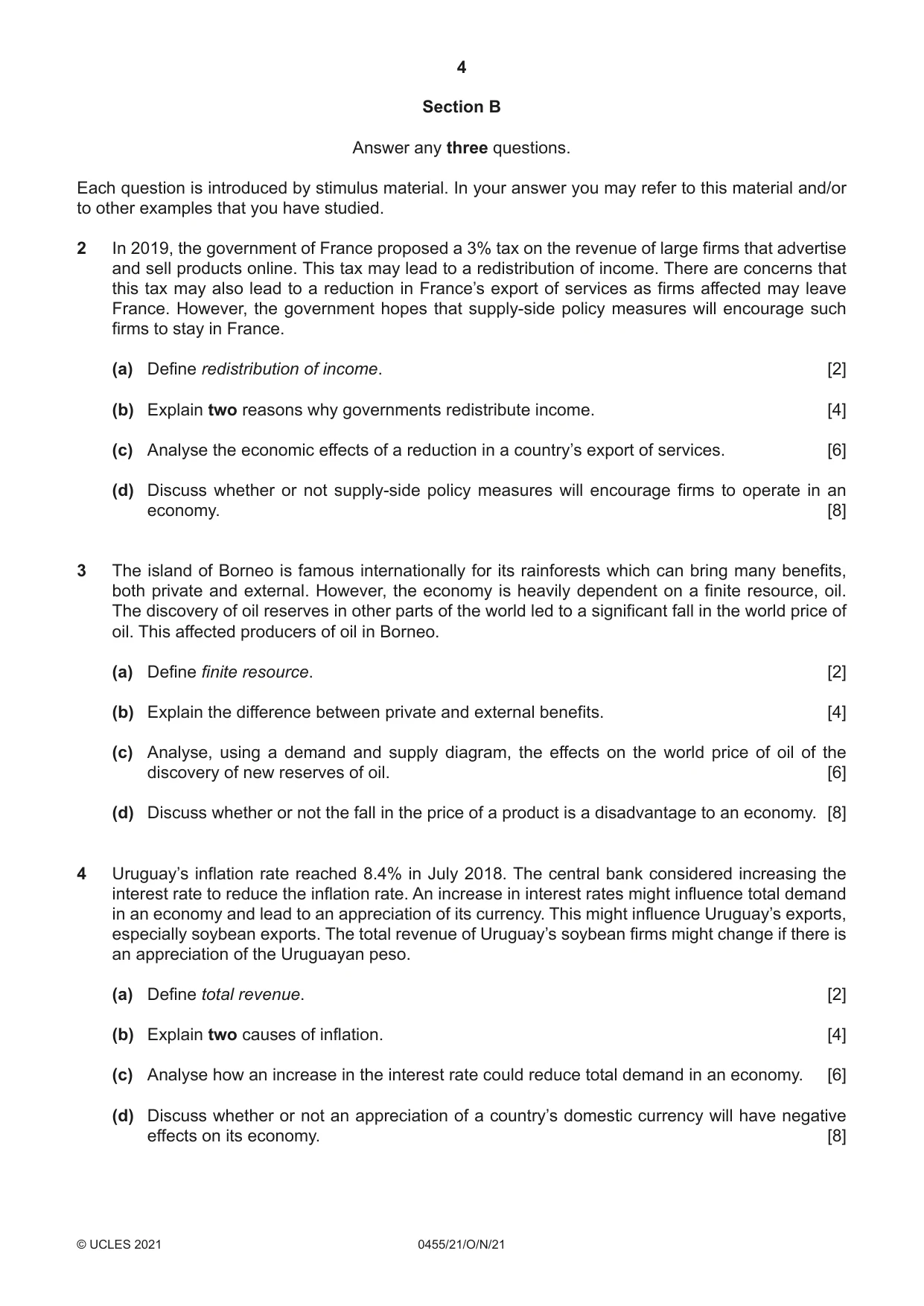
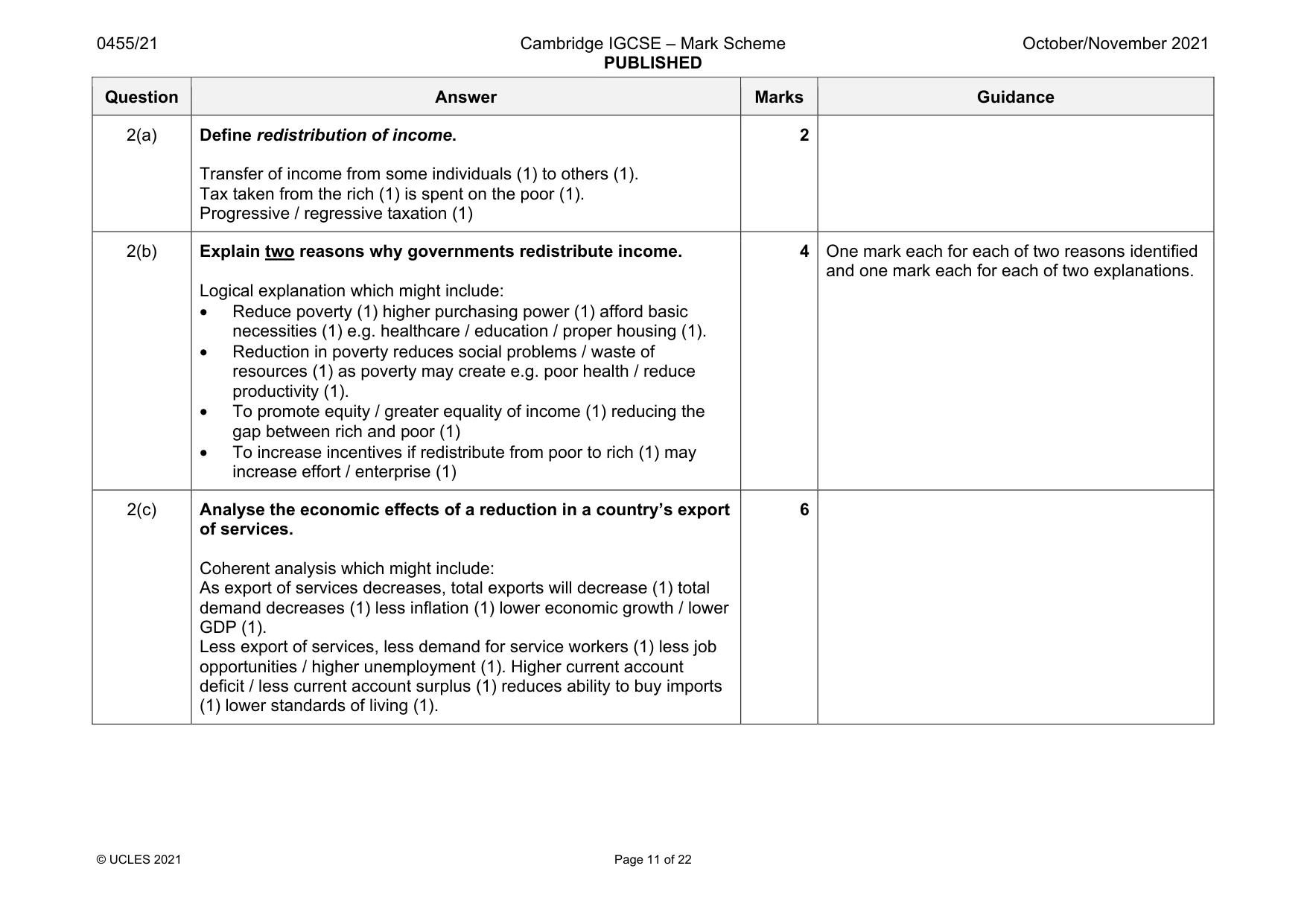
2 In 2019, the government of France proposed a 3% tax on the revenue of large firms that advertise and sell products online. This tax may lead to a redistribution of income. There are concerns that this tax may also lead to a reduction in France’s export of services as firms affected may leave France. However, the government hopes that supply-side policy measures will encourage such firms to stay in France. (a) Define redistribution of income. [2] (b) Explain two reasons why governments redistribute income. [4] (c) Analyse the economic effects of a reduction in a country’s export of services. [6] (d) Discuss whether or not supply-side policy measures will encourage firms to operate in an economy. [8]
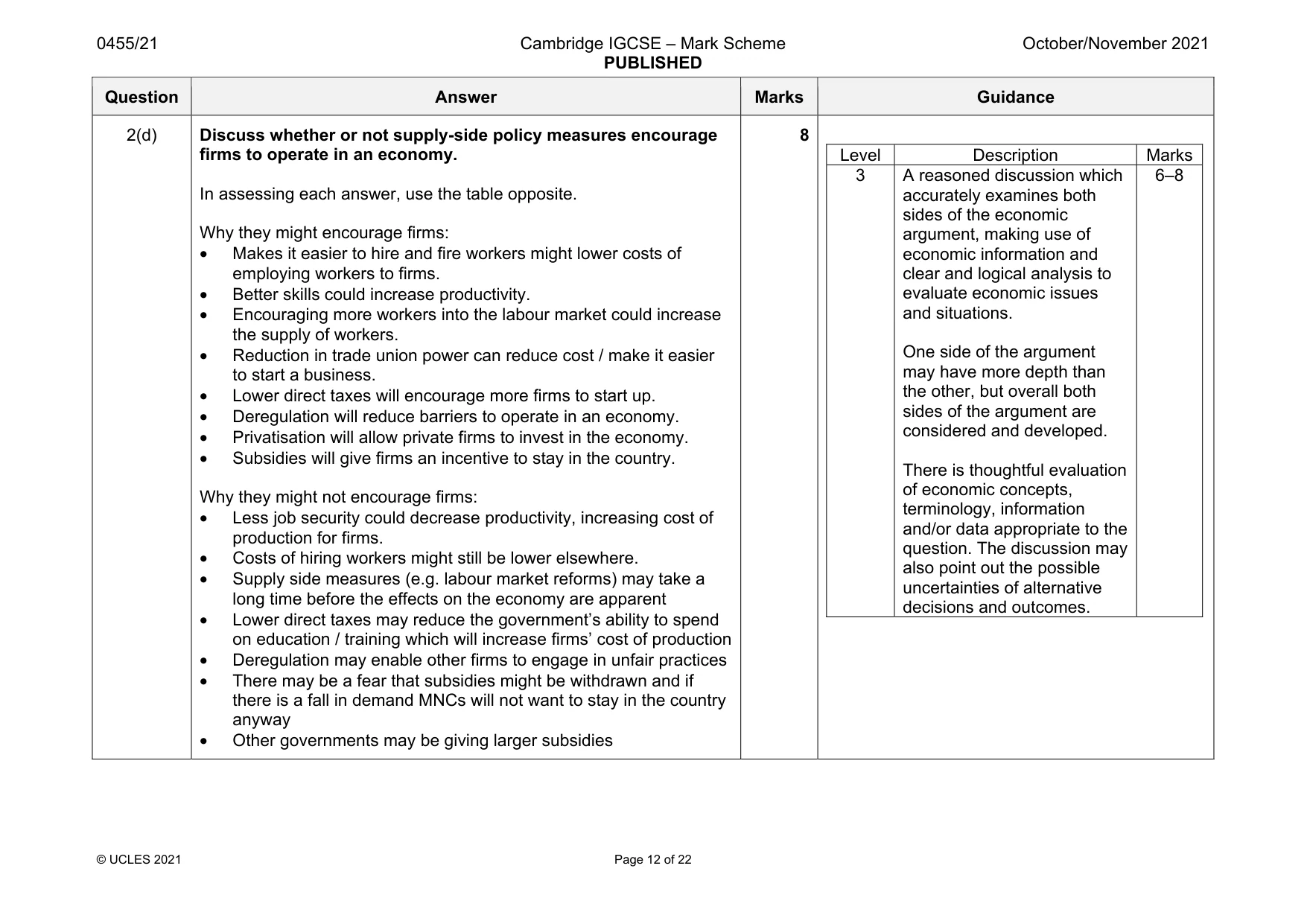
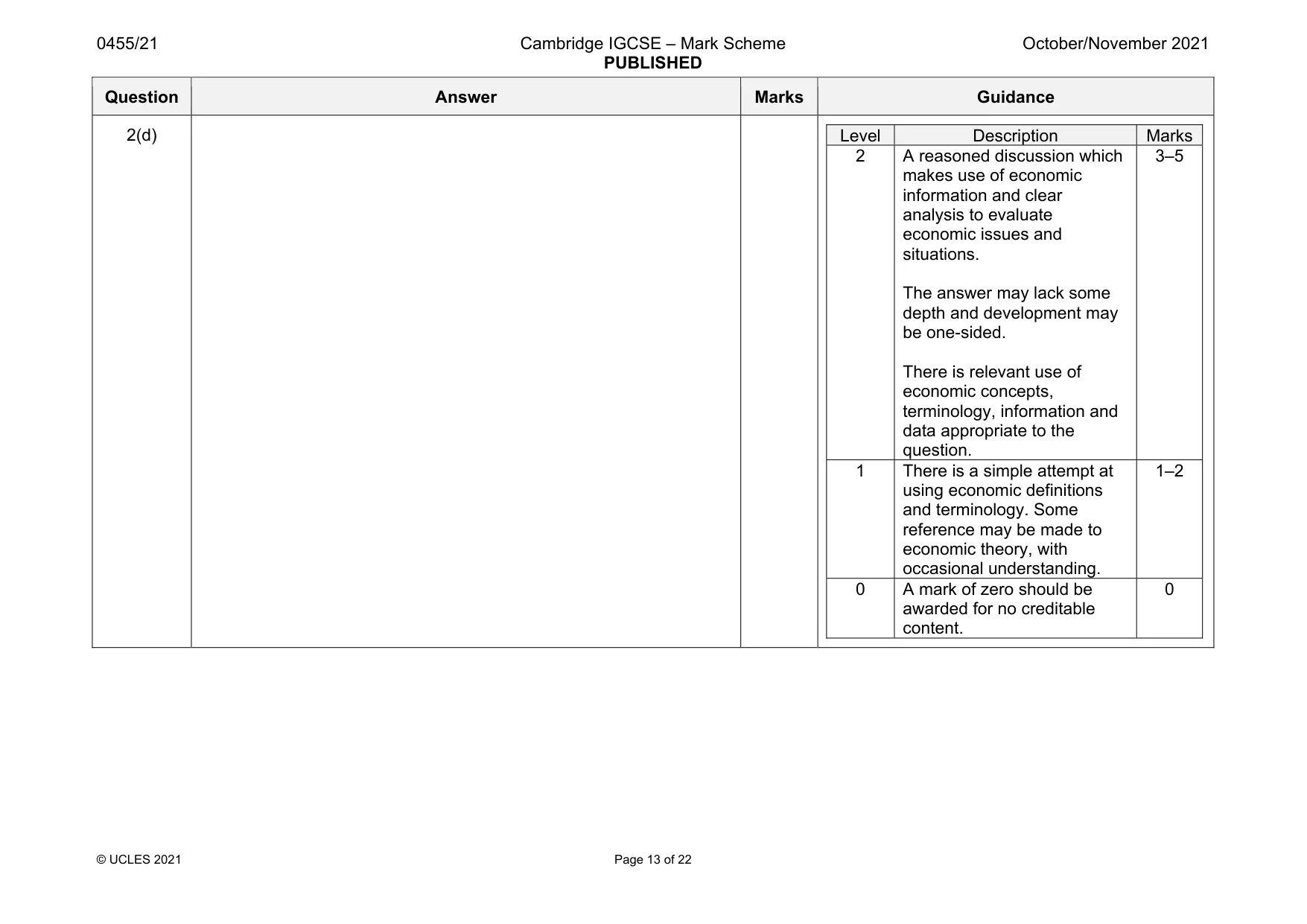
Mark scheme: 2(a) Define redistribution of income. Transfer of income from some individuals (1) to others (1). Tax taken from the rich (1) is spent on the poor (1). Progressive / regressive taxation (1) 2 2(b) Explain two reasons why governments redistribute income. Logical explanation which might include: • Reduce poverty (1) higher purchasing power (1) afford basic necessities (1) e.g. healthcare / education / proper housing (1). • Reduction in poverty reduces social problems / waste of resources (1) as poverty may create e.g. poor health / reduce productivity (1). • To promote equity / greater equality of income (1) reducing the gap between rich and poor (1) • To increase incentives if redistribute from poor to rich (1) may increase effort / enterprise (1) 4 One mark each for each of two reasons identified and one mark each for each of two explanations. 2(c) Analyse the economic effects of a reduction in a country’s export of services. Coherent analysis which might include: As export of services decreases, total exports will decrease (1) total demand decreases (1) less inflation (1) lower economic growth / lower GDP (1). Less export of services, less demand for service workers (1) less job opportunities / higher unemployment (1). Higher current account deficit / less current account surplus (1) reduces ability to buy imports (1) lower standards of living (1). 6 Question Answer Marks Guidance 2(d) Discuss whether or not supply-side policy measures encourage firms to operate in an economy. In assessing each answer, use the table opposite. Why they might encourage firms: • Makes it easier to hire and fire workers might lower costs of employing workers to firms. • Better skills could increase productivity. • Encouraging more workers into the labour market could increase the supply of workers. • Reduction in trade union power can reduce cost / make it easier to start a business. • Lower direct taxes will encourage more firms to start up. • Deregulation will reduce barriers to operate in an economy. • Privatisation will allow private firms to invest in the economy. • Subsidies will give firms an incentive to stay in the country. Why they might not encourage firms: • Less job security could decrease productivity, increasing cost of production for firms. • Costs of hiring workers might still be lower elsewhere. • Supply side measures (e.g. labour market reforms) may take a long time before the effects on the economy are apparent • Lower direct taxes may reduce the government’s ability to spend on education / training which will increase firms’ cost of production • Deregulation may enable other firms to engage in unfair practices • There may be a fear that subsidies might be withdrawn and if there is a fall in demand MNCs will not want to stay in the country anyway • Other governments may be giving larger subsidies 8 Level Description Marks 3 A reasoned discussion which accurately examines both sides of the economic argument, making use of economic information and clear and logical analysis to evaluate economic issues and situations. One side of the argument may have more depth than the other, but overall both sides of the argument are considered and developed. There is thoughtful evaluation of economic concepts, terminology, information and/or data appropriate to the question. The discussion may also point out the possible uncertainties of alternative decisions and outcomes. 6–8 Question Answer Marks Guidance 2(d) Level Description Marks 2 A reasoned discussion which makes use of economic information and clear analysis to evaluate economic issues and situations. The answer may lack some depth and development may be one-sided. There is relevant use of economic concepts, terminology, information and data appropriate to the question. 3–5 1 There is a simple attempt at using economic definitions and terminology. Some reference may be made to economic theory, with occasional understanding. 1–2 0 A mark of zero should be awarded for no creditable content. 0
Q3 · The island of Borneo is famous internationally for its rainforests which can bring many…
3 The island of Borneo is famous internationally for its rainforests which can bring many benefits, both private and external. However, the economy is heavily dependent on a finite resource, oil. The discovery of oil reserves in other parts of the world led to a significant fall in the world price of oil. This affected producers of oil in Borneo. (a) Define finite resource. [2] (b) Explain the difference between private and external benefits. [4] (c) Analyse, using a demand and supply diagram, the effects on the world price of oil of the discovery of new reserves of oil. [6] (d) Discuss whether or not the fall in the price of a product is a disadvantage to an economy. [8]
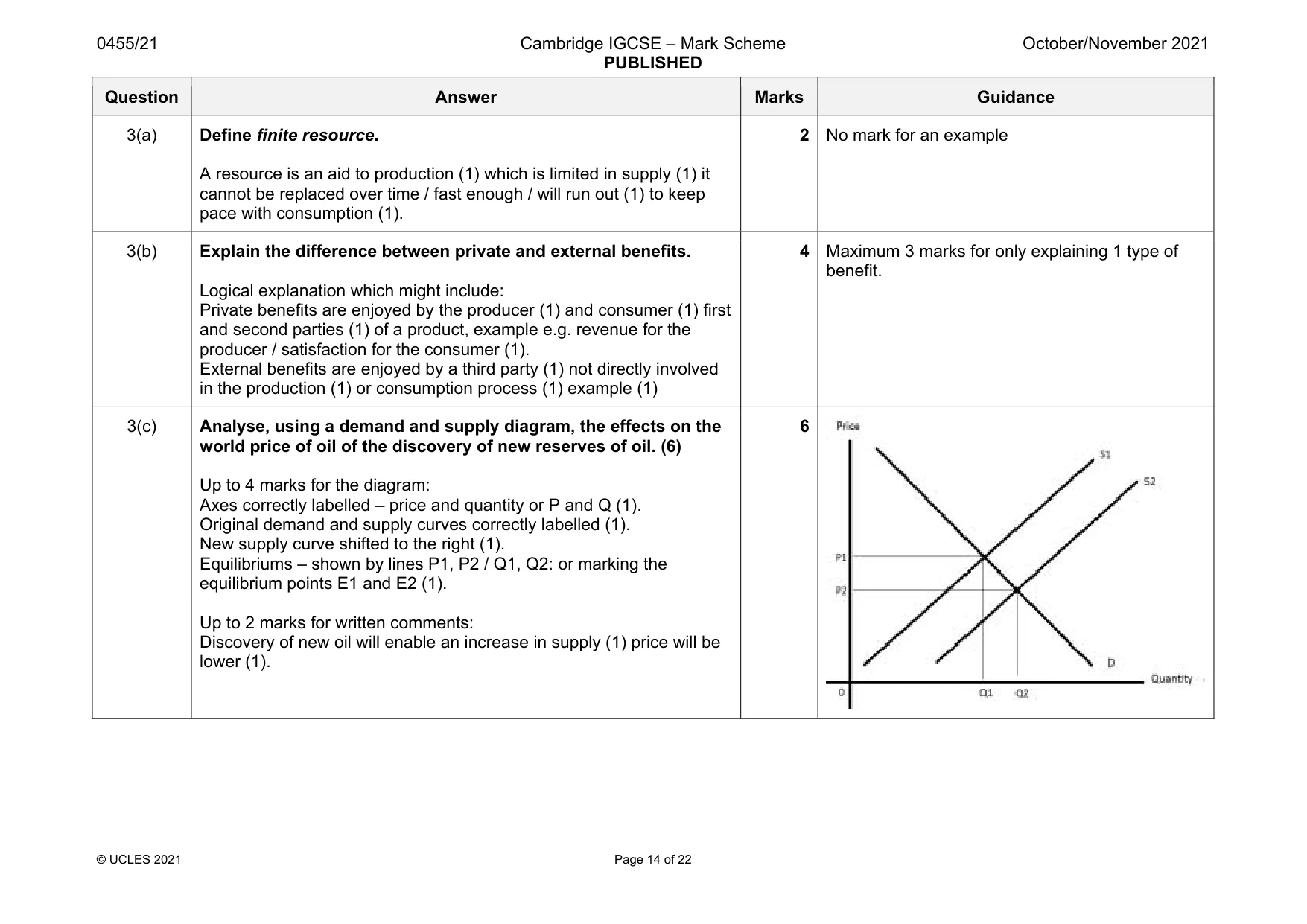
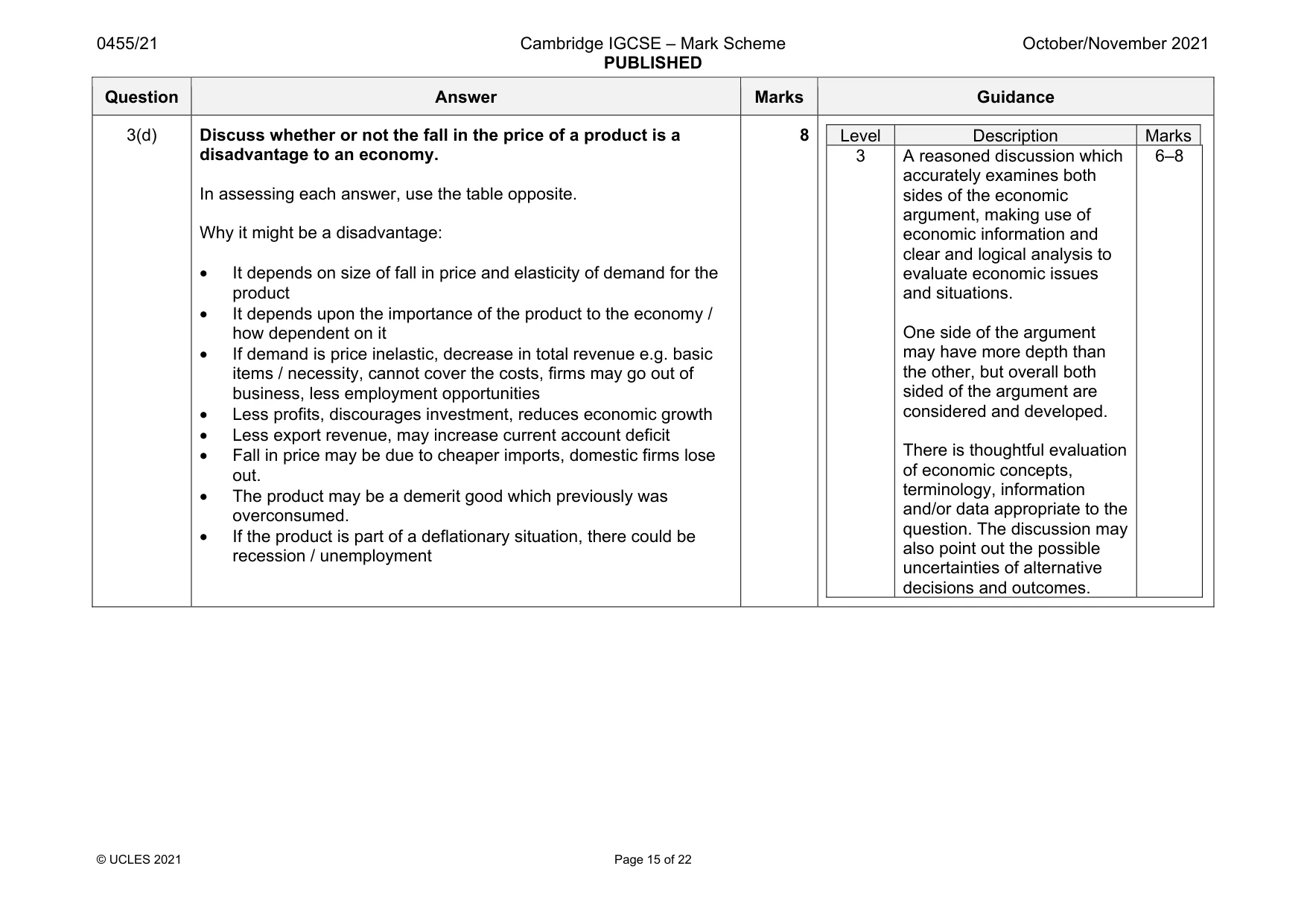
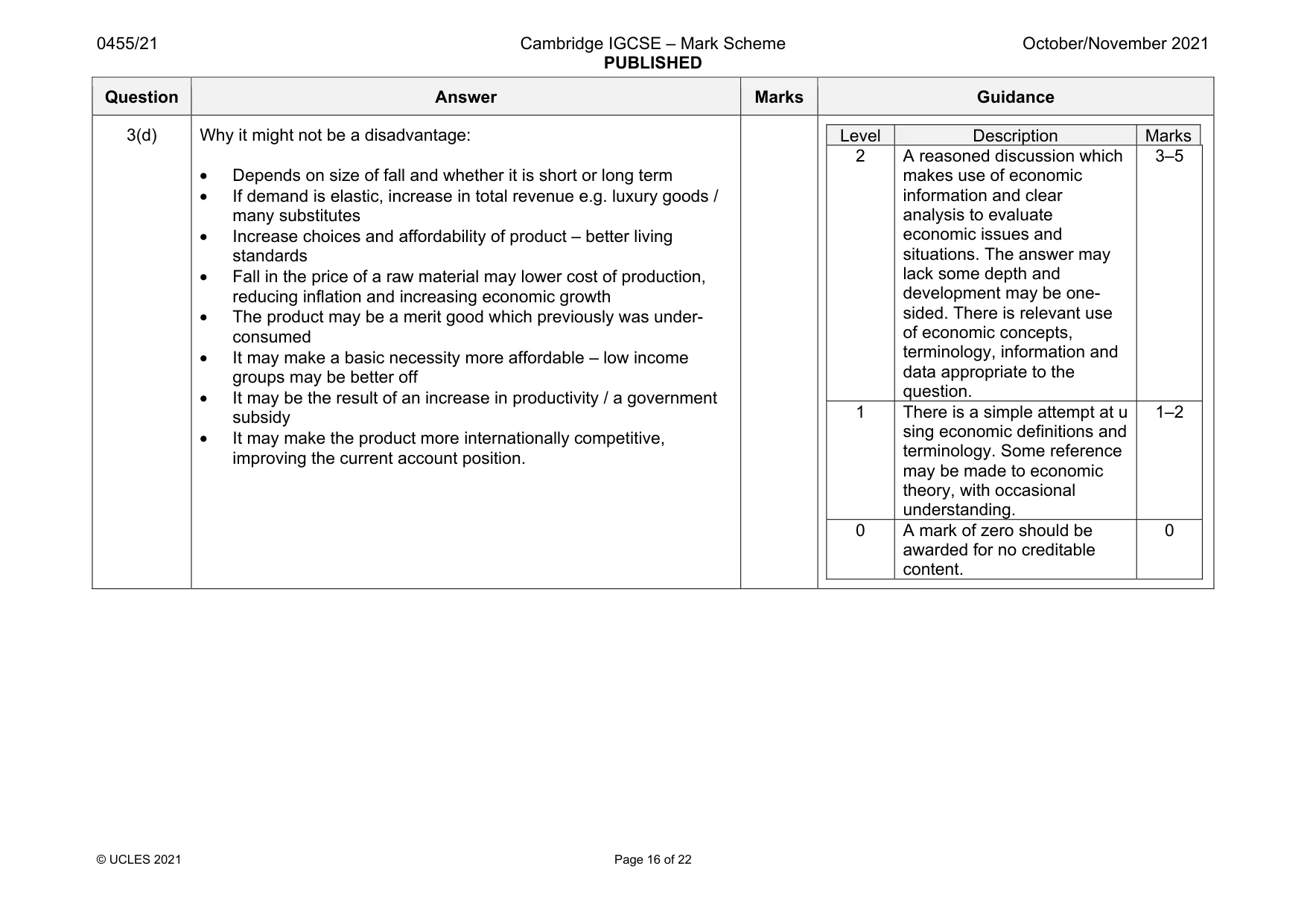
Mark scheme: 3(a) Define finite resource. A resource is an aid to production (1) which is limited in supply (1) it cannot be replaced over time / fast enough / will run out (1) to keep pace with consumption (1). 2 No mark for an example 3(b) Explain the difference between private and external benefits. Logical explanation which might include: Private benefits are enjoyed by the producer (1) and consumer (1) first and second parties (1) of a product, example e.g. revenue for the producer / satisfaction for the consumer (1). External benefits are enjoyed by a third party (1) not directly involved in the production (1) or consumption process (1) example (1) 4 Maximum 3 marks for only explaining 1 type of benefit. 3(c) Analyse, using a demand and supply diagram, the effects on the world price of oil of the discovery of new reserves of oil. (6) Up to 4 marks for the diagram: Axes correctly labelled – price and quantity or P and Q (1). Original demand and supply curves correctly labelled (1). New supply curve shifted to the right (1). Equilibriums – shown by lines P1, P2 / Q1, Q2: or marking the equilibrium points E1 and E2 (1). Up to 2 marks for written comments: Discovery of new oil will enable an increase in supply (1) price will be lower (1). 6 Question Answer Marks Guidance 3(d) Discuss whether or not the fall in the price of a product is a disadvantage to an economy. In assessing each answer, use the table opposite. Why it might be a disadvantage: • It depends on size of fall in price and elasticity of demand for the product • It depends upon the importance of the product to the economy / how dependent on it • If demand is price inelastic, decrease in total revenue e.g. basic items / necessity, cannot cover the costs, firms may go out of business, less employment opportunities • Less profits, discourages investment, reduces economic growth • Less export revenue, may increase current account deficit • Fall in price may be due to cheaper imports, domestic firms lose out. • The product may be a demerit good which previously was overconsumed. • If the product is part of a deflationary situation, there could be recession / unemployment 8 Level Description Marks 3 A reasoned discussion which accurately examines both sides of the economic argument, making use of economic information and clear and logical analysis to evaluate economic issues and situations. One side of the argument may have more depth than the other, but overall both sided of the argument are considered and developed. There is thoughtful evaluation of economic concepts, terminology, information and/or data appropriate to the question. The discussion may also point out the possible uncertainties of alternative decisions and outcomes. 6–8 Question Answer Marks Guidance 3(d) Why it might not be a disadvantage: • Depends on size of fall and whether it is short or long term • If demand is elastic, increase in total revenue e.g. luxury goods / many substitutes • Increase choices and affordability of product – better living standards • Fall in the price of a raw material may lower cost of production, reducing inflation and increasing economic growth • The product may be a merit good which previously was under- consumed • It may make a basic necessity more affordable – low income groups may be better off • It may be the result of an increase in productivity / a government subsidy • It may make the product more internationally competitive, improving the current account position. Level Description Marks 2 A reasoned discussion which makes use of economic information and clear analysis to evaluate economic issues and situations. The answer may lack some depth and development may be one- sided. There is relevant use of economic concepts, terminology, information and data appropriate to the question. 3–5 1 There is a simple attempt at u sing economic definitions and terminology. Some reference may be made to economic theory, with occasional understanding. 1–2 0 A mark of zero should be awarded for no creditable content. 0
Q4 · Uruguay’s inflation rate reached 8.4% in July 2018
4 Uruguay’s inflation rate reached 8.4% in July 2018. The central bank considered increasing the interest rate to reduce the inflation rate. An increase in interest rates might influence total demand in an economy and lead to an appreciation of its currency. This might influence Uruguay’s exports, especially soybean exports. The total revenue of Uruguay’s soybean firms might change if there is an appreciation of the Uruguayan peso. (a) Define total revenue. [2] (b) Explain two causes of inflation. [4] (c) Analyse how an increase in the interest rate could reduce total demand in an economy. [6] (d) Discuss whether or not an appreciation of a country’s domestic currency will have negative effects on its economy. [8]
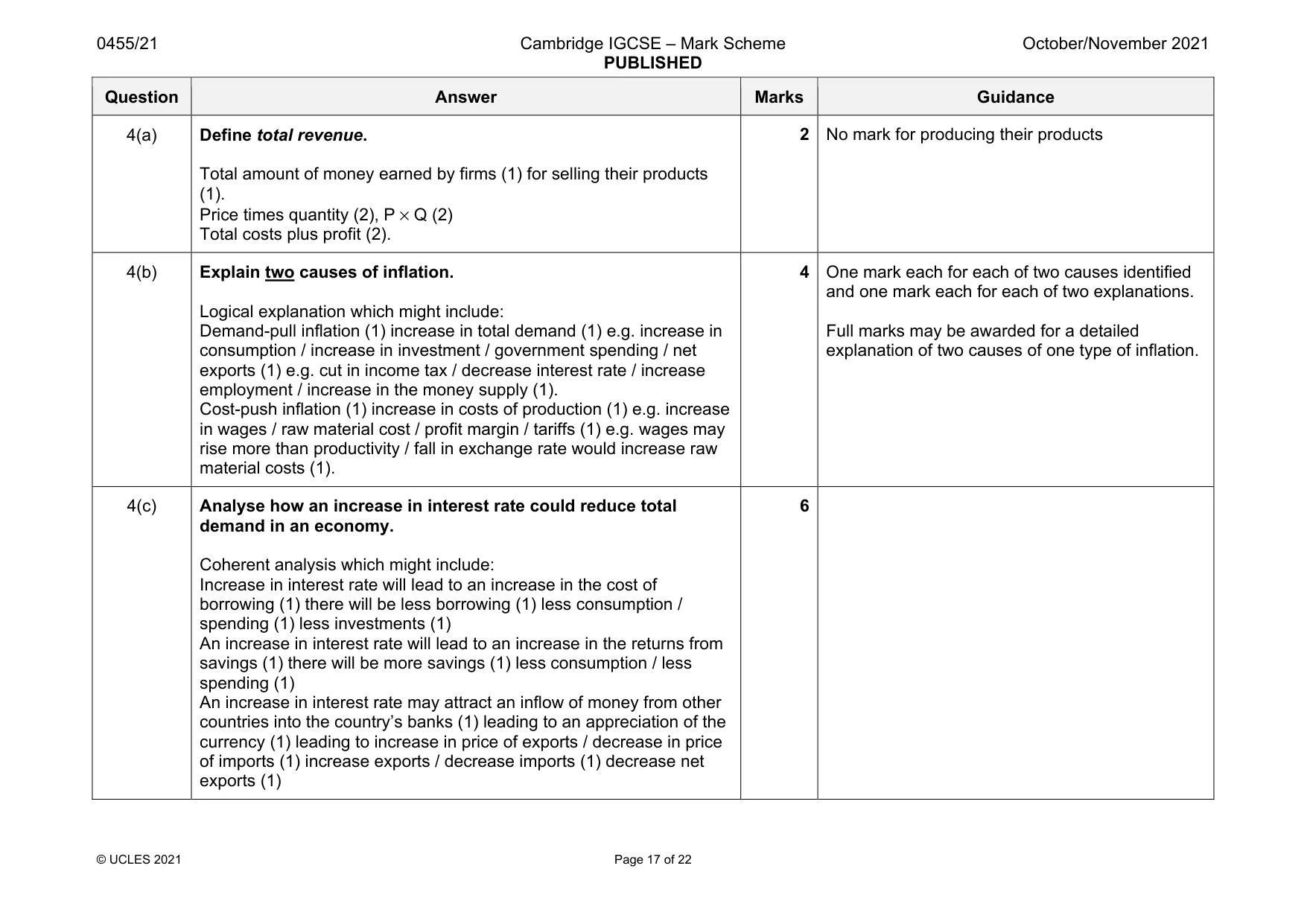
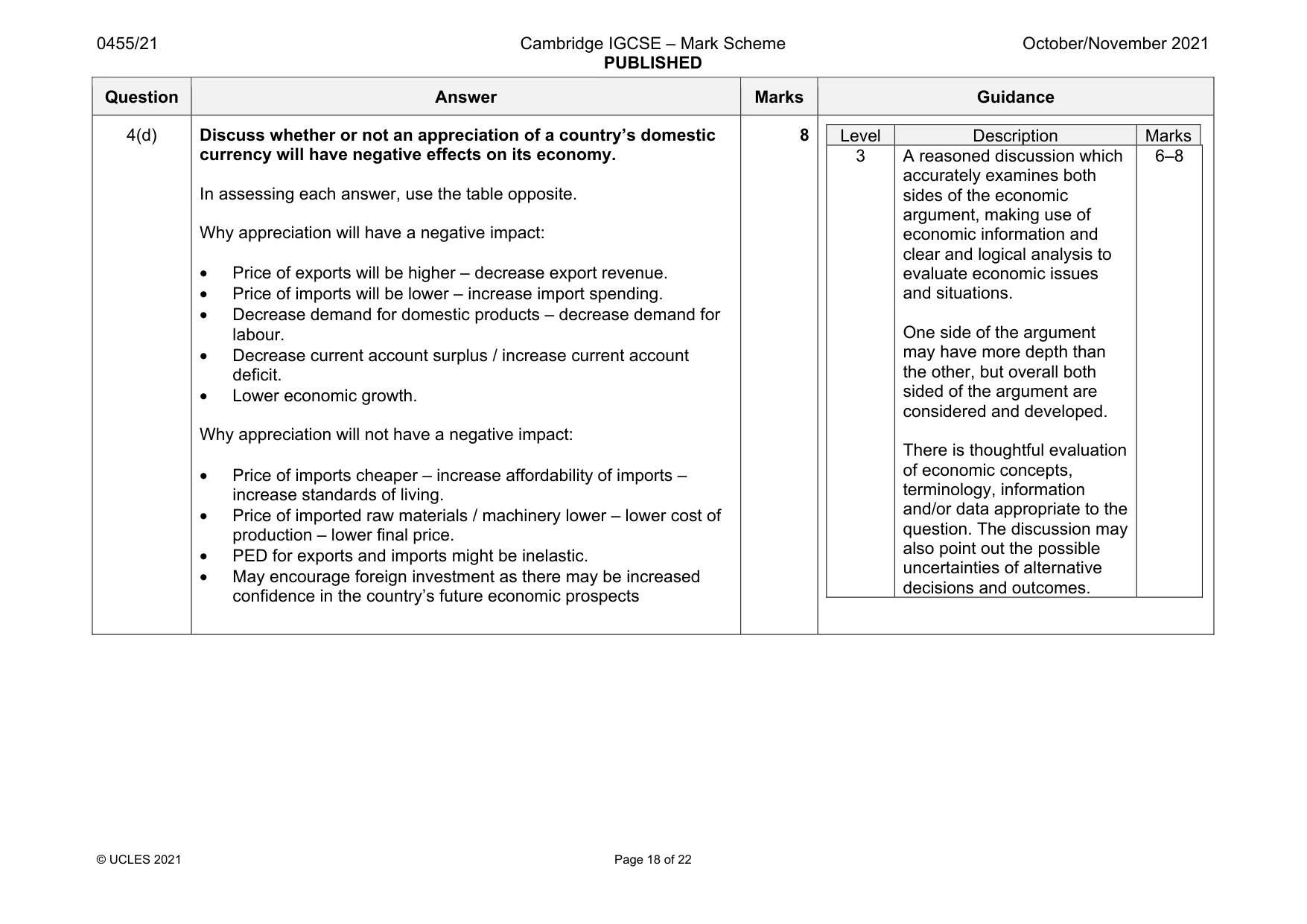
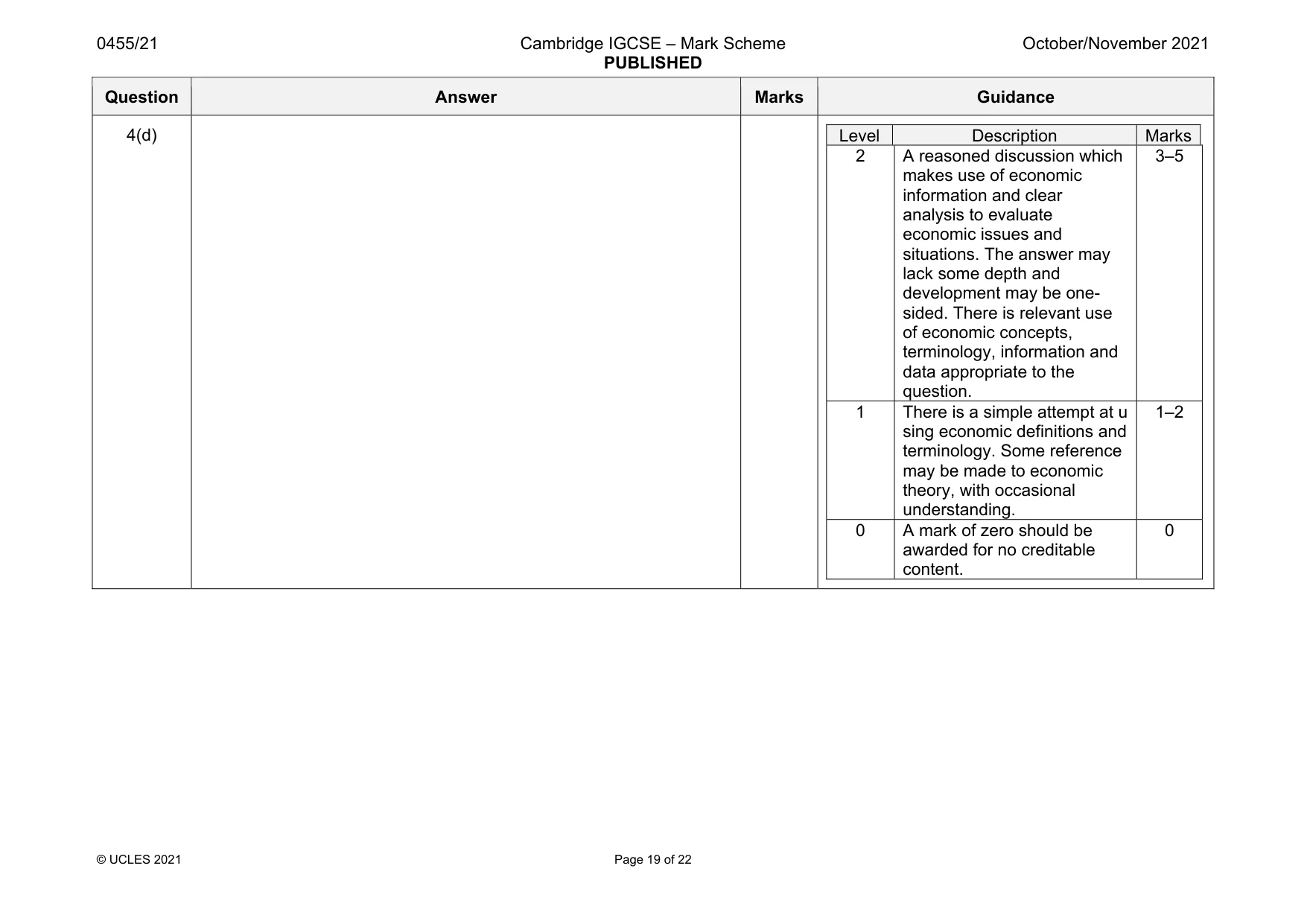
Mark scheme: 4(a) Define total revenue. Total amount of money earned by firms (1) for selling their products (1). Price times quantity (2), P × Q (2) Total costs plus profit (2). 4(b) Explain two causes of inflation. Logical explanation which might include: Demand-pull inflation (1) increase in total demand (1) e.g. increase in consumption / increase in investment / government spending / net exports (1) e.g. cut in income tax / decrease interest rate / increase employment / increase in the money supply (1). Cost-push inflation (1) increase in costs of production (1) e.g. increase in wages / raw material cost / profit margin / tariffs (1) e.g. wages may rise more than productivity / fall in exchange rate would increase raw material costs (1). 4 One mark each for each of two causes identified and one mark each for each of two explanations. Full marks may be awarded for a detailed explanation of two causes of one type of inflation. 4(c) Analyse how an increase in interest rate could reduce total demand in an economy. Coherent analysis which might include: Increase in interest rate will lead to an increase in the cost of borrowing (1) there will be less borrowing (1) less consumption / spending (1) less investments (1) An increase in interest rate will lead to an increase in the returns from savings (1) there will be more savings (1) less consumption / less spending (1) An increase in interest rate may attract an inflow of money from other countries into the country’s banks (1) leading to an appreciation of the currency (1) leading to increase in price of exports / decrease in price of imports (1) increase exports / decrease imports (1) decrease net exports (1) 6 Question Answer Marks Guidance 4(d) Discuss whether or not an appreciation of a country’s domestic currency will have negative effects on its economy. In assessing each answer, use the table opposite. Why appreciation will have a negative impact: • Price of exports will be higher – decrease export revenue. • Price of imports will be lower – increase import spending. • Decrease demand for domestic products – decrease demand for labour. • Decrease current account surplus / increase current account deficit. • Lower economic growth. Why appreciation will not have a negative impact: • Price of imports cheaper – increase affordability of imports – increase standards of living. • Price of imported raw materials / machinery lower – lower cost of production – lower final price. • PED for exports and imports might be inelastic. • May encourage foreign investment as there may be increased confidence in the country’s future economic prospects 8 Level Description Marks 3 A reasoned discussion which accurately examines both sides of the economic argument, making use of economic information and clear and logical analysis to evaluate economic issues and situations. One side of the argument may have more depth than the other, but overall both sided of the argument are considered and developed. There is thoughtful evaluation of economic concepts, terminology, information and/or data appropriate to the question. The discussion may also point out the possible uncertainties of alternative decisions and outcomes. 6–8 Question Answer Marks Guidance 4(d) Level Description Marks 2 A reasoned discussion which makes use of economic information and clear analysis to evaluate economic issues and situations. The answer may lack some depth and development may be one- sided. There is relevant use of economic concepts, terminology, information and data appropriate to the question. 3–5 1 There is a simple attempt at u sing economic definitions and terminology. Some reference may be made to economic theory, with occasional understanding. 1–2 0 A mark of zero should be awarded for no creditable content. 0
Q5 · Some economists criticise high government spending and trade unions for creating market…
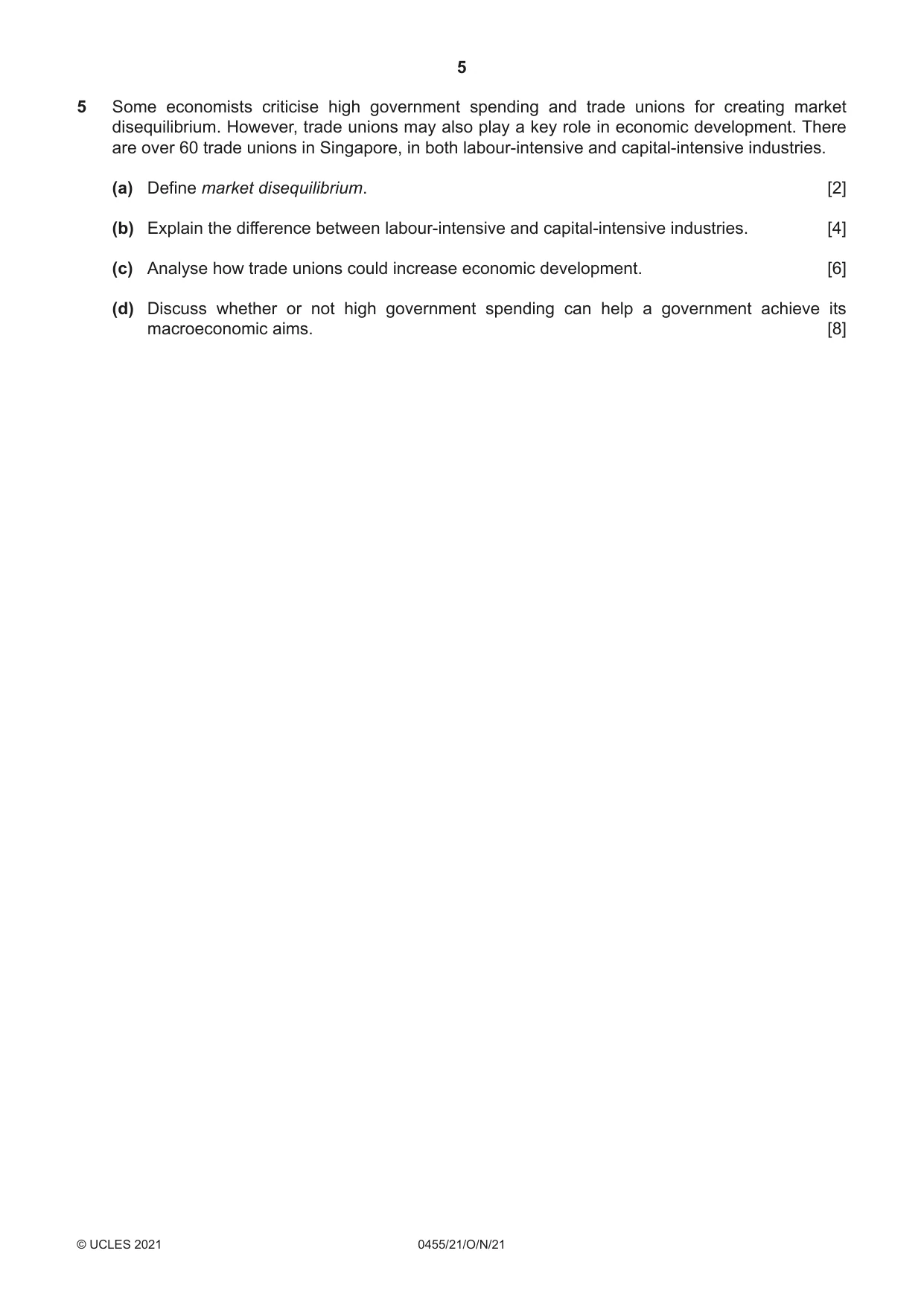
5 Some economists criticise high government spending and trade unions for creating market disequilibrium. However, trade unions may also play a key role in economic development. There are over 60 trade unions in Singapore, in both labour-intensive and capital-intensive industries. (a) Define market disequilibrium. [2] (b) Explain the difference between labour-intensive and capital-intensive industries. [4] (c) Analyse how trade unions could increase economic development. [6] (d) Discuss whether or not high government spending can help a government achieve its macroeconomic aims. [8]
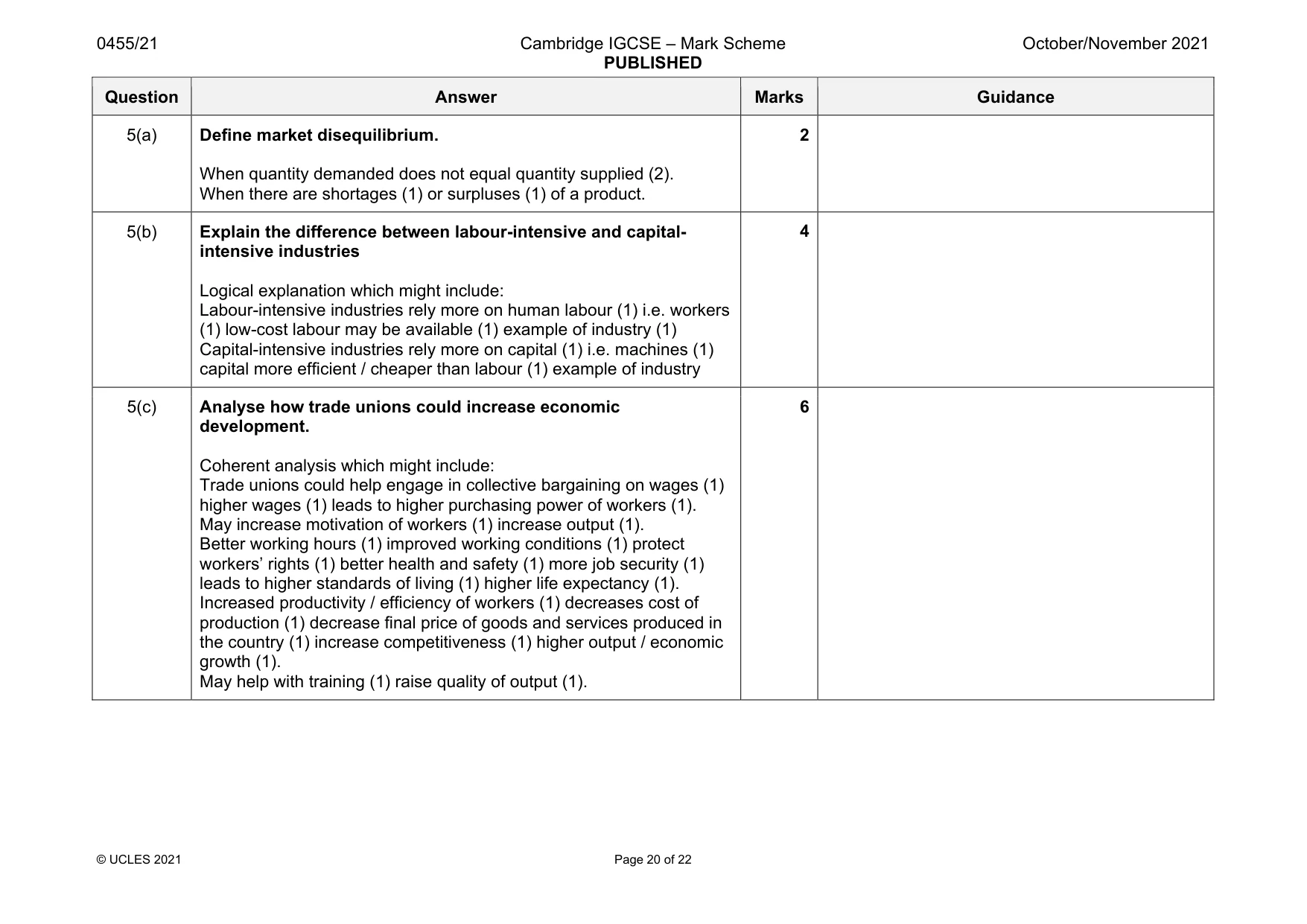
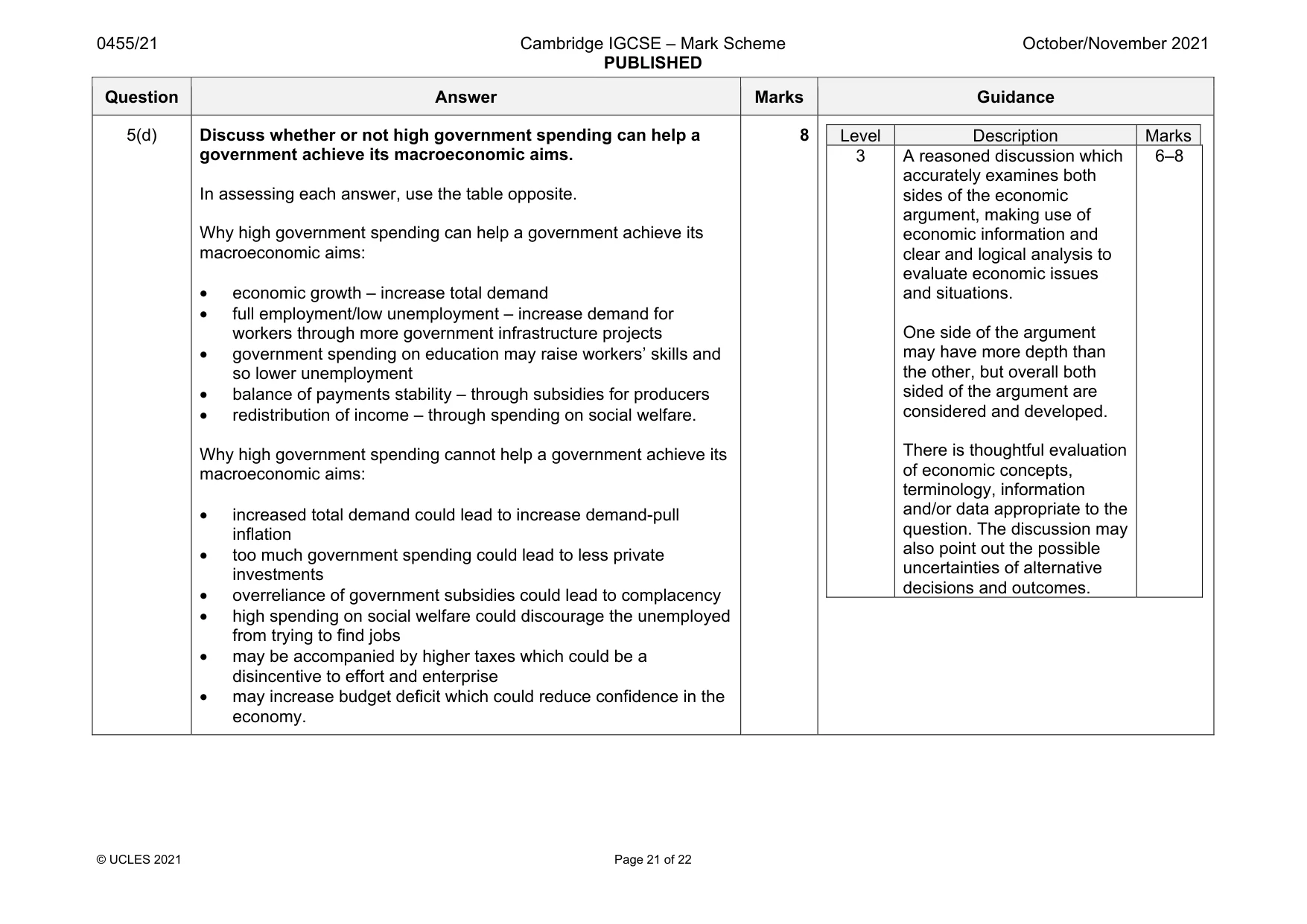
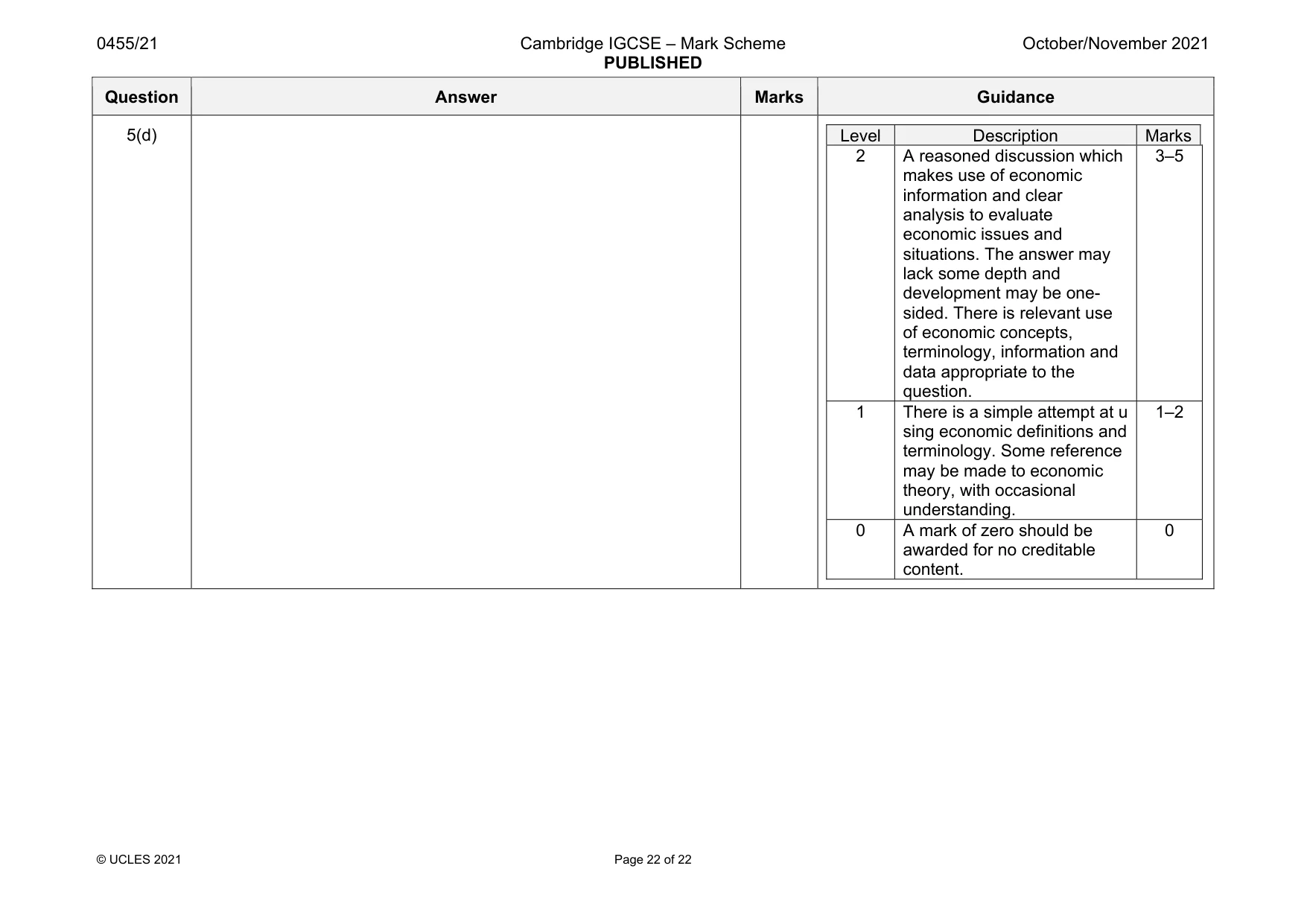
Mark scheme: 5(a) Define market disequilibrium. When quantity demanded does not equal quantity supplied (2). When there are shortages (1) or surpluses (1) of a product. 2 5(b) Explain the difference between labour-intensive and capital- intensive industries Logical explanation which might include: Labour-intensive industries rely more on human labour (1) i.e. workers (1) low-cost labour may be available (1) example of industry (1) Capital-intensive industries rely more on capital (1) i.e. machines (1) capital more efficient / cheaper than labour (1) example of industry 4 5(c) Analyse how trade unions could increase economic development. Coherent analysis which might include: Trade unions could help engage in collective bargaining on wages (1) higher wages (1) leads to higher purchasing power of workers (1). May increase motivation of workers (1) increase output (1). Better working hours (1) improved working conditions (1) protect workers’ rights (1) better health and safety (1) more job security (1) leads to higher standards of living (1) higher life expectancy (1). Increased productivity / efficiency of workers (1) decreases cost of production (1) decrease final price of goods and services produced in the country (1) increase competitiveness (1) higher output / economic growth (1). May help with training (1) raise quality of output (1). 6 Question Answer Marks Guidance 5(d) Discuss whether or not high government spending can help a government achieve its macroeconomic aims. In assessing each answer, use the table opposite. Why high government spending can help a government achieve its macroeconomic aims: • economic growth – increase total demand • full employment/low unemployment – increase demand for workers through more government infrastructure projects • government spending on education may raise workers’ skills and so lower unemployment • balance of payments stability – through subsidies for producers • redistribution of income – through spending on social welfare. Why high government spending cannot help a government achieve its macroeconomic aims: • increased total demand could lead to increase demand-pull inflation • too much government spending could lead to less private investments • overreliance of government subsidies could lead to complacency • high spending on social welfare could discourage the unemployed from trying to find jobs • may be accompanied by higher taxes which could be a disincentive to effort and enterprise • may increase budget deficit which could reduce confidence in the economy. 8 Level Description Marks 3 A reasoned discussion which accurately examines both sides of the economic argument, making use of economic information and clear and logical analysis to evaluate economic issues and situations. One side of the argument may have more depth than the other, but overall both sided of the argument are considered and developed. There is thoughtful evaluation of economic concepts, terminology, information and/or data appropriate to the question. The discussion may also point out the possible uncertainties of alternative decisions and outcomes. 6–8 Question Answer Marks Guidance 5(d) Level Description Marks 2 A reasoned discussion which makes use of economic information and clear analysis to evaluate economic issues and situations. The answer may lack some depth and development may be one- sided. There is relevant use of economic concepts, terminology, information and data appropriate to the question. 3–5 1 There is a simple attempt at u sing economic definitions and terminology. Some reference may be made to economic theory, with occasional understanding. 1–2 0 A mark of zero should be awarded for no creditable content. 0
What was in this paper
The subtopics covered by these 5 questions, and how many questions each got. Open one in a new tab to see every Cambridge question on it.
What you needed in this session
Cambridge’s own grade thresholds for 2021 Oct/Nov, Paper 2 · Variant 1. A higher threshold means an easier paper — the bar moves with how the cohort did.