Cambridge IGCSE Economics 0455 — 2024 May/June Paper 2 · Variant 2
0455/22/M/J/24 · 5 questions · 90 marks · ≈101 min
The question paper and its mark scheme, free to read here and free to download. This is Cambridge’s own paper, exactly as it was sat.
Question paper8 pages
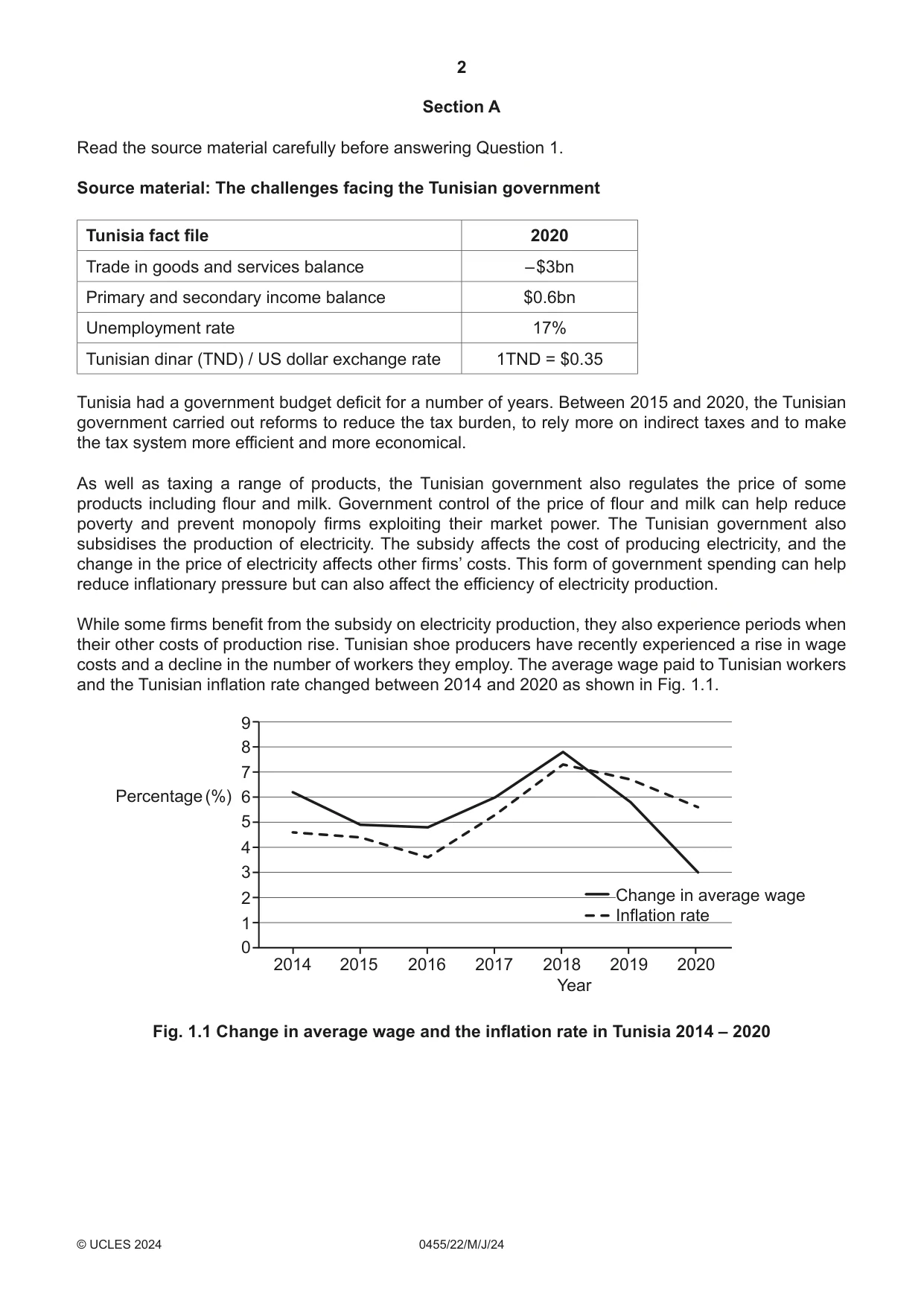
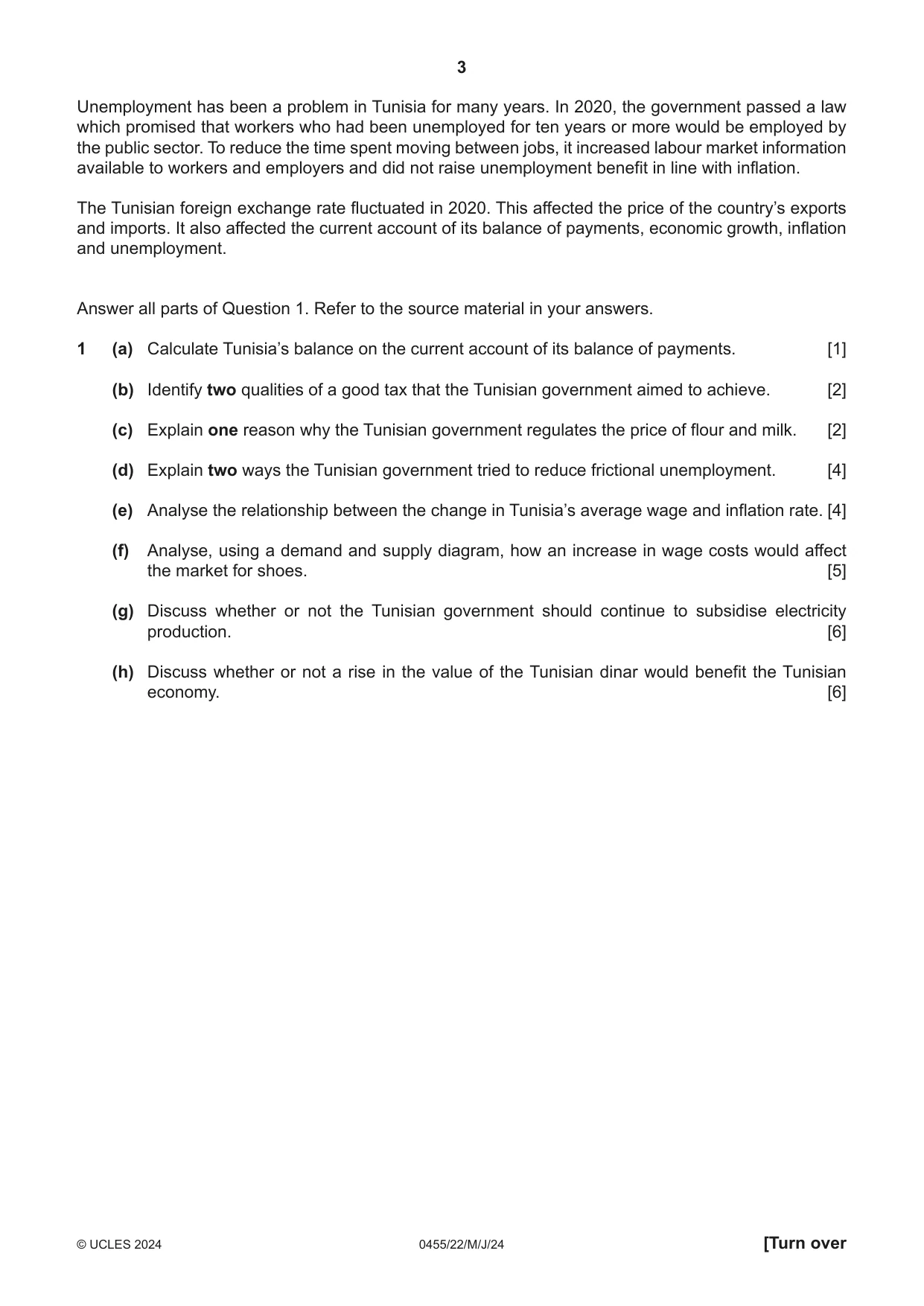
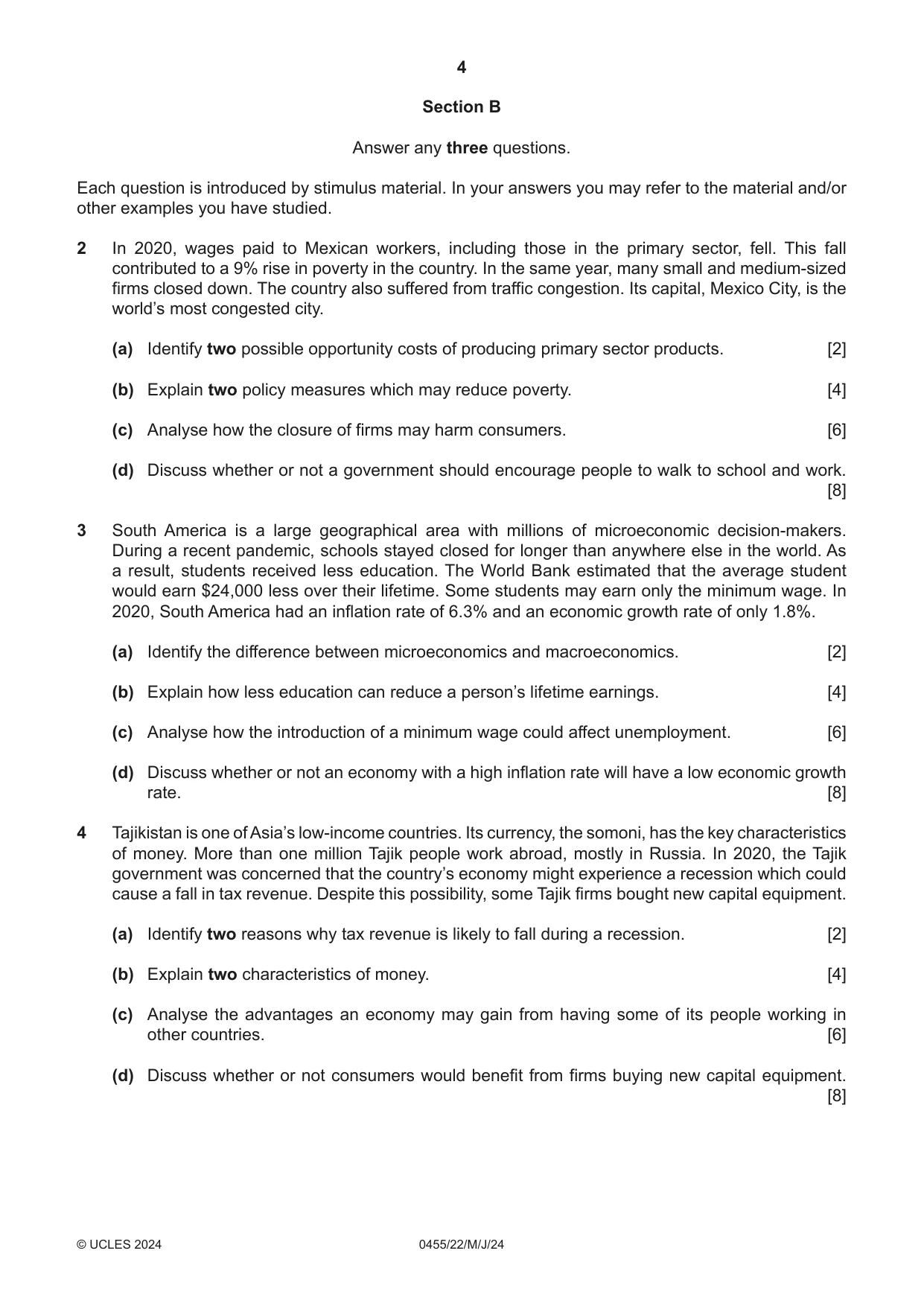


Mark scheme29 pages
Answers below. Sit the paper first if you are practising.
Questions as text
Q1 · Calculate Tunisia’s balance on the current account of its balance of payments
1 (a) Calculate Tunisia’s balance on the current account of its balance of payments. [1] (b) Identify two qualities of a good tax that the Tunisian government aimed to achieve. [2] (c) Explain one reason why the Tunisian government regulates the price of flour and milk. [2] (d) Explain two ways the Tunisian government tried to reduce frictional unemployment. [4] (e) Analyse the relationship between the change in Tunisia’s average wage and inflation rate. [4] (f) Analyse, using a demand and supply diagram, how an increase in wage costs would affect the market for shoes. [5] (g) Discuss whether or not the Tunisian government should continue to subsidise electricity production. [6] (h) Discuss whether or not a rise in the value of the Tunisian dinar would benefit the Tunisian economy. [6]
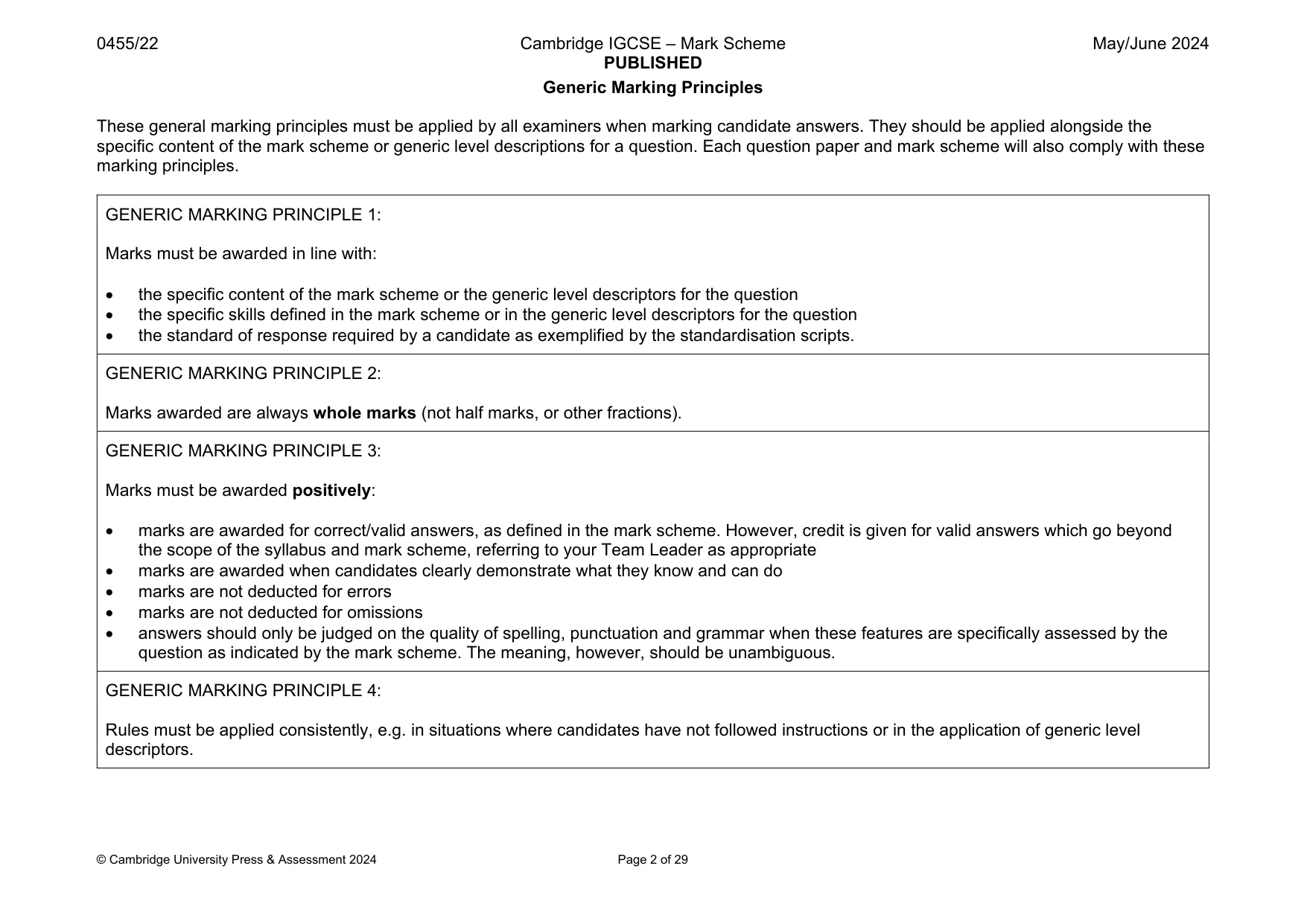
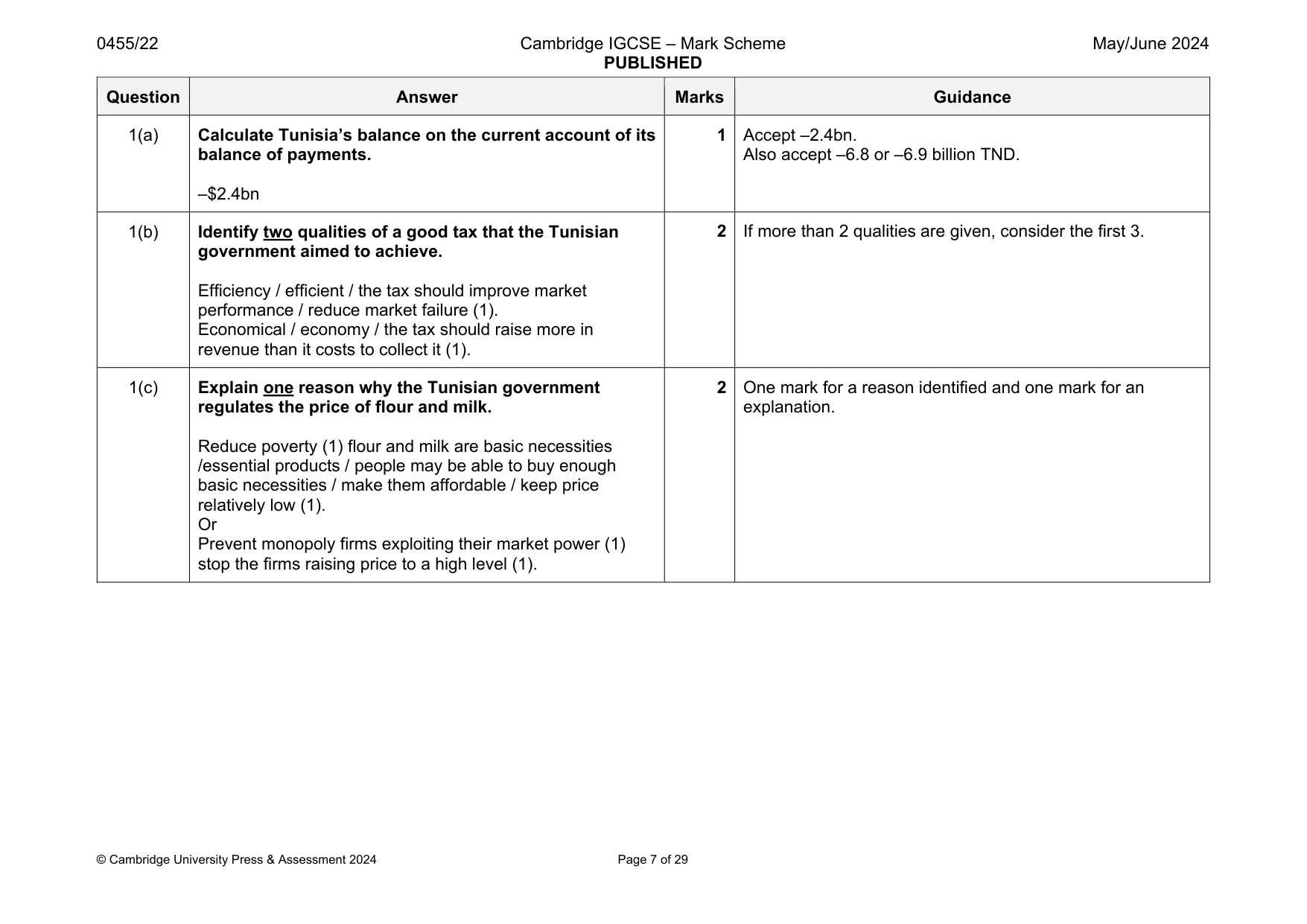
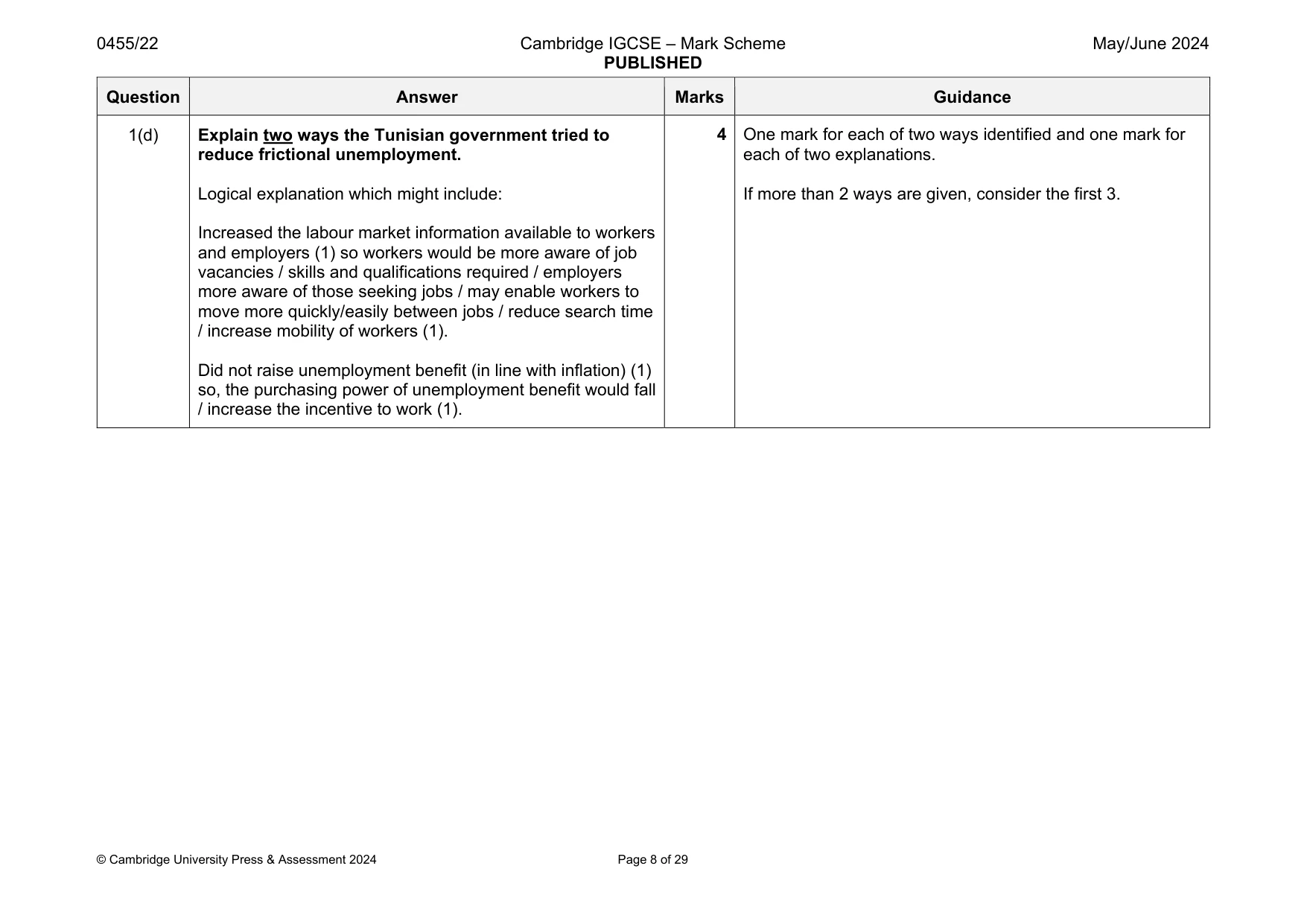
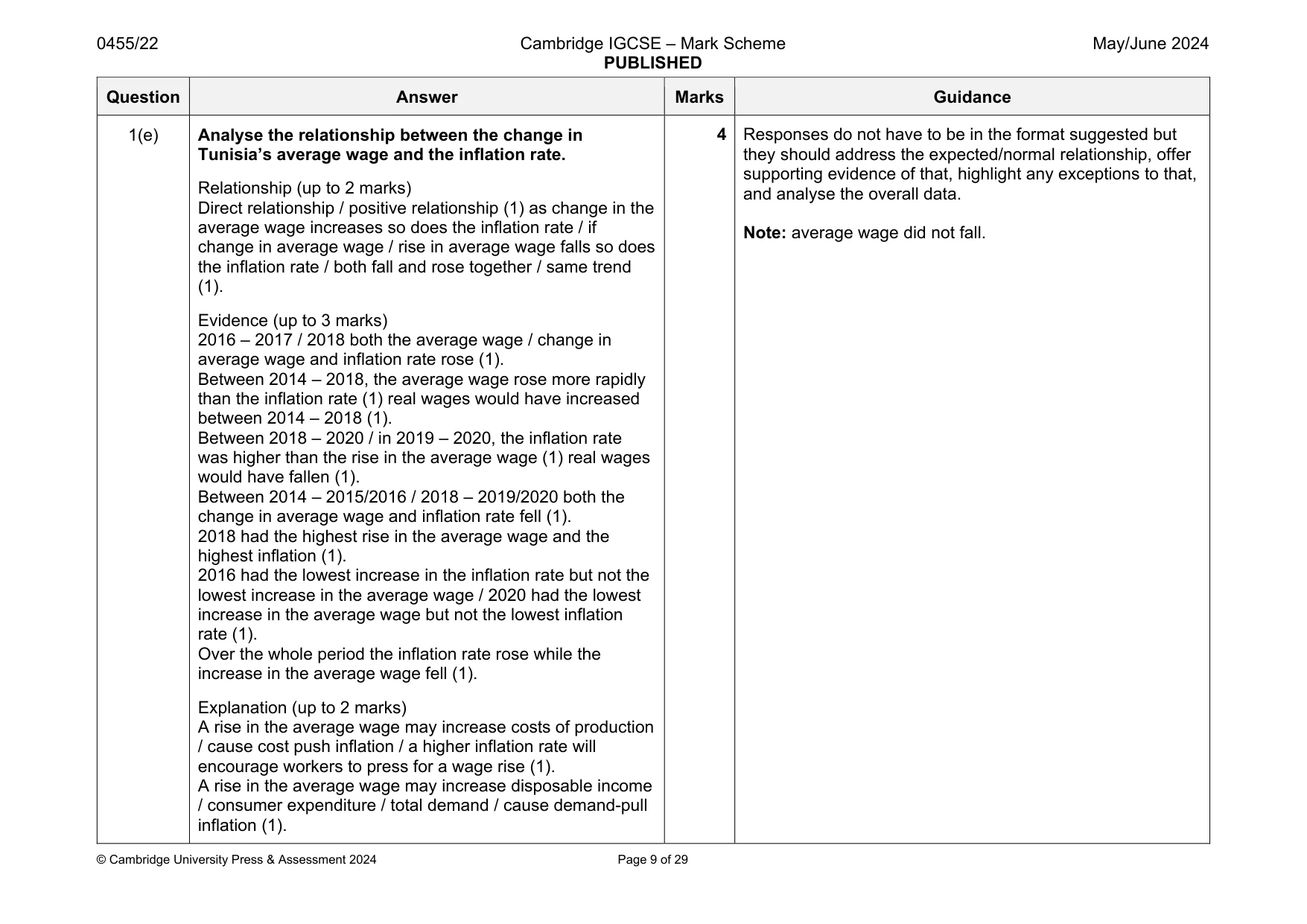
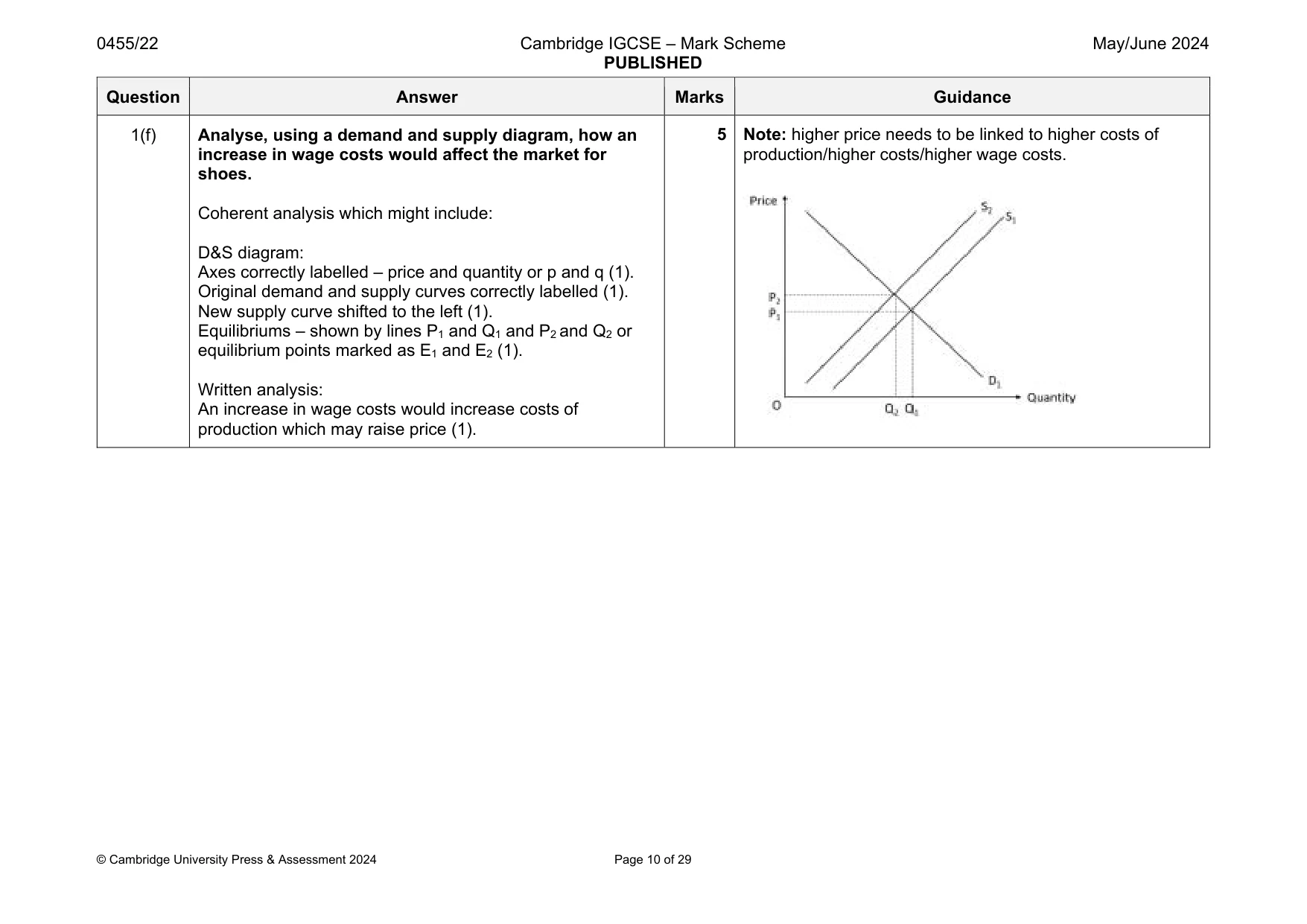
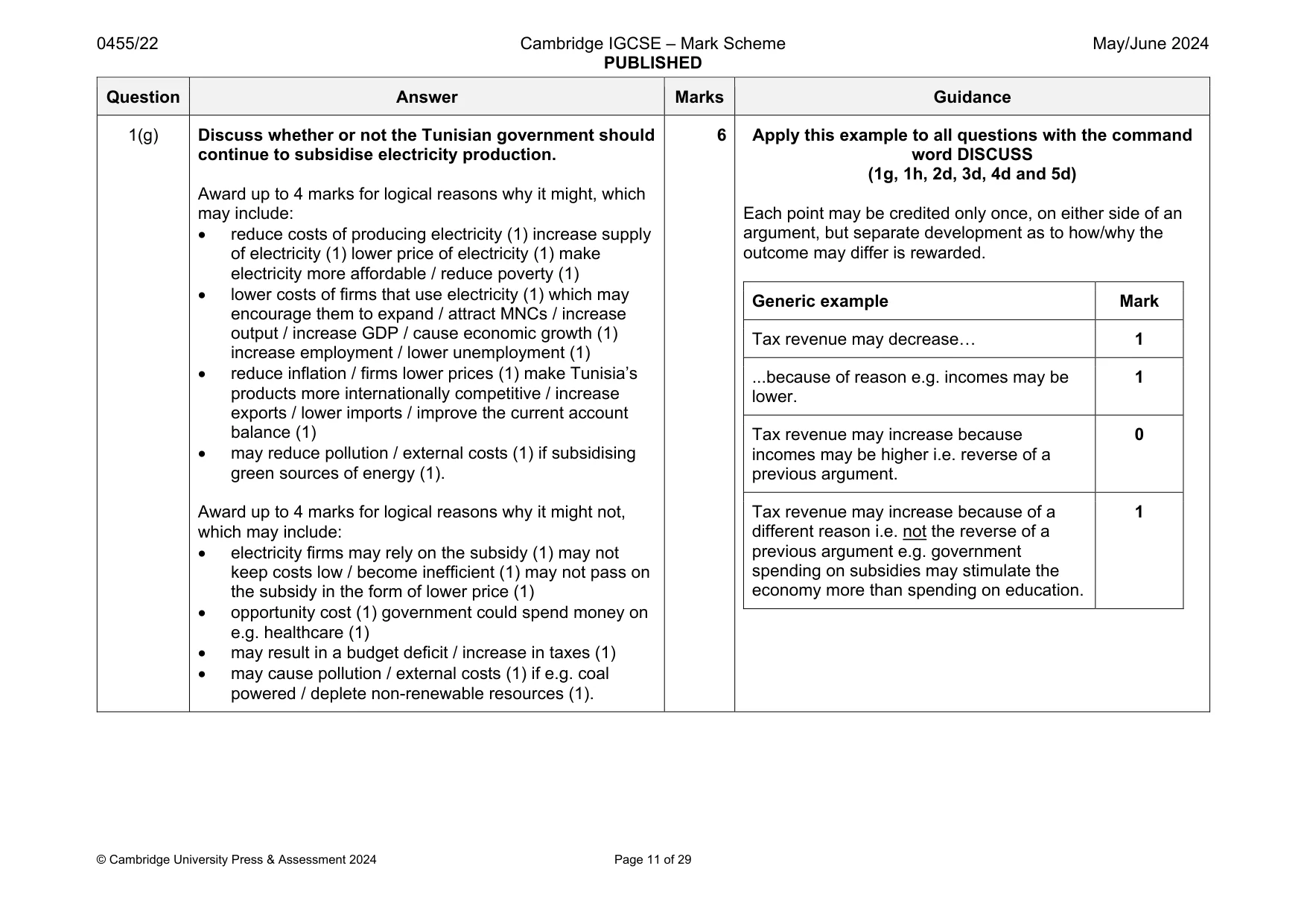
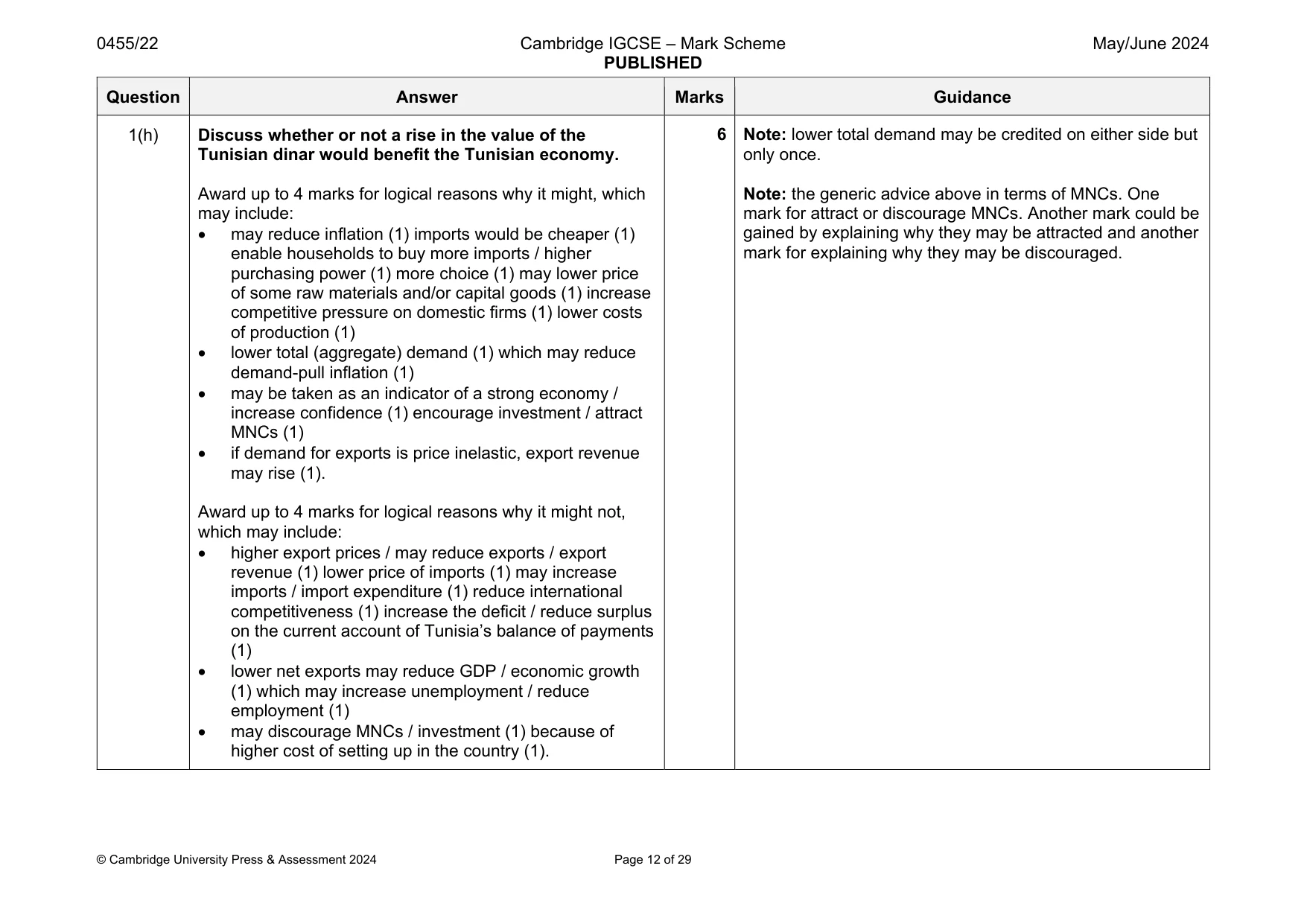
Mark scheme: 1(a) Calculate Tunisia’s balance on the current account of its balance of payments. –$2.4bn 1 Accept –2.4bn. Also accept –6.8 or –6.9 billion TND. 1(b) Identify two qualities of a good tax that the Tunisian government aimed to achieve. Efficiency / efficient / the tax should improve market performance / reduce market failure (1). Economical / economy / the tax should raise more in revenue than it costs to collect it (1). 2 If more than 2 qualities are given, consider the first 3. 1(c) Explain one reason why the Tunisian government regulates the price of flour and milk. Reduce poverty (1) flour and milk are basic necessities /essential products / people may be able to buy enough basic necessities / make them affordable / keep price relatively low (1). Or Prevent monopoly firms exploiting their market power (1) stop the firms raising price to a high level (1). 2 One mark for a reason identified and one mark for an explanation. Question Answer Marks Guidance 1(d) Explain two ways the Tunisian government tried to reduce frictional unemployment. Logical explanation which might include: Increased the labour market information available to workers and employers (1) so workers would be more aware of job vacancies / skills and qualifications required / employers more aware of those seeking jobs / may enable workers to move more quickly/easily between jobs / reduce search time / increase mobility of workers (1). Did not raise unemployment benefit (in line with inflation) (1) so, the purchasing power of unemployment benefit would fall / increase the incentive to work (1). 4 One mark for each of two ways identified and one mark for each of two explanations. If more than 2 ways are given, consider the first 3. Question Answer Marks Guidance 1(e) Analyse the relationship between the change in Tunisia’s average wage and the inflation rate. Relationship (up to 2 marks) Direct relationship / positive relationship (1) as change in the average wage increases so does the inflation rate / if change in average wage / rise in average wage falls so does the inflation rate / both fall and rose together / same trend (1). Evidence (up to 3 marks) 2016 – 2017 / 2018 both the average wage / change in average wage and inflation rate rose (1). Between 2014 – 2018, the average wage rose more rapidly than the inflation rate (1) real wages would have increased between 2014 – 2018 (1). Between 2018 – 2020 / in 2019 – 2020, the inflation rate was higher than the rise in the average wage (1) real wages would have fallen (1). Between 2014 – 2015/2016 / 2018 – 2019/2020 both the change in average wage and inflation rate fell (1). 2018 had the highest rise in the average wage and the highest inflation (1). 2016 had the lowest increase in the inflation rate but not the lowest increase in the average wage / 2020 had the lowest increase in the average wage but not the lowest inflation rate (1). Over the whole period the inflation rate rose while the increase in the average wage fell (1). Explanation (up to 2 marks) A rise in the average wage may increase costs of production / cause cost push inflation / a higher inflation rate will encourage workers to press for a wage rise (1). A rise in the average wage may increase disposable income / consumer expenditure / total demand / cause demand-pull inflation (1). 4 Responses do not have to be in the format suggested but they should address the expected/normal relationship, offer supporting evidence of that, highlight any exceptions to that, and analyse the overall data. Note: average wage did not fall. Question Answer Marks Guidance 1(f) Analyse, using a demand and supply diagram, how an increase in wage costs would affect the market for shoes. Coherent analysis which might include: D&S diagram: Axes correctly labelled – price and quantity or p and q (1). Original demand and supply curves correctly labelled (1). New supply curve shifted to the left (1). Equilibriums – shown by lines P1 and Q1 and P2 and Q2 or equilibrium points marked as E1 and E2 (1). Written analysis: An increase in wage costs would increase costs of production which may raise price (1). 5 Note: higher price needs to be linked to higher costs of production/higher costs/higher wage costs. Question Answer Marks Guidance 1(g) Discuss whether or not the Tunisian government should continue to subsidise electricity production. Award up to 4 marks for logical reasons why it might, which may include: reduce costs of producing electricity (1) increase supply of electricity (1) lower price of electricity (1) make electricity more affordable / reduce poverty (1) lower costs of firms that use electricity (1) which may encourage them to expand / attract MNCs / increase output / increase GDP / cause economic growth (1) increase employment / lower unemployment (1) reduce inflation / firms lower prices (1) make Tunisia’s products more internationally competitive / increase exports / lower imports / improve the current account balance (1) may reduce pollution / external costs (1) if subsidising green sources of energy (1). Award up to 4 marks for logical reasons why it might not, which may include: electricity firms may rely on the subsidy (1) may not keep costs low / become inefficient (1) may not pass on the subsidy in the form of lower price (1) opportunity cost (1) government could spend money on e.g. healthcare (1) may result in a budget deficit / increase in taxes (1) may cause pollution / external costs (1) if e.g. coal powered / deplete non-renewable resources (1). 6 Apply this example to all questions with the command word DISCUSS (1g, 1h, 2d, 3d, 4d and 5d) Each point may be credited only once, on either side of an argument, but separate development as to how/why the outcome may differ is rewarded. Generic example Mark Tax revenue may decrease… 1 ...because of reason e.g. incomes may be lower. 1 Tax revenue may increase because incomes may be higher i.e. reverse of a previous argument. 0 Tax revenue may increase because of a different reason i.e. not the reverse of a previous argument e.g. government spending on subsidies may stimulate the economy more than spending on education. 1 Question Answer Marks Guidance 1(h) Discuss whether or not a rise in the value of the Tunisian dinar would benefit the Tunisian economy. Award up to 4 marks for logical reasons why it might, which may include: may reduce inflation (1) imports would be cheaper (1) enable households to buy more imports / higher purchasing power (1) more choice (1) may lower price of some raw materials and/or capital goods (1) increase competitive pressure on domestic firms (1) lower costs of production (1) lower total (aggregate) demand (1) which may reduce demand-pull inflation (1) may be taken as an indicator of a strong economy / increase confidence (1) encourage investment / attract MNCs (1) if demand for exports is price inelastic, export revenue may rise (1). Award up to 4 marks for logical reasons why it might not, which may include: higher export prices / may reduce exports / export revenue (1) lower price of imports (1) may increase imports / import expenditure (1) reduce international competitiveness (1) increase the deficit / reduce surplus on the current account of Tunisia’s balance of payments (1) lower net exports may reduce GDP / economic growth (1) which may increase unemployment / reduce employment (1) may discourage MNCs / investment (1) because of higher cost of setting up in the country (1). 6 Note: lower total demand may be credited on either side but only once. Note: the generic advice above in terms of MNCs. One mark for attract or discourage MNCs. Another mark could be gained by explaining why they may be attracted and another mark for explaining why they may be discouraged.
Q2 · In 2020, wages paid to Mexican workers, including those in the primary sector, fell
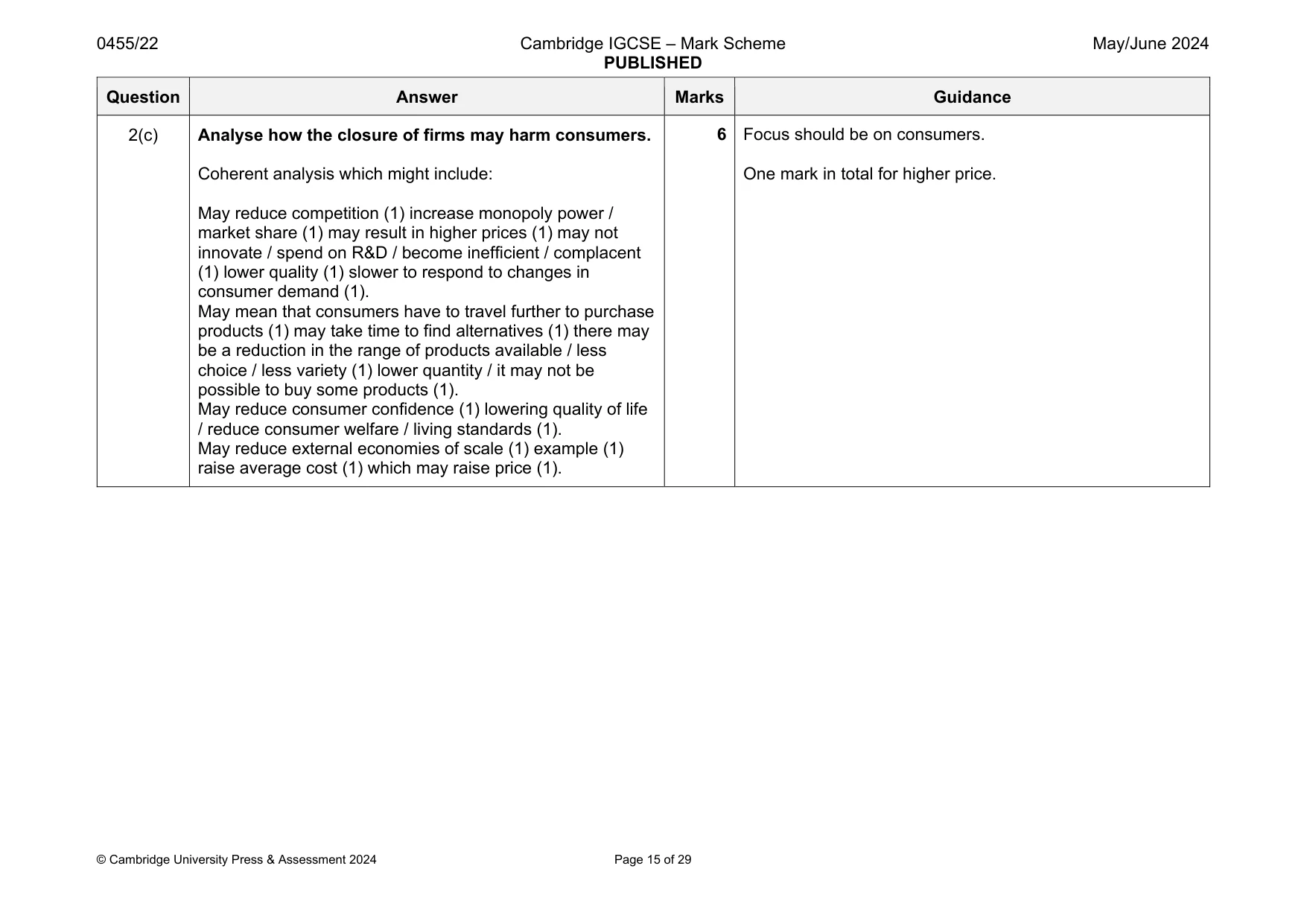
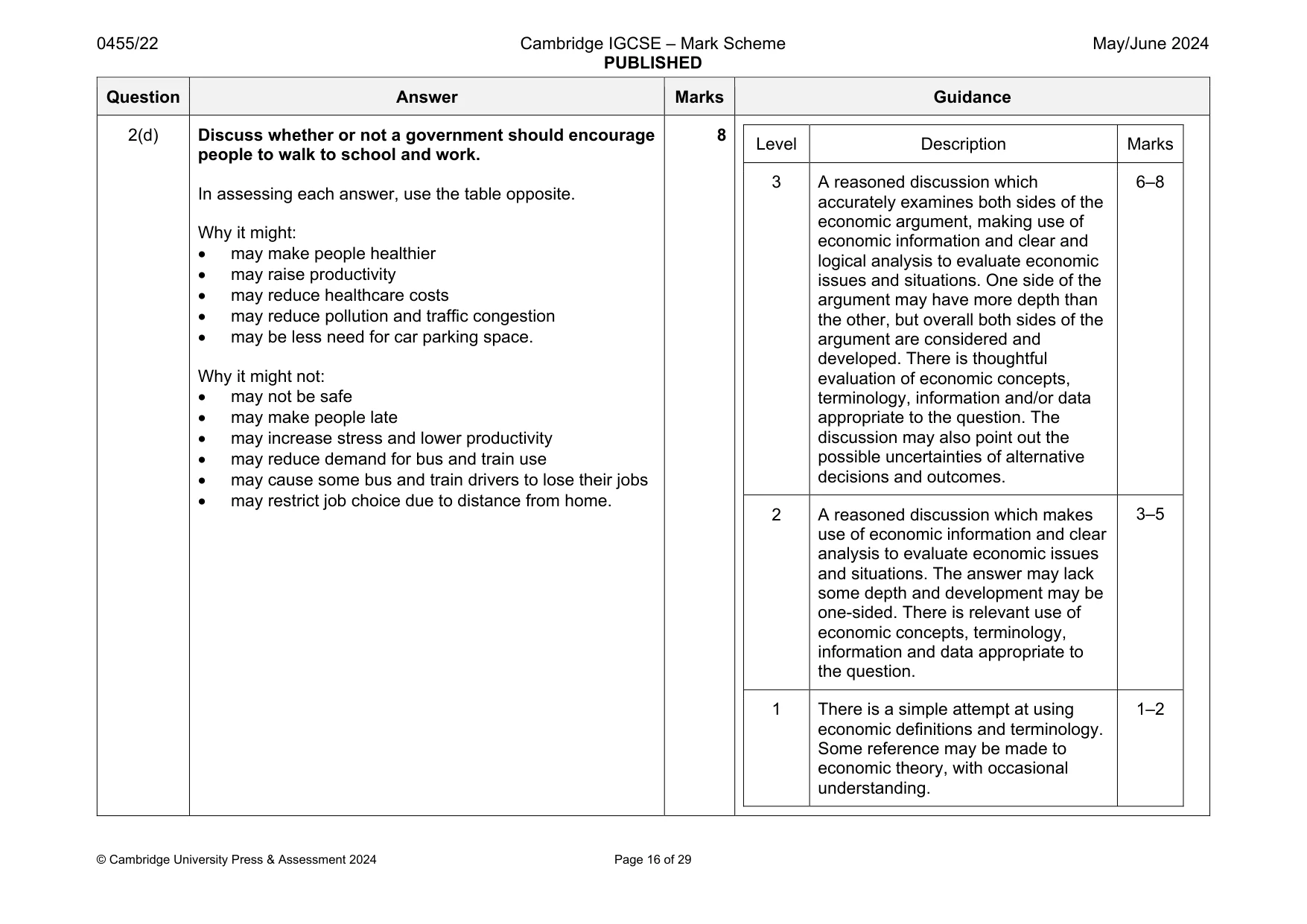
2 In 2020, wages paid to Mexican workers, including those in the primary sector, fell. This fall contributed to a 9% rise in poverty in the country. In the same year, many small and medium-sized firms closed down. The country also suffered from traffic congestion. Its capital, Mexico City, is the world’s most congested city. (a) Identify two possible opportunity costs of producing primary sector products. [2] (b) Explain two policy measures which may reduce poverty. [4] (c) Analyse how the closure of firms may harm consumers. [6] (d) Discuss whether or not a government should encourage people to walk to school and work. [8]
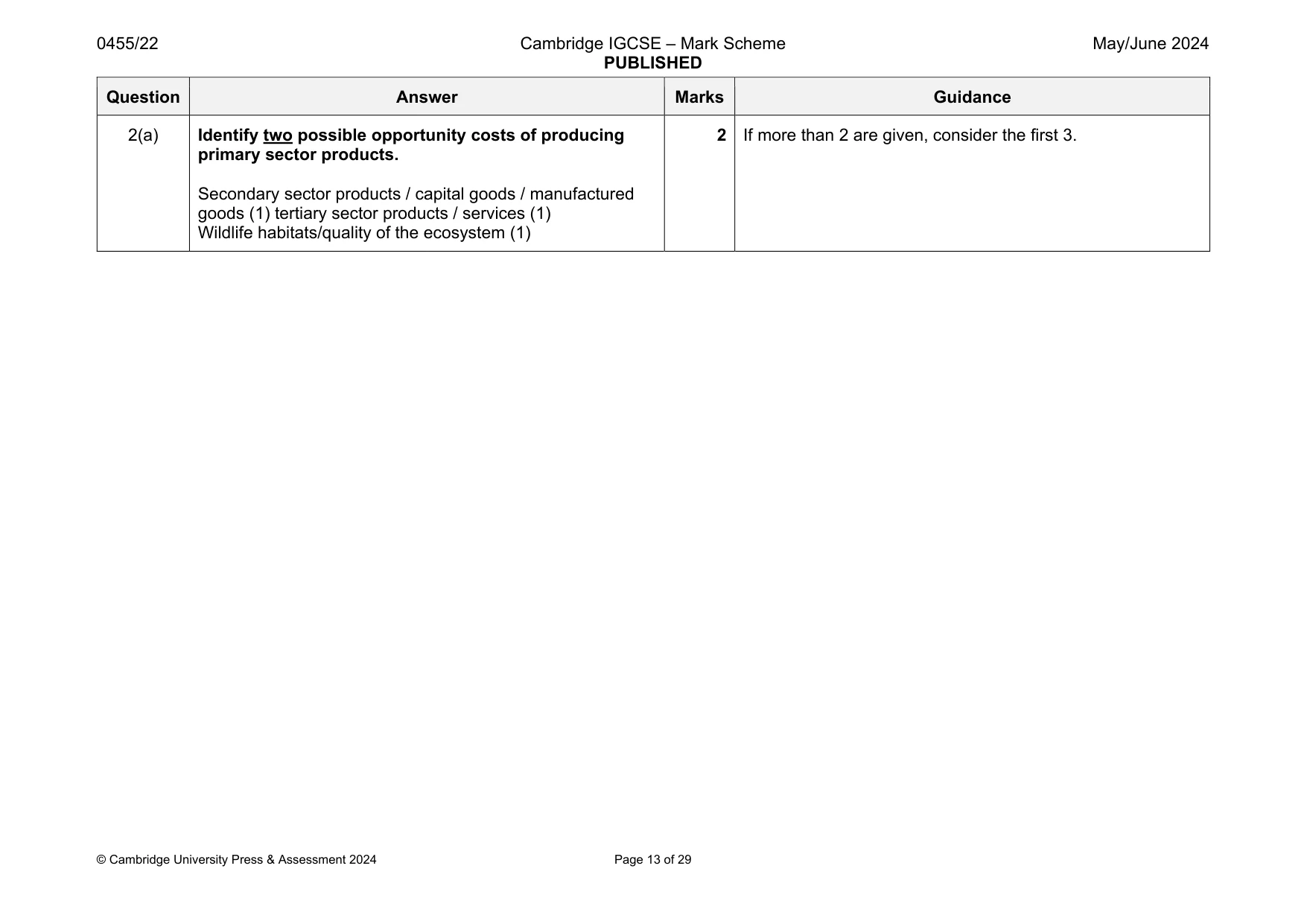
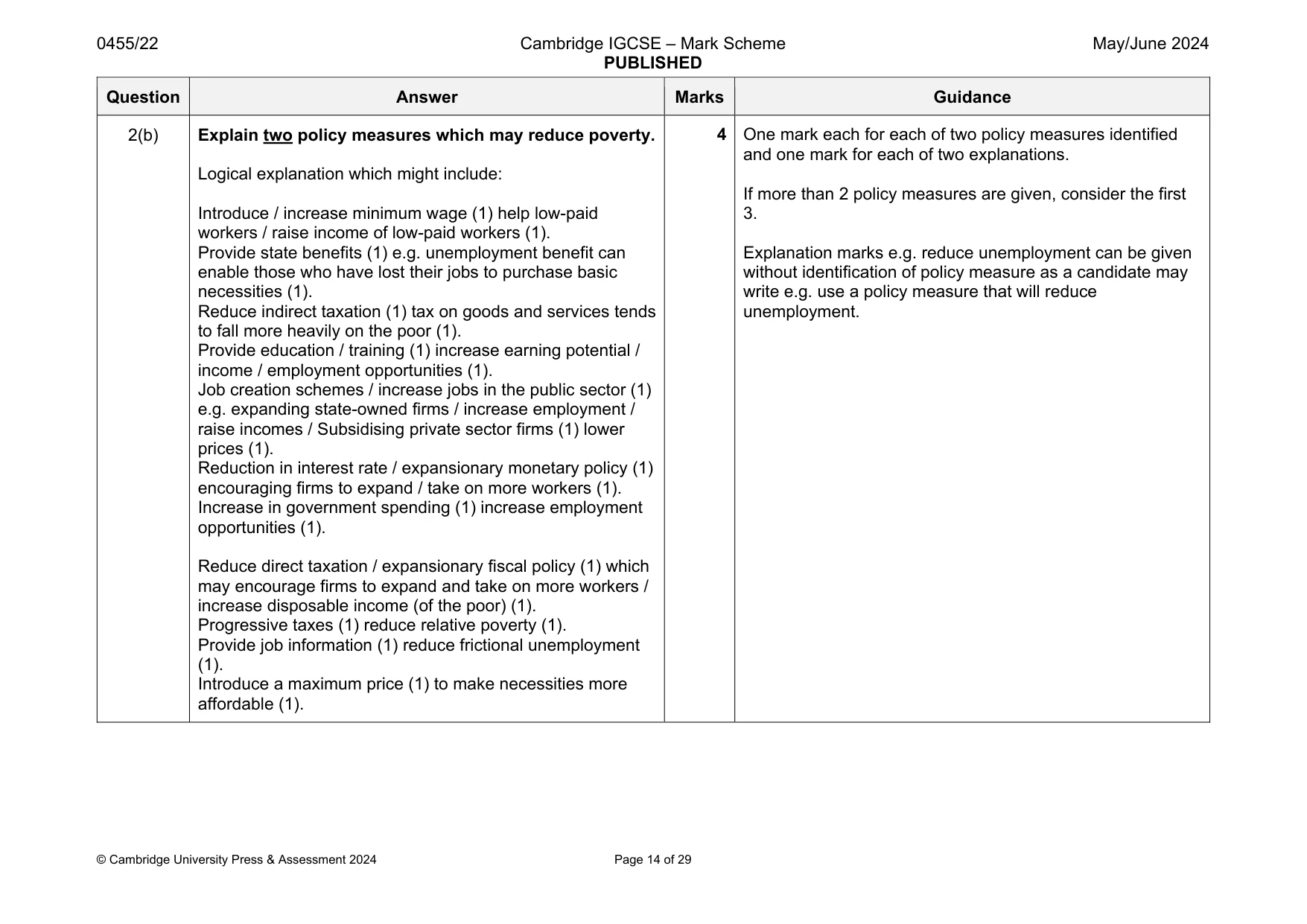
Mark scheme: 2(a) Identify two possible opportunity costs of producing primary sector products. Secondary sector products / capital goods / manufactured goods (1) tertiary sector products / services (1) Wildlife habitats/quality of the ecosystem (1) 2 If more than 2 are given, consider the first 3. Question Answer Marks Guidance 2(b) Explain two policy measures which may reduce poverty. Logical explanation which might include: Introduce / increase minimum wage (1) help low-paid workers / raise income of low-paid workers (1). Provide state benefits (1) e.g. unemployment benefit can enable those who have lost their jobs to purchase basic necessities (1). Reduce indirect taxation (1) tax on goods and services tends to fall more heavily on the poor (1). Provide education / training (1) increase earning potential / income / employment opportunities (1). Job creation schemes / increase jobs in the public sector (1) e.g. expanding state-owned firms / increase employment / raise incomes / Subsidising private sector firms (1) lower prices (1). Reduction in interest rate / expansionary monetary policy (1) encouraging firms to expand / take on more workers (1). Increase in government spending (1) increase employment opportunities (1). Reduce direct taxation / expansionary fiscal policy (1) which may encourage firms to expand and take on more workers / increase disposable income (of the poor) (1). Progressive taxes (1) reduce relative poverty (1). Provide job information (1) reduce frictional unemployment (1). Introduce a maximum price (1) to make necessities more affordable (1). 4 One mark each for each of two policy measures identified and one mark for each of two explanations. If more than 2 policy measures are given, consider the first 3. Explanation marks e.g. reduce unemployment can be given without identification of policy measure as a candidate may write e.g. use a policy measure that will reduce unemployment. Question Answer Marks Guidance 2(c) Analyse how the closure of firms may harm consumers. Coherent analysis which might include: May reduce competition (1) increase monopoly power / market share (1) may result in higher prices (1) may not innovate / spend on R&D / become inefficient / complacent (1) lower quality (1) slower to respond to changes in consumer demand (1). May mean that consumers have to travel further to purchase products (1) may take time to find alternatives (1) there may be a reduction in the range of products available / less choice / less variety (1) lower quantity / it may not be possible to buy some products (1). May reduce consumer confidence (1) lowering quality of life / reduce consumer welfare / living standards (1). May reduce external economies of scale (1) example (1) raise average cost (1) which may raise price (1). 6 Focus should be on consumers. One mark in total for higher price. Question Answer Marks Guidance 2(d) Discuss whether or not a government should encourage people to walk to school and work. In assessing each answer, use the table opposite. Why it might: may make people healthier may raise productivity may reduce healthcare costs may reduce pollution and traffic congestion may be less need for car parking space. Why it might not: may not be safe may make people late may increase stress and lower productivity may reduce demand for bus and train use may cause some bus and train drivers to lose their jobs may restrict job choice due to distance from home. 8 Level Description Marks 3 A reasoned discussion which accurately examines both sides of the economic argument, making use of economic information and clear and logical analysis to evaluate economic issues and situations. One side of the argument may have more depth than the other, but overall both sides of the argument are considered and developed. There is thoughtful evaluation of economic concepts, terminology, information and/or data appropriate to the question. The discussion may also point out the possible uncertainties of alternative decisions and outcomes. 6–8 2 A reasoned discussion which makes use of economic information and clear analysis to evaluate economic issues and situations. The answer may lack some depth and development may be one-sided. There is relevant use of economic concepts, terminology, information and data appropriate to the question. 3–5 1 There is a simple attempt at using economic definitions and terminology. Some reference may be made to economic theory, with occasional understanding. 1–2 Question Answer Marks Guidance 2(d) Level Description Marks 0 A mark of zero should be awarded for no creditable content. 0
Q3 · South America is a large geographical area with millions of microeconomic decision-makers
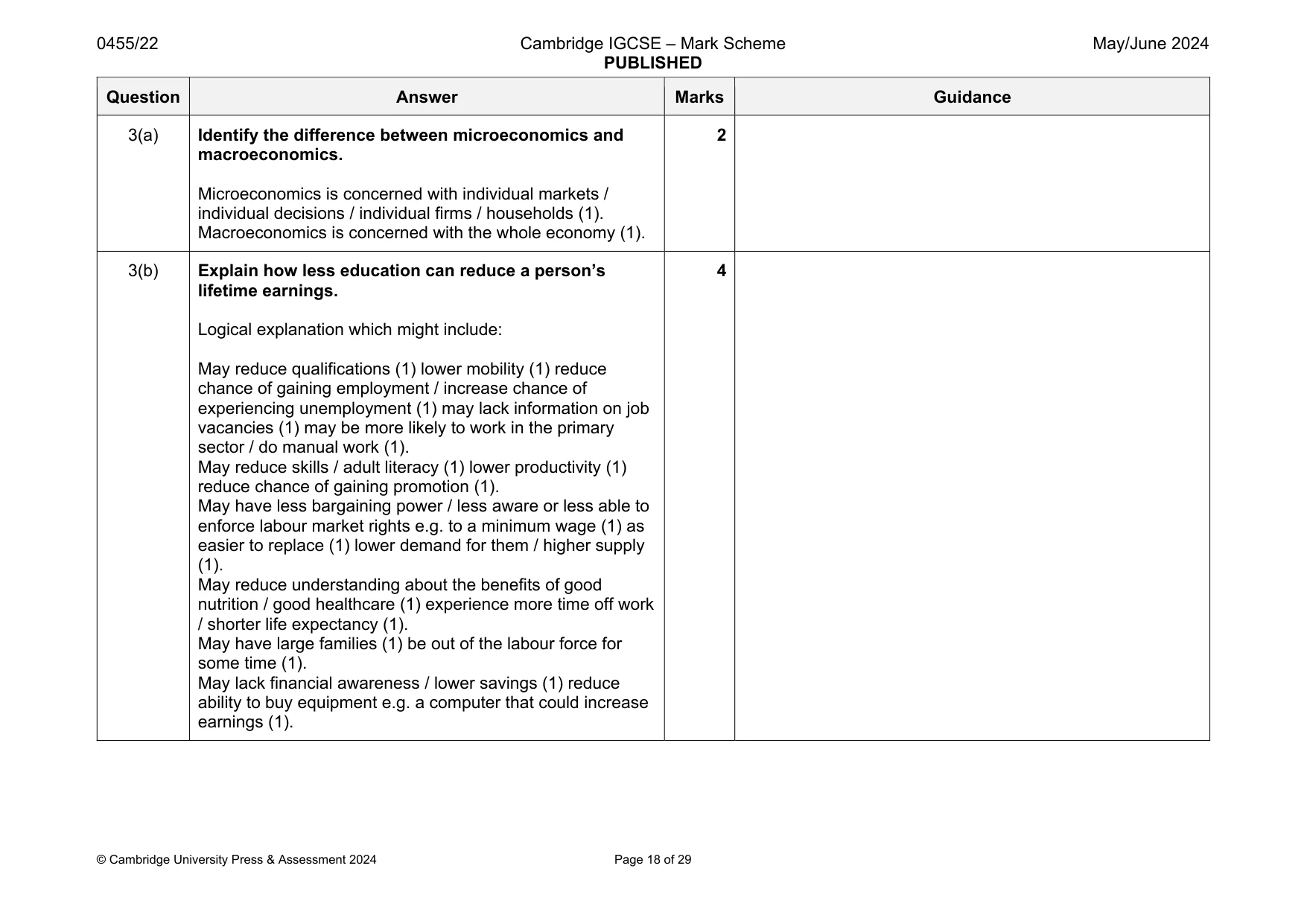
3 South America is a large geographical area with millions of microeconomic decision-makers. During a recent pandemic, schools stayed closed for longer than anywhere else in the world. As a result, students received less education. The World Bank estimated that the average student would earn $24,000 less over their lifetime. Some students may earn only the minimum wage. In 2020, South America had an inflation rate of 6.3% and an economic growth rate of only 1.8%. (a) Identify the difference between microeconomics and macroeconomics. [2] (b) Explain how less education can reduce a person’s lifetime earnings. [4] (c) Analyse how the introduction of a minimum wage could affect unemployment. [6] (d) Discuss whether or not an economy with a high inflation rate will have a low economic growth rate. [8]
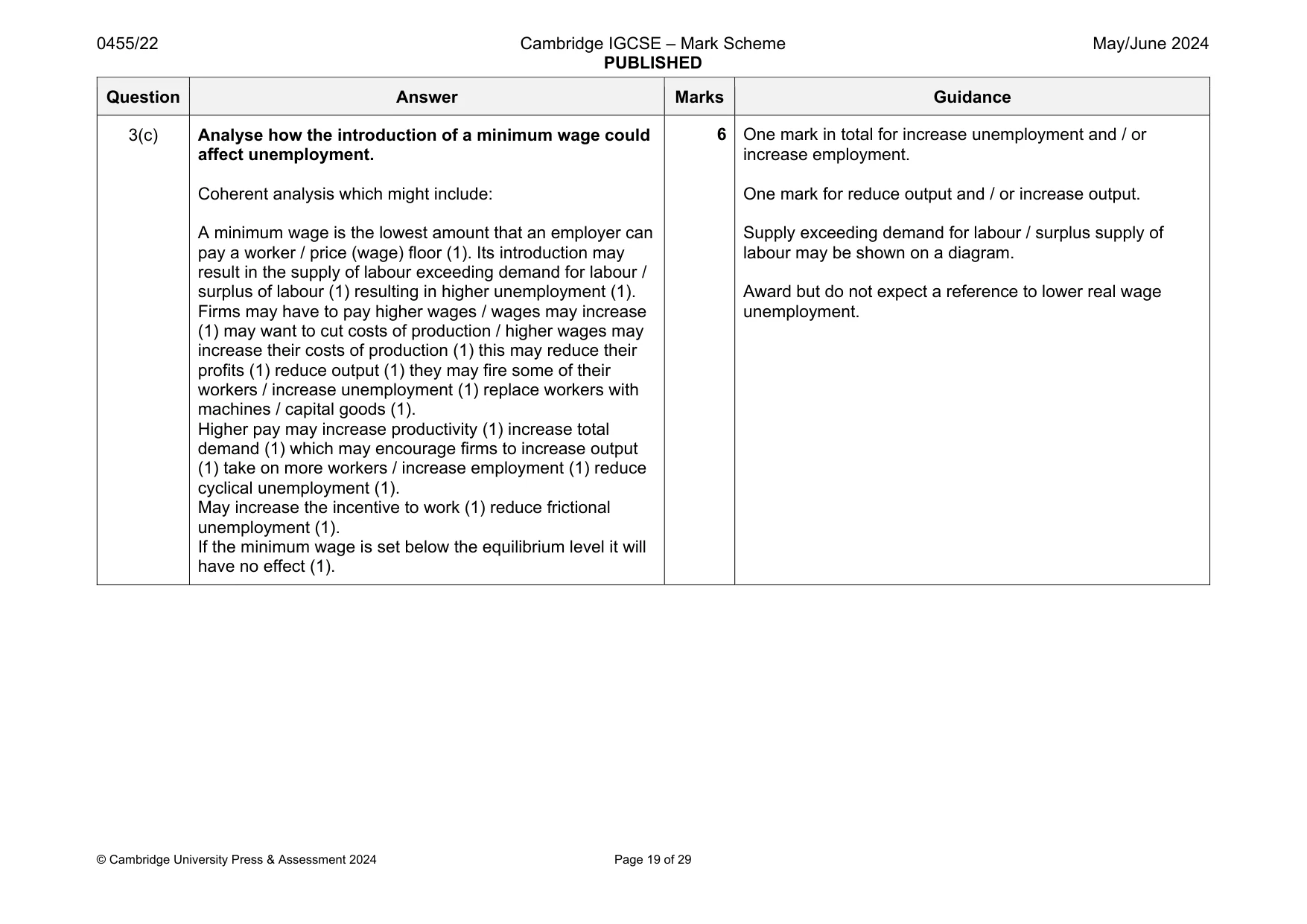
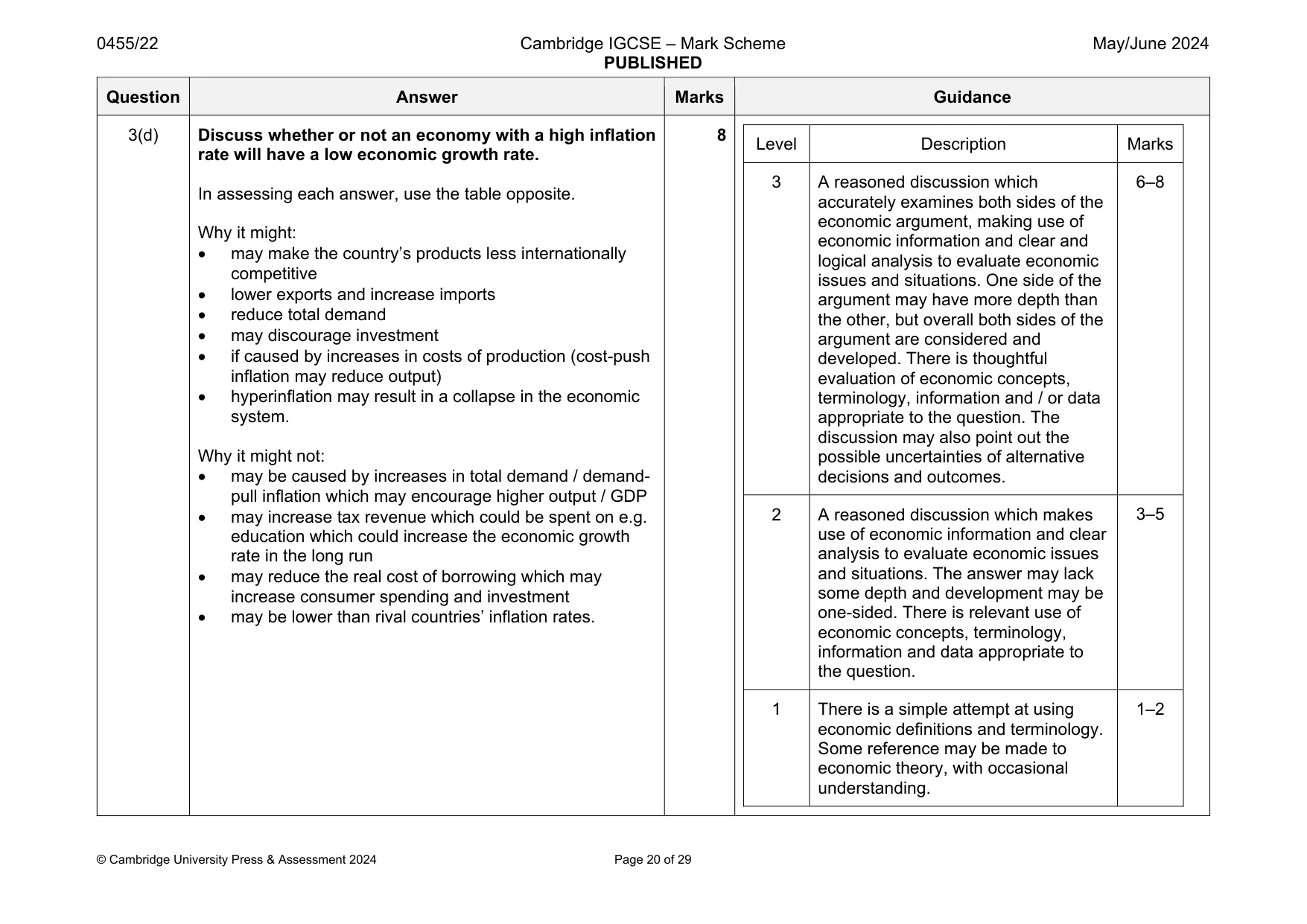
Mark scheme: 3(a) Identify the difference between microeconomics and macroeconomics. Microeconomics is concerned with individual markets / individual decisions / individual firms / households (1). Macroeconomics is concerned with the whole economy (1). 2 3(b) Explain how less education can reduce a person’s lifetime earnings. Logical explanation which might include: May reduce qualifications (1) lower mobility (1) reduce chance of gaining employment / increase chance of experiencing unemployment (1) may lack information on job vacancies (1) may be more likely to work in the primary sector / do manual work (1). May reduce skills / adult literacy (1) lower productivity (1) reduce chance of gaining promotion (1). May have less bargaining power / less aware or less able to enforce labour market rights e.g. to a minimum wage (1) as easier to replace (1) lower demand for them / higher supply (1). May reduce understanding about the benefits of good nutrition / good healthcare (1) experience more time off work / shorter life expectancy (1). May have large families (1) be out of the labour force for some time (1). May lack financial awareness / lower savings (1) reduce ability to buy equipment e.g. a computer that could increase earnings (1). 4 Question Answer Marks Guidance 3(c) Analyse how the introduction of a minimum wage could affect unemployment. Coherent analysis which might include: A minimum wage is the lowest amount that an employer can pay a worker / price (wage) floor (1). Its introduction may result in the supply of labour exceeding demand for labour / surplus of labour (1) resulting in higher unemployment (1). Firms may have to pay higher wages / wages may increase (1) may want to cut costs of production / higher wages may increase their costs of production (1) this may reduce their profits (1) reduce output (1) they may fire some of their workers / increase unemployment (1) replace workers with machines / capital goods (1). Higher pay may increase productivity (1) increase total demand (1) which may encourage firms to increase output (1) take on more workers / increase employment (1) reduce cyclical unemployment (1). May increase the incentive to work (1) reduce frictional unemployment (1). If the minimum wage is set below the equilibrium level it will have no effect (1). 6 One mark in total for increase unemployment and / or increase employment. One mark for reduce output and / or increase output. Supply exceeding demand for labour / surplus supply of labour may be shown on a diagram. Award but do not expect a reference to lower real wage unemployment. Question Answer Marks Guidance 3(d) Discuss whether or not an economy with a high inflation rate will have a low economic growth rate. In assessing each answer, use the table opposite. Why it might: may make the country’s products less internationally competitive lower exports and increase imports reduce total demand may discourage investment if caused by increases in costs of production (cost-push inflation may reduce output) hyperinflation may result in a collapse in the economic system. Why it might not: may be caused by increases in total demand / demand- pull inflation which may encourage higher output / GDP may increase tax revenue which could be spent on e.g. education which could increase the economic growth rate in the long run may reduce the real cost of borrowing which may increase consumer spending and investment may be lower than rival countries’ inflation rates. 8 Level Description Marks 3 A reasoned discussion which accurately examines both sides of the economic argument, making use of economic information and clear and logical analysis to evaluate economic issues and situations. One side of the argument may have more depth than the other, but overall both sides of the argument are considered and developed. There is thoughtful evaluation of economic concepts, terminology, information and / or data appropriate to the question. The discussion may also point out the possible uncertainties of alternative decisions and outcomes. 6–8 2 A reasoned discussion which makes use of economic information and clear analysis to evaluate economic issues and situations. The answer may lack some depth and development may be one-sided. There is relevant use of economic concepts, terminology, information and data appropriate to the question. 3–5 1 There is a simple attempt at using economic definitions and terminology. Some reference may be made to economic theory, with occasional understanding. 1–2 Question Answer Marks Guidance 3(d) Level Description Marks 0 A mark of zero should be awarded for no creditable content. 0
Q4 · Tajikistan is one of Asia’s low-income countries
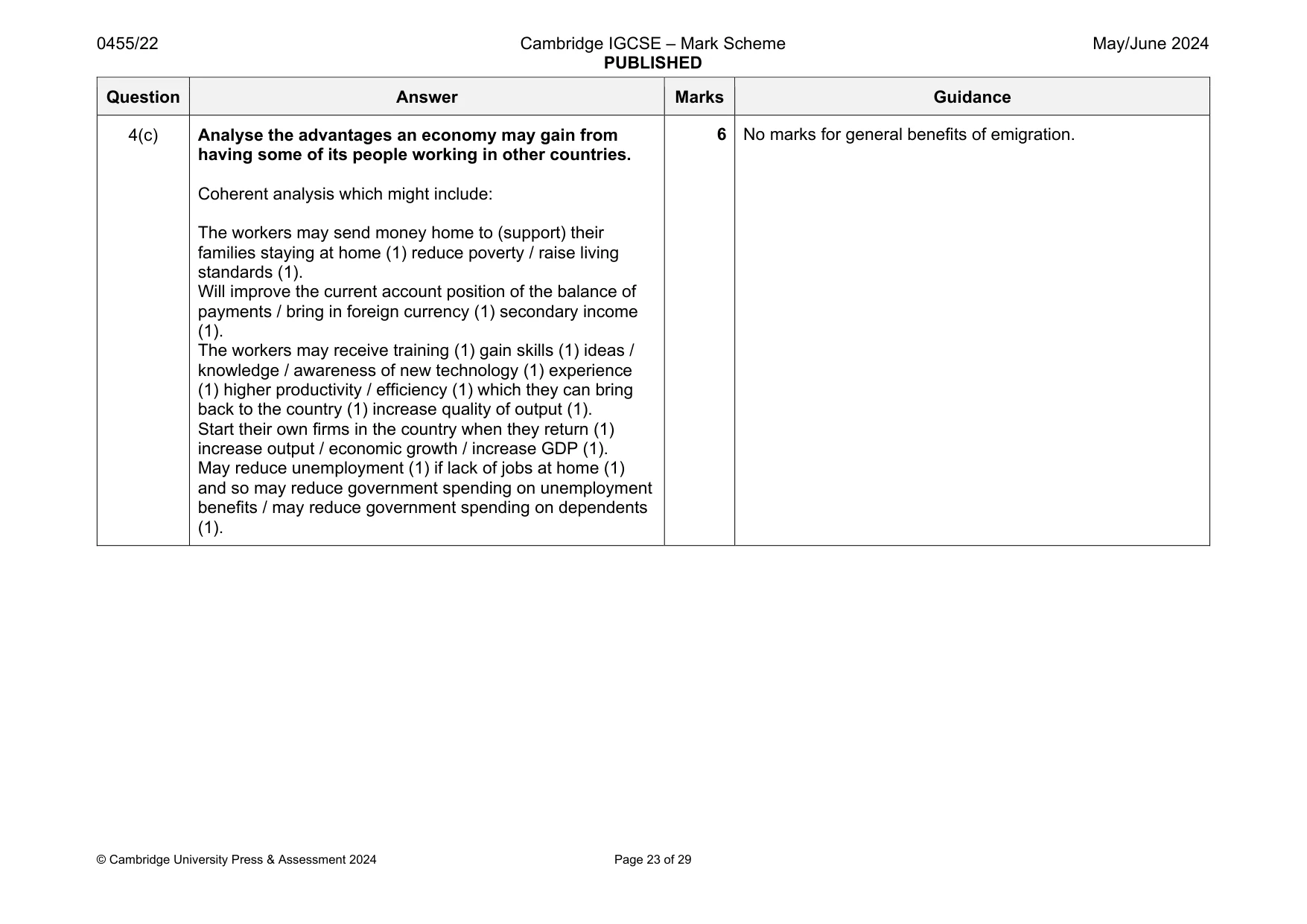
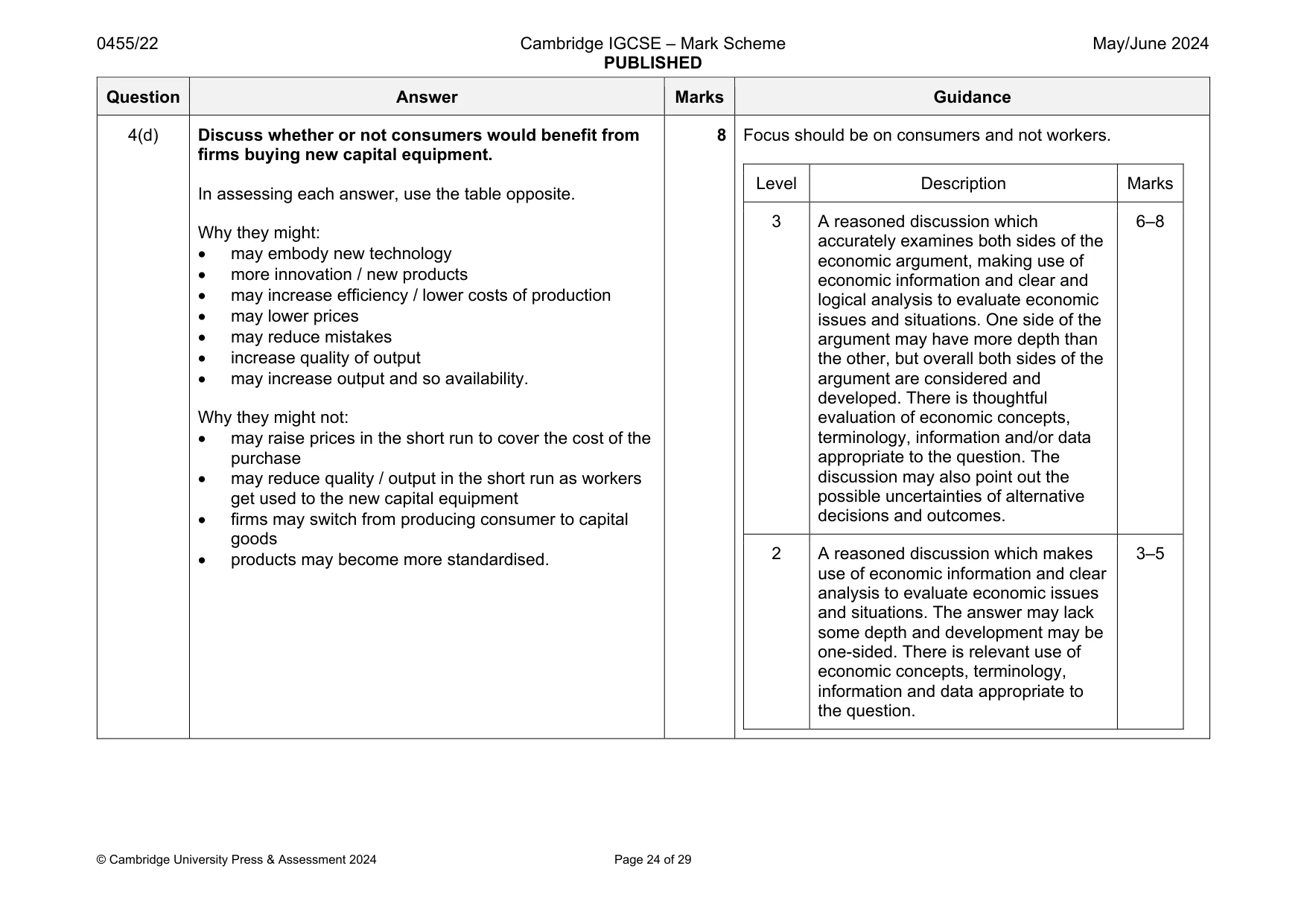
4 Tajikistan is one of Asia’s low-income countries. Its currency, the somoni, has the key characteristics of money. More than one million Tajik people work abroad, mostly in Russia. In 2020, the Tajik government was concerned that the country’s economy might experience a recession which could cause a fall in tax revenue. Despite this possibility, some Tajik firms bought new capital equipment. (a) Identify two reasons why tax revenue is likely to fall during a recession. [2] (b) Explain two characteristics of money. [4] (c) Analyse the advantages an economy may gain from having some of its people working in other countries. [6] (d) Discuss whether or not consumers would benefit from firms buying new capital equipment. [8]
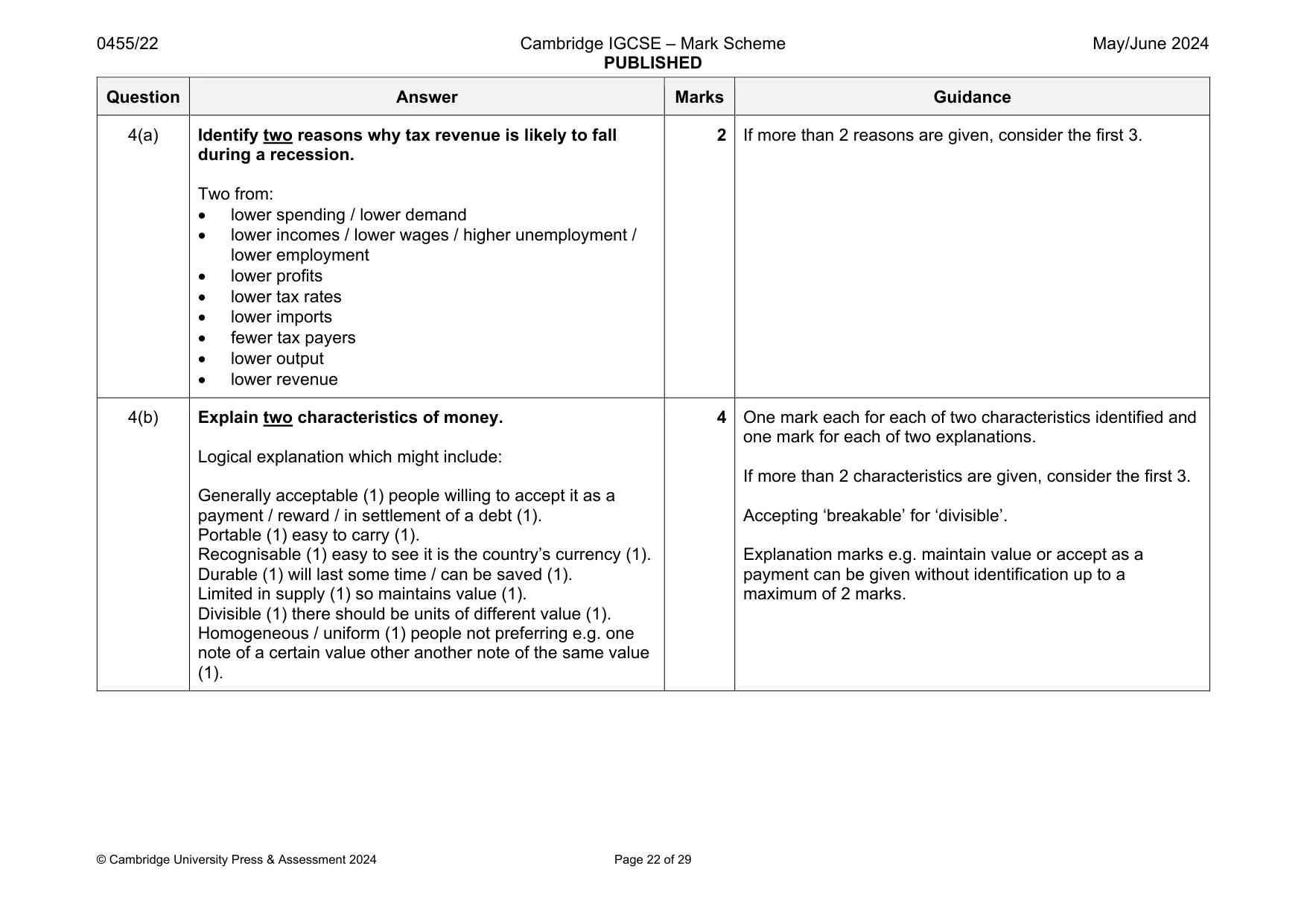
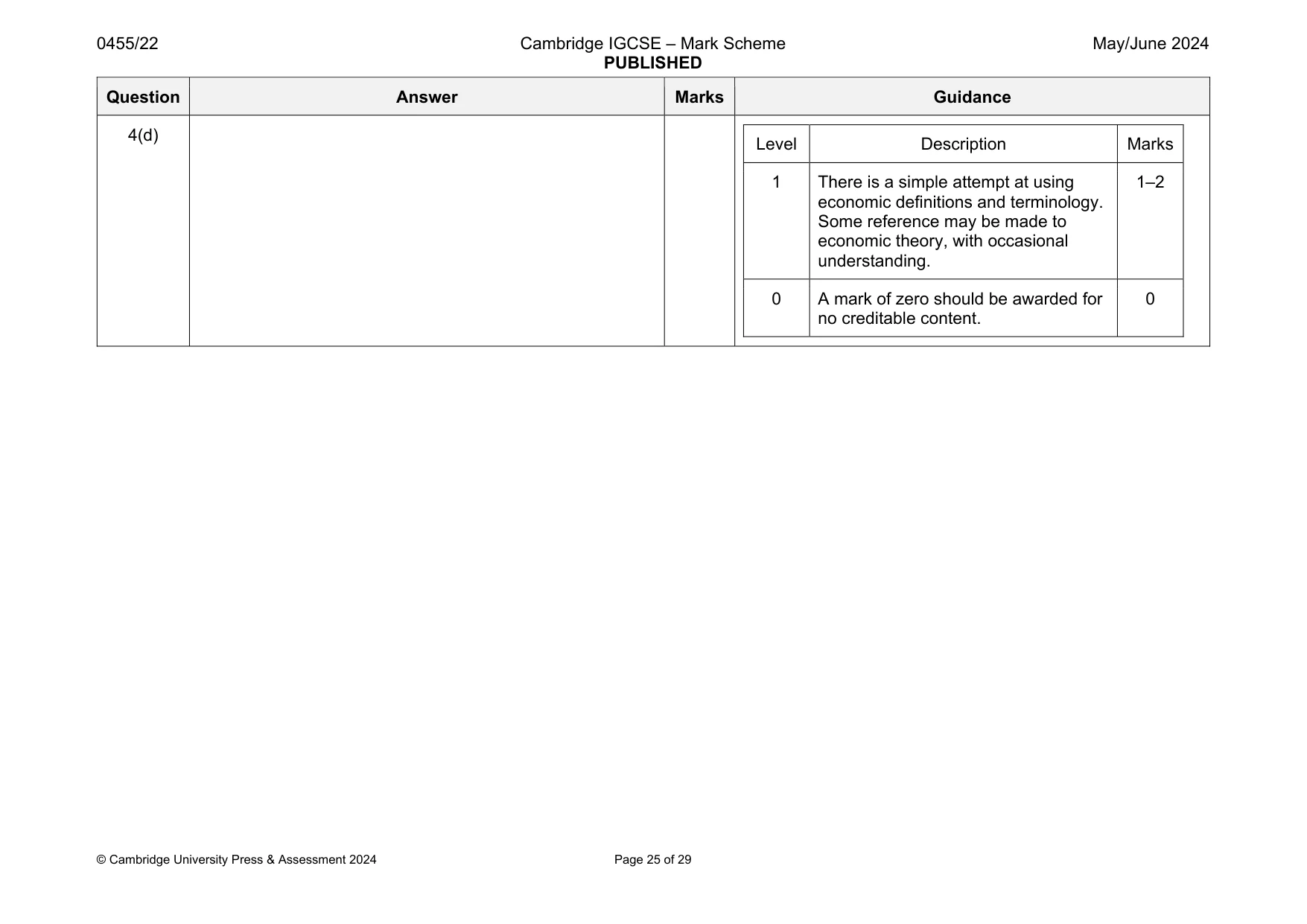
Mark scheme: 4(a) Identify two reasons why tax revenue is likely to fall during a recession. Two from: lower spending / lower demand lower incomes / lower wages / higher unemployment / lower employment lower profits lower tax rates lower imports fewer tax payers lower output lower revenue 2 If more than 2 reasons are given, consider the first 3. 4(b) Explain two characteristics of money. Logical explanation which might include: Generally acceptable (1) people willing to accept it as a payment / reward / in settlement of a debt (1). Portable (1) easy to carry (1). Recognisable (1) easy to see it is the country’s currency (1). Durable (1) will last some time / can be saved (1). Limited in supply (1) so maintains value (1). Divisible (1) there should be units of different value (1). Homogeneous / uniform (1) people not preferring e.g. one note of a certain value other another note of the same value (1). 4 One mark each for each of two characteristics identified and one mark for each of two explanations. If more than 2 characteristics are given, consider the first 3. Accepting ‘breakable’ for ‘divisible’. Explanation marks e.g. maintain value or accept as a payment can be given without identification up to a maximum of 2 marks. Question Answer Marks Guidance 4(c) Analyse the advantages an economy may gain from having some of its people working in other countries. Coherent analysis which might include: The workers may send money home to (support) their families staying at home (1) reduce poverty / raise living standards (1). Will improve the current account position of the balance of payments / bring in foreign currency (1) secondary income (1). The workers may receive training (1) gain skills (1) ideas / knowledge / awareness of new technology (1) experience (1) higher productivity / efficiency (1) which they can bring back to the country (1) increase quality of output (1). Start their own firms in the country when they return (1) increase output / economic growth / increase GDP (1). May reduce unemployment (1) if lack of jobs at home (1) and so may reduce government spending on unemployment benefits / may reduce government spending on dependents (1). 6 No marks for general benefits of emigration. Question Answer Marks Guidance 4(d) Discuss whether or not consumers would benefit from firms buying new capital equipment. In assessing each answer, use the table opposite. Why they might: may embody new technology more innovation / new products may increase efficiency / lower costs of production may lower prices may reduce mistakes increase quality of output may increase output and so availability. Why they might not: may raise prices in the short run to cover the cost of the purchase may reduce quality / output in the short run as workers get used to the new capital equipment firms may switch from producing consumer to capital goods products may become more standardised. 8 Focus should be on consumers and not workers. Level Description Marks 3 A reasoned discussion which accurately examines both sides of the economic argument, making use of economic information and clear and logical analysis to evaluate economic issues and situations. One side of the argument may have more depth than the other, but overall both sides of the argument are considered and developed. There is thoughtful evaluation of economic concepts, terminology, information and/or data appropriate to the question. The discussion may also point out the possible uncertainties of alternative decisions and outcomes. 6–8 2 A reasoned discussion which makes use of economic information and clear analysis to evaluate economic issues and situations. The answer may lack some depth and development may be one-sided. There is relevant use of economic concepts, terminology, information and data appropriate to the question. 3–5 Question Answer Marks Guidance 4(d) Level Description Marks 1 There is a simple attempt at using economic definitions and terminology. Some reference may be made to economic theory, with occasional understanding. 1–2 0 A mark of zero should be awarded for no creditable content. 0
Q5 · Free goods and economic goods are consumed in Poland
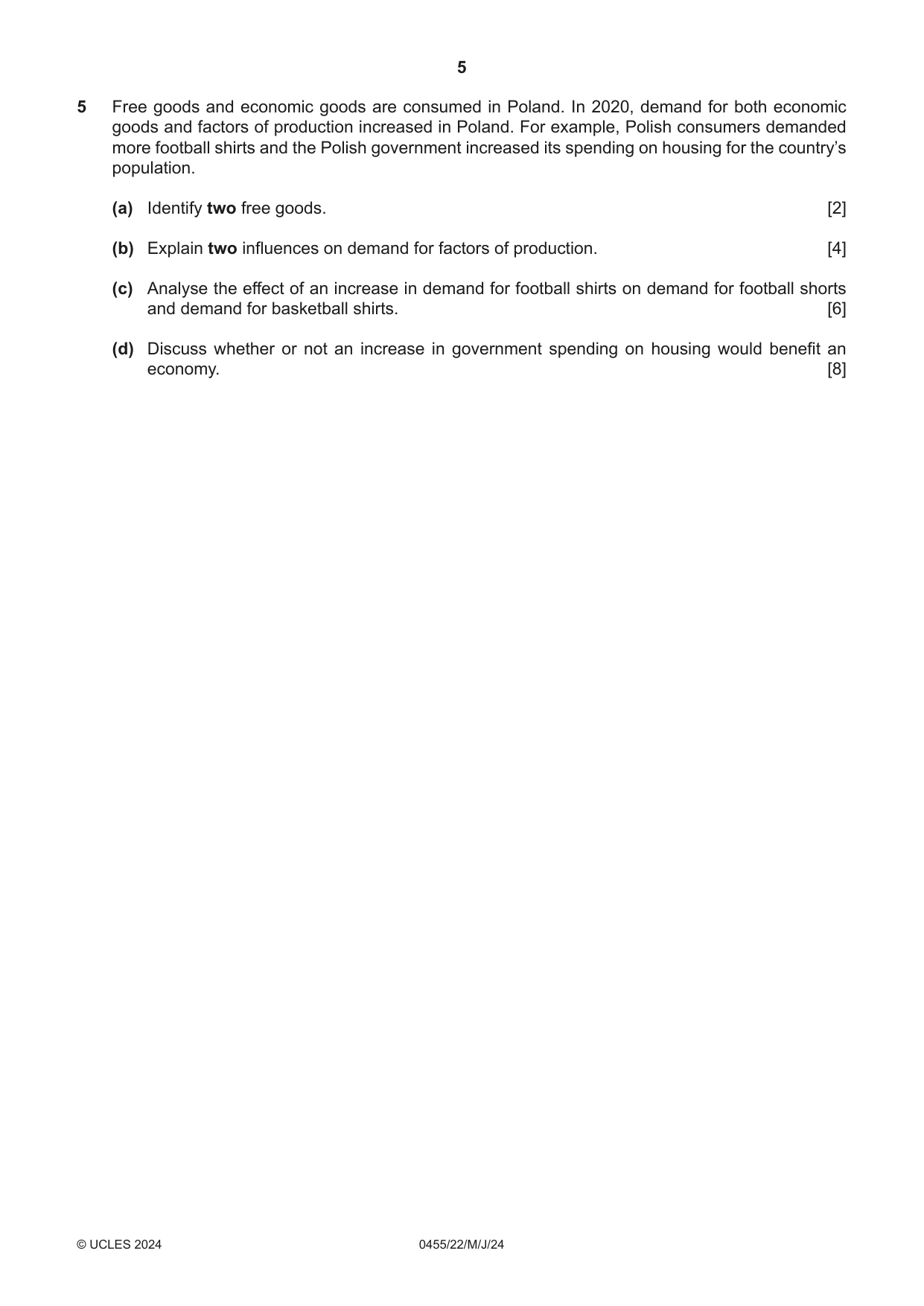
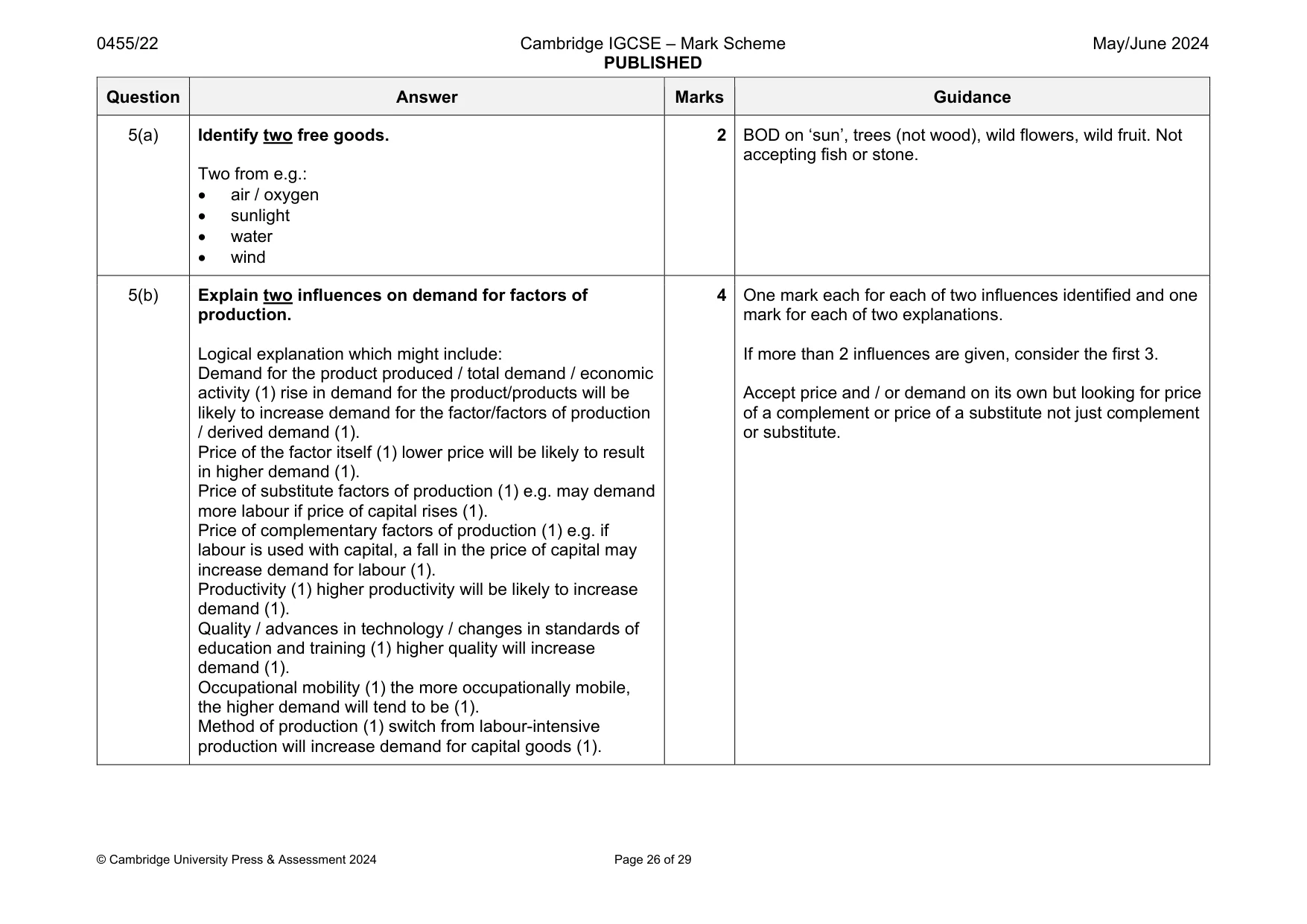
5 Free goods and economic goods are consumed in Poland. In 2020, demand for both economic goods and factors of production increased in Poland. For example, Polish consumers demanded more football shirts and the Polish government increased its spending on housing for the country’s population. (a) Identify two free goods. [2] (b) Explain two influences on demand for factors of production. [4] (c) Analyse the effect of an increase in demand for football shirts on demand for football shorts and demand for basketball shirts. [6] (d) Discuss whether or not an increase in government spending on housing would benefit an economy. [8]
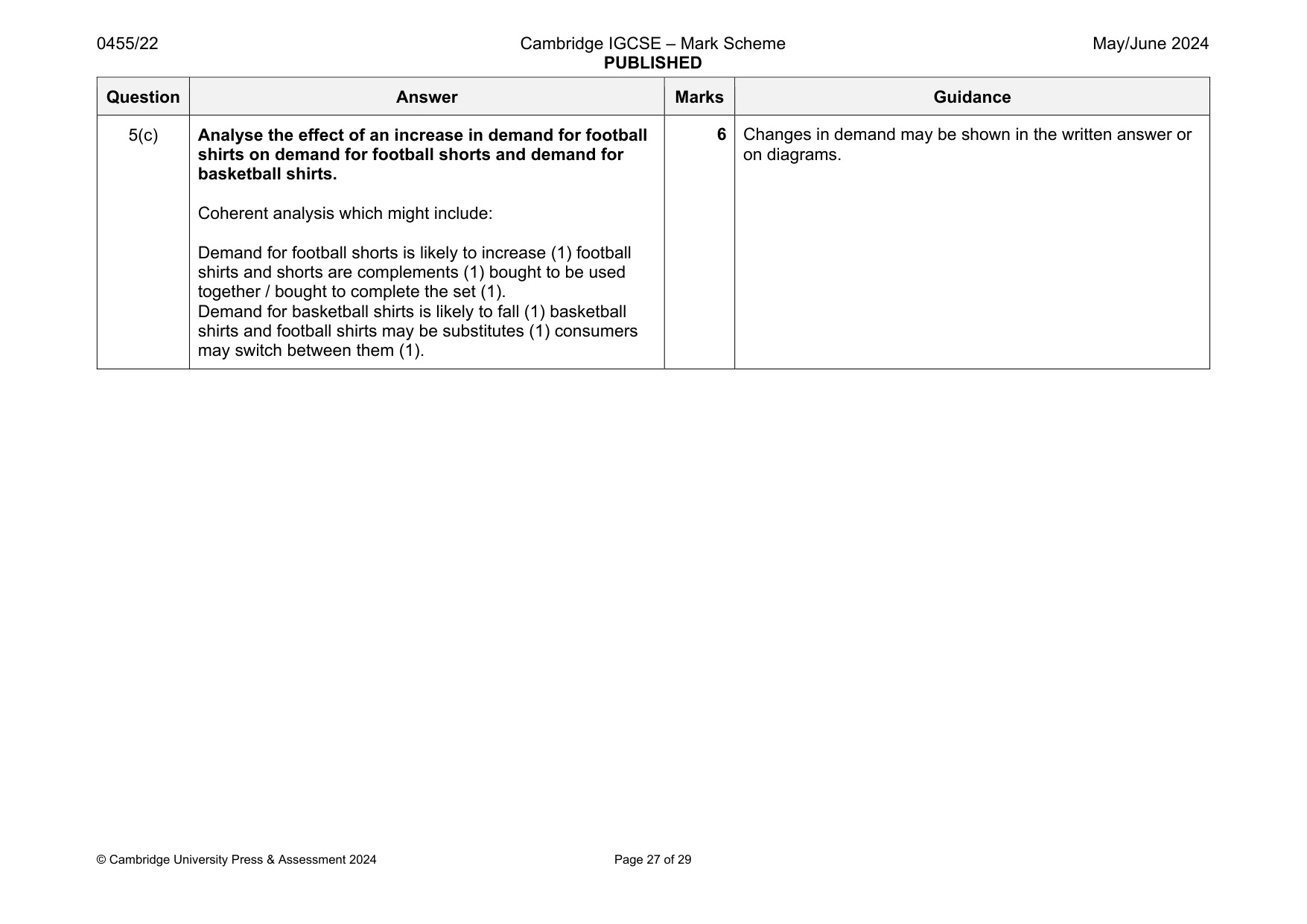
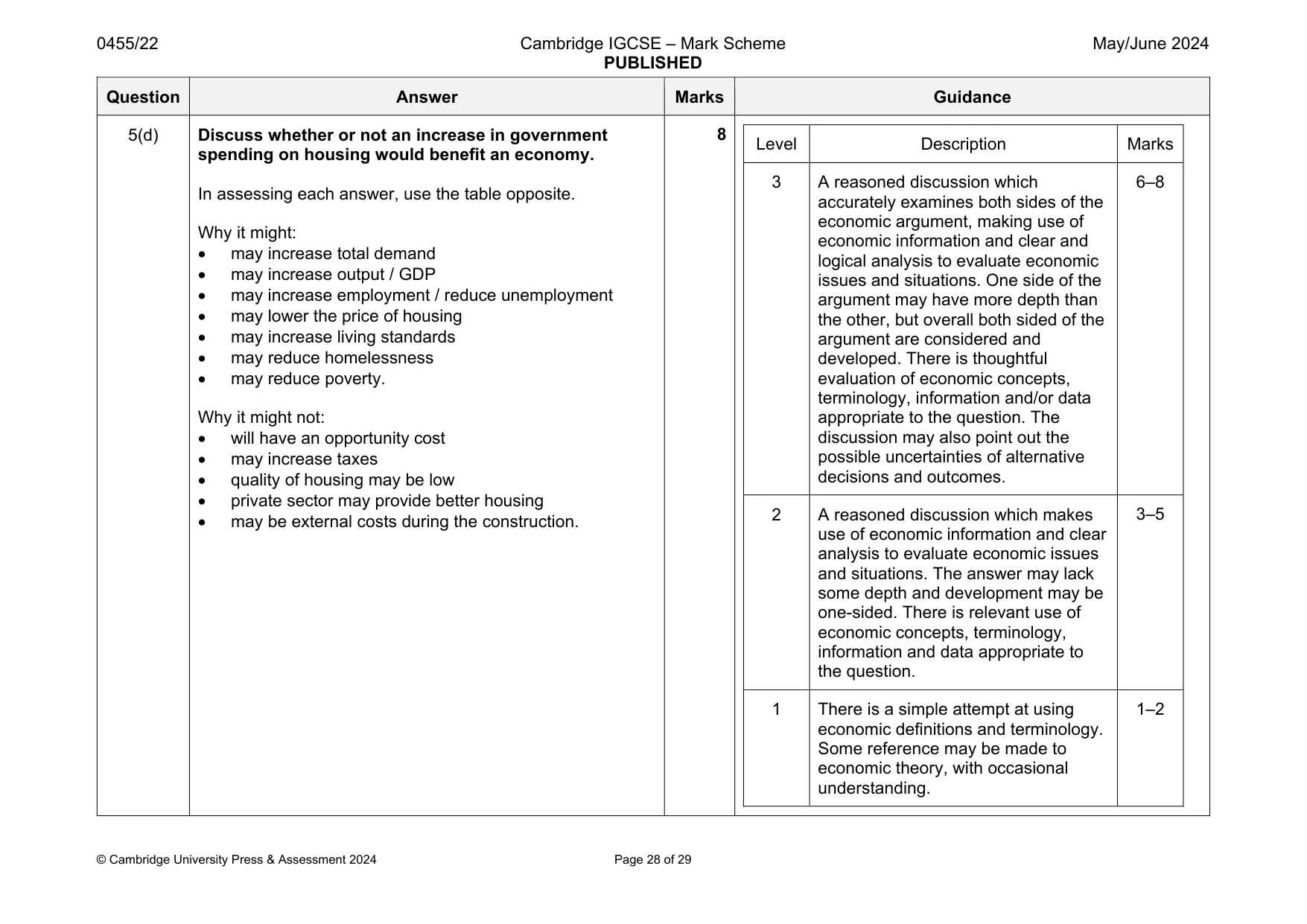
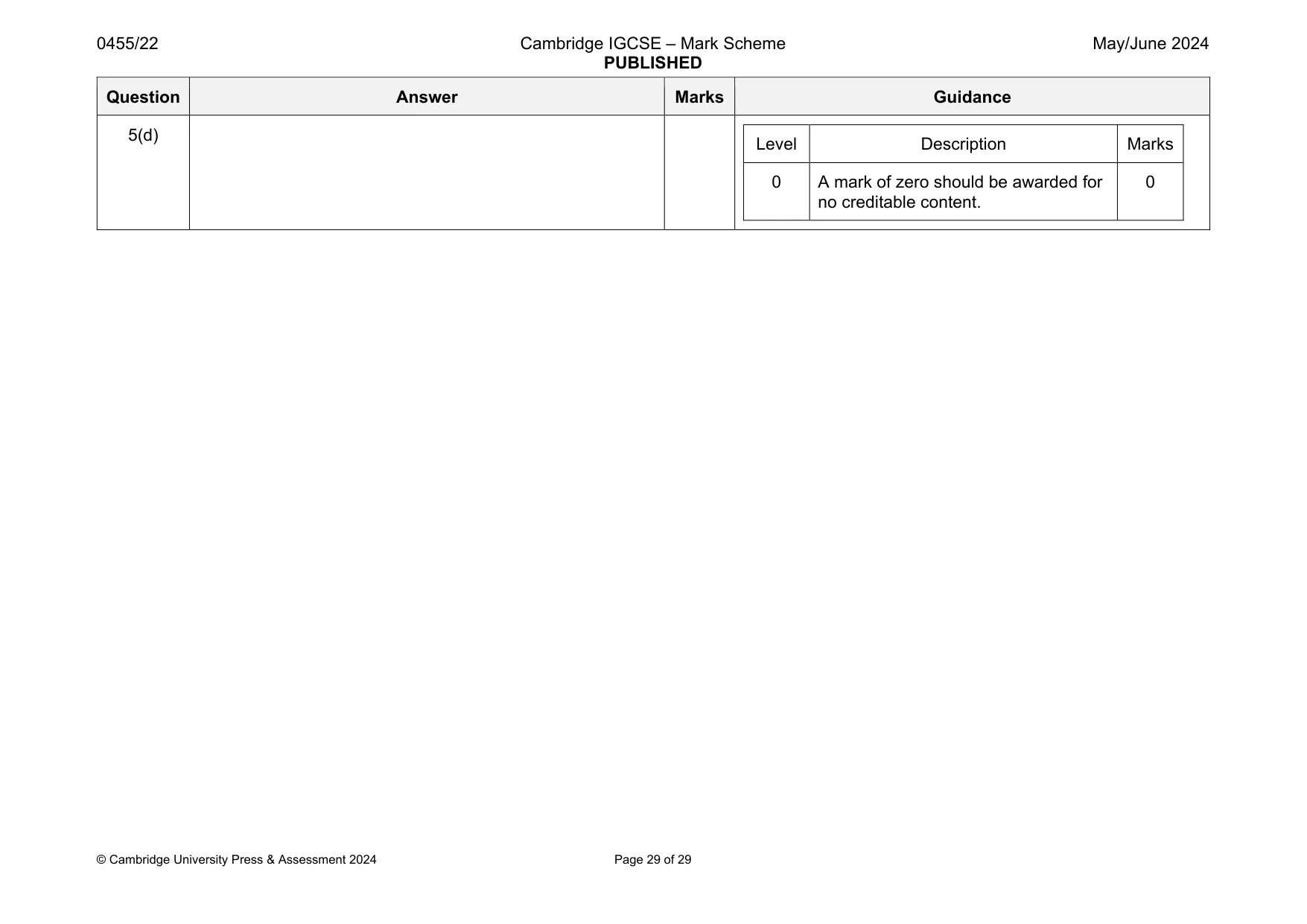
Mark scheme: 5(a) Identify two free goods. Two from e.g.: air / oxygen sunlight water wind 2 BOD on ‘sun’, trees (not wood), wild flowers, wild fruit. Not accepting fish or stone. 5(b) Explain two influences on demand for factors of production. Logical explanation which might include: Demand for the product produced / total demand / economic activity (1) rise in demand for the product/products will be likely to increase demand for the factor/factors of production / derived demand (1). Price of the factor itself (1) lower price will be likely to result in higher demand (1). Price of substitute factors of production (1) e.g. may demand more labour if price of capital rises (1). Price of complementary factors of production (1) e.g. if labour is used with capital, a fall in the price of capital may increase demand for labour (1). Productivity (1) higher productivity will be likely to increase demand (1). Quality / advances in technology / changes in standards of education and training (1) higher quality will increase demand (1). Occupational mobility (1) the more occupationally mobile, the higher demand will tend to be (1). Method of production (1) switch from labour-intensive production will increase demand for capital goods (1). 4 One mark each for each of two influences identified and one mark for each of two explanations. If more than 2 influences are given, consider the first 3. Accept price and / or demand on its own but looking for price of a complement or price of a substitute not just complement or substitute. Question Answer Marks Guidance 5(c) Analyse the effect of an increase in demand for football shirts on demand for football shorts and demand for basketball shirts. Coherent analysis which might include: Demand for football shorts is likely to increase (1) football shirts and shorts are complements (1) bought to be used together / bought to complete the set (1). Demand for basketball shirts is likely to fall (1) basketball shirts and football shirts may be substitutes (1) consumers may switch between them (1). 6 Changes in demand may be shown in the written answer or on diagrams. Question Answer Marks Guidance 5(d) Discuss whether or not an increase in government spending on housing would benefit an economy. In assessing each answer, use the table opposite. Why it might: may increase total demand may increase output / GDP may increase employment / reduce unemployment may lower the price of housing may increase living standards may reduce homelessness may reduce poverty. Why it might not: will have an opportunity cost may increase taxes quality of housing may be low private sector may provide better housing may be external costs during the construction. 8 Level Description Marks 3 A reasoned discussion which accurately examines both sides of the economic argument, making use of economic information and clear and logical analysis to evaluate economic issues and situations. One side of the argument may have more depth than the other, but overall both sided of the argument are considered and developed. There is thoughtful evaluation of economic concepts, terminology, information and/or data appropriate to the question. The discussion may also point out the possible uncertainties of alternative decisions and outcomes. 6–8 2 A reasoned discussion which makes use of economic information and clear analysis to evaluate economic issues and situations. The answer may lack some depth and development may be one-sided. There is relevant use of economic concepts, terminology, information and data appropriate to the question. 3–5 1 There is a simple attempt at using economic definitions and terminology. Some reference may be made to economic theory, with occasional understanding. 1–2 Question Answer Marks Guidance 5(d) Level Description Marks 0 A mark of zero should be awarded for no creditable content. 0
What was in this paper
The subtopics covered by these 5 questions, and how many questions each got. Open one in a new tab to see every Cambridge question on it.
What you needed in this session
Cambridge’s own grade thresholds for 2024 May/June, Paper 2 · Variant 2. A higher threshold means an easier paper — the bar moves with how the cohort did.