Cambridge IGCSE Economics 0455 — 2024 May/June Paper 2 · Variant 3
0455/23/M/J/24 · 5 questions · 90 marks · ≈101 min
The question paper and its mark scheme, free to read here and free to download. This is Cambridge’s own paper, exactly as it was sat.
Question paper8 pages




Mark scheme27 pages
Answers below. Sit the paper first if you are practising.






Questions as text
Q1 · Calculate the percentage contribution of Jakarta to Indonesia’s GDP in 2021
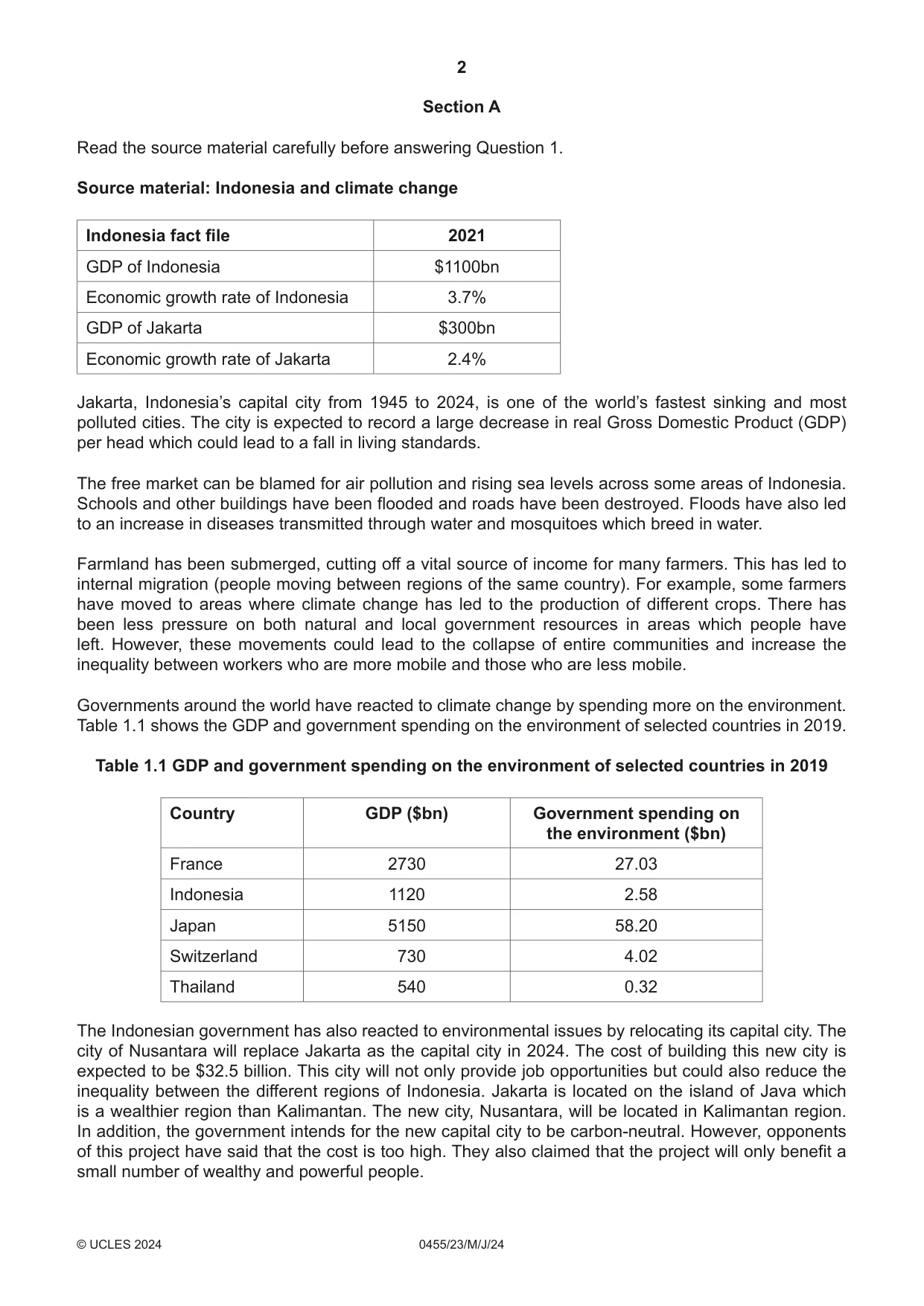
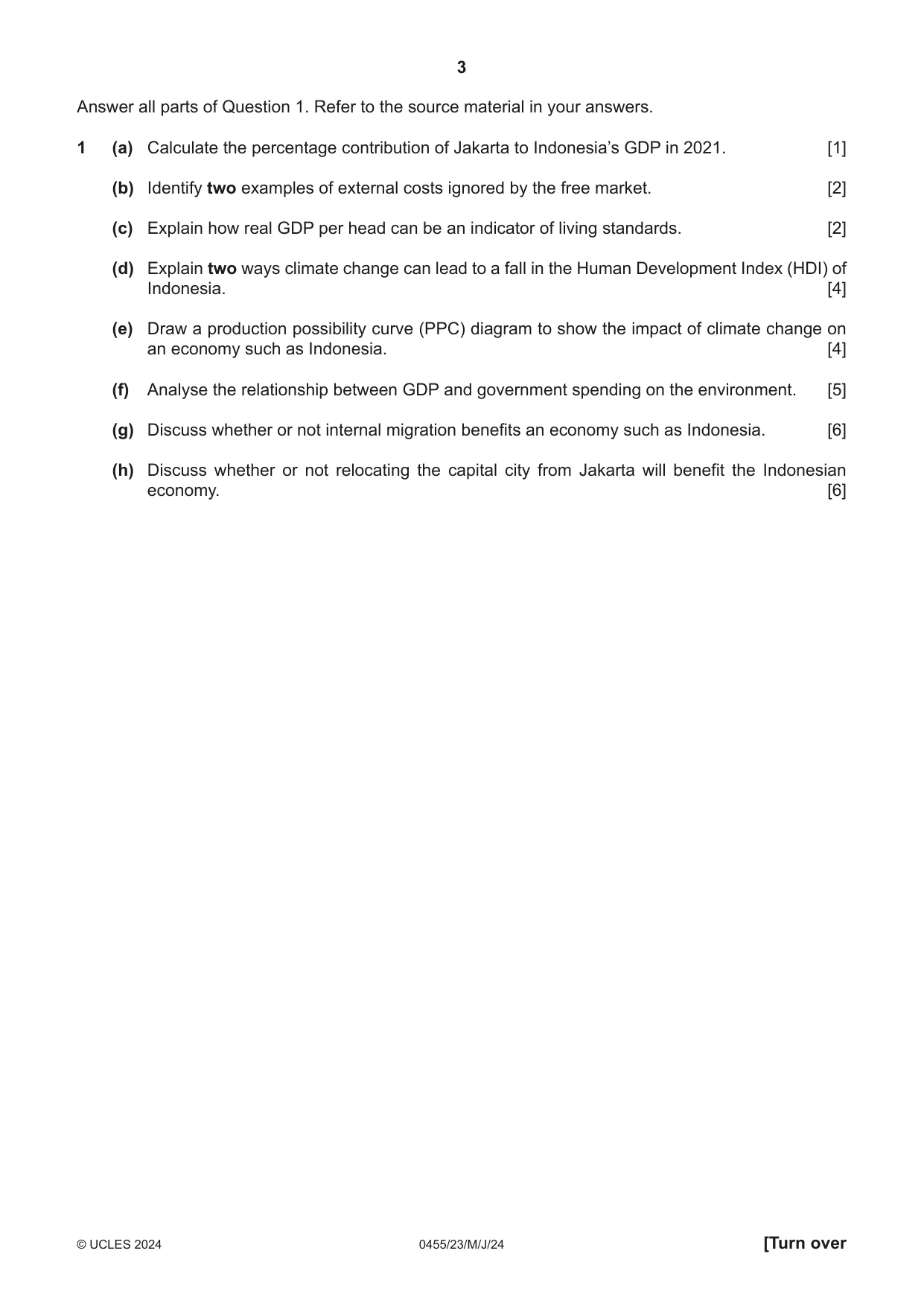
1 (a) Calculate the percentage contribution of Jakarta to Indonesia’s GDP in 2021. [1] (b) Identify two examples of external costs ignored by the free market. [2] (c) Explain how real GDP per head can be an indicator of living standards. [2] (d) Explain two ways climate change can lead to a fall in the Human Development Index (HDI) of Indonesia. [4] (e) Draw a production possibility curve (PPC) diagram to show the impact of climate change on an economy such as Indonesia. [4] (f) Analyse the relationship between GDP and government spending on the environment. [5] (g) Discuss whether or not internal migration benefits an economy such as Indonesia. [6] (h) Discuss whether or not relocating the capital city from Jakarta will benefit the Indonesian economy. [6]
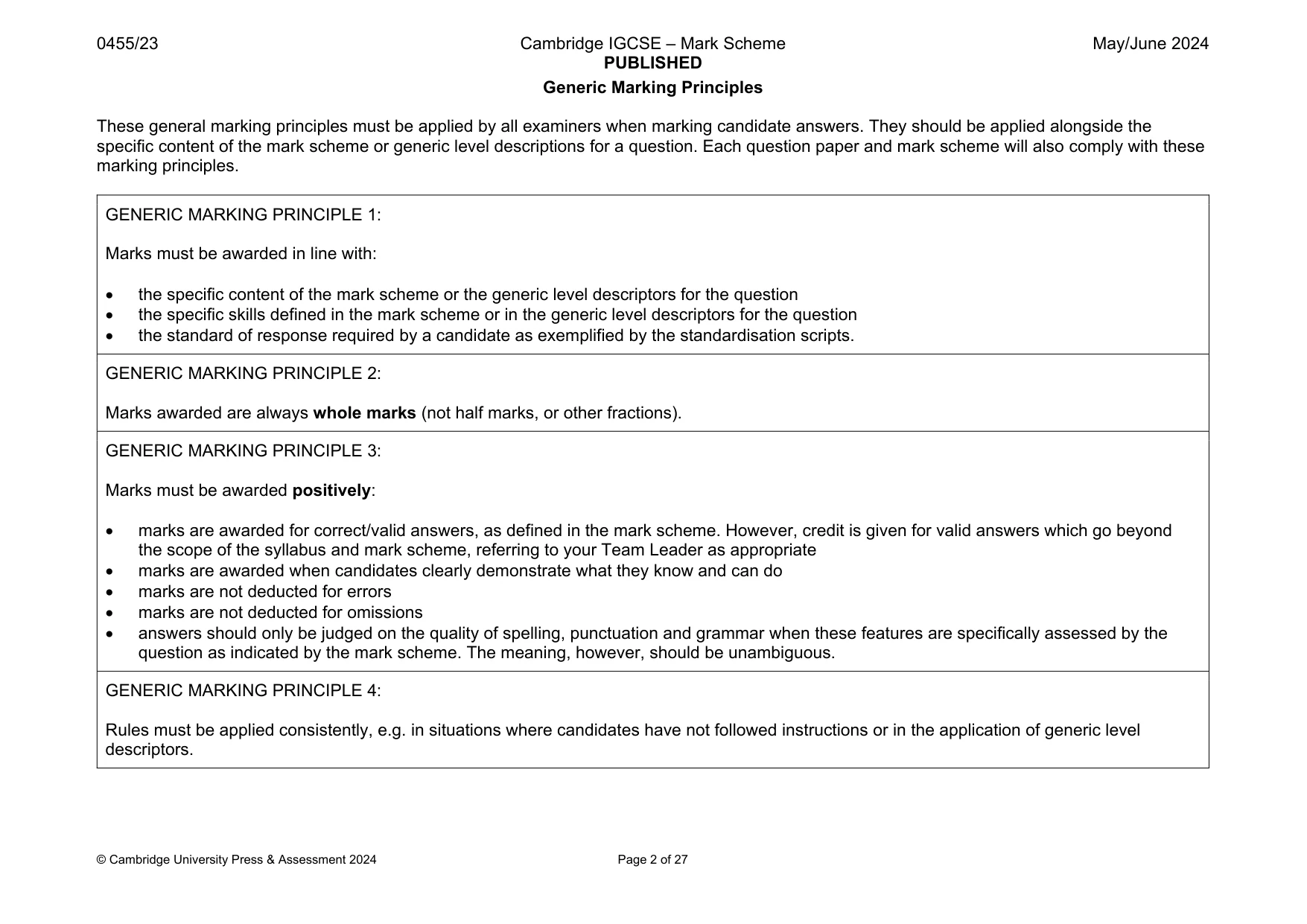
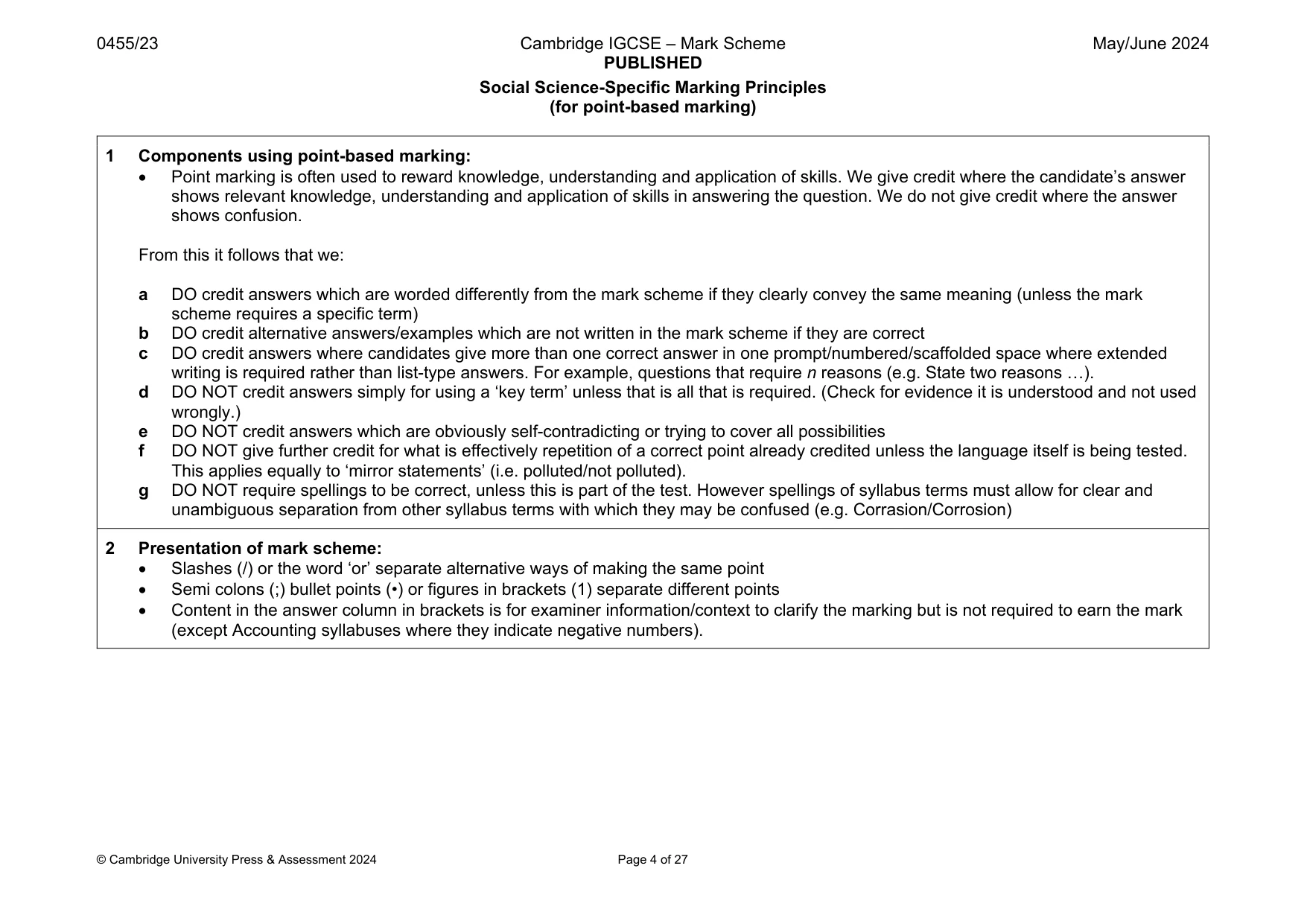
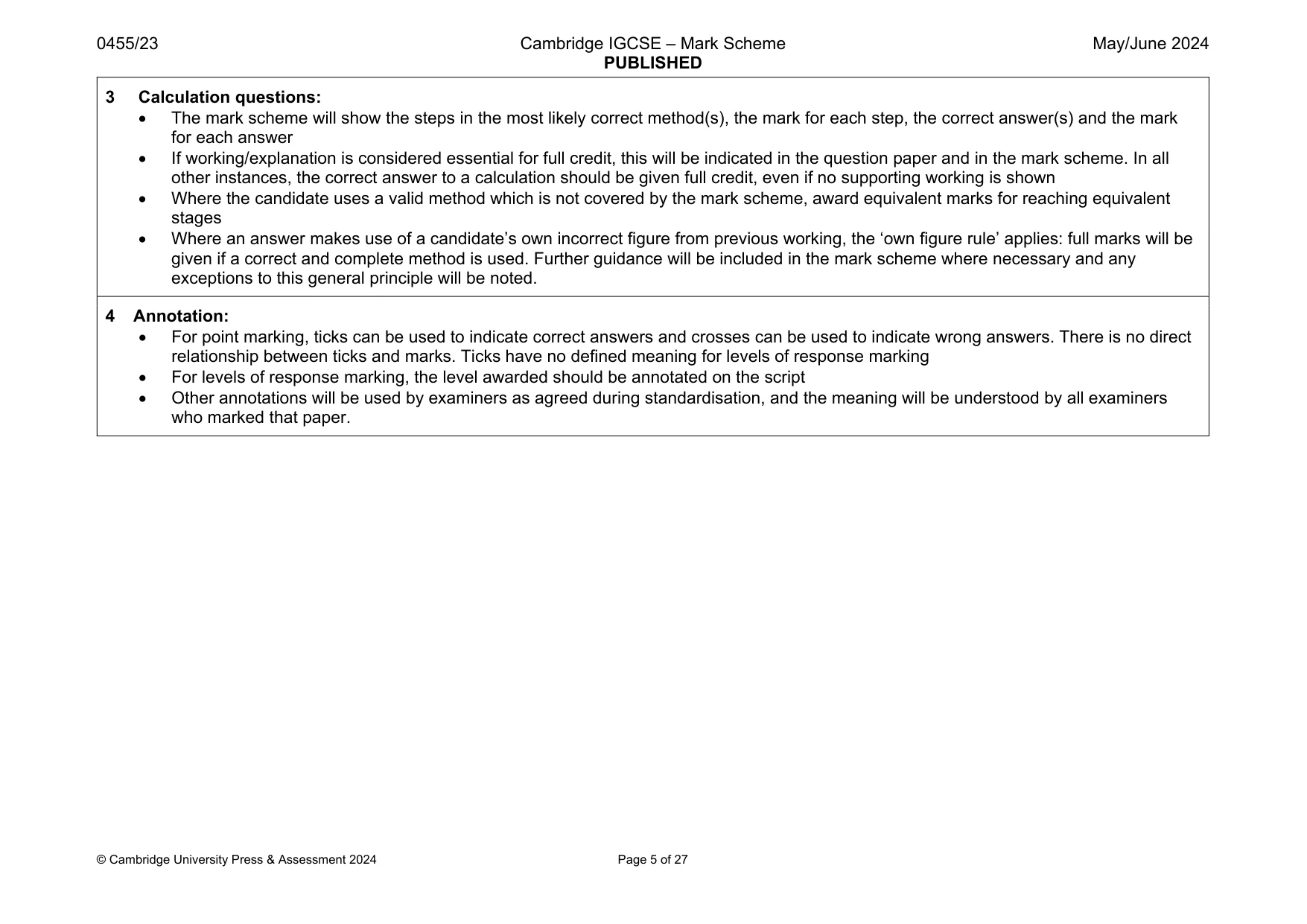
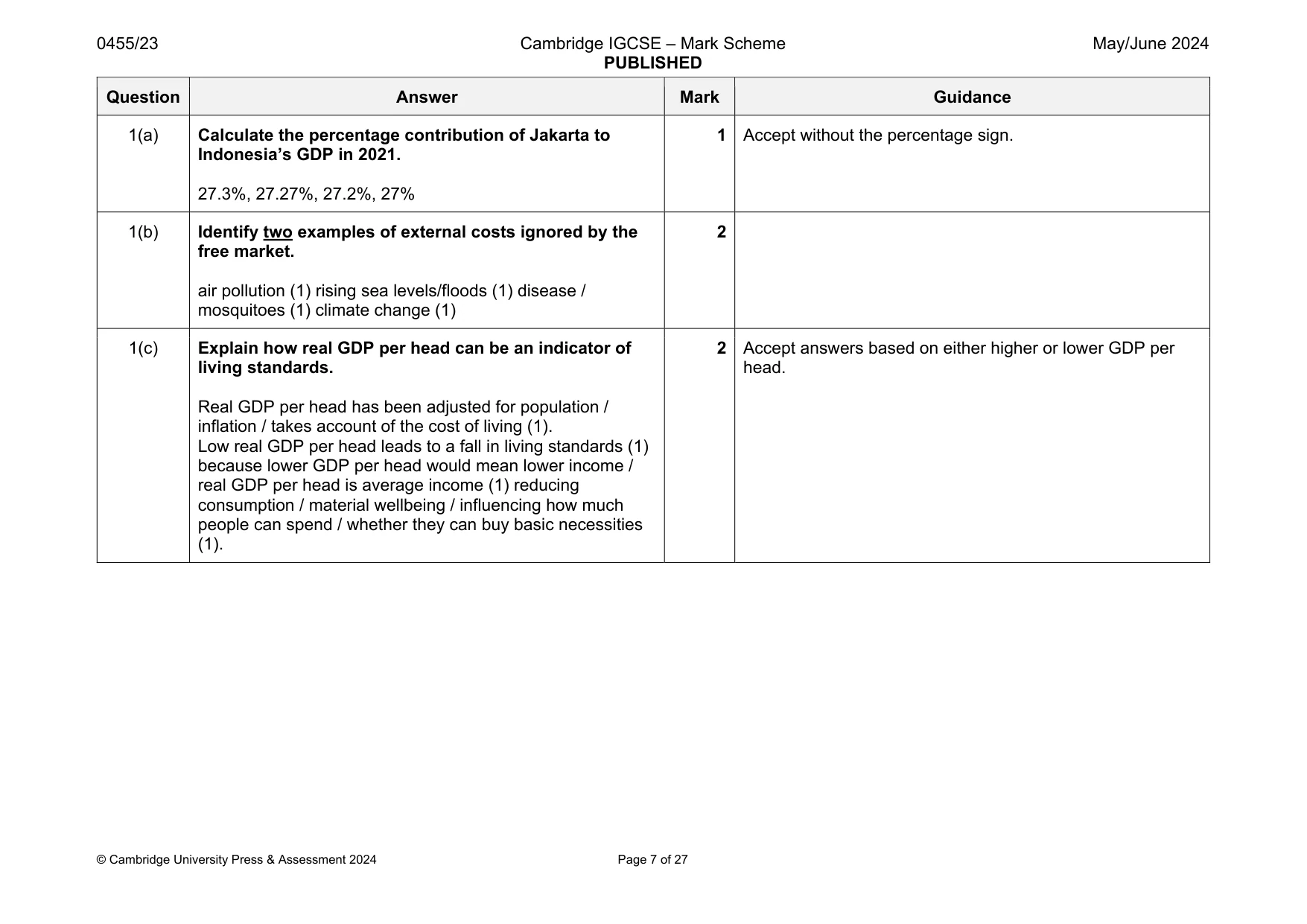
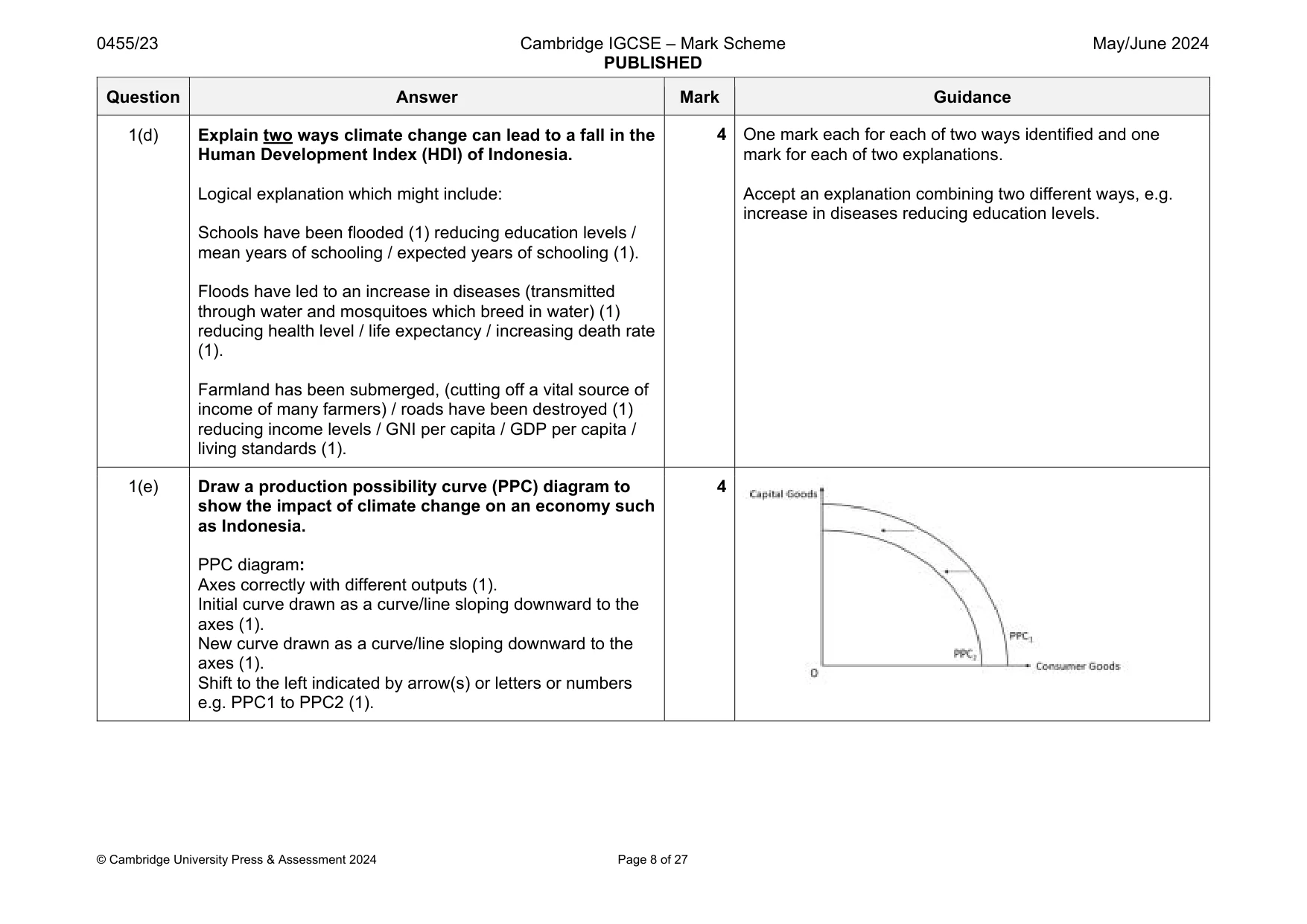
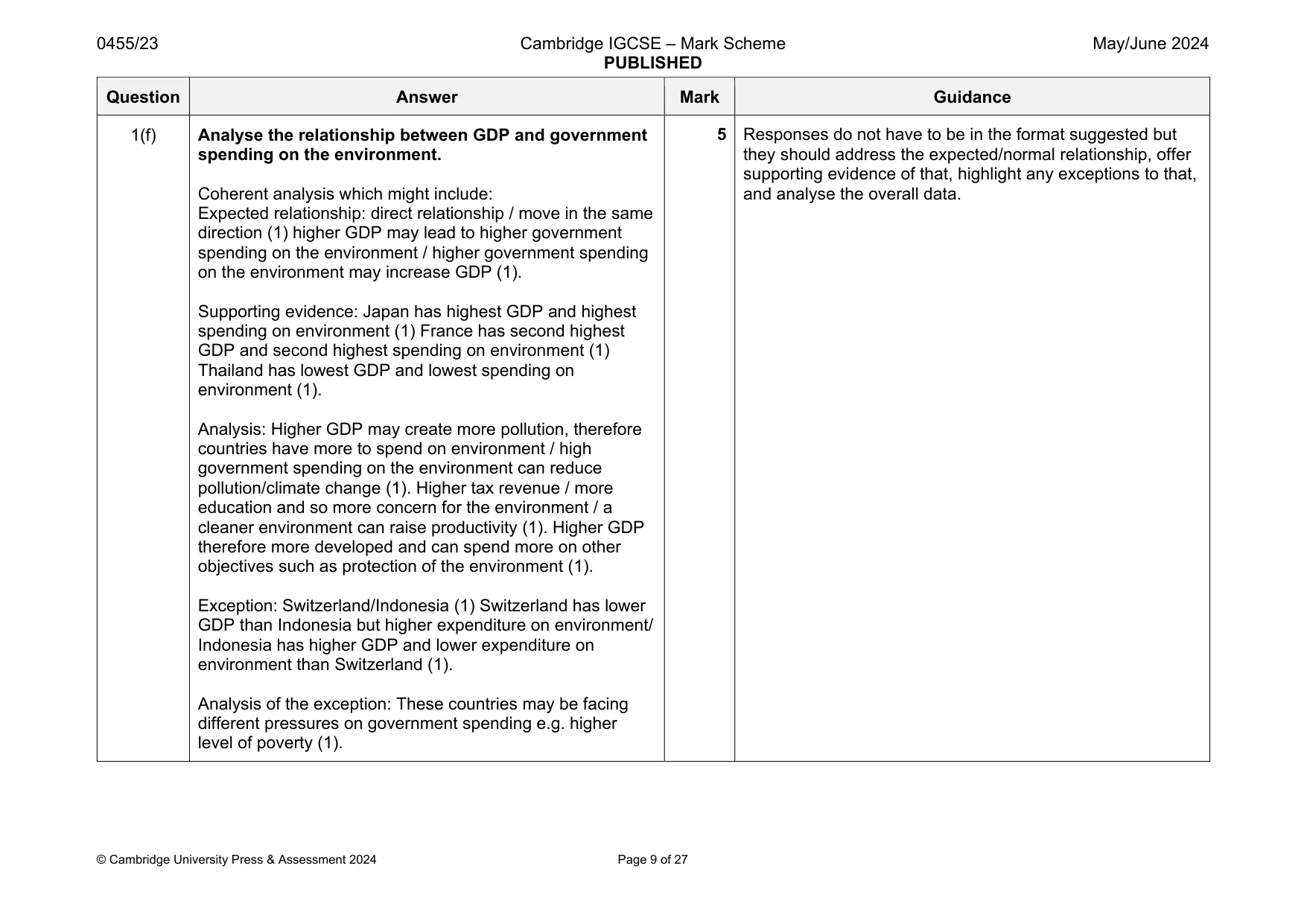
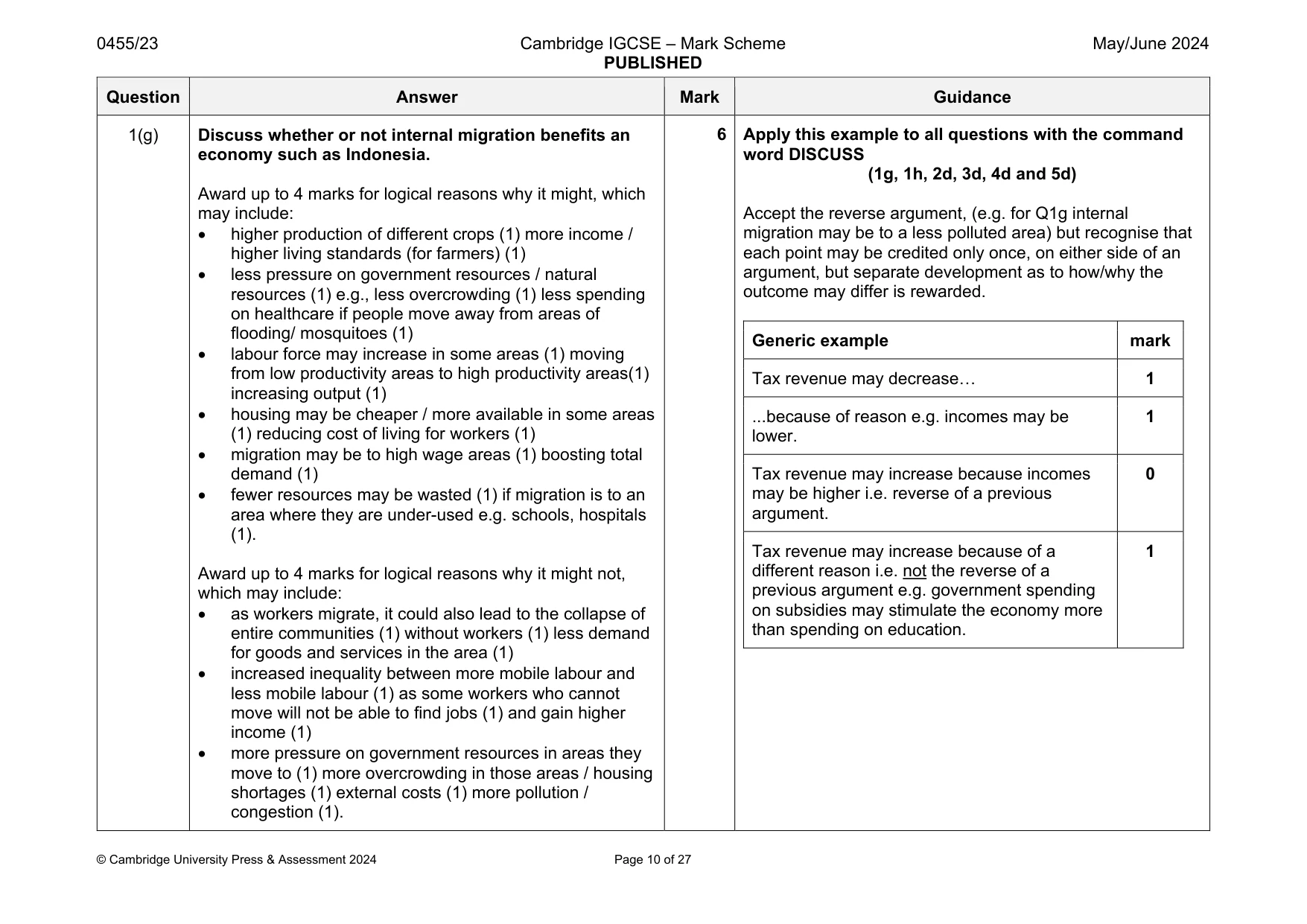
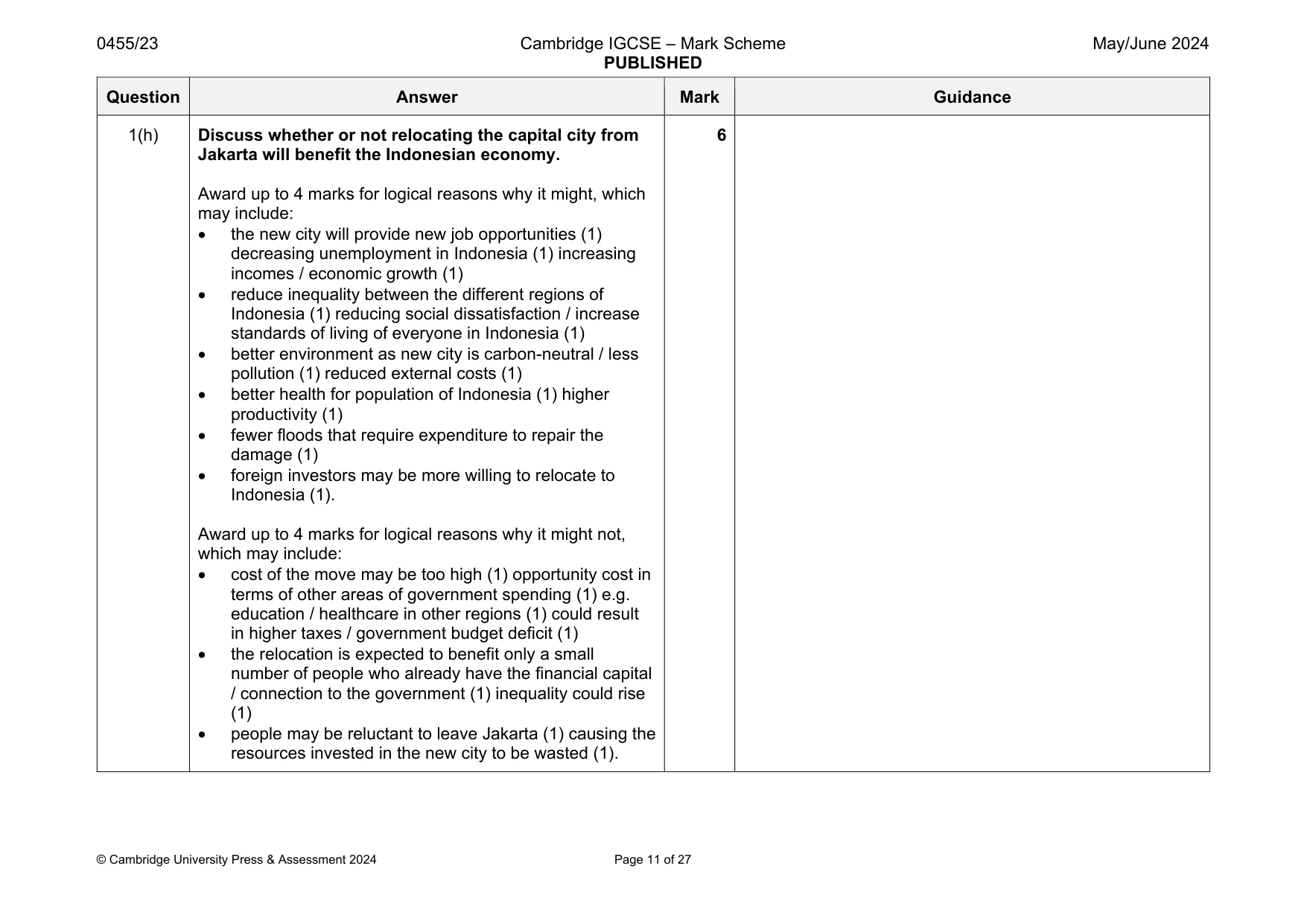
Mark scheme: 1(a) Calculate the percentage contribution of Jakarta to Indonesia’s GDP in 2021. 27.3%, 27.27%, 27.2%, 27% 1 Accept without the percentage sign. 1(b) Identify two examples of external costs ignored by the free market. air pollution (1) rising sea levels/floods (1) disease / mosquitoes (1) climate change (1) 2 1(c) Explain how real GDP per head can be an indicator of living standards. Real GDP per head has been adjusted for population / inflation / takes account of the cost of living (1). Low real GDP per head leads to a fall in living standards (1) because lower GDP per head would mean lower income / real GDP per head is average income (1) reducing consumption / material wellbeing / influencing how much people can spend / whether they can buy basic necessities (1). 2 Accept answers based on either higher or lower GDP per head. Question Answer Mark Guidance 1(d) Explain two ways climate change can lead to a fall in the Human Development Index (HDI) of Indonesia. Logical explanation which might include: Schools have been flooded (1) reducing education levels / mean years of schooling / expected years of schooling (1). Floods have led to an increase in diseases (transmitted through water and mosquitoes which breed in water) (1) reducing health level / life expectancy / increasing death rate (1). Farmland has been submerged, (cutting off a vital source of income of many farmers) / roads have been destroyed (1) reducing income levels / GNI per capita / GDP per capita / living standards (1). 4 One mark each for each of two ways identified and one mark for each of two explanations. Accept an explanation combining two different ways, e.g. increase in diseases reducing education levels. 1(e) Draw a production possibility curve (PPC) diagram to show the impact of climate change on an economy such as Indonesia. PPC diagram: Axes correctly with different outputs (1). Initial curve drawn as a curve/line sloping downward to the axes (1). New curve drawn as a curve/line sloping downward to the axes (1). Shift to the left indicated by arrow(s) or letters or numbers e.g. PPC1 to PPC2 (1). 4 Question Answer Mark Guidance 1(f) Analyse the relationship between GDP and government spending on the environment. Coherent analysis which might include: Expected relationship: direct relationship / move in the same direction (1) higher GDP may lead to higher government spending on the environment / higher government spending on the environment may increase GDP (1). Supporting evidence: Japan has highest GDP and highest spending on environment (1) France has second highest GDP and second highest spending on environment (1) Thailand has lowest GDP and lowest spending on environment (1). Analysis: Higher GDP may create more pollution, therefore countries have more to spend on environment / high government spending on the environment can reduce pollution/climate change (1). Higher tax revenue / more education and so more concern for the environment / a cleaner environment can raise productivity (1). Higher GDP therefore more developed and can spend more on other objectives such as protection of the environment (1). Exception: Switzerland/Indonesia (1) Switzerland has lower GDP than Indonesia but higher expenditure on environment/ Indonesia has higher GDP and lower expenditure on environment than Switzerland (1). Analysis of the exception: These countries may be facing different pressures on government spending e.g. higher level of poverty (1). 5 Responses do not have to be in the format suggested but they should address the expected/normal relationship, offer supporting evidence of that, highlight any exceptions to that, and analyse the overall data. Question Answer Mark Guidance 1(g) Discuss whether or not internal migration benefits an economy such as Indonesia. Award up to 4 marks for logical reasons why it might, which may include: higher production of different crops (1) more income / higher living standards (for farmers) (1) less pressure on government resources / natural resources (1) e.g., less overcrowding (1) less spending on healthcare if people move away from areas of flooding/ mosquitoes (1) labour force may increase in some areas (1) moving from low productivity areas to high productivity areas(1) increasing output (1) housing may be cheaper / more available in some areas (1) reducing cost of living for workers (1) migration may be to high wage areas (1) boosting total demand (1) fewer resources may be wasted (1) if migration is to an area where they are under-used e.g. schools, hospitals (1). Award up to 4 marks for logical reasons why it might not, which may include: as workers migrate, it could also lead to the collapse of entire communities (1) without workers (1) less demand for goods and services in the area (1) increased inequality between more mobile labour and less mobile labour (1) as some workers who cannot move will not be able to find jobs (1) and gain higher income (1) more pressure on government resources in areas they move to (1) more overcrowding in those areas / housing shortages (1) external costs (1) more pollution / congestion (1). 6 Apply this example to all questions with the command word DISCUSS (1g, 1h, 2d, 3d, 4d and 5d) Accept the reverse argument, (e.g. for Q1g internal migration may be to a less polluted area) but recognise that each point may be credited only once, on either side of an argument, but separate development as to how/why the outcome may differ is rewarded. Generic example mark Tax revenue may decrease… 1 ...because of reason e.g. incomes may be lower. 1 Tax revenue may increase because incomes may be higher i.e. reverse of a previous argument. 0 Tax revenue may increase because of a different reason i.e. not the reverse of a previous argument e.g. government spending on subsidies may stimulate the economy more than spending on education. 1 Question Answer Mark Guidance 1(h) Discuss whether or not relocating the capital city from Jakarta will benefit the Indonesian economy. Award up to 4 marks for logical reasons why it might, which may include: the new city will provide new job opportunities (1) decreasing unemployment in Indonesia (1) increasing incomes / economic growth (1) reduce inequality between the different regions of Indonesia (1) reducing social dissatisfaction / increase standards of living of everyone in Indonesia (1) better environment as new city is carbon-neutral / less pollution (1) reduced external costs (1) better health for population of Indonesia (1) higher productivity (1) fewer floods that require expenditure to repair the damage (1) foreign investors may be more willing to relocate to Indonesia (1). Award up to 4 marks for logical reasons why it might not, which may include: cost of the move may be too high (1) opportunity cost in terms of other areas of government spending (1) e.g. education / healthcare in other regions (1) could result in higher taxes / government budget deficit (1) the relocation is expected to benefit only a small number of people who already have the financial capital / connection to the government (1) inequality could rise (1) people may be reluctant to leave Jakarta (1) causing the resources invested in the new city to be wasted (1). 6
Q2 · Shenzhen, once a fishing village, is now one of China’s richest cities with a large…
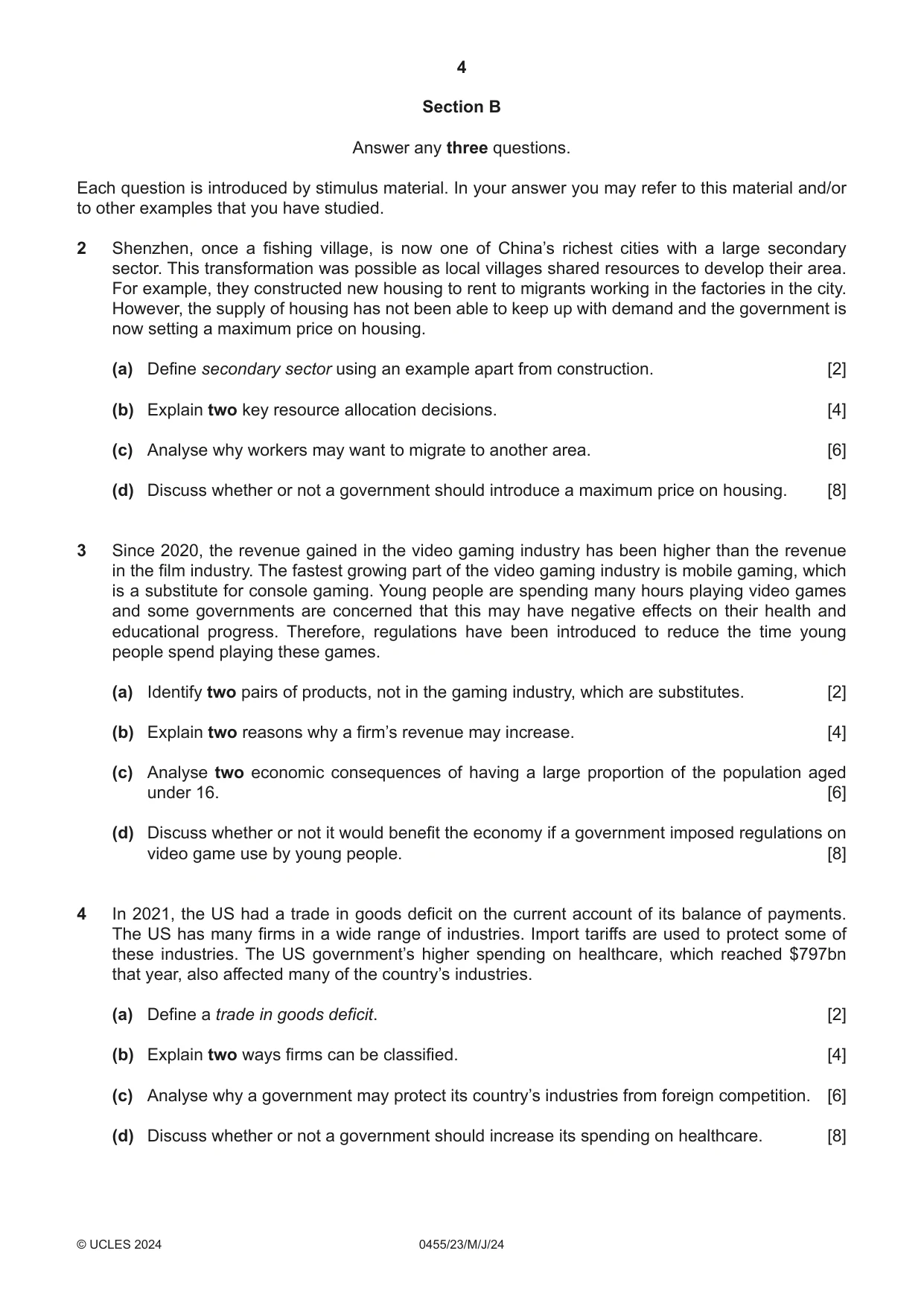
2 Shenzhen, once a fishing village, is now one of China’s richest cities with a large secondary sector. This transformation was possible as local villages shared resources to develop their area. For example, they constructed new housing to rent to migrants working in the factories in the city. However, the supply of housing has not been able to keep up with demand and the government is now setting a maximum price on housing. (a) Define secondary sector using an example apart from construction. [2] (b) Explain two key resource allocation decisions. [4] (c) Analyse why workers may want to migrate to another area. [6] (d) Discuss whether or not a government should introduce a maximum price on housing. [8]
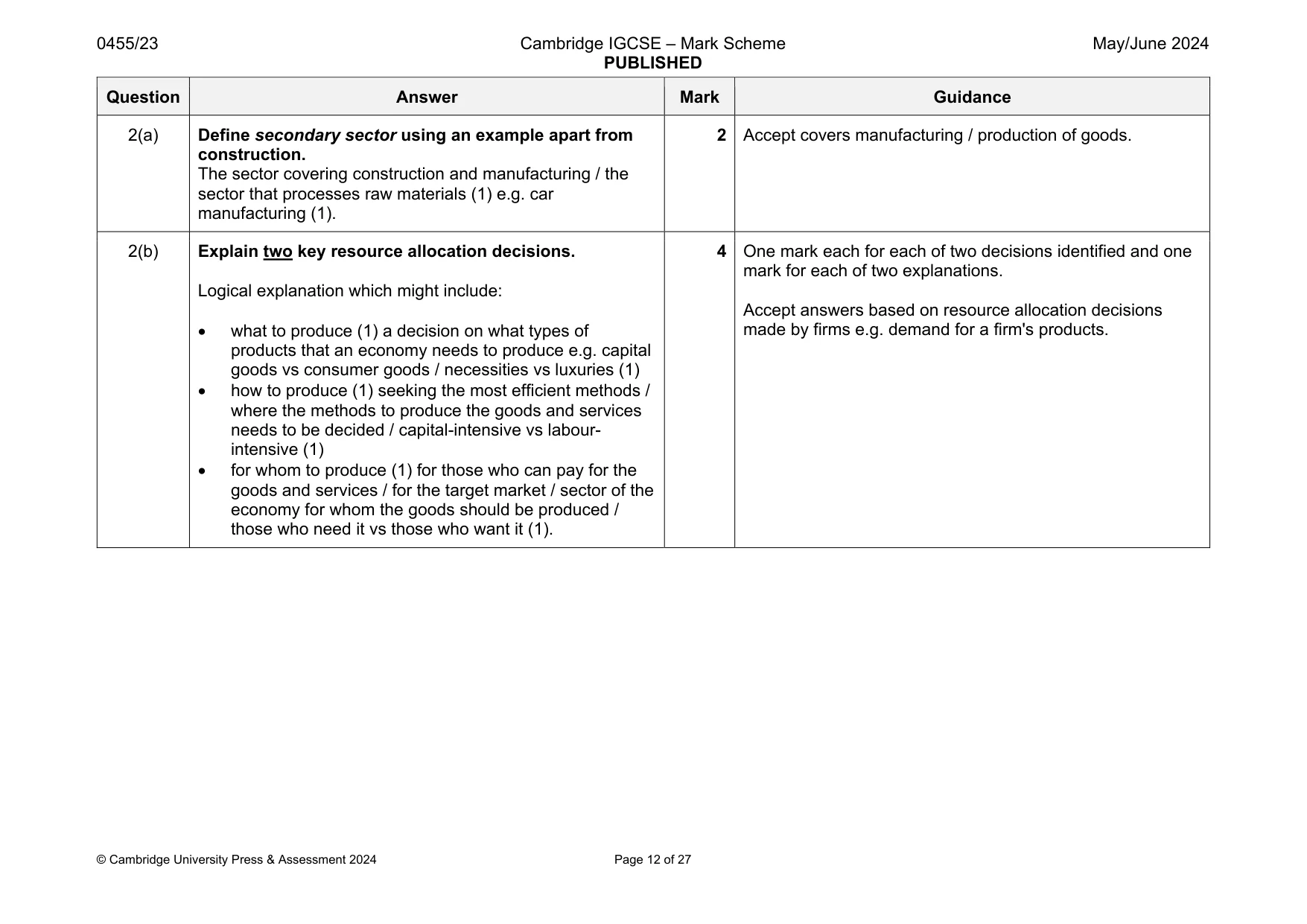
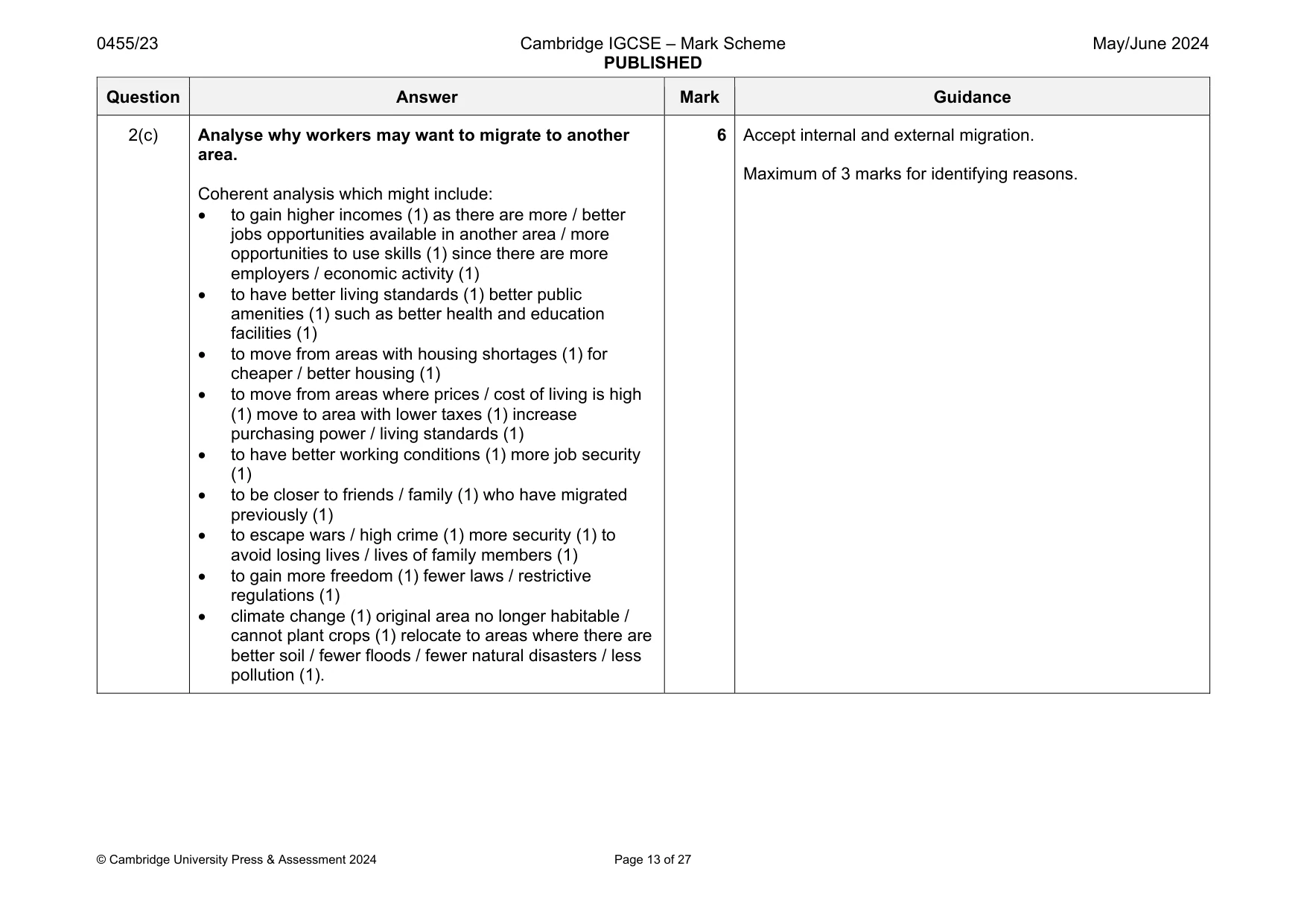
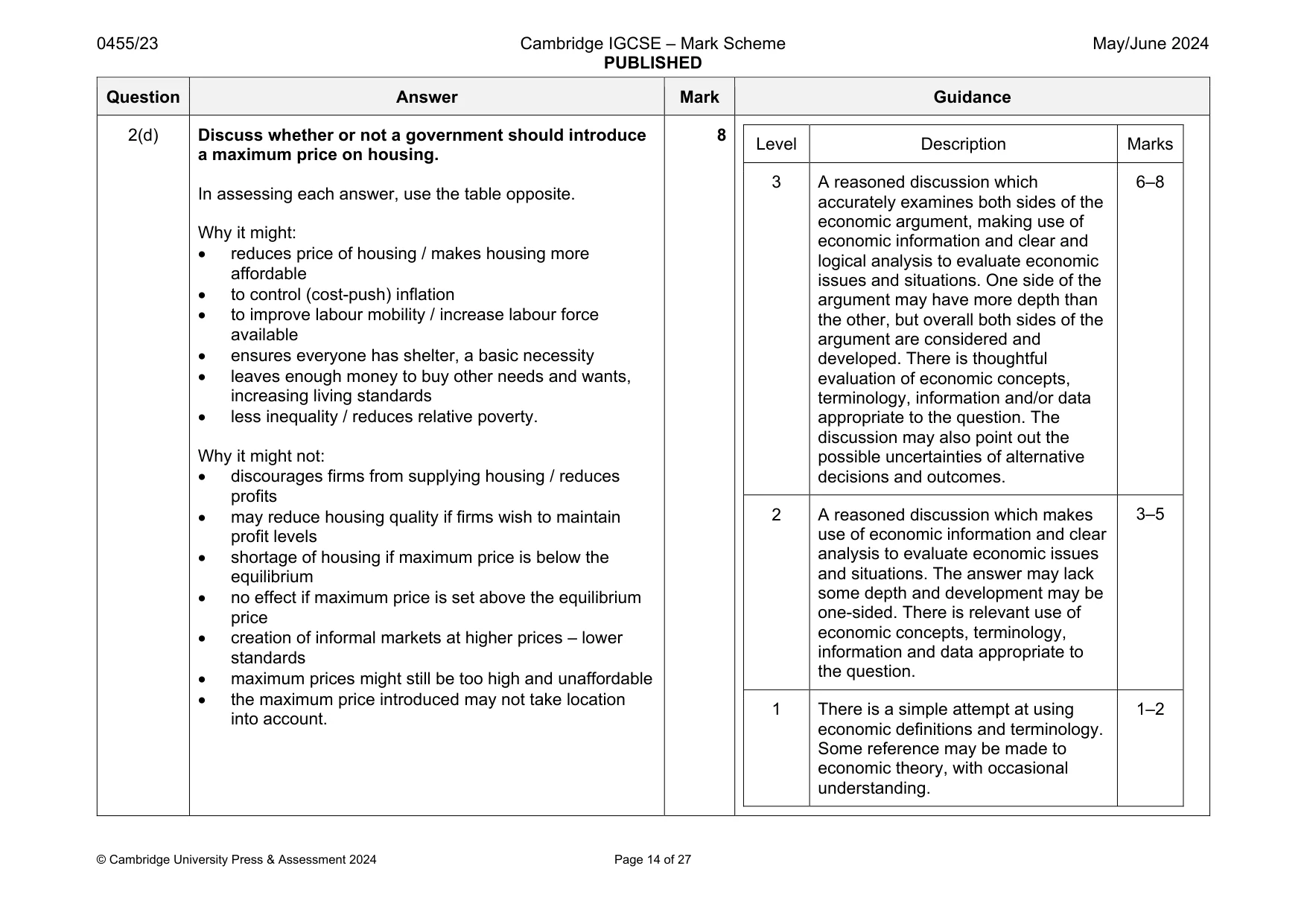
Mark scheme: 2(a) Define secondary sector using an example apart from construction. The sector covering construction and manufacturing / the sector that processes raw materials (1) e.g. car manufacturing (1). 2 Accept covers manufacturing / production of goods. 2(b) Explain two key resource allocation decisions. Logical explanation which might include: what to produce (1) a decision on what types of products that an economy needs to produce e.g. capital goods vs consumer goods / necessities vs luxuries (1) how to produce (1) seeking the most efficient methods / where the methods to produce the goods and services needs to be decided / capital-intensive vs labour- intensive (1) for whom to produce (1) for those who can pay for the goods and services / for the target market / sector of the economy for whom the goods should be produced / those who need it vs those who want it (1). 4 One mark each for each of two decisions identified and one mark for each of two explanations. Accept answers based on resource allocation decisions made by firms e.g. demand for a firm's products. Question Answer Mark Guidance 2(c) Analyse why workers may want to migrate to another area. Coherent analysis which might include: to gain higher incomes (1) as there are more / better jobs opportunities available in another area / more opportunities to use skills (1) since there are more employers / economic activity (1) to have better living standards (1) better public amenities (1) such as better health and education facilities (1) to move from areas with housing shortages (1) for cheaper / better housing (1) to move from areas where prices / cost of living is high (1) move to area with lower taxes (1) increase purchasing power / living standards (1) to have better working conditions (1) more job security (1) to be closer to friends / family (1) who have migrated previously (1) to escape wars / high crime (1) more security (1) to avoid losing lives / lives of family members (1) to gain more freedom (1) fewer laws / restrictive regulations (1) climate change (1) original area no longer habitable / cannot plant crops (1) relocate to areas where there are better soil / fewer floods / fewer natural disasters / less pollution (1). 6 Accept internal and external migration. Maximum of 3 marks for identifying reasons. Question Answer Mark Guidance 2(d) Discuss whether or not a government should introduce a maximum price on housing. In assessing each answer, use the table opposite. Why it might: reduces price of housing / makes housing more affordable to control (cost-push) inflation to improve labour mobility / increase labour force available ensures everyone has shelter, a basic necessity leaves enough money to buy other needs and wants, increasing living standards less inequality / reduces relative poverty. Why it might not: discourages firms from supplying housing / reduces profits may reduce housing quality if firms wish to maintain profit levels shortage of housing if maximum price is below the equilibrium no effect if maximum price is set above the equilibrium price creation of informal markets at higher prices – lower standards maximum prices might still be too high and unaffordable the maximum price introduced may not take location into account. 8 Level Description Marks 3 A reasoned discussion which accurately examines both sides of the economic argument, making use of economic information and clear and logical analysis to evaluate economic issues and situations. One side of the argument may have more depth than the other, but overall both sides of the argument are considered and developed. There is thoughtful evaluation of economic concepts, terminology, information and/or data appropriate to the question. The discussion may also point out the possible uncertainties of alternative decisions and outcomes. 6–8 2 A reasoned discussion which makes use of economic information and clear analysis to evaluate economic issues and situations. The answer may lack some depth and development may be one-sided. There is relevant use of economic concepts, terminology, information and data appropriate to the question. 3–5 1 There is a simple attempt at using economic definitions and terminology. Some reference may be made to economic theory, with occasional understanding. 1–2 Question Answer Mark Guidance Level Description Marks 0 A mark of zero should be awarded for no creditable content. 0
Q3 · Since 2020, the revenue gained in the video gaming industry has been higher than the…
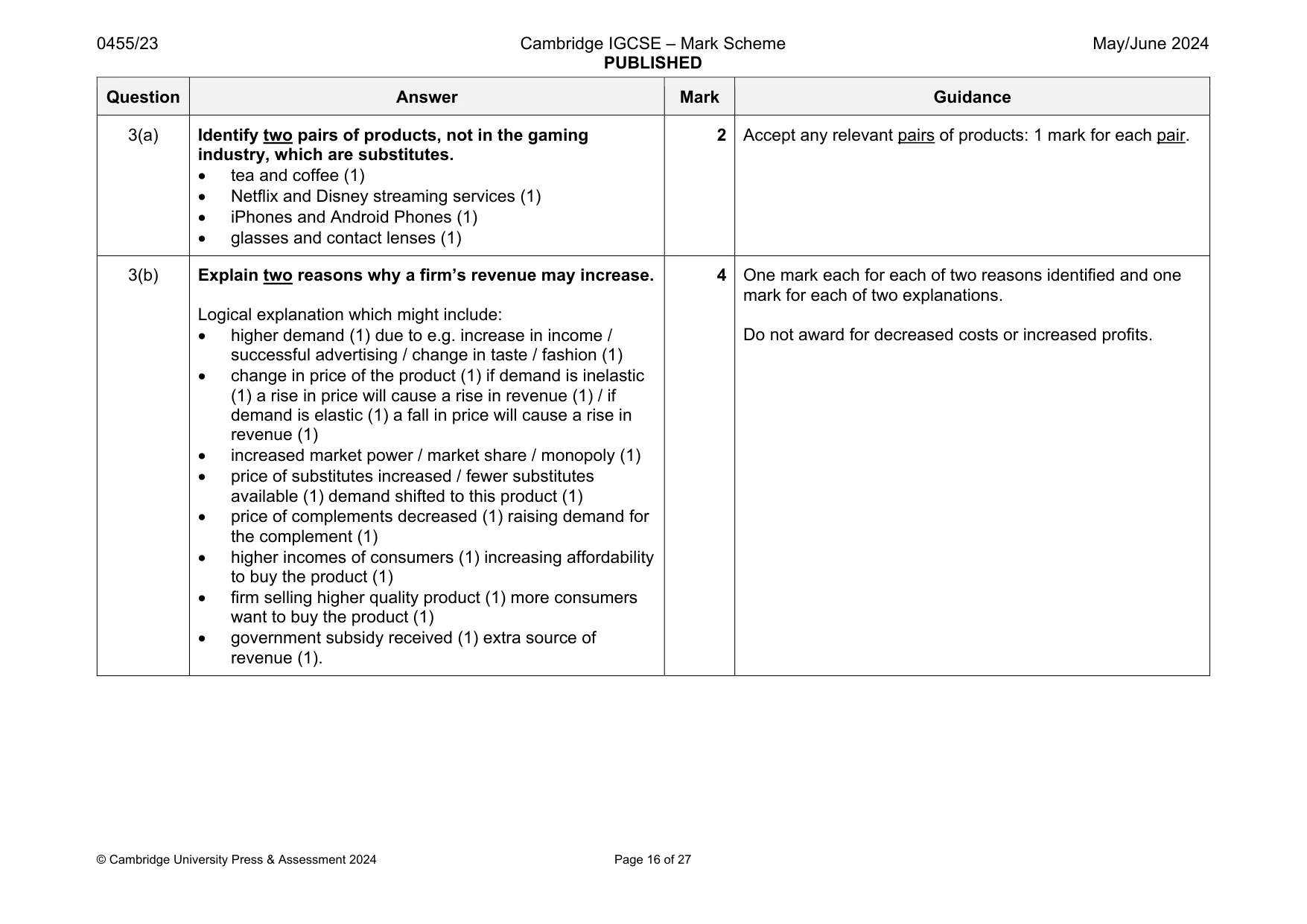
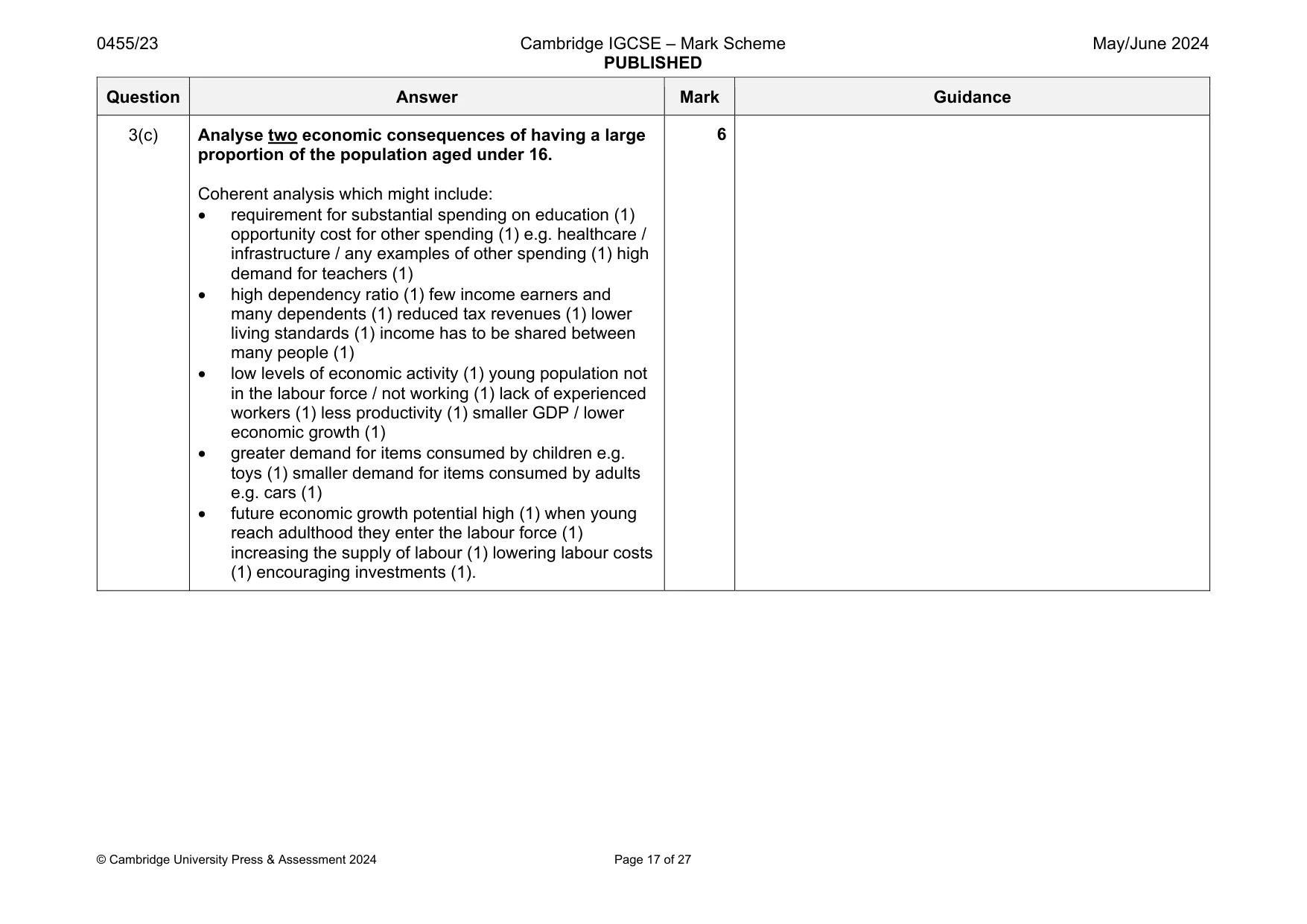
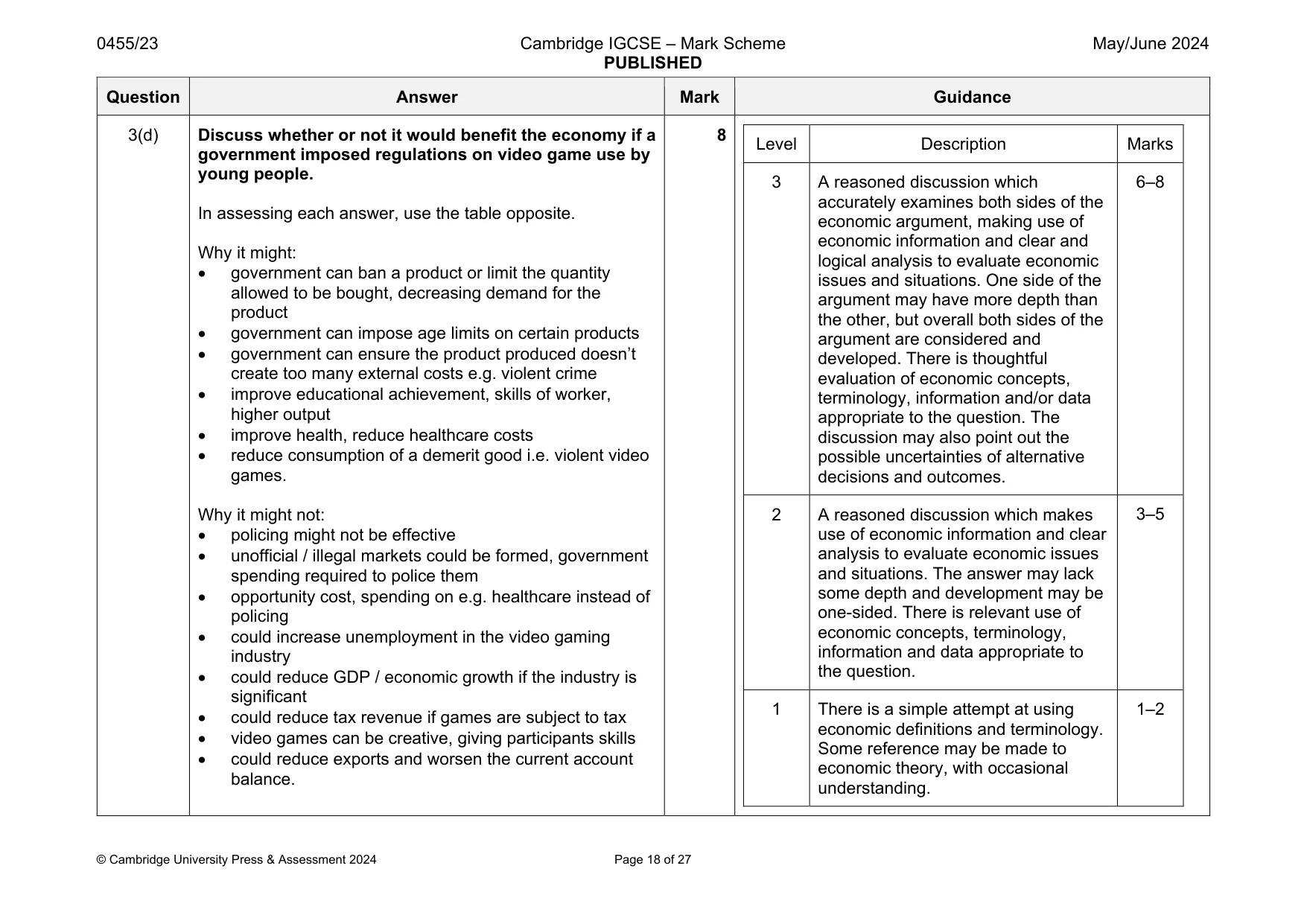
3 Since 2020, the revenue gained in the video gaming industry has been higher than the revenue in the film industry. The fastest growing part of the video gaming industry is mobile gaming, which is a substitute for console gaming. Young people are spending many hours playing video games and some governments are concerned that this may have negative effects on their health and educational progress. Therefore, regulations have been introduced to reduce the time young people spend playing these games. (a) Identify two pairs of products, not in the gaming industry, which are substitutes. [2] (b) Explain two reasons why a firm’s revenue may increase. [4] (c) Analyse two economic consequences of having a large proportion of the population aged under 16. [6] (d) Discuss whether or not it would benefit the economy if a government imposed regulations on video game use by young people. [8]
Mark scheme: 3(a) Identify two pairs of products, not in the gaming industry, which are substitutes. tea and coffee (1) Netflix and Disney streaming services (1) iPhones and Android Phones (1) glasses and contact lenses (1) 2 Accept any relevant pairs of products: 1 mark for each pair. 3(b) Explain two reasons why a firm’s revenue may increase. Logical explanation which might include: higher demand (1) due to e.g. increase in income / successful advertising / change in taste / fashion (1) change in price of the product (1) if demand is inelastic (1) a rise in price will cause a rise in revenue (1) / if demand is elastic (1) a fall in price will cause a rise in revenue (1) increased market power / market share / monopoly (1) price of substitutes increased / fewer substitutes available (1) demand shifted to this product (1) price of complements decreased (1) raising demand for the complement (1) higher incomes of consumers (1) increasing affordability to buy the product (1) firm selling higher quality product (1) more consumers want to buy the product (1) government subsidy received (1) extra source of revenue (1). 4 One mark each for each of two reasons identified and one mark for each of two explanations. Do not award for decreased costs or increased profits. Question Answer Mark Guidance 3(c) Analyse two economic consequences of having a large proportion of the population aged under 16. Coherent analysis which might include: requirement for substantial spending on education (1) opportunity cost for other spending (1) e.g. healthcare / infrastructure / any examples of other spending (1) high demand for teachers (1) high dependency ratio (1) few income earners and many dependents (1) reduced tax revenues (1) lower living standards (1) income has to be shared between many people (1) low levels of economic activity (1) young population not in the labour force / not working (1) lack of experienced workers (1) less productivity (1) smaller GDP / lower economic growth (1) greater demand for items consumed by children e.g. toys (1) smaller demand for items consumed by adults e.g. cars (1) future economic growth potential high (1) when young reach adulthood they enter the labour force (1) increasing the supply of labour (1) lowering labour costs (1) encouraging investments (1). 6 Question Answer Mark Guidance 3(d) Discuss whether or not it would benefit the economy if a government imposed regulations on video game use by young people. In assessing each answer, use the table opposite. Why it might: government can ban a product or limit the quantity allowed to be bought, decreasing demand for the product government can impose age limits on certain products government can ensure the product produced doesn’t create too many external costs e.g. violent crime improve educational achievement, skills of worker, higher output improve health, reduce healthcare costs reduce consumption of a demerit good i.e. violent video games. Why it might not: policing might not be effective unofficial / illegal markets could be formed, government spending required to police them opportunity cost, spending on e.g. healthcare instead of policing could increase unemployment in the video gaming industry could reduce GDP / economic growth if the industry is significant could reduce tax revenue if games are subject to tax video games can be creative, giving participants skills could reduce exports and worsen the current account balance. 8 Level Description Marks 3 A reasoned discussion which accurately examines both sides of the economic argument, making use of economic information and clear and logical analysis to evaluate economic issues and situations. One side of the argument may have more depth than the other, but overall both sides of the argument are considered and developed. There is thoughtful evaluation of economic concepts, terminology, information and/or data appropriate to the question. The discussion may also point out the possible uncertainties of alternative decisions and outcomes. 6–8 2 A reasoned discussion which makes use of economic information and clear analysis to evaluate economic issues and situations. The answer may lack some depth and development may be one-sided. There is relevant use of economic concepts, terminology, information and data appropriate to the question. 3–5 1 There is a simple attempt at using economic definitions and terminology. Some reference may be made to economic theory, with occasional understanding. 1–2 Question Answer Mark Guidance 3(d) Level Description Marks 0 A mark of zero should be awarded for no creditable content. 0
Q4 · In 2021, the US had a trade in goods deficit on the current account of its balance of…
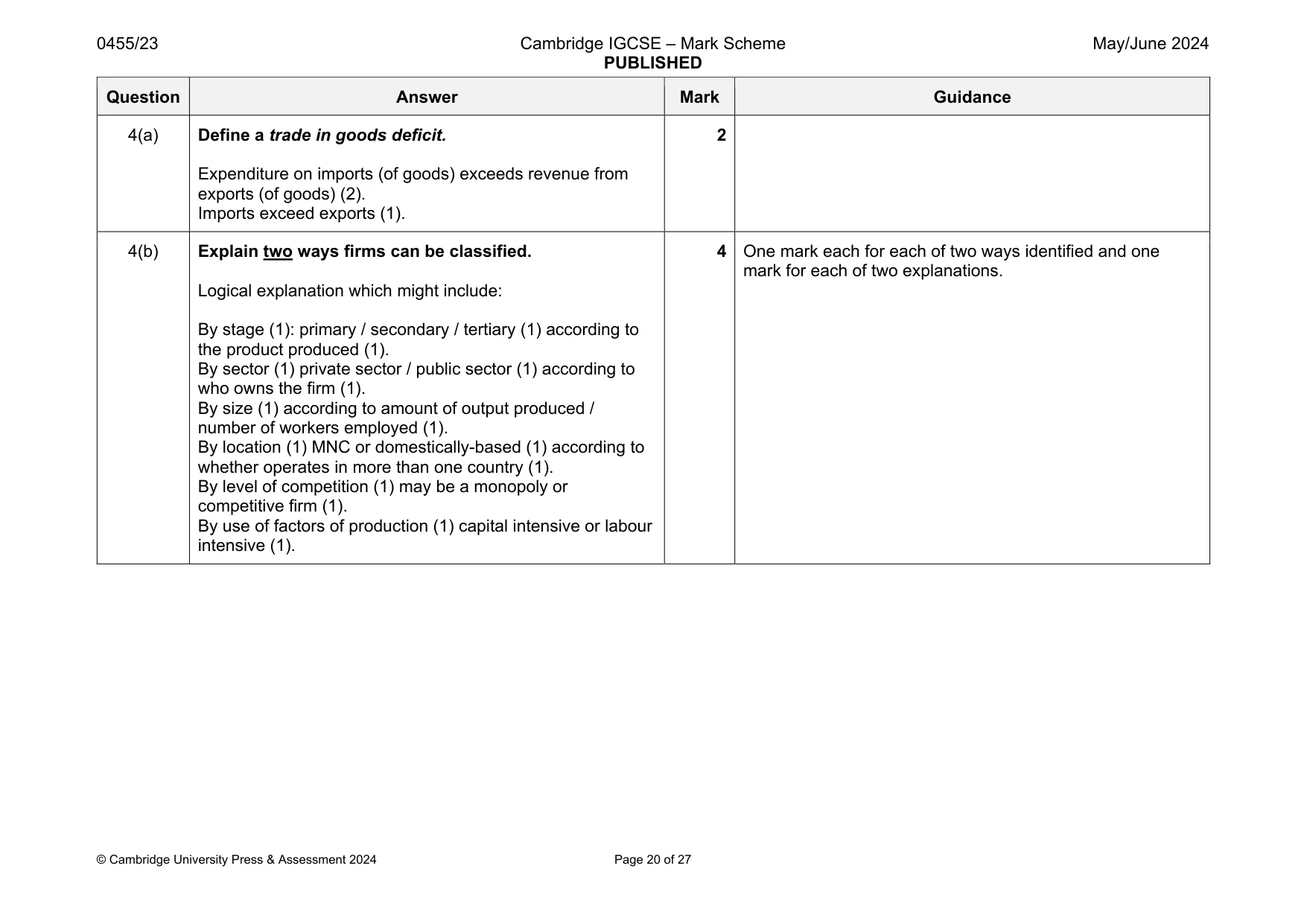
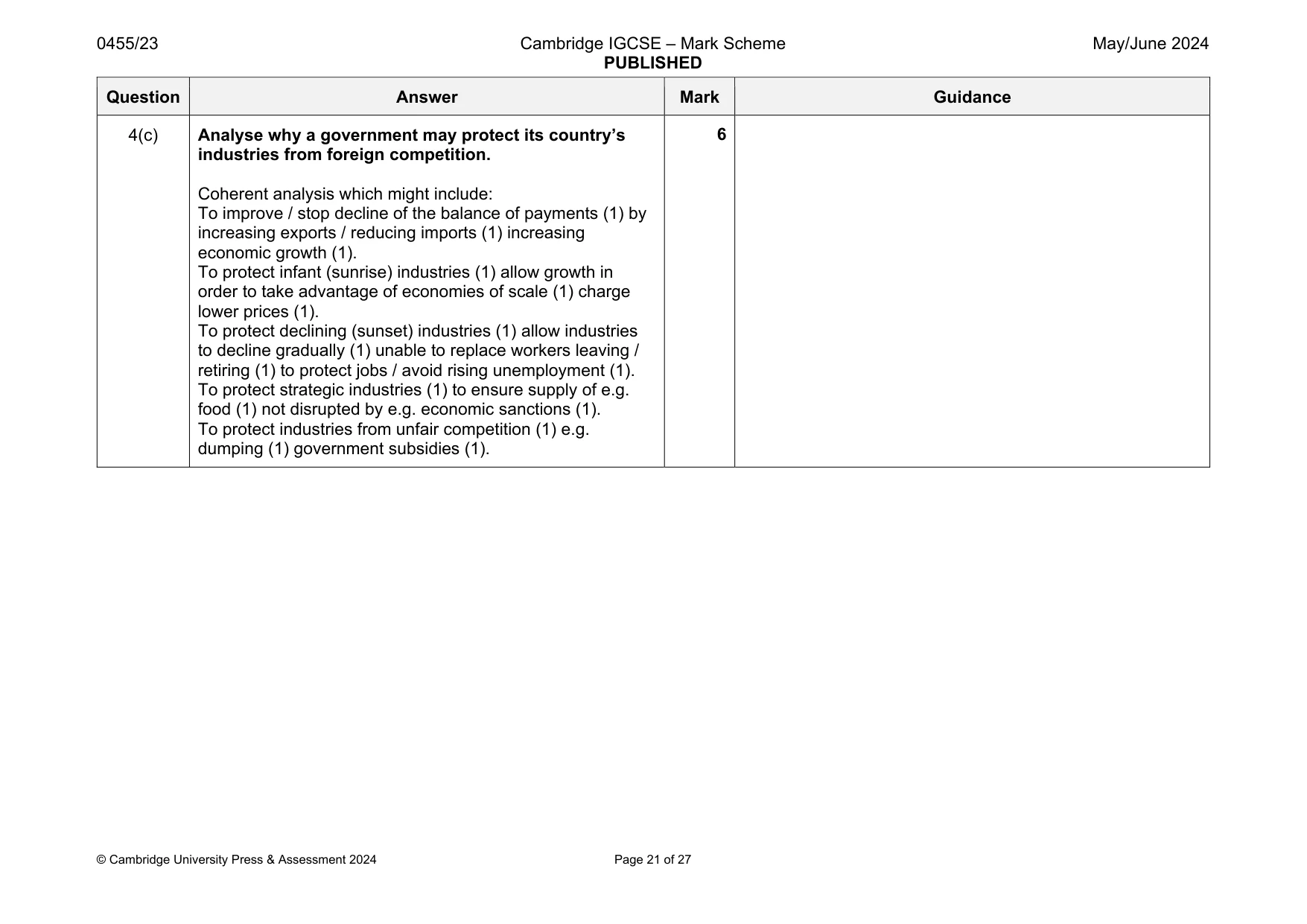
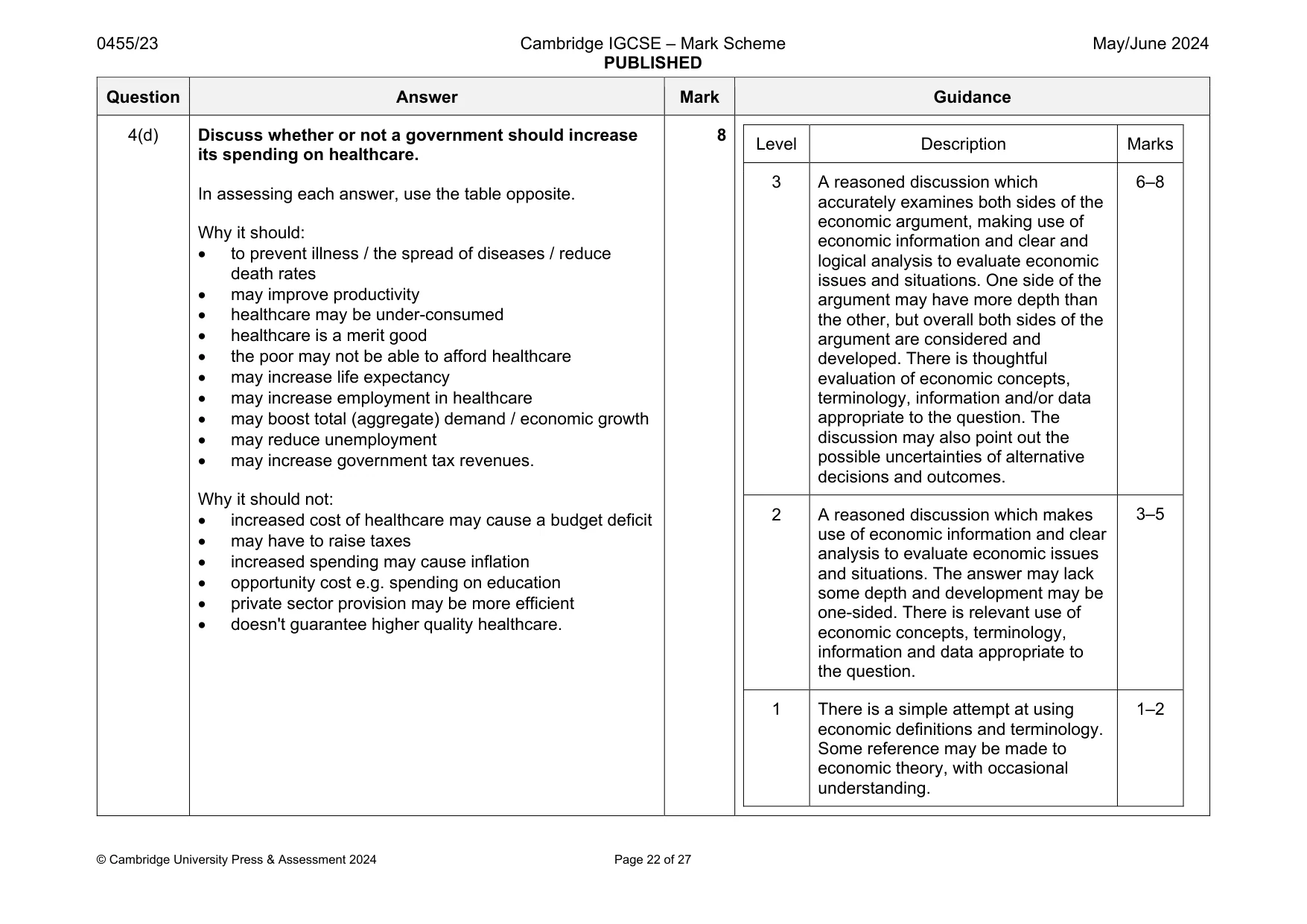
4 In 2021, the US had a trade in goods deficit on the current account of its balance of payments. The US has many firms in a wide range of industries. Import tariffs are used to protect some of these industries. The US government’s higher spending on healthcare, which reached $797bn that year, also affected many of the country’s industries. (a) Define a trade in goods deficit. [2] (b) Explain two ways firms can be classified. [4] (c) Analyse why a government may protect its country’s industries from foreign competition. [6] (d) Discuss whether or not a government should increase its spending on healthcare. [8]
Mark scheme: 4(a) Define a trade in goods deficit. Expenditure on imports (of goods) exceeds revenue from exports (of goods) (2). Imports exceed exports (1). 2 4(b) Explain two ways firms can be classified. Logical explanation which might include: By stage (1): primary / secondary / tertiary (1) according to the product produced (1). By sector (1) private sector / public sector (1) according to who owns the firm (1). By size (1) according to amount of output produced / number of workers employed (1). By location (1) MNC or domestically-based (1) according to whether operates in more than one country (1). By level of competition (1) may be a monopoly or competitive firm (1). By use of factors of production (1) capital intensive or labour intensive (1). 4 One mark each for each of two ways identified and one mark for each of two explanations. Question Answer Mark Guidance 4(c) Analyse why a government may protect its country’s industries from foreign competition. Coherent analysis which might include: To improve / stop decline of the balance of payments (1) by increasing exports / reducing imports (1) increasing economic growth (1). To protect infant (sunrise) industries (1) allow growth in order to take advantage of economies of scale (1) charge lower prices (1). To protect declining (sunset) industries (1) allow industries to decline gradually (1) unable to replace workers leaving / retiring (1) to protect jobs / avoid rising unemployment (1). To protect strategic industries (1) to ensure supply of e.g. food (1) not disrupted by e.g. economic sanctions (1). To protect industries from unfair competition (1) e.g. dumping (1) government subsidies (1). 6 Question Answer Mark Guidance 4(d) Discuss whether or not a government should increase its spending on healthcare. In assessing each answer, use the table opposite. Why it should: to prevent illness / the spread of diseases / reduce death rates may improve productivity healthcare may be under-consumed healthcare is a merit good the poor may not be able to afford healthcare may increase life expectancy may increase employment in healthcare may boost total (aggregate) demand / economic growth may reduce unemployment may increase government tax revenues. Why it should not: increased cost of healthcare may cause a budget deficit may have to raise taxes increased spending may cause inflation opportunity cost e.g. spending on education private sector provision may be more efficient doesn't guarantee higher quality healthcare. 8 Level Description Marks 3 A reasoned discussion which accurately examines both sides of the economic argument, making use of economic information and clear and logical analysis to evaluate economic issues and situations. One side of the argument may have more depth than the other, but overall both sides of the argument are considered and developed. There is thoughtful evaluation of economic concepts, terminology, information and/or data appropriate to the question. The discussion may also point out the possible uncertainties of alternative decisions and outcomes. 6–8 2 A reasoned discussion which makes use of economic information and clear analysis to evaluate economic issues and situations. The answer may lack some depth and development may be one-sided. There is relevant use of economic concepts, terminology, information and data appropriate to the question. 3–5 1 There is a simple attempt at using economic definitions and terminology. Some reference may be made to economic theory, with occasional understanding. 1–2 Question Answer Mark Guidance 4(d) Level Description Marks 0 A mark of zero should be awarded for no creditable content. 0
Q5 · In 2020, investment in vaccine production was very high
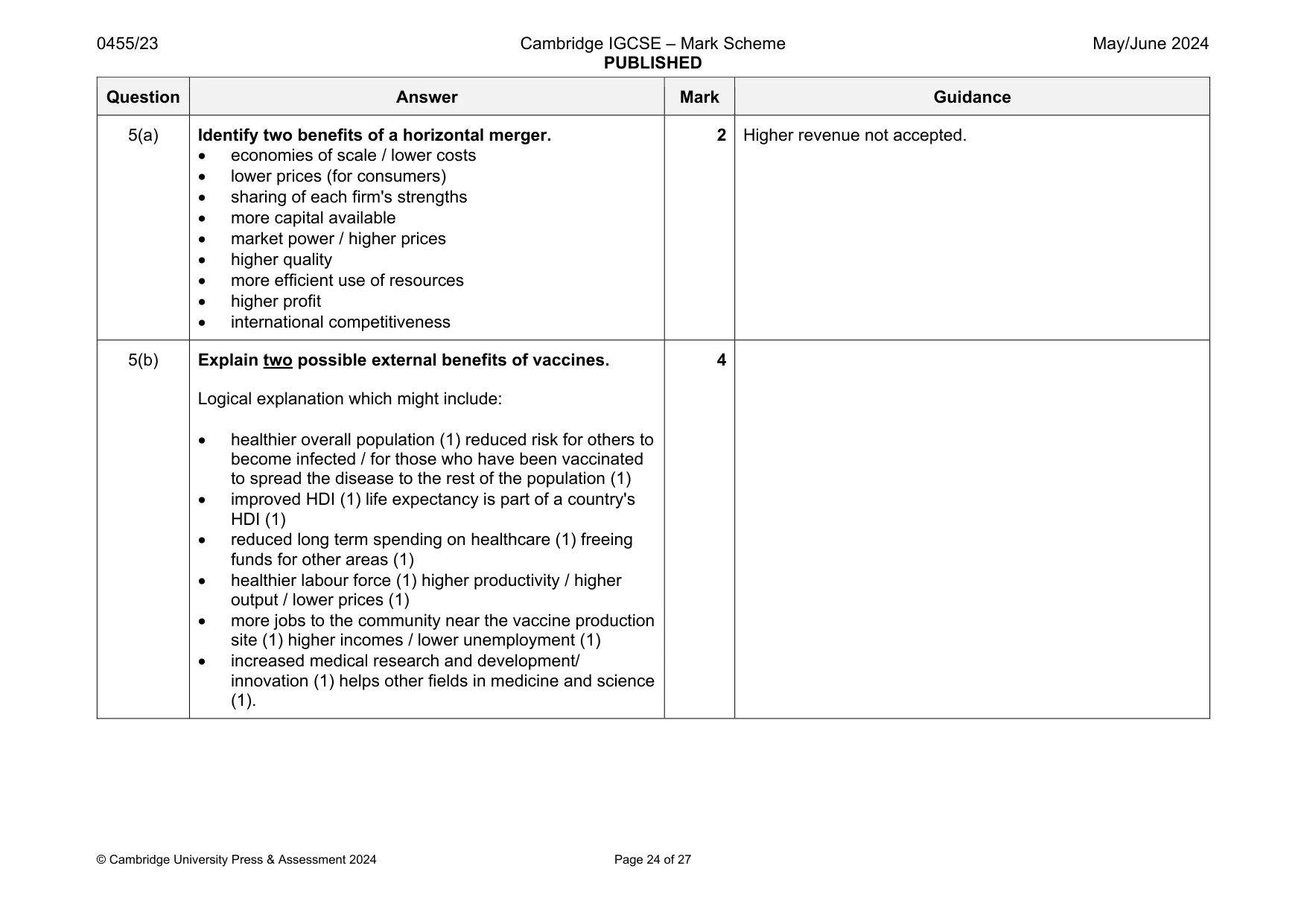
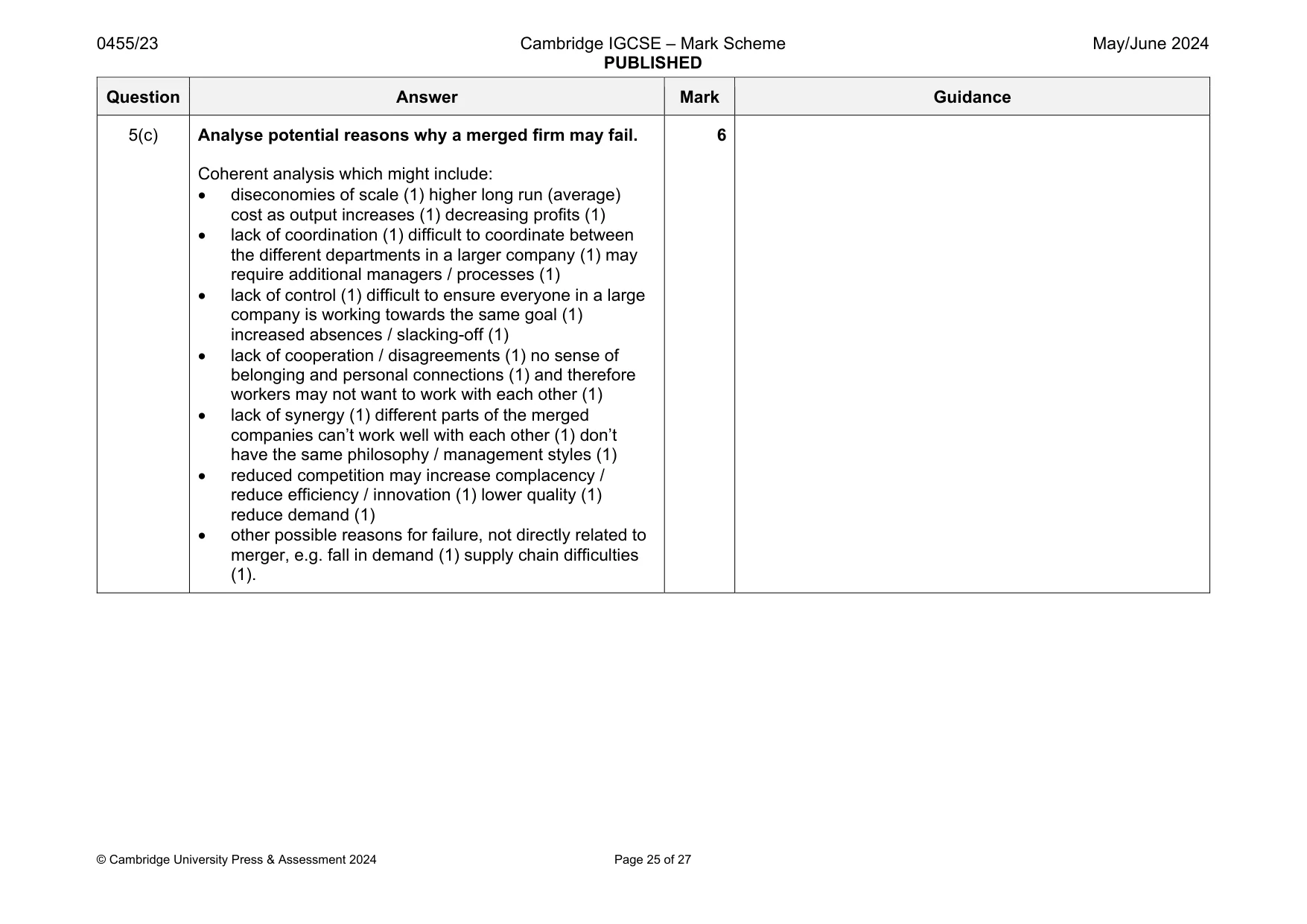
5 In 2020, investment in vaccine production was very high. There was a plan for a major vaccine producer to horizontally merge with another firm but the plan was cancelled. This was not surprising as a similar merger of two firms in the same industry had failed the previous year. However, most firms in this industry are still meeting their objectives and also creating many external benefits for the wider economy. (a) Identify two benefits of a horizontal merger. [2] (b) Explain two possible external benefits of vaccines. [4] (c) Analyse potential reasons why a merged firm may fail. [6] (d) Discuss whether or not investment is beneficial to an economy. [8]
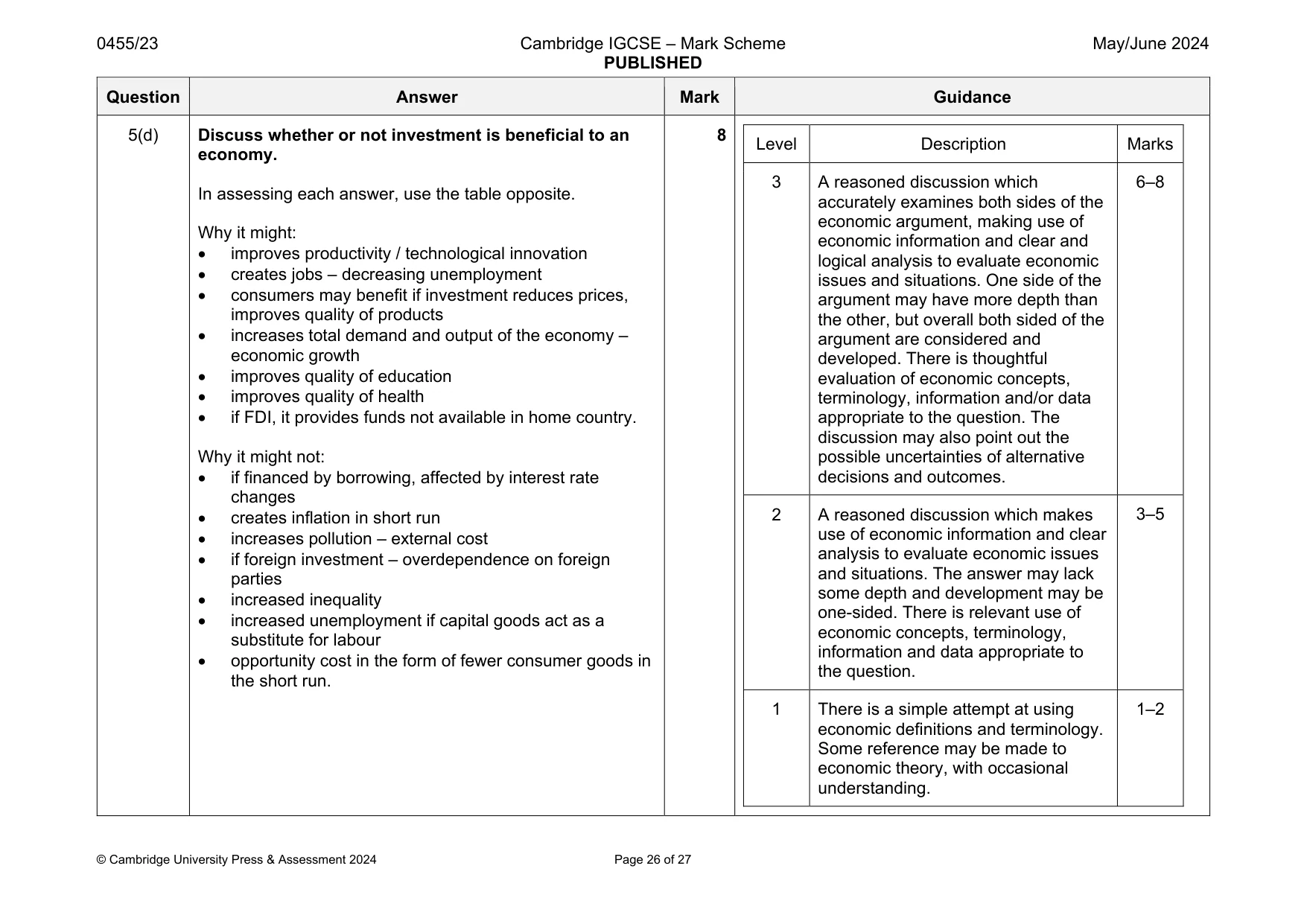
Mark scheme: 5(a) Identify two benefits of a horizontal merger. economies of scale / lower costs lower prices (for consumers) sharing of each firm's strengths more capital available market power / higher prices higher quality more efficient use of resources higher profit international competitiveness 2 Higher revenue not accepted. 5(b) Explain two possible external benefits of vaccines. Logical explanation which might include: healthier overall population (1) reduced risk for others to become infected / for those who have been vaccinated to spread the disease to the rest of the population (1) improved HDI (1) life expectancy is part of a country's HDI (1) reduced long term spending on healthcare (1) freeing funds for other areas (1) healthier labour force (1) higher productivity / higher output / lower prices (1) more jobs to the community near the vaccine production site (1) higher incomes / lower unemployment (1) increased medical research and development/ innovation (1) helps other fields in medicine and science (1). 4 Question Answer Mark Guidance 5(c) Analyse potential reasons why a merged firm may fail. Coherent analysis which might include: diseconomies of scale (1) higher long run (average) cost as output increases (1) decreasing profits (1) lack of coordination (1) difficult to coordinate between the different departments in a larger company (1) may require additional managers / processes (1) lack of control (1) difficult to ensure everyone in a large company is working towards the same goal (1) increased absences / slacking-off (1) lack of cooperation / disagreements (1) no sense of belonging and personal connections (1) and therefore workers may not want to work with each other (1) lack of synergy (1) different parts of the merged companies can’t work well with each other (1) don’t have the same philosophy / management styles (1) reduced competition may increase complacency / reduce efficiency / innovation (1) lower quality (1) reduce demand (1) other possible reasons for failure, not directly related to merger, e.g. fall in demand (1) supply chain difficulties (1). 6 Question Answer Mark Guidance 5(d) Discuss whether or not investment is beneficial to an economy. In assessing each answer, use the table opposite. Why it might: improves productivity / technological innovation creates jobs – decreasing unemployment consumers may benefit if investment reduces prices, improves quality of products increases total demand and output of the economy – economic growth improves quality of education improves quality of health if FDI, it provides funds not available in home country. Why it might not: if financed by borrowing, affected by interest rate changes creates inflation in short run increases pollution – external cost if foreign investment – overdependence on foreign parties increased inequality increased unemployment if capital goods act as a substitute for labour opportunity cost in the form of fewer consumer goods in the short run. 8 Level Description Marks 3 A reasoned discussion which accurately examines both sides of the economic argument, making use of economic information and clear and logical analysis to evaluate economic issues and situations. One side of the argument may have more depth than the other, but overall both sided of the argument are considered and developed. There is thoughtful evaluation of economic concepts, terminology, information and/or data appropriate to the question. The discussion may also point out the possible uncertainties of alternative decisions and outcomes. 6–8 2 A reasoned discussion which makes use of economic information and clear analysis to evaluate economic issues and situations. The answer may lack some depth and development may be one-sided. There is relevant use of economic concepts, terminology, information and data appropriate to the question. 3–5 1 There is a simple attempt at using economic definitions and terminology. Some reference may be made to economic theory, with occasional understanding. 1–2 Question Answer Mark Guidance 5(d) Level Description Marks 0 A mark of zero should be awarded for no creditable content. 0
What was in this paper
The subtopics covered by these 5 questions, and how many questions each got. Open one in a new tab to see every Cambridge question on it.
What you needed in this session
Cambridge’s own grade thresholds for 2024 May/June, Paper 2 · Variant 3. A higher threshold means an easier paper — the bar moves with how the cohort did.