Cambridge IGCSE Economics 0455 — 2022 Oct/Nov Paper 2 · Variant 2
0455/22/O/N/22 · 5 questions · 90 marks · ≈101 min
The question paper and its mark scheme, free to read here and free to download. This is Cambridge’s own paper, exactly as it was sat.
Question paper8 pages
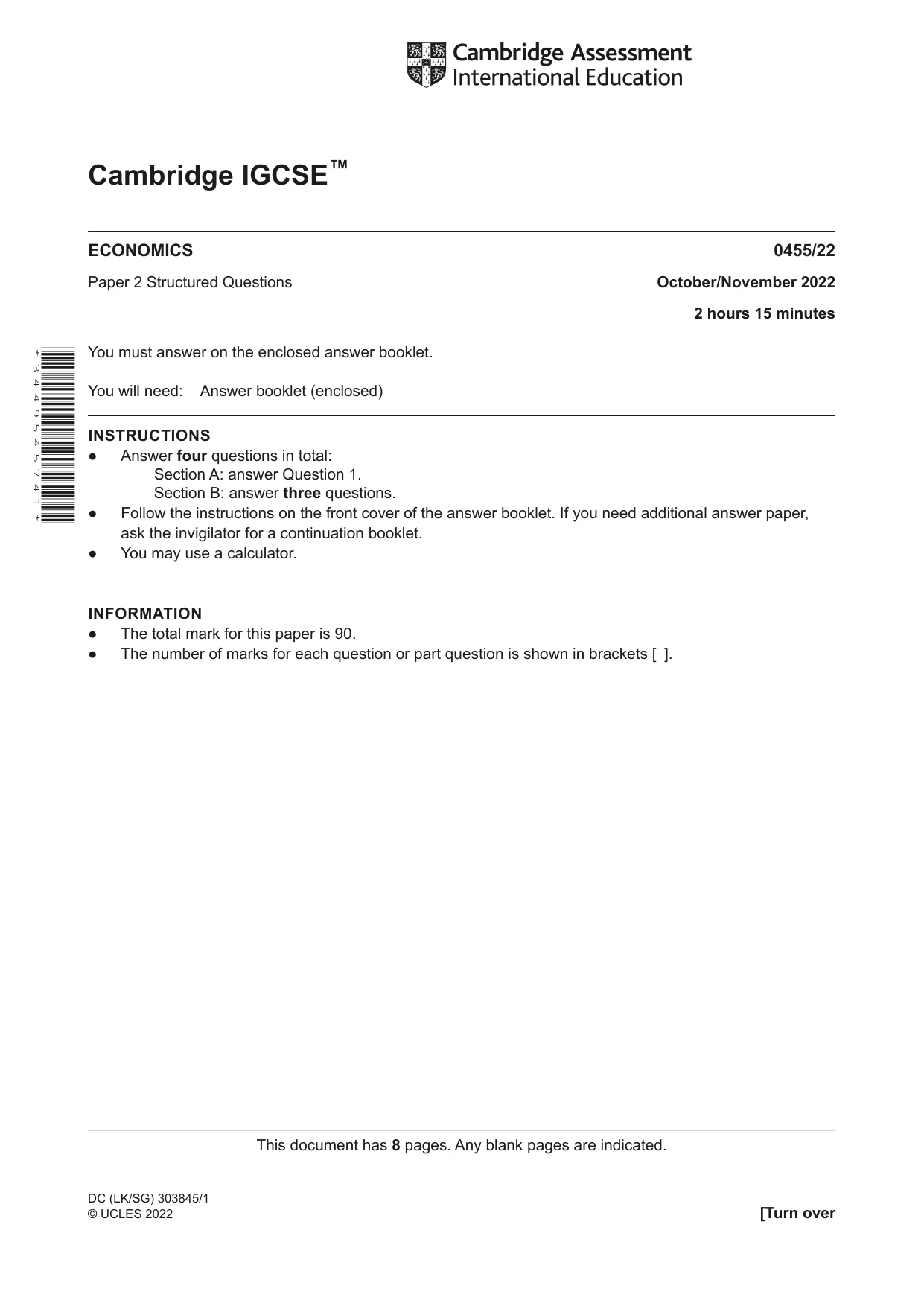




Mark scheme24 pages
Answers below. Sit the paper first if you are practising.
Questions as text
Q1 · Calculate how many dollars 6400 Nigerian naira would have bought in 2019
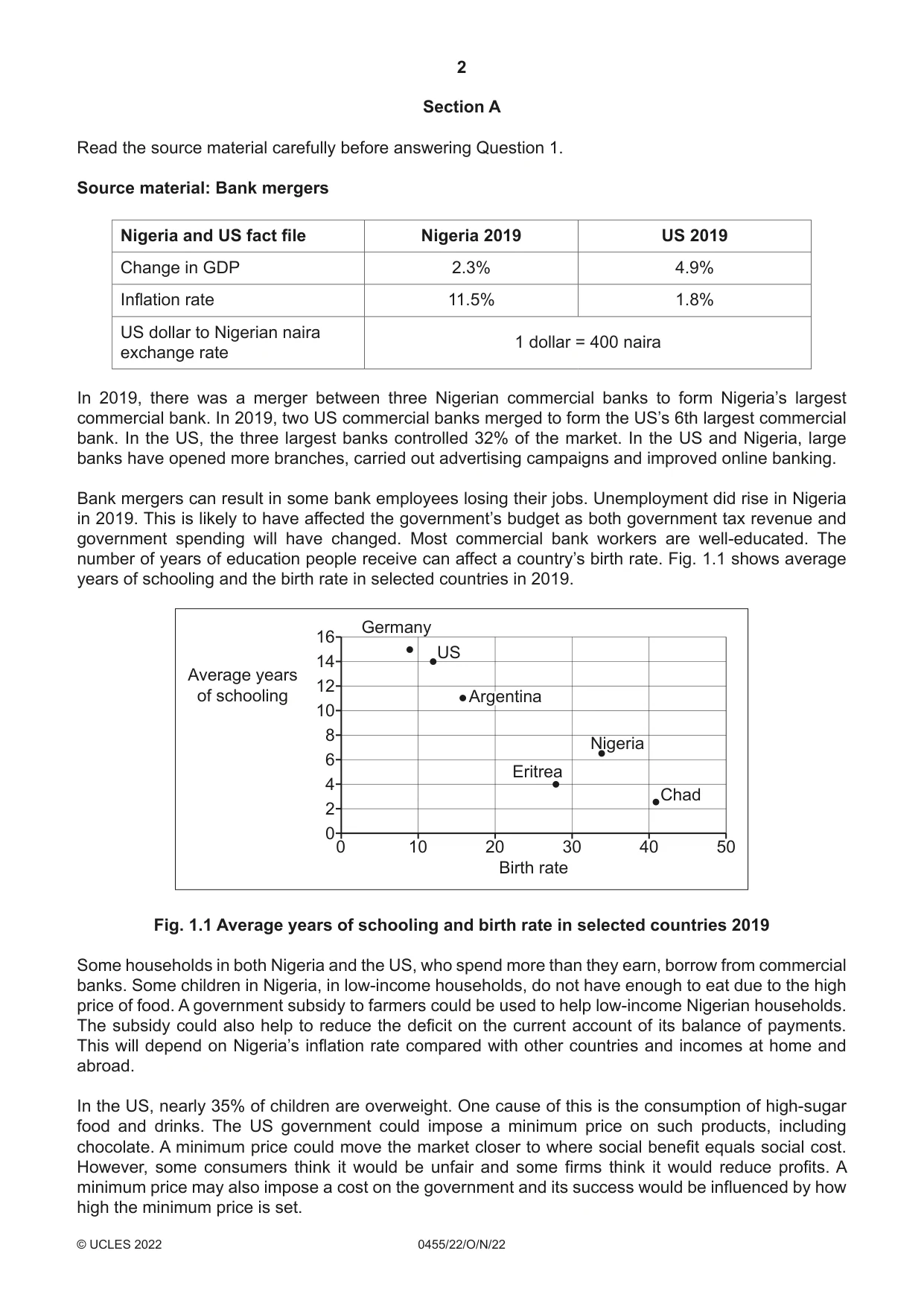
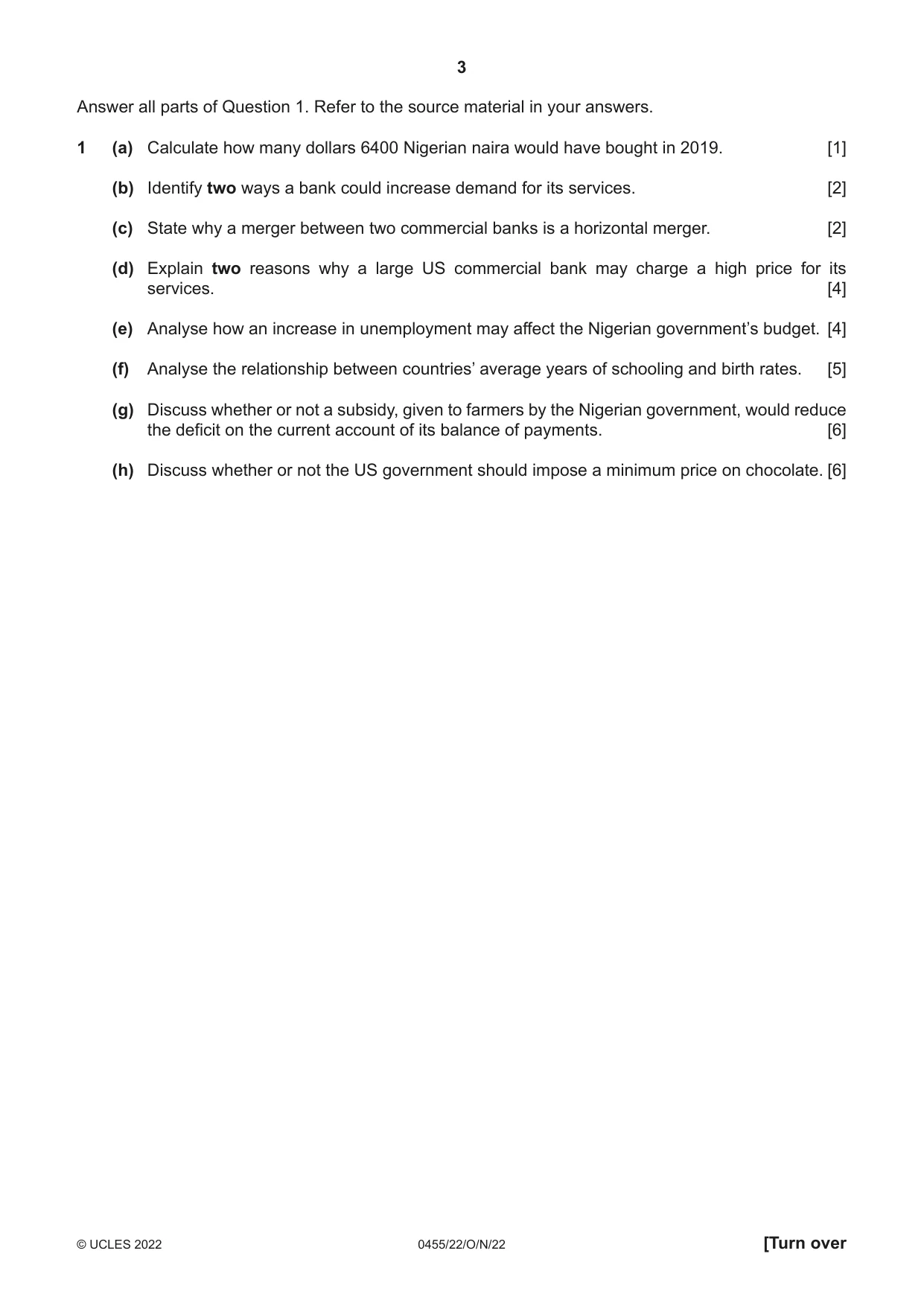
1 (a) Calculate how many dollars 6400 Nigerian naira would have bought in 2019. [1] (b) Identify two ways a bank could increase demand for its services. [2] (c) State why a merger between two commercial banks is a horizontal merger. [2] (d) Explain two reasons why a large US commercial bank may charge a high price for its services. [4] (e) Analyse how an increase in unemployment may affect the Nigerian government’s budget. [4] (f) Analyse the relationship between countries’ average years of schooling and birth rates. [5] (g) Discuss whether or not a subsidy, given to farmers by the Nigerian government, would reduce the deficit on the current account of its balance of payments. [6] (h) Discuss whether or not the US government should impose a minimum price on chocolate. [6]
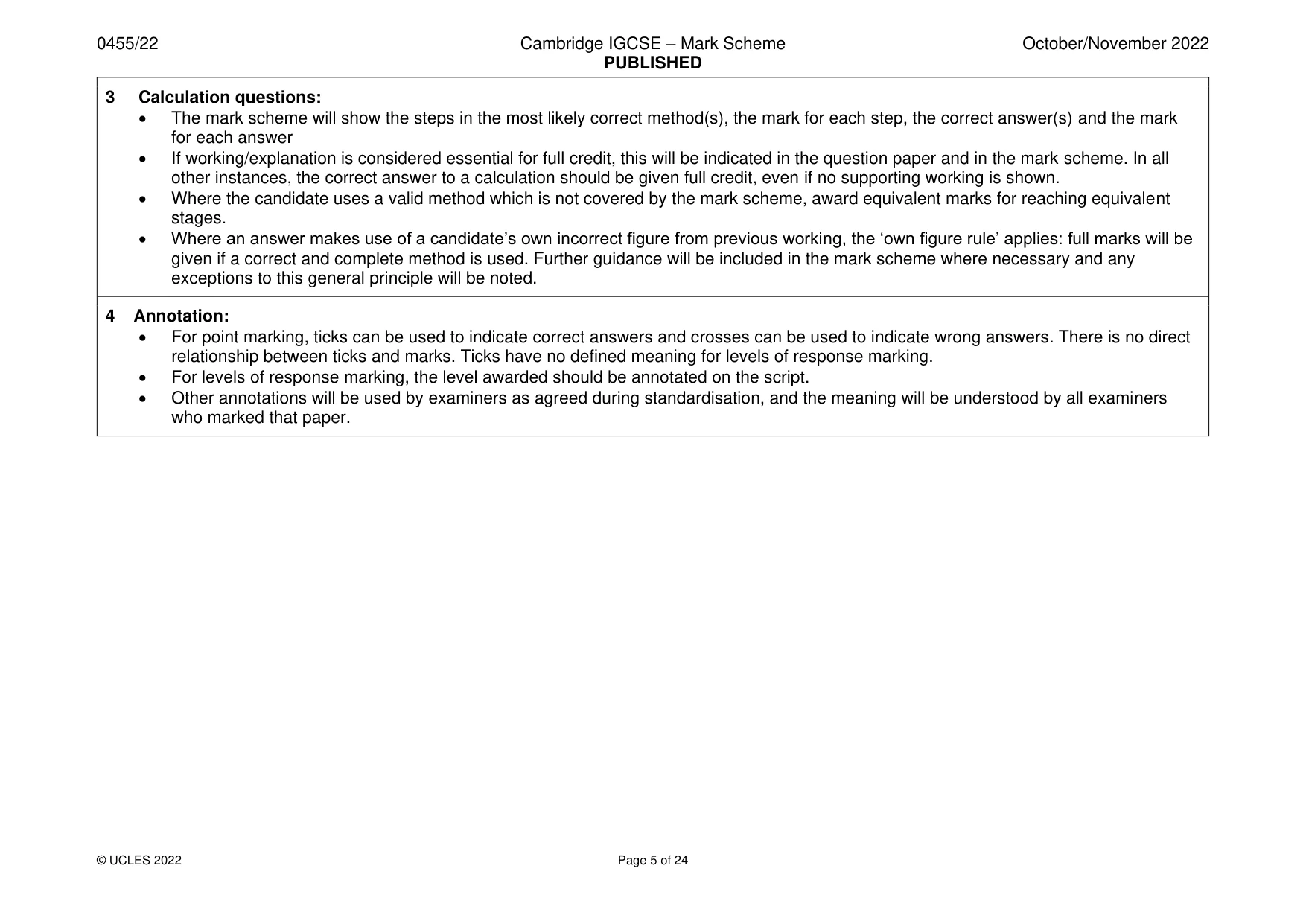
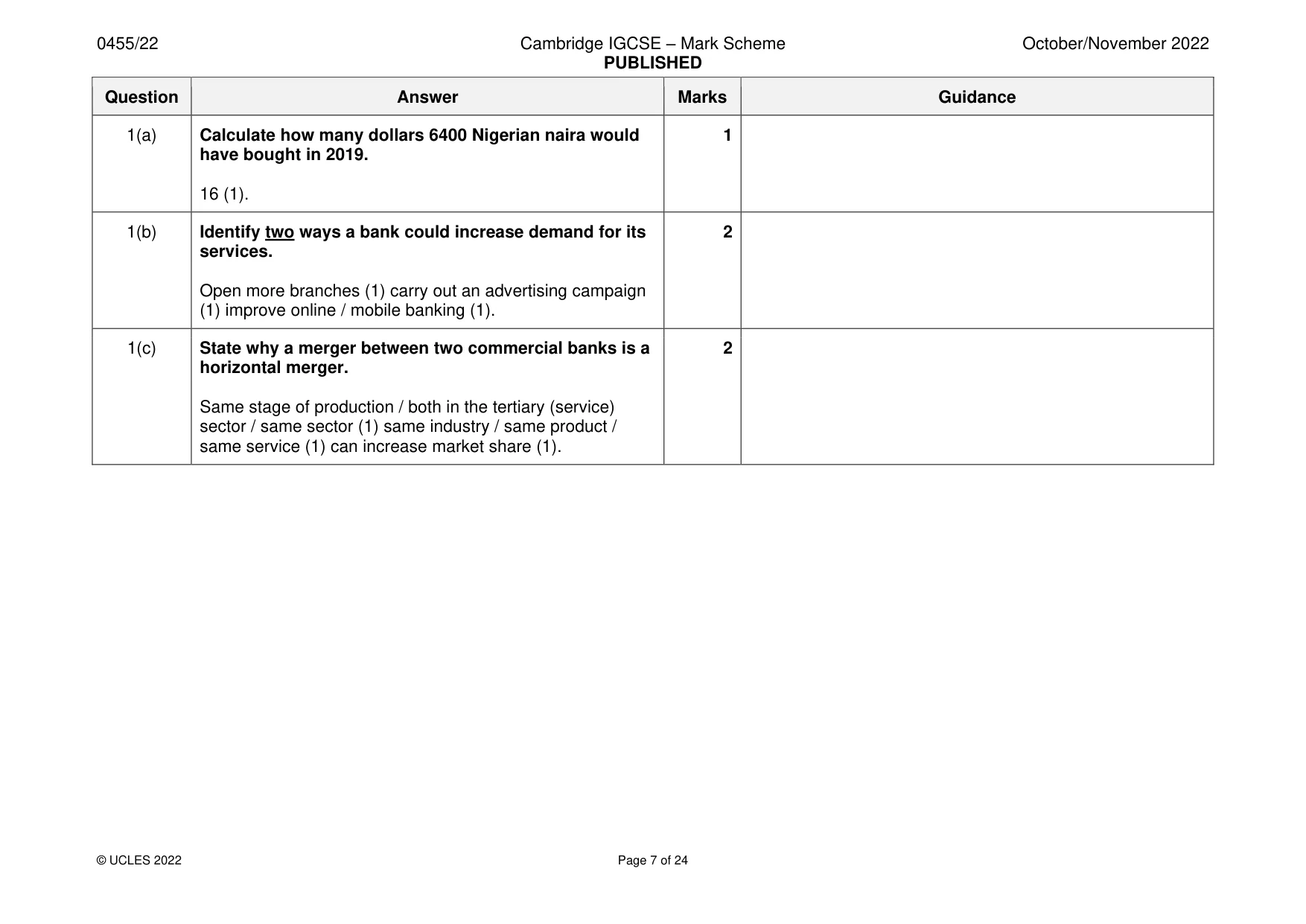
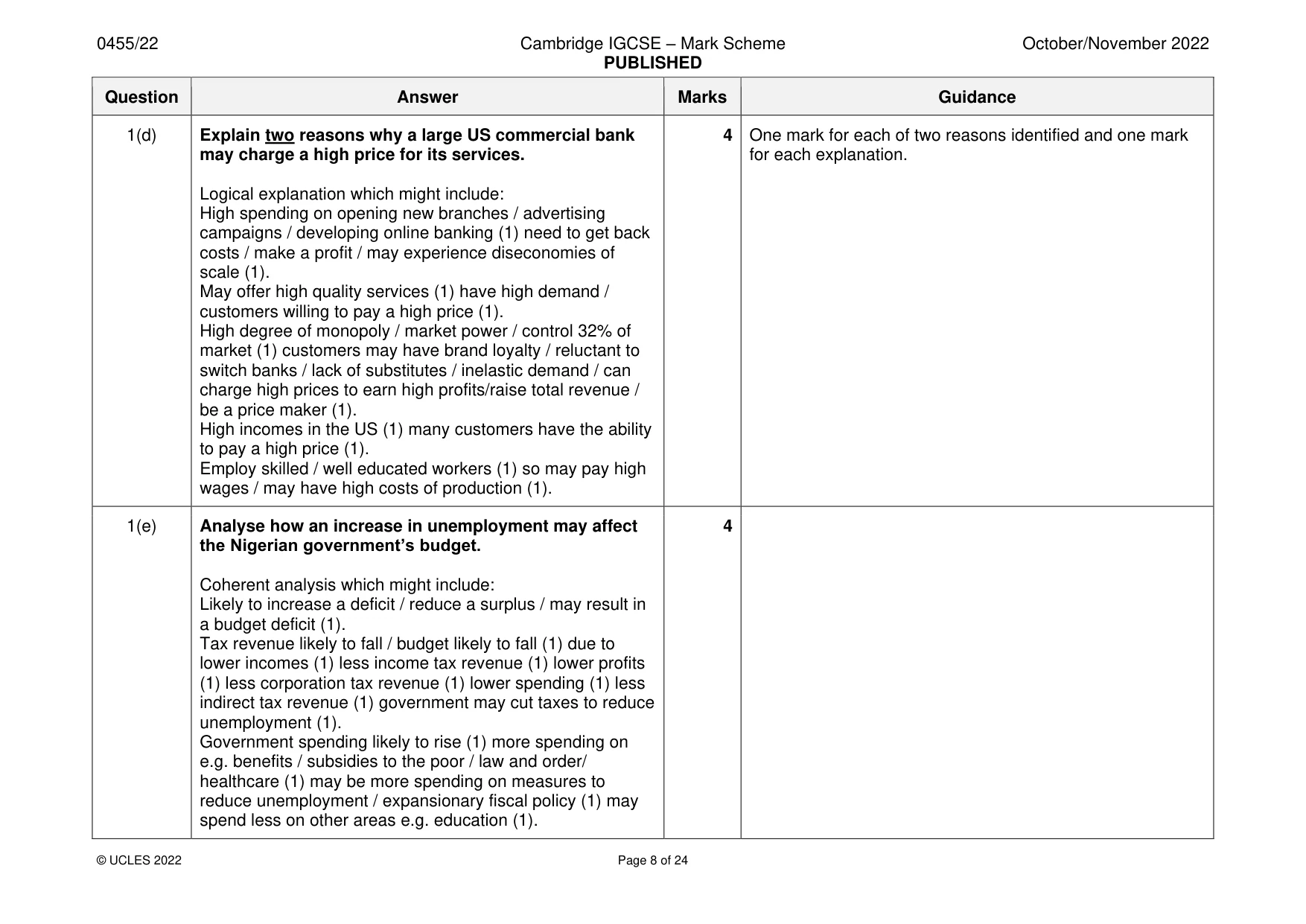
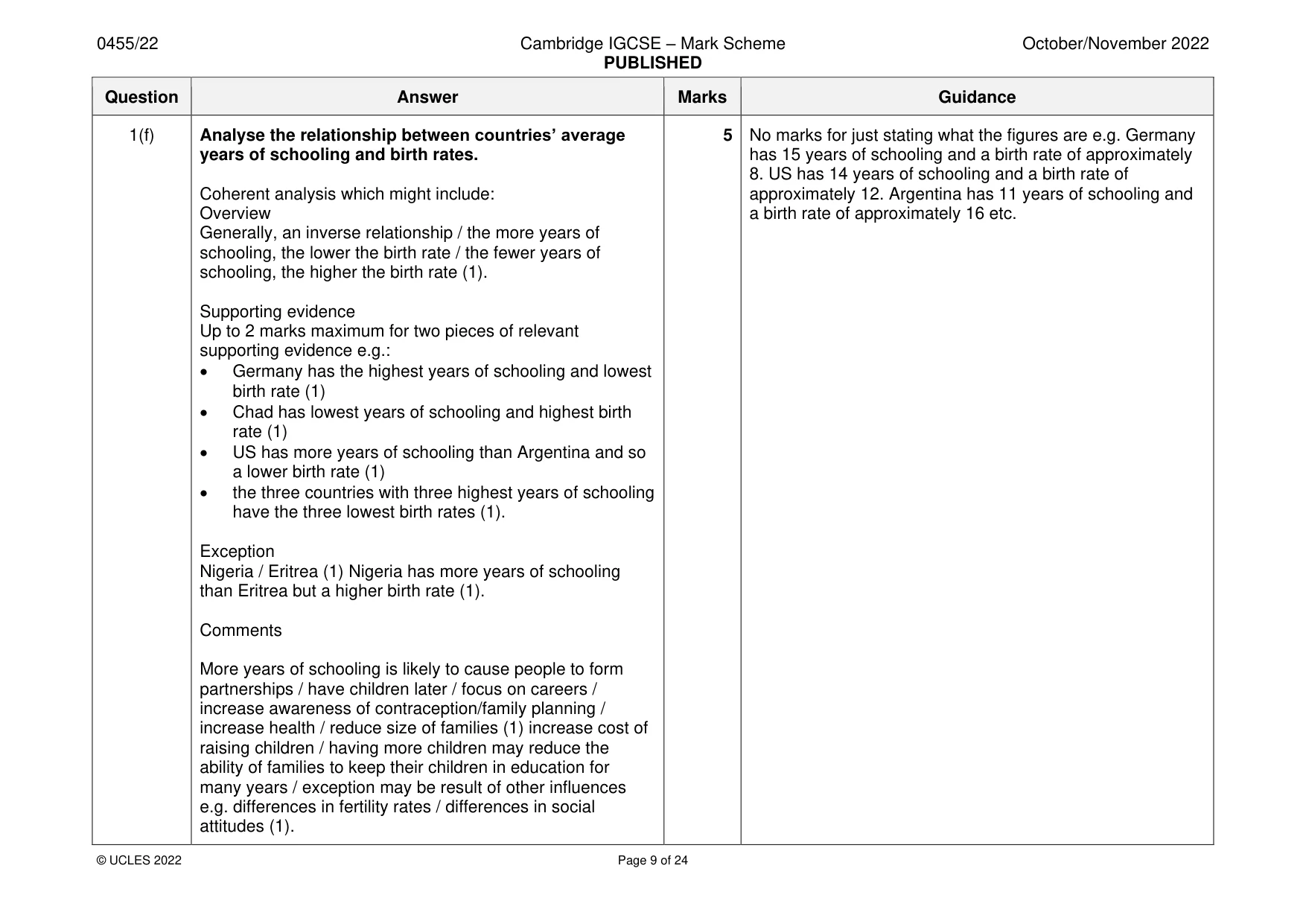
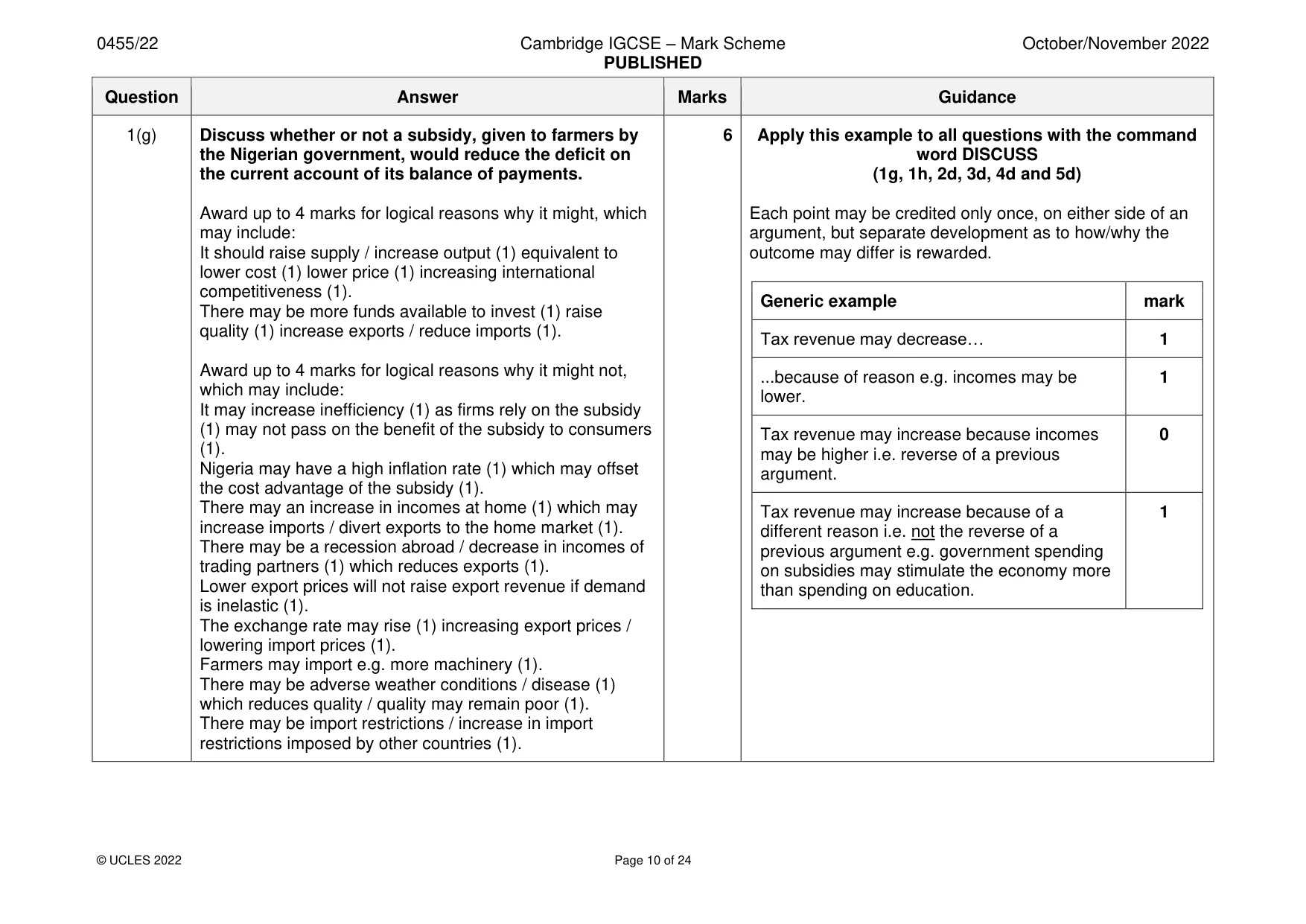
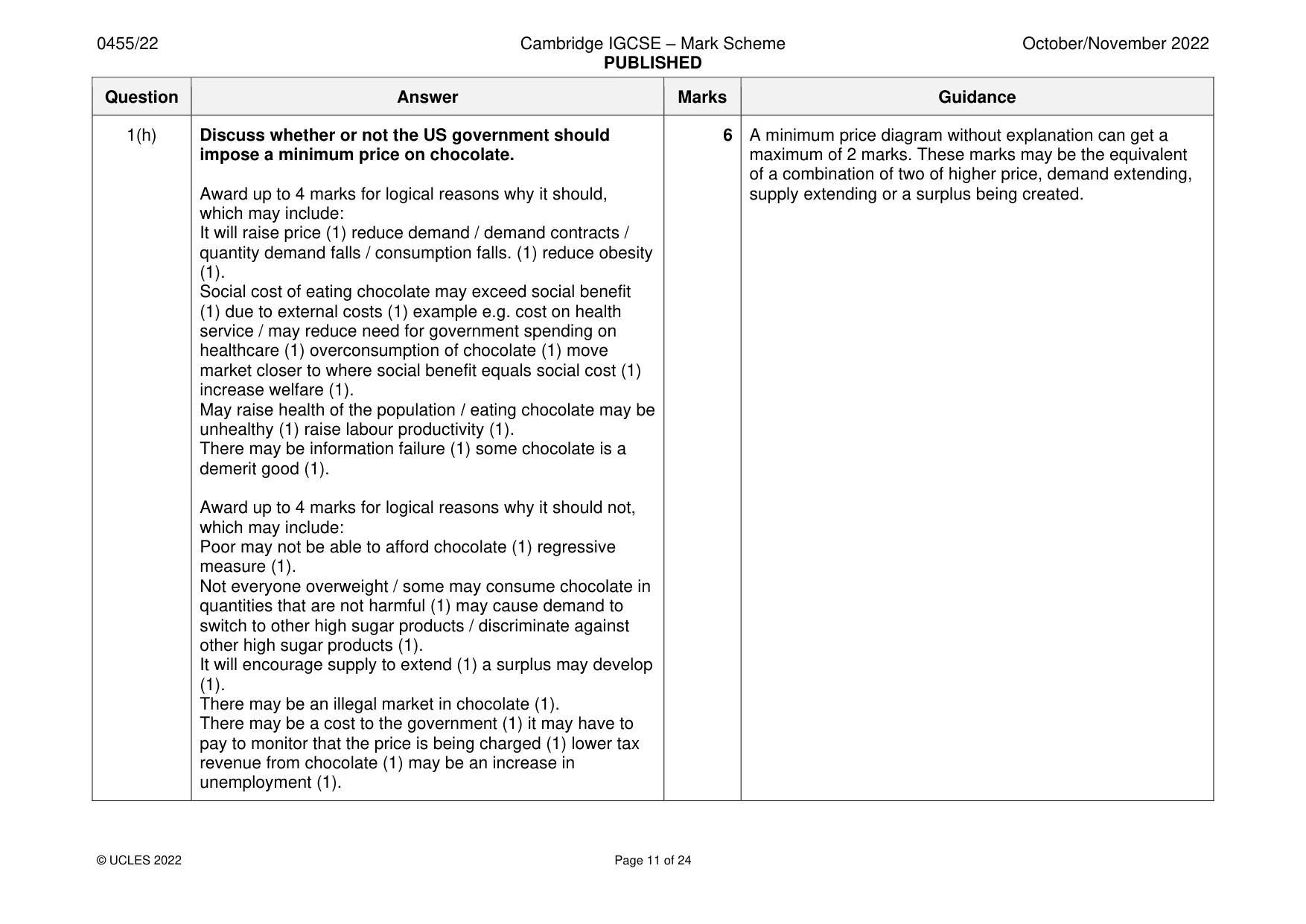
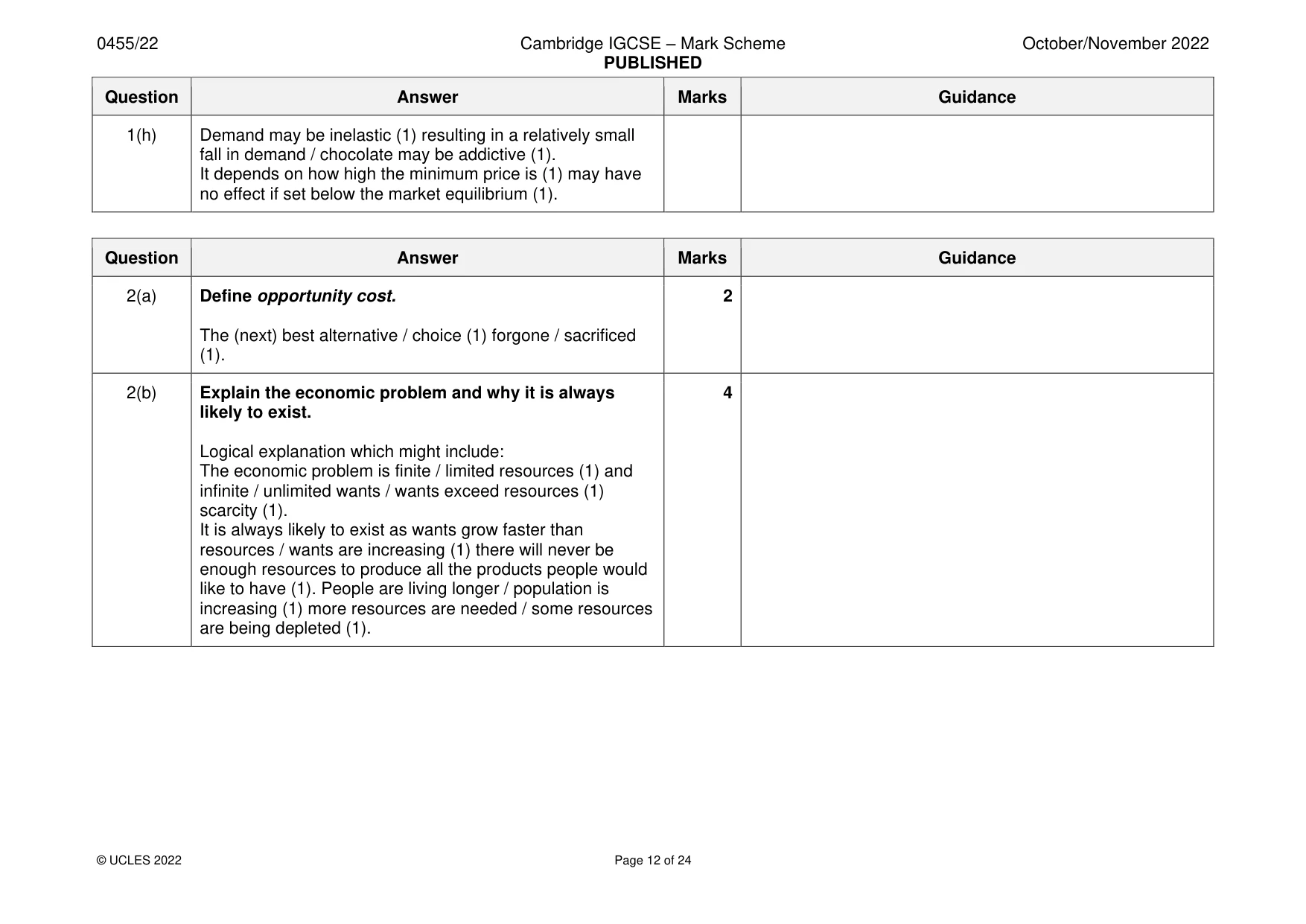
Mark scheme: Question Answer Marks Guidance 1(a) Calculate how many dollars 6400 Nigerian naira would 1 have bought in 2019. 16 (1). 1(b) Identify two ways a bank could increase demand for its 2 services. Open more branches (1) carry out an advertising campaign (1) improve online / mobile banking (1). 1(c) State why a merger between two commercial banks is a 2 horizontal merger. Same stage of production / both in the tertiary (service) sector / same sector (1) same industry / same product / same service (1) can increase market share (1). 1(d) Explain two reasons why a large US commercial bank 4 One mark for each of two reasons identified and one mark may charge a high price for its services. for each explanation. Logical explanation which might include: High spending on opening new branches / advertising campaigns / developing online banking (1) need to get back costs / make a profit / may experience diseconomies of scale (1). May offer high quality services (1) have high demand / customers willing to pay a high price (1). High degree of monopoly / market power / control 32% of market (1) customers may have brand loyalty / reluctant to switch banks / lack of substitutes / inelastic demand / can charge high prices to earn high profits/raise total revenue / be a price maker (1). High incomes in the US (1) many customers have the ability to pay a high price (1). Employ skilled / well educated workers (1) so may pay high wages / may have high costs of production (1). 1(e) Analyse how an increase in unemployment may affect 4 the Nigerian government’s budget. Coherent analysis which might include: Likely to increase a deficit / reduce a surplus / may result in a budget deficit (1). Tax revenue likely to fall / budget likely to fall (1) due to lower incomes (1) less income tax revenue (1) lower profits (1) less corporation tax revenue (1) lower spending (1) less indirect tax revenue (1) government may cut taxes to reduce unemployment (1). Government spending likely to rise (1) more spending on e.g. benefits / subsidies to the poor / law and order/ healthcare (1) may be more spending on measures to reduce unemployment / expansionary fiscal policy (1) may spend less on other areas e.g. education (1). 1(f) Analyse the relationship between countries’ average 5 No marks for just stating what the figures are e.g. Germany years of schooling and birth rates. has 15 years of schooling and a birth rate of approximately 8. US has 14 years of schooling and a birth rate of Coherent analysis which might include: approximately 12. Argentina has 11 years of schooling and Overview a birth rate of approximately 16 etc. Generally, an inverse relationship / the more years of schooling, the lower the birth rate / the fewer years of schooling, the higher the birth rate (1). Supporting evidence Up to 2 marks maximum for two pieces of relevant supporting evidence e.g.: • Germany has the highest years of schooling and lowest birth rate (1) • Chad has lowest years of schooling and highest birth rate (1) • US has more years of schooling than Argentina and so a lower birth rate (1) • the three countries with three highest years of schooling have the three lowest birth rates (1). Exception Nigeria / Eritrea (1) Nigeria has more years of schooling than Eritrea but a higher birth rate (1). Comments More years of schooling is likely to cause people to form partnerships / have children later / focus on careers / increase awareness of contraception/family planning / increase health / reduce size of families (1) increase cost of raising children / having more children may reduce the ability of families to keep their children in education for many years / exception may be result of other influences e.g. differences in fertility rates / differences in social attitudes (1). 1(g) Discuss whether or not a subsidy, given to farmers by 6 Apply this example to all questions with the command the Nigerian government, would reduce the deficit on word DISCUSS the current account of its balance of payments. (1g, 1h, 2d, 3d, 4d and 5d) Award up to 4 marks for logical reasons why it might, which Each point may be credited only once, on either side of an may include: argument, but separate development as to how/why the It should raise supply / increase output (1) equivalent to outcome may differ is rewarded. lower cost (1) lower price (1) increasing international competitiveness (1). Generic example mark There may be more funds available to invest (1) raise quality (1) increase exports / reduce imports (1). Tax revenue may decrease… 1 Award up to 4 marks for logical reasons why it might not, ...because of reason e.g. incomes may be 1 which may include: lower. It may increase inefficiency (1) as firms rely on the subsidy (1) may not pass on the benefit of the subsidy to consumers Tax revenue may increase because incomes 0 (1). may be higher i.e. reverse of a previous Nigeria may have a high inflation rate (1) which may offset argument. the cost advantage of the subsidy (1). There may an increase in incomes at home (1) which may Tax revenue may increase because of a 1 increase imports / divert exports to the home market (1). different reason i.e. not the reverse of a There may be a recession abroad / decrease in incomes of previous argument e.g. government spending trading partners (1) which reduces exports (1). on subsidies may stimulate the economy more Lower export prices will not raise export revenue if demand than spending on education. is inelastic (1). The exchange rate may rise (1) increasing export prices / lowering import prices (1). Farmers may import e.g. more machinery (1). There may be adverse weather conditions / disease (1) which reduces quality / quality may remain poor (1). There may be import restrictions / increase in import restrictions imposed by other countries (1). 1(h) Discuss whether or not the US government should 6 A minimum price diagram without explanation can get a impose a minimum price on chocolate. maximum of 2 marks. These marks may be the equivalent of a combination of two of higher price, demand extending, Award up to 4 marks for logical reasons why it should, supply extending or a surplus being created. which may include: It will raise price (1) reduce demand / demand contracts / quantity demand falls / consumption falls. (1) reduce obesity (1). Social cost of eating chocolate may exceed social benefit (1) due to external costs (1) example e.g. cost on health service / may reduce need for government spending on healthcare (1) overconsumption of chocolate (1) move market closer to where social benefit equals social cost (1) increase welfare (1). May raise health of the population / eating chocolate may be unhealthy (1) raise labour productivity (1). There may be information failure (1) some chocolate is a demerit good (1). Award up to 4 marks for logical reasons why it should not, which may include: Poor may not be able to afford chocolate (1) regressive measure (1). Not everyone overweight / some may consume chocolate in quantities that are not harmful (1) may cause demand to switch to other high sugar products / discriminate against other high sugar products (1). It will encourage supply to extend (1) a surplus may develop (1). There may be an illegal market in chocolate (1). There may be a cost to the government (1) it may have to pay to monitor that the price is being charged (1) lower tax revenue from chocolate (1) may be an increase in unemployment (1). 1(h) Demand may be inelastic (1) resulting in a relatively small fall in demand / chocolate may be addictive (1). It depends on how high the minimum price is (1) may have no effect if set below the market equilibrium (1).
Q2 · The economic problem results in choices and opportunity cost
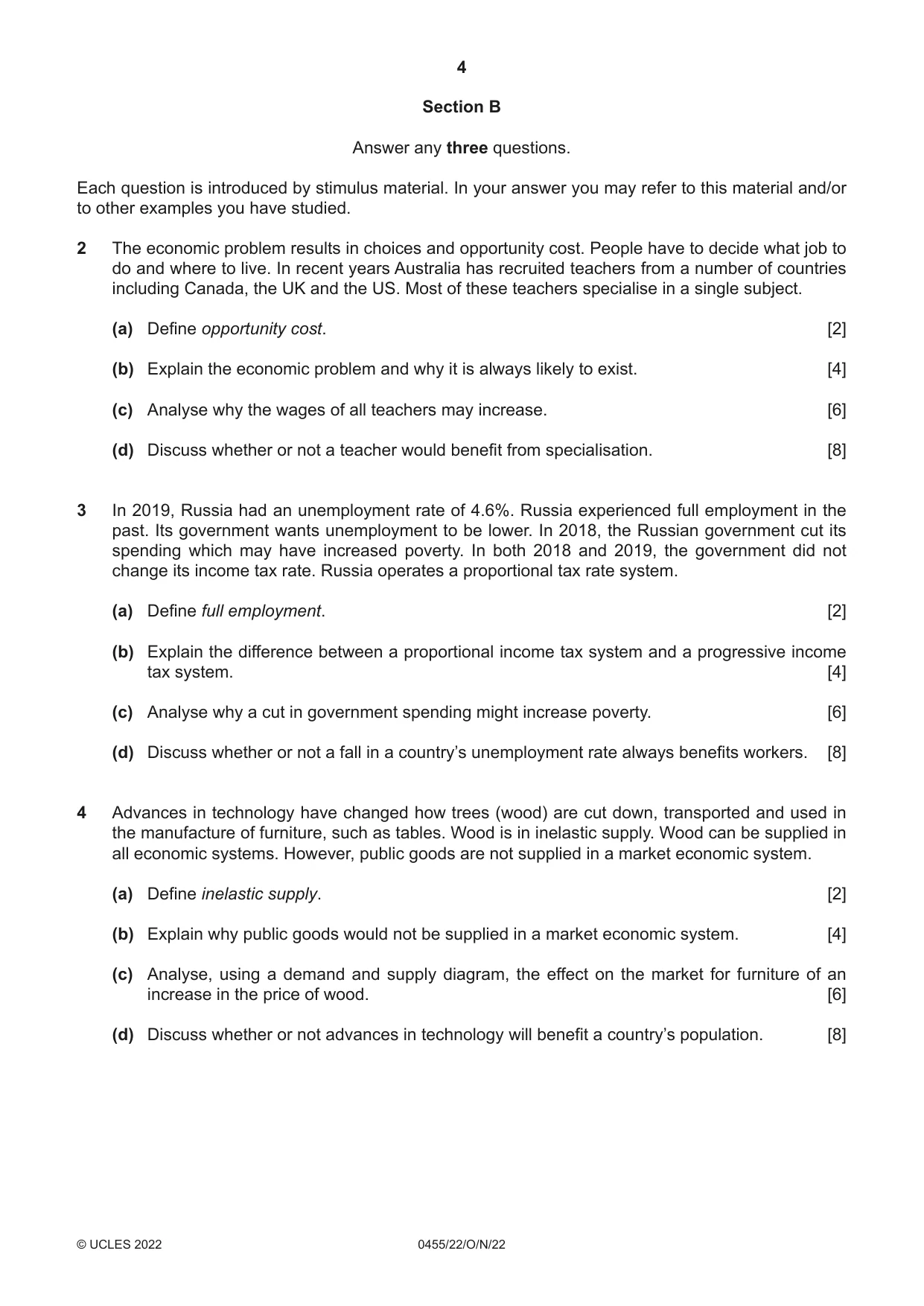
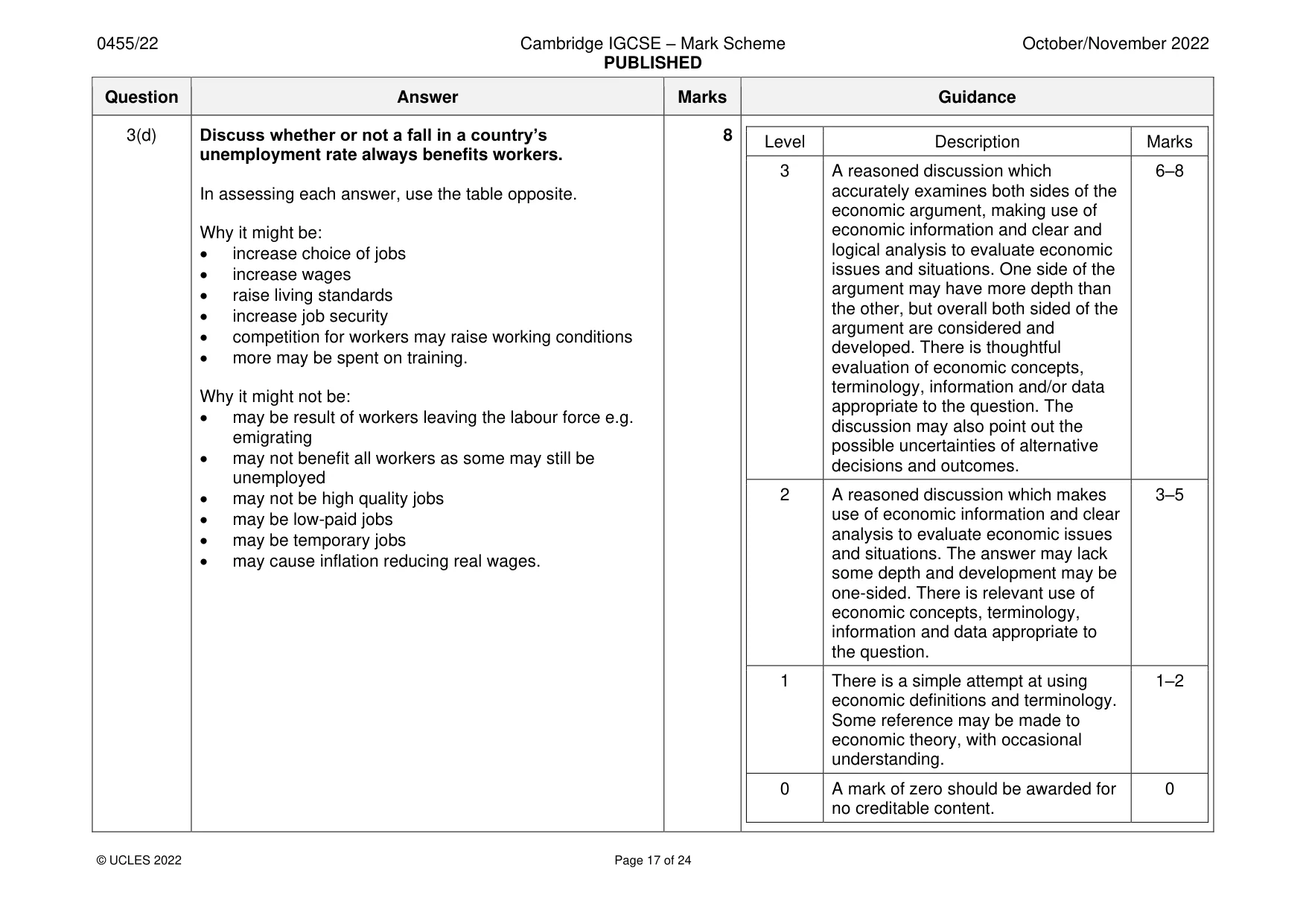
2 The economic problem results in choices and opportunity cost. People have to decide what job to do and where to live. In recent years Australia has recruited teachers from a number of countries including Canada, the UK and the US. Most of these teachers specialise in a single subject. (a) Define opportunity cost. [2] (b) Explain the economic problem and why it is always likely to exist. [4] (c) Analyse why the wages of all teachers may increase. [6] (d) Discuss whether or not a teacher would benefit from specialisation. [8]
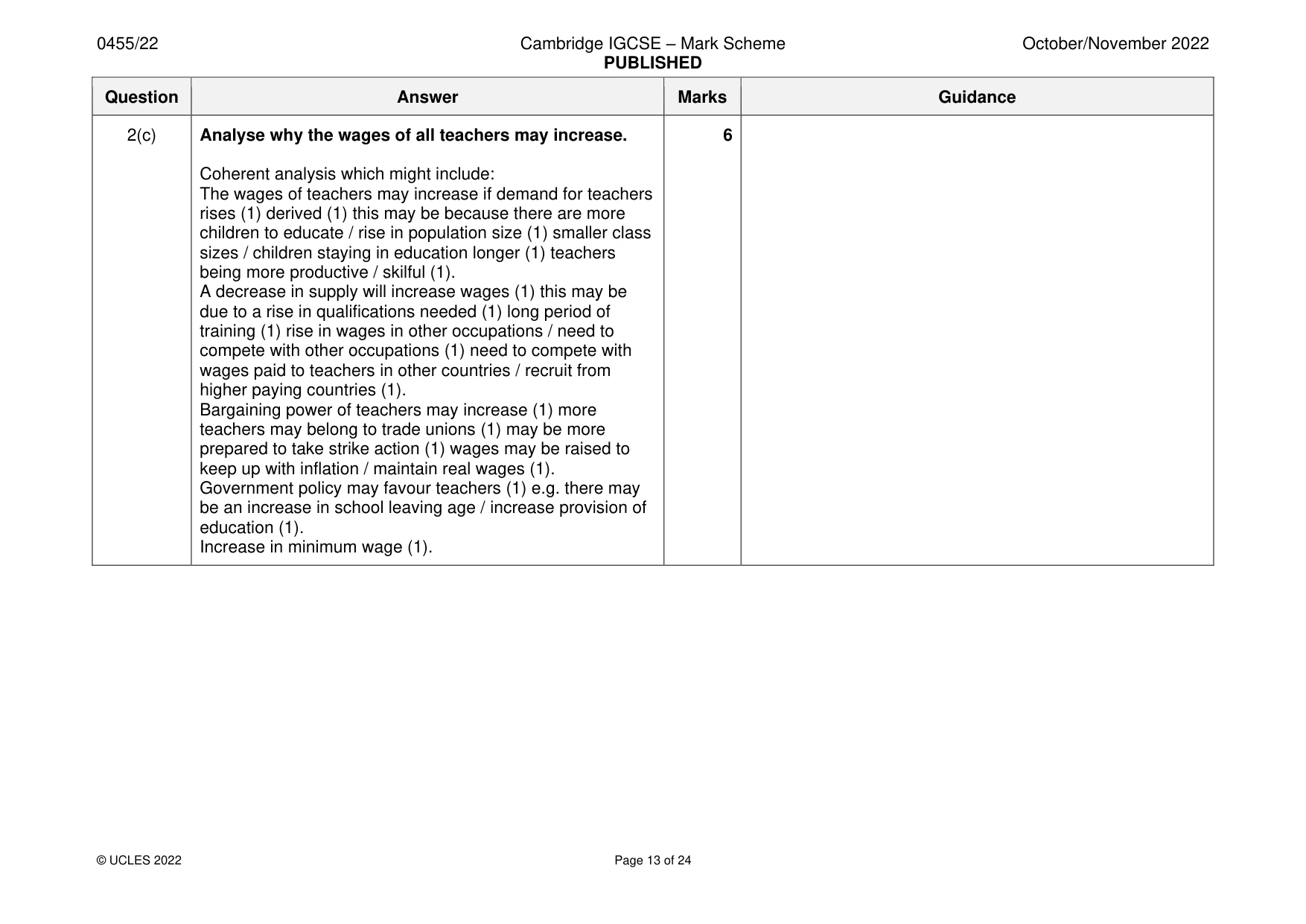
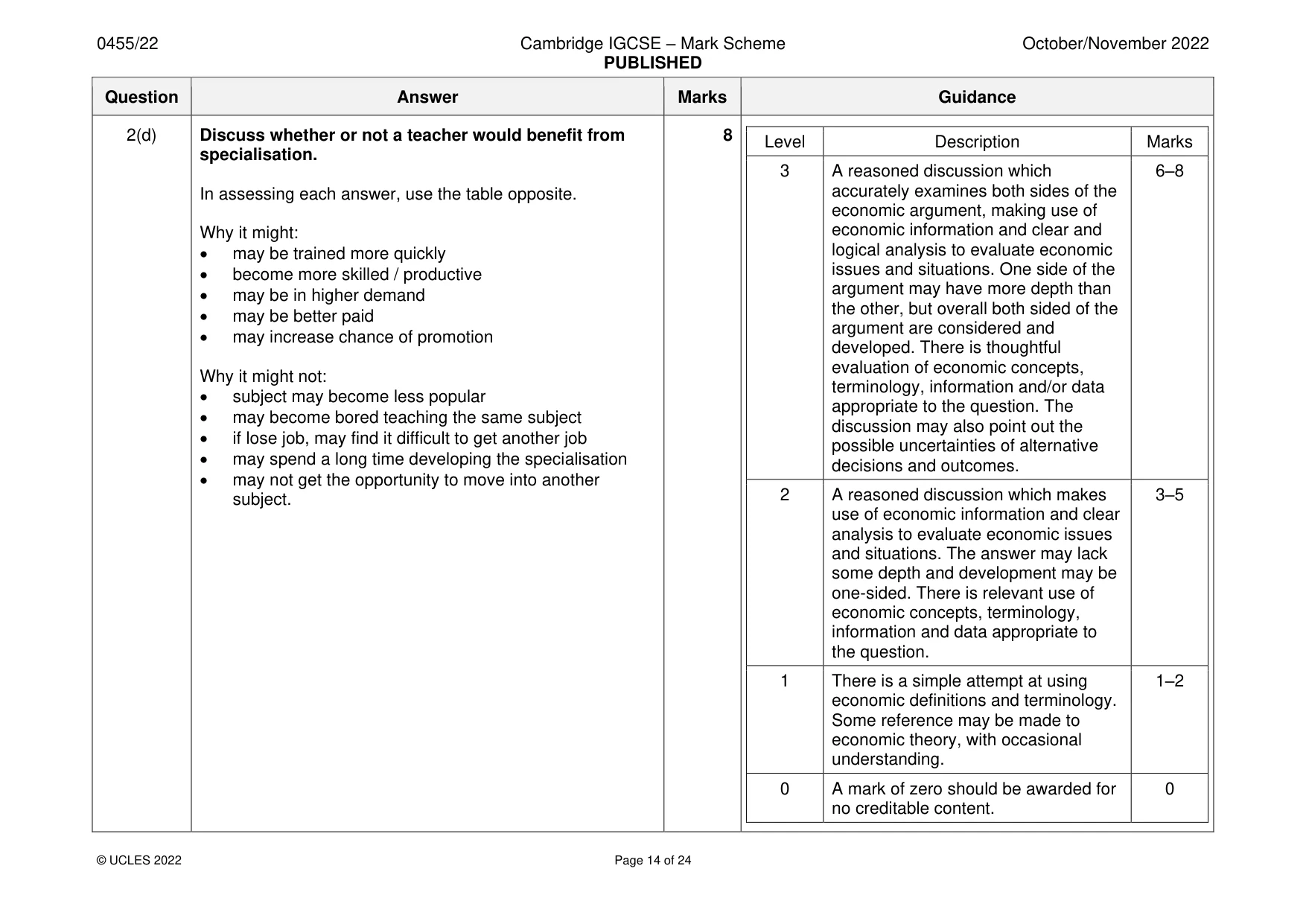
Mark scheme: 2(a) Define opportunity cost. 2 The (next) best alternative / choice (1) forgone / sacrificed (1). 2(b) Explain the economic problem and why it is always 4 likely to exist. Logical explanation which might include: The economic problem is finite / limited resources (1) and infinite / unlimited wants / wants exceed resources (1) scarcity (1). It is always likely to exist as wants grow faster than resources / wants are increasing (1) there will never be enough resources to produce all the products people would like to have (1). People are living longer / population is increasing (1) more resources are needed / some resources are being depleted (1). 2(c) Analyse why the wages of all teachers may increase. 6 Coherent analysis which might include: The wages of teachers may increase if demand for teachers rises (1) derived (1) this may be because there are more children to educate / rise in population size (1) smaller class sizes / children staying in education longer (1) teachers being more productive / skilful (1). A decrease in supply will increase wages (1) this may be due to a rise in qualifications needed (1) long period of training (1) rise in wages in other occupations / need to compete with other occupations (1) need to compete with wages paid to teachers in other countries / recruit from higher paying countries (1). Bargaining power of teachers may increase (1) more teachers may belong to trade unions (1) may be more prepared to take strike action (1) wages may be raised to keep up with inflation / maintain real wages (1). Government policy may favour teachers (1) e.g. there may be an increase in school leaving age / increase provision of education (1). Increase in minimum wage (1). 2(d) Discuss whether or not a teacher would benefit from 8 Level Description Marks specialisation. 3 A reasoned discussion which 6–8 In assessing each answer, use the table opposite. accurately examines both sides of the economic argument, making use of Why it might: economic information and clear and • may be trained more quickly logical analysis to evaluate economic • become more skilled / productive issues and situations. One side of the argument may have more depth than • may be in higher demand the other, but overall both sided of the • may be better paid argument are considered and • may increase chance of promotion developed. There is thoughtful evaluation of economic concepts, Why it might not: terminology, information and/or data • subject may become less popular appropriate to the question. The • may become bored teaching the same subject discussion may also point out the • if lose job, may find it difficult to get another job possible uncertainties of alternative • may spend a long time developing the specialisation decisions and outcomes. • may not get the opportunity to move into another 2 A reasoned discussion which makes 3–5 subject. use of economic information and clear analysis to evaluate economic issues and situations. The answer may lack some depth and development may be one-sided. There is relevant use of economic concepts, terminology, information and data appropriate to the question. 1 There is a simple attempt at using 1–2 economic definitions and terminology. Some reference may be made to economic theory, with occasional understanding. 0 A mark of zero should be awarded for 0 no creditable content.
Q3 · In 2019, Russia had an unemployment rate of 4.6%
3 In 2019, Russia had an unemployment rate of 4.6%. Russia experienced full employment in the past. Its government wants unemployment to be lower. In 2018, the Russian government cut its spending which may have increased poverty. In both 2018 and 2019, the government did not change its income tax rate. Russia operates a proportional tax rate system. (a) Define full employment. [2] (b) Explain the difference between a proportional income tax system and a progressive income tax system. [4] (c) Analyse why a cut in government spending might increase poverty. [6] (d) Discuss whether or not a fall in a country’s unemployment rate always benefits workers. [8]
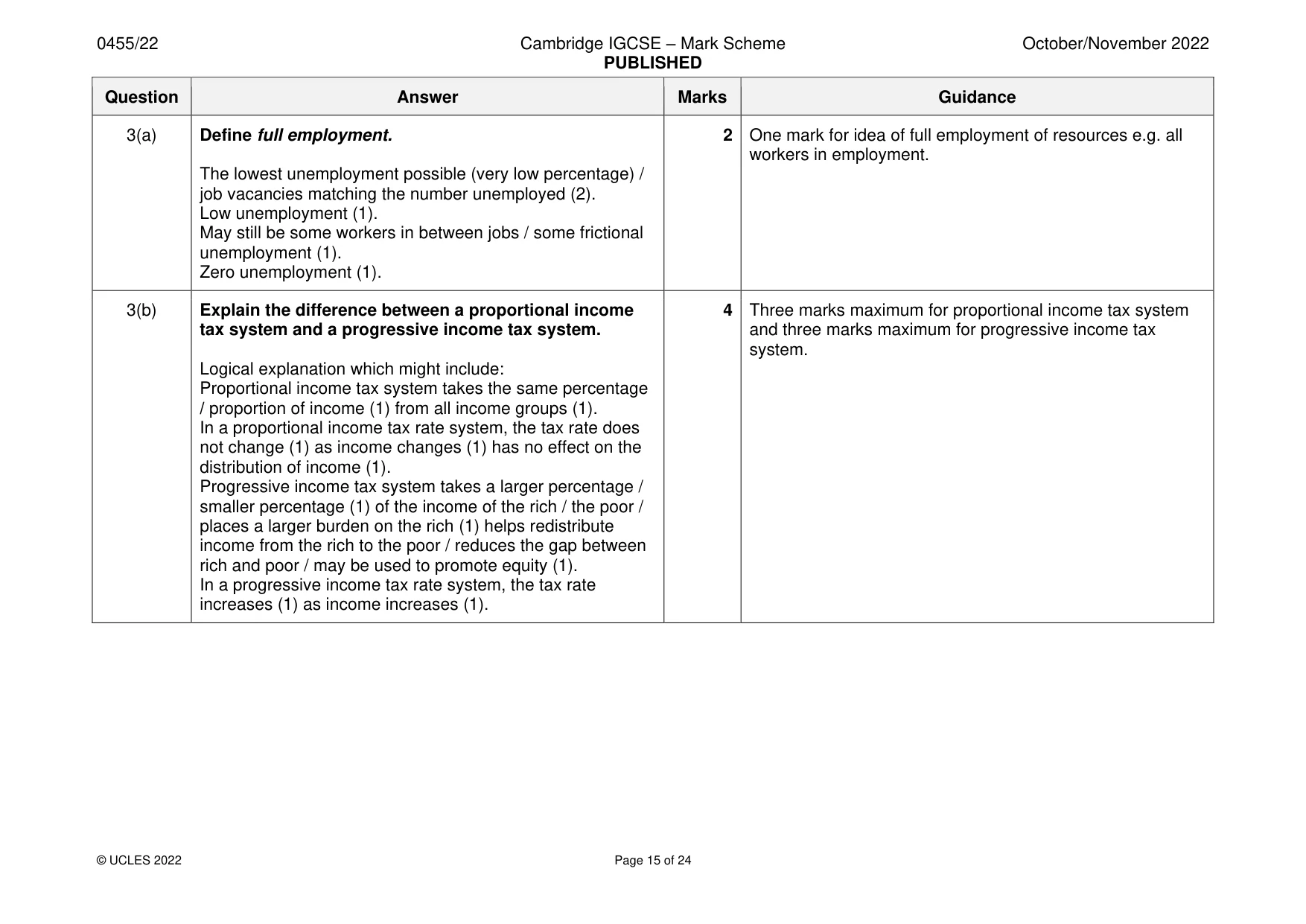
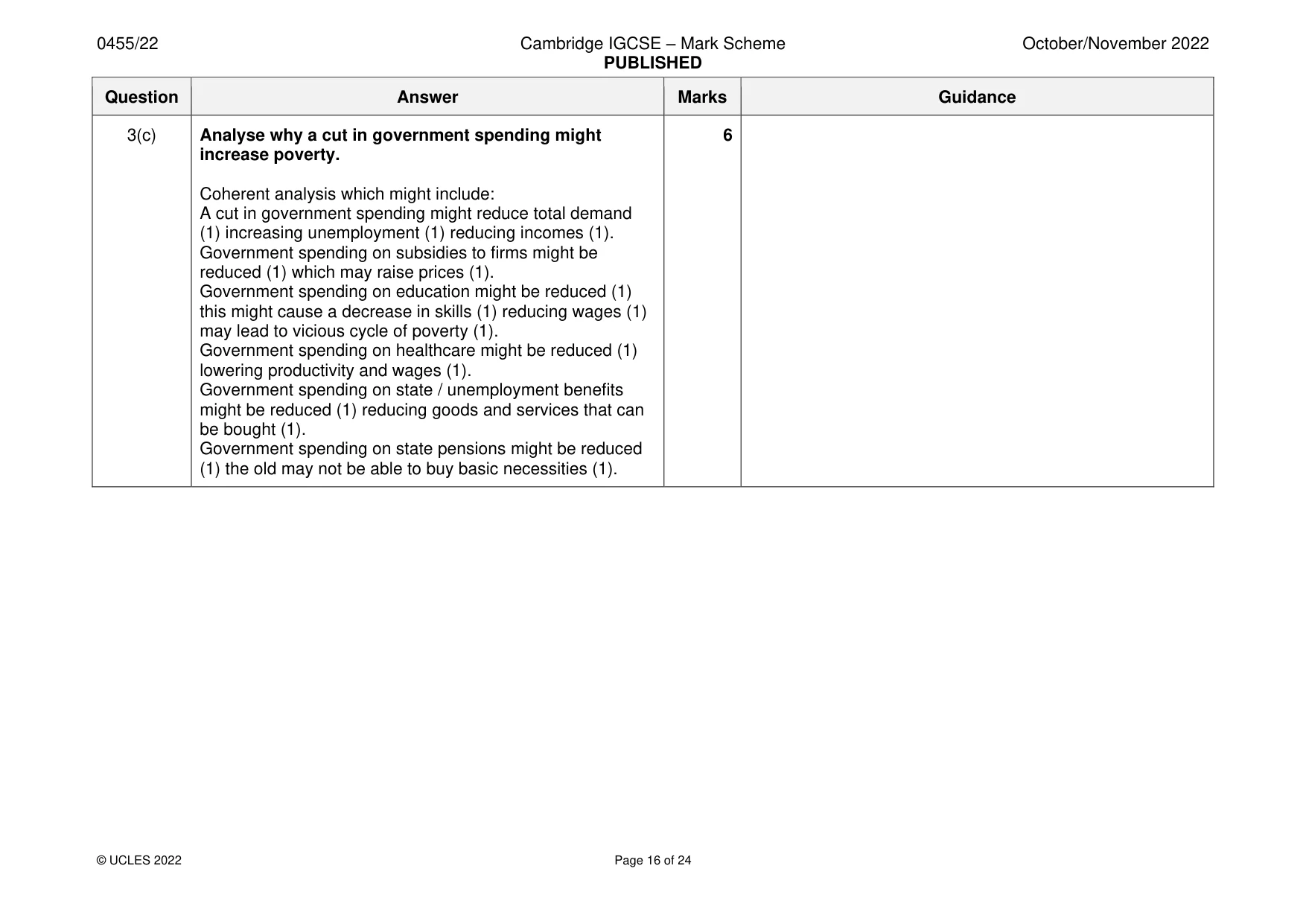
Mark scheme: 3(a) Define full employment. 2 One mark for idea of full employment of resources e.g. all workers in employment. The lowest unemployment possible (very low percentage) / job vacancies matching the number unemployed (2). Low unemployment (1). May still be some workers in between jobs / some frictional unemployment (1). Zero unemployment (1). 3(b) Explain the difference between a proportional income 4 Three marks maximum for proportional income tax system tax system and a progressive income tax system. and three marks maximum for progressive income tax system. Logical explanation which might include: Proportional income tax system takes the same percentage / proportion of income (1) from all income groups (1). In a proportional income tax rate system, the tax rate does not change (1) as income changes (1) has no effect on the distribution of income (1). Progressive income tax system takes a larger percentage / smaller percentage (1) of the income of the rich / the poor / places a larger burden on the rich (1) helps redistribute income from the rich to the poor / reduces the gap between rich and poor / may be used to promote equity (1). In a progressive income tax rate system, the tax rate increases (1) as income increases (1). 3(c) Analyse why a cut in government spending might 6 increase poverty. Coherent analysis which might include: A cut in government spending might reduce total demand (1) increasing unemployment (1) reducing incomes (1). Government spending on subsidies to firms might be reduced (1) which may raise prices (1). Government spending on education might be reduced (1) this might cause a decrease in skills (1) reducing wages (1) may lead to vicious cycle of poverty (1). Government spending on healthcare might be reduced (1) lowering productivity and wages (1). Government spending on state / unemployment benefits might be reduced (1) reducing goods and services that can be bought (1). Government spending on state pensions might be reduced (1) the old may not be able to buy basic necessities (1). 3(d) Discuss whether or not a fall in a country’s 8 Level Description Marks unemployment rate always benefits workers. 3 A reasoned discussion which 6–8 In assessing each answer, use the table opposite. accurately examines both sides of the economic argument, making use of Why it might be: economic information and clear and • increase choice of jobs logical analysis to evaluate economic • increase wages issues and situations. One side of the argument may have more depth than • raise living standards the other, but overall both sided of the • increase job security argument are considered and • competition for workers may raise working conditions developed. There is thoughtful • more may be spent on training. evaluation of economic concepts, terminology, information and/or data Why it might not be: appropriate to the question. The • may be result of workers leaving the labour force e.g. discussion may also point out the emigrating possible uncertainties of alternative • may not benefit all workers as some may still be decisions and outcomes. unemployed • may not be high quality jobs 2 A reasoned discussion which makes 3–5 • may be low-paid jobs use of economic information and clear • may be temporary jobs analysis to evaluate economic issues and situations. The answer may lack • may cause inflation reducing real wages. some depth and development may be one-sided. There is relevant use of economic concepts, terminology, information and data appropriate to the question. 1 There is a simple attempt at using 1–2 economic definitions and terminology. Some reference may be made to economic theory, with occasional understanding. 0 A mark of zero should be awarded for 0 no creditable content.
Q4 · Advances in technology have changed how trees (wood) are cut down, transported and used…
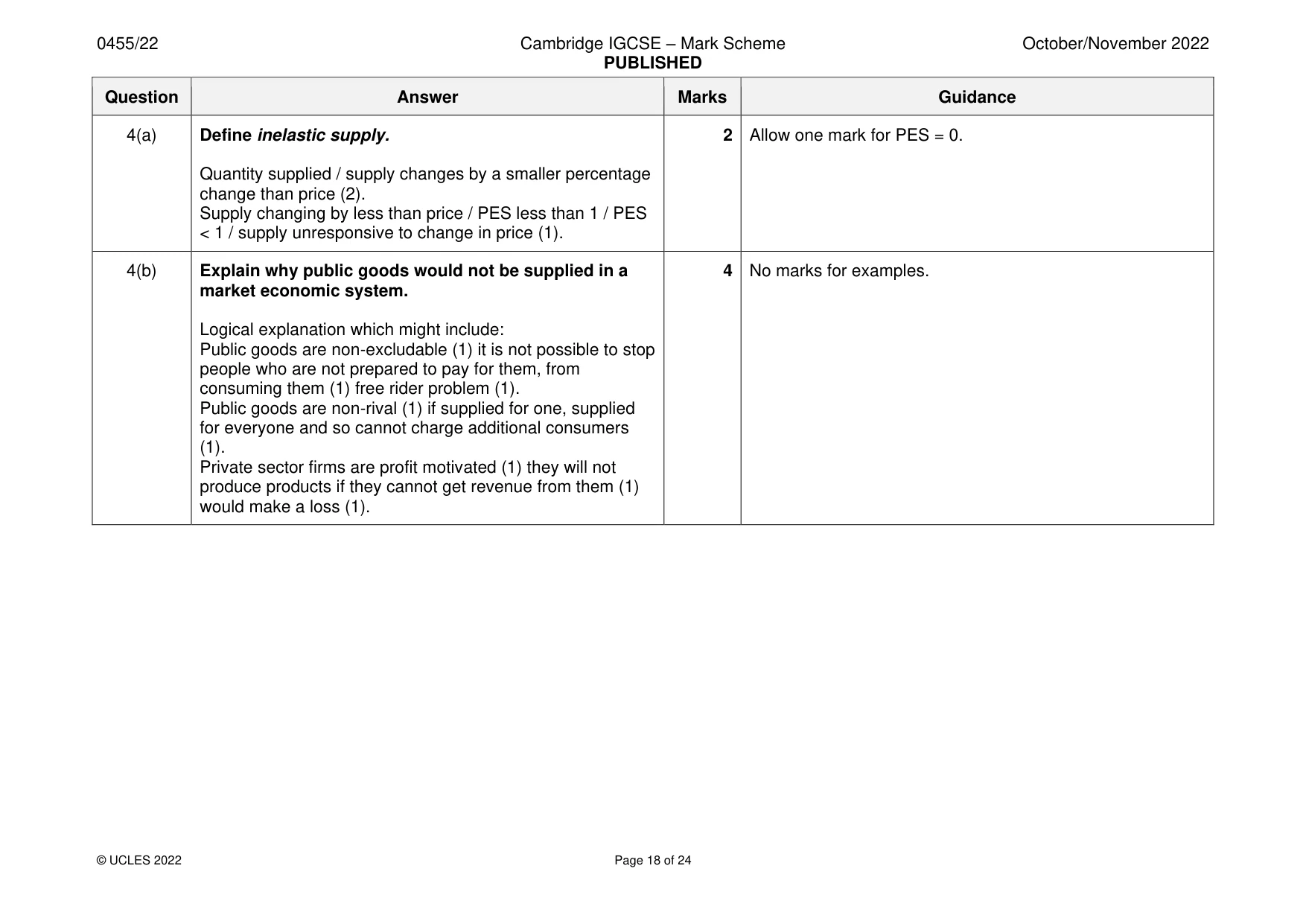
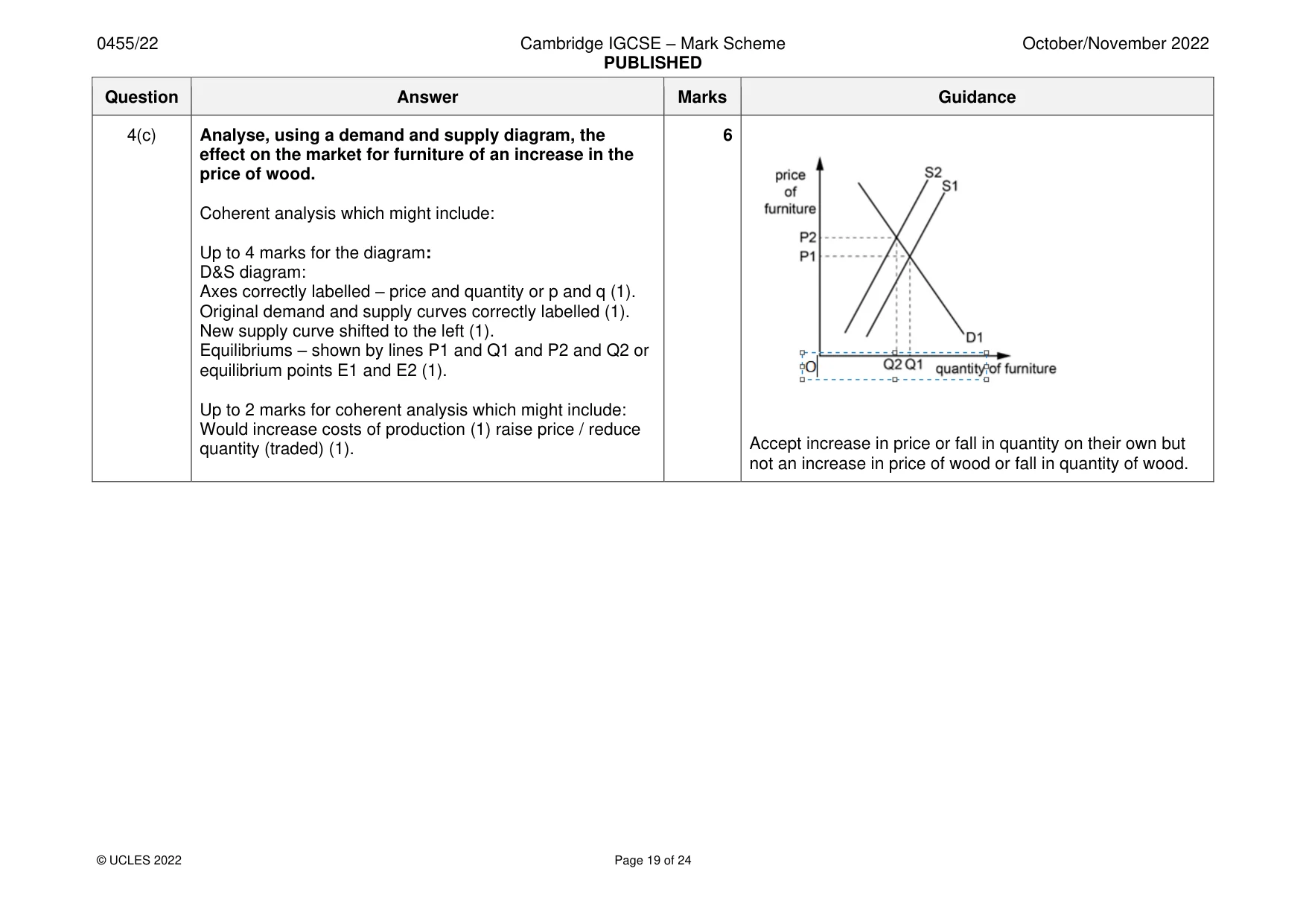
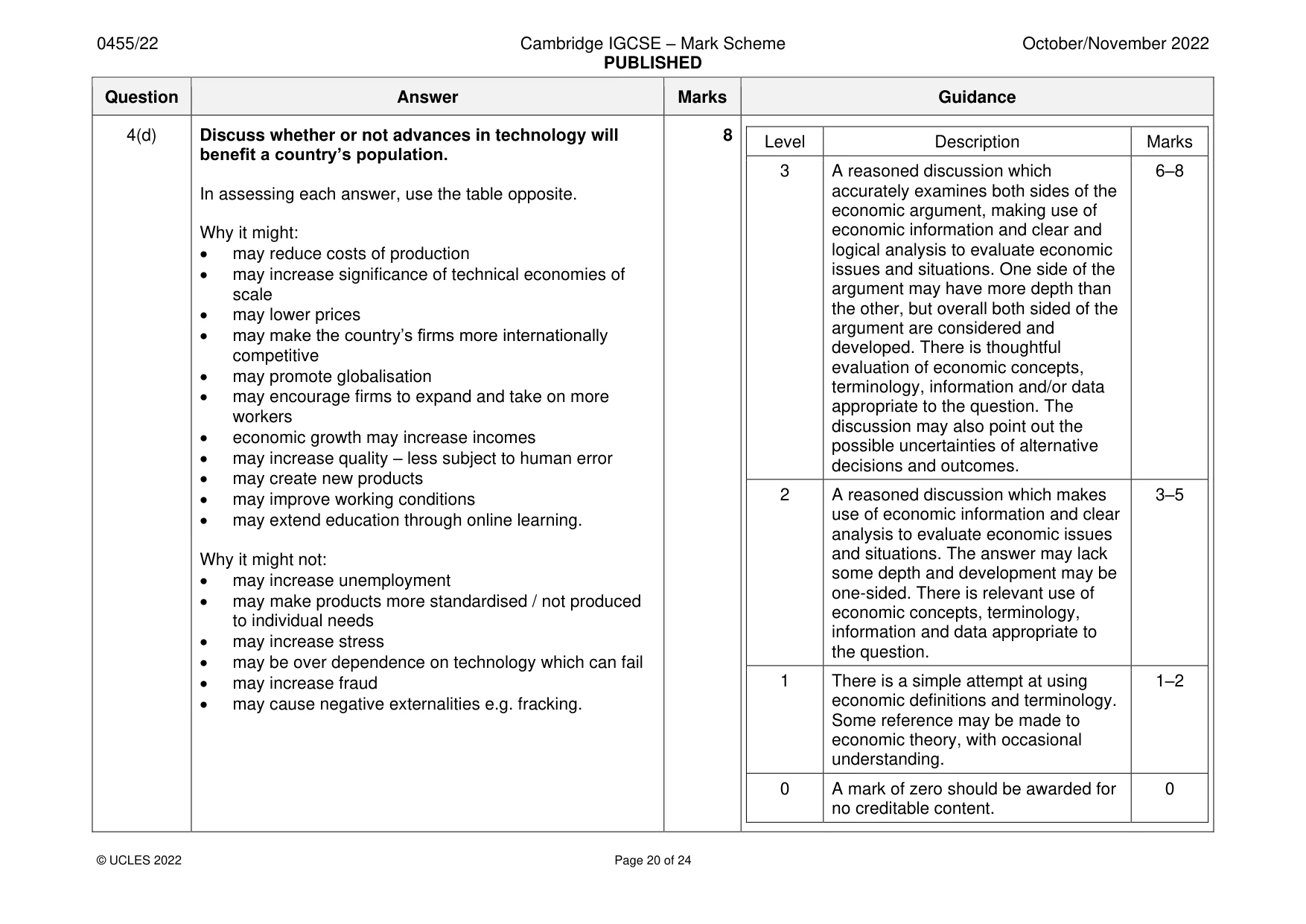
4 Advances in technology have changed how trees (wood) are cut down, transported and used in the manufacture of furniture, such as tables. Wood is in inelastic supply. Wood can be supplied in all economic systems. However, public goods are not supplied in a market economic system. (a) Define inelastic supply. [2] (b) Explain why public goods would not be supplied in a market economic system. [4] (c) Analyse, using a demand and supply diagram, the effect on the market for furniture of an increase in the price of wood. [6] (d) Discuss whether or not advances in technology will benefit a country’s population. [8]
Mark scheme: 4(a) Define inelastic supply. 2 Allow one mark for PES = 0. Quantity supplied / supply changes by a smaller percentage change than price (2). Supply changing by less than price / PES less than 1 / PES < 1 / supply unresponsive to change in price (1). 4(b) Explain why public goods would not be supplied in a 4 No marks for examples. market economic system. Logical explanation which might include: Public goods are non-excludable (1) it is not possible to stop people who are not prepared to pay for them, from consuming them (1) free rider problem (1). Public goods are non-rival (1) if supplied for one, supplied for everyone and so cannot charge additional consumers (1). Private sector firms are profit motivated (1) they will not produce products if they cannot get revenue from them (1) would make a loss (1). 4(c) Analyse, using a demand and supply diagram, the 6 effect on the market for furniture of an increase in the price of wood. Coherent analysis which might include: Up to 4 marks for the diagram: D&S diagram: Axes correctly labelled – price and quantity or p and q (1). Original demand and supply curves correctly labelled (1). New supply curve shifted to the left (1). Equilibriums – shown by lines P1 and Q1 and P2 and Q2 or equilibrium points E1 and E2 (1). Up to 2 marks for coherent analysis which might include: Would increase costs of production (1) raise price / reduce Accept increase in price or fall in quantity on their own but quantity (traded) (1). not an increase in price of wood or fall in quantity of wood. 4(d) Discuss whether or not advances in technology will 8 Level Description Marks benefit a country’s population. 3 A reasoned discussion which 6–8 In assessing each answer, use the table opposite. accurately examines both sides of the economic argument, making use of Why it might: economic information and clear and • may reduce costs of production logical analysis to evaluate economic • may increase significance of technical economies of issues and situations. One side of the argument may have more depth than scale the other, but overall both sided of the • may lower prices argument are considered and • may make the country’s firms more internationally developed. There is thoughtful competitive evaluation of economic concepts, • may promote globalisation terminology, information and/or data • may encourage firms to expand and take on more appropriate to the question. The workers discussion may also point out the • economic growth may increase incomes possible uncertainties of alternative • may increase quality – less subject to human error decisions and outcomes. • may create new products • may improve working conditions 2 A reasoned discussion which makes 3–5 • may extend education through online learning. use of economic information and clear analysis to evaluate economic issues and situations. The answer may lack Why it might not: some depth and development may be • may increase unemployment one-sided. There is relevant use of • may make products more standardised / not produced economic concepts, terminology, to individual needs information and data appropriate to • may increase stress the question. • may be over dependence on technology which can fail • may increase fraud 1 There is a simple attempt at using 1–2 • may cause negative externalities e.g. fracking. economic definitions and terminology. Some reference may be made to economic theory, with occasional understanding. 0 A mark of zero should be awarded for 0 no creditable content.
Q5 · While 15% of US exports go to Mexico, 80% of Mexico’s exports go to the US
5 While 15% of US exports go to Mexico, 80% of Mexico’s exports go to the US. In 2019, the US government imposed some methods of protection to reduce imports from Mexico. This US action caused a fall in Mexico’s foreign exchange rate. Despite a rise in its inflation rate, Mexico’s central bank reduced the rate of interest from 7.75% at the end of 2019 to 6.5% in March 2020. (a) Identify two methods of protection. [2] (b) Explain two reasons why a government may want to reduce imports. [4] (c) Analyse how a fall in a country’s foreign exchange rate could increase its inflation rate. [6] (d) Discuss whether or not a decrease in the rate of interest will increase a country’s GDP. [8]
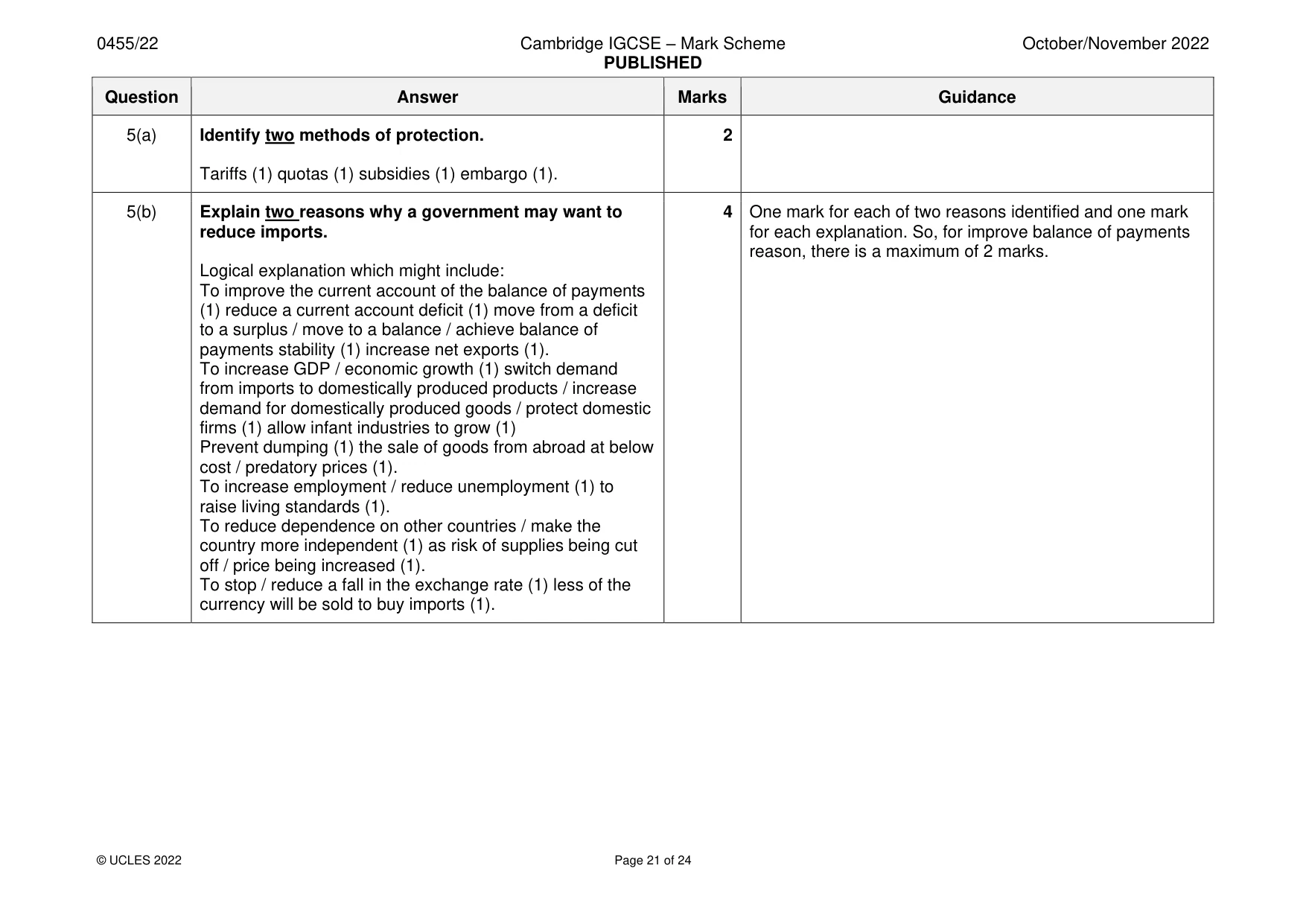
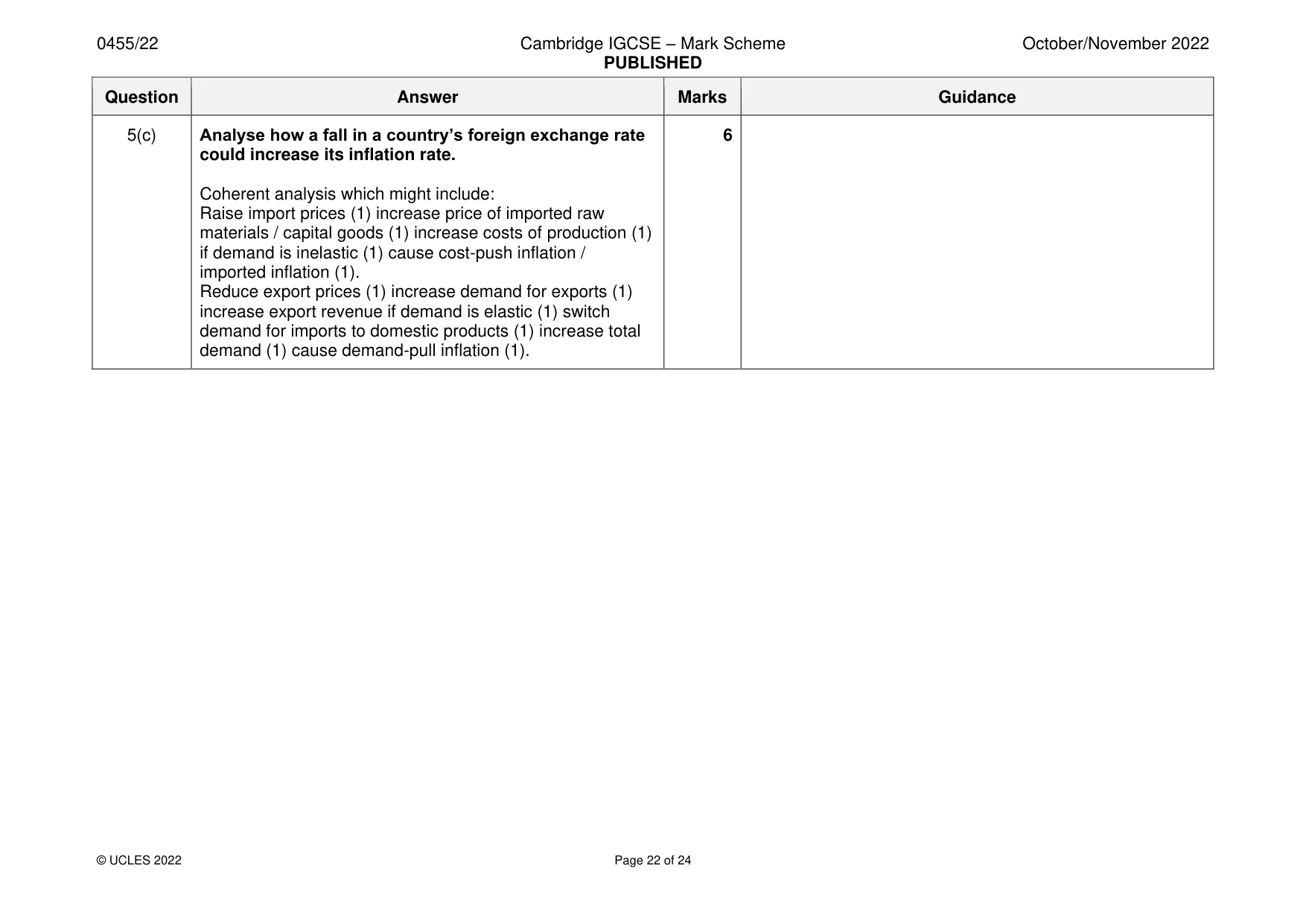
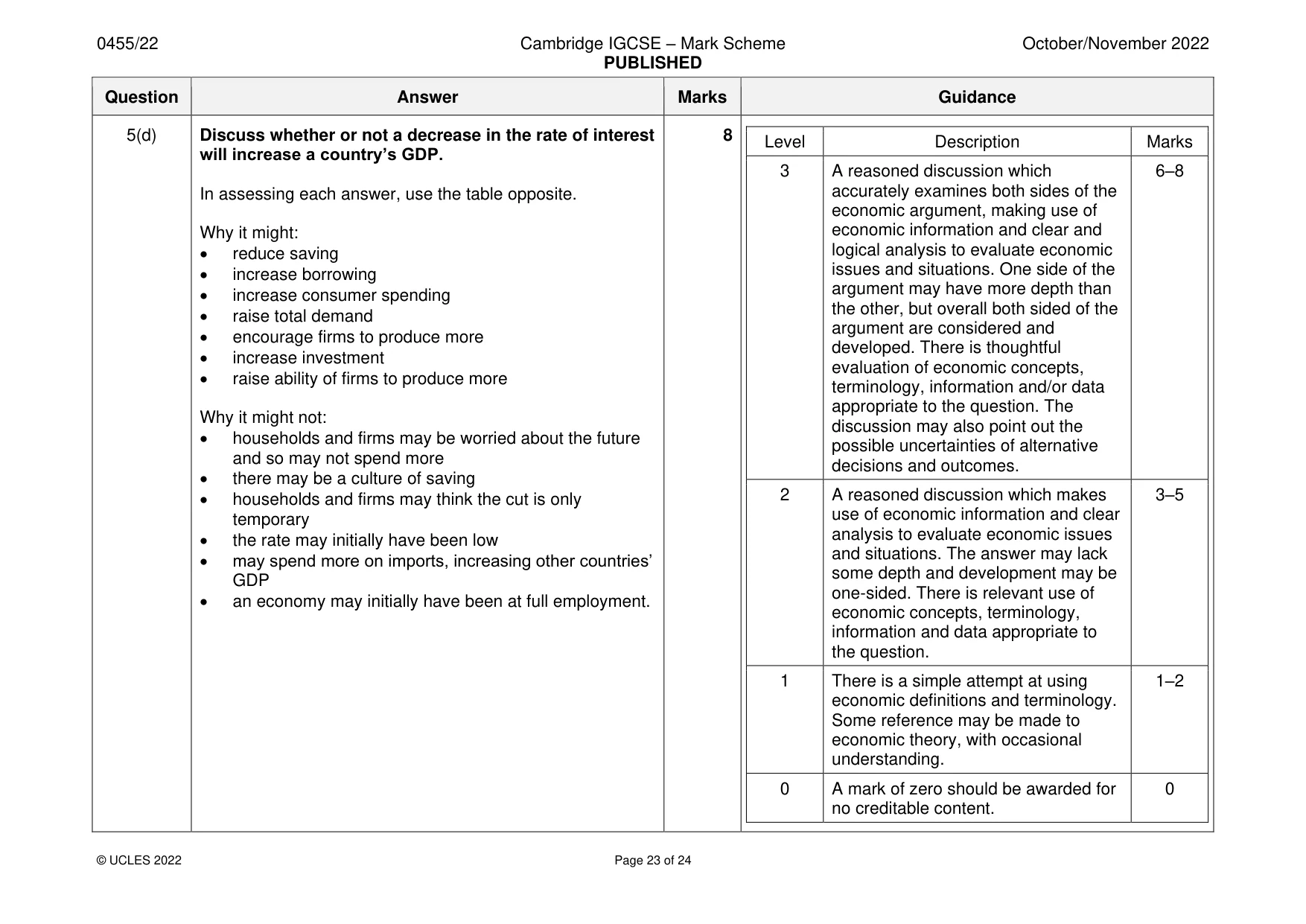
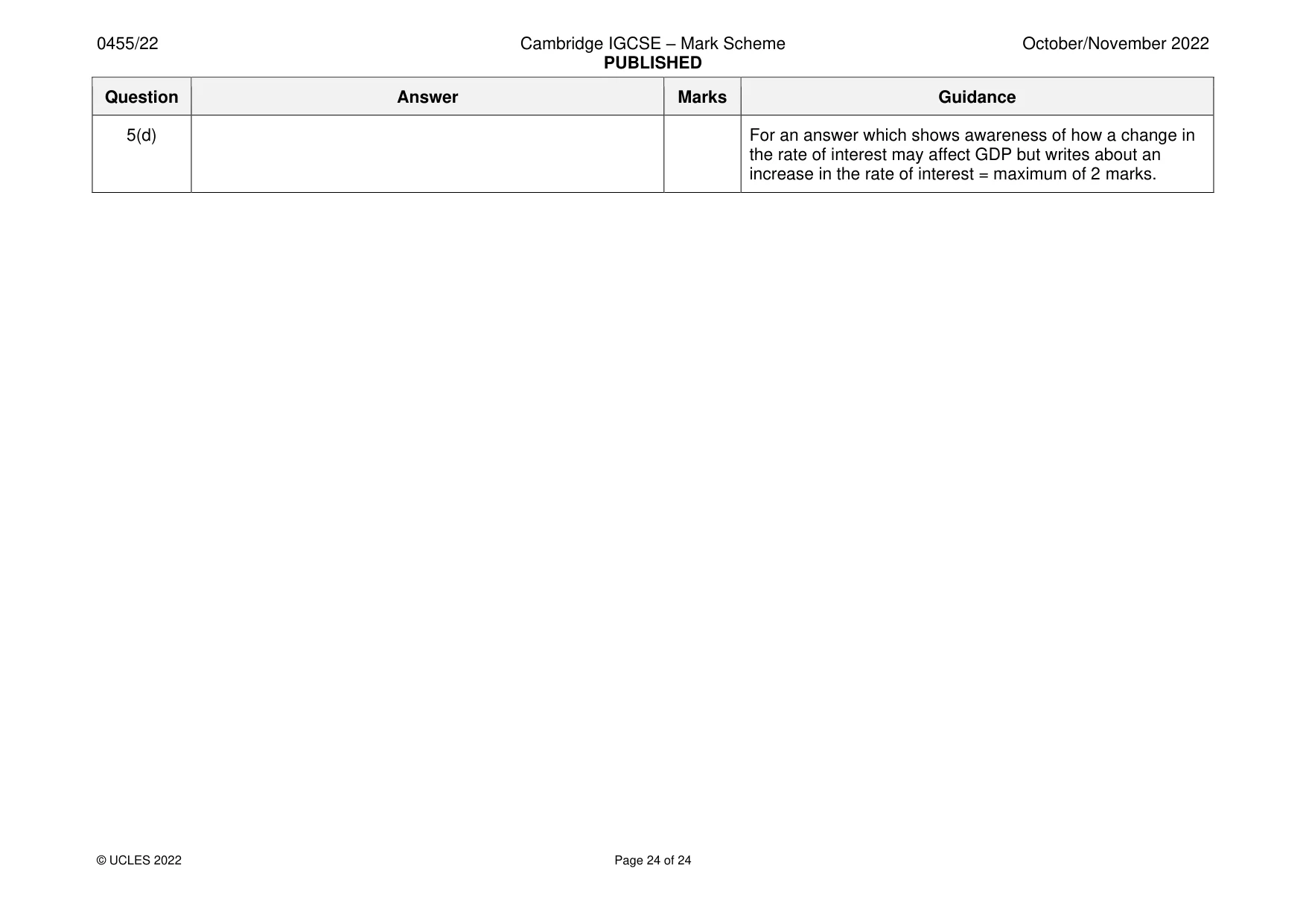
Mark scheme: 5(a) Identify two methods of protection. 2 Tariffs (1) quotas (1) subsidies (1) embargo (1). 5(b) Explain two reasons why a government may want to 4 One mark for each of two reasons identified and one mark reduce imports. for each explanation. So, for improve balance of payments reason, there is a maximum of 2 marks. Logical explanation which might include: To improve the current account of the balance of payments (1) reduce a current account deficit (1) move from a deficit to a surplus / move to a balance / achieve balance of payments stability (1) increase net exports (1). To increase GDP / economic growth (1) switch demand from imports to domestically produced products / increase demand for domestically produced goods / protect domestic firms (1) allow infant industries to grow (1) Prevent dumping (1) the sale of goods from abroad at below cost / predatory prices (1). To increase employment / reduce unemployment (1) to raise living standards (1). To reduce dependence on other countries / make the country more independent (1) as risk of supplies being cut off / price being increased (1). To stop / reduce a fall in the exchange rate (1) less of the currency will be sold to buy imports (1). 5(c) Analyse how a fall in a country’s foreign exchange rate 6 could increase its inflation rate. Coherent analysis which might include: Raise import prices (1) increase price of imported raw materials / capital goods (1) increase costs of production (1) if demand is inelastic (1) cause cost-push inflation / imported inflation (1). Reduce export prices (1) increase demand for exports (1) increase export revenue if demand is elastic (1) switch demand for imports to domestic products (1) increase total demand (1) cause demand-pull inflation (1). 5(d) Discuss whether or not a decrease in the rate of interest 8 Level Description Marks will increase a country’s GDP. 3 A reasoned discussion which 6–8 In assessing each answer, use the table opposite. accurately examines both sides of the economic argument, making use of Why it might: economic information and clear and • reduce saving logical analysis to evaluate economic • increase borrowing issues and situations. One side of the argument may have more depth than • increase consumer spending the other, but overall both sided of the • raise total demand argument are considered and • encourage firms to produce more developed. There is thoughtful • increase investment evaluation of economic concepts, • raise ability of firms to produce more terminology, information and/or data appropriate to the question. The Why it might not: discussion may also point out the • households and firms may be worried about the future possible uncertainties of alternative and so may not spend more decisions and outcomes. • there may be a culture of saving • households and firms may think the cut is only 2 A reasoned discussion which makes 3–5 use of economic information and clear temporary • the rate may initially have been low analysis to evaluate economic issues and situations. The answer may lack • may spend more on imports, increasing other countries’ some depth and development may be GDP one-sided. There is relevant use of • an economy may initially have been at full employment. economic concepts, terminology, information and data appropriate to the question. 1 There is a simple attempt at using 1–2 economic definitions and terminology. Some reference may be made to economic theory, with occasional understanding. 0 A mark of zero should be awarded for 0 no creditable content. 5(d) For an answer which shows awareness of how a change in the rate of interest may affect GDP but writes about an increase in the rate of interest = maximum of 2 marks.
What was in this paper
The subtopics covered by these 5 questions, and how many questions each got. Open one in a new tab to see every Cambridge question on it.
What you needed in this session
Cambridge’s own grade thresholds for 2022 Oct/Nov, Paper 2 · Variant 2. A higher threshold means an easier paper — the bar moves with how the cohort did.