Questions as text
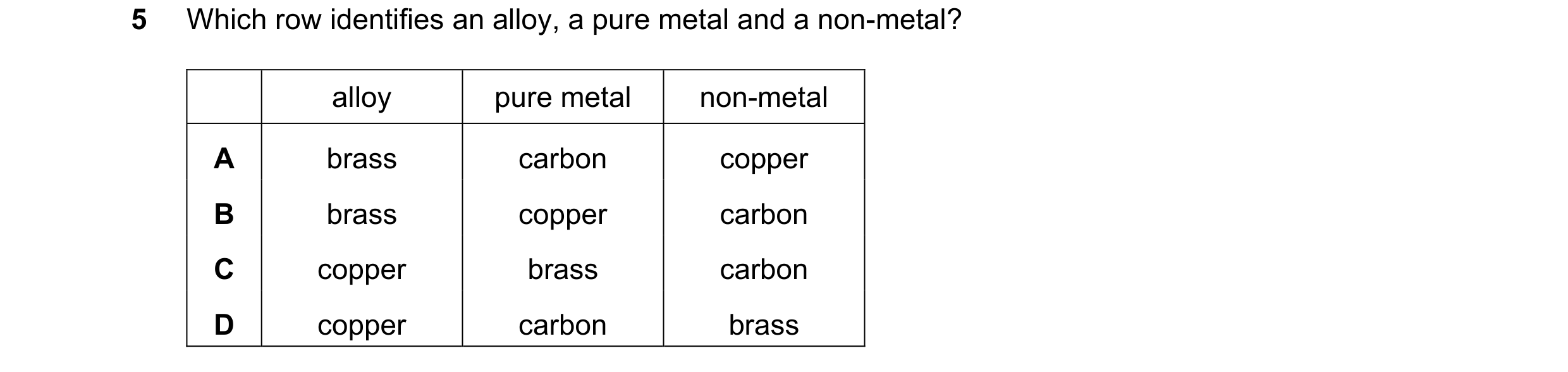
Q1 · Which row identifies an alloy, a pure metal and a non-metal? 0971/11 May/June 2018
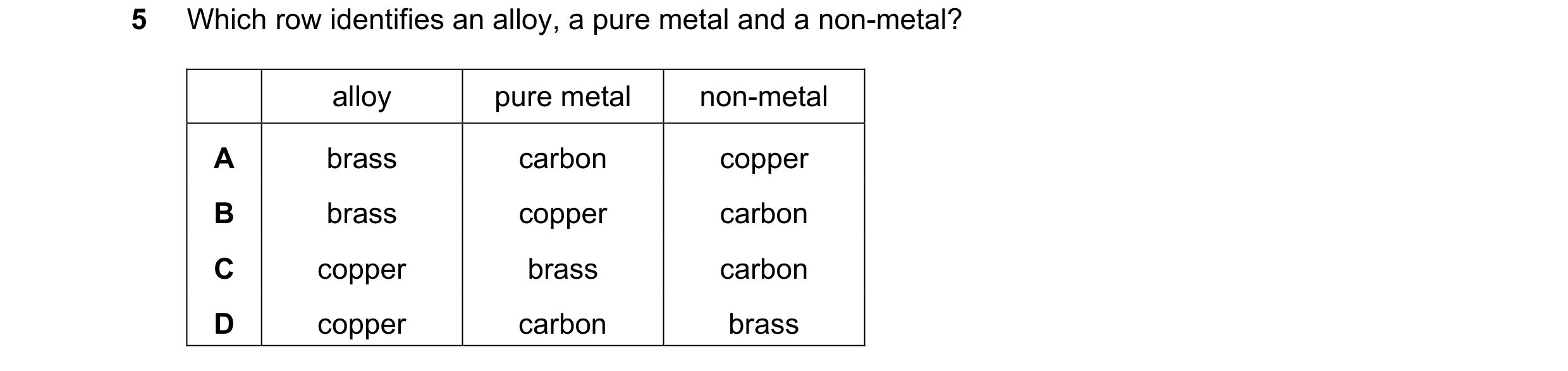
5 Which row identifies an alloy, a pure metal and a non-metal? alloy pure metal non-metal A brass carbon copper B brass copper carbon C copper brass carbon D copper carbon brass
1 marks
Answer: B
This question in 0971/11 May/June 2018
Q2 · The diagrams show the structure of two substances used to make electrical conductors 0971/11 May/June 2019
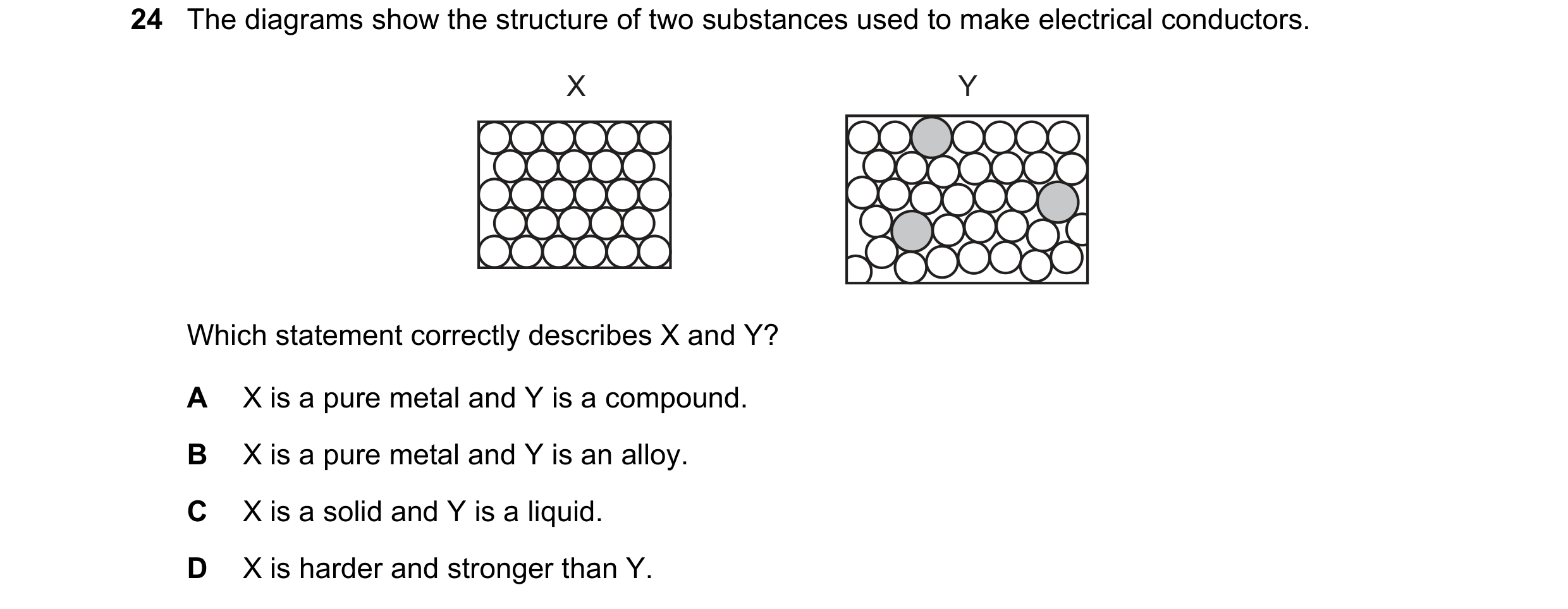
24 The diagrams show the structure of two substances used to make electrical conductors. X Y Which statement correctly describes X and Y? A X is a pure metal and Y is a compound. B X is a pure metal and Y is an alloy. C X is a solid and Y is a liquid. D X is harder and stronger than Y.
1 marks
Answer: B
This question in 0971/11 May/June 2019
Q3 · Which statement about an alloy is correct? 0971/12 Oct/Nov 2019
7 Which statement about an alloy is correct? A It is a compound made of two or more elements, one of which is a metal. B It is a layer of a metal plated onto another metal. C It is a mixture of a metal with other elements. D It is a single element.
1 marks
Answer: C
This question in 0971/12 Oct/Nov 2019
Q4 · What is added to molten iron to make steel? 0971/12 Oct/Nov 2019
26 What is added to molten iron to make steel? A small amounts of carbon B limestone and coke C calcium oxide and oxygen D hematite and air
1 marks
Answer: C
This question in 0971/12 Oct/Nov 2019
Q5 · Which row describes two uses of the named steel? 0971/11 May/June 2020
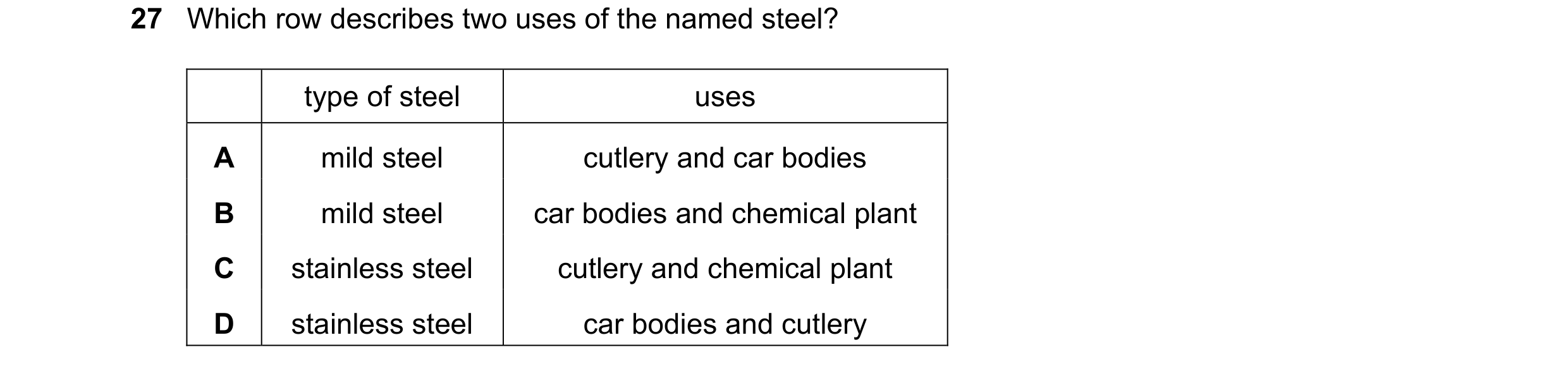
27 Which row describes two uses of the named steel? type of steel uses A mild steel cutlery and car bodies B mild steel car bodies and chemical plant C stainless steel cutlery and chemical plant D stainless steel car bodies and cutlery
1 marks
Answer: C
This question in 0971/11 May/June 2020
Q6 · Which statement about mild steel explains why it is a good choice for car bodies? 0971/12 May/June 2020
27 Which statement about mild steel explains why it is a good choice for car bodies? A It is cheap and strong. B It is a good conductor. C It is low density. D It resists rusting.
1 marks
Answer: A
This question in 0971/12 May/June 2020
Q7 · Which diagram shows the structure of an alloy? 0971/11 May/June 2021
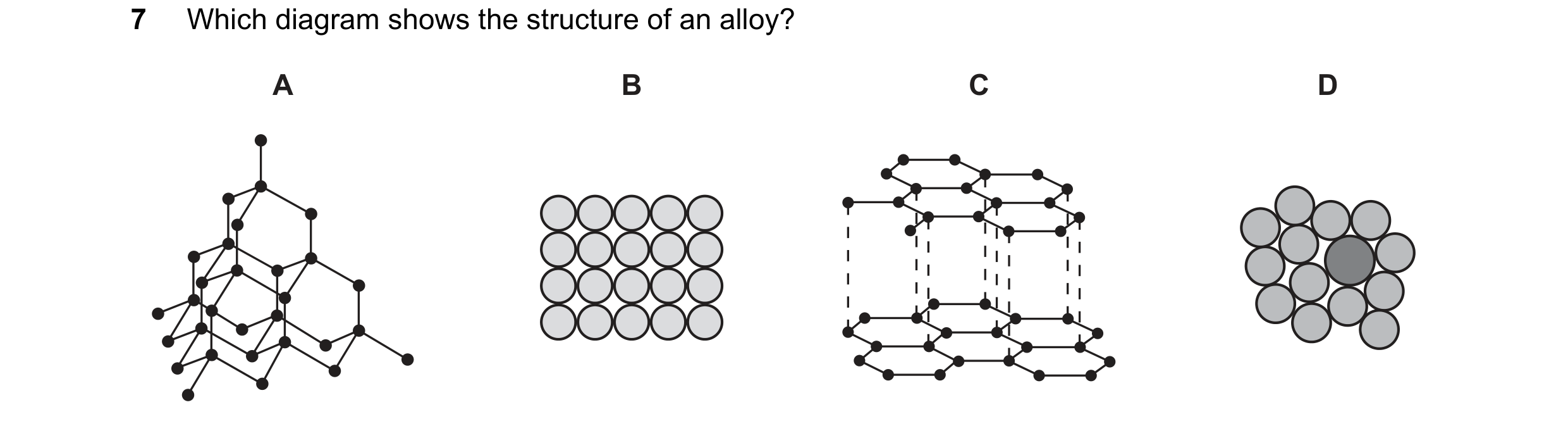
7 Which diagram shows the structure of an alloy? A B C D
1 marks
Answer: D
This question in 0971/11 May/June 2021
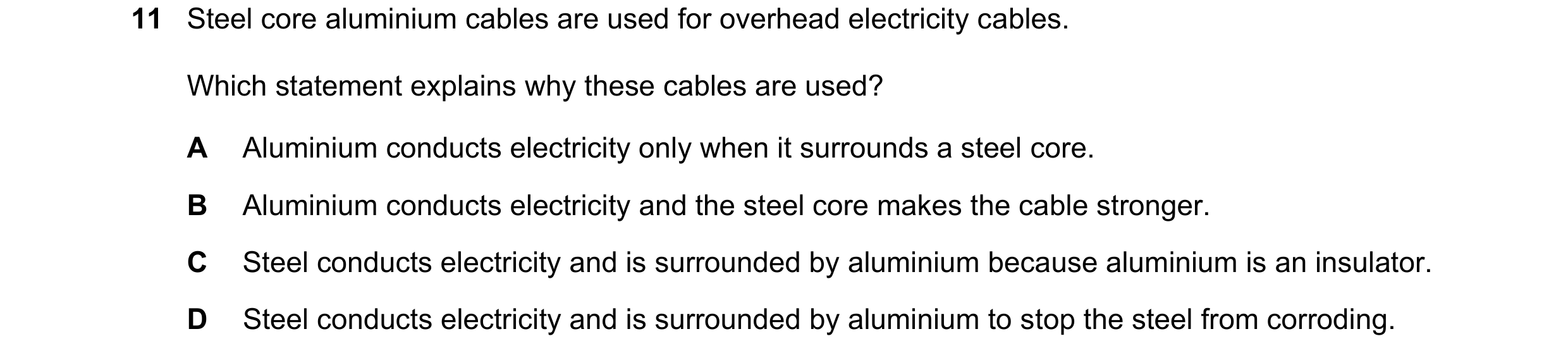
Q8 · Steel core aluminium cables are used for overhead electricity cables 0971/11 May/June 2021
11 Steel core aluminium cables are used for overhead electricity cables. Which statement explains why these cables are used? A Aluminium conducts electricity only when it surrounds a steel core. B Aluminium conducts electricity and the steel core makes the cable stronger. C Steel conducts electricity and is surrounded by aluminium because aluminium is an insulator. D Steel conducts electricity and is surrounded by aluminium to stop the steel from corroding.
1 marks
Answer: B
This question in 0971/11 May/June 2021
Q9 · Which description of brass is correct? 0971/12 Oct/Nov 2021
5 Which description of brass is correct? A alloy B compound C element D non-metal
1 marks
Answer: A
This question in 0971/12 Oct/Nov 2021
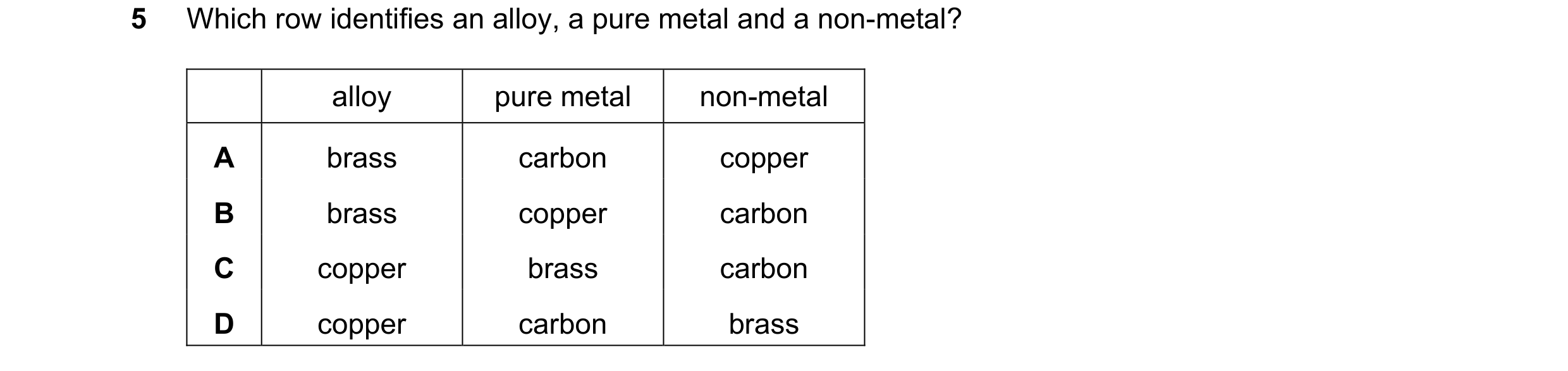
Q10 · Which row identifies an alloy, a pure metal and a non-metal? 0971/11 May/June 2022
5 Which row identifies an alloy, a pure metal and a non-metal? alloy pure metal non-metal A brass carbon copper B brass copper carbon C copper brass carbon D copper carbon brass
1 marks
Answer: B
This question in 0971/11 May/June 2022
Q11 · Overhead power cables made from (steel-cored) aluminium are used to carry electricity… 0971/11 May/June 2022
11 Overhead power cables made from (steel-cored) aluminium are used to carry electricity over long distances. Which property of (steel-cored) aluminium makes it suitable for use in power cables? A Aluminium has a low density. B Aluminium has low strength. C Steel is a good conductor of heat. D Steel is resistant to corrosion.
1 marks
Answer: A
This question in 0971/11 May/June 2022
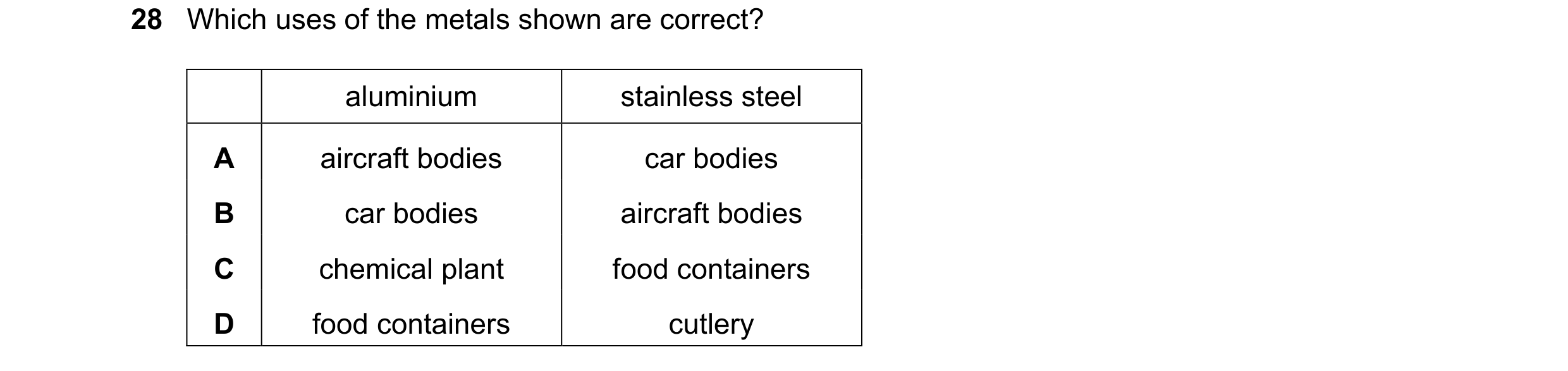
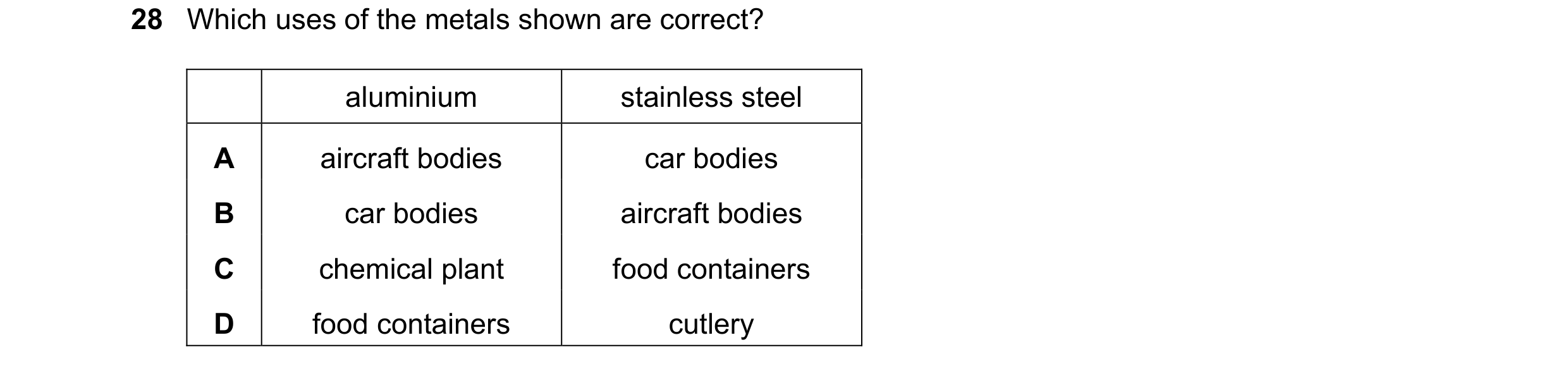
Q12 · Which uses of the metals shown are correct? 0971/11 May/June 2022
28 Which uses of the metals shown are correct? aluminium stainless steel A aircraft bodies car bodies B car bodies aircraft bodies C chemical plant food containers D food containers cutlery
1 marks
Answer: D
This question in 0971/11 May/June 2022
Q13 · Which row identifies an alloy, a pure metal and a non-metal? 0971/12 May/June 2022
5 Which row identifies an alloy, a pure metal and a non-metal? alloy pure metal non-metal A brass carbon copper B brass copper carbon C copper brass carbon D copper carbon brass
1 marks
Answer: B
This question in 0971/12 May/June 2022
Q14 · Which diagram represents the arrangement of atoms in an alloy? 0971/12 May/June 2022
27 Which diagram represents the arrangement of atoms in an alloy? A B C D
1 marks
Answer: D
This question in 0971/12 May/June 2022
Q15 · Which uses of the metals shown are correct? 0971/12 May/June 2022
28 Which uses of the metals shown are correct? aluminium stainless steel A aircraft bodies car bodies B car bodies aircraft bodies C chemical plant food containers D food containers cutlery
1 marks
Answer: D
This question in 0971/12 May/June 2022
Q16 · Which statement about an alloy is correct? 0971/12 Oct/Nov 2022
5 Which statement about an alloy is correct? A It is a compound made of two or more elements, one of which is a metal. B It is a layer of a metal plated onto another metal. C It is a mixture of a metal with one or more other elements. D It is a single element.
1 marks
Answer: C
This question in 0971/12 Oct/Nov 2022
Q17 · Which metallic element is added to iron in the manufacture of stainless steel? 0971/12 Oct/Nov 2023
25 Which metallic element is added to iron in the manufacture of stainless steel? A carbon B copper C lead D nickel
1 marks
Answer: D
This question in 0971/12 Oct/Nov 2023
Q18 · Which statement about the uses of metals is correct? 0971/12 Oct/Nov 2023
26 Which statement about the uses of metals is correct? A Aluminium is used in the manufacture of overhead electrical cables as it has a high density. B Aluminium is used to make food containers as it conducts electricity. C Stainless steel is used in cutlery because it is resistant to rusting. D Stainless steel is used to make chemical reactors because it is a soft alloy.
1 marks
Answer: C
This question in 0971/12 Oct/Nov 2023
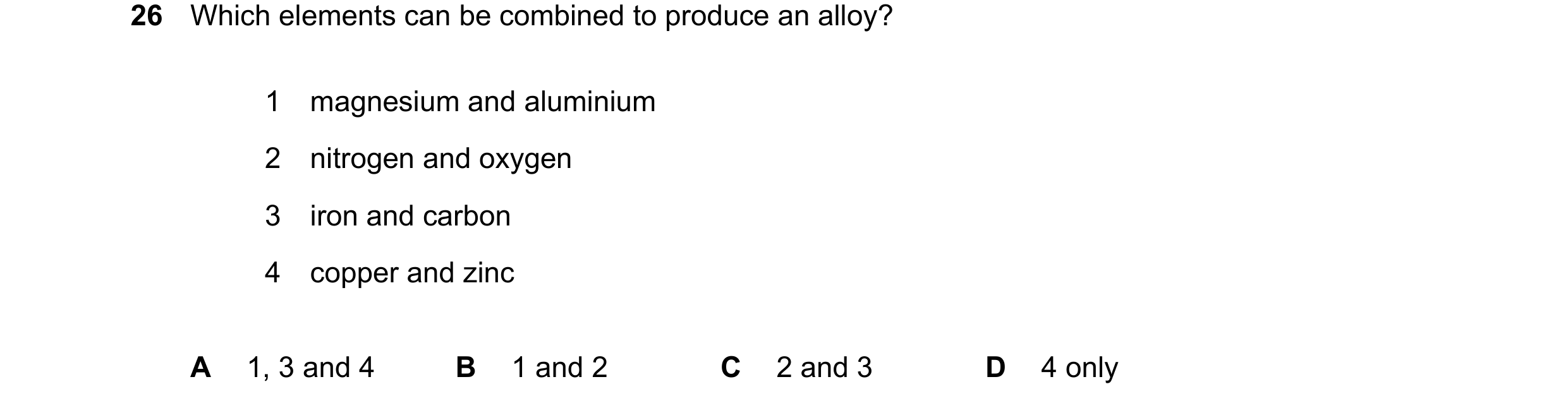
Q19 · Which elements can be combined to produce an alloy? 0971/11 May/June 2024
26 Which elements can be combined to produce an alloy? 1 magnesium and aluminium 2 nitrogen and oxygen 3 iron and carbon 4 copper and zinc A 1, 3 and 4 B 1 and 2 C 2 and 3 D 4 only
1 marks
Answer: A
This question in 0971/11 May/June 2024
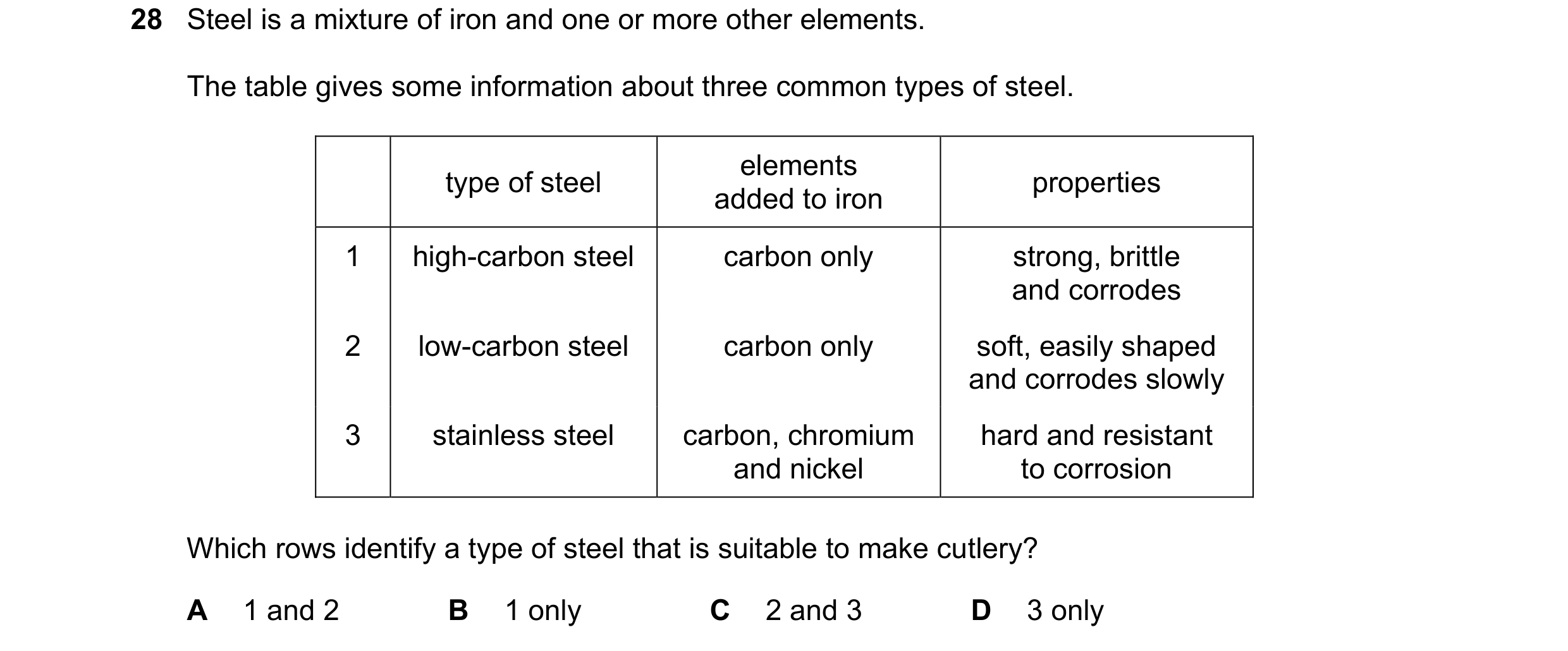
Q20 · Steel is a mixture of iron and one or more other elements 0971/11 May/June 2025
28 Steel is a mixture of iron and one or more other elements. The table gives some information about three common types of steel. elements type of steel properties added to iron 1 high-carbon steel carbon only strong, brittle and corrodes 2 low-carbon steel carbon only soft, easily shaped and corrodes slowly 3 stainless steel carbon, chromium hard and resistant and nickel to corrosion Which rows identify a type of steel that is suitable to make cutlery? A 1 and 2 B 1 only C 2 and 3 D 3 only
1 marks
Answer: D
This question in 0971/11 May/June 2025
Q21 · Pure metals can be combined to make alloys 0971/12 May/June 2025
29 Pure metals can be combined to make alloys. Why are the alloys sometimes used rather than the metals they are made from? A Alloys are easier to extract and cheaper. B Alloys are easier to hammer into different shapes. C Alloys are harder and keep their shape better. D Alloys contain only atoms of the same size but pure metals do not.
1 marks
Answer: C
This question in 0971/12 May/June 2025


 1 / 5
1 / 5

 2 / 5
2 / 5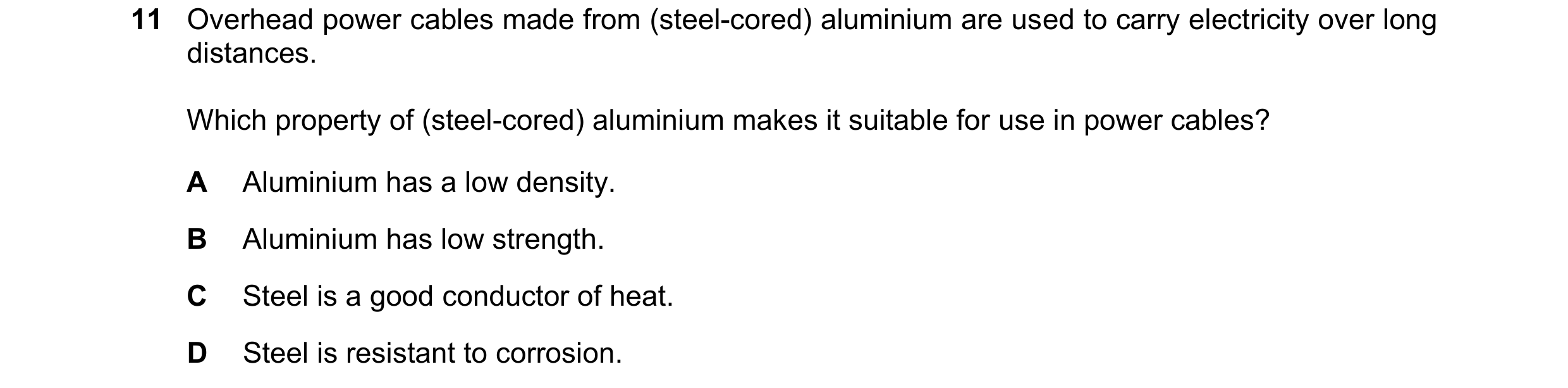

 3 / 5
3 / 5


 4 / 5
4 / 5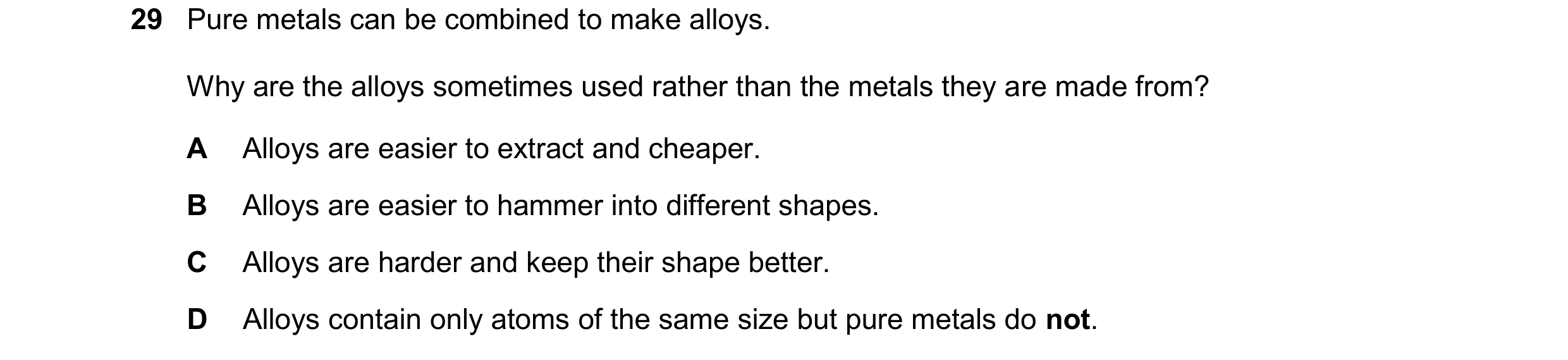 5 / 5
5 / 5