Questions as text
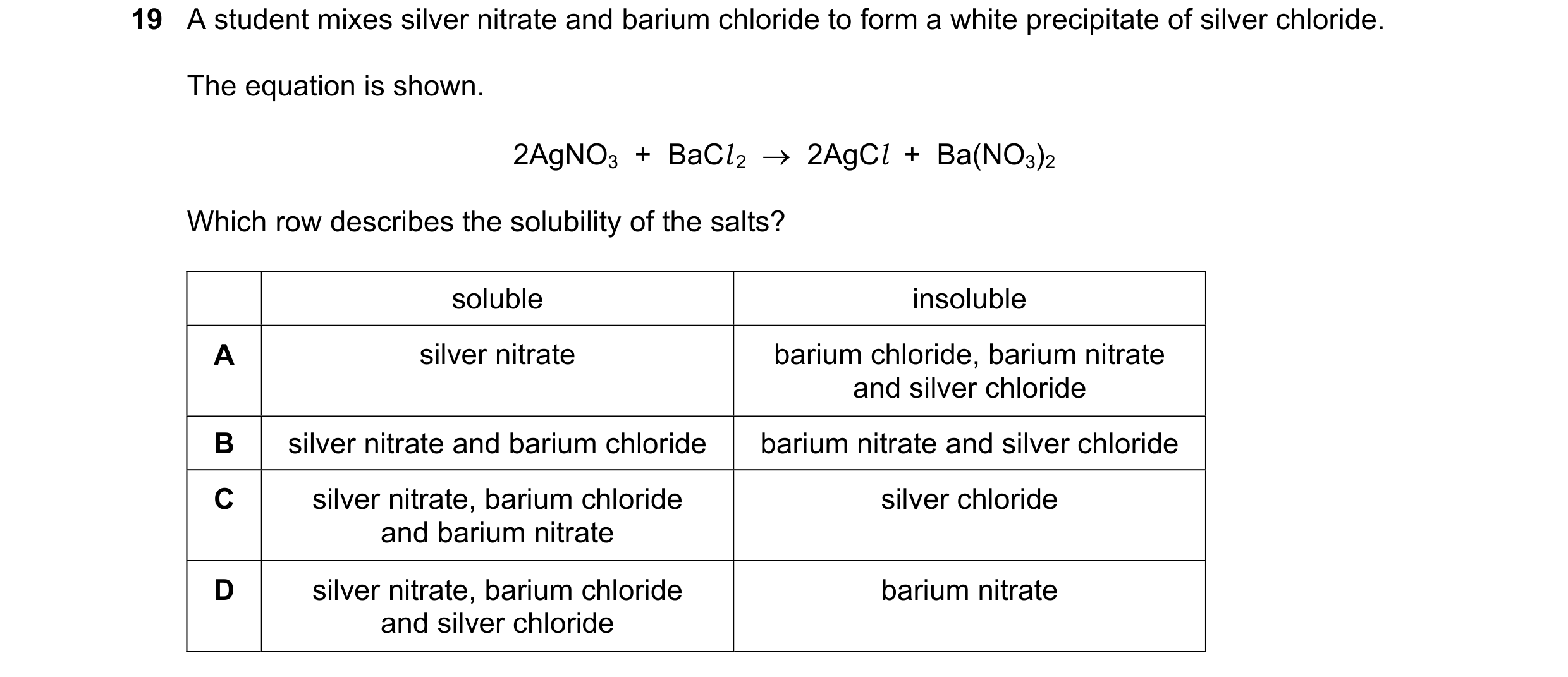
Q1 · A student mixes silver nitrate and barium chloride to form a white precipitate of silver… 0971/21 May/June 2018
19 A student mixes silver nitrate and barium chloride to form a white precipitate of silver chloride. The equation is shown. 2AgNO3 + BaCl 2 → 2AgCl + Ba(NO3)2 Which row describes the solubility of the salts? soluble insoluble A silver nitrate barium chloride, barium nitrate and silver chloride B silver nitrate and barium chloride barium nitrate and silver chloride C silver nitrate, barium chloride silver chloride and barium nitrate D silver nitrate, barium chloride barium nitrate and silver chloride
1 marks
Answer: C
This question in 0971/21 May/June 2018
Q2 · Which methods are suitable for preparing both zinc sulfate and copper(II) sulfate? 0971/21 May/June 2018
20 Which methods are suitable for preparing both zinc sulfate and copper(II) sulfate? 1 reacting the metal oxide with warm dilute aqueous sulfuric acid 2 reacting the metal with dilute aqueous sulfuric acid 3 reacting the metal carbonate with dilute aqueous sulfuric acid A 1, 2 and 3 B 1 and 2 only C 1 and 3 only D 2 and 3 only
1 marks
Answer: C
This question in 0971/21 May/June 2018
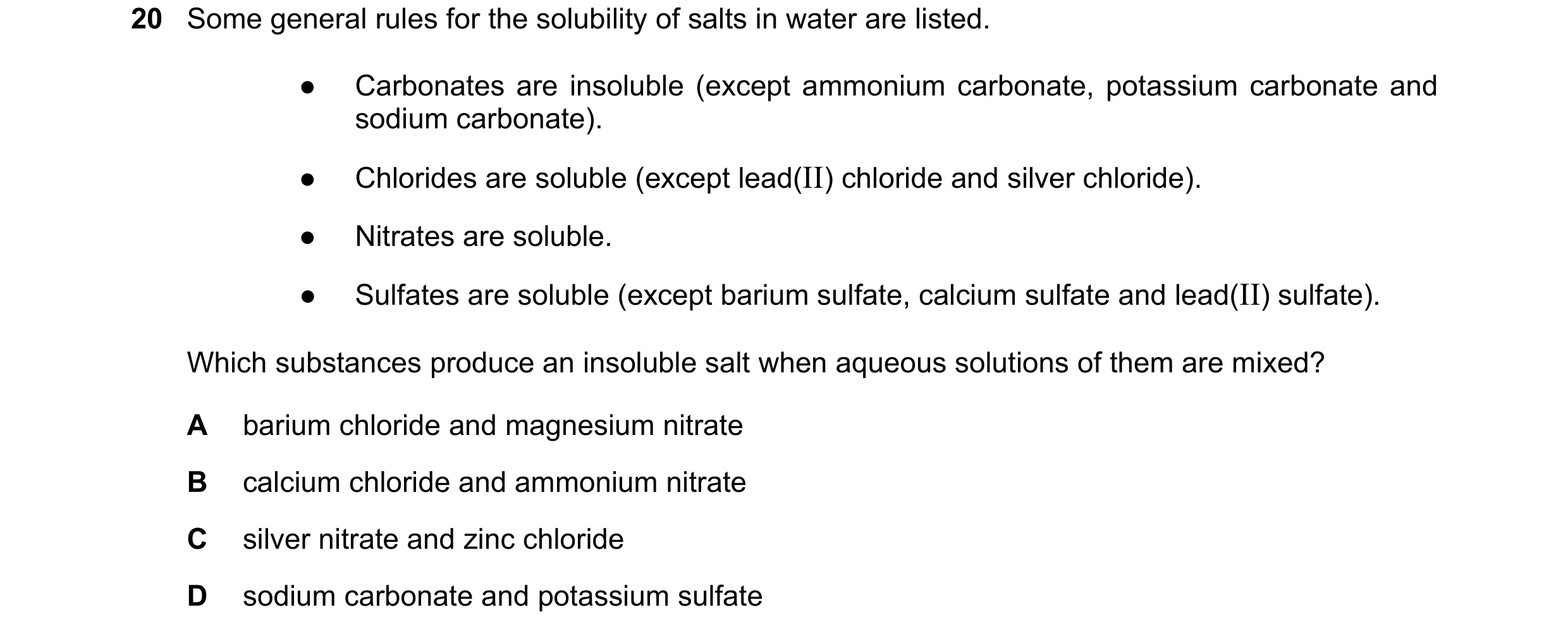
Q3 · Some general rules for the solubility of salts in water are listed 0971/22 Oct/Nov 2018
20 Some general rules for the solubility of salts in water are listed. ● Carbonates are insoluble (except ammonium carbonate, potassium carbonate and sodium carbonate). ● Chlorides are soluble (except lead(II) chloride and silver chloride). ● Nitrates are soluble. ● Sulfates are soluble (except barium sulfate, calcium sulfate and lead(II) sulfate). Which substances produce an insoluble salt when aqueous solutions of them are mixed? A barium chloride and magnesium nitrate B calcium chloride and ammonium nitrate C silver nitrate and zinc chloride D sodium carbonate and potassium sulfate
1 marks
Answer: C
This question in 0971/22 Oct/Nov 2018
Q4 · A method used to make copper(II) sulfate crystals is shown 0971/22 Oct/Nov 2019
21 A method used to make copper(II) sulfate crystals is shown. 1 Place dilute sulfuric acid in a beaker. 2 Warm the acid. 3 Add copper(II) oxide until it is in excess. 4 Filter the mixture. 5 Evaporate the filtrate until crystals start to form. 6 Leave the filtrate to cool. What are the purposes of step 3 and step 4? step 3 step 4 A to ensure all of the acid has reacted to obtain solid copper(II) sulfate B to ensure all of the acid has reacted to remove the excess of copper(II) oxide C to speed up the reaction to obtain solid copper(II) sulfate D to speed up the reaction to remove the excess of copper(II) oxide
1 marks
Answer: B
This question in 0971/22 Oct/Nov 2019
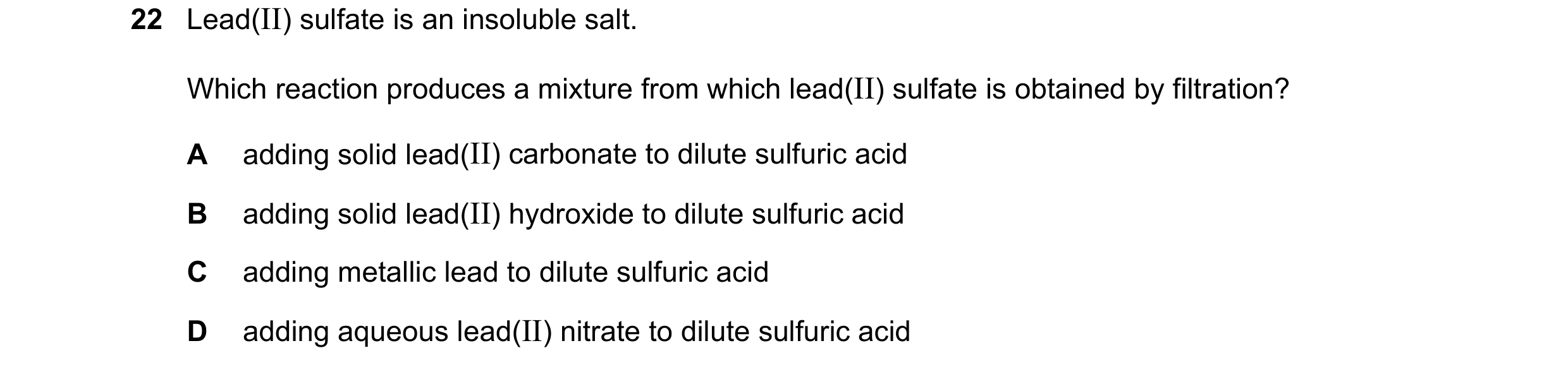
Q5 · Lead(II) sulfate is an insoluble salt 0971/22 Oct/Nov 2019
22 Lead(II) sulfate is an insoluble salt. Which reaction produces a mixture from which lead(II) sulfate is obtained by filtration? A adding solid lead(II) carbonate to dilute sulfuric acid B adding solid lead(II) hydroxide to dilute sulfuric acid C adding metallic lead to dilute sulfuric acid D adding aqueous lead(II) nitrate to dilute sulfuric acid
1 marks
Answer: D
This question in 0971/22 Oct/Nov 2019
Q6 · A solution of iron(III) sulfate reacts with aqueous sodium hydroxide to form a red–brown… 0971/21 May/June 2020
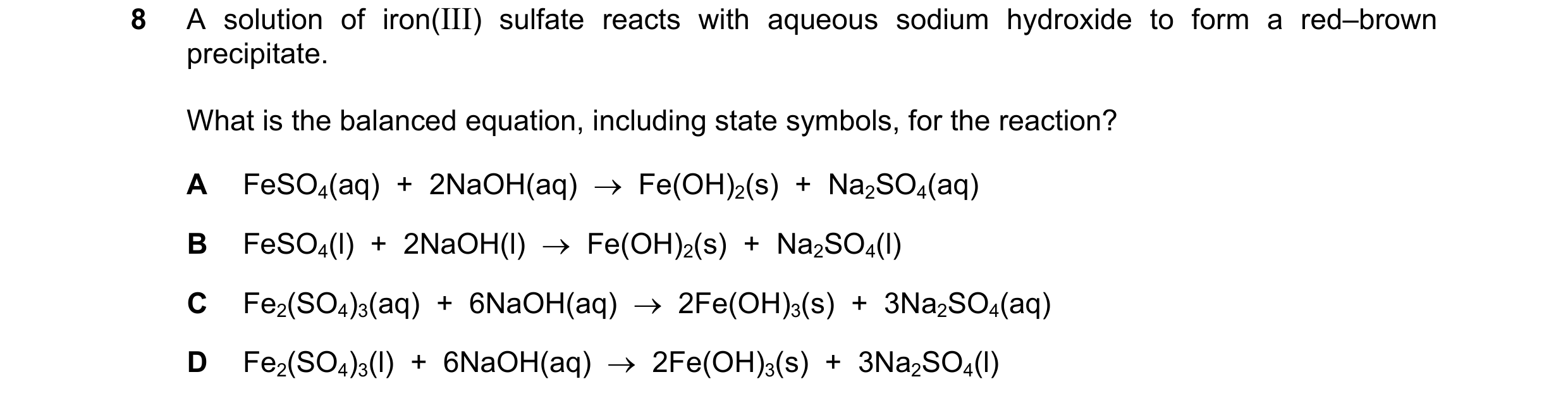
8 A solution of iron(III) sulfate reacts with aqueous sodium hydroxide to form a red–brown precipitate. What is the balanced equation, including state symbols, for the reaction? A FeSO4(aq) + 2NaOH(aq) → Fe(OH)2(s) + Na2SO4(aq) B FeSO4(l) + 2NaOH(l) → Fe(OH)2(s) + Na2SO4(l) C Fe2(SO4)3(aq) + 6NaOH(aq) → 2Fe(OH)3(s) + 3Na2SO4(aq) D Fe2(SO4)3(l) + 6NaOH(aq) → 2Fe(OH)3(s) + 3Na2SO4(l)
1 marks
Answer: C
This question in 0971/21 May/June 2020
Q7 · The apparatus shown is used to prepare aqueous copper(II) sulfate 0971/21 May/June 2020
20 The apparatus shown is used to prepare aqueous copper(II) sulfate. filter paper stirrer excess of solid X solid X Y aqueous copper(II) sulfate heat What are X and Y? X Y A copper aqueous iron(II) sulfate B copper(II) chloride dilute sulfuric acid C copper(II) oxide dilute sulfuric acid D sulfur aqueous copper(II) chloride
1 marks
Answer: C
This question in 0971/21 May/June 2020
Q8 · Lead(II) sulfate is an insoluble salt 0971/21 May/June 2020
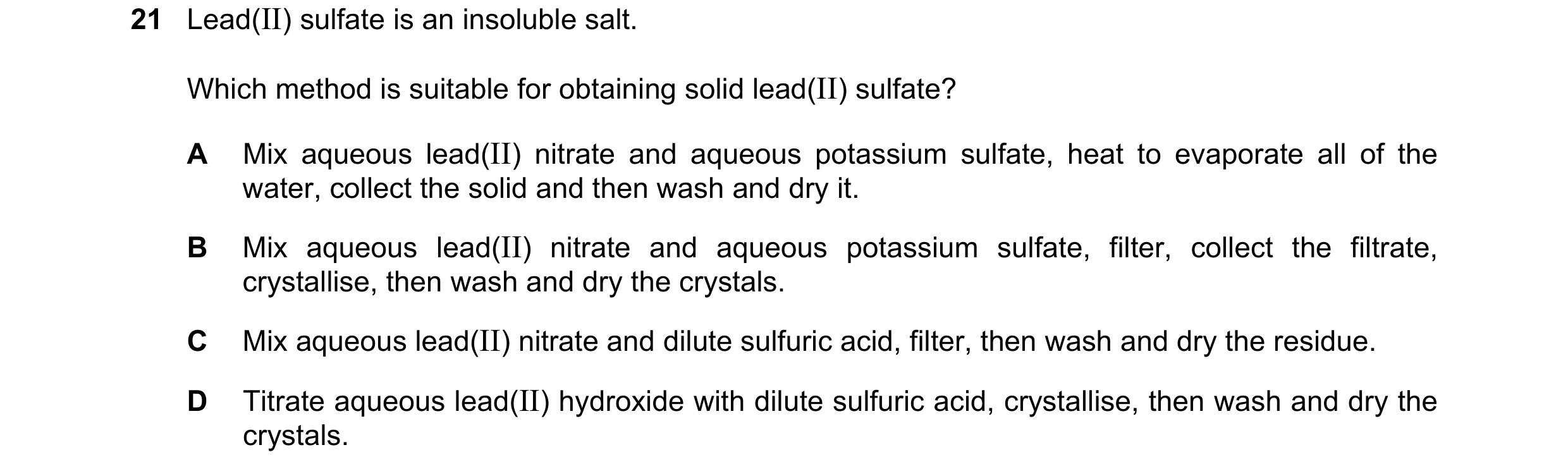
21 Lead(II) sulfate is an insoluble salt. Which method is suitable for obtaining solid lead(II) sulfate? A Mix aqueous lead(II) nitrate and aqueous potassium sulfate, heat to evaporate all of the water, collect the solid and then wash and dry it. B Mix aqueous lead(II) nitrate and aqueous potassium sulfate, filter, collect the filtrate, crystallise, then wash and dry the crystals. C Mix aqueous lead(II) nitrate and dilute sulfuric acid, filter, then wash and dry the residue. D Titrate aqueous lead(II) hydroxide with dilute sulfuric acid, crystallise, then wash and dry the crystals.
1 marks
Answer: C
This question in 0971/21 May/June 2020
Q9 · The apparatus shown is used to prepare aqueous copper(II) sulfate 0971/22 May/June 2020
20 The apparatus shown is used to prepare aqueous copper(II) sulfate. filter paper stirrer excess of solid X solid X Y aqueous copper(II) sulfate heat What are X and Y? X Y A copper aqueous iron(II) sulfate B copper(II) chloride dilute sulfuric acid C copper(II) oxide dilute sulfuric acid D sulfur aqueous copper(II) chloride
1 marks
Answer: C
This question in 0971/22 May/June 2020
Q10 · Which process is not used in the preparation of an insoluble salt? 0971/22 May/June 2020
21 Which process is not used in the preparation of an insoluble salt? A filtration B washing C crystallisation D drying
1 marks
Answer: C
This question in 0971/22 May/June 2020
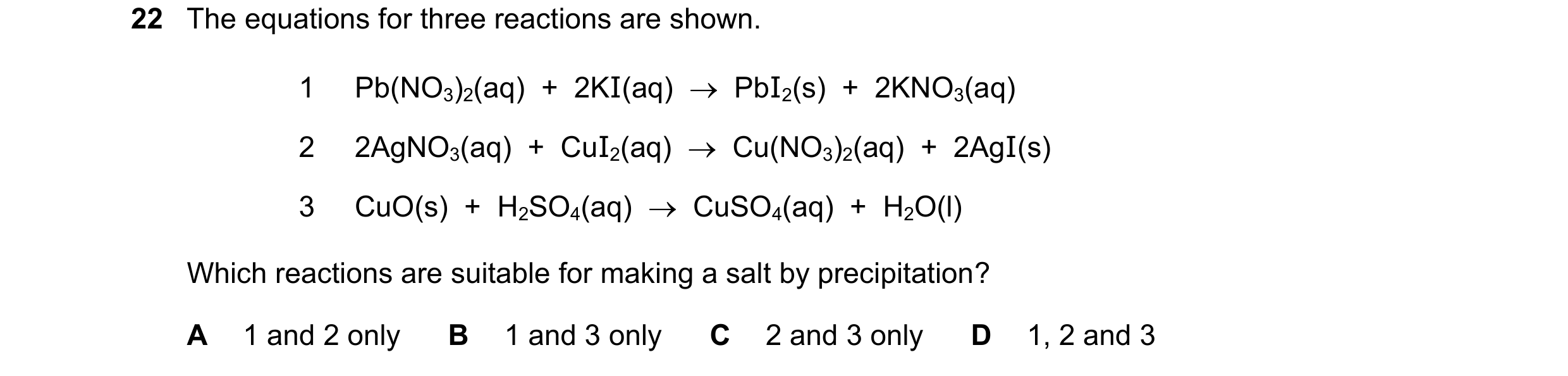
Q11 · The equations for three reactions are shown 0971/22 Oct/Nov 2020
22 The equations for three reactions are shown. 1 Pb(NO3)2(aq) + 2KI(aq) PbI2(s) + 2KNO3(aq) 2 2AgNO3(aq) + CuI2(aq) Cu(NO3)2(aq) + 2AgI(s) 3 CuO(s) + H2SO4(aq) CuSO4(aq) + H2O(l) Which reactions are suitable for making a salt by precipitation? A 1 and 2 only B 1 and 3 only C 2 and 3 only D 1, 2 and 3
1 marks
Answer: A
This question in 0971/22 Oct/Nov 2020
Q12 · A student carries out an experiment to prepare pure magnesium sulfate crystals 0971/22 Oct/Nov 2020
24 A student carries out an experiment to prepare pure magnesium sulfate crystals. The diagram shows the first stage of the preparation. stirrer magnesium carbonate dilute sulfuric acid He adds magnesium carbonate until no more reacts. Which process should he use for the next stage? A crystallisation B evaporation C filtration D neutralisation
1 marks
Answer: C
This question in 0971/22 Oct/Nov 2020
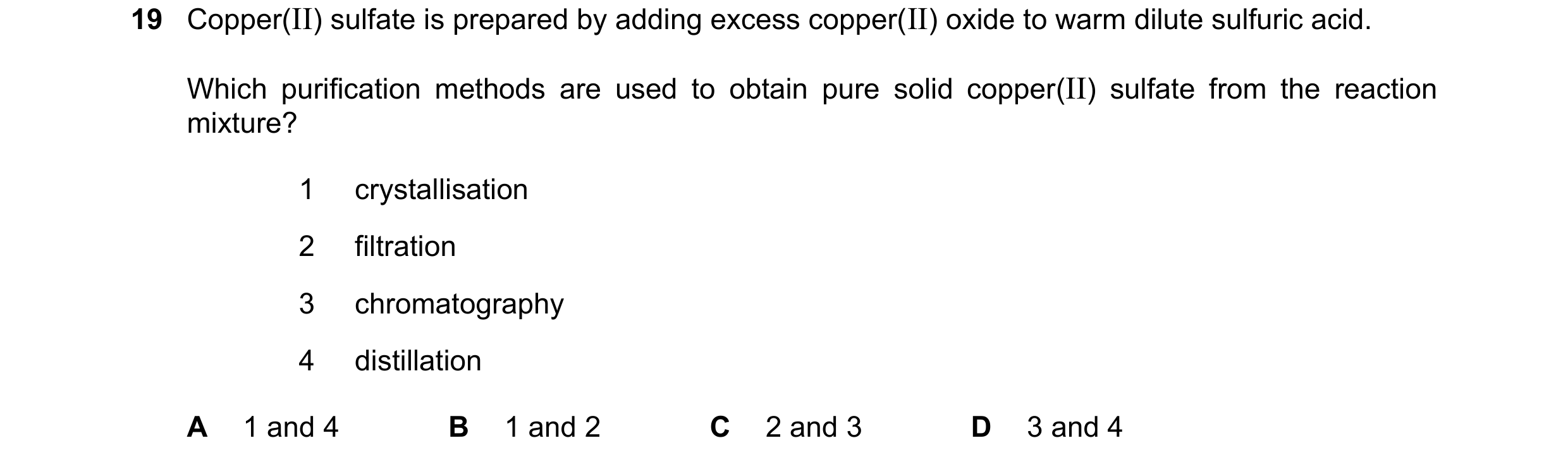
Q13 · Copper(II) sulfate is prepared by adding excess copper(II) oxide to warm dilute sulfuric… 0971/21 May/June 2021
19 Copper(II) sulfate is prepared by adding excess copper(II) oxide to warm dilute sulfuric acid. Which purification methods are used to obtain pure solid copper(II) sulfate from the reaction mixture? 1 crystallisation 2 filtration 3 chromatography 4 distillation A 1 and 4 B 1 and 2 C 2 and 3 D 3 and 4
1 marks
Answer: B
This question in 0971/21 May/June 2021
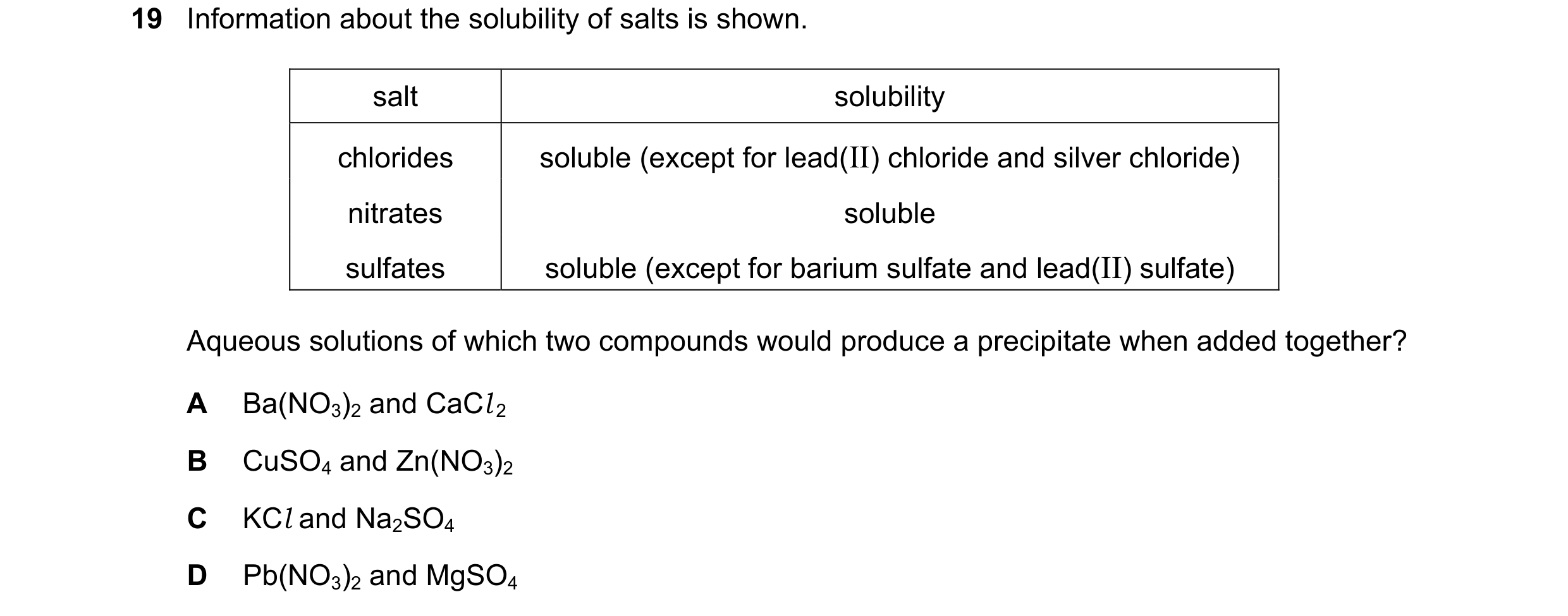
Q14 · Information about the solubility of salts is shown 0971/22 May/June 2021
19 Information about the solubility of salts is shown. salt solubility chlorides soluble (except for lead(II) chloride and silver chloride) nitrates soluble sulfates soluble (except for barium sulfate and lead(II) sulfate) Aqueous solutions of which two compounds would produce a precipitate when added together? A Ba(NO3)2 and CaCl 2 B CuSO4 and Zn(NO3)2 C KCl and Na2SO4 D Pb(NO3)2 and MgSO4
1 marks
Answer: D
This question in 0971/22 May/June 2021
Q15 · All metal nitrates are soluble in water 0971/22 Oct/Nov 2021
22 All metal nitrates are soluble in water. All metal chlorides are soluble except silver and lead. All metal carbonates are insoluble except sodium and potassium. Which aqueous solutions produce a precipitate when mixed together? 1 silver nitrate + sodium carbonate 2 silver nitrate + sodium chloride 3 barium nitrate + potassium chloride A 1 and 2 only B 1 and 3 only C 2 and 3 only D 1, 2 and 3
1 marks
Answer: A
This question in 0971/22 Oct/Nov 2021
Q16 · An acid is neutralised by adding an excess of an insoluble solid base 0971/21 May/June 2022
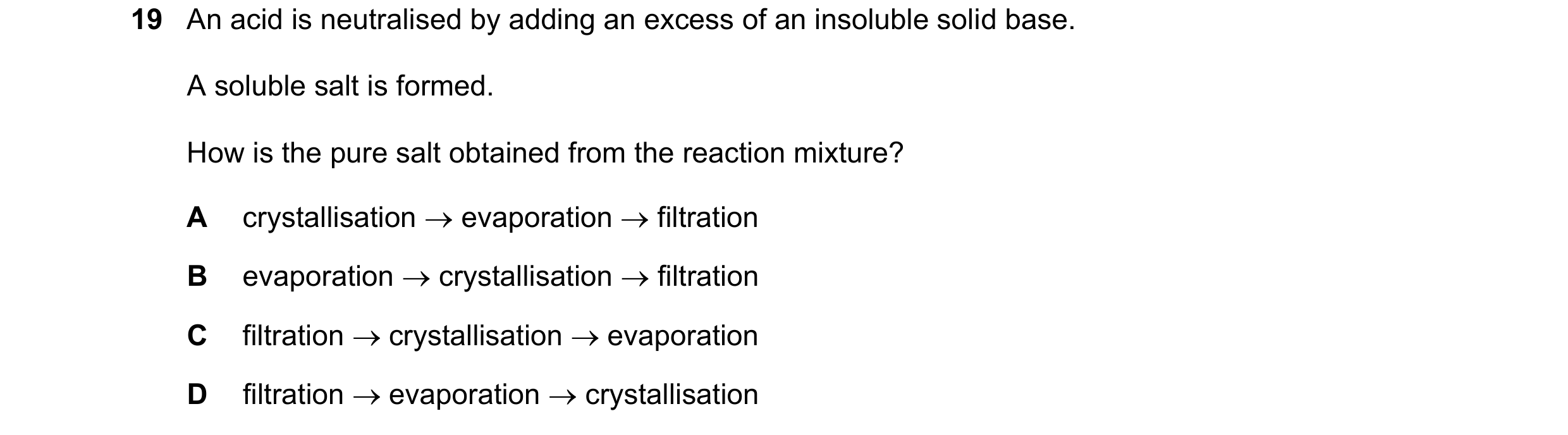
19 An acid is neutralised by adding an excess of an insoluble solid base. A soluble salt is formed. How is the pure salt obtained from the reaction mixture? A crystallisation evaporation filtration B evaporation crystallisation filtration C filtration crystallisation evaporation D filtration evaporation crystallisation
1 marks
Answer: D
This question in 0971/21 May/June 2022
Q17 · An acid is neutralised by adding an excess of an insoluble solid base 0971/22 May/June 2022
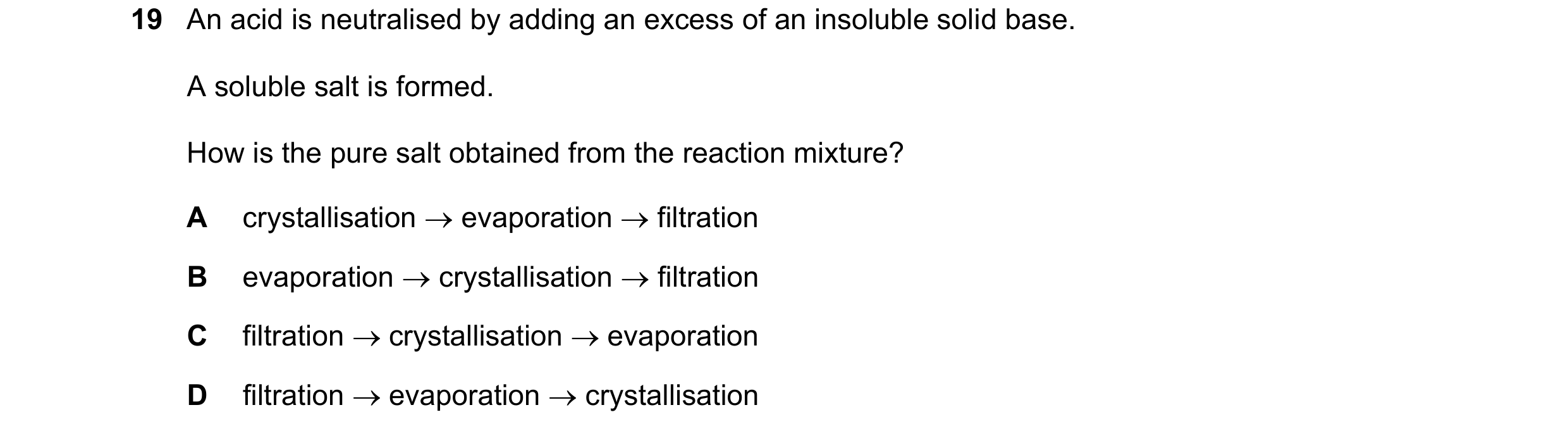
19 An acid is neutralised by adding an excess of an insoluble solid base. A soluble salt is formed. How is the pure salt obtained from the reaction mixture? A crystallisation evaporation filtration B evaporation crystallisation filtration C filtration crystallisation evaporation D filtration evaporation crystallisation
1 marks
Answer: D
This question in 0971/22 May/June 2022
Q18 · Copper(II) sulfate is a soluble salt 0971/22 Oct/Nov 2022
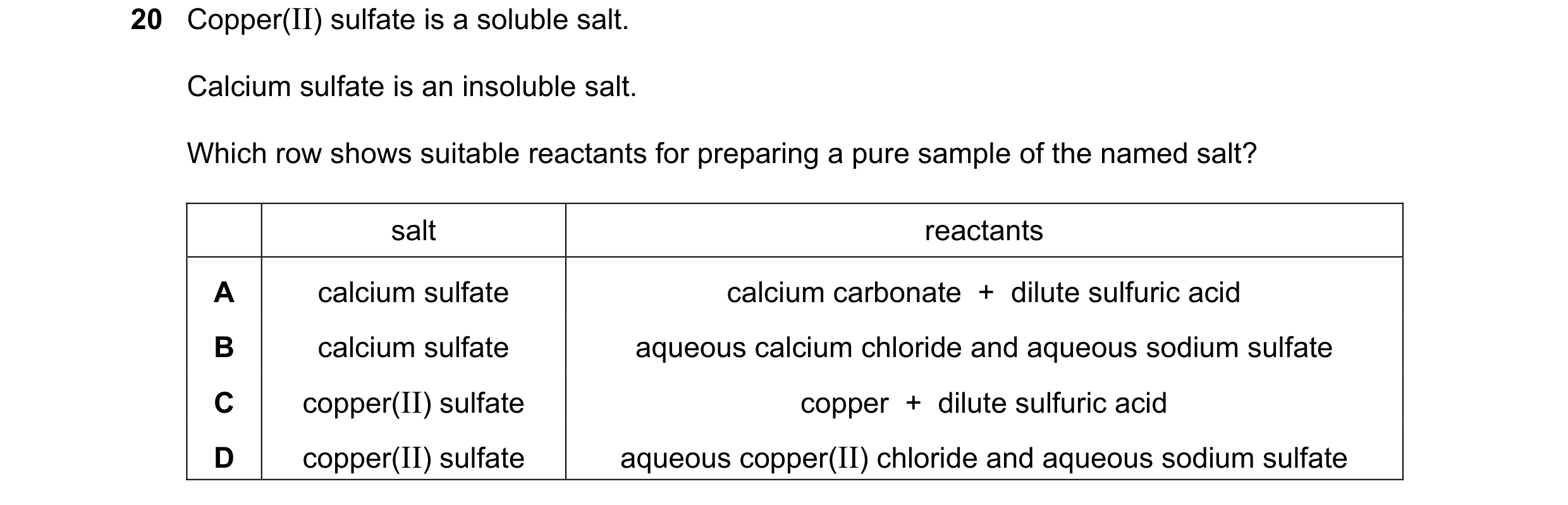
20 Copper(II) sulfate is a soluble salt. Calcium sulfate is an insoluble salt. Which row shows suitable reactants for preparing a pure sample of the named salt? salt reactants A calcium sulfate calcium carbonate + dilute sulfuric acid B calcium sulfate aqueous calcium chloride and aqueous sodium sulfate C copper(II) sulfate copper + dilute sulfuric acid D copper(II) sulfate aqueous copper(II) chloride and aqueous sodium sulfate
1 marks
Answer: B
This question in 0971/22 Oct/Nov 2022
Q19 · Which method produces the salt copper(II) carbonate? 0971/21 May/June 2023
17 Which method produces the salt copper(II) carbonate? A Add copper(II) oxide to water, then add excess aqueous sodium carbonate. Filter off the precipitate. B Add copper(II) oxide to dilute sulfuric acid, then add excess aqueous sodium carbonate. Filter off the precipitate. C Add copper to dilute hydrochloric acid, then add aqueous sodium carbonate. Filter off the precipitate. D Add copper(II) oxide to excess aqueous sodium carbonate. Filter off the precipitate.
1 marks
Answer: B
This question in 0971/21 May/June 2023
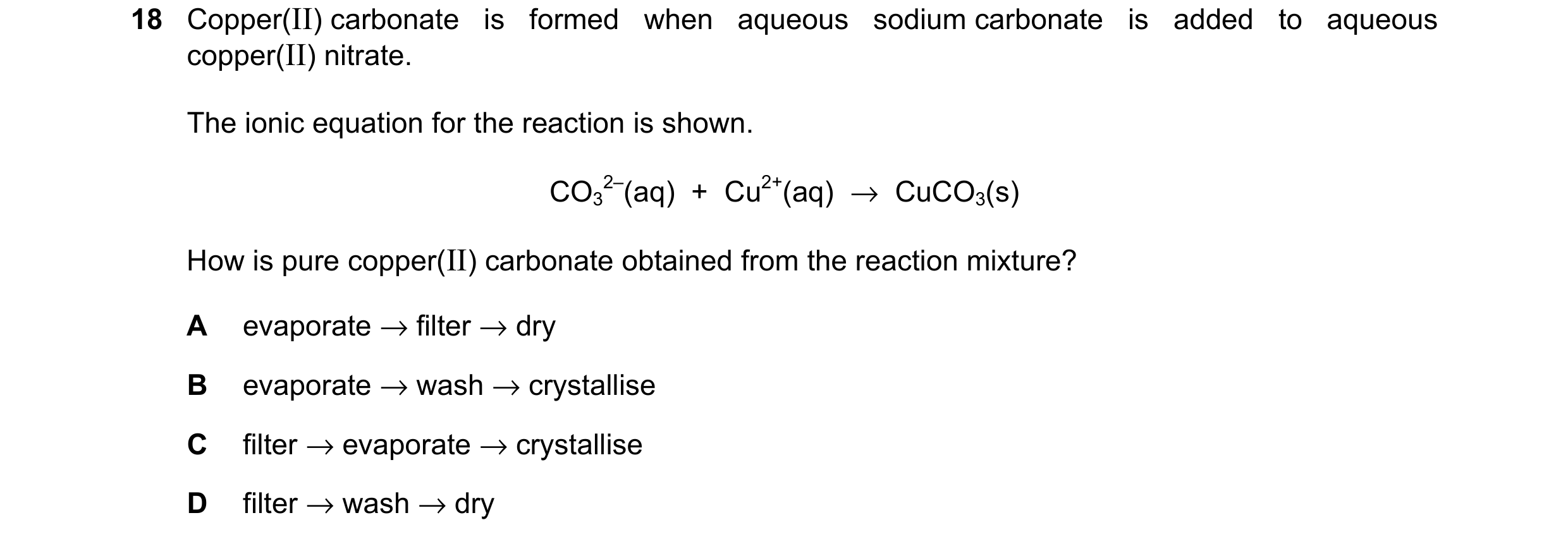
Q20 · Copper(II) carbonate is formed when aqueous sodium carbonate is added to aqueous… 0971/22 May/June 2023
18 Copper(II) carbonate is formed when aqueous sodium carbonate is added to aqueous copper(II) nitrate. The ionic equation for the reaction is shown. CO3 2–(aq) + Cu2+(aq) → CuCO3(s) How is pure copper(II) carbonate obtained from the reaction mixture? A evaporate → filter → dry B evaporate → wash → crystallise C filter → evaporate → crystallise D filter → wash → dry
1 marks
Answer: D
This question in 0971/22 May/June 2023
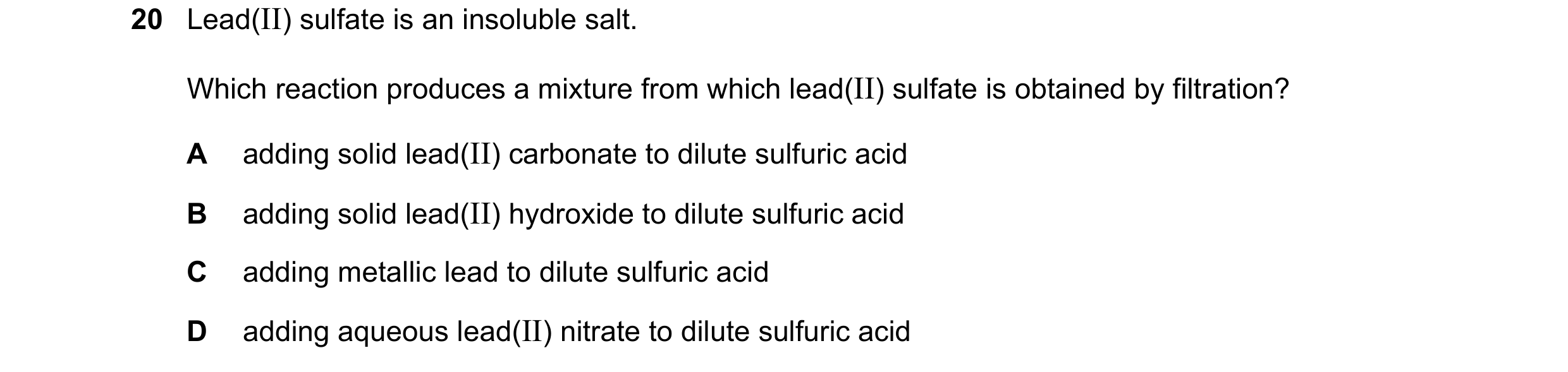
Q21 · Lead(II) sulfate is an insoluble salt 0971/22 May/June 2023
20 Lead(II) sulfate is an insoluble salt. Which reaction produces a mixture from which lead(II) sulfate is obtained by filtration? A adding solid lead(II) carbonate to dilute sulfuric acid B adding solid lead(II) hydroxide to dilute sulfuric acid C adding metallic lead to dilute sulfuric acid D adding aqueous lead(II) nitrate to dilute sulfuric acid
1 marks
Answer: D
This question in 0971/22 May/June 2023
Q22 · Which method is used to produce insoluble salts? 0971/22 Oct/Nov 2023
21 Which method is used to produce insoluble salts? A addition of excess insoluble base to an acid B addition of excess metal to an acid C precipitation using two aqueous solutions D titration using an acid and an alkali
1 marks
Answer: C
This question in 0971/22 Oct/Nov 2023
Q23 · Which process is not used in the preparation of an insoluble salt? 0971/22 May/June 2024
20 Which process is not used in the preparation of an insoluble salt? A filtration B washing C crystallisation D drying
1 marks
Answer: C
This question in 0971/22 May/June 2024
Q24 · Which method is used to prepare a pure, dry sample of lead(II) chloride? 0971/22 Oct/Nov 2025
20 Which method is used to prepare a pure, dry sample of lead(II) chloride? A mix aqueous lead(II) nitrate and dilute hydrochloric acid filter crystallise and dry the filtrate B mix aqueous lead(II) nitrate and dilute hydrochloric acid filter wash and dry the residue C mix solid lead(II) hydroxide and aqueous sodium chloride filter crystallise and dry the filtrate D mix solid lead(II) hydroxide and aqueous sodium chloride filter wash and dry the residue
1 marks
Answer: B
This question in 0971/22 Oct/Nov 2025

 1 / 8
1 / 8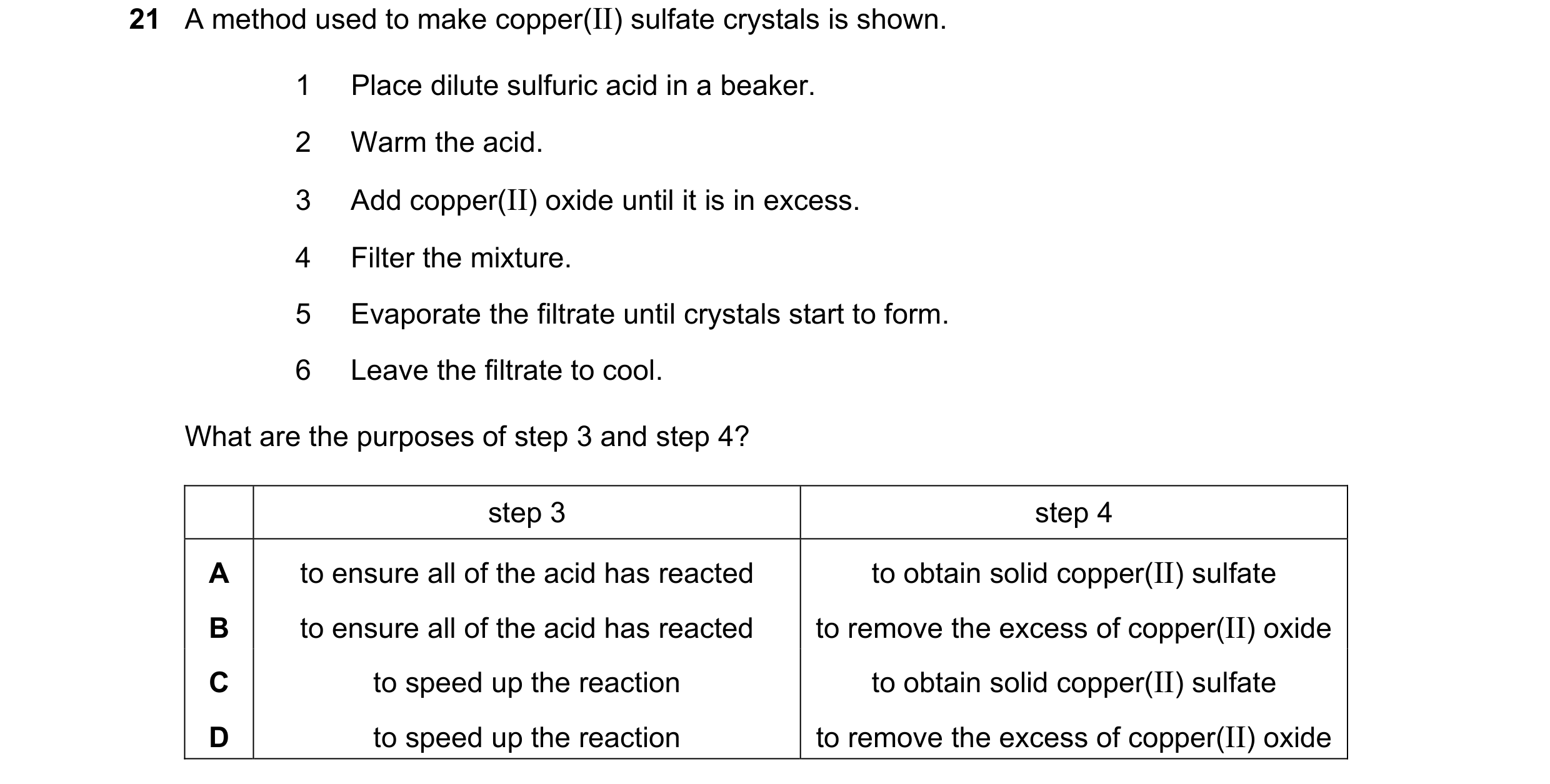
 2 / 8
2 / 8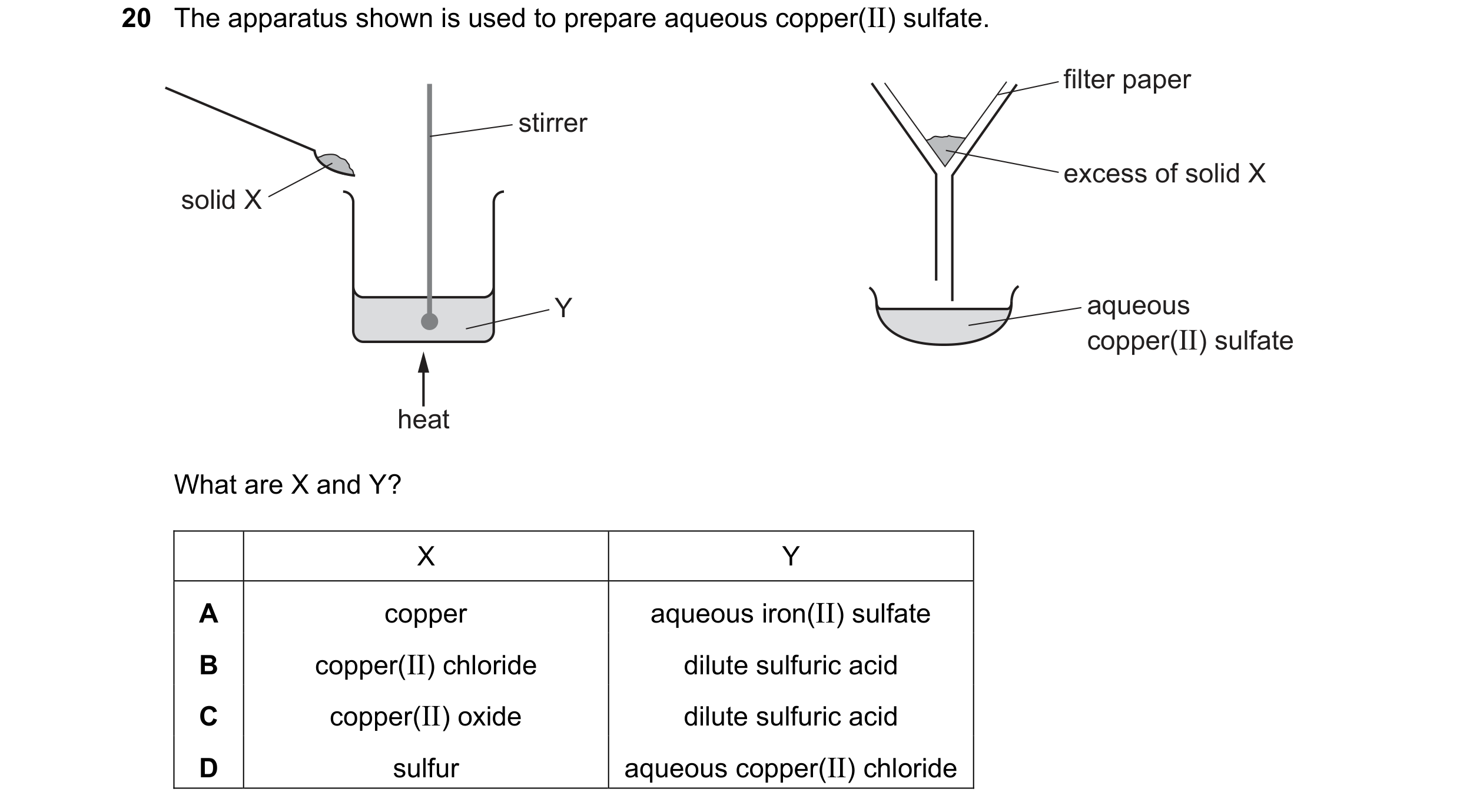
 3 / 8
3 / 8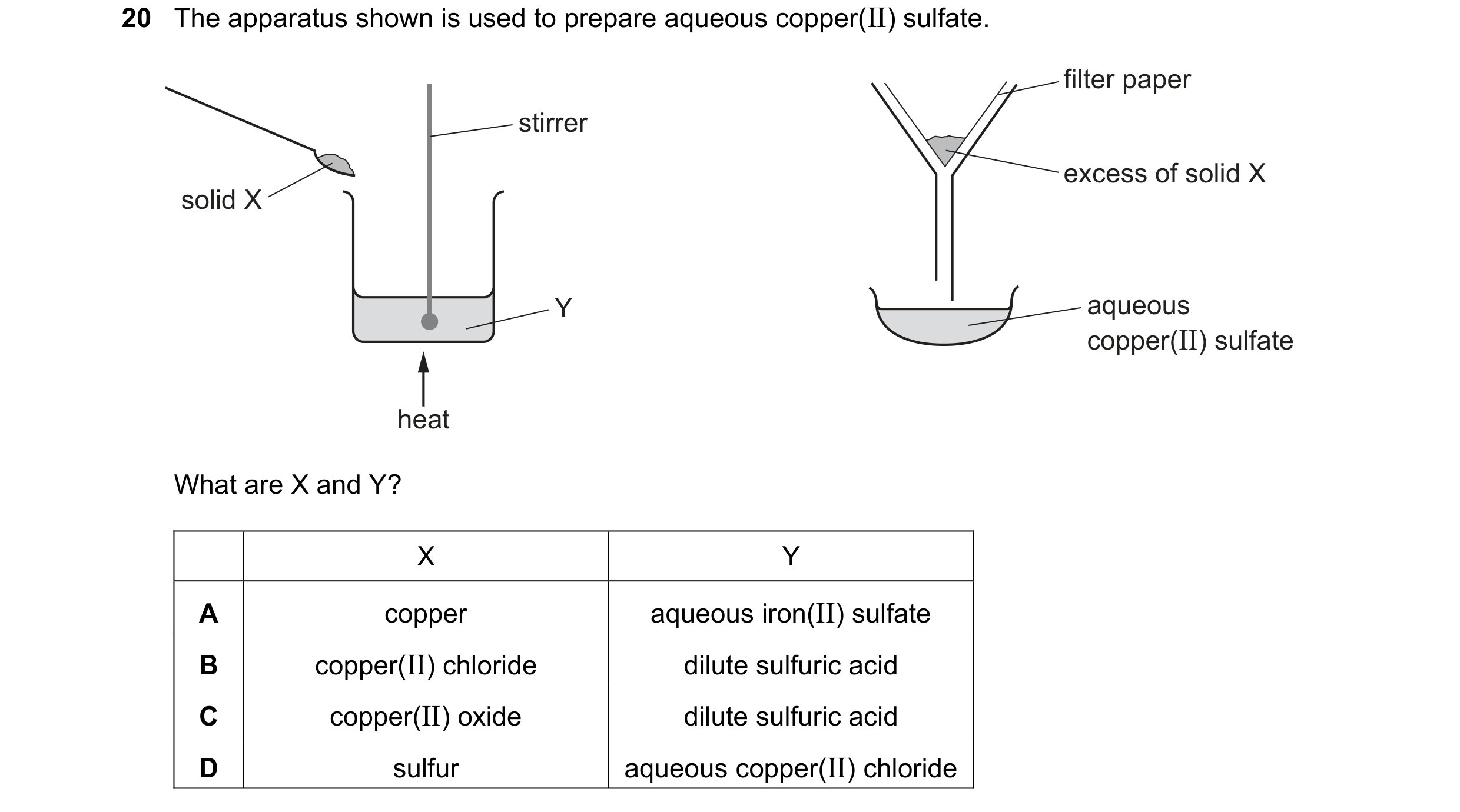

 4 / 8
4 / 8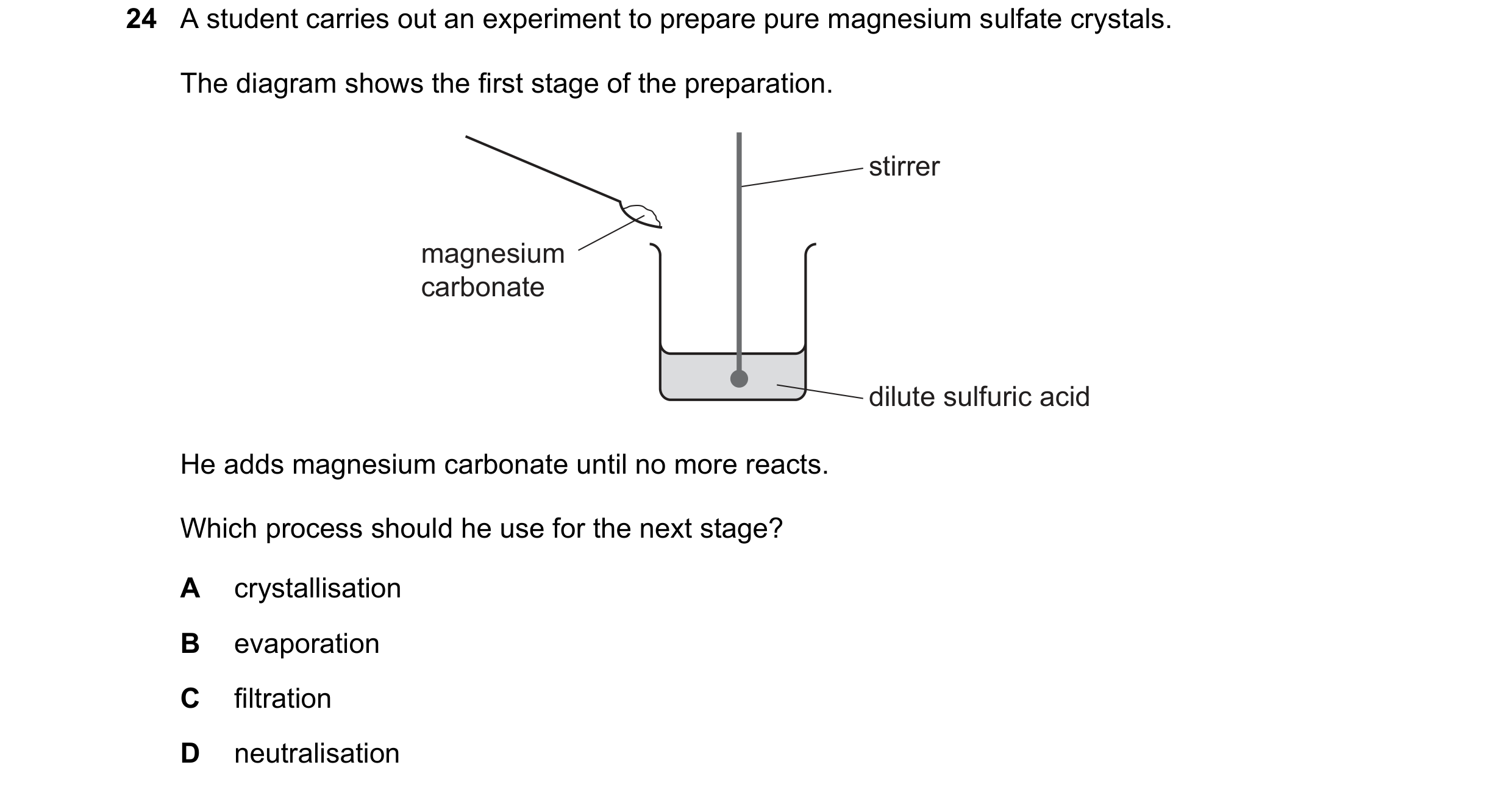
 5 / 8
5 / 8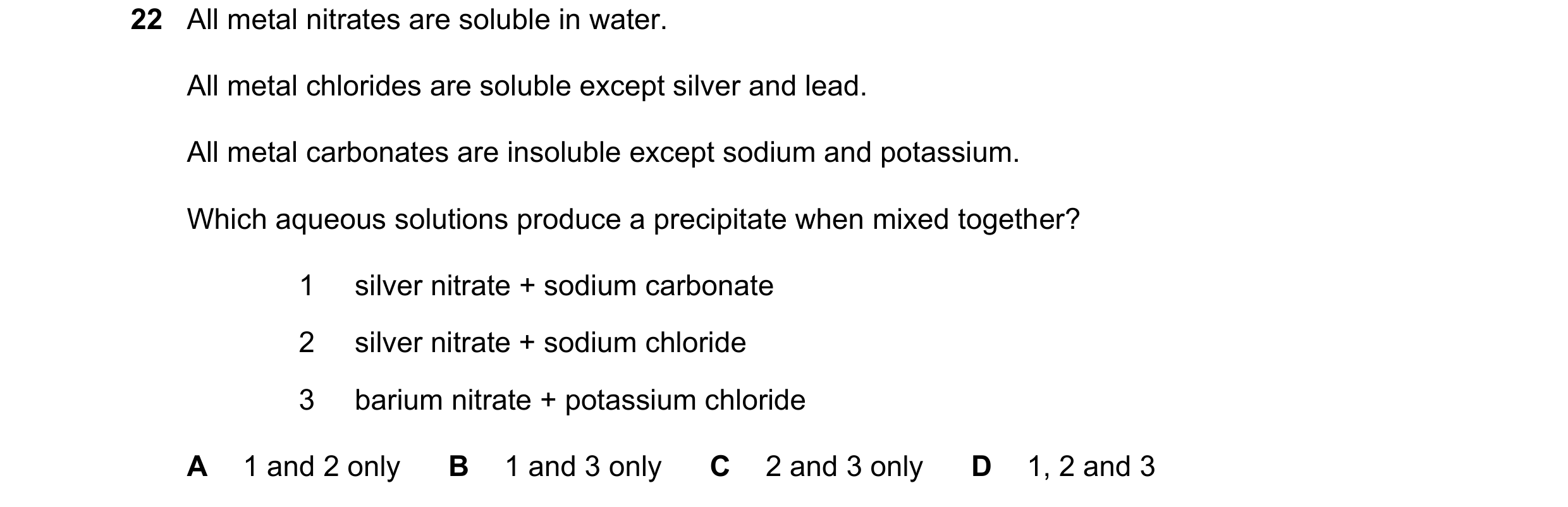
 6 / 8
6 / 8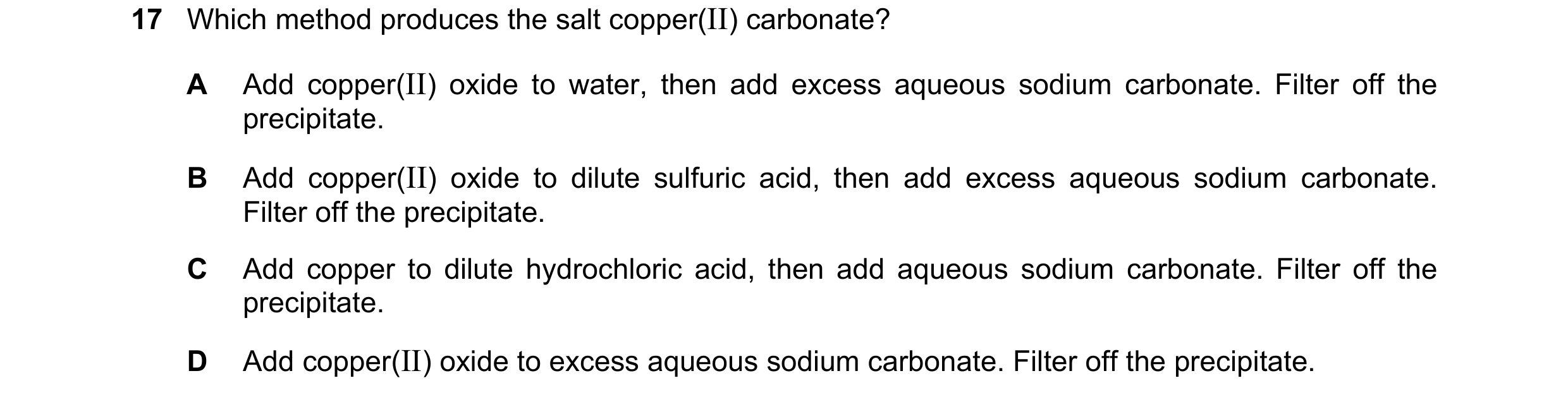

 7 / 8
7 / 8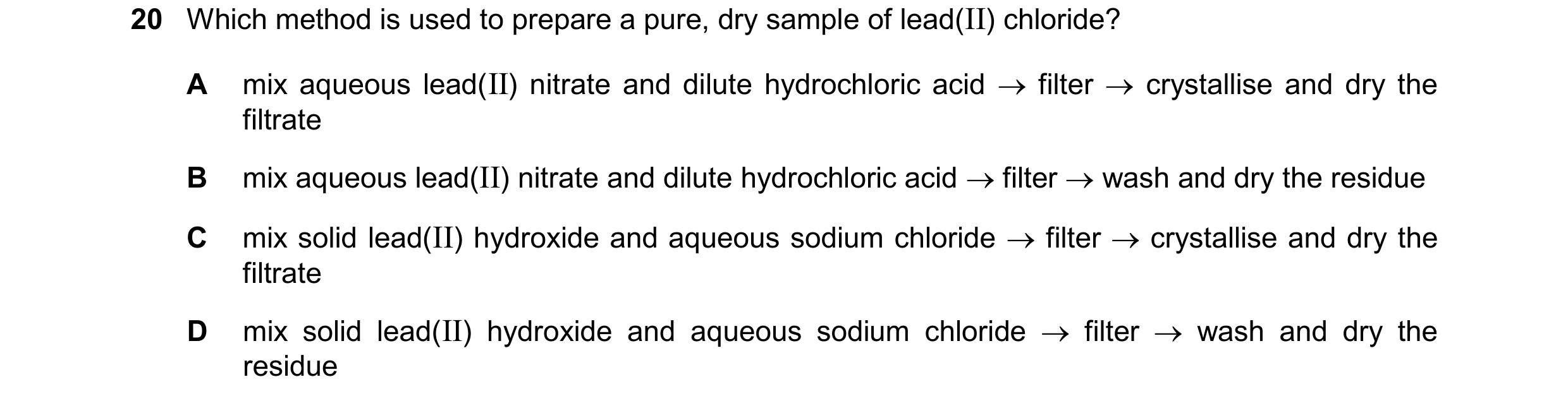 8 / 8
8 / 8