Questions as text
Q1 · A hydrocarbon W burns to form carbon dioxide and water 0971/11 May/June 2019
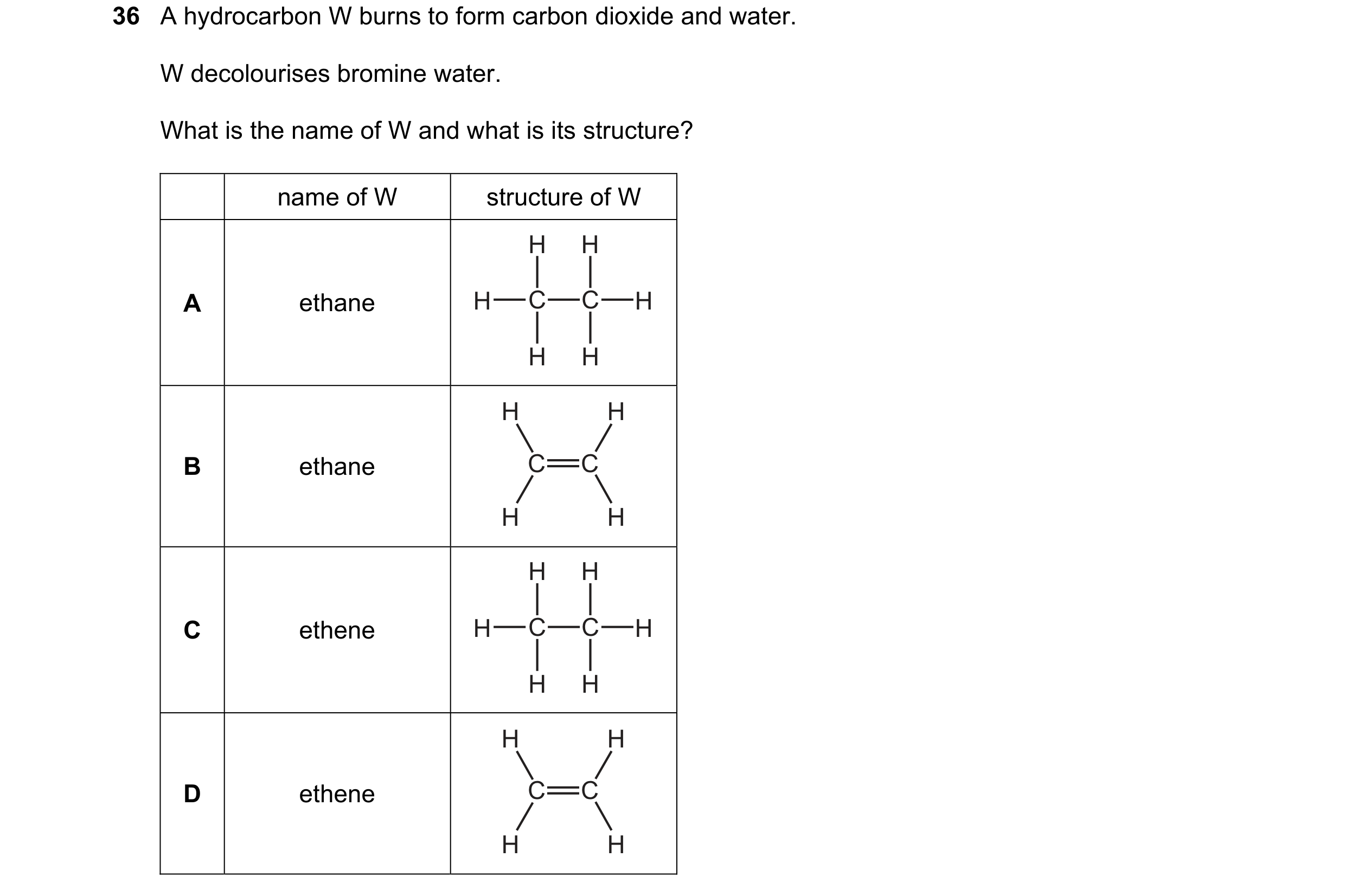
36 A hydrocarbon W burns to form carbon dioxide and water. W decolourises bromine water. What is the name of W and what is its structure? name of W structure of W H H A ethane H C C H H H H H B ethane C C H H H H C ethene H C C H H H H H D ethene C C H H
1 marks
Answer: D
This question in 0971/11 May/June 2019
Q2 · Which products are obtained by the cracking of an alkane? 0971/12 Oct/Nov 2019
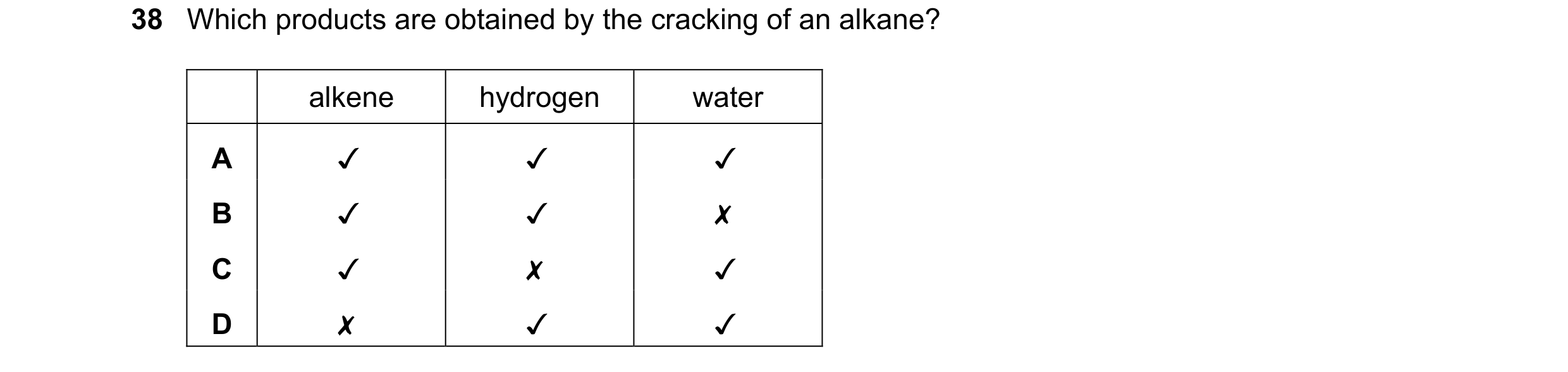
38 Which products are obtained by the cracking of an alkane?
alkene hydrogen water
v v v
0 Oo WwW >
v v x
v x v
x v v
1 marks
Answer: B
This question in 0971/12 Oct/Nov 2019
Q3 · The diagram shows the structure of a monomer and of the polymer made from it 0971/12 Oct/Nov 2019
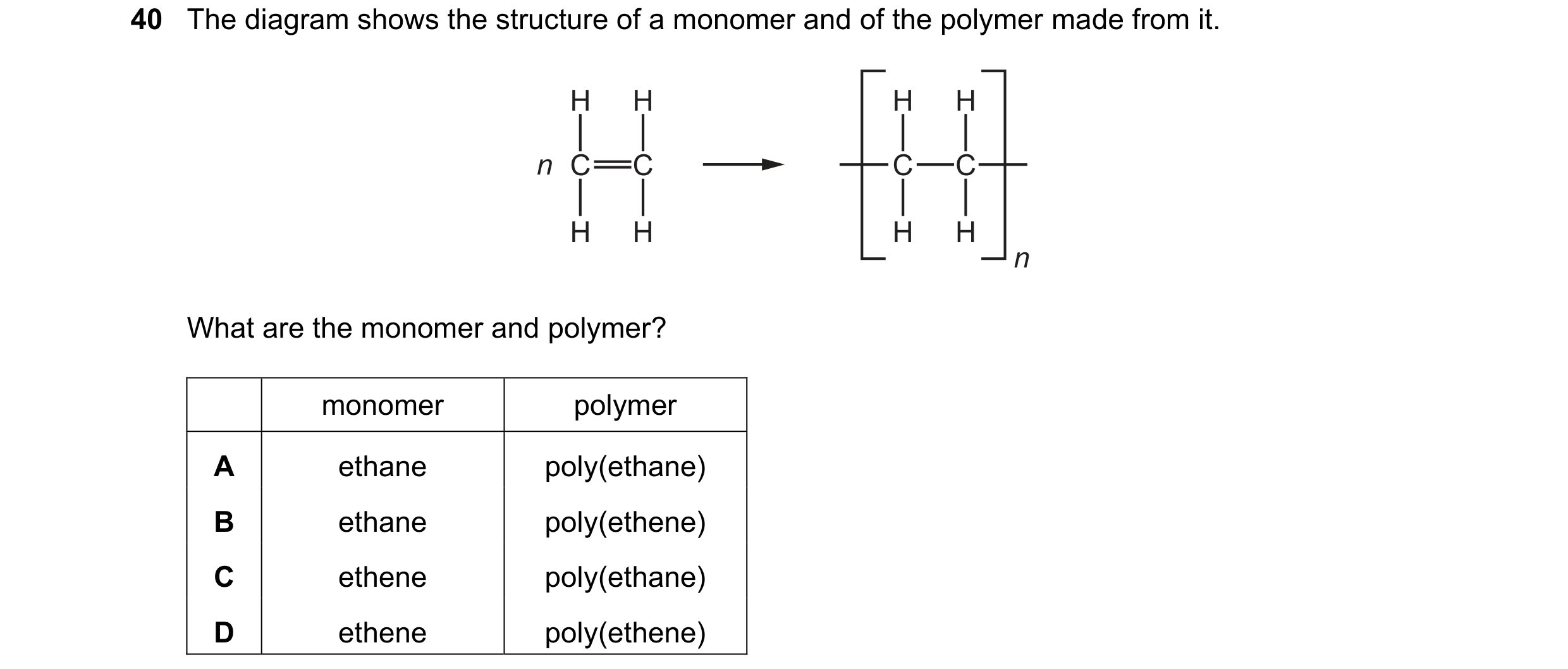
40 The diagram shows the structure of a monomer and of the polymer made from it. H H H H n C C C C H H H H n What are the monomer and polymer? monomer polymer A ethane poly(ethane) B ethane poly(ethene) C ethene poly(ethane) D ethene poly(ethene)
1 marks
Answer: D
This question in 0971/12 Oct/Nov 2019
Q4 · P, Q, R and S are four organic compounds 0971/11 May/June 2021
38 P, Q, R and S are four organic compounds. P is an unsaturated hydrocarbon. Q burns but otherwise is unreactive. R contains a C–C single bond and a C=C double bond. S undergoes addition polymerisation. Which compounds are alkenes? A P and R only B P, R and S C P, Q and S D Q, R and S
1 marks
Answer: B
This question in 0971/11 May/June 2021
Q5 · Which statements about unsaturated hydrocarbons are correct? 0971/12 Oct/Nov 2021
38 Which statements about unsaturated hydrocarbons are correct? 1 They contain both single and double bonds. 2 They turn aqueous bromine from colourless to brown. 3 They can be manufactured by cracking. A 1 and 2 only B 1 and 3 only C 2 and 3 only D 1, 2 and 3
1 marks
Answer: B
This question in 0971/12 Oct/Nov 2021
Q6 · Some properties of colourless liquid L are listed 0971/11 May/June 2022
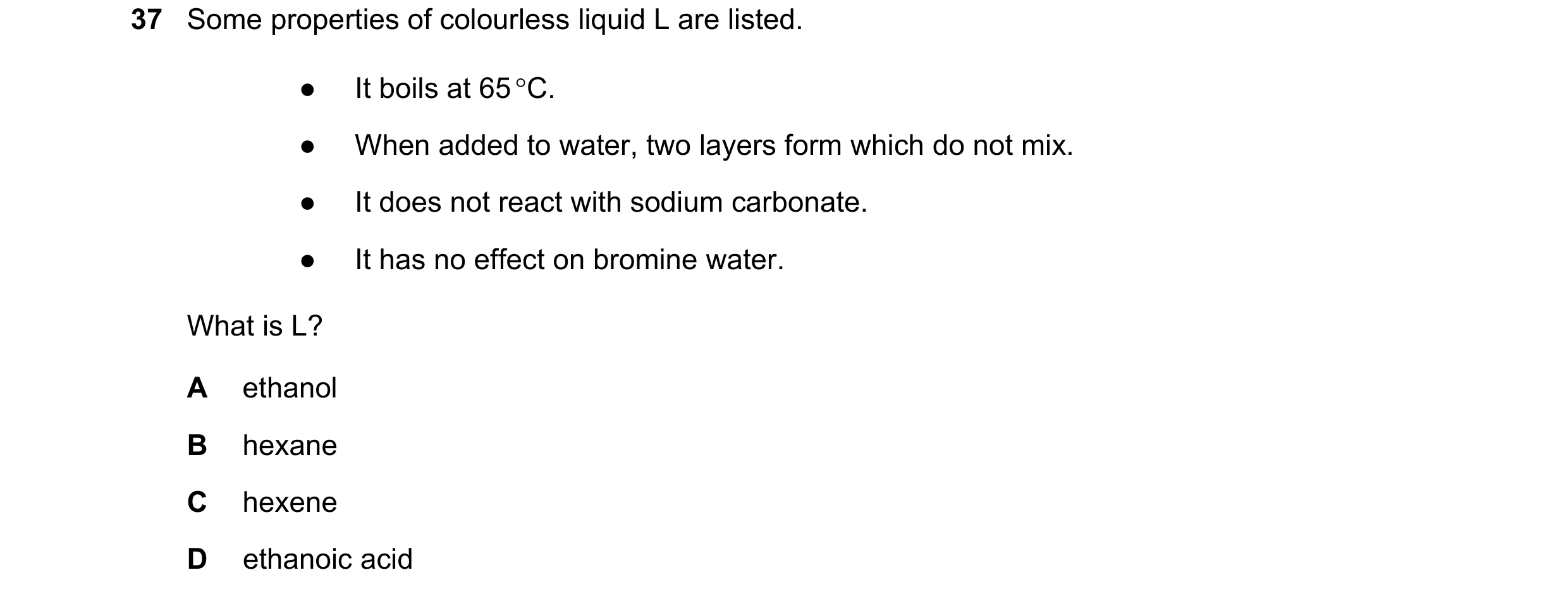
37 Some properties of colourless liquid L are listed. ● It boils at 65 C. ● When added to water, two layers form which do not mix. ● It does not react with sodium carbonate. ● It has no effect on bromine water. What is L? A ethanol B hexane C hexene D ethanoic acid
1 marks
Answer: B
This question in 0971/11 May/June 2022
Q7 · A molecule of compound P contains two carbon atoms and four hydrogen atoms 0971/11 May/June 2022
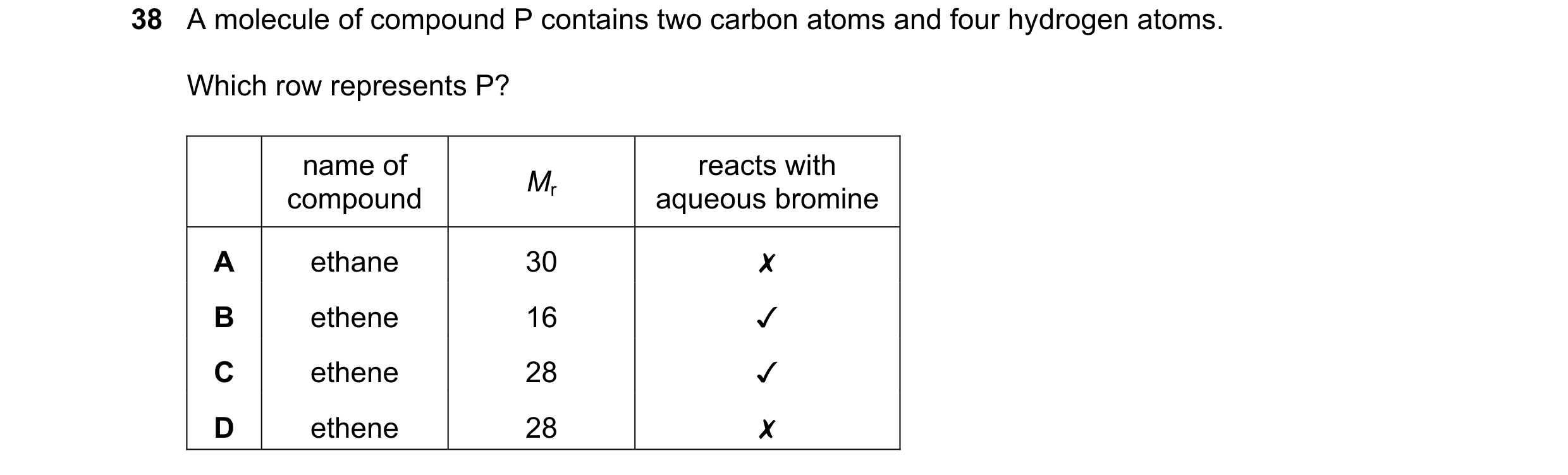
38 A molecule of compound P contains two carbon atoms and four hydrogen atoms.
Which row represents P?
name of M reacts with
compound " aqueous bromine
A ethane 30 x
B ethene 16 v
Cc ethene 28 v
D ethene 28 x
1 marks
Answer: C
This question in 0971/11 May/June 2022
Q8 · The equation representing the reaction of a hydrocarbon with water is shown 0971/11 May/June 2022
39 The equation representing the reaction of a hydrocarbon with water is shown. catalyst CxHy + H2O CxH5OH What are the values of x and y? x y A 1 4 B 1 6 C 2 4 D 2 6
1 marks
Answer: C
This question in 0971/11 May/June 2022
Q9 · Ethene reacts with substance X to form ethanol 0971/12 May/June 2022
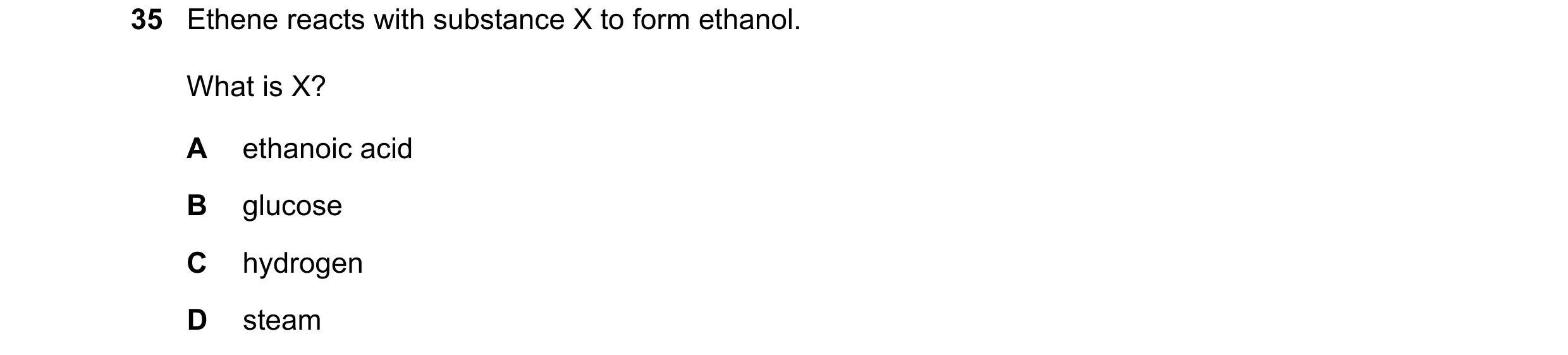
35 Ethene reacts with substance X to form ethanol. What is X? A ethanoic acid B glucose C hydrogen D steam
1 marks
Answer: D
This question in 0971/12 May/June 2022
Q10 · Alkenes can be produced by cracking large hydrocarbon molecules to form smaller… 0971/12 May/June 2022
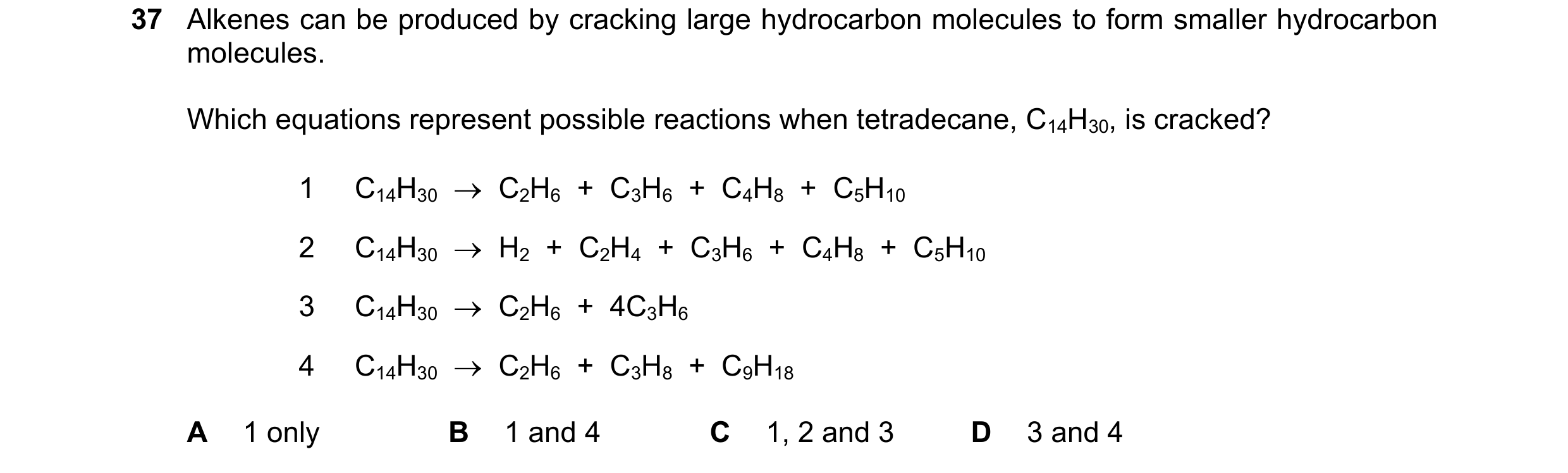
37 Alkenes can be produced by cracking large hydrocarbon molecules to form smaller hydrocarbon molecules. Which equations represent possible reactions when tetradecane, C14H30, is cracked? 1 C14H30 C2H6 + C3H6 + C4H8 + C5H10 2 C14H30 H2 + C2H4 + C3H6 + C4H8 + C5H10 3 C14H30 C2H6 + 4C3H6 4 C14H30 C2H6 + C3H8 + C9H18 A 1 only B 1 and 4 C 1, 2 and 3 D 3 and 4
1 marks
Answer: C
This question in 0971/12 May/June 2022
Q11 · Which homologous series of compounds reacts to form an addition polymer? 0971/12 Oct/Nov 2022
36 Which homologous series of compounds reacts to form an addition polymer? A alcohols B alkanes C alkenes D carboxylic acids
1 marks
Answer: C
This question in 0971/12 Oct/Nov 2022
Q12 · Which statement about unsaturated hydrocarbons is correct? 0971/12 Oct/Nov 2022
39 Which statement about unsaturated hydrocarbons is correct? A CH3CH2CH=CHCH3 is an unsaturated hydrocarbon. B Ethene has more hydrogen atoms per molecule than ethane. C Unsaturated hydrocarbons have double bonds between carbon and hydrogen atoms. D Unsaturated hydrocarbons turn aqueous bromine from colourless to brown.
1 marks
Answer: A
This question in 0971/12 Oct/Nov 2022
Q13 · Part of the structure of a molecule of vitamin A is shown 0971/11 May/June 2023
32 Part of the structure of a molecule of vitamin A is shown. H H C H H H C C C C C O H H H H Which statements about this part of the structure are correct? 1 It is saturated. 2 There are two alkene groups. 3 The structure shows a carboxylic acid. A 1 and 3 B 1 only C 2 and 3 D 2 only
1 marks
Answer: D
This question in 0971/11 May/June 2023
Q14 · Which equation represents the cracking of an alkane? 0971/11 May/June 2023
34 Which equation represents the cracking of an alkane? A 3C2H4 → C6H12 B C6H12 + H2 → C6H14 C C6H14 → 6C + 7H2 D C6H14 → C2H4 + C4H10
1 marks
Answer: D
This question in 0971/11 May/June 2023
Q15 · Which compound rapidly decolourises aqueous bromine? 0971/12 May/June 2023
34 Which compound rapidly decolourises aqueous bromine? A ethane B ethanoic acid C ethanol D ethene
1 marks
Answer: D
This question in 0971/12 May/June 2023
Q16 · Which of the statements about propene are correct? 0971/12 May/June 2024
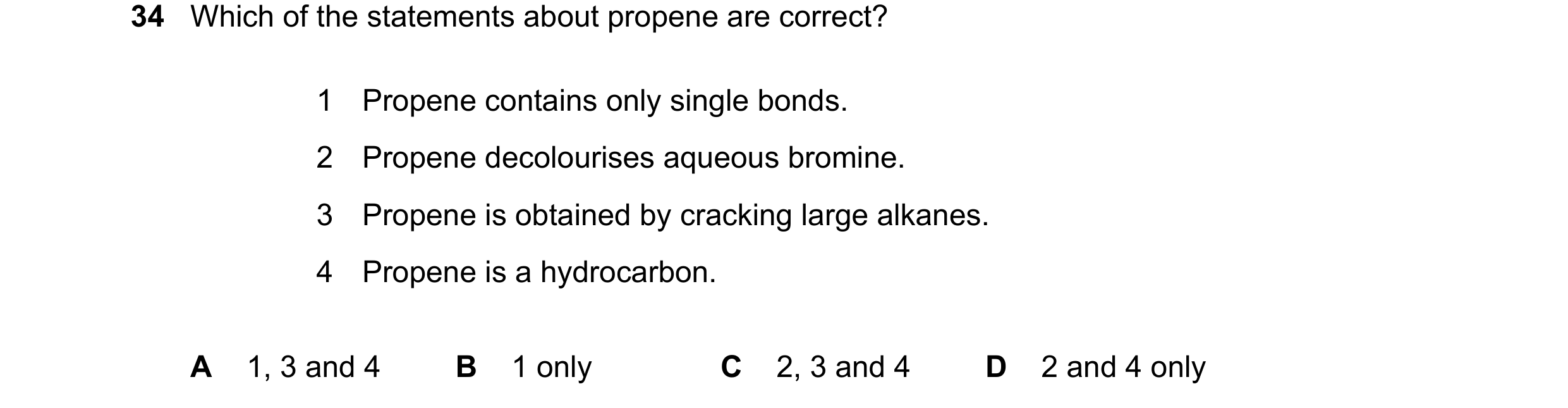
34 Which of the statements about propene are correct? 1 Propene contains only single bonds. 2 Propene decolourises aqueous bromine. 3 Propene is obtained by cracking large alkanes. 4 Propene is a hydrocarbon. A 1, 3 and 4 B 1 only C 2, 3 and 4 D 2 and 4 only
1 marks
Answer: C
This question in 0971/12 May/June 2024
Q17 · The equation for a reaction that produces ethanol is shown 0971/12 May/June 2024
36 The equation for a reaction that produces ethanol is shown. ethene + steam →ethanol Which type of reaction does the equation represent? A addition B combustion C fermentation D polymerisation
1 marks
Answer: A
This question in 0971/12 May/June 2024
Q18 · Four statements about ethene or poly(ethene) are listed 0971/12 May/June 2024
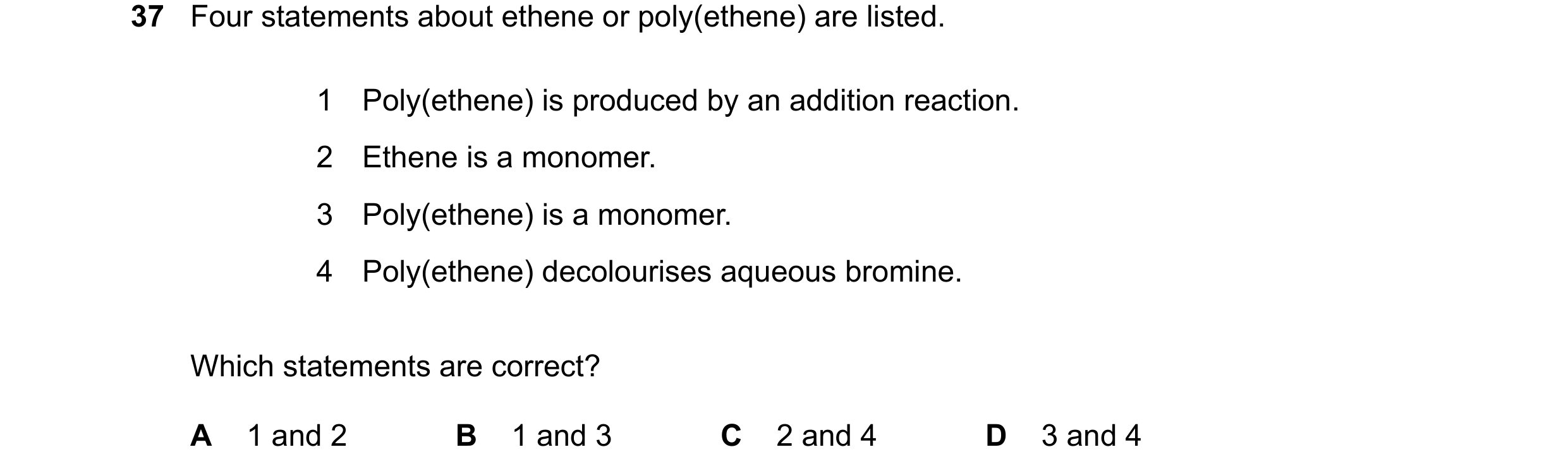
37 Four statements about ethene or poly(ethene) are listed. 1 Poly(ethene) is produced by an addition reaction. 2 Ethene is a monomer. 3 Poly(ethene) is a monomer. 4 Poly(ethene) decolourises aqueous bromine. Which statements are correct? A 1 and 2 B 1 and 3 C 2 and 4 D 3 and 4
1 marks
Answer: A
This question in 0971/12 May/June 2024
Q19 · Three statements about cracking of larger alkane molecules are listed 0971/11 May/June 2025
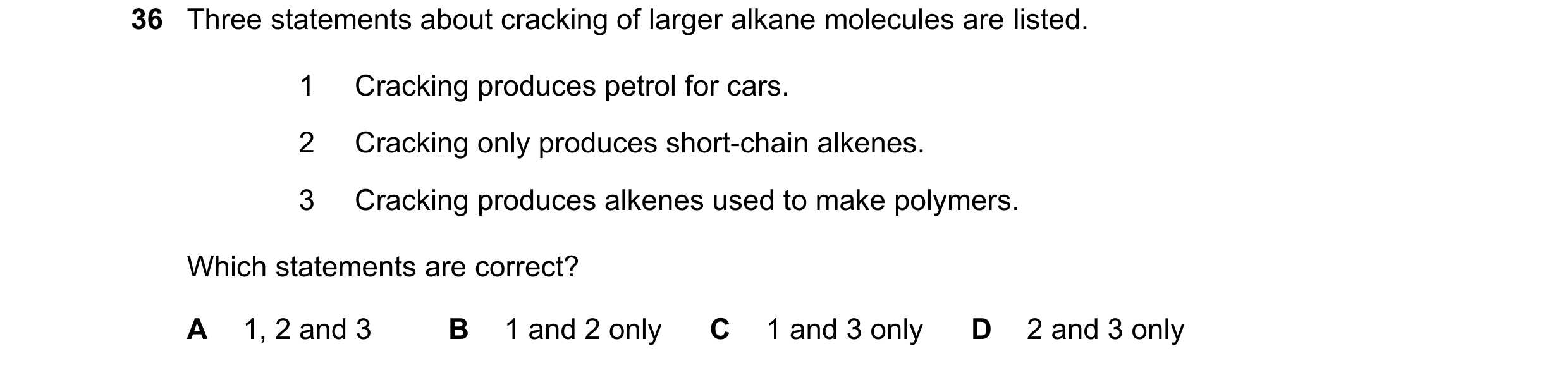
36 Three statements about cracking of larger alkane molecules are listed. 1 Cracking produces petrol for cars. 2 Cracking only produces short-chain alkenes. 3 Cracking produces alkenes used to make polymers. Which statements are correct? A 1, 2 and 3 B 1 and 2 only C 1 and 3 only D 2 and 3 only
1 marks
Answer: C
This question in 0971/11 May/June 2025
Q20 · Some words used to describe organic compounds are listed 0971/11 May/June 2025
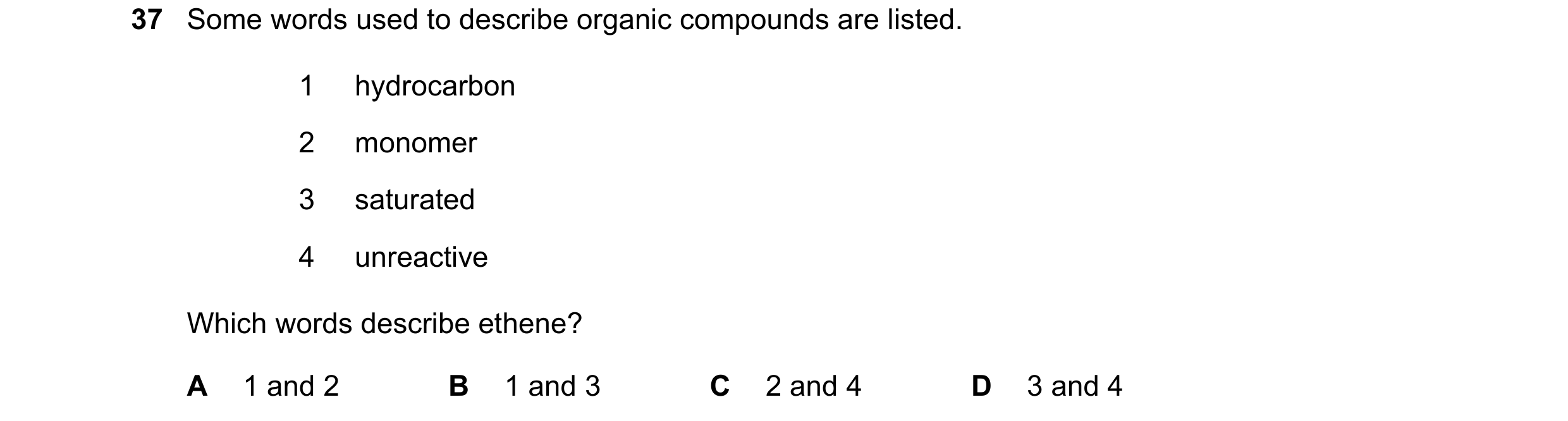
37 Some words used to describe organic compounds are listed. 1 hydrocarbon 2 monomer 3 saturated 4 unreactive Which words describe ethene? A 1 and 2 B 1 and 3 C 2 and 4 D 3 and 4
1 marks
Answer: A
This question in 0971/11 May/June 2025
Q21 · Three hydrocarbons are separately mixed with aqueous bromine 0971/12 May/June 2025
34 Three hydrocarbons are separately mixed with aqueous bromine. Which row gives the correct observation for each hydrocarbon? H H H H H H C H H C C H C C H H H H H A colour changes from colour stays colour changes from orange to colourless unchanged orange to colourless B colour changes from colour changes from colour stays orange to colourless orange to colourless unchanged C colour stays colour stays colour changes from unchanged unchanged orange to colourless D colour stays colour changes from colour stays unchanged orange to colourless unchanged
1 marks
Answer: C
This question in 0971/12 May/June 2025
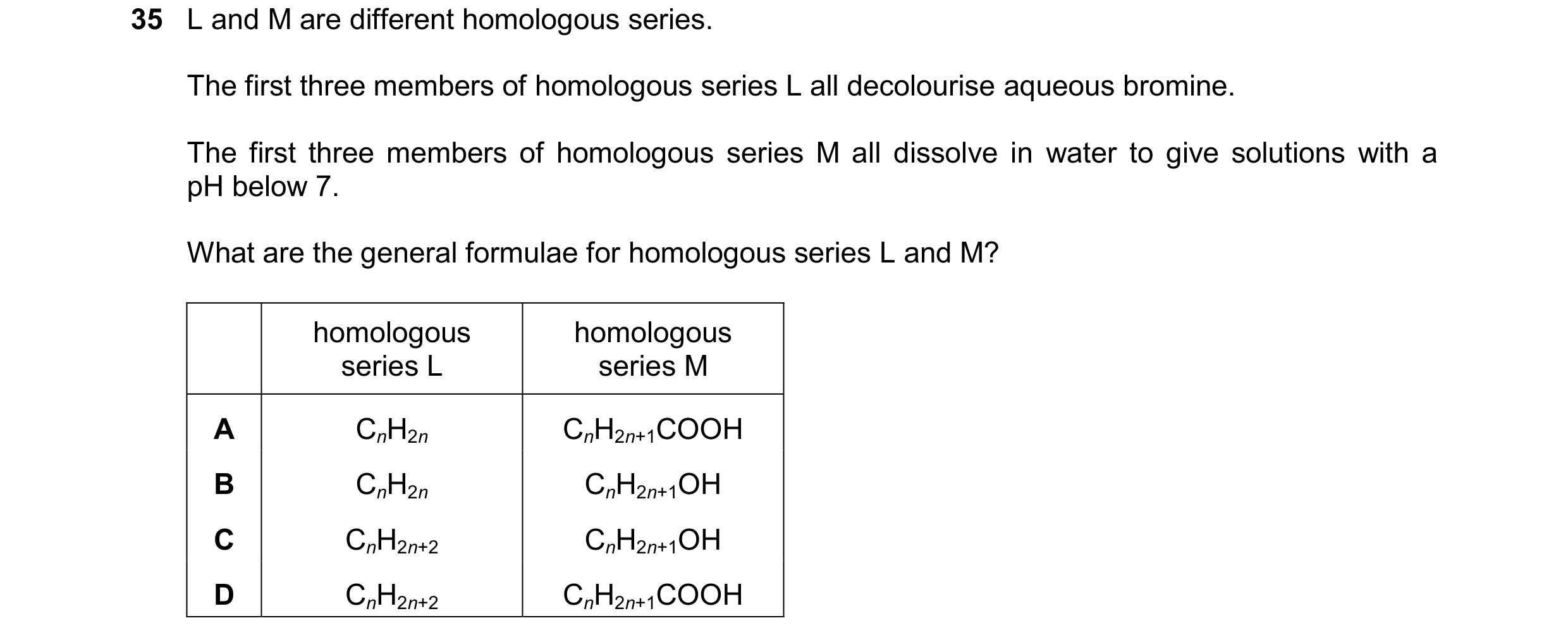
Q22 · L and M are different homologous series 0971/12 Oct/Nov 2025
35 L and M are different homologous series. The first three members of homologous series L all decolourise aqueous bromine. The first three members of homologous series M all dissolve in water to give solutions with a pH below 7. What are the general formulae for homologous series L and M? homologous homologous series L series M A CnH2n CnH2n+1COOH B CnH2n CnH2n+1OH C CnH2n+2 CnH2n+1OH D CnH2n+2 CnH2n+1COOH
1 marks
Answer: A
This question in 0971/12 Oct/Nov 2025
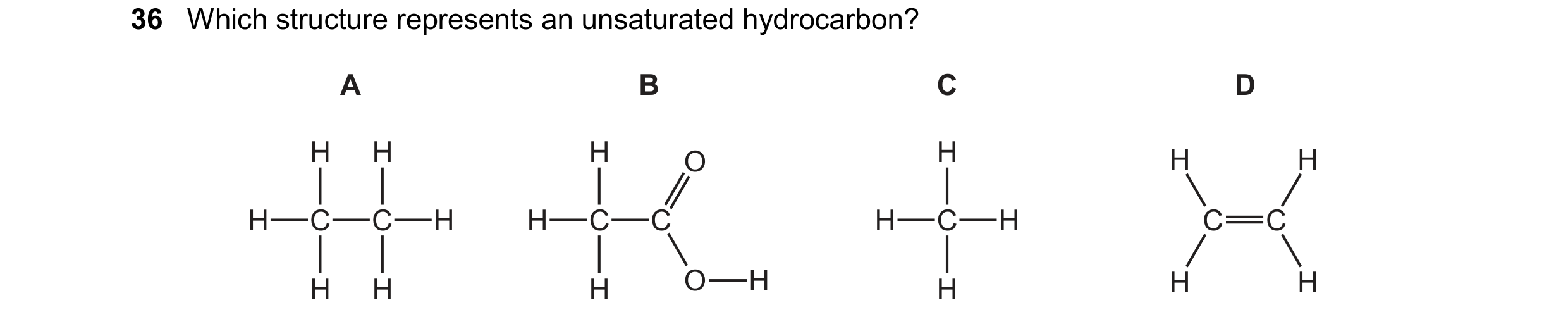
Q23 · Which structure represents an unsaturated hydrocarbon? 0971/12 Oct/Nov 2025
36 Which structure represents an unsaturated hydrocarbon? A B C D H H H O H H H H C C H H C C H C H C C H H H O H H H H
1 marks
Answer: D
This question in 0971/12 Oct/Nov 2025
 1 / 6
1 / 6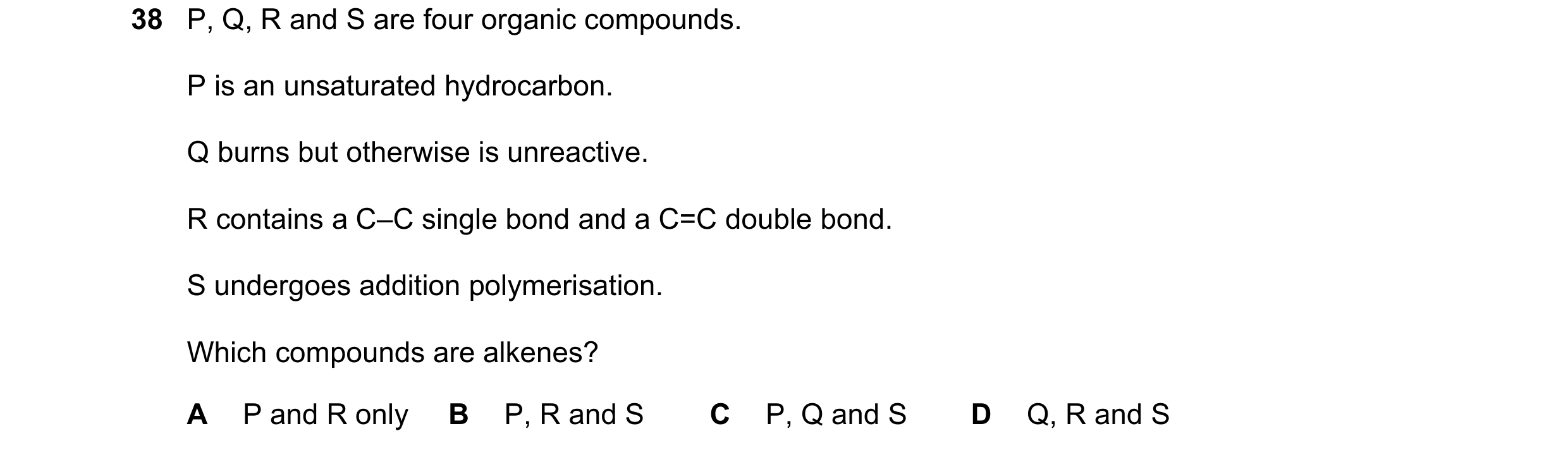

 2 / 6
2 / 6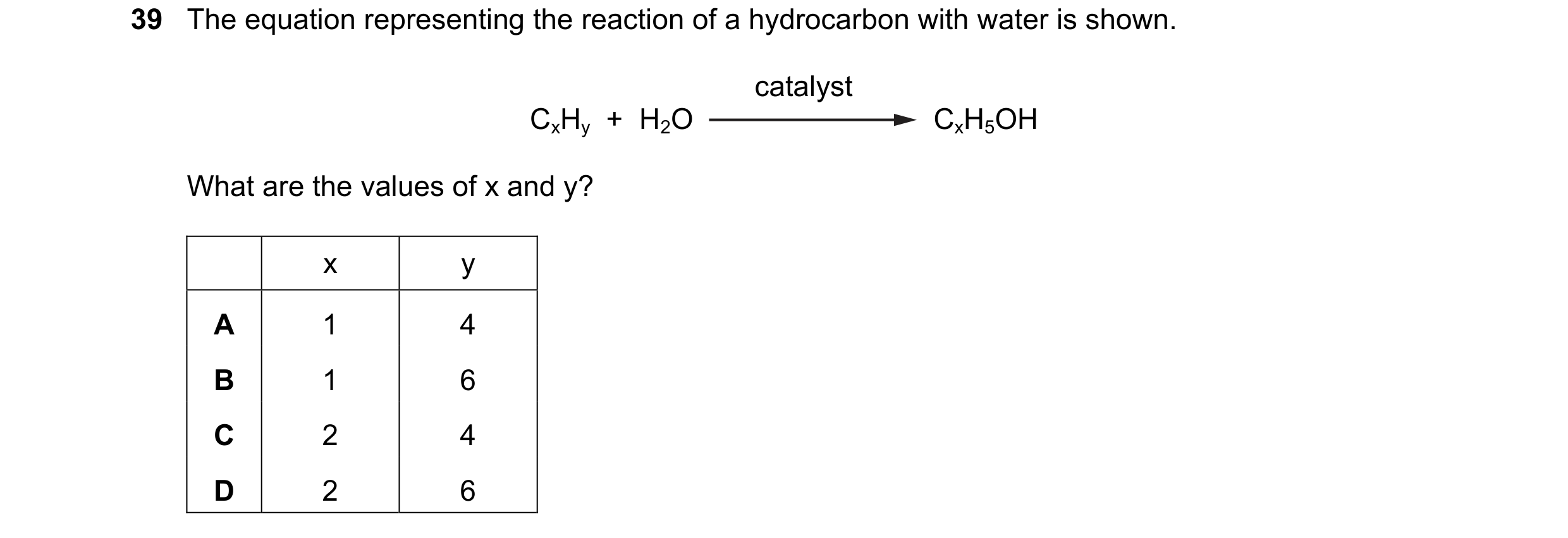

 3 / 6
3 / 6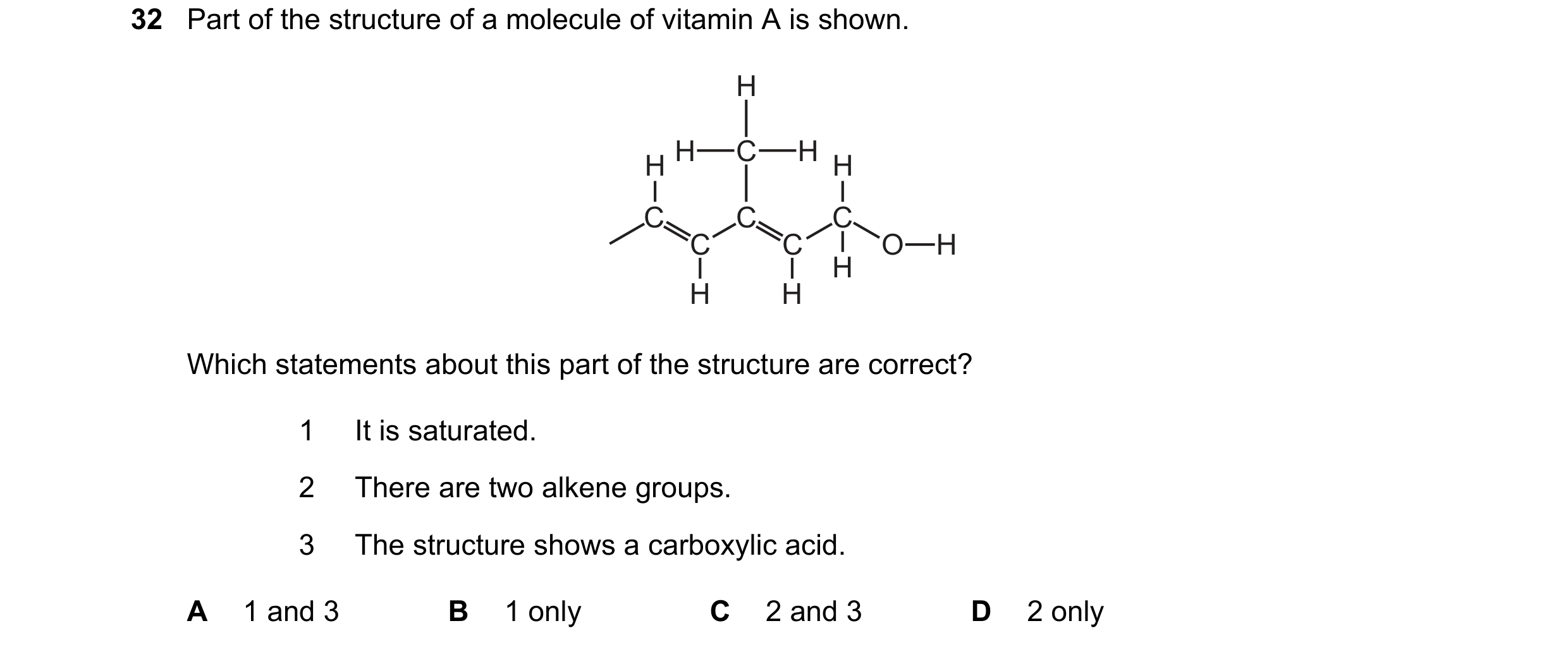


 4 / 6
4 / 6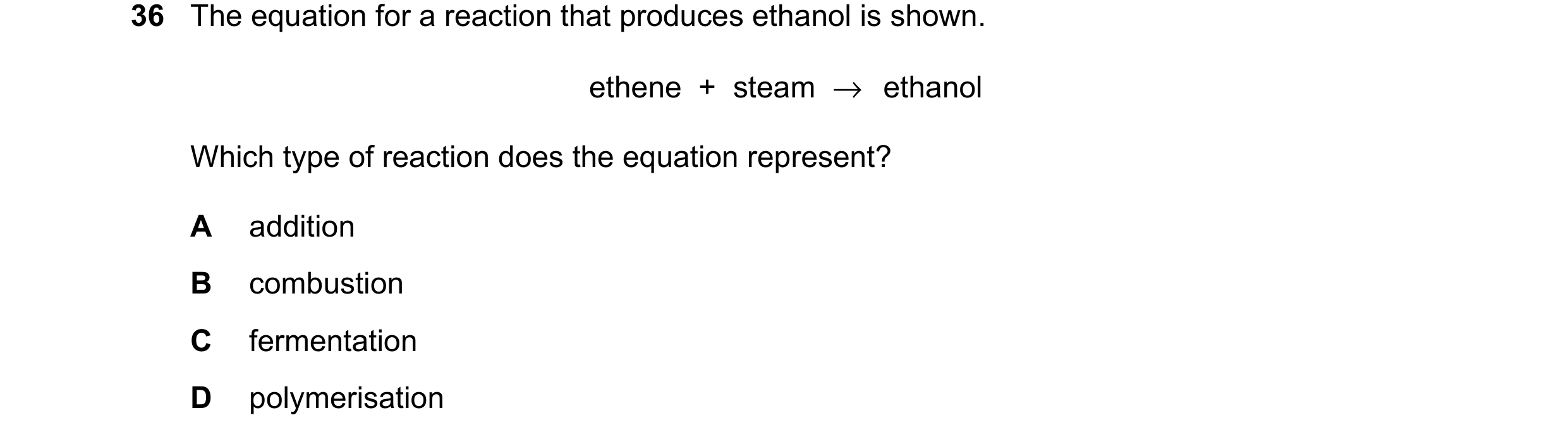
 5 / 6
5 / 6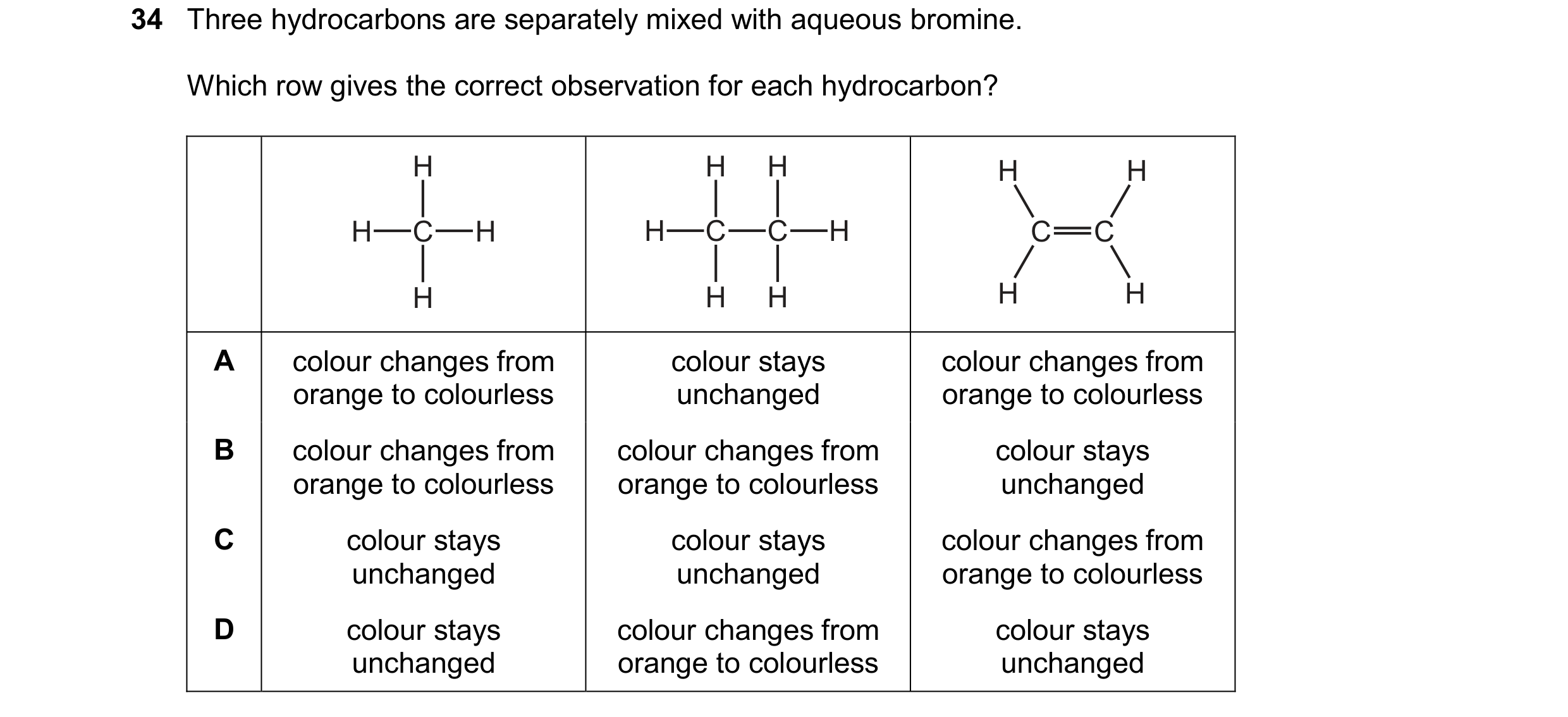
 6 / 6
6 / 6