Questions as text
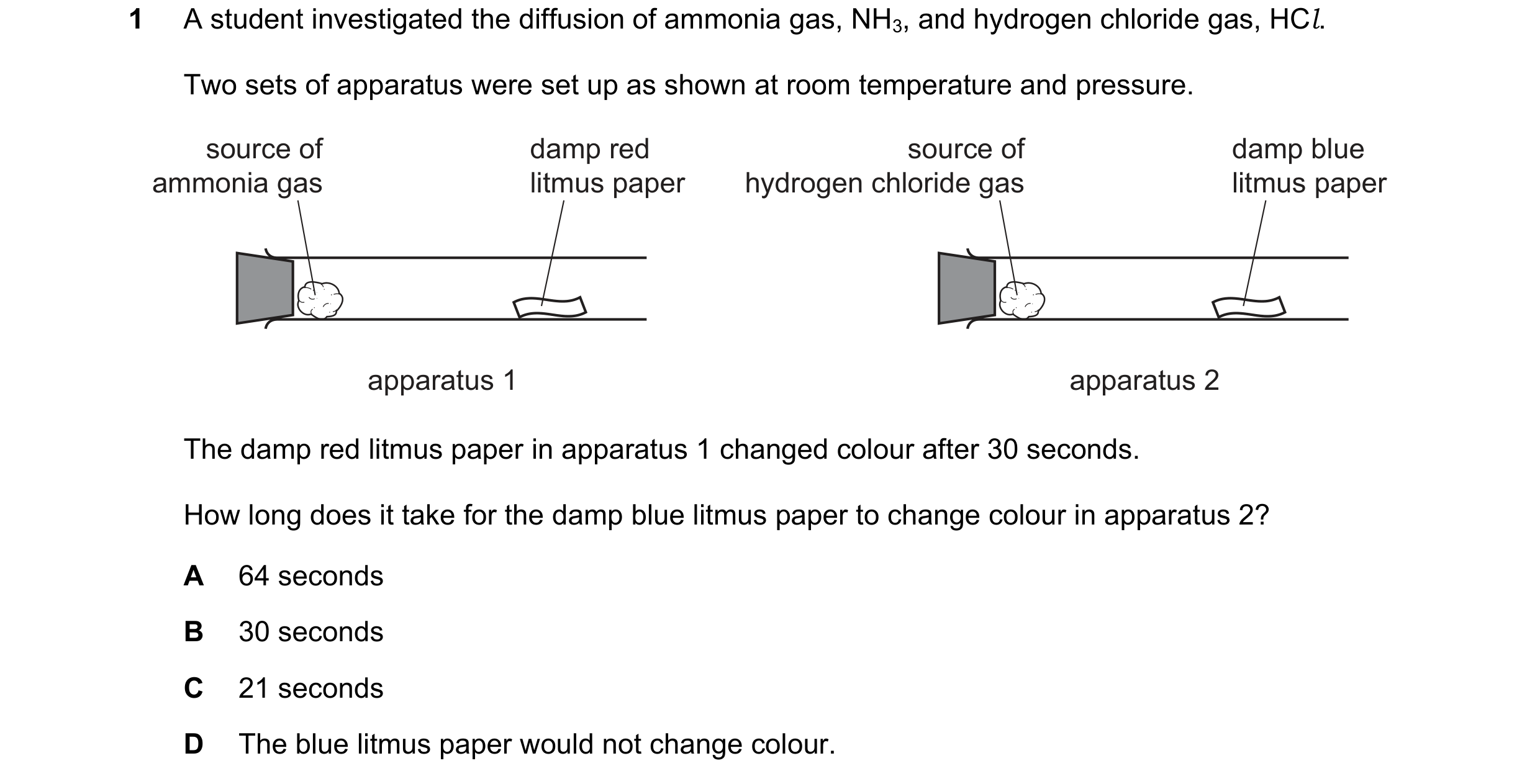
Q1 · A student investigated the diffusion of ammonia gas, NH3, and hydrogen chloride gas, HCl 0971/21 May/June 2018
1 A student investigated the diffusion of ammonia gas, NH3, and hydrogen chloride gas, HCl. Two sets of apparatus were set up as shown at room temperature and pressure. source of damp red source of damp blue ammonia gas litmus paper hydrogen chloride gas litmus paper apparatus 1 apparatus 2 The damp red litmus paper in apparatus 1 changed colour after 30 seconds. How long does it take for the damp blue litmus paper to change colour in apparatus 2? A 64 seconds B 30 seconds C 21 seconds D The blue litmus paper would not change colour.
1 marks
Answer: A
This question in 0971/21 May/June 2018
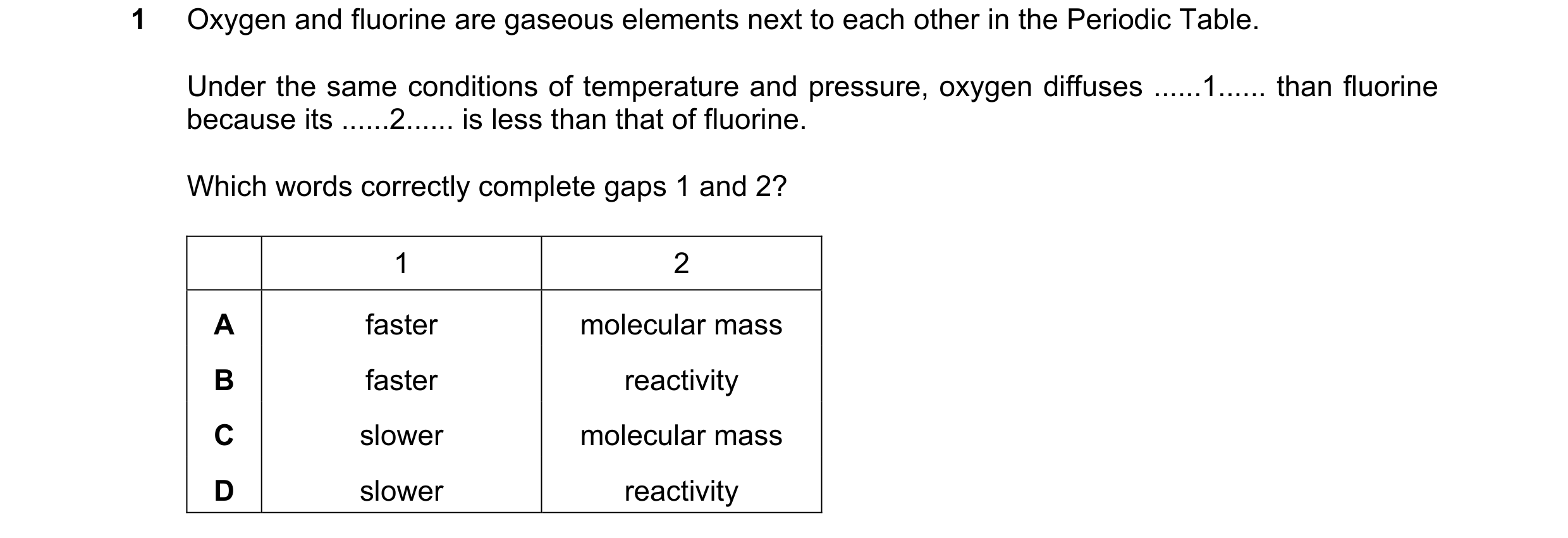
Q2 · Oxygen and fluorine are gaseous elements next to each other in the Periodic Table 0971/22 Oct/Nov 2018
1 Oxygen and fluorine are gaseous elements next to each other in the Periodic Table. Under the same conditions of temperature and pressure, oxygen diffuses … 1 … than fluorine because its … 2 … is less than that of fluorine. Which words correctly complete gaps 1 and 2? 1 2 A faster molecular mass B faster reactivity C slower molecular mass D slower reactivity
1 marks
Answer: A
This question in 0971/22 Oct/Nov 2018
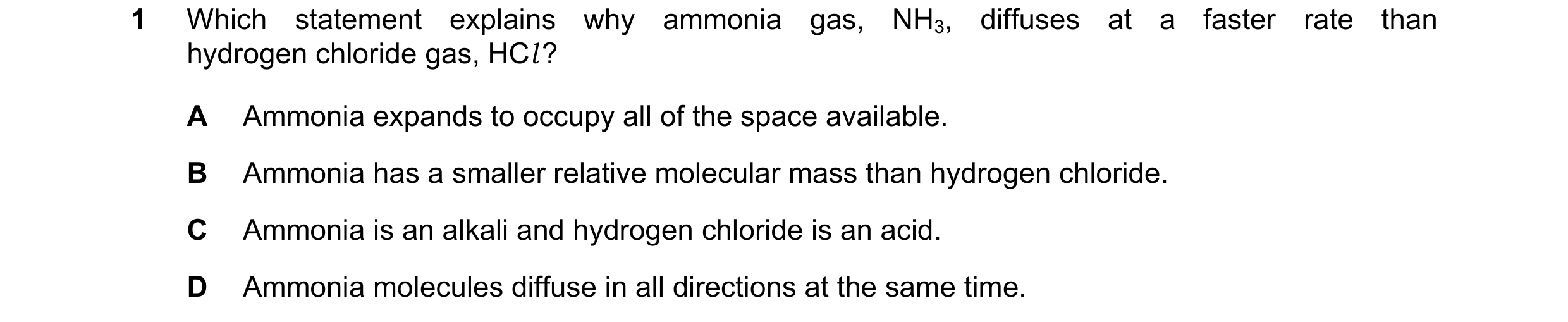
Q3 · Which statement explains why ammonia gas, NH3, diffuses at a faster rate than hydrogen… 0971/21 May/June 2019
1 Which statement explains why ammonia gas, NH3, diffuses at a faster rate than hydrogen chloride gas, HCl ? A Ammonia expands to occupy all of the space available. B Ammonia has a smaller relative molecular mass than hydrogen chloride. C Ammonia is an alkali and hydrogen chloride is an acid. D Ammonia molecules diffuse in all directions at the same time.
1 marks
Answer: B
This question in 0971/21 May/June 2019
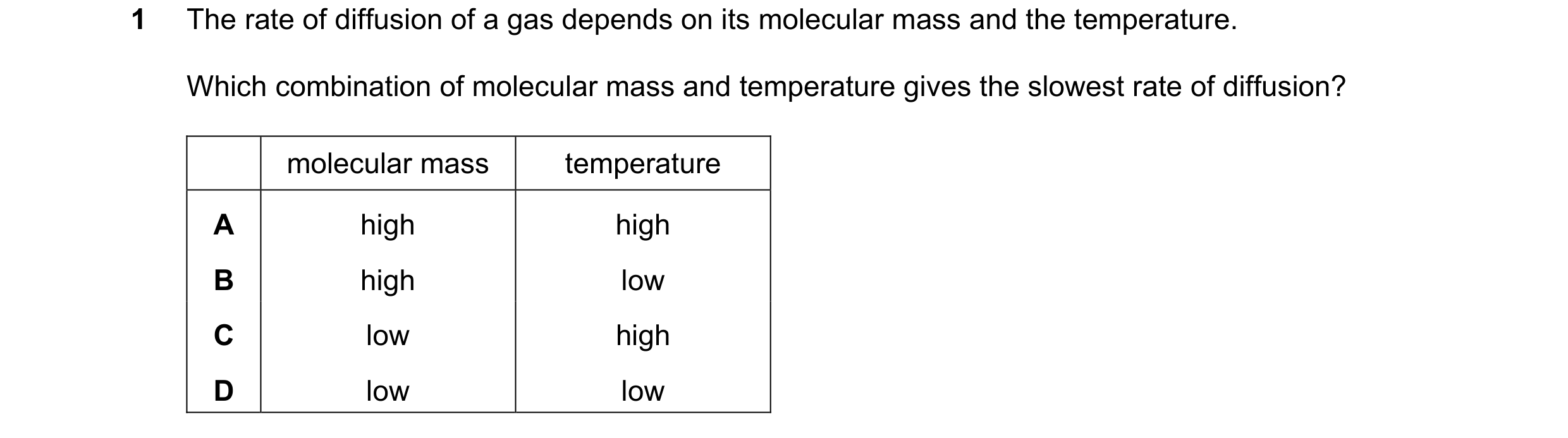
Q4 · The rate of diffusion of a gas depends on its molecular mass and the temperature 0971/22 Oct/Nov 2019
1 The rate of diffusion of a gas depends on its molecular mass and the temperature. Which combination of molecular mass and temperature gives the slowest rate of diffusion? molecular mass temperature A high high B high low C low high D low low
1 marks
Answer: B
This question in 0971/22 Oct/Nov 2019
Q5 · Which gas has the slowest rate of diffusion? 0971/22 Oct/Nov 2020
1 Which gas has the slowest rate of diffusion? A H2 B NH3 C CH4 D CO2
1 marks
Answer: D
This question in 0971/22 Oct/Nov 2020
Q6 · A gas is released at point P in the apparatus shown 0971/21 May/June 2021
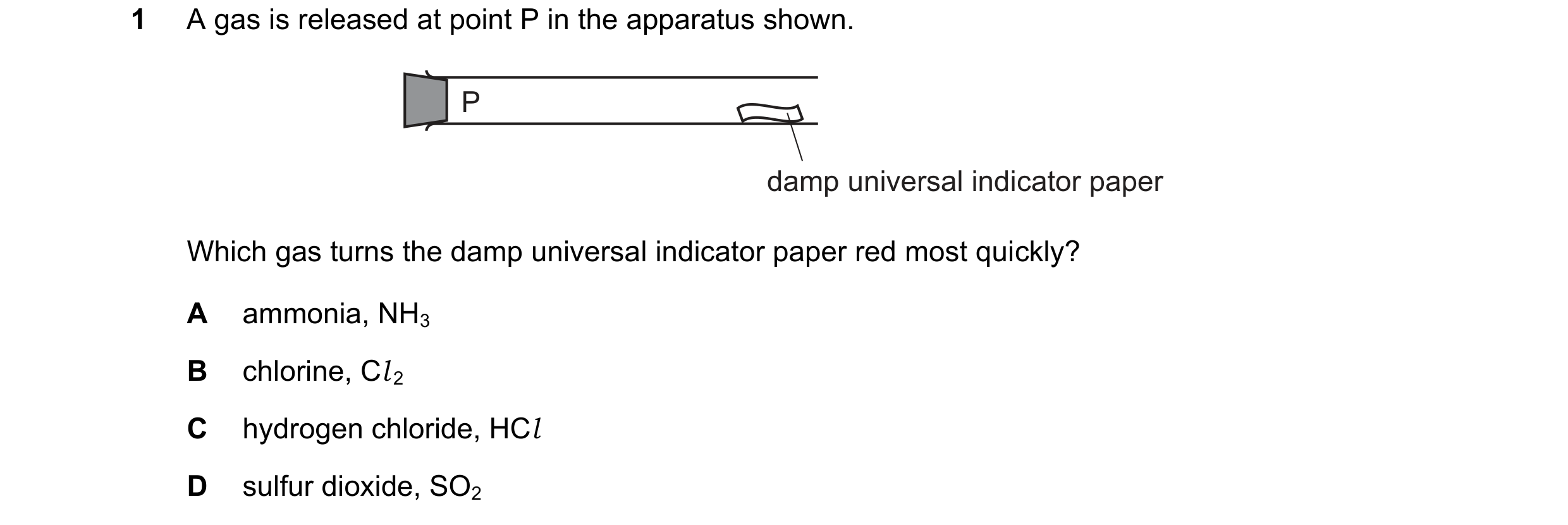
1 A gas is released at point P in the apparatus shown. P damp universal indicator paper Which gas turns the damp universal indicator paper red most quickly? A ammonia, NH3 B chlorine, Cl 2 C hydrogen chloride, HCl D sulfur dioxide, SO2
1 marks
Answer: C
This question in 0971/21 May/June 2021
Q7 · A gas is released at point P in the apparatus shown 0971/22 May/June 2021
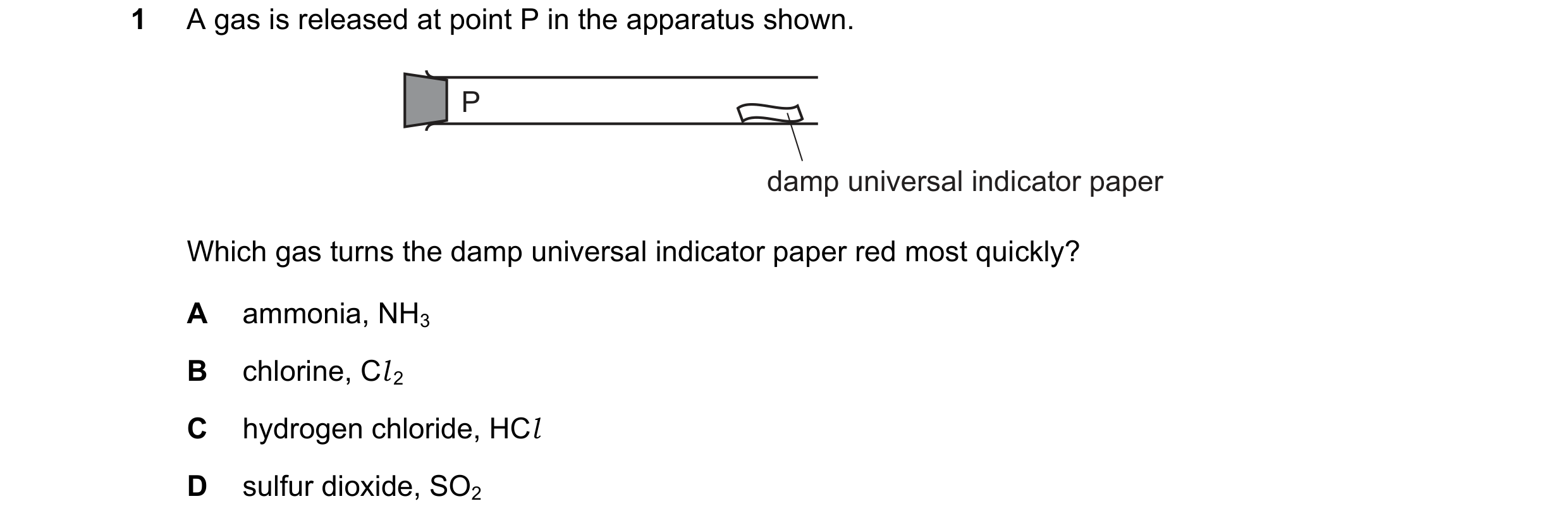
1 A gas is released at point P in the apparatus shown. P damp universal indicator paper Which gas turns the damp universal indicator paper red most quickly? A ammonia, NH3 B chlorine, Cl 2 C hydrogen chloride, HCl D sulfur dioxide, SO2
1 marks
Answer: C
This question in 0971/22 May/June 2021
Q8 · An experiment is set up as shown 0971/22 Oct/Nov 2021
1 An experiment is set up as shown. cotton wool soaked cotton wool soaked in ammonia in hydrochloric acid After several minutes, a white ring of ammonium chloride appears as shown. ammonium chloride Which statement explains the observation after several minutes? A Ammonia gas diffuses faster than hydrogen chloride gas because its molecules have a lower molecular mass. B Ammonia gas diffuses faster than hydrogen chloride gas because its molecules have a higher molecular mass. C Ammonia gas diffuses slower than hydrogen chloride gas because its molecules have a lower molecular mass. D Ammonia gas diffuses slower than hydrogen chloride gas because its molecules have a higher molecular mass.
1 marks
Answer: A
This question in 0971/22 Oct/Nov 2021
Q9 · Which two gases will diffuse at the same rate, at the same temperature? 0971/21 May/June 2022
1 Which two gases will diffuse at the same rate, at the same temperature? A carbon monoxide and carbon dioxide B carbon monoxide and nitrogen C chlorine and fluorine D nitrogen and oxygen
1 marks
Answer: B
This question in 0971/21 May/June 2022
Q10 · Which two gases will diffuse at the same rate, at the same temperature? 0971/22 May/June 2022
1 Which two gases will diffuse at the same rate, at the same temperature? A carbon monoxide and carbon dioxide B carbon monoxide and nitrogen C chlorine and fluorine D nitrogen and oxygen
1 marks
Answer: B
This question in 0971/22 May/June 2022
Q11 · The rate of diffusion of three gases, ammonia, carbon dioxide and methane, is measured 0971/22 Oct/Nov 2022
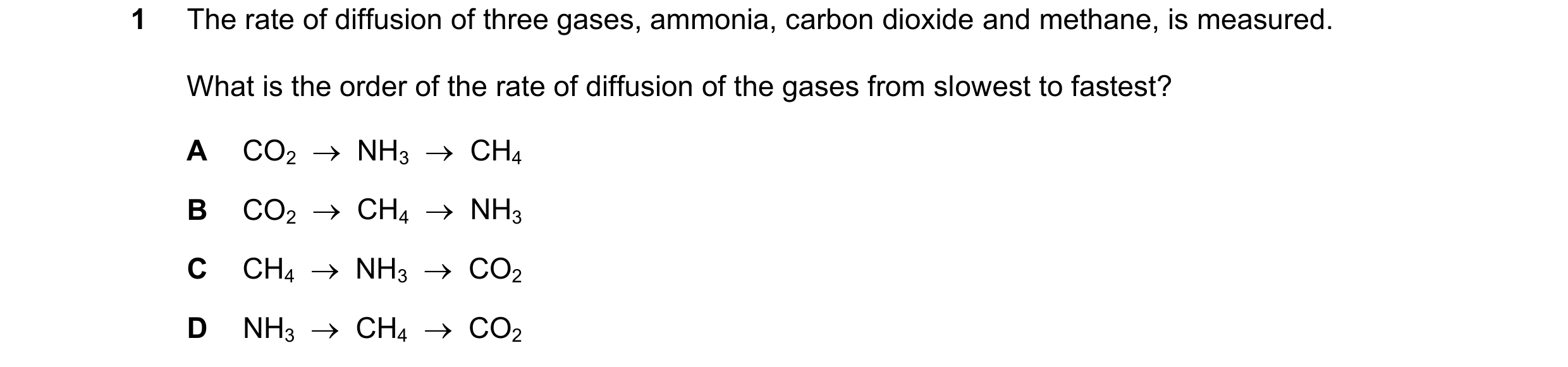
1 The rate of diffusion of three gases, ammonia, carbon dioxide and methane, is measured. What is the order of the rate of diffusion of the gases from slowest to fastest? A CO2 NH3 CH4 B CO2 CH4 NH3 C CH4 NH3 CO2 D NH3 CH4 CO2
1 marks
Answer: A
This question in 0971/22 Oct/Nov 2022
Q12 · The diagram shows the result of dropping a purple crystal into water 0971/21 May/June 2023
1. The diagram shows the result of dropping a purple crystal into water.
after
water five hours
—__ > purple
purple solution
crystal
Which processes take place in this experiment?
chemical
reaction
diffusing dissolving
0 OO WwW PY
x « &
Ke O&K
<< & x
1 marks
Answer: D
This question in 0971/21 May/June 2023
Q13 · Hydrogen chloride gas [Mr: HCl, 36.5] is released at P in the apparatus shown 0971/21 May/June 2024
3 Hydrogen chloride gas [Mr: HCl, 36.5] is released at P in the apparatus shown. The universal indicator paper turns red after 38s. P universal indicator paper The experiment is repeated using sulfur dioxide gas [Mr: SO2, 64]. What is the result for sulfur dioxide gas? universal time for indicator universal indicator paper paper turns to change colour/s A blue 26 B blue 51 C red 26 D red 51
1 marks
Answer: D
This question in 0971/21 May/June 2024
Q14 · Which gas has the slowest rate of diffusion? 0971/22 May/June 2024
1 Which gas has the slowest rate of diffusion? A H2 B NH3 C CH4 D CO2
1 marks
Answer: D
This question in 0971/22 May/June 2024
Q15 · A student investigates the diffusion of ammonia gas, NH3, and hydrogen chloride gas, HCl 0971/22 Oct/Nov 2025
3 A student investigates the diffusion of ammonia gas, NH3, and hydrogen chloride gas, HCl. Two sets of apparatus are set up as shown at room temperature and pressure. apparatus 1 apparatus 2 source of damp red source of damp blue ammonia gas litmus paper hydrogen chloride gas litmus paper The damp red litmus paper in apparatus 1 changes colour after 30 seconds. How long does it take for the damp blue litmus paper in apparatus 2 to change colour? A 21 seconds B 30 seconds C 64 seconds D The damp blue litmus paper does not change colour.
1 marks
Answer: C
This question in 0971/22 Oct/Nov 2025
 1 / 5
1 / 5
 2 / 5
2 / 5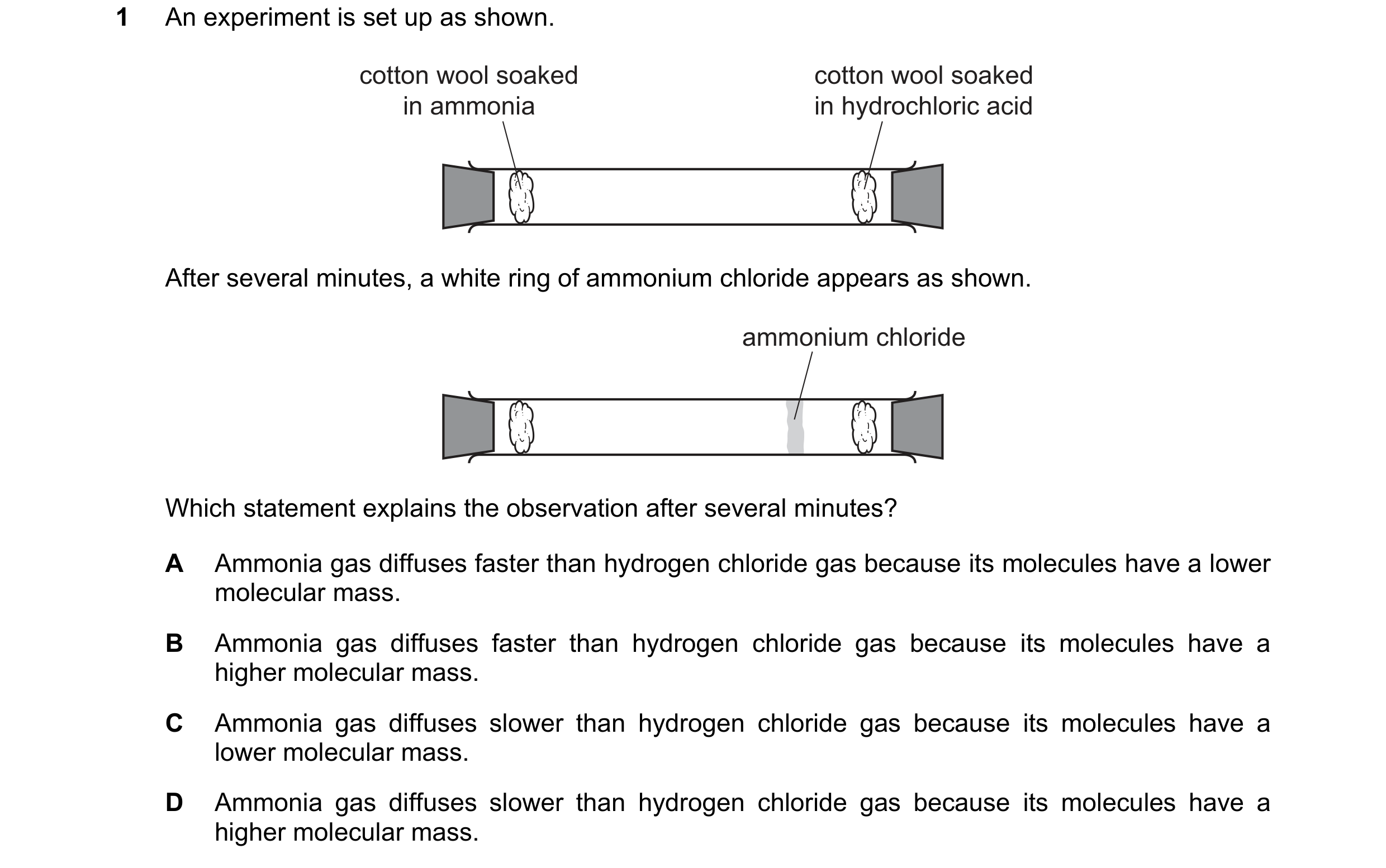


 3 / 5
3 / 5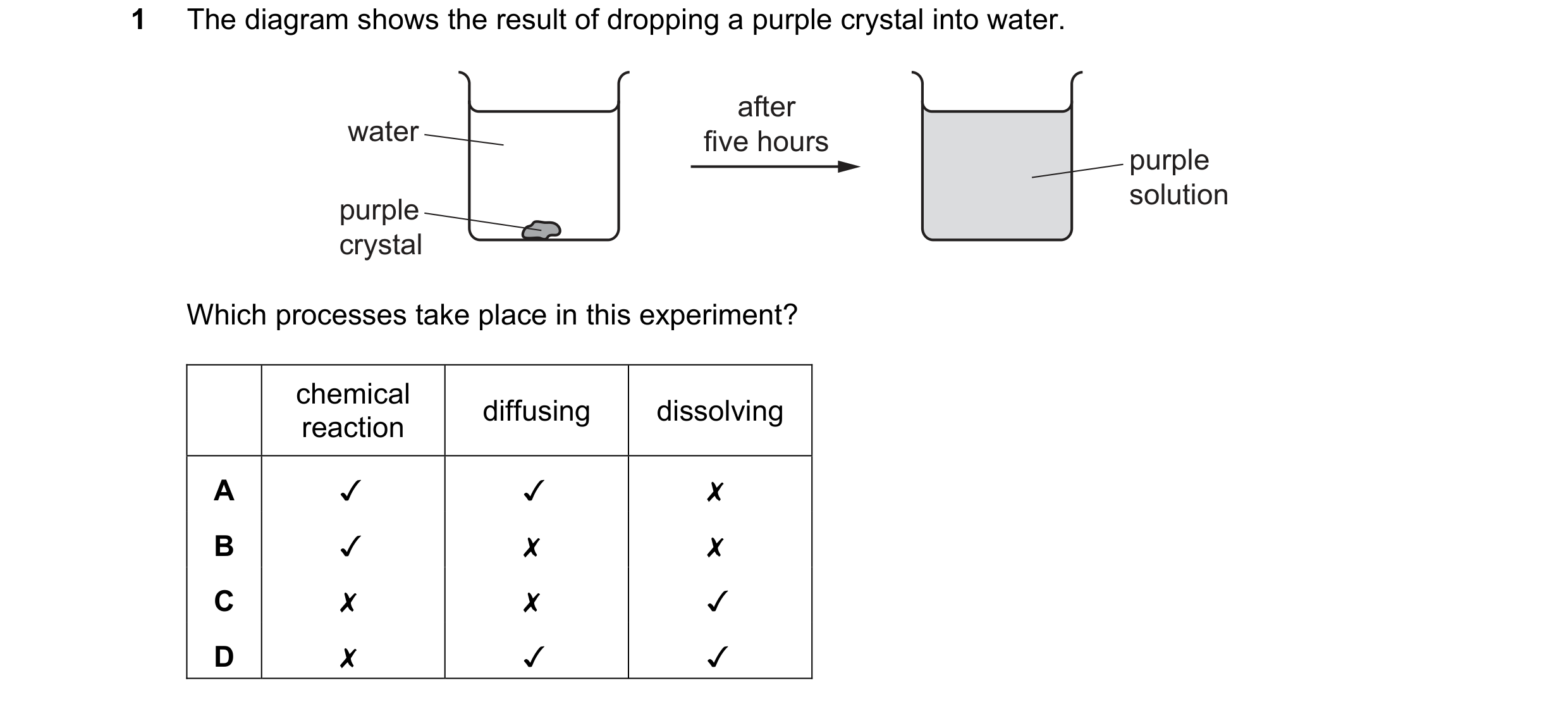
![Question 13: Hydrogen chloride gas [Mr: HCl, 36.5] is released at P in the apparatus shown. The universal indicator paper turns red after 38s. P univers…](https://img.pastlit.com/crops/60d7205d-3a6e-4460-b52a-150f00e26455/q3.png)
 4 / 5
4 / 5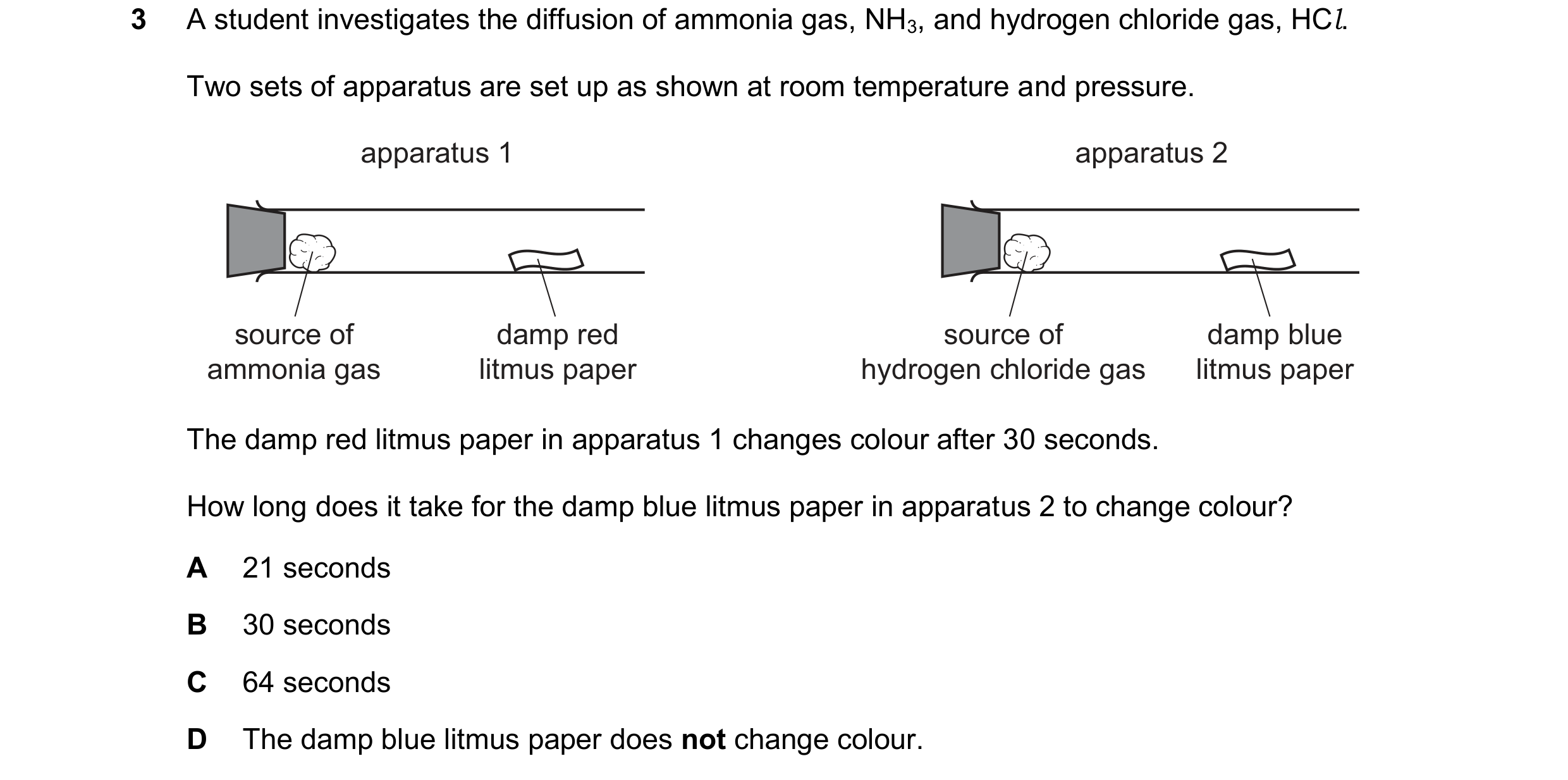 5 / 5
5 / 5