Cambridge A Level Psychology (from 2018) 9990 — 2022 Oct/Nov Paper 3 · Variant 3
9990/33/O/N/22 · 8 questions · 60 marks · ≈68 min
The question paper and its mark scheme, free to read here and free to download. This is Cambridge’s own paper, exactly as it was sat.
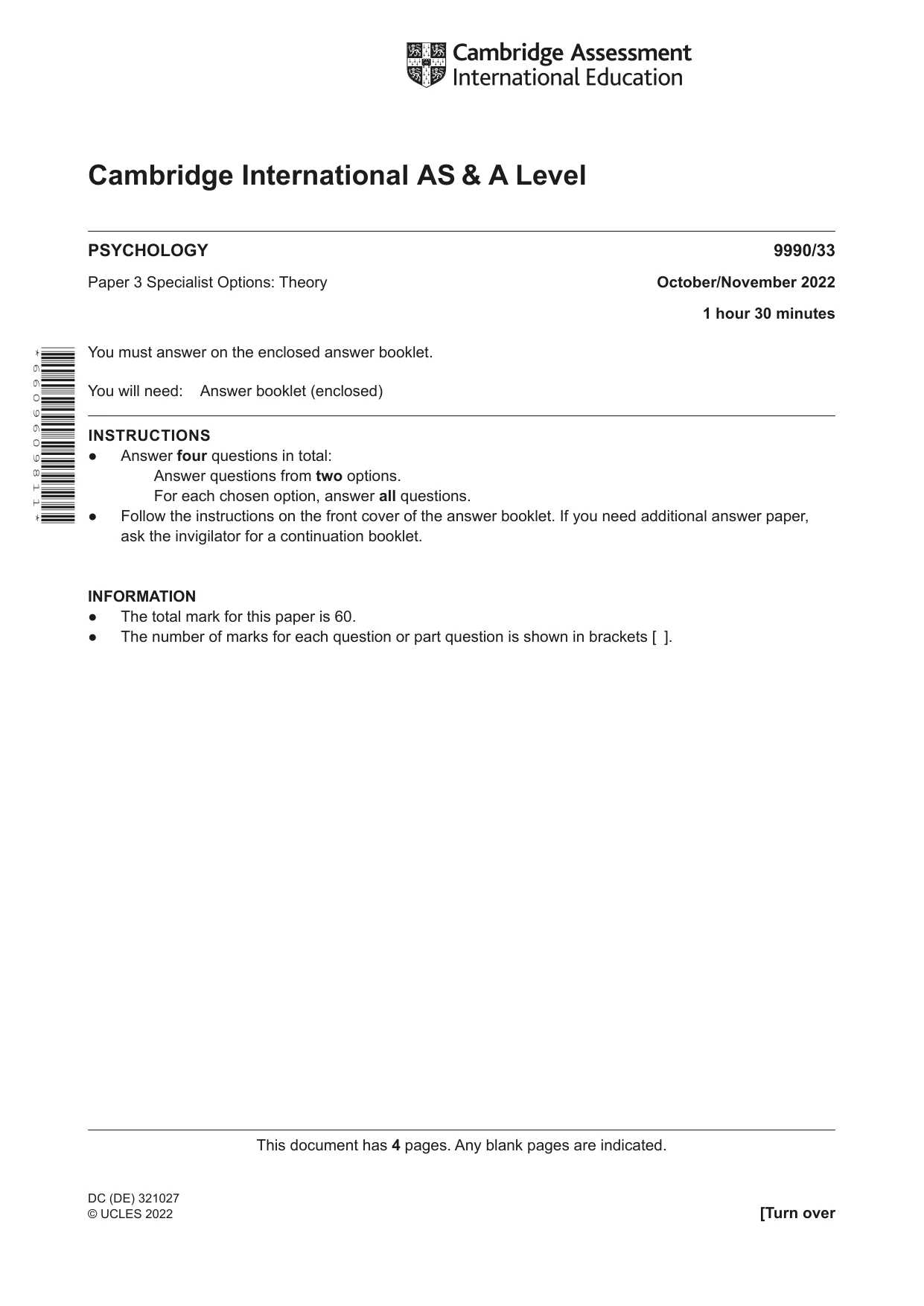
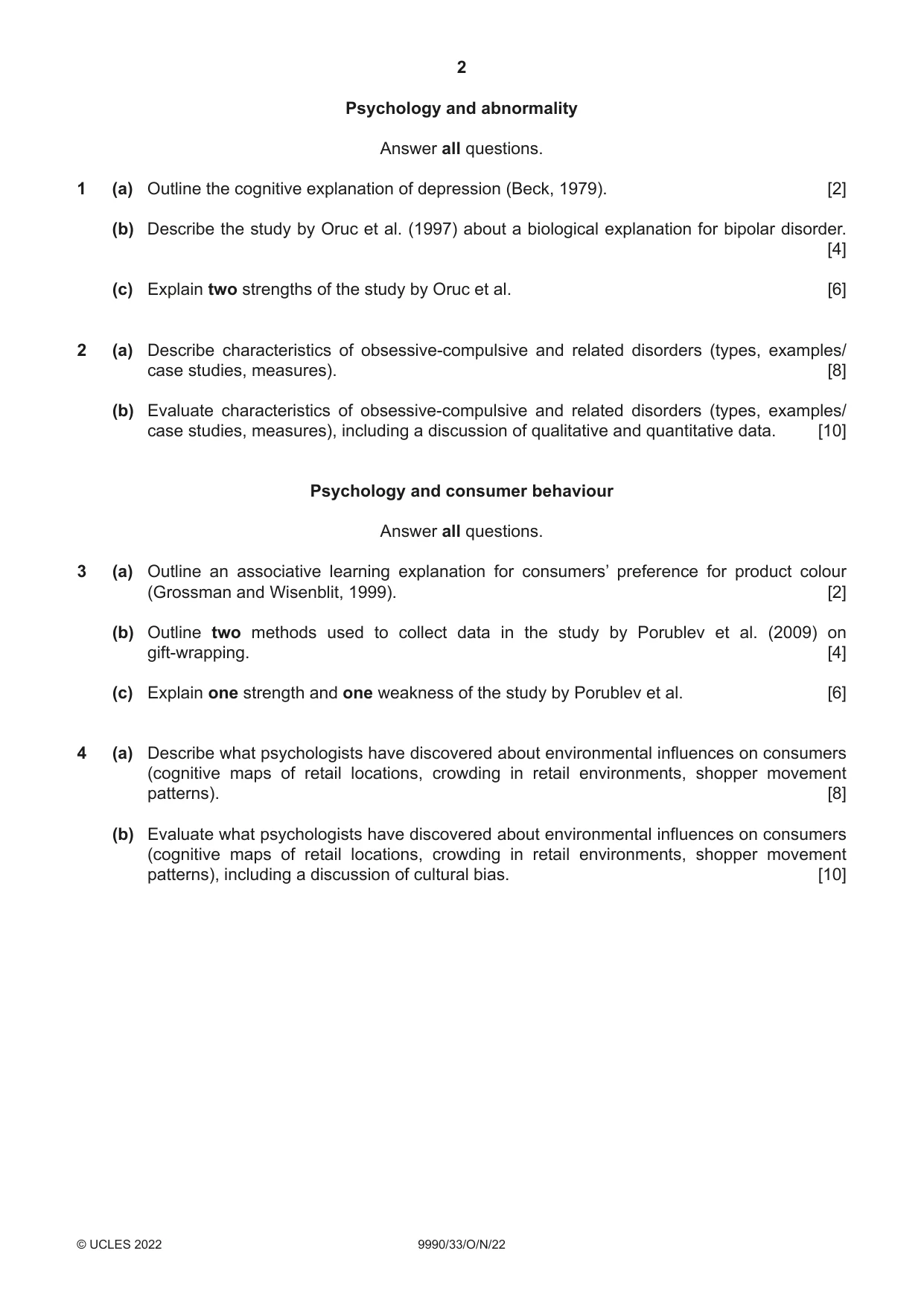
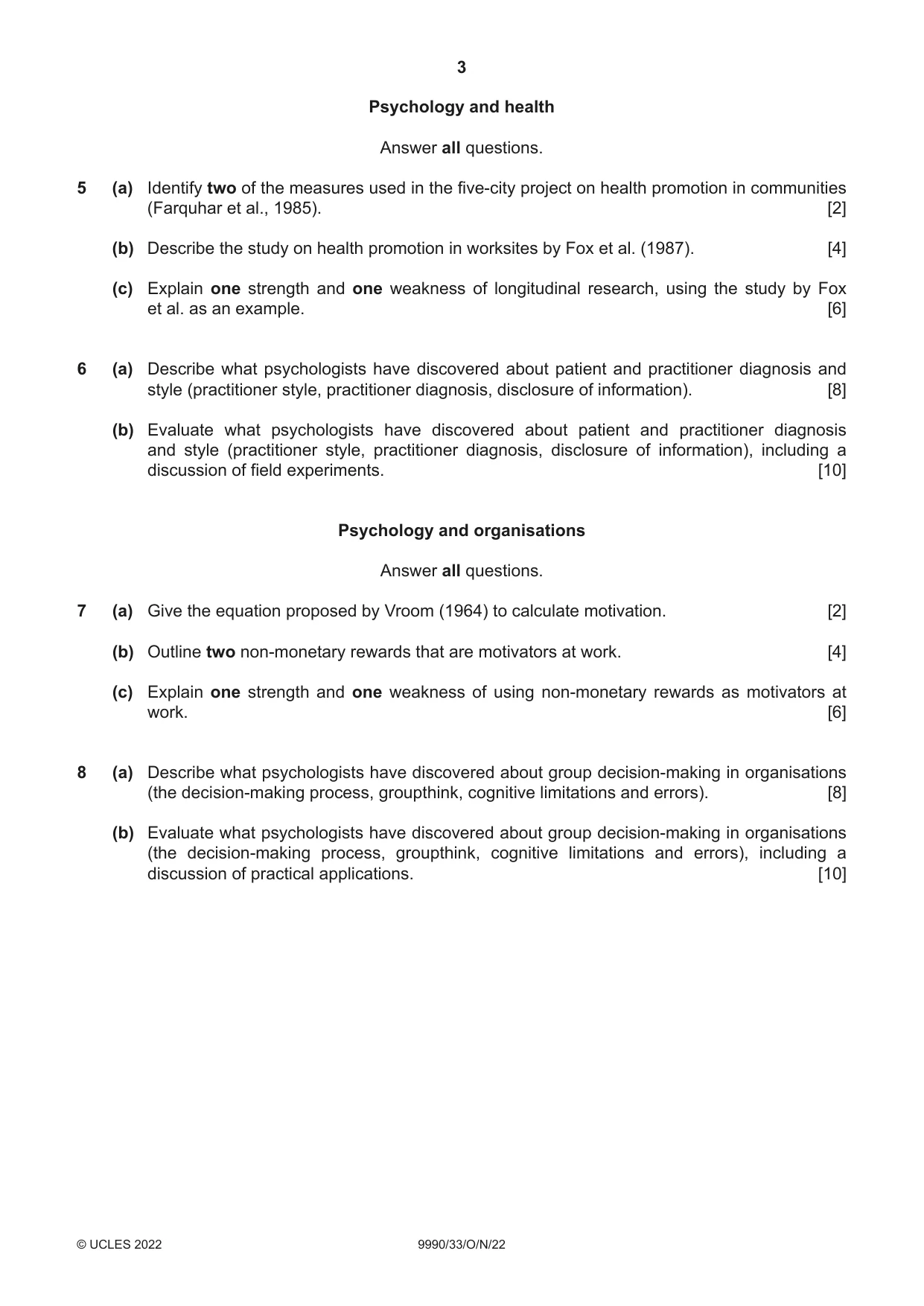
Question paper4 pages

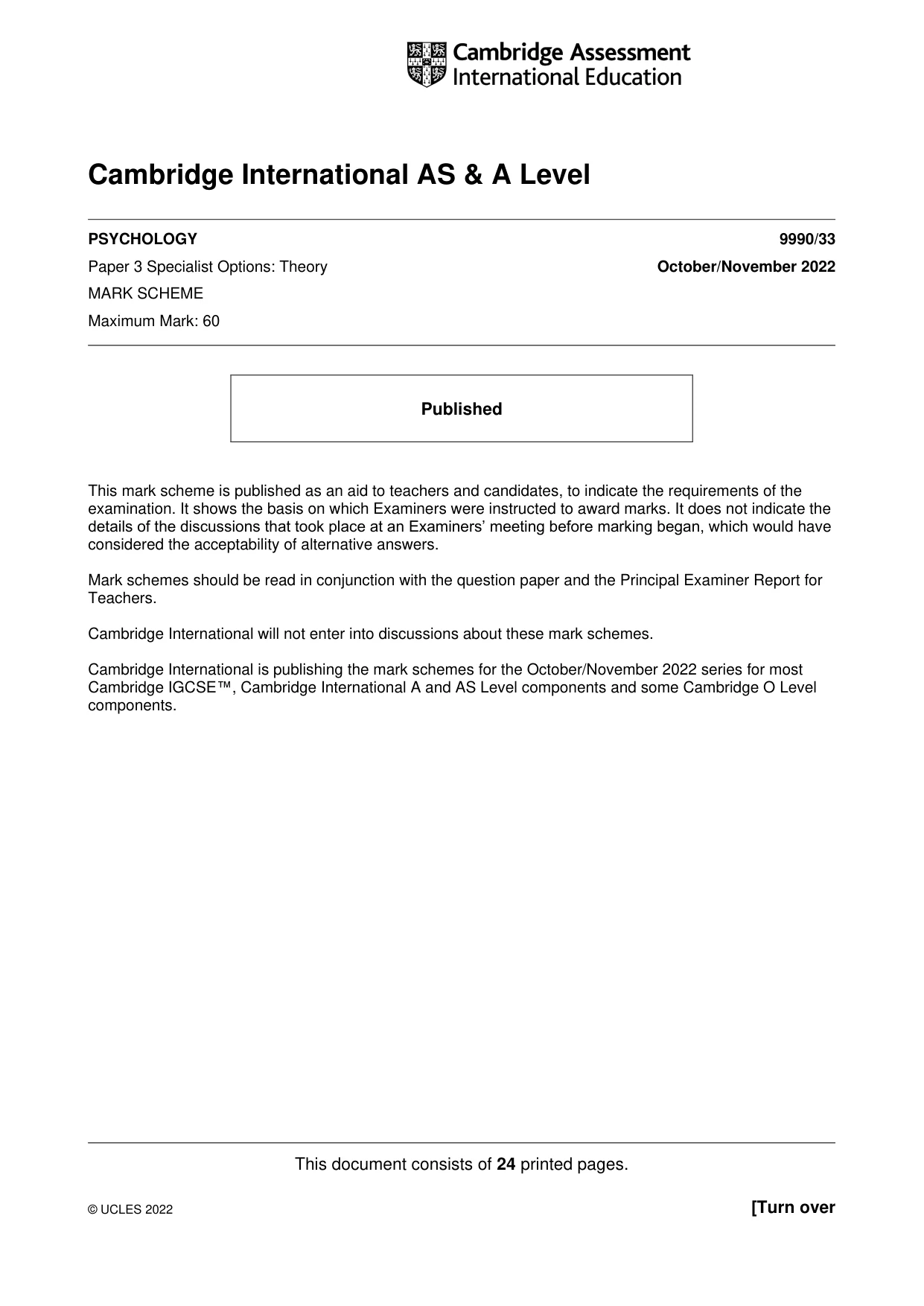
Mark scheme24 pages
Answers below. Sit the paper first if you are practising.

Questions as text
Q1 · Outline the cognitive explanation of depression (Beck, 1979)
1 (a) Outline the cognitive explanation of depression (Beck, 1979). [2] (b) Describe the study by Oruc et al. (1997) about a biological explanation for bipolar disorder. [4] (c) Explain two strengths of the study by Oruc et al. [6]
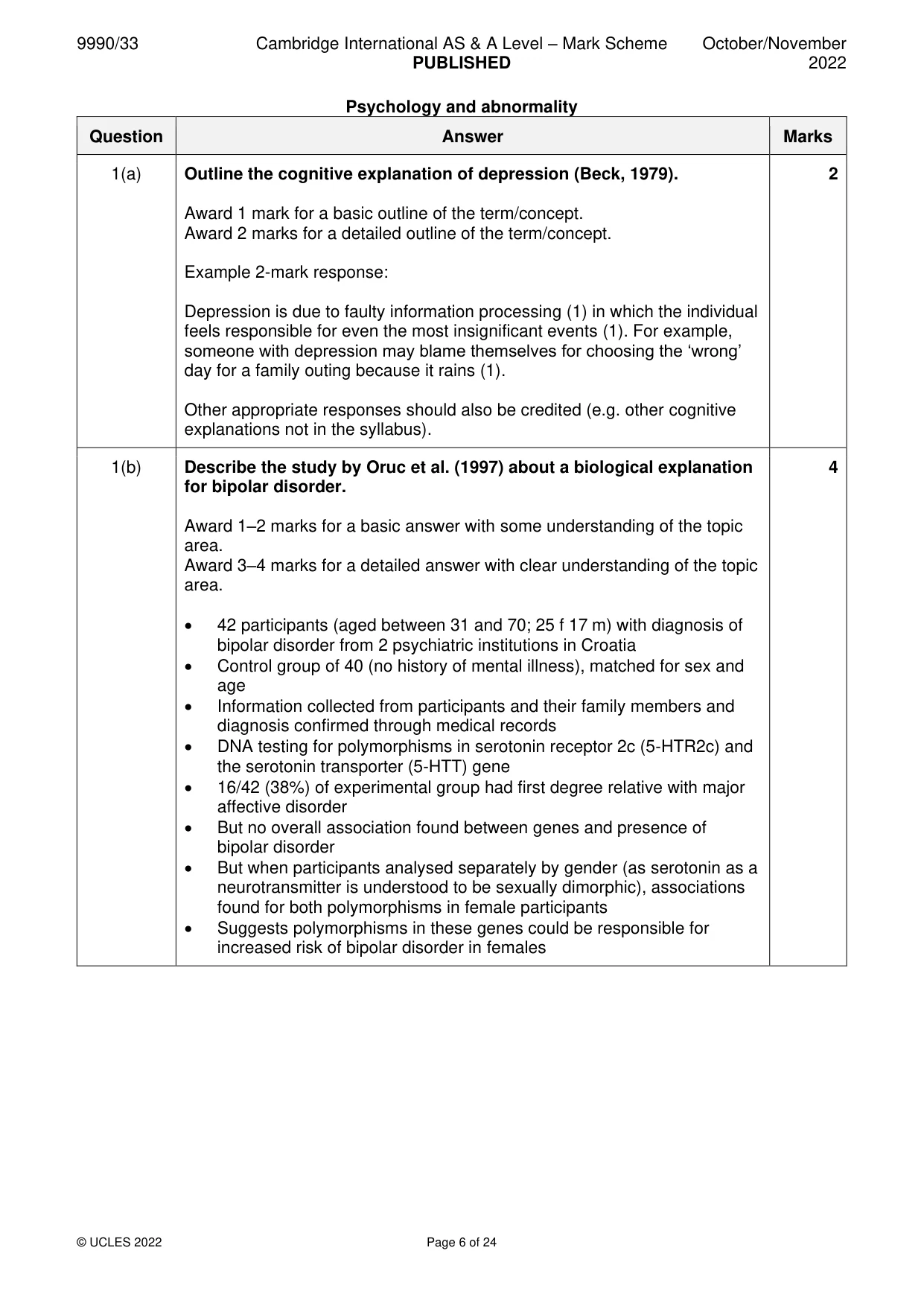
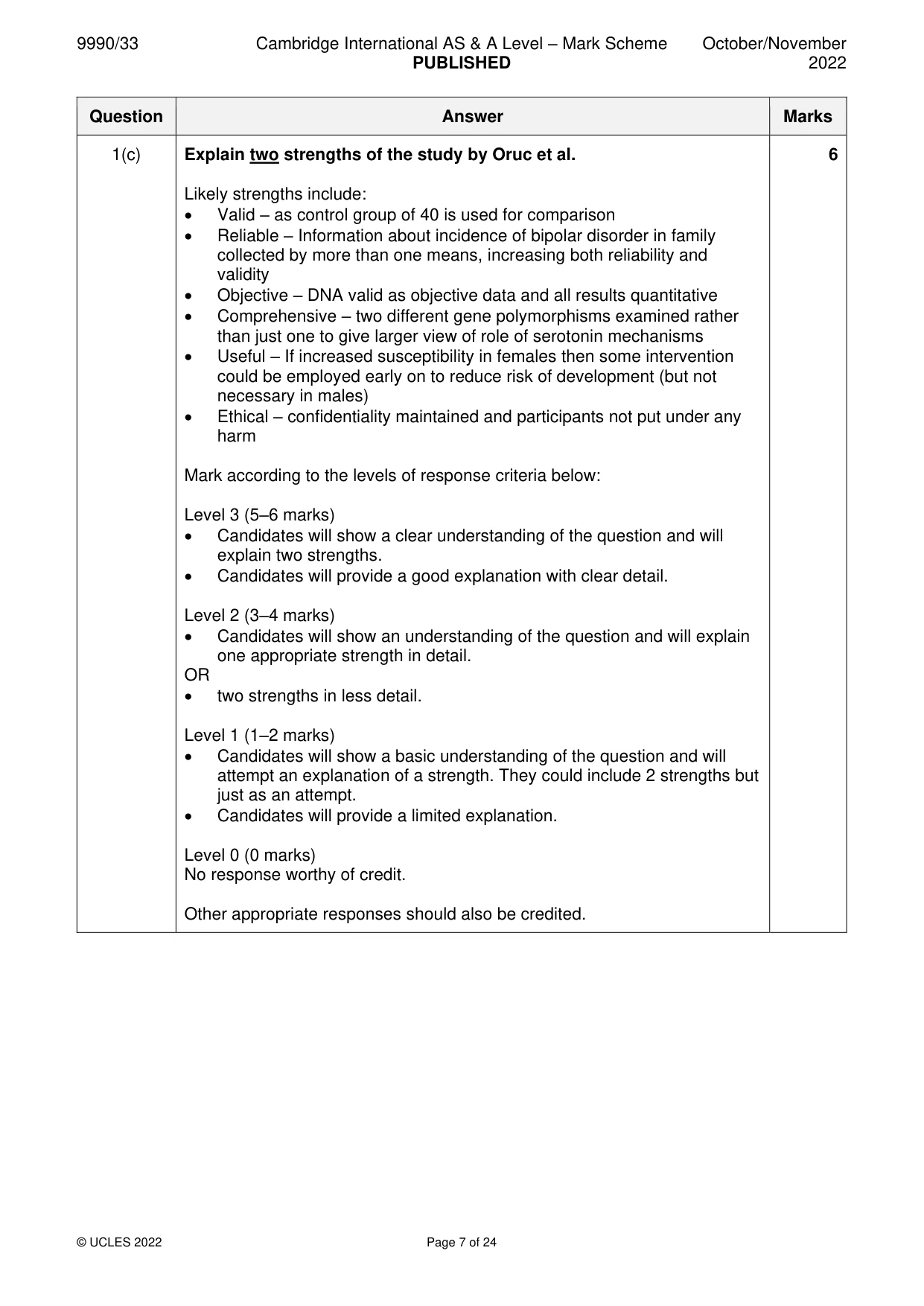
Mark scheme: Psychology and abnormality Question Answer Marks 1(a) Outline the cognitive explanation of depression (Beck, 1979). 2 Award 1 mark for a basic outline of the term/concept. Award 2 marks for a detailed outline of the term/concept. Example 2-mark response: Depression is due to faulty information processing (1) in which the individual feels responsible for even the most insignificant events (1). For example, someone with depression may blame themselves for choosing the ‘wrong’ day for a family outing because it rains (1). Other appropriate responses should also be credited (e.g. other cognitive explanations not in the syllabus). 1(b) Describe the study by Oruc et al. (1997) about a biological explanation 4 for bipolar disorder. Award 1–2 marks for a basic answer with some understanding of the topic area. Award 3–4 marks for a detailed answer with clear understanding of the topic area. • 42 participants (aged between 31 and 70; 25 f 17 m) with diagnosis of bipolar disorder from 2 psychiatric institutions in Croatia • Control group of 40 (no history of mental illness), matched for sex and age • Information collected from participants and their family members and diagnosis confirmed through medical records • DNA testing for polymorphisms in serotonin receptor 2c (5-HTR2c) and the serotonin transporter (5-HTT) gene • 16/42 (38%) of experimental group had first degree relative with major affective disorder • But no overall association found between genes and presence of bipolar disorder • But when participants analysed separately by gender (as serotonin as a neurotransmitter is understood to be sexually dimorphic), associations found for both polymorphisms in female participants • Suggests polymorphisms in these genes could be responsible for increased risk of bipolar disorder in females 1(c) Explain two strengths of the study by Oruc et al. 6 Likely strengths include: • Valid – as control group of 40 is used for comparison • Reliable – Information about incidence of bipolar disorder in family collected by more than one means, increasing both reliability and validity • Objective – DNA valid as objective data and all results quantitative • Comprehensive – two different gene polymorphisms examined rather than just one to give larger view of role of serotonin mechanisms • Useful – If increased susceptibility in females then some intervention could be employed early on to reduce risk of development (but not necessary in males) • Ethical – confidentiality maintained and participants not put under any harm Mark according to the levels of response criteria below: Level 3 (5–6 marks) • Candidates will show a clear understanding of the question and will explain two strengths. • Candidates will provide a good explanation with clear detail. Level 2 (3–4 marks) • Candidates will show an understanding of the question and will explain one appropriate strength in detail. OR • two strengths in less detail. Level 1 (1–2 marks) • Candidates will show a basic understanding of the question and will attempt an explanation of a strength. They could include 2 strengths but just as an attempt. • Candidates will provide a limited explanation. Level 0 (0 marks) No response worthy of credit. Other appropriate responses should also be credited.
More questions on Mood (affective) disorders: depressive disorder (unipolar) and bipolar disorder
Q2 · Describe characteristics of obsessive-compulsive and related disorders (types, examples/…
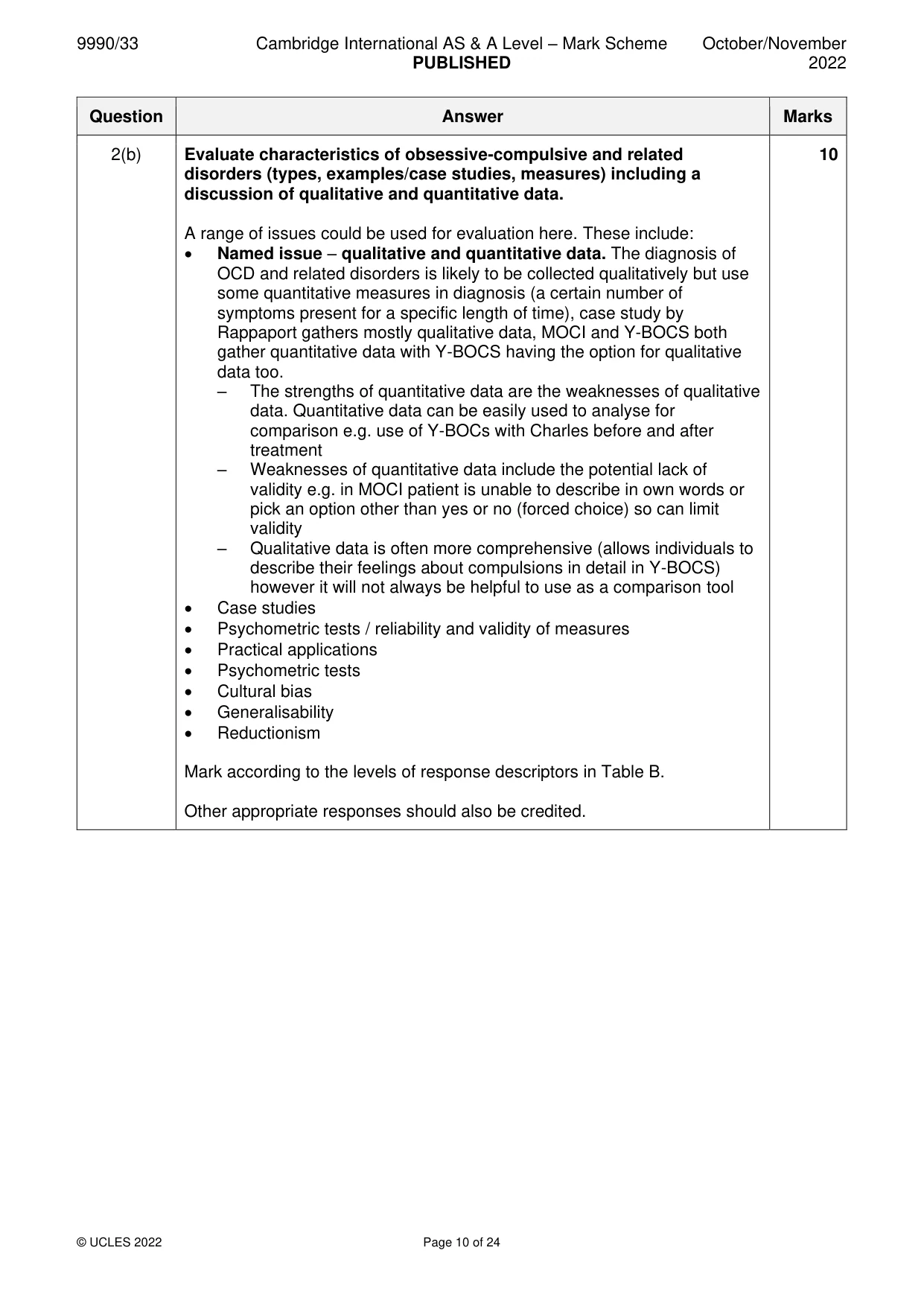
2 (a) Describe characteristics of obsessive-compulsive and related disorders (types, examples/ case studies, measures). [8] (b) Evaluate characteristics of obsessive-compulsive and related disorders (types, examples/ case studies, measures), including a discussion of qualitative and quantitative data. [10] Psychology and consumer behaviour Answer all questions.
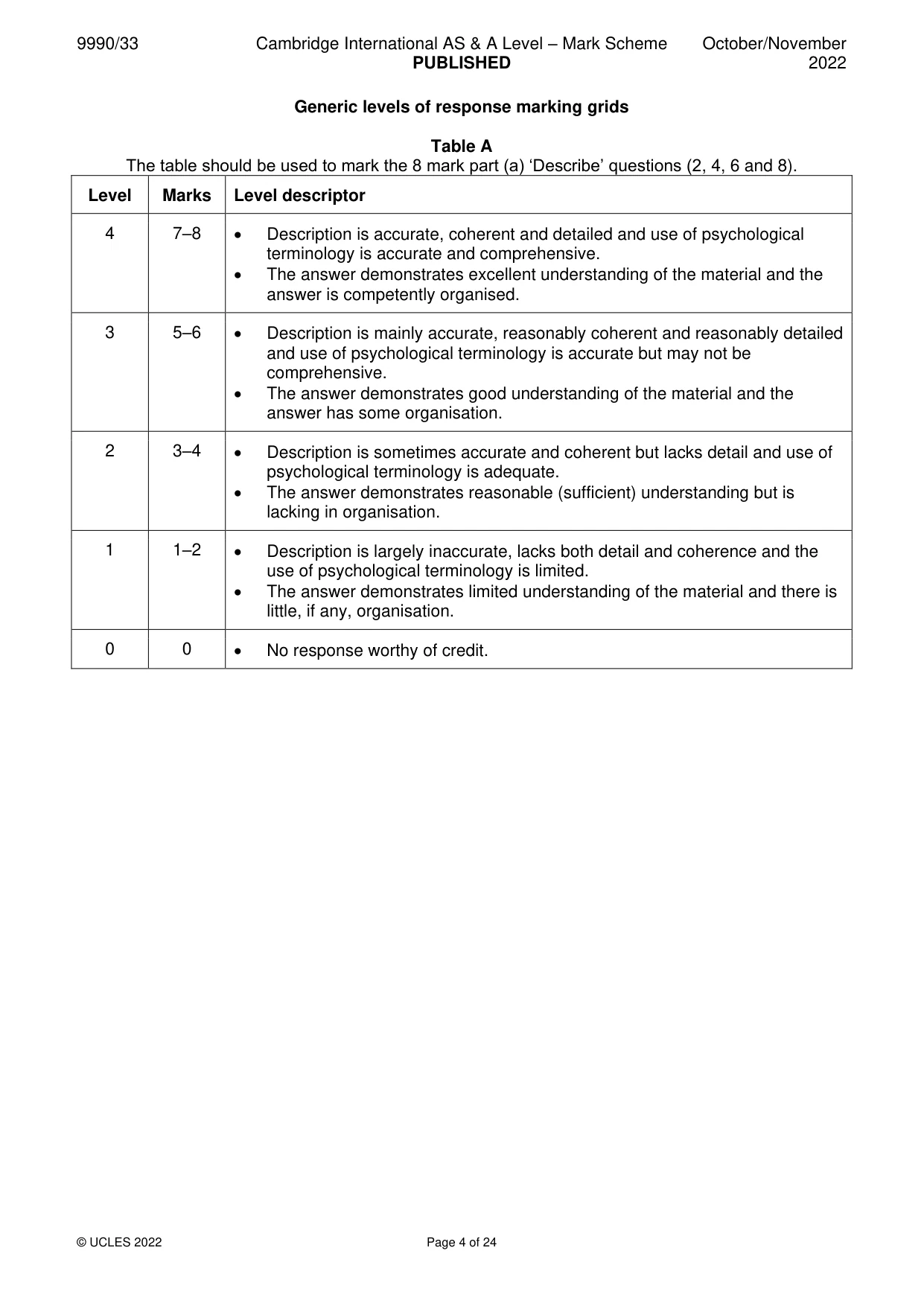
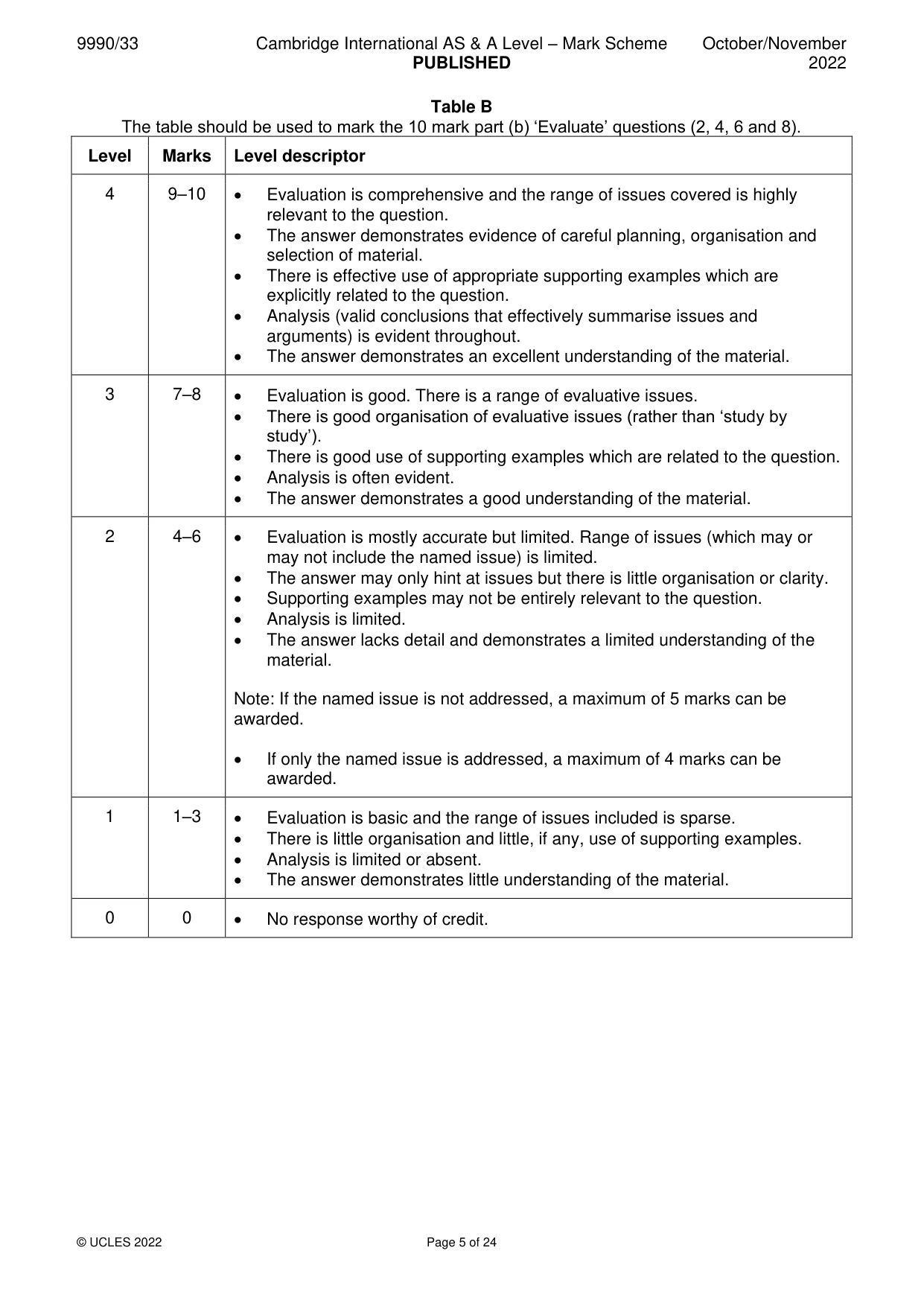
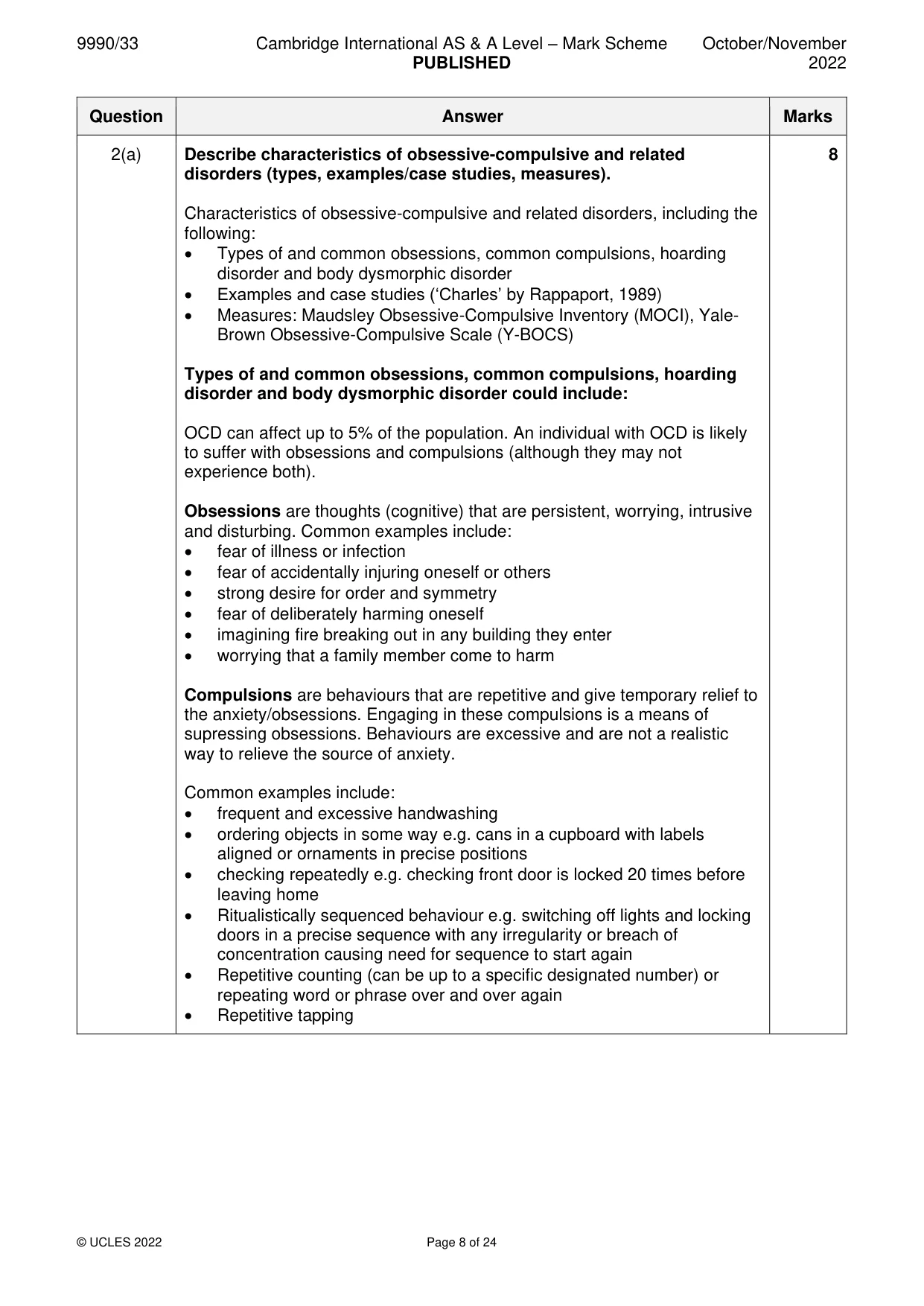
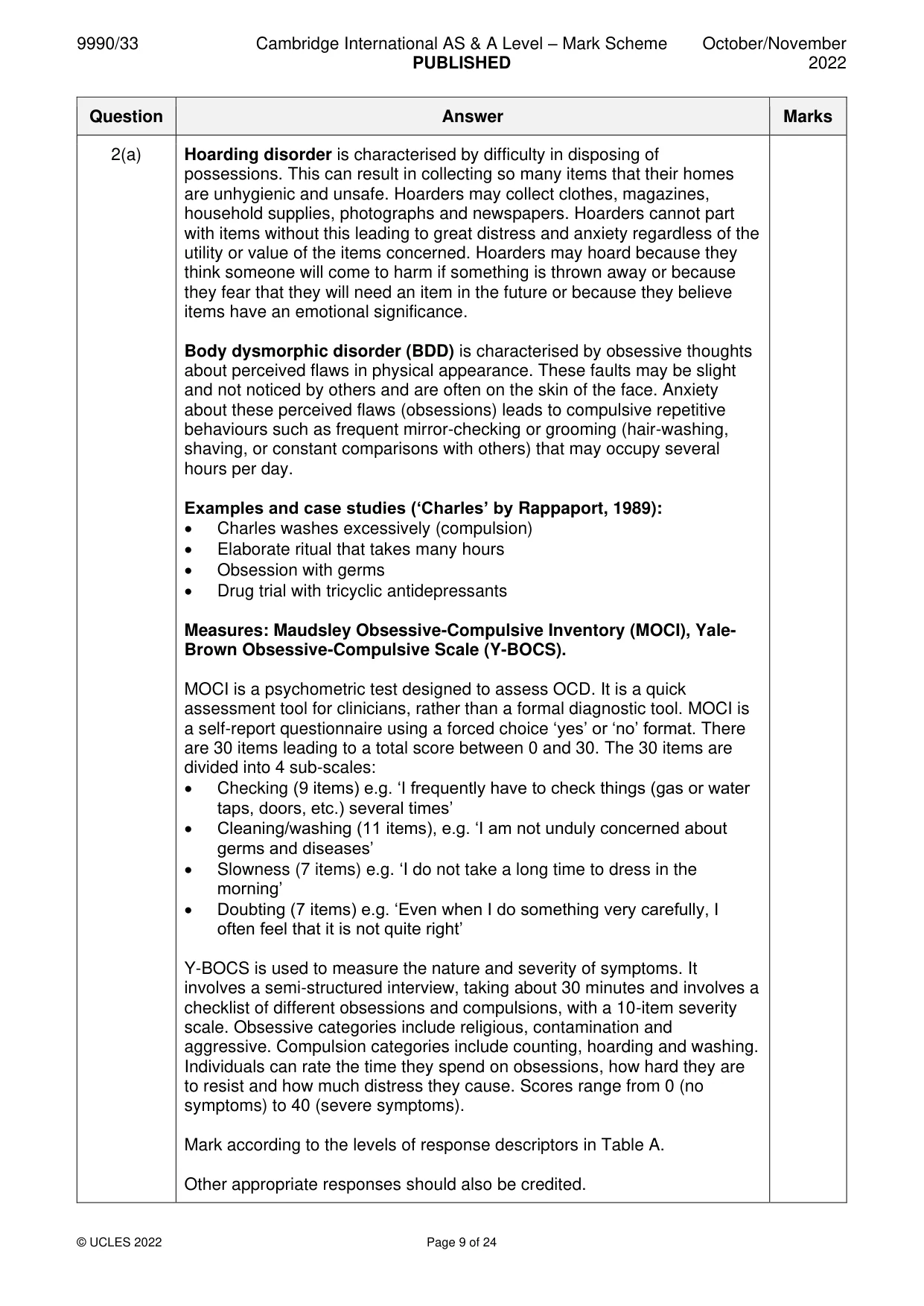
Mark scheme: 2(a) Describe characteristics of obsessive-compulsive and related 8 disorders (types, examples/case studies, measures). Characteristics of obsessive-compulsive and related disorders, including the following: • Types of and common obsessions, common compulsions, hoarding disorder and body dysmorphic disorder • Examples and case studies (‘Charles’ by Rappaport, 1989) • Measures: Maudsley Obsessive-Compulsive Inventory (MOCI), Yale- Brown Obsessive-Compulsive Scale (Y-BOCS) Types of and common obsessions, common compulsions, hoarding disorder and body dysmorphic disorder could include: OCD can affect up to 5% of the population. An individual with OCD is likely to suffer with obsessions and compulsions (although they may not experience both). Obsessions are thoughts (cognitive) that are persistent, worrying, intrusive and disturbing. Common examples include: • fear of illness or infection • fear of accidentally injuring oneself or others • strong desire for order and symmetry • fear of deliberately harming oneself • imagining fire breaking out in any building they enter • worrying that a family member come to harm Compulsions are behaviours that are repetitive and give temporary relief to the anxiety/obsessions. Engaging in these compulsions is a means of supressing obsessions. Behaviours are excessive and are not a realistic way to relieve the source of anxiety. Common examples include: • frequent and excessive handwashing • ordering objects in some way e.g. cans in a cupboard with labels aligned or ornaments in precise positions • checking repeatedly e.g. checking front door is locked 20 times before leaving home • Ritualistically sequenced behaviour e.g. switching off lights and locking doors in a precise sequence with any irregularity or breach of concentration causing need for sequence to start again • Repetitive counting (can be up to a specific designated number) or repeating word or phrase over and over again • Repetitive tapping 2(a) Hoarding disorder is characterised by difficulty in disposing of possessions. This can result in collecting so many items that their homes are unhygienic and unsafe. Hoarders may collect clothes, magazines, household supplies, photographs and newspapers. Hoarders cannot part with items without this leading to great distress and anxiety regardless of the utility or value of the items concerned. Hoarders may hoard because they think someone will come to harm if something is thrown away or because they fear that they will need an item in the future or because they believe items have an emotional significance. Body dysmorphic disorder (BDD) is characterised by obsessive thoughts about perceived flaws in physical appearance. These faults may be slight and not noticed by others and are often on the skin of the face. Anxiety about these perceived flaws (obsessions) leads to compulsive repetitive behaviours such as frequent mirror-checking or grooming (hair-washing, shaving, or constant comparisons with others) that may occupy several hours per day. Examples and case studies (‘Charles’ by Rappaport, 1989): • Charles washes excessively (compulsion) • Elaborate ritual that takes many hours • Obsession with germs • Drug trial with tricyclic antidepressants Measures: Maudsley Obsessive-Compulsive Inventory (MOCI), Yale- Brown Obsessive-Compulsive Scale (Y-BOCS). MOCI is a psychometric test designed to assess OCD. It is a quick assessment tool for clinicians, rather than a formal diagnostic tool. MOCI is a self-report questionnaire using a forced choice ‘yes’ or ‘no’ format. There are 30 items leading to a total score between 0 and 30. The 30 items are divided into 4 sub-scales: • Checking (9 items) e.g. ‘I frequently have to check things (gas or water taps, doors, etc.) several times’ • Cleaning/washing (11 items), e.g. ‘I am not unduly concerned about germs and diseases’ • Slowness (7 items) e.g. ‘I do not take a long time to dress in the morning’ • Doubting (7 items) e.g. ‘Even when I do something very carefully, I often feel that it is not quite right’ Y-BOCS is used to measure the nature and severity of symptoms. It involves a semi-structured interview, taking about 30 minutes and involves a checklist of different obsessions and compulsions, with a 10-item severity scale. Obsessive categories include religious, contamination and aggressive. Compulsion categories include counting, hoarding and washing. Individuals can rate the time they spend on obsessions, how hard they are to resist and how much distress they cause. Scores range from 0 (no symptoms) to 40 (severe symptoms). Mark according to the levels of response descriptors in Table A. Other appropriate responses should also be credited. 2(b) Evaluate characteristics of obsessive-compulsive and related 10 disorders (types, examples/case studies, measures) including a discussion of qualitative and quantitative data. A range of issues could be used for evaluation here. These include: • Named issue – qualitative and quantitative data. The diagnosis of OCD and related disorders is likely to be collected qualitatively but use some quantitative measures in diagnosis (a certain number of symptoms present for a specific length of time), case study by Rappaport gathers mostly qualitative data, MOCI and Y-BOCS both gather quantitative data with Y-BOCS having the option for qualitative data too. – The strengths of quantitative data are the weaknesses of qualitative data. Quantitative data can be easily used to analyse for comparison e.g. use of Y-BOCs with Charles before and after treatment – Weaknesses of quantitative data include the potential lack of validity e.g. in MOCI patient is unable to describe in own words or pick an option other than yes or no (forced choice) so can limit validity – Qualitative data is often more comprehensive (allows individuals to describe their feelings about compulsions in detail in Y-BOCS) however it will not always be helpful to use as a comparison tool • Case studies • Psychometric tests / reliability and validity of measures • Practical applications • Psychometric tests • Cultural bias • Generalisability • Reductionism Mark according to the levels of response descriptors in Table B. Other appropriate responses should also be credited. Psychology and consumer behaviour
Q3 · Outline an associative learning explanation for consumers’ preference for product colour…
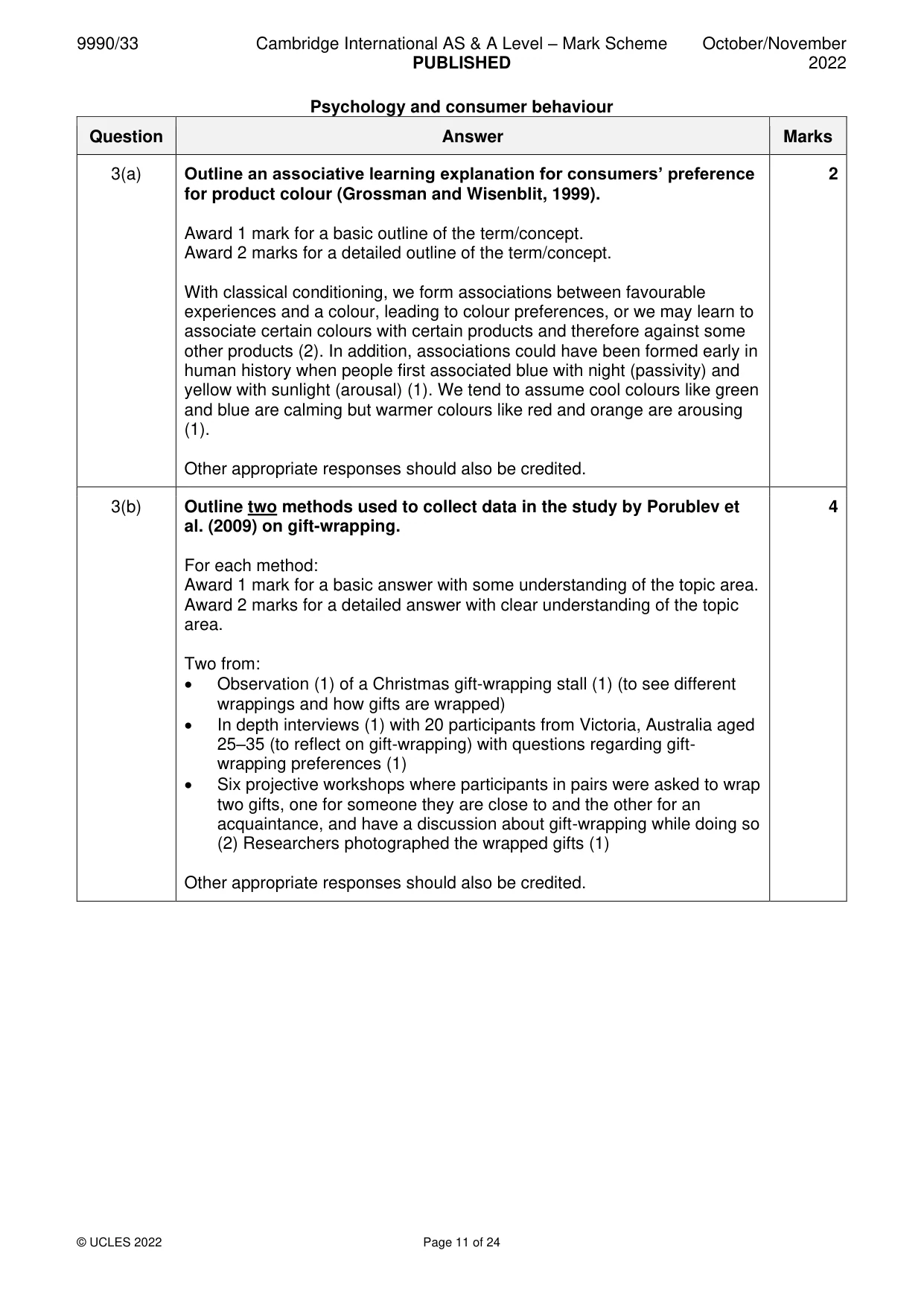
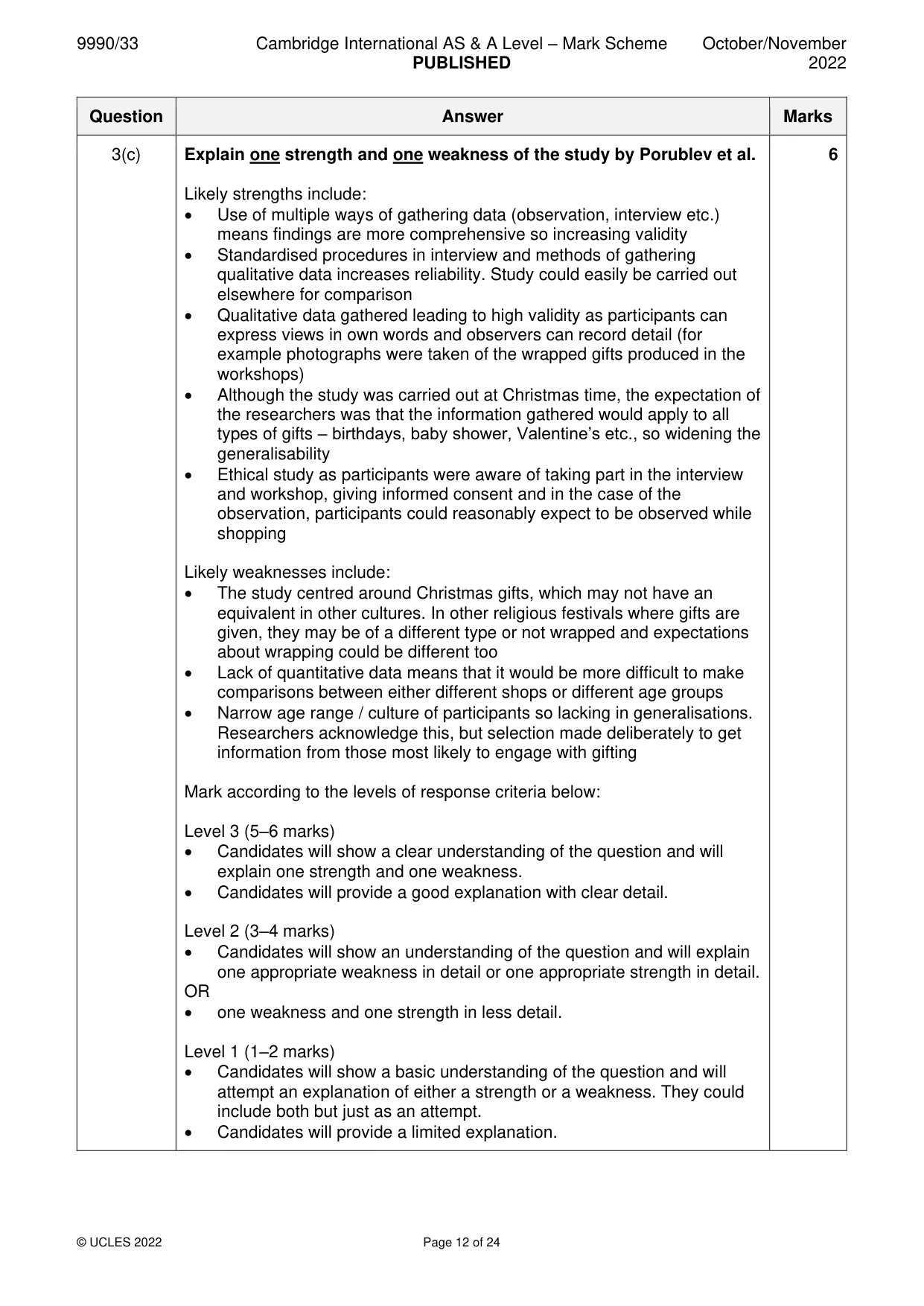
3 (a) Outline an associative learning explanation for consumers’ preference for product colour (Grossman and Wisenblit, 1999). [2] (b) Outline two methods used to collect data in the study by Porublev et al. (2009) on gift-wrapping. [4] (c) Explain one strength and one weakness of the study by Porublev et al. [6]
Mark scheme: 3(a) Outline an associative learning explanation for consumers’ preference 2 for product colour (Grossman and Wisenblit, 1999). Award 1 mark for a basic outline of the term/concept. Award 2 marks for a detailed outline of the term/concept. With classical conditioning, we form associations between favourable experiences and a colour, leading to colour preferences, or we may learn to associate certain colours with certain products and therefore against some other products (2). In addition, associations could have been formed early in human history when people first associated blue with night (passivity) and yellow with sunlight (arousal) (1). We tend to assume cool colours like green and blue are calming but warmer colours like red and orange are arousing (1). Other appropriate responses should also be credited. 3(b) Outline two methods used to collect data in the study by Porublev et 4 al. (2009) on gift-wrapping. For each method: Award 1 mark for a basic answer with some understanding of the topic area. Award 2 marks for a detailed answer with clear understanding of the topic area. Two from: • Observation (1) of a Christmas gift-wrapping stall (1) (to see different wrappings and how gifts are wrapped) • In depth interviews (1) with 20 participants from Victoria, Australia aged 25–35 (to reflect on gift-wrapping) with questions regarding gift- wrapping preferences (1) • Six projective workshops where participants in pairs were asked to wrap two gifts, one for someone they are close to and the other for an acquaintance, and have a discussion about gift-wrapping while doing so (2) Researchers photographed the wrapped gifts (1) Other appropriate responses should also be credited. 3(c) Explain one strength and one weakness of the study by Porublev et al. 6 Likely strengths include: • Use of multiple ways of gathering data (observation, interview etc.) means findings are more comprehensive so increasing validity • Standardised procedures in interview and methods of gathering qualitative data increases reliability. Study could easily be carried out elsewhere for comparison • Qualitative data gathered leading to high validity as participants can express views in own words and observers can record detail (for example photographs were taken of the wrapped gifts produced in the workshops) • Although the study was carried out at Christmas time, the expectation of the researchers was that the information gathered would apply to all types of gifts – birthdays, baby shower, Valentine’s etc., so widening the generalisability • Ethical study as participants were aware of taking part in the interview and workshop, giving informed consent and in the case of the observation, participants could reasonably expect to be observed while shopping Likely weaknesses include: • The study centred around Christmas gifts, which may not have an equivalent in other cultures. In other religious festivals where gifts are given, they may be of a different type or not wrapped and expectations about wrapping could be different too • Lack of quantitative data means that it would be more difficult to make comparisons between either different shops or different age groups • Narrow age range / culture of participants so lacking in generalisations. Researchers acknowledge this, but selection made deliberately to get information from those most likely to engage with gifting Mark according to the levels of response criteria below: Level 3 (5–6 marks) • Candidates will show a clear understanding of the question and will explain one strength and one weakness. • Candidates will provide a good explanation with clear detail. Level 2 (3–4 marks) • Candidates will show an understanding of the question and will explain one appropriate weakness in detail or one appropriate strength in detail. OR • one weakness and one strength in less detail. Level 1 (1–2 marks) • Candidates will show a basic understanding of the question and will attempt an explanation of either a strength or a weakness. They could include both but just as an attempt. • Candidates will provide a limited explanation. 3(c) Level 0 (0 marks) No response worthy of credit. Other appropriate responses should also be credited.
Q4 · Describe what psychologists have discovered about environmental influences on consumers…
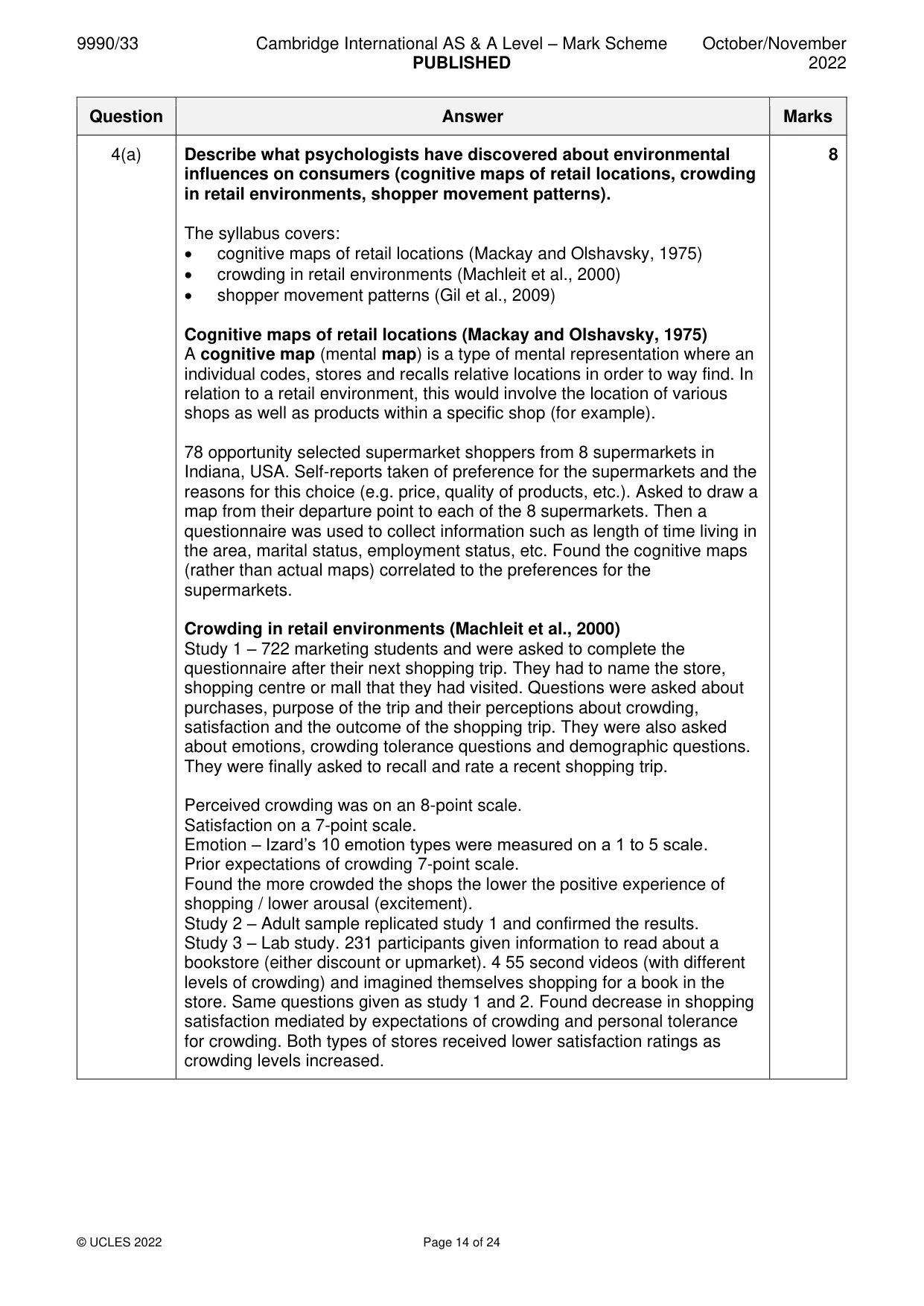
4 (a) Describe what psychologists have discovered about environmental influences on consumers (cognitive maps of retail locations, crowding in retail environments, shopper movement patterns). [8] (b) Evaluate what psychologists have discovered about environmental influences on consumers (cognitive maps of retail locations, crowding in retail environments, shopper movement patterns), including a discussion of cultural bias. [10] Psychology and health Answer all questions.
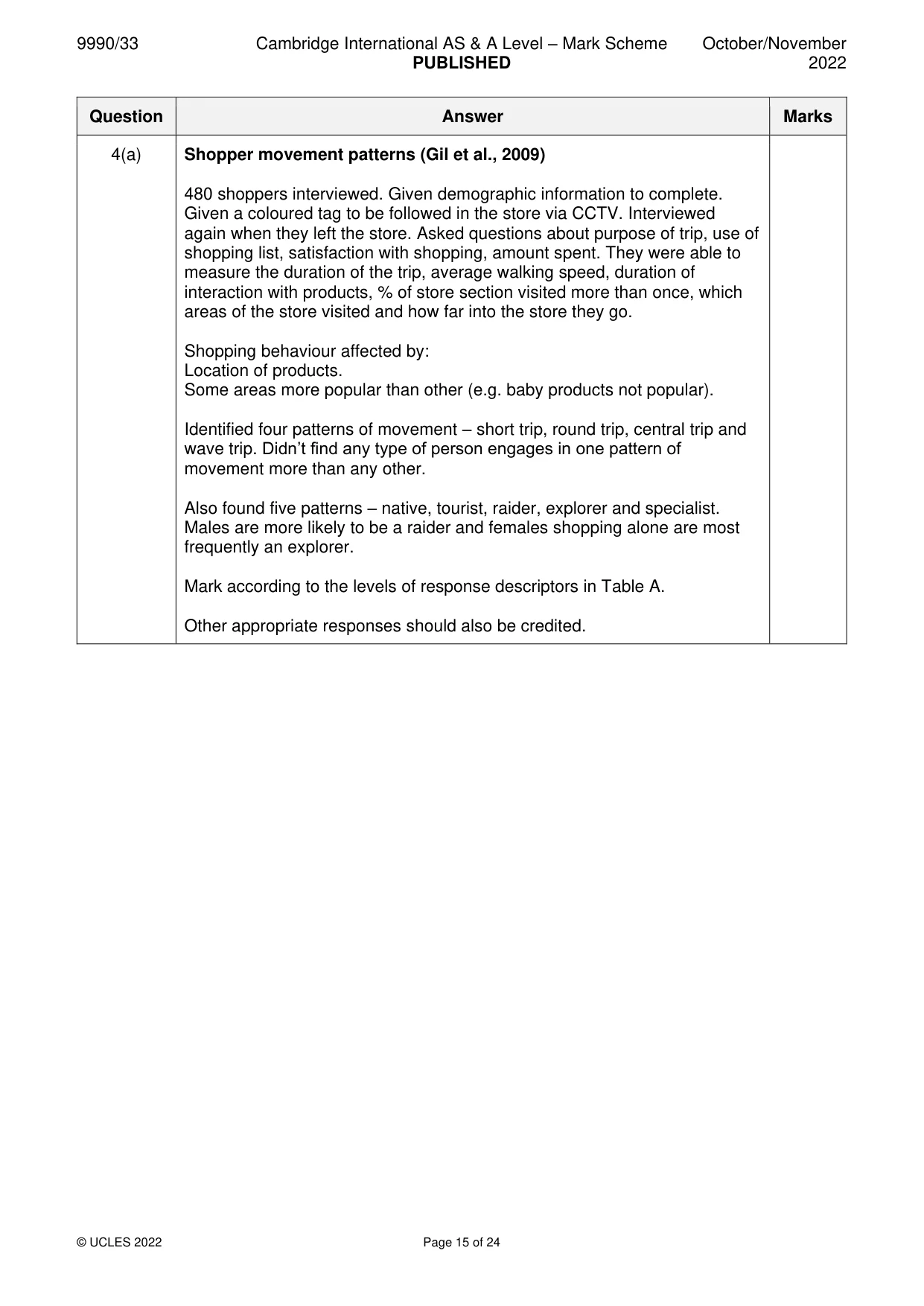
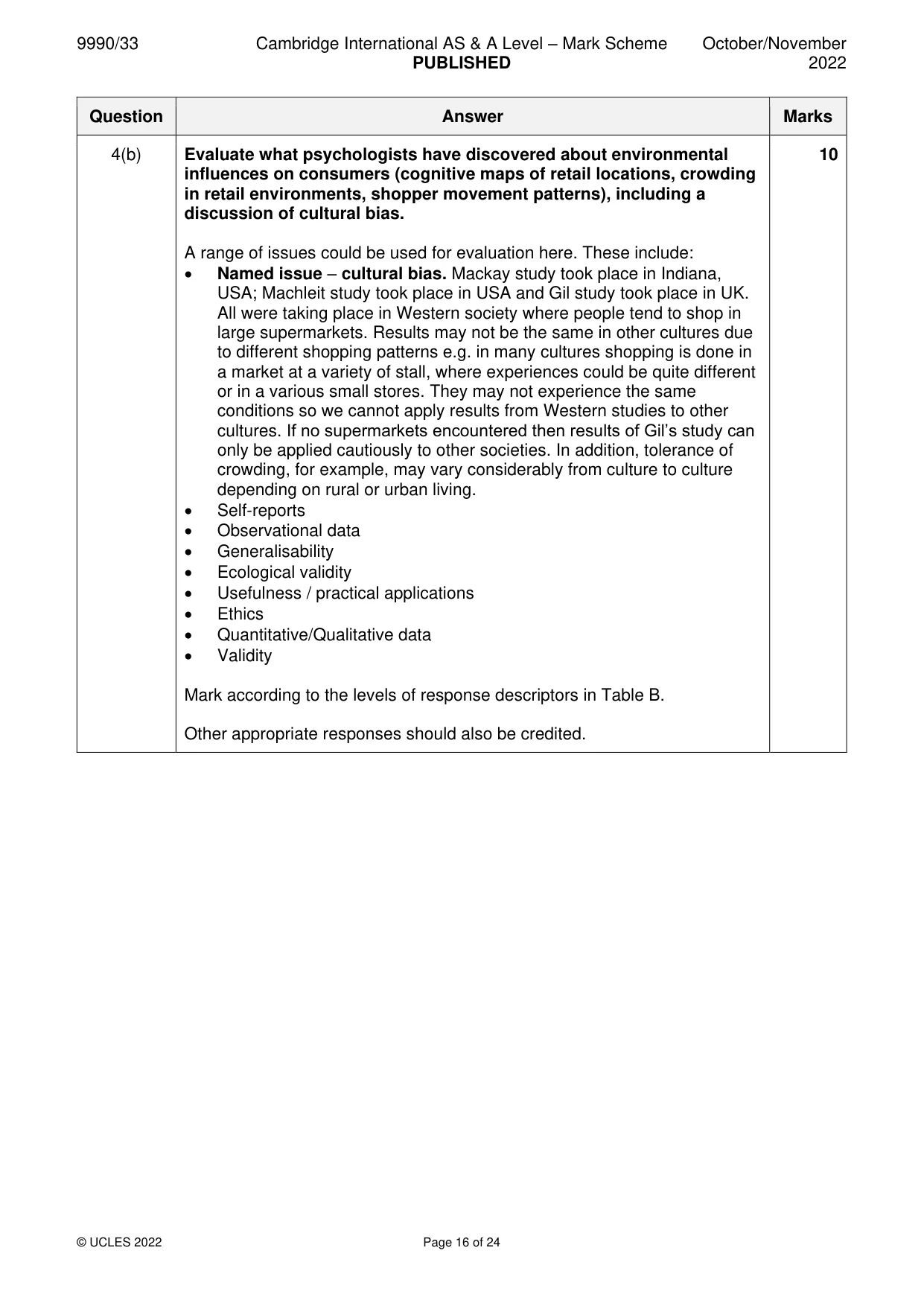
Mark scheme: 4(a) Describe what psychologists have discovered about environmental 8 influences on consumers (cognitive maps of retail locations, crowding in retail environments, shopper movement patterns). The syllabus covers: • cognitive maps of retail locations (Mackay and Olshavsky, 1975) • crowding in retail environments (Machleit et al., 2000) • shopper movement patterns (Gil et al., 2009) Cognitive maps of retail locations (Mackay and Olshavsky, 1975) A cognitive map (mental map) is a type of mental representation where an individual codes, stores and recalls relative locations in order to way find. In relation to a retail environment, this would involve the location of various shops as well as products within a specific shop (for example). 78 opportunity selected supermarket shoppers from 8 supermarkets in Indiana, USA. Self-reports taken of preference for the supermarkets and the reasons for this choice (e.g. price, quality of products, etc.). Asked to draw a map from their departure point to each of the 8 supermarkets. Then a questionnaire was used to collect information such as length of time living in the area, marital status, employment status, etc. Found the cognitive maps (rather than actual maps) correlated to the preferences for the supermarkets. Crowding in retail environments (Machleit et al., 2000) Study 1 – 722 marketing students and were asked to complete the questionnaire after their next shopping trip. They had to name the store, shopping centre or mall that they had visited. Questions were asked about purchases, purpose of the trip and their perceptions about crowding, satisfaction and the outcome of the shopping trip. They were also asked about emotions, crowding tolerance questions and demographic questions. They were finally asked to recall and rate a recent shopping trip. Perceived crowding was on an 8-point scale. Satisfaction on a 7-point scale. Emotion – Izard’s 10 emotion types were measured on a 1 to 5 scale. Prior expectations of crowding 7-point scale. Found the more crowded the shops the lower the positive experience of shopping / lower arousal (excitement). Study 2 – Adult sample replicated study 1 and confirmed the results. Study 3 – Lab study. 231 participants given information to read about a bookstore (either discount or upmarket). 4 55 second videos (with different levels of crowding) and imagined themselves shopping for a book in the store. Same questions given as study 1 and 2. Found decrease in shopping satisfaction mediated by expectations of crowding and personal tolerance for crowding. Both types of stores received lower satisfaction ratings as crowding levels increased. 4(a) Shopper movement patterns (Gil et al., 2009) 480 shoppers interviewed. Given demographic information to complete. Given a coloured tag to be followed in the store via CCTV. Interviewed again when they left the store. Asked questions about purpose of trip, use of shopping list, satisfaction with shopping, amount spent. They were able to measure the duration of the trip, average walking speed, duration of interaction with products, % of store section visited more than once, which areas of the store visited and how far into the store they go. Shopping behaviour affected by: Location of products. Some areas more popular than other (e.g. baby products not popular). Identified four patterns of movement – short trip, round trip, central trip and wave trip. Didn’t find any type of person engages in one pattern of movement more than any other. Also found five patterns – native, tourist, raider, explorer and specialist. Males are more likely to be a raider and females shopping alone are most frequently an explorer. Mark according to the levels of response descriptors in Table A. Other appropriate responses should also be credited. 4(b) Evaluate what psychologists have discovered about environmental 10 influences on consumers (cognitive maps of retail locations, crowding in retail environments, shopper movement patterns), including a discussion of cultural bias. A range of issues could be used for evaluation here. These include: • Named issue – cultural bias. Mackay study took place in Indiana, USA; Machleit study took place in USA and Gil study took place in UK. All were taking place in Western society where people tend to shop in large supermarkets. Results may not be the same in other cultures due to different shopping patterns e.g. in many cultures shopping is done in a market at a variety of stall, where experiences could be quite different or in a various small stores. They may not experience the same conditions so we cannot apply results from Western studies to other cultures. If no supermarkets encountered then results of Gil’s study can only be applied cautiously to other societies. In addition, tolerance of crowding, for example, may vary considerably from culture to culture depending on rural or urban living. • Self-reports • Observational data • Generalisability • Ecological validity • Usefulness / practical applications • Ethics • Quantitative/Qualitative data • Validity Mark according to the levels of response descriptors in Table B. Other appropriate responses should also be credited. Psychology and health
Q5 · Identify two of the measures used in the five-city project on health promotion in…
5 (a) Identify two of the measures used in the five-city project on health promotion in communities (Farquhar et al., 1985). [2] (b) Describe the study on health promotion in worksites by Fox et al. (1987). [4] (c) Explain one strength and one weakness of longitudinal research, using the study by Fox et al. as an example. [6]
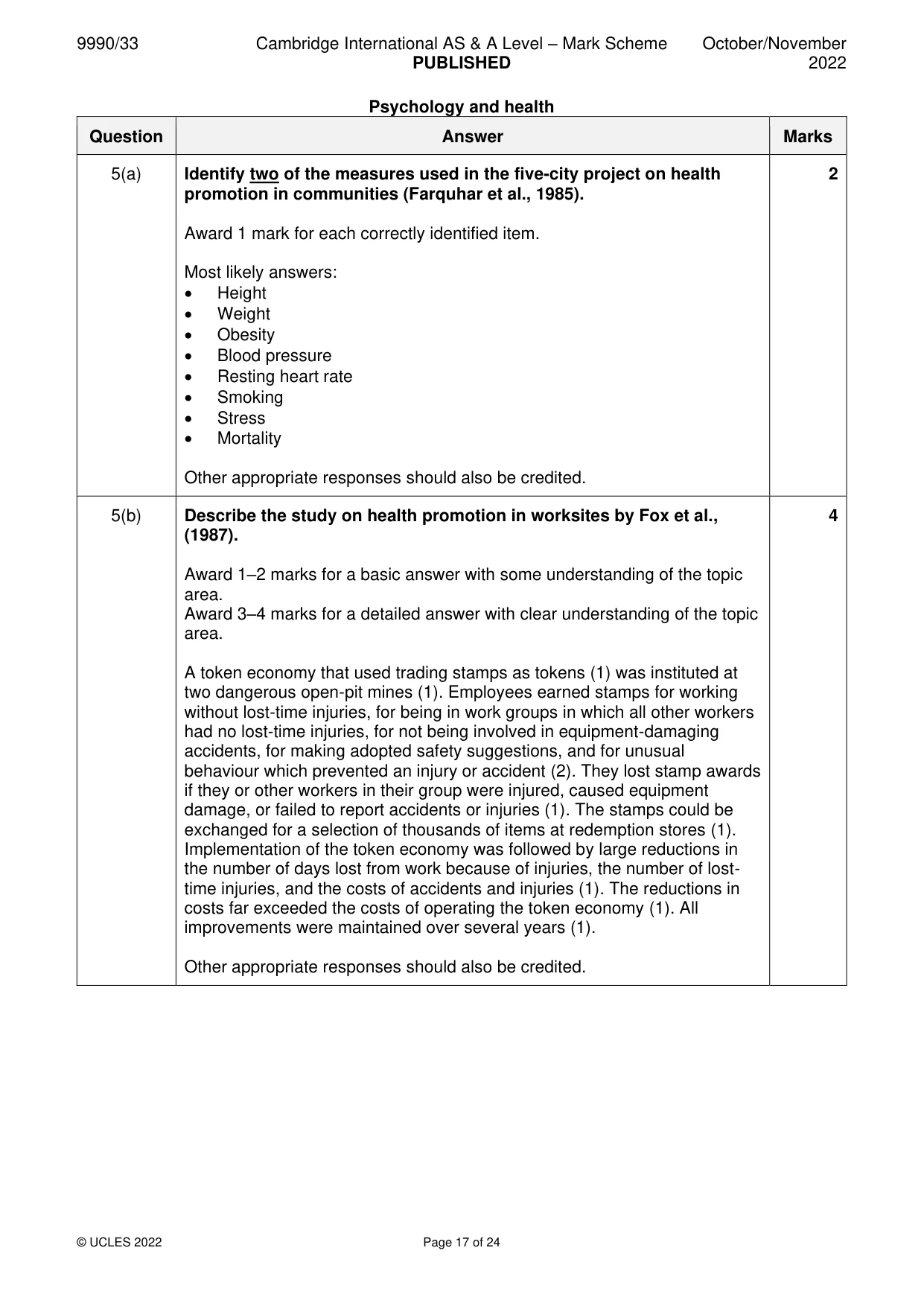
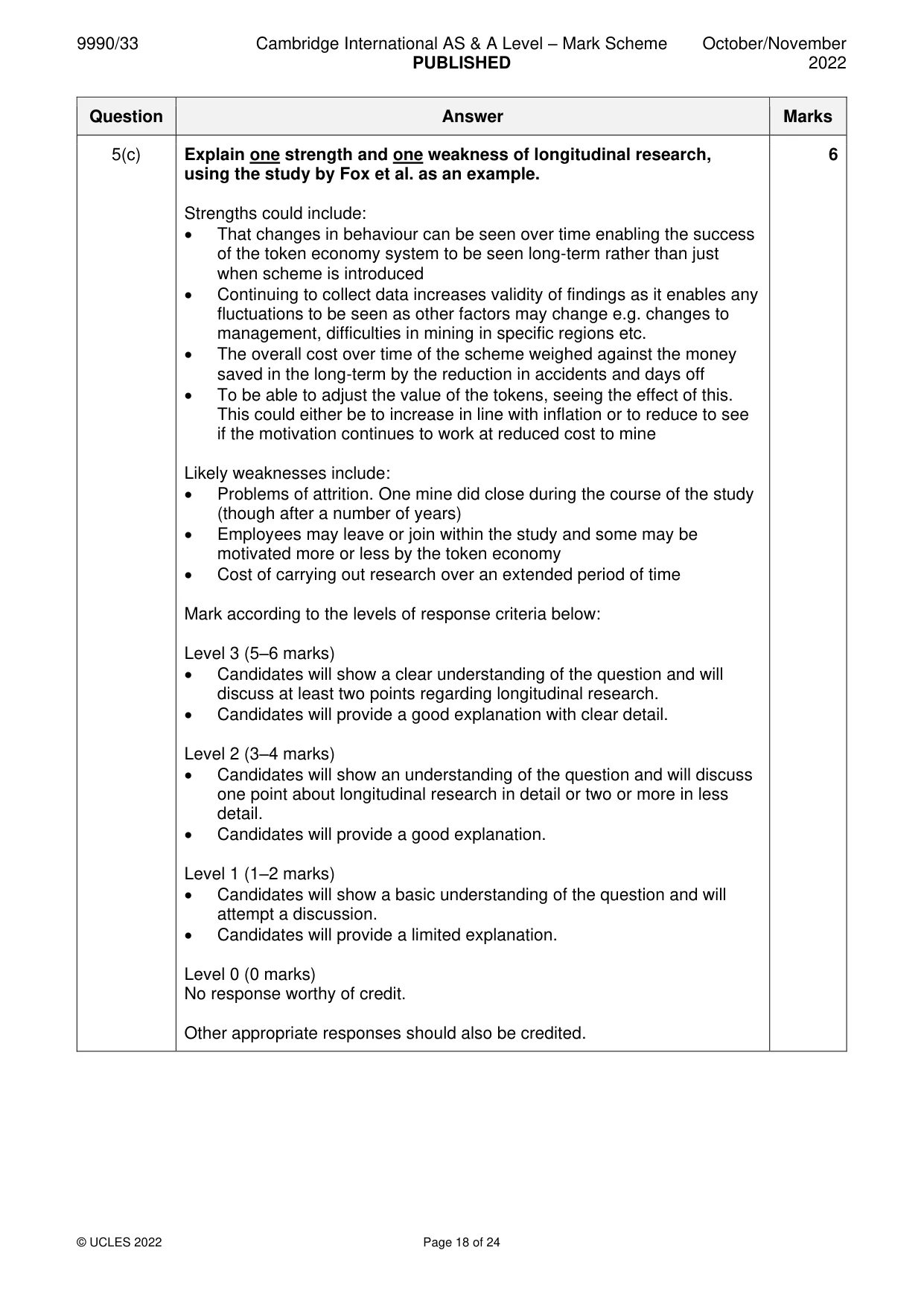
Mark scheme: 5(a) Identify two of the measures used in the five-city project on health 2 promotion in communities (Farquhar et al., 1985). Award 1 mark for each correctly identified item. Most likely answers: • Height • Weight • Obesity • Blood pressure • Resting heart rate • Smoking • Stress • Mortality Other appropriate responses should also be credited. 5(b) Describe the study on health promotion in worksites by Fox et al., 4 (1987). Award 1–2 marks for a basic answer with some understanding of the topic area. Award 3–4 marks for a detailed answer with clear understanding of the topic area. A token economy that used trading stamps as tokens (1) was instituted at two dangerous open-pit mines (1). Employees earned stamps for working without lost-time injuries, for being in work groups in which all other workers had no lost-time injuries, for not being involved in equipment-damaging accidents, for making adopted safety suggestions, and for unusual behaviour which prevented an injury or accident (2). They lost stamp awards if they or other workers in their group were injured, caused equipment damage, or failed to report accidents or injuries (1). The stamps could be exchanged for a selection of thousands of items at redemption stores (1). Implementation of the token economy was followed by large reductions in the number of days lost from work because of injuries, the number of lost- time injuries, and the costs of accidents and injuries (1). The reductions in costs far exceeded the costs of operating the token economy (1). All improvements were maintained over several years (1). Other appropriate responses should also be credited. 5(c) Explain one strength and one weakness of longitudinal research, 6 using the study by Fox et al. as an example. Strengths could include: • That changes in behaviour can be seen over time enabling the success of the token economy system to be seen long-term rather than just when scheme is introduced • Continuing to collect data increases validity of findings as it enables any fluctuations to be seen as other factors may change e.g. changes to management, difficulties in mining in specific regions etc. • The overall cost over time of the scheme weighed against the money saved in the long-term by the reduction in accidents and days off • To be able to adjust the value of the tokens, seeing the effect of this. This could either be to increase in line with inflation or to reduce to see if the motivation continues to work at reduced cost to mine Likely weaknesses include: • Problems of attrition. One mine did close during the course of the study (though after a number of years) • Employees may leave or join within the study and some may be motivated more or less by the token economy • Cost of carrying out research over an extended period of time Mark according to the levels of response criteria below: Level 3 (5–6 marks) • Candidates will show a clear understanding of the question and will discuss at least two points regarding longitudinal research. • Candidates will provide a good explanation with clear detail. Level 2 (3–4 marks) • Candidates will show an understanding of the question and will discuss one point about longitudinal research in detail or two or more in less detail. • Candidates will provide a good explanation. Level 1 (1–2 marks) • Candidates will show a basic understanding of the question and will attempt a discussion. • Candidates will provide a limited explanation. Level 0 (0 marks) No response worthy of credit. Other appropriate responses should also be credited.
More questions on 2 Health promotion in schools and worksites
Q6 · Describe what psychologists have discovered about patient and practitioner diagnosis and…
6 (a) Describe what psychologists have discovered about patient and practitioner diagnosis and style (practitioner style, practitioner diagnosis, disclosure of information). [8] (b) Evaluate what psychologists have discovered about patient and practitioner diagnosis and style (practitioner style, practitioner diagnosis, disclosure of information), including a discussion of field experiments. [10] Psychology and organisations Answer all questions.
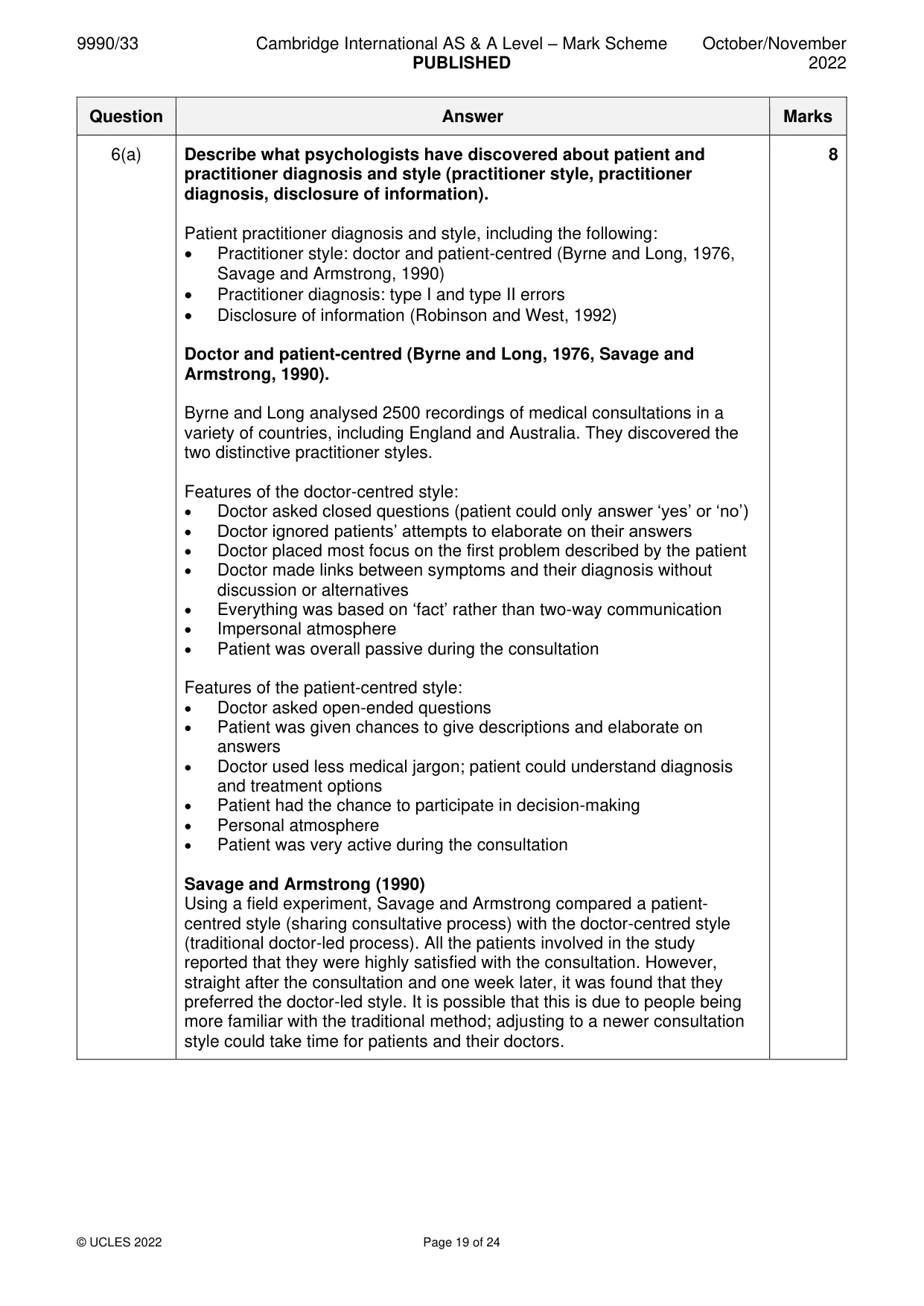
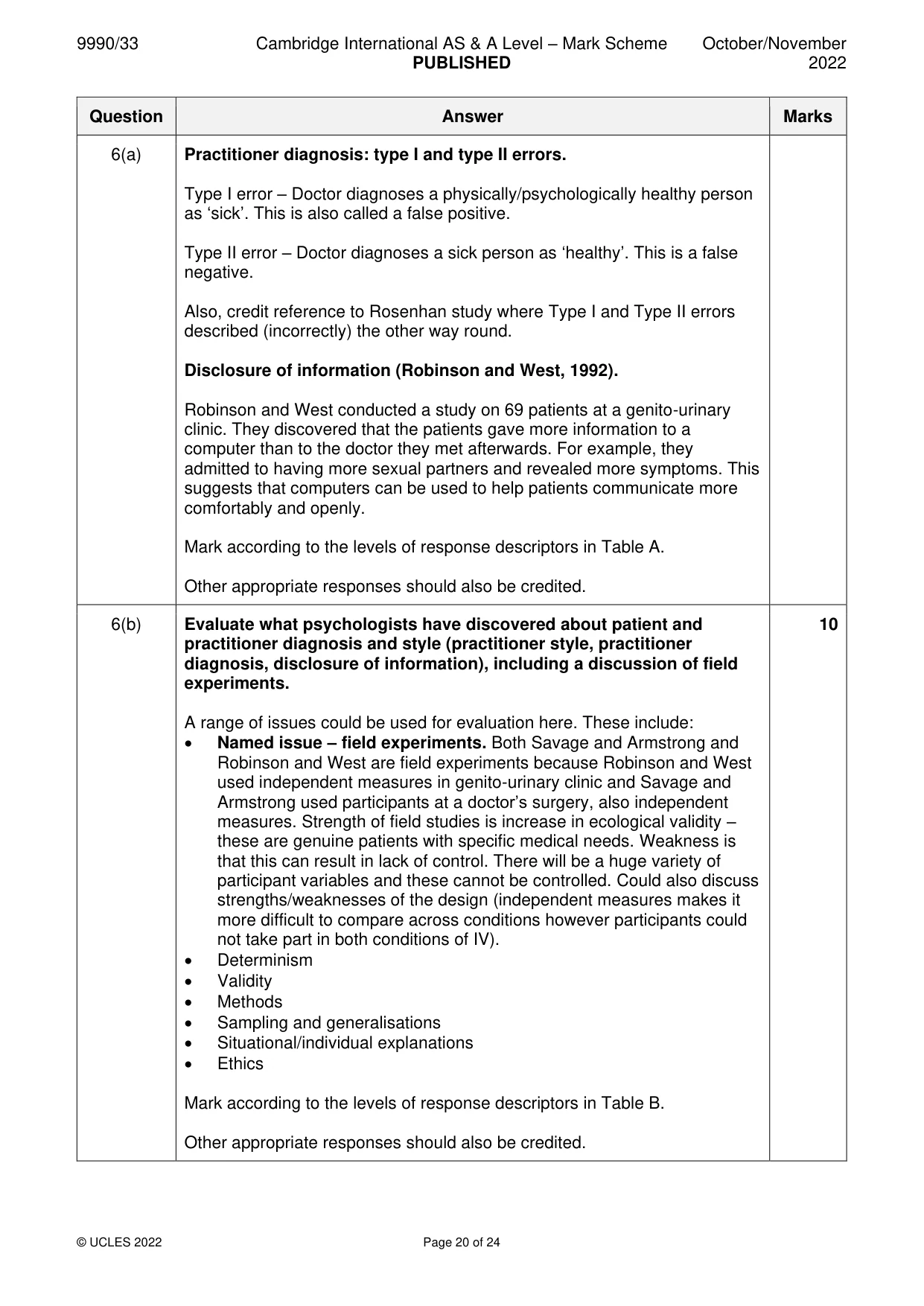
Mark scheme: 6(a) Describe what psychologists have discovered about patient and 8 practitioner diagnosis and style (practitioner style, practitioner diagnosis, disclosure of information). Patient practitioner diagnosis and style, including the following: • Practitioner style: doctor and patient-centred (Byrne and Long, 1976, Savage and Armstrong, 1990) • Practitioner diagnosis: type I and type II errors • Disclosure of information (Robinson and West, 1992) Doctor and patient-centred (Byrne and Long, 1976, Savage and Armstrong, 1990). Byrne and Long analysed 2500 recordings of medical consultations in a variety of countries, including England and Australia. They discovered the two distinctive practitioner styles. Features of the doctor-centred style: • Doctor asked closed questions (patient could only answer ‘yes’ or ‘no’) • Doctor ignored patients’ attempts to elaborate on their answers • Doctor placed most focus on the first problem described by the patient • Doctor made links between symptoms and their diagnosis without discussion or alternatives • Everything was based on ‘fact’ rather than two-way communication • Impersonal atmosphere • Patient was overall passive during the consultation Features of the patient-centred style: • Doctor asked open-ended questions • Patient was given chances to give descriptions and elaborate on answers • Doctor used less medical jargon; patient could understand diagnosis and treatment options • Patient had the chance to participate in decision-making • Personal atmosphere • Patient was very active during the consultation Savage and Armstrong (1990) Using a field experiment, Savage and Armstrong compared a patient- centred style (sharing consultative process) with the doctor-centred style (traditional doctor-led process). All the patients involved in the study reported that they were highly satisfied with the consultation. However, straight after the consultation and one week later, it was found that they preferred the doctor-led style. It is possible that this is due to people being more familiar with the traditional method; adjusting to a newer consultation style could take time for patients and their doctors. 6(a) Practitioner diagnosis: type I and type II errors. Type I error – Doctor diagnoses a physically/psychologically healthy person as ‘sick’. This is also called a false positive. Type II error – Doctor diagnoses a sick person as ‘healthy’. This is a false negative. Also, credit reference to Rosenhan study where Type I and Type II errors described (incorrectly) the other way round. Disclosure of information (Robinson and West, 1992). Robinson and West conducted a study on 69 patients at a genito-urinary clinic. They discovered that the patients gave more information to a computer than to the doctor they met afterwards. For example, they admitted to having more sexual partners and revealed more symptoms. This suggests that computers can be used to help patients communicate more comfortably and openly. Mark according to the levels of response descriptors in Table A. Other appropriate responses should also be credited. 6(b) Evaluate what psychologists have discovered about patient and 10 practitioner diagnosis and style (practitioner style, practitioner diagnosis, disclosure of information), including a discussion of field experiments. A range of issues could be used for evaluation here. These include: • Named issue – field experiments. Both Savage and Armstrong and Robinson and West are field experiments because Robinson and West used independent measures in genito-urinary clinic and Savage and Armstrong used participants at a doctor’s surgery, also independent measures. Strength of field studies is increase in ecological validity – these are genuine patients with specific medical needs. Weakness is that this can result in lack of control. There will be a huge variety of participant variables and these cannot be controlled. Could also discuss strengths/weaknesses of the design (independent measures makes it more difficult to compare across conditions however participants could not take part in both conditions of IV). • Determinism • Validity • Methods • Sampling and generalisations • Situational/individual explanations • Ethics Mark according to the levels of response descriptors in Table B. Other appropriate responses should also be credited. Psychology and organisations
Q7 · Give the equation proposed by Vroom (1964) to calculate motivation
7 (a) Give the equation proposed by Vroom (1964) to calculate motivation. [2] (b) Outline two non-monetary rewards that are motivators at work. [4] (c) Explain one strength and one weakness of using non-monetary rewards as motivators at work. [6]
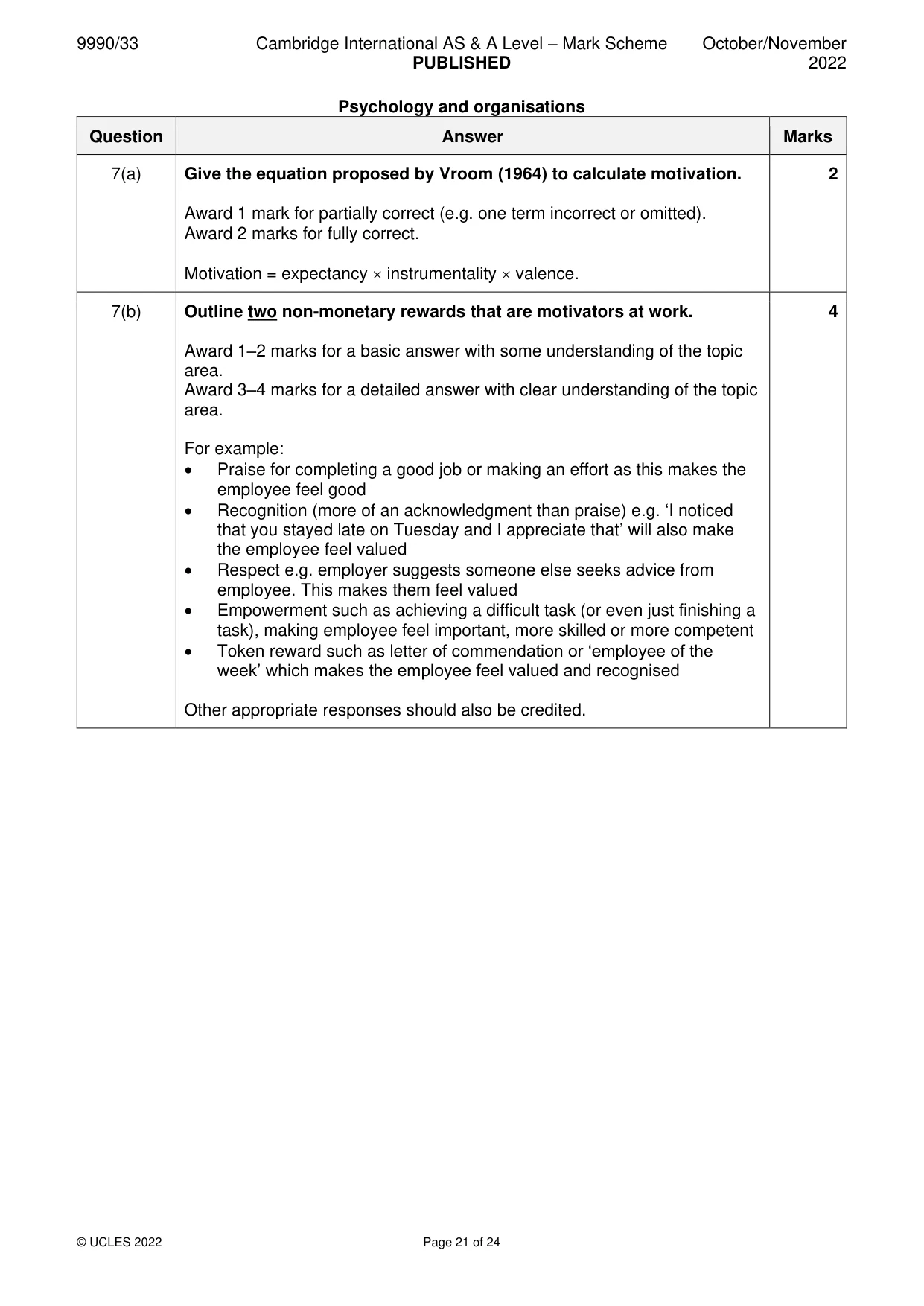
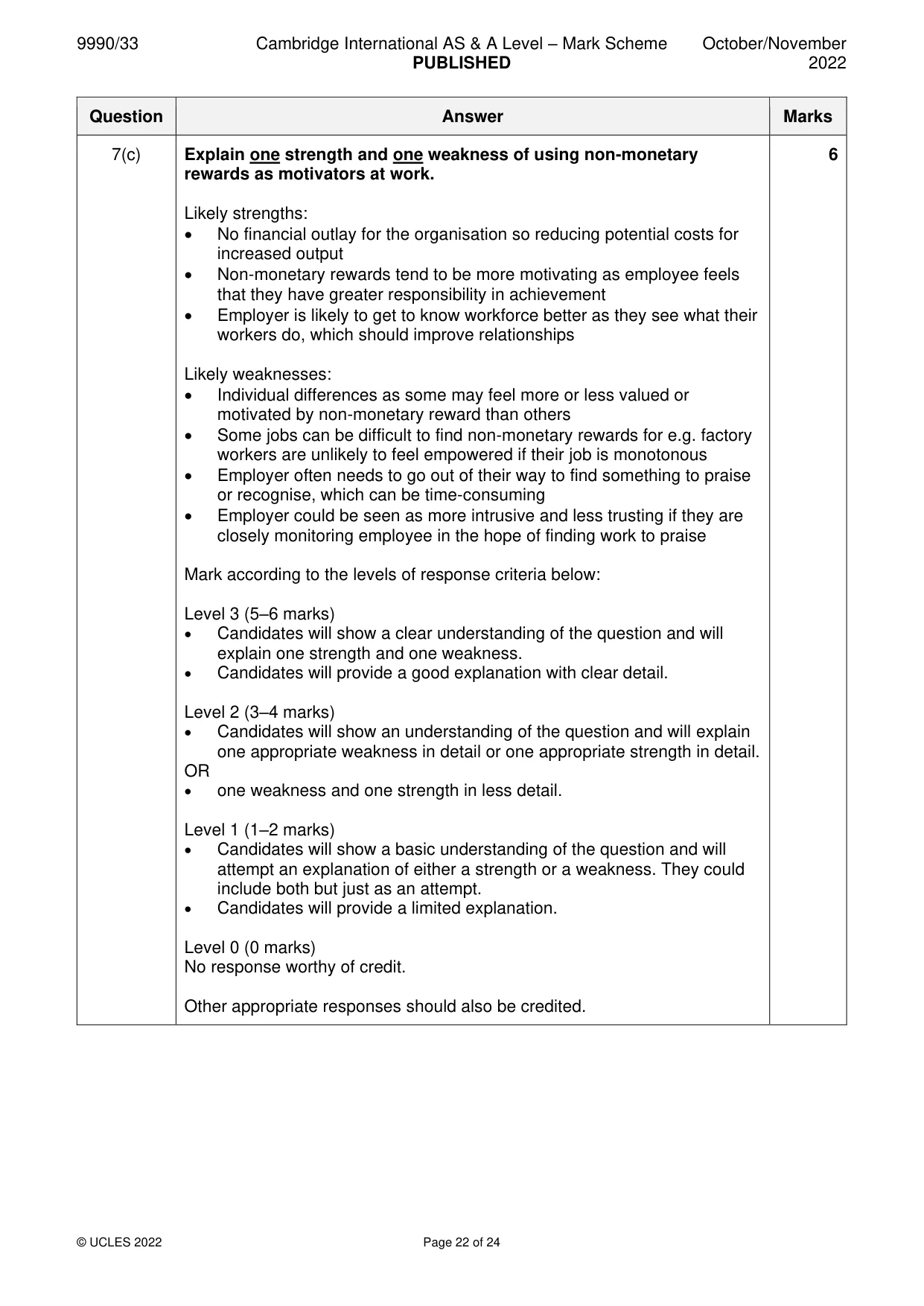
Mark scheme: 7(a) Give the equation proposed by Vroom (1964) to calculate motivation. 2 Award 1 mark for partially correct (e.g. one term incorrect or omitted). Award 2 marks for fully correct. Motivation = expectancy instrumentality valence. 7(b) Outline two non-monetary rewards that are motivators at work. 4 Award 1–2 marks for a basic answer with some understanding of the topic area. Award 3–4 marks for a detailed answer with clear understanding of the topic area. For example: • Praise for completing a good job or making an effort as this makes the employee feel good • Recognition (more of an acknowledgment than praise) e.g. ‘I noticed that you stayed late on Tuesday and I appreciate that’ will also make the employee feel valued • Respect e.g. employer suggests someone else seeks advice from employee. This makes them feel valued • Empowerment such as achieving a difficult task (or even just finishing a task), making employee feel important, more skilled or more competent • Token reward such as letter of commendation or ‘employee of the week’ which makes the employee feel valued and recognised Other appropriate responses should also be credited. 7(c) Explain one strength and one weakness of using non-monetary 6 rewards as motivators at work. Likely strengths: • No financial outlay for the organisation so reducing potential costs for increased output • Non-monetary rewards tend to be more motivating as employee feels that they have greater responsibility in achievement • Employer is likely to get to know workforce better as they see what their workers do, which should improve relationships Likely weaknesses: • Individual differences as some may feel more or less valued or motivated by non-monetary reward than others • Some jobs can be difficult to find non-monetary rewards for e.g. factory workers are unlikely to feel empowered if their job is monotonous • Employer often needs to go out of their way to find something to praise or recognise, which can be time-consuming • Employer could be seen as more intrusive and less trusting if they are closely monitoring employee in the hope of finding work to praise Mark according to the levels of response criteria below: Level 3 (5–6 marks) • Candidates will show a clear understanding of the question and will explain one strength and one weakness. • Candidates will provide a good explanation with clear detail. Level 2 (3–4 marks) • Candidates will show an understanding of the question and will explain one appropriate weakness in detail or one appropriate strength in detail. OR • one weakness and one strength in less detail. Level 1 (1–2 marks) • Candidates will show a basic understanding of the question and will attempt an explanation of either a strength or a weakness. They could include both but just as an attempt. • Candidates will provide a limited explanation. Level 0 (0 marks) No response worthy of credit. Other appropriate responses should also be credited.
Q8 · Describe what psychologists have discovered about group decision-making in organisations…
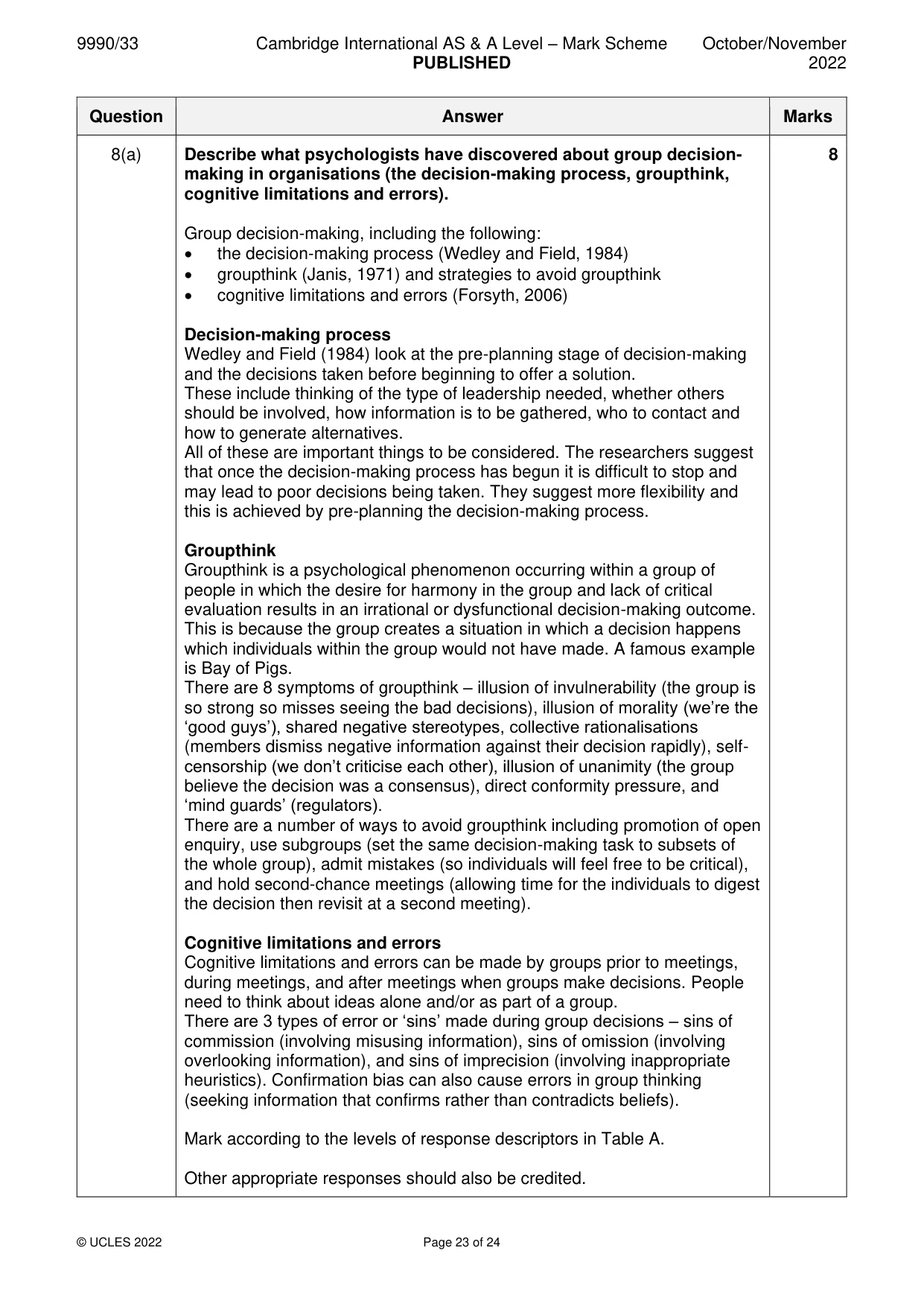
8 (a) Describe what psychologists have discovered about group decision-making in organisations (the decision-making process, groupthink, cognitive limitations and errors). [8] (b) Evaluate what psychologists have discovered about group decision-making in organisations (the decision-making process, groupthink, cognitive limitations and errors), including a discussion of practical applications. [10]
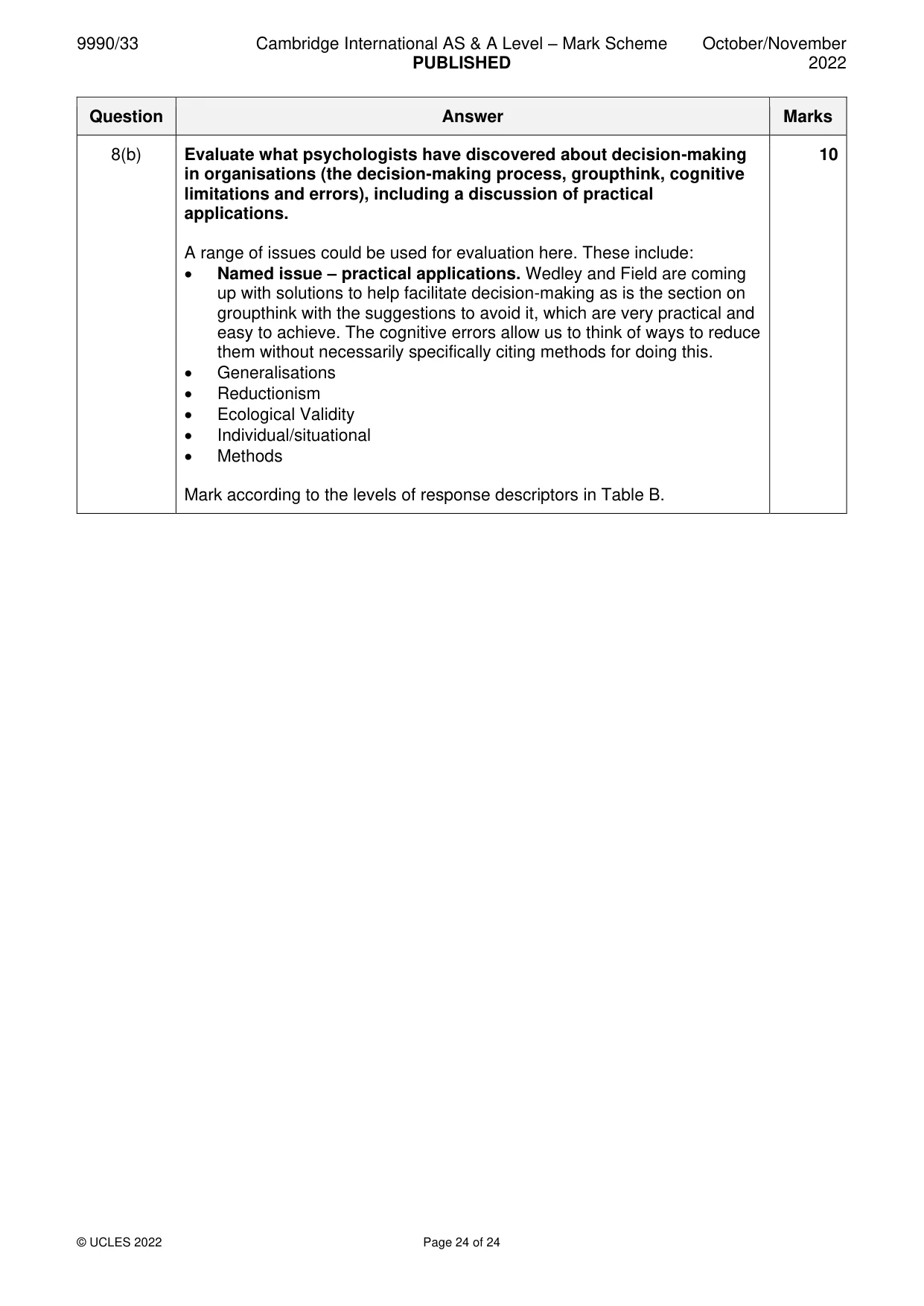
Mark scheme: 8(a) Describe what psychologists have discovered about group decision- 8 making in organisations (the decision-making process, groupthink, cognitive limitations and errors). Group decision-making, including the following: • the decision-making process (Wedley and Field, 1984) • groupthink (Janis, 1971) and strategies to avoid groupthink • cognitive limitations and errors (Forsyth, 2006) Decision-making process Wedley and Field (1984) look at the pre-planning stage of decision-making and the decisions taken before beginning to offer a solution. These include thinking of the type of leadership needed, whether others should be involved, how information is to be gathered, who to contact and how to generate alternatives. All of these are important things to be considered. The researchers suggest that once the decision-making process has begun it is difficult to stop and may lead to poor decisions being taken. They suggest more flexibility and this is achieved by pre-planning the decision-making process. Groupthink Groupthink is a psychological phenomenon occurring within a group of people in which the desire for harmony in the group and lack of critical evaluation results in an irrational or dysfunctional decision-making outcome. This is because the group creates a situation in which a decision happens which individuals within the group would not have made. A famous example is Bay of Pigs. There are 8 symptoms of groupthink – illusion of invulnerability (the group is so strong so misses seeing the bad decisions), illusion of morality (we’re the ‘good guys’), shared negative stereotypes, collective rationalisations (members dismiss negative information against their decision rapidly), self- censorship (we don’t criticise each other), illusion of unanimity (the group believe the decision was a consensus), direct conformity pressure, and ‘mind guards’ (regulators). There are a number of ways to avoid groupthink including promotion of open enquiry, use subgroups (set the same decision-making task to subsets of the whole group), admit mistakes (so individuals will feel free to be critical), and hold second-chance meetings (allowing time for the individuals to digest the decision then revisit at a second meeting). Cognitive limitations and errors Cognitive limitations and errors can be made by groups prior to meetings, during meetings, and after meetings when groups make decisions. People need to think about ideas alone and/or as part of a group. There are 3 types of error or ‘sins’ made during group decisions – sins of commission (involving misusing information), sins of omission (involving overlooking information), and sins of imprecision (involving inappropriate heuristics). Confirmation bias can also cause errors in group thinking (seeking information that confirms rather than contradicts beliefs). Mark according to the levels of response descriptors in Table A. Other appropriate responses should also be credited. 8(b) Evaluate what psychologists have discovered about decision-making 10 in organisations (the decision-making process, groupthink, cognitive limitations and errors), including a discussion of practical applications. A range of issues could be used for evaluation here. These include: • Named issue – practical applications. Wedley and Field are coming up with solutions to help facilitate decision-making as is the section on groupthink with the suggestions to avoid it, which are very practical and easy to achieve. The cognitive errors allow us to think of ways to reduce them without necessarily specifically citing methods for doing this. • Generalisations • Reductionism • Ecological Validity • Individual/situational • Methods Mark according to the levels of response descriptors in Table B.
What was in this paper
The subtopics covered by these 8 questions, and how many questions each got. Open one in a new tab to see every Cambridge question on it.
What you needed in this session
Cambridge’s own grade thresholds for 2022 Oct/Nov, Paper 3 · Variant 3. A higher threshold means an easier paper — the bar moves with how the cohort did.