Questions as text
Question 1 9702/22 Feb/March 2017
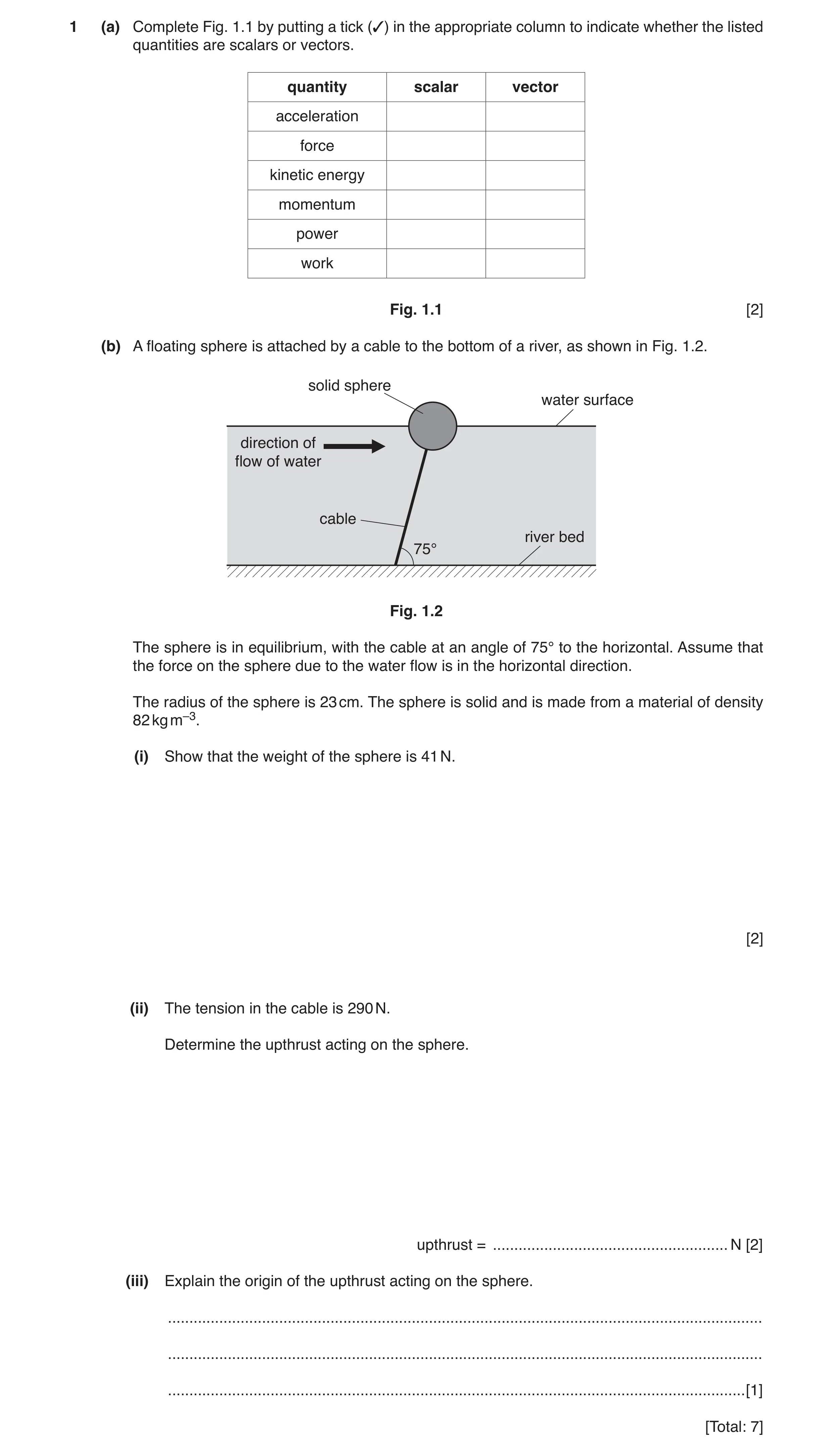
1 (a) Complete Fig. 1.1 by putting a tick (3) in the appropriate column to indicate whether the listed quantities are scalars or vectors. quantity scalar vector acceleration force kinetic energy momentum power work Fig. 1.1 [2] (b) A floating sphere is attached by a cable to the bottom of a river, as shown in Fig. 1.2. solid sphere water surface direction of flow of water cable river bed 75° Fig. 1.2 The sphere is in equilibrium, with the cable at an angle of 75° to the horizontal. Assume that the force on the sphere due to the water flow is in the horizontal direction. The radius of the sphere is 23 cm. The sphere is solid and is made from a material of density 82 kg m–3. (i) Show that the weight of the sphere is 41 N. [2] (ii) The tension in the cable is 290 N. Determine the upthrust acting on the sphere. upthrust = … N [2] (iii) Explain the origin of the upthrust acting on the sphere. … … … [1] [Total: 7]
7 marks
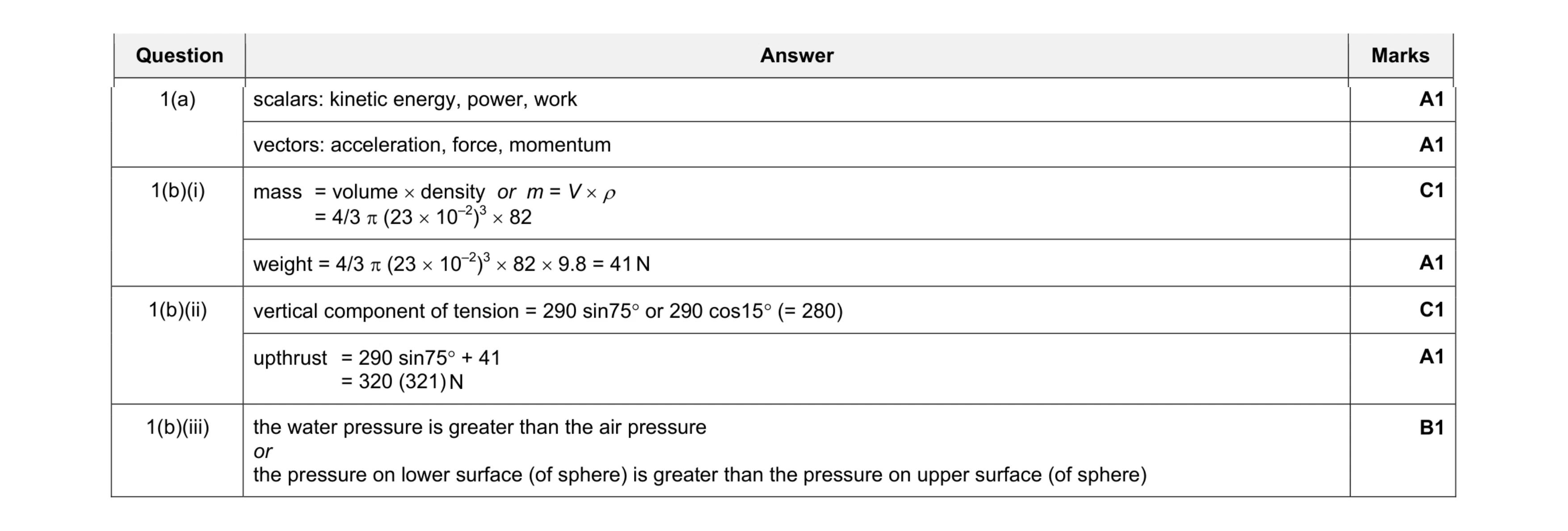
Mark scheme: 1(a) scalars: kinetic energy, power, work A1 vectors: acceleration, force, momentum A1 1(b)(i) mass = volume × density or m = V × ρ = 4/3 π (23 × 10–2)3 × 82 C1 weight = 4/3 π (23 × 10–2)3 × 82 × 9.8 = 41 N A1 1(b)(ii) vertical component of tension = 290 sin75° or 290 cos15° (= 280) C1 upthrust = 290 sin75° + 41 = 320 (321) N A1 1(b)(iii) the water pressure is greater than the air pressure or the pressure on lower surface (of sphere) is greater than the pressure on upper surface (of sphere) B1
This question in 9702/22 Feb/March 2017
Q2 · A spring is attached at one end to a fixed point and hangs vertically with a cube… 9702/22 Oct/Nov 2017
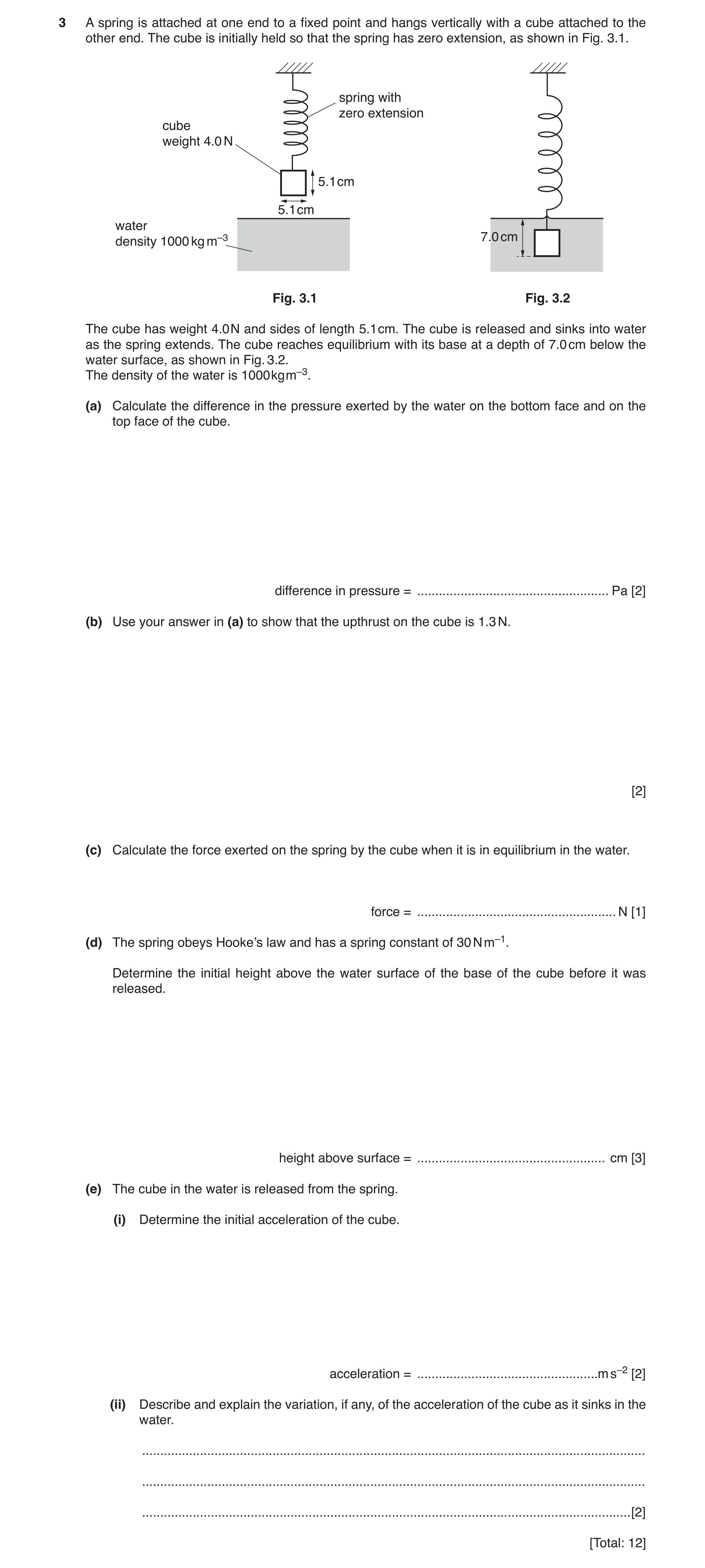
3 A spring is attached at one end to a fixed point and hangs vertically with a cube attached to the other end. The cube is initially held so that the spring has zero extension, as shown in Fig. 3.1. spring with zero extension cube weight 4.0 N 5.1 cm 5.1 cm water 7.0 cm density 1000 kg m–3 Fig. 3.1 Fig. 3.2 The cube has weight 4.0 N and sides of length 5.1 cm. The cube is released and sinks into water as the spring extends. The cube reaches equilibrium with its base at a depth of 7.0 cm below the water surface, as shown in Fig. 3.2. The density of the water is 1000 kg m–3. (a) Calculate the difference in the pressure exerted by the water on the bottom face and on the top face of the cube. difference in pressure = … Pa [2] (b) Use your answer in (a) to show that the upthrust on the cube is 1.3 N. [2] (c) Calculate the force exerted on the spring by the cube when it is in equilibrium in the water. force = … N [1] (d) The spring obeys Hooke’s law and has a spring constant of 30 N m–1. Determine the initial height above the water surface of the base of the cube before it was released. height above surface = … cm [3] (e) The cube in the water is released from the spring. (i) Determine the initial acceleration of the cube. acceleration = … m s–2 [2] (ii) Describe and explain the variation, if any, of the acceleration of the cube as it sinks in the water. … … … [2] [Total: 12]
12 marks
Mark scheme: 3(a) C1 ∆p = 1000 × 9.81 × (7.0 × 10–2 – 1.9 × 10⁻²) or 686 – 186 = 500 Pa A1 3(b) F = pA or (∆)F = ∆p × A C1 upthrust = 500 × (5.1 × 10–2)2 = 1.3 N or upthrust = (686 – 186) × (5.1 ×10–2)2 = 1.3 N or upthrust = 1000 × 9.81 × 5.1 ×10–2 × (5.1 × 10–2)2 = 1.3 N A1 3(c) force = 4.0 – 1.3 = 2.7 N A1 Question Answer Marks 3(d) extension/x/e = 2.7 / 30 C1 = 0.09 (m) or 9 (cm) C1 height above surface = 9 – 7 = 2 cm A1 3(e)(i) mass = 4.0 / 9.81 C1 acceleration = 2.7 / (4.0 / 9.81) = 6.6 m s–2 A1 3(e)(ii) viscous force increases (and then becomes constant) M1 (weight and upthrust constant so) acceleration decreases (to zero) A1
This question in 9702/22 Oct/Nov 2017
Q3 · A solid cylinder is lifted out of oil by a wire attached to a motor 9702/22 May/June 2018
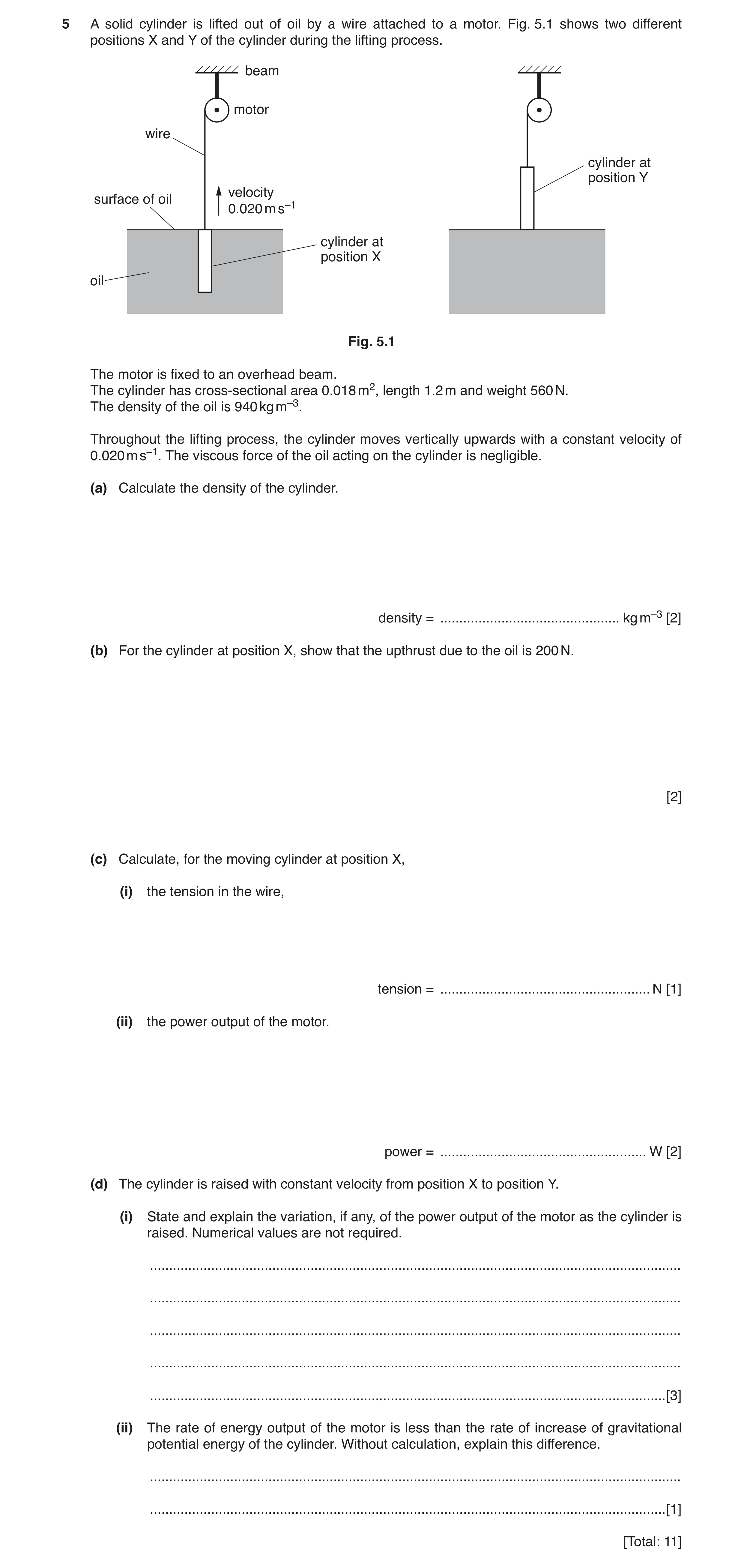
5 A solid cylinder is lifted out of oil by a wire attached to a motor. Fig. 5.1 shows two different positions X and Y of the cylinder during the lifting process. beam motor wire cylinder at position Y velocity surface of oil 0.020 m s–1 cylinder at position X oil Fig. 5.1 The motor is fixed to an overhead beam. The cylinder has cross-sectional area 0.018 m2, length 1.2 m and weight 560 N. The density of the oil is 940 kg m–3. Throughout the lifting process, the cylinder moves vertically upwards with a constant velocity of 0.020 m s–1. The viscous force of the oil acting on the cylinder is negligible. (a) Calculate the density of the cylinder. density = … kg m–3 [2] (b) For the cylinder at position X, show that the upthrust due to the oil is 200 N. [2] (c) Calculate, for the moving cylinder at position X, (i) the tension in the wire, tension = … N [1] (ii) the power output of the motor. power = … W [2] (d) The cylinder is raised with constant velocity from position X to position Y. (i) State and explain the variation, if any, of the power output of the motor as the cylinder is raised. Numerical values are not required. … … … … … [3] (ii) The rate of energy output of the motor is less than the rate of increase of gravitational potential energy of the cylinder. Without calculation, explain this difference. … … [1] [Total: 11]
11 marks
Mark scheme: 5(a) C1 = (560 / 9.81) / (1.2 × 0.018) = 2600 kg m–3 A1 5(b) (∆)p = 940 × 9.81 × 1.2 C1 (upthrust =) 940 × 9.81 × 1.2 × 0.018 = 200 N A1 5(c)(i) tension = 560 – 200 = 360 N A1 5(c)(ii) P = Fv C1 = 360 × 0.020 = 7.2 W A1 5(d)(i) upthrust decreases B1 tension (in wire) increases M1 power (output of motor) increases A1 5(d)(ii) there is work done (on the cylinder) by the upthrust or GPE of oil decreases (as it fills the space left by cylinder and so total energy is conserved) B1
This question in 9702/22 May/June 2018
Q4 · State what is meant by work done 9702/23 May/June 2018
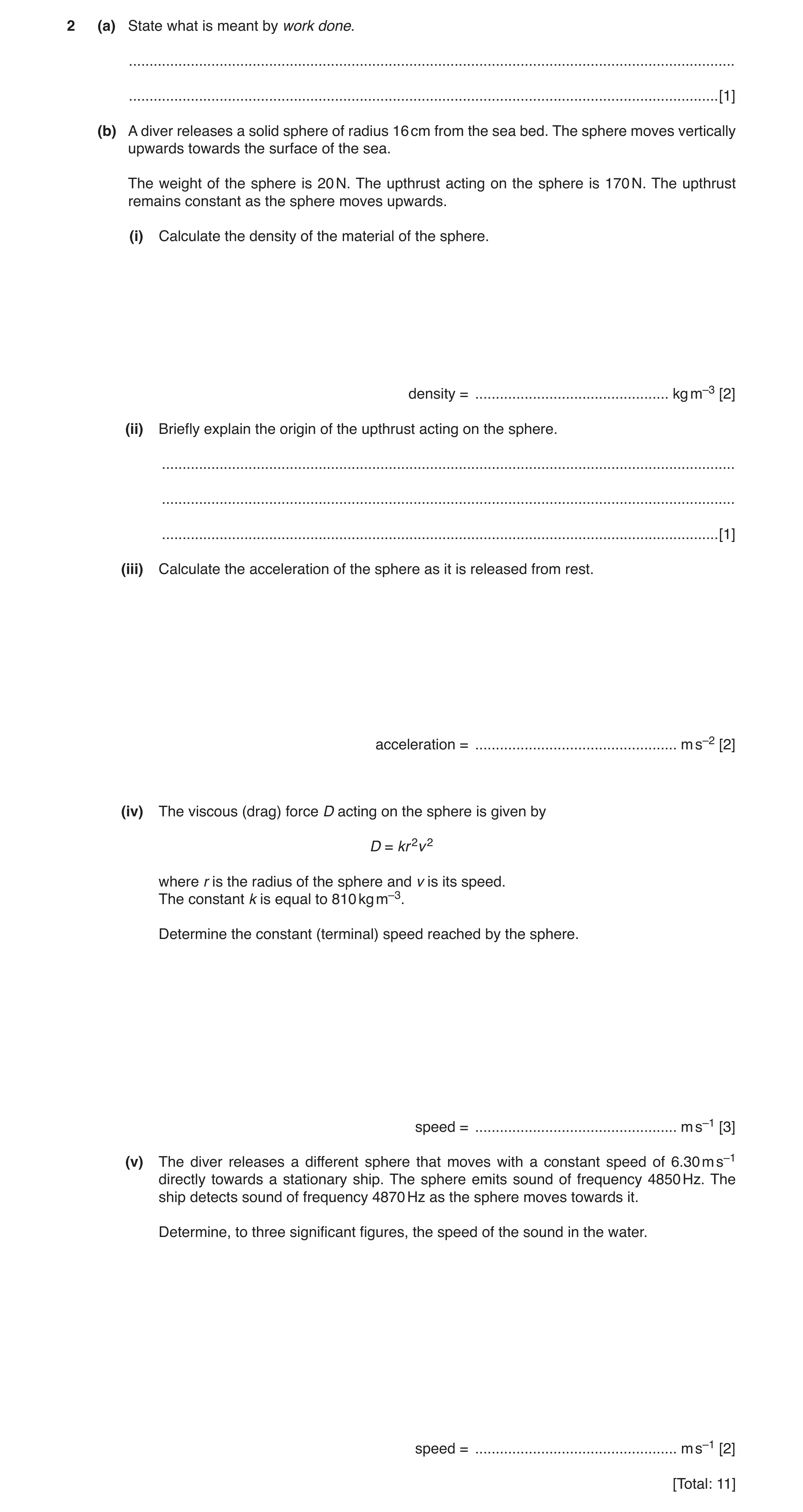
2 (a) State what is meant by work done. … … [1] (b) A diver releases a solid sphere of radius 16 cm from the sea bed. The sphere moves vertically upwards towards the surface of the sea. The weight of the sphere is 20 N. The upthrust acting on the sphere is 170 N. The upthrust remains constant as the sphere moves upwards. (i) Calculate the density of the material of the sphere. density = … kg m–3 [2] (ii) Briefly explain the origin of the upthrust acting on the sphere. … … … [1] (iii) Calculate the acceleration of the sphere as it is released from rest. acceleration = … m s–2 [2] (iv) The viscous (drag) force D acting on the sphere is given by D = kr 2v 2 where r is the radius of the sphere and v is its speed. The constant k is equal to 810 kg m–3. Determine the constant (terminal) speed reached by the sphere. speed = … m s–1 [3] (v) The diver releases a different sphere that moves with a constant speed of 6.30 m s–1 directly towards a stationary ship. The sphere emits sound of frequency 4850 Hz. The ship detects sound of frequency 4870 Hz as the sphere moves towards it. Determine, to three significant figures, the speed of the sound in the water. speed = … m s–1 [2] [Total: 11]
11 marks
Mark scheme: 2(a)(i) B1 2(b)(i) ρ = m / V C1 = (20 / 9.81) / (4/3 × π × 0.163) = 120 kg m–3 A1 2(b)(ii) the pressure on the lower surface (of sphere) is greater than the pressure on the upper surface (of sphere) B1 2(b)(iii) a = (170 – 20) / (20 / 9.81) C1 = 74 m s–2 A1 2(b)(iv) D = 170 – 20 (= 150) C1 810 × (0.162) × v2 = 150 C1 v = 2.7 m s–1 A1 2(b)(v) 4870 = (4850 × v) / (v – 6.30) C1 v = 1530 m s–1 A1
This question in 9702/23 May/June 2018
Q5 · The diameter d of a cylinder is measured as 0.0125 m ± 1.6% 9702/22 May/June 2019
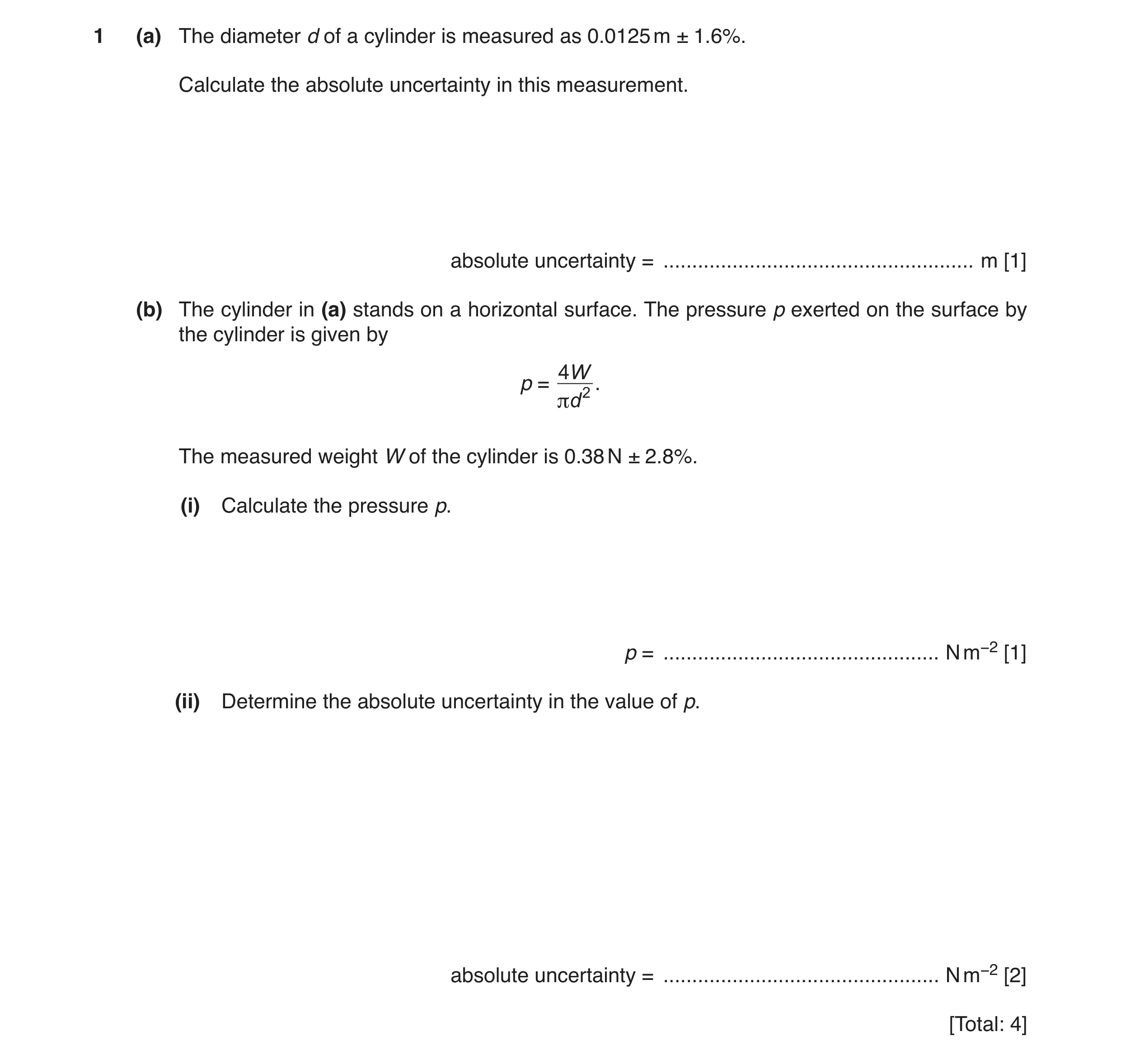
1 (a) The diameter d of a cylinder is measured as 0.0125 m ± 1.6%. Calculate the absolute uncertainty in this measurement. absolute uncertainty = … m [1] (b) The cylinder in (a) stands on a horizontal surface. The pressure p exerted on the surface by the cylinder is given by 4 W p = 2 . π d The measured weight W of the cylinder is 0.38 N ± 2.8%. (i) Calculate the pressure p. p = … N m−2 [1] (ii) Determine the absolute uncertainty in the value of p. absolute uncertainty = … N m−2 [2] [Total: 4]
4 marks
Mark scheme: 1(a) = 2 × 10⁻⁴ m A1 1(b)(i) p = (4 × 0.38) / (π × 0.01252) = 3100 N m–2 A1 1(b)(ii) percentage uncertainty = 2.8 + (2 × 1.6) (= 6%) or fractional uncertainty = 0.028 + (2 × 0.016) (= 0.06) C1 absolute uncertainty = 0.06 × 3100 = 190 N m–2 (allow to 1 significant figure) A1
This question in 9702/22 May/June 2019
Q6 · A cylindrical disc of mass 0.24 kg has a circular cross-sectional area A, as shown in Fig 9702/23 May/June 2019
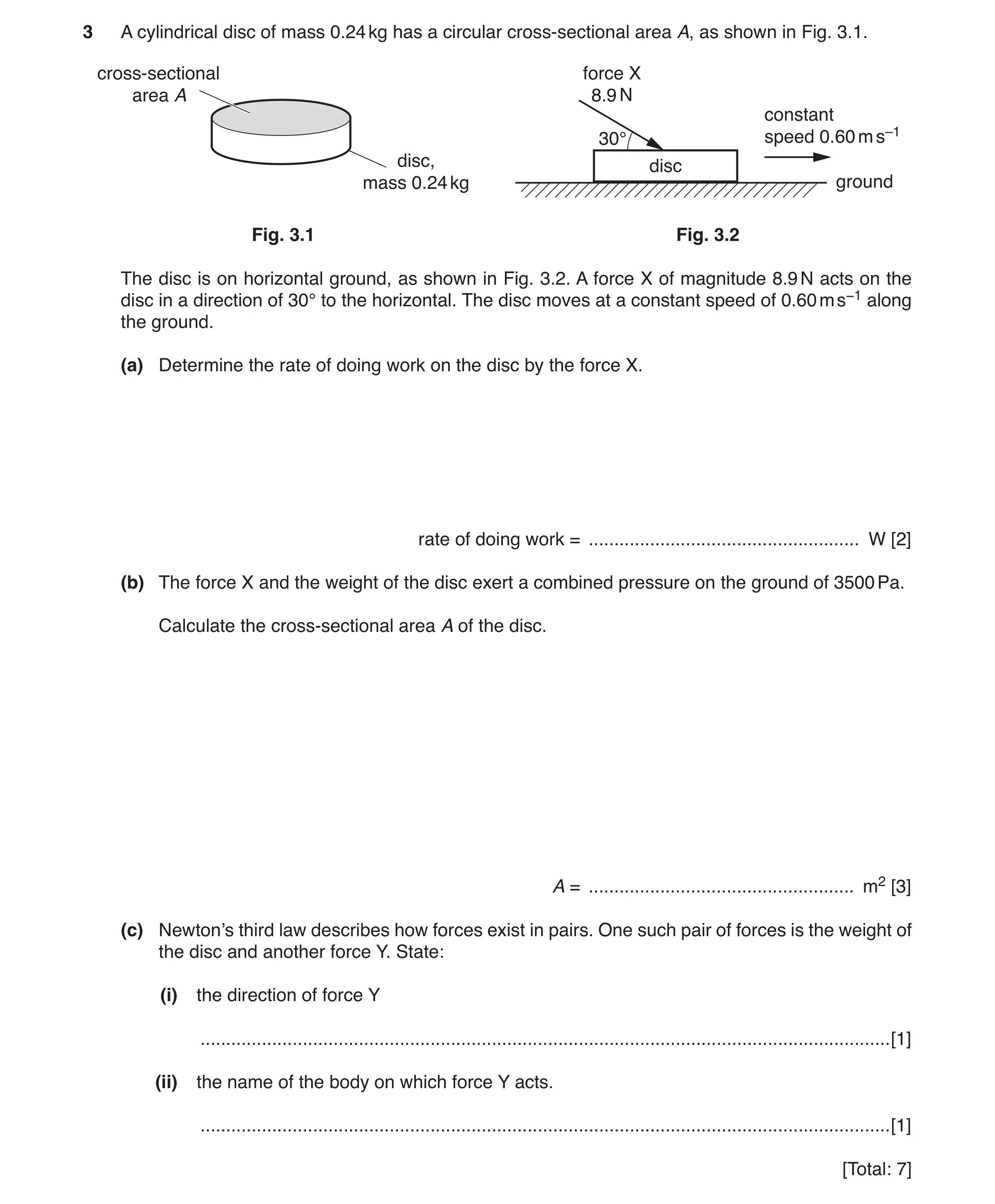
3 A cylindrical disc of mass 0.24 kg has a circular cross-sectional area A, as shown in Fig. 3.1. cross-sectional force X area A 8.9 N constant 30° speed 0.60 m s–1 disc, disc mass 0.24 kg ground Fig. 3.1 Fig. 3.2 The disc is on horizontal ground, as shown in Fig. 3.2. A force X of magnitude 8.9 N acts on the disc in a direction of 30° to the horizontal. The disc moves at a constant speed of 0.60 m s−1 along the ground. (a) Determine the rate of doing work on the disc by the force X. rate of doing work = … W [2] (b) The force X and the weight of the disc exert a combined pressure on the ground of 3500 Pa. Calculate the cross-sectional area A of the disc. A = … m2 [3] (c) Newton’s third law describes how forces exist in pairs. One such pair of forces is the weight of the disc and another force Y. State: (i) the direction of force Y … [1] (ii) the name of the body on which force Y acts. … [1] [Total: 7]
7 marks
Mark scheme: 3(a) P = Fv C1 P = 8.9 cos 30° × 0.60 = 4.6 W A1 3(b) p = F / A C1 F = 8.9 sin 30° + (0.24 × 9.81) ( = 6.80 N) C1 A = 6.80 / 3500 = 1.9 × 10⁻³ m2 A1 3(c)(i) upwards/up B1 3(c)(ii) the Earth/planet B1
This question in 9702/23 May/June 2019
Q7 · A small remote-controlled model aircraft has two propellers, each of diameter 16 cm 9702/21 Oct/Nov 2019
3 A small remote-controlled model aircraft has two propellers, each of diameter 16 cm. Fig. 3.1 is a side view of the aircraft when hovering. body of 16 cm 16 cm aircraft propeller propeller air air speed speed 7.6 m s–1 7.6 m s–1 Fig. 3.1 Air is propelled vertically downwards by each propeller so that the aircraft hovers at a fixed position. The density of the air is 1.2 kg m–3. Assume that the air from each propeller moves with a constant speed of 7.6 m s–1 in a uniform cylinder of diameter 16 cm. Also assume that the air above each propeller is stationary. (a) Show that, in a time interval of 3.0 s, the mass of air propelled downwards by one propeller is 0.55 kg. [3] (b) Calculate: (i) the increase in momentum of the mass of air in (a) increase in momentum = … N s [1] (ii) the downward force exerted on this mass of air by the propeller. force = … N [1] (c) State: (i) the upward force acting on one propeller force = … N [1] (ii) the name of the law that explains the relationship between the force in (b)(ii) and the force in (c)(i). … [1] (d) Determine the mass of the aircraft. mass = … kg [1] (e) In order for the aircraft to hover at a very high altitude (height), the propellers must propel the air downwards with a greater speed than when the aircraft hovers at a low altitude. Suggest the reason for this. … … [1] (f) When the aircraft is hovering at a high altitude, an electric fault causes the propellers to stop rotating. The aircraft falls vertically downwards. When the aircraft reaches a constant speed of 22 m s–1, it emits sound of frequency 3.0 kHz from an alarm. The speed of the sound in the air is 340 m s–1. Determine the frequency of the sound heard by a person standing vertically below the falling aircraft. frequency = … Hz [2] [Total: 11]
11 marks
Mark scheme: 3(a) C1 V = π × (0.16 / 2)2 × 7.6 × 3.0 (= 0.458 m3) C1 m = π × (0.16 / 2)2 × 7.6 × 3.0 × 1.2 = 0.55 kg A1 3(b)(i) ∆p = 0.55 × 7.6 = 4.2 N s A1 3(b)(ii) F = 4.2 / 3.0 or 0.55 × 7.6 / 3.0 = 1.4 N A1 3(c)(i) F = 1.4 N A1 3(c)(ii) Newton’s third law (of motion) B1 3(d) 2 × 1.4 = m × 9.81 m = 0.29 kg A1 3(e) the density of air is less at high altitude B1 3(f) fo = fsv / (v – vs) = 3000 × 340 / (340 – 22) C1 = 3200 Hz A1
This question in 9702/21 Oct/Nov 2019
Q8 · Define the moment of a force about a point 9702/21 Oct/Nov 2020
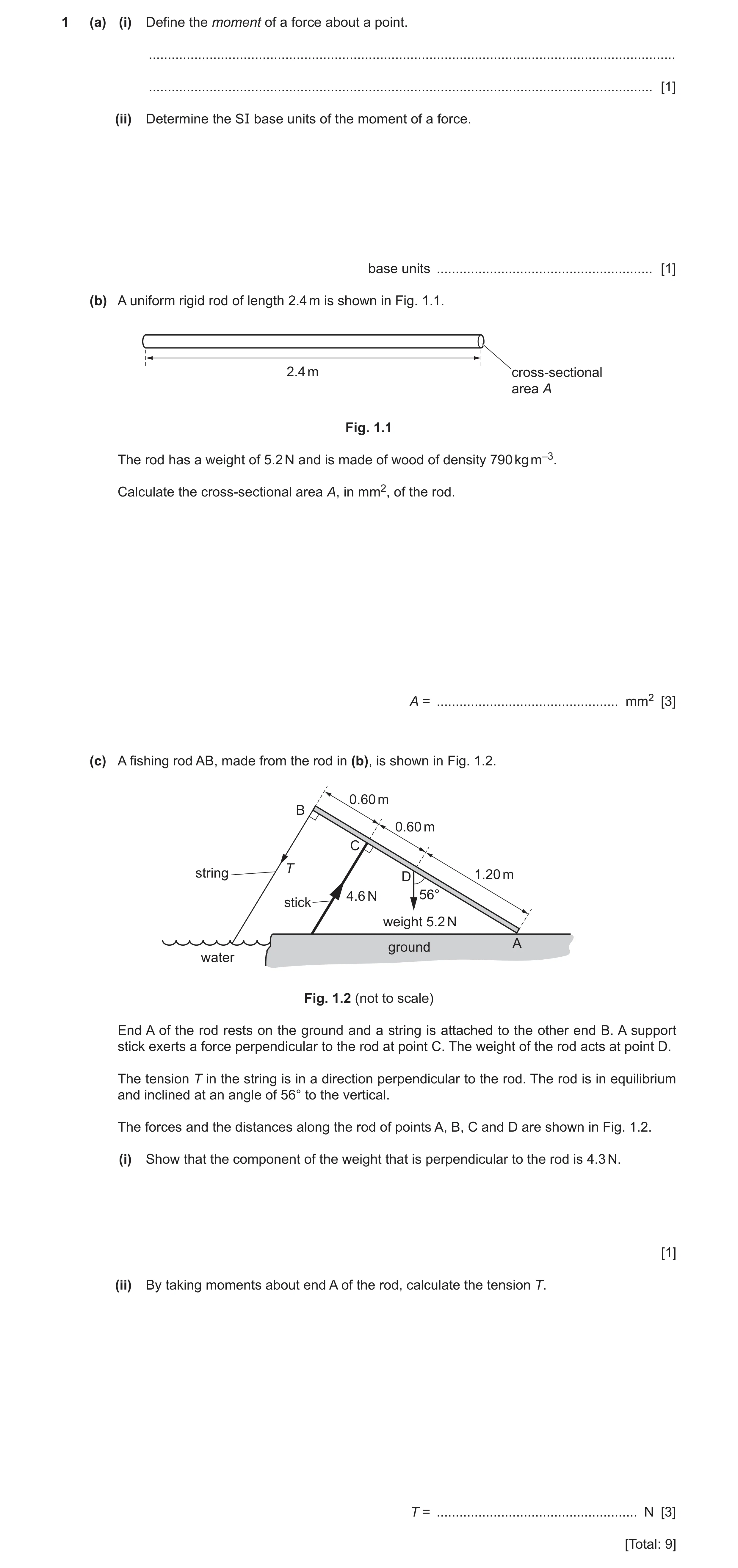
1 (a) (i) Define the moment of a force about a point. … … [1] (ii) Determine the SI base units of the moment of a force. base units … [1] (b) A uniform rigid rod of length 2.4 m is shown in Fig. 1.1. 2.4 m cross-sectional area A Fig. 1.1 The rod has a weight of 5.2 N and is made of wood of density 790 kg m–3. Calculate the cross-sectional area A, in mm2, of the rod. A = … mm2 [3] (c) A fishing rod AB, made from the rod in (b), is shown in Fig. 1.2. 0.60 m B 0.60 m C T string D 1.20 m 4.6 N 56° stick weight 5.2 N A ground water Fig. 1.2 (not to scale) End A of the rod rests on the ground and a string is attached to the other end B. A support stick exerts a force perpendicular to the rod at point C. The weight of the rod acts at point D. The tension T in the string is in a direction perpendicular to the rod. The rod is in equilibrium and inclined at an angle of 56° to the vertical. The forces and the distances along the rod of points A, B, C and D are shown in Fig. 1.2. (i) Show that the component of the weight that is perpendicular to the rod is 4.3 N. [1] (ii) By taking moments about end A of the rod, calculate the tension T. T = … N [3] [Total: 9]
9 marks
Mark scheme: 1(a)(i) force × perpendicular distance (of line of action of force to the point) B1 1(a)(ii) units: kg m s–2 m = kg m2 s–2 A1 1(b) W = ρVg or W = ρALg C1 A = 5.2 / (790 × 2.4 × 9.81) (= 2.8 × 10⁻⁴ (m2)) C1 = 2.8 × 102 mm2 A1 1(c)(i) (component =) 5.2 sin 56° = 4.3 (N) or 5.2 cos 34° = 4.3 (N) A1 1(c)(ii) (T × 2.4) or (4.3 × 1.2) or (4.6 × 1.8) C1 (T × 2.4) + (4.3 × 1.2) = (4.6 × 1.8) C1 T = 1.3 N A1
This question in 9702/21 Oct/Nov 2020
Q9 · A spring is extended by a force 9702/22 Feb/March 2021
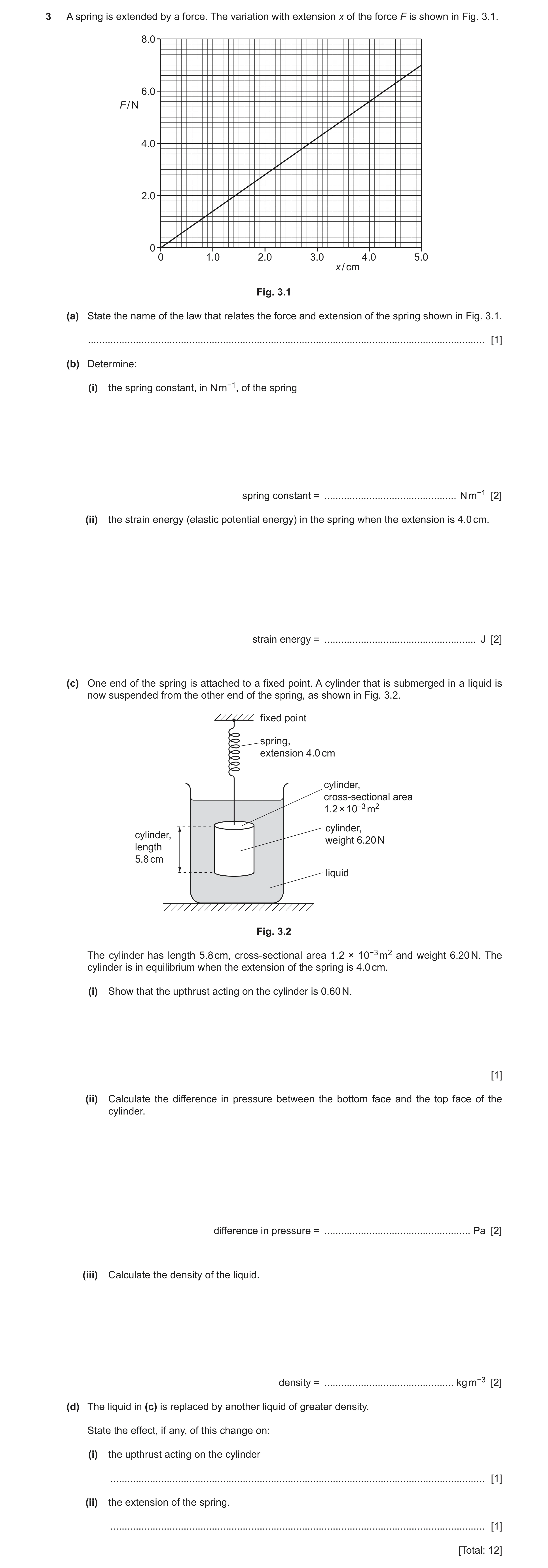
3 A spring is extended by a force. The variation with extension x of the force F is shown in Fig. 3.1. 8.0 6.0 F / N 4.0 2.0 0 0 1.0 2.0 3.0 4.0 5.0 x / cm Fig. 3.1 (a) State the name of the law that relates the force and extension of the spring shown in Fig. 3.1. … [1] (b) Determine: (i) the spring constant, in N m−1, of the spring spring constant = … N m−1 [2] (ii) the strain energy (elastic potential energy) in the spring when the extension is 4.0 cm. strain energy = … J [2] (c) One end of the spring is attached to a fixed point. A cylinder that is submerged in a liquid is now suspended from the other end of the spring, as shown in Fig. 3.2. fixed point spring, extension 4.0 cm cylinder, cross-sectional area 1.2 × 10⁻³ m2 cylinder, cylinder, weight 6.20 N length 5.8 cm liquid Fig. 3.2 The cylinder has length 5.8 cm, cross-sectional area 1.2 × 10⁻³ m2 and weight 6.20 N. The cylinder is in equilibrium when the extension of the spring is 4.0 cm. (i) Show that the upthrust acting on the cylinder is 0.60 N. [1] (ii) Calculate the difference in pressure between the bottom face and the top face of the cylinder. difference in pressure = … Pa [2] (iii) Calculate the density of the liquid. density = … kg m−3 [2] (d) The liquid in (c) is replaced by another liquid of greater density. State the effect, if any, of this change on: (i) the upthrust acting on the cylinder … [1] (ii) the extension of the spring. … [1] [Total: 12]
12 marks
Mark scheme: 3(a) Hooke’s (law) B1 3(b)(i) k = F / x or k = gradient e.g. k = 7.0 / 5.0 × 10⁻² C1 = 140 N m–1 A1 3(b)(ii) E = ½ F x or E = ½ k x 2 or E = area under graph = ½ × 5.6 × 4.0 × 10–2 or ½ × 140 × (4.0 × 10–2)2 C1 = 0.11 J A1 3(c)(i) (upthrust =) 6.20 – 5.60 = 0.60 (N) A1 3(c)(ii) Δp = ΔF / A = 0.60 / 1.2 × 10⁻³ C1 = 500 Pa A1 3(c)(iii) (Δ)p = ρg(Δ)h ρ = 500 / (9.81 × 5.8 × 10–2) C1 = 880 kg m–3 A1 3(d)(i) (upthrust) increases B1 3(d)(ii) (extension) decreases B1
This question in 9702/22 Feb/March 2021
Q10 · Complete Table 1.1 by stating whether each of the quantities is a vector or a scalar 9702/22 May/June 2021
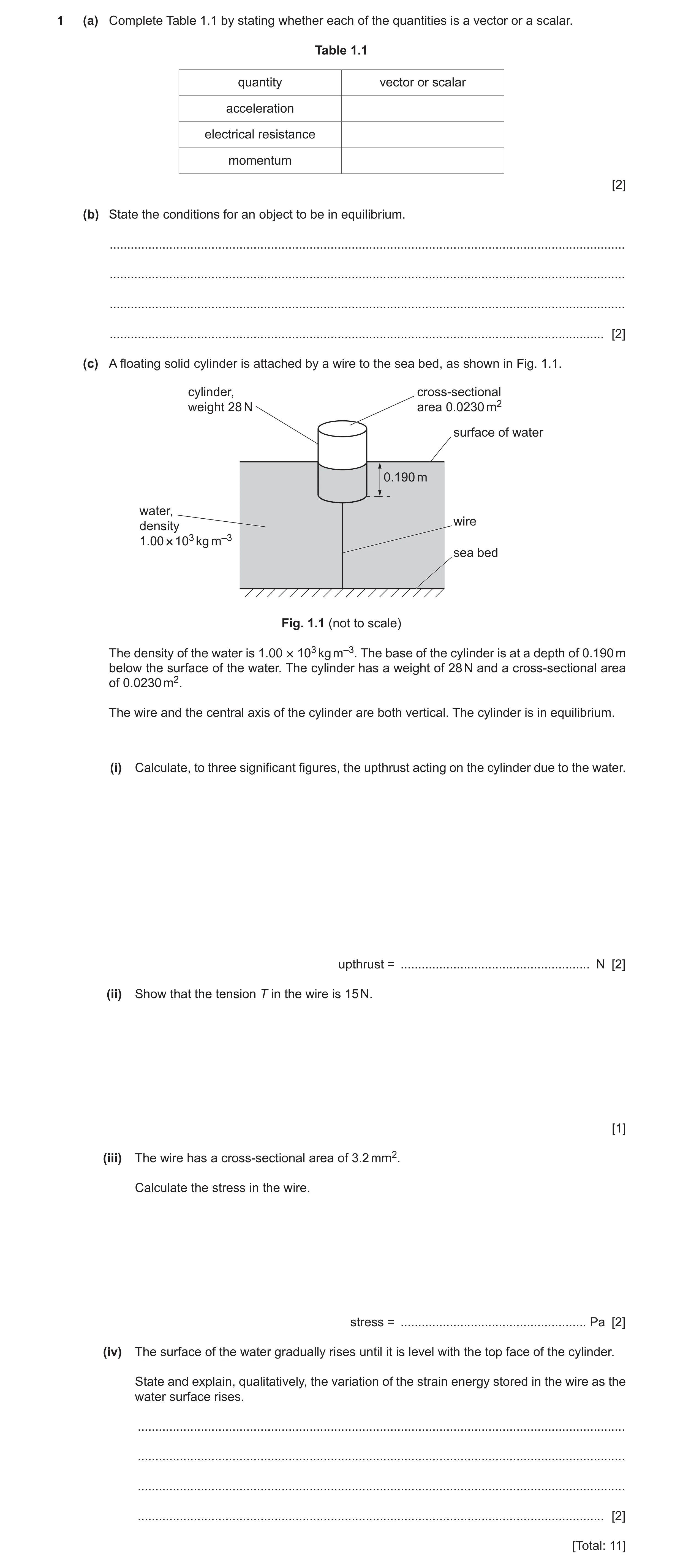
1 (a) Complete Table 1.1 by stating whether each of the quantities is a vector or a scalar. Table 1.1 quantity vector or scalar acceleration electrical resistance momentum [2] (b) State the conditions for an object to be in equilibrium. … … … … [2] (c) A floating solid cylinder is attached by a wire to the sea bed, as shown in Fig. 1.1. cylinder, cross-sectional weight 28 N area 0.0230 m2 surface of water 0.190 m water, wire density 1.00 × 10³ kg m–3 sea bed Fig. 1.1 (not to scale) The density of the water is 1.00 × 10³ kg m–3. The base of the cylinder is at a depth of 0.190 m below the surface of the water. The cylinder has a weight of 28 N and a cross-sectional area of 0.0230 m2. The wire and the central axis of the cylinder are both vertical. The cylinder is in equilibrium. (i) Calculate, to three significant figures, the upthrust acting on the cylinder due to the water. upthrust = … N [2] (ii) Show that the tension T in the wire is 15 N. [1] (iii) The wire has a cross-sectional area of 3.2 mm2. Calculate the stress in the wire. stress = … Pa [2] (iv) The surface of the water gradually rises until it is level with the top face of the cylinder. State and explain, qualitatively, the variation of the strain energy stored in the wire as the water surface rises. … … … … [2] [Total: 11]
11 marks
Mark scheme: 1(a) acceleration: vector electrical resistance: scalar momentum: vector 1 mark for two correct, 2 marks for all three correct B2 1(b) resultant force (in any direction) is zero B1 resultant torque/moment (about any point) is zero B1 1(c)(i) upthrust = ρ g (∆)h × A C1 = (1.00 × 103 × 9.81 × 0.190) × 0.0230 = 42.9 N A1 1(c)(ii) (T =) 43 – 28 = 15 (N) or (T =) 42.9 – 28 = 14.9 or 15 (N) A1 1(c)(iii) σ = F / A or T / A C1 = 15 / (3.2 × 10⁻⁶) = 4.7 × 10⁶ Pa A1 1(c)(iv) upthrust (on cylinder) increases (and weight constant) B1 tension/stress increases and (so) strain energy increases B1
This question in 9702/22 May/June 2021
Question 11 9702/21 Oct/Nov 2021
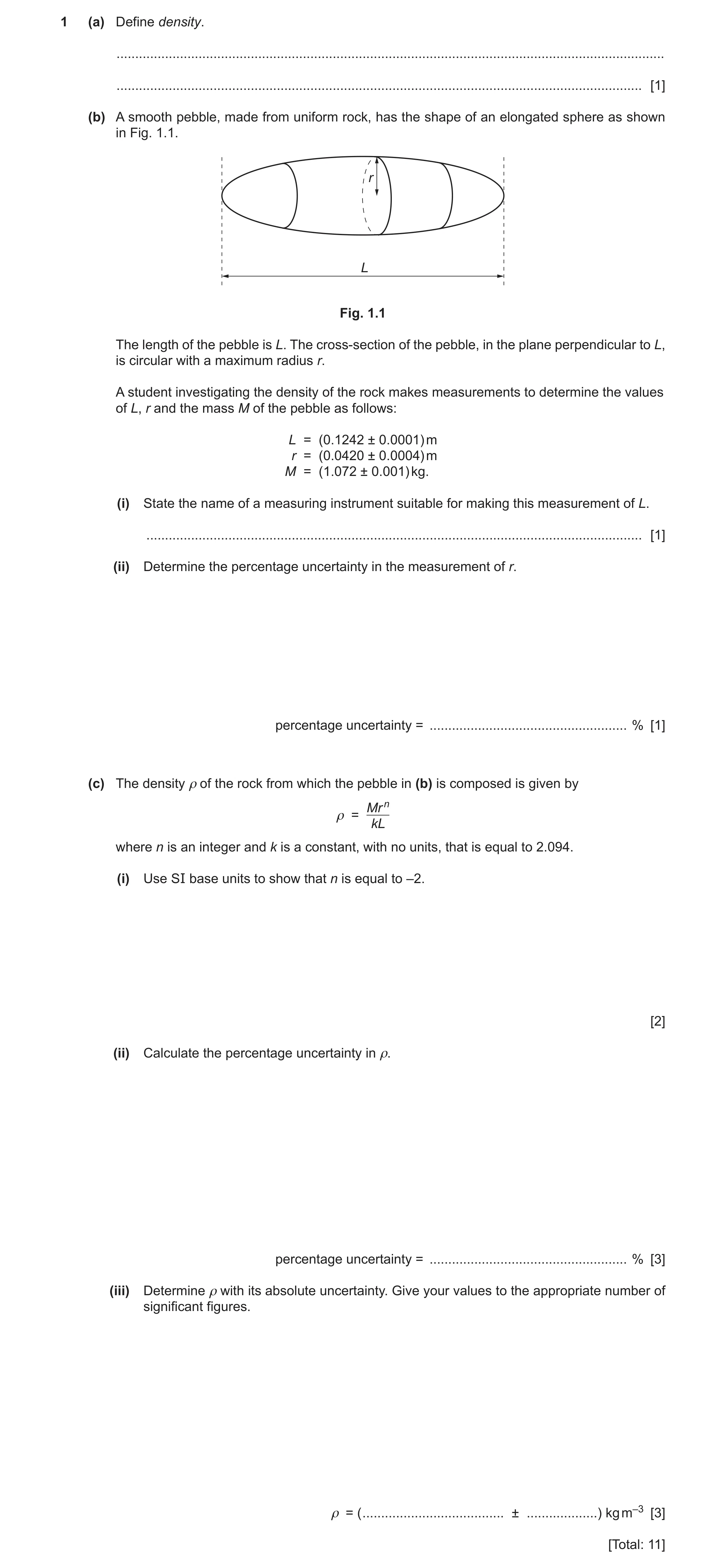
1 (a) Define density. … … [1] (b) A smooth pebble, made from uniform rock, has the shape of an elongated sphere as shown in Fig. 1.1. r L Fig. 1.1 The length of the pebble is L. The cross-section of the pebble, in the plane perpendicular to L, is circular with a maximum radius r. A student investigating the density of the rock makes measurements to determine the values of L, r and the mass M of the pebble as follows: L = (0.1242 ± 0.0001) m r = (0.0420 ± 0.0004) m M = (1.072 ± 0.001) kg. (i) State the name of a measuring instrument suitable for making this measurement of L. … [1] (ii) Determine the percentage uncertainty in the measurement of r. percentage uncertainty = … % [1] (c) The density ρ of the rock from which the pebble in (b) is composed is given by Mr n ρ = kL where n is an integer and k is a constant, with no units, that is equal to 2.094. (i) Use SI base units to show that n is equal to –2. [2] (ii) Calculate the percentage uncertainty in ρ. percentage uncertainty = … % [3] (iii) Determine ρ with its absolute uncertainty. Give your values to the appropriate number of significant figures. ρ = ( … ± … ) kg m–3 [3] [Total: 11]
11 marks
Mark scheme: 1(a) mass / volume B1 1(b)(i) (vernier/digital) calipers B1 1(b)(ii) percentage uncertainty = (0.0004 / 0.0420) × 100 = 1% A1 1(c)(i) kg m–3 = kg × mn / m or kg m–3 = kg × mn × m–1 M1 –3 = n – 1 and (so) n = –2 A1 1(c)(ii) (Δρ / ρ) = (ΔM / M) + 2(Δr / r) + (ΔL / L) C1 percentage uncertainty = [(0.001 / 1.072) + 2 × (0.0004 / 0.0420) + (0.0001 / 0.1242)] (× 100) C1 = 0.09% + 2 × 0.95% + 0.08% = 2% A1 1(c)(iii) ρ = (1.072 × 0.0420–2) / (2.094 × 0.1242) = 2337 (kg m–3) C1 ∆ρ = 0.021 × 2337 = 49 (kg m–3) C1 ρ = (2340 ± 50) kg m–3 A1
This question in 9702/21 Oct/Nov 2021
Question 12 9702/22 May/June 2023
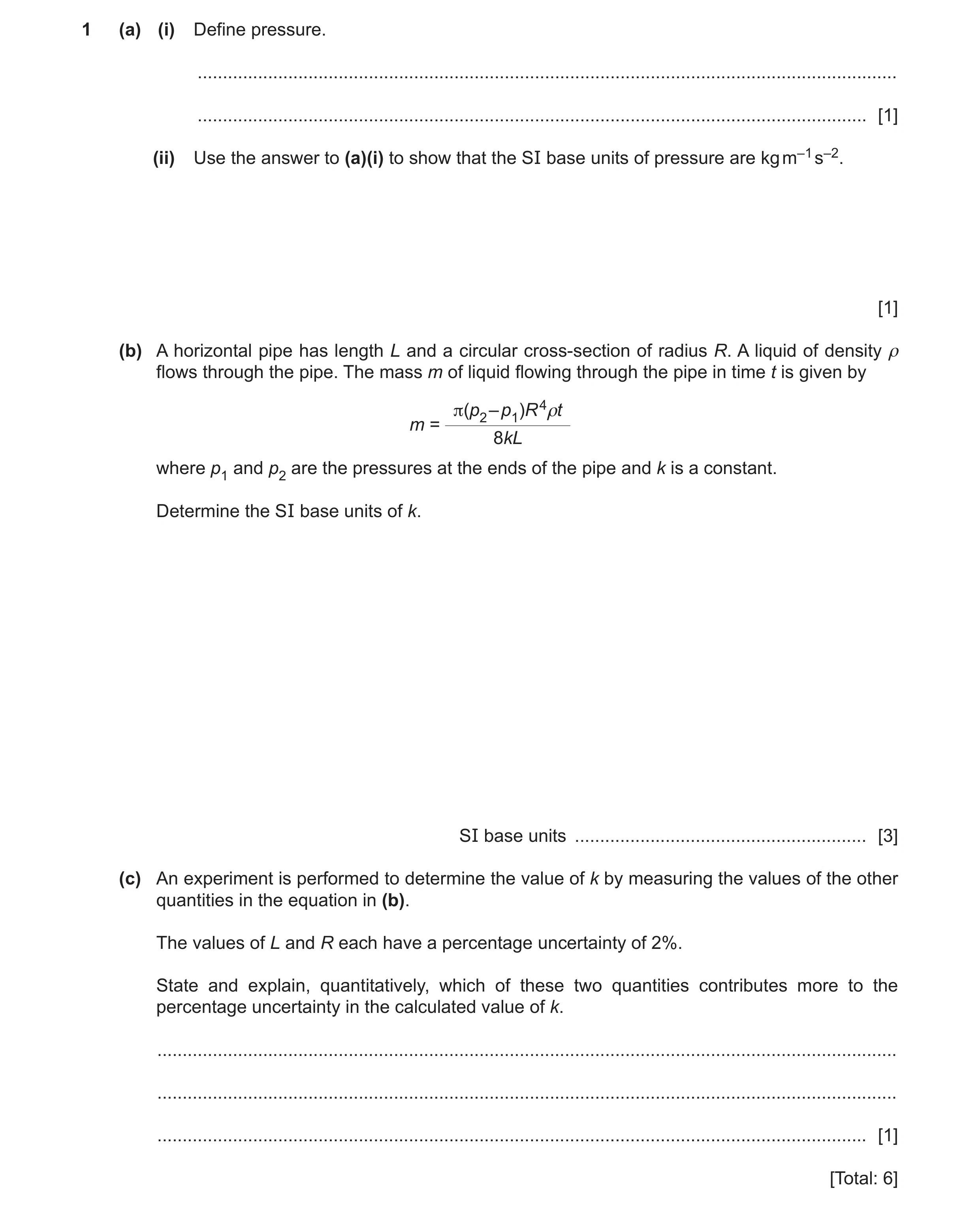
1 (a) (i) Define pressure. … … [1] (ii) Use the answer to (a)(i) to show that the SI base units of pressure are kg m–1 s–2. [1] (b) A horizontal pipe has length L and a circular cross‑section of radius R. A liquid of density ρ flows through the pipe. The mass m of liquid flowing through the pipe in time t is given by π(p2 – p1)R 4ρt m = 8kL where p1 and p2 are the pressures at the ends of the pipe and k is a constant. Determine the SI base units of k. SI base units … [3] (c) An experiment is performed to determine the value of k by measuring the values of the other quantities in the equation in (b). The values of L and R each have a percentage uncertainty of 2%. State and explain, quantitatively, which of these two quantities contributes more to the percentage uncertainty in the calculated value of k. … … … [1] [Total: 6]
6 marks
Mark scheme: 1(a)(i) force / area (normal to the force) B1 1(a)(ii) (p = F / A so units are) kg m s–2 / m2 = kg m–1 s–2 A1 1(b) unit of R: m and unit of t: s and unit of L: m C1 unit of : kg m–3 or = m / V C1 base units of k: (kg m–1 s–2 m4 kg m–3 s) / (kg m) = kg m–1 s–1 A1 1(c) R contributes 4 2% or 8% (and L contributes 2%) so R contributes more (to the percentage uncertainty in k) B1
This question in 9702/22 May/June 2023
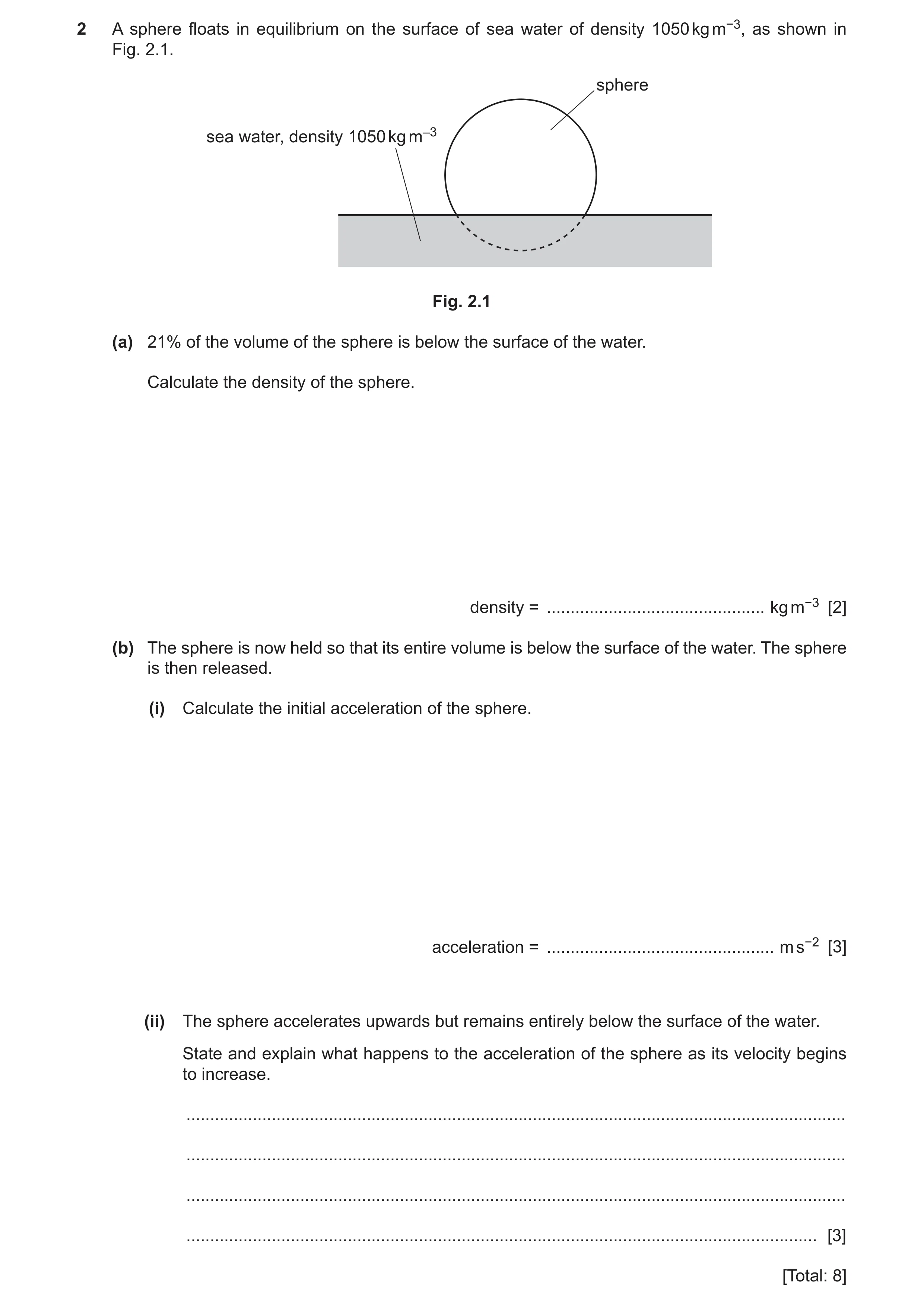
Q13 · A sphere floats in equilibrium on the surface of sea water of density 1050 kg m−3, as… 9702/23 May/June 2023
2 A sphere floats in equilibrium on the surface of sea water of density 1050 kg m−3, as shown in Fig. 2.1. sphere sea water, density 1050 kg m–3 Fig. 2.1 (a) 21% of the volume of the sphere is below the surface of the water. Calculate the density of the sphere. density = … kg m−3 [2] (b) The sphere is now held so that its entire volume is below the surface of the water. The sphere is then released. (i) Calculate the initial acceleration of the sphere. acceleration = … m s−2 [3] (ii) The sphere accelerates upwards but remains entirely below the surface of the water. State and explain what happens to the acceleration of the sphere as its velocity begins to increase. … … … … [3] [Total: 8]
8 marks
Mark scheme: 2(a) C1 0.21V 1050 ( 9.81) = V ( 9.81) = 220 kg m–3 A1 2(b)(i) F = 1050 9.81 V or W = 220 9.81 V C1 (V 1050 9.81) – (V 220 9.81) = (V 220) a C1 a = 37 m s–2 A1 2(b)(ii) the (downward) drag / viscous force increases (with speed) M1 resultant force decreases (as upthrust and weight remain the same) M1 acceleration decreases (as its velocity increases) A1
This question in 9702/23 May/June 2023
Question 14 9702/22 Feb/March 2024
2 (a) Define acceleration. … … [1] (b) An Olympic diver stands on a platform above a pool of water, as shown in Fig. 2.1. 5.9 m s–1 diver 60° horizontal platform 9.0 m surface of water 1.2 m Fig. 2.1 (not to scale) When the diver is on the platform his centre of gravity is a vertical height of 9.0 m above the surface of the water. The diver jumps from the platform with a velocity of 5.9 m s–1 at an angle of 60° to the horizontal. Air resistance is negligible. When the diver hits the surface of the water, his centre of gravity is a vertical height of 1.2 m above the surface of the water. Calculate the speed of the diver at the instant he hits the surface of the water. speed = … m s–1 [3] (c) The diver in (b) enters the water and decelerates. (i) Describe and explain the variation of the viscous drag force acting on the diver in the water as he moves downwards. … … … … [2] (ii) The diver has a volume of 7.5 × 10⁻² m3 . The density of the water is 1.0 × 10³ kg m–3 . Show that the upthrust acting on the diver when he is entirely underwater is 740 N. [1] (iii) At a particular instant when the diver is entirely underwater his horizontal velocity is zero. The viscous drag force acting on him at this instant is 950 N vertically upwards. The diver has mass 78 kg. Determine the magnitude and direction of the acceleration of the diver. acceleration = … m s–2 direction … [4] [Total: 11]
11 marks
Mark scheme: 2(a) rate of change of velocity B1 2(b) ½ m()v2= mg()h C1 v2 = 5.92 + 2 9.81 7.8 C1 v2 = 188 v = 14 m s–1 A1 or by resolving components (C1) Vertically: v2 = u2 + 2as v2 = (5.9sin60)2 +2 –9.81 (1.2–9.0) vv = 13.4 horizontally: (C1) vh = 5.9cos60 vh = 2.95 resultant velocity = √(13.42 + 2.952) (A1) = 14 m s–1 2(c)(i) (As the diver moves down their) speed decreases B1 (So) viscous force / drag (force) decreases B1 2(c)(ii) (F =) gV A1 = 1000 9.81 7.5 10–2 = 740 (N)
This question in 9702/22 Feb/March 2024
Q15 · The drag force FD acting on a sphere falling through a liquid is given by FD = 6πηr v… 9702/23 May/June 2024
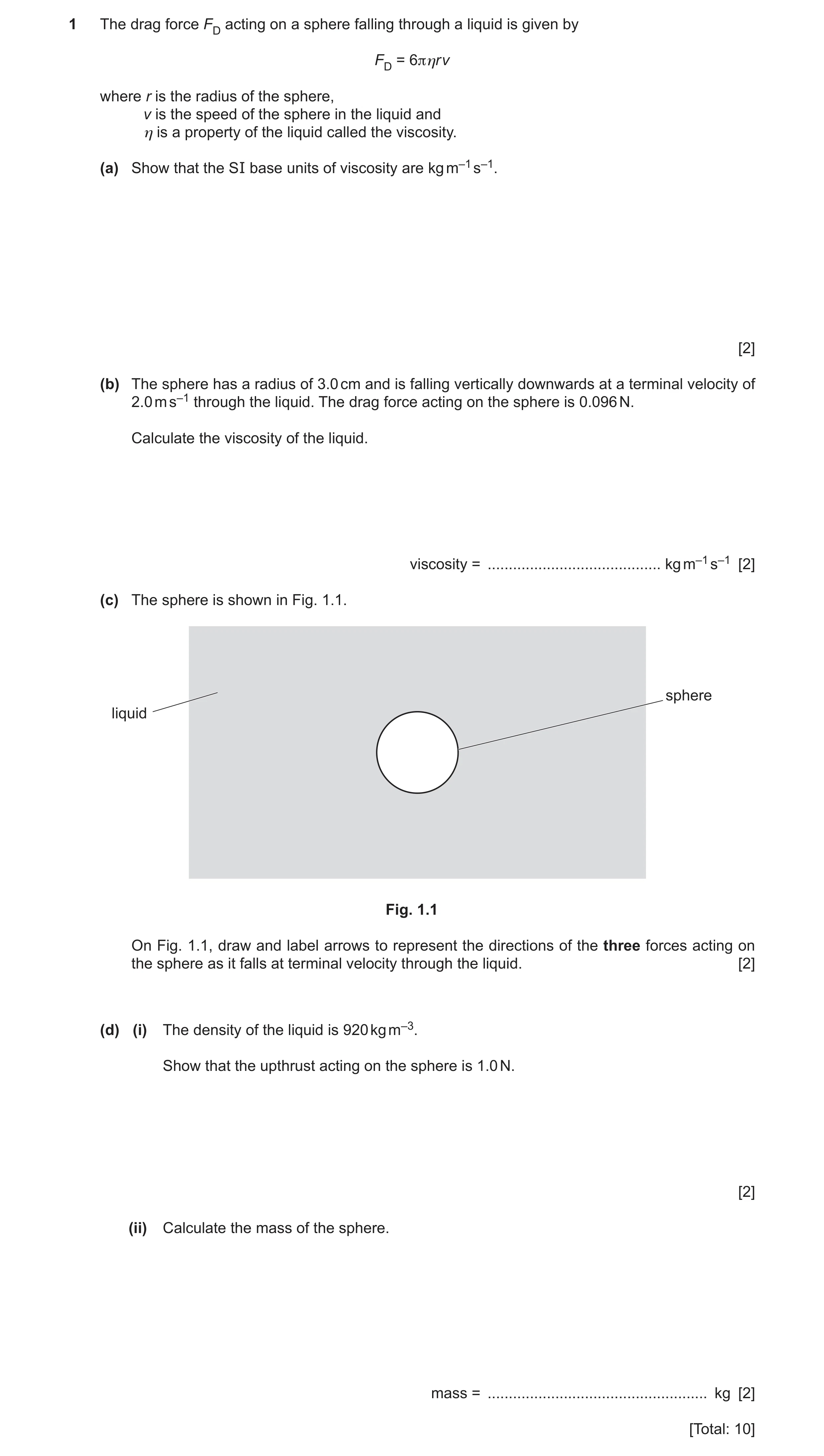
1 The drag force FD acting on a sphere falling through a liquid is given by FD = 6πηr v where r is the radius of the sphere, v is the speed of the sphere in the liquid and η is a property of the liquid called the viscosity. (a) Show that the SI base units of viscosity are kg m–1 s–1. [2] (b) The sphere has a radius of 3.0 cm and is falling vertically downwards at a terminal velocity of 2.0 m s–1 through the liquid. The drag force acting on the sphere is 0.096 N. Calculate the viscosity of the liquid. viscosity = … kg m–1 s–1 [2] (c) The sphere is shown in Fig. 1.1. sphere liquid Fig. 1.1 On Fig. 1.1, draw and label arrows to represent the directions of the three forces acting on the sphere as it falls at terminal velocity through the liquid. [2] (d) (i) The density of the liquid is 920 kg m–3. Show that the upthrust acting on the sphere is 1.0 N. [2] (ii) Calculate the mass of the sphere. mass = … kg [2] [Total: 10]
10 marks
Mark scheme: 1(a) units of F: kg m s–2 C1 units of r: m and units of v: m s–1 units of : kg m s–2 / (m m s–1) = kg m–1 s–1 A1 1(b) viscosity = 0.096 / (6 0.03 2.0) C1 = 0.085 kg m–1 s–1 A1 1(c) one arrow vertically downwards labelled weight / W B1 arrow(s) vertically upwards labelled U / upthrust and drag / FD/viscous force B1 1(d)(i) V = (4 / 3) r3 C1 upthrust = (4 / 3) 0.033 920 9.81 = 1.0 N A1 1(d)(ii) weight = 1.0 + 0.096 (= 1.096 N) C1 m = 1.096 / 9.81 = 0.11 kg A1
This question in 9702/23 May/June 2024
Q16 · Scientists are investigating the variation in air pressure at different locations on a… 9702/22 Oct/Nov 2025
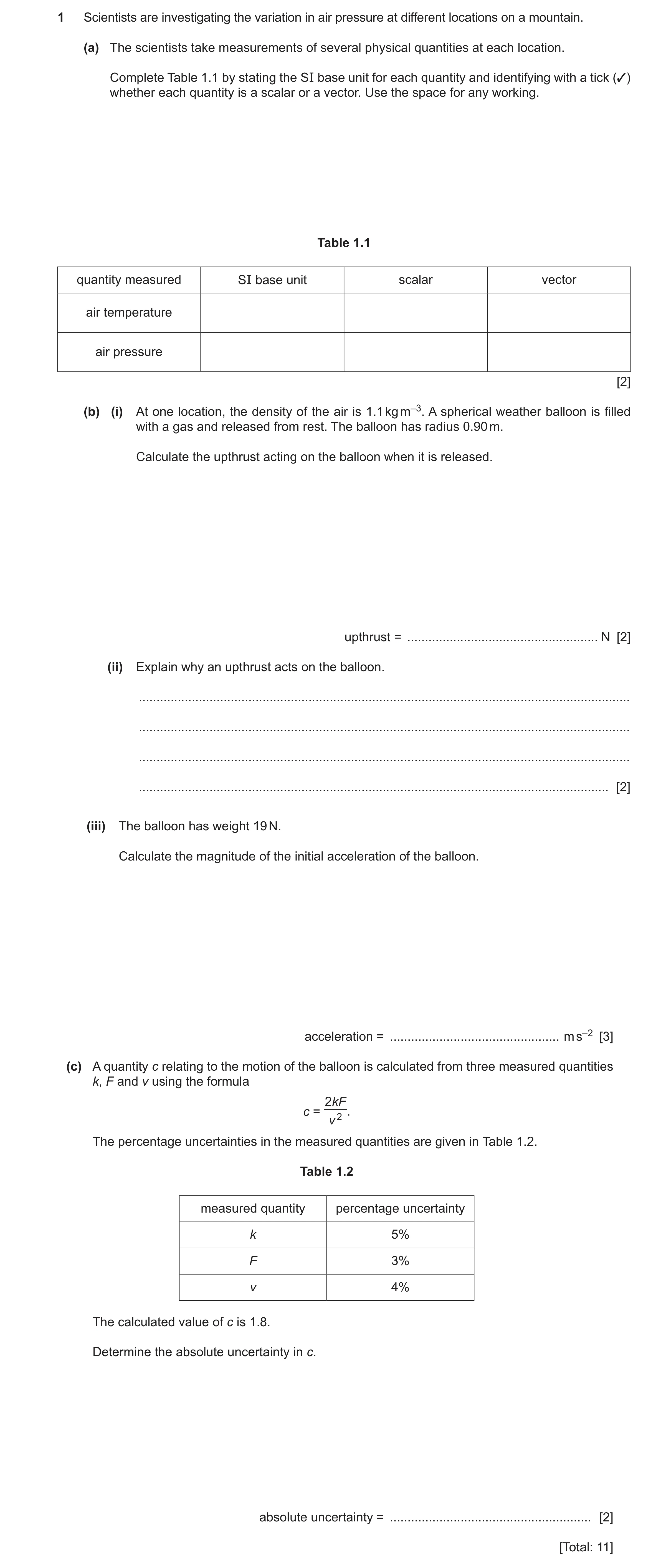
1 Scientists are investigating the variation in air pressure at different locations on a mountain. (a) The scientists take measurements of several physical quantities at each location. Complete Table 1.1 by stating the SI base unit for each quantity and identifying with a tick (3) whether each quantity is a scalar or a vector. Use the space for any working. Table 1.1 quantity measured SI base unit scalar vector air temperature air pressure [2] (b) (i) At one location, the density of the air is 1.1 kg m–3. A spherical weather balloon is filled with a gas and released from rest. The balloon has radius 0.90 m. Calculate the upthrust acting on the balloon when it is released. upthrust = … N [2] (ii) Explain why an upthrust acts on the balloon. … … … … [2] (iii) The balloon has weight 19 N. Calculate the magnitude of the initial acceleration of the balloon. acceleration = … m s–2 [3] (c) A quantity c relating to the motion of the balloon is calculated from three measured quantities k, F and v using the formula 2kF c = . v 2 The percentage uncertainties in the measured quantities are given in Table 1.2. Table 1.2 measured quantity percentage uncertainty k 5% F 3% v 4% The calculated value of c is 1.8. Determine the absolute uncertainty in c. absolute uncertainty = … [2] [Total: 11]
11 marks
Mark scheme: Question Answer Marks 1(a) air temperature: K and air pressure: kg m–1 s–2 B1 scalar only ticked for both air temperature and air pressure B1 1(b)(i) upthrust = 1.1 9.81 (4 0.903 / 3) C1 = 33 N A1 1(b)(ii) (due to difference in height / depth there is a) difference in pressure between top and bottom (of balloon) B1 (due to pressure difference, upwards) B1 force on bottom of balloon is greater (than downwards force on top of balloon, so resultant force is upwards) 1(b)(iii) ()F = 33 – 19 C1 (= 14 N) m = 19 / 9.81 C1 ( = 1.94 kg) a = (33 – 19) / (19 / 9.81) A1 = 7.2 m s–2 1(c) 5 + 3 + (2 4) C1 (= 16%) absolute uncertainty in c = 1.8 0.16 A1 = (±) 0.3
This question in 9702/22 Oct/Nov 2025
Question 17 9702/23 Oct/Nov 2025
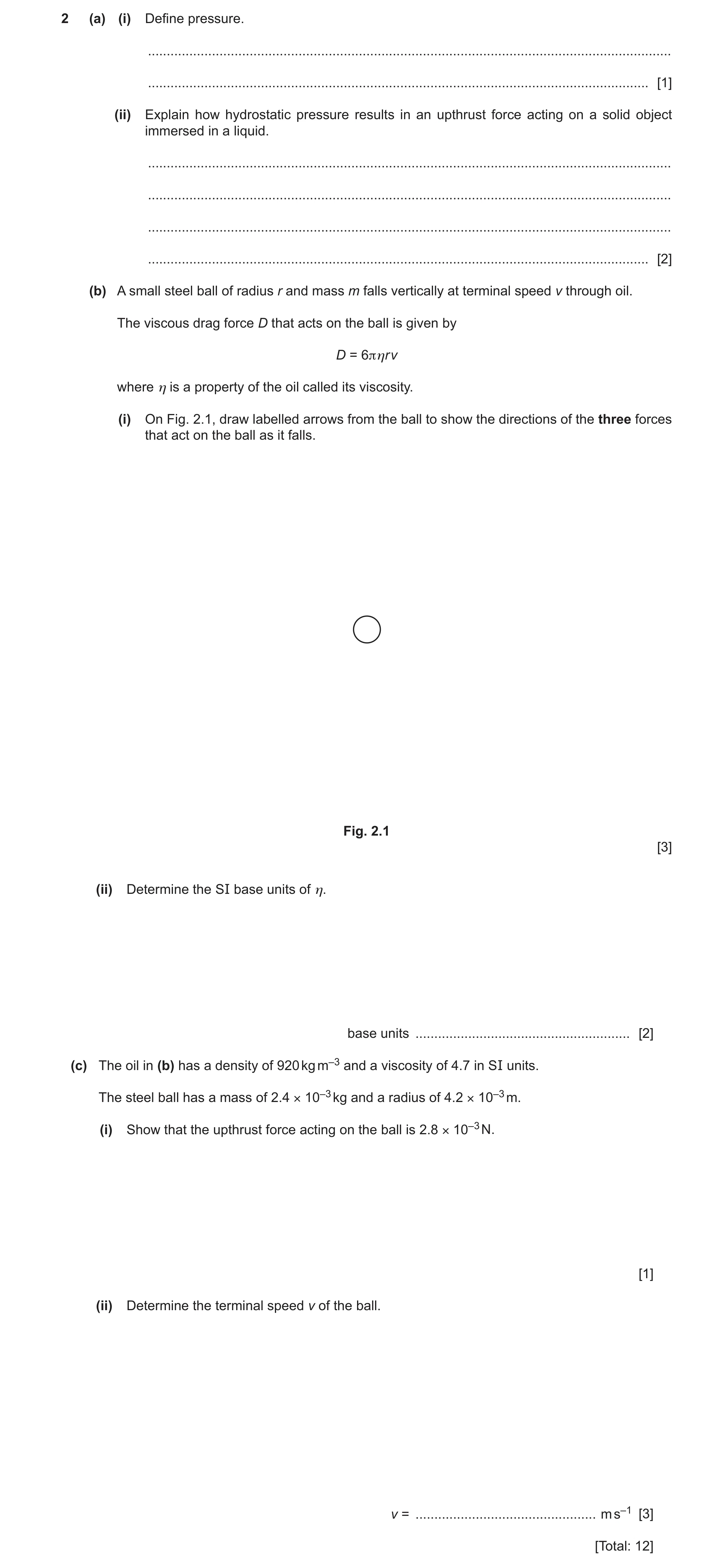
2 (a) (i) Define pressure. … … [1] (ii) Explain how hydrostatic pressure results in an upthrust force acting on a solid object immersed in a liquid. … … … … [2] (b) A small steel ball of radius r and mass m falls vertically at terminal speed v through oil. The viscous drag force D that acts on the ball is given by D = 6πη r v where η is a property of the oil called its viscosity. (i) On Fig. 2.1, draw labelled arrows from the ball to show the directions of the three forces that act on the ball as it falls. Fig. 2.1 [3] (ii) Determine the SI base units of η. base units … [2] (c) The oil in (b) has a density of 920 kg m–3 and a viscosity of 4.7 in SI units. The steel ball has a mass of 2.4 × 10⁻³ kg and a radius of 4.2 × 10⁻³ m. (i) Show that the upthrust force acting on the ball is 2.8 × 10⁻³ N. [1] (ii) Determine the terminal speed v of the ball. v = … m s–1 [3] [Total: 12]
12 marks
Mark scheme: 2(a)(i) (normal) force per (unit cross-sectional) area B1 2(a)(ii) (due to difference in depth there is a) difference in pressure between top and bottom (of ball) B1 (due to pressure difference, upwards) B1 force on bottom of ball is greater (than downwards force on top of ball, so resultant force is upwards) 2(b)(i) arrow vertically downwards labelled ‘weight’ B1 arrow vertically upwards labelled ‘upthrust’ B1 arrow vertically upwards labelled ‘(viscous) drag’ B1 2(b)(ii) SI base units of D: kg m s–2 C1 base units of : kg m s–2 / (m m s–1) A1 = kg m–1 s–1 2(c)(i) upthrust = 920 (4 / 3) (4.2 10–3)3 9.81 = 2.8 10–3 (N) A1 2(c)(ii) weight = drag + upthrust C1 (2.4 10–3 9.81) = (2.8 10–3) + (6 4.7 4.2 10–3 v) C1 v = 0.056 m s–1 A1
This question in 9702/23 Oct/Nov 2025
Q18 · A square metal sheet of non-uniform density, with a thin wooden rod fixed at its centre 9702/24 Oct/Nov 2025
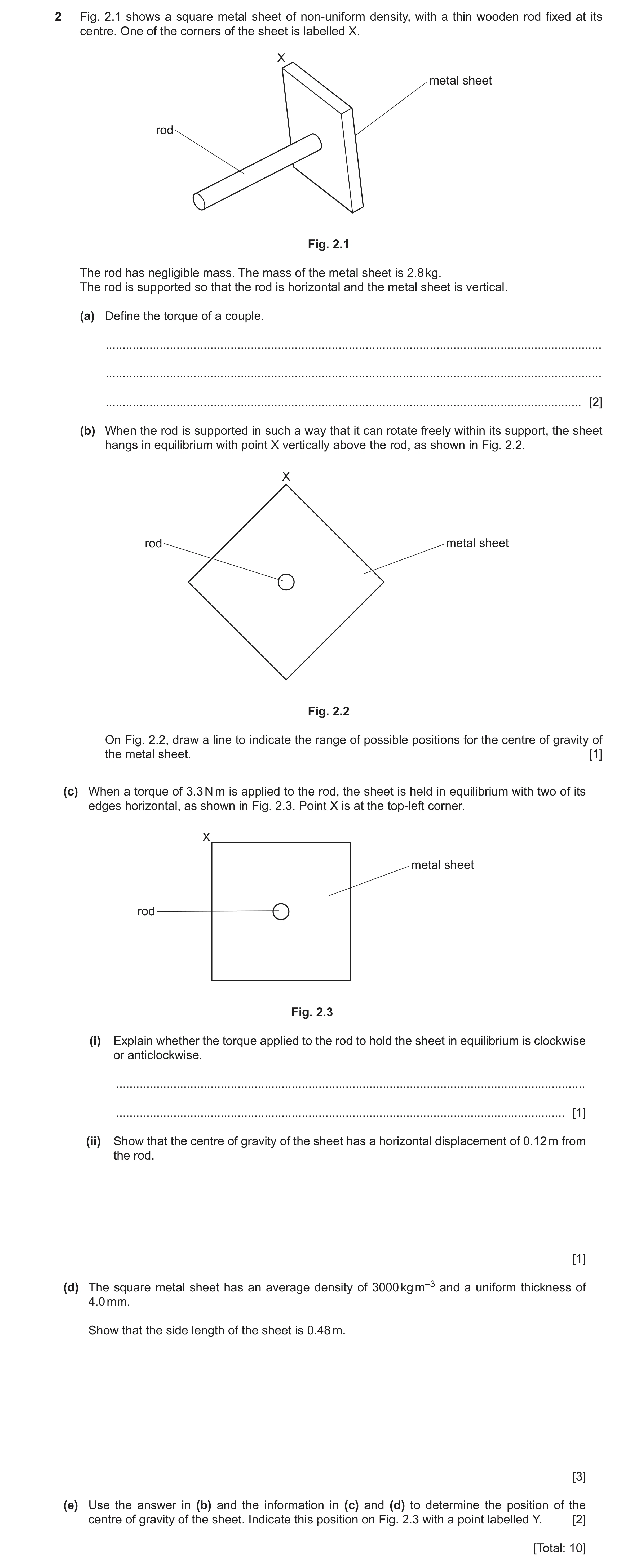
2 Fig. 2.1 shows a square metal sheet of non-uniform density, with a thin wooden rod fixed at its centre. One of the corners of the sheet is labelled X. X metal sheet rod Fig. 2.1 The rod has negligible mass. The mass of the metal sheet is 2.8 kg. The rod is supported so that the rod is horizontal and the metal sheet is vertical. (a) Define the torque of a couple. … … … [2] (b) When the rod is supported in such a way that it can rotate freely within its support, the sheet hangs in equilibrium with point X vertically above the rod, as shown in Fig. 2.2. X rod metal sheet Fig. 2.2 On Fig. 2.2, draw a line to indicate the range of possible positions for the centre of gravity of the metal sheet. [1] (c) When a torque of 3.3 N m is applied to the rod, the sheet is held in equilibrium with two of its edges horizontal, as shown in Fig. 2.3. Point X is at the top-left corner. X metal sheet rod Fig. 2.3 (i) Explain whether the torque applied to the rod to hold the sheet in equilibrium is clockwise or anticlockwise. … … [1] (ii) Show that the centre of gravity of the sheet has a horizontal displacement of 0.12 m from the rod. [1] (d) The square metal sheet has an average density of 3000 kg m–3 and a uniform thickness of 4.0 mm. Show that the side length of the sheet is 0.48 m. [3] (e) Use the answer in (b) and the information in (c) and (d) to determine the position of the centre of gravity of the sheet. Indicate this position on Fig. 2.3 with a point labelled Y. [2] [Total: 10]
10 marks
Mark scheme: 2(a) product of force and distance M1 perpendicular distance between the (line of action of the two) forces A1 2(b) straight vertical line drawn from centre to bottom corner B1 2(c)(i) centre of gravity is to the right of the rod so torque is anticlockwise B1 or moment of weight of sheet about rod is clockwise so torque is anticlockwise 2(c)(ii) (horizontal displacement) = 3.3 / (2.8 9.81) = 0.12 (m) A1 2(d) = m / V C1 V = 4.0 10–3 × (side length)2 C1 A1 0.48m side length = 2.8 / ( 3000 0.0040 ) = 2(e) point lies on a straight line at 45° to the horizontal from the bottom-right corner to the edge of the rod B1 point lies on a vertical line half-way between rod and right-hand edge B1
This question in 9702/24 Oct/Nov 2025
 7 / 28
 8 / 28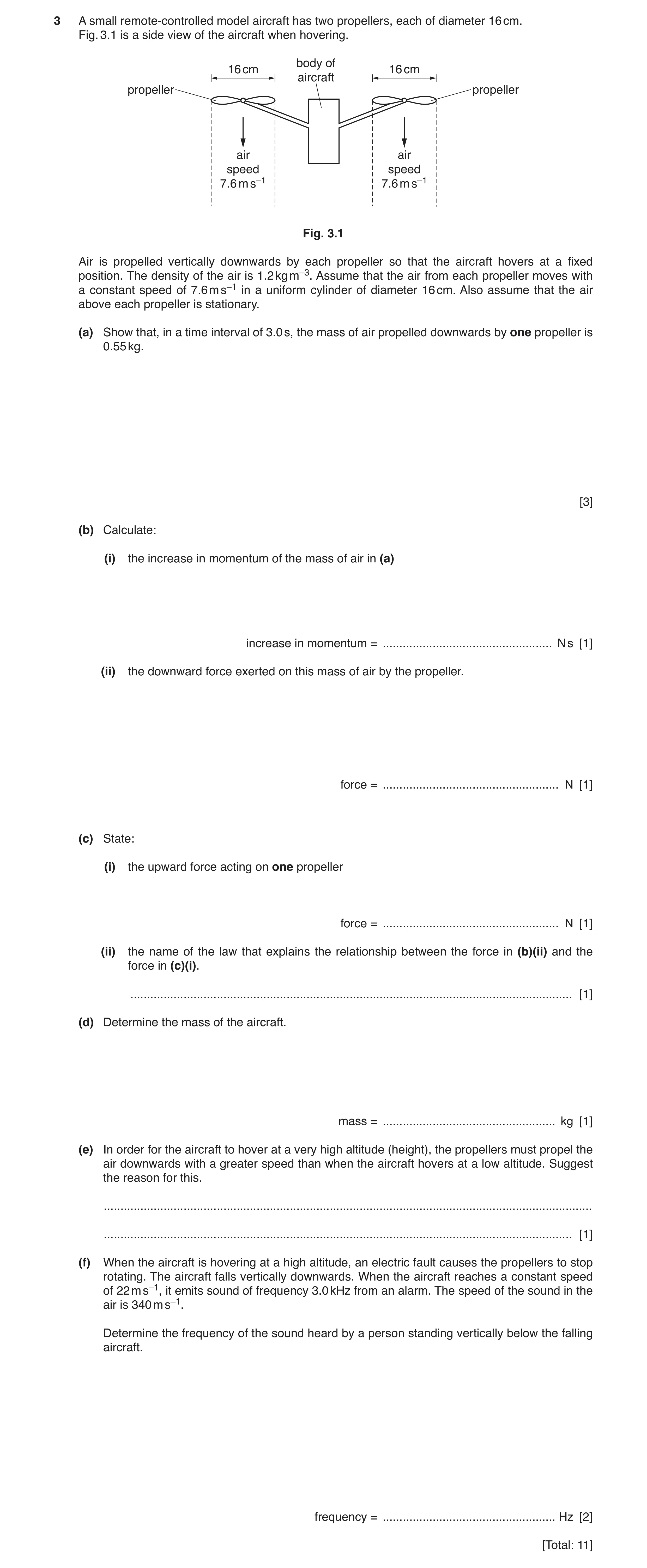
 18 / 28
 19 / 28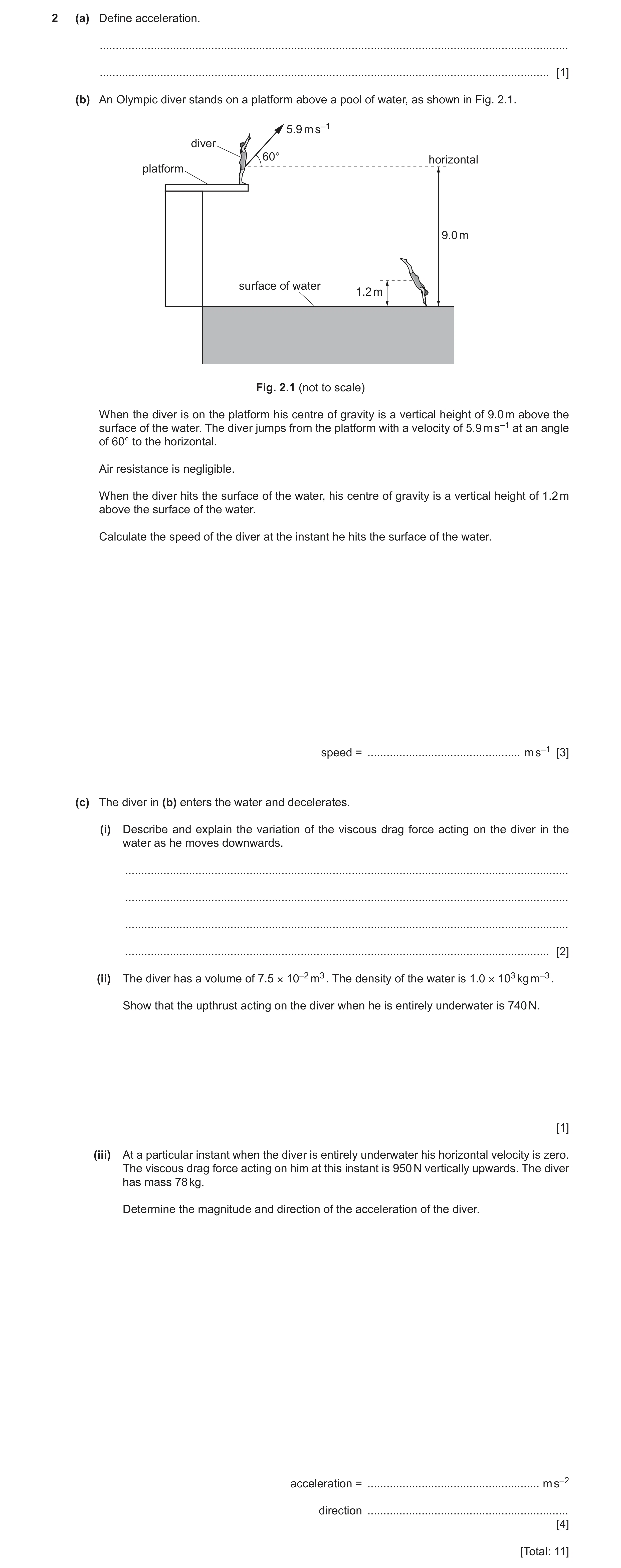
 7
7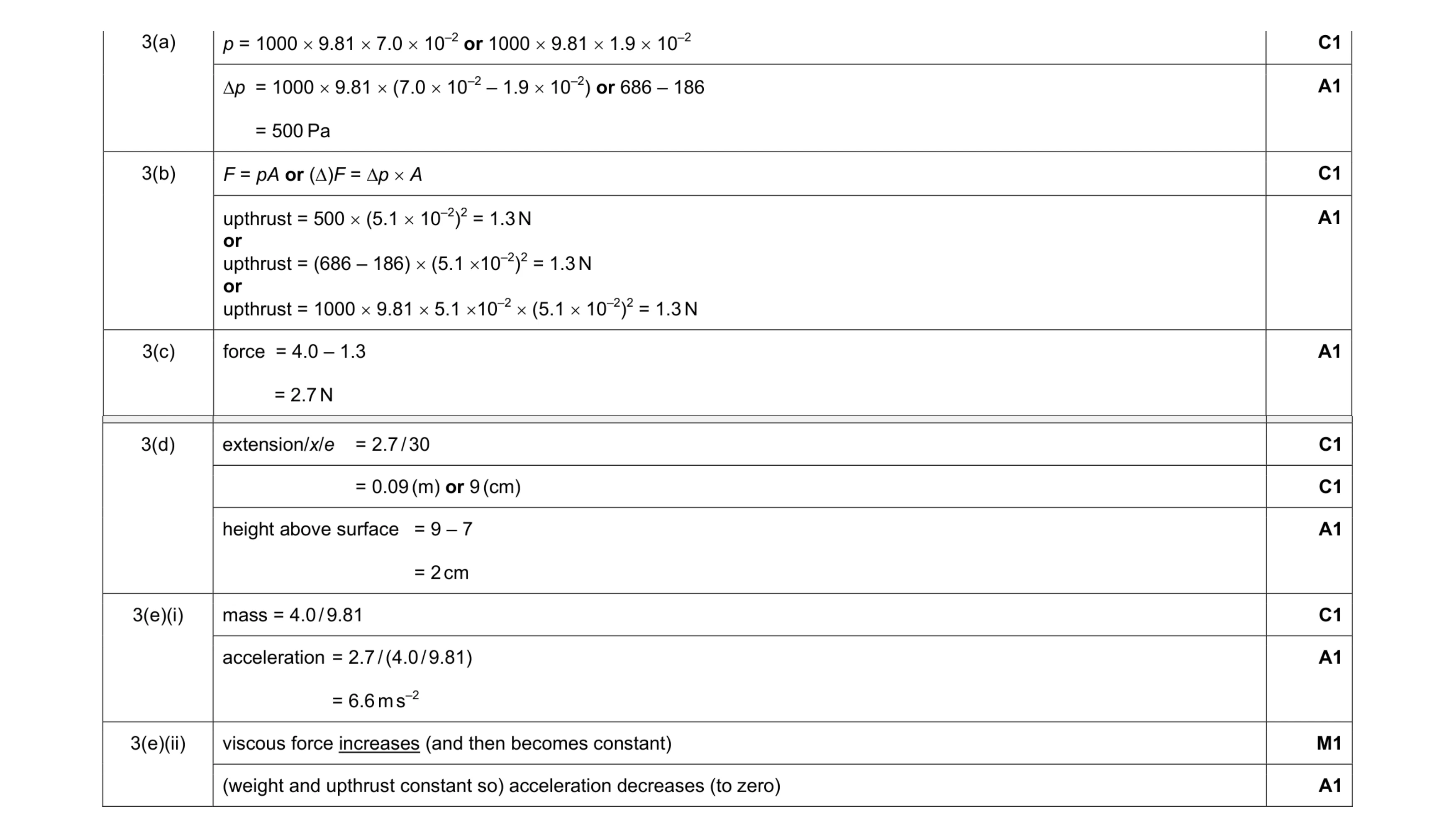 12
12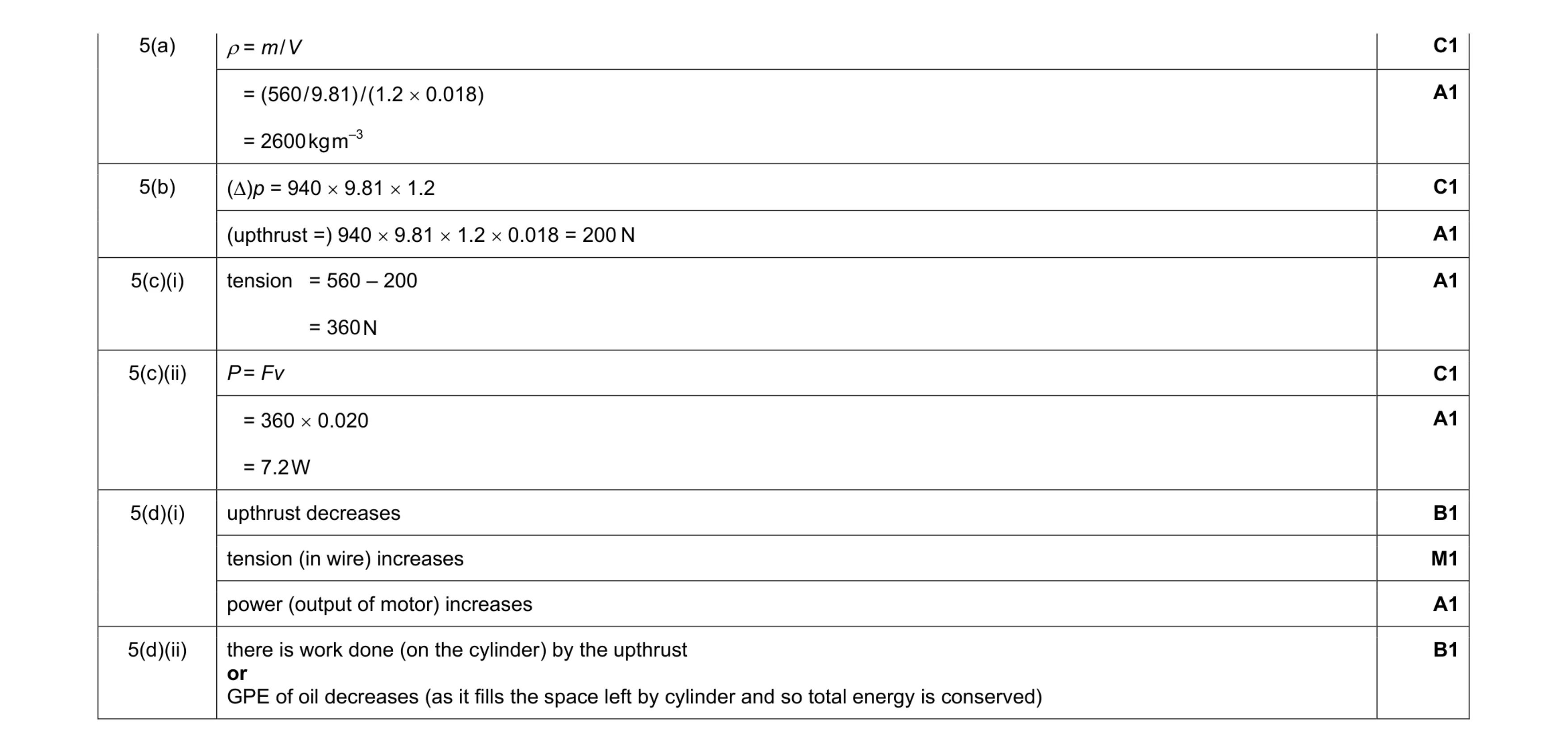 11
11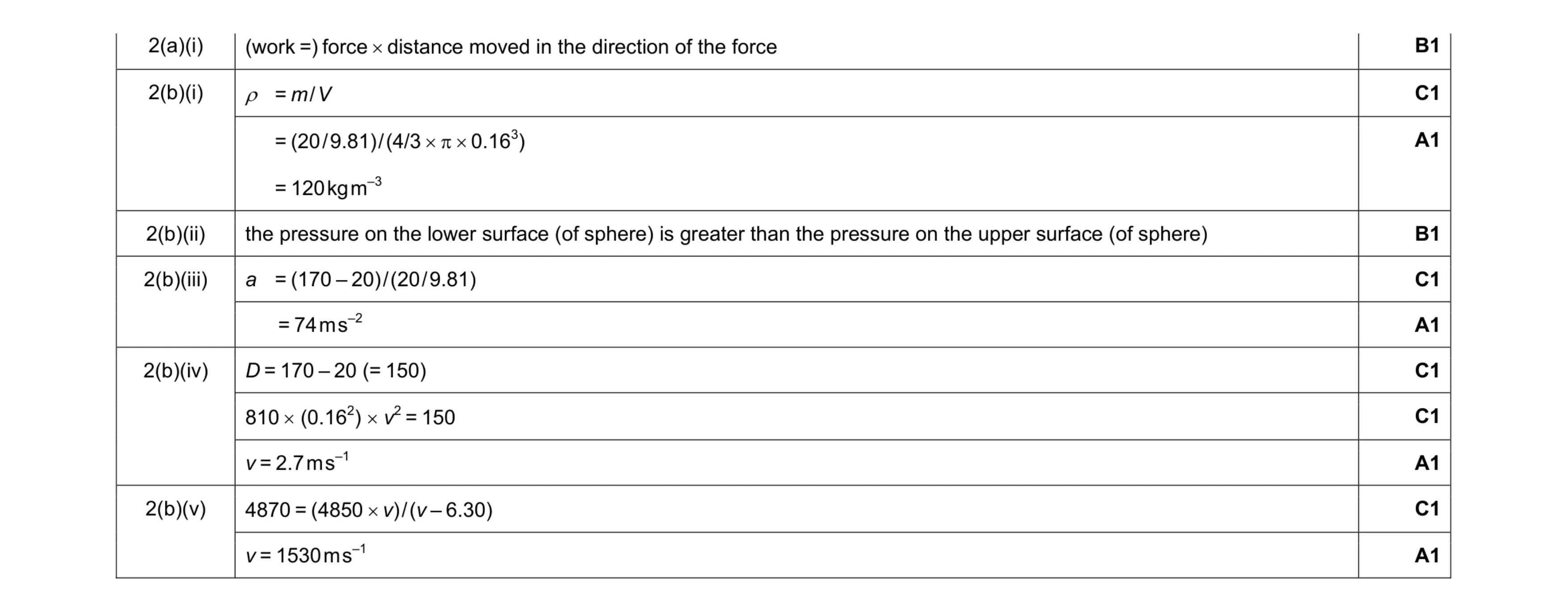 11
11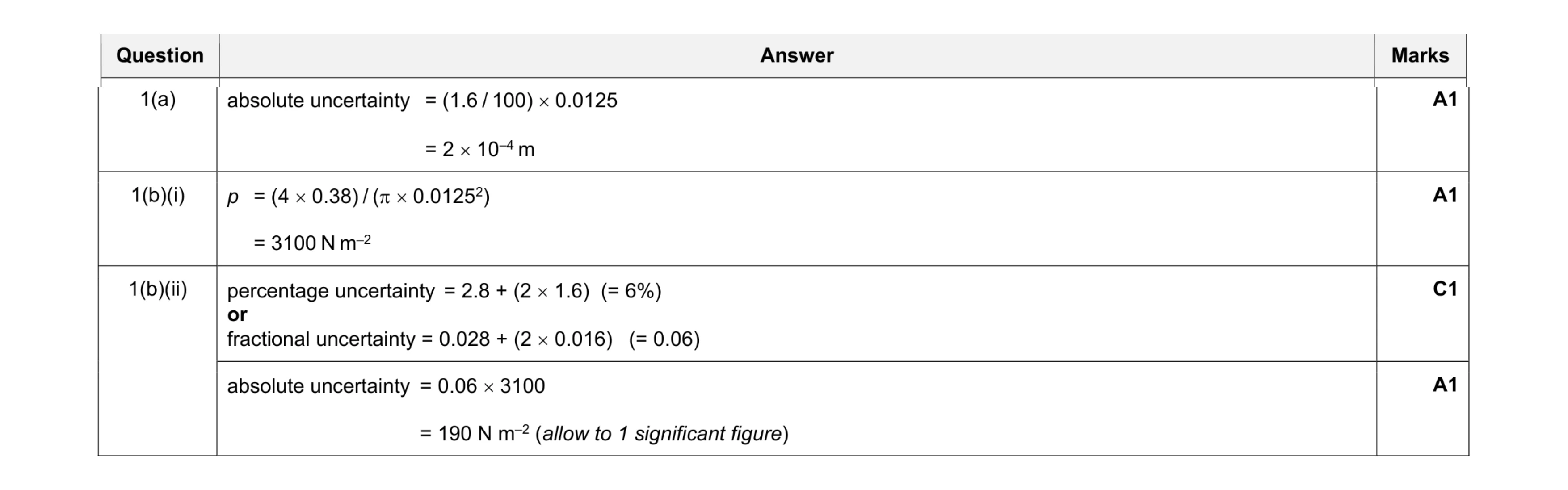 4
4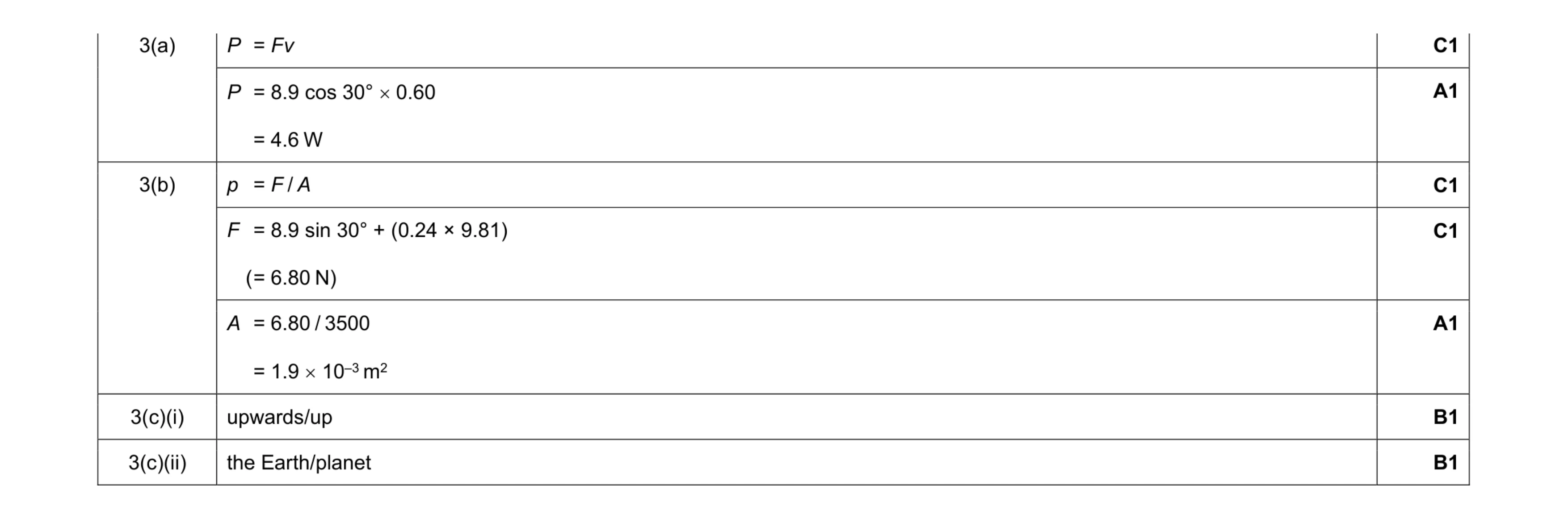 7
7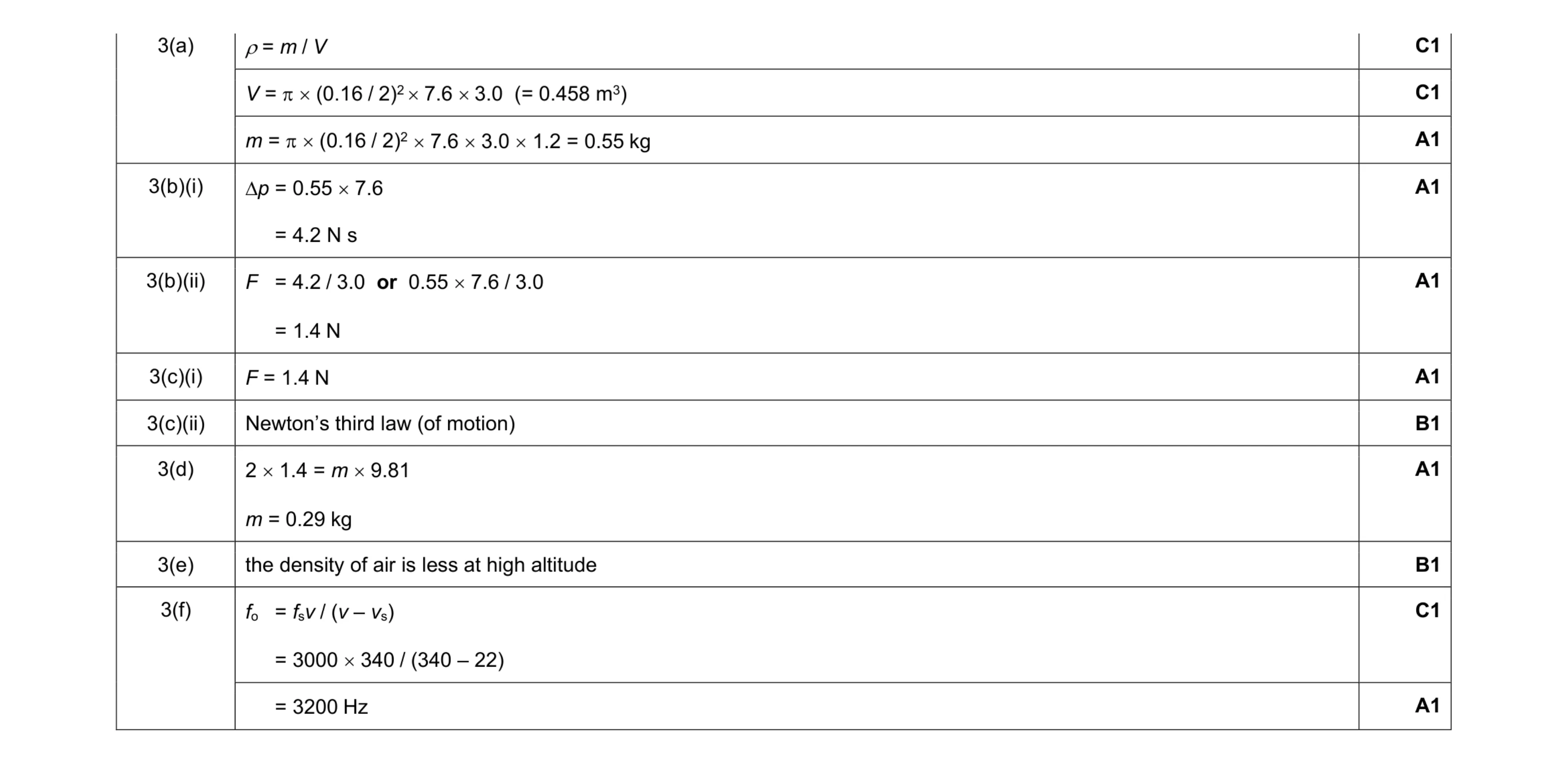 11
11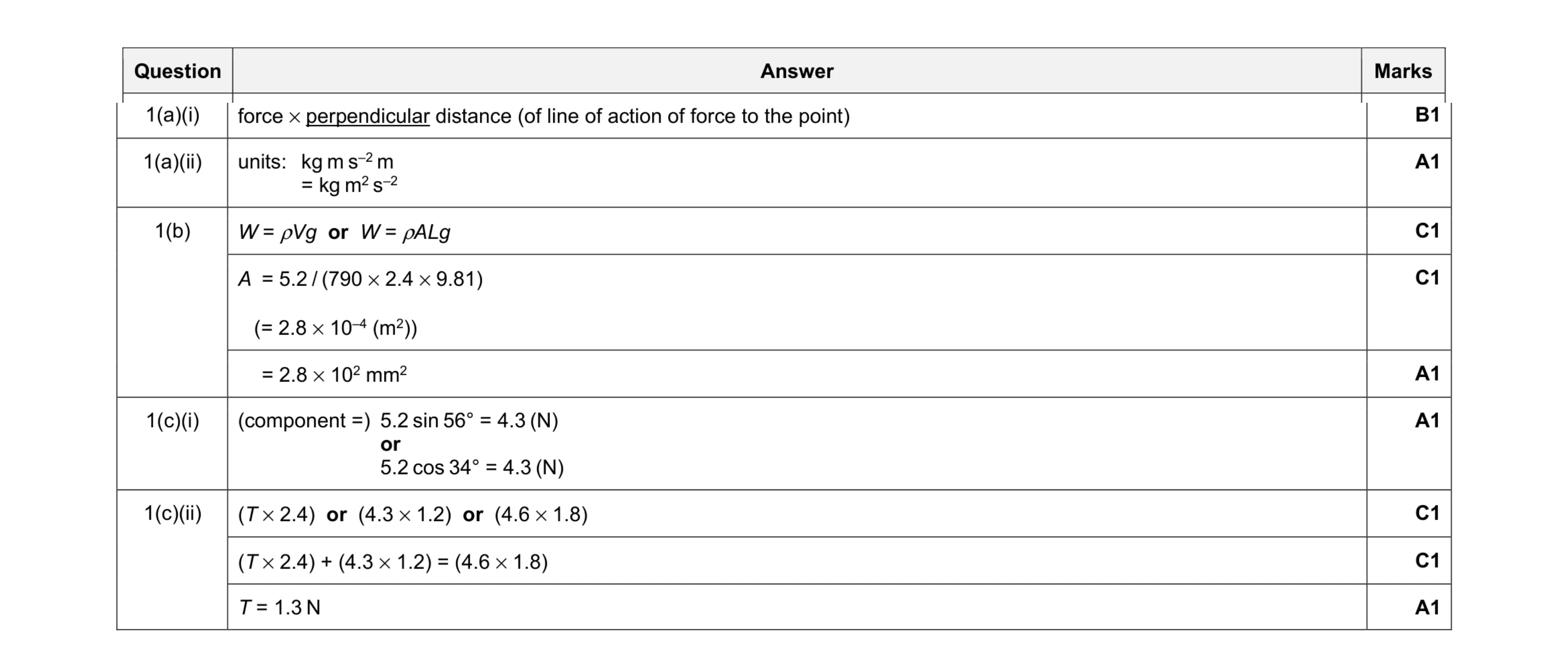 9
9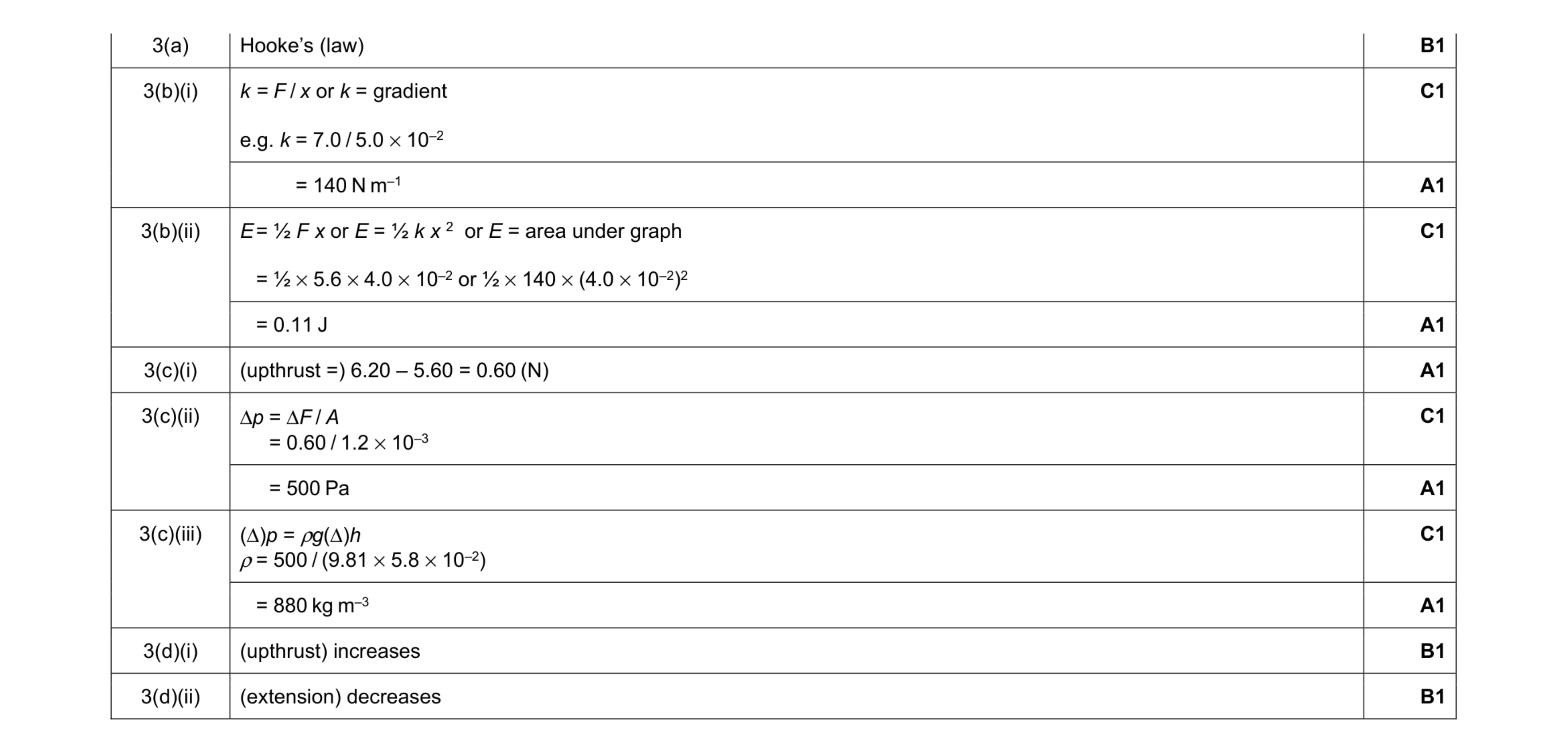 12
12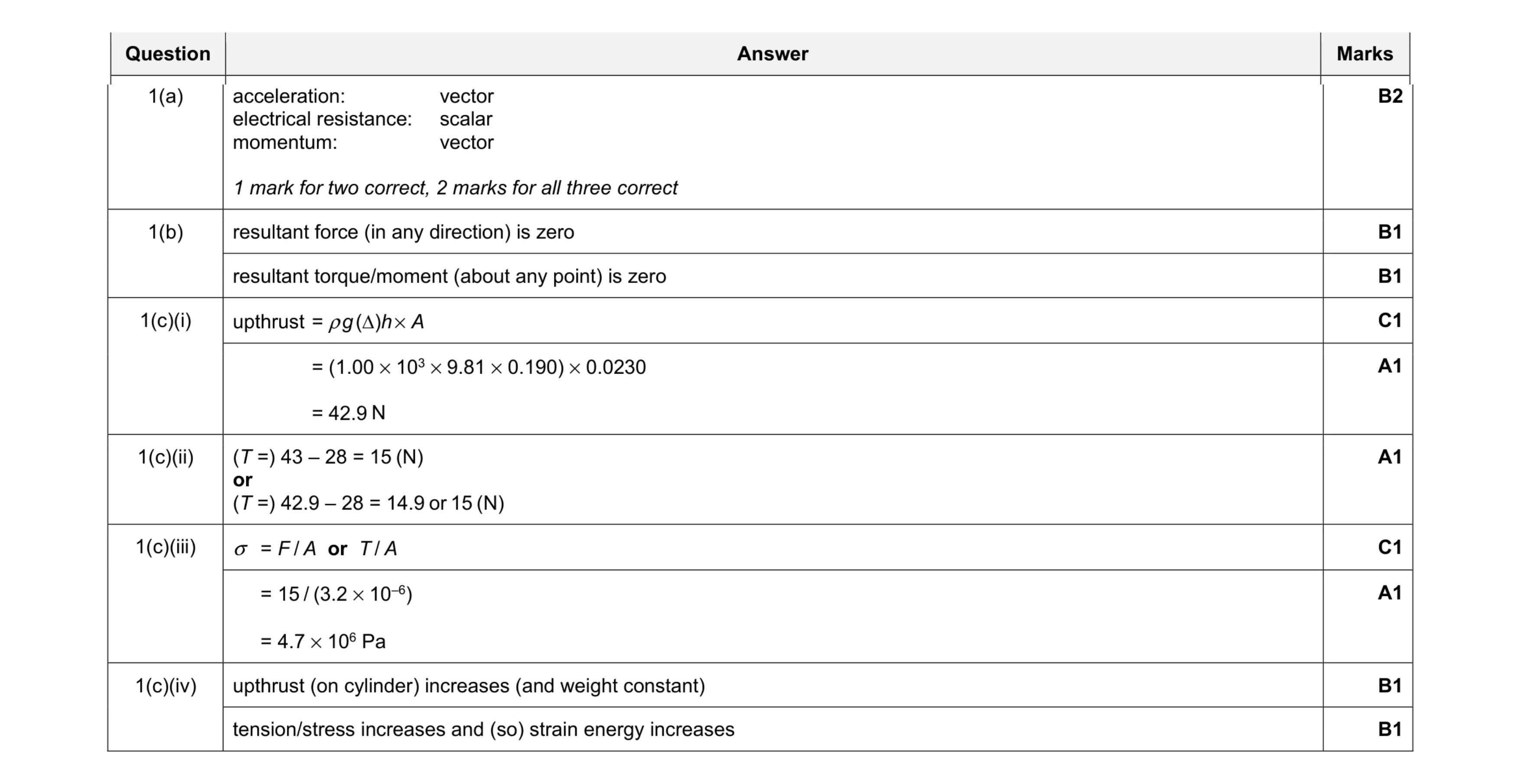 11
11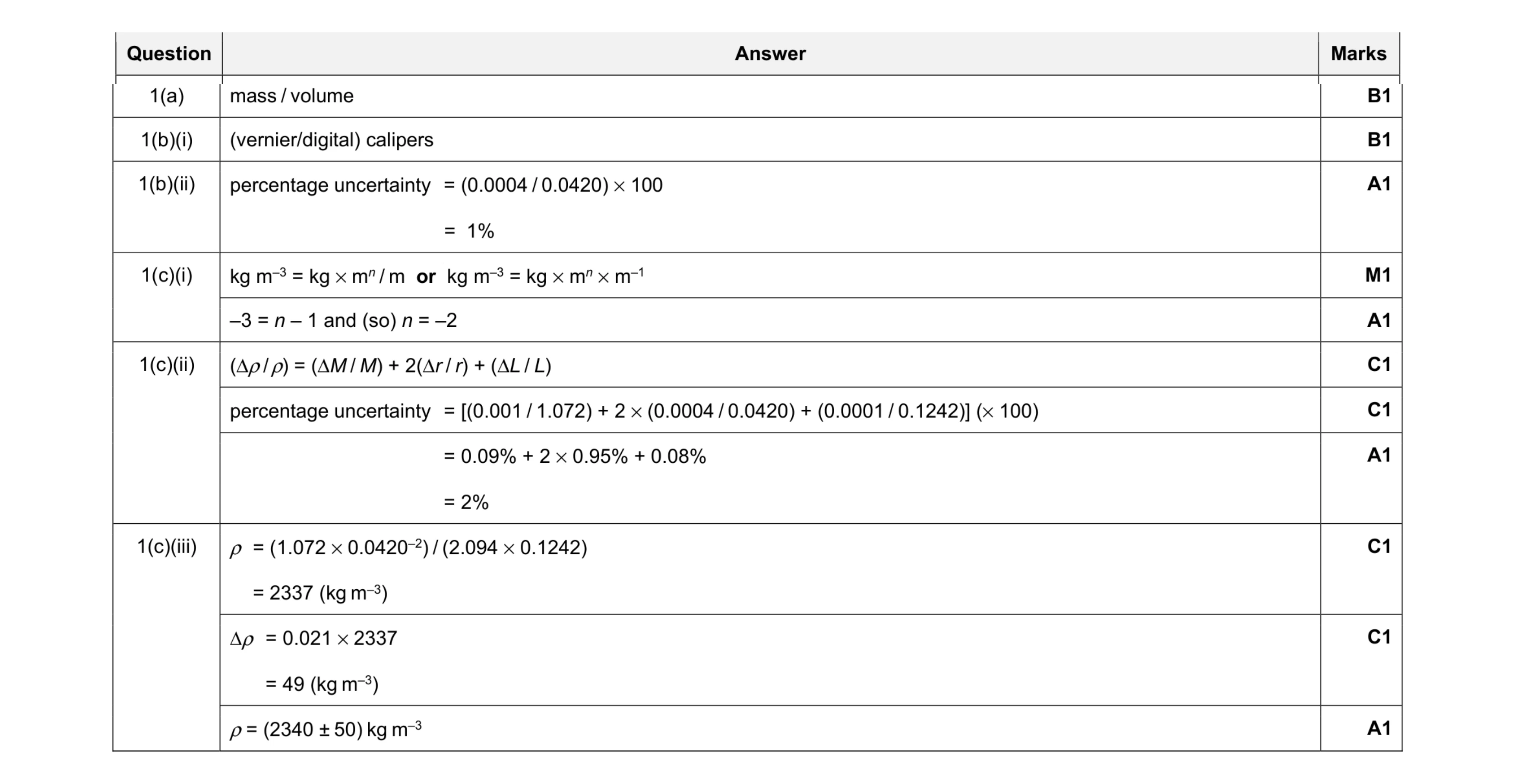 11
11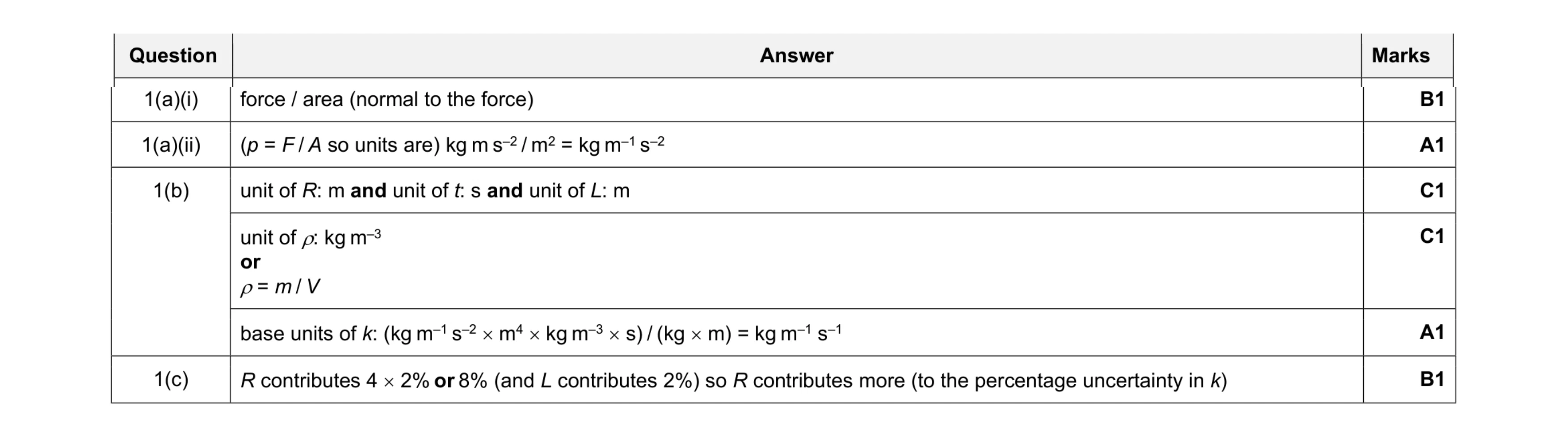 6
6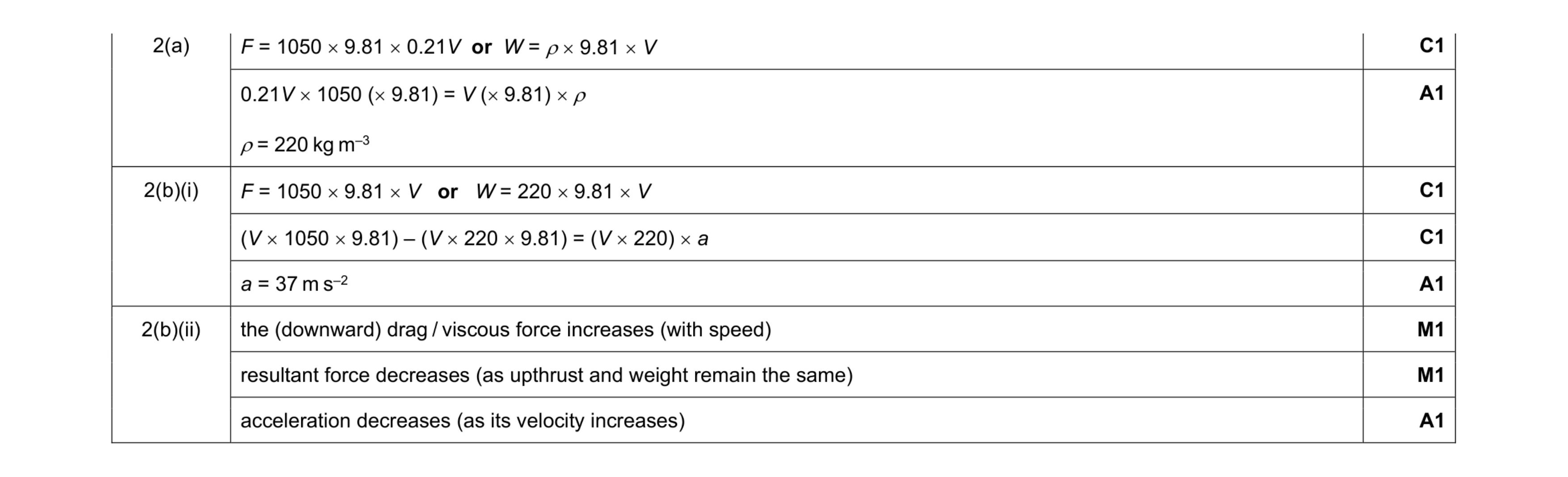 8
8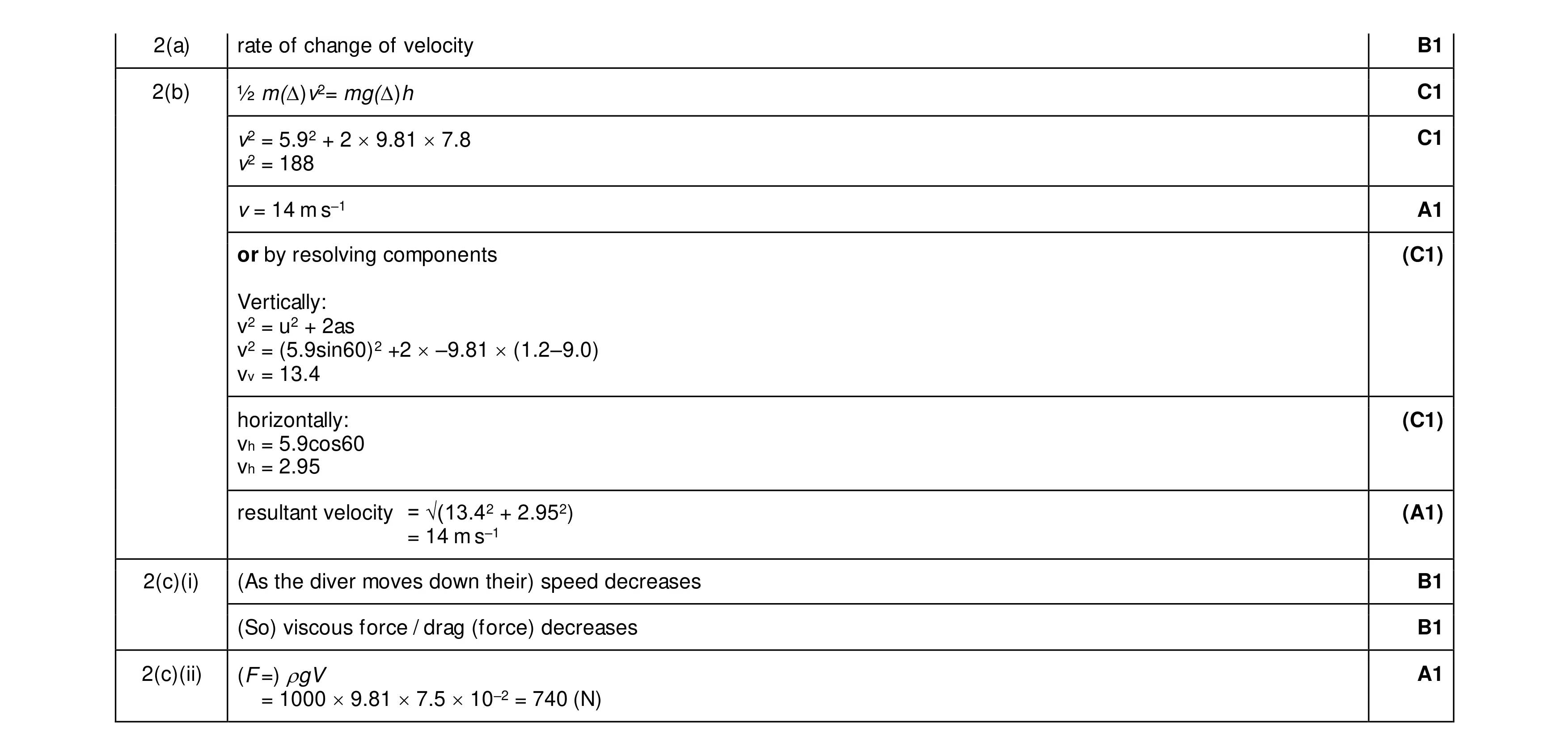 11
11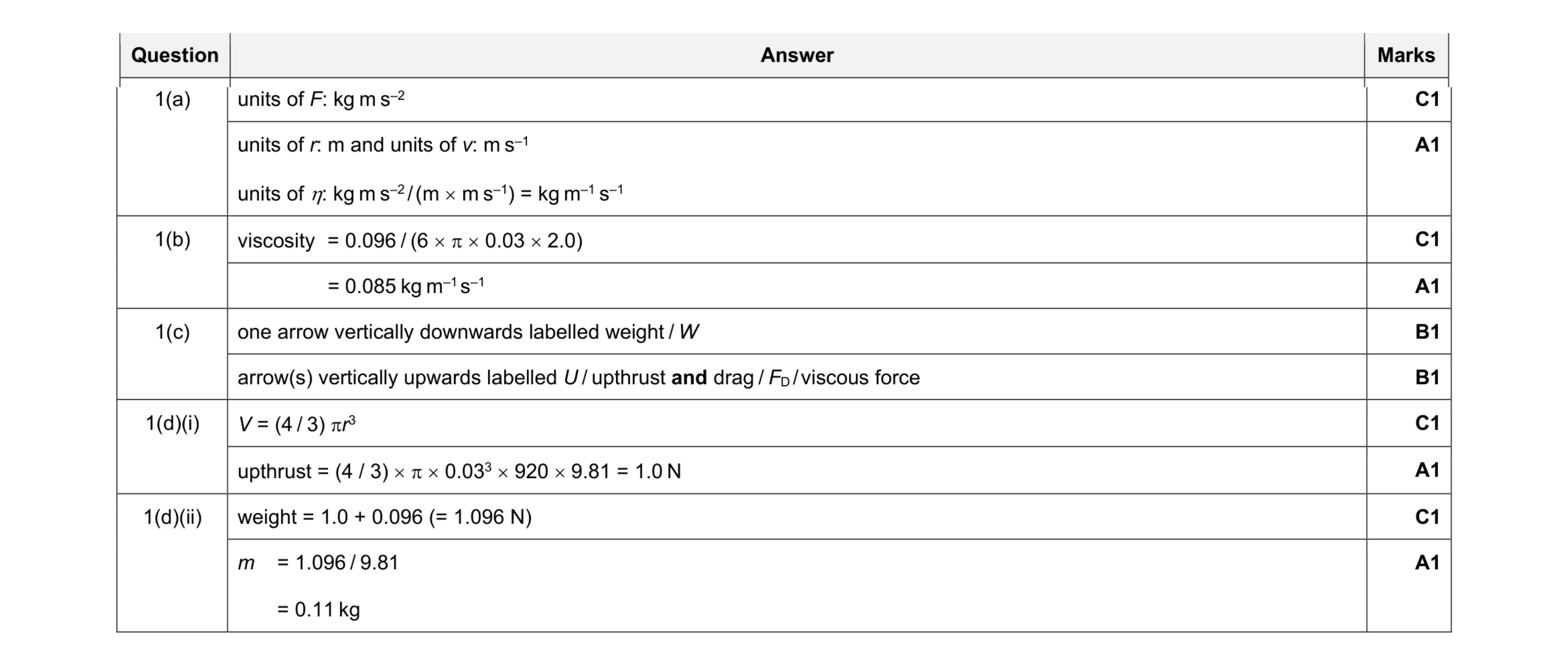 10
10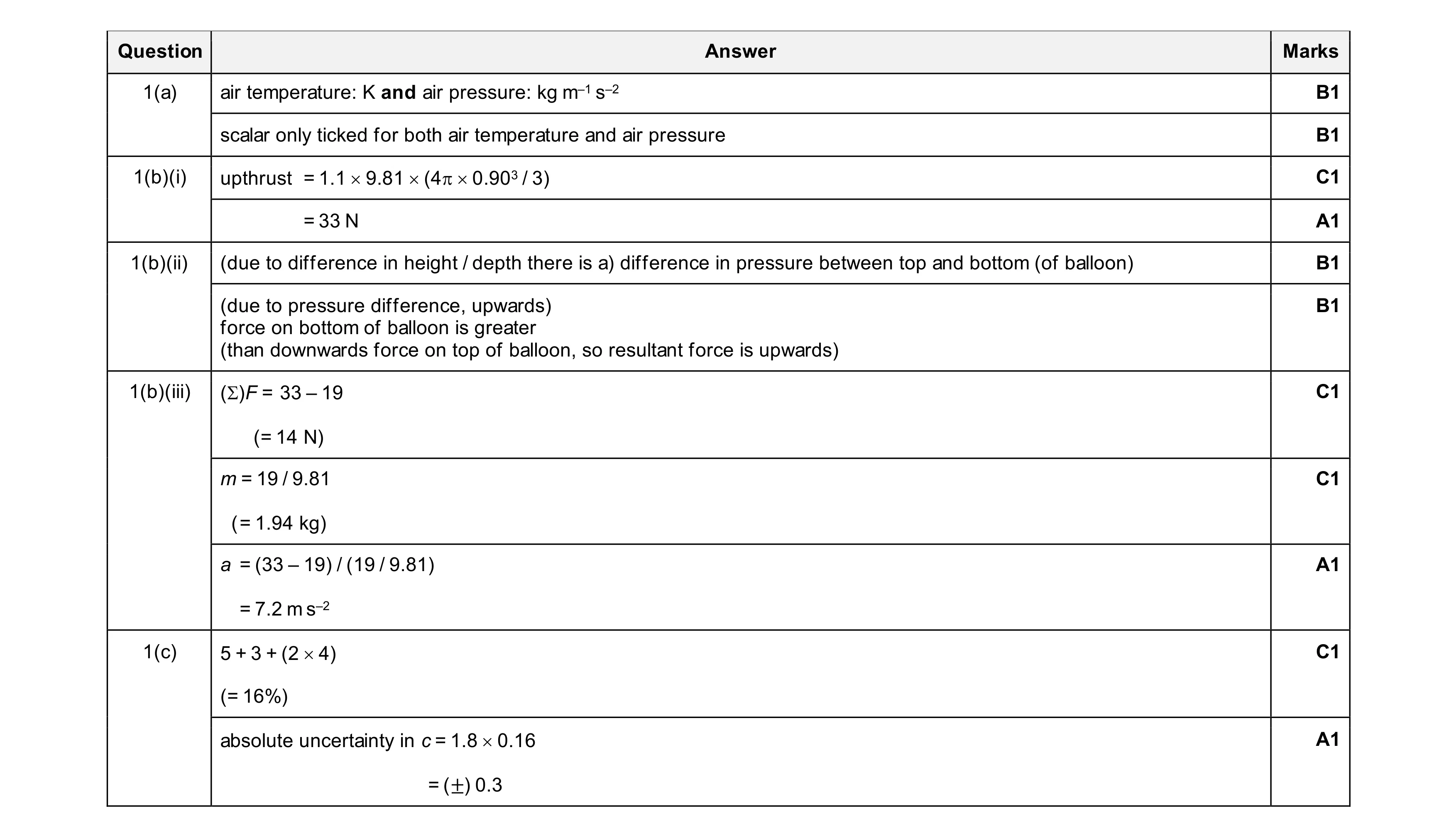 11
11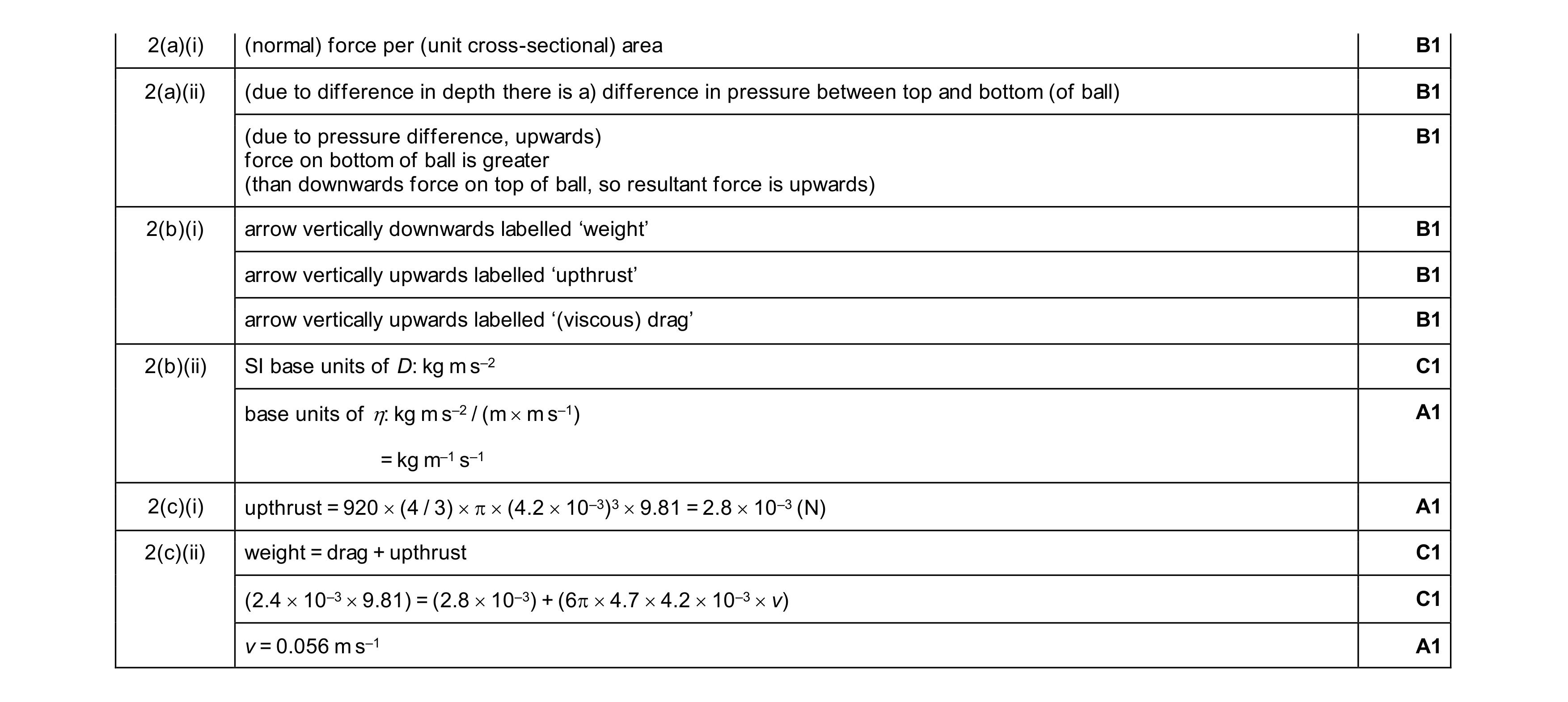 12
12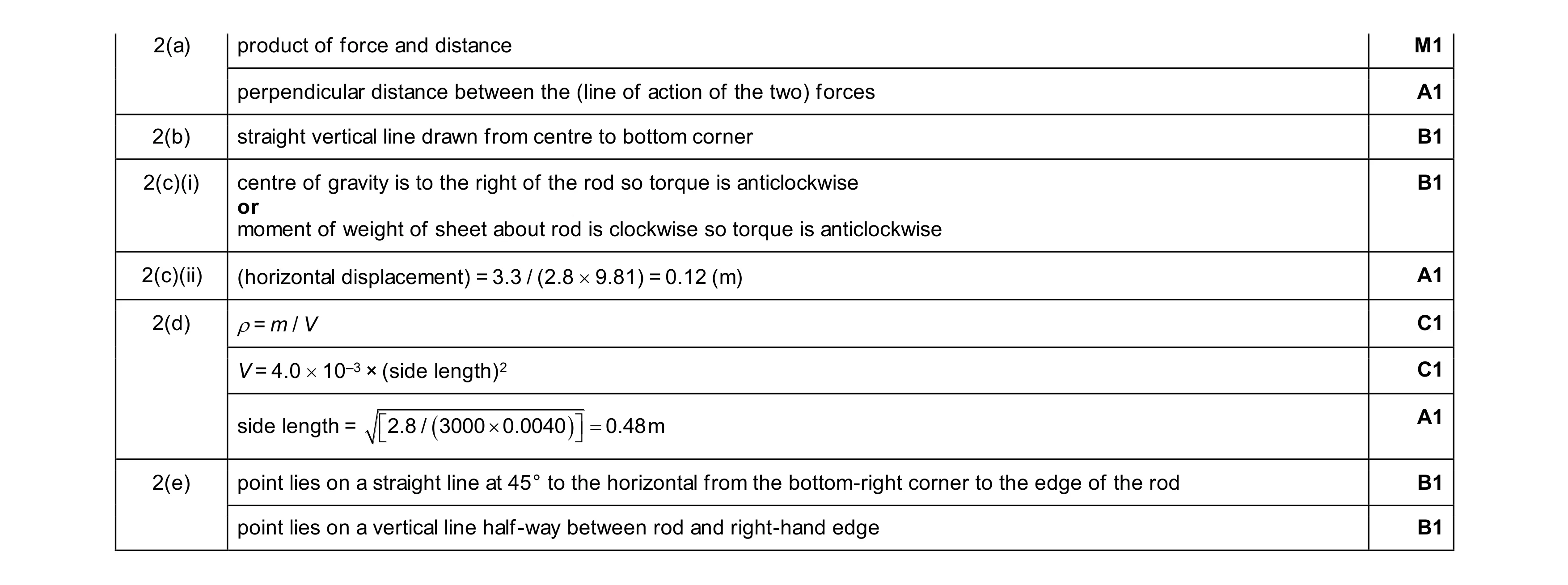 10
10