Cambridge A Level Accounting 9706 — 2023 May/June Paper 4 · Variant 2
9706/42/M/J/23 · 2 questions · 50 marks · ≈56 min
The question paper and its mark scheme, free to read here and free to download. This is Cambridge’s own paper, exactly as it was sat.
Question paper8 pages
Mark scheme15 pages
Answers below. Sit the paper first if you are practising.
Questions as text
Q1 · Read Source A in the insert
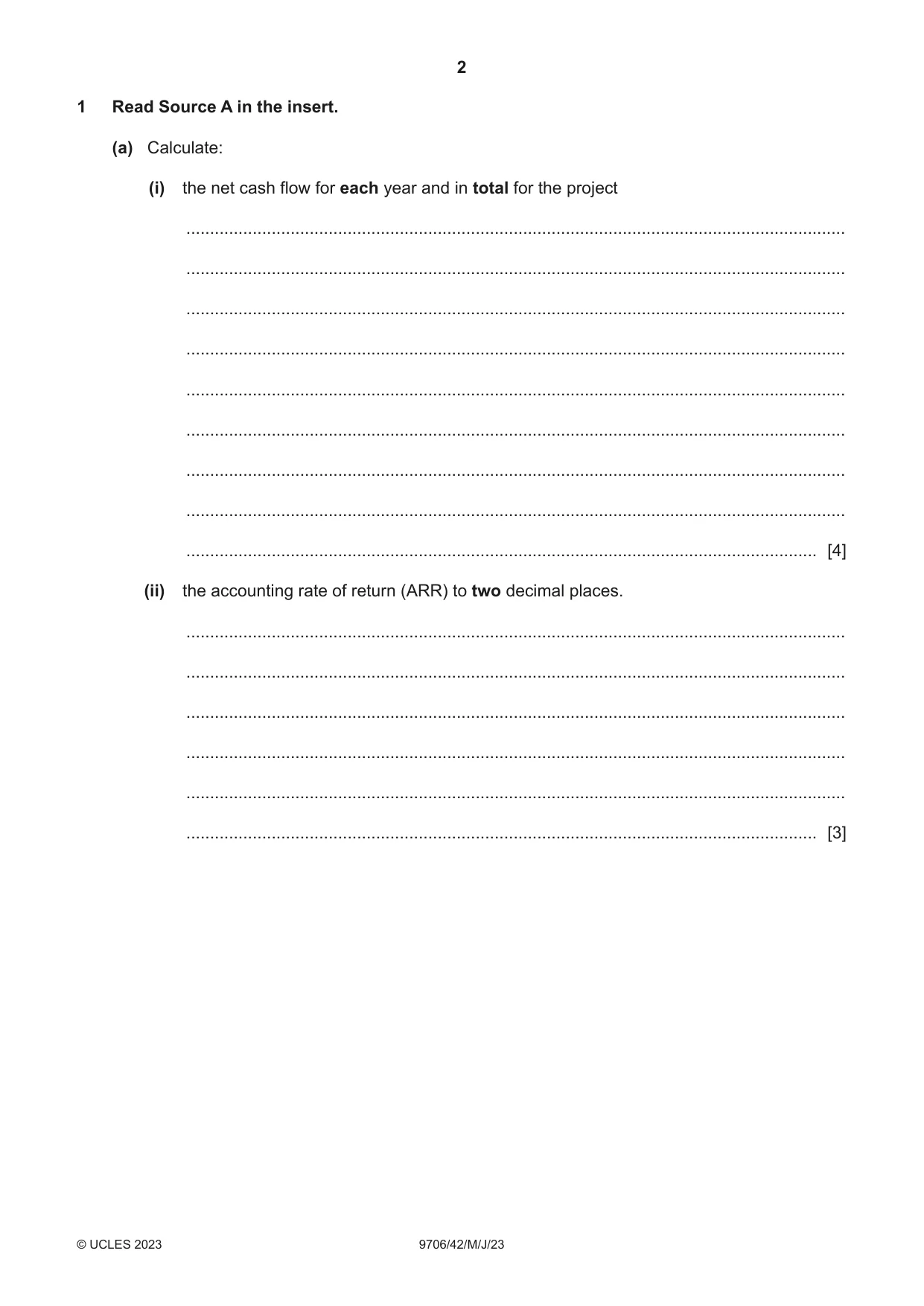
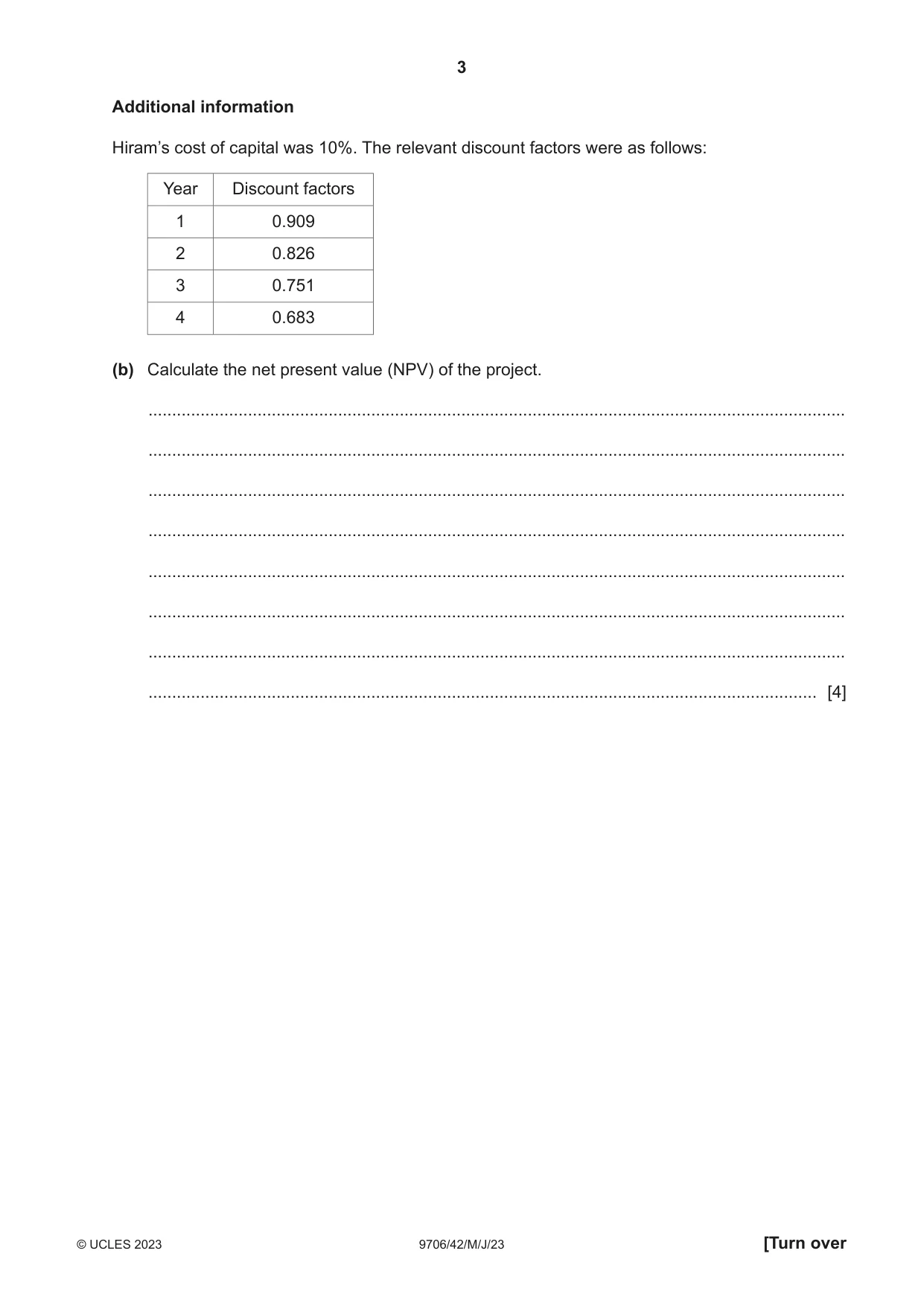
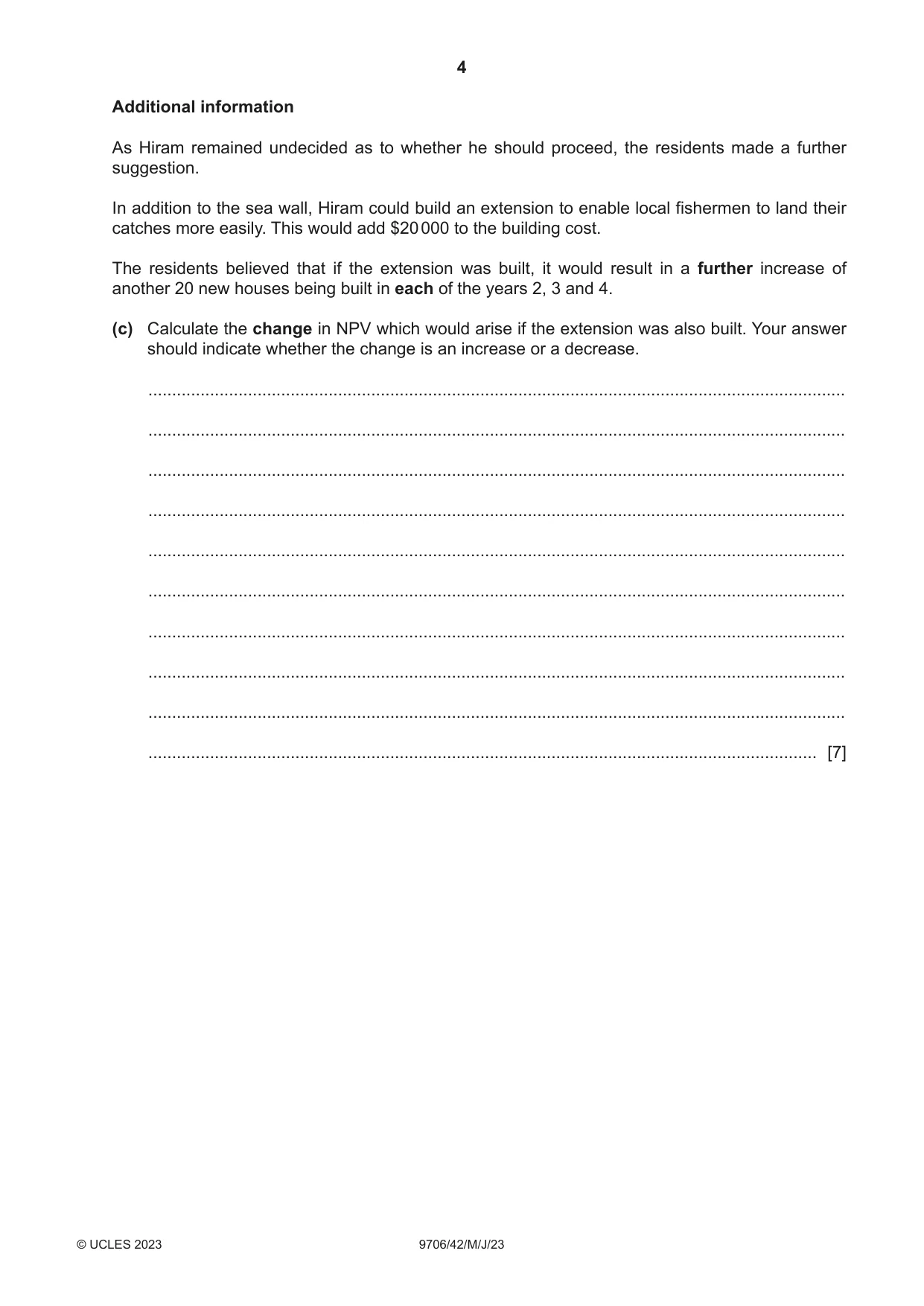
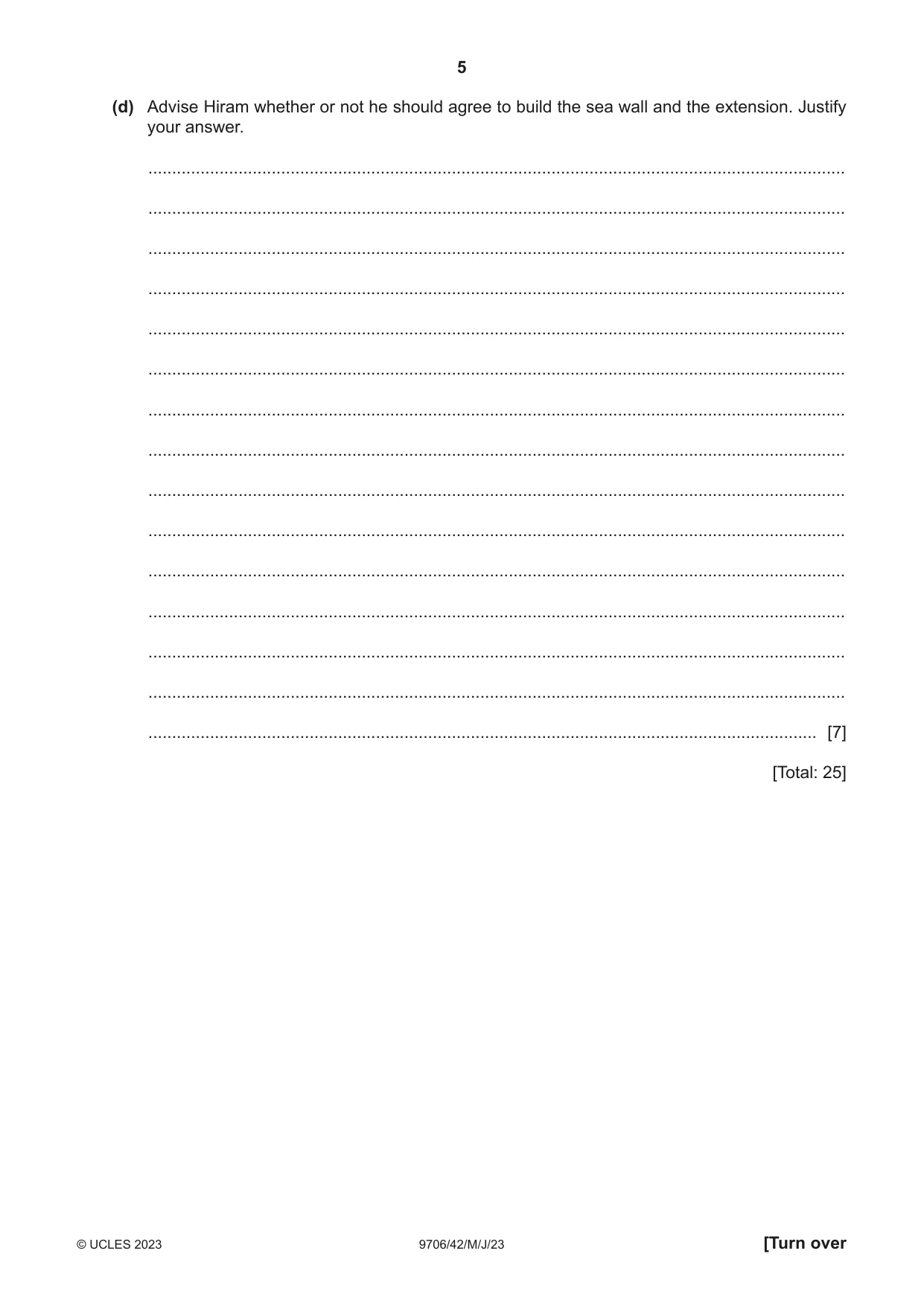
1 Read Source A in the insert. (a) Calculate: (i) the net cash flow for each year and in total for the project ........................................................................................................................................... ........................................................................................................................................... ........................................................................................................................................... ........................................................................................................................................... ........................................................................................................................................... ........................................................................................................................................... ........................................................................................................................................... ........................................................................................................................................... ..................................................................................................................................... [4] (ii) the accounting rate of return (ARR) to two decimal places. ........................................................................................................................................... ........................................................................................................................................... ........................................................................................................................................... ........................................................................................................................................... ........................................................................................................................................... ..................................................................................................................................... [3] Additional information Hiram’s cost of capital was 10%. The relevant discount factors were as follows: Year Discount factors 1 0.909 2 0.826 3 0.751 4 0.683 (b) Calculate the net present value (NPV) of the project. ................................................................................................................................................... ................................................................................................................................................... ................................................................................................................................................... ................................................................................................................................................... ................................................................................................................................................... ................................................................................................................................................... ................................................................................................................................................... ............................................................................................................................................. [4] Additional information As Hiram remained undecided as to whether he should proceed, the residents made a further suggestion. In addition to the sea wall, Hiram could build an extension to enable local fishermen to land their catches more easily. This would add $20 000 to the building cost. The residents believed that if the extension was built, it would result in a further increase of another 20 new houses being built in each of the years 2, 3 and 4. (c) Calculate the change in NPV which would arise if the extension was also built. Your answer should indicate whether the change is an increase or a decrease. ................................................................................................................................................... ................................................................................................................................................... ................................................................................................................................................... ................................................................................................................................................... ................................................................................................................................................... ................................................................................................................................................... ................................................................................................................................................... ................................................................................................................................................... ................................................................................................................................................... ............................................................................................................................................. [7] (d) Advise Hiram whether or not he should agree to build the sea wall and the extension. Justify your answer. ................................................................................................................................................... ................................................................................................................................................... ................................................................................................................................................... ................................................................................................................................................... ................................................................................................................................................... ................................................................................................................................................... ................................................................................................................................................... ................................................................................................................................................... ................................................................................................................................................... ................................................................................................................................................... ................................................................................................................................................... ................................................................................................................................................... ................................................................................................................................................... ................................................................................................................................................... ............................................................................................................................................. [7] [Total: 25]
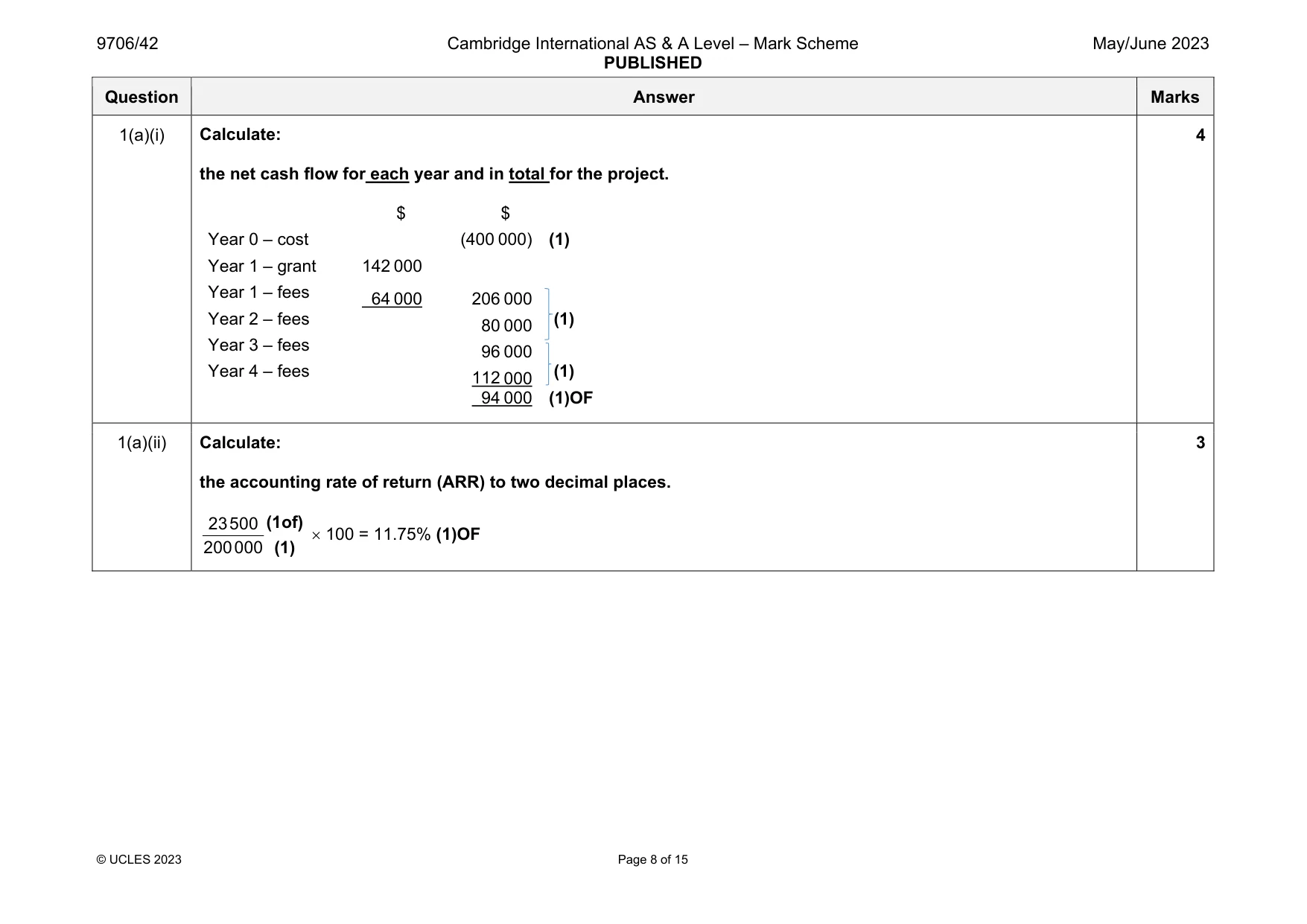
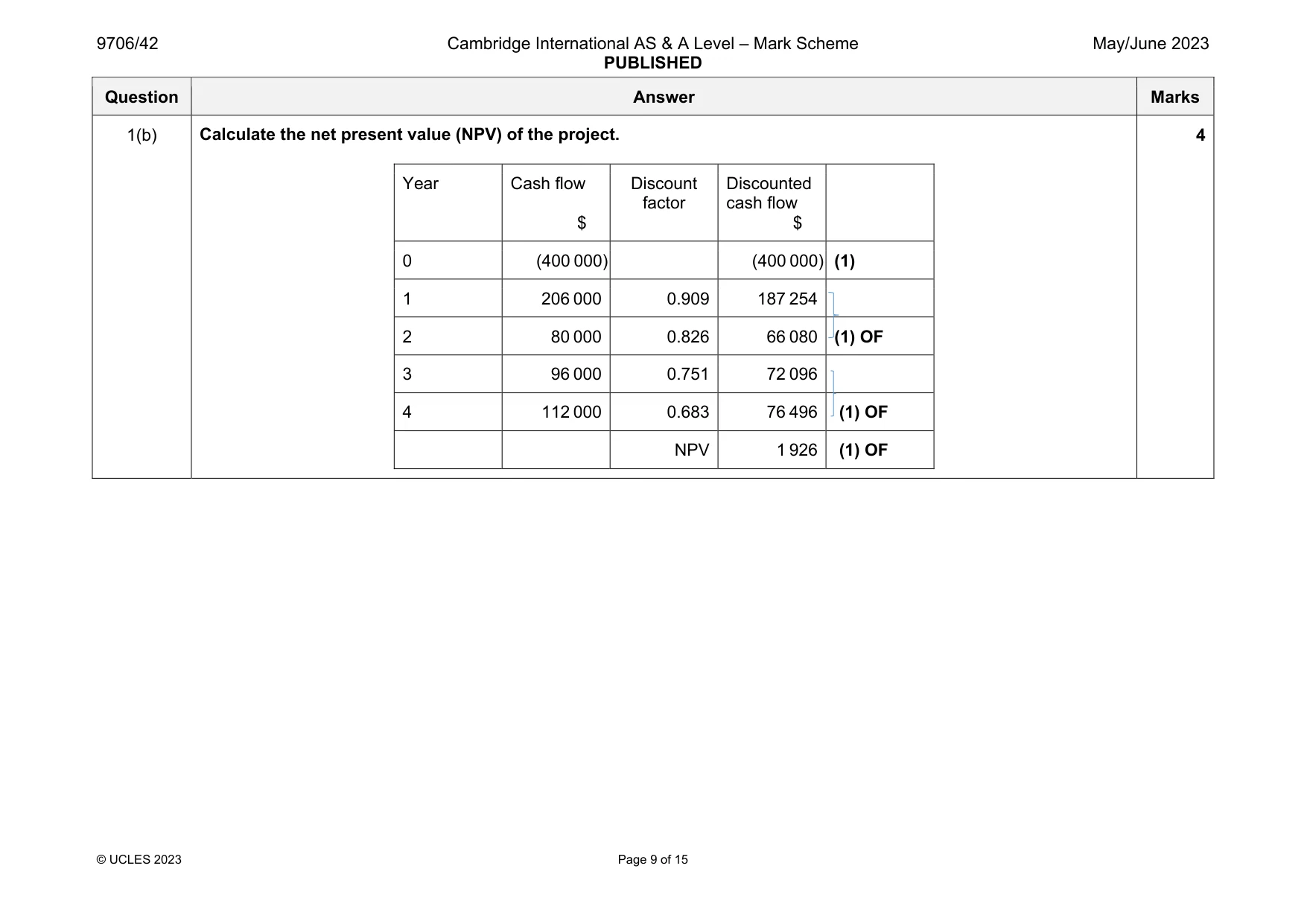
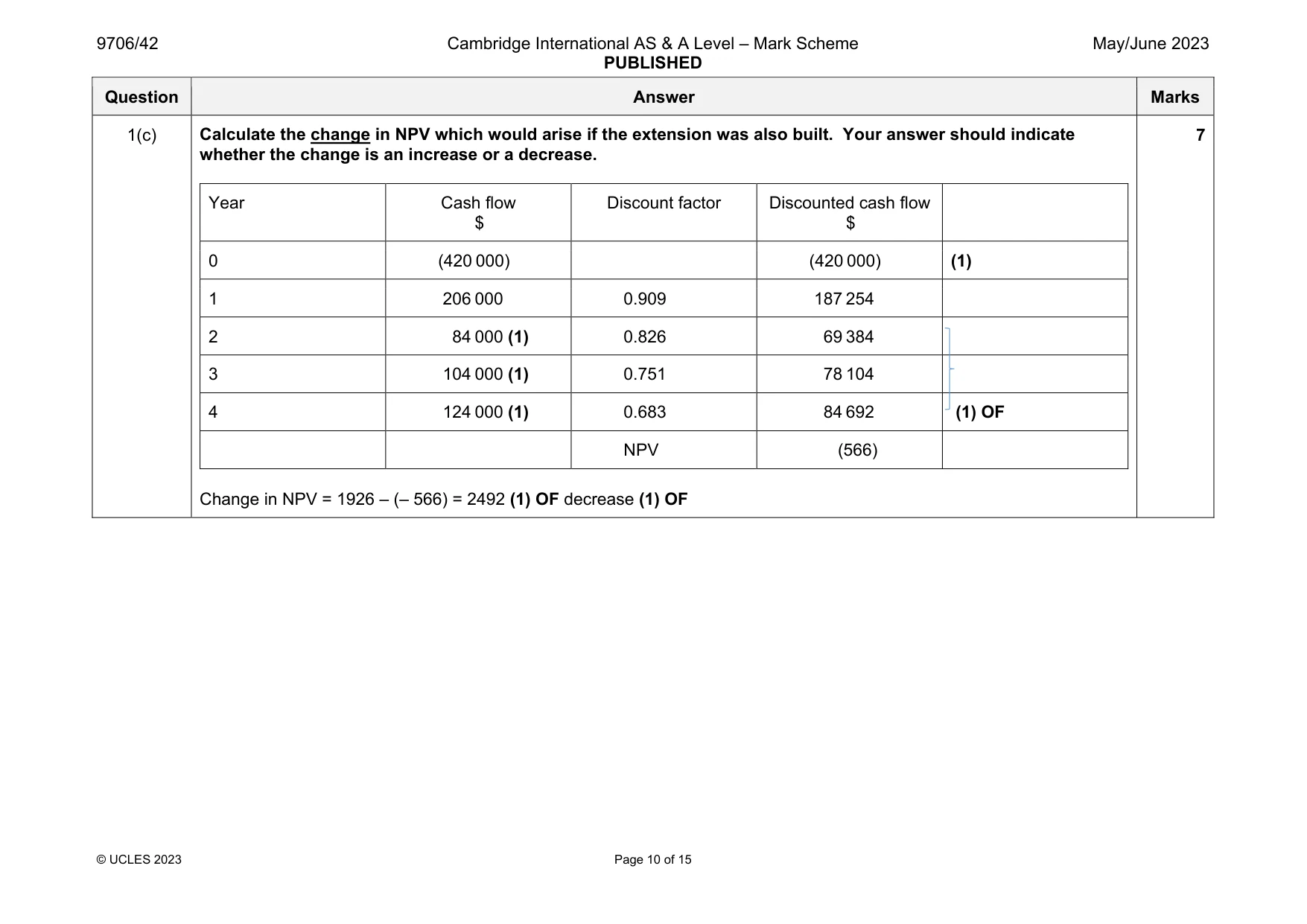
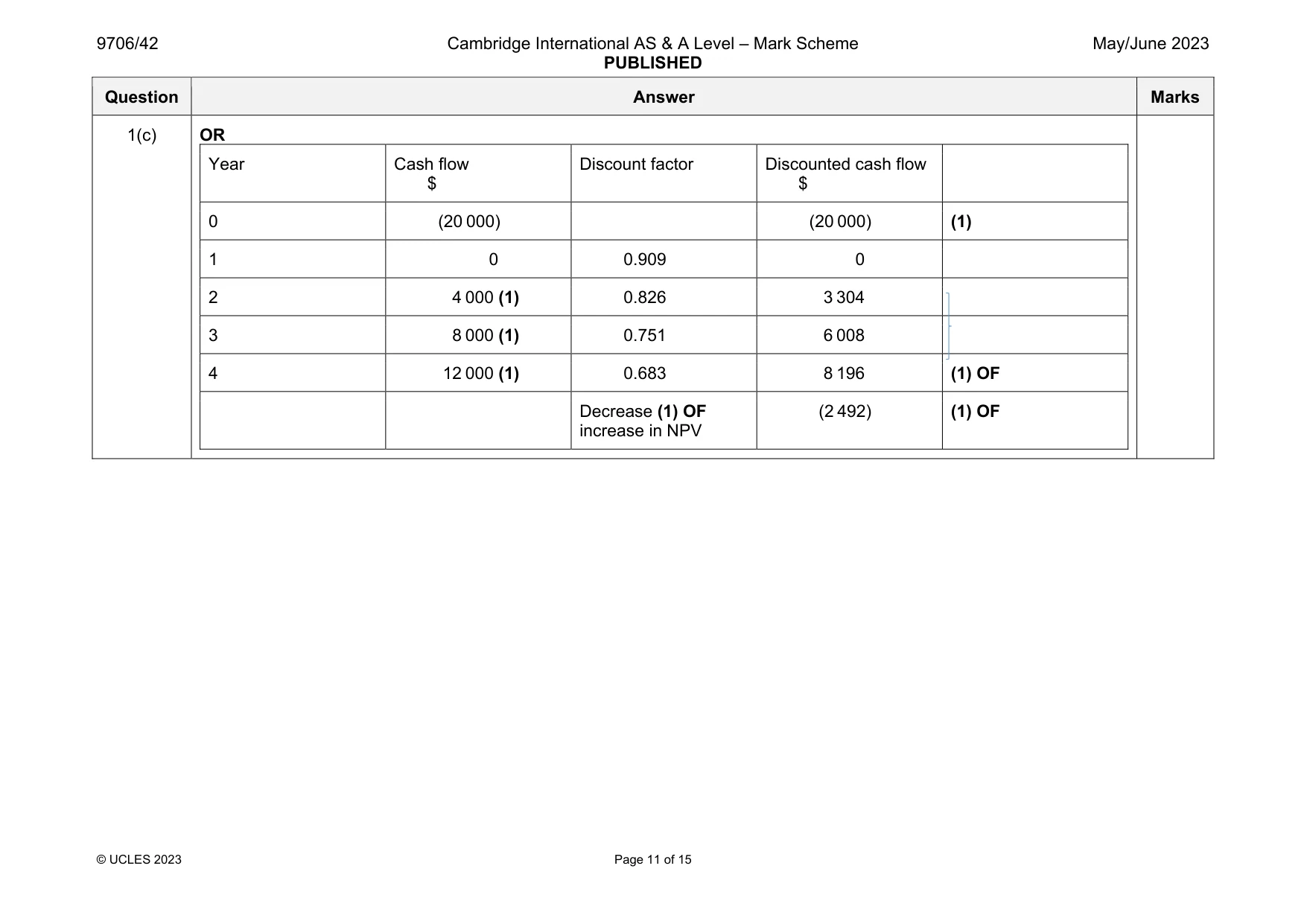
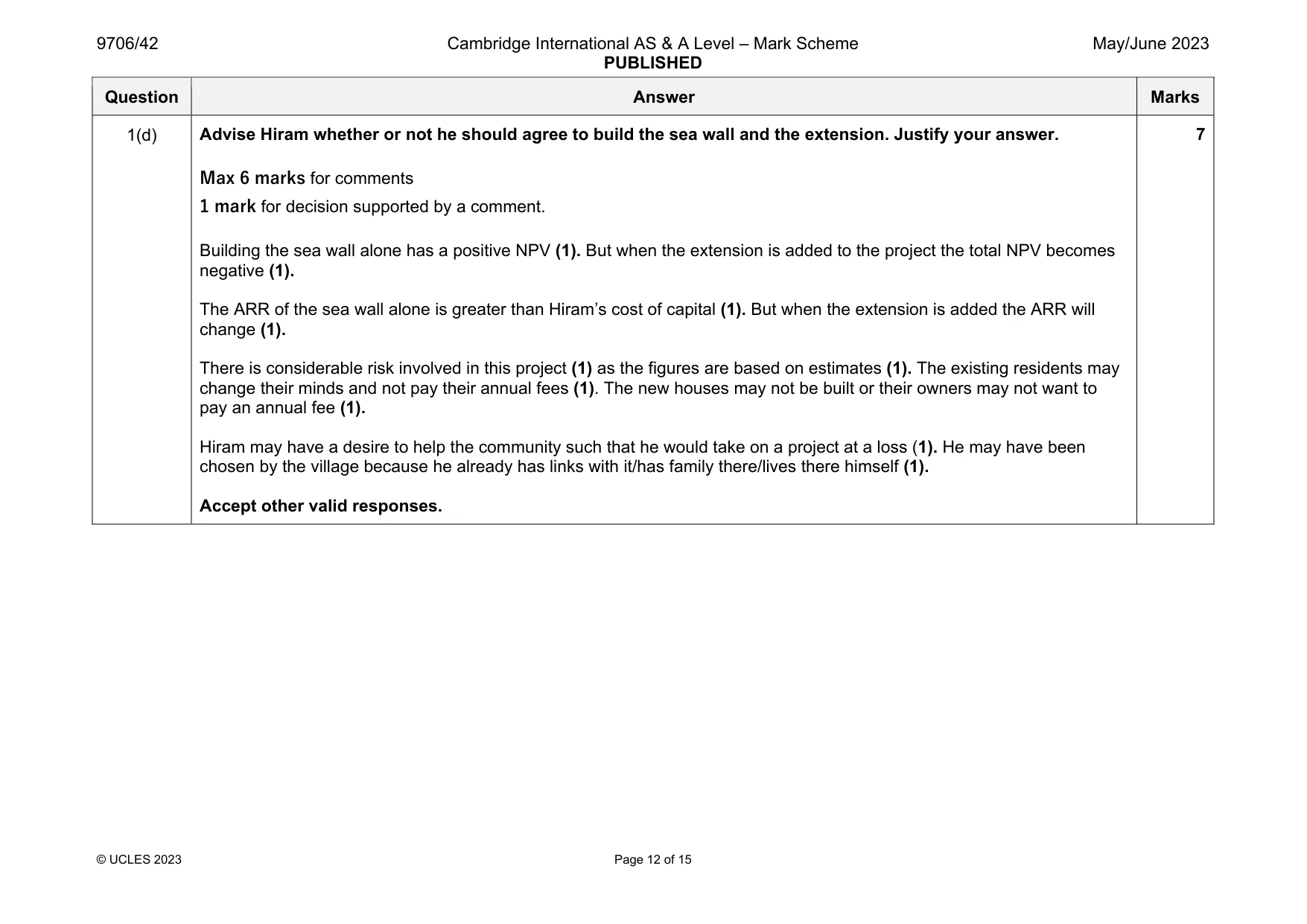
Mark scheme: 1(a)(i) the net cash flow for each year and in total for the project. $ $ Year 0 – cost (400 000) (1) Year 1 – grant 142 000 Year 1 – fees 64 000 206 000 Year 2 – fees 80 000 (1) Year 3 – fees 96 000 Year 4 – fees 112 000 (1) 94 000 (1)OF 1(a)(ii) Calculate: the accounting rate of return (ARR) to two decimal places. 23500 200000 (1of) (1) 100 = 11.75% (1)OF 3 Question Answer Marks 1(b) Calculate the net present value (NPV) of the project. Year Cash flow $ Discount factor Discounted cash flow $ 0 (400 000) (400 000) (1) 1 206 000 0.909 187 254 2 80 000 0.826 66 080 (1) OF 3 96 000 0.751 72 096 4 112 000 0.683 76 496 (1) OF NPV 1 926 (1) OF 4 Question Answer Marks 1(c) Calculate the change in NPV which would arise if the extension was also built. Your answer should indicate whether the change is an increase or a decrease. Year Cash flow $ Discount factor Discounted cash flow $ 0 (420 000) (420 000) (1) 1 206 000 0.909 187 254 2 84 000 (1) 0.826 69 384 3 104 000 (1) 0.751 78 104 4 124 000 (1) 0.683 84 692 (1) OF NPV (566) Change in NPV = 1926 – (– 566) = 2492 (1) OF decrease (1) OF 7 Question Answer Marks 1(c) OR Year Cash flow $ Discount factor Discounted cash flow $ 0 (20 000) (20 000) (1) 1 0 0.909 0 2 4 000 (1) 0.826 3 304 3 8 000 (1) 0.751 6 008 4 12 000 (1) 0.683 8 196 (1) OF Decrease (1) OF increase in NPV (2 492) (1) OF Question Answer Marks 1(d) Advise Hiram whether or not he should agree to build the sea wall and the extension. Justify your answer. Max 6 marks for comments 1 mark for decision supported by a comment. Building the sea wall alone has a positive NPV (1). But when the extension is added to the project the total NPV becomes negative (1). The ARR of the sea wall alone is greater than Hiram’s cost of capital (1). But when the extension is added the ARR will change (1). There is considerable risk involved in this project (1) as the figures are based on estimates (1). The existing residents may change their minds and not pay their annual fees (1). The new houses may not be built or their owners may not want to pay an annual fee (1). Hiram may have a desire to help the community such that he would take on a project at a loss (1). He may have been chosen by the village because he already has links with it/has family there/lives there himself (1). Accept other valid responses. 7
Q2 · Read Source B in the insert
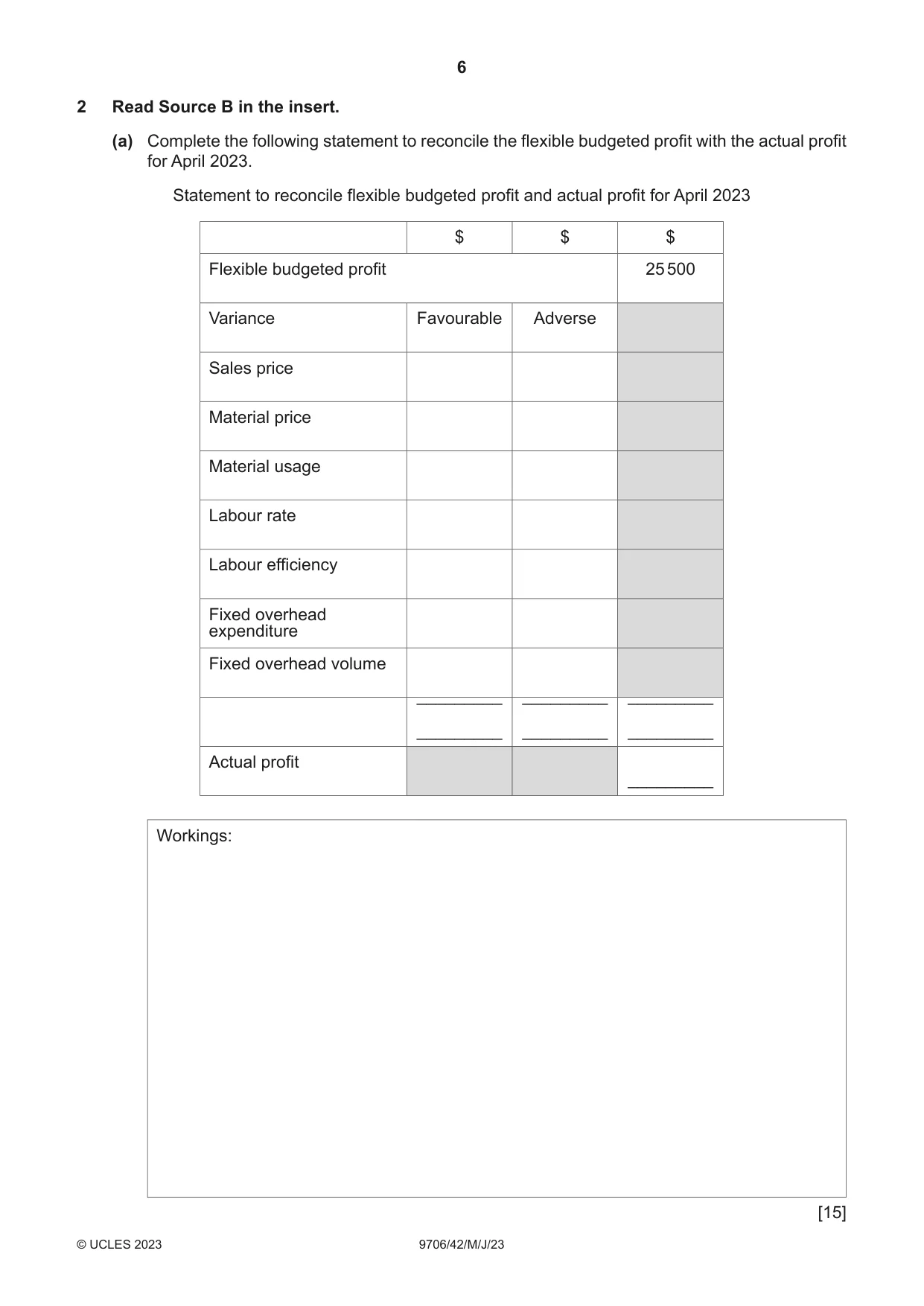
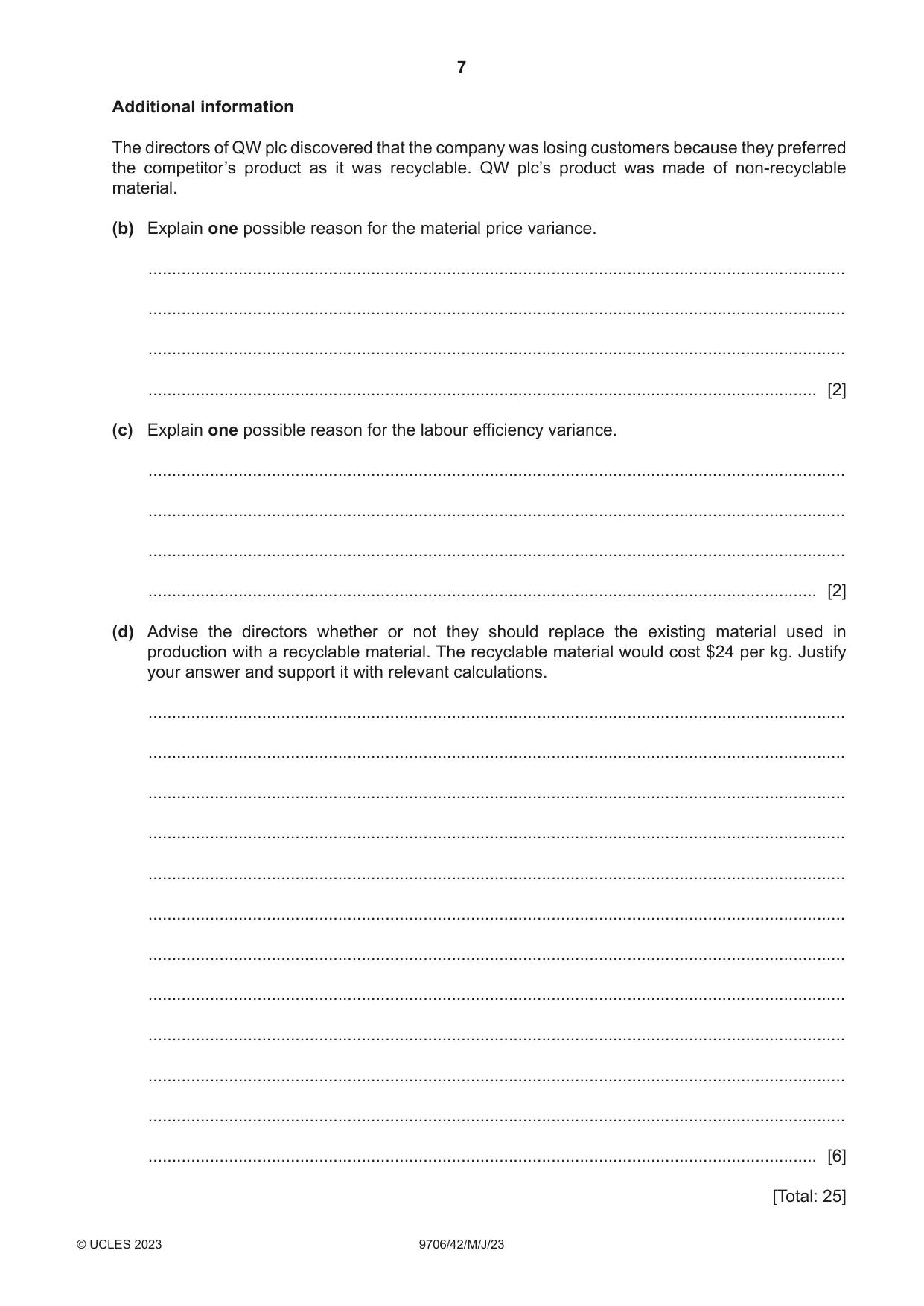
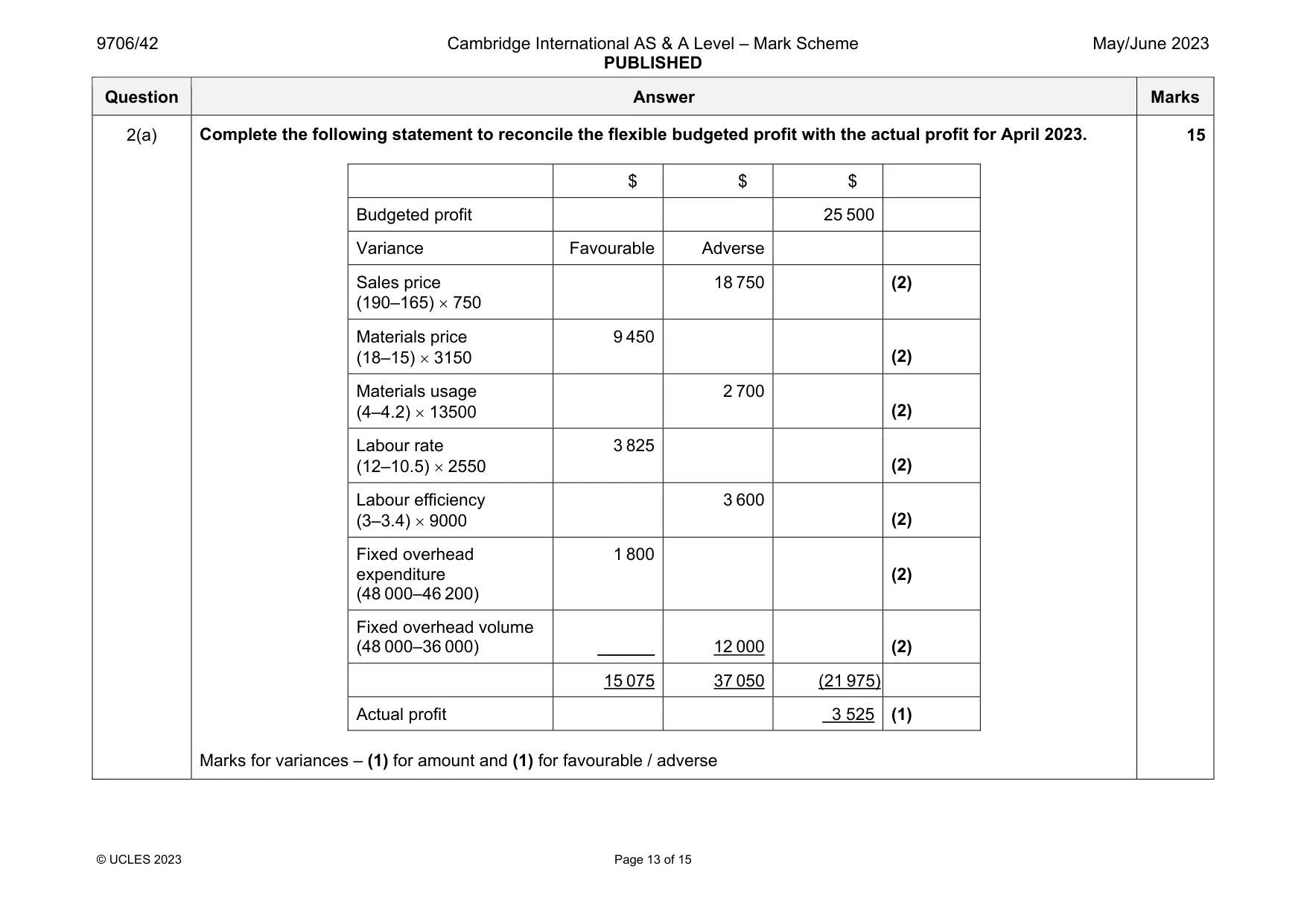
2 Read Source B in the insert. (a) Complete the following statement to reconcile the flexible budgeted profit with the actual profit for April 2023. Statement to reconcile flexible budgeted profit and actual profit for April 2023 $ $ $ Flexible budgeted profit 25 500 Variance Favourable Adverse Sales price Material price Material usage Labour rate Labour efficiency Fixed overhead expenditure Fixed overhead volume _________ _________ _________ _________ _________ _________ Actual profit _________ Workings: [15] Additional information The directors of QW plc discovered that the company was losing customers because they preferred the competitor’s product as it was recyclable. QW plc’s product was made of non‑recyclable material. (b) Explain one possible reason for the material price variance. ................................................................................................................................................... ................................................................................................................................................... ................................................................................................................................................... ............................................................................................................................................. [2] (c) Explain one possible reason for the labour efficiency variance. ................................................................................................................................................... ................................................................................................................................................... ................................................................................................................................................... ............................................................................................................................................. [2] (d) Advise the directors whether or not they should replace the existing material used in production with a recyclable material. The recyclable material would cost $24 per kg. Justify your answer and support it with relevant calculations. ................................................................................................................................................... ................................................................................................................................................... ................................................................................................................................................... ................................................................................................................................................... ................................................................................................................................................... ................................................................................................................................................... ................................................................................................................................................... ................................................................................................................................................... ................................................................................................................................................... ................................................................................................................................................... ................................................................................................................................................... ............................................................................................................................................. [6] [Total: 25]
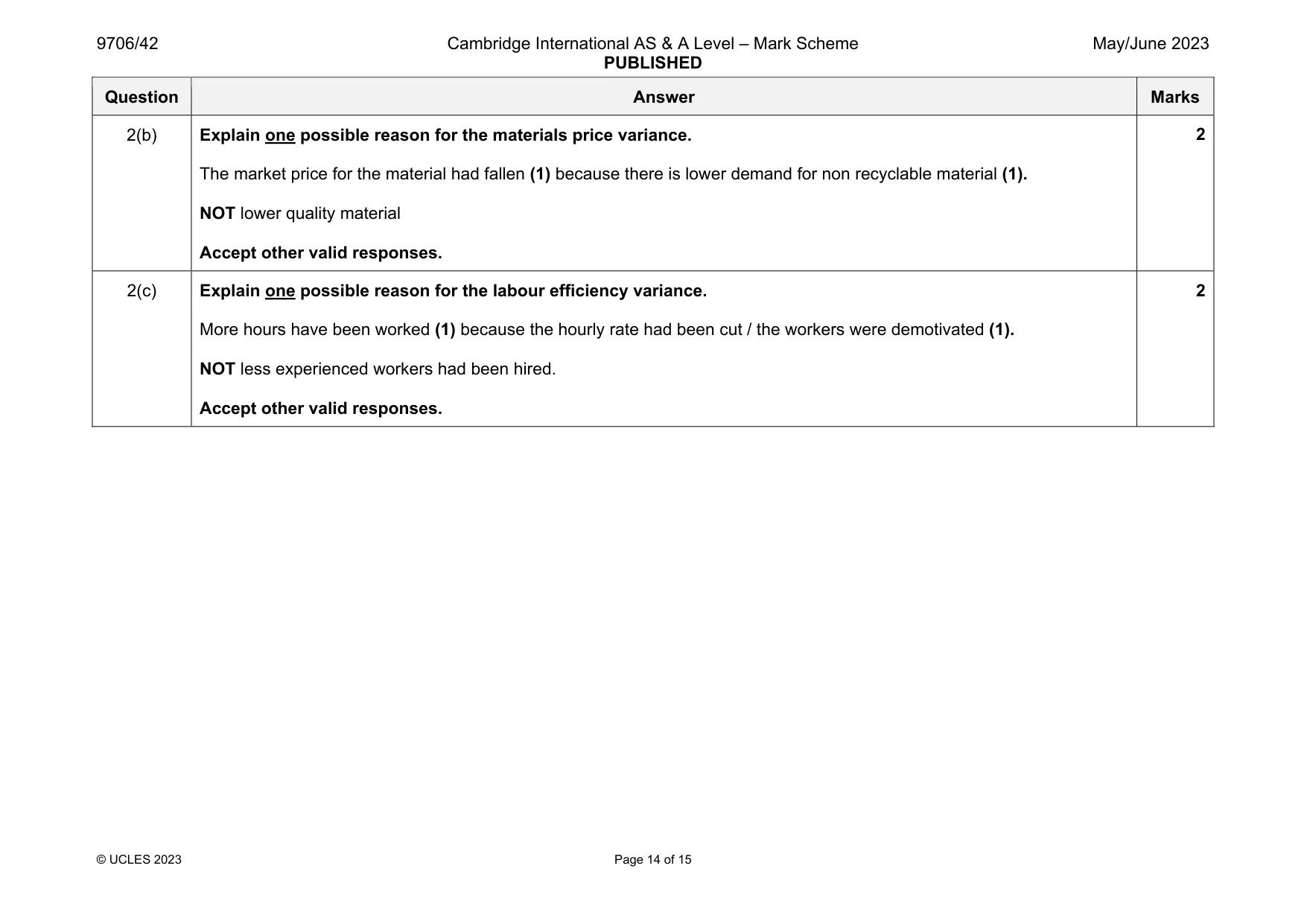
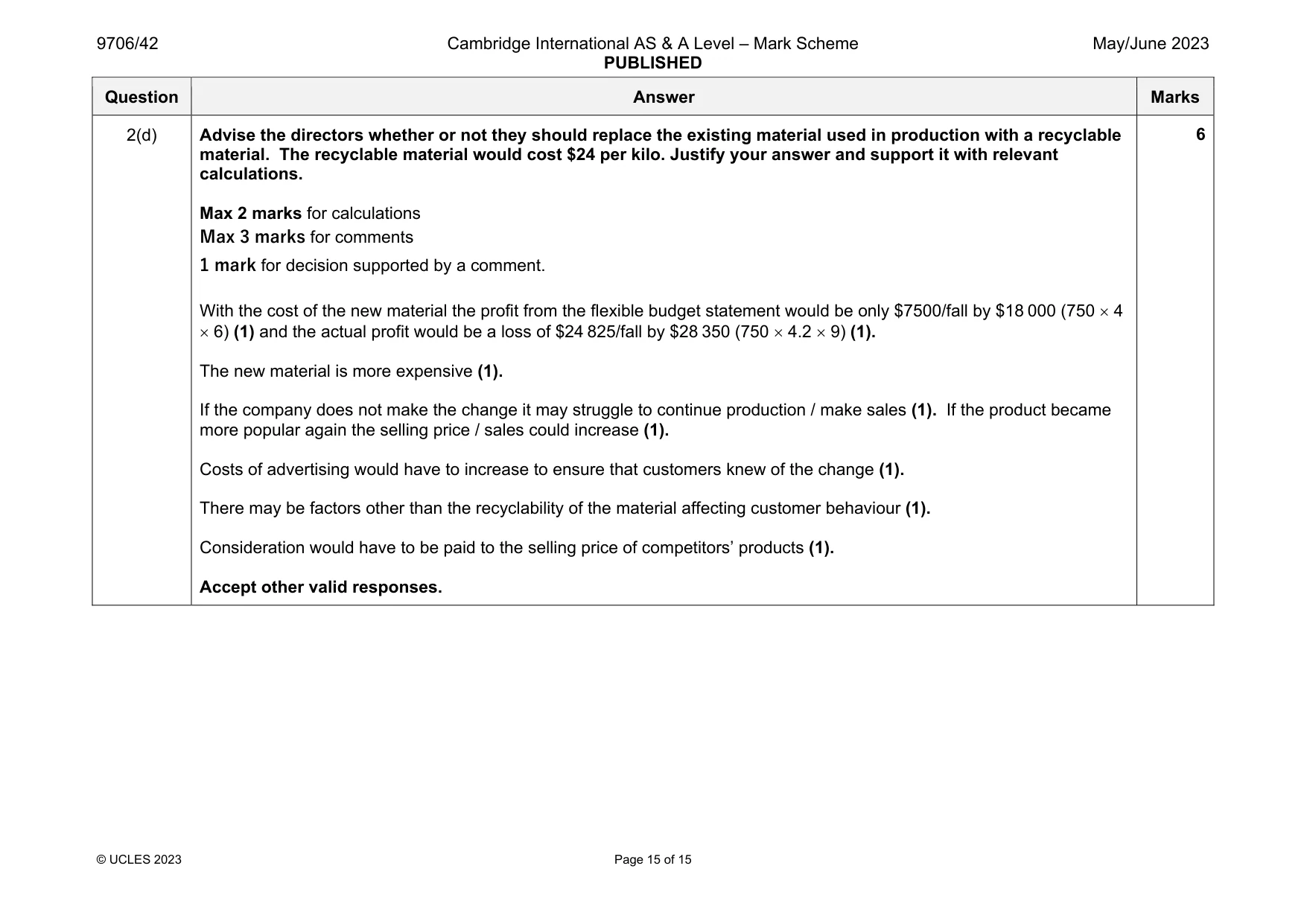
Mark scheme: 2(a) $ $ $ Budgeted profit 25 500 Variance Favourable Adverse Sales price (190–165) 750 18 750 (2) Materials price (18–15) 3150 9 450 (2) Materials usage (4–4.2) 13500 2 700 (2) Labour rate (12–10.5) 2550 3 825 (2) Labour efficiency (3–3.4) 9000 3 600 (2) Fixed overhead expenditure (48 000–46 200) 1 800 (2) Fixed overhead volume (48 000–36 000) ______ 12 000 (2) 15 075 37 050 (21 975) Actual profit 3 525 (1) Marks for variances – (1) for amount and (1) for favourable / adverse Question Answer Marks 2(b) Explain one possible reason for the materials price variance. The market price for the material had fallen (1) because there is lower demand for non recyclable material (1). NOT lower quality material Accept other valid responses. 2 2(c) Explain one possible reason for the labour efficiency variance. More hours have been worked (1) because the hourly rate had been cut / the workers were demotivated (1). NOT less experienced workers had been hired. Accept other valid responses. 2 Question Answer Marks 2(d) Advise the directors whether or not they should replace the existing material used in production with a recyclable material. The recyclable material would cost $24 per kilo. Justify your answer and support it with relevant calculations. Max 2 marks for calculations Max 3 marks for comments 1 mark for decision supported by a comment. With the cost of the new material the profit from the flexible budget statement would be only $7500/fall by $18 000 (750 4 6) (1) and the actual profit would be a loss of $24 825/fall by $28 350 (750 4.2 9) (1). The new material is more expensive (1). If the company does not make the change it may struggle to continue production / make sales (1). If the product became more popular again the selling price / sales could increase (1). Costs of advertising would have to increase to ensure that customers knew of the change (1). There may be factors other than the recyclability of the material affecting customer behaviour (1). Consideration would have to be paid to the selling price of competitors’ products (1). Accept other valid responses. 6
What was in this paper
The subtopics covered by these 2 questions, and how many questions each got. Open one in a new tab to see every Cambridge question on it.
What you needed in this session
Cambridge’s own grade thresholds for 2023 May/June, Paper 4 · Variant 2. A higher threshold means an easier paper — the bar moves with how the cohort did.