Questions as text
Q1 · Some sociologists believe that education is key to improving an individual's life… 0495/21 May/June 2018
2 Some sociologists believe that education is key to improving an individual's life chances, others believe that it simply maintains current inequalities in society. There are significant differences between the educational achievement of upper and working class students, which some sociologists argue is caused by different levels of social control. (a) What is meant by the term ‘social control’? [2] (b) Describe two features of the comprehensive system. [4] (c) Explain how schools ensure that pupils conform to social expectations. [6] (d) Explain why there are differences in the educational achievement of upper and working class students. [8] (e) To what extent does education maintain social stratification? [15] Section C: Crime, deviance and social control
35 marks
Mark scheme: 2(a) What is meant by the term ‘social control’? 2 One mark for partial definition, e.g. doing what someone else wants you to. Two marks for clear definition, e.g. the process of persuading or forcing individuals to conform to norms and values. 2(b) Describe two features of the comprehensive system. 4 Possible answers: • schools that take pupils of all different backgrounds, classes and status; • schools that take pupils of all different abilities; • it is open to everyone – inclusive education, not selective; • based on principles of meritocracy in order to create equal opportunities in society (Functionalism); • children from a local area would all go to school together (different ethnicities/social classes, etc.) and so promote tolerance by breaking down social barriers; • often characterised by mixed ability teaching; • other reasonable response. One mark for each point correctly identified (up to maximum of two). One mark for each point that is developed (up to a maximum of two). 2(c) Explain how schools ensure that pupils conform to social 6 expectations. Possible answers: • through socialisation in schools – pupils learn to accept authority and do as they are told; • through formal social control in schools such as detentions, isolation, exclusion, etc.; • through informal social control in schools such as teacher reprimands, warnings, peer pressure, etc.; • through the hidden curriculum – certain norms, values and beliefs are transmitted as normal and thus encourage children to conform to these; • through positive sanctions/rewards – children learn that if they conform they will be praised; • through negative sanctions/punishments – children learn that they will be punished if they don't conform; • through power and authority – students are expected to conform to the rules of those in a higher status; • other reasonable response. Band 0 [0 marks] No creditworthy response. Band 1 [1–3 marks] Answers in this band will show only a limited awareness of how schools ensure that pupils conform to social expectations and may talk about e.g. Children get punished if they don't do what they're told. Responses may be short and un/under developed. At the bottom of the band (1 mark), expect one weak point. Higher in the band (2–3 marks), candidates may offer more than one weak point, but there may be a tendency towards simplistic answers, engaging with sociological ideas without using sociological language. Band 2 [4–6 marks] A clear and accurate explanation, showing good sociological knowledge and understanding of how schools ensure that pupils conform to social expectations. Sociological terms and concepts should be expected e.g. Positive and negative sanctions can both be used by schools to promote conformity. Punishments can be used to shown the negative consequences of not doing what you're told whereas rewards and praise can be used to encourage compliance and future conformity. This would be followed by explanation of factors leading to this. At the bottom of the band, the range of points covered may be narrow or lack detail. Higher in the band, answers will cover more than one factor in a well-developed way or cover several factors in less detail. 2(d) Explain why there are differences in the educational achievement of upper 8 and working class students. Possible answers: • private education is available to the upper class where results are typically better – working class cannot afford this; • private education results in better qualifications than state schools due to smaller class sizes, better facilities and more resources than state schools; • the working class may experience material deprivation so they can't afford such things as private tutoring, internet, revision guides, etc.; • the working class student may be from a family that is not financially able to support them through Higher Education and students may therefore limit their ambitions and aspirations; • working class families may have a poorer diet than the upper class which is thought to affect concentration levels; • the working class student may live in overcrowded conditions that do not offer a quiet place to work and study; • working class students may be labelled as failures by their teachers and thus perform a self-fulfilling prophecy; • the culture of the working class home may not value education to the same degree that the upper class one does and this may affect educational achievement; • the upper class may possess cultural capital which makes educational success easier to achieve; • the language codes of the upper class are likely to match the elaborated codes used in schools and examinations and thus make success easier; • other reasonable response. Band 0 [0 marks] No creditworthy response. Band 1 [1–3 marks] Answers in this band will show only a limited awareness of why there are differences in the educational achievement of the upper and working class. A tendency to description is likely. Responses may be short and undeveloped, e.g. Upper class students go to better schools, stated without explanation. Sociological terms and concepts are unlikely to be used. At the bottom of the band (1 mark), expect one weak point. Higher in the band (2–3 marks), candidates may offer more than one weak point. Band 2 [4–6 marks] Answers in this band will show basic sociological knowledge and understanding of why there are differences in the educational achievement of the upper and working classes. Responses may be underdeveloped and lacking in range, e.g. The upper class are more likely to go to private school where qualifications are better than state schools because of the better facilities and smaller class sizes, etc. At the bottom of the band, candidates are unlikely to use sociological terms and concepts accurately. Higher in the band, candidates may be beginning to use sociological terms and concepts with greater accuracy. However, some aspects of the answer may only be partially developed/explained. 2(d) Band 3 [7–8 marks] 8 Answers in this band will show good sociological knowledge and understanding of why there are differences in the educational achievement of the upper and working classes and will be well developed and explained, e.g. The upper classes possess more cultural capital than the working class meaning that school and educational success is easier for them to access. They use the same linguistic elaborated codes as their teachers and therefore can access textbooks and examinations easier than the working class. Candidates may then expand on the explanation of this and other factors. Sociological terms and concepts will be used accurately overall. Answers will be well focused on the question and there will be a range of reasons presented. At the top of the band explanations will be clear throughout. 2(e) To what extent does education maintain social stratification? 15 SOCIAL STRATIFICATION – the different levels into which societies are divided based on differences such as wealth, gender, ethnicity, class, power and status. Candidates may discuss this as social inequalities. Possible answers: FOR: • private education offers elite privileges to those who can afford to go there and so maintains social stratification; • private tutoring offers benefits and privileges for those able to afford it, resulting in better chances of educational success; • through practices such as the hidden curriculum, inequalities in society are reproduced and maintained in education i.e. gender roles; • in some societies males are prioritised over females in education which means social stratification continues; • many sociologists believe institutional racism is present in education which causes ethnic majority pupils to do better than ethnic minorities and so social stratification continues; • material factors mean that those from the higher classes tend to do better in education – these qualifications allow them to access the better jobs in society and so maintains the status quo; • cultural factors and cultural capital mean that those from the higher social classes and the ethnic majority are likely to be more successful in education as they feel at home in the institution – this maintains social stratification; • linguistic factors such as the use of elaborated code by the higher social classes/majority ethnic group means that they find the language of education easy to understand and use therefore they are more likely to be successful – this maintains social stratification; • the key trend in educational success is that those from the higher social classes/majority ethnic group do better in education – this ensures that their privileged position in the social hierarchy is maintained; • teacher stereotyping and labelling in the classroom is thought to lead to minority ethnic groups/working class pupils doing least well in the system – this maintains the social stratification system in society as little social mobility occurs; • functionalists believe that the positions people hold in the social stratification system are fair and just and thus education helps to place people in the correct position; • other reasonable response. 2(e) AGAINST: 15 • comprehensive education offers equal opportunities to all students to be successful – this means that social mobility is both possible and probable; • functionalists believe that we live in a meritocracy so the ability to improve a person's life chances is available through educational success – this can then alter a person's position in the social stratification system; • Marxists believe that the social stratification system is maintained by the system of capitalism not just education; • feminists believe that the social stratification system is maintained by the system of patriarchy not just education; • equal opportunity programmes in schools means that there are many chances for all students to do well and challenge their position in the social stratification system e.g. girls into STEM, etc.; • compensatory education attempts to alter the social stratification system be offering positive discrimination to disadvantaged social groups e.g. ethnic minority pupils; • education can be seen to challenge rather than maintain the social stratification system through the opportunities that it offers students; • positive role models exist in education for those groups of students who are not placed highly in the social stratification system i.e. female, working class and/or ethnic minority teachers; • other reasonable response. Band 0 [0 marks] No creditworthy response. Band 1 [1–4 marks] Answers in this band may be vague and largely based on common sense showing limited knowledge of whether education maintains social stratification. Use of sociological terms or concepts is very unlikely. Responses may be short, undeveloped and one-sided, e.g. If you buy an education you will get the best results OR The most powerful people do best in education. Lower in the band (1–2 marks) expect one or two weak points. Higher in the band (3–4 marks) candidates may offer more than two points or provide a weak definition of key terms in the question, e.g. social stratification means dividing people up. 2(e) Band 2 [5–8 marks] 15 In this band candidates will show some basic knowledge of whether education maintains social stratification. Alternatively, they may offer an answer which is list-like in nature but there will be no real attempt to assess the issues raised by the question. There may be limited/some use of sociological terms or concepts. Responses may be underdeveloped and lack range. Answers may be simplistic and two-sided responses are unlikely e.g. Private schools get the best results so people that go there also get the best jobs OR Males are prioritised in education in some cultures so this gives them advantages in society, etc. Lower in the band, the response will be rather narrow in the points covered and there will be little development. Higher in the band, more points will be covered and there will be limited development of some points. Alternatively, a list-like answer with little development covering both sides of the argument may score up to 8 marks. A one-sided answer cannot score higher than 8 marks. Band 3 [9–12 marks] Answers in this band will show good sociological knowledge and understanding of whether education maintains social stratification. Sociological terms and concepts will be used with greater accuracy and/or frequency. For the most part, answers will be well-developed, focused on the question and there will be a range of points presented. Candidates may say that e.g. Despite those from the most privileged backgrounds continuing to do the best in education, many opportunities exist for disadvantaged groups to be successful in increasingly meritocratic societies – such as scholarships, positive discrimination, compensatory education etc. There will be a two- sided response but this may be unbalanced. At the bottom of the band, candidates may provide a narrower range of well-developed points. At the top of the band, expect a wider range of points and clear focus on the question. Band 4 [13–15 marks] Answers in this band will show excellent knowledge and understanding of whether education maintains social stratification. There will be a strong grasp of the argument as well as accurate and frequent use of sociological terms and concepts. Answers will be well developed, clearly focused on the question and discuss a wide range of points. Responses will be two-sided and balanced. At the bottom of the band (13 marks), the answer may lack a specific conclusion. Higher in the band, there will be a clear attempt to offer an assessment of the ‘To what extent«?’ part of the question through a focused conclusion. Candidates should show consideration of points for and against the idea of education maintaining social stratification, citing some of the examples given.
This question in 0495/21 May/June 2018
Q2 · Different social groups vary in their educational achievement 0495/22 Oct/Nov 2018
2 Different social groups vary in their educational achievement. Whilst there are policies and initiatives to promote equality and social mobility, they do not help everybody. For some, education does not improve a person's life chances. (a) What is meant by the term ‘social mobility’? [2] (b) Describe two ways that schools socially control pupils. [4] (c) Explain how positive discrimination can improve the educational achievement of some social groups. [6] (d) Explain why education is necessary in modern industrial societies. [8] (e) To what extent do social factors, such as gender, determine an individual’s educational achievement? [15] Section C: Crime, deviance and social control There are different ways that sociologists can measure crime, for example self-report studies. However using these measurements to explain why people commit crime causes much debate. Some sociologists argue that crime is committed because people experience a lack of status in society, other sociologists blame the police and the way they behave.
35 marks
Mark scheme: 2(a) What is meant by the term ‘social mobility’? One mark for partial definition, e.g. ‘getting more status’. Two marks for clear definition, e.g. ‘the movement of individuals or groups up or down the social hierarchy’. 2 2(b) Describe two ways that schools socially control pupils. Possible answers: • Through formal social control – exclusions and school rules; • Through informal social control – warnings; • Through negative sanctions such as detentions – fear of punishment; • Through deterrence – punishment puts children off from misbehaving again; • Through encouraging conformity – children like to fit in; • Through positive sanctions such as stickers and praise – this encourages children to continue behaving in the ‘right’ way; • Through the hidden curriculum – Marxist ideas of ideological control; • Through the patriarchal curriculum – feminist ideas of male control; • Through positive or negative peer pressure – anti-school or pro-school sub-cultures; • Through secondary socialisation processes – teachers teaching the expected norms and values for later life; • Other reasonable response. One mark for each point correctly identified (up to maximum of two). One mark for each point that is developed (up to a maximum of two). 4 Question Answer Marks 2(c) Explain how positive discrimination can improve the educational achievement of some social groups. Possible answers: • Some schools have introduced schemes to encourage girls to aim higher, especially in science and technology subjects (STEM policies, GIST, WISE, etc.). Girls may be given preferential access to lab equipment, for example; • Single-sex classes within co-educational schools – thought to improve the performance of both males and females; • Lessons geared towards boys’ ways of learning (active learning) have been introduced in many schools to enable boys to fulfil their academic potential; • Ethnic minority pupils may be given small group/individual/additional lessons in English as an additional or secondary language to boost educational achievement; • Some universities and private schools are now setting quotas that ensure they admit pupils from disadvantaged backgrounds – often with lower results than the average; • Financial bursaries, scholarships, policies that give financial aid/resources to students and incentives are often available to benefit and support those from socioeconomically deprived and/or ethnic minority backgrounds; • Extra-curricular, additional and holiday lessons/summer schools are run by many schools for less privileged social groups to attend; • Educational priority zones/ZEPs can receive better funding and additional resources to improve educational achievement of deprived individuals; • Other reasonable response. Band 0 [0 marks] No creditworthy response. Band 1 [1–3 marks] Answers in this band will show only a limited awareness of the concept of positive discrimination and its influence on educational achievement and may talk about e.g. ‘helping poorer students do better’. Responses may be short and un/under developed. At the bottom of the band (1 mark), expect one weak point. Higher in the band (2–3 marks), candidates may offer more than one weak point, but there may be a tendency towards simplistic answers, engaging with sociological ideas without using sociological language. Band 2 [4–6 marks] A clear and accurate explanation, showing good sociological knowledge and understanding of the relationship between positive discrimination and improved educational achievement. Sociological terms and concepts should be expected e.g. ‘Many schools have introduced STEM initiatives and clubs to better engage females in science and technology subjects. They have been given privileged access to equipment and offered mentors and visits to improve their motivation and performance.’ This would be followed by explanation of factors leading to this. At the bottom of the band, the range of points covered may be narrow or lack detail. Higher in the band, answers will cover more than one factor in a well-developed way or cover several factors in less detail. 6 Question Answer Marks 2(d) Explain why education is necessary in modern industrial societies. Possible answers: • Hidden curriculum – to learn and accept society’s culture; • Socialisation – learning and reinforcing of norms and values; • Social control – to ensure that individual’s know their place in society and/or conform; • Knowledge – to learn and to understand further; • To gain qualifications which will allow for further study and access to a career of choice; • Learning of national identity through such things as the singing of the national anthem, culture and history, shared values, etc.; • To provide the skills and abilities to ensure that society and the economy functions well in a modern, technological society; • Marxists believe education exists to indoctrinate individuals into accepting capitalism and its inequalities as normal and fair; • Feminists believe that education reinforces and teaches patriarchal values and makes distinctions between the expectations of males and females; • Education is meritocratic according to functionalists and therefore exists as a means of social mobility; • Functionalism – role allocation – getting the right people into the right positions, allowing society to function smoothly; • Other reasonable response. Band 0 [0 marks] No creditworthy response. Band 1 [1–3 marks] Answers in this band will show only a limited awareness of why education is necessary in modern industrial societies. A tendency to description is likely. Responses may be short and undeveloped, e.g. ‘so we know about important things’ stated without explanation. Sociological terms and concepts are unlikely to be used. At the bottom of the band (1 mark), expect one weak point. Higher in the band (2–3 marks), candidates may offer more than one weak point. Band 2 [4–6 marks] Answers in this band will show basic sociological knowledge and understanding of why education is necessary in modern industrial societies. Responses may be underdeveloped and lacking in range, e.g. ‘Education is a crucial part of the socialisation process and reinforces norms, values and gender roles in individuals’. At the bottom of the band, candidates are unlikely to use sociological terms and concepts accurately. Higher in the band, candidates may be beginning to use sociological terms and concepts with greater accuracy. However, some aspects of the answer may only be partially developed/explained. 8 Question Answer Marks 2(d) Band 3 [7–8 marks] Answers in this band will show good sociological knowledge and understanding of why education is necessary in modern industrial societies and will be well developed and explained, e.g. ‘Different sociological theories believe there are different reasons as to why education is important. Functionalists see it as a positive institution where social mobility possibilities are created whereas Marxists see it as an agency where capitalist inequalities are reproduced’. They can then expand on the explanation of this and other factors as necessary. Sociological terms and concepts will be used accurately overall. Answers will be well focused on the question and there will be a range of reasons presented. At the top of the band explanations will be clear throughout. Question Answer Marks 2(e) To what extent do social factors, such as gender, determine an individual’s educational achievement? Possible answers: FOR: • Gender – in some developing countries and in some cultures boys may be more likely to attend school than girls and so achieve better; • In most industrial societies girls perform better than boys in their examinations – the culture of masculinity and pressure to be a ‘lad’ may be a reason to explain this; • Boys are more likely to join an anti-school subculture than girls which may negatively affect their achievement; • Negative peer pressure is thought to affect boys more than girls and the fear of informal sanctions from their peers discourages boys from studying and working hard; • More positive role models in education for girls may be one of the reasons for their improved performance; • Positive discrimination policies regarding gender e.g. girls into STEM can affect achievement; • Pupils from ethnic minorities tend to do less well in education – cultural factors such as language barriers may be one reason for this; • Prejudice, discrimination and racism may explain why some ethnic minorities do not do well in education; • The ethnocentric curriculum may be a factor to explain why ethnic minorities do not do well in education; • Some ethnic groups e.g. Chinese, do well in education due to parental expectations and the value placed on educational success; • Higher class students are more likely to attend private schools and so are more likely to do well in education; • Bourdieu – lack of capital (e.g. cultural) may be a reason to explain different attainment levels by students from different social classes; • Material deprivation is more likely to be relevant for those in the lower social classes and may affect how well an individual does in education; • Immediate gratification may be a cultural norm for the lower social classes, whereas deferred gratification is linked with those from the higher social groups; • Teacher labelling (either positive or negative) regarding gender/class/ethnicity may lead to a self-fulfilling prophecy and thus affect educational achievement; • Other reasonable response. 15 Question Answer Marks 2(e) AGAINST: • Nothing to do with social factors but with genetic differences in intelligence; • This approach is too deterministic – every individual is different, you cannot generalise about all members of a social group being the same in terms of educational achievement; • Functionalism – educational success depends upon how hard you work and the efforts you make; • Education today is based on equal opportunities (functionalism and meritocracy) therefore social factors are no longer relevant; • Educational success is not determined by your social group but by school factors e.g. culture of learning/setting/teacher labelling/curriculum options/fee paying schools, etc.; • Educational success is not determined by your social group but by the value placed upon education in the home and how much parental encouragement a child receives; • Educational success is closely linked to location (this could be on a global, national or local scale) and funding not on social factors; • Educational success is determined by the teacher and the school structures and expectations, not on social factors; • Peer group factors – it is the peer group that the student associates with that determines educational achievement, not social factors; • Positive discrimination and equal rights legislation means that previous barriers faced by some social groups in education are no longer relevant; • Other reasonable response. Band 0 [0 marks] No creditworthy response. Band 1 [1–4 marks] Answers in this band may be vague and largely based on common sense showing limited knowledge of the extent to which social factors determine educational success. Use of sociological terms or concepts is very unlikely. Responses may be short, undeveloped and one-sided, e.g. ‘Girls do better than boys because they work harder’ or ‘Poor people don’t do as well as rich people’. Lower in the band (1–2 marks), expect one or two weak points. Higher in the band (3–4 marks) candidates may offer more than two points and provide a weak definition of key terms, e.g. ‘educational success is how well a person does in education’, in the question. Question Answer Marks 2(e) Band 2 [5–8 marks] In this band candidates will show some basic knowledge of the extent to which social factors determine educational success. Alternatively, they may offer an answer which is list-like in nature but there will be no real attempt to assess the issues raised by the question. There may be limited/some use of sociological terms or concepts. Responses may be underdeveloped and lack range. Answers may be simplistic and two-sided responses are unlikely e.g. ‘Some social groups do much better in education than others. Ethnic minorities may face racism in schools and so they don’t do very well’. Lower in the band, the response will be rather narrow in the points covered and there will be little development. Higher in the band, more points will be covered and there will be limited development of some points. Alternatively, a list-like answer with little development covering both sides of the argument may score up to 8 marks. A one-sided answer cannot score higher than 8 marks. Band 3 [9–12 marks] Answers in this band will show good sociological knowledge and understanding of the extent to which social factors determine educational success. Sociological terms and concepts will be used with greater accuracy and/or frequency. For the most part, answers will be well developed, focused on the question and there will be a range of points presented. Candidates may say that e.g. ‘despite more equal opportunity legislation in education, some social groups still do better than others. In many countries, for example, boys are more valued than girls and so are more likely to go to school and study. Girls fall behind and so do not achieve as well. Feminists would link this to patriarchy.’ There will be a two-sided response but this may be unbalanced. At the bottom of the band, candidates may provide a narrower range of well-developed points. At the top of the band, expect a wider range of points and clear focus on the question. Band 4 [13–15 marks] Answers in this band will show excellent knowledge and understanding of the extent to which social factors determine educational success. There will be a strong grasp of the argument as well as accurate and frequent use of sociological terms and concepts. Answers will be well developed, clearly focused on the question and discuss a wide range of points. Responses will be two-sided and balanced. At the bottom of the band (13 marks), the answer may lack a specific conclusion. Higher in the band, there will be a clear attempt to offer an assessment of the ‘To what extent«?’ part of the question through a focused conclusion. Candidates should show consideration of points for and against the idea of social factors determining educational success, citing some of the examples given.
This question in 0495/22 Oct/Nov 2018
Q3 · Some sociologists view education and the official curriculum as essential to improving an… 0495/21 May/June 2019
2 Some sociologists view education and the official curriculum as essential to improving an individual’s life chances. Other sociologists believe education maintains social inequalities. Whilst every school is different they all operate a system of rules and rewards for students. (a) What is meant by the term ‘official curriculum’? [2] (b) Describe two features of the hidden curriculum. [4] (c) Explain how schools have tried to improve the educational achievement of ethnic minority students. [6] (d) Explain why sanctions are used in schools. [8] (e) To what extent is education a major factor in improving an individual's life chances? [15] Section C: Crime, deviance and social control
35 marks
Mark scheme: 2(a) What is meant by the term ‘official curriculum’. 2 One mark for partial definition e.g. subjects studied Two marks for clear definition e.g. the subjects and lessons studied at school and their content 2(b) Describe two features of the hidden curriculum. 4 Possible answers: • competitive sports and testing – sends out the message that doing better than others is valued in society; • learning the importance of punctuality in school, preparing you for later working life; • through school uniform requirements, students learn expectations for dress codes e.g. at work; • abiding by school rules – you have to do as you’re told by those in authority regardless of whether you agree; • schools are hierarchies – students learn their place in the hierarchy and the associated norms with this status position; • functionalists – hidden curriculum gives the skills and attitudes necessary for the smooth running of society, social order; • Marxists – hidden curriculum maintains the control of the working class by the bourgeoisie; • feminists – students learn the expectations associated with their gender and their future gender roles; • respect and manners and reinforced to students through the hidden curriculum; • values and morals of society are taught and reinforced through the hidden curriculum; • other reasonable response. One mark for each point correctly identified (up to maximum of two). One mark for each point that is developed (up to a maximum of two) 2(c) Explain how schools have tried to improve the educational 6 achievement of ethnic minority students. Candidates may talk about ethnic minority students in general terms or may focus on specific ethnic groups in their answer. Either way is fine to credit. Possible answers: • anti-racism programmes – teachers have been trained in equal opportunities and the need to change their expectations and stereotypes of ethnic minority students; • legislation now exists to ensure that ethnic minority students get a ‘fair deal’ in education; • curriculums are far less ethnocentric in nature today and thus ethnic minority students are far more likely to engage and be successful; • representations of ethnic minority students in textbooks are more regular and frequent meaning that education is seen to be something for everyone; • positive discrimination – schools can place ethnic minority students into higher sets and introduce compensatory education programmes/intervention in order to try and improve performance; • recruitment of more ethnic minority teachers can help ethnic minority students to see that education is something that they can be successful in – positive role modelling; • other reasonable response. Band 0 [0 marks] No creditworthy response Band 1 [1–3 marks] Answers in this band will show only a limited awareness of the question and may talk about ‘not being racist and treating ethnic minority students equally’. Responses may be short and un/underdeveloped. At the bottom of the band (1 mark), expect one weak point. Higher in the band (2–3 marks), candidates may offer more than one weak point, but there may be a tendency towards simplistic answers, engaging with sociological ideas without using sociological language. Band 2 [4–6 marks] A clear and accurate explanation, showing good sociological knowledge and understanding of the question. Sociological terms and concepts should be expected e.g. ‘positive discrimination can be used to try and improve the educational achievement of ethnic minority students. This can involve additional tuition, a non-ethnocentric curriculum, placing EM students into higher sets and bringing in motivational speakers’. This would be followed by explanation of factors leading to this. At the bottom of the band, the range of points covered may be narrow or lack detail. Higher in the band, answers will cover more than one factor in a well-developed way or cover several factors in less detail. 2(d) Explain why sanctions are used in schools. 8 Candidates should show awareness of the various reasons why sanctions (positive rewards and/or negative punishments may be discussed) are used in schools. Possible answers: • negative sanctions such as detentions are used in schools in order to promote conformity; • punishments in schools are used to teach individuals that certain behaviours are ‘wrong’ and should not be repeated; • positive sanctions such as treat trips are used in schools to encourage students to engage in and repeat socially encouraged behaviour; • functionalists believe sanctions in schools are necessary as one of the functions of education is social control – to produce social stability; • feminists believe sanctions are used in schools to maintain patriarchy in terms of gender roles and gender expectations in behaviour and attitudes; • Marxists believe sanctions are used in schools to allow the promotion of the belief that it is ‘natural’ to conform to the wishes of those in positions of authority and power; • sanctions in schools could be seen to be an extension of the power of the state to ideologically control individuals (Marxism) through the promotion of socially approved attitudes, beliefs and behaviour that benefit the ruling class; • Marxists believe sanctions in schools allow the promotion of the capitalist ideology as something that is fair and just; • prizes and rewards are used as positive sanctions in order to raise attainment; • other reasonable response. Band 0[ 0 marks] No creditworthy response Band 1 [1–3 marks] Answers in this band will show only a limited awareness of the question. A tendency to description is likely. Responses may be short and undeveloped e.g. ‘to punish students’. Sociological terms and concepts are unlikely to be used. At the bottom of the band (1 mark), expect one weak point. Higher in the band (2–3 marks), candidates may offer more than one weak point. Band 2 [4–6 marks] Answers in this band will show basic sociological knowledge and understanding of why sanctions are used in schools. Responses may be underdeveloped and lacking in range e.g. ‘sanctions can be punishments or rewards and they make students do what they are told, so acting as a type of social control’. At the bottom of the band, candidates are unlikely to use sociological terms and concepts accurately. Higher in the band, candidates may be beginning to use sociological terms and concepts with greater accuracy. However, some aspects of the answer may only be partially developed/explained. 2(d) Band 3 [7–8 marks] Answers in this band will show good sociological knowledge and understanding of why sanctions are used in schools and will be well developed and explained e.g. ‘Sanctions in school ensure conformity to the roles and to those in positions of authority. For functionalists this is a good thing as it socialises us to accept orders from others and so keeps society running smoothly. For Marxists, though, it allows the ruling class to maintain power over the lower class’. They can then expand on the explanation of this and other factors as necessary. Sociological terms and concepts will be used accurately overall. Answers will be well focused on the question and there will be a range of reasons presented. At the top of the band explanations will be clear throughout. 2(e) To what extent is education a major factor in improving an individual’s 15 life chances? Life Chances – the opportunities that individuals have to improve their lives. Candidates should show awareness of the ways that education can improve a person’s life chances and should also consider how life chances are already fixed and cannot be changed by education. Factors to do with ethnicity, gender and social class may be referred to here. Possible answers: For: • functionalists see education as being meritocratic and so by working hard you will be successful and will improve your life chances; • educational qualifications are seen in MIS’s as being vital in order to obtain professional and high status jobs; • higher education is thought to be a major factor in determining the type and level of job a person can obtain – this then can be life changing; • education is thought to lead to social mobility, offering individuals the opportunity to change their social status and lifestyle; • education is free for children in many countries and so opens doors for everybody in terms of increasing life chances; • education may lead to improved and widened social networks which may heighten job opportunities and prospects; • education can lift poor people out of poverty and break the cycle; • education allows for equality of opportunity regardless of a person’s social characteristics (gender/ethnicity/social class); • compensatory education and/or positive discrimination can improve the life chances of disadvantaged groups; • the teaching of the hidden curriculum promotes life skills and ensures that students know the expected norms and values in order to function successfully and so improves life chances; • other reasonable response. Against: • those with more money have better chances of being successful in education than poorer people e.g. through private education, which then affects life chances; • despite girls performing better than boys in education in many societies, when it comes to life chances, males still fare better e.g. the gender pay gap; • ethnic minorities do not do as well in education as the ethnic majority and therefore do not have improved life chances; • Marxists do not believe that education is meritocratic and instead see it as an institution that maintains social inequalities and thus does not change life chances as it is a tool to keep the working class in their place; • feminists believe that patriarchal ideologies are so ingrained in society that educational performance is irrelevant in determining life chances; 2(e) • life chances may be fixed and ascribed by social characteristics and so education cannot affect life chances (ascribed status); • other social agents e.g. the peer group may be more influential than education in terms of improving life chances; • other reasonable response Band 0 [0 marks] No creditworthy response Band 1 [1–4 marks] Answers in this band will be vague and largely based on common sense showing limited knowledge of the extent of the debate in the question. Use of sociological terms or concepts is very unlikely. Responses may be short, undeveloped and one-sided e.g. ‘qualifications help you get a good job’. Lower in the band (1–2 marks), expect one or two weak points. Higher in the band (3–4 marks) candidates may offer more than two points or provide a weak definition of key terms, e.g. ‘life chances are the opportunities you have to succeed’. Band 2 [5–8 marks] In this band candidates will show some basic knowledge of the extent of the debate in the question. Alternatively, they may offer an answer which is list- like in nature but there will be no real attempt to assess the issues raised by the question. There may be limited/some use of sociological terms or concepts. Responses may be underdeveloped and lack range. Answers may be simplistic and two-sided responses are unlikely e.g. ‘education is often free and available to everyone so if you do well in it you have more chances to improve your status’. Lower in the band, the response will be rather narrow in the points covered and there will be little development. Higher in the band, more points will be covered and there will be limited development of some points. Alternatively, a list-like answer with little development covering both sides of the argument may score up to 8 marks. A one-sided answer cannot score higher than 8 marks. Band 3 [9–12 marks] Answers in this band will show good sociological knowledge and understanding of the extent of the debate in the question. Sociological terms and concepts will be used with greater accuracy and/or frequency. For the most part, answers will be well developed, focused on the question and there will be a range of points presented. Candidates may say that, for example, ‘whilst functionalists believe that education is a meritocratic system, that allows everyone to better themselves if they work and try hard, it remains the case that most people will remain in the class or status position into which they were born. This shows that education has little effect on life chances’. There will be a two-sided response but this may be unbalanced. At the bottom of the band, candidates may provide a narrower range of well-developed points. At the top of the band, expect a wider range of points and clear focus on the question.
This question in 0495/21 May/June 2019
Q4 · Sociologists debate the reasons why some individuals do better in education than others 0495/22 May/June 2019
2 Sociologists debate the reasons why some individuals do better in education than others. Anti-school sub-cultures and family background are two explanations that are often considered. Schools have introduced programmes such as positive discrimination to try and make school a better experience for all. (a) What is meant by the term 'positive discrimination'? [2] (b) Describe two sociological reasons why children go to school. [4] (c) Explain how anti-school sub-cultures can affect educational achievement. [6] (d) Explain why schools are not functional for all students. [8] (e) To what extent does family background influence educational achievement? [15] Section C: Crime, deviance and social control
35 marks
Mark scheme: 2(a) What is meant by the term ‘positive discrimination’? 2 One mark for partial definition e.g. treating some people differently to others Two marks for clear definition e.g. giving disadvantaged groups better treatment than others to try and make up for their disadvantage 2(b) Describe two sociological reasons why children go to school. 4 Responses may engage with functionalist and/or Marxist theory in their response, although this is not necessary for the marks to be awarded. Possible answers: • to learn the necessary knowledge and skills for society; • to be socialised into the norms and values of society; • to learn social expectations such as how to get on with others; • to control the thoughts and behaviour of children; • to learn the importance of conformity through sanctions and social control; • to learn and accept their future roles in society; • to be prepared for the world of work e.g. ICT skills, importance of punctuality etc.; • feminism – to learn that males have more power than females in society thus reinforcing patriarchy; • Marxism – to learn to be a good, conformist worker for capitalist society; • other reasonable response. One mark for each point correctly identified (up to maximum of two). One mark for each point that is developed (up to a maximum of two). 2(c) Explain how anti-school sub-cultures can affect educational 6 achievement. Possible answers: • these sub-cultures reject the rules and values of the school and develop an alternative value system instead which may disrupt educational achievement; • these sub-cultures are peer group based and therefore there is a lot of pressure not to conform to school norms and values thus affecting achievement; • these sub-cultures are often associated with lower sets and streams where educational achievement is less – teacher expectations; • teacher labelling – those in an anti-school subculture may be negatively labelled by their teachers so leading to a self-fulfilling prophecy of low educational achievement; • the counter values of anti-school sub-cultures often involve truancy, getting into mischief, not completing work and being rude to the teacher – these are unlikely to lead to high educational achievement; • anti-school sub-cultures allow students to gain respect and status from their peer group therefore there is less of a need to gain this from educational achievement; • Paul Willis’ study – the working class ‘lads’ came to school not to learn but to ‘have a laugh’, enjoying breaking the school rules and messing about in and out of lessons to annoy teachers; • other reasonable response. Band 0 [0 marks] No creditworthy response Band 1 [1–3 marks] Answers in this band will show only a limited awareness of the question and may talk about ‘naughty students who don’t do their school work’. Responses may be short and un / underdeveloped. At the bottom of the band (1 mark), expect one weak point. Higher in the band (2–3 marks), candidates may offer more than one weak point, but there may be a tendency towards simplistic answers, engaging with sociological ideas without using sociological language. Band 2 [4–6 marks] A clear and accurate explanation, showing good sociological knowledge and understanding of the question. Sociological terms and concepts should be expected e.g. ‘anti-school sub-cultures are based on an alternative set of values than those associated with educational success. Peer group pressure means that students search for status from their peer group rather than from doing well at school. This often results in work not being completed, truancy and being placed into lower sets’. This would be followed by explanation of factors leading to this. At the bottom of the band, the range of points covered may be narrow or lack detail. Higher in the band, answers will cover more than one factor in a well-developed way or cover several factors in less detail. 2(d) Explain why schools are not functional for all students. 8 Candidates should show an awareness of the various reasons why schools are not functional for all students. Possible answers: • feminists believe that schools benefit males more than females; • Marxists believe that schools benefit the higher classes rather than the lower classes; • setting and streaming means that the experience of schooling for students can be very different with those in the lower sets often experiencing low teacher expectations; • the ethnocentric curriculum may mean that schools are not perceived to address the needs of ethnic minority students; • schools have been accused of institutional racism and so may not be functional for ethnic minority students; • anti-school sub-cultures evidence the fact that not all students engage well with schools and value education – students rebel against the social control; • teacher stereotyping and labelling means that some students may not be well thought of and may suffer from a self-fulfilling prophecy; • other reasonable response. Band 0 [0 marks] No creditworthy response Band 1 [1–3 marks] Answers in this band will show only a limited awareness of the question. Responses may be short and un / underdeveloped. For example, ‘not all students do well at school, some are naughty and do not do their work’. At the bottom of the band (1 mark), expect one weak point. Higher in the band (2–3 marks), candidates may offer more than one weak point, but there may be a tendency towards simplistic answers, engaging with sociological ideas without using sociological language. Band 2 [4–6 marks] A clear and accurate explanation, showing good sociological knowledge and understanding of the question. Sociological terms and concepts should be expected. For example, ‘ Setting and streaming is thought by the labelling theory to stereotype some students as successes and some as failures. This can cause a self-fulfilling prophecy to occur’. This would be followed by explanation of factors leading to this. At the bottom of the band, the range of points covered may be narrow or lack detail. Higher in the band, answers will cover more than one factor in a well-developed way or cover several factors in less detail. 2(d) Band 3 [7–8 marks] Answers in this band will show good sociological knowledge and understanding of the question. For example, ‘Marxists talk about education being a tool of the ruling class that exploits the working class through Bourdieu’s idea of capital, setting and streaming and negative teacher labelling. This may result in the formation of an anti-school sub-culture where academic achievement is low’. They can then expand on the explanation of this and other factors as necessary. Sociological terms and concepts will be used accurately overall. Answers will be well focused on the question and there will be a range of reasons presented. At the top of the band explanations will be clear throughout. 2(e) To what extent does family background influence educational 15 achievement? In interpreting ‘family background’, candidates may discuss factors such as ethnicity, religion, social class, locality, culture etc. Candidates should show awareness of the ways that family background may influence educational achievement. This could be culturally and/or materially. In evaluation, they should consider how these family factors may not influence educational achievement and discuss how other factors such as school / peer group can be influential instead. Possible answers: For: • material factors – children living in poverty are likely to be educationally disadvantaged i.e. over-crowded accommodation, part-time jobs, few resources to support education at home etc; • cultural factors – members of the working class are thought to want immediate rather than deferred gratification and therefore value education less than middle class parents; • there may be an absence of successful role models in the family who have done well in education and therefore this route is not seen as an option for many children; • Bourdieu – cultural capital – familiarity with literature, visits to museums and galleries and knowledge of how the education system works are seen to advantage some children in education; • gender roles – girls may be socialised to see their future roles in terms of marriage and children and not in terms of educational success; • Bernstein – believes the working class use a restricted code and the higher classes an elaborated code at home which makes the ‘world’ of education far easier to access and be successful in; • minority students may be taught in a language that is not their home language and so may face problems of understanding and of written / verbal expression; • other reasonable response. 2(e) Against: • pupil sub-cultures may be influential over educational achievement (pro or anti-school sub-cultures); the set / stream a pupil is in may be a very important factor in determining educational achievement; • teacher expectations may affect educational achievement through labelling and the self-fulfilling prophecy or the halo effect; • students in private schools typically achieve better educational qualifications than those in state schools, perhaps due to smaller class sizes, better resources and better teachers; • the ethnocentric curriculum may be a reason why ethnic minority students do less well in education than others; • schools can be seen as institutions that reinforce traditional gender roles through careers advice, subject choice etc and this can affect educational achievement; • a culture of masculinity is encouraged in many peer groups and this makes it very difficult for males to be hard working and studious in school; • government / school policy may influence educational achievement more than family background e.g. girls aren’t always sent to school / compensatory education etc; • other reasonable response. Band 0 [0 marks] No creditworthy response Band 1 [1–4 marks] Answers in this band will be vague and largely based on common sense showing limited knowledge of the extent of the question. Use of sociological terms or concepts is very unlikely. Responses may be short, undeveloped and one-sided. For example, ‘if parents don’t think education is important then the children won’t either’. Lower in the band (1–2 marks), expect one or two weak points. Higher in the band (3–4 marks) candidates may offer more than two points or provide a weak definition of key terms. Band 2 [5–8 marks] In this band candidates will show some basic knowledge of the extent of the question. Alternatively, they may offer an answer which is list-like in nature but there will be no real attempt to assess the issues raised by the question. There may be limited / some use of sociological terms or concepts. Responses may be underdeveloped and lack range. Answers may be simplistic and two-sided responses are unlikely. For example, ‘families with more money are able to buy resources like laptops and revision guides which can help to improve student achievement, poorer students can’t afford this’. Lower in the band, the response will be rather narrow in the points covered and there will be little development. Higher in the band, more points will be covered and there will be limited development of some points. Alternatively, a list-like answer with little development covering both sides of the argument may score up to 8 marks. A one-sided answer cannot score higher than 8 marks. 2(e) Band 3 [9–12 marks] Answers in this band will show good sociological knowledge and understanding of the extent of the debate in the question. Sociological terms and concepts will be used with greater accuracy and/or frequency. For the most part, answers will be well developed, focused on the question and there will be a range of points presented. For example, ‘As Bourdieu points out family background is very important when it comes to capital however it is not the only relevant factor. For ethnic minorities it might be an ethnocentric curriculum and institutional racism that determines educational success, for example’. There will be a two-sided response but this may be unbalanced. At the bottom of the band, candidates may provide a narrower range of well- developed points. At the top of the band, expect a wider range of points and clear focus on the question. Band 4 [13–15 marks] Answers in this band will show excellent knowledge and understanding of the extent to which family background influences educational achievement. There will be a strong grasp of the argument as well as accurate and frequent use of sociological terms and concepts. Answers will be well developed, clearly focused on the question and discuss a wide range of points. Responses will be two-sided and balanced. At the bottom of the band (13 marks), the answer may lack a specific conclusion. Higher in the band, there will be a clear attempt to offer an assessment of the ‘To what extent?’ part of the question through a focused conclusion. Candidates should show consideration of points for and against the debate in the question, citing some of the examples given.
This question in 0495/22 May/June 2019
Q5 · Some sociologists view education and the official curriculum as essential to improving an… 0495/23 May/June 2019
2 Some sociologists view education and the official curriculum as essential to improving an individual’s life chances. Other sociologists believe education maintains social inequalities. Whilst every school is different they all operate a system of rules and rewards for students. (a) What is meant by the term ‘official curriculum’? [2] (b) Describe two features of the hidden curriculum. [4] (c) Explain how schools have tried to improve the educational achievement of ethnic minority students. [6] (d) Explain why sanctions are used in schools. [8] (e) To what extent is education a major factor in improving an individual's life chances? [15] Section C: Crime, deviance and social control
35 marks
Mark scheme: 2(a) What is meant by the term ‘official curriculum’. 2 One mark for partial definition e.g. subjects studied Two marks for clear definition e.g. the subjects and lessons studied at school and their content 2(b) Describe two features of the hidden curriculum. 4 Possible answers: • competitive sports and testing – sends out the message that doing better than others is valued in society; • learning the importance of punctuality in school, preparing you for later working life; • through school uniform requirements, students learn expectations for dress codes e.g. at work; • abiding by school rules – you have to do as you’re told by those in authority regardless of whether you agree; • schools are hierarchies – students learn their place in the hierarchy and the associated norms with this status position; • functionalists – hidden curriculum gives the skills and attitudes necessary for the smooth running of society, social order; • Marxists – hidden curriculum maintains the control of the working class by the bourgeoisie; • feminists – students learn the expectations associated with their gender and their future gender roles; • respect and manners and reinforced to students through the hidden curriculum; • values and morals of society are taught and reinforced through the hidden curriculum; • other reasonable response. One mark for each point correctly identified (up to maximum of two). One mark for each point that is developed (up to a maximum of two) 2(c) Explain how schools have tried to improve the educational 6 achievement of ethnic minority students. Candidates may talk about ethnic minority students in general terms or may focus on specific ethnic groups in their answer. Either way is fine to credit. Possible answers: • anti-racism programmes – teachers have been trained in equal opportunities and the need to change their expectations and stereotypes of ethnic minority students; • legislation now exists to ensure that ethnic minority students get a ‘fair deal’ in education; • curriculums are far less ethnocentric in nature today and thus ethnic minority students are far more likely to engage and be successful; • representations of ethnic minority students in textbooks are more regular and frequent meaning that education is seen to be something for everyone; • positive discrimination – schools can place ethnic minority students into higher sets and introduce compensatory education programmes/intervention in order to try and improve performance; • recruitment of more ethnic minority teachers can help ethnic minority students to see that education is something that they can be successful in – positive role modelling; • other reasonable response. Band 0 [0 marks] No creditworthy response Band 1 [1–3 marks] Answers in this band will show only a limited awareness of the question and may talk about ‘not being racist and treating ethnic minority students equally’. Responses may be short and un/underdeveloped. At the bottom of the band (1 mark), expect one weak point. Higher in the band (2–3 marks), candidates may offer more than one weak point, but there may be a tendency towards simplistic answers, engaging with sociological ideas without using sociological language. Band 2 [4–6 marks] A clear and accurate explanation, showing good sociological knowledge and understanding of the question. Sociological terms and concepts should be expected e.g. ‘positive discrimination can be used to try and improve the educational achievement of ethnic minority students. This can involve additional tuition, a non-ethnocentric curriculum, placing EM students into higher sets and bringing in motivational speakers’. This would be followed by explanation of factors leading to this. At the bottom of the band, the range of points covered may be narrow or lack detail. Higher in the band, answers will cover more than one factor in a well-developed way or cover several factors in less detail. 2(d) Explain why sanctions are used in schools. 8 Candidates should show awareness of the various reasons why sanctions (positive rewards and/or negative punishments may be discussed) are used in schools. Possible answers: • negative sanctions such as detentions are used in schools in order to promote conformity; • punishments in schools are used to teach individuals that certain behaviours are ‘wrong’ and should not be repeated; • positive sanctions such as treat trips are used in schools to encourage students to engage in and repeat socially encouraged behaviour; • functionalists believe sanctions in schools are necessary as one of the functions of education is social control – to produce social stability; • feminists believe sanctions are used in schools to maintain patriarchy in terms of gender roles and gender expectations in behaviour and attitudes; • Marxists believe sanctions are used in schools to allow the promotion of the belief that it is ‘natural’ to conform to the wishes of those in positions of authority and power; • sanctions in schools could be seen to be an extension of the power of the state to ideologically control individuals (Marxism) through the promotion of socially approved attitudes, beliefs and behaviour that benefit the ruling class; • Marxists believe sanctions in schools allow the promotion of the capitalist ideology as something that is fair and just; • prizes and rewards are used as positive sanctions in order to raise attainment; • other reasonable response. Band 0[ 0 marks] No creditworthy response Band 1 [1–3 marks] Answers in this band will show only a limited awareness of the question. A tendency to description is likely. Responses may be short and undeveloped e.g. ‘to punish students’. Sociological terms and concepts are unlikely to be used. At the bottom of the band (1 mark), expect one weak point. Higher in the band (2–3 marks), candidates may offer more than one weak point. Band 2 [4–6 marks] Answers in this band will show basic sociological knowledge and understanding of why sanctions are used in schools. Responses may be underdeveloped and lacking in range e.g. ‘sanctions can be punishments or rewards and they make students do what they are told, so acting as a type of social control’. At the bottom of the band, candidates are unlikely to use sociological terms and concepts accurately. Higher in the band, candidates may be beginning to use sociological terms and concepts with greater accuracy. However, some aspects of the answer may only be partially developed/explained. 2(d) Band 3 [7–8 marks] Answers in this band will show good sociological knowledge and understanding of why sanctions are used in schools and will be well developed and explained e.g. ‘Sanctions in school ensure conformity to the roles and to those in positions of authority. For functionalists this is a good thing as it socialises us to accept orders from others and so keeps society running smoothly. For Marxists, though, it allows the ruling class to maintain power over the lower class’. They can then expand on the explanation of this and other factors as necessary. Sociological terms and concepts will be used accurately overall. Answers will be well focused on the question and there will be a range of reasons presented. At the top of the band explanations will be clear throughout. 2(e) To what extent is education a major factor in improving an individual’s 15 life chances? Life Chances – the opportunities that individuals have to improve their lives. Candidates should show awareness of the ways that education can improve a person’s life chances and should also consider how life chances are already fixed and cannot be changed by education. Factors to do with ethnicity, gender and social class may be referred to here. Possible answers: For: • functionalists see education as being meritocratic and so by working hard you will be successful and will improve your life chances; • educational qualifications are seen in MIS’s as being vital in order to obtain professional and high status jobs; • higher education is thought to be a major factor in determining the type and level of job a person can obtain – this then can be life changing; • education is thought to lead to social mobility, offering individuals the opportunity to change their social status and lifestyle; • education is free for children in many countries and so opens doors for everybody in terms of increasing life chances; • education may lead to improved and widened social networks which may heighten job opportunities and prospects; • education can lift poor people out of poverty and break the cycle; • education allows for equality of opportunity regardless of a person’s social characteristics (gender/ethnicity/social class); • compensatory education and/or positive discrimination can improve the life chances of disadvantaged groups; • the teaching of the hidden curriculum promotes life skills and ensures that students know the expected norms and values in order to function successfully and so improves life chances; • other reasonable response. Against: • those with more money have better chances of being successful in education than poorer people e.g. through private education, which then affects life chances; • despite girls performing better than boys in education in many societies, when it comes to life chances, males still fare better e.g. the gender pay gap; • ethnic minorities do not do as well in education as the ethnic majority and therefore do not have improved life chances; • Marxists do not believe that education is meritocratic and instead see it as an institution that maintains social inequalities and thus does not change life chances as it is a tool to keep the working class in their place; • feminists believe that patriarchal ideologies are so ingrained in society that educational performance is irrelevant in determining life chances; 2(e) • life chances may be fixed and ascribed by social characteristics and so education cannot affect life chances (ascribed status); • other social agents e.g. the peer group may be more influential than education in terms of improving life chances; • other reasonable response Band 0 [0 marks] No creditworthy response Band 1 [1–4 marks] Answers in this band will be vague and largely based on common sense showing limited knowledge of the extent of the debate in the question. Use of sociological terms or concepts is very unlikely. Responses may be short, undeveloped and one-sided e.g. ‘qualifications help you get a good job’. Lower in the band (1–2 marks), expect one or two weak points. Higher in the band (3–4 marks) candidates may offer more than two points or provide a weak definition of key terms, e.g. ‘life chances are the opportunities you have to succeed’. Band 2 [5–8 marks] In this band candidates will show some basic knowledge of the extent of the debate in the question. Alternatively, they may offer an answer which is list- like in nature but there will be no real attempt to assess the issues raised by the question. There may be limited/some use of sociological terms or concepts. Responses may be underdeveloped and lack range. Answers may be simplistic and two-sided responses are unlikely e.g. ‘education is often free and available to everyone so if you do well in it you have more chances to improve your status’. Lower in the band, the response will be rather narrow in the points covered and there will be little development. Higher in the band, more points will be covered and there will be limited development of some points. Alternatively, a list-like answer with little development covering both sides of the argument may score up to 8 marks. A one-sided answer cannot score higher than 8 marks. Band 3 [9–12 marks] Answers in this band will show good sociological knowledge and understanding of the extent of the debate in the question. Sociological terms and concepts will be used with greater accuracy and/or frequency. For the most part, answers will be well developed, focused on the question and there will be a range of points presented. Candidates may say that, for example, ‘whilst functionalists believe that education is a meritocratic system, that allows everyone to better themselves if they work and try hard, it remains the case that most people will remain in the class or status position into which they were born. This shows that education has little effect on life chances’. There will be a two-sided response but this may be unbalanced. At the bottom of the band, candidates may provide a narrower range of well-developed points. At the top of the band, expect a wider range of points and clear focus on the question.
This question in 0495/23 May/June 2019
Q6 · Experiences of schooling can be very diverse and this can affect educational achievement 0495/21 May/June 2020
2 Experiences of schooling can be very diverse and this can affect educational achievement. For example the type of school attended and the student’s family background can be very important. Some sociologists believe that every student has the chance to be successful in education, others think this is impossible due to educational inequality. (a) What is meant by the term ‘educational inequality’? [2] (b) Describe two functions of education. [4] (c) Explain how family background may impact upon educational achievement. [6] (d) Explain why some students join anti-school sub-cultures. [8] (e) To what extent does the comprehensive system of education improve an individual’s life chances? [15] Section C: Crime, deviance and social control
35 marks
Mark scheme: 2(a) What is meant by the term ‘educational inequality’? 2 One mark for partial definition, e.g. girls do better than boys Two marks for clear definition, e.g. when different social groups are treated differently or have different levels of educational achievement. 2(b) Describe two functions of education. 4 Candidates will describe two different functions of education. Points from a functionalist or a Marxist or a feminist viewpoint are fine to credit. Possible answers: • socialisation – norms and shared values are transmitted through schools resulting in a sense of belonging; • education is a means of social control – functionalists see this positively, Marxists negatively; • learning the importance of individual achievement – where their status is achieved against a set of universal standards; • economic function – schools produce individuals with the skills and abilities needed for getting a job and for supporting the economy of that society; • selection role- schools ensure that the right people are in the right jobs, ‘sifting and sorting’; • Marxists believe that schools inculcate students with the ideology of the ruling class through the hidden curriculum – making them good workers for the capitalist system; • Marxists believe that the functions of education are different depending upon your social class – the children of the elite attend private schools and the top universities and so learn that they are superior to the rest. Marxists believe that the function is to ensure upper class children inherit and maintain their power, wealth and status; • feminists believe that education functions to reinforce and maintain the system of patriarchy e.g. through the gendered curriculum; • other reasonable response. One mark for each point correctly identified (up to maximum of two). One mark for each point that is developed (up to a maximum of two). 2(c) Explain how family background may impact upon educational 6 achievement. Candidates should consider how family background may impact upon educational achievement. They may refer to a positive or negative impact or a combination of the two FAMILY BACKGROUND – candidates may refer to material, cultural and/or linguistic factors when considering how family background may impact upon educational achievement. Note: the list of possible answers below take the negative view of the impact of family background on educational achievement. These can all be reversed to explain the benefits accrued by the higher classes. Possible answers: • a lack of money may mean not having a quiet place to study; • not having the money to attend pre-school may negatively impact upon a child’s educational achievements at school; • coming from a family that is not financially able to support a child through university may limit aspirations accordingly; • having parents who do not value education is likely to be passed on to the children who are then also unlikely to value it and so not try hard to succeed; • a lack of cultural capital (Bourdieu) may hinder students in schools, particularly in terms of selection examinations e.g. the 11+; • ethnic minority students may be hampered in education if the language of the curriculum is not their/their parents first language; • other reasonable response. Band 0 [0 marks] No creditworthy response. Band 1 [1–3 marks] Answers in this band will show only a limited awareness of how family background may impact upon educational achievement. They may talk about e.g. ‘If you have rich parents then you can afford to attend the better private schools and so get better qualifications’. Responses may be short and un/under developed. At the bottom of the band (1 mark), expect one weak point. Higher in the band (2-3 marks), candidates may offer more than one weak point, but there may be a tendency towards simplistic answers, engaging with sociological ideas without using sociological language 2(c) Band 2 [4–6 marks] A clear and accurate explanation, showing good sociological knowledge and understanding of how family background may impact upon educational achievement. Sociological terms and concepts should be expected e.g. ‘Bourdieu’s concept of capital is a useful way of explaining how home factors impact upon educational achievement. In terms of money, economic capital, those with high economic capital are able to improve their grades through private tutors, ICT resources, a quiet place to study and the ability to boost classroom study through extra-curricular trips and visits. These opportunities are not available to poorer students who are less likely to do as well’. This would be followed by explanation of factors leading to this. At the bottom of the band, the range of points covered may be narrow or lack detail. Higher in the band, answers will cover more than one factor in a well- developed way or cover several factors in less detail. 2(d) Explain why some students join anti-school sub-cultures. 8 Candidates need to explain different reasons why some students join anti- school subcultures. ANTI-SCHOOL SUB-CULTURE: where the pupil’s norms and values go against the expectations and values of the school. Possible answers: • teacher labelling – if students are labelled as ‘failures’ this may lead to a self-fulfilling prophecy and the student joining an anti-school sub- culture; • Cohen – status frustration – students may join an anti-school sub- culture as a means of gaining status if they are unable to do this in the school system; • peer pressure – the pressure to conform to one’s peer group may cause some students to join an anti-school sub-culture; • instant gratification – the desire for fun and ‘having a laff’ (Willis, the lads) may encourage some students to reject school values and join an anti-school sub-culture instead; • Willis and Marxists thinkers would argue that anti-school sub-cultures are formed due to the ‘myth of meritocracy’/fatalism; • culture of masculinity – boys in particular may feel pressure to join an anti-school sub-culture so they can prove their masculinity in the feminised world of education; • setting and streaming – anti-school sub-cultures tend to be formed by students from the lower sets, suggesting they are a reaction to low self- esteem and an inability to be successful through the school curriculum; • some students who feel marginalised due to racism may join an anti- school sub-culture as a form of resistance; • other reasonable response. Band 0 [0 marks] No creditworthy response. Band 1 [1–3 marks] Answers in this band will show only a limited awareness of why some students may join an anti-school sub-culture. A tendency to description is likely. Responses may be short and undeveloped, e.g. ‘they join because they find school hard and are in the lower sets’, stated without explanation. Sociological terms and concepts are unlikely to be used. At the bottom of the band (1 mark), expect one weak point. Higher in the band (2-3 marks), candidates may offer more than one weak point. 2(d) Band 2 [4–6 marks] Answers in this band will show basic sociological knowledge and understanding of why some students may join an anti-school sub-culture. Responses may be underdeveloped and lacking in range. e.g. ‘Schools set pupils based on ability and those in the bottom sets are often looked down on by teachers. This means they don’t value education and have low self- esteem and so rebel against teachers and the system by joining an anti-school sub-culture’ etc. At the bottom of the band, candidates are unlikely to use sociological terms and concepts accurately. Higher in the band, candidates may be beginning to use sociological terms and concepts with greater accuracy. However, some aspects of the answer may only be partially developed/explained. Band 3 [7–8 marks] Answers in this band will show good sociological knowledge and understanding of why some students may join an anti-school sub-culture and will be well developed and explained. e.g. ‘Students joining anti-school sub-cultures are typically male and working class. They are labelled by their teachers as failures and therefore see little point in trying hard in their schoolwork, often living up to their self-fulfilling prophecy. Cohen believes they suffer from ‘status frustration’ and so turn to their anti-school peer group for status instead’. They can then expand on the explanation of this and other factors as necessary. Sociological terms and concepts will be used accurately overall. Answers will be well focused on the question and there will be a range of reasons presented. At the top of the band explanations will be clear throughout. 2(e) To what extent does the comprehensive system of education improve 15 an individual’s life chances? COMPREHENSIVE SYSTEM: non-selective secondary schools accepting all children in the local area, regardless of ability LIFE CHANCES: opportunities to be successful in life. Possible answers: FOR • they allow for equality of opportunity as all students study the same subjects (national curriculum) and have an equal chance of succeeding and improving their life chances; • comprehensive schools operate within a system based on achieved status – this allows anybody, regardless of background, to improve their life chances; • comprehensive schools avoid the disadvantages of selective education whereby children can be labelled as ‘failures’ from an early age, thus limiting their life chances; • functionalist view – comprehensive schools are based on the principle of meritocracy, meaning all students have the same chances to be successful and to improve their life chances; • the comprehensive system means that fewer pupils than ever before leave education without any qualifications thus improving their life chances; • comprehensive schools are free to attend and therefore allows everyone the opportunity to improve their life chances; • the comprehensive system benefits working class pupils in particular as they are least likely to get into grammar or private schools. This therefore improves their life chances; • other reasonable response. AGAINST • critics of comprehensive education say that it lowers educational standards (and therefore life chances) through insufficient challenge and mixed ability teaching; • comprehensive schools tend to be large and impersonal leading to discipline problems that can impinge upon learning so negatively affecting life chances; • comprehensive schools still tend to use setting and streaming and so still label students – this can lead to a self-fulfilling prophecy and so lower the life chances of some pupils; • private and grammar schools still achieve better exam results than comprehensive schools meaning that the life chances of their students tend to be better; • many sociologists believe that life chances are linked to a person’s ascribed status – comprehensive schools can do little to challenge or change this; 2(e) • feminists believe that despite the national curriculum gendered subject choice still occurs in comprehensive schools which limits the life chances of girls who seem to be channelled into lower paid and lower status caring work; • Marxists believe that comprehensive schools make little difference to a person’s life chances as we live in a world in which the ruling class will always exploit the lower classes through their power over them; • comprehensive schools cannot compete with the influence of the old boys network and social capital found in private/independent schools which gives pupils the private sector a clear advantage; • other reasonable response. Band 0 [0 marks] No creditworthy response. Band 1 [1–4 marks] Answers in this band may be vague and largely based on common sense showing limited knowledge of the extent to which the comprehensive system of education can improve life chances is correct. Use of sociological terms or concepts is very unlikely. Responses may be short, undeveloped and one-sided. e.g. ‘Comprehensive education gives everyone the chance to be successful in life’. Lower in the band (1-2 marks), expect one or two weak points. Higher in the band (3-4 marks) candidates may offer more than two points or provide a weak definition of key terms, e.g. A comprehensive school is a school that anybody can go to. Band 2 [5–8 marks] In this band candidates will show some basic knowledge of the extent to which the comprehensive system of education can improve life chances is correct. Alternatively, they may offer an answer which is list-like in nature but there will be no real attempt to assess the issues raised by the question. There may be limited/some use of sociological terms or concepts. Responses may be underdeveloped and lack range. Answers may be simplistic and two-sided responses are unlikely e.g. ‘Comprehensive schools make students all follow the same national curriculum which gives them all the same opportunities in education and later in life’ etc. Lower in the band, the response will be rather narrow in the points covered and there will be little development. Higher in the band, more points will be covered and there will be limited development of some points. Alternatively, a list-like answer with little development covering both sides of the argument may score up to 8 marks. A one-sided answer cannot score higher than 8 marks. 2(e) Band 3 [9–12 marks] Answers in this band will show good sociological knowledge and understanding of the extent to which the comprehensive system of education can improve life chances is correct. Sociological terms and concepts will be used with greater accuracy and/or frequency. For the most part, answers will be well developed, focused on the question and there will be a range of points presented. Candidates may say that e.g. ‘Despite there being many positive factors to comprehensive education like equality of opportunity and meritocratic principles, Marxists believe that it cannot really improve a pupil’s life chances when education serves the interests of the ruling class and indoctrinates students into capitalist norms values that ensure the working class remain in their low status positions in society. Ascribed status and privilege will always be more important and comprehensive education cannot challenge this’. There will be a two-sided response but this may be unbalanced. At the bottom of the band, candidates may provide a narrower range of well developed points. At the top of the band, expect a wider range of points and clear focus on the question. Band 4 [13–15 marks] Answers in this band will show excellent knowledge and understanding of the extent to which the comprehensive system of education can improve life chances. There will be a strong grasp of the argument as well as accurate and frequent use of sociological terms and concepts. Answers will be well developed, clearly focused on the question and discuss a wide range of points. Responses will be two-sided and balanced. At the bottom of the band (13 marks), the answer may lack a specific conclusion. Higher in the band, there will be a clear attempt to offer an assessment of the ‘To what extent.?’ part of the question through a focused conclusion. Candidates should show consideration of points for and against the idea of whether the comprehensive system of education can improve life chances, citing some of the examples given.
This question in 0495/21 May/June 2020
Q7 · According to official crime statistics there are clear patterns and trends in the types… 0495/22 May/June 2021
3 According to official crime statistics there are clear patterns and trends in the types of crime committed and in offending rates. Many sociologists believe that material deprivation explains why crime occurs, others argue that stigma is a better explanation. However, functionalists do not agree and would look at other factors instead. (a) What is meant by the term ‘stigma’? [2] (b) Describe two examples of rehabilitation used to reduce crime. [4] (c) Explain how material deprivation may lead to crime. [6] (d) Explain why functionalists believe there is crime in society. [8] (e) To what extent are the official crime statistics accurate? [15] Section D: Media
35 marks
Mark scheme: 3(a) What is meant by the term ‘stigma’? 2 One mark for partial definition, e.g. a bad label. Two marks for clear definition, e.g. a label that changes the labelled person’s positive self-image into a negative one. 3(b) Describe two examples of rehabilitation used to reduce crime. 4 Candidates will be expected to describe two examples of rehabilitation used to reduce crime. Possible answers: • restorative justice – the offender and victim meet allowing the offender to see the consequences of his/her crime and to apologise for it; • work and employment – criminals may be given access to work experience and placements in order that on release from prison they are ‘work ready’; • training schemes – vocational education, practical skills training and access to jobs may be provided to prisoners in order to equip them to work once released from prison; • education – prisoners may be able to access educational programmes in prison that allows them to focus on something positive and thus improve their work opportunities on release; • treatment programmes/rehab centres – medical and psychological intervention may be provided in order to treat addictions and criminal behaviour e.g. violence; • community service – giving back to the community and putting the crime committed ‘right’ is used as a way of making criminals see the error of their ways; • mentoring – positive role models may be assigned to criminals either in prison or in the outside world in order to show them a better, non- offending lifestyle; • other reasonable response. One mark for each point correctly identified (up to maximum of two). One mark for each point that is developed (up to a maximum of two). 3(c) Explain how material deprivation may lead to crime. 6 Candidates should discuss how material deprivation may lead to crime. Possible answers: • the lower classes do not have as much wealth and income as the higher classes and so may turn to crime to buy the goods they want; • poverty – in countries without welfare benefits some people may have no choice but to turn to crime to survive; • unemployment – those without a job may struggle to survive, even if welfare benefits are available, therefore may turn to crime e.g. shoplifting, robbery; • material deprivation may cause some people to join criminal gangs in order to make money e.g. drug dealing, human trafficking etc.; • consumer society – Marxists believe we are pressured to buy consumer goods through advertising and the media culture – if you can’t afford to buy them then this might result in crime; • status frustration – Cohen – young people in particular may be frustrated by their inability to afford consumer goods due to material deprivation and thus may turn to crime instead; • Marxism – there may be a sense amongst the lower classes that society is unfair and unjust and thus that crime is legitimised in order to combat material deprivation; • other reasonable response. Band 0 [0 marks] No creditworthy response. Band 1 [1–3 marks] Answers in this band will show only a limited awareness of the question. Responses may be short and un/underdeveloped. At the bottom of the band (1 mark), expect one weak point. Higher in the band (2–3 marks), candidates may offer more than one weak point, but there may be a tendency towards simplistic answers, engaging with sociological ideas without using sociological language. Band 2 [4–6 marks] Answers in this band will have clear and accurate explanation, showing good sociological knowledge and understanding. Sociological terms and concepts should be expected and explained. At the bottom of the band, the range of points covered may be narrow or lack detail. Higher in the band, answers will cover more than one point in a well-developed way or cover several points in less detail. 3(d) Explain why functionalists believe there is crime in society. 8 Candidates should discuss the reasons why functionalists believe there is crime in society. Different types of crimes may be discussed in candidate’s answers. Possible answers: • a limited amount of crime in society is seen as socially necessary, beneficial and inevitable; • value consensus – laws make it clear where the boundaries of unacceptable and acceptable behaviour lie and crime helps to reinforce this to individuals in society; • social change – crime is a useful tool for measuring the need for changes to be made in society e.g. rioting and social inequalities; • Merton’s strain theory – everyone strives for success but not everyone can achieve this, causing a societal strain which can often result in crime being committed; • Cohen – status frustration – young working class males in particular may feel frustrated by the disadvantages and inequalities they face in society and so become criminal; • New Right, Murray – inadequate socialisation in non-nuclear families contributes to a rise in crime e.g. the underclass; • Cloward and Ohlin – access to the illegitimate opportunity structure allows individuals in certain deprived areas to climb the ‘crime career ladder’; • Miller – focal concerns – the values of the working class are not dis- similar to those of criminals therefore it is unsurprising that lower class individuals commit crime e.g. violence, assault; • Job creation – functionalists believe that crime creates jobs (police, prisons, courts etc) – this is economically functional for society; • other reasonable response. Band 0 [0 marks] No creditworthy response. Band 1 [1–3 marks] Answers in this band will show only a limited awareness of the question. A tendency to description is likely. Responses may be short and undeveloped and points stated without explanation. Sociological terms and concepts are unlikely to be used. At the bottom of the band (1 mark), expect one weak point. Higher in the band (2–3 marks), candidates may offer more than one weak point. 3(d) Band 2 [4–6 marks] Answers in this band will show basic sociological knowledge and understanding. Responses may be underdeveloped and lacking in range. At the bottom of the band, candidates are unlikely to use sociological terms and concepts accurately. Higher in the band, candidates may be beginning to use sociological terms and concepts with greater accuracy. However, some aspects of the answer may only be partially developed/explained. Band 3 [7–8 marks] Answers in this band will show good sociological knowledge and understanding and will be well-developed and explained. Sociological terms and concepts will be used accurately overall. Answers will be well-focused on the question and there will be a range of points presented. At the top of the band explanations will be clear throughout. 3(e) To what extent are the official crime statistics accurate? 15 Candidates should consider the ways in which the official crime statistics are accurate. In evaluation, the reasons why they may not be accurate should be discussed. This may be generically or candidates may choose to focus on specific social groups e.g. women, older people, middle class etc. Possible answers: FOR • the official crime statistics are used by the Government to present a picture of crime and to decide policy, this makes them credible; • official statistics of crime are based on police/court/prison records – these are all formal agents based upon evidence, arrests and convictions and thus are accurate; • official statistics present an up-to-date picture of crime, typically released annually by departments such as the Home Office, thus making them accurate; • the quantitative data found in statistics means that they can be used to see accurate patterns and trends in crime and offenders as well as to make comparisons e.g. over time or between different social groups; • positivists believe that the official crime statistics present an accurate, scientific, reliable picture of crime; • because the crime statistics show a national picture of crime they can be seen to be both representative and generalisable, meaning that the picture produced is more accurate; • other reasonable response. 3(e) AGAINST • many crimes do not appear in the official crime statistics – they are seen to be the ‘tip of the iceberg’ as they do not reflect the dark figure of crime. Therefore interactionists see them as a social construction; • criminal acts that are not recognised as crimes never make it into the official statistics e.g. a lot of cyber-crimes – this reduces their accuracy; • a lot of crimes committed are never reported to the police e.g. victims of sexual crimes, crimes involving gangs or family members etc – how then can the crime statistics be accurate?; • many crimes that are reported to the police are not recorded by them as crimes e.g. there is not perceived to be enough evidence to proceed, it’s a domestic matter etc. – this means the crime statistics cannot be accurate; • official statistics merely show a national average picture of crime, they do not show the accurate picture in specific areas or communities – something that the Left realist local victim surveys have tried to address; • victim surveys ask a sample of people what crimes they have been a victim of and can therefore reveal some of the dark figure of unreported crime which challenge the official picture e.g. the CSEW/BCS showed that young working class males are most likely to be victims of crime – this shows how the crime statistics are not accurate; • self-report studies are confidential surveys asking about criminal acts committed – this anonymity is likely to encourage people to reveal crimes that do not appear in the statistics so producing a more accurate picture; • Marxism – the official statistics hugely under-estimate the amount of white-collar and corporate crime, being a tool of the ruling class therefore they are not accurate; • feminism – the official statistics hugely under-estimate the amount of sexual crimes and domestic abuse of women – local feminist victim surveys have shown just how much of an issue this really is and have demonstrated that the crime statistics are not accurate; • other reasonable response. Band 0 [0 marks] No creditworthy response. Band 1 [1–4 marks] Answers in this band may be vague and largely based on common sense showing limited knowledge of the debate. Use of sociological terms or concepts is very unlikely. Responses may be short, undeveloped and one- sided. Lower in the band (1–2 marks), expect one or two weak points. Higher in the band (3–4 marks) candidates may offer more than two points and provide a weak definition of key terms in the question. 3(e) Band 2 [5–8 marks] In this band candidates will show some basic knowledge of the debate. Alternatively, they may offer an answer which is list-like in nature but there will be no real attempt to assess the issues raised by the question. There may be limited/some use of sociological terms or concepts. Responses may be underdeveloped and lack range. Answers may be simplistic and two- sided or only cover one side of the debate. Lower in the band, the response may be rather narrow in the points covered and there may be some development. Higher in the band, more points are likely to be covered with some development. Alternatively, a list-like answer with some development covering both sides of the argument may score up to 8 marks. A one-sided answer cannot score higher than 8 marks. Band 3 [9–12 marks] Answers in this band will show good sociological knowledge and understanding of the debate. Sociological terms and concepts will be used with greater accuracy and/or frequency. For the most part, answers will be well-developed, focused on the questions and there will be a range of points presented. There will be a two-sided response but it may lack range on one side. At the bottom of the band, candidates may provide a narrower range of developed points. At the top of the band, expect a wider range of developed points and clear focus on the question. Band 4 [13–15 marks] Answers in this band will show excellent knowledge and understanding of the debate. There will be a strong grasp of the arguments as well as accurate and frequent use of sociological terms and concepts. Answers will be well-developed, clearly focused on the question and discuss a wide range of points. Responses will be two-sided and have a range of points on each side. At the bottom of the band (13 marks), the answer may lack a specific conclusion. Higher in the band, there will be a clear attempt to offer an assessment of the ‘To what extent.?’ part of the question through a focused conclusion.
This question in 0495/22 May/June 2021
Q8 · The comprehensive education system began in the 1960s and was based upon principles of… 0495/23 Oct/Nov 2021
2 The comprehensive education system began in the 1960s and was based upon principles of equality. It tried to improve issues of cultural deprivation and is still a popular educational system in modern industrial societies. Despite this, however, some social groups still perform better than others in education. (a) What is meant by the term ‘cultural deprivation’? [2] (b) Describe two examples of informal education. [4] (c) Explain how shared values are learned in schools. [6] (d) Explain why in many modern industrial societies girls achieve better examination results than boys. [8] (e) To what extent does the comprehensive system ensure equality of opportunity in education? [15] Section C: Crime, deviance and social control
35 marks
Mark scheme: 2(a) What is meant by the term ‘cultural deprivation’? 2 Values and attitudes from the family background of some children that prevent them from achieving in education. One mark for partial definition, e.g. don’t value education. Two marks for clear definition, e.g. family values that may hold some children back from achieving in education, immediate gratification, for example. 2(b) Describe two examples of informal education. 4 Possible answers: • education outside the classroom/formal curriculum; • after school activities e.g. football training teaching teamwork; • what children learn in lessons that is not part of the formal curriculum i.e. importance of punctuality; • the learning of norms and values – socialisation; • the learning of gender roles and expectations – gendered socialisation; • hidden curriculum – schools pass on to students a wide range of expectations, norms and values which children are unlikely to question – that young people have a lack of power when compared to those in positions of authority, for example; • learning to accept boredom – schools train students in how to deal with boredom in order to prepare them for this in their later working life; • any other reasonable response. One mark for each point correctly identified (up to maximum of two). One mark for each point that is developed (up to a maximum of two). 2(c) Explain how shared values are learned in schools. 6 Possible answers: • informal sanctions such as glares, warnings and body language let children know whether their behaviour and actions are approved or disapproved of; • children learn social expectations from school and therefore can see what their society believes to be important – secondary socialisation; • imitation/role modelling – students learn shared values through seeing how others behave and how they are consequently treated; • formal sanctions such as exclusions and detentions teach children that there are negative consequences to their actions if they misbehave; • fear – students may conform in education because they are afraid of not following the rules, particularly if corporal punishment is legal; • Marxist view – those in positions of power may control the rest of the population through schools, media etc – children may therefore be taught a particular world view; • rewards – children like to receive praise and therefore may do as they’re told by teachers in order to receive stickers, positive contact with home, merit rewards etc; • feminists believe schools teach children patriarchal ideologies through stereotyping, differential subject choice and gendered expectations; • wanting to fit in – by following the rules and conforming, children do not stand out from the crowd and do not appear ‘different’ – education can help them feel that they belong and have shared interests with other members of their society; • functionalists believe schools continue the socialisation that began at home in infancy and so pass on core norms and values from one generation to the next; • formal curriculum e.g. being taught in lessons and assemblies about your society, history, culture, morals and heritage encourages togetherness; • in some countries learning national values is part of the school day e.g. in UK British Values must be taught, in other countries singing national anthems, pledging allegiance to a flag (patriotism) etc; • any other reasonable response. 2(c) Band 0 [0 marks] No creditworthy response. Band 1 [1–3 marks] Answers in this band will show only a limited awareness of how shared values are learnt in schools. Responses may be short and un/under developed. Candidates may only describe some values. At the bottom of the band (1 mark), expect one weak point. Higher in the band (2–3 marks), candidates may offer more than one weak point, but there may be a tendency towards simplistic answers, engaging with sociological ideas without using sociological language, e.g. ‘Teachers tell students off when they are doing things that are wrong.’ Band 2 [4–6 marks] A clear and accurate explanation showing good sociological knowledge and understanding of how shared values are learnt in schools. Sociological terms and concepts should be expected. Candidates may discuss e.g. ‘the learning of norms and values, learning patriotic slogans, secondary socialisation, patriarchal ideologies etc.’ At the bottom of the band, the range of points covered may be narrow or lack detail. Higher in the band, answers will cover more than one factor in a well-developed way or cover several factors in less detail. 2(d) Explain why in many modern industrial societies girls achieve better 8 examination results than boys. Possible reasons: • today there are more opportunities available for women in society, girls know they no longer have to be housewives and mothers and can strive for a successful career instead; • there are many positive female role models in society for women, encouraging girls to do well for themselves; • equal opportunities legislation ensures that girls and boys get the same opportunities to be successful at school; • peer pressure in schools is often a key reason for the educational performance of students – may lead to anti-school and/or pro-school subcultures forming for boys; • positive discrimination may occur whereby schools develop schemes to encourage girls to aim higher e.g. in science and technology; • teacher labelling (positive or negative) may lead to a self-fulfilling prophecy for students e.g. naughty boys, bright girls; • research shows that girls spend longer doing their homework, concentrate better in class and are better organised, girls also seem to benefit from coursework options; • girls are thought to mature earlier than boys so are more likely to recognise the importance of taking and being successful in examinations; • girls are socialised to be passive which makes them better equipped than boys to learn in a classroom environment where conformity is highly valued; • any other reasonable response. 2(d) Band 0 [0 marks] No creditworthy response. Band 1 [1–3 marks] Answers in this band will show only a limited awareness of why girls achieve better examination results than boys. Responses may be short and undeveloped. e.g. ‘girls work harder’ without justification. Sociological terms and concepts are unlikely to be used. At the bottom of the band (1 mark), expect one weak point. Higher in the band (2–3 marks), candidates may offer more than one weak point. Band 2 [4–6 marks] Answers in this band will show basic sociological knowledge and understanding of why girls achieve better examination results than boys. Responses may be underdeveloped and lacking in range. Answers may concentrate on only a few factors such as ‘teacher expectations/labelling’ or ‘positive female role models’ and so be a little narrow. At the bottom of the band, candidates are unlikely to use sociological terms and concepts accurately. Higher in the band, candidates may be beginning to use sociological terms and concepts with greater accuracy. However, some aspects of the answer may only be partially developed. Band 3 [7–8 marks] Answers in this band will show good sociological knowledge and understanding of why girls achieve better examination results than boys and will be well developed and explained, e.g. ‘Clear trends in the educational performance of girls and boys are evident, showing that girls are typically achieving better in examinations. Nowadays, girls have high aspirations to be successful in life and will work and study hard at school to achieve this. Teachers often have positive stereotypes of girls which can lead to the halo effect. Schemes to further encourage girls to do well in education are also implemented in many schools, particularly in science and technology’. Sociological terms and concepts will be used accurately, overall. Answers will be well focused on the question and there will be a range of reasons presented. At the top of the band explanations will be clear throughout. 2(e) To what extent does the comprehensive system ensure equality of 15 opportunity in education? Arguments for: • entrance to comprehensive schools is only through catchment area or parental choice, nothing to do with entrance exam or fees; • comprehensive schools were introduced to recognise the change in thinking that all students deserve the same chances to succeed in life – a meritocracy; • comprehensive schools allow equality of opportunity – all pupils can study the same subjects and have an equal chance of succeeding; • comprehensive schools bring children from different social groups together in a spirit of community – different genders, ethnic groups and social classes – which leads to fewer social divisions; • few students now leave school without any qualifications which betters their life chances (comprehensive schools play a role in this); • children are no longer labelled as failures at age 11 as they were in the former tripartite system and so can develop as learners and be successful thus avoiding the self-fulfilling prophecy; • comprehensive schools offer a wide range of subjects to students, academic and vocational, meaning there is something to suit everyone; • functionalist view – education as fair for all, a meritocracy; • any other reasonable response. Arguments against: • some argue comprehensive schools lower standards because brighter students have to work at the same speed as the less able and thus are insufficiently stretched; • in reality comprehensive schools are not as diverse as they are in theory – if the schools has a mainly working class catchment area then most of the pupils will also be working class; • some argue that comprehensives can be large and impersonal institutions that may contain discipline problems; • most comprehensives use setting and streaming to provide a different education for pupils with different abilities i.e. selection; • not all children in the local area will attend the local comprehensive – parents can choose to send their children elsewhere i.e. a private school, faith school etc; • teacher stereotyping and labelling may still occur in comprehensive schools which will prevent equality of opportunity; • many middle class parents will choose to send their children to selective schools as they believe they will get a better education there than the local comprehensive; • schools are under increasing pressure to get good exam results and so will try to select the most able pupils and exclude those with discipline problems and learning difficulties as they may not do as well in school; • comprehensive schools cannot compensate for home factors such as material and cultural deprivation; • Marxist view – comprehensive schools continue to support the system that benefits the ruling class i.e. capitalism; • feminist view – comprehensive schools still deliver a patriarchal curriculum and encourage stereotypical views of males and females; • any other reasonable response. 2(e) Band 0 [0 marks] No creditworthy response. Band 1 [1–4 marks] Answers in this band may be vague and largely based on common sense showing limited knowledge of whether the comprehensive system ensures equality of opportunity. Use of sociological terms or concepts is very unlikely. Responses may be short, undeveloped and one-sided. e.g. ‘comprehensives accept every child’. Lower in the band (1–2 marks), expect one or two weak points. Higher in the band (3–4 marks) candidates may offer more than two points or provide a weak definition of key terms, e.g. comprehensive schools are for everyone you don’t have to pass a test to get in’, in the question. Band 2 [5–8 marks] In this band candidates will show some basic knowledge of whether the comprehensive system ensures equality of opportunity. Alternatively, they may offer an answer which is list-like in nature but there will be no real attempt to assess the issues raised by the question. Answers may list different types of schools with positive and negative factors. There may be limited use of sociological terms or concepts. Responses may be underdeveloped and lack range. Answers may be simplistic and two-sided responses are unlikely. Lower in the band, the response will be rather narrow in the points covered and there will be little development. Higher in the band, more points will be covered and there will be limited development of some points, for example ‘Lots of different types of subjects and qualifications are offered in comprehensive schools which means there is something available to allow every pupil to be successful’. Alternatively, a list-like answer with little development covering both sides of the argument may score up to 8 marks. A one-sided answer cannot score higher than 8 marks. Band 3 [9–12 marks] Answers in this band will show good sociological knowledge and understanding of whether the comprehensive system ensures equality of opportunity. Sociological terms and concepts will be used with greater accuracy and/or frequency. For the most part, answers will be well developed, focused on the question and there will be a range of points presented. There will be a two-sided response but this may be unbalanced. At the bottom of the band, candidates may provide a narrower range of well- developed points. At the top of the band, expect a wider range of points and clear focus on the question. Candidates may outline that e.g. ‘there are different opinions within sociology as to whether comprehensive schools offer equal opportunities for children. Functionalists believe they are part of a meritocratic system whereas Marxists and Feminists believe they still advantage some students over others’. 2(e) Band 4 [13–15 marks] Answers in this band will show excellent knowledge and understanding of whether the comprehensive system ensures equality of opportunity. There will be a strong grasp of the argument as well as accurate and frequent use of sociological terms and concepts. Answers will be well developed, clearly focused on the question and discuss a wide range of points. Candidates may outline and discuss different views of comprehensive schools both positively and negatively e.g. ‘meritocratic, setting, no selection, diversity, labelling, social divisions’ etc. Responses will be two-sided and balanced. At the bottom of the band (13 marks), the answer may lack a specific conclusion. Higher in the band, there will be a clear attempt to offer an assessment of the ‘To what extent…?’ part of the question through a focused conclusion. Candidates should show consideration of points for and against the idea of whether the comprehensive system offers equality of opportunity, citing some of the examples given.
This question in 0495/23 Oct/Nov 2021
Q9 · Education is an important and necessary institution in modern industrial societies 0495/21 Oct/Nov 2022
2 Education is an important and necessary institution in modern industrial societies. However, some sociologists argue that students are not all treated equally. Individual experience in school can be affected by streaming, self-fulfilling prophecies and positive discrimination. Life at home can also affect school experience due to cultural factors. These factors include cultural deprivation as well as material factors. (a) What is meant by the term ‘streaming’? [2] (b) Describe two examples of positive discrimination in schools. [4] (c) Explain how a self-fulfilling prophecy could occur in schools. [6] (d) Explain why education is necessary in modern industrial societies. [8] (e) To what extent can cultural deprivation explain differences in educational achievement between different social classes? [15] Section C: Crime, deviance and social control
35 marks
Mark scheme: 2(a) What is meant by the term ‘streaming’? 2 One mark for a partial definition, e.g. being set. Two marks for a clear definition, e.g. when children are taught in classes of similar ability students. 2(b) Describe two examples of positive discrimination in schools. 4 Possible responses: • Additional learning opportunities – some groups may be offered additional classes and learning opportunities than the wider school population; • Resources – some groups may be provided with resources to help in their studies such as revision guides, ICT access etc.; • Access to equipment – some students may be given priority access to equipment to help their learning e.g. ensuring girls have priority over boys in terms of access to lab equipment; • Teachers – placing the best teachers with disadvantaged groups to further support their learning; • Setting/streaming/courses – having different expectations of different social groups when it comes to determining benchmarks for entry to particular sets/courses e.g. lowering entry requirements for minority ethnic groups; • Mentoring schemes – some groups can sometimes be provided with academic/vocational/peer mentors to help motivate them and to raise aspirations; • Single-sex lessons – some co-ed schools have introduced single sex lessons in order to reduce male domination in the classroom and so to try and improve girls’ achievement; • ‘Aspire’ schemes – many schools now run programs to increase the aspirations of some students e.g. extra-curricular activities, trips, University visits, visiting speakers etc.; • Any other reasonable response. One mark for each point correctly identified (up to maximum of two). One mark for each point that is developed (up to a maximum of two). 2(c) Explain how a self-fulfilling prophecy could occur in schools. 6 Possible responses: • setting/streaming – if placed in a low/high set or stream students start to feel that they are ‘bright’ or ‘stupid’ and thus act in that way; • gender – girls and boys may be stereotyped by their teachers in a certain way and may live up to this e.g. boys are naughtier, girls are more passive etc.; • ethnicity – racial stereotypes may lead to a self-fulfilling prophecy dependent upon teacher behaviour and/or institutional racism in schools e.g. more black boys are excluded from school because teachers stereotype them to be disruptive in class; • teacher labelling – teachers form stereotypes of students and can start to treat them in terms of that thus causing the student to believe this view and act accordingly; • peer group – students face a lot of peer pressure in school and will typically conform to the peer group norms e.g. living up to expectations a student in an anti-school sub-culture begins to truant; • bullying/cyber-bullying – students start to believe and accept the things others are saying about them and so self-fulfil that prophecy; • school attended – students in a private school may start to believe that they are elite due to the school ethos and so a self-fulfilling prophecy occurs – conversely, a student in a state school may believe that the school is of a poor standard and so accepts their position in life; • any other reasonable response. Band 0 [0 marks] No creditworthy response. Band 1 [1–3 marks] Answers in this band will show only a limited awareness of the question. Responses may be short and un/underdeveloped. At the bottom of the band (1 mark), expect one weak point. Higher in the band (2–3 marks), candidates may offer more than one weak point, but there may be a tendency towards simplistic answers, engaging with sociological ideas without using sociological language. Band 2 [4–6 marks] Answers in this band will have clear and accurate explanation, showing good sociological knowledge and understanding. Sociological terms and concepts should be expected and explained. At the bottom of the band, the range of points covered may be narrow or lack detail. Higher in the band, answers will cover more than one point in a well-developed way or cover several points in less detail. 2(d) Explain why education is necessary in modern industrial societies. 8 Possible responses: • socialisation – school continues the process of socialisation that has begun in the family and ensures societal norms and values are passed on from one generation to the next; • social control – school allows for the thoughts and behaviour of children to be influenced or controlled through a system of sanctions and rewards; • knowledge and skills – education provides students with the knowledge and skills necessary to be a fully functioning adult; • sense of belonging – education can unite people through shared customs and beliefs creating a value consensus e.g. singing of the national anthem and being taught about their country and heritage; • individual achievement – at school students are measured by universal standards such as exams and cannot rely upon their family ascribed status; • sifting and sorting – functionalism – education produces people with the skills and abilities necessary for the economy and so allocates students their roles e.g. an intelligent child goes on to study at University and then gets a well-paid career because of their qualifications; • Marxism – ideological state control – working class children are indoctrinated into a set of norms and values that will make them good workers for the capitalist system – hidden curriculum; • feminism – in some countries education is thought to be more important for boys than for girls and feminists believe that schools transmit the message that boys are superior to girls – girls then lower their expectations; • any other reasonable response. Band 0 [0 marks] No creditworthy response. Band 1 [1–3 marks] Answers in this band will show only a limited awareness of the question. A tendency to description is likely. Responses may be short and undeveloped and points stated without explanation. Sociological terms and concepts are unlikely to be used. At the bottom of the band (1 mark), expect one weak point. Higher in the band (2–3 marks), candidates may offer more than one weak point. Band 2 [4–6 marks] Answers in this band will show basic sociological knowledge and understanding. Responses maybe underdeveloped and lacking in range. At the bottom of the band, candidates are unlikely to use sociological terms and concepts accurately. Higher in the band, candidates may be beginning to use sociological terms and concepts with greater accuracy. However, some aspects of the answer may only be partially developed/explained. 2(d) Band 3 [7–8 marks] Answers in this band will show good sociological knowledge and understanding and will be well-developed and explained. Sociological terms and concepts will be used accurately overall. Answers will be well-focused on the question and there will be a range of points presented. At the top of the band explanations will be clear throughout. 2(e) To what extent can cultural deprivation explain differences in 15 educational achievement between different social classes? Possible responses: Arguments for: • school attended – with cultural deprivation children may not have the parental help or educational aspirations to get into the best schools/top universities etc. which lowers their life chances; • UK Tripartite system – historically education has always separated students based upon their cultural position e.g. grammar, technical and secondary modern schools whereby those with cultural deprivation found it harder to pass the entrance exams and be accepted to the top schools; • fatalistic attitude – working class children are sometimes said to have the culture of a fatalistic attitude where they do not believe they are in control of their futures and they cannot change their prospects; • immediate gratification – the culture of the working class may mean that they are brought up being unable to see the benefits of putting off rewards until later e.g. staying in education longer in order to secure a higher wage in the future; • masculinity – working class boys are often brought up in a culture of action, thrills and excitement that is at odds with the culture of middle- class educational success; • parental attitudes – if lower class parents do not value education then it is unlikely that children will do so either which is likely to affect educational achievement; • lack of successful role models – if these educationally successful role models are lacking then the cultural norms and values of a lower-class community are likely to see education as unimportant or irrelevant or not for ‘people like us’; • loyalty to the group – it may be seen as wrong to want to move away from your cultural class origins and this is likely to hamper educational achievement; • cultural capital – Bourdieu – the higher classes’ tastes, values and behaviour give their children advantages when it comes to schooling and educational achievement i.e. museum visits, access to books and libraries etc.; • language – students without English as a first language are likely to find it harder to achieve the top grades than other students; • any other reasonable response. 2(e) Arguments against: • working class culture – many sociologists question whether such a culture actually exists anymore when we have meritocratic education systems and high rates of social mobility; • linguistic code – Bernstein believes it is not culture but the ability to speak elaborated code that benefits higher class students in education; • diet – it may not be culture that determines educational achievement but factors such as diet, space, heating etc. which explains why those from the higher classes do better; • school factors – educational achievement may be affected by in-school factors such as setting and teacher labelling that negatively impacts upon the lower classes; • inherited intelligence – it has been suggested that middle class children do better in schools because they are ‘naturally’ brighter – not to do with culture; • material factors – differences in educational achievement may be better explained by material factors such as not being able to afford laptops, tutors etc. that is more likely amongst the working class; • part time work – it may be that the differences in achievement between some social groups is because poorer children from the lower classes often have to work part time to help support their studies giving them less time for academic work; • peer group – the pressure of the peer group to work hard or not may be the most important factor in determining educational success e.g. anti- school sub-cultures are typically dominated by working class students; • any other reasonable response. Band 0 [0 marks] No creditworthy response. Band 1 [1–4 marks] Answers in this band may be vague and largely based on common sense showing limited knowledge of the debate. Use of sociological terms or concepts is very unlikely. Responses may be short, undeveloped and one- sided. Lower in the band (1–2 marks), expect one or two weak points. Higher in the band (3–4 marks) candidates may offer more than two points and provide a weak definition of key terms in the question. Band 2 [5–8 marks] In this band candidates will show some basic knowledge of the debate. Alternatively, they may offer an answer which is list-like in nature but there will be no real attempt to assess the issues raised by the question. There may be limited/some use of sociological terms or concepts. Responses may be underdeveloped and lack range. Answers may be simplistic and two- sided or only cover one side of the debate. Lower in the band, the response may be rather narrow in the points covered and there may be some development. Higher in the band, more points are likely to be covered with some development. Alternatively, a list-like answer with some development covering both sides of the argument may score up to 8 marks. A one-sided answer cannot score higher than 8 marks. 2(e) Band 3 [9–12 marks] Answers in this band will show good sociological knowledge and understanding of the debate. Sociological terms and concepts will be used with greater accuracy and/or frequency. For the most part, answers will be well-developed, focused on the question and there will be a range of points presented. There will be a two-sided response but it may lack range on one side. At the bottom of the band, candidates may provide a narrower range of developed points. At the top of the band, expect a wider range of developed points and clear focus on the question. Band 4 [13–15 marks] Answers in this band will show excellent knowledge and understanding of the debate. There will be a strong grasp of the arguments as well as accurate and frequent use of sociological terms and concepts. Answers will be well-developed, clearly focused on the question and discuss a wide range of points. Responses will be two-sided and have a range of points on each side. At the bottom of the band (13 marks), the answer may lack a specific conclusion. Higher in the band, there will be a clear attempt to offer an assessment of the ‘To what extent.?’ part of the question through a focused conclusion.
This question in 0495/21 Oct/Nov 2022
Q10 · Some sociologists claim that discrimination has been reduced in schools 0495/22 Oct/Nov 2023
2 Some sociologists claim that discrimination has been reduced in schools. They argue that education is a fair and equal system that rewards intelligence and effort. Other sociologists disagree as some social groups achieve better than others in education. This may be due to the type of school attended. For example, experiences in single-sex schools will be different to other schools. (a) What is meant by the term ‘single-sex school’? [2] (b) Describe two functions of education. [4] (c) Explain how gender discrimination has been reduced in schools. [6] (d) Explain why some sociologists are critical of private schools. [8] (e) To what extent is educational achievement determined by a student’s intelligence and effort? [15] Section C: Crime, deviance and social control
35 marks
Mark scheme: 2(a) What is meant by the term ‘single-sex school’? 2 One mark for a partial definition, e.g. girl’s school. Two marks for a clear definition, e.g. schools that accept either only boys or only girls. 2(b) Describe two functions of education. 4 Possible answers: • socialisation – schools pass common norms and values on from one generation to the next; • shared values – schools socialise children to accept shared values e.g. patriotism, a country’s heritage – this promotes social solidarity; • social control – schools use rewards and sanctions to teach social expectations and to ensure children understand the consequences of their actions; • individual achievement – schools teach children about achieved status as they are judged largely on what they achieve, measured by universal standards and standardised testing; • skills and abilities – economic function – schools ensure individuals have the skills and abilities needed as adults for the workplace; • sifting and sorting – selective function – schools sort children out into ability groups and so lead them into the future roles that are appropriate for their ability e.g. professional or manual work; • Marxism – schools reproduce and normalise capitalist values, meaning that the system of elitism is not challenged and the status quo remains – so benefiting the ruling class; • feminism – schools send out the message that boys are superior and so girls learn to lower their expectations later in society; • any other reasonable response. One mark for each point correctly identified (up to a maximum of two). One mark for each point that is developed (up to a maximum of two). 2(c) Explain how gender discrimination has been reduced in schools. 6 Possible answers: • positive discrimination – many schools have introduced initiatives to try and reduce gender discrimination – this could be through STEM clubs for girls, female priority access to the labs, female masterclasses, female access to university schemes, etc.; • equal opportunities – legislation is now clear that all students need to be given the same opportunities to succeed and that sexism is not to be tolerated – schools must follow these practices and so gender discrimination reduces; • changing attitudes – as norms and values about gender change in wider society so they do in schools – gender discrimination is not acceptable, therefore there is a culture of acceptance that will sanction discriminatory behaviour both at school and in the peer group; • co-ed/comprehensive schools – the introduction of schools for students of both genders meant that male and female students studied alongside one another and had access to the same subjects and opportunities, thus reducing gender discrimination; • teaching staff – many schools have actively tried to recruit more female staff to leadership positions, so creating positive role models and reducing gender discrimination; • coursework – the introduction of coursework in many educational syllabuses has facilitated better achievement for girls and so has reduced gender discrimination; • careers advice – schools have ensured that male and female students can all have access to the same careers advice and guidance, regardless of gender – so reducing gender discrimination; • textbooks – representations and written text has become less stereotypical as care is taken to avoid gender discrimination; • curriculum – in schools in most modern industrial societies, boys and girls now follow the same curriculum in order to reduce gender discrimination, e.g. a national curriculum; • access – in some areas of the world girls have now been given access to education/secondary education, thus reducing gender discrimination; • single-sex schools – increase in or encouragement of single-sex schooling means that gender discrimination can be avoided; • functionalism – schools now operating on principles of meritocracy means that gender becomes irrelevant and instead students are treated based on how hard they work and their achievements; • social media/hashtag campaigns – the global nature of these campaigns means they have far-reaching impact and can raise awareness of gender discrimination that then filters down into schools e.g. ‘This Girl Can’, ‘Everyone’s Invited’, ‘#metoo’; • gender discrimination against female teachers may also have been reduced e.g. via equal pay with males or females getting higher posts in schools where they can act as role models for girls; • any other reasonable response. 2(c) Band 0 [0 marks] No creditworthy response. Band 1 [1–3 marks] Answers in this band will show only a limited awareness of the question. Responses may be short and un/underdeveloped. At the bottom of the band (1 mark), expect one weak point. Higher in the band (2–3 marks), candidates may offer more than one weak point, but there may be a tendency towards simplistic answers, engaging with sociological ideas without using sociological language. Band 2 [4–6 marks] Answers in this band will have clear and accurate explanation, showing good sociological knowledge and understanding. Sociological terms and concepts should be expected and explained. At the bottom of the band, the range of points covered may be narrow or lack detail. Higher in the band, answers will cover more than one point in a well-developed way or cover several points in less detail. 2(d) Explain why some sociologists are critical of private schools. 8 Possible answers: • money – most parents cannot afford private schools, it is wrong that the wealthy can buy a better education; • charities – private schools are charities so attract subsidies and benefits even though they only educate a wealthy minority; • teaching standards – teaching is often no better in private schools than state schools and so better exam results are probably more likely to be down to the smaller class sizes and greater individual attention than in state schools; • education for all – elite private schools spend about four times as much each year on students than state schools and this money could be better spent on improving education for everybody; • Marxism – private schools ensure that the higher classes pass on their privileges to their children and maintain social inequalities; • university – attendance at private schools is often a pre-cursor to attendance at elite universities e.g. Oxbridge is dominated by private school pupils and this is not seen to be fair; • access to the top jobs – attending a private school often leads to unfair advantages in the job market; • life chances – students who attend private schools have better life chances than those from the state sector, regardless of qualifications or effort; • capital (Bourdieu) – private schools cultivate cultural and social capital which then benefit students in society – this is unfair; • any other reasonable response. Band 0 [0 marks] No creditworthy response. Band 1 [1–3 marks] Answers in this band will show only a limited awareness of the question. A tendency to description is likely. Responses may be short and undeveloped and points stated without explanation. Sociological terms and concepts are unlikely to be used. At the bottom of the band (1 mark), expect one weak point. Higher in the band (2–3 marks), candidates may offer more than one weak point. Band 2 [4–6 marks] Answers in this band will show basic sociological knowledge and understanding. Responses maybe underdeveloped and lacking in range. At the bottom of the band, candidates are unlikely to use sociological terms and concepts accurately. Higher in the band, candidates may be beginning to use sociological terms and concepts with greater accuracy. However, some aspects of the answer may only be partially developed/explained. Band 3 [7–8 marks] Answers in this band will show good sociological knowledge and understanding and will be well-developed and explained. Sociological terms and concepts will be used accurately overall. Answers will be well-focused on the question and there will be a range of points presented. At the top of the band explanations will be clear throughout. 2(e) To what extent is educational achievement determined by a student’s 15 intelligence and effort? Possible answers: Arguments for: • some people argue that some people are more intelligent than others and this explains how well people do in schools; • IQ tests – these exist in various forms in education and are used to assess student intelligence and capabilities to inform school selection procedures, e.g. the 11+ exam used to decide whether a student is admitted into a high achieving grammar school; • equality of opportunity – functionalists believe education is based on a system of meritocracy that allows anyone to succeed based upon their natural ability and their efforts to succeed; • social mobility – the functionalist belief explains why those from underprivileged backgrounds and minority ethnic groups can still do well in education if they are bright and try hard, e.g. in the UK it is an ethnically diverse, inner city comprehensive school that currently sends most students on to Oxbridge universities; • universal standards – all students are judged by the same criteria and many study the same national curriculum, this gives all students the same chances of success therefore ability must explain any differences in educational achievement; • sifting and sorting – functionalists believe that education sorts students by ability, setting and streaming can be used to ensure the brightest students are pushed to achieve the best qualifications and enter professional careers whilst a more vocational route is chosen for less bright students; • comprehensive schools – allow all students from different backgrounds to get the same educational opportunities, meaning that those who are intelligent and try hard can be placed in top sets/streams and excel; • any other reasonable response. Arguments against: • social class – research shows that students in the lower social classes do not achieve as well as students in the higher social classes (Marxism) and this is not to do with effort or ability but inequality; • ethnicity – minority ethnic groups typically do less well in education than other ethnic groups and this is likely to be caused by racism rather than a lack of effort or intelligence; • gender – in some countries the education of boys is prioritised over that of girls (feminism) and so boys have an unfair advantage in their education, regardless of intelligence or effort; • school factors – educational achievement may be determined by teacher labelling, the type of school attended and the institutional practices and ethos; • peer group – peer group pressure and anti-school/pro-school subcultures may be a significant influence on pupil achievement; • home factors – the value placed on education, parental aspirations and engagement with school as well as the community may all impact upon educational achievement; 2(e) • material factors – how much money a family has may influence educational achievement e.g. private tuition, school attended, extra resources, internet access, quiet study space, etc.; • intersection – it is unlikely that one factor alone, e.g. ability, is responsible for educational success, most sociologists believe that different factors intersect; • any other reasonable response. Band 0 [0 marks] No creditworthy response. Band 1 [1–4 marks] Answers in this band may be vague and largely based on common sense showing limited knowledge of the debate. Use of sociological terms or concepts is very unlikely. Responses may be short, undeveloped and one- sided. Lower in the band (1–2 marks), expect one or two weak points. Higher in the band (3–4 marks) candidates may offer more than two points and provide a weak definition of key terms in the question. Band 2 [5–8 marks] In this band candidates will show some basic knowledgeof the debate. Alternatively, they may offer an answer which is list-like in nature but there will be no real attempt to assess the issues raised by the question. There may be limited/some use of sociological terms or concepts. Responses may be underdeveloped and lack range. Answers may be simplistic and two- sided or only cover one side of the debate. Lower in the band, the response may be rather narrow in the points covered and there may be some development. Higher in the band, more points are likely to be covered with some development. Alternatively, a list-like answer with some development covering both sides of the argument may score up to 8 marks. A one-sided answer cannot score higher than 8 marks. Band 3 [9–12 marks] Answers in this band will show good sociological knowledge and understanding of the debate. Sociological terms and concepts will be used with greater accuracy and/or frequency. For the most part, answers will be well-developed, focused on the questions and there will be a range of points presented. There will be a two sided response but it may lack range on one side. At the bottom of the band, candidates may provide a narrower range of developed points. At the top of the band, expect a wider range of developed points and clear focus on the question. Band 4 [13–15 marks] Answers in this band will show excellent knowledge and understanding of the debate. There will be a strong grasp of the arguments as well as accurate and frequent use of sociological terms and concepts. Answers will be well- developed, clearly focused on the question and discuss a wide range of points. Responses will be two-sided and have a range of points on each side. At the bottom of the band (13 marks), the answer may lack a specific conclusion. Higher in the band, there will be a clear attempt to offer an assessment of the ‘To what extent.?’ part of the question through a focused conclusion.
This question in 0495/22 Oct/Nov 2023
Q11 · Girls and boys often study different subjects in schools 0495/22 May/June 2024
2 Girls and boys often study different subjects in schools. Educational achievement is not the same for everyone and many sociologists argue that this is because of linguistic factors. Vocationalism is now an important feature of most education systems. Many countries have laws that ensure equality of opportunities in education. (a) What is meant by the term ‘vocationalism’? [2] (b) Describe two examples of equal opportunities in education. [4] (c) Explain how rewards are used by schools to socially control students. [6] (d) Explain why girls often study different subjects to boys. [8] (e) To what extent do linguistic factors have the most influence on a student’s educational achievement? [15] Section C: Crime, deviance and social control
35 marks
Mark scheme: 2(a) What is meant by the term ‘vocationalism’? 2 One mark for partial definition e.g. work experience. Two marks for clear definition e.g. vocational education prepares people for work or trains them for particular jobs or careers. 2(b) Describe two examples of equal opportunities in education. 4 Possible answers: meritocracy – you will be setted/get results based on your effort and ability; national curriculum – all students must follow the same curriculum for core subjects which is fair and equal; free education – in many societies education is free to all, regardless of background e.g. state schools; subject choice – all students in a school have the same choice of subjects, regardless of social factors; social mobility – upward and downward mobility is a feature of life for everybody, based on educational success; comprehensive schools – these were set up to offer equality of education to all students in a local area; compensatory education – many schools use schemes such as bursaries and/or scholarships in order to ensure all social groups get equal opportunities for success (positive discrimination); co-ed teaching/schools – offering girls and boys the same educational opportunities and curriculum; any other reasonable response. One mark for each point correctly identified (up to a maximum of two). One mark for each point that is developed (up to a maximum of two). 2(c) Explain how rewards are used by schools to socially control students. 6 Possible answers: praise, stickers, badges – can all be used to encourage socially approved behaviours and values in schools; socialisation – rewards in schools socialise students into their social expectations e.g. to use good manners will result in something positive happening/being said; being positively labelled at school – encourages social conformity as the student desires further rewards (the halo effect); manipulation – rewards allow schools to influence and control the thoughts and actions of children into believing the status quo/not rebelling (ideological control) treat trips – students can be rewarded by being allowed to go on trips if they are good/achieve certain marks; setting – if students work hard and follow the rules, they may be rewarded by moving up to a higher set or gaining better results; assemblies – these may be used to publicly congratulate and reward students who have exceeded targets/been good citizens etc. thus producing a culture whereby rewards are seen to be desirable; any other reasonable response. Band 0 [0 marks] No creditworthy response. Band 1 [1–3 marks] Answers in this band will show only a limited awareness of the question. Responses may be short and un/underdeveloped. At the bottom of the band (1 mark), expect one weak point. Higher in the band (2–3 marks), candidates may offer more than one weak point, but there may be a tendency towards simplistic answers, engaging with sociological ideas without using sociological language. Band 2 [4–6 marks] Answers in this band will have clear and accurate explanation, showing good sociological knowledge and understanding. Sociological terms and concepts should be expected and explained. At the bottom of the band, the range of points covered may be narrow or lack detail. Higher in the band, answers will cover more than one point in a well-developed way or cover several points in less detail. 2(d) Explain why girls often study different subjects to boys? 8 Possible answers: feminism – girls are prepared for their traditional gender role as nurturer through subjects such as cooking and sewing, boys are prepared for their instrumental role through ‘harder’ subjects such as physics and economics; gendered role models – in schools head teachers and senior staff are often male which may encourage boys to choose subjects to study that could be equated with leadership and authority in the future e.g. those subjects perceived as ‘academic’ or ‘difficult’ – the reverse may be seen for girls; teacher expectations – teachers may have higher expectations of boys and encourage them to aim for a career through their subject choices whereas they may assume the future for girls is marriage and motherhood and thus be less inclined to encourage study of the more academic subjects; careers advice – careers advice may be based on traditional gender stereotypes; thus girls may be pushed into different subjects than boys to match these careers; home factors – parental pressure and attitudes are likely to affect the subjects that boys and girls choose to study at school; gendered socialisation – Ann Oakley – processes such as canalisation and manipulation begin at home and may affect the aspirations and future goals of boys and girls, e.g. girls encouraged to be nurturing and feminine so choose health and social care, boys encouraged to be active and adventurous so choose PE; cultural factors – the pupil’s cultural norms and values are likely to affect subject choice at school e.g. cultures where girls are seen as having careers and being independent are likely to socialise girls differently than those where marriage and motherhood is the norm; single-sex schools – single-sex schools may offer a curriculum based upon the perceived needs of the gender they are catering for e.g. girls schools may be more likely to offer needlework, textiles and childcare and boys schools engineering, woodwork and economics; any other reasonable response. Band 0 [0 marks] No creditworthy response. Band 1 [1–3 marks] Answers in this band will show only a limited awareness of the question. A tendency to description is likely. Responses may be short and undeveloped and points stated without explanation. Sociological terms and concepts are unlikely to be used. At the bottom of the band (1 mark), expect one weak point. Higher in the band (2–3 marks), candidates may offer more than one weak point. 2(d) Band 2 [4–6 marks] Answers in this band will show basic sociological knowledge and understanding. Responses may be underdeveloped and lacking in range. At the bottom of the band, candidates are unlikely to use sociological terms and concepts accurately. Higher in the band, candidates may be beginning to use sociological terms and concepts with greater accuracy. However, some aspects of the answer may only be partially developed/explained. Band 3 [7–8 marks] Answers in this band will show good sociological knowledge and understanding and will be well-developed and explained. Sociological terms and concepts will be used accurately overall. Answers will be well-focused on the question and there will be a range of points presented. At the top of the band explanations will be clear throughout. 2(e) To what extent do linguistic factors have the most influence on a 15 student’s educational achievement? Possible answers: Arguments for: social class – Bernstein’s restricted code – informal, everyday language with limited vocab spoken widely by the lower social classes that is discouraged in schools – this could negatively influence opportunities for working class educational achievement as this is not the language of education; social class – Bernstein’s elaborated code – expresses complex and abstract ideas, a formal style of language used in schools by teachers and found in textbooks. This is the common language code of the higher classes and so advantages them when it comes to educational achievement as they are more familiar with these codes; minority ethnic groups – may be taught in a language that is not their home language e.g. in international schools, which may lead to problems of understanding and communication thus explaining lower educational achievement; bilingualism – research indicates that those students able to speak and use more than one recognised language may have an advantage in learning in schools and thus may do better; ethnocentrism in language – some languages may be thought of by teachers as ungrammatical and incorrect e.g. patois/creole – thus teachers did not recognise when children speaking or using these languages were in fact expressing complex and abstract ideas (Labov); immigration – students recently arrived in a country and with little understanding of the official language are likely to be disadvantaged in their opportunities to succeed at school due to an inability to access the curriculum; any other reasonable response. Arguments against: linguistic influences on educational achievement are thought to be significant but this does not mean that they have the most influence on a pupil’s educational achievement, a range of factors are likely to intersect with one another; cultural influences – social class – the working class have been linked with cultural deprivation that encourages immediate rather than deferred gratification, an absence of successful well educated role models and a culture of fatalism – this may explain their educational lack of success; cultural influences – ethnicity – different ethnicities value education differently and this is likely to influence a pupil’s educational achievement e.g. Archer’s research into why Chinese students do well in education; cultural influences – gender – socialisation into gender roles starts in the primary stage and this is likely to influence aspirations – so, for example, girls may feel that qualifications are not needed if their primary role is to be a mother; 2(e) material influences – social class – children living in poverty are less likely to succeed at school because of factors such as lack of supporting resources, having part-time jobs, lack of a quiet place to study, inadequate diet etc.; material influences – ethnicity – some ethnic minority groups have high numbers of their members also in the working class so they are likely to suffer from material deprivation more than the majority ethnic group which may explain their lack of educational success; material influences – gender – when a family has limited resources to spend on education, in some cultures a girl’s education may be seen as less important than that of boys; schools and teachers – teacher labelling and the setting/streaming process may be the biggest influence on how well a pupil succeeds in education; the peer group – peer pressure maybe the most important influence on educational achievement, especially for boys e.g. Willis ‘the lads’ (anti- school subcultures; any other reasonable response. Band 0 [0 marks] No creditworthy response. Band 1 [1–4 marks] Answers in this band may be vague and largely based on commonsense showing limited knowledge of the debate. Use of sociological terms or concepts is very unlikely. Responses may be short, undeveloped and one- sided. Lower in the band (1–2 marks), expect one or two weak points. Higher in the band (3–4 marks) candidates may offer more than two points and provide a weak definition of key terms in the question. Band 2 [5–8 marks] In this band candidates will show some basic knowledge of the debate. Alternatively, they may offer an answer which is list-like in nature but there will be no real attempt to assess the issues raised by the question. There may be limited/some use of sociological terms or concepts. Responses may be underdeveloped and lack range. Answers may be simplistic and two-sided or only cover one side of the debate. Lower in the band, the response may be rather narrow in the points covered and there may be some development. Higher in the band, more points are likely to be covered with some development. Alternatively, a list-like answer with some development covering both sides of the argument may score up to 8 marks. A one-sided answer cannot score higher than 8 marks. 2(e) Band 3 [9–12 marks] Answers in this band will show good sociological knowledge and understanding of the debate. Sociological terms and concepts will be used with greater accuracy and/or frequency. For the most part, answers will be well-developed, focused on the questions and there will be a range of points presented. There will be a two-sided response but it may lack range on one side. At the bottom of the band, candidates may provide a narrower range of developed points. At the top of the band, expect a wider range of developed points and clear focus on the question. Band 4 [13 – 15 marks] Answers in this band will show excellent knowledge and understanding of the debate. There will be a strong grasp of the arguments as well as accurate and frequent use of sociological terms and concepts. Answers will be well- developed, clearly focused on the question and discuss a wide range of points. Responses will be two-sided and have a range of points on each side. At the bottom of the band (13 marks), the answer may lack a specific conclusion. Higher in the band, there will be a clear attempt to offer an assessment of the ‘To what extent?’ part of the question through a focused conclusion.
This question in 0495/22 May/June 2024
Q12 · There are many different types of schools 0495/23 May/June 2024
2 There are many different types of schools. For example, comprehensive schools and private schools. However, all schools educate, socialise and socially control students. Sociologists investigate different social groups’ experiences of education. This includes investigating factors such as cultural capital and the culture of masculinity. (a) What is meant by the term ‘cultural capital’? [2] (b) Describe two ways schools socially control students. [4] (c) Explain how private schools benefit students from higher social classes. [6] (d) Explain why the comprehensive system of education was introduced. [8] (e) To what extent does the culture of masculinity affect educational experience? [15] Section C: Crime, deviance and social control
35 marks
Mark scheme: 2(a) What is meant by the term ‘cultural capital’? 2 One mark for partial definition e.g. visiting museums and galleries. Two marks for clear definition e.g. the knowledge, language, attitudes and values that give those who have them an advantage in the educational system. 2(b) Describe two ways schools socially control students. 4 Possible answers: formal social control – schools use formal school rules to control pupils and ensure they obey those in authority, e.g. uniform rules, behaviour policy, homework policy etc.; informal social control – flexible measures of social control are frequently used within schools to control students e.g. a stern look or a smile in order to encourage conformity; negative sanctions – punishments are used in schools to control pupils and deter them from further bad behaviour e.g. detentions, negative contact with home; rewards (positive sanctions) – praise and other rewards such as positive contact home/treat trips are used to promote and encourage good behaviour by school pupils (social conformity); peer group – peer groups can use peer pressure and role models in order to control the behaviour and attitudes of others in the peer group who are keen to belong e.g. pro and anti-school subcultures; any other reasonable response. One mark for each point correctly identified (up to a maximum of two). One mark for each point that is developed (up to a maximum of two). 2(c) Explain how private schools benefit students from higher social classes. 6 Possible answers: Marxism – private schools typically gain better examination results and thus ensure the maintenance of elite culture as it is students from the higher social classes who typically attend private school; myth of meritocracy – the education system is not based on equality of opportunity and favours the higher classes who will achieve more in private education than those educated by the state – Marxism; smaller class sizes – private schools can therefore devote more specialist teacher attention to pupils and so achieve better examination results; better resources – private schools are paid for by parents and thus have more money to spend per child, resulting in better resources and facilities – all of which promotes better learning, outcomes and motivation for the students (who have come from the social classes); old boys network – the social capital gained in the private school system benefits those pupils who have attended such schools as they have contacts that can help them later with finding a job, gaining quality work experience etc.; parental pressure – if parents are paying for their child’s education, then they expect to get their money’s worth and so will pressure and be in close contact with the school in order to achieve this – as well as pressuring their child to do well – this ultimately benefits the children who are typically from the higher social classes; access to elite universities – private school students dominate the intake at elite universities which then leads to greater opportunities and success in employment e.g. government members are often dominated by those with an elite education; admissions policy – private schools often take only the best students academically so there is a culture of high attainment which typically leads to academic success and so benefits those who attend; any other reasonable response. Band 0 [0 marks] No creditworthy response. Band 1 [1–3 marks] Answers in this band will show only a limited awareness of the question. Responses may be short and un/underdeveloped. At the bottom of the band (1 mark), expect one weak point. Higher in the band (2–3 marks), candidates may offer more than one weak point, but there may be a tendency towards simplistic answers, engaging with sociological ideas without using sociological language. Band 2 [4–6 marks] Answers in this band will have clear and accurate explanation, showing good sociological knowledge and understanding. Sociological terms and concepts should be expected and explained. At the bottom of the band, the range of points covered may be narrow or lack detail. Higher in the band, answers will cover more than one point in a well-developed way or cover several points in less detail. 2(d) Explain why the comprehensive system of education was introduced. 8 Possible answers: meritocracy – comprehensive schools were introduced originally in the 1960’s to embrace the cultural change towards equality of opportunity for all through all pupils studying the same subjects in the same school (functionalism); replace the tripartite system – comprehensive schools replaced the three- tier system of education that was thought to be unfair and divisive for children; qualifications – comprehensive schools wanted to try to ensure that fewer pupils left school without any qualifications so they could better compete in society for jobs and success (tackling inequalities); working-class underachievement – comprehensive schools wanted to tackle the issue of working-class children’s under-achievement at school – they were the least likely to gain a place at a grammar school and so were often hindered in terms of being able to achieve academically hence comprehensives were introduced; tolerance and acceptance – comprehensive schools wanted to strengthen community bonds and bring together children from a diverse range of backgrounds in order to embrace multiculturalism, special needs and social class differences within a community; no label of failure – the comprehensive system did not have an entry test and therefore no students were labelled as ‘failures’ before their secondary education had even begun (Interactionism); social mobility – comprehensive schools believed that students should be judged on outcomes (universal standards such as examination results) not on social characteristics, and thus offered all pupils the chance to be socially mobile through educational success; any other reasonable response. Band 0 [0 marks] No creditworthy response. Band 1 [1–3 marks] Answers in this band will show only a limited awareness of the question. A tendency to description is likely. Responses may be short and undeveloped and points stated without explanation. Sociological terms and concepts are unlikely to be used. At the bottom of the band (1 mark), expect one weak point. Higher in the band (2–3 marks), candidates may offer more than one weak point. Band 2 [4–6 marks] Answers in this band will show basic sociological knowledge and understanding. Responses may be underdeveloped and lacking in range. At the bottom of the band, candidates are unlikely to use sociological terms and concepts accurately. Higher in the band, candidates may be beginning to use sociological terms and concepts with greater accuracy. However, some aspects of the answer may only be partially developed/explained. 2(d) Band 3 [7–8 marks] Answers in this band will show good sociological knowledge and understanding and will be well-developed and explained. Sociological terms and concepts will be used accurately overall. Answers will be well-focused on the question and there will be a range of points presented. At the top of the band explanations will be clear throughout. 2(e) To what extent does the culture of masculinity affect educational 15 experience? Possible answers: Arguments for: hegemonic masculinity (Connell) – there is a lot of pressure on boys to be perceived by their peers as masculine and this can lead to the formation of anti-school sub-cultures where such norms are accepted and admired e.g. providing status for the boys (Cohen’s status frustration); Willis ‘The Lads’ – his study showed the ‘lads’ came to school not to learn (perceived as feminine) but to have a laugh and mess about with their friends (‘do masculinity’) in an anti-school sub-culture; peer pressure – boys are afraid of negative labels e.g. sissy, and thus will act more masculine with their peers in school in order to conform to the stereotypical notion of ‘being male’ and so avoid any negative labelling; teacher labelling – teachers are likely to stereotype boys as being more troublesome (a perceived feature of masculinity) than girls in the classroom and this may lead to a self-fulfilling prophecy in which boys under-achieve and live up to their label; gendered subject choice – a culture of masculinity with the associated male and female traditional stereotypes may explain why girls and boys typically choose different options at school e.g. boys choose masculine subjects such as PE, Design and ICT; toxic masculinity – schools have been in the spotlight recently for not tackling so called ‘rape culture’ (Everyone’s Invited) which suggests that a culture of masculinity is still prevalent and influential in schools; male power – schools are seen by feminists as patriarchal institutions that benefit boys more than girls and thus the higher status given to masculinity is reflected in a culture where boys succeed and have higher status and visibility than girls e.g. boys dominate the playground, they dominate teacher time and attention in class etc.; role models – a school dominated by males in high positions (e.g. head- teacher), socialises students to believe that this is the norm and typical also of wider society – a culture of masculinity like this will therefore encourage boys to achieve more than girls so they too can achieve these positions of power; any other reasonable response. Arguments against: too deterministic – a culture of masculinity may be one factor to explain gendered educational experience but it is not the only one (intersectionality); negotiating masculinity – masculinity no longer has one singular meaning and is interpreted differently by different males therefore there is no longer just one culture of masculinity (e.g. we now have males who are meterosexual, new man, homosexual etc); does the culture of masculinity exist? – girls are now achieving more than boys in education almost universally so this has led some sociologists to question whether a culture of masculinity actually exists in education any longer; female role models – schools and wider society are full of positive role models for females and this culture is likely today to be far more influential on educational experience (for females) than a culture of masculinity; 2(e) feminisation of education – sociologists claim that education has been reconstructed to value feminine qualities such as conformity, listening, writing and reading – this contradicts the idea of a culture of masculinity being present in schools; functionalism and meritocracy – functionalists say schools are equal institutions that offer equal opportunities for all therefore the culture of masculinity cannot be relevant for explaining differences in educational experience, instead any differences are down to individual effort and ability; socialisation at home – girls and boys arrive at school already aware of their gender roles and expectations through processes such as canalisation and manipulation (Oakley) and this is therefore likely to impact upon experiences at school; feminism – this social movement has raised the aspirations and expectations of females and therefore it is unlikely that a culture of masculinity either still exists or is influential in education; material deprivation – this may be more influential on experiences than a culture of masculinity e.g. where families can only afford to educate sons not daughters; any other reasonable response. Band 0 [0 marks] No creditworthy response. Band 1 [1–4 marks] Answers in this band may be vague and largely based on commonsense showing limited knowledge of the debate. Use of sociological terms or concepts is very unlikely. Responses may be short, undeveloped and one- sided. Lower in the band (1–2 marks), expect one or two weak points. Higher in the band (3–4 marks) candidates may offer more than two points and provide a weak definition of key terms in the question. Band 2 [5–8 marks] In this band candidates will show some basic knowledge of the debate. Alternatively, they may offer an answer which is list-like in nature but there will be no real attempt to assess the issues raised by the question. There may be limited/some use of sociological terms or concepts. Responses may be underdeveloped and lack range. Answers may be simplistic and two-sided or only cover one side of the debate. Lower in the band, the response may be rather narrow in the points covered and there may be some development. Higher in the band, more points are likely to be covered with some development. Alternatively, a list-like answer with some development covering both sides of the argument may score up to 8 marks. A one-sided answer cannot score higher than 8 marks. 2(e) Band 3 [9–12 marks] Answers in this band will show good sociological knowledge and understanding of the debate. Sociological terms and concepts will be used with greater accuracy and/or frequency. For the most part, answers will be well-developed, focused on the questions and there will be a range of points presented. There will be a two-sided response but it may lack range on one side. At the bottom of the band, candidates may provide a narrower range of developed points. At the top of the band, expect a wider range of developed points and clear focus on the question. Band 4 [13–15 marks] Answers in this band will show excellent knowledge and understanding of the debate. There will be a strong grasp of the arguments as well as accurate and frequent use of sociological terms and concepts. Answers will be well- developed, clearly focused on the question and discuss a wide range of points. Responses will be two-sided and have a range of points on each side. At the bottom of the band (13 marks), the answer may lack a specific conclusion. Higher in the band, there will be a clear attempt to offer an assessment of the ‘To what extent?’ part of the question through a focused conclusion.
This question in 0495/23 May/June 2024
 1 / 6
1 / 6
 2 / 6
2 / 6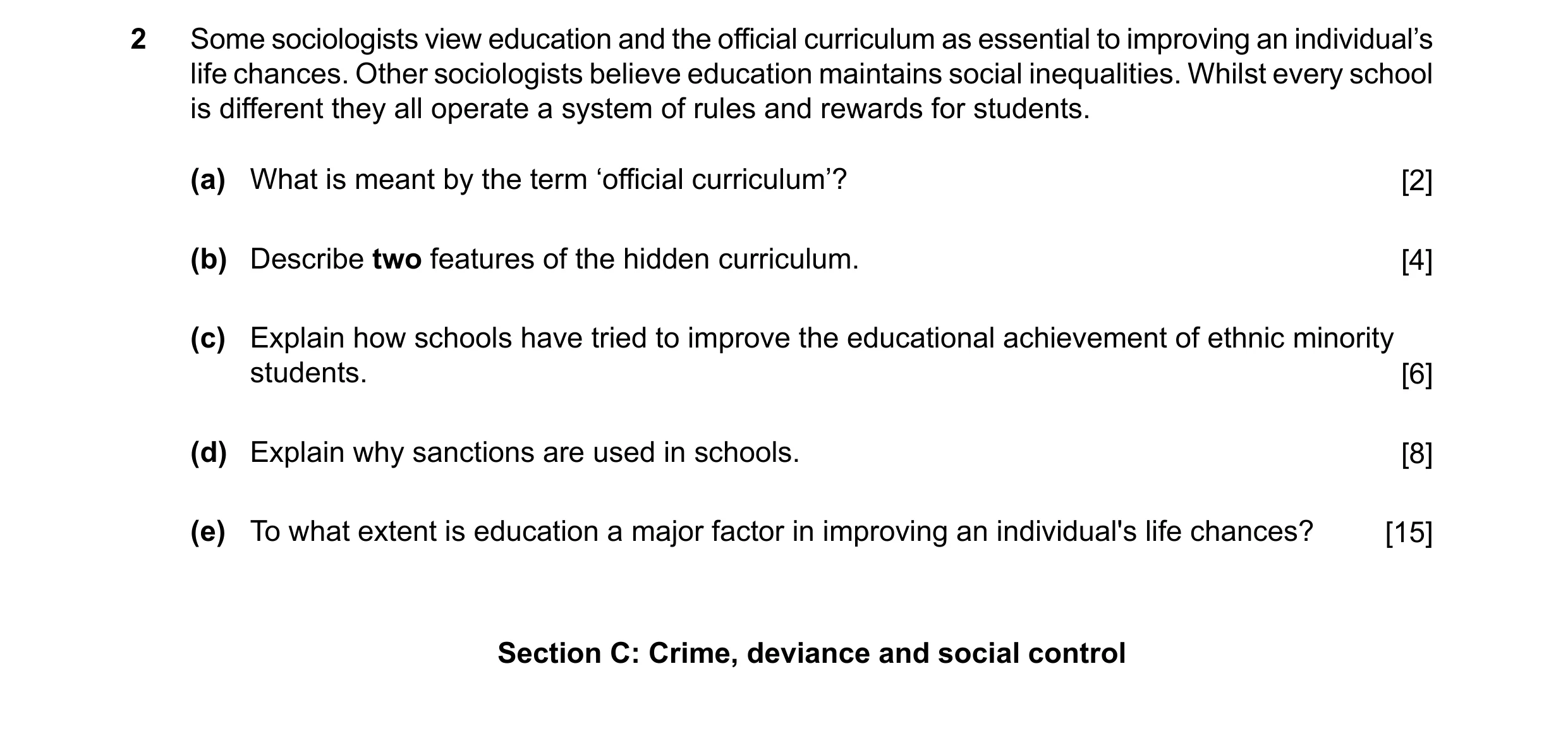
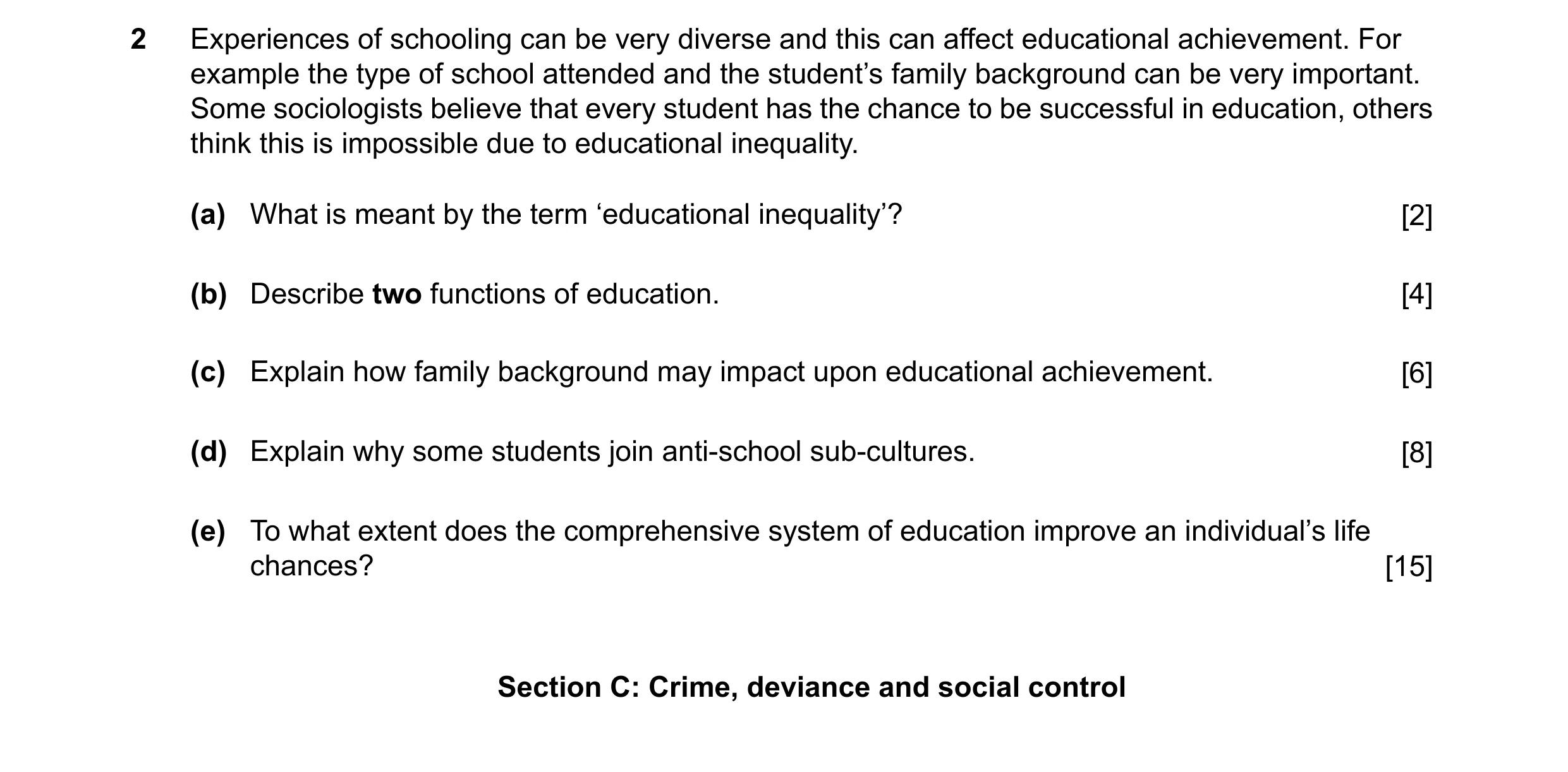 3 / 6
3 / 6
 4 / 6
4 / 6
 5 / 6
5 / 6
 6 / 6
6 / 6 35
35 35
35 35
35 35
35 35
35 35
35 35
35 35
35 35
35 35
35 35
35 35
35