Cambridge IGCSE Sociology 0495 — 2021 May/June Paper 2 · Variant 2
0495/22/M/J/21 · 4 questions · 70 marks · ≈79 min
The question paper and its mark scheme, free to read here and free to download. This is Cambridge’s own paper, exactly as it was sat.
Question paper4 pages
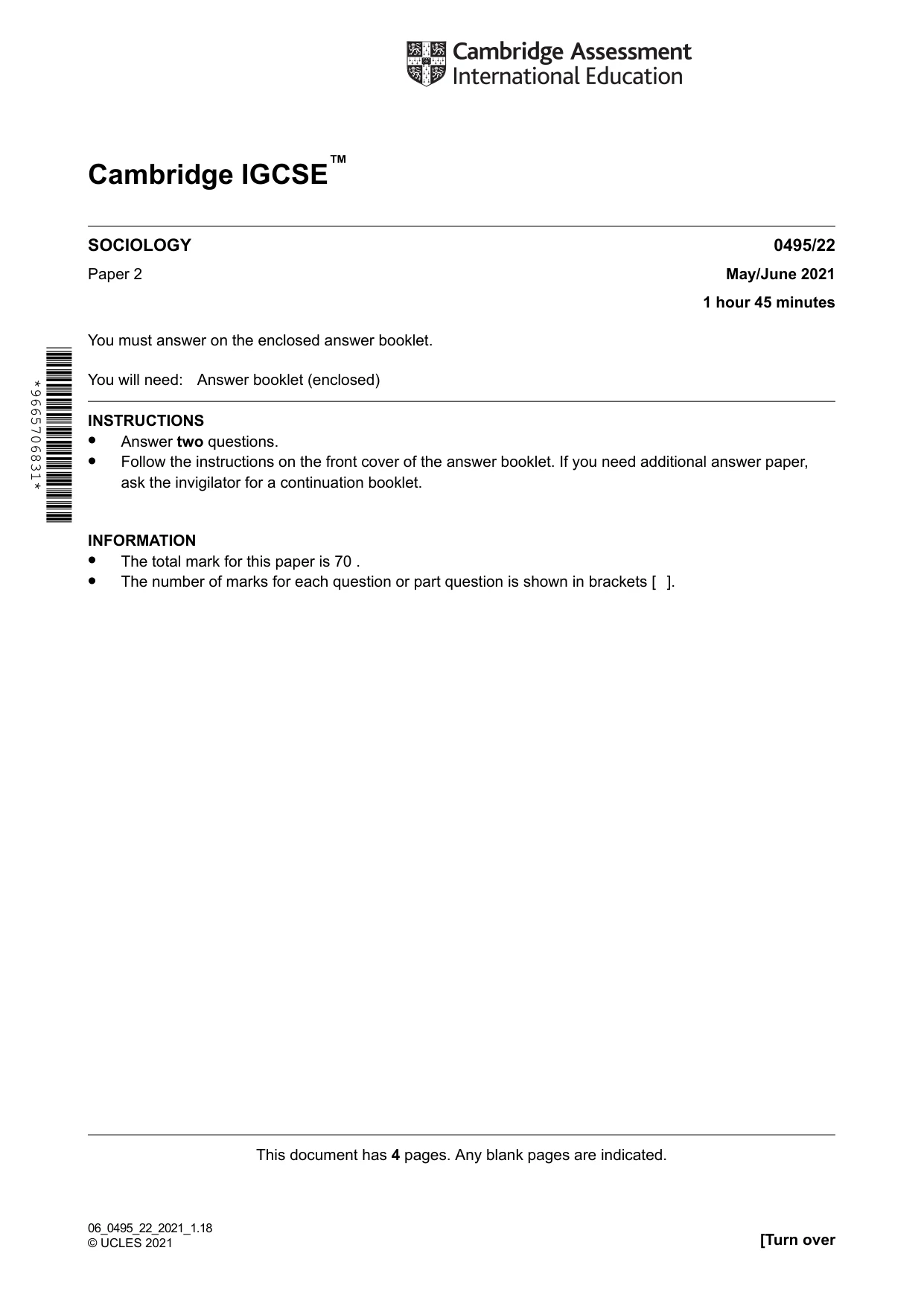

Mark scheme31 pages
Answers below. Sit the paper first if you are practising.


Questions as text
Q1 · The institution of the family is very diverse
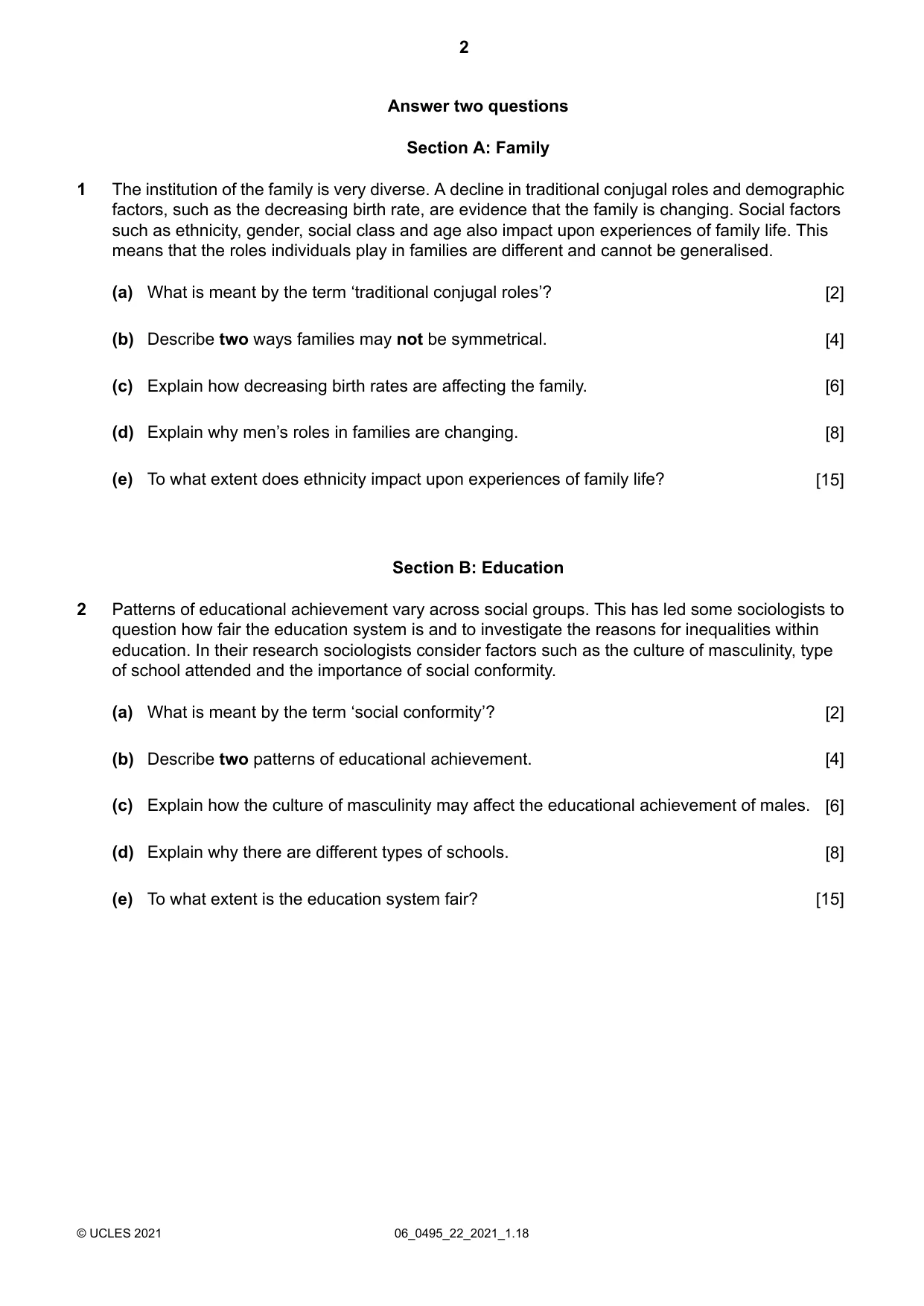
1 The institution of the family is very diverse. A decline in traditional conjugal roles and demographic factors, such as the decreasing birth rate, are evidence that the family is changing. Social factors such as ethnicity, gender, social class and age also impact upon experiences of family life. This means that the roles individuals play in families are different and cannot be generalised. (a) What is meant by the term ‘traditional conjugal roles’? [2] (b) Describe two ways families may not be symmetrical. [4] (c) Explain how decreasing birth rates are affecting the family. [6] (d) Explain why men’s roles in families are changing. [8] (e) To what extent does ethnicity impact upon experiences of family life? [15]
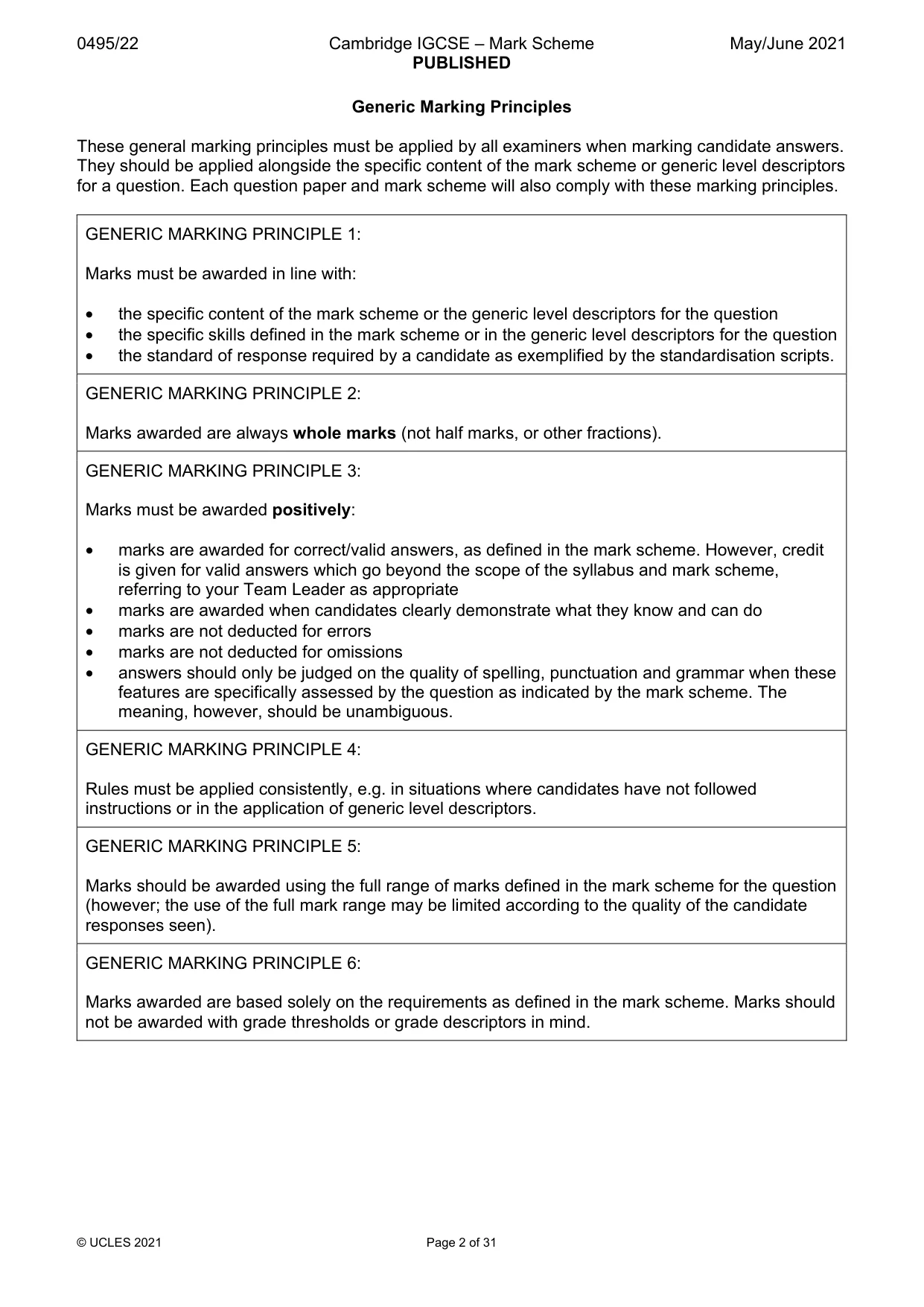
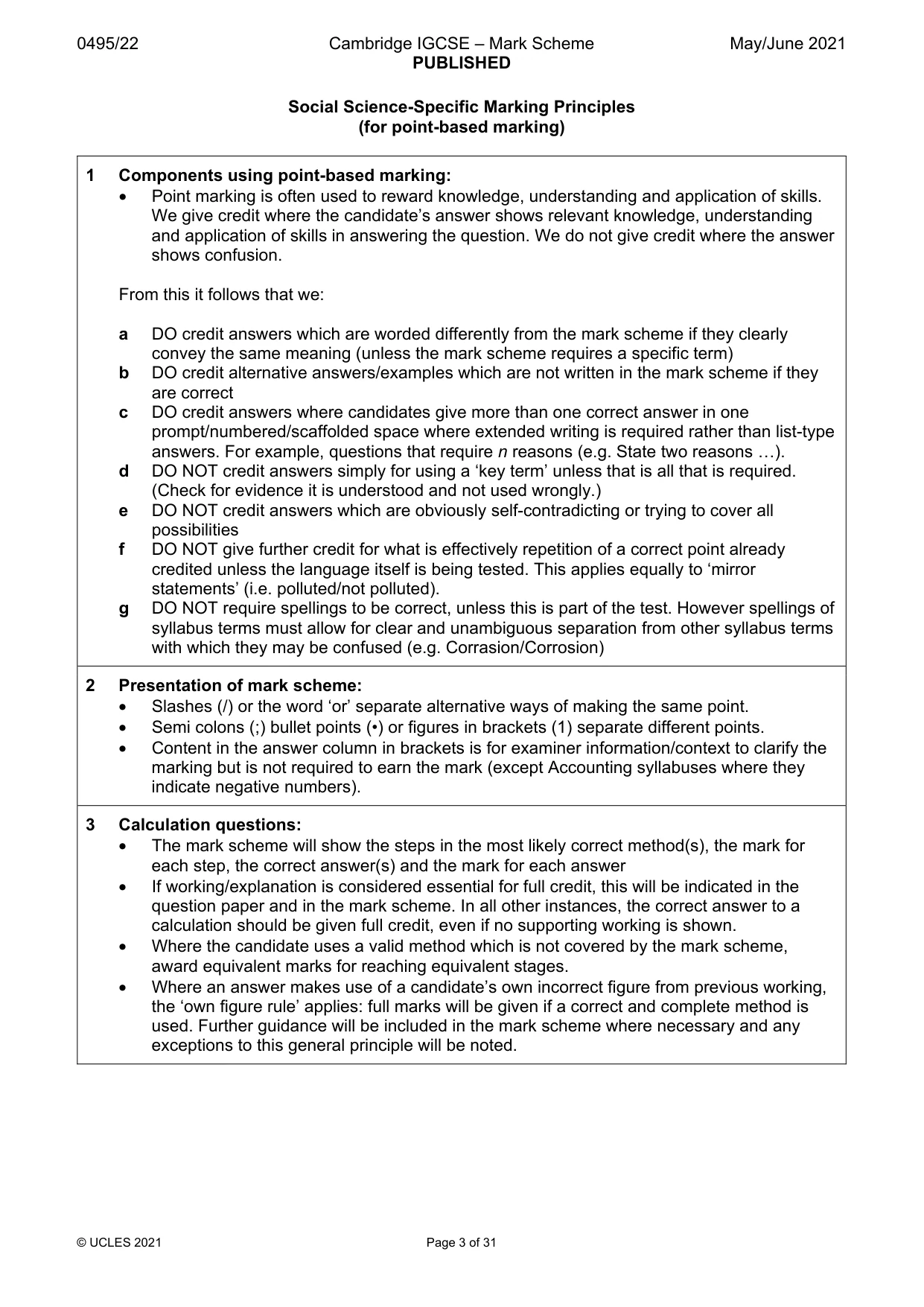
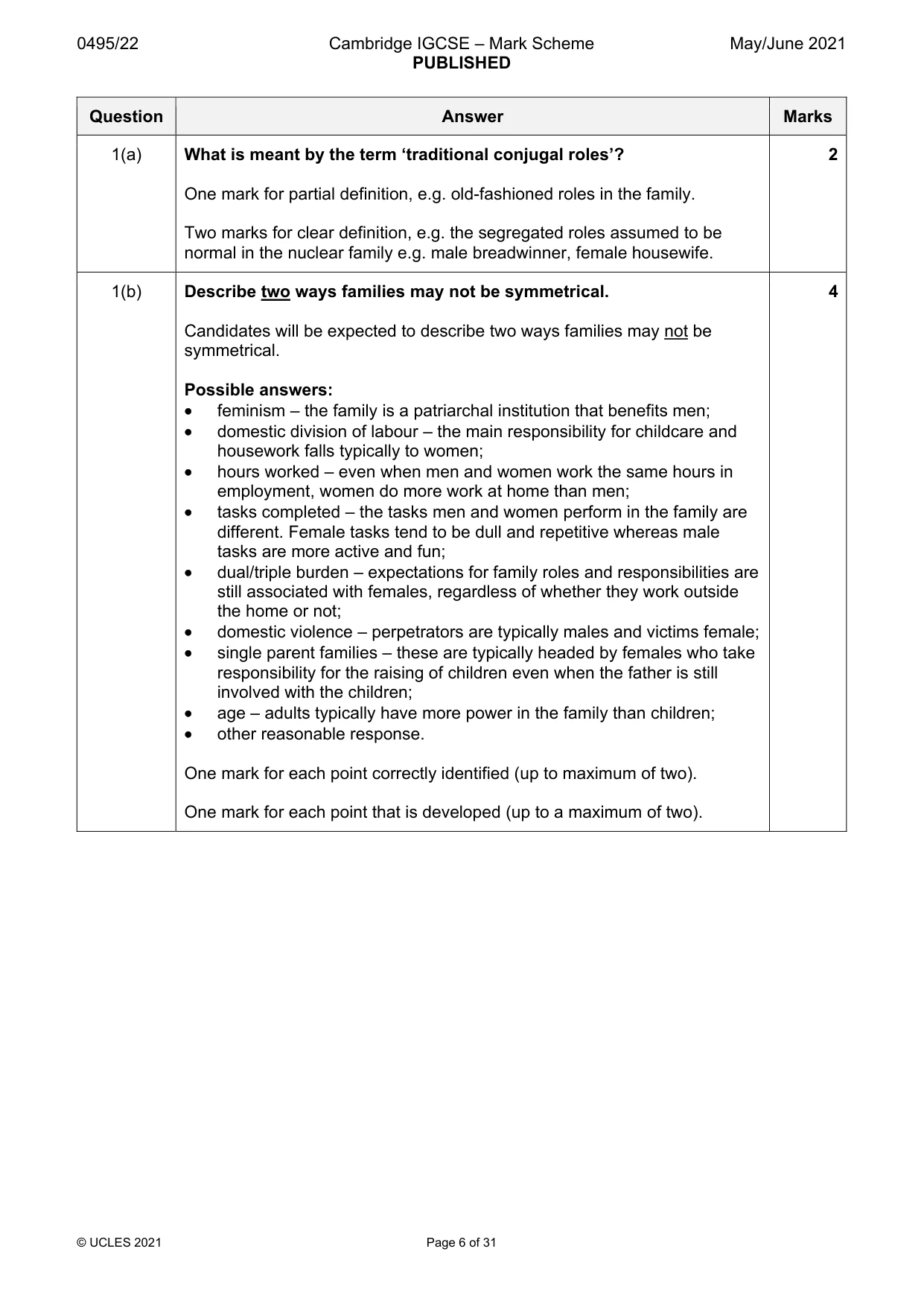
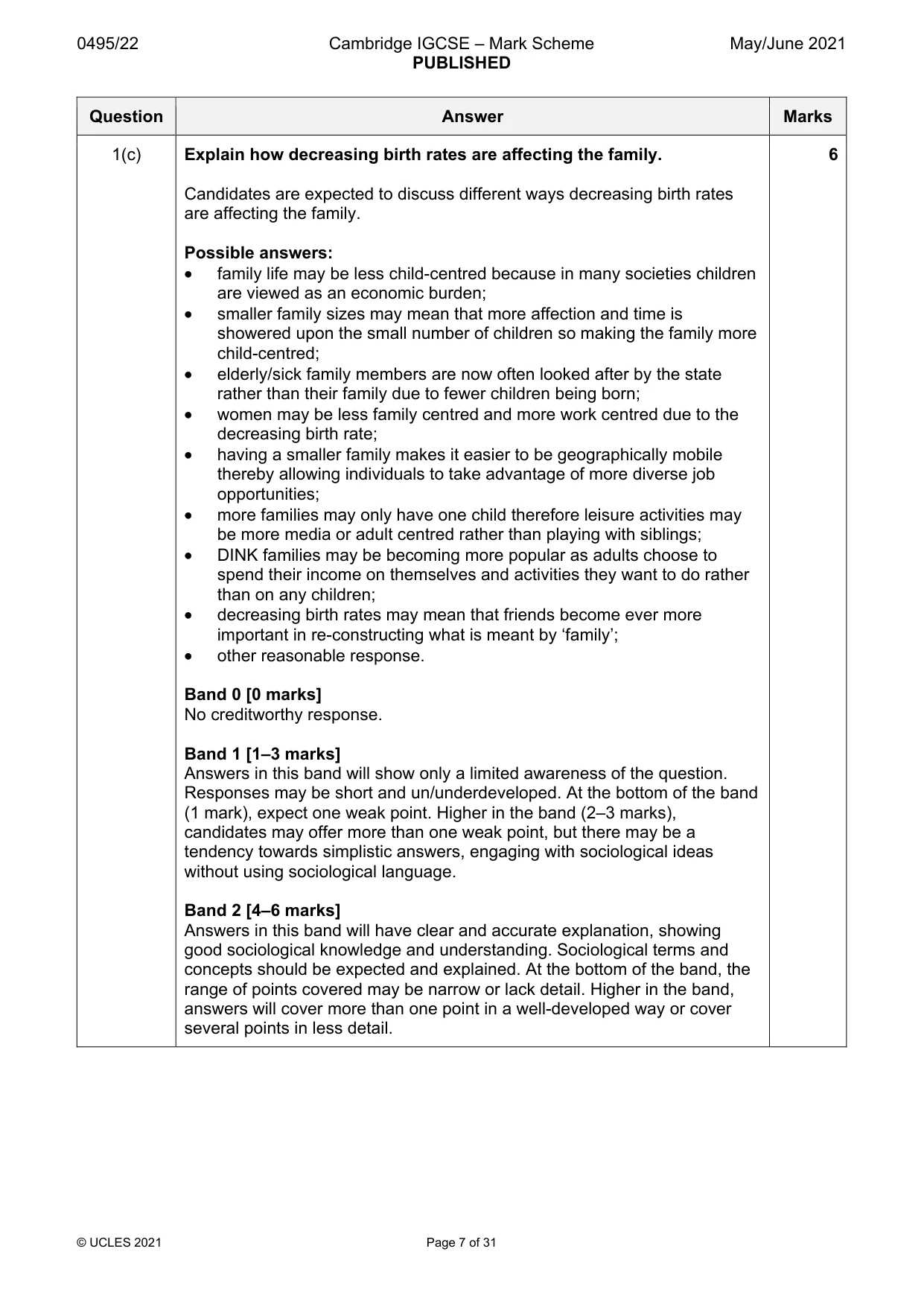
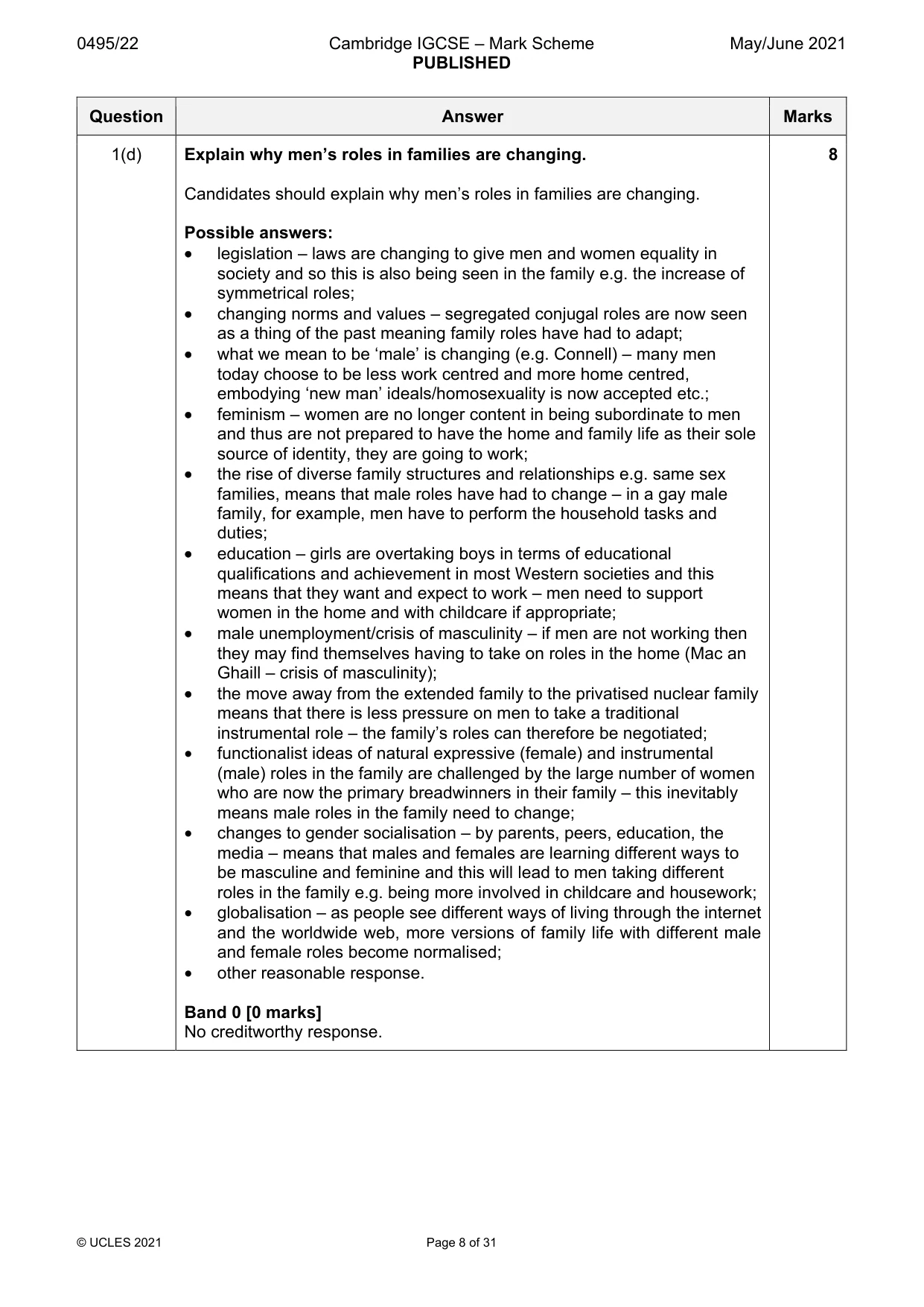
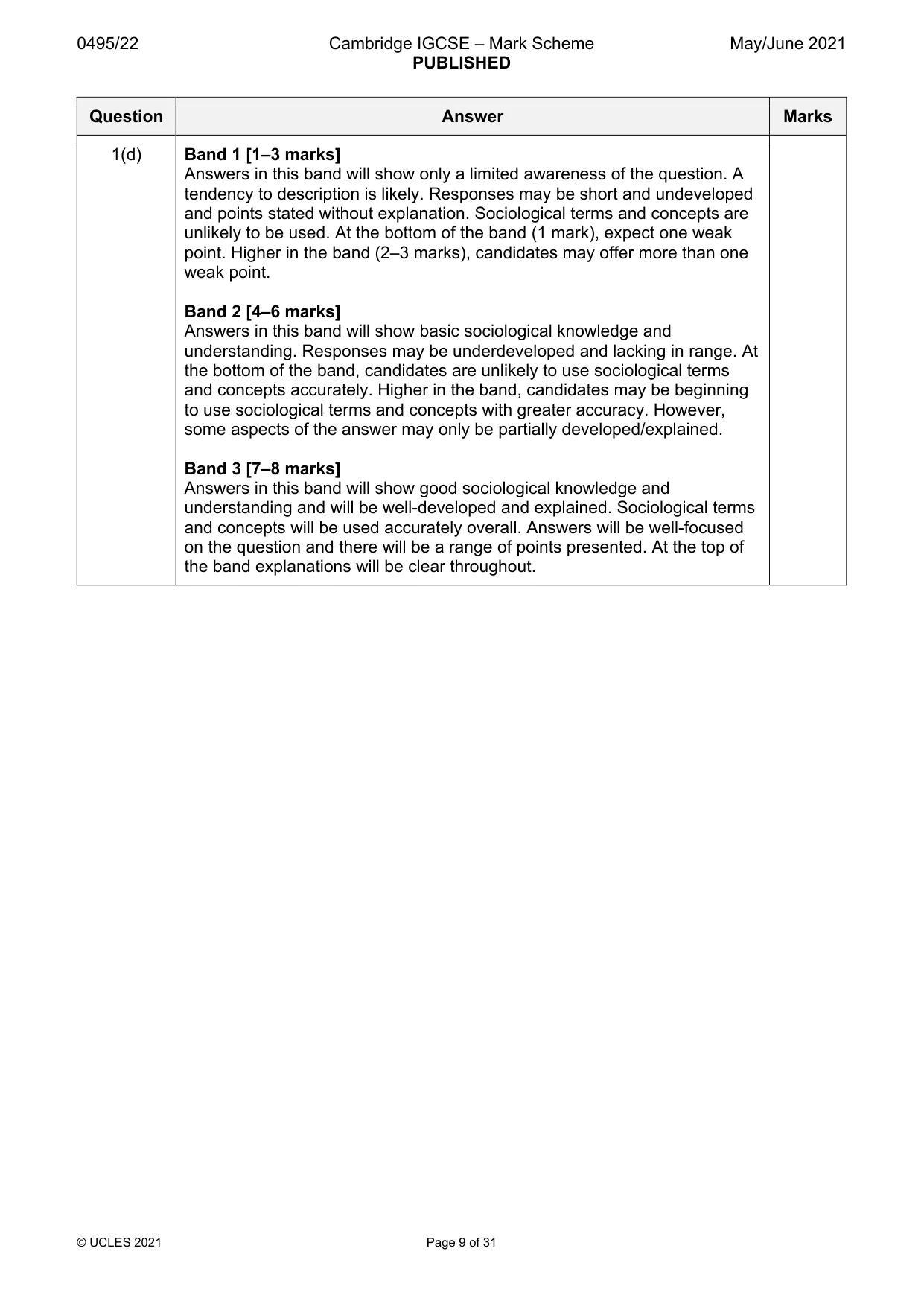
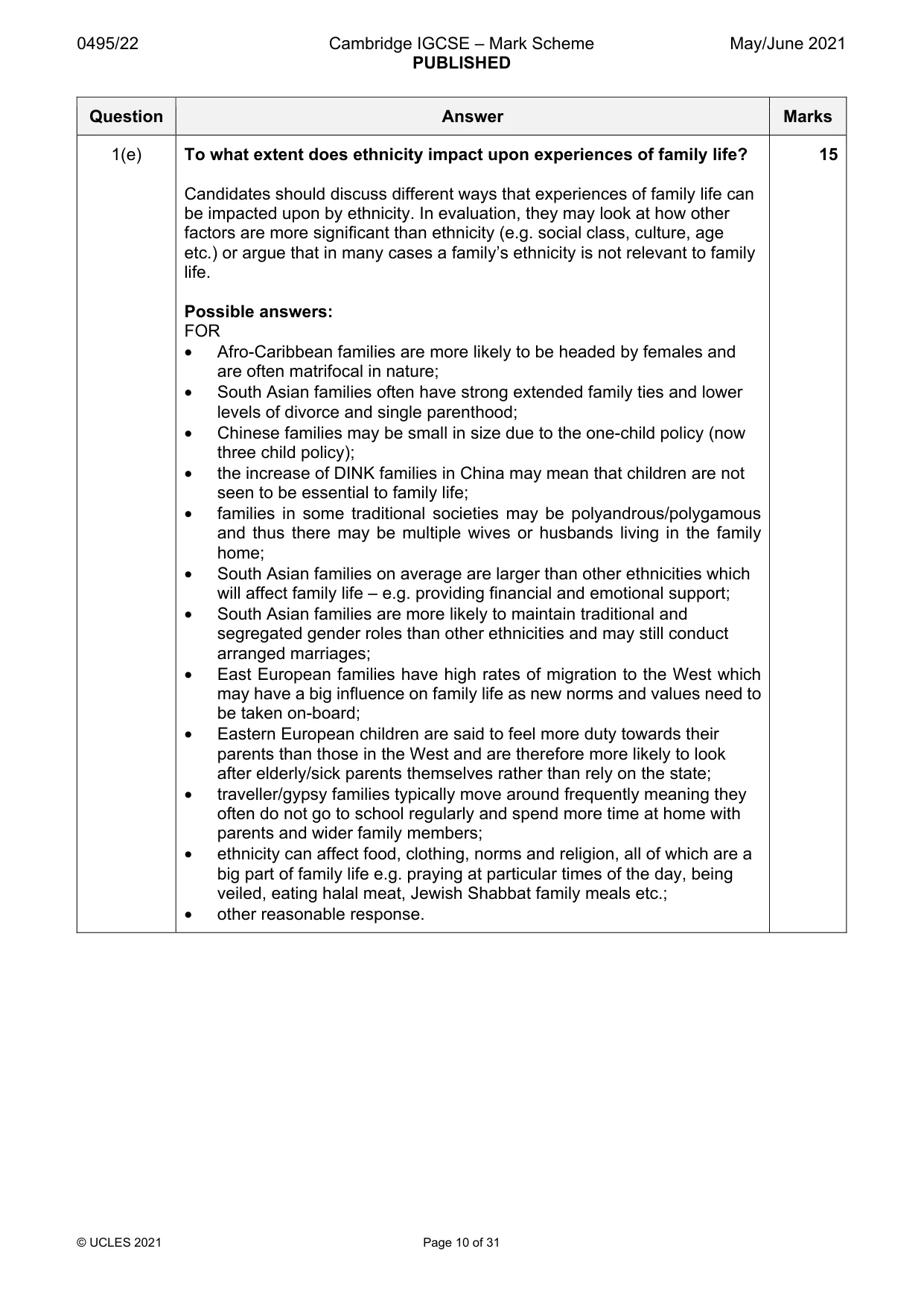
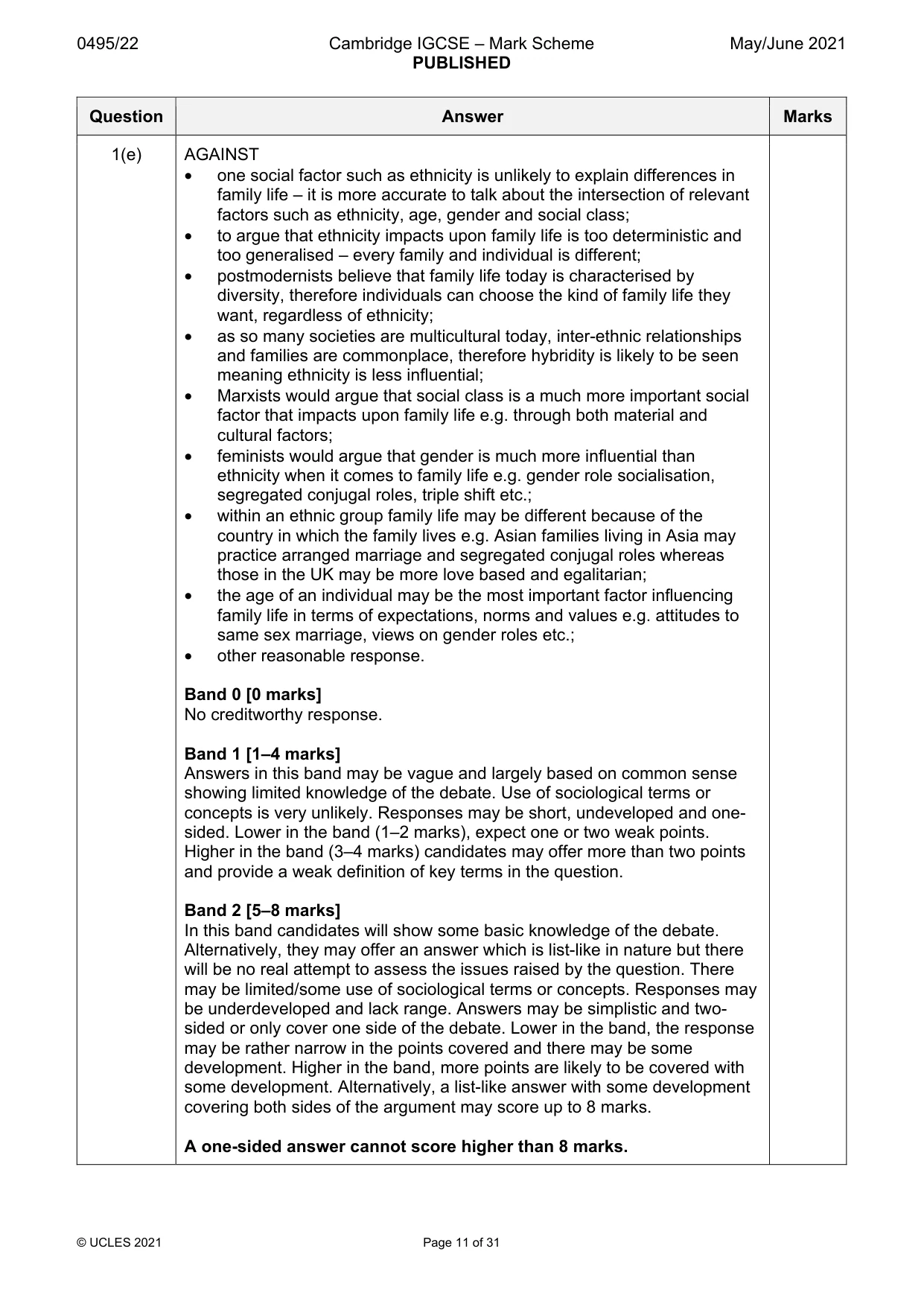
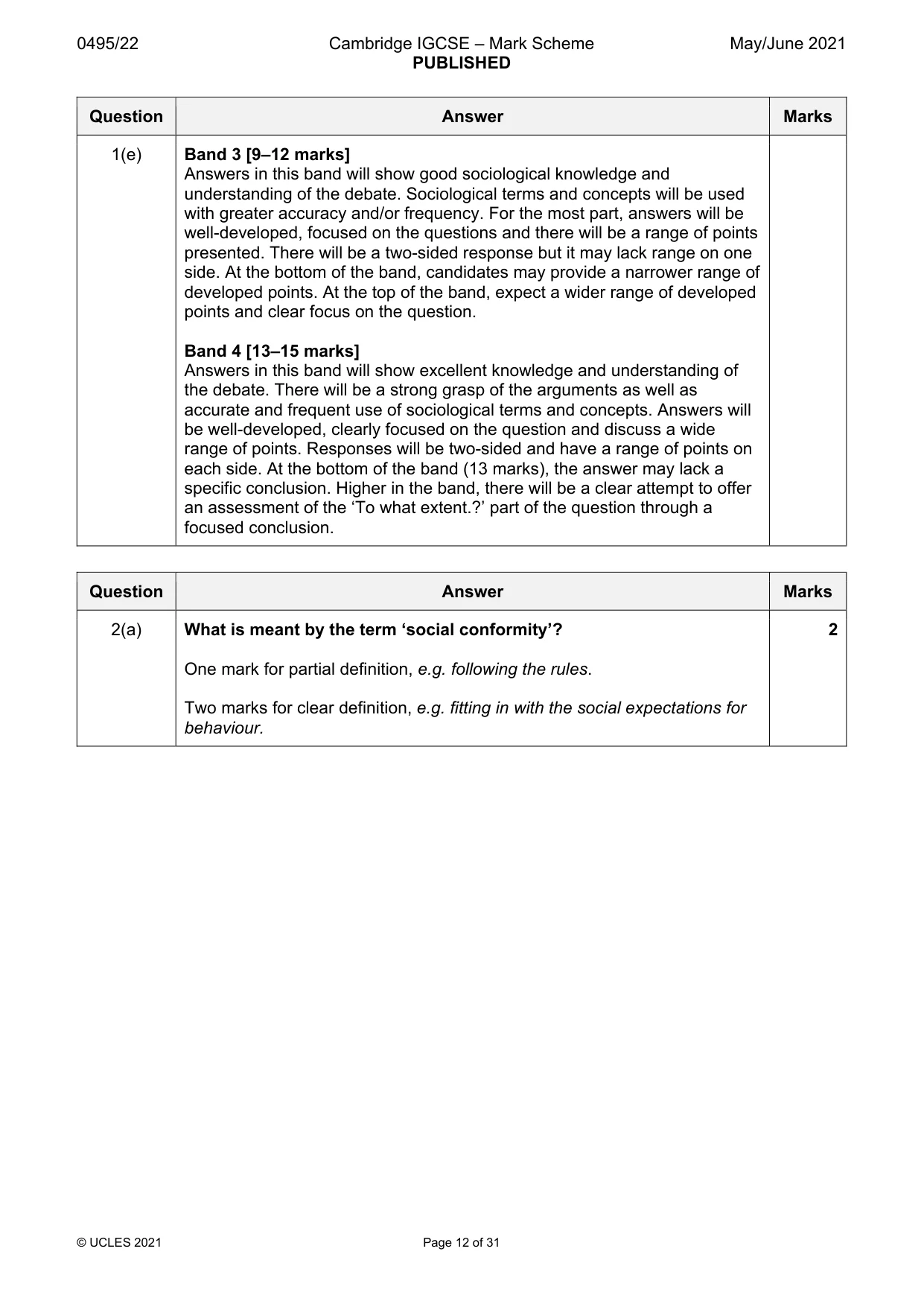
Mark scheme: Question Answer Marks 1(a) What is meant by the term ‘traditional conjugal roles’? 2 One mark for partial definition, e.g. old-fashioned roles in the family. Two marks for clear definition, e.g. the segregated roles assumed to be normal in the nuclear family e.g. male breadwinner, female housewife. 1(b) Describe two ways families may not be symmetrical. 4 Candidates will be expected to describe two ways families may not be symmetrical. Possible answers: • feminism – the family is a patriarchal institution that benefits men; • domestic division of labour – the main responsibility for childcare and housework falls typically to women; • hours worked – even when men and women work the same hours in employment, women do more work at home than men; • tasks completed – the tasks men and women perform in the family are different. Female tasks tend to be dull and repetitive whereas male tasks are more active and fun; • dual/triple burden – expectations for family roles and responsibilities are still associated with females, regardless of whether they work outside the home or not; • domestic violence – perpetrators are typically males and victims female; • single parent families – these are typically headed by females who take responsibility for the raising of children even when the father is still involved with the children; • age – adults typically have more power in the family than children; • other reasonable response. One mark for each point correctly identified (up to maximum of two). One mark for each point that is developed (up to a maximum of two). 1(c) Explain how decreasing birth rates are affecting the family. 6 Candidates are expected to discuss different ways decreasing birth rates are affecting the family. Possible answers: • family life may be less child-centred because in many societies children are viewed as an economic burden; • smaller family sizes may mean that more affection and time is showered upon the small number of children so making the family more child-centred; • elderly/sick family members are now often looked after by the state rather than their family due to fewer children being born; • women may be less family centred and more work centred due to the decreasing birth rate; • having a smaller family makes it easier to be geographically mobile thereby allowing individuals to take advantage of more diverse job opportunities; • more families may only have one child therefore leisure activities may be more media or adult centred rather than playing with siblings; • DINK families may be becoming more popular as adults choose to spend their income on themselves and activities they want to do rather than on any children; • decreasing birth rates may mean that friends become ever more important in re-constructing what is meant by ‘family’; • other reasonable response. Band 0 [0 marks] No creditworthy response. Band 1 [1–3 marks] Answers in this band will show only a limited awareness of the question. Responses may be short and un/underdeveloped. At the bottom of the band (1 mark), expect one weak point. Higher in the band (2–3 marks), candidates may offer more than one weak point, but there may be a tendency towards simplistic answers, engaging with sociological ideas without using sociological language. Band 2 [4–6 marks] Answers in this band will have clear and accurate explanation, showing good sociological knowledge and understanding. Sociological terms and concepts should be expected and explained. At the bottom of the band, the range of points covered may be narrow or lack detail. Higher in the band, answers will cover more than one point in a well-developed way or cover several points in less detail. 1(d) Explain why men’s roles in families are changing. 8 Candidates should explain why men’s roles in families are changing. Possible answers: • legislation – laws are changing to give men and women equality in society and so this is also being seen in the family e.g. the increase of symmetrical roles; • changing norms and values – segregated conjugal roles are now seen as a thing of the past meaning family roles have had to adapt; • what we mean to be ‘male’ is changing (e.g. Connell) – many men today choose to be less work centred and more home centred, embodying ‘new man’ ideals/homosexuality is now accepted etc.; • feminism – women are no longer content in being subordinate to men and thus are not prepared to have the home and family life as their sole source of identity, they are going to work; • the rise of diverse family structures and relationships e.g. same sex families, means that male roles have had to change – in a gay male family, for example, men have to perform the household tasks and duties; • education – girls are overtaking boys in terms of educational qualifications and achievement in most Western societies and this means that they want and expect to work – men need to support women in the home and with childcare if appropriate; • male unemployment/crisis of masculinity – if men are not working then they may find themselves having to take on roles in the home (Mac an Ghaill – crisis of masculinity); • the move away from the extended family to the privatised nuclear family means that there is less pressure on men to take a traditional instrumental role – the family’s roles can therefore be negotiated; • functionalist ideas of natural expressive (female) and instrumental (male) roles in the family are challenged by the large number of women who are now the primary breadwinners in their family – this inevitably means male roles in the family need to change; • changes to gender socialisation – by parents, peers, education, the media – means that males and females are learning different ways to be masculine and feminine and this will lead to men taking different roles in the family e.g. being more involved in childcare and housework; • globalisation – as people see different ways of living through the internet and the worldwide web, more versions of family life with different male and female roles become normalised; • other reasonable response. Band 0 [0 marks] No creditworthy response. 1(d) Band 1 [1–3 marks] Answers in this band will show only a limited awareness of the question. A tendency to description is likely. Responses may be short and undeveloped and points stated without explanation. Sociological terms and concepts are unlikely to be used. At the bottom of the band (1 mark), expect one weak point. Higher in the band (2–3 marks), candidates may offer more than one weak point. Band 2 [4–6 marks] Answers in this band will show basic sociological knowledge and understanding. Responses may be underdeveloped and lacking in range. At the bottom of the band, candidates are unlikely to use sociological terms and concepts accurately. Higher in the band, candidates may be beginning to use sociological terms and concepts with greater accuracy. However, some aspects of the answer may only be partially developed/explained. Band 3 [7–8 marks] Answers in this band will show good sociological knowledge and understanding and will be well-developed and explained. Sociological terms and concepts will be used accurately overall. Answers will be well-focused on the question and there will be a range of points presented. At the top of the band explanations will be clear throughout. 1(e) To what extent does ethnicity impact upon experiences of family life? 15 Candidates should discuss different ways that experiences of family life can be impacted upon by ethnicity. In evaluation, they may look at how other factors are more significant than ethnicity (e.g. social class, culture, age etc.) or argue that in many cases a family’s ethnicity is not relevant to family life. Possible answers: FOR • Afro-Caribbean families are more likely to be headed by females and are often matrifocal in nature; • South Asian families often have strong extended family ties and lower levels of divorce and single parenthood; • Chinese families may be small in size due to the one-child policy (now three child policy); • the increase of DINK families in China may mean that children are not seen to be essential to family life; • families in some traditional societies may be polyandrous/polygamous and thus there may be multiple wives or husbands living in the family home; • South Asian families on average are larger than other ethnicities which will affect family life – e.g. providing financial and emotional support; • South Asian families are more likely to maintain traditional and segregated gender roles than other ethnicities and may still conduct arranged marriages; • East European families have high rates of migration to the West which may have a big influence on family life as new norms and values need to be taken on-board; • Eastern European children are said to feel more duty towards their parents than those in the West and are therefore more likely to look after elderly/sick parents themselves rather than rely on the state; • traveller/gypsy families typically move around frequently meaning they often do not go to school regularly and spend more time at home with parents and wider family members; • ethnicity can affect food, clothing, norms and religion, all of which are a big part of family life e.g. praying at particular times of the day, being veiled, eating halal meat, Jewish Shabbat family meals etc.; • other reasonable response. 1(e) AGAINST • one social factor such as ethnicity is unlikely to explain differences in family life – it is more accurate to talk about the intersection of relevant factors such as ethnicity, age, gender and social class; • to argue that ethnicity impacts upon family life is too deterministic and too generalised – every family and individual is different; • postmodernists believe that family life today is characterised by diversity, therefore individuals can choose the kind of family life they want, regardless of ethnicity; • as so many societies are multicultural today, inter-ethnic relationships and families are commonplace, therefore hybridity is likely to be seen meaning ethnicity is less influential; • Marxists would argue that social class is a much more important social factor that impacts upon family life e.g. through both material and cultural factors; • feminists would argue that gender is much more influential than ethnicity when it comes to family life e.g. gender role socialisation, segregated conjugal roles, triple shift etc.; • within an ethnic group family life may be different because of the country in which the family lives e.g. Asian families living in Asia may practice arranged marriage and segregated conjugal roles whereas those in the UK may be more love based and egalitarian; • the age of an individual may be the most important factor influencing family life in terms of expectations, norms and values e.g. attitudes to same sex marriage, views on gender roles etc.; • other reasonable response. Band 0 [0 marks] No creditworthy response. Band 1 [1–4 marks] Answers in this band may be vague and largely based on common sense showing limited knowledge of the debate. Use of sociological terms or concepts is very unlikely. Responses may be short, undeveloped and one- sided. Lower in the band (1–2 marks), expect one or two weak points. Higher in the band (3–4 marks) candidates may offer more than two points and provide a weak definition of key terms in the question. Band 2 [5–8 marks] In this band candidates will show some basic knowledge of the debate. Alternatively, they may offer an answer which is list-like in nature but there will be no real attempt to assess the issues raised by the question. There may be limited/some use of sociological terms or concepts. Responses may be underdeveloped and lack range. Answers may be simplistic and two- sided or only cover one side of the debate. Lower in the band, the response may be rather narrow in the points covered and there may be some development. Higher in the band, more points are likely to be covered with some development. Alternatively, a list-like answer with some development covering both sides of the argument may score up to 8 marks. A one-sided answer cannot score higher than 8 marks. 1(e) Band 3 [9–12 marks] Answers in this band will show good sociological knowledge and understanding of the debate. Sociological terms and concepts will be used with greater accuracy and/or frequency. For the most part, answers will be well-developed, focused on the questions and there will be a range of points presented. There will be a two-sided response but it may lack range on one side. At the bottom of the band, candidates may provide a narrower range of developed points. At the top of the band, expect a wider range of developed points and clear focus on the question. Band 4 [13–15 marks] Answers in this band will show excellent knowledge and understanding of the debate. There will be a strong grasp of the arguments as well as accurate and frequent use of sociological terms and concepts. Answers will be well-developed, clearly focused on the question and discuss a wide range of points. Responses will be two-sided and have a range of points on each side. At the bottom of the band (13 marks), the answer may lack a specific conclusion. Higher in the band, there will be a clear attempt to offer an assessment of the ‘To what extent.?’ part of the question through a focused conclusion.
Q2 · Patterns of educational achievement vary across social groups
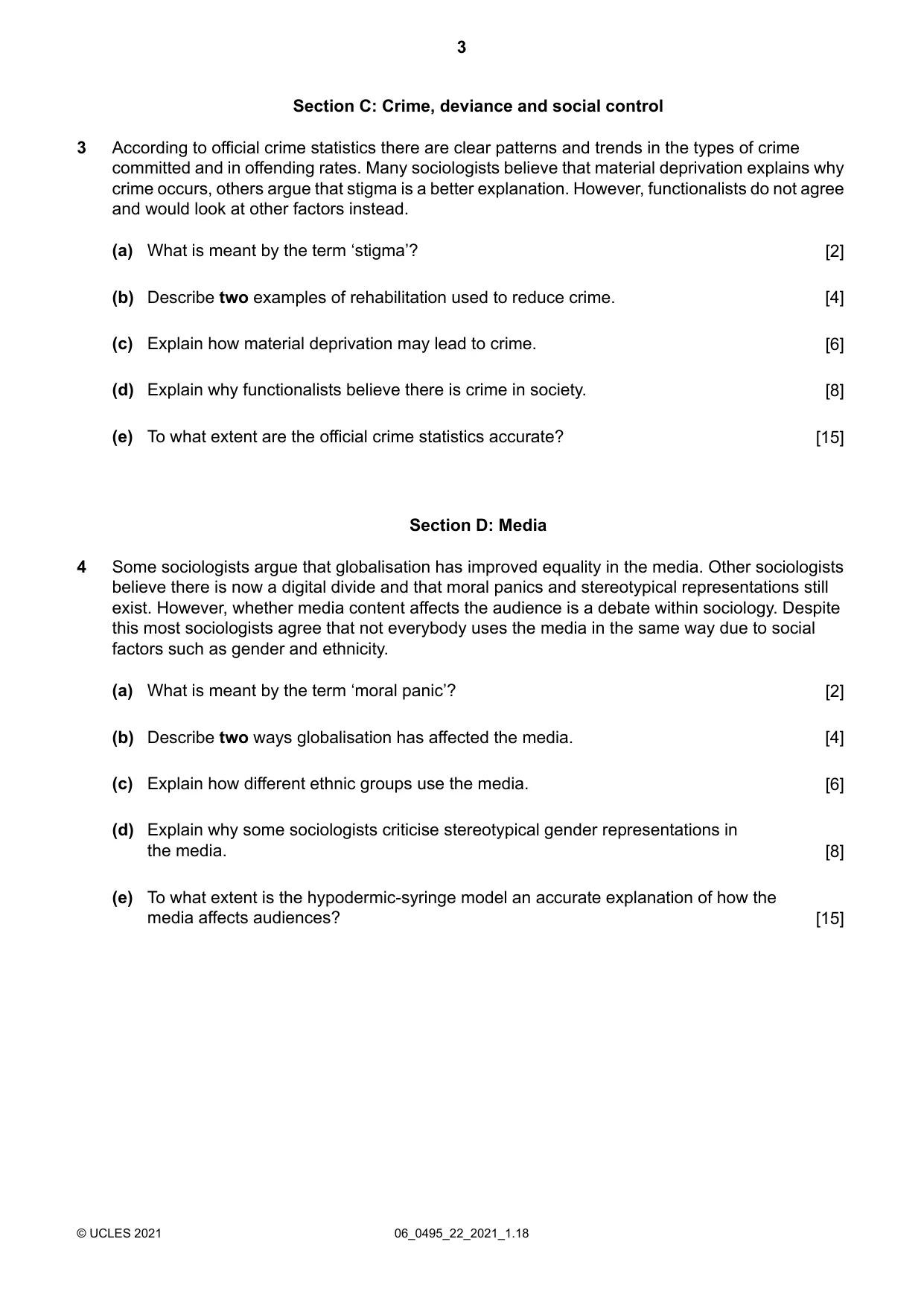
2 Patterns of educational achievement vary across social groups. This has led some sociologists to question how fair the education system is and to investigate the reasons for inequalities within education. In their research sociologists consider factors such as the culture of masculinity, type of school attended and the importance of social conformity. (a) What is meant by the term ‘social conformity’? [2] (b) Describe two patterns of educational achievement. [4] (c) Explain how the culture of masculinity may affect the educational achievement of males. [6] (d) Explain why there are different types of schools. [8] (e) To what extent is the education system fair? [15] Section C: Crime, deviance and social control
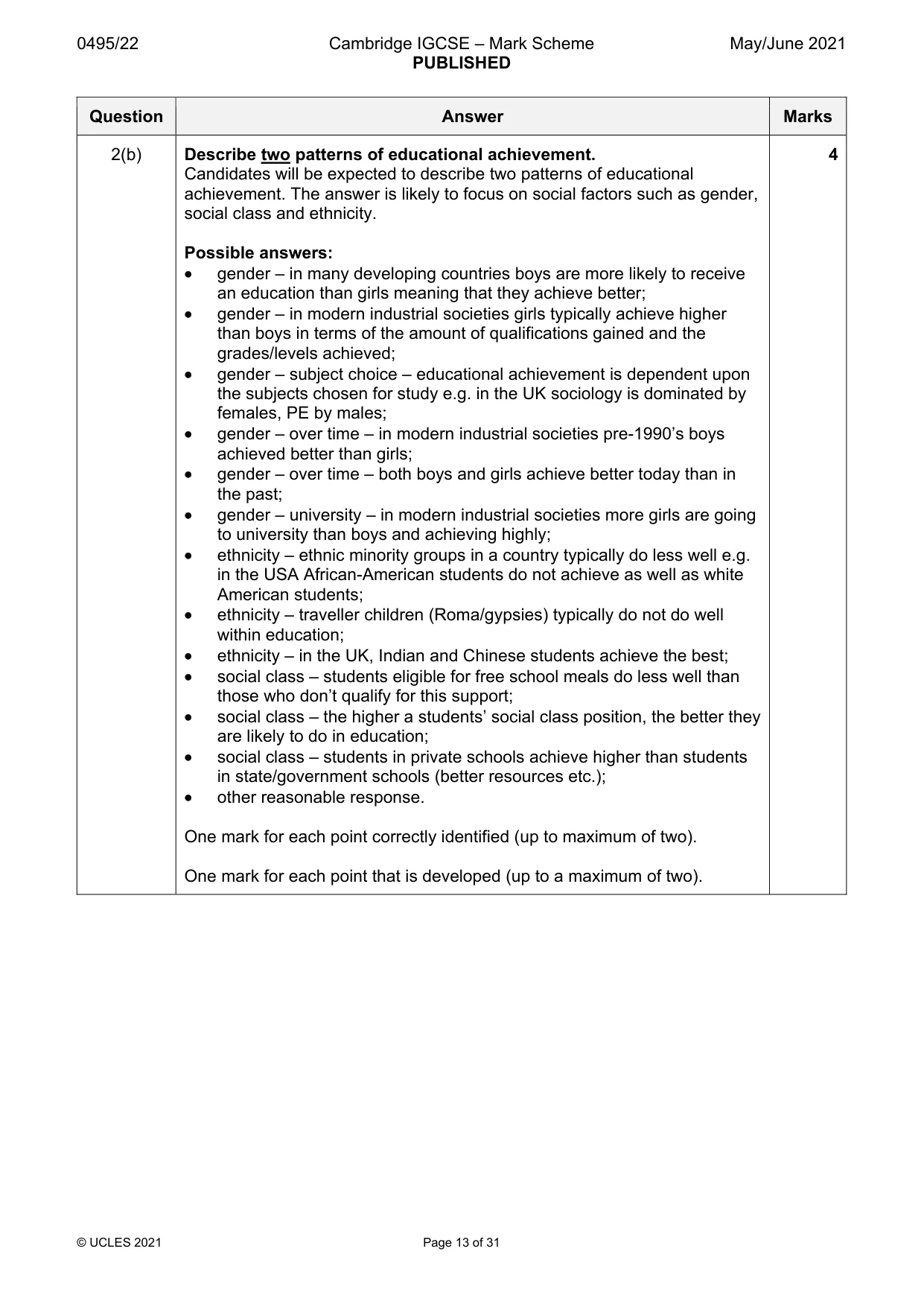
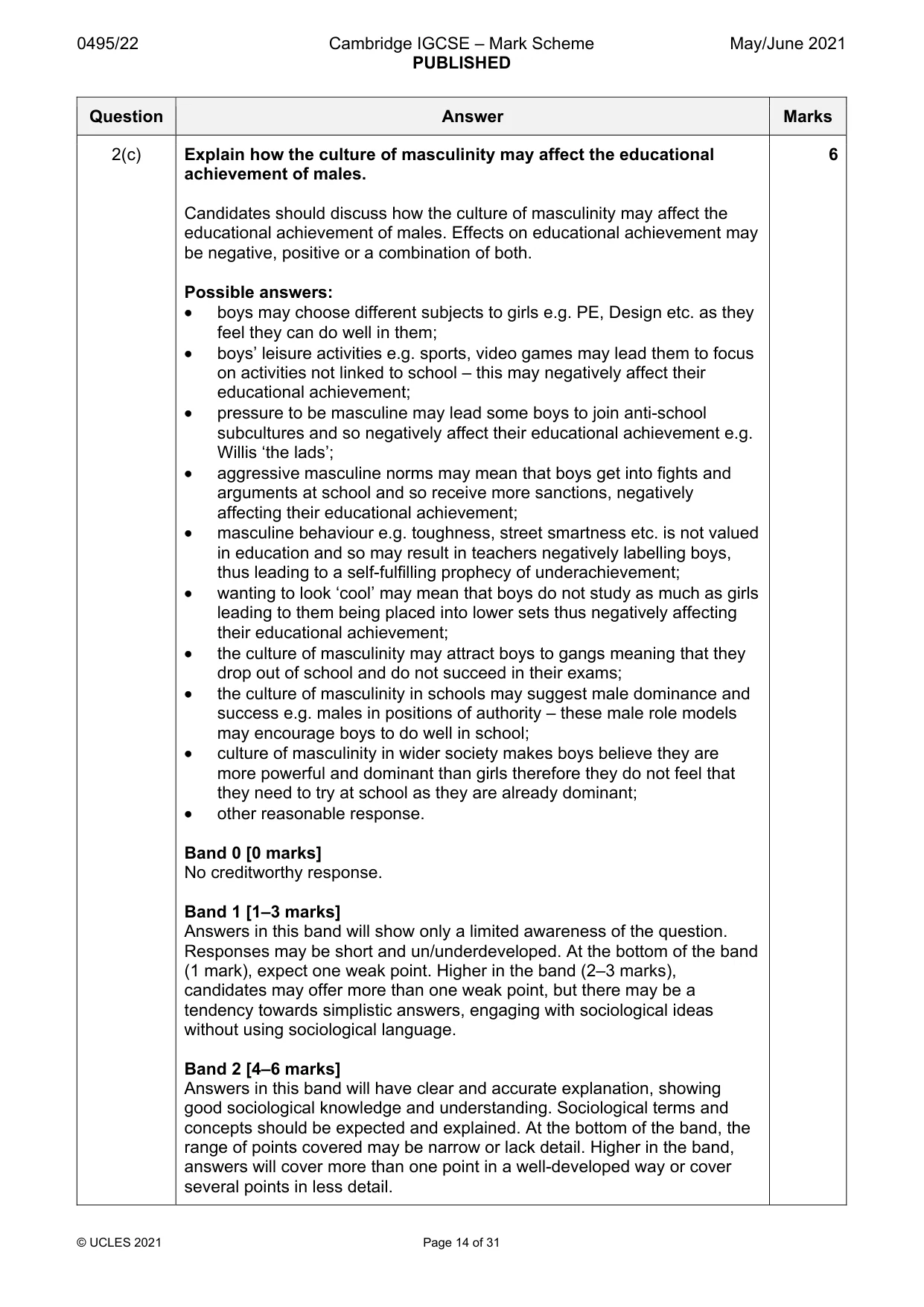
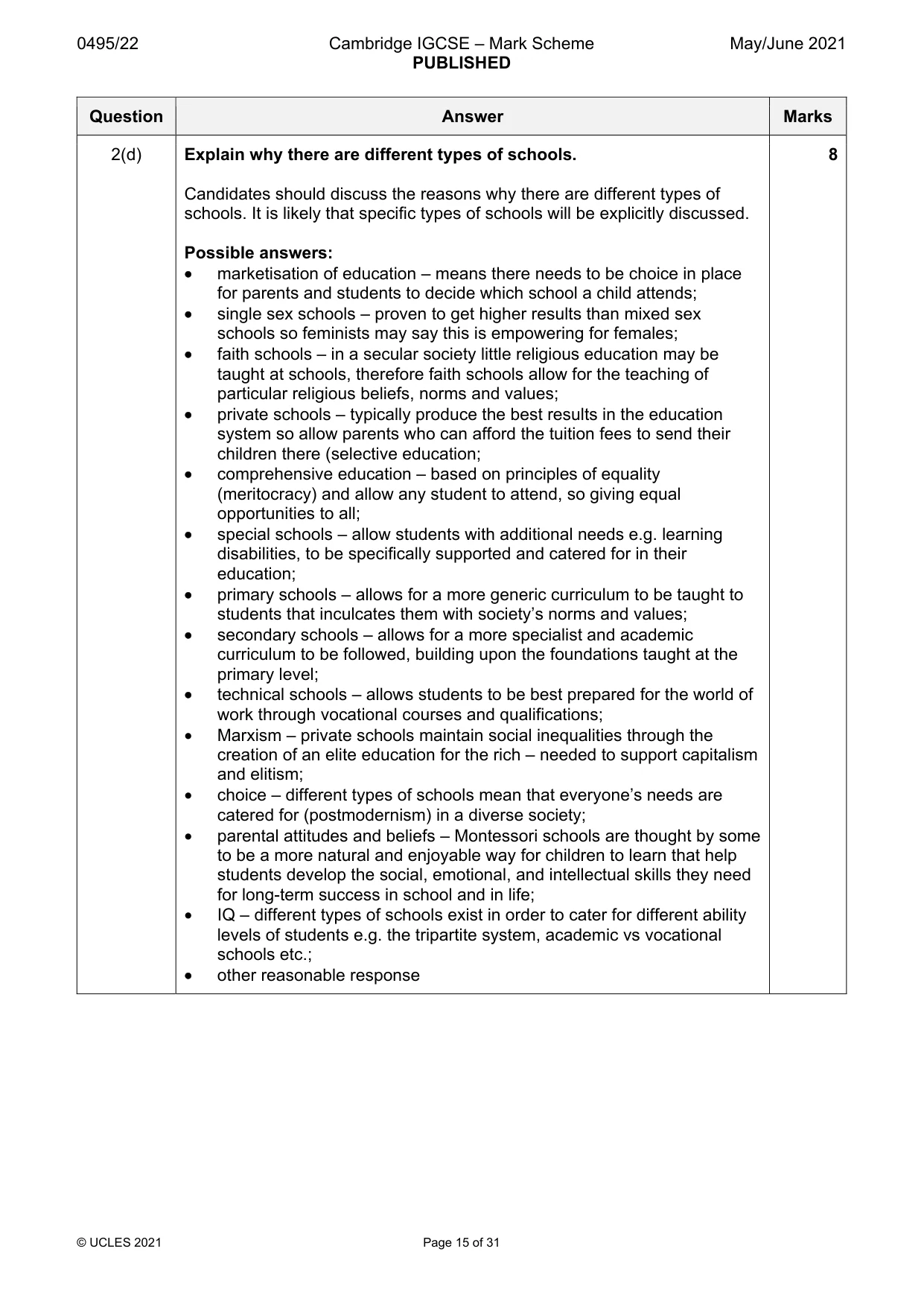
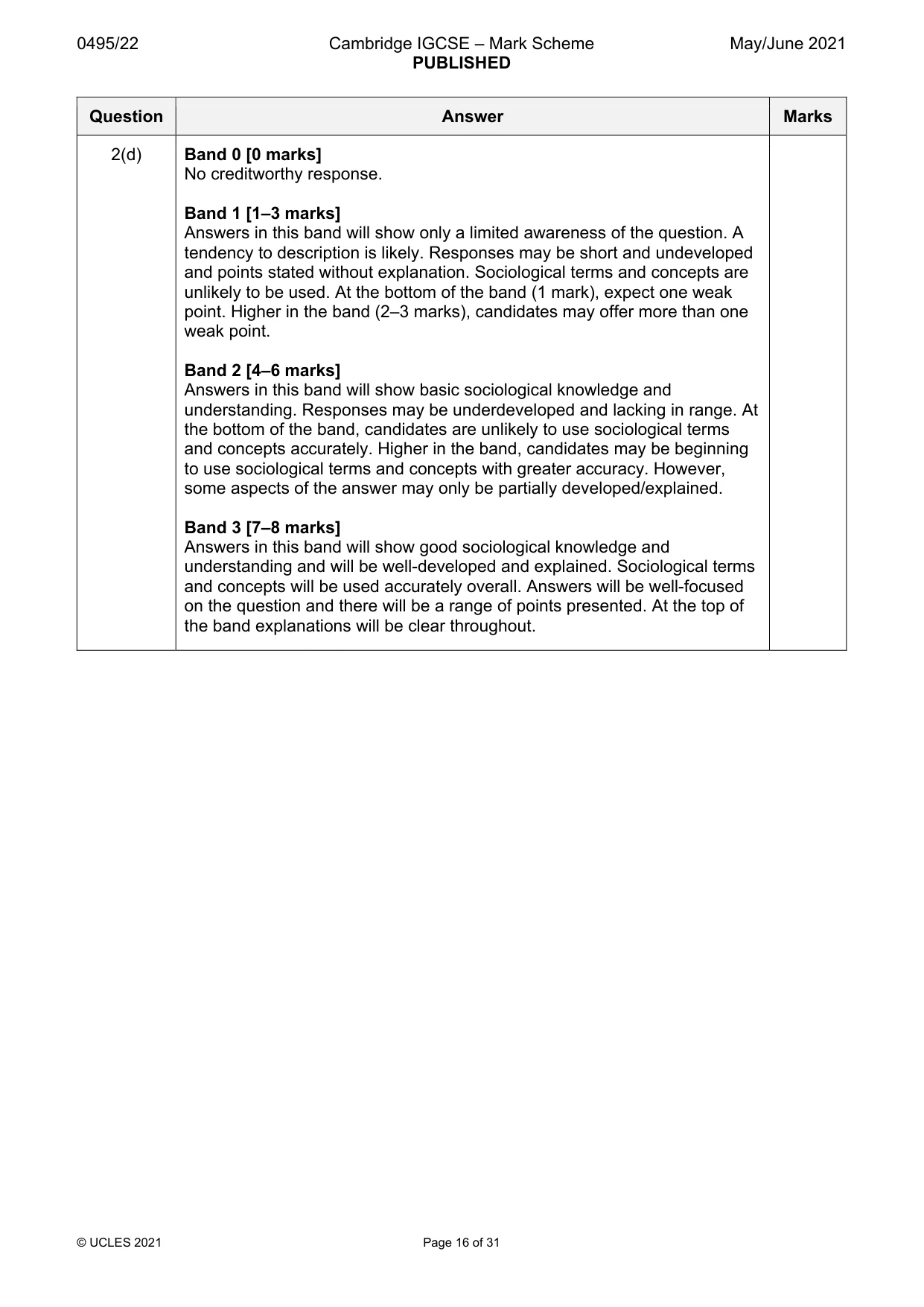
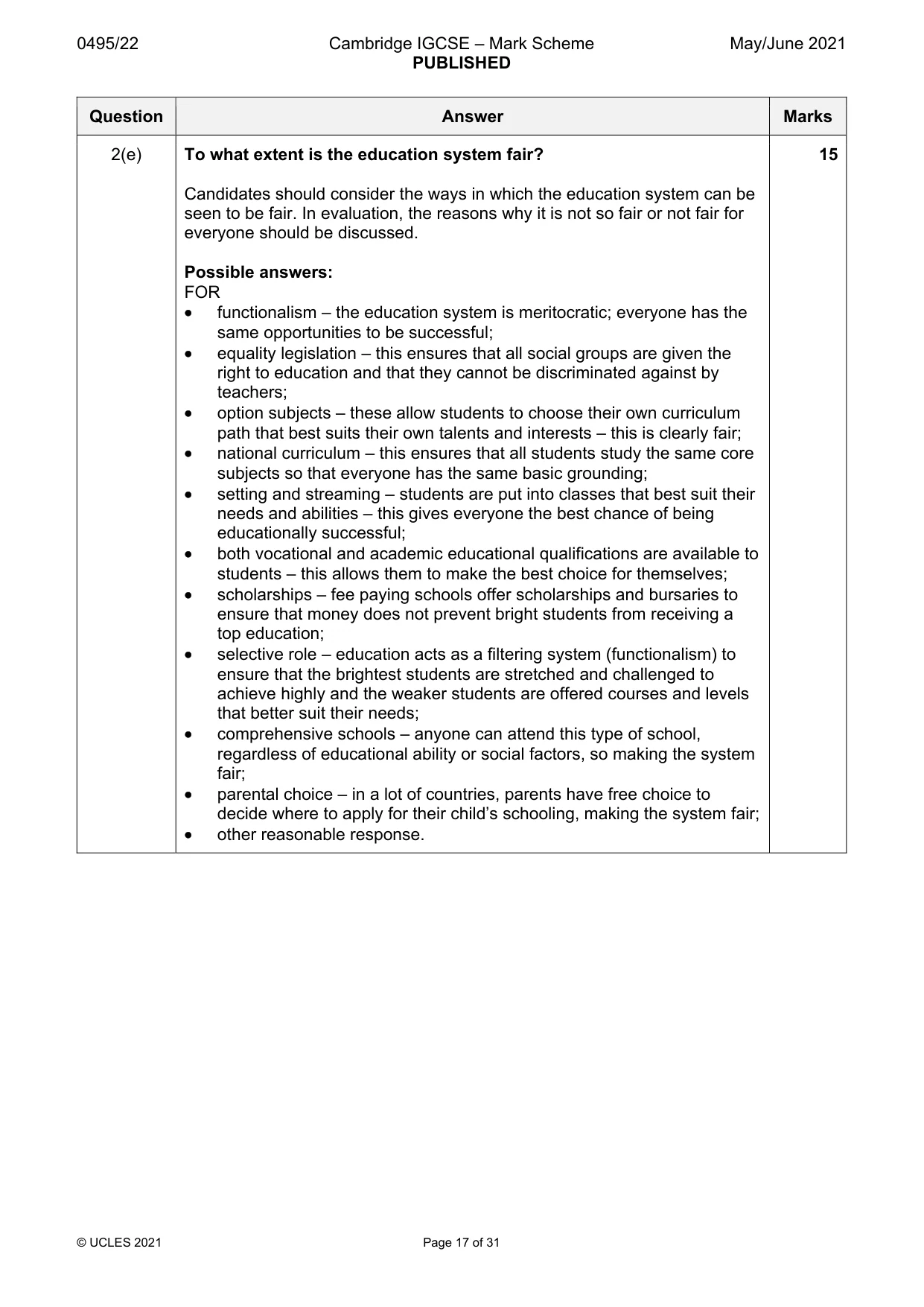
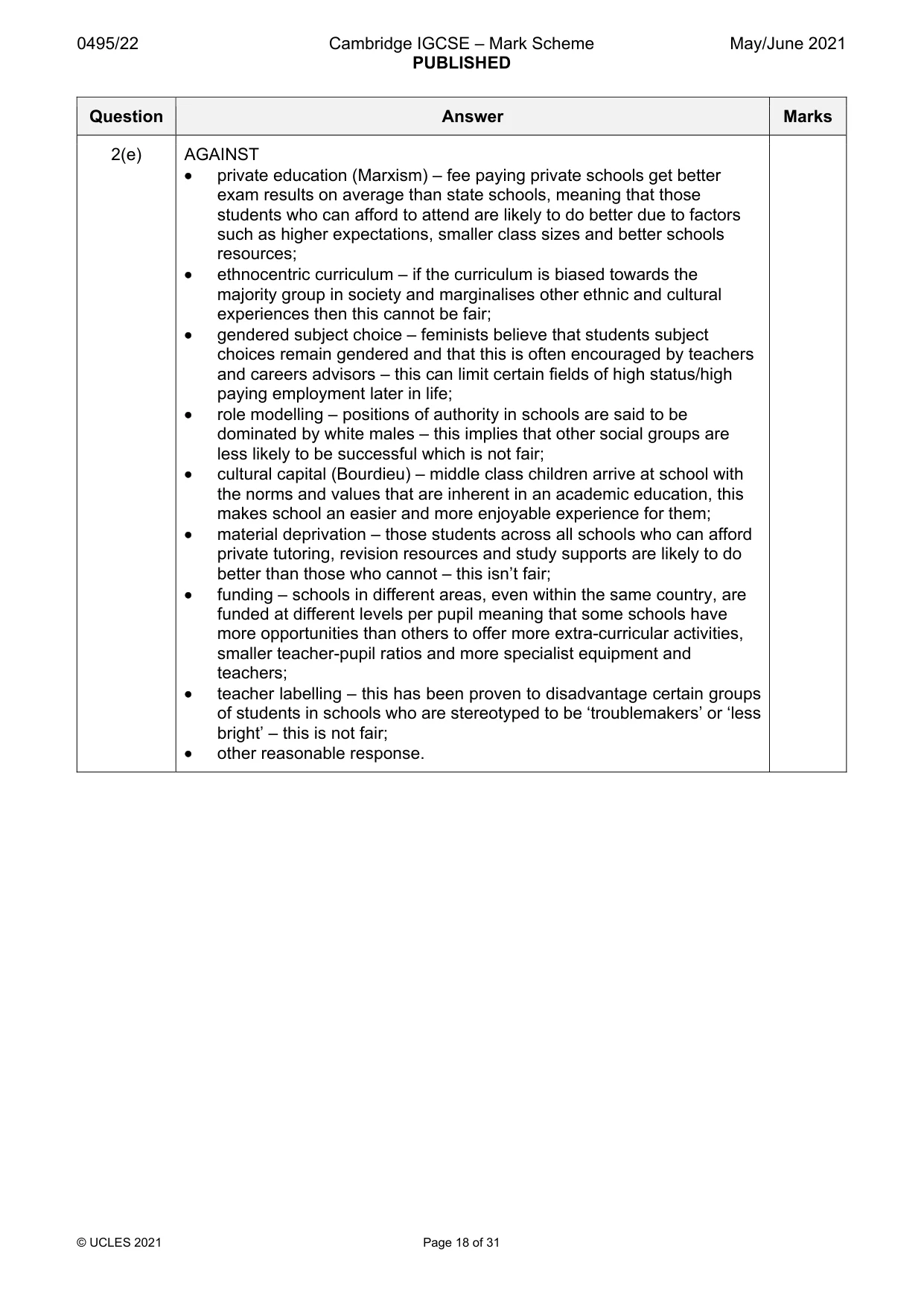
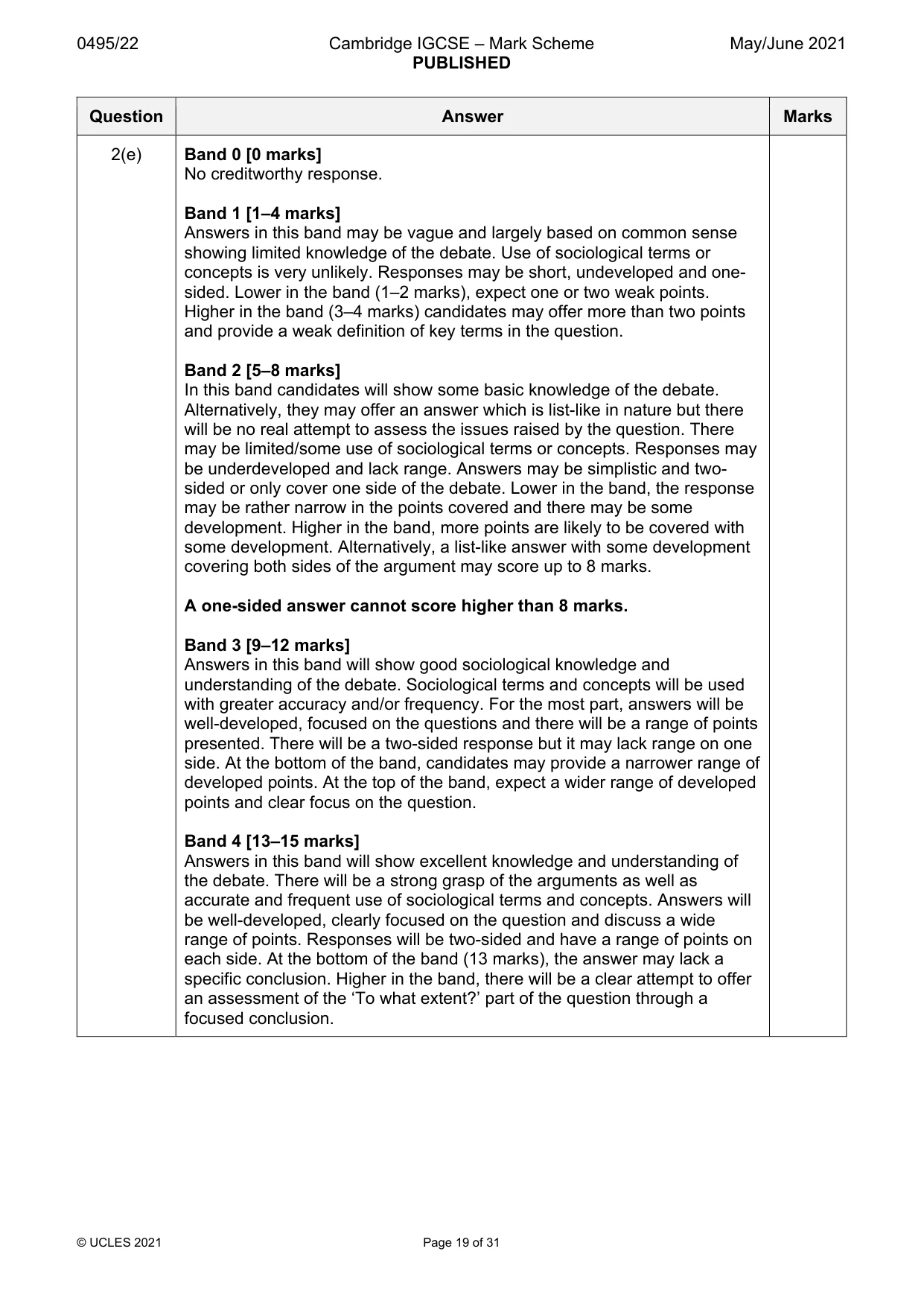
Mark scheme: 2(a) What is meant by the term ‘social conformity’? 2 One mark for partial definition, e.g. following the rules. Two marks for clear definition, e.g. fitting in with the social expectations for behaviour. 2(b) Describe two patterns of educational achievement. 4 Candidates will be expected to describe two patterns of educational achievement. The answer is likely to focus on social factors such as gender, social class and ethnicity. Possible answers: • gender – in many developing countries boys are more likely to receive an education than girls meaning that they achieve better; • gender – in modern industrial societies girls typically achieve higher than boys in terms of the amount of qualifications gained and the grades/levels achieved; • gender – subject choice – educational achievement is dependent upon the subjects chosen for study e.g. in the UK sociology is dominated by females, PE by males; • gender – over time – in modern industrial societies pre-1990’s boys achieved better than girls; • gender – over time – both boys and girls achieve better today than in the past; • gender – university – in modern industrial societies more girls are going to university than boys and achieving highly; • ethnicity – ethnic minority groups in a country typically do less well e.g. in the USA African-American students do not achieve as well as white American students; • ethnicity – traveller children (Roma/gypsies) typically do not do well within education; • ethnicity – in the UK, Indian and Chinese students achieve the best; • social class – students eligible for free school meals do less well than those who don’t qualify for this support; • social class – the higher a students’ social class position, the better they are likely to do in education; • social class – students in private schools achieve higher than students in state/government schools (better resources etc.); • other reasonable response. One mark for each point correctly identified (up to maximum of two). One mark for each point that is developed (up to a maximum of two). 2(c) Explain how the culture of masculinity may affect the educational 6 achievement of males. Candidates should discuss how the culture of masculinity may affect the educational achievement of males. Effects on educational achievement may be negative, positive or a combination of both. Possible answers: • boys may choose different subjects to girls e.g. PE, Design etc. as they feel they can do well in them; • boys’ leisure activities e.g. sports, video games may lead them to focus on activities not linked to school – this may negatively affect their educational achievement; • pressure to be masculine may lead some boys to join anti-school subcultures and so negatively affect their educational achievement e.g. Willis ‘the lads’; • aggressive masculine norms may mean that boys get into fights and arguments at school and so receive more sanctions, negatively affecting their educational achievement; • masculine behaviour e.g. toughness, street smartness etc. is not valued in education and so may result in teachers negatively labelling boys, thus leading to a self-fulfilling prophecy of underachievement; • wanting to look ‘cool’ may mean that boys do not study as much as girls leading to them being placed into lower sets thus negatively affecting their educational achievement; • the culture of masculinity may attract boys to gangs meaning that they drop out of school and do not succeed in their exams; • the culture of masculinity in schools may suggest male dominance and success e.g. males in positions of authority – these male role models may encourage boys to do well in school; • culture of masculinity in wider society makes boys believe they are more powerful and dominant than girls therefore they do not feel that they need to try at school as they are already dominant; • other reasonable response. Band 0 [0 marks] No creditworthy response. Band 1 [1–3 marks] Answers in this band will show only a limited awareness of the question. Responses may be short and un/underdeveloped. At the bottom of the band (1 mark), expect one weak point. Higher in the band (2–3 marks), candidates may offer more than one weak point, but there may be a tendency towards simplistic answers, engaging with sociological ideas without using sociological language. Band 2 [4–6 marks] Answers in this band will have clear and accurate explanation, showing good sociological knowledge and understanding. Sociological terms and concepts should be expected and explained. At the bottom of the band, the range of points covered may be narrow or lack detail. Higher in the band, answers will cover more than one point in a well-developed way or cover several points in less detail. 2(d) Explain why there are different types of schools. 8 Candidates should discuss the reasons why there are different types of schools. It is likely that specific types of schools will be explicitly discussed. Possible answers: • marketisation of education – means there needs to be choice in place for parents and students to decide which school a child attends; • single sex schools – proven to get higher results than mixed sex schools so feminists may say this is empowering for females; • faith schools – in a secular society little religious education may be taught at schools, therefore faith schools allow for the teaching of particular religious beliefs, norms and values; • private schools – typically produce the best results in the education system so allow parents who can afford the tuition fees to send their children there (selective education; • comprehensive education – based on principles of equality (meritocracy) and allow any student to attend, so giving equal opportunities to all; • special schools – allow students with additional needs e.g. learning disabilities, to be specifically supported and catered for in their education; • primary schools – allows for a more generic curriculum to be taught to students that inculcates them with society’s norms and values; • secondary schools – allows for a more specialist and academic curriculum to be followed, building upon the foundations taught at the primary level; • technical schools – allows students to be best prepared for the world of work through vocational courses and qualifications; • Marxism – private schools maintain social inequalities through the creation of an elite education for the rich – needed to support capitalism and elitism; • choice – different types of schools mean that everyone’s needs are catered for (postmodernism) in a diverse society; • parental attitudes and beliefs – Montessori schools are thought by some to be a more natural and enjoyable way for children to learn that help students develop the social, emotional, and intellectual skills they need for long-term success in school and in life; • IQ – different types of schools exist in order to cater for different ability levels of students e.g. the tripartite system, academic vs vocational schools etc.; • other reasonable response 2(d) Band 0 [0 marks] No creditworthy response. Band 1 [1–3 marks] Answers in this band will show only a limited awareness of the question. A tendency to description is likely. Responses may be short and undeveloped and points stated without explanation. Sociological terms and concepts are unlikely to be used. At the bottom of the band (1 mark), expect one weak point. Higher in the band (2–3 marks), candidates may offer more than one weak point. Band 2 [4–6 marks] Answers in this band will show basic sociological knowledge and understanding. Responses may be underdeveloped and lacking in range. At the bottom of the band, candidates are unlikely to use sociological terms and concepts accurately. Higher in the band, candidates may be beginning to use sociological terms and concepts with greater accuracy. However, some aspects of the answer may only be partially developed/explained. Band 3 [7–8 marks] Answers in this band will show good sociological knowledge and understanding and will be well-developed and explained. Sociological terms and concepts will be used accurately overall. Answers will be well-focused on the question and there will be a range of points presented. At the top of the band explanations will be clear throughout. 2(e) To what extent is the education system fair? 15 Candidates should consider the ways in which the education system can be seen to be fair. In evaluation, the reasons why it is not so fair or not fair for everyone should be discussed. Possible answers: FOR • functionalism – the education system is meritocratic; everyone has the same opportunities to be successful; • equality legislation – this ensures that all social groups are given the right to education and that they cannot be discriminated against by teachers; • option subjects – these allow students to choose their own curriculum path that best suits their own talents and interests – this is clearly fair; • national curriculum – this ensures that all students study the same core subjects so that everyone has the same basic grounding; • setting and streaming – students are put into classes that best suit their needs and abilities – this gives everyone the best chance of being educationally successful; • both vocational and academic educational qualifications are available to students – this allows them to make the best choice for themselves; • scholarships – fee paying schools offer scholarships and bursaries to ensure that money does not prevent bright students from receiving a top education; • selective role – education acts as a filtering system (functionalism) to ensure that the brightest students are stretched and challenged to achieve highly and the weaker students are offered courses and levels that better suit their needs; • comprehensive schools – anyone can attend this type of school, regardless of educational ability or social factors, so making the system fair; • parental choice – in a lot of countries, parents have free choice to decide where to apply for their child’s schooling, making the system fair; • other reasonable response. 2(e) AGAINST • private education (Marxism) – fee paying private schools get better exam results on average than state schools, meaning that those students who can afford to attend are likely to do better due to factors such as higher expectations, smaller class sizes and better schools resources; • ethnocentric curriculum – if the curriculum is biased towards the majority group in society and marginalises other ethnic and cultural experiences then this cannot be fair; • gendered subject choice – feminists believe that students subject choices remain gendered and that this is often encouraged by teachers and careers advisors – this can limit certain fields of high status/high paying employment later in life; • role modelling – positions of authority in schools are said to be dominated by white males – this implies that other social groups are less likely to be successful which is not fair; • cultural capital (Bourdieu) – middle class children arrive at school with the norms and values that are inherent in an academic education, this makes school an easier and more enjoyable experience for them; • material deprivation – those students across all schools who can afford private tutoring, revision resources and study supports are likely to do better than those who cannot – this isn’t fair; • funding – schools in different areas, even within the same country, are funded at different levels per pupil meaning that some schools have more opportunities than others to offer more extra-curricular activities, smaller teacher-pupil ratios and more specialist equipment and teachers; • teacher labelling – this has been proven to disadvantage certain groups of students in schools who are stereotyped to be ‘troublemakers’ or ‘less bright’ – this is not fair; • other reasonable response. 2(e) Band 0 [0 marks] No creditworthy response. Band 1 [1–4 marks] Answers in this band may be vague and largely based on common sense showing limited knowledge of the debate. Use of sociological terms or concepts is very unlikely. Responses may be short, undeveloped and one- sided. Lower in the band (1–2 marks), expect one or two weak points. Higher in the band (3–4 marks) candidates may offer more than two points and provide a weak definition of key terms in the question. Band 2 [5–8 marks] In this band candidates will show some basic knowledge of the debate. Alternatively, they may offer an answer which is list-like in nature but there will be no real attempt to assess the issues raised by the question. There may be limited/some use of sociological terms or concepts. Responses may be underdeveloped and lack range. Answers may be simplistic and two- sided or only cover one side of the debate. Lower in the band, the response may be rather narrow in the points covered and there may be some development. Higher in the band, more points are likely to be covered with some development. Alternatively, a list-like answer with some development covering both sides of the argument may score up to 8 marks. A one-sided answer cannot score higher than 8 marks. Band 3 [9–12 marks] Answers in this band will show good sociological knowledge and understanding of the debate. Sociological terms and concepts will be used with greater accuracy and/or frequency. For the most part, answers will be well-developed, focused on the questions and there will be a range of points presented. There will be a two-sided response but it may lack range on one side. At the bottom of the band, candidates may provide a narrower range of developed points. At the top of the band, expect a wider range of developed points and clear focus on the question. Band 4 [13–15 marks] Answers in this band will show excellent knowledge and understanding of the debate. There will be a strong grasp of the arguments as well as accurate and frequent use of sociological terms and concepts. Answers will be well-developed, clearly focused on the question and discuss a wide range of points. Responses will be two-sided and have a range of points on each side. At the bottom of the band (13 marks), the answer may lack a specific conclusion. Higher in the band, there will be a clear attempt to offer an assessment of the ‘To what extent?’ part of the question through a focused conclusion.
Q3 · According to official crime statistics there are clear patterns and trends in the types…
3 According to official crime statistics there are clear patterns and trends in the types of crime committed and in offending rates. Many sociologists believe that material deprivation explains why crime occurs, others argue that stigma is a better explanation. However, functionalists do not agree and would look at other factors instead. (a) What is meant by the term ‘stigma’? [2] (b) Describe two examples of rehabilitation used to reduce crime. [4] (c) Explain how material deprivation may lead to crime. [6] (d) Explain why functionalists believe there is crime in society. [8] (e) To what extent are the official crime statistics accurate? [15] Section D: Media
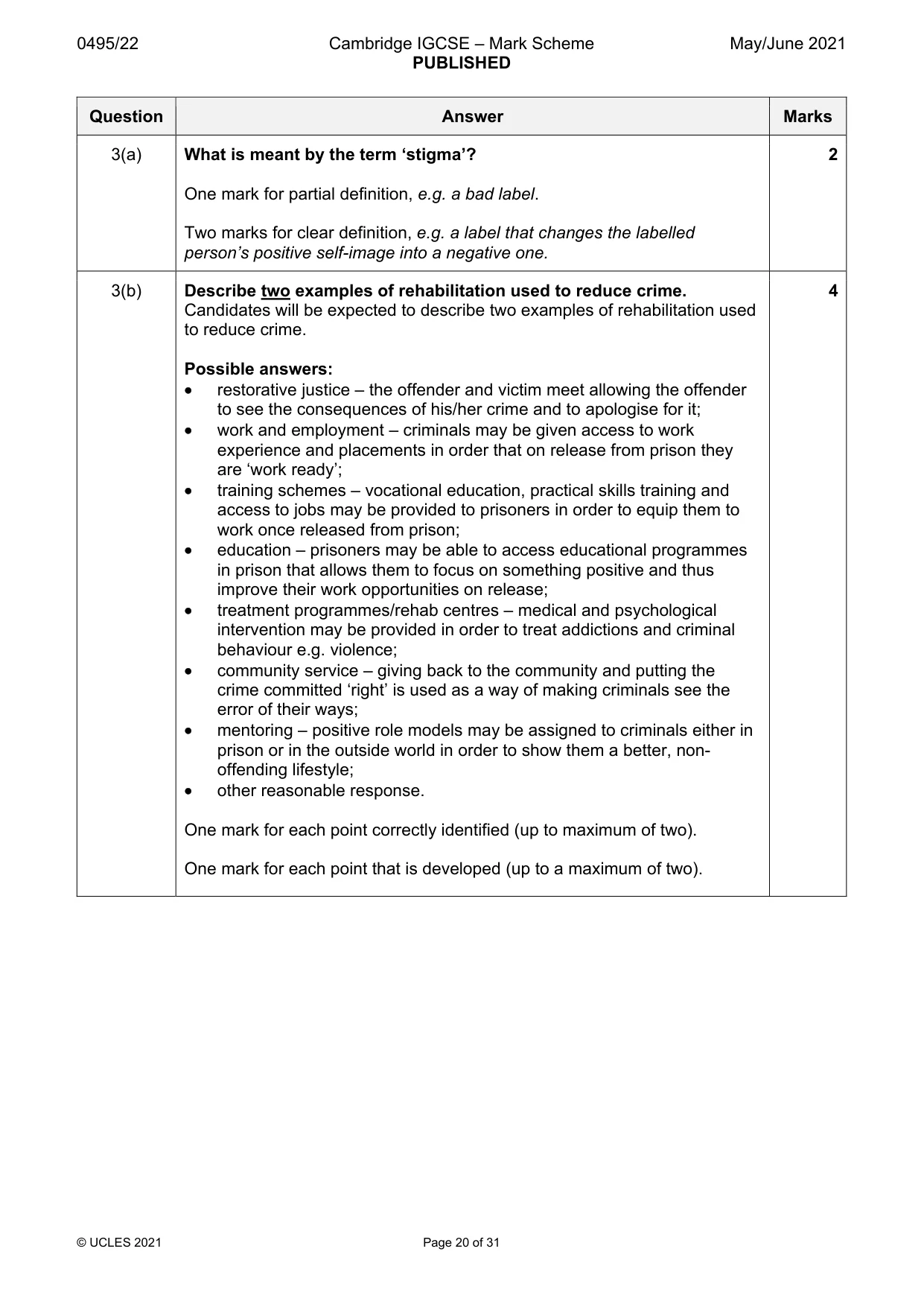
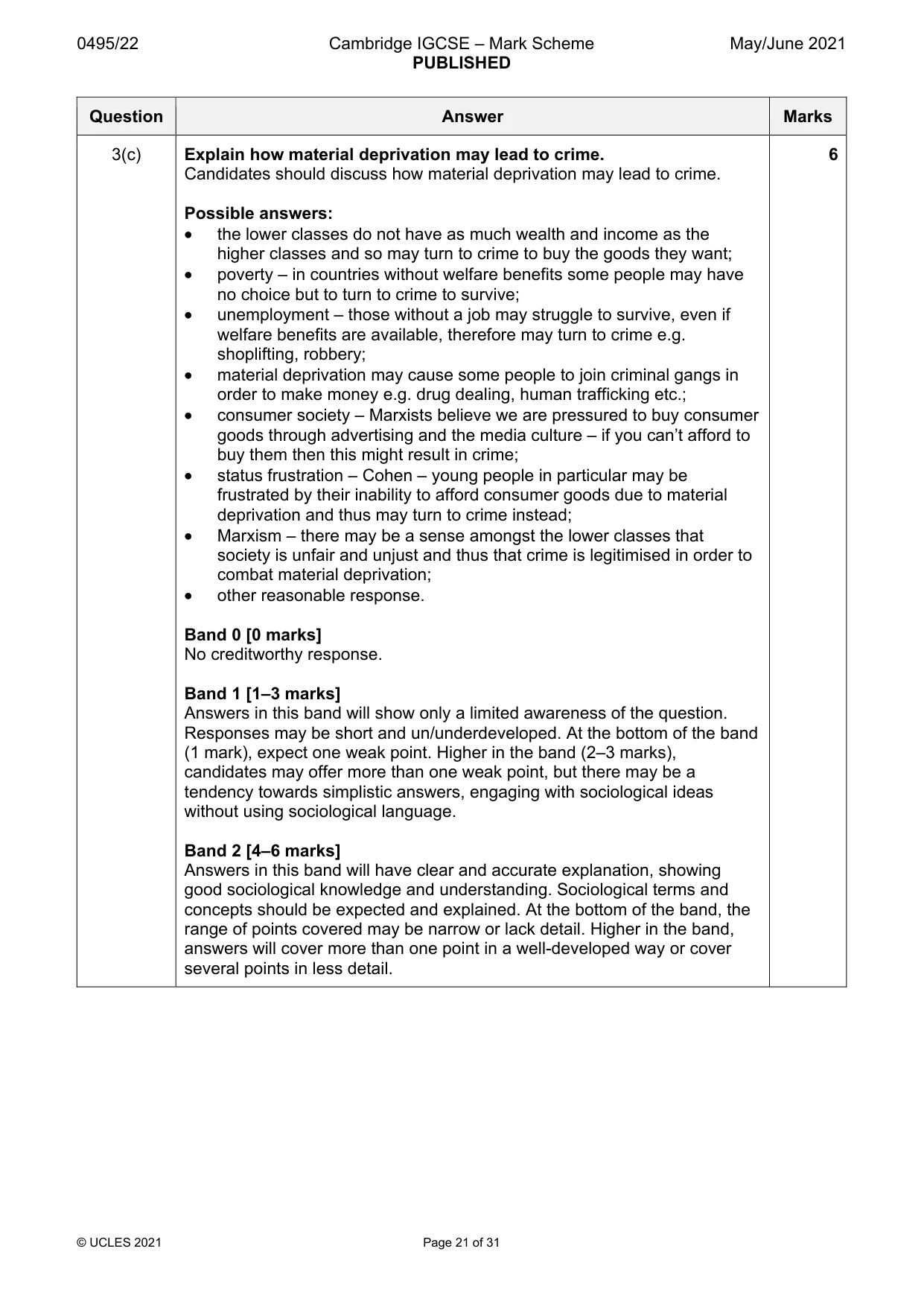
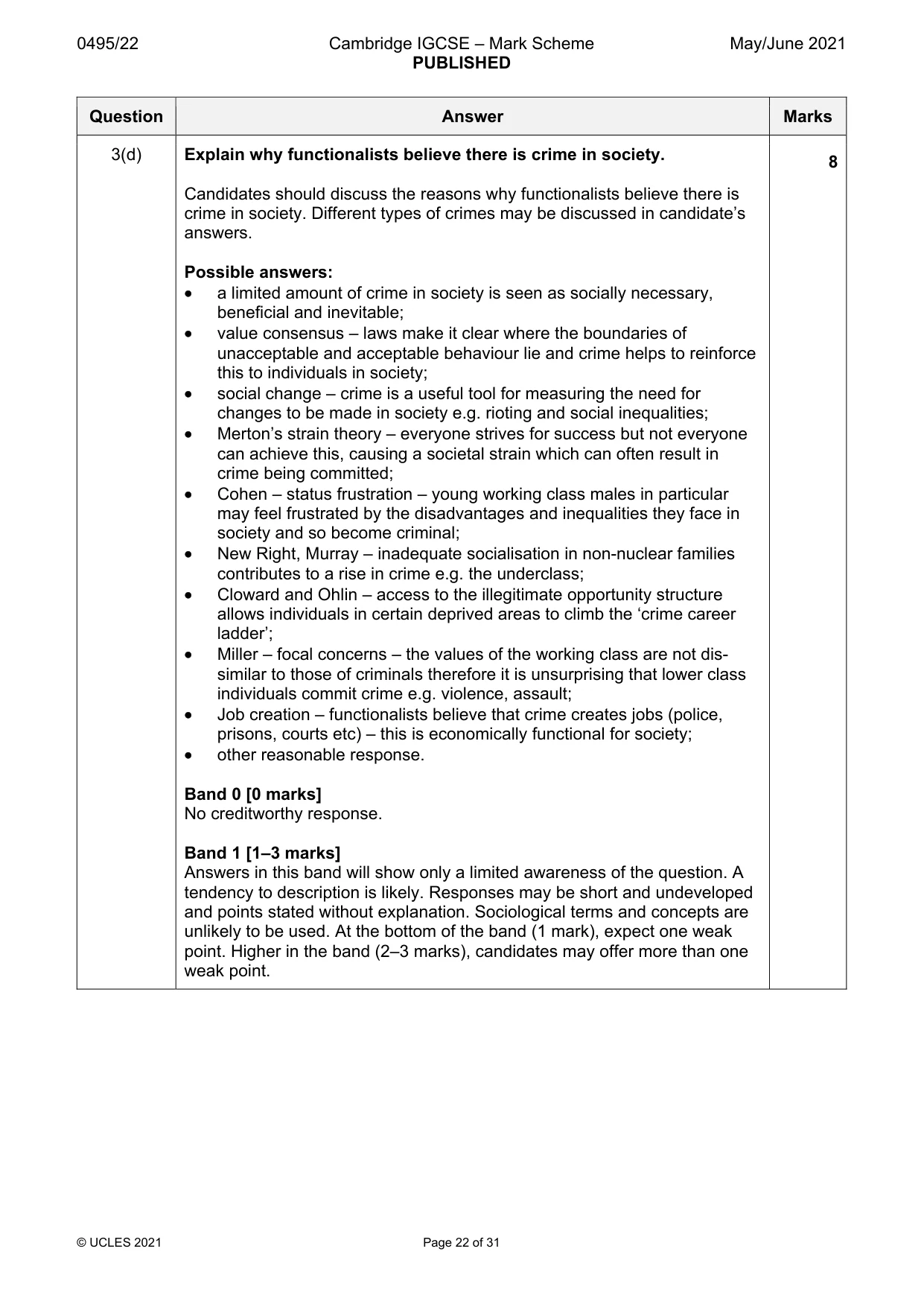
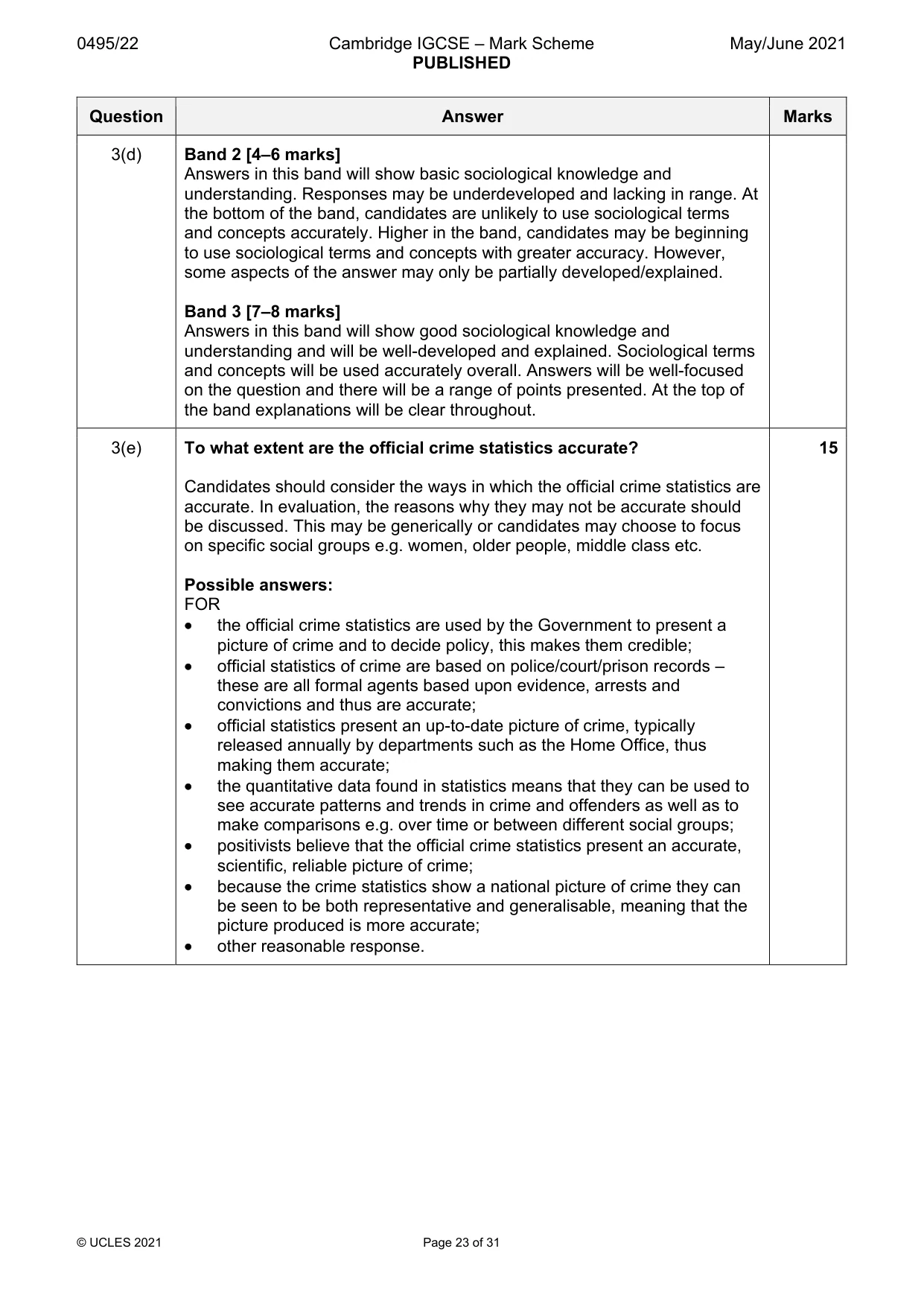
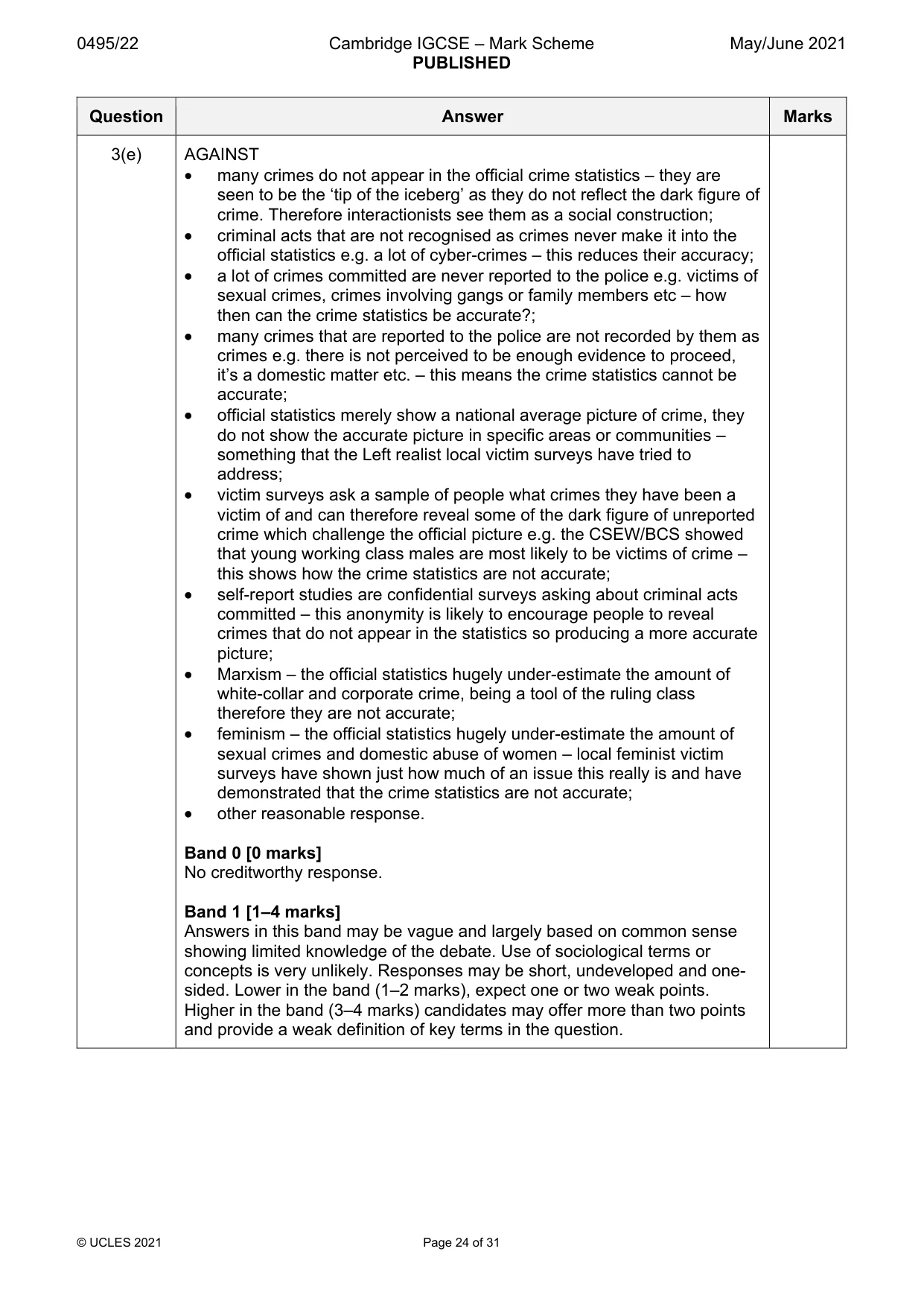
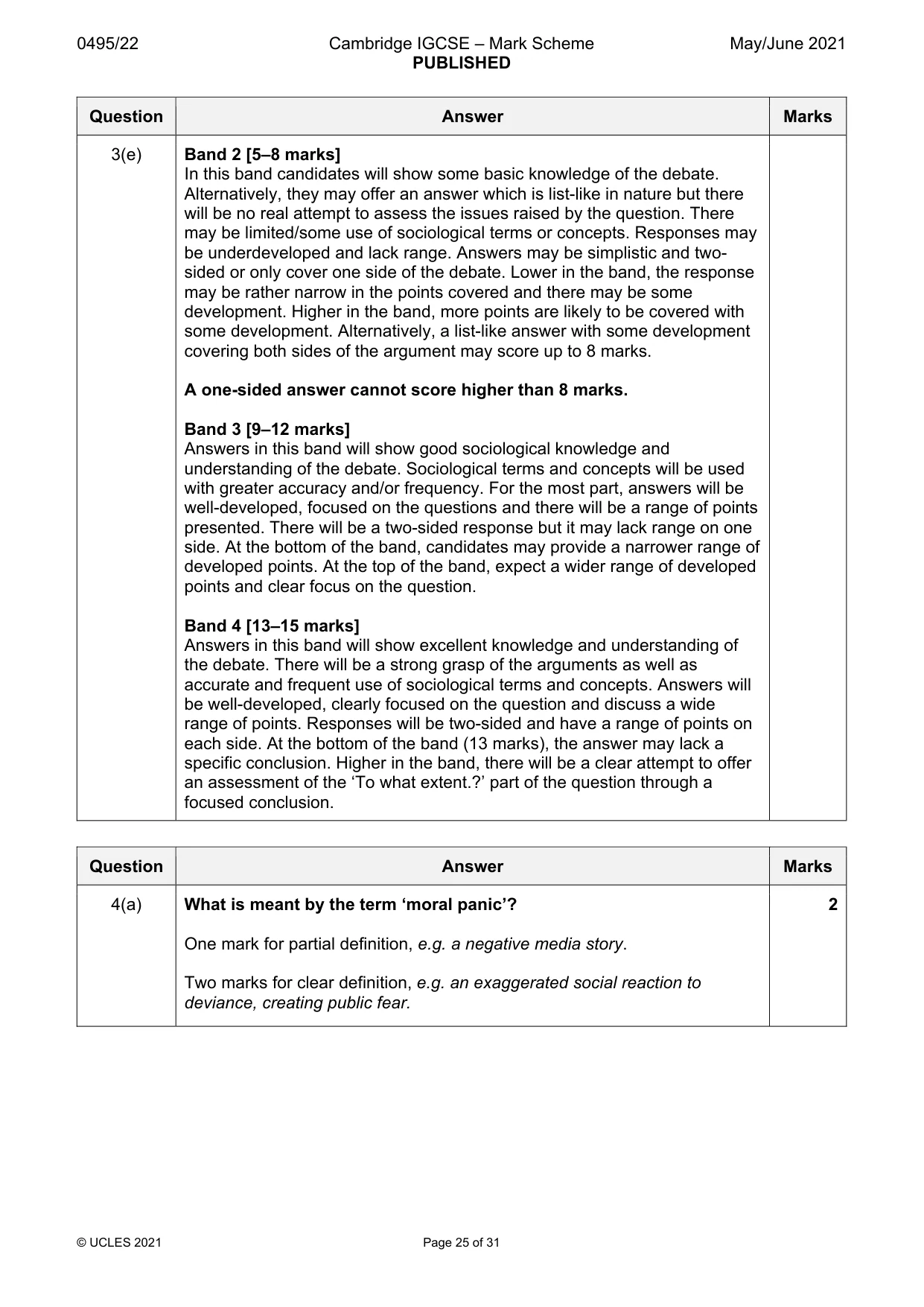
Mark scheme: 3(a) What is meant by the term ‘stigma’? 2 One mark for partial definition, e.g. a bad label. Two marks for clear definition, e.g. a label that changes the labelled person’s positive self-image into a negative one. 3(b) Describe two examples of rehabilitation used to reduce crime. 4 Candidates will be expected to describe two examples of rehabilitation used to reduce crime. Possible answers: • restorative justice – the offender and victim meet allowing the offender to see the consequences of his/her crime and to apologise for it; • work and employment – criminals may be given access to work experience and placements in order that on release from prison they are ‘work ready’; • training schemes – vocational education, practical skills training and access to jobs may be provided to prisoners in order to equip them to work once released from prison; • education – prisoners may be able to access educational programmes in prison that allows them to focus on something positive and thus improve their work opportunities on release; • treatment programmes/rehab centres – medical and psychological intervention may be provided in order to treat addictions and criminal behaviour e.g. violence; • community service – giving back to the community and putting the crime committed ‘right’ is used as a way of making criminals see the error of their ways; • mentoring – positive role models may be assigned to criminals either in prison or in the outside world in order to show them a better, non- offending lifestyle; • other reasonable response. One mark for each point correctly identified (up to maximum of two). One mark for each point that is developed (up to a maximum of two). 3(c) Explain how material deprivation may lead to crime. 6 Candidates should discuss how material deprivation may lead to crime. Possible answers: • the lower classes do not have as much wealth and income as the higher classes and so may turn to crime to buy the goods they want; • poverty – in countries without welfare benefits some people may have no choice but to turn to crime to survive; • unemployment – those without a job may struggle to survive, even if welfare benefits are available, therefore may turn to crime e.g. shoplifting, robbery; • material deprivation may cause some people to join criminal gangs in order to make money e.g. drug dealing, human trafficking etc.; • consumer society – Marxists believe we are pressured to buy consumer goods through advertising and the media culture – if you can’t afford to buy them then this might result in crime; • status frustration – Cohen – young people in particular may be frustrated by their inability to afford consumer goods due to material deprivation and thus may turn to crime instead; • Marxism – there may be a sense amongst the lower classes that society is unfair and unjust and thus that crime is legitimised in order to combat material deprivation; • other reasonable response. Band 0 [0 marks] No creditworthy response. Band 1 [1–3 marks] Answers in this band will show only a limited awareness of the question. Responses may be short and un/underdeveloped. At the bottom of the band (1 mark), expect one weak point. Higher in the band (2–3 marks), candidates may offer more than one weak point, but there may be a tendency towards simplistic answers, engaging with sociological ideas without using sociological language. Band 2 [4–6 marks] Answers in this band will have clear and accurate explanation, showing good sociological knowledge and understanding. Sociological terms and concepts should be expected and explained. At the bottom of the band, the range of points covered may be narrow or lack detail. Higher in the band, answers will cover more than one point in a well-developed way or cover several points in less detail. 3(d) Explain why functionalists believe there is crime in society. 8 Candidates should discuss the reasons why functionalists believe there is crime in society. Different types of crimes may be discussed in candidate’s answers. Possible answers: • a limited amount of crime in society is seen as socially necessary, beneficial and inevitable; • value consensus – laws make it clear where the boundaries of unacceptable and acceptable behaviour lie and crime helps to reinforce this to individuals in society; • social change – crime is a useful tool for measuring the need for changes to be made in society e.g. rioting and social inequalities; • Merton’s strain theory – everyone strives for success but not everyone can achieve this, causing a societal strain which can often result in crime being committed; • Cohen – status frustration – young working class males in particular may feel frustrated by the disadvantages and inequalities they face in society and so become criminal; • New Right, Murray – inadequate socialisation in non-nuclear families contributes to a rise in crime e.g. the underclass; • Cloward and Ohlin – access to the illegitimate opportunity structure allows individuals in certain deprived areas to climb the ‘crime career ladder’; • Miller – focal concerns – the values of the working class are not dis- similar to those of criminals therefore it is unsurprising that lower class individuals commit crime e.g. violence, assault; • Job creation – functionalists believe that crime creates jobs (police, prisons, courts etc) – this is economically functional for society; • other reasonable response. Band 0 [0 marks] No creditworthy response. Band 1 [1–3 marks] Answers in this band will show only a limited awareness of the question. A tendency to description is likely. Responses may be short and undeveloped and points stated without explanation. Sociological terms and concepts are unlikely to be used. At the bottom of the band (1 mark), expect one weak point. Higher in the band (2–3 marks), candidates may offer more than one weak point. 3(d) Band 2 [4–6 marks] Answers in this band will show basic sociological knowledge and understanding. Responses may be underdeveloped and lacking in range. At the bottom of the band, candidates are unlikely to use sociological terms and concepts accurately. Higher in the band, candidates may be beginning to use sociological terms and concepts with greater accuracy. However, some aspects of the answer may only be partially developed/explained. Band 3 [7–8 marks] Answers in this band will show good sociological knowledge and understanding and will be well-developed and explained. Sociological terms and concepts will be used accurately overall. Answers will be well-focused on the question and there will be a range of points presented. At the top of the band explanations will be clear throughout. 3(e) To what extent are the official crime statistics accurate? 15 Candidates should consider the ways in which the official crime statistics are accurate. In evaluation, the reasons why they may not be accurate should be discussed. This may be generically or candidates may choose to focus on specific social groups e.g. women, older people, middle class etc. Possible answers: FOR • the official crime statistics are used by the Government to present a picture of crime and to decide policy, this makes them credible; • official statistics of crime are based on police/court/prison records – these are all formal agents based upon evidence, arrests and convictions and thus are accurate; • official statistics present an up-to-date picture of crime, typically released annually by departments such as the Home Office, thus making them accurate; • the quantitative data found in statistics means that they can be used to see accurate patterns and trends in crime and offenders as well as to make comparisons e.g. over time or between different social groups; • positivists believe that the official crime statistics present an accurate, scientific, reliable picture of crime; • because the crime statistics show a national picture of crime they can be seen to be both representative and generalisable, meaning that the picture produced is more accurate; • other reasonable response. 3(e) AGAINST • many crimes do not appear in the official crime statistics – they are seen to be the ‘tip of the iceberg’ as they do not reflect the dark figure of crime. Therefore interactionists see them as a social construction; • criminal acts that are not recognised as crimes never make it into the official statistics e.g. a lot of cyber-crimes – this reduces their accuracy; • a lot of crimes committed are never reported to the police e.g. victims of sexual crimes, crimes involving gangs or family members etc – how then can the crime statistics be accurate?; • many crimes that are reported to the police are not recorded by them as crimes e.g. there is not perceived to be enough evidence to proceed, it’s a domestic matter etc. – this means the crime statistics cannot be accurate; • official statistics merely show a national average picture of crime, they do not show the accurate picture in specific areas or communities – something that the Left realist local victim surveys have tried to address; • victim surveys ask a sample of people what crimes they have been a victim of and can therefore reveal some of the dark figure of unreported crime which challenge the official picture e.g. the CSEW/BCS showed that young working class males are most likely to be victims of crime – this shows how the crime statistics are not accurate; • self-report studies are confidential surveys asking about criminal acts committed – this anonymity is likely to encourage people to reveal crimes that do not appear in the statistics so producing a more accurate picture; • Marxism – the official statistics hugely under-estimate the amount of white-collar and corporate crime, being a tool of the ruling class therefore they are not accurate; • feminism – the official statistics hugely under-estimate the amount of sexual crimes and domestic abuse of women – local feminist victim surveys have shown just how much of an issue this really is and have demonstrated that the crime statistics are not accurate; • other reasonable response. Band 0 [0 marks] No creditworthy response. Band 1 [1–4 marks] Answers in this band may be vague and largely based on common sense showing limited knowledge of the debate. Use of sociological terms or concepts is very unlikely. Responses may be short, undeveloped and one- sided. Lower in the band (1–2 marks), expect one or two weak points. Higher in the band (3–4 marks) candidates may offer more than two points and provide a weak definition of key terms in the question. 3(e) Band 2 [5–8 marks] In this band candidates will show some basic knowledge of the debate. Alternatively, they may offer an answer which is list-like in nature but there will be no real attempt to assess the issues raised by the question. There may be limited/some use of sociological terms or concepts. Responses may be underdeveloped and lack range. Answers may be simplistic and two- sided or only cover one side of the debate. Lower in the band, the response may be rather narrow in the points covered and there may be some development. Higher in the band, more points are likely to be covered with some development. Alternatively, a list-like answer with some development covering both sides of the argument may score up to 8 marks. A one-sided answer cannot score higher than 8 marks. Band 3 [9–12 marks] Answers in this band will show good sociological knowledge and understanding of the debate. Sociological terms and concepts will be used with greater accuracy and/or frequency. For the most part, answers will be well-developed, focused on the questions and there will be a range of points presented. There will be a two-sided response but it may lack range on one side. At the bottom of the band, candidates may provide a narrower range of developed points. At the top of the band, expect a wider range of developed points and clear focus on the question. Band 4 [13–15 marks] Answers in this band will show excellent knowledge and understanding of the debate. There will be a strong grasp of the arguments as well as accurate and frequent use of sociological terms and concepts. Answers will be well-developed, clearly focused on the question and discuss a wide range of points. Responses will be two-sided and have a range of points on each side. At the bottom of the band (13 marks), the answer may lack a specific conclusion. Higher in the band, there will be a clear attempt to offer an assessment of the ‘To what extent.?’ part of the question through a focused conclusion.
More questions on What types of data and evidence do sociologists use?
Q4 · Some sociologists argue that globalisation has improved equality in the media
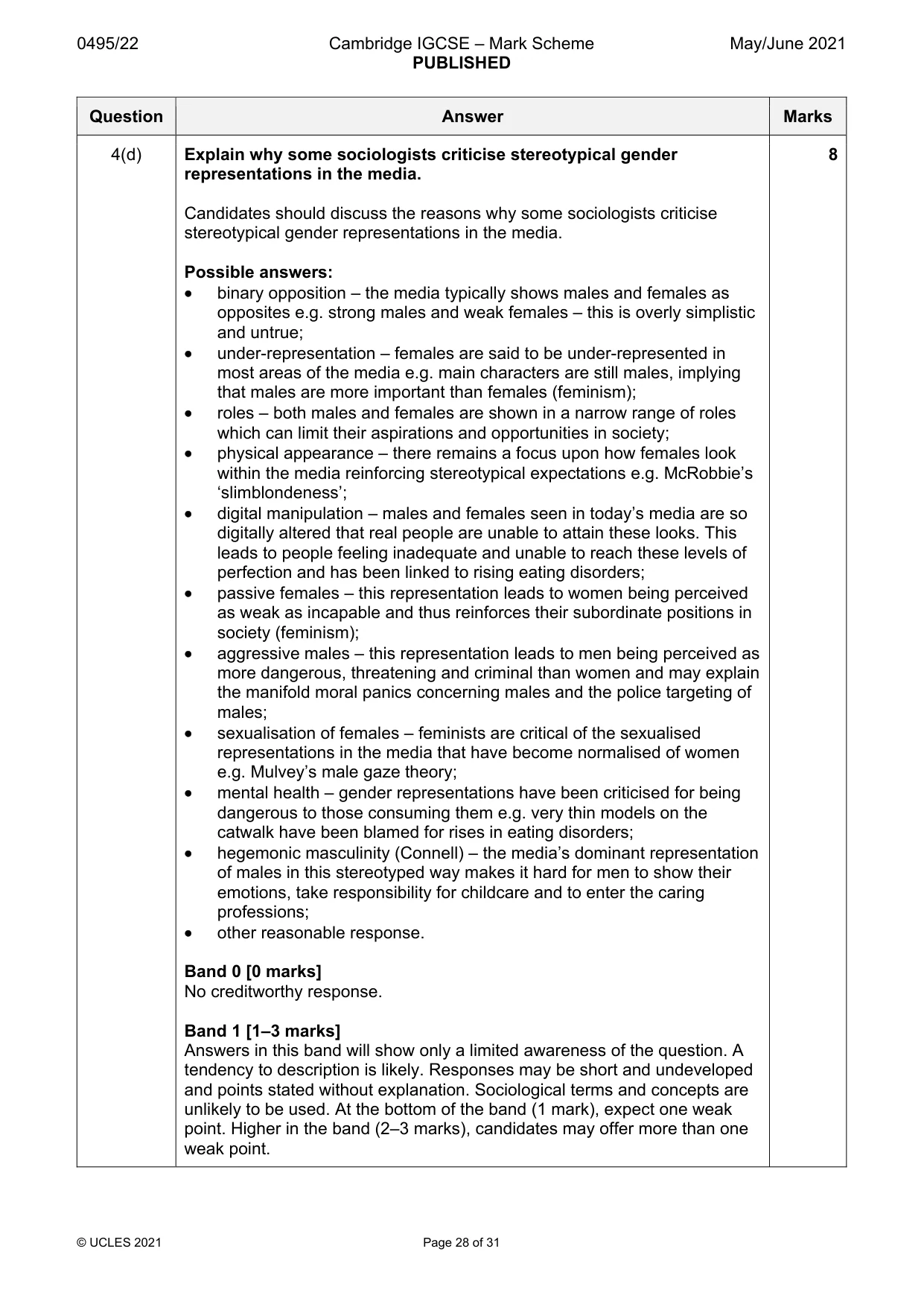
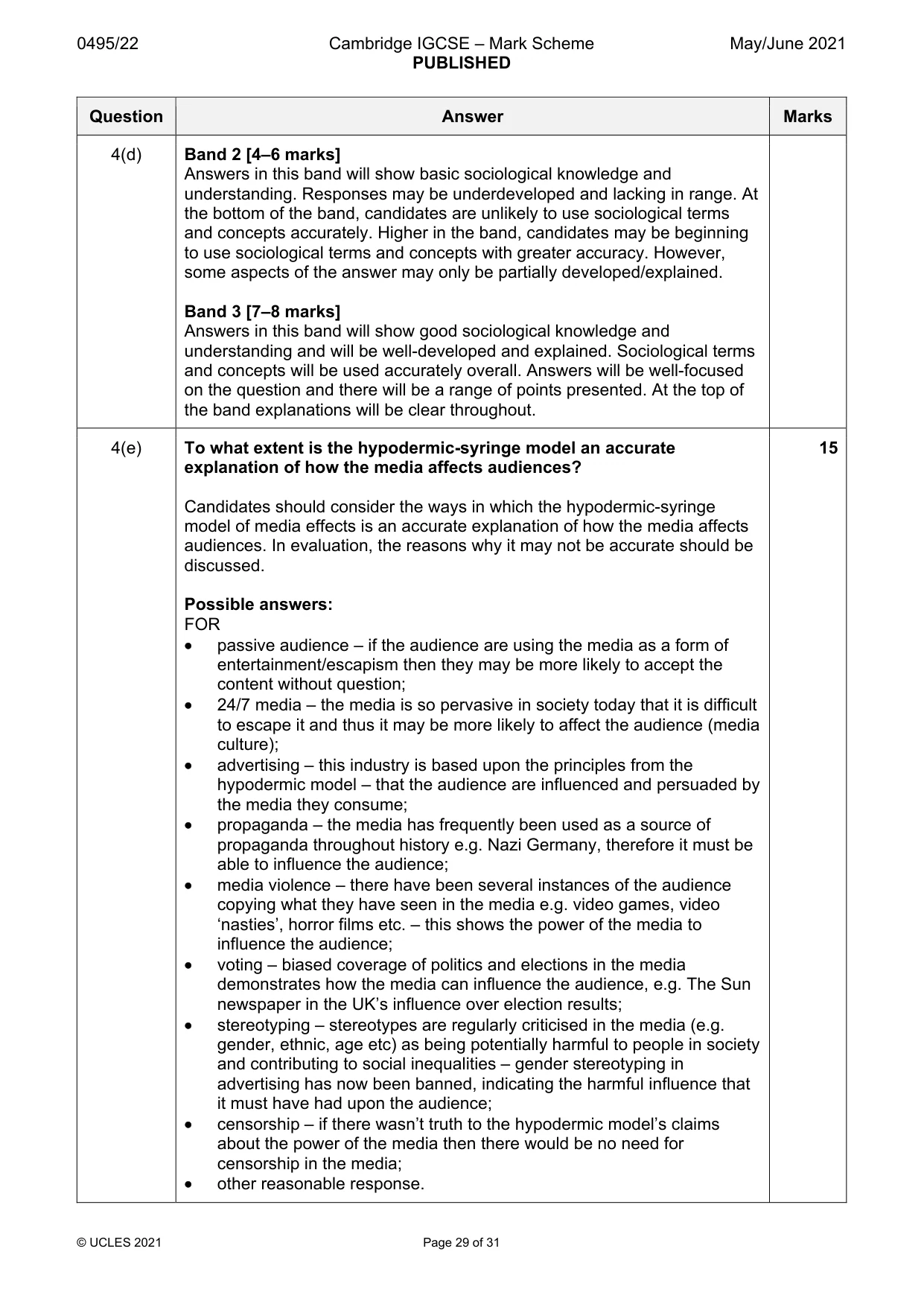
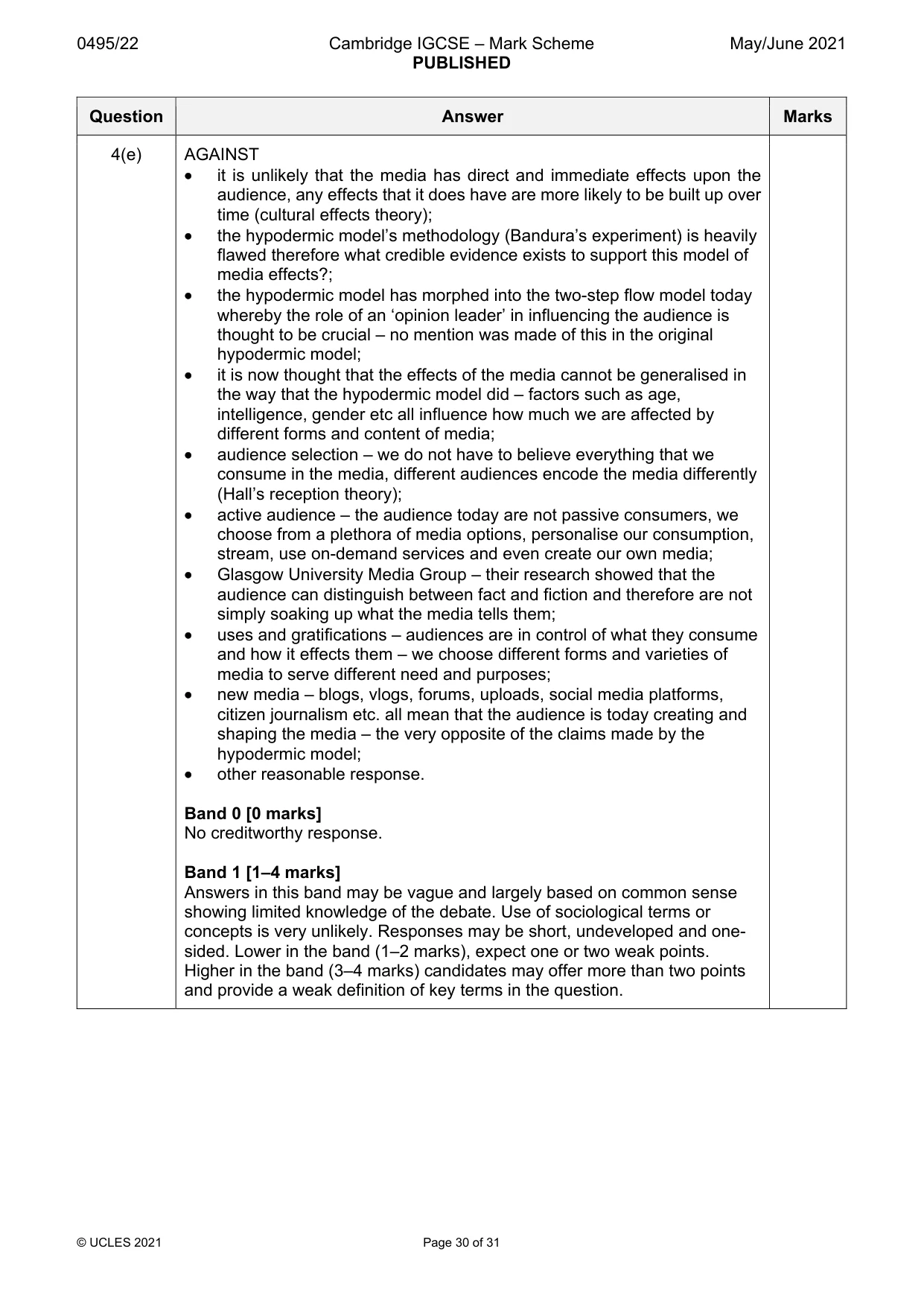
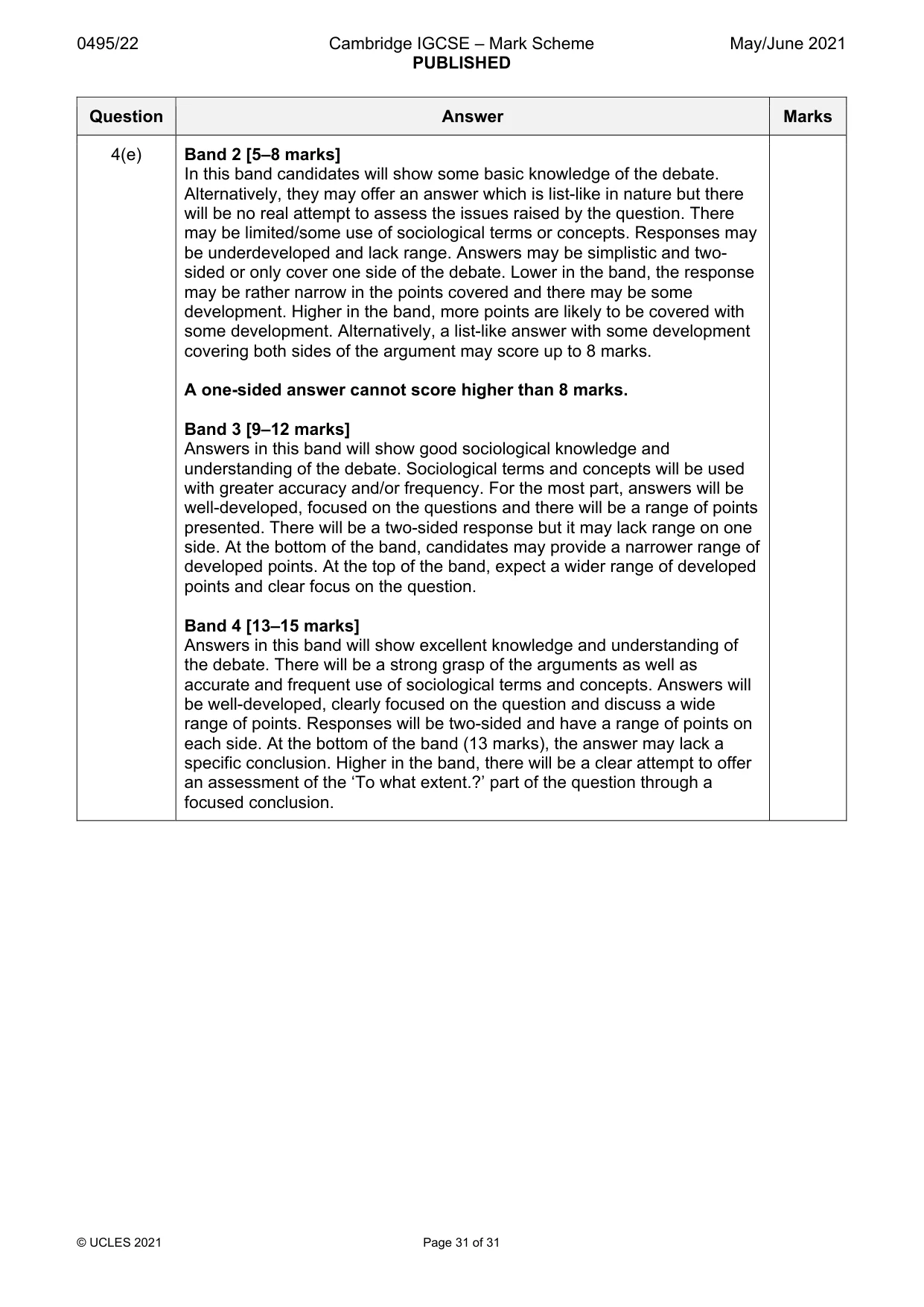
4 Some sociologists argue that globalisation has improved equality in the media. Other sociologists believe there is now a digital divide and that moral panics and stereotypical representations still exist. However, whether media content affects the audience is a debate within sociology. Despite this most sociologists agree that not everybody uses the media in the same way due to social factors such as gender and ethnicity. (a) What is meant by the term ‘moral panic’? [2] (b) Describe two ways globalisation has affected the media. [4] (c) Explain how different ethnic groups use the media. [6] (d) Explain why some sociologists criticise stereotypical gender representations in the media. [8] (e) To what extent is the hypodermic-syringe model an accurate explanation of how the media affects audiences? [15]
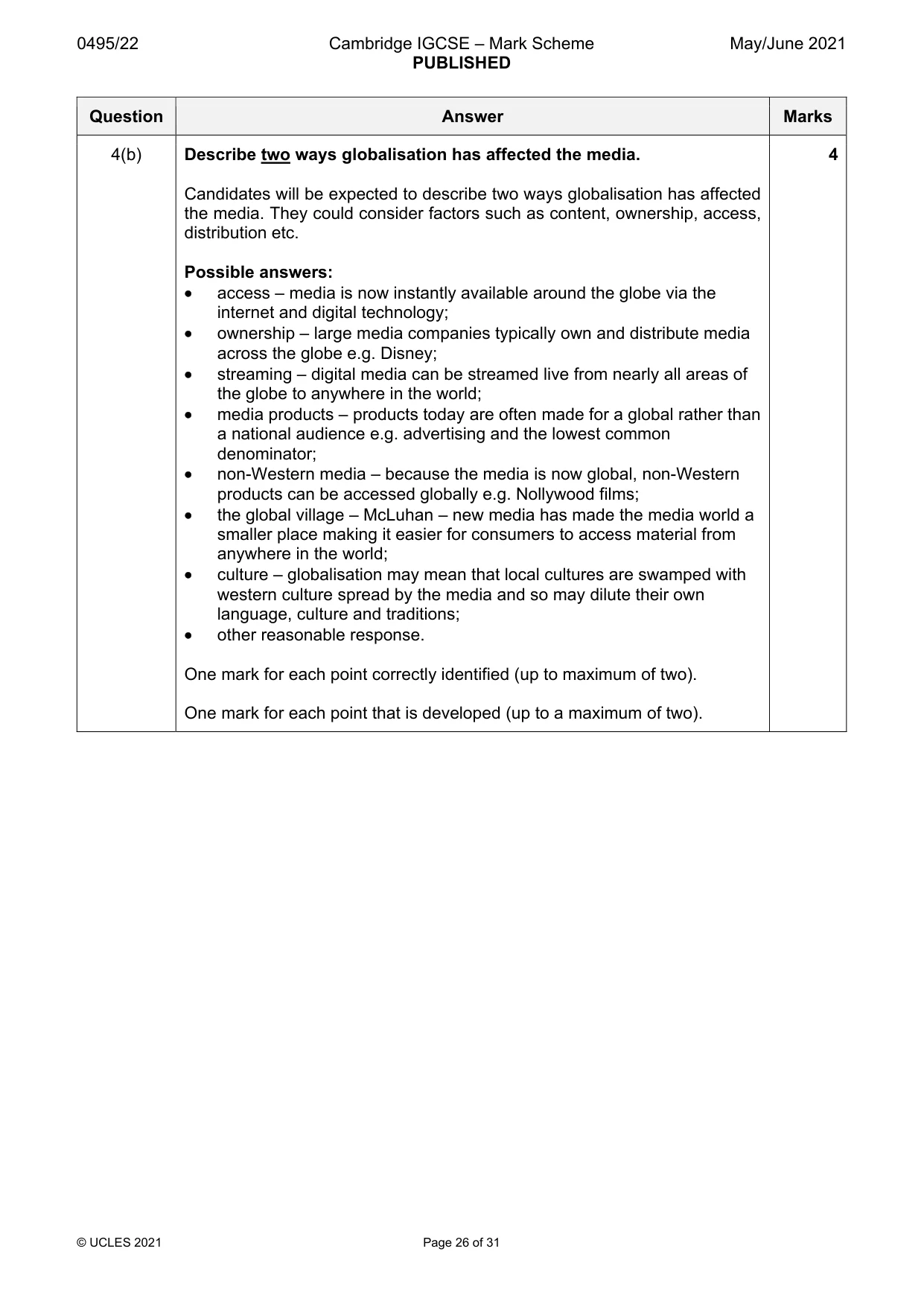
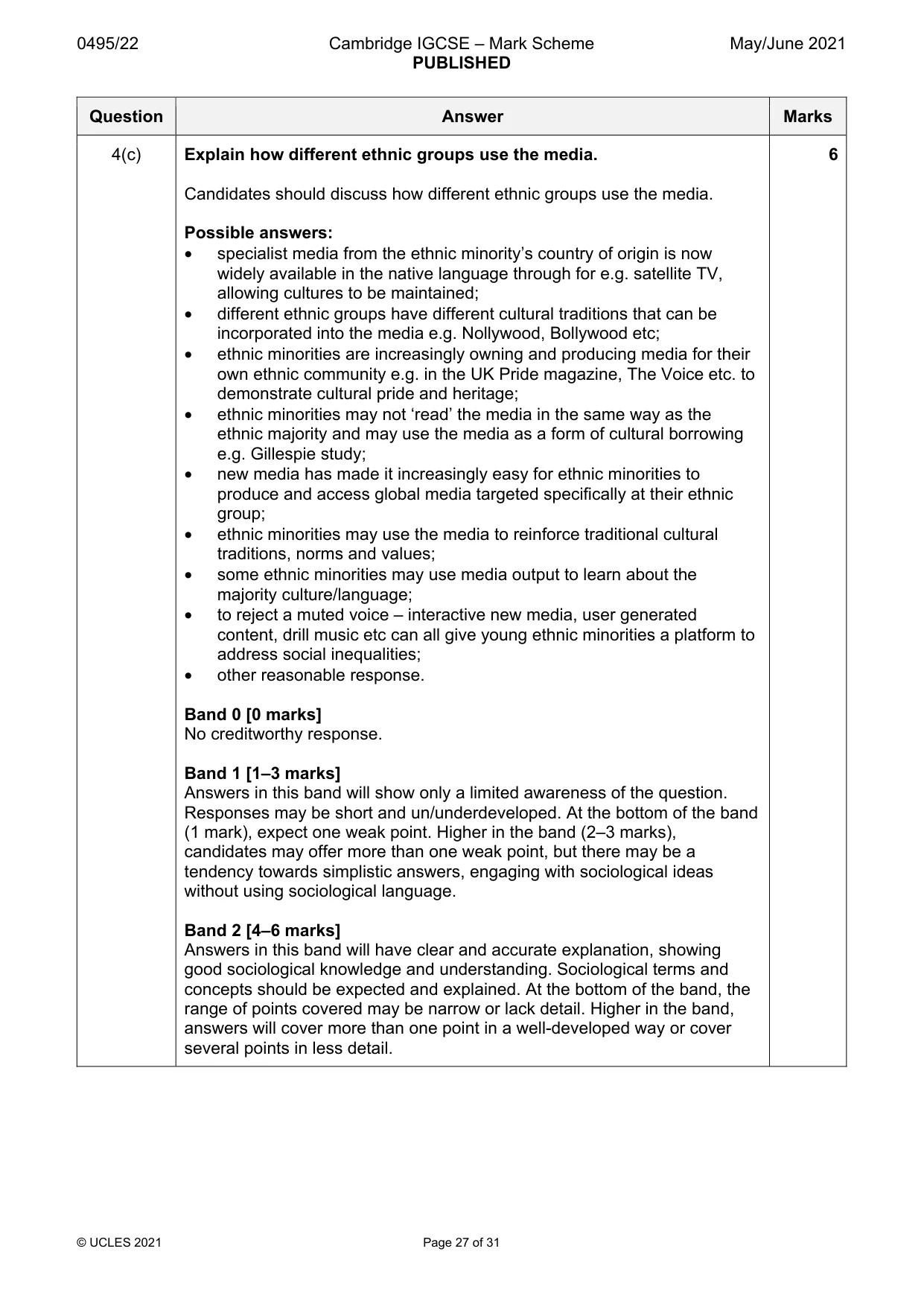
Mark scheme: 4(a) What is meant by the term ‘moral panic’? 2 One mark for partial definition, e.g. a negative media story. Two marks for clear definition, e.g. an exaggerated social reaction to deviance, creating public fear. 4(b) Describe two ways globalisation has affected the media. 4 Candidates will be expected to describe two ways globalisation has affected the media. They could consider factors such as content, ownership, access, distribution etc. Possible answers: • access – media is now instantly available around the globe via the internet and digital technology; • ownership – large media companies typically own and distribute media across the globe e.g. Disney; • streaming – digital media can be streamed live from nearly all areas of the globe to anywhere in the world; • media products – products today are often made for a global rather than a national audience e.g. advertising and the lowest common denominator; • non-Western media – because the media is now global, non-Western products can be accessed globally e.g. Nollywood films; • the global village – McLuhan – new media has made the media world a smaller place making it easier for consumers to access material from anywhere in the world; • culture – globalisation may mean that local cultures are swamped with western culture spread by the media and so may dilute their own language, culture and traditions; • other reasonable response. One mark for each point correctly identified (up to maximum of two). One mark for each point that is developed (up to a maximum of two). 4(c) Explain how different ethnic groups use the media. 6 Candidates should discuss how different ethnic groups use the media. Possible answers: • specialist media from the ethnic minority’s country of origin is now widely available in the native language through for e.g. satellite TV, allowing cultures to be maintained; • different ethnic groups have different cultural traditions that can be incorporated into the media e.g. Nollywood, Bollywood etc; • ethnic minorities are increasingly owning and producing media for their own ethnic community e.g. in the UK Pride magazine, The Voice etc. to demonstrate cultural pride and heritage; • ethnic minorities may not ‘read’ the media in the same way as the ethnic majority and may use the media as a form of cultural borrowing e.g. Gillespie study; • new media has made it increasingly easy for ethnic minorities to produce and access global media targeted specifically at their ethnic group; • ethnic minorities may use the media to reinforce traditional cultural traditions, norms and values; • some ethnic minorities may use media output to learn about the majority culture/language; • to reject a muted voice – interactive new media, user generated content, drill music etc can all give young ethnic minorities a platform to address social inequalities; • other reasonable response. Band 0 [0 marks] No creditworthy response. Band 1 [1–3 marks] Answers in this band will show only a limited awareness of the question. Responses may be short and un/underdeveloped. At the bottom of the band (1 mark), expect one weak point. Higher in the band (2–3 marks), candidates may offer more than one weak point, but there may be a tendency towards simplistic answers, engaging with sociological ideas without using sociological language. Band 2 [4–6 marks] Answers in this band will have clear and accurate explanation, showing good sociological knowledge and understanding. Sociological terms and concepts should be expected and explained. At the bottom of the band, the range of points covered may be narrow or lack detail. Higher in the band, answers will cover more than one point in a well-developed way or cover several points in less detail. 4(d) Explain why some sociologists criticise stereotypical gender 8 representations in the media. Candidates should discuss the reasons why some sociologists criticise stereotypical gender representations in the media. Possible answers: • binary opposition – the media typically shows males and females as opposites e.g. strong males and weak females – this is overly simplistic and untrue; • under-representation – females are said to be under-represented in most areas of the media e.g. main characters are still males, implying that males are more important than females (feminism); • roles – both males and females are shown in a narrow range of roles which can limit their aspirations and opportunities in society; • physical appearance – there remains a focus upon how females look within the media reinforcing stereotypical expectations e.g. McRobbie’s ‘slimblondeness’; • digital manipulation – males and females seen in today’s media are so digitally altered that real people are unable to attain these looks. This leads to people feeling inadequate and unable to reach these levels of perfection and has been linked to rising eating disorders; • passive females – this representation leads to women being perceived as weak as incapable and thus reinforces their subordinate positions in society (feminism); • aggressive males – this representation leads to men being perceived as more dangerous, threatening and criminal than women and may explain the manifold moral panics concerning males and the police targeting of males; • sexualisation of females – feminists are critical of the sexualised representations in the media that have become normalised of women e.g. Mulvey’s male gaze theory; • mental health – gender representations have been criticised for being dangerous to those consuming them e.g. very thin models on the catwalk have been blamed for rises in eating disorders; • hegemonic masculinity (Connell) – the media’s dominant representation of males in this stereotyped way makes it hard for men to show their emotions, take responsibility for childcare and to enter the caring professions; • other reasonable response. Band 0 [0 marks] No creditworthy response. Band 1 [1–3 marks] Answers in this band will show only a limited awareness of the question. A tendency to description is likely. Responses may be short and undeveloped and points stated without explanation. Sociological terms and concepts are unlikely to be used. At the bottom of the band (1 mark), expect one weak point. Higher in the band (2–3 marks), candidates may offer more than one weak point. 4(d) Band 2 [4–6 marks] Answers in this band will show basic sociological knowledge and understanding. Responses may be underdeveloped and lacking in range. At the bottom of the band, candidates are unlikely to use sociological terms and concepts accurately. Higher in the band, candidates may be beginning to use sociological terms and concepts with greater accuracy. However, some aspects of the answer may only be partially developed/explained. Band 3 [7–8 marks] Answers in this band will show good sociological knowledge and understanding and will be well-developed and explained. Sociological terms and concepts will be used accurately overall. Answers will be well-focused on the question and there will be a range of points presented. At the top of the band explanations will be clear throughout. 4(e) To what extent is the hypodermic-syringe model an accurate 15 explanation of how the media affects audiences? Candidates should consider the ways in which the hypodermic-syringe model of media effects is an accurate explanation of how the media affects audiences. In evaluation, the reasons why it may not be accurate should be discussed. Possible answers: FOR • passive audience – if the audience are using the media as a form of entertainment/escapism then they may be more likely to accept the content without question; • 24/7 media – the media is so pervasive in society today that it is difficult to escape it and thus it may be more likely to affect the audience (media culture); • advertising – this industry is based upon the principles from the hypodermic model – that the audience are influenced and persuaded by the media they consume; • propaganda – the media has frequently been used as a source of propaganda throughout history e.g. Nazi Germany, therefore it must be able to influence the audience; • media violence – there have been several instances of the audience copying what they have seen in the media e.g. video games, video ‘nasties’, horror films etc. – this shows the power of the media to influence the audience; • voting – biased coverage of politics and elections in the media demonstrates how the media can influence the audience, e.g. The Sun newspaper in the UK’s influence over election results; • stereotyping – stereotypes are regularly criticised in the media (e.g. gender, ethnic, age etc) as being potentially harmful to people in society and contributing to social inequalities – gender stereotyping in advertising has now been banned, indicating the harmful influence that it must have had upon the audience; • censorship – if there wasn’t truth to the hypodermic model’s claims about the power of the media then there would be no need for censorship in the media; • other reasonable response. 4(e) AGAINST • it is unlikely that the media has direct and immediate effects upon the audience, any effects that it does have are more likely to be built up over time (cultural effects theory); • the hypodermic model’s methodology (Bandura’s experiment) is heavily flawed therefore what credible evidence exists to support this model of media effects?; • the hypodermic model has morphed into the two-step flow model today whereby the role of an ‘opinion leader’ in influencing the audience is thought to be crucial – no mention was made of this in the original hypodermic model; • it is now thought that the effects of the media cannot be generalised in the way that the hypodermic model did – factors such as age, intelligence, gender etc all influence how much we are affected by different forms and content of media; • audience selection – we do not have to believe everything that we consume in the media, different audiences encode the media differently (Hall’s reception theory); • active audience – the audience today are not passive consumers, we choose from a plethora of media options, personalise our consumption, stream, use on-demand services and even create our own media; • Glasgow University Media Group – their research showed that the audience can distinguish between fact and fiction and therefore are not simply soaking up what the media tells them; • uses and gratifications – audiences are in control of what they consume and how it effects them – we choose different forms and varieties of media to serve different need and purposes; • new media – blogs, vlogs, forums, uploads, social media platforms, citizen journalism etc. all mean that the audience is today creating and shaping the media – the very opposite of the claims made by the hypodermic model; • other reasonable response. Band 0 [0 marks] No creditworthy response. Band 1 [1–4 marks] Answers in this band may be vague and largely based on common sense showing limited knowledge of the debate. Use of sociological terms or concepts is very unlikely. Responses may be short, undeveloped and one- sided. Lower in the band (1–2 marks), expect one or two weak points. Higher in the band (3–4 marks) candidates may offer more than two points and provide a weak definition of key terms in the question. 4(e) Band 2 [5–8 marks] In this band candidates will show some basic knowledge of the debate. Alternatively, they may offer an answer which is list-like in nature but there will be no real attempt to assess the issues raised by the question. There may be limited/some use of sociological terms or concepts. Responses may be underdeveloped and lack range. Answers may be simplistic and two- sided or only cover one side of the debate. Lower in the band, the response may be rather narrow in the points covered and there may be some development. Higher in the band, more points are likely to be covered with some development. Alternatively, a list-like answer with some development covering both sides of the argument may score up to 8 marks. A one-sided answer cannot score higher than 8 marks. Band 3 [9–12 marks] Answers in this band will show good sociological knowledge and understanding of the debate. Sociological terms and concepts will be used with greater accuracy and/or frequency. For the most part, answers will be well-developed, focused on the questions and there will be a range of points presented. There will be a two-sided response but it may lack range on one side. At the bottom of the band, candidates may provide a narrower range of developed points. At the top of the band, expect a wider range of developed points and clear focus on the question. Band 4 [13–15 marks] Answers in this band will show excellent knowledge and understanding of the debate. There will be a strong grasp of the arguments as well as accurate and frequent use of sociological terms and concepts. Answers will be well-developed, clearly focused on the question and discuss a wide range of points. Responses will be two-sided and have a range of points on each side. At the bottom of the band (13 marks), the answer may lack a specific conclusion. Higher in the band, there will be a clear attempt to offer an assessment of the ‘To what extent.?’ part of the question through a focused conclusion.
More questions on What types of data and evidence do sociologists use?
What was in this paper
The subtopics covered by these 4 questions, and how many questions each got. Open one in a new tab to see every Cambridge question on it.
What you needed in this session
Cambridge’s own grade thresholds for 2021 May/June, Paper 2 · Variant 2. A higher threshold means an easier paper — the bar moves with how the cohort did.