Cambridge IGCSE Sociology 0495 — 2021 Oct/Nov Paper 2 · Variant 3
0495/23/O/N/21 · 4 questions · 70 marks · ≈79 min
The question paper and its mark scheme, free to read here and free to download. This is Cambridge’s own paper, exactly as it was sat.
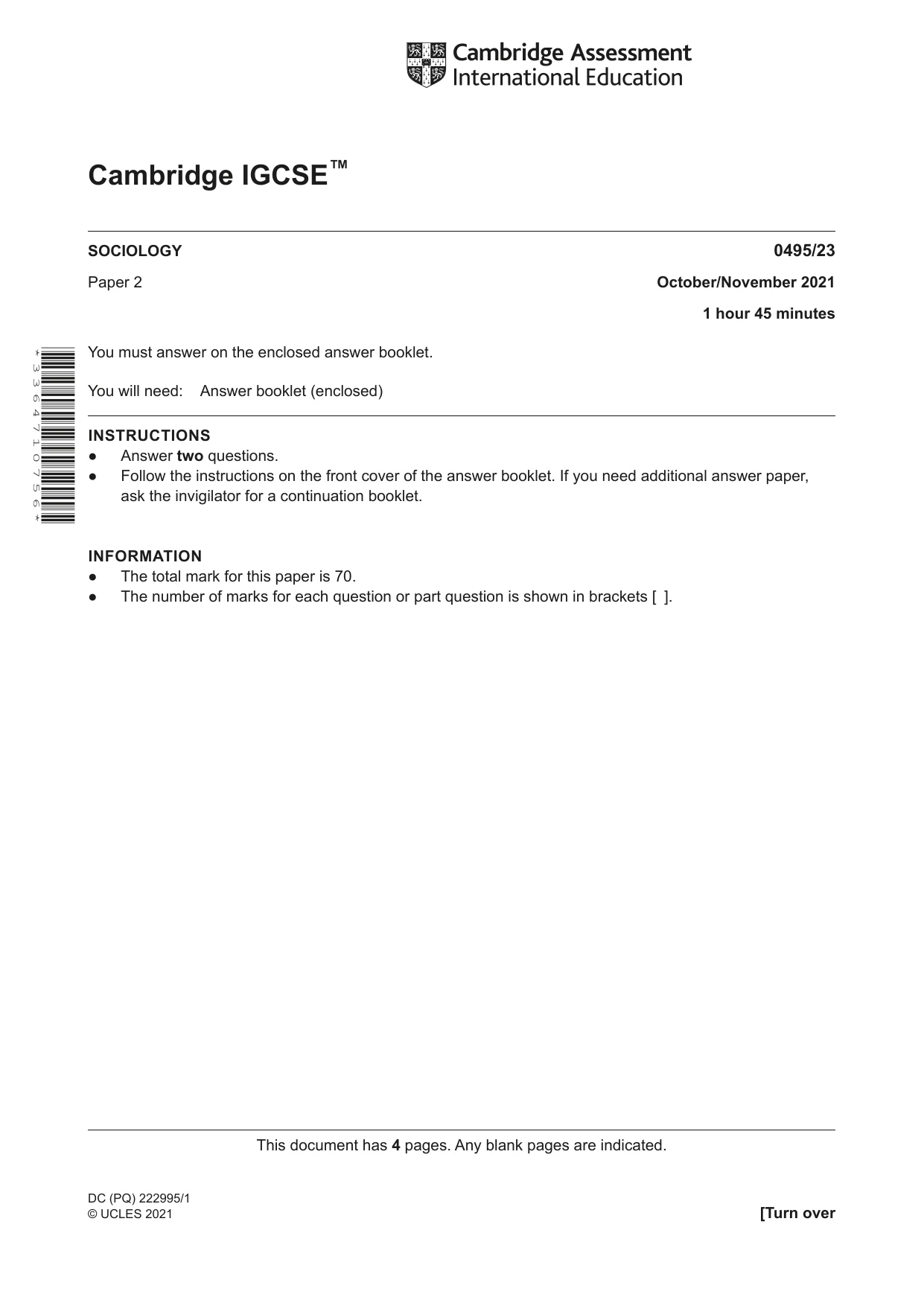
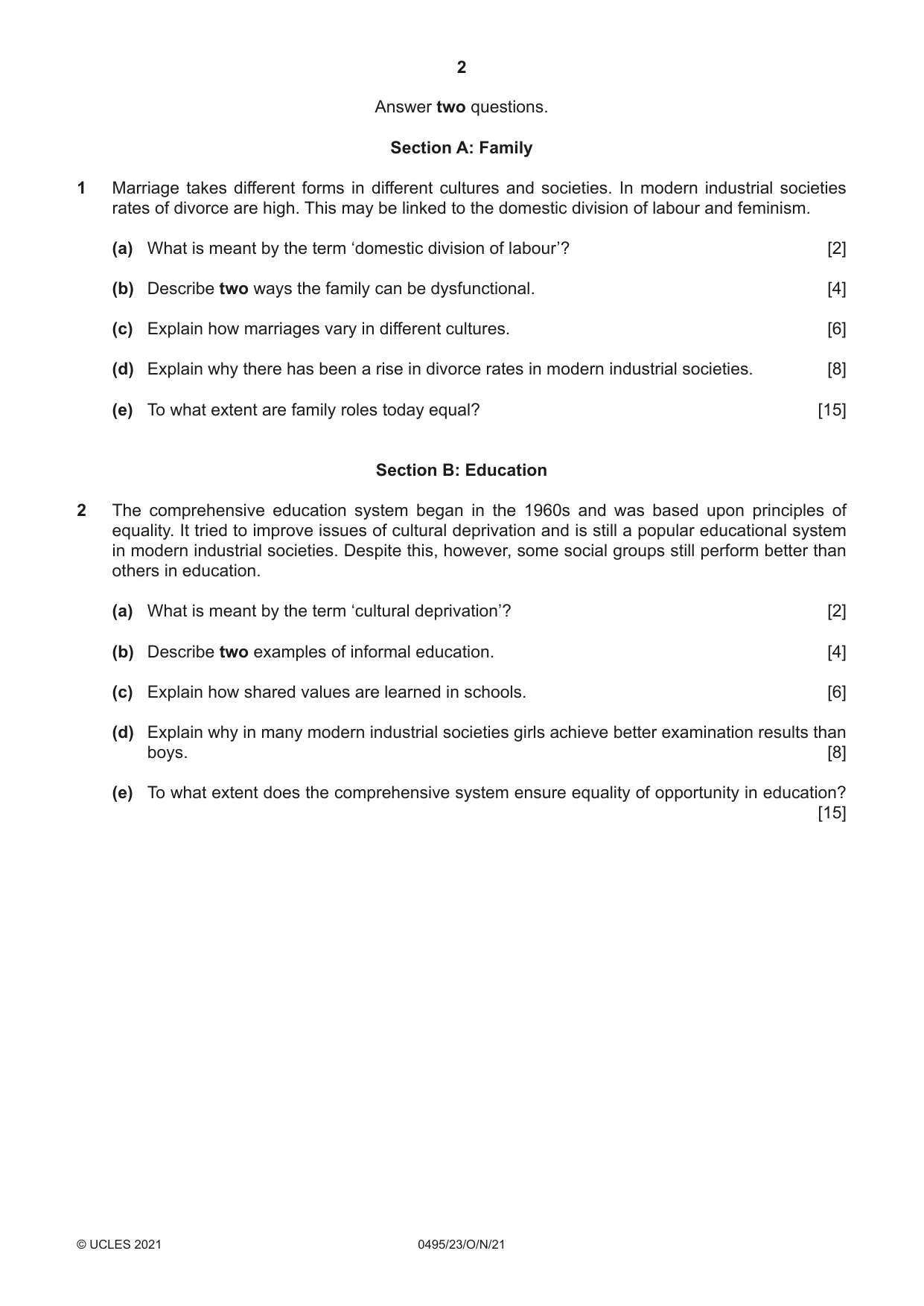
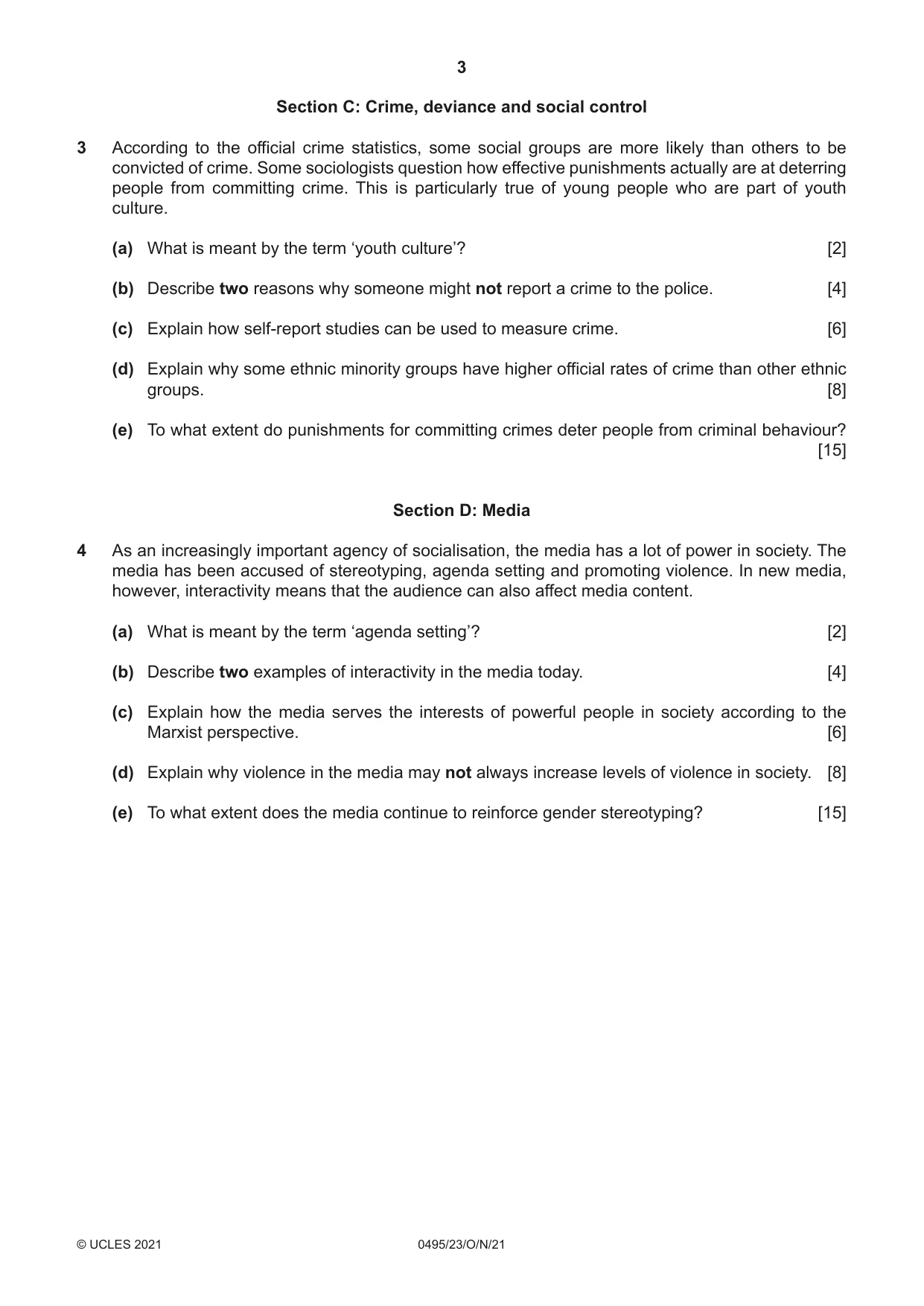
Question paper4 pages

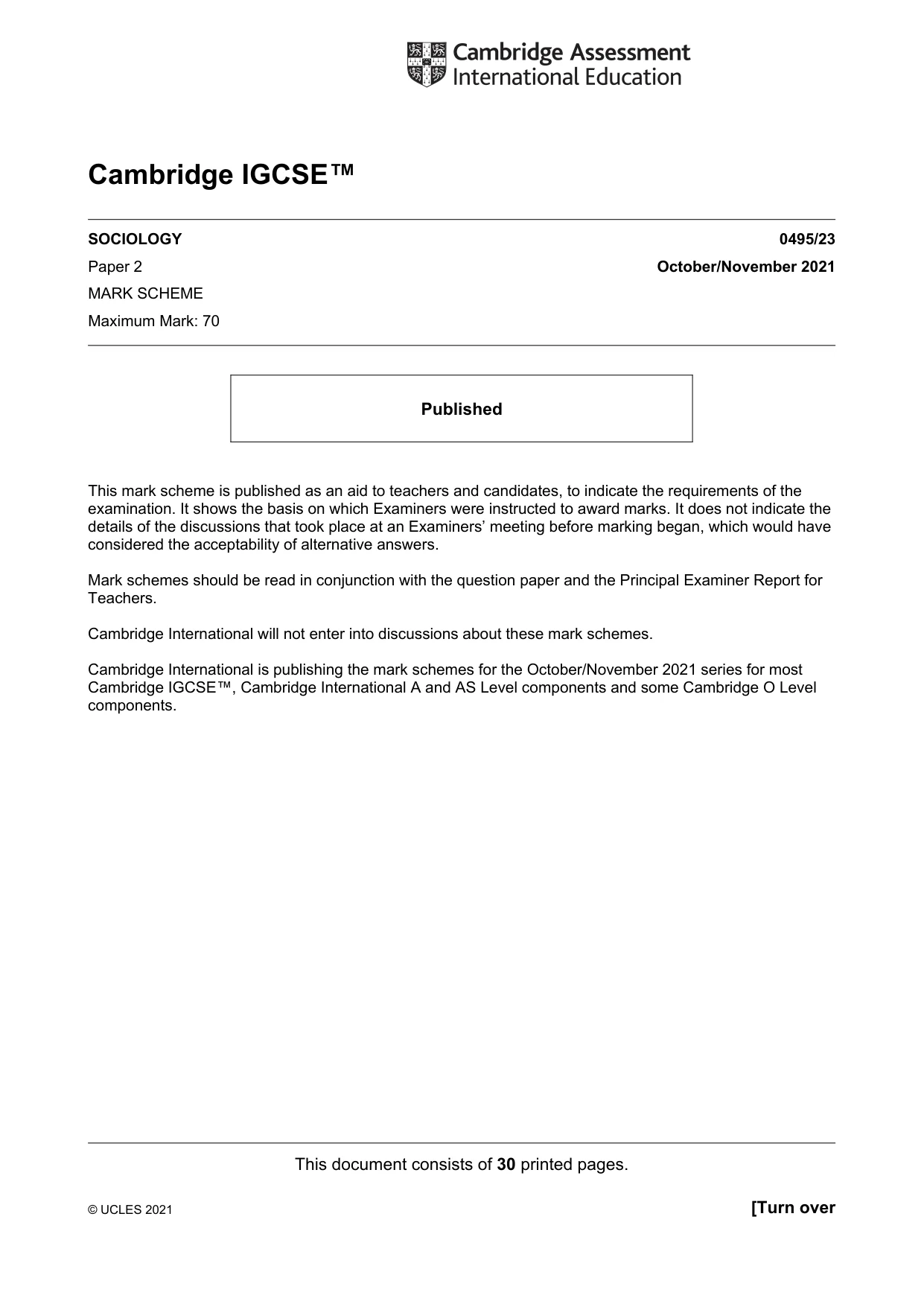
Mark scheme30 pages
Answers below. Sit the paper first if you are practising.



Questions as text
Q1 · Marriage takes different forms in different cultures and societies
1 Marriage takes different forms in different cultures and societies. In modern industrial societies rates of divorce are high. This may be linked to the domestic division of labour and feminism. (a) What is meant by the term ‘domestic division of labour’? [2] (b) Describe two ways the family can be dysfunctional. [4] (c) Explain how marriages vary in different cultures. [6] (d) Explain why there has been a rise in divorce rates in modern industrial societies. [8] (e) To what extent are family roles today equal? [15]
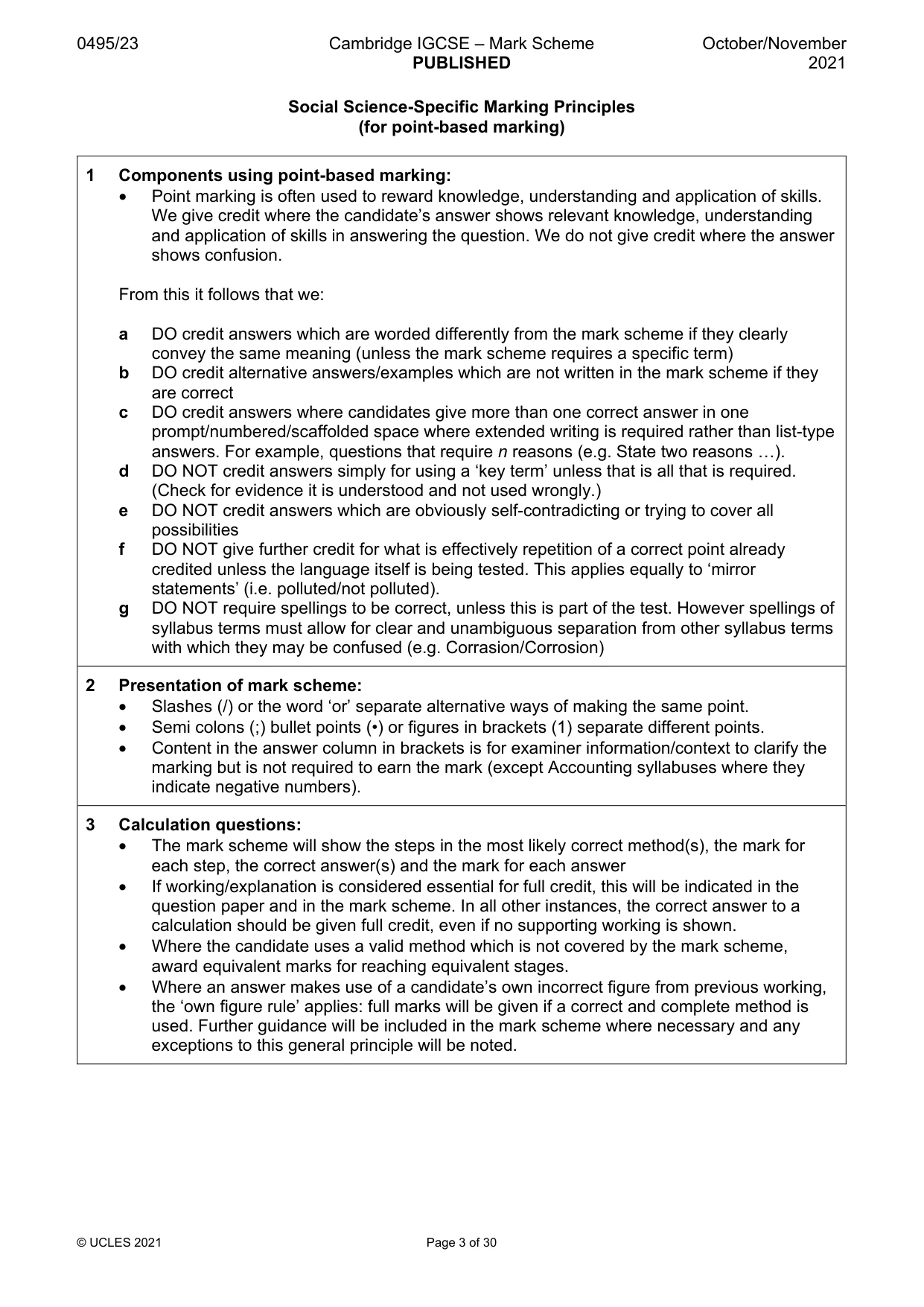
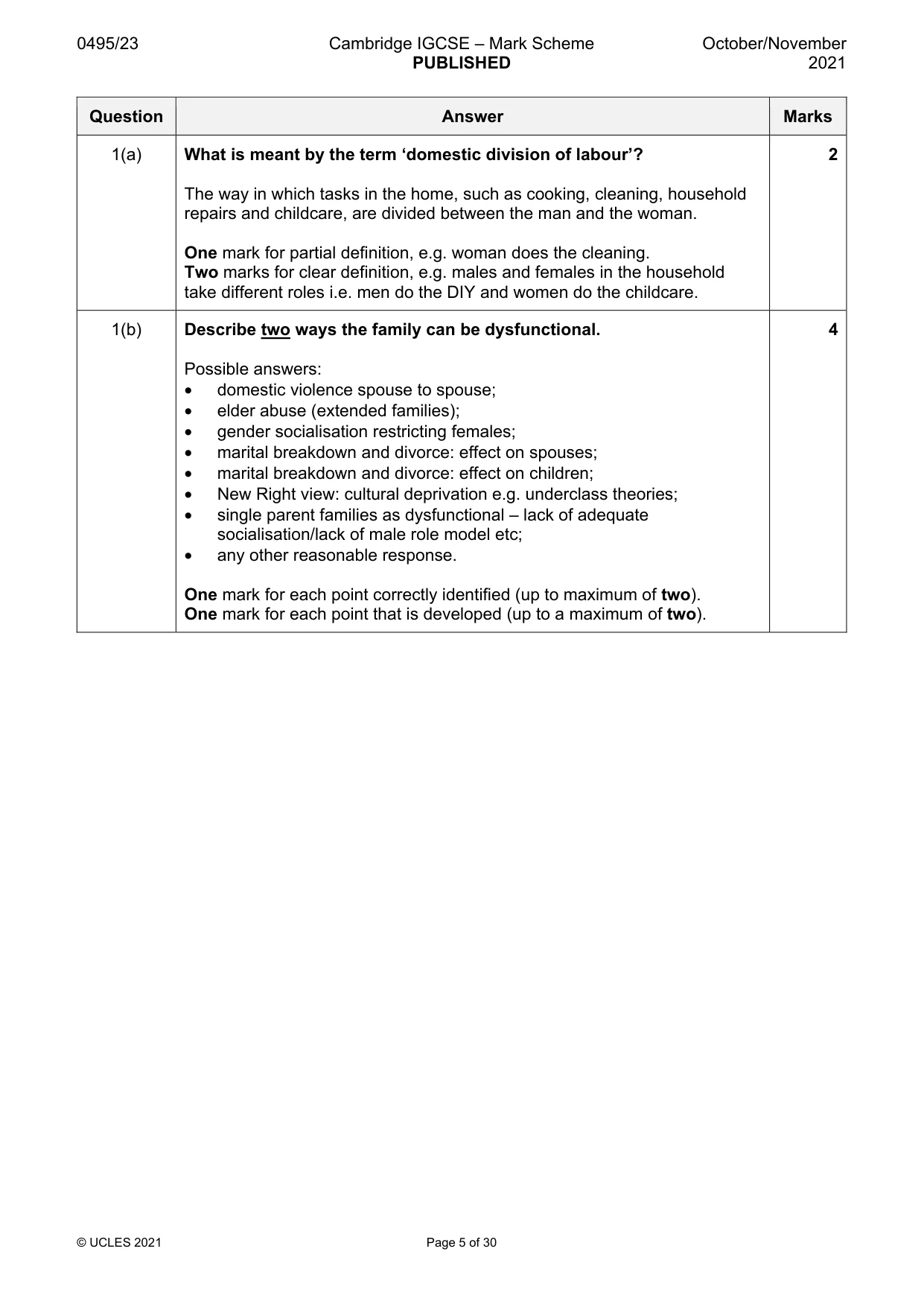
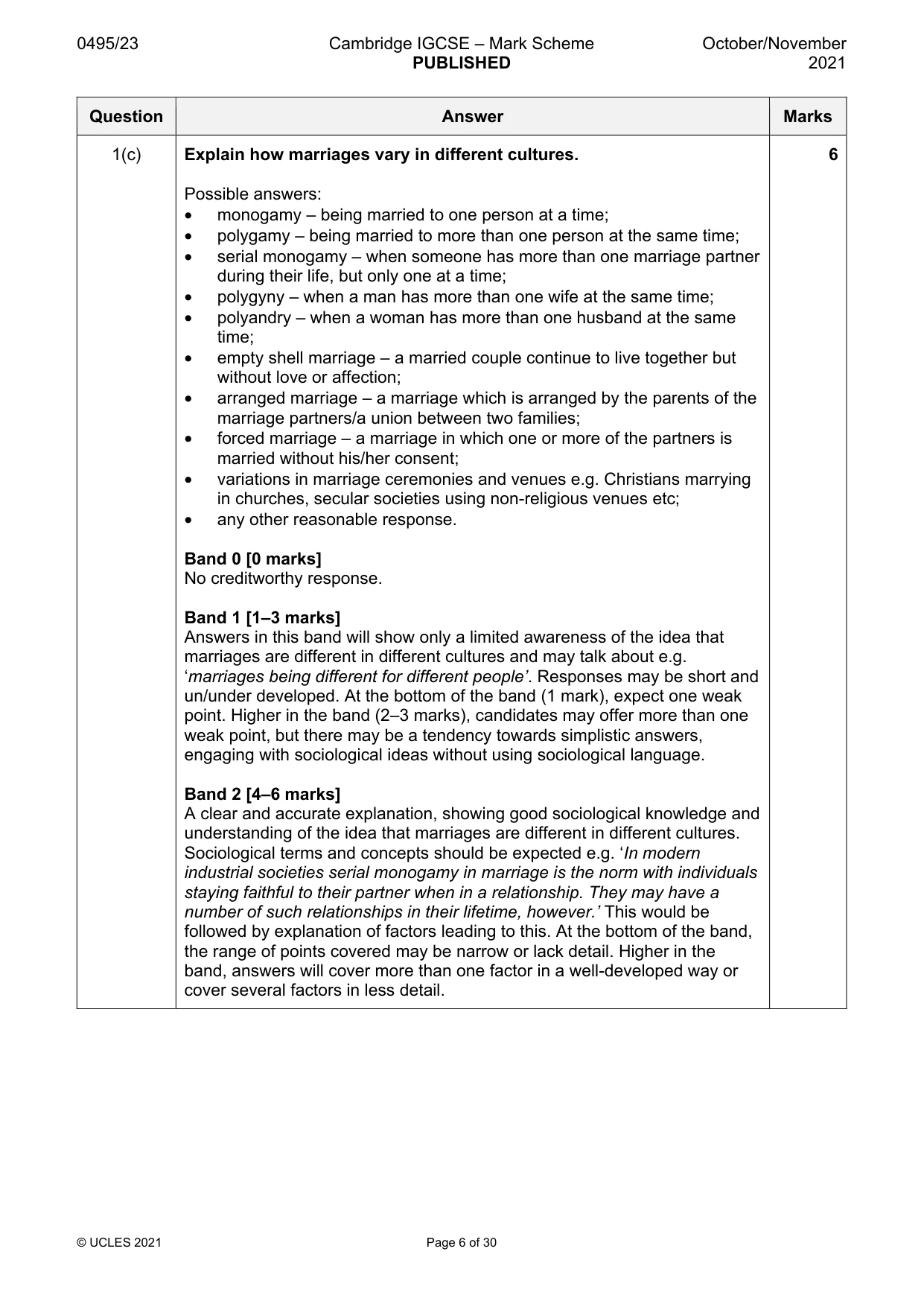
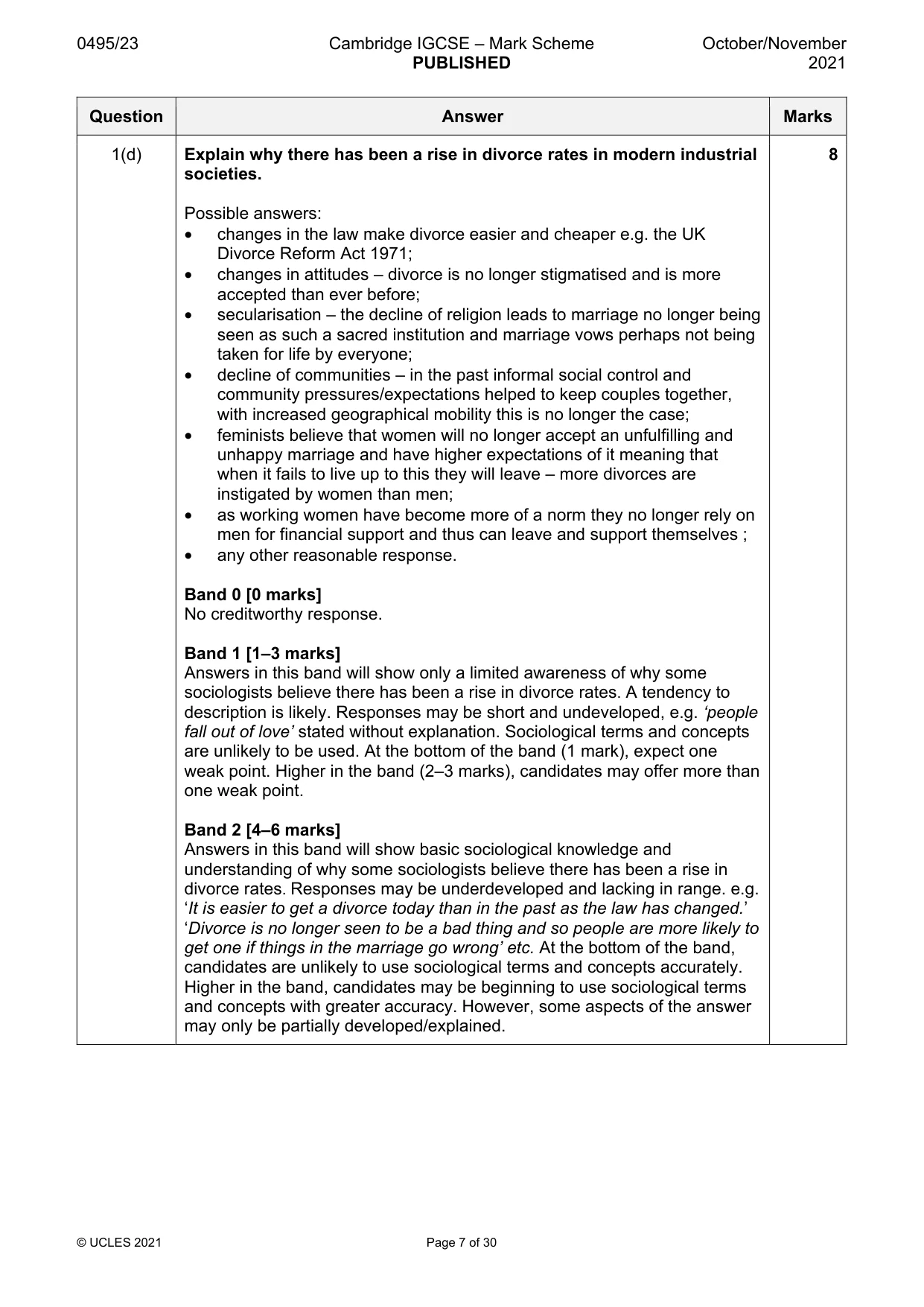
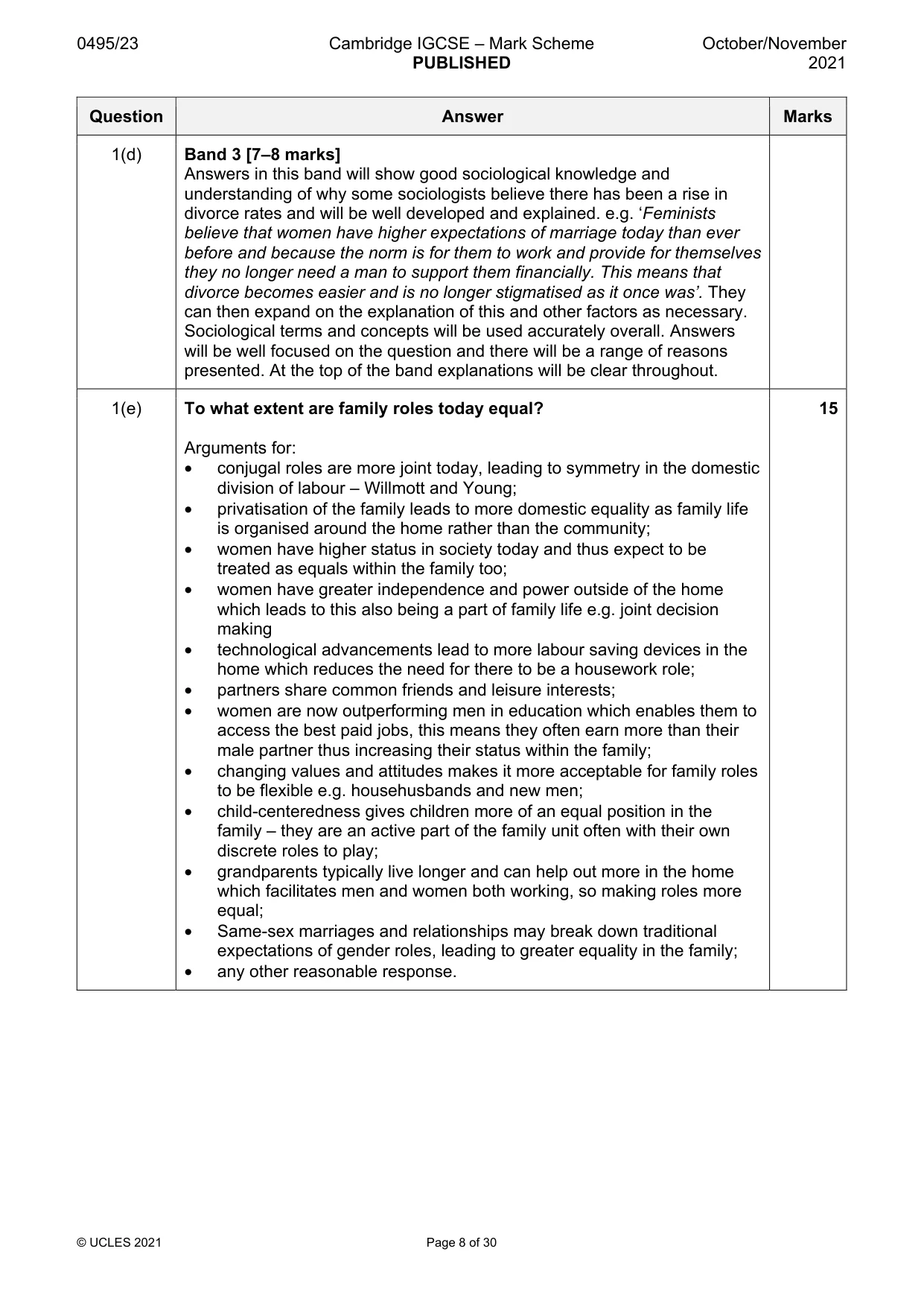
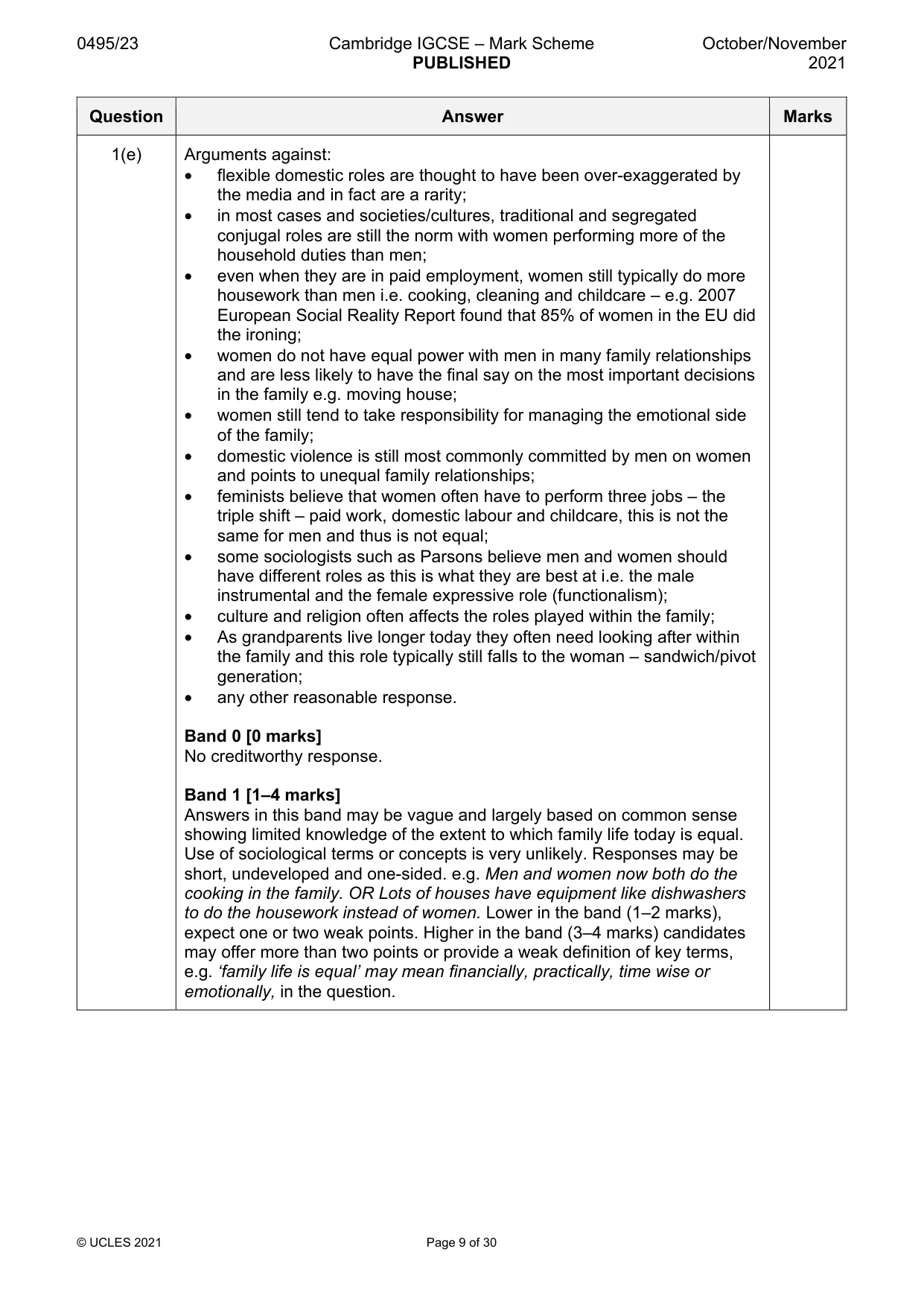
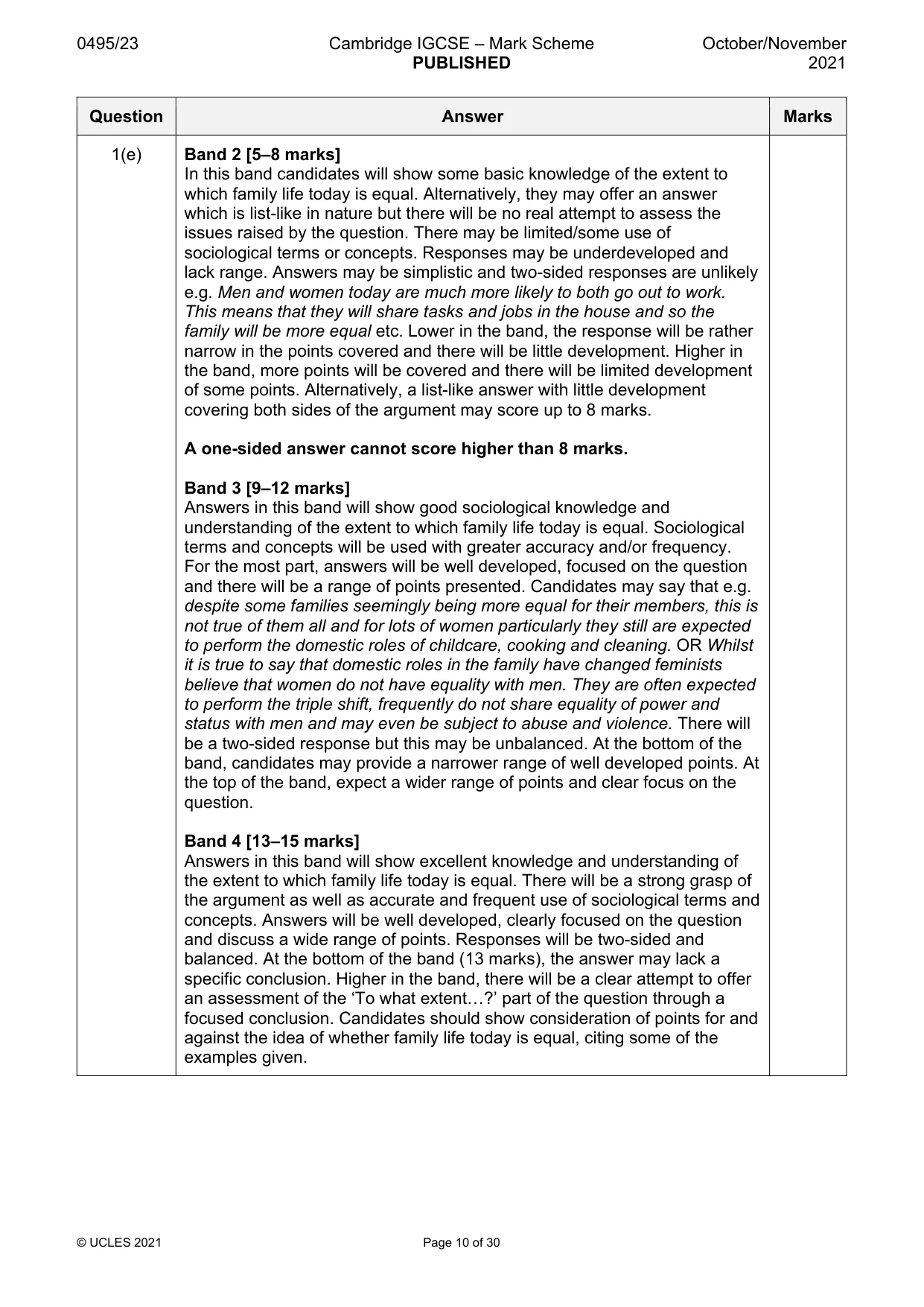
Mark scheme: Question Answer Marks 1(a) What is meant by the term ‘domestic division of labour’? 2 The way in which tasks in the home, such as cooking, cleaning, household repairs and childcare, are divided between the man and the woman. One mark for partial definition, e.g. woman does the cleaning. Two marks for clear definition, e.g. males and females in the household take different roles i.e. men do the DIY and women do the childcare. 1(b) Describe two ways the family can be dysfunctional. 4 Possible answers: • domestic violence spouse to spouse; • elder abuse (extended families); • gender socialisation restricting females; • marital breakdown and divorce: effect on spouses; • marital breakdown and divorce: effect on children; • New Right view: cultural deprivation e.g. underclass theories; • single parent families as dysfunctional – lack of adequate socialisation/lack of male role model etc; • any other reasonable response. One mark for each point correctly identified (up to maximum of two). One mark for each point that is developed (up to a maximum of two). 1(c) Explain how marriages vary in different cultures. 6 Possible answers: • monogamy – being married to one person at a time; • polygamy – being married to more than one person at the same time; • serial monogamy – when someone has more than one marriage partner during their life, but only one at a time; • polygyny – when a man has more than one wife at the same time; • polyandry – when a woman has more than one husband at the same time; • empty shell marriage – a married couple continue to live together but without love or affection; • arranged marriage – a marriage which is arranged by the parents of the marriage partners/a union between two families; • forced marriage – a marriage in which one or more of the partners is married without his/her consent; • variations in marriage ceremonies and venues e.g. Christians marrying in churches, secular societies using non-religious venues etc; • any other reasonable response. Band 0 [0 marks] No creditworthy response. Band 1 [1–3 marks] Answers in this band will show only a limited awareness of the idea that marriages are different in different cultures and may talk about e.g. ‘marriages being different for different people’. Responses may be short and un/under developed. At the bottom of the band (1 mark), expect one weak point. Higher in the band (2–3 marks), candidates may offer more than one weak point, but there may be a tendency towards simplistic answers, engaging with sociological ideas without using sociological language. Band 2 [4–6 marks] A clear and accurate explanation, showing good sociological knowledge and understanding of the idea that marriages are different in different cultures. Sociological terms and concepts should be expected e.g. ‘In modern industrial societies serial monogamy in marriage is the norm with individuals staying faithful to their partner when in a relationship. They may have a number of such relationships in their lifetime, however.’ This would be followed by explanation of factors leading to this. At the bottom of the band, the range of points covered may be narrow or lack detail. Higher in the band, answers will cover more than one factor in a well-developed way or cover several factors in less detail. 1(d) Explain why there has been a rise in divorce rates in modern industrial 8 societies. Possible answers: • changes in the law make divorce easier and cheaper e.g. the UK Divorce Reform Act 1971; • changes in attitudes – divorce is no longer stigmatised and is more accepted than ever before; • secularisation – the decline of religion leads to marriage no longer being seen as such a sacred institution and marriage vows perhaps not being taken for life by everyone; • decline of communities – in the past informal social control and community pressures/expectations helped to keep couples together, with increased geographical mobility this is no longer the case; • feminists believe that women will no longer accept an unfulfilling and unhappy marriage and have higher expectations of it meaning that when it fails to live up to this they will leave – more divorces are instigated by women than men; • as working women have become more of a norm they no longer rely on men for financial support and thus can leave and support themselves ; • any other reasonable response. Band 0 [0 marks] No creditworthy response. Band 1 [1–3 marks] Answers in this band will show only a limited awareness of why some sociologists believe there has been a rise in divorce rates. A tendency to description is likely. Responses may be short and undeveloped, e.g. ‘people fall out of love’ stated without explanation. Sociological terms and concepts are unlikely to be used. At the bottom of the band (1 mark), expect one weak point. Higher in the band (2–3 marks), candidates may offer more than one weak point. Band 2 [4–6 marks] Answers in this band will show basic sociological knowledge and understanding of why some sociologists believe there has been a rise in divorce rates. Responses may be underdeveloped and lacking in range. e.g. ‘It is easier to get a divorce today than in the past as the law has changed.’ ‘Divorce is no longer seen to be a bad thing and so people are more likely to get one if things in the marriage go wrong’ etc. At the bottom of the band, candidates are unlikely to use sociological terms and concepts accurately. Higher in the band, candidates may be beginning to use sociological terms and concepts with greater accuracy. However, some aspects of the answer may only be partially developed/explained. 1(d) Band 3 [7–8 marks] Answers in this band will show good sociological knowledge and understanding of why some sociologists believe there has been a rise in divorce rates and will be well developed and explained. e.g. ‘Feminists believe that women have higher expectations of marriage today than ever before and because the norm is for them to work and provide for themselves they no longer need a man to support them financially. This means that divorce becomes easier and is no longer stigmatised as it once was’. They can then expand on the explanation of this and other factors as necessary. Sociological terms and concepts will be used accurately overall. Answers will be well focused on the question and there will be a range of reasons presented. At the top of the band explanations will be clear throughout. 1(e) To what extent are family roles today equal? 15 Arguments for: • conjugal roles are more joint today, leading to symmetry in the domestic division of labour – Willmott and Young; • privatisation of the family leads to more domestic equality as family life is organised around the home rather than the community; • women have higher status in society today and thus expect to be treated as equals within the family too; • women have greater independence and power outside of the home which leads to this also being a part of family life e.g. joint decision making • technological advancements lead to more labour saving devices in the home which reduces the need for there to be a housework role; • partners share common friends and leisure interests; • women are now outperforming men in education which enables them to access the best paid jobs, this means they often earn more than their male partner thus increasing their status within the family; • changing values and attitudes makes it more acceptable for family roles to be flexible e.g. househusbands and new men; • child-centeredness gives children more of an equal position in the family – they are an active part of the family unit often with their own discrete roles to play; • grandparents typically live longer and can help out more in the home which facilitates men and women both working, so making roles more equal; • Same-sex marriages and relationships may break down traditional expectations of gender roles, leading to greater equality in the family; • any other reasonable response. 1(e) Arguments against: • flexible domestic roles are thought to have been over-exaggerated by the media and in fact are a rarity; • in most cases and societies/cultures, traditional and segregated conjugal roles are still the norm with women performing more of the household duties than men; • even when they are in paid employment, women still typically do more housework than men i.e. cooking, cleaning and childcare – e.g. 2007 European Social Reality Report found that 85% of women in the EU did the ironing; • women do not have equal power with men in many family relationships and are less likely to have the final say on the most important decisions in the family e.g. moving house; • women still tend to take responsibility for managing the emotional side of the family; • domestic violence is still most commonly committed by men on women and points to unequal family relationships; • feminists believe that women often have to perform three jobs – the triple shift – paid work, domestic labour and childcare, this is not the same for men and thus is not equal; • some sociologists such as Parsons believe men and women should have different roles as this is what they are best at i.e. the male instrumental and the female expressive role (functionalism); • culture and religion often affects the roles played within the family; • As grandparents live longer today they often need looking after within the family and this role typically still falls to the woman – sandwich/pivot generation; • any other reasonable response. Band 0 [0 marks] No creditworthy response. Band 1 [1–4 marks] Answers in this band may be vague and largely based on common sense showing limited knowledge of the extent to which family life today is equal. Use of sociological terms or concepts is very unlikely. Responses may be short, undeveloped and one-sided. e.g. Men and women now both do the cooking in the family. OR Lots of houses have equipment like dishwashers to do the housework instead of women. Lower in the band (1–2 marks), expect one or two weak points. Higher in the band (3–4 marks) candidates may offer more than two points or provide a weak definition of key terms, e.g. ‘family life is equal’ may mean financially, practically, time wise or emotionally, in the question. 1(e) Band 2 [5–8 marks] In this band candidates will show some basic knowledge of the extent to which family life today is equal. Alternatively, they may offer an answer which is list-like in nature but there will be no real attempt to assess the issues raised by the question. There may be limited/some use of sociological terms or concepts. Responses may be underdeveloped and lack range. Answers may be simplistic and two-sided responses are unlikely e.g. Men and women today are much more likely to both go out to work. This means that they will share tasks and jobs in the house and so the family will be more equal etc. Lower in the band, the response will be rather narrow in the points covered and there will be little development. Higher in the band, more points will be covered and there will be limited development of some points. Alternatively, a list-like answer with little development covering both sides of the argument may score up to 8 marks. A one-sided answer cannot score higher than 8 marks. Band 3 [9–12 marks] Answers in this band will show good sociological knowledge and understanding of the extent to which family life today is equal. Sociological terms and concepts will be used with greater accuracy and/or frequency. For the most part, answers will be well developed, focused on the question and there will be a range of points presented. Candidates may say that e.g. despite some families seemingly being more equal for their members, this is not true of them all and for lots of women particularly they still are expected to perform the domestic roles of childcare, cooking and cleaning. OR Whilst it is true to say that domestic roles in the family have changed feminists believe that women do not have equality with men. They are often expected to perform the triple shift, frequently do not share equality of power and status with men and may even be subject to abuse and violence. There will be a two-sided response but this may be unbalanced. At the bottom of the band, candidates may provide a narrower range of well developed points. At the top of the band, expect a wider range of points and clear focus on the question. Band 4 [13–15 marks] Answers in this band will show excellent knowledge and understanding of the extent to which family life today is equal. There will be a strong grasp of the argument as well as accurate and frequent use of sociological terms and concepts. Answers will be well developed, clearly focused on the question and discuss a wide range of points. Responses will be two-sided and balanced. At the bottom of the band (13 marks), the answer may lack a specific conclusion. Higher in the band, there will be a clear attempt to offer an assessment of the ‘To what extent…?’ part of the question through a focused conclusion. Candidates should show consideration of points for and against the idea of whether family life today is equal, citing some of the examples given.
Q2 · The comprehensive education system began in the 1960s and was based upon principles of…
2 The comprehensive education system began in the 1960s and was based upon principles of equality. It tried to improve issues of cultural deprivation and is still a popular educational system in modern industrial societies. Despite this, however, some social groups still perform better than others in education. (a) What is meant by the term ‘cultural deprivation’? [2] (b) Describe two examples of informal education. [4] (c) Explain how shared values are learned in schools. [6] (d) Explain why in many modern industrial societies girls achieve better examination results than boys. [8] (e) To what extent does the comprehensive system ensure equality of opportunity in education? [15] Section C: Crime, deviance and social control
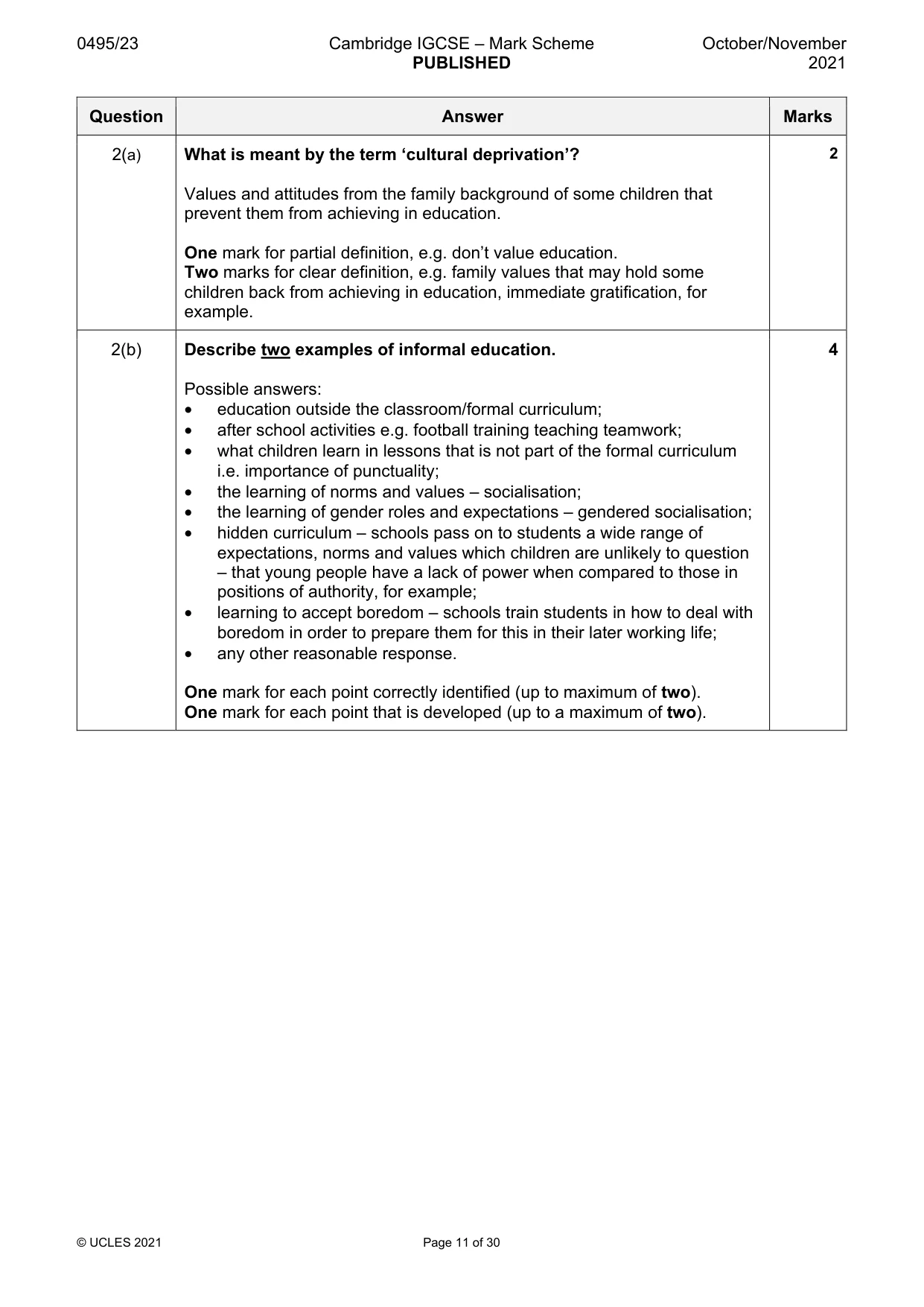
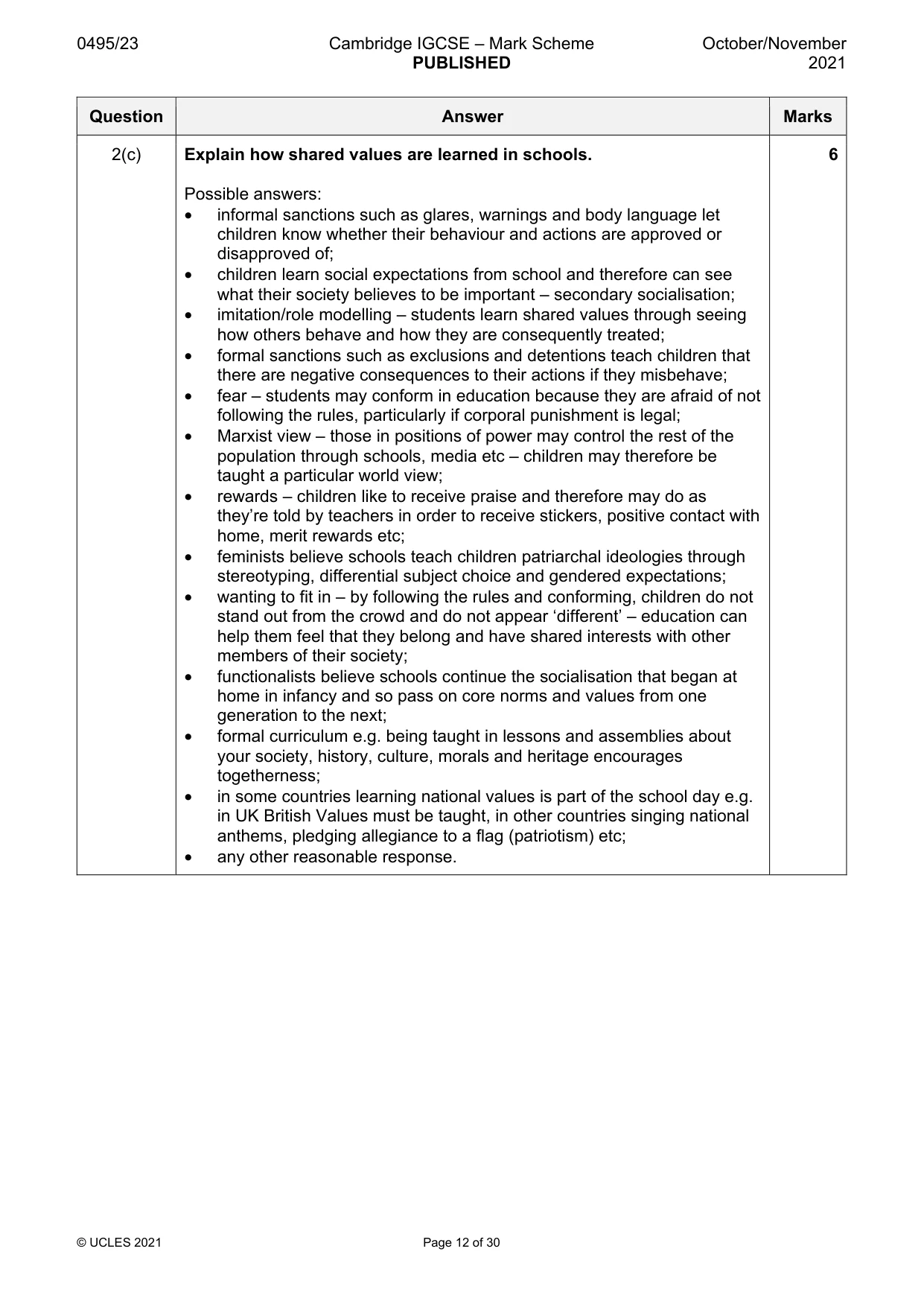
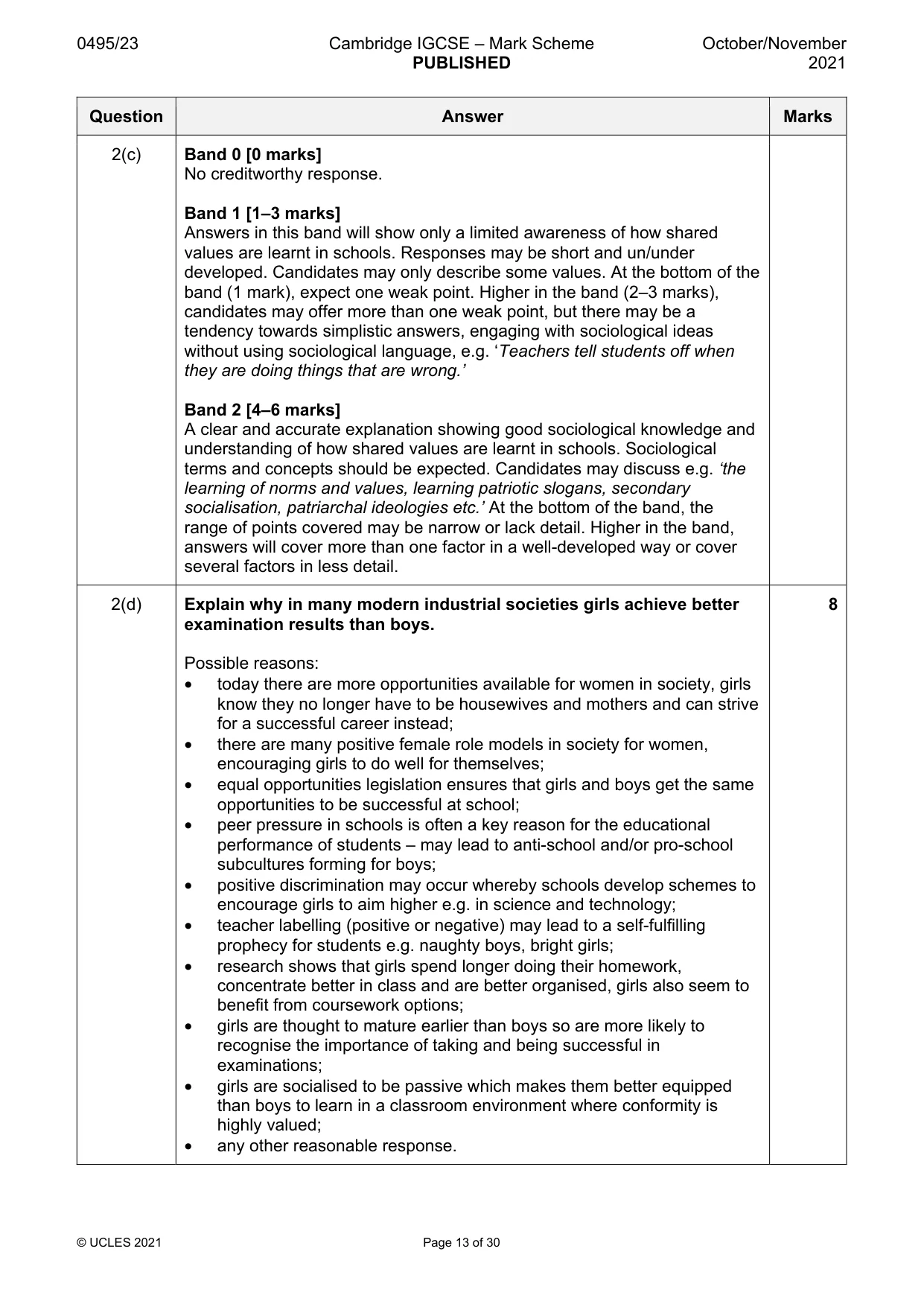
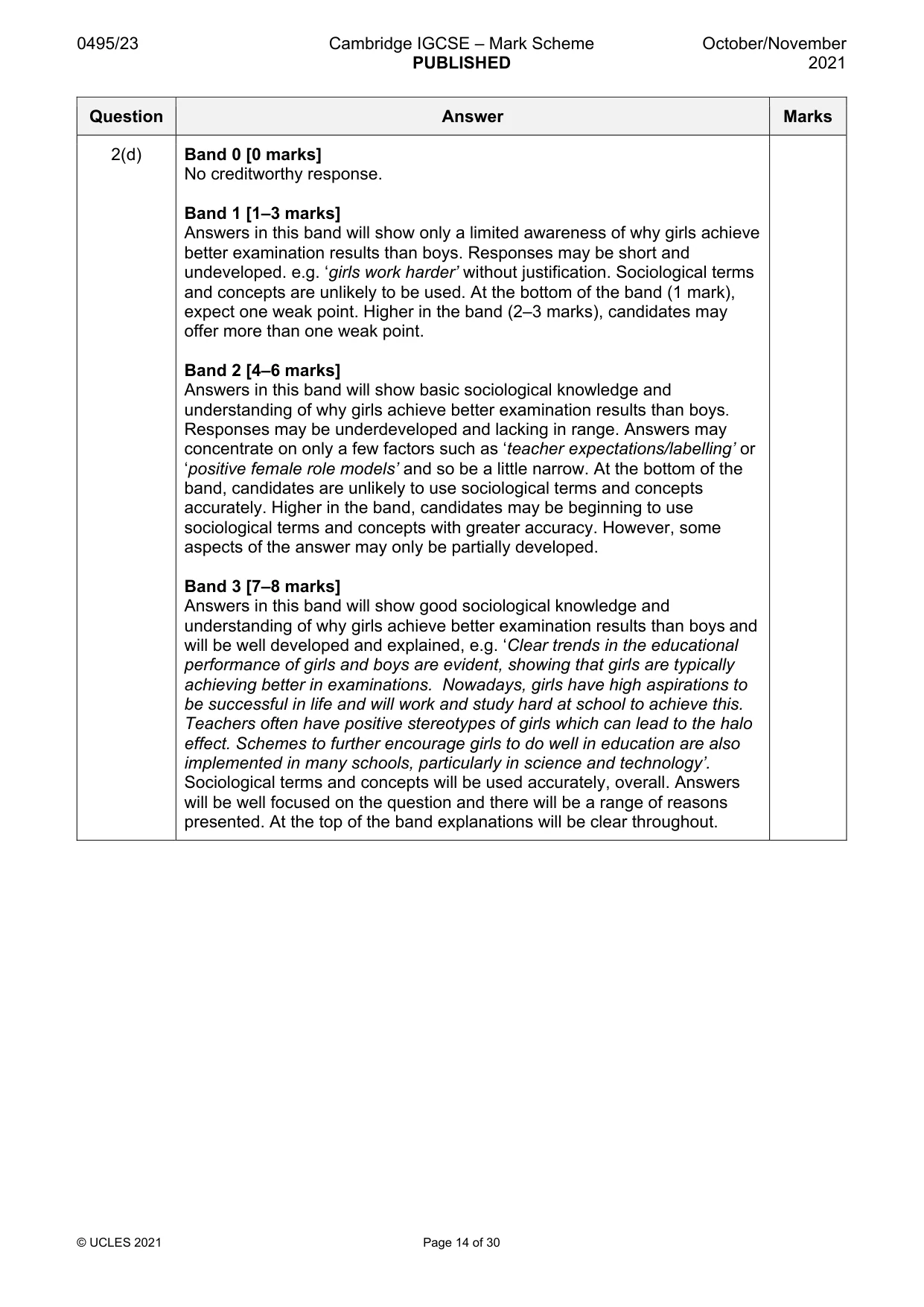
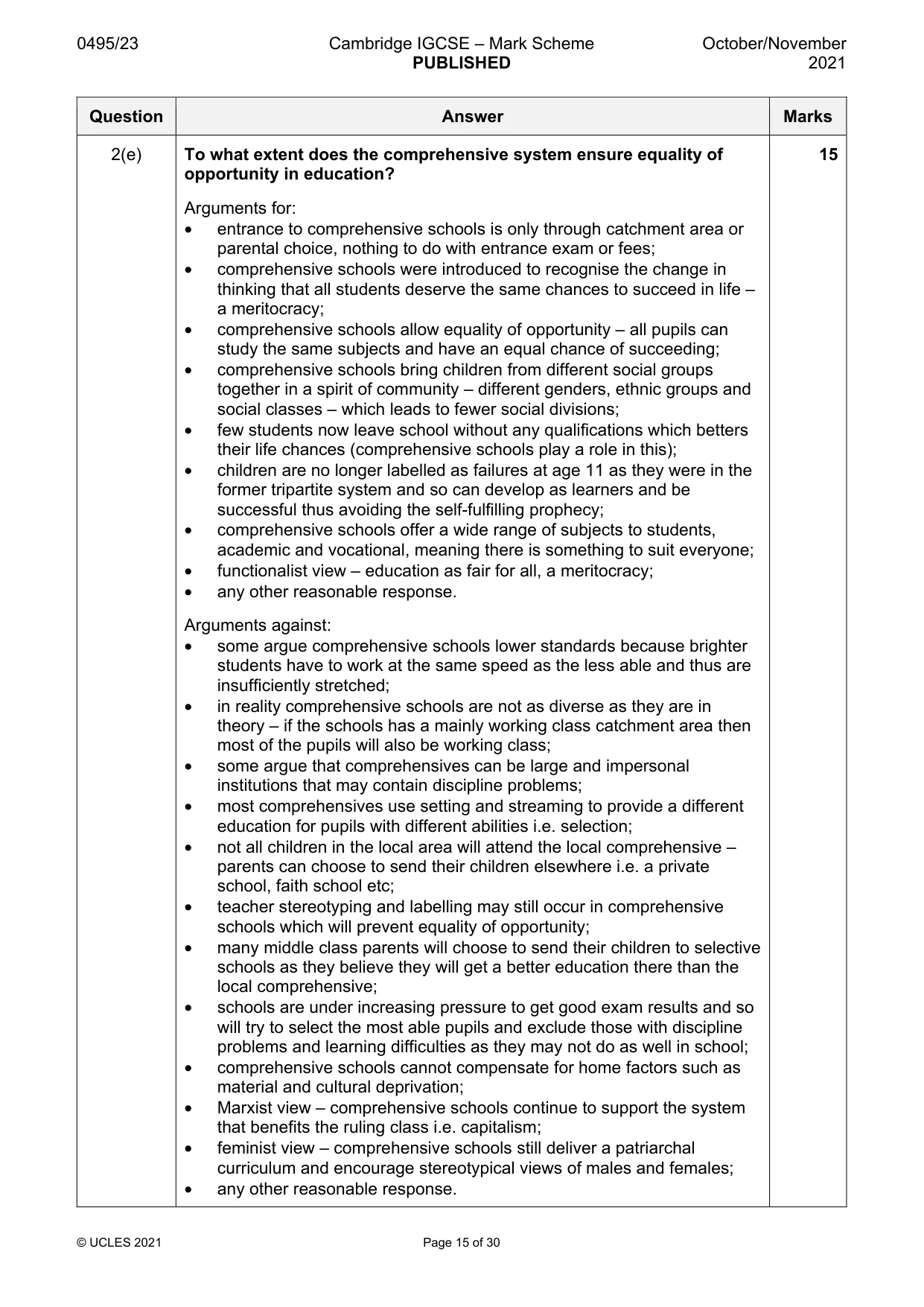
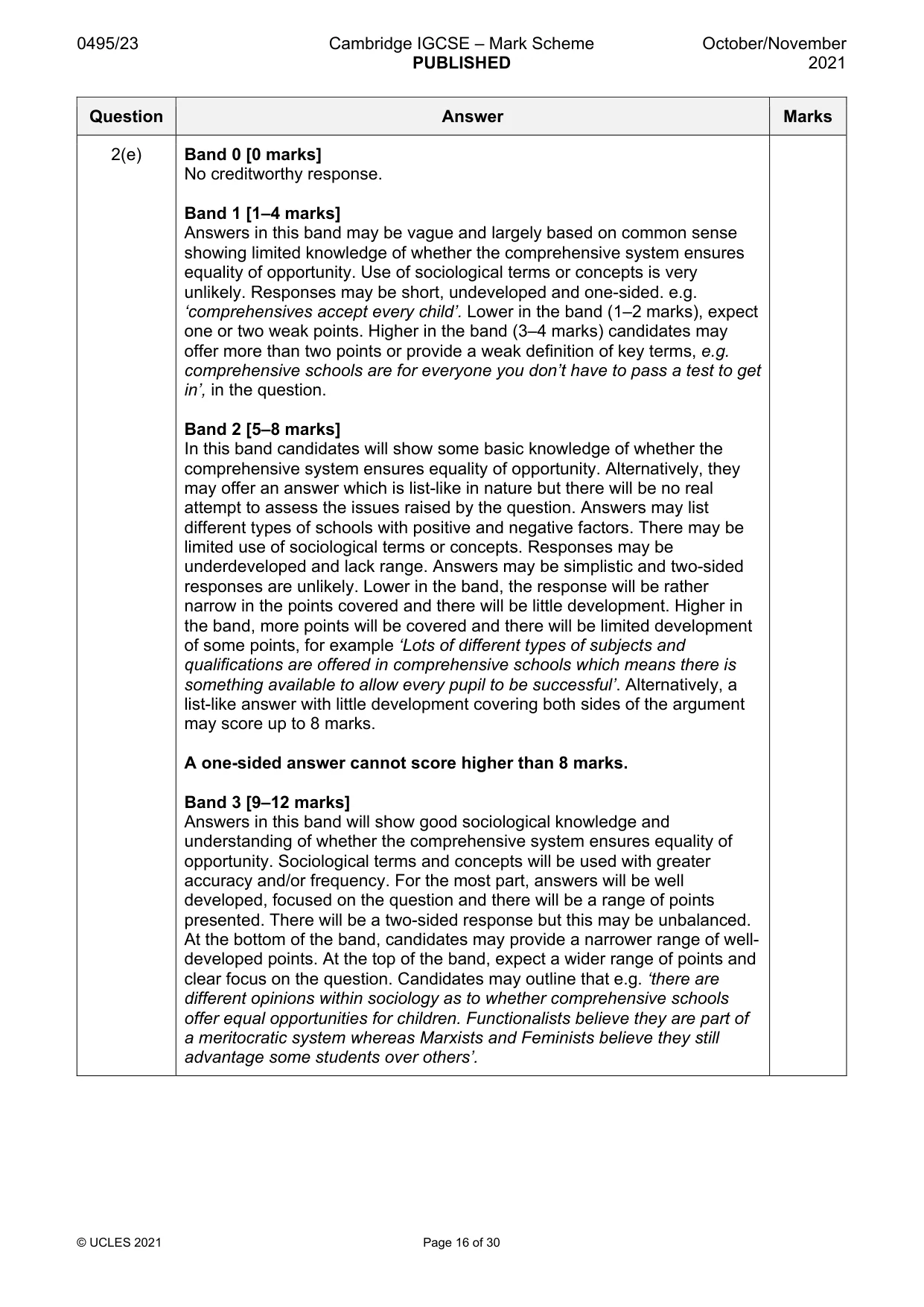
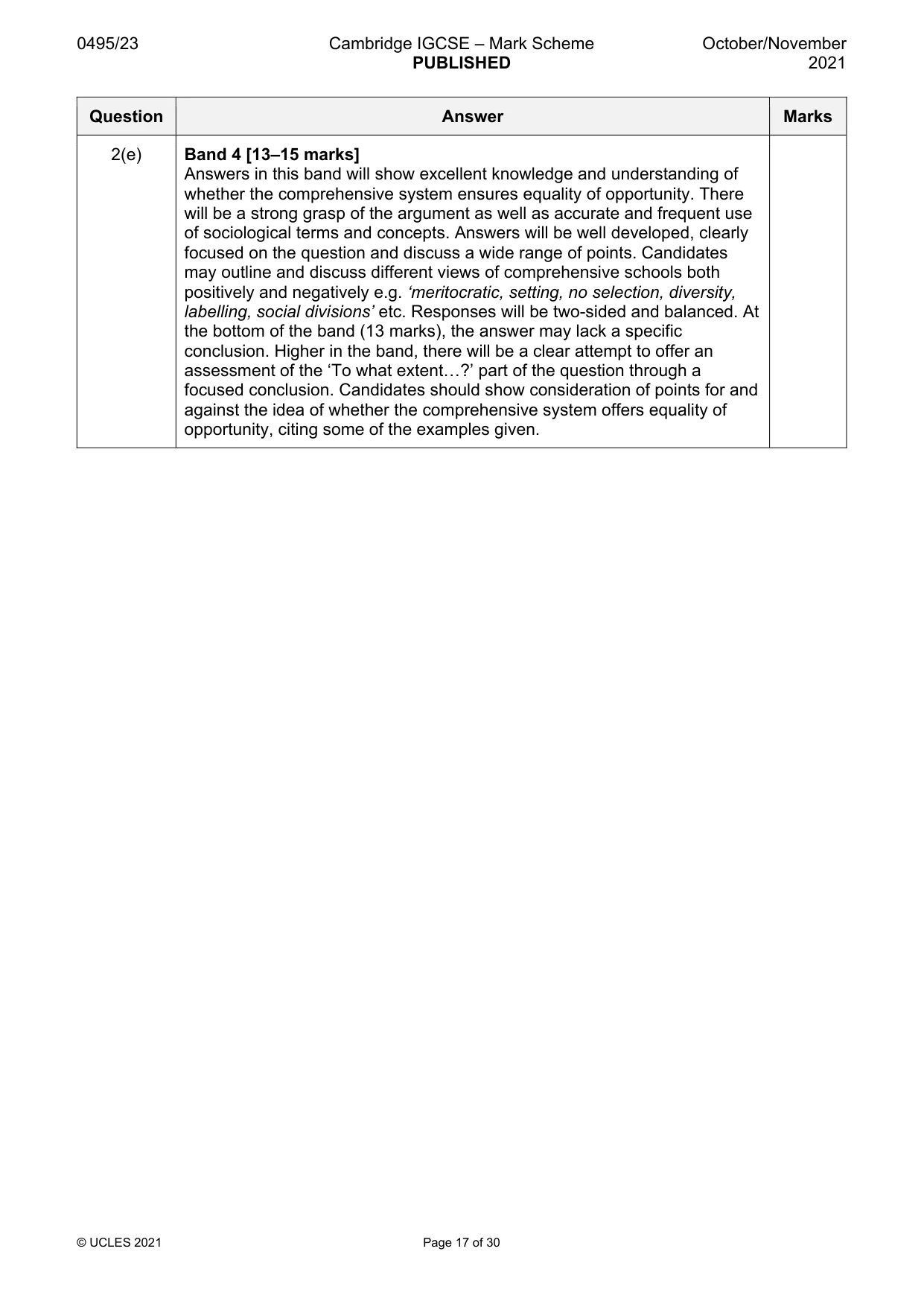
Mark scheme: 2(a) What is meant by the term ‘cultural deprivation’? 2 Values and attitudes from the family background of some children that prevent them from achieving in education. One mark for partial definition, e.g. don’t value education. Two marks for clear definition, e.g. family values that may hold some children back from achieving in education, immediate gratification, for example. 2(b) Describe two examples of informal education. 4 Possible answers: • education outside the classroom/formal curriculum; • after school activities e.g. football training teaching teamwork; • what children learn in lessons that is not part of the formal curriculum i.e. importance of punctuality; • the learning of norms and values – socialisation; • the learning of gender roles and expectations – gendered socialisation; • hidden curriculum – schools pass on to students a wide range of expectations, norms and values which children are unlikely to question – that young people have a lack of power when compared to those in positions of authority, for example; • learning to accept boredom – schools train students in how to deal with boredom in order to prepare them for this in their later working life; • any other reasonable response. One mark for each point correctly identified (up to maximum of two). One mark for each point that is developed (up to a maximum of two). 2(c) Explain how shared values are learned in schools. 6 Possible answers: • informal sanctions such as glares, warnings and body language let children know whether their behaviour and actions are approved or disapproved of; • children learn social expectations from school and therefore can see what their society believes to be important – secondary socialisation; • imitation/role modelling – students learn shared values through seeing how others behave and how they are consequently treated; • formal sanctions such as exclusions and detentions teach children that there are negative consequences to their actions if they misbehave; • fear – students may conform in education because they are afraid of not following the rules, particularly if corporal punishment is legal; • Marxist view – those in positions of power may control the rest of the population through schools, media etc – children may therefore be taught a particular world view; • rewards – children like to receive praise and therefore may do as they’re told by teachers in order to receive stickers, positive contact with home, merit rewards etc; • feminists believe schools teach children patriarchal ideologies through stereotyping, differential subject choice and gendered expectations; • wanting to fit in – by following the rules and conforming, children do not stand out from the crowd and do not appear ‘different’ – education can help them feel that they belong and have shared interests with other members of their society; • functionalists believe schools continue the socialisation that began at home in infancy and so pass on core norms and values from one generation to the next; • formal curriculum e.g. being taught in lessons and assemblies about your society, history, culture, morals and heritage encourages togetherness; • in some countries learning national values is part of the school day e.g. in UK British Values must be taught, in other countries singing national anthems, pledging allegiance to a flag (patriotism) etc; • any other reasonable response. 2(c) Band 0 [0 marks] No creditworthy response. Band 1 [1–3 marks] Answers in this band will show only a limited awareness of how shared values are learnt in schools. Responses may be short and un/under developed. Candidates may only describe some values. At the bottom of the band (1 mark), expect one weak point. Higher in the band (2–3 marks), candidates may offer more than one weak point, but there may be a tendency towards simplistic answers, engaging with sociological ideas without using sociological language, e.g. ‘Teachers tell students off when they are doing things that are wrong.’ Band 2 [4–6 marks] A clear and accurate explanation showing good sociological knowledge and understanding of how shared values are learnt in schools. Sociological terms and concepts should be expected. Candidates may discuss e.g. ‘the learning of norms and values, learning patriotic slogans, secondary socialisation, patriarchal ideologies etc.’ At the bottom of the band, the range of points covered may be narrow or lack detail. Higher in the band, answers will cover more than one factor in a well-developed way or cover several factors in less detail. 2(d) Explain why in many modern industrial societies girls achieve better 8 examination results than boys. Possible reasons: • today there are more opportunities available for women in society, girls know they no longer have to be housewives and mothers and can strive for a successful career instead; • there are many positive female role models in society for women, encouraging girls to do well for themselves; • equal opportunities legislation ensures that girls and boys get the same opportunities to be successful at school; • peer pressure in schools is often a key reason for the educational performance of students – may lead to anti-school and/or pro-school subcultures forming for boys; • positive discrimination may occur whereby schools develop schemes to encourage girls to aim higher e.g. in science and technology; • teacher labelling (positive or negative) may lead to a self-fulfilling prophecy for students e.g. naughty boys, bright girls; • research shows that girls spend longer doing their homework, concentrate better in class and are better organised, girls also seem to benefit from coursework options; • girls are thought to mature earlier than boys so are more likely to recognise the importance of taking and being successful in examinations; • girls are socialised to be passive which makes them better equipped than boys to learn in a classroom environment where conformity is highly valued; • any other reasonable response. 2(d) Band 0 [0 marks] No creditworthy response. Band 1 [1–3 marks] Answers in this band will show only a limited awareness of why girls achieve better examination results than boys. Responses may be short and undeveloped. e.g. ‘girls work harder’ without justification. Sociological terms and concepts are unlikely to be used. At the bottom of the band (1 mark), expect one weak point. Higher in the band (2–3 marks), candidates may offer more than one weak point. Band 2 [4–6 marks] Answers in this band will show basic sociological knowledge and understanding of why girls achieve better examination results than boys. Responses may be underdeveloped and lacking in range. Answers may concentrate on only a few factors such as ‘teacher expectations/labelling’ or ‘positive female role models’ and so be a little narrow. At the bottom of the band, candidates are unlikely to use sociological terms and concepts accurately. Higher in the band, candidates may be beginning to use sociological terms and concepts with greater accuracy. However, some aspects of the answer may only be partially developed. Band 3 [7–8 marks] Answers in this band will show good sociological knowledge and understanding of why girls achieve better examination results than boys and will be well developed and explained, e.g. ‘Clear trends in the educational performance of girls and boys are evident, showing that girls are typically achieving better in examinations. Nowadays, girls have high aspirations to be successful in life and will work and study hard at school to achieve this. Teachers often have positive stereotypes of girls which can lead to the halo effect. Schemes to further encourage girls to do well in education are also implemented in many schools, particularly in science and technology’. Sociological terms and concepts will be used accurately, overall. Answers will be well focused on the question and there will be a range of reasons presented. At the top of the band explanations will be clear throughout. 2(e) To what extent does the comprehensive system ensure equality of 15 opportunity in education? Arguments for: • entrance to comprehensive schools is only through catchment area or parental choice, nothing to do with entrance exam or fees; • comprehensive schools were introduced to recognise the change in thinking that all students deserve the same chances to succeed in life – a meritocracy; • comprehensive schools allow equality of opportunity – all pupils can study the same subjects and have an equal chance of succeeding; • comprehensive schools bring children from different social groups together in a spirit of community – different genders, ethnic groups and social classes – which leads to fewer social divisions; • few students now leave school without any qualifications which betters their life chances (comprehensive schools play a role in this); • children are no longer labelled as failures at age 11 as they were in the former tripartite system and so can develop as learners and be successful thus avoiding the self-fulfilling prophecy; • comprehensive schools offer a wide range of subjects to students, academic and vocational, meaning there is something to suit everyone; • functionalist view – education as fair for all, a meritocracy; • any other reasonable response. Arguments against: • some argue comprehensive schools lower standards because brighter students have to work at the same speed as the less able and thus are insufficiently stretched; • in reality comprehensive schools are not as diverse as they are in theory – if the schools has a mainly working class catchment area then most of the pupils will also be working class; • some argue that comprehensives can be large and impersonal institutions that may contain discipline problems; • most comprehensives use setting and streaming to provide a different education for pupils with different abilities i.e. selection; • not all children in the local area will attend the local comprehensive – parents can choose to send their children elsewhere i.e. a private school, faith school etc; • teacher stereotyping and labelling may still occur in comprehensive schools which will prevent equality of opportunity; • many middle class parents will choose to send their children to selective schools as they believe they will get a better education there than the local comprehensive; • schools are under increasing pressure to get good exam results and so will try to select the most able pupils and exclude those with discipline problems and learning difficulties as they may not do as well in school; • comprehensive schools cannot compensate for home factors such as material and cultural deprivation; • Marxist view – comprehensive schools continue to support the system that benefits the ruling class i.e. capitalism; • feminist view – comprehensive schools still deliver a patriarchal curriculum and encourage stereotypical views of males and females; • any other reasonable response. 2(e) Band 0 [0 marks] No creditworthy response. Band 1 [1–4 marks] Answers in this band may be vague and largely based on common sense showing limited knowledge of whether the comprehensive system ensures equality of opportunity. Use of sociological terms or concepts is very unlikely. Responses may be short, undeveloped and one-sided. e.g. ‘comprehensives accept every child’. Lower in the band (1–2 marks), expect one or two weak points. Higher in the band (3–4 marks) candidates may offer more than two points or provide a weak definition of key terms, e.g. comprehensive schools are for everyone you don’t have to pass a test to get in’, in the question. Band 2 [5–8 marks] In this band candidates will show some basic knowledge of whether the comprehensive system ensures equality of opportunity. Alternatively, they may offer an answer which is list-like in nature but there will be no real attempt to assess the issues raised by the question. Answers may list different types of schools with positive and negative factors. There may be limited use of sociological terms or concepts. Responses may be underdeveloped and lack range. Answers may be simplistic and two-sided responses are unlikely. Lower in the band, the response will be rather narrow in the points covered and there will be little development. Higher in the band, more points will be covered and there will be limited development of some points, for example ‘Lots of different types of subjects and qualifications are offered in comprehensive schools which means there is something available to allow every pupil to be successful’. Alternatively, a list-like answer with little development covering both sides of the argument may score up to 8 marks. A one-sided answer cannot score higher than 8 marks. Band 3 [9–12 marks] Answers in this band will show good sociological knowledge and understanding of whether the comprehensive system ensures equality of opportunity. Sociological terms and concepts will be used with greater accuracy and/or frequency. For the most part, answers will be well developed, focused on the question and there will be a range of points presented. There will be a two-sided response but this may be unbalanced. At the bottom of the band, candidates may provide a narrower range of well- developed points. At the top of the band, expect a wider range of points and clear focus on the question. Candidates may outline that e.g. ‘there are different opinions within sociology as to whether comprehensive schools offer equal opportunities for children. Functionalists believe they are part of a meritocratic system whereas Marxists and Feminists believe they still advantage some students over others’. 2(e) Band 4 [13–15 marks] Answers in this band will show excellent knowledge and understanding of whether the comprehensive system ensures equality of opportunity. There will be a strong grasp of the argument as well as accurate and frequent use of sociological terms and concepts. Answers will be well developed, clearly focused on the question and discuss a wide range of points. Candidates may outline and discuss different views of comprehensive schools both positively and negatively e.g. ‘meritocratic, setting, no selection, diversity, labelling, social divisions’ etc. Responses will be two-sided and balanced. At the bottom of the band (13 marks), the answer may lack a specific conclusion. Higher in the band, there will be a clear attempt to offer an assessment of the ‘To what extent…?’ part of the question through a focused conclusion. Candidates should show consideration of points for and against the idea of whether the comprehensive system offers equality of opportunity, citing some of the examples given.
More questions on What attempts have been made to reduce social inequalities?
Q3 · According to the official crime statistics, some social groups are more likely than…
3 According to the official crime statistics, some social groups are more likely than others to be convicted of crime. Some sociologists question how effective punishments actually are at deterring people from committing crime. This is particularly true of young people who are part of youth culture. (a) What is meant by the term ‘youth culture’? [2] (b) Describe two reasons why someone might not report a crime to the police. [4] (c) Explain how self-report studies can be used to measure crime. [6] (d) Explain why some ethnic minority groups have higher official rates of crime than other ethnic groups. [8] (e) To what extent do punishments for committing crimes deter people from criminal behaviour? [15] Section D: Media
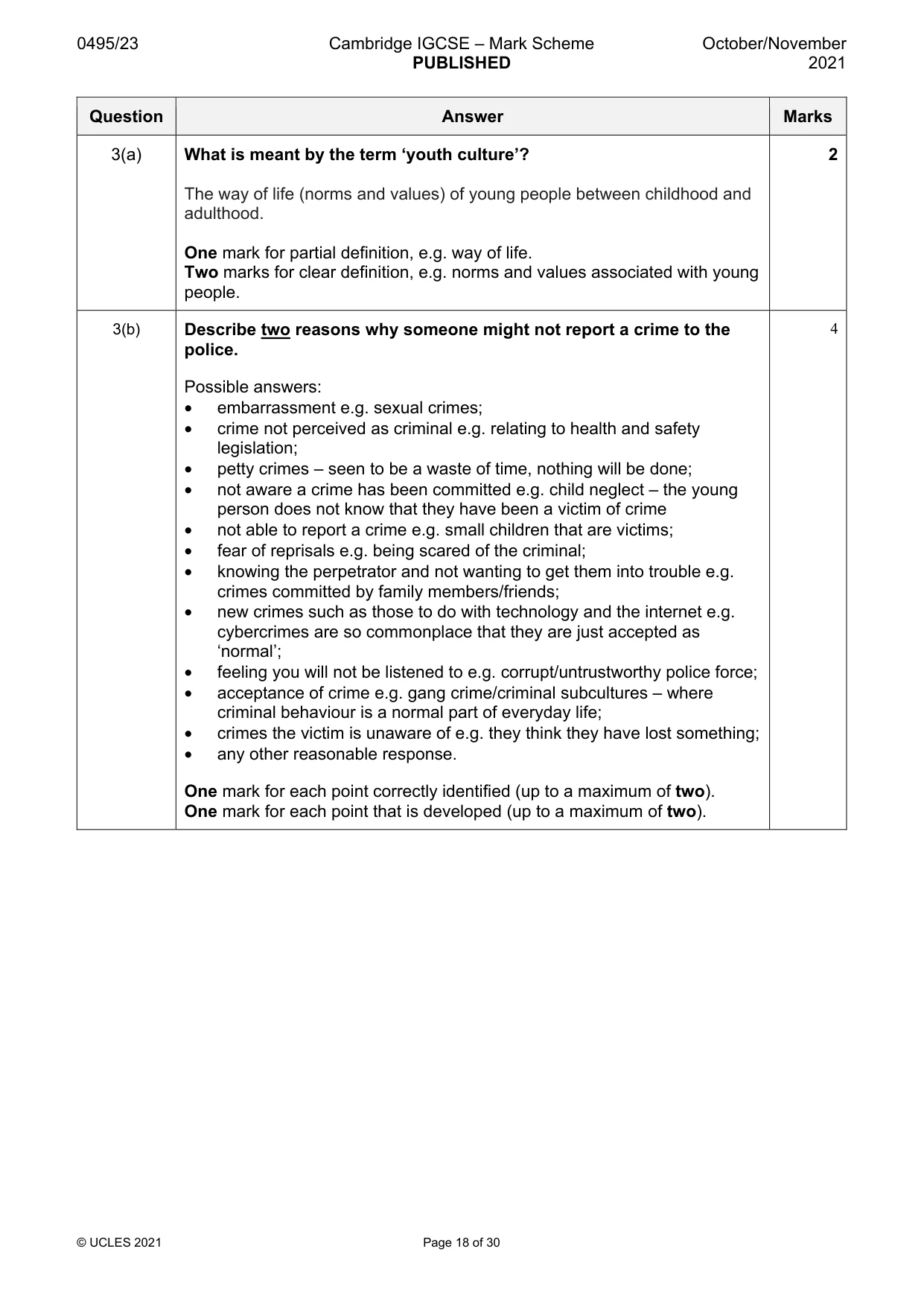
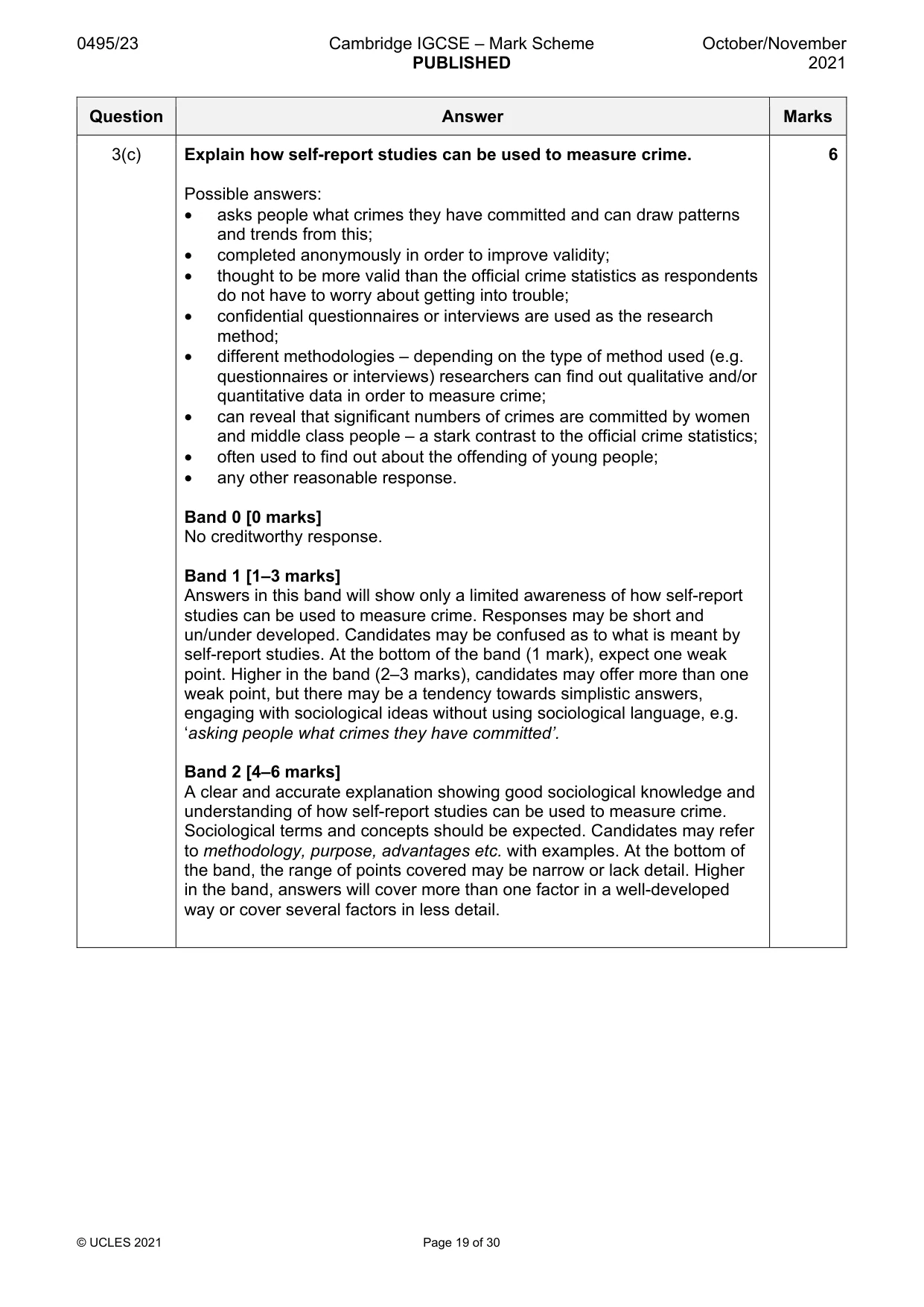
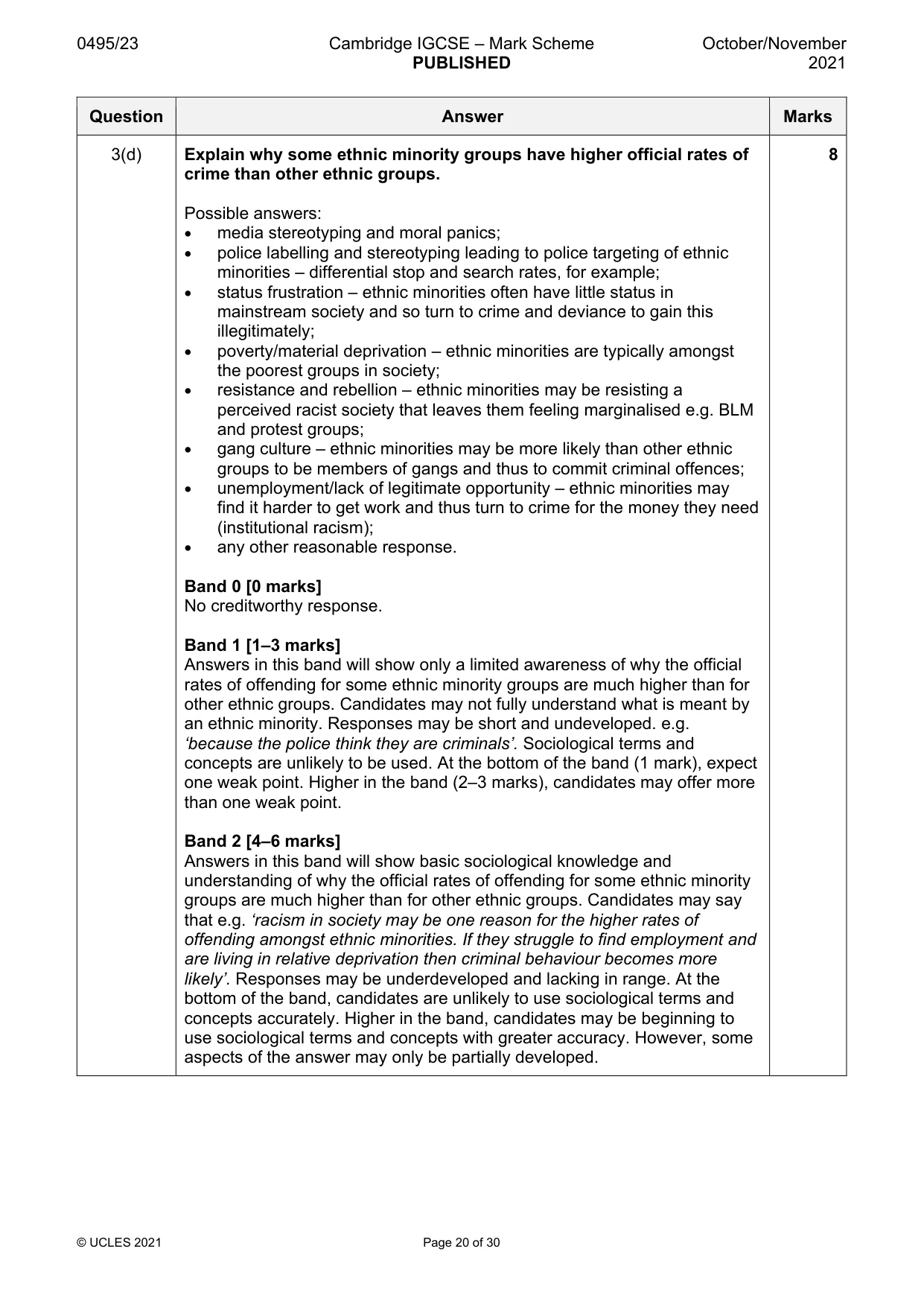
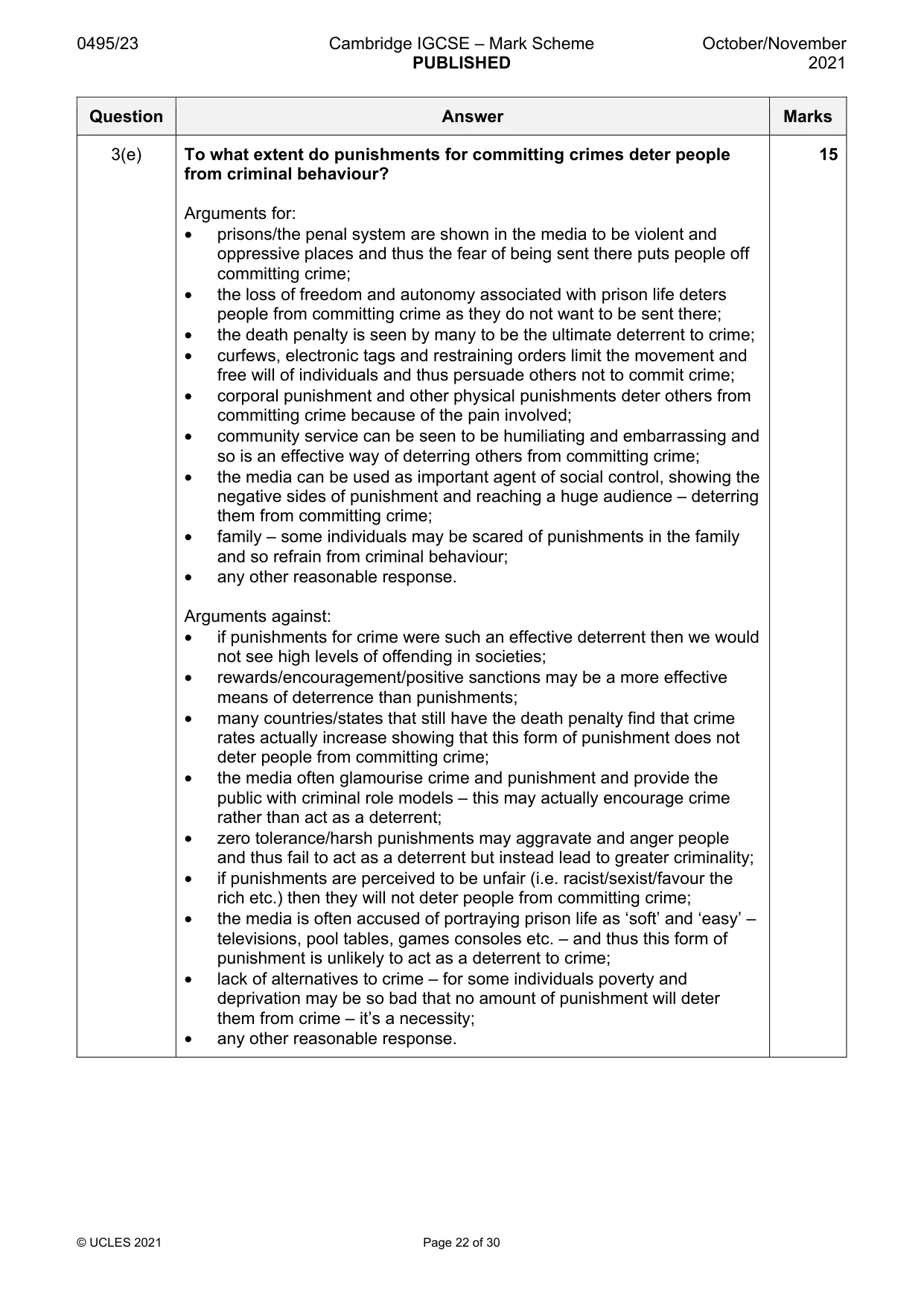
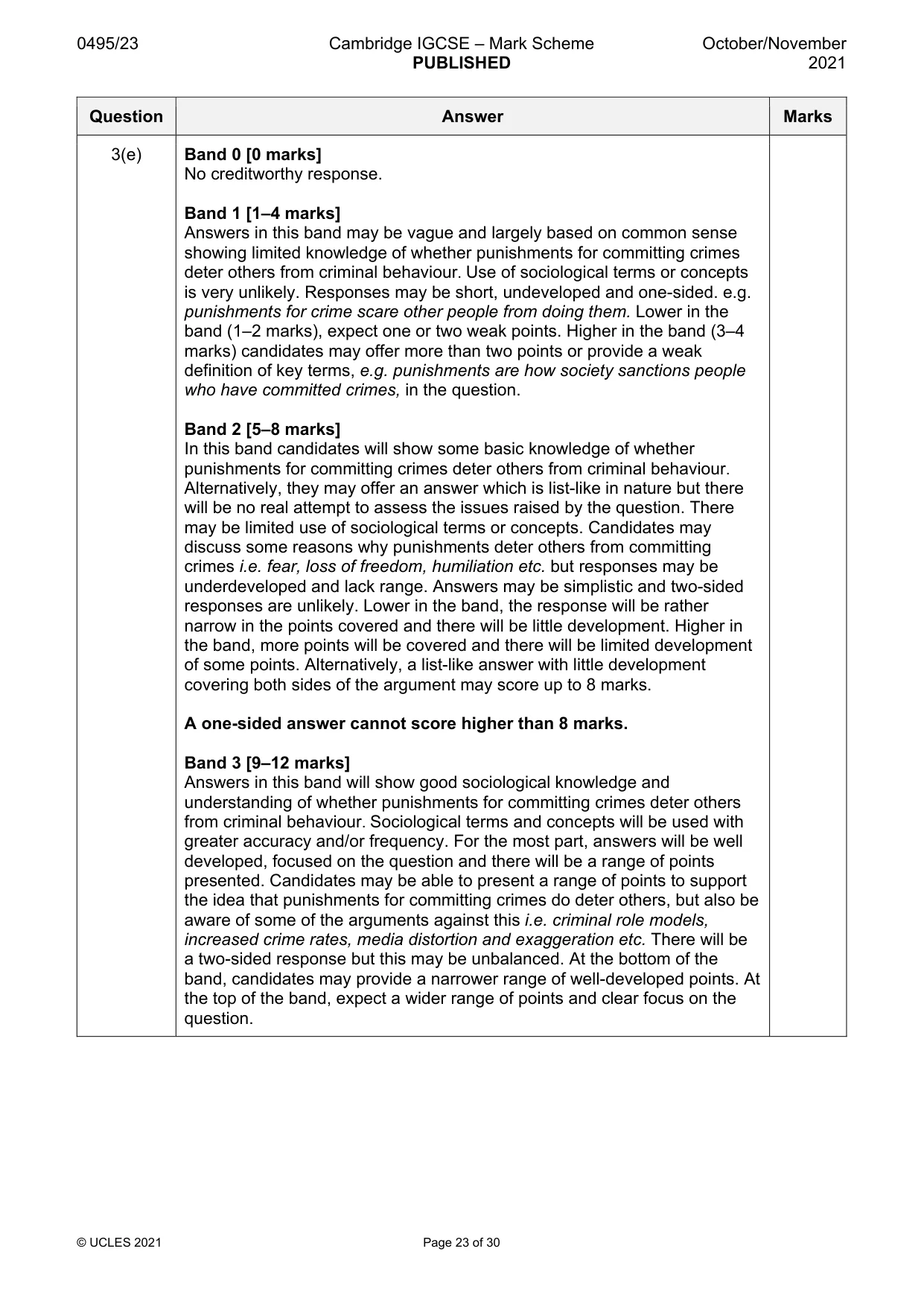
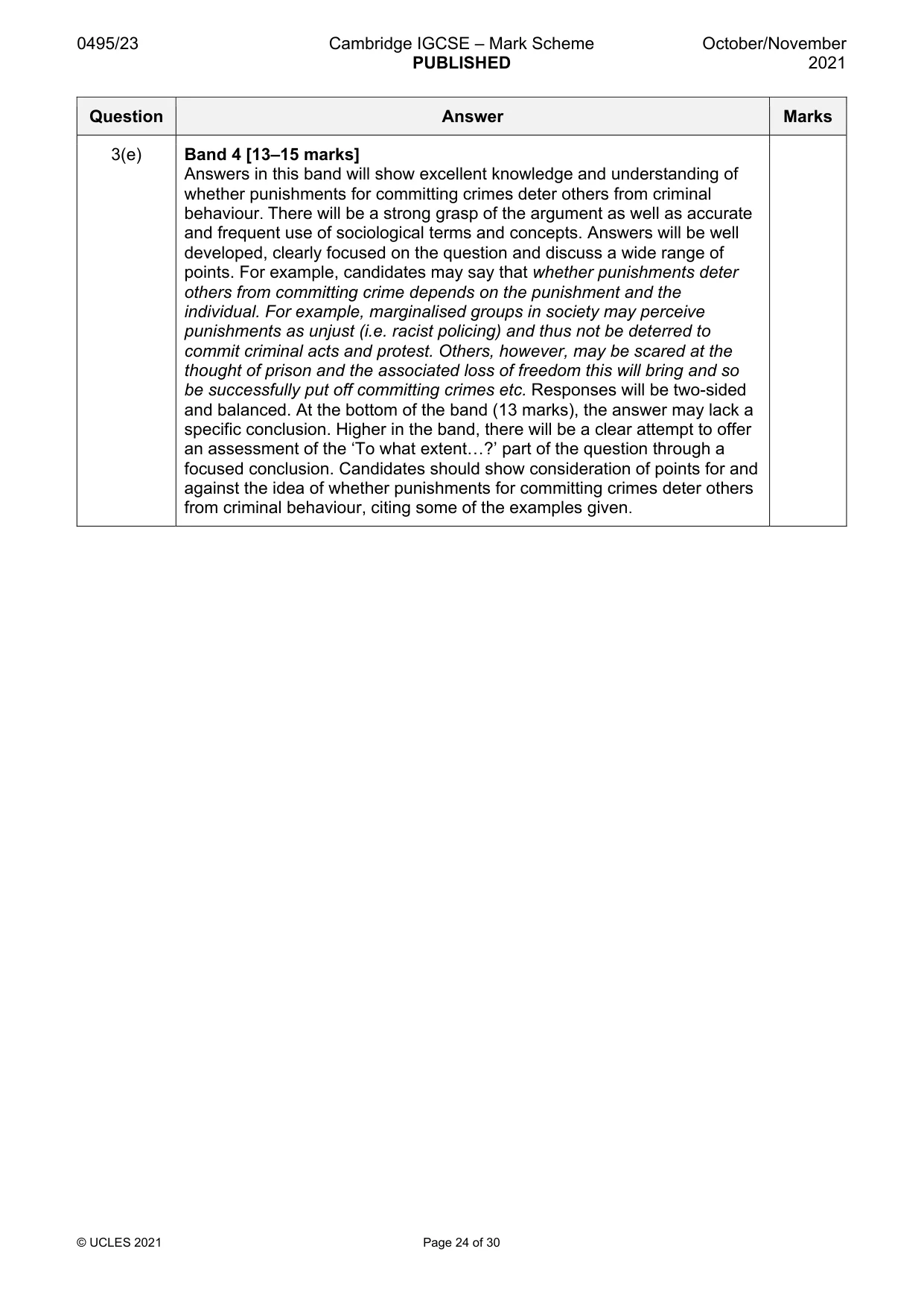
Mark scheme: 3(a) What is meant by the term ‘youth culture’? 2 The way of life (norms and values) of young people between childhood and adulthood. One mark for partial definition, e.g. way of life. Two marks for clear definition, e.g. norms and values associated with young people. 3(b) Describe two reasons why someone might not report a crime to the 4 police. Possible answers: • embarrassment e.g. sexual crimes; • crime not perceived as criminal e.g. relating to health and safety legislation; • petty crimes – seen to be a waste of time, nothing will be done; • not aware a crime has been committed e.g. child neglect – the young person does not know that they have been a victim of crime • not able to report a crime e.g. small children that are victims; • fear of reprisals e.g. being scared of the criminal; • knowing the perpetrator and not wanting to get them into trouble e.g. crimes committed by family members/friends; • new crimes such as those to do with technology and the internet e.g. cybercrimes are so commonplace that they are just accepted as ‘normal’; • feeling you will not be listened to e.g. corrupt/untrustworthy police force; • acceptance of crime e.g. gang crime/criminal subcultures – where criminal behaviour is a normal part of everyday life; • crimes the victim is unaware of e.g. they think they have lost something; • any other reasonable response. One mark for each point correctly identified (up to a maximum of two). One mark for each point that is developed (up to a maximum of two). 3(c) Explain how self-report studies can be used to measure crime. 6 Possible answers: • asks people what crimes they have committed and can draw patterns and trends from this; • completed anonymously in order to improve validity; • thought to be more valid than the official crime statistics as respondents do not have to worry about getting into trouble; • confidential questionnaires or interviews are used as the research method; • different methodologies – depending on the type of method used (e.g. questionnaires or interviews) researchers can find out qualitative and/or quantitative data in order to measure crime; • can reveal that significant numbers of crimes are committed by women and middle class people – a stark contrast to the official crime statistics; • often used to find out about the offending of young people; • any other reasonable response. Band 0 [0 marks] No creditworthy response. Band 1 [1–3 marks] Answers in this band will show only a limited awareness of how self-report studies can be used to measure crime. Responses may be short and un/under developed. Candidates may be confused as to what is meant by self-report studies. At the bottom of the band (1 mark), expect one weak point. Higher in the band (2–3 marks), candidates may offer more than one weak point, but there may be a tendency towards simplistic answers, engaging with sociological ideas without using sociological language, e.g. ‘asking people what crimes they have committed’. Band 2 [4–6 marks] A clear and accurate explanation showing good sociological knowledge and understanding of how self-report studies can be used to measure crime. Sociological terms and concepts should be expected. Candidates may refer to methodology, purpose, advantages etc. with examples. At the bottom of the band, the range of points covered may be narrow or lack detail. Higher in the band, answers will cover more than one factor in a well-developed way or cover several factors in less detail. 3(d) Explain why some ethnic minority groups have higher official rates of 8 crime than other ethnic groups. Possible answers: • media stereotyping and moral panics; • police labelling and stereotyping leading to police targeting of ethnic minorities – differential stop and search rates, for example; • status frustration – ethnic minorities often have little status in mainstream society and so turn to crime and deviance to gain this illegitimately; • poverty/material deprivation – ethnic minorities are typically amongst the poorest groups in society; • resistance and rebellion – ethnic minorities may be resisting a perceived racist society that leaves them feeling marginalised e.g. BLM and protest groups; • gang culture – ethnic minorities may be more likely than other ethnic groups to be members of gangs and thus to commit criminal offences; • unemployment/lack of legitimate opportunity – ethnic minorities may find it harder to get work and thus turn to crime for the money they need (institutional racism); • any other reasonable response. Band 0 [0 marks] No creditworthy response. Band 1 [1–3 marks] Answers in this band will show only a limited awareness of why the official rates of offending for some ethnic minority groups are much higher than for other ethnic groups. Candidates may not fully understand what is meant by an ethnic minority. Responses may be short and undeveloped. e.g. ‘because the police think they are criminals’. Sociological terms and concepts are unlikely to be used. At the bottom of the band (1 mark), expect one weak point. Higher in the band (2–3 marks), candidates may offer more than one weak point. Band 2 [4–6 marks] Answers in this band will show basic sociological knowledge and understanding of why the official rates of offending for some ethnic minority groups are much higher than for other ethnic groups. Candidates may say that e.g. ‘racism in society may be one reason for the higher rates of offending amongst ethnic minorities. If they struggle to find employment and are living in relative deprivation then criminal behaviour becomes more likely’. Responses may be underdeveloped and lacking in range. At the bottom of the band, candidates are unlikely to use sociological terms and concepts accurately. Higher in the band, candidates may be beginning to use sociological terms and concepts with greater accuracy. However, some aspects of the answer may only be partially developed. 3(d) Band 3 [7–8 marks] Answers in this band will show good sociological knowledge and understanding of why the official rates of offending for some ethnic minority groups are much higher than for other ethnic groups and will be well developed and explained. Candidates may discuss institutional racism, marginalisation, police targeting, labelling theory, moral panics etc. Sociological terms and concepts will be used accurately, overall. Answers will be well focused on the question and there will be a range of reasons presented. At the top of the band explanations will be clear throughout. 3(e) To what extent do punishments for committing crimes deter people 15 from criminal behaviour? Arguments for: • prisons/the penal system are shown in the media to be violent and oppressive places and thus the fear of being sent there puts people off committing crime; • the loss of freedom and autonomy associated with prison life deters people from committing crime as they do not want to be sent there; • the death penalty is seen by many to be the ultimate deterrent to crime; • curfews, electronic tags and restraining orders limit the movement and free will of individuals and thus persuade others not to commit crime; • corporal punishment and other physical punishments deter others from committing crime because of the pain involved; • community service can be seen to be humiliating and embarrassing and so is an effective way of deterring others from committing crime; • the media can be used as important agent of social control, showing the negative sides of punishment and reaching a huge audience – deterring them from committing crime; • family – some individuals may be scared of punishments in the family and so refrain from criminal behaviour; • any other reasonable response. Arguments against: • if punishments for crime were such an effective deterrent then we would not see high levels of offending in societies; • rewards/encouragement/positive sanctions may be a more effective means of deterrence than punishments; • many countries/states that still have the death penalty find that crime rates actually increase showing that this form of punishment does not deter people from committing crime; • the media often glamourise crime and punishment and provide the public with criminal role models – this may actually encourage crime rather than act as a deterrent; • zero tolerance/harsh punishments may aggravate and anger people and thus fail to act as a deterrent but instead lead to greater criminality; • if punishments are perceived to be unfair (i.e. racist/sexist/favour the rich etc.) then they will not deter people from committing crime; • the media is often accused of portraying prison life as ‘soft’ and ‘easy’ – televisions, pool tables, games consoles etc. – and thus this form of punishment is unlikely to act as a deterrent to crime; • lack of alternatives to crime – for some individuals poverty and deprivation may be so bad that no amount of punishment will deter them from crime – it’s a necessity; • any other reasonable response. 3(e) Band 0 [0 marks] No creditworthy response. Band 1 [1–4 marks] Answers in this band may be vague and largely based on common sense showing limited knowledge of whether punishments for committing crimes deter others from criminal behaviour. Use of sociological terms or concepts is very unlikely. Responses may be short, undeveloped and one-sided. e.g. punishments for crime scare other people from doing them. Lower in the band (1–2 marks), expect one or two weak points. Higher in the band (3–4 marks) candidates may offer more than two points or provide a weak definition of key terms, e.g. punishments are how society sanctions people who have committed crimes, in the question. Band 2 [5–8 marks] In this band candidates will show some basic knowledge of whether punishments for committing crimes deter others from criminal behaviour. Alternatively, they may offer an answer which is list-like in nature but there will be no real attempt to assess the issues raised by the question. There may be limited use of sociological terms or concepts. Candidates may discuss some reasons why punishments deter others from committing crimes i.e. fear, loss of freedom, humiliation etc. but responses may be underdeveloped and lack range. Answers may be simplistic and two-sided responses are unlikely. Lower in the band, the response will be rather narrow in the points covered and there will be little development. Higher in the band, more points will be covered and there will be limited development of some points. Alternatively, a list-like answer with little development covering both sides of the argument may score up to 8 marks. A one-sided answer cannot score higher than 8 marks. Band 3 [9–12 marks] Answers in this band will show good sociological knowledge and understanding of whether punishments for committing crimes deter others from criminal behaviour. Sociological terms and concepts will be used with greater accuracy and/or frequency. For the most part, answers will be well developed, focused on the question and there will be a range of points presented. Candidates may be able to present a range of points to support the idea that punishments for committing crimes do deter others, but also be aware of some of the arguments against this i.e. criminal role models, increased crime rates, media distortion and exaggeration etc. There will be a two-sided response but this may be unbalanced. At the bottom of the band, candidates may provide a narrower range of well-developed points. At the top of the band, expect a wider range of points and clear focus on the question. 3(e) Band 4 [13–15 marks] Answers in this band will show excellent knowledge and understanding of whether punishments for committing crimes deter others from criminal behaviour. There will be a strong grasp of the argument as well as accurate and frequent use of sociological terms and concepts. Answers will be well developed, clearly focused on the question and discuss a wide range of points. For example, candidates may say that whether punishments deter others from committing crime depends on the punishment and the individual. For example, marginalised groups in society may perceive punishments as unjust (i.e. racist policing) and thus not be deterred to commit criminal acts and protest. Others, however, may be scared at the thought of prison and the associated loss of freedom this will bring and so be successfully put off committing crimes etc. Responses will be two-sided and balanced. At the bottom of the band (13 marks), the answer may lack a specific conclusion. Higher in the band, there will be a clear attempt to offer an assessment of the ‘To what extent…?’ part of the question through a focused conclusion. Candidates should show consideration of points for and against the idea of whether punishments for committing crimes deter others from criminal behaviour, citing some of the examples given.
Q4 · As an increasingly important agency of socialisation, the media has a lot of power in…
4 As an increasingly important agency of socialisation, the media has a lot of power in society. The media has been accused of stereotyping, agenda setting and promoting violence. In new media, however, interactivity means that the audience can also affect media content. (a) What is meant by the term ‘agenda setting’? [2] (b) Describe two examples of interactivity in the media today. [4] (c) Explain how the media serves the interests of powerful people in society according to the Marxist perspective. [6] (d) Explain why violence in the media may not always increase levels of violence in society. [8] (e) To what extent does the media continue to reinforce gender stereotyping? [15]
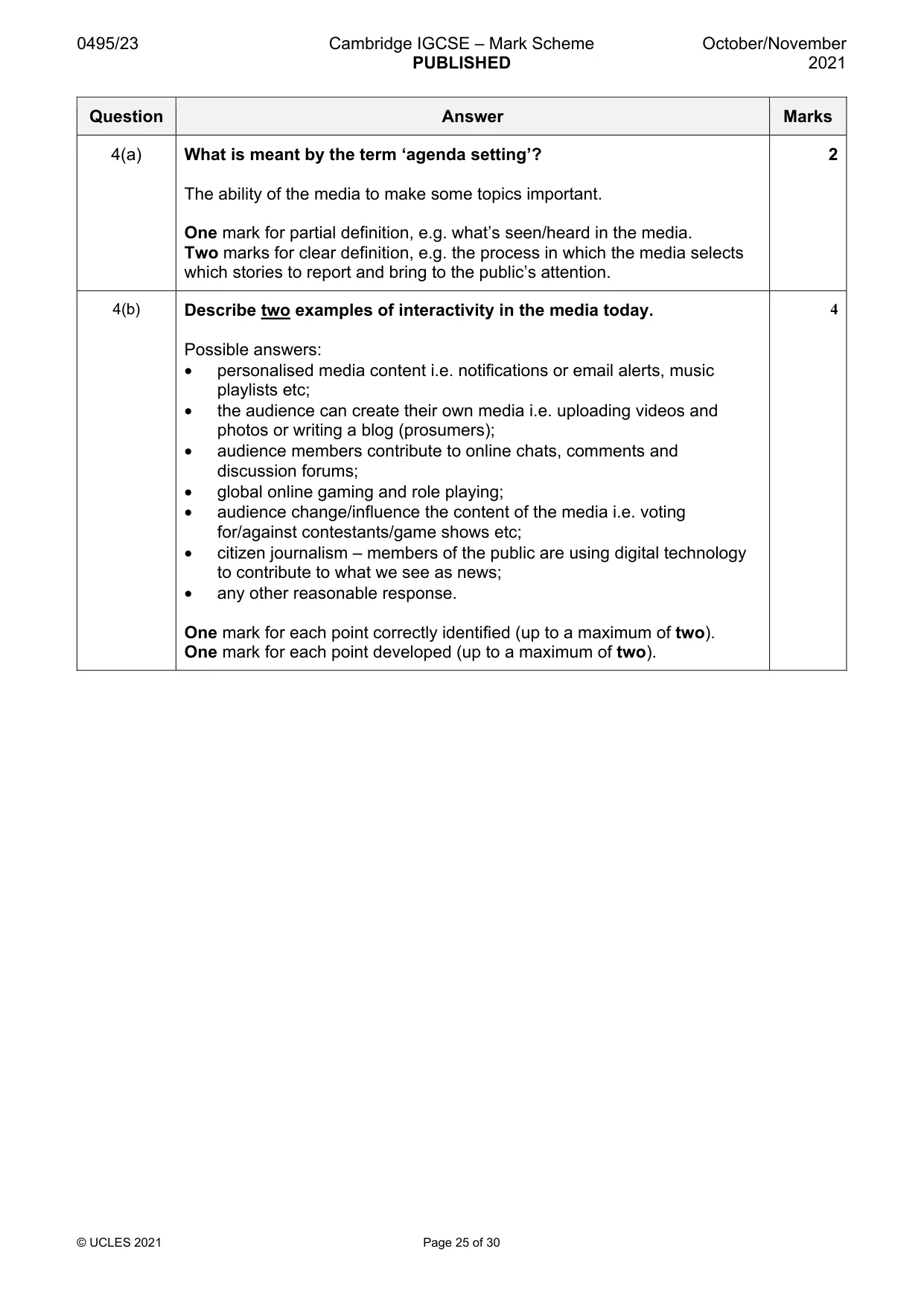
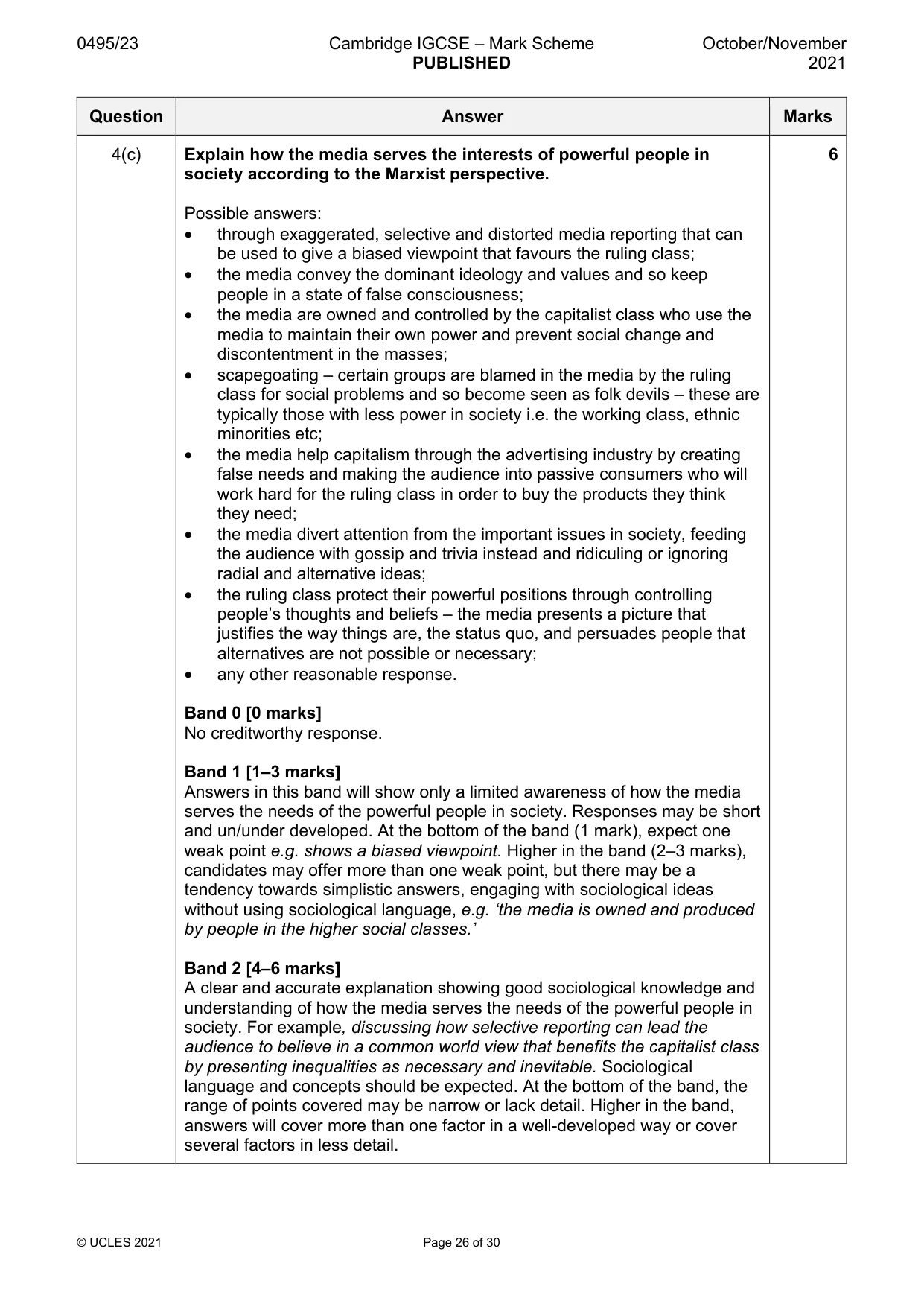
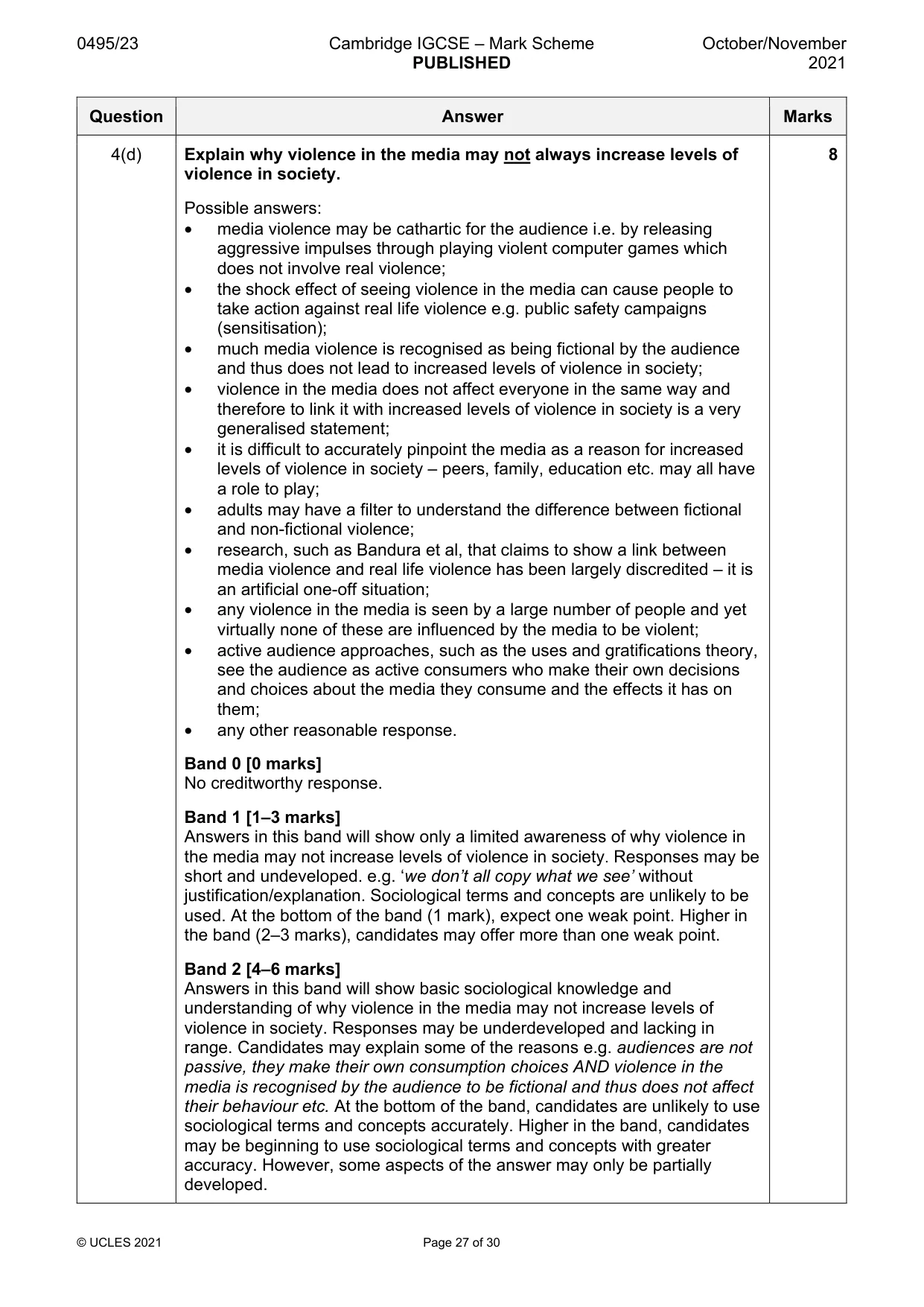
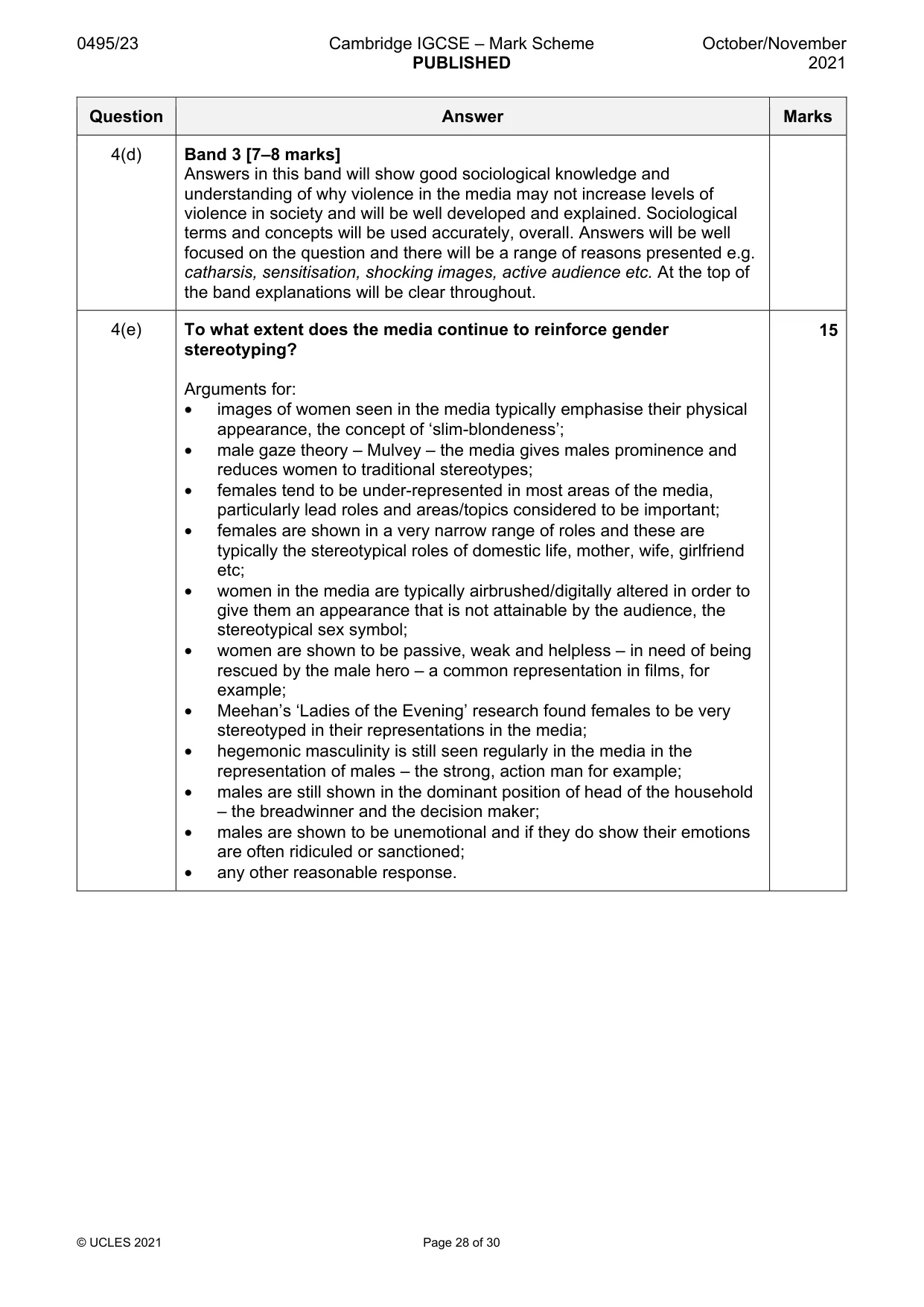
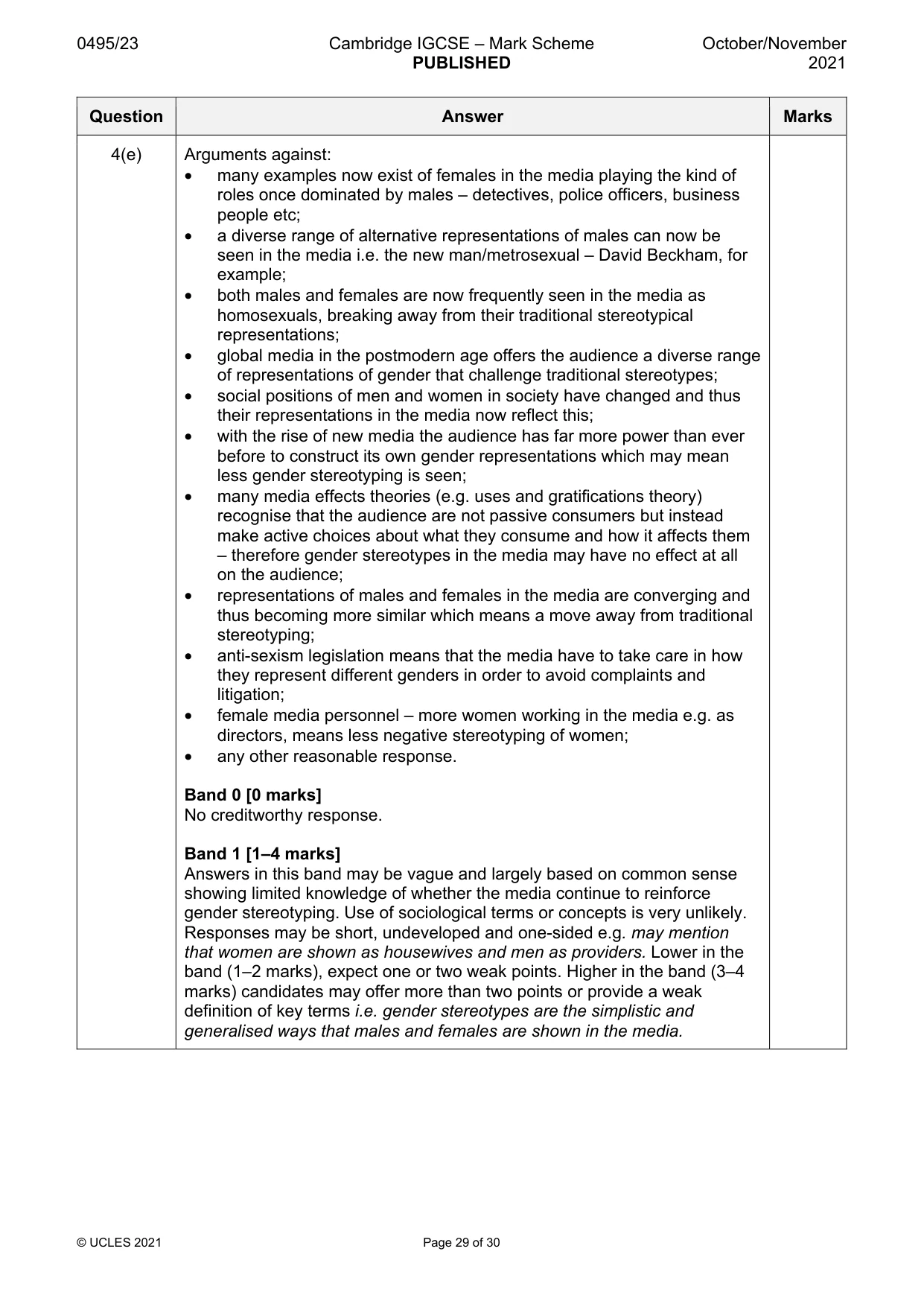
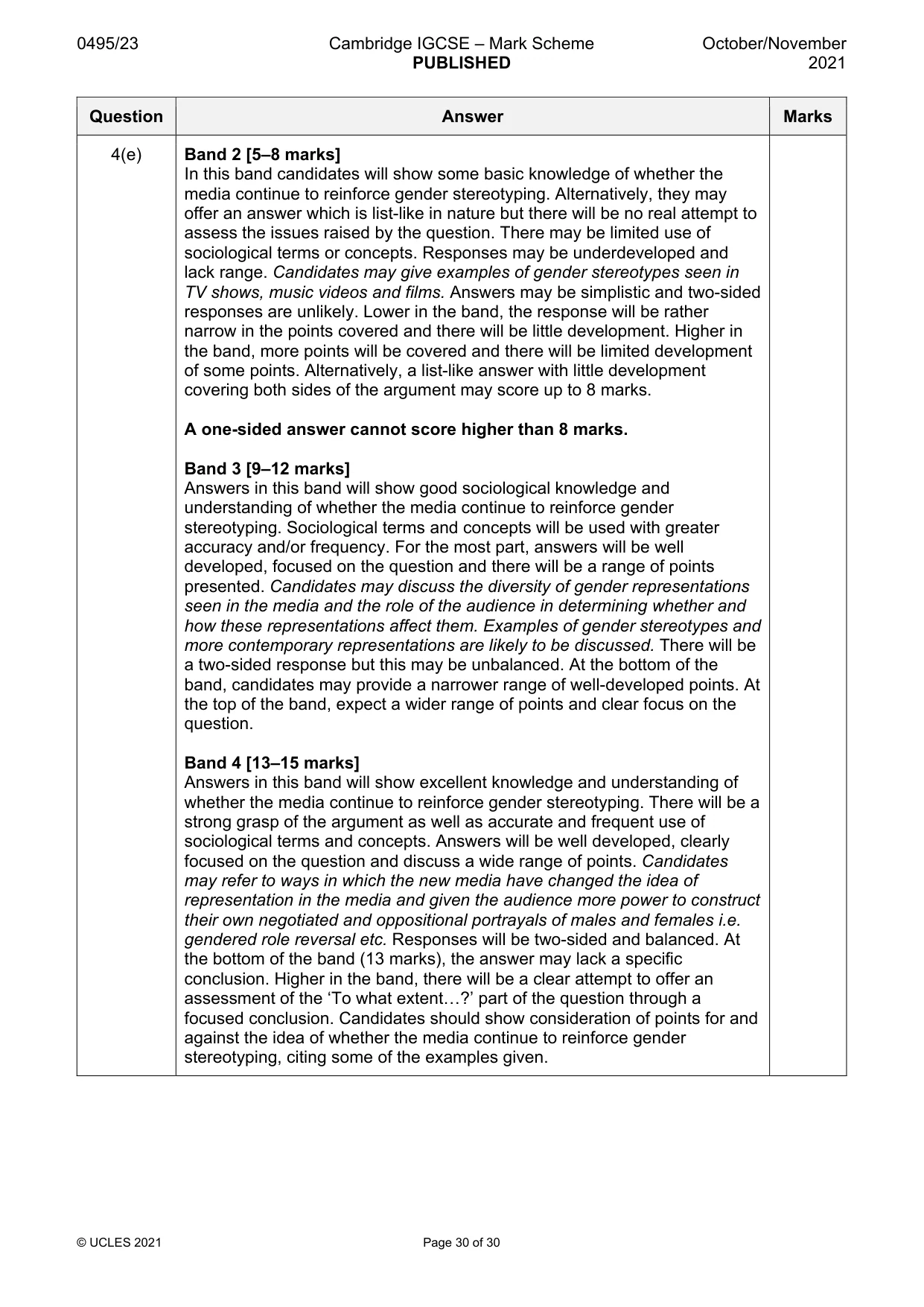
Mark scheme: 4(a) What is meant by the term ‘agenda setting’? 2 The ability of the media to make some topics important. One mark for partial definition, e.g. what’s seen/heard in the media. Two marks for clear definition, e.g. the process in which the media selects which stories to report and bring to the public’s attention. 4(b) Describe two examples of interactivity in the media today. 4 Possible answers: • personalised media content i.e. notifications or email alerts, music playlists etc; • the audience can create their own media i.e. uploading videos and photos or writing a blog (prosumers); • audience members contribute to online chats, comments and discussion forums; • global online gaming and role playing; • audience change/influence the content of the media i.e. voting for/against contestants/game shows etc; • citizen journalism – members of the public are using digital technology to contribute to what we see as news; • any other reasonable response. One mark for each point correctly identified (up to a maximum of two). One mark for each point developed (up to a maximum of two). 4(c) Explain how the media serves the interests of powerful people in 6 society according to the Marxist perspective. Possible answers: • through exaggerated, selective and distorted media reporting that can be used to give a biased viewpoint that favours the ruling class; • the media convey the dominant ideology and values and so keep people in a state of false consciousness; • the media are owned and controlled by the capitalist class who use the media to maintain their own power and prevent social change and discontentment in the masses; • scapegoating – certain groups are blamed in the media by the ruling class for social problems and so become seen as folk devils – these are typically those with less power in society i.e. the working class, ethnic minorities etc; • the media help capitalism through the advertising industry by creating false needs and making the audience into passive consumers who will work hard for the ruling class in order to buy the products they think they need; • the media divert attention from the important issues in society, feeding the audience with gossip and trivia instead and ridiculing or ignoring radial and alternative ideas; • the ruling class protect their powerful positions through controlling people’s thoughts and beliefs – the media presents a picture that justifies the way things are, the status quo, and persuades people that alternatives are not possible or necessary; • any other reasonable response. Band 0 [0 marks] No creditworthy response. Band 1 [1–3 marks] Answers in this band will show only a limited awareness of how the media serves the needs of the powerful people in society. Responses may be short and un/under developed. At the bottom of the band (1 mark), expect one weak point e.g. shows a biased viewpoint. Higher in the band (2–3 marks), candidates may offer more than one weak point, but there may be a tendency towards simplistic answers, engaging with sociological ideas without using sociological language, e.g. ‘the media is owned and produced by people in the higher social classes.’ Band 2 [4–6 marks] A clear and accurate explanation showing good sociological knowledge and understanding of how the media serves the needs of the powerful people in society. For example, discussing how selective reporting can lead the audience to believe in a common world view that benefits the capitalist class by presenting inequalities as necessary and inevitable. Sociological language and concepts should be expected. At the bottom of the band, the range of points covered may be narrow or lack detail. Higher in the band, answers will cover more than one factor in a well-developed way or cover several factors in less detail. 4(d) Explain why violence in the media may not always increase levels of 8 violence in society. Possible answers: • media violence may be cathartic for the audience i.e. by releasing aggressive impulses through playing violent computer games which does not involve real violence; • the shock effect of seeing violence in the media can cause people to take action against real life violence e.g. public safety campaigns (sensitisation); • much media violence is recognised as being fictional by the audience and thus does not lead to increased levels of violence in society; • violence in the media does not affect everyone in the same way and therefore to link it with increased levels of violence in society is a very generalised statement; • it is difficult to accurately pinpoint the media as a reason for increased levels of violence in society – peers, family, education etc. may all have a role to play; • adults may have a filter to understand the difference between fictional and non-fictional violence; • research, such as Bandura et al, that claims to show a link between media violence and real life violence has been largely discredited – it is an artificial one-off situation; • any violence in the media is seen by a large number of people and yet virtually none of these are influenced by the media to be violent; • active audience approaches, such as the uses and gratifications theory, see the audience as active consumers who make their own decisions and choices about the media they consume and the effects it has on them; • any other reasonable response. Band 0 [0 marks] No creditworthy response. Band 1 [1–3 marks] Answers in this band will show only a limited awareness of why violence in the media may not increase levels of violence in society. Responses may be short and undeveloped. e.g. ‘we don’t all copy what we see’ without justification/explanation. Sociological terms and concepts are unlikely to be used. At the bottom of the band (1 mark), expect one weak point. Higher in the band (2–3 marks), candidates may offer more than one weak point. Band 2 [4–6 marks] Answers in this band will show basic sociological knowledge and understanding of why violence in the media may not increase levels of violence in society. Responses may be underdeveloped and lacking in range. Candidates may explain some of the reasons e.g. audiences are not passive, they make their own consumption choices AND violence in the media is recognised by the audience to be fictional and thus does not affect their behaviour etc. At the bottom of the band, candidates are unlikely to use sociological terms and concepts accurately. Higher in the band, candidates may be beginning to use sociological terms and concepts with greater accuracy. However, some aspects of the answer may only be partially developed. 4(d) Band 3 [7–8 marks] Answers in this band will show good sociological knowledge and understanding of why violence in the media may not increase levels of violence in society and will be well developed and explained. Sociological terms and concepts will be used accurately, overall. Answers will be well focused on the question and there will be a range of reasons presented e.g. catharsis, sensitisation, shocking images, active audience etc. At the top of the band explanations will be clear throughout. 4(e) To what extent does the media continue to reinforce gender 15 stereotyping? Arguments for: • images of women seen in the media typically emphasise their physical appearance, the concept of ‘slim-blondeness’; • male gaze theory – Mulvey – the media gives males prominence and reduces women to traditional stereotypes; • females tend to be under-represented in most areas of the media, particularly lead roles and areas/topics considered to be important; • females are shown in a very narrow range of roles and these are typically the stereotypical roles of domestic life, mother, wife, girlfriend etc; • women in the media are typically airbrushed/digitally altered in order to give them an appearance that is not attainable by the audience, the stereotypical sex symbol; • women are shown to be passive, weak and helpless – in need of being rescued by the male hero – a common representation in films, for example; • Meehan’s ‘Ladies of the Evening’ research found females to be very stereotyped in their representations in the media; • hegemonic masculinity is still seen regularly in the media in the representation of males – the strong, action man for example; • males are still shown in the dominant position of head of the household – the breadwinner and the decision maker; • males are shown to be unemotional and if they do show their emotions are often ridiculed or sanctioned; • any other reasonable response. 4(e) Arguments against: • many examples now exist of females in the media playing the kind of roles once dominated by males – detectives, police officers, business people etc; • a diverse range of alternative representations of males can now be seen in the media i.e. the new man/metrosexual – David Beckham, for example; • both males and females are now frequently seen in the media as homosexuals, breaking away from their traditional stereotypical representations; • global media in the postmodern age offers the audience a diverse range of representations of gender that challenge traditional stereotypes; • social positions of men and women in society have changed and thus their representations in the media now reflect this; • with the rise of new media the audience has far more power than ever before to construct its own gender representations which may mean less gender stereotyping is seen; • many media effects theories (e.g. uses and gratifications theory) recognise that the audience are not passive consumers but instead make active choices about what they consume and how it affects them – therefore gender stereotypes in the media may have no effect at all on the audience; • representations of males and females in the media are converging and thus becoming more similar which means a move away from traditional stereotyping; • anti-sexism legislation means that the media have to take care in how they represent different genders in order to avoid complaints and litigation; • female media personnel – more women working in the media e.g. as directors, means less negative stereotyping of women; • any other reasonable response. Band 0 [0 marks] No creditworthy response. Band 1 [1–4 marks] Answers in this band may be vague and largely based on common sense showing limited knowledge of whether the media continue to reinforce gender stereotyping. Use of sociological terms or concepts is very unlikely. Responses may be short, undeveloped and one-sided e.g. may mention that women are shown as housewives and men as providers. Lower in the band (1–2 marks), expect one or two weak points. Higher in the band (3–4 marks) candidates may offer more than two points or provide a weak definition of key terms i.e. gender stereotypes are the simplistic and generalised ways that males and females are shown in the media. 4(e) Band 2 [5–8 marks] In this band candidates will show some basic knowledge of whether the media continue to reinforce gender stereotyping. Alternatively, they may offer an answer which is list-like in nature but there will be no real attempt to assess the issues raised by the question. There may be limited use of sociological terms or concepts. Responses may be underdeveloped and lack range. Candidates may give examples of gender stereotypes seen in TV shows, music videos and films. Answers may be simplistic and two-sided responses are unlikely. Lower in the band, the response will be rather narrow in the points covered and there will be little development. Higher in the band, more points will be covered and there will be limited development of some points. Alternatively, a list-like answer with little development covering both sides of the argument may score up to 8 marks. A one-sided answer cannot score higher than 8 marks. Band 3 [9–12 marks] Answers in this band will show good sociological knowledge and understanding of whether the media continue to reinforce gender stereotyping. Sociological terms and concepts will be used with greater accuracy and/or frequency. For the most part, answers will be well developed, focused on the question and there will be a range of points presented. Candidates may discuss the diversity of gender representations seen in the media and the role of the audience in determining whether and how these representations affect them. Examples of gender stereotypes and more contemporary representations are likely to be discussed. There will be a two-sided response but this may be unbalanced. At the bottom of the band, candidates may provide a narrower range of well-developed points. At the top of the band, expect a wider range of points and clear focus on the question. Band 4 [13–15 marks] Answers in this band will show excellent knowledge and understanding of whether the media continue to reinforce gender stereotyping. There will be a strong grasp of the argument as well as accurate and frequent use of sociological terms and concepts. Answers will be well developed, clearly focused on the question and discuss a wide range of points. Candidates may refer to ways in which the new media have changed the idea of representation in the media and given the audience more power to construct their own negotiated and oppositional portrayals of males and females i.e. gendered role reversal etc. Responses will be two-sided and balanced. At the bottom of the band (13 marks), the answer may lack a specific conclusion. Higher in the band, there will be a clear attempt to offer an assessment of the ‘To what extent…?’ part of the question through a focused conclusion. Candidates should show consideration of points for and against the idea of whether the media continue to reinforce gender stereotyping, citing some of the examples given.
What was in this paper
The subtopics covered by these 4 questions, and how many questions each got. Open one in a new tab to see every Cambridge question on it.
What you needed in this session
Cambridge’s own grade thresholds for 2021 Oct/Nov, Paper 2 · Variant 3. A higher threshold means an easier paper — the bar moves with how the cohort did.