Cambridge IGCSE Sociology 0495 — 2020 May/June Paper 2 · Variant 1
0495/21/M/J/20 · 4 questions · 140 marks · ≈158 min
The question paper and its mark scheme, free to read here and free to download. This is Cambridge’s own paper, exactly as it was sat.
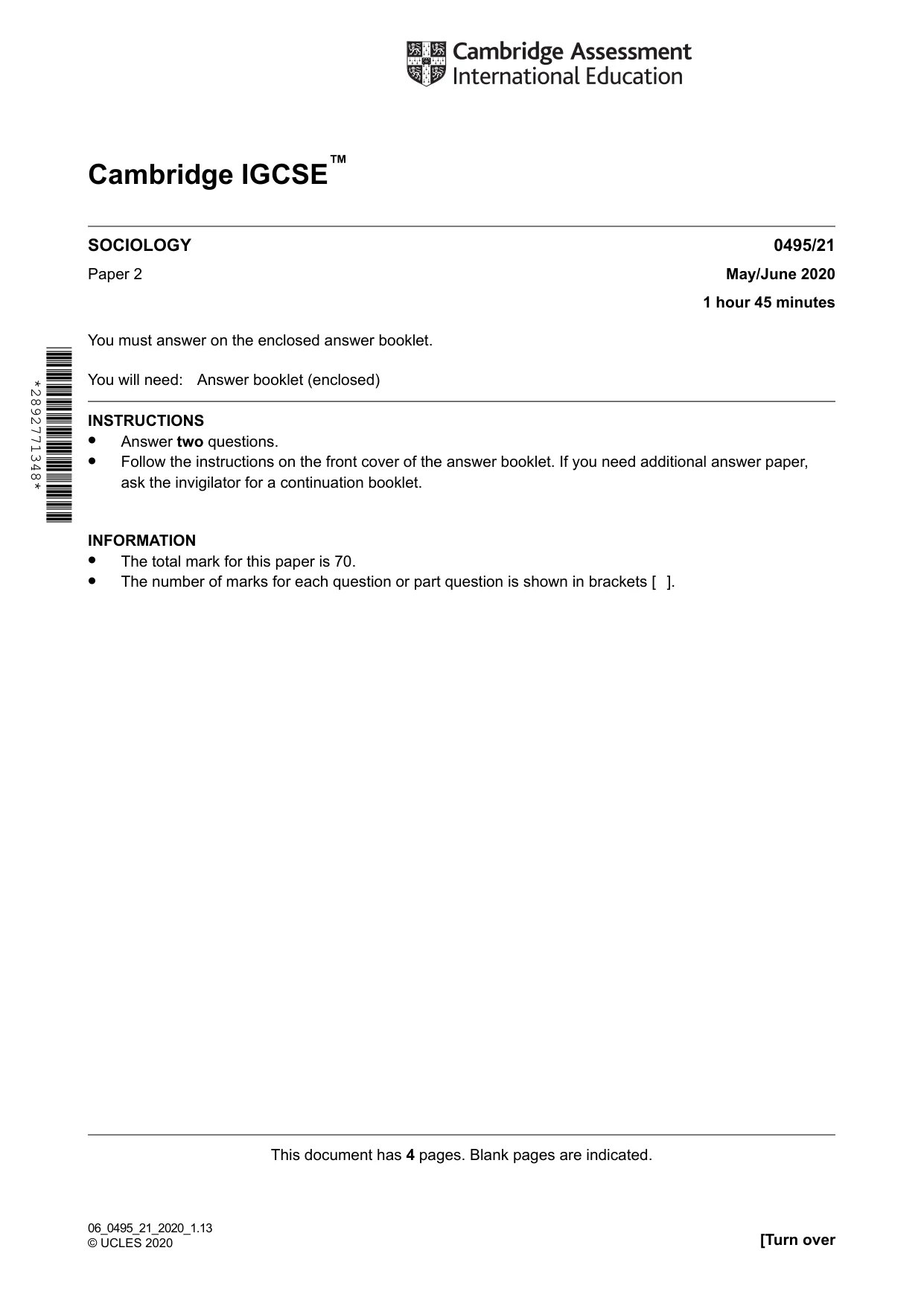
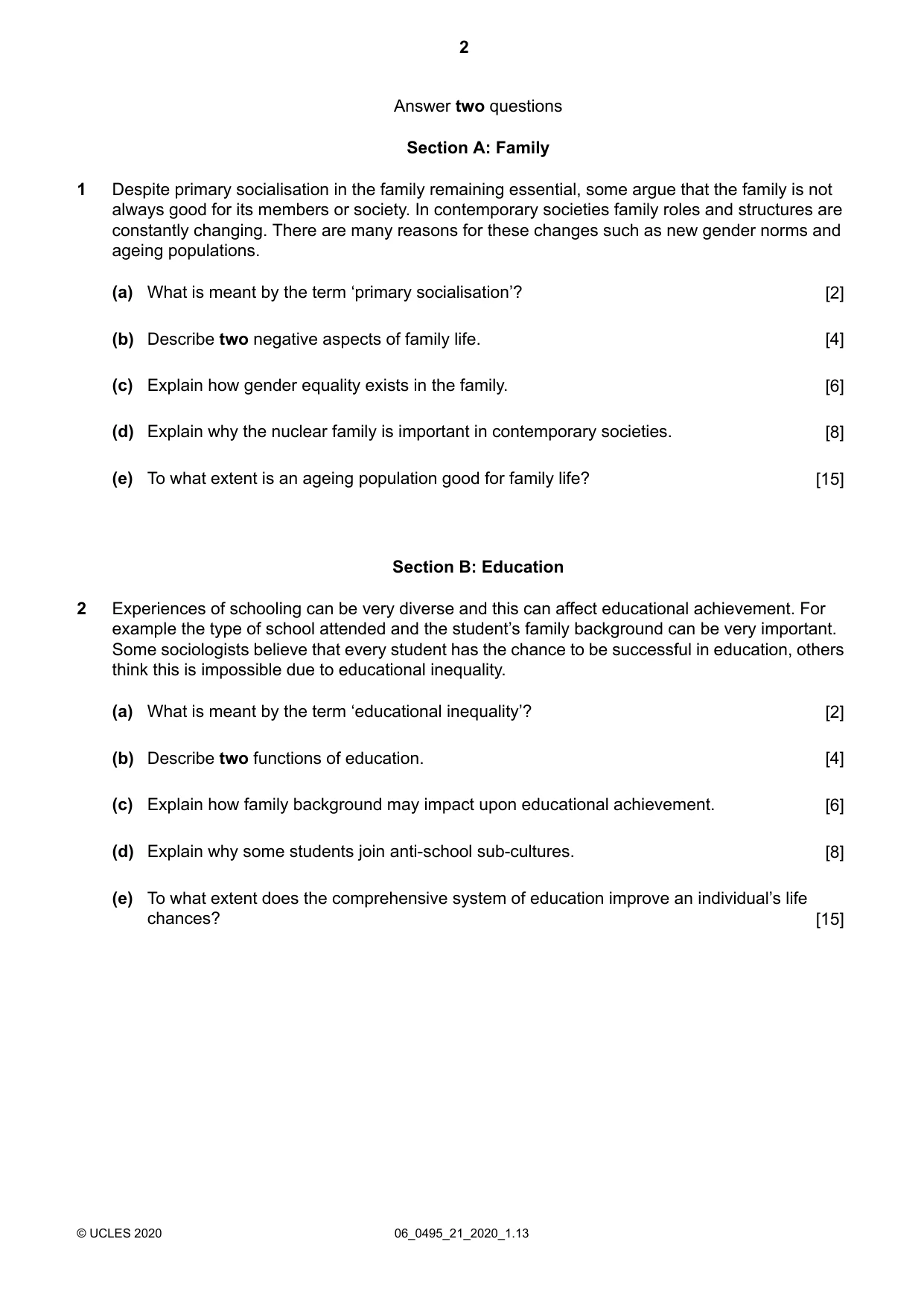
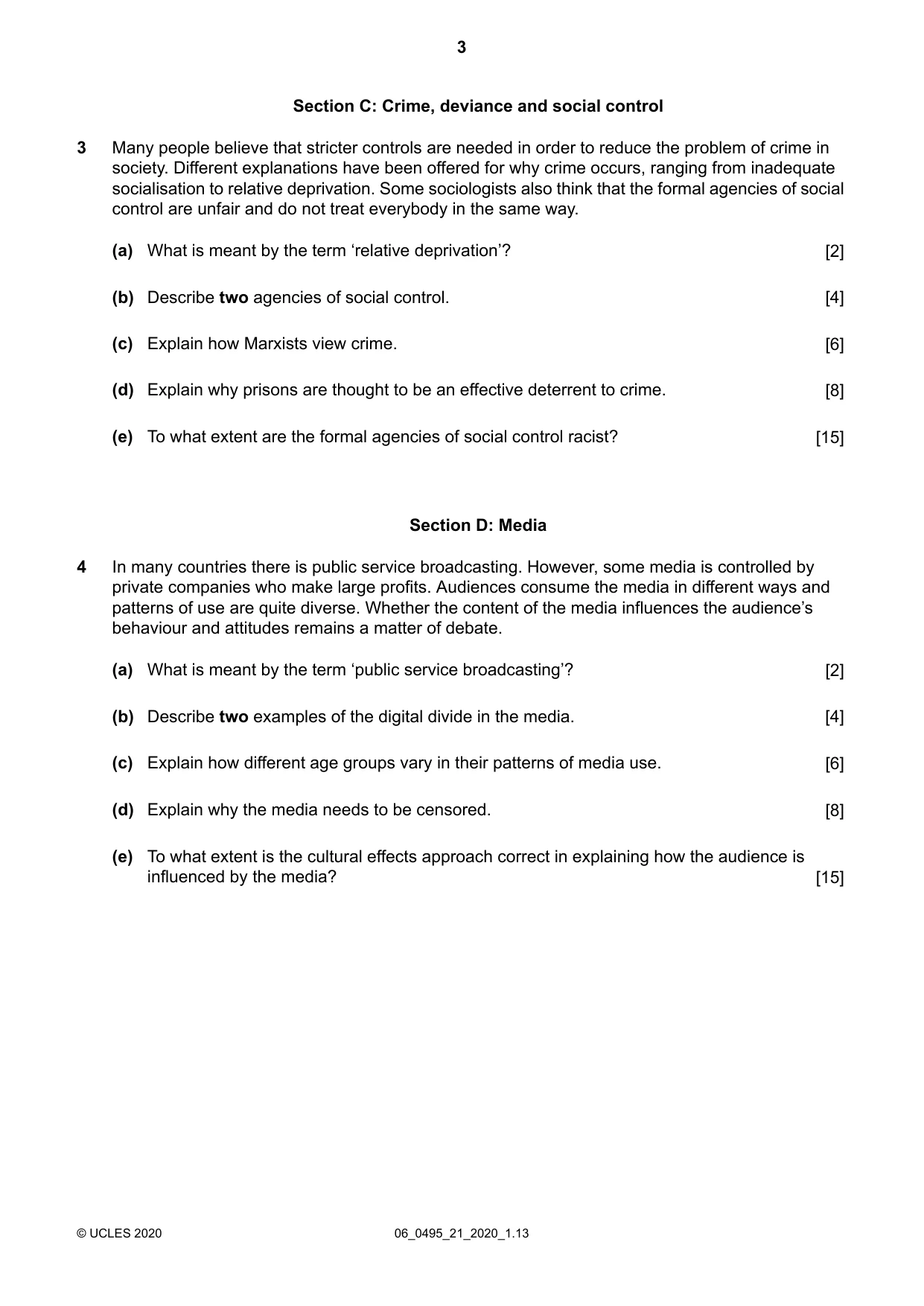
Question paper4 pages

Mark scheme33 pages
Answers below. Sit the paper first if you are practising.


Questions as text
Q1 · Despite primary socialisation in the family remaining essential, some argue that the…
1 Despite primary socialisation in the family remaining essential, some argue that the family is not always good for its members or society. In contemporary societies family roles and structures are constantly changing. There are many reasons for these changes such as new gender norms and ageing populations. (a) What is meant by the term ‘primary socialisation’? [2] (b) Describe two negative aspects of family life. [4] (c) Explain how gender equality exists in the family. [6] (d) Explain why the nuclear family is important in contemporary societies. [8] (e) To what extent is an ageing population good for family life? [15]
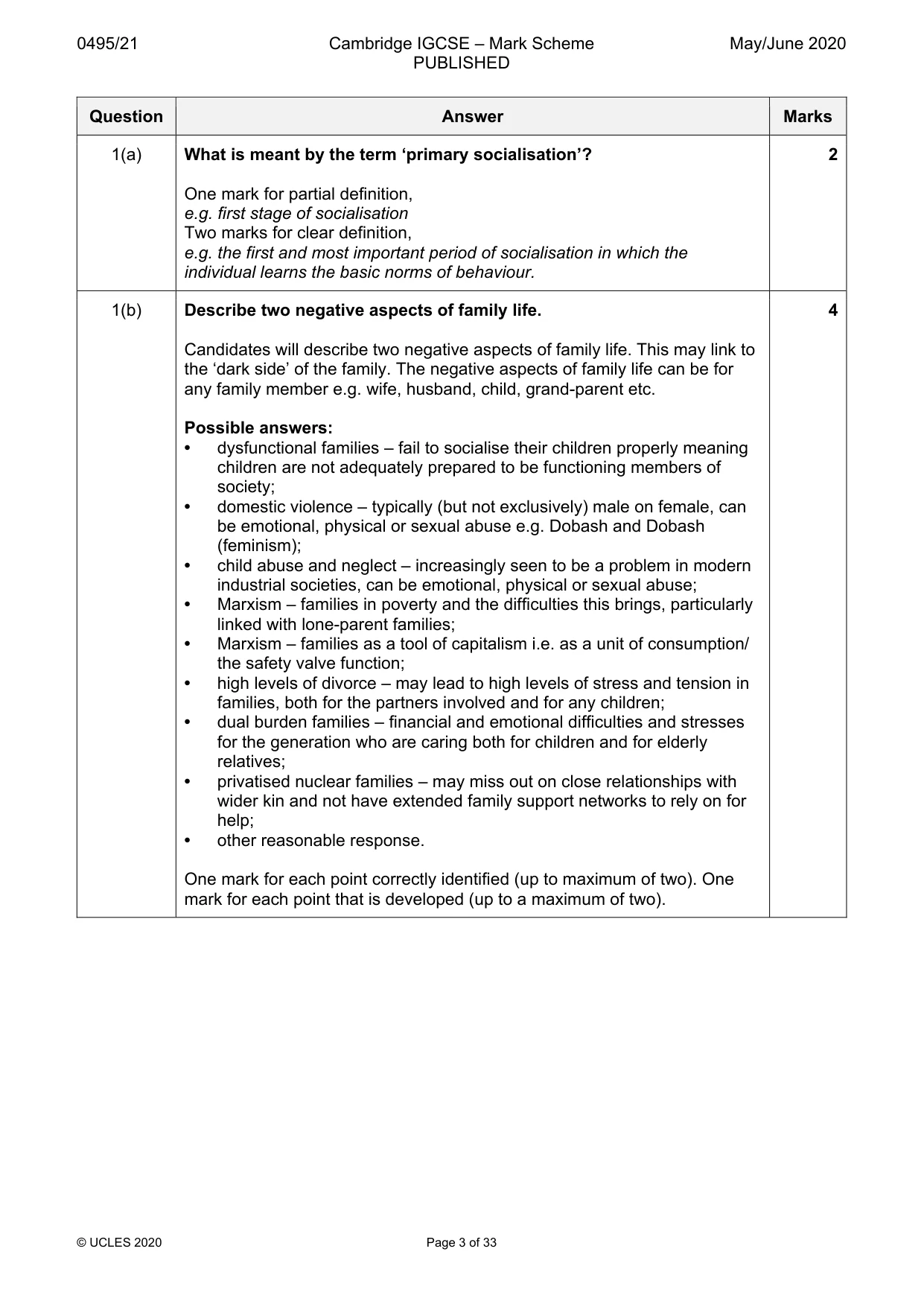
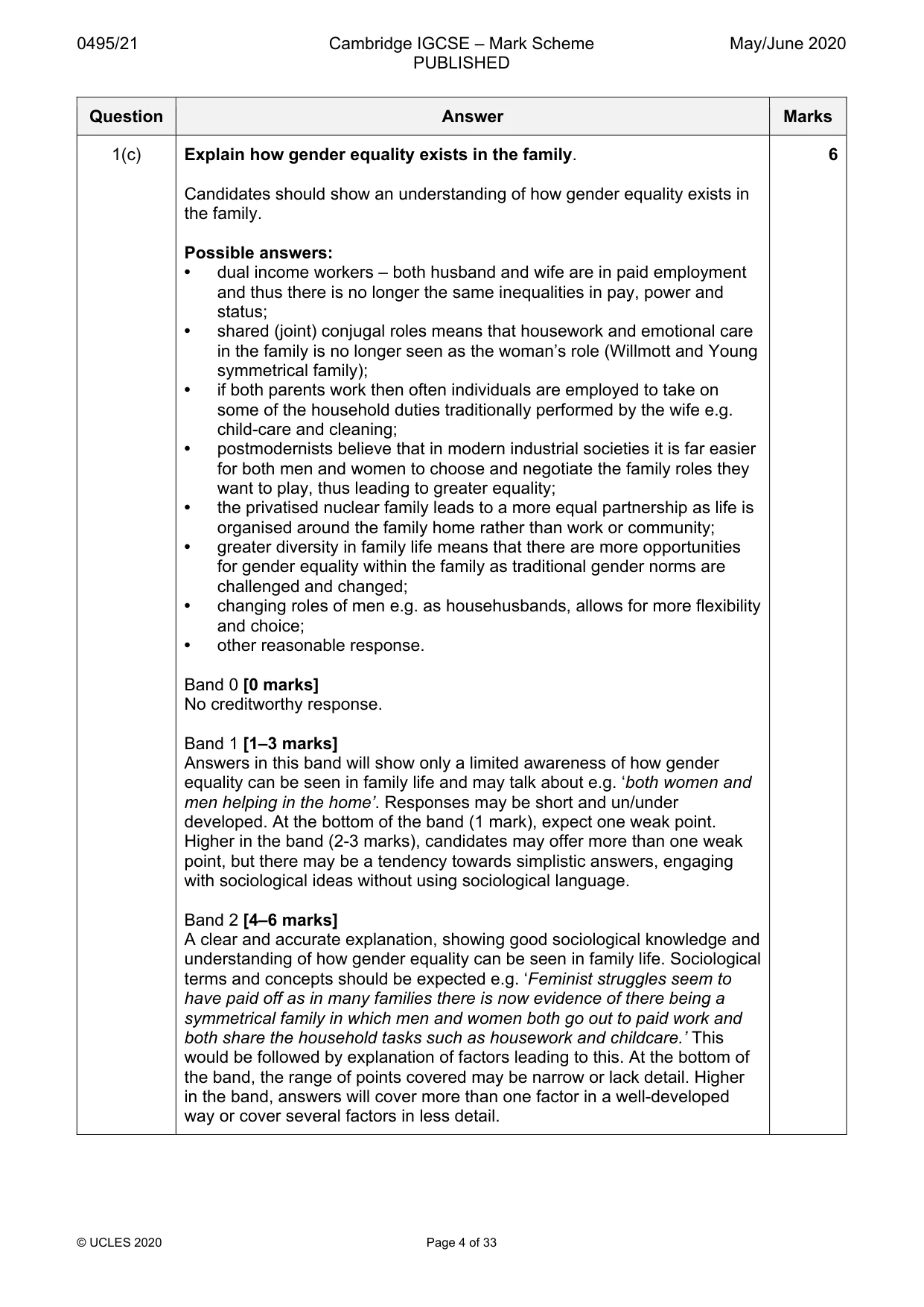
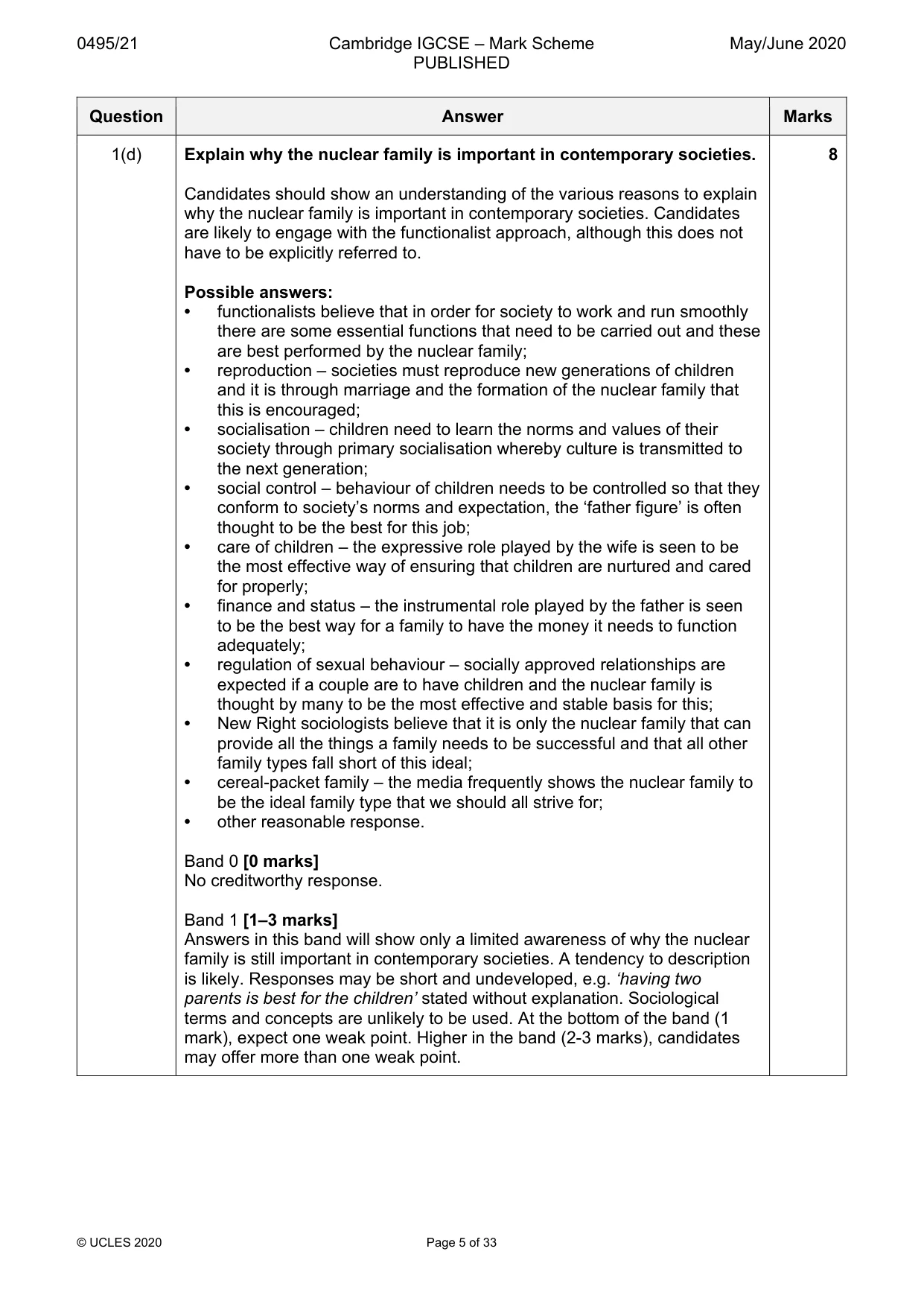
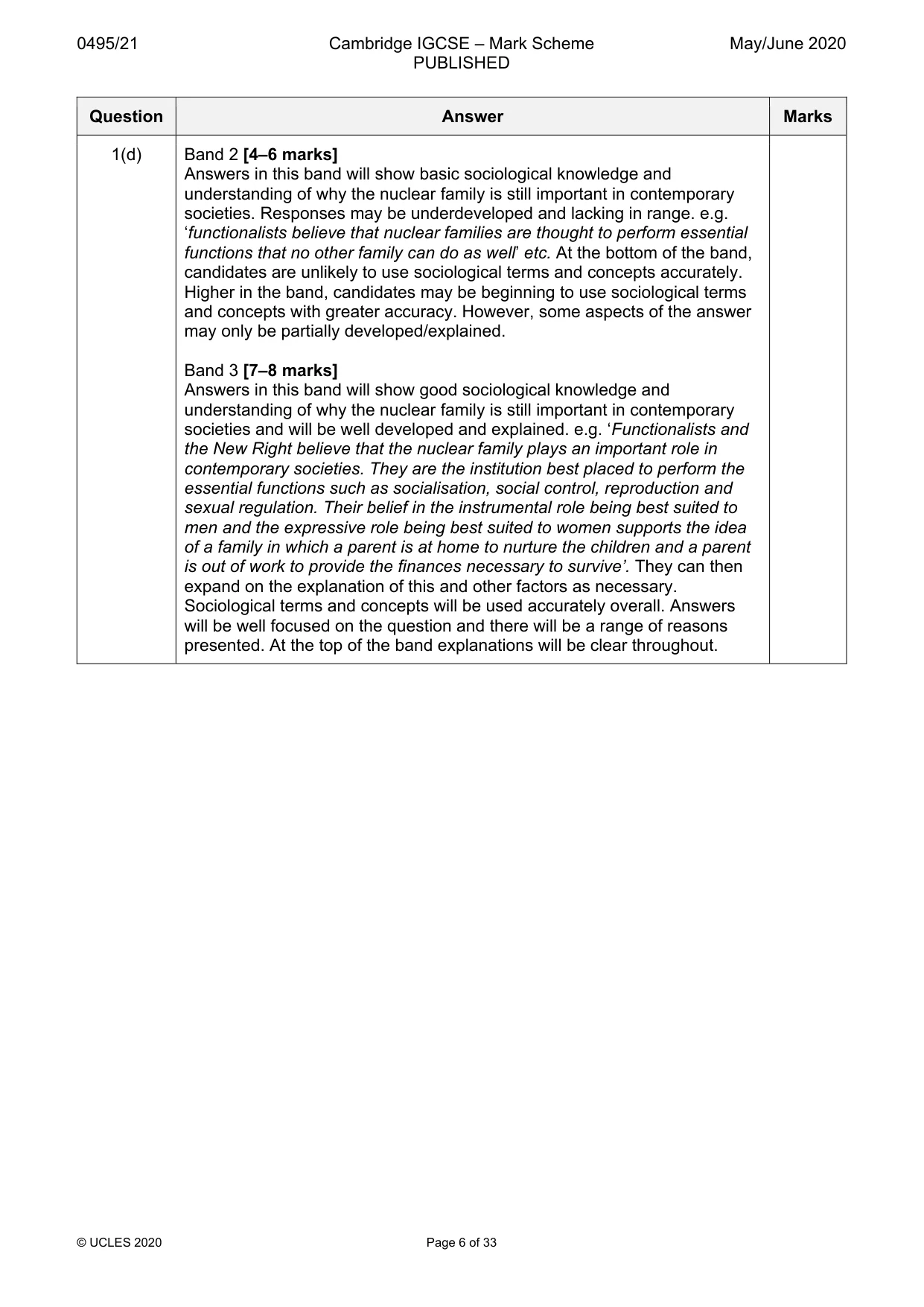
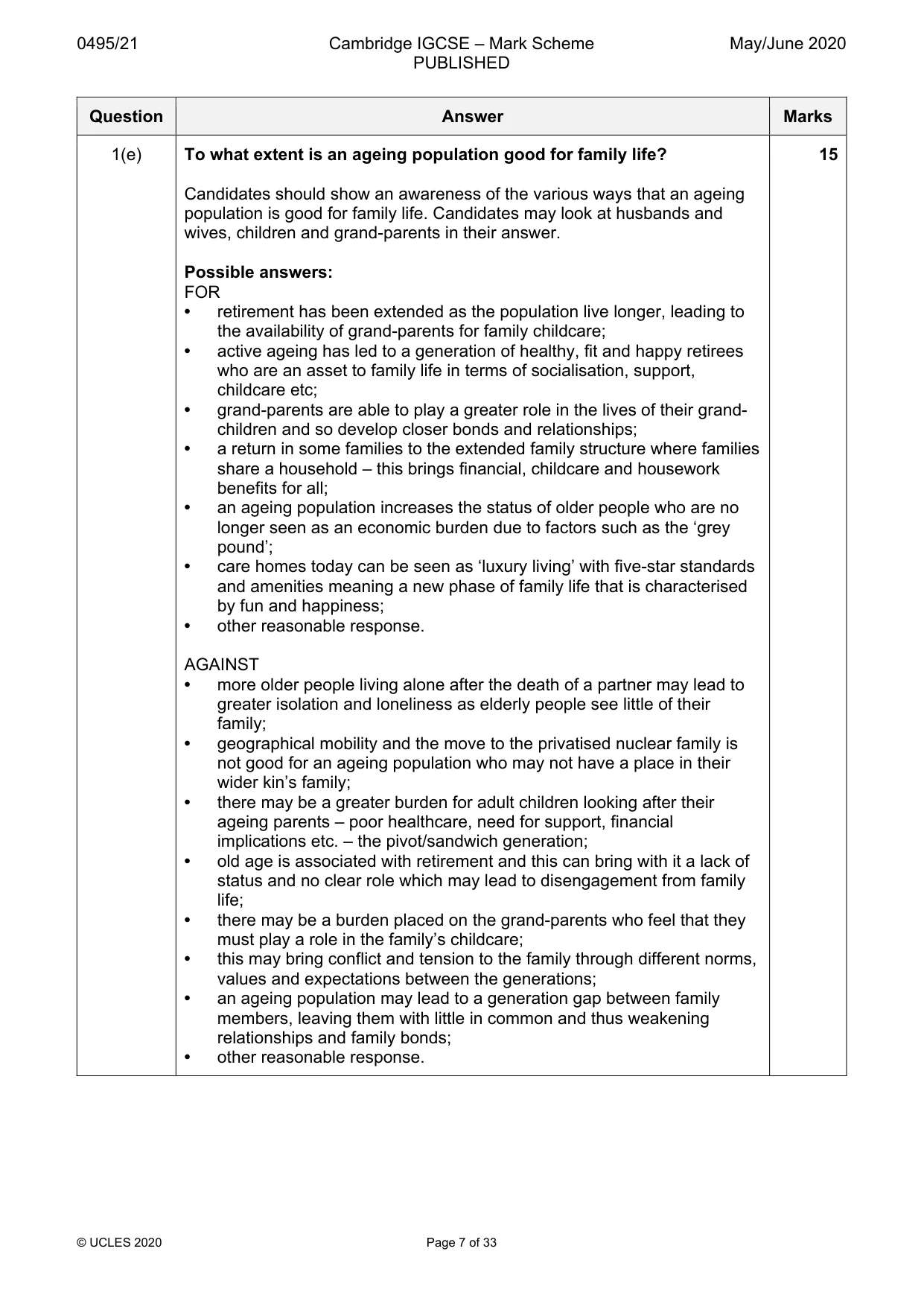
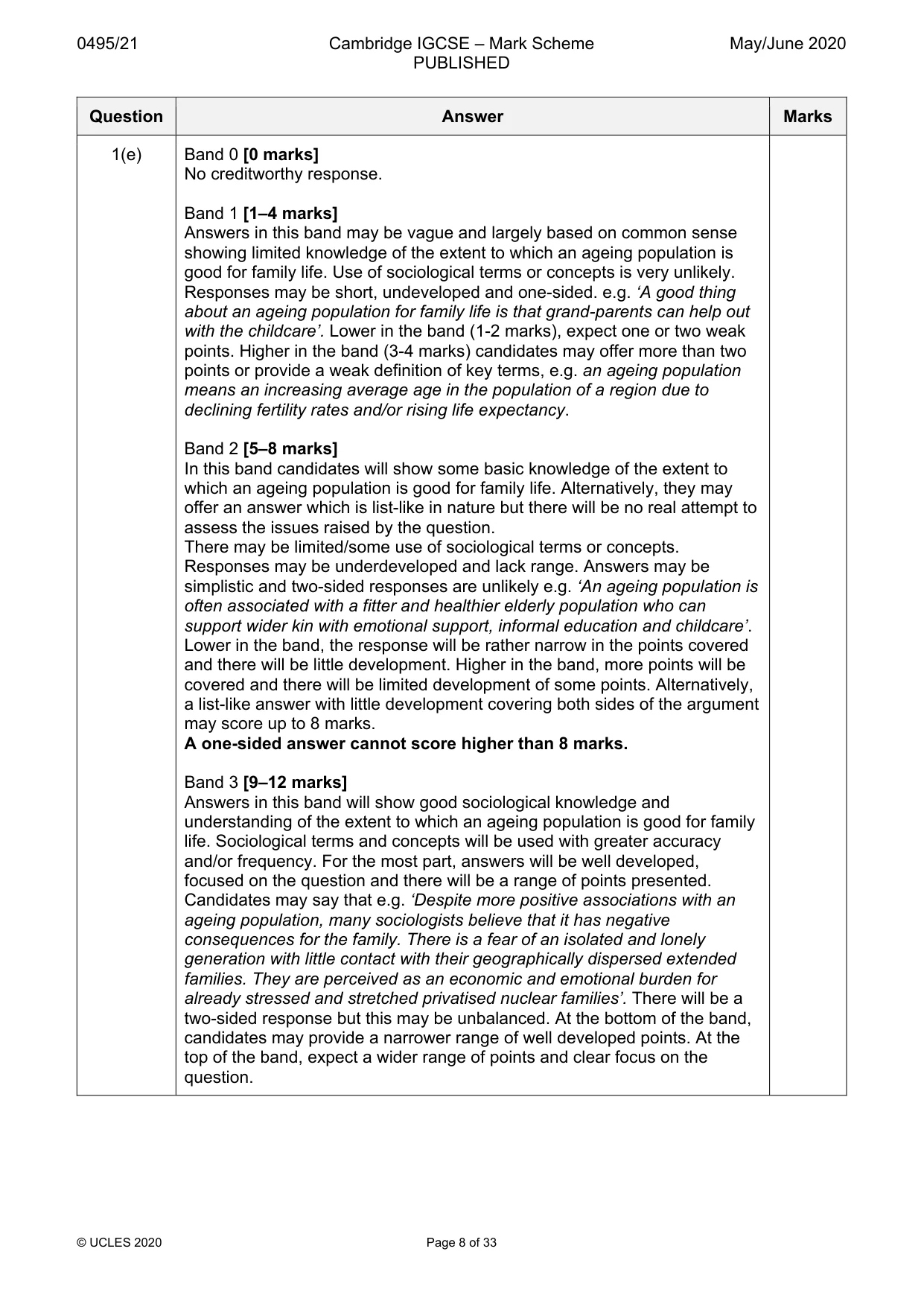
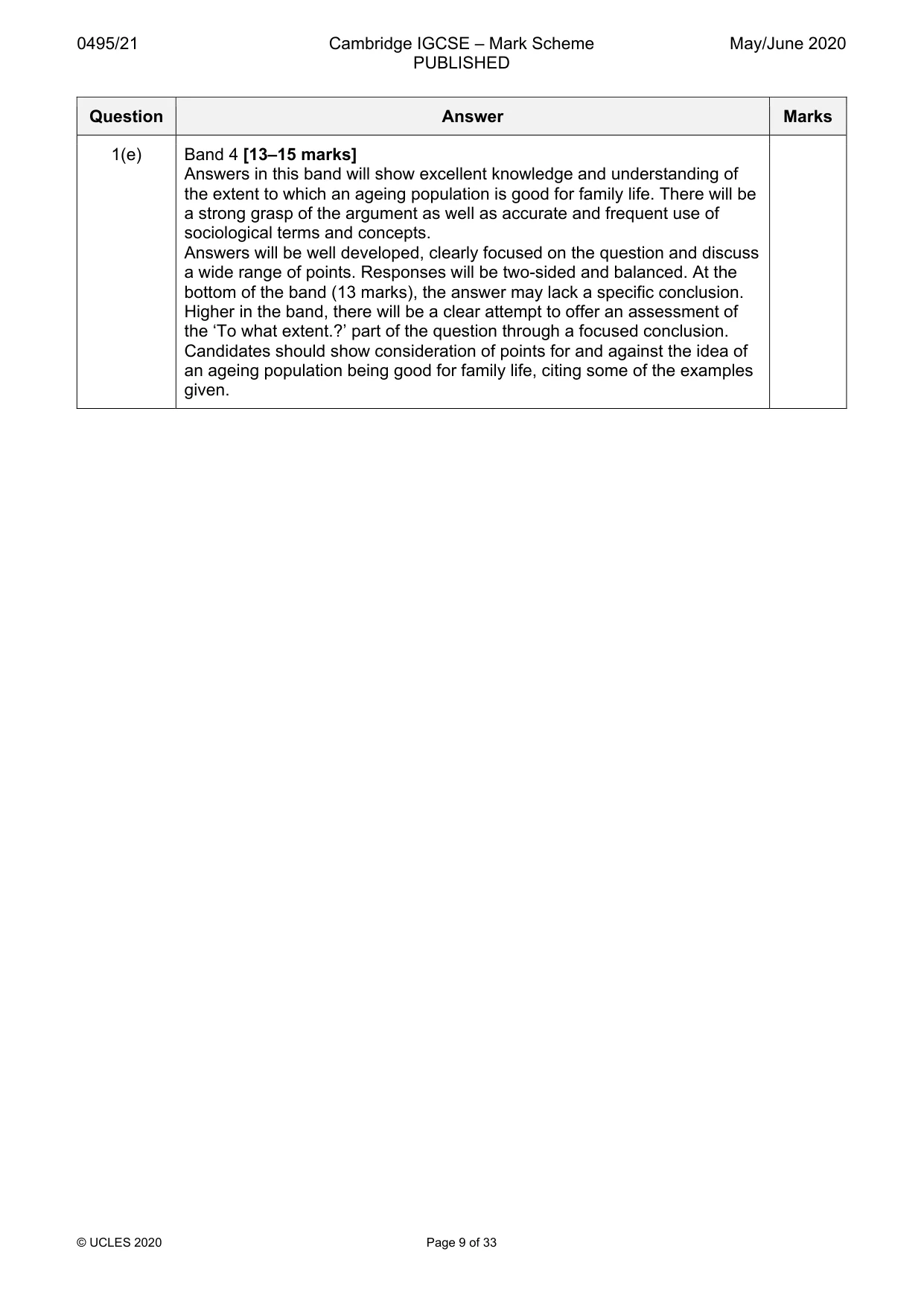
Mark scheme: Question Answer Marks 1(a) What is meant by the term ‘primary socialisation’? 2 One mark for partial definition, e.g. first stage of socialisation Two marks for clear definition, e.g. the first and most important period of socialisation in which the individual learns the basic norms of behaviour. 1(b) Describe two negative aspects of family life. 4 Candidates will describe two negative aspects of family life. This may link to the ‘dark side’ of the family. The negative aspects of family life can be for any family member e.g. wife, husband, child, grand-parent etc. Possible answers: • dysfunctional families – fail to socialise their children properly meaning children are not adequately prepared to be functioning members of society; • domestic violence – typically (but not exclusively) male on female, can be emotional, physical or sexual abuse e.g. Dobash and Dobash (feminism); • child abuse and neglect – increasingly seen to be a problem in modern industrial societies, can be emotional, physical or sexual abuse; • Marxism – families in poverty and the difficulties this brings, particularly linked with lone-parent families; • Marxism – families as a tool of capitalism i.e. as a unit of consumption/ the safety valve function; • high levels of divorce – may lead to high levels of stress and tension in families, both for the partners involved and for any children; • dual burden families – financial and emotional difficulties and stresses for the generation who are caring both for children and for elderly relatives; • privatised nuclear families – may miss out on close relationships with wider kin and not have extended family support networks to rely on for help; • other reasonable response. One mark for each point correctly identified (up to maximum of two). One mark for each point that is developed (up to a maximum of two). 1(c) Explain how gender equality exists in the family. 6 Candidates should show an understanding of how gender equality exists in the family. Possible answers: • dual income workers – both husband and wife are in paid employment and thus there is no longer the same inequalities in pay, power and status; • shared (joint) conjugal roles means that housework and emotional care in the family is no longer seen as the woman’s role (Willmott and Young symmetrical family); • if both parents work then often individuals are employed to take on some of the household duties traditionally performed by the wife e.g. child-care and cleaning; • postmodernists believe that in modern industrial societies it is far easier for both men and women to choose and negotiate the family roles they want to play, thus leading to greater equality; • the privatised nuclear family leads to a more equal partnership as life is organised around the family home rather than work or community; • greater diversity in family life means that there are more opportunities for gender equality within the family as traditional gender norms are challenged and changed; • changing roles of men e.g. as househusbands, allows for more flexibility and choice; • other reasonable response. Band 0 [0 marks] No creditworthy response. Band 1 [1–3 marks] Answers in this band will show only a limited awareness of how gender equality can be seen in family life and may talk about e.g. ‘both women and men helping in the home’. Responses may be short and un/under developed. At the bottom of the band (1 mark), expect one weak point. Higher in the band (2-3 marks), candidates may offer more than one weak point, but there may be a tendency towards simplistic answers, engaging with sociological ideas without using sociological language. Band 2 [4–6 marks] A clear and accurate explanation, showing good sociological knowledge and understanding of how gender equality can be seen in family life. Sociological terms and concepts should be expected e.g. ‘Feminist struggles seem to have paid off as in many families there is now evidence of there being a symmetrical family in which men and women both go out to paid work and both share the household tasks such as housework and childcare.’ This would be followed by explanation of factors leading to this. At the bottom of the band, the range of points covered may be narrow or lack detail. Higher in the band, answers will cover more than one factor in a well-developed way or cover several factors in less detail. 1(d) Explain why the nuclear family is important in contemporary societies. 8 Candidates should show an understanding of the various reasons to explain why the nuclear family is important in contemporary societies. Candidates are likely to engage with the functionalist approach, although this does not have to be explicitly referred to. Possible answers: • functionalists believe that in order for society to work and run smoothly there are some essential functions that need to be carried out and these are best performed by the nuclear family; • reproduction – societies must reproduce new generations of children and it is through marriage and the formation of the nuclear family that this is encouraged; • socialisation – children need to learn the norms and values of their society through primary socialisation whereby culture is transmitted to the next generation; • social control – behaviour of children needs to be controlled so that they conform to society’s norms and expectation, the ‘father figure’ is often thought to be the best for this job; • care of children – the expressive role played by the wife is seen to be the most effective way of ensuring that children are nurtured and cared for properly; • finance and status – the instrumental role played by the father is seen to be the best way for a family to have the money it needs to function adequately; • regulation of sexual behaviour – socially approved relationships are expected if a couple are to have children and the nuclear family is thought by many to be the most effective and stable basis for this; • New Right sociologists believe that it is only the nuclear family that can provide all the things a family needs to be successful and that all other family types fall short of this ideal; • cereal-packet family – the media frequently shows the nuclear family to be the ideal family type that we should all strive for; • other reasonable response. Band 0 [0 marks] No creditworthy response. Band 1 [1–3 marks] Answers in this band will show only a limited awareness of why the nuclear family is still important in contemporary societies. A tendency to description is likely. Responses may be short and undeveloped, e.g. ‘having two parents is best for the children’ stated without explanation. Sociological terms and concepts are unlikely to be used. At the bottom of the band (1 mark), expect one weak point. Higher in the band (2-3 marks), candidates may offer more than one weak point. 1(d) Band 2 [4–6 marks] Answers in this band will show basic sociological knowledge and understanding of why the nuclear family is still important in contemporary societies. Responses may be underdeveloped and lacking in range. e.g. ‘functionalists believe that nuclear families are thought to perform essential functions that no other family can do as well’ etc. At the bottom of the band, candidates are unlikely to use sociological terms and concepts accurately. Higher in the band, candidates may be beginning to use sociological terms and concepts with greater accuracy. However, some aspects of the answer may only be partially developed/explained. Band 3 [7–8 marks] Answers in this band will show good sociological knowledge and understanding of why the nuclear family is still important in contemporary societies and will be well developed and explained. e.g. ‘Functionalists and the New Right believe that the nuclear family plays an important role in contemporary societies. They are the institution best placed to perform the essential functions such as socialisation, social control, reproduction and sexual regulation. Their belief in the instrumental role being best suited to men and the expressive role being best suited to women supports the idea of a family in which a parent is at home to nurture the children and a parent is out of work to provide the finances necessary to survive’. They can then expand on the explanation of this and other factors as necessary. Sociological terms and concepts will be used accurately overall. Answers will be well focused on the question and there will be a range of reasons presented. At the top of the band explanations will be clear throughout. 1(e) To what extent is an ageing population good for family life? 15 Candidates should show an awareness of the various ways that an ageing population is good for family life. Candidates may look at husbands and wives, children and grand-parents in their answer. Possible answers: FOR • retirement has been extended as the population live longer, leading to the availability of grand-parents for family childcare; • active ageing has led to a generation of healthy, fit and happy retirees who are an asset to family life in terms of socialisation, support, childcare etc; • grand-parents are able to play a greater role in the lives of their grand- children and so develop closer bonds and relationships; • a return in some families to the extended family structure where families share a household – this brings financial, childcare and housework benefits for all; • an ageing population increases the status of older people who are no longer seen as an economic burden due to factors such as the ‘grey pound’; • care homes today can be seen as ‘luxury living’ with five-star standards and amenities meaning a new phase of family life that is characterised by fun and happiness; • other reasonable response. AGAINST • more older people living alone after the death of a partner may lead to greater isolation and loneliness as elderly people see little of their family; • geographical mobility and the move to the privatised nuclear family is not good for an ageing population who may not have a place in their wider kin’s family; • there may be a greater burden for adult children looking after their ageing parents – poor healthcare, need for support, financial implications etc. – the pivot/sandwich generation; • old age is associated with retirement and this can bring with it a lack of status and no clear role which may lead to disengagement from family life; • there may be a burden placed on the grand-parents who feel that they must play a role in the family’s childcare; • this may bring conflict and tension to the family through different norms, values and expectations between the generations; • an ageing population may lead to a generation gap between family members, leaving them with little in common and thus weakening relationships and family bonds; • other reasonable response. 1(e) Band 0 [0 marks] No creditworthy response. Band 1 [1–4 marks] Answers in this band may be vague and largely based on common sense showing limited knowledge of the extent to which an ageing population is good for family life. Use of sociological terms or concepts is very unlikely. Responses may be short, undeveloped and one-sided. e.g. ‘A good thing about an ageing population for family life is that grand-parents can help out with the childcare’. Lower in the band (1-2 marks), expect one or two weak points. Higher in the band (3-4 marks) candidates may offer more than two points or provide a weak definition of key terms, e.g. an ageing population means an increasing average age in the population of a region due to declining fertility rates and/or rising life expectancy. Band 2 [5–8 marks] In this band candidates will show some basic knowledge of the extent to which an ageing population is good for family life. Alternatively, they may offer an answer which is list-like in nature but there will be no real attempt to assess the issues raised by the question. There may be limited/some use of sociological terms or concepts. Responses may be underdeveloped and lack range. Answers may be simplistic and two-sided responses are unlikely e.g. ‘An ageing population is often associated with a fitter and healthier elderly population who can support wider kin with emotional support, informal education and childcare’. Lower in the band, the response will be rather narrow in the points covered and there will be little development. Higher in the band, more points will be covered and there will be limited development of some points. Alternatively, a list-like answer with little development covering both sides of the argument may score up to 8 marks. A one-sided answer cannot score higher than 8 marks. Band 3 [9–12 marks] Answers in this band will show good sociological knowledge and understanding of the extent to which an ageing population is good for family life. Sociological terms and concepts will be used with greater accuracy and/or frequency. For the most part, answers will be well developed, focused on the question and there will be a range of points presented. Candidates may say that e.g. ‘Despite more positive associations with an ageing population, many sociologists believe that it has negative consequences for the family. There is a fear of an isolated and lonely generation with little contact with their geographically dispersed extended families. They are perceived as an economic and emotional burden for already stressed and stretched privatised nuclear families’. There will be a two-sided response but this may be unbalanced. At the bottom of the band, candidates may provide a narrower range of well developed points. At the top of the band, expect a wider range of points and clear focus on the question. 1(e) Band 4 [13–15 marks] Answers in this band will show excellent knowledge and understanding of the extent to which an ageing population is good for family life. There will be a strong grasp of the argument as well as accurate and frequent use of sociological terms and concepts. Answers will be well developed, clearly focused on the question and discuss a wide range of points. Responses will be two-sided and balanced. At the bottom of the band (13 marks), the answer may lack a specific conclusion. Higher in the band, there will be a clear attempt to offer an assessment of the ‘To what extent.?’ part of the question through a focused conclusion. Candidates should show consideration of points for and against the idea of an ageing population being good for family life, citing some of the examples given.
Q2 · Experiences of schooling can be very diverse and this can affect educational achievement
2 Experiences of schooling can be very diverse and this can affect educational achievement. For example the type of school attended and the student’s family background can be very important. Some sociologists believe that every student has the chance to be successful in education, others think this is impossible due to educational inequality. (a) What is meant by the term ‘educational inequality’? [2] (b) Describe two functions of education. [4] (c) Explain how family background may impact upon educational achievement. [6] (d) Explain why some students join anti-school sub-cultures. [8] (e) To what extent does the comprehensive system of education improve an individual’s life chances? [15] Section C: Crime, deviance and social control
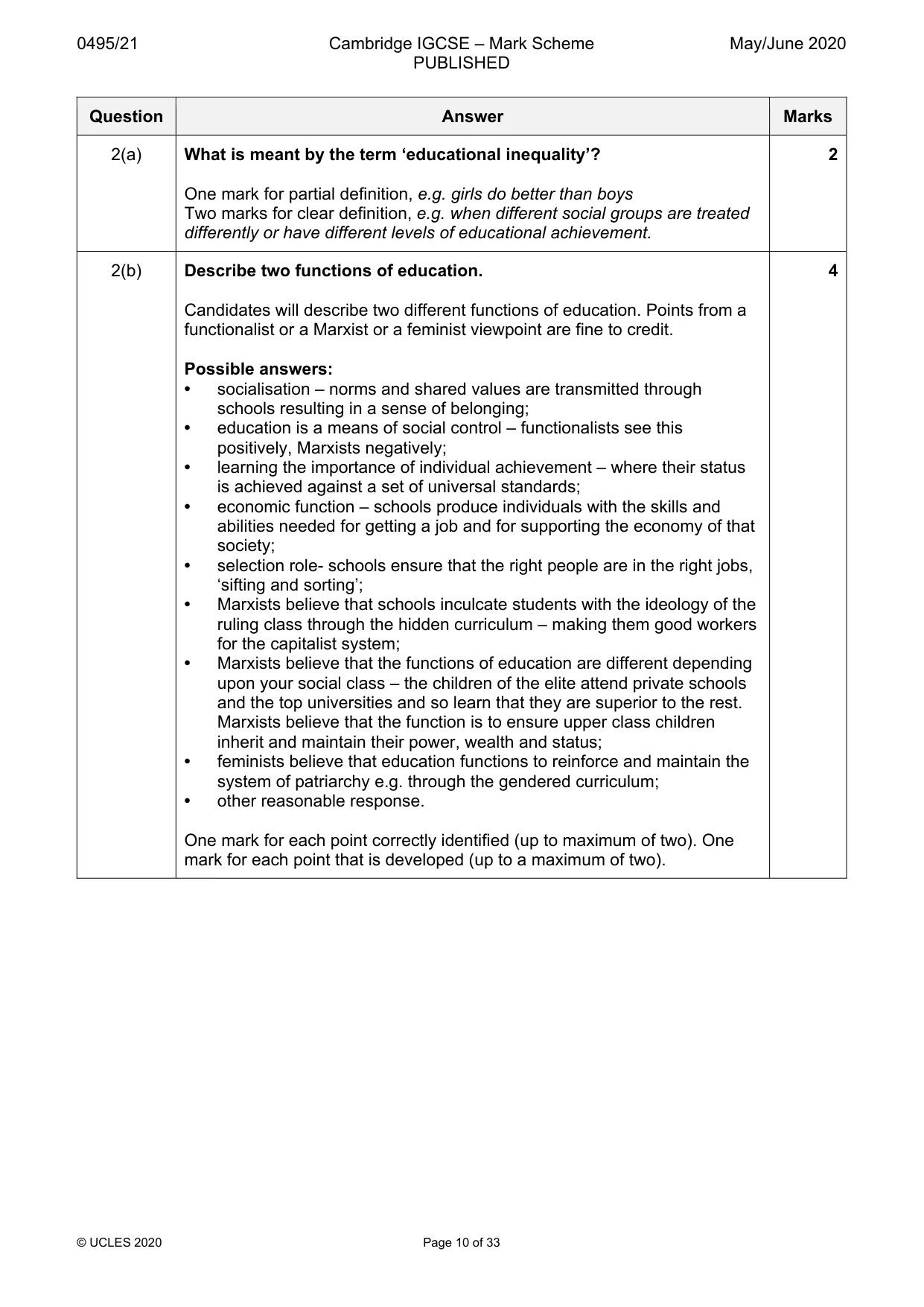
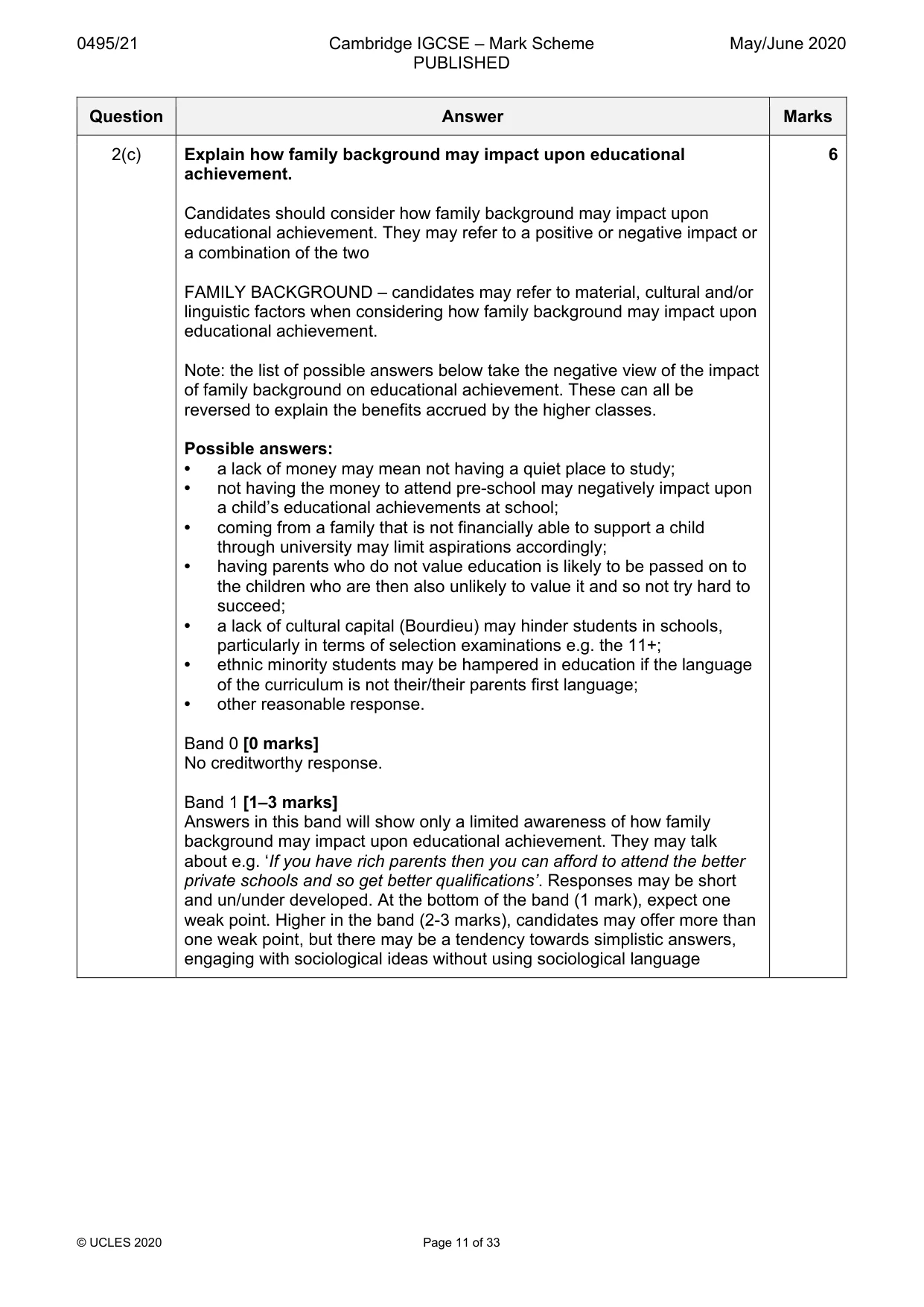
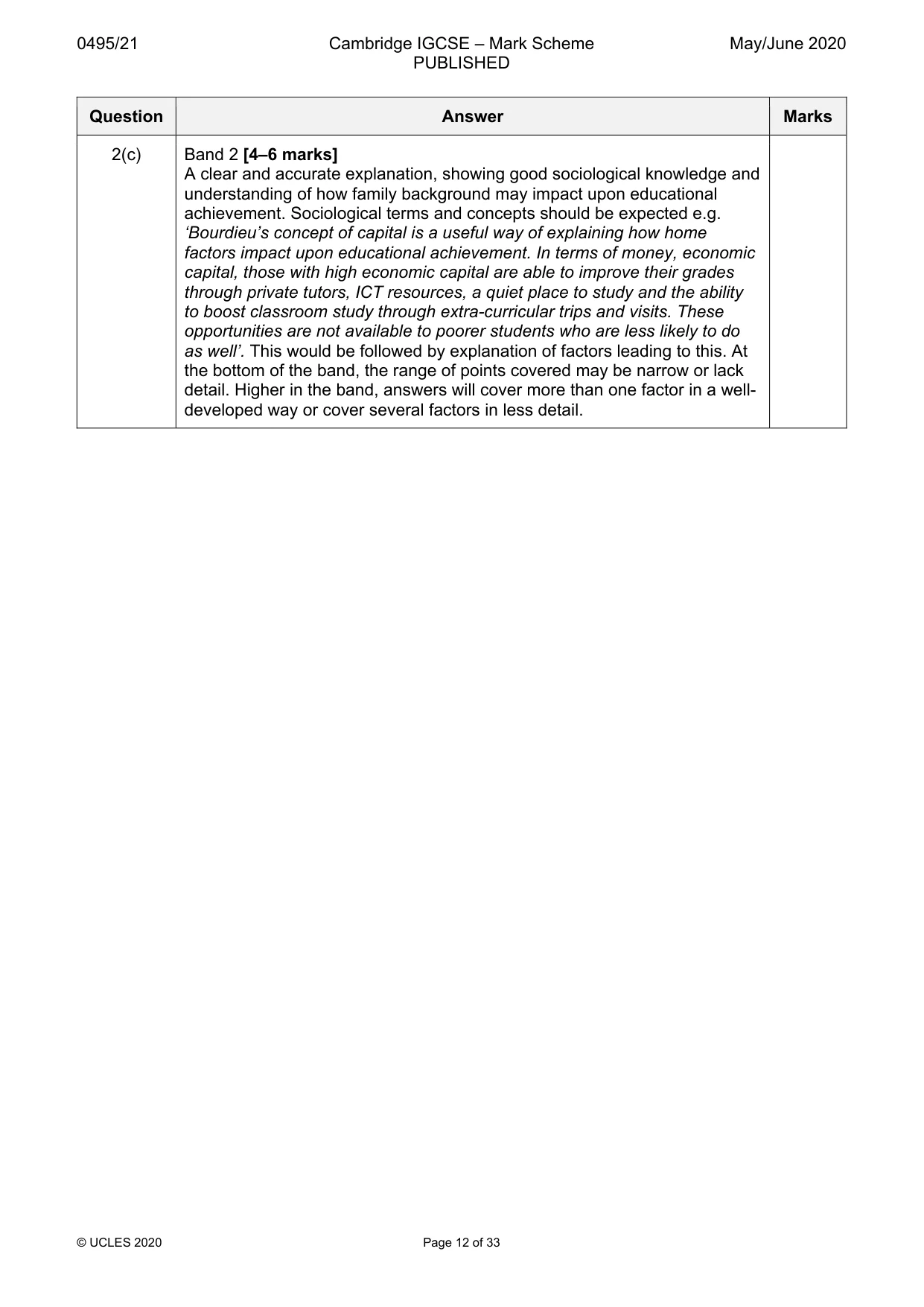
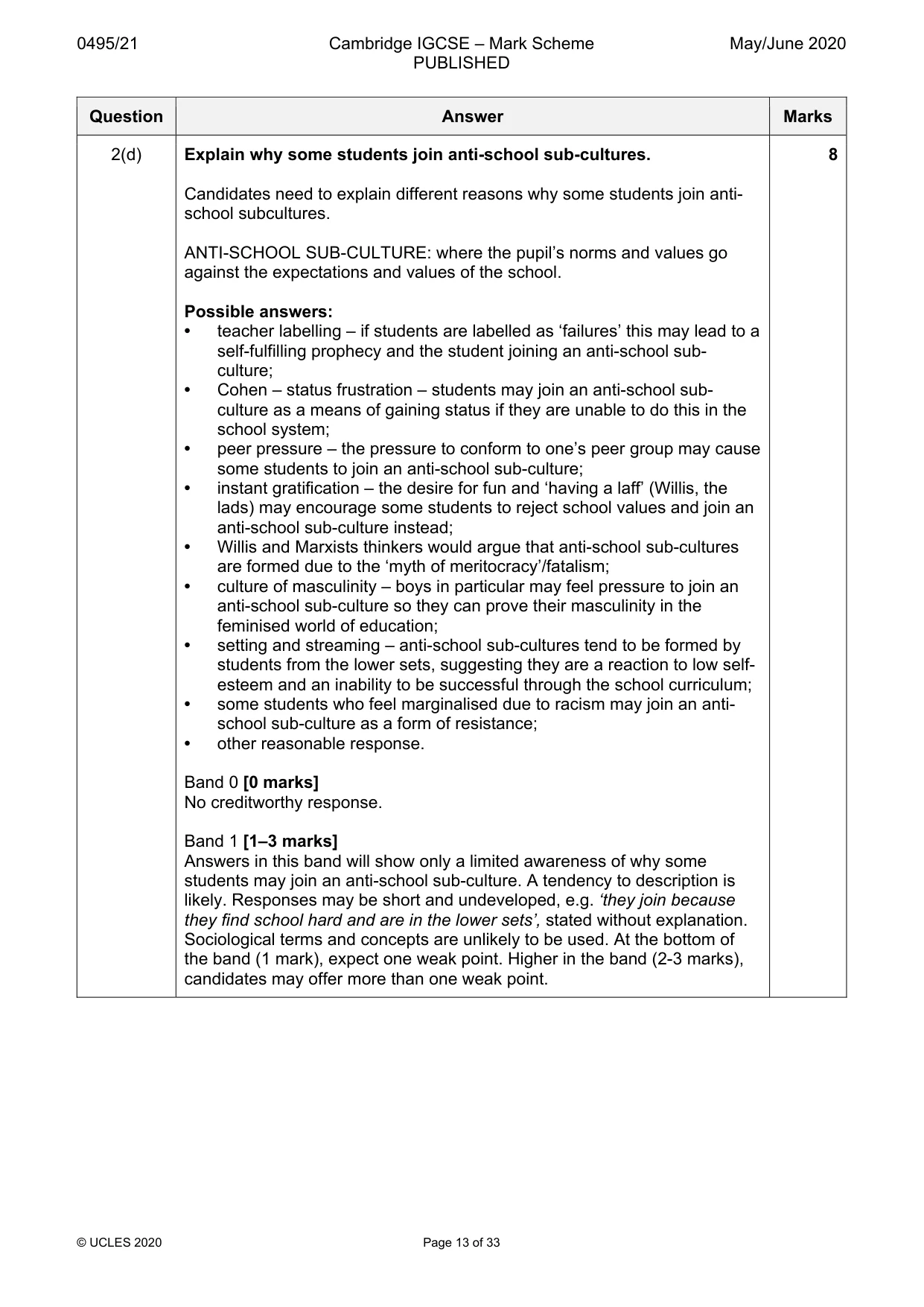
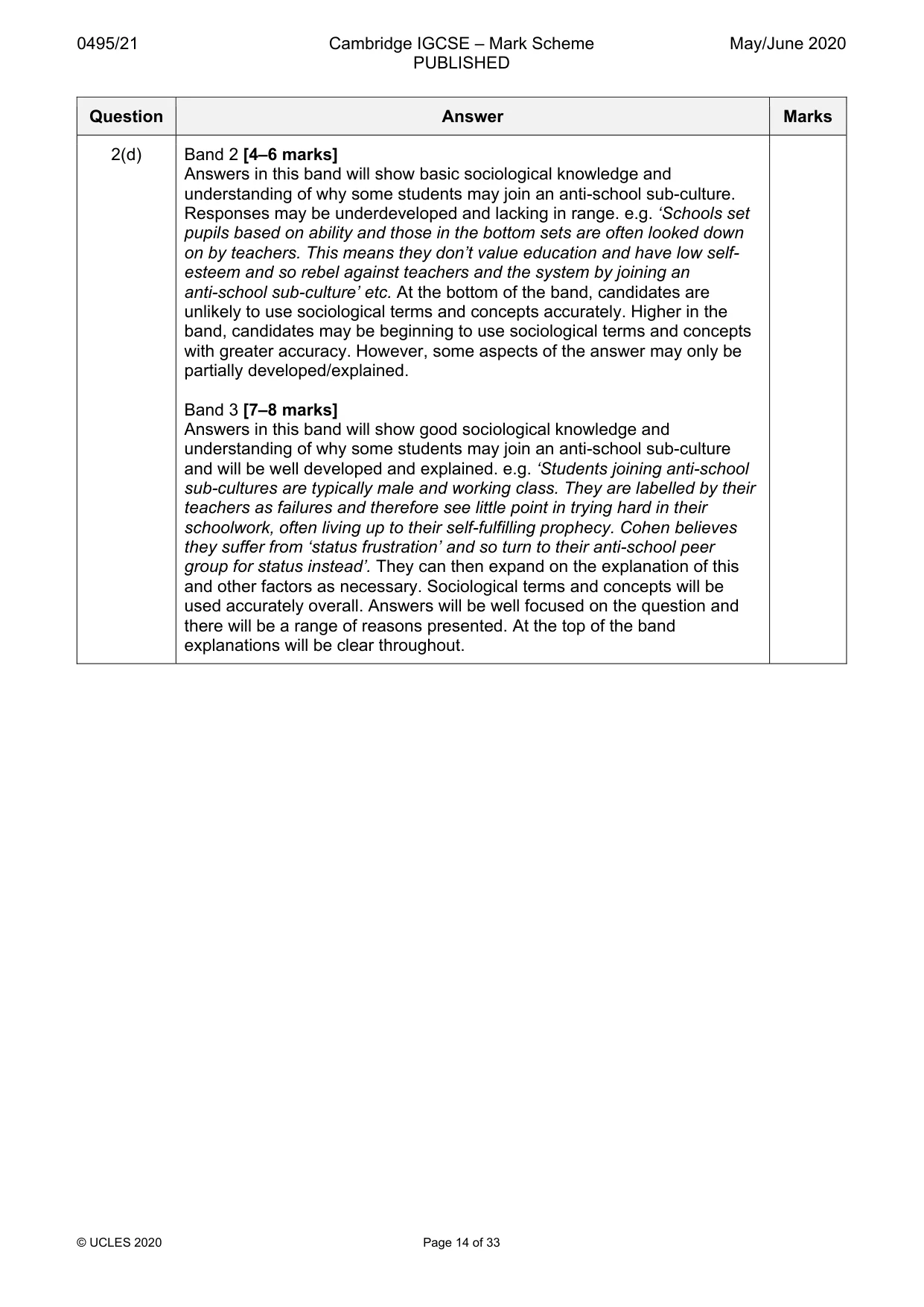
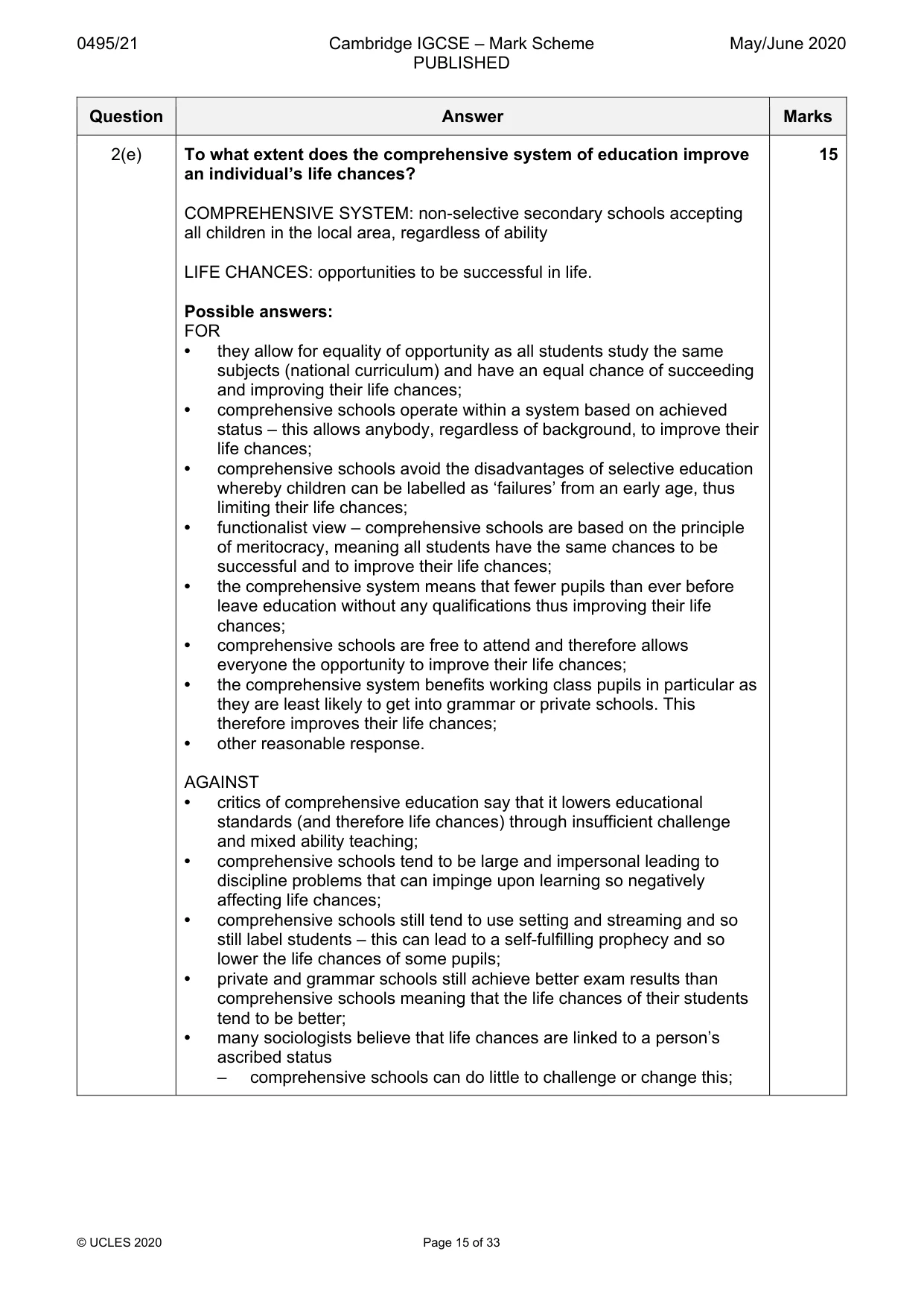
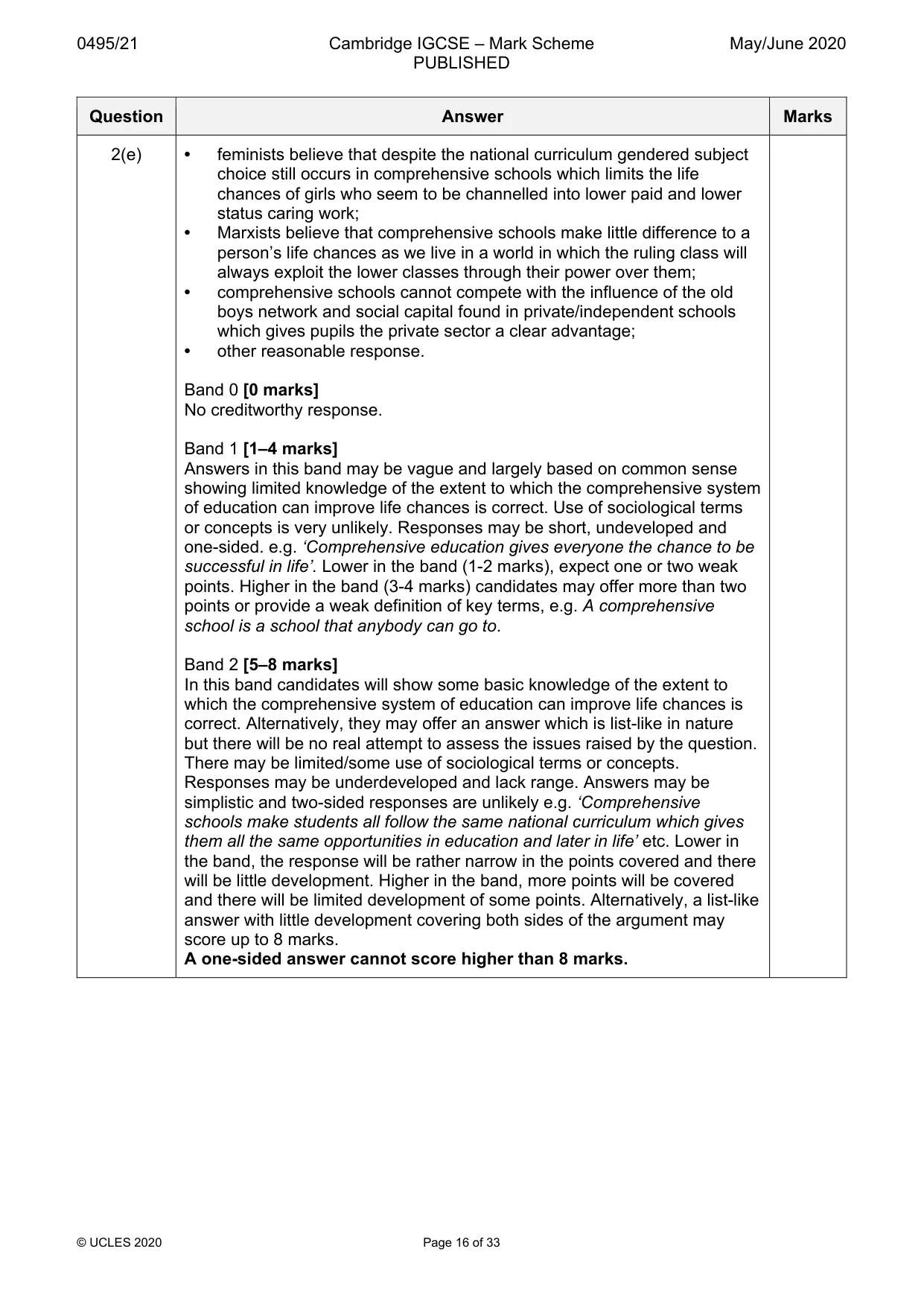
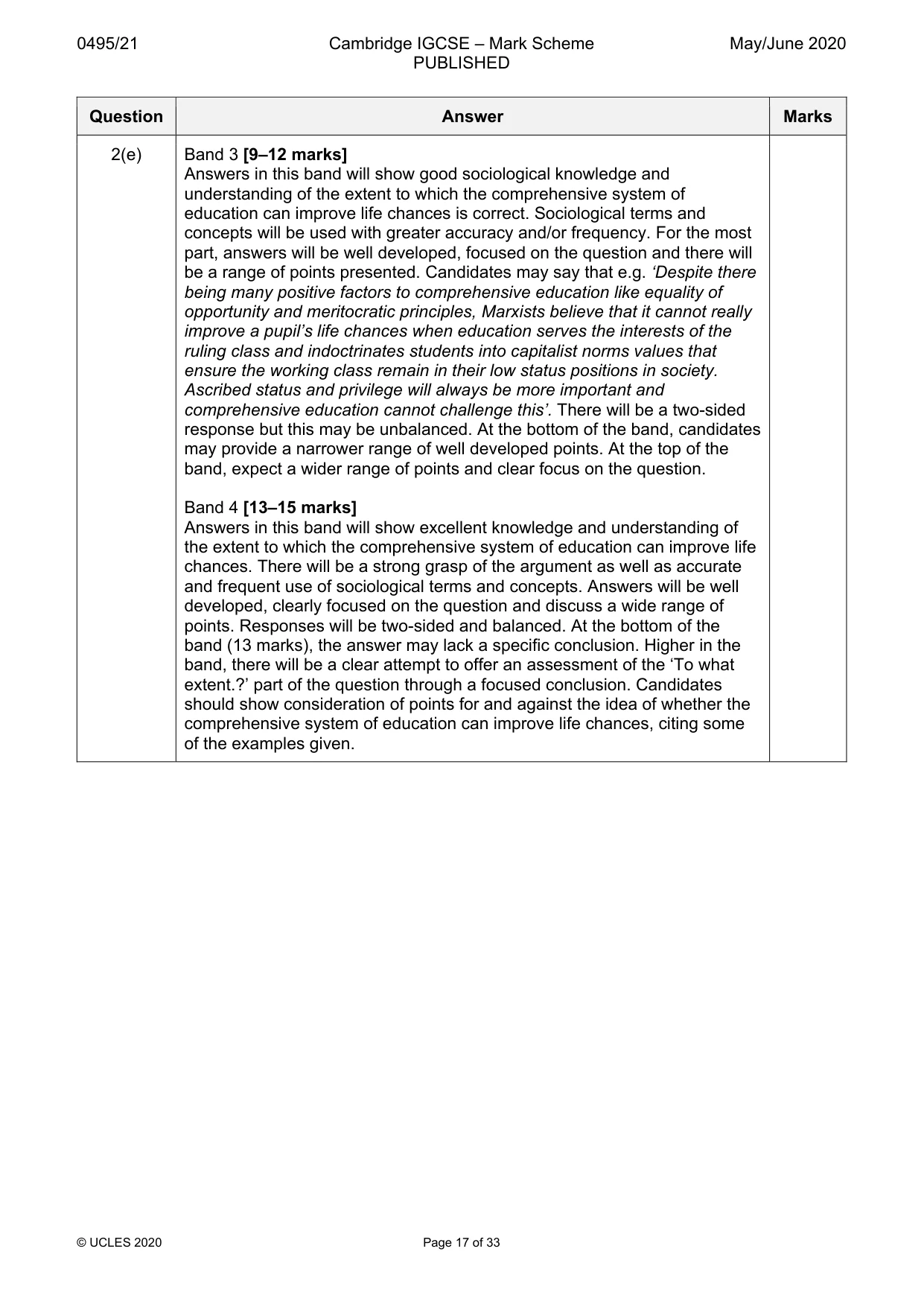
Mark scheme: 2(a) What is meant by the term ‘educational inequality’? 2 One mark for partial definition, e.g. girls do better than boys Two marks for clear definition, e.g. when different social groups are treated differently or have different levels of educational achievement. 2(b) Describe two functions of education. 4 Candidates will describe two different functions of education. Points from a functionalist or a Marxist or a feminist viewpoint are fine to credit. Possible answers: • socialisation – norms and shared values are transmitted through schools resulting in a sense of belonging; • education is a means of social control – functionalists see this positively, Marxists negatively; • learning the importance of individual achievement – where their status is achieved against a set of universal standards; • economic function – schools produce individuals with the skills and abilities needed for getting a job and for supporting the economy of that society; • selection role- schools ensure that the right people are in the right jobs, ‘sifting and sorting’; • Marxists believe that schools inculcate students with the ideology of the ruling class through the hidden curriculum – making them good workers for the capitalist system; • Marxists believe that the functions of education are different depending upon your social class – the children of the elite attend private schools and the top universities and so learn that they are superior to the rest. Marxists believe that the function is to ensure upper class children inherit and maintain their power, wealth and status; • feminists believe that education functions to reinforce and maintain the system of patriarchy e.g. through the gendered curriculum; • other reasonable response. One mark for each point correctly identified (up to maximum of two). One mark for each point that is developed (up to a maximum of two). 2(c) Explain how family background may impact upon educational 6 achievement. Candidates should consider how family background may impact upon educational achievement. They may refer to a positive or negative impact or a combination of the two FAMILY BACKGROUND – candidates may refer to material, cultural and/or linguistic factors when considering how family background may impact upon educational achievement. Note: the list of possible answers below take the negative view of the impact of family background on educational achievement. These can all be reversed to explain the benefits accrued by the higher classes. Possible answers: • a lack of money may mean not having a quiet place to study; • not having the money to attend pre-school may negatively impact upon a child’s educational achievements at school; • coming from a family that is not financially able to support a child through university may limit aspirations accordingly; • having parents who do not value education is likely to be passed on to the children who are then also unlikely to value it and so not try hard to succeed; • a lack of cultural capital (Bourdieu) may hinder students in schools, particularly in terms of selection examinations e.g. the 11+; • ethnic minority students may be hampered in education if the language of the curriculum is not their/their parents first language; • other reasonable response. Band 0 [0 marks] No creditworthy response. Band 1 [1–3 marks] Answers in this band will show only a limited awareness of how family background may impact upon educational achievement. They may talk about e.g. ‘If you have rich parents then you can afford to attend the better private schools and so get better qualifications’. Responses may be short and un/under developed. At the bottom of the band (1 mark), expect one weak point. Higher in the band (2-3 marks), candidates may offer more than one weak point, but there may be a tendency towards simplistic answers, engaging with sociological ideas without using sociological language 2(c) Band 2 [4–6 marks] A clear and accurate explanation, showing good sociological knowledge and understanding of how family background may impact upon educational achievement. Sociological terms and concepts should be expected e.g. ‘Bourdieu’s concept of capital is a useful way of explaining how home factors impact upon educational achievement. In terms of money, economic capital, those with high economic capital are able to improve their grades through private tutors, ICT resources, a quiet place to study and the ability to boost classroom study through extra-curricular trips and visits. These opportunities are not available to poorer students who are less likely to do as well’. This would be followed by explanation of factors leading to this. At the bottom of the band, the range of points covered may be narrow or lack detail. Higher in the band, answers will cover more than one factor in a well- developed way or cover several factors in less detail. 2(d) Explain why some students join anti-school sub-cultures. 8 Candidates need to explain different reasons why some students join anti- school subcultures. ANTI-SCHOOL SUB-CULTURE: where the pupil’s norms and values go against the expectations and values of the school. Possible answers: • teacher labelling – if students are labelled as ‘failures’ this may lead to a self-fulfilling prophecy and the student joining an anti-school sub- culture; • Cohen – status frustration – students may join an anti-school sub- culture as a means of gaining status if they are unable to do this in the school system; • peer pressure – the pressure to conform to one’s peer group may cause some students to join an anti-school sub-culture; • instant gratification – the desire for fun and ‘having a laff’ (Willis, the lads) may encourage some students to reject school values and join an anti-school sub-culture instead; • Willis and Marxists thinkers would argue that anti-school sub-cultures are formed due to the ‘myth of meritocracy’/fatalism; • culture of masculinity – boys in particular may feel pressure to join an anti-school sub-culture so they can prove their masculinity in the feminised world of education; • setting and streaming – anti-school sub-cultures tend to be formed by students from the lower sets, suggesting they are a reaction to low self- esteem and an inability to be successful through the school curriculum; • some students who feel marginalised due to racism may join an anti- school sub-culture as a form of resistance; • other reasonable response. Band 0 [0 marks] No creditworthy response. Band 1 [1–3 marks] Answers in this band will show only a limited awareness of why some students may join an anti-school sub-culture. A tendency to description is likely. Responses may be short and undeveloped, e.g. ‘they join because they find school hard and are in the lower sets’, stated without explanation. Sociological terms and concepts are unlikely to be used. At the bottom of the band (1 mark), expect one weak point. Higher in the band (2-3 marks), candidates may offer more than one weak point. 2(d) Band 2 [4–6 marks] Answers in this band will show basic sociological knowledge and understanding of why some students may join an anti-school sub-culture. Responses may be underdeveloped and lacking in range. e.g. ‘Schools set pupils based on ability and those in the bottom sets are often looked down on by teachers. This means they don’t value education and have low self- esteem and so rebel against teachers and the system by joining an anti-school sub-culture’ etc. At the bottom of the band, candidates are unlikely to use sociological terms and concepts accurately. Higher in the band, candidates may be beginning to use sociological terms and concepts with greater accuracy. However, some aspects of the answer may only be partially developed/explained. Band 3 [7–8 marks] Answers in this band will show good sociological knowledge and understanding of why some students may join an anti-school sub-culture and will be well developed and explained. e.g. ‘Students joining anti-school sub-cultures are typically male and working class. They are labelled by their teachers as failures and therefore see little point in trying hard in their schoolwork, often living up to their self-fulfilling prophecy. Cohen believes they suffer from ‘status frustration’ and so turn to their anti-school peer group for status instead’. They can then expand on the explanation of this and other factors as necessary. Sociological terms and concepts will be used accurately overall. Answers will be well focused on the question and there will be a range of reasons presented. At the top of the band explanations will be clear throughout. 2(e) To what extent does the comprehensive system of education improve 15 an individual’s life chances? COMPREHENSIVE SYSTEM: non-selective secondary schools accepting all children in the local area, regardless of ability LIFE CHANCES: opportunities to be successful in life. Possible answers: FOR • they allow for equality of opportunity as all students study the same subjects (national curriculum) and have an equal chance of succeeding and improving their life chances; • comprehensive schools operate within a system based on achieved status – this allows anybody, regardless of background, to improve their life chances; • comprehensive schools avoid the disadvantages of selective education whereby children can be labelled as ‘failures’ from an early age, thus limiting their life chances; • functionalist view – comprehensive schools are based on the principle of meritocracy, meaning all students have the same chances to be successful and to improve their life chances; • the comprehensive system means that fewer pupils than ever before leave education without any qualifications thus improving their life chances; • comprehensive schools are free to attend and therefore allows everyone the opportunity to improve their life chances; • the comprehensive system benefits working class pupils in particular as they are least likely to get into grammar or private schools. This therefore improves their life chances; • other reasonable response. AGAINST • critics of comprehensive education say that it lowers educational standards (and therefore life chances) through insufficient challenge and mixed ability teaching; • comprehensive schools tend to be large and impersonal leading to discipline problems that can impinge upon learning so negatively affecting life chances; • comprehensive schools still tend to use setting and streaming and so still label students – this can lead to a self-fulfilling prophecy and so lower the life chances of some pupils; • private and grammar schools still achieve better exam results than comprehensive schools meaning that the life chances of their students tend to be better; • many sociologists believe that life chances are linked to a person’s ascribed status – comprehensive schools can do little to challenge or change this; 2(e) • feminists believe that despite the national curriculum gendered subject choice still occurs in comprehensive schools which limits the life chances of girls who seem to be channelled into lower paid and lower status caring work; • Marxists believe that comprehensive schools make little difference to a person’s life chances as we live in a world in which the ruling class will always exploit the lower classes through their power over them; • comprehensive schools cannot compete with the influence of the old boys network and social capital found in private/independent schools which gives pupils the private sector a clear advantage; • other reasonable response. Band 0 [0 marks] No creditworthy response. Band 1 [1–4 marks] Answers in this band may be vague and largely based on common sense showing limited knowledge of the extent to which the comprehensive system of education can improve life chances is correct. Use of sociological terms or concepts is very unlikely. Responses may be short, undeveloped and one-sided. e.g. ‘Comprehensive education gives everyone the chance to be successful in life’. Lower in the band (1-2 marks), expect one or two weak points. Higher in the band (3-4 marks) candidates may offer more than two points or provide a weak definition of key terms, e.g. A comprehensive school is a school that anybody can go to. Band 2 [5–8 marks] In this band candidates will show some basic knowledge of the extent to which the comprehensive system of education can improve life chances is correct. Alternatively, they may offer an answer which is list-like in nature but there will be no real attempt to assess the issues raised by the question. There may be limited/some use of sociological terms or concepts. Responses may be underdeveloped and lack range. Answers may be simplistic and two-sided responses are unlikely e.g. ‘Comprehensive schools make students all follow the same national curriculum which gives them all the same opportunities in education and later in life’ etc. Lower in the band, the response will be rather narrow in the points covered and there will be little development. Higher in the band, more points will be covered and there will be limited development of some points. Alternatively, a list-like answer with little development covering both sides of the argument may score up to 8 marks. A one-sided answer cannot score higher than 8 marks. 2(e) Band 3 [9–12 marks] Answers in this band will show good sociological knowledge and understanding of the extent to which the comprehensive system of education can improve life chances is correct. Sociological terms and concepts will be used with greater accuracy and/or frequency. For the most part, answers will be well developed, focused on the question and there will be a range of points presented. Candidates may say that e.g. ‘Despite there being many positive factors to comprehensive education like equality of opportunity and meritocratic principles, Marxists believe that it cannot really improve a pupil’s life chances when education serves the interests of the ruling class and indoctrinates students into capitalist norms values that ensure the working class remain in their low status positions in society. Ascribed status and privilege will always be more important and comprehensive education cannot challenge this’. There will be a two-sided response but this may be unbalanced. At the bottom of the band, candidates may provide a narrower range of well developed points. At the top of the band, expect a wider range of points and clear focus on the question. Band 4 [13–15 marks] Answers in this band will show excellent knowledge and understanding of the extent to which the comprehensive system of education can improve life chances. There will be a strong grasp of the argument as well as accurate and frequent use of sociological terms and concepts. Answers will be well developed, clearly focused on the question and discuss a wide range of points. Responses will be two-sided and balanced. At the bottom of the band (13 marks), the answer may lack a specific conclusion. Higher in the band, there will be a clear attempt to offer an assessment of the ‘To what extent.?’ part of the question through a focused conclusion. Candidates should show consideration of points for and against the idea of whether the comprehensive system of education can improve life chances, citing some of the examples given.
Q3 · Many people believe that stricter controls are needed in order to reduce the problem of…
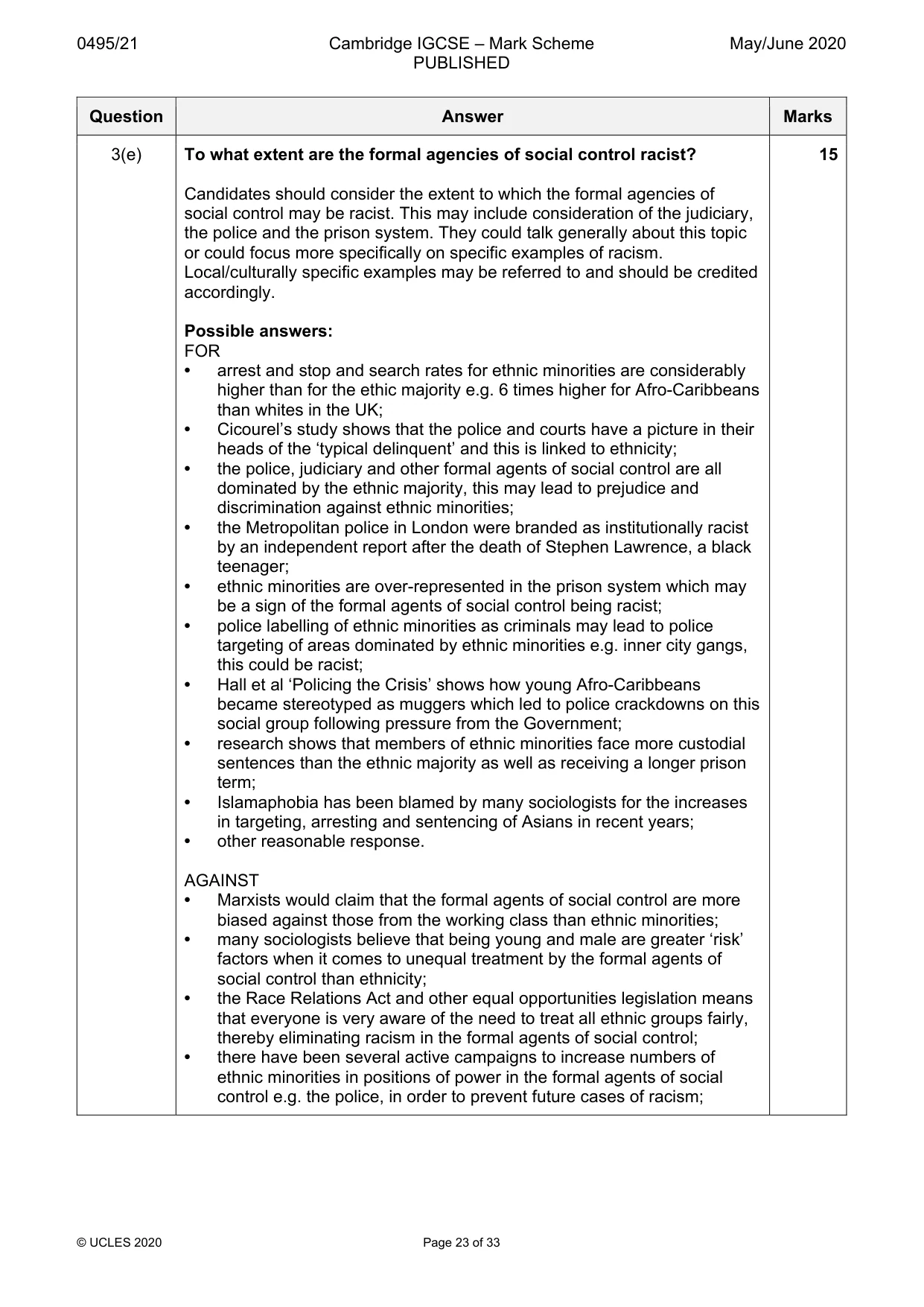
3 Many people believe that stricter controls are needed in order to reduce the problem of crime in society. Different explanations have been offered for why crime occurs, ranging from inadequate socialisation to relative deprivation. Some sociologists also think that the formal agencies of social control are unfair and do not treat everybody in the same way. (a) What is meant by the term ‘relative deprivation’? [2] (b) Describe two agencies of social control. [4] (c) Explain how Marxists view crime. [6] (d) Explain why prisons are thought to be an effective deterrent to crime. [8] (e) To what extent are the formal agencies of social control racist? [15] Section D: Media
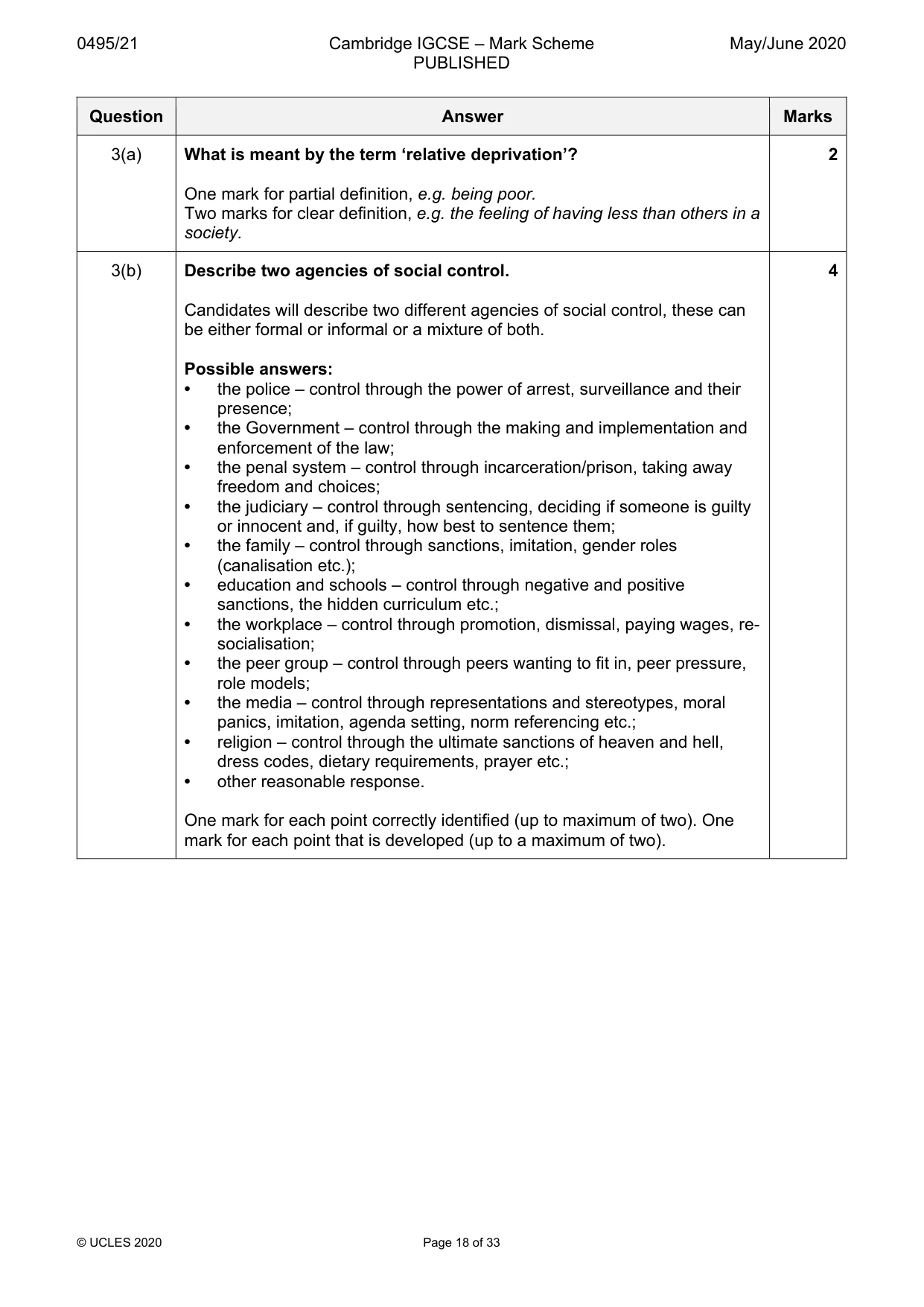
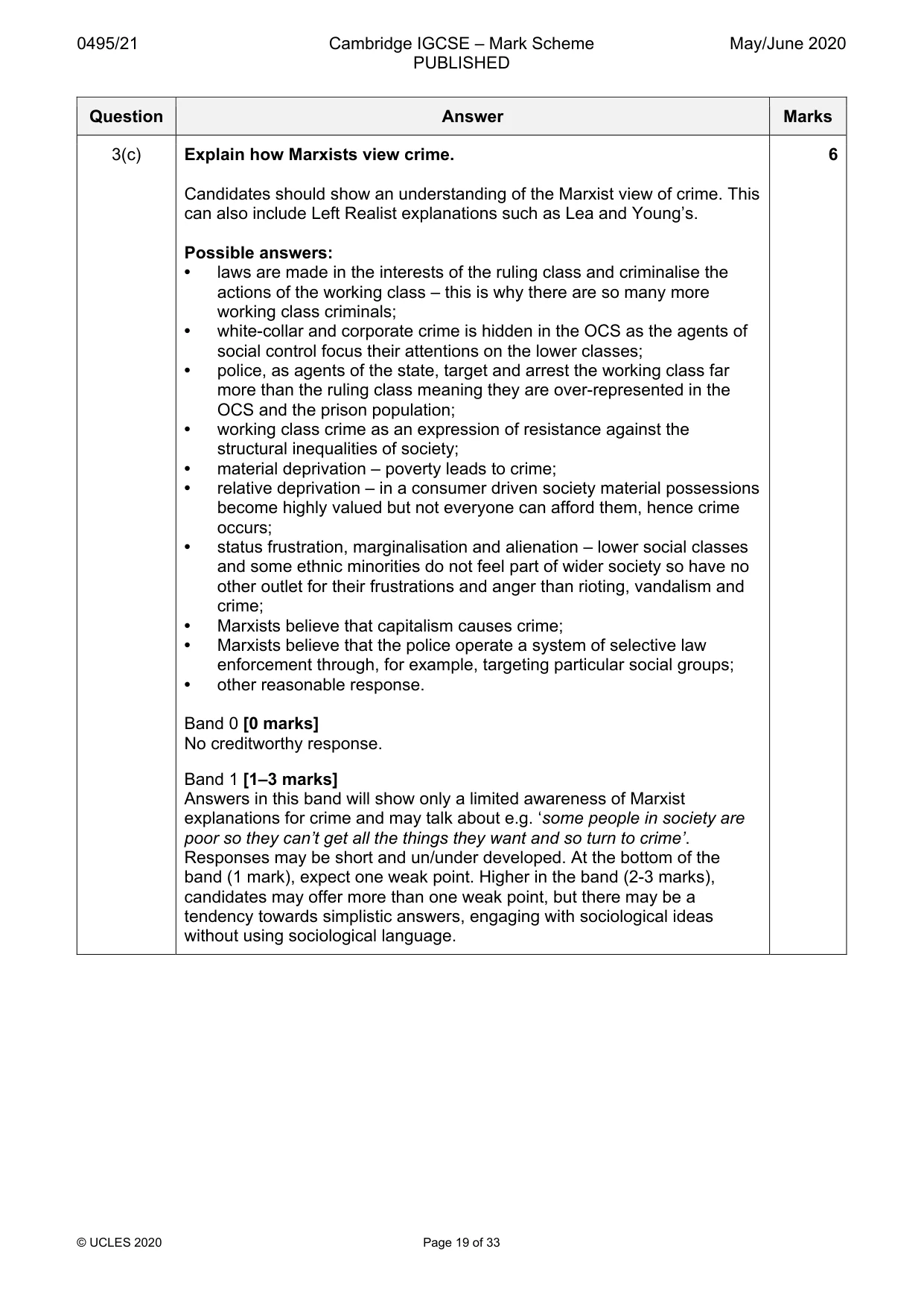
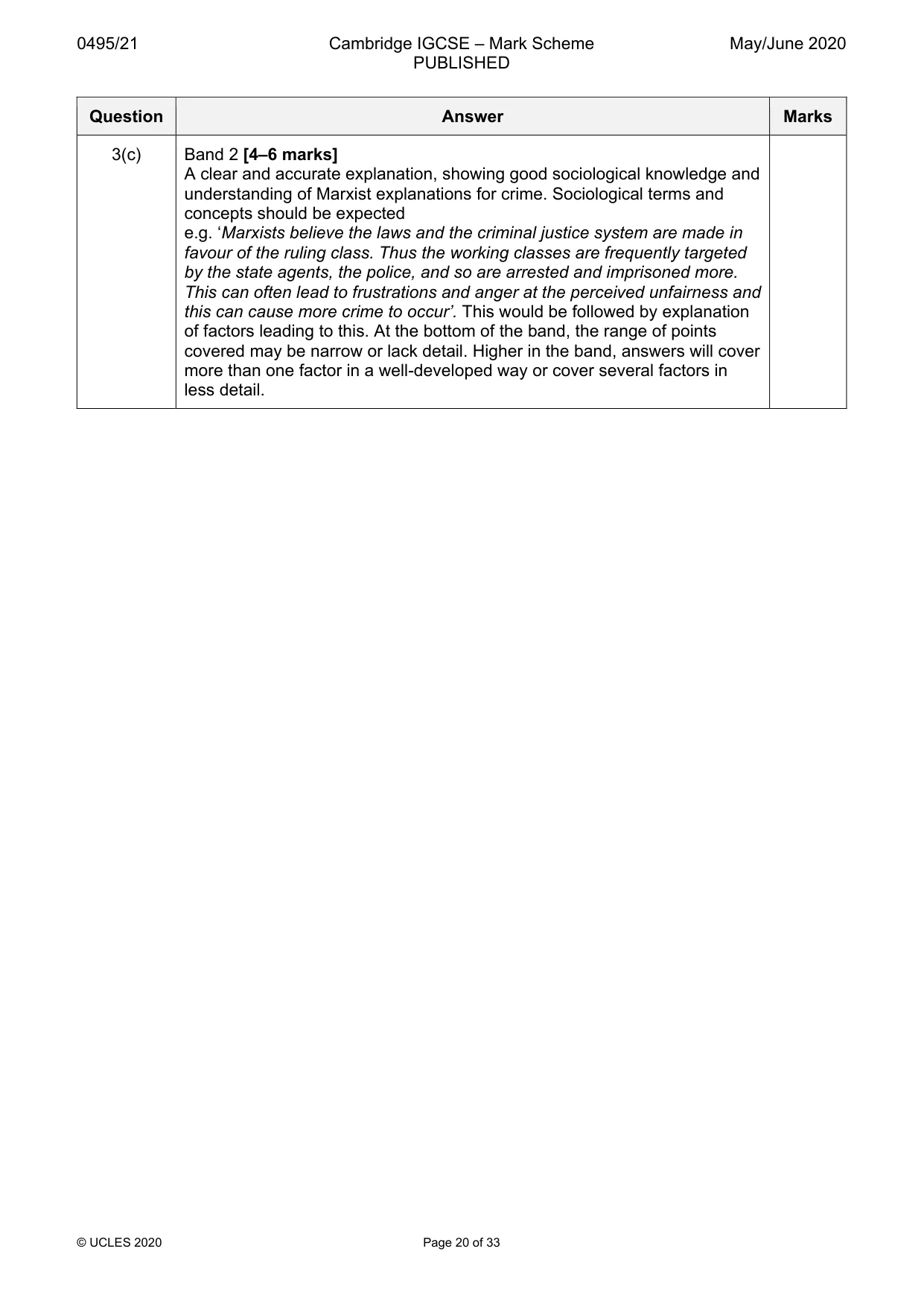
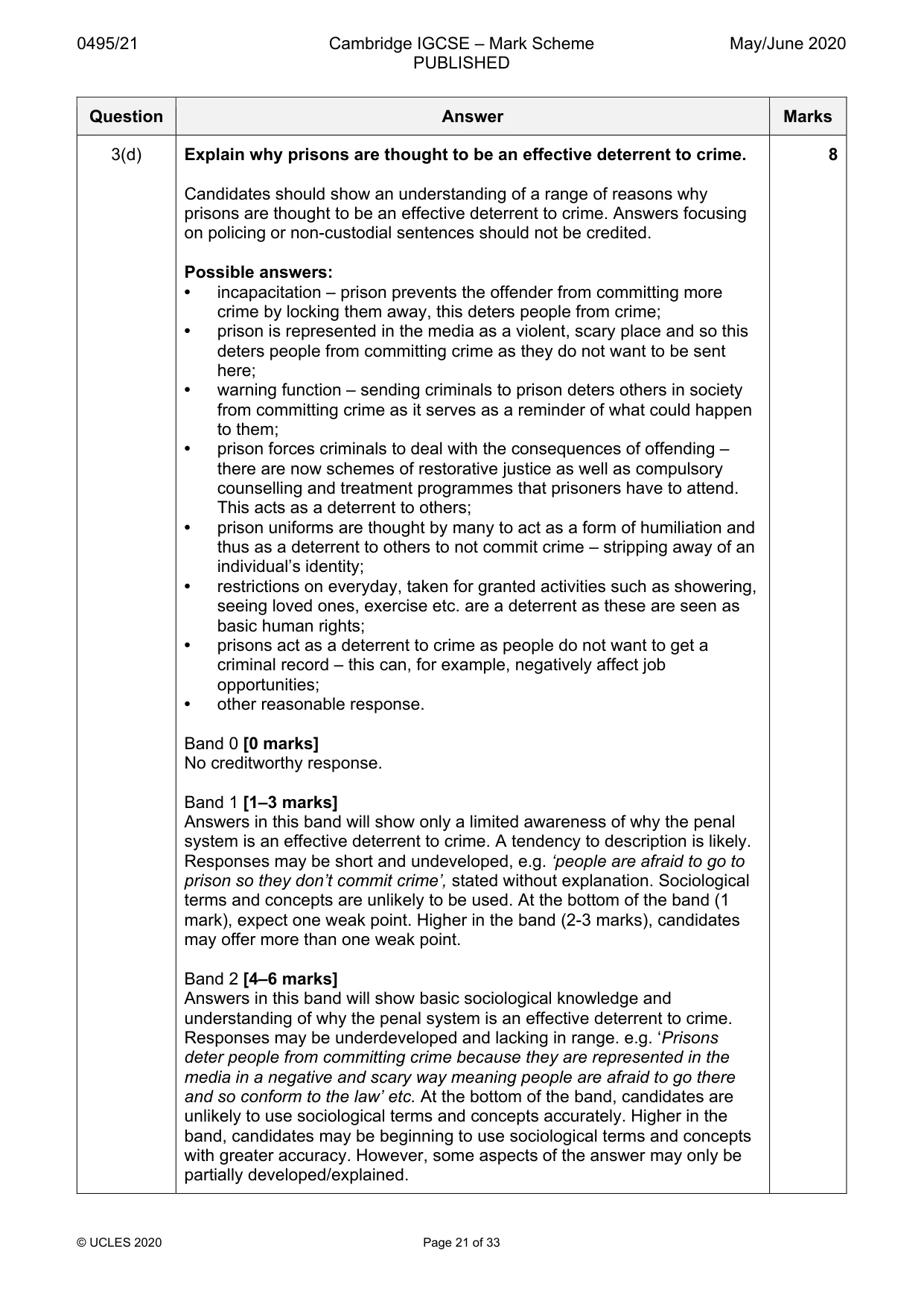
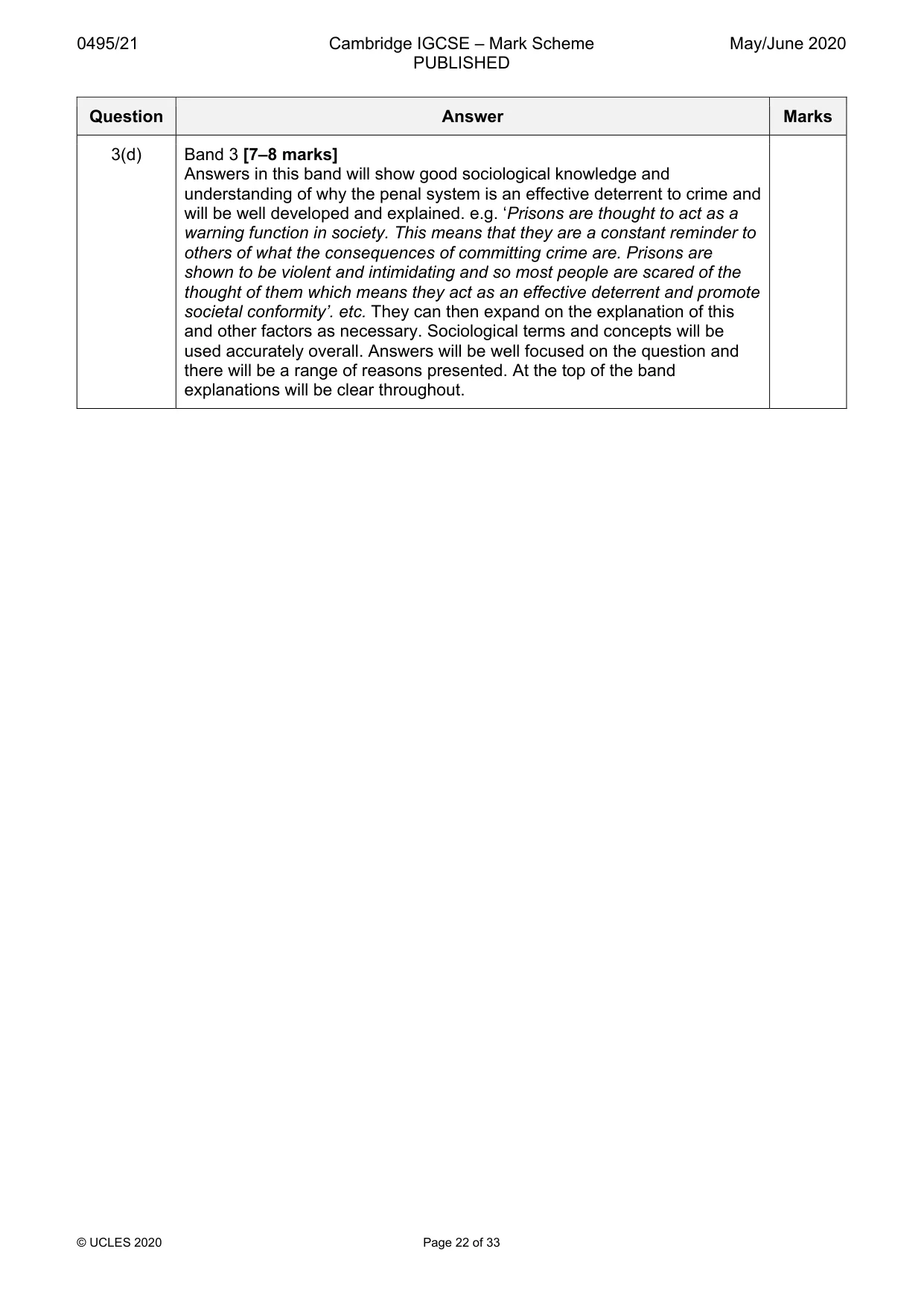
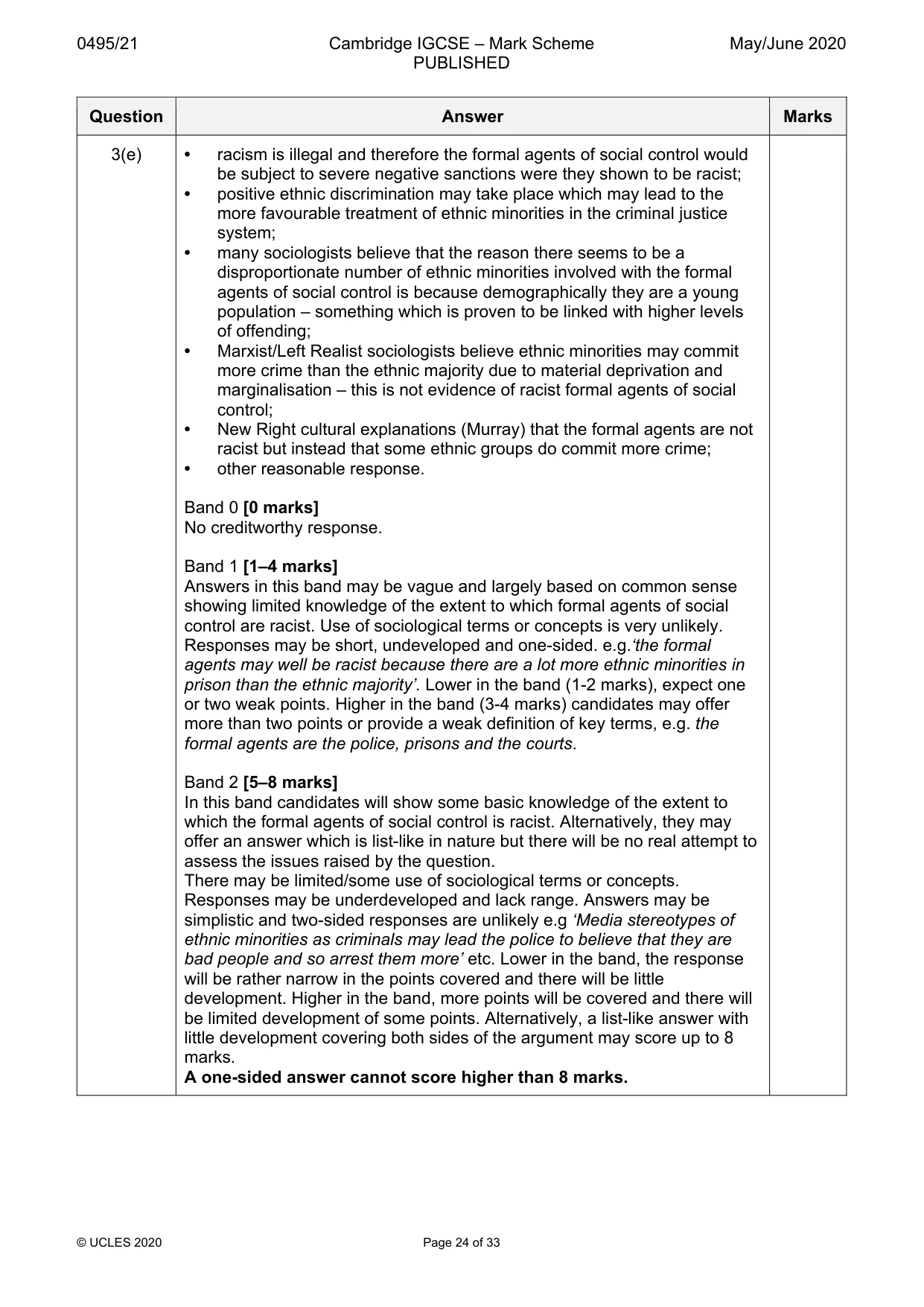
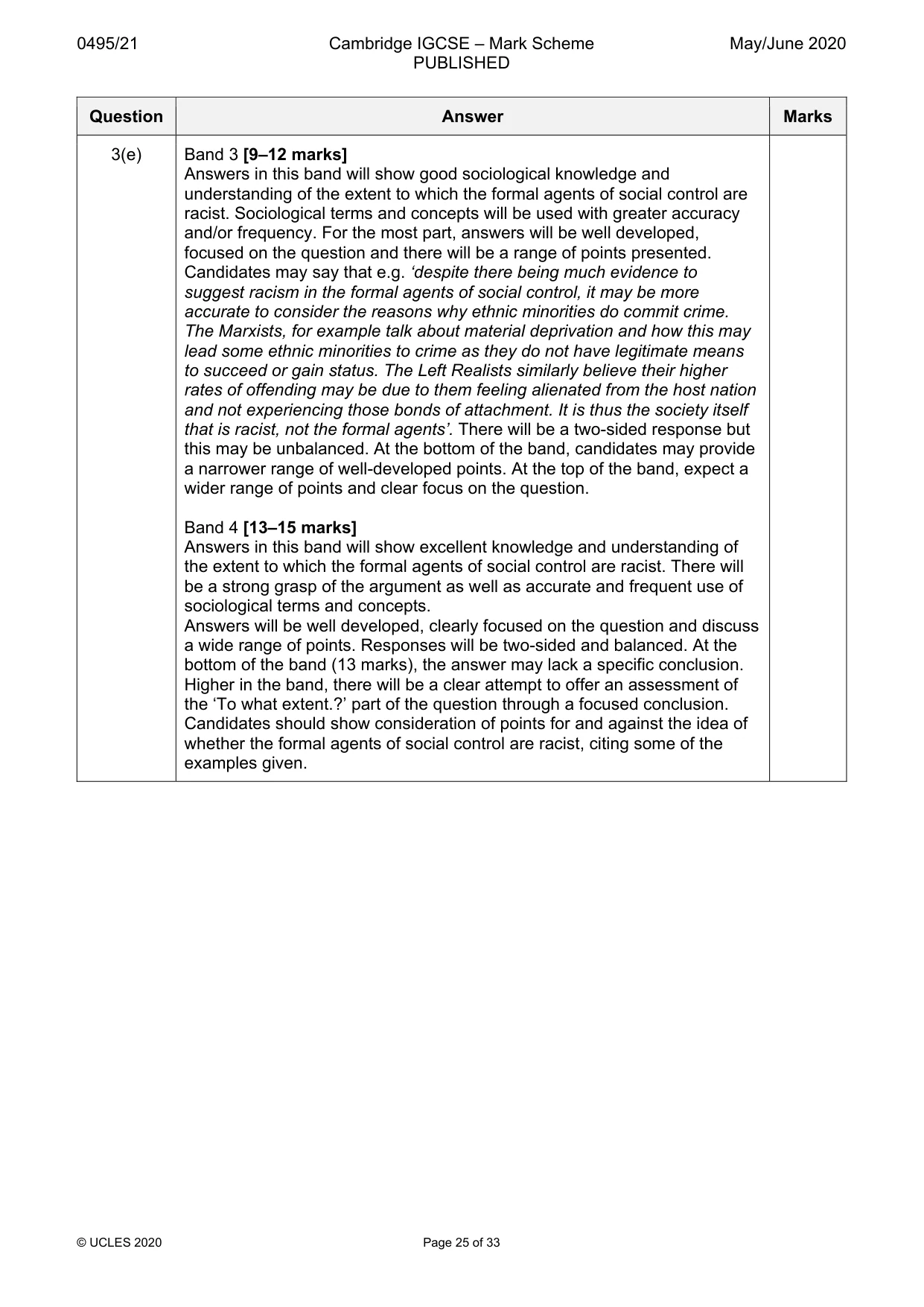
Mark scheme: 3(a) What is meant by the term ‘relative deprivation’? 2 One mark for partial definition, e.g. being poor. Two marks for clear definition, e.g. the feeling of having less than others in a society. 3(b) Describe two agencies of social control. 4 Candidates will describe two different agencies of social control, these can be either formal or informal or a mixture of both. Possible answers: • the police – control through the power of arrest, surveillance and their presence; • the Government – control through the making and implementation and enforcement of the law; • the penal system – control through incarceration/prison, taking away freedom and choices; • the judiciary – control through sentencing, deciding if someone is guilty or innocent and, if guilty, how best to sentence them; • the family – control through sanctions, imitation, gender roles (canalisation etc.); • education and schools – control through negative and positive sanctions, the hidden curriculum etc.; • the workplace – control through promotion, dismissal, paying wages, re- socialisation; • the peer group – control through peers wanting to fit in, peer pressure, role models; • the media – control through representations and stereotypes, moral panics, imitation, agenda setting, norm referencing etc.; • religion – control through the ultimate sanctions of heaven and hell, dress codes, dietary requirements, prayer etc.; • other reasonable response. One mark for each point correctly identified (up to maximum of two). One mark for each point that is developed (up to a maximum of two). 3(c) Explain how Marxists view crime. 6 Candidates should show an understanding of the Marxist view of crime. This can also include Left Realist explanations such as Lea and Young’s. Possible answers: • laws are made in the interests of the ruling class and criminalise the actions of the working class – this is why there are so many more working class criminals; • white-collar and corporate crime is hidden in the OCS as the agents of social control focus their attentions on the lower classes; • police, as agents of the state, target and arrest the working class far more than the ruling class meaning they are over-represented in the OCS and the prison population; • working class crime as an expression of resistance against the structural inequalities of society; • material deprivation – poverty leads to crime; • relative deprivation – in a consumer driven society material possessions become highly valued but not everyone can afford them, hence crime occurs; • status frustration, marginalisation and alienation – lower social classes and some ethnic minorities do not feel part of wider society so have no other outlet for their frustrations and anger than rioting, vandalism and crime; • Marxists believe that capitalism causes crime; • Marxists believe that the police operate a system of selective law enforcement through, for example, targeting particular social groups; • other reasonable response. Band 0 [0 marks] No creditworthy response. Band 1 [1–3 marks] Answers in this band will show only a limited awareness of Marxist explanations for crime and may talk about e.g. ‘some people in society are poor so they can’t get all the things they want and so turn to crime’. Responses may be short and un/under developed. At the bottom of the band (1 mark), expect one weak point. Higher in the band (2-3 marks), candidates may offer more than one weak point, but there may be a tendency towards simplistic answers, engaging with sociological ideas without using sociological language. 3(c) Band 2 [4–6 marks] A clear and accurate explanation, showing good sociological knowledge and understanding of Marxist explanations for crime. Sociological terms and concepts should be expected e.g. ‘Marxists believe the laws and the criminal justice system are made in favour of the ruling class. Thus the working classes are frequently targeted by the state agents, the police, and so are arrested and imprisoned more. This can often lead to frustrations and anger at the perceived unfairness and this can cause more crime to occur’. This would be followed by explanation of factors leading to this. At the bottom of the band, the range of points covered may be narrow or lack detail. Higher in the band, answers will cover more than one factor in a well-developed way or cover several factors in less detail. 3(d) Explain why prisons are thought to be an effective deterrent to crime. 8 Candidates should show an understanding of a range of reasons why prisons are thought to be an effective deterrent to crime. Answers focusing on policing or non-custodial sentences should not be credited. Possible answers: • incapacitation – prison prevents the offender from committing more crime by locking them away, this deters people from crime; • prison is represented in the media as a violent, scary place and so this deters people from committing crime as they do not want to be sent here; • warning function – sending criminals to prison deters others in society from committing crime as it serves as a reminder of what could happen to them; • prison forces criminals to deal with the consequences of offending – there are now schemes of restorative justice as well as compulsory counselling and treatment programmes that prisoners have to attend. This acts as a deterrent to others; • prison uniforms are thought by many to act as a form of humiliation and thus as a deterrent to others to not commit crime – stripping away of an individual’s identity; • restrictions on everyday, taken for granted activities such as showering, seeing loved ones, exercise etc. are a deterrent as these are seen as basic human rights; • prisons act as a deterrent to crime as people do not want to get a criminal record – this can, for example, negatively affect job opportunities; • other reasonable response. Band 0 [0 marks] No creditworthy response. Band 1 [1–3 marks] Answers in this band will show only a limited awareness of why the penal system is an effective deterrent to crime. A tendency to description is likely. Responses may be short and undeveloped, e.g. ‘people are afraid to go to prison so they don’t commit crime’, stated without explanation. Sociological terms and concepts are unlikely to be used. At the bottom of the band (1 mark), expect one weak point. Higher in the band (2-3 marks), candidates may offer more than one weak point. Band 2 [4–6 marks] Answers in this band will show basic sociological knowledge and understanding of why the penal system is an effective deterrent to crime. Responses may be underdeveloped and lacking in range. e.g. ‘Prisons deter people from committing crime because they are represented in the media in a negative and scary way meaning people are afraid to go there and so conform to the law’ etc. At the bottom of the band, candidates are unlikely to use sociological terms and concepts accurately. Higher in the band, candidates may be beginning to use sociological terms and concepts with greater accuracy. However, some aspects of the answer may only be partially developed/explained. 3(d) Band 3 [7–8 marks] Answers in this band will show good sociological knowledge and understanding of why the penal system is an effective deterrent to crime and will be well developed and explained. e.g. ‘Prisons are thought to act as a warning function in society. This means that they are a constant reminder to others of what the consequences of committing crime are. Prisons are shown to be violent and intimidating and so most people are scared of the thought of them which means they act as an effective deterrent and promote societal conformity’. etc. They can then expand on the explanation of this and other factors as necessary. Sociological terms and concepts will be used accurately overall. Answers will be well focused on the question and there will be a range of reasons presented. At the top of the band explanations will be clear throughout. 3(e) To what extent are the formal agencies of social control racist? 15 Candidates should consider the extent to which the formal agencies of social control may be racist. This may include consideration of the judiciary, the police and the prison system. They could talk generally about this topic or could focus more specifically on specific examples of racism. Local/culturally specific examples may be referred to and should be credited accordingly. Possible answers: FOR • arrest and stop and search rates for ethnic minorities are considerably higher than for the ethic majority e.g. 6 times higher for Afro-Caribbeans than whites in the UK; • Cicourel’s study shows that the police and courts have a picture in their heads of the ‘typical delinquent’ and this is linked to ethnicity; • the police, judiciary and other formal agents of social control are all dominated by the ethnic majority, this may lead to prejudice and discrimination against ethnic minorities; • the Metropolitan police in London were branded as institutionally racist by an independent report after the death of Stephen Lawrence, a black teenager; • ethnic minorities are over-represented in the prison system which may be a sign of the formal agents of social control being racist; • police labelling of ethnic minorities as criminals may lead to police targeting of areas dominated by ethnic minorities e.g. inner city gangs, this could be racist; • Hall et al ‘Policing the Crisis’ shows how young Afro-Caribbeans became stereotyped as muggers which led to police crackdowns on this social group following pressure from the Government; • research shows that members of ethnic minorities face more custodial sentences than the ethnic majority as well as receiving a longer prison term; • Islamaphobia has been blamed by many sociologists for the increases in targeting, arresting and sentencing of Asians in recent years; • other reasonable response. AGAINST • Marxists would claim that the formal agents of social control are more biased against those from the working class than ethnic minorities; • many sociologists believe that being young and male are greater ‘risk’ factors when it comes to unequal treatment by the formal agents of social control than ethnicity; • the Race Relations Act and other equal opportunities legislation means that everyone is very aware of the need to treat all ethnic groups fairly, thereby eliminating racism in the formal agents of social control; • there have been several active campaigns to increase numbers of ethnic minorities in positions of power in the formal agents of social control e.g. the police, in order to prevent future cases of racism; 3(e) • racism is illegal and therefore the formal agents of social control would be subject to severe negative sanctions were they shown to be racist; • positive ethnic discrimination may take place which may lead to the more favourable treatment of ethnic minorities in the criminal justice system; • many sociologists believe that the reason there seems to be a disproportionate number of ethnic minorities involved with the formal agents of social control is because demographically they are a young population – something which is proven to be linked with higher levels of offending; • Marxist/Left Realist sociologists believe ethnic minorities may commit more crime than the ethnic majority due to material deprivation and marginalisation – this is not evidence of racist formal agents of social control; • New Right cultural explanations (Murray) that the formal agents are not racist but instead that some ethnic groups do commit more crime; • other reasonable response. Band 0 [0 marks] No creditworthy response. Band 1 [1–4 marks] Answers in this band may be vague and largely based on common sense showing limited knowledge of the extent to which formal agents of social control are racist. Use of sociological terms or concepts is very unlikely. Responses may be short, undeveloped and one-sided. e.g.‘the formal agents may well be racist because there are a lot more ethnic minorities in prison than the ethnic majority’. Lower in the band (1-2 marks), expect one or two weak points. Higher in the band (3-4 marks) candidates may offer more than two points or provide a weak definition of key terms, e.g. the formal agents are the police, prisons and the courts. Band 2 [5–8 marks] In this band candidates will show some basic knowledge of the extent to which the formal agents of social control is racist. Alternatively, they may offer an answer which is list-like in nature but there will be no real attempt to assess the issues raised by the question. There may be limited/some use of sociological terms or concepts. Responses may be underdeveloped and lack range. Answers may be simplistic and two-sided responses are unlikely e.g ‘Media stereotypes of ethnic minorities as criminals may lead the police to believe that they are bad people and so arrest them more’ etc. Lower in the band, the response will be rather narrow in the points covered and there will be little development. Higher in the band, more points will be covered and there will be limited development of some points. Alternatively, a list-like answer with little development covering both sides of the argument may score up to 8 marks. A one-sided answer cannot score higher than 8 marks. 3(e) Band 3 [9–12 marks] Answers in this band will show good sociological knowledge and understanding of the extent to which the formal agents of social control are racist. Sociological terms and concepts will be used with greater accuracy and/or frequency. For the most part, answers will be well developed, focused on the question and there will be a range of points presented. Candidates may say that e.g. ‘despite there being much evidence to suggest racism in the formal agents of social control, it may be more accurate to consider the reasons why ethnic minorities do commit crime. The Marxists, for example talk about material deprivation and how this may lead some ethnic minorities to crime as they do not have legitimate means to succeed or gain status. The Left Realists similarly believe their higher rates of offending may be due to them feeling alienated from the host nation and not experiencing those bonds of attachment. It is thus the society itself that is racist, not the formal agents’. There will be a two-sided response but this may be unbalanced. At the bottom of the band, candidates may provide a narrower range of well-developed points. At the top of the band, expect a wider range of points and clear focus on the question. Band 4 [13–15 marks] Answers in this band will show excellent knowledge and understanding of the extent to which the formal agents of social control are racist. There will be a strong grasp of the argument as well as accurate and frequent use of sociological terms and concepts. Answers will be well developed, clearly focused on the question and discuss a wide range of points. Responses will be two-sided and balanced. At the bottom of the band (13 marks), the answer may lack a specific conclusion. Higher in the band, there will be a clear attempt to offer an assessment of the ‘To what extent.?’ part of the question through a focused conclusion. Candidates should show consideration of points for and against the idea of whether the formal agents of social control are racist, citing some of the examples given.
Q4 · In many countries there is public service broadcasting
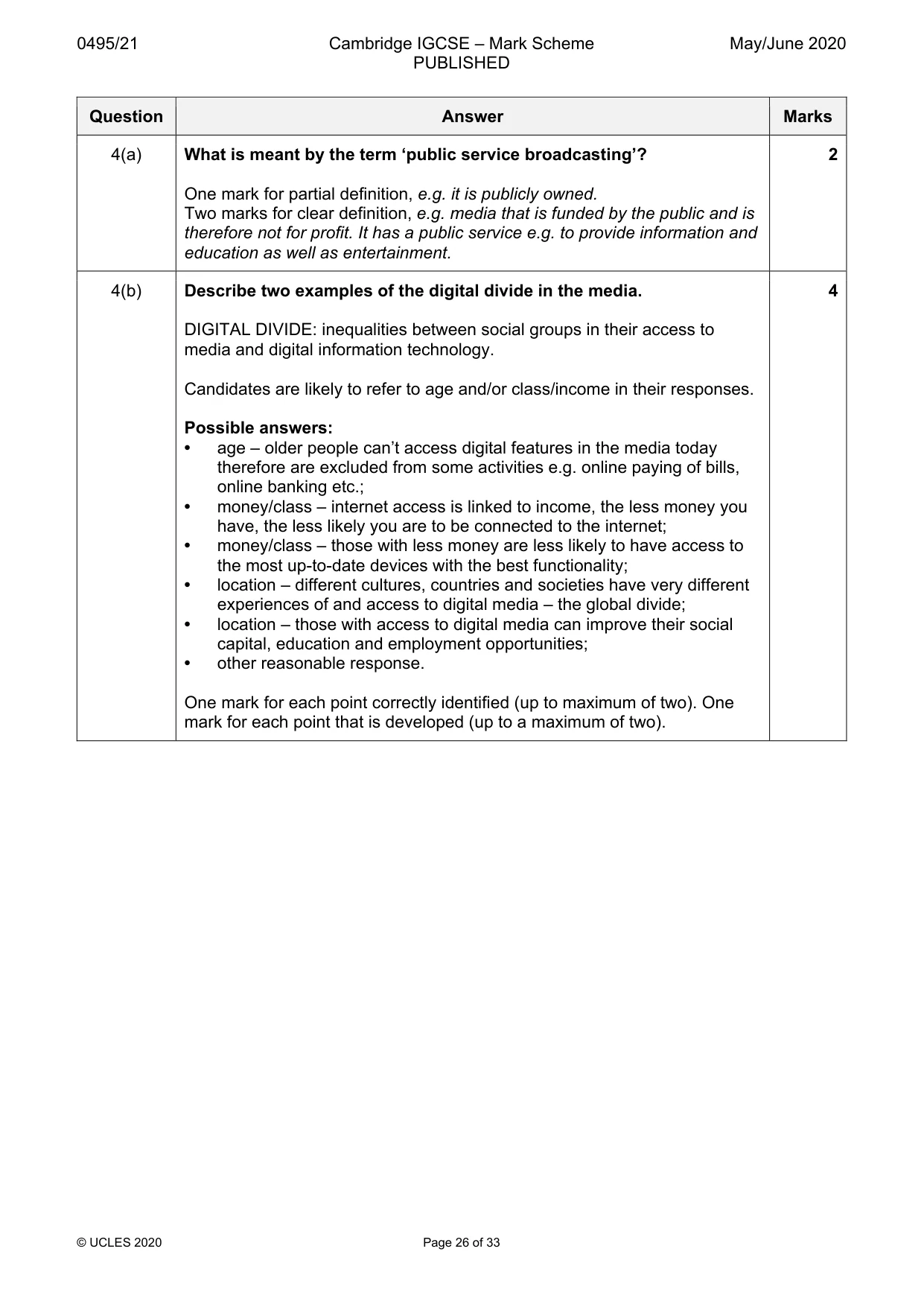
4 In many countries there is public service broadcasting. However, some media is controlled by private companies who make large profits. Audiences consume the media in different ways and patterns of use are quite diverse. Whether the content of the media influences the audience’s behaviour and attitudes remains a matter of debate. (a) What is meant by the term ‘public service broadcasting’? [2] (b) Describe two examples of the digital divide in the media. [4] (c) Explain how different age groups vary in their patterns of media use. [6] (d) Explain why the media needs to be censored. [8] (e) To what extent is the cultural effects approach correct in explaining how the audience is influenced by the media? [15]
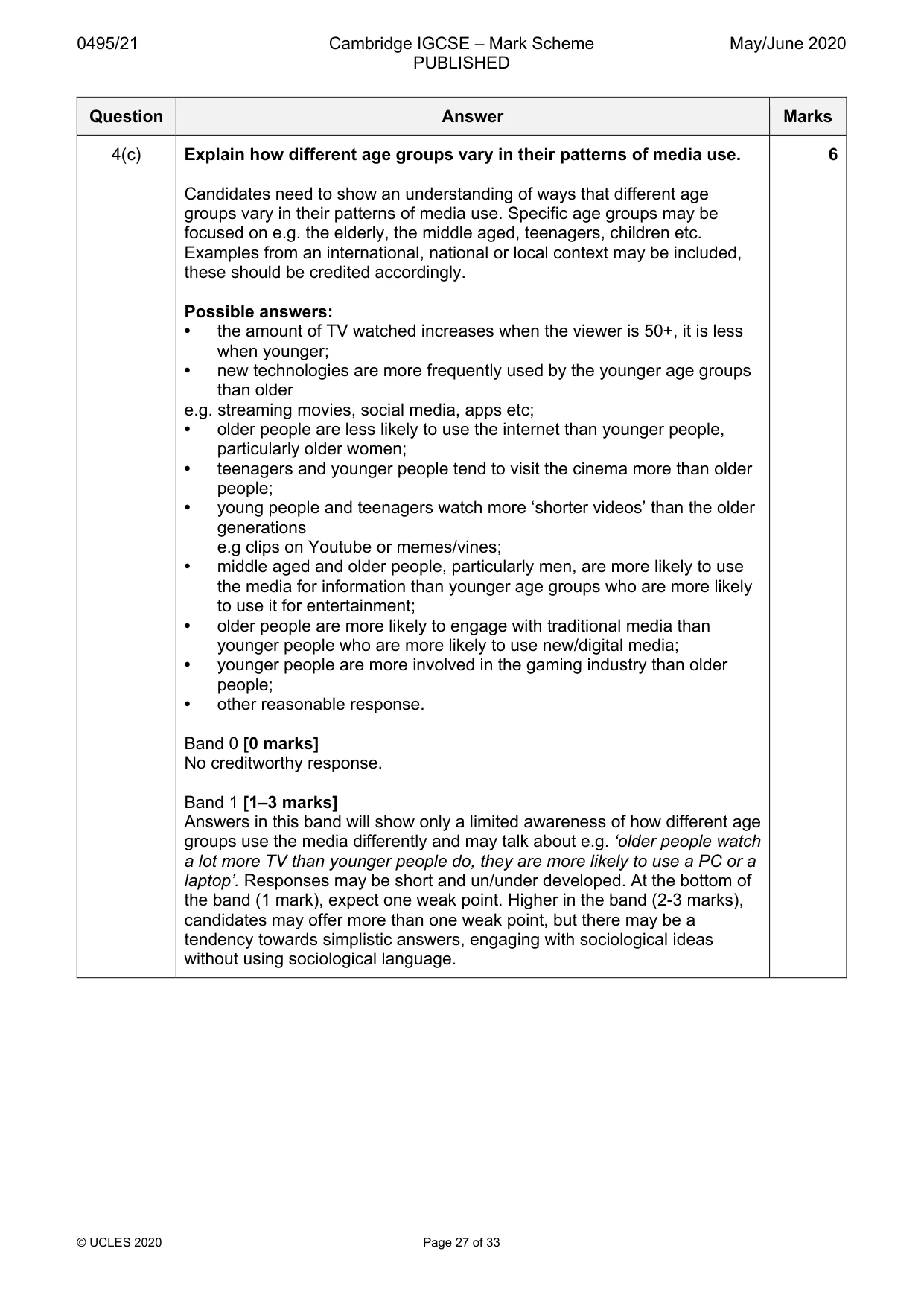
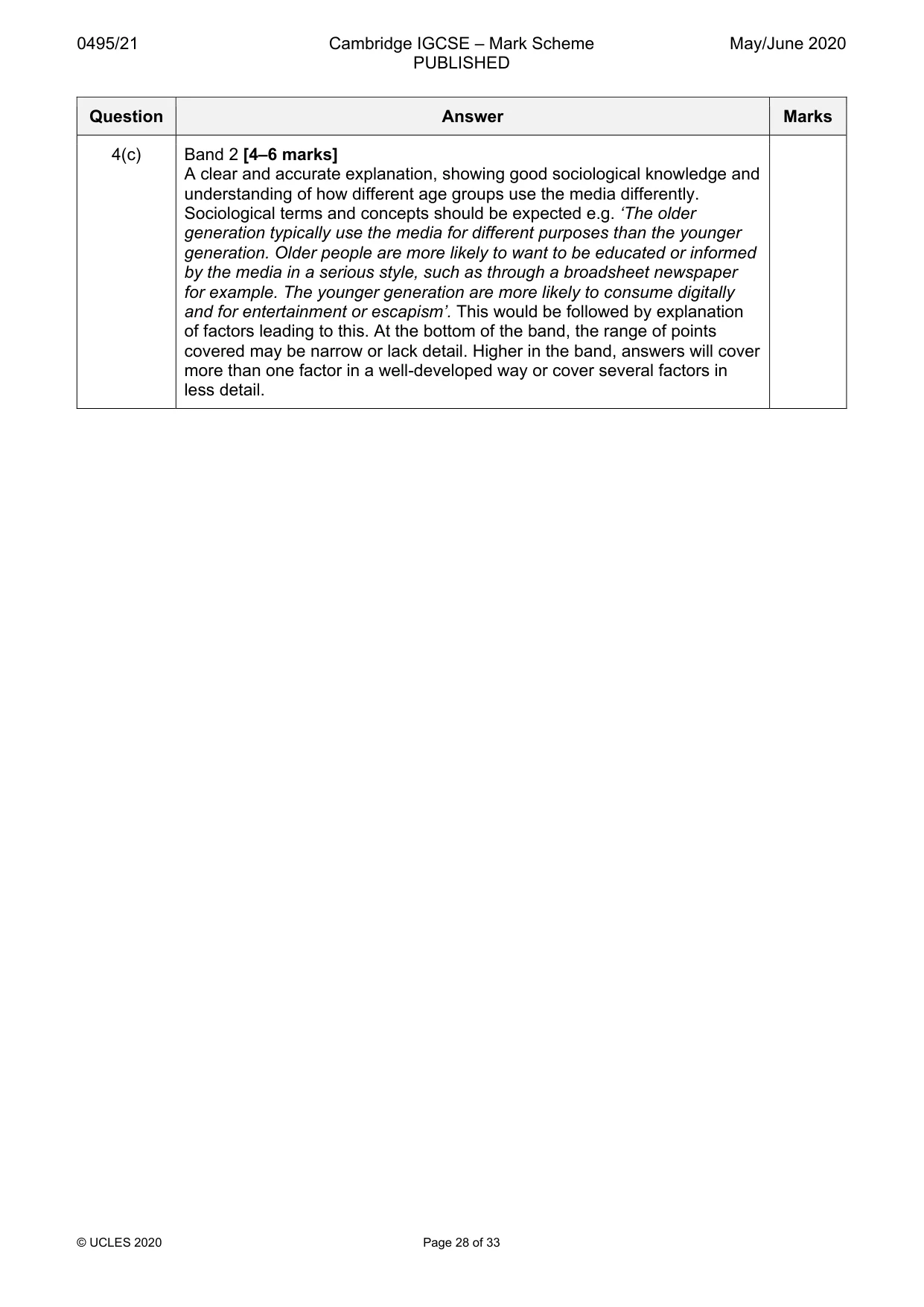
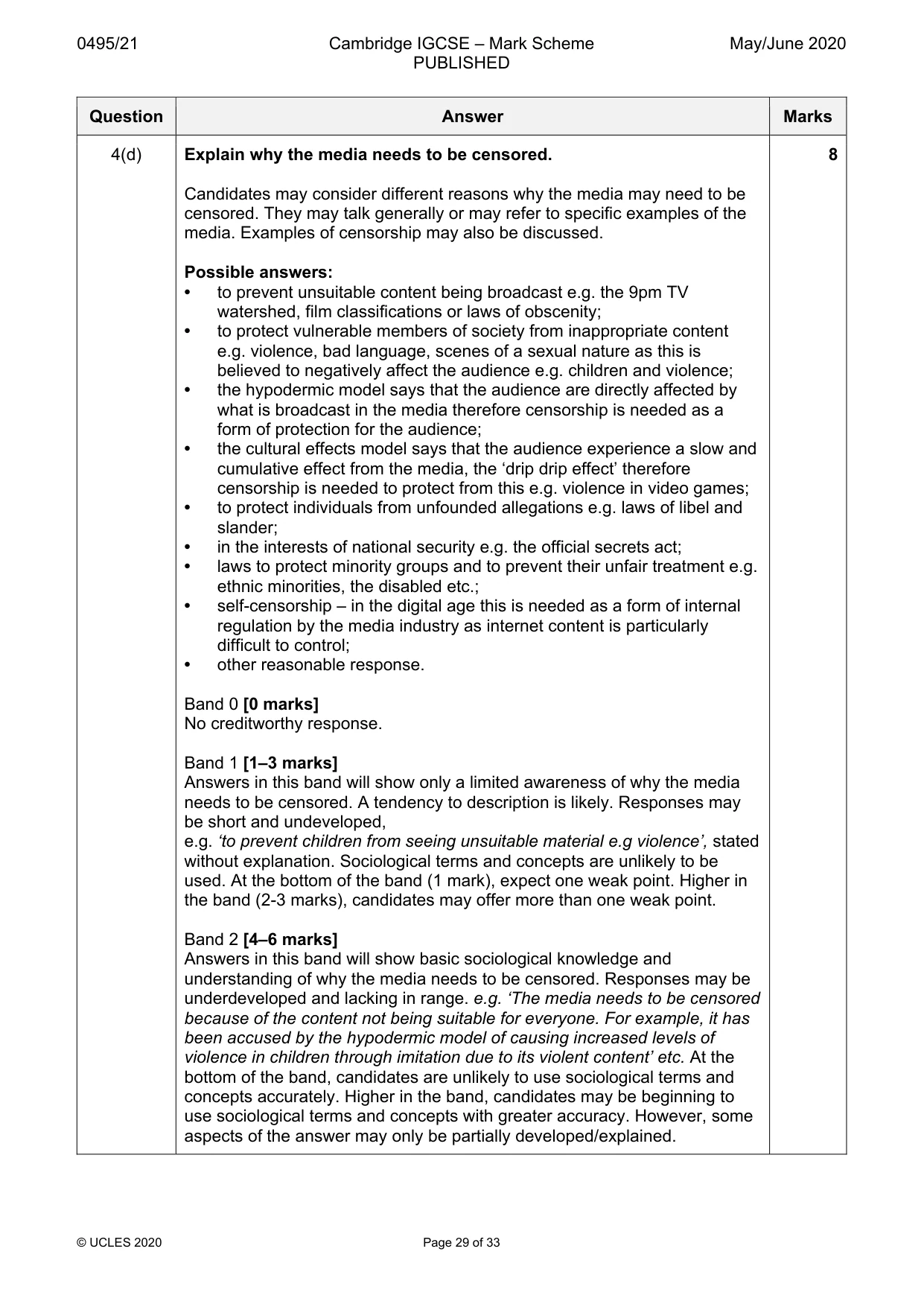
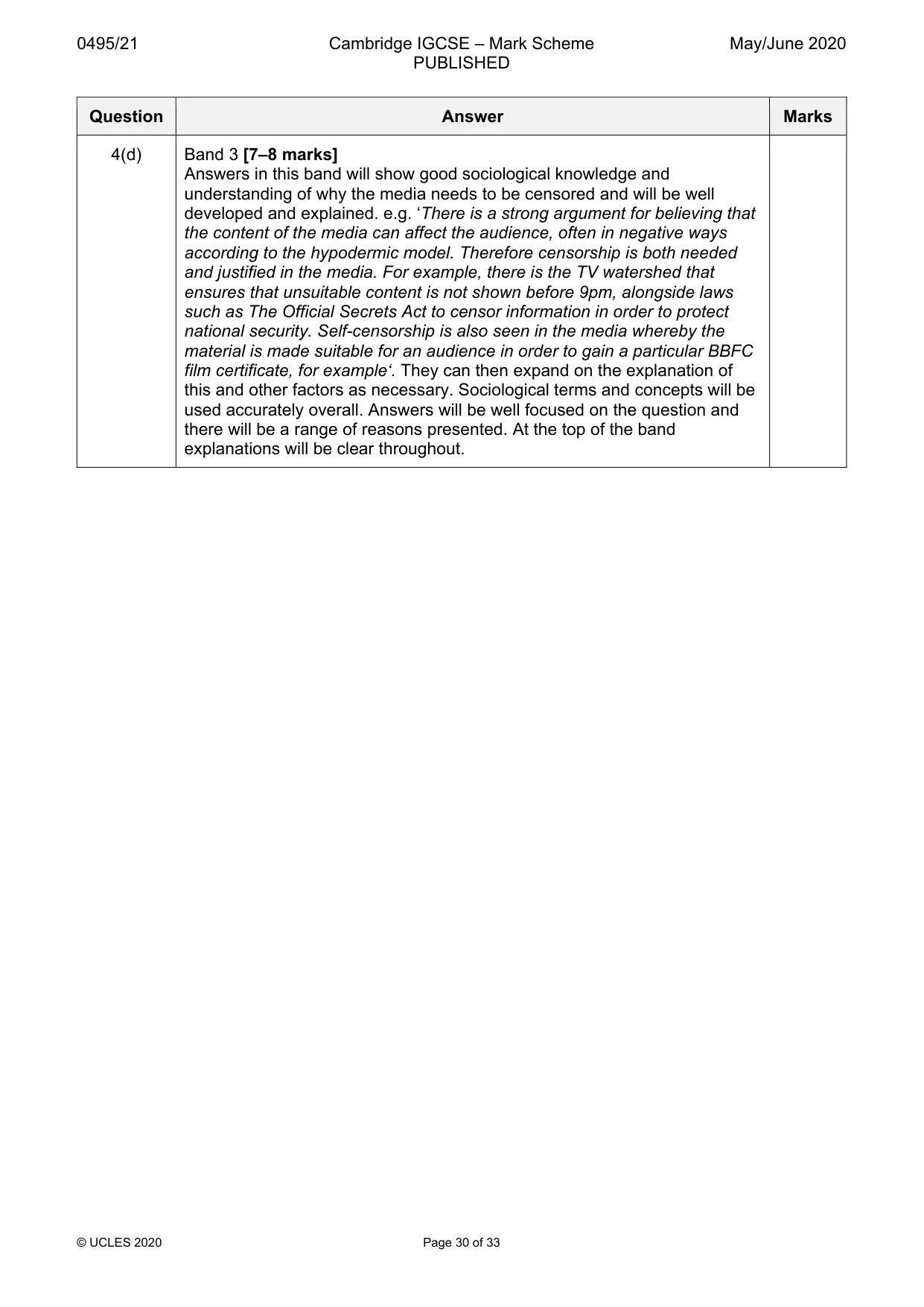
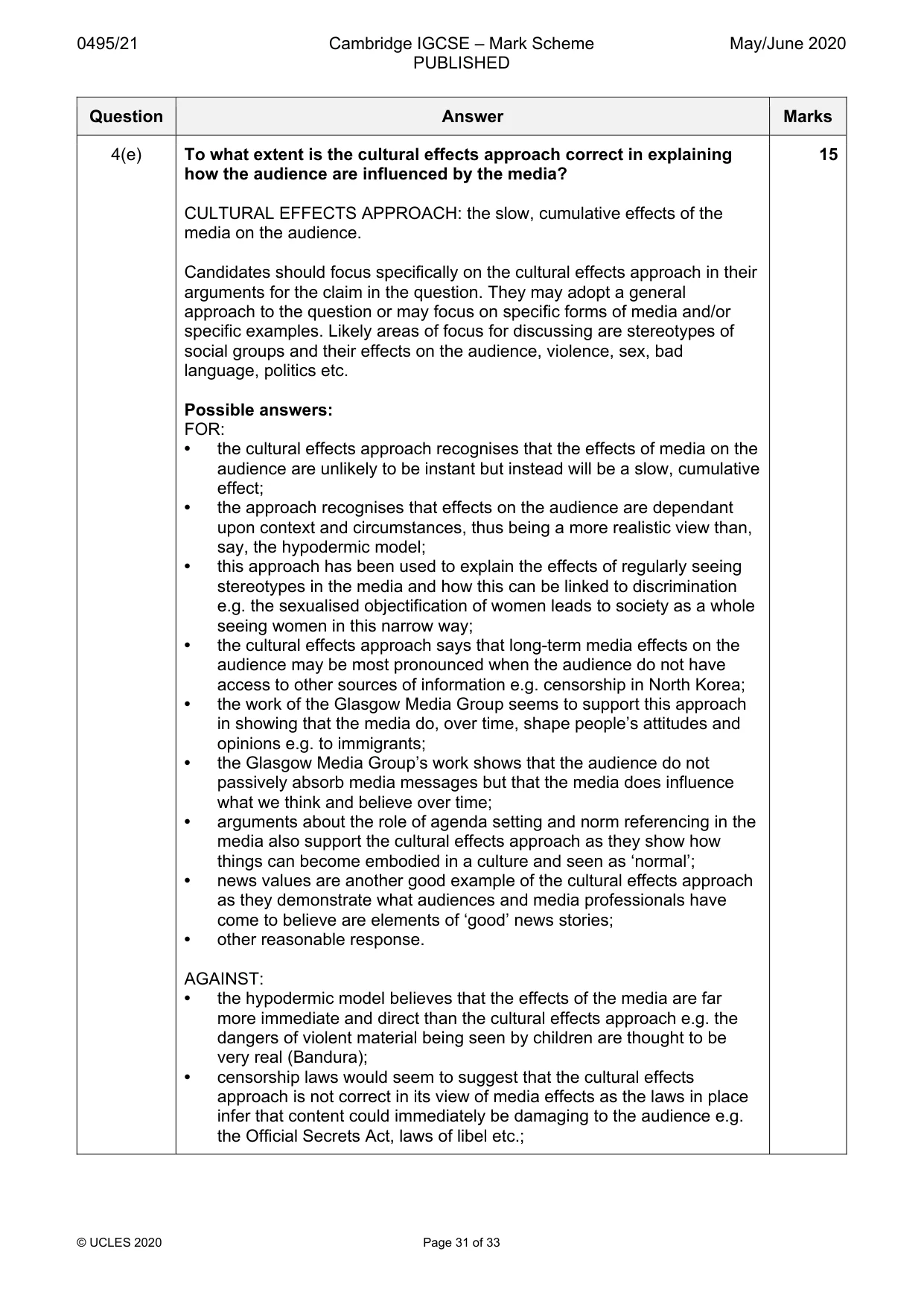
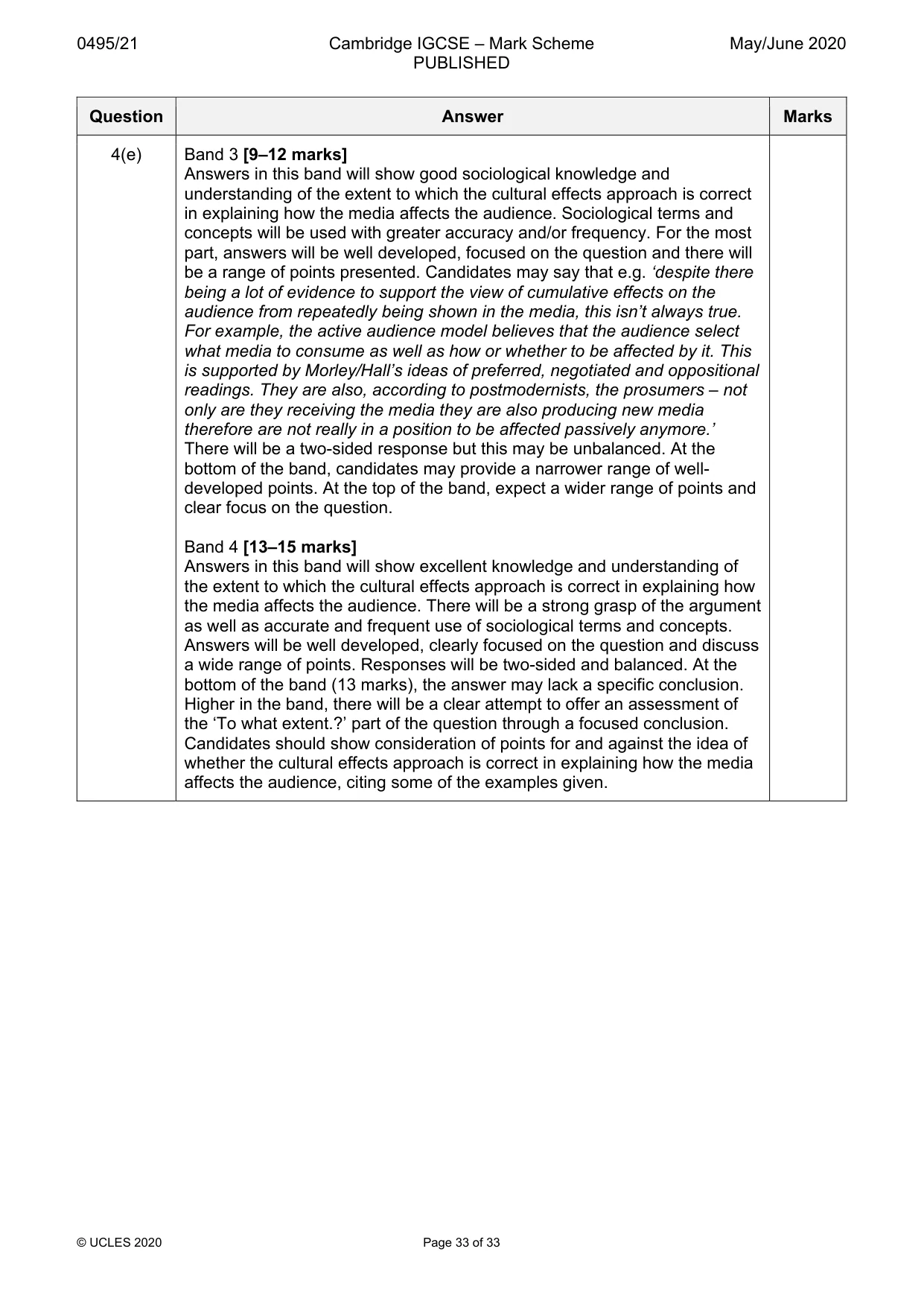
Mark scheme: 4(a) What is meant by the term ‘public service broadcasting’? 2 One mark for partial definition, e.g. it is publicly owned. Two marks for clear definition, e.g. media that is funded by the public and is therefore not for profit. It has a public service e.g. to provide information and education as well as entertainment. 4(b) Describe two examples of the digital divide in the media. 4 DIGITAL DIVIDE: inequalities between social groups in their access to media and digital information technology. Candidates are likely to refer to age and/or class/income in their responses. Possible answers: • age – older people can’t access digital features in the media today therefore are excluded from some activities e.g. online paying of bills, online banking etc.; • money/class – internet access is linked to income, the less money you have, the less likely you are to be connected to the internet; • money/class – those with less money are less likely to have access to the most up-to-date devices with the best functionality; • location – different cultures, countries and societies have very different experiences of and access to digital media – the global divide; • location – those with access to digital media can improve their social capital, education and employment opportunities; • other reasonable response. One mark for each point correctly identified (up to maximum of two). One mark for each point that is developed (up to a maximum of two). 4(c) Explain how different age groups vary in their patterns of media use. 6 Candidates need to show an understanding of ways that different age groups vary in their patterns of media use. Specific age groups may be focused on e.g. the elderly, the middle aged, teenagers, children etc. Examples from an international, national or local context may be included, these should be credited accordingly. Possible answers: • the amount of TV watched increases when the viewer is 50+, it is less when younger; • new technologies are more frequently used by the younger age groups than older e.g. streaming movies, social media, apps etc; • older people are less likely to use the internet than younger people, particularly older women; • teenagers and younger people tend to visit the cinema more than older people; • young people and teenagers watch more ‘shorter videos’ than the older generations e.g clips on Youtube or memes/vines; • middle aged and older people, particularly men, are more likely to use the media for information than younger age groups who are more likely to use it for entertainment; • older people are more likely to engage with traditional media than younger people who are more likely to use new/digital media; • younger people are more involved in the gaming industry than older people; • other reasonable response. Band 0 [0 marks] No creditworthy response. Band 1 [1–3 marks] Answers in this band will show only a limited awareness of how different age groups use the media differently and may talk about e.g. ‘older people watch a lot more TV than younger people do, they are more likely to use a PC or a laptop’. Responses may be short and un/under developed. At the bottom of the band (1 mark), expect one weak point. Higher in the band (2-3 marks), candidates may offer more than one weak point, but there may be a tendency towards simplistic answers, engaging with sociological ideas without using sociological language. 4(c) Band 2 [4–6 marks] A clear and accurate explanation, showing good sociological knowledge and understanding of how different age groups use the media differently. Sociological terms and concepts should be expected e.g. ‘The older generation typically use the media for different purposes than the younger generation. Older people are more likely to want to be educated or informed by the media in a serious style, such as through a broadsheet newspaper for example. The younger generation are more likely to consume digitally and for entertainment or escapism’. This would be followed by explanation of factors leading to this. At the bottom of the band, the range of points covered may be narrow or lack detail. Higher in the band, answers will cover more than one factor in a well-developed way or cover several factors in less detail. 4(d) Explain why the media needs to be censored. 8 Candidates may consider different reasons why the media may need to be censored. They may talk generally or may refer to specific examples of the media. Examples of censorship may also be discussed. Possible answers: • to prevent unsuitable content being broadcast e.g. the 9pm TV watershed, film classifications or laws of obscenity; • to protect vulnerable members of society from inappropriate content e.g. violence, bad language, scenes of a sexual nature as this is believed to negatively affect the audience e.g. children and violence; • the hypodermic model says that the audience are directly affected by what is broadcast in the media therefore censorship is needed as a form of protection for the audience; • the cultural effects model says that the audience experience a slow and cumulative effect from the media, the ‘drip drip effect’ therefore censorship is needed to protect from this e.g. violence in video games; • to protect individuals from unfounded allegations e.g. laws of libel and slander; • in the interests of national security e.g. the official secrets act; • laws to protect minority groups and to prevent their unfair treatment e.g. ethnic minorities, the disabled etc.; • self-censorship – in the digital age this is needed as a form of internal regulation by the media industry as internet content is particularly difficult to control; • other reasonable response. Band 0 [0 marks] No creditworthy response. Band 1 [1–3 marks] Answers in this band will show only a limited awareness of why the media needs to be censored. A tendency to description is likely. Responses may be short and undeveloped, e.g. ‘to prevent children from seeing unsuitable material e.g violence’, stated without explanation. Sociological terms and concepts are unlikely to be used. At the bottom of the band (1 mark), expect one weak point. Higher in the band (2-3 marks), candidates may offer more than one weak point. Band 2 [4–6 marks] Answers in this band will show basic sociological knowledge and understanding of why the media needs to be censored. Responses may be underdeveloped and lacking in range. e.g. ‘The media needs to be censored because of the content not being suitable for everyone. For example, it has been accused by the hypodermic model of causing increased levels of violence in children through imitation due to its violent content’ etc. At the bottom of the band, candidates are unlikely to use sociological terms and concepts accurately. Higher in the band, candidates may be beginning to use sociological terms and concepts with greater accuracy. However, some aspects of the answer may only be partially developed/explained. 4(d) Band 3 [7–8 marks] Answers in this band will show good sociological knowledge and understanding of why the media needs to be censored and will be well developed and explained. e.g. ‘There is a strong argument for believing that the content of the media can affect the audience, often in negative ways according to the hypodermic model. Therefore censorship is both needed and justified in the media. For example, there is the TV watershed that ensures that unsuitable content is not shown before 9pm, alongside laws such as The Official Secrets Act to censor information in order to protect national security. Self-censorship is also seen in the media whereby the material is made suitable for an audience in order to gain a particular BBFC film certificate, for example‘. They can then expand on the explanation of this and other factors as necessary. Sociological terms and concepts will be used accurately overall. Answers will be well focused on the question and there will be a range of reasons presented. At the top of the band explanations will be clear throughout. 4(e) To what extent is the cultural effects approach correct in explaining 15 how the audience are influenced by the media? CULTURAL EFFECTS APPROACH: the slow, cumulative effects of the media on the audience. Candidates should focus specifically on the cultural effects approach in their arguments for the claim in the question. They may adopt a general approach to the question or may focus on specific forms of media and/or specific examples. Likely areas of focus for discussing are stereotypes of social groups and their effects on the audience, violence, sex, bad language, politics etc. Possible answers: FOR: • the cultural effects approach recognises that the effects of media on the audience are unlikely to be instant but instead will be a slow, cumulative effect; • the approach recognises that effects on the audience are dependant upon context and circumstances, thus being a more realistic view than, say, the hypodermic model; • this approach has been used to explain the effects of regularly seeing stereotypes in the media and how this can be linked to discrimination e.g. the sexualised objectification of women leads to society as a whole seeing women in this narrow way; • the cultural effects approach says that long-term media effects on the audience may be most pronounced when the audience do not have access to other sources of information e.g. censorship in North Korea; • the work of the Glasgow Media Group seems to support this approach in showing that the media do, over time, shape people’s attitudes and opinions e.g. to immigrants; • the Glasgow Media Group’s work shows that the audience do not passively absorb media messages but that the media does influence what we think and believe over time; • arguments about the role of agenda setting and norm referencing in the media also support the cultural effects approach as they show how things can become embodied in a culture and seen as ‘normal’; • news values are another good example of the cultural effects approach as they demonstrate what audiences and media professionals have come to believe are elements of ‘good’ news stories; • other reasonable response. AGAINST: • the hypodermic model believes that the effects of the media are far more immediate and direct than the cultural effects approach e.g. the dangers of violent material being seen by children are thought to be very real (Bandura); • censorship laws would seem to suggest that the cultural effects approach is not correct in its view of media effects as the laws in place infer that content could immediately be damaging to the audience e.g. the Official Secrets Act, laws of libel etc.; 4(e) • the uses and gratifications approach awards the audience with far more power and control over how they are affected by the media than the cultural effects approach, McQuail says we should ask ‘how do audiences use the media’?; • audience selection says the audience have power over the media as they can decide how they interpret any media content that they consume e.g. Hall’s work on reading the media; • postmodern work on the new media says that the audience are now in control of the media and therefore are not affected by it but are active producers of it instead e.g. through the internet; • the interactive nature of new media means that the audience can actively construct meanings through discussion, comments and immersion e.g. forums, blogs, gaming etc.; • pluralism – there is so much diversity in today’s media that audience choice is vast and therefore it is impossible to say that effects are caused solely by the cumulative effects of the media; • other reasonable response. Band 0 [0 marks] No creditworthy response. Band 1 [1–4 marks] Answers in this band may be vague and largely based on common sense showing limited knowledge of the extent to which the cultural effects approach is correct in explaining how the media affects the audience. Use of sociological terms or concepts is very unlikely. Responses may be short, undeveloped and one-sided. e.g. ‘When the audience sees something in the media repeatedly they do start to believe it’. Lower in the band (1-2 marks), expect one or two weak points. Higher in the band (3-4 marks) candidates may offer more than two points or provide a weak definition of key terms, e.g. the cultural effects approach says media content does affect the audience. Band 2 [5–8 marks] In this band candidates will show some basic knowledge of the extent to which the cultural effects approach is correct in explaining how the media affects the audience. Alternatively, they may offer an answer which is list- like in nature but there will be no real attempt to assess the issues raised by the question. There may be limited/some use of sociological terms or concepts. Responses may be underdeveloped and lack range. Answers may be simplistic and two-sided responses are unlikely e.g. ‘When the audience sees something in the media repeatedly they do start to believe it. For example, the representation of the idealised woman is a frequently seen stereotype in the media that affects females’ etc. Lower in the band, the response will be rather narrow in the points covered and there will be little development. Higher in the band, more points will be covered and there will be limited development of some points. Alternatively, a list-like answer with little development covering both sides of the argument may score up to 8 marks. A one-sided answer cannot score higher than 8 marks. 4(e) Band 3 [9–12 marks] Answers in this band will show good sociological knowledge and understanding of the extent to which the cultural effects approach is correct in explaining how the media affects the audience. Sociological terms and concepts will be used with greater accuracy and/or frequency. For the most part, answers will be well developed, focused on the question and there will be a range of points presented. Candidates may say that e.g. ‘despite there being a lot of evidence to support the view of cumulative effects on the audience from repeatedly being shown in the media, this isn’t always true. For example, the active audience model believes that the audience select what media to consume as well as how or whether to be affected by it. This is supported by Morley/Hall’s ideas of preferred, negotiated and oppositional readings. They are also, according to postmodernists, the prosumers – not only are they receiving the media they are also producing new media therefore are not really in a position to be affected passively anymore.’ There will be a two-sided response but this may be unbalanced. At the bottom of the band, candidates may provide a narrower range of well- developed points. At the top of the band, expect a wider range of points and clear focus on the question. Band 4 [13–15 marks] Answers in this band will show excellent knowledge and understanding of the extent to which the cultural effects approach is correct in explaining how the media affects the audience. There will be a strong grasp of the argument as well as accurate and frequent use of sociological terms and concepts. Answers will be well developed, clearly focused on the question and discuss a wide range of points. Responses will be two-sided and balanced. At the bottom of the band (13 marks), the answer may lack a specific conclusion. Higher in the band, there will be a clear attempt to offer an assessment of the ‘To what extent.?’ part of the question through a focused conclusion. Candidates should show consideration of points for and against the idea of whether the cultural effects approach is correct in explaining how the media affects the audience, citing some of the examples given.
More questions on How do sociologists approach the study of society?
What was in this paper
The subtopics covered by these 4 questions, and how many questions each got. Open one in a new tab to see every Cambridge question on it.