Cambridge IGCSE Sociology 0495 — 2024 May/June Paper 2 · Variant 2
0495/22/M/J/24 · 4 questions · 70 marks · ≈79 min
The question paper and its mark scheme, free to read here and free to download. This is Cambridge’s own paper, exactly as it was sat.
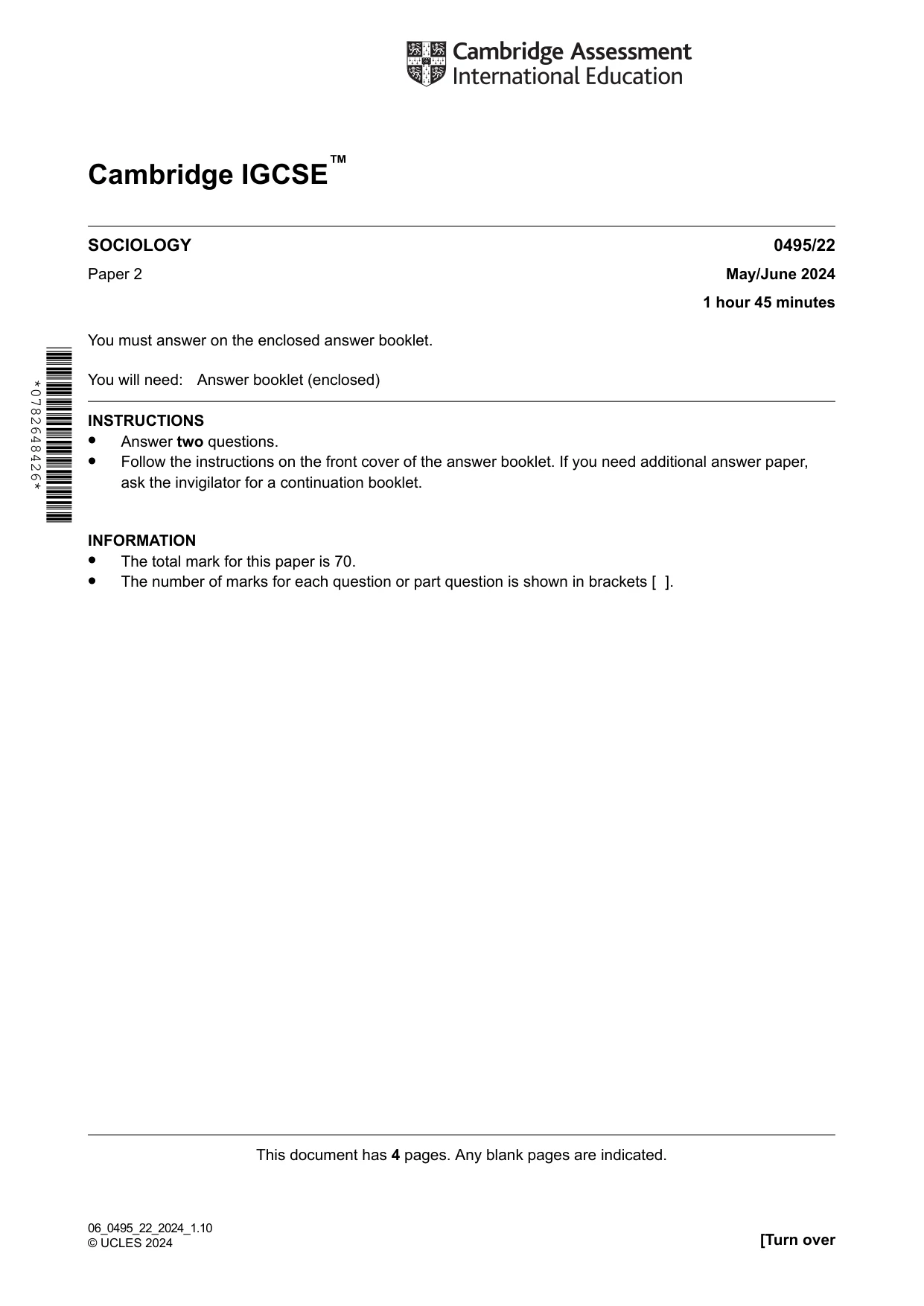
Question paper4 pages

Mark scheme31 pages
Answers below. Sit the paper first if you are practising.



Questions as text
Q1 · Marriage and family life vary globally
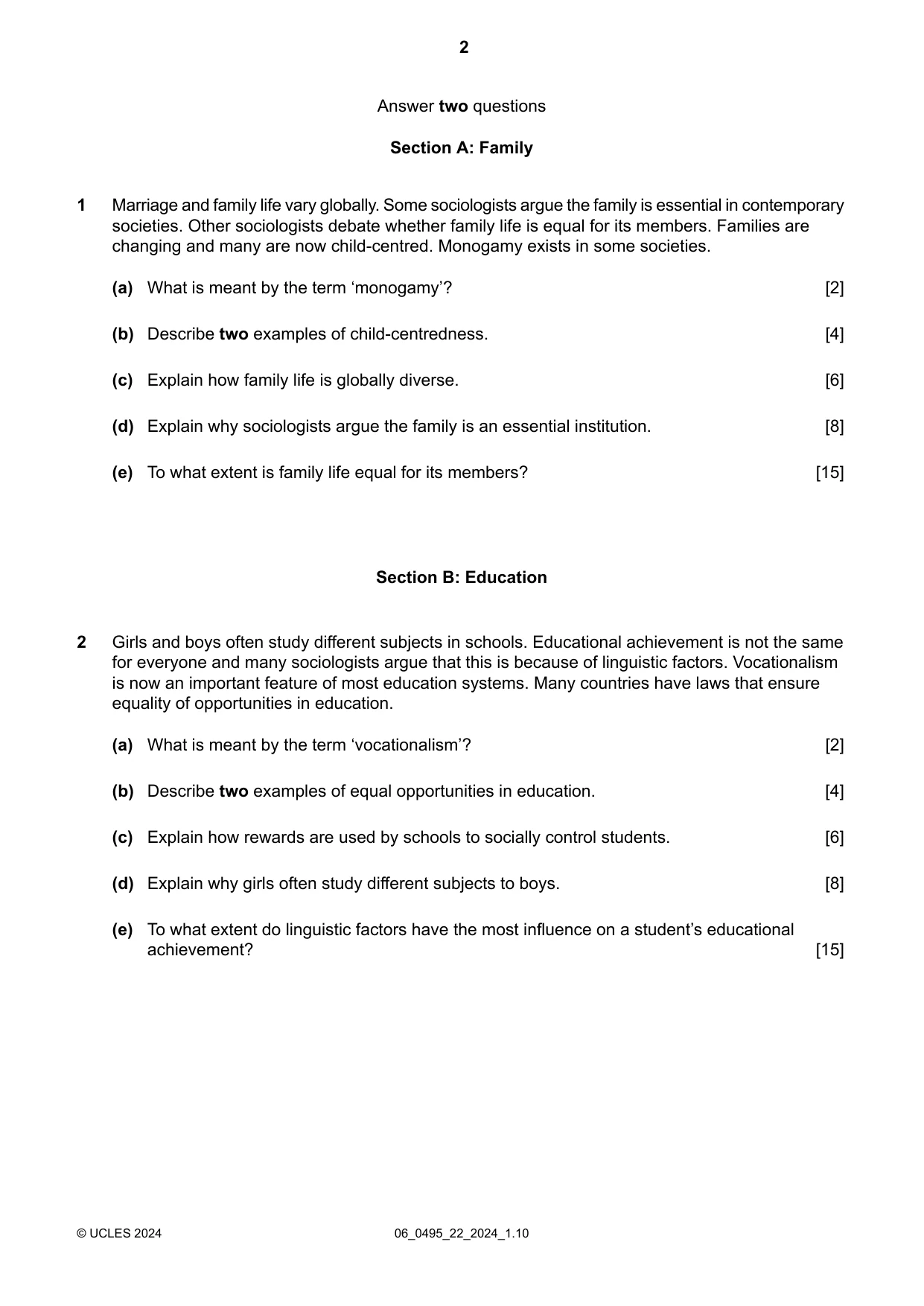
1 Marriage and family life vary globally. Some sociologists argue the family is essential in contemporary societies. Other sociologists debate whether family life is equal for its members. Families are changing and many are now child-centred. Monogamy exists in some societies. (a) What is meant by the term ‘monogamy’? [2] (b) Describe two examples of child-centredness. [4] (c) Explain how family life is globally diverse. [6] (d) Explain why sociologists argue the family is an essential institution. [8] (e) To what extent is family life equal for its members? [15]
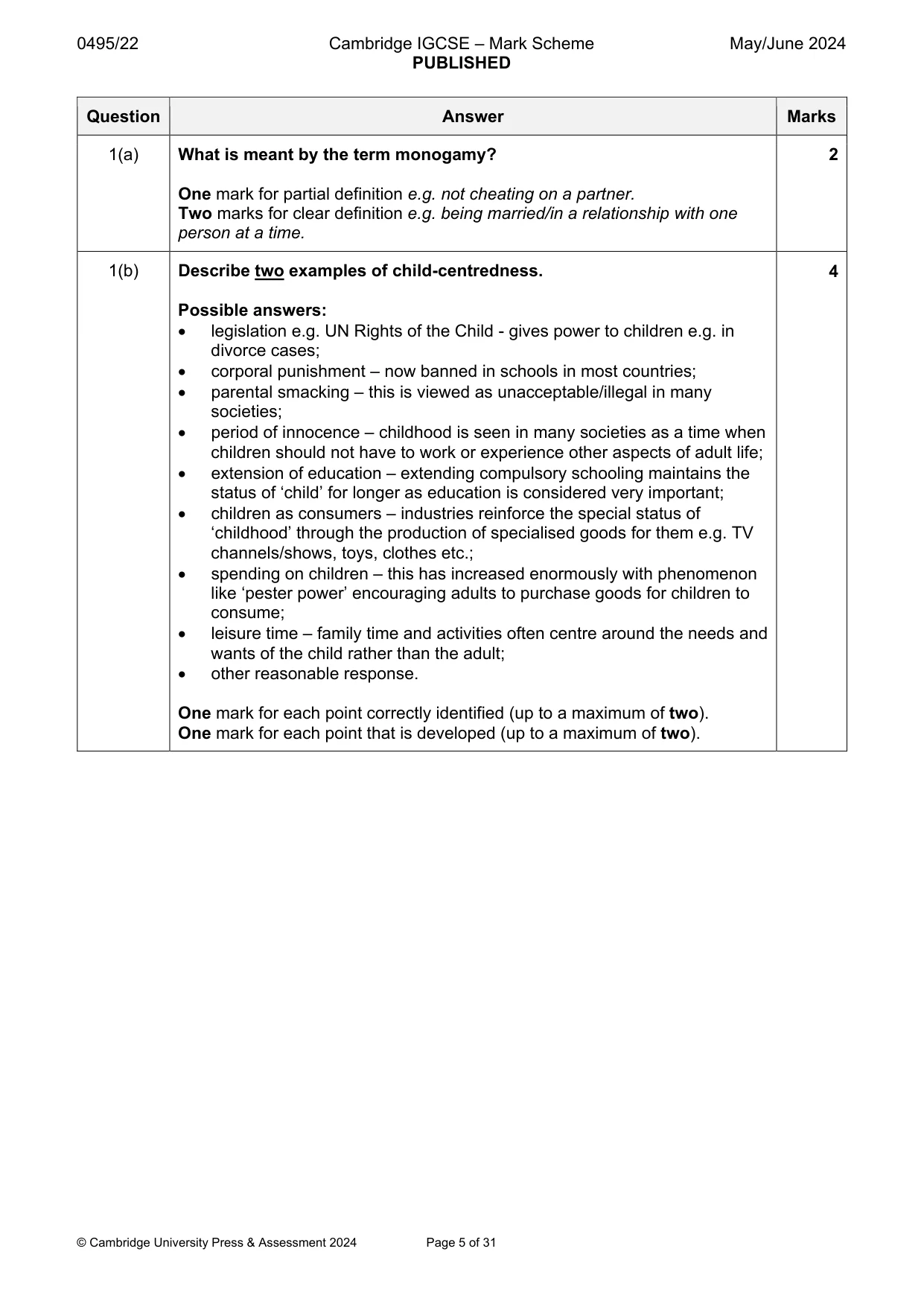
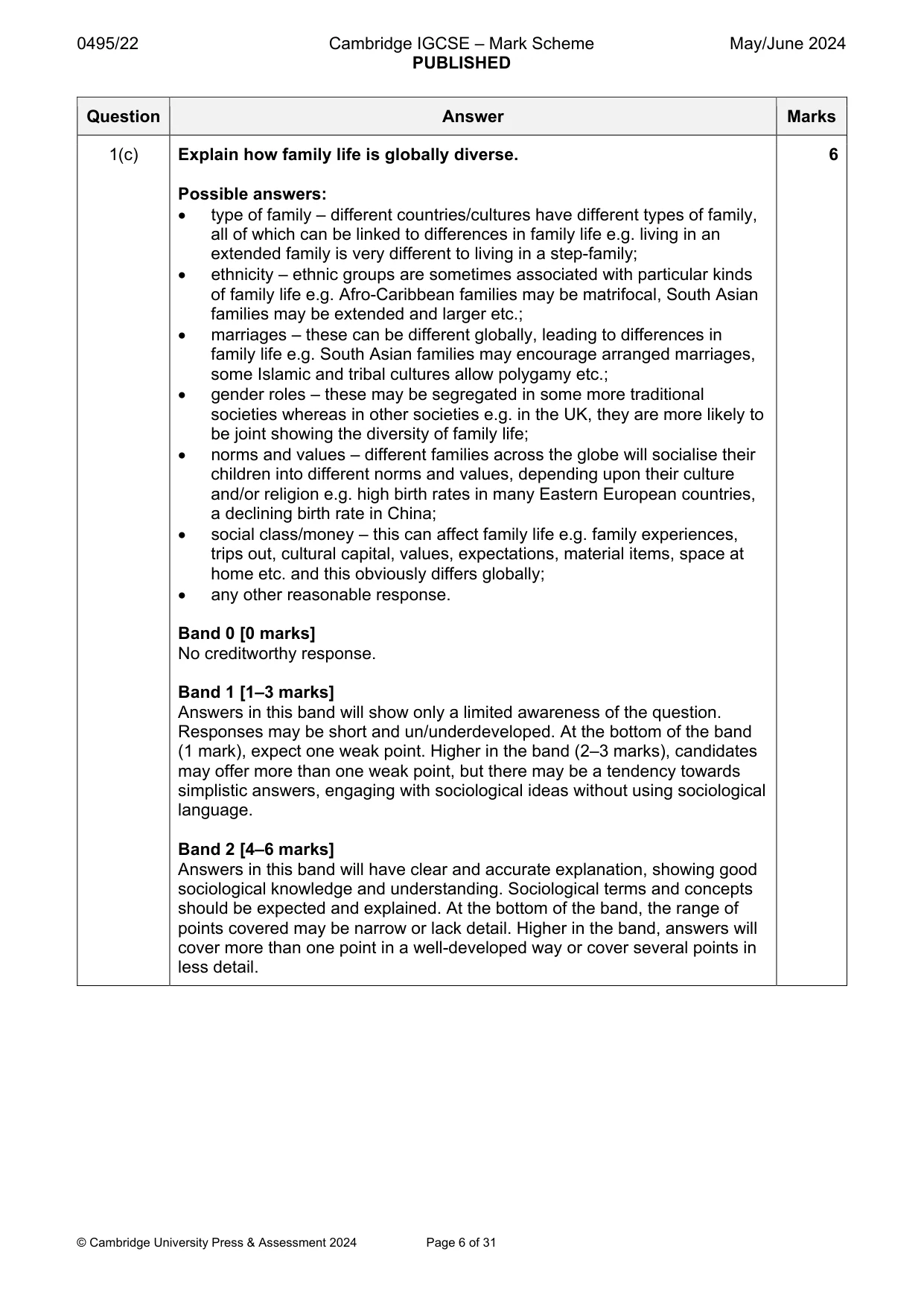
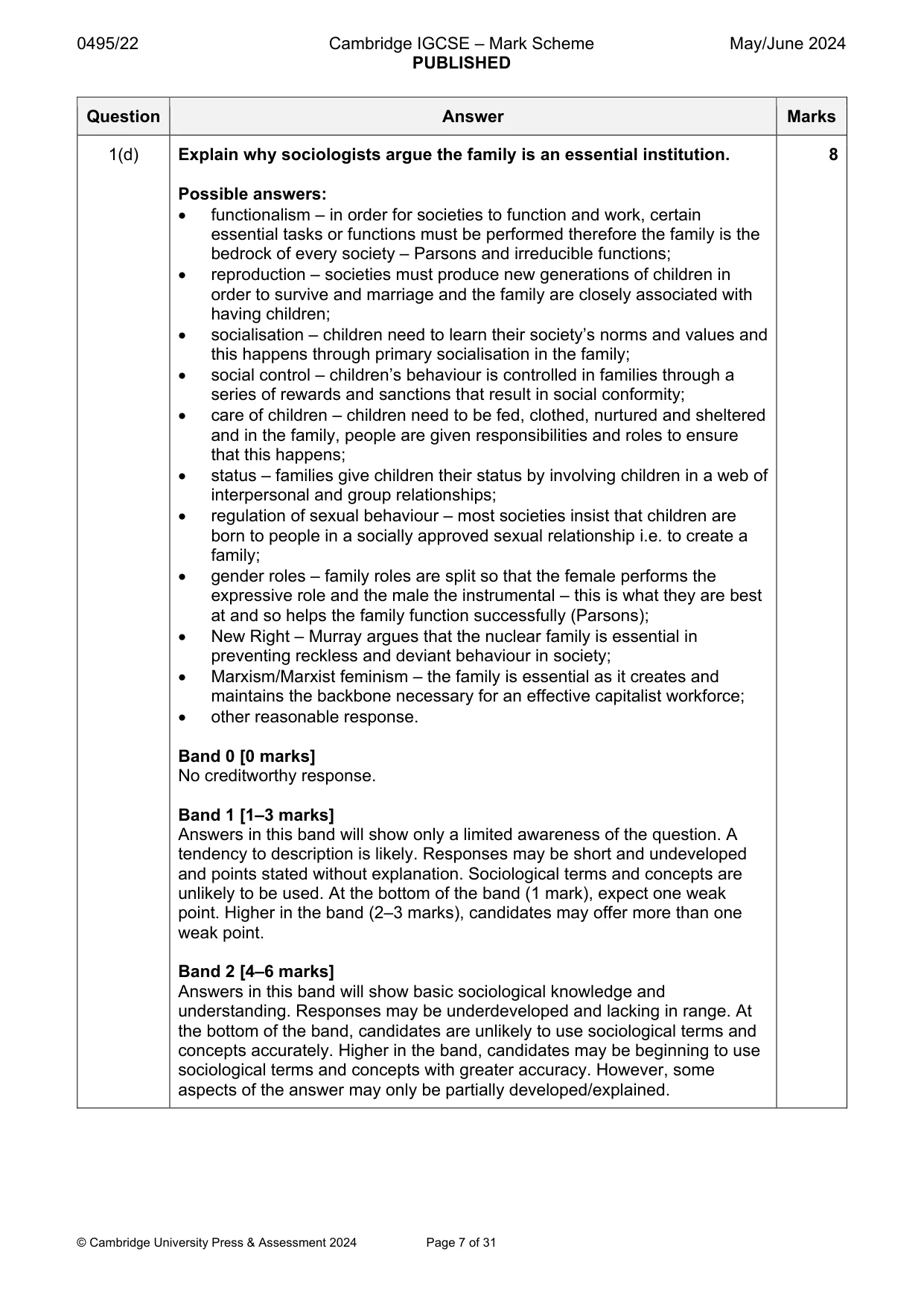
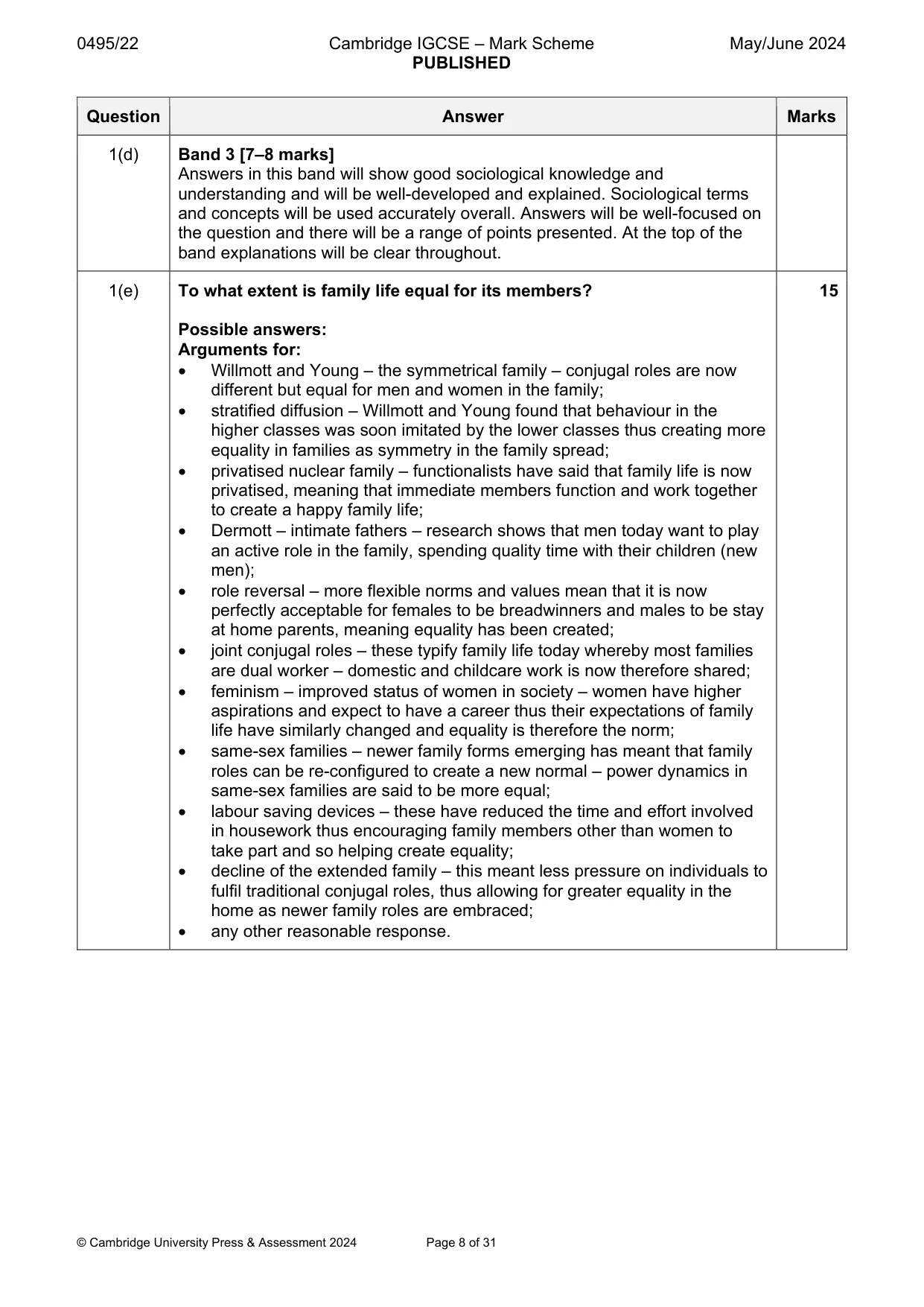
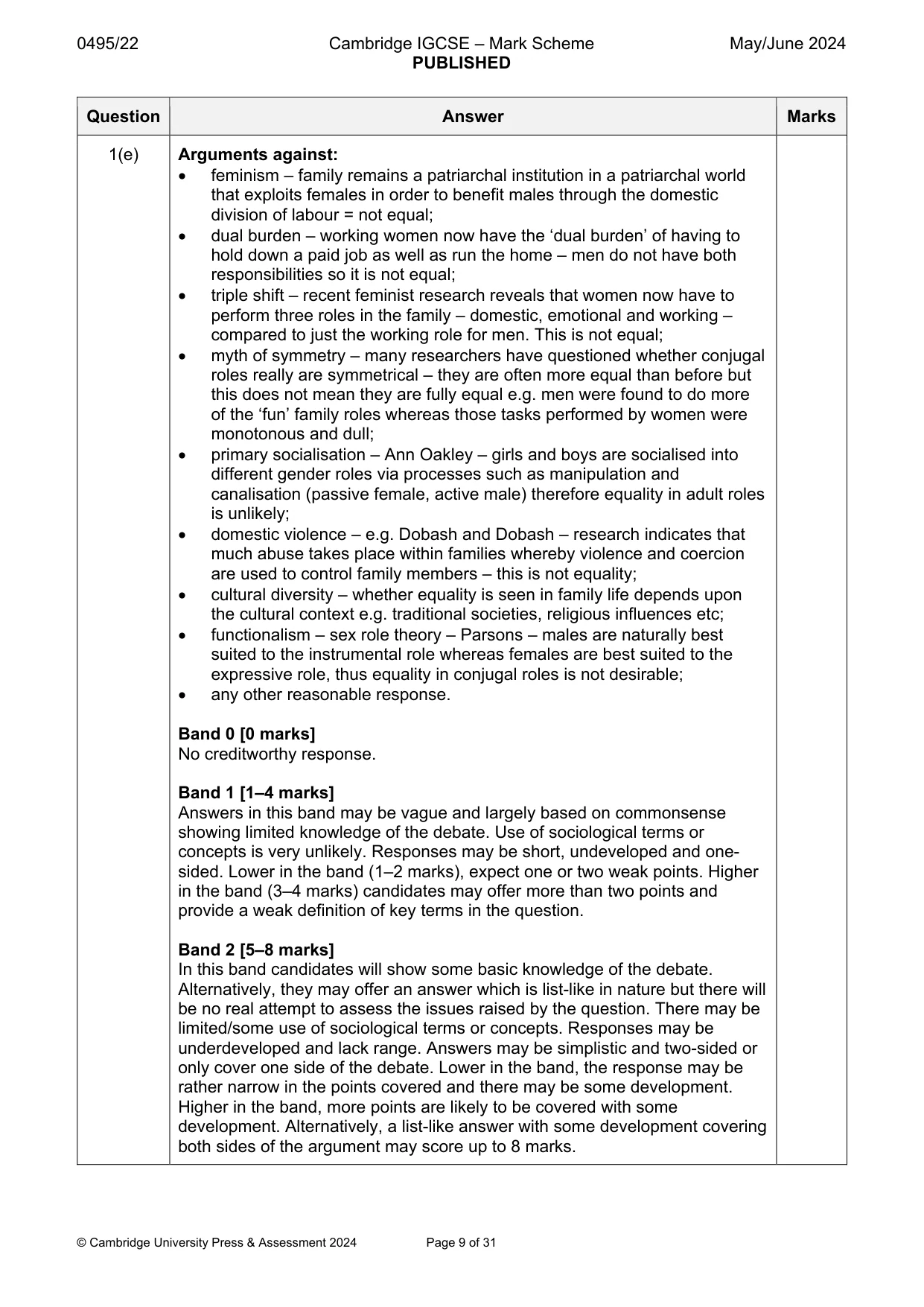
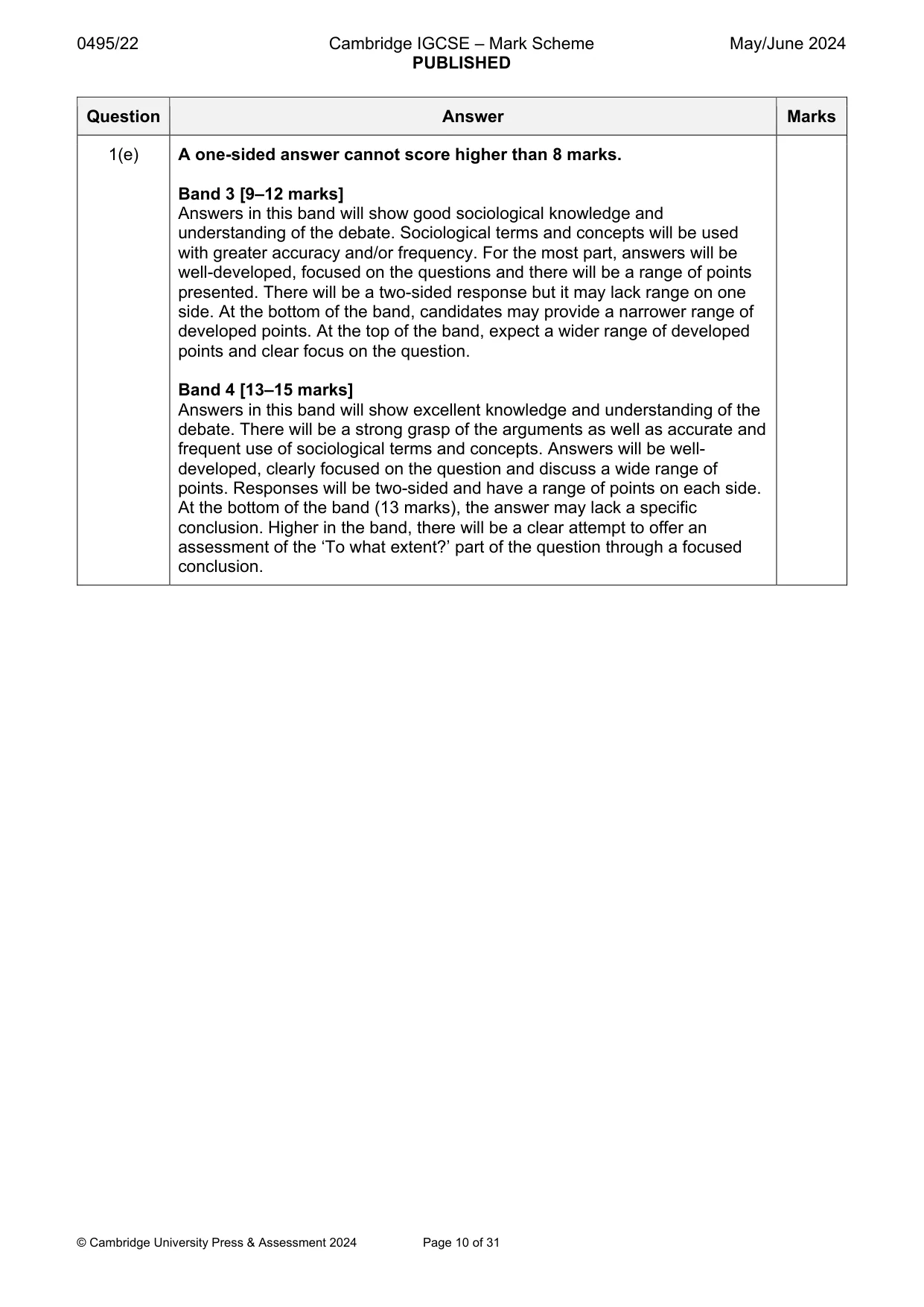
Mark scheme: Question Answer Marks 1(a) What is meant by the term monogamy? 2 One mark for partial definition e.g. not cheating on a partner. Two marks for clear definition e.g. being married/in a relationship with one person at a time. 1(b) Describe two examples of child-centredness. 4 Possible answers: legislation e.g. UN Rights of the Child - gives power to children e.g. in divorce cases; corporal punishment – now banned in schools in most countries; parental smacking – this is viewed as unacceptable/illegal in many societies; period of innocence – childhood is seen in many societies as a time when children should not have to work or experience other aspects of adult life; extension of education – extending compulsory schooling maintains the status of ‘child’ for longer as education is considered very important; children as consumers – industries reinforce the special status of ‘childhood’ through the production of specialised goods for them e.g. TV channels/shows, toys, clothes etc.; spending on children – this has increased enormously with phenomenon like ‘pester power’ encouraging adults to purchase goods for children to consume; leisure time – family time and activities often centre around the needs and wants of the child rather than the adult; other reasonable response. One mark for each point correctly identified (up to a maximum of two). One mark for each point that is developed (up to a maximum of two). 1(c) Explain how family life is globally diverse. 6 Possible answers: type of family – different countries/cultures have different types of family, all of which can be linked to differences in family life e.g. living in an extended family is very different to living in a step-family; ethnicity – ethnic groups are sometimes associated with particular kinds of family life e.g. Afro-Caribbean families may be matrifocal, South Asian families may be extended and larger etc.; marriages – these can be different globally, leading to differences in family life e.g. South Asian families may encourage arranged marriages, some Islamic and tribal cultures allow polygamy etc.; gender roles – these may be segregated in some more traditional societies whereas in other societies e.g. in the UK, they are more likely to be joint showing the diversity of family life; norms and values – different families across the globe will socialise their children into different norms and values, depending upon their culture and/or religion e.g. high birth rates in many Eastern European countries, a declining birth rate in China; social class/money – this can affect family life e.g. family experiences, trips out, cultural capital, values, expectations, material items, space at home etc. and this obviously differs globally; any other reasonable response. Band 0 [0 marks] No creditworthy response. Band 1 [1–3 marks] Answers in this band will show only a limited awareness of the question. Responses may be short and un/underdeveloped. At the bottom of the band (1 mark), expect one weak point. Higher in the band (2–3 marks), candidates may offer more than one weak point, but there may be a tendency towards simplistic answers, engaging with sociological ideas without using sociological language. Band 2 [4–6 marks] Answers in this band will have clear and accurate explanation, showing good sociological knowledge and understanding. Sociological terms and concepts should be expected and explained. At the bottom of the band, the range of points covered may be narrow or lack detail. Higher in the band, answers will cover more than one point in a well-developed way or cover several points in less detail. 1(d) Explain why sociologists argue the family is an essential institution. 8 Possible answers: functionalism – in order for societies to function and work, certain essential tasks or functions must be performed therefore the family is the bedrock of every society – Parsons and irreducible functions; reproduction – societies must produce new generations of children in order to survive and marriage and the family are closely associated with having children; socialisation – children need to learn their society’s norms and values and this happens through primary socialisation in the family; social control – children’s behaviour is controlled in families through a series of rewards and sanctions that result in social conformity; care of children – children need to be fed, clothed, nurtured and sheltered and in the family, people are given responsibilities and roles to ensure that this happens; status – families give children their status by involving children in a web of interpersonal and group relationships; regulation of sexual behaviour – most societies insist that children are born to people in a socially approved sexual relationship i.e. to create a family; gender roles – family roles are split so that the female performs the expressive role and the male the instrumental – this is what they are best at and so helps the family function successfully (Parsons); New Right – Murray argues that the nuclear family is essential in preventing reckless and deviant behaviour in society; Marxism/Marxist feminism – the family is essential as it creates and maintains the backbone necessary for an effective capitalist workforce; other reasonable response. Band 0 [0 marks] No creditworthy response. Band 1 [1–3 marks] Answers in this band will show only a limited awareness of the question. A tendency to description is likely. Responses may be short and undeveloped and points stated without explanation. Sociological terms and concepts are unlikely to be used. At the bottom of the band (1 mark), expect one weak point. Higher in the band (2–3 marks), candidates may offer more than one weak point. Band 2 [4–6 marks] Answers in this band will show basic sociological knowledge and understanding. Responses may be underdeveloped and lacking in range. At the bottom of the band, candidates are unlikely to use sociological terms and concepts accurately. Higher in the band, candidates may be beginning to use sociological terms and concepts with greater accuracy. However, some aspects of the answer may only be partially developed/explained. 1(d) Band 3 [7–8 marks] Answers in this band will show good sociological knowledge and understanding and will be well-developed and explained. Sociological terms and concepts will be used accurately overall. Answers will be well-focused on the question and there will be a range of points presented. At the top of the band explanations will be clear throughout. 1(e) To what extent is family life equal for its members? 15 Possible answers: Arguments for: Willmott and Young – the symmetrical family – conjugal roles are now different but equal for men and women in the family; stratified diffusion – Willmott and Young found that behaviour in the higher classes was soon imitated by the lower classes thus creating more equality in families as symmetry in the family spread; privatised nuclear family – functionalists have said that family life is now privatised, meaning that immediate members function and work together to create a happy family life; Dermott – intimate fathers – research shows that men today want to play an active role in the family, spending quality time with their children (new men); role reversal – more flexible norms and values mean that it is now perfectly acceptable for females to be breadwinners and males to be stay at home parents, meaning equality has been created; joint conjugal roles – these typify family life today whereby most families are dual worker – domestic and childcare work is now therefore shared; feminism – improved status of women in society – women have higher aspirations and expect to have a career thus their expectations of family life have similarly changed and equality is therefore the norm; same-sex families – newer family forms emerging has meant that family roles can be re-configured to create a new normal – power dynamics in same-sex families are said to be more equal; labour saving devices – these have reduced the time and effort involved in housework thus encouraging family members other than women to take part and so helping create equality; decline of the extended family – this meant less pressure on individuals to fulfil traditional conjugal roles, thus allowing for greater equality in the home as newer family roles are embraced; any other reasonable response. 1(e) Arguments against: feminism – family remains a patriarchal institution in a patriarchal world that exploits females in order to benefit males through the domestic division of labour = not equal; dual burden – working women now have the ‘dual burden’ of having to hold down a paid job as well as run the home – men do not have both responsibilities so it is not equal; triple shift – recent feminist research reveals that women now have to perform three roles in the family – domestic, emotional and working – compared to just the working role for men. This is not equal; myth of symmetry – many researchers have questioned whether conjugal roles really are symmetrical – they are often more equal than before but this does not mean they are fully equal e.g. men were found to do more of the ‘fun’ family roles whereas those tasks performed by women were monotonous and dull; primary socialisation – Ann Oakley – girls and boys are socialised into different gender roles via processes such as manipulation and canalisation (passive female, active male) therefore equality in adult roles is unlikely; domestic violence – e.g. Dobash and Dobash – research indicates that much abuse takes place within families whereby violence and coercion are used to control family members – this is not equality; cultural diversity – whether equality is seen in family life depends upon the cultural context e.g. traditional societies, religious influences etc; functionalism – sex role theory – Parsons – males are naturally best suited to the instrumental role whereas females are best suited to the expressive role, thus equality in conjugal roles is not desirable; any other reasonable response. Band 0 [0 marks] No creditworthy response. Band 1 [1–4 marks] Answers in this band may be vague and largely based on commonsense showing limited knowledge of the debate. Use of sociological terms or concepts is very unlikely. Responses may be short, undeveloped and one- sided. Lower in the band (1–2 marks), expect one or two weak points. Higher in the band (3–4 marks) candidates may offer more than two points and provide a weak definition of key terms in the question. Band 2 [5–8 marks] In this band candidates will show some basic knowledge of the debate. Alternatively, they may offer an answer which is list-like in nature but there will be no real attempt to assess the issues raised by the question. There may be limited/some use of sociological terms or concepts. Responses may be underdeveloped and lack range. Answers may be simplistic and two-sided or only cover one side of the debate. Lower in the band, the response may be rather narrow in the points covered and there may be some development. Higher in the band, more points are likely to be covered with some development. Alternatively, a list-like answer with some development covering both sides of the argument may score up to 8 marks. 1(e) A one-sided answer cannot score higher than 8 marks. Band 3 [9–12 marks] Answers in this band will show good sociological knowledge and understanding of the debate. Sociological terms and concepts will be used with greater accuracy and/or frequency. For the most part, answers will be well-developed, focused on the questions and there will be a range of points presented. There will be a two-sided response but it may lack range on one side. At the bottom of the band, candidates may provide a narrower range of developed points. At the top of the band, expect a wider range of developed points and clear focus on the question. Band 4 [13–15 marks] Answers in this band will show excellent knowledge and understanding of the debate. There will be a strong grasp of the arguments as well as accurate and frequent use of sociological terms and concepts. Answers will be well- developed, clearly focused on the question and discuss a wide range of points. Responses will be two-sided and have a range of points on each side. At the bottom of the band (13 marks), the answer may lack a specific conclusion. Higher in the band, there will be a clear attempt to offer an assessment of the ‘To what extent?’ part of the question through a focused conclusion.
Q2 · Girls and boys often study different subjects in schools
2 Girls and boys often study different subjects in schools. Educational achievement is not the same for everyone and many sociologists argue that this is because of linguistic factors. Vocationalism is now an important feature of most education systems. Many countries have laws that ensure equality of opportunities in education. (a) What is meant by the term ‘vocationalism’? [2] (b) Describe two examples of equal opportunities in education. [4] (c) Explain how rewards are used by schools to socially control students. [6] (d) Explain why girls often study different subjects to boys. [8] (e) To what extent do linguistic factors have the most influence on a student’s educational achievement? [15] Section C: Crime, deviance and social control
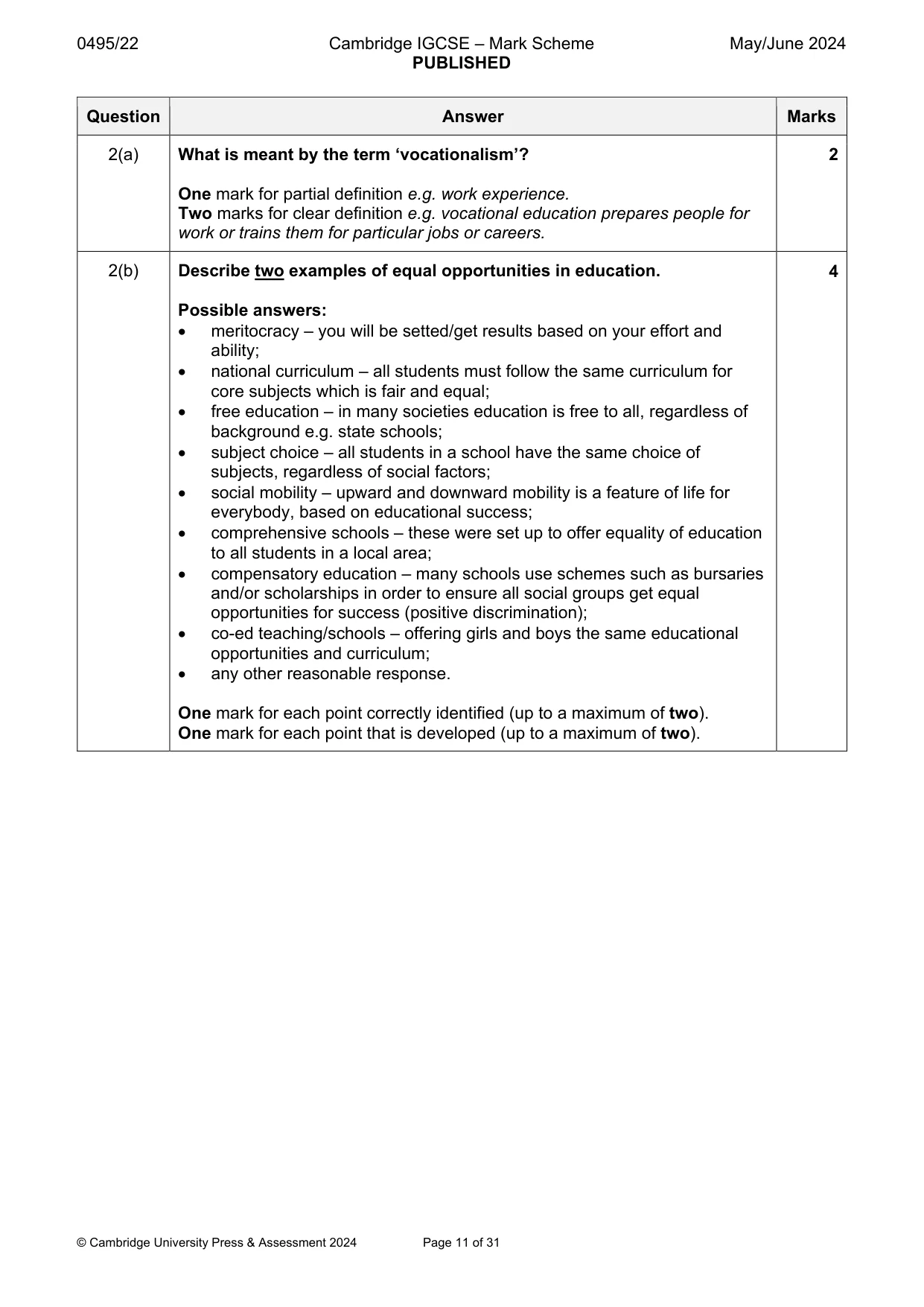
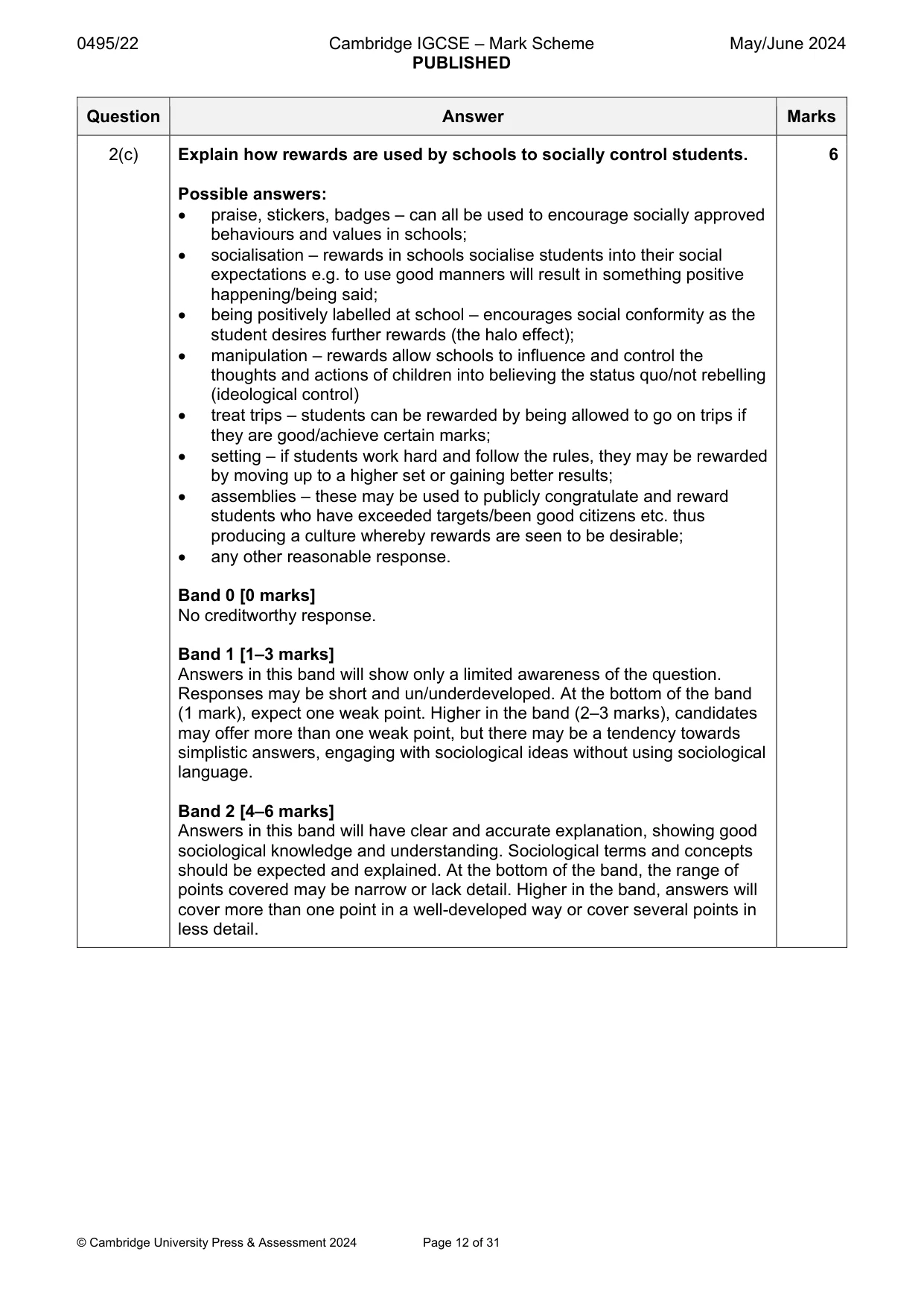
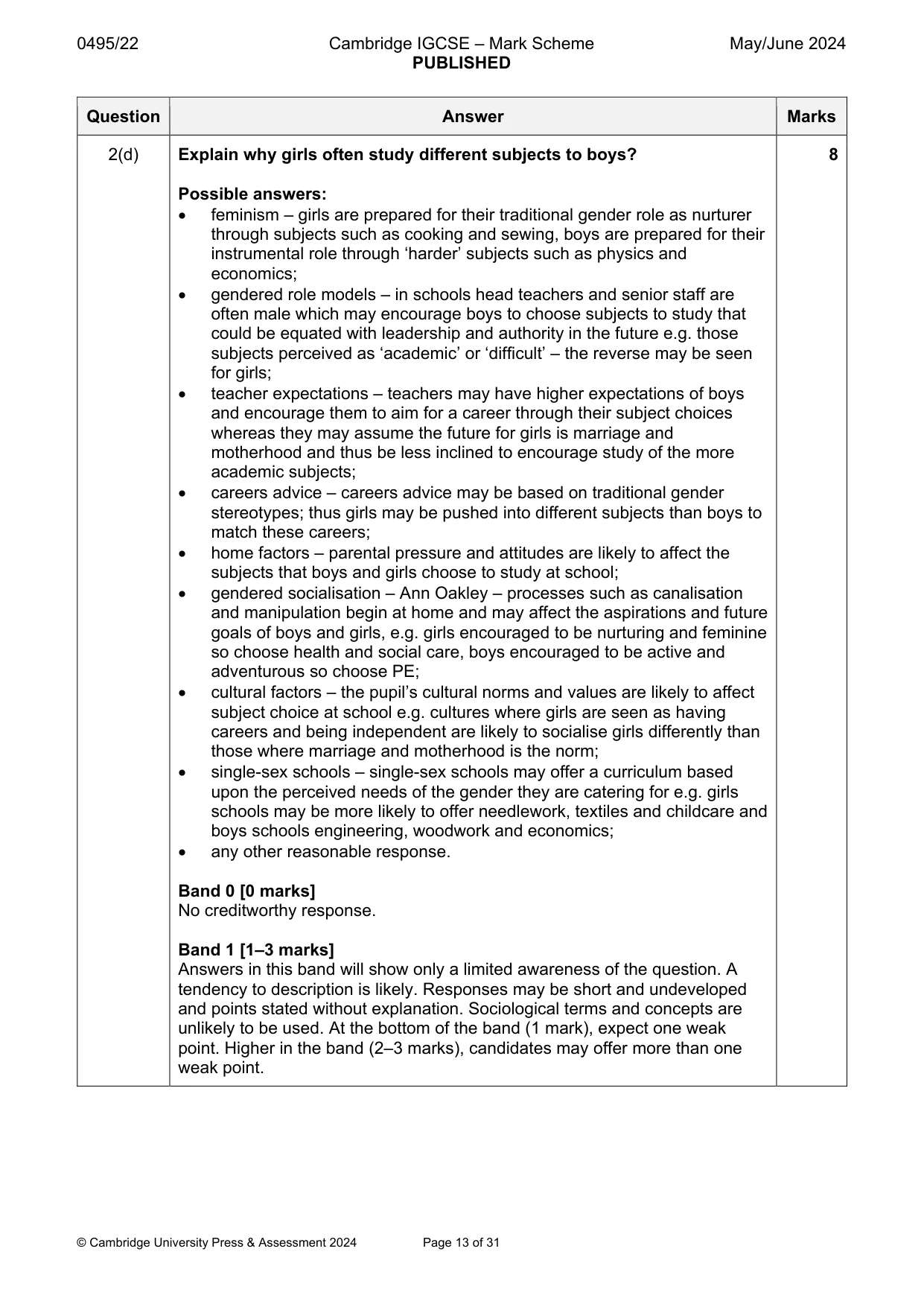
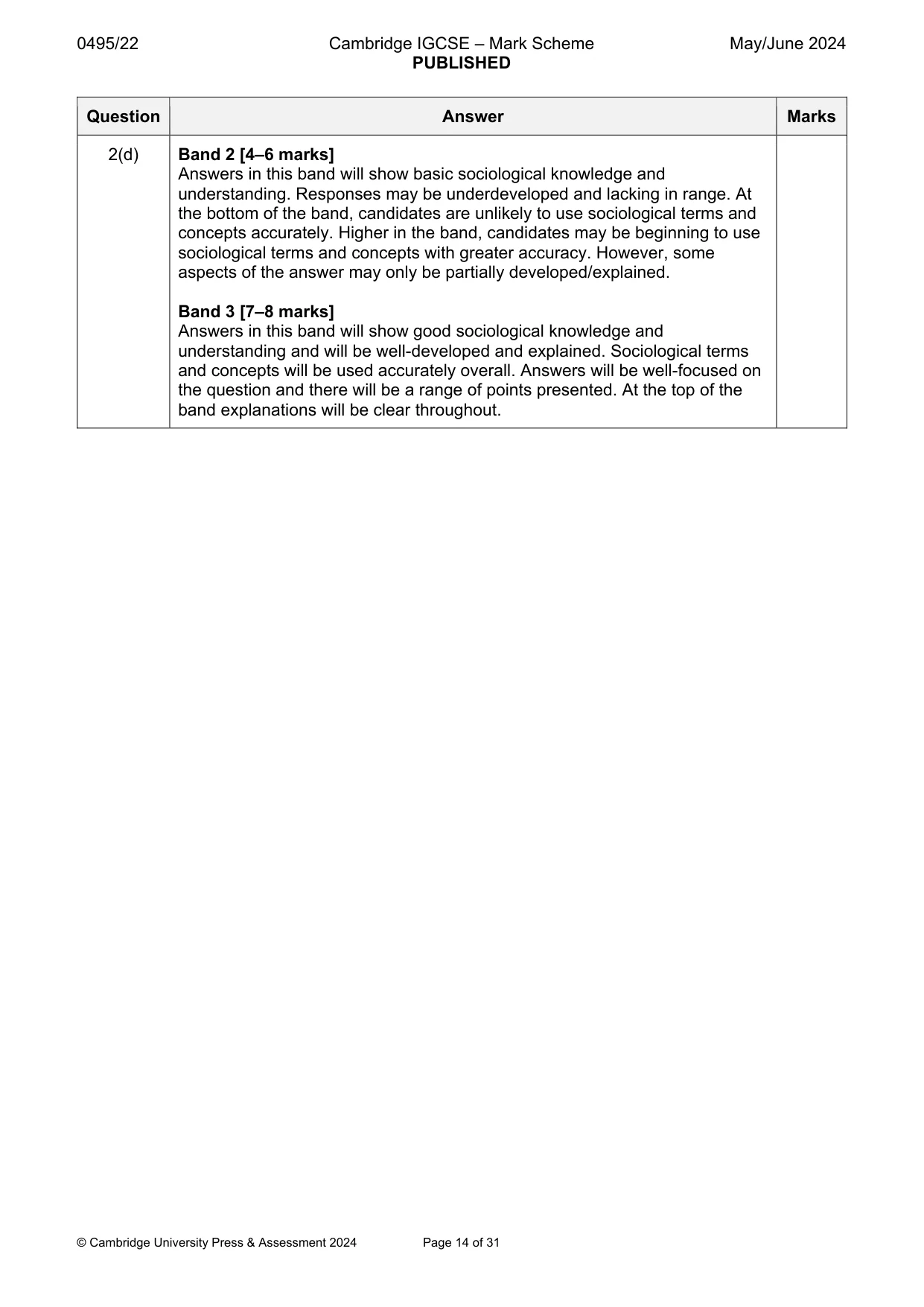
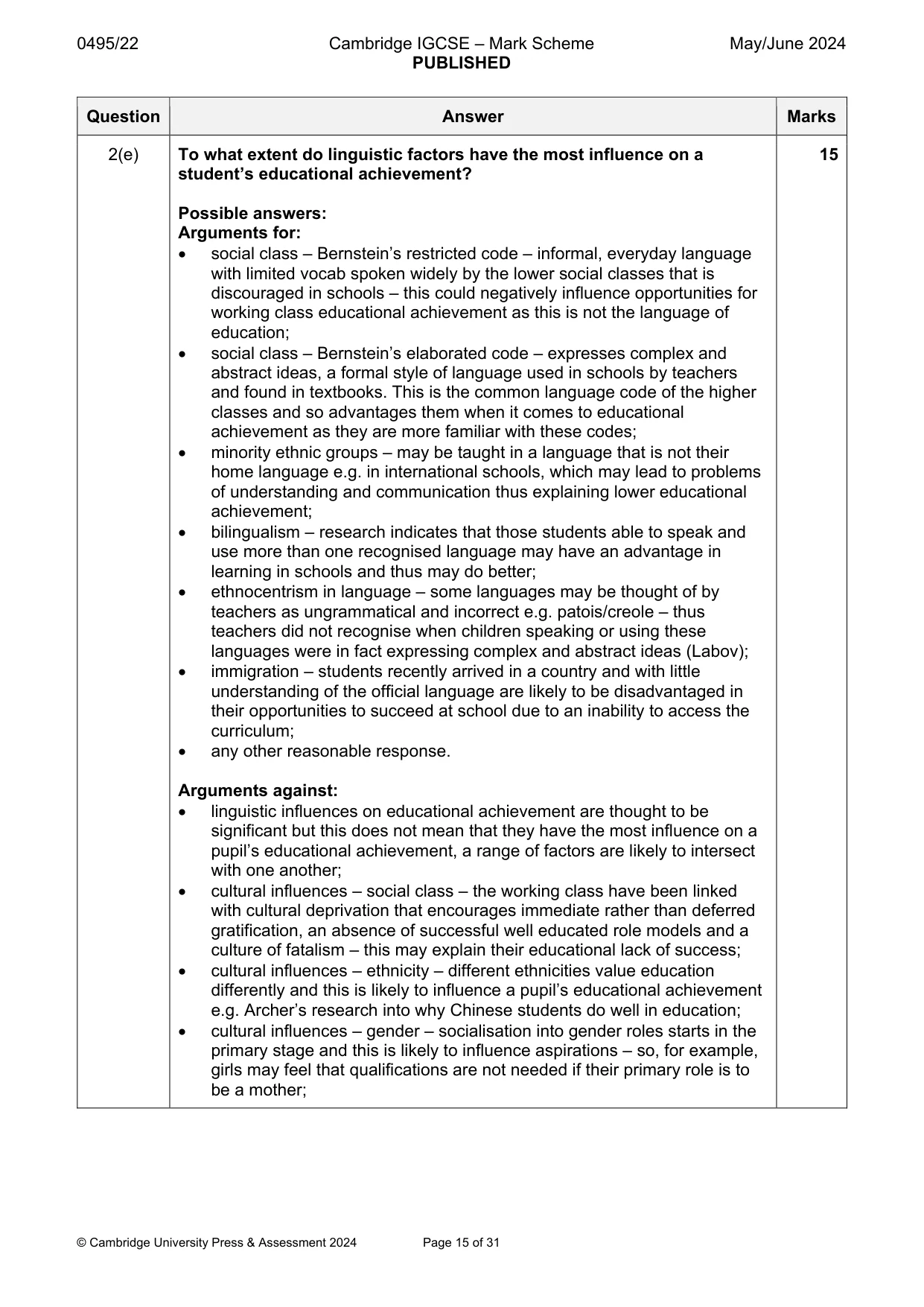
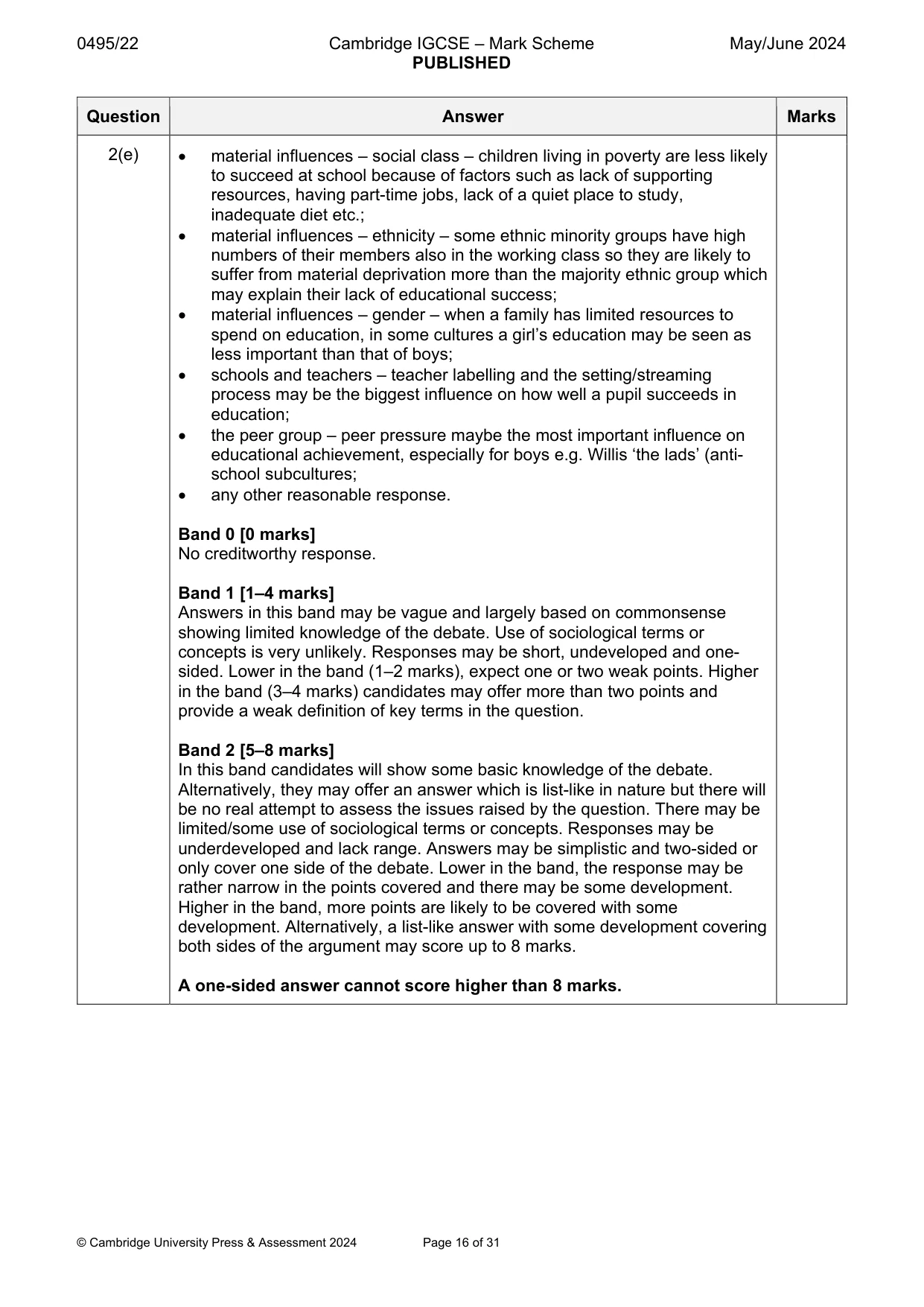
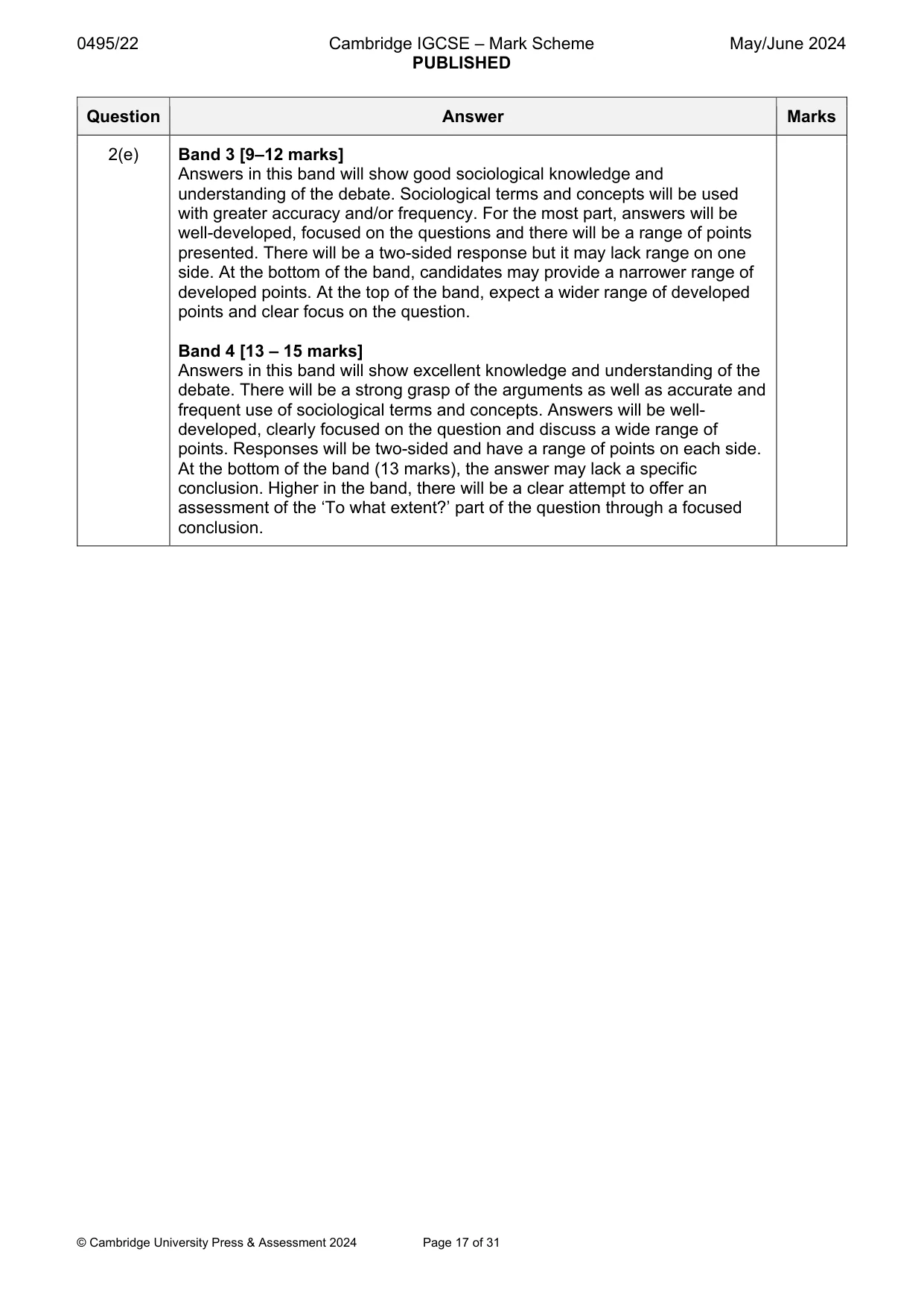
Mark scheme: 2(a) What is meant by the term ‘vocationalism’? 2 One mark for partial definition e.g. work experience. Two marks for clear definition e.g. vocational education prepares people for work or trains them for particular jobs or careers. 2(b) Describe two examples of equal opportunities in education. 4 Possible answers: meritocracy – you will be setted/get results based on your effort and ability; national curriculum – all students must follow the same curriculum for core subjects which is fair and equal; free education – in many societies education is free to all, regardless of background e.g. state schools; subject choice – all students in a school have the same choice of subjects, regardless of social factors; social mobility – upward and downward mobility is a feature of life for everybody, based on educational success; comprehensive schools – these were set up to offer equality of education to all students in a local area; compensatory education – many schools use schemes such as bursaries and/or scholarships in order to ensure all social groups get equal opportunities for success (positive discrimination); co-ed teaching/schools – offering girls and boys the same educational opportunities and curriculum; any other reasonable response. One mark for each point correctly identified (up to a maximum of two). One mark for each point that is developed (up to a maximum of two). 2(c) Explain how rewards are used by schools to socially control students. 6 Possible answers: praise, stickers, badges – can all be used to encourage socially approved behaviours and values in schools; socialisation – rewards in schools socialise students into their social expectations e.g. to use good manners will result in something positive happening/being said; being positively labelled at school – encourages social conformity as the student desires further rewards (the halo effect); manipulation – rewards allow schools to influence and control the thoughts and actions of children into believing the status quo/not rebelling (ideological control) treat trips – students can be rewarded by being allowed to go on trips if they are good/achieve certain marks; setting – if students work hard and follow the rules, they may be rewarded by moving up to a higher set or gaining better results; assemblies – these may be used to publicly congratulate and reward students who have exceeded targets/been good citizens etc. thus producing a culture whereby rewards are seen to be desirable; any other reasonable response. Band 0 [0 marks] No creditworthy response. Band 1 [1–3 marks] Answers in this band will show only a limited awareness of the question. Responses may be short and un/underdeveloped. At the bottom of the band (1 mark), expect one weak point. Higher in the band (2–3 marks), candidates may offer more than one weak point, but there may be a tendency towards simplistic answers, engaging with sociological ideas without using sociological language. Band 2 [4–6 marks] Answers in this band will have clear and accurate explanation, showing good sociological knowledge and understanding. Sociological terms and concepts should be expected and explained. At the bottom of the band, the range of points covered may be narrow or lack detail. Higher in the band, answers will cover more than one point in a well-developed way or cover several points in less detail. 2(d) Explain why girls often study different subjects to boys? 8 Possible answers: feminism – girls are prepared for their traditional gender role as nurturer through subjects such as cooking and sewing, boys are prepared for their instrumental role through ‘harder’ subjects such as physics and economics; gendered role models – in schools head teachers and senior staff are often male which may encourage boys to choose subjects to study that could be equated with leadership and authority in the future e.g. those subjects perceived as ‘academic’ or ‘difficult’ – the reverse may be seen for girls; teacher expectations – teachers may have higher expectations of boys and encourage them to aim for a career through their subject choices whereas they may assume the future for girls is marriage and motherhood and thus be less inclined to encourage study of the more academic subjects; careers advice – careers advice may be based on traditional gender stereotypes; thus girls may be pushed into different subjects than boys to match these careers; home factors – parental pressure and attitudes are likely to affect the subjects that boys and girls choose to study at school; gendered socialisation – Ann Oakley – processes such as canalisation and manipulation begin at home and may affect the aspirations and future goals of boys and girls, e.g. girls encouraged to be nurturing and feminine so choose health and social care, boys encouraged to be active and adventurous so choose PE; cultural factors – the pupil’s cultural norms and values are likely to affect subject choice at school e.g. cultures where girls are seen as having careers and being independent are likely to socialise girls differently than those where marriage and motherhood is the norm; single-sex schools – single-sex schools may offer a curriculum based upon the perceived needs of the gender they are catering for e.g. girls schools may be more likely to offer needlework, textiles and childcare and boys schools engineering, woodwork and economics; any other reasonable response. Band 0 [0 marks] No creditworthy response. Band 1 [1–3 marks] Answers in this band will show only a limited awareness of the question. A tendency to description is likely. Responses may be short and undeveloped and points stated without explanation. Sociological terms and concepts are unlikely to be used. At the bottom of the band (1 mark), expect one weak point. Higher in the band (2–3 marks), candidates may offer more than one weak point. 2(d) Band 2 [4–6 marks] Answers in this band will show basic sociological knowledge and understanding. Responses may be underdeveloped and lacking in range. At the bottom of the band, candidates are unlikely to use sociological terms and concepts accurately. Higher in the band, candidates may be beginning to use sociological terms and concepts with greater accuracy. However, some aspects of the answer may only be partially developed/explained. Band 3 [7–8 marks] Answers in this band will show good sociological knowledge and understanding and will be well-developed and explained. Sociological terms and concepts will be used accurately overall. Answers will be well-focused on the question and there will be a range of points presented. At the top of the band explanations will be clear throughout. 2(e) To what extent do linguistic factors have the most influence on a 15 student’s educational achievement? Possible answers: Arguments for: social class – Bernstein’s restricted code – informal, everyday language with limited vocab spoken widely by the lower social classes that is discouraged in schools – this could negatively influence opportunities for working class educational achievement as this is not the language of education; social class – Bernstein’s elaborated code – expresses complex and abstract ideas, a formal style of language used in schools by teachers and found in textbooks. This is the common language code of the higher classes and so advantages them when it comes to educational achievement as they are more familiar with these codes; minority ethnic groups – may be taught in a language that is not their home language e.g. in international schools, which may lead to problems of understanding and communication thus explaining lower educational achievement; bilingualism – research indicates that those students able to speak and use more than one recognised language may have an advantage in learning in schools and thus may do better; ethnocentrism in language – some languages may be thought of by teachers as ungrammatical and incorrect e.g. patois/creole – thus teachers did not recognise when children speaking or using these languages were in fact expressing complex and abstract ideas (Labov); immigration – students recently arrived in a country and with little understanding of the official language are likely to be disadvantaged in their opportunities to succeed at school due to an inability to access the curriculum; any other reasonable response. Arguments against: linguistic influences on educational achievement are thought to be significant but this does not mean that they have the most influence on a pupil’s educational achievement, a range of factors are likely to intersect with one another; cultural influences – social class – the working class have been linked with cultural deprivation that encourages immediate rather than deferred gratification, an absence of successful well educated role models and a culture of fatalism – this may explain their educational lack of success; cultural influences – ethnicity – different ethnicities value education differently and this is likely to influence a pupil’s educational achievement e.g. Archer’s research into why Chinese students do well in education; cultural influences – gender – socialisation into gender roles starts in the primary stage and this is likely to influence aspirations – so, for example, girls may feel that qualifications are not needed if their primary role is to be a mother; 2(e) material influences – social class – children living in poverty are less likely to succeed at school because of factors such as lack of supporting resources, having part-time jobs, lack of a quiet place to study, inadequate diet etc.; material influences – ethnicity – some ethnic minority groups have high numbers of their members also in the working class so they are likely to suffer from material deprivation more than the majority ethnic group which may explain their lack of educational success; material influences – gender – when a family has limited resources to spend on education, in some cultures a girl’s education may be seen as less important than that of boys; schools and teachers – teacher labelling and the setting/streaming process may be the biggest influence on how well a pupil succeeds in education; the peer group – peer pressure maybe the most important influence on educational achievement, especially for boys e.g. Willis ‘the lads’ (anti- school subcultures; any other reasonable response. Band 0 [0 marks] No creditworthy response. Band 1 [1–4 marks] Answers in this band may be vague and largely based on commonsense showing limited knowledge of the debate. Use of sociological terms or concepts is very unlikely. Responses may be short, undeveloped and one- sided. Lower in the band (1–2 marks), expect one or two weak points. Higher in the band (3–4 marks) candidates may offer more than two points and provide a weak definition of key terms in the question. Band 2 [5–8 marks] In this band candidates will show some basic knowledge of the debate. Alternatively, they may offer an answer which is list-like in nature but there will be no real attempt to assess the issues raised by the question. There may be limited/some use of sociological terms or concepts. Responses may be underdeveloped and lack range. Answers may be simplistic and two-sided or only cover one side of the debate. Lower in the band, the response may be rather narrow in the points covered and there may be some development. Higher in the band, more points are likely to be covered with some development. Alternatively, a list-like answer with some development covering both sides of the argument may score up to 8 marks. A one-sided answer cannot score higher than 8 marks. 2(e) Band 3 [9–12 marks] Answers in this band will show good sociological knowledge and understanding of the debate. Sociological terms and concepts will be used with greater accuracy and/or frequency. For the most part, answers will be well-developed, focused on the questions and there will be a range of points presented. There will be a two-sided response but it may lack range on one side. At the bottom of the band, candidates may provide a narrower range of developed points. At the top of the band, expect a wider range of developed points and clear focus on the question. Band 4 [13 – 15 marks] Answers in this band will show excellent knowledge and understanding of the debate. There will be a strong grasp of the arguments as well as accurate and frequent use of sociological terms and concepts. Answers will be well- developed, clearly focused on the question and discuss a wide range of points. Responses will be two-sided and have a range of points on each side. At the bottom of the band (13 marks), the answer may lack a specific conclusion. Higher in the band, there will be a clear attempt to offer an assessment of the ‘To what extent?’ part of the question through a focused conclusion.
Q3 · All societies try to control and prevent crime but self-report studies and official crime…
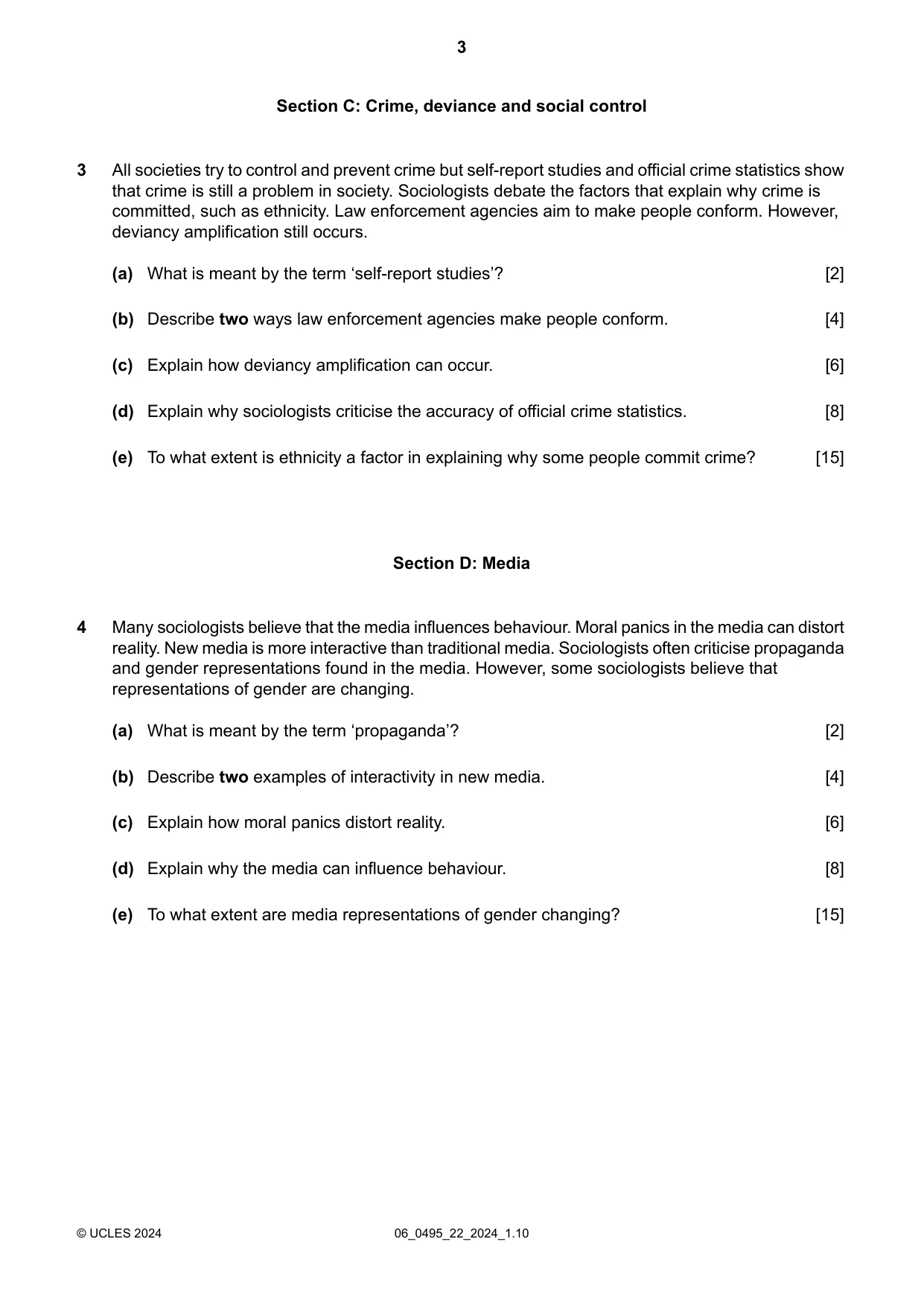
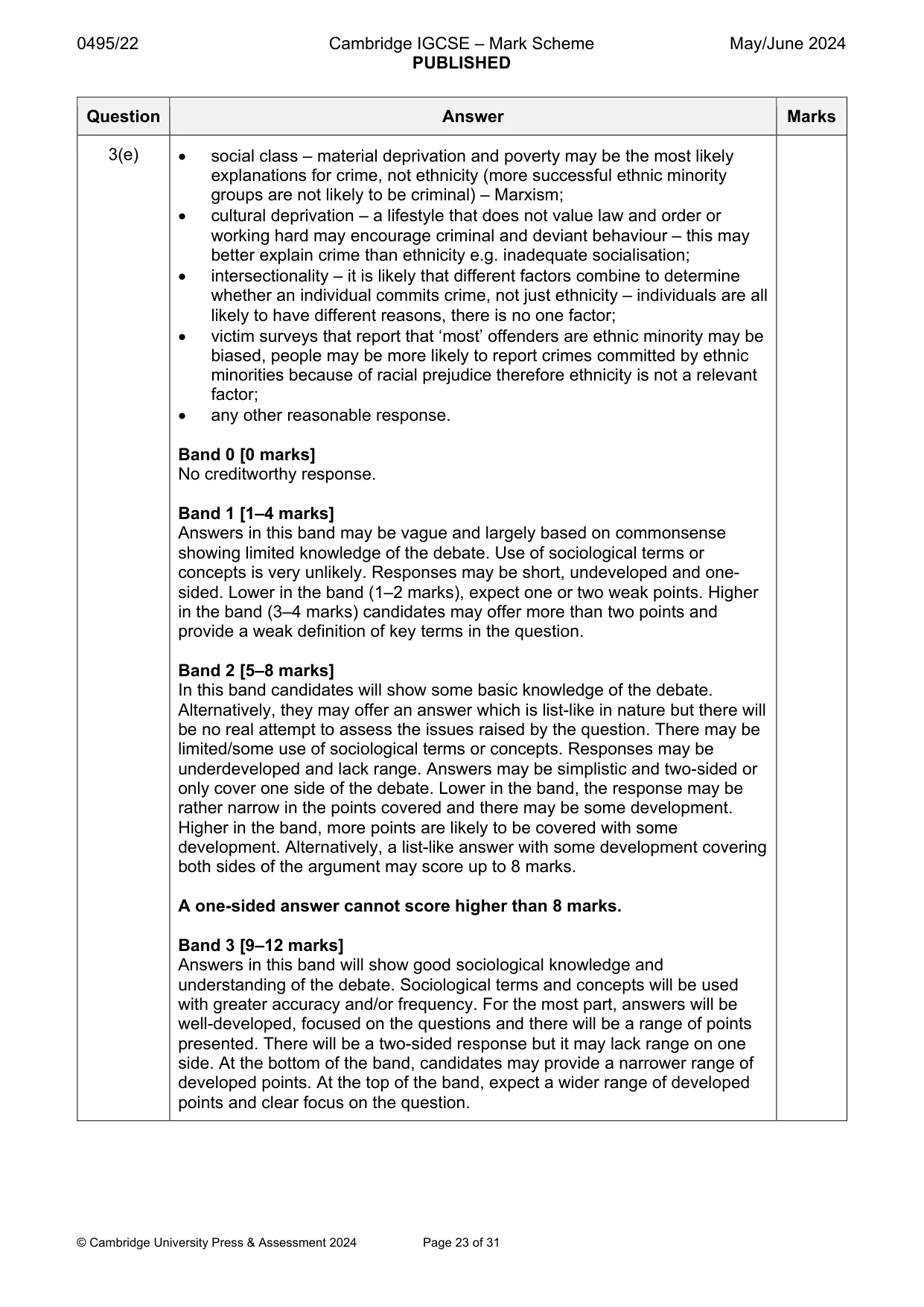
3 All societies try to control and prevent crime but self-report studies and official crime statistics show that crime is still a problem in society. Sociologists debate the factors that explain why crime is committed, such as ethnicity. Law enforcement agencies aim to make people conform. However, deviancy amplification still occurs. (a) What is meant by the term ‘self-report studies’? [2] (b) Describe two ways law enforcement agencies make people conform. [4] (c) Explain how deviancy amplification can occur. [6] (d) Explain why sociologists criticise the accuracy of official crime statistics. [8] (e) To what extent is ethnicity a factor in explaining why some people commit crime? [15] Section D: Media
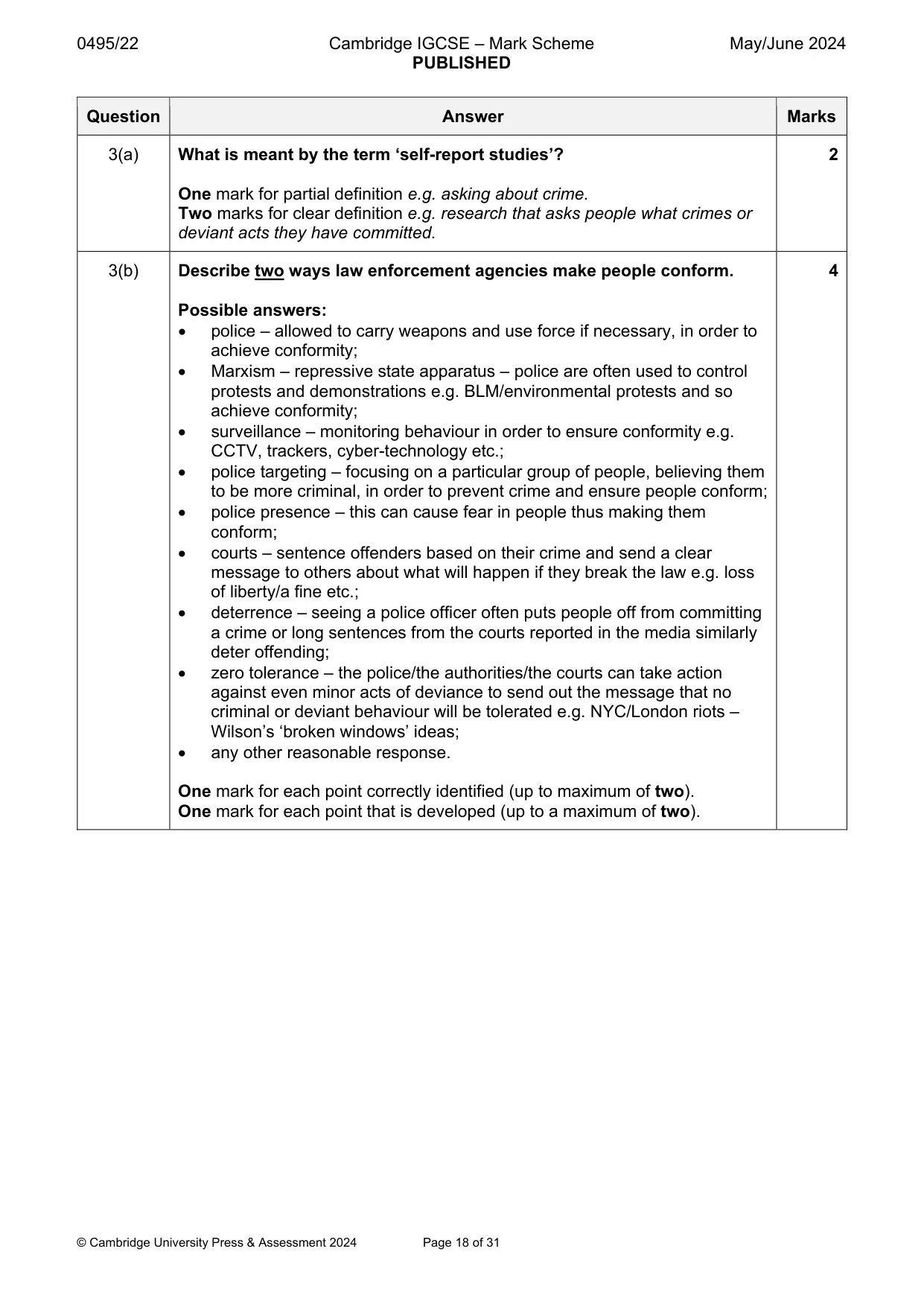
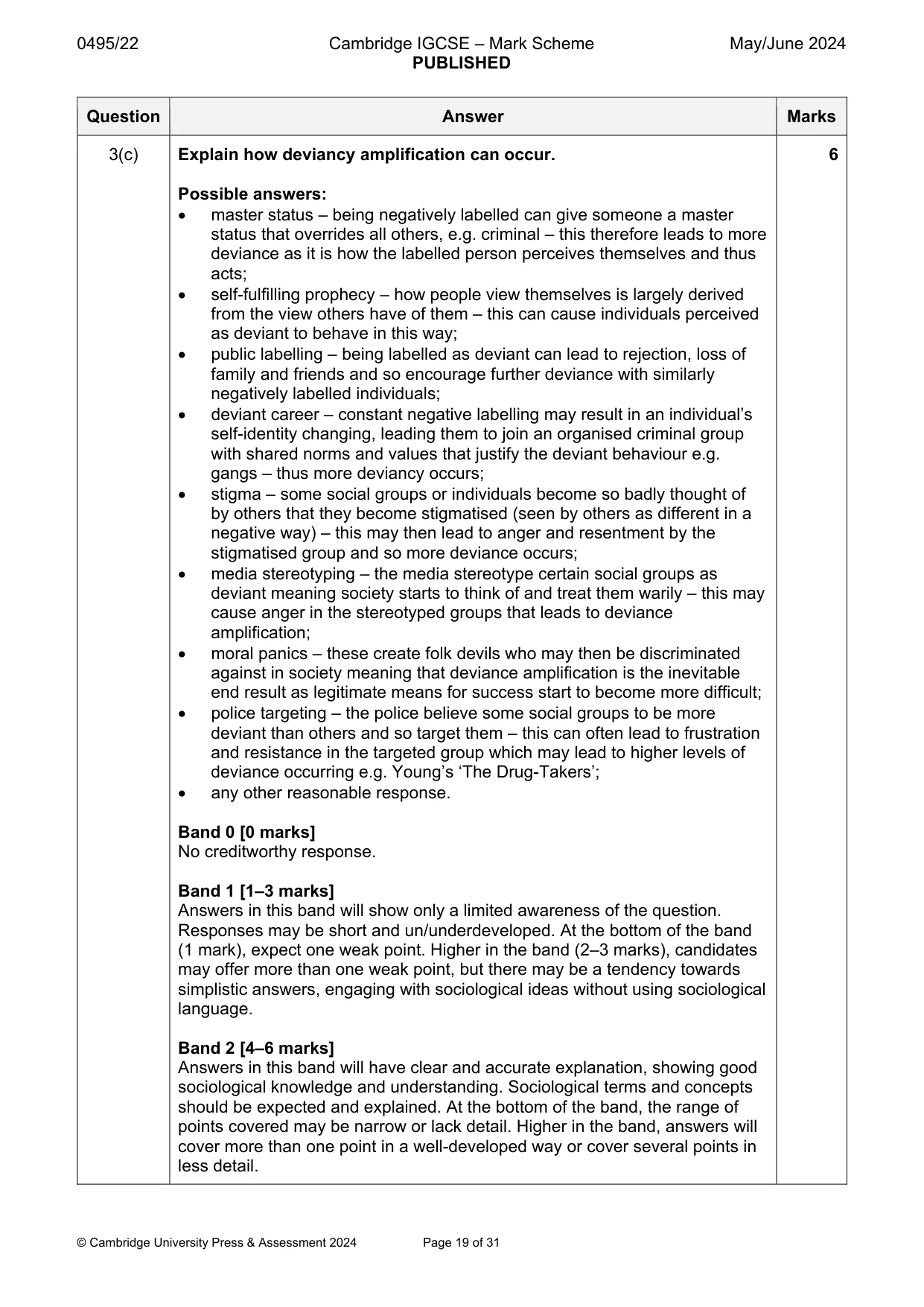
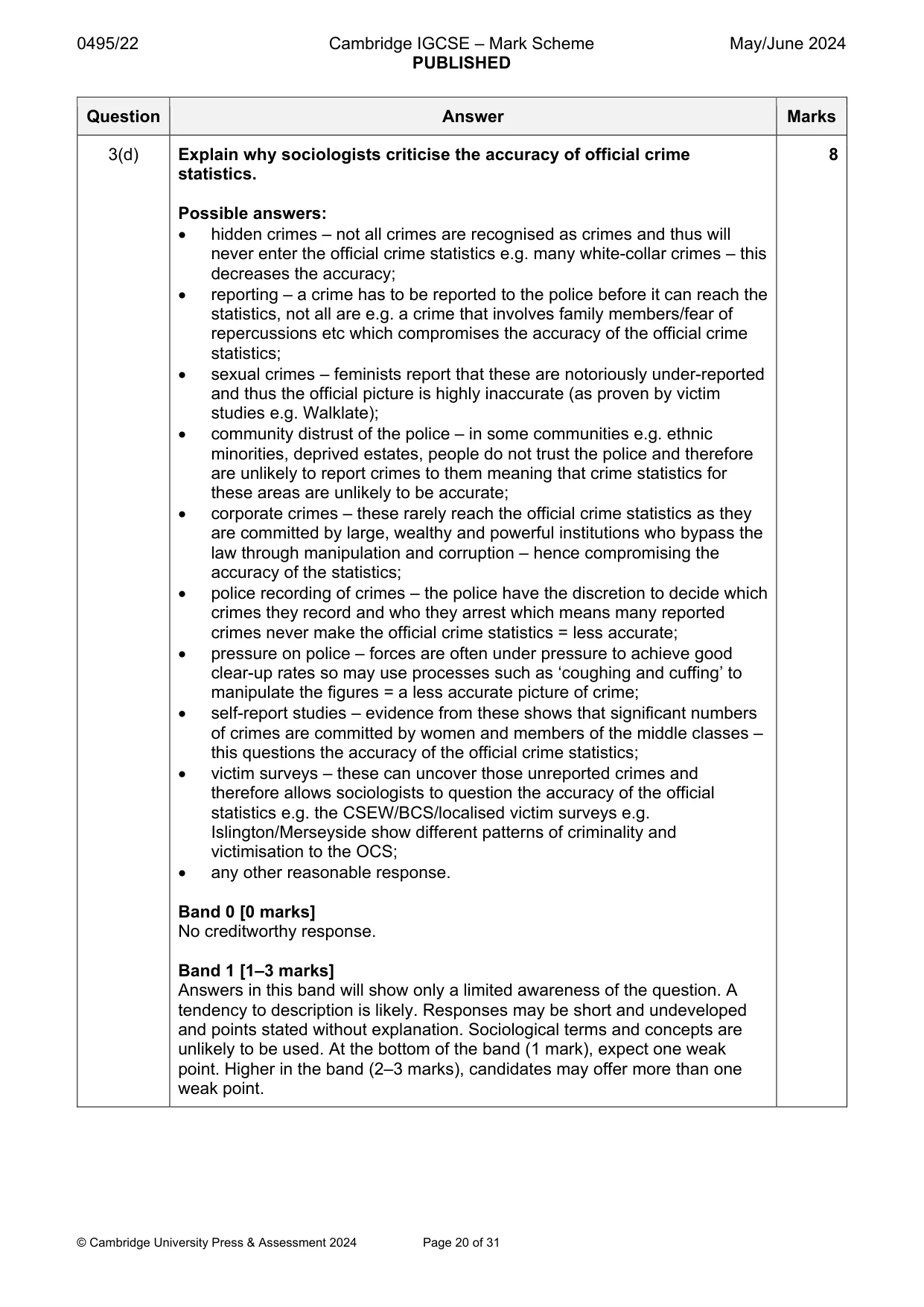
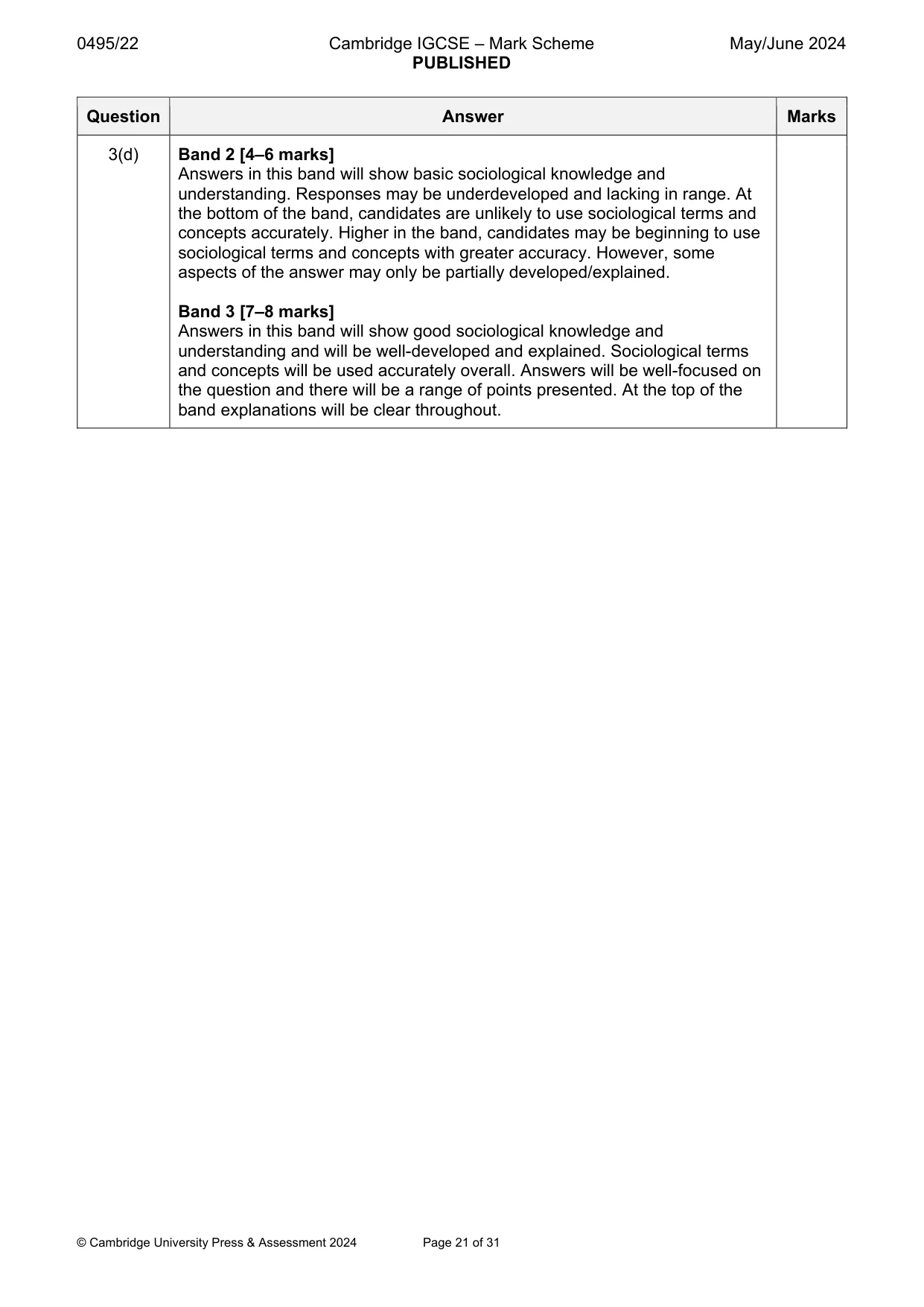
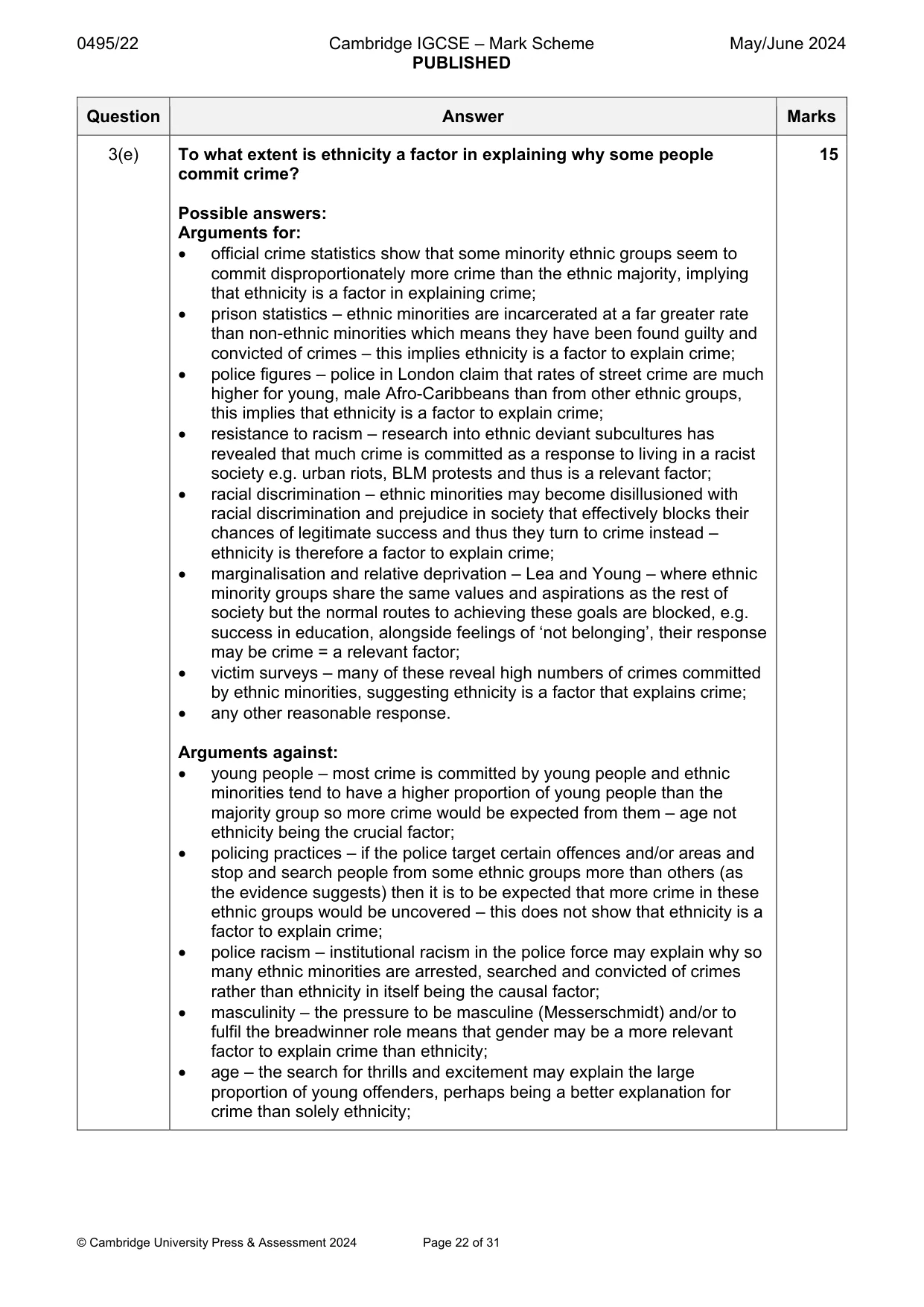
Mark scheme: 3(a) What is meant by the term ‘self-report studies’? 2 One mark for partial definition e.g. asking about crime. Two marks for clear definition e.g. research that asks people what crimes or deviant acts they have committed. 3(b) Describe two ways law enforcement agencies make people conform. 4 Possible answers: police – allowed to carry weapons and use force if necessary, in order to achieve conformity; Marxism – repressive state apparatus – police are often used to control protests and demonstrations e.g. BLM/environmental protests and so achieve conformity; surveillance – monitoring behaviour in order to ensure conformity e.g. CCTV, trackers, cyber-technology etc.; police targeting – focusing on a particular group of people, believing them to be more criminal, in order to prevent crime and ensure people conform; police presence – this can cause fear in people thus making them conform; courts – sentence offenders based on their crime and send a clear message to others about what will happen if they break the law e.g. loss of liberty/a fine etc.; deterrence – seeing a police officer often puts people off from committing a crime or long sentences from the courts reported in the media similarly deter offending; zero tolerance – the police/the authorities/the courts can take action against even minor acts of deviance to send out the message that no criminal or deviant behaviour will be tolerated e.g. NYC/London riots – Wilson’s ‘broken windows’ ideas; any other reasonable response. One mark for each point correctly identified (up to maximum of two). One mark for each point that is developed (up to a maximum of two). 3(c) Explain how deviancy amplification can occur. 6 Possible answers: master status – being negatively labelled can give someone a master status that overrides all others, e.g. criminal – this therefore leads to more deviance as it is how the labelled person perceives themselves and thus acts; self-fulfilling prophecy – how people view themselves is largely derived from the view others have of them – this can cause individuals perceived as deviant to behave in this way; public labelling – being labelled as deviant can lead to rejection, loss of family and friends and so encourage further deviance with similarly negatively labelled individuals; deviant career – constant negative labelling may result in an individual’s self-identity changing, leading them to join an organised criminal group with shared norms and values that justify the deviant behaviour e.g. gangs – thus more deviancy occurs; stigma – some social groups or individuals become so badly thought of by others that they become stigmatised (seen by others as different in a negative way) – this may then lead to anger and resentment by the stigmatised group and so more deviance occurs; media stereotyping – the media stereotype certain social groups as deviant meaning society starts to think of and treat them warily – this may cause anger in the stereotyped groups that leads to deviance amplification; moral panics – these create folk devils who may then be discriminated against in society meaning that deviance amplification is the inevitable end result as legitimate means for success start to become more difficult; police targeting – the police believe some social groups to be more deviant than others and so target them – this can often lead to frustration and resistance in the targeted group which may lead to higher levels of deviance occurring e.g. Young’s ‘The Drug-Takers’; any other reasonable response. Band 0 [0 marks] No creditworthy response. Band 1 [1–3 marks] Answers in this band will show only a limited awareness of the question. Responses may be short and un/underdeveloped. At the bottom of the band (1 mark), expect one weak point. Higher in the band (2–3 marks), candidates may offer more than one weak point, but there may be a tendency towards simplistic answers, engaging with sociological ideas without using sociological language. Band 2 [4–6 marks] Answers in this band will have clear and accurate explanation, showing good sociological knowledge and understanding. Sociological terms and concepts should be expected and explained. At the bottom of the band, the range of points covered may be narrow or lack detail. Higher in the band, answers will cover more than one point in a well-developed way or cover several points in less detail. 3(d) Explain why sociologists criticise the accuracy of official crime 8 statistics. Possible answers: hidden crimes – not all crimes are recognised as crimes and thus will never enter the official crime statistics e.g. many white-collar crimes – this decreases the accuracy; reporting – a crime has to be reported to the police before it can reach the statistics, not all are e.g. a crime that involves family members/fear of repercussions etc which compromises the accuracy of the official crime statistics; sexual crimes – feminists report that these are notoriously under-reported and thus the official picture is highly inaccurate (as proven by victim studies e.g. Walklate); community distrust of the police – in some communities e.g. ethnic minorities, deprived estates, people do not trust the police and therefore are unlikely to report crimes to them meaning that crime statistics for these areas are unlikely to be accurate; corporate crimes – these rarely reach the official crime statistics as they are committed by large, wealthy and powerful institutions who bypass the law through manipulation and corruption – hence compromising the accuracy of the statistics; police recording of crimes – the police have the discretion to decide which crimes they record and who they arrest which means many reported crimes never make the official crime statistics = less accurate; pressure on police – forces are often under pressure to achieve good clear-up rates so may use processes such as ‘coughing and cuffing’ to manipulate the figures = a less accurate picture of crime; self-report studies – evidence from these shows that significant numbers of crimes are committed by women and members of the middle classes – this questions the accuracy of the official crime statistics; victim surveys – these can uncover those unreported crimes and therefore allows sociologists to question the accuracy of the official statistics e.g. the CSEW/BCS/localised victim surveys e.g. Islington/Merseyside show different patterns of criminality and victimisation to the OCS; any other reasonable response. Band 0 [0 marks] No creditworthy response. Band 1 [1–3 marks] Answers in this band will show only a limited awareness of the question. A tendency to description is likely. Responses may be short and undeveloped and points stated without explanation. Sociological terms and concepts are unlikely to be used. At the bottom of the band (1 mark), expect one weak point. Higher in the band (2–3 marks), candidates may offer more than one weak point. 3(d) Band 2 [4–6 marks] Answers in this band will show basic sociological knowledge and understanding. Responses may be underdeveloped and lacking in range. At the bottom of the band, candidates are unlikely to use sociological terms and concepts accurately. Higher in the band, candidates may be beginning to use sociological terms and concepts with greater accuracy. However, some aspects of the answer may only be partially developed/explained. Band 3 [7–8 marks] Answers in this band will show good sociological knowledge and understanding and will be well-developed and explained. Sociological terms and concepts will be used accurately overall. Answers will be well-focused on the question and there will be a range of points presented. At the top of the band explanations will be clear throughout. 3(e) To what extent is ethnicity a factor in explaining why some people 15 commit crime? Possible answers: Arguments for: official crime statistics show that some minority ethnic groups seem to commit disproportionately more crime than the ethnic majority, implying that ethnicity is a factor in explaining crime; prison statistics – ethnic minorities are incarcerated at a far greater rate than non-ethnic minorities which means they have been found guilty and convicted of crimes – this implies ethnicity is a factor to explain crime; police figures – police in London claim that rates of street crime are much higher for young, male Afro-Caribbeans than from other ethnic groups, this implies that ethnicity is a factor to explain crime; resistance to racism – research into ethnic deviant subcultures has revealed that much crime is committed as a response to living in a racist society e.g. urban riots, BLM protests and thus is a relevant factor; racial discrimination – ethnic minorities may become disillusioned with racial discrimination and prejudice in society that effectively blocks their chances of legitimate success and thus they turn to crime instead – ethnicity is therefore a factor to explain crime; marginalisation and relative deprivation – Lea and Young – where ethnic minority groups share the same values and aspirations as the rest of society but the normal routes to achieving these goals are blocked, e.g. success in education, alongside feelings of ‘not belonging’, their response may be crime = a relevant factor; victim surveys – many of these reveal high numbers of crimes committed by ethnic minorities, suggesting ethnicity is a factor that explains crime; any other reasonable response. Arguments against: young people – most crime is committed by young people and ethnic minorities tend to have a higher proportion of young people than the majority group so more crime would be expected from them – age not ethnicity being the crucial factor; policing practices – if the police target certain offences and/or areas and stop and search people from some ethnic groups more than others (as the evidence suggests) then it is to be expected that more crime in these ethnic groups would be uncovered – this does not show that ethnicity is a factor to explain crime; police racism – institutional racism in the police force may explain why so many ethnic minorities are arrested, searched and convicted of crimes rather than ethnicity in itself being the causal factor; masculinity – the pressure to be masculine (Messerschmidt) and/or to fulfil the breadwinner role means that gender may be a more relevant factor to explain crime than ethnicity; age – the search for thrills and excitement may explain the large proportion of young offenders, perhaps being a better explanation for crime than solely ethnicity; 3(e) social class – material deprivation and poverty may be the most likely explanations for crime, not ethnicity (more successful ethnic minority groups are not likely to be criminal) – Marxism; cultural deprivation – a lifestyle that does not value law and order or working hard may encourage criminal and deviant behaviour – this may better explain crime than ethnicity e.g. inadequate socialisation; intersectionality – it is likely that different factors combine to determine whether an individual commits crime, not just ethnicity – individuals are all likely to have different reasons, there is no one factor; victim surveys that report that ‘most’ offenders are ethnic minority may be biased, people may be more likely to report crimes committed by ethnic minorities because of racial prejudice therefore ethnicity is not a relevant factor; any other reasonable response. Band 0 [0 marks] No creditworthy response. Band 1 [1–4 marks] Answers in this band may be vague and largely based on commonsense showing limited knowledge of the debate. Use of sociological terms or concepts is very unlikely. Responses may be short, undeveloped and one- sided. Lower in the band (1–2 marks), expect one or two weak points. Higher in the band (3–4 marks) candidates may offer more than two points and provide a weak definition of key terms in the question. Band 2 [5–8 marks] In this band candidates will show some basic knowledge of the debate. Alternatively, they may offer an answer which is list-like in nature but there will be no real attempt to assess the issues raised by the question. There may be limited/some use of sociological terms or concepts. Responses may be underdeveloped and lack range. Answers may be simplistic and two-sided or only cover one side of the debate. Lower in the band, the response may be rather narrow in the points covered and there may be some development. Higher in the band, more points are likely to be covered with some development. Alternatively, a list-like answer with some development covering both sides of the argument may score up to 8 marks. A one-sided answer cannot score higher than 8 marks. Band 3 [9–12 marks] Answers in this band will show good sociological knowledge and understanding of the debate. Sociological terms and concepts will be used with greater accuracy and/or frequency. For the most part, answers will be well-developed, focused on the questions and there will be a range of points presented. There will be a two-sided response but it may lack range on one side. At the bottom of the band, candidates may provide a narrower range of developed points. At the top of the band, expect a wider range of developed points and clear focus on the question. 3(e) Band 4 [13–15 marks] Answers in this band will show excellent knowledge and understanding of the debate. There will be a strong grasp of the arguments as well as accurate and frequent use of sociological terms and concepts. Answers will be well- developed, clearly focused on the question and discuss a wide range of points. Responses will be two-sided and have a range of points on each side. At the bottom of the band (13 marks), the answer may lack a specific conclusion. Higher in the band, there will be a clear attempt to offer an assessment of the ‘To what extent?’ part of the question through a focused conclusion.
Q4 · Many sociologists believe that the media influences behaviour
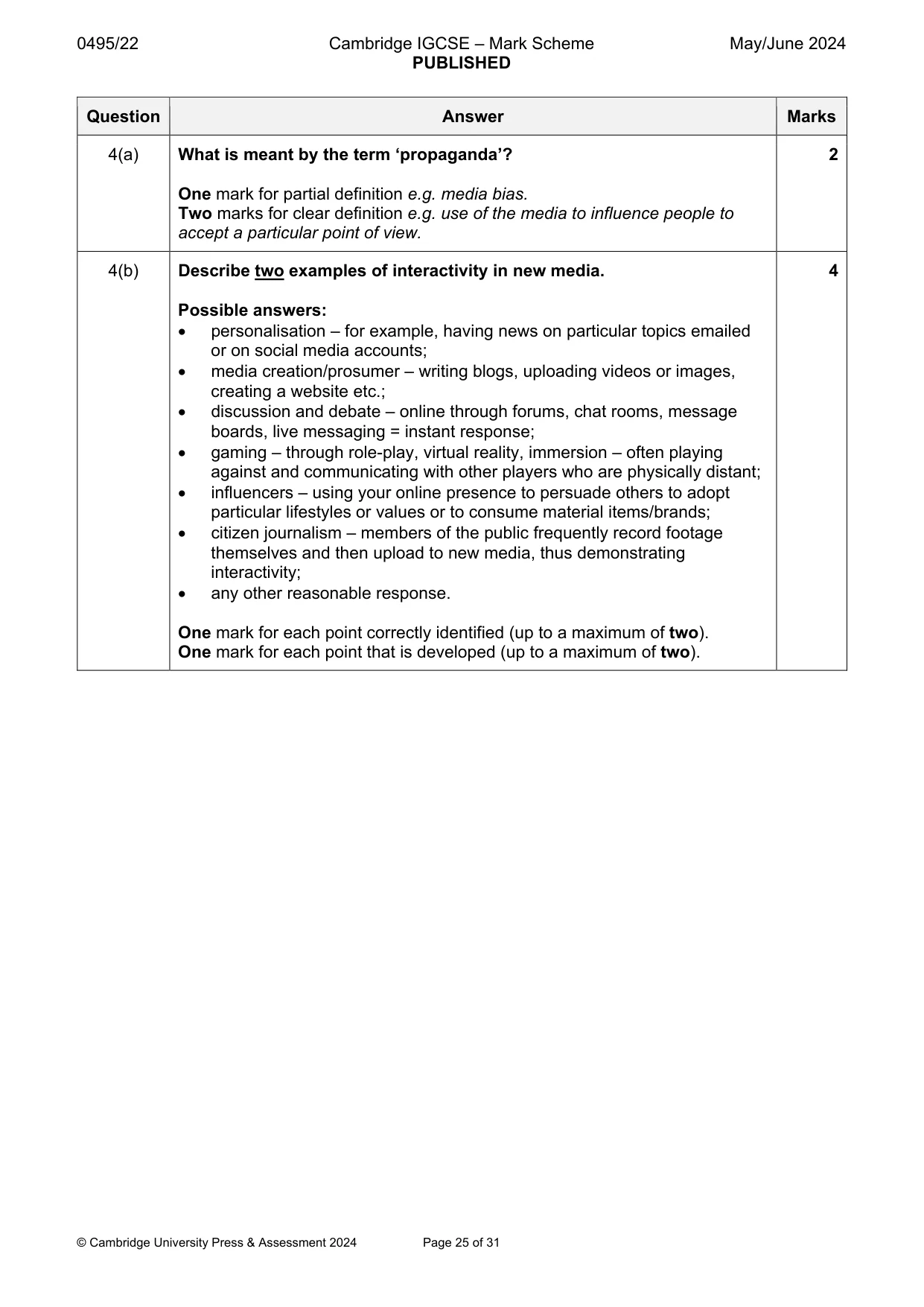
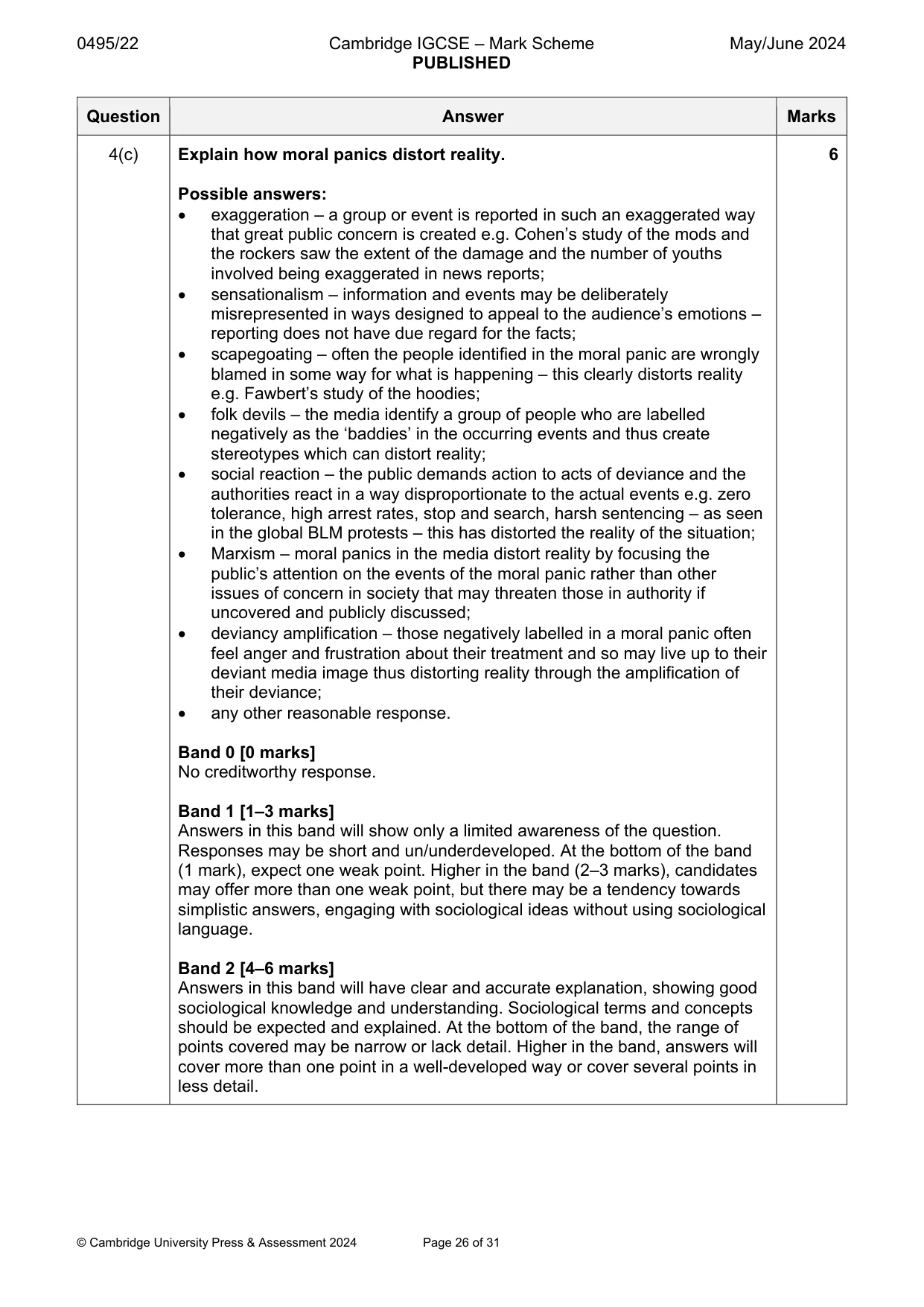
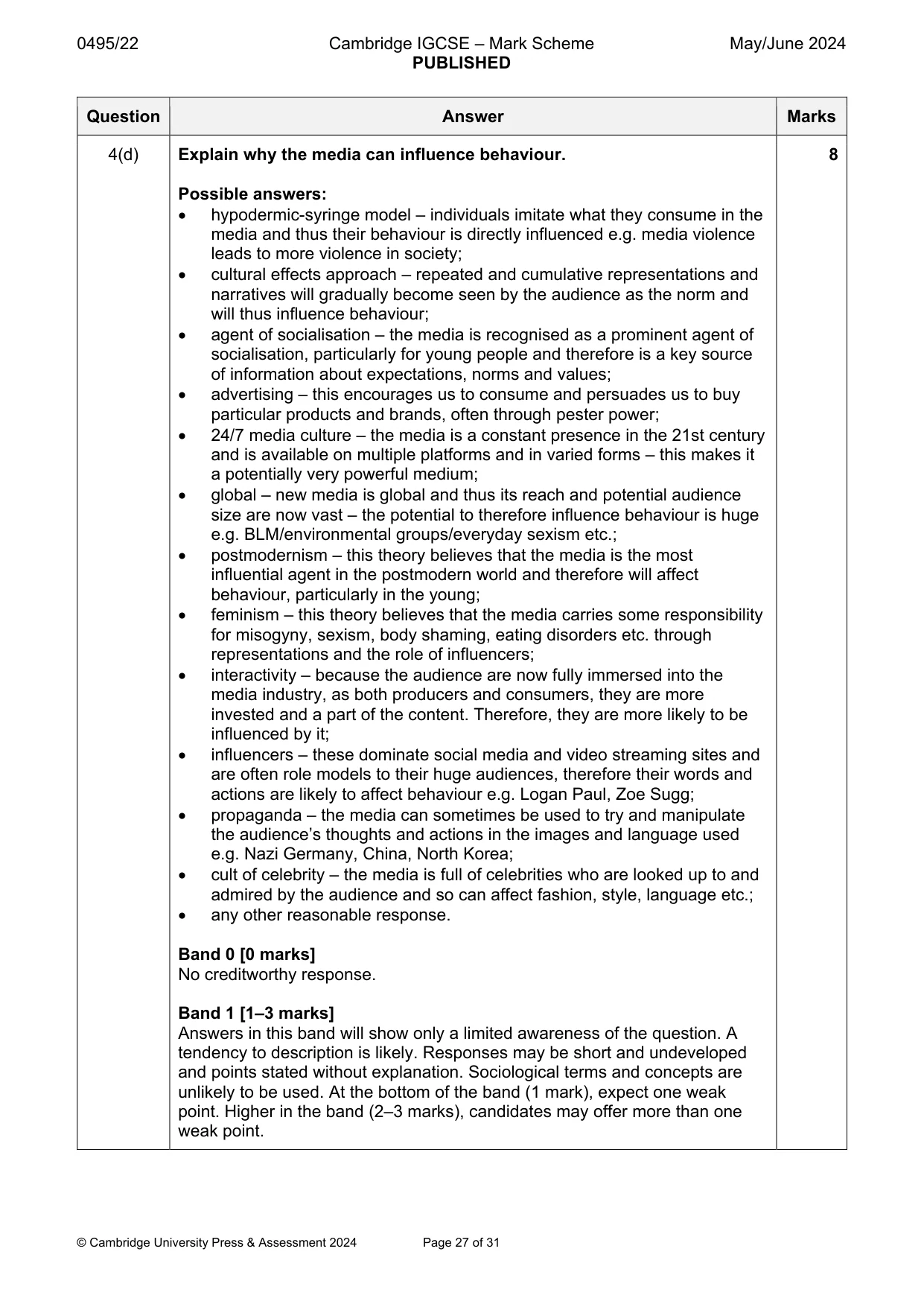
4 Many sociologists believe that the media influences behaviour. Moral panics in the media can distort reality. New media is more interactive than traditional media. Sociologists often criticise propaganda and gender representations found in the media. However, some sociologists believe that representations of gender are changing. (a) What is meant by the term ‘propaganda’? [2] (b) Describe two examples of interactivity in new media. [4] (c) Explain how moral panics distort reality. [6] (d) Explain why the media can influence behaviour. [8] (e) To what extent are media representations of gender changing? [15]
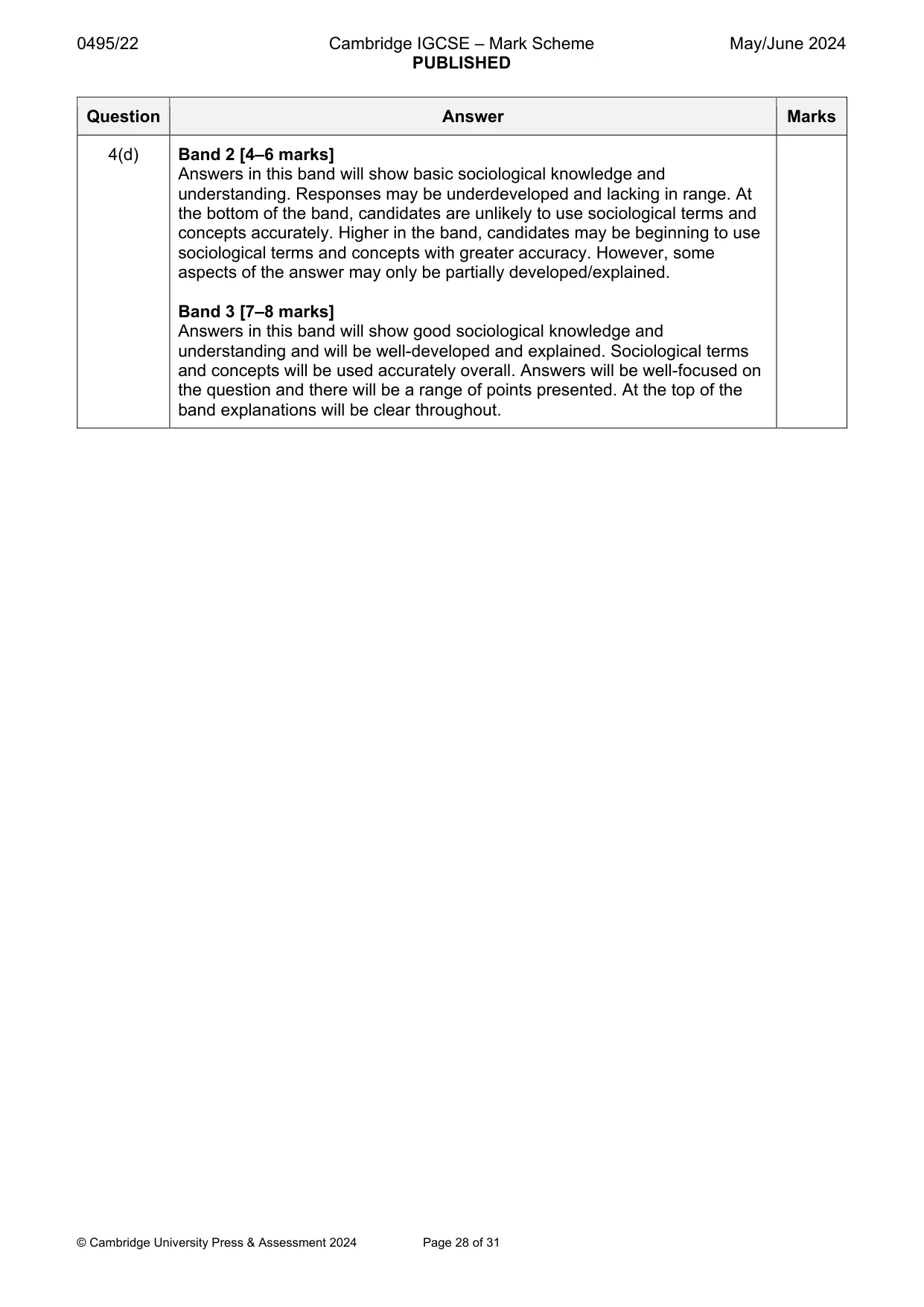
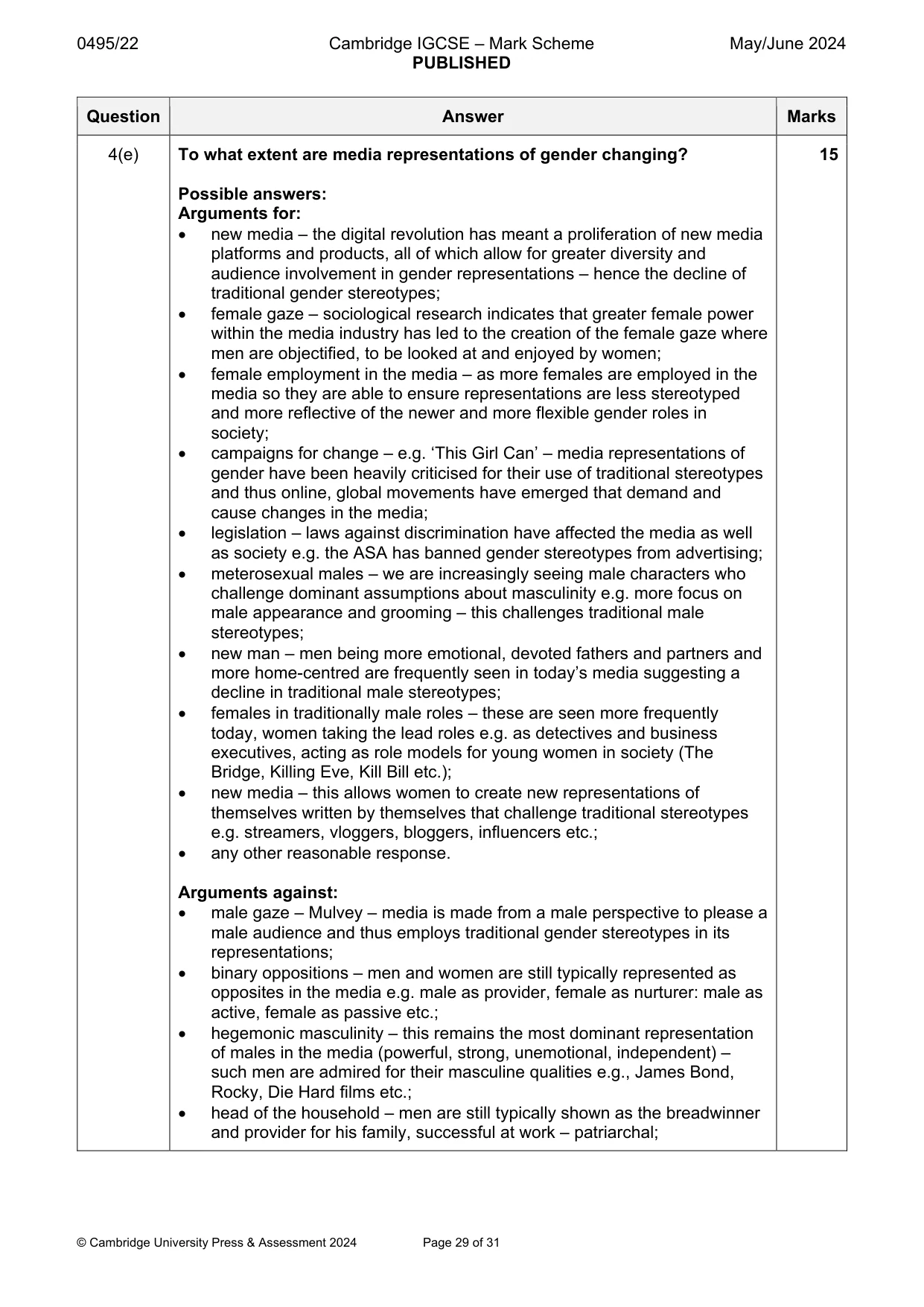
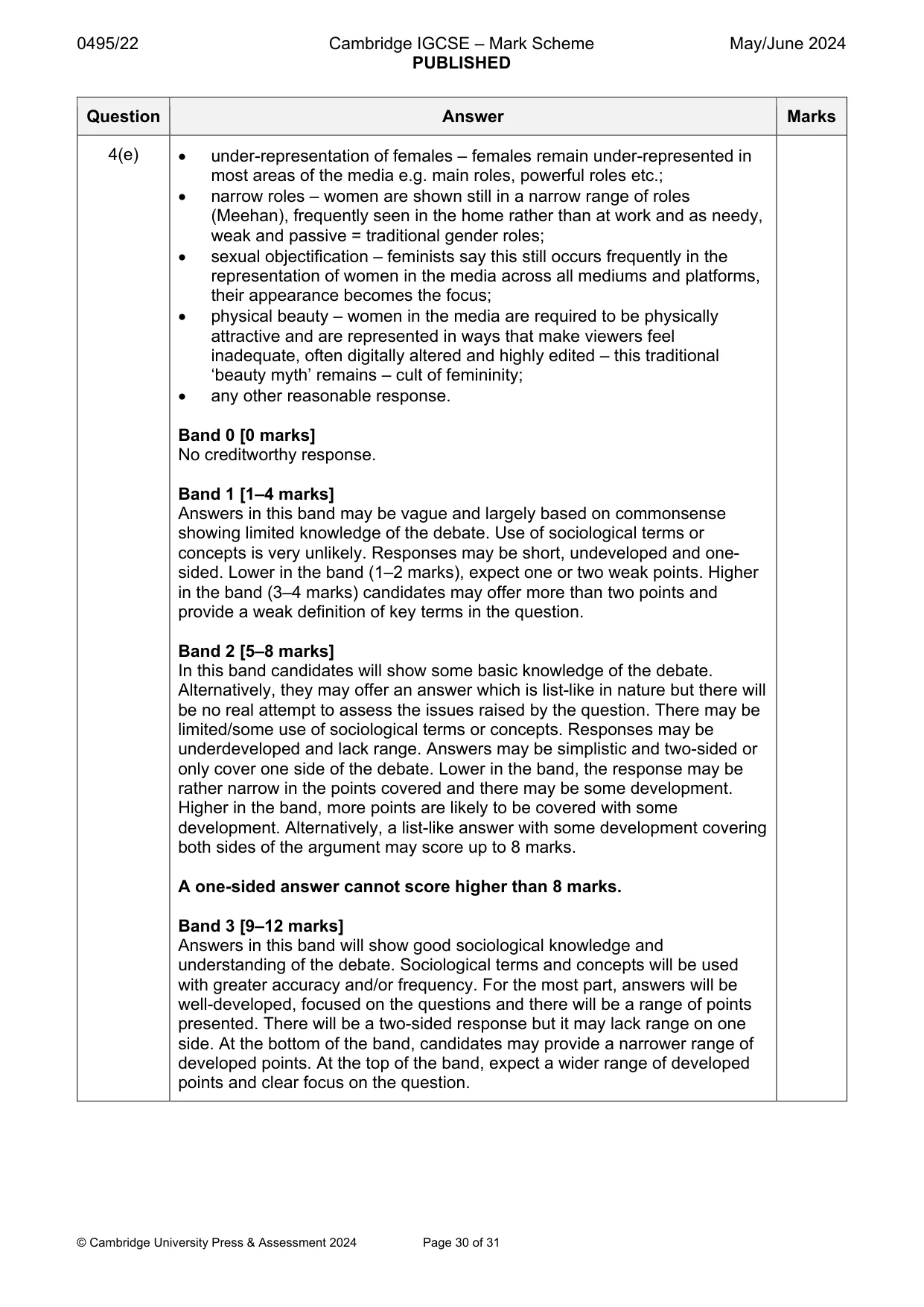
Mark scheme: 4(a) What is meant by the term ‘propaganda’? 2 One mark for partial definition e.g. media bias. Two marks for clear definition e.g. use of the media to influence people to accept a particular point of view. 4(b) Describe two examples of interactivity in new media. 4 Possible answers: personalisation – for example, having news on particular topics emailed or on social media accounts; media creation/prosumer – writing blogs, uploading videos or images, creating a website etc.; discussion and debate – online through forums, chat rooms, message boards, live messaging = instant response; gaming – through role-play, virtual reality, immersion – often playing against and communicating with other players who are physically distant; influencers – using your online presence to persuade others to adopt particular lifestyles or values or to consume material items/brands; citizen journalism – members of the public frequently record footage themselves and then upload to new media, thus demonstrating interactivity; any other reasonable response. One mark for each point correctly identified (up to a maximum of two). One mark for each point that is developed (up to a maximum of two). 4(c) Explain how moral panics distort reality. 6 Possible answers: exaggeration – a group or event is reported in such an exaggerated way that great public concern is created e.g. Cohen’s study of the mods and the rockers saw the extent of the damage and the number of youths involved being exaggerated in news reports; sensationalism – information and events may be deliberately misrepresented in ways designed to appeal to the audience’s emotions – reporting does not have due regard for the facts; scapegoating – often the people identified in the moral panic are wrongly blamed in some way for what is happening – this clearly distorts reality e.g. Fawbert’s study of the hoodies; folk devils – the media identify a group of people who are labelled negatively as the ‘baddies’ in the occurring events and thus create stereotypes which can distort reality; social reaction – the public demands action to acts of deviance and the authorities react in a way disproportionate to the actual events e.g. zero tolerance, high arrest rates, stop and search, harsh sentencing – as seen in the global BLM protests – this has distorted the reality of the situation; Marxism – moral panics in the media distort reality by focusing the public’s attention on the events of the moral panic rather than other issues of concern in society that may threaten those in authority if uncovered and publicly discussed; deviancy amplification – those negatively labelled in a moral panic often feel anger and frustration about their treatment and so may live up to their deviant media image thus distorting reality through the amplification of their deviance; any other reasonable response. Band 0 [0 marks] No creditworthy response. Band 1 [1–3 marks] Answers in this band will show only a limited awareness of the question. Responses may be short and un/underdeveloped. At the bottom of the band (1 mark), expect one weak point. Higher in the band (2–3 marks), candidates may offer more than one weak point, but there may be a tendency towards simplistic answers, engaging with sociological ideas without using sociological language. Band 2 [4–6 marks] Answers in this band will have clear and accurate explanation, showing good sociological knowledge and understanding. Sociological terms and concepts should be expected and explained. At the bottom of the band, the range of points covered may be narrow or lack detail. Higher in the band, answers will cover more than one point in a well-developed way or cover several points in less detail. 4(d) Explain why the media can influence behaviour. 8 Possible answers: hypodermic-syringe model – individuals imitate what they consume in the media and thus their behaviour is directly influenced e.g. media violence leads to more violence in society; cultural effects approach – repeated and cumulative representations and narratives will gradually become seen by the audience as the norm and will thus influence behaviour; agent of socialisation – the media is recognised as a prominent agent of socialisation, particularly for young people and therefore is a key source of information about expectations, norms and values; advertising – this encourages us to consume and persuades us to buy particular products and brands, often through pester power; 24/7 media culture – the media is a constant presence in the 21st century and is available on multiple platforms and in varied forms – this makes it a potentially very powerful medium; global – new media is global and thus its reach and potential audience size are now vast – the potential to therefore influence behaviour is huge e.g. BLM/environmental groups/everyday sexism etc.; postmodernism – this theory believes that the media is the most influential agent in the postmodern world and therefore will affect behaviour, particularly in the young; feminism – this theory believes that the media carries some responsibility for misogyny, sexism, body shaming, eating disorders etc. through representations and the role of influencers; interactivity – because the audience are now fully immersed into the media industry, as both producers and consumers, they are more invested and a part of the content. Therefore, they are more likely to be influenced by it; influencers – these dominate social media and video streaming sites and are often role models to their huge audiences, therefore their words and actions are likely to affect behaviour e.g. Logan Paul, Zoe Sugg; propaganda – the media can sometimes be used to try and manipulate the audience’s thoughts and actions in the images and language used e.g. Nazi Germany, China, North Korea; cult of celebrity – the media is full of celebrities who are looked up to and admired by the audience and so can affect fashion, style, language etc.; any other reasonable response. Band 0 [0 marks] No creditworthy response. Band 1 [1–3 marks] Answers in this band will show only a limited awareness of the question. A tendency to description is likely. Responses may be short and undeveloped and points stated without explanation. Sociological terms and concepts are unlikely to be used. At the bottom of the band (1 mark), expect one weak point. Higher in the band (2–3 marks), candidates may offer more than one weak point. 4(d) Band 2 [4–6 marks] Answers in this band will show basic sociological knowledge and understanding. Responses may be underdeveloped and lacking in range. At the bottom of the band, candidates are unlikely to use sociological terms and concepts accurately. Higher in the band, candidates may be beginning to use sociological terms and concepts with greater accuracy. However, some aspects of the answer may only be partially developed/explained. Band 3 [7–8 marks] Answers in this band will show good sociological knowledge and understanding and will be well-developed and explained. Sociological terms and concepts will be used accurately overall. Answers will be well-focused on the question and there will be a range of points presented. At the top of the band explanations will be clear throughout. 4(e) To what extent are media representations of gender changing? 15 Possible answers: Arguments for: new media – the digital revolution has meant a proliferation of new media platforms and products, all of which allow for greater diversity and audience involvement in gender representations – hence the decline of traditional gender stereotypes; female gaze – sociological research indicates that greater female power within the media industry has led to the creation of the female gaze where men are objectified, to be looked at and enjoyed by women; female employment in the media – as more females are employed in the media so they are able to ensure representations are less stereotyped and more reflective of the newer and more flexible gender roles in society; campaigns for change – e.g. ‘This Girl Can’ – media representations of gender have been heavily criticised for their use of traditional stereotypes and thus online, global movements have emerged that demand and cause changes in the media; legislation – laws against discrimination have affected the media as well as society e.g. the ASA has banned gender stereotypes from advertising; meterosexual males – we are increasingly seeing male characters who challenge dominant assumptions about masculinity e.g. more focus on male appearance and grooming – this challenges traditional male stereotypes; new man – men being more emotional, devoted fathers and partners and more home-centred are frequently seen in today’s media suggesting a decline in traditional male stereotypes; females in traditionally male roles – these are seen more frequently today, women taking the lead roles e.g. as detectives and business executives, acting as role models for young women in society (The Bridge, Killing Eve, Kill Bill etc.); new media – this allows women to create new representations of themselves written by themselves that challenge traditional stereotypes e.g. streamers, vloggers, bloggers, influencers etc.; any other reasonable response. Arguments against: male gaze – Mulvey – media is made from a male perspective to please a male audience and thus employs traditional gender stereotypes in its representations; binary oppositions – men and women are still typically represented as opposites in the media e.g. male as provider, female as nurturer: male as active, female as passive etc.; hegemonic masculinity – this remains the most dominant representation of males in the media (powerful, strong, unemotional, independent) – such men are admired for their masculine qualities e.g., James Bond, Rocky, Die Hard films etc.; head of the household – men are still typically shown as the breadwinner and provider for his family, successful at work – patriarchal; 4(e) under-representation of females – females remain under-represented in most areas of the media e.g. main roles, powerful roles etc.; narrow roles – women are shown still in a narrow range of roles (Meehan), frequently seen in the home rather than at work and as needy, weak and passive = traditional gender roles; sexual objectification – feminists say this still occurs frequently in the representation of women in the media across all mediums and platforms, their appearance becomes the focus; physical beauty – women in the media are required to be physically attractive and are represented in ways that make viewers feel inadequate, often digitally altered and highly edited – this traditional ‘beauty myth’ remains – cult of femininity; any other reasonable response. Band 0 [0 marks] No creditworthy response. Band 1 [1–4 marks] Answers in this band may be vague and largely based on commonsense showing limited knowledge of the debate. Use of sociological terms or concepts is very unlikely. Responses may be short, undeveloped and one- sided. Lower in the band (1–2 marks), expect one or two weak points. Higher in the band (3–4 marks) candidates may offer more than two points and provide a weak definition of key terms in the question. Band 2 [5–8 marks] In this band candidates will show some basic knowledge of the debate. Alternatively, they may offer an answer which is list-like in nature but there will be no real attempt to assess the issues raised by the question. There may be limited/some use of sociological terms or concepts. Responses may be underdeveloped and lack range. Answers may be simplistic and two-sided or only cover one side of the debate. Lower in the band, the response may be rather narrow in the points covered and there may be some development. Higher in the band, more points are likely to be covered with some development. Alternatively, a list-like answer with some development covering both sides of the argument may score up to 8 marks. A one-sided answer cannot score higher than 8 marks. Band 3 [9–12 marks] Answers in this band will show good sociological knowledge and understanding of the debate. Sociological terms and concepts will be used with greater accuracy and/or frequency. For the most part, answers will be well-developed, focused on the questions and there will be a range of points presented. There will be a two-sided response but it may lack range on one side. At the bottom of the band, candidates may provide a narrower range of developed points. At the top of the band, expect a wider range of developed points and clear focus on the question. 4(e) Band 4 [13–15 marks] Answers in this band will show excellent knowledge and understanding of the debate. There will be a strong grasp of the arguments as well as accurate and frequent use of sociological terms and concepts. Answers will be well- developed, clearly focused on the question and discuss a wide range of points. Responses will be two-sided and have a range of points on each side. At the bottom of the band (13 marks), the answer may lack a specific conclusion. Higher in the band, there will be a clear attempt to offer an assessment of the ‘To what extent?’ part of the question through a focused conclusion.
More questions on How do sociologists approach the study of society?
What was in this paper
The subtopics covered by these 4 questions, and how many questions each got. Open one in a new tab to see every Cambridge question on it.
What you needed in this session
Cambridge’s own grade thresholds for 2024 May/June, Paper 2 · Variant 2. A higher threshold means an easier paper — the bar moves with how the cohort did.