Cambridge IGCSE Sociology 0495 — 2018 Oct/Nov Paper 2 · Variant 2
0495/22/O/N/18 · 4 questions · 70 marks · ≈79 min
The question paper and its mark scheme, free to read here and free to download. This is Cambridge’s own paper, exactly as it was sat.
Question paper4 pages

Mark scheme32 pages
Answers below. Sit the paper first if you are practising.
Questions as text
Q1 · Alternatives to marriage, such as civil partnerships, mean the family continues to change
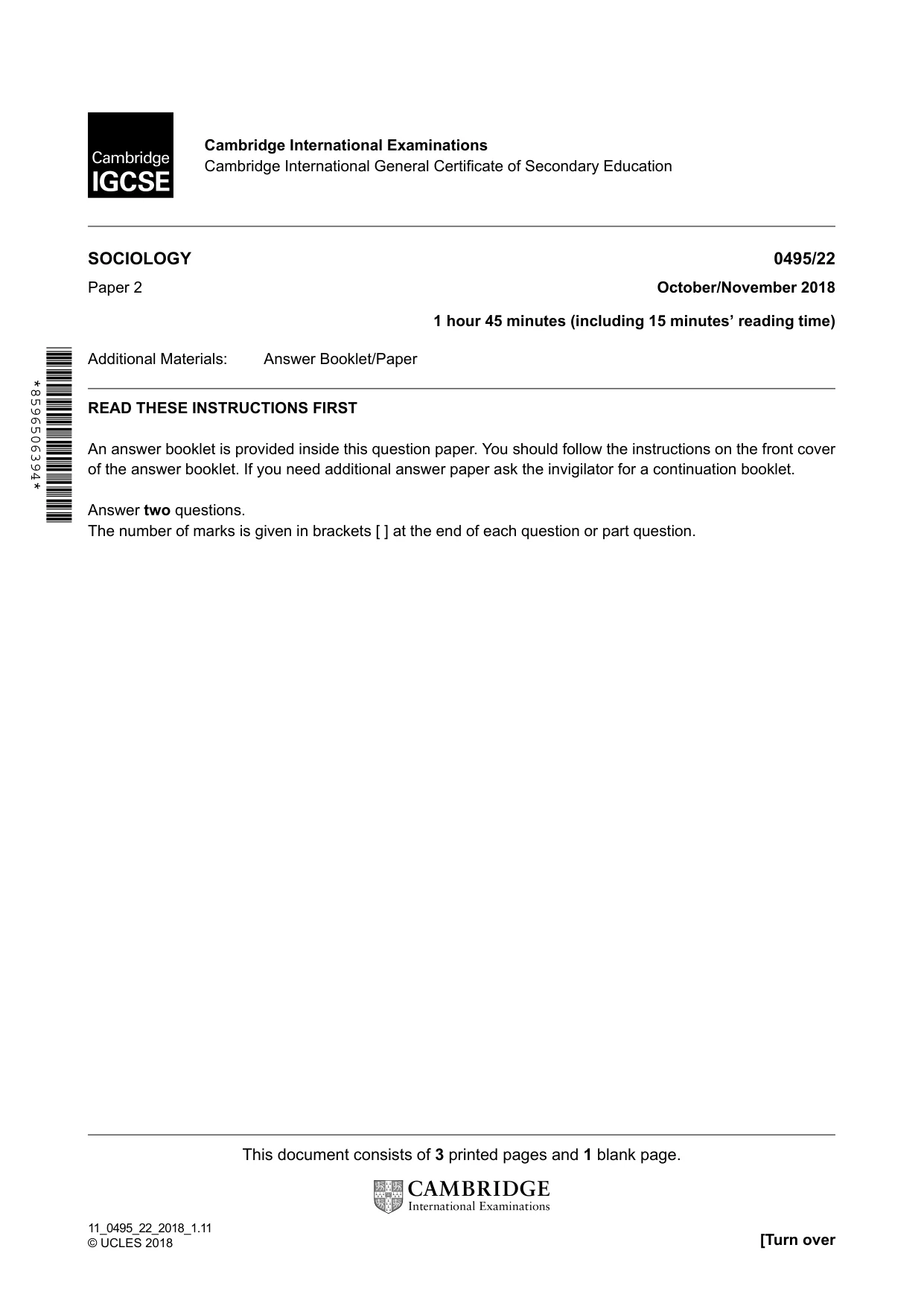
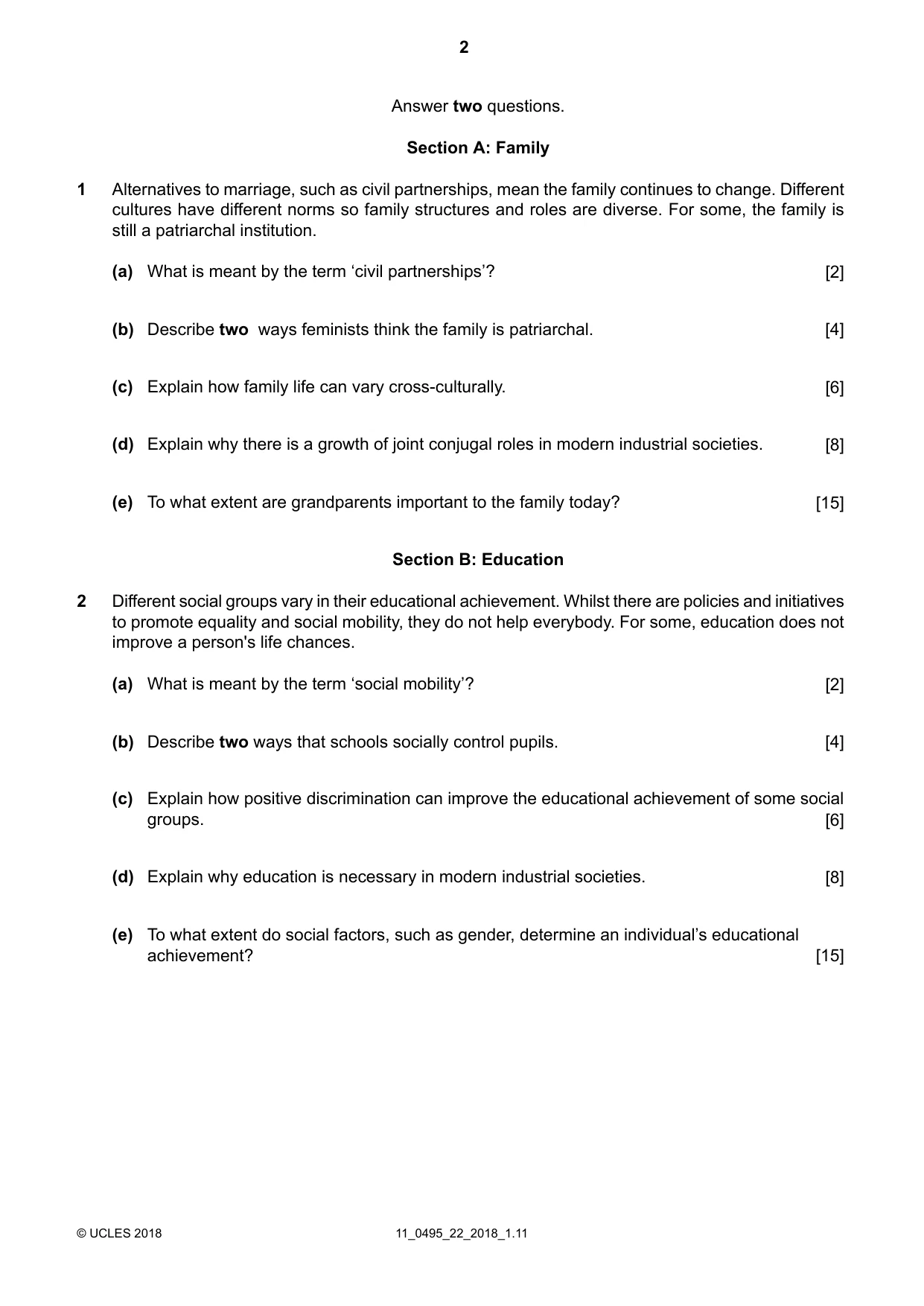
1 Alternatives to marriage, such as civil partnerships, mean the family continues to change. Different cultures have different norms so family structures and roles are diverse. For some, the family is still a patriarchal institution. (a) What is meant by the term ‘civil partnerships’? [2] (b) Describe two ways feminists think the family is patriarchal. [4] (c) Explain how family life can vary cross-culturally. [6] (d) Explain why there is a growth of joint conjugal roles in modern industrial societies. [8] (e) To what extent are grandparents important to the family today? [15]
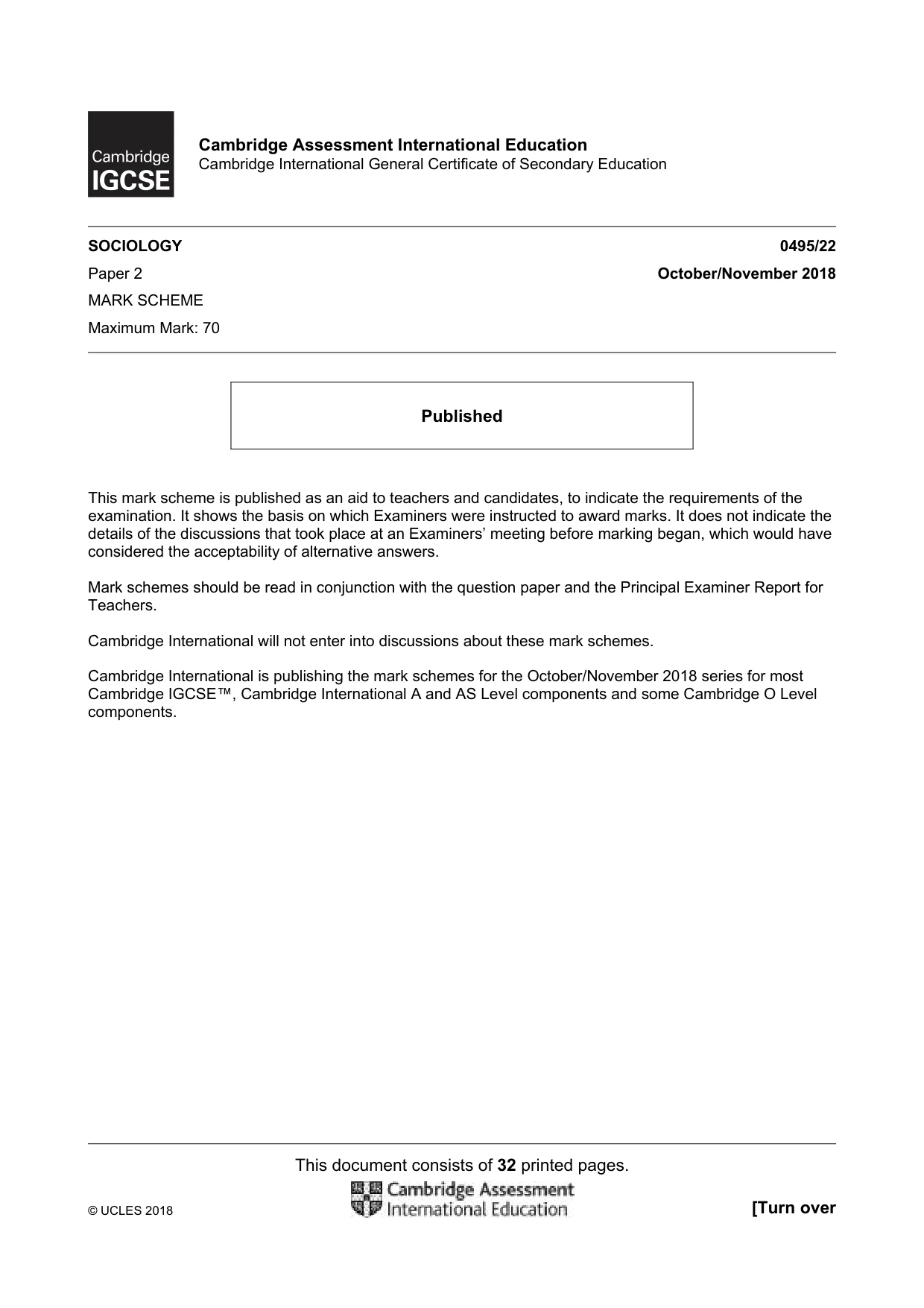
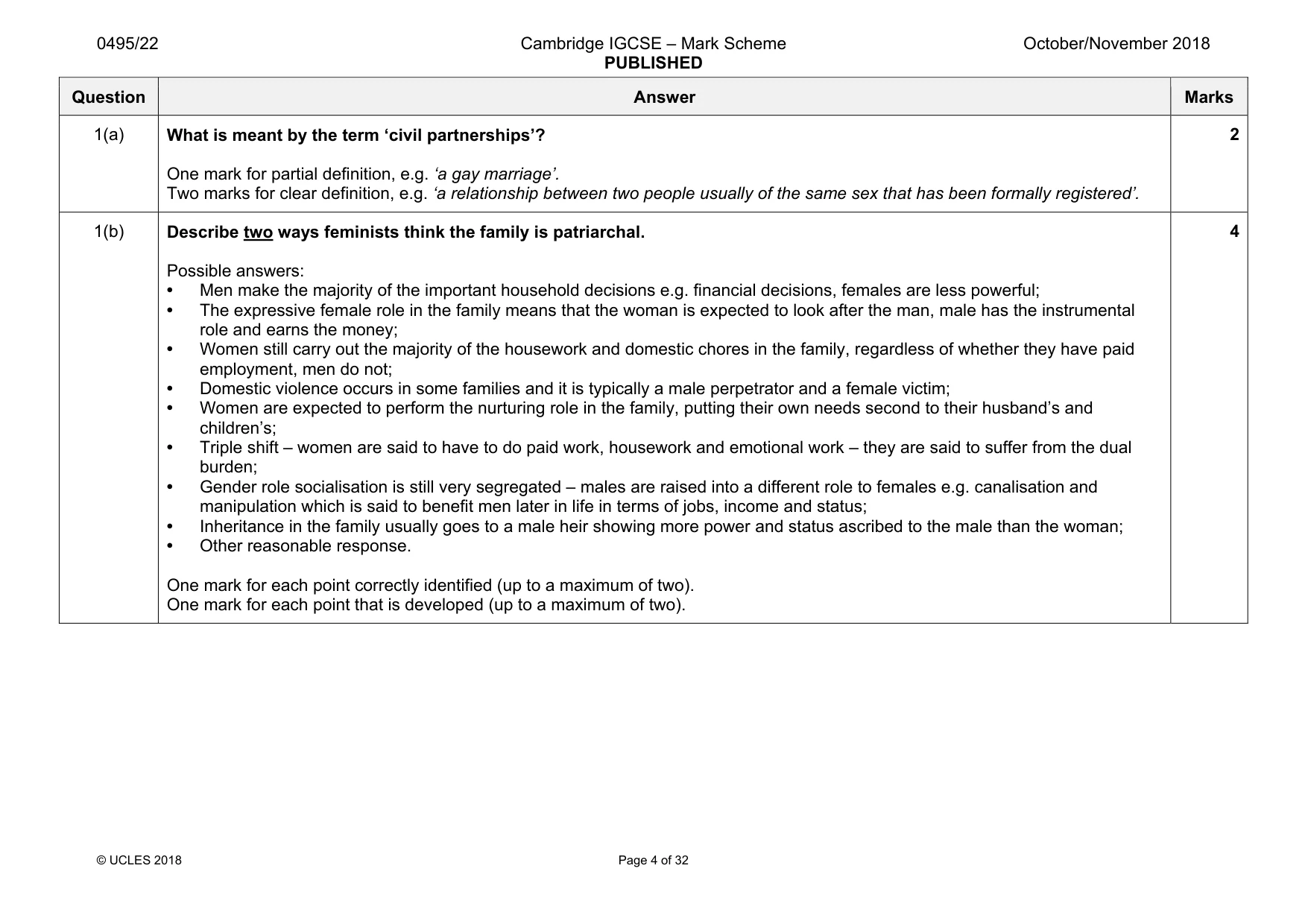
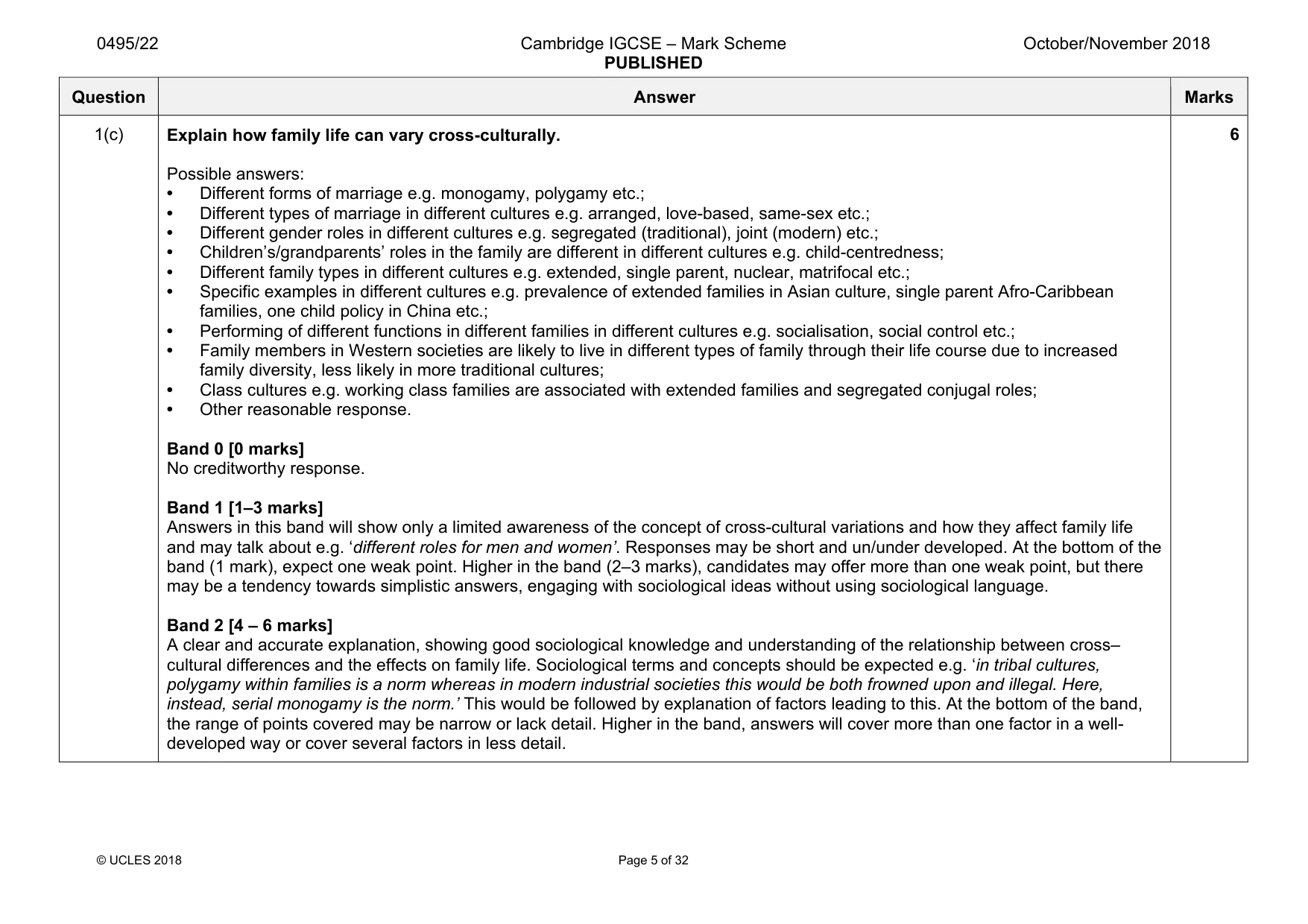
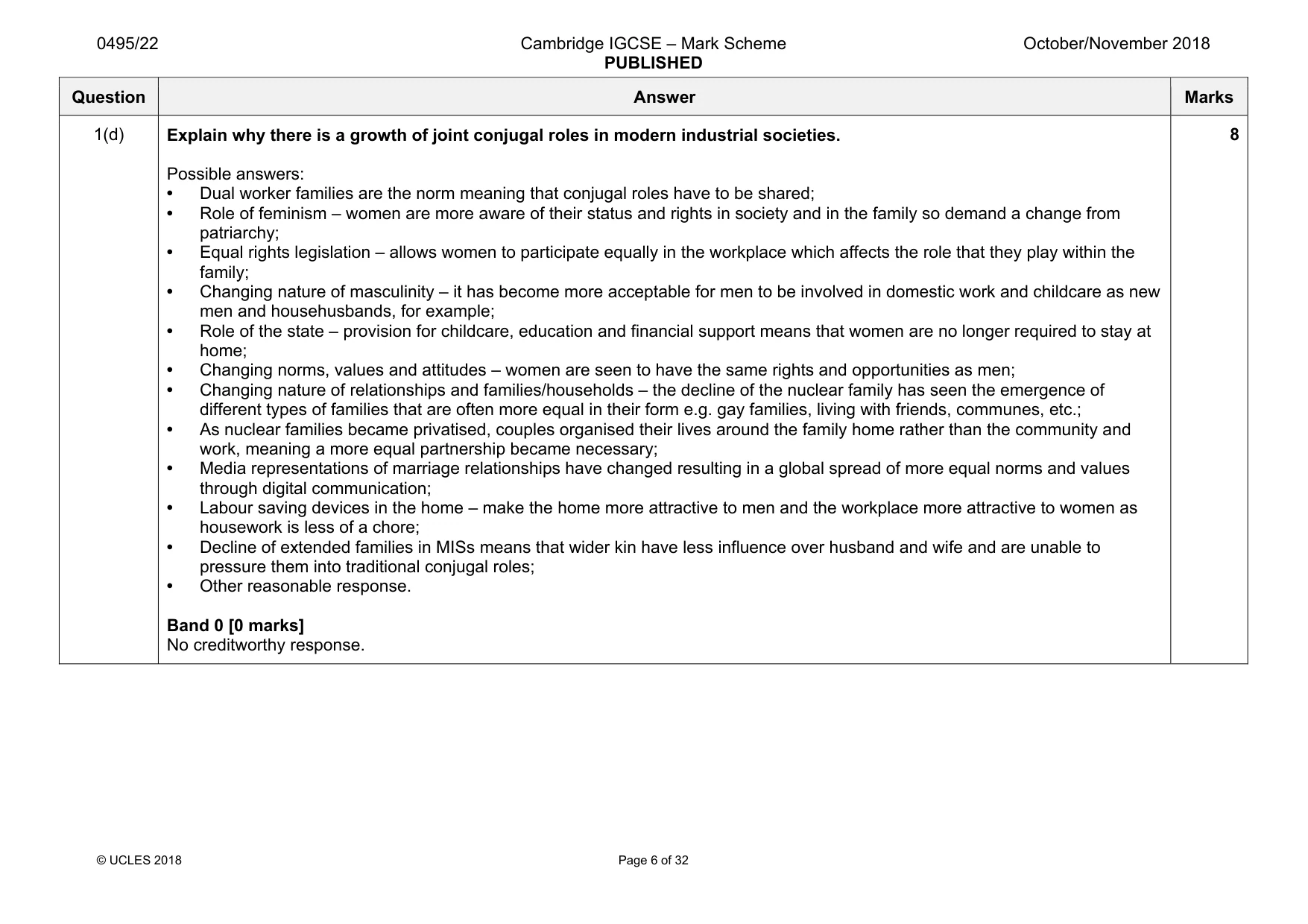
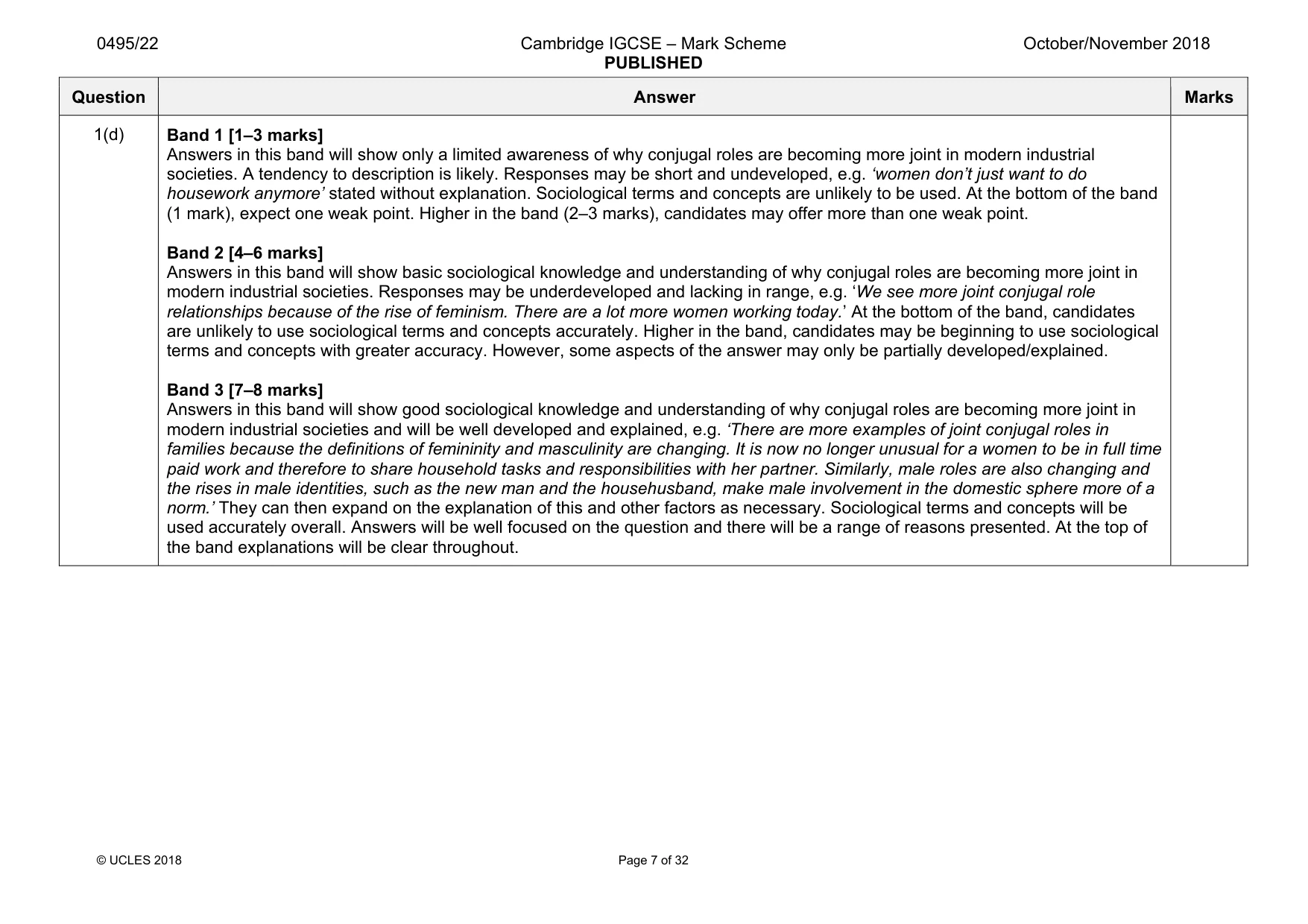
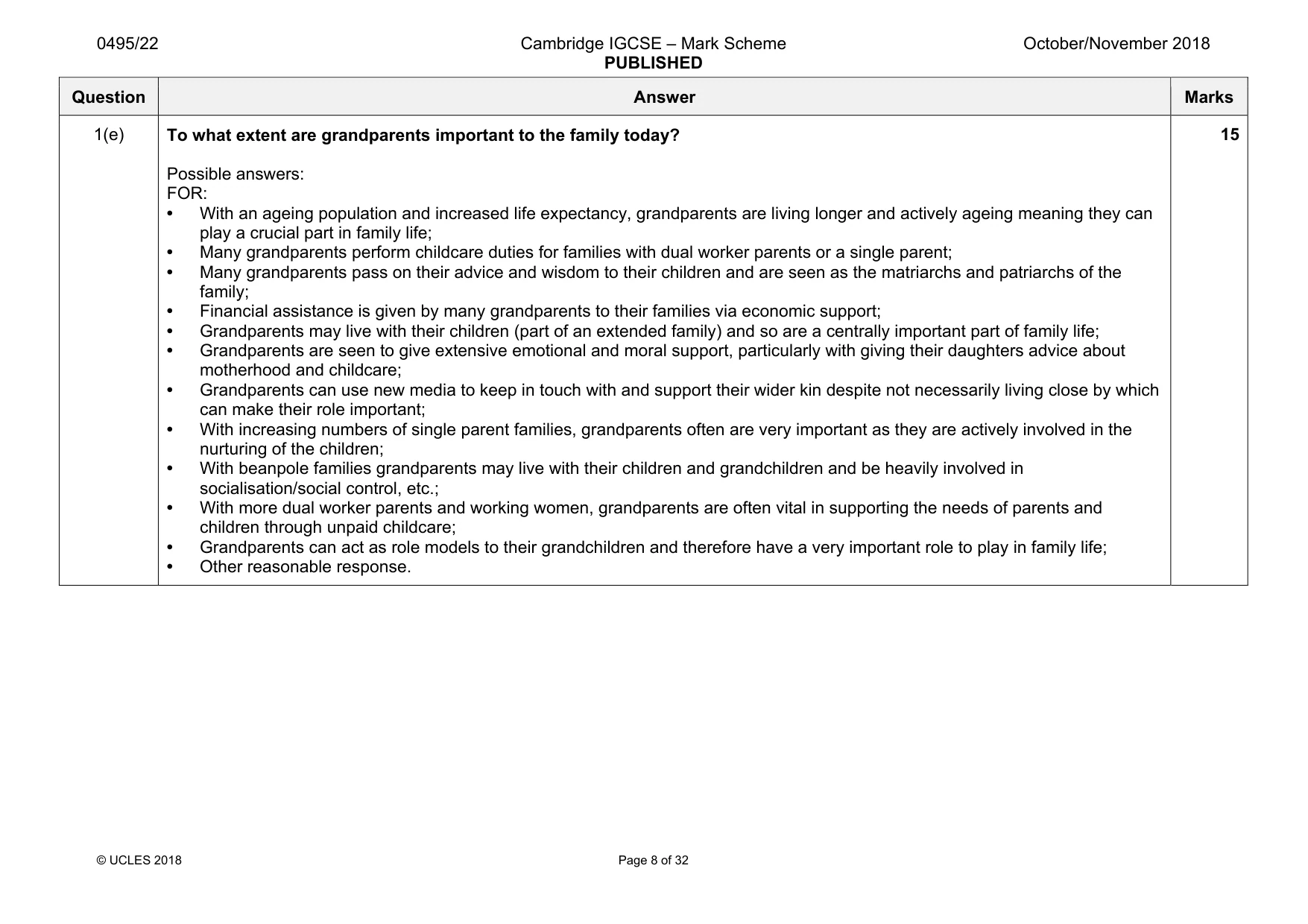
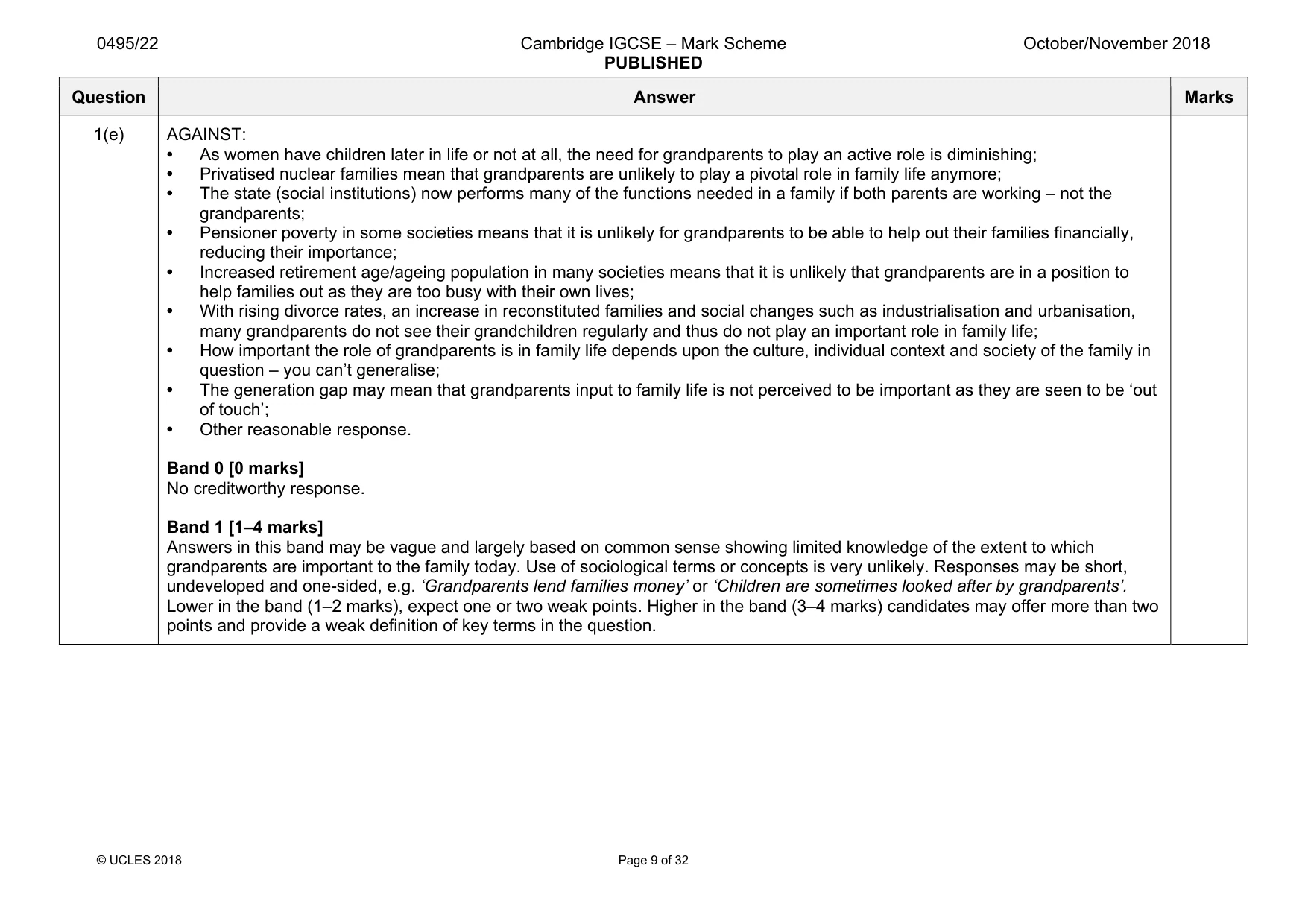
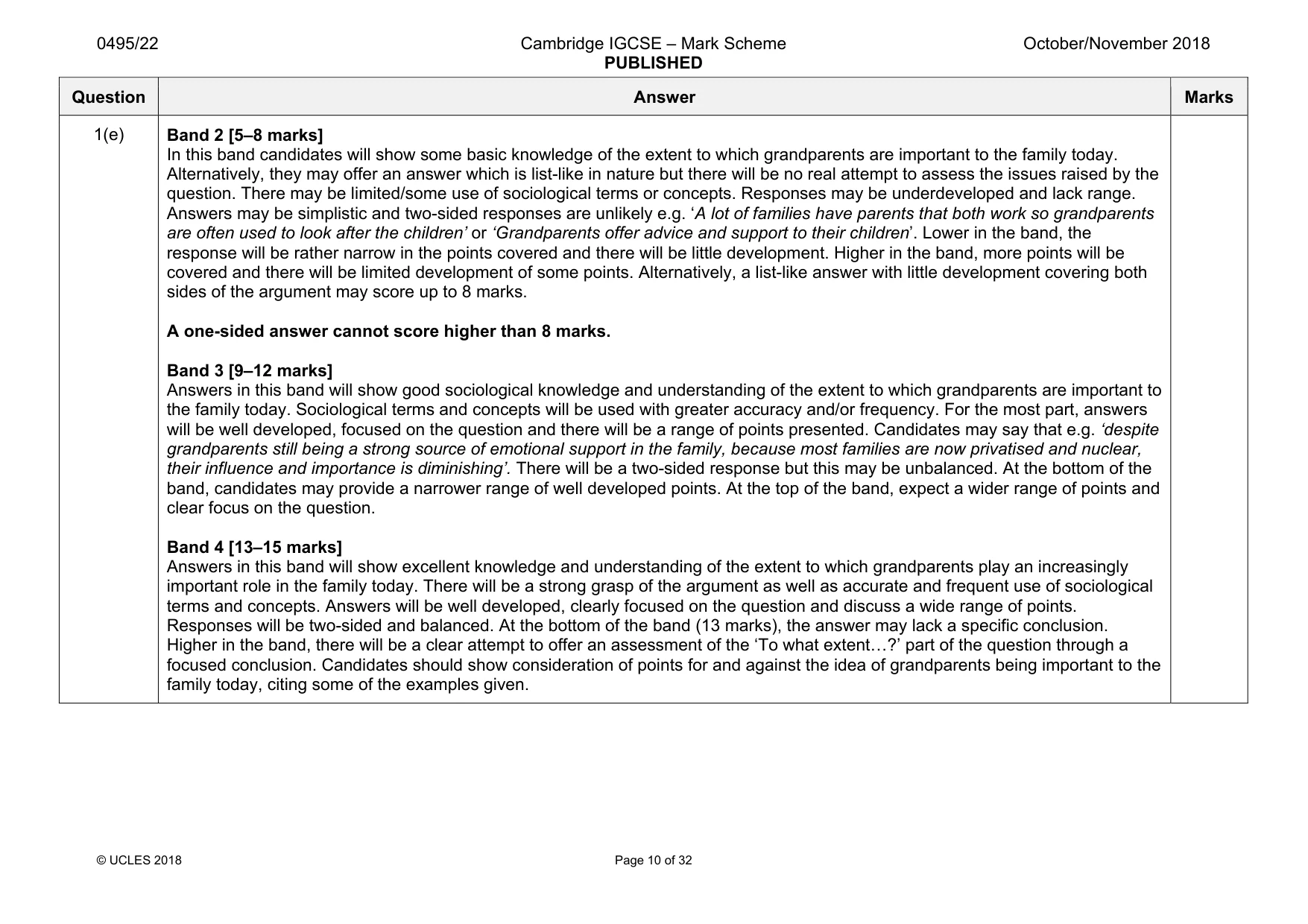
Mark scheme: 1(a) What is meant by the term ‘civil partnerships’? One mark for partial definition, e.g. ‘a gay marriage’. Two marks for clear definition, e.g. ‘a relationship between two people usually of the same sex that has been formally registered’. 2 1(b) Describe two ways feminists think the family is patriarchal. Possible answers: • Men make the majority of the important household decisions e.g. financial decisions, females are less powerful; • The expressive female role in the family means that the woman is expected to look after the man, male has the instrumental role and earns the money; • Women still carry out the majority of the housework and domestic chores in the family, regardless of whether they have paid employment, men do not; • Domestic violence occurs in some families and it is typically a male perpetrator and a female victim; • Women are expected to perform the nurturing role in the family, putting their own needs second to their husband’s and children’s; • Triple shift – women are said to have to do paid work, housework and emotional work – they are said to suffer from the dual burden; • Gender role socialisation is still very segregated – males are raised into a different role to females e.g. canalisation and manipulation which is said to benefit men later in life in terms of jobs, income and status; • Inheritance in the family usually goes to a male heir showing more power and status ascribed to the male than the woman; • Other reasonable response. One mark for each point correctly identified (up to a maximum of two). One mark for each point that is developed (up to a maximum of two). 4 Question Answer Marks 1(c) Explain how family life can vary cross-culturally. Possible answers: • Different forms of marriage e.g. monogamy, polygamy etc.; • Different types of marriage in different cultures e.g. arranged, love-based, same-sex etc.; • Different gender roles in different cultures e.g. segregated (traditional), joint (modern) etc.; • Children’s/grandparents’ roles in the family are different in different cultures e.g. child-centredness; • Different family types in different cultures e.g. extended, single parent, nuclear, matrifocal etc.; • Specific examples in different cultures e.g. prevalence of extended families in Asian culture, single parent Afro-Caribbean families, one child policy in China etc.; • Performing of different functions in different families in different cultures e.g. socialisation, social control etc.; • Family members in Western societies are likely to live in different types of family through their life course due to increased family diversity, less likely in more traditional cultures; • Class cultures e.g. working class families are associated with extended families and segregated conjugal roles; • Other reasonable response. Band 0 [0 marks] No creditworthy response. Band 1 [1–3 marks] Answers in this band will show only a limited awareness of the concept of cross-cultural variations and how they affect family life and may talk about e.g. ‘different roles for men and women’. Responses may be short and un/under developed. At the bottom of the band (1 mark), expect one weak point. Higher in the band (2–3 marks), candidates may offer more than one weak point, but there may be a tendency towards simplistic answers, engaging with sociological ideas without using sociological language. Band 2 [4 – 6 marks] A clear and accurate explanation, showing good sociological knowledge and understanding of the relationship between cross– cultural differences and the effects on family life. Sociological terms and concepts should be expected e.g. ‘in tribal cultures, polygamy within families is a norm whereas in modern industrial societies this would be both frowned upon and illegal. Here, instead, serial monogamy is the norm.’ This would be followed by explanation of factors leading to this. At the bottom of the band, the range of points covered may be narrow or lack detail. Higher in the band, answers will cover more than one factor in a well- developed way or cover several factors in less detail. 6 Question Answer Marks 1(d) Explain why there is a growth of joint conjugal roles in modern industrial societies. Possible answers: • Dual worker families are the norm meaning that conjugal roles have to be shared; • Role of feminism – women are more aware of their status and rights in society and in the family so demand a change from patriarchy; • Equal rights legislation – allows women to participate equally in the workplace which affects the role that they play within the family; • Changing nature of masculinity – it has become more acceptable for men to be involved in domestic work and childcare as new men and househusbands, for example; • Role of the state – provision for childcare, education and financial support means that women are no longer required to stay at home; • Changing norms, values and attitudes – women are seen to have the same rights and opportunities as men; • Changing nature of relationships and families/households – the decline of the nuclear family has seen the emergence of different types of families that are often more equal in their form e.g. gay families, living with friends, communes, etc.; • As nuclear families became privatised, couples organised their lives around the family home rather than the community and work, meaning a more equal partnership became necessary; • Media representations of marriage relationships have changed resulting in a global spread of more equal norms and values through digital communication; • Labour saving devices in the home – make the home more attractive to men and the workplace more attractive to women as housework is less of a chore; • Decline of extended families in MISs means that wider kin have less influence over husband and wife and are unable to pressure them into traditional conjugal roles; • Other reasonable response. Band 0 [0 marks] No creditworthy response. 8 Question Answer Marks 1(d) Band 1 [1–3 marks] Answers in this band will show only a limited awareness of why conjugal roles are becoming more joint in modern industrial societies. A tendency to description is likely. Responses may be short and undeveloped, e.g. ‘women don’t just want to do housework anymore’ stated without explanation. Sociological terms and concepts are unlikely to be used. At the bottom of the band (1 mark), expect one weak point. Higher in the band (2–3 marks), candidates may offer more than one weak point. Band 2 [4–6 marks] Answers in this band will show basic sociological knowledge and understanding of why conjugal roles are becoming more joint in modern industrial societies. Responses may be underdeveloped and lacking in range, e.g. ‘We see more joint conjugal role relationships because of the rise of feminism. There are a lot more women working today.’ At the bottom of the band, candidates are unlikely to use sociological terms and concepts accurately. Higher in the band, candidates may be beginning to use sociological terms and concepts with greater accuracy. However, some aspects of the answer may only be partially developed/explained. Band 3 [7–8 marks] Answers in this band will show good sociological knowledge and understanding of why conjugal roles are becoming more joint in modern industrial societies and will be well developed and explained, e.g. ‘There are more examples of joint conjugal roles in families because the definitions of femininity and masculinity are changing. It is now no longer unusual for a women to be in full time paid work and therefore to share household tasks and responsibilities with her partner. Similarly, male roles are also changing and the rises in male identities, such as the new man and the househusband, make male involvement in the domestic sphere more of a norm.’ They can then expand on the explanation of this and other factors as necessary. Sociological terms and concepts will be used accurately overall. Answers will be well focused on the question and there will be a range of reasons presented. At the top of the band explanations will be clear throughout. Question Answer Marks 1(e) To what extent are grandparents important to the family today? Possible answers: FOR: • With an ageing population and increased life expectancy, grandparents are living longer and actively ageing meaning they can play a crucial part in family life; • Many grandparents perform childcare duties for families with dual worker parents or a single parent; • Many grandparents pass on their advice and wisdom to their children and are seen as the matriarchs and patriarchs of the family; • Financial assistance is given by many grandparents to their families via economic support; • Grandparents may live with their children (part of an extended family) and so are a centrally important part of family life; • Grandparents are seen to give extensive emotional and moral support, particularly with giving their daughters advice about motherhood and childcare; • Grandparents can use new media to keep in touch with and support their wider kin despite not necessarily living close by which can make their role important; • With increasing numbers of single parent families, grandparents often are very important as they are actively involved in the nurturing of the children; • With beanpole families grandparents may live with their children and grandchildren and be heavily involved in socialisation/social control, etc.; • With more dual worker parents and working women, grandparents are often vital in supporting the needs of parents and children through unpaid childcare; • Grandparents can act as role models to their grandchildren and therefore have a very important role to play in family life; • Other reasonable response. 15 Question Answer Marks 1(e) AGAINST: • As women have children later in life or not at all, the need for grandparents to play an active role is diminishing; • Privatised nuclear families mean that grandparents are unlikely to play a pivotal role in family life anymore; • The state (social institutions) now performs many of the functions needed in a family if both parents are working – not the grandparents; • Pensioner poverty in some societies means that it is unlikely for grandparents to be able to help out their families financially, reducing their importance; • Increased retirement age/ageing population in many societies means that it is unlikely that grandparents are in a position to help families out as they are too busy with their own lives; • With rising divorce rates, an increase in reconstituted families and social changes such as industrialisation and urbanisation, many grandparents do not see their grandchildren regularly and thus do not play an important role in family life; • How important the role of grandparents is in family life depends upon the culture, individual context and society of the family in question – you can’t generalise; • The generation gap may mean that grandparents input to family life is not perceived to be important as they are seen to be ‘out of touch’; • Other reasonable response. Band 0 [0 marks] No creditworthy response. Band 1 [1–4 marks] Answers in this band may be vague and largely based on common sense showing limited knowledge of the extent to which grandparents are important to the family today. Use of sociological terms or concepts is very unlikely. Responses may be short, undeveloped and one-sided, e.g. ‘Grandparents lend families money’ or ‘Children are sometimes looked after by grandparents’. Lower in the band (1–2 marks), expect one or two weak points. Higher in the band (3–4 marks) candidates may offer more than two points and provide a weak definition of key terms in the question. Question Answer Marks 1(e) Band 2 [5–8 marks] In this band candidates will show some basic knowledge of the extent to which grandparents are important to the family today. Alternatively, they may offer an answer which is list-like in nature but there will be no real attempt to assess the issues raised by the question. There may be limited/some use of sociological terms or concepts. Responses may be underdeveloped and lack range. Answers may be simplistic and two-sided responses are unlikely e.g. ‘A lot of families have parents that both work so grandparents are often used to look after the children’ or ‘Grandparents offer advice and support to their children’. Lower in the band, the response will be rather narrow in the points covered and there will be little development. Higher in the band, more points will be covered and there will be limited development of some points. Alternatively, a list-like answer with little development covering both sides of the argument may score up to 8 marks. A one-sided answer cannot score higher than 8 marks. Band 3 [9–12 marks] Answers in this band will show good sociological knowledge and understanding of the extent to which grandparents are important to the family today. Sociological terms and concepts will be used with greater accuracy and/or frequency. For the most part, answers will be well developed, focused on the question and there will be a range of points presented. Candidates may say that e.g. ‘despite grandparents still being a strong source of emotional support in the family, because most families are now privatised and nuclear, their influence and importance is diminishing’. There will be a two-sided response but this may be unbalanced. At the bottom of the band, candidates may provide a narrower range of well developed points. At the top of the band, expect a wider range of points and clear focus on the question. Band 4 [13–15 marks] Answers in this band will show excellent knowledge and understanding of the extent to which grandparents play an increasingly important role in the family today. There will be a strong grasp of the argument as well as accurate and frequent use of sociological terms and concepts. Answers will be well developed, clearly focused on the question and discuss a wide range of points. Responses will be two-sided and balanced. At the bottom of the band (13 marks), the answer may lack a specific conclusion. Higher in the band, there will be a clear attempt to offer an assessment of the ‘To what extent«?’ part of the question through a focused conclusion. Candidates should show consideration of points for and against the idea of grandparents being important to the family today, citing some of the examples given.
Q2 · Different social groups vary in their educational achievement
2 Different social groups vary in their educational achievement. Whilst there are policies and initiatives to promote equality and social mobility, they do not help everybody. For some, education does not improve a person's life chances. (a) What is meant by the term ‘social mobility’? [2] (b) Describe two ways that schools socially control pupils. [4] (c) Explain how positive discrimination can improve the educational achievement of some social groups. [6] (d) Explain why education is necessary in modern industrial societies. [8] (e) To what extent do social factors, such as gender, determine an individual’s educational achievement? [15] Section C: Crime, deviance and social control There are different ways that sociologists can measure crime, for example self-report studies. However using these measurements to explain why people commit crime causes much debate. Some sociologists argue that crime is committed because people experience a lack of status in society, other sociologists blame the police and the way they behave.
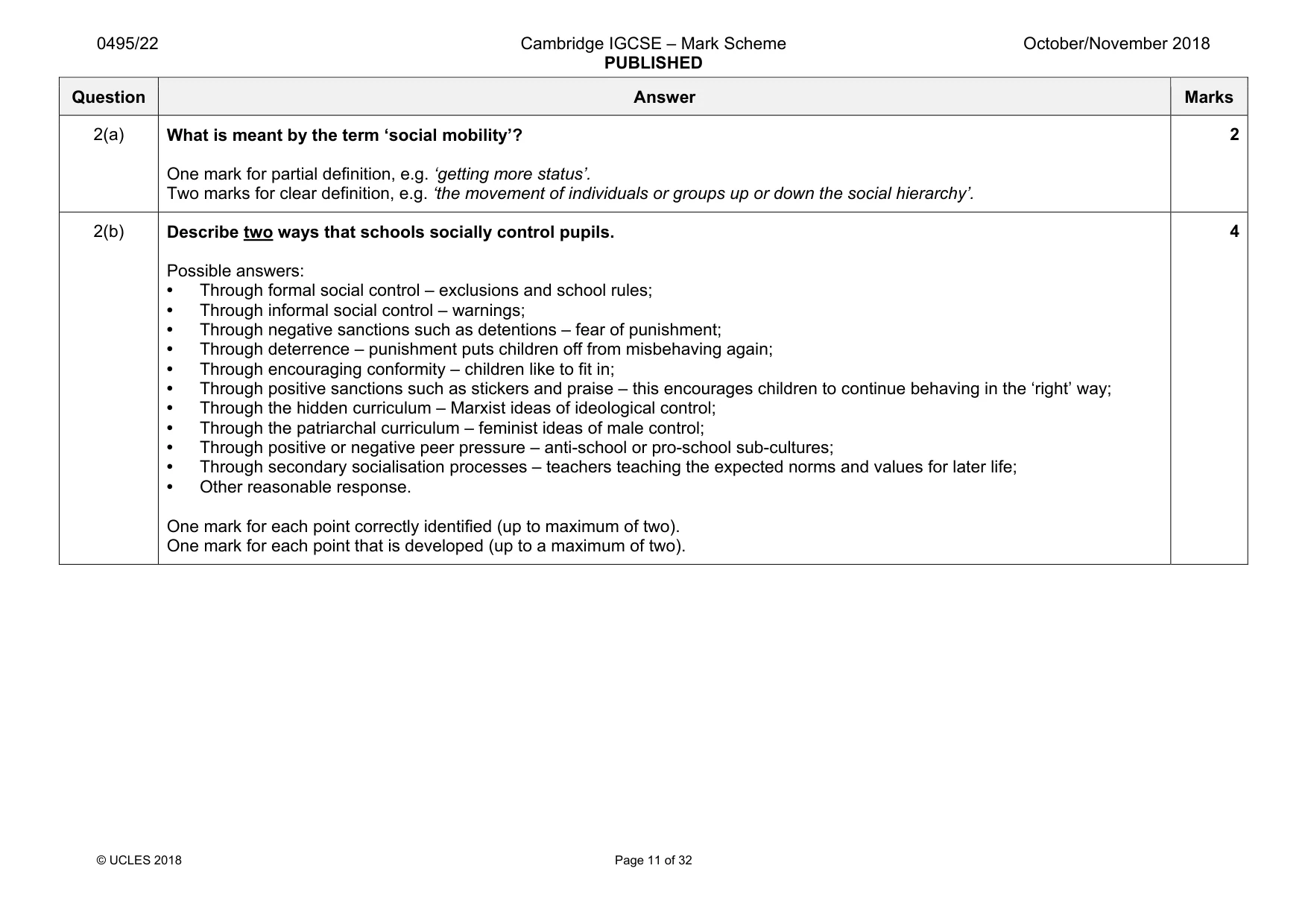
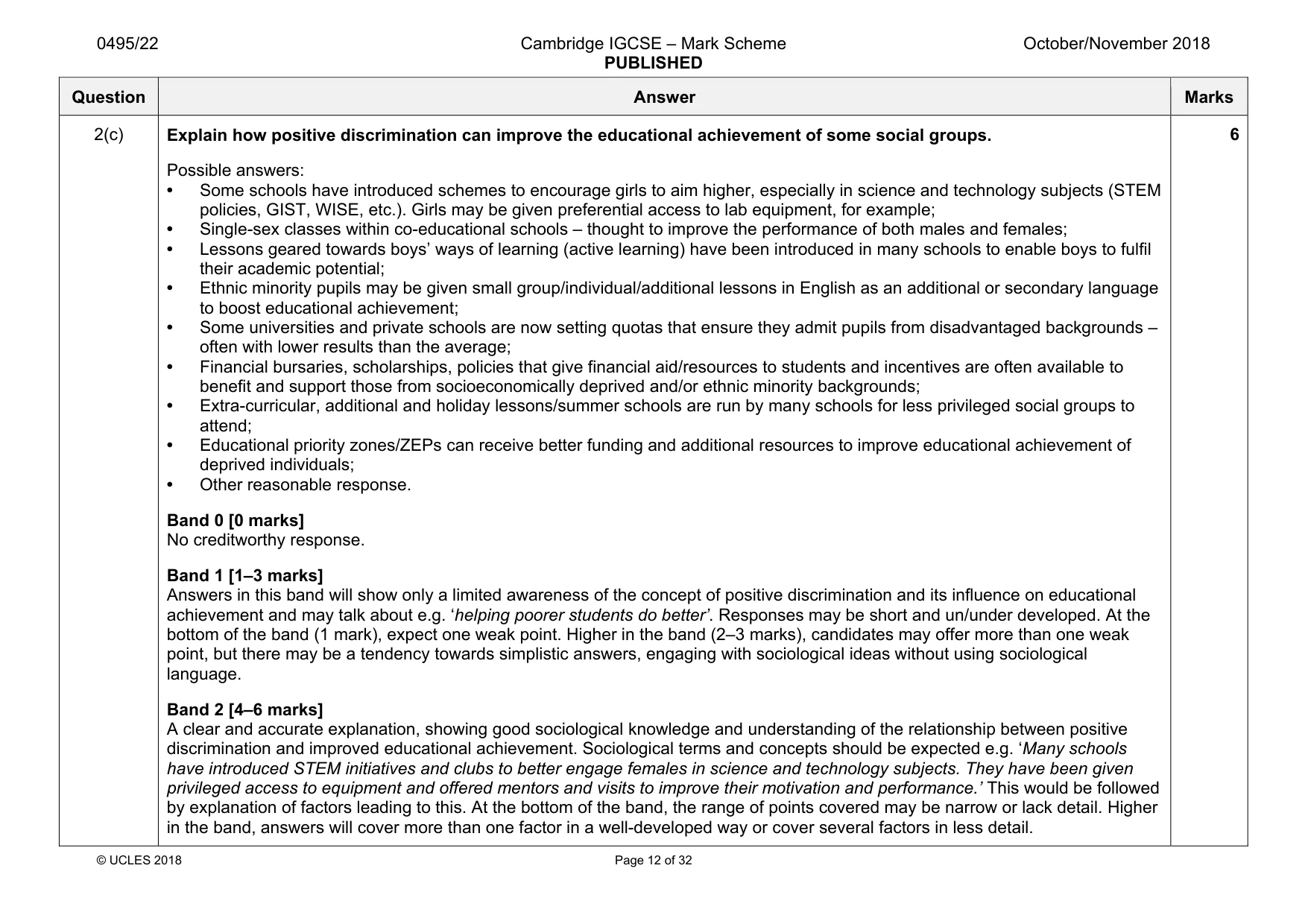
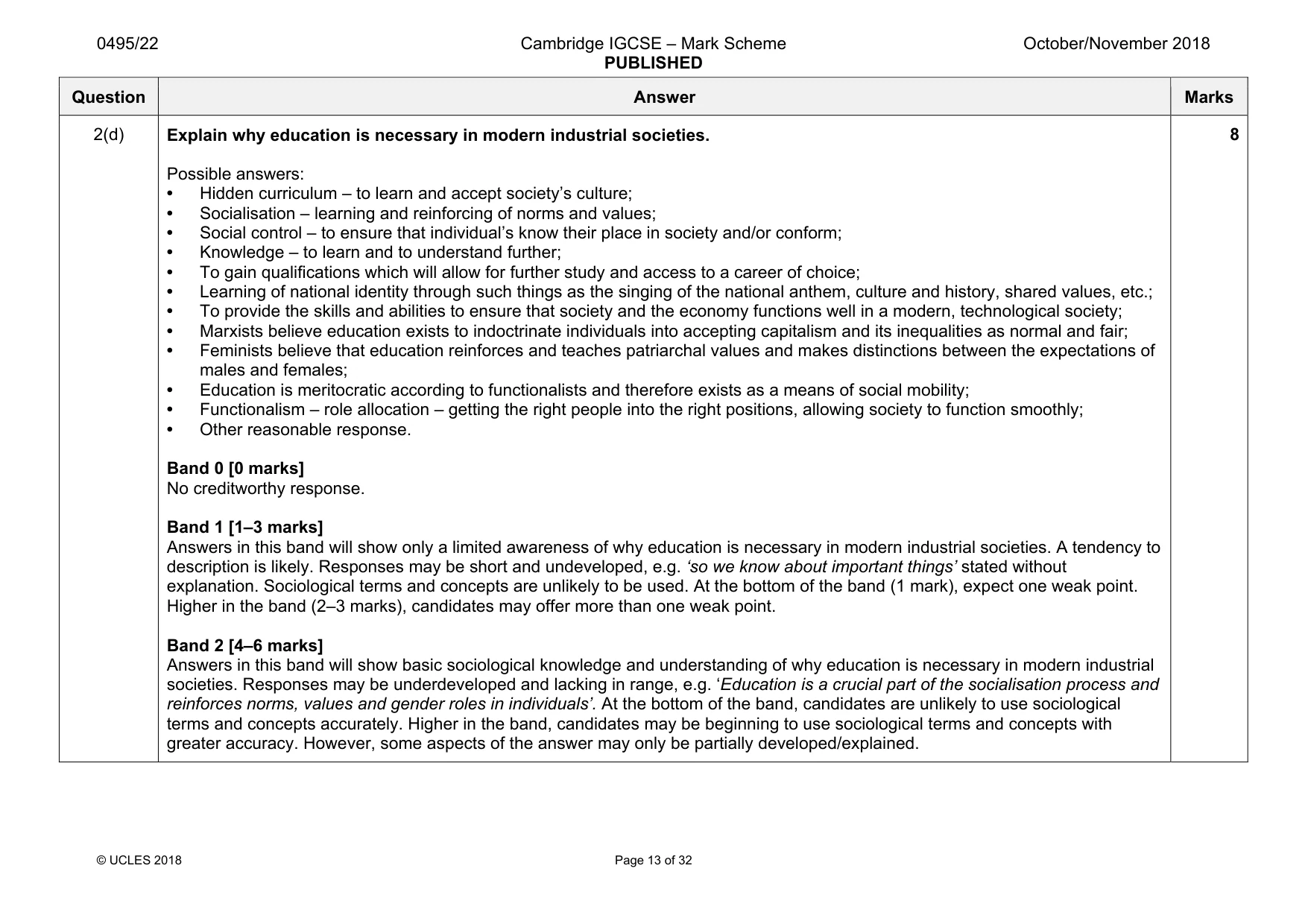
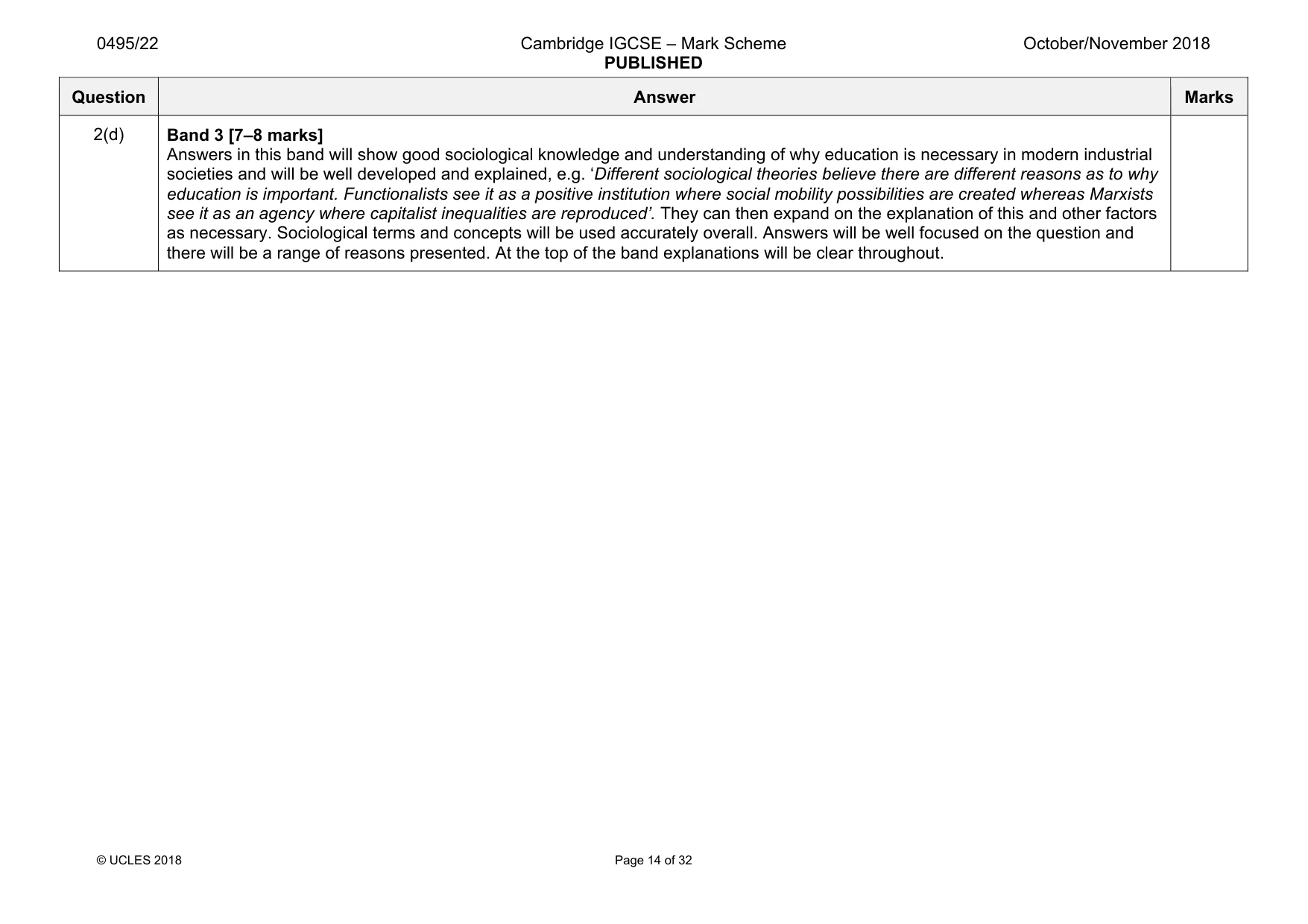
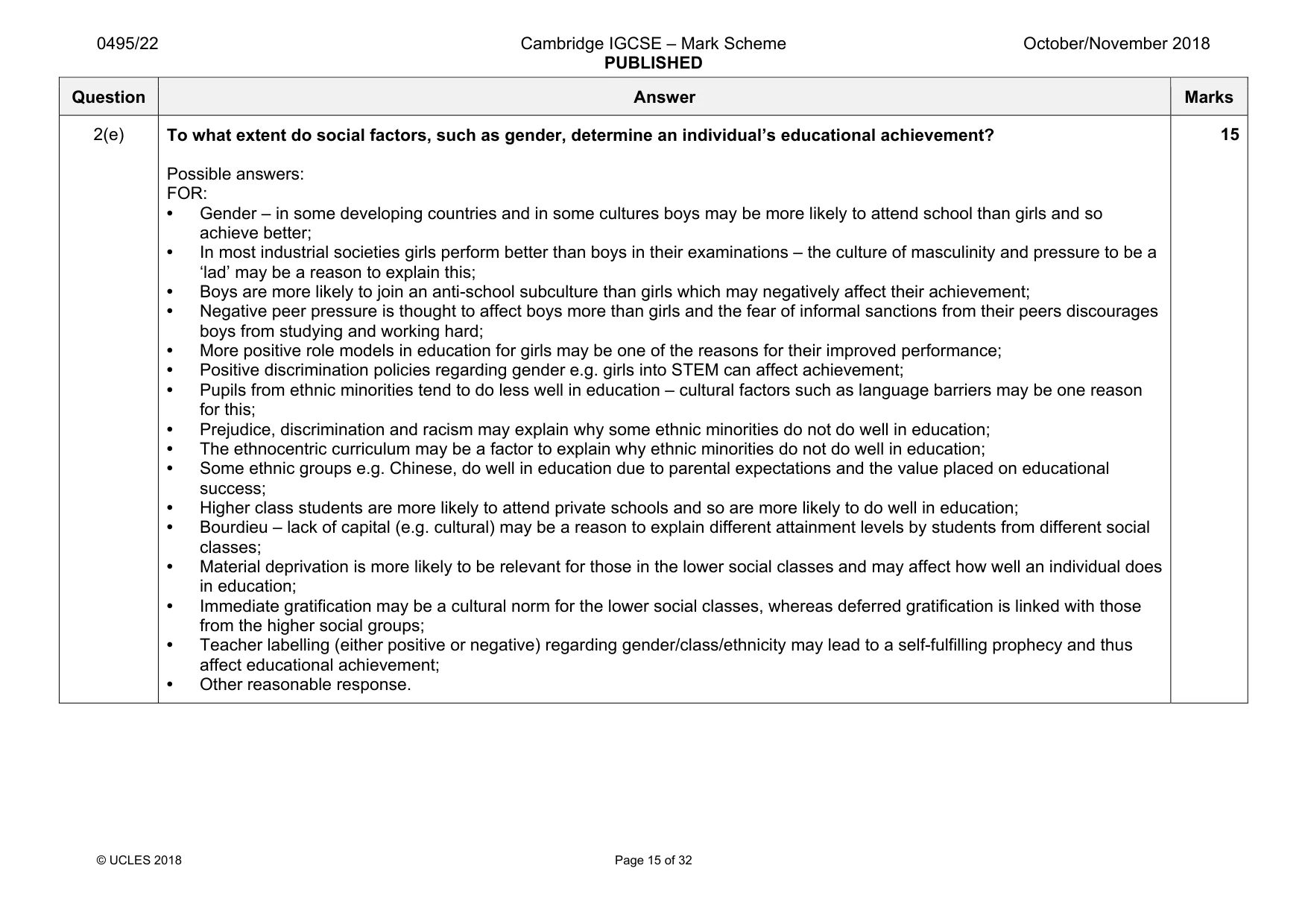
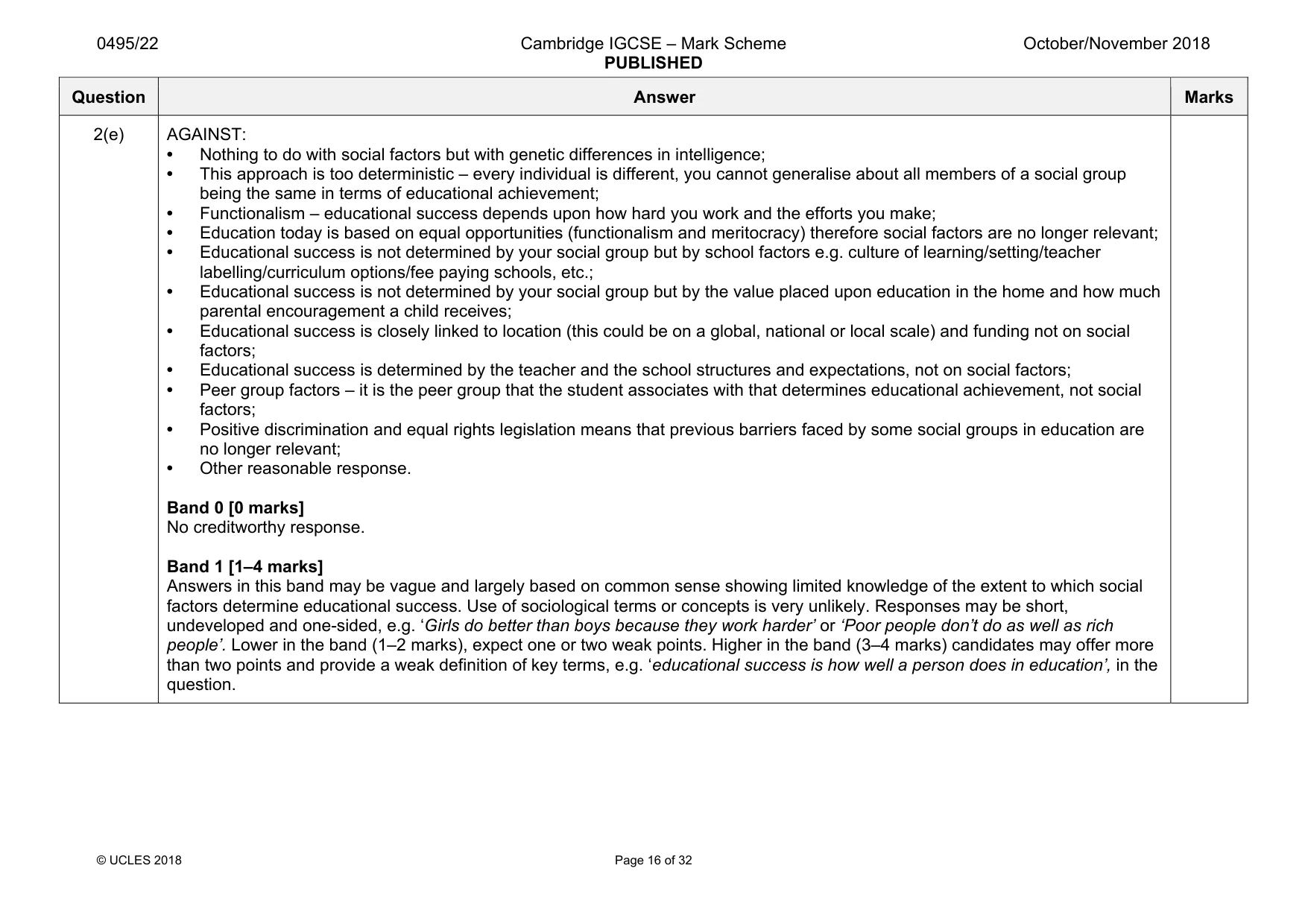
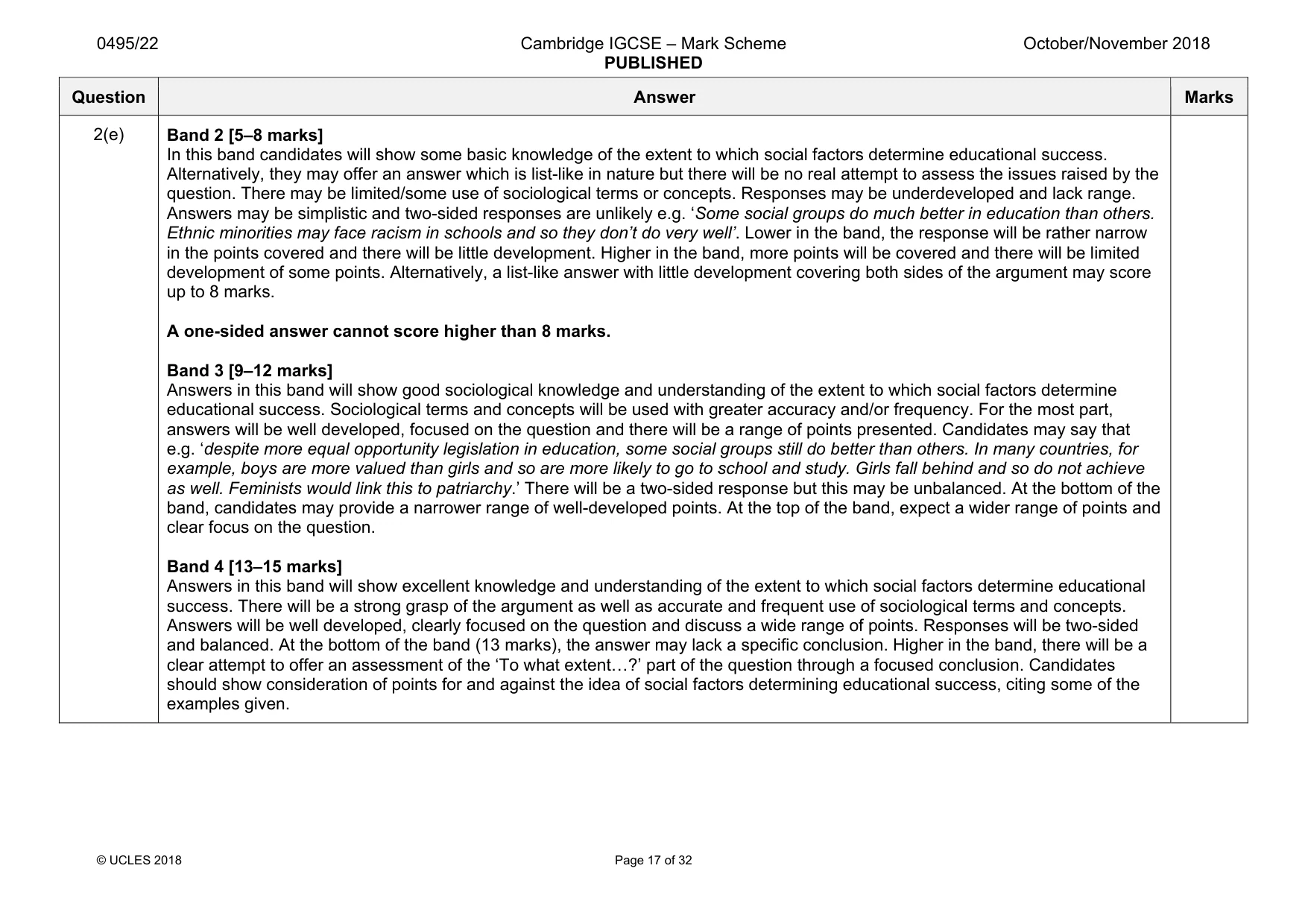
Mark scheme: 2(a) What is meant by the term ‘social mobility’? One mark for partial definition, e.g. ‘getting more status’. Two marks for clear definition, e.g. ‘the movement of individuals or groups up or down the social hierarchy’. 2 2(b) Describe two ways that schools socially control pupils. Possible answers: • Through formal social control – exclusions and school rules; • Through informal social control – warnings; • Through negative sanctions such as detentions – fear of punishment; • Through deterrence – punishment puts children off from misbehaving again; • Through encouraging conformity – children like to fit in; • Through positive sanctions such as stickers and praise – this encourages children to continue behaving in the ‘right’ way; • Through the hidden curriculum – Marxist ideas of ideological control; • Through the patriarchal curriculum – feminist ideas of male control; • Through positive or negative peer pressure – anti-school or pro-school sub-cultures; • Through secondary socialisation processes – teachers teaching the expected norms and values for later life; • Other reasonable response. One mark for each point correctly identified (up to maximum of two). One mark for each point that is developed (up to a maximum of two). 4 Question Answer Marks 2(c) Explain how positive discrimination can improve the educational achievement of some social groups. Possible answers: • Some schools have introduced schemes to encourage girls to aim higher, especially in science and technology subjects (STEM policies, GIST, WISE, etc.). Girls may be given preferential access to lab equipment, for example; • Single-sex classes within co-educational schools – thought to improve the performance of both males and females; • Lessons geared towards boys’ ways of learning (active learning) have been introduced in many schools to enable boys to fulfil their academic potential; • Ethnic minority pupils may be given small group/individual/additional lessons in English as an additional or secondary language to boost educational achievement; • Some universities and private schools are now setting quotas that ensure they admit pupils from disadvantaged backgrounds – often with lower results than the average; • Financial bursaries, scholarships, policies that give financial aid/resources to students and incentives are often available to benefit and support those from socioeconomically deprived and/or ethnic minority backgrounds; • Extra-curricular, additional and holiday lessons/summer schools are run by many schools for less privileged social groups to attend; • Educational priority zones/ZEPs can receive better funding and additional resources to improve educational achievement of deprived individuals; • Other reasonable response. Band 0 [0 marks] No creditworthy response. Band 1 [1–3 marks] Answers in this band will show only a limited awareness of the concept of positive discrimination and its influence on educational achievement and may talk about e.g. ‘helping poorer students do better’. Responses may be short and un/under developed. At the bottom of the band (1 mark), expect one weak point. Higher in the band (2–3 marks), candidates may offer more than one weak point, but there may be a tendency towards simplistic answers, engaging with sociological ideas without using sociological language. Band 2 [4–6 marks] A clear and accurate explanation, showing good sociological knowledge and understanding of the relationship between positive discrimination and improved educational achievement. Sociological terms and concepts should be expected e.g. ‘Many schools have introduced STEM initiatives and clubs to better engage females in science and technology subjects. They have been given privileged access to equipment and offered mentors and visits to improve their motivation and performance.’ This would be followed by explanation of factors leading to this. At the bottom of the band, the range of points covered may be narrow or lack detail. Higher in the band, answers will cover more than one factor in a well-developed way or cover several factors in less detail. 6 Question Answer Marks 2(d) Explain why education is necessary in modern industrial societies. Possible answers: • Hidden curriculum – to learn and accept society’s culture; • Socialisation – learning and reinforcing of norms and values; • Social control – to ensure that individual’s know their place in society and/or conform; • Knowledge – to learn and to understand further; • To gain qualifications which will allow for further study and access to a career of choice; • Learning of national identity through such things as the singing of the national anthem, culture and history, shared values, etc.; • To provide the skills and abilities to ensure that society and the economy functions well in a modern, technological society; • Marxists believe education exists to indoctrinate individuals into accepting capitalism and its inequalities as normal and fair; • Feminists believe that education reinforces and teaches patriarchal values and makes distinctions between the expectations of males and females; • Education is meritocratic according to functionalists and therefore exists as a means of social mobility; • Functionalism – role allocation – getting the right people into the right positions, allowing society to function smoothly; • Other reasonable response. Band 0 [0 marks] No creditworthy response. Band 1 [1–3 marks] Answers in this band will show only a limited awareness of why education is necessary in modern industrial societies. A tendency to description is likely. Responses may be short and undeveloped, e.g. ‘so we know about important things’ stated without explanation. Sociological terms and concepts are unlikely to be used. At the bottom of the band (1 mark), expect one weak point. Higher in the band (2–3 marks), candidates may offer more than one weak point. Band 2 [4–6 marks] Answers in this band will show basic sociological knowledge and understanding of why education is necessary in modern industrial societies. Responses may be underdeveloped and lacking in range, e.g. ‘Education is a crucial part of the socialisation process and reinforces norms, values and gender roles in individuals’. At the bottom of the band, candidates are unlikely to use sociological terms and concepts accurately. Higher in the band, candidates may be beginning to use sociological terms and concepts with greater accuracy. However, some aspects of the answer may only be partially developed/explained. 8 Question Answer Marks 2(d) Band 3 [7–8 marks] Answers in this band will show good sociological knowledge and understanding of why education is necessary in modern industrial societies and will be well developed and explained, e.g. ‘Different sociological theories believe there are different reasons as to why education is important. Functionalists see it as a positive institution where social mobility possibilities are created whereas Marxists see it as an agency where capitalist inequalities are reproduced’. They can then expand on the explanation of this and other factors as necessary. Sociological terms and concepts will be used accurately overall. Answers will be well focused on the question and there will be a range of reasons presented. At the top of the band explanations will be clear throughout. Question Answer Marks 2(e) To what extent do social factors, such as gender, determine an individual’s educational achievement? Possible answers: FOR: • Gender – in some developing countries and in some cultures boys may be more likely to attend school than girls and so achieve better; • In most industrial societies girls perform better than boys in their examinations – the culture of masculinity and pressure to be a ‘lad’ may be a reason to explain this; • Boys are more likely to join an anti-school subculture than girls which may negatively affect their achievement; • Negative peer pressure is thought to affect boys more than girls and the fear of informal sanctions from their peers discourages boys from studying and working hard; • More positive role models in education for girls may be one of the reasons for their improved performance; • Positive discrimination policies regarding gender e.g. girls into STEM can affect achievement; • Pupils from ethnic minorities tend to do less well in education – cultural factors such as language barriers may be one reason for this; • Prejudice, discrimination and racism may explain why some ethnic minorities do not do well in education; • The ethnocentric curriculum may be a factor to explain why ethnic minorities do not do well in education; • Some ethnic groups e.g. Chinese, do well in education due to parental expectations and the value placed on educational success; • Higher class students are more likely to attend private schools and so are more likely to do well in education; • Bourdieu – lack of capital (e.g. cultural) may be a reason to explain different attainment levels by students from different social classes; • Material deprivation is more likely to be relevant for those in the lower social classes and may affect how well an individual does in education; • Immediate gratification may be a cultural norm for the lower social classes, whereas deferred gratification is linked with those from the higher social groups; • Teacher labelling (either positive or negative) regarding gender/class/ethnicity may lead to a self-fulfilling prophecy and thus affect educational achievement; • Other reasonable response. 15 Question Answer Marks 2(e) AGAINST: • Nothing to do with social factors but with genetic differences in intelligence; • This approach is too deterministic – every individual is different, you cannot generalise about all members of a social group being the same in terms of educational achievement; • Functionalism – educational success depends upon how hard you work and the efforts you make; • Education today is based on equal opportunities (functionalism and meritocracy) therefore social factors are no longer relevant; • Educational success is not determined by your social group but by school factors e.g. culture of learning/setting/teacher labelling/curriculum options/fee paying schools, etc.; • Educational success is not determined by your social group but by the value placed upon education in the home and how much parental encouragement a child receives; • Educational success is closely linked to location (this could be on a global, national or local scale) and funding not on social factors; • Educational success is determined by the teacher and the school structures and expectations, not on social factors; • Peer group factors – it is the peer group that the student associates with that determines educational achievement, not social factors; • Positive discrimination and equal rights legislation means that previous barriers faced by some social groups in education are no longer relevant; • Other reasonable response. Band 0 [0 marks] No creditworthy response. Band 1 [1–4 marks] Answers in this band may be vague and largely based on common sense showing limited knowledge of the extent to which social factors determine educational success. Use of sociological terms or concepts is very unlikely. Responses may be short, undeveloped and one-sided, e.g. ‘Girls do better than boys because they work harder’ or ‘Poor people don’t do as well as rich people’. Lower in the band (1–2 marks), expect one or two weak points. Higher in the band (3–4 marks) candidates may offer more than two points and provide a weak definition of key terms, e.g. ‘educational success is how well a person does in education’, in the question. Question Answer Marks 2(e) Band 2 [5–8 marks] In this band candidates will show some basic knowledge of the extent to which social factors determine educational success. Alternatively, they may offer an answer which is list-like in nature but there will be no real attempt to assess the issues raised by the question. There may be limited/some use of sociological terms or concepts. Responses may be underdeveloped and lack range. Answers may be simplistic and two-sided responses are unlikely e.g. ‘Some social groups do much better in education than others. Ethnic minorities may face racism in schools and so they don’t do very well’. Lower in the band, the response will be rather narrow in the points covered and there will be little development. Higher in the band, more points will be covered and there will be limited development of some points. Alternatively, a list-like answer with little development covering both sides of the argument may score up to 8 marks. A one-sided answer cannot score higher than 8 marks. Band 3 [9–12 marks] Answers in this band will show good sociological knowledge and understanding of the extent to which social factors determine educational success. Sociological terms and concepts will be used with greater accuracy and/or frequency. For the most part, answers will be well developed, focused on the question and there will be a range of points presented. Candidates may say that e.g. ‘despite more equal opportunity legislation in education, some social groups still do better than others. In many countries, for example, boys are more valued than girls and so are more likely to go to school and study. Girls fall behind and so do not achieve as well. Feminists would link this to patriarchy.’ There will be a two-sided response but this may be unbalanced. At the bottom of the band, candidates may provide a narrower range of well-developed points. At the top of the band, expect a wider range of points and clear focus on the question. Band 4 [13–15 marks] Answers in this band will show excellent knowledge and understanding of the extent to which social factors determine educational success. There will be a strong grasp of the argument as well as accurate and frequent use of sociological terms and concepts. Answers will be well developed, clearly focused on the question and discuss a wide range of points. Responses will be two-sided and balanced. At the bottom of the band (13 marks), the answer may lack a specific conclusion. Higher in the band, there will be a clear attempt to offer an assessment of the ‘To what extent«?’ part of the question through a focused conclusion. Candidates should show consideration of points for and against the idea of social factors determining educational success, citing some of the examples given.
Q3 · What is meant by the term ‘self-report studies’?
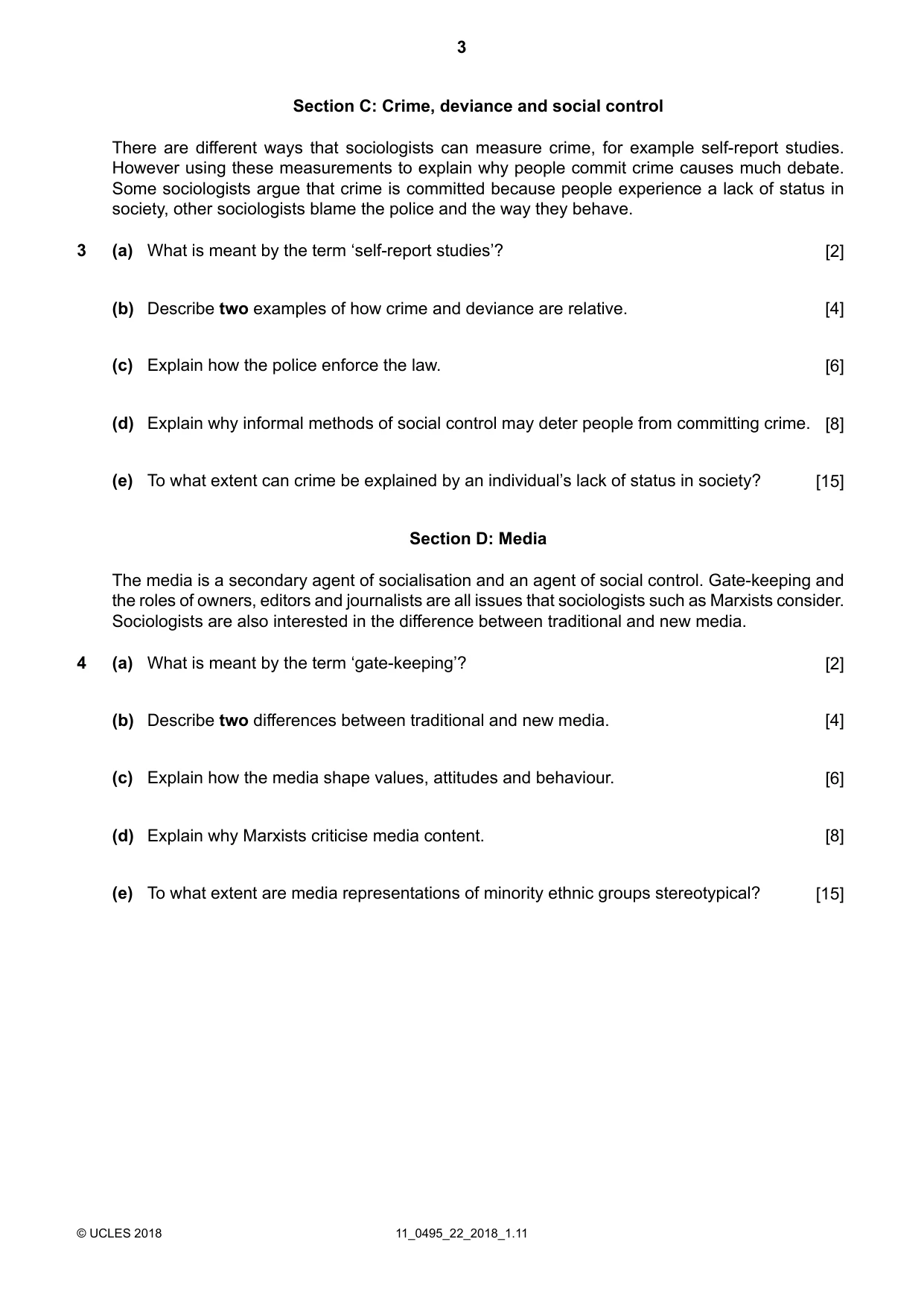
3 (a) What is meant by the term ‘self-report studies’? [2] (b) Describe two examples of how crime and deviance are relative. [4] (c) Explain how the police enforce the law. [6] (d) Explain why informal methods of social control may deter people from committing crime. [8] (e) To what extent can crime be explained by an individual’s lack of status in society? [15] Section D: Media The media is a secondary agent of socialisation and an agent of social control. Gate-keeping and the roles of owners, editors and journalists are all issues that sociologists such as Marxists consider. Sociologists are also interested in the difference between traditional and new media.
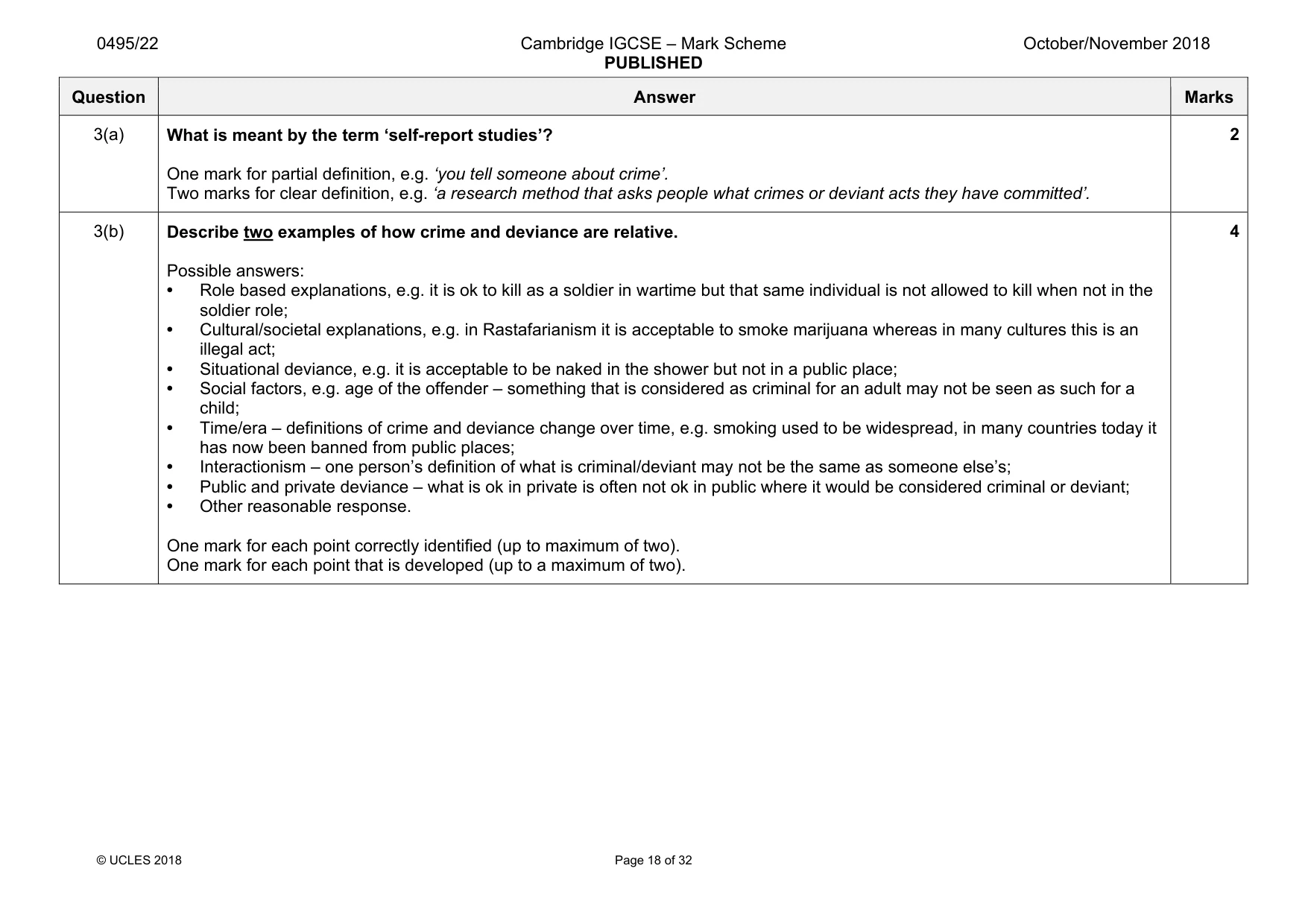
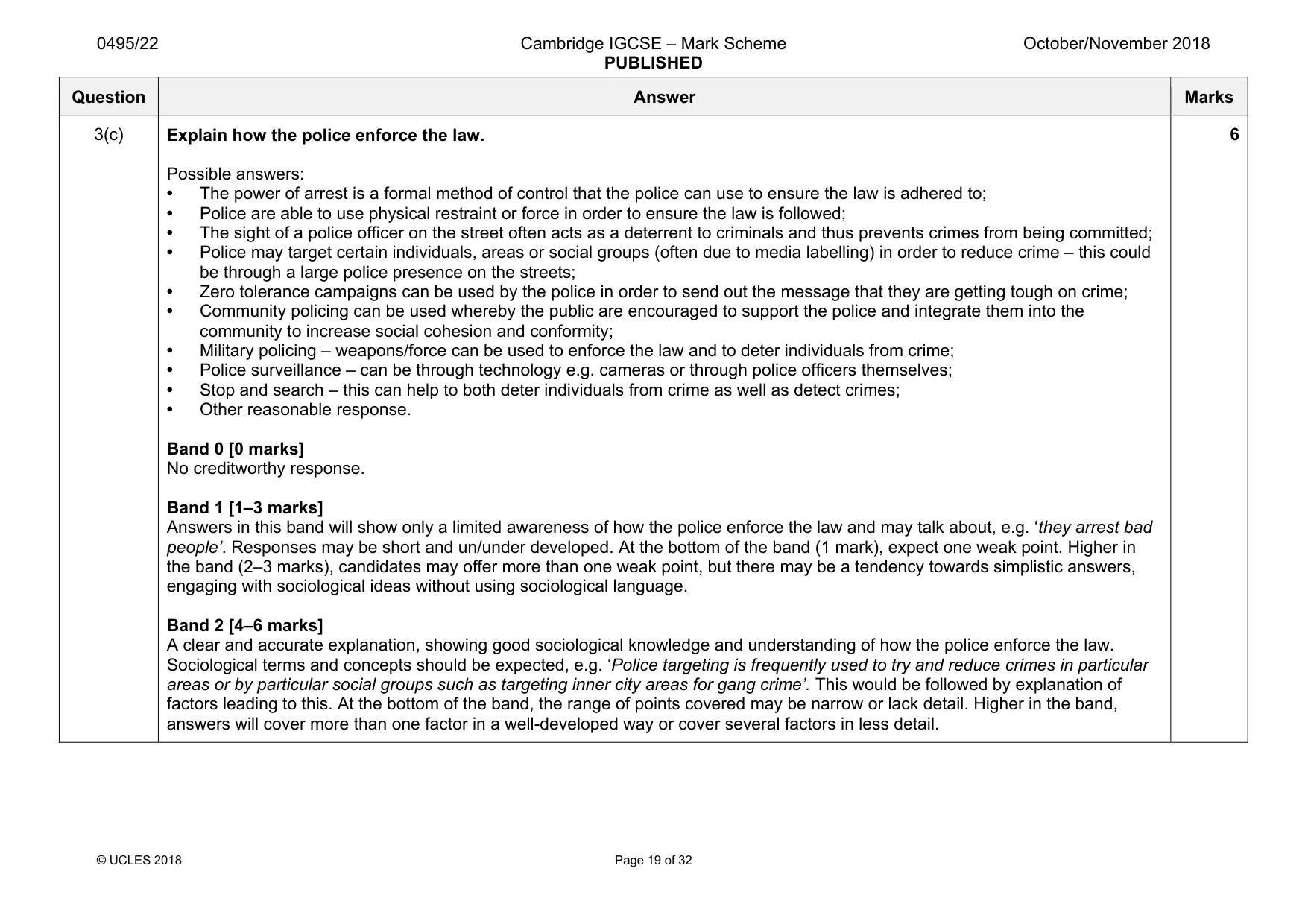
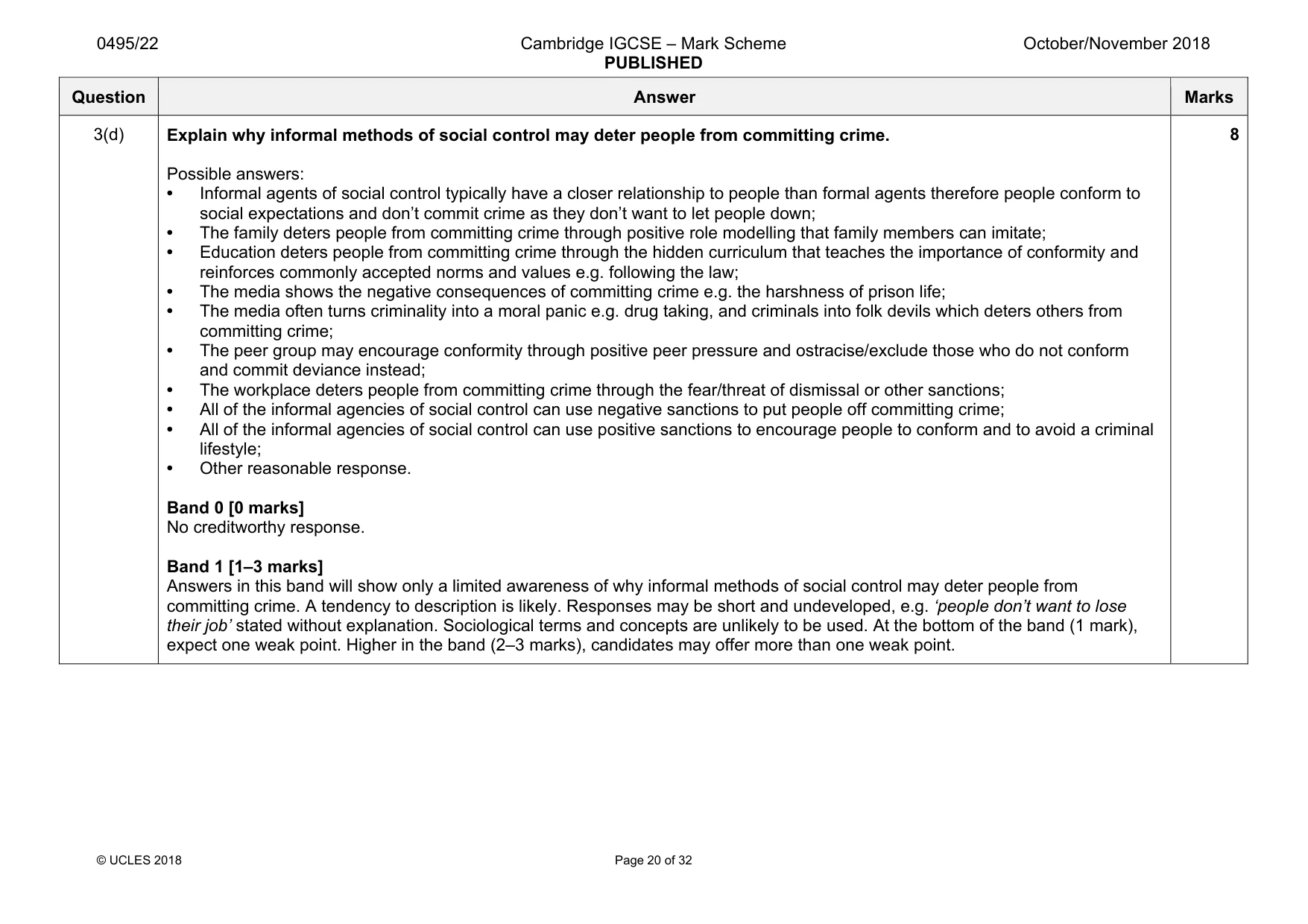
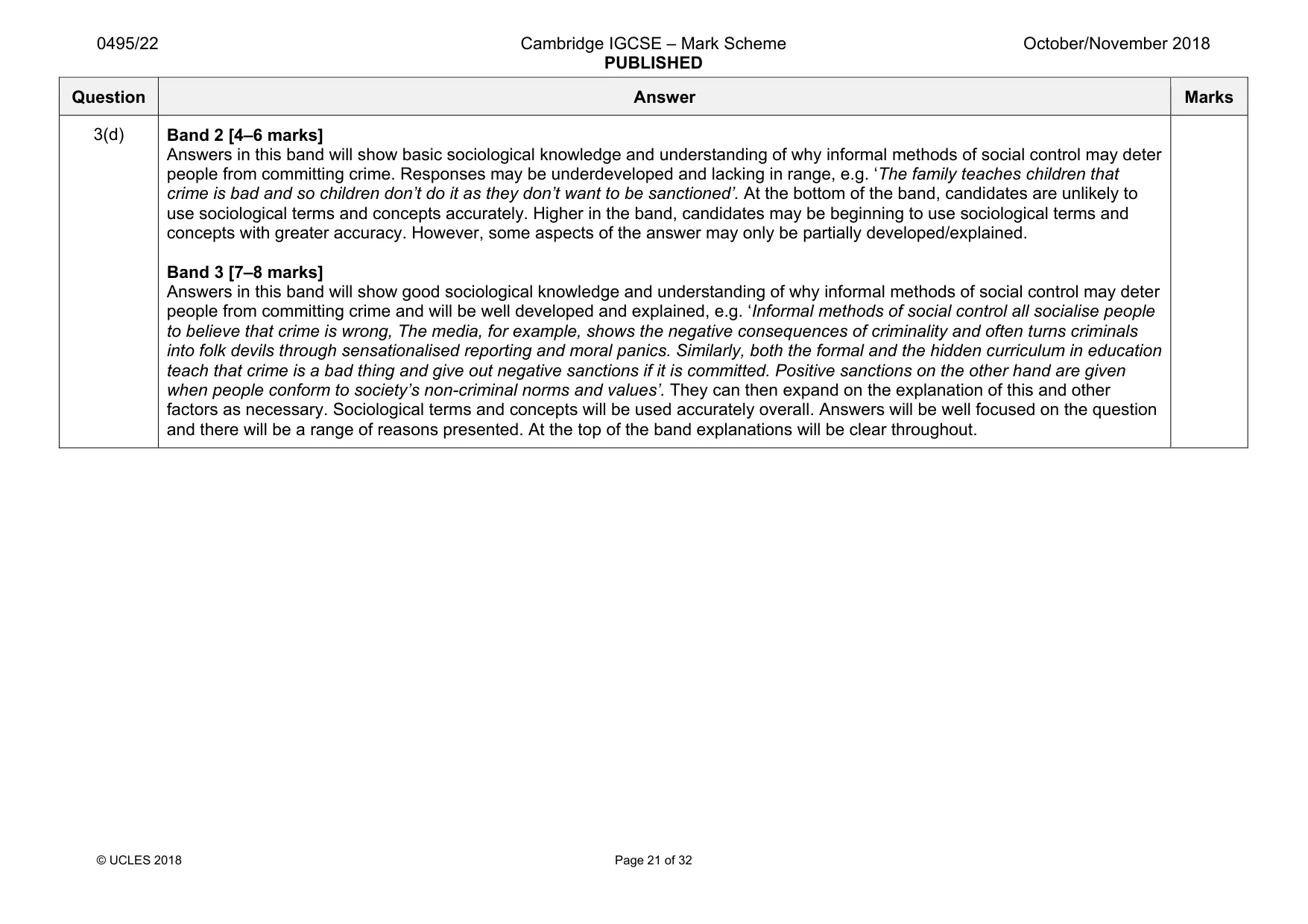
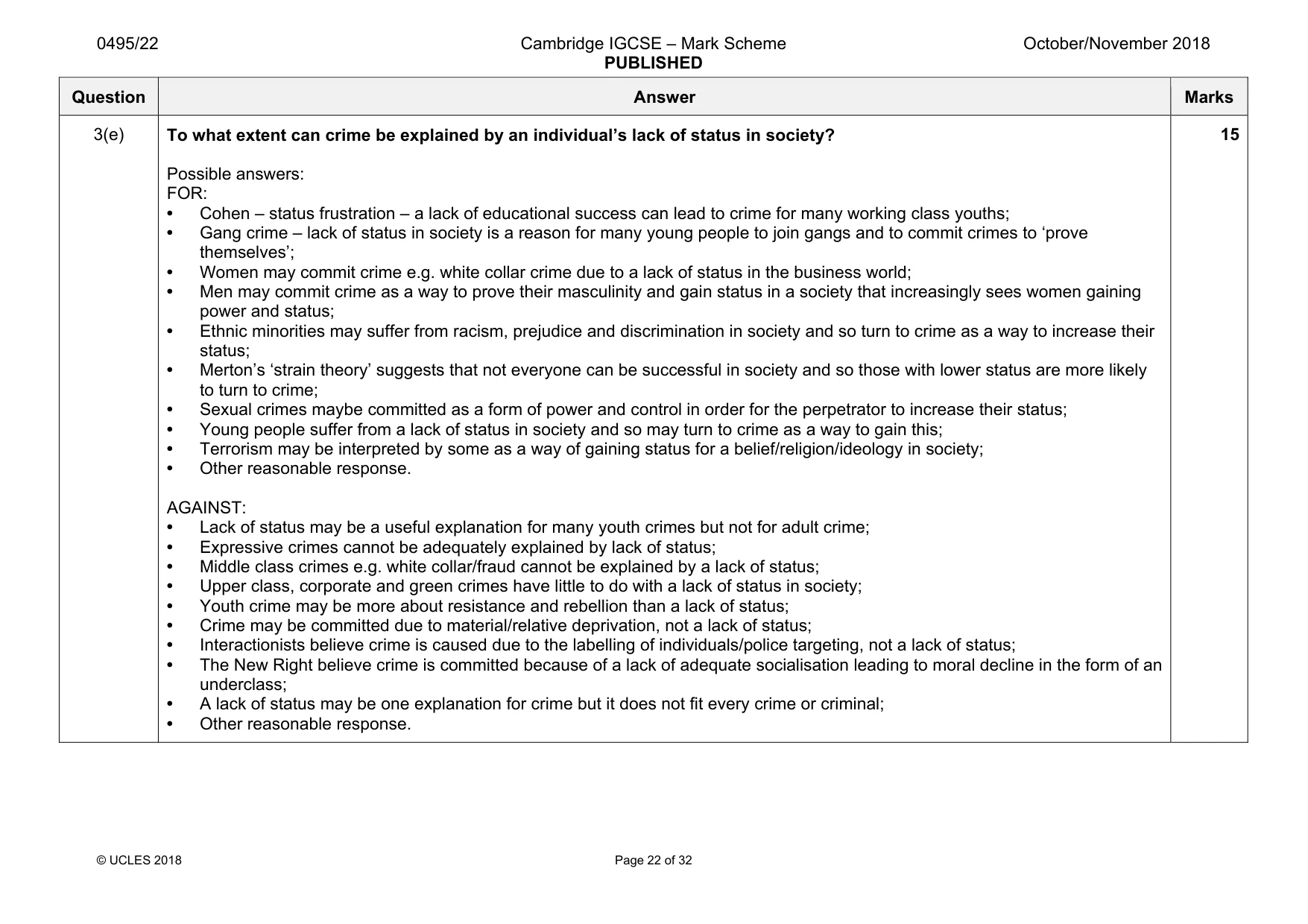
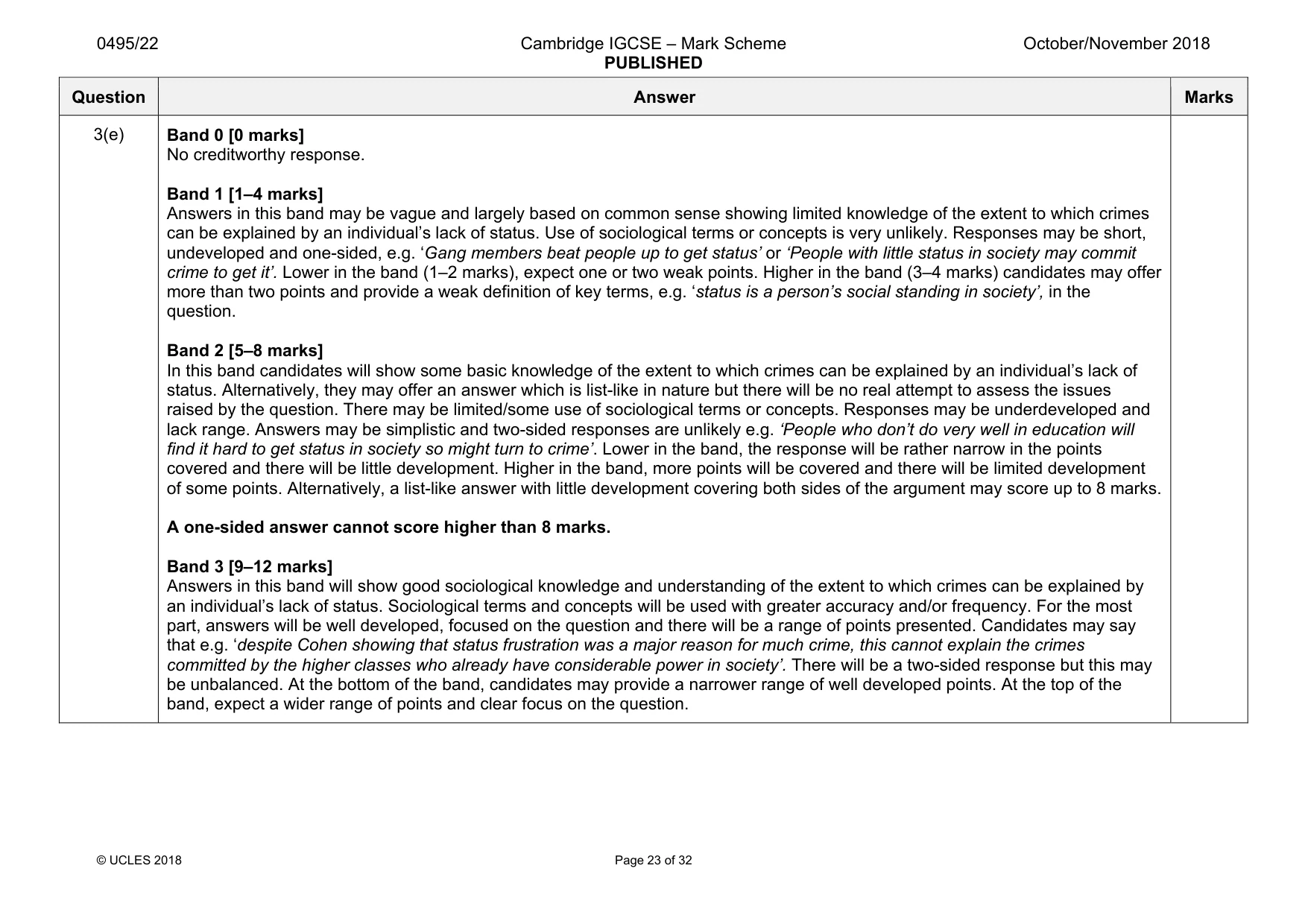
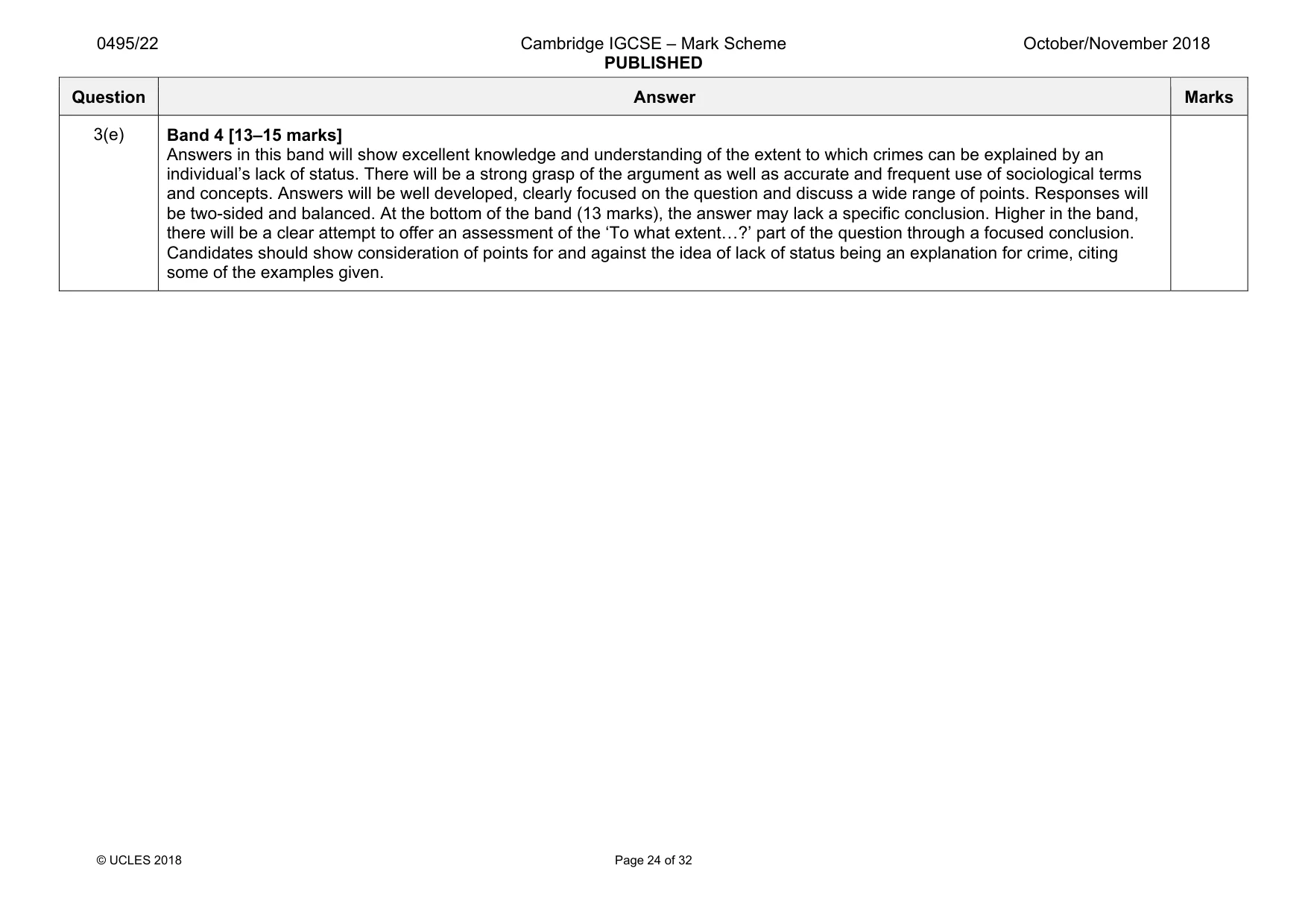
Mark scheme: 3(a) What is meant by the term ‘self-report studies’? One mark for partial definition, e.g. ‘you tell someone about crime’. Two marks for clear definition, e.g. ‘a research method that asks people what crimes or deviant acts they have committed’. 2 3(b) Describe two examples of how crime and deviance are relative. Possible answers: • Role based explanations, e.g. it is ok to kill as a soldier in wartime but that same individual is not allowed to kill when not in the soldier role; • Cultural/societal explanations, e.g. in Rastafarianism it is acceptable to smoke marijuana whereas in many cultures this is an illegal act; • Situational deviance, e.g. it is acceptable to be naked in the shower but not in a public place; • Social factors, e.g. age of the offender – something that is considered as criminal for an adult may not be seen as such for a child; • Time/era – definitions of crime and deviance change over time, e.g. smoking used to be widespread, in many countries today it has now been banned from public places; • Interactionism – one person’s definition of what is criminal/deviant may not be the same as someone else’s; • Public and private deviance – what is ok in private is often not ok in public where it would be considered criminal or deviant; • Other reasonable response. One mark for each point correctly identified (up to maximum of two). One mark for each point that is developed (up to a maximum of two). 4 Question Answer Marks 3(c) Explain how the police enforce the law. Possible answers: • The power of arrest is a formal method of control that the police can use to ensure the law is adhered to; • Police are able to use physical restraint or force in order to ensure the law is followed; • The sight of a police officer on the street often acts as a deterrent to criminals and thus prevents crimes from being committed; • Police may target certain individuals, areas or social groups (often due to media labelling) in order to reduce crime – this could be through a large police presence on the streets; • Zero tolerance campaigns can be used by the police in order to send out the message that they are getting tough on crime; • Community policing can be used whereby the public are encouraged to support the police and integrate them into the community to increase social cohesion and conformity; • Military policing – weapons/force can be used to enforce the law and to deter individuals from crime; • Police surveillance – can be through technology e.g. cameras or through police officers themselves; • Stop and search – this can help to both deter individuals from crime as well as detect crimes; • Other reasonable response. Band 0 [0 marks] No creditworthy response. Band 1 [1–3 marks] Answers in this band will show only a limited awareness of how the police enforce the law and may talk about, e.g. ‘they arrest bad people’. Responses may be short and un/under developed. At the bottom of the band (1 mark), expect one weak point. Higher in the band (2–3 marks), candidates may offer more than one weak point, but there may be a tendency towards simplistic answers, engaging with sociological ideas without using sociological language. Band 2 [4–6 marks] A clear and accurate explanation, showing good sociological knowledge and understanding of how the police enforce the law. Sociological terms and concepts should be expected, e.g. ‘Police targeting is frequently used to try and reduce crimes in particular areas or by particular social groups such as targeting inner city areas for gang crime’. This would be followed by explanation of factors leading to this. At the bottom of the band, the range of points covered may be narrow or lack detail. Higher in the band, answers will cover more than one factor in a well-developed way or cover several factors in less detail. 6 Question Answer Marks 3(d) Explain why informal methods of social control may deter people from committing crime. Possible answers: • Informal agents of social control typically have a closer relationship to people than formal agents therefore people conform to social expectations and don’t commit crime as they don’t want to let people down; • The family deters people from committing crime through positive role modelling that family members can imitate; • Education deters people from committing crime through the hidden curriculum that teaches the importance of conformity and reinforces commonly accepted norms and values e.g. following the law; • The media shows the negative consequences of committing crime e.g. the harshness of prison life; • The media often turns criminality into a moral panic e.g. drug taking, and criminals into folk devils which deters others from committing crime; • The peer group may encourage conformity through positive peer pressure and ostracise/exclude those who do not conform and commit deviance instead; • The workplace deters people from committing crime through the fear/threat of dismissal or other sanctions; • All of the informal agencies of social control can use negative sanctions to put people off committing crime; • All of the informal agencies of social control can use positive sanctions to encourage people to conform and to avoid a criminal lifestyle; • Other reasonable response. Band 0 [0 marks] No creditworthy response. Band 1 [1–3 marks] Answers in this band will show only a limited awareness of why informal methods of social control may deter people from committing crime. A tendency to description is likely. Responses may be short and undeveloped, e.g. ‘people don’t want to lose their job’ stated without explanation. Sociological terms and concepts are unlikely to be used. At the bottom of the band (1 mark), expect one weak point. Higher in the band (2–3 marks), candidates may offer more than one weak point. 8 Question Answer Marks 3(d) Band 2 [4–6 marks] Answers in this band will show basic sociological knowledge and understanding of why informal methods of social control may deter people from committing crime. Responses may be underdeveloped and lacking in range, e.g. ‘The family teaches children that crime is bad and so children don’t do it as they don’t want to be sanctioned’. At the bottom of the band, candidates are unlikely to use sociological terms and concepts accurately. Higher in the band, candidates may be beginning to use sociological terms and concepts with greater accuracy. However, some aspects of the answer may only be partially developed/explained. Band 3 [7–8 marks] Answers in this band will show good sociological knowledge and understanding of why informal methods of social control may deter people from committing crime and will be well developed and explained, e.g. ‘Informal methods of social control all socialise people to believe that crime is wrong, The media, for example, shows the negative consequences of criminality and often turns criminals into folk devils through sensationalised reporting and moral panics. Similarly, both the formal and the hidden curriculum in education teach that crime is a bad thing and give out negative sanctions if it is committed. Positive sanctions on the other hand are given when people conform to society’s non-criminal norms and values’. They can then expand on the explanation of this and other factors as necessary. Sociological terms and concepts will be used accurately overall. Answers will be well focused on the question and there will be a range of reasons presented. At the top of the band explanations will be clear throughout. Question Answer Marks 3(e) To what extent can crime be explained by an individual’s lack of status in society? Possible answers: FOR: • Cohen – status frustration – a lack of educational success can lead to crime for many working class youths; • Gang crime – lack of status in society is a reason for many young people to join gangs and to commit crimes to ‘prove themselves’; • Women may commit crime e.g. white collar crime due to a lack of status in the business world; • Men may commit crime as a way to prove their masculinity and gain status in a society that increasingly sees women gaining power and status; • Ethnic minorities may suffer from racism, prejudice and discrimination in society and so turn to crime as a way to increase their status; • Merton’s ‘strain theory’ suggests that not everyone can be successful in society and so those with lower status are more likely to turn to crime; • Sexual crimes maybe committed as a form of power and control in order for the perpetrator to increase their status; • Young people suffer from a lack of status in society and so may turn to crime as a way to gain this; • Terrorism may be interpreted by some as a way of gaining status for a belief/religion/ideology in society; • Other reasonable response. AGAINST: • Lack of status may be a useful explanation for many youth crimes but not for adult crime; • Expressive crimes cannot be adequately explained by lack of status; • Middle class crimes e.g. white collar/fraud cannot be explained by a lack of status; • Upper class, corporate and green crimes have little to do with a lack of status in society; • Youth crime may be more about resistance and rebellion than a lack of status; • Crime may be committed due to material/relative deprivation, not a lack of status; • Interactionists believe crime is caused due to the labelling of individuals/police targeting, not a lack of status; • The New Right believe crime is committed because of a lack of adequate socialisation leading to moral decline in the form of an underclass; • A lack of status may be one explanation for crime but it does not fit every crime or criminal; • Other reasonable response. 15 Question Answer Marks 3(e) Band 0 [0 marks] No creditworthy response. Band 1 [1–4 marks] Answers in this band may be vague and largely based on common sense showing limited knowledge of the extent to which crimes can be explained by an individual’s lack of status. Use of sociological terms or concepts is very unlikely. Responses may be short, undeveloped and one-sided, e.g. ‘Gang members beat people up to get status’ or ‘People with little status in society may commit crime to get it’. Lower in the band (1–2 marks), expect one or two weak points. Higher in the band (3–4 marks) candidates may offer more than two points and provide a weak definition of key terms, e.g. ‘status is a person’s social standing in society’, in the question. Band 2 [5–8 marks] In this band candidates will show some basic knowledge of the extent to which crimes can be explained by an individual’s lack of status. Alternatively, they may offer an answer which is list-like in nature but there will be no real attempt to assess the issues raised by the question. There may be limited/some use of sociological terms or concepts. Responses may be underdeveloped and lack range. Answers may be simplistic and two-sided responses are unlikely e.g. ‘People who don’t do very well in education will find it hard to get status in society so might turn to crime’. Lower in the band, the response will be rather narrow in the points covered and there will be little development. Higher in the band, more points will be covered and there will be limited development of some points. Alternatively, a list-like answer with little development covering both sides of the argument may score up to 8 marks. A one-sided answer cannot score higher than 8 marks. Band 3 [9–12 marks] Answers in this band will show good sociological knowledge and understanding of the extent to which crimes can be explained by an individual’s lack of status. Sociological terms and concepts will be used with greater accuracy and/or frequency. For the most part, answers will be well developed, focused on the question and there will be a range of points presented. Candidates may say that e.g. ‘despite Cohen showing that status frustration was a major reason for much crime, this cannot explain the crimes committed by the higher classes who already have considerable power in society’. There will be a two-sided response but this may be unbalanced. At the bottom of the band, candidates may provide a narrower range of well developed points. At the top of the band, expect a wider range of points and clear focus on the question. Question Answer Marks 3(e) Band 4 [13–15 marks] Answers in this band will show excellent knowledge and understanding of the extent to which crimes can be explained by an individual’s lack of status. There will be a strong grasp of the argument as well as accurate and frequent use of sociological terms and concepts. Answers will be well developed, clearly focused on the question and discuss a wide range of points. Responses will be two-sided and balanced. At the bottom of the band (13 marks), the answer may lack a specific conclusion. Higher in the band, there will be a clear attempt to offer an assessment of the ‘To what extent«?’ part of the question through a focused conclusion. Candidates should show consideration of points for and against the idea of lack of status being an explanation for crime, citing some of the examples given.
Q4 · What is meant by the term ‘gate-keeping’?
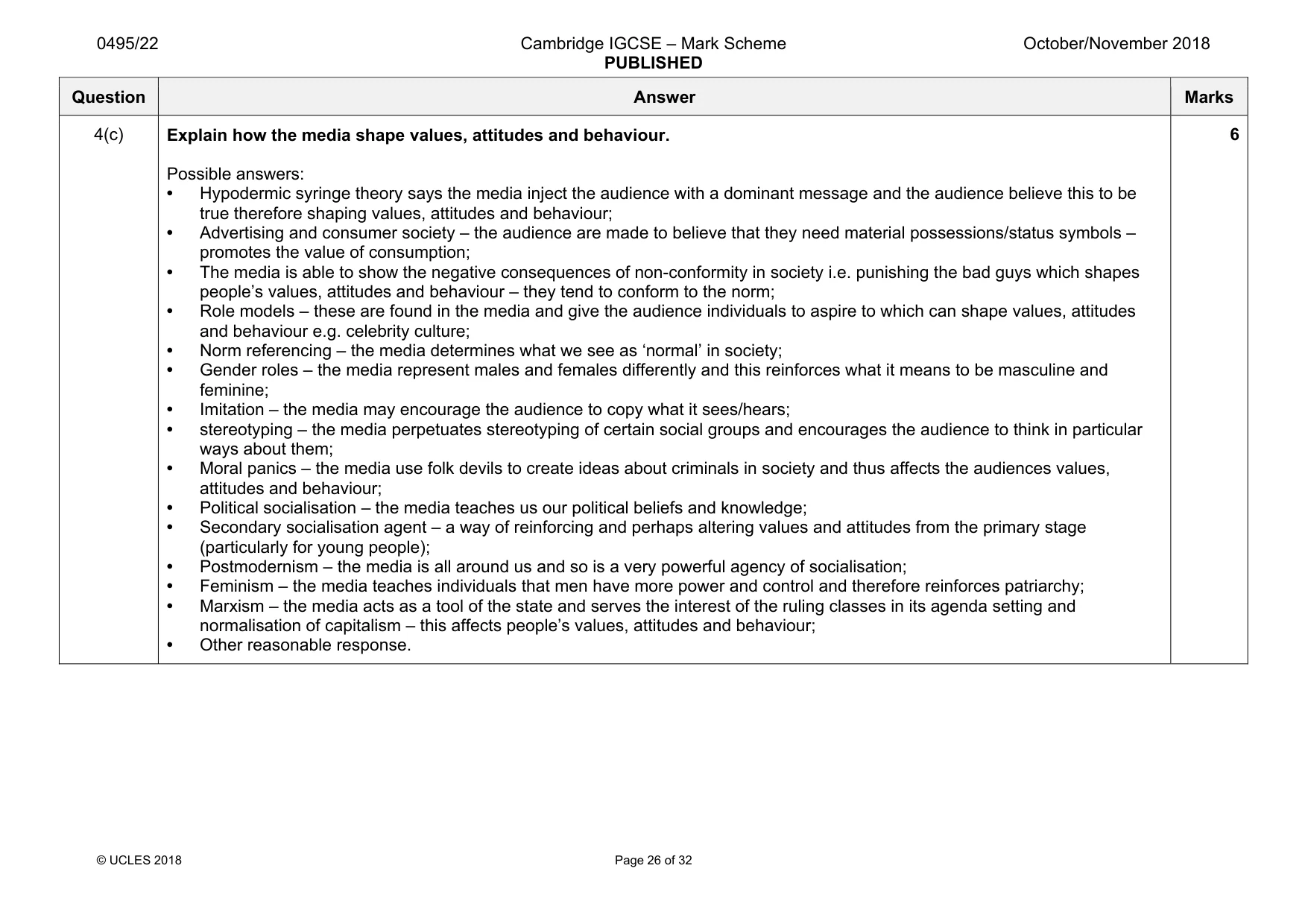
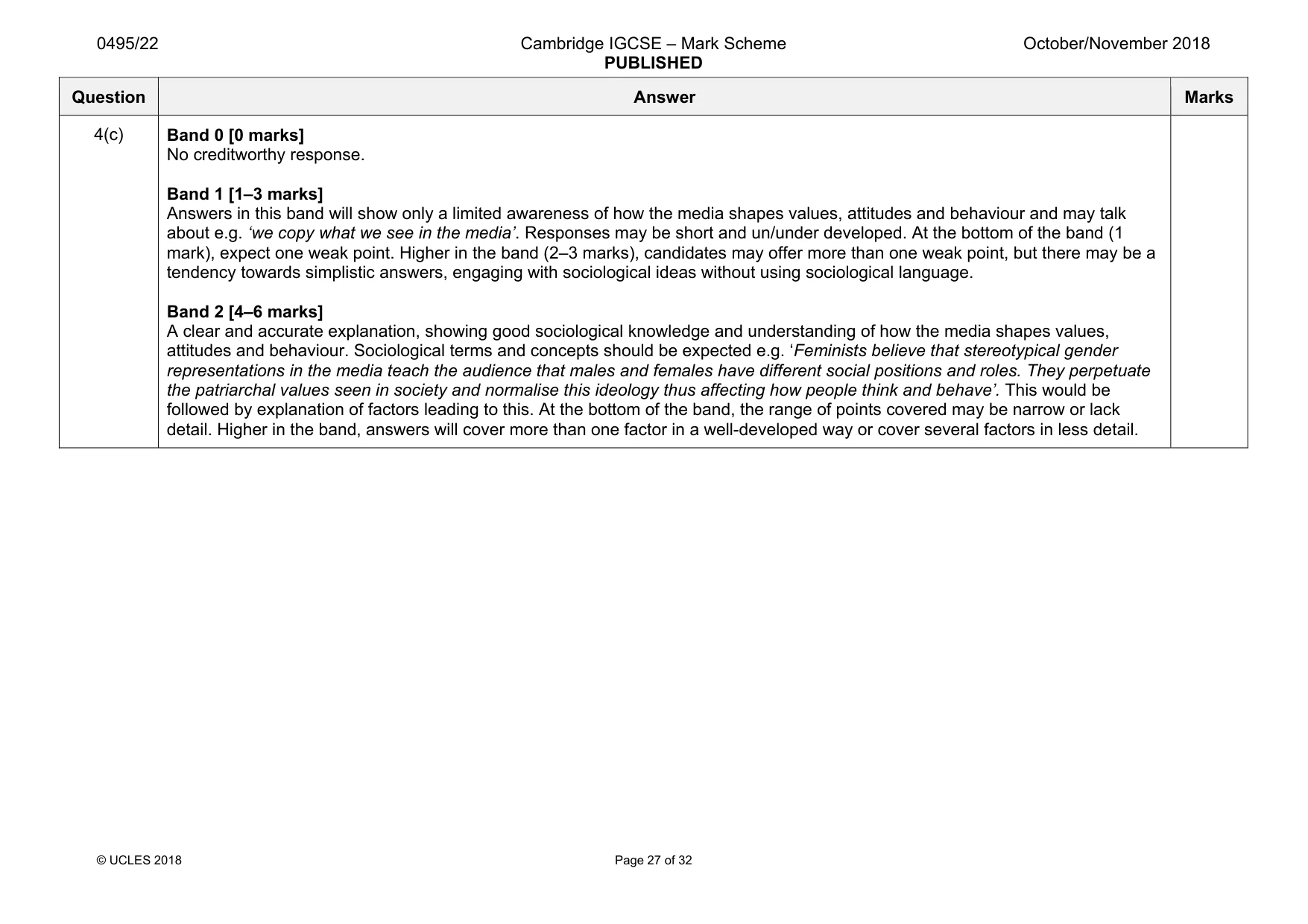
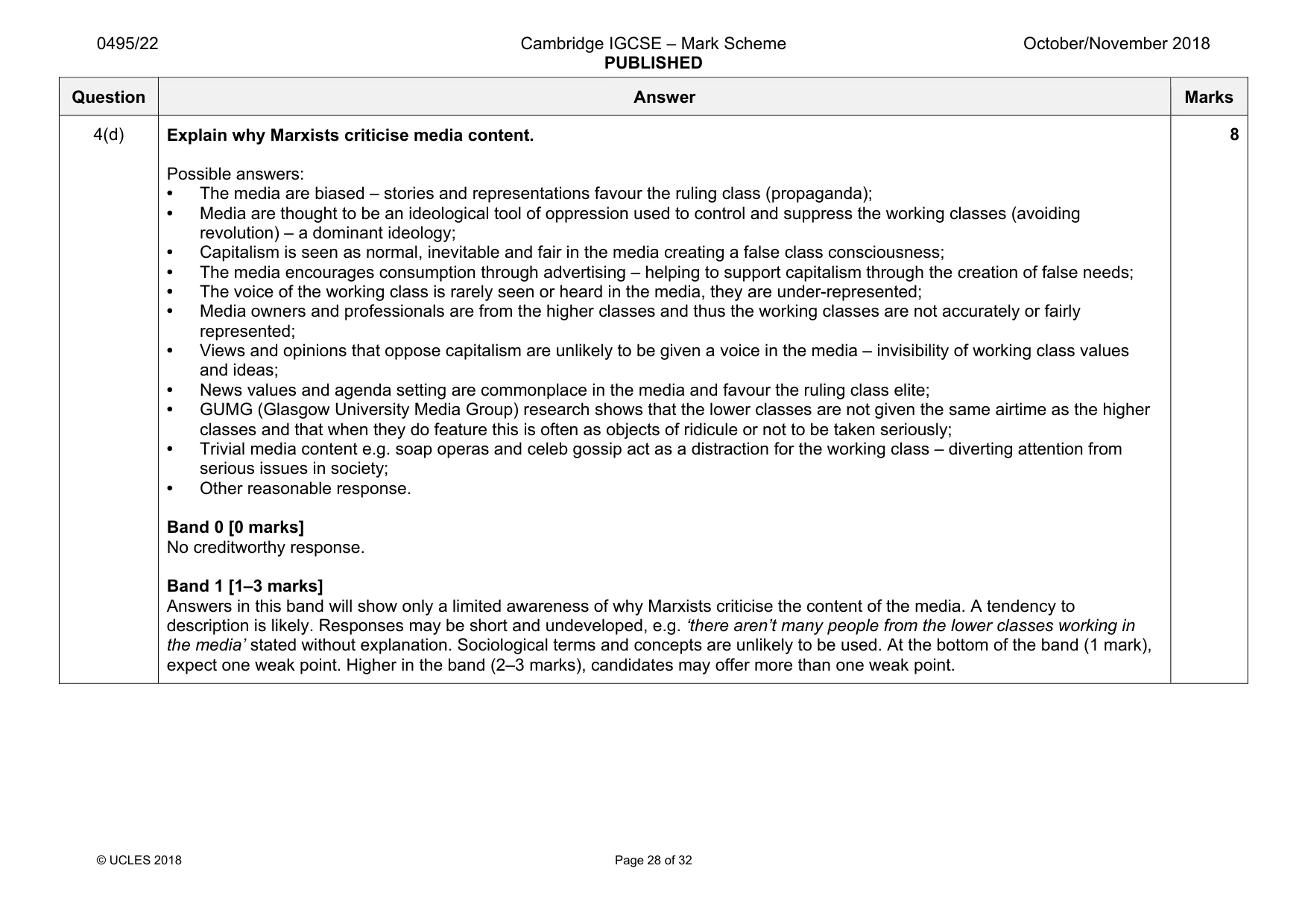
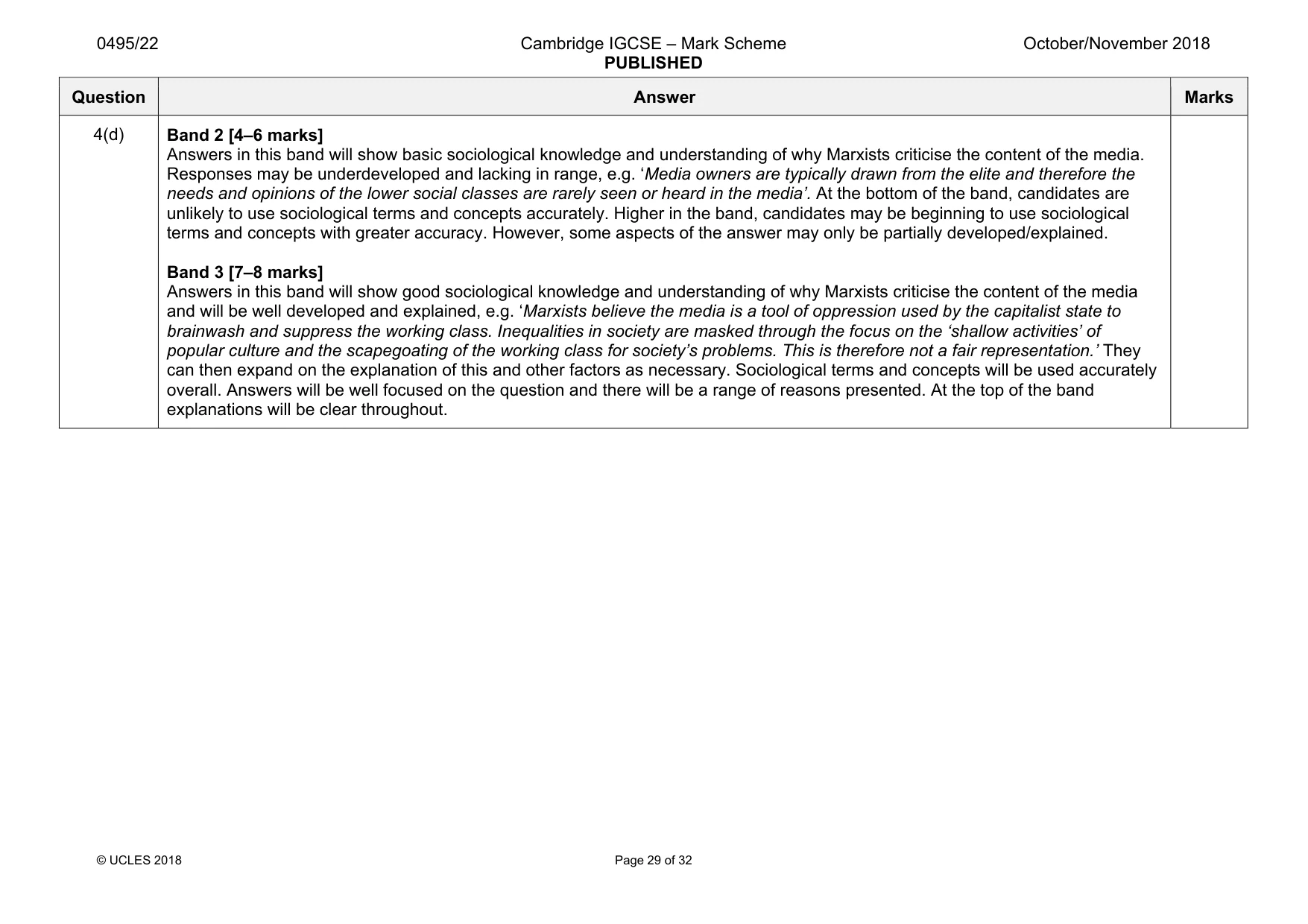
4 (a) What is meant by the term ‘gate-keeping’? [2] (b) Describe two differences between traditional and new media. [4] (c) Explain how the media shape values, attitudes and behaviour. [6] (d) Explain why Marxists criticise media content. [8] (e) To what extent are media representations of minority ethnic groups stereotypical? [15]
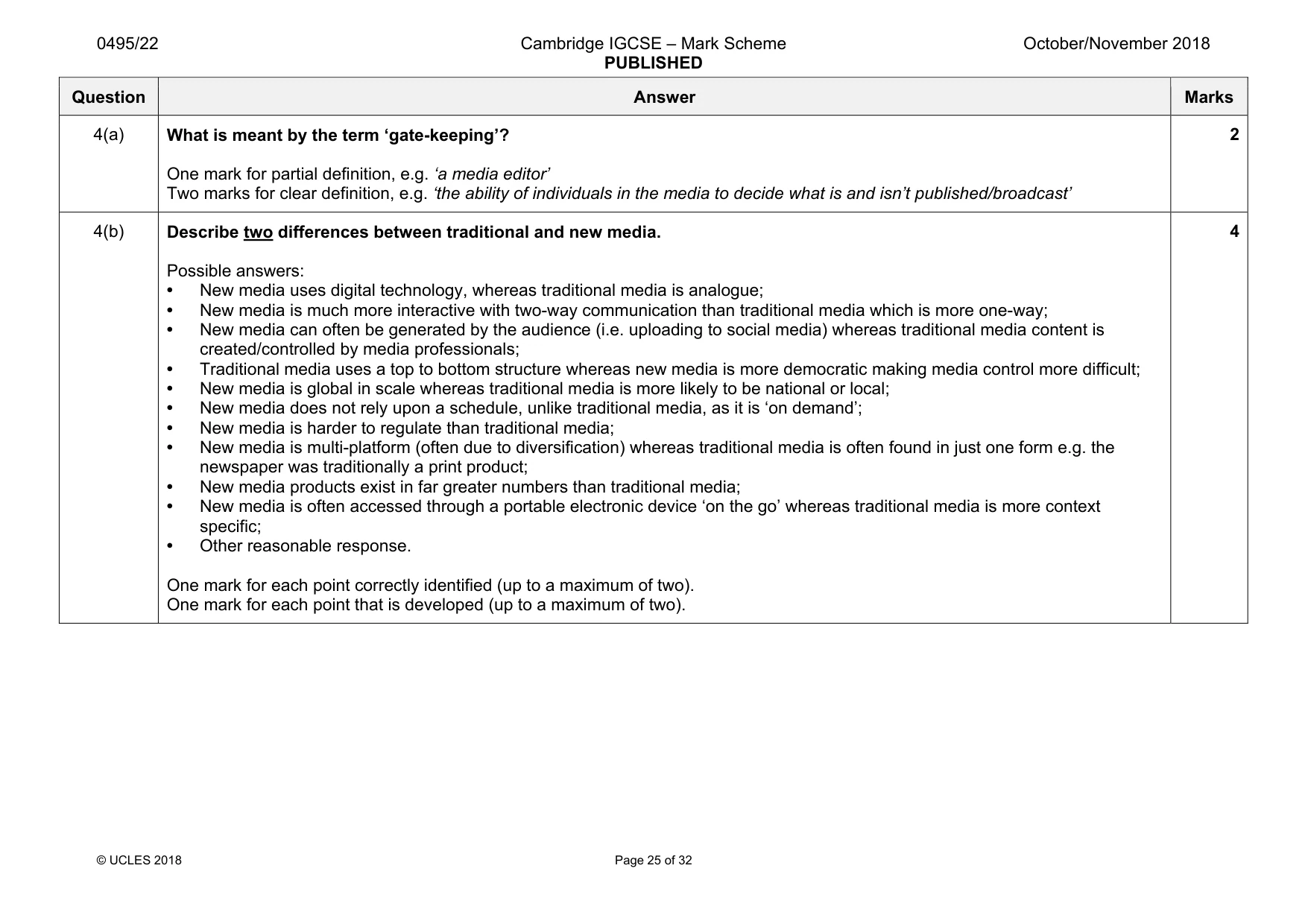
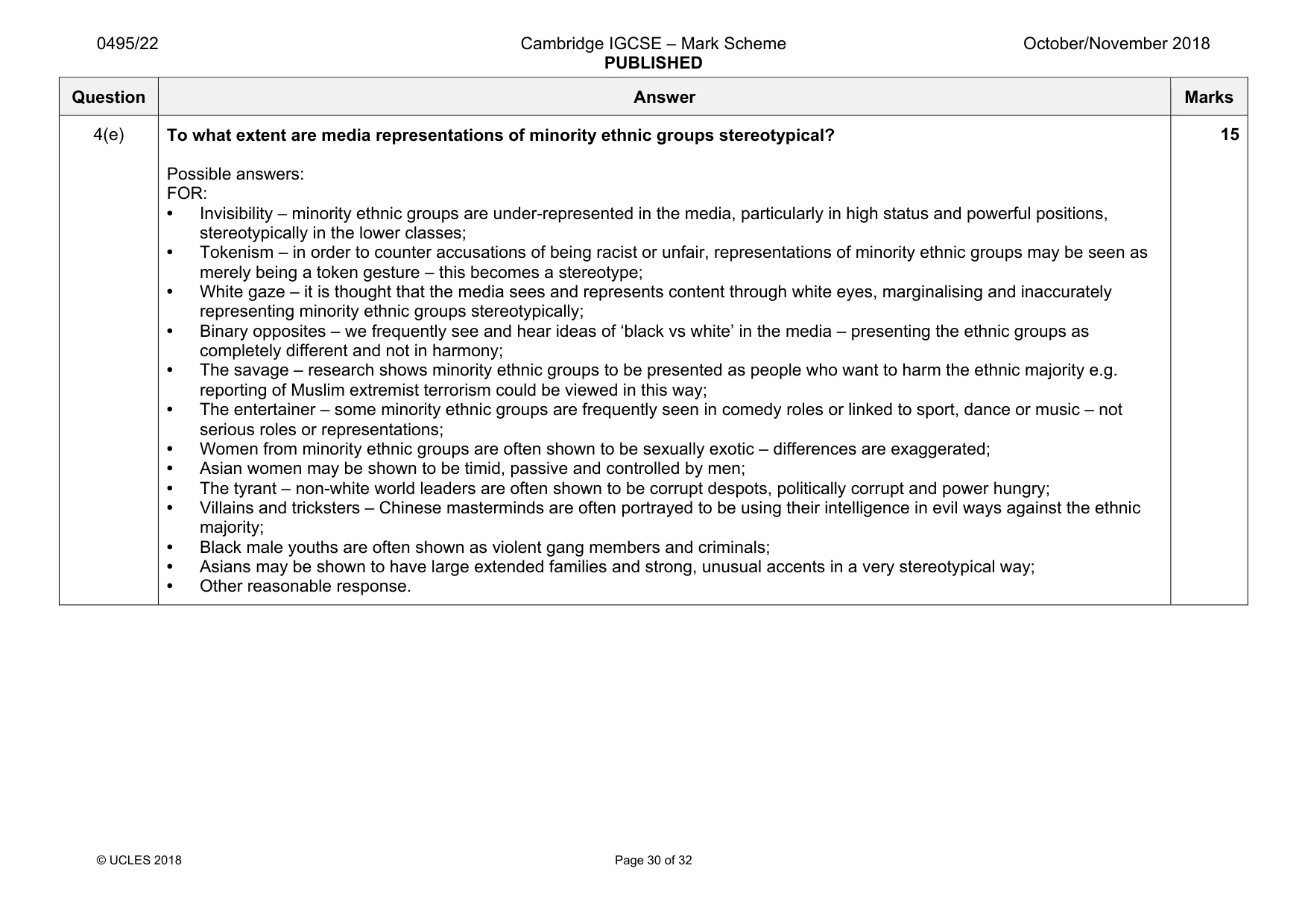
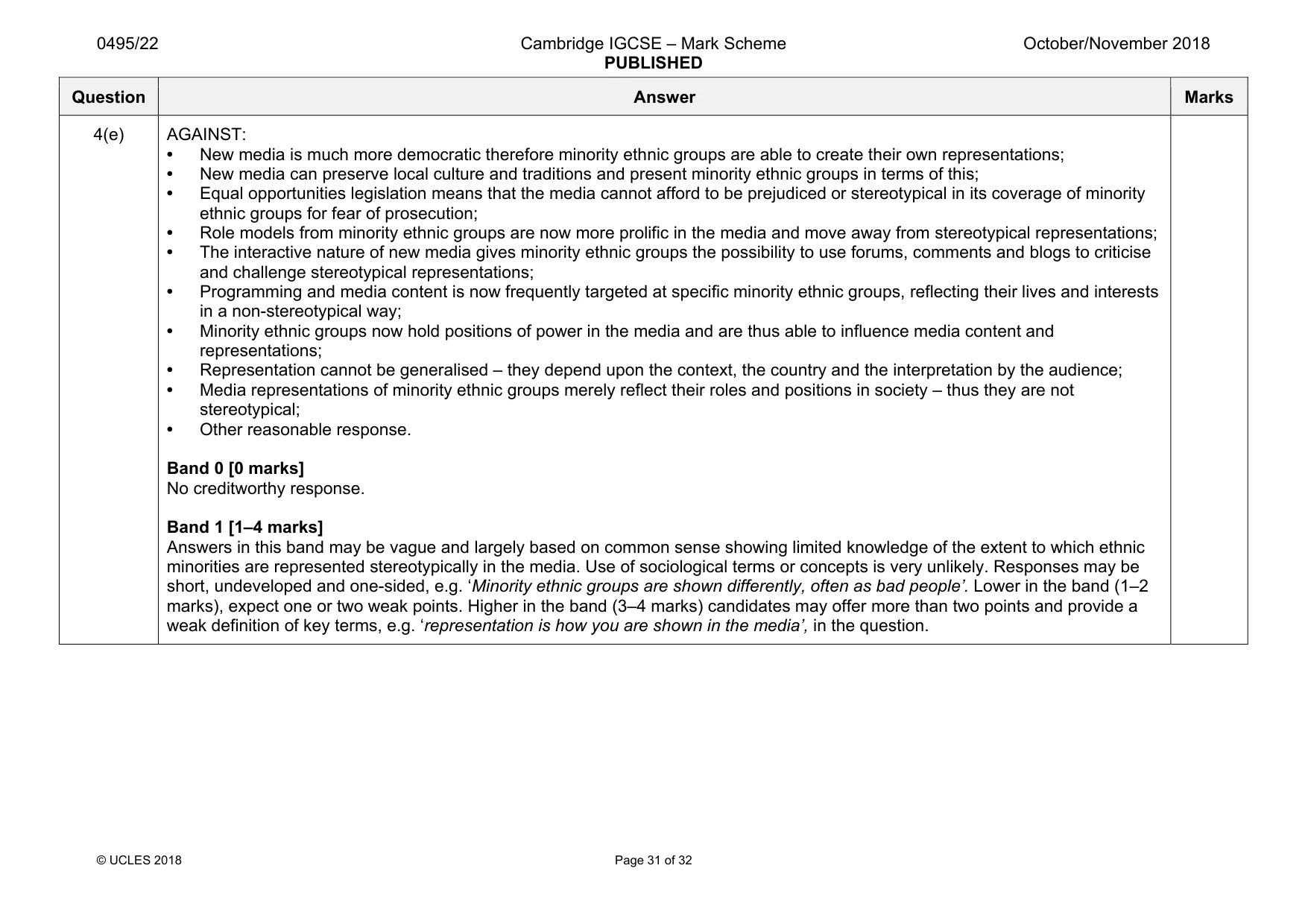
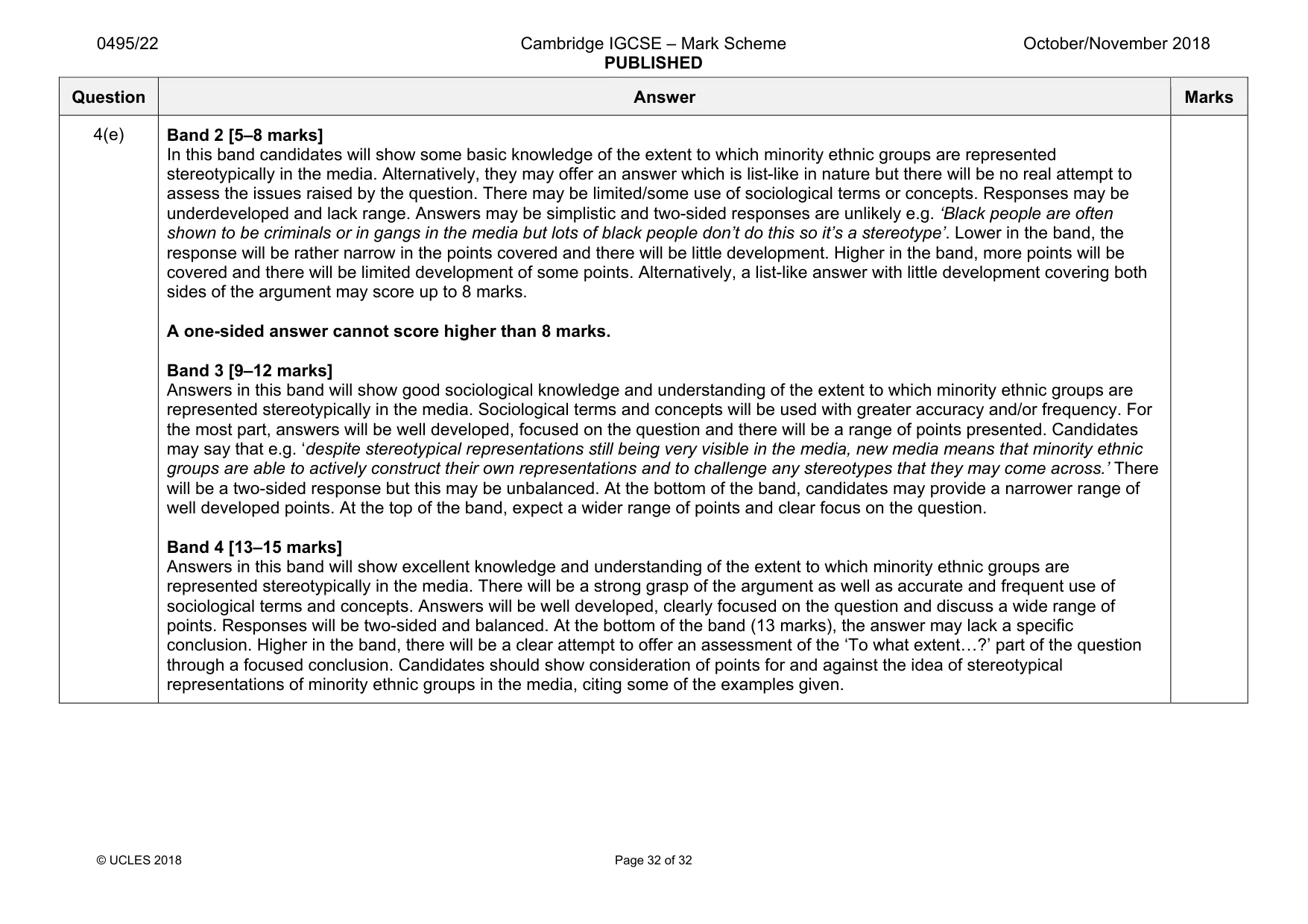
Mark scheme: 4(a) What is meant by the term ‘gate-keeping’? One mark for partial definition, e.g. ‘a media editor’ Two marks for clear definition, e.g. ‘the ability of individuals in the media to decide what is and isn’t published/broadcast’ 2 4(b) Describe two differences between traditional and new media. Possible answers: • New media uses digital technology, whereas traditional media is analogue; • New media is much more interactive with two-way communication than traditional media which is more one-way; • New media can often be generated by the audience (i.e. uploading to social media) whereas traditional media content is created/controlled by media professionals; • Traditional media uses a top to bottom structure whereas new media is more democratic making media control more difficult; • New media is global in scale whereas traditional media is more likely to be national or local; • New media does not rely upon a schedule, unlike traditional media, as it is ‘on demand’; • New media is harder to regulate than traditional media; • New media is multi-platform (often due to diversification) whereas traditional media is often found in just one form e.g. the newspaper was traditionally a print product; • New media products exist in far greater numbers than traditional media; • New media is often accessed through a portable electronic device ‘on the go’ whereas traditional media is more context specific; • Other reasonable response. One mark for each point correctly identified (up to a maximum of two). One mark for each point that is developed (up to a maximum of two). 4 Question Answer Marks 4(c) Explain how the media shape values, attitudes and behaviour. Possible answers: • Hypodermic syringe theory says the media inject the audience with a dominant message and the audience believe this to be true therefore shaping values, attitudes and behaviour; • Advertising and consumer society – the audience are made to believe that they need material possessions/status symbols – promotes the value of consumption; • The media is able to show the negative consequences of non-conformity in society i.e. punishing the bad guys which shapes people’s values, attitudes and behaviour – they tend to conform to the norm; • Role models – these are found in the media and give the audience individuals to aspire to which can shape values, attitudes and behaviour e.g. celebrity culture; • Norm referencing – the media determines what we see as ‘normal’ in society; • Gender roles – the media represent males and females differently and this reinforces what it means to be masculine and feminine; • Imitation – the media may encourage the audience to copy what it sees/hears; • stereotyping – the media perpetuates stereotyping of certain social groups and encourages the audience to think in particular ways about them; • Moral panics – the media use folk devils to create ideas about criminals in society and thus affects the audiences values, attitudes and behaviour; • Political socialisation – the media teaches us our political beliefs and knowledge; • Secondary socialisation agent – a way of reinforcing and perhaps altering values and attitudes from the primary stage (particularly for young people); • Postmodernism – the media is all around us and so is a very powerful agency of socialisation; • Feminism – the media teaches individuals that men have more power and control and therefore reinforces patriarchy; • Marxism – the media acts as a tool of the state and serves the interest of the ruling classes in its agenda setting and normalisation of capitalism – this affects people’s values, attitudes and behaviour; • Other reasonable response. 6 Question Answer Marks 4(c) Band 0 [0 marks] No creditworthy response. Band 1 [1–3 marks] Answers in this band will show only a limited awareness of how the media shapes values, attitudes and behaviour and may talk about e.g. ‘we copy what we see in the media’. Responses may be short and un/under developed. At the bottom of the band (1 mark), expect one weak point. Higher in the band (2–3 marks), candidates may offer more than one weak point, but there may be a tendency towards simplistic answers, engaging with sociological ideas without using sociological language. Band 2 [4–6 marks] A clear and accurate explanation, showing good sociological knowledge and understanding of how the media shapes values, attitudes and behaviour. Sociological terms and concepts should be expected e.g. ‘Feminists believe that stereotypical gender representations in the media teach the audience that males and females have different social positions and roles. They perpetuate the patriarchal values seen in society and normalise this ideology thus affecting how people think and behave’. This would be followed by explanation of factors leading to this. At the bottom of the band, the range of points covered may be narrow or lack detail. Higher in the band, answers will cover more than one factor in a well-developed way or cover several factors in less detail. Question Answer Marks 4(d) Explain why Marxists criticise media content. Possible answers: • The media are biased – stories and representations favour the ruling class (propaganda); • Media are thought to be an ideological tool of oppression used to control and suppress the working classes (avoiding revolution) – a dominant ideology; • Capitalism is seen as normal, inevitable and fair in the media creating a false class consciousness; • The media encourages consumption through advertising – helping to support capitalism through the creation of false needs; • The voice of the working class is rarely seen or heard in the media, they are under-represented; • Media owners and professionals are from the higher classes and thus the working classes are not accurately or fairly represented; • Views and opinions that oppose capitalism are unlikely to be given a voice in the media – invisibility of working class values and ideas; • News values and agenda setting are commonplace in the media and favour the ruling class elite; • GUMG (Glasgow University Media Group) research shows that the lower classes are not given the same airtime as the higher classes and that when they do feature this is often as objects of ridicule or not to be taken seriously; • Trivial media content e.g. soap operas and celeb gossip act as a distraction for the working class – diverting attention from serious issues in society; • Other reasonable response. Band 0 [0 marks] No creditworthy response. Band 1 [1–3 marks] Answers in this band will show only a limited awareness of why Marxists criticise the content of the media. A tendency to description is likely. Responses may be short and undeveloped, e.g. ‘there aren’t many people from the lower classes working in the media’ stated without explanation. Sociological terms and concepts are unlikely to be used. At the bottom of the band (1 mark), expect one weak point. Higher in the band (2–3 marks), candidates may offer more than one weak point. 8 Question Answer Marks 4(d) Band 2 [4–6 marks] Answers in this band will show basic sociological knowledge and understanding of why Marxists criticise the content of the media. Responses may be underdeveloped and lacking in range, e.g. ‘Media owners are typically drawn from the elite and therefore the needs and opinions of the lower social classes are rarely seen or heard in the media’. At the bottom of the band, candidates are unlikely to use sociological terms and concepts accurately. Higher in the band, candidates may be beginning to use sociological terms and concepts with greater accuracy. However, some aspects of the answer may only be partially developed/explained. Band 3 [7–8 marks] Answers in this band will show good sociological knowledge and understanding of why Marxists criticise the content of the media and will be well developed and explained, e.g. ‘Marxists believe the media is a tool of oppression used by the capitalist state to brainwash and suppress the working class. Inequalities in society are masked through the focus on the ‘shallow activities’ of popular culture and the scapegoating of the working class for society’s problems. This is therefore not a fair representation.’ They can then expand on the explanation of this and other factors as necessary. Sociological terms and concepts will be used accurately overall. Answers will be well focused on the question and there will be a range of reasons presented. At the top of the band explanations will be clear throughout. Question Answer Marks 4(e) To what extent are media representations of minority ethnic groups stereotypical? Possible answers: FOR: • Invisibility – minority ethnic groups are under-represented in the media, particularly in high status and powerful positions, stereotypically in the lower classes; • Tokenism – in order to counter accusations of being racist or unfair, representations of minority ethnic groups may be seen as merely being a token gesture – this becomes a stereotype; • White gaze – it is thought that the media sees and represents content through white eyes, marginalising and inaccurately representing minority ethnic groups stereotypically; • Binary opposites – we frequently see and hear ideas of ‘black vs white’ in the media – presenting the ethnic groups as completely different and not in harmony; • The savage – research shows minority ethnic groups to be presented as people who want to harm the ethnic majority e.g. reporting of Muslim extremist terrorism could be viewed in this way; • The entertainer – some minority ethnic groups are frequently seen in comedy roles or linked to sport, dance or music – not serious roles or representations; • Women from minority ethnic groups are often shown to be sexually exotic – differences are exaggerated; • Asian women may be shown to be timid, passive and controlled by men; • The tyrant – non-white world leaders are often shown to be corrupt despots, politically corrupt and power hungry; • Villains and tricksters – Chinese masterminds are often portrayed to be using their intelligence in evil ways against the ethnic majority; • Black male youths are often shown as violent gang members and criminals; • Asians may be shown to have large extended families and strong, unusual accents in a very stereotypical way; • Other reasonable response. 15 Question Answer Marks 4(e) AGAINST: • New media is much more democratic therefore minority ethnic groups are able to create their own representations; • New media can preserve local culture and traditions and present minority ethnic groups in terms of this; • Equal opportunities legislation means that the media cannot afford to be prejudiced or stereotypical in its coverage of minority ethnic groups for fear of prosecution; • Role models from minority ethnic groups are now more prolific in the media and move away from stereotypical representations; • The interactive nature of new media gives minority ethnic groups the possibility to use forums, comments and blogs to criticise and challenge stereotypical representations; • Programming and media content is now frequently targeted at specific minority ethnic groups, reflecting their lives and interests in a non-stereotypical way; • Minority ethnic groups now hold positions of power in the media and are thus able to influence media content and representations; • Representation cannot be generalised – they depend upon the context, the country and the interpretation by the audience; • Media representations of minority ethnic groups merely reflect their roles and positions in society – thus they are not stereotypical; • Other reasonable response. Band 0 [0 marks] No creditworthy response. Band 1 [1–4 marks] Answers in this band may be vague and largely based on common sense showing limited knowledge of the extent to which ethnic minorities are represented stereotypically in the media. Use of sociological terms or concepts is very unlikely. Responses may be short, undeveloped and one-sided, e.g. ‘Minority ethnic groups are shown differently, often as bad people’. Lower in the band (1–2 marks), expect one or two weak points. Higher in the band (3–4 marks) candidates may offer more than two points and provide a weak definition of key terms, e.g. ‘representation is how you are shown in the media’, in the question. Question Answer Marks 4(e) Band 2 [5–8 marks] In this band candidates will show some basic knowledge of the extent to which minority ethnic groups are represented stereotypically in the media. Alternatively, they may offer an answer which is list-like in nature but there will be no real attempt to assess the issues raised by the question. There may be limited/some use of sociological terms or concepts. Responses may be underdeveloped and lack range. Answers may be simplistic and two-sided responses are unlikely e.g. ‘Black people are often shown to be criminals or in gangs in the media but lots of black people don’t do this so it’s a stereotype’. Lower in the band, the response will be rather narrow in the points covered and there will be little development. Higher in the band, more points will be covered and there will be limited development of some points. Alternatively, a list-like answer with little development covering both sides of the argument may score up to 8 marks. A one-sided answer cannot score higher than 8 marks. Band 3 [9–12 marks] Answers in this band will show good sociological knowledge and understanding of the extent to which minority ethnic groups are represented stereotypically in the media. Sociological terms and concepts will be used with greater accuracy and/or frequency. For the most part, answers will be well developed, focused on the question and there will be a range of points presented. Candidates may say that e.g. ‘despite stereotypical representations still being very visible in the media, new media means that minority ethnic groups are able to actively construct their own representations and to challenge any stereotypes that they may come across.’ There will be a two-sided response but this may be unbalanced. At the bottom of the band, candidates may provide a narrower range of well developed points. At the top of the band, expect a wider range of points and clear focus on the question. Band 4 [13–15 marks] Answers in this band will show excellent knowledge and understanding of the extent to which minority ethnic groups are represented stereotypically in the media. There will be a strong grasp of the argument as well as accurate and frequent use of sociological terms and concepts. Answers will be well developed, clearly focused on the question and discuss a wide range of points. Responses will be two-sided and balanced. At the bottom of the band (13 marks), the answer may lack a specific conclusion. Higher in the band, there will be a clear attempt to offer an assessment of the ‘To what extent«?’ part of the question through a focused conclusion. Candidates should show consideration of points for and against the idea of stereotypical representations of minority ethnic groups in the media, citing some of the examples given.
More questions on How do sociologists approach the study of society?
What was in this paper
The subtopics covered by these 4 questions, and how many questions each got. Open one in a new tab to see every Cambridge question on it.
What you needed in this session
Cambridge’s own grade thresholds for 2018 Oct/Nov, Paper 2 · Variant 2. A higher threshold means an easier paper — the bar moves with how the cohort did.