Cambridge IGCSE Sociology 0495 — 2023 Oct/Nov Paper 2 · Variant 2
0495/22/O/N/23 · 4 questions · 70 marks · ≈79 min
The question paper and its mark scheme, free to read here and free to download. This is Cambridge’s own paper, exactly as it was sat.
Question paper4 pages

Mark scheme27 pages
Answers below. Sit the paper first if you are practising.



Questions as text
Q1 · Functionalists claim that the nuclear family is the norm and that it is the best type of…
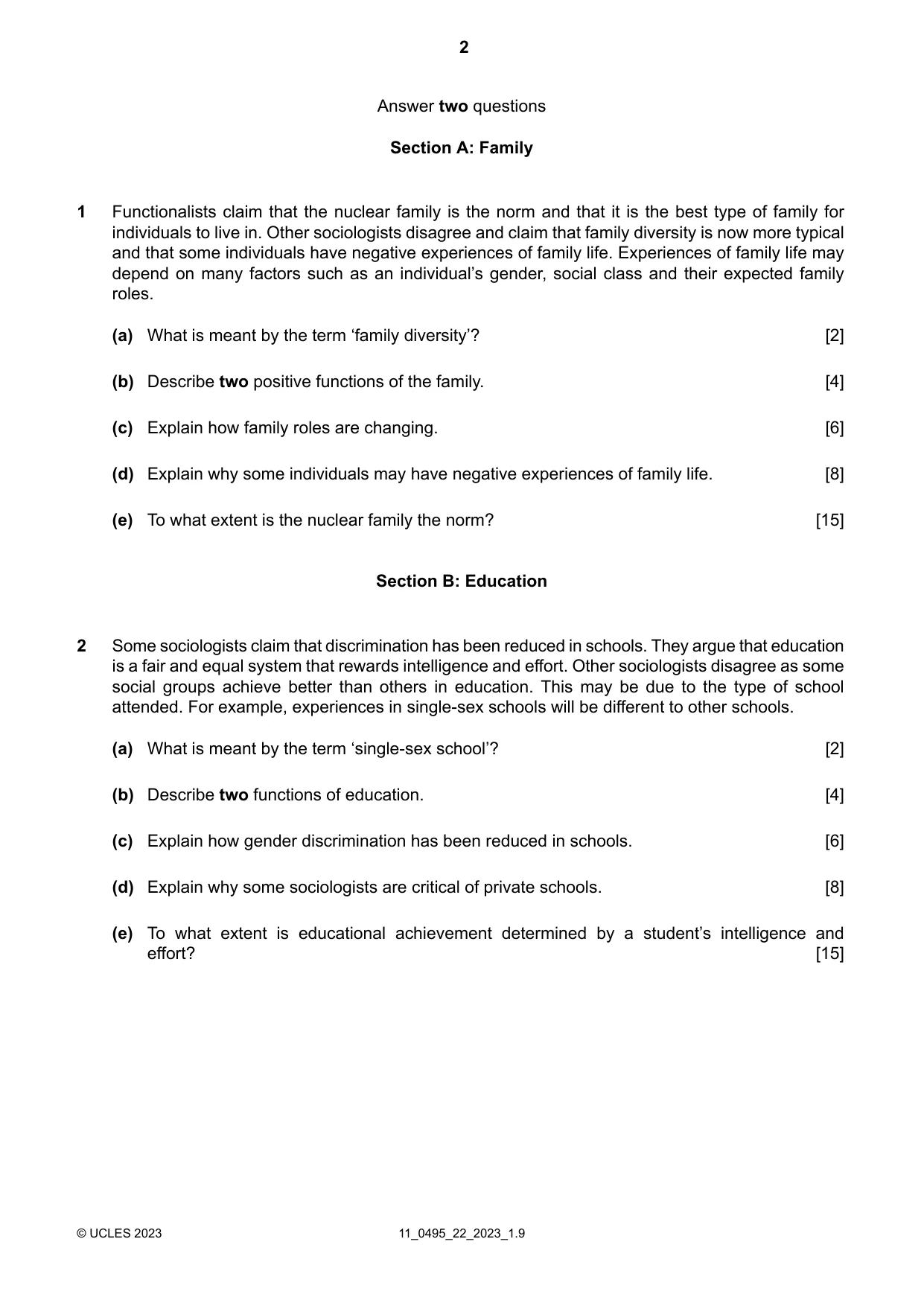
1 Functionalists claim that the nuclear family is the norm and that it is the best type of family for individuals to live in. Other sociologists disagree and claim that family diversity is now more typical and that some individuals have negative experiences of family life. Experiences of family life may depend on many factors such as an individual’s gender, social class and their expected family roles. (a) What is meant by the term ‘family diversity’? [2] (b) Describe two positive functions of the family. [4] (c) Explain how family roles are changing. [6] (d) Explain why some individuals may have negative experiences of family life. [8] (e) To what extent is the nuclear family the norm? [15]
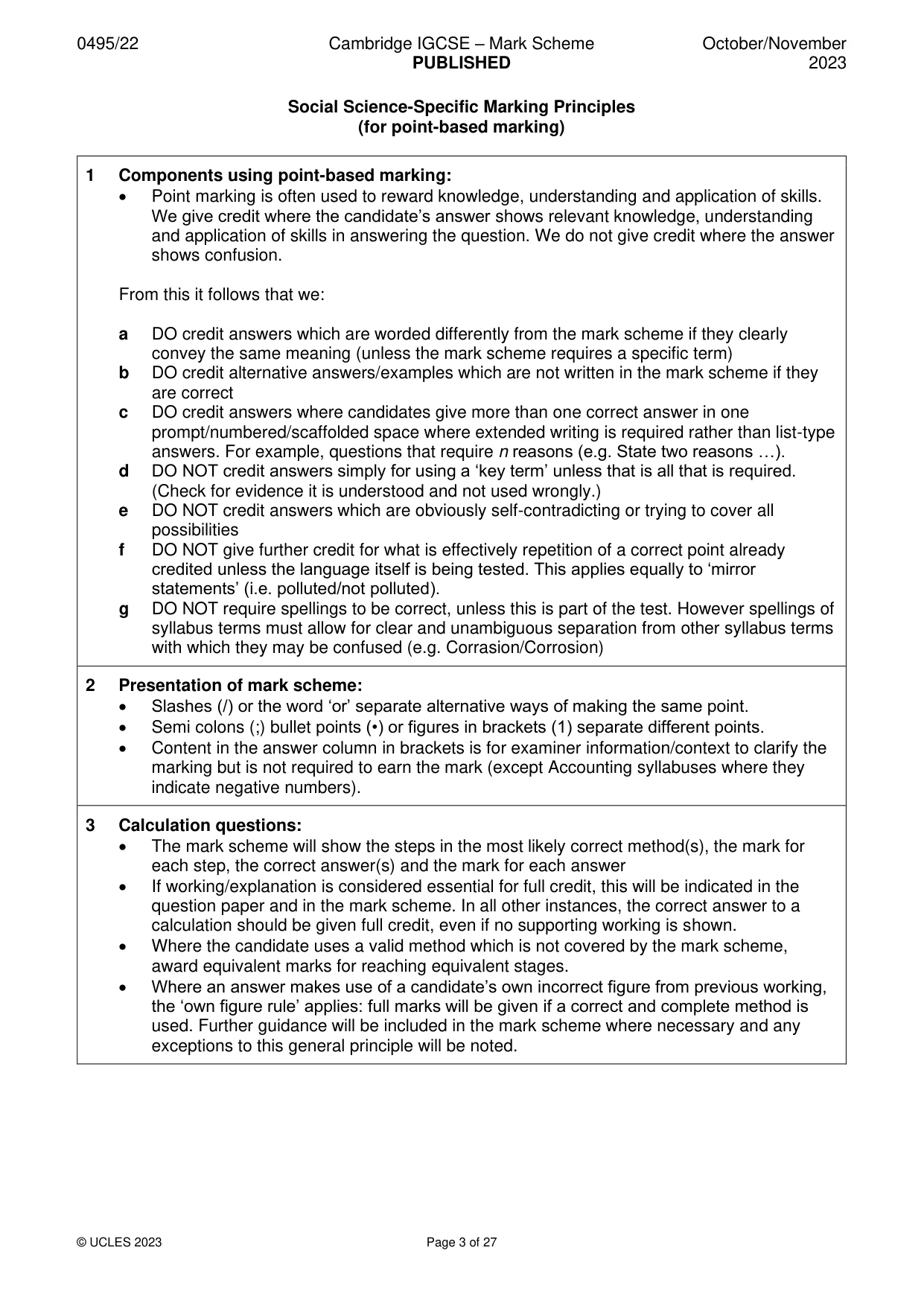
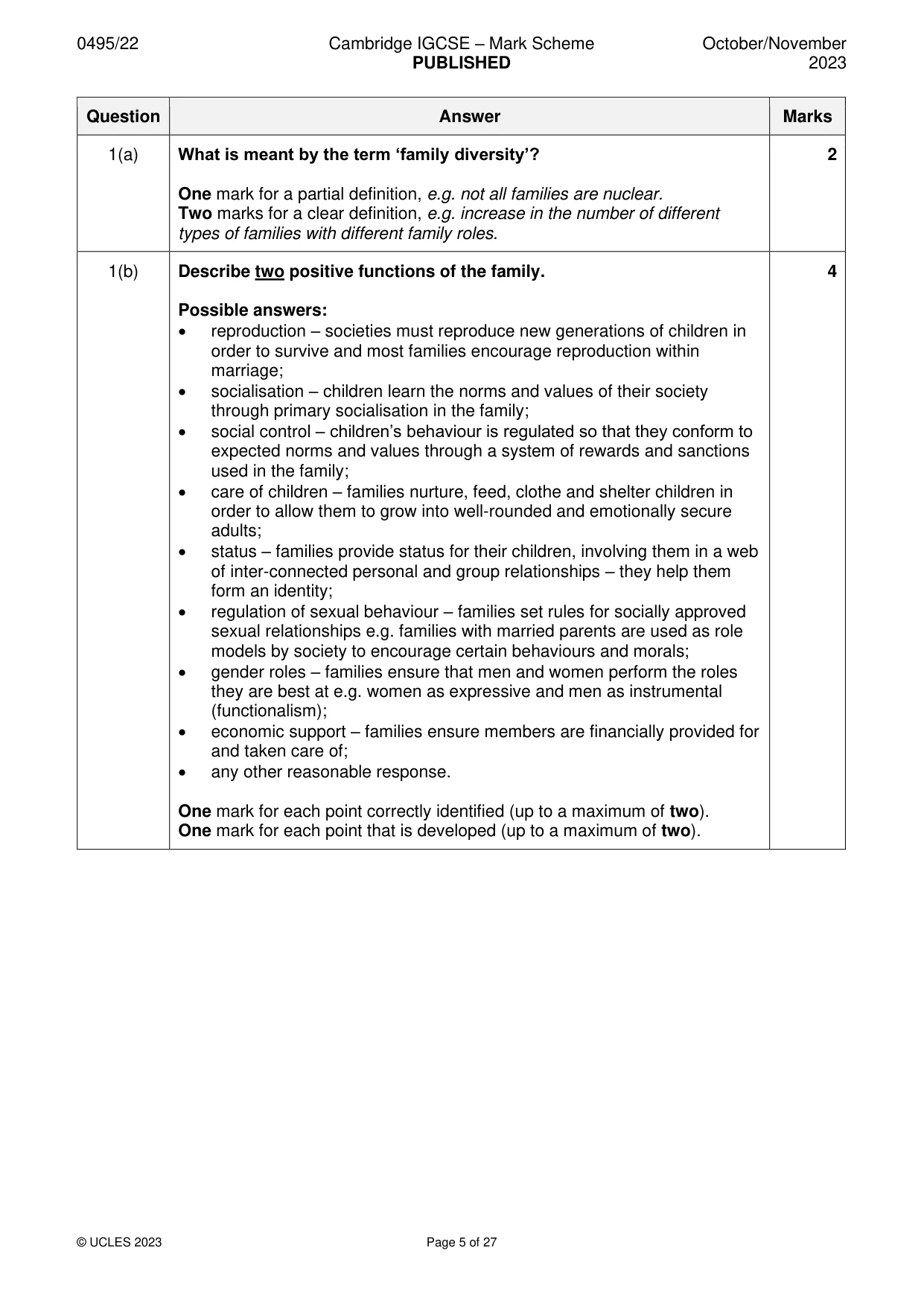
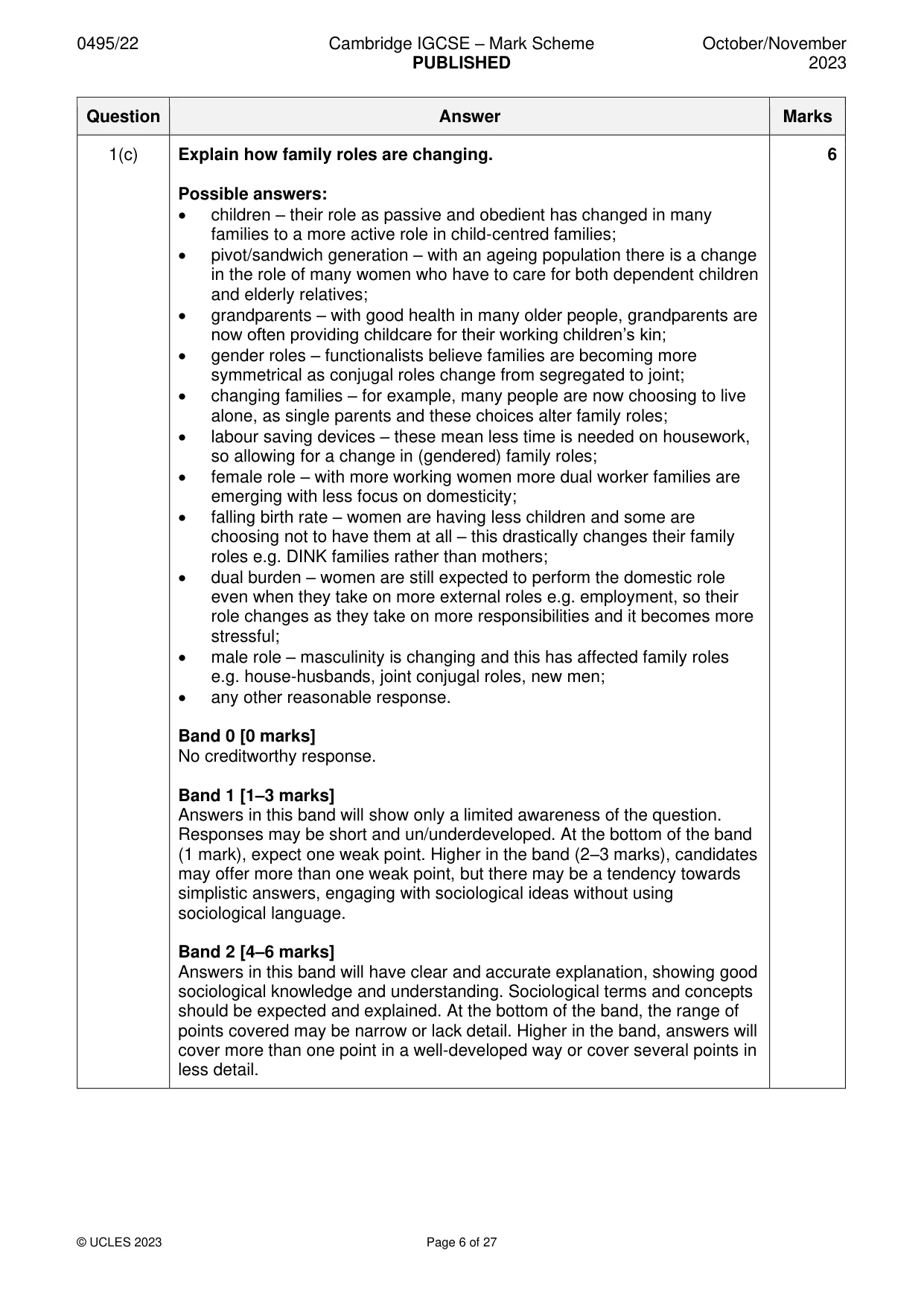
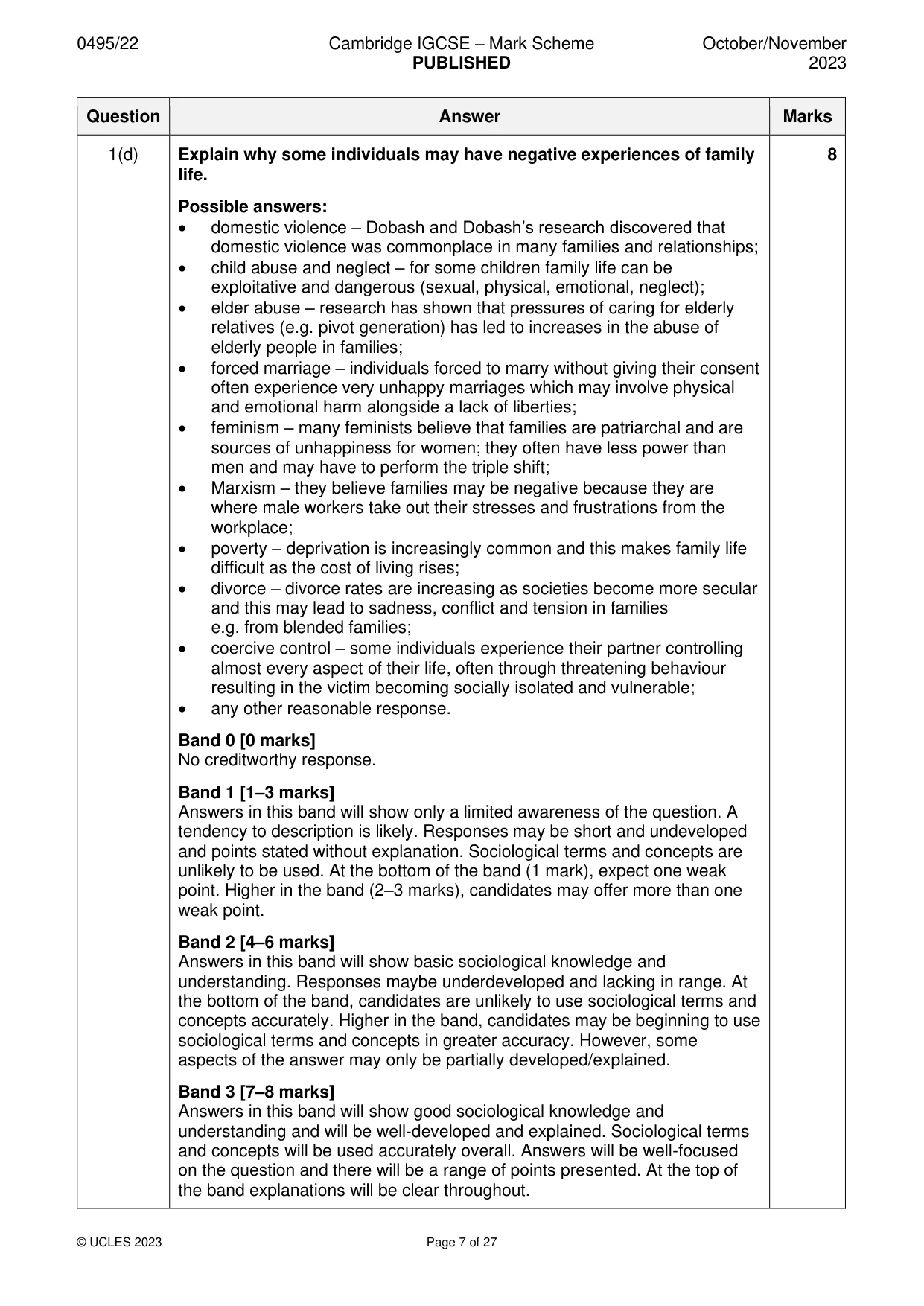
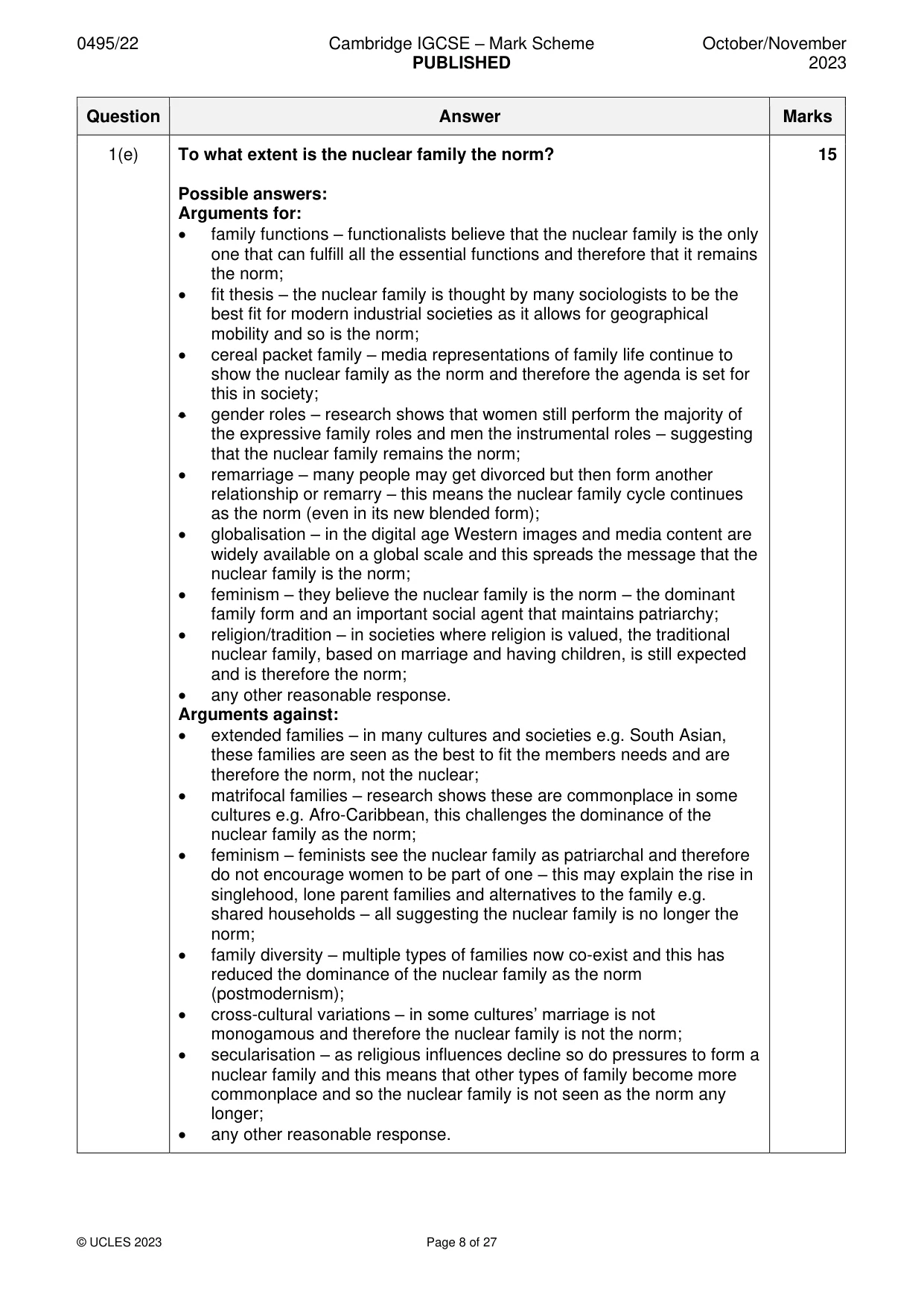
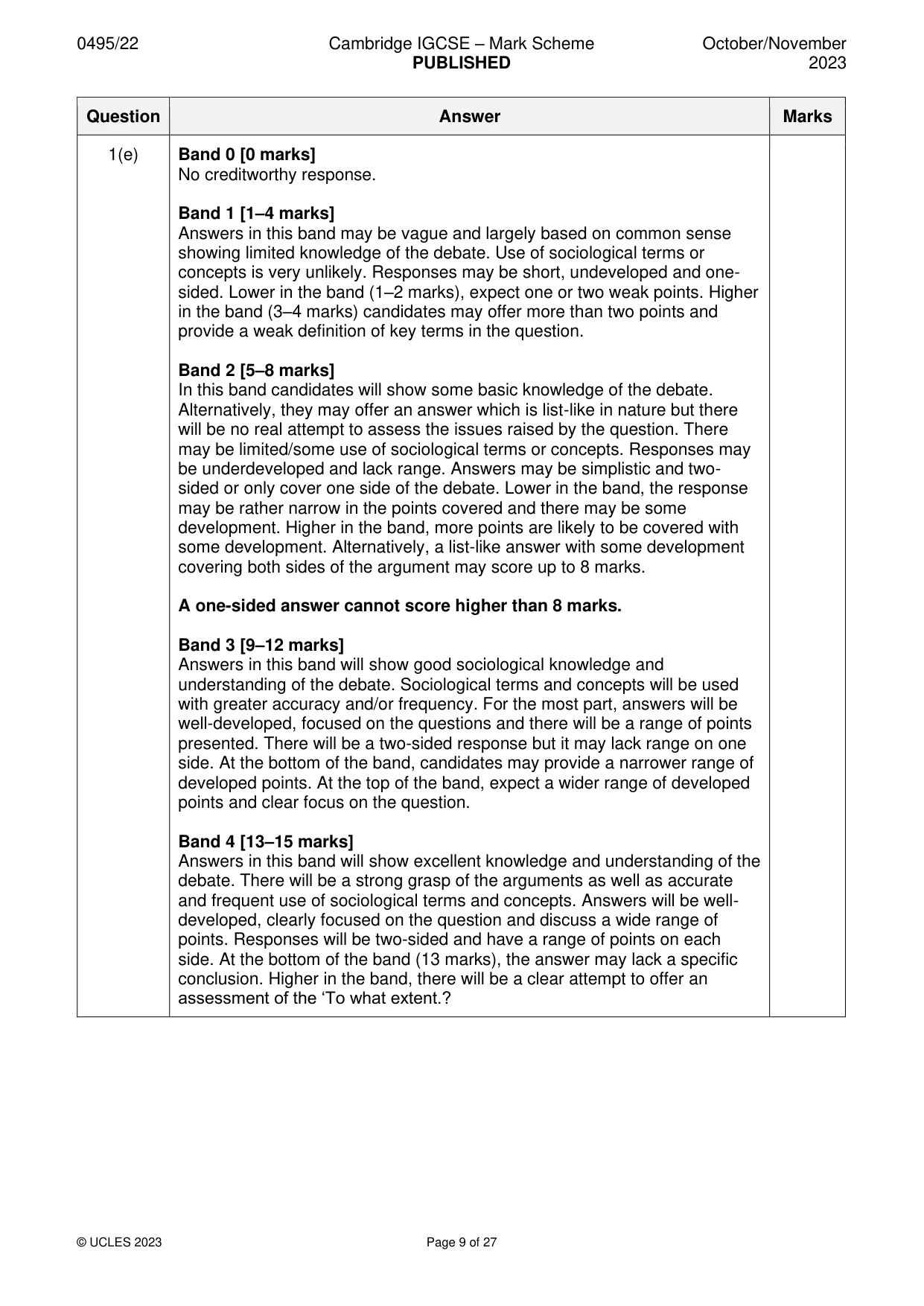
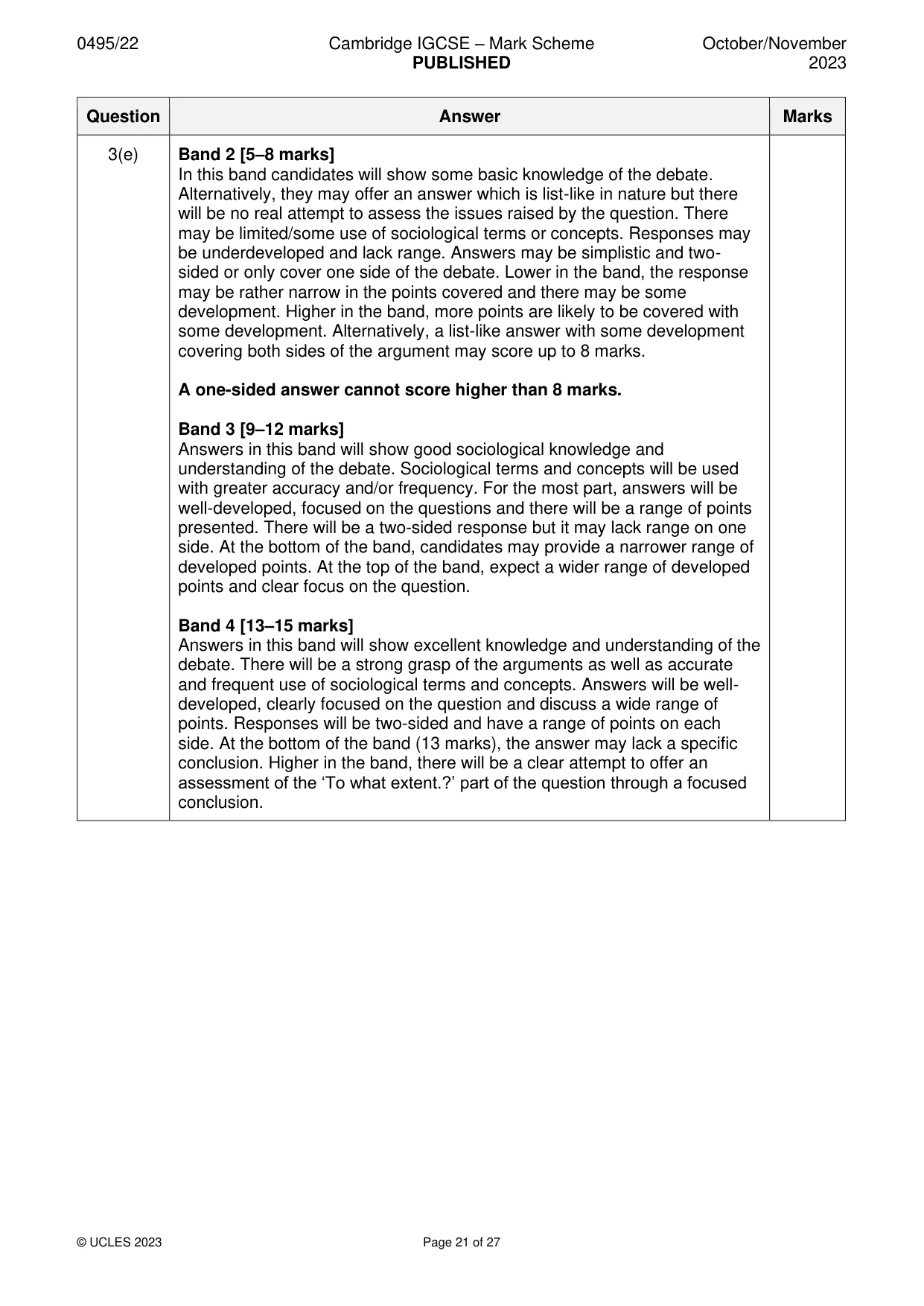
Mark scheme: Question Answer Marks 1(a) What is meant by the term ‘family diversity’? 2 One mark for a partial definition, e.g. not all families are nuclear. Two marks for a clear definition, e.g. increase in the number of different types of families with different family roles. 1(b) Describe two positive functions of the family. 4 Possible answers: • reproduction – societies must reproduce new generations of children in order to survive and most families encourage reproduction within marriage; • socialisation – children learn the norms and values of their society through primary socialisation in the family; • social control – children’s behaviour is regulated so that they conform to expected norms and values through a system of rewards and sanctions used in the family; • care of children – families nurture, feed, clothe and shelter children in order to allow them to grow into well-rounded and emotionally secure adults; • status – families provide status for their children, involving them in a web of inter-connected personal and group relationships – they help them form an identity; • regulation of sexual behaviour – families set rules for socially approved sexual relationships e.g. families with married parents are used as role models by society to encourage certain behaviours and morals; • gender roles – families ensure that men and women perform the roles they are best at e.g. women as expressive and men as instrumental (functionalism); • economic support – families ensure members are financially provided for and taken care of; • any other reasonable response. One mark for each point correctly identified (up to a maximum of two). One mark for each point that is developed (up to a maximum of two). 1(c) Explain how family roles are changing. 6 Possible answers: • children – their role as passive and obedient has changed in many families to a more active role in child-centred families; • pivot/sandwich generation – with an ageing population there is a change in the role of many women who have to care for both dependent children and elderly relatives; • grandparents – with good health in many older people, grandparents are now often providing childcare for their working children’s kin; • gender roles – functionalists believe families are becoming more symmetrical as conjugal roles change from segregated to joint; • changing families – for example, many people are now choosing to live alone, as single parents and these choices alter family roles; • labour saving devices – these mean less time is needed on housework, so allowing for a change in (gendered) family roles; • female role – with more working women more dual worker families are emerging with less focus on domesticity; • falling birth rate – women are having less children and some are choosing not to have them at all – this drastically changes their family roles e.g. DINK families rather than mothers; • dual burden – women are still expected to perform the domestic role even when they take on more external roles e.g. employment, so their role changes as they take on more responsibilities and it becomes more stressful; • male role – masculinity is changing and this has affected family roles e.g. house-husbands, joint conjugal roles, new men; • any other reasonable response. Band 0 [0 marks] No creditworthy response. Band 1 [1–3 marks] Answers in this band will show only a limited awareness of the question. Responses may be short and un/underdeveloped. At the bottom of the band (1 mark), expect one weak point. Higher in the band (2–3 marks), candidates may offer more than one weak point, but there may be a tendency towards simplistic answers, engaging with sociological ideas without using sociological language. Band 2 [4–6 marks] Answers in this band will have clear and accurate explanation, showing good sociological knowledge and understanding. Sociological terms and concepts should be expected and explained. At the bottom of the band, the range of points covered may be narrow or lack detail. Higher in the band, answers will cover more than one point in a well-developed way or cover several points in less detail. 1(d) Explain why some individuals may have negative experiences of family 8 life. Possible answers: • domestic violence – Dobash and Dobash’s research discovered that domestic violence was commonplace in many families and relationships; • child abuse and neglect – for some children family life can be exploitative and dangerous (sexual, physical, emotional, neglect); • elder abuse – research has shown that pressures of caring for elderly relatives (e.g. pivot generation) has led to increases in the abuse of elderly people in families; • forced marriage – individuals forced to marry without giving their consent often experience very unhappy marriages which may involve physical and emotional harm alongside a lack of liberties; • feminism – many feminists believe that families are patriarchal and are sources of unhappiness for women; they often have less power than men and may have to perform the triple shift; • Marxism – they believe families may be negative because they are where male workers take out their stresses and frustrations from the workplace; • poverty – deprivation is increasingly common and this makes family life difficult as the cost of living rises; • divorce – divorce rates are increasing as societies become more secular and this may lead to sadness, conflict and tension in families e.g. from blended families; • coercive control – some individuals experience their partner controlling almost every aspect of their life, often through threatening behaviour resulting in the victim becoming socially isolated and vulnerable; • any other reasonable response. Band 0 [0 marks] No creditworthy response. Band 1 [1–3 marks] Answers in this band will show only a limited awareness of the question. A tendency to description is likely. Responses may be short and undeveloped and points stated without explanation. Sociological terms and concepts are unlikely to be used. At the bottom of the band (1 mark), expect one weak point. Higher in the band (2–3 marks), candidates may offer more than one weak point. Band 2 [4–6 marks] Answers in this band will show basic sociological knowledge and understanding. Responses maybe underdeveloped and lacking in range. At the bottom of the band, candidates are unlikely to use sociological terms and concepts accurately. Higher in the band, candidates may be beginning to use sociological terms and concepts in greater accuracy. However, some aspects of the answer may only be partially developed/explained. Band 3 [7–8 marks] Answers in this band will show good sociological knowledge and understanding and will be well-developed and explained. Sociological terms and concepts will be used accurately overall. Answers will be well-focused on the question and there will be a range of points presented. At the top of the band explanations will be clear throughout. 1(e) To what extent is the nuclear family the norm? 15 Possible answers: Arguments for: • family functions – functionalists believe that the nuclear family is the only one that can fulfill all the essential functions and therefore that it remains the norm; • fit thesis – the nuclear family is thought by many sociologists to be the best fit for modern industrial societies as it allows for geographical mobility and so is the norm; • cereal packet family – media representations of family life continue to show the nuclear family as the norm and therefore the agenda is set for this in society; • gender roles – research shows that women still perform the majority of the expressive family roles and men the instrumental roles – suggesting that the nuclear family remains the norm; • remarriage – many people may get divorced but then form another relationship or remarry – this means the nuclear family cycle continues as the norm (even in its new blended form); • globalisation – in the digital age Western images and media content are widely available on a global scale and this spreads the message that the nuclear family is the norm; • feminism – they believe the nuclear family is the norm – the dominant family form and an important social agent that maintains patriarchy; • religion/tradition – in societies where religion is valued, the traditional nuclear family, based on marriage and having children, is still expected and is therefore the norm; • any other reasonable response. Arguments against: • extended families – in many cultures and societies e.g. South Asian, these families are seen as the best to fit the members needs and are therefore the norm, not the nuclear; • matrifocal families – research shows these are commonplace in some cultures e.g. Afro-Caribbean, this challenges the dominance of the nuclear family as the norm; • feminism – feminists see the nuclear family as patriarchal and therefore do not encourage women to be part of one – this may explain the rise in singlehood, lone parent families and alternatives to the family e.g. shared households – all suggesting the nuclear family is no longer the norm; • family diversity – multiple types of families now co-exist and this has reduced the dominance of the nuclear family as the norm (postmodernism); • cross-cultural variations – in some cultures’ marriage is not monogamous and therefore the nuclear family is not the norm; • secularisation – as religious influences decline so do pressures to form a nuclear family and this means that other types of family become more commonplace and so the nuclear family is not seen as the norm any longer; • any other reasonable response. 1(e) Band 0 [0 marks] No creditworthy response. Band 1 [1–4 marks] Answers in this band may be vague and largely based on common sense showing limited knowledge of the debate. Use of sociological terms or concepts is very unlikely. Responses may be short, undeveloped and one- sided. Lower in the band (1–2 marks), expect one or two weak points. Higher in the band (3–4 marks) candidates may offer more than two points and provide a weak definition of key terms in the question. Band 2 [5–8 marks] In this band candidates will show some basic knowledge of the debate. Alternatively, they may offer an answer which is list-like in nature but there will be no real attempt to assess the issues raised by the question. There may be limited/some use of sociological terms or concepts. Responses may be underdeveloped and lack range. Answers may be simplistic and two- sided or only cover one side of the debate. Lower in the band, the response may be rather narrow in the points covered and there may be some development. Higher in the band, more points are likely to be covered with some development. Alternatively, a list-like answer with some development covering both sides of the argument may score up to 8 marks. A one-sided answer cannot score higher than 8 marks. Band 3 [9–12 marks] Answers in this band will show good sociological knowledge and understanding of the debate. Sociological terms and concepts will be used with greater accuracy and/or frequency. For the most part, answers will be well-developed, focused on the questions and there will be a range of points presented. There will be a two-sided response but it may lack range on one side. At the bottom of the band, candidates may provide a narrower range of developed points. At the top of the band, expect a wider range of developed points and clear focus on the question. Band 4 [13–15 marks] Answers in this band will show excellent knowledge and understanding of the debate. There will be a strong grasp of the arguments as well as accurate and frequent use of sociological terms and concepts. Answers will be well- developed, clearly focused on the question and discuss a wide range of points. Responses will be two-sided and have a range of points on each side. At the bottom of the band (13 marks), the answer may lack a specific conclusion. Higher in the band, there will be a clear attempt to offer an assessment of the ‘To what extent.?
Q2 · Some sociologists claim that discrimination has been reduced in schools
2 Some sociologists claim that discrimination has been reduced in schools. They argue that education is a fair and equal system that rewards intelligence and effort. Other sociologists disagree as some social groups achieve better than others in education. This may be due to the type of school attended. For example, experiences in single-sex schools will be different to other schools. (a) What is meant by the term ‘single-sex school’? [2] (b) Describe two functions of education. [4] (c) Explain how gender discrimination has been reduced in schools. [6] (d) Explain why some sociologists are critical of private schools. [8] (e) To what extent is educational achievement determined by a student’s intelligence and effort? [15] Section C: Crime, deviance and social control
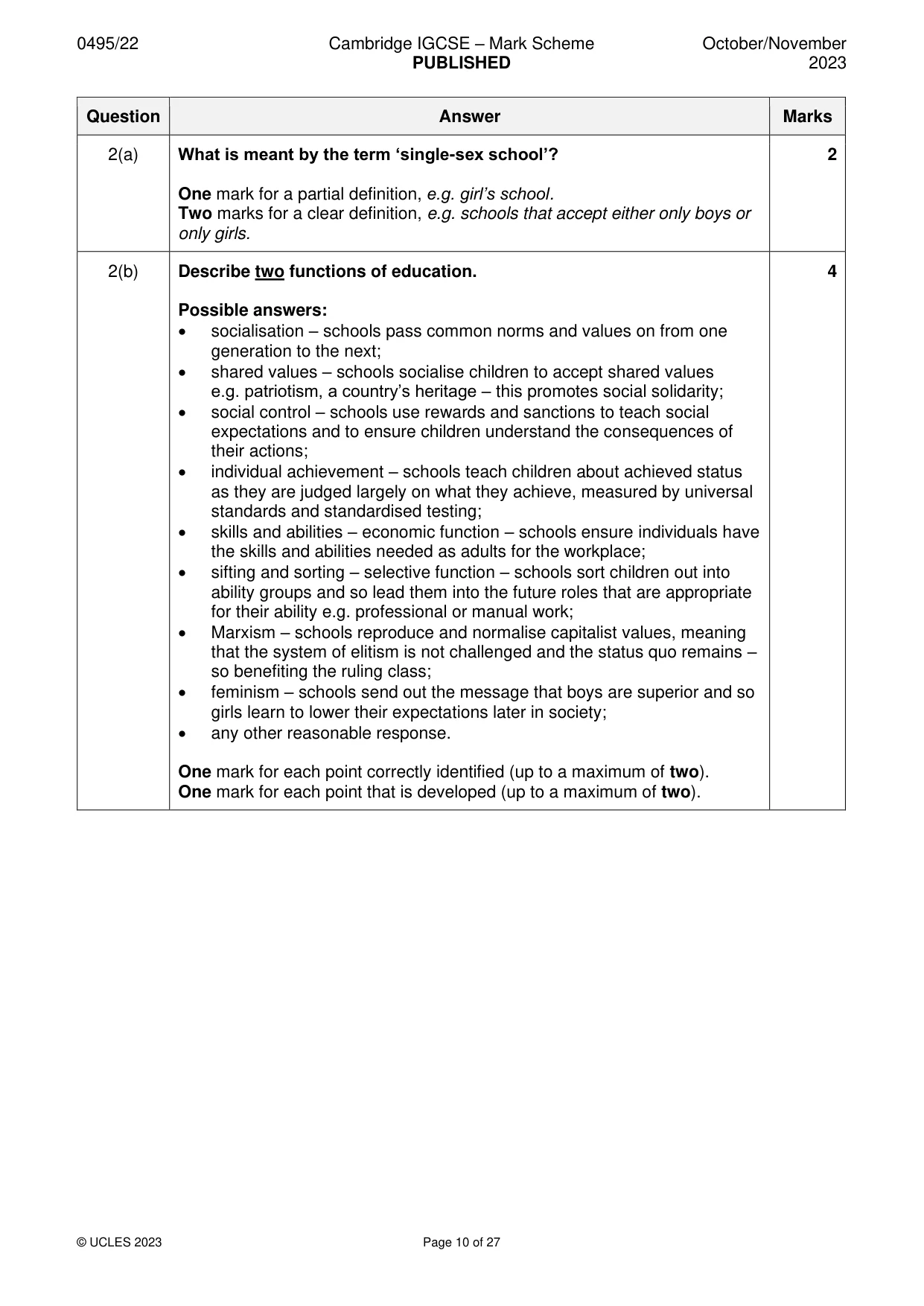
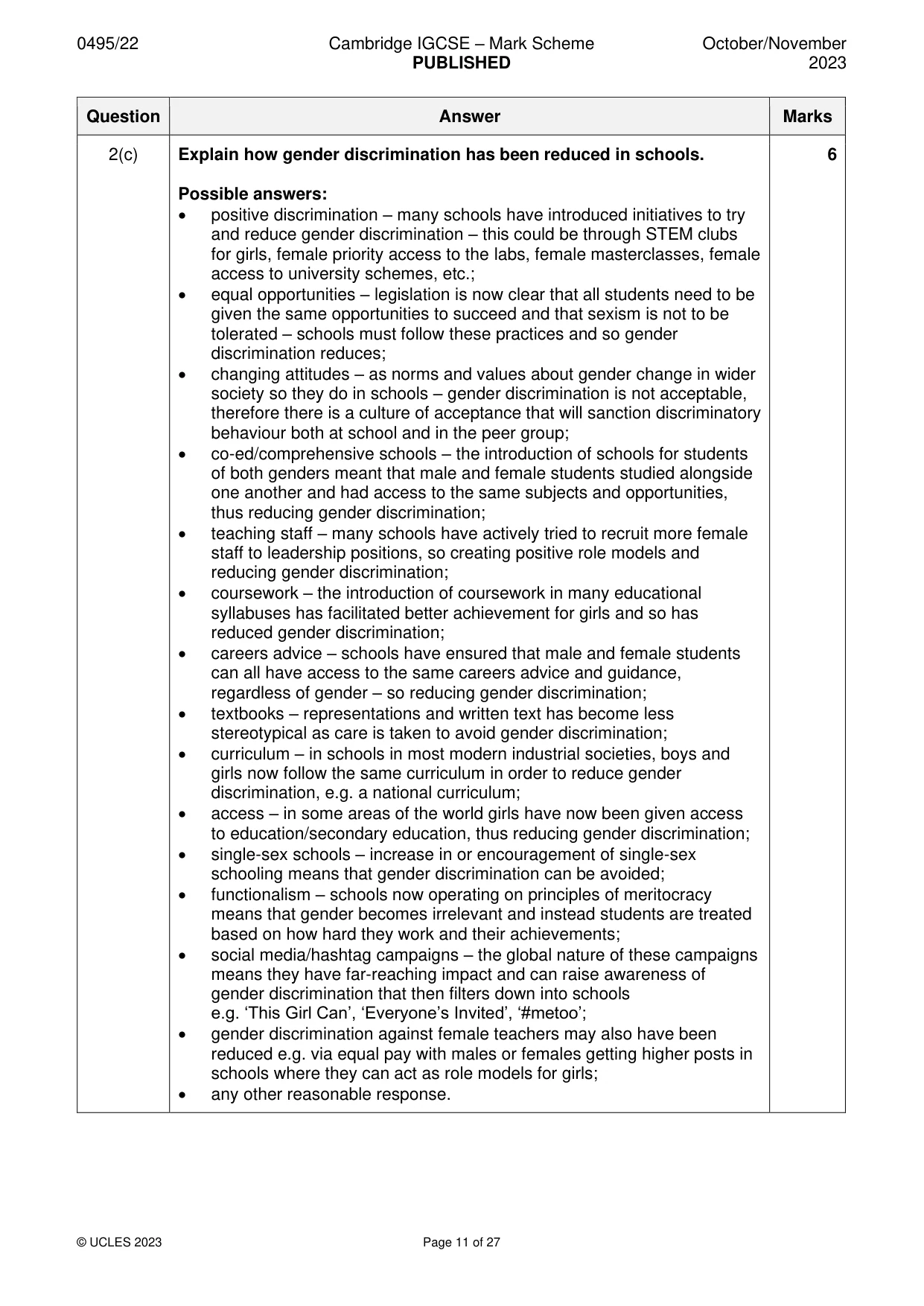
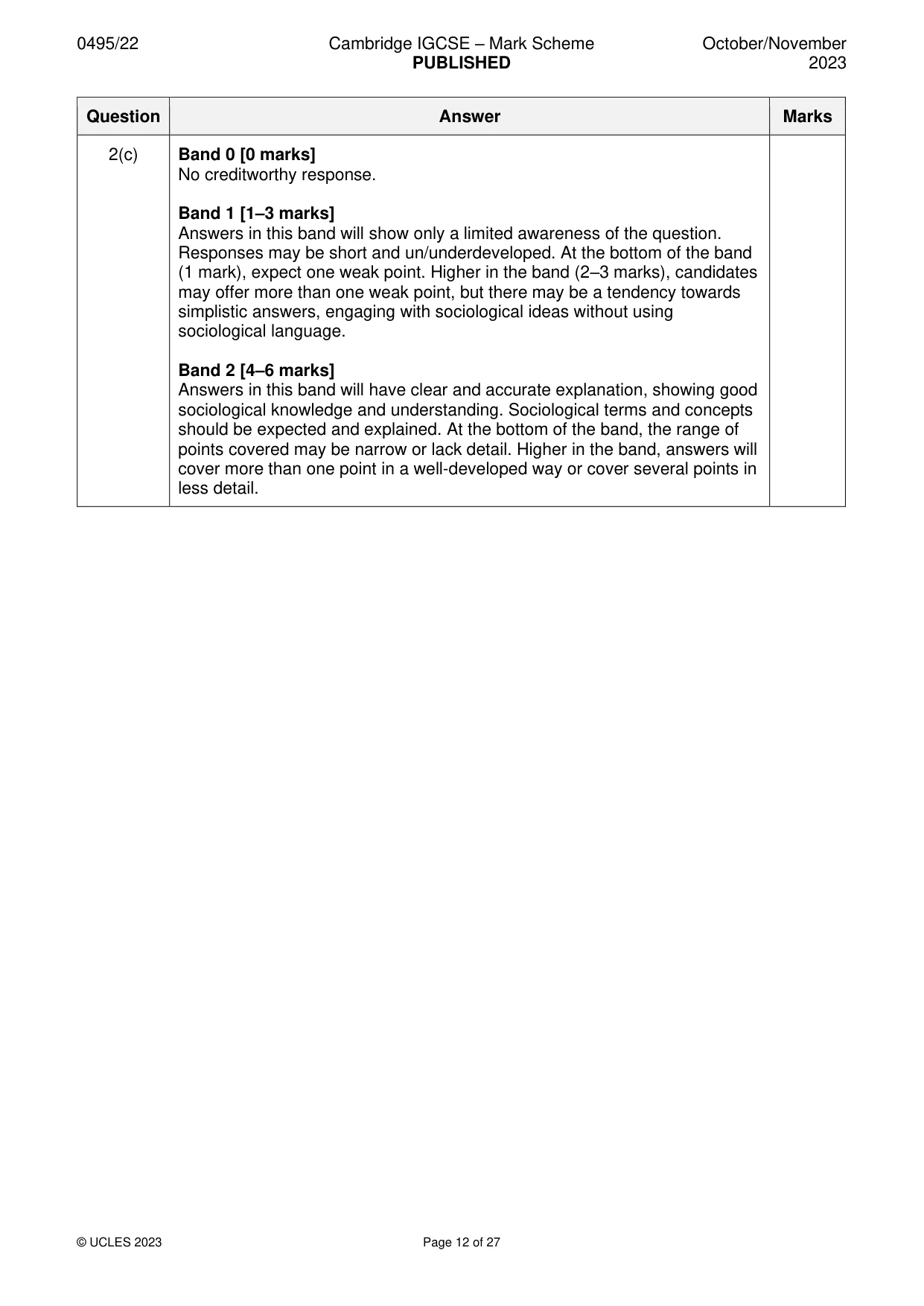
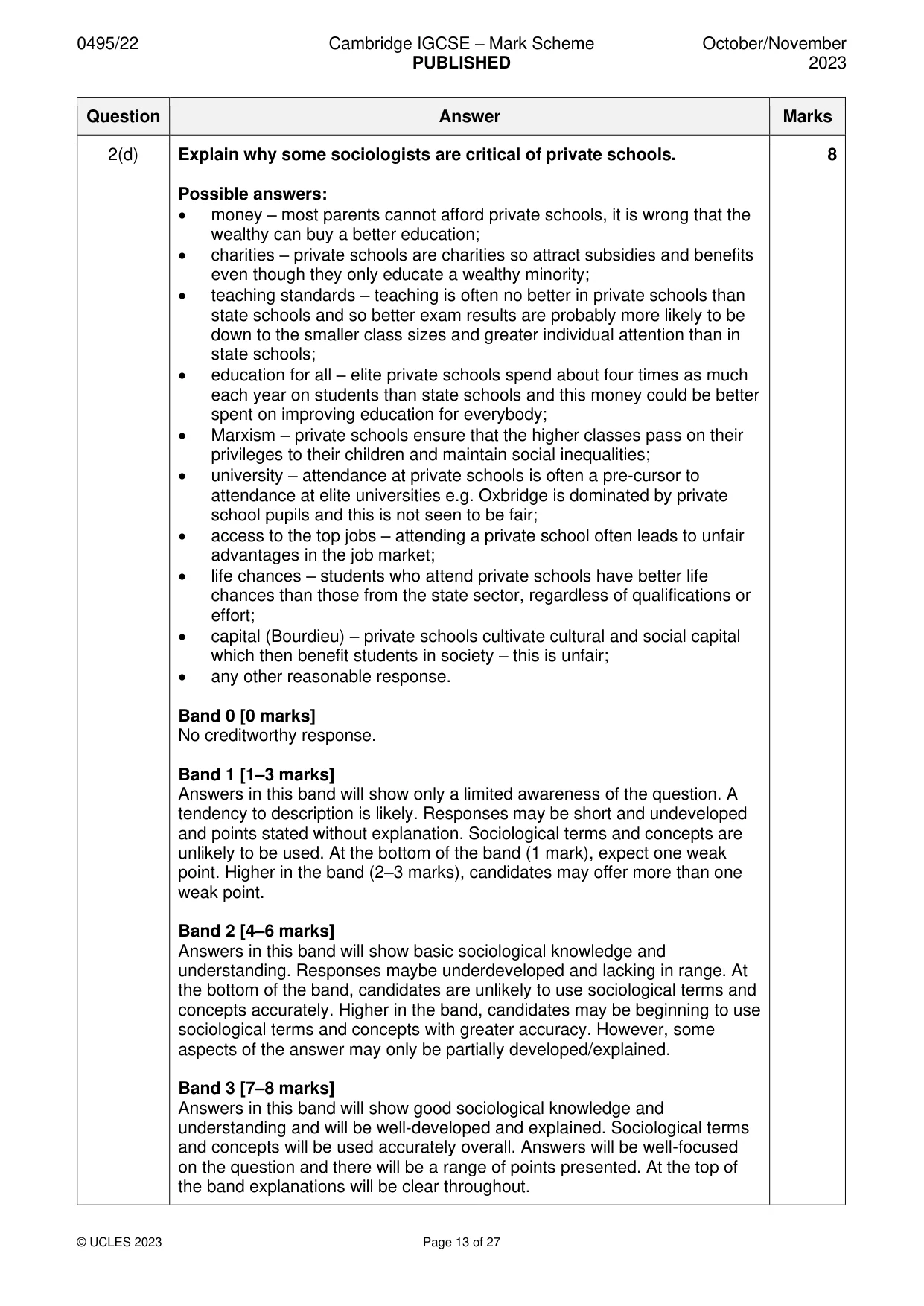
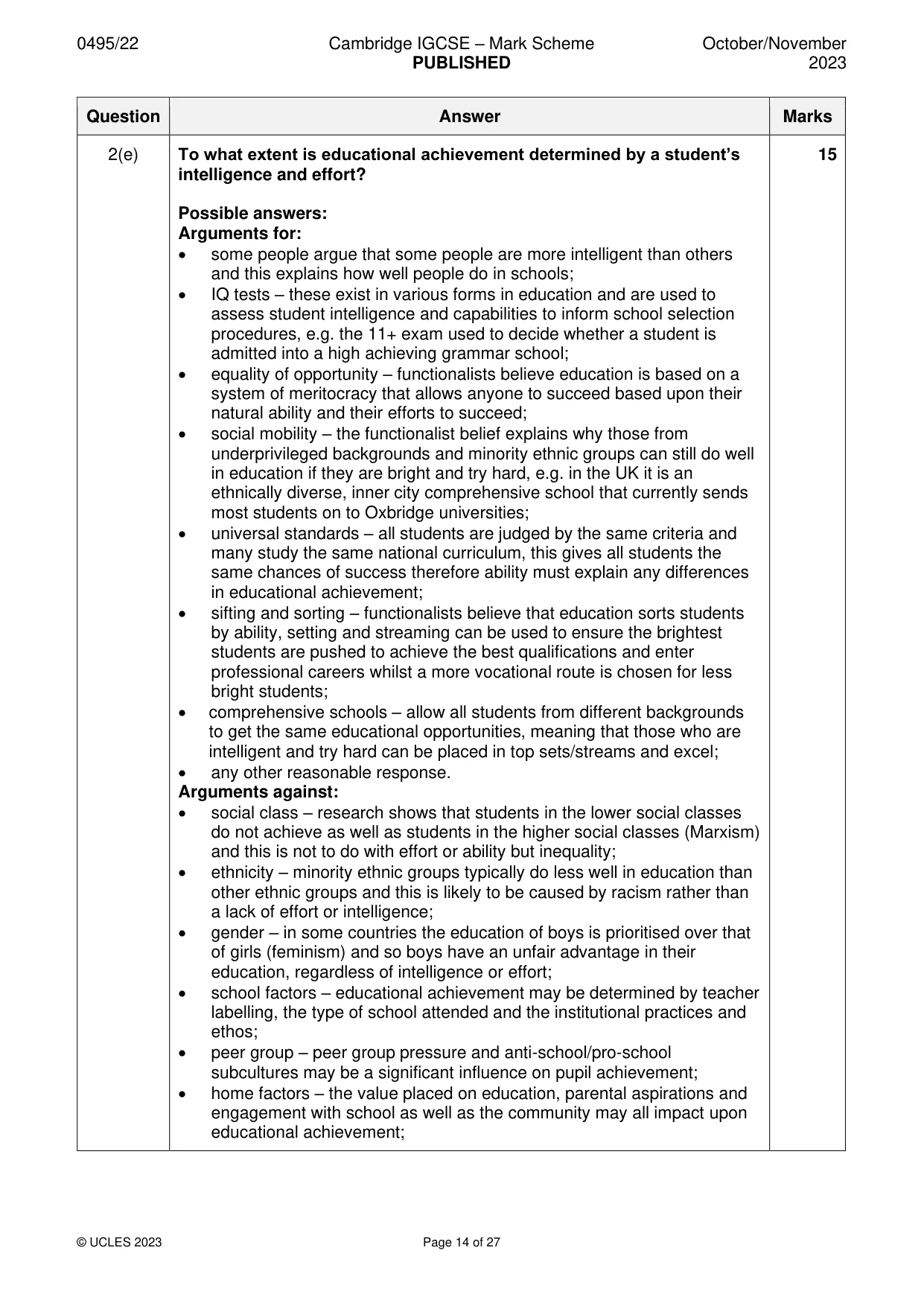
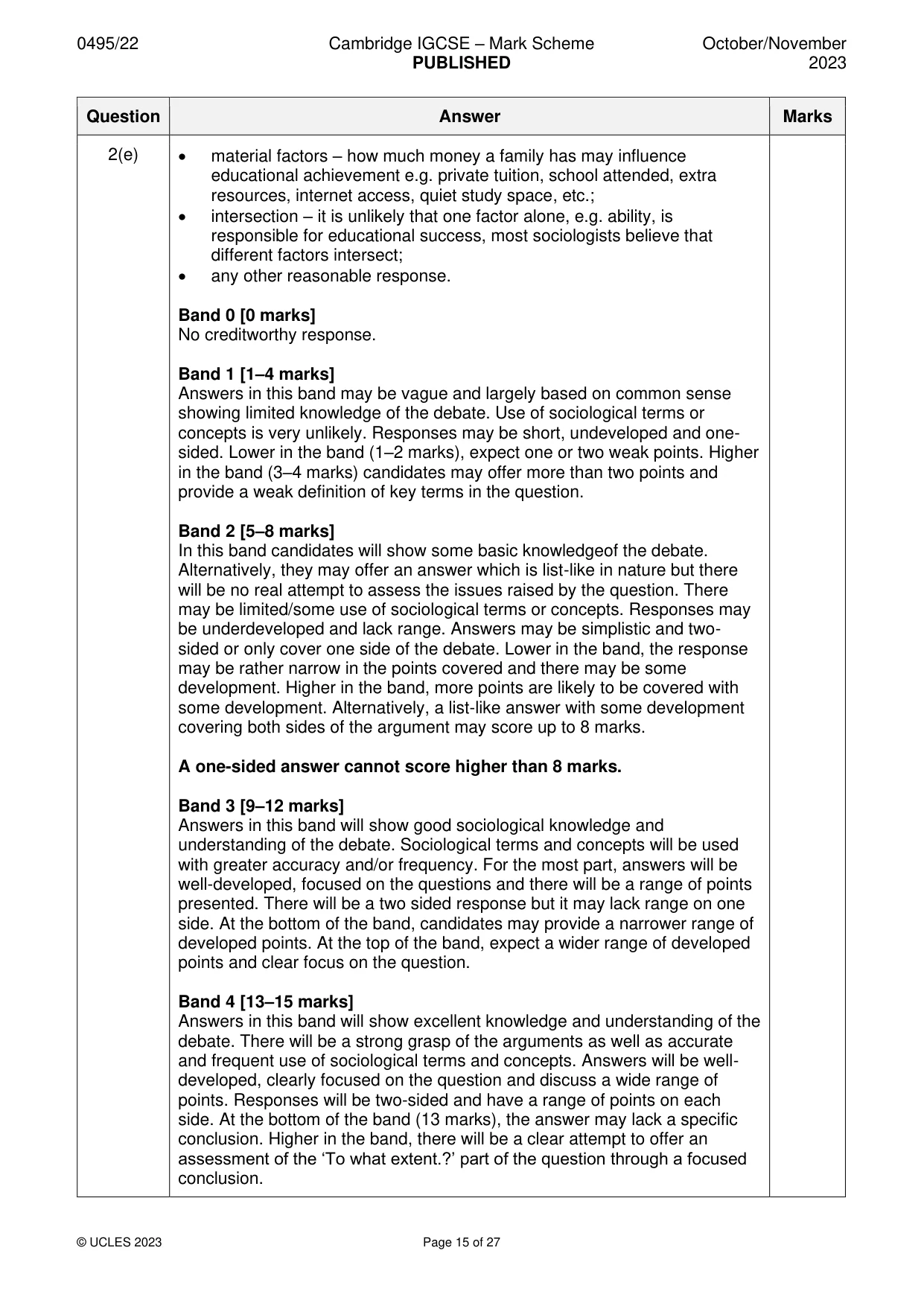
Mark scheme: 2(a) What is meant by the term ‘single-sex school’? 2 One mark for a partial definition, e.g. girl’s school. Two marks for a clear definition, e.g. schools that accept either only boys or only girls. 2(b) Describe two functions of education. 4 Possible answers: • socialisation – schools pass common norms and values on from one generation to the next; • shared values – schools socialise children to accept shared values e.g. patriotism, a country’s heritage – this promotes social solidarity; • social control – schools use rewards and sanctions to teach social expectations and to ensure children understand the consequences of their actions; • individual achievement – schools teach children about achieved status as they are judged largely on what they achieve, measured by universal standards and standardised testing; • skills and abilities – economic function – schools ensure individuals have the skills and abilities needed as adults for the workplace; • sifting and sorting – selective function – schools sort children out into ability groups and so lead them into the future roles that are appropriate for their ability e.g. professional or manual work; • Marxism – schools reproduce and normalise capitalist values, meaning that the system of elitism is not challenged and the status quo remains – so benefiting the ruling class; • feminism – schools send out the message that boys are superior and so girls learn to lower their expectations later in society; • any other reasonable response. One mark for each point correctly identified (up to a maximum of two). One mark for each point that is developed (up to a maximum of two). 2(c) Explain how gender discrimination has been reduced in schools. 6 Possible answers: • positive discrimination – many schools have introduced initiatives to try and reduce gender discrimination – this could be through STEM clubs for girls, female priority access to the labs, female masterclasses, female access to university schemes, etc.; • equal opportunities – legislation is now clear that all students need to be given the same opportunities to succeed and that sexism is not to be tolerated – schools must follow these practices and so gender discrimination reduces; • changing attitudes – as norms and values about gender change in wider society so they do in schools – gender discrimination is not acceptable, therefore there is a culture of acceptance that will sanction discriminatory behaviour both at school and in the peer group; • co-ed/comprehensive schools – the introduction of schools for students of both genders meant that male and female students studied alongside one another and had access to the same subjects and opportunities, thus reducing gender discrimination; • teaching staff – many schools have actively tried to recruit more female staff to leadership positions, so creating positive role models and reducing gender discrimination; • coursework – the introduction of coursework in many educational syllabuses has facilitated better achievement for girls and so has reduced gender discrimination; • careers advice – schools have ensured that male and female students can all have access to the same careers advice and guidance, regardless of gender – so reducing gender discrimination; • textbooks – representations and written text has become less stereotypical as care is taken to avoid gender discrimination; • curriculum – in schools in most modern industrial societies, boys and girls now follow the same curriculum in order to reduce gender discrimination, e.g. a national curriculum; • access – in some areas of the world girls have now been given access to education/secondary education, thus reducing gender discrimination; • single-sex schools – increase in or encouragement of single-sex schooling means that gender discrimination can be avoided; • functionalism – schools now operating on principles of meritocracy means that gender becomes irrelevant and instead students are treated based on how hard they work and their achievements; • social media/hashtag campaigns – the global nature of these campaigns means they have far-reaching impact and can raise awareness of gender discrimination that then filters down into schools e.g. ‘This Girl Can’, ‘Everyone’s Invited’, ‘#metoo’; • gender discrimination against female teachers may also have been reduced e.g. via equal pay with males or females getting higher posts in schools where they can act as role models for girls; • any other reasonable response. 2(c) Band 0 [0 marks] No creditworthy response. Band 1 [1–3 marks] Answers in this band will show only a limited awareness of the question. Responses may be short and un/underdeveloped. At the bottom of the band (1 mark), expect one weak point. Higher in the band (2–3 marks), candidates may offer more than one weak point, but there may be a tendency towards simplistic answers, engaging with sociological ideas without using sociological language. Band 2 [4–6 marks] Answers in this band will have clear and accurate explanation, showing good sociological knowledge and understanding. Sociological terms and concepts should be expected and explained. At the bottom of the band, the range of points covered may be narrow or lack detail. Higher in the band, answers will cover more than one point in a well-developed way or cover several points in less detail. 2(d) Explain why some sociologists are critical of private schools. 8 Possible answers: • money – most parents cannot afford private schools, it is wrong that the wealthy can buy a better education; • charities – private schools are charities so attract subsidies and benefits even though they only educate a wealthy minority; • teaching standards – teaching is often no better in private schools than state schools and so better exam results are probably more likely to be down to the smaller class sizes and greater individual attention than in state schools; • education for all – elite private schools spend about four times as much each year on students than state schools and this money could be better spent on improving education for everybody; • Marxism – private schools ensure that the higher classes pass on their privileges to their children and maintain social inequalities; • university – attendance at private schools is often a pre-cursor to attendance at elite universities e.g. Oxbridge is dominated by private school pupils and this is not seen to be fair; • access to the top jobs – attending a private school often leads to unfair advantages in the job market; • life chances – students who attend private schools have better life chances than those from the state sector, regardless of qualifications or effort; • capital (Bourdieu) – private schools cultivate cultural and social capital which then benefit students in society – this is unfair; • any other reasonable response. Band 0 [0 marks] No creditworthy response. Band 1 [1–3 marks] Answers in this band will show only a limited awareness of the question. A tendency to description is likely. Responses may be short and undeveloped and points stated without explanation. Sociological terms and concepts are unlikely to be used. At the bottom of the band (1 mark), expect one weak point. Higher in the band (2–3 marks), candidates may offer more than one weak point. Band 2 [4–6 marks] Answers in this band will show basic sociological knowledge and understanding. Responses maybe underdeveloped and lacking in range. At the bottom of the band, candidates are unlikely to use sociological terms and concepts accurately. Higher in the band, candidates may be beginning to use sociological terms and concepts with greater accuracy. However, some aspects of the answer may only be partially developed/explained. Band 3 [7–8 marks] Answers in this band will show good sociological knowledge and understanding and will be well-developed and explained. Sociological terms and concepts will be used accurately overall. Answers will be well-focused on the question and there will be a range of points presented. At the top of the band explanations will be clear throughout. 2(e) To what extent is educational achievement determined by a student’s 15 intelligence and effort? Possible answers: Arguments for: • some people argue that some people are more intelligent than others and this explains how well people do in schools; • IQ tests – these exist in various forms in education and are used to assess student intelligence and capabilities to inform school selection procedures, e.g. the 11+ exam used to decide whether a student is admitted into a high achieving grammar school; • equality of opportunity – functionalists believe education is based on a system of meritocracy that allows anyone to succeed based upon their natural ability and their efforts to succeed; • social mobility – the functionalist belief explains why those from underprivileged backgrounds and minority ethnic groups can still do well in education if they are bright and try hard, e.g. in the UK it is an ethnically diverse, inner city comprehensive school that currently sends most students on to Oxbridge universities; • universal standards – all students are judged by the same criteria and many study the same national curriculum, this gives all students the same chances of success therefore ability must explain any differences in educational achievement; • sifting and sorting – functionalists believe that education sorts students by ability, setting and streaming can be used to ensure the brightest students are pushed to achieve the best qualifications and enter professional careers whilst a more vocational route is chosen for less bright students; • comprehensive schools – allow all students from different backgrounds to get the same educational opportunities, meaning that those who are intelligent and try hard can be placed in top sets/streams and excel; • any other reasonable response. Arguments against: • social class – research shows that students in the lower social classes do not achieve as well as students in the higher social classes (Marxism) and this is not to do with effort or ability but inequality; • ethnicity – minority ethnic groups typically do less well in education than other ethnic groups and this is likely to be caused by racism rather than a lack of effort or intelligence; • gender – in some countries the education of boys is prioritised over that of girls (feminism) and so boys have an unfair advantage in their education, regardless of intelligence or effort; • school factors – educational achievement may be determined by teacher labelling, the type of school attended and the institutional practices and ethos; • peer group – peer group pressure and anti-school/pro-school subcultures may be a significant influence on pupil achievement; • home factors – the value placed on education, parental aspirations and engagement with school as well as the community may all impact upon educational achievement; 2(e) • material factors – how much money a family has may influence educational achievement e.g. private tuition, school attended, extra resources, internet access, quiet study space, etc.; • intersection – it is unlikely that one factor alone, e.g. ability, is responsible for educational success, most sociologists believe that different factors intersect; • any other reasonable response. Band 0 [0 marks] No creditworthy response. Band 1 [1–4 marks] Answers in this band may be vague and largely based on common sense showing limited knowledge of the debate. Use of sociological terms or concepts is very unlikely. Responses may be short, undeveloped and one- sided. Lower in the band (1–2 marks), expect one or two weak points. Higher in the band (3–4 marks) candidates may offer more than two points and provide a weak definition of key terms in the question. Band 2 [5–8 marks] In this band candidates will show some basic knowledgeof the debate. Alternatively, they may offer an answer which is list-like in nature but there will be no real attempt to assess the issues raised by the question. There may be limited/some use of sociological terms or concepts. Responses may be underdeveloped and lack range. Answers may be simplistic and two- sided or only cover one side of the debate. Lower in the band, the response may be rather narrow in the points covered and there may be some development. Higher in the band, more points are likely to be covered with some development. Alternatively, a list-like answer with some development covering both sides of the argument may score up to 8 marks. A one-sided answer cannot score higher than 8 marks. Band 3 [9–12 marks] Answers in this band will show good sociological knowledge and understanding of the debate. Sociological terms and concepts will be used with greater accuracy and/or frequency. For the most part, answers will be well-developed, focused on the questions and there will be a range of points presented. There will be a two sided response but it may lack range on one side. At the bottom of the band, candidates may provide a narrower range of developed points. At the top of the band, expect a wider range of developed points and clear focus on the question. Band 4 [13–15 marks] Answers in this band will show excellent knowledge and understanding of the debate. There will be a strong grasp of the arguments as well as accurate and frequent use of sociological terms and concepts. Answers will be well- developed, clearly focused on the question and discuss a wide range of points. Responses will be two-sided and have a range of points on each side. At the bottom of the band (13 marks), the answer may lack a specific conclusion. Higher in the band, there will be a clear attempt to offer an assessment of the ‘To what extent.?’ part of the question through a focused conclusion.
Q3 · Official crime statistics reveal a clear trend that most crimes are committed by males
3 Official crime statistics reveal a clear trend that most crimes are committed by males. Some sociologists claim it may be due to different gender socialisation. Other sociologists blame factors such as material deprivation and involvement in criminal sub-cultures. However, a criticism of the official crime statistics is that they do not show the true extent of all crimes committed. For example, white-collar crime often goes unreported. (a) What is meant by the term ‘material deprivation’? [2] (b) Describe two criminal sub-cultures. [4] (c) Explain how formal agencies of social control deal with crime. [6] (d) Explain why white-collar crime often goes unreported. [8] (e) To what extent does gender socialisation explain why females commit less crime than males? [15] Section D: Media
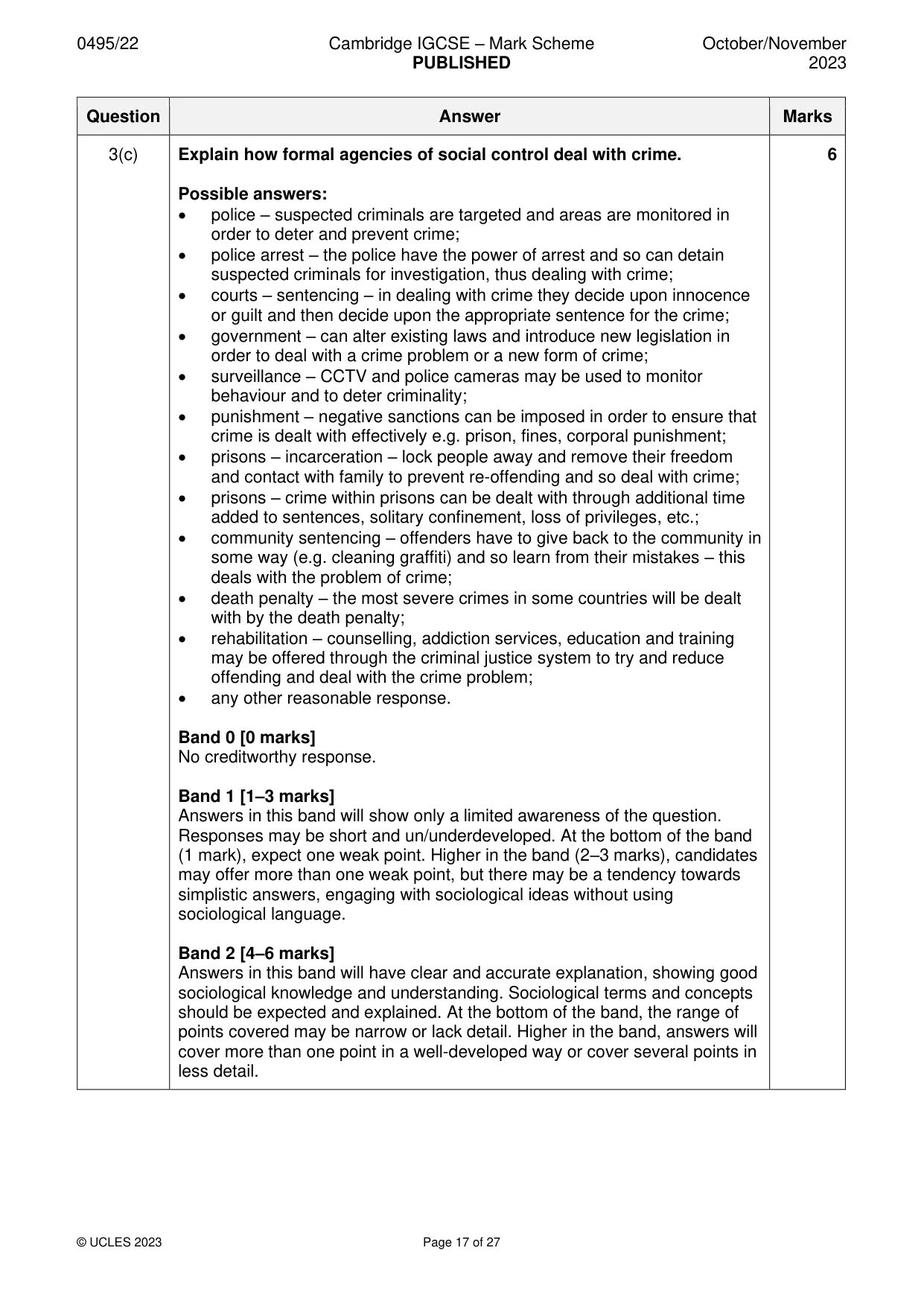
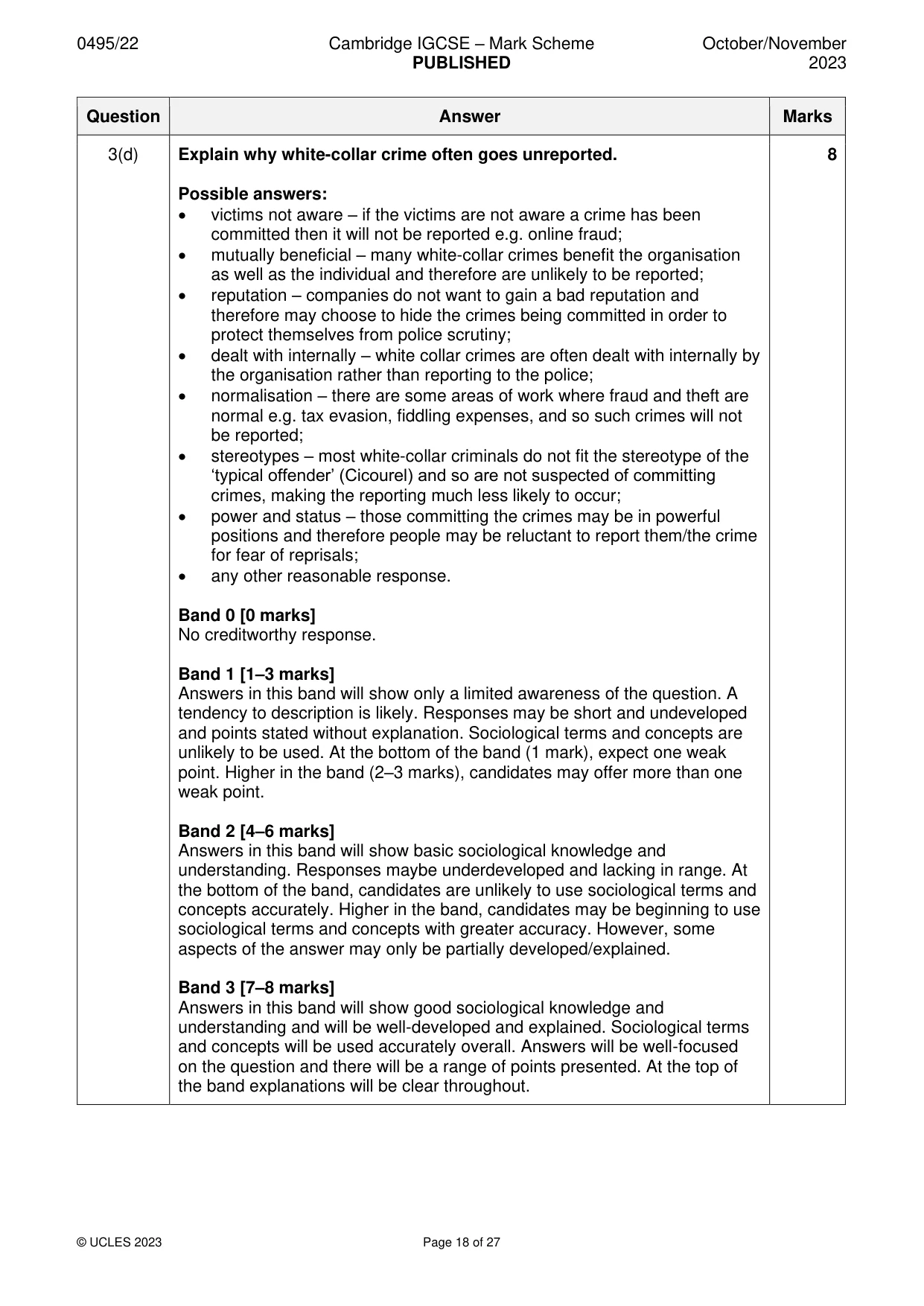
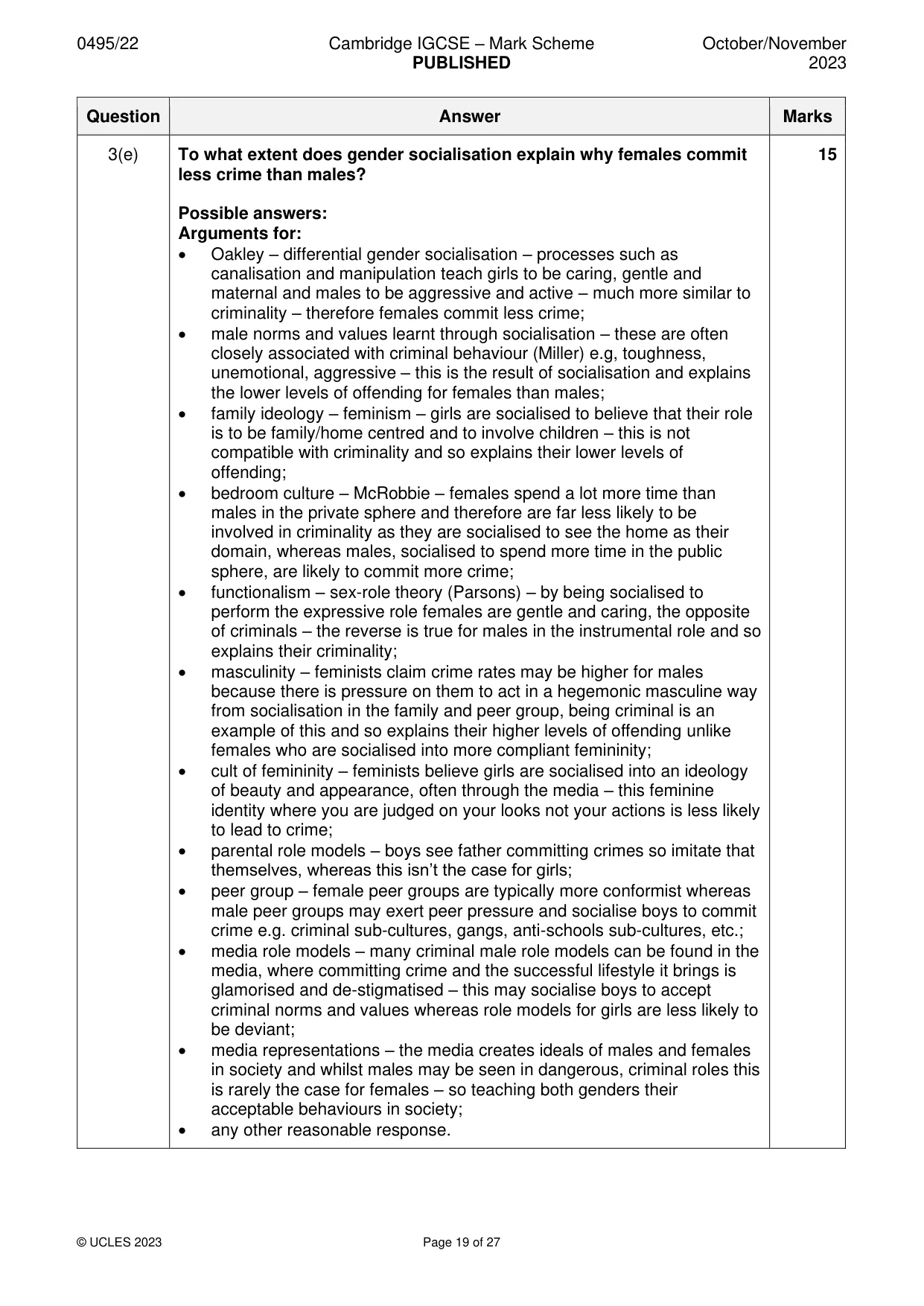
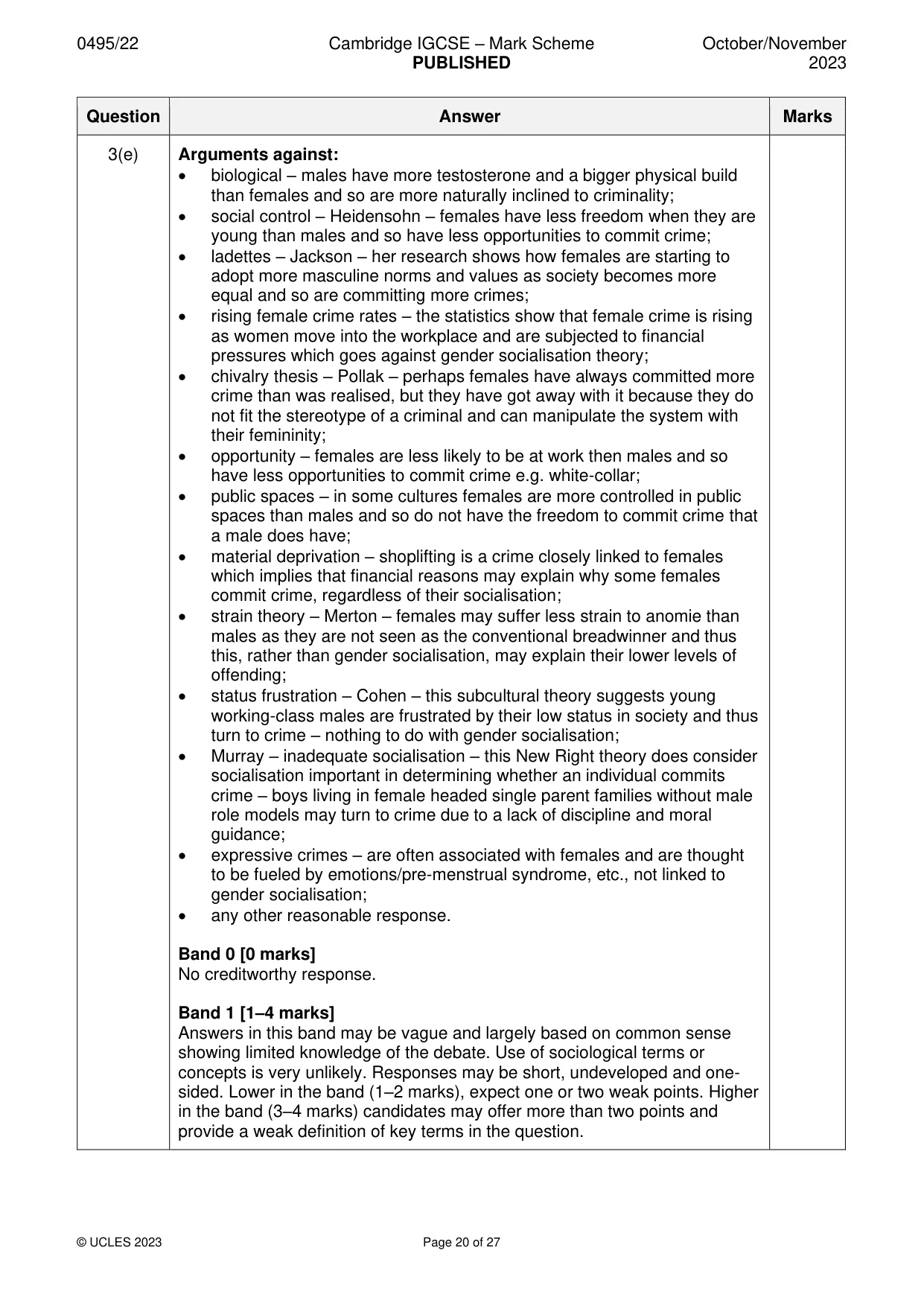
Mark scheme: 3(a) What is meant by the term ‘material deprivation’? 2 One mark for a partial definition, e.g. being poor. Two marks for a clear definition, e.g. being short of the material goods needed and wanted in society. 3(b) Describe two criminal sub-cultures. 4 Possible answers: • youth sub-cultures e.g. mods, rockers, punks, skinheads – taking drugs, violence, anti-social behaviour, etc.; • organised criminal sub-cultures – Sutherland – criminal behaviour is highly organised to maximise profits e.g. the Mafia; • gangs – a sub-culture based on a strict hierarchy that may be involved in drug dealing, human trafficking, violence, etc.; • retreatist sub-cultures – drug and/or alcohol addicts, often involved in crime to fund their addictions; • conflict sub-cultures – Cloward and Ohlin’s illegitimate opportunity structures and turf wars involving criminal sub-cultures; • underclass sub-cultures – Murray – children socialised into deviant norms and values form criminal sub-cultures; • criminal groups that operate online such as hacking groups often issue ransom threats against individuals, businesses or even the government e.g. the group Anonymous; • any other reasonable response. One mark for each point correctly identified (up to a maximum of two). One mark for each point that is developed (up to a maximum of two). 3(c) Explain how formal agencies of social control deal with crime. 6 Possible answers: • police – suspected criminals are targeted and areas are monitored in order to deter and prevent crime; • police arrest – the police have the power of arrest and so can detain suspected criminals for investigation, thus dealing with crime; • courts – sentencing – in dealing with crime they decide upon innocence or guilt and then decide upon the appropriate sentence for the crime; • government – can alter existing laws and introduce new legislation in order to deal with a crime problem or a new form of crime; • surveillance – CCTV and police cameras may be used to monitor behaviour and to deter criminality; • punishment – negative sanctions can be imposed in order to ensure that crime is dealt with effectively e.g. prison, fines, corporal punishment; • prisons – incarceration – lock people away and remove their freedom and contact with family to prevent re-offending and so deal with crime; • prisons – crime within prisons can be dealt with through additional time added to sentences, solitary confinement, loss of privileges, etc.; • community sentencing – offenders have to give back to the community in some way (e.g. cleaning graffiti) and so learn from their mistakes – this deals with the problem of crime; • death penalty – the most severe crimes in some countries will be dealt with by the death penalty; • rehabilitation – counselling, addiction services, education and training may be offered through the criminal justice system to try and reduce offending and deal with the crime problem; • any other reasonable response. Band 0 [0 marks] No creditworthy response. Band 1 [1–3 marks] Answers in this band will show only a limited awareness of the question. Responses may be short and un/underdeveloped. At the bottom of the band (1 mark), expect one weak point. Higher in the band (2–3 marks), candidates may offer more than one weak point, but there may be a tendency towards simplistic answers, engaging with sociological ideas without using sociological language. Band 2 [4–6 marks] Answers in this band will have clear and accurate explanation, showing good sociological knowledge and understanding. Sociological terms and concepts should be expected and explained. At the bottom of the band, the range of points covered may be narrow or lack detail. Higher in the band, answers will cover more than one point in a well-developed way or cover several points in less detail. 3(d) Explain why white-collar crime often goes unreported. 8 Possible answers: • victims not aware – if the victims are not aware a crime has been committed then it will not be reported e.g. online fraud; • mutually beneficial – many white-collar crimes benefit the organisation as well as the individual and therefore are unlikely to be reported; • reputation – companies do not want to gain a bad reputation and therefore may choose to hide the crimes being committed in order to protect themselves from police scrutiny; • dealt with internally – white collar crimes are often dealt with internally by the organisation rather than reporting to the police; • normalisation – there are some areas of work where fraud and theft are normal e.g. tax evasion, fiddling expenses, and so such crimes will not be reported; • stereotypes – most white-collar criminals do not fit the stereotype of the ‘typical offender’ (Cicourel) and so are not suspected of committing crimes, making the reporting much less likely to occur; • power and status – those committing the crimes may be in powerful positions and therefore people may be reluctant to report them/the crime for fear of reprisals; • any other reasonable response. Band 0 [0 marks] No creditworthy response. Band 1 [1–3 marks] Answers in this band will show only a limited awareness of the question. A tendency to description is likely. Responses may be short and undeveloped and points stated without explanation. Sociological terms and concepts are unlikely to be used. At the bottom of the band (1 mark), expect one weak point. Higher in the band (2–3 marks), candidates may offer more than one weak point. Band 2 [4–6 marks] Answers in this band will show basic sociological knowledge and understanding. Responses maybe underdeveloped and lacking in range. At the bottom of the band, candidates are unlikely to use sociological terms and concepts accurately. Higher in the band, candidates may be beginning to use sociological terms and concepts with greater accuracy. However, some aspects of the answer may only be partially developed/explained. Band 3 [7–8 marks] Answers in this band will show good sociological knowledge and understanding and will be well-developed and explained. Sociological terms and concepts will be used accurately overall. Answers will be well-focused on the question and there will be a range of points presented. At the top of the band explanations will be clear throughout. 3(e) To what extent does gender socialisation explain why females commit 15 less crime than males? Possible answers: Arguments for: • Oakley – differential gender socialisation – processes such as canalisation and manipulation teach girls to be caring, gentle and maternal and males to be aggressive and active – much more similar to criminality – therefore females commit less crime; • male norms and values learnt through socialisation – these are often closely associated with criminal behaviour (Miller) e.g, toughness, unemotional, aggressive – this is the result of socialisation and explains the lower levels of offending for females than males; • family ideology – feminism – girls are socialised to believe that their role is to be family/home centred and to involve children – this is not compatible with criminality and so explains their lower levels of offending; • bedroom culture – McRobbie – females spend a lot more time than males in the private sphere and therefore are far less likely to be involved in criminality as they are socialised to see the home as their domain, whereas males, socialised to spend more time in the public sphere, are likely to commit more crime; • functionalism – sex-role theory (Parsons) – by being socialised to perform the expressive role females are gentle and caring, the opposite of criminals – the reverse is true for males in the instrumental role and so explains their criminality; • masculinity – feminists claim crime rates may be higher for males because there is pressure on them to act in a hegemonic masculine way from socialisation in the family and peer group, being criminal is an example of this and so explains their higher levels of offending unlike females who are socialised into more compliant femininity; • cult of femininity – feminists believe girls are socialised into an ideology of beauty and appearance, often through the media – this feminine identity where you are judged on your looks not your actions is less likely to lead to crime; • parental role models – boys see father committing crimes so imitate that themselves, whereas this isn’t the case for girls; • peer group – female peer groups are typically more conformist whereas male peer groups may exert peer pressure and socialise boys to commit crime e.g. criminal sub-cultures, gangs, anti-schools sub-cultures, etc.; • media role models – many criminal male role models can be found in the media, where committing crime and the successful lifestyle it brings is glamorised and de-stigmatised – this may socialise boys to accept criminal norms and values whereas role models for girls are less likely to be deviant; • media representations – the media creates ideals of males and females in society and whilst males may be seen in dangerous, criminal roles this is rarely the case for females – so teaching both genders their acceptable behaviours in society; • any other reasonable response. 3(e) Arguments against: • biological – males have more testosterone and a bigger physical build than females and so are more naturally inclined to criminality; • social control – Heidensohn – females have less freedom when they are young than males and so have less opportunities to commit crime; • ladettes – Jackson – her research shows how females are starting to adopt more masculine norms and values as society becomes more equal and so are committing more crimes; • rising female crime rates – the statistics show that female crime is rising as women move into the workplace and are subjected to financial pressures which goes against gender socialisation theory; • chivalry thesis – Pollak – perhaps females have always committed more crime than was realised, but they have got away with it because they do not fit the stereotype of a criminal and can manipulate the system with their femininity; • opportunity – females are less likely to be at work then males and so have less opportunities to commit crime e.g. white-collar; • public spaces – in some cultures females are more controlled in public spaces than males and so do not have the freedom to commit crime that a male does have; • material deprivation – shoplifting is a crime closely linked to females which implies that financial reasons may explain why some females commit crime, regardless of their socialisation; • strain theory – Merton – females may suffer less strain to anomie than males as they are not seen as the conventional breadwinner and thus this, rather than gender socialisation, may explain their lower levels of offending; • status frustration – Cohen – this subcultural theory suggests young working-class males are frustrated by their low status in society and thus turn to crime – nothing to do with gender socialisation; • Murray – inadequate socialisation – this New Right theory does consider socialisation important in determining whether an individual commits crime – boys living in female headed single parent families without male role models may turn to crime due to a lack of discipline and moral guidance; • expressive crimes – are often associated with females and are thought to be fueled by emotions/pre-menstrual syndrome, etc., not linked to gender socialisation; • any other reasonable response. Band 0 [0 marks] No creditworthy response. Band 1 [1–4 marks] Answers in this band may be vague and largely based on common sense showing limited knowledge of the debate. Use of sociological terms or concepts is very unlikely. Responses may be short, undeveloped and one- sided. Lower in the band (1–2 marks), expect one or two weak points. Higher in the band (3–4 marks) candidates may offer more than two points and provide a weak definition of key terms in the question. 3(e) Band 2 [5–8 marks] In this band candidates will show some basic knowledge of the debate. Alternatively, they may offer an answer which is list-like in nature but there will be no real attempt to assess the issues raised by the question. There may be limited/some use of sociological terms or concepts. Responses may be underdeveloped and lack range. Answers may be simplistic and two- sided or only cover one side of the debate. Lower in the band, the response may be rather narrow in the points covered and there may be some development. Higher in the band, more points are likely to be covered with some development. Alternatively, a list-like answer with some development covering both sides of the argument may score up to 8 marks. A one-sided answer cannot score higher than 8 marks. Band 3 [9–12 marks] Answers in this band will show good sociological knowledge and understanding of the debate. Sociological terms and concepts will be used with greater accuracy and/or frequency. For the most part, answers will be well-developed, focused on the questions and there will be a range of points presented. There will be a two-sided response but it may lack range on one side. At the bottom of the band, candidates may provide a narrower range of developed points. At the top of the band, expect a wider range of developed points and clear focus on the question. Band 4 [13–15 marks] Answers in this band will show excellent knowledge and understanding of the debate. There will be a strong grasp of the arguments as well as accurate and frequent use of sociological terms and concepts. Answers will be well- developed, clearly focused on the question and discuss a wide range of points. Responses will be two-sided and have a range of points on each side. At the bottom of the band (13 marks), the answer may lack a specific conclusion. Higher in the band, there will be a clear attempt to offer an assessment of the ‘To what extent.?’ part of the question through a focused conclusion.
Q4 · Contemporary media includes both new and traditional media and is an agent of…
4 Contemporary media includes both new and traditional media and is an agent of socialisation. The media affects values, behaviour and political beliefs. Both new and traditional media have been criticised by sociologists for biased content and inaccurate and distorted representations of some social groups. New media has also been criticised for creating a digital divide. (a) What is meant by the term ‘traditional media’? [2] (b) Describe two examples of media folk devils. [4] (c) Explain how males are represented in contemporary media. [6] (d) Explain why political beliefs might be influenced by the media. [8] (e) To what extent has new media created a digital divide? [15]
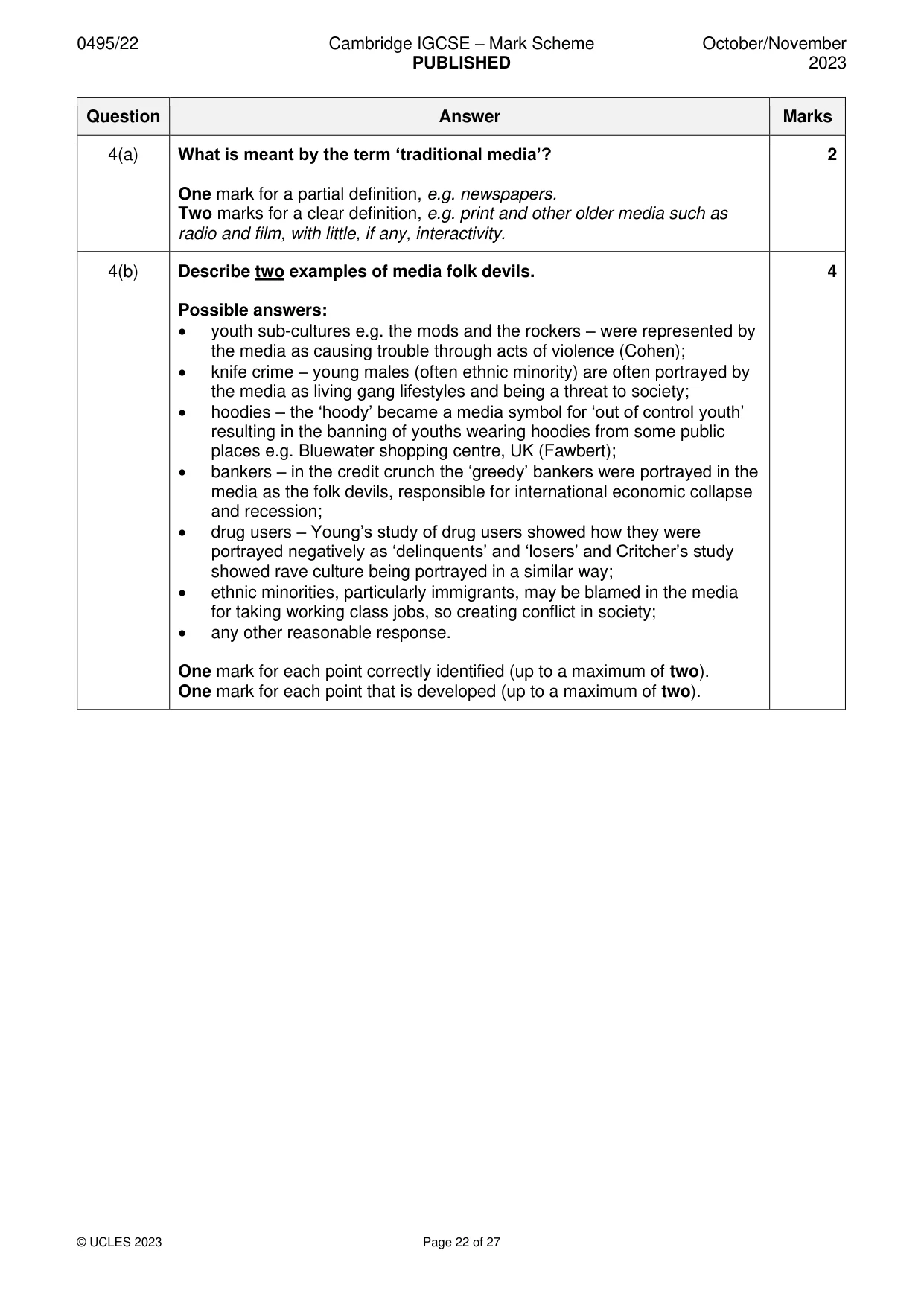
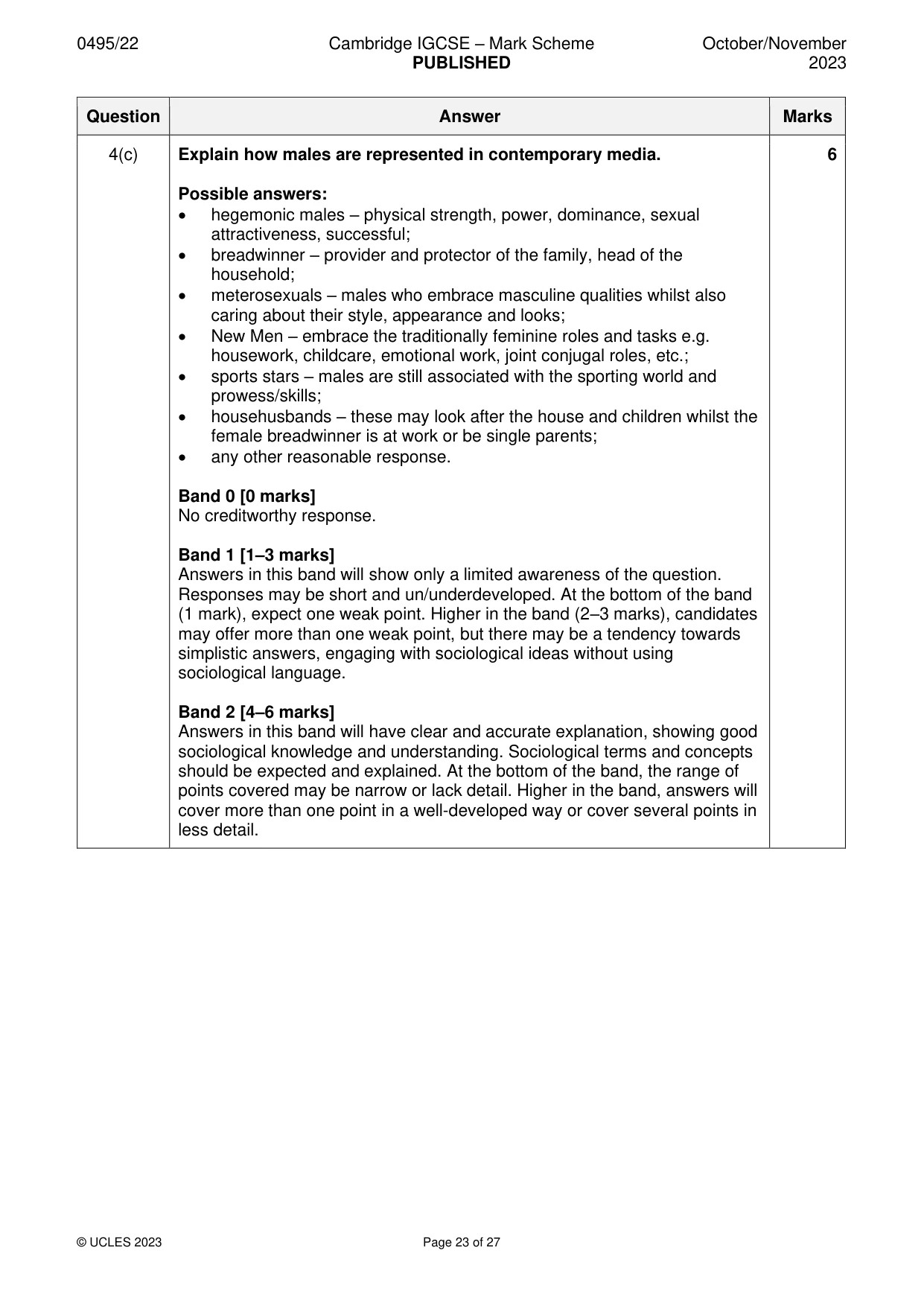
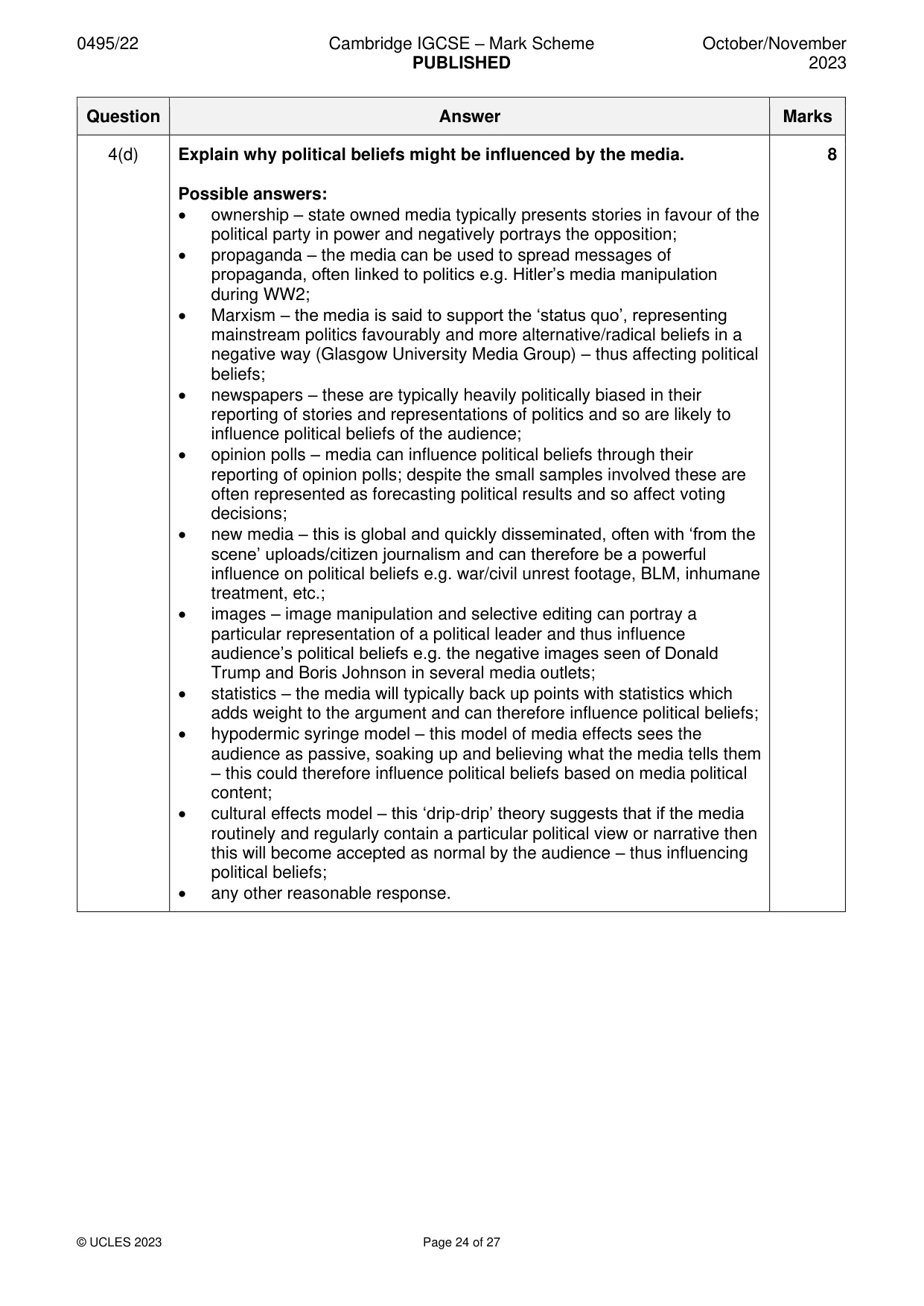
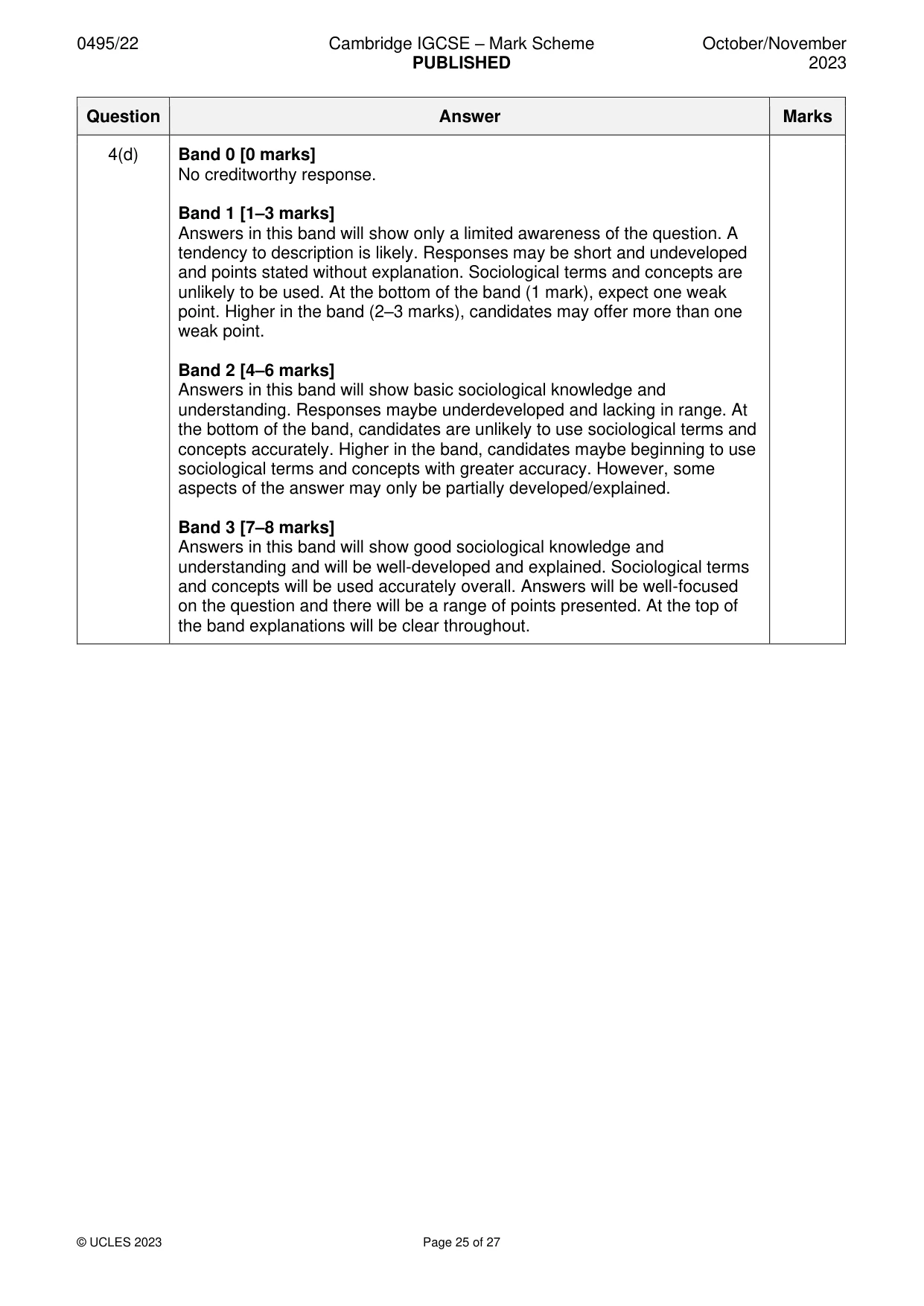
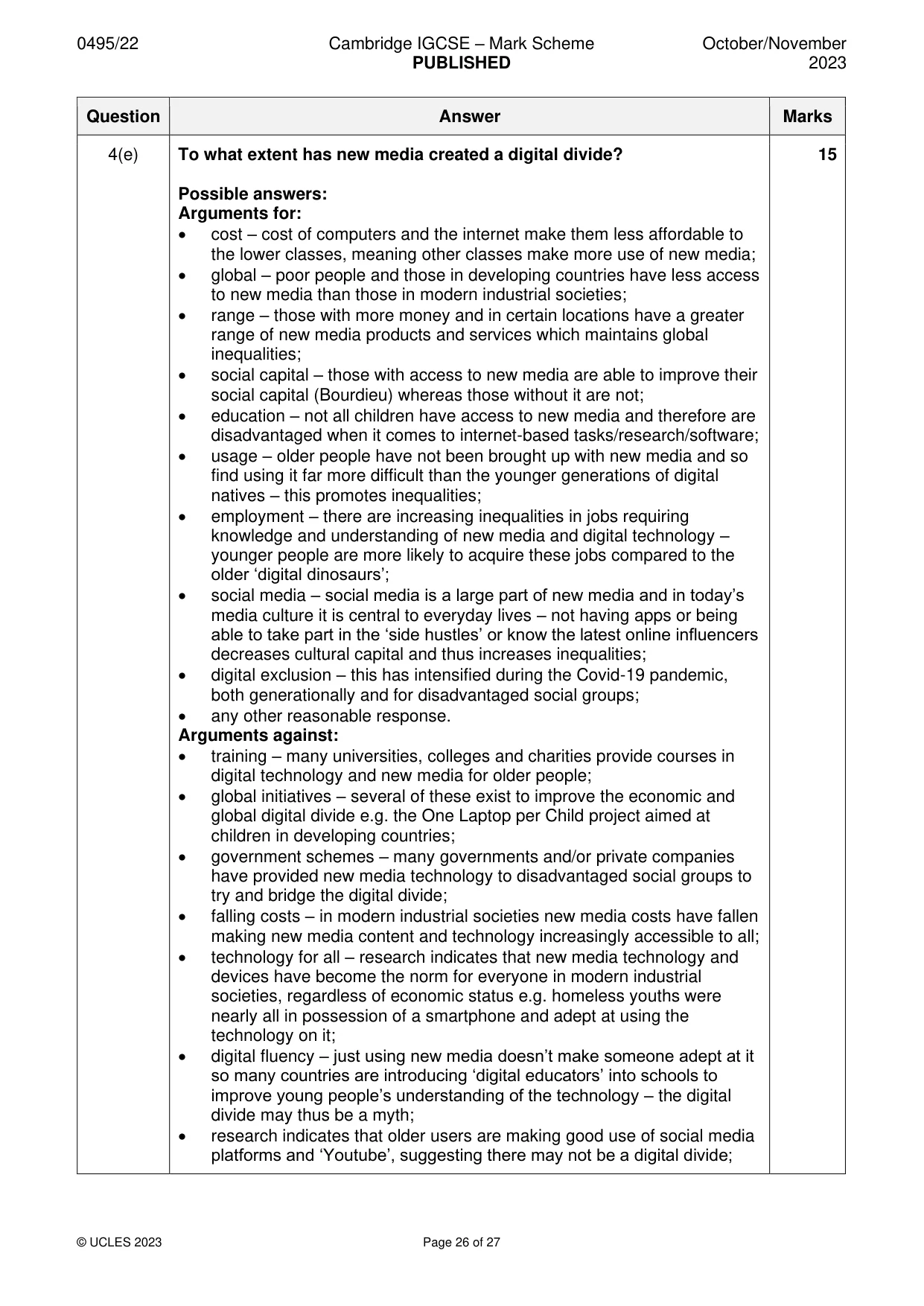
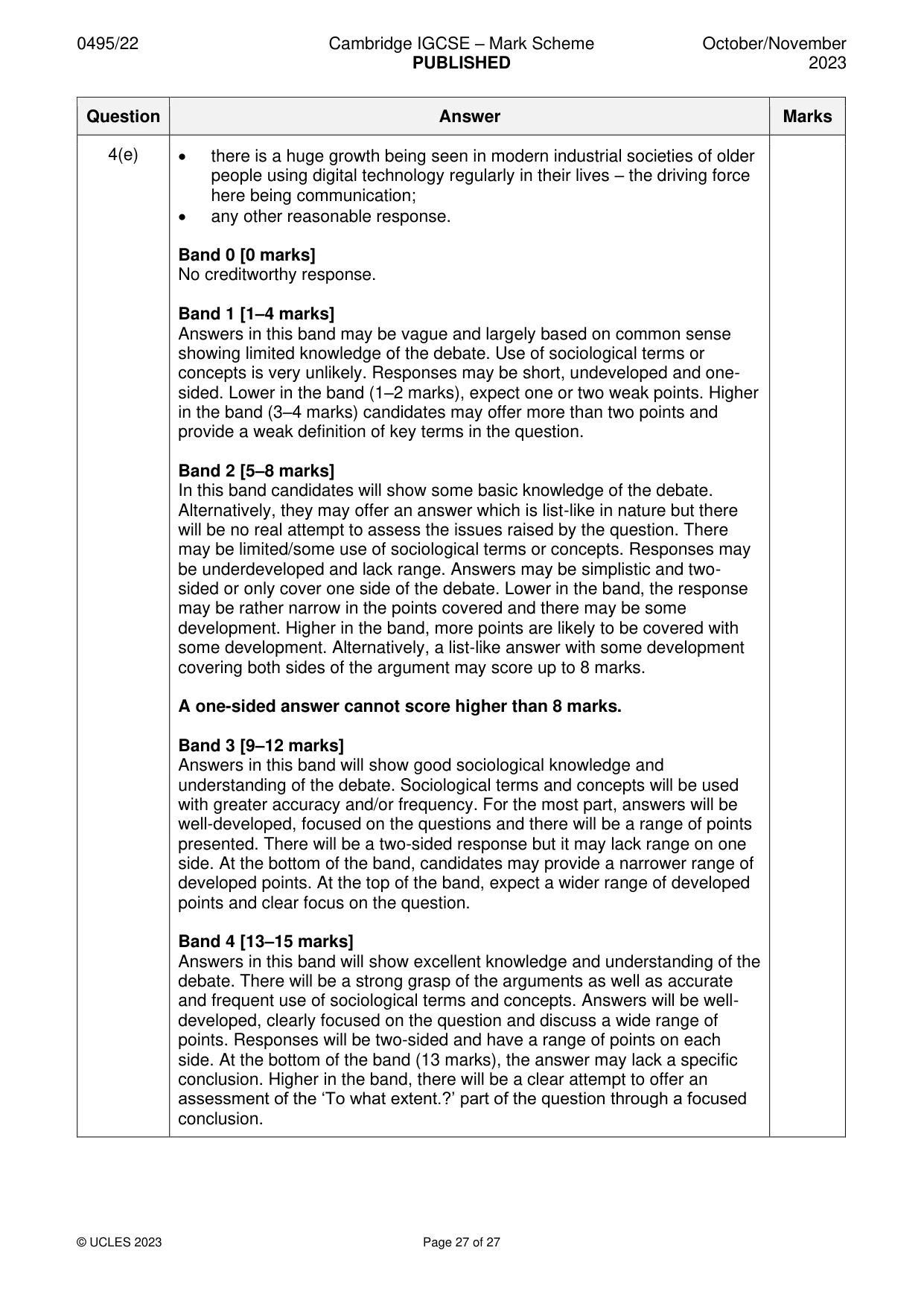
Mark scheme: 4(a) What is meant by the term ‘traditional media’? 2 One mark for a partial definition, e.g. newspapers. Two marks for a clear definition, e.g. print and other older media such as radio and film, with little, if any, interactivity. 4(b) Describe two examples of media folk devils. 4 Possible answers: • youth sub-cultures e.g. the mods and the rockers – were represented by the media as causing trouble through acts of violence (Cohen); • knife crime – young males (often ethnic minority) are often portrayed by the media as living gang lifestyles and being a threat to society; • hoodies – the ‘hoody’ became a media symbol for ‘out of control youth’ resulting in the banning of youths wearing hoodies from some public places e.g. Bluewater shopping centre, UK (Fawbert); • bankers – in the credit crunch the ‘greedy’ bankers were portrayed in the media as the folk devils, responsible for international economic collapse and recession; • drug users – Young’s study of drug users showed how they were portrayed negatively as ‘delinquents’ and ‘losers’ and Critcher’s study showed rave culture being portrayed in a similar way; • ethnic minorities, particularly immigrants, may be blamed in the media for taking working class jobs, so creating conflict in society; • any other reasonable response. One mark for each point correctly identified (up to a maximum of two). One mark for each point that is developed (up to a maximum of two). 4(c) Explain how males are represented in contemporary media. 6 Possible answers: • hegemonic males – physical strength, power, dominance, sexual attractiveness, successful; • breadwinner – provider and protector of the family, head of the household; • meterosexuals – males who embrace masculine qualities whilst also caring about their style, appearance and looks; • New Men – embrace the traditionally feminine roles and tasks e.g. housework, childcare, emotional work, joint conjugal roles, etc.; • sports stars – males are still associated with the sporting world and prowess/skills; • househusbands – these may look after the house and children whilst the female breadwinner is at work or be single parents; • any other reasonable response. Band 0 [0 marks] No creditworthy response. Band 1 [1–3 marks] Answers in this band will show only a limited awareness of the question. Responses may be short and un/underdeveloped. At the bottom of the band (1 mark), expect one weak point. Higher in the band (2–3 marks), candidates may offer more than one weak point, but there may be a tendency towards simplistic answers, engaging with sociological ideas without using sociological language. Band 2 [4–6 marks] Answers in this band will have clear and accurate explanation, showing good sociological knowledge and understanding. Sociological terms and concepts should be expected and explained. At the bottom of the band, the range of points covered may be narrow or lack detail. Higher in the band, answers will cover more than one point in a well-developed way or cover several points in less detail. 4(d) Explain why political beliefs might be influenced by the media. 8 Possible answers: • ownership – state owned media typically presents stories in favour of the political party in power and negatively portrays the opposition; • propaganda – the media can be used to spread messages of propaganda, often linked to politics e.g. Hitler’s media manipulation during WW2; • Marxism – the media is said to support the ‘status quo’, representing mainstream politics favourably and more alternative/radical beliefs in a negative way (Glasgow University Media Group) – thus affecting political beliefs; • newspapers – these are typically heavily politically biased in their reporting of stories and representations of politics and so are likely to influence political beliefs of the audience; • opinion polls – media can influence political beliefs through their reporting of opinion polls; despite the small samples involved these are often represented as forecasting political results and so affect voting decisions; • new media – this is global and quickly disseminated, often with ‘from the scene’ uploads/citizen journalism and can therefore be a powerful influence on political beliefs e.g. war/civil unrest footage, BLM, inhumane treatment, etc.; • images – image manipulation and selective editing can portray a particular representation of a political leader and thus influence audience’s political beliefs e.g. the negative images seen of Donald Trump and Boris Johnson in several media outlets; • statistics – the media will typically back up points with statistics which adds weight to the argument and can therefore influence political beliefs; • hypodermic syringe model – this model of media effects sees the audience as passive, soaking up and believing what the media tells them – this could therefore influence political beliefs based on media political content; • cultural effects model – this ‘drip-drip’ theory suggests that if the media routinely and regularly contain a particular political view or narrative then this will become accepted as normal by the audience – thus influencing political beliefs; • any other reasonable response. 4(d) Band 0 [0 marks] No creditworthy response. Band 1 [1–3 marks] Answers in this band will show only a limited awareness of the question. A tendency to description is likely. Responses may be short and undeveloped and points stated without explanation. Sociological terms and concepts are unlikely to be used. At the bottom of the band (1 mark), expect one weak point. Higher in the band (2–3 marks), candidates may offer more than one weak point. Band 2 [4–6 marks] Answers in this band will show basic sociological knowledge and understanding. Responses maybe underdeveloped and lacking in range. At the bottom of the band, candidates are unlikely to use sociological terms and concepts accurately. Higher in the band, candidates maybe beginning to use sociological terms and concepts with greater accuracy. However, some aspects of the answer may only be partially developed/explained. Band 3 [7–8 marks] Answers in this band will show good sociological knowledge and understanding and will be well-developed and explained. Sociological terms and concepts will be used accurately overall. Answers will be well-focused on the question and there will be a range of points presented. At the top of the band explanations will be clear throughout. 4(e) To what extent has new media created a digital divide? 15 Possible answers: Arguments for: • cost – cost of computers and the internet make them less affordable to the lower classes, meaning other classes make more use of new media; • global – poor people and those in developing countries have less access to new media than those in modern industrial societies; • range – those with more money and in certain locations have a greater range of new media products and services which maintains global inequalities; • social capital – those with access to new media are able to improve their social capital (Bourdieu) whereas those without it are not; • education – not all children have access to new media and therefore are disadvantaged when it comes to internet-based tasks/research/software; • usage – older people have not been brought up with new media and so find using it far more difficult than the younger generations of digital natives – this promotes inequalities; • employment – there are increasing inequalities in jobs requiring knowledge and understanding of new media and digital technology – younger people are more likely to acquire these jobs compared to the older ‘digital dinosaurs’; • social media – social media is a large part of new media and in today’s media culture it is central to everyday lives – not having apps or being able to take part in the ‘side hustles’ or know the latest online influencers decreases cultural capital and thus increases inequalities; • digital exclusion – this has intensified during the Covid-19 pandemic, both generationally and for disadvantaged social groups; • any other reasonable response. Arguments against: • training – many universities, colleges and charities provide courses in digital technology and new media for older people; • global initiatives – several of these exist to improve the economic and global digital divide e.g. the One Laptop per Child project aimed at children in developing countries; • government schemes – many governments and/or private companies have provided new media technology to disadvantaged social groups to try and bridge the digital divide; • falling costs – in modern industrial societies new media costs have fallen making new media content and technology increasingly accessible to all; • technology for all – research indicates that new media technology and devices have become the norm for everyone in modern industrial societies, regardless of economic status e.g. homeless youths were nearly all in possession of a smartphone and adept at using the technology on it; • digital fluency – just using new media doesn’t make someone adept at it so many countries are introducing ‘digital educators’ into schools to improve young people’s understanding of the technology – the digital divide may thus be a myth; • research indicates that older users are making good use of social media platforms and ‘Youtube’, suggesting there may not be a digital divide; 4(e) • there is a huge growth being seen in modern industrial societies of older people using digital technology regularly in their lives – the driving force here being communication; • any other reasonable response. Band 0 [0 marks] No creditworthy response. Band 1 [1–4 marks] Answers in this band may be vague and largely based on common sense showing limited knowledge of the debate. Use of sociological terms or concepts is very unlikely. Responses may be short, undeveloped and one- sided. Lower in the band (1–2 marks), expect one or two weak points. Higher in the band (3–4 marks) candidates may offer more than two points and provide a weak definition of key terms in the question. Band 2 [5–8 marks] In this band candidates will show some basic knowledge of the debate. Alternatively, they may offer an answer which is list-like in nature but there will be no real attempt to assess the issues raised by the question. There may be limited/some use of sociological terms or concepts. Responses may be underdeveloped and lack range. Answers may be simplistic and two- sided or only cover one side of the debate. Lower in the band, the response may be rather narrow in the points covered and there may be some development. Higher in the band, more points are likely to be covered with some development. Alternatively, a list-like answer with some development covering both sides of the argument may score up to 8 marks. A one-sided answer cannot score higher than 8 marks. Band 3 [9–12 marks] Answers in this band will show good sociological knowledge and understanding of the debate. Sociological terms and concepts will be used with greater accuracy and/or frequency. For the most part, answers will be well-developed, focused on the questions and there will be a range of points presented. There will be a two-sided response but it may lack range on one side. At the bottom of the band, candidates may provide a narrower range of developed points. At the top of the band, expect a wider range of developed points and clear focus on the question. Band 4 [13–15 marks] Answers in this band will show excellent knowledge and understanding of the debate. There will be a strong grasp of the arguments as well as accurate and frequent use of sociological terms and concepts. Answers will be well- developed, clearly focused on the question and discuss a wide range of points. Responses will be two-sided and have a range of points on each side. At the bottom of the band (13 marks), the answer may lack a specific conclusion. Higher in the band, there will be a clear attempt to offer an assessment of the ‘To what extent.?’ part of the question through a focused conclusion.
More questions on How has globalisation affected inequalities between societies?
What was in this paper
The subtopics covered by these 4 questions, and how many questions each got. Open one in a new tab to see every Cambridge question on it.
What you needed in this session
Cambridge’s own grade thresholds for 2023 Oct/Nov, Paper 2 · Variant 2. A higher threshold means an easier paper — the bar moves with how the cohort did.