Cambridge IGCSE Sociology 0495 — 2024 May/June Paper 2 · Variant 3
0495/23/M/J/24 · 4 questions · 70 marks · ≈79 min
The question paper and its mark scheme, free to read here and free to download. This is Cambridge’s own paper, exactly as it was sat.
Question paper4 pages
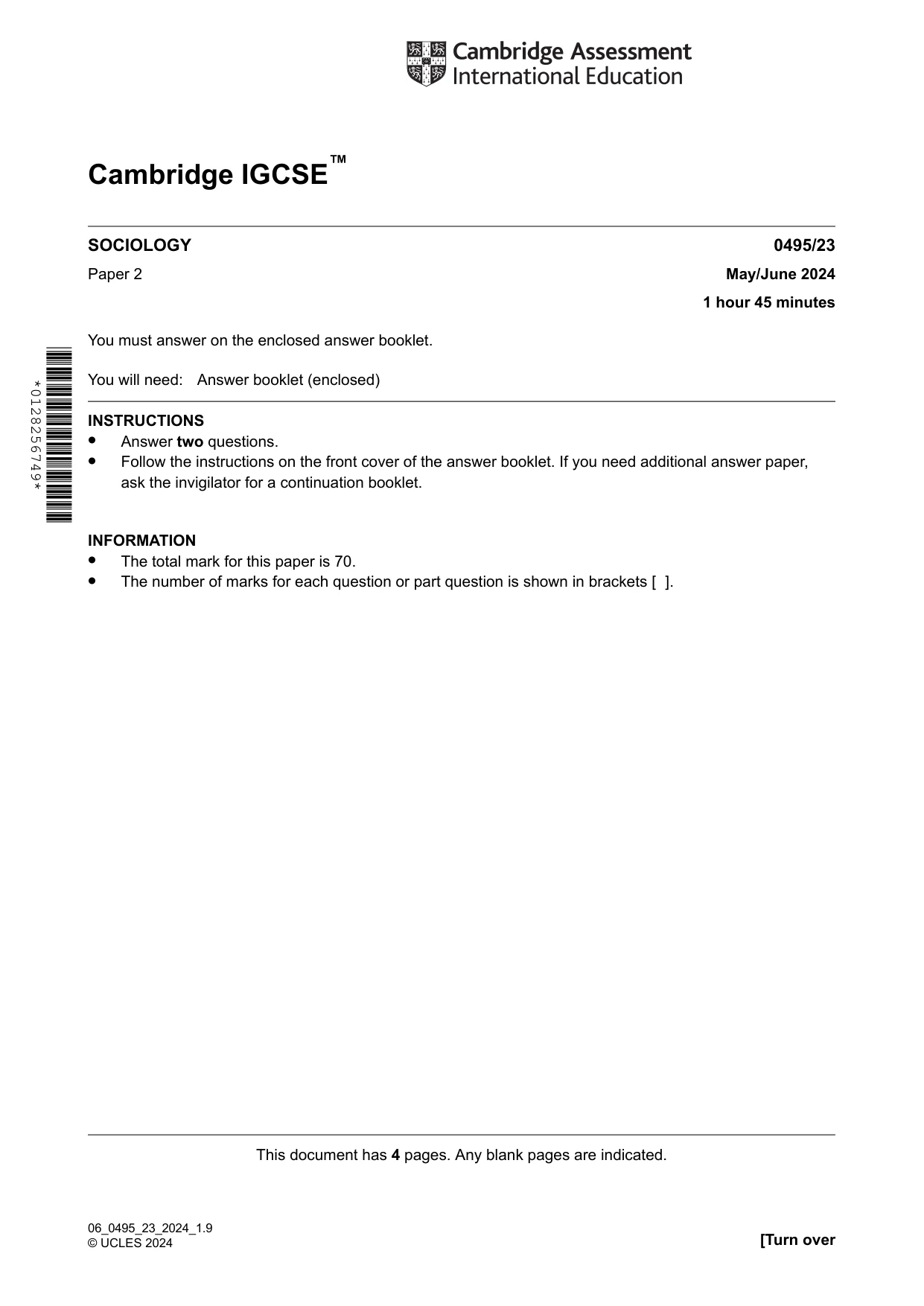
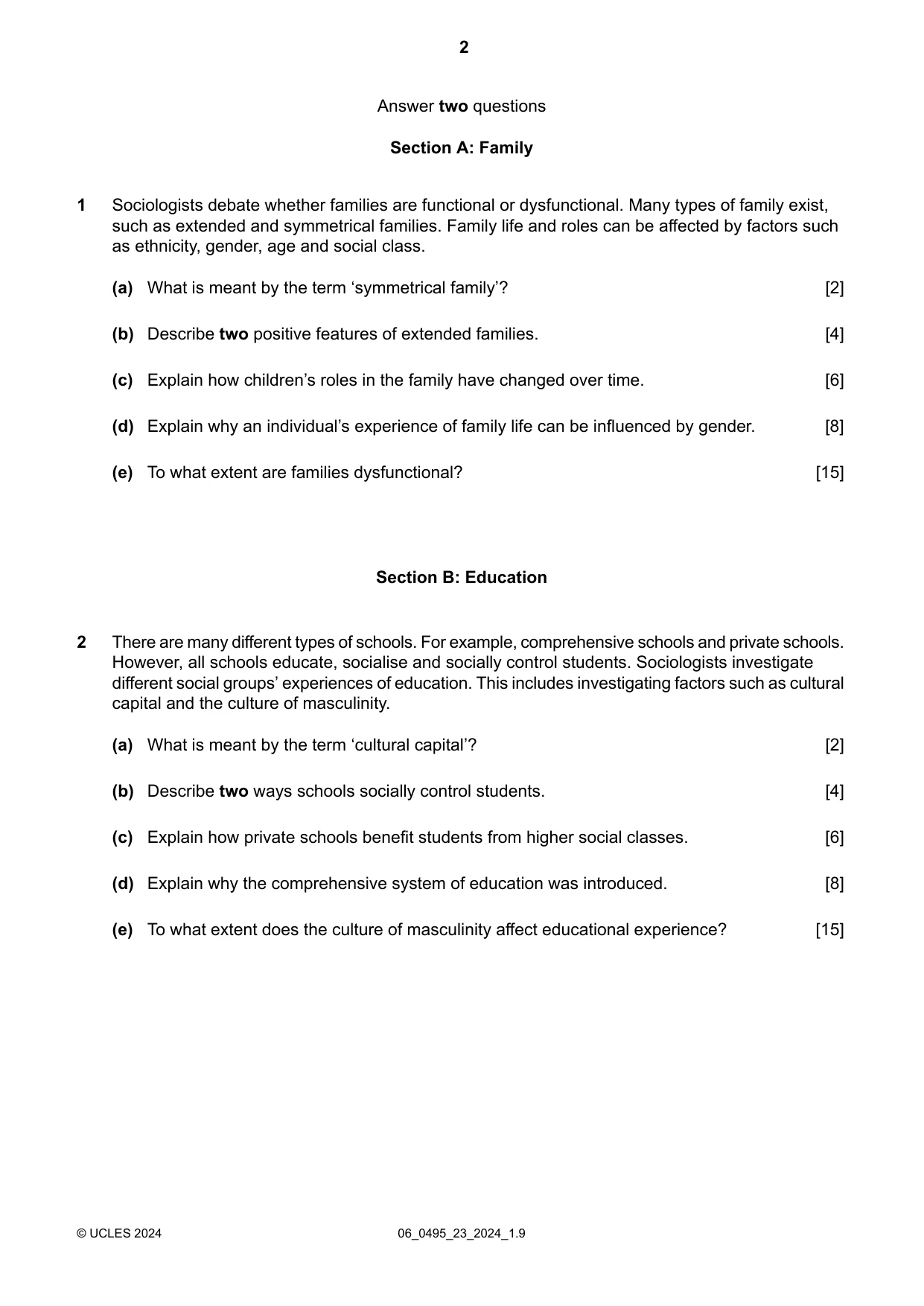
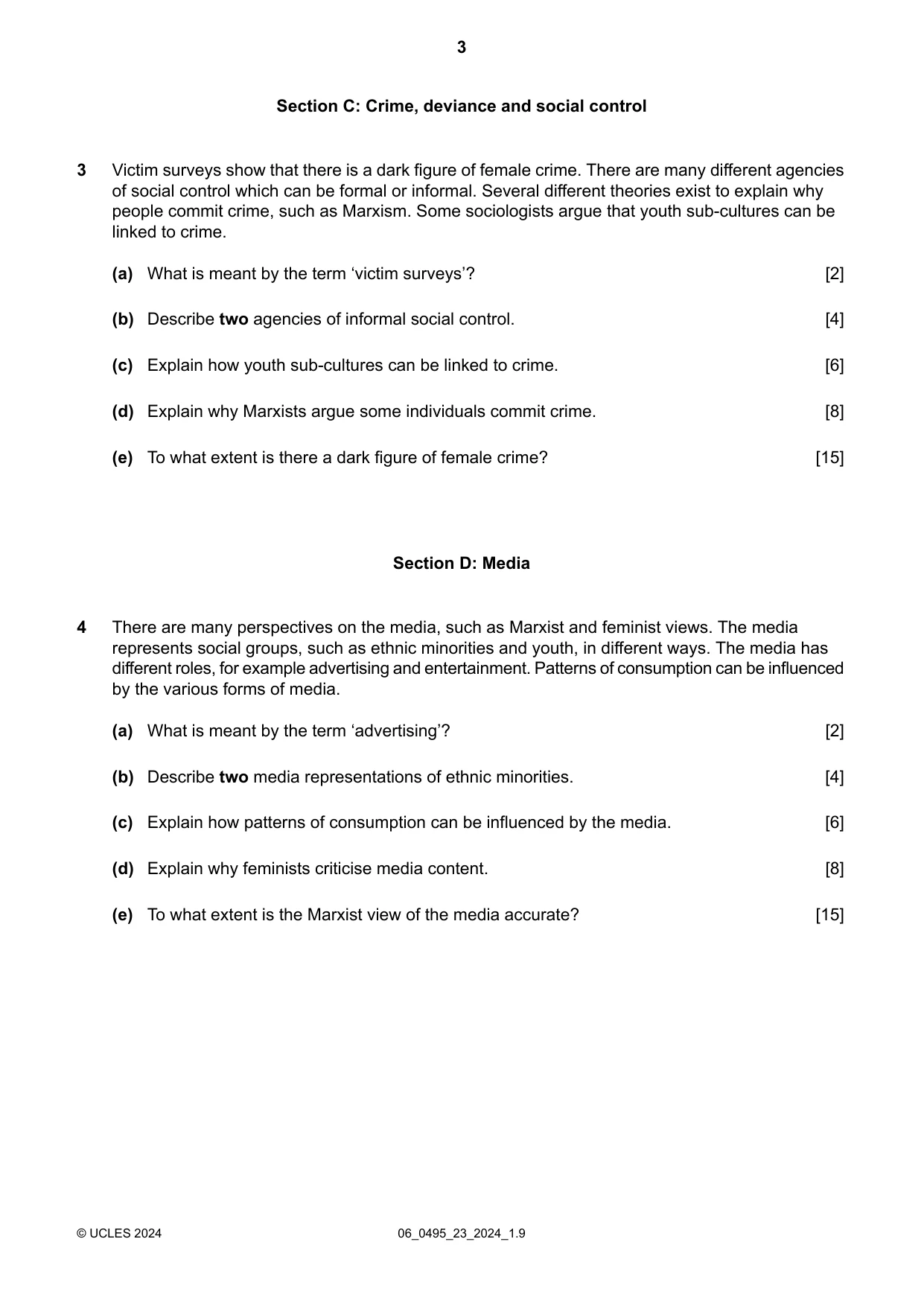

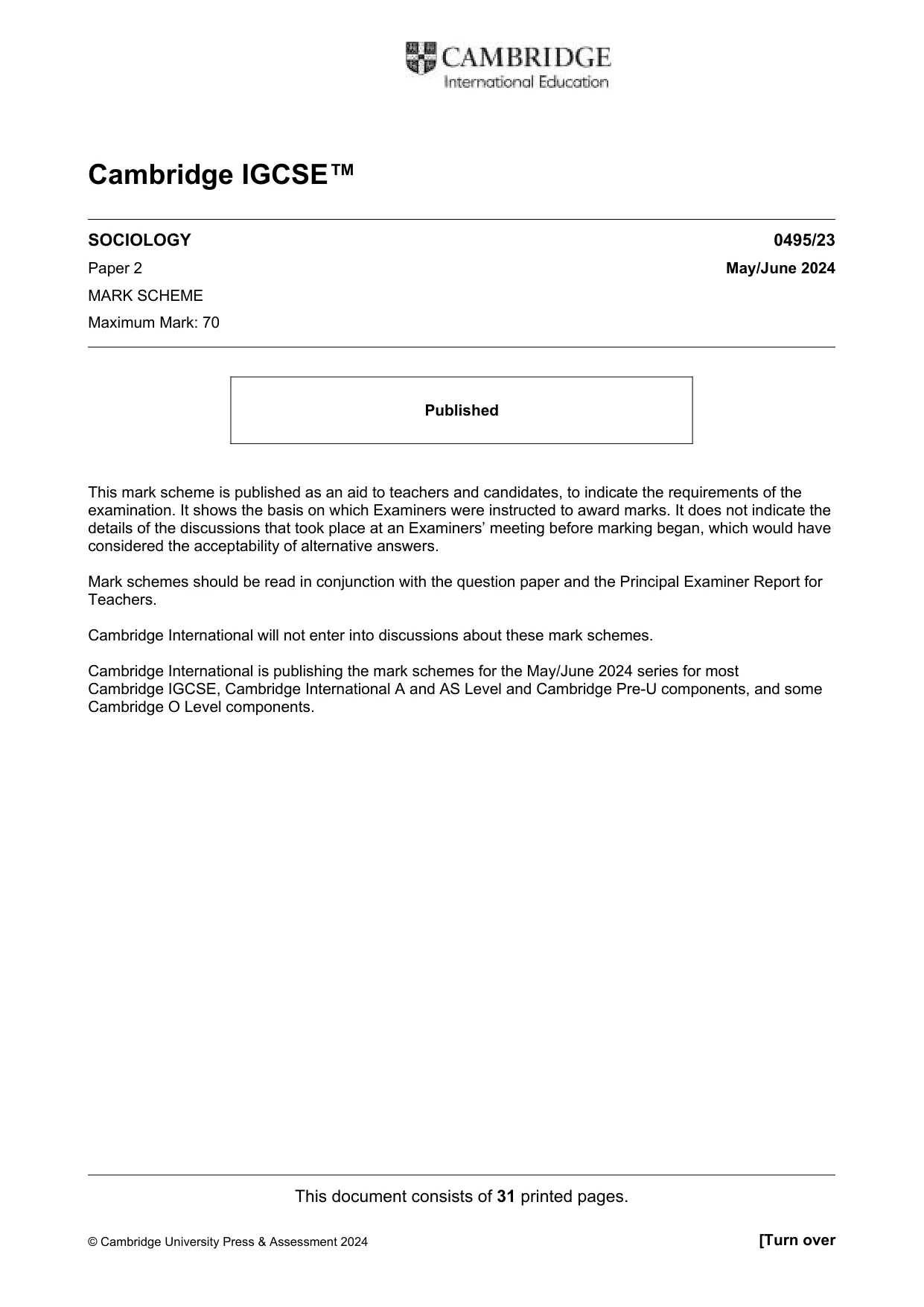
Mark scheme31 pages
Answers below. Sit the paper first if you are practising.




Questions as text
Q1 · Sociologists debate whether families are functional or dysfunctional
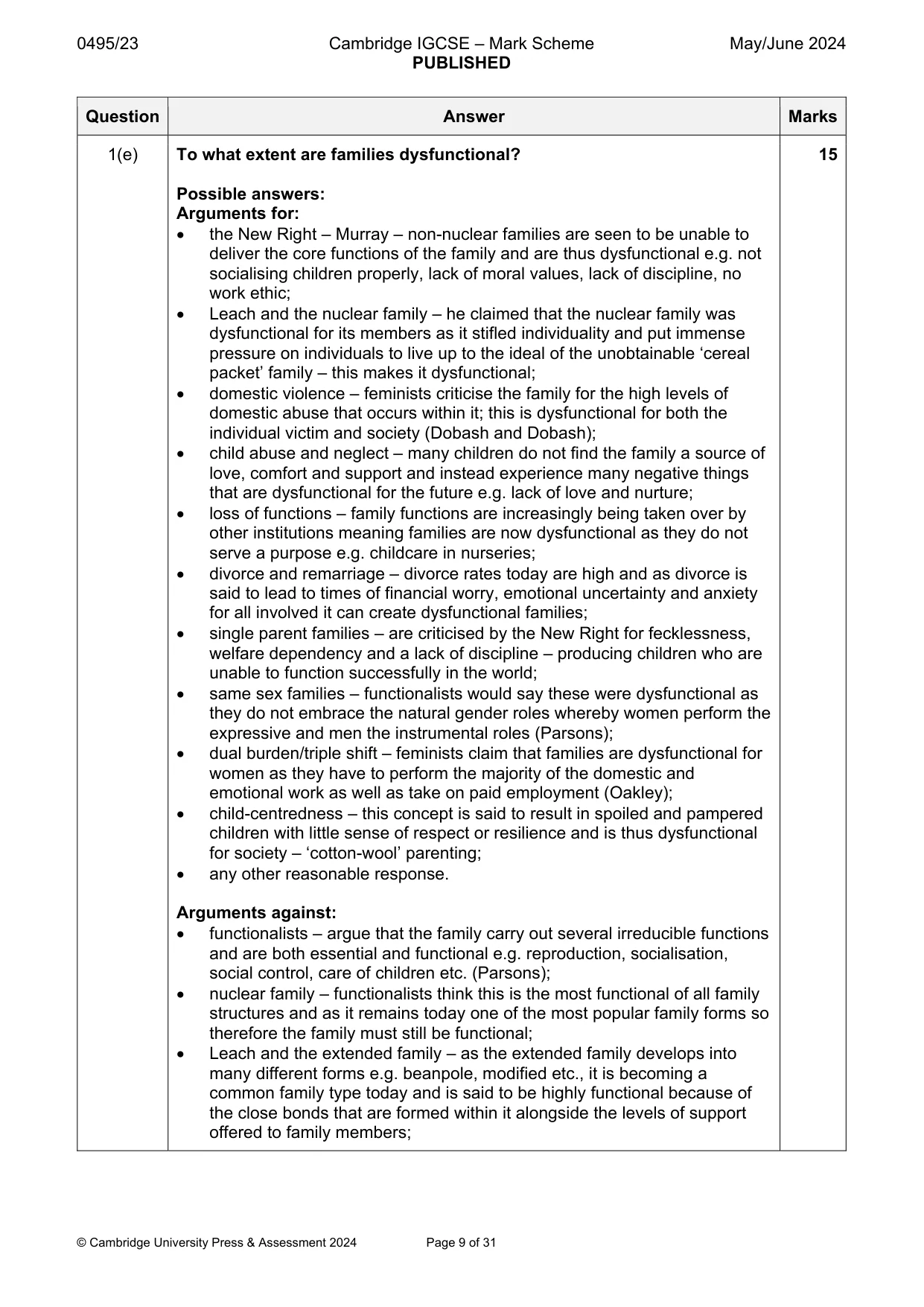
1 Sociologists debate whether families are functional or dysfunctional. Many types of family exist, such as extended and symmetrical families. Family life and roles can be affected by factors such as ethnicity, gender, age and social class. (a) What is meant by the term ‘symmetrical family’? [2] (b) Describe two positive features of extended families. [4] (c) Explain how children’s roles in the family have changed over time. [6] (d) Explain why an individual’s experience of family life can be influenced by gender. [8] (e) To what extent are families dysfunctional? [15]
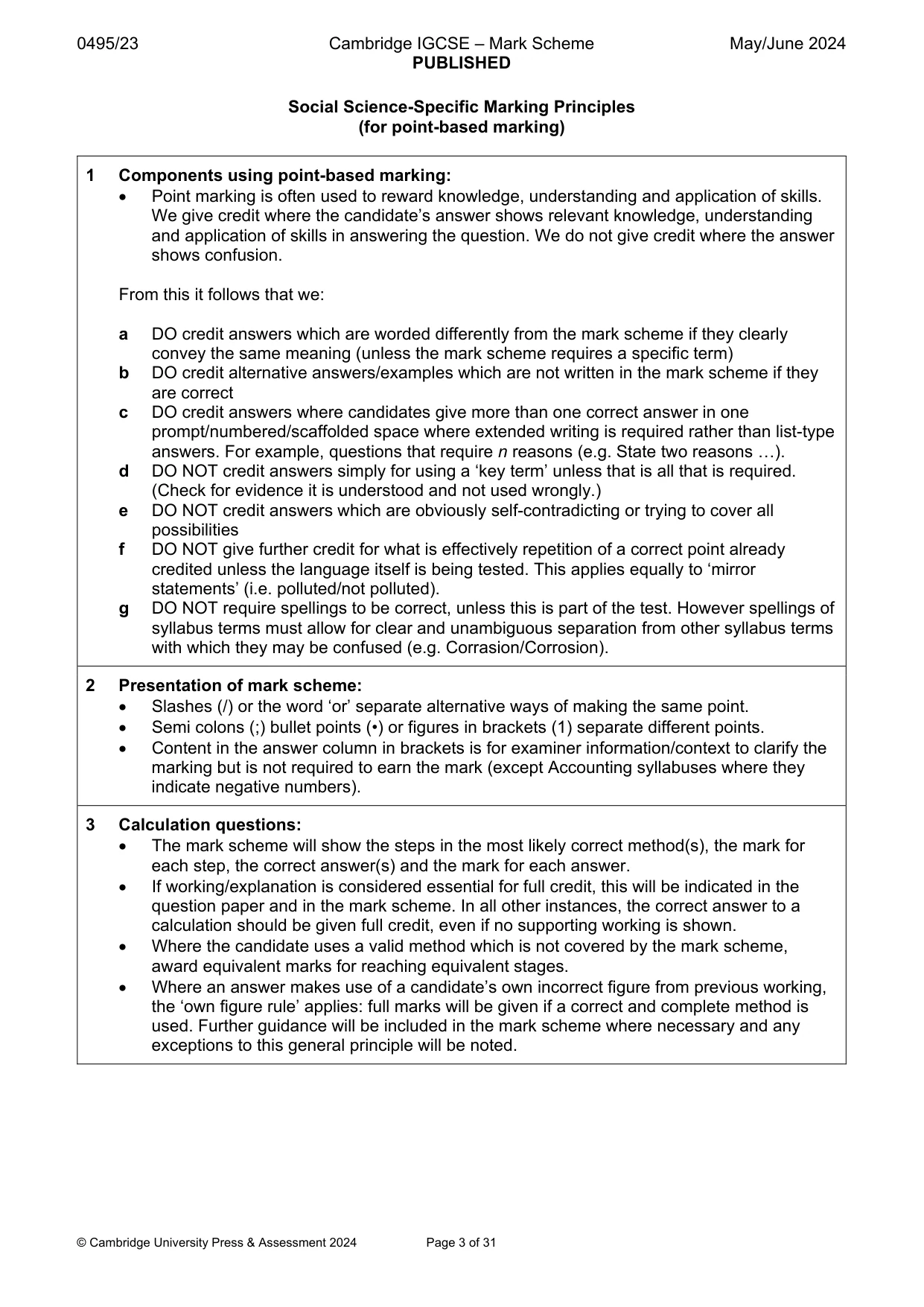
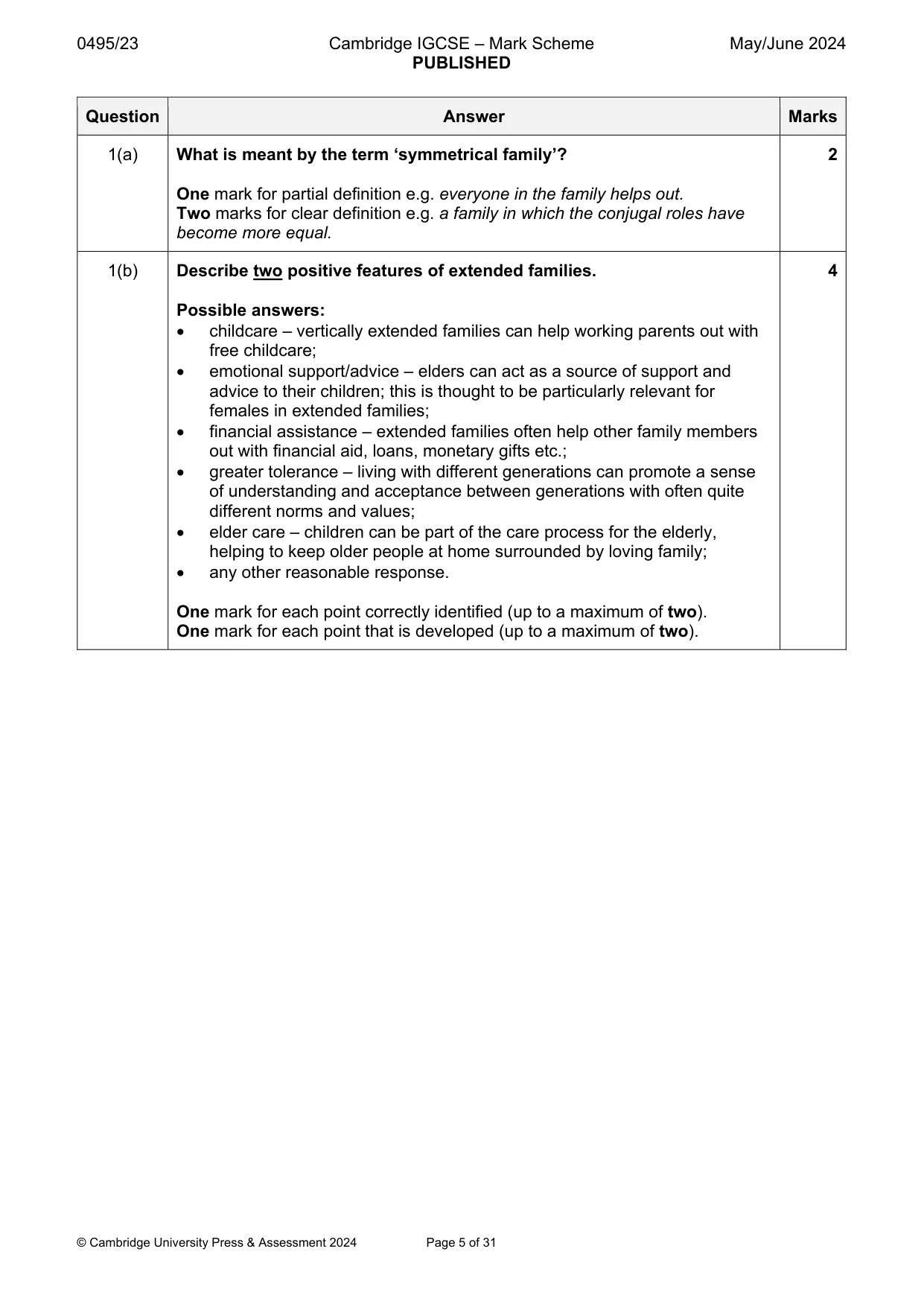
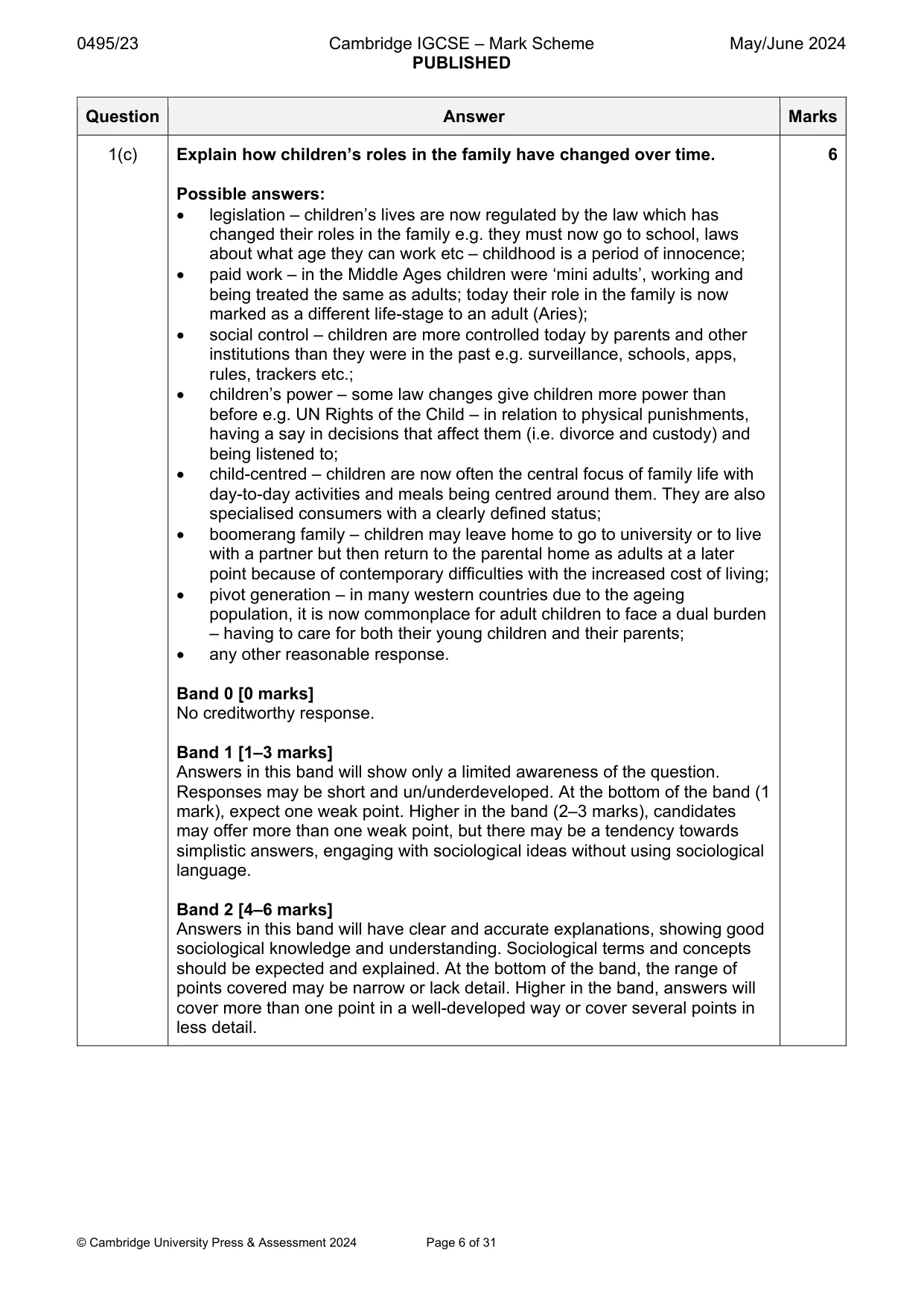
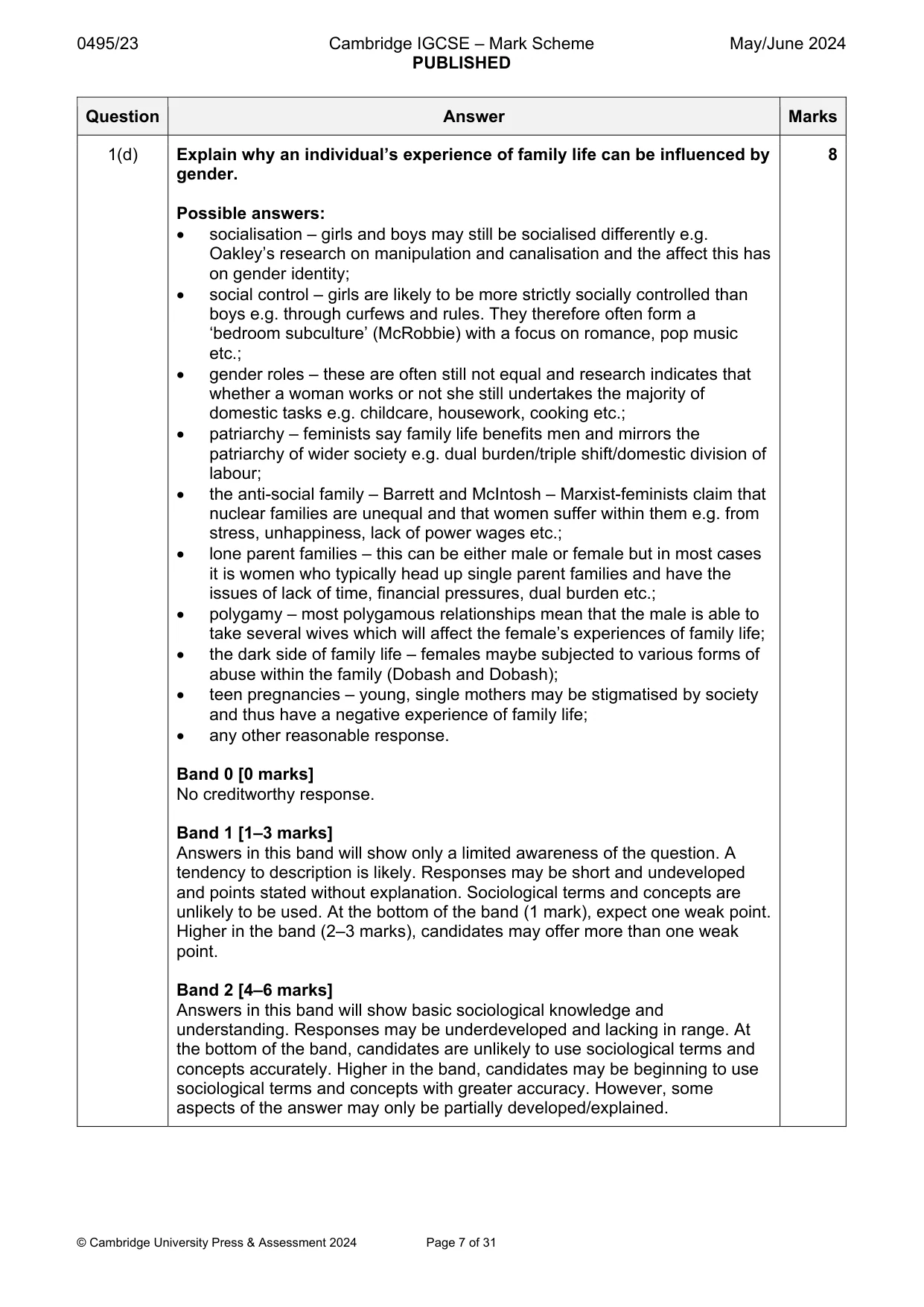
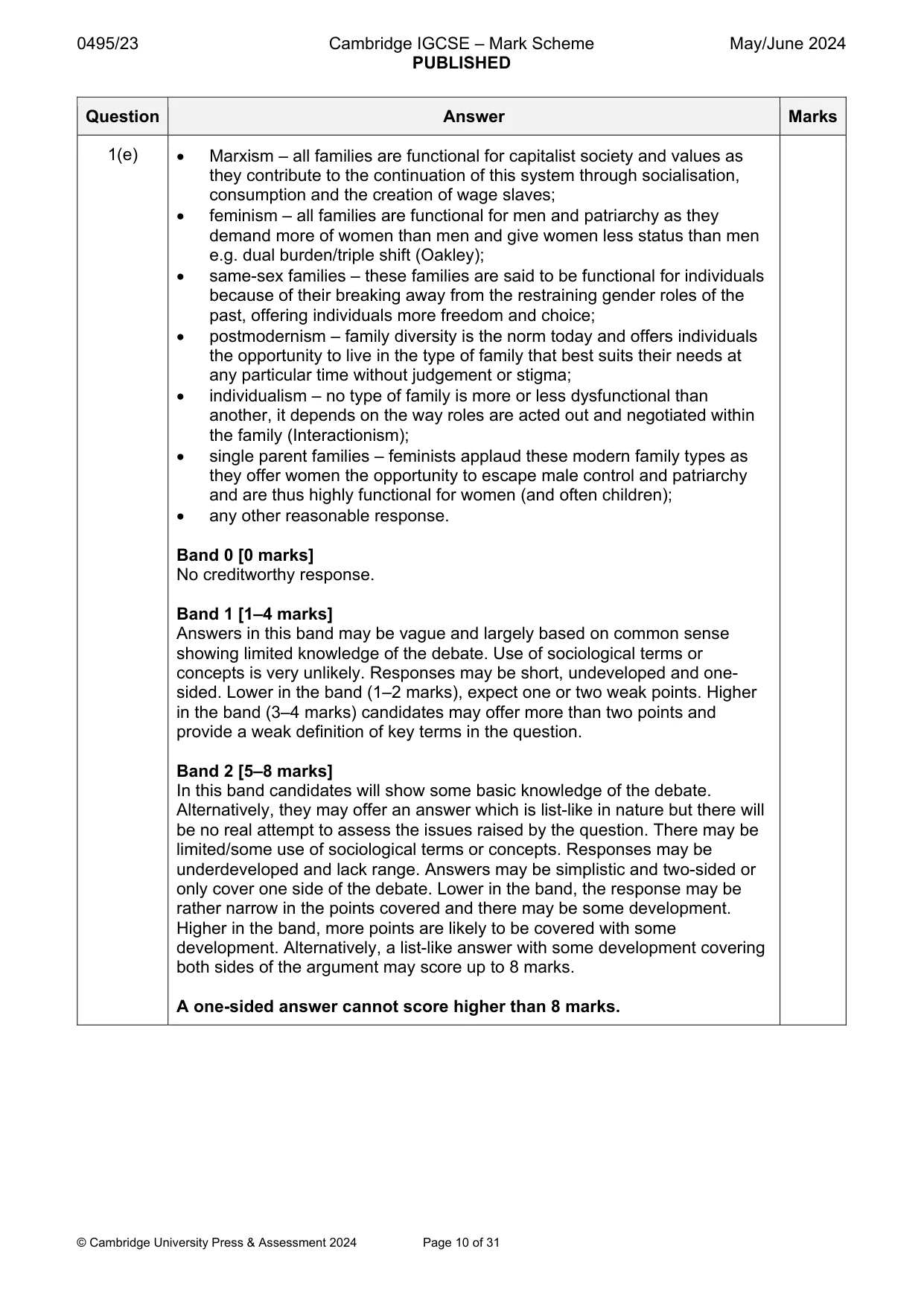
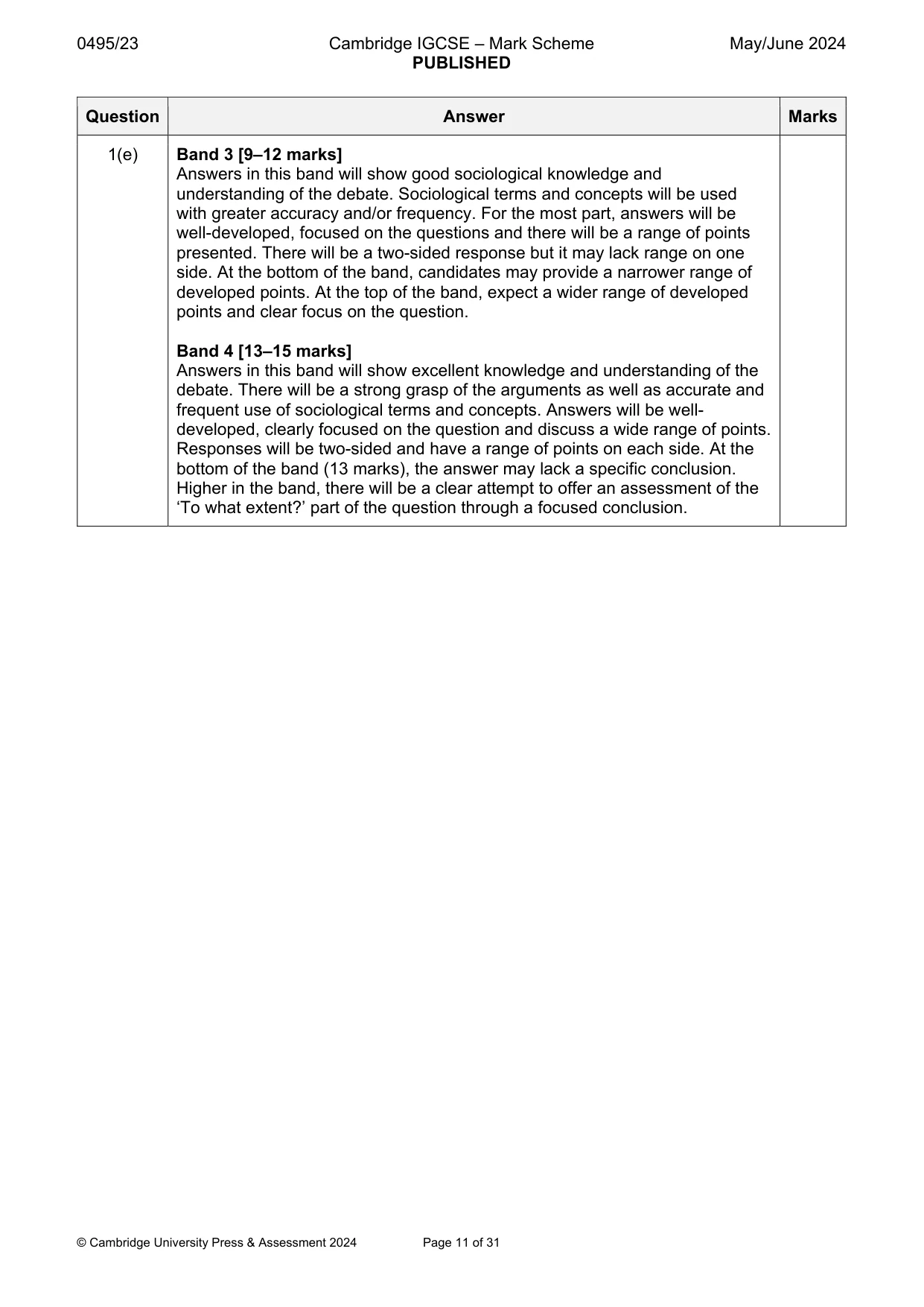
Mark scheme: Question Answer Marks 1(a) What is meant by the term ‘symmetrical family’? 2 One mark for partial definition e.g. everyone in the family helps out. Two marks for clear definition e.g. a family in which the conjugal roles have become more equal. 1(b) Describe two positive features of extended families. 4 Possible answers: childcare – vertically extended families can help working parents out with free childcare; emotional support/advice – elders can act as a source of support and advice to their children; this is thought to be particularly relevant for females in extended families; financial assistance – extended families often help other family members out with financial aid, loans, monetary gifts etc.; greater tolerance – living with different generations can promote a sense of understanding and acceptance between generations with often quite different norms and values; elder care – children can be part of the care process for the elderly, helping to keep older people at home surrounded by loving family; any other reasonable response. One mark for each point correctly identified (up to a maximum of two). One mark for each point that is developed (up to a maximum of two). 1(c) Explain how children’s roles in the family have changed over time. 6 Possible answers: legislation – children’s lives are now regulated by the law which has changed their roles in the family e.g. they must now go to school, laws about what age they can work etc – childhood is a period of innocence; paid work – in the Middle Ages children were ‘mini adults’, working and being treated the same as adults; today their role in the family is now marked as a different life-stage to an adult (Aries); social control – children are more controlled today by parents and other institutions than they were in the past e.g. surveillance, schools, apps, rules, trackers etc.; children’s power – some law changes give children more power than before e.g. UN Rights of the Child – in relation to physical punishments, having a say in decisions that affect them (i.e. divorce and custody) and being listened to; child-centred – children are now often the central focus of family life with day-to-day activities and meals being centred around them. They are also specialised consumers with a clearly defined status; boomerang family – children may leave home to go to university or to live with a partner but then return to the parental home as adults at a later point because of contemporary difficulties with the increased cost of living; pivot generation – in many western countries due to the ageing population, it is now commonplace for adult children to face a dual burden – having to care for both their young children and their parents; any other reasonable response. Band 0 [0 marks] No creditworthy response. Band 1 [1–3 marks] Answers in this band will show only a limited awareness of the question. Responses may be short and un/underdeveloped. At the bottom of the band (1 mark), expect one weak point. Higher in the band (2–3 marks), candidates may offer more than one weak point, but there may be a tendency towards simplistic answers, engaging with sociological ideas without using sociological language. Band 2 [4–6 marks] Answers in this band will have clear and accurate explanations, showing good sociological knowledge and understanding. Sociological terms and concepts should be expected and explained. At the bottom of the band, the range of points covered may be narrow or lack detail. Higher in the band, answers will cover more than one point in a well-developed way or cover several points in less detail. 1(d) Explain why an individual’s experience of family life can be influenced by 8 gender. Possible answers: socialisation – girls and boys may still be socialised differently e.g. Oakley’s research on manipulation and canalisation and the affect this has on gender identity; social control – girls are likely to be more strictly socially controlled than boys e.g. through curfews and rules. They therefore often form a ‘bedroom subculture’ (McRobbie) with a focus on romance, pop music etc.; gender roles – these are often still not equal and research indicates that whether a woman works or not she still undertakes the majority of domestic tasks e.g. childcare, housework, cooking etc.; patriarchy – feminists say family life benefits men and mirrors the patriarchy of wider society e.g. dual burden/triple shift/domestic division of labour; the anti-social family – Barrett and McIntosh – Marxist-feminists claim that nuclear families are unequal and that women suffer within them e.g. from stress, unhappiness, lack of power wages etc.; lone parent families – this can be either male or female but in most cases it is women who typically head up single parent families and have the issues of lack of time, financial pressures, dual burden etc.; polygamy – most polygamous relationships mean that the male is able to take several wives which will affect the female’s experiences of family life; the dark side of family life – females maybe subjected to various forms of abuse within the family (Dobash and Dobash); teen pregnancies – young, single mothers may be stigmatised by society and thus have a negative experience of family life; any other reasonable response. Band 0 [0 marks] No creditworthy response. Band 1 [1–3 marks] Answers in this band will show only a limited awareness of the question. A tendency to description is likely. Responses may be short and undeveloped and points stated without explanation. Sociological terms and concepts are unlikely to be used. At the bottom of the band (1 mark), expect one weak point. Higher in the band (2–3 marks), candidates may offer more than one weak point. Band 2 [4–6 marks] Answers in this band will show basic sociological knowledge and understanding. Responses may be underdeveloped and lacking in range. At the bottom of the band, candidates are unlikely to use sociological terms and concepts accurately. Higher in the band, candidates may be beginning to use sociological terms and concepts with greater accuracy. However, some aspects of the answer may only be partially developed/explained. 1(d) Band 3 [7–8 marks] Answers in this band will show good sociological knowledge and understanding and will be well-developed and explained. Sociological terms and concepts will be used accurately overall. Answers will be well-focused on the question and there will be a range of points presented. At the top of the band explanations will be clear throughout. 1(e) To what extent are families dysfunctional? 15 Possible answers: Arguments for: the New Right – Murray – non-nuclear families are seen to be unable to deliver the core functions of the family and are thus dysfunctional e.g. not socialising children properly, lack of moral values, lack of discipline, no work ethic; Leach and the nuclear family – he claimed that the nuclear family was dysfunctional for its members as it stifled individuality and put immense pressure on individuals to live up to the ideal of the unobtainable ‘cereal packet’ family – this makes it dysfunctional; domestic violence – feminists criticise the family for the high levels of domestic abuse that occurs within it; this is dysfunctional for both the individual victim and society (Dobash and Dobash); child abuse and neglect – many children do not find the family a source of love, comfort and support and instead experience many negative things that are dysfunctional for the future e.g. lack of love and nurture; loss of functions – family functions are increasingly being taken over by other institutions meaning families are now dysfunctional as they do not serve a purpose e.g. childcare in nurseries; divorce and remarriage – divorce rates today are high and as divorce is said to lead to times of financial worry, emotional uncertainty and anxiety for all involved it can create dysfunctional families; single parent families – are criticised by the New Right for fecklessness, welfare dependency and a lack of discipline – producing children who are unable to function successfully in the world; same sex families – functionalists would say these were dysfunctional as they do not embrace the natural gender roles whereby women perform the expressive and men the instrumental roles (Parsons); dual burden/triple shift – feminists claim that families are dysfunctional for women as they have to perform the majority of the domestic and emotional work as well as take on paid employment (Oakley); child-centredness – this concept is said to result in spoiled and pampered children with little sense of respect or resilience and is thus dysfunctional for society – ‘cotton-wool’ parenting; any other reasonable response. Arguments against: functionalists – argue that the family carry out several irreducible functions and are both essential and functional e.g. reproduction, socialisation, social control, care of children etc. (Parsons); nuclear family – functionalists think this is the most functional of all family structures and as it remains today one of the most popular family forms so therefore the family must still be functional; Leach and the extended family – as the extended family develops into many different forms e.g. beanpole, modified etc., it is becoming a common family type today and is said to be highly functional because of the close bonds that are formed within it alongside the levels of support offered to family members; 1(e) Marxism – all families are functional for capitalist society and values as they contribute to the continuation of this system through socialisation, consumption and the creation of wage slaves; feminism – all families are functional for men and patriarchy as they demand more of women than men and give women less status than men e.g. dual burden/triple shift (Oakley); same-sex families – these families are said to be functional for individuals because of their breaking away from the restraining gender roles of the past, offering individuals more freedom and choice; postmodernism – family diversity is the norm today and offers individuals the opportunity to live in the type of family that best suits their needs at any particular time without judgement or stigma; individualism – no type of family is more or less dysfunctional than another, it depends on the way roles are acted out and negotiated within the family (Interactionism); single parent families – feminists applaud these modern family types as they offer women the opportunity to escape male control and patriarchy and are thus highly functional for women (and often children); any other reasonable response. Band 0 [0 marks] No creditworthy response. Band 1 [1–4 marks] Answers in this band may be vague and largely based on common sense showing limited knowledge of the debate. Use of sociological terms or concepts is very unlikely. Responses may be short, undeveloped and one- sided. Lower in the band (1–2 marks), expect one or two weak points. Higher in the band (3–4 marks) candidates may offer more than two points and provide a weak definition of key terms in the question. Band 2 [5–8 marks] In this band candidates will show some basic knowledge of the debate. Alternatively, they may offer an answer which is list-like in nature but there will be no real attempt to assess the issues raised by the question. There may be limited/some use of sociological terms or concepts. Responses may be underdeveloped and lack range. Answers may be simplistic and two-sided or only cover one side of the debate. Lower in the band, the response may be rather narrow in the points covered and there may be some development. Higher in the band, more points are likely to be covered with some development. Alternatively, a list-like answer with some development covering both sides of the argument may score up to 8 marks. A one-sided answer cannot score higher than 8 marks. 1(e) Band 3 [9–12 marks] Answers in this band will show good sociological knowledge and understanding of the debate. Sociological terms and concepts will be used with greater accuracy and/or frequency. For the most part, answers will be well-developed, focused on the questions and there will be a range of points presented. There will be a two-sided response but it may lack range on one side. At the bottom of the band, candidates may provide a narrower range of developed points. At the top of the band, expect a wider range of developed points and clear focus on the question. Band 4 [13–15 marks] Answers in this band will show excellent knowledge and understanding of the debate. There will be a strong grasp of the arguments as well as accurate and frequent use of sociological terms and concepts. Answers will be well- developed, clearly focused on the question and discuss a wide range of points. Responses will be two-sided and have a range of points on each side. At the bottom of the band (13 marks), the answer may lack a specific conclusion. Higher in the band, there will be a clear attempt to offer an assessment of the ‘To what extent?’ part of the question through a focused conclusion.
More questions on How do sociologists approach the study of society?
Q2 · There are many different types of schools
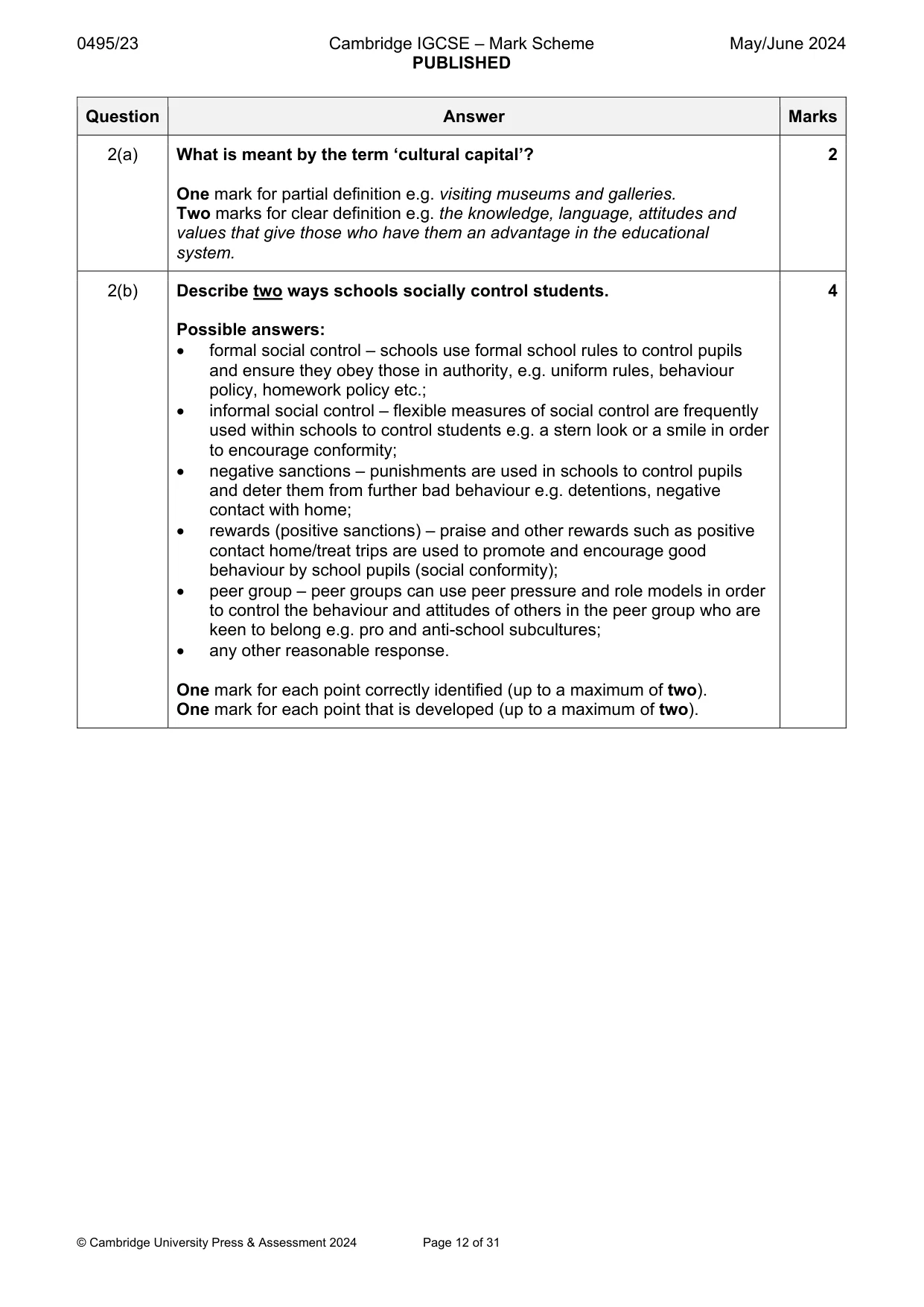
2 There are many different types of schools. For example, comprehensive schools and private schools. However, all schools educate, socialise and socially control students. Sociologists investigate different social groups’ experiences of education. This includes investigating factors such as cultural capital and the culture of masculinity. (a) What is meant by the term ‘cultural capital’? [2] (b) Describe two ways schools socially control students. [4] (c) Explain how private schools benefit students from higher social classes. [6] (d) Explain why the comprehensive system of education was introduced. [8] (e) To what extent does the culture of masculinity affect educational experience? [15] Section C: Crime, deviance and social control
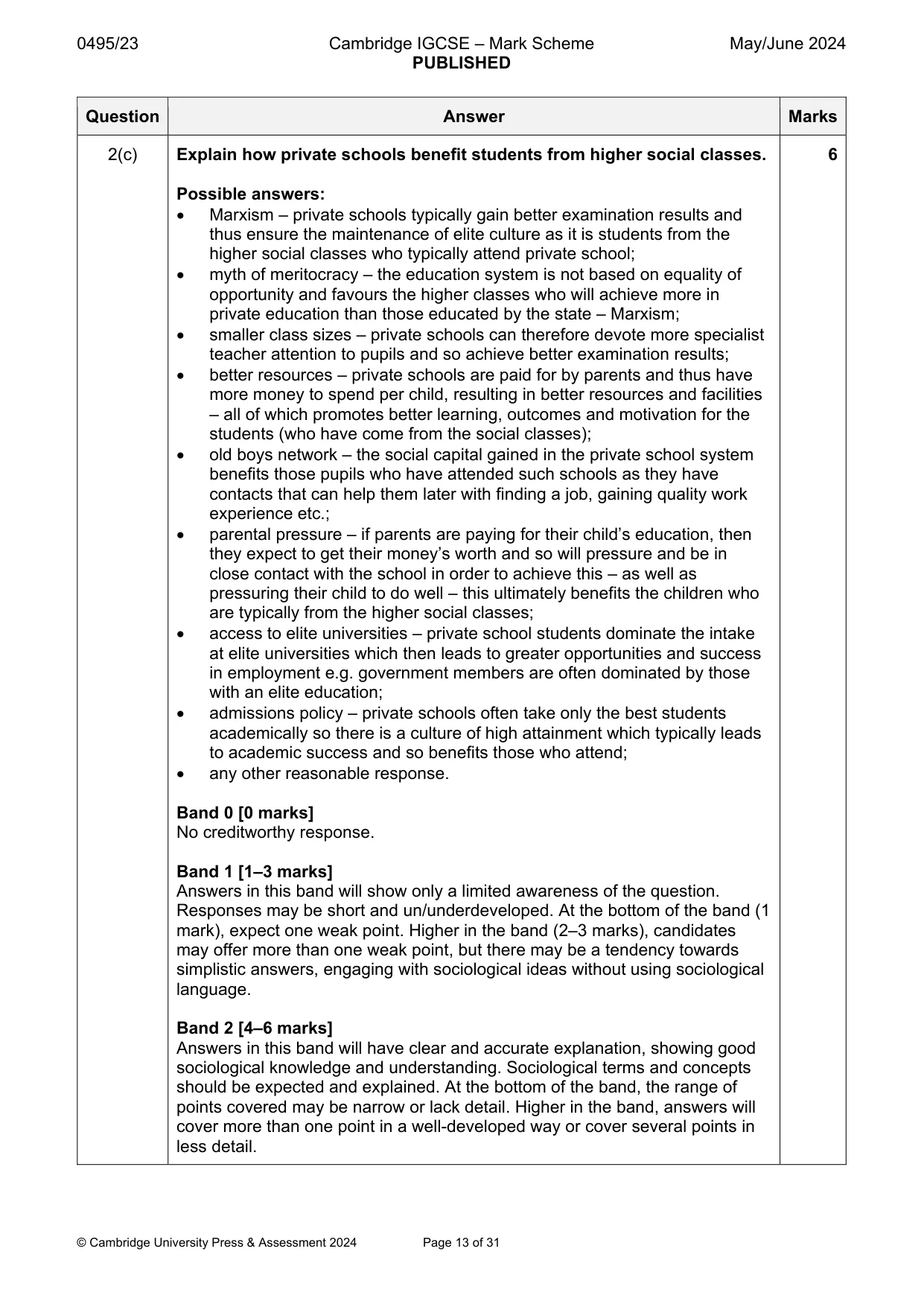
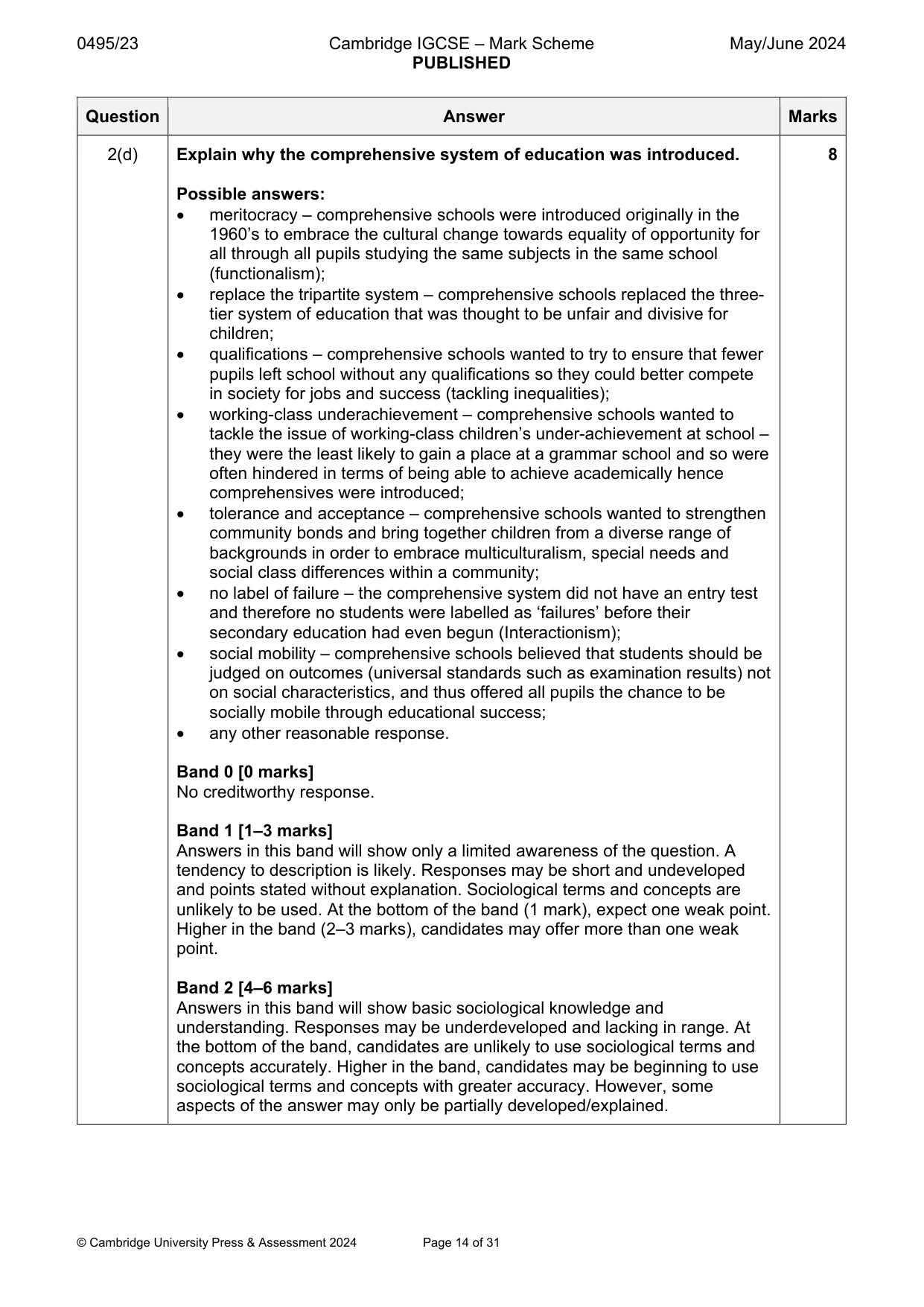
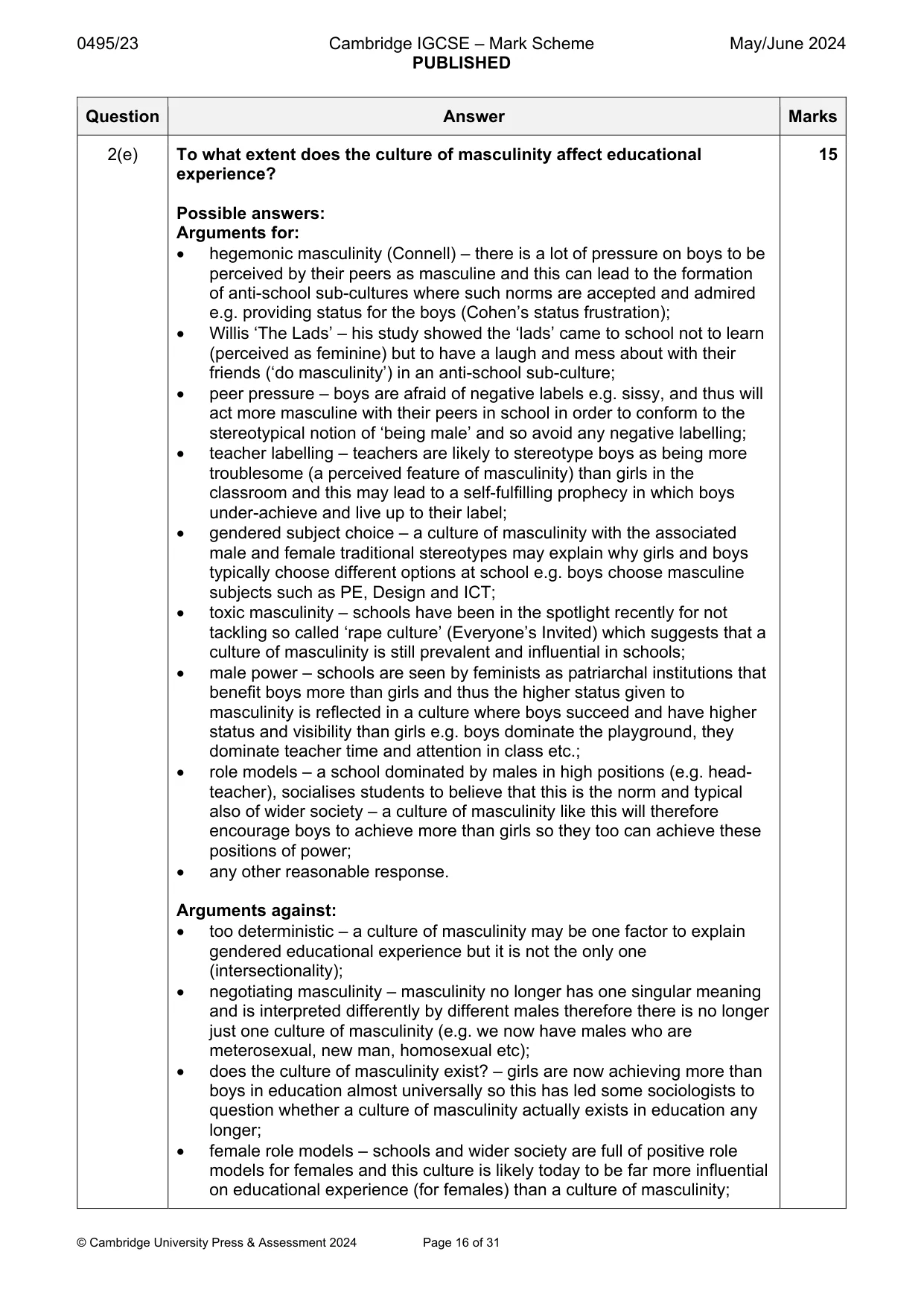
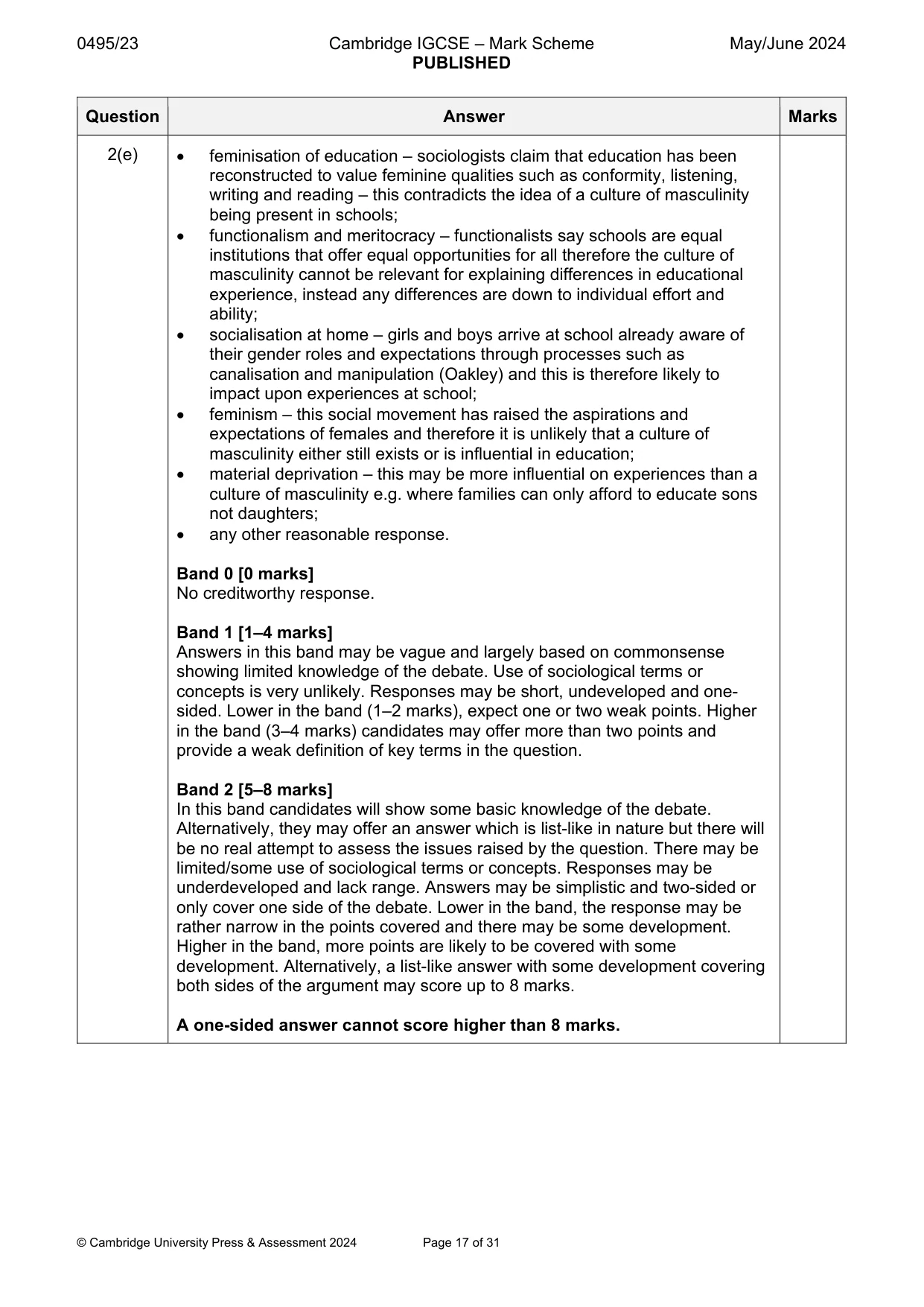
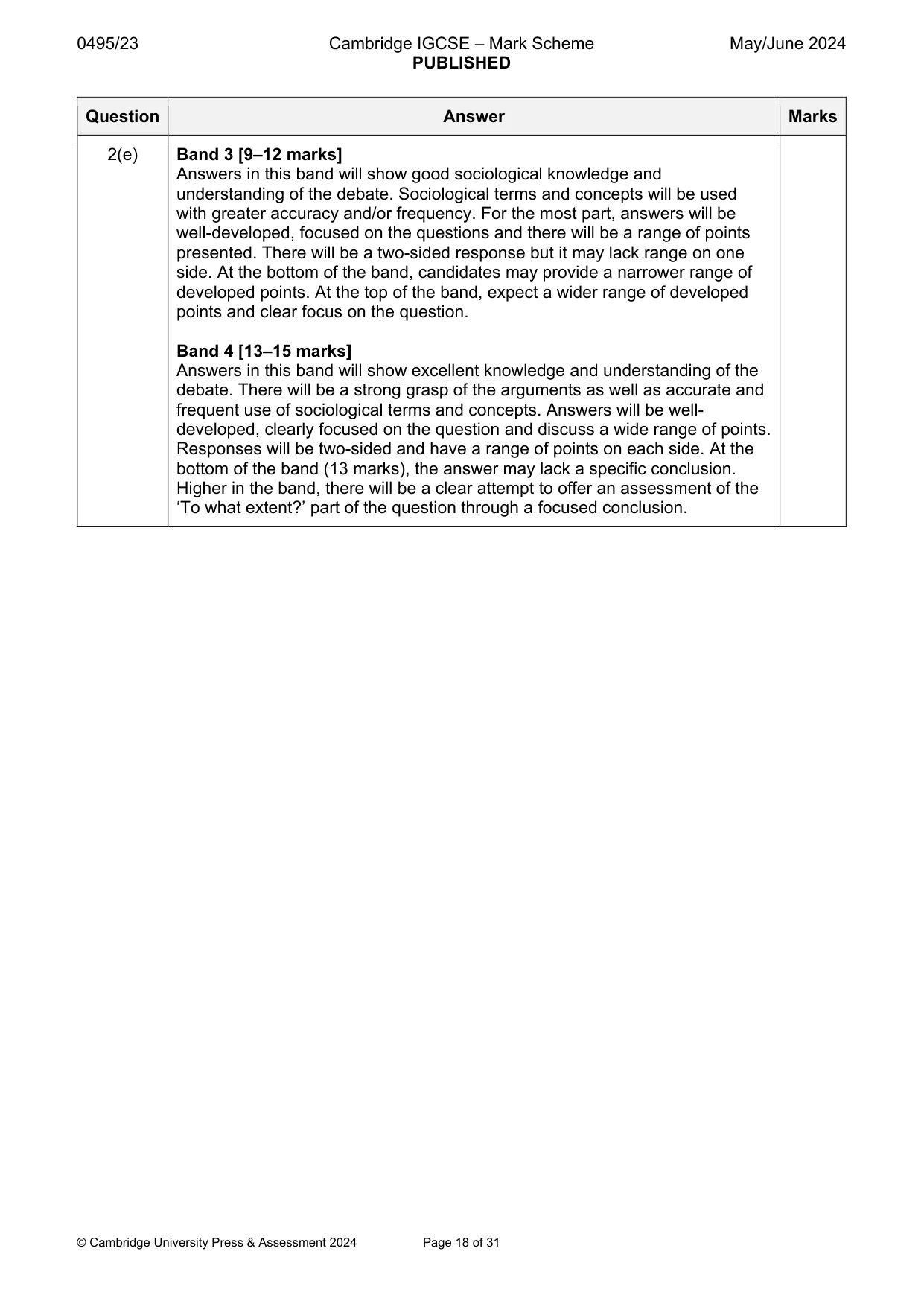
Mark scheme: 2(a) What is meant by the term ‘cultural capital’? 2 One mark for partial definition e.g. visiting museums and galleries. Two marks for clear definition e.g. the knowledge, language, attitudes and values that give those who have them an advantage in the educational system. 2(b) Describe two ways schools socially control students. 4 Possible answers: formal social control – schools use formal school rules to control pupils and ensure they obey those in authority, e.g. uniform rules, behaviour policy, homework policy etc.; informal social control – flexible measures of social control are frequently used within schools to control students e.g. a stern look or a smile in order to encourage conformity; negative sanctions – punishments are used in schools to control pupils and deter them from further bad behaviour e.g. detentions, negative contact with home; rewards (positive sanctions) – praise and other rewards such as positive contact home/treat trips are used to promote and encourage good behaviour by school pupils (social conformity); peer group – peer groups can use peer pressure and role models in order to control the behaviour and attitudes of others in the peer group who are keen to belong e.g. pro and anti-school subcultures; any other reasonable response. One mark for each point correctly identified (up to a maximum of two). One mark for each point that is developed (up to a maximum of two). 2(c) Explain how private schools benefit students from higher social classes. 6 Possible answers: Marxism – private schools typically gain better examination results and thus ensure the maintenance of elite culture as it is students from the higher social classes who typically attend private school; myth of meritocracy – the education system is not based on equality of opportunity and favours the higher classes who will achieve more in private education than those educated by the state – Marxism; smaller class sizes – private schools can therefore devote more specialist teacher attention to pupils and so achieve better examination results; better resources – private schools are paid for by parents and thus have more money to spend per child, resulting in better resources and facilities – all of which promotes better learning, outcomes and motivation for the students (who have come from the social classes); old boys network – the social capital gained in the private school system benefits those pupils who have attended such schools as they have contacts that can help them later with finding a job, gaining quality work experience etc.; parental pressure – if parents are paying for their child’s education, then they expect to get their money’s worth and so will pressure and be in close contact with the school in order to achieve this – as well as pressuring their child to do well – this ultimately benefits the children who are typically from the higher social classes; access to elite universities – private school students dominate the intake at elite universities which then leads to greater opportunities and success in employment e.g. government members are often dominated by those with an elite education; admissions policy – private schools often take only the best students academically so there is a culture of high attainment which typically leads to academic success and so benefits those who attend; any other reasonable response. Band 0 [0 marks] No creditworthy response. Band 1 [1–3 marks] Answers in this band will show only a limited awareness of the question. Responses may be short and un/underdeveloped. At the bottom of the band (1 mark), expect one weak point. Higher in the band (2–3 marks), candidates may offer more than one weak point, but there may be a tendency towards simplistic answers, engaging with sociological ideas without using sociological language. Band 2 [4–6 marks] Answers in this band will have clear and accurate explanation, showing good sociological knowledge and understanding. Sociological terms and concepts should be expected and explained. At the bottom of the band, the range of points covered may be narrow or lack detail. Higher in the band, answers will cover more than one point in a well-developed way or cover several points in less detail. 2(d) Explain why the comprehensive system of education was introduced. 8 Possible answers: meritocracy – comprehensive schools were introduced originally in the 1960’s to embrace the cultural change towards equality of opportunity for all through all pupils studying the same subjects in the same school (functionalism); replace the tripartite system – comprehensive schools replaced the three- tier system of education that was thought to be unfair and divisive for children; qualifications – comprehensive schools wanted to try to ensure that fewer pupils left school without any qualifications so they could better compete in society for jobs and success (tackling inequalities); working-class underachievement – comprehensive schools wanted to tackle the issue of working-class children’s under-achievement at school – they were the least likely to gain a place at a grammar school and so were often hindered in terms of being able to achieve academically hence comprehensives were introduced; tolerance and acceptance – comprehensive schools wanted to strengthen community bonds and bring together children from a diverse range of backgrounds in order to embrace multiculturalism, special needs and social class differences within a community; no label of failure – the comprehensive system did not have an entry test and therefore no students were labelled as ‘failures’ before their secondary education had even begun (Interactionism); social mobility – comprehensive schools believed that students should be judged on outcomes (universal standards such as examination results) not on social characteristics, and thus offered all pupils the chance to be socially mobile through educational success; any other reasonable response. Band 0 [0 marks] No creditworthy response. Band 1 [1–3 marks] Answers in this band will show only a limited awareness of the question. A tendency to description is likely. Responses may be short and undeveloped and points stated without explanation. Sociological terms and concepts are unlikely to be used. At the bottom of the band (1 mark), expect one weak point. Higher in the band (2–3 marks), candidates may offer more than one weak point. Band 2 [4–6 marks] Answers in this band will show basic sociological knowledge and understanding. Responses may be underdeveloped and lacking in range. At the bottom of the band, candidates are unlikely to use sociological terms and concepts accurately. Higher in the band, candidates may be beginning to use sociological terms and concepts with greater accuracy. However, some aspects of the answer may only be partially developed/explained. 2(d) Band 3 [7–8 marks] Answers in this band will show good sociological knowledge and understanding and will be well-developed and explained. Sociological terms and concepts will be used accurately overall. Answers will be well-focused on the question and there will be a range of points presented. At the top of the band explanations will be clear throughout. 2(e) To what extent does the culture of masculinity affect educational 15 experience? Possible answers: Arguments for: hegemonic masculinity (Connell) – there is a lot of pressure on boys to be perceived by their peers as masculine and this can lead to the formation of anti-school sub-cultures where such norms are accepted and admired e.g. providing status for the boys (Cohen’s status frustration); Willis ‘The Lads’ – his study showed the ‘lads’ came to school not to learn (perceived as feminine) but to have a laugh and mess about with their friends (‘do masculinity’) in an anti-school sub-culture; peer pressure – boys are afraid of negative labels e.g. sissy, and thus will act more masculine with their peers in school in order to conform to the stereotypical notion of ‘being male’ and so avoid any negative labelling; teacher labelling – teachers are likely to stereotype boys as being more troublesome (a perceived feature of masculinity) than girls in the classroom and this may lead to a self-fulfilling prophecy in which boys under-achieve and live up to their label; gendered subject choice – a culture of masculinity with the associated male and female traditional stereotypes may explain why girls and boys typically choose different options at school e.g. boys choose masculine subjects such as PE, Design and ICT; toxic masculinity – schools have been in the spotlight recently for not tackling so called ‘rape culture’ (Everyone’s Invited) which suggests that a culture of masculinity is still prevalent and influential in schools; male power – schools are seen by feminists as patriarchal institutions that benefit boys more than girls and thus the higher status given to masculinity is reflected in a culture where boys succeed and have higher status and visibility than girls e.g. boys dominate the playground, they dominate teacher time and attention in class etc.; role models – a school dominated by males in high positions (e.g. head- teacher), socialises students to believe that this is the norm and typical also of wider society – a culture of masculinity like this will therefore encourage boys to achieve more than girls so they too can achieve these positions of power; any other reasonable response. Arguments against: too deterministic – a culture of masculinity may be one factor to explain gendered educational experience but it is not the only one (intersectionality); negotiating masculinity – masculinity no longer has one singular meaning and is interpreted differently by different males therefore there is no longer just one culture of masculinity (e.g. we now have males who are meterosexual, new man, homosexual etc); does the culture of masculinity exist? – girls are now achieving more than boys in education almost universally so this has led some sociologists to question whether a culture of masculinity actually exists in education any longer; female role models – schools and wider society are full of positive role models for females and this culture is likely today to be far more influential on educational experience (for females) than a culture of masculinity; 2(e) feminisation of education – sociologists claim that education has been reconstructed to value feminine qualities such as conformity, listening, writing and reading – this contradicts the idea of a culture of masculinity being present in schools; functionalism and meritocracy – functionalists say schools are equal institutions that offer equal opportunities for all therefore the culture of masculinity cannot be relevant for explaining differences in educational experience, instead any differences are down to individual effort and ability; socialisation at home – girls and boys arrive at school already aware of their gender roles and expectations through processes such as canalisation and manipulation (Oakley) and this is therefore likely to impact upon experiences at school; feminism – this social movement has raised the aspirations and expectations of females and therefore it is unlikely that a culture of masculinity either still exists or is influential in education; material deprivation – this may be more influential on experiences than a culture of masculinity e.g. where families can only afford to educate sons not daughters; any other reasonable response. Band 0 [0 marks] No creditworthy response. Band 1 [1–4 marks] Answers in this band may be vague and largely based on commonsense showing limited knowledge of the debate. Use of sociological terms or concepts is very unlikely. Responses may be short, undeveloped and one- sided. Lower in the band (1–2 marks), expect one or two weak points. Higher in the band (3–4 marks) candidates may offer more than two points and provide a weak definition of key terms in the question. Band 2 [5–8 marks] In this band candidates will show some basic knowledge of the debate. Alternatively, they may offer an answer which is list-like in nature but there will be no real attempt to assess the issues raised by the question. There may be limited/some use of sociological terms or concepts. Responses may be underdeveloped and lack range. Answers may be simplistic and two-sided or only cover one side of the debate. Lower in the band, the response may be rather narrow in the points covered and there may be some development. Higher in the band, more points are likely to be covered with some development. Alternatively, a list-like answer with some development covering both sides of the argument may score up to 8 marks. A one-sided answer cannot score higher than 8 marks. 2(e) Band 3 [9–12 marks] Answers in this band will show good sociological knowledge and understanding of the debate. Sociological terms and concepts will be used with greater accuracy and/or frequency. For the most part, answers will be well-developed, focused on the questions and there will be a range of points presented. There will be a two-sided response but it may lack range on one side. At the bottom of the band, candidates may provide a narrower range of developed points. At the top of the band, expect a wider range of developed points and clear focus on the question. Band 4 [13–15 marks] Answers in this band will show excellent knowledge and understanding of the debate. There will be a strong grasp of the arguments as well as accurate and frequent use of sociological terms and concepts. Answers will be well- developed, clearly focused on the question and discuss a wide range of points. Responses will be two-sided and have a range of points on each side. At the bottom of the band (13 marks), the answer may lack a specific conclusion. Higher in the band, there will be a clear attempt to offer an assessment of the ‘To what extent?’ part of the question through a focused conclusion.
Q3 · Victim surveys show that there is a dark figure of female crime
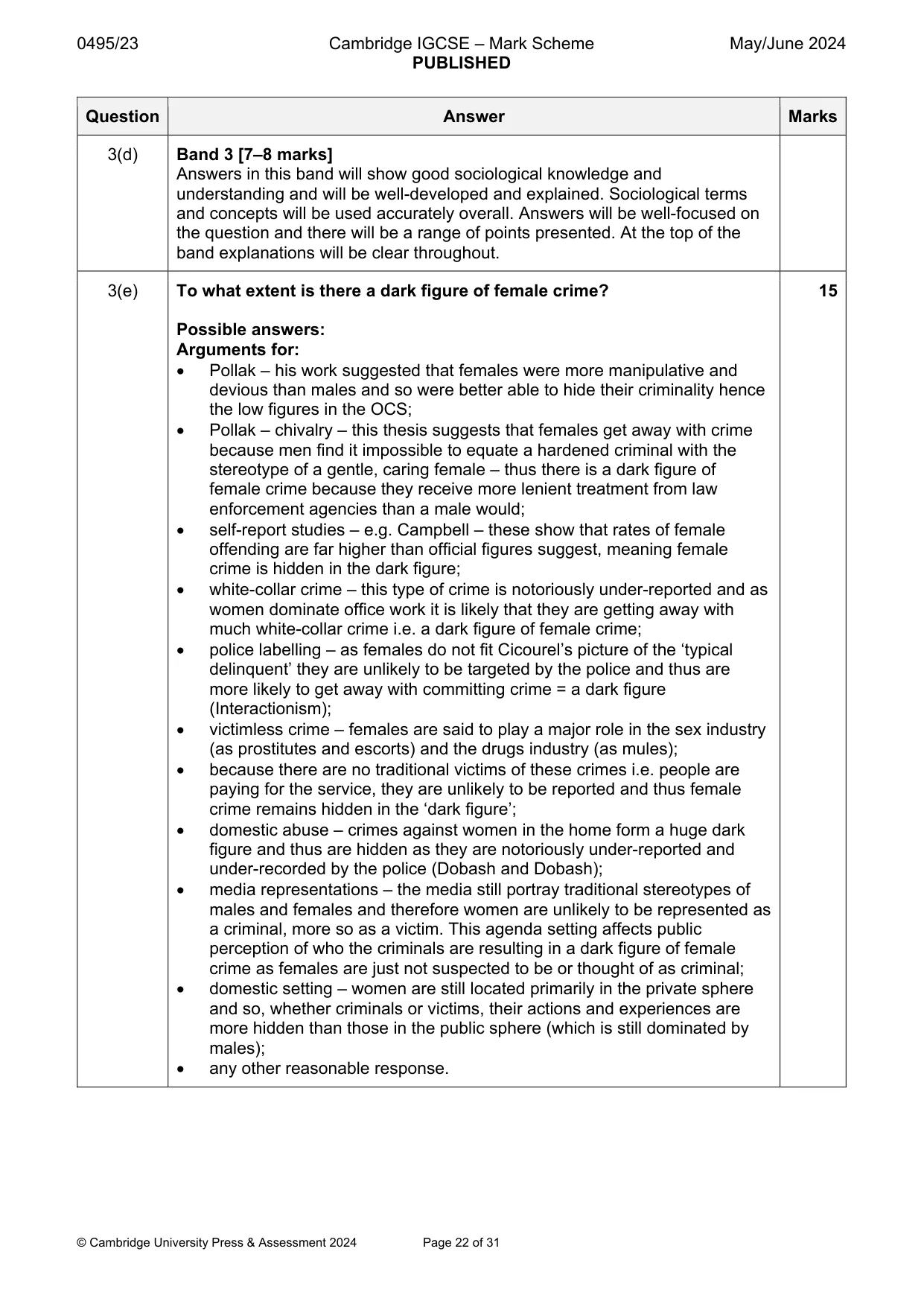
3 Victim surveys show that there is a dark figure of female crime. There are many different agencies of social control which can be formal or informal. Several different theories exist to explain why people commit crime, such as Marxism. Some sociologists argue that youth sub-cultures can be linked to crime. (a) What is meant by the term ‘victim surveys’? [2] (b) Describe two agencies of informal social control. [4] (c) Explain how youth sub-cultures can be linked to crime. [6] (d) Explain why Marxists argue some individuals commit crime. [8] (e) To what extent is there a dark figure of female crime? [15] Section D: Media
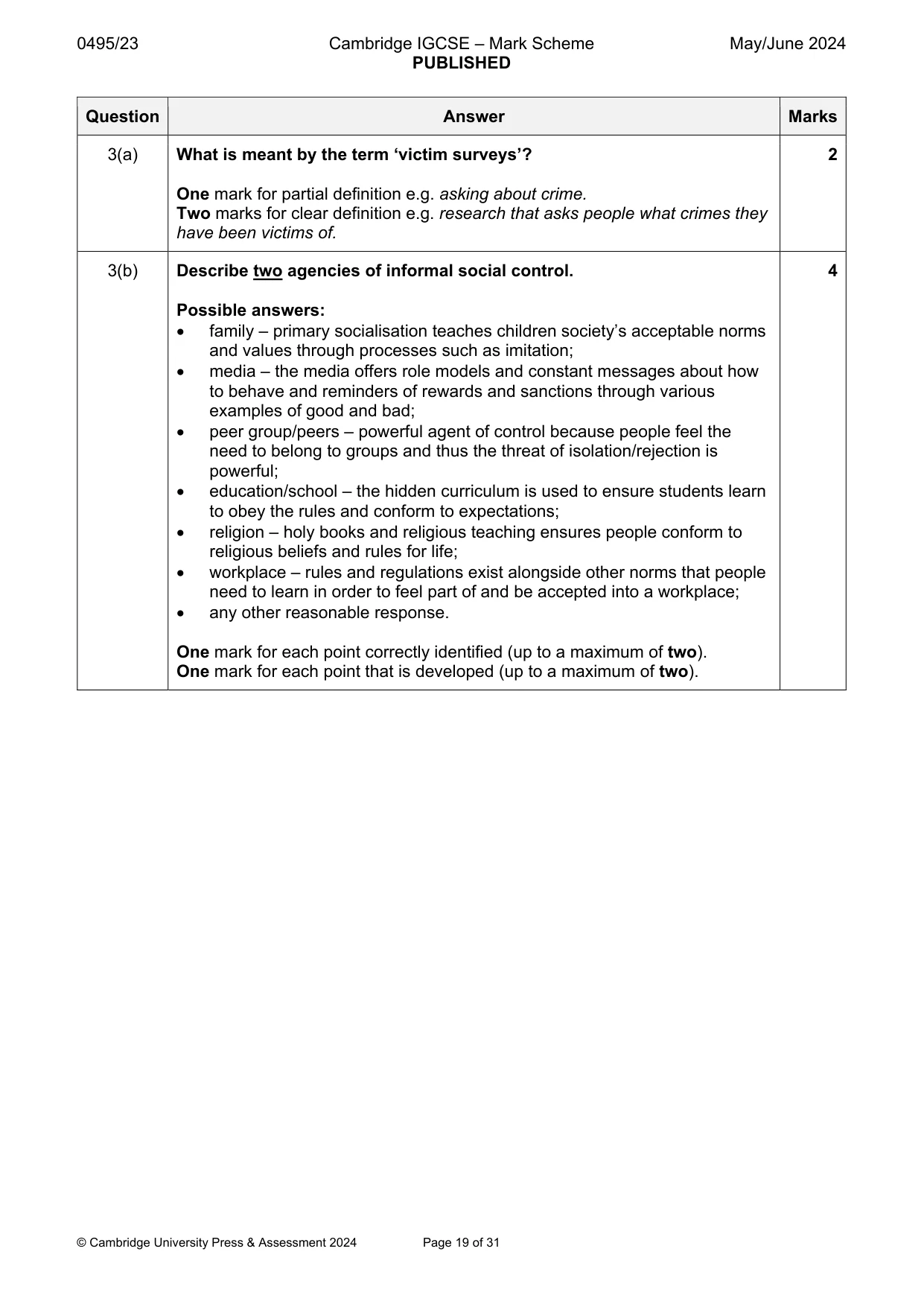
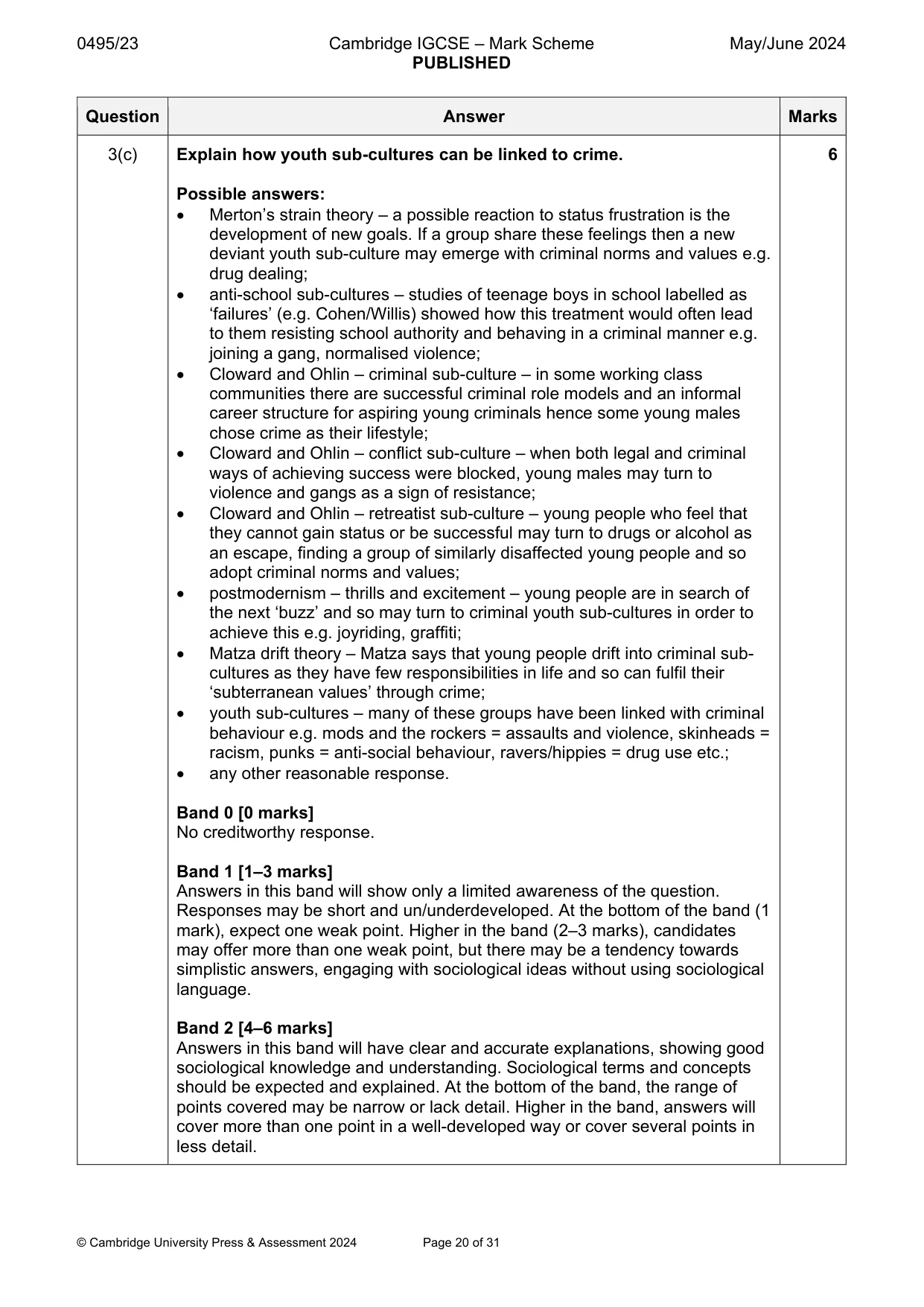
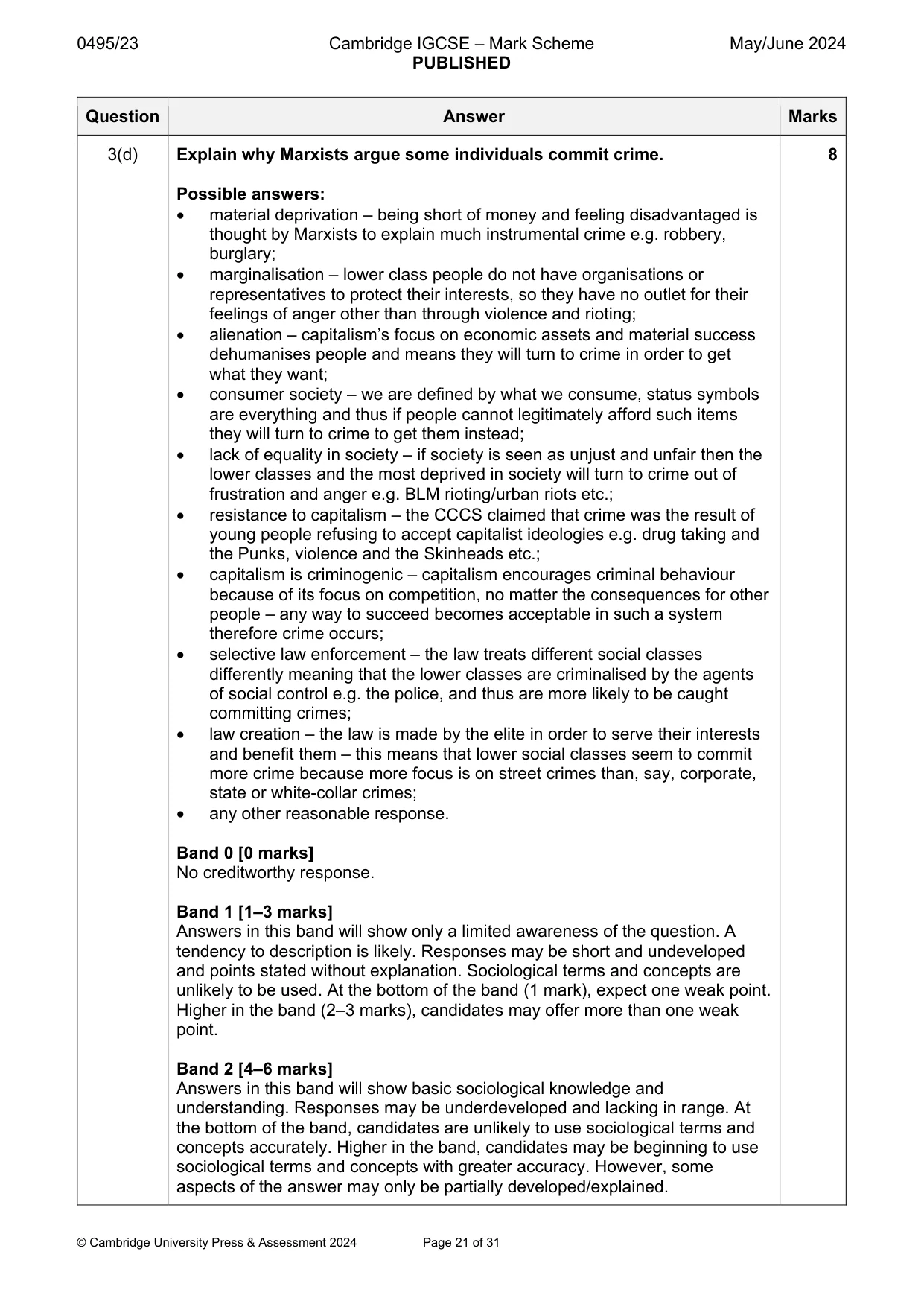
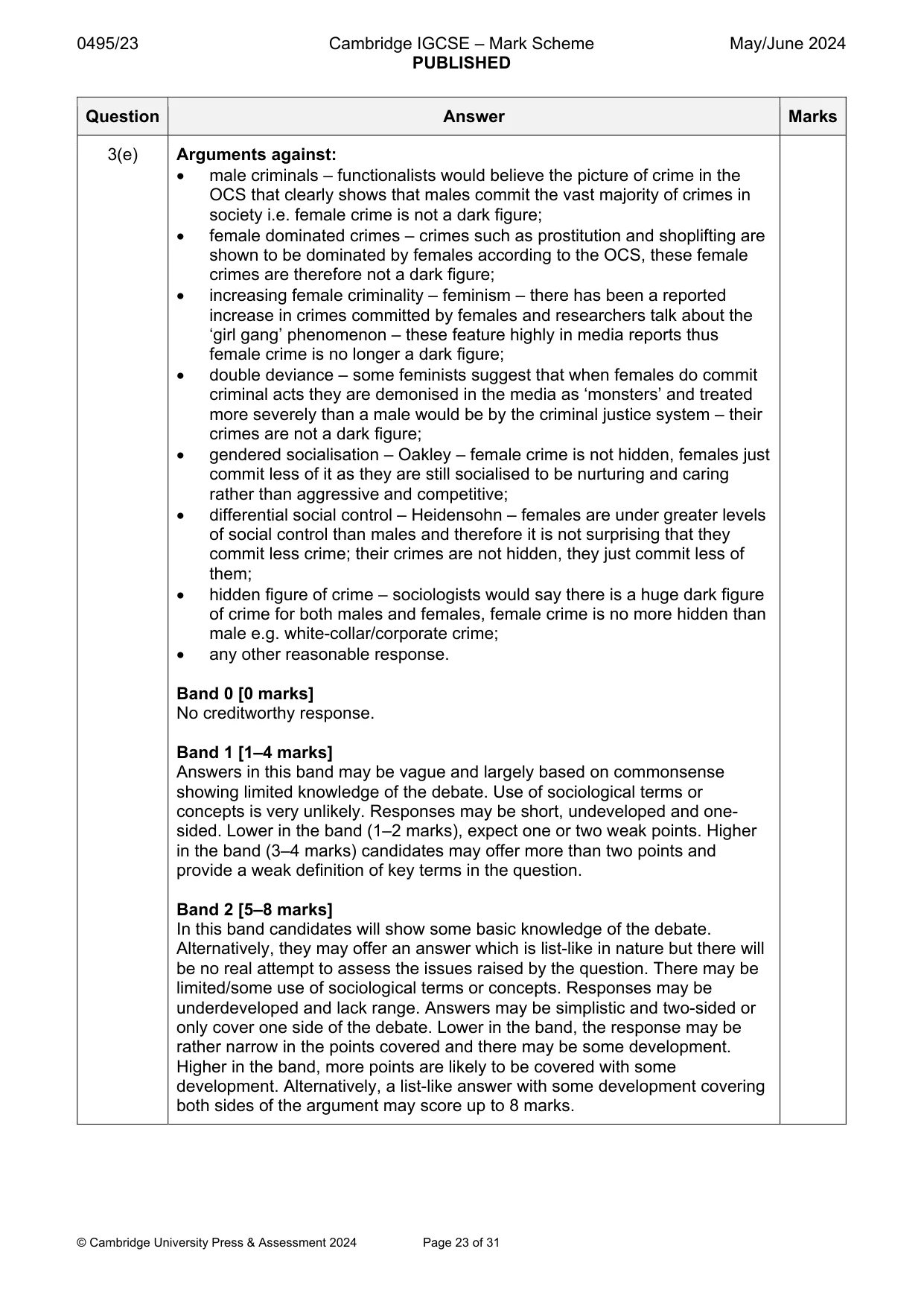
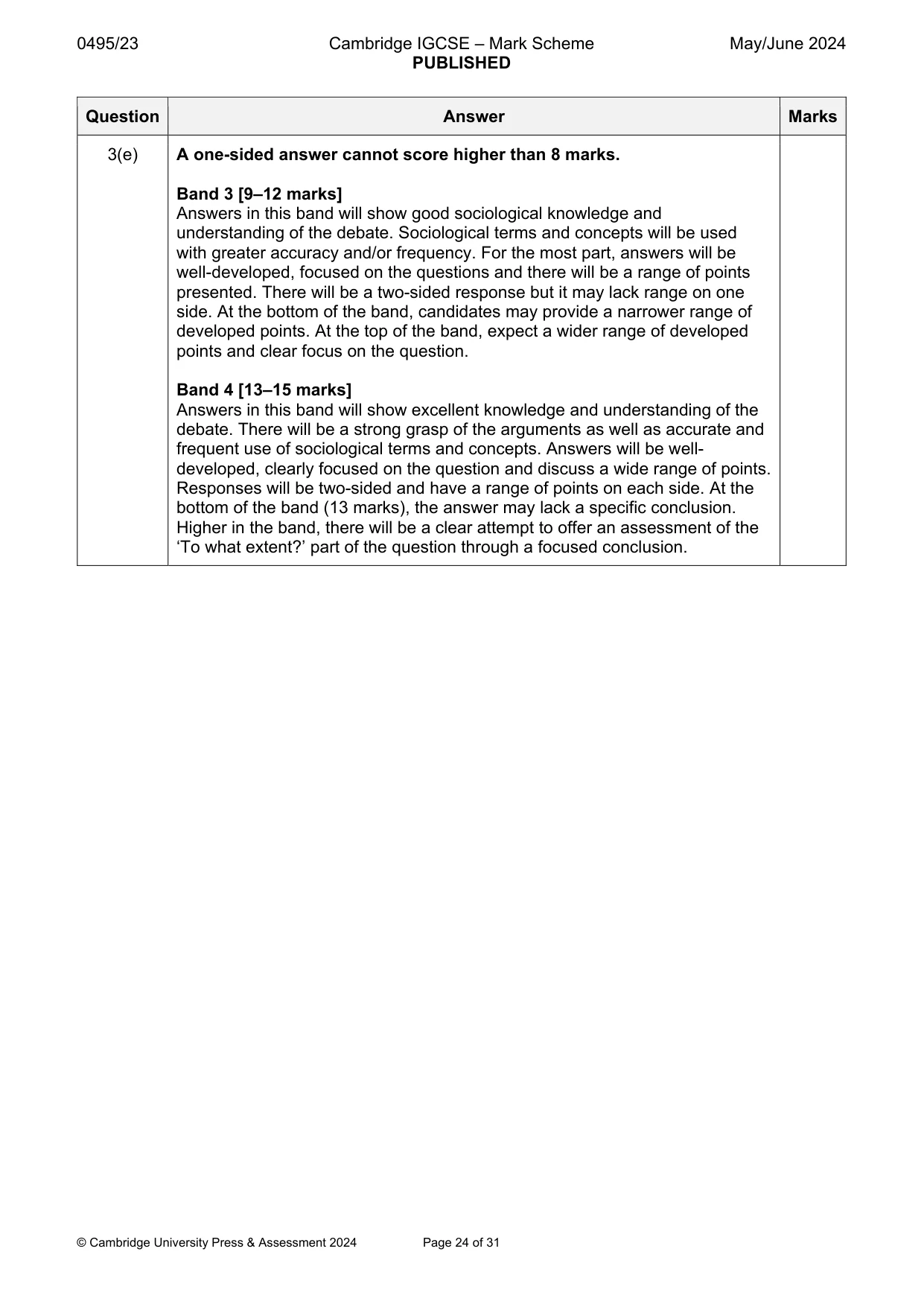
Mark scheme: 3(a) What is meant by the term ‘victim surveys’? 2 One mark for partial definition e.g. asking about crime. Two marks for clear definition e.g. research that asks people what crimes they have been victims of. 3(b) Describe two agencies of informal social control. 4 Possible answers: family – primary socialisation teaches children society’s acceptable norms and values through processes such as imitation; media – the media offers role models and constant messages about how to behave and reminders of rewards and sanctions through various examples of good and bad; peer group/peers – powerful agent of control because people feel the need to belong to groups and thus the threat of isolation/rejection is powerful; education/school – the hidden curriculum is used to ensure students learn to obey the rules and conform to expectations; religion – holy books and religious teaching ensures people conform to religious beliefs and rules for life; workplace – rules and regulations exist alongside other norms that people need to learn in order to feel part of and be accepted into a workplace; any other reasonable response. One mark for each point correctly identified (up to a maximum of two). One mark for each point that is developed (up to a maximum of two). 3(c) Explain how youth sub-cultures can be linked to crime. 6 Possible answers: Merton’s strain theory – a possible reaction to status frustration is the development of new goals. If a group share these feelings then a new deviant youth sub-culture may emerge with criminal norms and values e.g. drug dealing; anti-school sub-cultures – studies of teenage boys in school labelled as ‘failures’ (e.g. Cohen/Willis) showed how this treatment would often lead to them resisting school authority and behaving in a criminal manner e.g. joining a gang, normalised violence; Cloward and Ohlin – criminal sub-culture – in some working class communities there are successful criminal role models and an informal career structure for aspiring young criminals hence some young males chose crime as their lifestyle; Cloward and Ohlin – conflict sub-culture – when both legal and criminal ways of achieving success were blocked, young males may turn to violence and gangs as a sign of resistance; Cloward and Ohlin – retreatist sub-culture – young people who feel that they cannot gain status or be successful may turn to drugs or alcohol as an escape, finding a group of similarly disaffected young people and so adopt criminal norms and values; postmodernism – thrills and excitement – young people are in search of the next ‘buzz’ and so may turn to criminal youth sub-cultures in order to achieve this e.g. joyriding, graffiti; Matza drift theory – Matza says that young people drift into criminal sub- cultures as they have few responsibilities in life and so can fulfil their ‘subterranean values’ through crime; youth sub-cultures – many of these groups have been linked with criminal behaviour e.g. mods and the rockers = assaults and violence, skinheads = racism, punks = anti-social behaviour, ravers/hippies = drug use etc.; any other reasonable response. Band 0 [0 marks] No creditworthy response. Band 1 [1–3 marks] Answers in this band will show only a limited awareness of the question. Responses may be short and un/underdeveloped. At the bottom of the band (1 mark), expect one weak point. Higher in the band (2–3 marks), candidates may offer more than one weak point, but there may be a tendency towards simplistic answers, engaging with sociological ideas without using sociological language. Band 2 [4–6 marks] Answers in this band will have clear and accurate explanations, showing good sociological knowledge and understanding. Sociological terms and concepts should be expected and explained. At the bottom of the band, the range of points covered may be narrow or lack detail. Higher in the band, answers will cover more than one point in a well-developed way or cover several points in less detail. 3(d) Explain why Marxists argue some individuals commit crime. 8 Possible answers: material deprivation – being short of money and feeling disadvantaged is thought by Marxists to explain much instrumental crime e.g. robbery, burglary; marginalisation – lower class people do not have organisations or representatives to protect their interests, so they have no outlet for their feelings of anger other than through violence and rioting; alienation – capitalism’s focus on economic assets and material success dehumanises people and means they will turn to crime in order to get what they want; consumer society – we are defined by what we consume, status symbols are everything and thus if people cannot legitimately afford such items they will turn to crime to get them instead; lack of equality in society – if society is seen as unjust and unfair then the lower classes and the most deprived in society will turn to crime out of frustration and anger e.g. BLM rioting/urban riots etc.; resistance to capitalism – the CCCS claimed that crime was the result of young people refusing to accept capitalist ideologies e.g. drug taking and the Punks, violence and the Skinheads etc.; capitalism is criminogenic – capitalism encourages criminal behaviour because of its focus on competition, no matter the consequences for other people – any way to succeed becomes acceptable in such a system therefore crime occurs; selective law enforcement – the law treats different social classes differently meaning that the lower classes are criminalised by the agents of social control e.g. the police, and thus are more likely to be caught committing crimes; law creation – the law is made by the elite in order to serve their interests and benefit them – this means that lower social classes seem to commit more crime because more focus is on street crimes than, say, corporate, state or white-collar crimes; any other reasonable response. Band 0 [0 marks] No creditworthy response. Band 1 [1–3 marks] Answers in this band will show only a limited awareness of the question. A tendency to description is likely. Responses may be short and undeveloped and points stated without explanation. Sociological terms and concepts are unlikely to be used. At the bottom of the band (1 mark), expect one weak point. Higher in the band (2–3 marks), candidates may offer more than one weak point. Band 2 [4–6 marks] Answers in this band will show basic sociological knowledge and understanding. Responses may be underdeveloped and lacking in range. At the bottom of the band, candidates are unlikely to use sociological terms and concepts accurately. Higher in the band, candidates may be beginning to use sociological terms and concepts with greater accuracy. However, some aspects of the answer may only be partially developed/explained. 3(d) Band 3 [7–8 marks] Answers in this band will show good sociological knowledge and understanding and will be well-developed and explained. Sociological terms and concepts will be used accurately overall. Answers will be well-focused on the question and there will be a range of points presented. At the top of the band explanations will be clear throughout. 3(e) To what extent is there a dark figure of female crime? 15 Possible answers: Arguments for: Pollak – his work suggested that females were more manipulative and devious than males and so were better able to hide their criminality hence the low figures in the OCS; Pollak – chivalry – this thesis suggests that females get away with crime because men find it impossible to equate a hardened criminal with the stereotype of a gentle, caring female – thus there is a dark figure of female crime because they receive more lenient treatment from law enforcement agencies than a male would; self-report studies – e.g. Campbell – these show that rates of female offending are far higher than official figures suggest, meaning female crime is hidden in the dark figure; white-collar crime – this type of crime is notoriously under-reported and as women dominate office work it is likely that they are getting away with much white-collar crime i.e. a dark figure of female crime; police labelling – as females do not fit Cicourel’s picture of the ‘typical delinquent’ they are unlikely to be targeted by the police and thus are more likely to get away with committing crime = a dark figure (Interactionism); victimless crime – females are said to play a major role in the sex industry (as prostitutes and escorts) and the drugs industry (as mules); because there are no traditional victims of these crimes i.e. people are paying for the service, they are unlikely to be reported and thus female crime remains hidden in the ‘dark figure’; domestic abuse – crimes against women in the home form a huge dark figure and thus are hidden as they are notoriously under-reported and under-recorded by the police (Dobash and Dobash); media representations – the media still portray traditional stereotypes of males and females and therefore women are unlikely to be represented as a criminal, more so as a victim. This agenda setting affects public perception of who the criminals are resulting in a dark figure of female crime as females are just not suspected to be or thought of as criminal; domestic setting – women are still located primarily in the private sphere and so, whether criminals or victims, their actions and experiences are more hidden than those in the public sphere (which is still dominated by males); any other reasonable response. 3(e) Arguments against: male criminals – functionalists would believe the picture of crime in the OCS that clearly shows that males commit the vast majority of crimes in society i.e. female crime is not a dark figure; female dominated crimes – crimes such as prostitution and shoplifting are shown to be dominated by females according to the OCS, these female crimes are therefore not a dark figure; increasing female criminality – feminism – there has been a reported increase in crimes committed by females and researchers talk about the ‘girl gang’ phenomenon – these feature highly in media reports thus female crime is no longer a dark figure; double deviance – some feminists suggest that when females do commit criminal acts they are demonised in the media as ‘monsters’ and treated more severely than a male would be by the criminal justice system – their crimes are not a dark figure; gendered socialisation – Oakley – female crime is not hidden, females just commit less of it as they are still socialised to be nurturing and caring rather than aggressive and competitive; differential social control – Heidensohn – females are under greater levels of social control than males and therefore it is not surprising that they commit less crime; their crimes are not hidden, they just commit less of them; hidden figure of crime – sociologists would say there is a huge dark figure of crime for both males and females, female crime is no more hidden than male e.g. white-collar/corporate crime; any other reasonable response. Band 0 [0 marks] No creditworthy response. Band 1 [1–4 marks] Answers in this band may be vague and largely based on commonsense showing limited knowledge of the debate. Use of sociological terms or concepts is very unlikely. Responses may be short, undeveloped and one- sided. Lower in the band (1–2 marks), expect one or two weak points. Higher in the band (3–4 marks) candidates may offer more than two points and provide a weak definition of key terms in the question. Band 2 [5–8 marks] In this band candidates will show some basic knowledge of the debate. Alternatively, they may offer an answer which is list-like in nature but there will be no real attempt to assess the issues raised by the question. There may be limited/some use of sociological terms or concepts. Responses may be underdeveloped and lack range. Answers may be simplistic and two-sided or only cover one side of the debate. Lower in the band, the response may be rather narrow in the points covered and there may be some development. Higher in the band, more points are likely to be covered with some development. Alternatively, a list-like answer with some development covering both sides of the argument may score up to 8 marks. 3(e) A one-sided answer cannot score higher than 8 marks. Band 3 [9–12 marks] Answers in this band will show good sociological knowledge and understanding of the debate. Sociological terms and concepts will be used with greater accuracy and/or frequency. For the most part, answers will be well-developed, focused on the questions and there will be a range of points presented. There will be a two-sided response but it may lack range on one side. At the bottom of the band, candidates may provide a narrower range of developed points. At the top of the band, expect a wider range of developed points and clear focus on the question. Band 4 [13–15 marks] Answers in this band will show excellent knowledge and understanding of the debate. There will be a strong grasp of the arguments as well as accurate and frequent use of sociological terms and concepts. Answers will be well- developed, clearly focused on the question and discuss a wide range of points. Responses will be two-sided and have a range of points on each side. At the bottom of the band (13 marks), the answer may lack a specific conclusion. Higher in the band, there will be a clear attempt to offer an assessment of the ‘To what extent?’ part of the question through a focused conclusion.
More questions on What types of data and evidence do sociologists use?
Q4 · There are many perspectives on the media, such as Marxist and feminist views
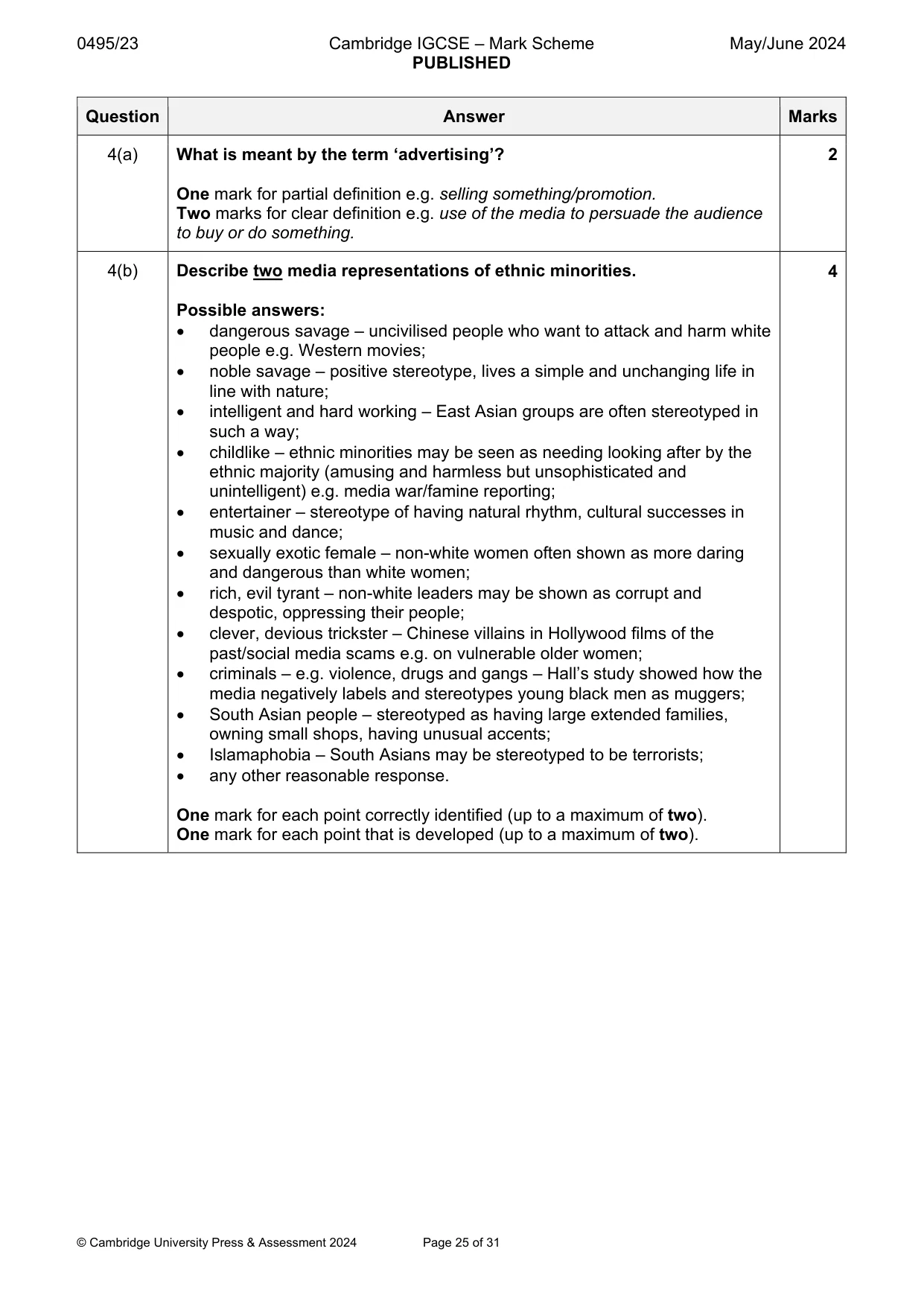
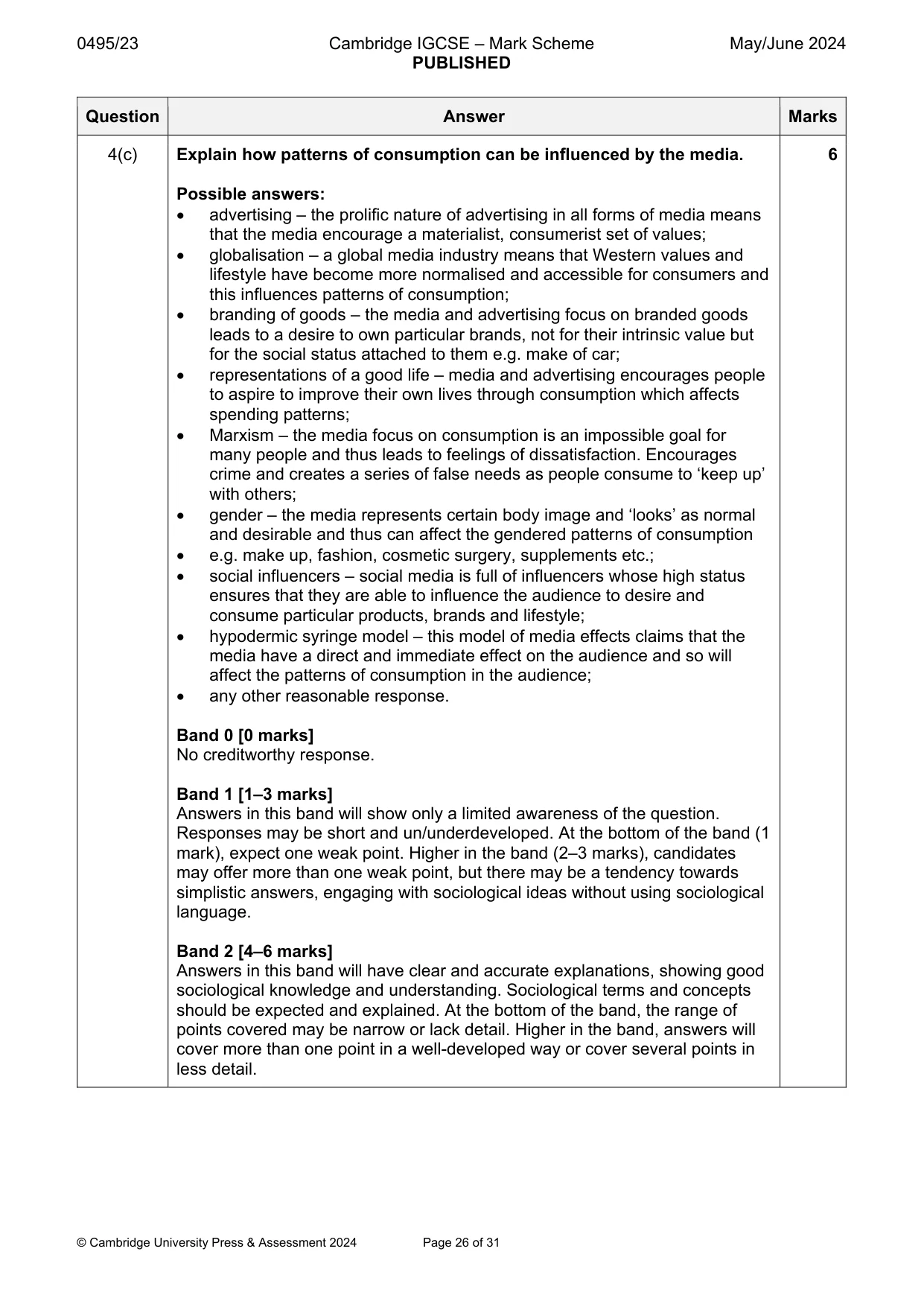
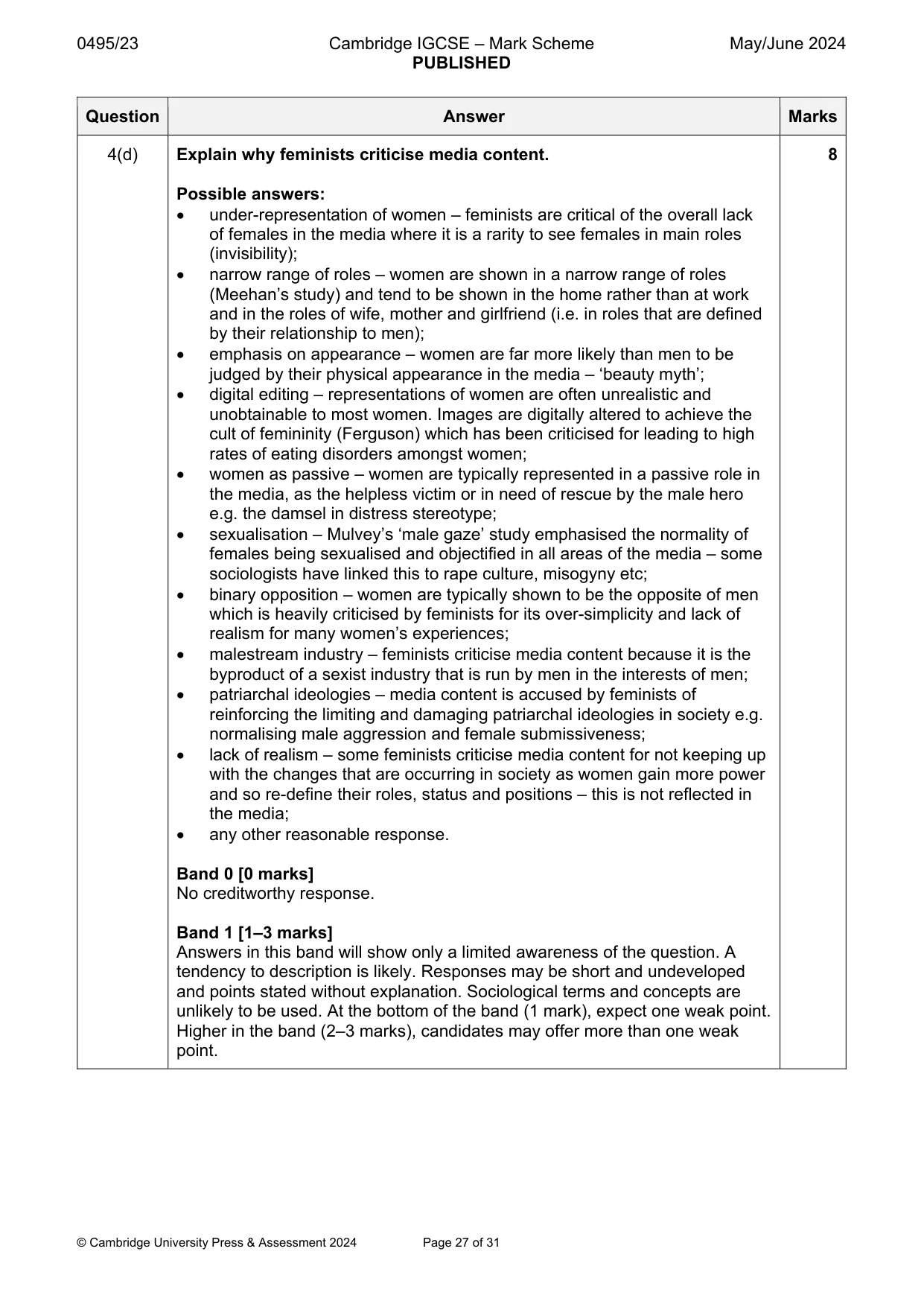
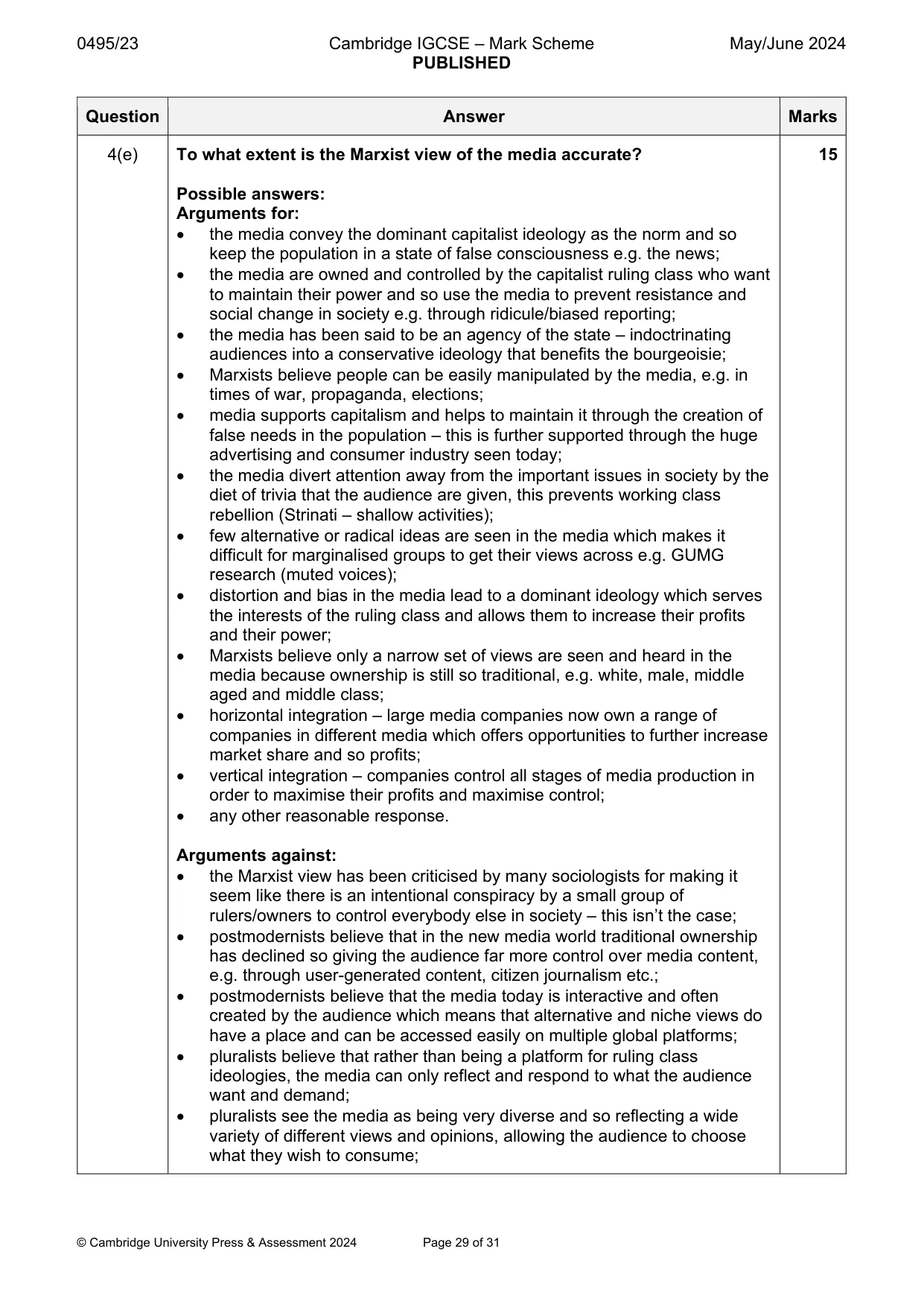
4 There are many perspectives on the media, such as Marxist and feminist views. The media represents social groups, such as ethnic minorities and youth, in different ways. The media has different roles, for example advertising and entertainment. Patterns of consumption can be influenced by the various forms of media. (a) What is meant by the term ‘advertising’? [2] (b) Describe two media representations of ethnic minorities. [4] (c) Explain how patterns of consumption can be influenced by the media. [6] (d) Explain why feminists criticise media content. [8] (e) To what extent is the Marxist view of the media accurate? [15]
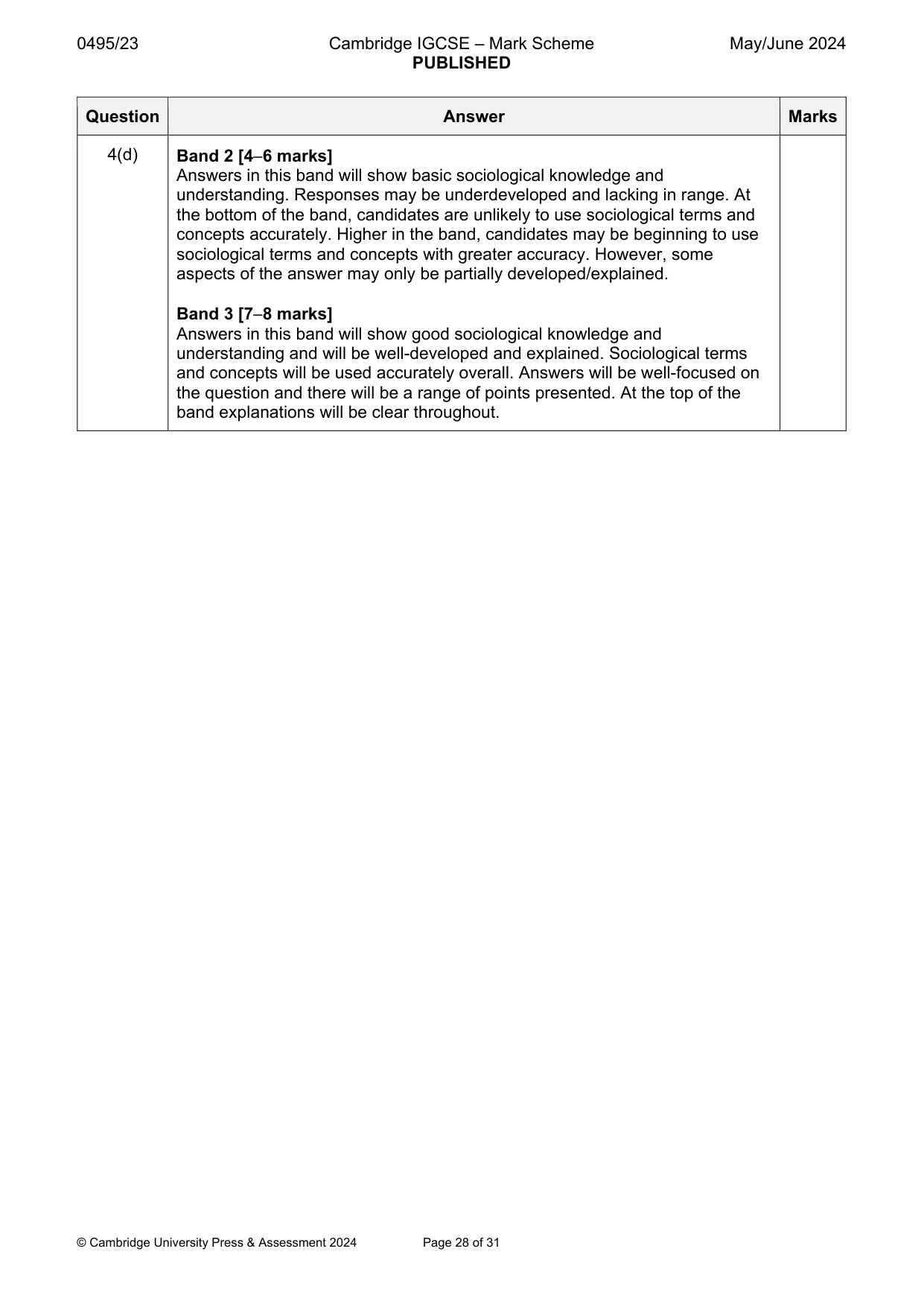
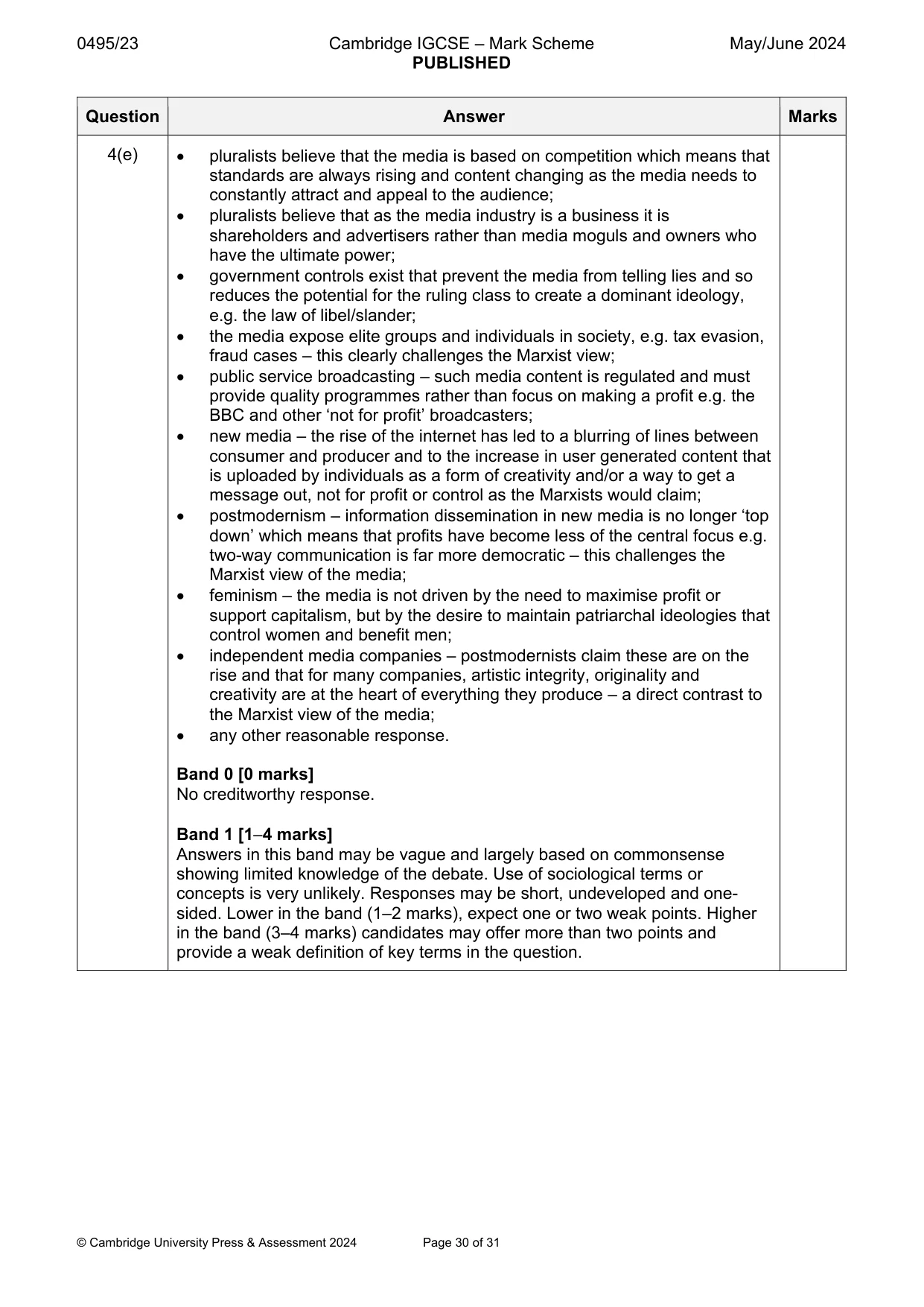
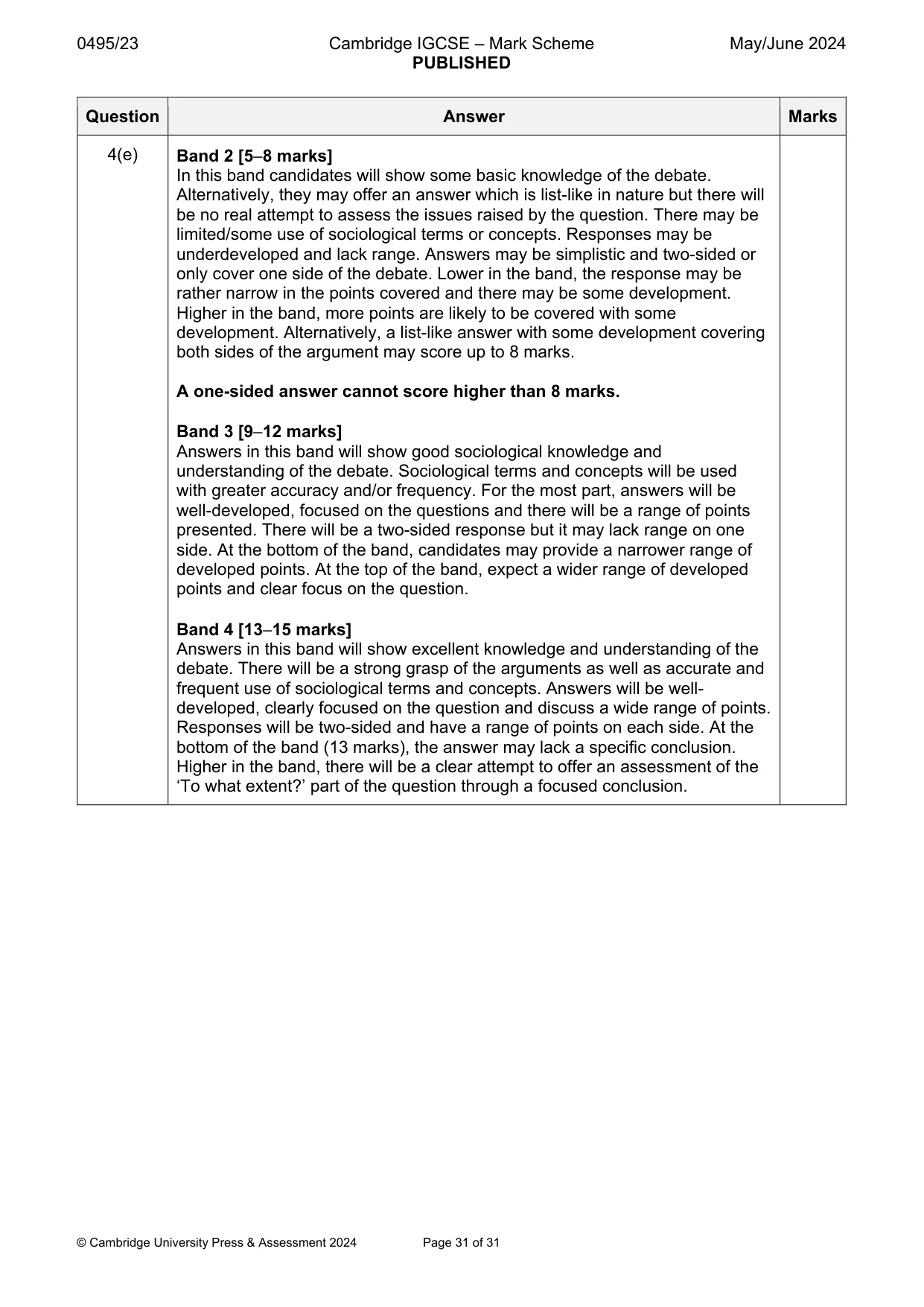
Mark scheme: 4(a) What is meant by the term ‘advertising’? 2 One mark for partial definition e.g. selling something/promotion. Two marks for clear definition e.g. use of the media to persuade the audience to buy or do something. 4(b) Describe two media representations of ethnic minorities. 4 Possible answers: dangerous savage – uncivilised people who want to attack and harm white people e.g. Western movies; noble savage – positive stereotype, lives a simple and unchanging life in line with nature; intelligent and hard working – East Asian groups are often stereotyped in such a way; childlike – ethnic minorities may be seen as needing looking after by the ethnic majority (amusing and harmless but unsophisticated and unintelligent) e.g. media war/famine reporting; entertainer – stereotype of having natural rhythm, cultural successes in music and dance; sexually exotic female – non-white women often shown as more daring and dangerous than white women; rich, evil tyrant – non-white leaders may be shown as corrupt and despotic, oppressing their people; clever, devious trickster – Chinese villains in Hollywood films of the past/social media scams e.g. on vulnerable older women; criminals – e.g. violence, drugs and gangs – Hall’s study showed how the media negatively labels and stereotypes young black men as muggers; South Asian people – stereotyped as having large extended families, owning small shops, having unusual accents; Islamaphobia – South Asians may be stereotyped to be terrorists; any other reasonable response. One mark for each point correctly identified (up to a maximum of two). One mark for each point that is developed (up to a maximum of two). 4(c) Explain how patterns of consumption can be influenced by the media. 6 Possible answers: advertising – the prolific nature of advertising in all forms of media means that the media encourage a materialist, consumerist set of values; globalisation – a global media industry means that Western values and lifestyle have become more normalised and accessible for consumers and this influences patterns of consumption; branding of goods – the media and advertising focus on branded goods leads to a desire to own particular brands, not for their intrinsic value but for the social status attached to them e.g. make of car; representations of a good life – media and advertising encourages people to aspire to improve their own lives through consumption which affects spending patterns; Marxism – the media focus on consumption is an impossible goal for many people and thus leads to feelings of dissatisfaction. Encourages crime and creates a series of false needs as people consume to ‘keep up’ with others; gender – the media represents certain body image and ‘looks’ as normal and desirable and thus can affect the gendered patterns of consumption e.g. make up, fashion, cosmetic surgery, supplements etc.; social influencers – social media is full of influencers whose high status ensures that they are able to influence the audience to desire and consume particular products, brands and lifestyle; hypodermic syringe model – this model of media effects claims that the media have a direct and immediate effect on the audience and so will affect the patterns of consumption in the audience; any other reasonable response. Band 0 [0 marks] No creditworthy response. Band 1 [1–3 marks] Answers in this band will show only a limited awareness of the question. Responses may be short and un/underdeveloped. At the bottom of the band (1 mark), expect one weak point. Higher in the band (2–3 marks), candidates may offer more than one weak point, but there may be a tendency towards simplistic answers, engaging with sociological ideas without using sociological language. Band 2 [4–6 marks] Answers in this band will have clear and accurate explanations, showing good sociological knowledge and understanding. Sociological terms and concepts should be expected and explained. At the bottom of the band, the range of points covered may be narrow or lack detail. Higher in the band, answers will cover more than one point in a well-developed way or cover several points in less detail. 4(d) Explain why feminists criticise media content. 8 Possible answers: under-representation of women – feminists are critical of the overall lack of females in the media where it is a rarity to see females in main roles (invisibility); narrow range of roles – women are shown in a narrow range of roles (Meehan’s study) and tend to be shown in the home rather than at work and in the roles of wife, mother and girlfriend (i.e. in roles that are defined by their relationship to men); emphasis on appearance – women are far more likely than men to be judged by their physical appearance in the media – ‘beauty myth’; digital editing – representations of women are often unrealistic and unobtainable to most women. Images are digitally altered to achieve the cult of femininity (Ferguson) which has been criticised for leading to high rates of eating disorders amongst women; women as passive – women are typically represented in a passive role in the media, as the helpless victim or in need of rescue by the male hero e.g. the damsel in distress stereotype; sexualisation – Mulvey’s ‘male gaze’ study emphasised the normality of females being sexualised and objectified in all areas of the media – some sociologists have linked this to rape culture, misogyny etc; binary opposition – women are typically shown to be the opposite of men which is heavily criticised by feminists for its over-simplicity and lack of realism for many women’s experiences; malestream industry – feminists criticise media content because it is the byproduct of a sexist industry that is run by men in the interests of men; patriarchal ideologies – media content is accused by feminists of reinforcing the limiting and damaging patriarchal ideologies in society e.g. normalising male aggression and female submissiveness; lack of realism – some feminists criticise media content for not keeping up with the changes that are occurring in society as women gain more power and so re-define their roles, status and positions – this is not reflected in the media; any other reasonable response. Band 0 [0 marks] No creditworthy response. Band 1 [1–3 marks] Answers in this band will show only a limited awareness of the question. A tendency to description is likely. Responses may be short and undeveloped and points stated without explanation. Sociological terms and concepts are unlikely to be used. At the bottom of the band (1 mark), expect one weak point. Higher in the band (2–3 marks), candidates may offer more than one weak point. 4(d) Band 2 [46 marks] Answers in this band will show basic sociological knowledge and understanding. Responses may be underdeveloped and lacking in range. At the bottom of the band, candidates are unlikely to use sociological terms and concepts accurately. Higher in the band, candidates may be beginning to use sociological terms and concepts with greater accuracy. However, some aspects of the answer may only be partially developed/explained. Band 3 [78 marks] Answers in this band will show good sociological knowledge and understanding and will be well-developed and explained. Sociological terms and concepts will be used accurately overall. Answers will be well-focused on the question and there will be a range of points presented. At the top of the band explanations will be clear throughout. 4(e) To what extent is the Marxist view of the media accurate? 15 Possible answers: Arguments for: the media convey the dominant capitalist ideology as the norm and so keep the population in a state of false consciousness e.g. the news; the media are owned and controlled by the capitalist ruling class who want to maintain their power and so use the media to prevent resistance and social change in society e.g. through ridicule/biased reporting; the media has been said to be an agency of the state – indoctrinating audiences into a conservative ideology that benefits the bourgeoisie; Marxists believe people can be easily manipulated by the media, e.g. in times of war, propaganda, elections; media supports capitalism and helps to maintain it through the creation of false needs in the population – this is further supported through the huge advertising and consumer industry seen today; the media divert attention away from the important issues in society by the diet of trivia that the audience are given, this prevents working class rebellion (Strinati – shallow activities); few alternative or radical ideas are seen in the media which makes it difficult for marginalised groups to get their views across e.g. GUMG research (muted voices); distortion and bias in the media lead to a dominant ideology which serves the interests of the ruling class and allows them to increase their profits and their power; Marxists believe only a narrow set of views are seen and heard in the media because ownership is still so traditional, e.g. white, male, middle aged and middle class; horizontal integration – large media companies now own a range of companies in different media which offers opportunities to further increase market share and so profits; vertical integration – companies control all stages of media production in order to maximise their profits and maximise control; any other reasonable response. Arguments against: the Marxist view has been criticised by many sociologists for making it seem like there is an intentional conspiracy by a small group of rulers/owners to control everybody else in society – this isn’t the case; postmodernists believe that in the new media world traditional ownership has declined so giving the audience far more control over media content, e.g. through user-generated content, citizen journalism etc.; postmodernists believe that the media today is interactive and often created by the audience which means that alternative and niche views do have a place and can be accessed easily on multiple global platforms; pluralists believe that rather than being a platform for ruling class ideologies, the media can only reflect and respond to what the audience want and demand; pluralists see the media as being very diverse and so reflecting a wide variety of different views and opinions, allowing the audience to choose what they wish to consume; 4(e) pluralists believe that the media is based on competition which means that standards are always rising and content changing as the media needs to constantly attract and appeal to the audience; pluralists believe that as the media industry is a business it is shareholders and advertisers rather than media moguls and owners who have the ultimate power; government controls exist that prevent the media from telling lies and so reduces the potential for the ruling class to create a dominant ideology, e.g. the law of libel/slander; the media expose elite groups and individuals in society, e.g. tax evasion, fraud cases – this clearly challenges the Marxist view; public service broadcasting – such media content is regulated and must provide quality programmes rather than focus on making a profit e.g. the BBC and other ‘not for profit’ broadcasters; new media – the rise of the internet has led to a blurring of lines between consumer and producer and to the increase in user generated content that is uploaded by individuals as a form of creativity and/or a way to get a message out, not for profit or control as the Marxists would claim; postmodernism – information dissemination in new media is no longer ‘top down’ which means that profits have become less of the central focus e.g. two-way communication is far more democratic – this challenges the Marxist view of the media; feminism – the media is not driven by the need to maximise profit or support capitalism, but by the desire to maintain patriarchal ideologies that control women and benefit men; independent media companies – postmodernists claim these are on the rise and that for many companies, artistic integrity, originality and creativity are at the heart of everything they produce – a direct contrast to the Marxist view of the media; any other reasonable response. Band 0 [0 marks] No creditworthy response. Band 1 [14 marks] Answers in this band may be vague and largely based on commonsense showing limited knowledge of the debate. Use of sociological terms or concepts is very unlikely. Responses may be short, undeveloped and one- sided. Lower in the band (1–2 marks), expect one or two weak points. Higher in the band (3–4 marks) candidates may offer more than two points and provide a weak definition of key terms in the question. 4(e) Band 2 [58 marks] In this band candidates will show some basic knowledge of the debate. Alternatively, they may offer an answer which is list-like in nature but there will be no real attempt to assess the issues raised by the question. There may be limited/some use of sociological terms or concepts. Responses may be underdeveloped and lack range. Answers may be simplistic and two-sided or only cover one side of the debate. Lower in the band, the response may be rather narrow in the points covered and there may be some development. Higher in the band, more points are likely to be covered with some development. Alternatively, a list-like answer with some development covering both sides of the argument may score up to 8 marks. A one-sided answer cannot score higher than 8 marks. Band 3 [912 marks] Answers in this band will show good sociological knowledge and understanding of the debate. Sociological terms and concepts will be used with greater accuracy and/or frequency. For the most part, answers will be well-developed, focused on the questions and there will be a range of points presented. There will be a two-sided response but it may lack range on one side. At the bottom of the band, candidates may provide a narrower range of developed points. At the top of the band, expect a wider range of developed points and clear focus on the question. Band 4 [1315 marks] Answers in this band will show excellent knowledge and understanding of the debate. There will be a strong grasp of the arguments as well as accurate and frequent use of sociological terms and concepts. Answers will be well- developed, clearly focused on the question and discuss a wide range of points. Responses will be two-sided and have a range of points on each side. At the bottom of the band (13 marks), the answer may lack a specific conclusion. Higher in the band, there will be a clear attempt to offer an assessment of the ‘To what extent?’ part of the question through a focused conclusion.
What was in this paper
The subtopics covered by these 4 questions, and how many questions each got. Open one in a new tab to see every Cambridge question on it.
What you needed in this session
Cambridge’s own grade thresholds for 2024 May/June, Paper 2 · Variant 3. A higher threshold means an easier paper — the bar moves with how the cohort did.