Cambridge IGCSE Sociology 0495 — 2019 May/June Paper 2 · Variant 2
0495/22/M/J/19 · 4 questions · 70 marks · ≈79 min
The question paper and its mark scheme, free to read here and free to download. This is Cambridge’s own paper, exactly as it was sat.
Question paper4 pages

Mark scheme27 pages
Answers below. Sit the paper first if you are practising.

Questions as text
Q1 · Family life is not always a positive experience for individuals
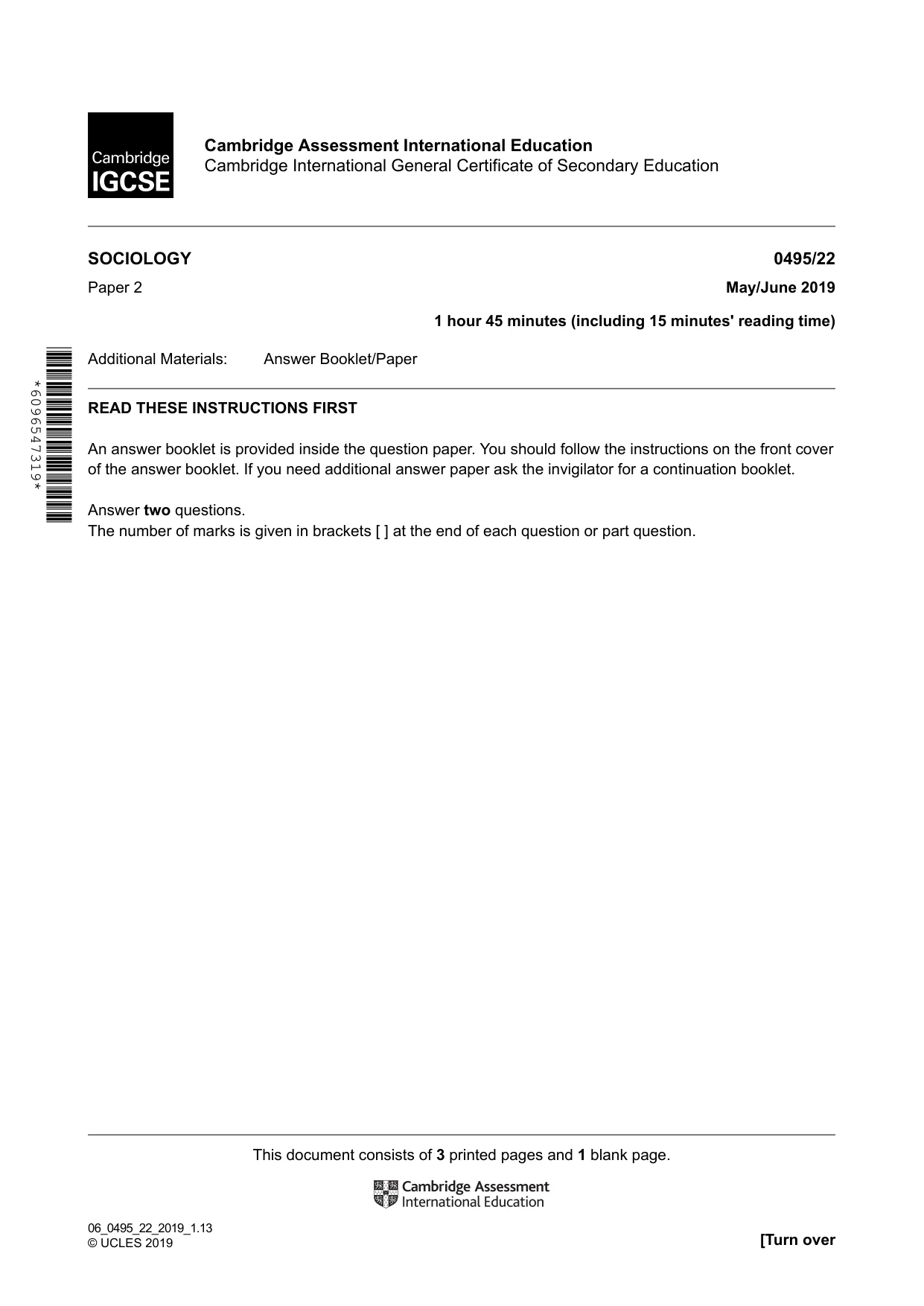
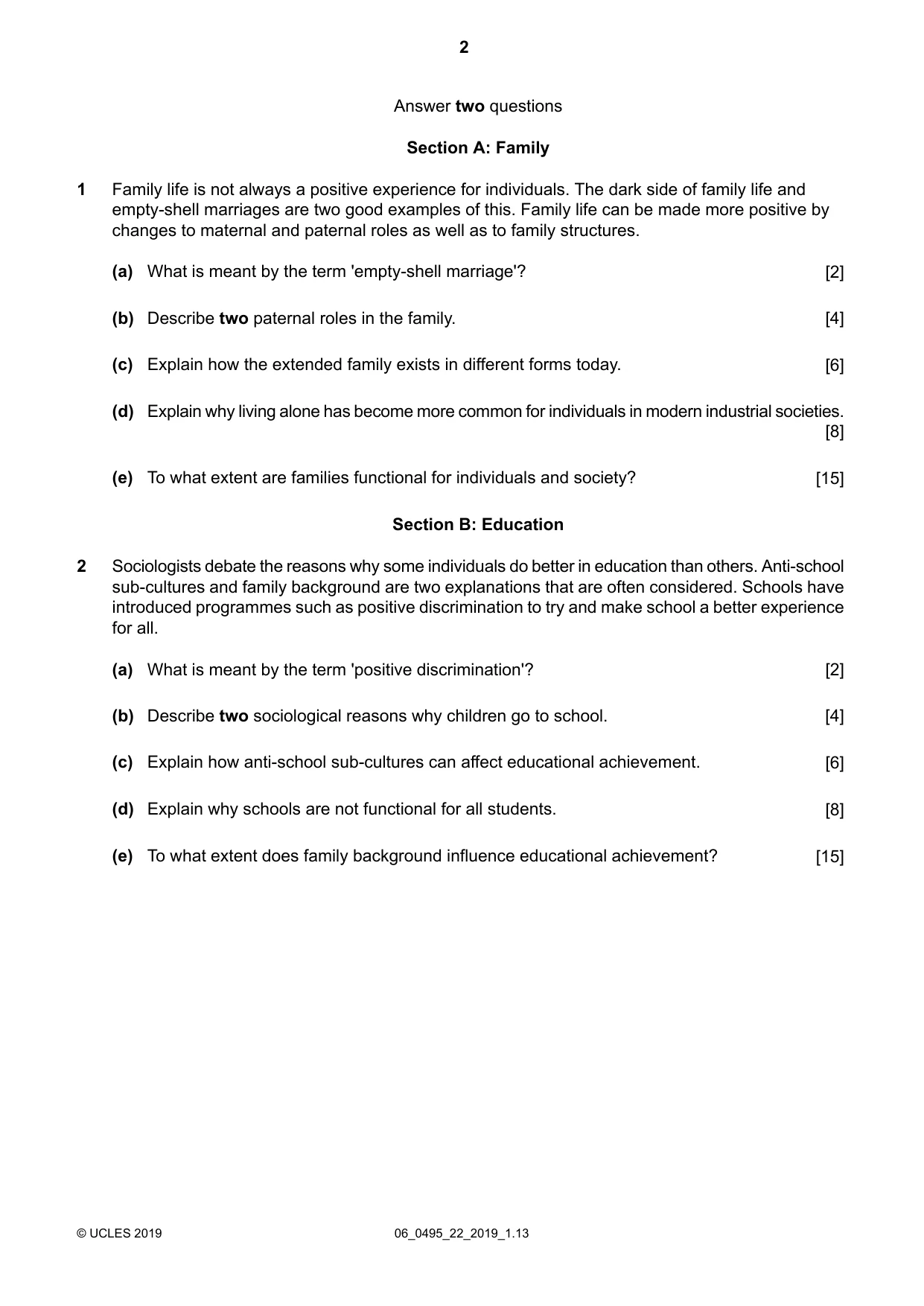
1 Family life is not always a positive experience for individuals. The dark side of family life and empty-shell marriages are two good examples of this. Family life can be made more positive by changes to maternal and paternal roles as well as to family structures. (a) What is meant by the term 'empty-shell marriage'? [2] (b) Describe two paternal roles in the family. [4] (c) Explain how the extended family exists in different forms today. [6] (d) Explain why living alone has become more common for individuals in modern industrial societies. [8] (e) To what extent are families functional for individuals and society? [15]
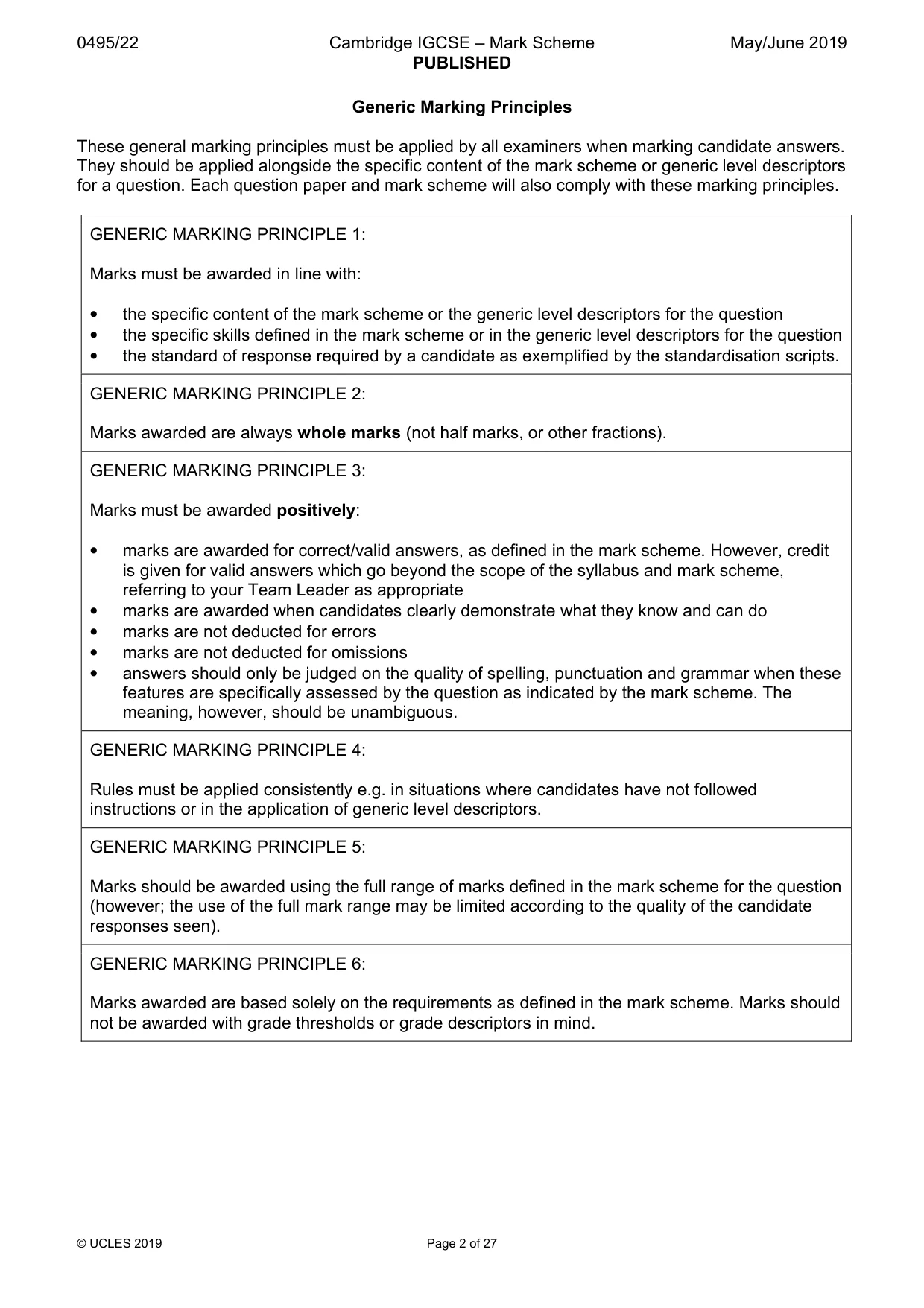
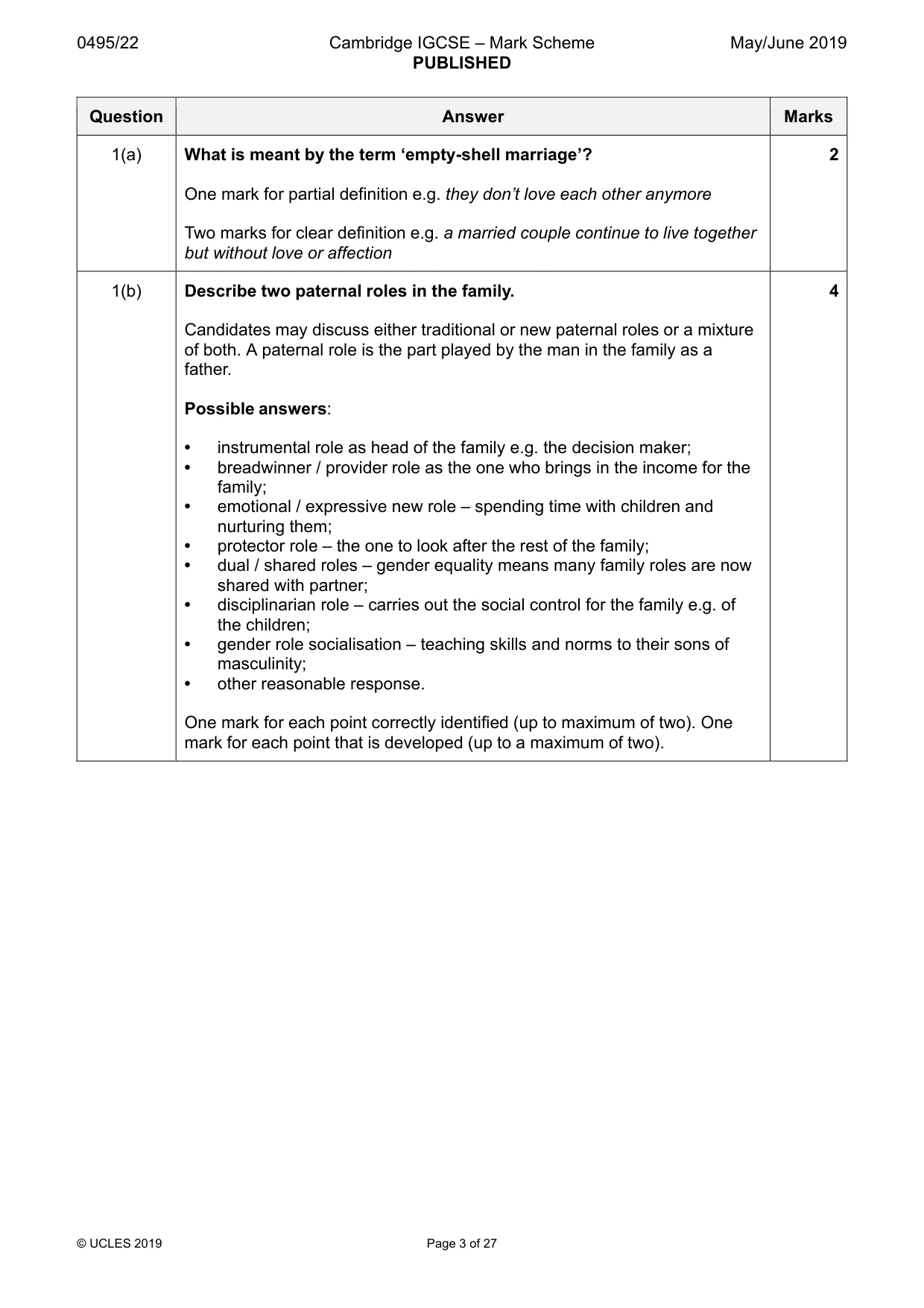
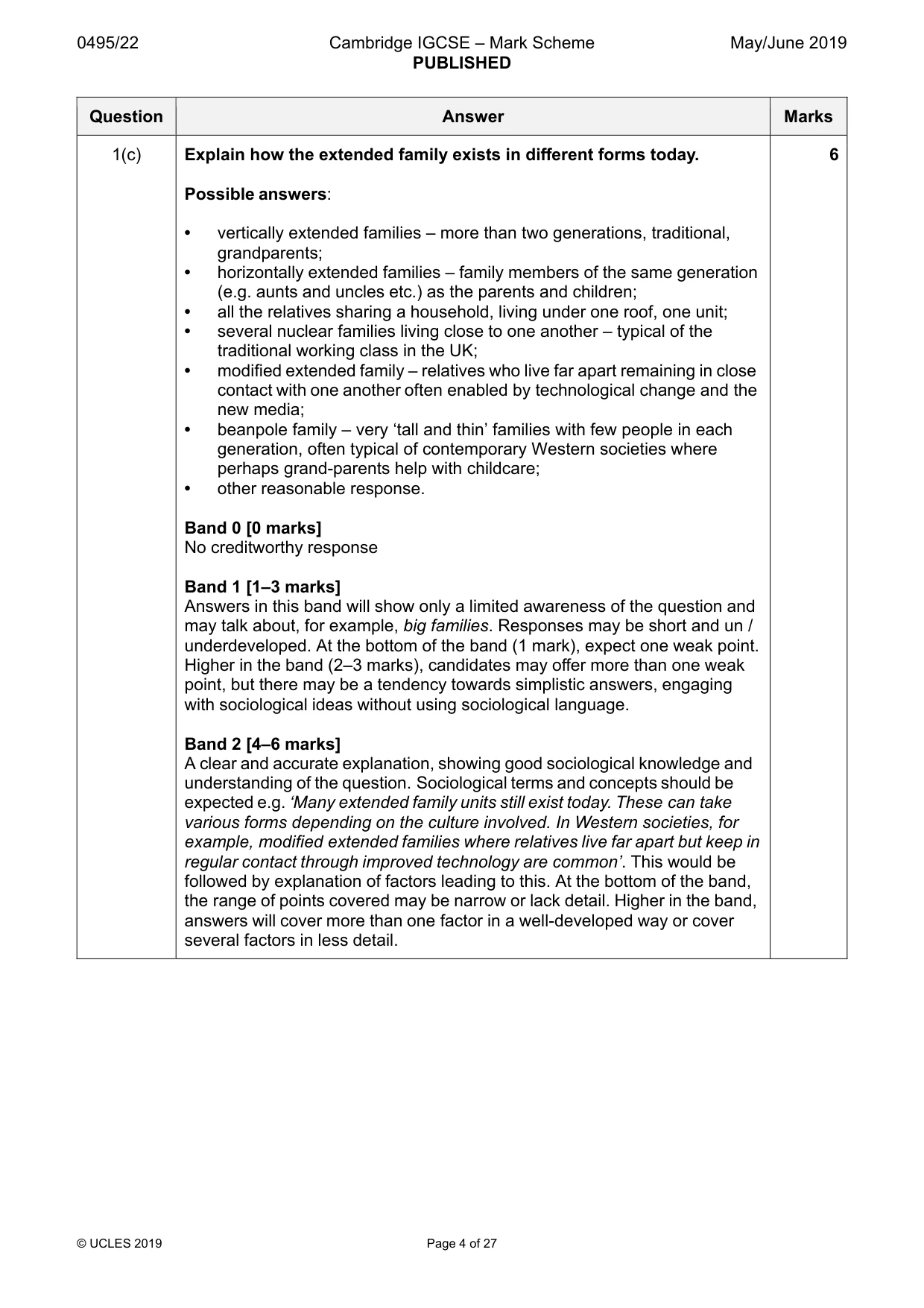
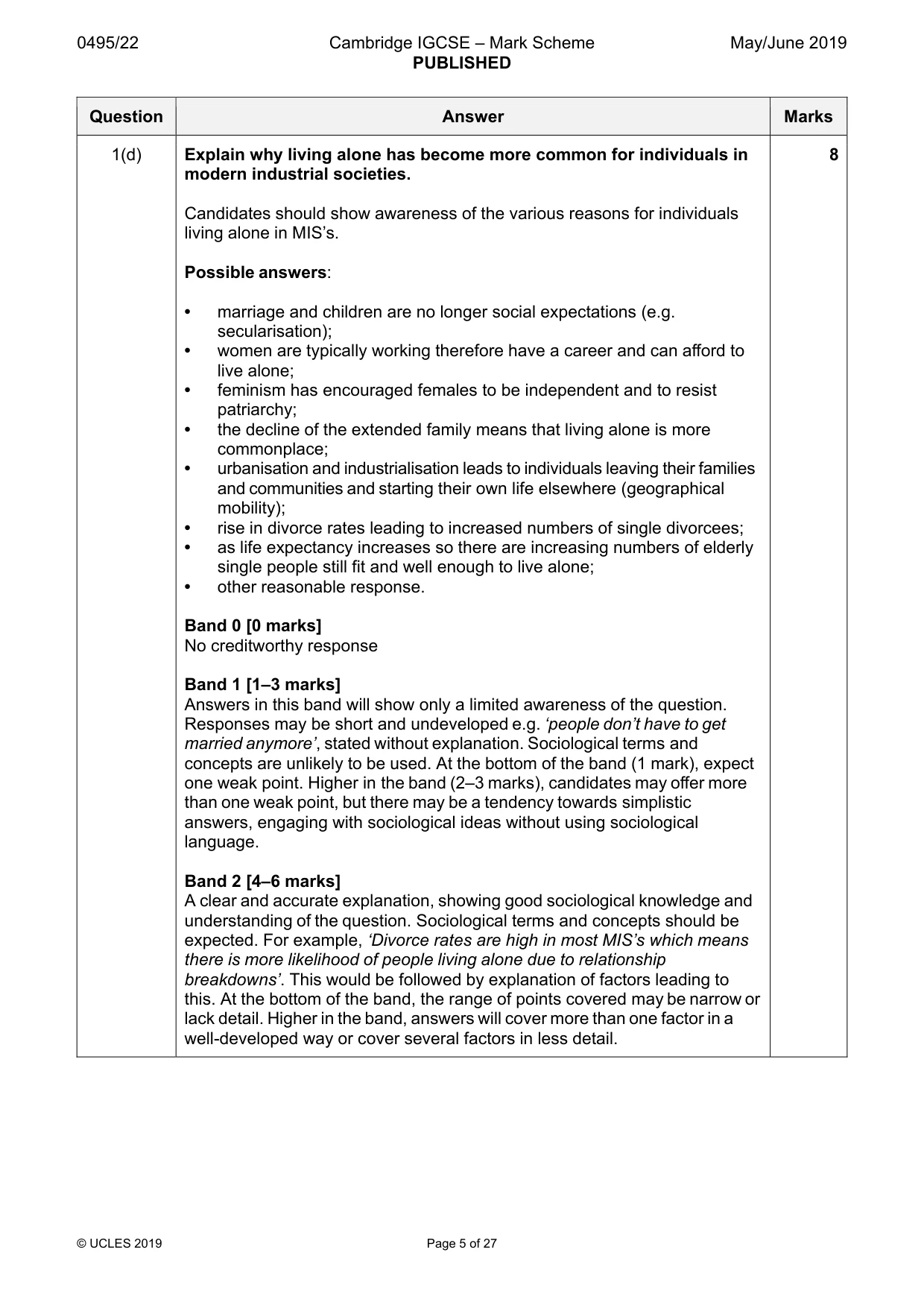
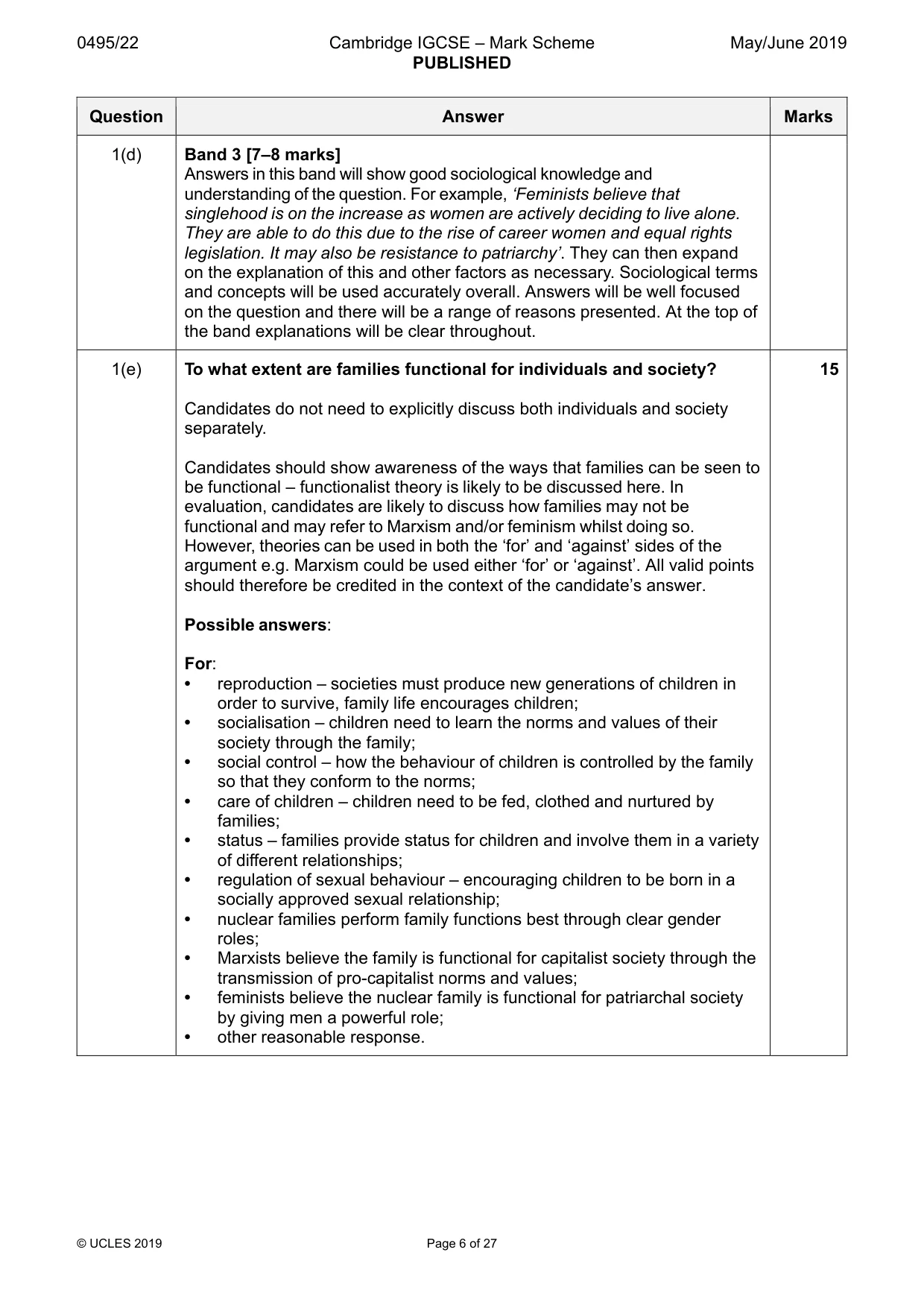
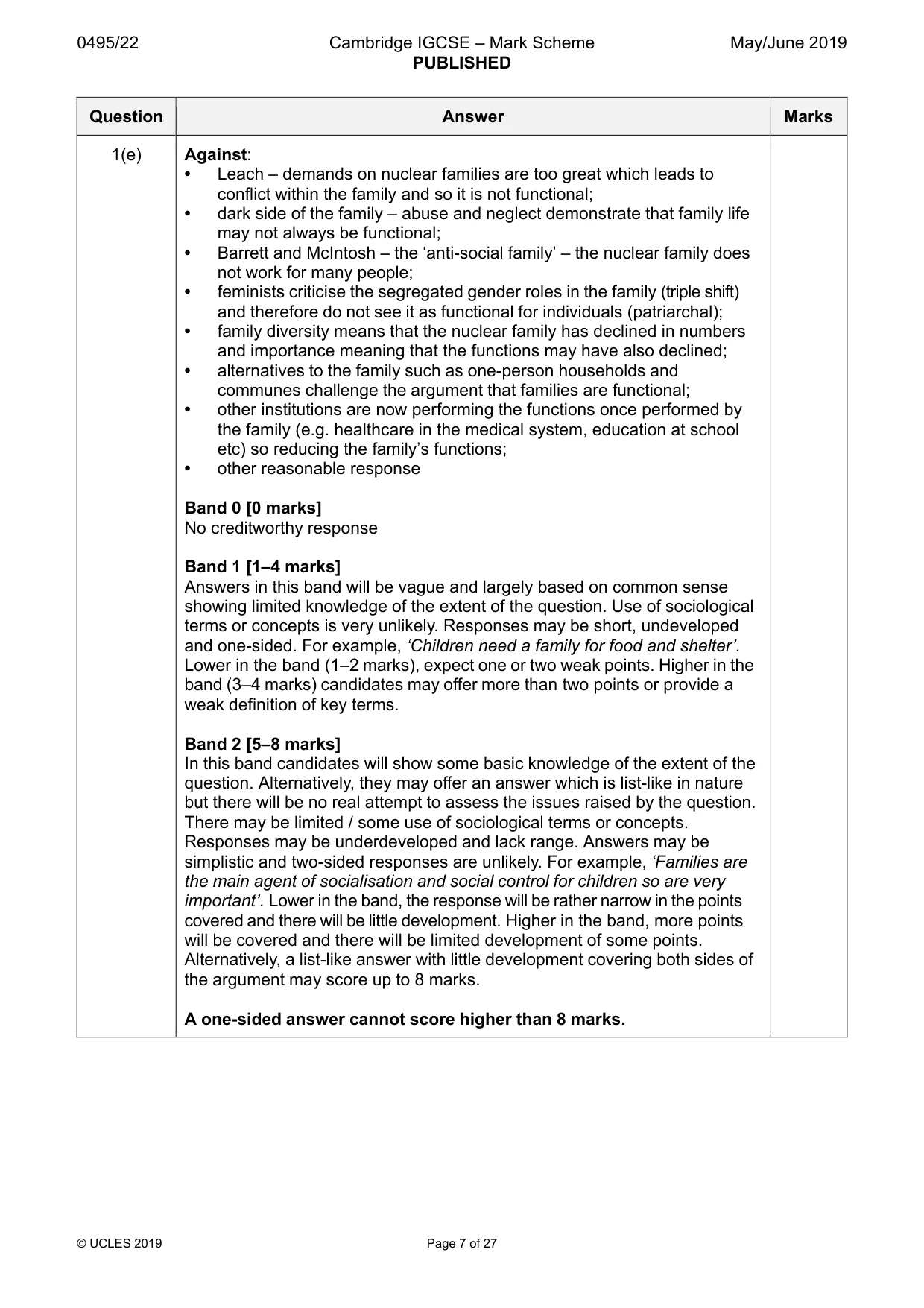
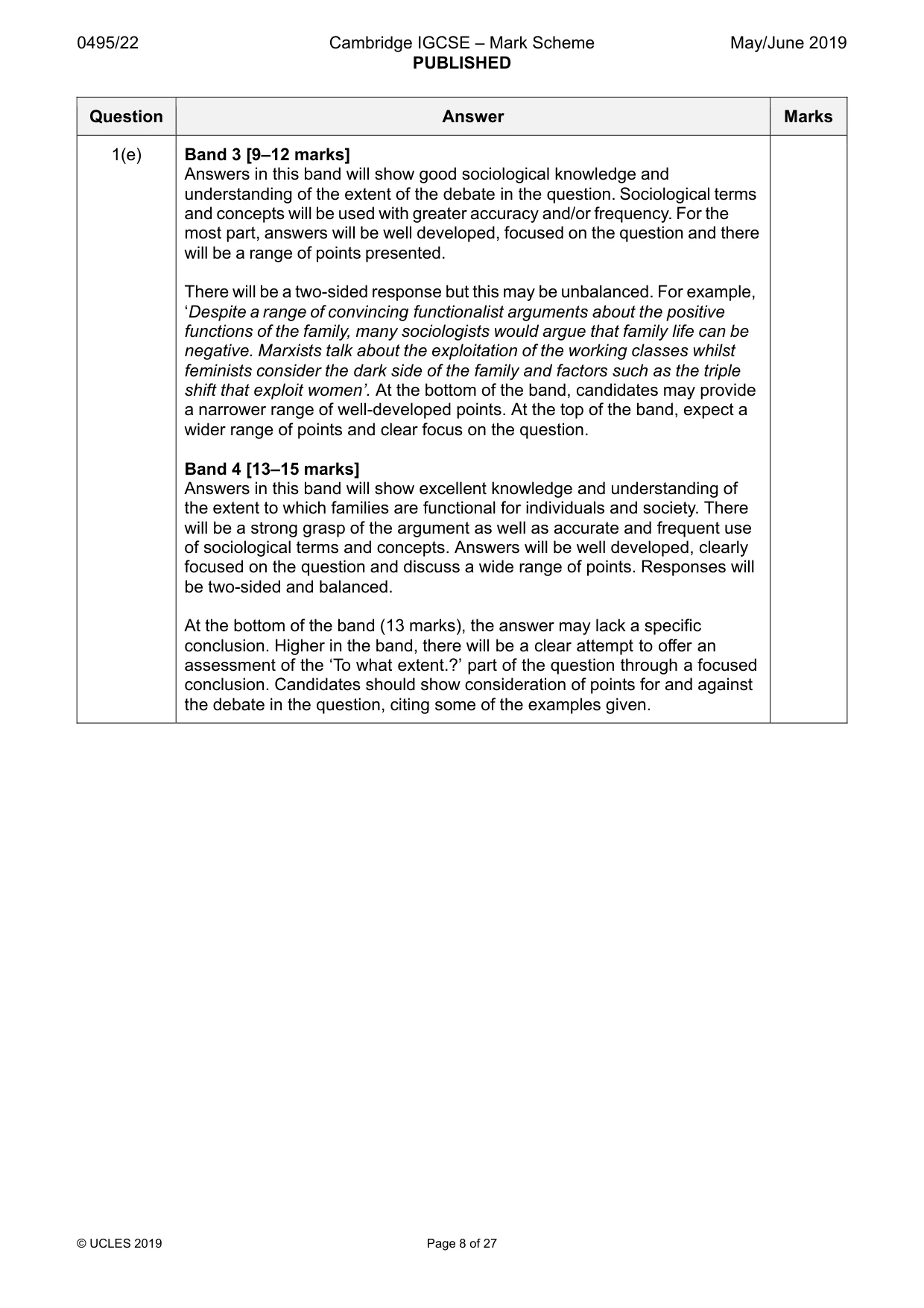
Mark scheme: Question Answer Marks 1(a) What is meant by the term ‘empty-shell marriage’? 2 One mark for partial definition e.g. they don’t love each other anymore Two marks for clear definition e.g. a married couple continue to live together but without love or affection 1(b) Describe two paternal roles in the family. 4 Candidates may discuss either traditional or new paternal roles or a mixture of both. A paternal role is the part played by the man in the family as a father. Possible answers: • instrumental role as head of the family e.g. the decision maker; • breadwinner / provider role as the one who brings in the income for the family; • emotional / expressive new role – spending time with children and nurturing them; • protector role – the one to look after the rest of the family; • dual / shared roles – gender equality means many family roles are now shared with partner; • disciplinarian role – carries out the social control for the family e.g. of the children; • gender role socialisation – teaching skills and norms to their sons of masculinity; • other reasonable response. One mark for each point correctly identified (up to maximum of two). One mark for each point that is developed (up to a maximum of two). 1(c) Explain how the extended family exists in different forms today. 6 Possible answers: • vertically extended families – more than two generations, traditional, grandparents; • horizontally extended families – family members of the same generation (e.g. aunts and uncles etc.) as the parents and children; • all the relatives sharing a household, living under one roof, one unit; • several nuclear families living close to one another – typical of the traditional working class in the UK; • modified extended family – relatives who live far apart remaining in close contact with one another often enabled by technological change and the new media; • beanpole family – very ‘tall and thin’ families with few people in each generation, often typical of contemporary Western societies where perhaps grand-parents help with childcare; • other reasonable response. Band 0 [0 marks] No creditworthy response Band 1 [1–3 marks] Answers in this band will show only a limited awareness of the question and may talk about, for example, big families. Responses may be short and un / underdeveloped. At the bottom of the band (1 mark), expect one weak point. Higher in the band (2–3 marks), candidates may offer more than one weak point, but there may be a tendency towards simplistic answers, engaging with sociological ideas without using sociological language. Band 2 [4–6 marks] A clear and accurate explanation, showing good sociological knowledge and understanding of the question. Sociological terms and concepts should be expected e.g. ‘Many extended family units still exist today. These can take various forms depending on the culture involved. In Western societies, for example, modified extended families where relatives live far apart but keep in regular contact through improved technology are common’. This would be followed by explanation of factors leading to this. At the bottom of the band, the range of points covered may be narrow or lack detail. Higher in the band, answers will cover more than one factor in a well-developed way or cover several factors in less detail. 1(d) Explain why living alone has become more common for individuals in 8 modern industrial societies. Candidates should show awareness of the various reasons for individuals living alone in MIS’s. Possible answers: • marriage and children are no longer social expectations (e.g. secularisation); • women are typically working therefore have a career and can afford to live alone; • feminism has encouraged females to be independent and to resist patriarchy; • the decline of the extended family means that living alone is more commonplace; • urbanisation and industrialisation leads to individuals leaving their families and communities and starting their own life elsewhere (geographical mobility); • rise in divorce rates leading to increased numbers of single divorcees; • as life expectancy increases so there are increasing numbers of elderly single people still fit and well enough to live alone; • other reasonable response. Band 0 [0 marks] No creditworthy response Band 1 [1–3 marks] Answers in this band will show only a limited awareness of the question. Responses may be short and undeveloped e.g. ‘people don’t have to get married anymore’, stated without explanation. Sociological terms and concepts are unlikely to be used. At the bottom of the band (1 mark), expect one weak point. Higher in the band (2–3 marks), candidates may offer more than one weak point, but there may be a tendency towards simplistic answers, engaging with sociological ideas without using sociological language. Band 2 [4–6 marks] A clear and accurate explanation, showing good sociological knowledge and understanding of the question. Sociological terms and concepts should be expected. For example, ‘Divorce rates are high in most MIS’s which means there is more likelihood of people living alone due to relationship breakdowns’. This would be followed by explanation of factors leading to this. At the bottom of the band, the range of points covered may be narrow or lack detail. Higher in the band, answers will cover more than one factor in a well-developed way or cover several factors in less detail. 1(d) Band 3 [7–8 marks] Answers in this band will show good sociological knowledge and understanding of the question. For example, ‘Feminists believe that singlehood is on the increase as women are actively deciding to live alone. They are able to do this due to the rise of career women and equal rights legislation. It may also be resistance to patriarchy’. They can then expand on the explanation of this and other factors as necessary. Sociological terms and concepts will be used accurately overall. Answers will be well focused on the question and there will be a range of reasons presented. At the top of the band explanations will be clear throughout. 1(e) To what extent are families functional for individuals and society? 15 Candidates do not need to explicitly discuss both individuals and society separately. Candidates should show awareness of the ways that families can be seen to be functional – functionalist theory is likely to be discussed here. In evaluation, candidates are likely to discuss how families may not be functional and may refer to Marxism and/or feminism whilst doing so. However, theories can be used in both the ‘for’ and ‘against’ sides of the argument e.g. Marxism could be used either ‘for’ or ‘against’. All valid points should therefore be credited in the context of the candidate’s answer. Possible answers: For: • reproduction – societies must produce new generations of children in order to survive, family life encourages children; • socialisation – children need to learn the norms and values of their society through the family; • social control – how the behaviour of children is controlled by the family so that they conform to the norms; • care of children – children need to be fed, clothed and nurtured by families; • status – families provide status for children and involve them in a variety of different relationships; • regulation of sexual behaviour – encouraging children to be born in a socially approved sexual relationship; • nuclear families perform family functions best through clear gender roles; • Marxists believe the family is functional for capitalist society through the transmission of pro-capitalist norms and values; • feminists believe the nuclear family is functional for patriarchal society by giving men a powerful role; • other reasonable response. 1(e) Against: • Leach – demands on nuclear families are too great which leads to conflict within the family and so it is not functional; • dark side of the family – abuse and neglect demonstrate that family life may not always be functional; • Barrett and McIntosh – the ‘anti-social family’ – the nuclear family does not work for many people; • feminists criticise the segregated gender roles in the family (triple shift) and therefore do not see it as functional for individuals (patriarchal); • family diversity means that the nuclear family has declined in numbers and importance meaning that the functions may have also declined; • alternatives to the family such as one-person households and communes challenge the argument that families are functional; • other institutions are now performing the functions once performed by the family (e.g. healthcare in the medical system, education at school etc) so reducing the family’s functions; • other reasonable response Band 0 [0 marks] No creditworthy response Band 1 [1–4 marks] Answers in this band will be vague and largely based on common sense showing limited knowledge of the extent of the question. Use of sociological terms or concepts is very unlikely. Responses may be short, undeveloped and one-sided. For example, ‘Children need a family for food and shelter’. Lower in the band (1–2 marks), expect one or two weak points. Higher in the band (3–4 marks) candidates may offer more than two points or provide a weak definition of key terms. Band 2 [5–8 marks] In this band candidates will show some basic knowledge of the extent of the question. Alternatively, they may offer an answer which is list-like in nature but there will be no real attempt to assess the issues raised by the question. There may be limited / some use of sociological terms or concepts. Responses may be underdeveloped and lack range. Answers may be simplistic and two-sided responses are unlikely. For example, ‘Families are the main agent of socialisation and social control for children so are very important’. Lower in the band, the response will be rather narrow in the points covered and there will be little development. Higher in the band, more points will be covered and there will be limited development of some points. Alternatively, a list-like answer with little development covering both sides of the argument may score up to 8 marks. A one-sided answer cannot score higher than 8 marks. 1(e) Band 3 [9–12 marks] Answers in this band will show good sociological knowledge and understanding of the extent of the debate in the question. Sociological terms and concepts will be used with greater accuracy and/or frequency. For the most part, answers will be well developed, focused on the question and there will be a range of points presented. There will be a two-sided response but this may be unbalanced. For example, ‘Despite a range of convincing functionalist arguments about the positive functions of the family, many sociologists would argue that family life can be negative. Marxists talk about the exploitation of the working classes whilst feminists consider the dark side of the family and factors such as the triple shift that exploit women’. At the bottom of the band, candidates may provide a narrower range of well-developed points. At the top of the band, expect a wider range of points and clear focus on the question. Band 4 [13–15 marks] Answers in this band will show excellent knowledge and understanding of the extent to which families are functional for individuals and society. There will be a strong grasp of the argument as well as accurate and frequent use of sociological terms and concepts. Answers will be well developed, clearly focused on the question and discuss a wide range of points. Responses will be two-sided and balanced. At the bottom of the band (13 marks), the answer may lack a specific conclusion. Higher in the band, there will be a clear attempt to offer an assessment of the ‘To what extent.?’ part of the question through a focused conclusion. Candidates should show consideration of points for and against the debate in the question, citing some of the examples given.
Q2 · Sociologists debate the reasons why some individuals do better in education than others
2 Sociologists debate the reasons why some individuals do better in education than others. Anti-school sub-cultures and family background are two explanations that are often considered. Schools have introduced programmes such as positive discrimination to try and make school a better experience for all. (a) What is meant by the term 'positive discrimination'? [2] (b) Describe two sociological reasons why children go to school. [4] (c) Explain how anti-school sub-cultures can affect educational achievement. [6] (d) Explain why schools are not functional for all students. [8] (e) To what extent does family background influence educational achievement? [15] Section C: Crime, deviance and social control
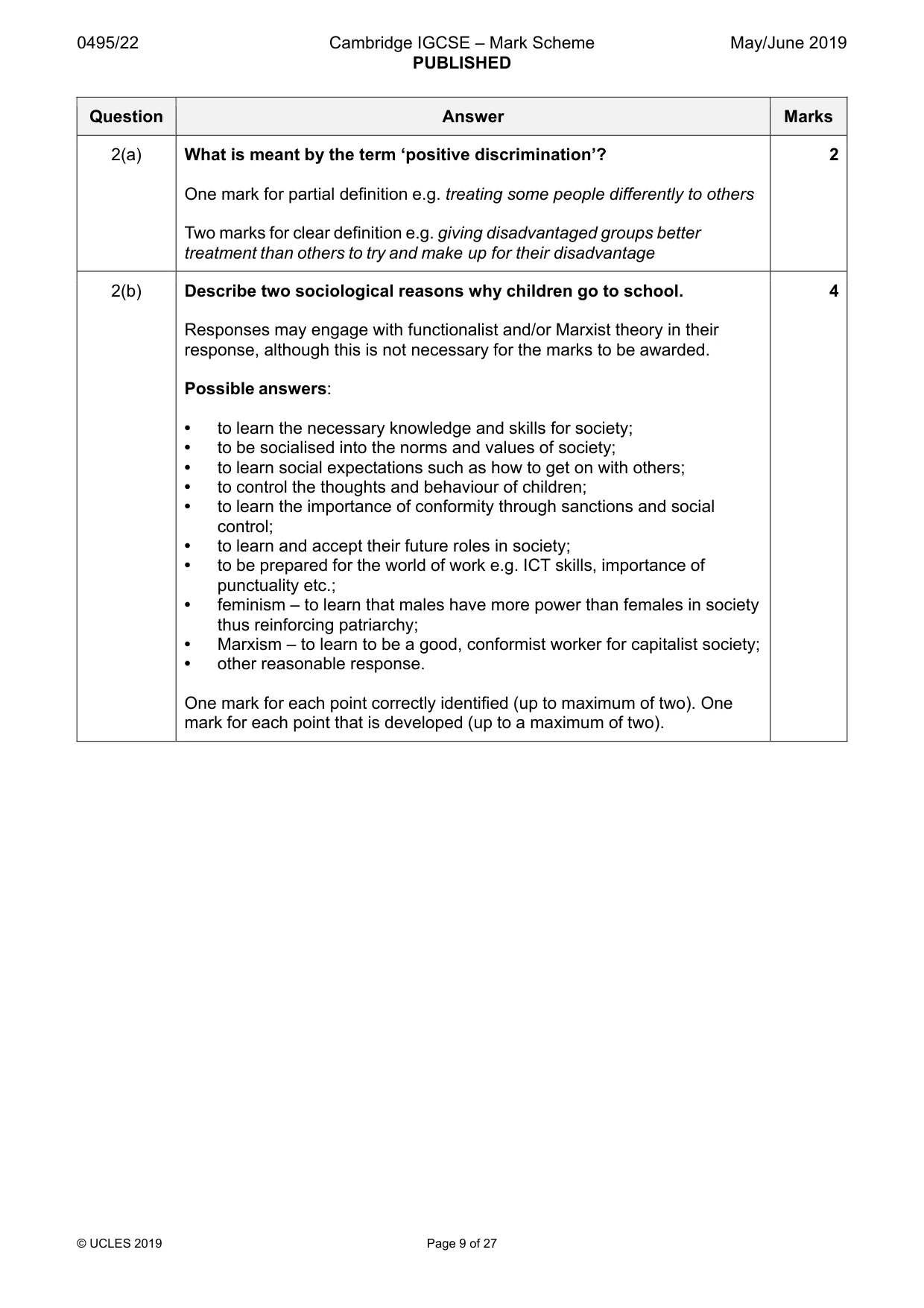
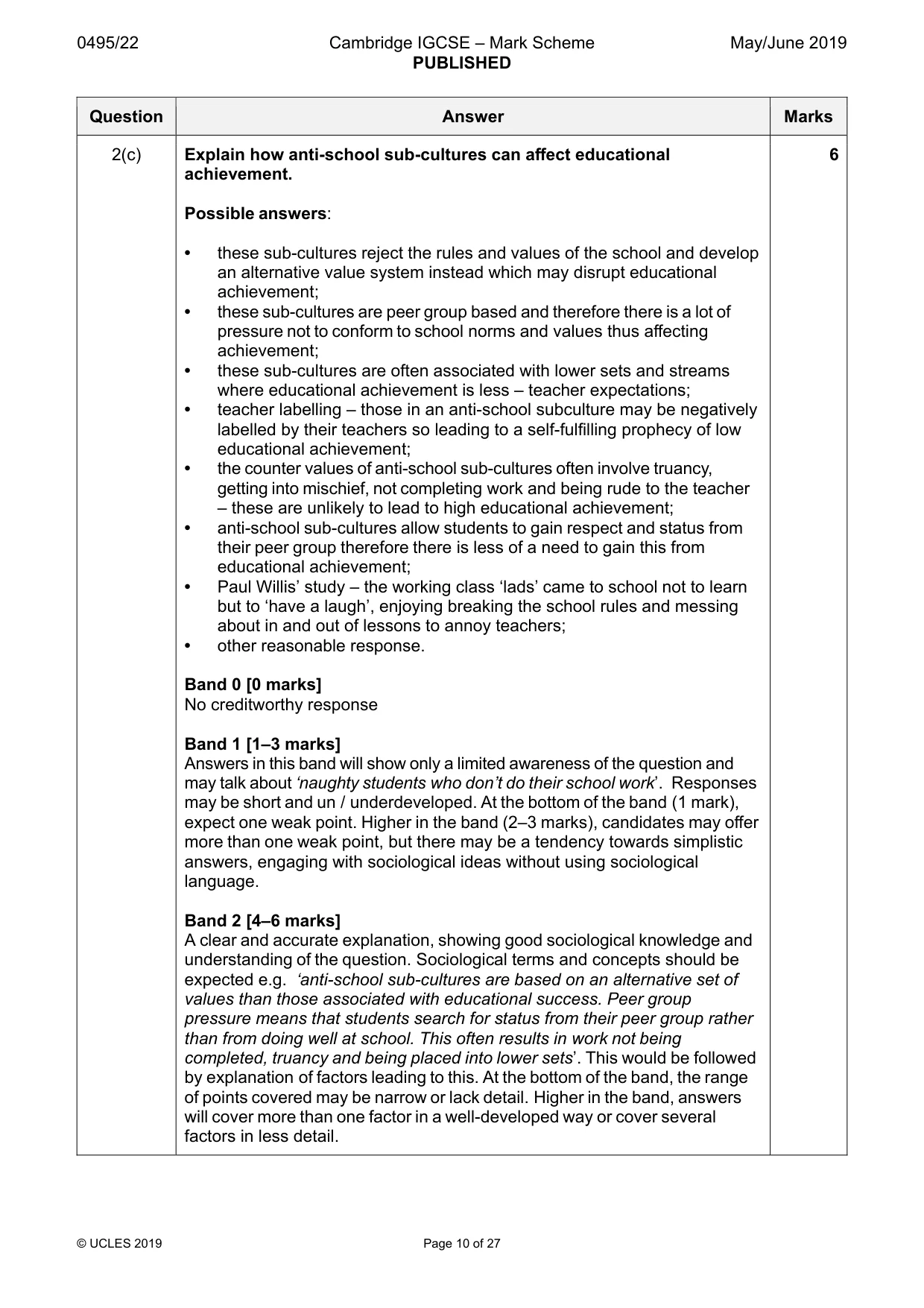
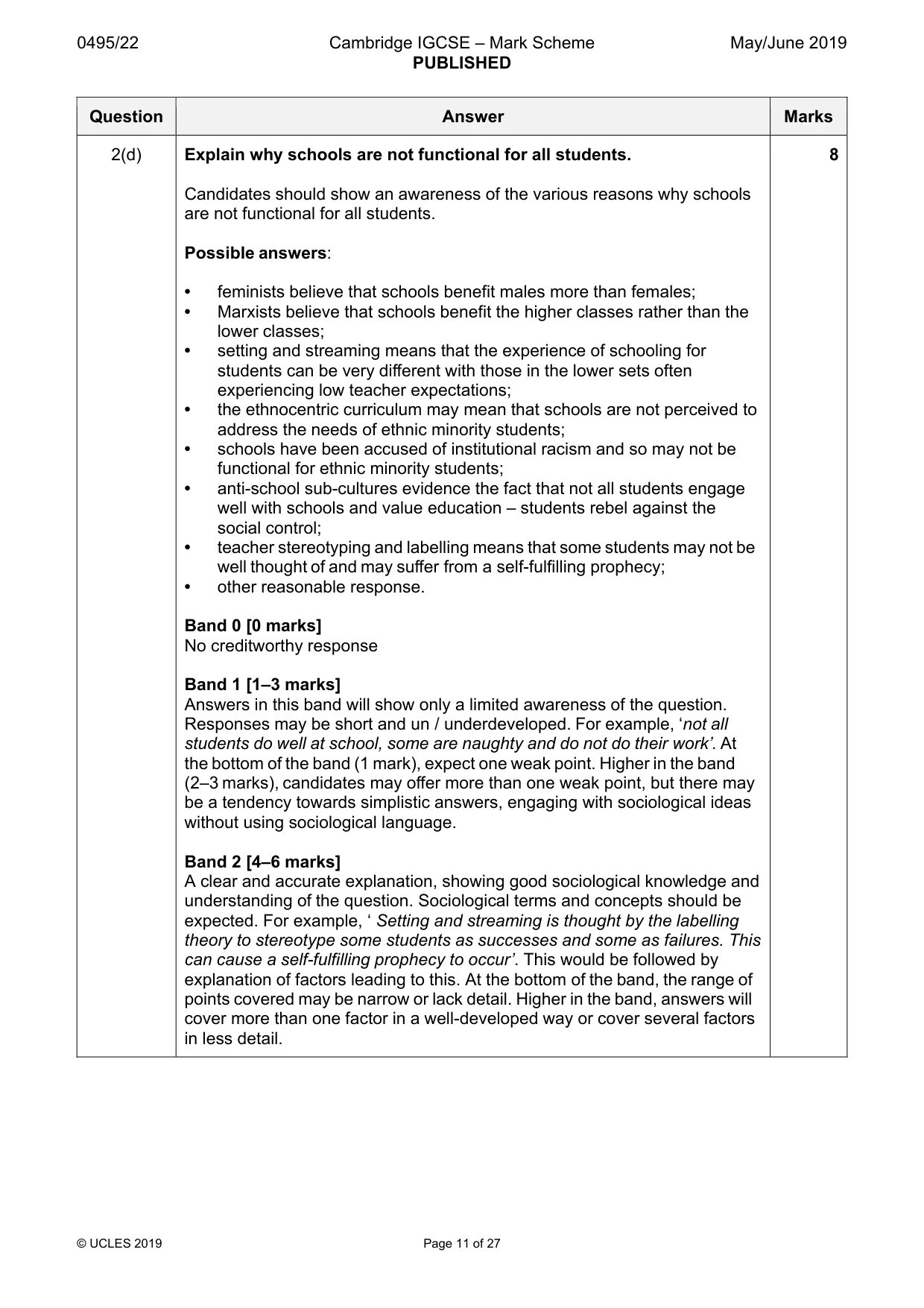
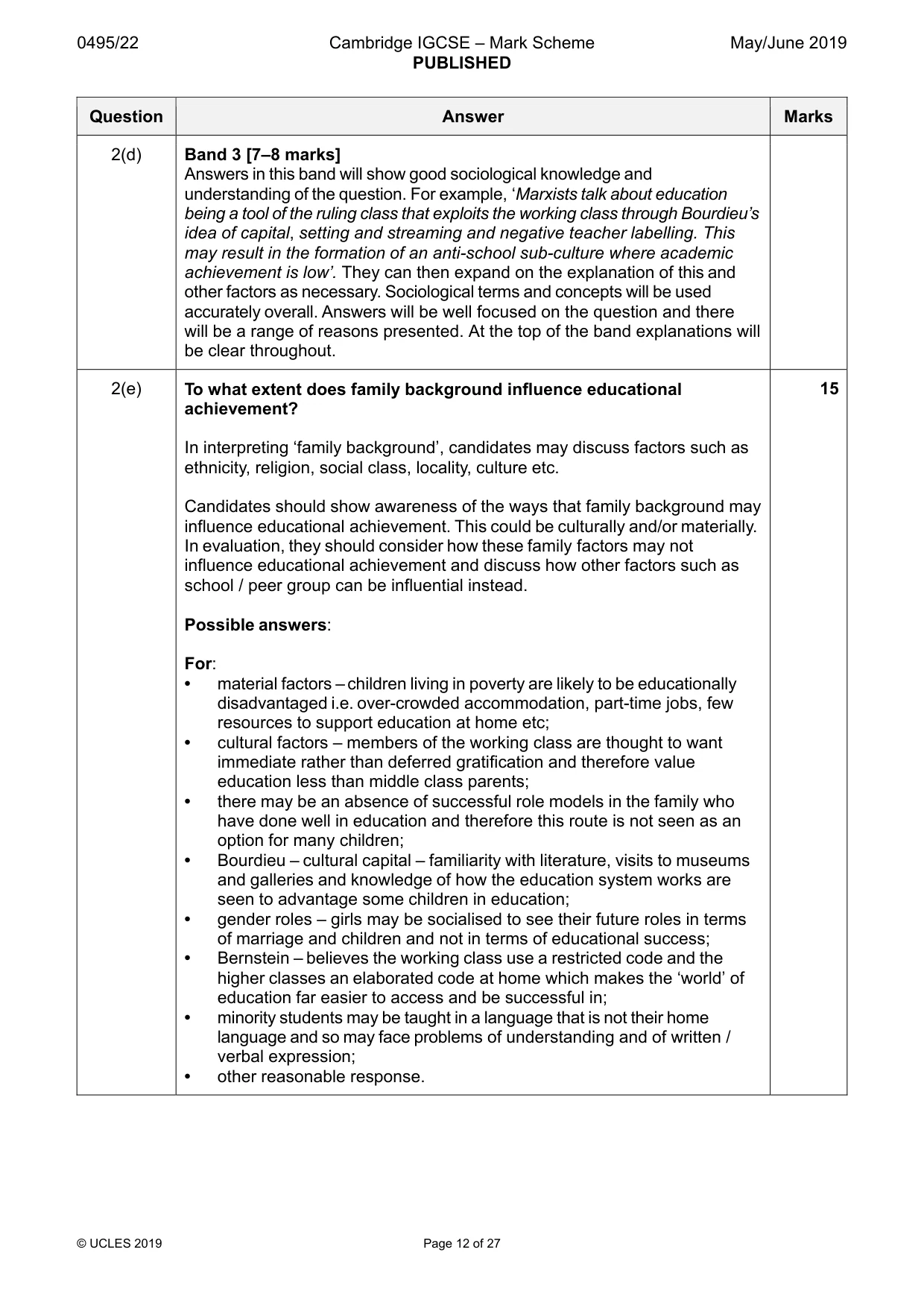
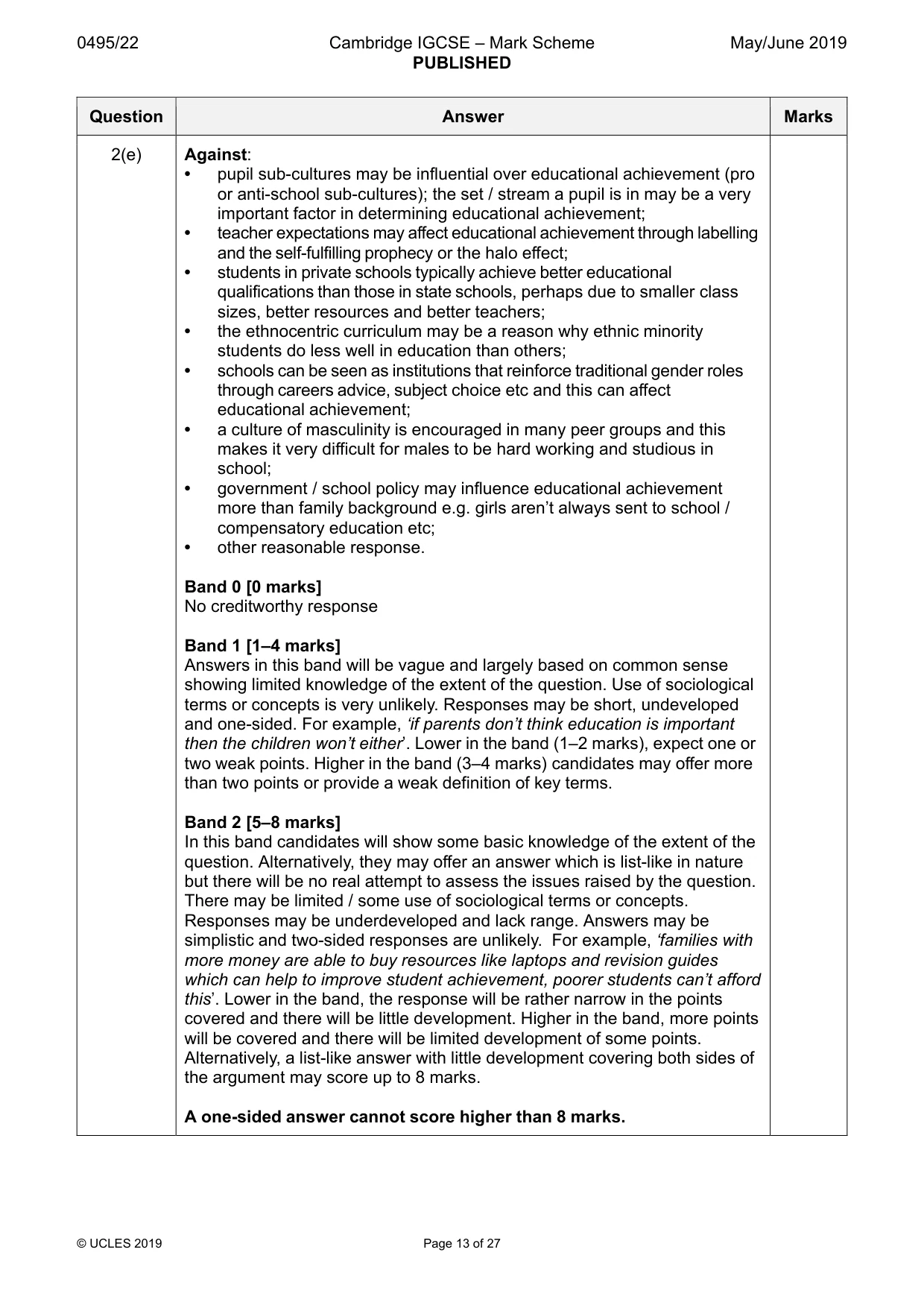
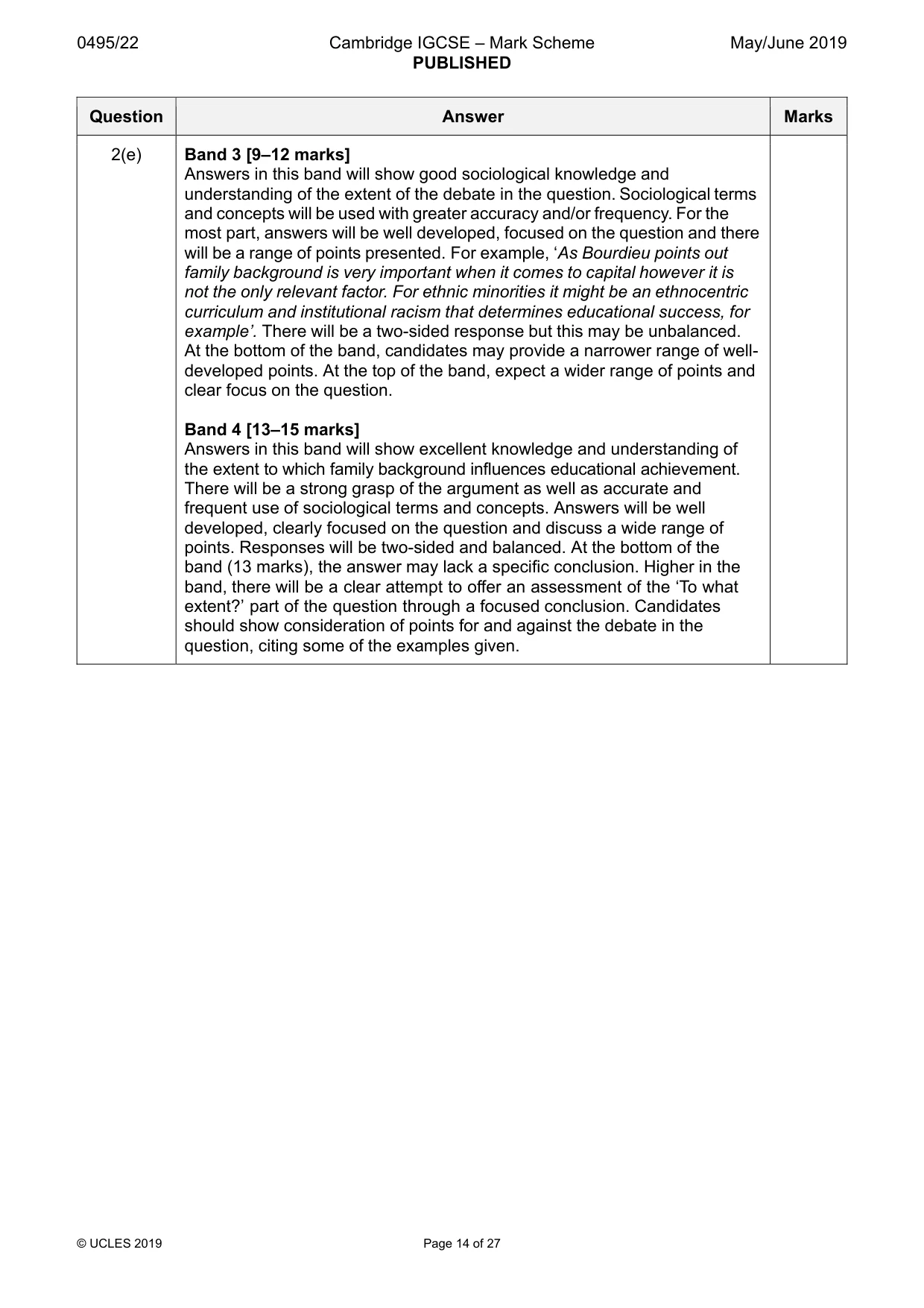
Mark scheme: 2(a) What is meant by the term ‘positive discrimination’? 2 One mark for partial definition e.g. treating some people differently to others Two marks for clear definition e.g. giving disadvantaged groups better treatment than others to try and make up for their disadvantage 2(b) Describe two sociological reasons why children go to school. 4 Responses may engage with functionalist and/or Marxist theory in their response, although this is not necessary for the marks to be awarded. Possible answers: • to learn the necessary knowledge and skills for society; • to be socialised into the norms and values of society; • to learn social expectations such as how to get on with others; • to control the thoughts and behaviour of children; • to learn the importance of conformity through sanctions and social control; • to learn and accept their future roles in society; • to be prepared for the world of work e.g. ICT skills, importance of punctuality etc.; • feminism – to learn that males have more power than females in society thus reinforcing patriarchy; • Marxism – to learn to be a good, conformist worker for capitalist society; • other reasonable response. One mark for each point correctly identified (up to maximum of two). One mark for each point that is developed (up to a maximum of two). 2(c) Explain how anti-school sub-cultures can affect educational 6 achievement. Possible answers: • these sub-cultures reject the rules and values of the school and develop an alternative value system instead which may disrupt educational achievement; • these sub-cultures are peer group based and therefore there is a lot of pressure not to conform to school norms and values thus affecting achievement; • these sub-cultures are often associated with lower sets and streams where educational achievement is less – teacher expectations; • teacher labelling – those in an anti-school subculture may be negatively labelled by their teachers so leading to a self-fulfilling prophecy of low educational achievement; • the counter values of anti-school sub-cultures often involve truancy, getting into mischief, not completing work and being rude to the teacher – these are unlikely to lead to high educational achievement; • anti-school sub-cultures allow students to gain respect and status from their peer group therefore there is less of a need to gain this from educational achievement; • Paul Willis’ study – the working class ‘lads’ came to school not to learn but to ‘have a laugh’, enjoying breaking the school rules and messing about in and out of lessons to annoy teachers; • other reasonable response. Band 0 [0 marks] No creditworthy response Band 1 [1–3 marks] Answers in this band will show only a limited awareness of the question and may talk about ‘naughty students who don’t do their school work’. Responses may be short and un / underdeveloped. At the bottom of the band (1 mark), expect one weak point. Higher in the band (2–3 marks), candidates may offer more than one weak point, but there may be a tendency towards simplistic answers, engaging with sociological ideas without using sociological language. Band 2 [4–6 marks] A clear and accurate explanation, showing good sociological knowledge and understanding of the question. Sociological terms and concepts should be expected e.g. ‘anti-school sub-cultures are based on an alternative set of values than those associated with educational success. Peer group pressure means that students search for status from their peer group rather than from doing well at school. This often results in work not being completed, truancy and being placed into lower sets’. This would be followed by explanation of factors leading to this. At the bottom of the band, the range of points covered may be narrow or lack detail. Higher in the band, answers will cover more than one factor in a well-developed way or cover several factors in less detail. 2(d) Explain why schools are not functional for all students. 8 Candidates should show an awareness of the various reasons why schools are not functional for all students. Possible answers: • feminists believe that schools benefit males more than females; • Marxists believe that schools benefit the higher classes rather than the lower classes; • setting and streaming means that the experience of schooling for students can be very different with those in the lower sets often experiencing low teacher expectations; • the ethnocentric curriculum may mean that schools are not perceived to address the needs of ethnic minority students; • schools have been accused of institutional racism and so may not be functional for ethnic minority students; • anti-school sub-cultures evidence the fact that not all students engage well with schools and value education – students rebel against the social control; • teacher stereotyping and labelling means that some students may not be well thought of and may suffer from a self-fulfilling prophecy; • other reasonable response. Band 0 [0 marks] No creditworthy response Band 1 [1–3 marks] Answers in this band will show only a limited awareness of the question. Responses may be short and un / underdeveloped. For example, ‘not all students do well at school, some are naughty and do not do their work’. At the bottom of the band (1 mark), expect one weak point. Higher in the band (2–3 marks), candidates may offer more than one weak point, but there may be a tendency towards simplistic answers, engaging with sociological ideas without using sociological language. Band 2 [4–6 marks] A clear and accurate explanation, showing good sociological knowledge and understanding of the question. Sociological terms and concepts should be expected. For example, ‘ Setting and streaming is thought by the labelling theory to stereotype some students as successes and some as failures. This can cause a self-fulfilling prophecy to occur’. This would be followed by explanation of factors leading to this. At the bottom of the band, the range of points covered may be narrow or lack detail. Higher in the band, answers will cover more than one factor in a well-developed way or cover several factors in less detail. 2(d) Band 3 [7–8 marks] Answers in this band will show good sociological knowledge and understanding of the question. For example, ‘Marxists talk about education being a tool of the ruling class that exploits the working class through Bourdieu’s idea of capital, setting and streaming and negative teacher labelling. This may result in the formation of an anti-school sub-culture where academic achievement is low’. They can then expand on the explanation of this and other factors as necessary. Sociological terms and concepts will be used accurately overall. Answers will be well focused on the question and there will be a range of reasons presented. At the top of the band explanations will be clear throughout. 2(e) To what extent does family background influence educational 15 achievement? In interpreting ‘family background’, candidates may discuss factors such as ethnicity, religion, social class, locality, culture etc. Candidates should show awareness of the ways that family background may influence educational achievement. This could be culturally and/or materially. In evaluation, they should consider how these family factors may not influence educational achievement and discuss how other factors such as school / peer group can be influential instead. Possible answers: For: • material factors – children living in poverty are likely to be educationally disadvantaged i.e. over-crowded accommodation, part-time jobs, few resources to support education at home etc; • cultural factors – members of the working class are thought to want immediate rather than deferred gratification and therefore value education less than middle class parents; • there may be an absence of successful role models in the family who have done well in education and therefore this route is not seen as an option for many children; • Bourdieu – cultural capital – familiarity with literature, visits to museums and galleries and knowledge of how the education system works are seen to advantage some children in education; • gender roles – girls may be socialised to see their future roles in terms of marriage and children and not in terms of educational success; • Bernstein – believes the working class use a restricted code and the higher classes an elaborated code at home which makes the ‘world’ of education far easier to access and be successful in; • minority students may be taught in a language that is not their home language and so may face problems of understanding and of written / verbal expression; • other reasonable response. 2(e) Against: • pupil sub-cultures may be influential over educational achievement (pro or anti-school sub-cultures); the set / stream a pupil is in may be a very important factor in determining educational achievement; • teacher expectations may affect educational achievement through labelling and the self-fulfilling prophecy or the halo effect; • students in private schools typically achieve better educational qualifications than those in state schools, perhaps due to smaller class sizes, better resources and better teachers; • the ethnocentric curriculum may be a reason why ethnic minority students do less well in education than others; • schools can be seen as institutions that reinforce traditional gender roles through careers advice, subject choice etc and this can affect educational achievement; • a culture of masculinity is encouraged in many peer groups and this makes it very difficult for males to be hard working and studious in school; • government / school policy may influence educational achievement more than family background e.g. girls aren’t always sent to school / compensatory education etc; • other reasonable response. Band 0 [0 marks] No creditworthy response Band 1 [1–4 marks] Answers in this band will be vague and largely based on common sense showing limited knowledge of the extent of the question. Use of sociological terms or concepts is very unlikely. Responses may be short, undeveloped and one-sided. For example, ‘if parents don’t think education is important then the children won’t either’. Lower in the band (1–2 marks), expect one or two weak points. Higher in the band (3–4 marks) candidates may offer more than two points or provide a weak definition of key terms. Band 2 [5–8 marks] In this band candidates will show some basic knowledge of the extent of the question. Alternatively, they may offer an answer which is list-like in nature but there will be no real attempt to assess the issues raised by the question. There may be limited / some use of sociological terms or concepts. Responses may be underdeveloped and lack range. Answers may be simplistic and two-sided responses are unlikely. For example, ‘families with more money are able to buy resources like laptops and revision guides which can help to improve student achievement, poorer students can’t afford this’. Lower in the band, the response will be rather narrow in the points covered and there will be little development. Higher in the band, more points will be covered and there will be limited development of some points. Alternatively, a list-like answer with little development covering both sides of the argument may score up to 8 marks. A one-sided answer cannot score higher than 8 marks. 2(e) Band 3 [9–12 marks] Answers in this band will show good sociological knowledge and understanding of the extent of the debate in the question. Sociological terms and concepts will be used with greater accuracy and/or frequency. For the most part, answers will be well developed, focused on the question and there will be a range of points presented. For example, ‘As Bourdieu points out family background is very important when it comes to capital however it is not the only relevant factor. For ethnic minorities it might be an ethnocentric curriculum and institutional racism that determines educational success, for example’. There will be a two-sided response but this may be unbalanced. At the bottom of the band, candidates may provide a narrower range of well- developed points. At the top of the band, expect a wider range of points and clear focus on the question. Band 4 [13–15 marks] Answers in this band will show excellent knowledge and understanding of the extent to which family background influences educational achievement. There will be a strong grasp of the argument as well as accurate and frequent use of sociological terms and concepts. Answers will be well developed, clearly focused on the question and discuss a wide range of points. Responses will be two-sided and balanced. At the bottom of the band (13 marks), the answer may lack a specific conclusion. Higher in the band, there will be a clear attempt to offer an assessment of the ‘To what extent?’ part of the question through a focused conclusion. Candidates should show consideration of points for and against the debate in the question, citing some of the examples given.
Q3 · Crime remains a big problem in society with many people believing that crime rates are…
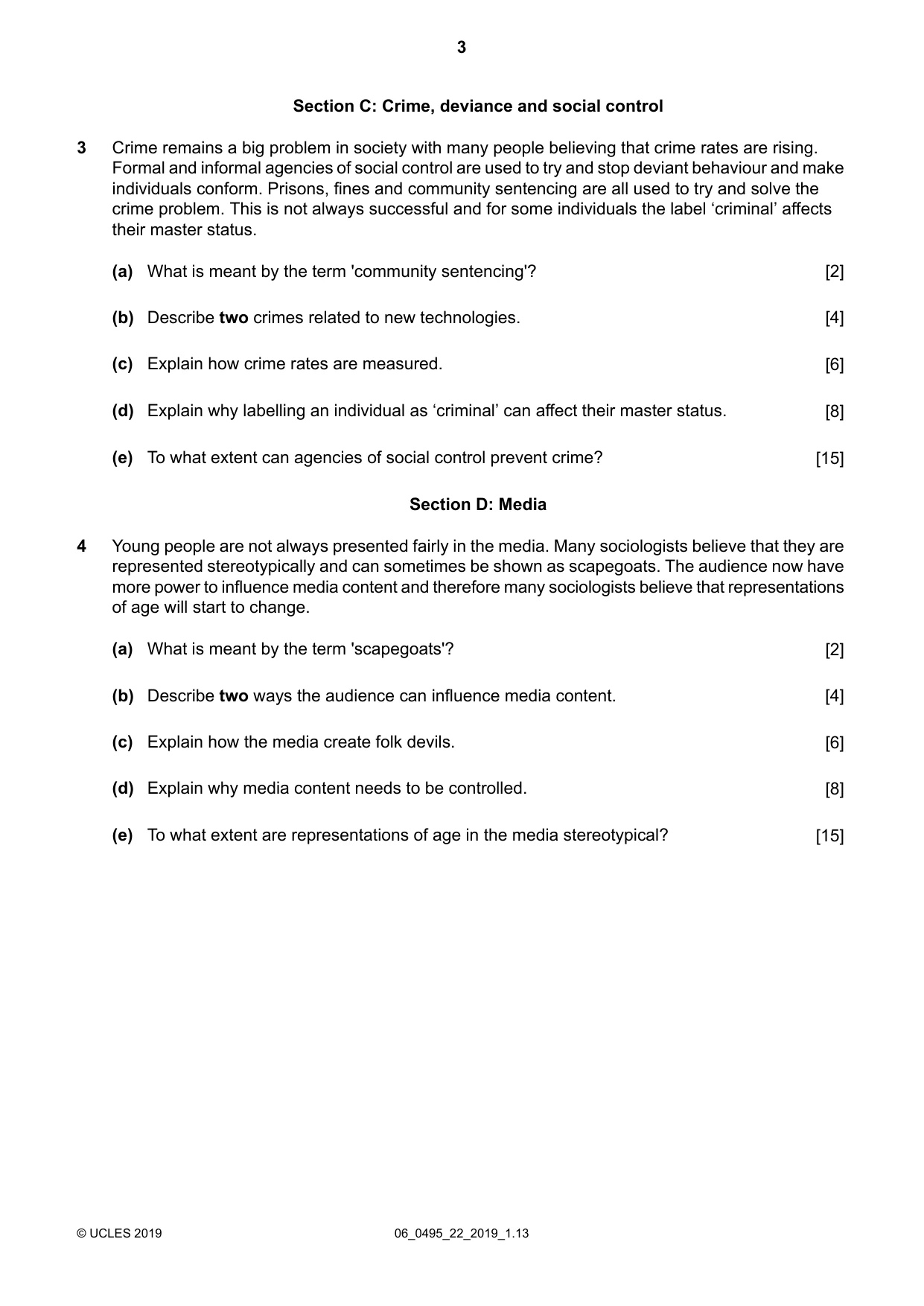
3 Crime remains a big problem in society with many people believing that crime rates are rising. Formal and informal agencies of social control are used to try and stop deviant behaviour and make individuals conform. Prisons, fines and community sentencing are all used to try and solve the crime problem. This is not always successful and for some individuals the label ‘criminal’ affects their master status. (a) What is meant by the term 'community sentencing'? [2] (b) Describe two crimes related to new technologies. [4] (c) Explain how crime rates are measured. [6] (d) Explain why labelling an individual as ‘criminal’ can affect their master status. [8] (e) To what extent can agencies of social control prevent crime? [15] Section D: Media
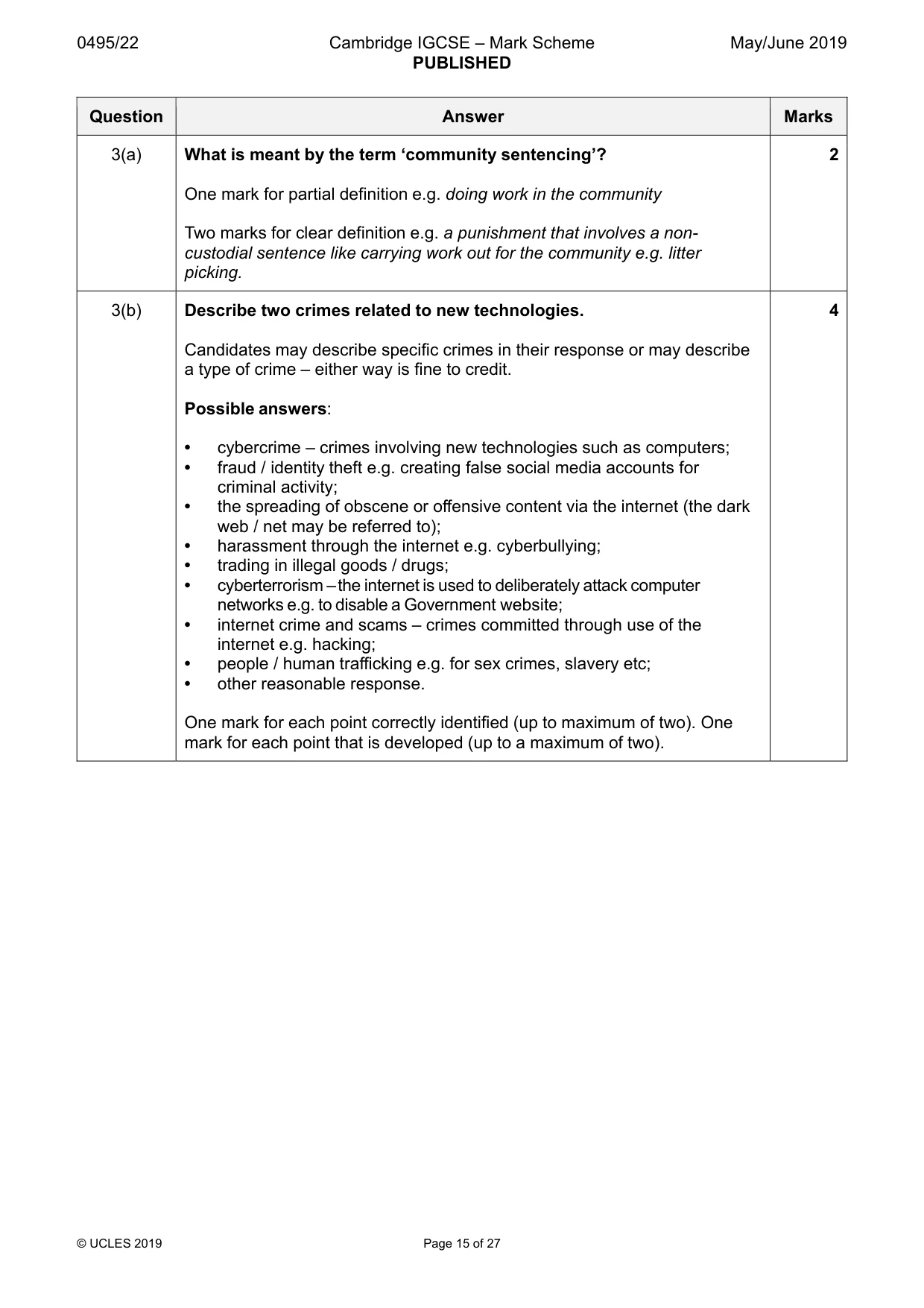
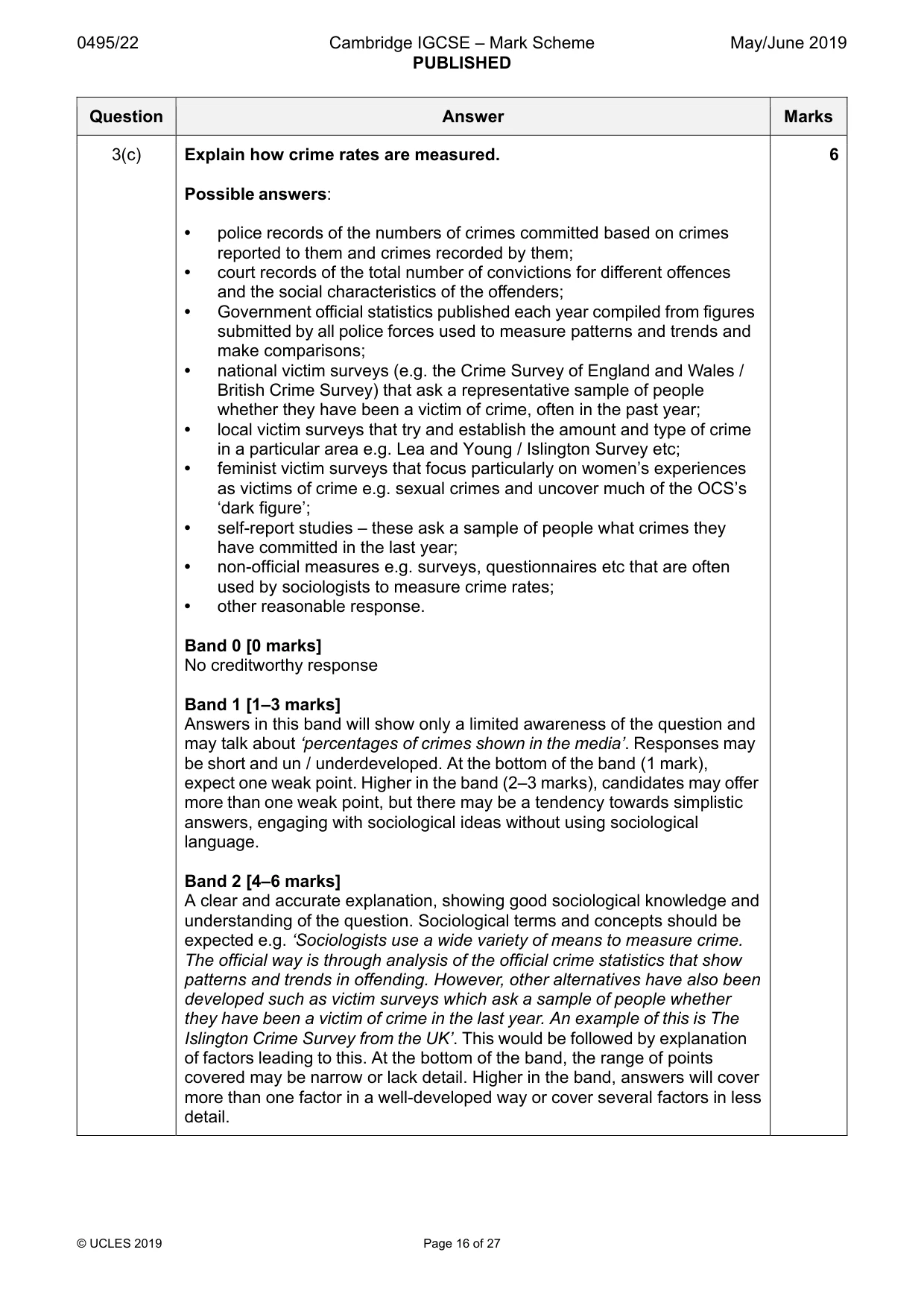
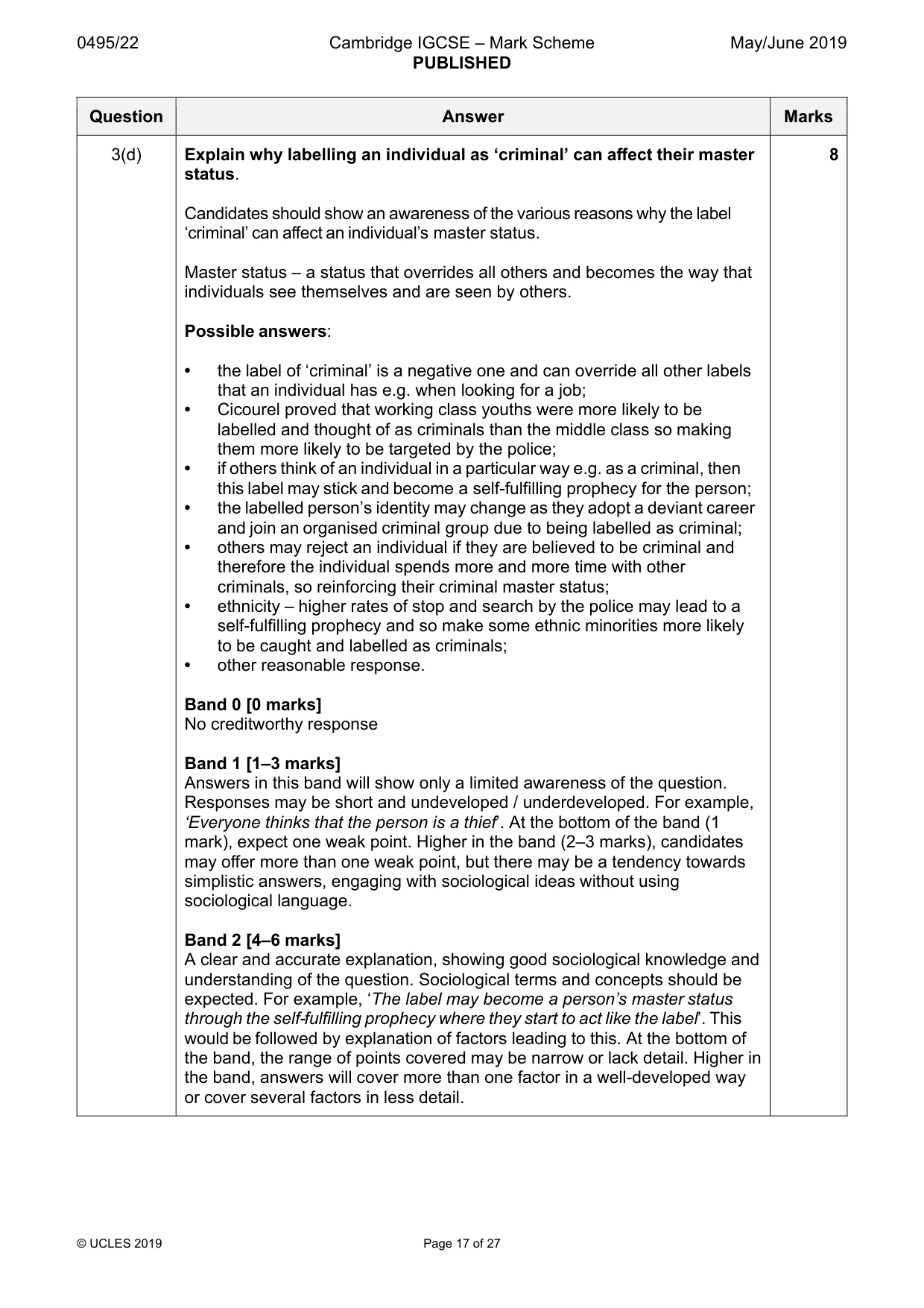
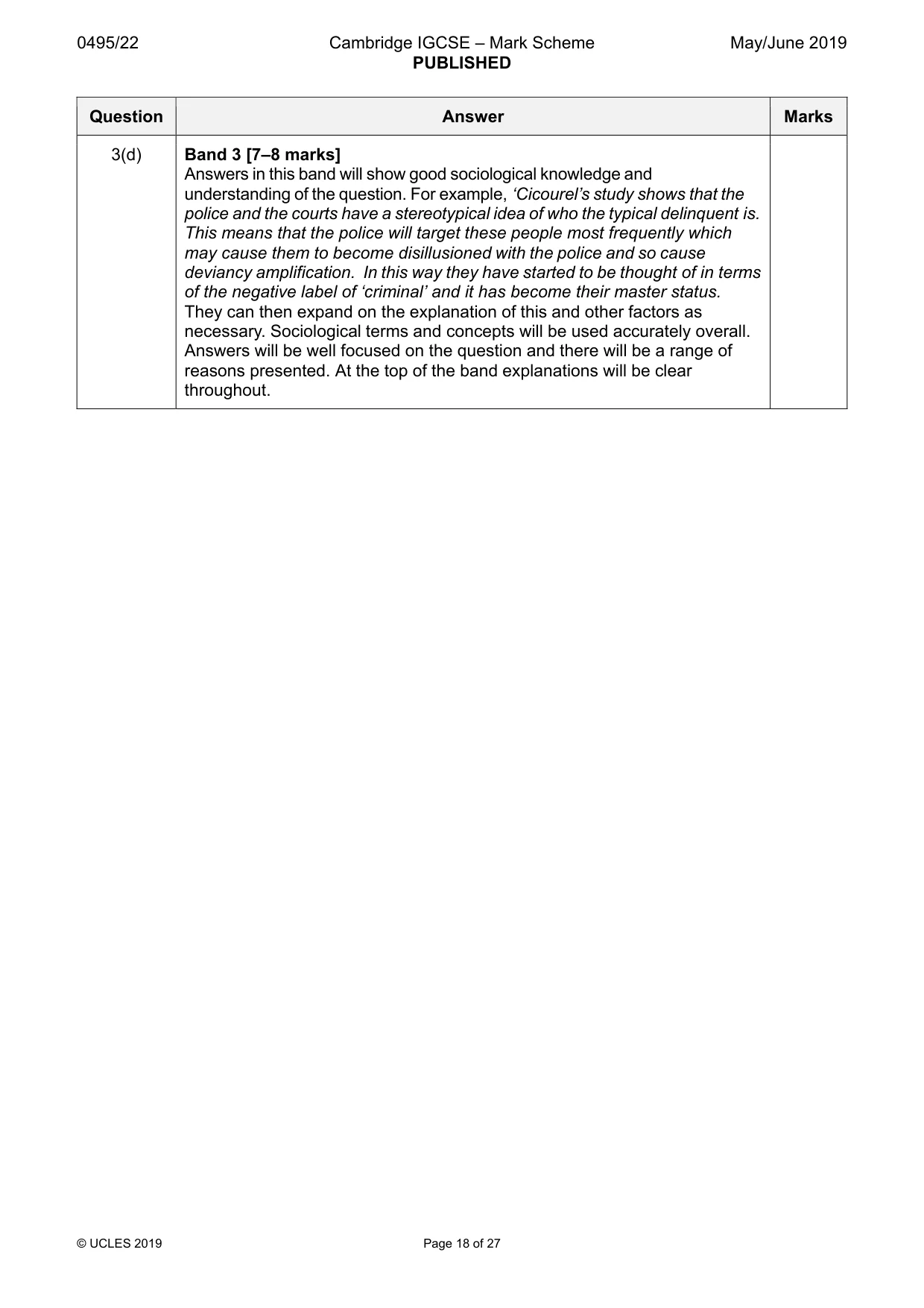
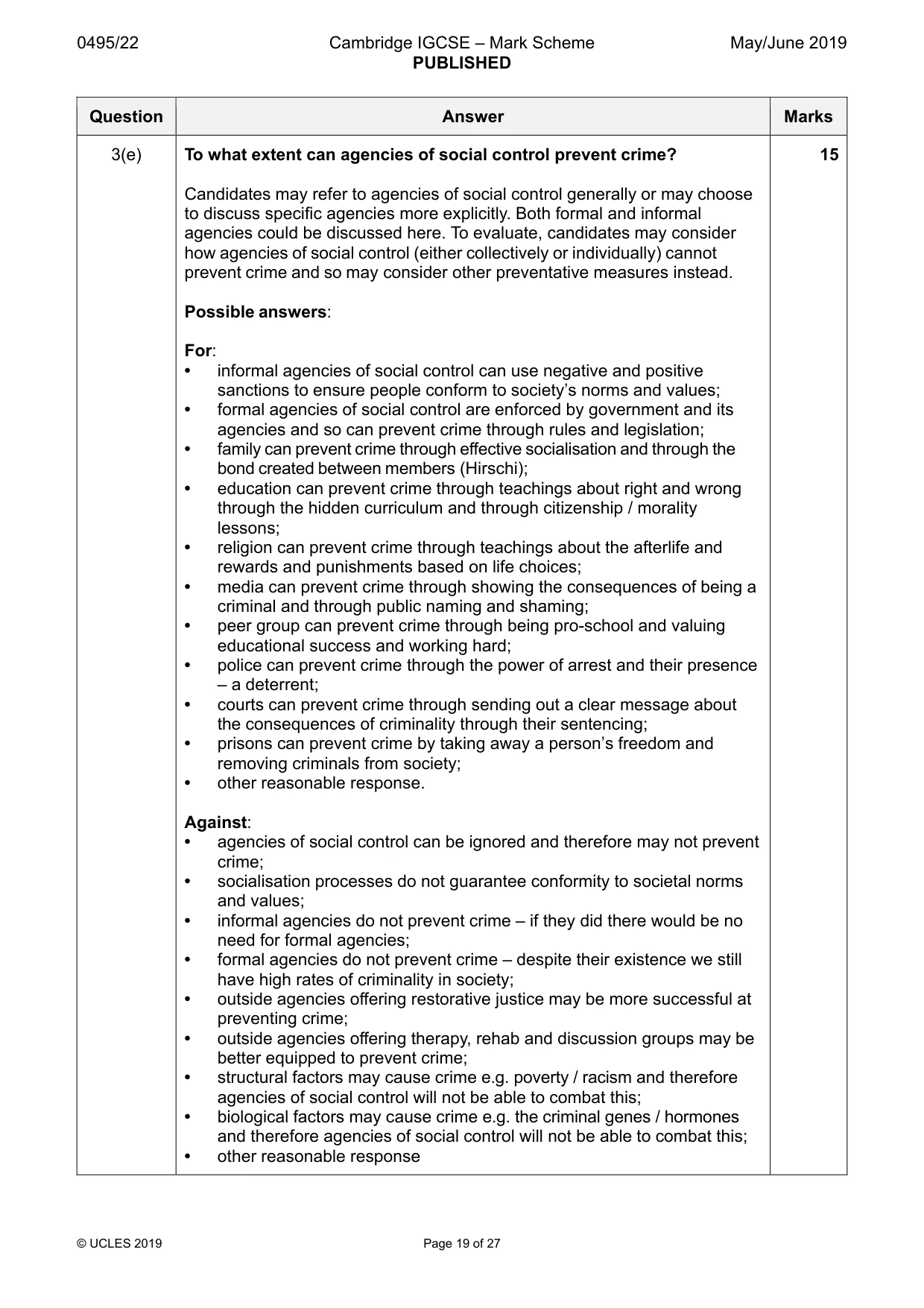
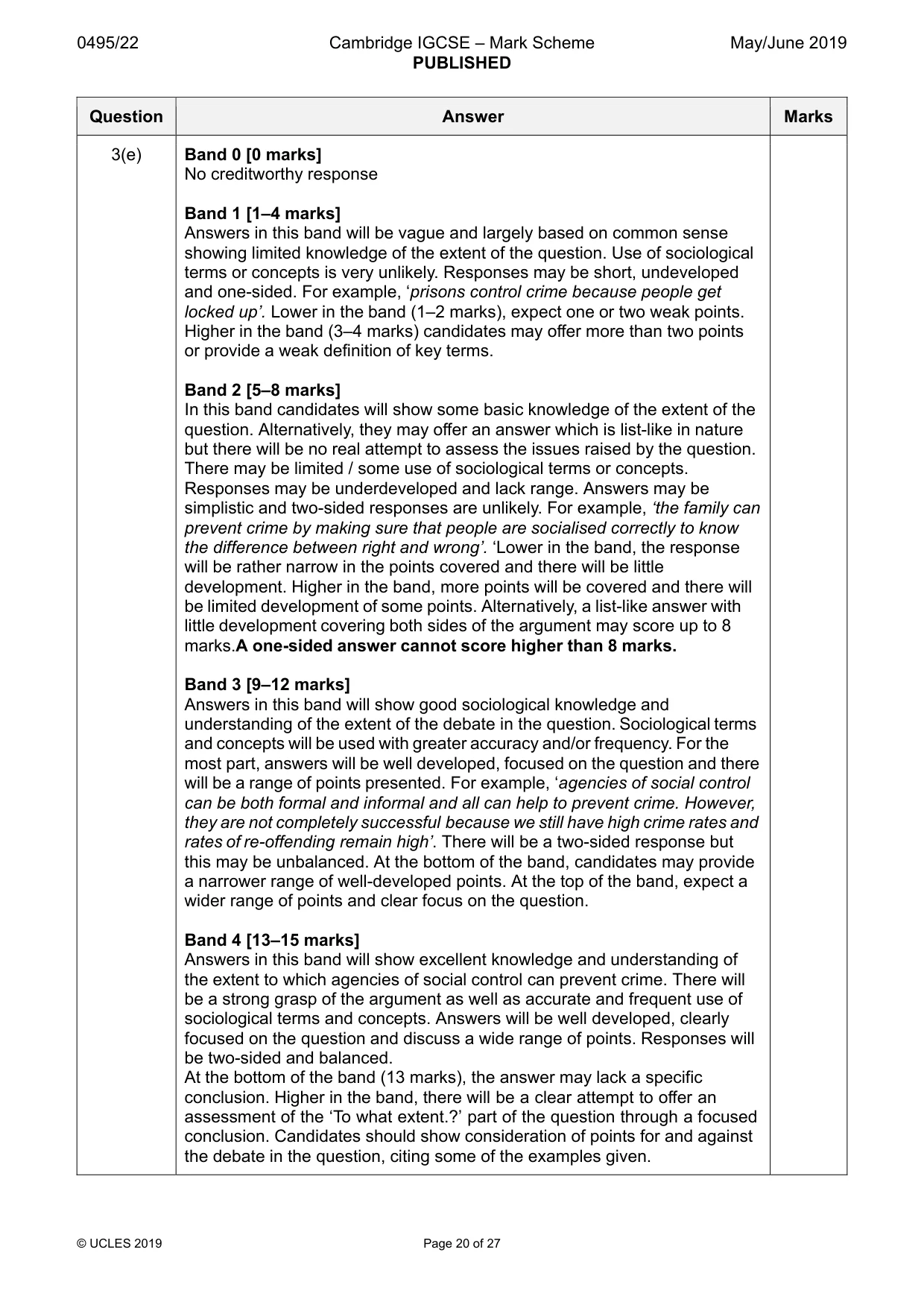
Mark scheme: 3(a) What is meant by the term ‘community sentencing’? 2 One mark for partial definition e.g. doing work in the community Two marks for clear definition e.g. a punishment that involves a non- custodial sentence like carrying work out for the community e.g. litter picking. 3(b) Describe two crimes related to new technologies. 4 Candidates may describe specific crimes in their response or may describe a type of crime – either way is fine to credit. Possible answers: • cybercrime – crimes involving new technologies such as computers; • fraud / identity theft e.g. creating false social media accounts for criminal activity; • the spreading of obscene or offensive content via the internet (the dark web / net may be referred to); • harassment through the internet e.g. cyberbullying; • trading in illegal goods / drugs; • cyberterrorism – the internet is used to deliberately attack computer networks e.g. to disable a Government website; • internet crime and scams – crimes committed through use of the internet e.g. hacking; • people / human trafficking e.g. for sex crimes, slavery etc; • other reasonable response. One mark for each point correctly identified (up to maximum of two). One mark for each point that is developed (up to a maximum of two). 3(c) Explain how crime rates are measured. 6 Possible answers: • police records of the numbers of crimes committed based on crimes reported to them and crimes recorded by them; • court records of the total number of convictions for different offences and the social characteristics of the offenders; • Government official statistics published each year compiled from figures submitted by all police forces used to measure patterns and trends and make comparisons; • national victim surveys (e.g. the Crime Survey of England and Wales / British Crime Survey) that ask a representative sample of people whether they have been a victim of crime, often in the past year; • local victim surveys that try and establish the amount and type of crime in a particular area e.g. Lea and Young / Islington Survey etc; • feminist victim surveys that focus particularly on women’s experiences as victims of crime e.g. sexual crimes and uncover much of the OCS’s ‘dark figure’; • self-report studies – these ask a sample of people what crimes they have committed in the last year; • non-official measures e.g. surveys, questionnaires etc that are often used by sociologists to measure crime rates; • other reasonable response. Band 0 [0 marks] No creditworthy response Band 1 [1–3 marks] Answers in this band will show only a limited awareness of the question and may talk about ‘percentages of crimes shown in the media’. Responses may be short and un / underdeveloped. At the bottom of the band (1 mark), expect one weak point. Higher in the band (2–3 marks), candidates may offer more than one weak point, but there may be a tendency towards simplistic answers, engaging with sociological ideas without using sociological language. Band 2 [4–6 marks] A clear and accurate explanation, showing good sociological knowledge and understanding of the question. Sociological terms and concepts should be expected e.g. ‘Sociologists use a wide variety of means to measure crime. The official way is through analysis of the official crime statistics that show patterns and trends in offending. However, other alternatives have also been developed such as victim surveys which ask a sample of people whether they have been a victim of crime in the last year. An example of this is The Islington Crime Survey from the UK’. This would be followed by explanation of factors leading to this. At the bottom of the band, the range of points covered may be narrow or lack detail. Higher in the band, answers will cover more than one factor in a well-developed way or cover several factors in less detail. 3(d) Explain why labelling an individual as ‘criminal’ can affect their master 8 status. Candidates should show an awareness of the various reasons why the label ‘criminal’ can affect an individual’s master status. Master status – a status that overrides all others and becomes the way that individuals see themselves and are seen by others. Possible answers: • the label of ‘criminal’ is a negative one and can override all other labels that an individual has e.g. when looking for a job; • Cicourel proved that working class youths were more likely to be labelled and thought of as criminals than the middle class so making them more likely to be targeted by the police; • if others think of an individual in a particular way e.g. as a criminal, then this label may stick and become a self-fulfilling prophecy for the person; • the labelled person’s identity may change as they adopt a deviant career and join an organised criminal group due to being labelled as criminal; • others may reject an individual if they are believed to be criminal and therefore the individual spends more and more time with other criminals, so reinforcing their criminal master status; • ethnicity – higher rates of stop and search by the police may lead to a self-fulfilling prophecy and so make some ethnic minorities more likely to be caught and labelled as criminals; • other reasonable response. Band 0 [0 marks] No creditworthy response Band 1 [1–3 marks] Answers in this band will show only a limited awareness of the question. Responses may be short and undeveloped / underdeveloped. For example, ‘Everyone thinks that the person is a thief’. At the bottom of the band (1 mark), expect one weak point. Higher in the band (2–3 marks), candidates may offer more than one weak point, but there may be a tendency towards simplistic answers, engaging with sociological ideas without using sociological language. Band 2 [4–6 marks] A clear and accurate explanation, showing good sociological knowledge and understanding of the question. Sociological terms and concepts should be expected. For example, ‘The label may become a person’s master status through the self-fulfilling prophecy where they start to act like the label’. This would be followed by explanation of factors leading to this. At the bottom of the band, the range of points covered may be narrow or lack detail. Higher in the band, answers will cover more than one factor in a well-developed way or cover several factors in less detail. 3(d) Band 3 [7–8 marks] Answers in this band will show good sociological knowledge and understanding of the question. For example, ‘Cicourel’s study shows that the police and the courts have a stereotypical idea of who the typical delinquent is. This means that the police will target these people most frequently which may cause them to become disillusioned with the police and so cause deviancy amplification. In this way they have started to be thought of in terms of the negative label of ‘criminal’ and it has become their master status. They can then expand on the explanation of this and other factors as necessary. Sociological terms and concepts will be used accurately overall. Answers will be well focused on the question and there will be a range of reasons presented. At the top of the band explanations will be clear throughout. 3(e) To what extent can agencies of social control prevent crime? 15 Candidates may refer to agencies of social control generally or may choose to discuss specific agencies more explicitly. Both formal and informal agencies could be discussed here. To evaluate, candidates may consider how agencies of social control (either collectively or individually) cannot prevent crime and so may consider other preventative measures instead. Possible answers: For: • informal agencies of social control can use negative and positive sanctions to ensure people conform to society’s norms and values; • formal agencies of social control are enforced by government and its agencies and so can prevent crime through rules and legislation; • family can prevent crime through effective socialisation and through the bond created between members (Hirschi); • education can prevent crime through teachings about right and wrong through the hidden curriculum and through citizenship / morality lessons; • religion can prevent crime through teachings about the afterlife and rewards and punishments based on life choices; • media can prevent crime through showing the consequences of being a criminal and through public naming and shaming; • peer group can prevent crime through being pro-school and valuing educational success and working hard; • police can prevent crime through the power of arrest and their presence – a deterrent; • courts can prevent crime through sending out a clear message about the consequences of criminality through their sentencing; • prisons can prevent crime by taking away a person’s freedom and removing criminals from society; • other reasonable response. Against: • agencies of social control can be ignored and therefore may not prevent crime; • socialisation processes do not guarantee conformity to societal norms and values; • informal agencies do not prevent crime – if they did there would be no need for formal agencies; • formal agencies do not prevent crime – despite their existence we still have high rates of criminality in society; • outside agencies offering restorative justice may be more successful at preventing crime; • outside agencies offering therapy, rehab and discussion groups may be better equipped to prevent crime; • structural factors may cause crime e.g. poverty / racism and therefore agencies of social control will not be able to combat this; • biological factors may cause crime e.g. the criminal genes / hormones and therefore agencies of social control will not be able to combat this; • other reasonable response 3(e) Band 0 [0 marks] No creditworthy response Band 1 [1–4 marks] Answers in this band will be vague and largely based on common sense showing limited knowledge of the extent of the question. Use of sociological terms or concepts is very unlikely. Responses may be short, undeveloped and one-sided. For example, ‘prisons control crime because people get locked up’. Lower in the band (1–2 marks), expect one or two weak points. Higher in the band (3–4 marks) candidates may offer more than two points or provide a weak definition of key terms. Band 2 [5–8 marks] In this band candidates will show some basic knowledge of the extent of the question. Alternatively, they may offer an answer which is list-like in nature but there will be no real attempt to assess the issues raised by the question. There may be limited / some use of sociological terms or concepts. Responses may be underdeveloped and lack range. Answers may be simplistic and two-sided responses are unlikely. For example, ‘the family can prevent crime by making sure that people are socialised correctly to know the difference between right and wrong’. ‘Lower in the band, the response will be rather narrow in the points covered and there will be little development. Higher in the band, more points will be covered and there will be limited development of some points. Alternatively, a list-like answer with little development covering both sides of the argument may score up to 8 marks.A one-sided answer cannot score higher than 8 marks. Band 3 [9–12 marks] Answers in this band will show good sociological knowledge and understanding of the extent of the debate in the question. Sociological terms and concepts will be used with greater accuracy and/or frequency. For the most part, answers will be well developed, focused on the question and there will be a range of points presented. For example, ‘agencies of social control can be both formal and informal and all can help to prevent crime. However, they are not completely successful because we still have high crime rates and rates of re-offending remain high’. There will be a two-sided response but this may be unbalanced. At the bottom of the band, candidates may provide a narrower range of well-developed points. At the top of the band, expect a wider range of points and clear focus on the question. Band 4 [13–15 marks] Answers in this band will show excellent knowledge and understanding of the extent to which agencies of social control can prevent crime. There will be a strong grasp of the argument as well as accurate and frequent use of sociological terms and concepts. Answers will be well developed, clearly focused on the question and discuss a wide range of points. Responses will be two-sided and balanced. At the bottom of the band (13 marks), the answer may lack a specific conclusion. Higher in the band, there will be a clear attempt to offer an assessment of the ‘To what extent.?’ part of the question through a focused conclusion. Candidates should show consideration of points for and against the debate in the question, citing some of the examples given.
Q4 · Young people are not always presented fairly in the media
4 Young people are not always presented fairly in the media. Many sociologists believe that they are represented stereotypically and can sometimes be shown as scapegoats. The audience now have more power to influence media content and therefore many sociologists believe that representations of age will start to change. (a) What is meant by the term 'scapegoats'? [2] (b) Describe two ways the audience can influence media content. [4] (c) Explain how the media create folk devils. [6] (d) Explain why media content needs to be controlled. [8] (e) To what extent are representations of age in the media stereotypical? [15]
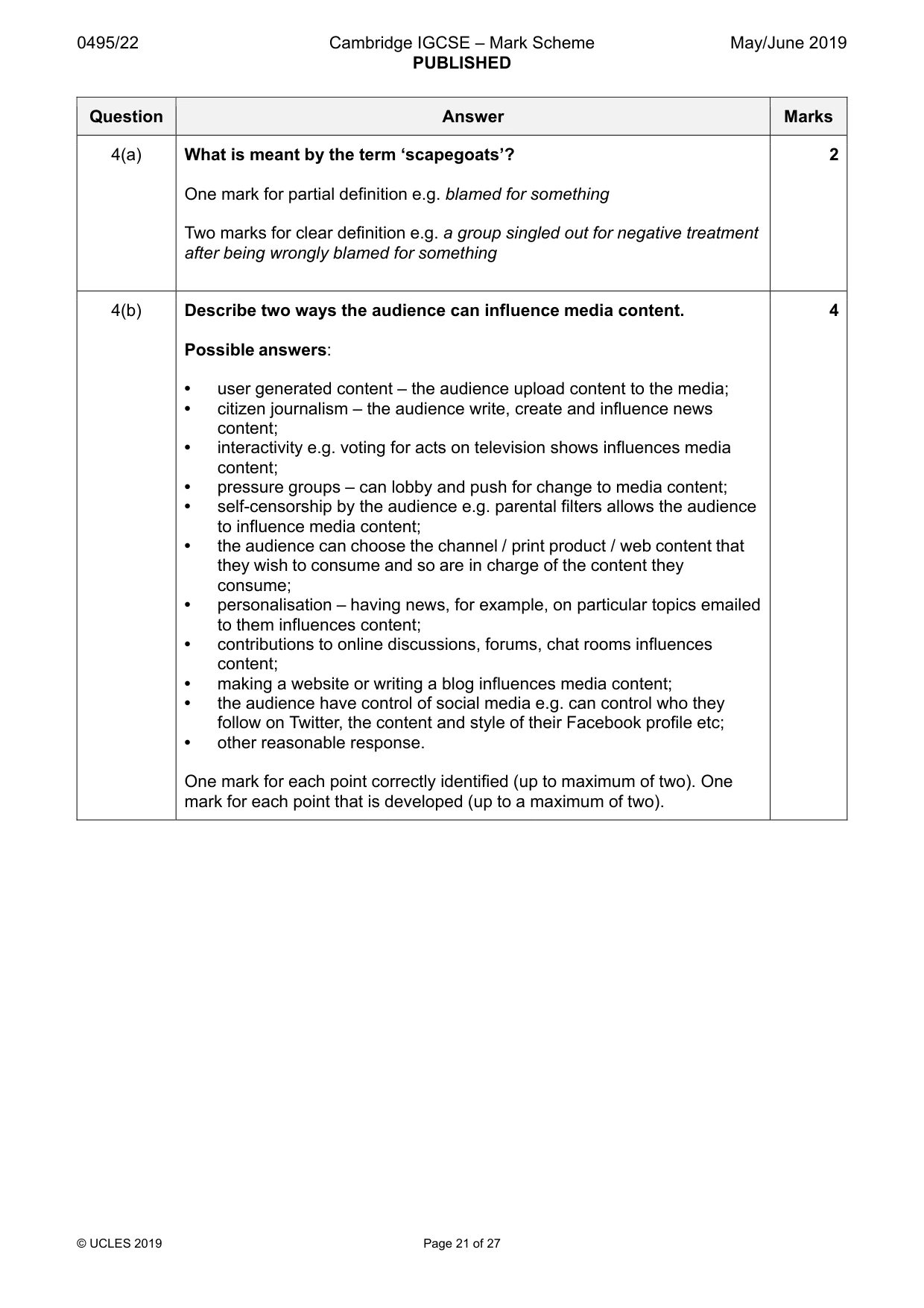
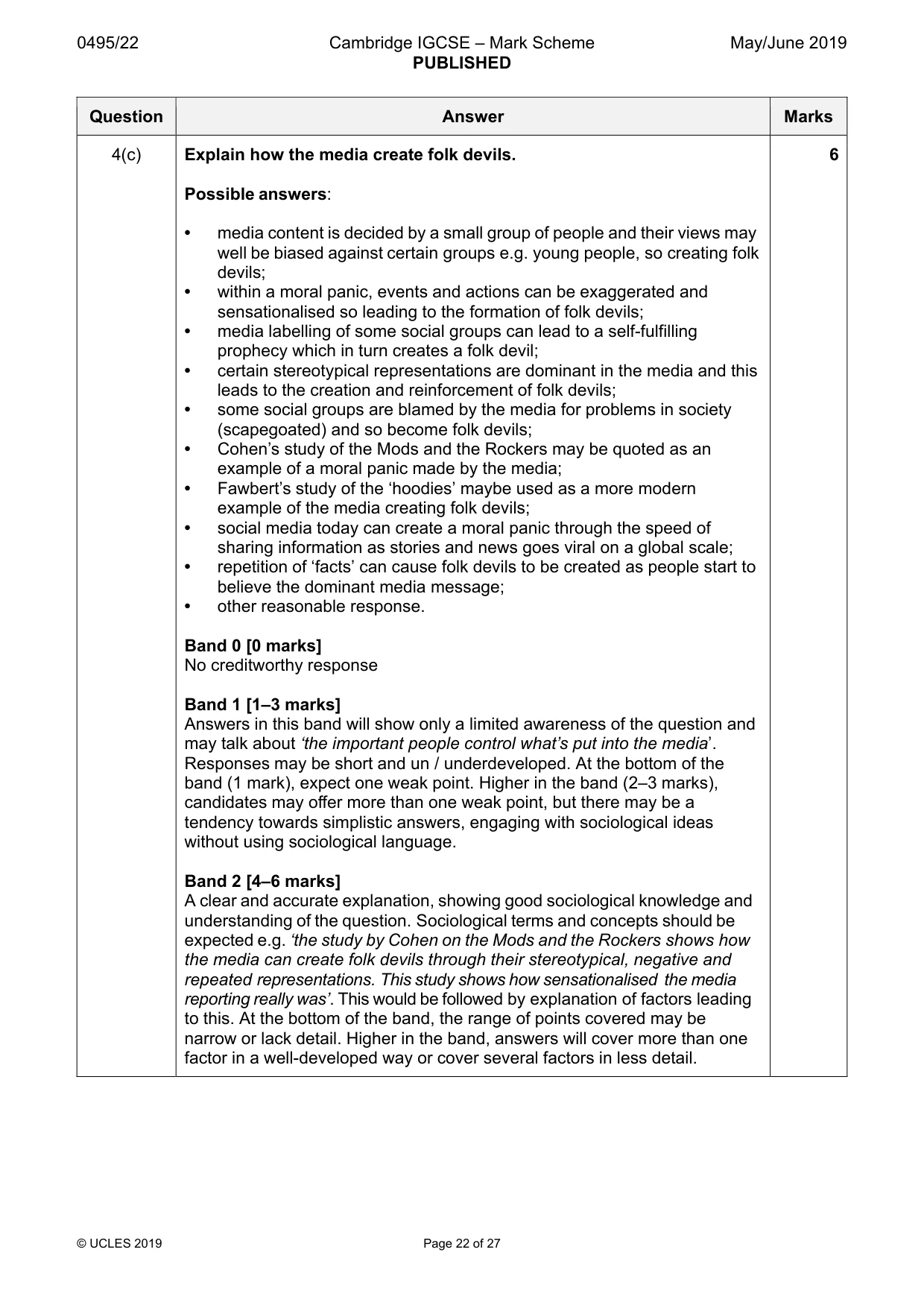
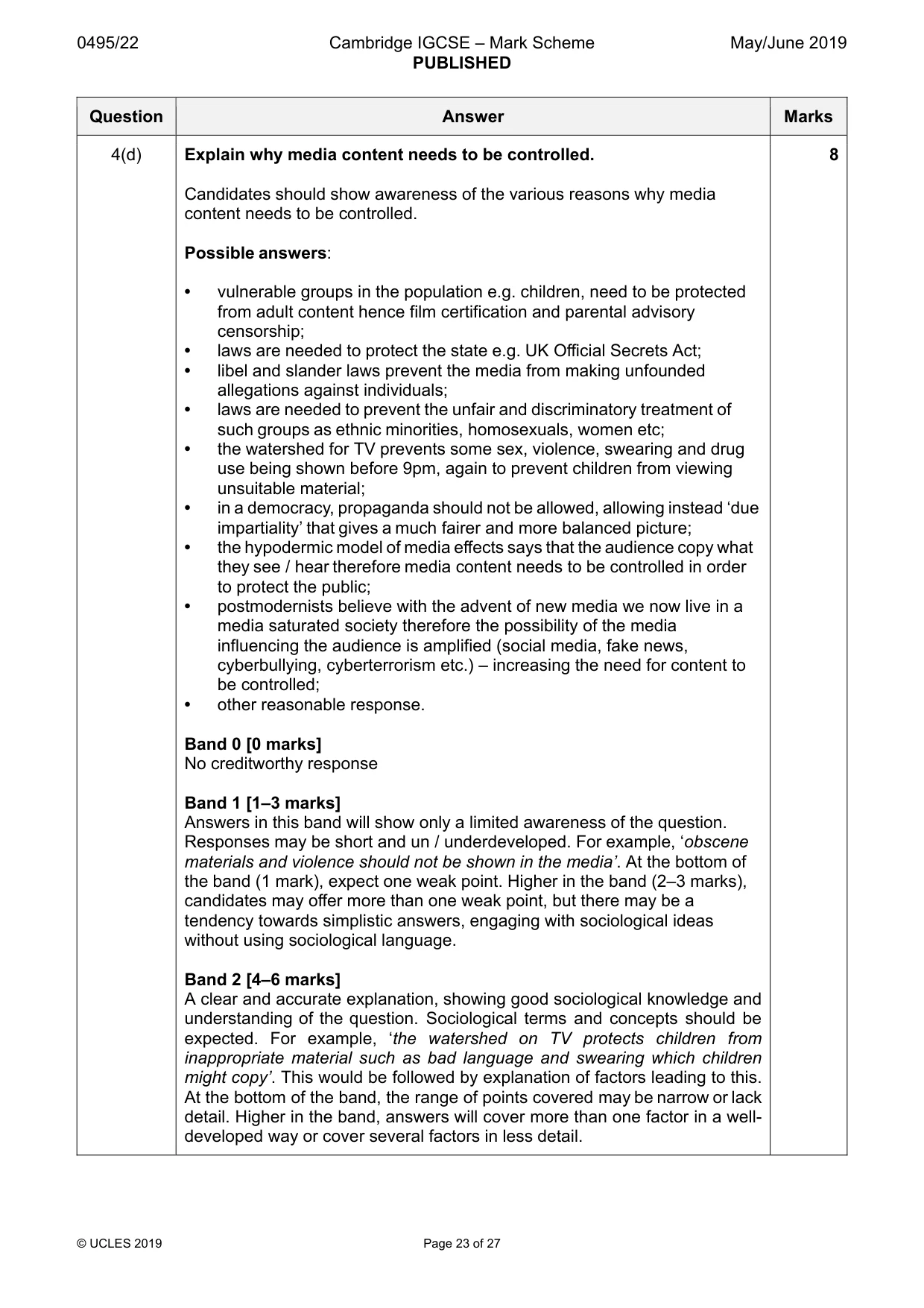
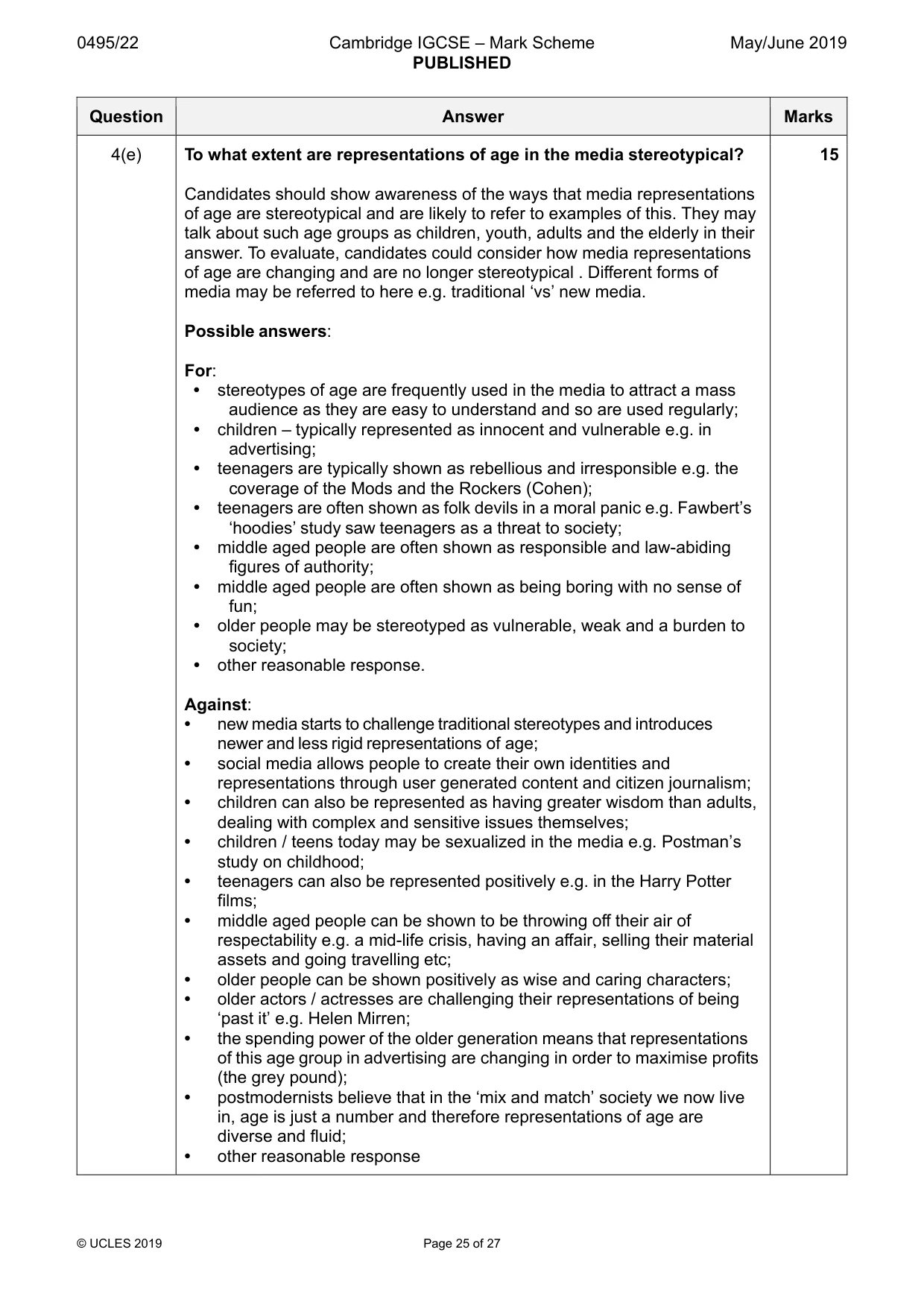
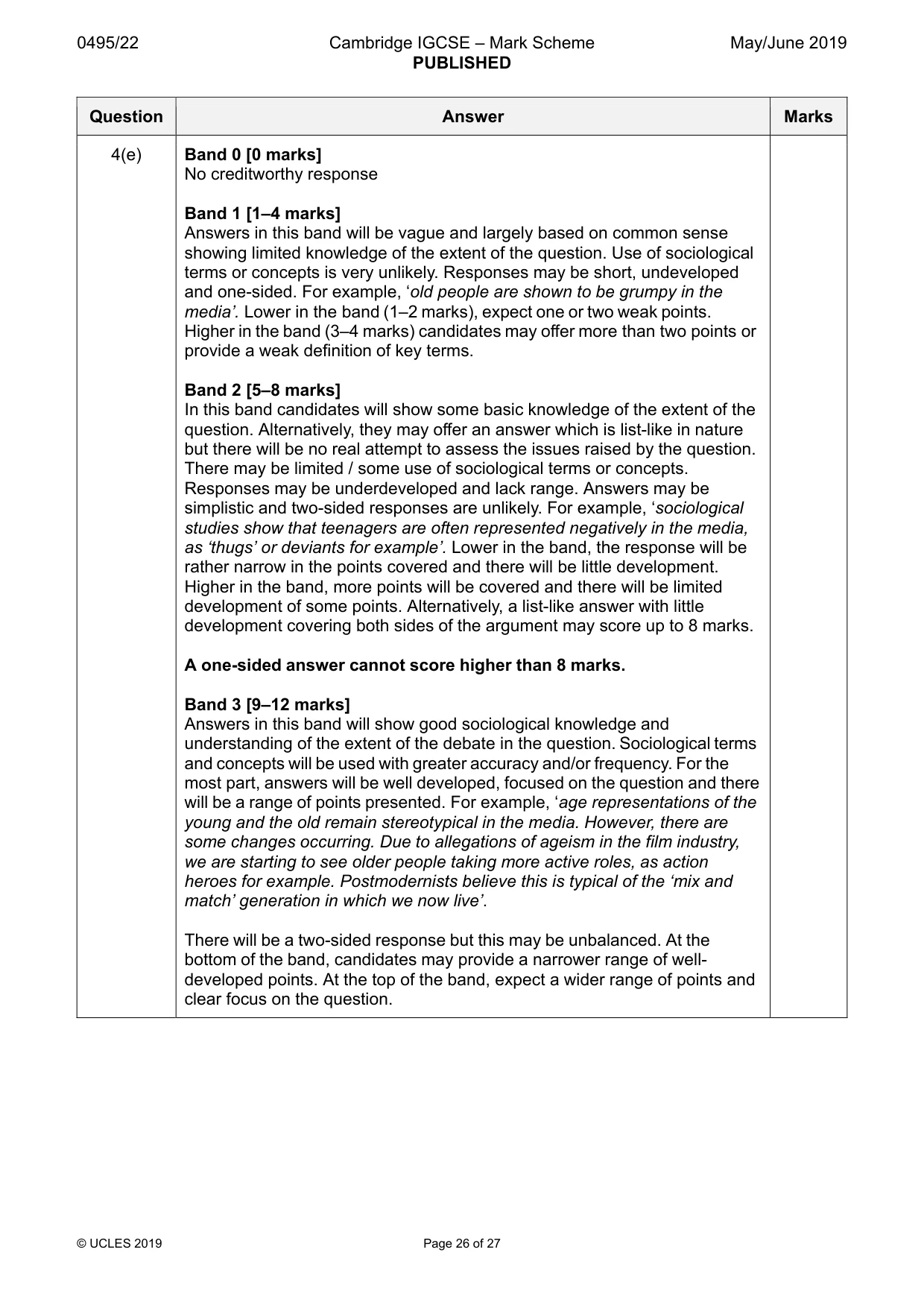
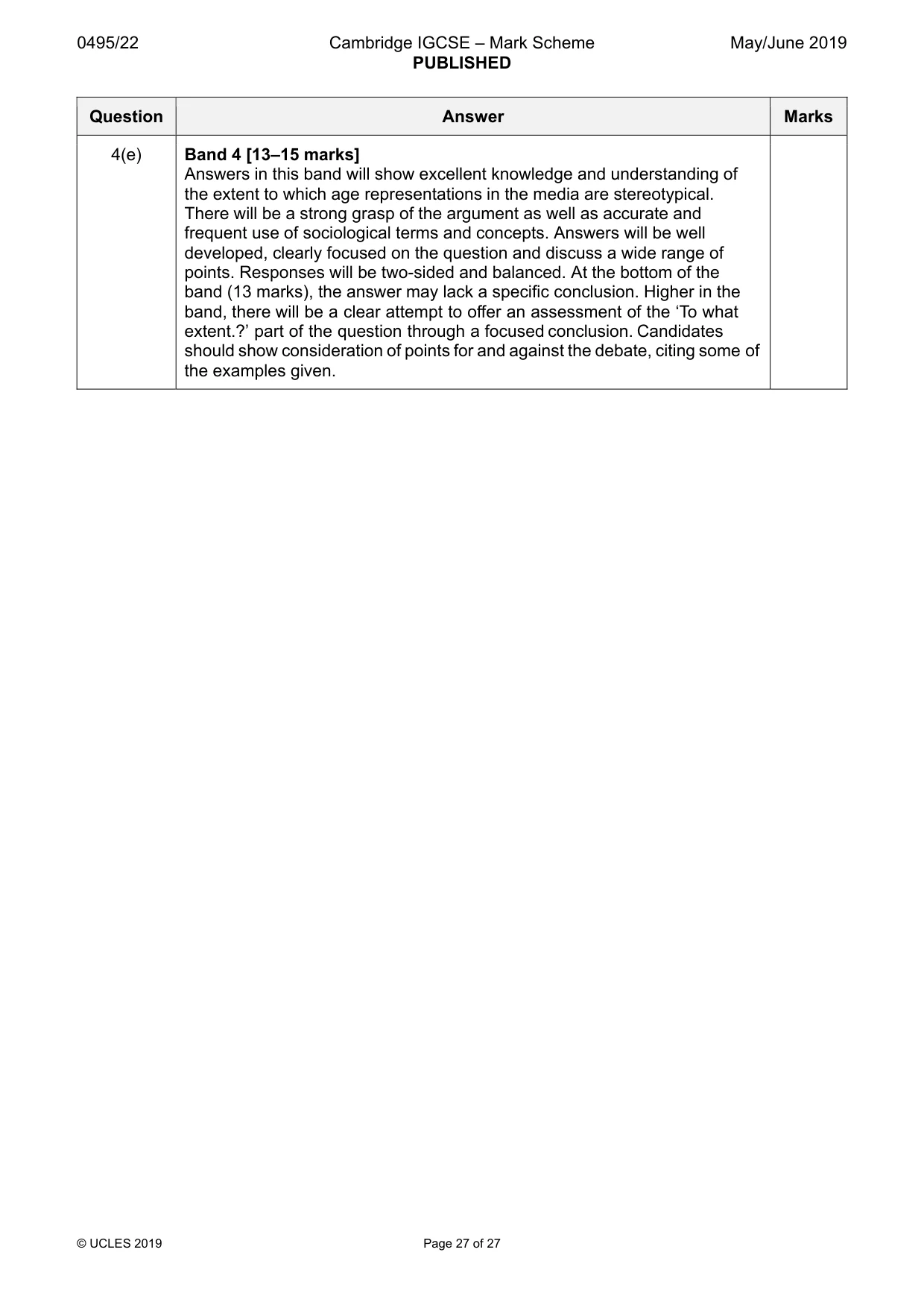
Mark scheme: 4(a) What is meant by the term ‘scapegoats’? 2 One mark for partial definition e.g. blamed for something Two marks for clear definition e.g. a group singled out for negative treatment after being wrongly blamed for something 4(b) Describe two ways the audience can influence media content. 4 Possible answers: • user generated content – the audience upload content to the media; • citizen journalism – the audience write, create and influence news content; • interactivity e.g. voting for acts on television shows influences media content; • pressure groups – can lobby and push for change to media content; • self-censorship by the audience e.g. parental filters allows the audience to influence media content; • the audience can choose the channel / print product / web content that they wish to consume and so are in charge of the content they consume; • personalisation – having news, for example, on particular topics emailed to them influences content; • contributions to online discussions, forums, chat rooms influences content; • making a website or writing a blog influences media content; • the audience have control of social media e.g. can control who they follow on Twitter, the content and style of their Facebook profile etc; • other reasonable response. One mark for each point correctly identified (up to maximum of two). One mark for each point that is developed (up to a maximum of two). 4(c) Explain how the media create folk devils. 6 Possible answers: • media content is decided by a small group of people and their views may well be biased against certain groups e.g. young people, so creating folk devils; • within a moral panic, events and actions can be exaggerated and sensationalised so leading to the formation of folk devils; • media labelling of some social groups can lead to a self-fulfilling prophecy which in turn creates a folk devil; • certain stereotypical representations are dominant in the media and this leads to the creation and reinforcement of folk devils; • some social groups are blamed by the media for problems in society (scapegoated) and so become folk devils; • Cohen’s study of the Mods and the Rockers may be quoted as an example of a moral panic made by the media; • Fawbert’s study of the ‘hoodies’ maybe used as a more modern example of the media creating folk devils; • social media today can create a moral panic through the speed of sharing information as stories and news goes viral on a global scale; • repetition of ‘facts’ can cause folk devils to be created as people start to believe the dominant media message; • other reasonable response. Band 0 [0 marks] No creditworthy response Band 1 [1–3 marks] Answers in this band will show only a limited awareness of the question and may talk about ‘the important people control what’s put into the media’. Responses may be short and un / underdeveloped. At the bottom of the band (1 mark), expect one weak point. Higher in the band (2–3 marks), candidates may offer more than one weak point, but there may be a tendency towards simplistic answers, engaging with sociological ideas without using sociological language. Band 2 [4–6 marks] A clear and accurate explanation, showing good sociological knowledge and understanding of the question. Sociological terms and concepts should be expected e.g. ‘the study by Cohen on the Mods and the Rockers shows how the media can create folk devils through their stereotypical, negative and repeated representations. This study shows how sensationalised the media reporting really was’. This would be followed by explanation of factors leading to this. At the bottom of the band, the range of points covered may be narrow or lack detail. Higher in the band, answers will cover more than one factor in a well-developed way or cover several factors in less detail. 4(d) Explain why media content needs to be controlled. 8 Candidates should show awareness of the various reasons why media content needs to be controlled. Possible answers: • vulnerable groups in the population e.g. children, need to be protected from adult content hence film certification and parental advisory censorship; • laws are needed to protect the state e.g. UK Official Secrets Act; • libel and slander laws prevent the media from making unfounded allegations against individuals; • laws are needed to prevent the unfair and discriminatory treatment of such groups as ethnic minorities, homosexuals, women etc; • the watershed for TV prevents some sex, violence, swearing and drug use being shown before 9pm, again to prevent children from viewing unsuitable material; • in a democracy, propaganda should not be allowed, allowing instead ‘due impartiality’ that gives a much fairer and more balanced picture; • the hypodermic model of media effects says that the audience copy what they see / hear therefore media content needs to be controlled in order to protect the public; • postmodernists believe with the advent of new media we now live in a media saturated society therefore the possibility of the media influencing the audience is amplified (social media, fake news, cyberbullying, cyberterrorism etc.) – increasing the need for content to be controlled; • other reasonable response. Band 0 [0 marks] No creditworthy response Band 1 [1–3 marks] Answers in this band will show only a limited awareness of the question. Responses may be short and un / underdeveloped. For example, ‘obscene materials and violence should not be shown in the media’. At the bottom of the band (1 mark), expect one weak point. Higher in the band (2–3 marks), candidates may offer more than one weak point, but there may be a tendency towards simplistic answers, engaging with sociological ideas without using sociological language. Band 2 [4–6 marks] A clear and accurate explanation, showing good sociological knowledge and understanding of the question. Sociological terms and concepts should be expected. For example, ‘the watershed on TV protects children from inappropriate material such as bad language and swearing which children might copy’. This would be followed by explanation of factors leading to this. At the bottom of the band, the range of points covered may be narrow or lack detail. Higher in the band, answers will cover more than one factor in a well- developed way or cover several factors in less detail. 4(d) Band 3 [7–8 marks] Answers in this band will show good sociological knowledge and understanding of the question. For example, ‘laws are required to keep the country safe, particularly in times of war and conflict. There are acts in place such as The Official Secrets Act and the D Notice which ensure that material that could harm the nation is not allowed to be shown.’ They can then expand on the explanation of this and other factors as necessary. Sociological terms and concepts will be used accurately overall. Answers will be well focused on the question and there will be a range of reasons presented. At the top of the band explanations will be clear throughout. 4(e) To what extent are representations of age in the media stereotypical? 15 Candidates should show awareness of the ways that media representations of age are stereotypical and are likely to refer to examples of this. They may talk about such age groups as children, youth, adults and the elderly in their answer. To evaluate, candidates could consider how media representations of age are changing and are no longer stereotypical . Different forms of media may be referred to here e.g. traditional ‘vs’ new media. Possible answers: For: • stereotypes of age are frequently used in the media to attract a mass audience as they are easy to understand and so are used regularly; • children – typically represented as innocent and vulnerable e.g. in advertising; • teenagers are typically shown as rebellious and irresponsible e.g. the coverage of the Mods and the Rockers (Cohen); • teenagers are often shown as folk devils in a moral panic e.g. Fawbert’s ‘hoodies’ study saw teenagers as a threat to society; • middle aged people are often shown as responsible and law-abiding figures of authority; • middle aged people are often shown as being boring with no sense of fun; • older people may be stereotyped as vulnerable, weak and a burden to society; • other reasonable response. Against: • new media starts to challenge traditional stereotypes and introduces newer and less rigid representations of age; • social media allows people to create their own identities and representations through user generated content and citizen journalism; • children can also be represented as having greater wisdom than adults, dealing with complex and sensitive issues themselves; • children / teens today may be sexualized in the media e.g. Postman’s study on childhood; • teenagers can also be represented positively e.g. in the Harry Potter films; • middle aged people can be shown to be throwing off their air of respectability e.g. a mid-life crisis, having an affair, selling their material assets and going travelling etc; • older people can be shown positively as wise and caring characters; • older actors / actresses are challenging their representations of being ‘past it’ e.g. Helen Mirren; • the spending power of the older generation means that representations of this age group in advertising are changing in order to maximise profits (the grey pound); • postmodernists believe that in the ‘mix and match’ society we now live in, age is just a number and therefore representations of age are diverse and fluid; • other reasonable response 4(e) Band 0 [0 marks] No creditworthy response Band 1 [1–4 marks] Answers in this band will be vague and largely based on common sense showing limited knowledge of the extent of the question. Use of sociological terms or concepts is very unlikely. Responses may be short, undeveloped and one-sided. For example, ‘old people are shown to be grumpy in the media’. Lower in the band (1–2 marks), expect one or two weak points. Higher in the band (3–4 marks) candidates may offer more than two points or provide a weak definition of key terms. Band 2 [5–8 marks] In this band candidates will show some basic knowledge of the extent of the question. Alternatively, they may offer an answer which is list-like in nature but there will be no real attempt to assess the issues raised by the question. There may be limited / some use of sociological terms or concepts. Responses may be underdeveloped and lack range. Answers may be simplistic and two-sided responses are unlikely. For example, ‘sociological studies show that teenagers are often represented negatively in the media, as ‘thugs’ or deviants for example’. Lower in the band, the response will be rather narrow in the points covered and there will be little development. Higher in the band, more points will be covered and there will be limited development of some points. Alternatively, a list-like answer with little development covering both sides of the argument may score up to 8 marks. A one-sided answer cannot score higher than 8 marks. Band 3 [9–12 marks] Answers in this band will show good sociological knowledge and understanding of the extent of the debate in the question. Sociological terms and concepts will be used with greater accuracy and/or frequency. For the most part, answers will be well developed, focused on the question and there will be a range of points presented. For example, ‘age representations of the young and the old remain stereotypical in the media. However, there are some changes occurring. Due to allegations of ageism in the film industry, we are starting to see older people taking more active roles, as action heroes for example. Postmodernists believe this is typical of the ‘mix and match’ generation in which we now live’. There will be a two-sided response but this may be unbalanced. At the bottom of the band, candidates may provide a narrower range of well- developed points. At the top of the band, expect a wider range of points and clear focus on the question. 4(e) Band 4 [13–15 marks] Answers in this band will show excellent knowledge and understanding of the extent to which age representations in the media are stereotypical. There will be a strong grasp of the argument as well as accurate and frequent use of sociological terms and concepts. Answers will be well developed, clearly focused on the question and discuss a wide range of points. Responses will be two-sided and balanced. At the bottom of the band (13 marks), the answer may lack a specific conclusion. Higher in the band, there will be a clear attempt to offer an assessment of the ‘To what extent.?’ part of the question through a focused conclusion. Candidates should show consideration of points for and against the debate, citing some of the examples given.
What was in this paper
The subtopics covered by these 4 questions, and how many questions each got. Open one in a new tab to see every Cambridge question on it.
What you needed in this session
Cambridge’s own grade thresholds for 2019 May/June, Paper 2 · Variant 2. A higher threshold means an easier paper — the bar moves with how the cohort did.