Cambridge IGCSE Sociology 0495 — 2019 May/June Paper 2 · Variant 3
0495/23/M/J/19 · 4 questions · 70 marks · ≈79 min
The question paper and its mark scheme, free to read here and free to download. This is Cambridge’s own paper, exactly as it was sat.
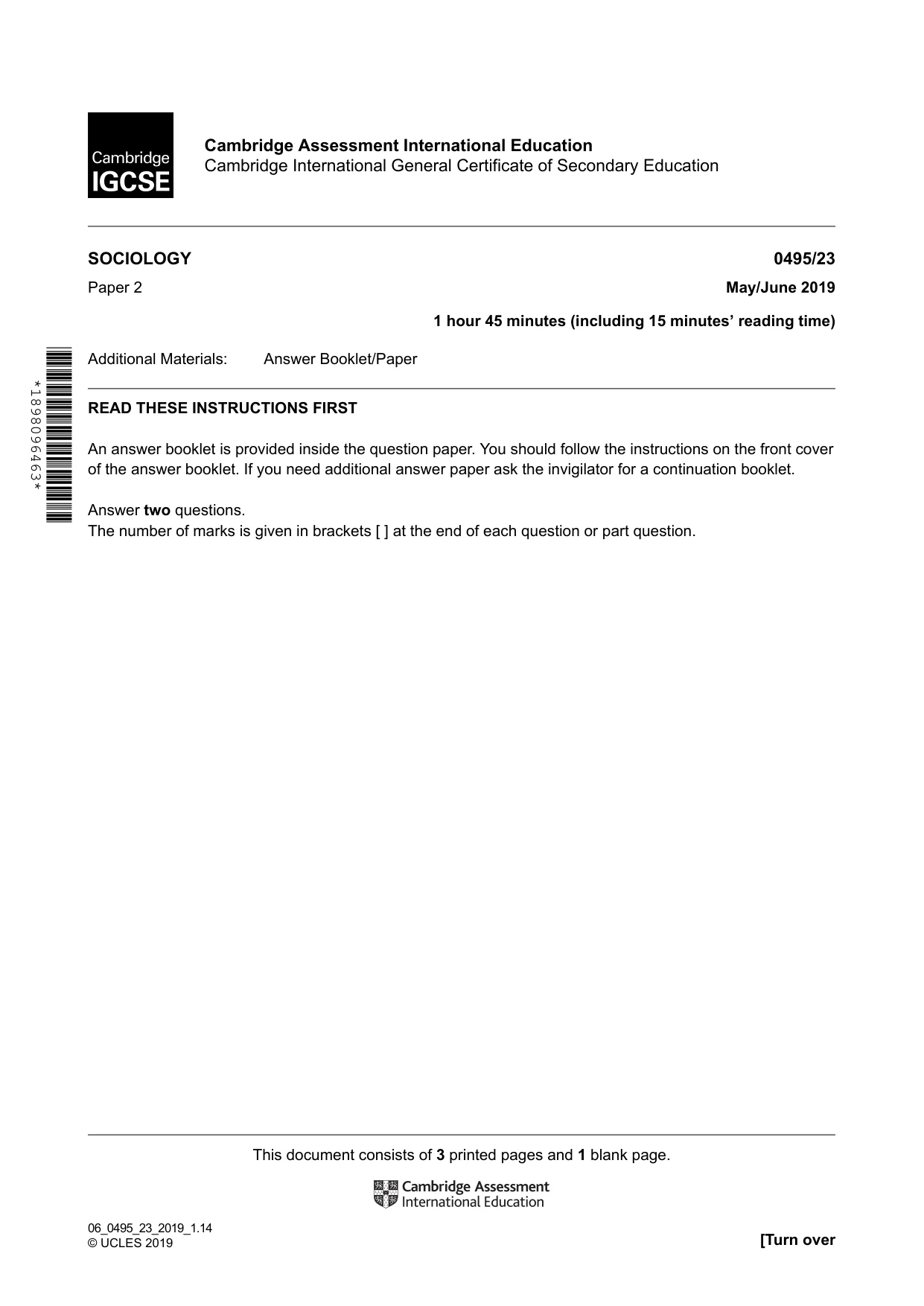
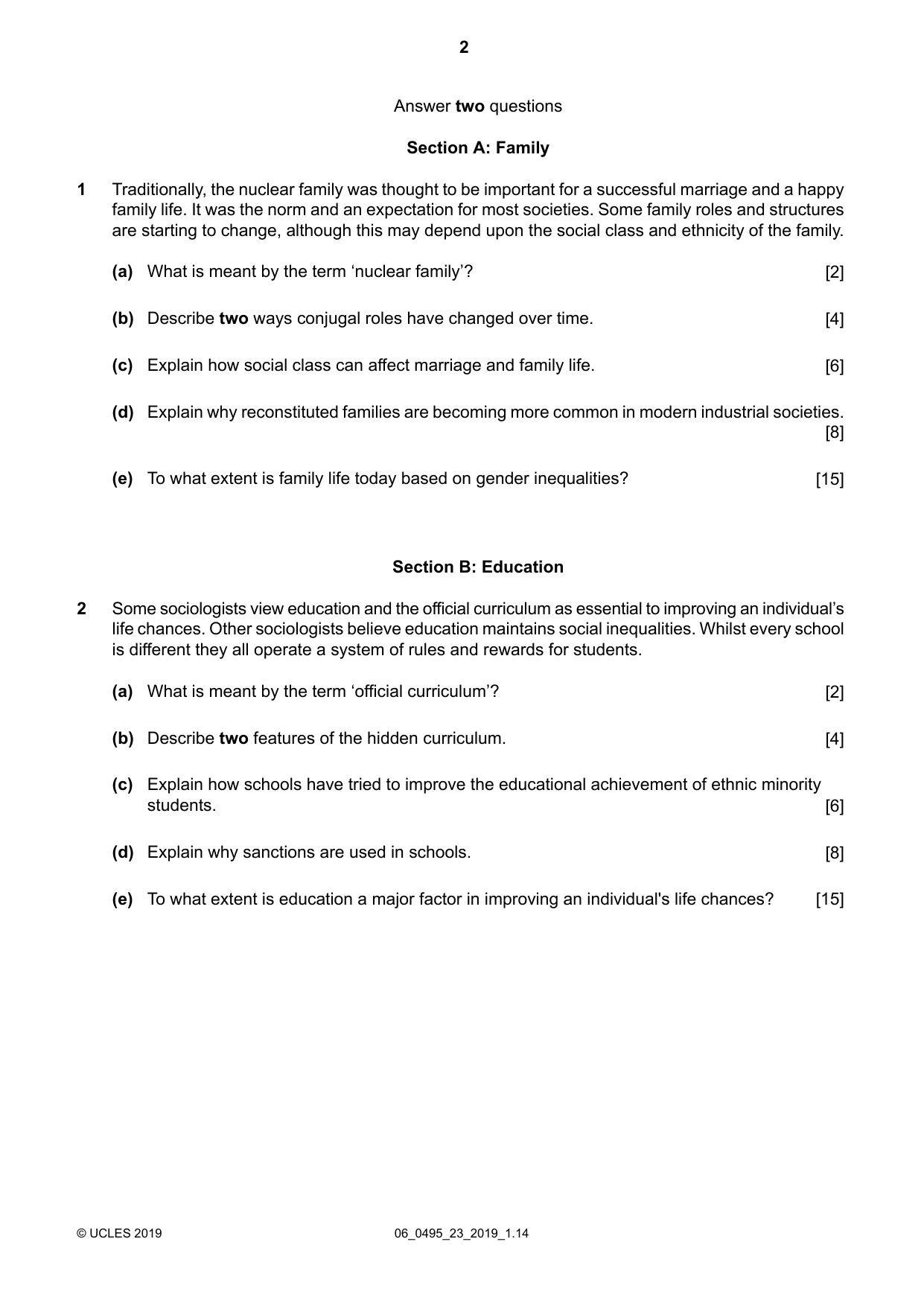
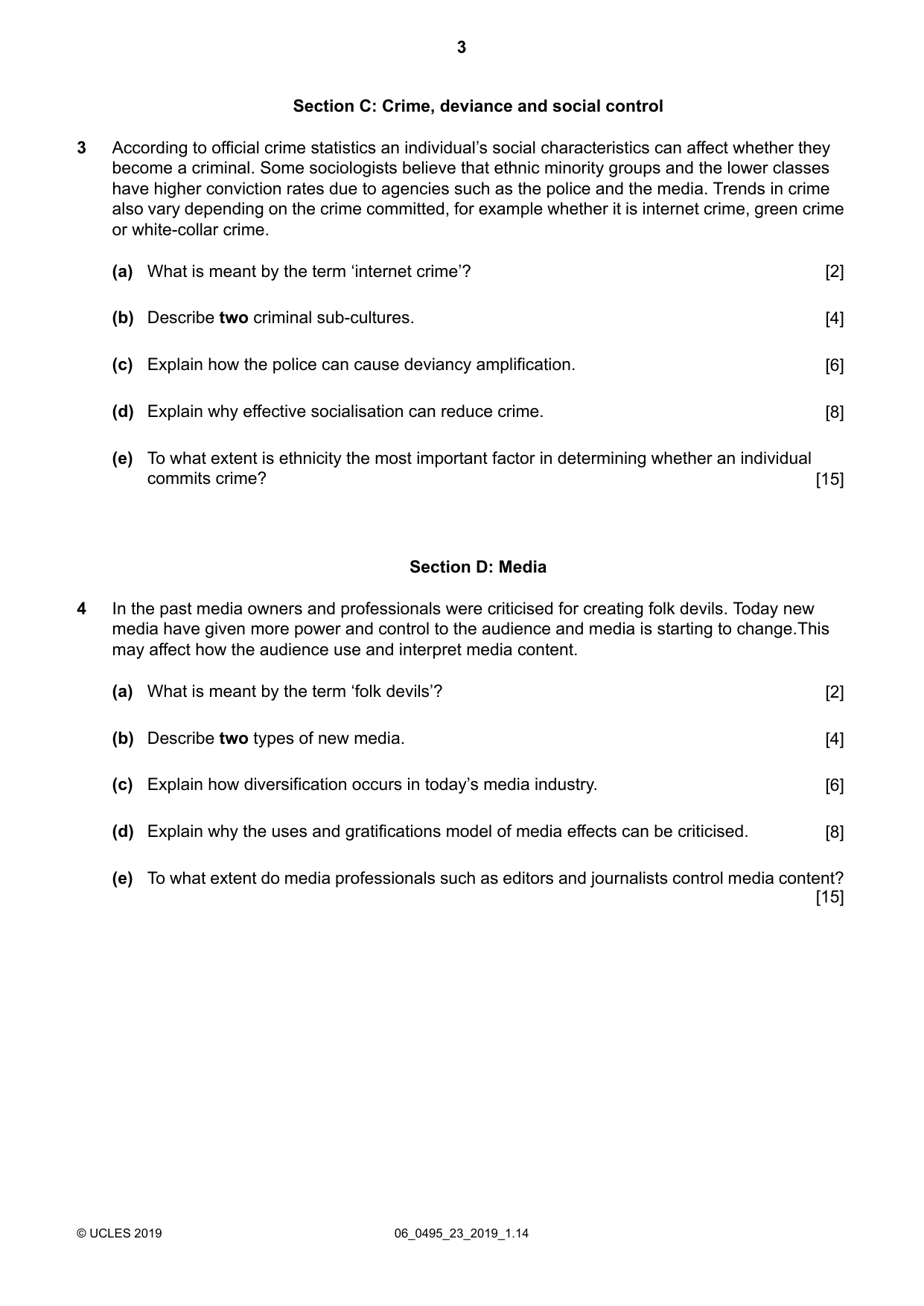
Question paper4 pages

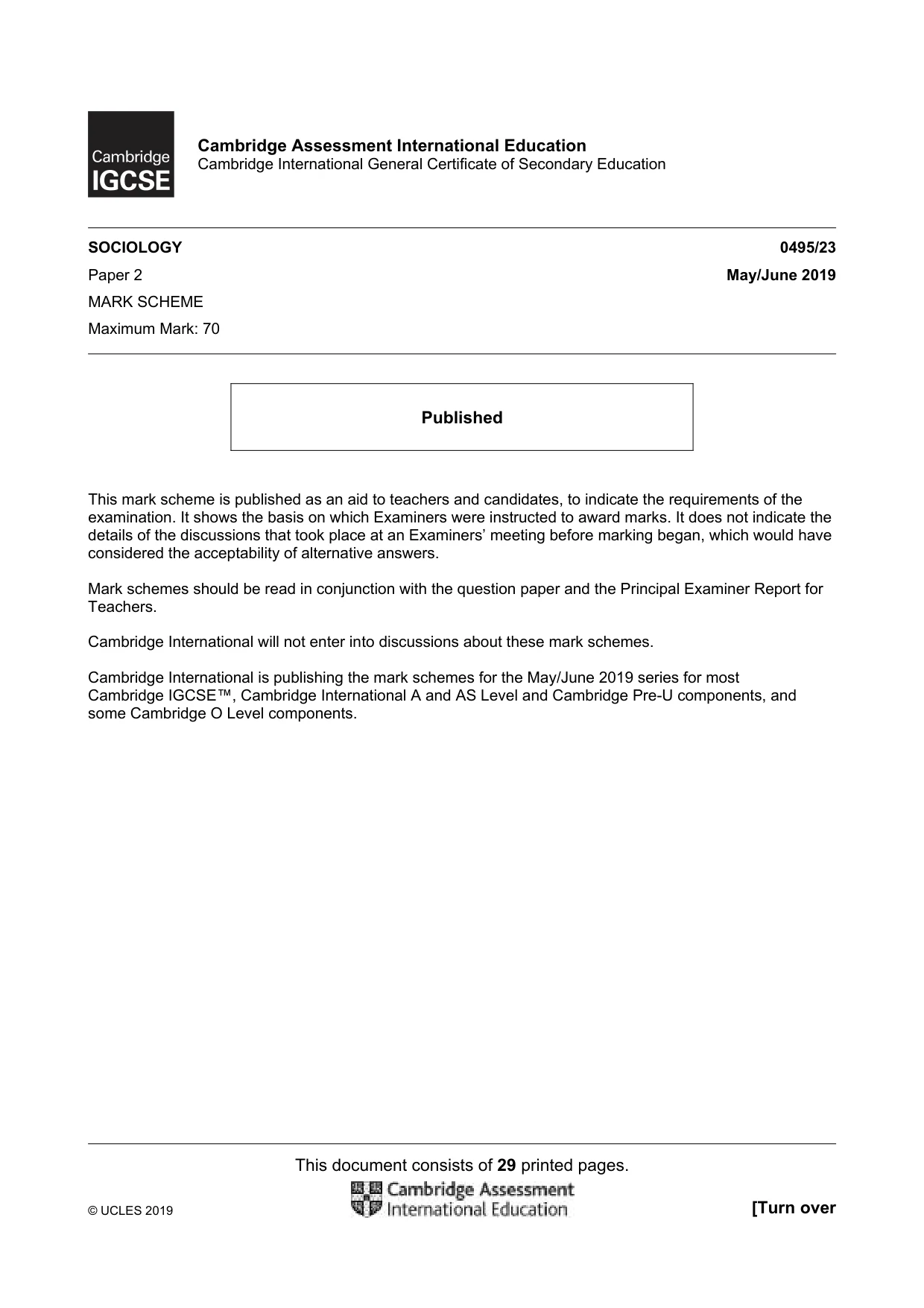
Mark scheme29 pages
Answers below. Sit the paper first if you are practising.




Questions as text
Q1 · Traditionally, the nuclear family was thought to be important for a successful marriage…
1 Traditionally, the nuclear family was thought to be important for a successful marriage and a happy family life. It was the norm and an expectation for most societies. Some family roles and structures are starting to change, although this may depend upon the social class and ethnicity of the family. (a) What is meant by the term ‘nuclear family’? [2] (b) Describe two ways conjugal roles have changed over time. [4] (c) Explain how social class can affect marriage and family life. [6] (d) Explain why reconstituted families are becoming more common in modern industrial societies. [8] (e) To what extent is family life today based on gender inequalities? [15]
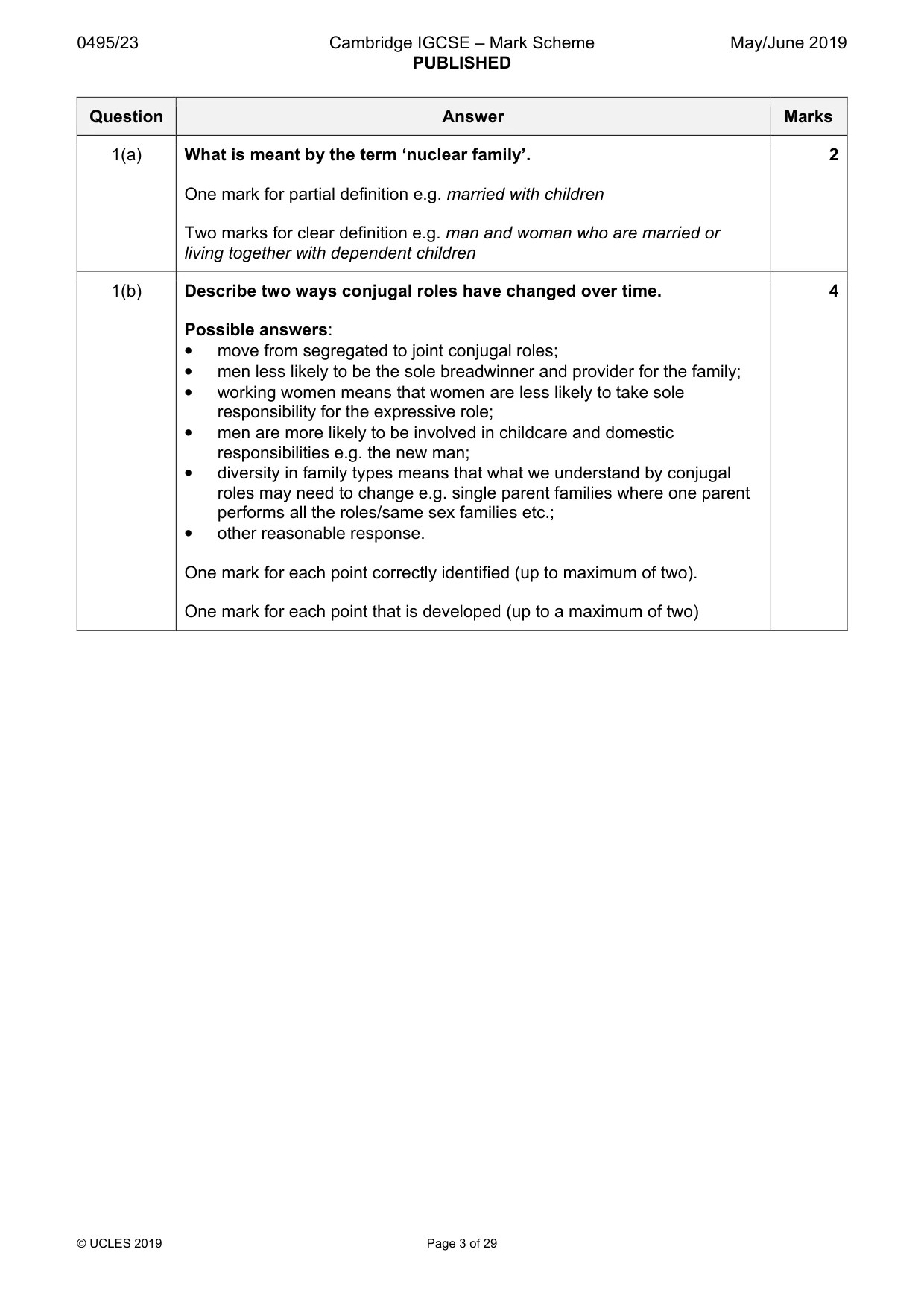
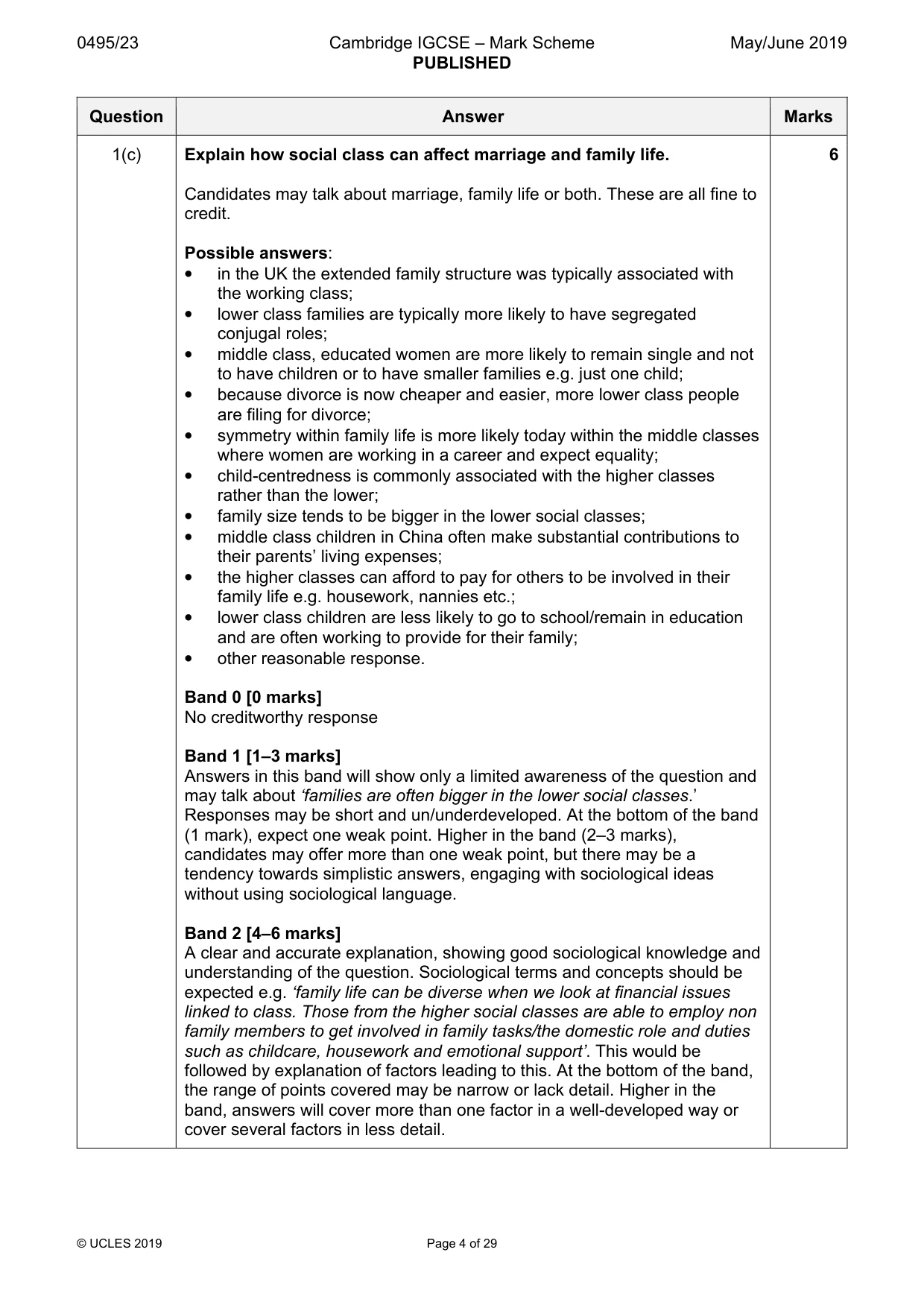
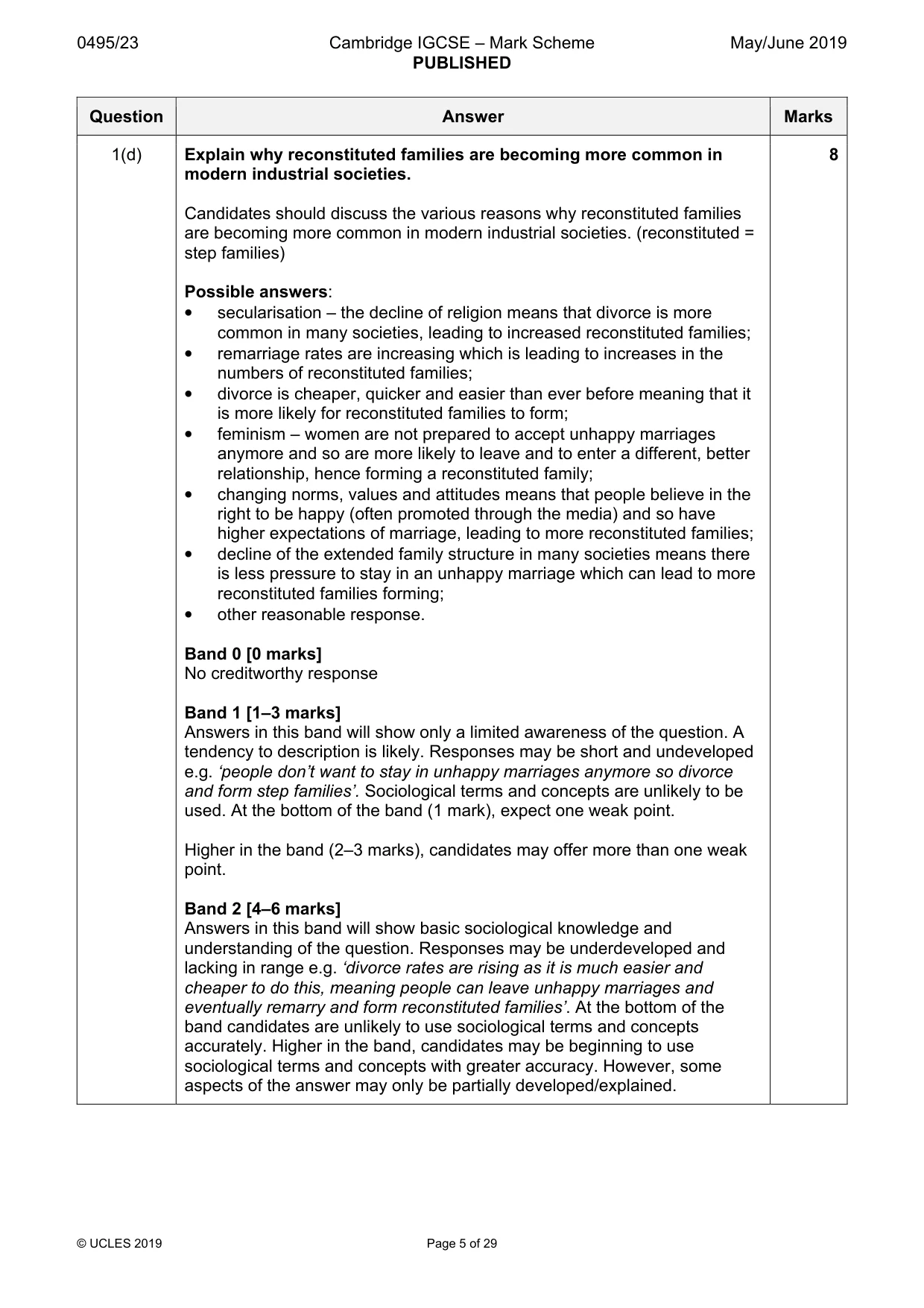
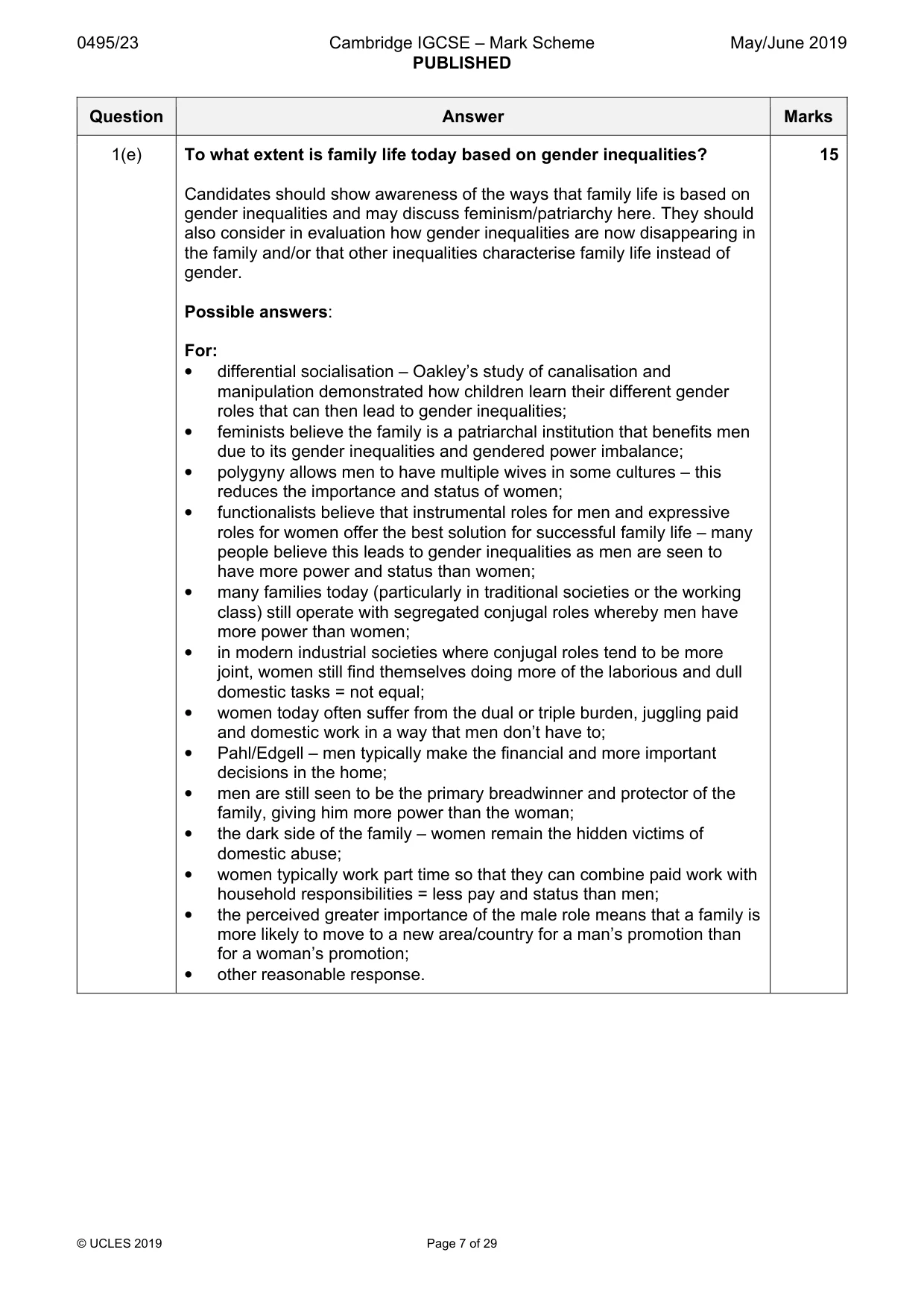
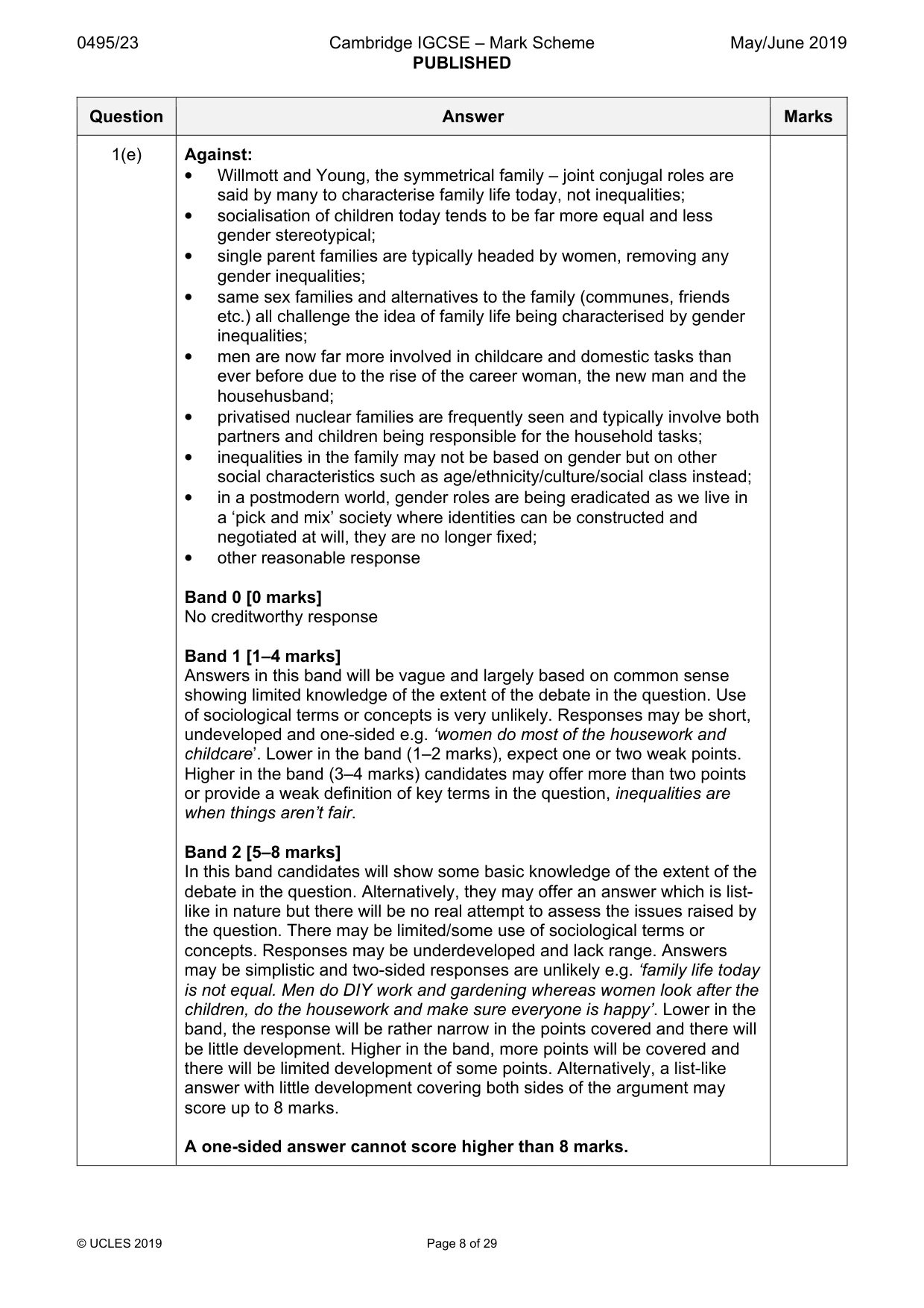
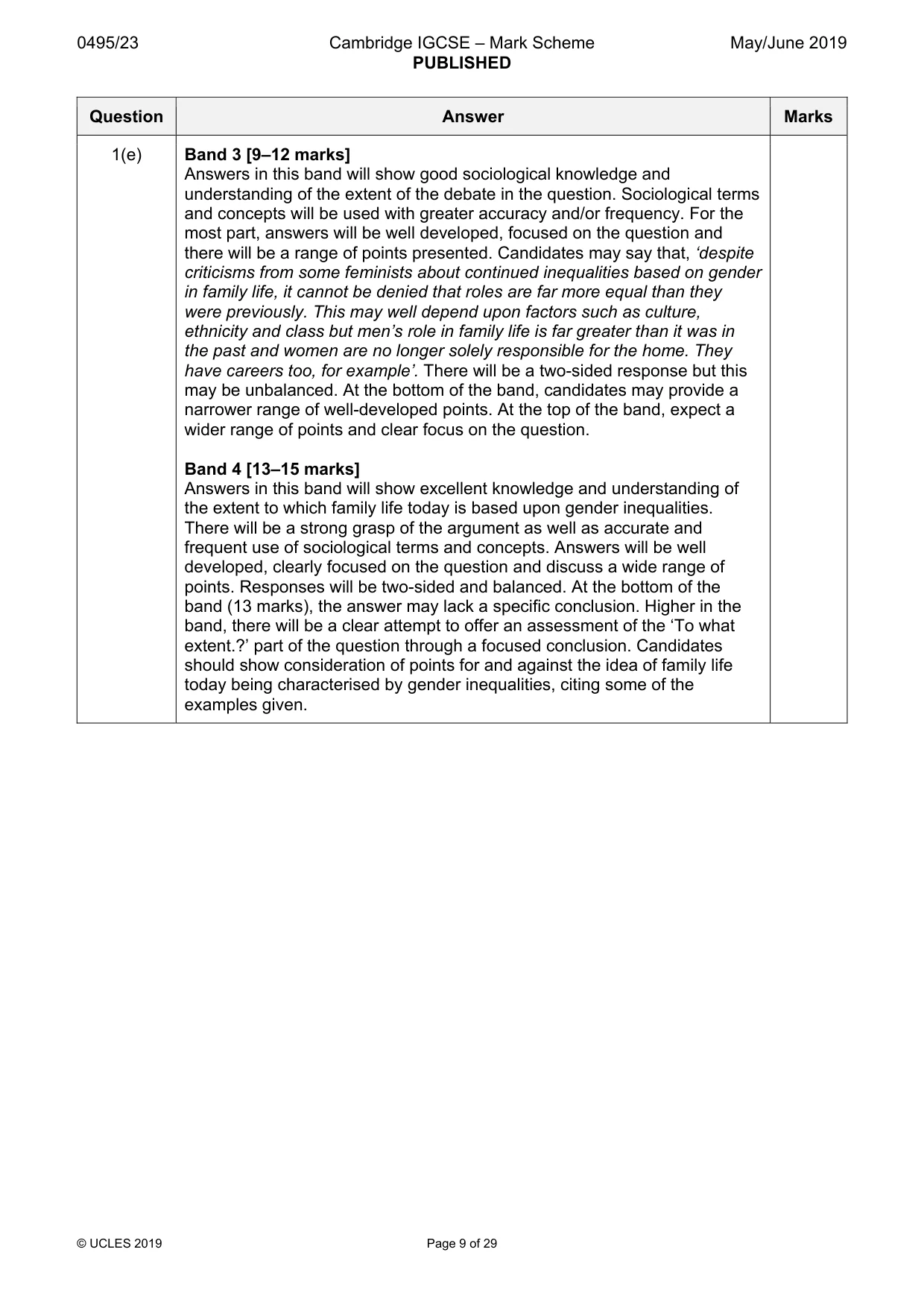
Mark scheme: Question Answer Marks 1(a) What is meant by the term ‘nuclear family’. 2 One mark for partial definition e.g. married with children Two marks for clear definition e.g. man and woman who are married or living together with dependent children 1(b) Describe two ways conjugal roles have changed over time. 4 Possible answers: • move from segregated to joint conjugal roles; • men less likely to be the sole breadwinner and provider for the family; • working women means that women are less likely to take sole responsibility for the expressive role; • men are more likely to be involved in childcare and domestic responsibilities e.g. the new man; • diversity in family types means that what we understand by conjugal roles may need to change e.g. single parent families where one parent performs all the roles/same sex families etc.; • other reasonable response. One mark for each point correctly identified (up to maximum of two). One mark for each point that is developed (up to a maximum of two) 1(c) Explain how social class can affect marriage and family life. 6 Candidates may talk about marriage, family life or both. These are all fine to credit. Possible answers: • in the UK the extended family structure was typically associated with the working class; • lower class families are typically more likely to have segregated conjugal roles; • middle class, educated women are more likely to remain single and not to have children or to have smaller families e.g. just one child; • because divorce is now cheaper and easier, more lower class people are filing for divorce; • symmetry within family life is more likely today within the middle classes where women are working in a career and expect equality; • child-centredness is commonly associated with the higher classes rather than the lower; • family size tends to be bigger in the lower social classes; • middle class children in China often make substantial contributions to their parents’ living expenses; • the higher classes can afford to pay for others to be involved in their family life e.g. housework, nannies etc.; • lower class children are less likely to go to school/remain in education and are often working to provide for their family; • other reasonable response. Band 0 [0 marks] No creditworthy response Band 1 [1–3 marks] Answers in this band will show only a limited awareness of the question and may talk about ‘families are often bigger in the lower social classes.’ Responses may be short and un/underdeveloped. At the bottom of the band (1 mark), expect one weak point. Higher in the band (2–3 marks), candidates may offer more than one weak point, but there may be a tendency towards simplistic answers, engaging with sociological ideas without using sociological language. Band 2 [4–6 marks] A clear and accurate explanation, showing good sociological knowledge and understanding of the question. Sociological terms and concepts should be expected e.g. ‘family life can be diverse when we look at financial issues linked to class. Those from the higher social classes are able to employ non family members to get involved in family tasks/the domestic role and duties such as childcare, housework and emotional support’. This would be followed by explanation of factors leading to this. At the bottom of the band, the range of points covered may be narrow or lack detail. Higher in the band, answers will cover more than one factor in a well-developed way or cover several factors in less detail. 1(d) Explain why reconstituted families are becoming more common in 8 modern industrial societies. Candidates should discuss the various reasons why reconstituted families are becoming more common in modern industrial societies. (reconstituted = step families) Possible answers: • secularisation – the decline of religion means that divorce is more common in many societies, leading to increased reconstituted families; • remarriage rates are increasing which is leading to increases in the numbers of reconstituted families; • divorce is cheaper, quicker and easier than ever before meaning that it is more likely for reconstituted families to form; • feminism – women are not prepared to accept unhappy marriages anymore and so are more likely to leave and to enter a different, better relationship, hence forming a reconstituted family; • changing norms, values and attitudes means that people believe in the right to be happy (often promoted through the media) and so have higher expectations of marriage, leading to more reconstituted families; • decline of the extended family structure in many societies means there is less pressure to stay in an unhappy marriage which can lead to more reconstituted families forming; • other reasonable response. Band 0 [0 marks] No creditworthy response Band 1 [1–3 marks] Answers in this band will show only a limited awareness of the question. A tendency to description is likely. Responses may be short and undeveloped e.g. ‘people don’t want to stay in unhappy marriages anymore so divorce and form step families’. Sociological terms and concepts are unlikely to be used. At the bottom of the band (1 mark), expect one weak point. Higher in the band (2–3 marks), candidates may offer more than one weak point. Band 2 [4–6 marks] Answers in this band will show basic sociological knowledge and understanding of the question. Responses may be underdeveloped and lacking in range e.g. ‘divorce rates are rising as it is much easier and cheaper to do this, meaning people can leave unhappy marriages and eventually remarry and form reconstituted families’. At the bottom of the band candidates are unlikely to use sociological terms and concepts accurately. Higher in the band, candidates may be beginning to use sociological terms and concepts with greater accuracy. However, some aspects of the answer may only be partially developed/explained. 1(d) Band 3 [7–8 marks] Answers in this band will show good sociological knowledge and understanding of the question., e.g. ‘Many societies are now secular meaning that there is less pressure to stay in an unhappy marriage. This leads to increasing divorce rates, particularly by women, who will look for different, better relationships. This is further encouraged by feminism and so increased numbers of reconstituted families start to form’. They can then expand on the explanation of this and other factors as necessary. Sociological terms and concepts will be used accurately overall. Answers will be well focused on the question and there will be a range of reasons presented. At the top of the band explanations will be clear throughout. 1(e) To what extent is family life today based on gender inequalities? 15 Candidates should show awareness of the ways that family life is based on gender inequalities and may discuss feminism/patriarchy here. They should also consider in evaluation how gender inequalities are now disappearing in the family and/or that other inequalities characterise family life instead of gender. Possible answers: For: • differential socialisation – Oakley’s study of canalisation and manipulation demonstrated how children learn their different gender roles that can then lead to gender inequalities; • feminists believe the family is a patriarchal institution that benefits men due to its gender inequalities and gendered power imbalance; • polygyny allows men to have multiple wives in some cultures – this reduces the importance and status of women; • functionalists believe that instrumental roles for men and expressive roles for women offer the best solution for successful family life – many people believe this leads to gender inequalities as men are seen to have more power and status than women; • many families today (particularly in traditional societies or the working class) still operate with segregated conjugal roles whereby men have more power than women; • in modern industrial societies where conjugal roles tend to be more joint, women still find themselves doing more of the laborious and dull domestic tasks = not equal; • women today often suffer from the dual or triple burden, juggling paid and domestic work in a way that men don’t have to; • Pahl/Edgell – men typically make the financial and more important decisions in the home; • men are still seen to be the primary breadwinner and protector of the family, giving him more power than the woman; • the dark side of the family – women remain the hidden victims of domestic abuse; • women typically work part time so that they can combine paid work with household responsibilities = less pay and status than men; • the perceived greater importance of the male role means that a family is more likely to move to a new area/country for a man’s promotion than for a woman’s promotion; • other reasonable response. 1(e) Against: • Willmott and Young, the symmetrical family – joint conjugal roles are said by many to characterise family life today, not inequalities; • socialisation of children today tends to be far more equal and less gender stereotypical; • single parent families are typically headed by women, removing any gender inequalities; • same sex families and alternatives to the family (communes, friends etc.) all challenge the idea of family life being characterised by gender inequalities; • men are now far more involved in childcare and domestic tasks than ever before due to the rise of the career woman, the new man and the househusband; • privatised nuclear families are frequently seen and typically involve both partners and children being responsible for the household tasks; • inequalities in the family may not be based on gender but on other social characteristics such as age/ethnicity/culture/social class instead; • in a postmodern world, gender roles are being eradicated as we live in a ‘pick and mix’ society where identities can be constructed and negotiated at will, they are no longer fixed; • other reasonable response Band 0 [0 marks] No creditworthy response Band 1 [1–4 marks] Answers in this band will be vague and largely based on common sense showing limited knowledge of the extent of the debate in the question. Use of sociological terms or concepts is very unlikely. Responses may be short, undeveloped and one-sided e.g. ‘women do most of the housework and childcare’. Lower in the band (1–2 marks), expect one or two weak points. Higher in the band (3–4 marks) candidates may offer more than two points or provide a weak definition of key terms in the question, inequalities are when things aren’t fair. Band 2 [5–8 marks] In this band candidates will show some basic knowledge of the extent of the debate in the question. Alternatively, they may offer an answer which is list- like in nature but there will be no real attempt to assess the issues raised by the question. There may be limited/some use of sociological terms or concepts. Responses may be underdeveloped and lack range. Answers may be simplistic and two-sided responses are unlikely e.g. ‘family life today is not equal. Men do DIY work and gardening whereas women look after the children, do the housework and make sure everyone is happy’. Lower in the band, the response will be rather narrow in the points covered and there will be little development. Higher in the band, more points will be covered and there will be limited development of some points. Alternatively, a list-like answer with little development covering both sides of the argument may score up to 8 marks. A one-sided answer cannot score higher than 8 marks. 1(e) Band 3 [9–12 marks] Answers in this band will show good sociological knowledge and understanding of the extent of the debate in the question. Sociological terms and concepts will be used with greater accuracy and/or frequency. For the most part, answers will be well developed, focused on the question and there will be a range of points presented. Candidates may say that, ‘despite criticisms from some feminists about continued inequalities based on gender in family life, it cannot be denied that roles are far more equal than they were previously. This may well depend upon factors such as culture, ethnicity and class but men’s role in family life is far greater than it was in the past and women are no longer solely responsible for the home. They have careers too, for example’. There will be a two-sided response but this may be unbalanced. At the bottom of the band, candidates may provide a narrower range of well-developed points. At the top of the band, expect a wider range of points and clear focus on the question. Band 4 [13–15 marks] Answers in this band will show excellent knowledge and understanding of the extent to which family life today is based upon gender inequalities. There will be a strong grasp of the argument as well as accurate and frequent use of sociological terms and concepts. Answers will be well developed, clearly focused on the question and discuss a wide range of points. Responses will be two-sided and balanced. At the bottom of the band (13 marks), the answer may lack a specific conclusion. Higher in the band, there will be a clear attempt to offer an assessment of the ‘To what extent.?’ part of the question through a focused conclusion. Candidates should show consideration of points for and against the idea of family life today being characterised by gender inequalities, citing some of the examples given.
Q2 · Some sociologists view education and the official curriculum as essential to improving an…
2 Some sociologists view education and the official curriculum as essential to improving an individual’s life chances. Other sociologists believe education maintains social inequalities. Whilst every school is different they all operate a system of rules and rewards for students. (a) What is meant by the term ‘official curriculum’? [2] (b) Describe two features of the hidden curriculum. [4] (c) Explain how schools have tried to improve the educational achievement of ethnic minority students. [6] (d) Explain why sanctions are used in schools. [8] (e) To what extent is education a major factor in improving an individual's life chances? [15] Section C: Crime, deviance and social control
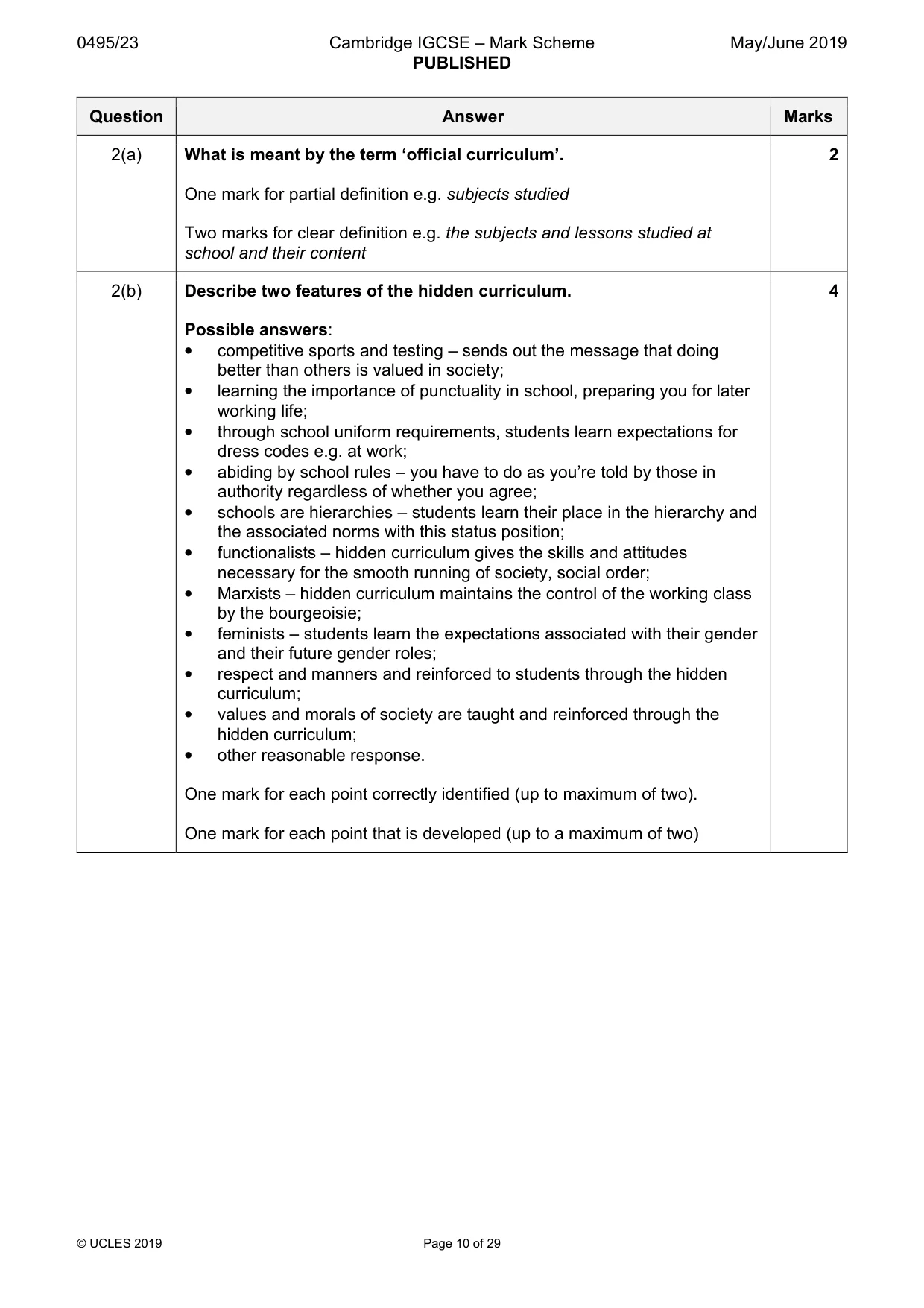
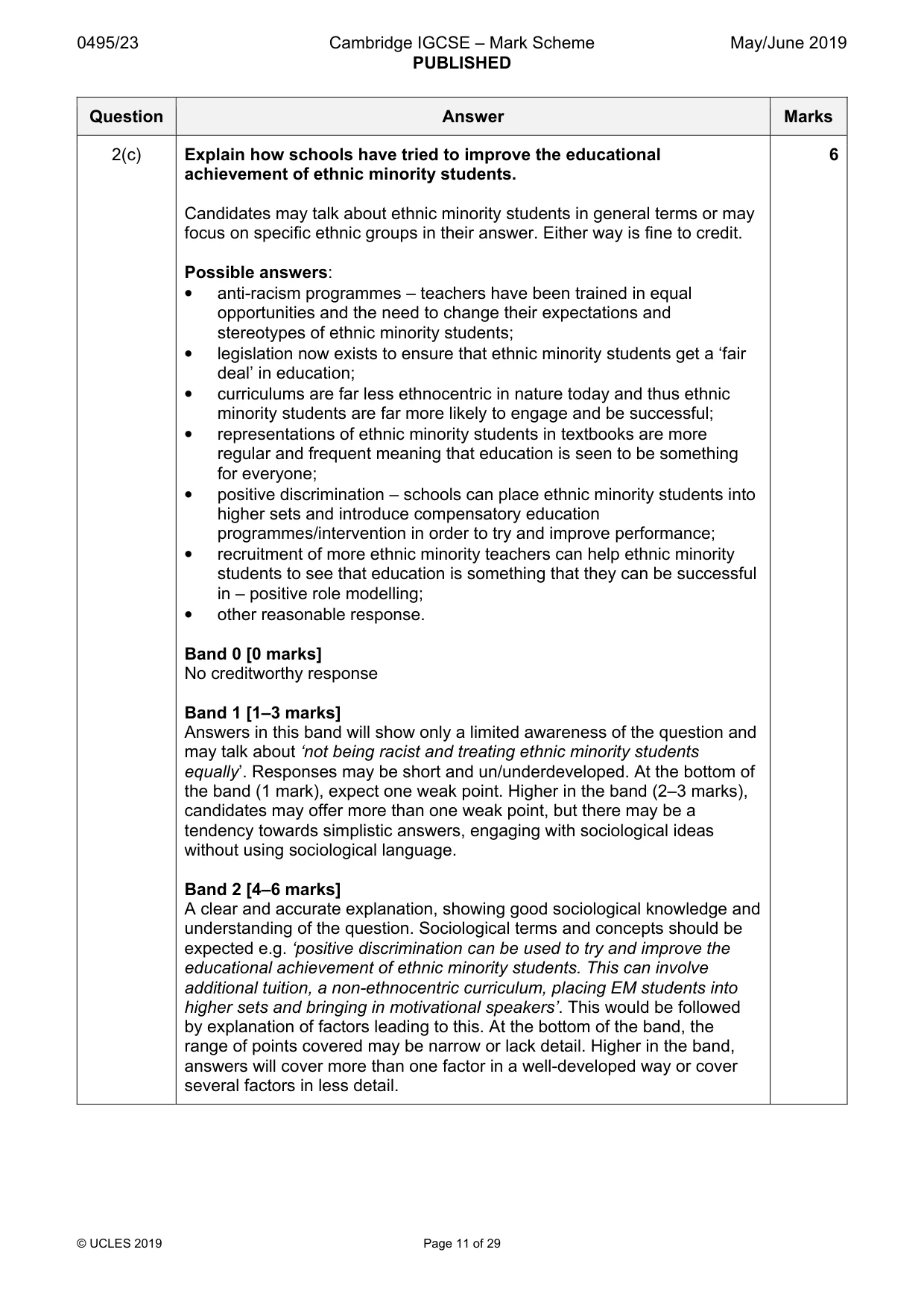
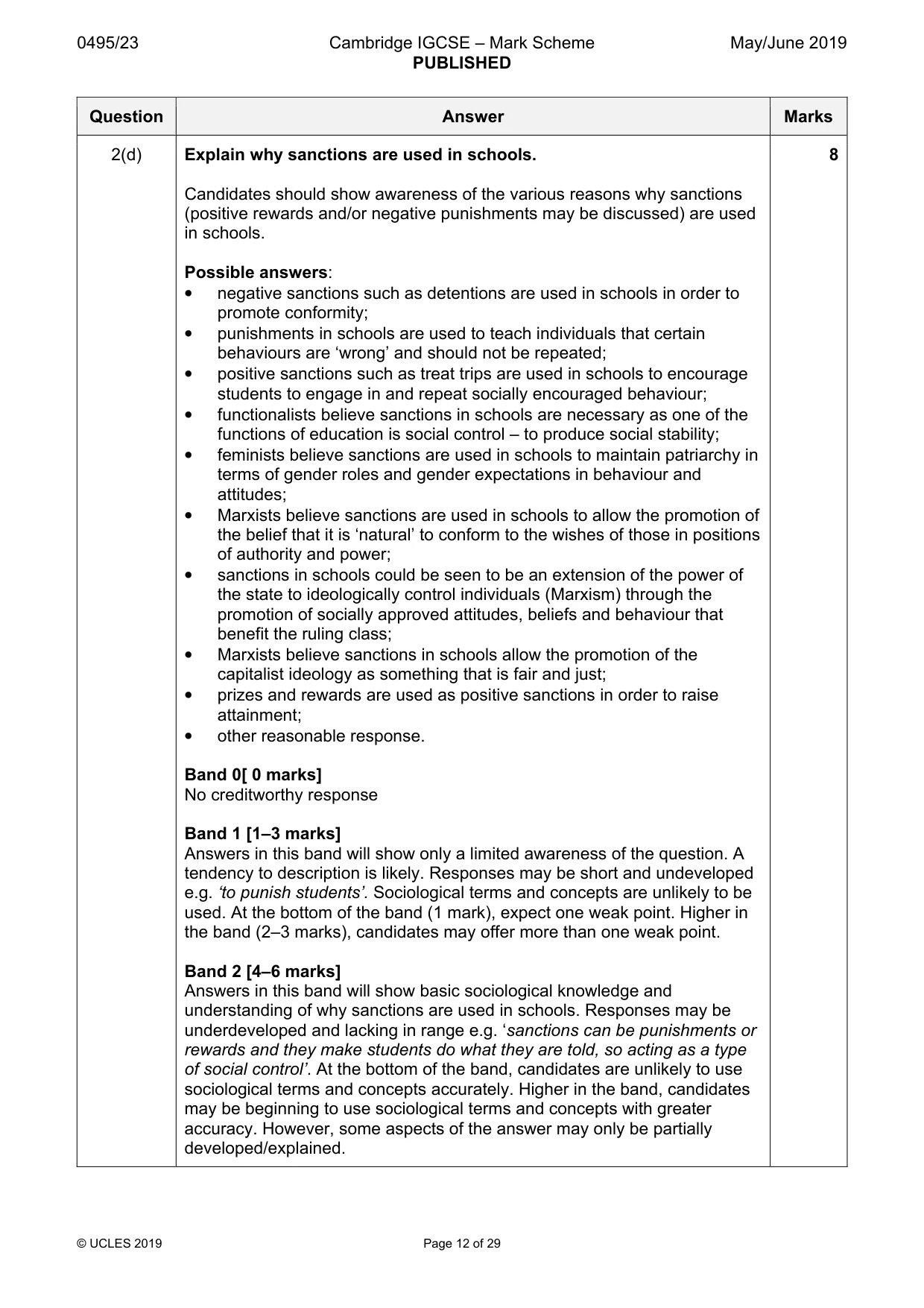
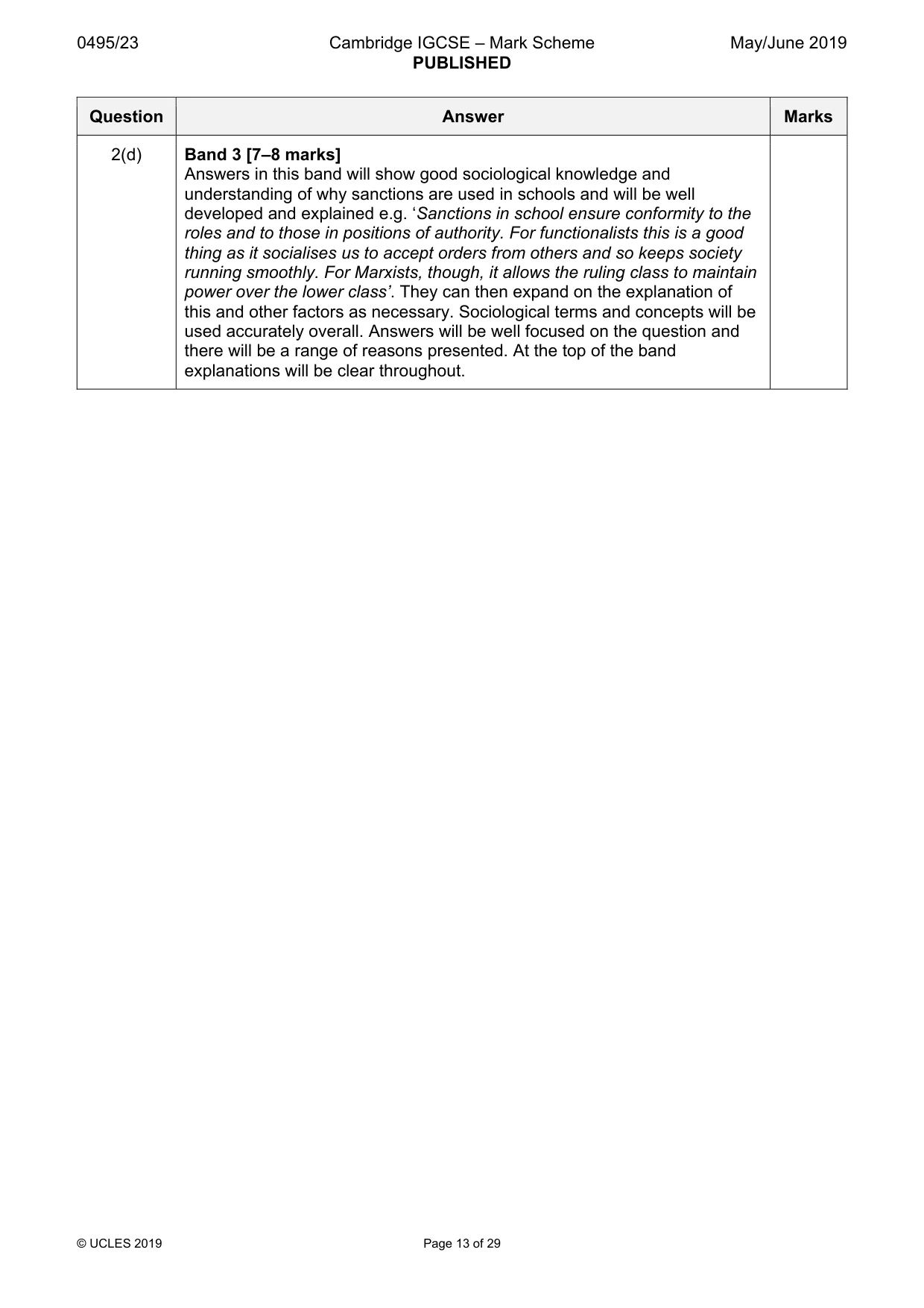
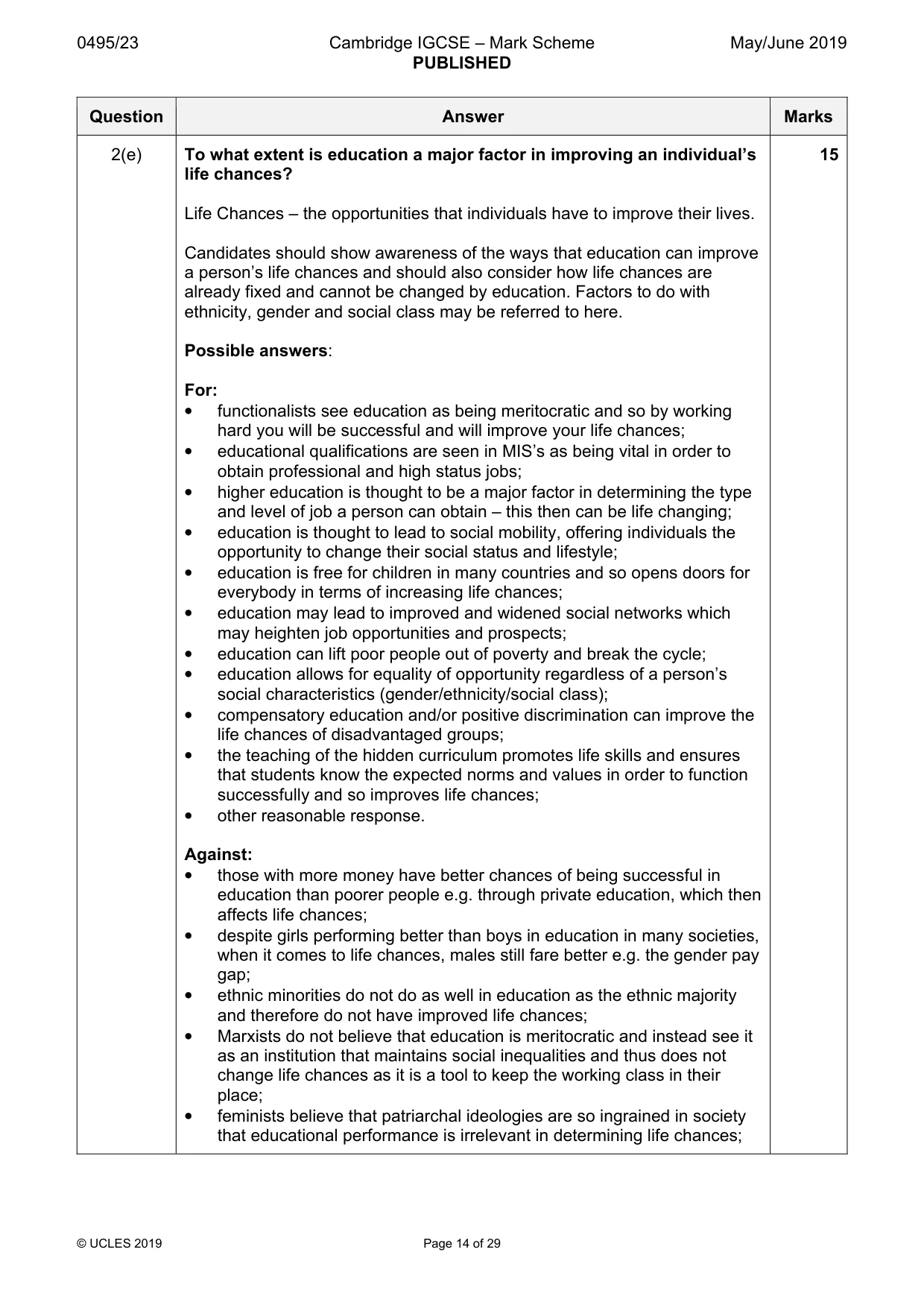
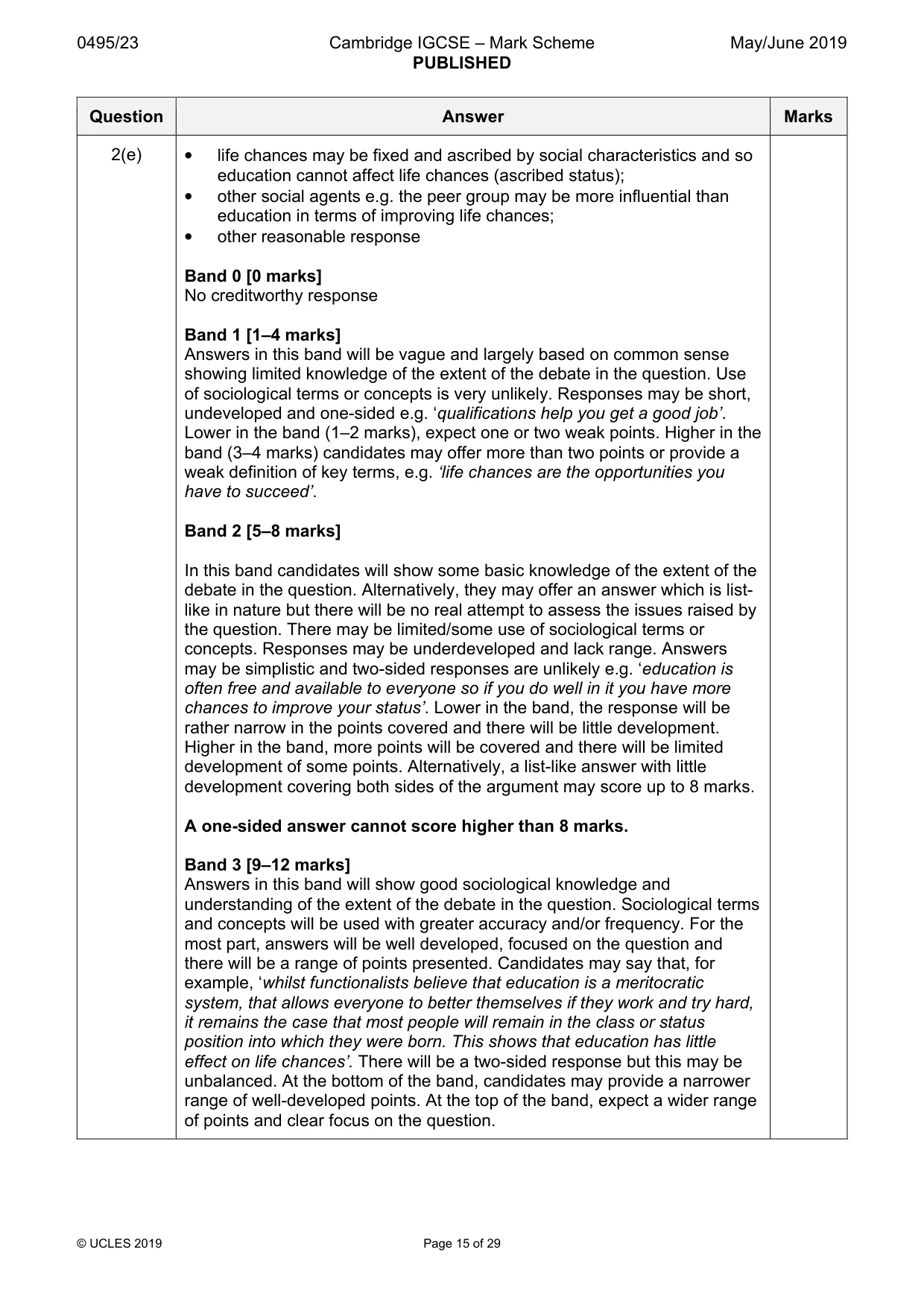
Mark scheme: 2(a) What is meant by the term ‘official curriculum’. 2 One mark for partial definition e.g. subjects studied Two marks for clear definition e.g. the subjects and lessons studied at school and their content 2(b) Describe two features of the hidden curriculum. 4 Possible answers: • competitive sports and testing – sends out the message that doing better than others is valued in society; • learning the importance of punctuality in school, preparing you for later working life; • through school uniform requirements, students learn expectations for dress codes e.g. at work; • abiding by school rules – you have to do as you’re told by those in authority regardless of whether you agree; • schools are hierarchies – students learn their place in the hierarchy and the associated norms with this status position; • functionalists – hidden curriculum gives the skills and attitudes necessary for the smooth running of society, social order; • Marxists – hidden curriculum maintains the control of the working class by the bourgeoisie; • feminists – students learn the expectations associated with their gender and their future gender roles; • respect and manners and reinforced to students through the hidden curriculum; • values and morals of society are taught and reinforced through the hidden curriculum; • other reasonable response. One mark for each point correctly identified (up to maximum of two). One mark for each point that is developed (up to a maximum of two) 2(c) Explain how schools have tried to improve the educational 6 achievement of ethnic minority students. Candidates may talk about ethnic minority students in general terms or may focus on specific ethnic groups in their answer. Either way is fine to credit. Possible answers: • anti-racism programmes – teachers have been trained in equal opportunities and the need to change their expectations and stereotypes of ethnic minority students; • legislation now exists to ensure that ethnic minority students get a ‘fair deal’ in education; • curriculums are far less ethnocentric in nature today and thus ethnic minority students are far more likely to engage and be successful; • representations of ethnic minority students in textbooks are more regular and frequent meaning that education is seen to be something for everyone; • positive discrimination – schools can place ethnic minority students into higher sets and introduce compensatory education programmes/intervention in order to try and improve performance; • recruitment of more ethnic minority teachers can help ethnic minority students to see that education is something that they can be successful in – positive role modelling; • other reasonable response. Band 0 [0 marks] No creditworthy response Band 1 [1–3 marks] Answers in this band will show only a limited awareness of the question and may talk about ‘not being racist and treating ethnic minority students equally’. Responses may be short and un/underdeveloped. At the bottom of the band (1 mark), expect one weak point. Higher in the band (2–3 marks), candidates may offer more than one weak point, but there may be a tendency towards simplistic answers, engaging with sociological ideas without using sociological language. Band 2 [4–6 marks] A clear and accurate explanation, showing good sociological knowledge and understanding of the question. Sociological terms and concepts should be expected e.g. ‘positive discrimination can be used to try and improve the educational achievement of ethnic minority students. This can involve additional tuition, a non-ethnocentric curriculum, placing EM students into higher sets and bringing in motivational speakers’. This would be followed by explanation of factors leading to this. At the bottom of the band, the range of points covered may be narrow or lack detail. Higher in the band, answers will cover more than one factor in a well-developed way or cover several factors in less detail. 2(d) Explain why sanctions are used in schools. 8 Candidates should show awareness of the various reasons why sanctions (positive rewards and/or negative punishments may be discussed) are used in schools. Possible answers: • negative sanctions such as detentions are used in schools in order to promote conformity; • punishments in schools are used to teach individuals that certain behaviours are ‘wrong’ and should not be repeated; • positive sanctions such as treat trips are used in schools to encourage students to engage in and repeat socially encouraged behaviour; • functionalists believe sanctions in schools are necessary as one of the functions of education is social control – to produce social stability; • feminists believe sanctions are used in schools to maintain patriarchy in terms of gender roles and gender expectations in behaviour and attitudes; • Marxists believe sanctions are used in schools to allow the promotion of the belief that it is ‘natural’ to conform to the wishes of those in positions of authority and power; • sanctions in schools could be seen to be an extension of the power of the state to ideologically control individuals (Marxism) through the promotion of socially approved attitudes, beliefs and behaviour that benefit the ruling class; • Marxists believe sanctions in schools allow the promotion of the capitalist ideology as something that is fair and just; • prizes and rewards are used as positive sanctions in order to raise attainment; • other reasonable response. Band 0[ 0 marks] No creditworthy response Band 1 [1–3 marks] Answers in this band will show only a limited awareness of the question. A tendency to description is likely. Responses may be short and undeveloped e.g. ‘to punish students’. Sociological terms and concepts are unlikely to be used. At the bottom of the band (1 mark), expect one weak point. Higher in the band (2–3 marks), candidates may offer more than one weak point. Band 2 [4–6 marks] Answers in this band will show basic sociological knowledge and understanding of why sanctions are used in schools. Responses may be underdeveloped and lacking in range e.g. ‘sanctions can be punishments or rewards and they make students do what they are told, so acting as a type of social control’. At the bottom of the band, candidates are unlikely to use sociological terms and concepts accurately. Higher in the band, candidates may be beginning to use sociological terms and concepts with greater accuracy. However, some aspects of the answer may only be partially developed/explained. 2(d) Band 3 [7–8 marks] Answers in this band will show good sociological knowledge and understanding of why sanctions are used in schools and will be well developed and explained e.g. ‘Sanctions in school ensure conformity to the roles and to those in positions of authority. For functionalists this is a good thing as it socialises us to accept orders from others and so keeps society running smoothly. For Marxists, though, it allows the ruling class to maintain power over the lower class’. They can then expand on the explanation of this and other factors as necessary. Sociological terms and concepts will be used accurately overall. Answers will be well focused on the question and there will be a range of reasons presented. At the top of the band explanations will be clear throughout. 2(e) To what extent is education a major factor in improving an individual’s 15 life chances? Life Chances – the opportunities that individuals have to improve their lives. Candidates should show awareness of the ways that education can improve a person’s life chances and should also consider how life chances are already fixed and cannot be changed by education. Factors to do with ethnicity, gender and social class may be referred to here. Possible answers: For: • functionalists see education as being meritocratic and so by working hard you will be successful and will improve your life chances; • educational qualifications are seen in MIS’s as being vital in order to obtain professional and high status jobs; • higher education is thought to be a major factor in determining the type and level of job a person can obtain – this then can be life changing; • education is thought to lead to social mobility, offering individuals the opportunity to change their social status and lifestyle; • education is free for children in many countries and so opens doors for everybody in terms of increasing life chances; • education may lead to improved and widened social networks which may heighten job opportunities and prospects; • education can lift poor people out of poverty and break the cycle; • education allows for equality of opportunity regardless of a person’s social characteristics (gender/ethnicity/social class); • compensatory education and/or positive discrimination can improve the life chances of disadvantaged groups; • the teaching of the hidden curriculum promotes life skills and ensures that students know the expected norms and values in order to function successfully and so improves life chances; • other reasonable response. Against: • those with more money have better chances of being successful in education than poorer people e.g. through private education, which then affects life chances; • despite girls performing better than boys in education in many societies, when it comes to life chances, males still fare better e.g. the gender pay gap; • ethnic minorities do not do as well in education as the ethnic majority and therefore do not have improved life chances; • Marxists do not believe that education is meritocratic and instead see it as an institution that maintains social inequalities and thus does not change life chances as it is a tool to keep the working class in their place; • feminists believe that patriarchal ideologies are so ingrained in society that educational performance is irrelevant in determining life chances; 2(e) • life chances may be fixed and ascribed by social characteristics and so education cannot affect life chances (ascribed status); • other social agents e.g. the peer group may be more influential than education in terms of improving life chances; • other reasonable response Band 0 [0 marks] No creditworthy response Band 1 [1–4 marks] Answers in this band will be vague and largely based on common sense showing limited knowledge of the extent of the debate in the question. Use of sociological terms or concepts is very unlikely. Responses may be short, undeveloped and one-sided e.g. ‘qualifications help you get a good job’. Lower in the band (1–2 marks), expect one or two weak points. Higher in the band (3–4 marks) candidates may offer more than two points or provide a weak definition of key terms, e.g. ‘life chances are the opportunities you have to succeed’. Band 2 [5–8 marks] In this band candidates will show some basic knowledge of the extent of the debate in the question. Alternatively, they may offer an answer which is list- like in nature but there will be no real attempt to assess the issues raised by the question. There may be limited/some use of sociological terms or concepts. Responses may be underdeveloped and lack range. Answers may be simplistic and two-sided responses are unlikely e.g. ‘education is often free and available to everyone so if you do well in it you have more chances to improve your status’. Lower in the band, the response will be rather narrow in the points covered and there will be little development. Higher in the band, more points will be covered and there will be limited development of some points. Alternatively, a list-like answer with little development covering both sides of the argument may score up to 8 marks. A one-sided answer cannot score higher than 8 marks. Band 3 [9–12 marks] Answers in this band will show good sociological knowledge and understanding of the extent of the debate in the question. Sociological terms and concepts will be used with greater accuracy and/or frequency. For the most part, answers will be well developed, focused on the question and there will be a range of points presented. Candidates may say that, for example, ‘whilst functionalists believe that education is a meritocratic system, that allows everyone to better themselves if they work and try hard, it remains the case that most people will remain in the class or status position into which they were born. This shows that education has little effect on life chances’. There will be a two-sided response but this may be unbalanced. At the bottom of the band, candidates may provide a narrower range of well-developed points. At the top of the band, expect a wider range of points and clear focus on the question.
Q3 · According to official crime statistics an individual’s social characteristics can affect…
3 According to official crime statistics an individual’s social characteristics can affect whether they become a criminal. Some sociologists believe that ethnic minority groups and the lower classes have higher conviction rates due to agencies such as the police and the media. Trends in crime also vary depending on the crime committed, for example whether it is internet crime, green crime or white-collar crime. (a) What is meant by the term ‘internet crime’? [2] (b) Describe two criminal sub-cultures. [4] (c) Explain how the police can cause deviancy amplification. [6] (d) Explain why effective socialisation can reduce crime. [8] (e) To what extent is ethnicity the most important factor in determining whether an individual commits crime? [15] Section D: Media
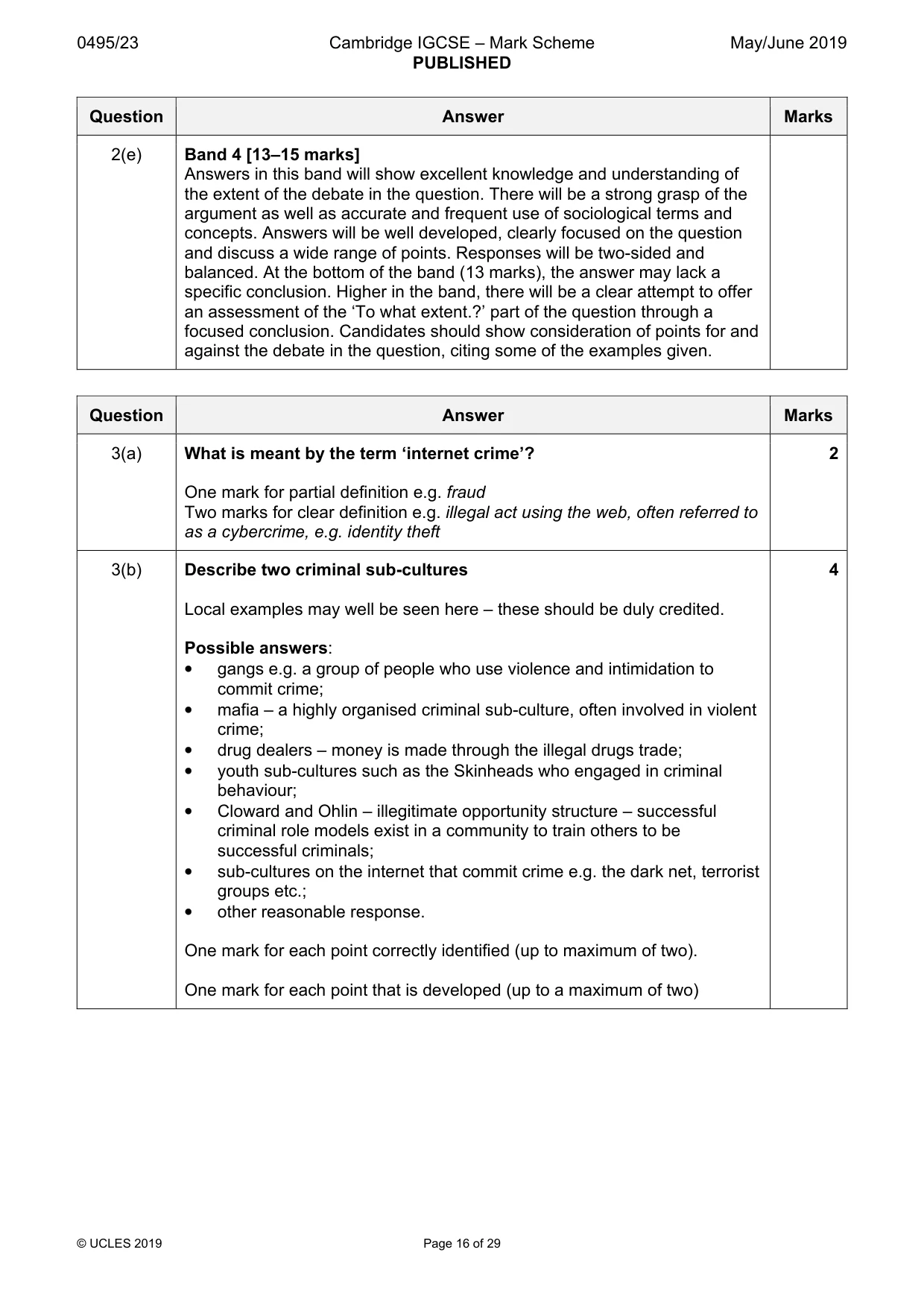
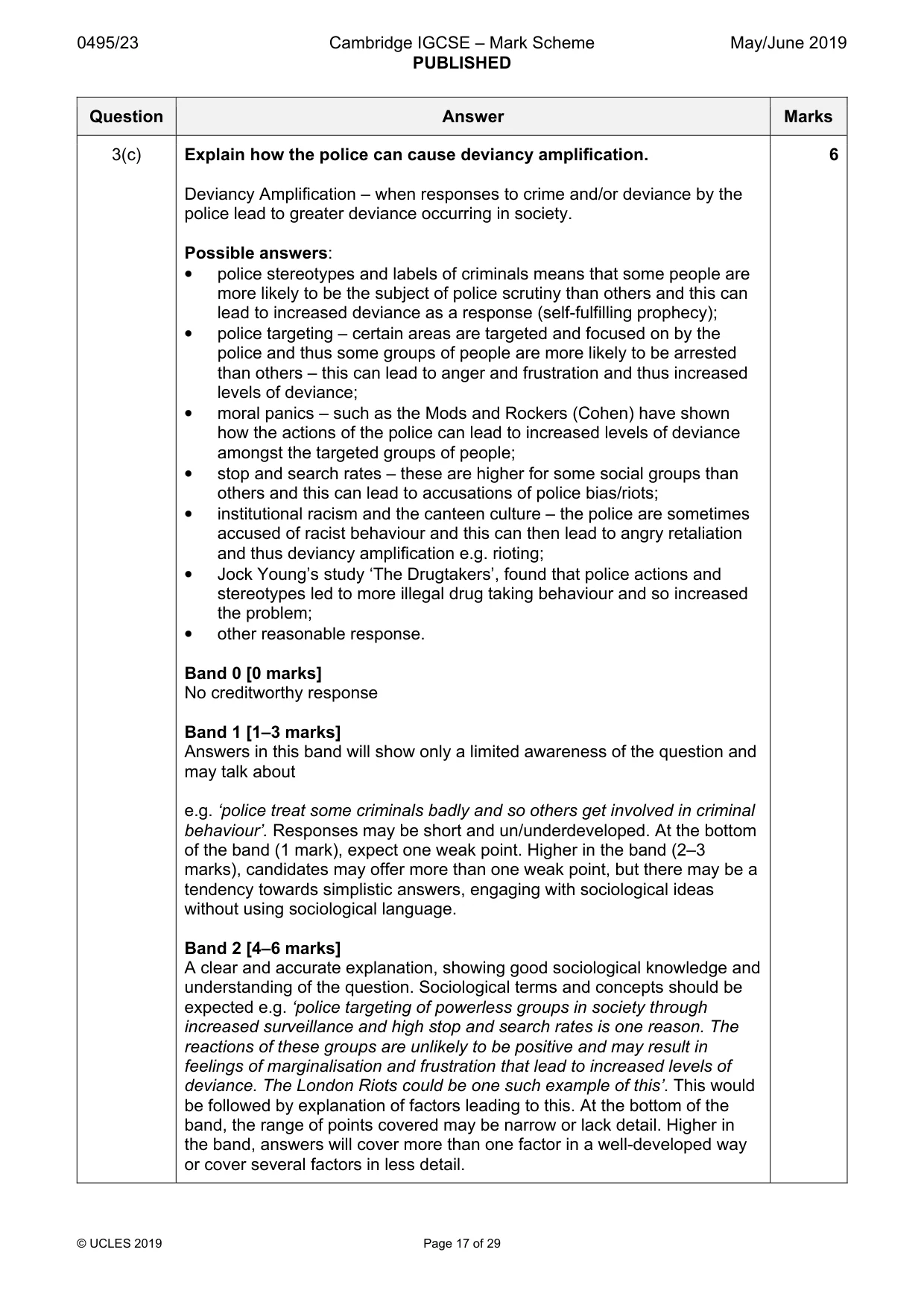
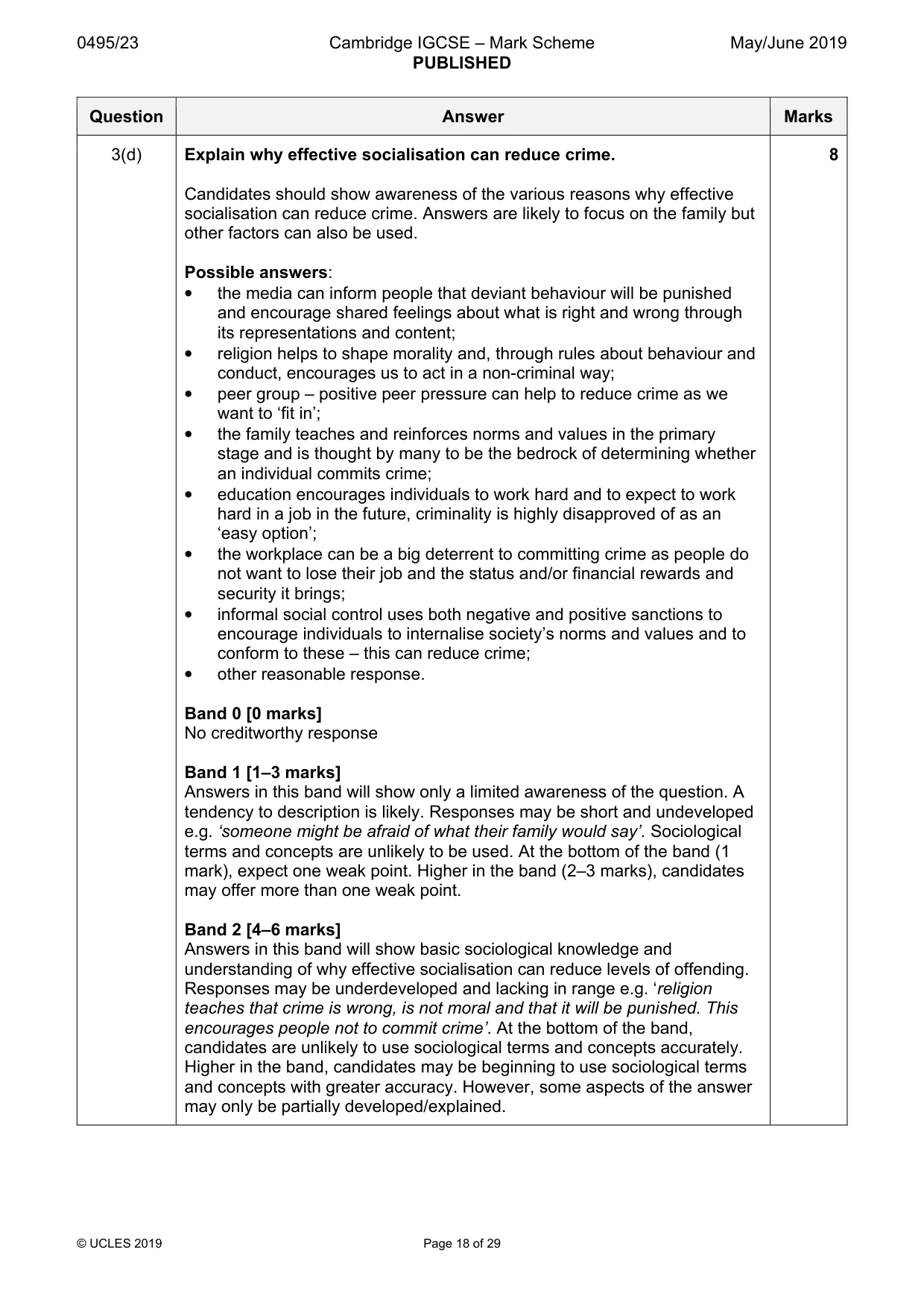
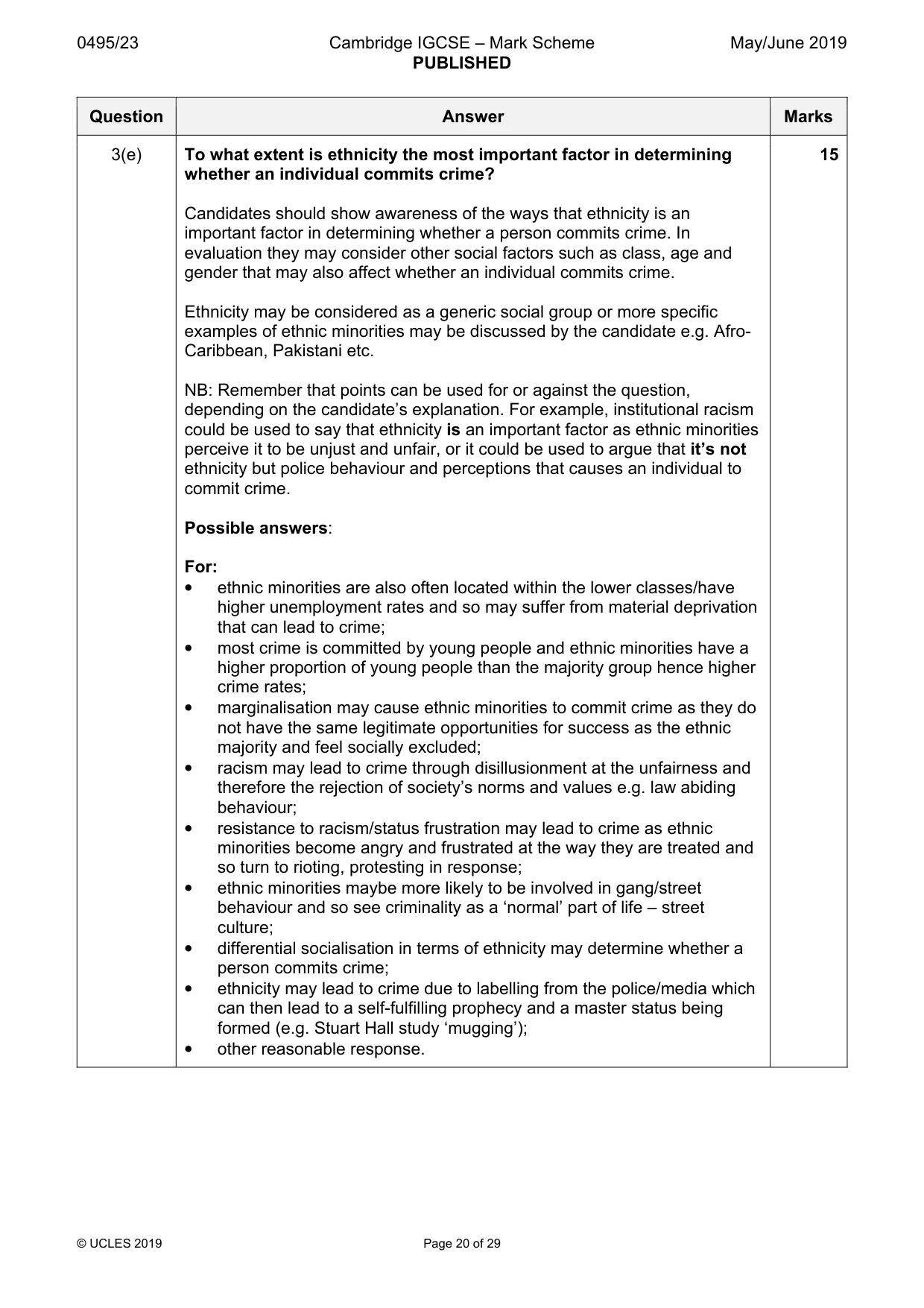
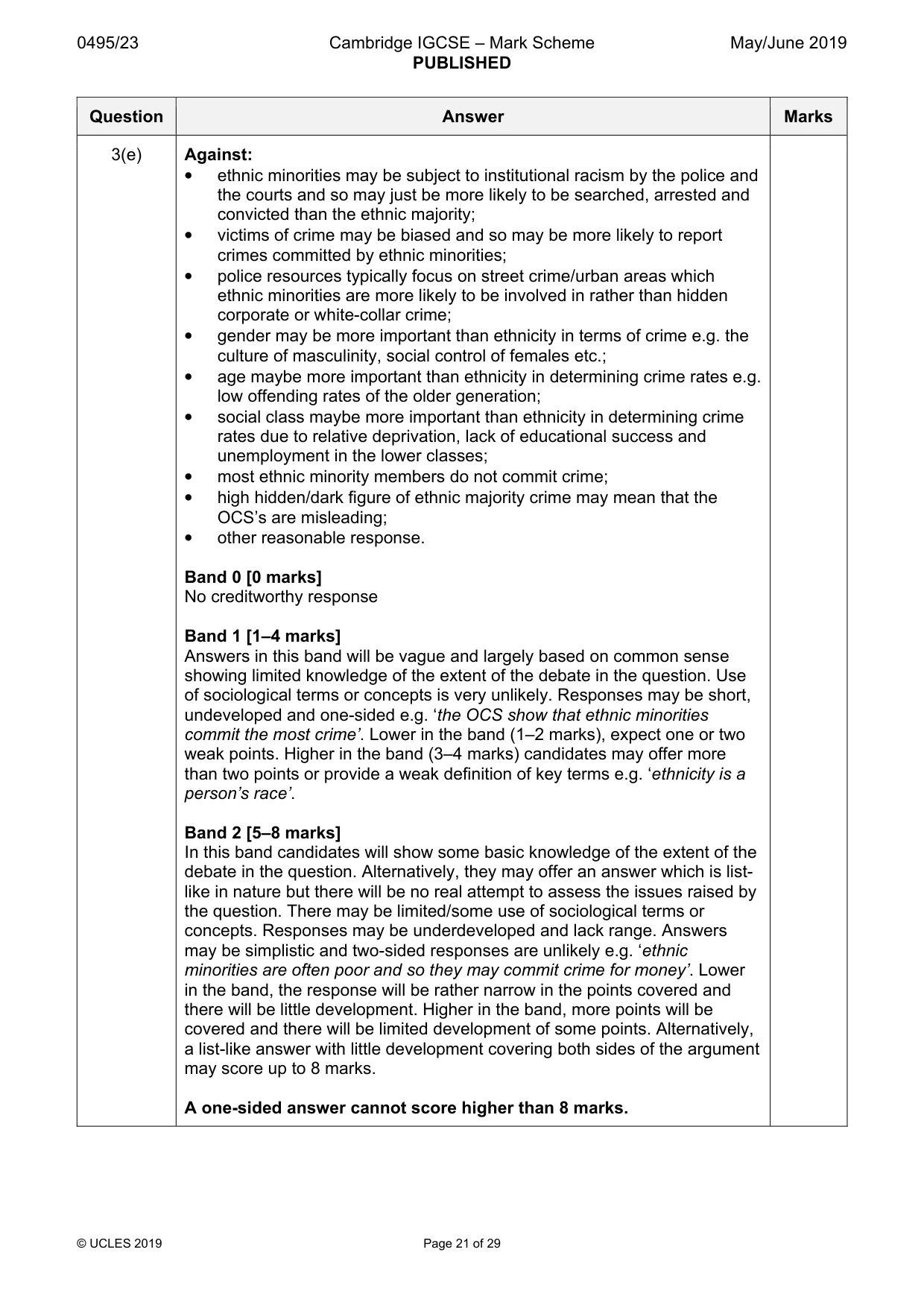
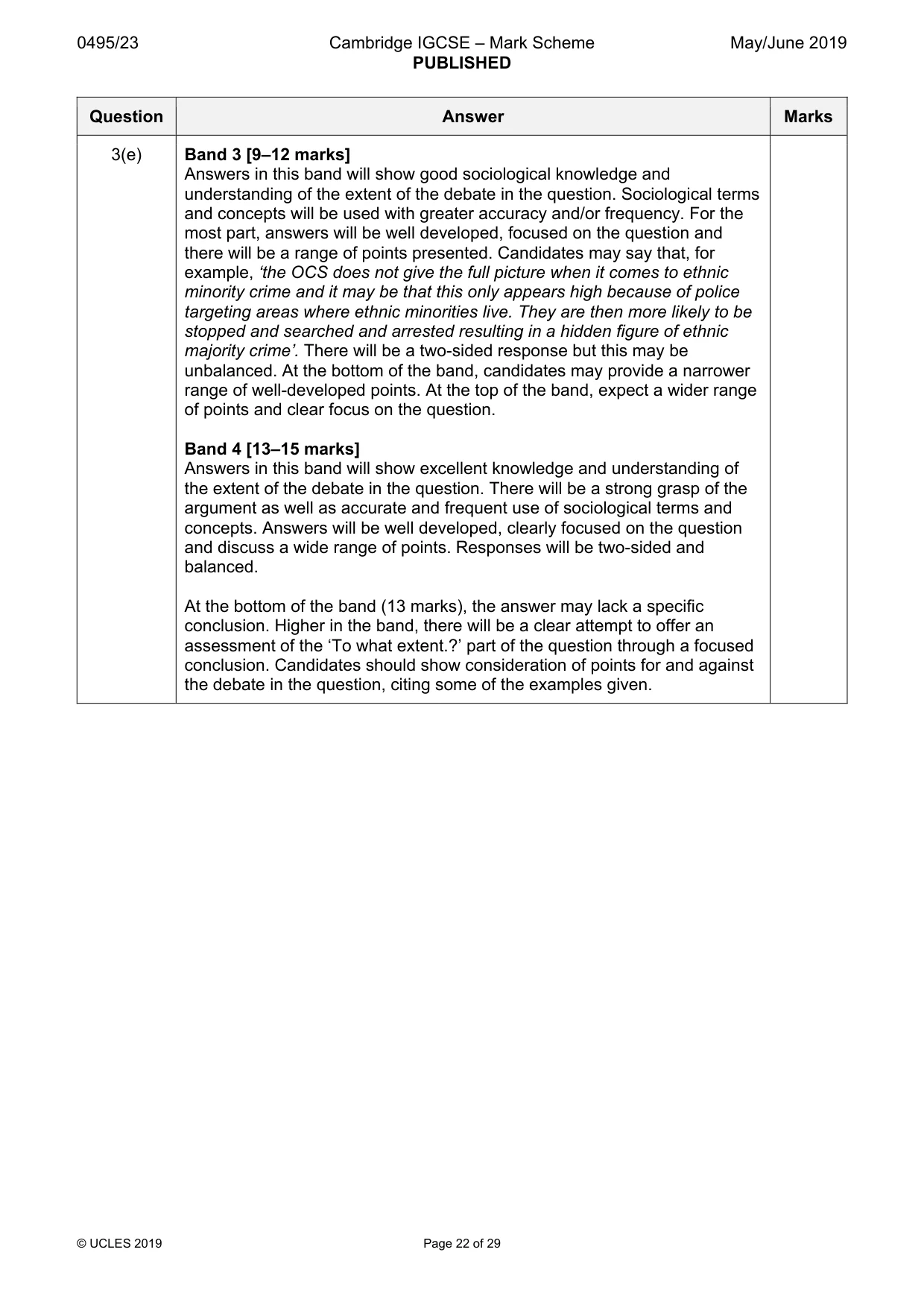
Mark scheme: 3(a) What is meant by the term ‘internet crime’? 2 One mark for partial definition e.g. fraud Two marks for clear definition e.g. illegal act using the web, often referred to as a cybercrime, e.g. identity theft 3(b) Describe two criminal sub-cultures 4 Local examples may well be seen here – these should be duly credited. Possible answers: • gangs e.g. a group of people who use violence and intimidation to commit crime; • mafia – a highly organised criminal sub-culture, often involved in violent crime; • drug dealers – money is made through the illegal drugs trade; • youth sub-cultures such as the Skinheads who engaged in criminal behaviour; • Cloward and Ohlin – illegitimate opportunity structure – successful criminal role models exist in a community to train others to be successful criminals; • sub-cultures on the internet that commit crime e.g. the dark net, terrorist groups etc.; • other reasonable response. One mark for each point correctly identified (up to maximum of two). One mark for each point that is developed (up to a maximum of two) 3(c) Explain how the police can cause deviancy amplification. 6 Deviancy Amplification – when responses to crime and/or deviance by the police lead to greater deviance occurring in society. Possible answers: • police stereotypes and labels of criminals means that some people are more likely to be the subject of police scrutiny than others and this can lead to increased deviance as a response (self-fulfilling prophecy); • police targeting – certain areas are targeted and focused on by the police and thus some groups of people are more likely to be arrested than others – this can lead to anger and frustration and thus increased levels of deviance; • moral panics – such as the Mods and Rockers (Cohen) have shown how the actions of the police can lead to increased levels of deviance amongst the targeted groups of people; • stop and search rates – these are higher for some social groups than others and this can lead to accusations of police bias/riots; • institutional racism and the canteen culture – the police are sometimes accused of racist behaviour and this can then lead to angry retaliation and thus deviancy amplification e.g. rioting; • Jock Young’s study ‘The Drugtakers’, found that police actions and stereotypes led to more illegal drug taking behaviour and so increased the problem; • other reasonable response. Band 0 [0 marks] No creditworthy response Band 1 [1–3 marks] Answers in this band will show only a limited awareness of the question and may talk about e.g. ‘police treat some criminals badly and so others get involved in criminal behaviour’. Responses may be short and un/underdeveloped. At the bottom of the band (1 mark), expect one weak point. Higher in the band (2–3 marks), candidates may offer more than one weak point, but there may be a tendency towards simplistic answers, engaging with sociological ideas without using sociological language. Band 2 [4–6 marks] A clear and accurate explanation, showing good sociological knowledge and understanding of the question. Sociological terms and concepts should be expected e.g. ‘police targeting of powerless groups in society through increased surveillance and high stop and search rates is one reason. The reactions of these groups are unlikely to be positive and may result in feelings of marginalisation and frustration that lead to increased levels of deviance. The London Riots could be one such example of this’. This would be followed by explanation of factors leading to this. At the bottom of the band, the range of points covered may be narrow or lack detail. Higher in the band, answers will cover more than one factor in a well-developed way or cover several factors in less detail. 3(d) Explain why effective socialisation can reduce crime. 8 Candidates should show awareness of the various reasons why effective socialisation can reduce crime. Answers are likely to focus on the family but other factors can also be used. Possible answers: • the media can inform people that deviant behaviour will be punished and encourage shared feelings about what is right and wrong through its representations and content; • religion helps to shape morality and, through rules about behaviour and conduct, encourages us to act in a non-criminal way; • peer group – positive peer pressure can help to reduce crime as we want to ‘fit in’; • the family teaches and reinforces norms and values in the primary stage and is thought by many to be the bedrock of determining whether an individual commits crime; • education encourages individuals to work hard and to expect to work hard in a job in the future, criminality is highly disapproved of as an ‘easy option’; • the workplace can be a big deterrent to committing crime as people do not want to lose their job and the status and/or financial rewards and security it brings; • informal social control uses both negative and positive sanctions to encourage individuals to internalise society’s norms and values and to conform to these – this can reduce crime; • other reasonable response. Band 0 [0 marks] No creditworthy response Band 1 [1–3 marks] Answers in this band will show only a limited awareness of the question. A tendency to description is likely. Responses may be short and undeveloped e.g. ‘someone might be afraid of what their family would say’. Sociological terms and concepts are unlikely to be used. At the bottom of the band (1 mark), expect one weak point. Higher in the band (2–3 marks), candidates may offer more than one weak point. Band 2 [4–6 marks] Answers in this band will show basic sociological knowledge and understanding of why effective socialisation can reduce levels of offending. Responses may be underdeveloped and lacking in range e.g. ‘religion teaches that crime is wrong, is not moral and that it will be punished. This encourages people not to commit crime’. At the bottom of the band, candidates are unlikely to use sociological terms and concepts accurately. Higher in the band, candidates may be beginning to use sociological terms and concepts with greater accuracy. However, some aspects of the answer may only be partially developed/explained. 3(d) Band 3 [7–8 marks] Answers in this band will show good sociological knowledge and understanding of why effective socialisation can reduce levels of offending and will be well developed and explained e.g. ‘all of the agencies of socialisation work together to teach and reinforce right and wrong behaviour in society. Crime is seen to be wrong and is therefore discouraged through a series of positive and negative sanctions’. They can then expand on the explanation of this and other factors as necessary. Sociological terms and concepts will be used accurately overall. Answers will be well focused on the question and there will be a range of reasons presented. At the top of the band explanations will be clear throughout. 3(e) To what extent is ethnicity the most important factor in determining 15 whether an individual commits crime? Candidates should show awareness of the ways that ethnicity is an important factor in determining whether a person commits crime. In evaluation they may consider other social factors such as class, age and gender that may also affect whether an individual commits crime. Ethnicity may be considered as a generic social group or more specific examples of ethnic minorities may be discussed by the candidate e.g. Afro- Caribbean, Pakistani etc. NB: Remember that points can be used for or against the question, depending on the candidate’s explanation. For example, institutional racism could be used to say that ethnicity is an important factor as ethnic minorities perceive it to be unjust and unfair, or it could be used to argue that it’s not ethnicity but police behaviour and perceptions that causes an individual to commit crime. Possible answers: For: • ethnic minorities are also often located within the lower classes/have higher unemployment rates and so may suffer from material deprivation that can lead to crime; • most crime is committed by young people and ethnic minorities have a higher proportion of young people than the majority group hence higher crime rates; • marginalisation may cause ethnic minorities to commit crime as they do not have the same legitimate opportunities for success as the ethnic majority and feel socially excluded; • racism may lead to crime through disillusionment at the unfairness and therefore the rejection of society’s norms and values e.g. law abiding behaviour; • resistance to racism/status frustration may lead to crime as ethnic minorities become angry and frustrated at the way they are treated and so turn to rioting, protesting in response; • ethnic minorities maybe more likely to be involved in gang/street behaviour and so see criminality as a ‘normal’ part of life – street culture; • differential socialisation in terms of ethnicity may determine whether a person commits crime; • ethnicity may lead to crime due to labelling from the police/media which can then lead to a self-fulfilling prophecy and a master status being formed (e.g. Stuart Hall study ‘mugging’); • other reasonable response. 3(e) Against: • ethnic minorities may be subject to institutional racism by the police and the courts and so may just be more likely to be searched, arrested and convicted than the ethnic majority; • victims of crime may be biased and so may be more likely to report crimes committed by ethnic minorities; • police resources typically focus on street crime/urban areas which ethnic minorities are more likely to be involved in rather than hidden corporate or white-collar crime; • gender may be more important than ethnicity in terms of crime e.g. the culture of masculinity, social control of females etc.; • age maybe more important than ethnicity in determining crime rates e.g. low offending rates of the older generation; • social class maybe more important than ethnicity in determining crime rates due to relative deprivation, lack of educational success and unemployment in the lower classes; • most ethnic minority members do not commit crime; • high hidden/dark figure of ethnic majority crime may mean that the OCS’s are misleading; • other reasonable response. Band 0 [0 marks] No creditworthy response Band 1 [1–4 marks] Answers in this band will be vague and largely based on common sense showing limited knowledge of the extent of the debate in the question. Use of sociological terms or concepts is very unlikely. Responses may be short, undeveloped and one-sided e.g. ‘the OCS show that ethnic minorities commit the most crime’. Lower in the band (1–2 marks), expect one or two weak points. Higher in the band (3–4 marks) candidates may offer more than two points or provide a weak definition of key terms e.g. ‘ethnicity is a person’s race’. Band 2 [5–8 marks] In this band candidates will show some basic knowledge of the extent of the debate in the question. Alternatively, they may offer an answer which is list- like in nature but there will be no real attempt to assess the issues raised by the question. There may be limited/some use of sociological terms or concepts. Responses may be underdeveloped and lack range. Answers may be simplistic and two-sided responses are unlikely e.g. ‘ethnic minorities are often poor and so they may commit crime for money’. Lower in the band, the response will be rather narrow in the points covered and there will be little development. Higher in the band, more points will be covered and there will be limited development of some points. Alternatively, a list-like answer with little development covering both sides of the argument may score up to 8 marks. A one-sided answer cannot score higher than 8 marks. 3(e) Band 3 [9–12 marks] Answers in this band will show good sociological knowledge and understanding of the extent of the debate in the question. Sociological terms and concepts will be used with greater accuracy and/or frequency. For the most part, answers will be well developed, focused on the question and there will be a range of points presented. Candidates may say that, for example, ‘the OCS does not give the full picture when it comes to ethnic minority crime and it may be that this only appears high because of police targeting areas where ethnic minorities live. They are then more likely to be stopped and searched and arrested resulting in a hidden figure of ethnic majority crime’. There will be a two-sided response but this may be unbalanced. At the bottom of the band, candidates may provide a narrower range of well-developed points. At the top of the band, expect a wider range of points and clear focus on the question. Band 4 [13–15 marks] Answers in this band will show excellent knowledge and understanding of the extent of the debate in the question. There will be a strong grasp of the argument as well as accurate and frequent use of sociological terms and concepts. Answers will be well developed, clearly focused on the question and discuss a wide range of points. Responses will be two-sided and balanced. At the bottom of the band (13 marks), the answer may lack a specific conclusion. Higher in the band, there will be a clear attempt to offer an assessment of the ‘To what extent.?’ part of the question through a focused conclusion. Candidates should show consideration of points for and against the debate in the question, citing some of the examples given.
Q4 · In the past media owners and professionals were criticised for creating folk devils
4 In the past media owners and professionals were criticised for creating folk devils. Today new media have given more power and control to the audience and media is starting to change.This may affect how the audience use and interpret media content. (a) What is meant by the term ‘folk devils’? [2] (b) Describe two types of new media. [4] (c) Explain how diversification occurs in today’s media industry. [6] (d) Explain why the uses and gratifications model of media effects can be criticised. [8] (e) To what extent do media professionals such as editors and journalists control media content? [15]
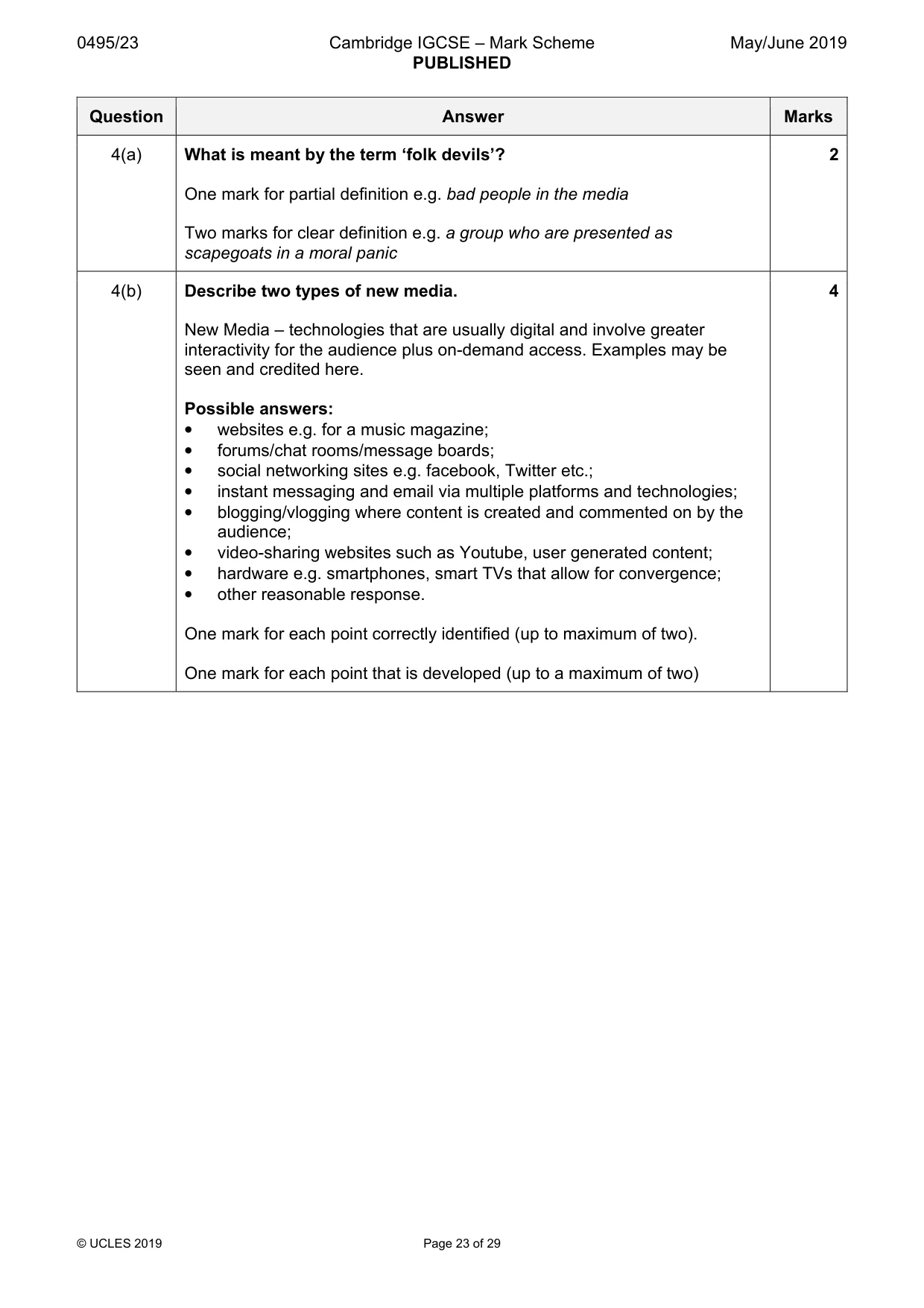
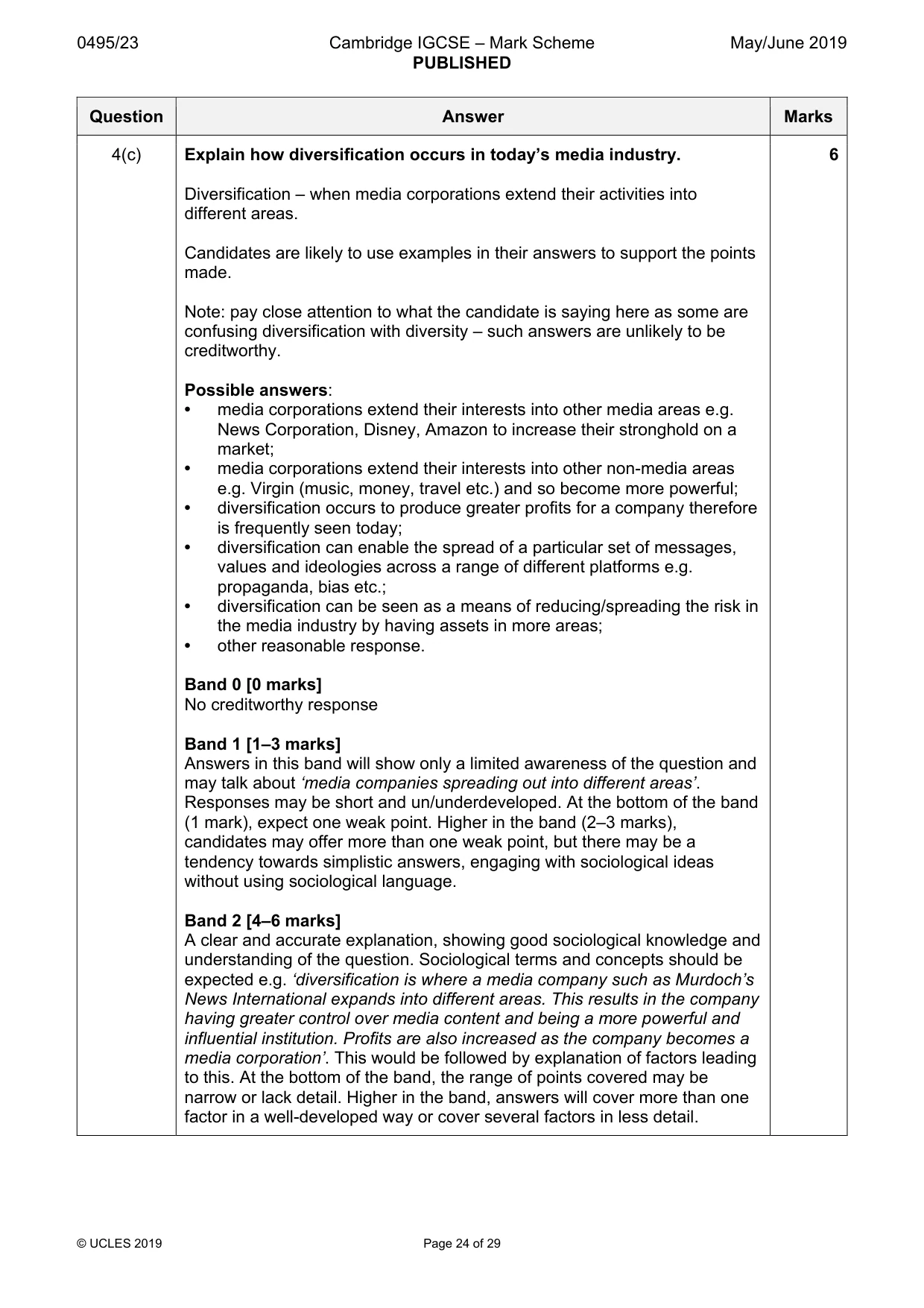
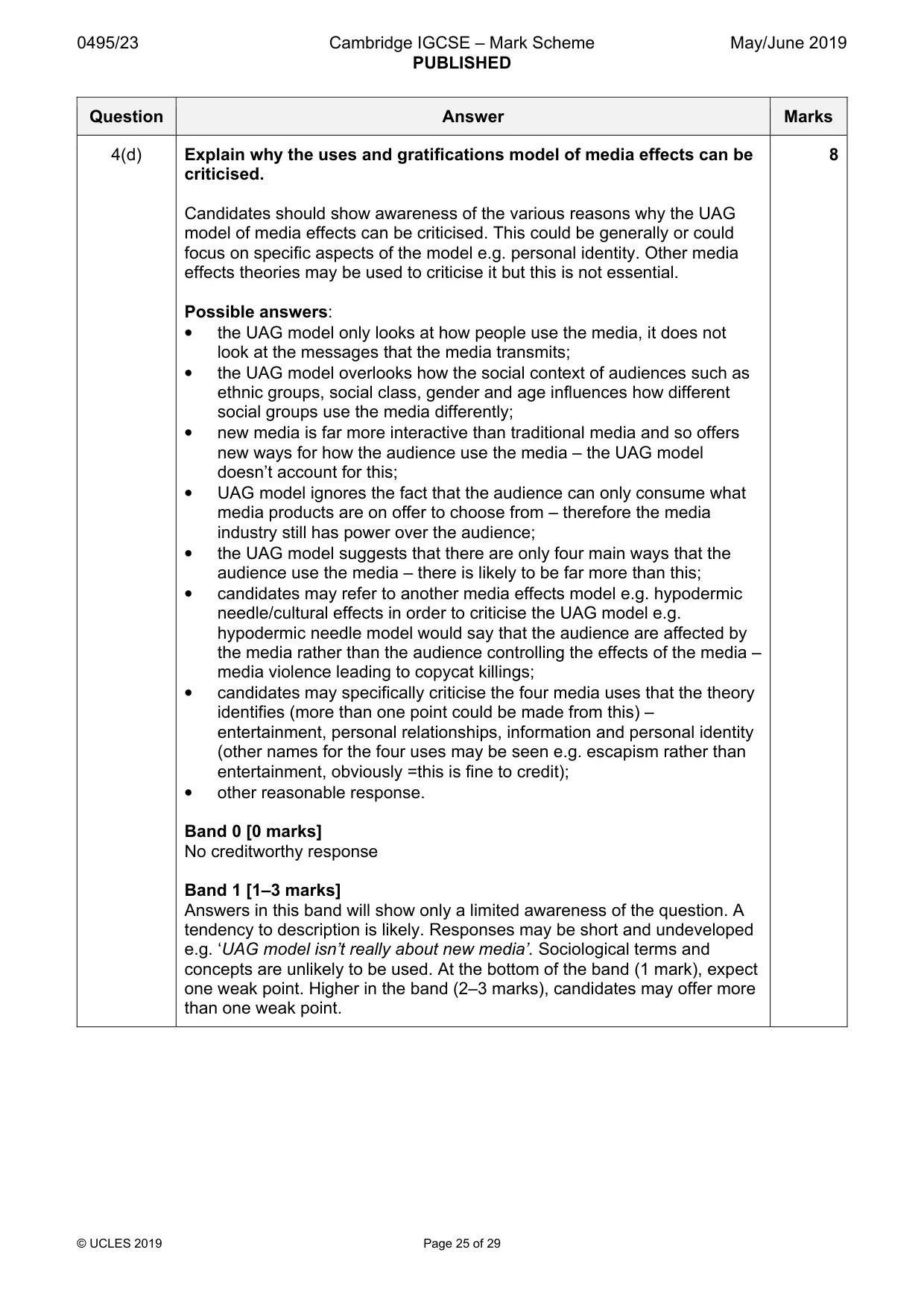
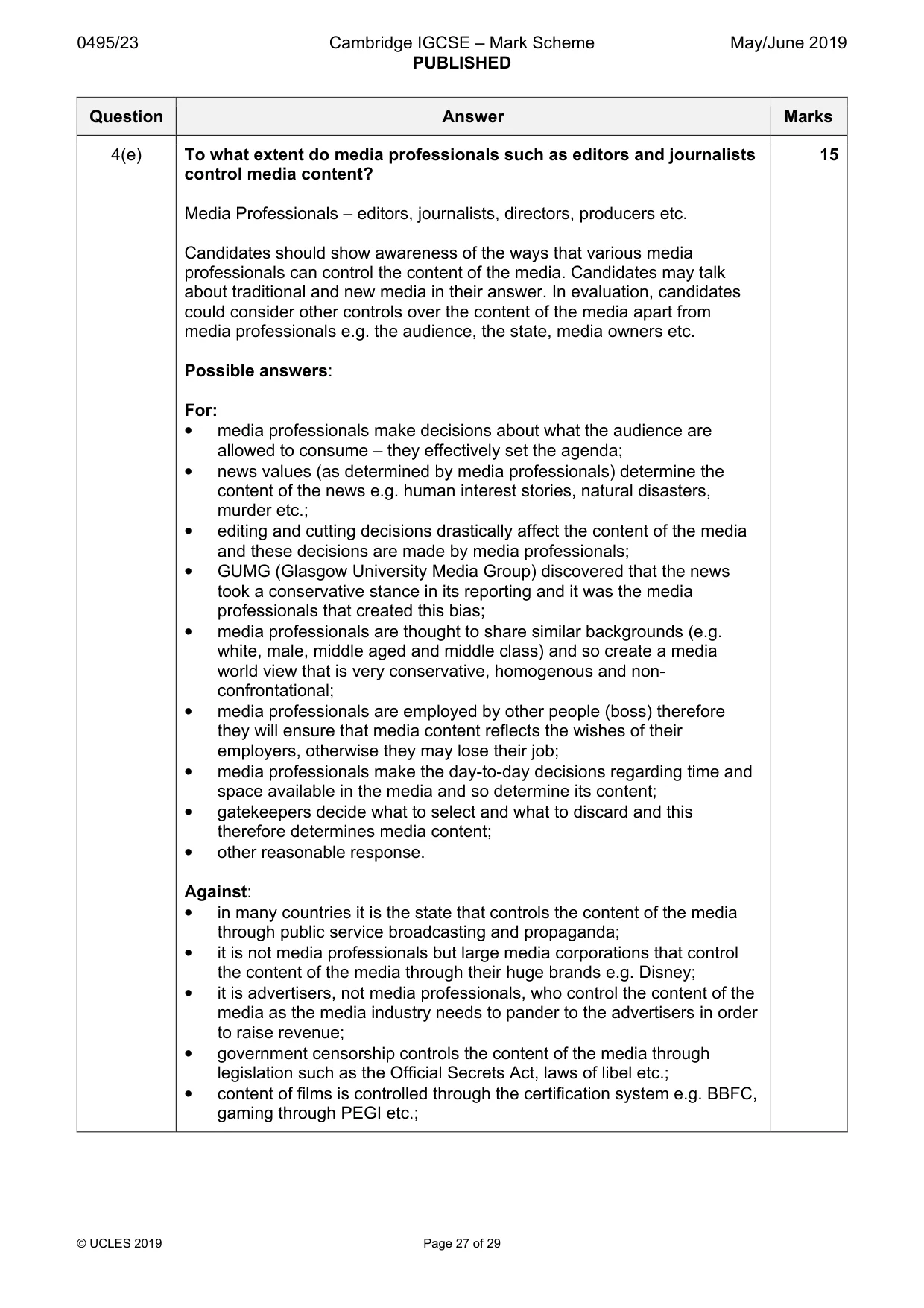
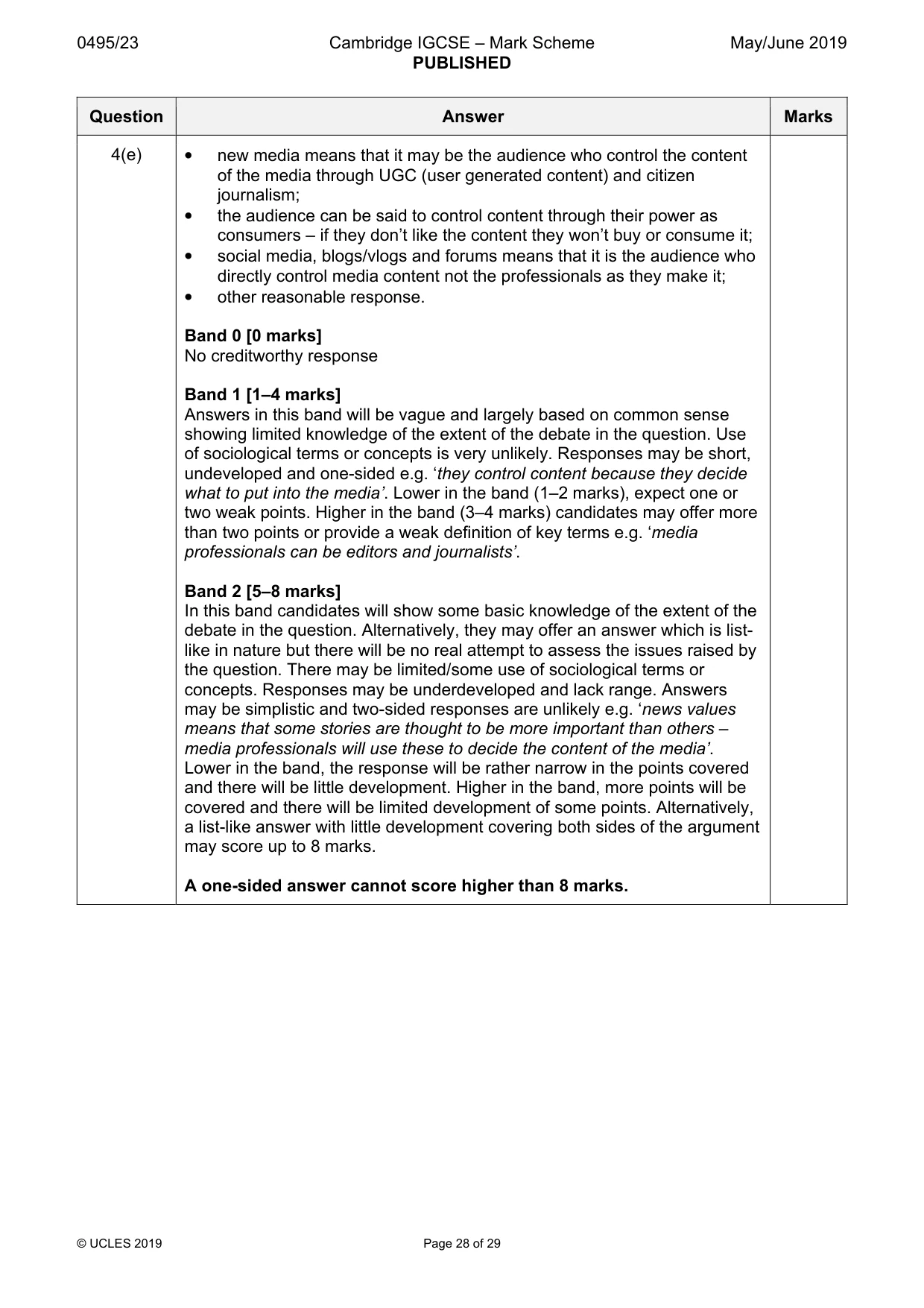
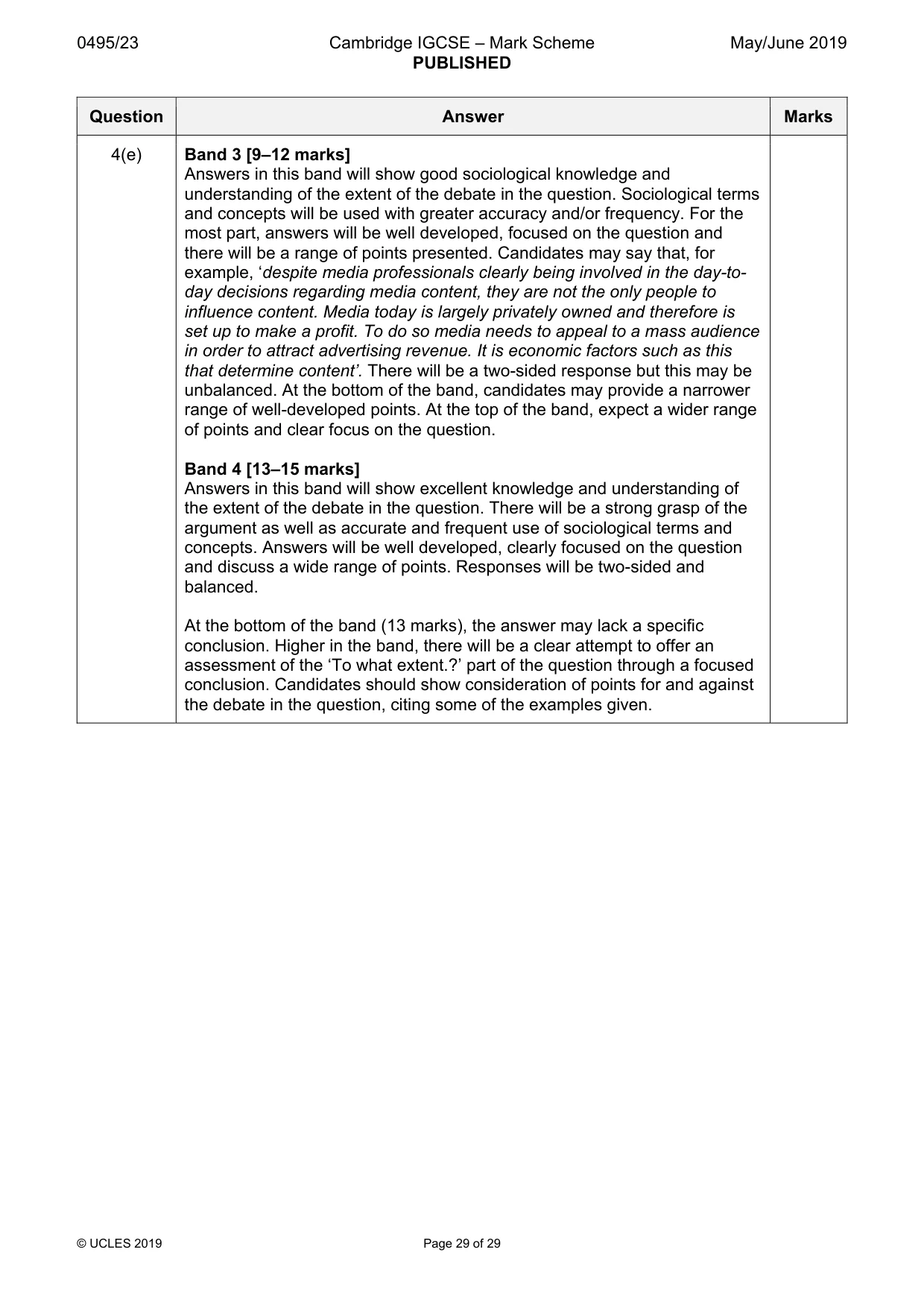
Mark scheme: 4(a) What is meant by the term ‘folk devils’? 2 One mark for partial definition e.g. bad people in the media Two marks for clear definition e.g. a group who are presented as scapegoats in a moral panic 4(b) Describe two types of new media. 4 New Media – technologies that are usually digital and involve greater interactivity for the audience plus on-demand access. Examples may be seen and credited here. Possible answers: • websites e.g. for a music magazine; • forums/chat rooms/message boards; • social networking sites e.g. facebook, Twitter etc.; • instant messaging and email via multiple platforms and technologies; • blogging/vlogging where content is created and commented on by the audience; • video-sharing websites such as Youtube, user generated content; • hardware e.g. smartphones, smart TVs that allow for convergence; • other reasonable response. One mark for each point correctly identified (up to maximum of two). One mark for each point that is developed (up to a maximum of two) 4(c) Explain how diversification occurs in today’s media industry. 6 Diversification – when media corporations extend their activities into different areas. Candidates are likely to use examples in their answers to support the points made. Note: pay close attention to what the candidate is saying here as some are confusing diversification with diversity – such answers are unlikely to be creditworthy. Possible answers: • media corporations extend their interests into other media areas e.g. News Corporation, Disney, Amazon to increase their stronghold on a market; • media corporations extend their interests into other non-media areas e.g. Virgin (music, money, travel etc.) and so become more powerful; • diversification occurs to produce greater profits for a company therefore is frequently seen today; • diversification can enable the spread of a particular set of messages, values and ideologies across a range of different platforms e.g. propaganda, bias etc.; • diversification can be seen as a means of reducing/spreading the risk in the media industry by having assets in more areas; • other reasonable response. Band 0 [0 marks] No creditworthy response Band 1 [1–3 marks] Answers in this band will show only a limited awareness of the question and may talk about ‘media companies spreading out into different areas’. Responses may be short and un/underdeveloped. At the bottom of the band (1 mark), expect one weak point. Higher in the band (2–3 marks), candidates may offer more than one weak point, but there may be a tendency towards simplistic answers, engaging with sociological ideas without using sociological language. Band 2 [4–6 marks] A clear and accurate explanation, showing good sociological knowledge and understanding of the question. Sociological terms and concepts should be expected e.g. ‘diversification is where a media company such as Murdoch’s News International expands into different areas. This results in the company having greater control over media content and being a more powerful and influential institution. Profits are also increased as the company becomes a media corporation’. This would be followed by explanation of factors leading to this. At the bottom of the band, the range of points covered may be narrow or lack detail. Higher in the band, answers will cover more than one factor in a well-developed way or cover several factors in less detail. 4(d) Explain why the uses and gratifications model of media effects can be 8 criticised. Candidates should show awareness of the various reasons why the UAG model of media effects can be criticised. This could be generally or could focus on specific aspects of the model e.g. personal identity. Other media effects theories may be used to criticise it but this is not essential. Possible answers: • the UAG model only looks at how people use the media, it does not look at the messages that the media transmits; • the UAG model overlooks how the social context of audiences such as ethnic groups, social class, gender and age influences how different social groups use the media differently; • new media is far more interactive than traditional media and so offers new ways for how the audience use the media – the UAG model doesn’t account for this; • UAG model ignores the fact that the audience can only consume what media products are on offer to choose from – therefore the media industry still has power over the audience; • the UAG model suggests that there are only four main ways that the audience use the media – there is likely to be far more than this; • candidates may refer to another media effects model e.g. hypodermic needle/cultural effects in order to criticise the UAG model e.g. hypodermic needle model would say that the audience are affected by the media rather than the audience controlling the effects of the media – media violence leading to copycat killings; • candidates may specifically criticise the four media uses that the theory identifies (more than one point could be made from this) – entertainment, personal relationships, information and personal identity (other names for the four uses may be seen e.g. escapism rather than entertainment, obviously =this is fine to credit); • other reasonable response. Band 0 [0 marks] No creditworthy response Band 1 [1–3 marks] Answers in this band will show only a limited awareness of the question. A tendency to description is likely. Responses may be short and undeveloped e.g. ‘UAG model isn’t really about new media’. Sociological terms and concepts are unlikely to be used. At the bottom of the band (1 mark), expect one weak point. Higher in the band (2–3 marks), candidates may offer more than one weak point. 4(d) Band 2 [4–6 marks] Answers in this band will show basic sociological knowledge and understanding of why the UAG model of media effects can be criticised. Responses may be underdeveloped and lacking in range e.g. ‘the UAG model says that people use the media for different things but it doesn’t consider the powerful messages that the media can transmit such as advertising and propaganda’. At the bottom of the band, candidates are unlikely to use sociological terms and concepts accurately. Higher in the band, candidates may be beginning to use sociological terms and concepts with greater accuracy. However, some aspects of the answer may only be partially developed/explained. Band 3 [7–8 marks] Answers in this band will show good sociological knowledge and understanding of why the UAG model of media effects can be criticised and will be well developed and explained e.g. ‘because the UAG model attempted to explain how the audience used traditional media, it doesn’t consider the huge changes in the industry since the advent of new media. The digital and global nature of the industry and products today means that the audience are far more interactive than ever before and so are finding new ways to use the media which had never been considered by UAG’. They can then expand on the explanation of this and other factors as necessary. Sociological terms and concepts will be used accurately overall. Answers will be well focused on the question and there will be a range of reasons presented. At the top of the band explanations will be clear throughout. 4(e) To what extent do media professionals such as editors and journalists 15 control media content? Media Professionals – editors, journalists, directors, producers etc. Candidates should show awareness of the ways that various media professionals can control the content of the media. Candidates may talk about traditional and new media in their answer. In evaluation, candidates could consider other controls over the content of the media apart from media professionals e.g. the audience, the state, media owners etc. Possible answers: For: • media professionals make decisions about what the audience are allowed to consume – they effectively set the agenda; • news values (as determined by media professionals) determine the content of the news e.g. human interest stories, natural disasters, murder etc.; • editing and cutting decisions drastically affect the content of the media and these decisions are made by media professionals; • GUMG (Glasgow University Media Group) discovered that the news took a conservative stance in its reporting and it was the media professionals that created this bias; • media professionals are thought to share similar backgrounds (e.g. white, male, middle aged and middle class) and so create a media world view that is very conservative, homogenous and non- confrontational; • media professionals are employed by other people (boss) therefore they will ensure that media content reflects the wishes of their employers, otherwise they may lose their job; • media professionals make the day-to-day decisions regarding time and space available in the media and so determine its content; • gatekeepers decide what to select and what to discard and this therefore determines media content; • other reasonable response. Against: • in many countries it is the state that controls the content of the media through public service broadcasting and propaganda; • it is not media professionals but large media corporations that control the content of the media through their huge brands e.g. Disney; • it is advertisers, not media professionals, who control the content of the media as the media industry needs to pander to the advertisers in order to raise revenue; • government censorship controls the content of the media through legislation such as the Official Secrets Act, laws of libel etc.; • content of films is controlled through the certification system e.g. BBFC, gaming through PEGI etc.; 4(e) • new media means that it may be the audience who control the content of the media through UGC (user generated content) and citizen journalism; • the audience can be said to control content through their power as consumers – if they don’t like the content they won’t buy or consume it; • social media, blogs/vlogs and forums means that it is the audience who directly control media content not the professionals as they make it; • other reasonable response. Band 0 [0 marks] No creditworthy response Band 1 [1–4 marks] Answers in this band will be vague and largely based on common sense showing limited knowledge of the extent of the debate in the question. Use of sociological terms or concepts is very unlikely. Responses may be short, undeveloped and one-sided e.g. ‘they control content because they decide what to put into the media’. Lower in the band (1–2 marks), expect one or two weak points. Higher in the band (3–4 marks) candidates may offer more than two points or provide a weak definition of key terms e.g. ‘media professionals can be editors and journalists’. Band 2 [5–8 marks] In this band candidates will show some basic knowledge of the extent of the debate in the question. Alternatively, they may offer an answer which is list- like in nature but there will be no real attempt to assess the issues raised by the question. There may be limited/some use of sociological terms or concepts. Responses may be underdeveloped and lack range. Answers may be simplistic and two-sided responses are unlikely e.g. ‘news values means that some stories are thought to be more important than others – media professionals will use these to decide the content of the media’. Lower in the band, the response will be rather narrow in the points covered and there will be little development. Higher in the band, more points will be covered and there will be limited development of some points. Alternatively, a list-like answer with little development covering both sides of the argument may score up to 8 marks. A one-sided answer cannot score higher than 8 marks. 4(e) Band 3 [9–12 marks] Answers in this band will show good sociological knowledge and understanding of the extent of the debate in the question. Sociological terms and concepts will be used with greater accuracy and/or frequency. For the most part, answers will be well developed, focused on the question and there will be a range of points presented. Candidates may say that, for example, ‘despite media professionals clearly being involved in the day-to- day decisions regarding media content, they are not the only people to influence content. Media today is largely privately owned and therefore is set up to make a profit. To do so media needs to appeal to a mass audience in order to attract advertising revenue. It is economic factors such as this that determine content’. There will be a two-sided response but this may be unbalanced. At the bottom of the band, candidates may provide a narrower range of well-developed points. At the top of the band, expect a wider range of points and clear focus on the question. Band 4 [13–15 marks] Answers in this band will show excellent knowledge and understanding of the extent of the debate in the question. There will be a strong grasp of the argument as well as accurate and frequent use of sociological terms and concepts. Answers will be well developed, clearly focused on the question and discuss a wide range of points. Responses will be two-sided and balanced. At the bottom of the band (13 marks), the answer may lack a specific conclusion. Higher in the band, there will be a clear attempt to offer an assessment of the ‘To what extent.?’ part of the question through a focused conclusion. Candidates should show consideration of points for and against the debate in the question, citing some of the examples given.
What was in this paper
The subtopics covered by these 4 questions, and how many questions each got. Open one in a new tab to see every Cambridge question on it.
What you needed in this session
Cambridge’s own grade thresholds for 2019 May/June, Paper 2 · Variant 3. A higher threshold means an easier paper — the bar moves with how the cohort did.