Cambridge IGCSE Sociology 0495 — 2022 Oct/Nov Paper 2 · Variant 1
0495/21/O/N/22 · 4 questions · 70 marks · ≈79 min
The question paper and its mark scheme, free to read here and free to download. This is Cambridge’s own paper, exactly as it was sat.
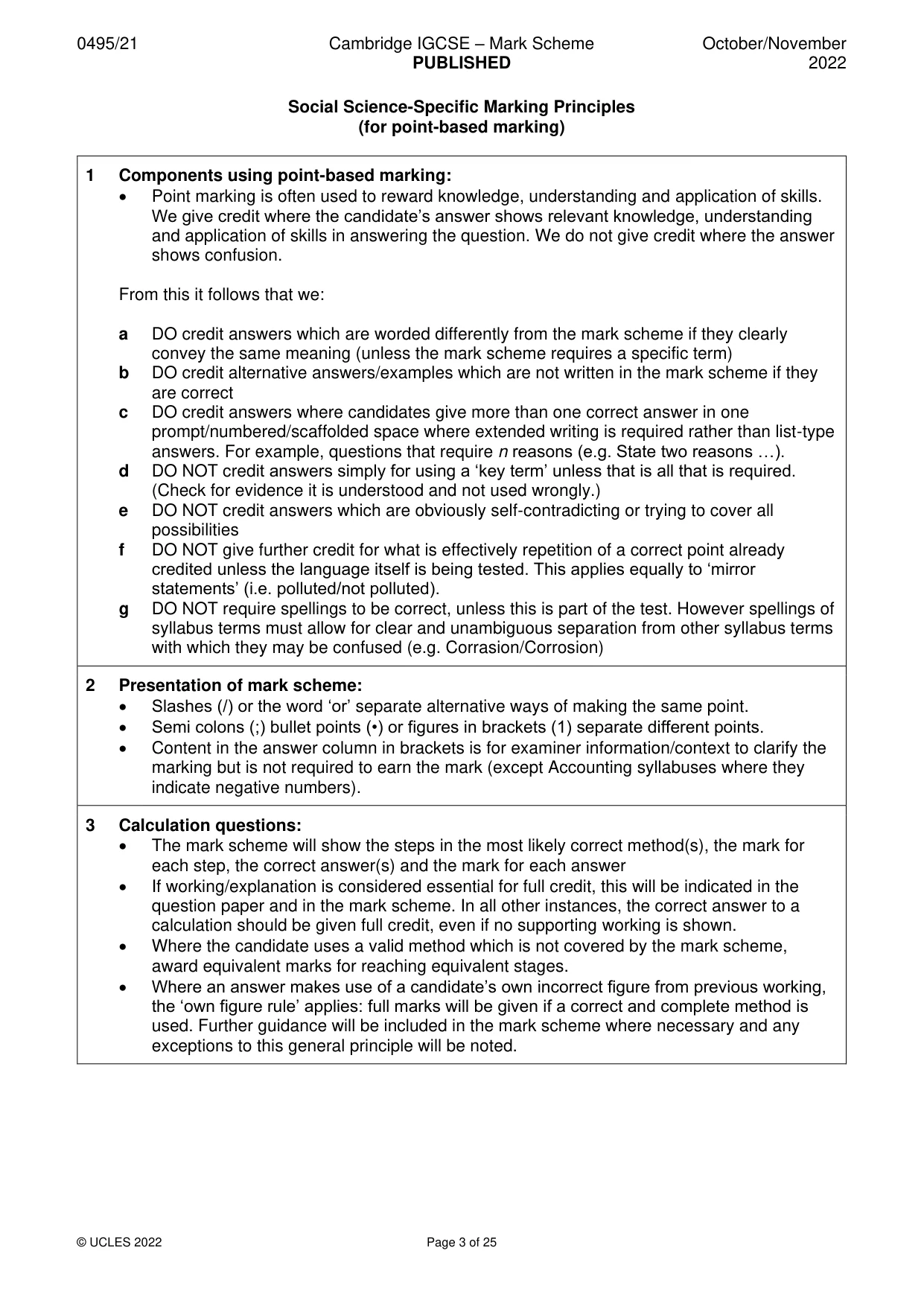
Question paper4 pages


Mark scheme25 pages
Answers below. Sit the paper first if you are practising.





Questions as text
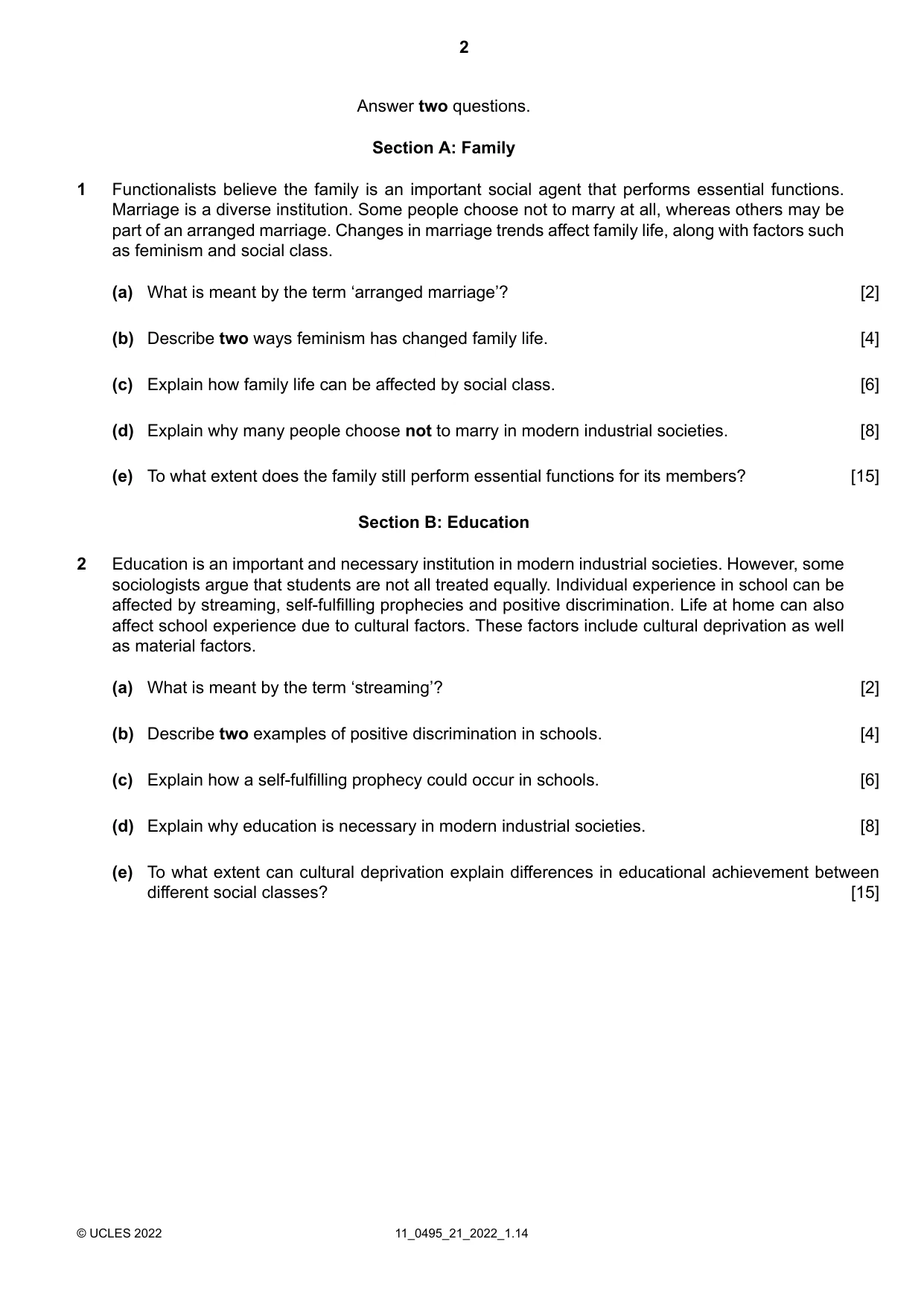
Q1 · Functionalists believe the family is an important social agent that performs essential…
1 Functionalists believe the family is an important social agent that performs essential functions. Marriage is a diverse institution. Some people choose not to marry at all, whereas others may be part of an arranged marriage. Changes in marriage trends affect family life, along with factors such as feminism and social class. (a) What is meant by the term ‘arranged marriage’? [2] (b) Describe two ways feminism has changed family life. [4] (c) Explain how family life can be affected by social class. [6] (d) Explain why many people choose not to marry in modern industrial societies. [8] (e) To what extent does the family still perform essential functions for its members? [15]
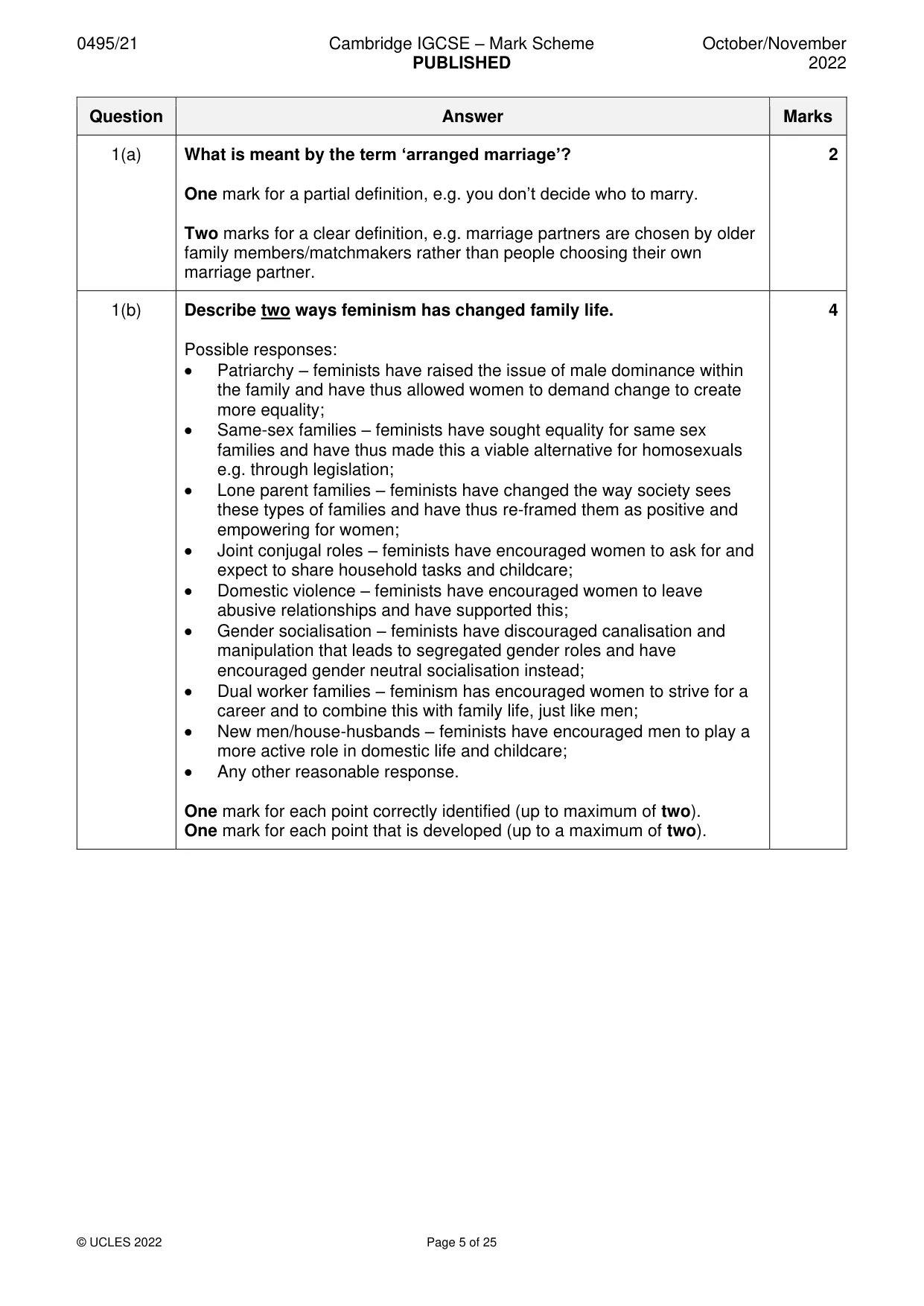
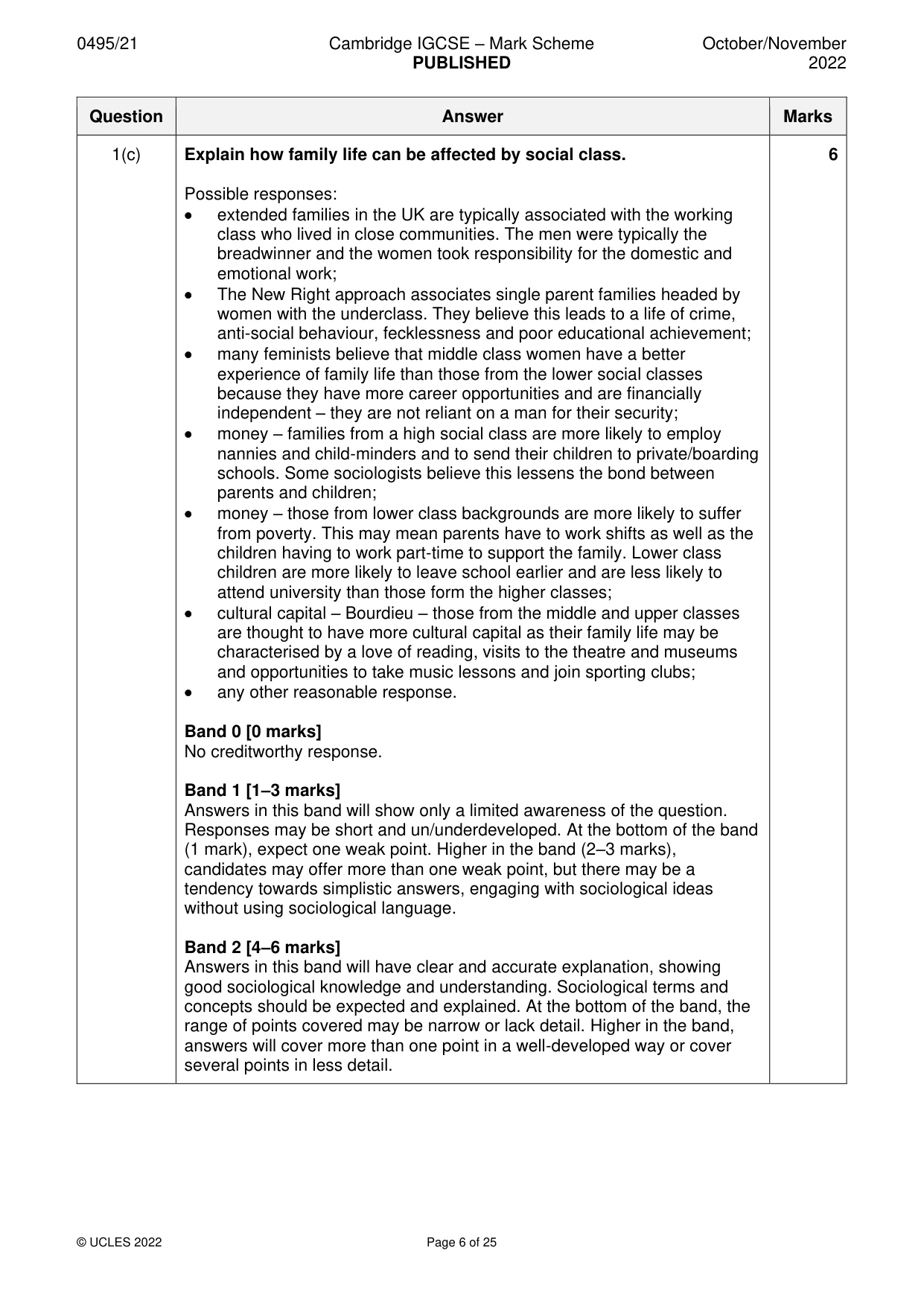
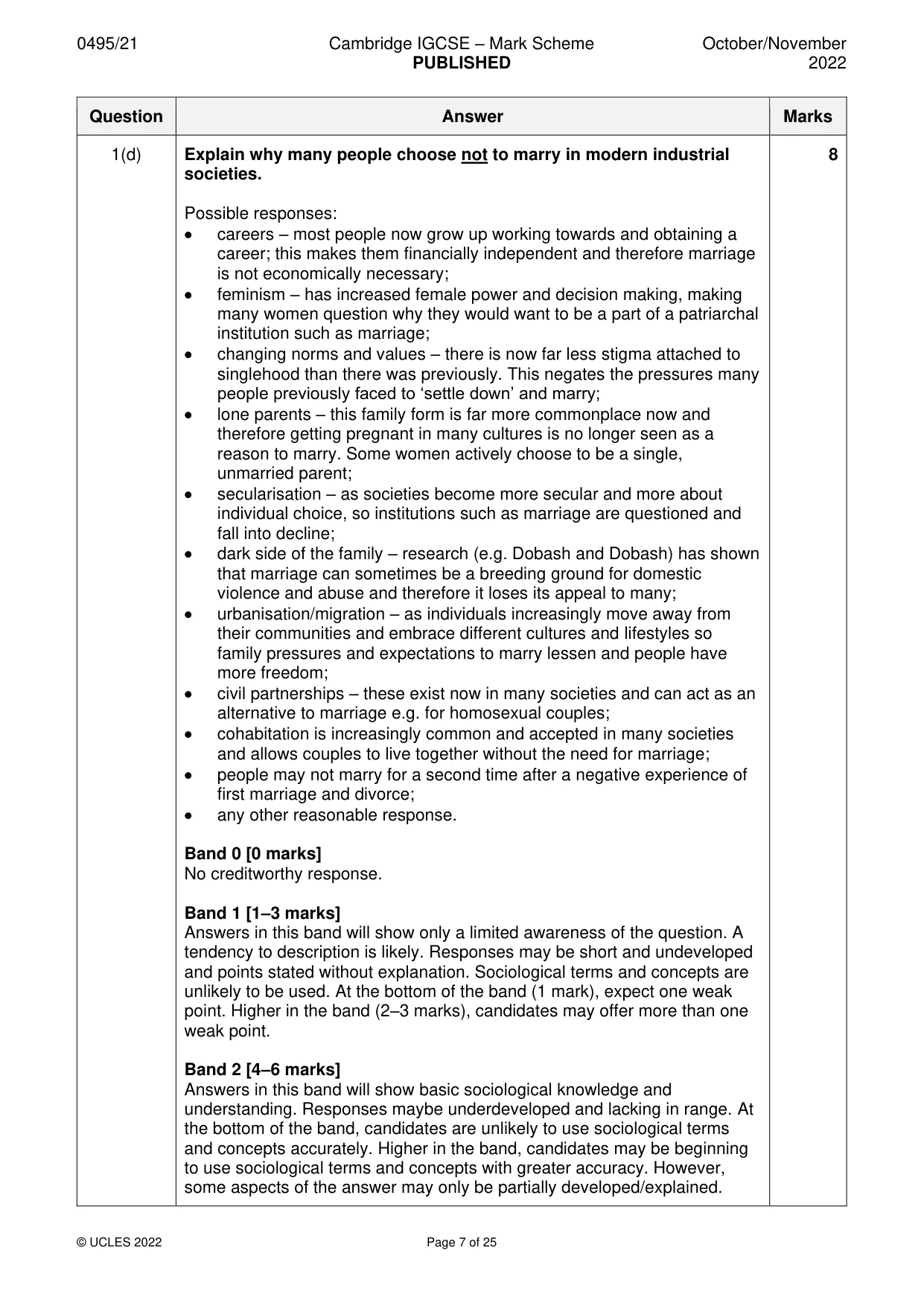
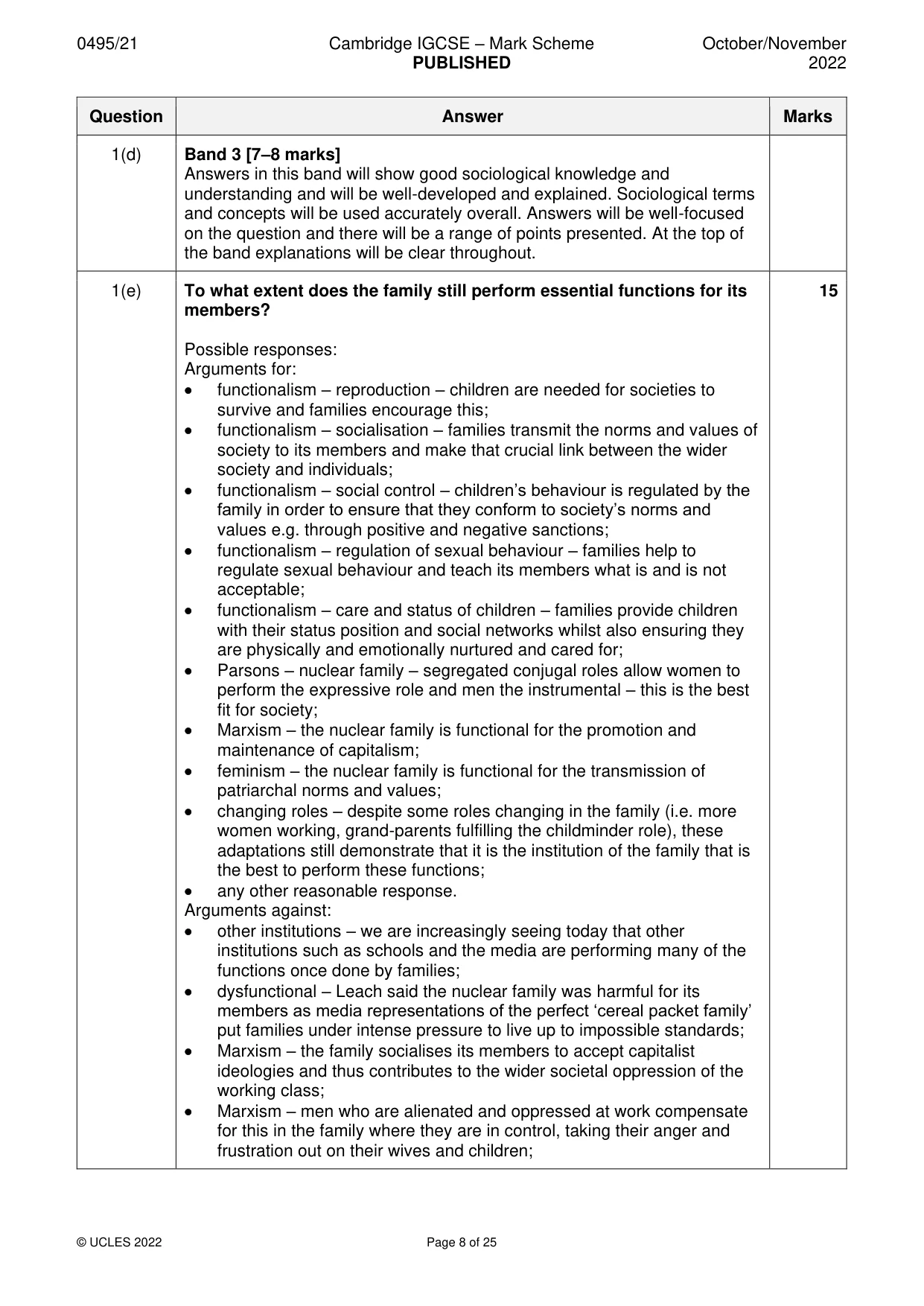
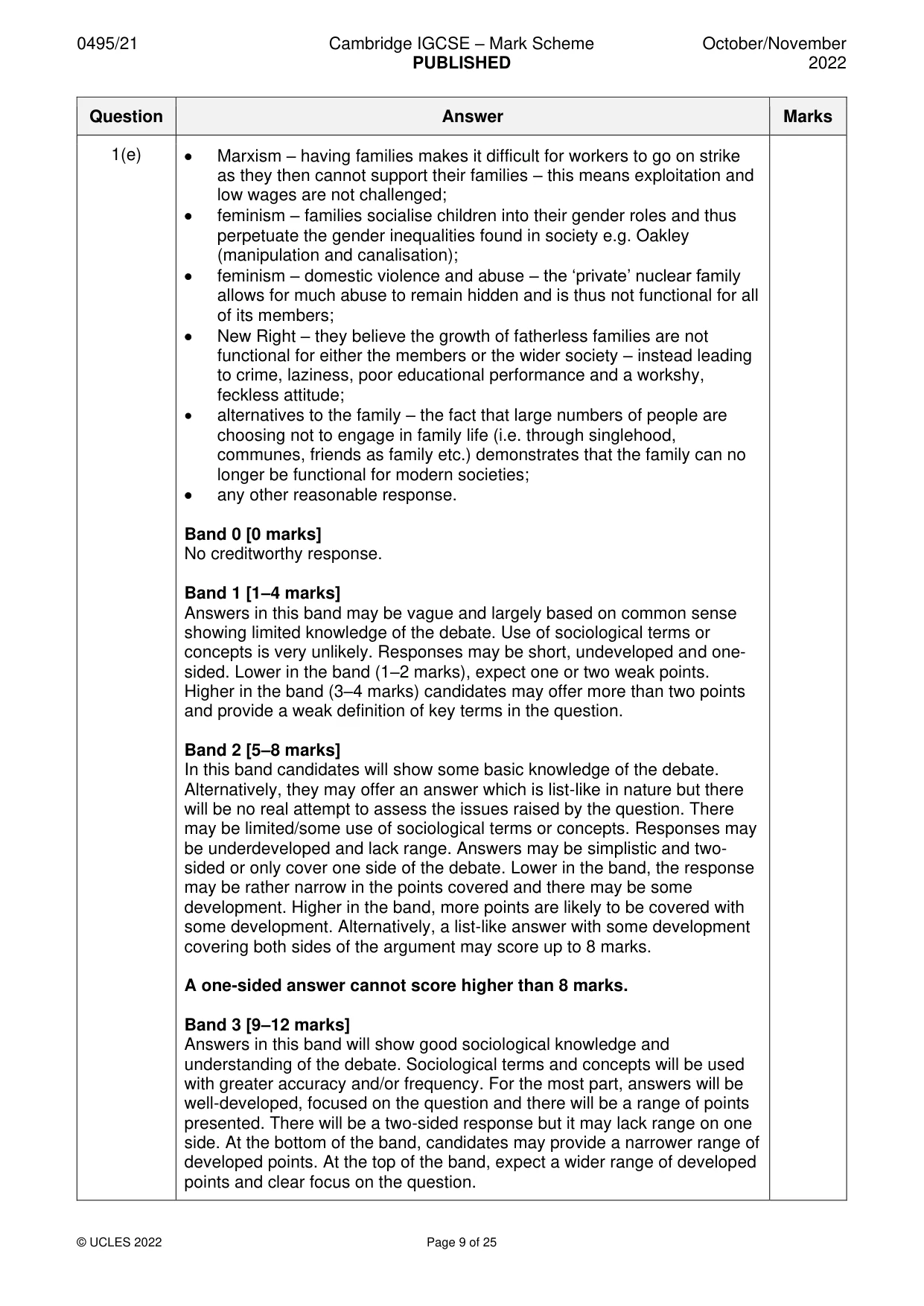
Mark scheme: Question Answer Marks 1(a) What is meant by the term ‘arranged marriage’? 2 One mark for a partial definition, e.g. you don’t decide who to marry. Two marks for a clear definition, e.g. marriage partners are chosen by older family members/matchmakers rather than people choosing their own marriage partner. 1(b) Describe two ways feminism has changed family life. 4 Possible responses: • Patriarchy – feminists have raised the issue of male dominance within the family and have thus allowed women to demand change to create more equality; • Same-sex families – feminists have sought equality for same sex families and have thus made this a viable alternative for homosexuals e.g. through legislation; • Lone parent families – feminists have changed the way society sees these types of families and have thus re-framed them as positive and empowering for women; • Joint conjugal roles – feminists have encouraged women to ask for and expect to share household tasks and childcare; • Domestic violence – feminists have encouraged women to leave abusive relationships and have supported this; • Gender socialisation – feminists have discouraged canalisation and manipulation that leads to segregated gender roles and have encouraged gender neutral socialisation instead; • Dual worker families – feminism has encouraged women to strive for a career and to combine this with family life, just like men; • New men/house-husbands – feminists have encouraged men to play a more active role in domestic life and childcare; • Any other reasonable response. One mark for each point correctly identified (up to maximum of two). One mark for each point that is developed (up to a maximum of two). 1(c) Explain how family life can be affected by social class. 6 Possible responses: • extended families in the UK are typically associated with the working class who lived in close communities. The men were typically the breadwinner and the women took responsibility for the domestic and emotional work; • The New Right approach associates single parent families headed by women with the underclass. They believe this leads to a life of crime, anti-social behaviour, fecklessness and poor educational achievement; • many feminists believe that middle class women have a better experience of family life than those from the lower social classes because they have more career opportunities and are financially independent – they are not reliant on a man for their security; • money – families from a high social class are more likely to employ nannies and child-minders and to send their children to private/boarding schools. Some sociologists believe this lessens the bond between parents and children; • money – those from lower class backgrounds are more likely to suffer from poverty. This may mean parents have to work shifts as well as the children having to work part-time to support the family. Lower class children are more likely to leave school earlier and are less likely to attend university than those form the higher classes; • cultural capital – Bourdieu – those from the middle and upper classes are thought to have more cultural capital as their family life may be characterised by a love of reading, visits to the theatre and museums and opportunities to take music lessons and join sporting clubs; • any other reasonable response. Band 0 [0 marks] No creditworthy response. Band 1 [1–3 marks] Answers in this band will show only a limited awareness of the question. Responses may be short and un/underdeveloped. At the bottom of the band (1 mark), expect one weak point. Higher in the band (2–3 marks), candidates may offer more than one weak point, but there may be a tendency towards simplistic answers, engaging with sociological ideas without using sociological language. Band 2 [4–6 marks] Answers in this band will have clear and accurate explanation, showing good sociological knowledge and understanding. Sociological terms and concepts should be expected and explained. At the bottom of the band, the range of points covered may be narrow or lack detail. Higher in the band, answers will cover more than one point in a well-developed way or cover several points in less detail. 1(d) Explain why many people choose not to marry in modern industrial 8 societies. Possible responses: • careers – most people now grow up working towards and obtaining a career; this makes them financially independent and therefore marriage is not economically necessary; • feminism – has increased female power and decision making, making many women question why they would want to be a part of a patriarchal institution such as marriage; • changing norms and values – there is now far less stigma attached to singlehood than there was previously. This negates the pressures many people previously faced to ‘settle down’ and marry; • lone parents – this family form is far more commonplace now and therefore getting pregnant in many cultures is no longer seen as a reason to marry. Some women actively choose to be a single, unmarried parent; • secularisation – as societies become more secular and more about individual choice, so institutions such as marriage are questioned and fall into decline; • dark side of the family – research (e.g. Dobash and Dobash) has shown that marriage can sometimes be a breeding ground for domestic violence and abuse and therefore it loses its appeal to many; • urbanisation/migration – as individuals increasingly move away from their communities and embrace different cultures and lifestyles so family pressures and expectations to marry lessen and people have more freedom; • civil partnerships – these exist now in many societies and can act as an alternative to marriage e.g. for homosexual couples; • cohabitation is increasingly common and accepted in many societies and allows couples to live together without the need for marriage; • people may not marry for a second time after a negative experience of first marriage and divorce; • any other reasonable response. Band 0 [0 marks] No creditworthy response. Band 1 [1–3 marks] Answers in this band will show only a limited awareness of the question. A tendency to description is likely. Responses may be short and undeveloped and points stated without explanation. Sociological terms and concepts are unlikely to be used. At the bottom of the band (1 mark), expect one weak point. Higher in the band (2–3 marks), candidates may offer more than one weak point. Band 2 [4–6 marks] Answers in this band will show basic sociological knowledge and understanding. Responses maybe underdeveloped and lacking in range. At the bottom of the band, candidates are unlikely to use sociological terms and concepts accurately. Higher in the band, candidates may be beginning to use sociological terms and concepts with greater accuracy. However, some aspects of the answer may only be partially developed/explained. 1(d) Band 3 [7–8 marks] Answers in this band will show good sociological knowledge and understanding and will be well-developed and explained. Sociological terms and concepts will be used accurately overall. Answers will be well-focused on the question and there will be a range of points presented. At the top of the band explanations will be clear throughout. 1(e) To what extent does the family still perform essential functions for its 15 members? Possible responses: Arguments for: • functionalism – reproduction – children are needed for societies to survive and families encourage this; • functionalism – socialisation – families transmit the norms and values of society to its members and make that crucial link between the wider society and individuals; • functionalism – social control – children’s behaviour is regulated by the family in order to ensure that they conform to society’s norms and values e.g. through positive and negative sanctions; • functionalism – regulation of sexual behaviour – families help to regulate sexual behaviour and teach its members what is and is not acceptable; • functionalism – care and status of children – families provide children with their status position and social networks whilst also ensuring they are physically and emotionally nurtured and cared for; • Parsons – nuclear family – segregated conjugal roles allow women to perform the expressive role and men the instrumental – this is the best fit for society; • Marxism – the nuclear family is functional for the promotion and maintenance of capitalism; • feminism – the nuclear family is functional for the transmission of patriarchal norms and values; • changing roles – despite some roles changing in the family (i.e. more women working, grand-parents fulfilling the childminder role), these adaptations still demonstrate that it is the institution of the family that is the best to perform these functions; • any other reasonable response. Arguments against: • other institutions – we are increasingly seeing today that other institutions such as schools and the media are performing many of the functions once done by families; • dysfunctional – Leach said the nuclear family was harmful for its members as media representations of the perfect ‘cereal packet family’ put families under intense pressure to live up to impossible standards; • Marxism – the family socialises its members to accept capitalist ideologies and thus contributes to the wider societal oppression of the working class; • Marxism – men who are alienated and oppressed at work compensate for this in the family where they are in control, taking their anger and frustration out on their wives and children; 1(e) • Marxism – having families makes it difficult for workers to go on strike as they then cannot support their families – this means exploitation and low wages are not challenged; • feminism – families socialise children into their gender roles and thus perpetuate the gender inequalities found in society e.g. Oakley (manipulation and canalisation); • feminism – domestic violence and abuse – the ‘private’ nuclear family allows for much abuse to remain hidden and is thus not functional for all of its members; • New Right – they believe the growth of fatherless families are not functional for either the members or the wider society – instead leading to crime, laziness, poor educational performance and a workshy, feckless attitude; • alternatives to the family – the fact that large numbers of people are choosing not to engage in family life (i.e. through singlehood, communes, friends as family etc.) demonstrates that the family can no longer be functional for modern societies; • any other reasonable response. Band 0 [0 marks] No creditworthy response. Band 1 [1–4 marks] Answers in this band may be vague and largely based on common sense showing limited knowledge of the debate. Use of sociological terms or concepts is very unlikely. Responses may be short, undeveloped and one- sided. Lower in the band (1–2 marks), expect one or two weak points. Higher in the band (3–4 marks) candidates may offer more than two points and provide a weak definition of key terms in the question. Band 2 [5–8 marks] In this band candidates will show some basic knowledge of the debate. Alternatively, they may offer an answer which is list-like in nature but there will be no real attempt to assess the issues raised by the question. There may be limited/some use of sociological terms or concepts. Responses may be underdeveloped and lack range. Answers may be simplistic and two- sided or only cover one side of the debate. Lower in the band, the response may be rather narrow in the points covered and there may be some development. Higher in the band, more points are likely to be covered with some development. Alternatively, a list-like answer with some development covering both sides of the argument may score up to 8 marks. A one-sided answer cannot score higher than 8 marks. Band 3 [9–12 marks] Answers in this band will show good sociological knowledge and understanding of the debate. Sociological terms and concepts will be used with greater accuracy and/or frequency. For the most part, answers will be well-developed, focused on the question and there will be a range of points presented. There will be a two-sided response but it may lack range on one side. At the bottom of the band, candidates may provide a narrower range of developed points. At the top of the band, expect a wider range of developed points and clear focus on the question. 1(e) Band 4 [13–15 marks] Answers in this band will show excellent knowledge and understanding of the debate. There will be a strong grasp of the arguments as well as accurate and frequent use of sociological terms and concepts. Answers will be well-developed, clearly focused on the question and discuss a wide range of points. Responses will be two-sided and have a range of points on each side. At the bottom of the band (13 marks), the answer may lack a specific conclusion. Higher in the band, there will be a clear attempt to offer an assessment of the ‘To what extent.?’ part of the question through a focused conclusion.
More questions on How do sociologists approach the study of society?
Q2 · Education is an important and necessary institution in modern industrial societies
2 Education is an important and necessary institution in modern industrial societies. However, some sociologists argue that students are not all treated equally. Individual experience in school can be affected by streaming, self-fulfilling prophecies and positive discrimination. Life at home can also affect school experience due to cultural factors. These factors include cultural deprivation as well as material factors. (a) What is meant by the term ‘streaming’? [2] (b) Describe two examples of positive discrimination in schools. [4] (c) Explain how a self-fulfilling prophecy could occur in schools. [6] (d) Explain why education is necessary in modern industrial societies. [8] (e) To what extent can cultural deprivation explain differences in educational achievement between different social classes? [15] Section C: Crime, deviance and social control
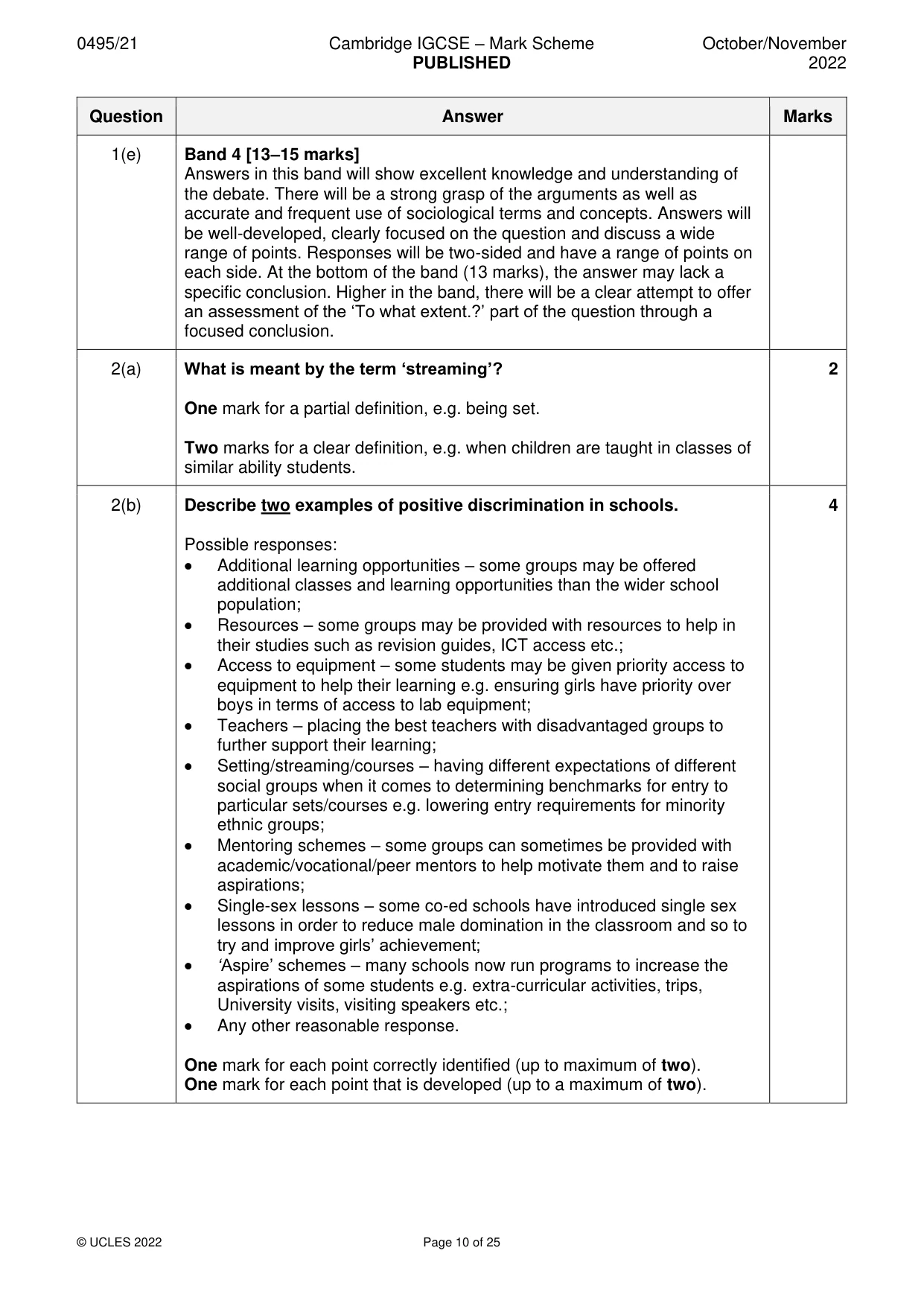
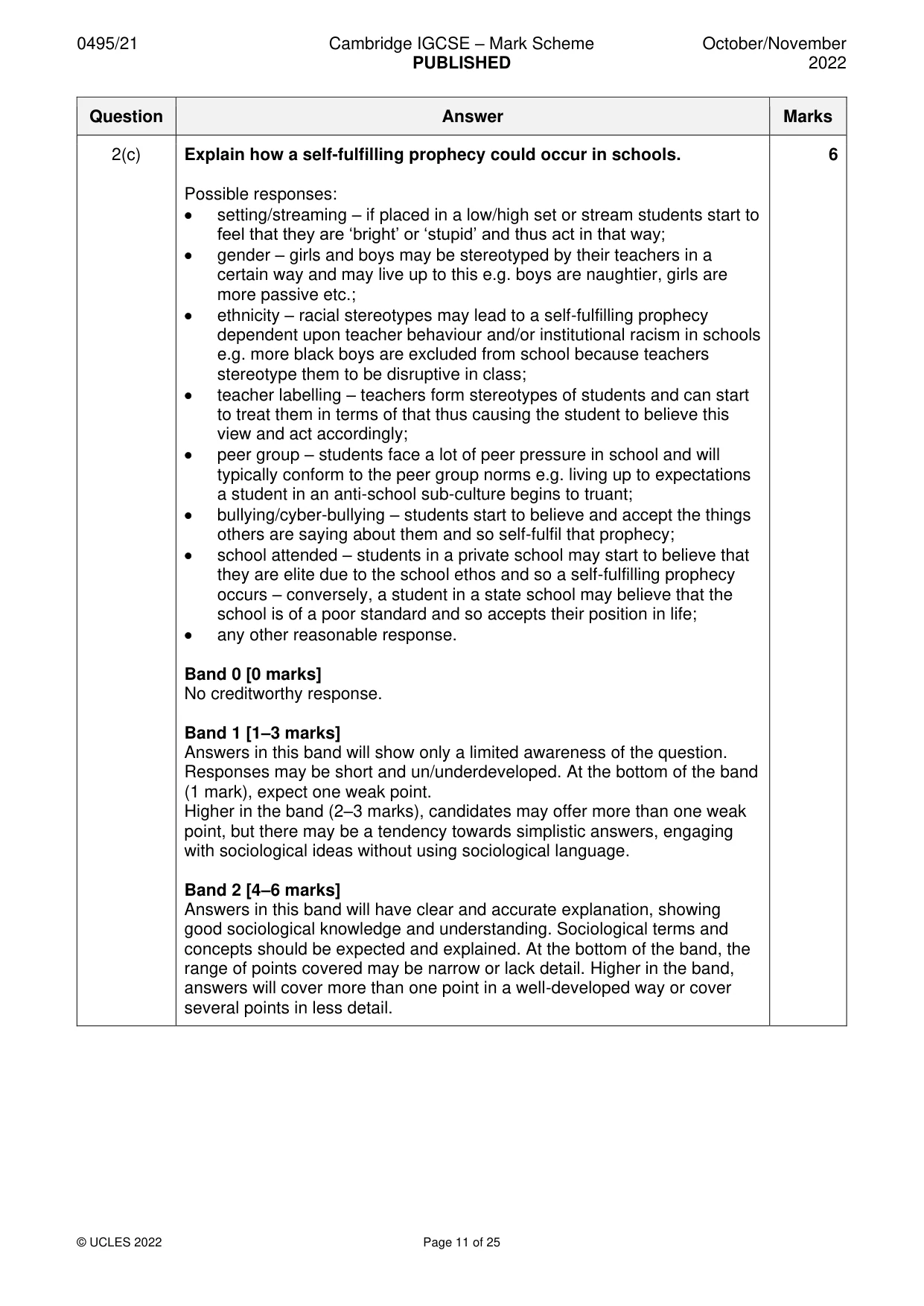
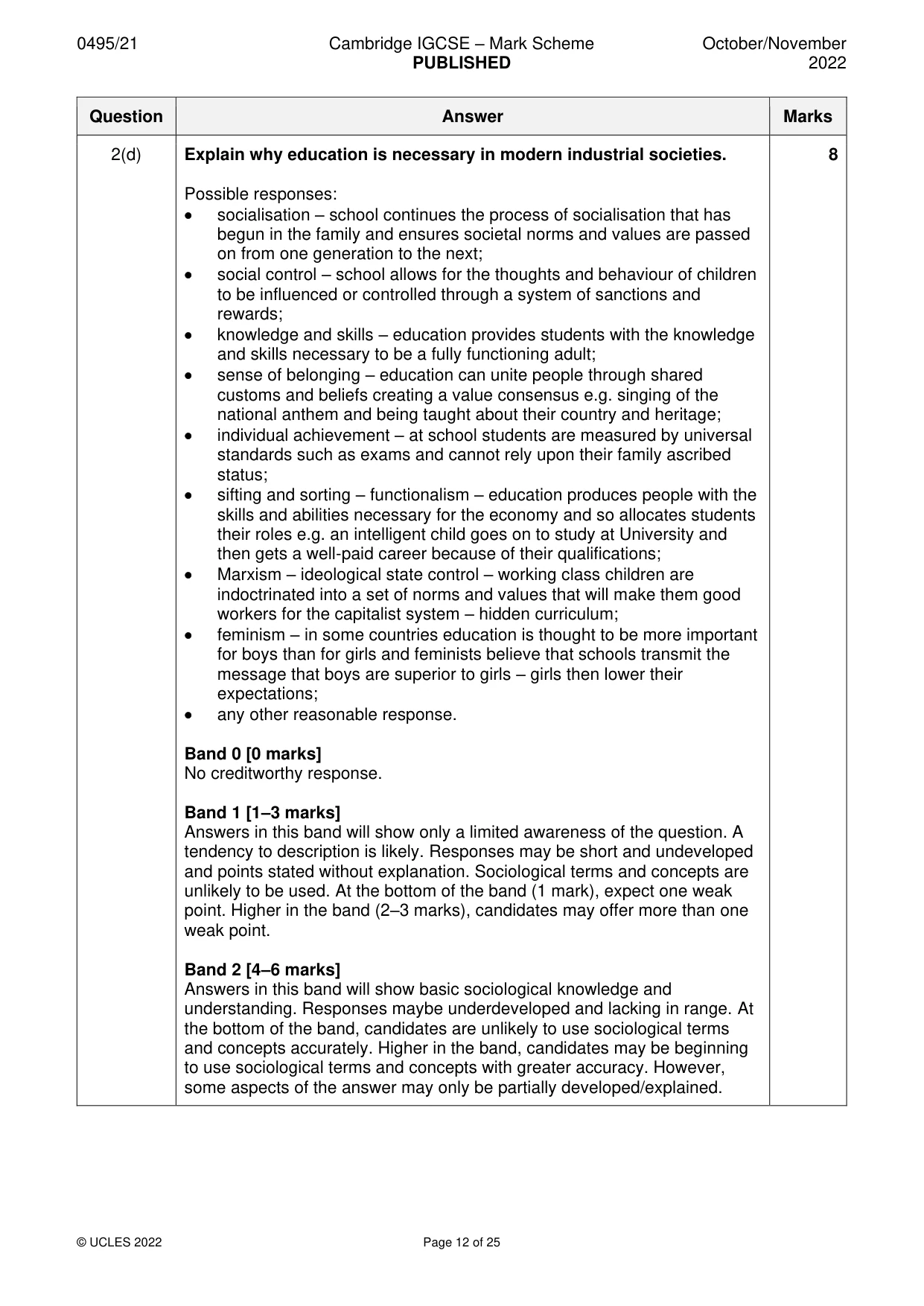
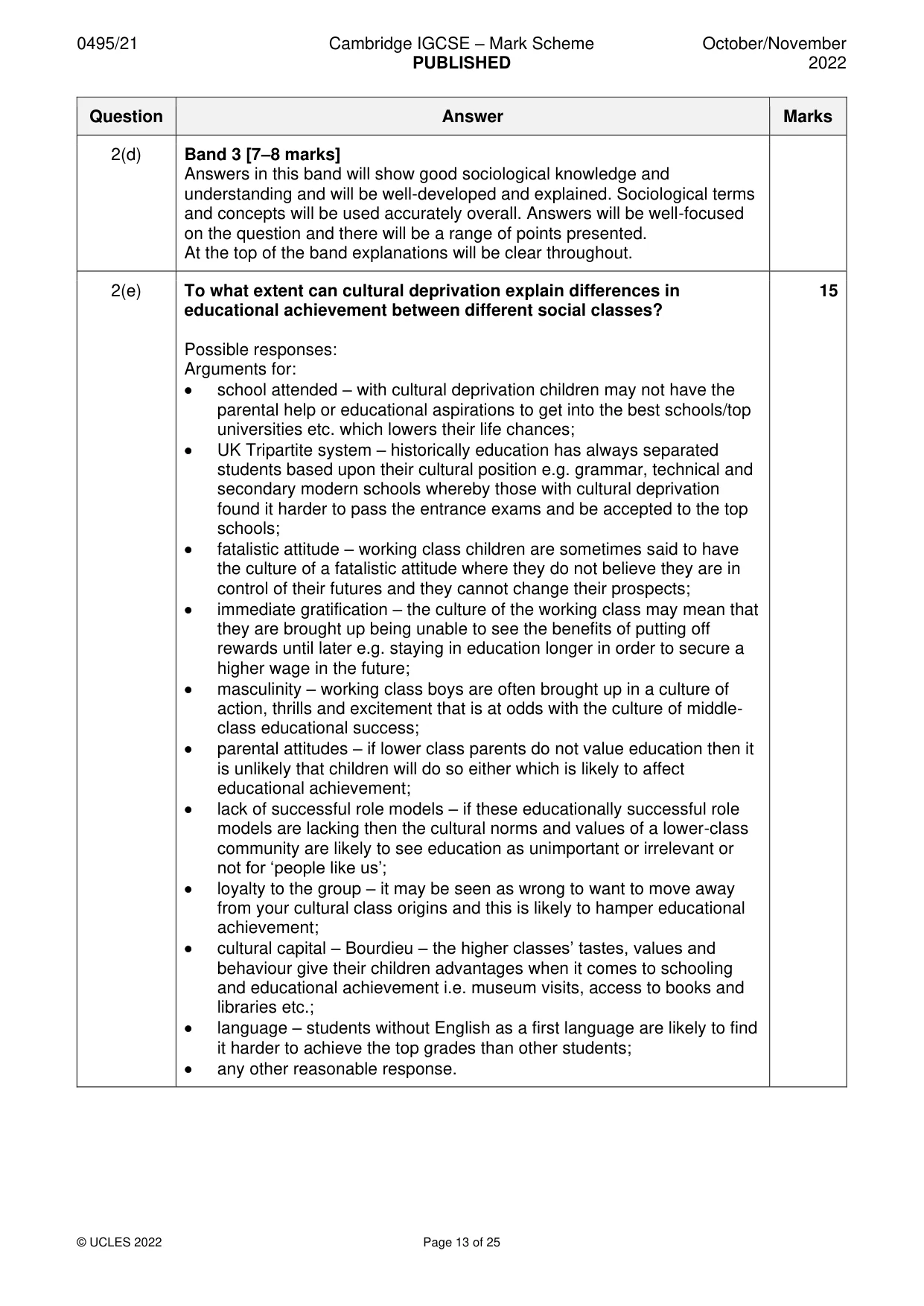
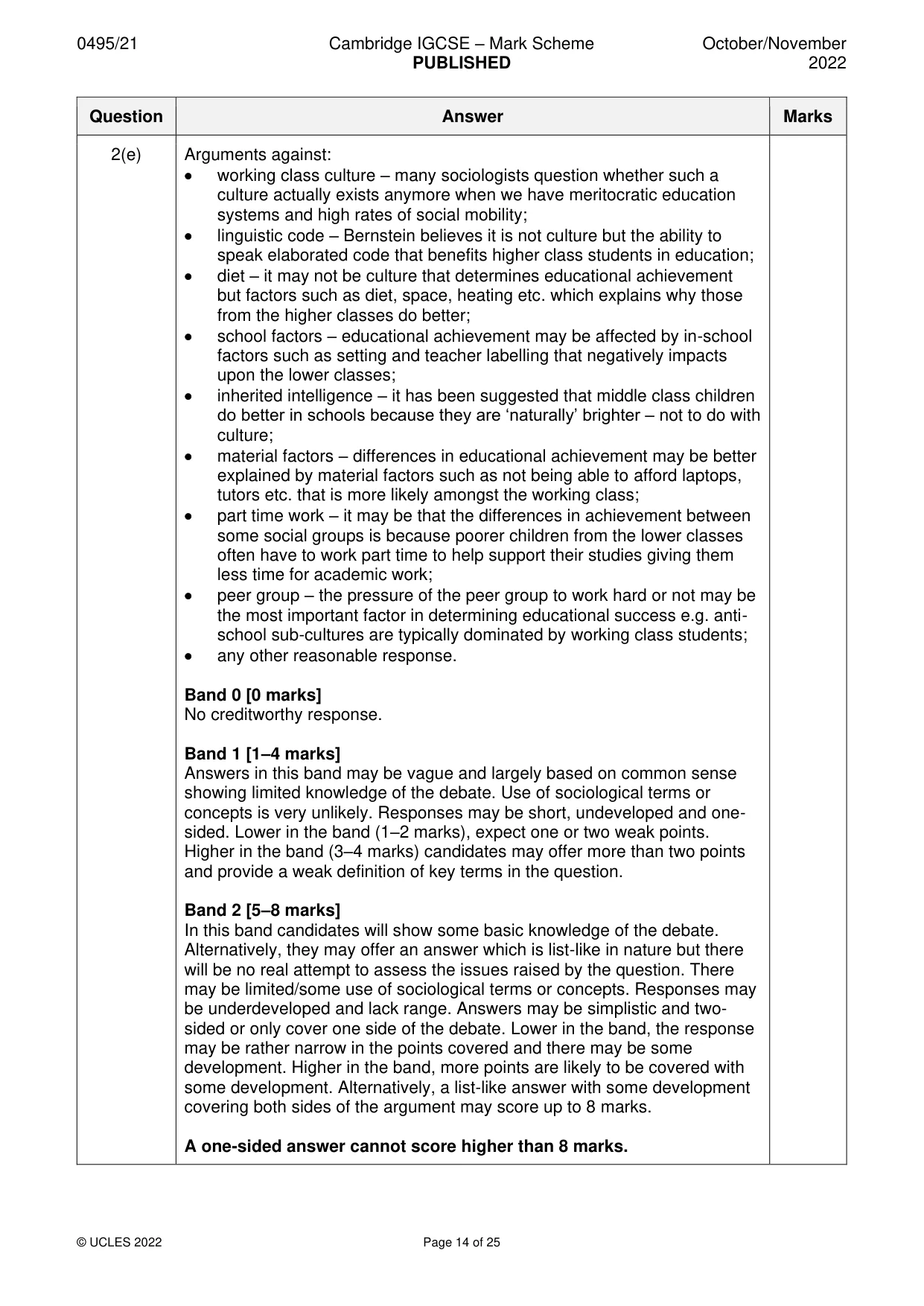
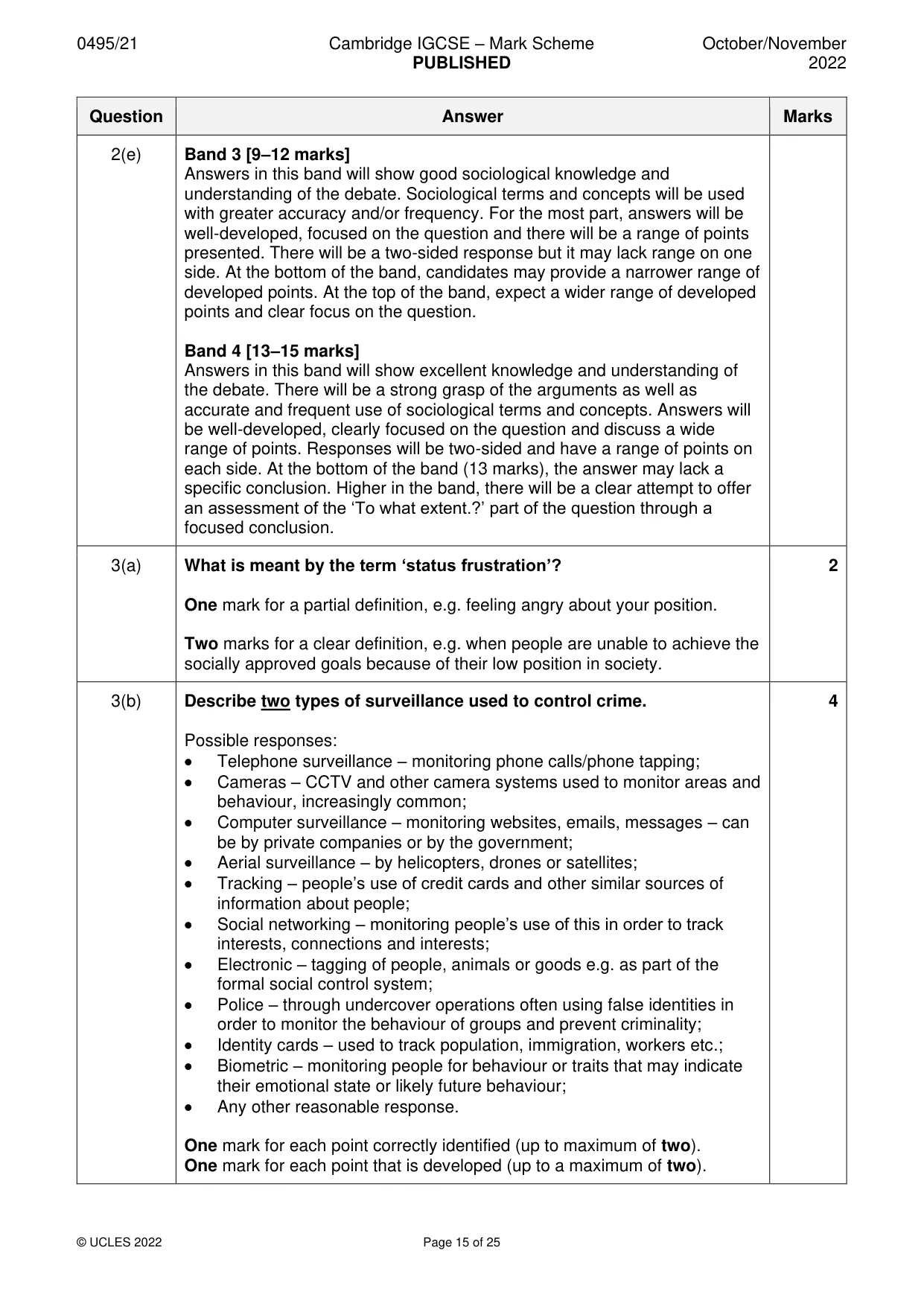
Mark scheme: 2(a) What is meant by the term ‘streaming’? 2 One mark for a partial definition, e.g. being set. Two marks for a clear definition, e.g. when children are taught in classes of similar ability students. 2(b) Describe two examples of positive discrimination in schools. 4 Possible responses: • Additional learning opportunities – some groups may be offered additional classes and learning opportunities than the wider school population; • Resources – some groups may be provided with resources to help in their studies such as revision guides, ICT access etc.; • Access to equipment – some students may be given priority access to equipment to help their learning e.g. ensuring girls have priority over boys in terms of access to lab equipment; • Teachers – placing the best teachers with disadvantaged groups to further support their learning; • Setting/streaming/courses – having different expectations of different social groups when it comes to determining benchmarks for entry to particular sets/courses e.g. lowering entry requirements for minority ethnic groups; • Mentoring schemes – some groups can sometimes be provided with academic/vocational/peer mentors to help motivate them and to raise aspirations; • Single-sex lessons – some co-ed schools have introduced single sex lessons in order to reduce male domination in the classroom and so to try and improve girls’ achievement; • ‘Aspire’ schemes – many schools now run programs to increase the aspirations of some students e.g. extra-curricular activities, trips, University visits, visiting speakers etc.; • Any other reasonable response. One mark for each point correctly identified (up to maximum of two). One mark for each point that is developed (up to a maximum of two). 2(c) Explain how a self-fulfilling prophecy could occur in schools. 6 Possible responses: • setting/streaming – if placed in a low/high set or stream students start to feel that they are ‘bright’ or ‘stupid’ and thus act in that way; • gender – girls and boys may be stereotyped by their teachers in a certain way and may live up to this e.g. boys are naughtier, girls are more passive etc.; • ethnicity – racial stereotypes may lead to a self-fulfilling prophecy dependent upon teacher behaviour and/or institutional racism in schools e.g. more black boys are excluded from school because teachers stereotype them to be disruptive in class; • teacher labelling – teachers form stereotypes of students and can start to treat them in terms of that thus causing the student to believe this view and act accordingly; • peer group – students face a lot of peer pressure in school and will typically conform to the peer group norms e.g. living up to expectations a student in an anti-school sub-culture begins to truant; • bullying/cyber-bullying – students start to believe and accept the things others are saying about them and so self-fulfil that prophecy; • school attended – students in a private school may start to believe that they are elite due to the school ethos and so a self-fulfilling prophecy occurs – conversely, a student in a state school may believe that the school is of a poor standard and so accepts their position in life; • any other reasonable response. Band 0 [0 marks] No creditworthy response. Band 1 [1–3 marks] Answers in this band will show only a limited awareness of the question. Responses may be short and un/underdeveloped. At the bottom of the band (1 mark), expect one weak point. Higher in the band (2–3 marks), candidates may offer more than one weak point, but there may be a tendency towards simplistic answers, engaging with sociological ideas without using sociological language. Band 2 [4–6 marks] Answers in this band will have clear and accurate explanation, showing good sociological knowledge and understanding. Sociological terms and concepts should be expected and explained. At the bottom of the band, the range of points covered may be narrow or lack detail. Higher in the band, answers will cover more than one point in a well-developed way or cover several points in less detail. 2(d) Explain why education is necessary in modern industrial societies. 8 Possible responses: • socialisation – school continues the process of socialisation that has begun in the family and ensures societal norms and values are passed on from one generation to the next; • social control – school allows for the thoughts and behaviour of children to be influenced or controlled through a system of sanctions and rewards; • knowledge and skills – education provides students with the knowledge and skills necessary to be a fully functioning adult; • sense of belonging – education can unite people through shared customs and beliefs creating a value consensus e.g. singing of the national anthem and being taught about their country and heritage; • individual achievement – at school students are measured by universal standards such as exams and cannot rely upon their family ascribed status; • sifting and sorting – functionalism – education produces people with the skills and abilities necessary for the economy and so allocates students their roles e.g. an intelligent child goes on to study at University and then gets a well-paid career because of their qualifications; • Marxism – ideological state control – working class children are indoctrinated into a set of norms and values that will make them good workers for the capitalist system – hidden curriculum; • feminism – in some countries education is thought to be more important for boys than for girls and feminists believe that schools transmit the message that boys are superior to girls – girls then lower their expectations; • any other reasonable response. Band 0 [0 marks] No creditworthy response. Band 1 [1–3 marks] Answers in this band will show only a limited awareness of the question. A tendency to description is likely. Responses may be short and undeveloped and points stated without explanation. Sociological terms and concepts are unlikely to be used. At the bottom of the band (1 mark), expect one weak point. Higher in the band (2–3 marks), candidates may offer more than one weak point. Band 2 [4–6 marks] Answers in this band will show basic sociological knowledge and understanding. Responses maybe underdeveloped and lacking in range. At the bottom of the band, candidates are unlikely to use sociological terms and concepts accurately. Higher in the band, candidates may be beginning to use sociological terms and concepts with greater accuracy. However, some aspects of the answer may only be partially developed/explained. 2(d) Band 3 [7–8 marks] Answers in this band will show good sociological knowledge and understanding and will be well-developed and explained. Sociological terms and concepts will be used accurately overall. Answers will be well-focused on the question and there will be a range of points presented. At the top of the band explanations will be clear throughout. 2(e) To what extent can cultural deprivation explain differences in 15 educational achievement between different social classes? Possible responses: Arguments for: • school attended – with cultural deprivation children may not have the parental help or educational aspirations to get into the best schools/top universities etc. which lowers their life chances; • UK Tripartite system – historically education has always separated students based upon their cultural position e.g. grammar, technical and secondary modern schools whereby those with cultural deprivation found it harder to pass the entrance exams and be accepted to the top schools; • fatalistic attitude – working class children are sometimes said to have the culture of a fatalistic attitude where they do not believe they are in control of their futures and they cannot change their prospects; • immediate gratification – the culture of the working class may mean that they are brought up being unable to see the benefits of putting off rewards until later e.g. staying in education longer in order to secure a higher wage in the future; • masculinity – working class boys are often brought up in a culture of action, thrills and excitement that is at odds with the culture of middle- class educational success; • parental attitudes – if lower class parents do not value education then it is unlikely that children will do so either which is likely to affect educational achievement; • lack of successful role models – if these educationally successful role models are lacking then the cultural norms and values of a lower-class community are likely to see education as unimportant or irrelevant or not for ‘people like us’; • loyalty to the group – it may be seen as wrong to want to move away from your cultural class origins and this is likely to hamper educational achievement; • cultural capital – Bourdieu – the higher classes’ tastes, values and behaviour give their children advantages when it comes to schooling and educational achievement i.e. museum visits, access to books and libraries etc.; • language – students without English as a first language are likely to find it harder to achieve the top grades than other students; • any other reasonable response. 2(e) Arguments against: • working class culture – many sociologists question whether such a culture actually exists anymore when we have meritocratic education systems and high rates of social mobility; • linguistic code – Bernstein believes it is not culture but the ability to speak elaborated code that benefits higher class students in education; • diet – it may not be culture that determines educational achievement but factors such as diet, space, heating etc. which explains why those from the higher classes do better; • school factors – educational achievement may be affected by in-school factors such as setting and teacher labelling that negatively impacts upon the lower classes; • inherited intelligence – it has been suggested that middle class children do better in schools because they are ‘naturally’ brighter – not to do with culture; • material factors – differences in educational achievement may be better explained by material factors such as not being able to afford laptops, tutors etc. that is more likely amongst the working class; • part time work – it may be that the differences in achievement between some social groups is because poorer children from the lower classes often have to work part time to help support their studies giving them less time for academic work; • peer group – the pressure of the peer group to work hard or not may be the most important factor in determining educational success e.g. anti- school sub-cultures are typically dominated by working class students; • any other reasonable response. Band 0 [0 marks] No creditworthy response. Band 1 [1–4 marks] Answers in this band may be vague and largely based on common sense showing limited knowledge of the debate. Use of sociological terms or concepts is very unlikely. Responses may be short, undeveloped and one- sided. Lower in the band (1–2 marks), expect one or two weak points. Higher in the band (3–4 marks) candidates may offer more than two points and provide a weak definition of key terms in the question. Band 2 [5–8 marks] In this band candidates will show some basic knowledge of the debate. Alternatively, they may offer an answer which is list-like in nature but there will be no real attempt to assess the issues raised by the question. There may be limited/some use of sociological terms or concepts. Responses may be underdeveloped and lack range. Answers may be simplistic and two- sided or only cover one side of the debate. Lower in the band, the response may be rather narrow in the points covered and there may be some development. Higher in the band, more points are likely to be covered with some development. Alternatively, a list-like answer with some development covering both sides of the argument may score up to 8 marks. A one-sided answer cannot score higher than 8 marks. 2(e) Band 3 [9–12 marks] Answers in this band will show good sociological knowledge and understanding of the debate. Sociological terms and concepts will be used with greater accuracy and/or frequency. For the most part, answers will be well-developed, focused on the question and there will be a range of points presented. There will be a two-sided response but it may lack range on one side. At the bottom of the band, candidates may provide a narrower range of developed points. At the top of the band, expect a wider range of developed points and clear focus on the question. Band 4 [13–15 marks] Answers in this band will show excellent knowledge and understanding of the debate. There will be a strong grasp of the arguments as well as accurate and frequent use of sociological terms and concepts. Answers will be well-developed, clearly focused on the question and discuss a wide range of points. Responses will be two-sided and have a range of points on each side. At the bottom of the band (13 marks), the answer may lack a specific conclusion. Higher in the band, there will be a clear attempt to offer an assessment of the ‘To what extent.?’ part of the question through a focused conclusion.
Q3 · Surveillance is one way society tries to control acts of crime and deviance
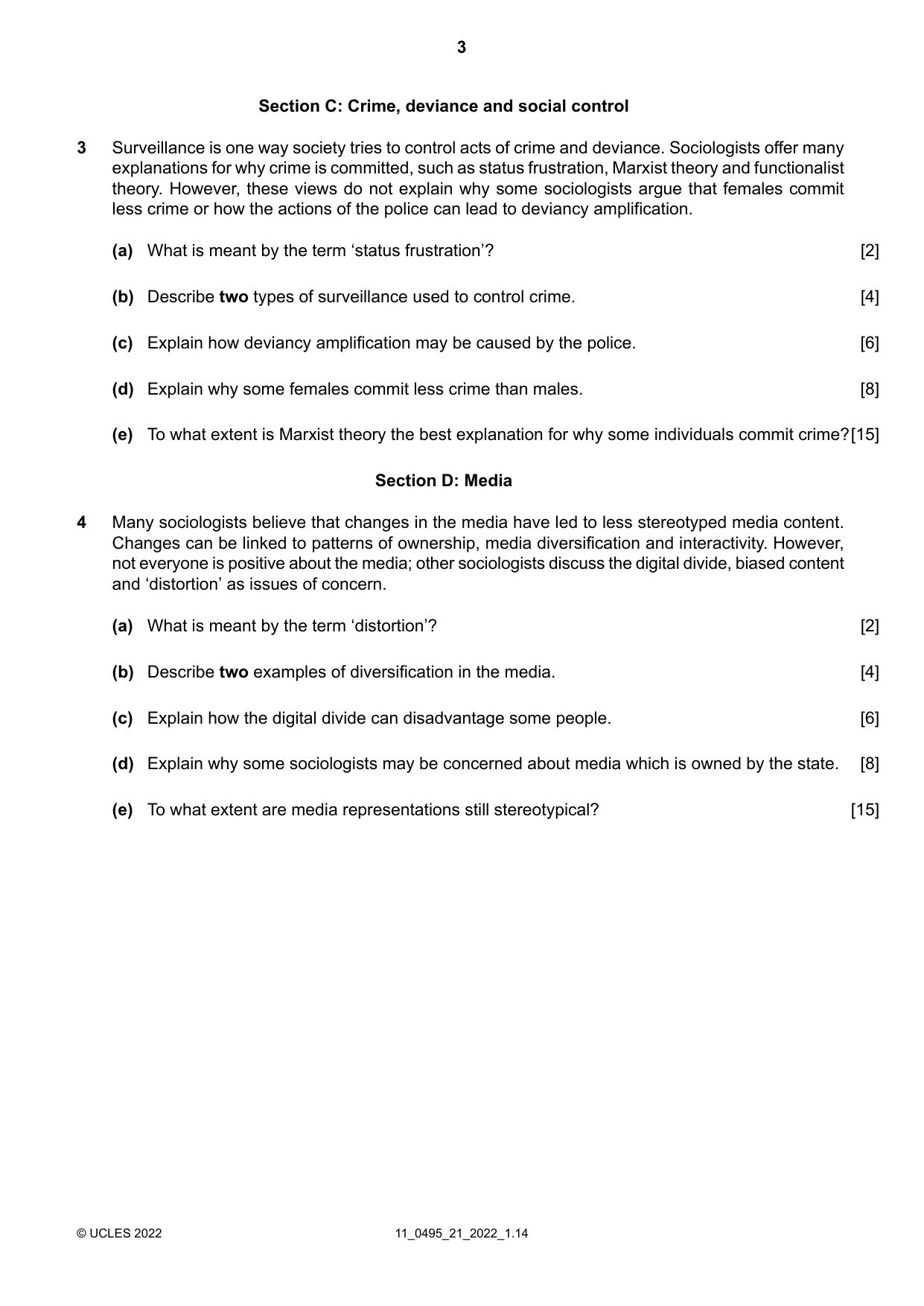
3 Surveillance is one way society tries to control acts of crime and deviance. Sociologists offer many explanations for why crime is committed, such as status frustration, Marxist theory and functionalist theory. However, these views do not explain why some sociologists argue that females commit less crime or how the actions of the police can lead to deviancy amplification. (a) What is meant by the term ‘status frustration’? [2] (b) Describe two types of surveillance used to control crime. [4] (c) Explain how deviancy amplification may be caused by the police. [6] (d) Explain why some females commit less crime than males. [8] (e) To what extent is Marxist theory the best explanation for why some individuals commit crime?[15] Section D: Media
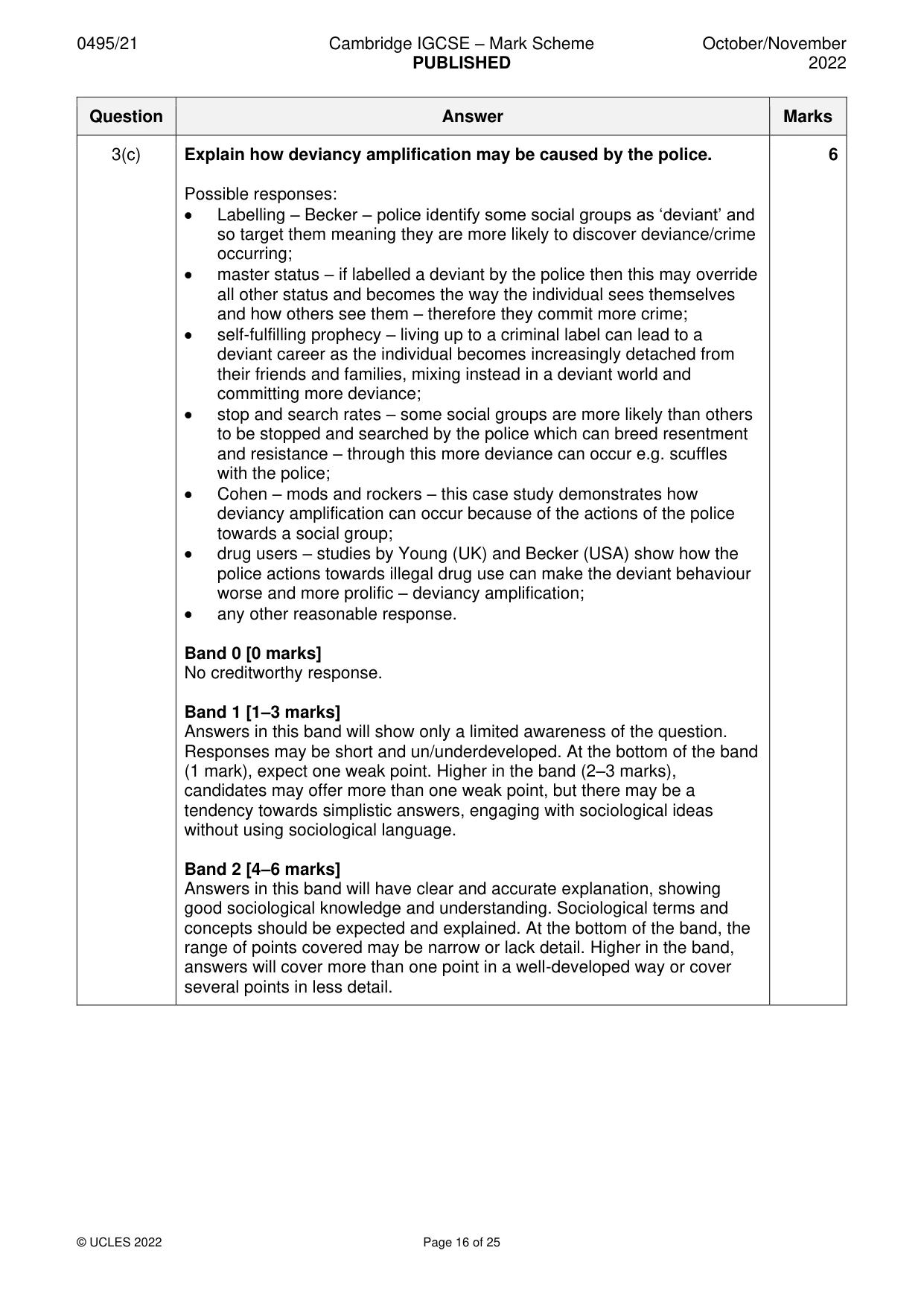
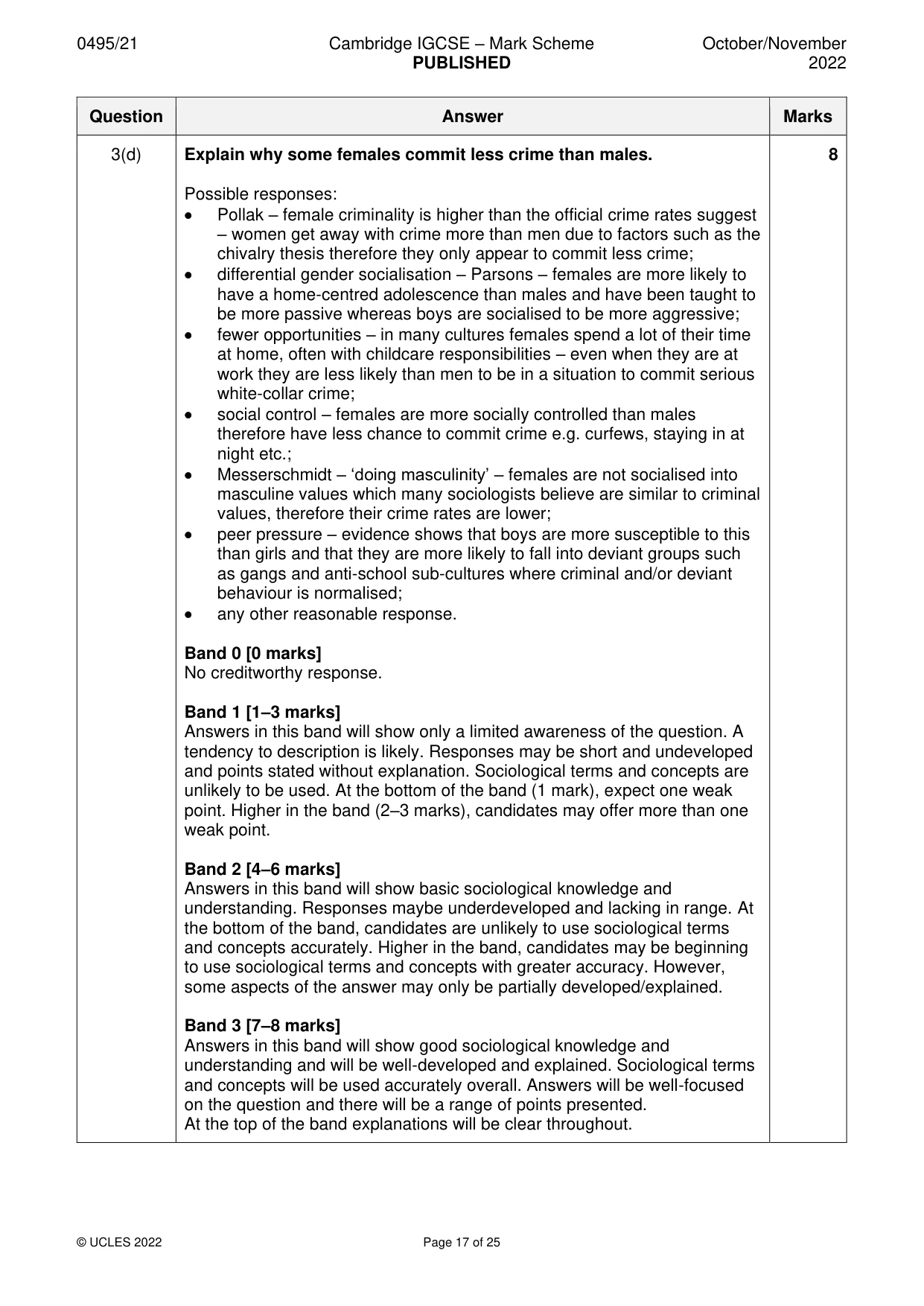
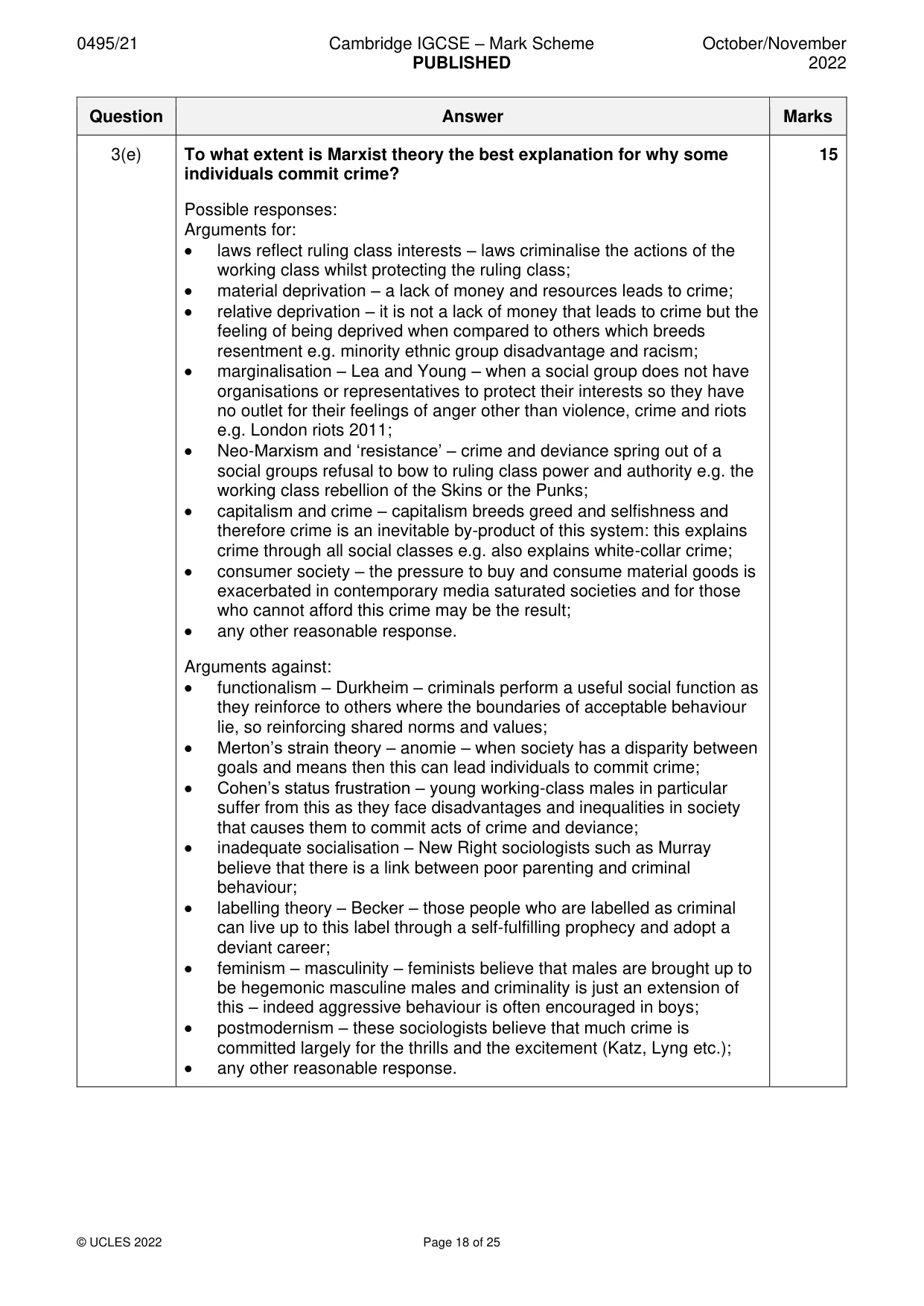
Mark scheme: 3(a) What is meant by the term ‘status frustration’? 2 One mark for a partial definition, e.g. feeling angry about your position. Two marks for a clear definition, e.g. when people are unable to achieve the socially approved goals because of their low position in society. 3(b) Describe two types of surveillance used to control crime. 4 Possible responses: • Telephone surveillance – monitoring phone calls/phone tapping; • Cameras – CCTV and other camera systems used to monitor areas and behaviour, increasingly common; • Computer surveillance – monitoring websites, emails, messages – can be by private companies or by the government; • Aerial surveillance – by helicopters, drones or satellites; • Tracking – people’s use of credit cards and other similar sources of information about people; • Social networking – monitoring people’s use of this in order to track interests, connections and interests; • Electronic – tagging of people, animals or goods e.g. as part of the formal social control system; • Police – through undercover operations often using false identities in order to monitor the behaviour of groups and prevent criminality; • Identity cards – used to track population, immigration, workers etc.; • Biometric – monitoring people for behaviour or traits that may indicate their emotional state or likely future behaviour; • Any other reasonable response. One mark for each point correctly identified (up to maximum of two). One mark for each point that is developed (up to a maximum of two). 3(c) Explain how deviancy amplification may be caused by the police. 6 Possible responses: • Labelling – Becker – police identify some social groups as ‘deviant’ and so target them meaning they are more likely to discover deviance/crime occurring; • master status – if labelled a deviant by the police then this may override all other status and becomes the way the individual sees themselves and how others see them – therefore they commit more crime; • self-fulfilling prophecy – living up to a criminal label can lead to a deviant career as the individual becomes increasingly detached from their friends and families, mixing instead in a deviant world and committing more deviance; • stop and search rates – some social groups are more likely than others to be stopped and searched by the police which can breed resentment and resistance – through this more deviance can occur e.g. scuffles with the police; • Cohen – mods and rockers – this case study demonstrates how deviancy amplification can occur because of the actions of the police towards a social group; • drug users – studies by Young (UK) and Becker (USA) show how the police actions towards illegal drug use can make the deviant behaviour worse and more prolific – deviancy amplification; • any other reasonable response. Band 0 [0 marks] No creditworthy response. Band 1 [1–3 marks] Answers in this band will show only a limited awareness of the question. Responses may be short and un/underdeveloped. At the bottom of the band (1 mark), expect one weak point. Higher in the band (2–3 marks), candidates may offer more than one weak point, but there may be a tendency towards simplistic answers, engaging with sociological ideas without using sociological language. Band 2 [4–6 marks] Answers in this band will have clear and accurate explanation, showing good sociological knowledge and understanding. Sociological terms and concepts should be expected and explained. At the bottom of the band, the range of points covered may be narrow or lack detail. Higher in the band, answers will cover more than one point in a well-developed way or cover several points in less detail. 3(d) Explain why some females commit less crime than males. 8 Possible responses: • Pollak – female criminality is higher than the official crime rates suggest – women get away with crime more than men due to factors such as the chivalry thesis therefore they only appear to commit less crime; • differential gender socialisation – Parsons – females are more likely to have a home-centred adolescence than males and have been taught to be more passive whereas boys are socialised to be more aggressive; • fewer opportunities – in many cultures females spend a lot of their time at home, often with childcare responsibilities – even when they are at work they are less likely than men to be in a situation to commit serious white-collar crime; • social control – females are more socially controlled than males therefore have less chance to commit crime e.g. curfews, staying in at night etc.; • Messerschmidt – ‘doing masculinity’ – females are not socialised into masculine values which many sociologists believe are similar to criminal values, therefore their crime rates are lower; • peer pressure – evidence shows that boys are more susceptible to this than girls and that they are more likely to fall into deviant groups such as gangs and anti-school sub-cultures where criminal and/or deviant behaviour is normalised; • any other reasonable response. Band 0 [0 marks] No creditworthy response. Band 1 [1–3 marks] Answers in this band will show only a limited awareness of the question. A tendency to description is likely. Responses may be short and undeveloped and points stated without explanation. Sociological terms and concepts are unlikely to be used. At the bottom of the band (1 mark), expect one weak point. Higher in the band (2–3 marks), candidates may offer more than one weak point. Band 2 [4–6 marks] Answers in this band will show basic sociological knowledge and understanding. Responses maybe underdeveloped and lacking in range. At the bottom of the band, candidates are unlikely to use sociological terms and concepts accurately. Higher in the band, candidates may be beginning to use sociological terms and concepts with greater accuracy. However, some aspects of the answer may only be partially developed/explained. Band 3 [7–8 marks] Answers in this band will show good sociological knowledge and understanding and will be well-developed and explained. Sociological terms and concepts will be used accurately overall. Answers will be well-focused on the question and there will be a range of points presented. At the top of the band explanations will be clear throughout. 3(e) To what extent is Marxist theory the best explanation for why some 15 individuals commit crime? Possible responses: Arguments for: • laws reflect ruling class interests – laws criminalise the actions of the working class whilst protecting the ruling class; • material deprivation – a lack of money and resources leads to crime; • relative deprivation – it is not a lack of money that leads to crime but the feeling of being deprived when compared to others which breeds resentment e.g. minority ethnic group disadvantage and racism; • marginalisation – Lea and Young – when a social group does not have organisations or representatives to protect their interests so they have no outlet for their feelings of anger other than violence, crime and riots e.g. London riots 2011; • Neo-Marxism and ‘resistance’ – crime and deviance spring out of a social groups refusal to bow to ruling class power and authority e.g. the working class rebellion of the Skins or the Punks; • capitalism and crime – capitalism breeds greed and selfishness and therefore crime is an inevitable by-product of this system: this explains crime through all social classes e.g. also explains white-collar crime; • consumer society – the pressure to buy and consume material goods is exacerbated in contemporary media saturated societies and for those who cannot afford this crime may be the result; • any other reasonable response. Arguments against: • functionalism – Durkheim – criminals perform a useful social function as they reinforce to others where the boundaries of acceptable behaviour lie, so reinforcing shared norms and values; • Merton’s strain theory – anomie – when society has a disparity between goals and means then this can lead individuals to commit crime; • Cohen’s status frustration – young working-class males in particular suffer from this as they face disadvantages and inequalities in society that causes them to commit acts of crime and deviance; • inadequate socialisation – New Right sociologists such as Murray believe that there is a link between poor parenting and criminal behaviour; • labelling theory – Becker – those people who are labelled as criminal can live up to this label through a self-fulfilling prophecy and adopt a deviant career; • feminism – masculinity – feminists believe that males are brought up to be hegemonic masculine males and criminality is just an extension of this – indeed aggressive behaviour is often encouraged in boys; • postmodernism – these sociologists believe that much crime is committed largely for the thrills and the excitement (Katz, Lyng etc.); • any other reasonable response. 3(e) Band 0 [0 marks] No creditworthy response. Band 1 [1–4 marks] Answers in this band may be vague and largely based on common sense showing limited knowledge of the debate. Use of sociological terms or concepts is very unlikely. Responses may be short, undeveloped and one- sided. Lower in the band (1–2 marks), expect one or two weak points. Higher in the band (3–4 marks) candidates may offer more than two points and provide a weak definition of key terms in the question. Band 2 [5–8 marks] In this band candidates will show some basic knowledge of the debate. Alternatively, they may offer an answer which is list-like in nature but there will be no real attempt to assess the issues raised by the question. There may be limited/some use of sociological terms or concepts. Responses may be underdeveloped and lack range. Answers may be simplistic and two- sided or only cover one side of the debate. Lower in the band, the response may be rather narrow in the points covered and there may be some development. Higher in the band, more points are likely to be covered with some development. Alternatively, a list-like answer with some development covering both sides of the argument may score up to 8 marks. A one-sided answer cannot score higher than 8 marks. Band 3 [9–12 marks] Answers in this band will show good sociological knowledge and understanding of the debate. Sociological terms and concepts will be used with greater accuracy and/or frequency. For the most part, answers will be well-developed, focused on the question and there will be a range of points presented. There will be a two-sided response but it may lack range on one side. At the bottom of the band, candidates may provide a narrower range of developed points. At the top of the band, expect a wider range of developed points and clear focus on the question. Band 4 [13–15 marks] Answers in this band will show excellent knowledge and understanding of the debate. There will be a strong grasp of the arguments as well as accurate and frequent use of sociological terms and concepts. Answers will be well-developed, clearly focused on the question and discuss a wide range of points. Responses will be two-sided and have a range of points on each side. At the bottom of the band (13 marks), the answer may lack a specific conclusion. Higher in the band, there will be a clear attempt to offer an assessment of the ‘To what extent.?’ part of the question through a focused conclusion.
Q4 · Many sociologists believe that changes in the media have led to less stereotyped media…
4 Many sociologists believe that changes in the media have led to less stereotyped media content. Changes can be linked to patterns of ownership, media diversification and interactivity. However, not everyone is positive about the media; other sociologists discuss the digital divide, biased content and ‘distortion’ as issues of concern. (a) What is meant by the term ‘distortion’? [2] (b) Describe two examples of diversification in the media. [4] (c) Explain how the digital divide can disadvantage some people. [6] (d) Explain why some sociologists may be concerned about media which is owned by the state. [8] (e) To what extent are media representations still stereotypical? [15]
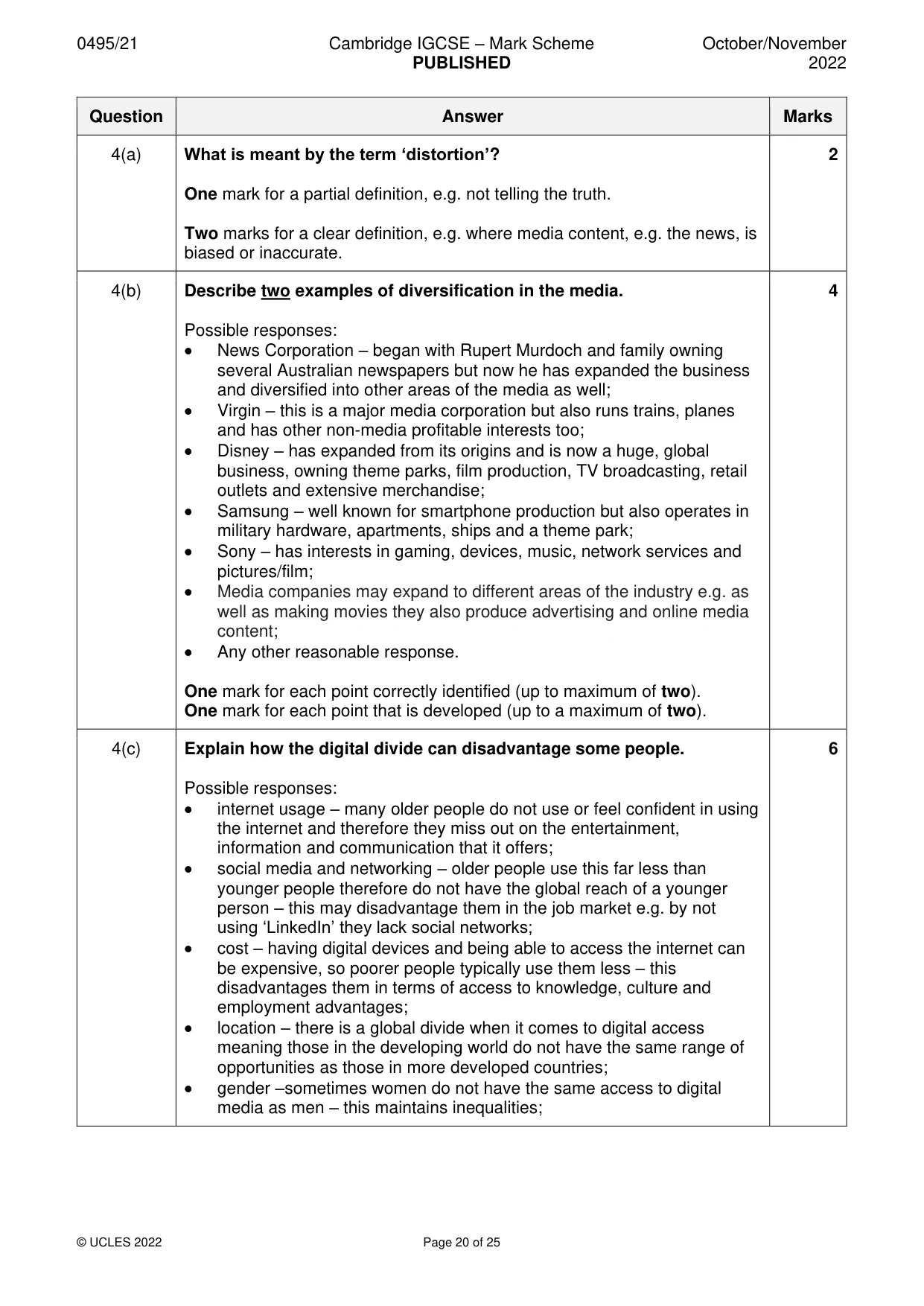
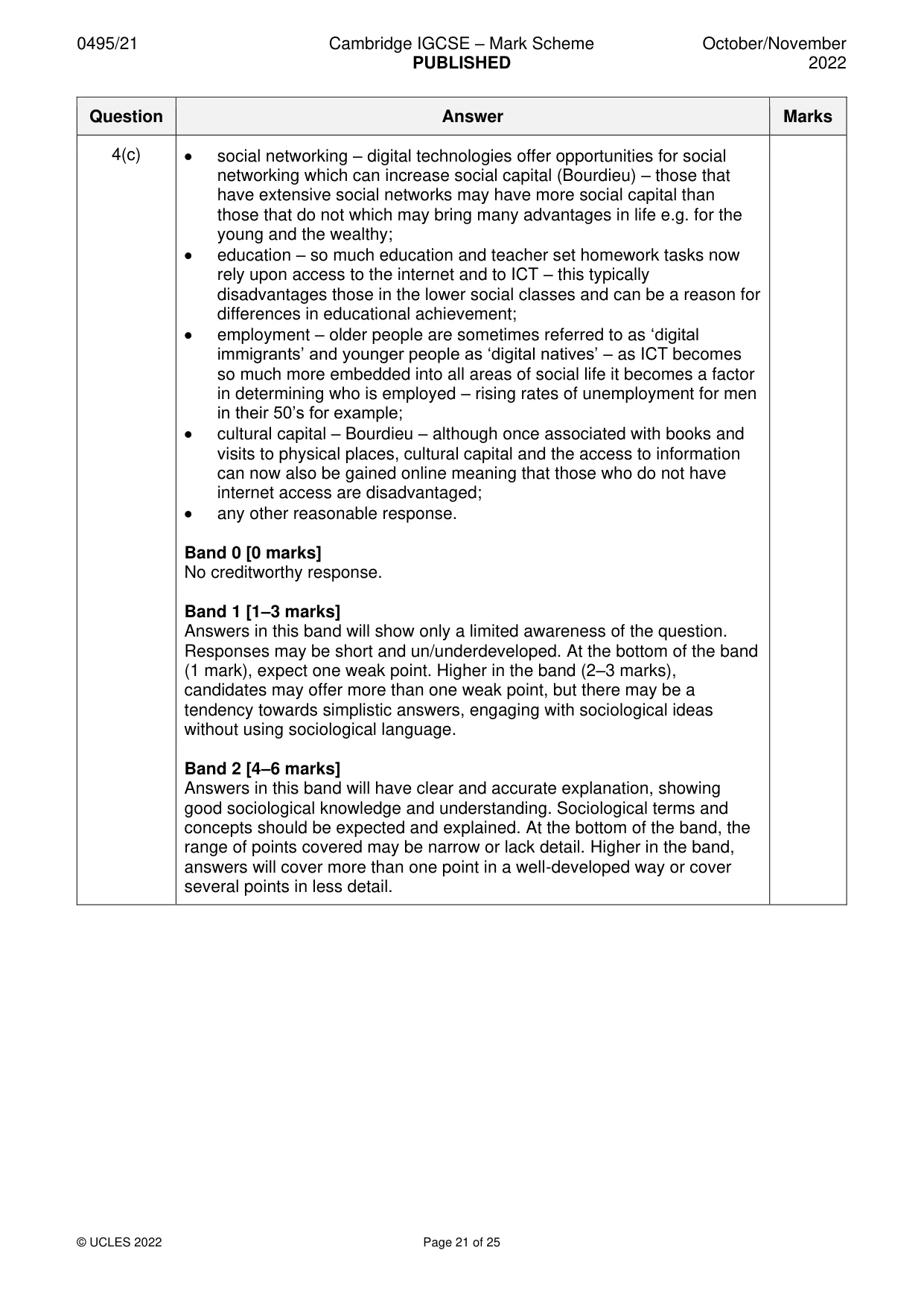
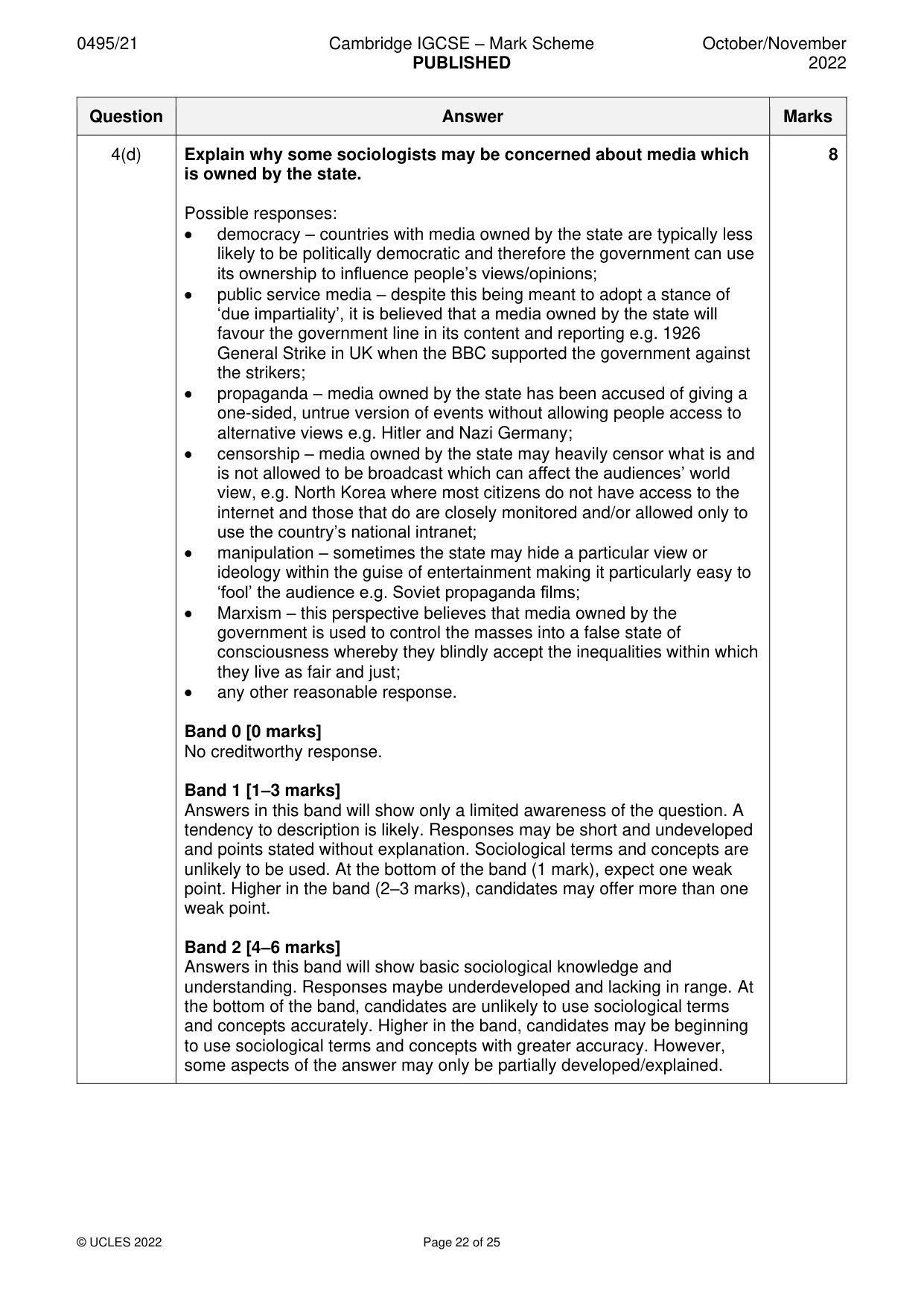
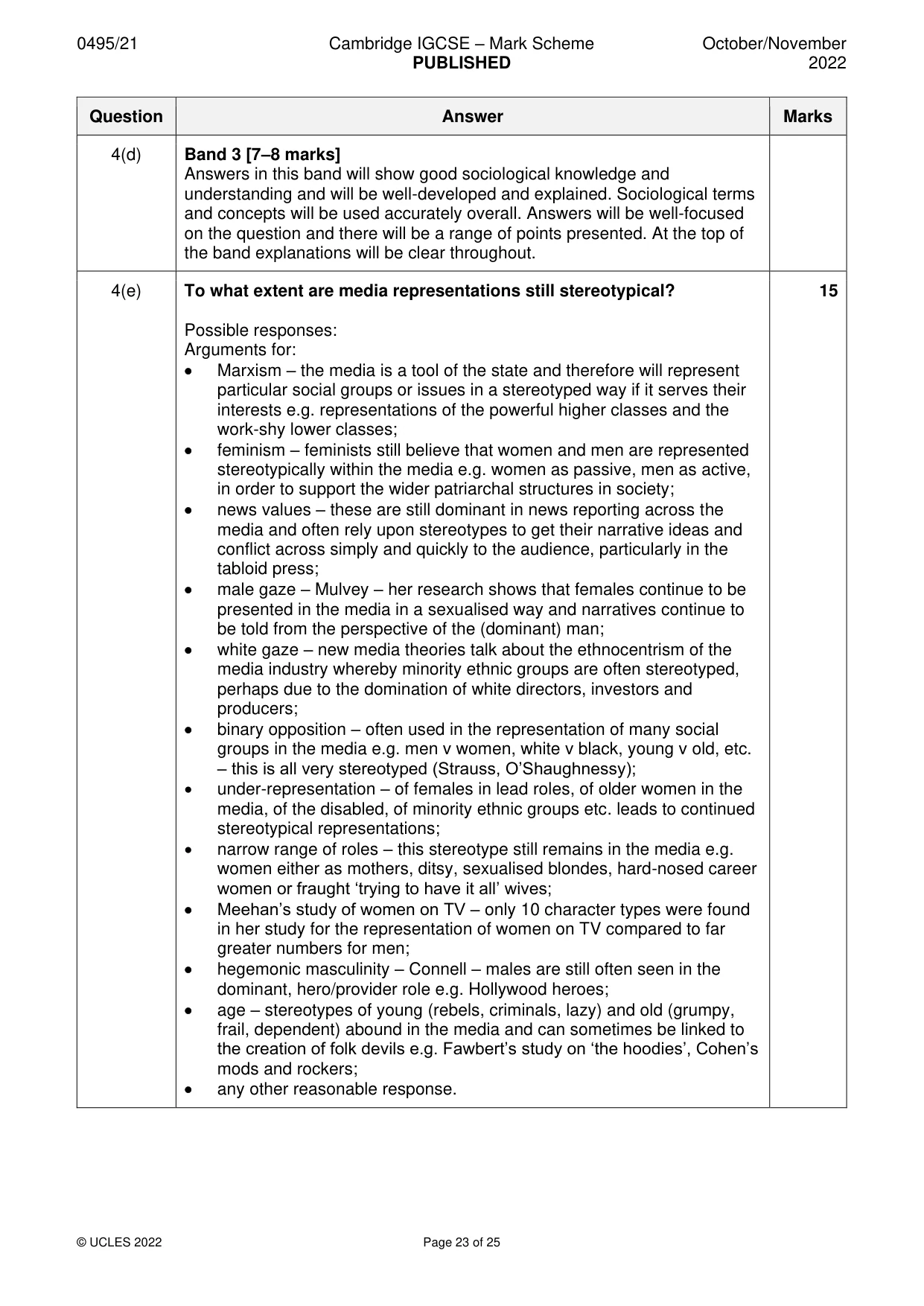
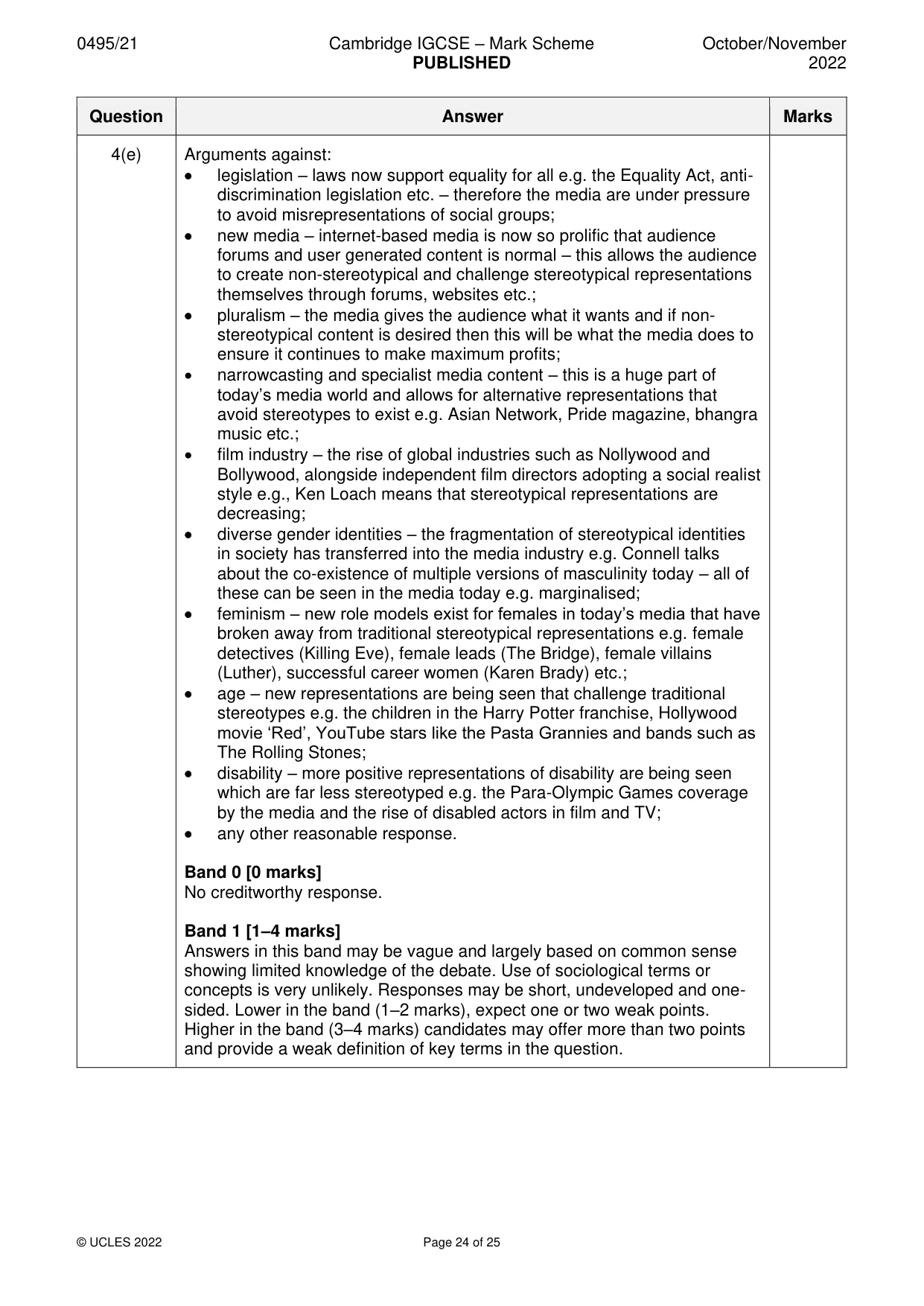
Mark scheme: 4(a) What is meant by the term ‘distortion’? 2 One mark for a partial definition, e.g. not telling the truth. Two marks for a clear definition, e.g. where media content, e.g. the news, is biased or inaccurate. 4(b) Describe two examples of diversification in the media. 4 Possible responses: • News Corporation – began with Rupert Murdoch and family owning several Australian newspapers but now he has expanded the business and diversified into other areas of the media as well; • Virgin – this is a major media corporation but also runs trains, planes and has other non-media profitable interests too; • Disney – has expanded from its origins and is now a huge, global business, owning theme parks, film production, TV broadcasting, retail outlets and extensive merchandise; • Samsung – well known for smartphone production but also operates in military hardware, apartments, ships and a theme park; • Sony – has interests in gaming, devices, music, network services and pictures/film; • Media companies may expand to different areas of the industry e.g. as well as making movies they also produce advertising and online media content; • Any other reasonable response. One mark for each point correctly identified (up to maximum of two). One mark for each point that is developed (up to a maximum of two). 4(c) Explain how the digital divide can disadvantage some people. 6 Possible responses: • internet usage – many older people do not use or feel confident in using the internet and therefore they miss out on the entertainment, information and communication that it offers; • social media and networking – older people use this far less than younger people therefore do not have the global reach of a younger person – this may disadvantage them in the job market e.g. by not using ‘LinkedIn’ they lack social networks; • cost – having digital devices and being able to access the internet can be expensive, so poorer people typically use them less – this disadvantages them in terms of access to knowledge, culture and employment advantages; • location – there is a global divide when it comes to digital access meaning those in the developing world do not have the same range of opportunities as those in more developed countries; • gender –sometimes women do not have the same access to digital media as men – this maintains inequalities; 4(c) • social networking – digital technologies offer opportunities for social networking which can increase social capital (Bourdieu) – those that have extensive social networks may have more social capital than those that do not which may bring many advantages in life e.g. for the young and the wealthy; • education – so much education and teacher set homework tasks now rely upon access to the internet and to ICT – this typically disadvantages those in the lower social classes and can be a reason for differences in educational achievement; • employment – older people are sometimes referred to as ‘digital immigrants’ and younger people as ‘digital natives’ – as ICT becomes so much more embedded into all areas of social life it becomes a factor in determining who is employed – rising rates of unemployment for men in their 50’s for example; • cultural capital – Bourdieu – although once associated with books and visits to physical places, cultural capital and the access to information can now also be gained online meaning that those who do not have internet access are disadvantaged; • any other reasonable response. Band 0 [0 marks] No creditworthy response. Band 1 [1–3 marks] Answers in this band will show only a limited awareness of the question. Responses may be short and un/underdeveloped. At the bottom of the band (1 mark), expect one weak point. Higher in the band (2–3 marks), candidates may offer more than one weak point, but there may be a tendency towards simplistic answers, engaging with sociological ideas without using sociological language. Band 2 [4–6 marks] Answers in this band will have clear and accurate explanation, showing good sociological knowledge and understanding. Sociological terms and concepts should be expected and explained. At the bottom of the band, the range of points covered may be narrow or lack detail. Higher in the band, answers will cover more than one point in a well-developed way or cover several points in less detail. 4(d) Explain why some sociologists may be concerned about media which 8 is owned by the state. Possible responses: • democracy – countries with media owned by the state are typically less likely to be politically democratic and therefore the government can use its ownership to influence people’s views/opinions; • public service media – despite this being meant to adopt a stance of ‘due impartiality’, it is believed that a media owned by the state will favour the government line in its content and reporting e.g. 1926 General Strike in UK when the BBC supported the government against the strikers; • propaganda – media owned by the state has been accused of giving a one-sided, untrue version of events without allowing people access to alternative views e.g. Hitler and Nazi Germany; • censorship – media owned by the state may heavily censor what is and is not allowed to be broadcast which can affect the audiences’ world view, e.g. North Korea where most citizens do not have access to the internet and those that do are closely monitored and/or allowed only to use the country’s national intranet; • manipulation – sometimes the state may hide a particular view or ideology within the guise of entertainment making it particularly easy to ‘fool’ the audience e.g. Soviet propaganda films; • Marxism – this perspective believes that media owned by the government is used to control the masses into a false state of consciousness whereby they blindly accept the inequalities within which they live as fair and just; • any other reasonable response. Band 0 [0 marks] No creditworthy response. Band 1 [1–3 marks] Answers in this band will show only a limited awareness of the question. A tendency to description is likely. Responses may be short and undeveloped and points stated without explanation. Sociological terms and concepts are unlikely to be used. At the bottom of the band (1 mark), expect one weak point. Higher in the band (2–3 marks), candidates may offer more than one weak point. Band 2 [4–6 marks] Answers in this band will show basic sociological knowledge and understanding. Responses maybe underdeveloped and lacking in range. At the bottom of the band, candidates are unlikely to use sociological terms and concepts accurately. Higher in the band, candidates may be beginning to use sociological terms and concepts with greater accuracy. However, some aspects of the answer may only be partially developed/explained. 4(d) Band 3 [7–8 marks] Answers in this band will show good sociological knowledge and understanding and will be well-developed and explained. Sociological terms and concepts will be used accurately overall. Answers will be well-focused on the question and there will be a range of points presented. At the top of the band explanations will be clear throughout. 4(e) To what extent are media representations still stereotypical? 15 Possible responses: Arguments for: • Marxism – the media is a tool of the state and therefore will represent particular social groups or issues in a stereotyped way if it serves their interests e.g. representations of the powerful higher classes and the work-shy lower classes; • feminism – feminists still believe that women and men are represented stereotypically within the media e.g. women as passive, men as active, in order to support the wider patriarchal structures in society; • news values – these are still dominant in news reporting across the media and often rely upon stereotypes to get their narrative ideas and conflict across simply and quickly to the audience, particularly in the tabloid press; • male gaze – Mulvey – her research shows that females continue to be presented in the media in a sexualised way and narratives continue to be told from the perspective of the (dominant) man; • white gaze – new media theories talk about the ethnocentrism of the media industry whereby minority ethnic groups are often stereotyped, perhaps due to the domination of white directors, investors and producers; • binary opposition – often used in the representation of many social groups in the media e.g. men v women, white v black, young v old, etc. – this is all very stereotyped (Strauss, O’Shaughnessy); • under-representation – of females in lead roles, of older women in the media, of the disabled, of minority ethnic groups etc. leads to continued stereotypical representations; • narrow range of roles – this stereotype still remains in the media e.g. women either as mothers, ditsy, sexualised blondes, hard-nosed career women or fraught ‘trying to have it all’ wives; • Meehan’s study of women on TV – only 10 character types were found in her study for the representation of women on TV compared to far greater numbers for men; • hegemonic masculinity – Connell – males are still often seen in the dominant, hero/provider role e.g. Hollywood heroes; • age – stereotypes of young (rebels, criminals, lazy) and old (grumpy, frail, dependent) abound in the media and can sometimes be linked to the creation of folk devils e.g. Fawbert’s study on ‘the hoodies’, Cohen’s mods and rockers; • any other reasonable response. 4(e) Arguments against: • legislation – laws now support equality for all e.g. the Equality Act, anti- discrimination legislation etc. – therefore the media are under pressure to avoid misrepresentations of social groups; • new media – internet-based media is now so prolific that audience forums and user generated content is normal – this allows the audience to create non-stereotypical and challenge stereotypical representations themselves through forums, websites etc.; • pluralism – the media gives the audience what it wants and if non- stereotypical content is desired then this will be what the media does to ensure it continues to make maximum profits; • narrowcasting and specialist media content – this is a huge part of today’s media world and allows for alternative representations that avoid stereotypes to exist e.g. Asian Network, Pride magazine, bhangra music etc.; • film industry – the rise of global industries such as Nollywood and Bollywood, alongside independent film directors adopting a social realist style e.g., Ken Loach means that stereotypical representations are decreasing; • diverse gender identities – the fragmentation of stereotypical identities in society has transferred into the media industry e.g. Connell talks about the co-existence of multiple versions of masculinity today – all of these can be seen in the media today e.g. marginalised; • feminism – new role models exist for females in today’s media that have broken away from traditional stereotypical representations e.g. female detectives (Killing Eve), female leads (The Bridge), female villains (Luther), successful career women (Karen Brady) etc.; • age – new representations are being seen that challenge traditional stereotypes e.g. the children in the Harry Potter franchise, Hollywood movie ‘Red’, YouTube stars like the Pasta Grannies and bands such as The Rolling Stones; • disability – more positive representations of disability are being seen which are far less stereotyped e.g. the Para-Olympic Games coverage by the media and the rise of disabled actors in film and TV; • any other reasonable response. Band 0 [0 marks] No creditworthy response. Band 1 [1–4 marks] Answers in this band may be vague and largely based on common sense showing limited knowledge of the debate. Use of sociological terms or concepts is very unlikely. Responses may be short, undeveloped and one- sided. Lower in the band (1–2 marks), expect one or two weak points. Higher in the band (3–4 marks) candidates may offer more than two points and provide a weak definition of key terms in the question. 4(e) Band 2 [5–8 marks] In this band candidates will show some basic knowledge of the debate. Alternatively, they may offer an answer which is list-like in nature but there will be no real attempt to assess the issues raised by the question. There may be limited/some use of sociological terms or concepts. Responses may be underdeveloped and lack range. Answers may be simplistic and two- sided or only cover one side of the debate. Lower in the band, the response may be rather narrow in the points covered and there may be some development. Higher in the band, more points are likely to be covered with some development. Alternatively, a list-like answer with some development covering both sides of the argument may score up to 8 marks. A one-sided answer cannot score higher than 8 marks. Band 3 [9–12 marks] Answers in this band will show good sociological knowledge and understanding of the debate. Sociological terms and concepts will be used with greater accuracy and/or frequency. For the most part, answers will be well-developed, focused on the question and there will be a range of points presented. There will be a two-sided response but it may lack range on one side. At the bottom of the band, candidates may provide a narrower range of developed points. At the top of the band, expect a wider range of developed points and clear focus on the question. Band 4 [13–15 marks] Answers in this band will show excellent knowledge and understanding of the debate. There will be a strong grasp of the arguments as well as accurate and frequent use of sociological terms and concepts. Answers will be well-developed, clearly focused on the question and discuss a wide range of points. Responses will be two-sided and have a range of points on each side. At the bottom of the band (13 marks), the answer may lack a specific conclusion. Higher in the band, there will be a clear attempt to offer an assessment of the ‘To what extent.?’ part of the question through a focused conclusion.
What was in this paper
The subtopics covered by these 4 questions, and how many questions each got. Open one in a new tab to see every Cambridge question on it.
What you needed in this session
Cambridge’s own grade thresholds for 2022 Oct/Nov, Paper 2 · Variant 1. A higher threshold means an easier paper — the bar moves with how the cohort did.